


BY GRANT JOHNSON
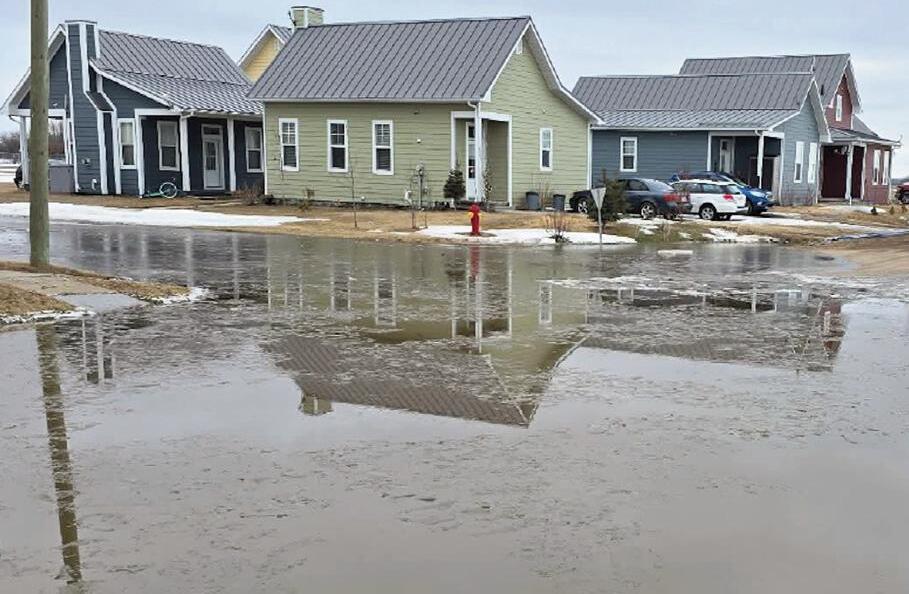
Residents in Chipman are dealing with the aftermath of repeated flooding events, with some homeowners now raising concerns about how the situation was handled and whether more could have been done to prevent damage.
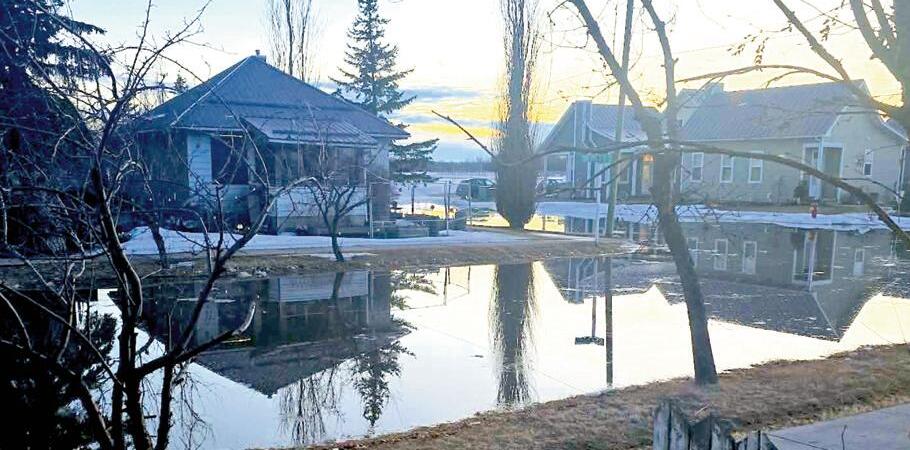
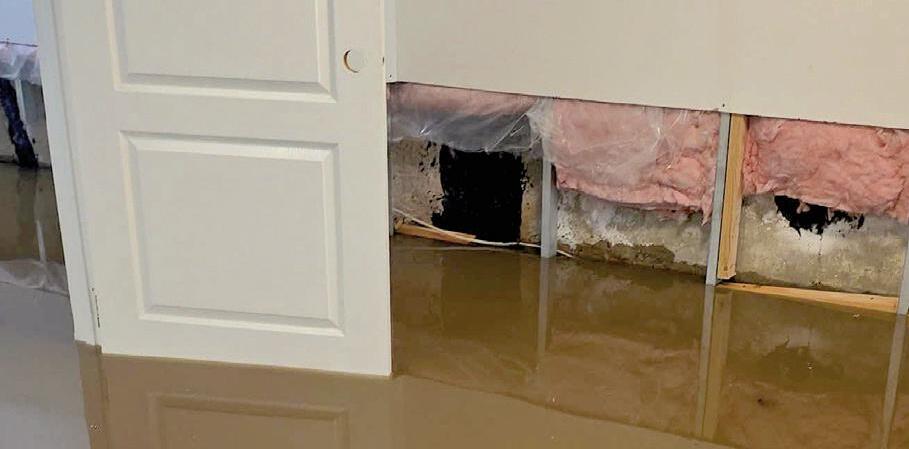
Christina Coutts says her troubles began on March 17, when she noticed a large pool of water outside her home, estimated to be about two feet deep above a nearby manhole. According to Coutts, town workers opened the manhole, which she believes caused water to back up into her basement.
“At that time, our property was the only one severely affected,” she said, adding that the manhole appeared to be functioning properly and should not have been opened.
Once workers saw the flooding inside her home, she says they closed the manhole, which stopped the flow of water. Coutts noted that if she and her husband hadn’t been home, the damage could have been far worse.
The couple is now working through the Village’s insurance process in hopes of recovering their losses.
However, the issue did not end there. Roughly two weeks later, on April 4,
flooding returned—this time impacting multiple homes in the community. Several residents reported sewage backing up into their basements, rais-
sewage.
According to Coutts, she also spoke directly with the provincial environmental health minister, who she says
ing serious health and safety concerns.
Coutts says she reached out to multiple officials as the situation escalated, including the area MLA, the CEO of Alberta Health Services, and the Village’s Chief Administrative Officer.
She also contacted an environmental health officer due to the presence of
became involved ahead of local leadership, including the mayor and public works department.
During the April 4 incident, the mayor acted quickly to bring in several pumps to move water out of affected areas. At the same time, crews worked to thaw a frozen culvert believed to be
contributing to the problem.
Despite those efforts, Coutts believes more could have been done sooner. She says she suggested bringing in a hydrovac truck to remove standing water, but that recommendation was not acted on. As a result, she says water remained in the area longer than necessary, contributing to further basement flooding.
Village CAO Pat Tomkow confirmed Coutts’ flooding issues and that the Village hired a hydro vac truck to come in, but because of delays the truck took five hours to get there
In the meantime, Coutts and her husband paid out of pocket to have water removed from their basement.
The situation also left some residents unable to flush their toilets during the height of the flooding, adding to the disruption and concern across the community.
As cleanup continues, residents are now looking for answers and assurances that steps will be taken to prevent a similar situation in the future.
Tomkow said the Village is having a high level meeting this afternoon to go over the response, to discuss what was done, and what could've been done better
BY MELISSA MACINTOSH-YOUNG
Residents in communities northeast of Edmonton experienced an unexpected jolt on the evening of April 1, as a minor earthquake struck near Gibbons and surrounding areas.
According to Earthquakes Canada, the quake occurred at approximately 5:27 p.m. local time and registered a magnitude of 4.5. The epicentre was located about 18 kilometres northeast of Morinville at a relatively shallow depth of five kilometres.
The tremor was lightly felt across several nearby communities, including Gibbons, Legal, Bon Accord, and even parts of Edmonton. Reports also indicated the shaking was noticed as far south as central Alberta and in more distant regions such as Whitecourt and Lesser Slave Lake.
Despite the wide area in which it was felt, there have been no reports of damage or injuries. Experts note that while earthquakes of this size are not common in the region, they are not entirely unusual. Alberta does ex-
perience occasional seismic activity, often too small to be noticed, but events of this magnitude can be felt by residents, especially when they occur close to the surface.
For many locals, the timing of the quake—on April Fools’ Day—led to initial confusion, with some unsure whether the shaking was real or a prank. However, the event was quickly confirmed by seismic monitoring agencies.
While minor, the earthquake serves as a reminder that even areas not typically associated
Frequency Rise: Earthquakes averaged 19 per year (1985–2005) but increased to over 290 annually after 2006 in Alberta.
Magnitude: 98.4% of earthquakes are magnitude 3.5 or less.
Largest Recorded: A 5.6 to 5.8 magnitude earthquake occurred in November 2022 near Peace River.
Common Locations: Seismic activity is concentrated along the Rocky Moun-





tains, foothills, and the Peace River Arch.
Causes: Both natural tectonic stress and induced seismicity (related to energy industry activity) cause earthquakes in the province.
Risk Level: Despite increased frequency, Alberta's earthquake risk is generally classified as low with the majority undetectable to the average Albertan.
with seismic activity can experience sudden ground movement. Monitoring agencies continue
to track activity in the region, encouraging residents to report any future tremors they may feel.

No aftershocks of significance have been reported as of yet.

































































































































BY JOHN MATHER
After reading and watching snippets and news stories regarding the National NDP leadership convention held in Winnipeg more than a week ago, I have a couple of observations.
Firstly, I have no faith in the election of Avi Lewis to the leadership of the party.
Essentially, the Federal NDP are dead in the water after the disastrous tenure of Jagmeet Singh.
And Lewis’ ultra left wing approach to no fossil fuels development, government run and subsidized grocery stores, and all his other socialist writings and ramblings don’t give me any optimism the NDP is about to improve its seat count in parliament.
And the silly display put on by different coloured card carrying delegates over speaking priority, arguing gender identity issues during the policy sessions made a comedic display which had social media going crazy.
The moderator of the sessions couldn’t even say the word “straight” as in “stand in a straight line” without rolling she/her/them/their eyes.
She did make sure everyone understood she was “non-binary.”
And waving a Palestinian flag on stage with no Canadian flags in sight, as Lewis made his victory speech also doesn’t bode well for what wants to pass as a credible Federalist Canadian national party.
I grew up during Lewis’ grandfather’s tenure at the helm of the Federal NDP. I didn’t like his left leaning direction. I was never a fan of his father, Stephen Lewis either, although it’s obvious he was held in wide respect by the comments that were posted on his passing last week.
It’s very obvious the apple hasn’t fallen far from the tree with Avi Lewis.
He has no seat in the House of Commons and it’s obvious he’s not in a hurry to get one.
There are currently three federal by-elections underway which will probably result in an unelected majority government for the Liberals when the dust settles and the votes are counted.
Lewis has stated he will be busy rebuilding the NDP brand.


Well he does have the support of Manitoba’s Wab Kinew and Ontario provincial party leader Maria Stiles.
But the B.C. premier David Eby is having mixed emotions.
“We will work with anyone and any federal leader who shares our priorities, and stand firm against those who put that progress at risk,” he said.
Well Lewis doesn’t agree with that.
Saskatchewan provincial NDP leader Carla Beck penned a letter to Lewis where she said she wouldn’t meet with him.
“The positions you have taken when it comes to natural resource development are ideological and unrealistic,” she wrote. “They would hurt Saskatchewan workers, communities, and industries.
“When you publicly reverse your decisions on these matters and show a willingness to try to understand the realities of our province and the thousands of proud Saskatchewan workers who rely on our industries to feed their families, I will meet with you,” the letter concludes.
Alberta NDP leader Naheed Nenshi also attacked Lewis on social media after his victory last Sunday.
“It is clear that the direction of the federal party under this new leader, someone who openly cheered for the defeat of the Alberta NDP government, is not in the interests of



Alberta,” Nenshi wrote on X.
“Last year, Alberta’s New Democrats voted overwhelmingly to make membership in the federal party optional. Many thousands of our provincial members, including myself, are not members of the federal party. We are a big tent and welcome the support of people who vote for every federal party.”
But I expect the beneficiary of some of this Alberta discontent with the Federal NDP will result in a positive outlook for the Progressive Tory Party of Alberta.
Currently led by former UCP MLA Peter Guthrie, I expect it will pick up disgruntled provincial NDP supporters who see no future in the Nenshi leadership, and also won’t see anything positive in the new federal leader. If he plays his cards well, the centrist Tory Party could siphon off this support. But first the party, formed out of the ashes of the Alberta Party, needs to get an identity.
Now Guthrie is to be at a meet and greet in Fort Saskatchewan April 14. Former MLA Jackie Fenske is promoting the $20 event and selling tickets, but she hasn’t publicly stated where it will be held.
Is this a secret? If you want to promote and grow a party, throw those doors open to anyone and let people know where it will be held so they can decide if they want to attend.
The Fort Saskatchewan Vegreville constituency did elect an NDP MLA in 2015 as part of the Notley government and maybe some of those supporters may want to attend.







By Hazel Anaka
In a few short weeks
I’ll be manning my table at the Wildrose Antique Show in Edmonton. The two-day show starts Friday evening and ends Saturday. An awful lot has to happen at my end before that weekend.
I have vague memories of that show from decades ago. The sale venue seemed gigantic in size, the number of sellers enormous, and the prices higher than I could afford. In recent years I've attended the show twice at the Edmonton Inn & Conference Centre. It spills over two ballrooms and is accessible with free parking. If anything makes my day, it’s free parking!
Each time I found many things I loved enough to buy. I’m far more knowledgeable and worldly (hah!) now so I
have a good feel for what’s a reasonable price. But, as we all know price makes up just one part, albeit an important part, of the purchasing decision. When we’re talking about items with sentimental or nostalgic qualities, all bets may be off. Men will spend big money buying (rebuying) the muscle car of their youth because of the memories it evokes and how it makes them feel--young, virile, successful. Likewise for the woman who may remember vintage outfits she wore, kitchen doodads her mother used, and toys she cherished. I’ve often written about the appeal of strolling through an antique mall seeing books, board games, toys from my past or even that of my children. It’s really best not to do the math and realize what you once used and loved is now an antique or at minimum vintage. By some definitions items are considered vintage if they’re at least 25 years old. That’s only 2000; heck that’s practically yesterday. An antique on the other hand is at least 100 years old. This show expects items at least 50
years old, in other words from 1976.
So, in addition to the basics like a table cloth, cash float, signage, and display aids I need to figure out what I’m going to sell. I’ll want a variety of price points to broaden the appeal of my booth. With a $225 table rental fee, selling a few expensive items or many, many cheaper ones will be required or some combination thereof. Clearly to cover the out-of-pocket costs of table fee, fuel, food plus turn a profit I’m gambling that what I have someone else will want. The other tricky thing is to have just enough merchandise just like Goldilocks’ porridge, bed, chair. Not so much that I break my body packing, hauling, setting up, and dismantling or so little that the display looks skimpy and pathetic. It’s a fine line. I need to make up some business cards just in case. Most items need to be packaged and priced. For many of them I’ll need to do some online research as well. If possible, I will stage a mock setup of my display so I can see how much is enough. If a physical mock up isn’t possible,


Rev. Carolyn Woodall
AM
April 17th 5-7pm Ham & Scalloped Potatoes
I’ll do a diagram at least. I may take my risers to bring my table up to a more viewer-friendly height.
Since it’s during seeding time, I’ll be on my own for schlepping and hauling. I intend to use wheeled suitcases to carry my stuff. Pulling them across a parking lot and through a hotel will save me. It will also keep my stuff secure until it’s
all inside the venue and I can begin set-up. Hilary has agreed to help me at some point during the weekend. When you’re a solo act, you either need to make friends with a fellow vendor who’ll watch your area during bathroom breaks or be able to cross your legs indefinitely.
The other test of endurance will be maintaining a positive, upbeat
sense of engagement especially when one is an introvert. I can and will do it but it will take everything out of me. Thankfully, I like and can talk to all kinds of people because that’s what it takes at a show like this. The reason I’m doing all this is to make up for the US market I’ve lost through Trump’s tariffs. Let’s hope it’s worth the blood, sweat, and tears from where I sit.

A$20 6-12$10 <6FREE CHECKOUTOURNEWFACEBOOKPAGE!! Everyone Welcome! AA Meetings Thursdays at 8:00 pm Bruderheim Community Church 4904 Queen Street 780-796-3775
BY GRANT JOHNSON
After a few quiet years on the diamond, youth baseball is making a comeback in Andrew.
The last season was played in 2021, but now there’s new life thanks to strong early interest from local families.
Organizers say a recent community survey brought in enough responses to get things rolling again.
Plans are already in motion to launch a Blast Ball program for kids under 5 and a Rally Cap league for ages 7 and under.
There’s also hope to build U9 and U11 teams if more players sign up in the coming weeks.
“We were really happy with the interest we saw,” said organizer Katlyn Lamash. “It shows people want this back.”
Right now, volunteers
are working through the details of restarting the program after several inactive years. Registration forms are expected to be available early next week.
An information night is planned for April 12 at 6 p.m. at the Andrew Arena, giving parents a
BY JOHN MATHER
After winning her first game back in the Vancouver net after a five-game absence for injury, Bruderheim’s Emerance Maschmeyer and her Vancouver Goldeneyes squad couldn’t repeat when they played the Montreal Victoire on April 1. Montreal clinched a playoff position with a convincing 3-0 shutout.
Maschmeyer stopped 25 of the 26 shots she faced, while Ann-Renee Desbiens faced only 18 shots in the Montreal net.
On April 4, the Goldeneyes welcomed Minnesota to the Pacific
Coliseum but dropped a 6-5 decision.
Maschmeyer had a strong game, facing 35 shots and stopping 29 of them.
The Goldeneyes fired 25 shots at Frost goalie Nicole Hensley.
Sarah Nurse opened the scoring for the Goldeneyes from Sophie Jaques and Hannah Miller at 1:18 of the opening frame.
That lead was shortlived as Minnesota came back with two quick goals from Grace Zumwinkle and Katy Kroll.
But Vancouver fought back and with goals from

Tereza Vanisova and Sophie Jaques as the Goldeneyes took a 3-2 lead to the dressing room after 20 minutes.
Jenn Gardiner scored at 3:30 of the second to give the Goldeneyes a two goal cushion, but before the end of the frame, Minnesota came back to tie the score on goals from Mae Batherson and a power play marker from Taylor Heise.
Minnesota kept the pressure on in the third period as a pair of power plays resulted in goals from Kelly Pannek.
Izzy Daniels got a late goal for Vancouver with 53 seconds left on the
clock but it wasn’t enough.
The loss gave Minnesota a sweep of their season series with Vancouver.
The Goldeneyes were back on the ice last night (April 7) hosting Boston and then they have a week off before they host Seattle April 14.
chance to learn more and ask questions.
Organizers say community support will be key to making the season a success — especially when it comes to volunteers.
“We’re always looking
for parents to help coach and assist on the field,” Lamash said. If all goes as planned, kids in Andrew will once again be stepping up to the plate this spring.
Estate of Robert Nemirsky who died on February 23, 2026
If you have a claim against this estate, you must file your claim by: May 8, 2026 and provide details of your claimwith
Christine D. Maloney
Weary & Company Law Office #400, 30 Green Grove Drive St. Albert, AB T8N 5H6
If you do not file by the date above, the estate property can lawfully be distributed without regard to any claim you may have.
Weary & Co. Law Office, Barristers & Solicitors
Flagstaff Waste is a full-service waste collection, transportation, and landfill service for 10 municipalities with an annual operating budget of nearly $3.0 million. Our mission is to provide an efficient, environmentally sensitive, cost-effective, and professional waste service to all residents within the collection area.
Flagstaff Waste is currently seeking a motivated individual to lead staff and oversee all company activities including waste bin rentals/collections operations, curbside waste collection, multi-stream recycle collection, processing, sorting and marketing, transfer site operations and all activities related to operating a Class II landfill for 10 municipalities within Flagstaff County.
Duties:
•Business planning, budgeting and financial controls with a view to long-term strategic goals.
•Develop, maintain and ensure compliance with internal Human Resources, Audit & Finance, and Health & Safety Policies with focus on staff retention in a safe workplace culture.
•Coordinate direct reporting and feedback with a Board of Directors representing 10 partner municipalities making up this not-for-profit Society.
•Ensure legislative compliance for all regulated matters related to environment, WCB, Solid Waste Association regulated requirements, maintain registrations and Code of practices related to Landfill operations, trucking, OH&S and Alberta Employment standards.
•Lead a multi-disciplinary team employing HR goal setting and performance review processes that ensure high productivity and safety with end goal of optimized efficiency. Negotiate high value health benefits, pension plans and insurance products for staff and the company.
•Manage heavy equipment and trucking fleets with maintenance programs, and right-sized replacement plans. Enable GPS systems to manage routes and for driver safety.
•Continually grow customer base through marketing, relationships and service.
•Annual reporting as required to Alberta Environmental Protection, Canada Composting Council, WCB, CRA, GST, Annual Financial Audit, Federal Green House Gas, etc.
Qualifications:
•Progression in employment history, demonstrating leadership and management skills.
•Strong social skills with a track record demonstrating positive work relationships with staff, vendors and customers. Demonstrate ability to develop long term solutions that work favorably for all parties.
•Proven understanding of business principles and communicating progress using standard business reporting.
•Organized, computer literate and ability to make highly productive use of time.
•Applicants with work history within the waste industry and/or previous landfill operations experience are preferred. Applicants willing to relocate to Flagstaff County preferred.
•Manager of Landfill Operations (MOLO) certification required within 1 year of hire.
Flagstaff Waste offers a dynamic workplace with a culture of strong customer service. We provide a competitive salary and a full benefit package including enrollment in a ‘defined benefits’ pension plan.
If you wish to join our exciting team, submit resume to: admin@flagwaste.ca or by mail to Box 309, Sedgewick, AB, T0B4C0.
The Feds announced plans to close the Lacombe Research Centre, which is disappointing.
This Research Centre is agriculture based and has served the various agriculture communities and sectors for umpteen years. Like other stations across Canada, the Lacombe Centre served as a key resource for farmers, providing research-based knowledge that enhanced their operations and improved the quality of their products.
Today the Canadian farmer ranks above average globally, thanks to the various research stations which were the catalysts in “making” the farmer of today.
Although often overlooked, the Lacombe Research Centre was instrumental during design and certifying devices used to build the internationally recognized High Containment Laboratory in Winnipeg, now known as the Canadian Science Centre for Human and Animal Health (CSCHAH).
I became aware in mid 80s the Feds were planning to build a combined human – animal high containment laboratory. With this knowledge we decided to pursue this project. As CEO of Hemisphere Consulting Engineers, I met with various scientists in Ottawa to discuss that Hemisphere employed skilled mechanical and electrical engineers, backed by qualified technical staff with extensive expertise.
Soon after the conclusion of the numerous trips the Feds issued a Canada-wide qualification call for architectural and engineering firms who they felt had the qualification to submit.
As the Principal-inCharge, I collaborated with our team to develop a proposal that met all
the requirements as well enhanced the submission on how Hemisphere’s design of systems would improve the operation in this laboratory. The proposal was submitted on time, and Hemisphere made the shortlist. Upon further interview presentations, Hemisphere was selected as the mechanical and electrical consulting engineer. Smith Carter of Winnipeg was chosen as the architectural firm, with the late Jim Orzechowski serving as Principal Architect. Soon after the official award of the contract Hemisphere quickly recognized the need to test various reference products to be specified for both mechanical and electrical engineering tasks to ensure that an evolution of design would be realized. Since Lacombe is a research facility near Edmonton, the federal government approved converting part of the Centre into a small high-containment mockup lab.
During the design phase, the finished construction document included both drawings and specifications. The various products we were basing the design on were described in the specification document. In our mechanical and electrical design, we worked diligently to advance both technology and methodology for operating this high-level containment laboratory (HCL). Our aim was also to make sure every system was designed and constructed to the highest possible standard. During the progression of the design, every device to be specified was tested at the mock-up lab in Lacombe.
At the HCL, all liquids and solids—including animal carcasses from the CSCHAH—are placed in
a large cooker (three are located in Winnipeg), cooked for 48 hours, cooled down, and then discharged into the Winnipeg municipal sewer system. Unfortunately, the testing of a huge cooker was not feasible in the Lacombe mock-up laboratory and during the tendering phase cooker suppliers had to submit certified test results to obtain approval.
Following the completion of the architectural, structural, mechanical, electrical, civil, and landscape construction documents, the project proceeded into an extended tendering phase. During the tendering phase, multiple suppliers sought product approval from Hemisphere. Only Hemisphere approved products (related to M&E) were permitted to be included in the contractor's construction tender.
Nearly all mechanical and electrical devices were able to be tested at the Lacombe Research Centre, except for the cookers. We assessed cooker submissions from North American suppliers using certified factory performance reports; however, a German manufacturer requested approval for their cooker.
The submission material of the German built cooker indicated their cookers were of superior built and had better mode of operation. To ensure of a proper assessment a visit to their factory was essential.
After notifying the German manufacturer, I commenced the visit accompanied by the late project architect Jim Orzechowski. Our travel itinerary included stops in Amsterdam and Bern, Switzerland, followed by high-speed rail transit to Munich, Germany, where the manufacturing plant
sign CSCHAH is operating extraordinarily well. Incidentally evolution took place architecturally as well. This laboratory of the year of proven operating systems became the Icon of high containment labs globally.
is located. After several days of reviewing and viewing the devices in an operation mode, an approval was granted for this company to submit their quote to the various contractors pricing the holistic value of this project.
On the return trip, the animal high containment Bern lab was toured with much feedback from their scientists.
Throughout the design and construction phases and until the handover of the newly constructed laboratory to Health Canada, Canada Health maintained a small team led by an engineer to oversee the design progression of the project.
Firstly, he was ticked off that he was not approved by Health Canada to take part in the trip to Germany, fast forwarding approximately 4 years, with the German cooker being a component of the successful contractor’s bid a testing methodology was put into play. The high containment part of the overall lab was filled with HCL type additives to the liquid and water to replicate a functional lab draining into the cooker.
In addition, since a large component of the Winnipeg lab is animal, a laboratory replicated dissected hog was also placed into the cooker. When the test began, attended by half a dozen scientists, the Fed engineer joked that if the test failed then I will have to eat a bite of the cooked hog; if the test succeeded to meet the requirements, he would have to eat a piece of hog. Once the cooker was cooled down (about 12 hours) the crowd watched with delight as he chewed on a piece of the hog.
The evolution of Hemisphere’s mechanical and electrical engineering de-
A tribute to Lacombe Research Centre by permitting Hemisphere and the rest of the design team on the willingness to participant utilizing their facility during the design and tendering phases. Without Lacombe participation the evolution of Hemisphere’s design with the products to be specified could not be tested before specifying. This lab the CSCHAH, has become the global Icon.
Within a year of the Winnipeg completion Hemisphere was invited by an American multidiscipline architectural/engineering firm in USA to associate with them for a high containment laboratory project for Center of Disease Control (CDC) in Atlanta, Georgia which we accepted. After submitting the team credentials and acing the interviews, our team was chosen to be the architects and engineers to provide the design and construction inspection for this high containment high rise lab. Design, construction, and commissioning took about six years.
The newly built CDC HCL was earmarked to be destroyed in the 9/11 by foreign destruction plan however, during the flight the American pilot was replaced in a struggle by a foreign pilot. Then as the flight continued, the passengers were able to disable the foreign pilot, sadly in the process the airplane crashed a long distance from the CDC lab killing all in the plane. This lab like the Winnipeg lab also is performing well. It should be stated that HCLs do research on various including deadly pathogens which when exposed into the public are weapons. For a decade, the team— Hemisphere included— was engaged in designing numerous high-containment labora-
tories throughout the United States, as well as projects in Germany, Mexico, and Paraguay. Despite ongoing concerns about the migration of our intellectual property and obtaining legal counsel advice, transfers continued. As the largest U.S. Army military base approached completion—with its high containment design over 95% finished—reality became apparent. The American team obviously with a strategy that the migration of Hemisphere’s intellectual property was completed decided to divorce themselves from the Canadian Hemisphere design team. Hemisphere’s intellectual property currently has been absorbed into many American consulting engineering firms. Technical research at Lacombe Research Centre, combined with Hemisphere's engineering expertise, contributed significantly to creating a safer, more innovative high-containment research facilities for scientists. Obviously, the migration of Hemisphere’s knowledge and expertise is now global. As the retired CEO of Hemisphere Engineering and Principal-in-Charge of this highly technical project, I want to express my appreciation to the Lacombe Research Centre should NOT be closed. The development of an advanced high containment design depended on this facility's capacity for testing and acquiring knowledge. I also thank all the Canadian and American scientists whose feedback shaped the design process, as well as Fed Health for supporting renovations at the Lacombe Research Centre to create a mock-up lab. These combined efforts led to the creation of the best High Containment Laboratory, which now operates in full alignment with scientific needs. Thank you Lacombe Research Centre,
By John W Chomiak, Retired CEO Hemisphere Engineering,
APEGA Honoray Member, Principal Emeritus, FCSC The Lamont Leader (Lamont, Alberta),
BY MELISSA MACINTOSH-YOUNG
A pair of familiar names in Lamont Minor Hockey are preparing for an unforgettable moment on the provincial stage— only this time, they won’t be sharing the same bench.
After years of skating side-by-side, Cole Chudyk and Chael Whaling are heading to the
2026 Alberta Cup, each earning a coveted spot among the province’s top young hockey talent. Selected by Hockey Alberta, the two athletes are now set to compete against one another.
For as long as they can remember, Chudyk and Whaling have been teammates—growing up together in Lamont, developing their skills,

and building chemistry on the ice year after year. That long-standing partnership makes this next chapter all the more exciting, as the longtime teammates now become rivals.
The 2026 Alberta Cup, part of the Spring Showcase presented by Direct Energy, will feature 120 of the province’s top male athletes. Players have been divided into six teams representing the North, Central, and South regions, with two teams from each region competing in a modified round-robin tournament.
The event takes place April 23–26 at the Gary W. Harris Canada Games Centre in Red Deer, where scouts, coaches, and fans will gather to watch Alberta’s rising stars battle it out. Each roster is carefully built, featuring two goal-



tenders, six defencemen, and 12 forwards—making every selection a significant achievement.
For Chudyk and Whaling, being selected is a testament to years of dedication, long hours, and a shared passion for the
game. Now, instead of working together toward a common goal, they’ll be pushing each other from opposite sides of the ice—just as they have done throughout their journey.
No matter the outcome, Lamont will be cheering loudly for both. Because whether they’re teammates or rivals, Cole Chudyk and Chael Whaling are proof that smalltown roots can lead to big-league dreams.









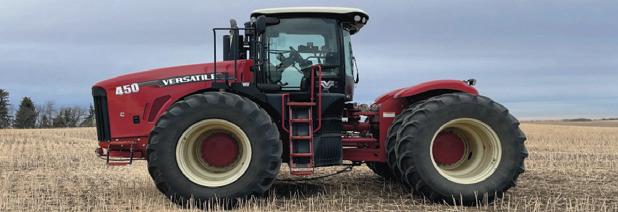
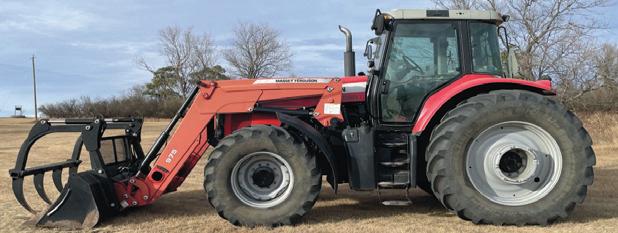
●2009 MASSEY FERGUSON 7490 MFWD tractor w/ FEL, 8½ ft. bucket, & grapple, 10,286 hours, 168 hp.
●1984 JOHN DEERE 4450 tractor w/ FEL, 8 ft. bucket, & grapple, 158 hp., 16,130 hrs., 3 hyd’s, powershift.

●2016 ROGATOR RG1100B 120 ft. sprayer 2,567 engine hours, 315 hp., 1100 gal. SS tank, Raven Viper 4, GPS, crop dividers, VF380/90R46 tires, + MORE! ●(4) MITAS 650/65R38 fat sprayer tires w/ rims.
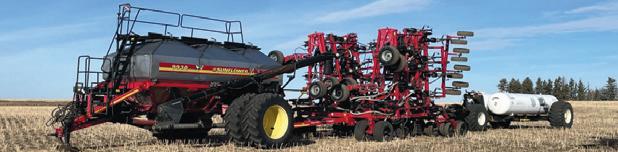
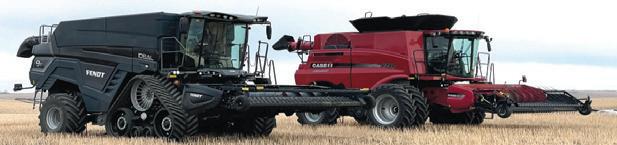
●2012 CONCORD Amity 6015 air drill w/ 2014 Sunflower 9930 TBT air cart, 60’, 1000 lb trip, + MORE!
●TOR-MASTER NH3 4000 gal. anhydrous cart.
●(2) 1998 CASE IH 56 ft. air seeders w/ Concord air carts.
●1997 CASE IH 3400 PARTS air cart, no auger.
● AGRO-TREND 4102D 3 pt. hitch snowblower, 102” wide, 540/1000 pto. ●HLA bale spear w/ homemade extension to pick square bales –fits Merlo ZM2 bracket. ●HLA pallet forks w/ skid steer mounting plate. ●HLA bale spear. ●Bale fork –fits John Deere 4450. ●10 Wheel 3 pt. hitch ‘V’ hay rake. ●MacDon center drum parts assembly, was on a MacDon FD145 header. ●Hobart 10,000 welder. ●Aqua flow air compressor / gen. / welder. ●(6) Flagro heaters. ●Frost Fighter heater. ●± 75 Pallets of tools / farm items. ●




●2015 DEGELMAN Pro-till 40 ft. high speed disc.
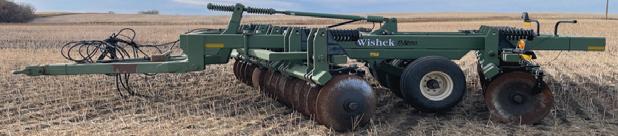
●2012 WISHEK 842N 14’ heavy duty offset t/a disc
●2012 BRANDT 8200 heavy harrow, 82’, 5/8” tines.
●2013 DEGELMAN 7200 bat reel rock picker.
●FRIGGSTAD 40 ft. cultivator w/ 3 bar harrows.
●MORRIS CP731 cultivator w/ 3 bar harrows, 31’.
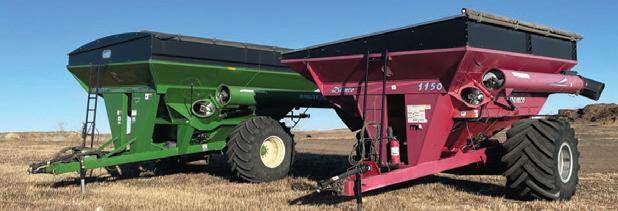
●2014 DEMCO 1150 s/a grain cart w/ scale, roll tarp.
●2012 BRENT 1082 s/a grain cart w/ scale, roll tarp.
●2017 AKRON GTT 4010 grain bagger, 540 pto.
●2010 AKRON 300 10’ grain bag extractor, 540 pto.
●GBR 100 skid steer grain bag roller, hydraulic drive.
●1997 BRANDT 5000EX grain vac, 1000 pto.
●(2) Grain Guard 7.5 hp. aeration fans.
●2011 ELIAS Relia Belt grain conveyor w/ mover.
●BATCO 1545 grain conveyor w/ mover, 45 ft., 15” belt.
●BRANDT 1370 mech. swing grain auger, 13”, 70 ft.
●SAKUNDIAK HD8-1400 grain auger w/ mover.
●SAKUNDIAK HD10-1200 grain auger w/ mover.
●SAKUNDIAK 7-41 grain auger, 7”, 41 ft., no motor.

●(6) JTL 1625FA ±5000 bu. smooth wall hopper bins.
●(3) 2017 JTL 1825FA ±6400 bushel hopper bins.
●(4) JTL 1807FA ± 6000 bu. 7 ring hopper bottom bins.
●(2) WESTEEL Magnum 1620F ±4000 bu. hopper bins.
● (2) WESTEEL ±2250 bu. 6 ring hopper bins.
●(3) 2008 WESTEEL ±5300 bushel 7 ring hopper bins.
● (3) WESTEEL ±4500 bushel 6 ring hopper bins.
●(4) WESTEEL ±5000 bu. bins w/ JTL steel flat floors.
●(2) WESTEEL ±3500 bu. bins w/ JTL steel flat floors.

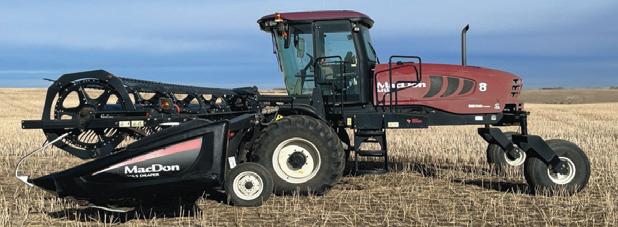
●2013 MACDON M155 swather w/ MacDon D65-S 35’ p/u reel, 1,139 header hrs., 1,611 engine hrs, + MORE!

●2021 MACDON FD135 flex header w/ transport, 35’ split p/u reel, single point hookup, Agco adapter.
●2019 MACDON FD145 flex header w/ transport, 45’ split p/u reel, single point hookup, Agco adapter.
●2016 MACDON FD75-D flex header w/ transport, 45’ split p/u reel, single point hookup.
●(2) MASSEY FERGUSON 8200 35’ flex headers, (1) 2009 w/ transport, (1) 2008 is damaged & no transport.
●1994 HONEYBEE SP42 swather header, 42 ft. ●HONEYBEE SA-30 hydraswing p/t swather.
●ELMERS Crop Master 30 ft. bean/ pea header. ●(2) Bourgault swath rollers, (1) tow behind, (1) mounted.




BY MELISSA MACINTOSH-YOUNG
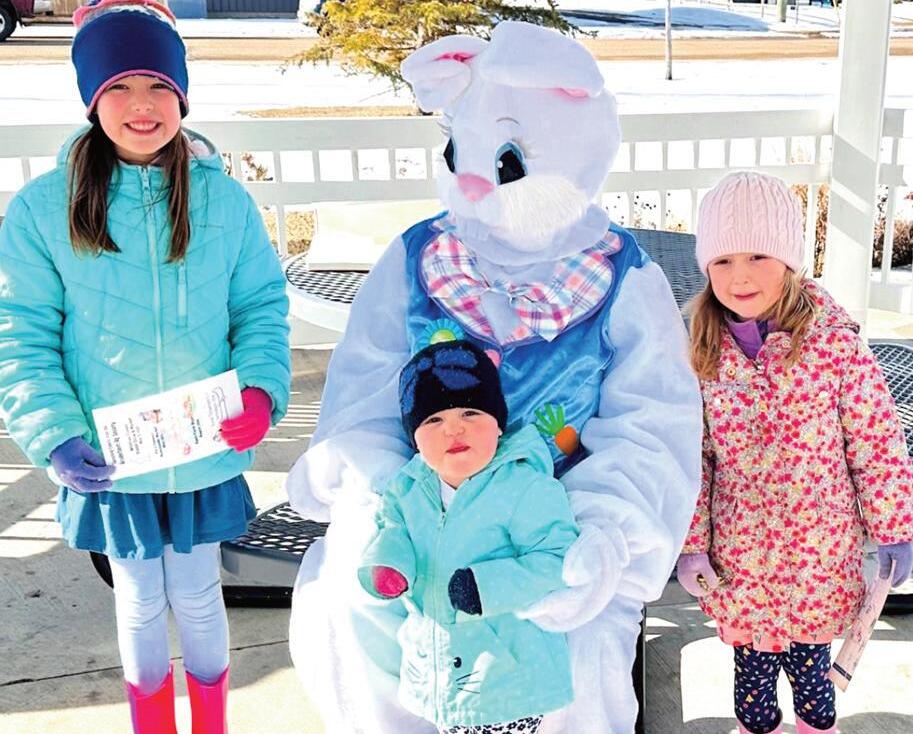
Under sunny skies and with a hint of spring in the air, the Bruderheim Agricultural Society’s annual Easter egg hunt brought the community together for a morning filled with fun and festive adventure.
The event kicked off at the town gazebo, where eager children received maps of Bruderheim marked with special stations scattered throughout the community.
With baskets in hand and energy to spare, par-
ticipants set off on their adventure, making their way from stop to stop. At each station, children collected a stamp along with a small treat, adding both sweetness and a sense of accomplishment to the journey.
The final destination
BY GRANT JOHNSON
A contract dispute affecting seniors housing workers across Lamont County is ongoing, with no deal in sight and tensions rising.
Staff with the Lamont County Housing Foundation, which operates facilities in Mundare, Andrew, Bruderheim, Chipman and Lamont, have been without a new agreement since the end of 2024.
The foundation runs dozens of housing units and employs nearly 50 workers in roles ranging from cooking and housekeeping to maintenance and recreation.
ployees, say that’s not enough.
They’re pushing for about 35 per cent over two years, arguing their pay hasn’t kept up with the cost of living. Union figures suggest workers have effectively been taking a pay cut when inflation is factored in.
Facilities in smaller communities like Mundare and Andrew rely heavily
on these workers to keep day-to-day operations running, from meals and cleaning to basic maintenance and programming.
With both sides far apart, mediation appears to be the next step. The last contract took about a year to settle after expiring, and there are growing concerns this round could follow the same path.
brought participants to Walker School, where the celebration continued.
After completing their maps, children were rewarded with the chance to choose a special Easter surprise -an extra highlight to cap off their efforts.
Adding to the charm of the day, families were also able to spend time visiting with a collection of fluffy chicks, a favourite attraction that delighted children and adults alike.
AG Society member and organizer, Sherry Cote, said “We had over 148 participants this year. We even had visitors from Vernon, BC and Whitecourt take part, on their way to visit family.”
Blending fresh spring air, community connection, and festive fun, the Bruderheim Agricultural Society’s Easter egg hunt once again proved to be a memorable way to celebrate the season.





Wages remain the biggest sticking point. The Lamont County Housing Foundation says they have offered a fouryear deal starting with around six per cent in increases, later bumped to roughly 12 per cent over the term.
But workers, represented by the Alberta Union of Provincial Em-




























































●2004 AGCO RT-135 MFWD tractor w/ FEL, 8 ½’ bucket, & grapple, 5,281 hrs., 150 hp., Autosteer, shedded.
●1984 JOHN DEERE 4250 tractor, 7,677 hrs., 144 hp., powershift, 2 hyd’s., 540/1000 pto., shedded.
●1979 JOHN DEERE 4240 tractor w/ FEL & 7 ft. bucket, 11,751 hrs., 122 hp., 16F/6R, shedded.
●1979 MASSEY FERGUSON 275 tractor, 8,926 hrs.
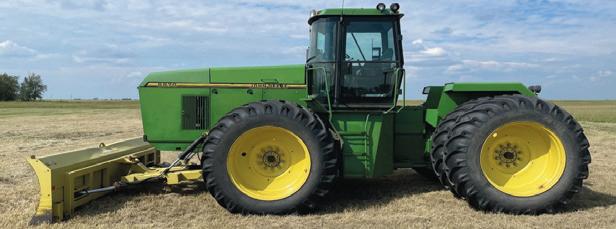
●1993 JOHN DEERE 8870 4WD tractor w/ Degelman 14 ft. front blade, 6,735 hrs., 350 hp., shedded, VG condition.
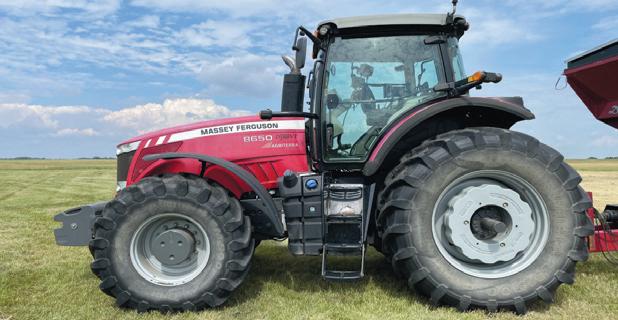
●2012 MASSEY FERGUSON 8650 MFWD tractor, 240 hp., 1,551 hrs., CVT trans., 1 owner, + MORE!
●2010 MASSEY FERGUSON 1533 MFWD tractor w/ FEL & 5½’ bucket, 313 hrs., 33 hp., 1 owner, shedded.

●2022 HONDA Rancher quad, ONLY 34 hours & 356 km, 4X4, shedded, excellent condition.
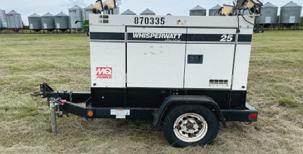
●MULTIQUIP diesel AC 25 KVA portable generator / lightplant, 18,353 hours, single or 3 phase.
● BRUNS S130 gravity feed wagon, 13 ton capacity, 12R22.5 tires.
●Cub Cadet 750 EFI side x side, 4X4.
●(2) HLA pallet forks.


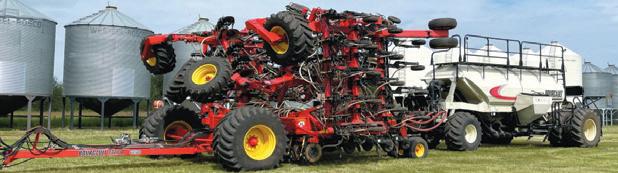
●2015 BOURGAULT 3320 QDA air drill w/ 2016 Bourgault 7550 cart, 60’, shedded, VG cond., + MORE!
●PATTISON NH3 2500 wagon w/ (2) 1250 US gal. tanks.
●2014 BOURGAULT 6000 mid harrow, 70’, 1 owner.
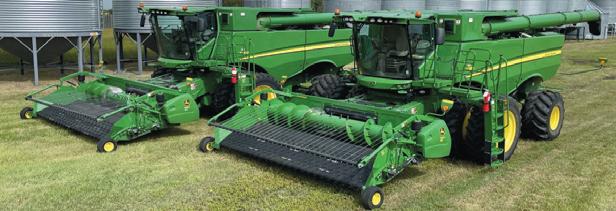
●2016 & 2014 JOHN DEERE S680 combines, w/ JD 615P 15’ pickups, (1) 1,148 sep. hrs., 1,627 eng. hrs., (1) 1,361 sep. hrs., 1,895 eng. hrs., shedded, + MUCHMORE!
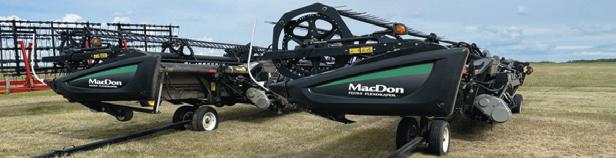
●(2) 2017 MACDON FD75-S flex draper headers w/ 35 ft. split p/u reels, pea augers, shedded, +MORE!

●(2) 2011 MASSEY FERGUSON Hesston 9220 swathers w/ 30’ headers, (1) 678 hrs., (1) 881 hrs., GPS, autosteer, Cummins diesel, 1 owner, shedded.
●2012 TRAILTECH 33 ft. t/a swather transport.
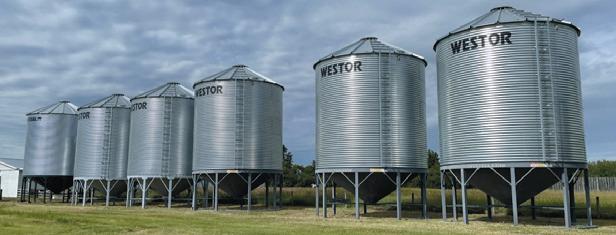
See Website for More Details on Each Bin
●(5) WESTOR & (1) WESTEEL ±4900 bu. hopper bins.
●(3) WESTOR 1505 ±3300 bu. hopper bottom bins.
●WHEATLAND Grain Maxx ±3000 bushel smooth wall hopper bottom grain bin.
●(4) WHEATLAND Grain Maxx ±2000 bushel smooth wall hopper bottom grain bins.
●(2) WESTEEL ROSCO ±4000 bushel hopper bins.
●(11) WESTEEL & (1) UFA ±1850 bu. hopper bins.
●TWISTER ±4500 bushel hopper bottom grain bin.
●(2) TWISTER ±2200 bushel hopper bottom grain bins.
●WHEATLAND ±1250 bu. smooth wall hopper feed bin.
●CHIEF WESTLAND ±2700 bushel flat bottom bin.
●BUTLER ±1500 bushel flat bottom bin.

AUCTIONEERS NOTE: Bid with confidence on this high quality lineup of mostly shedded equipment.


●2014 ROGATOR RG900 100 ft. sprayer, 1,620 engine hours, 1 owner, VG condition, + MUCH MORE!
●BRANDT SB4000 p/t 90 ft. high clearance sprayer.
● CHEM HANDLER III w/ fittings.
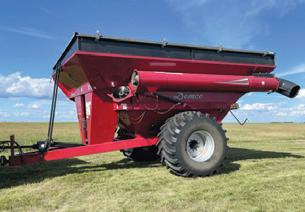
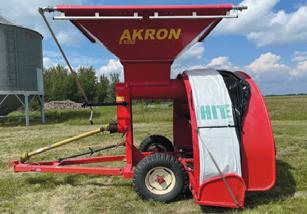
●2014 DEMCO 850 bushel s/a grain cart w/ scale.
●2010 AKRON 9250 grain bagger, 540 pto., shedded.
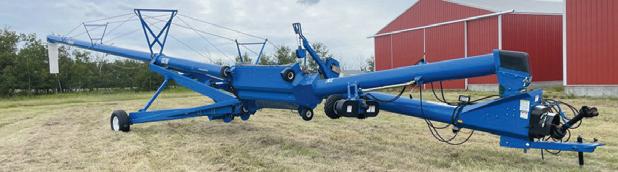
●2008 BRANDT 1370XL hyd. swing auger, 13”, 70 ft., dual auger hopper, 540 pto., bin full alarm.
●BRANDT 1050 mech. swing auger, 10”, 50 ft., single auger hopper flighting, 540 pto.
●2013 BRANDT 842 auger w/ hyd. mover, 8”, 42 ft.
●BRANDT 842 pto. driven grain auger, 8”, 42 ft.
●WHEATHEART R10-41 auger w/ hyd. mover, 10”, 41 ft.
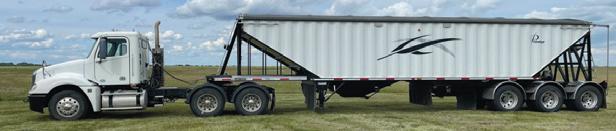
●2008 FREIGHTLINER highway tractor, 173,927 km, 515 hp. Detroit, autoshift, shedded, VG condition.
●2011 LODE KING Prestige 45 ft. tridem grain trailer, roll tarp, air ride, shedded, VG condition.
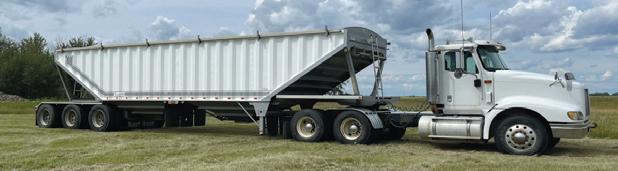
●2004 INTERNATIONAL 9400i highway tractor, 666,592 km, 435 hp. Cat C15, automatic, shedded.
●2008 CASTLETON 45’ tridem grain trailer, shedded.
●1995 FORD L9000 t/a grain truck w/ 20 ft. steel box & hoist, 108,0741 km, Detroit diesel, 10 speed.
●1978 MACK R400 t/a grain truck w/ 17 ft. steel box & hoist, 110,454 miles, diesel, 13 speed, roll tarp.
●2008 GMC 3500HD quad cab service truck, 104,203 km, gas, 4X4, c/w 1,470L fuel tank.
●2008 FORD F-350 King Ranch Super Duty crew cab truck, 4X4, 188,715 km, Powerstroke V8 Diesel.
●2001 DODGE RAM 1500 Laramie SLT extended cab truck, 181,780 km., 5.2L V8 gas engine, 4X4.
●2002 DOUBLE ‘A’ 22’ t/a gooseneck flatdeck trailer.
●1995 LODE KING 48 ft. tridem highboy dually sprayer trailer w/ (2) 3,120 US gallon tanks.
●2015 OASIS Sport 12’ s/a flatdeck utility trailer.

BY JOHN MATHER
Bruderheim council an-
nounced April 1 they will hold a by-election on May25 to fill the council seat left vacant by the resignation of Councillor
At the meeting council also passed a motion to hold an advanced poll on May 23 from 10 a.m. to 2 p.m.
A third motion was
Lesster Quijano Acosta who handed in his resignation March 18.
passed to appoint Sherry Cote, the Administration Assistant Special Projects Coordinator as the Returning Officer for the election.
BY GRANT JOHNSON
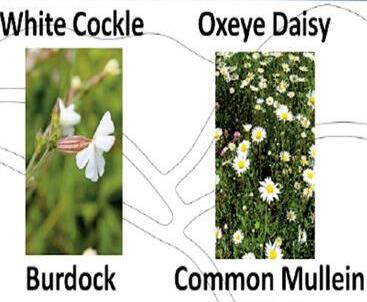
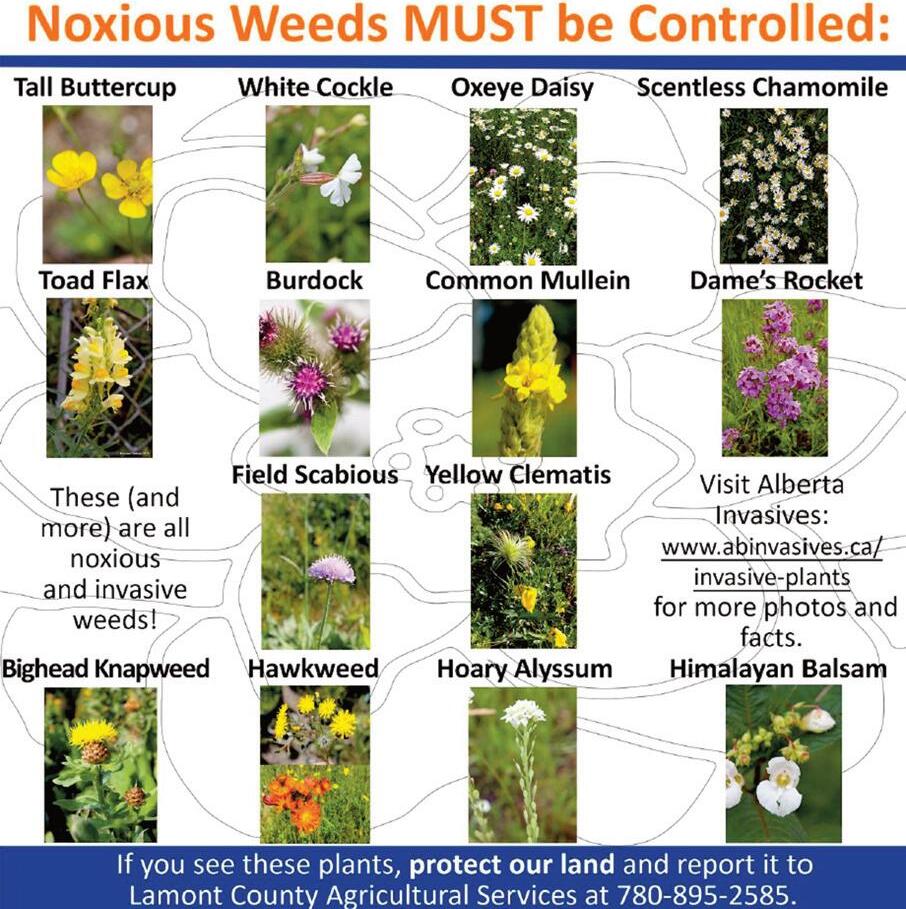
As spring takes hold across the region, Lamont County is reminding residents that weed control is more than just yard work, it’s a responsibility and a key part of protecting local farmland and natural areas.
Under Alberta’s Weed Control Act, landowners are required to manage unwanted vegetation on their property, particularly when it comes to “noxious” and “prohibited noxious” weeds.
These invasive species can spread quickly, choke
out crops, and reduce pasture productivity if left unchecked.
Early action is the most effective way to stay ahead of the problem.
“Once weeds go to seed, you’re already behind,” one local agricultural fieldman noted. “Controlling them early in the season saves time, money, and headaches later on.”
In Lamont County, common problem weeds include thistle varieties, scentless chamomile, and leafy spurge. These plants are aggressive
growers and can spread through wind, water, and equipment.
Residents don’t need fancy equipment to make a difference. A few simple strategies can go a long way including regular inspections, hand pulling or mowing, cleaning equipment, and maintaining healthy grass.
With moisture levels and weather conditions varying year to year, the severity of weed growth can change. That’s why consistent monitoring is key.
BY JOHN MATHER
Lamont County’sAgriculture Services Board is hosting a conference tonight (April 8) at the Lamont Arena meeting room to discuss kochia, a problem weed which has been moving north in Alberta.
Krista DeMilliano, the
Chief Provincial Plant Officer, with Alberta Agriculture and Irrigation and Kenneth Houle, from ENVU will be the presenters at the meeting.
While the event is free, preregistratuon is recommended by calling 780895-2585. Or emailing to: amandak@lamontocunty.ca
BY JOHN MATHER
A hastily called special council meeting of Lamont County Council occurred April 1.
In giving notice of the meeting, it specified the meeting was called under Section 23(1), 29 (1)(a), and 31(1) to discuss and act upon a privacy matter.
Coming out of the closed session which lasted more than an hour, Council passed a motion to “direct Administration to authorize the RMA insurance to investigate allegations of a potential cyber security incident and authorized a budget of up to $25,000 for this.”
The motion was carried.
The County had first mentioned issues with potential cyber attacks since early March when they posted on Facebook, “Due to a potential cyber attack, we have temporarily disabled Credit Card and Debit Card transactions at the Hilliard and Heartland Water Stations. Prepaid access is still available
while this is investigated. We apologize for any inconvenience this may cause.”
Local resident Ann Gagnon asked promptly what actually happened and had any credit card or debit information been compromised?
In a response, the County replied, “this is being investigated, and as a precaution the onsite payment was suspended until we know more. Updates will be provided as more information is available. If you need to set up a water account, please contact reception at 780-895-2233.”
No further information was forthcoming from the County communications department when asked for an update following the special council meeting.
The Leader asked via email: “What will RMA insurance do to investigate?; Does that insurance just cover the cost or do they have a team that actually investigates?; Is this connected to the

The kochia invasion in central and northern Alberta represents more than just an agricultural change. It threatens crop yields, increases production costs and could potentially fundamentally alter farming practices across Alberta.
Continued on Page 13



cyber security issues from a few weeks ago and the Heartland and Hilliard truck fills? If so, why the delay?; have the RCMP been brought in to investigate?; and besides the truck fills have other departments been subject to a cyber attack? If so, which ones?; Are any taxpayers directly affected ie: tax records being hacked or other proportional information being hacked?”
The reply that came back to the Leader was, “As this is a current investigation, we’re unable to comment on this at this time.”
On the Rural municipalities web site they discuss their insurance program stating, “We offer a full range of additional insurance programs to provide complete protection for your assets and exposures. We have access to almost all available insurance lines,” Through its Genesis program which is described as “broadly tailored for municipal exposures.”










BY MELISSA MACINTOSH-YOUNG
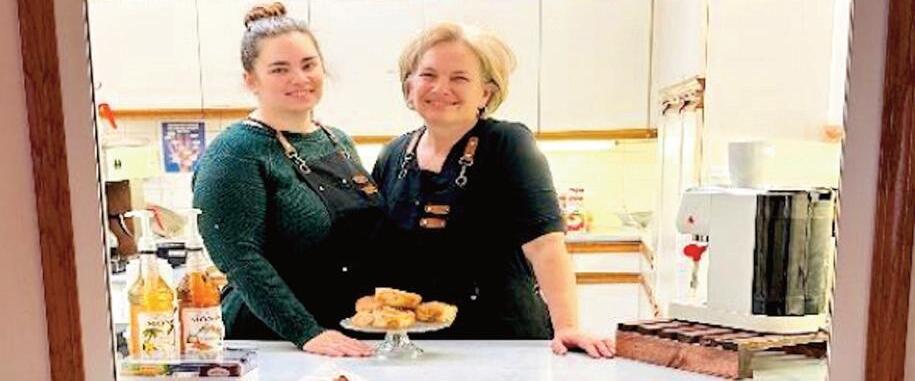
A charming new venture is brewing in Bruderheim, as Ironwood Catering recently hosted the soft opening of a popup coffee shop inside the historic old Moravian Church.
The unique space, rich with character and local history, has been transformed into a cozy and inviting spot where residents can gather, relax, and enjoy a warm drink.
Guests at the soft opening were treated to a selection of freshly baked goods, along with a variety of coffees and lattes, all served in a welcoming and laid-back atmosphere.
Owner Shannon Schiller says the pop-up is a way to explore the possibility of a more permanent coffee shop in the community. Starting small allows her to gauge interest and better understand what locals are looking for in a
Continued from Page 12
Breanna Tidemann, research scientist with Agriculture and AgriFood Canada, gave a presentation to local farmers in Wainwright, Alberta, in June.
She explained that kochia, which has long been known as a southern Alberta problem, has started moving its way to the central and northern parts of the province.
“We’re seeing kochia move further north than ever before. Random field surveys now show

café experience.
“We’re just testing the waters right now,” Schiller explained. “It’s a chance to see what the need is in town and what people would like to see in a space like this.”
Adding to the shop’s charm is its thoughtfully curated seating area, featuring an eclectic mix of vintage furniture. The comfortable, homey setting encourages visitors to sit and stay awhile— whether catching up with friends or simply enjoying a quiet moment with a cup of coffee.
The soft opening drew a steady stream of curious residents eager to check out the new offering, many expressing excitement about having a potential café space right in town.
If the early response is any indication, this small pop-up could be the start of something much bigger for Bruderheim.
kochia populations extending all the way to the outskirts of Edmonton, which is a dramatic shift from its historical range,” Tidemann said.
“Kochia has developed resistance to group two, glyphosate, dicamba and now potentially group 14 herbicides. This means farmers are facing a weed that can survive most standard chemical treatments.”
“This isn’t just about controlling a weed. It’s about adapting our entire agricultural approach to a changing environmental landscape,” Tidemann said.










































































































FUNDRAISER
Chemo Care Hydration Packages. $55 buys one and Sonya donates one. Includes: Night Cream, Lip Balm and Foot Lotion. The goal is 300 pkgs by June 30. See Sonya Martens at the Tofield Market Friday, April 10th & 24th. www.MaryKay.ca/smartens or call 780-240-4605 TM14P
From the Filipino Community regarding the Annual Prague Mass:
We would like to share that this year’s celebration will be held in Edmonton instead of Prague. It will take place on Saturday, May 16, from 10:00 AM to 3:00 PM at Annunciation Church and its hall.
As we prepare, we reflect with gratitude on the many years of dedication and care the Prague community has given to this celebration. You have made it truly special and meaningful.
We warmly invite the extended Prague community to join us this year as we continue this cherished tradition in a new setting. Your lasting impact is deeply appreciated. 14/16c
Battle River Art Club Show and Sale
Saturday, April 25 from 10 a.m. to 4 p.m. Sedgewick Community Hall. Lunch & Snacks available. For more information call Chris McMullan - 780-384-2167 14/15c
The Sedgewick Lions Club will be conducting Free Vision Screening for children ages six-months to 12-years-old.
Date: Thursday, April 23. Time 2:30 p.m. to 6:30 p.m. Place: Sedgewick Library (4806-47 Street) 14/15c
Friends of the Sedgewick Library Society Annual General Meeting to be held Monday, April 20 at 7 p.m. at the Sedgewick Library. All Welcome to attend. 14/15c
Battle River Minor Hockey Association Annual General Meeting, Wednesday, April 22 in the Multi-Purpose Room at the Killam Agriplex at 7 p.m. Voting on proposed Special Resolution: Bylaw changes. See website for details. www.battlerivermha.ca 14/15c
PRAGUE COMMUNITY ASSOCIATION
ANNUAL GENERAL MEETING
Sunday, May 3, 2026 at 2 PM at the Prague Hall
Please attend if interested, as we will be discussing the status of the Prague Church. Beverages and snack served. 14/16c
Dolores Larson Simpson’s 90th Birthday Celebration! You are cordially invited to the celebration of our dear sister, Mom, Grandma, Great-Grandma, and friend. Party to take place Sunday, May 3 at the events room at the Sierras of Taylor Drive in Red Deer (4512 52 Avenue) with refreshments and a short program. Please RSVP to elsieramsden@telus.net or via text 403-443-9450 (Elsie Larson Ramsden)
Bethania Cemetery Society Annual General Meeting will be held April 22 at 7 p.m. at the Sedgewick Library's Board Room on Main Street in Sedgewick. All interested members are welcome to attend.
14/15c
There will be a celebration of life for Joseph Fornal on Saturday, April 25, 2026 at the Holden Community Hall, at 2 p.m.
The Lougheed Ag Society is now accepting Applications for 2026 Recreation Grants. DEADLINE IS April 15, 2026 at 5 p.m. Send Applications to: Lougheed Ag Society PO Box 305 Lougheed, AB T0B 2V0 Eligible applicants need to comply with Rec Grant as requested by Flagstaff County. For further information and to see the requirements, check out the Flagstaff County website. (flagstaff.ca)
The Heisler Ag Society is currently accepting applications for the 2026 Recreation Grant. Application deadline is April 11, 2026 Applications can be sent to: The Heisler Ag Society Box 152 Heisler, AB T0B 2A0
Attention: Recreation Grant or emailed to heisleragsociety@gmail.com
Registered Red & Black Angus Bulls for sale. Call 780-986-9088 11/18LL
Antiques for Sale. Oil & Gas Memorabilia: White Rose, Red Indian and P&H. Early 1900's glass pop bottles and tobacco tins. Also for sale, a 1961 Dodge Dart and a 1978 GMC 1T Dually, 2wd with a 454 engine. Many more antiques. Contact Rod at 780-385-8765.
Brian at Daysland has strawberry plants and trees left, last chance to order! All orders must be confirmed by May 1 deadline. Trees must be paid on ordering or by May 1 at the latest or will not be held. Call Brian at 780-678-0053 to make your order.
FORAGE SEED FOR SALE: Organic & conventional: Sweet Clover, Alfalfa, Red Clover, Smooth Brome, Meadow Brome, Crested Wheatgrass, Timothy, etc. Free Delivery! Birch Rose Acres Ltd. 306-921-9942. ————————————————
BARLEY – *NEW-AB Standswell*
Smooth AWN, High Yielding, Grain and Forage Great Lodging Resistance. 1st NITROGEN USE EFFICIENT CEREAL IN CANADA.OTHER BARLEY: Cerveza, CDC Austenson, CDC Durango, CDC Maverick, Esma, Sundre. WHEAT – Pintail, Forage or Grain. OATS – AC Juniper, AC Morgan, AC Mustang, Derby, CDC S01 Super Oat. PEAS – Very Early Yellow Peas, Forage Peas. ALSO AVAILABLE: Polish Canola & Spring Triticale. Special pricing on truckloads. www.mastinseeds.com; 403-556-2609
WHITE SPRUCE TREES: 5’ average $50. Installation ONLY $19. Includes: hole augered, Wurzel Dip enzyme injection, bark mulch application, staking. Minimum order 25. One-time fuel charge: $150-300. Crystal Springs, 403-820-0961. Quality guaranteed. albertasprucetrees.com
—————————-
ARE YOU PASSIONATE ABOUT AGRICULTURE? Do you enjoy working directly with farmers?
Egg Farmers of Alberta is seeking a full-time Southern Alberta Field Services Coordinator. For more information and to apply, please visit eggs.ab.ca/about-us/careers/
Seeking Concession Operator at Shorncliffe Park for upcoming season (May through SeptemberCamping stall supplied.) Contact Troy for more information, at 780-842-7235. Shorncliffe Park Improvement Association. 12/13c
————————————————
Now Hiring – Clubhouse Staff Hardisty Golf Course
Seasonal Positions starting mid April to Sept 30th
Flexible hours. Friendly, team orientated work environment Duties include: Cooking & Food Preparation. Cleaning and general clubhouse duties. Must be willing to learn and take on new tasks. Must be reliable and dependable.
Apply in writing to Hardisty Golf Course at info@hardisty.ca
————————————————
The Town of Killam is accepting applications for the following seasonal positions: Parks Students: Full Time Hours (June 27 to end of August). Outdoor general and parks work. Must have a valid driver’s licence. Must be returning to high school or entering post-secondary in Fall 2026. Deadline for applications is April 13, 2026. Please send resume and qualifications indicating the position you are interested in to: Town of Killam, Box 189, Killam, AB T0B 2L0 Fax: 780-385-2120
Email Parks: publicworks@town.killam.ab.ca 12/14c
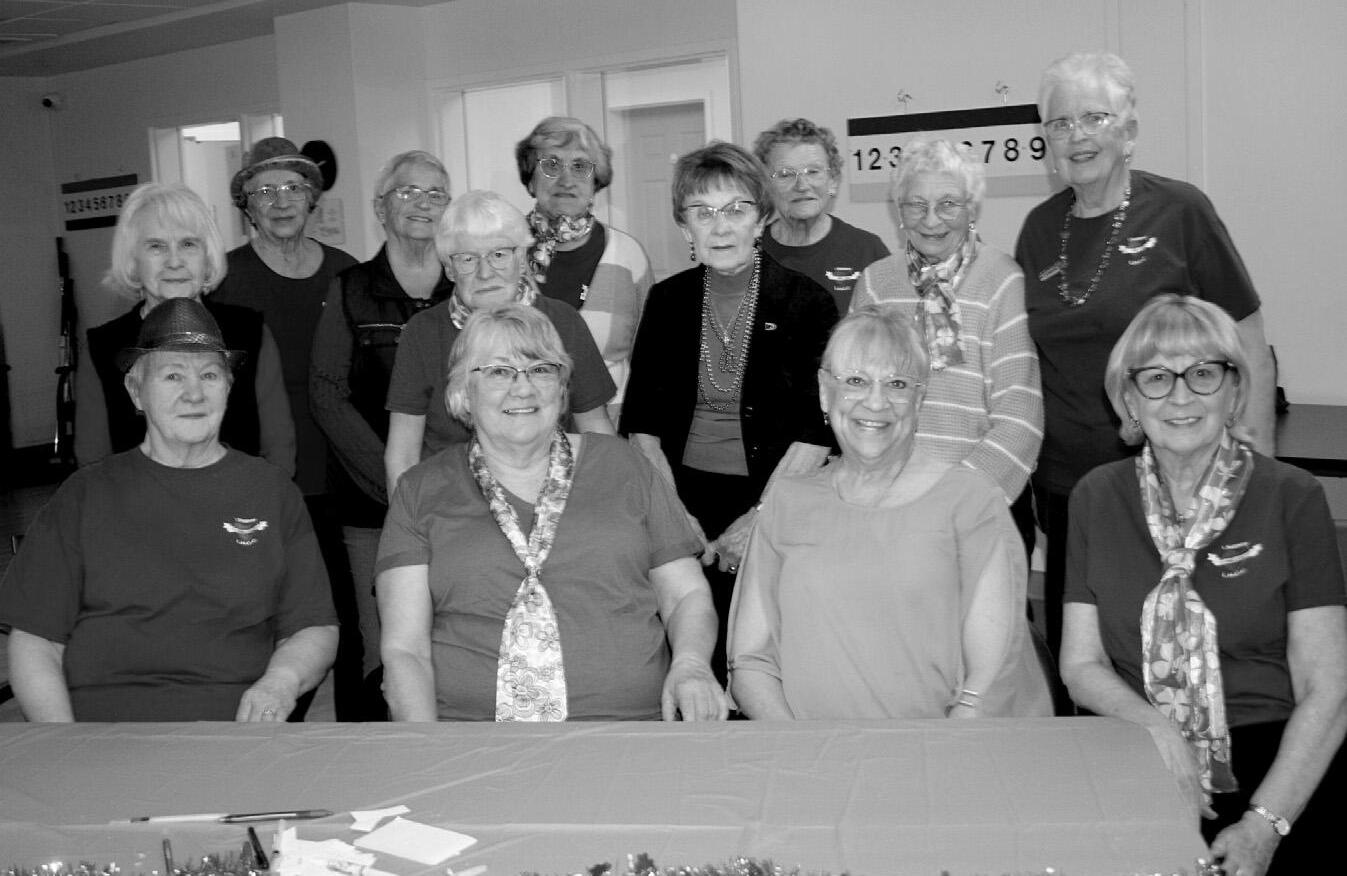
Members of the Lamont Hospital Auxiliary served St.Patrick’s Day tea at Beaverhill Pioneer Lodge on March 13. Newly elected president Gail Hutchings and newly elected secretary Susan Harrison, both wearing green, are seated in the centre of the front row. The group is hoping to get a few men on the auxiliary as they provide support for hospital residents, Beaverhill residents and other community facilities.




CWRS - AAC Brandon - Improved Rated MR for FHB resistance
- Most widely grown CWRS variety in Western Canada for 5 years










CWRS - AAC Wheatland VB -Wheat Midge tolerant
- Very good lodging resistance
CWSWS - AC Andrew - Great silage option
-In demand by milling and ethanol industries













Yellow Peas:






CDC Canary - Improved standability -Early maturity -Higher Yielding Faba Beans:
CDC 219-16 - Zero Tannin
- Seed is smaller than Snowbird, larger than CDC Snowdrop
6-Row Feed Barley:
AB Advantage - Improved plump and bushel weight - Smooth awned -High grain and forage yield
2-Row Malt Barley:
CDC Churchill - Increasing demand by Malting Companies, Yielding 109% of CDC Copeland


BY JOHN MATHER
Fort Saskatchewan
RCMP are asking for public assistance in identifying a male suspected of robbing a liquor store in the city three different times.
The liquor store at 100 Street and 88 Avenue was robbed Dec. 7, 2025, Dec.10, 2025, and March 5, 2026.
Twice the robber tookthe liquor value of $500 and $240 respectively getting away in a dark
coloured Nissan Juke.
On the third occasion
$240 of liquor was taken and the suspect fled in a silver Toyota Tacoma.
The suspect is described as caucasian, about 25 to 35 years old. He was wearing a dark winter jacket with a faux fur hood.
He has a medium build and is in the area of 5’11” and 6’2”.
He also had short brown hair and a tight trimmed beard.

In a recent survey less than 100,000 of the responde
Anyone with information is asked to contact the Fort Saskatchewan RCMP Detachment at 780-997-7900, or your local police.
If you want to remain anonymous, you can contact Crime Stoppers at 1800-222-8477 (TIPS), online at www.P3Tips.com or by using the “P3 Tips” app available through the Apple App or Google Play Store.

of adults 18+ living in communities of population on the prairies, the majority nts across all measured sectors said



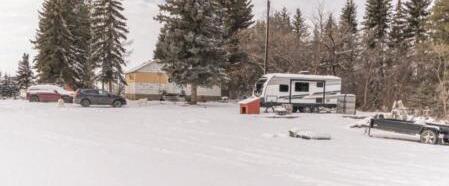
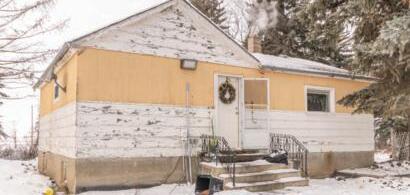
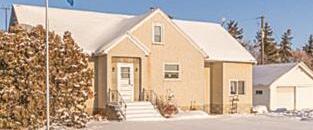
• Part of W4-14-51-10-SW County of Minburn 140 acres with 950 sq ft bungalow and treed yard site. Power, gas well and septic tank. # 2 soil with 100 acres cultivated and 35 cultivatable acres in hay. House and yard are currently rented for $1000 per month plus utilities. Offers will be subject to subdivision with the County of Minburn. Price $1,300,000
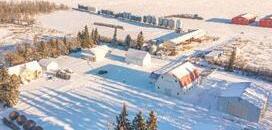
• SOLD 2 Property Sale: Property 1: 50301 RR182 1 ½ storey 1,710 sq ft house on 80 acres with Detached double car garage, Heated and insulated 40’ x 50’ shop, 44’ x 52’ wooden barn , Insulated 30’x 40’ detached man cave. 2 - 100’x50’ and 1-120’x50’ cold storage shops , 36’x54’ Machine shed and 2 3-sided pole sheds. 65± acres cultivation. Property 2: W4-18-50-23-SWN ½ 80 acres, 78± acres cultivated 2 soil.Total price for both $1,225,000
• SOLD W4-18-50-23-SE 160 acres 95± acres of cultivated and 65± acres of pasture. Price: $550,000
• SOLD W4-18-50-23-NE 160 acres 44± acres cultivated, 36± acres pasture and 80± acres wetlands Price: $300,000
• W4-18-50-14-NE 159± acres 140± #2 cultivated soil 10± acres hay 10± acres bush Price: $900,000
• W4-18-50-14-SE N 26.21 acres 16± acres cultivated and 10± acres pasture Price: $68,000










• 5119 48 Ave, 5121 48 Ave, and 5116 47 Ave 3 commercial lots 50' by 100', 65' by 100', and 30' by 100' Price: $200,000
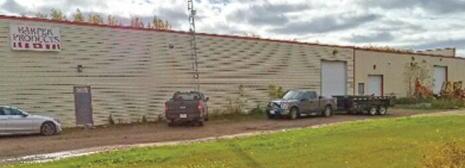
• 5317-50 Ave Andrew An 18,000 sq. ft. manufacturing shop with office and storage space on 2.3 acres of land
Price: $1,700,000 ***or inquire about leasing units as small as 4000 sq ft***


Always Looking For New Farm Listings!!












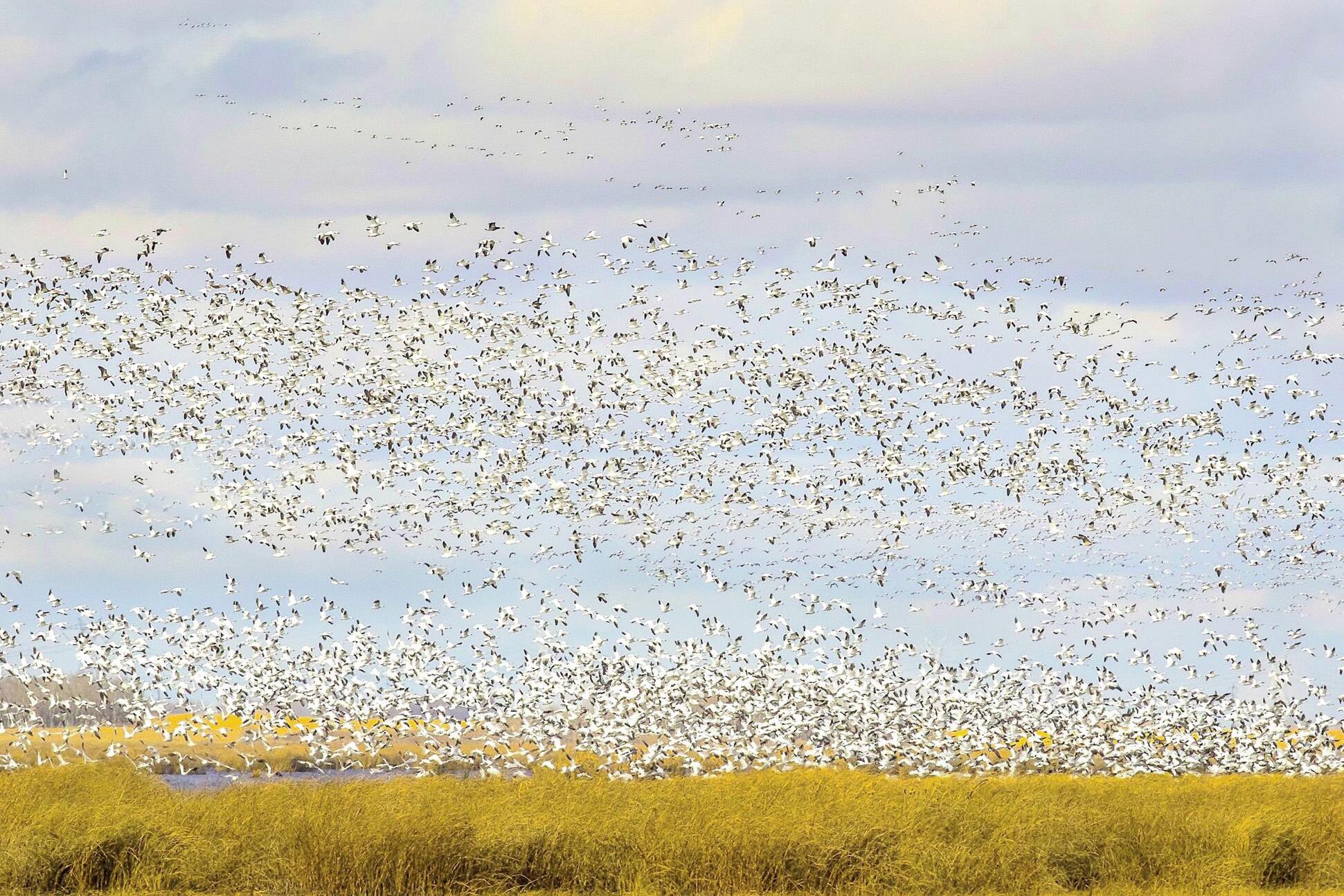




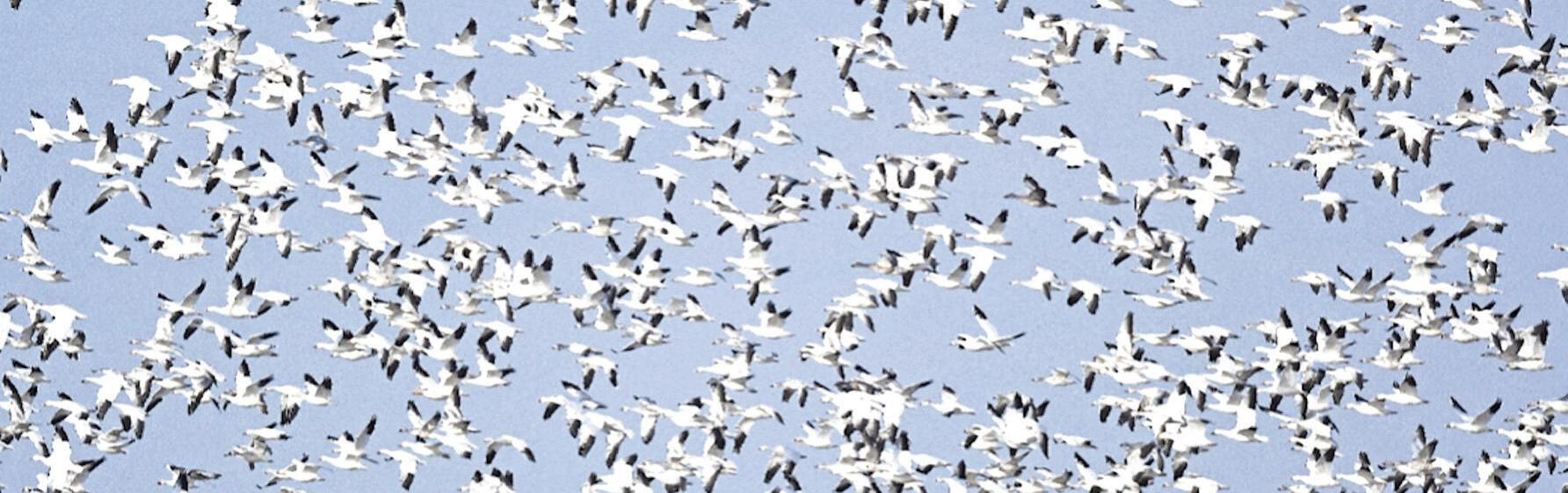

Welcome to the 2026 Snow Goose Festival on 25-26 April, 2026 in Tofield Alberta. A committee representing over a dozen organizations has been meeting regularly to recreate this festival which attracted 4,000 to 7,000 people in the 1990s to view spring wildlife focused on the thousands of Snow Geese, other waterfowl and songbirds which migrate through Alberta.
The Festival was established as a celebration of spring bird migration, an opportunity for everyone to view the many species of birds that pass through central Alberta on their migra-
tion northward. The Festival will include guided bus tours, hiking tours, a trade show, a banquet and other associated activities based out of the Tofield Arena.
Organizations that are represented in the organizing committee include:
• Town of Tofield
• Beaverhill Bird Observatory
• Beaver County
• County of Strathcona
• North American Waterfowl
Management Plan
• Canadian Wildlife Service
• Nature Alberta

• Edmonton Nature Club
• Nature Conservancy
• Beaverhills Biosphere
• Alberta Conservation Association
• Claystone Waste Ltd
• WILDNorth
On behalf of the committee we thank you for participating in the Festival and supporting the trade fair in the Tofield Arena.
Thank you again for your interest.
Yours truly
Geoff Holroyd, and Vanita Englauer
On behalf of the 2026




The Trumpeter Swan is a migratory waterfowl species seen across the Aspen Parkland and Boreal Forest of Alberta during spring, summer and fall.
It is a large, white bird with an unusually long and graceful neck. It often has a rusty orange stain on its head and neck because of feeding in lakes that are high in iron.
This swan is easily confused with the smaller, but similar looking, Tundra Swan. However, Trumpeters often have a red line along the upper edge of their lower jaw whereas Tundra Swans do not.
Tundra Swans also feature a yellow streak running towards their eyes, unlike Trumpeters, whose bills blend into their eyes without any coloured markings.
Following a brush with extinction, Trumpeters are making a comeback in North America. In 1933, overhunting by early settlers reduced the number of Trumpeter Swans to just 77 breeding adults in Canada and 50 in the United
States. Today there are approximately 16,000 Trumpeters in North America (approximately 7,734 in Alberta) thanks to reintroduction programs, habitat conservation and sanctuaries that have successfully implemented a hunting ban.
While Trumpeter Swan numbers have increased steadily, the species still faces several threats. Canadian Wildlife Services (CWS) has been collecting
feedback on a proposed Tundra Swan hunt, which may lead to Trumpeter Swan deaths as both birds appear similar and share overlapping habitats.
A seasoned bird watcher may spot the differences, but most hunters are unlikely to do so. Misidentification presents a serious conservation risk to this sensitive species that can’t be hunted anywhere in North America.
Allowing a Tundra Swan hunt could
undermine decades of restoration work, threatening a species brought back through significant public investment, scientific planning and longterm stewardship.
Alberta is an important region for Trumpeter Swans, with several wellestablished breeding locations. The heart of their Alberta range is in the Peace Country, most notably in an area immediately north and west of Grande Prairie, where the swans have been observed nesting in at least 28 lakes.

Another important conservation step was the translocation of Trumpeters from the Grande Prairie area to Elk Island National Park in 1987, which helped re-establish a breeding population in the central Parkland Region. To support management efforts, formal surveys of swan populations began in the Grande Prairie area in 1953 and were extended to all of Alberta in 1985. Enjoy the Snow Goose Festival and watch for many other migratory bird species travelling through the Beaver Hills Lake area. Have fun!

BY: JON VAN ARRAGON (Assistant Biologist, Beaverhill Bird Observatory)
During the 2025 field season, I had a very simple assignment: count shorebirds in Beaverhill Lake. Doing this requires 2 key ingredients: shorebirds, and a lake. Unfortunately, the 2025 shorebird surveys only scored a grade of 1/2 in those categories. I spent many days observing shorebirds during my surveys, but I was also observing dramatic declines in the water levels of Beaverhill Lake at the same time.
The shorebird counts last year showed some interesting trends despite the fleeting water levels. Over 24,000 shorebirds were observed across 18 surveys, which took place from April 30 to October 2. The most common species was Long-billed Dowitcher with nearly 7,000 observations, followed by Pectoral Sandpiper and American Avocet. Other common species included Least Sandpipers, Lesser Yellowlegs, and Semipalmated Sandpipers. Some noteworthy sightings included a pair of Red Knots, a Hudsonian Godwit, and an Upland Sandpiper - all uncommon species!
The decline in water levels was the biggest story of the 2025 surveys.
Shoreline survey points established in 2024 were dry on my first visit, and the survey transect along the south shore of Beaverhill Lake continually shifted north throughout the year, chasing the
retreating edge of the lake. By August, water had essentially disappeared from the main body of Beaverhill Lake, and shorebird surveys were relocated to the east arm of the lake near
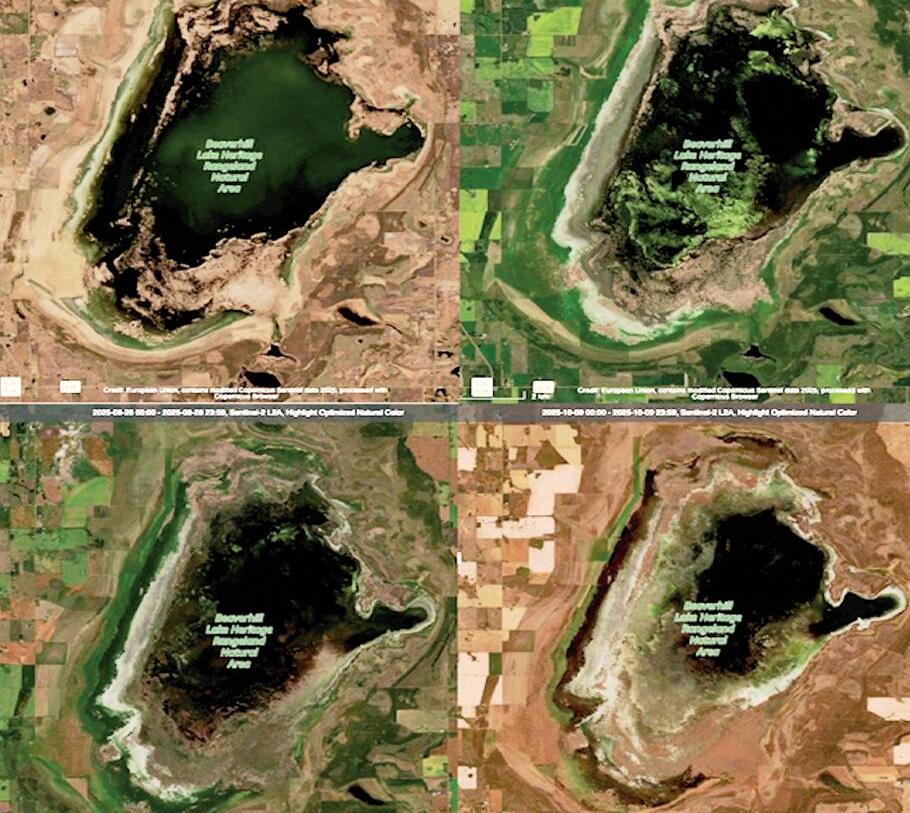
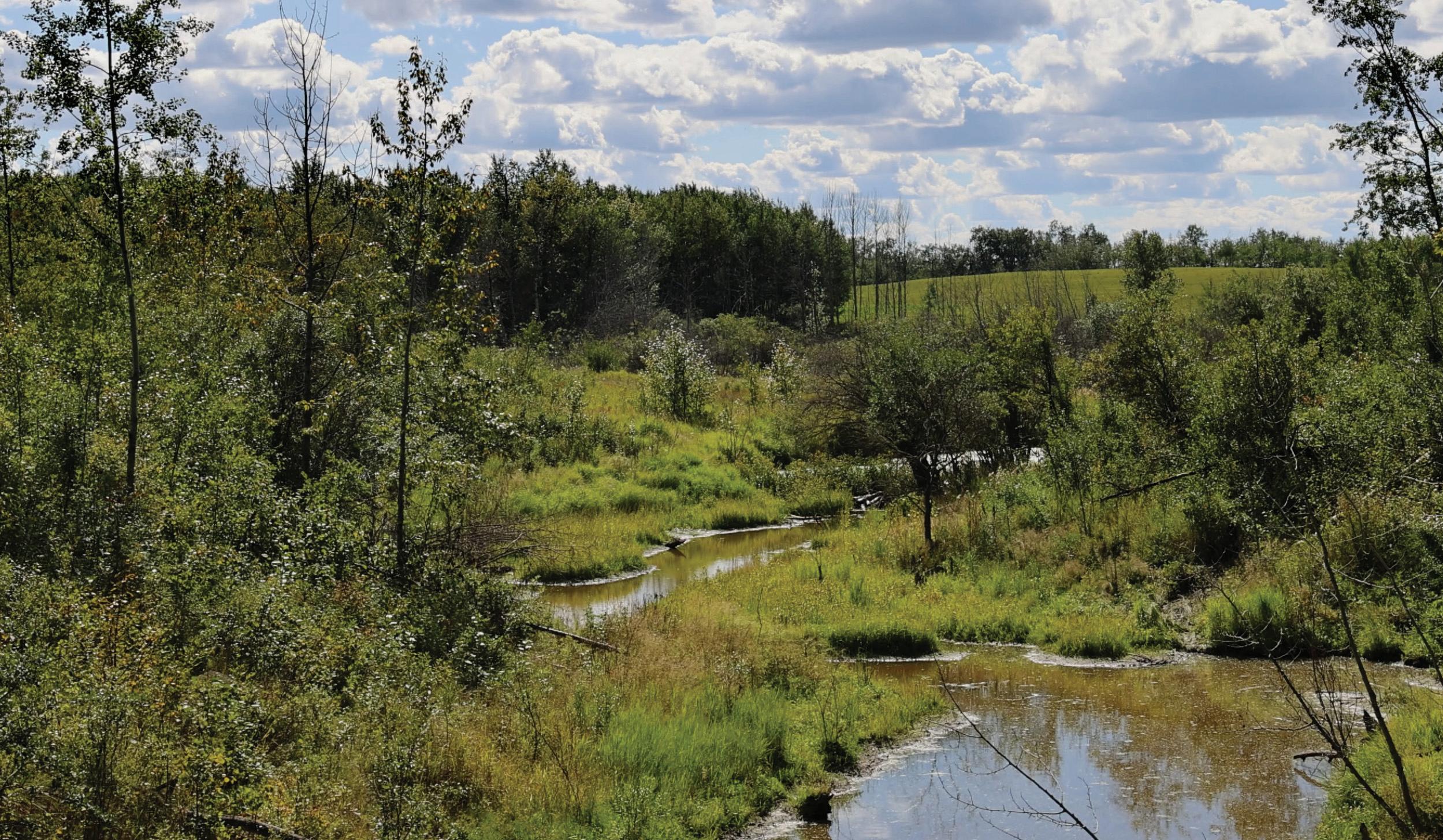
Progression of water levels in Beaverhill Lake over the 2025 field season. Photo dates from left to right, top to bottom: May 2, July 11, August 28, October 9.
How many of these bird species can you find?
How many of these bird species can you find?
☐American Avocet
☐American Coot
☐American Crow
☐American Kestrel
☐American Robin
☐Bald Eagle
☐Barn Swallow
☐Black-capped Chickadee
☐Black-necked Stilt
☐Blue Jay
☐Blue-winged Teal
☐California Gull
☐Canada Goose
☐Canvasback
☐Cinnamon Teal
☐Common Grackle
☐Cooper’s Hawk
☐Dark-eyed Junco
☐Downy Woodpecker
☐Eurasian Wigeon
☐European Starling
☐Franklin’s Gull
☐Gadwall
☐Great Blue Heron
☐Greater Scaup
☐Greater White-fronted Goose
☐Greater Yellowlegs
☐Green-winged Teal
☐Hairy Woodpecker
☐Hermit Thrush
☐Horned Lark
☐House Finch
☐House Sparrow
☐Hudsonian Godwit
☐Killdeer
☐Lapland Longspur
☐Lesser Scaup
☐Lincoln’s Sparrow
☐Mallard
☐Marbled Godwit
☐Merlin
☐Northern Flicker
☐Northern Harrier
☐Northern Pintail
☐Northern Saw-whet Owl
☐Northern Shoveler
☐Orange-crowned Warbler
☐Pied-billed Grebe
☐Pileated Woodpecker
☐Purple Martin
☐Redhead
Red-tailed Hawk
Red-winged Blackbird
☐Ring-billed Gull
☐Rock Pigeon
☐Ross’s Goose
☐Rough-legged Hawk
☐Ruddy Duck
☐Ruffed Grouse
☐Sandhill Crane
☐Savannah Sparrow
☐Say’s Phoebe
☐Sharp-shinned Hawk
☐Snow Bunting
☐Snow Goose
☐Solitary Sandpiper
☐Song Sparrow
☐Swainson’s Hawk
Mundare Beach. Examining satellite imagery shows just how quickly the drying occurred, with the position of the shoreline shifting by kilometers in a matter of weeks at times.
None of this is unusual in a vacuum. Beaverhill Lake has dried up before, most recently in 2005. Beaverhill Lake was not the only water body in the area to dry in 2025. Many of the shallow sloughs and marshes surrounding Tofield dried up as well, likely owing to a poor spring runoff and insufficient summer precipitation. Nationally, shorebird populations have declined 42% in the last 50 years, and the loss of formerly productive breeding and staging areas is a major contributing factor to that.
Beaverhill Lake is still an important and precious water body, even if it is fleeting. Flocks of Long-billed Dowitcher, Lesser Yellowlegs, Semipalmated Sandpiper, Least Sandpiper, and Pectoral Sandpiper at Beaverhill Lake were larger than anywhere else in the province in 2025.
Interested in reading more about shorebird numbers? Check out our website at beaverhillbirds.com!
☐Tree Swallow
☐Tundra Swan
☐Turkey Vulture
☐Western Meadowlark
☐White-crowned Sparrow
☐White-faced Ibis
☐Willet
☐Yellow-headed Blackbird
☐Yellow-rumped Warbler
☐________________________
CODE OF ETHICS for Birdwatchers
CODE OF ETHICS for Birdwatchers
DO NOT TRESPASS on private land without the landowner’s permission.
Avoid repeated disturbance or flushing of birds. Keep your distance and ensure that your presence does not disrupt the normal resting, feeding, breeding and nesting behaviour of birds. Repeated disturbance can reduce energy levels needed by migrating birds as well as those raising young. It can also increase their vulnerability to predation.
On public land, such as the natural area, use established access points and stay on developed trails to avoid unnecessary trampling of vegetation.
Ensure that you take back with you everything that you brought. Leave no litter. Most bird-watching access areas around Beaverhill Lake are user-maintained.
Show courtesy towards fellow birdwatchers, other recreationists and landowners. Don’t interfere with their activities and show a friendly disposition in sharing observations and providing directions.
WILLOW ZILLIOX
As our feathered friends return to their northern breeding grounds, our ecosystems are growing livelier! Perhaps one of the most stunning transformations occurs in the province’s wetland environments.
Wetland enthusiasts will be quick to point out that a marsh is not synonymous with a bog, fen, or swamp. Marshes are distinguished by an abundance of grasses, sedges, and cattails. As with all wetlands, it is a challenge to overstate their value in the environment. Amongst many other benefits, wetlands aid in water filtration, habitat creation, carbon storage, and safeguarding against drought!
Millions of birds populate Alberta’s wetlands every year, integrating themselves into complex webs of species relations and ecosystem cycles. Birdwatchers delight in visiting these bustling habitats, with many hoping to observe their more elusive residents – a handful of wetland-dependent species aptly referred to as “secretive marsh birds”. Grebes, Rails, and Bitterns are included in this collection and have a tendency to be heard rather than seen, with the added twist that many of them sound like anything but birds!
Do you hear a shrill telephone or alarm call? That’s a Sora making itself known. Oinking, grunting, or a froglike “ke-DIK, ke-DIK, ke-DIK”? A

Virginia Rail might be watching. Pebbles rhythmically tapping together? Lucky you! You’re in the presence of a rare Yellow Rail! Water glugging out of a jug? A stealthy American Bittern is lurking in the cattails. Is someone playing a series of notes on a
Observatory (BBO) run a Marsh Monitoring Program (MMP) within the wetland surrounding Lister Lake, a small waterbody just south of Beaverhill Lake. Protocols for these surveys are adapted from The Prairie and Parkland Marsh Monitoring
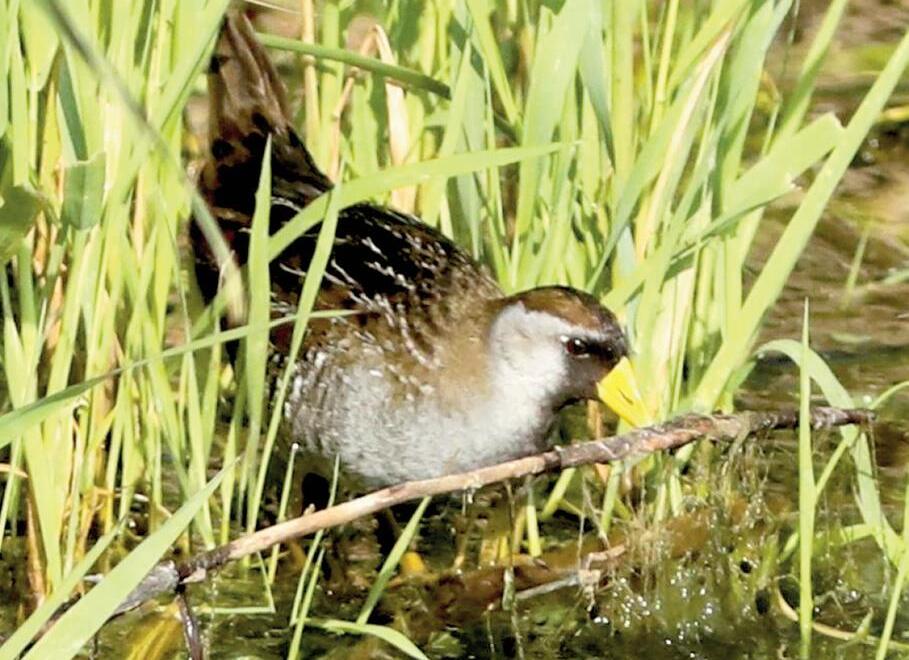
recorder, or could it be that a Piedbilled Grebe just swam by?
Nestled in the Beaverhill Lake Natural Area are two things: a marsh and an organization of curious bird biologists. They are a perfect match; annually, staff at the Beaverhill Bird
Program (PPMMP) by Birds Canada. Designed with secretive marsh birds in mind, the program uses a technique known as “callback” where bird calls are broadcast from a speaker in hopes of triggering a response from the target species. It is important to emphasize
that callback should be reserved for scientific purposes, not personal use. Inappropriate callback practices will disturb bird breeding behaviour, and great care is taken during the MMP to eliminate harm.
The Beaverhill Lake Natural Area has been designated as a Key Biodiversity Area and recognized by the Ramsar Convention on Wetlands, and the glowing results of these surveys leave no question as to why this is. In an area smaller than 4km2 (400 hectares), the observatory’s MMP surveys have documented more than 50 bird species! This includes eight of the protocol’s ten target species: American Bittern, Pied-billed Grebe, Eared Grebe, Horned Grebe, Virginia Rail, Sora, Yellow Rail, and Nelson’s Sparrow.
During this year’s Snow Goose Festival, visitors partaking in hiking tours to the Beaverhill Bird Observatory will be led along the western shore of Lister Lake. Many of the MMP survey sites are located along this trail, as well as a few viewpoints overlooking this marsh!
So don your binoculars, hit the trails, and spend this summer basking in the bizarre symphony of your local wetlands! But, before excitedly adding a secretive marsh bird to your list, make sure you’re not being fooled by a nearby speaker!


BY CHRIS REES
The majority of North American Geese nest in the Canadian arctic and Alaska. This means that every spring large flocks of geese migrate from wintering (non-breeding) grounds in the south to breeding grounds in the north.
Snow Geese are by far the most numerous species and flocks of these large white birds are spectacular to see.
The local Snow Goose is the Lesser Snow Goose sub-species with the Greater Snow Goose being found in Quebec and the east coast.
The Snow Goose comes in two colour phases or morphs: the normal white morph and the grey “blue” morph. In the fall, when the birds return south, the flocks are augmented with many family groups and an abundance of greyer juveniles.
The Beaverhill Lake Snow Goose Festival allows interested parties to experience the awesome spectacle of the Spring Snow Goose Migration.
Snow Geese are the most highly visible species, but the four other continental goose species are also present in the local area: Greater White-fronted Goose, Ross’s Goose, Cackling Goose, and Canada Goose.
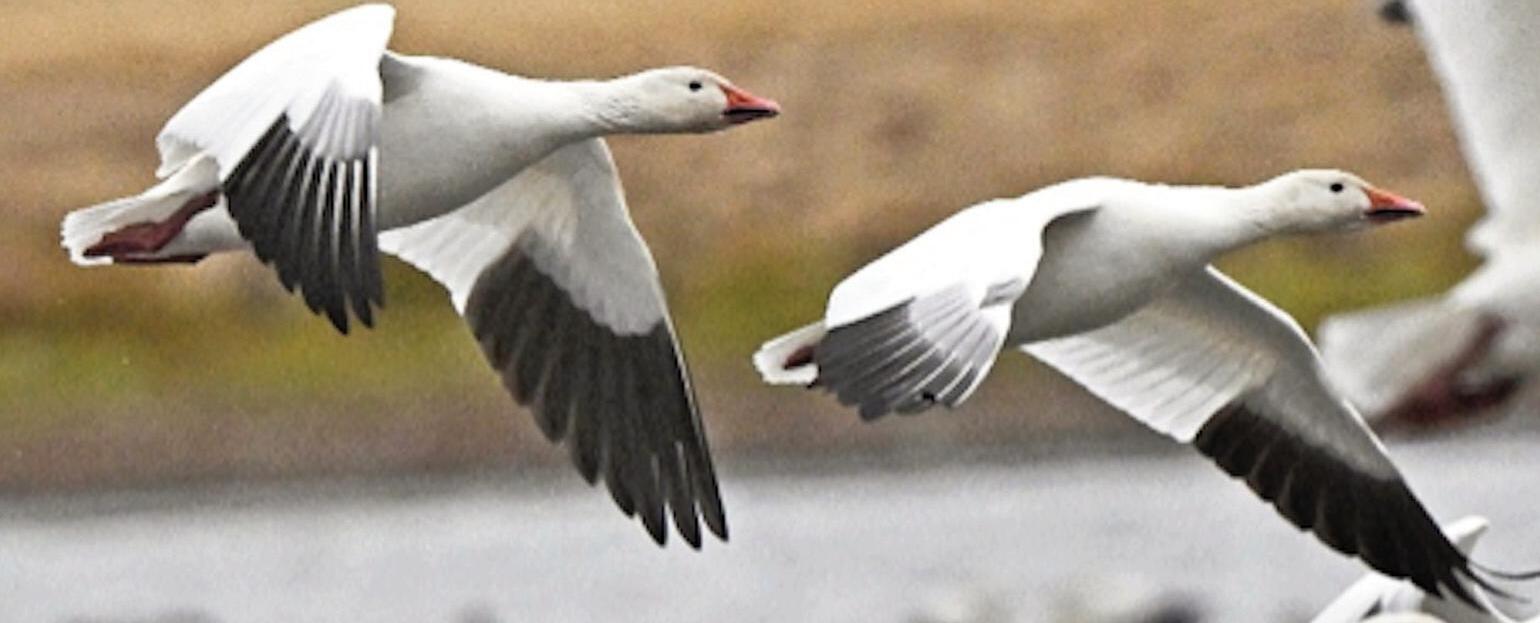
Greater White-fronts tend to be the earliest spring and autumn arrivals. Ross’s Geese are the least common but with careful scoping of the flocks of Snow Geese one can often find up to
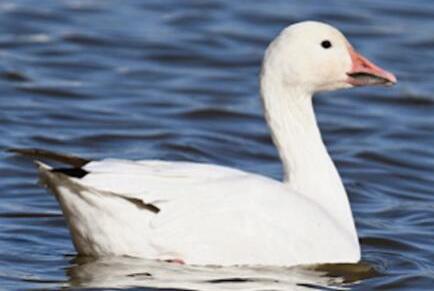
several of these smaller geese in the flocks.
Ross’s Geese come in two colour morphs similar to Snow Geese, but the proportion of “blue” morphs is much lower.
The Cackling Goose was split from the Canada Goose in the 45th supplement of the AOU (American Ornithologists Union) checklist in 2004. It has taken a while, but many local birders have become proficient at distinguishing the two species (ok still with some uncertainty).
There are four subspecies of Cackling Geese. The local species was formerly the Richardson’s Canada Goose and is now the Cackling Goose (Richardson’s). Spring and autumn Canada Geese flocks are probably a mixture of local birds and migrants.
The numbers of Snow Geese have increased dramatically in the past years. Ducks Unlimited reports that
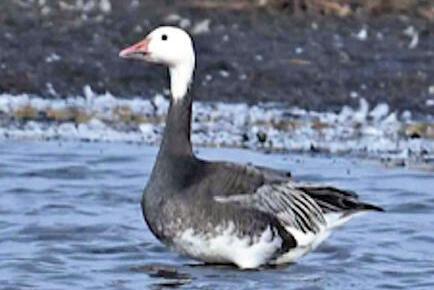
the population has grown from as low as 1,000 in the 1900s to a high of 19 million in 2013. The numbers are so high that the geese have been damaging their arctic nesting grounds, so hunting limits have been increased to 50 birds per day with an unlimited possession limit. In addition, a spring hunting season has been added.
All goose populations appear to be in good shape. Ducks Unlimited provides the following information for conservation status as defined by the International Union for the Conservation of Wildlife (IUCN) and population numbers for each goose species:
Snow Goose
• IUCN Status: Least Concern
• Population Status: The population of Snow Geese increased exponentially from 1970 (1 million birds) until 2013
(19 million birds) and has declined since that time to 14 million in 2019. The Mid-continent Population is estimated to contain about 83 percent of the total at 12 million birds. The Wrangel Island population is estimated at 440,000, while the Greater Snow Goose subspecies is estimated at 1.4 million birds.
Greater White-fronted Goose
• IUCN Status: Least Concern
• Population Status: The population is stable to increasing throughout their range in North America. In North America three sub-populations occur; the Pacific Greater White-fronted Goose (A. a. sponsa) that numbers 685,000 birds, the Western Greater White-fronted Goose (A. a. gambelli) estimated at 2,600,000, and the Tule Greater White-fronted Goose (A. a. elegasi) estimated at 8,000–13,000 birds. The population of White-fronted Geese as a whole, in North America, has grown substantially in recent decades. Ross’s Goose
• IUCN Status: Least Concern
• Population Status: Recent estimates are 2.35 million birds and an increasing population. During the early 1900s, the population was small and of conservation concern. In the early 1950s there were 2,000–3000 Ross’s Geese, but by 2006 there were 1.3 million birds.
Continued on Page 8
The American Kestrel is North America’s smallest and most colourful falcon. This beautiful little raptor is found in grassland and agricultural areas, especially pasture-type habitats, where it mainly feeds on grasshoppers, mice and voles. Unfortunately, Kestrel populations are declining across the continent. To investigate why this is happening, we have been monitoring Kestrels using nestboxes in central Alberta for the past decade. Cameras have been used to learn what our local Kestrels eat, and we have deployed trackers to learn about their movements. Some of our Kestrels travelled more than 10,000 km annually!!!
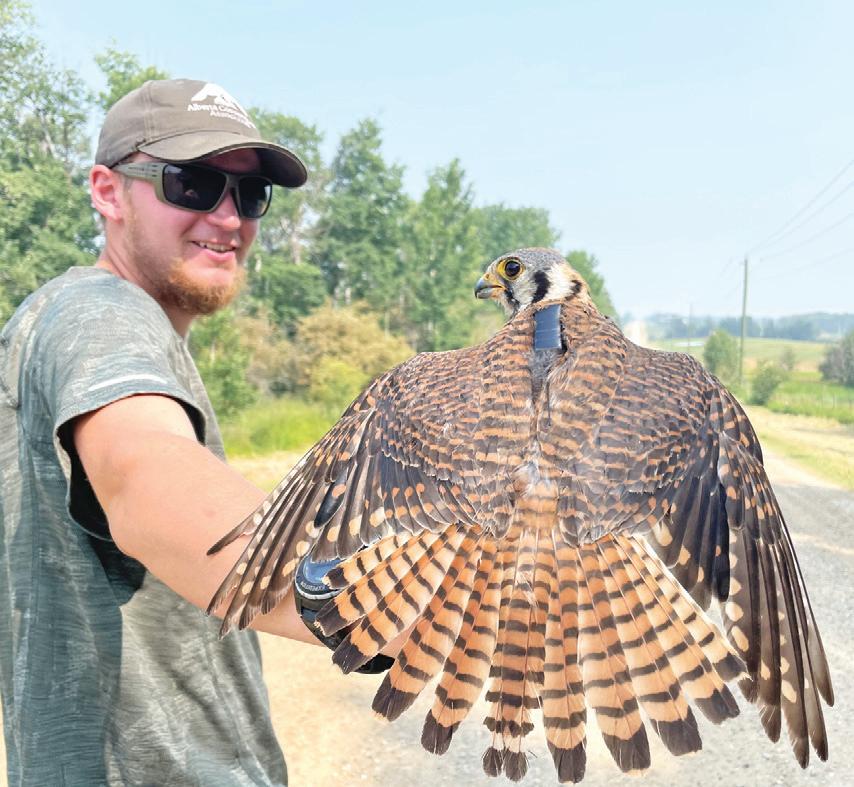

Please share your Kestrel sightings with us. You could host a Kestrel family with a nestbox. To hear about how you can attend and participate in our events, such as banding young at nestboxes, please email info@STRIXeco.ca. We are on Instagram @alberta_kestrel_project and our Facebook page is Alberta Kestrel Project.



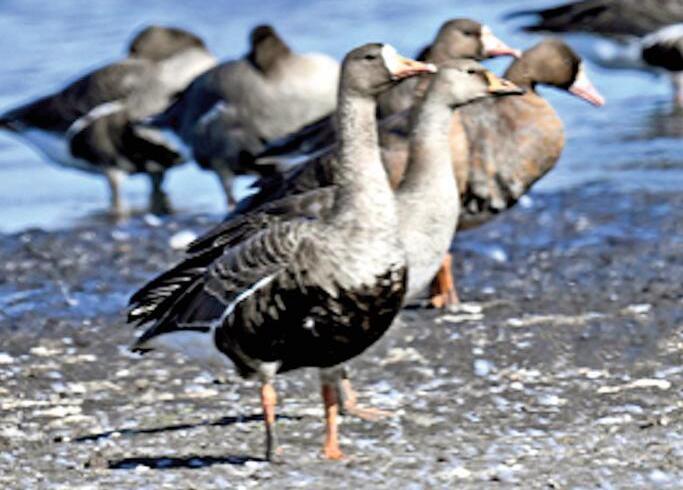
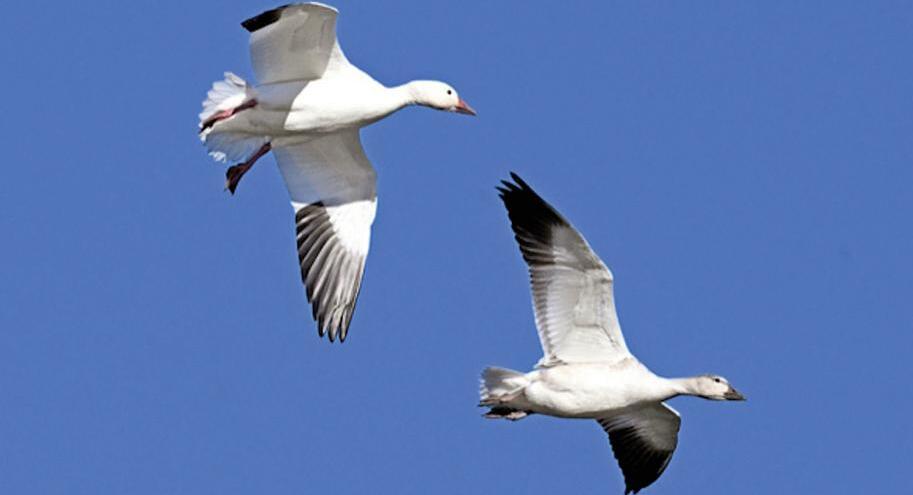
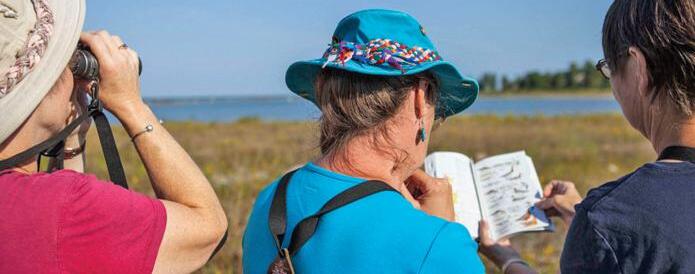

Continued from Page 6
Cackling Goose
• IUCN Status: Least Concern
• Population Status: The global population of Cackling Geese is estimated to be around 3,000,000, of which 2,499,000 are B. h. hutchinsii, 205,000 are B. h. minima, 199,000 are B. h. leucopareia, and 59,000 are B. h. taverneri. Population trends suggest slight

declines in recent years.
Canada Goose
• IUCN Status: Least Concern
• Population Status: The global population of Canada Geese is estimated to be between 5,100,000 and 6,200,000, which is probably conservative. Population trends and stability vary among subspecies, with some subspecies not well documented. Many subspecies and subpopulations overlap in winter, and use breeding areas that are not easily surveyed, making it difficult to accurately estimate numbers by subspecies.

Mark your calendars for the upcoming Village of Ryley Events:
Ryley Sports Day & 2nd Annual Slo-Pitch Tournament: Kids entertainment and parade! - June 20th
Ryley Summer Fest: Community Celebration with activities for all ages - July 18th
Harvest Dinner & Dance - October 24th
Check the Village of Ryley Facebook Page or www.ryley.ca for more details as event dates approach!
BY CHRIS REES
It is exciting to see all the arctic breeding geese passing through our local area in large numbers.
There is one other very rare goose species, and if all the local birders check
the flocks carefully, maybe, just maybe we will find the much sought after near mythical Brant.
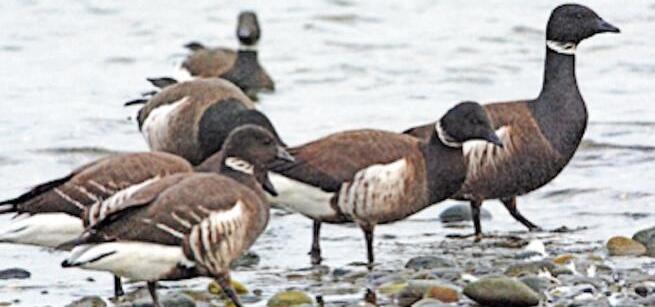
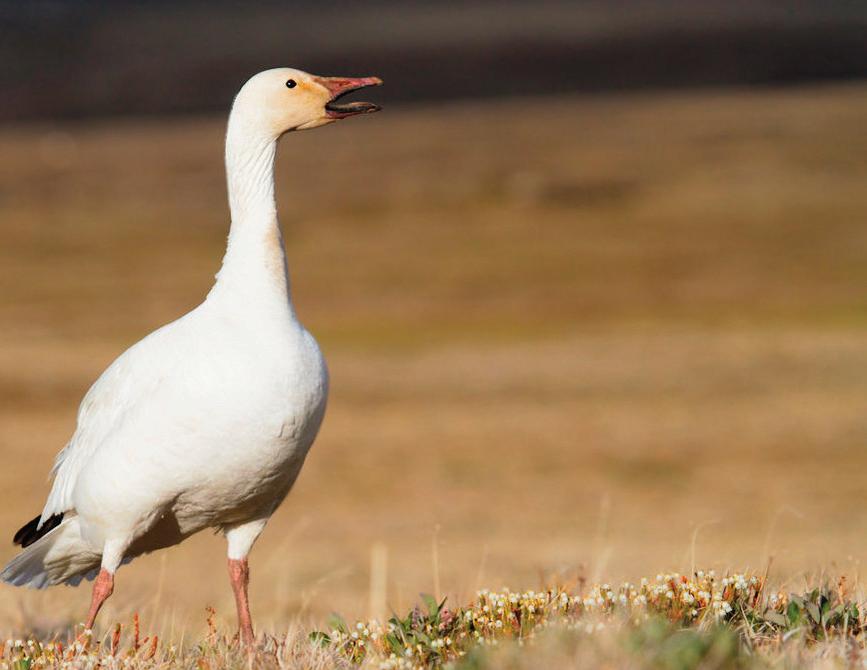





Emilie Dykstra, Beaverhill Bird Observatory
In 2025, the Beaverhill Bird Observatory (BBO) completed the fourth year of a Least Flycatcher study, focusing on breeding success and nest reuse: 94 nests were found between 2022 and 2025. Of those monitored across multiple breeding seasons, roughly 20 percent were reused at least once — a notable finding for a species previously thought to build fresh nests each year due to weather damage and structural decay.
Historically, scientists believed open-cup nests were too fragile to withstand winter weather or offer safe reuse options. However, results of this ongoing study suggest nest persistence — and reuse — may play a larger role in songbird breeding ecology than previously understood. Open-cup nesting birds, unlike cavity nesters, typically construct new nests annually despite the energy costs. But in BBO’s study area, about 65% of nests retained enough structural integrity to persist through at least one winter.
Importantly, reused nests were no more likely to fail than newly built ones. Over the 2024 and 2025 breeding seasons, nest failure occurred at similar rates in both old and new nests. Nest
failure by predation, weather events, or brood parasitism (where another species will lay eggs in the Least Flycatcher nest) were almost equal between new and reused nests in both years of study.
Monitoring under the MAPS (Monitoring Avian Productivity and Survivorship) program recorded a 269% increase in total captures of Least Flycatchers and a 319% rise in breeding-age adults between 2022 and 2025. Nest reuse may help support that growth. Such a high breeding population may encourage birds to select sites where nests already exist, saving time and energy while competing for limited territory.
As insect populations fluctuate and climate conditions shift, understanding subtle behaviours such as nest reuse may prove critical in conserving aerial insectivores like the Least Flycatcher. Continuing to promote high quality habitat for this small songbird in the Beaverhill Natural Area is important to maintain such a dense breeding population.
The study will continue in 2026, hopefully adding more insight into these tiny birds’ nesting habits! All years of the Least Flycatcher nest monitoring project are available to read on the BBO’s website.
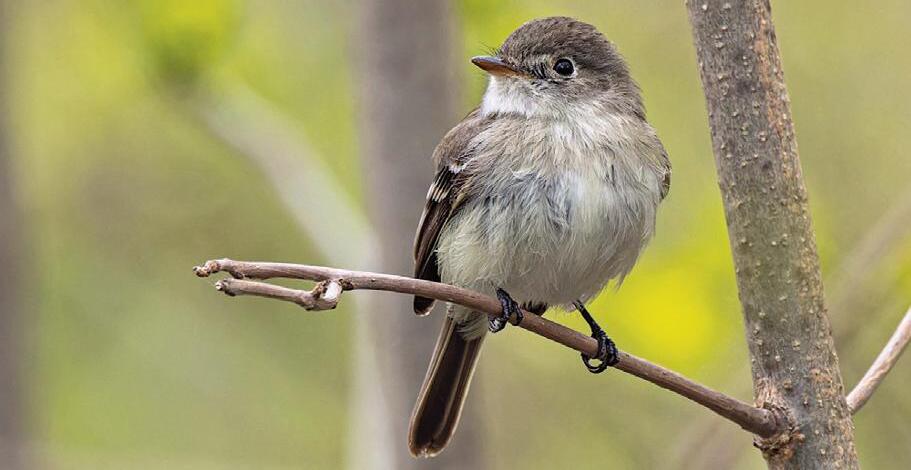


(Same for both days unless otherwise noted)
Purchase advance tour tickets and find more details at: www.snowgoosefestival.ca
7:30 am - 5:00 pm Tour Registration & information Centre – Tofield Arena
Concession open
8:00 am – 3:30 pm Tour Departures from Tofield Arena
Ticket Required Tour cost: Adults: $25, Youth (12 & under): $10, Family (2a/2c): $60
Visit website to purchase advance tickets. Tickets may be limited on site.
Bring your camera, bird ID book, and binoculars. As spring weather can be unpredictable, waterproof footwear and layered clothing are recommended.
9:30 am – 5:00 pm Trade Show and Market Hours
FREE Admission Several tradeshow and market vendors, nature interpretation, kid’s activities, educational exhibits with live birds and more!
9:30 am – 5:00 pm FREE Kids Activities - Located in Trade Show area
FREE Admission Hosted by Nature Alberta and Nature Kids
Visit the Nature Alberta booth where families can try out a variety of different activities.
- Kids can make their own craft to take home
- Test their wildlife knowledge with interactive quizzes
12 Noon & 2:00 pm Speaker Series: Tofield Arena Meeting Room
FREE Admission
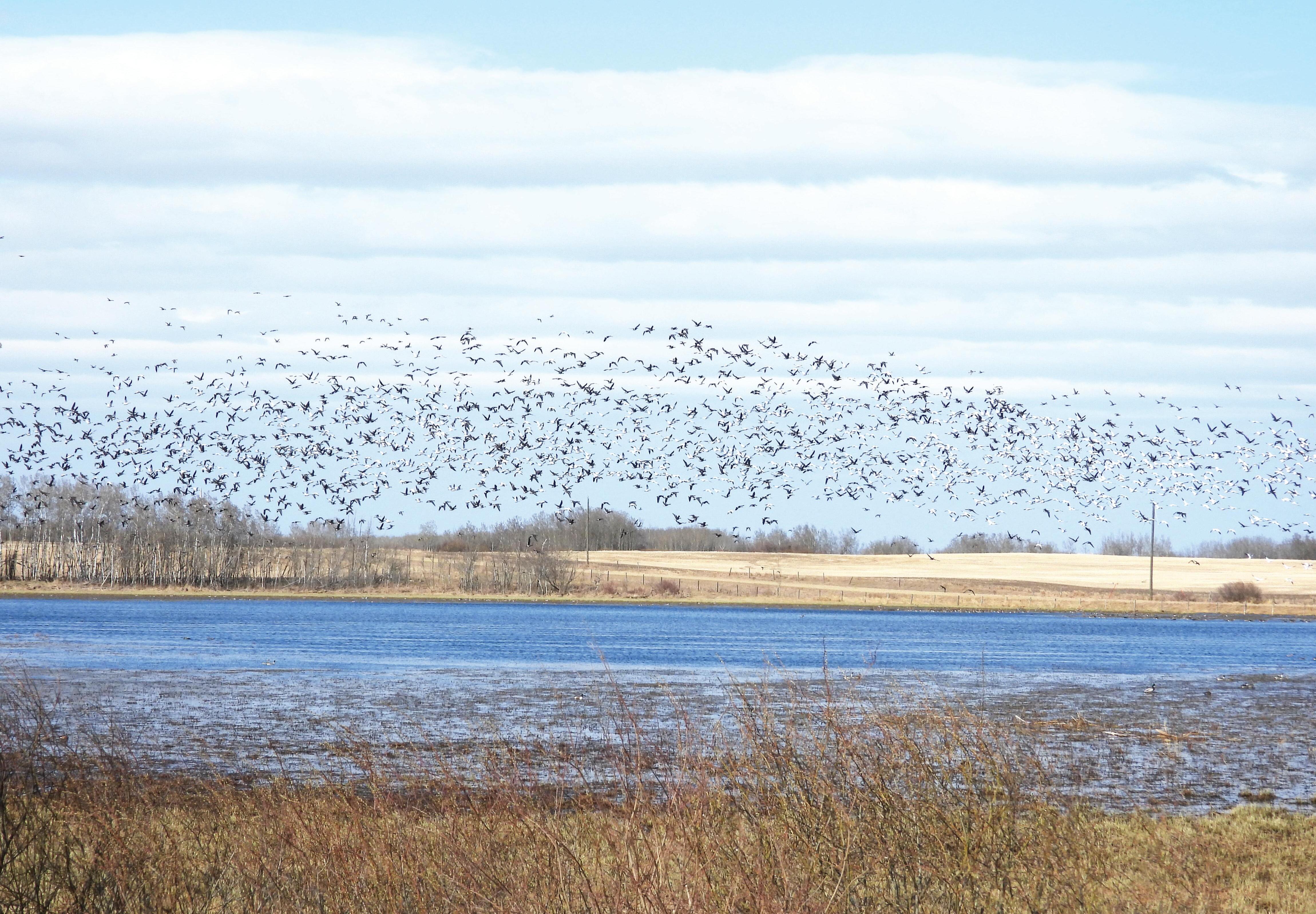
Saturday, April 25 at 12 Noon
Marsh Birds of the Beaverhill Natural Area
Willow Zilliox, Field Biologist, Beaverhill Bird Observatory
Saturday, April 25 at 2:00 pm
Sidney Stansell and the Birds of Alberta 100 Years Ago
John Acorn, Lifelong naturalist, a former television host, a book author, and a faculty member at the University of Alberta in Edmonton
Sunday, April 26 at 12 Noon
Exploring the role for zoos in local species conservation in support of global biodiversity goals
Catherine Shier, Professional Biologist with the City of Edmonton
Sunday, April 26 at 2:00 pm
In Search of Sandpipers: The Fleeting Shores of Beaverhill Lake
Jon Van Arragon, Biologist, Beaverhill Bird Observatory
6:30 pm Banquet & Silent Auction at Tofield Community Hall
Saturday Only Doors open at 6:00 pm, supper at 6:30 pm. Ticket Required Tickets: $50/person (purchase in advance by April 17)
Guest Speaker: Dr. Glynnis Hood
Topic - Seasons of the beaver: A journey through time
Silent Auction at banquet with proceeds supporting the Snow Goose Festival.






2-Hours Bus tour View wildlife in wetland areas around the south and east points around Beaverhill Lake including stops at migratory points of interest for viewing. Possible short stops to view geese on the bus.
A19:00am-11:00amSat.&Sun.
A210:00am-12NoonSat.&Sun.
A311:00am-1:00pmSat.&Sun.
A412:30pm-2:30pmSat.&Sun.
A51:30pm-3:30pmSat.&Sun.
A62:30pm-4:30pmSat.&Sun.
A73:00pm-5:00pmSat.&Sun.
3-Hour Bus Tour
View wildlife in wetland areas around the south and east points around Beaverhill Lake including stops at migratory points of interest for viewing. Extended stops to view snow geese off the bus.
B18:00am-11:00amSat.&Sun.
B28:30am-11:30amSat.&Sun.
B39:00am-12NoonSat.&Sun.
B411:00am-2:00pmSat.&Sun.
B51:00pm-4:00pmSat.&Sun.
B62:30pm-5:30pmSat.&Sun.
B73:00-6:00pmSat.&Sun.
3 Hour Field Hike
Take a short bus ride to Beaverhill Nature Area, then a 4km hike along the trail network to the Beaverhill Bird Observatory where staff will provide information on their birding studies and you may witness spring banding. This hike does NOT include busing to see flocks of snow geese.
C18:00am-11:00amSat.&Sun.
C29:00am-12NoonSat.&Sun.
C310:00am-1:00pmSat.&Sun.
C411:00am-2:00pmSat.&Sun.
C512Noon-3:00pmSat.&Sun.
C61:00pm-4:00pmSat.&Sun.
C72:00pm-5:00pmSat.only
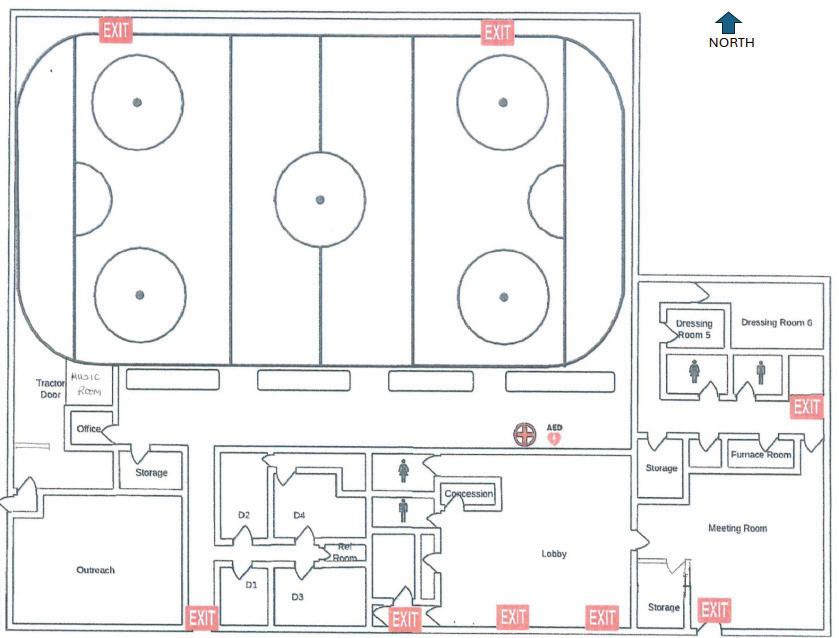
FESTIVALHEADQUARTERS (TofieldArena)
*TourCheck-In
*TradeShow&Market (freeadmission)
*Information
*KidsActivities
*LiveBirdonsite!

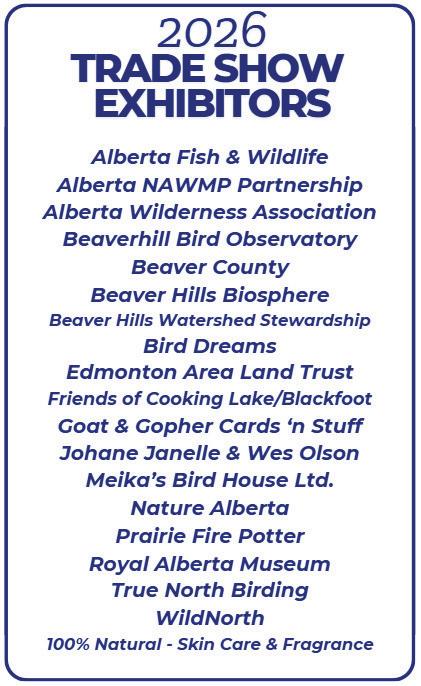




Book your free shuttle on the website: www.snowgoosefestival.ca

Free shuttle DOES NOT include tickets for the guided bus tours departing from the Festival. TICKETS FOR THOSE BUSES






SATURDAY 12 PM
WILLOW ZILLIOX
Marsh Birds of the Beaverhill Natural Area
Abstract
In this presentation, we will begin with a brief outline of Alberta’s wetland habitats and the importance of conserving these ecosystems. We’ll then explore Lister Lake through the lens of the Beaverhill Bird Observatory’s Marsh Monitoring Program and, finally, learn about a few notable species inhabiting the BBO's wetlands!
Bio
Willow Zilliox is a Field Biologist with the Beaverhill Bird Observatory, joining the team of staff in May 2025. Last season, she performed a series of marsh bird surveys in the wetland surrounding Lister Lake in continuation of the BBO’s Marsh Monitoring Program. Willow delights in engaging with others and sharing her excitement about wildlife!
SATURDAY 2 PM
JOHN ACORN
Sidney Stansell and the Birds of Alberta 100 Years Ago
Abstract
Sidney Stansell was a school teacher in rural Alberta in the early 1900s. He was also a bird watcher, and he lived near Carvel, Manly, Cooking Lake, and Provost. His most important records were never published, but we now have both his bird notes and many of his lantern-slide photographs, allowing us to reconstruct the bird life of this previously mysterious period in our history. Gaining recognition as a bird expert was highly competitive back then, and Stansell's story is also a story of scientific politics, and missed opportunities.
Bio
John Acorn is a lifelong naturalist, a former television host, a book author, and a faculty member at the University of Alberta in Edmonton. He is frequently seen in the vicinity of Beaverhill Lake, binoculars and camera in hand.
SUNDAY 12 PM
CATHERINE SHIER
Exploring the role for zoos in local species conservation in support of global biodiversity goals
Abstract
With two-thirds of the human global population projected to live in cities by

2050, many of the most personally impactful human-wildlife interactions occur close to home for the majority of us. This is particularly true in Alberta which already has one of the most urbanized populations in the world at 81%. This high proportion makes it imperative that Alberta based conser-

vation organizations invest in urban biodiversity conservation to provide all citizens with the opportunity to enjoy and experience native biodiversity close to home.
Continued on Page 13
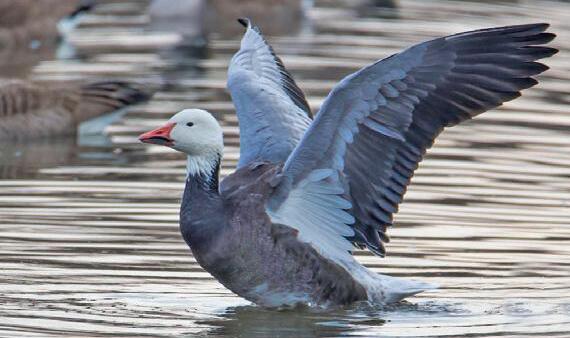


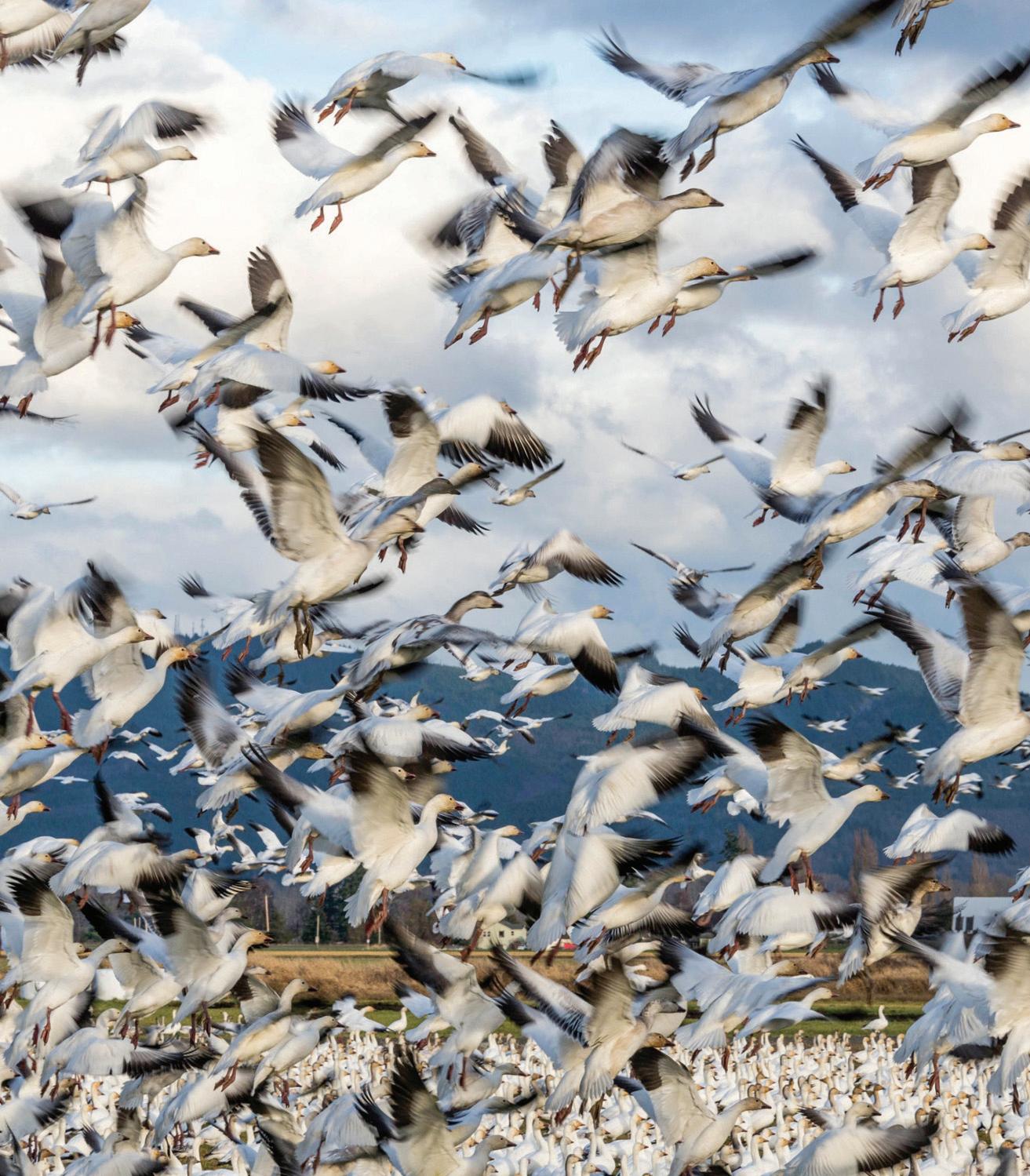
















Continued from 12
To that end, Canada’s only Zoo located within the Central Parklandarguably Alberta’s most threatened natural subregion - is working to incorporate urban wildlife conservation initiatives into its conservation program. Partnering with other Zoos, academic partners, and the naturalist community, the Edmonton Valley Zoo is continuing to look for partners who also want to protect the Central Parkland's native biodiversity and work together to achieve full implementation of Target 4 of the Global Biodiversity Framework.
Bio
Catherine is a Professional Biologist who has worked for the last 14 years to conserve Edmonton's wildlife and wild places through her various roles with the City of Edmonton. Catherine has an M.Sc. in Environmental Biology and Ecology from the University of Alberta and has worked on the City's ecological mapping, wildlife passage and biodiversity monitoring programs. In August 2022 Catherine moved into the role of Edmonton's first Conservation Coordinator where she is working to continue, and expand upon, the suc-
cessful local and international wildlife conservation work led by the Edmonton Valley Zoo.
SUNDAY 2PM
JON VAN ARRAGON
In Search of Sandpipers: The Fleeting Shores of Beaverhill Lake
Abstract
Located just east of Tofield, Beaverhill Lake was a renowned shorebird watching spot in the 1980s. When the lake was at its fullest, it was designated as a Western Hemispheric Shorebird Reserve, a RAMSAR wetland of International Importance, and a Key Biodiversity Area (KBA). However, Beaverhill Lake dried up in the early 2000s, taking the massive flocks of shorebirds with it. Jon will explore the history of Beaverhill Lake, and will share what recent surveys conducted by the BBO have shown about shorebird populations in the lake today.
Bio
Jon is a biologist at the Beaverhill Bird Observatory, where he has worked since 2020. He spent much of the 2025 field season trudging through the muck of Beaverhill Lake to count shorebirds.
BANQUET GUEST SPEAKER
DR. GLYNNIS HOOD
Seasons of the beaver: A journey through time
Abstract
Beavers have been part of our ecological and cultural history for millennia, and through it all, they have supported us and many other species with tenacity and resilience. Absent from the Beaver Hills for many decades, their return, partly helped by trains, planes, and automobiles, marked a return of water and a measure of ecological recovery. Their activities cover various timescales. Unlike many other rodents, beavers do not hibernate and contribute their hard work throughout the seasons. This talk explores our shared ecological history with a species that shapes our future one season at a time.
Bio
Dr. Glynnis Hood is a Professor Emerita and ecologist at the University of Alberta and an Adjunct Professor at the
University of Saskatchewan. For more than 20 years, Glynnis has integrated her research on beaver ecology with more focused studies of beaver management to enhance human-wildlife coexistence. She is the author of Semiaquatic Mammals: Ecology and Biology, The Beaver Manifesto, and her first children's book A Cabin Christmas. A second edition of her first book, entitled The Beaver Manifesto: Conservation, Conflict and the Future of Wetlands was released in September 2025 by Rocky Mountain Books.
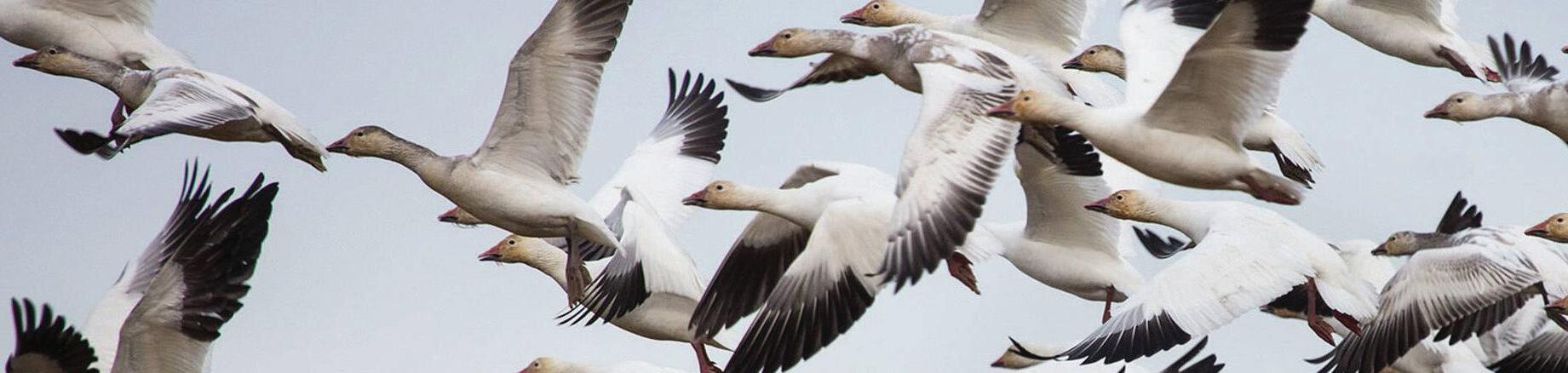
Celebrate the wonder of the spring migration with us at the Snow Goose Festival in Tofield on April 25 & 26, 2026.
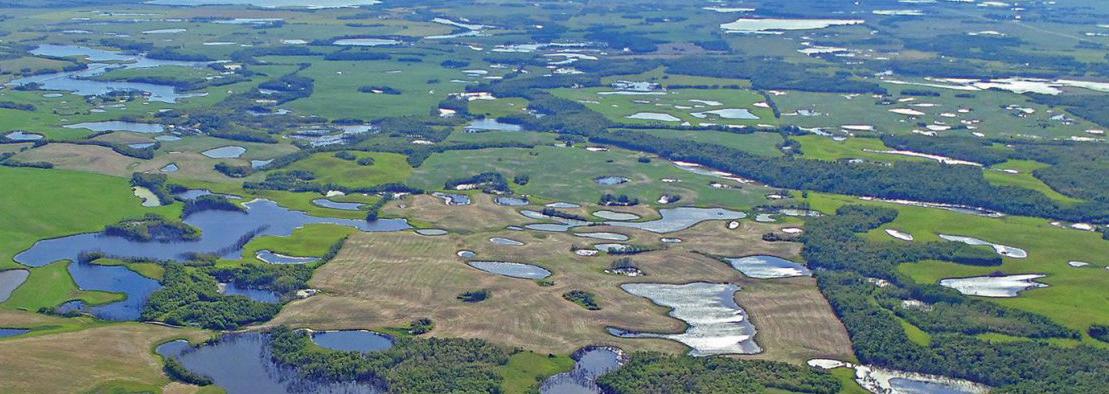
Since 1986, the Alberta North American Waterfowl Management Plan Partnership (Alberta NAWMP) and its supporters have been conserving and protecting the province’s wetlands. Because of these efforts, some bird populations, especially waterfowl, are making a comeback and, in some cases, thriving again.


M.J. PYBUS, FISH AND WILDLIFE STEWARDSHIP, Alberta Environment and Protected Areas
Waterfowl managers and wildlife disease specialists have tracked avian influenza virus (AIV) for many, many years. This ancient virus has a longstanding but ever-changing relationship with wild waterfowl, particularly ducks, geese, and shorebirds around the world. New forms of the virus constantly appear, wild waterfowl populations generate protective immunity to the new forms, and life goes on. The virus and the birds coexist in relative harmony.
However, since late 2021, the virus has done things never seen before in North America. A new highly pathogenic (=deadly) form of H5N1 avian influenza (HPAI) virus arrived in migrating wild birds from Eurasia and through 2022 it swept across the continent causing significant mortality in wild terrestrial and marine birds and a few wild mammals.
The virus not only killed individual birds, but was passed on to other species that ate AIV-infected live or dead birds. In Alberta we saw large losses in snow geese, great horned owls (adults & owlets), red-tailed hawks, magpies, crows, cormorants, grebes, ravens, and peregrine falcons in spring and again in the fall. Striped skunks also were hit hard after eating infected snow geese. Mortality was particularly concentrated in central Alberta during spring migration, perhaps in combination with increased stress in migrating waterfowl and weather-related concentration of snow geese during a late spring snowstorm.
At the same time, many poultry operations in the province detected the same form of H5N1 virus in domestic chickens, ducks, geese, and turkeys. Poultry at these sites either died or were depopulated in order to prevent further spread of the disease among domestic flocks.
Over the next year, a new North American highly pathogenic form of H5N1 systematically spread through Central and South America and all the way south to Antarctica. This was in addition to a Eurasian HPAI H5N1 form circulating in Europe, Asia, and Africa. Eventually HPAI H5N1 established a worldwide presence in wild waterfowl – the very definition of a global pandemic.
The number of dead wild birds dramatically decreased after 2022, although the list of species in which HPAI H5N1 has been detected continues to slowly increase – cumulatively, over 20 different species of marine or terrestrial mammals in North America.
By the end of 2024 we were beginning to think that the virus had once again established a relatively benign relationship with wild waterfowl and mortality was limited to a minor surge in cases during fall 2024. The apparent population declines seen in 2022 had largely turned around. For example, red-tailed hawks, hit hard by the initial wave of HPAI H5N1, were back in the sky after a 2-year noticeable absence across Canada.
But 2025 showed something new, yet again. A dramatic rise in the number of dead birds seen in early September was sustained through October and November. Mortality largely involved juvenile Canada geese that overwintered on open (unfrozen) waters in southern Alberta. It was particularly evident in the vicinity of Lethbridge and Medicine Hat well into February and March.
A North American version of HPAI H5N1 is now established in wild waterfowl, carried primarily as benign infections in mallards. We suspect the 2025 fall outbreak was associated with the incomplete immune systems of young geese that made them less able to supress viral infections. The added stress of overwintering in southern Alberta likely increased the risk to individual geese.
In looking at our data and at information from other provinces, it seems this may be the new normal for avian influenza in wild birds: Limited mortality in spring but outbreaks of differing degrees during
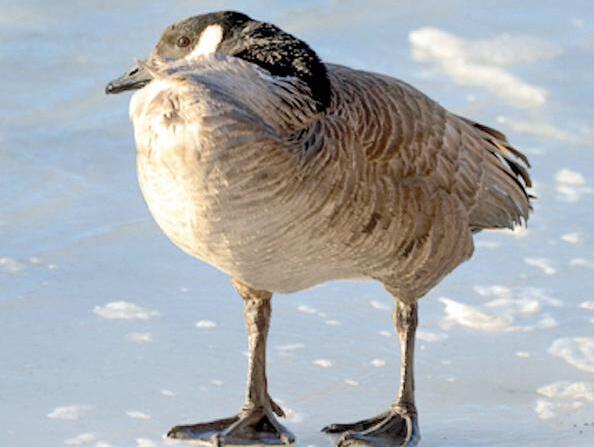
April 25, 26, 2026
fall and winter. Wildlife and agricultural agencies continue to monitor AIV across North America and particularly any changes in H5N1 genetic makeup that might increase the chances of further mortality events in wild populations, and any possible shift to increasing infections in mammals. Human health authorities state that the risk of human infection with avian influenza remains low, and involves close contact with infected domestic animals.
Alberta has conducted ongoing avian influenza surveillance of wildlife since 2006. We continue to work closely with provincial agriculture and public health officials as we monitor the virus in wild birds or mammals.
Additional information about the Alberta AIV wildlife surveillance program can be found at alberta.ca/avian-influenza-in-wild-birds. Or the national wild bird AIV surveillance program at: http://www.cwhc-rcsf.ca/avian_influenza.php
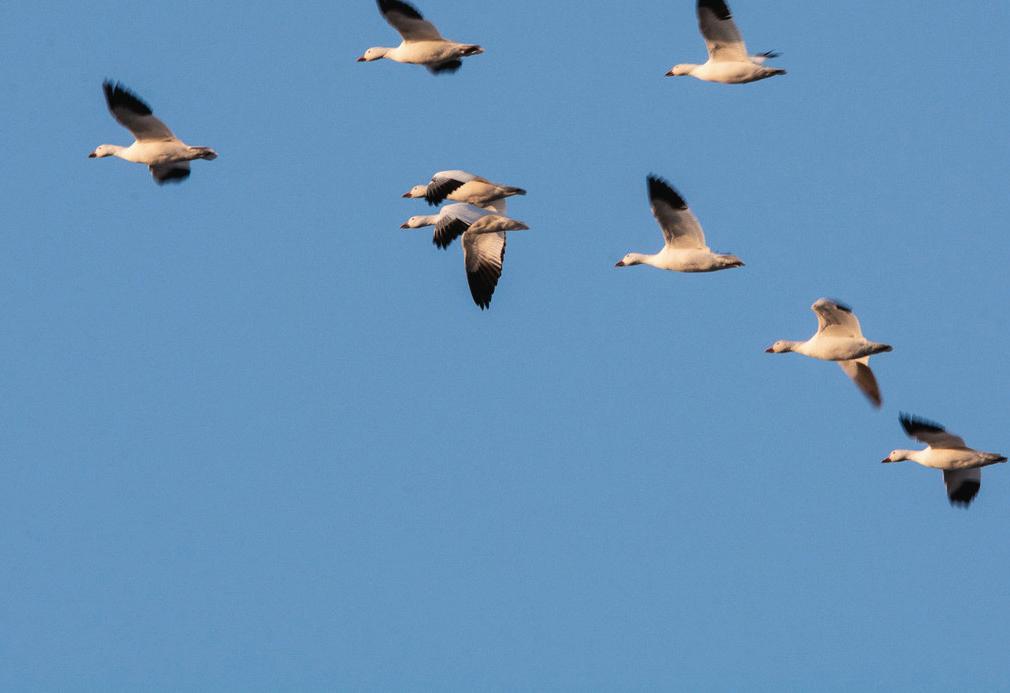




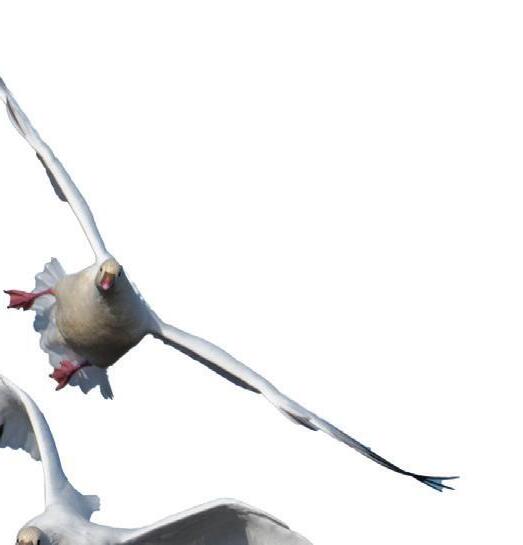



BY JANA TEEFY, HEAD BIOLOGIST
The warming spring temperatures bring an eagerness to abandon our desks for the great outdoors, fresh air, and of course, birds! We welcome back Jana and Jon as Head and Assistant Biologist, along with Emelie, Xavier, and Willow as field biologists—making five returning permitted banders, a milestone for BBO.
If you’ve visited the observatory this winter, you would be witness to the thick layer of snow blanketing the natural area. We are hopeful the retained snow means Beaverhill Lake will mean higher lake levels this year, bringing new life and biodiversity to the landscape.
Our biologists are looking forward to kicking off the annual projects, like Migration and MAPS banding to monitor our migratory species and local breeders, and our long-term monitoring projects, including nestbox, bat, butterfly, shorebird, marshland, and Least Flycatcher projects.
We are excited to introduce new projects, including nano tagging butterflies and Purple Martins with new and novel CTT tags that are detected by cellular Bluetooth technology. We are also partnering with the Bird Genoscape Project to help connect populations across the continent and track
movements through genetic sampling.
We are also looking forward to hosting our public banding events and outreach this spring, including the Snow Goose Festival, World Migratory Bird Day, songbird banding events, Big Birding Breakfast, and the Young Ornithologists’ Workshop.
This year, we are introducing “learn to extract” and “learn to band” workshops for our volunteers to get dedicated hands-on learning opportunities to expand their skills.
BirdSmart presentation, and offer various other activities.
Whether you’re attending an event or workshop, volunteering, walking the trails, or following along on social media, the team at BBO is ready to welcome you to the 2026 field season!
UPCOMING EVENTS AT THE BEAVERHILL BIRD OBSERVATORY
The BBO believes that great experiences should be affordable to everyone, so we are continuing to offer lowered ticket prices, seniors pricing, and family passes this year.
Please note that to eliminate uncertainty, we will no longer be cancelling events due to weather. If we are not able to open nets, we will invite you to join us on a guided hike, check out our new specimen display, watch a

Events this year kick off with the Snow Goose Festival on April 25-26, where you can take bus tours to view the massive flocks of geese, hike the Beaverhill Natural Area and see interpretive bird banding demonstrations, check out the tradeshow vendors, listen to guest speakers, and attend the Saturday evening banquet dinner and keynote speaker.
World Migratory Bird Day on May 9th
Celebrate the return of our migratory species with a free drop-in style event from 9 am to 2 pm at the BBO!
The theme this year is "Every Bird Counts - Your Observations Matter!" and focuses on citizen science, so we will be competing walking tours of the area, using e-bird and iNaturalist to complete a bioblitz. We will also be offering guided hikes to the weir and other family friendly activities.
beverages will be provided.
The BBO staff will be completing their Big Birding Day Fundraiser on May 20th, where they will be birding throughout the county, finding as many species of birds as possible in a single day to raise money for bird conservation! This year's goal is to see over 100 species and raise $3,000 by the day's end. Your generous donations go directly to the Beaverhill Bird Observatory to fund our long-term monitoring and education programs.
Our annual Big Birding Breakfast on May 30th and 31st will feature interpretive banding demonstrations, home-cooked crepe breakfast, kids’ crafts, face painting, and other family friendly activities.
School field tripsInterpretive Banding demonstrations
Did you know that we offer class field trips to the observatory in the spring and fall for guided hikes and interpretive banding demonstrations?
Contact education@beaverhillbirds.com for more information
Workshops
We are excited to introduce adult workshops this year! Spring workshops will be focused on gaining practice with extracting birds from mist nets. Current volunteers who have progressed to Net Check Assistant will be given priority.
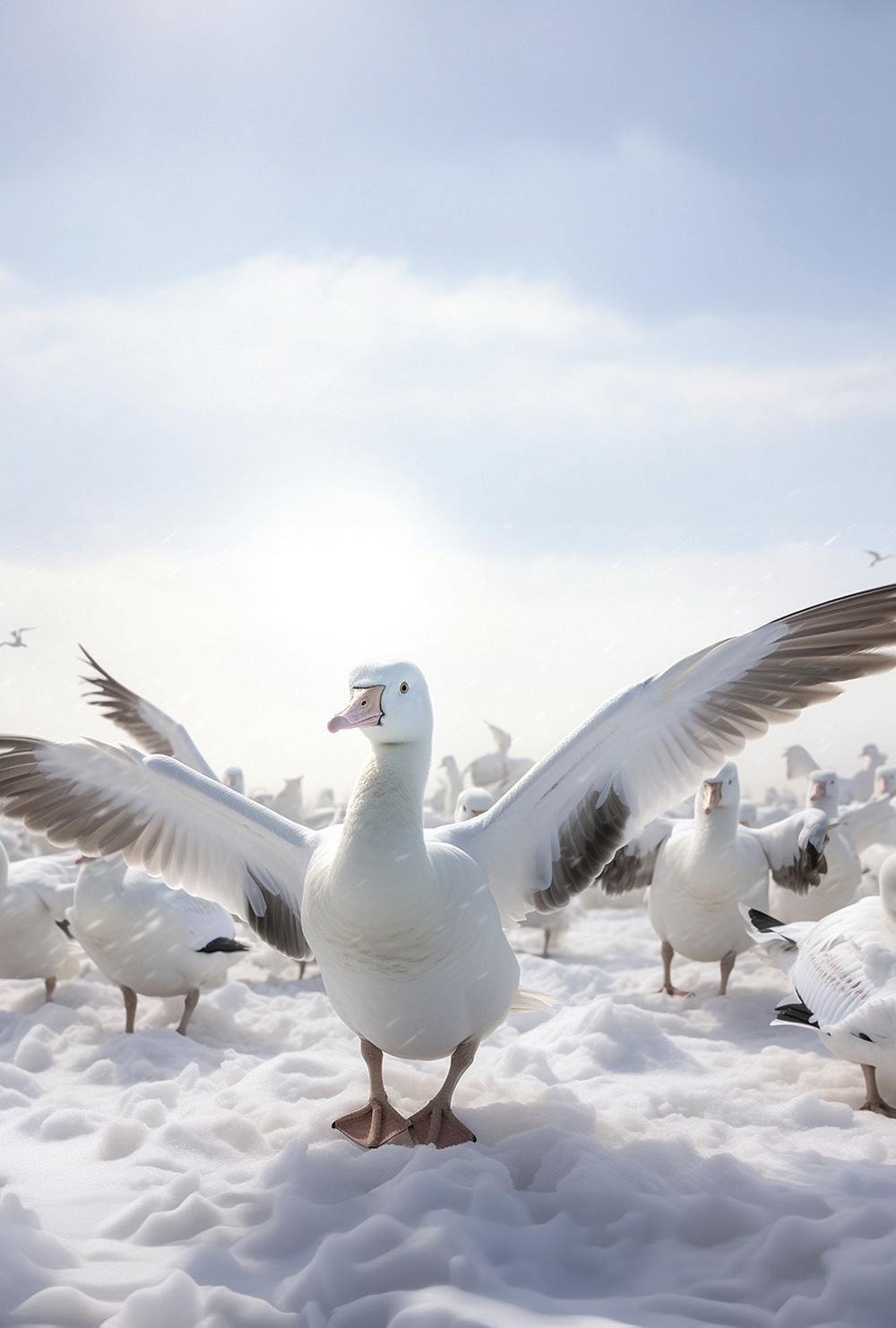
Our ticketed weekend songbird banding events will take flight on May 10th with interpretive banding demonstrations where you can learn about migrating and locally breeding birds, how we age and sex birds, and the importance of bird banding for bird conservation. Light snacks and warm


Upland sandpipers (Bartramia longicauda) migrate from South America to a large portion of Canada and the United States for breeding every spring. The Canadian Prairies are a popular destination – if you drive along our Prairie rural roads, you’ll likely see a male upland sandpiper standing on a fencepost and singing his charismatic ‘wolf whistle’ call.
Intriguingly, the upland sandpiper’s breeding population patterns are complex, with varying trends across their range. Prairie conservationists have a keen interest in gaining a deeper understanding of landscape factors driving these varied trends.
This understanding is important not only for conserving this grassland shorebird itself, but also other midcontinental shorebirds and grassland birds who share the same landscapes. Overall, the breeding populations of shorebirds and of grassland birds have dramatically declined in North America in recent decades.
To help fill this gap in understanding, the Alberta NAWMP Partnership’s Science Fund supported an upland sandpiper study to analyze land cover changes – especially the conversion of grasslands to agricultural crops – as a potential driver of the bird’s local breeding population trends.
Andres Rosales, a University of
Saskatchewan student, conducted this study for a chapter in his master’s thesis. His thesis research was guided by Dr. Kirsty Gurney and Dr. Ann McKellar, who are both at Environment and Climate Change Canada (ECCC), with valuable input from their ECCC colleague Dr. Scott Wilson.
Long-term, broad-scale estimates indicate the upland sandpiper’s breeding population is fairly stable overall. But a more detailed look shows strong geographic variations, including some locations with population increases and others with steep decreases. Gurney says, “The big question is why are these different populations doing different things?”
that is also being conducted on this species, he knew that these birds also make use of pastures, hay fields, and even cereal and canola crops, especially in the Prairies. “Upland sandpipers are living in and using the same landscapes that producers manage every day.”
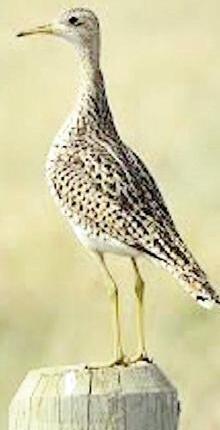
Rosales’ study covered almost all of the upland sandpiper’s breeding range, including its core range, which encompasses the Canadian Prairies and the U.S. Great Plains as far south as Kansas, and smaller areas as far east as Maine and New Brunswick.
As a ground-nesting species, the upland sandpiper needs large, open grasslands for nesting and rearing chicks, explains Rosales. However, from the trapping and tagging work


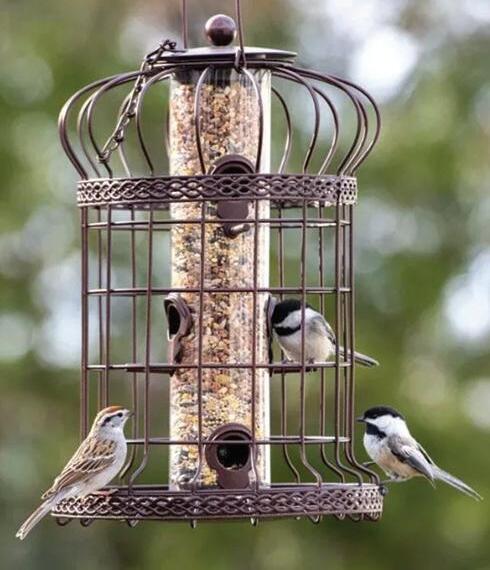

His study’s objective was to link grassland and cropland land cover changes with the upland sandpiper’s local breeding trends, from 2012 to 2022.
For the 2012 to 2022 breeding trend estimates, Rosales used the eBird Status and Trends dataset. This citizen science dataset provides localized breeding trend estimates, each representing a 27-kilometre circle, across the bird’s entire breeding range.
Next, using two publicly available land cover datasets, he determined the change in grassland area and cropland area between 2012 and 2022 for each of the eBird trend locations. And then he used a statistical model to see how changes in the estimated amounts of grassland and cropland area related to the upland sandpiper’s breeding population trends.
“The majority of locations (59%) that we examined experienced a decline in grassland area, and that decline was associated with a decline in breeding


abundance, as expected. An increase in cropland area tended to be associated with declining breeding abundance, although the magnitude of this relationship varied geographically,” says Rosales.
On a positive note, he adds, “Upland sandpiper populations on the Canadian Prairies are generally increasing despite the widespread expansion of cropland. This is likely due to the extensive grasslands that still remain and the dominant crops –canola, wheat, pulses, oats and barley –possibly acting as suitable habitat.”
However, he cautions, “The positive population trend on the Prairies could change in the future as the cropland area continues to expand and the remaining grasslands continue to be lost.”
Rosales concludes, “Sustainable management and effective conservation action for the upland sandpiper will depend on coordinated efforts among producers, researchers and conservation practitioners to balance agricultural productivity with sustainable landscapes for grassland birds.”
In addition to Alberta NAWMP’s support, this research received funding from ECCC and in-kind support from the U.S. Fish and Wildlife Service, Biodiversity Research Institute, and University of Saskatchewan.



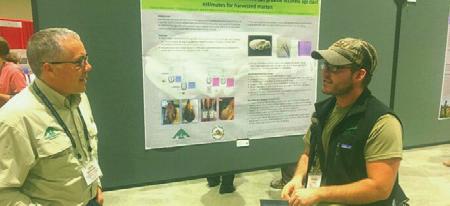
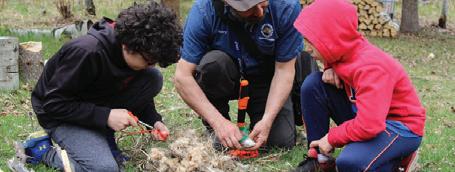






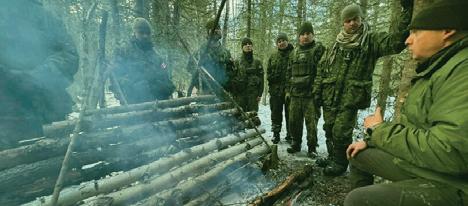
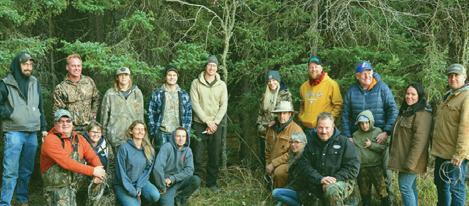
By Chuck Priestley and Lisa Priestley
Many people rec-
ognize the familiar sight of an American kestrel perched on a roadside wire or hovering over an open field, but this colourful little falcon has declined across much of the continent. The causes of those declines are still not fully understood. One of the questions we have been investigating is how strongly kestrels are tied to the places they live during the nesting season and winter. Understanding this
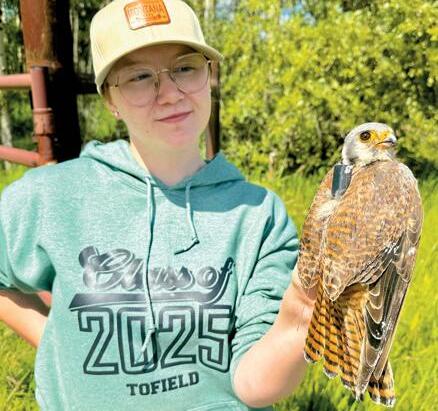
may help guide conservation actions to support kestrels.
Since 2012, STRIX Ecological Consulting, with support from Alberta Conservation Association, Amrize Canada, the Town of Tofield, and many landowner partners, has monitored breeding kestrels in central Alberta using nestboxes near Tofield, Tomahawk, and Camrose. In recent years, tracking technology has advanced to now allow us to follow individual birds well beyond Alberta to better understand how faithful they are to the places they use in both the breeding and winter seasons.
We are finding that there are seasonal differences in how kestrels are tied to the places they call home. In winter, they appear to return with remarkable precision. On average, our kestrels were 120 meters from their previous winter’s home range. For a bird that migrates from Alberta to central America, that is incredible. It means kestrels are returning not just to the same region, but to essentially the same little winter neighbourhood. On the breeding grounds, the average between-year distance was larger, about 1.4 kilometres, suggesting that
birds also return to familiar breeding landscapes, but with a little more flexibility in exactly where they settle.
The seasonal difference we are finding likely reflects how their needs change during the year. A wintering bird that finds good hunting, safe cover, and reliable habitat benefits from returning to that exact place. On
the breeding grounds however, kestrels also need to find a mate and a nest (unused tree cavity or nestbox). Nest sites may already be occupied, or potential mates may not be present. To find these, kestrels may move around within a broader area while still returning to familiar country.
Continued on Page 18

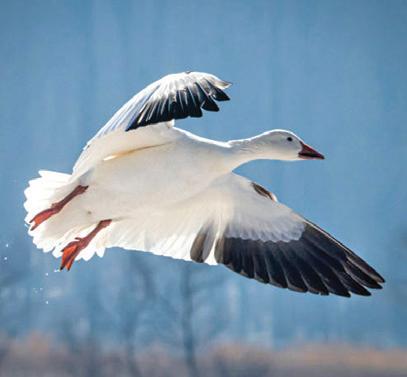


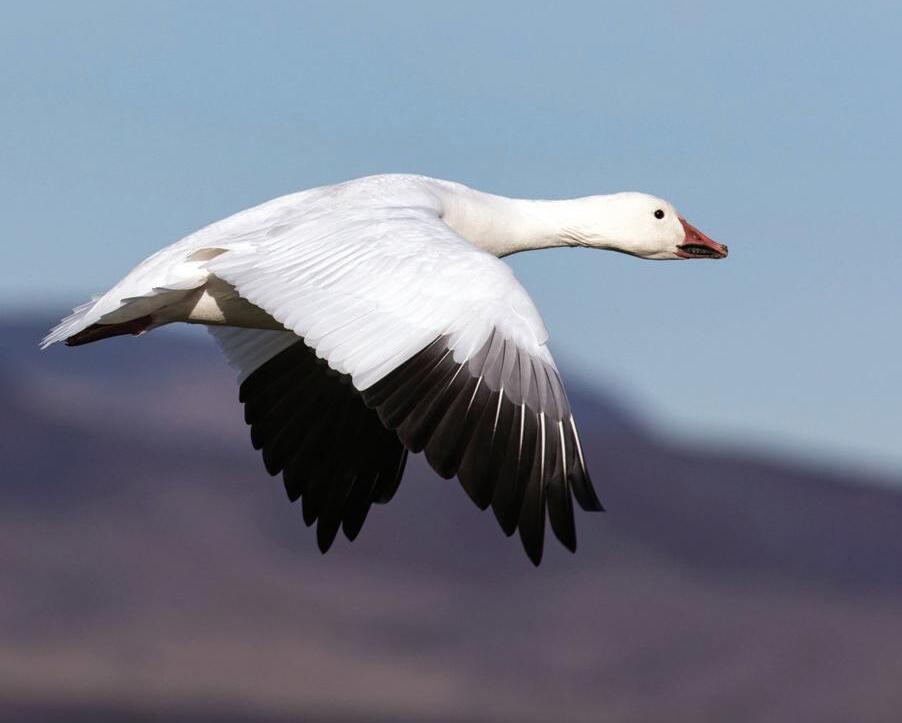
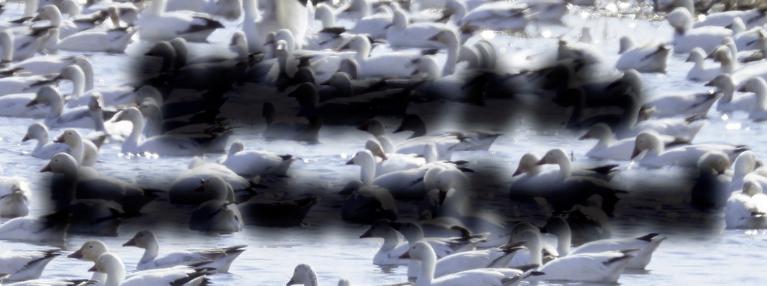




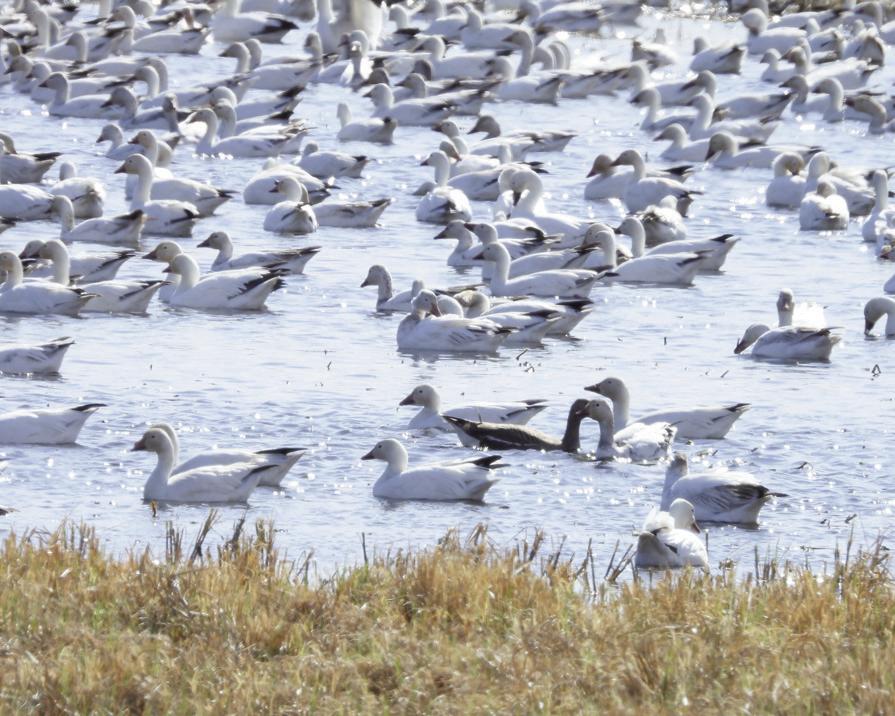


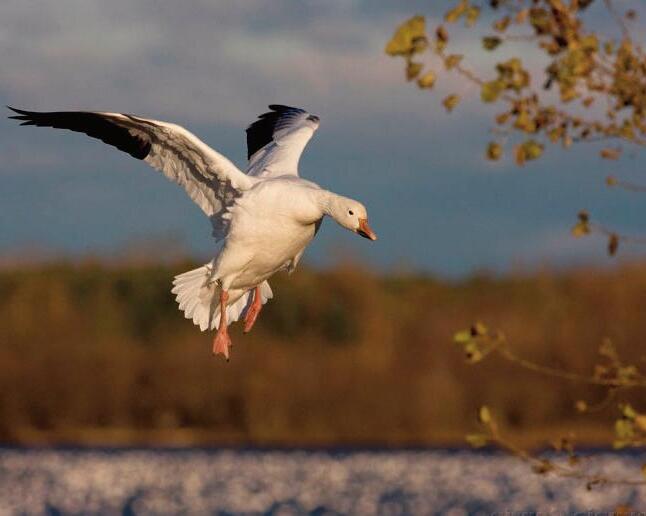


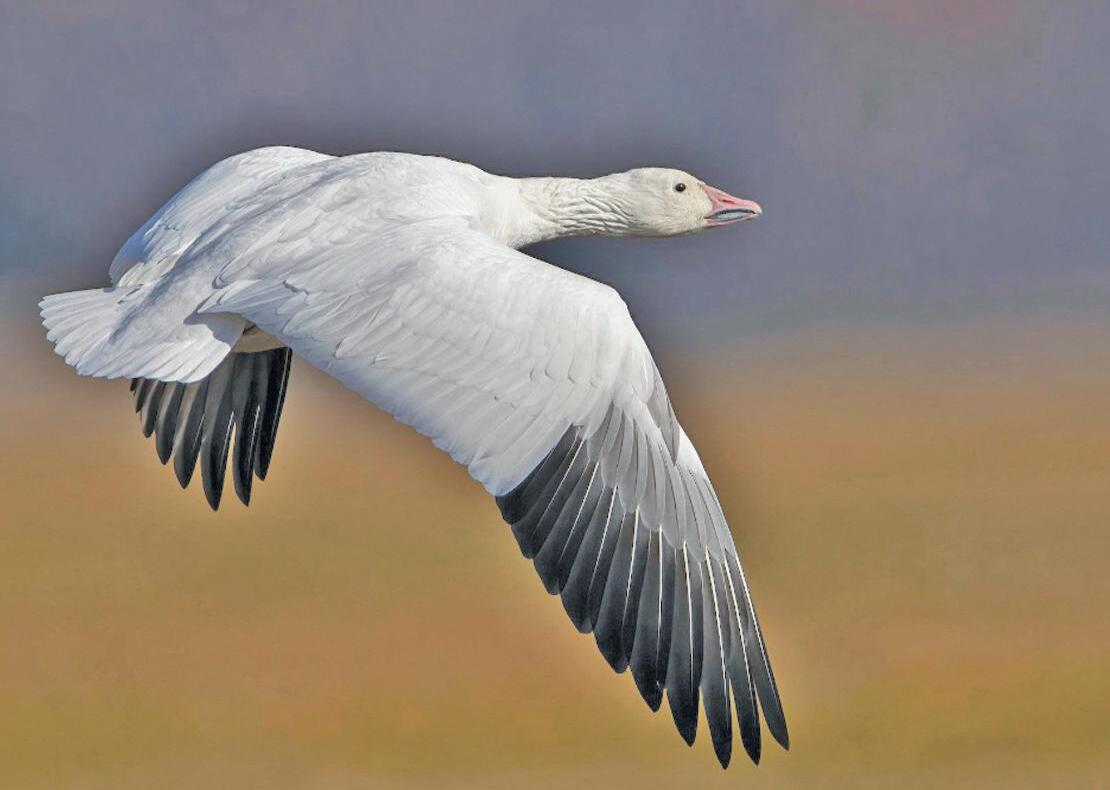
Continued from Page 17
The locations our kestrel transmitters provide are not just points on a map. They provide important insights about how our kestrels live. From what we have learned so far it appears that individual birds make decisions based on memory and experience. The more we follow them, the more it
becomes clear that kestrels are not simply wandering. They are returning to places that mattered to them before. There are various ways people can help. Maintaining open grasslands, healthy pasture, shelterbelts, and natural nesting areas helps provide the habitat kestrels need to hunt and raise young. Cows and kestrels live well
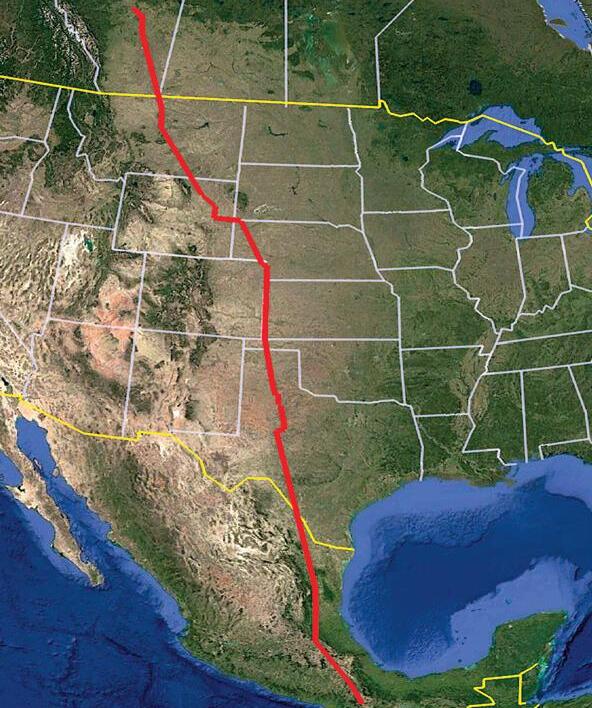
“Susie”, named after local acreage owner Susie Williams, was fitted with a transmitter four miles west of Tofield on 4 July 2025. Since that time, we have tracked her moving 5,608km! She is currently wintering in southern Mexico and will start spring migration any day. Follow Alberta Kestrel Project’s Facebook page and @AlbertaKestrelProject on Instagram to learn where she nests in 2026.


together, and landowners interested in having a kestrel nestbox placed near their pastures are encouraged to contact info@STRIXeco.ca.
If you would like to hear more about kestrel conservation and this project, we are happy to give presentations at schools and community events.
The more people who care about kestrels and the places they depend on, the better chance we have of keeping this little falcon on the landscape for years to come.

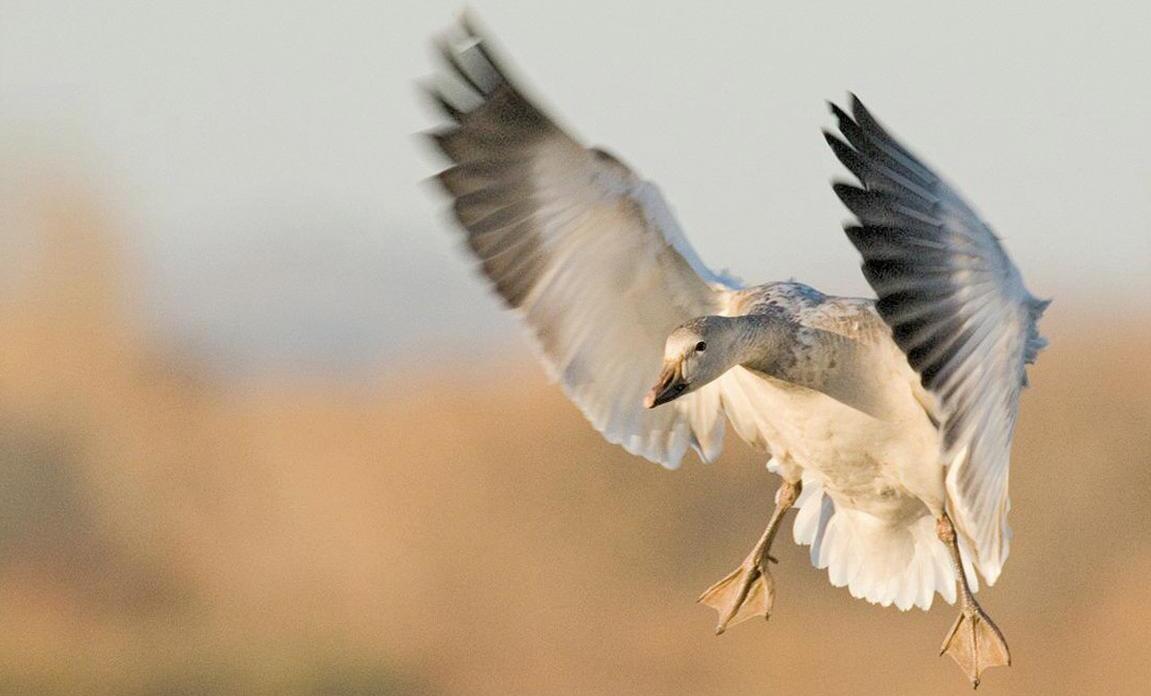



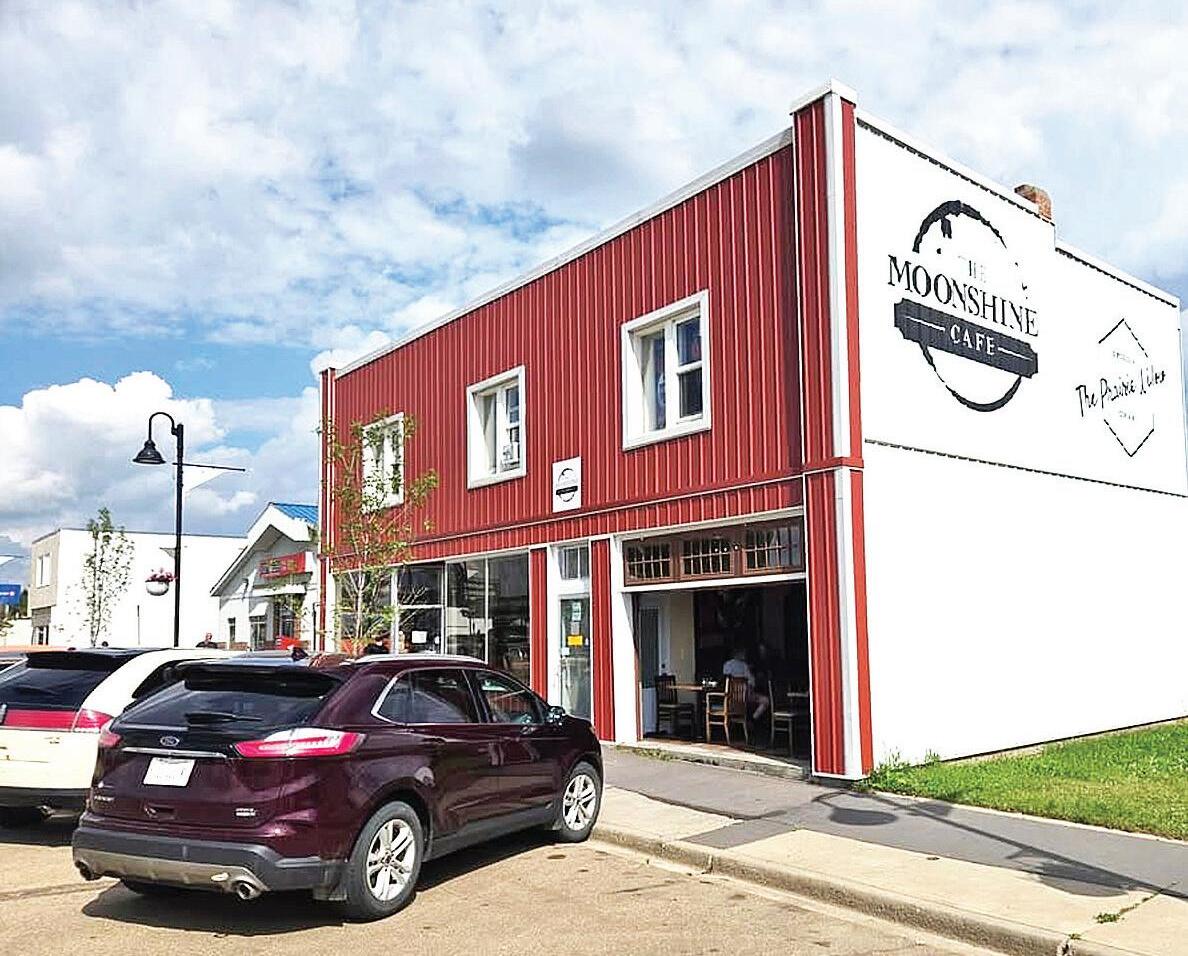










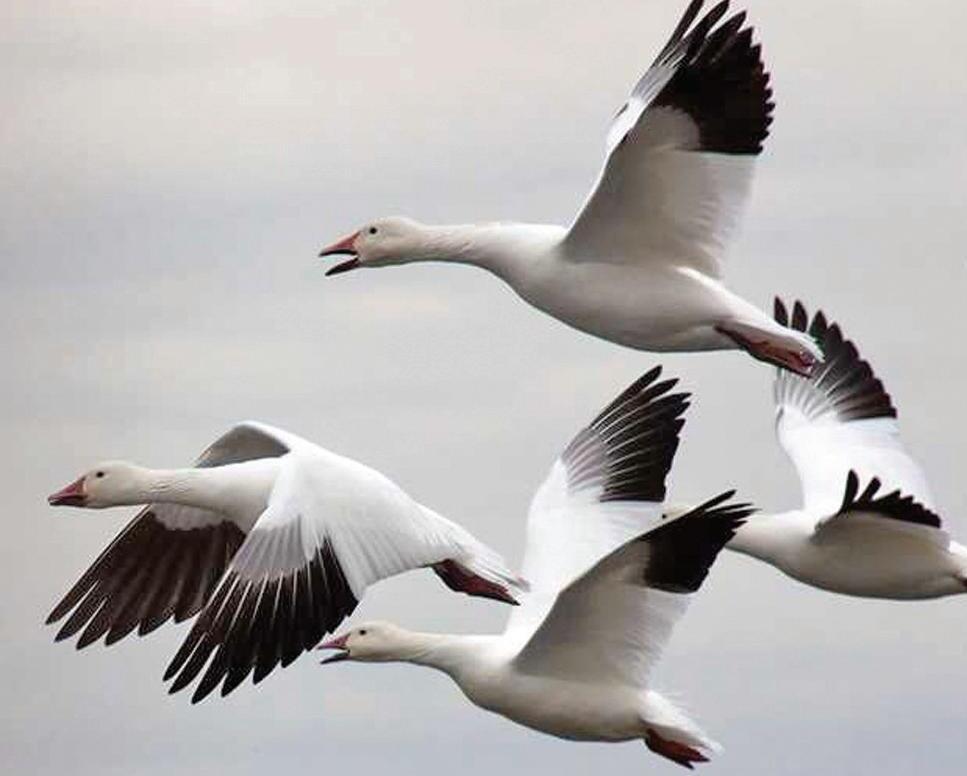
Geese sightings
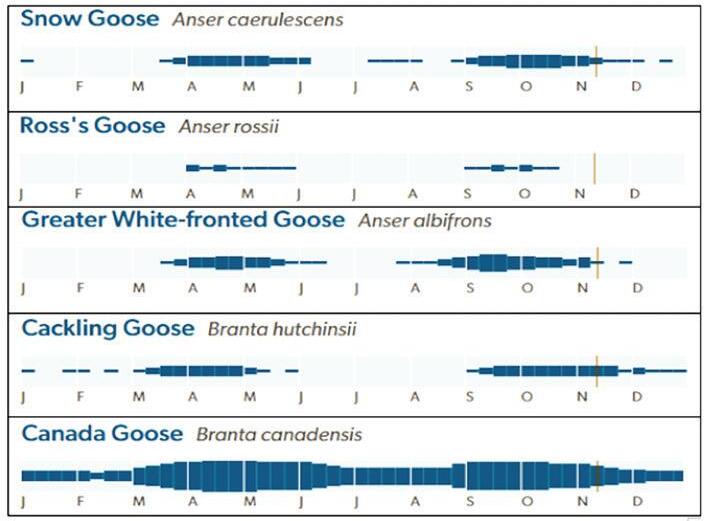


Interested in nature?
The Edmonton Nature Club offers city walks and out of town field trips, a speaker series, and study group presentations about bugs, plants and birds. Spring 2026 special offer for new members! Purchase a $40 annual family membership through our website and have it extended through 2027. edmontonnatureclub.org Join us for birding, botany and bugs!
BY CHRIS REES
Data extracted from eBird shows when sightings of the various species of geese have been reported in the Edmonton area. eBird is a citizen-science database supported by Birds Canada and managed by the Cornell Lab of Ornithology. (See: https://ebird.org/home).

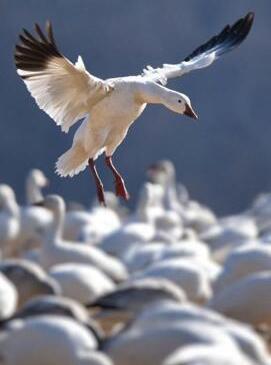
















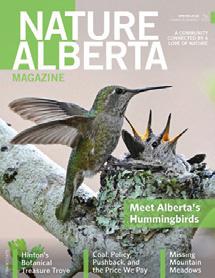







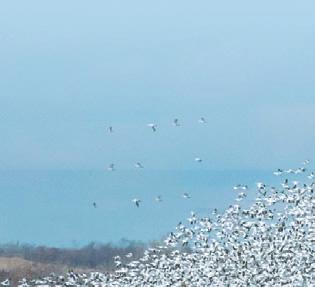

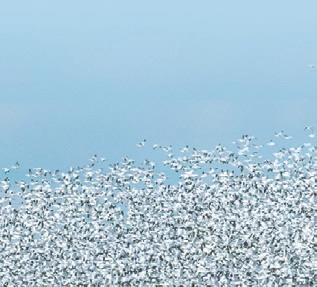
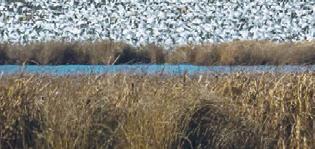
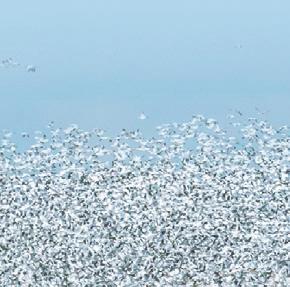
If you live in or have spent time in Tofield or in the surrounding areas of Beaver County, you’re probably familiar with the local geography that surrounds you – the boreal mixed wood forest and the hummocky “knob and kettle” terrain of the Beaver Hills (or Cooking Lake Moraine, another term for the area) that forms a patchwork of depressional areas, many of which support wetlands, small lakes and streams.
The Beaver Hills, known as amiskwaciya in Cree, is an important place that provides a diversity of productive, critical habitat to many species of wildlife and migratory bird species.
But the importance of the region extends beyond its exceptional landscape and biodiversity.
From its millennia long and rich heritage as an important place for Indigenous Peoples, to subsequent fur
trade era and colonial settlement, the region is home to many people, past and present.
It is a region unlike others. In fact, the geographical and biodiversity uniqueness and the historical and cultural significance of the Beaver Hills, coupled with the active conservation that has taken place here since the end of the 19th century, has earned it a place as a priority natural area in the greater Edmonton region and well beyond.
This is why the Beaver Hills was designated as a biosphere on March 19, 2016, by the United Nations Educational, Scientific and Cultural Organization (UNESCO), joining the worldwide network of 738 biospheres in 134 countries.
You’re probably wondering, what are UNESCO-designated biospheres?
Simply put, they are distinct regions in
which people live and work in harmony with nature. This means that local communities and interested stakeholders collaborate on:
• conservation of biodiversity and cultural diversity,
• economic development that is culturally and environmentally sustainable, and
• research, monitoring, education and training.
The Beaver Hills Biosphere isn’t just one organization. The Biosphere represents the coming together of many partners focused on researching, understanding, building capacity and implementing innovative efforts that conserve biodiversity, support communities, facilitate sustainable development, and mitigate environmental change in this resilient Alberta landscape.
But it isn’t all work and no play. The
distinctive character, ecology and history, and the designated parks and protected areas that account for a quarter of the region, make it an incredible place to experience nature. There are numerous and diverse recreational activities and tourism opportunities in the Beaver Hills. From hiking to wildlife watching to camping and stargazing and more, the possibilities are endless.
So, the next time you are travelling west from Tofield, along Highway 14 passing South Cooking Lake, or going south to visit Miquelon Lake or heading north towards Elk Island National Park, remember you’re seeing and experiencing the Biosphere in your backyard.
Learn and experience more at beaverhills.ca.