Anglophone, Francophone, Hispanophone, Dutch Caribbean and Kreyòl-speaking scholars found in the CSA a rare room where those divides, themselves an afterlife of slavery and empire, could be worked across rather than reinforced. That achievement was never inevitable. It was built, deliberately, conversation by conversation, conference by conference, by people who believed the Caribbean was one intellectual project even where it was many nations and many tongues. And it continues: this Association has kept extending its table to new voices, new generations, new questions.
I say all of this not as ceremony but as ground, because I also want to be honest with our membership about where we currently stand For much of our history, the operational infrastructure of this Association, including our membership systems, our web presence, the way our records and materials have been stored and managed has not been ours. It has been held by external vendors and platforms, at arm ' s length from our own governance and increasingly out of step with how emerging scholars actually work, communicate, and organize in a fast-moving digital environment. This was not a failure of vision on the part of those who came before us; it was the reality of what was possible with the capacity we had at the time. But it has left us, at various points, at the mercy of systems and agencies with no stake in Caribbean scholarship and thus unable to fully own or shape the digital home of our own intellectual community
This is changing. We now have the institutional capacity to build our own infrastructure (e.g. our own website, our own social media presence, our own membership and archival systems) designed and owned by us, for us. This is not simply a technical upgrade. It is a question of self-determination applied to our own house: if sovereignty over how the Caribbean is studied has always been central to this Association's founding purpose, then sovereignty over how we organize ourselves is its natural extension. We owe it to the region, and to the generations of scholars who will inherit this Association, to build something durable, fit for purpose, and finally our own Work on this rebuild is underway, and I will share more detailed plans, and ways to be involved, in the coming months.
Beyond our internal architecture, we are also thinking about the Association's place in the hemisphere.This brings me to news of our 51st annual meeting, which will be held in June 2027 in Miami, hosted at the University of Miami
This choice grows directly out of the hemispheric reality the CSA has always understood: the Caribbean does not end at the shoreline of the islands It extends into every city where Caribbean people have built lives, institutions, and communities, and Miami is chief among them. The University of Miami is home to the Hemispheric Caribbean Consortium, an existing network of Global South institutional partners that already includes the University of the West Indies, alongside institutions in Haiti, Puerto Rico, the Dominican Republic, Cuba, and Colombia Many UWI scholars already hold longstanding collaborations with University of Miami faculty, and graduate students from Haiti, Barbados, Trinidad and Tobago, Cuba, and Colombia who took part in our 2024 virtual graduate symposium are living proof of the alliances this network already sustains alliances built across institutions, languages, and national boundaries, in the very spirit this Association was founded to protect
Choosing Miami is also, deliberately, a choice to reach the many Caribbean nationals who live in the United States, many of them descendants of the people who helped build this city and who carry deep, active ties to the region still. Standing with that diaspora, in an organization rooted in Caribbean intellectual sovereignty, matters This is not a relocation of the CSA; it is an expansion of where and with whom we practice our solidarity. Holding the conference at a university also gives us institutional resources, support, and a measure of protection difficult to find elsewhere, and we arrive with a support base already in motion — including partners like the Pérez Art Museum, the Haitian Cultural Arts Alliance, and Florida International University. I say this also as someone who has lived and worked in Miami for over twenty-three years, with relationships across this city's public and private institutions built over decades of academic, public, and community work.
I recognize that for some of you, the current political climate in the United States makes this choice a difficult one, and I do not take that lightly. Some members may not be in a position to travel, and that is a legitimate and respected choice; nothing about this decision asks anyone to set aside their own safety or judgment. What I would ask is that we hold both truths at once – that even while we acknowledge the climate is genuinely hostile we also recognize that our presence, chosen in solidarity rather than convenience, is precisely what this moment calls for. Retreat is one response to hostility. Ours, this time, is presence.
The CSA is, of course, far larger than any single meeting. But this gathering is an opportunity to widen the table once more as this Association has always done and to have a broader global dialogue about the Caribbean's place in this hemisphere and beyond. Alongside this, I want to share news of another initiative aimed at strengthening how we carry our history forward. We are forming a Past Presidents' Task Force, under the guidance of Professor Carol Boyce Davies, past president of this Association and one of the most formidable intellectual figures our field has produced. This Task Force will draw on the institutional memory, hard-won best practices, and mentorship of those who have led the CSA before, and will work alongside the current leadership on the critical questions of this moment not as a body looking backward, but as partners helping us build forward with the fullest possible understanding of where we have been
And we need that fuller understanding, because the moment we are building into is not an easy one. The Caribbean is contending simultaneously with climate and environmental insecurity that threatens the physical ground beneath us; with fiscal stress that constrains what our institutions and governments can do; and with direct challenges to the sovereignty of our nations, including the presence of foreign military forces in our own regional waters. These are not abstractions for scholarly debate alone, as they are conditions our people are living through now, and this Association was founded precisely to think seriously, and Caribbean-first, about conditions like these.
Fifty years ago, the founders of this Association had the audacity to believe that the Caribbean could theorize itself, on its own terms, for its own sake. That audacity is what I am asking us to carry into the next fifty years! It will serve as a guide informing how we rebuild our digital home, how we show up in Miami, how we draw on the wisdom of those who led before us, and how we respond to a region under real pressure I am grateful to be doing this work alongside all of you, and I look forward to sharing more as each of these initiatives develops.
In solidarity, and with hope, for what we continue to build together,
Association That Thinks, Moves, and Makes Together
We are living through a conjuncture that demands more than academic business as usual. To speak honestly about the present is to reckon with a world in crisis: the accelerating climate emergency that places small island and coastal communities at the frontline; the ongoing violence and instability in Haiti; the extrajudicial killings unfolding across the Caribbean Sea; the slow death imposed by the United States energy blockade on Cuba; and the unfolding devastations in Palestine, Sudan, and the Congo. These are not distant or disconnected events They are part of the same global conditions that shape Caribbean life, thought, and survival. In such a moment, Caribbean Studies cannot afford neutrality. The Caribbean Studies Association is not merely an academic organisation. It is a site of intellectual sovereignty and ethical responsibility—a place where the Caribbean speaks for itself, theorises itself, and refuses, on behalf of its peoples and its diasporas, to look away
As Vice President and President-elect of the CSA, I am committed to leading an association that rises to meet this moment, not by doing what we have always done more efficiently, but by asking what Caribbean Studies could become if we allowed our forms of gathering and sharing knowledge to be as bold and generative as the scholarship itself.
Reimagining How We Gather
The traditional conference panel remains valuable, but it is not enough I envision an annual conference that embraces a genuinely multi-modal architecture of knowledge exchange: dialogic keynotes that open into conversation rather than close into monologue; roundtables that place scholars, artists, and community practitioners in sustained dialogue; workshops that produce something — a framework, a question, a methodology — rather than merely present findings; salons that recover the intimacy and intellectual risk of a smaller gathering; and plenary sessions designed not for passive reception but for collective thinking. The form of our gatherings is itself an argument about what Caribbean knowledge looks like. It should look like us: polyphonic, relational, embodied, and alive.
This might take the form of a dialogic keynote that unfolds not as a singular address, but as a living encounter where a scholar, an artist, and a community practitioner think together in real time, allowing theory, movement, sound, and lived knowledge to coproduce insight before us. It might also take the form of workshops that do not end when the session closes but generate something that travels: a collaboratively authored manifesto, a digital archive, a pedagogical toolkit, or a set of questions that continue to circulate across classrooms, communities, and future gatherings. In this way, the conference becomes not simply a site of presentation, but a space of creation where Caribbean knowledge is not only shared but made.
Expanding Who Belongs
A thriving association is a multigenerational one I am committed to a sustained investment in graduate student engagement and earlycareer professional development which centers mentorship structures, dedicated sessions, and pathways that bring the next generation of Caribbean scholars into the intellectual life of the association before they feel they have earned the right to be there. They have already earned it I also envision a more deliberate welcome for artist-scholars and scholar-practitioners whose work crosses the boundaries of academic and creative production, a constituency that Caribbean Studies has always needed and has not always consistently fully claimed. Expanding membership across the Hispanophone, Francophone, and Kreyolophone and Dutch Caribbean, and deepening our ties with the diaspora, must also be a structural priority.
Widening How We Share
Scholarship that reaches only other scholars is scholarship that has not yet finished its work I am committed to exploring new and openaccess modes of dissemination. These may include digital platforms, public-facing publications, and collaborative partnerships with cultural institutions, policy bodies, and community organisations across the region that carry Caribbean Studies thinking into the spaces where it is most urgently needed. To widen how we share is also to ask how we return It calls us beyond extraction toward reciprocity; ensuring that research circulates back in forms that are accessible, meaningful, and sustaining. In this way, dissemination becomes not an afterthought, but an ethical practice at the heart of Caribbean Studies.
The Caribbean Studies Association has always been more than a conference. It is where I began my own scholastic journey, in 1999, as a graduate student coming to understand that the region is not peripheral to knowledge production. I came to know an institution that, at its best, represents a community of intellectual kinship a place where the region’s thinkers, makers, and dreamers find one another across languages, disciplines, and geographies. I am honoured to be nominated to serve this community, and I am ready to bring to its leadership the full range of my scholarly vision, regional commitment, and creative imagination. The Caribbean deserves nothing less.
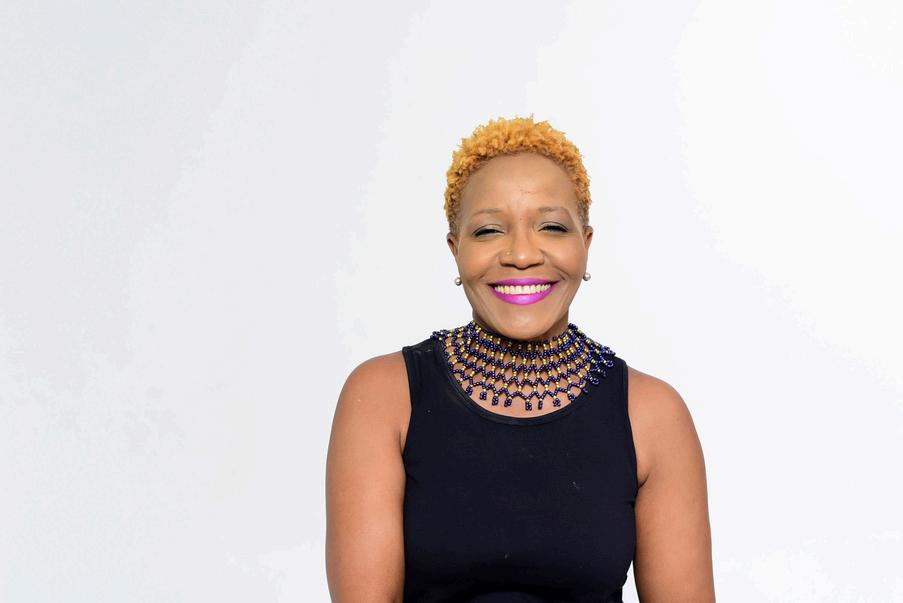
Dr. Yanique Hume
Vice President, Caribbean Studies Association
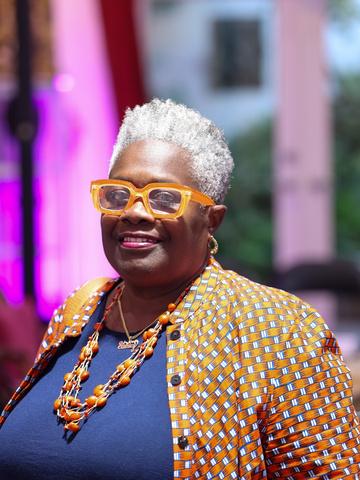
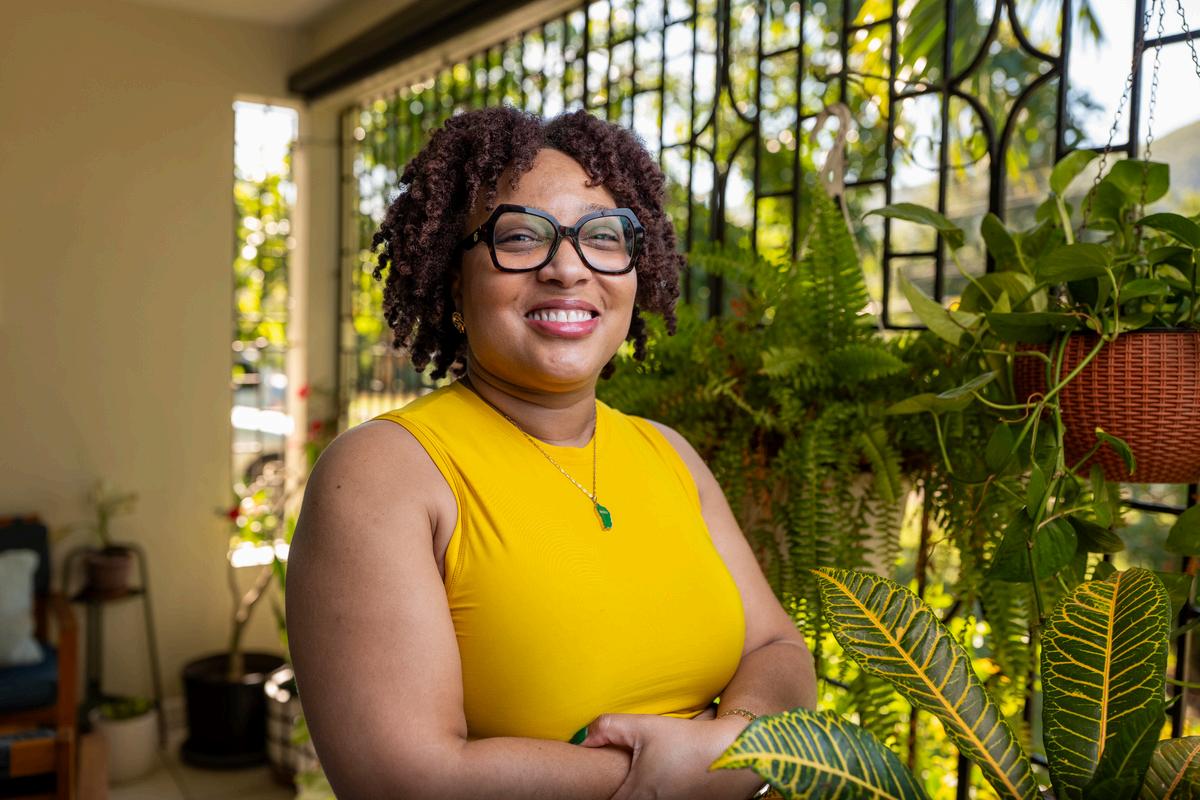
Patricia J. Saunders, President Professor of English and Creative Writing University of Miami
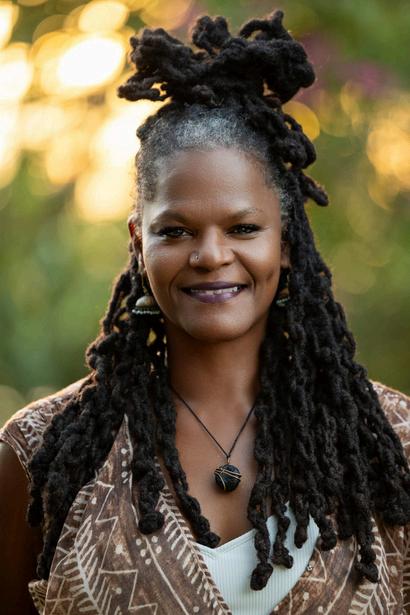
Donna P. Hope, Immediate Past President Professor of Culture, Gender and Society UWI, Jamaica
Armorgan
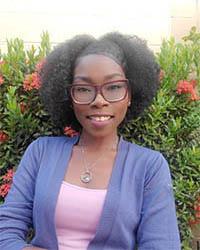
Gabrielle Jean-Louis PhD Candidate English & Creative Writing University of Miami
Esprit
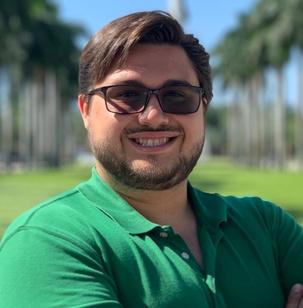
Michael R. Soriano PhD Candidate English & Creative Writing University of Miami
Yanique Hume, VP Senior Lecturer, Cultural Studies UWI, Cave Hill, Barbados
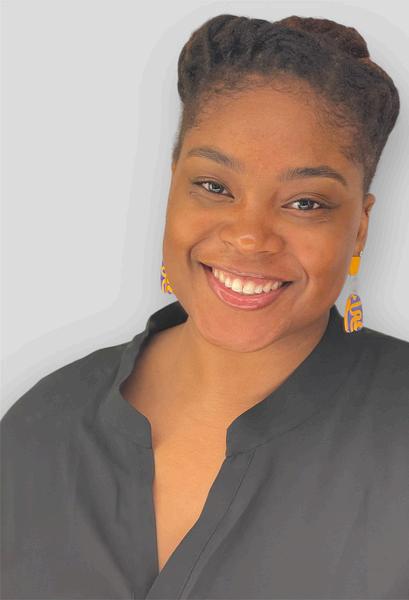
Angelique V. Nixon Senior Lecturer UWI, St. Augustine
Semone
Graduate Student, ISER UWI, St. Augustine
Alpha Obika Lecturer UWI, Mona
Schuyler
Lecturer UWI, Mona
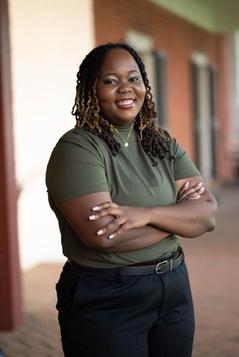
Rashana Lydner Professor of Africana Studies Georgia State University
CSA Election of Officers (2026-2027)
Dear CSA Members,
I am pleased to announce the results of the second election of officers for the Caribbean Studies Association Executive Council As the outgoing VicePresident of CSA, one of my responsibilities was overseeing the election process Thanks to a dedicated team of volunteers, the gathering of nominations and all supporting materials went smoothly, as did the preparation of the ballots for distribution. At the same time, there were two areas in which the election process fell short of our expectations. As VicePresident responsible overseeing the election, I acknowledge these shortcomings and the need to address them
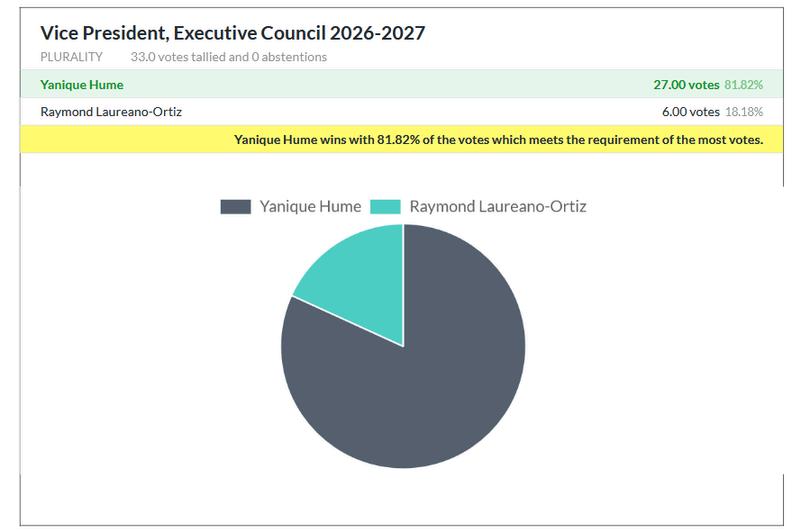
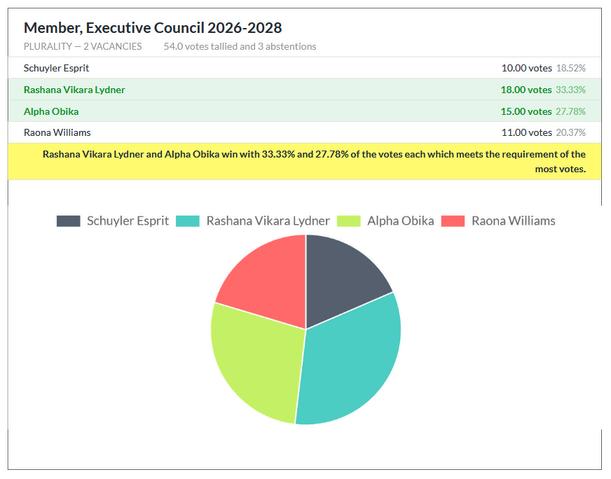
The first concerns the maintenance and upkeep of CSA members' contact information, particularly for long-standing members who have changed institutions multiple times over the years. As reflected in the Election Buddy results (see Figure #1), a significant number of ballots bounced back as undeliverable because of outdated email addresses. This is an area where collaborative partnership with our membership must prevail when it comes to updating changes in email addresses, institutional affiliations, and addresses Rest assured, we are working on a new system for registration that will ask registrants to confirm and validate their email addresses and other pertinent information to allow members to take part fully in the governance processes of CSA
The second issue is closely connected to the first. Had our membership email records been current, there would have been far less need to rely on paper ballots. However, the on-site, paper ballot voting system also revealed shortcomings. As many members brought to my attention, there was insufficient communication about the voting timeline and the options available to those who had not received an electronic ballot. A centrally located, clearly visible voting station would also have served as an effective reminder for members who had not yet voted. Although paper ballots were cast and counted, I was not present for the counting process. When I received the election results, I noted that the list of candidates was not accompanied by the supporting vote totals or other election data. In hindsight, the best course of action would have been to delay announcing the winners until all the data from the election was available Instead, I announced the names provided on the list and told the Secretariat that I would validate the results after the meeting When the time came to ratify the election results, the paper ballots could not be located Despite efforts to find them, they remained misplaced at the close of the conference, leaving us without a verified paper ballot count. The only complete election data available were the electronic voting results (see Figure 1), which differed from the list of candidates that I had announced.
CSA Election of Officers (2026-2027)
In light of these shortcomings, the letters received contesting the election process, and following discussions with the nominees and members of the Executive Council, I decided, in my capacity as the elected officer responsible for overseeing the election, to hold a second election This decision was made to address the concerns of members who had not received ballots and to provide a measure of redress for those who had cast paper ballots that could not be validated because the ballots had been misplaced.
The second-round ballot was distributed via Qualtrics on June 26, 2026, and voting remained open through July 2, 2026. While I was disappointed that several hundred ballots were again returned as undeliverable, it was encouraging that participation nearly doubled during this shortened voting period. The experience also underscored two critical takeaways. First, we must improve how we maintain and update our membership contact information to ensure that all eligible members receive election communications. Second, as an organization, we must continue to engage and empower our membership to participate more actively in the governance of the Caribbean Studies Association. Every member who registered for the conference was eligible to vote, yet only a small proportion did so Strengthening member engagement in our electoral processes is therefore a shared responsibility and an important priority moving forward
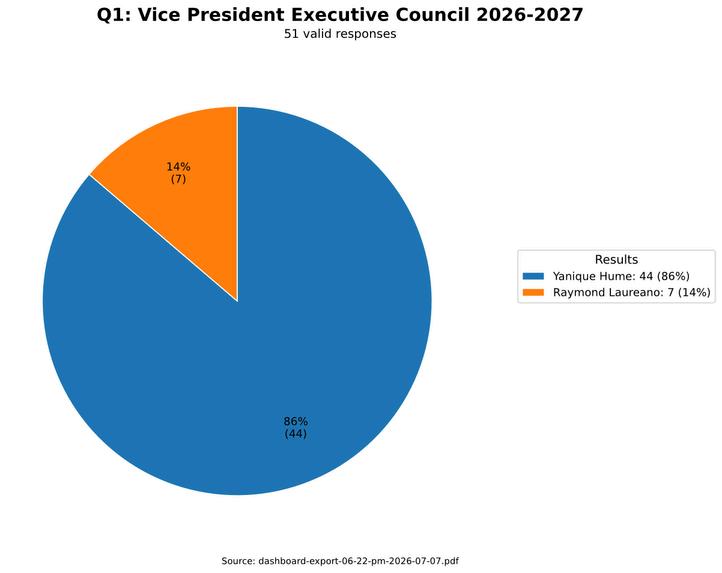
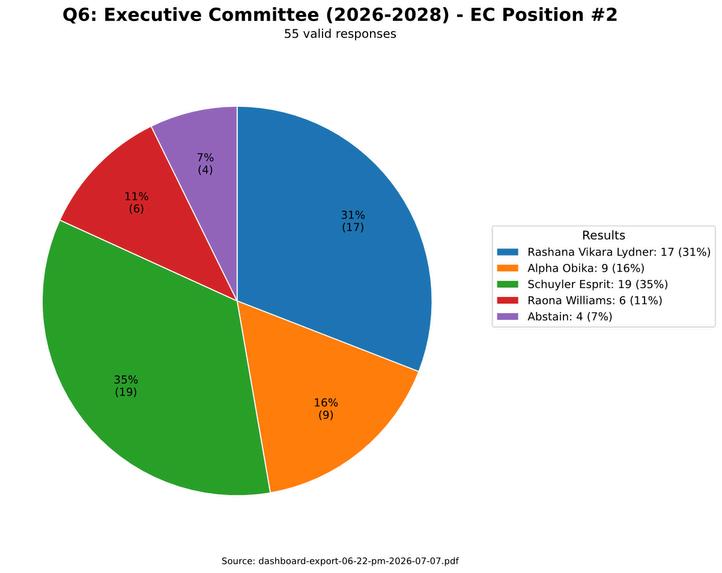
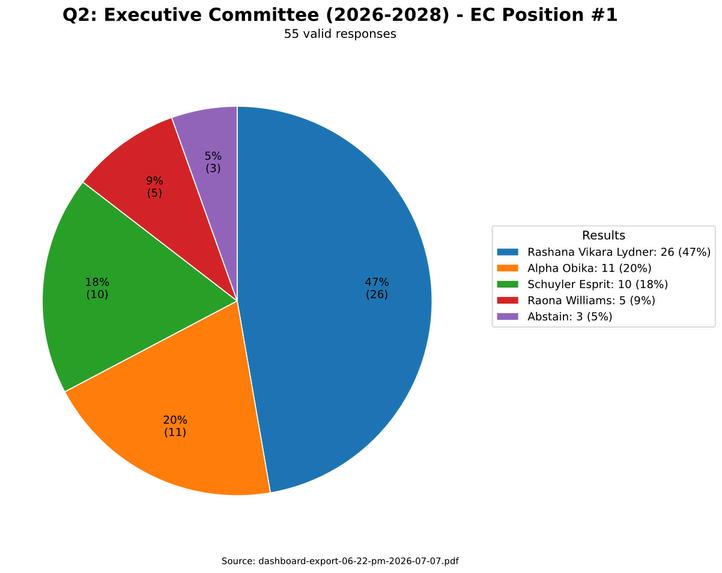
With all of this said, the results from the second round of voting produced the following outcome:
Vice President:
Yanique Hume (86% with 44 votes)
Executive Council Member (Position #1)
Rashana Vikara Lydner (47% with 27 votes)
Executive Council Member (Position #2)
Schuyler Esprit (35% with 19 votes)
Executive Council Member (Appointed 1 year to complete the 2nd year of a vacated seat) Alpha Obika
I would like to thank all the nominees who volunteered to give their time and effort to the Caribbean Studies Association. This spirit of generosity and working toward a common cause represents part of CSA’s legacy for the last 50 years. The way forward looks bright!
Figure 2 - Election Buddy
Figure 1 - Election Buddy
Figure 4 - Qualtrics
Figure 3 - Election Buddy
Figure 6 - Qualtrics
Figure 5 - Qualtrics
CSA Executive Committee Bios:
Dr. Yanique Hume is a Senior Lecturer in Cultural Studies and former Head of Department at UWI Cave Hill. She is an interdisciplinary scholar, choreographer, and practitioner of African diaspora dance whose work moves fluidly across the boundaries of academic scholarship and critical creative practice. She holds a PhD in Comparative Studies in Culture, History and Theory from Emory University and has been supported by fellowships from the Wenner-Gren Anthropological Foundation, the Social Science Research Council, the Ford Foundation, and the Smithsonian Institution A scholar-initiate in Kongo and Yoruba-based Africana sacred traditions, she brings to her work an embodied and relational knowledge that grounds her scholarship in lived experience as much as critical theory Senior Lecturer in Cultural Studies and Head of the Department of Cultural Studies at the University of the West Indies, Cave Hill Campus, she is widely recognised as a leading voice in Caribbean Cultural Studies, African Diaspora Spiritualities and Religiosities, and Afro-Atlantic Festive and Sacred Arts. As Head of Department at UWI Cave Hill, she has demonstrated sustained commitment to curriculum innovation, postgraduate mentorship, and the internationalisation of Caribbean scholarship coordinating immersive study programs with institutions including NYU, St. Mary's University, and Morehouse College, and building sustained academic partnerships across the Caribbean, North America, West Africa, and Europe. At the regional and international level, Dr. Hume has served as President of KOSANBA, the Scholarly Association for the Study of Haitian Vodou and African Diaspora Religions, demonstrating her capacity to lead scholarly organizations with both intellectual vision and administrative commitment. She has served as Chair of the Evaluation Committee for the Inaugural Cultural Industries Finance Fund Enabler Grant at the Caribbean Development Bank, and as Key Expert and Lead Researcher for the CARICOM Secretariat's Regional Strategic Plan for Cultural and Creative Industries She has been a longstanding member of the Visual Art and Performance Track Committee of the Caribbean Studies Association and a consistent presence at its annual conferences Dr Hume's practice-based research has been recognised with the 2026 Richard A. Long Award for Research and Creative Practice in African Diaspora Dance, granted by the Collegium of African Diaspora Dance (CADD), and includes a commissioned choreography for the 15th Edition of the Dakar Biennale (2024).
Schuyler Esprit is the Founder and Director of Create Caribbean Research Institute, the first digital humanities center in the Caribbean. Her research areas of interest include Caribbean literary and cultural studies, environmental and ecological humanities, and digital humanities In addition to her writing for several magazines, journals and newspapers on topics related to Caribbean studies, Dr. Esprit writes and publishes on Caribbean literature, including on the impact of reading in communities in real and virtual spaces Dr Esprit is also a Lecturer of Literatures in English at The University of the West Indies, Mona Campus.
CSA Executive Committee Bios:
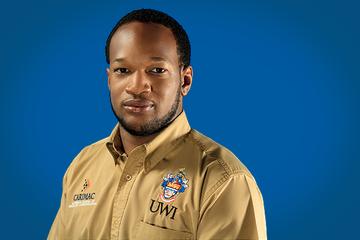
Alpha Obika is a Lecturer, Undergraduate Coordinator and Programme Coordinator for the BA degree in Integrated Marketing Communication at the Caribbean School of Media and Communication (CARIMAC), University of the West Indies, Mona Campus He has a PhD in Communication Studies from CARIMAC, a Master of Arts in Cultural Policy and Management from City, University of London, and a BA in Media and Communications from CARIMAC His research specializes in Communication and Cultural Policy, Event Management, and critical analysis of media and cultural products in the global south.
Rashana Vikara Lydner, PhD, is an Assistant Professor of Africana Studies at Georgia State University in Atlanta. Bridging the fields of Caribbean studies, French cultural studies, linguistic anthropology, and Creolistics her research focuses on a transnational approach to the study of Black popular culture in the francophone and anglophone Caribbean at the intersections of language, identity, and power Dr Lydner has a Ph D in French and Francophone Studies, with a designated emphasis in African Diaspora Studies, from the University of California, Davis; a M.A. in French from the University of California, Davis, and a B.A. in French and Spanish, Summa Cum Laude, with a minor in Psychology, from the State University of New York, Brockport. Her published works include “Decolonizing Creolistics Through Popular Culture” in Decolonizing Linguistics (Oxford University Press), “S’habiller Sexy en Body String: The French Guianese bad gyal and the image of French Caribbean Women” in Small Axe: a Caribbean journal of criticism, and “‘Mwen Enmé’W’ [I Love You]: Black Queer Women’s Social Positioning in the French Caribbean” in Gender & Language She is currently completing her first monograph, Dancehall ka joué: Gender and Sexual Politics at Play in French Guiana, under contract with Louisiana State University Press as part of the Noir(e): Race and Belonging in the AfroFrench World book series.
Statement from the Caribbean Studies Association Re: Haitian Studies Association Statement on TPS Supreme Court Decision
The Caribbean Studies Association (CSA) recognizes the profound social and economic consequences of recent U.S. immigration policies and legislation, as well as the Supreme Court's decision allowing the revocation of Temporary Protected Status (TPS) protections affecting immigrants from Haiti and Syria. These actions will have immediate and enduring impacts on hundreds of thousands of individuals who have lived, worked, and continue to contribute meaningfully to communities across the United States.
The CSA stands in solidarity with our colleagues and friends in the Haitian Studies Association and fully supports their statement condemning both this decision and the broader social and political forces that have shaped it. We affirm our commitment to the principles of human dignity, justice, and the protection of vulnerable communities
We encourage members of the Caribbean Studies Association to share this statement of solidarity and to engage their academic, professional, and civic communities in informed dialogue and collective action in support of those affected.
Dear Colleagues,
The Haitian Studies Association condemns the majority decision by the United States Supreme Court allowing the federal government to revoke Temporary Protected Status (TPS) for approximately 350,000 Haitians and 6,000 Syrians. This decision to permit blatantly racist, discriminatory actions against Haitian migrants will have far-reaching effects for them, their families, and communities. On June 18th, we hosted an important dialogue on the state of immigration for Haitians in the US - the status of which changes regularly, subject to court decisions and inhumane policies. As we collectively ask what we can do in today’s context, we encourage you to watch the public recording of Update on Haitian Immigration in the United States where this unfortunate outcome was discussed by experts: Gabrielle Apollon, Geralde Gabeau, Jesse HoffnungGarskof, and Darlène Dubuisson. During this conversation, many resources and calls to action were shared and we share them with you below and on our website. Mobilizing the Senate is all the more critical in the days to come.
We are already seeing the impact of TPS termination on Venezuelan communities. In the coming days and years as they face the compounding damages of the devastating earthquake outside of Caracas on June 24, 2026, the Haitian Studies Association expresses its deepest sympathy to the people of Venezuela and calls for the hard lessons learned from the Haiti earthquake of Douz Janvye (January 12, 2010) with a death toll of over 300,000 people, to inform regional solidarity and a just reconstruction for all Venezuelans.
In solidarity,
HSA Executive Committee on behalf of the Haitian Studies Association
ACTION
Advocacy for Senate Bill 4814 to Extend TPS for Haiti: The press release and bill text here: https:// www.markey.senate.gov/news/press-releases/senatorsmarkey-and-blunt-rochester-leader-schumer-colleaguesintroduce-legislation-to-designate-haiti-for-temporaryprotected-status-amid-trump-administration-attacks
As of June 18th, these are the only Senators who have signed on so far to Senate Bill 4814, so if you don't see your Senator's name here, start reaching out to them! The legislation is cosponsored by Senate Democratic Leader Chuck Schumer (D-N.Y.) and Senators Elizabeth Warren (DMass.), Andy Kim (D-N.J.), Chris Coons (D-Del.), Chris Van Hollen (D-Md.), Cory Booker (D-N.J.), Angela Alsobrooks (DMd.), Raphael Warnock (D-Ga.), Peter Welch (D-Vt.), Patty Murray (D-Wash.), Angus King (I-Maine), Tammy Duckworth (D-Ill.), Kirsten Gillibrand (D-N.Y.), Jack Reed (D-R.I.), Sheldon Whitehouse (D-R.I.), Mazie Hirono (D-Hawaii.), and Michael Bennet (D-Colo.).
Other opportunities to volunteer and support advocacy: Center for Gender & Refugee Studies offers expert witness trainings: https://cgrs.uclawsf.edu/en https://floridaimmigrant.org/events/ (accepts remote interpreters)
https://haitianrefugees.org/ (presented amicus brief in the Miot case which highlights the long history of immigration policy re: Haitians in the U.S.)
INFORMATION
Full Supreme Court Decision including minority opinion: https://www.supremecourt.gov/ opinions/25pdf/25-1083 f204.pdf
IJDH: Broad Group of Massachusetts-Based Organizations Decry Unprincipled, Dangerous US Supreme Court Termination of Haitian TPS
HBA: SUPREME COURT LIMITS COURTS’ POWER TO REVIEW TPS TERMINATIONS BUT PRESERVES CONSTITUTIONAL CHALLENGES; THE FIGHT CONTINUES
INFORMATION (CONT.)
Haitian Times: ‘Call your Senator,’ advocates urge community as push to pass TPS for Haitians continues Asylum applicants can access biannual reports on human rights conditions in Haiti published by the Institute for Justice and Democracy in Haiti
UN Definition of Refugee
Resources from the Immigration Justice Lab at the University of Michigan: https://www.immigrantjusticelab.org/
Please support local and national organizations supporting Haitian migrants including:
Haitian Bridge Alliance
Haitian Women for Haitian Refugees
Institute for Justice and Democracy in Haiti
Updating Member Information
As we continue to streamline our digital operations, we are updating our mailing list to ensure our records are accurate and up to date.
We kindly invite you to complete the Google Form using the link below. Thank you for taking the time to complete the form. Your cooperation is greatly appreciated.