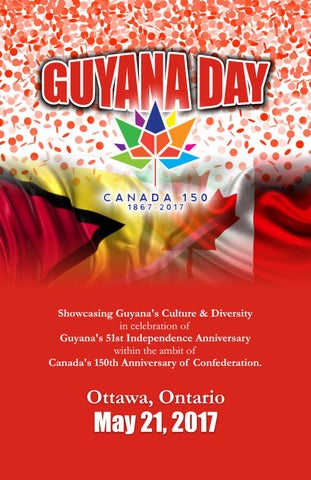
Showcasing Guyana's Culture & Diversity in celebration of Guyana's 51st Independence Anniversary within the ambit of Canada's 150th Anniversary of Confederation.
Ottawa, Ontario
May 21, 2017
P02
Guyana Day 2017
Sash Transportation Service Inc, Subsidiary of Sash Fleet Holdings Limited.
Establish
ed si n
ce 2 Your 005 - ISO Transportation 900 and Logistics Partner 1-20 09 c in North America and ertified internationally With the three divisions listed below equipped & available to service your needs.
Flatbed Division • Refrigeration Division • Dry Van Division SASH is a Proven Reliable & Secure Logistic Services
CALL 905-678-6688 7355 Torbram Road, Unit #3, Mississauga ON L4T 3W3 Fax: 905 677 0648 • Email: info@sashts.com • WebSite: sashts.com Guyana Day 2017
P03
Table of Contents 05 • Guyana Day Programme of Events 06-07 • Messages Guyana Ministry of Business Guyana's High Commissioner to Canada 08 • Positive Linkages Between Guyana & Canada 13 • Guyana Tourism South America Discovered 18 • Georgetown Guyana's Garden City 22 • Diaspora Migration Published by Tony McWatt (TMac Enterprises) under the distinguished auspices of Clarissa S.Riehl High Commissioner GUYANA HIGH COMMISSION OTTAWA 151 Slater Street, Suite 800 Ottawa, Ontario Canada K1P 3H3
P04
Guyana Day 2017
GUYANA DAY Sunday, May 21, 2017 Horticulture Building, Ottawa
PROGRAMME 10:00 Steelpan Welcome - Eddie Alleyne Enjoy the sound of sweet steelpan music upon entry to the Horticulture Building 10:10 National Anthems O Canada & Dear Land of Guyana 10:15 Welcome Remarks – Mrs. Denise Moore Isaacs Overview of the Guyana Day activities 10:30 - 5:30 Booth Displays, Arts & Craft, Food Court. Kids Interactive Area Discover Guyana's endless Eco Tourism possibilities & Investment opportunities Browse displays of selected paintings, craft and jewelry by renowned Guyanese artistes Sample delicious Guyanese cuisine Kids can enjoy all-day activities including face painting and Guyanese storytelling 11:00 - 12:00 1st Cultural Interlude Enjoy Guyana's special brand of songs, dances and comedy by a cast of Guyanese Entertainers featuring Bill “The Mighty Crooner” Newman, Faith Amour, Mumtaz Ali, the London Sisters and many more. 2:00 - 4:00 2nd Cultural Interlude A repeat of the first Cultural Interlude with the addition of Omesh Singh's Wave Band's live music to bring a magnificent, rollicking, end to the Day! 2:00 – 5:00 Rum Tasting Sample Guyana's Best In The World Award winning El Dorado Rum and relish in the discovery of “liquid gold!” Learn how El Dorado Rum is distilled and blended.
Guyana Day 2017
P05
MESSAGE FROM THE DIRECTOR GENERAL OF TOURISM The Department of Tourism in the Ministry of Business sends its heartiest congratulations to the Government and people of Canada on the occasion of the country's observance of the sesquicentennial. The celebrations, under the theme 'Canada welcomes the world' aptly reflect a value that, historically, has been an essential ingredient of Canada's foreign policy. Canadian society is now richer for the contribution of diverse cultures and nationalities. As Guyana seeks to consolidate its own space and identity within the Commonwealth of nations, and to define its identity as a tourism destination, a posture of welcome can only be to Guyana's political and economic benefit. In this regard the Department of Tourism in the Ministry of Business is excited to partner with the Guyana High Commission in Ottawa in being a part of these historic celebrations that truly bring the world to Canada. Donald Sinclair Director General Department of Tourism Ministry of Business
P06
Guyana Day 2017
Guyana Day 2017
P07
Guyana In Profile At A Glance Geography: Area: 83,000 sq. miles/214,969 sq. km Location: Northern Coast of South America Borders with: Brazil, Venezuela, Suriname Capital: Georgetown Demographics: Population: 752,940 (2010 est.) Official Language: English, Creole is widely spoken Amerindian languages also spoken Ethnic Groups: East Indian 43 %, African 31 %, Amerindian 9 %, Mixed 17 % Religions: Christianity, Hinduism, Islam, Rastafarian Climate: Tropical, hot, humid, moderated by northeast trade winds. Equatorial Rainforest. Mean temperature of 27.5C. 2 rainy seasons: May-July, Nov-Jan Currency: Guyana Dollar (G$) US$1.00 – G$206 (2017) CAD$1.00 – G$150 (2017) Time Zone: GMT minus 4 U.S. Eastern Standard Tine +1 International Direct Dialing: Access Code - 592 HISTORY Guyana is the only English speaking country among the twelve countries of South America. “Guyana” a Native Amerindian word which means “Land of Many Waters”, is representative of the country's numerous rivers, creeks and waterfalls. The first Europeans to settle in the country were the Dutch who traded with Native Indians and began cultivating cotton and sugar cane in the 17th century. For more than 100 years Guyana was colonized by Holland, France and England as these three countries competed for ownership over Guyana and other Regional territories. Eventually Britain gained overall control in 1814 and named the country British Guiana. It remained a colony of Britain until becoming independent on May 26, 1966. The country's name was changed to Guyana after
P08
Independence. On February 23, 1970, the country became known as the Cooperative Republic of Guyana. The Europeans enslaved Africans and brought them to work in Guyana to produce sugar cane and cotton due to the unsuitability of the Native Indians for compulsory labour on the plantations. After slavery was abolished and the slaves were freed by 1838, indentured labourers were then brought to British Guiana from India, China and Portugal to work on the plantations. The descendants of these labourers make up the present day inhabitants of Guyana. GEOGRAPHY Guyana has a tropical climate with an area of 83,000 square miles. The country is located on the northeast coast of South America bound to the north by the Atlantic Ocean; to the south by Brazil; to the west by Venezuela; and Suriname to the east. Over 70% of Guyana is made up of forests and savannahs. The country is situated on the northern edge of the Amazon rainforest which is referred to as the lungs of the world. The majority of the inhabitants live along the Atlantic Coast where Georgetown, the capital city, is located. This region is several feet below sea level. A nearly 200 mile long sea defence wall, commonly referred to as the “seawall”, serves to protect this area from the waters of the Atlantic Ocean. Georgetown also houses the seat of government, the main maritime port and the main commercial centers. The city contains many historical monuments including gracious wooden colonial buildings. Among them is St. George's Cathedral, which was once the tallest wooden building in the world. Georgetown is called the “Garden City of the Caribbean” due to its many plants, trees and gardens. The largest river, the Essequibo, is almost 400 miles long. It is the third largest river in South America after the Amazon and Orinoco. Guyana has 275 waterfalls, the most spectacular of which is Kaieteur Falls, the world's highest single-drop waterfall. It has a single drop of 741 feet, a total height of 822 feet (about 5 times that of Niagara Falls) and is 140 feet wide. Kaieteur Falls is Guyana's main tourist attraction.
Guyana Day 2017
>> Guyana In Profile At A Glance FESTIVALS Due to the different origins of Guyana's peoples, the country has a mixture of religions and a diverse culture. More than half of the population is Christian, a little more than one third are Hindus and less than a quarter are Muslims. The customs and festivals surrounding these various religions are often observed across religious boundaries. The country's most important national festival is Mashramani, a colorful carnival of costume parades blending music, art and pageantry which commemorates the attainment of Republican status by Guyana on February 23, 1970. The festival is therefore celebrated on February 23rd each year. At Easter time it is traditional for families to picnic and fly kites. Raising kites in the sky celebrate the resurrection of Jesus Christ. Phagwah is a joyous Hindu festival at which friends and passersby are doused with brightly coloured liquids and powders. Traditional sweets and desserts are shared on this national holiday and cultural presentations feature singing and dancing. Diwali is known as the Hindu Festival of Lights. Buildings are lit up with scores of tiny earthen lamps called diyas, and motor vehicles are decorated with colourful lights. This festival symbolizes the triumph of good over evil. The Islamic festivals of Eid-ul-Fitr and Eid-ul-Aza, a traditional feast on the last day of the Muslim fast of Ramadan, are also widely observed.
Guyana Day 2017
SYMBOLS OF NATIONHOOD The National Flag of Guyana, “The Golden Arrowhead”, has five colors – green, white, gold, black and red. The GREEN background symbolizes the agricultural and forested nature of Guyana. The WHITE border symbolizes its waters and rivers potential. The GOLDEN arrow symbolizes Guyana's mineral wealth and its forward thrust. The BLACK border, the endurance that will sustain the golden arrow's forward thrust into the future. The RED triangle symbolizes the zeal and the dynamic task of nation building which lies before our young and independent country. The national Coat-of-Arms of Guyana is a composite of motifs suggested in separate designs by three Guyanese artists. The design is interpreted as follows: The Amerindian head-dress symbolizes the Amerindians as the indigenous people of the country. The two diamonds at the side of the head-dress represent the country's mining industry. The helmet is the monarchial insignia. The two jaguars holding a pick axe, a sugar cane and a stalk of rice symbolize labor and the two main agricultural industries of the country - sugar and rice. The shield which is decorated with the National Flower, the Victoria Regia Lily, is to protect the nation. The three blue wavy lines represent the many waters of Guyana. The Canje Pheasant, the National Bird, at the bottom of the shield represents a rare bird found principally in this part of the world and also the rich fauna of Guyana.
P09
Celebrating The Positive Linkages Between Guyana And Canada The fact that Guyana's commemoration of Canada's 150th Anniversary has been scheduled to take place within the time-frame of our young country's celebration of the 51st Anniversary of Independence – gained on May 26, 1966 – provides a significant opportunity for the recognition and affirmation of the important links that exist between Guyana and Canada. Both countries owe much to the significant role played in our development by the indigenous inhabitants: in Canada, the “First Nations”; in Guyana, the “Amerindians”. Canada's 'timeline' notes the heroic role played by Tecumseh in the 1812 War against the United States of
America; Guyana acknowledges the part played by Manariwau whose 1810 visit to Governor Bentinck in Georgetown provides documentary evidence of Amerindian support for and acquiescence in, British jurisdiction over the Essequibo region. Indeed it is even more significant that the furor caused and moreso the 'hearsay' generated by Manariwau's regal entry into Georgetown was likely to have impacted the mind of a seven year old boy, son of a white father and a free-black mother. That boy, “James Douglas,” would be pivotal in the development of British Columbia, through his application of a respect for both 'indigenous' and 'black', and his skillful use of their varied talents in the 'Canadian interest'.
Tel: 416-744-0476 Fax: 416-744-6639 Email: jays.autobody1@gmail.com 7 Taber Rd., Rexdale, ON M9W 3A3
P10
Guyana Day 2017
Guyana Day 2017
P11
>> Celebrating The Positive Linkages Between Guyana And Canada
An even closer, and mutually beneficial linkage between Canada and Guyana was established when Great Britain, having decided that the processing of “British Guiana's” high grade bauxite into aluminum would only be permitted in 'a British territory', determined that Canada, would be, 'the British territory'. The result, succinctly detailed in the November 12, 2010 Toronto Globe and Mail article on 'The Town That Aluminum Built', was that “ARVIDA” (named from the first two letters of the then CEO of “Alcoa”, the Aluminum Corporation of America – Arthur Vining Davis) was established to process Guyana's 'premium grade' bauxite. Famed as “the City built in 135 days” Arvida's establishment would be followed by the Alcoa decision in 1928 to transfer all its non-American holdings to a new company, “Aluminum Limited of Canada”
P12
which subsequently became “Alcan”. As stipulated in the Globe and Mail article, “Arvida turned into the biggest aluminum production centre in the Western World, so critical to the Allied effort during the Second World War that the wartime city was guarded by anti-aircraft batteries”. Naturally Canada reaped tremendous economic benefits and 'spin-offs'. Naturally Guyana was also benefited – not only by the financial gains that were reaped from the enhanced mining activity of the Demerara Bauxite Company, (“Demba”, Alcan's subsidiary,) but also by the increased technological inputs through which the workers and the country were ushered into modern industrial activity. This mutually beneficial relationship would continue until 1971, when the newly created Cooperative Republic of Guyana (1970) took the decision to nationalize Demba.
Guyana Day 2017
>> Celebrating The Positive Linkages Between Guyana And Canada Nationalization of Demba did not however lead to fracturing of the bonds between Guyana and Canada. On the contrary not only would Canada continue to give unflagging support to its fellow Commonwealth member, but together, Canada and Guyana would demonstrate positive support for Cuba; for China; and for the “ Gleneagles Declaration” which would aid the eventual downfall of the 'apartheid system' in South Africa. This tacit demonstration of shared values, and the underlying cultural similarities that it indicates, tends to make It understandable the fact that Guyanese who chose to emigrate for a variety of reasons, should consider Canada a favored – in fact, 'the optimum' – destination. Indeed, Jacqueline A. McLeod's web-published article Guyanese Americans received one response which stated “I was … raised in Canada. I love that Canada is so multi-cultural and accepts the Guyanese culture. I'm a proud Guyanese”.
culturalism – that the 'Canadian-Guyanese' will seek to present as their input in the historic Commemoration of Canada's 150th Anniversary. Our efforts will be bolstered by the July 2, 2016 Caribbean Trakker article “Canada celebrates 149th birthday and 50 years of relations with Guyana”, which noted that the Canadian “High Commissioner remarked that the spirit of respect, cooperation and partnership that underlines the strong relations between Canada and Guyana grows stronger every day. This is why the High Commission's theme for celebrating this anniversary is 'Growing Together'.” And too, by the inexorable links of our mutual relationship with Sir James Douglas, recently and fittingly 'enshrined' by the 'Memorandum of Understanding Between the National Assembly of Guyana and the Legislative Assembly of British Columbia' , signed in Georgetown on January 17, 2017.
It is the sharing of the Guyanese cultural traditions – as part of Canada's multi-
Mr. Hugh Payne
Anchor International Freight Services Inc. International Forwarders & Consultants Toronto, Ontario, Canada
Over
30 years Freight Forwarding experience global Agent network Import & Export, Air and Sea Custom Clearance Packing / Crating / Warehousing / Logistics; Truck Transportation - All North American points including Mexico Letters of Credit / Consulting Marine and Air Cargo Insurance Providing the highest level of quality and professional services Bringing together all overall shipping requirements Saving clients time, money and needless hassles in handling shipments from warehouses to final destinations. Member of the Canadian International Freight Forwarders Association – CIFFA/FIATA & Toronto Region Board of Trade Extensive
Guyana Day 2017
CALL 416-367-2118 Arlene Singroy Fax: 416-367-2119 Email: anchor@anchorintl.com Website: www.anchorintl.com P13
Destination Guyana Beckons By Donald Sinclair
National Geographic Traveller magazine of December 2013/January 2014 lists Guyana among its Best in the World list of travel destinations. The list, according to National Geographic “reflects what's authentic, culturally rich, sustainable, and superlative in the world of travel today.” Business Insider UK lists Guyana as one of the 12 emerging travel destinations for 2016. The magazine continues: “Wildlife far outnumbers the people, with jaguars, pumas and sloths the real locals.” These plaudits are merely the confirmation of a truth already known to many Guyanese and foreign travellers – that the Guyana tourism product has some features that set the country apart as a unique travel destination. Prince Harry, during his December 2016 visit, stood in awe as he beheld the mighty Kaieteur thundering its greeting to the royal visitor. P14
Guyana Day 2017
>> Destination Guyana Beckons
Visitors need not venture to the far interior to be enthralled by the beauty of Guyana, or to find opportunities for adventure and leisure. Guyana is meat and drink for those who love fishing, bird-watching, cricket, motor-racing, or even hiking along nature trails. Come at Easter and understand why Guyana now profiles itself as the Caribbean's foremost Easter destination. In addition, the abundance of fresh fruit and vegetables, the ever present coconut water and other natural juices will delight the appetite of the modern traveller who cares about organic gastronomy. If you don't believe it, just visit.
Guyana Day 2017
P15
P16
Guyana Day 2017
Norman Sue Bakery Ltd.
Thanks for your loyal and much appreciated continuing support.
1220 Ellesmere Road, Unit 30 Scarborough, Ontario M1P 2X5
416-754-4181 Guyana Day 2017
P17
The City of Georgetown Excerpts from “The City of Georgetown Guyana's Cosmopolitan Capital� by H. E. David A. Granger, President of the Cooperative Republic of Guyana The Dutch were the first European colonisers of the country now known as Guyana. Dutch planters were unhappy with the first headquarters of the colony of Demerara on Borsselen Island, 32 km up river. They opened new plantations closer to the mouth of the Demerara River and along the Coast.
P18
It was decided then to build a new administrative centre on the site of a brandwacht (fire watch or signal station), which had been installed on the eastern bank of the estuary as early as 1748. The English captured Demerara on the 24th February 1781. The English military administrator, Lieutenant Colonel Robert Kingston, established Fort St. George as his headquarters on that site. A year later, on the 3rd February 1782, the English capitulated to the French.
Guyana Day 2017
>> The City of Georgetown
The French demolished Fort St. George and developed their own centre called La Nouvelle Ville or Long champs. The French commander, Admiral the Comte de Kersaint, wrote:
“
It was…considered necessary on account of the great extent of the river and its dependencies to establish a capital which would become a business centre; where religion would have a temple, justice a palace, war its arsenals, commerce its counting houses and industry its factories; where also the inhabitants might enjoy the advantage of social intercourse.” These grand plans were short-lived, The French soon handed Demerara back to the Dutch who, on the 14th September 1784,
Guyana Day 2017
renamed the centre, Stabroek, after the President of the West India Company, Nicolas Gelvink, Lord of Castricum, Backum and Stabroek. The English took possession of the colony again on the 22nd April 1796 and continued to hold it (except for a brief interruption in 1802-1803), up to 1966. Stabroek was renamed Georgeotwn on 5th May 1812, in honour of the British Prince Regent, later, King George IV. The central ward of the town, however, retained its o r i g i n a l D u t ch n a m e, S t a b r o e k . Georgetown, Guyana's capital therefore is over two hundred years old. The Dutch colonies – Essequibo-Demerara and Berbice- were ceded to Britain in 1814 and unified into the colony of British Guiana on 4th March 1831.
P19
>> The City of Georgetown The City bred a cosmopolitan population, more or less representative of Guyana's diverse peoples of Amerindian, African, Indian, Chinese and European (including Portuguese) descent and their numerous mixtures- Bovianders, Douglas, Mulattoes and Santantones. Georgetown grew out of a cluster of plantations at the mouth of the Demerara River. The distinctive Dutch plantation drainage pattern imprinted an inescapable rectangular grid on the layout of the City. Plantations Eve Leary, La Bourgade, La Pentience, Le Repentir, Stabroek, Thomas, Vlissengen and Werk-en-Rust comprised the capital by the 1820s. Gerogetown became British Guiana's administrative centre and an Ordinance was passed on 1st March, 1837 for the establishment of a Mayor and Town Council
Miss
with the gradual growth of the town. The City's cosmopolitan heritage of Dutch, French and English colonisation survives in the names of the wards- Werk-en-rust, La Penitence and Queenstown for example- and was enriched by newer names- Prashad Nagar, Roxanne Burnham Gardens and Subryanville. Guyana's immigrant peoples from Africa, Asia and Europe moreover, are ceaselessly remoulding the capital which has become the home of a quarter of the country's population. Georgetown despite its blemishes, with its bustling business district, numerous places of worship, its military cantonment, industrial estate and its markets and museums, can be said to have fulfilled the aspirations of its French founder, the Comte de Kersaint.
Beautiful, Talented, Intelligent & Cultured
N O W A C C E P T I N G R E G I S T R A T I O N S West Indian O N W i C A N A D i A N . C O M
Canadian Pageant • WiCANADiAN.COM
2 0 1 0 P20
2 0 1 1
Open to All Canadian Women of West Indian Heritage. Between the Ages of 19 to 31
2 0 1 2
2 0 1 3
2 0 1 4
2 0 1 5
Guyana Day 2017
Guyana Day 2017
P21
The Migration Of Guyanese To Canada Under The Foreign Domestic Workers Act The country of Guyana is located on the north-eastern coast of South America, and is culturally part of the Anglophone Caribbean. While geographically Guyana is a part of the South American mainland, it is culturally much more similar to the nearby island nations of the West Indies such as Trinidad and Tobago, Barbados, Saint Vincent and the Grenadines and Grenada. In fact, Guyana is considered a Caribbean country even though it is not an island nation located in the Caribbean Sea, as are most Caribbean nations. On June 8, 1955 following a cabinet meeting, the decision was taken to admit into Canada on an experimental basis100 domestic workers from the British West Indies. Seventy-five were to be selected from Jamaica and twenty-five from Barbados. This cabinet decision heralded the beginning of the Caribbean Domestic Workers Scheme whereby an annual quota, determined by Citizenship and Immigration Canada, was selected from the participating territories of the British West Indies. Canada made it explicitly clear that if the experiment was not successful, the P22
Caribbean Domestic Workers Scheme would be terminated, and that if any of the women had to be deported it would be done at the expense of the particular Caribbean territory. What was not known at the outset, despite it being flaunted otherwise, the domestic workers scheme was a last resort to partially manage a labour shortage in Canadian homes, and designed and executed in a manner to make sure that Canada got maximum benefits at low costs. Of further significance is the fact that this scheme took place during a period when Blacks and East Indians, the two dominant groups in the Caribbean, were not welcome in Canada. In defending the decision, Canada claimed that it had made an exception to its racial immigration policy in 1955 “as a gesture of good will and in the interest of Canada's important trade relations with Jamaica.� As soon as the inauguration of the Domestic Workers Scheme with Jamaica and Barbados became known, the rest of the English-speaking Caribbean began clamouring for a chance to participate.
Guyana Day 2017
>> The Migration Of Guyanese To Canada Under The Foreign Domestic Workers Act
In 1956, when Canada added British Guiana to the list of territories participating in the domestic workers scheme, it was stipulated that girls of East Indian racial origin could not be included in the quota. This denial of Indo-Caribbean women as domestic workers caused some embarrassment for Trade Commissioner C. E. S. Smith as his counterpart in British Guiana, Labour Commissioner J. F. Ramphal, was of East Indian origin. “I had a little embarrassment when discussing our programme with him as he is of East Indian origin and asked whether girls of his racial origin would be accepted in our group of 30. Fortunately, the ban did not last much longer. By June of the same year, Mr. Ramphal was informed that the Minister of Immigration had confirmed that the ban on recruiting domestic workers of Asian racial origin had been eliminated. Canada also adopted more stringent
measures with the Caribbean Domestic Workers than it did with those from Europe. It was stipulated that the women must be between the ages of twenty-one and thirtyfive, a condition that was never attached to the contracts of European domestic workers. This age range ensured that Canada would get women who were strong and healthy and who would be capable of providing many years of service, and would be less likely to be a burden on the health system. It was important that they be single so that they could work without the interruption of having a family. Being single would also save money in social provisions such as housing, schools, hospitals, transportation and other infrastructural facilities. Applicants had to be in good physical and mental health and undergo complete medical pre-screening in accordance with the standards laid down by the Department of National Health and Welfare in Canada.
2365 Finch Avenue West Suite 207 Toronto, Ontario M9M 2W8
Telephone: (416) 741-2770 Fax: (416) 741-0069 E-mail: sales@topnotchemployment.com Website: www.topnotchemployment.com
Guyana Day 2017
P23
>> The Migration Of Guyanese To Canada Under The Foreign Domestic Workers Act Another significant stipulation was that the women had to be unmarried, for it was the thinking of the immigration officials that the spouse of a domestic worker would likely be unskilled. Canada was trying to protect itself from an influx of unskilled coloured dependents who could enter through the sponsorship route as it was legal for a Caribbean domestic worker with Canadian Citizenship to sponsor her spouse, fiancĂŠ (e), parents, grandparents, children and siblings. Canadian officials were concerned, if not alarmed, that Caribbean domestic workers had started sponsoring relatives soon after they had been in Canada for one year. Their main concern was the swelling of the unskilled labour force in Canada. They reasoned that since domestic workers were unskilled in their home country, then their fiancĂŠs and relatives who they would later sponsor would be from the same, or possibly lower, economic background. In a Memorandum dated January 19, 1962 Ellen Fairclough, Minister of Citizenship and
P24
Immigration, tabled new immigration regulations in the House of Commons. The core of this new immigration policy was Section 31 which placed the greatest emphasis upon education, training and skills as the main consideration of admissibility into Canada, rather than the country of origin of the applicant or the colour of skin. The argument of the Ministry of Citizenship and Immigration was that there was no longer a need for a quota arrangement for future domestic servants, as other applicants would be considered based on their education, training, skills and other qualifications in accordance with the regulation. The abolition of the special quota caused some uneasiness among Caribbean leaders, particularly those of the smaller territories. Eventually it was eliminated by the Immigration Regulations of October 1, 1967, bringing an end to the Caribbean Domestic Workers Scheme on January 1, 1968. Ms. Yvonne Sam
Guyana Day 2017
Guyana Day 2017
P25
ACKNOWLEDGEMENTS SPONSORS
ADVERTISERS Norman Sue Bakery • SASH Transportation • Joe Jaglall Realty • Jiffy Lube Superbilt Shutters • Anchor Intl. Freight • Shiv Misir Realty Top Notch Employment • Avi Persaud Realty • Zorena Sawh Realty Jay's Autobody • Azeem Khan Realty
COMMUNITY MEDIA SPONSOR Different & Dynamic. Bigga, Brighta, Betta!
P26
GRAPHIC DESIGN
L
infiniteLinx.ca
Guyana Day 2017
Guyana Day 2017
P27