SSCReport to the 189th CFMC Meeting
April 20-22, 2026
Dr. Vance Vicente Chairman
Scientific and Statistical Committee
April 20-22, 2026
Dr. Vance Vicente Chairman
Scientific and Statistical Committee
Participants
SSC
• Jason Cope
• Elizabeth Kadison
• Walter Keithly
• Richard Appeldoorn
• Jorge García Sais
• Juan J Cruz Motta
• Tarsila Seara
• Todd Gedamke
• Skyler Sagarese
• Vance Vicente
chairs
Researchers
members and staff

1. Reviewed SEDAR 91 U.S. Caribbean Spiny Lobster Puerto Rico
1. Reviewed SEDAR 84 Caribbean Yellowtail Snapper (Puerto Rico)
1. Reviewed SEDAR 84 Caribbean Yellowtail Snapper (St. Thomas/St. John)
1. Reviewed SEDAR 84 Caribbean Stoplight Parrotfish (St. Croix)
1. SSC Final Review and Recommendations for SEDAR 91 PR and SEDAR 84 PR-USVI
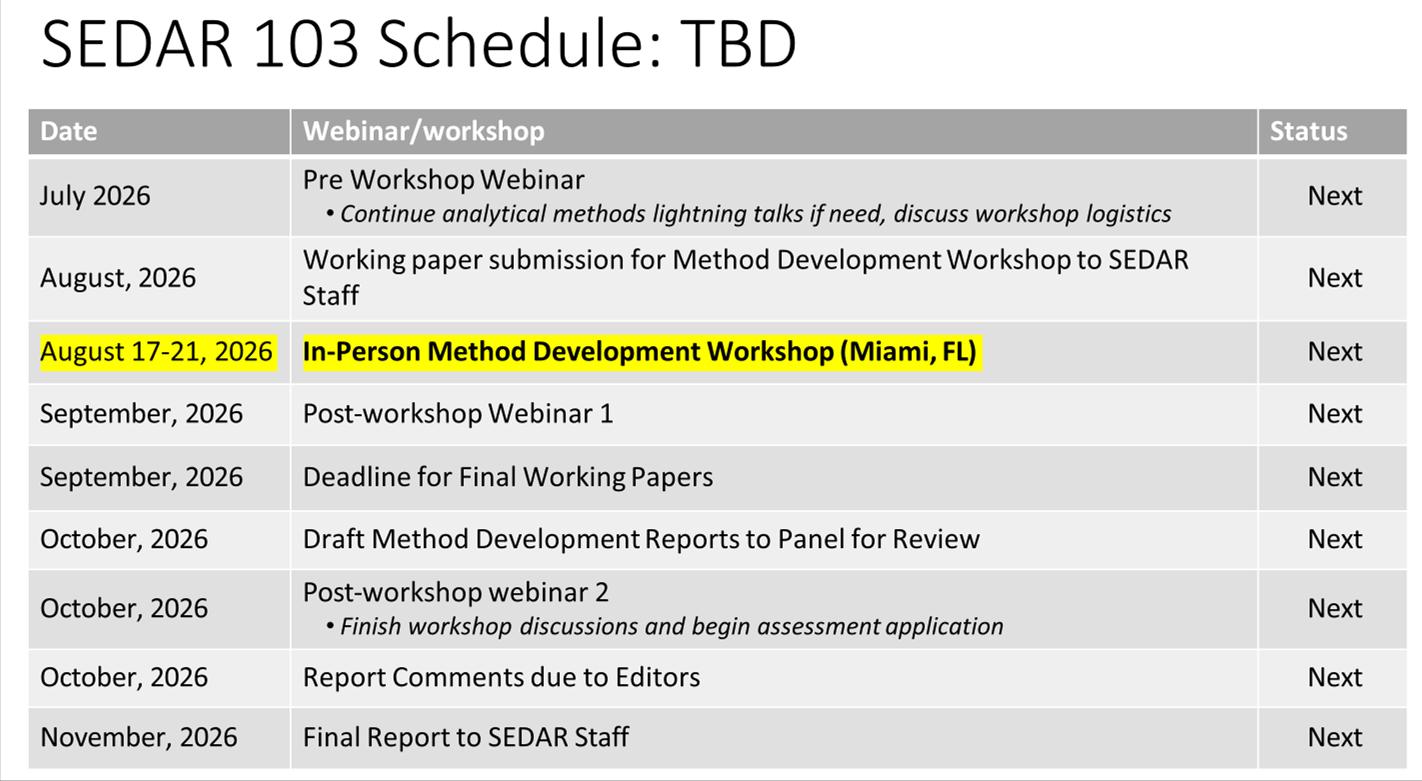
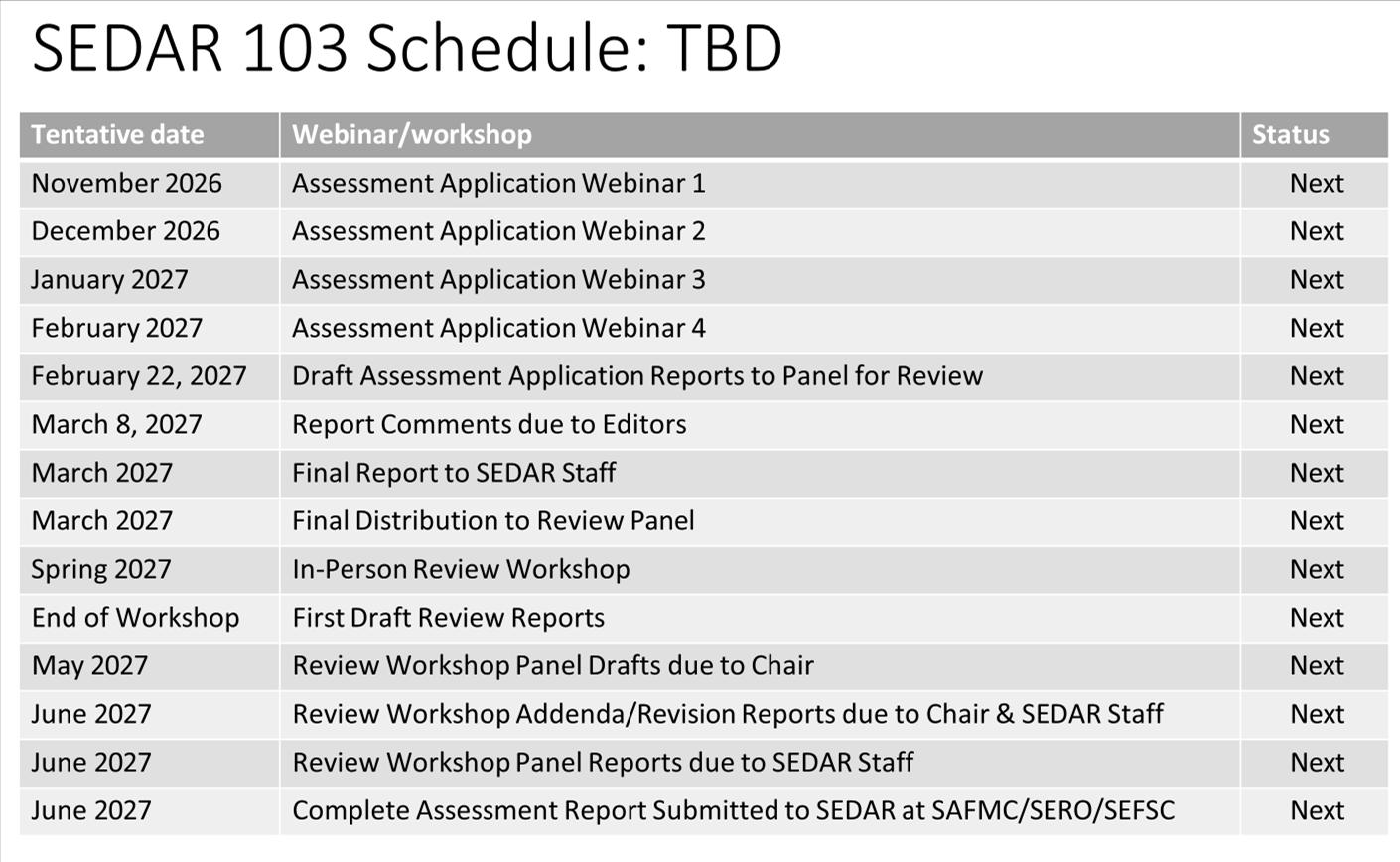
1. Update on SEDAR 103 U.S. Caribbean Application of Alternative Assessment Methods
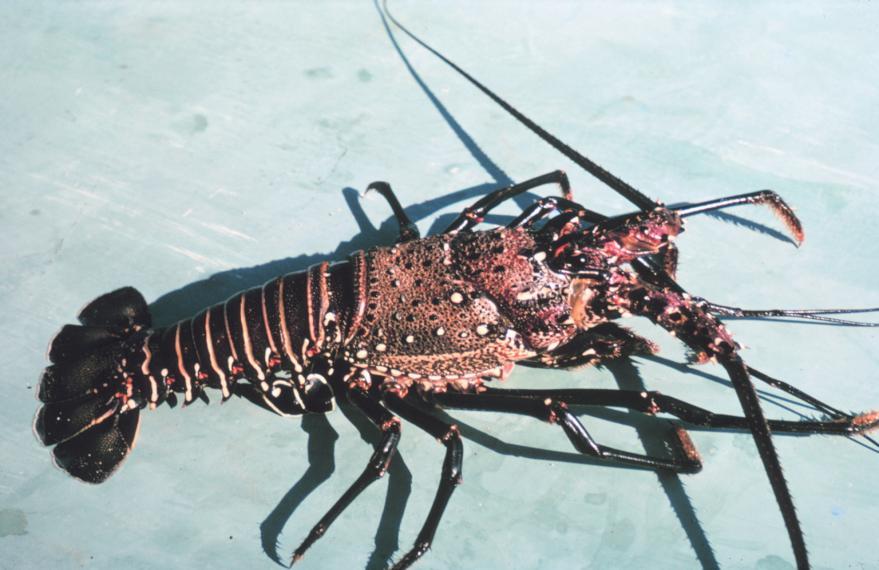
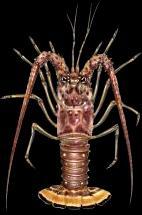
Credit Photo Collection of Dr. James P. McVey, NOAA Sea Grant Program
1. In March 2026 the CFMC SSC received from the Caribbean Fisheries Branch a Summary of Puerto Rico Spiny Lobster SEDAR 91
Additional Sensitivity Runs Incorporating Standardized Fishery-Dependent Indices of Abundance and 2024 Terminal Year
1. This report describes the requested supplemental analysis following the SSC’s initial review of the SEDAR 91 assessment, highlighting a fundamental improvement to the modeling framework through the incorporation of a) standardized indices of abundance (Martínez Rivera and McCarthy 2026) and b) recruitment deviations into the assessment model.
1. The original SEDAR 91 Base model—which lacked these dynamic components—indicated the stock was overfished (SSB / SSBSPR 30% < 1) and undergoing overfishing (F / FSPR 30% > 1),
1. The updated sensitivity run (labeled 8324_03g) suggests a more optimistic stock status. By transitioning to F parameter estimation and enabling recruitment deviations, the model identifies a decade of strong recruitment signals that reconcile the simultaneous increases in CPUE and catch observed in recent commercial landings (Matos-Caraballo et al. 2024).
1. Under this more biologically representative configuration, the sensitivity run indicates the Puerto Rico spiny lobster stock is not overfished (SSB / SSBSPR 30%~ > 1) and not undergoing overfishing (F / FSPE 30% < 1).
1. Incorporating abundance indices fundamentally improves the SEDAR 91 modeling framework by allowing the model to distinguish between overfishing and natural recruitment fluctuations, providing more accurate and responsive management advice.
Standardized Index of Abundance by Kevin McCarthy
Fishery-dependent indices of abundance: available data:
● Landings and fishing effort of commercial fishers from the Caribbean Commercial Logbook (CCL).
● Each fishing trip has a unique trip identifier, the landing date, fishing gear, coast, gear-specific effort, species caught, and weight (lbs) of the landings.
● Data subsetting.
● Catch per unit effort (CPUE) defined as whole weight per gear quantity (traps fished, SCUBA tanks used).
● Background
● S57 Assessment Approach
● S91 Assessment Approach
● S91 Sources of data
● Data and Life History Overview (what information went to the model)
● S91 Models
● Quantile Analysis (looking at different quantiles in the length data)
● Figures
● SSC Discussion and Next Steps
●SEDAR 91 addressed the stock assessment for US Caribbean Spiny Lobster.
●The process consisted of an in-person Data Workshop, with several webinars before and after the workshop and a series of assessment webinars.
●The Stock Assessment Report (SAR) for US Caribbean Spiny Lobster – Puerto Rico was disseminated to the public in September 2025.
●The SSC was tasked with recommending whether the assessments represent Best Available Science, whether the results are useful for providing management advice and developing fishing level recommendations.
●SEDAR 57 (S57) was the first application of Stock Synthesis (SS3) in the US Caribbean (2019).
●The Puerto Rico assessment models developed during S57 were fit to catch time series and length composition information from dive and pot/trap fisheries using a data-limited to moderate implementation of SS3.
●S57 resulted in a satisfactory determination for providing management advice.
●A data-only update was conducted through 2022 to provide OFLs and ABCs through 2023-2025.
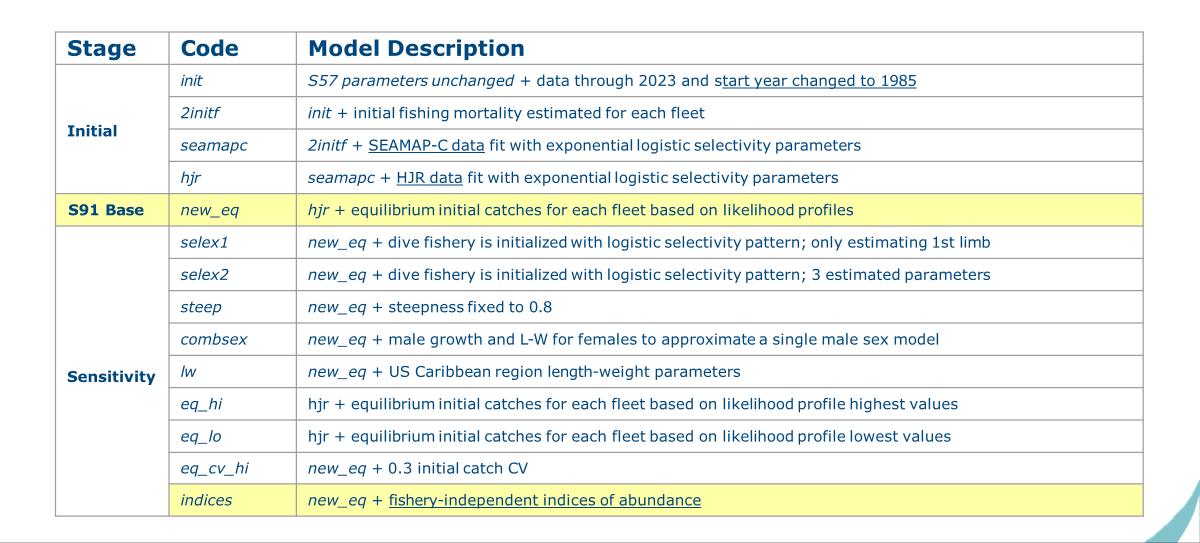
●Iterate on existing SEDAR 57 (S57), SEDAR 57 Update (S57U) length-based statistical catch at age models using SS3 through 2023
●SS3 was implemented as a length-based statistical catch-at-age model. Forward-projecting, age-structured population dynamics model that is fit to landings (removals), length composition data, and indices of abundance.
●Landings from self-reported fisher logbooks
●Length compositions from shore-based port sampling
●Life history parameters carried over from SEDAR 57
NEW: INCORPORATED INTO THE ASSESSMENT. INCLUDED IN THE BASE RUN.
●Length compositions obtained from SEAMAP-C dive surveys conducted off of the Southwest Puerto Rico coast during 2021-2023
●Length compositions obtained from an HJR Reefscaping lobster trap survey conducted throughout Puerto Rico coastal waters during 2021-2022
● Fishery-dependent indices of abundance from fisher logbooks (by Kevin McCarthy)
Topic 1: Review SEDAR 91 U.S. Caribbean Spiny Lobster Puerto Rico Assessment Report
∙ Motion 1: The SSC considers the assessment for SEDAR 91 U.S. Caribbean Spiny Lobster for Puerto Rico to represent the best available science.
∙ Motion 2: The SSC finds that the results presented in the SEDAR 91 U.S. Caribbean Spiny Lobster Puerto Rico are useful for providing management advice and developing fishing level recommendations for the Council.
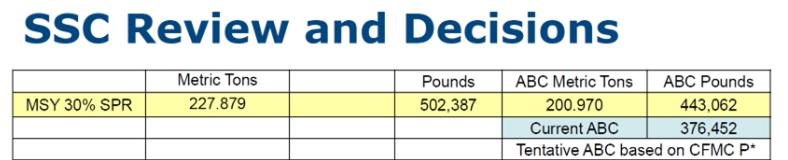
∙ Motion 3: The current assessment indicates that the stock is currently above target and therefore experiencing a fishing down to the MSY proxy. In addition, the new stock assessment shows an increase in the overall size of the population (i.e., a higher unfinished population size), which leads to an increase in catches with all other things being equal.
∙ -This increase in stock scale is greatly influenced by the final point in the new abundance indices, which adds further uncertainty in the model (as shown in the retrospective analysis).
∙ -These conditions lead to a 3-year average ABC that will exceed the proxy-MSY OFL in 2029.
∙ -Instead, the SSC recommends to use the ABC that is derived from the OFL based on the proxyMSY (F at SPR=30%) as a constant catch value for management.
∙ -Further, the SSC recommends using the 2022-2024 landings average for each fleet as the provisional landings values for 2025 and 2026.

Topic 2: Review SEDAR 84 U.S. Caribbean Yellowtail Snapper Puerto Rico Assessment Report
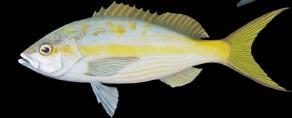
∙ Motion 4: The SSC considers the assessment for SEDAR 84 U.S. Yellowtail Snapper for Puerto Rico to represent the best available science.
∙ Motion 5: The SSC finds that the results presented in the SEDAR 84 U.S. Yellowtail Snapper for Puerto Rico are not at present useful for providing management advice and developing fishing level recommendations for the Council.
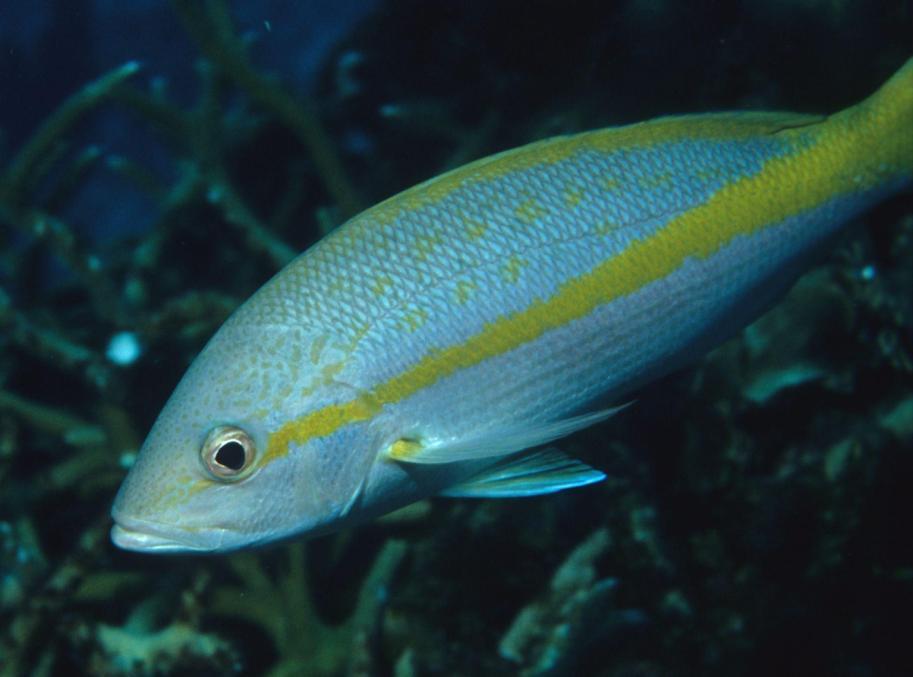
Credit: Photographer Dr. Dwayne Meadows
Topic 3: Review SEDAR 84 U.S. Caribbean Yellowtail Snapper St. Thomas-St. John
Assessment Report
∙ Motion 6: The SSC considers the assessment for SEDAR 84 U.S. Yellowtail Snapper for St. Thomas and St. John to represent the best available science.
∙ Motion 7: Given the uncertainties noted during the Review Workshop, the SSC finds that the results presented in the SEDAR 84 U.S. Yellowtail Snapper for St. Thomas/St. John are not at present useful for providing management advice and developing fishing level recommendations for the Council.
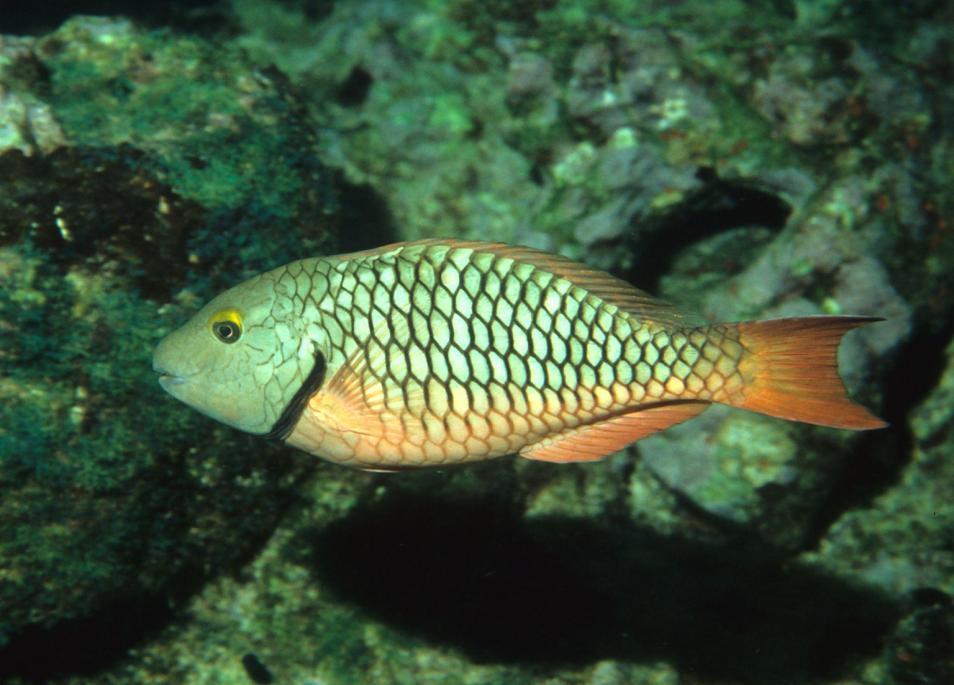
Credit: Photographer Dr. Dwayne Meadows
Topic 4: Review SEDAR 84 U.S. Caribbean Spotlight Parrotfish St. Croix Assessment Report
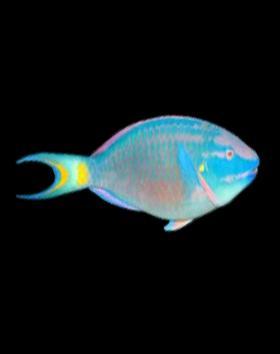
∙ Motion 8: The SSC considers the assessment for SEDAR 84 U.S. Stoplight Parrotfish for St. Croix to represent the best available science.
∙ Motion 9: The SSC finds that the results presented in the SEDAR 84 U.S. Stoplight Parrotfish for St. Croix are not at present useful for providing management advice and developing fishing level recommendations for the Council.
5. SSC Final Review and recommendations for SEDAR 91
FINAL REVIEW
SEDAR 91 PR SL
Best available science X
Useful for providing management advice and developing fishing level recommendations for the Council X
For SEDAR 91 PR SL - SSC presents the ABC to the Council Members. Results of the models demonstrate not overfishing and/or underfishing.
Action Item: Does the CFMC accepts or not the ABC, for it to pass to a framework amendment?
SEDAR 84 PR YT SEDAR 84 STTSTJ YT
SEDAR 84 STX SP
Best available science X X X
Useful for providing management advice and developing fishing level recommendations for the Council
For SEDAR 84 PR - USVI - The three assessment are found NOT useful for providing management advice and developing fishing level recommendations for the Council. What does the experts said? There is no stock assessments to determine how the population is. It cannot provide OFL and ABC.
Action Item: None.
Topic 5: Review and Recommendations for SEDAR 91 and SEDAR 84 Assessment Report
∙ Motion 10: The SSC endorses the recommendations made by the data and review panels and also makes the following recommendations related to SEDAR 91 and SEDAR 84.
1. Investigate further potential factors for use in the CPUE index standardization. The fish trap survey in particular showed large dynamics outside biological bounds that may be due to other factors currently not included in the standardization process, such as historical management decisions (e.g. size limits), socioeconomic factors, and fishing behavior (e.g., how traps are baited). Collection and analysis of Local Ecological Knowledge and other socioeconomic data can contribute to understanding potential drivers.
1. When developing fishery-dependent indices of relative abundance, consider alternative trip selection methods and/or improvements to the Stephens and MacCall (2004) trip selection approach, such as exploring whether species correlation coefficients (e.g. Index of Association) vary over time periods
3. Model sensitivity analysis showed that when catch is given a larger variance, the model will deviate from the inputted catch time series, especially toward the end of the time series. This period of catches is also recognized as more uncertain and currently derived from a catch correction process that contains its own uncertainty. Local ecological knowledge may bear further insight into the best catch time series and how to calculate it, as it is preferred to model catches with low uncertainty rather than let the model estimate catches.
4. Adding recreational or other removal fleets will help estimate the overall scale of the lobster population and offer a more complete estimate of the overall fishing mortality.
5. Explore the potential impacts of warming water temperatures on spiny lobster recruitment and growth.
Continued evaluation of life history parameters for this stock
Evaluate stock connectivity to determine whether local recruitment contributes to the stock or if recruits are primarily obtained from surrounding areas
Consider simpler assessment implementations such as an age-structure production model. This could be beneficial in situations where the representativeness of the TIP length composition is questionable, which was noted for Yellowtail Snapper in Puerto Rico
Increase data collection for recreational landings
Initiate a sustained data collection program effort for local ecological knowledge
Investigate fishing effort
Increase data collection for determining discards for both commercial and recreational fisheries, and consider alternative approaches using local ecological knowledge as needed
Increase cooperative research effort to collect data mentioned
Increase FI sampling in waters deeper than 30m (DCRMP) X
Evaluate the utility of NCRMP and TCRMP surveys X
Investigate whether landings time series can be extended back in time with either available data or local ecological knowledge


Details:
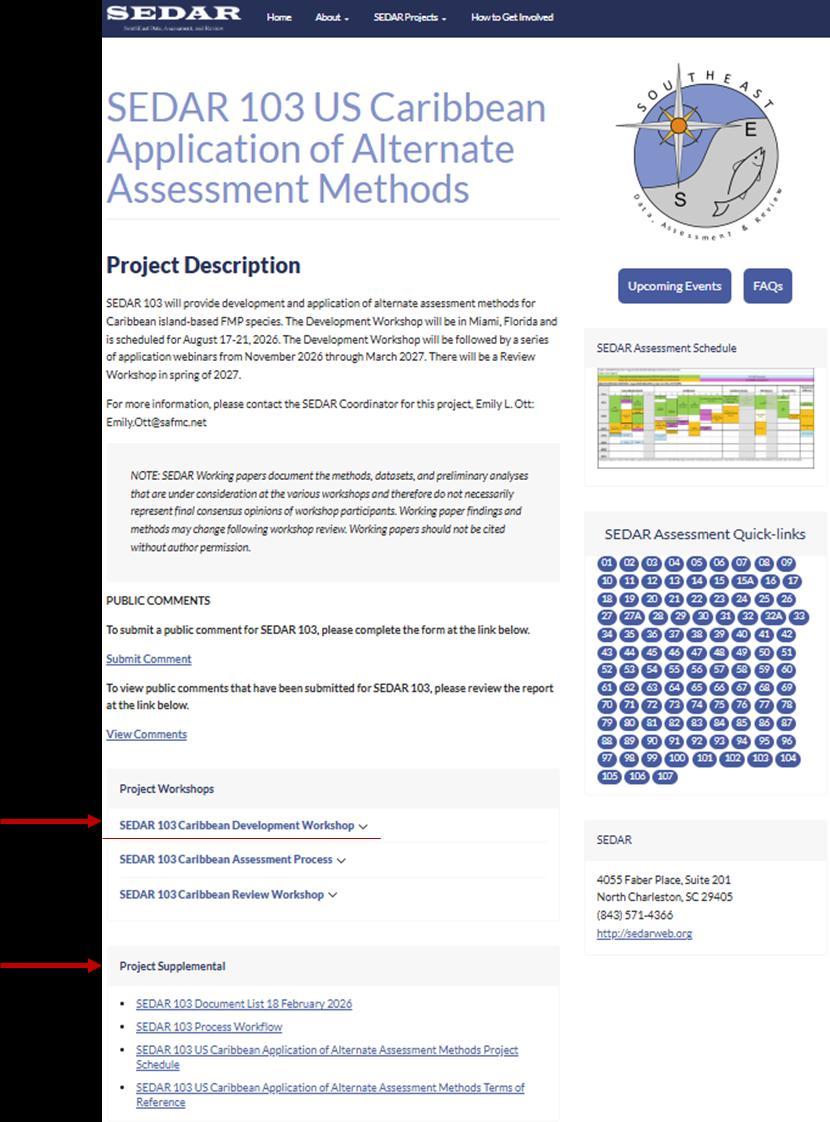
•Review and recommend options for alternative assessment approaches to better inform management of US Caribbean federally managed species.
•Approaches likely to differ among species and species groups.
•Goal is to have analytical approaches recommended for most federally managed species in the US Caribbean.
•Project started in January 2026 (a delay from the original 2025 start date due to the 2025 government shutdown)
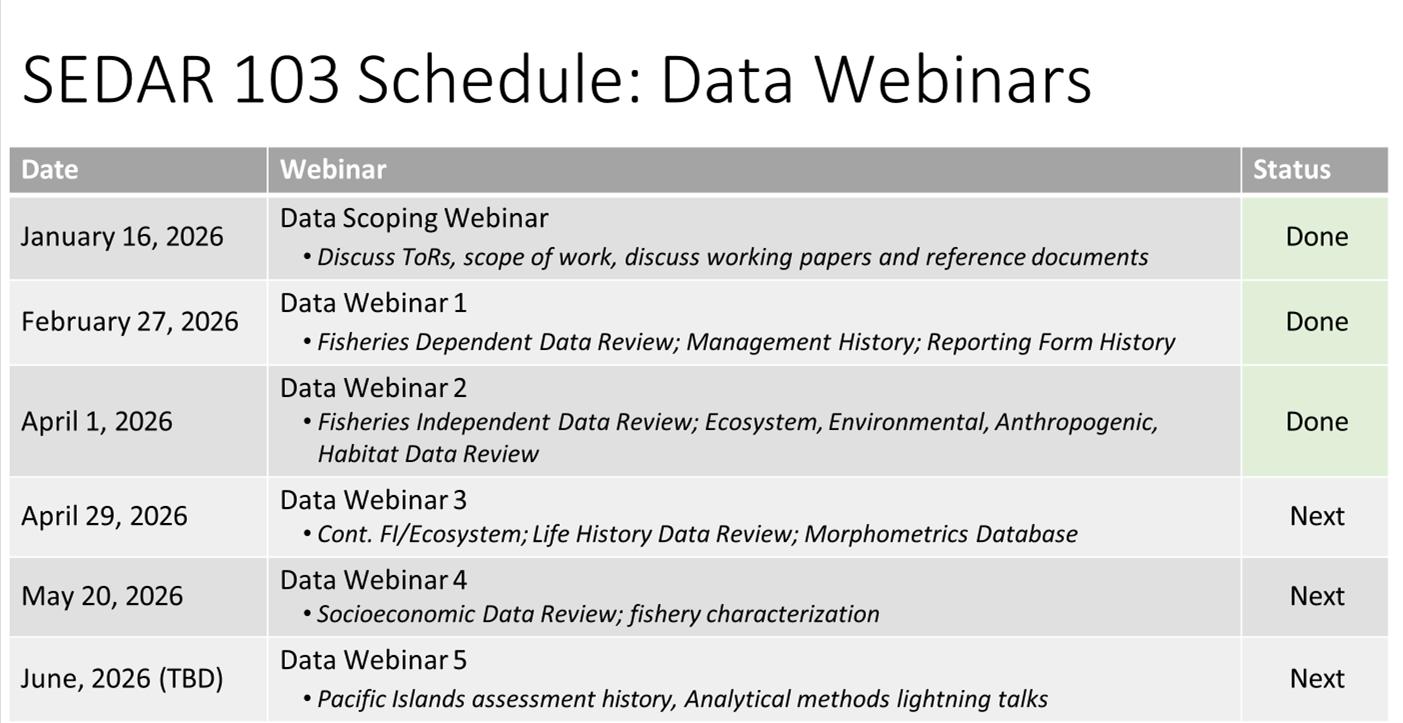
Web site: https://sedarweb.org/assessment s/sedar-103-us-caribbeanapplication-of-alternateassessment-methods/