SSC Report to the 188th CFMC Meeting
December 03-04, 2025
Dr. Vance Vicente Chairman
Scientific and Statistical Committee

December 03-04, 2025
Dr. Vance Vicente Chairman
Scientific and Statistical Committee
• Biology/Ecology of Caribbean spiny lobster
• SEDAR 91 summary
• SEDAR SSC Tasks
• SSC’s September Meeting summary and action items
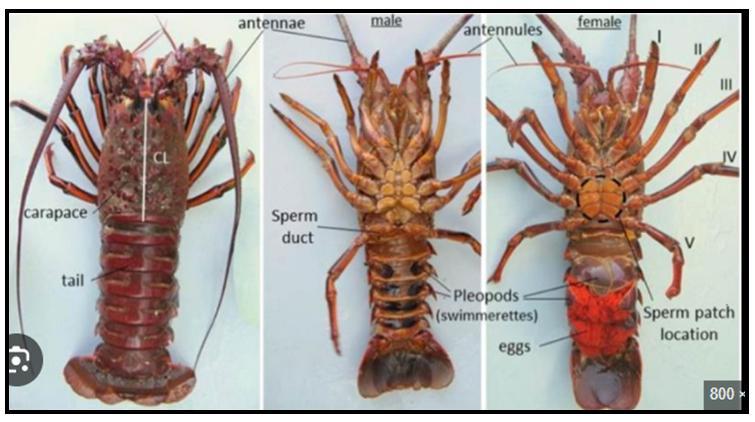
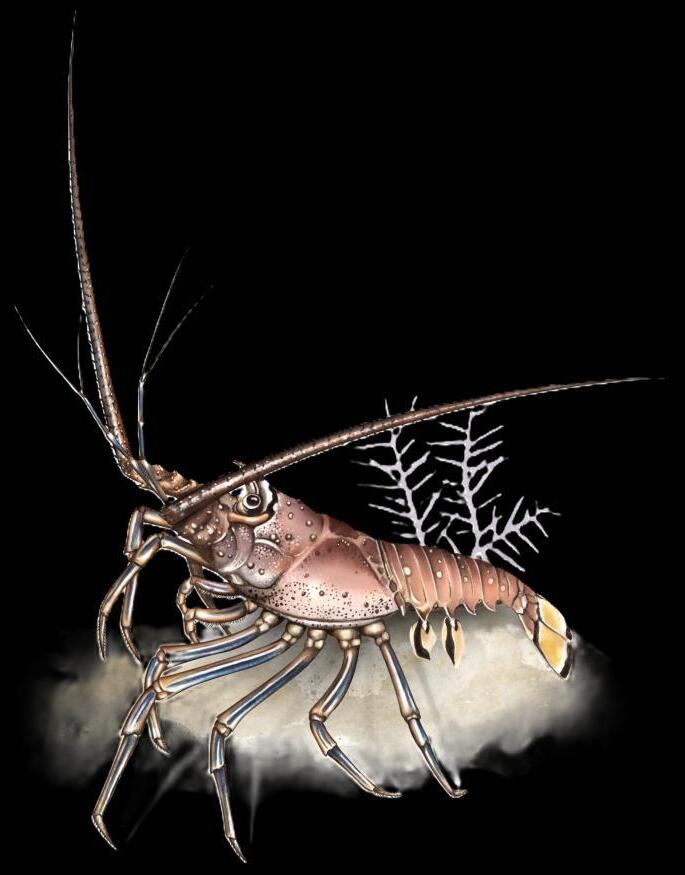
• BIOLOGY: The "sperm patch" in a spiny lobster is a packet of sperm, scientifically called a spermatophore, that a male deposits on the underside of a female. Initially white and sticky, it hardens and darkens to a "tar-spot" in the hours after mating. The female uses her legs to scratch at this hardened patch to fertilize eggs she later carries under her tail. SS3 is an age structured model: update ossicle studies: ossicles can be used to determine the age of spiny lobsters by counting the annual growth bands in the gastric mill ossicles).
Perry Insitute

ECOLOGY: The ecology of the Caribbean spiny lobster (Panulirus argus) is characterized by a distinct life cycle with different habitats for each stage: larvae are planktonic in the open ocean, juveniles settle in shallow, vegetated areas like seagrass beds, and adults are benthic, inhabiting coral reefs, rocky substrates, and soft bottoms, where they are nocturnal and graze on invertebrates. Adults also undertake seasonal migrations to deeper water and play a key role in their ecosystem by controlling populations of other invertebrates like sea urchins and snails. (The Caribbean Seminar Series should continue: A seminar by a spiny lobster expert is needed).
• SEDAR 91 addressed the Stock Assessment for US Caribbean Spiny Lobster –St. Croix, St. Thomas & St. John. The process consisted of an in-person Data Workshop, with several webinars before and after the workshop and a series of assessment webinars.
• The Review Workshop was cancelled because the center for independent experts (CIE) were not able to participate in the review of the assessment. The assessment was conducted by the SEFSC.
• The Council’s Scientific and Statistical Committee (SSC) reviews the SAR (Stock Assessment Report).
• The SSCs are tasked with recommending whether the Stock Assessments represent Best Available Science,
• The SSC determines whether the results presented in the SARs are useful for providing management advice and developing fishing level recommendations for the Council.
• An SSC may request additional analyses be conducted or may use the information provided in the SAR as the basis for their Fishing Level Recommendations (e.g., Overfishing Limit (OFL) and Acceptable Biological Catch (ABC).
• The Caribbean Council’s SSC will review the assessment at its September 23-25 2025, SSC meeting,
• The Council receives the SSC information at its December 2025 meeting.
*Documentation on SSC recommendations is not part of the SEDAR process and is handled through each Council.
Participants
SSC
• Michelle Scharer
• Jason Cope
• Elizabeth Kadison
• Walter Keithly
• Richard Appeldoorn
• Jorge García Sais
• Juan J Cruz Motta
• Tarsila Seara
• Todd Gedamke
• Skyler Sagarese
• Vance Vicente
chairs
members and staff
1. Review SEDAR 91 U.S. Caribbean Spiny Lobster St. Thomas/St. John Assessment Report
2. Review SEDAR 91 U.S. Caribbean Spiny Lobster St. Croix Assessment Report
3. Review SEDAR 84 Caribbean Yellowtail Snapper (Puerto Rico, St. Thomas/St. John) and Stoplight Parrotfish (St. Croix)
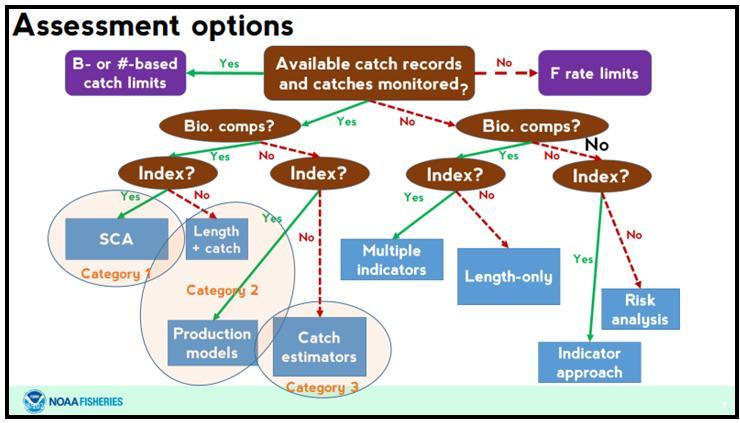
4. Update on SEDAR 103 U.S. Caribbean Application of Alternative Assessment Methods
5. SSC recommendations
• Landings from self-reported fisher logbooks
• Length compositions from shore-based port sampling
• Life history parameters carried over from SEDAR 57
(SEDAR 57: SEDAR 57 Stock Assessment Report U.S. Caribbean Spiny Lobster: August 2019)

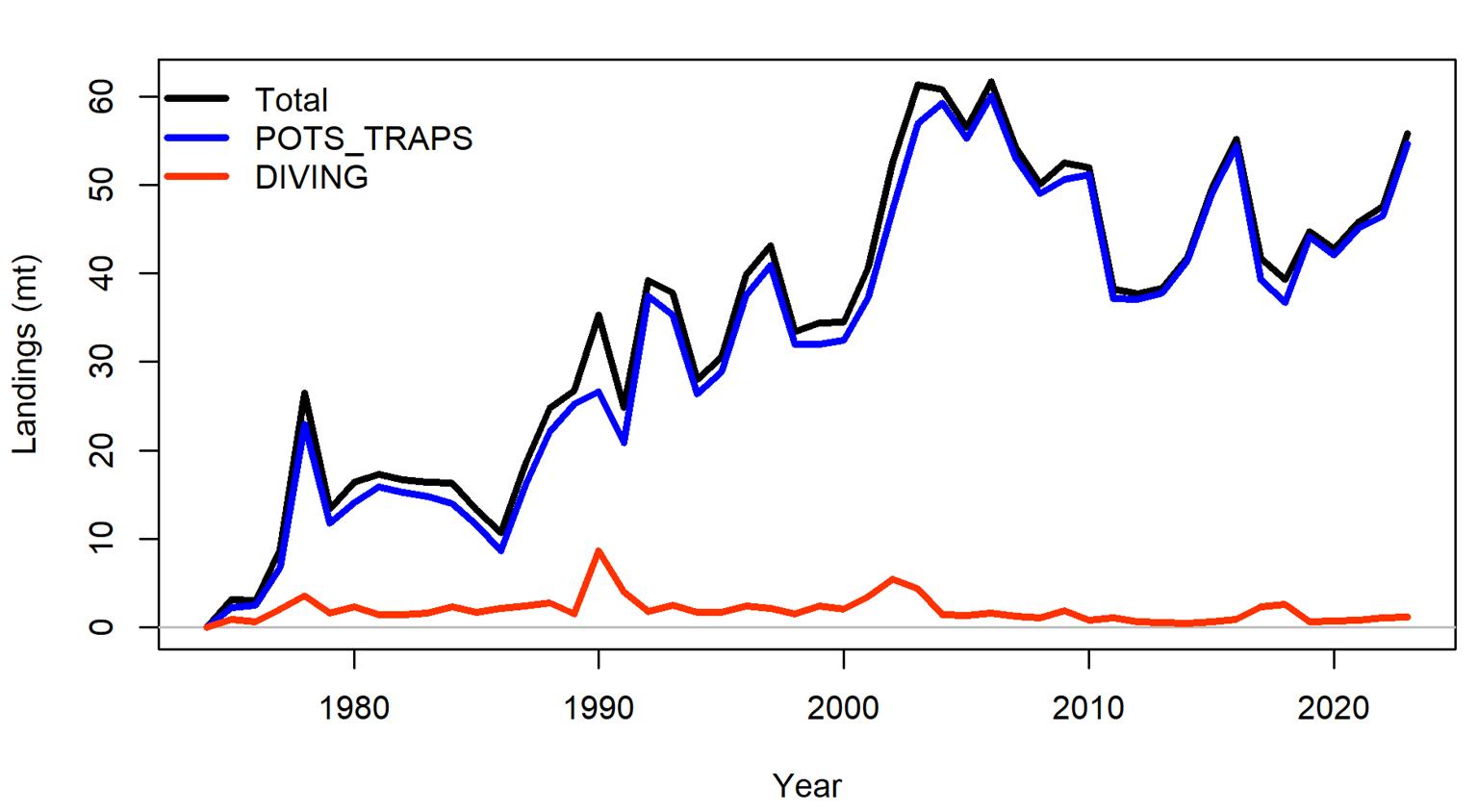
STTJ – Data review
Commercial logbook landings
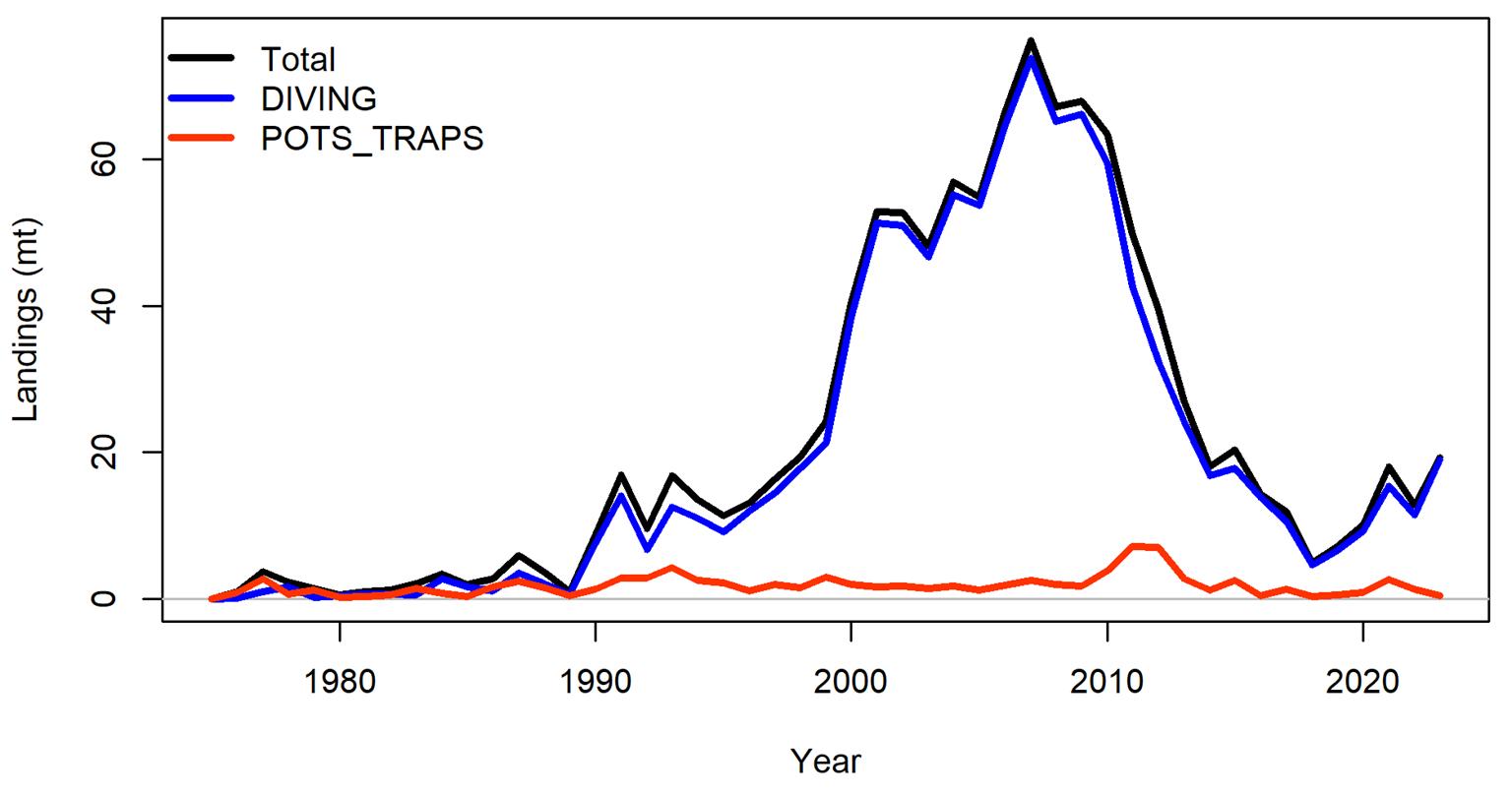
STX – Data review
Commercial logbook landings
Commercial landings 2021-2025 for USVI
Recent commercial landings for spiny lobster for fishing years 2021-2023 and provisional landings for 2024 and 2025 for each island/island group. Provisional landings were set equal to the 3-year average from 2021-2023. Values are in pounds whole weight.
• Motion 1: The SSC moves to recommend the assessment for SEDAR 91 U.S. Caribbean Spiny Lobster for St. Thomas and St. John as the best scientific information available (BSIA).
• Motion 2: The results presented in SEDAR 91 U.S. Caribbean Spiny Lobster for St. Thomas and St. John are useful for providing management advice and developing fishing level recommendations for the Council.
• Motion 3: The SSC recommends to include years using the average of 2021-2023 as the provisional landings values for the 2024-2025 forecast for the SEDAR 91 U.S. Caribbean Spiny Lobster for St. Thomas and St. John.
• The SSC discussed options, but did not recommend a sigma value.
• Motion 4: The SSC moves to recommend the assessment for SEDAR 91 U.S. Caribbean Spiny Lobster for St. Croix as the best scientific information available.
• Motion 5: The results presented in SEDAR 91 U.S. Caribbean Spiny Lobster for St. Croix are useful for providing management advice and developing fishing level recommendations for the Council.
• Motion 6: The SSC recommends to include years using the average of 2021-2023 as the provisional landings values for the 2024-2025 forecast for the SEDAR 91 U.S. Caribbean Spiny Lobster for St. St. Croix.
• Motion 7: The SSC recommends a sigma value of 0.5 for the SEDAR 91 U.S. Caribbean Spiny Lobster for St. Thomas/St. John and St. Croix.
• Preliminary Results: Using the recommended sigma value of 0.5, and assuming the Council selects 0.45 as their risk of overfishing value (P*), the SEFSC provided the following reference points and constant-catch OFLs and ABCs for SEDAR 91 U.S. Caribbean Spiny Lobster for St. Thomas/St. John and St. Croix.
Management reference points from SEDAR 91 Caribbean Spiny Lobster stock assessments for each island/island group. Values correspond to base model run in the St. Thomas/St. John and St. Croix SEDAR 91 assessment reports. Values are in pounds whole weight.
St. Croix, USVI
Projected constant-catch overfishing limit and acceptable biological catch values for spiny lobster for fishing years 2026-2028 for each island/island group. Values are in pounds whole weight.
* ABC was estimated using the SSC recommended sigma value of 0.5 TO ACCOUNT FOR UNCERTAINTY for SEDAR 91 USVI and the p* of 0.45 from Framework Amendment 2 to the Puerto Rico, St. Croix, and St. Thomas/St. John Fishery Management Plans: Updates to the Spiny Lobster Overfishing Limit, Acceptable Biological Catch, and Annual Catch Limit (89 FR 34168).
** Note that the OFL and ABC for St. Croix are larger than the maximum sustainable yield (MSY) proxy included in Table 1; this is because the 2023 estimate of spawning stock biomass (SSB) is considerably larger than the SSB associated with the MSY proxy (BMSY). When biomass is greater than BMSY, a larger temporary catch is possible without causing overfishing.
1. For each island platform (STTJ and STX), results indicate that overfishing is not occurring and the stocks are not overfished.
2. Diagnostics indicate consistent and relatively robust model estimates.
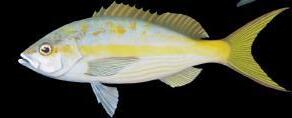
Topic 3: Review SEDAR 84 Caribbean Yellowtail Snapper (Puerto Rico, St. Thomas/St. John) and Stoplight Parrotfish (St. Croix)
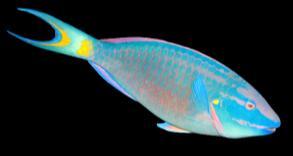
• Motion 8: The SSC reviewed documents associated with the SEDAR 84 stock assessment review and CIE reports for Puerto Rico and St. Thomas/St. John yellowtail snapper and St. Croix stoplight parrotfish. In anticipation of a full SSC review of these stock assessments, the SSC and the SEFSC Caribbean Branch discussed additional model runs for the full review. The suggested model runs include:
o Exclusion of the NCRMP data
o Further exploration in parameter sensitivity to (with a soft prioritization):
▪ Selectivity
▪ Growth, including the possibility of using priors
▪ Natural mortality
▪ Steepness
▪ Equilibrium catch
The SSC recognizes the limited capacity of the SEFSC to do additional runs in light of the prioritization of completing the Puerto Rico Spiny Lobster stock assessment (SEDAR 91). The SSC will also look to the SEFSC analysts to determine the best exploration of uncertainty in the above list, as they expressed lessons learned from the review panel and ways to go about the above uncertainty exploration.
• SEFSC analysts will explore SSC recommendations for SEDAR 84 and present the stock assessment results to the SSC at their next meeting.
• SSC member Cope asked if he could recommend a federal employee from the Alaska Science Center to attend the meeting and asked if someone from the SEFSC could attend the National SSC meeting scheduled in January 2026 in San Diego.
• SSC member Seara asked if relevant reference documents could be submitted to be distributed to the S103 participants before the meeting.
• The SSC made several research recommendations for U.S. Caribbean Spiny Lobster for St. Thomas/St. John and St. Croix, to be submitted as part of the SEDAR 91 Review.


An annual catch target (ACT) is a harvest level set lower than the annual catch limit (ACL) to provide a buffer against overfishing. It is a management tool used in commercial and recreational fisheries to account for uncertainty in the management process such as potential misreporting or late catch information ensuring that the final catch does not exceed the ACL.
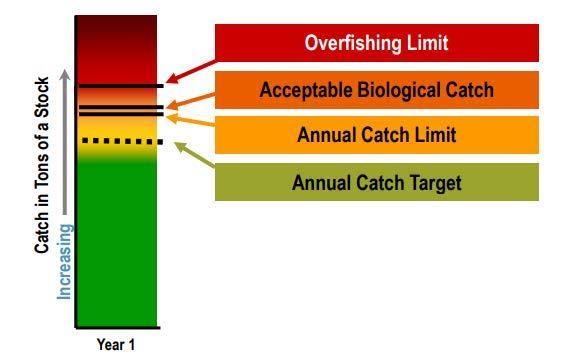
ACLs and ACTs are expressed either in pounds or numbers of fish.
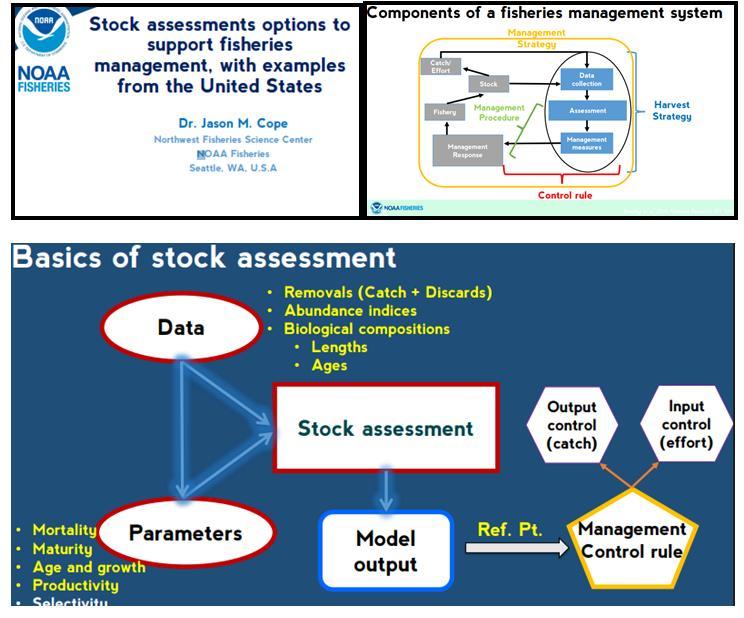
Stock Synthesis (SS3) is an age- and size-structured stock assessment model in the class of models termed integrated analysis. Stock Synthesis has evolved over time to be able to model a wide range of fish population dynamics and somatic growth and to utilize diverse types of data. The model is coded in C++ with parameter estimation enabled by automatic differentiation though AD Model Builder ADMB (Fournier et al. 2012).
SS3 is made up of
• A population sub-model that simulates the following population processes:
• biology (growth, maturity, fecundity),
• recruitment,
• movement,
• fishery selectivity,
• natural and fishing mortality, and
• responsiveness to environmental and predation factors.
• An observation sub-model that estimates expected values for various types of data.
• A statistical sub-model that characterizes the data’s goodness of fit and obtains best-fitting parameters with associated variance.
• A forecast sub-model that projects management quantities.
Reference: Methot, R.D. and Wetzel, C.R. (2013). Stock Synthesis: A biological and statistical framework for fish stock assessment and fishery management. Fisheries Research, 142: 86-99. https://doi.org/10.1016/j.fishres.2012.10.012