Framework Action 4 under the STX & STT/STJ Management Plans
Framework Action 4 under the St. Croix and St. Thomas/St. John Fishery Management Plans:
Modification of Spiny Lobster Management Reference Points Based on SEDAR 91 Stock Assessments
Sarah Stephenson, NMFS-SERO Caribbean Branch
189th Caribbean Fishery Management Council Meeting
April 21-22, 2026
Review of Spiny Lobster Management
• The St. Croix and St. Thomas/St. John Fishery Management Plans (FMP) set status determination criteria and reference points for spiny lobster using Tier 4a of the Council’s acceptable biological catch (ABC) control rule (data limited with no assessment, stock not vulnerable to fishing pressure) and set the annual catch limits (ACL) at 95% of the ABC.
• Spiny lobster management reference points were updated in Framework 1 based on SEDAR 57 and in Framework 2 based on an update assessment to SEDAR 57, both using Tier 3 of the ABC control rule (data limited with accepted assessment).
Current Management
Reference Point (Framework
Proposed Updates to Spiny Lobster Management
• The Scientific and Statistical Committee reviewed the SEDAR 91 spiny lobster stock assessments for St. Croix and St. Thomas/St. John in September 2025, determined them appropriate for management use, and recommended updated ABCs.
• SEDAR 91 models used landings and length data to understand the productivity of the spiny lobster stocks and produced OFL and ABC values designed to keep each stock at its most productive.
Council Decisions
• At this meeting, the Council will review the draft document (included in the meeting briefing book) for Framework Action 4 to modify spiny lobster reference points based on SEDAR 91.
• Through this framework action, the Council would set ACLs for spiny lobster in St. Croix and in St. Thomas/St. John from the SSC’s recommended ABC values, and decide on a management uncertainty* buffer.
*Reflects the uncertainty in the ability of managers to constrain catch so the ACL is not exceeded, and the uncertainty in knowing the true catch amounts (i.e., estimation errors).
• The Council can select a preferred alternative for setting the spiny lobster ACL for both St. Croix and St. Thomas/St. John.
o A different alternative could be selected as preferred for each FMP.
Purpose and Need Statements
• The purpose of this framework action is to update status determination criteria and management reference points for spiny lobster under the St. Croix FMP and the St. Thomas/St. John FMP to ensure management is consistent with the most recent spiny lobster stock assessments and recommendations from the Council’s SSC.
• The need for this action is to ensure that management measures for spiny lobster are based on the best scientific information available to prevent overfishing and achieve optimum yield, in accordance with the requirements of the Magnuson-Stevens Fishery Conservation and Management Act.
Proposed Actions and Alternatives
• Framework Action 4 would update status determination criteria and management reference point values consistent with the SEDAR 91 spiny lobster stock assessments.
Management reference point Definition
Maximum sustainable yield proxy (pounds whole weight)
Largest long-term average catch that can be taken from a stock under current ecological and ocean conditions and fishing characteristics.
Croix
Minimum stock size threshold in thousands of eggs (0.75* Spawning Stock Biomass [SSB]MFMT)
Biomass level below which the ability of the stock to produce MSY on a continuing basis has been jeopardized. A stock is considered overfished when its biomass is below MSST.
Action 1: St. Croix
Action 1: Update the St. Croix Spiny Lobster OFL, ABC, and ACL
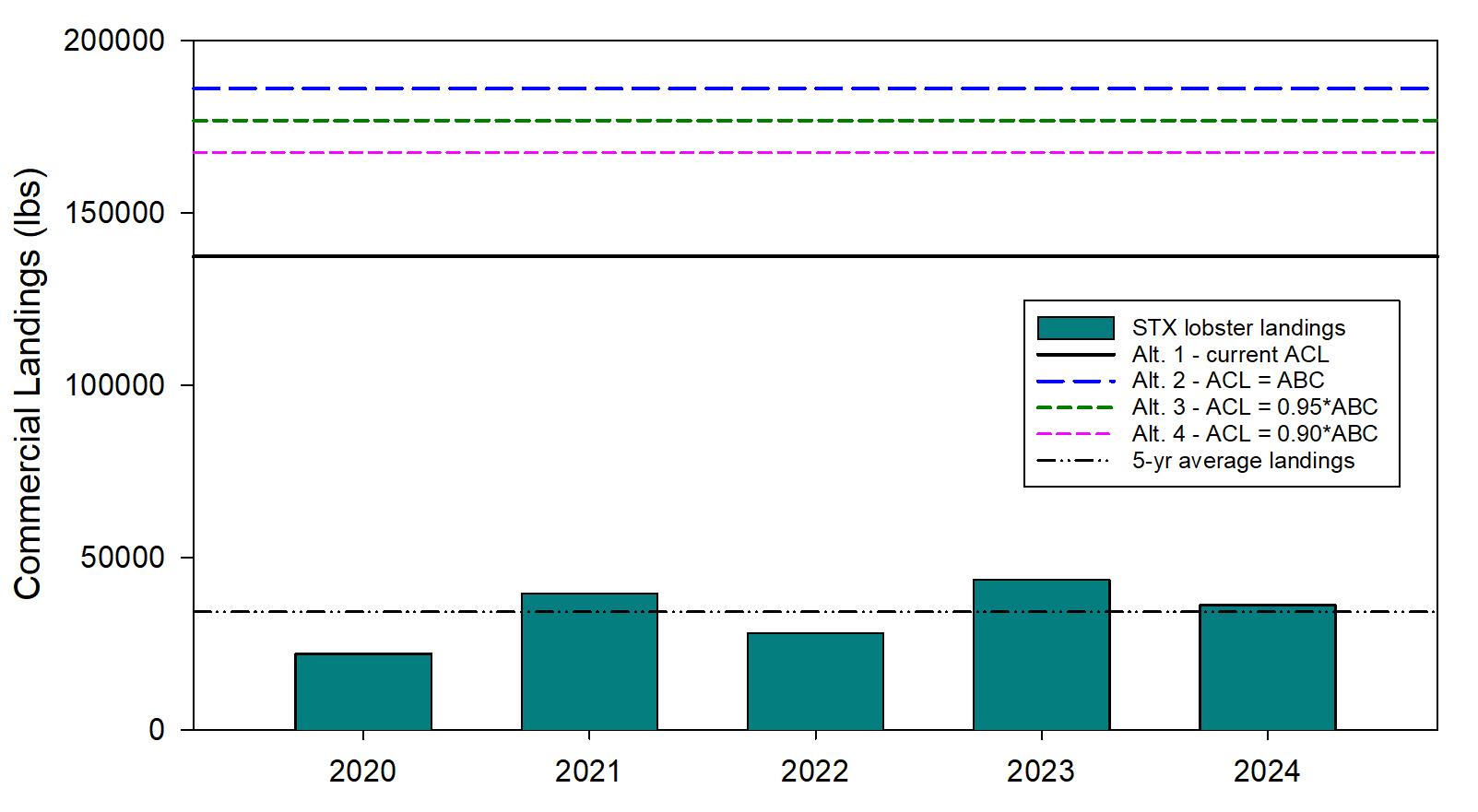
Alternative 1. No Action. Retain the current St. Croix spiny lobster OFL, ABC, and ACL values. The ACL is set equal to 95% of the recommended ABC (144,478 lbs) and equals 137,254 pounds (lbs).
Alternative 2. Update the St. Croix spiny lobster OFL and ABC values and set the ACL equal to the recommended ABC (186,063 lbs). The ACL would equal 186,063 lbs.
Alternative 3. Update the St. Croix spiny lobster OFL and ABC values and set the ACL equal to 95% of the recommended ABC (186,063 lbs). The ACL would equal 176,760 lbs.
Alternative 4. Update the St. Croix spiny lobster OFL and ABC values and set the ACL equal to 90% of the recommended ABC (186,063 lbs). The ACL would equal 167,457 lbs.
Comparison of Alternatives – St. Croix
See Table 3.1 in Framework Action 4 document for landings of spiny lobster reported in St. Croix.
General Expected Effects – St. Croix
Alternative 1: No changes to current reference points, but not based on best scientific information.
Biological/Ecological: Potential long-term negative effects from not managing to reference points that are based on the best scientific information.
Social/Ecological: No short-term effects (no changes to current levels), but if fishing levels increase above the current ACL, then there could be more long-term negative effects (for example - decreased income and fishing opportunities) from not managing to reference points that are based on the best scientific information.
Administrative: None.
General Expected Effects – St. Croix
Alternatives 2 - 4: Update reference points based on best scientific information.
Increase in ACL.
Biological/Ecological: Short-term negative effects from increased removals*, and long-term positive effects from using reference points based on the best scientific information. (Alternative 4 would set the lowest ACL; more lobster left in water)
Social/Economic: Positive effects from potential for increased revenues** and fishing opportunities and from sustainably managing the stock. (Alternative 4 would provide smallest revenue gains)
Administrative: Short-term effects from creating, administering, and enforcing new regulations and from additional outreach efforts notifying stakeholders of changes. (Equal effects among proposed alternatives)
* If fishermen harvest to the ACL.
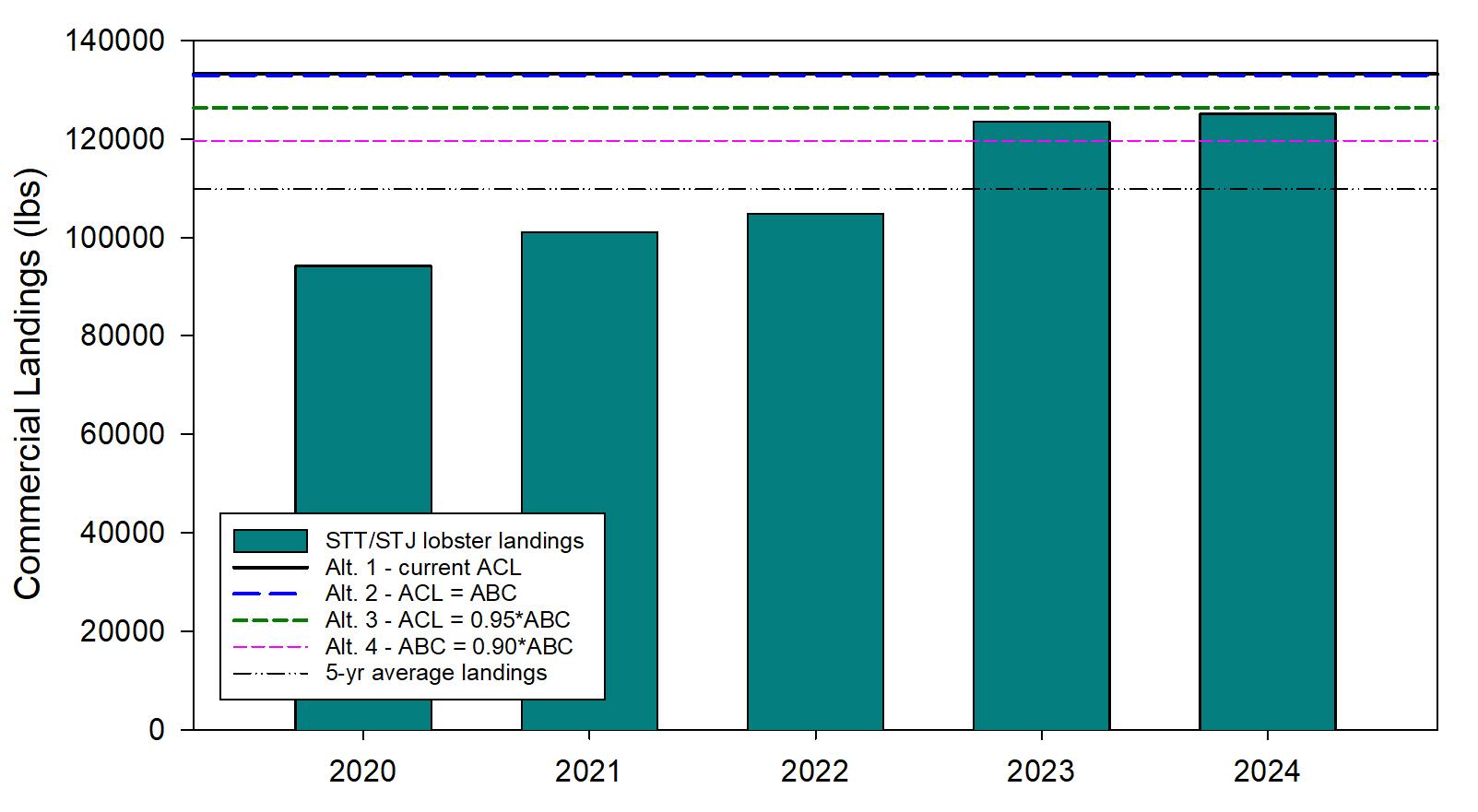
** Note current commercial landings for spiny lobster are well below the current and proposed ACLs.
Action 2: St. Thomas/St. John
Action 2: Update the St. Thomas/St. John Spiny Lobster OFL, ABC, and ACL
Alternative 1. No Action. Retain the current St. Thomas/St. John spiny lobster OFL, ABC, and ACL values. The ACL is set equal to 95% of the recommended ABC (140,218 lbs) and equals 133,207 pounds (lbs).
Alternative 2. Update the St. Thomas/St. John spiny lobster OFL and ABC values and set the ACL equal to the recommended ABC (132,964 lbs). The ACL would equal 132,964 lbs.
Alternative 3. Update the St. Thomas/St. John spiny lobster OFL and ABC values and set the ACL equal to 95% of the recommended ABC (132,964 lbs). The ACL would equal 126,316 lbs.
Alternative 4. Update the St. Thomas/St. John spiny lobster OFL and ABC values and set the ACL equal to 90% of the recommended ABC (132,964 lbs). The ACL would equal 119,668 lbs.
Comparison of Alternatives – St. Thomas/St. John
See Table 3.9 in Framework Action 4 document for landings of spiny lobster reported in St. Thomas/St. John.
General Expected Effects – St. Thomas/St. John
Alternative 1: No changes to current reference points, but not based on best scientific information. Additionally, the current ACL is greater than recommended ABC, which is inconsistent with the Magnuson-Stevens Fishery Conservation and Management Act.
Biological/Ecological: Potential long-term negative effects from not managing to reference points that are based on the best scientific information.
Social/Ecological: No short-term effects (no changes to current levels), but longterm negative effects (for example - decreased income and fishing opportunities) from not managing to reference points that are based on the best scientific information
Administrative: None.
General Expected Effects – St. Thomas/St. John
Alternatives 2 - 4: Update reference points based on best scientific information.
Decrease in ACL.
Biological/Ecological: Short-term positive effects from decreased removals*, and long-term positive effects from using reference points based on the best scientific information. (Alternative 4 would set the lowest ACL; more lobster left in water)
Social/Economic: Negative effects from decreased revenues and fishing opportunities, ranging from minimal (Alt. 2) to moderate (Alt. 3) to major (Alt. 4).
Administrative: Short-term effects from creating, administering, and enforcing new regulations and from additional outreach efforts notifying stakeholders of changes. Additionally, Alt. 4 sets an ACL less than the 2024 landings, and accountability measures (fishing season reduction) could be required in the future if landings continue at that level, or increase.
* If fishermen harvest to the ACL.
Action Items and Next Steps
• Council selects a preferred alternative for St. Croix and St. Thomas/St. John (can be the same or different).
April 2026
• If a preferred is selected, Council could review regulatory text and approve Framework Action 4 for submission to Secretary of Commerce (allowing staff to make minor editorial changes).
• Staff sends completed framework and regulatory text to Council Chair to review.
• Council submits Framework Action 4 to NMFS.
August 2026
• SERO staff begins rulemaking.
• Public will have opportunity to comment during the proposed rule comment period, which will be announced in the Federal Register and in a Caribbean Fishery Bulletin (text CARIBFISH to 888777).