

Sarah Stephenson
NOAA Fisheries • Southeast Regional Office
190th CFMC Meeting • Isla Verde, Puerto Rico
Aug 11-12, 2026
Refine Managed Species List
Refine the list of federally-managed species to include only those that are in need of conservation and management.

Reclassify or Remove
For those not in need of conservation and management, reclassify species that can achieve ecosystem management objectives or remove them from the fishery management plan.
Improve Efficiency
To improve the efficiency and effectiveness of federal fisheries management in the U.S. Caribbean.
Some species managed in the fishery management plans are not targeted by fishermen, but were included because of their ecosystem role. These species may be better suited as ecosystem component species, which do not require active management.

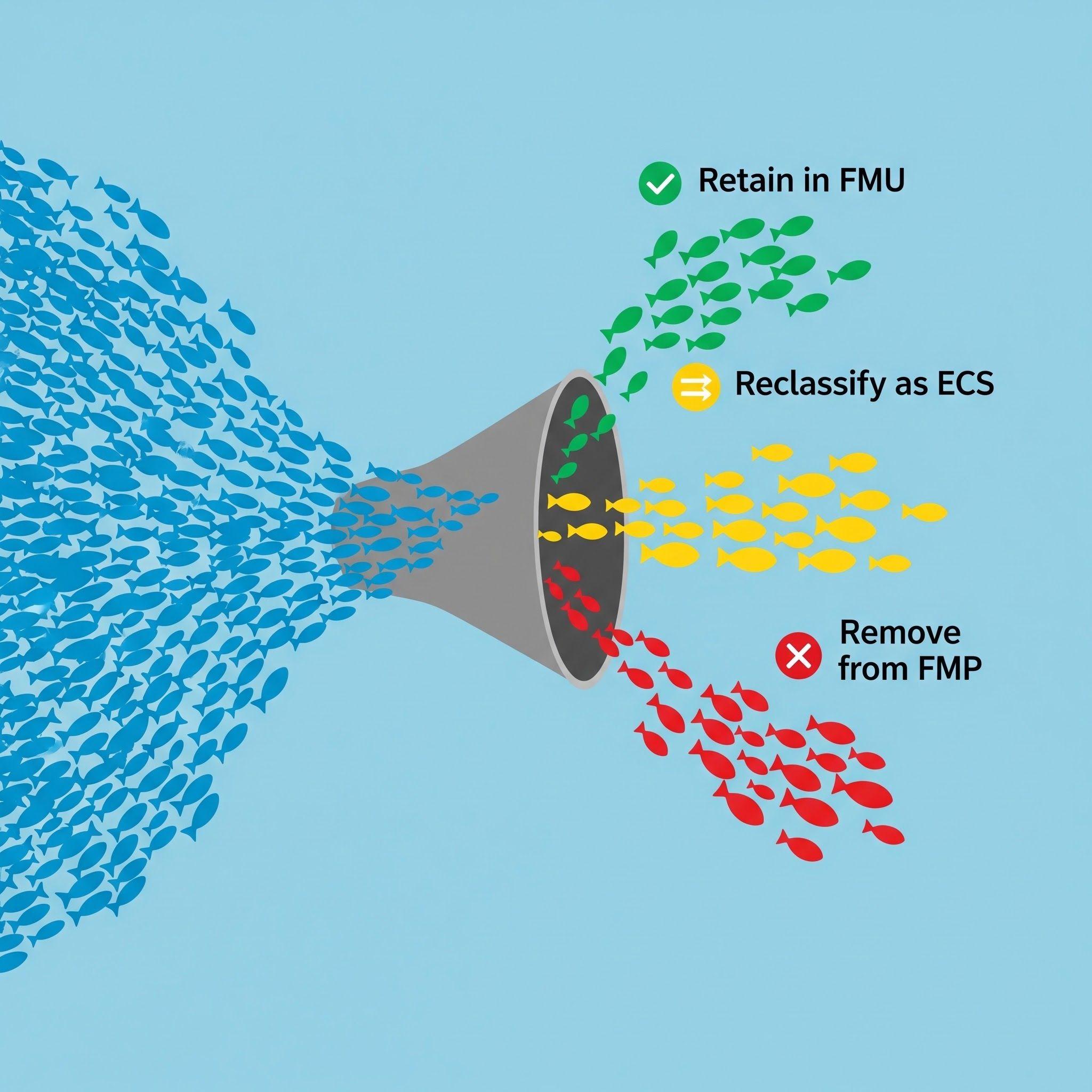
Develop a process that systematically evaluates which species should be included in the fishery management plan and actively managed (in the fishery management unit or FMU).
Retain in FMU — Require Management
Keep species that are overfished or experiencing overfishing or could become so in the future.
Retain in FMU — Council Choice
Keep species the Council considers would benefit from federal management (e.g., spawning occurs in federal waters).
Reclassify as ECS — Ecologically Important
Keep in the FMP, but remove from active management, species vital to managed fish or the ecosystem (e.g., corals, herbivores, prey).
Remove from FMP — Ineffective Management
Remove species adequately managed by territories and/or where federal management is ineffective (e.g., species primarily caught in territorial waters).
Take a first look using recent commercial landings data to distinguish between directed catch and incidental catch.
● Spatial Catch Analysis: Estimate the percentage of landings reported from federal waters to determine if federal regulations will be effective.
● Range of Options: Consider management approaches ranging from retaining many species to retaining few species.
Systematically evaluate all species excluded during Step 1 to determine if they should be kept in the Fishery Management Plan.
● FMU Classification: Retain species to be managed actively (annual catch limit).
● ECS Classification: Reclassify species as Ecosystem Component Species to keep in the FMP but that are not managed with target limits.
Input on the threshold used as the cut off between directed catch and incidental catch.
Input on the range of proposed options based on landings data.
Can any be removed from consideration, or combined with another?
Input on steps to be applied to the list of species not retained after the first cut.
Are there any considerations that are missing?
Focus on process, not results.
Fishery Management Unit (FMU) Evaluation
Used average commercial landings from 2020-2024. Additionally, for Puerto Rico, used average recreational landings from 2000-2016.
Categorized by the percentage of landings reported from federal waters:
Minimum: 5% or less
Low: 5% – 25%
Medium: 25% – 50%
High: 50% – 75%
Maximum: 75% – 100%
Preliminarily selected a de minimis1threshold based on median landings to separate directed catch from incidental catch.
Risk Assessment
Assigned risk levels based on Council's SSC susceptibility scores2:

PR (com.+rec.) = 8,500
STX = 2,500
STT/STJ = 2,000
Low Risk: 1.0
Low susceptibility
/
/
1De minimis is something that is very small or of little importance.
2 Susceptibility scores for each species were assigned by the SSC during development of the island-based Fishery Management Plans, which were completed in 2019. Some scores were combined for the Risk category for this analysis.
Puerto Rico species with total (commercial + recreational) average landings greater than the preliminary de minimis value, grouped by Risk and Spatial categories.
Location
State (< 5% from federal waters)
Southern stingray, Spotted eagle ray Crevalle jack, Dog snapper, Lane snapper
Stoplight parrotfish, Cero mackerel
Low (5-25% from federal waters)
Queen conch, Goliath grouper, Yellowfin grouper, Rainbow parrotfish
Medium (25-50% from federal waters) None
Coney, Red hind, Spiny lobster, Mutton snapper, Vermilion snapper, Yellowtail snapper, Cubera snapper, Queen triggerfish, Hogfish
Blackfin snapper, Silk snapper, Cardinal snapper, Queen snapper
Great barracuda, Little tunny, King mackerel
Blackfin tuna
, Tripletail, Wahoo
(50-75% from federal waters)
(75-100% from federal waters)
Bold = indicator species. Red = Ad Hoc committee recommended removing. All results are preliminary.
Puerto Rico species with total (commercial + recreational) average landings less than the preliminary de minimis value, grouped by Risk and Spatial categories.
Location
No landings reported Corals, Sea cucumbers,
Sea urchins, Yellowmouth grouper,
Giant manta ray
State
(< 5% from federal waters)
Black grouper, Midnight parrotfish,
None Queen angelfish
Low (5-25% from federal waters)
Nassau grouper, Blue parrotfish
White grunt, Schoolmaster Gray angelfish, French angelfish, Pompano dolphin, Queen parrotfish, Redtail parrotfish, Redband parrotfish, Striped parrotfish, Blue tang, Ocean surgeonfish, Puddingwife
Black snapper, Wenchman
Medium
(25-50% from federal waters)
High
(50-75% from federal waters)
Max
(75-100% from federal waters)
None
Graysby, Rock hind, Rainbow runner, Princess parrotfish, Doctorfish, Gray triggerfish, Ocean triggerfish, Spanish hogfish
Misty grouper African pompano
Red grouper
None
Yellowedge grouper
Tiger grouper
None
None
Bold = indicator species. Red = Ad Hoc committee recommended removing. All results are preliminary.
St. Croix species with average commercial landings greater than the preliminary de minimis value, grouped by Risk and Spatial categories.
State (< 5% from federal waters)
Low (5-25% from federal waters) Queen parrotfish
Medium (25-50% from federal waters)
Queen conch, Redfin parrotfish, Redtail parrotfish, Redband parrotfish, Queen triggerfish
High (50-75% from federal waters) Red hind, Stoplight parrotfish
Max (75-100% from federal waters)
Spiny lobster, Yellowtail snapper, Doctorfish
None
grunt Blackfin snapper, Silk snapper, Schoolmaster
Dolphin, Wahoo, Queen snapper Bold = indicator species. Red = Ad Hoc committee recommended removing. All results are preliminary.
St. Croix species with average commercial landings less than the preliminary de minimis value, grouped by Risk and Spatial categories.
No landings reported Corals, Sea cucumbers, Nassau grouper, Goliath grouper, Midnight parrotfish, Rainbow parrotfish, Striped parrotfish
parrotfish, Sea urchins
(< 5% from federal waters)
grouper
(5-25% from federal waters)
grouper
(25-50% from federal waters)
(50-75% from federal waters)
from federal waters)
Red grouper, Yellowfin grouper
Princess parrotfish
Coney, Bluestriped grunt, Gray snapper, Mutton snapper, Blue tang, Ocean surgeonfish
Rock hind
snapper
Misty grouper, Lane snapper, Vermilion snapper
Bold = indicator species. Red = Ad Hoc committee recommended removing. All results are preliminary.
St. Thomas/St. John species with average commercial landings greater than the preliminary de minimis value, grouped by Risk and Spatial categories.
(< 5% from federal waters)
(5-25% from federal waters)
St. Thomas/St. John species with average commercial landings less than the preliminary de minimis value, grouped by Risk and Spatial categories.
No landings reported Corals, Goliath grouper, Blue
Parrotfish, Rainbow
parrotfish, Midnight
parrotfish, Striped parrotfish
(< 5% from federal waters)
porgy
(5-25% from federal waters)
(25-50% from federal waters)
High
(50-75% from federal waters)
Max
(75-100% from federal waters)
cucumbers
Sea urchins
Nassau grouper
Queen conch, Jolthead porgy, Sea bream
Queen angelfish, Black grouper, Tiger grouper, Yellowfin grouper, Ocean surgeonfish
Redband parrotfish, Redfin parrotfish
Yellowedge grouper, Princess parrotfish, Vermilion snapper
Misty grouper, Yellowmouth grouper, Black snapper, Silk snapper, Lane snapper, Queen snapper, Wahoo
Bold = indicator species. Red = Ad Hoc committee recommended removing. Blue - St. Thomas FAC recommended removing. All results are preliminary.
Option 1 Retain all species currently managed under the X-island FMP.
spiny lobster, queen conch, 51 Reef Fish, 9 Pelagic Fish, 3 Rays & all corals, sea urchins, sea cucumbers
spiny lobster, queen conch, 41 Reef Fish, 2 Pelagic Fish, & all corals, sea urchins, sea cucumbers
spiny lobster, queen conch, 45 Reef Fish, 2 Pelagic Fish, & all corals, sea urchins, sea cucumbers Option
Reef
Species proposed for removal undergo systematic qualifying questions to decide their final status:
● Retained in the FMU
● Reclassified as ECS
● Removed from the FMP
The decision tree incorporates screening questions to prevent incorrect exclusions based strictly on raw landings statistics.
Conservation Goal
The core purpose is to guarantee that any species determined by the Council to remain in the FMU requires conservation and management.
These species stay within the FMP framework, either actively managed with annual catch limits or designated as an ECS.
Is the species a target species and currently benefiting from federal regulations (e.g., catch prohibitions, seasonal closures, etc)?
Can federal regulations improve or maintain stock condition (i.e., active management under an FMP), promote species recovery or advance recovery efforts for Endangered Species Act listed species, or address economic, social, or operational concerns
Is the stock an important component of the marine environment - such as in providing support to FMP-managed species or in achieving ecosystem management objectives?
For species retained in the FMU, is the species already adequately managed by Puerto Rico or USVI state agencies, state/federal programs, or another federal FMP?
YES - Retain in the FMU
NO - Move to the next question
YES - Retain in the FMU
NO - Move to the next question
YES - Reclassify as EC Species
NO - Remove from the FMP
YES - Remove from the FMP
NO - Retain in the FMU
NOTE - During this process, the Council can make exceptions to the ultimate disposition of each species. For example, the Council could recommend that a species that is retained in the FMU is better suited as an ECS.
|
Puerto Rico species with landings below the de minimis value
Corals
Sea cucumbers
Sea urchins
Nassau grouper
Midnight parrotfish
Blue parrotfish
Giant manta ray
Graysby
Rock hind
Black snapper
Schoolmaster
Wenchman
Gray triggerfish
Ocean triggerfish
Spanish hogfish
Puddingwife
Queen parrotfish
Princess parrotfish
Redtail parrotfish
Redband parrotfish
Striped parrotfish
Queen angelfish
Gray angelfish
French angelfish
Blue tang
Doctorfish
Ocean surgeonfish
Black grouper
Red grouper
Tiger grouper
Yellowedge grouper
Yellowmouth grouper
Misty grouper
African pompano
Rainbow runner
Pompano dolphin
Q1 - Target species benefiting from federal regulations?
YES - Retain in the FMU
Black grouper, Red grouper, Tiger grouper, Yellowedge grouper, Black snapper
Q2 - Would active management improve stock condition or address concerns?
Q3 - Is the species critical to ecosystem, FMP-managed species, or is listed under the ESA?
YES - Retain in the FMU
Nassau grouper
Q4 - Is the species retained in the FMU adequately managed by territories?
YES - Reclassify as EC Species
Corals, Sea cucumbers, Sea urchins, Giant manta ray, Midnight parrotfish, Blue parrotfish, Queen parrotfish, Princess parrotfish, Redtail parrotfish, Redband parrotfish, Striped parrotfish, Gray angelfish, French angelfish, Blue tang, Doctorfish, Ocean surgeonfish
NO - Remove from the FMP
Misty grouper, Graysby, Rock hind, Schoolmaster, Wenchman, Gray triggerfish, Ocean triggerfish, Spanish hogfish, Puddingwife, African pompano, Rainbow runner, Pompano dolphin
Regulatory adjustments to develop after the list of species is revised
Evaluate if regulations are required for ECS to preserve their ecosystem role.
Stock Complexes Update management reference points (e.g., ACLs) if species are removed from the FMU. Update ACLs with enhanced reporting.
Evaluate and update as needed current species-specific measures like recreational bag limits or seasonal closures.
Sec 306(a)(3) of the MSA - a state may regulate vessels outside of the state’s boundaries if it is registered under the law of that state and there is no FMP.

Other Actions? Are there any other regulatory pathways, measures, or management options that should be evaluated?
01
Do you have any suggestions on the options based on Step 1 (landings analysis)? Are there other options that should be considered?
02 Do you have ideas on what landings threshold (de minimis value) should be used to separate directed from incidental catch for each management area?
03
Do you agree with the proposed decision tree questions? Are there any you would change or add?
04 What benefits do you foresee from removing species from the FMU (no annual catch limits)? What concerns do you have and how can those be best addressed?
August 2026
Council Meeting
Overview of potential options for
Sept-Nov 2026
IPT Process Develop Draft Amendment
December 2026
Council Meeting
Draft Amendment presented to the Council
April 2027
Council Meeting To Be Determined
Option 1 (no action)
spiny lobster, queen conch, 63 species of finfish (51 Reef Fish, 9 Pelagic Fish, and 3 Rays), and all species of corals, sea urchins, and sea cucumbers
spiny lobster, queen conch, 43 species of finfish (41 Reef Fish, 2 Pelagic Fish), and all species of corals, sea urchins, and sea cucumbers
spiny lobster, queen conch, 47 species of finfish (45 Reef Fish, 2 Pelagic Fish), and all species of corals, sea urchins, and sea cucumbers
Option 2 (all risk and >5% federal waters)
Option 3
(all risk and >25% federal waters)
queen conch, goliath grouper, yellowfin grouper, rainbow parrotfish, coney, red hind, white grunt, spiny lobster, mutton snapper, vermilion snapper, lane snapper, yellowtail snapper, cubera snapper, queen triggerfish, hogfish, great barracuda, little tunny, king mackerel, cero mackerel, blackfin snapper, silk snapper, cardinal snapper, queen snapper, blackfin tuna, dolphin, tripletail, and wahoo
blackfin snapper, silk snapper, cardinal snapper, queen snapper, blackfin tuna, dolphin, tripletail, and wahoo
queen conch, queen parrotfish, redfin parrotfish, redtail parrotfish, redband parrotfish, queen triggerfish, red hind, stoplight parrotfish, spiny lobster, yellowtail snapper, doctorfish, white grunt, blackfin snapper, silk snapper, schoolmaster, dolphin, wahoo, and queen snapper
blue runner, spiny lobster, bluestriped grunt, yellowtail snapper, blue tang, redtail parrotfish, stoplight parrotfish, gray angelfish, french angelfish, red grouper, white grunt, margate, saucereye porgy, doctorfish, queen triggerfish, hogfish, dolphin, coney, red hind, blackfin snapper, mutton snapper
queen conch, redfin parrotfish, redtail parrotfish, redband parrotfish, queen triggerfish, red hind, stoplight parrotfish, spiny lobster, yellowtail snapper, doctorfish, white grunt, blackfin snapper, silk snapper, schoolmaster, dolphin, wahoo, and queen snapper
blue runner, spiny lobster, bluestriped grunt, yellowtail snapper, blue tang, redtail parrotfish, stoplight parrotfish, gray angelfish, french angelfish, red grouper, white grunt, margate, saucereye porgy, doctorfish, queen triggerfish, hogfish, dolphin, coney, red hind, blackfin snapper, mutton snapper
Option 4
(all risk and >50% federal waters) dolphin, tripletail, and wahoo
red hind, stoplight parrotfish, white grunt, blackfin snapper, silk snapper, schoolmaster, dolphin, wahoo, and queen snapper
bluestriped grunt, yellowtail snapper, blue tang, redtail parrotfish, stoplight parrotfish, gray angelfish, french angelfish, red grouper, white grunt, margate, saucereye porgy, doctorfish, queen triggerfish, hogfish, dolphin, coney, red hind, blackfin snapper, mutton snapper
Option 5
(high, moderate risk and >5% federal waters)
queen conch, goliath grouper, yellowfin grouper, rainbow parrotfish, coney, red hind, white grunt, spiny lobster, mutton snapper, vermilion snapper, lane snapper, yellowtail snapper, cubera snapper, queen triggerfish, hogfish, blackfin snapper, silk snapper, cardinal snapper, queen snapper
queen parrotfish, queen conch, redfin parrotfish, redtail parrotfish, redband parrotfish, queen triggerfish, red hind, stoplight parrotfish, spiny lobster, yellowtail snapper, doctorfish, and white grunt
blue runner, bluestriped grunt, yellowtail snapper, blue tang, gray angelfish, french angelfish, red grouper, white grunt, margate, saucereye porgy, doctorfish, queen triggerfish, and hogfish
Option 6
(high, moderate risk and >50% federal waters)
none
red hind, stoplight parrotfish, and white grunt
bluestriped grunt, yellowtail snapper, blue tang, gray angelfish, french angelfish, red grouper, white grunt, margate, saucereye porgy, doctorfish, queen triggerfish, and hogfish