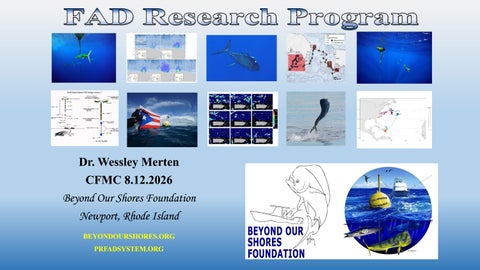
Dr. Wessley Merten CFMC 8.12.2026 Beyond Our Shores Foundation Newport, Rhode Island BEYONDOURSHORES.ORG PRFADSYSTEM.ORG
• International citizen science mark and recapture program for dolphinfish • Designed to collect data on movements, life history patterns, and population dynamics • Started in 2002 – Middle of 25th year
170 – 158 DOL, 12 WAH
40,663 Tagged
Satellite tags deployed
930 Recaptured
16 Publications
As of 8.4.2026 1,288 – 38.9% Tagged at FADs
Length frequency of fish tagged and released at Caribbean mFADs
N = 949 24% are less than 20” FL 33.8% are less than 23.5” FL
History of our FAD Work in the U.S. Caribbean Sea
“Determining pelagic fish diversity, movements, and FAD fishery dynamics relative to a Stationary FAD system off San Juan, Puerto Rico”
“Determining pelagic fish diversity, movements, and FAD fishery dynamics relative to a Stationary FAD system off San Juan, Puerto Rico”
“Determining pelagic fish diversity, movements, and FAD fishery dynamics relative to a Stationary FAD system off San Juan, Puerto Rico”
Publication #1 (2018)
“Construction and Deployment of (4) Submerged Fish Aggregating Devices (FADs) and Comparing Surface and Submerged FADs in Terms of Catch Per Unit Effort, Fish Abundance, Diversity, and Movements off San Juan, Puerto Rico.”
Publication #2 (2023)
“Multifaceted review and implementation of nature-based fish aggregating devices for Puerto Rico: Effectiveness, compliance, performance, and monitoring“
Average overall FAD longevity 471.86 days (n=29) 13 FADs with unknown loss dates (mostly submerged FADs)
Average overall submerged FAD longevity 590.60 days (n=5)
Currents are another major cause for FAD loss
This year, an angler we monitor has lost 24 of 29 FADs deployed off DR.
Current project:
“Multifaceted review and implementation of nature-based fish aggregating devices for Puerto Rico: Effectiveness, compliance, performance, and monitoring“
Step 1: Global Review of dFAD and mFAD use and designs
Step 2: Rank materials in terms of biodegradability
Step 3: Create FAD design library
Step 4: Design sFAD and dFAD
Step 4: Design sFAD and dFAD
Step 4: Design Approval & Permitting #1. Army Corps of Engineers (ACE) Approval
#2. U.S. Coast Guard Aids to Navigation Application
Step 4: Design Approval & Permitting #3. Section 7 ESA / NMFS and Section 106 Consultations ESA consultation: https://www.fws.gov/service/esa-section-7-consultation NMFS consultation: https://www.fisheries.noaa.gov/southeast/endangered-species-conservation/esa-section-7-interagency-consultation-southeast-united-states Section 106: https://www.oech.pr.gov/
Step 5: FAD Component Sourcing and Construction
Step 6: Nature-Based sFAD and dFAD Deployment
In Summary: Building experience in FAD research themes through time: Projects 1-5: FAD visual census, vessel activity, catch & effort, tagging (acoustic, satellite, conventional) Projects 6-7: Funding submerged FAD construction & deployment, enhancing VTS study, new sensors introduced Project 8: Nature-based FAD design research, component sourcing, permitting, VTS study, pending deployment & monitoring (effectiveness)
24 Surface / 17 Subsurface
Trips up to August 4th, 2026
As of 8.4.2026
2 Published 1 in review 1 in prep
37 Satellite Tag Deployments 28 DOL, 6 WAH, 1 FAL, 1 YFT, 1 BUM 26 Acoustic Tag Deployments 16 DOL, 5 YFT, 3 WAH, 1 BLK, 1 FAL 51 Vessels Involved
FAD Research Program
Questions?