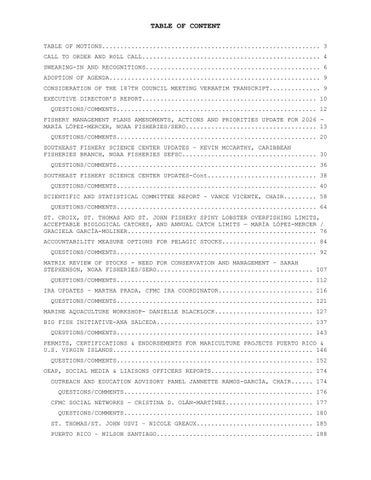
PAGE 54: Motion for the CFMC to explore options for permitting
and the relevant research on Fish Tracking Devices and to have a
presentation provided by the Council in 2026 that incorporates
feedback from the U.S. Army Corps of Engineers, Department of
Interior’s U.S. Fish and Wildlife Service, and NOAA on those
options. The motion carried on page 57.
PAGE 77: Motion to accept the recommendation provided by the SSC
for ABC from SEDAR 91 for spiny lobster for Saint Thomas/Saint
John, and Saint Croix. The motion carried on page 179.
PAGE 81: Motion to add to the agenda for the OEAP meeting a
request to look at how existing and new communication tools could
be applied in new ways to improve fishers' ability to engage in
Council decision-making at meetings and during public comment
periods. The motion carried on page 81.
PAGE 161: Motion to allow each District Advisory Panel to choose
a local non-profit representative to their membership. The motion
carried on page 162.
PAGE 165: Motion to appoint a recent MREP graduate to the second
remaining vacancy on the Saint Croix District Advisory Panel. The
Chair will have the authority to choose the graduate from a list
of names that NOAA Fisheries submits. The motion carried on page
166.
PAGE 216: Move to rescind motion number nine: Motion to appoint
a recent MREP graduate to the second remaining vacancy on the Saint
Croix District Advisory Panel. The Chair will have the authority
to choose the graduate from a list of names that NOAA Fisheries
submits. The motion carried on page 217.
The Caribbean Fishery Management Council convened at the Westin
Inn Beach Resort and Spa in Saint Thomas, U.S.V.I. on Wednesday
morning, December 03, 2026, and was called to order at 9:08 A.M.
by the Council Chair, Carlos Farchette.
CARLOS FARCHETTE: Good morning, everyone. We’re going to get
started, we're kind of running a little behind. So, if you all
can, grab your seats.
So good morning, everyone. Welcome to the one 188th Council Meeting
being held at the Westin Resort on Saint Thomas, U.S. Virgin
Islands. It is 9:08 A.M.
We are going to start with a roll call. We are going to start on
my left with Cristina.
CRISTINA D. OLÁN-MARTÍNEZ: Good morning. Cristina Olán, Council
Staff. Buenos días.
LIAJAY RIVERA GARCÍA: Buenos días. Good morning. Liajay Rivera
García,
staff.
MARÍA LÓPEZ-MERCER: Good morning. María López, NOAA Fisheries.
GRACIELA GARCÍA-MOLINER: Graciela García-Moliner, Council Staff.
DANIEL MATOS-CARABALLO: Good morning, Daniel Matos-Caraballo,
Puerto Rico Department of Natural and Environmental Resources.
NICOLE F. ANGELI: Good morning. Nicole Angeli, U.S. Virgin Islands
and Wildlife.
LOUIS ANTHONY BLANCHARD: Good morning. Tony Blanchard, Saint
Thomas, Councilman.
CARLOS FARCHETTE: Carlos Farchette, Council Chair.
MIGUEL A. ROLÓN: Miguel Rolón, Executive Director. I need to read
for the record that Ms. Heather Blough and María Del Mar López-
Mercer are the designees from the office of the Regional Office
for this meeting. So, I need to say it for the record.
DIANA T. MARTINÓ NOGUERAS: Diana Martinó, Council staff. Good
morning.
HEATHER BLOUGH: Good morning. Buenos días, everyone. I'm Heather
Blough with NOAA Fisheries Southeast Regional Office. I am very
happy and honored to be serving as Andy Strelcheck’s designee at
this meeting. I've worked with some of you for many, many years
dating all the way back to the Council's 2005 Sustainable Fisheries
Act amendment and had the opportunity to work with many of the
U.S.V.I. fishermen on the Trap Reduction Program several years
ago. I'm looking forward to reengaging, reconnecting with folks,
and getting to know and work with those of you who I haven't yet
had the opportunity to work with.
ANNE M. KERSTING: Good morning. Anne Kersting, NOAA Office of
General Counsel.
ROBERTO SABATER: Good morning. Roberto Sabater, Council Member.
SENNAI HABTES: Morning, all. Sennai Habtes, U.S. Virgin Islands
Division Of Fish And Wildlife and the Ecosystems-Based Fisheries
Advisory Panel Chair.
JANNETTE RAMOS-GARCÍA: Good morning, everyone. My name is Jannette
Ramos-García, Outreach and Education Advisory Panel Chair.
VANCE P. VICENTE CERNUDA: Yes. Good morning. This is Vance
Vicente, Scientific and Statistics Committee member and Chairman.
MARTHA C. PRADA TRIANA: Buenos días. Martha Prada, IRA
Coordinator.
DANIELLE BLACKLOCK: Good morning. Danielle Blacklock, Director of
the Office of Aquaculture at NOAA Fisheries.
WILSON G. SANTIAGO SOLER: Good morning. Wilson Santiago, Puerto
Rico Fisheries Liaison.
JAMES R. KREGLO: Good morning. James Kreglo, DAP Saint
Thomas/Saint John member.
YADIRA SANCHEZ: Hello. My name is Yadira Sanchez from Puerto Rico.
JULIAN MAGRAS: Julia Magras, DAP Chair, Saint Thomas/Saint John.
NELSON CRESPO: Good morning, everyone. Nelson Crespo, DAP Chair,
Puerto Rico.
GERSON MARTÍNEZ: Good morning, all. Gerson Martínez, Saint Croix,
DAP Chair.
SARAH P. STEPHENSON: Good morning. Sarah Stephenson, NOAA
Fisheries.
MARÍA DE LOS A. IRIZARRY: Good morning. María Irizarry, Council
Staff.
CARLOS
CRISTINA D. OLÁN-MARTÍNEZ: People in Zoom. James Butler, Kiara
Matías, Vanessa Ramírez, Nicole Greaux, Michael, Jose A. Rivera,
Ricardo López, Kevin McCarthy, Jesus Rivera-Hernández, John
Walter, Derek Soto, Acacia Holiday and Lauren Rensburg.
CARLOS FARCHETTE: Miguel?
MIGUEL A. ROLÓN: Yeah. For the record, we want to excuse Vanessa
Ramírez for being here in person, she's a Vice-Chair, due to family
emergencies, but she will be with us on a voting capacity and
everything through the internet. You just heard her voice. But for
the record, that's the reason why she's not here in person.
CARLOS FARCHETTE: Thank you. I'll thank Graciela for reminding me
that I didn't mention the date for the meeting. It's December 3rd ,
2025. Next, we have the swearing in of Tony Blanchard.
LOUIS
HEATHER BLOUGH: Very honored to welcome you back to the Council,
Tony. So, I'm going to read the first two lines here and then turn
it over to you to read the rest. “As trustees of the nation's
fishery resources, all voting members must take an oath specified
by the secretary as follows.”
LOUIS ANTHONY BLANCHARD: “I, Anthony Blanchard, as a duly
appointed member of a Regional Fishery Management Council
established under the Magnuson-Stevens Fishery Conservation and
Management Act, hereby promise to conserve and manage the living
marine resources of the United States of America by carrying out
the business of the Council for the greatest overall benefit of
the Nation.
I recognize my responsibility to serve as a knowledgeable and
experienced trustee of the Nation's marine fisheries resources,
being careful to balance competing private or regional interests,
and always aware and protective of the public interest in those
resources. I commit myself to uphold the provisions, standards,
and requirements of the Magnuson-Stevens Fishery Conservation and
Management Act and other applicable law and shall conduct myself
at all times according to the rules of conduct prescribed by the
Secretary of Commerce.
This oath is given freely and without mental reservation or purpose
of evasion.”
HEATHER BLOUGH: Thank you so much. Thanks for your willingness to
serve.
LOUIS ANTHONY BLANCHARD: Appreciate it.
CARLOS FARCHETTE: Thank you, Tony, and welcome back. We have
another person online whose name is not on the list here, but his
name is Michael Funk. He is a Fisheries Advisory Committee Member
from Saint Croix. He just has issues with his microphone so he
can't talk. Okay, Miguel.
MIGUEL A. ROLÓN: Thank you, Mr. Chairman. You know, Council work
is teamwork. I remember John Boardman, a member of the NOAA
Fisheries, a long time ago he told me, after going through all
seven Councils that this was not a Council meeting. It was mostly
a thanksgiving meeting with friends and family. That's the way we
think that we have been able to succeed in managing the fisheries
of the U.S. Caribbean.
Sometimes we take people for granted. You know, the Chairs of the
DAPs, Chair of the SSC, members of the Council, staff, staff from
the Council, María, Sarah. These people work really hard to make
things happen for the Council. But today they're going to kill
me for this. but I want to ask where is Alberto? You're right.
Come over here, please.
Alberto is this guy that if everything goes fine, well, nobody
cares. But if the mic doesn't work, we all look at Alberto. “What
happened, Alberto?” He has been with us for some time now, and we
consider him a part of the Caribbean Council family. So, I'm going
to recognize you today, Alberto, for all your work, all your tears
yesterday. So, as they say in the army, thank you for your service.
I hope that you will be with us longer than I will be. Please talk
to Angie. She has some fiscal matters to talk to you about. And
thank you again for all your work. Yeah.
And the next one, she's going to really hate it, but anyway.
Cristina.
Okay. This is another person, again, that we take for granted
sometimes. But when we hired Cristina, she started working with
our social networks, everything that has to do with the Council
and the outside world. As you see, she's the one who runs the
meetings. She's the one who fetches the presentations and calls
you every time because usually the presentations or some people
come at the last minute. But she's there to help us with that. And
she has been with us for how many years now?
CRISTINA D. OLÁN-MARTÍNEZ: As an employee, for two.
MIGUEL A. ROLÓN: But forever. Since the beginning.
CRISTINA D. OLÁN-MARTÍNEZ: Since the OEAP, 2009.
MIGUEL A. ROLÓN: Yep. And she's always willing and able to help
everybody that needs help from us. And she's a partner of Jannette
Ramos when she was in Sea Grant, and Wilson. And anybody who needs
help communicating with the Council or getting information that we
need to send to the public. So, for that, we are really grateful.
recognize you today. Thank you very much.
CRISTINA D.
MIGUEL A. ROLÓN: A special award will be given to Cristina here
in recognition of her work is a token of appreciation for what you
do here for us. Thank you very much.
CRISTINA D. OLÁN-MARTÍNEZ: Thank you very much.
MIGUEL A. ROLÓN: Okay. You want to say something?
CRISTINA D. OLÁN-MARTÍNEZ: Rapidito. Sí. I'm very thankful for
this recognition. I didn't expect that. Also, I want to say that
all that I do is just to serve and that goes to the community that
we are part of. So, I'm very thankful but also honored to be
serving. Ya tú sabes. Gracias.
MIGUEL A. ROLÓN: Okay, thank you. Thank you, Chairman.
CARLOS FARCHETTE: Thank you, Miguel. Okay, next on the adoption
of the agenda, Liajay.
LIAJAY RIVERA GARCÍA: Thank you, Mr. Chair. We have a suggestion
on day two to eliminate the topic Upcoming SEDAR 103 Procedural
Workshop Updates as it will be covered at the Science Center topic,
today in the morning.
CARLOS FARCHETTE: Graciela?
GRACIELA GARCÍA-MOLINER: We would also suggest that instead of
the agenda reading a letter sent to NOAA on the Executive Order.
We were expecting it to be the status of NOAA's response to the
CFMC's letter regarding Executive Order 14276, Restoring America's
Seafood Competitiveness. So, just to change in the heading.
CARLOS FARCHETTE: Miguel?
MIGUEL A. ROLÓN: Yes. On the second day, we are going to be
addressing mariculture at 09:30. It will be an hour for discussion,
but we want to stop sharp at 10:00. We will have a presentation by
Ana Salceda, she's in Spain, and it will be a presentation on the
Big Fish Campaign. Her presentation will be fifteen to twenty
minutes and then afterward we can continue talking about
mariculture if needed.
And then there will be a presentation by Danielle Blacklock and
then there will be another one following Danielle’s from Dr. Cepeda
on the update of her work regarding permits that you need for
aquaculture in the U.S. Caribbean.
CARLOS FARCHETTE: Okay. Is that all we have for agenda updates?
Okay. So, we need a motion to accept the agenda as amended.
NICOLE F. ANGELI: Nicole Angeli, motion to accept the agenda as
LOUIS ANTHONY BLANCHARD: Second. Tony Blanchard.
CARLOS FARCHETTE: Okay. So, next is a consideration of the what?
Oh, I'm sorry. Yeah. Everybody. All in favor say, “aye.”
Aye.
CARLOS FARCHETTE: Any nays? Any abstentions? Hearing none, motion 1 carries. 2
So, consideration of the 187th Council meeting verbatim
transcriptions. I think we have yes. Anne?
ANNE M. KERSTING: It's Anne Kersting, for the record. On page 217
of the transcript, line 34, it says, “Sarah P. Stephenson,” and it
should say “Anne Kersting” instead. And that's my only correction.
CARLOS FARCHETTE: Any other corrections to the transcript? Okay.
We need a motion to accept the verbatim transcript as amended.
LOUIS ANTHONY BLANCHARD: Motion to accept as amended.
CARLOS FARCHETTE: I need a second. Second by Sabater. All in favor
say, “aye.”
CARLOS FARCHETTE: Any nays? Any abstentions? Hearing none, motion
carries. Next, we have Miguel with the executive director's report.
EXECUTIVE DIRECTOR’S REPORT
MIGUEL A. ROLÓN: Thank you, Mr. Chairman. As you know, the eight
Councils and National Marine Fisheries Service are celebrating,
next year, the fiftieth anniversary of the Magnuson and Stevens
Act, and the implementation of Councils to help manage the
fisheries of The United States. As part of that event, each Council
will engage in activities that will celebrate this anniversary
along with the other eight Councils where we're going to have
activities at a national level to celebrate the fiftieth
anniversary. The CFMC will have a video that will include
experiences of the people who have been with us for many years.
Cristina and Diana, with the person in charge of photography here,
Rene, will interview some of the key people that have been with us
for all these years, Council members, staff, all, except Angie.
And we will then edit that video,
That will be for 2026, our contribution to the celebration of the
fiftieth anniversary. If you recall, when we celebrated the
fortieth anniversary, it was here in Saint Thomas. And the whole
celebration was put together with Diana here with the help of some
other people. So, this time, because of the budgetary constraint
and everything that we have, we have to rethink our activities for
next year.
So, we are going to take the opportunity to interview some of the
people that we have on the list with five easy questions. The 1 questions will be the same for everybody. Later then, Cristina and
I will have to sit down and go over it. And remember, if you have
five minutes for each person, and you have 10 people, that’s fifty
minutes. And at the end, you have to reduce that to ten minutes,
no more than ten minutes.
So please, when you are approached by Cristina or Diana today, do
your best for cooperation. I guess, Nelson already hired a person
that will help you with the haircut and everything you said. So,
the key people that we have here include, of course, Council
members.
And then, next thing that I have is the budget. As you all know,
we have the closure, we have uncertainties with the budget. We
have enough to go through December 31st and start in January. After
that, if we don't get any more money, the Council, all the Councils
will suffer. Some of them will have to stop activities. We hope
that this will be solved before the end of the year.
I talked to Mr. Piñeiro, the assistant administrator for NOAA
Fisheries, and they are doing their best to assist so that we, all
eight Councils, receive the funding on time. Not only the Councils,
but the National Marine Fisheries Service, the Regional Office,
the Centers are also in need of having some, well, certain levels
of budgets so they can continue operating. So, that's something
that may affect us.
But one thing that we would like to do is to continue some of the
key projects that we have. For example, for next year we will have
in-person meetings with each one of the DAPs. We will visit Saint
Thomas, Saint Croix and Puerto Rico. That's something that I
discussed with the Chairs before, because it's important to
communicate effectively with members of the DAPs. Remember,
sometimes you learn more at the coffee break than at the meeting
itself. That will be something that we budget for it.
The other thing that we budget is the aquaculture workshop. We
will hear more about it tomorrow. That's it for the budget, Mr.
Chairman, so far. As soon as we have some more information before
the end of this month, we will communicate with you and let you
know what will happen in 2026.
The Big Fish campaign, this is probably the last year because we
ran out of money, and we have one more country to visit with the
money that we had before. So, we are working with the CRFM, the
Caribbean Community, CARICOM, the Caribbean Regional Fisheries
Mechanism that encompasses 17 countries, nine members and other
observers. That will be the last part of the Big Fish Campaign.
You will hear about it tomorrow when we get the presentation from
Ana Salceda.
The Big Fish Campaign is instrumental for the protection of fish
that aggregate to spawn. We all know that some snappers, some
groupers, and other species of fish aggregate to spawn, and they
become very vulnerable to overfishing. So, we have been able, with
this campaign, to engage the fishers from each country that
participates. The idea is to have a bottom-up approach rather than
the other way around which has been the traditional way of
operating, and it had been a success story. Each country that we
have visited, especially because of Ana Salceda, has implemented
measures to manage the fishery in a way that will protect the fish
aggregations in each one of the countries.
So, that's what we have so far, Mr. Chairman, at this time. I need
to reiterate also that, in our case, we kept the liaisons funded
for Puerto Rico and the U.S. Virgin Islands. That includes Saint
Thomas and Saint Croix and Saint John, of course. So, I was allowed
to keep that in our budgets. So, we hope that that won’t suffer.
It's not a great amount of money, but it's important to assist the
local government in engaging with the Council's activities that we
have.
QUESTIONS/COMMENTS
CARLOS FARCHETTE: Thank you, Miguel. Any questions for Miguel?
NICOLE F. ANGELI: Hi, good morning. Nicole Angeli, U.S. Virgin
Islands. Thank you so much for the report. I was wondering if we
would have the opportunity to review this on paper. I was unable
to take good notes about the information that you just submitted.
And also, I did want to impress upon everyone that the amount of
money that we get for our liaison funds for the CFMC are actually
only one of two dedicated forms of funding that we get at all, for
the commercial fishery. It is critically important for those funds
to still be available to us and we appreciate it.
MIGUEL A. ROLÓN: Okay. Mr. Chairman. Sorry, I forgot about this.
When I participated at the thirty-six legislature of the U.S.
Virgin Islands. I was asked to present, following a questionnaire
from the legislators, the activities the Council has and issues
that the Council deals with here. I was assisted by Graciela
García-Moliner. Actually, she was present there and Dr. Angeli as
well, at that session.
I need to recognize Angeli because I have been in that position.
She was all by herself presenting every information that we have
to hear from the division. And one aspect of the discussion was
the intention of some legislators to promote mariculture in the
U.S. Caribbean. I talked afterwards with a Senate member; he will
be invited to the workshop next year. Next year we have elections,
some changes may happen there.
They are interested in pursuing a mariculture project in the U.S.
Virgin Islands. This is right on time. You will see tomorrow when
we talk about this workshop next year. They are expecting to be
invited.
Dr. Sennai Habtes will also be there. He has been working in the
Virgin Islands, in the past, with aquaculture projects. The
president of the committee told me that they may call me again
next year, if need be, to add more information about what the
Council does, etcetera. I believe that this interest by legislators
of the Virgin Islands in Mariculture will provide some positive
results in years to come.
Thank you, Mr. Chairman. Sorry for forgetting about it.
CARLOS FARCHETTE: No problem. Any more questions for Miguel? Okay.
Hearing none, we're going to move on to the fishery amendment plans
of Fishery Management Plans Amendments, Actions and Priorities
for 2026. María López-Mercer
MARÍA LÓPEZ-MERCER: Good morning, everybody. This is María López
with NOAA Fisheries, Caribbean Branch. As usual, we are going to
start the meeting giving an update on where we are with all the
actions that the Council has been working on during the past year,
the status of actions that the Council is currently pursuing. And
then we're also going to talk about the priorities or other
projects that the Council was interested in discussing in 2026 and
additional topics that the Council started discussing during the
August meeting. You can go to the next slide.
Okay. First, this first slide has a list of all the regulatory
actions that NMFS and NOAA Fisheries have been working with after
the Council took final action on these ones. So, this is a summary
of where we are, the status of these actions right now.
So, Amendment 2 to all the Fishery Management Plans. This is the
trawl, net gear, and descending devices. The notice of availability
of the amendment was published during the same period of the August
Council meeting. Then in September 2025, there was a proposed rule
that was published. And then in October, the final rule was
published. On November 3rd , 2025, the rule implementing this
amendment became effective, except that the descending device
requirement that was also included in this amendment and in this
final rule will become effective on April 1st , 2026. The Council
and NMFS chose to do that because they wanted to provide time for
the Council to continue their outreach and education activities on
the descending devices and all the activities that they have
planned to inform about this requirement and promote best fishing
practices through the use of the descending devices.
So, the other action that the regulatory action that NMFS is
currently working on is Framework 3 to the U.S. Virgin Islands
Fishery Management Plans. This is the action that established the
management reference points that came from SEDAR 80 for the queen
triggerfish in Saint Thomas/Saint John, and in Saint Croix. The
proposed rule published in October. The comment period ended in
November. And right now, NMFS is developing the final rule. We
will be informing, through fishery bulletins and through the
Council website and NOAA Fisheries' website when that final rule
is published and the effective date.
Amendment 4 to the Puerto Rico FMP is the reclassification of the
rainbow runner as a pelagic species. Right now, we are working on
the proposed rule. We're developing that proposed rule and when
the amendment is available for comment and that proposed rule, we
will be publishing a fishery bulletin, and it will be informed in
the Council webpage and in NOAA Fisheries’ webpage so the public
can comment on the amendment and in the proposed rule.
So, that's where we are right now for those actions. As a reminder,
size limits for all harvest of dolphin and wahoo are in place.
That became effective earlier this year. Recreational bag limits
for dolphin and wahoo in federal waters are also in place. The
prohibition on the use of nets, except for the specific gillnet
for certain species as specified in the regulations, in federal
waters is also in place. This is what I mentioned earlier, the
Amendment 2 to all the FMPs.
And as I mentioned earlier, the descending device requirement will
be in place on April 1st, 2026. And as usual, thank you to everyone,
all the fishers that are already using those devices. Okay, we can
go to the next slide.
Okay, this slide is going to be showing all the actions that the
Council is currently working on and the ones that are going to be
discussed during this meeting or in future meetings.
Okay, let's start with modification of pelagic accountability
measures. If you see from this slide, we decided to add a column
on information on why is the Council taking this action, why is it
important? So, this modification of pelagic accountability
measures is an action that we started discussing during the past
August 2025 meeting. And the reason that the Council needs to do
something about it is because right now the accountability measures
that are established for pelagic species, which as all of you know,
are new to federal management under the fisher management plans,
do not specify a corrective action to take if there is an overage
or an exceedance of the ACL. So, that corrective action needs to
be taken to prevent the ACL from being exceeded again in the next
year.
So, we started the discussion about that, and we will continue
that discussion during the, I think, I believe this afternoon. So,
during this meeting, in the August meeting, we presented some
draft, very draft options for the Council to discuss. The idea was
for the Council to give input to staff, to find out what are the
things that could be considered and there was a motion for the
creation of an interdisciplinary planning team to start working on
these options.
So, during September, the IPT or a smaller working group started
discussing it. We started like brainstorming ideas on how to deal
with this particular accountability measure, which as you all know,
and as we discussed during the August meeting, is very different
than the reef fish, right? These are pelagic species, they are
seasonal species, they can come in pulses, they have trends. The
harvest. We also discussed that the harvest of species in the
Caribbean is just a small portion of the wider availability of
fish or what is being harvested in the whole entire Caribbean. So,
there was a lot of discussion about that.
So, what we would like to do during this meeting, and we'll talk
about that later, is to review some of the things that we will
discuss in this working group. And what we want to focus more on
is that AM trigger. What is the evaluation that we could do to the
landings to determine, for example, if there are trends, how the
landings could be methodically evaluated when they exceed the ACL?
We are also going to be looking for the Council to provide ideas,
and we can talk about that a little bit more later. But if you can
start thinking about how to address this issue, because this is a
requirement for management, then we can talk about that later. So,
the plan would be, as I said, discussing options during this
meeting, draft options, potential options, and then bring this
back to the working group to refine those options, and then bring
an options paper for the Council to look at in April.
The next action that the Council already started working with is
the review of stocks in need of conservation and management. This
is what is also known as the matrix. The Council set that, in
August 2025, as priority number one. The reason that the Council
is pursuing this is because there's a need to maximize management
efficiency and is also something that can be taken under the
Executive Order for seafood. The seafood E.O. 14276, I'm sorry.
So, during the August meeting, Sarah Stephenson from NOAA Fisheries
gave a presentation on what the matrix is. The matrix is basically,
includes the species that we are managing and the data that we
have available on those species. That mostly comes from the data
triage that the Science Center has been developing during these
past years and many other things of information that is available
for the species, but also is an evaluation and a presentation for
criteria that the Council used to decide what stocks were going to
be managed under the current FMPs, but also using the guidance
from the Magnuson and Stevens Act from the National Standards,
what are the criteria that we need to follow, the Council needs to
follow to determine if a particular species is in need of
conservation and management.
So, the idea here would be for the Council to look at different
criteria, perhaps, if they're interested, that could be used to
again maximize management efficiency. If there are species that
could be removed from management, because perhaps they are not
covered under any of those criteria. If there are species that are
not in a targeted directly on a fishery that could perhaps be moved
to an ecosystem component species under the FMPs because of the
role they have in the ecosystem, meaning that these species are
not going to be directly managed, like for example, with annual
catch limits or accountability measures, but they will be included
in the plan for basically keeping an eye on them and taking some
actions to protect the role in the ecosystem.
So, Sarah Stephenson will be providing, at this meeting, a
discussion on some of those preliminary options. They were able,
as you know, the federal government was closed for six weeks. So,
there's some things that we wanted to accomplish during this month
after the August meeting. However, we were able to have some
discussions, and this is what we're going to be talking about today
with you, trying to get input from the Council. And then, after
that, plan is for the working group to work on refining those
options. And again, also similar to the accountability measures
for pelagics, just bringing the idea if the Council is agreeable
to that review and options paper during the April meeting.
The next topic is the SEDAR 91 spiny lobster. This is starting the
assessments, update assessments that were done for a spiny lobster
in Saint Croix and in Saint Thomas and Saint John. Why? Because
their assessment was updated and ultimately it will result in a
revision of the ACLs for the spiny lobster in both of those
islands. So, in August 2025, the period on that time, the Council
received an update on where we were on the SEDAR 91, and there was
a motion that was passed by the Council to develop amendments, of
course, pending the SSC review that was going to happen in
September. So, that SSC review happened in September, and the SSC
accepted SEDAR 91, for each one of the islands, adequate for giving
management advice and best available science.
So, during this Council meeting, the SSC will discuss their
recommendations. The Council will be selecting their P*, their
probabilities for the uncertainty. And then, they can also choose
to provide options for the staff to work with and include in an
amendment, in a framework action for developing ACLs, of course,
if the Council votes to accept the recommendation from the SSC for
the acceptable biological catch.
So, the plan would be if the Council passes a motion to do that,
then staff can begin work on a framework action or to implement
these new ACLs that would come from this assessment. And then, the
idea will be in April 2026 for the Council to select preferred
alternatives, and we'll move forward.
We'll talk about SEDAR 91 for spiny lobster on the next slide for
Puerto Rico. So, SEDAR 84, which is a yellowtail snapper in Puerto
Rico and in Saint Thomas/Saint John, and for stoplight parrotfish
in Saint Croix. This is because there were stock assessments for
this species and ultimately will result, if accepted, in a revision
of the ACLs for all the species on specific islands. So, during
the August meeting period, around the August meetings there was a
review panel and there was also an overview report that was
provided at that time.
The SSC had a preliminary review and there's some actions that the
Science Center did, I believe, and Kevin McCarthy from the Science
Center will be providing some information about this in his
participation later this morning. So, the idea for this one, as I
said in December, in this meeting, is we're going to get those
updates on where the process is with regard to these assessments.
And then as you can see, don't have anything listed in here for
the next months because that will be depending on the guidance
that is provided by the Science Center and the SSC during their
discussion.
Okay, next slide. Okay, SEDAR 91 for spiny lobster for Puerto Rico.
During the August meeting, there was a motion to develop the
amendments, of course, pending revision of SEDAR 91 and their
outcomes. There were some concerns that were raised by the, and
this is a summary of what was discussed during the past meeting,
by Puerto Rico DNER about the assessment, and there were some
recommendations that were made to the Science Center to include
some additional information regarding some fishery dependent
information in the assessment. So, right now the staff of the
Science Center is working with Puerto Rico DNER to incorporate the
information that was requested.
So, during this meeting, we're going to get an update from the
Science Center on those revisions. And also, this is going to be
pending, SEDAR 91 is pending a review from the SSC and then we'll
be informed during SSC participation in this meeting as to when
that will happen. The Council has to schedule that meeting, so
we'll get more information about that. And as you can see, for the
rest of the year, at least until April, it's in blank because we're
going to be filling those out depending on the guidance provided
by the Council.
Okay, and then in the next slide the next slide, sorry. The next
topic is revision of accountability measures for Puerto Rico spiny
lobster. Again, this is something that we discussed during the
past Council meeting which is also going to be pending the outcomes
from SEDAR 91. So, it's kind of on hold until this process that is
all
through.
Okay, so lastly, I wanted to bring to the Council's attention a
prioritized list of actions to NMFS on E.O. 14276. This is
something that the Council will be discussing later, I believe
tomorrow. There was a list of priorities that were provided to
NOAA Fisheries that the Council would like to focus on. Some of
the topics that the Council discussed which could be prioritized,
that the Council could start working on, could be, for example,
revising incompatible regulations between territorial and federal
waters. There's some work that has been ongoing. For example, the
U.S. Virgin Islands have reviewed some of their regulations and,
Nicole, correct me if I'm wrong, my understanding is that you also
incorporated the minimum size limit for the yellowtail snapper,
which is compatible with Federal Waters. We have that 12-inches
size limit on the yellowtail snapper. And also, the U.S. Virgin
Islands also prohibited the harvest of the sea cucumbers, sea
urchins, or is that on the works?
NICOLE F. ANGELI: That's on the works.
MARÍA LÓPEZ-MERCER:
That's on the works, sorry. So, that's
something that’s on the work. So, the good thing about this is
that this is things that we have been working, the U.S. Virgin
Islands and Puerto Rico, they have been working for some time on
identifying those regulations that are incompatible, right? And we
still have to do, at the federal level, we already identified some
of those regulations. So, one suggestion for the Council will be
to look at some of these regulations that are not compatible at
our side and see if there's anything that the Council would like
to pursue, that the staff and guide staff, task staff to begin
working on. So, I believe there's a list of regulations that maybe
we can share with you Council members to see if there's anything
that you would like us to start pursuing during 2026 and maybe we
can go back to that tomorrow. I want to thank the U.S. Virgin
Islands for being so proactive in revising regulations and
discussing with us. Thank you very much.
So, the plan for this one is when ready and when there's
availability, because I know that at the end of the year, it’s
kind of very there's a lot going on, right, we can continue these
discussions to see what the needs are, additional needs for making
changes to the regulations so we can bring that to the Council's
attention.
Okay, so the other thing that the Council discussed is a revision
of duplicative regulations in federal waters. That's another item
that we can suggest for the Council to take a look at what things,
what specific actions they would like to pursue that they can task
staff to start looking into. For example, there were talks about,
perhaps, duplication of seasonal closures with some area closures
or some regulations that may be duplicated, there may be something
else that is already addressing that. So, we can certainly have
some more discussions, but if there's things that maybe can be
done quicker, that will be something that we could be looking into
as well as part of these priorities.
There was also some talk about exploring carryover of new ACLs,
and this is a topic that we can certainly talk about in the future
and explore a little bit more. The feasibility of this for
particular situations here in the Caribbean, that's something that
we can take a look at.
There's also SEDAR 103. SEDAR 103 is the U.S. Caribbean application 1 of alternative assessment methods, and this is something that the
Science Center is going to be leading in 2026. They're looking for
alternative assessment approaches and that could end up being more
efficient and a little bit better for the type of data that we
have in our fisheries. That's something that was also included as
a priority and it is ongoing. And then, the idea here will also be
for the Council to provide input on other things that they would
like to pursue. Not necessarily that they may be all included at
this point under that list of priorities for NOAA Fisheries, but
maybe thinking about some specific actions that the Council would
like to pursue in 2026. And then as we have done during the past
Council meetings, tomorrow, perhaps at the end of the day, Council
can come with a revised list of priorities for the staff to focus
on.
Okay, I think this is all I have. There's going to be discussions
for the AM for pelagics later on, the matrix later on, and then
all of the information about the SEDARs later on today. I believe
these duplicative regulations or incompatible regulations or other
list of actions that were included in the response to NOAA
Fisheries will be discussed tomorrow.
So, this concludes my update. If you have any questions, I will be
happy to address them.
QUESTIONS/COMMENTS
Thank you, María. Graciela?
GRACIELA GARCÍA-MOLINER: So, this is not a question, Mr. Chair,
but in addition to everything that María presented, the Council
also needs to be thinking about the essential fish habitat five-
year review. The Island-Based FMP started the clock. So, we put
everything that we knew about the new species in there, but the
review has to be done every five years. 2026 begins the clock to
meet the deadline of 2027.
The EFH review, for the Council, is funding dependent. So, we are
preparing a budget to see where we will be seeking that funding to
come to the Council for a contract for the update of the essential
fish habitat for all the species under management. Now since you
are discussing the matrix and you are discussing SEDAR 103, that
might change the number of species that we have to deal with in
terms of reviewing the EFH. So, considering all the pieces of the
puzzle put together, we need to start thinking about where funding
will be available to do the EFH review. Thank you.
CARLOS FARCHETTE: Miguel?
MIGUEL A. ROLÓN: Thank you, Graciela, for that note. Graciela has
been talking about the experiences before. Every five years we
have to do this, and it costs around $150,000 or more and we don't
have a penny for that. However, by law, we are required to have
that assessment every five years. So, we will write a note somehow
after this meeting to the appropriate people and see if we can
secure some extra funding to comply with that requirement.
And as María mentioned, when we talk about duplicative species
that we want to reduce the number, although we have to do it
anyway, it will be, as she mentioned, and this is important to say
it for the record, part of the compliance with the Order 14276.
So, tomorrow, between here and tomorrow, if you have any question
for María or Graciela, this is the time, so we can leave this
meeting with an order of priorities that the Council would like to
pursue in 2026.
And remember, we cannot do everything at the same time, but that
priority list is very important, so that the staff can then address
those with the appropriate people and time. Thank you, Mr.
Chairman.
CARLOS FARCHETTE: Any other questions for María? I have one. You
mentioned compatibility discussions. Are we going to start this
hopefully in '26? Is that what we're saying?
MARÍA LÓPEZ-MERCER:
Thank you, Mr. Chair. So, the thing with
compatibility is that there is a list of regulations that may not
be compatible, right, between either, you know, on our side,
federal with the state or vice-versa, right? And so, we could
start, the Council, if there's any specific actions under this
list of things that are not compatible that the Council would like
to start working on, that can certainly be included as a priority
for 2026.
CARLOS FARCHETTE: So, I know that our fisheries committee worked
with Sennai quite extensively on prioritizing that listing of what
we thought were easy ones. Some of them are more challenging. And
so, I don't know. Sennai, how can we jump start this process? I
know that we did that list at the FAC, and we prioritized it from
one to whatever it was, one to four I think.
SENNAI HABTES: You're talking about compatible regulations?
CARLOS FARCHETTE: Right. Right.
SENNAI HABTES: I mean, we're already doing it. There's no jump
starting. It takes time. Right? So, we've already identified the
ones that you, both FACs have prioritized.
I've already identified the most expedient route to getting them
put into legislation, whether it be through a commissioner
declaration or it needs to go through a change to the V.I. code or
it needs to be something that we can pass through other regulations
that we're doing through promulgation, the executive loan. All of
those are in process. We're choosing to move forward first with
the ones that can be done through commissioner declaration.
SENNAI HABTES: And as we get them drafted, we bring them to you
for review with FACs.
Mhmm.
SENNAI HABTES: And then we move forward to processing them. The
federal ones, those we've set the list with also your
recommendations to NMFS SERO. María's reviewing those. I think as
time moves forward, they will be brought to the Council for review
if there are ways that those regulations can be managed. To my
knowledge, there were maybe only two or three that required there
were two that require federal action. So, I think they're reviewing
those now to see what the process would be for them.
CARLOS FARCHETTE: So, it's like what we just did with the
yellowtail and what we're doing with the sea urchins, cucumbers,
blah blah?
SENNAI HABTES: Correct. That is the process we're going through
CARLOS FARCHETTE: Okay. I got Andy and then Heather. Andy?
Can you hear me okay?
Great. Good to see everyone. Sorry. I can't be
there in person. Two things with regard to the priorities.
So, I couldn't hear Sennai, but certainly we want to work with
U.S.V.I. and Puerto Rico on alignment of compatible regulations.
I think this will go nicely with the work we're doing on the matrix
and determining what species are in need of conservation and
federal management. And so, looking at obviously the regulations
for consistency, but also in alignment with what the territories
are doing to manage various species relative to federal fisheries.
And then in terms of the comments about the five-year review, we'll
have to look obviously at kind of our requirements for five-year
reviews. I will say given the reductions in staffing within the
government; conversations we've been having across our entire
habitat program is that five-year reviews would be deemed lower
priority for work. So, I think we would want to go back and look
carefully at kind of what was done five years ago, whether or not
that could be kind of sufficient moving forward and whether there's
a need to conduct that five-year review imminently versus kind of
delaying that over a longer period of time just given resourcing
issues like Miguel talked about. Thanks.
CARLOS FARCHETTE: Thank you, Andy. Heather?
HEATHER BLOUGH: Thanks, Mr. Chair. Andy covered some of what I
was going to bring up. Also, I'm hoping that tomorrow during the
E.O. discussion, we can look more fully at the list that Graciela
had circulated, the list the Council has submitted to NMFS and
take a little bit of time to prioritize those. There are a lot of
actions on there. And then, maybe drill down into some of them,
like the duplicative regulations compatibility and those issues
that seem to continue to rise to the top of the pile and see if we
can add a little bit more detail and structure around what those
could look like.
CARLOS FARCHETTE: Sennai?
SENNAI HABTES: So, this is a different comment, but I just wanted
to go back to the prioritized list of actions on the E.O. 14276.
I would really like to see the Council try and coincide additional
things that we're doing regarding if we move forward with the list
of actions. Can we please take a look at the strategic plan and
the priorities that we've identified and see how the things that
we've said are priorities, going forward to 2026, coincide with
these list of actions; and identify the things that we say are the
most important things that we want to do and how they align with
this list of actions that we're moving forward.
Otherwise, what we're continually doing is identifying more and
more priorities with more and more dwindling resources, and it
makes it impossible for us to get anything done other than say
we're going to do something. And so, I think it's really important
that if we identify things that we're moving towards, they fit
into the strategic plan that we've already identified, or we don't
JULIAN MAGRAS: Yeah. Julian Magras, for the record. So, listen to
this compatibility discussion here from our earlier conversation
that we had, Miguel, 2026 DAP meetings. I would like to request
from now that if we can see a presentation from both the federal
and local government about what we are working on so we can have
a discussion with our teams. I think it would clear the air instead
of a surprise being out there.
I know a lot of us played part of the local discussion a few years
back with Sennai and Dr. Angeli and her team, but it would be good
to see exactly what's actually taking place right now, so we could
all have an idea, and maybe we might have a little extra input
that we would like to suggest. Thank you.
María?
MARÍA LÓPEZ-MERCER: Thank you, Julian. Just to clarify. Your
request is to provide, like, for example, a list of all those
regulations that are incompatible? Is that what you're saying?
JULIAN MAGRAS: Yes. From what is compatible and what we are
looking at doing compatible.
MARÍA LÓPEZ-MERCER: Yes. What needs to be done. Yeah. Yeah.
MARÍA LÓPEZ-MERCER: Yeah. We can certainly put that together.
That was kind of the plan. Obviously, you know, we were not able
to accomplish many of the things that we wanted to bring for this
meeting due to the furlough, but that's the plan. Absolutely.
Because we want the Council to take a look at these regulations
and maybe make some decisions as to what they would like staff to
start looking into for presentations. So, we'll definitely put
something together as soon as possible and share it. Thank you for
that.
CARLOS FARCHETTE: Sennai?
SENNAI HABTES: Yeah. So, I'm sure for any federal ones that will
come through review at the Council, and so, that will be presented
as any rule changes or regulations that are promulgated. From the
territorial side, let me know the next time you have a DAP meeting
either in Saint Thomas or Saint Croix, and I will happily come and
give you a presentation on that.
María?
MARÍA LÓPEZ-MERCER: Just to, you know, perhaps close the topic,
at least on my end, just to remind you. Yes, like Sennai said, any
need for any changes to our regulations will go through the normal
process, through the Council process, discussion, the Council
voting, there's document that will be prepared that will evaluate
all the environmental effects that any action the Council would
like to pursue would have on the economy, on the social
environment, on the biology of any of the species that will be
affected, the physical environment, etcetera.
So, it will just go through a regular amendment process. This is
something that will come from the actual Council. So, there's
plenty of opportunities to comment. And of course, they're not all
regulations, they're regulations that were put in place for a
reason, of course, all of them. So, there needs to be an evaluation
about the need for revising those regulations more than just to be
compatible, right? There has to be an evaluation of what is the
need for making that change and it has to make sense for everybody.
Just wanted to clarify that.
So, on that note, two things. One, we
will request from the local government as soon as you have the
proclamation of the commissioner or the regulation that's made it
into the books to send it to us. We do have newspaper articles
where it says that yellowtail will have a size limit. So, we do
request that, so that the comparison can be made law to law rather
than the information that's available.
And secondly, there are two things. One, that's enforcement and
the other one is the Science Center and the need for the monitoring
of the regulations that we put in place. So, if we're thinking
about compatibility from the shore to the 200 nautical miles, then
you need to think in terms of the monitoring of these regulations
to see if they're working or not, if we need to change them. And
secondly, the enforcement of those regulations that will become
part of the fisher's daily life. So, those two things, you know,
do have to come hand in hand when we're talking about that topic
of compatibility or duplicity of regulations. Thank you.
CARLOS FARCHETTE: So Heather? I'll wait.
HEATHER BLOUGH: Okay. I was just going to speak to Sennai's point
about the strategic plan. Wondering if it's possible to share that
before the E.O. 14276 prioritization conversation tomorrow?
MIGUEL A. ROLÓN: We have the five-year strategic plan. Yeah, we
can share that.
HEATHER BLOUGH: It might be helpful to do that crosswalk if we
are trying to prioritize. Okay, thanks.
MIGUEL A. ROLÓN: ¿Tú lo tienes, Graciela?
SENNAI HABTES: Just so everyones aware, it's publicly available
on the website. Everything's on there. So, if you just go to the
CFMC, anyone can just look up the strategic plan.
CARLOS FARCHETTE: Graciela?
GRACIELA GARCÍA-MOLINER: Thank you, Mr. Chair. So, a couple of
things. So, they are available. It's available on our website, but
I'll send a copy around.
And secondly, it's not only what's in the strategic plan, but it's
also what the SSC considers and has made recommendations to the
Council of things that we need to pursue in order to really assess
or really have a good handle on what we're doing. So, those
recommendations come forth from the SEDAR process to the SSC, from
the SSC to the Council. So, we do have not only one place that we
grab this information from its talking to the Regional Office,
talking to the Science Center for the one commonality that we have,
and that's, you know, making sure that we have sustainable
fisheries in the U.S. Caribbean.
So, the SSC already kind of gave us their blessing in terms of
what's there. It covers everything that we've been talking about
for a long time. And they are ranked in the letter that was sent
to Mr. Piñeiro. So, we need to, and as María said and Heather and
Sennai, we need to really narrow it down in terms of the work that
the staff can do. And the staff from the Regional Office and the
staff from the Science Center can actually do to provide you with
the outcome, a successful outcome. In addition to that, we do have
to keep a timeline that is required for the amendments and the
framework approach to changing management, etcetera. So, it's many
places that we have to look at. So, we'll try we try to do that
with that table that we provided.
So, I'll leave that as is right now. Thank you.
CARLOS FARCHETTE: Okay. I just wanted to mention because I just
want a little clarity. Sennai, when the FAC sat down on Saint Croix
and prioritized the list for compatible, what we want to go ahead
and accept as what's going on for our waters and we submitted what
we would learn from the FADs, which is only a few for two, okay,
I think, recreational harvest for queen conch is one of them or
something like that. Because they got three, we got six.
So, what Julian was saying, that list that we did, is that the
list that Julian wants the DAP to review? Is that what you're
talking about?
JULIAN MAGRAS:
CARLOS FARCHETTE: Okay.
MIGUEL A. ROLÓN: So. The five-year strategic plan ends 2026 along
with the other plan that we mentioned before, Essential Fish
Habitat, this strategic plan could be amended. But we don't need
to do that. Actually, the idea of that strategic plan was to focus
on the things that the Council could do. So, 2026 is an important
time where we're going to address the strategic plan and the
concerns that we have and the modification that we need to have in
the strategic plan.
Also, we need to continue it for another five years. It's just a
matter of changing the data and updating what needs to be updated,
and we will have a viable strategic plan for the next five years.
CARLOS FARCHETTE: When it comes to the executive order, we, the
DAPs, submitted their input as to what they felt should be managed
and what should be put in an ecosystem-based plan. But those
species are going to be separated and still be managed, right?
They're not just put aside and not managed. They're still managed
on the ecosystem. Miguel?
MIGUEL A. ROLÓN: María, you want to go?
MARÍA LÓPEZ-MERCER: Thank you, Miguel. So, the recommendations
that the DAP made on the species that they would like to keep or
move, that will be part of the process that NMFS and the Council
are currently discussing for the matrix. There is a process that
has to be followed. Some of those species may fall under those
criteria. So, that's for evaluation.
Of course, all the input that is provided by the DAPs, all the
input that is provided in the public comments that come from here,
everything like that will be incorporated into the process, right?
But as Sarah will discuss when she does her presentation later
today, there's criteria that the same way that we did to decide
what we're currently managing. We have to follow those criteria to
make that decision as to what species are in need of conservation
and management. So, the question for the Council would be what
criteria from that guidance that is provided by the national
standards, what criteria would you like to use to refine your list
of species that you are managing right now and to move, right? So,
I think the input that is provided by the DAP can be part of and
it's expected to be part of those discussions that the Council
will be having. But there's a process that needs to be followed
and that's what Sarah has been working on and she will be
presenting.
CARLOS
FARCHETTE: Miguel?
MIGUEL A.
ROLÓN: We also need to separate 14276 from what we're
doing. Without the 14276, we still have to do that. Actually, we
started some years ago. So, we are lucky that they asked for the
same thing that we are doing now.
Meaning that the actions that the Council are taking now are our
response to the directive that we received from the National Marine
Fisheries Service. We cannot move any of the species without
modifying the management plant. In order for you to modify
management plant it takes about one year to three years. That's
something that we have to keep in mind.
For the DAPs, they already engaged in the discussion on July, but
we are going to address that at each one of the DAPs and of course
the SSC and the DAP at the same time. Meaning that after December
15th, we might have some other directive from National Marine
Fisheries Service regarding the compliance with 14276. But
whatever they tell us to do, or everything is a little bit separate
from the work that we have been doing now.
The key will be to follow SERO and Council staff. In the
presentation from Sarah tomorrow you will see where we are and the
things that we need to do.
María, from this Council meeting, do we need to give some guidance
specific to some action, or just give an idea of where we want to
go and then for the following meeting, we take more action? In
other words, do we need a definite answer from the Council at this
time?
MARÍA LÓPEZ-MERCER: Are you referring to the process for
determining the need of conservation of species? No. So, when we
do the presentation a little bit later, we go on some of the draft
options. The idea would be for the Council to provide input as to
where do they want to be moved to, like in terms of the criteria,
new criteria that could be proposed. And then the idea will be for
staff, the IPT, to work on those options and refine the options.
And for the April meeting, bring a draft of options paper. So, we
are very early in the process here. But thank you for the question.
MIGUEL A. ROLÓN: So, Mr. Chairman, that's the key to this meeting.
We don't expect definite answer, but we want to inform the Council
where we are, and also to hear from the Council if we need to
address any concerns you may have at this time. And then by the
April meeting, we will have this action paper. Remember, the action
paper is nothing but a compilation of the information that we have.
And then you have to determine the next steps. Remember, for any
modification of the management plan, have to schedule public
hearings, etcetera, etcetera. Yeah.
MARÍA LÓPEZ-MERCER: Yeah. And just to provide a little bit more
information about the process. So, then when the draft options
paper is brought to the Council for their discussion, and then the
Council decide, “okay,” there are going to be options there that
you may not even want to pursue. And that's the kind of guidance
that you will give to the staff and there's options in there that
are like, “okay, I think staff can go ahead and evaluate these
options.” And then the staff will start looking into evaluating in
terms of effects of each one of the proposed options that are in
there. Then next time they come to the Council meeting and then
basically they will become alternatives that will be evaluated.
And then, as you have seen in the past, we typically bring the
options and we said, “okay, so these are the pros of this
alternative, these are the cons; these are the summary of the
effects that would be expected for the economy, for the
environment, etcetera,” and all of those things with the idea that
the Council can make an informed decision as to what would be their
preferred route.
And then after that, let's say that the Council is ready to make
a decision as to what will be the preferred alternative. And then,
it goes back to the drawing table and then the Council can later
vote to submit the amendment to NMFS for approval and then start
working on the regulations. That will be NOAA Fisheries working on
the regulations. And then, Heather has some additional comments
that she would like to make.
CARLOS FARCHETTE: Heather?
HEATHER BLOUGH: Thank you. Heather Blough here. It will be
important at this meeting to hear from folk to help us vet and
refine the draft options that Sarah is going to present. We will
be applying the criteria that we're presenting to you today between
now and the April meeting to the stocks and the plan to see how it
shakes out. If we use the criteria that we talk about today and
that you guys provide input on then which species would move to
the ecosystem component category, which might be removed from the
plan.
We can bring that back to the April meeting. And then we have the
opportunity to make some more qualitative decisions based on input
from the DAPs, the Council as to, you know, are there outcomes
that don't make sense that we might want to tweak or refine in
between that meeting and the next when we go to the public hearing
draft. So, the discussion today will be important just in helping
us to make sure that the criteria we're looking at do make sense
for, considering if we want to move something into a different
category or take it out of the plan altogether.
MIGUEL A. ROLÓN: Yeah. And it's important to mention it now. When
we discussed it with Andy Strelcheck, Carlos and I, we were talking
about the possibility of a need for having an interim meeting, a
virtual meeting of one day between today, this meeting and April.
But it seems that with all the work that we need to do, probably
that meeting is not needed at this time. So, the next meeting will
be in April. You will receive the information that was outlined by
Graciela and María.
CARLOS FARCHETTE: Okay. Any more discussion. A quick ten-minute
break.
(Whereupon, a brief recess was taken.)
CARLOS FARCHETTE: Okay. We're going to get going again.
Okay. Back to the agenda. So, next on the agenda is the Southeast
Fishery Science Center Updates with Kevin McCarthy. Kevin, the
floor is yours.
KEVIN MCCARTHY: Good morning, everybody. Can you hear me?
CARLOS
Yes.
KEVIN MCCARTHY: Alright. I'm going to share my screen. Are you
able to see presentation mode?
KEVIN MCCARTHY: Terrific. Alright. Well, good morning, everybody.
I wish I could be there with you, but I'll have to attend virtually
on this meeting. I'm going to present with some help from, Kate
Overly, a contractor at our Panama City Lab, the update for the
Science Center.
We're going to cover three general topics. I'll give you updates
on SEDARs 84, 91 and 103. We'll talk some about collaborative
projects with our partners in the Caribbean and then finish up
with a social science project overview. So, we'll start with stock
assessments.
SEDAR 84, as you all know, is yellowtail snapper in Puerto Rico
and Saint Thomas/Saint John, and stoplight parrotfish in Saint
Croix. We were scheduled for review with the SSC in November,
obviously postponed due to the lapse in funding. This assessment
has gone through review with the Center for Independent Experts as
well as, SSC. Some of the SSC were in that workshop, that review
workshop. All of those reports have been released to the public.
You can access them at the SEDAR website shown here, sedarweb.org.
We have some additional model runs that were recommended for Puerto
Rico by the SSC in the September meeting. Those will be explored,
for SSC review, hopefully what we'd like to do is do that in the
spring of 2026. So, the Virgin Islands models are complete and
will be reviewed as they stand. The Puerto Rico models will have
updated inputs and will include data through 2024.
The SEDAR 84 terminal year had been 2022. That's getting a little
stale now. So, we'll update the data inputs through 2024, present
those to the SSC in the spring.
Similarly, SEDAR 91, all the assessment reports, are again at the
SEDAR website. The Virgin Islands assessments were reviewed by the
SSC in September. I'll be discussing that more later, in this
meeting. They were accepted as best available science and
recommended to be used to inform management decisions.
The SSC review of the Puerto Rico assessment also scheduled for
November, again postponed. We’ll get back to that one in the
spring. There are some recommendations that were made by the SSC
for the Puerto Rico model, for some sensitivity model runs, and
we'll also update those data through 2024. The terminal year for
that assessment was 2023, so we'll add that additional year.
Moving on to SEDAR 103 just for everyone's recollection, this is
using alternate assessment methods and reviewing those. This is a
very technical workshop. It's different from our normal SEDARs.
We're not focused on a single species. We're not focused on moving
through that single species with a stock assessment. What we want
to do is review and recommend multiple options, alternative
approaches to provide scientific advice to the managers.
Those approaches may differ among species and species groups, but
the goal is to have an analytical approach for every federally
managed species in the U.S. Caribbean. Now, the answer may be there
aren't enough data to do much, but we want to have approaches for
every species that have sufficient data, and some of them may be
wrapped up in ecosystem level things. Others may use very data
limited approaches. That's the goal. So, I think it can
fundamentally change the way we are doing business in terms of our
stock assessments and providing scientific advice for management.
And you can see here that the organizing committee included Council
staff, SSC members, folks from the Science Center from CIMAS and
from SEDAR. CIMAS being the Cooperative Institute at the University
of Miami. So, we had to change up the schedule a bit. We finished
the terms of reference in the schedule. We had all the workshop
appointments, all the people who are going to participate, and we
had the shutdown. So, we missed two of these webinars. So, we've
moved our scoping webinar, which is when we'll discuss the terms
of reference with all the participants, discuss the scope of work,
talk about what a working paper needs to look like, have some
reference documents for them to review, that will happen sometime
during the week of January 12
Our data webinar is then, of course, pushed back. So, we'll have
a series of data webinars. The goal there is to discuss the data
before an in-person workshop so that we can focus on the analytical
methods at that workshop, and we'll have already covered the data.
So that's now pushed back to February.
We'll have several more data webinars. One, during the week of
March 23rd, the one in April, that week has yet to be determined.
The same with a final data webinar, which we'll also wrap up with
a pre-workshop discussion. That's in May. We'll have the working
papers from everyone due in either May or June, and that's
dependent upon when this last thing here, the in-person method
development workshop happens. That was scheduled to be the April,
but it's now pushed back to summer. We have, sent out a doodle
poll to participants with options in June, July, and August.
So, we'll see when everybody can attend. That's a tough time for
a lot of people. It's field season. Folks are unavailable because
they're out on the water doing surveys and such. So, we'll see
when that happens and adjust that working paper submission. Maybe
we've got time for another data webinar, if necessary, but we'll
see how that plays out.
After this workshop and I'm not going to show another slide of
this. After this workshop, we will have another series of webinars
because what we'll do with the workshop is determine the best
approaches to move forward with, and then folks will go back and
start those analyses or continue those analyses, and we'll have a
later, after another series of webinars to review that work, we'll
have another in-person review workshop. It probably won't involve
all the participants, but those dates are still very much up in
the air dependent upon this first in-person workshop.
So, now I'm going to turn the mic over to Kate. And, Kate, just
let me know when you would like me to advance the slide.
KATHERINE E. OVERLY: Thanks, Kevin. Can y'all hear me?
CARLOS FARCHETTE: Yep.
KATHERINE E. OVERLY: Uh-oh. Okay. Great. Good morning, everyone.
So, I'm going to be providing an update on the Puerto Rico Reef
Fish Survey. And just those that aren't familiar, if there's anyone
on the call, this has been an ongoing project since about 2017,
2018. Next slide, Kevin.
So, a little bit of project overview again, just in case there's
any folks that aren't familiar with it, but we developed a
collaborative fishery independent survey that we have since
implemented island wide in Puerto Rico. Historically, it's been
from 50 to 450 meters. We are now expanding that into shallow water
as well, which I'll go into in a little bit more detail, but that's
going to be from 20 meters now.
So, we have a 20-to-50-meter depth bin, too. But that is hook and
line fishing predominantly, although we are expanding that as well.
And then, the survey itself, has stratified random sampling. So,
we have, seven depth bins and three rugosity bins, that go into
that site selection. And, really, the main goal so it's a
collaborative survey. So, we have a full team in Puerto Rico,
fishers, scientists, and observers that help us get this work
completed. The main goal is to generate indices of abundance, and
size structure for those commercially important snapper and
grouper species.
So, a lot of those deep-water ones are on the right-hand side of
the slide there, but, obviously, we are expanding into shallow
water, so we do expect to add a few more species, hopefully, in
the coming years. But this survey not only does it generate, you
know, those indices of abundance and size structure for stock
assessment and management, but it generates a lot of other data as
well. So, you know, we can get diversity indices, spatial
distributions of these species, as well as biological samples.
We do a lot of life history sampling, for collaborative age growth,
reproduction, population connectivity, and adding tissues to
genetic databases. So, there's a lot of work that goes into this
project.
slide.
So, the team, we have some recent results here, we were able to
implement that full island-wide sampling, which we’ve been doing
for a couple of years now, but that map on the right. So, they
were able to complete 200 stations, this spring. And you can see
that island wide. Those are red points, I believe. So, yeah, you
can kind of see that full spatial distribution. In addition to
that CPUE data and that length composition data that the survey
generates, we also, obviously, collect those biological samples.
So, we have a current project that's led by Dr. Virginia Shervette,
out of the University of South Carolina at Aiken. So, we are
supplying silk and queen snapper life history samples for age
growth in reproduction studies to her, as well as the Puerto Rico
DNER and some of our NOAA collaborators as well, with some other
species.
And then the last bullet on this slide here. So, we were able to
present at the National AFS, this would have been 2024, some of
the key results from this survey. So, we've worked really hard on
optimizing the survey design. So, all of the work that we've put
into that, we see a 55% for silk and a 70% for queen reduction in
effort and thus funds, with all of this optimization. So, I talked
about that stratified random sampling, so that kind of optimization
for that has gotten us this reduction.
And at that same time, we ran the coefficient of variation, the
CVs for both queen and silk. So, for queen, we got a 23% CV and
13% for silk. And, obviously, since then, this was 2024, we have
a few field years of sampling, so we'll be updating that really
soon, actually. Kevin, if you can go to the next slide, please.
I'll jump down to the third bullet, but we do have a manuscript in
prep on that survey universe design. So, those two last bullets on
the last slide, will be going into a manuscript, and we'll be
updating those CVs with the more recent years as well. But we were
able to begin our sampling again. So, the team is actually
currently sampling this month and has been sampling, since prior
to the shutdown. So, we have 270 stations that the team is getting
island wide. And I mentioned, you know, historically, that's been
in deep-water, so we had that 50 to, you know, 450-meter depth
bin, but we were able, with leveraged IRA funding, to expand into
that shallow water bin. So, the team is also now deploying hook
and line gear from 20 to 50 meters, and that is really just allowing
us to have overlap with the other shallow water surveys that occur
in the area.
With that, if we jump down to that bottom bullet there, we did
we're really excited about this, and it goes kind of hand in hand
with that shallow water sampling that we're doing. But we received
300k in leveraged funds through the EASA funding source, and
that'll span over the next three to five years. And it's partially
funding the internal development of our final Stereo-Baited Remote
Underwater Video System.
So, if you're familiar with this project and all the work we've
done, we have done a lot of research and development on camera
systems. So, there was not an off the shelf product, you know,
that went down to 450 meters where we could see fish and not bias
the response to the lights. It had to be compact and lightweight
and easily deployable, all for a low cost. So that's a lot of big-
ticket items for a camera system.
And so, we are in the final development of that this spring. We'll
be building the final model and then deploying it this summer and
testing it. So, the goal is to have this standardized system so
we're not changing our cameras year after year after year. We have
a set camera system that we are not going to continue modifying.
So, this final setup will have back-to-back facing stereo video
cameras. We'll still be able to generate that length composition
data. And then we've done a lot of research with our counterparts
in the Pacific Islands on what wavelengths to use for the lights,
and we're settling in and about, like, an amber to red orange
wavelength so as not to bias the fish response with white light.
And kind of in hand with that development of the system is that
AI/ML pipeline. So, artificial intelligence and machine learning
pipeline, that we will be developing as well for the video reading.
So, it takes a lot of time to basically read these videos.
Something we're doing with our branch in the Gulf is developing a
program and algorithms that will assist us with this video reading
for identifying these species. So, we're leveraging some of the
algorithm and what we've been doing in the Gulf, into this work in
the Caribbean as well.
And then also, gear comparison studies between the cameras that
we're developing, the hook and line gear, and the diver sampling,
through NCRMP. So, looking at that overlap between those systems,
and then from there, a full-scale calibration survey across all of
those methods.
So, the team is quite busy. It's kind of a big update. We have a
lot of really, really exciting things taking place, that will
propel the survey forward, and we'll be able to, you know, increase
the optimization of the survey and introduce some new methods that
should be really helpful. I think that's it, Kevin, for me.
QUESTIONS/COMMENTS
CARLOS FARCHETTE: Any questions so far? Oh, Heather.
HEATHER BLOUGH: Thank you, Mr. Chair, Heather Blough. So, thank
you, Kevin and Kate, for that great presentation. It's great to
see the cooperative research that's going on. I'm just wondering,
has the Council had any conversations about how we can integrate
the data that's coming out of that into management?
Like, is the plan to incorporate that data into the SEDAR 103
process? Is there any opportunity to use some of the results in
looking at the interest in revisiting some of the current
regulations that might be outdated or redundant? Or is it so early
in the process that we haven't yet thought that through?
GRACIELA GARCÍA-MOLINER: Graciela here. So, a couple of things.
One, we'll probably be looking at all that information in SEDAR
103. Second, we do have additional data points that maybe could be
included in this. This comes from the ATLAS and inventory of 2005
that the Council did through the Coral Reef Conservation Grant
Program. So, everything up to that date, it's included there,
including a CPUE for the deep-water snappers. So, all the research
that have been done to that point, it's included in there.
I don't know if they already have it in the database. It should be
in the Oracle database that the Science Center had put together.
And third, we do have Coral Reef Conservation Program Grant also
who provided data on the water column characteristics and also
some additional information on the deep-water habitats.
And lastly, there is, and I don't know if we've actually mined
that database, the Nautilus, Okeanos Explorer, and other missions
that NOAA has had in the area after 2005. And those probably also
provide information for the deep-water snapper group. I don't know
in the SEDAR 103, we're going to be so specific about, you know,
we're talking about deep-water ecosystems versus the shallower
areas that have much more data over the years, so that's something
that 103 would have to discuss and determine what they're going to
do. Or if they're thinking about doing the whole ecosystem as, you
know, shallow-to-deep with that changes in the species that are
encountered at each of those.
I did talk to Nelson earlier today and one of the things that we
are also doing is that the IRA funding, and you'll hear about it
this afternoon, it's looking at the variability in some of the
parameters for the species of interest to the Council, and that
includes some of the deep-water species. So, that should be coming
into the picture also for SEDAR 103. The IRA funding doesn't have
any no-cost extension, so most of the heavy work should have been
done by the time SEDAR 103 meets.
But the information that they have is that 2025 apparently for the
deep-water snapper fishery was a really bad year. So, now we're
not talking only about the profile of the water column but we're
also talking about the exchange of the water masses, you know, the
Sargasso 18-degree water that comes into the Mona Channel and all
that information.
So, I'm hoping that we will take all of this into consideration
when we come to the table and really begin looking at 103, SEDAR
103. Does that answer your question?
Yes, thanks, Graciela.
CARLOS FARCHETTE: Okay. Have a couple of hands up there. Think
Andy and Kevin. Andy? Kevin?
GRACIELA
Kevin, we cannot hear you.
KEVIN MCCARTHY: Oh, sorry. I couldn't hear you. So, I've still
got slides to go. The presentation isn't complete. Are you still
seeing my screen?
GRACIELA
presentation.
Nope. So, we'll go back to your
KEVIN MCCARTHY: Somehow, we got disconnected there. We're only
halfway through. I didn't know that you couldn't hear or see, so,
sorry for that.
CRISTINA
Can you reshare your screen?
KEVIN MCCARTHY: Yep. I'm going to do that now, and we'll keep
going. And I can get back to the SEDAR 103 questions as well. So,
sharing my screen again. And, putting it into presentation mode.
KEVIN MCCARTHY: Okay. Perfect. So, this is where we left off. And
I was saying that I've been involved in some of these projects,
but not all of them. So, if I misspeak, and misrepresent, that's
entirely on me and not the fault of the folks doing actual work.
But I am involved in this Puerto Rico Recreational Port Sampling.
This is collaborative work between Puerto Rico DRNA and the Science
Center. The project is in the seventh round of eight weeks of
periods of sampling. So, we'll do an eight week round, an eight-
week period of sampling, analyze the data, modify the survey
design, and get the samplers back out for another eight week round.
So, we're in the middle of the seventh one of those.
So right now, we've got two port samplers. Each are sampling four
times a week. Again, this is recreational sampling. 175 trips have
been sampled, and they've seen 65 different species. And as I said,
with each round, we continue to work on the survey design and the
stratification of the sampling.
We've also got a Puerto Rico lobster survey. This is a trap survey.
We've talked about this one in the past. Working with Puerto Rico
fishers in a collaborative project along with a local contracting
company, scientific company.
We've got an initial year of sampling that'll begin this winter.
We're starting now with a paired trap design. This sampling is
really to get at what are the animals that are going to recruit
into the fishery in the next year or so as they grow large enough
to be harvested. So, this paired trap design has a trap that's
sort of a standard we've standardized all this with the help of
the fishermen, and we've got a design that one trap is meant to
fish as a normal trap would, and the other one will catch the
smaller lobsters and retain them.
So, anyway, that's ongoing. Kate mentioned the NCRMP survey, the
National Coral Reef Monitoring Program. This is the dive survey.
In 2025 they were able to sample in Puerto Rico and the U.S. Virgin
Islands. This is the shallow water survey because it’s a dive
survey, so they can get down to about 30 meters. 268 sites in Saint
Croix, 266 in Saint Thomas/Saint John, and 231 in Puerto Rico this
year. Those data will be quality controlled and made publicly
available for inclusion in any sort of future analyses, including,
reef fish stock assessments. That should be done by the spring of
2026.
They're also planning a meeting of all fisheries-independent spiny
lobster programs. So, these are dive programs like SEAMAP-C, NCRMP
of course, and the National Park Service does a dive survey for
lobster. And, basically, it's to better coordinate those surveys.
Make sure that the methods are standardized. They're not
duplicating effort. They’re maximizing their resources.
Queen conch surveys have been ongoing for since 2023. Saint
Thomas/Saint John that survey occurred in 2023. 2024 with Saint
Croix. 2025 was meant to be Puerto Rico. They ran into a little
bit of trouble with postponements, with contracting delays, and
then, ran into the end of the year, and the contracts were not yet
in place. So, they're looking for carryover money. Hopefully, those
funds will become available again this year, and we'll be able to
complete those surveys during 2026.
They're also doing genetics work. They've got sequencing and
bioinformatic analyses of samples that they've collected in the
Florida Keys, Dry Tortugas, Virgin Islands, and Puerto Rico. That
work is nearly complete. They've collected additional samples in
the British Virgin Islands, Saba, Bermuda, Tobago, and Grand
Cayman. And they're working to get samples from Turks and Caicos,
Barbados, and Belize in the coming year. That will give them a
pretty broad array of samples across the Greater Caribbean, which
will be really nice to have. And so, that work is continuing.
There is a lot of interest in aquaculture. We know. There'll be
more discussions about that, later in this meeting. But with the
University of Puerto Rico, there is renewed interest with the
hiring of a new professor, and that may provide a possibility of
collaboration with Science Center scientists. It could include
things like rearing red hind or yellowtail snapper juveniles for
heat stress experiments and also rearing spiny lobster juveniles
to determine molt frequency and growth rates, maybe some heat
stress experiments with those, too. This would be, perhaps, paired
up with our trap survey to help us design that recruit survey from
the traps combined with these with these growth rates, and we can
get a really nice index of recruitment to the fishery, I think.
Finally, we've got social science projects that are ongoing. In
Saint Croix, this is the oral history work that SSRG, the Social
Science Research Group at the Science Center has been doing. Those
interviews occurred in September in Saint Croix. They completed
nine interviews and collecting others via Zoom meetups.
They're collecting additional oral histories in Puerto Rico in
2025, so I guess that work will be here in December. You can access
the Saint Thomas oral histories on what's called the Voices
database. I've got a link here. NOAA.gov/NOAA-voices.
The collection that you find there is U.S. Caribbean oral history
project, so you can take a look at those. There is a paper in
preparation, looking at the use of oral histories as a means of
incorporating local ecological knowledge into fisheries
management, something everyone is interested in. They're also
examining perceived and experienced changes in the marine
environment, particularly with the sargassum inundations that have
been occurring.
Also, interviewing Saint Croix lobster fishers regarding the
history of lobster fishing in Saint Croix. I think that was coupled
with some of the oral history work. And they're working with
pelagic fishers also in Saint Croix to discuss the use of FADs and
the idea of conflict among users of that resource. And SSRG staff
are working on the IPT options for revising FMP selection criteria
for the Caribbean. So, they're working with Council staff and SERO
staff and getting at the issues of which spaces should be managed.
And that's, I think, it for our presentation.
QUESTIONS/COMMENTS
CARLOS FARCHETTE: Gerson?
KEVIN MCCARTHY: Going to move to a different mode here so I can
see hands going up.
GERSON MARTÍNEZ: I don't want to point fingers at nobody, but,
actually, we haven't had a FAD in Saint Croix in over seven years,
NICOLE F. ANGELI: We did deploy three FADs in 2019, including one
in Saint Croix, and it was gone within a year and a half.
CARLOS FARCHETTE: Sennai?
KEVIN MCCARTHY: I can go back to that question about incorporating
some of this information to SEDAR 103, and that is absolutely the
intent. These are really valuable datasets and sources of
information. So, we want to include all of this in SEDAR 103. A
lot of it will be discussed in the webinars leading up to the in-
person workshop. And as those data are used in particular analyses,
they'll be reviewed in that in-person workshop.
The workshop itself, the in-person part, is really meant to be a
review of the methods, but we will be discussing all the data and
the possible uses of those data throughout the SEDAR 103 process.
SENNAI HABTES: Hey, Kevin. Couple of questions for you. One, going
back to Kate's presentation. I noticed in terms of, like, the
analysis of the video reading, you guys had identified an AI and
a machine learning pipeline development for video reading. I was
wondering if you could describe where you are on that process. And
if so, you know, let us know how you're coordinating, because there
is a lot of other projects that do video reading in the Caribbean
that are trying to develop similar pipelines, and I think that
would be a good area for coordination.
KEVIN MCCARTHY: I agree completely, Sennai. I'm going to that
was part of Kate's presentation. So, Kate, if you're available,
you want to
KATHERINE
KATHERINE
you talking, right?
Yeah. Absolutely. Can you hear me?
Okay. Perfect. And that was Sennai. That was
Yeah, Kate.
KATHERINE E. OVERLY: Hey. Okay. Yeah. So, I know you had reached
out to Matt Campbell who's my brand's chief as well. So, yes. We
are working with specifically the VIAME software that he probably
would have spoken to you about in those emails. I can't remember
exactly what he responded with now. But so, we're building those,
and they're currently pretty operational for about nineteen of our
commercially important species in the Gulf. And so, the plan is to
take those algorithms that we've already built up in the Gulf for
reef fish, because there's some overlap, not like a ton. Obviously,
we don't see very large numbers of queen or silk or a lot of those
deep-water snappers. But the goal is to continue adding to those
libraries.
So, improving the algorithm for species in the Caribbean, which we
can do a multitude of ways, whether that's including imagery from,
like, the deep-water and shallow water survey, now is the Puerto
Rico survey, or if that's using SEAMAP-C data, or something along
those lines. I think I talked with Omar about that a little bit
too during the training meeting. But yeah.
So, the goal would be to make those algorithms, to make those
models available to anyone that could utilize them in the
Caribbean. Like, that is the end goal. So, you could plug that
into your videos, theoretically, as long as this is the same
species, or we've improved the algorithms enough for the species
of interest on your end for someone else to then also use.
Something that we don't get a lot of, so the model is not optimized
for, but it would be fairly easy to do since they're distinct are,
like, spiny lobster and conch. So, we don't see a whole lot of
those in the Gulf, obviously. We don't have a whole lot of imagery
or won't have a whole lot of imagery from the type of survey that
we're doing. But that could easily be plugged in. You could develop
a model using that software as well for, like, those types of
species.
But, yeah, for collaboration, for sure. That's the name of the
game, and we definitely want to help as much as we can with this.
It's not supposed to just be for one survey. It's supposed to be
utilized across the suite of surveys, whoever can utilize it, of
course.
SENNAI HABTES: Yeah. So, I would say, Kate, keep me cc'd on, like,
any coordination on that. I think we currently pretty much have
video both in the U.S.V.I. and Puerto Rico for pretty much every
managed species, including for conch and lobster. I think where
we're limited is developing the database management that would
allow for easy analysis and processing. And so, I think, while you
guys are developing that or if you have that in place, helping us
coordinate to develop that system as well as training for using
the VIAME software toolkit would be beneficial, which I'm in the
process of trying to write grant funding for that.
So, knowing specifically how you guys are doing it and what you're
KATHERINE E. OVERLY: Yeah. Absolutely. Maybe we can have a chat,
out in the next couple of days or something outside of this meeting
and go into a bit more detail. I think, Scott Brown is on our team,
and he, I think, reached out to you as well. He does a lot of our
model building, so we could set up a call amongst us and chat
further about it, for sure.
SENNAI HABTES: I think that would be helpful.
GRACIELA GARCÍA-MOLINER: Hey, Kevin and Sennai. Was looking at
the recreational fishery activities that the Science Center has.
And I have to congratulate the U.S.V.I. because I do have my
recreational fishing license already. So, that apparently has been
moving forward. So, that's really a good information that should
come to the assessment group.
Are we also getting data from the recreational fishers through any
of these projects? And if not, what do we need to do, you know, to
help out with that?
SENNAI HABTES: Yeah. Right now, we're still in the process of
developing the system for collecting the recreational data. We
want it to follow the same format that we use for the CCRs. But
the way that data has been managed as well as the system that's
been set up for it, like, none of that information is clear. So,
it's been like a very long process for gathering both the spatial
data set up, and we also wanted to follow the same process for
going into the databases that they're used on the federal level
similar to what Puerto Rico's gone through.
So, what we are trying to do is eliminate any of the headaches
from that as we're developing the system. My guess is that within
the next six to eight months, we'll likely have that set up. So,
by end of 2026, there'll likely be recreational fisheries catch
reports coming in from the for-hire data and then voluntary from
any other recreational fishers. But it's not an easy system to set
up.
KEVIN
GRACIELA GARCÍA-MOLINER: Go ahead. Go ahead.
KEVIN MCCARTHY: So, one follow-up to your question, Graciela. So,
I would also say, as I mentioned earlier in the presentation, we’re
working with Grisel in Puerto Rico on the recreational survey
there. So, that's a port sampling survey as well as working with
Sennai and his team on port sampling in the Virgin Islands, and
that covers all sectors of the fishery, including, the recreational
fishery. And those are all ongoing efforts.
GRACIELA GARCÍA-MOLINER: So, one additional question that comes
to mind is, the reason for asking about why the FADs did not stay
in place because that information we are now managing pelagics.
Are these FADs in the EEZ or within the state territorial waters?
Do they supply that information, the fishers to the database that
DPNR has? Or is it mostly recreational charter and it hasn't come
into the system yet?
So, you know, these are the things that the gap analysis from the
data needs to know. Because if there is this big jump and there is
a FAD and people are fishing at those sites, then it's very
punctual and very spatial specific versus the rest of the and
who's fishing for all of that? So that's the reason for the
question regarding if you put them out, why do they disappear? Is
it navigation problems with the cruise ships or something or other?
NICOLE F. ANGELI: Are you asking that as a question for us? So,
there is a lifetime to FADs, and the FADs that we've had in the
past have been constructed with lime. There are multiple reasons
why FADs would move or break. They were deployed. They were in our
waters for about half of the lifetime that we expected those FADs
to be in the water. On the CCRs, there is a question for commercial
fishers if they fished out a FAD or not. Of course, we wouldn't
have had any data from 2020 until now, since our official FADs are
no longer in the waters.
But that is and, of course, the CCRs are developed in
coordination with the Southeast Science Fisheries Center. So, any
data that we would need, you can always I think the last time
that we updated those CCRs was with the new HMS regulations. And
so, if there is any kind of update that you would want us to
collect on the commercial data reports, that's something that could
easily be done for, you know, the next fishing year. But there
should be no gap in that data.
CARLOS FARCHETTE:
Gerson?
GERSON MARTÍNEZ: Gerson Martínez, for the record. I will ask this
Council to consider the application process. Takes about two years
to get one of those FADs approved according to what Dr. Sinai has
told us in the past. I think you guys should revise those
applications and give the Virgin Islands the ability to replace
any FAD that drifts away for whatever reason without reapplying
for that permit.
That is the big issue right now in the Virgin Islands. That two
years wait for FADs. We really need those to take away the effort
against the reef resource. I know a lot of fishermen when the FADs
are there, they shift according to the demand of the year, they
shift from the reef towards FADs and pelagic fish. So, I think if
that permitting system changes, I think we would have more FADs in
the Virgin Island faster than what we really are getting them.
Thank you.
CARLOS FARCHETTE: Sabater?
ROBERTO SABATER: Roberto Sabater, for the record. Do we have any
data concerning whether these FADs affect or have an effect a bad
effect or good effect on the migration of pelagic fish? Thank you.
MIGUEL A. ROLÓN: Data here and there, but they do attract
pelagics. And actually, they are used by recreational and
commercial fishers all over the world, since the time of Jesus
Christ. One problem that we have
By the way, Gerson, the Council does not get involved in permits.
We don't have that authority. Because when you have a fish
aggregating device, it's a hazard to navigation until you declare
it differently. So, the Coast Guard, and the Corp of Engineers
people have to look at it.
But going back to your question, they are positive in terms of
attracting fish. They also have been proven to be an economic asset
for fisheries in some areas in the United States and the rest of
the world. In the Caribbean, they have several countries who got
involved into FADs. Actually, they're very active on it.
The problem that we have is, as we all know, we are in the middle
of an area where hurricanes come once in a while. That has been
detrimental to some FADs. The other thing that we have done well,
not we. I used to work on that before. They are deployed deeper.
So, they still attract fish, a different type of fish and they
have been positive.
Negative is that, in some cases, they attract the fish that you
want to protect, as it has been proved in other countries, and
it's detrimental to that fishery in particular, especially when
they attract fish that are spawning during that time. So, it has
pros and cons, but mostly in all the meetings that I have been
working with this, it is positive to have the FADs.
And by the way, in Saint Croix, when we were involved in that
the problem with Saint Croix is that it's in the top of a mountain.
So, any deployment of a FAD has a challenge logistically. One of
them that was deployed in Saint Croix ended up in La Parguera.
So, it's an asset to the fishery, but it has some complications.
CARLOS FARCHETTE: I'm assuming that there's no word on this
National Permit from Army Corps on the FADs. Still not an answer
to that, Sennai?
SENNAI HABTES: So, one, that permit is a territorial process that
we're going through DPNR. If you would like to make FADs, something
that is done through the CFMC, that can be something that the
Council decides on and moves forward with. We're in the process of
trying to develop a permit, but developing FADs is something that
is done through the only thing that we can use it for is our
Sport Fish Restoration Funding through U.S. Fish and Wildlife
Service, which is primarily for recreational fishing. In fact,
only for recreational fishing. Right?
And so, that funding is limited in how we use it and disperse it.
So, we're using it to figure out processes where we can implement
a FAD program, but that takes time given that funding is getting
shorter and shorter for things. Now what I would recommend is if
you want to make that a priority here for the Council, then that's
something we can discuss, vote on, and move forward for creating
projects that we do for FADs from federal waters, which is
primarily where the FADs would exist within U.S.V.I. waters. And
so, if you want to do that, we can do that. Otherwise, I don't
think it's pertinent and useful using our times to talk about
territorial things that we're working on within our waters at a
time when we're discussing federal management and processes here.
CARLOS FARCHETTE: Just give me a second here, Julian. But even if
the U.S.V.I. does get a permit for a FAD, it's going to be deployed
in federal waters, right, not in territorial waters?
SENNAI HABTES: Correct. And that is why we have to go through the
process with the Army Corps and CZM and all of the other permitting
processes. You can do that through a nationwide permit where we
create a list of all the potential sites that we're doing it, but
we also have to create a maintenance plan. We have to develop
budgets for doing that and putting them out there. There are new
requirements.
I've been waiting until I thought things were changing, which are
likely during this current administration that would make it more
acceptable for the type of FAD development that we were doing. So,
that is where we are currently with that process.
CARLOS FARCHETTE: Okay. Because I know there are fishermen out
there that are putting out their own FADs, but what it's creating
is a war out there. These guys are threatening to shoot each other.
I mean, it's getting really bad out there.
SENNAI HABTES: And so, in my understanding, that's within federal
waters, correct?
SENNAI HABTES: And so, if the issue is a lack of enforcement
associated with what is now a problem associated with illegal FAD
deployment, as well as associated problems between registered
fishers that are utilizing a federal resource, then that is what
we should identify here and come up with a solution as part of
management that we do for federal fisheries. Right? But identifying
how territorial resources are being spent to put something like a
FAD in the water is not necessarily addressing that particular
point.
JULIAN MAGRAS: Julian Magras, for the record. So, I totally agree
with what Sennai is saying. I think that's a great idea. I know
Miguel said earlier in his report that we are very strapped for
funding, but who knows here in the near future that some funding
could come available, and we've been hearing the fishers cry out
for FADs for a long period of time. And if by some way, some means,
the Council can assist in getting some FADs placed, since they're
being placed in federal waters, I think that's a great idea to
help expedite the process and add FADs to try to eliminate the
tension that's out there, especially in Saint Croix.
And, you know, talking with Mr. Ledee, Winston, is there. I like
to recognize him. He's a DAP member, and he's also a FAC member in
the Saint Thomas/Saint John District, former Council member. He
just came from Saint Barts, and, you know, they have hundreds of
FADs. They put them out on a regular basis, and they're catching
tons of dolphin and wahoo and everything, on a daily basis, because
they have so many FADs out there, and it has eased the pressure on
the shelf itself.
So, I'm just throwing that out there because I think Sennai’s
statement is a very good statement. And I think it should be added
to the priority list at some point. And I'm going to leave it at
that for now.
MIGUEL A. ROLÓN: Yeah. There's no question that FADs are a good
idea. And by the way, you can not compare the United States with
other countries. Some other countries, they don't care about some
of the things that we have here. “You want a FAD? Yeah, go ahead
and put it.” They have the money. They even have money from the
Japanese government, European Community, and Canadian Community.
And some of these countries have a very strong program for FADs.
In the Council we tried it before. At one time they told me, “Don’t
spend any more money on FADs.” We spent $11,000 on FADs that I,
with Jose Rivera and Carlos Ramos, put it all together. They lasted
for a few weeks. The fisherman stole them. The other time we had
some beautiful FADs, and we deployed them with some money that we
received through the Council Grant Office, and those disappeared.
So, I was told, unless you get money from outside the Council based
money, do not spend one more dollar on FADs.
We can go back and ask for that idea. Actually, you said something
that, to me, is important. If we say that the Council is interested
in FADs, and then we talk to some people in NOAA and other places
and they get monies that can be funded to the Council, that will
be an excellent idea. We can help with that. Also, we have been
able to learn from past mistakes and we can apply that knowledge
to the new FADs.
And back to what's Sennai said, we can discuss FADs whenever we
want to discuss it. It's not a waste of time because FADs collect
information and that's why we do it. In the case of providing
opportunities for fishers, commercial and recreational, with FADs,
that's something that is within the realm of the Council, and we
can push for it. Actually, we can put it in the agenda for the
next two or three years, and then we can discuss it.
Genio is not here because he was called for another meeting. But
those are the kinds of things that he told me he might be interested
on hearing. New idea, better ideas, that we can put together on
the table. In the past, we had this negative reaction from some
people, but this is the future. Who knows? Maybe there is someone
out there that can help us with a program like that. So, what the
Council needs to do or say is, “Yeah, we support FADs for
commercial and recreational fishers. We will support any proposal
for any entity for FADs.”
The other thing that we have to be mindful of is that we cannot
interfere with the regulations. The local government and the
federal government, or whoever wants to put a FAD out there, if
they don't comply with the regulation they are in violation,
illegal FADs. In some cases, that is creating some problems. For
example, I was in Vieques, I was in a meeting a long time ago, and
the fisher had blocks with a rope, and on top of it he had a
Styrofoam block. They attracted the fish. The fisherman use to
deploy that, you know, every other week. They use the way they
these were trapped. There was an initiative by a group of fishermen
in Saint Croix erm... Vieques, excuse me. and it was
successful. So, that's where we are, Mr. Chairman, so far.
CARLOS FARCHETTE: Okay. I have Blanchard and Nicole.
LOUIS ANTHONY BLANCHARD: Well, let me piggyback on a couple things
that were said here about the FADs. I do agree that they work just
like Mr. Magras says. I got cousins that fish in St. Bart's, and
they use FADs, and they put them out on their own, out of pocket.
Now, just like Miguel said, we have a different process in which
we use here. But the point I'm going to make here is that with or
without funding from the government, the fishers will put out the
FADs illegal or legal, because they make money off of it.
MIGUEL A. ROLÓN: Mhmm.
LOUIS ANTHONY BLANCHARD: So, I would disagree with Sennai saying
that the FADs would have to be in federal waters because you could
employ them in local waters, especially around Saint Thomas that
you have the depth of water where you will catch the palagics along
with everything else. That could be done in local waters. Now in
federal waters, I would agree that they would be deployed for
basically palagics.
MIGUEL A. ROLÓN: Yeah.
LOUIS ANTHONY BLANCHARD: So, the route of where I think the
Council fits in is if we want to create something that we are going
to pull pressure off the reefs. We need to create some place for
LOUIS ANTHONY BLANCHARD: The pressure needs to move to the outside
and just like Nickey said. Fishing practices, our business is
making money. So, if at this time of the year, the FADs produce
and this fishery that we are in currently, it slows up, we're going
where the money is. That's just how it is. Each man is a business.
We get to make money. Unless you’re a recreational guy and you do
this for fun.
So, to the end of the day, I think the Council should support the
FADs. I think we need to find some way of coming up with money and
maybe an easier solution than going through the loops that we have
to jump through, maybe we don't have to jump through 10 loops, we
just have to jump through five, to make this process easier to get
the pressure off of the reef.
So, I think this is a win-win for everybody. That's just my
personal opinion.
MIGUEL A. ROLÓN: To that point, one thing that we were discussing
before the meeting is that the outreach and education project, one
thing that we need to find out and distribute information to
everybody is what is a FAD? How can you deploy FADs? What are the
requirements in the U.S. Caribbean for FADs? And how can we assist
fishers especially, and even the local governments, if they want
to have a program with FADs.
That's the kind of thing that we can put together, and I think we
can communicate to NOAA Fisheries about the willingness. But if
you agree with that, Mr. Chairman, we need to have some, maybe a
motion or just an indication to the staff to pursue this further.
And then come back to the meeting in April with more information.
GRACIELA GARCÍA-MOLINER: Just to that point, the strategic plan
of the Council states, and thank you, Sarah, for that, that for
Saint Croix, it's a priority to, and I'll read, “collaborate with
the domestic and international partners to promote adaptive and
effective management that considers diverse community ” No,
that's not the one. 4.18, “Support the development of interagency
coordination for permitting of fish aggregating devices
deployment.” So, we do have it in strategic plan.
MIGUEL A. ROLÓN: Wait, wait. That's the kind of thing that looks
good on paper. But we haven't done a thing for that. A thing with
“s.” My whole point is that if you agree, we can pursue that a
little bit further. And now that we have the concurrence of the
fishers, and I'm sure that in Puerto Rico, the fishers in Puerto
Rico will also have that idea, we can put it in the next DAP
meeting. So, have this information and distribute that
information, and I'm sure that we can move forward with this.
So, Graciela and I will have to, after this meeting, sit down,
look at the strategic plan and look at the avenues that we have to
move forward with a project like this for the support of FADs in
the U.S. Caribbean.
CARLOS FARCHETTE: Tony and then Nicole and Gerson and then Sennai.
LOUIS ANTHONY BLANCHARD: And to also show why we support this is
the mere fact that when a guy goes and he invest this money on a
FAD and he puts it out there, he does not control what happens
around that FAD. So, if I dump in money into FAD and I got another
fisher coming here, beating me to my FAD, catching the fish that
I am supposed to be catching, this is a problem.
So, this, by the Council getting involved and finding funding and
making this a government FAD per se, that will neutralize anybody
saying, “This is mine,” because it's not yours. You didn't put it
out. That not only happens in Saint Thomas and Saint Croix. Even
in Saint Barts, they have the same problem. You got guys putting
out FADs and somebody beats them to the FADs they manned in and
now they are confronted with this problem.
So, this is not a select problem to just here. And like I said,
after you dump money and effort into building this and putting it
out there, you plan to make money out of this, and when another
guy come in and sweeps in before you and catches what's on your
FAD, it becomes a problem.
CARLOS FARCHETTE: Nicole?
NICOLE F. ANGELI: Yeah. I wanted to make a similar point to the
one that Graciela made. There are multiple references to FADs in
the strategic plan, including strategy 12.3, investigate the
potential of FADs to mitigate habitat loss and deploy where
appropriate. And then my second point was, I think it would be
illuminative to have the Office of Protected Resources perhaps
come and discuss the requirements that they would have for
federally funded FADs, and then differences in what privately
funded FADs would require for permitting.
GERSON MARTÍNEZ: Gerson Martínez, for the record. I want to
piggyback on what on Mr. Blanchard and Mr. Magras and everybody
else said here, and I’m glad of what Dr. Nicole just said. I would
like to hear a motion here today concerning everything we have
discussed here just to start the movement of this very important
matter of fishing or taking away from the resource of the reef
structure. I think each and everybody here today should recognize
the efforts that getting FADs in the Virgin Islands, Puerto Rico,
and any U.S. regulated island or state, how much fishing a FAD
takes away from the reef resource. I think it's very important for
us that want to protect reef fish and the reef resource, especially
the queen conch.
I'm a diver by nature. In the past, when we had those FADs, I used
to stop diving sometime for one or two years cause we had the
clientele for the pelagic fish. The only thing right now is since
we don't have the FADs and we have the Chinese up in the Lesser
Antilles, they are stopping our resource from coming down here.
And if we don't have FADs to stop that resource, we are putting a
lot of pressure.
So, I would like a motion, if it's possible, to start this process,
this ball movement in taking off the pressure on the resource by
having more FADs deployment and the legal procedure to be a little
faster. Because we have been talking to Dr. Sennai and Dr. Nicole
about this procedure and that's the point that I always bring up,
the legal procedure takes two to three years to get stuff approved
even though that FAD was put there and it drifted away in eighteen
months, they have to start the procedure again. So, I think
modifications need to be made to make this effort and this
deployment of FADs easier.
SENNAI HABTES: What I was going to say is, one, it's not the time
period of the procedure. It's just what is required to be
submitted. So, an application for putting something in the ocean
is extremely involved and requires a lot, particularly if it's
something permanent, a lot of information surrounding it. So, it
takes someone a long time to put that together. What I would
recommend is if this is truly something the Council wants to do 1 and provide resources to coordinating for the U.S.V.I., is for
Council staff to identify a person on the staff that would assist
DPNR in developing and submitting a permit for a nationwide for a
series of location for FADs throughout the U.S.V.I., as well as
identify a plan that is going to either get resources or help apply
for resources to put certain FADs out in conjunction with Virgin
Island's Department of Planning and Natural Resources.
Because right now, the only person in the U.S.V.I. that is doing
any work towards that is the Division of Fish and Wildlife, which
has myself along with four other fishery staff that does everything
in the U.S. Virgin Islands associated with fisheries, research,
outreach and education, infrastructure development, monitoring, as
well as, you know, outside research, as well as work for this
Council associated with both ecosystems-based fisheries management
and other associated tasks.
So, I think what we should really do is look at the resources that
are available and prioritize the things that we want to get done
because it is not possible. So, if this is something we want to
prioritize, we say it and we put resources towards doing it. That's
all I'm saying.
CARLOS FARCHETTE: Heather?
HEATHER BLOUGH: I think following along with what Sennai is
saying, I do agree that some additional research would be helpful
to look into this. Both, in terms of the nationwide permitting
process, what that would look like. If we're looking at putting
them in federal waters, us doing some additional research see
what's been done in other regions. Nicole had mentioned the
importance of considering the protected resources requirements and
consultation requirements for federally funded versus privately
deployed FADs. So, maybe the action, if we want to make a motion,
the action could be to do some of that research between now and
the next meeting, if this is a priority.
I think we should also integrate this discussion into the
priorities discussion tomorrow and see where it falls on the list.
But I think that's probably the most responsible use of time at
this point on that.
CARLOS FARCHETTE: Nicole?
NICOLE F. ANGELI: Yeah. Thank you, Mr. Chair. Nicole Angeli, I
would like to propose a motion that the Council implement
strategies 4.18 on permitting and 12.3 on research for not just
Saint Croix, but for the entirety of the Caribbean, U.S. Caribbean,
and explore options and do research and have a presentation
provided to us at a 2026 Council meeting of their choice so that
we could engage further on this discussion with all of the
information available.
CARLOS FARCHETTE: Okay. Give me a second. Oh, I need to get that
up on the screen.
MIGUEL A. ROLÓN: Yeah. I propose that the staff meet with Angeli
so we can write that. And probably after lunch, we can put it
CARLOS FARCHETTE: All right. Okay. So we'll prepare a motion for
after lunch.
MIGUEL A. ROLÓN: Wait. Wait. Do you have it, Nicole?
CARLOS FARCHETTE: So, we'll prepare this and then after lunch
we'll do the motion, when we have more time because we still got
Vance to go for the SSC. But I'd like to say that I'm pleased to
see that we're making some headway on FADs. Saint Croix has been
screaming about this for many years.
MIGUEL A. ROLÓN: Mr. Chairman, I propose that we're close to
five minutes we break for lunch, have the motion, and then
continue with Vance’s presentation. Yeah, because we don't want to
shorten his presentation. ¿Como cuanto tu necesitas, como quince
o veinte?
VANCE P. VICENTE CERNUDA: Veinte, por lo menos.
MIGUEL A. ROLÓN: Veinte. So, after lunch. We can come back at
01:30.
CARLOS FARCHETTE: Okay. So, we’ll break for lunch and come back
at 01:30.
(Whereupon, the meeting recessed for lunch on December 03, 2026.)
03, 2026
CARLOS FARCHETTE: Okay. Okay. We're going to get going again. I
know lunch took quite a while. Seems to be our life story.
So, we have a motion to pull up on the board before we move on to
Vance's presentation on FADs. So, Angeli, is at an important
meeting with the commissioner, so she'll be back as soon as she's
done. But her presented motion is “Motion for the CFMC to implement
their Saint Croix Strategic Plan Actions 4.18 and 12.3 for the
entire U.S. Caribbean, namely to explore options for permitting
and the relevant research on Fish Tracking Devices and to have a
presentation provided by the Council in 2026 that incorporates
feedback from the U.S. Army Corps of Engineers, the NOAA Southeast
Fisheries Science Center, NOAA SERO and NOAA Office of Protected
Resources on those options
MIGUEL A. ROLÓN: Hay que arreglar las siglas.
CARLOS FARCHETTE: Yeah. SEFSC. “F” and then “S”. Yeah.
MIGUEL A. ROLÓN: We need a second.
CARLOS FARCHETTE: So, we need a second on our
LOUIS ANTHONY BLANCHARD: Second. Tony Blanchard.
CARLOS FARCHETTE: Any discussion?
VANCE P. VICENTE CERNUDA: Miguel, can I just make a quick comment?
I know this is, you know, between your council members, but just
a quick suggestion. I would add in the second last sentence that
incorporates feedback from the U.S. Army Corps of Engineer, U.S.
Fish and Wildlife Service, Department of Interior, and the Office
of Protected Resources, specifically from NOAA. I don't know. Just
a suggestion.
CARLOS FARCHETTE: So Sennai since there was an amendment to this
motion, and I think you're representing Nicole for now, would you
accept that correction?
SENNAI HABTES: Yeah. We can. I move to accept the amendments to
the motion presented.
CARLOS FARCHETTE: Tony, you agree with the
LOUIS ANTHONY BLANCHARD: Yes.
CARLOS FARCHETTE: Any further discussion? Yes. Heather?
HEATHER BLOUGH: Thanks, Heather Blough, here. I think we could
generalize the folks to include NOAA Fisheries. I think there's
other offices that we might want to consult with, and we could
figure out who's best, maybe, to represent. We'll definitely work
with PRD on it, but we might also want to bring in HMS and other
offices. So, you could replace all those NOAA offices with just
the NOAA Fisheries, and we'll make sure we have the right people
at the table.
Also, I wonder if it might be better to simplify it. Do we really
need to include the strategic plan pieces versus say something
more generally and leave it a little bit more open that we could
explore options for permitting and the relevant research on FADs?
MIGUEL A. ROLÓN: But the thing is that those sections already do
that. That's why they are included in the motion. When you go to
a strategic plan, it is spelled out. It's all included in the
paragraph there. It's up to you to decide, but
The other thing about NOAA Fisheries is that we want to make sure
that the proper offices of NOAA Fisheries are consulted. I guess
you just said that.
HEATHER BLOUGH: We can do that. Yeah. Because I think there might
be more offices that are listed there that we might want to loop
in.
CARLOS FARCHETTE: Mhmm. Anne, do you want to say
ANNE M. KERSTING: Anne Kersting, for the record. I was just going
to chime in about simplifying it. I agree with Heather. I don't
think you need to reference the strategic plan actions because you
do cover it right after where you reference them, and it talks
about exploring options for permitting and the relevant research
on FADs just to keep it simple. It's just my suggestion.
WILSON G. SANTIAGO SOLER: Thank you.
CARLOS FARCHETTE: So, you're saying just delete the numbers, 4.18
and 12.3?
ANNE M. KERSTING: Yes. I don't think you need to reference the
plan and the numbers.
MIGUEL A. ROLÓN: So, how would you write it?
ANNE M. KERSTING: Yeah. I think you could do “motion for the CFMC
to explore options for permitting and the relevant research on
FADs” and then the rest. Which you could just
MIGUEL A. ROLÓN: For permit, let her finish. No. She has to
present that, and then the two have to accept it or not.
ANNE M. KERSTING: So, you can just delete if I mean
MIGUEL A. ROLÓN: And it would say NOAA Fisheries instead of the
yellow thing.
CARLOS FARCHETTE: Should that say NOAA Fisheries or NOAA is just
fine.
MIGUEL A. ROLÓN: Just NOAA, just in case.
So, Anne, is that good?
ANNE M. KERSTING: Yes. Thank you.
Okay. So, Sennai?
SENNAI HABTES: Yeah. I approve the amendments to the motion.
CARLOS
LOUIS
Blanchard?
Yes.
CARLOS FARCHETTE: Okay. So, the motion reads, “Motion for the
CFMC to explore options for permitting and development research on
FADs and to have a presentation provided by the Council in 2026
that incorporates feedback from the U.S. Army Corps of Engineers,
Department of Interior, Department of Fish and Wildlife Service,
and NOAA on those options.”
Any further discussion? So, we'll take it to a vote. I'm going to
start on my right with Sennai.
SENNAI
MIGUEL A. ROLÓN: You have to say your name first and then “aye. ”
It's starting with Sennai.
ROBERTO SABATER: Roberto Sabate, Aye.
SENNAI HABTES: Sennai Habtes, aye.
LOUIS
DANIEL
MIGUEL A.
VANESSA
CARLOS
MIGUEL
You have to also ask Vanessa.
Carlos Farchette, aye.
CARLOS FARCHETTE: I'm sorry. I'm sorry. [laughter]
MIGUEL A. ROLÓN: Okay. You want to be the Chairman next year?
[laughter]
CARLOS FARCHETTE: Any nays? Any abstentions? Hearing none, motion
carries
So, now we're going to move on to Vance Vicente on the SSC committee
report.
VANCE P. VICENTE CERNUDA: Yeah. Thank you, Mr. Chairman. Before
I begin, I really have to give special thanks to Sarah Stephenson
and Liajay Rivera. They really built up this presentation for me,
in short.
So, this is the SSC report to the 188th Caribbean Fishery Management
Council meeting being held now December 3rd and 4th of 2025. Give
me a second here. Next slide.
So, we will go over. We'll go over some general information on the
biology and on the ecology on the Caribbean spiny lobster. We'll
go over the SEDAR 91 summary, the SEDAR SSC tasks, and the SSC
September meeting summary and action items. Next slide please.
Regarding the biology, we really have significant amount of
information on the biology of these species. I mean, starting from
their mating, their reproduction, how often they spawn, which is
all year long. We have a lot of information on the length
composition, etcetera, etcetera. But we need, I feel that there is
a gap regarding age. The Stock Synthesis 3, the SS3 model, which
has been used for stock assessment since 19 I think since the
‘57, I believe, SEDAR meeting on the lobster stock assessment is
an age- and size-structure model. So, far, we have a significant
amount of length composition, and we're beginning to look into
what is called the gastric mill ossicles, which are like otoliths
in fish, in which you can count annual growth rings. But that's
still at a very early stage, but there is a significant progress
happening. So, that will be my recommendation to fill in into the
biological knowledge of this important species.
Regarding the ecology, there is a very distinct life cycle with
different habitats for each stage. For example, phyllosoma larvae
is the planktonic stage of the spiny lobster, and the habitat is
open ocean. And I'd like to add something for you to know, I had
hired Reni García for over ten years to do the zooplankton studies
for one of the power plants in Puerto Rico, Ecoeléctrica, which I
was the environmental monitor. Throughout these years, there
wasn't a single phyllosoma larvae in any of the samples. So, I
believe that the open ocean habitat per se is a good definition of
the pelagic face of this species.
Then the juveniles, they settle on SAV Submerged Aquatic
Vegetation, which are the different types of seagrass beds, turtle
grass beds, widgeon grass, shoal grass, manatee grass, as well as
macrophytic benthic habitats. The adults are benthic, and they are
found their habitat is a benthic habitat, which includes various
types of submerged coral reefs, submerged hard grounds, submerged
rocky bottoms, as well as unconsolidated substrate habitats such
as sand, mud, etcetera.
We also know some about the feeding habits. We know that they feed
on gastropods, they feed on snails, they feed on sea urchins, which
makes them an important component of the ecosystem as such in
controlling populations of species that some are feeders or grazers
on live coral surfaces. We also know that they migrate from shallow
water habitats into deeper water habitats, what are called conga
lines. I think in the Virgin Islands they call it lobster runs.
But anyhow, they get one on top of each other, and then they
migrate towards deep-water. And that migration is triggered by
changes in temperature or changes in other oceanographic
conditions such as wave action, storms, hurricanes, and the like.
Oh, I also added here that, you know, the Caribbean seminar series
being coordinated by Kevin McCarthy are very useful, and maybe we
should have more seminars on this series regarding the ecology of
this species as well as other managed species. Next slide.
SEDAR 91. SEDAR 91 addressed the stock assessment for the U.S.
Caribbean spiny lobster, Saint Croix, Saint Thomas, and Saint John.
And the process consisted of an in-person data workshop with
several webinars before and after the workshop and a series of
assessment webinars. The review workshop was canceled because the
CIE, the Center for Independent Experts, were not able to
participate in the review of the assessment. The assessment was
conducted by the Southeast Fishery Science Center. Next slide,
please.
The SEDAR SSC tasks I have to go over this are the following.
The Council's Scientific and Statistical Committee reviews the
Stock Assessment Report. Second, the SSCs are tasked with
recommending whether the stock assessment represents the best
available science. The SSC also determines whether the results
presented in the stock assessment reports are useful for providing
management advice and developing fishing level recommendations for
the Council.
An SSC may request that additional analyses be conducted or may
use the information provided in the stock assessment report as the
basis for their Fishing Level Recommendations, that is the
overfishing limit, OFL, and the acceptable biological catch. The
Caribbean Council's SSC also reviews the assessment, reviewed,
past, at its September 23rd through 25th of 2025 SSC meeting. Then
the Council received the SSC information, which is what I'm doing
right now, what we're doing right now at this December 2025
meeting.
Important to note that the documentation on SSC recommendation is
not part of the SEDAR process and is handled through each Council.
Next slide, please.
The SSC meeting of September 23-25 of 2025. Next slide, please.
Okay, on the left column, there is the list of the participants,
which are the SSC members. A total of 11 SSC members participated.
Therefore, there was a quorum to conduct this meeting. Also, the
DAP Chairs were very active. Oh, by the way, this was the first
virtual meeting. We didn't see each other face-to-face. So, it was
a little bit complicated, but it worked. So, Miguel, it worked.
So, the DAP Chairs, Julian Magras of Saint Thomas, Nelson Crespo
and Gerson from Saint Croix. They all had very active
participations on this. As well as the SERO staff, Southeast
Fisheries Science Center staff, some of the General Counsel staff,
researchers, and the CFMC members and staff.
The agenda overview was, one, review the SEDAR 91 U.S. Caribbean
spiny lobster of Saint Thomas/Saint John Assessment Report. Two,
review the SEDAR 91 U.S. Caribbean Spiny Lobster Saint Croix
Assessment Report. Three, review SEDAR 84 Caribbean Yellowtail
Snapper of Puerto Rico, Saint Thomas/Saint John, and stoplight
parrotfish for Saint Croix. Four, we received an update from Kevin
on SEDAR 103 U.S. Caribbean Application of Alternative Assessment
Methods, and then, we made also some recommendations. So, we can
go to the next slide.
The sources of the data are the three L's, landing, length, and
life history parameters. The life history parameters were carried
over from SEDAR 57. SEDAR 57 was a stock assessment report of the
U.S. Caribbean spiny lobster produced in August 2019 and made
available to the public the following month. Next slide.
Well, we don't have time to cover the three L's, but we'll start
with the right now the most important ones, which are the data
review of the landings. On the top graph, we see the landing since
the early 1970s to 2023 for Saint Thomas/Saint John. And we can
see here clearly that most of the catch, practically all of the
catch, was conducted by pots and traps. There was very little
reports on the well, there were reports, but the landings were
much significantly lower by lobsters being obtained or fished by
diving.
In the bottom graph, we see, again, the same. The landings in
metric tons from the ‘70s up to 2023. And this is the inverse. In
Saint Croix, most of the data, most of the fisheries for lobster
were conducted by diving and very few, very little by pots and
traps. So, these are the landing graphs.
The landings by table are the following. In 2021, you can see the
values on the middle column, 101,108 pounds. For Saint Croix,
39,782. I'm not going to read them all, but these are just the
data just laid out in a table format from 2021 to 2025. It is
important to note that the landing values for Saint Thomas/Saint
John and Saint Croix for 2024 and 2025 are provisional landings,
which were set equal to the three-year average from 2021 through
2023. And all the values are in pounds whole weight. Next slide,
please.
Regarding the action items. This is topic one. It deals with the
motions that were proposed during the SEDAR 91 U.S. Caribbean spiny
lobster for Saint Thomas/Saint John Assessment Report. There were
three motions that were proposed and approved. Motion one, the SSC
moves to recommend the assessment for SEDAR 91 U.S. Caribbean spiny
lobster for Saint Thomas and Saint John as the best scientific
information available. Motion two, the results presented in SEDAR
91 U.S. Caribbean spiny lobster for Saint Thomas and Saint John
are useful for providing management advice and developing fishing
level recommendations for the Council. Motion three was approved,
and it states that the SSC recommends including years using the
average of 2021 through 2023 as the provisional landings’ values
for the 2024-2025 forecast for the SEDAR 91 U.S. Caribbean spiny
lobster for Saint Thomas and Saint John. The SSC discussed option
but did not recommend a sigma value. Can we have the next slide?
Okay. Motion proposed. Review SEDAR 91, U.S. Caribbean spiny
lobster, now for Saint Croix. Okay. Assessment Report. There were
four motions proposed and approved, which carried forward. Motion
four, the SSC moves to recommend the assessment for SEDAR 91 U.S
Caribbean spiny lobster for Saint Croix as the best scientific
information available. Motion five, the results presented in SEDAR
91, U.S. Caribbean spiny lobster for Saint Croix are useful for
providing management advice and developing fishing level
recommendations for the Council. Motion six, the SSC recommends
including years using the average of 2021 through 2023 as a
provisional landings’ values for the 2024-2025 forecast for the
SEDAR 91 U.S. Caribbean spiny lobster for Saint Croix. Motion
seven, the SSC recommends a sigma value of 0.5 for the SEDAR 91
U.S. Caribbean spiny lobster for Saint Thomas, Saint John, and
Saint Croix. Next slide. Okay. SEDAR 91 Caribbean Spiny Lobster
VANCE P. VICENTE
Can we wait for the questions at the
end, please? Okay. Because there might be some answers already for
your question. Maybe.
SEDAR 91 U.S. Caribbean Spiny Lobster Base Model Run. These are
the management reference points from SEDAR 91 U.S. Caribbean spiny
lobster 's stock assessments for each island group. The values
correspond to base model run in the Saint Thomas/Saint John, and
Saint Croix SEDAR 91 assessment reports. All the values in this
table are in pounds whole weight with an SPR30%. This is the
spawning potential ratio, which is the minimum limit reference 1 point for maintaining sustainable fish stock. And the F SPR30 is 2 a specific fishing mortality rate. So, here are the values of the
management reference point. The maximum sustainable yield proxy
for Saint Thomas/Saint John is 130,230 pounds. For Saint Croix,
165,852. Maximum fishing mortality threshold, which is the
F SPR30% is 0.243 for Saint Thomas/Saint John and 0.197 for Saint
Croix, U.S.V.I.
The minimum stock size threshold in thousands of eggs is the
following: Saint Thomas/Saint John, 2.082e7, and for Saint Croix,
U.S.V.I., 3.045e7. The spawning stock biomass for 2023, over the
SSB SPR30 is 1.55 for Saint Thomas/Saint John and for Saint Croix
3. I'm sorry, 1.55 for Saint Thomas/Saint John and 2.83 for Saint
Croix. The current fishing mortality over the fishing mortality of
30% of the spawning ratio is 0.16 for Saint Thomas/Saint John, and
0.12 for Saint Croix, U.S.V.I. Next slide, please.
SEDAR 91 Caribbean spiny lobster, OFLs, overfishing limits and
ABCs for U.S.V.I. The projected constant catch, overfishing limit,
and acceptable biological catch values for spiny lobster for
fishing years 2026 through 2028 for each island/island group,
values are in pounds whole weight.
The constant catch limit of OFL for Saint Thomas/Saint John is
150,768. For Saint Croix, U.S.V.I., 210,977. And the acceptable
biological catch for Saint Thomas/Saint John, U.S.V.I. is 130,964.
And for Saint Croix it is 186,063. Next slide.
So, in summary, we can conclude that for each island platform,
Saint Thomas/Saint John, and Saint Croix, the results indicate
that overfishing is not occurring, and the stocks are not
overfished. And second, that the diagnostics indicate a consistent
and relatively robust model estimates.
Action items. Topic number three. Review of SEDAR 84 Caribbean
Yellowtail Snapper for Puerto Rico, Saint Thomas/Saint John, and
Stoplight Parrotfish for Saint Croix. Motion eight, which was also
approved, the SSC reviewed documents associated with the SEDAR 84
Stock Assessment Review and CIE reports for Puerto Rico and Saint
Thomas/Saint John yellowtail snapper and for Saint Croix stoplight
parrotfish.
In anticipation of a full SSC review of these stock assessments,
the SSC and the SEFSC Caribbean Branch discussed additional model
runs for the full review. The suggested model runs include: one,
exclusion of the NCRMP data. Second, further exploration in
parameter sensitivity to (with a soft prioritization):
selectivity; growth, including the possibility of using priors; 1 third, natural mortality; steepness; and equilibrium catch.
The SSC recognizes the limited capacity of the Southeast Fishery
Science Center to do additional runs in light of the prioritization
of completing the Puerto Rico spiny lobster stock assessment, SEDAR
91. The SSC will also look to the Southeast Fishery Science Center
analysts to determine the best exploration of uncertainty in the
above list, as they express lessons learned from the review panel
and ways to go about the above uncertainty explorations.
SSC meeting action items, topic number four. Kevin McCarthy
presented an update on the SEDAR 103 U.S. Caribbean Application of
Alternative Assessment Methods. During that presentation, the SSC
member, Jason Cope, asked if he could recommend a federal employee
from the Alaska Science Center to attend the meeting and asked if
someone from the Southeast Fisheries Science Center could attend
the National SSC meeting scheduled in January 2026 to be conducted
in San Diego. The SSC members, Sarah Stephenson[sic], asked if
relevant reference documents could be submitted to be distributed
to the S103 participants before the meeting.
SSC meeting action items. Topic number five. Research
Recommendations. The SSC made several research recommendations for
U.S. Caribbean spiny lobster for Saint Thomas/Saint John, and Saint
Croix to be submitted as part of the SEDAR 91 review. This is the
end of the presentation.
I added a whole bunch of other slides which I did not use, otherwise
I will be speaking here for a very long time, but they're available
for you. That's what I do in order to educate myself on all these
fisheries statistical modeling, mathematical things which I don't
really have a big domain on.
So, that's what I have. If there are any questions, please direct
the question to Sarah or to Kevin or to all of these experts.
QUESTIONS/COMMENTS
LOUIS ANTHONY BLANCHARD: So, I'm going to direct this to the
experts because I ain't. I see a couple of things here. Question
number one. I know in the last Council meeting you guys were
discussing bypassing a peer review process. Did the peer review
process oversee this?
VANCE P. VICENTE CERNUDA: Yes.
LOUIS ANTHONY BLANCHARD: Okay. The other thing that jumps out at
me is I looked at the back of the room, and I got some of my
fishers here. I know that this is how the scientists speak, but
all of us just step into the room and listen to all these acronyms.
Basically, it is like being traumatized in a way.
So, the thing is this. I think that sometimes we forget well,
let me rephrase that. Sometimes the scientists forget that a lot
of these people don't understand this language, the lingo, the
acronyms. We need to water it down a little bit so that some of
the guys in the back of the room because I know if I asked him
now, he would tell me that he don't have the slightest idea of
what is going on, would at least try to grasp what is going on.
VANCE P. VICENTE CERNUDA: Well, you don't really have to look at
the back of the room. You can look straight at me because I'm in
the same situation in many respects. I tried to define many of the
acronyms during this meeting, how they're used and in which way
they're used, that's up to the ones using the base models because
they are the ones that are the experts.
But regarding the base model, you have to remember that this is
the result of people in the back, you know, as well as other people
claiming for more information to make these ACLs, annual catch
limit definitions, as well as the ABCs because the SS3 model, what
it really does well is that it not only incorporates the life
history characteristics and the theories behind it, but it also
incorporates the environment, changes in the environment, as well
as real landing data which you provide us with, you know, to
analyze.
So, it’s very complex. It's not a very simple process, and, yeah,
I'm not the one that can explain it to you in detail how these
models run. All I know is how why they're being run, and that the
information that they provide has proven useful since SEDAR 57.
Julian?
JULIAN MAGRAS: Julian Magras ,. I think Tony's first question was
not understood. He was asking if the lobster went through the peer
review process, which is the independent, outside of the SSC and
the Council. And it did not go through that process. I just wanted
to clarify that and then we can come back to that.
And then, as it pertains to his comment about the acronyms, I think
what we can request is if the Council can put together an acronym
list with its definitions and it can be sent to the fishers so
they can understand for those who have not been part of the
We have Winston and Mr. Joe LaPlace here, and we have a couple
other fishers online. Shirley Ledee, I know Mr. Daryl Bryan is
trying to get on but having some difficulties, but some people
don't understand the acronyms. For us who have been involved for
a long period of time, we have somewhat of a take on what's going
on. We do get lost sometimes, but I just wanted to put that out
there.
VANCE P. VICENTE CERNUDA: Yes, Julian, thank you. The acronyms
have been put together with their definitions by the Council
before. I don't know exactly where it is laid out. I think it was
through one of the reviews of one of the SEDARs. I cannot remember,
but there is a table. Maybe Graciela can expand on that. And if
you can tell us how to find that table with the definitions,
Graciela?
GRACIELA GARCÍA-MOLINER: So, there are a number of booklets that
we have put together so we can revise them and bring them up and
provide a copy to everyone. So, there is the National Marine
Fisheries Service glossary, I think it's called. So, there are a
number of things that we can bring to the table. Álida Ortiz has
been working on a more layman's term glossary for us. So, we'll
look through what we have and make that available.
MIGUEL A. ROLÓN: No, before that. We can send it. There's a myriad
of glossaries, a list of acronyms that we can send you. Right now,
just opened the page the guide to fisheries management from Sea
Grant has all the acronyms you can think about. I believe that the
other thing is acronym may have to be translated into Spanish
because some of the acronyms don't make any sense in Spanish when
you have them in English. That's a good point. We can send that,
distribute to everybody. And it will be also depicted in our web
page.
We will make sure that we have a pop up that when you touch a
button, the acronyms will be there. And by the way, acronyms
change. Graciela and I went a long time ago to a meeting where
they changed the law, and one of the scientists feared that we
went from a three letters acronym to a four letters acronym. It
didn't change anything. What we used to call MSY was another
acronym. So, the point is that this is dynamic. The thing is, Mr.
Chairman, that the staff will prepare the list, put it on the web
page, and as Julian and Tony mentioned, we will distribute it, and
make sure that everybody will get it.
CARLOS FARCHETTE: I have a follow-up from Tony and then Sennai.
LOUIS ANTHONY BLANCHARD: Okay. Okay. This is the problem that I'm
having. We have not had a peer review on this study. And to me,
that's like asking a judge.
MIGUEL A. ROLÓN: Wait. Wait. No. No. Let Graciela explain because
the process
GRACIELA GARCÍA-MOLINER: Let me let me explain how it works. SEDAR
usually has a Center for Independent Experts where they contract
people from all over the world to do the peer review of the
assessment. However, in this case, the peer review has been
conducted by the SSC and the SSC by law is required to provide the
Council with the ABC, that's what you see on the screen. So, given
all the information that was provided by the Science Center, and
we do have stock assessment experts on the SSC and the input at
those meetings, the SSC is recommending to you that the ABC is as
it's shown on the screen for Saint Thomas and Saint Croix.
So, that is a change that will change the ACLs, etcetera, and we
have to come back to deal with the P*. You have to tell us how
much risk you want to take. But the issue was that at the time
when this was planned, the CIE review from external sources, the
contracts did not go through. They were not approved. So, that's
why it came to the SSC to be reviewed.
But the SSC serves as a peer review panel for the SEDAR 91 spiny
lobster.
VANCE P. VICENTE CERNUDA:
Yeah, let me help on this. I once
requested or asked the educational program of the Council to
prepare a pamphlet where you have to explain every detail of the
of the algorithms that are being used in the mathematical modeling.
Very few people understand that. But you can prepare a little
pamphlet with pictures of different size of fish, explaining what
biomass is, explain in very simple way what the spawning potential
ratio means in all these analyses, and that can be done by
drawings. I remember I asked Álida, “Hey. This is very important,
not only for the fishers, but for myself.
I made that very clear that in order to translate all these
algorithms and mathematical methodology in simple ways, you don't
have to become an expert nor, pass a calculus two course or
anything, but very figuratively. I remember, the Southeast Fishery
Science Center had done this before in their presentations. I
remember Brad Brown was emphatic on this, and there is some
information available. Okay? It has to be dig dug out, but for the
purpose of these meetings, the SSC meetings and Council meetings,
that pamphlet which explains centrifuge, all this mathematical
stuff into a precipitate that everybody can at least understand to
some extent.
Because I guarantee you, you're not going to be understanding a
100%, neither me nor anybody except the real experts on base
models. Okay?
MIGUEL A. ROLÓN: The thing is that we don't want to go overboard
with this and that's the reason why some people have a PhD, and
other people don't have a PhD. I believe that what Tony and Julian
are talking about are the basic concepts. What is OFL? for example.
What is ABC? And what's the need for more? If the level is 150,768.
What is the impact on our fisheries? Have we gone above the ACL.
Are we below the ACL.
This P* and everything, we spent a whole week talking about the P*
with a bunch of scientists, right here, by the way. So, the
concepts that we need to explain are the basics that we use for
the management of the fisheries that we have here. If people want
to have more, we can tell them where to go and get the information.
So, at this time, for Julian and Tony, what are the specific things
that you would like to see explained in common terms that we can
address?
LOUIS ANTHONY BLANCHARD: Okay. Well, I think it's more complicated
than that, to be honest with you. Seeing that we have you're
saying that the SSC did the peer review on this survey. Correct?
Okay. That's like having a judge sit on his own case, and he told
them what the verdict is going to be. In my opinion, that’s how I
am seeing it. And I'm sure if you ask the other fisherman there,
you can't judge your own case. This is actually a part of the
process for a reason. That's why the peer review was put into
place
MIGUEL A. ROLÓN: Yeah.
LOUIS
and not necessarily because of the SSC
doing it. You need independent people coming in and making that
judgment.
MIGUEL A. ROLÓN: Yeah. But that’s not the case, and it's not true.
LOUIS ANTHONY BLANCHARD: Hold on. Let me finish. Because I think
this seems to be a problem where this became a money problem, and
then it became the fisherman's problem in my opinion. I'm speaking
from a fisherman's point of view. So, Tony ain't a Councilman now.
I can tell you how a fisherman thinks.
You cannot have a judge, in my opinion, sitting and judging his
own case. This is a process, and it was set up in a certain way
for clarity, so that everybody feels that this is clean. This is
a clean product. These other people agree with these findings,
and, hey, they're neutral.
There's no neutral party in this. The neutral party has been taken
out because the SSC has taken place there. In my opinion Wait.
Let me finish Miguel. I don't mean to cut you out, but just let me
finish.
I'm sure if I ask legal counsel their take on it, I might get a
different opinion. So, I'm going to ask legal counsel how they see
this process.
ANNE M. KERSTING: I would ask someone from the SSC, there Kevin
McCarthy, which I believe is online, to speak to this issue. But
from a legal perspective, there is no issue with what the SSC did.
It's in the regulations. There is no conflict of interest or
anything of that nature.
LOUIS ANTHONY BLANCHARD: Okay.
CRISTINA D. OLÁN-MARTÍNEZ: Mr. Chair, you have John Walter, Kevin
CARLOS FARCHETTE: Okay, Walter.
JOHN WALTER, III: Good afternoon, everyone. Sorry, I couldn't be
there in person. John Walter, Southeast Fisheries Science Center,
Deputy Director for Science and Council Services, for the record.
I just want to mention that the SSCs are really the independent
science body that reviews the products and recommends, as Graciela
said, the allowable biological catches to the Councils. And we
really literally rely on those bodies for independent reviews. The
Councils rely on those bodies for independent reviews of that ABC
using the science. So, that happens at every Council.
Not every assessment is going to get the full CIE review. And in
this case, because the models were very, very little updates of
the previous models that were CIE reviewed successfully, the CIE
would have been reviewing about the exact same thing as before.
So, it would have been not a particularly useful use of time and
That's really where the decision was made to say that this was
something that could go to the SSC directly because there were
updates. We can't unfortunately get CIE reviews of all of the
assessments, and we're being asked to provide more and more
information and more stock assessments and greater throughput. We
just can't do that with every assessment and every product getting
the full CIE review. So, in this case, the decision was made, to
have this be able to go right to the SSC.
CARLOS FARCHETTE: Kevin?
KEVIN MCCARTHY: Well, I'm going to defer to John because he said
essentially everything I was going to say. Just to reiterate, this
assessment, SEDAR 91, was very much, an update of all the data
inputs from SEDAR 57, which had undergone a CIE review. So, there
were no fundamental changes in the modeling. It was really just an
update of the data inputs.
CARLOS FARCHETTE: Sennai?
SENNAI HABTES: Yeah, so I just had a couple generalized comments
regarding this. So, the first thing is, is like the independent
expert panel, CIE, that is a step that can be in a SEDAR process
to review the data and documents that are used in developing the
models. But all of that still goes to the SSC, for review, for
them to recommend to the Council. Always. The person the group
that determines whether recommendation to make an acceptable
change in anything that goes through SEDAR that gets recommended
to this Council is our SSC.
Their job is to do, like, technical and expert scientific advice
to the Council. If we do not feel that our SSC currently has the
people on it that can make that distinction, that is something
that we need to deal with at the Council. Right? We should be able
to have experts that are on that, that can make recommendations
based on the data and the information that are going in there.
Period. Because they trump anything that the CIE would put into
this review. It is their recommendation that comes to us, and
that's why those motions are there.
The second thing I would say is I really hear Tony's point about
understanding all the acronyms, the process, and the information
that is getting used to make these decisions. What I am hearing is
that from our fishers, we are not doing a good enough job of
educating them on the process and the information necessary for
them to help make these decisions at the Council level. We have
processes in place for them.
There's an outreach and education advisory panel. If we are not
putting enough information or resources through that to develop
the information that they need, we need to make that a priority,
and that is a decision that can be made here at the Council.
The second thing is all of these is prescribed processes. These
are rules and regulations that are set up both through Magnuson-
Stevens Act at the federal level, but also through our island-
based fisheries management plans. These are extensive documents
that have all the information as to how we process that, including
the acronyms for everything that gets used in this process in the
first five pages. They're all listed out.
So, if we need to take that information and create resources that
can help them understand it and use it to make clear reference
points on the decisions that we need to make, then we need to do
that. But we need to make a motion for that, and we need to put
the resources into that, and we need to tell the Council staff
that that's what we want them to do.
But we keep circling around the same issues without decisive action
on what needs to be done to address that. Okay? And I really do
think that it is not useful to have the same conversations without
clear action that we're going to take on. And so, I'm not voting
today. Right? I'm just saying this as EBFM TAP member, but those
are two recommendations that I think that we should take seriously.
The last thing I would say is a really good place to get a lot of
that knowledge and information are the marine resource education
program meetings that we've developed for the U.S. Caribbean.
Right? We were just trying to do one that was going to be Saint
Thomas Fisherman alone. They go through that whole process and
explains all of these aspects to you, and we couldn't get enough
fishermen to join it, so we had to cancel it, and now we're going
to a regional approach. Right?
So, I think, you know, we are doing things that are providing
resources to help fishers understand that. Maybe we're not
advertising it enough. Maybe they're not in a format that's best
useful. But I think we need to discuss that rather than talking
about a process that is literally already enshrined in rules that
we pass and federal laws that we can't change.
JULIAN MAGRAS: Julian Magras, for the record. Well, I disagree
with half of what Sennai just said, but I'm going to start off
with MREP, since we went there. The acronyms are included in MREP,
but the fishers have to participate in MREP. If they don't, the
fisher still needs to know what's taking place and understand when
rules and regulations are put in place. Not saying because you
didn't come, you don't need to know.
Something needs to be done for them to know. And that's been the
process from the very beginning. I've been involved for twenty-
four years. Twenty-four years, not two days. Twenty-four years of
this process. So, they need to be given a sheet that they can say
“Alright. These are the acronyms. If I attend a meeting, this is
what my homework is. To be prepared for attending that meeting.”
That's first.
So, we're going back to the peer review. If the peer review
external review is not going to be done for an assessment, then
SEDAR needs to change what is said on their website. It clearly
states an independent peer review must be done before the process
is given to the SSC. I sat in the yellowtail and the stoplight
parrotfish, process. And what a what a big commotion that was.
Because what came out of it, that the information that was
presented was not useful. Because the models could not fit the
data. And that's a perfect example of having an independent survey.
It's an external set of eyes that is looking at the process and
the information that is provided to see if it can be useful or
not.
Guess who's at the end of the stick? Me, the commercial fisher.
When rules and regs and limits are put in place, I'm the one that's
taking the loss. You guys are not taking the loss. We are the ones
taking the loss. Okay? You see a perfect example of what just
happened with the federal shutdown? That's what happens to the
fishers when we are shut down. There's no money coming in. Okay?
That's a perfect example.
So, this is why if we have a process in place, we need to follow
the process. If we are going to change the process throughout,
then we need to put it in the guidelines. “Well, if we don't have
money to do a peer review, the SSC of that individual Council on
which we're doing the assessment for will be the one to conduct
the peer review.” That's what needs to happen. Not just deciding
because, alright, we don't have the money today, so we are not
going to do it.
Lobster is our biggest fishery in the U.S. Virgin Islands. The
fishermen work hard for this. Okay? I wish my room was filled with
all my lobster fishermen today because it would have been an
uproar, but we don't want that. We want the working relationship
that we have had for the past few years, not to go back to where
he was twenty-four years ago.
So, this is all I'm saying. If we're going to do it, let's do it
the right way. And if we are not, just don't make decisions. “Oh,
well, this is what we're going to do.” The fisherman will be right
there to battle you every step of the way.
CARLOS FARCHETTE: I have someone
CRISTINA D. OLÁN-MARTÍNEZ: Andy Strelcheck.
CARLOS FARCHETTE: Okay. Andy?
ANDREW STRELCHECK: Yeah. Thanks, everyone. I realize, obviously,
people are very passionate about this issue. I just wanted to
emphasize a few things. So one, there is a SEDAR steering committee
that's comprised of myself and Clay Porch and Council directors
and other partners that meets twice a year. We are constantly going
through and updating policies and procedures and how the SEDAR
process operates. Now there's been a lot of criticism today about
the update and it not going through CIE review, and only going
through SSC review. But if you go to the SEDAR website and you,
pull up the SEDAR policies and procedures document, it'll clearly
indicate that updates go through SSC review. It does not say they
need to go through CIA review.
This is consistent with our process. This is consistent with how
other assessments are done in other regions of the Southeast under
the SEDAR process. And so, I feel like we're arguing about
something right now that has been in place for quite some time and
is very clearly documented as part of our policies and procedures.
I recognize there may be concerns with that. Certainly, Miguel or
others, if they want to voice those concerns at a future SEDAR
steering committee meeting, they can raise those. But in terms of
the process, we're very clear that updates can go through and do
go through the SSC peer review.
CARLOS FARCHETTE: Blanchard.
LOUIS ANTHONY BLANCHARD: I'm not saying that anything is not being
done or well, let me rephrase that. I'm not saying that you did
not do a good job overseeing the decisions. What I'm saying is
when I swear-in this morning, I swore into upholding the laws and
everything else and looking out for not only the fishers and the
users, the people of the islands, and the Magnuson-Stevens Act.
So, I want to make sure that when I sit down here, and make a
decision, it's clear in my head as to what I'm deciding to, “Am
I'm making the right decision?”
Now, I'm not saying that the SSC group, what Andy just described
that oversees this, that they are hiding anything. I'm not saying
that. But what I'm saying is perception and how something look, it
may look a certain way and not actually be happening, but it's the
image that you're giving. I'm not the only one involved in this
fishery. When I have to go back and try to explain this to some of
the guys that will probably ask me, “well, how it went” and what
I think, I can't stay with a straight face and try to sell something
that I don't believe in.
Now, my personal take on the lobster fishery... it is overmanage.
We got the E.O. from the president trying to open fisheries, open
doors for the American market, and I think we end up contradicting
ourselves at times because instead of easing up on regulations, we
look like we want to add more. I will explain to you why now.
The lobster of fishery, in my opinion, is over regulated. For the
matter of fact, we have a three-and-a-half-inch carapace. If we
were in Florida, we would have had a three. So, these lobsters
that we had just catching, they just made size, in Florida, they
would have already taken them. The three-and-a-half-inch carapace
also gives way for the lobsters to bear their first eggs and
correct me if I'm wrong because I ain't a scientist. So, them
lobsters are three-and-a-half-inch carapace already bearing. You
got them in Florida, there's a three-inch carapace. So, in Florida
waters they would have been long gone.
The other thing is we live on an island and we don't export our
lobsters. We don't export our fish. So, when the season shuts down
and people ain't buying, we can't sell. And anybody that is in
business knows you don't go catch something you can't sell. It's
about moving money. It's about moving your product. So, for the
months that the island is basically and shut down on you, you have
to cut back on your fishing days. You have to cut back on your
activities. That's a close season on the lobster fishery.
The other thing is what continuously got me puzzled in the back of
my mind. As I remember years ago when I was the Chairman of the
trap reduction committee, and it was mentioned to have a study
done. Caribbean Council was lucky to get a study done. Now within
that period of time, I think this is the third study that we are
doing on the lobster. So, my question is here, is there underlying
reason for doing this? What are we looking for? Let me let me put
you in fisherman tongue. What are we looking for? Are we looking
for something? Are we looking to find something? That's like a
police officer pulling you over, “You have a broken light. Can I
search your vehicle?” “What are you looking for? You stop me for
a broken light.” Is that the route we take it?
Because I’m behind the eight ball if that's what it is. I ain't
for that. So, if we go manage, we go manage sensibly. And when the
E. Order came down from the president, this ain't showing me that
we want to ease up on the regulations. This shows me that we are
putting on more regulations. And who is being regulated? Me, Mr.
Magras, Nelson, John, Winston, that's who's being regulated. I
think we got more regulations on us as fishermen than half of the
country got as a regular citizen.
So, I just want us to think about this approach and what's the
real reason for this? Coming back with another SEDAR assessment on
the lobster, which I don't think anything should be done by
lobsters. I think they should regulate the [inaudible] for the
mere of fact, we have to shut down business when business is slow.
We have a three-and-a-half-inch carapace when the lobsters are
already bearing. So, to the end of the day, if you ask me, and by
your own words, you say there's nothing wrong with the lobster’s
fishery. So, tell me what we're looking for.
HEATHER BLOUGH: Thanks. Heather Blough here. I guess I just have
some clarifying questions for Tony about what the concerns are
about the findings of the assessment? Because from what I
understand, it's showing the stocks in good shape and the revised
ABC and OFL are still above what the fishermen are catching. So,
I wanted to better understand a little bit what the concern is.
I don't see this resulting in more restrictive regulations.
LOUIS ANTHONY BLANCHARD: Okay. Now let me cut you off. I don't
find anything wrong with it. What I do find wrong with it is when
we veer from, in my opinion, what the process is. To determine
that because of a money issue we're not going to go through that
hoop. That's what I have a problem with.
You know, the rules just can't change because you ain't got money.
At least I don't think so. You can't bend the rules because you
ain't got money. Because if the guy that was making a $100 a day,
all of a sudden, he breaks down to $50, and he go stealing something
out of the neighbor yard and the police catch him, guess what
happens? He’s getting jailed. Do the rules bend for him because he
didn't have the money flow? I don't think so.
CARLOS FARCHETTE: So, no more discussions. Moving on to the next
agenda item. Graciela.
/ GRACIELA GARCÍA-MOLINER
GRACIELA GARCÍA-MOLINER: So, I mean the next agenda item has to
do with what we were just discussing about the recommendation that
the SSC is making to the Council. Can I have, so there is no
overfishing, and the stocks are not overfished. That's the
conclusion of the SEDAR 91 based on the peer review by the SSC. If
I can have the slide of the
So, the SSC is recommending for you a change in the ABC, which
will bring up and down the ACL depending on the uncertainty in
management that you have, because you have to provide the P*.
We had used, during this SEDAR 91, P* = 0.45. And that will give
you the recommendations for the ACL. You have to approve the ABC
that we have provided from the SSC so then we need to make the
changes to the ACLs and that would become a framework amended
MIGUEL A. ROLÓN: Graciela, they have to accept the SSC
recommendation, unless they have a better assessment. So, what the
law says, and it's already in the MSA, the Council relies on the
SSC for this type of decision, and they already have that. So, at
this meeting, what you need to do is revise your ABC. From the
discussion that you have here, it will benefit the fishery. It
will benefit the economy so far. And that's where we are. So,
Graciela in
GRACIELA GARCÍA-MOLINER: Can we have this slide with the table
and the ABC, please?
MIGUEL A. ROLÓN: So, Graciela, the question would be to accept or
not, by the Council, the levels of OFL and ABC, especially the ABC
that are presented here.
GRACIELA GARCÍA-MOLINER: That's correct. Or if you have any
MIGUEL A.
No, do the first one.
GRACIELA GARCÍA-MOLINER: Okay.
MIGUEL A. ROLÓN: So, you need a motion for that, Mr. Chairman.
GRACIELA GARCÍA-MOLINER: One last thing. All the data that we
have available for the lobster that pertains to the U.S. Caribbean
was used. There's nothing else, nothing more that we can bring to
the table that will change this.
MIGUEL A. ROLÓN: So, wait. Let’s make a motion to move this,
otherwise we're going to be here until tonight talking about this.
So, the motion will be to accept or not the ABC recommendation,
OFL recommendation presented by the SSC. So, can somebody move it,
or we're going to be looking at each other?
NICOLE F. ANGELI: Yeah. I moved to accept the recommendations of
the SSC.
GRACIELA GARCÍA-MOLINER: As shown on the screen that we have here.
OFL and ABC for Saint Thomas/Saint John and for Saint Croix.
MIGUEL A. ROLÓN:
board?
MIGUEL A. ROLÓN: Graciela, díctaselo poco a poco para que la
tengan. Liajay la tiene, ¿verdad? Graciela, while they do that,
anything else that you need the Council to accept at this time?
SARAH P. STEPHENSON: Hi. This is Sarah Stephenson. At the August
meeting, you did go ahead and make a motion for staff to start
working on a framework for the SEDAR 91. So, with that, I was going
to ask, would you like us to bring the same management uncertainty
buffer reductions that we've done typically in the past for the
species, which is no reduction? So, your catch limit would equal
the ABC or a 5% reduction or 10% reduction. Those are the ones
that we've usually done in the past. So, that would be my only
other question.
And if that looks good to you, then we would bring back those
numbers for you to look at based on these ABCs that you are
approving here.
MIGUEL A. ROLÓN: So that would be a follow-up to the motion that
they have at this time.
SARAH P. STEPHENSON: I don't think you need a motion for that. I
think you would just need a verbal vote. Like, if you want to do
a motion, you can, but at this point, it's more direction for
staff.
MIGUEL A. ROLÓN: Yeah. But whatever we're going to do, let's make
a motion so everybody will be clear on the same page of what is
needed. So, we don't come back on April talking about the same
thing again.
CARLOS FARCHETTE: Tony?
LOUIS ANTHONY BLANCHARD: Well, I will support the 5% reduction.
The 5% that you just said was on the table. I'll support that.
MIGUEL A. ROLÓN: Carlos, eso es para la segunda parte.
CARLOS FARCHETTE: María?
MARÍA LÓPEZ-MERCER: Hi. Just to clarify. María López. So, Liajay,
was going to put in the screen the motion that was presented to
accept the recommendation of the SSC for the ABCs for Saint
Thomas/Saint John and for Saint Croix. I just wanted to clarify
that.
And then, what Sarah was mentioning is she was asking if the
Council was agreeing for the staff to bring an amendment for them
to review that would incorporate the same percent reductions that
were used in the past. No decisions to be made in here right now
just to make sure that you're good with those options that we can
bring to the Council during the next time. And then, when we bring
that with the evaluation, then you can make your decisions as to
what type of percentage you would like to apply to the ABC. Thanks.
MIGUEL A. ROLÓN: And that's what Sarah was referring to. For that,
you as Chair can say, “the staff shall do this” and you don't need
a motion. That's what she said. So, the motion here will be to
accept the SSC recommendation and then for the record you can say
the staff is instructed then to follow what Sarah mentioned.
María, ¿está completa?
Mr. Chair, so now what you have on the screen will be in agreement
with the decision that has to be made today. So, we need to read
that for the record and then need a second, discussion and vote.
CARLOS FARCHETTE: Okay. So, the motion reads, “Motion to accept
the recommendations provided by the SSC for ABC from SEDAR 91 for
spiny lobster for Saint Thomas/Saint John, and Saint Croix.” And
move. We need a second.
LOUIS
CARLOS FARCHETTE: Second by Blanchard. Any further discussion?
Julian?
JULIAN MAGRAS: I totally agree with this here, but my concern is
because our landings have been below average due to the fact of
our market driven fishery that we have scaled back our harvest.
So, we are at a number where we use the average over 21 to 23 to
set this new allowable biological catch. My concern is that if we
do have a market demand and have a good season that we can harvest
more and we overrun that number. We don't want to see
accountability measures kick in.
And the reason why it's a perfect example is Puerto Rico. What is
happening to Puerto Rico due to the fact that when the allowable
biological catch and ACL was set back a few years, that I continue
bringing up at every meeting, it was set right there in that
meeting. We set in the number lower than can actually be harvested.
That's why they're in this situation there that they have been in
seven or eight times, that we know of. We're waiting to get a ‘24
and ‘25 numbers in place.
So, I feel that some kind of statement needs to be made in the
motion. We are accepting this, but if there's an overrun before
accountability measures kick in, we need to check why there was an
overrun. And I know that has been done in the past, and I think it
needs to be done for the Virgin Islands, especially the Saint
Thomas/Saint John Shelf.
MIGUEL A. ROLÓN: Carlos?
VANCE P. VICENTE CERNUDA: Yeah. Yeah. Julian, let me let me make
a quick interception here. Remember that the landings for 2024 and
2025 are provisional. That means that it may change, or it will
probably change. So don't take it as a dogma. Okay? Yeah.
MIGUEL A. ROLÓN: But I believe that Julian’s point has been
addressed before, and it's a valid one. And actually yesterday,
when we're discussing this, we can discuss it again, and this is
a follow-up to what Sarah talked about. This is the number that
you accept now. It doesn't mean that the time that you get one
pound over that, you will immediately trigger an accountable
measure. When you get to that point, and, actually, this is part
of the process, you have to analyze why, what happened. Is this a
real change in the fishery? Is this something that merits
accountability measures? Those are the things that we need to
follow.
So, the Council is doing nothing here but propose to accept the
recommendations of the OFL. But in the record, we will also have
a discussion in April because you need to instruct the staff to
look at the same thing that you adopted in August. Look at this
fishery now and come back to the Council meeting in April with the
alternative. That's when you make a decision.
And the record today will show that there is a concern; that this
is not something set in stone, that we have to make sure that if
we get to a certain point that we have better data collected or
whatever, that the mechanisms that we have in place will allow us
to correct or modify whatever we have here on the table.
That's a very important point for the Council member and everybody
to understand.
CARLOS FARCHETTE: Any further discussion? So, we're going to do
a roll call. I'll start on my left this time with Daniel.
DANIEL MATOS-CARABALLO: Daniel Matos-Caraballo, aye.
LOUIS
VANESSA
CARLOS FARCHETTE: And Carlos Farchette, yes.
Any nays? Any abstention? Motion carries. I have a question on
this because I remember that for the Executive Order, Saint Croix
submitted a carryover if they don't meet an ACL. So, maybe this
would benefit the lobster fishery. If you're not meeting your ACL
to have that carryover for the following year, which would increase
your I’m thinking this is correct? Heather?
HEATHER BLOUGH: So, the carryover is a much bigger issue that we
would have to look at separately. I know that's one of the things
that is on the list to explore. That's something that would take
more time, I think, to figure out how it could be appropriately
applied.
To Julian's question, though. I do think that maybe when we bring
back the framework amendment in April with the ACL alternatives,
we have the OFL, ABC, and we'll have the five, ten, or whatever
percent reductions, we can also review what the AM is at that
point, and the triggers. Like, what information we would review to
determine if a corrective action is needed, so that it is very
clear to everyone exactly how that would work when we're making
those. I just want to make sure everyone has the information that's
on the books.
And just while I have the mic, can I have one more thing? I really
appreciated Tony and Julian's comments about the importance of
making sure that what we're doing is understandable to the people
who make an effort to show up, right, and listen and try to
participate. And also, Sennai's comments about we do have experts,
right, that can help us with that, with the O and E, Outreach and
Education Committee.
I did want to put forward a motion, if I may. And this can be fine-
tuned, but something like adding to the agenda of the next outreach
and education meeting, an item to look at how existing and new
communication tools could be applied in new ways to improve
fisher's ability to engage in Council decision making at meetings
and during public comment periods, whether that be some additional
real simplistic slides that we can include at the beginning of
some of these more technical presentations or the handouts that we
could have at the meetings, things like that.
MIGUEL A.
ROLÓN:
You can have a motion of anything that you want,
but I'd rather make a note to tell the committee, and actually
people who are in the committee to prepare a bulletin or any
material of the sort that would be able to convey these technical
terms in a way that people understand it and may be available.
But you are entitled to have a motion to make it clearer. So,
people will expect to have that in due time. And also, your motion
will guide us as to what you want in this material that we're going
to have. We have the social networks. We have the MREP, we have
the workshops that are put together by the liaison officers. And
in those workshops, we include everything there. We also need to
consult with the fishers because I usually talk to Julian and
everybody that has knowledge about this, as to the best way to
approach this. So, the motion will be something that will give us
some guidelines if you still want to go with it.
VANCE P. VICENTE CERNUDA: Miguel, now I am remembering. It was
Jim Bohnsack. He prepared a set of slides for the fishers, for the
public in general, making drawings of what SPR means, what's
spawning biomass is, what is FM, and I do have those slides.
Something like that, similar to that can be rewritten or updated
for the general public and the fishers.
MIGUEL A. ROLÓN: Actually, it wasn’t James Bohnsack, it was the
other fellow. It's a booklet about all this in layman terms. That's
exactly the idea that I have. Just to copy it and bring it to the
outreach and education. But also, Jannette and I were talking about
the new dynamics with the social networks and the ways that we can
enhance that.
So, that was Bolton, the one who prepared that booklet. And you're
right, it's really, still, something that we can use as of today.
The things that he wrote there haven't changed.
CARLOS FARCHETTE: So, we need to complete this motion here?
Sabater?
ROBERTO SABATER: I remember when I went to Washington to get my
little training. They gave us a little piece of paper like this
that had all the acronyms and then right next to it what it was.
And we should have one right there, and then anybody who wants it
they can pick it up and use it. I need it sometimes.
HEATHER BLOUGH: So, if I get a second, I will help spell it out
on the board if people are interested in it. Okay. Okay. Let's try
this. So, motion to add to the agenda for the OEAP meeting, a
request to look at how existing and new communication tools could
be applied in new ways to improve fisher's ability to engage in
making, at meetings and during public comment
CARLOS
LOUIS
Okay. We need a second for the motion.
CARLOS FARCHETTE: Second by Blanchard. So, the motion reads motion
to add to the agenda for the OEAP meeting a request to look at how
existing and new communication tools could be applied in new ways
to improve fishers' ability to engage in Council decision-making
at meetings and during public comment period.
Any further discussion? Hearing none, all in favor say, “aye.
CARLOS FARCHETTE: Any nays? Any abstentions? Hearing none, motion
carries
GRACIELA GARCÍA-MOLINER: So, what you have in the agenda, it's
the Saint Croix, Saint Thomas/Saint John Fishery Spiny Lobster
Overfishing Limits, Acceptable Biological Catches, Animal Catch
Limits. You have provided us with the acceptance of the SSC
recommendations. Now the staff will be tasked to move forward the
framework amendment for Saint Thomas and Saint John.
CARLOS FARCHETTE: Okay. So that takes care of that agenda item?
Excuse me?
CARLOS FARCHETTE: It takes care of that agenda item. Or we'll
still have
CARLOS FARCHETTE: Okay. So, Okay. So, that would be María and
Graciela.
No. So, that's it, what I just said.
Okay.
GRACIELA GARCÍA-MOLINER: Do you want to see it in a motion? Do
you want to task us in a motion, or do you just want to task us to
move the framework?
CARLOS
It was just a task. Yeah.
Got it. Okay.
CARLOS FARCHETTE: To what, Sarah had mentioned. Right? Okay.
Alrighty.
would be Accountability Measure Options for Pelagic Stocks.
MARÍA LÓPEZ-MERCER: Mr. Chair, before we move to the next
presentation, is it possible to have a ten-minute break, please?
Thank you.
LOUIS ANTHONY
I’ll second that motion.
CARLOS FARCHETTE: Let's do that. You’ll second that motion?
(Whereupon, a
CARLOS FARCHETTE: Okay. We're going to get started again.
So, next on the agenda, Accountability Measures for Pelagic Stocks.
That
be María. Right? Okay.
MARÍA LÓPEZ-MERCER: Good afternoon. This is María López with NOAA
Fisheries. I'm going to be presenting and talking about this is
a topic that we started discussing during the past Council meeting
in August and is a modification of the accountability measures for
pelagic stocks under the island-based fishery management plans.
What I'm going to do first is I'm going to give a recap of what we
discussed during the August meeting and then talk a little bit
more about what are the expectations for today and then next steps.
If you can please go to the next slide, please.
Okay, so during the last Council meeting, we talked discussed that
our accountability measures for pelagic species and for older
species consists of a trigger, which is something that has to
happen for an accountability measure to basically be invoked and
what corrective actions that would be in the regulations in case
that accountability measure needs to be implemented.
Accountability measures are established to prevent the ACL from
being exceeded again and they are implemented when the ACL is
exceeded. So, the issue that we have with the pelagic species, if
you recall the pelagic species are new to management and we started
managing them with the island-based FMPs, is that the
accountability measures that are established for the pelagics,
different to the reef fish ones, do not specify a corrective action
when the annual catch target or the annual catch limit is exceeded.
If you recall from our reef fish and for the lobster fisheries,
when an ACL is exceeded and it's determined that it was due to an
increase in landings and other things that are included in that
regulation, NMFS will implement, in the case of reef fish and spiny
lobster, there is a seasonal closure. That's what we refer to a
corrective action.
So, for pelagic species, at this time, there is not a corrective
action that has been determined. In the next slide we're going to
read a little bit about what that AM currently is, how it reads
for the pelagics. So, we also reviewed that the pelagic species,
we have an ACT. An ACT is an annual catch target. This target we
basically use it to monitor when the, it was set at 90% of the
applicable ACL and a target below that ACL and it will provide
stability for the fisheries that fluctuate a lot around a target
catch rate. And that's why we have that ACT for this particular
pelagic species.
The reason, also, of why the pelagic species have a different AM
than the others is because of what we said, they're new to
management. We didn't really have consistent information coming
from the landings and we knew, at some point, that we would have
to begin looking again at the accountability measures and make
some changes, right? So, this is where we are right now.
So, one of the things that we also talked about is that, as you
all know, Magnuson-Stevens Act has requirements for all species
that are managed. They have to have annual catch limits, and they
have to have AMs, right? So, the need for determining or changing
or modifying this AM is basically to comply with these requirements
of the Magnuson-Stevens Act and that's why we are revisiting this.
We also discussed during that time, and we'll talk a little bit
more about that later that maybe replacing the ACT with the ACL,
using the ACL instead of the ACT as the trigger, because as we
talked about during the August meeting, that ACT/ACL monitoring
process may not be serving its purpose for pelagic stocks based on
past monitoring when both ACTs and ACLs were exceeded. And this is
usually because I'm sorry, Miguel, yes?
MIGUEL A. ROLÓN: María, can you clarify what ACT and ACL?
MARÍA LÓPEZ-MERCER: The annual catch target and annual catch
limits. And I mentioned that, you know, the ACL is that level that
we set for the fishers, the harvest levels. And we said that the
ACT is set under the ACL and the Council decided that they wanted
to set it at 90% of the ACT.
So, the thing with the ACT and the ACL is that in the past, based
on past monitors, we have seen that for some species, both the
ACTs and the ACLs were exceeded, right? So, one of the problems
that we have with the use of the ACT is that we know that there's
no real time commercial landings available or collection of
recreational landings that are usable at this time for monitoring.
So, monitoring commercial and recreational landings to the ACT in 1 season, which will make more sense, is not really possible at the
time. So, one of the things that the Council may want to consider
in these modifications for the AM is perhaps getting rid of the
use of that ACT if it's really not serving its purpose and then
just might as well go ahead with monitoring to the ACL.
So, the second column that I have in here is some of the things
that we also discussed is that we have new size limits for dolphin
and wahoo and how they might help to keep harvest below the ACT or
the ACL and that's something to be seen, right? These are fairly
new. Understanding that we have set these new regulations, and we
still have to know how they are going to be restricting or
restraining harvest to the ACL.
We also talked about some options to change the trigger, the AM
trigger. It says what needs to happen to an AM for NMFS to implement
an accountability measure. We also talked about some potential
corrective actions, which are your typical corrective actions,
your seasonal closure or size limits, adjustment to the size
limits, knowing that we just implemented those size limits or
species that do not have size limits, etcetera. So, we talked about
all these things.
And then at the end, we also spoke about the challenges and
potential approaches that we could take, and it was a very good
discussion. Concerns were expressed about the corrective actions
due to the seasonal nature and low ACLs for some of the species.
As we all know, the pelagic species, they come in pulses, their
availability is very dependent to the environment. We also discuss
that the amount of harvest that occurs in the Caribbean may be
minimal compared to what may be caught in some other areas if we're
going to be looking at the wider Caribbean.
So, all of those things we have to take into consideration. We
would like for the Council to take into consideration when we are
determining what will be the best way to deal with their
requirement that we have to comply with for having an
accountability measure to prevent exceeding the ACLs. We also
discussed how the matrix process. The matrix, the evaluation of
the stocks that are currently being managed that Sarah will be
talking about later, could change how species, how we are managing
federally right now, and maybe a tool that would allow us to have
better data to revise those ACLs for some of the species.
Okay, so there's a relationship here. Many of these things are
going to be related to this process that is being conducted right
now through the matrix. And also, some of the things that will be
identified, hopefully will be identified on the SEDAR 103 that
Kevin was talking about earlier. And lastly, we all agreed that
the AM design must be biologically appropriate for the species.
Okay, so that's a recap of what we discussed during the past
Council meeting. So now let's go to the well, before we go to
the next slide.
So, what we would like to do here, when we are continuing this
discussion is to focus more on that trigger, then focus more on
what will trigger that AM rather than the corrective actions. We
wanted to be able to develop a trigger that allows to methodically
evaluate the landings exceeding the ACL. For example, is there a
way that would allow us to consider trends in landings, to look at
those pulses before making a decision as to whether to implement
that corrective action? So, we are also looking at the Council to
provide ideas on how we can do this.
Okay, so we have been doing a little bit of brainstorming, but we
are counting on you, because, again, this is an interesting one.
We're talking about pelagic fish and understanding their
seasonality and their biology, etcetera, how we can make this work.
Let's go to the next slide, please.
Okay, so this is the current accountability measures that we have
in our regulations for all islands, all sectors. The AM would be
triggered if the applicable landings, for example, sector and
landings as available, that will be for Puerto Rico, exceed the
applicable ACT for that stock or stock complex. ACT is annual catch
target. If NOAA Fisheries estimates that landings have exceeded
the applicable ACT for a stock or a stock complex, NMFS in
consultation with the Council will determine appropriate
corrective action. That's what we have right now.
So, those two things that I have in there in orange are the two
parts of this equation that we have to figure out, right? And the
part of the trigger is the one that I would like us to try to focus
more on. And then for Puerto Rico, as we know, when landings for
one sector are not available for comparison to that sector, ACL
and ACT, the ACL or the ACT for the sector that has available
landings is the one that will be for the stock.
So basically, right now we have commercial landings that we're
monitoring, and we don't have recreational. So, we are monitoring
to the commercial ACL for Puerto Rico. For the U.S. Virgin Island,
well, it applies to all sectors at the same time.
We mentioned that the ACT was established to address uncertainty
in the landings for this species, all of which are needed for
management. This is something, the use of that ACT, is something
that is consistent with the Magnuson-Stevens Act and the National
standards. And, those ACTs were set at 90% of the applicable ACL
and those right now serve as the AM. Okay? So, let's go to the
next slide. Next one, okay, that one. Thank you.
So, this is what we currently do. This is the annual catch
monitoring process. Step one, as soon as landings are available
each year, Southeast Regional Office staff compares each pelagic
stock/stock complex’s landings to the applicable ACT. If landings
are less than the ACT, then no corrective action is required. If
landings exceed the ACT, then NMFS notifies the Council of the
overage.
There's a step two. Although this is not required currently by the
pelagics AM, SERO staff sends a summary memo listing those pelagics
stocks with ACT overages to the Science Center for review. And
next step, three, NMFS and the Council discuss and determine
appropriate corrective action, which is not predetermined in the
regulations. What that corrective action would be, we haven't done
it yet, right? So, that is not set.
So, the requirement that we have to do is that we have to set what
is that next step, what is that corrective action? Let's go to the
next slide.
So, we talked about some potential options last time. So, let's go
through some of those. And again, I will be happy to hear from
Council members if they have some ideas of how to do that. So as
usual, we have the option of not doing anything in terms of
changes, at least to the trigger.
So, let's talk about the trigger. So, the trigger right now, as I
mentioned earlier, is to evaluate landings relative to the
applicable ACT based on a moving multiyear average of landings,
which right now would be three years, the most recent three years
landings that are available for the stock. If NMFS estimate that
landings have exceeded the applicable ACT, NMFS in consultation
with the Council will determine appropriate corrective action. So,
this will be us not doing anything about it.
What's the problem with this? We already talked about the ACT not
serving its purpose. This one specifically says to use the ACT to
monitor the landings. The other thing is that we have to establish
a corrective action. We have had a couple of occasions where that
ACT has been exceeded. However, there's no corrective action has
been determined for that.
So, again, we want to focus on that trigger. This will be option
one, basically retaining what we have. Now let's go to the next
slide.
Okay, let's focus on alternative two here. So, this alternative
two or option two, potential option two, again, nothing is set in
stone. This is just an idea. So, this one would evaluate landings
relative to the applicable ACL, not the ACT, based on a moving
multiyear average of landings, three years, which that doesn't
change, it's the same thing that we have right now. If the average
landings, as estimated by NMFS, exceed the ACL, apply the AM. NMFS
will use the best scientific information available, including
considering landings, trends, and pulses to determine if
corrective action is necessary to prevent another overage.
So, this one, as I said, it does not use the ACT for AM monitoring.
It uses instead the established ACL for AM monitoring, which based
on past monitoring would make more sense. Similar to the current
AM, uses the multiyear landings for monitoring, which is an
average, which is better. But, adds a process where NMFS would
evaluate the best available science to determine if corrective
action is needed.
So, this alternative would allow for us to evaluate, for example,
if you have three years and you have one year that you have really
high landings, then we could take a look at those landings and
evaluate why, what is the reason of those landings. Is it for
something environmental, etcetera? So, it would give us the
opportunity to use the best available science to see if corrective
action is needed. Okay? So, the idea here is to try to do this,
try to focus on what really is happening with the landings before
there's a decision as to whether a corrective action, whatever
corrective action is decided later on, is needed, right? Hopefully,
this will be something that will help us understand better the
fishery, how the fishery is operating. And if for whatever reason
it is necessary to do a corrective action, it will give an
opportunity for there to be agreement, right, on why it's needed.
Because again, you know, the reason for having an AM is to prevent
the ACL from being exceeded again in the next year.
Okay, so option number three is basically the same thing, but the
difference is that this one is pretty straightforward. If you go
over the ACL, apply the AM, right? This one doesn't use the ACT,
it uses the ACL, similar. Similar to the other one, you're still
using the average, but it does not include a review process, which
may be more of a disadvantage than option number two.
So those are the two things that we have right now for triggering.
I think alternative number two or option number two really gives
that opportunity for evaluating the reasons why there would be an
increase in the landings, right? versus, obviously the other one,
where we're still using the ACL, but it doesn't include that
process, right? It's still a reasonable alternative, but you know,
it's up to the Council to decide what they would like to do. Okay,
so let's go to the next slide, please.
Okay, and here's the question. Do you have anything else that you
would like to suggest in here? So, we can talk about this later
after the presentation. We're happy to hear you. But it doesn't
matter what we do, I think something that we could include in here
is the Council should also periodically review and reevaluate the
system of ACLs and AMs and modify if necessary to improve their
performance and effectiveness. I think this is something that
covers what we all have been talking about earlier today. Okay, so
that is the AM trigger. Now let's go to the corrective action.
Next slide, please.
So, right now, what we have is NMFS in consultation with the
Council will determine appropriate corrective action, and as I
mentioned earlier, we have to determine what that corrective action
would be. However, what we're trying to do here is setting that
corrective action, but we really want to focus on that trigger.
Okay? So hopefully, we can identify what's going on with the
fishery and maybe there's no need ever to do a corrective action.
Right?
So, it will give us the opportunity to reevaluate what's going on
with the fishery. However, as I said, we have to do some corrective
actions. We have some potential options to consider. This is what
is in the toolbox. So, as they do in other regions for pelagic
species, they have seasonal length reductions, which is like the
reef fish, reduce the length of the fishing season for all sectors
by the amount necessary to prevent landings from exceeding the ACL
in the year following the determination.
If this was something that the Council would like to explore,
there's other things that they could do like with that. For
example, if there were to be a corrective action that it was a
seasonal closure, when should that be? Should it be a predetermined
short-term closure during a high season? Should it be a variable
time closure depending on how much they went over the ACL? Like
for example, December 31 backward or September 30 backward or
January 1. Those are things that the Council could determine, could
decide based on perhaps you can look at landing trends or the
species seasonality. What would make the most sense? Next slide.
The other two things that are usually in the toolbox for us
accountability measures and to control effort is adjusting size
limit, modifying the size limit for those species with one or
implement the size limit for those without one to prevent landings
from exceeding the ACL in the year following the determination. We
have to consider that we just recently implemented size limit for
dolphin and wahoo to limit mortality and protect fish prior to
reaching mature spawning sizes.
In Puerto Rico, we have other species that are being currently
managed, pelagic species, and the U.S. Virgin Island is just
dolphin and wahoo. Those species in Puerto Rico, they do not have
a size limit. Would that be something that could work out for those
species? We don't know, that will be part of the evaluation if
this is something that the Council will consider. And then the
other one is adjusting recreational bag limits or implementing
commercial treat limits.
Again, these are just options, modifying the recreational bag limit
for dolphin and wahoo or implemented a trip limit to prevent
landings from exceeding the ACL. Those bullets are just noting a
couple of things related to this particular one. We have recently
implemented dolphin and wahoo. We still don't know how that's
working out. The recreational limit will not apply to other pelagic
species managed under the Puerto Rico FMP because one was not
implemented before.
We don't have recreational data available for monitoring, so that
gives a big difficulty in this. This could be something both trip
limit for recreational bag limits that will be kind of difficult
to implement and communicate if there are changes annually. For
example, in the case that a corrective action needs to be
implemented, needs to be put in place, we will have to communicate
that for upcoming year, there would be a change in the recreational
bag limit, or they would be, you know, a commercial treat limits.
There are certain difficulties in the implementation of doing that
and communication, of course.
Obviously, this could lead to regulatory discards because when
there's a bag limit of a trip limit, whatever you cannot take,
you're going to have to return it back. Of course, the more
regulatory discards, the more it can increase fishing mortality.
Okay, so those are just a couple of options for us to be thinking
about. And then, let's go to the next step. This is not a long
presentation or anything. This is just meant to give a recap of
what we talked about last time, to bring some new ideas, to get
your input, with the understanding that these are very special
animals, right? That they are not reef fish. With the understanding
also that we do have a requirement from the Magnuson-Stevens Act
that we have to set appropriate AMs for the species. So, these are
the next steps. These are the expectations for this meeting and
the future. We want to discuss. We want to include your input. We
also want the Council to consider that there are other ongoing
processes, such as the stock evaluation, the new management
measures for dolphin and wahoo for us to decide when to further
develop this action.
And then, we have a working group. We have an IPT. There was a
motion during the past Council meeting to create an IPT. To
develop, we could, based on the input that we receive from the
Council, the idea would be to prepare an options paper for
consideration at the April 2026 meeting. I think that's all I have
for now and then we can open this for questions, for comments, for
input, etcetera. Thank you.
QUESTIONS/COMMENTS
MIGUEL A. ROLÓN: María, before we get into the questions, what do
you expect from this meeting to proceed with what you need to do?
MARÍA LÓPEZ-MERCER: Our expectation for this meeting, again, these
are potential options that we're presenting here that we are trying
to I know there's not a ton of options, but this one is a
difficult one. We are expecting input from you, if you are
agreeable with what we have in there, if you are not agreeable
with that, if there's anything that you will like us to consider.
And we don't really need a motion or anything. What we need is
once you kind of have an idea of where you would like us to go,
then we can bring an options paper for your consideration. No
decisions or anything, just an option paper for your consideration
in April.
MIGUEL A. ROLÓN: Follow-up. This will be for dolphin, wahoo, and
pelagic species.
MARÍA LÓPEZ-MERCER: Correct. This is a modification for the
accountability measures for pelagic stocks under each one of the
management plans. Dolphin and wahoo are managed under the three
management plan. Those are the only two species under each one of
the Saint Thomas/Saint John and Saint Croix. And then, Puerto has
those two and several other species that are included in there.
MIGUEL A. ROLÓN: Thank you.
CARLOS FARCHETTE: Blanchard.
LOUIS ANTHONY BLANCHARD: Well, I got a couple of options. I don't
know which one of them will fly, but they can put them all there.
As for the pelagics, I think we are mismanaging them, for the mere
fact that we all know that they're highly migratory. So, what I'm
saying is not that we don't manage them. We move them from the
Council managing them to HMS. Suggestion number one.
Suggestion number two where I see to be a problem, especially in
the Virgin Islands. We just currently came up with a recreational
program and I suspect that some of the recreational fishers are
going to be catching dolphin and wahoo, and they're going to plug
their numbers in, along with the head boats. Before when this all
started, and this was the argument on the table, we said we did
not have the information to move forward to put ACL in it. It was
pointed out to me that anything that the Council manages needs an
ACL. So, I see where we have a bring it back to the second slide,
the one where you gave the options. The slide just before the
correctives.
MARÍA LÓPEZ-MERCER: For the trigger or for the corrective actions?
LOUIS ANTHONY BLANCHARD: Just before the right. I think it's
the slide, I believe, just before the corrective actions.
MARÍA LÓPEZ-MERCER: Another one. Another one. This one?
LOUIS
MARÍA LÓPEZ-MERCER: Okay. One more on the back. Okay. So, number
two.
LOUIS ANTHONY BLANCHARD: Yes. Number two. So, how I see this
playing out is this, because we don't have the information to back
the fishery, especially in the Virgin Islands because of how it
was monitored. We need something that is going to be able to be
flexible.
I think option number two is flexible where we deal with the, once
it is triggered, we look into why it has been triggered, and then
we come up with where the correctives would come in, as to us
starting out with after we figure why it is triggered. We come
down with a size limit. We increase that size limit for the next
year, for the next three years. We can't do that?
MARÍA LÓPEZ-MERCER: So, the action that we will be taking is for
the next year. It will be
LOUIS
LOUIS ANTHONY
Okay. Good. So, we increase those size
limits for the next year, and then we come back to phase one.
Or if that does not work, then we go with a shortened season. The
only problem with the shortened season or the shortened trips is
that because this fishery is so unpredictable I don't know how
you'd actually manage that to determine how many days you would
take out of that fishing year. So, I think that would be the more
complicated route. So, I think by increasing the size of the fish,
that would be some kind of buffer, buffering system. How much you
increase in size? I really don't know. But I think that would be
the more adjustable way of dealing with that fishery.
CARLOS FARCHETTE: Julian.
JULIAN MAGRAS: Julian Magras, for the record. Great presentation
by the way. But I see some issues and maybe, María, you and the
team can maybe try to create something out of what I'm going to
say that we can get up on the slide, if not today at the next
meeting.
So, you made a statement early in your presentation that maybe one
way to bring the levels down, the catch limit level down is it
might drop because we have just put a size limit in place. Well,
the issue what I see with that is because we put a size limit in
place, the fish that we're going to be catching are going to weigh
heavier. So, reaching the existing number right now can happen
even quicker if we're having a good season. So, I think it's the
opposite way around, and we need to look at that. And I think we
should monitor that for three years since our annual catch limits,
I think, reset every three years or look at on an average every
three years. I think we should look at that since we have
implemented these new size limits.
Another note that I made here is fish and wildlife gave out some
new licenses for line fishing. I don't know how many licenses were
given out, and if fish and wildlife have any numbers as yet on the
pelagic sites of what has been harvested. So, with these new
licenses, is this going to drive the annual catch limit over the
edge even faster? So that's another big one in the equation.
So, with that being said, monitoring of the catch per unit effort,
CPUE to see where that has increased or decreased within these
three years of monitoring that I'm proposing. And like Tony said,
we need now to look at the new recreational data because now that
will be also incorporated into the landings of these two species.
Because we're a market driven fishery, our market has been down of
what we can actually sell over the years. I want to say this
especially for the pelagics. What I have seen over the last few
months, because of the new tariffs that were put in place, the
companies here in Saint Thomas/Saint John that bring in the wahoo
and the mahi-mahi and whatever else, their numbers have increased
in price to the restaurants, the hotels, etcetera. So right now,
we are receiving more calls in demand of the fresh local product.
So, what I see happening there is it also goes back to the CPUE is
that the fishers now are going out more often to try to get the
wahoo and the dolphin because the demand is there this season.
That's what I've been seeing. So, that's another thing for us to
look at.
And last but not least, when we put together our statement for the
Executive Order, we asked that the dolphin and the wahoo be removed
from a managed by ACL species, but not that it goes away. We still
keep track of the landings. We keep track of what this fish is
doing and manage it right now through the size limits that are
implemented right now. I think if this Council would come up with
a three-year design out of what I just said, if it makes sense to
everyone, I think it would be a great starting point to look at
these two species especially, and then determine after that
information has been gathered, do we actually need to change the
annual catch limit? Do we actually need to still manage these
species? What we should do.
But I think right now, because of all that is going on, we don't
have enough information to proceed with an AM accountability
measure because we just had an overrun. Thank you. That's my
statement.
CARLOS FARCHETTE: Crespo and then Tony.
NELSON CRESPO: Thank you, Mr. Chair. Nelson Crespo, for the
record. Well, Julian, you almost said all I had in my mind, but I
just want to add something. A regulation was recently implemented
especially for the wahoo and mahi, and all the fishing communities
are in favor of that. If now we are trying to apply or develop an
accountability measure for those species, what’s going to happen
is that you are going to be promoting the imports, something that
we’ve been fighting for a long time.
I think that is not fair. It’s not fair that when the fishing
communities support this new regulation, because they want to
protect the species, it's not necessary to put more rocks in the
middle of the road. You know? Because this is a pelagic species
sometimes, we get a lot of them, but sometimes the season doesn't
come because it all depends on the currents, where the food is.
Maybe if they turn and go to Santo Domingo or maybe they go to
Venezuela. They don’t always pass through the same side. The
fishermen, commercial and recreational, are going to be penalized
if you pretend to implement accountability measure. And, you know,
the only people that are going to be in favor are the people that
import the fish to our islands. Thank you.
CARLOS FARCHETTE: Tony?
LOUIS ANTHONY BLANCHARD: I think either way you twist it or turn
it, it ain't an easy decision. But like I was saying, especially
with the new licenses that came out of recreational licensing and
the mandatory head boats that they have to also send in their catch
reports, these numbers will skyrocket. I don't see no way around
it because that was not being monitored before and now you are
asking all of this flow of information to come in. So, the only
place this could go is up.
What I'm afraid of is that it will come to a point here where we
are going to be over managing and over penalizing the user groups,
let's say, because we don't have the data to back what is
sustainable. That's what I'm afraid of. So, either way we twist
this or turn it, this has to have some kind of flexibility to
recognize that something else might be going on and it does not
mean that the fishery is in an overfished state.
To be honest with you, I don't see how if they are overfished
for the Virgin Islands. Okay. Let's see. Let's just put it out
there. Then, I mean, I have to ask if it is overfished for Florida.
And I will tell you why now. Because these fish are passing
through. They don't always, just like Nelson said, pass through
the same route. They follow the currents; they follow the bait
fish. They going to go where that carries them.
So, where you may have a season that is very slow, like I said,
this is not reef fish, reef fish is completely different, you might
have a season that is very good. So, you could be penalizing them
for something that they have just basically hit the latter one.
So, once again, we need to be very careful as to what route we
take if we are going to manage this species.
MARÍA
LÓPEZ-MERCER:
Thank you. Thank you all for your comments.
Okay. So, a couple of things. I have one question for Julian.
Julian, you guys, when you submit your landings, do you count the
number of fish or just the weight?
JULIAN MAGRAS: I would have to defer that to fish and wildlife
because I don't fish for pelagics.
MARÍA LÓPEZ-MERCER: Okay. Then Sennai, please.
SENNAI HABTES: Yeah. For commercial, they do pounds.
MARÍA LÓPEZ-MERCER: They do pounds. Okay. Thank you for that. So,
one of the things that I mentioned in the beginning is that there
has been discussion before about the ACLs that were set for the
pelagics. And one of the things that the Council was interested in
doing is precisely, with better information, revise those ACLs.
So those were some of the things that we're wanting to do. However,
through the matrix process, through this identification of the
data that it's available, what are the needs, and through all that
processes, the criteria, etcetera, the idea is that that will give
us better information so we can go one of the next step is to
possibly revise those ACLs to incorporate things that we know now
about the species that we didn't have before in terms of how the
fisheries are behaving and more landings information, etcetera.
Now one of the things I want to clarify with respect to the ACLs
is that for the U.S. Virgin Islands, we have one ACL that applies
to all the sectors, right? Because we don't have recreational
information. Now the recreational information is starting to be
collected and ideally in the future, hopefully in the near future,
there will be an opportunity to have sector ACLs for all fisheries
in the U.S. Virgin Islands.
So, the way that we are monitoring right now is we're monitoring
only to that commercial ACL, not to the recreational. So, if there
were increases or landings that are going to be collected for
recreational, those, at this time, are not going to be counted
against that ACL because we don't have a way of monitoring that
right now, that is not incorporated in there. So, the way that
this works right now, when the commercial sector reaches their
ACL, for reef fish, right, because the pelagic is a different
story, and the AM is triggered and it's determined that it was due
to increased reporting, then there's an accountability measure
through a corrective action that is implemented and closes all the
fishery, like for both recreational and commercial. So, that's how
it works right now.
So, ideally, like I said, this new information has been corrected,
this data that has been collected for the recreational sector would
allow, potentially, the creation of a sector ACL for that that
will be more reflecting of how that fishery operates. So, I think
that at least for right now would remove that risk of going over
the ACL, the ACL that is established right now, because of the
activities of the recreational sector.
The other thing I wanted to talk about is management of the
species. Species that are federally managed, which means that
they're included in our management plans, have to have ACLs and AM
as part of the requirements of the MSA. But they also have other
regulations like it was mentioned, some species have size limits,
some have trip limits, etcetera, etcetera.
If a species is removed from federal management, then those
regulations will disappear. So that's something that Councils
should take into consideration. We cannot have both things. You
are either managed or you're not managed. So, I want us to keep
that into consideration when we're thinking about removing species
and keep track of species. Because if you remove something from
federal management, at least from the federal portion, those
regulations will go away, with certain exceptions that Sarah can
talk about that later.
I think that's all I have. Thank you for your suggestions, Tony,
about the option number two. I think what you said is right on the
spot, flexibility. This species requires or needs a trigger for an
AM that would allow that flexibility, that evaluation of what
really is going on in that fishery, precisely because of the
seasonality, because of the variability on how the species are
going to be landed. So, any options that the Council may want to
consider should incorporate that flexibility in there.
Not having an AM, they have an AM right now, because they're
required to have an AM. It's just that we don't have a corrective
action. So, let's just take this opportunity to modify this
accountability measure that is required that better suits the
species that we are managing.
I think Heather had an additional comment that she wanted to
mention, Mr. Chair.
CARLOS
Heather, then Sabater.
HEATHER BLOUGH: Thanks, Mr. Chair. María just covered so well
many of the points I wanted to make. I'll just, I wanted to
highlight a few other things that I heard from Tony and Julian and 1 Nelson. That was some really good input. I appreciate the
thoughtful input that you guys provided.
So, in terms of if we want to look at additional trigger options,
so the goal is to bring back in April, like kind of a robust set
of options to look at that you guys can explore. We'll look at the
pros and cons of the various ones and explore them in more detail,
and then at that point decide which we would want to move forward
on. Number two, where we had tried to develop one that incorporated
a little more flexibility based on, I think it was maybe Tony's
comment about the new, or no, it's Julian, the new size limit might
actually cause an overage, right? Because the poundage is going
up.
I mean, that might be one of the things that we want to incorporate
into including the considering landings, trends, pulses and the
impacts of new regulations, right? We could incorporate that into
one of the things that we look at in determining whether the
corrective action is needed. And then, I thought there was one
more here that I got out of there.
The concerns about the recreational data, right, increasing
landings. I mean, María addressed that. We also have baked into
here, I think, that same look that we do for the reef fish and the
other fisheries, that if there is an overage, one of the first
things we do and look to see is the overage caused by enhanced
reporting versus an actual overage. And so, even if those landings
did make it into the mix, that would be addressed there. So, it
wouldn't be an actual overage.
And then, Tony's idea about starting with increasing the size limit
first, and then maybe if that doesn't work doing a season, I think
that might be a modified option for the corrective action, the
suite of corrective actions in addition to just the size limit or
the season limit alternative, maybe we could incorporate some
combination there where we would start with one and only move to
the next if, for example, there was another overage right after we
did a size limit increase the following year.
The only other point I wanted to make, and then I'll go back to
you. So, we don't have the flexibility to not take action if we
exceed an ACL. If we exceed the ACL and we know that we exceeded
it because landings exceeded the catch limit that we set, then
we're required to do something. But we do have some flexibility
about how we do that and how we decide what to do. We need to put
the corrective action in place. But what we were really trying to
do is focus on the trigger so that that corrective action would
only be triggered when it's very clear based on the science and
stakeholder input that it's actually needed because there's a
problem in the fishery. And so, looking at landings, trends,
pulses, you know, are landings increasing because of the change in
regulations, things like that, would hopefully allow people to
have more confidence in any action that will be required when we
do take action.
And then, this is really considered, I think we're considering it
to really be interim action while we work on the species matrix,
SEDAR 103, and all these longer-term actions where maybe the
Council will decide to move the pelagics to the ecosystem component
species where they're just managed. We still have management
measures in place. Maybe there's a rationale to do that. Maybe you
guys will decide to take them out of the FMP, and we'll ask HMS to
pick them up. Those are all decisions that could be made through
the matrix amendment if we have the proper rationale to do that.
So, this is kind of like the interim action we take now to comply
with the requirements while those things are all being developed.
FARCHETTE: Sabater.
ROBERTO SABATER: I have something I'd like to be clarified. We're
talking about the management of these species, and we have settled
on their sizes and settled on it. Do we have any idea or probably
we know how is this fish that goes from here all the way up there
and back to the Carolinas, how are they managed over there to make
sure that we're on the same page as they are on the management of
these fish, so that we are not either above, or below. Because
this is not a territorial fish. It's pelagic. Are we on the same
page as all the other areas?
MARÍA LÓPEZ-MERCER: Thank you for your questions, Sabater. Yeah.
They do have management measures in place. They're kind of like
similar or consistent with the measures that we have in the
Caribbean. Sarah’s looking for the specifics right now, but there
are size limits and there's also of course accountability measures
with corrective actions. Those involve, for them, I think it
involves closing the fishery, again, with the same process, if
it's determined using the best available science as well.
So, this is not something new or very different than when it's
been done in other areas, of course. I mean, there's an
understanding that there's some flexibility done in here. There
are size limits too. Perhaps I think the biggest difference from
other parts of the region is the availability of in season
monitoring, which is something that unfortunately we do not have
at this time. Meaning that they're able to catch up, to keep up,
sorry, not catch up, keep up with the trends in the landings. By
doing that, they're able to make decisions more on the fly, I would
say. Versus in our case, we have a lag on the landing, sometimes
a year, sometimes two years. That means that we are making
decisions based on information, basically on yesterday news, if we
want to say it like that. But that's the best available that we
have. But we could have options like to, you know, if it's perhaps
unofficially try to see, look at some trends as well.
So I don't know, Sarah, do you have additional info? Thank you.
SARAH P. STEPHENSON: Yeah, I have the regulations in front of me
from the South Atlantic. They manage dolphin and wahoo under a
fishery management plan for just those two species. So, they do
have size limits that are actually for dolphin, I think for both
species are smaller. Dolphin is 20 inches off of Florida, Georgia,
and South Carolina. So, they do manage it.
They have recreational bag limits. They have commercial trip
limits. They have the accountability measure that closes the season
if they've gone over their limits. So, they have a lot of the same
regulations that we have. They just seem to be more, like I
mentioned, commercial trip limits. We just have the annual catch
limits. They have those as well, but they have an additional
commercial trip limit.
So, they have a little bit more regulations for these species, but
their catch limits are much more much greater than what our catch
limits are in the Caribbean. So, they just kind of have a few more
regulations. I can show you specifics if you want to know, but,
yes, to your question, they manage it along the Atlantic Coast.
FARCHETTE:
JULIAN MAGRAS: Yeah. Julian Magras, for the record. I am having
some discussion here with my counterparts. I have a concern. You
know, I heard Tony's suggestion, but I have a concern with us
trying to raise the size limit if there's an overrun, due to the
fact that if you increase the size limit for the following year,
then those species or those fish will be released, and they will
go into somebody else's economy.
There's no guarantee they're going to come back to me next season
at a bigger size. Because I think pretty much from what I have
looked at is most of the rules and regulation in place in other
jurisdictions have a similar size limit to what we have. So, I
don't think that's an option that we should go with for that
reason. Are we going to release the fish here, and then it's going
to be allowed to catch in Florida. What are the chances of that
fish coming back in the next season as a bigger fish?
So that’s a concern that I have, and Nelson and Gerson. So, I think
we need to look at a different option than that one. Sounds great
as an easy fix to an overrun, but I think we need to pay a little
bit more attention to the CPU effort and the market, especially
during these times that we are facing. I think it's a starting
point. And that's my comment.
CARLOS FARCHETTE: Any more discussion? Good. Think we got
something to work with. I'm not sure what's going to happen with
this commercial fishing license that we're issuing now that they're
strictly for line fishing. You're not allowed to do anything else
for a commercial license, so we don't know how many of those are
doing reef fish, line fishing, or how many of those are going to
go out for pelagics. So that's something we all have to look at
also.
And maybe some interviews with I mean, when I go back to Saint
Croix, I can interview some fishers that are strictly pelagics to
see what kind of input they can give me.
GERSON MARTÍNEZ: Gerson Martínez, for the record. I think a lot
of thought and a lot of communication took place to reach a size
limits for now to just come and change it out of the blue. I think
we should let that size limit, and those numbers run for a couple
of years, I would say three to five years, and then come back and
evaluate. Now is not the time to keep adding burden to our fishing
industry.
It's very hard. It's very pricey to be a pelagic fisherman. And we
don't need to put no more burden on the fisherman. I think we
should work with what we have right now in the books that we worked
very hard for a lot of years. This didn't happen in two years. I
think it happened, I think we've been talking about this for
probably fifteen, twenty years. Because I remember when you guys
first brought up pelagic fishery being regulated, we fought like
hell to prevent you guys from doing this. And now that we agreed
with what those numbers and those size limits are, I don't think
now is the time to change that. Not out of the blue like that.
CARLOS FARCHETTE: Heather?
BLOUGH: Just one more question then about the options
that we look at for corrective actions. So, right now we had size
limit, seasonal closures. I was thinking maybe we could add the
combo alternative with the size limit and seasonal closure, but 1 are there any other actions that you guys would suggest we
consider?
So, the intent of the accountability measure requirement is just
if we go over one year to prevent the same thing from happening
the next year. It doesn't mean the stock's overfished or anything.
The requirement is to make sure it doesn't happen the following
year. So, if we're looking at ways that we can, first, if we don't
expect it to happen again the following year, and that's what we're
doing with the trigger, looking at trends, pulses. If we don't
expect it's going to happen another year, under option two then we
don't need to implement the corrective action.
If we do expect it's going to happen the following year, then what
kinds of corrective actions would you suggest, outside of a
seasonal closure, that could help maybe bring down effort a little
bit to prevent that from happening?
CARLOS FARCHETTE: Gerson?
GERSON MARTÍNEZ: Nobody here can predict the future. I think we
have been telling you guys over and over and over. Mr. Magras
brought a big point, and I really agree with him a while ago.
Donald Trump raised the tariff on imports, and now we have the
potential to, not exploit, but to promote what Mr. Trump has been
telling us to do, local catch fish. And yet we're here trying to
prevent the fisherman from doing what our President has been asking
you guys for us to permit us to do.
We can do the job. But if you guys tie our hands and put us in
positions like this, this is going to continue happening. Then,
when these industries, that are importing, robbing the dollars out
of our pockets, because we have not been able to compete with this
industry until now that this opportunity has been given to us.
I think you guys should evaluate these numbers and see for next
year and probably the year after that, if these numbers keep going
higher or stay neutral or even, and then you can evaluate and say
we can go up with annual catch limits instead of cutting us from
being able to harvest from a fish that just passes through here.
It's not a reef fish. We are not hurting the resource this fish
comes through.
That's why we fought against regulating pelagics, because as I
said earlier, they are just passing through here. We have the
ability to feed the industry with a fish that is passing through,
but you cannot tie our hands now because probably somebody didn't
submit catch reports, or somebody submitted too much catch reports 1 to probably wash money. We’ve had those issues in the past where
drug dealers have been washing money saying they're catching
species that they're not even bringing to land, but we the
fishermen have been paying the What is the word I should say?
The consequences.
So, I think you guys should analyze this information a little
longer. When I say longer, I mean two, three years. Mr. Rolón
always says, “To make regulations it takes like two to three years.
That's the fastest you guys could do it.”
Take that consideration, analyze these numbers again for a couple
of years and see if the fisheries are stable to keep producing the
resource for the Caribbean and the Mainland and United States of
America. But don't take drastic measures that are going to hurt
the conventional fishermen of these Virgin Islands. Thank you.
CARLOS FARCHETTE: Okay. I got Sennai, and then I got to move
forward.
SENNAI HABTES: I have a question, María. If the issue is that we
want to evaluate the other information coming in, can you not limit
it to commercial landings? Simple ACL where we come from commercial
landings, not taking in the recreational and go with, like, an
evaluation of those landings based on existing ACLs? Right?
The other option, it seems to me, are we able to have something
that we manage without a proxy for like a landings limit. We need
a proxy for MSY. Correct? There's no way for us to manage it
without not having something like an ACL, an OFL, or ABC, or an
ACT. That's in our rules. So, the only option not to have that
where we set something with an AM, or an accountability measure is
to say we're not going to manage it.
We decided that we're managing it now, so we're trying to identify
one that would be the most reasonable one, based on the information
we currently have. So, we can make a recommendation to remove it
completely from management, but then that removes our ability to
set limits on size and bag limits. And so, I think if that's what
you're recommending, like, let's recommend that, and then let's
evaluate that as a question for the Council to decide. If that's
not the direction we're recommending, let's identify an AM trigger
that fits best within the limits of the knowledge that we have.
CARLOS FARCHETTE: Heather?
Yes. So, I think we could revise number two to
include, say, commercial landings, trends and pulses, right, to
get at Sennai’s first point. And then, the second point, yeah, I
think that we can look at through the matrix amendment. Sarah is
going to be speaking about the matrix amendment next, and that's
the amendment we're looking at to decide which species we still
want to manage, take out of the FMP or move to ecosystem component.
And we can also look in that amendment at how we want to manage
any changes that we might want to make to the pelagics there.
But as long as they are in the fishery management plan as managed
species, then they do need to have the catch limits and
accountability measures and all of these regulations’ requirements
applied.
MIGUEL A. ROLÓN: Just to be clear, you're talking about including
an option for the staff to review of dropping the wahoo and dolphin
from fishery management?
HEATHER BLOUGH: Not in this amendment. That'll be part of the
matrix amendment.
MIGUEL A. ROLÓN: But we were talking before to drop it from here
and send it to HMS. And by the way, HMS doesn't deal with this
little guys. So, we want to make sure what we are telling the staff
to bring to the meeting in April. So, María, do you have a clear-
MARÍA LÓPEZ-MERCER: Yeah. I think we have kind of like a clear
idea of what we need to bring. I think it's clear, from this
discussion, that the options that we will provide, they have to be
flexible to accommodate for the particularities of the species.
Something like alternative two will be something, will be an option
that seems palatable. I mean, we can definitely explain more what
that means, what are the kind of things that we will be looking
at, etcetera, and how the process would take place.
And in terms of corrective actions, we can certainly bring back
all of these options with pros and cons. I mean, Council members
have provided some input on some of these corrective actions. Also,
DAP Chairs provided some input as well. We appreciate all that
feedback and that's actually part of the evaluation. Let's do some
pros and cons so that the Council can make an informed decision as
to what do they like to include in an amendment for an alternative.
I think this is good. This is where we wanted to go. I mean, have
a requirement, we'll deal with this. We understand, like I said in
the beginning, we understand the issue with the ACL. We understand
that there's going to be some changes in the fishery precisely
because we're now collecting recreational data. So that's
something that will need to be addressed at some point.
We understand the need for having better reporting, etcetera. We
can certainly request information from the territories about if
there are new licenses or how many fishers are fishing right now,
which is something that we include when we do our analysis. So,
we'll do the best we can in getting this information and bringing
it back to the Council so they can The idea will be to bring an
options paper for this and get input.
MIGUEL A. ROLÓN: I suggest, Mr. Chairman, that you stop here and
let the staff work. Then, by the spring meeting, we will be able
then to see the different option, taking into consideration the
discussion.
CARLOS FARCHETTE: Okay. So, one more point from Julia, and I will
move to Sarah's presentation.
JULIAN MAGRAS: I have a question. Julian Magras, for the record.
I have a question and then an option. So, my question is, do we
have a timeline on when the decisions would be made on the
Executive Order How do I put it? The different DAP's
presentations, what will be the outcome from those presentations
and what would we what would we like to see? Do we have a timeline
on when those decisions would be made?
And then again, my counterparts, another option would be no action.
So, the information that has come from
MIGUEL A. ROLÓN: Yeah, the first part, we have to wait until after
December 15 because they opened the comment period for another two
weeks. And then, we will see from discussion with NOAA Fisheries
in Washington, they will send to all the Councils the feedback and
the next steps. In the meantime, the Council are expected to keep
working as we are doing here with the matrix that Sarah put
together and the management measure that we need to move forward.
So, that's where we are regarding the 14276.
Okay. Now we go to Sarah.
SARAH P. STEPHENSON: Hi, Sarah Stephenson. To answer Julian's
question about the timeline. What I was hoping for the matrix
present presentation, between now and April is that the planning
team would really flush out what we're going to discuss today and
bring back to you what that looks like as far as the species
managed. Then, one of the things I would like to do is compare
that to what the DAPs and the FAC recommended and that ad hoc
committee. So, kind of like show you what came out of the planning
team process for the amendment and how that compares to all the
other things that have happened in the last few months regarding
that E.O. So, that's kind of what I wanted to do.
So, you could see, okay, we recommended dolphin and wahoo come
out, maybe those stay in, and we talk about the pros and cons of
that. Maybe some of the groupers that I think you recommended could
come out, maybe those will shake out. And so, you'll be able to
line up your recommendations and how that fits with the current
draft options in the amendment, and then we can talk about that at
that point and say, “okay, we still want those to shake out. So,
what then could you recommend the Council do?”
So that's kind of what my plan was. But I don't have a timeline
other than you'll maybe see something in April.
CARLOS FARCHETTE: Okay. So, next on the agenda the Sarah for a
Matrix Review of Stocks.
SARAH P. STEPHENSON: I'm Sarah Stephenson from the NOAA Fisheries
office and I'm going to run through, hopefully, quickly, but not
too quickly, what we started discussing back in in August at that
Council meeting for revising the species that we manage. And María
kind of showed you this morning the why we're doing that. It is to
try to, you know, just become a little bit more efficient with our
federal fisheries management and really focus on species that are
caught, targeted in federal waters that the Council feels, based
on this list of criteria, really do require conservation and
management. Next, please.
So, back in August, we reviewed guidance which kind of walks you
through which stocks do need federal conservation and management.
So, the National Standards under the Magnuson-Stevens kind of give
you ten factors to consider, such as is it targeted by the fishery?
Are there adequate management at the state or, in our case,
territorial level? So, there were ten factors that we kind of ran
through. If you want a refresher, I think it's included after my
conclusion slide, we could look at that. But, basically, there's
ten things there.
Then, we also looked at the criteria that the Council came up with 1 when developing the fishery management plans for the three island
platforms. So, there were five of those, and they kind of were a
wide range. And we looked at those five and then kind of which
species lined up with each of those criteria just to kind of show
you that, for instance, there were a lot of species that were added
due to their ecological importance. So, anyway, so we looked at
all of those species, and I think, again, I have that as a reference
slide if we want to see that.
We discussed using what we at SERO put together called the matrix,
which is just a large summary of data that we have for each of the
species that we manage, almost everything that we could gather in
the in the few months that we worked on this between the April
meeting and the August meeting. So, it's just it's just a lot of
information.
We were thinking that we could use that as a tool to maybe if we
wanted to revisit the criteria, you know, like, what you use to
include species in your management plan, maybe we could give that
just a little facelift. So, we talked about the species matrix. We
showed you the list of quantitative and qualitative variables. So,
for instance, is it included on the current catch report form?
Maybe from the commercial landings for the last x amount of years,
how many of those landings were reported in federal water? So that
would be like a number versus the other one is a yes/no. So, we
looked at a wide range of variables in that matrix.
And so, at the August meeting, the Council did make a motion to go
ahead and start developing an amendment to revise those criteria,
which would then, theoretically, revise the list of species that
we're managing. We didn't get as far as we wanted to, but we did
look at, you know, what was recommended at that August meeting,
and we're bringing back some kind of criteria a little bit more
flushed out to review today.
We'd like to get your input and say, you know, is there anything
that you want to add? For instance, based on our last discussion
with pelagics, maybe we want to look at a criterion that's specific
to the pelagic species that we're managing, and maybe we draft one
there. If the Council doesn't suggest that I probably still would
mention it to our planning team and just get their input because
it's a wide variety of sources, protected resources, habitat, you
know, everybody, giving their input. So, next slide, please.
We also talked about what what's the starting point for this. We
didn't want to open it back up necessarily to every species ever,
so we thought that we would just start with the stocks that we're
currently managing under the three fishery management plans. And
then, the first criteria really easy could be, we would keep
managing it if they are currently classified as overfished. That
was one of the criteria we showed back in August, but it's an
important one. And so, it’s easy enough. There's only a handful of
species that are currently classified as overfished, so those would
come in.
The next kind of criteria to consider is retain stocks that are
predominantly caught in federal waters. And here are just two
examples. For example, if 50% or more of what's reported are
reported in federal landings, you keep those species. And then, an
even higher number is 75. So, the 75 would probably result in fewer
species being managed because maybe there's fewer species being
reported from federal water. So, those numbers in green, again,
are numbers that the Council can feel free to say, we don't like
those numbers. We want to do something different. In this instance,
there's only two. If you wanted to see three numbers, kind of like
a low, medium, and high, you could give us that input today.
From the August meeting, we had a similar kind of criteria, like,
just drafted, and we also had one that said, look at the ranking
of the species and where it fits. So, if a fisherman catches a 100
species, but their top three are, let's just do lobster, dolphin,
and red hind. If that's their top three, then we could come up
with numbers to say, “Well, let's retain their top three species
for fishermen.” We didn't include that here because we thought
that maybe just using the landings themselves, which is the next
one, would maybe get at that. So, the third one is just look at
what they're targeting. And this, again, is going to be for what's
reported. So, it's going to be for all waters. And so, we came up
with just some generic numbers.
Maybe you keep everything that's 5,000 pounds or more. These are
all per species, individual species, or you could look at 10,000
pounds. I know sizes of fishes differ, so maybe this would be
something where you could give input. Like, that number would work
for this species, but it wouldn't for that. So that's the kind of
input you could give today. And, again, any of those numbers in
green, if you don't like them, we can change them. If you want to
see more or less, we can talk about that too. Next slide.
The next one we came up with was retained stocks listed as
endangered or threatened under the ESA. Right now, there's a
handful of those, again, that we manage currently that are listed
under the Endangered Species Act. And so, we could bring back, you
know, just the list. What does that list look like? And so, those
could be included and then you could discuss them.
The next would be consider removing stocks that are adequately
managed by the territories. We would have to define what does
“adequately managed” mean. We would have to talk about that. And
then, course, the Council and NMFS would really want to get a heavy
influence and input from both the DNER and the DPNR. So, we don't
want to just do things in our bubble. We want to make sure that
what we're doing meshes with what they're doing in the territories
and what they see in the future of their management. So, we would
really want to be very collaborative with the territories.
And then next, we put one in that says, “Retain stocks that can be
adequately monitored or assessed.” We're still going to have to
kind of define that, but really what that's trying to get at is,
is there a current data collection program in place, or is there
a feasible method or reason to collect that data? So, we've talked
about in the past and kind of currently how we don't really have
recreational data. We know we want that data. There was a process,
a program in place in Puerto Rico in the past, so we know it's
feasible. We just need to find funds and time and to get that
implemented. And obviously, U.S.V.I., I think, and even DPNR in
Puerto Rico, they are making headway on that. It's just not in
place yet for us to get all of the alphabet soup numbers, but we're
working toward it.
So, we would want to retain species that are important to sectors
that even if we don't have the data now, we could easily maybe get
it in the future. So that's kind of what that means. The nice thing
about the timing of this, doing this matrix amendment now is that
it's going hand in hand with the Science Center's lead up to SEDAR
103, the process that they're looking at there. It also will
benefit from their data triage that they've done in the past, which
is gathering all the data types and links that we have for our
species. So, we also want to collaborate, work with the Science
Center closely on this one, we have been so far. Next.
And then, we've talked a little bit today about ecosystem component
species. We did talk about it back in August. And as this process
develops, we would like to look at some of those species that are
truly ecologically important, corals, urchins, some of your
parrotfish. They perform a service to the reef. They're very
important. We wouldn't want them to get decimated to the point
where your reef suffers.
So, we know there's species out there that would fall under this
category, and there is the potential under the MSA to classify
those as ecosystem component species. So, what we need to do is
look a little bit deeper at what other regions have done. We've
started that process. For instance, the Pacific Islands have some,
they actually moved a lot of their species to ecosystem component.
They manage a lot of corals just like we do, and they moved them
all to ecosystem component. And so, that means that you don't have
to set a catch limit for them. You don't have to have an
accountability measure. But they're still included in the
management plan because in this instance, they serve a purpose for
the ecosystem, and so, they want to just keep an eye on them.
So, we need to figure out what this classification means for our
species. If we truly want to move things to that, why do we want
to move it? What are our options once they are moved? And so,
hopefully, we'll package all of that in the document that we bring
back in April and really kind of try to explain that more clearly.
If we move it to ecosystem, what does that mean for the species?
I will tell you that if we move, like, for instance, your
parrotfish in Saint Croix that has a size limit, if those species
were not targeted predominantly in federal waters and we felt like
they could be removed from the FMP, but we acknowledge that they
serve a very important purpose in the ecosystem, so we want to
retain them as an ecological component species, reclassifying them
would mean that we didn't have that size limit anymore. So, you
can't have the size limit if they're EC species. But you could
still move them to that, monitor their landings over time and if
a problem develops or the fishery developed or they became more
targeted in federal waters, you could move them back into your
fishery management plan. You could establish catch limits and
accountability measures at that time. And then if you wanted to,
you could put the size limits back on.
So, that's just kind of an example of ecosystem component species.
You're not you're not supposed to have other management controls
in place if they're in that category. So, I hope that helps a
little bit. We'll bring back a document that really kind of try to
explain that better and give you examples from other regions of
what they've done. And then, as it says there, so anything that
gets moved or reclassified, we would continue to monitor. And then,
yeah, if it becomes a target, we could consider putting it back
into the fishery management plan with catch limits.
We want to hear from the Council, are there any other criteria?
Like I mentioned, we could probably add something specific to
pelagic species. But I think next slide. It's probably my next
steps, I think. Yep, next steps.
So, along with are there any other criteria, either qualitative
meaning like just not based on hard data or quantitative that is
based on hard data that we might have. Are there any other ones
that you would like us to consider when we come back in April? Are
there any other thresholds? And that's what we’re calling those
numbers that we had in green, thresholds. Any other numbers,
thresholds, that you would like us to consider, as I mentioned,
adding more, changing the numbers that were shown. Whatever input
you give, we'll take to the planning team.
And then, we also want to think about for the species that maybe
don't meet criteria for retention, are there any criteria or
rationale that we would want use or have in place for why we're
moving it to ecosystem component? We don't really need, I don't
think, rationale for if it's going to be removed. It wouldn't hurt,
but if we want to reclassify it as an ecosystem, we will need that
rationale. Yes, Miguel?
QUESTIONS/COMMENTS
MIGUEL
A. ROLÓN: I don't know, but I believe that we need to have
a rationale of why we are moving it. Because we're going to move
things into ecosystem just because it in the top of our head.
Because you have to make sure that species doesn't need management
because it's healthy, it's everything. But we have to make sure
that the Council understand that in order for us to move any
species to another component of the management like ecosystem, we
need to have a good rationale as to why we can do that.
And the other point is, it’s bad idea if we move it into ecosystem
and then if we need to put it back. That doesn't work that well.
Because probably by the time you put it back, it is for total
closure because the fishery disappeared. We did that in the Gulf
Council where we tried to manage one species by looking at it and
then the National Marine Fisheries Service overfished the darn
thing because there were too many of them. So, they were
overfishing it during the study area.
That's something I wanted to include for the record because what
Sarah is saying here is that we need to have criteria for any
action that you will have in order to remove those species. Even
when looking at the 14276, we also have to have criteria that the
secretary can approve for us to move any species out of the
management, let's say, this case, management unit of the management
plans. So, Sarah, what do you need from the Council at this time?
SARAH P. STEPHENSON: So, are there any other criteria that you
could think of that aren't in here, that you maybe would want us
to consider how we filter the list of species that we currently
have to maybe something new. Something that wasn't discussed or
something that was discussed, but you would maybe recommend a
different way to do it.
And if not, then we will move forward with developing these
criteria that we showed here and how that actually filters, our
current stocks for each fishery management plan and bring those
lists. As I mentioned, also how they compare to the DAP suggestions
and the ad hoc committee.
We'll compare it to everything. We want to give you as much
information as we can so that when you move forward, you know, we
don't have to do a lot of backtracking.
JULIAN MAGRAS: Julian Magras, to the record. I think this is a
great way to look at it. I'm looking forward to the outcome of
this. Only thing that I would ask the Chairman, Carlos, is that we
dedicate enough time at the April meeting for discussion, because
this is going to take a little time to discuss. It's a large group,
a species we're going to be looking at. I would ask that we are
not rushed, that we can take our time. Some of it is going to be
easy, I'm pretty sure. Some of it might need a little bit more
collaboration and discussion among ourselves. So, I'm just asking
that when doing the agenda, if you could allow enough time that we
don't feel rushed to go through this here. Thank you. Okay.
CARLOS FARCHETTE: Heather?
HEATHER BLOUGH: So just to Julian's point to help facilitate this,
this is partly a question for Sarah and María. So, we're going to
come back in April with the options paper, right? And are we
envisioning that options paper will have applied criteria that we
have here to the stocks in the FMU and we'll be able to show the
results, right? Okay.
Do we want to try to also crosswalk that outcome of the exercise
that Graciela has done with the DAP so that we can maybe show where
there are differences and, you know, how ours shook out relative
to the consequences of that exercise. And maybe that would help
set up a, if they're both in total agreement, right, like, maybe
that would give us a good set of things that we could move quickly
on, and then we could focus on the stocks that maybe aren't
aligning under each of the exercises.
SARAH P. STEPHENSON: This is Sarah. Yes. That was my intent is to
compare it to not just the DAPS, but the Ad Hoc Committee also did
a similar kind of process. Both of those where you can and what
I'm hoping is that if we go through the criteria, for the most
part, the DAPs and the ad hoc members are going to be happy with
how those two options shake out. They'll be like, oh, maybe the
75% in federal waters perfectly aligns with what they wanted. The
50% doesn't. So, they would just say, we prefer the 75. It matches
everything that we said. But I want to show that side by side so
they can see it and the Council can see it, if that makes sense.
HEATHER BLOUGH: Yeah. Think that'd be great. And then I think
we're also interested in hearing from the territories maybe at the
April meeting in what species you guys might be interested in
taking on. Yeah. Okay.
That'll be good. Thank you.
MIGUEL A. ROLÓN: Miguel? Yeah. One last thing, this has to do
with the workload. For the April meeting, we're shooting for the
April 22. And that information has to be given to the people at
least fifteen days in advance, so that they were able to read it
and digest it so they can come prepared to the meeting. Is that
feasible, Sarah?
SARAH P. STEPHENSON: If you tell me right now that I need to have
it to you fifteen days, then yes, it will be. If you don't tell
me, I'm going to just do it on my timeline. But yes, if you want
to, especially because this one would likely have a document as
well as a presentation, I will definitely try to get the document
ahead. The presentation I should be able to do as well because
I'll make it a priority. So, yes.
CARLOS FARCHETTE: Okay. So, we have a public comment period.
Anyone in the
MIGUEL A. ROLÓN: No.
CARLOS FARCHETTE: No. I guess not. Alright. Uh-huh. Meeting is in
recess until tomorrow morning at nine, and we have a closed session
for only Council members.
MIGUEL A. ROLÓN: In ten minutes.
CARLOS FARCHETTE: In ten minutes.
(Whereupon, the meeting recessed for the day on December 03, 2026.)
CARLOS FARCHETTE: Okay. Good morning. Good morning. We got our
two minutes to start.
Alright. Good morning. We are going to get started. We are going
to do a roll call. I’m going to start with Cristina.
CRISTINA D. OLÁN-MARTÍNEZ: Buenos días. Good morning. Cristina
Olán, Council Staff.
LIAJAY RIVERA GARCÍA: Buenos días. Good morning. Liajay Rivera
García, Council Staff.
MARÍA LÓPEZ-MERCER: Good morning. Maria López, NOAA Fisheries.
LOUIS ANTHONY BLANCHARD: Good morning. Tony Blanchard, Saint
Thomas, Councilman.
CARLOS FARCHETTE: Carlos Farchette, Council Chair.
HEATHER BLOUGH: Good morning. Buenos Dias. Heather Blough, NOAA
Fisheries.
ANNE
ROBERTO
Anne Kersting, NOAA Office of General Counsel.
Good morning. Roberto Sabater, Council Member.
DANIEL MATOS-CARABALLO: Good morning. Daniel Matos-Caraballo,
Puerto Rico Department of Natural and Environmental Resources.
NICOLE F. ANGELI: Nicole Angeli, U.S. Virgin Islands, Division of
Fish and Wildlife.
MIGUEL A. ROLÓN: Miguel Rolón, Caribbean Council. Good morning.
GRACIELA GARCÍA-MOLINER: Graciela García-Moliner, Council staff.
JANNETTE RAMOS-GARCÍA: Jannette Ramon-García, Outreach and
Educational Advisory Panel Chair. Good morning.
VANCE P. VICENTE CERNUDA: Good morning. Vance Vicente, SSC
Chairman.
JULIAN MAGRAS: Julian Magras, DAP Chair, Saint Thomas/Saint John.
Good morning, everyone.
NELSON CRESPO: Buenos días. Nelson Crespo, DAP Chair of Puerto
Rico.
GERSON MARTÍNEZ: Good morning, all. Gerson Martínez, Saint Croix's
DAP Chair.
WILSON G. SANTIAGO SOLER: Good morning. Wilson Santiago, Puerto
Rico Fisheries Liaison.
SARAH P. STEPHENSON: Good morning, Sarah Stephenson, NOAA
Fisheries.
MARTHA C. PRADA TRIANA: Good morning. Martha Prada, IRA
Coordinator. Buenos días.
DANIELLE BLACKLOCK: Good morning. Danielle Blacklock, Director of
the Office of Aquaculture, NOAA Fisheries.
NATALIE LORD: Good morning. Natalie Lord, MREP.
JAMES R. KREGLO: Good morning. James Kreglo, Saint Thomas/Saint
John.
CARLOS FARCHETTE: Okay. Online.
CRISTINA D. OLÁN-MARTÍNEZ: Good morning. People in Zoom are: Ana
Salceda, Kiara Matías, Nicole Greaux, Ricardo López, Michael Funk,
José A. Rivera, Mich Walsh, Refik Orhun, Vanessa Ramírez, Kevin
McCarthy, Jesús Rivera-Hernández and Ramon McIntosh.
CARLOS FARCHETTE: Okay. Good morning, everyone. It's December 4th ,
continuation of the Caribbean Fisheries Management Council meeting
being held at the Western Resort Saint Thomas, U.S. Virgin Islands.
It's 9:05 AM.
Next up on the agenda, continuing the agenda from yesterday is
Martha Prada, CFMC IRA Coordinator.
MARTHA C. PRADA TRIANA: Buenos Días. It's my pleasure to talk to
you about the progress we have been making through the
implementation process of the IRA project for the CFMC.
So, overall, the Council received $2.6 plus million. So far, going
into more or less the first years of implementation, we have
expended approximately $716,000 U.S. dollars, as you can see in
this slide. This slide specifies the different projects, the total
amount awarded to each one and the amount that we have paid so
far.
Overall, we have been evaluating the implementation process of
these proposals or projects through two different main criteria.
One, is how the technical advance is going on. And by technical,
I mean the fulfillment of all the goals that were stated at the
beginning. And the second criterion is how financially we are
advancing with payments and everything. So, next slide.
I will start describing more or less a very small summary overall
information for all of the projects and how they are advancing.
The first one is referring to the educational project as we have
been saying in short name. The main objective of this project is
to develop a storybook. A storybook describing extreme events and
describing how dynamics are affecting the habitats and the fishery
resources associated and be able to pass the main messages to the
teacher communities around Puerto Rico and the U.S. Virgin Islands
as well as the fishing community too.
So, far, through this project, four workshops have been completed.
One workshop means two parts. One part is involving teachers,
mostly science teachers. The second part involves the fishing
community. In Puerto Rico, we have completed the goal of going
through one of the main areas here, north, south, east, and west.
And so, in total, we have been more or less involving more than
around 100 fishers in total and around 75 schoolteachers.
The participation has been very productive. They have been
discussing a lot of topics. So, local community are expressing
their concepts. We are exchanging scientific knowledge with them.
And so, it has been a very interesting process going through these
workshops.
Our future work in the next three to four months is the development
of two workshops, one in Saint Croix and one in Saint Thomas. And
possibly another two workshops in Puerto Rico, in Vieques and
Culebra and that will depend on available resources, I mean,
financial resources. Because fishers are asking us to go there and
share and bring this information to them too. So, we are trying to
use the resources as most effective as possible so we can expand
the goals of this project. Next.
So, this second project deals with the dolphin fish, the movement
of the dolphin fish, information on the habitats and everything.
And so, through this project, some very interesting resources have 1 been completed so far. From the 15 offshore trips, 13 satellite
tags have been dropped and more or less a relatively intermedium
size individuals. More than 300 regular tags have also been marked
on different individuals throughout the Caribbean.
With this project, additional existing data is being analyzed. For
instance, Wes here, with the previous information has been able to
collect from 2002 to 2022 to analyze the spatial distribution of
the dolphin fish throughout the Caribbean. And so far, despite the
daily variability, so far, a seasonal pattern has started
appearing. And by seasonal variability, I mean that through fall
and winter, the range of this species, it appears to be small and
expanded through the summer and spring, which is very interesting.
Another interesting result from this project is how fast fishes
marked inside or outside the Gulf Stream are moving. So, the ones
that are marked inside the Gulf Stream move approximately twice at
the velocity of the ones that are outside. Right now, they also
started looking at the effects of the Mona Passage and the
Charleston Gyre and other very interesting sites where currents
maybe are affecting and how these are impacting the movement of
the species.
Additional data on sargassum and seawater temperature and how deep
through the satellite tags he is able to collect information on
temperature at depth, too. So, it's very interesting and for the
next couple of months, he is planning to do two additional trips
to Saint Croix and one additional trip to Puerto Rico and start
improving the analysis of the metrics now that more data is being
collected. It is approximately halfway through the work that was
proposed initially.
So, let's talk about another project. Through this project, a
climate vulnerability analysis is being conducted. In my previous
presentation, I mentioned that a total of 24 species were selected.
But now I am reporting to you that through the team, they are
collecting and updating the information on the literature. So,
each species now has a profile with updated information and the
databases for each species has been circulated within an expert
group that was identified throughout the region by species level.
With that preliminary information, they were able to prepare
special materials and did conduct an in-person workshop to evaluate
how the vulnerability expert was rated on all of the different
species following more than 12 different criteria.
So, the information is online. If you would like to have a look of
the details of that, I certainly can provide that. Right now, they
are evaluating because this scoring process is first presented by
the team, then evaluated by the experts, and now that the workshop
is concluded, a post-workshop evaluation is being finalized. And
they are ready to move to the second stage of the project, which
is the consultation with fishers.
Another project. This project is dealing with juveniles of queen
conch and nassau grouper. They are taking environmental data at 12
different stations from the Southwest Coast of Puerto Rico at two
depths, a more superficial one and closer to the border. So, they
have been, since the May this year, collecting very interesting
information. So, temperature and other environmental parameters
are being recorded for future analysis and to see if the habitat
characteristics are changing or not, or the degree of that change.
To complement the physical, chemical parameters measurements, they
are also conducting a lot of field surveys. In this field survey
they are quantifying the abundance and densities of juveniles of
queen conch and nassau grouper and then being able to future
present the combination of the biological changes and the
environmental changes.
Because they are focusing a lot of the reproduction of the queen
conch, this project is conducting and doing field surveys and
collecting data on the reproduction of the adults itself. They are
using a new methodology that is being proposed with different
experts here in Puerto Rico and presented at the regional level to
be adopted. They are following these protocols and then now 18
different field surveys are being conducted in order to collect
more information on the adult reproduction.
The future work for this project. So, they are also preparing
workshops to present preliminary results. They are meeting a lot
with fishers, with the community, they are interviewing people,
they are collecting information on their perceptions and how
people's perceptions plus information are aligned or not and the
result from this project. It will be highly interesting for
responding questions that usually are coming from fishers to the
Council.
So, these fishing regulations are being imposed on the results
with analyzing juveniles' habitat characteristics for these two
species that are on the recovery plans. They are aiming to produce
that kind of information. Next.
We have another interested project. This time is to prepare climate
vulnerability scenarios for management for two species, for red
hind or for a spiny lobster. So far, this is a process that is
clearly established and applied for a couple of sites in the U.S. 1 continent. And so, right now this process is comprised by eight
different stages.
In this project, we are halfway up the third step and started
looking at the initiation of the fourth stage. How those stages
are? First, collecting information and deciding on the variables,
on the dimensions, and what kind of information they would like to
analyze. In particular, for future scenarios, they will prepare
three different levels of impacts from environmental changes using
RCP recommendations for the minimum or aggressive changes.
And so, for future steps, they will try to finalize analysis of
the scientific data, also preparing for two workshops, one in
Puerto Rico, and one in the U.S. Virgin Islands, logistics,
material preparation, finalizing analysis of the data, generating
maps and everything. So that's being prepared and expected to
happen in the next couple of months. Next.
Finally, we have our interesting proposal project that is aimed to
be developed in the U.S. Virgin Islands mainly, but with emphasis
through the entire U.S. Caribbean. This project has been falling
a bit behind schedule, but fortunately we are now able to report
that the majority of the administrative challenges that local team
was facing at the beginning of setting up the project from the
administrative point of view, because doing contract is something
new for the Department of Planning and Natural Resources here. So,
they have to go through a learning process and setting up special
steps and special procedures. I've been informed that that stage
is now almost concluded, and implementation could start very soon.
Hopefully, by the end of this year.
So, to conclude my presentation, again, in red and in green,
positive things and challenges that we need to face. Majority of
the projects are moving along as expected. We have, through taking
data, with workshops, with interviews, gaining a lot of trust from
different stakeholders throughout the islands. So, Puerto Rico,
for instance, it's a very close collaboration with Puerto Rico,
Department of Education, and the teachers here are developing and
is very successful. Again, with fishers, we have been able to talk
to fishers, a lot of fishermen that we didn't expect from very
young people, ladies, men, and so, it has been very, very
successful. I guess it has been I can't find the word in English
now in my mind but rewarding for us as a team behind a lot of
preparation to do this and to see the response from the community
is rewarding.
And so, there are still some challenges. Remember that in my past
presentation, I mentioned with the CEFI elimination team within 1 the Southeast Science Center, a lot of the computing capacity was 2 lost. The team were able to contact new partners such as NOAA AOML.
And so, for some parameters, computing and analysis is taking
place. For other parameters, we still need to find a way to
generate those linkages to be able to identify the sources of
important data and the computing infrastructure that goes behind
that.
Sargassum is the last point I would like to highlight. It's been
identified at all different stages throughout all the projects as
a main issue with different perspectives. So, we didn't expect
that sargassum would be taking such high prevalence from different
opportunities, different aspects. So, I just wanted to see how
this sargassum topic can be, perhaps, slowly better understood and
be able to be introduced in fisheries management in a way.
We are far from that stage, but we are now collecting data,
collecting perspectives and collecting suggestions. So, that's all
that I have to say for you today. Unless you have any questions,
happy to answer.
QUESTIONS/COMMENTS
CARLOS FARCHETTE: Thank you, Martha. Tony?
LOUIS ANTHONY BLANCHARD: I just got a couple of questions and
probably statements. Going back to the red hind and the lobsters
Right?
LOUIS
LOUIS ANTHONY BLANCHARD: Could you bring it up on the screen
again? Okay. It says adapting to extreme events in U.S. Caribbean,
implementing a smart approach to ensure sustainable red hind and
lobster fishery. Let me fish in. Now my question is what is the
strategy behind it? Because I'm a little confused. How are you
dealing with it?
MARTHA C. PRADA TRIANA: First, the project is about is to compile
information on the environment characteristics and be able to
extrapolate that current information or past information into the
future to perhaps predict on the three different scenarios if that
could impact, for instance, the reproduction of the species or the
movement to deeper areas in order for the species to find a
suitable habitat or responses. So, right now, we are in the process
of collecting that information, going through the different
modeling capacities to be able to apply then using the indicators
for environments that could be in the future on minimum changes,
on intermedium changes, or aggressive changes. So, it's trying to
understand what is going on the environment and how those changes
could impact the biology and distribution of the species.
LOUIS ANTHONY BLANCHARD: Well, this would be my strategy. If
you're preparing for the future, the future also entails what
happens on the shoreline, what happens above the shoreline. The
lobsters as well as the small fish, they start off close to shore.
Now, I do believe that at some point in time, especially with the
lobsters, they move with the sargassum just as well as other fish
and crabs and everything else. It's a moving island at sea.
For you to ensure the future, in my opinion, you have to deal with
what's going on in the shoreline. And if they are building on the
shoreline, they run off on everything else. That's destroying the
habitat that is creating the fishery. So, unless we address that
force dealing with the future, yeah, you could blame a hurricane.
I agree with that. But unless you control what is going on the
shoreline, this is a continuous thing. You don't get hit with a
hurricane every year. But I guarantee you we have building going
on around the island every year, every day.
MARTHA C. PRADA TRIANA: Yes, I completely agree. And for purposes
of my presentation, I didn't present to you the amount of
parameters that are being analyzed in this project. It's more than
25 and approximately 10 parameters out of those 25 are on land, on
coastal areas and on land. Because that includes, for instance,
the changes in salinity thru rainfall, the sedimentation, the
development of the coast, the modeling of the tsunami, inundation,
all of those parameters are being analyzed. I just didn't present
to you the details for each of the analysis that are taking place.
But for sure, they are taking place.
LOUIS
CARLOS
CRISTINA D. OLÁN-MARTÍNEZ: Vanessa Ramírez.
CARLOS FARCHETTE:
VANESSA RAMÍREZ: Yes. Thank you, Mr. Chair. Martha, thank you.
Vanessa Ramírez, for the record.
Martha, thank you for all the effort that you have been doing.
From the people that participate in the West Coast, I had great
feedback from this workshop. And also, it's very important that
they become interested, and they want to continue supporting this
kind of workshop. So, I hope that you can find the funds and
support to continue this for the East Coast, especially in Culebra
and Vieques that we have a young generation of fishermen also. And
they are very interested in knowing more about the change in the
weather and all the things that can be participating in this.
So, thank you for that and you know that you count on my support.
MARTHA C. PRADA TRIANA: Thank you, Vanessa. Appreciate it.
CARLOS FARCHETTE: Tony?
LOUIS ANTHONY BLANCHARD: I got a question on your conch survey,
the conch and the nassau grouper. I'm just a little curious how
you pair one with the other one. And why I asked the question is,
I don't see where the survey of the conch and the nassau grouper
are in the same environment per se. Because even when I was young,
and we used to dive around the shoreline and everything, we have
never seen nassau grouper in numbers and congregation even if
there's juveniles.
The conch on the other hand is completely different. The conch you
will find in congregations. So, I'm just a little curious, you
know, as how you pair the two of them together.
MARTHA C. PRADA TRIANA: Yes. That's why in this project, they are
before going into the field, having a lot of workshops or informal
meetings and interviews with fishers because they are collecting
information on their young generation knowledge, but also on the
older generation of fishermen where they remember where those
juveniles were abundant in the past. In addition to that,
information from local communities, they are analyzing satellite
information that, for instance, the spatial distribution of
sargassum in the previous years.
So, they combine both kind of information to decide where to locate
the field surveys. The field surveys are not the same spots for
the different species. So, they choose one set of stations for the
nassau grouper and another set of station for the queen conch,
depending on the decision of where to place those efforts in the
field work so that it will be more effective. And they also have
the opportunity of having a team of experts that will go through
and review the entire process and choose where those stations will
CARLOS FARCHETTE: Okay. No more questions for Martha. Thank you
very much, Martha.
more.
CARLOS FARCHETTE: Oh, one more? Yeah. Heather?
HEATHER BLOUGH: Heather Blough here. I'm super excited about these
projects and how well they seem to be aligned with the work that
the Council's doing. It's not 100% to me clear like the expected
completion dates. Maybe that was on the first slide. But I wonder
if things like the dolphin work, you know, could be helpful to us
in crafting a more flexible accountability measure for dolphin
looking at, your future predicted trends or whatever that are
coming out of here.
I wonder if you could just speak to timing of all this and when
you think there would be information, like, ready for the Council
to start considering and working on some of same thing with the
spiny lobster one, like, do we have information coming out of there
that might help us take a harder look at why we might be going
over in some cases and whether any action really is needed based
on predicted future patterns?
MARTHA C. PRADA TRIANA: Yes. If everything keeps moving smoothly
as it’s been so far, we expect to have more definite information
by, I guess, next December. These projects were three-year
projects. We are completing our first year of implementation, but
we have to complete everything by March 2027. So, really, next
year will be a hard year for all of the people involved in doing
this kind of work to finalize their activities. Because everybody
is conscious that there are no-cost extensions for any of the
projects.
So, I hope that by December next year, I will be able to really
present more specific recommendations for the Council to evaluate
the degree of integration of some of the results that we have been
collecting through the implementation of these projects.
CARLOS FARCHETTE: María, and then Tony, and then I got to move
forward.
LOUIS ANTHONY BLANCHARD: Okay. My personal opinion, I think we're
looking at this. Not in the right way. And instead of speculating,
in my opinion, what is going to happen in the future, what we
should have is a plan, that if this does happen, this is what we
fall back on. The other thing is what I noticed here we see got
sargassum as a problem. And don't get me wrong, it is a problem in
a way. But I think instead of us looking at sargassum as a problem,
we need to look at it as what it is. Just like I say, it brings
fish across the ocean. It moves with the tide. It brings fish.
It brings crab. It brings lobsters. So, in a way, it is how would
I put it? It is essential. It is needed to keep bringing the stacks
into different areas as it flows.
The problem comes in when it comes on the shoreline that it
destroys everything on the shoreline once it's pushed ashore.
That's where the real problem comes in. Because once that's pushed
ashore, that's a whole different bargain. It kills everything on
the shoreline unless you get it out of there. But as for when it's
floating around, I don't see it as really being a problem. I see
that being an asset.
Because if you look at the sargassum when it moves, you will see
the small fish moving with it. You'll see the bigger fish moving
with them. You'll find that there's crab in the sargassum. And I'm
pretty sure the lobsters when they are tiny, they're moving with
a sargassum too.
So, our strategy needs to be, well, this sargassum ain't going no
place. So, we need to learn to work with it and see the benefits
that we could get out of it instead of seeing it as a problem, in
my opinion.
CARLOS FARCHETTE: María?
MARTHA C. PRADA TRIANA: Just to close. That kind of discussion is
always in our workshops coming in and coming in all the time. So,
I invite you to look at the Council’s web page and look at the
bulletins from these IRA initiatives because we have been able to
summarize some of the perception and kind of discussions regarding
the, particularly the sargassum, but all aspects on the
implementation of the projects. María?
MARÍA LÓPEZ-MERCER: Thank you, Martha. And so, yeah, we recognize
the importance of sargassum as an essential fish habitat,
particularly for pelagic species. So, it will be very interesting
to see how these projects that are measuring sargassum influxes in
general, not as a nuisance, but as an essential fish habitat for
the species that we're managing, and how the information that may
be collected and analyzed in this project can help us to better
define the essential fish habitats for these species that we are
managing. So, that's one of my comments.
The question that I had for you, Marta, is regarding the timing to
receive the outcomes of these projects. You said that it could be
December, by December. However, are there any preliminary reports
or information that managers could use to make decisions, to inform
decisions that the Council has taken. I know this number is not
that far, far away. But do you guys have progress reports for the
projects that because just for these projects and other projects
that, for example, grants that NOAA Fisheries sponsors or funds,
we like to see where the projects are going and see if the
information that has been collected if we are able to use it during
the development of the action so that the Council can make more
informed decisions.
MIGUEL A. ROLÓN:
We can discuss this later, but we have to advance
the agenda because we have a person at 10:00. Couple of things.
These projects have been reviewed and approved by NOAA Fisheries
and we have a schedule. We cannot deviate from that schedule. We
cannot add anything else that we have in the projects.
The information that we get from any of the projects has to be
authorized by the PI of each one of the projects. And remember,
scientists are picky about using information midway of the
projects. So, the instructions that we got is that all this
information will be available in 2027. If by next year we have a
component, of any of them, that can be sent to the Council to be
evaluated as best available data, don't forget that part. We have
to take it to the SSC, etcetera, the Center, and then it can be
used for managing purposes.
But we are mindful that the schedule that was approved to be
followed. I thought we had a meeting with Kelly Denit. As you know,
she's in charge in Washington about these projects. We are working
on time in most of the projects. So, what we are trying to do is
any information that we get, like the dolphin fish, for example,
we have been receiving information from them, actually I have it
in the computer. Once we have information that we can use, then it
will follow the process, SSC, etcetera, etcetera.
The modeling that we are talking about will give us a perspective
that we don't have now. We did that before, actually. We have
models that predicted the next two hundred years, five hundred
years of fisheries here. And at that time, we only had a couple of
parameters. These projects will allow us to have more information.
We cannot call it ecosystem, but we can call it environment. And
then that information will be sent to the Council for evaluation.
Has to be checked before by NOAA Fisheries.
So, we have the best available data. The Center will bless it and 1 everything, and it will become part of the tools. It will be
included in the toolbox that we have for it.
I suggest, Mr. Chairman, that we continue, but this is important
enough. You will have, in the schedule, at each Council meeting,
Martha is going to provide you an update on all of the projects.
And actually, I would like to take opportunity to thank Martha for
her excellent work. It's a lot. I mean, she's in the tip of the
iceberg, but she has been able to manage it in a way that I wouldn't
be able to do it. So, thank you for that, Martha.
HEATHER BLOUGH: And Miguel, just to clarify. I think what María,
and I are thinking, like, if the data from the project aren't
available until late next year, it's possible that we could work
in a process into, like, the pelagic accountability measure AM.
So, in addition to looking at trends and abundance of dolphin,
pulses in dolphin, maybe we could also look at projections for
sargassum in the future year when deciding maybe we don't need to
trigger an accountability measure because we don't expect another
overage in next year based on what it looks like, you know,
sargassum is going to be doing in the future, if that kind of
stuff's going to come out of this. But like building in the process
part type could prep us for when the data is ready and then we
could apply the data once it's put it.
CARLOS FARCHETTE: Okay. Next, we have marine aquaculture
guidelines,
Blacklock.
MIGUEL A. ROLÓN: Yeah, I have to we talked to Eugenio Piñeiro. He
is the System Administrator for NOAA Fisheries. He is interested
in this type of project for the U.S. Caribbean, mariculture
project. He asked me to talk to Danielle Blacklock. She's in charge
of the projects. We came up with two ideas. One of them we mentioned
it before. We will have a workshop next year for mariculture, by
invitation only, and we are going to develop the agenda.
Danielle Blacklock here will give us a perspective of what we have
so far, in comparison with the Pacific. Then, at 10:00 we have to
stop for the presentation on the Big Fish. But then, we can follow
the discussion. We also have Evelyn Cepeda. Dr. Cepeda was a higher
[inaudible] order to look at the permits agency that you have to
contact if you want to have a mariculture project in the U.S.
Caribbean.
The good news is that we have a lot of people working in different
projects. We have Jose Rivera from NOAA Fisheries. He's our expert
on a aquaculture here. And Ms. Blacklock, myself and Rivera, we
will put together a strategy for 2026 and we will inform, probably,
at the next meeting, where we are in terms of this workshop.
DANIELLE BLACKLOCK: Good morning. Thank you for having me here to
talk about aquaculture. I may not get through all of the
presentation before 10:00, but we can always regroup and have a
conversation afterwards as well. I'm Danielle Blacklock, the
Director of the Office of Aquaculture at NOAA Fisheries. I have
experienced both in wild harvest and in aquaculture. Aquaculture
is where I sit now, but I spent the first ten years with the agency
on the wild harvest side. So, it's nice to be back at a Council
meeting, and I'm grateful for the opportunity.
I'm going to give a bit of a sort of where we stand in the world
conversation all the way down into the Caribbean, in eight minutes
or however many eight minutes I have. Alright. On to the next
slide. Oh, I can do it. Fabulous.
So, Americans eat a lot of farmed seafood. We eat $15,000,000,000
worth of farmed seafood that's imported every year. We have the
largest trade deficit for a natural resource other than oil which
is seafood because we're importing so much farmed seafood. In
comparison, the U.S. currently produces less than 2,000,000,000.
So, this is an economic question.
The countries that we're importing our seafood from don't
necessarily have the same environmental laws, social laws, human
health laws, and on and on, where we have incredible governance,
you all are a part of it on the wild harvest side, that makes us
know that everything that we eat, that's American seafood, is
sustainable and safe.
So, this is a well-known graphic in the aquaculture circles. I
don't know if it says known more broadly, but Farm seafood has
actually surpassed globally the amount of seafood that is coming
from our oceans in wild harvest. It happened two years ago
according to the UN that there's now more farmed seafood than wild
harvest. That's incredibly important because our population is
growing.
There is no interest on NOAA Fisheries part to have farmed seafood
instead of wild harvest. That serves no one. The idea is to have
more seafood; to retain the wild harvest seafood we have and
augment it with aquaculture products.
So, where do we stand in the world? We have the second largest EEZ
in the world. We have one of the largest landmasses and we are 20th
globally in aquaculture production. Now, you can see China is the
long line on the graph and they produce more than the rest of the
world combined. Are we going to try to get past number one?
Probably not within our sustainability laws, within our other uses
of our ocean environment and our land use laws, it is unlikely
that sustainably we're targeting for number one, but we certainly
can do better than twentieth. I should also mention that we are
China's largest market. We are their marketplace for their farm
seafood.
So, the government as a whole has been looking at this issue for
a long time. I talked about that huge trade deficit. That's big
money. That's something that gets people's attention even if
they're not seafood people. So, these are a couple of things that
have come down the line over the past few years. One, I'm sure
everybody remembers during the previous Trump administration we
have E.O. 13921 which was all about promoting American Seafood
Competitiveness. You all were a participant in that. And on the
aquaculture side, it puts NOAA in the lead Chair for the National
Environmental Policy Act, and it tells us to create aquaculture
opportunity areas along with a number of other things.
In the middle there, you have a National Security Memorandum. Now
in these circles we don't talk about NSMs a lot, but National
Security Memorandum are not that common and NSM 16 was promulgated
in, I think, 2023. It calls aquaculture agriculture. That matters.
Words matter. They unlock doors in Washington. So, it calls
aquaculture agriculture, and it calls agriculture critical
infrastructure of The United States. Critical infrastructure is
another keyword. It unlocks doors. It unlocks funding.
And then over on the right, this is one of the many reports that
talks about food security is national security. We have to be able
to feed our people. We have to be able to have supply chains that
can insularly get food to American people. Everybody remembers
walking through a grocery store during the pandemic and wondering
if they'd see toilet paper, right? Wondering what food would be on
the shelves.
We have to know that we can give Americans enough protein to
survive, enough nutrition to be healthy and seafood is a big part
of that conversation when you start talking about national
security. The Department of Homeland Security recommended in one
of their six priority actions for food security, is to develop a
domestic aquaculture industry.
Now this is just a little crib sheet on that first executive order
that I mentioned of all the things that have been done. Really,
just want to highlight a couple of things so that you know that
they're out there.
One is that we worked across the federal government on all of the
federal grant assistance and financial assistance programs that
are available for aquaculture. There's a booklet of all of the
places where you might be able to find federal funding to start a
farm or start a research project about a farm. The other is in the
lower left corner there. We published a guide, again, across all
of the federal agencies of what does it take to get a permit. How
do you get a permit? That has been a long-standing question there
are so many agencies that govern our ocean waters, how do you
navigate that process? And that is another document that exists on
our website.
I'm going to dive a little bit more into aquaculture opportunity
areas in the future, but I wanted you to know that those two things
exist.
Now, we have another executive order. The President signed another
Executive Order 14276. Again, you all are participants in
implementing that. It talks a lot about wild harvest and finding
ways to make sure that we're extracting everything that we can
sustainably from our oceans. But one piece that I want to make
sure everybody is aware of is the call for developing an America
first seafood strategy.
Now, NOAA Fisheries has a seafood strategy a NOAA Fisheries
national seafood strategy that was written a couple of years ago.
I'm sure that you have been briefed on it. I like to think of this
as elevating that to government wide. What if we look at other
agencies and the portfolio of programs that they have to help
support our seafood industry?
We don't have a whole lot of ability to invest in infrastructure,
for example. But you know who does? USDA. USDA is told to work
with us on this plan, right? So, we're just starting to figure out
how we're going to craft our America First Seafood strategy, but
I think there's incredible opportunity, not only for aquaculture,
this is where aquaculture is called out, but it's also an
incredible opportunity for the seafood industry as a whole.
Alright. Now coming back into our homeland. NOAA's aquaculture
program. So, our legislative driver, or our largest legislative
driver is actually the National Aquaculture Act of 1980. We have
a law that says that we should have aquaculture in the United
States. It tells USDA and NOAA to do various things and, largely,
it creates an interagency committee where we all work together on
advancing aquaculture.
We have a strategic plan. It's the government. Everybody has a
strategic plan. I know that. But here are our four goals and what's
really special about this strategic plan is it's the first time
all of NOAA came together as a program under one plan. And what I
mean by that is our program actually sits in three-line offices.
In sits in the National Marine Fisheries Service, NOAA Fisheries.
You all are familiar with NOAA Fisheries. In the Fisheries Service
we have folks in each Regional Office. I have the Office of
Aquaculture. We also have researchers in our Science Centers. But
there's also a component of our program that sits in the National
Ocean Service, the National Centers for Coastal and Ocean Science.
They do all our marine spatial planning and our mapping. I'll talk
about that a little bit. And then there's also the National Sea
Grant program, which I think you're all familiar with.
On the aquaculture side, they're largely an external granting
mechanism that has about $13,000,000 in grants each year. But we
function across those three-line offices as one program. All three-
line offices are in my staff meetings. We all work together. And
under that strategic plan for the first time, we're all clearly
have stated our goals, and we're sort of rowing in the same
direction.
I'm going to give a little thumbnail on the research. You know
that NOAA is a science agency at our core. That's our mission, is
advancing science. Right? So, we have aquaculture research.
Actually, wet labs, growing animals and plants, better
understanding interactions of those organisms and the marine
environment.
I like to think of our science as falling into two bins. One, we
call tools for rules, understanding those interactions,
understanding how to make decisions about aquaculture. And then we
also have research to advance the industry. How do we make sure
that we can grow animals most efficiently on the best feeds? Those
kinds of things.
So, they are sprinkled around the country. As you can see here, we
don't really have duplication. Our genetics risk team that analyzes
if you're going to put a farm in this location, what is the
potential impact going to be to the surrounding conspecific stocks?
What are the genetic risks? That team sits in the Southwest Fishery
Science Center in La Jolla, California, but they are responsible
for the Nation. And that's how our whole system works is that
regardless of where they sit, they're responsible for the entire
country.
Research right here in the U.S. Caribbean. Through our granting
programs since 2019, NOAA has funded $2,300,000 worth of
aquaculture research in the U.S. Caribbean. There you have a
picture of the conch hatchery, and the conch that is now becoming
a commercial company and on and on. That's been one of the major
investments, but there are other projects that have been funded in
the U.S. Caribbean as well.
This is the most exciting thing that has happened in aquaculture
research, and, I would say, maybe in the history of the federal
government. In 2023, I'm trying to get my years right versus fiscal
years, Congress asked through appropriations language us to create
a cooperative institute for aquaculture research and they gave us
additional resources to fund that cooperative institute. A
cooperative institute at NOAA is a term of art. It means a long-
term partnership. We have 13 of them.
The long-term partnership has a ceiling of how much can be spent
over the next five years and then a review will happen. If that
review is positive, then another five years can continue. Some of
you may be familiar with some of the various Cooperative Institute
that are around NOAA. They span all of NOAA's mission. Cooperative
Institute research is done to achieve NOAA's mission. So, it's a
unique partnership where we have academic institutions doing
research that achieves our mission.
We have finished the competition part, meaning that the competition
is closed for this new cooperative institute called CIFARM. CIFARM
is hopefully going to be announced this winter as the competition
is now in the review phase. Is going to set up this new cooperative
institute to research these five major themes that are on the
slide. One that I want to call out in particular is that last
bullet.
Certainly, demonstration and engineering and observations and risk
management, all of these things are really important. That's why
we put them in there. But seafood markets. As a Council and as a
larger group and community, I think that making sure that when we
grow aquaculture, we're not disrupting markets in a negative way
for the existing producers is incredibly important. This piece
will help us use academic economists because I only have one
economist. But we'll be able to use academic economists to answer
some of our biggest questions.
What if we bring this species online? What's it going to do to the
local market? How will it impact the fishermen? Can you make a
profit growing it? These are really important questions. And I'm
really excited that we're going to all of a sudden have this
untapped potential to have conversations with them.
MIGUEL A. ROLÓN: I just talked to Ana Salceda, and we can have
fifteen minutes that you can extend because this is very important.
So, she said that she is willing to wait. Please go ahead.
DANIELLE BLACKLOCK: Oh, thank you. Thank you. Okay. The other
major initiative that my team has been working on is identifying
aquaculture opportunity areas. I mentioned that it was called for
in that first executive order.
The idea of an aquaculture opportunity area is finding appropriate
space for aquaculture to grow. We have a busy coastal environment.
Yes, we have the second largest EEZ, exclusive economic zone in
the world, but that doesn't mean that nobody's out there. You all
are out there. I know that.
So, we've been looking for space that's appropriate for aquaculture
to grow in three ways. One, we want it to be appropriate
environmentally, ecologically. We need it to be out of essential
fish habitat, out of critical habitat for endangered species. We
also want it to be appropriate socially, meaning we're not getting
in the way of other users. We're not going to be in a shipping
lane. We're not looking to be in traditional fishing grounds.
Right? We're trying to find space that is not being used by other
users. And the third is that we're trying to find space that is
appropriate economically, meaning not too far from port. If there's
a processing center close by, even better.
Well, how do we find those places? It's a two-part process. The
first part is through marine spatial analysis. We use that NOS
National Ocean Service, National Centers for Coastal and Ocean
Science to develop atlases. These atlases contain hundreds and
hundreds of data layers. They're literally as thick as, dating
myself a little bit, but when we had road atlases that were like
500 pages in the back of the passenger seat of the car, they're
like that but for the ocean environment, for the ocean neighborhood
we're looking in.
Hundreds of maps, hundreds of data layers that all can be brought
together to identify the most appropriate spaces. That's just phase
one. That's step one in identifying aquaculture opportunity areas
is using data to identify space. Phase two is a public conversation 1 about did we get it right? What are the impacts? We do that through
the NEPA process, the National Environmental Policy Act process,
which is a public conversation about making sure that we've found
the right places.
We started that effort in Southern California and in the Gulf Of
America. This year, on September 19th, we announced 13 aquaculture
opportunity areas, totaling more than 21,000 acres. Each of these
are between 500 and 2,000 acres. That's roughly enough space for
three to five commercial farms, each individual aquaculture
opportunity area.
Here's what it looks like in Southern California. Each of those
gray little boxes is an aquaculture opportunity area. And I should
say that these are not exclusive use zones. It doesn't mean that
other things can't happen there. These are just the places that we
think are most appropriate for aquaculture to grow. It also doesn't
mean aquaculture permit applicants have to go in them. They can
apply for a permit anywhere they want, but we have done a lot of
the analysis upfront for these locations.
And here's what it looks like in the Gulf of America. You can see
that all three of these locations are in the Western Gulf. They're
all off of Texas. We started coming out of the Atlas' with
locations across the entire Gulf. And when I say that it starts
that conversation, seven of those locations, no sorry, six of those
locations, there were nine, were eliminated through those
conversations of this might not be the best place, even though the
data and the atlases said it would be for various reasons. Those
six locations were removed.
So, we have three remaining and a little bit of icing on top of
the cake for these three we also did the baseline environmental
surveys. We did the baseline environmental surveys which is, you
have to see what's on the bottom to make sure that it's appropriate
for aquaculture to go there. We did those to unlock a new
methodology for baseline environmental surveys for everybody. We
did them, some ship based, and some using underwater autonomous
vehicles, which are much less expensive than having a research
ship go out and drag behind.
So, yes, we have them done for these places, but we've also
unlocked this cheaper, I should say, less expensive investment for
prospective farmers who want to farm in other locations. There's
now technology. We've shown that the technology can work for AUVs.
We are also working in Alaska. In Alaska, we are working in
partnership with the state. They invited us into their state
waters. We are only looking in state waters, and we're only looking
for shellfish and algae. Finfish is illegal in the state of Alaska.
Finfish aquaculture is illegal in the state of Alaska. So, we're
working in partnership with the state to find places that are
appropriate for shellfish and algae to grow.
We expect the Atlas, that's step one, to come out this winter.
Now, quickly, I'll walk through a couple of examples of the success
that we've seen in the United States and some of the building
blocks that I see that have already been built here.
First, this is one of a kind. The Natural Energy Laboratory of
Hawaii Authority, we call it NELHA, is a location where numerous
aquaculture companies all come together in one place. So, this is
a finfish farm called Blue Ocean Mariculture that's just off the
coast. They have their hatchery production and their processing
and all of that on the shore. And this is the suite of aquaculture
companies who are all in the same location.
Now there's a deep-water, intake that was built a very long time
ago for ocean thermal energy, and it is that deep-water intake
that has all of these companies come together. But what is really
incredible is that the community that these companies have built
together by being in the same location is something that I wish I
could replicate around the country. Where they're helping one
another solve problems, they're neighbors in the truest sense, and
some of them are competitors. Right? But in the sort of
precompetitive nature, in the there's just a lot of coordination
and communication that happens in this location. So, I wanted to
put it on your radar as this hub has spurred countless startups
and companies, and some of them have gone on to be quite big and
profitable.
And now a couple of building blocks that have happened here. So,
in 2023 there were two workshops that NCCOS held with BOEM. So,
the goal or the focus of the workshop was gathering data for wind
energy development but data on the ocean environment is data on
the ocean environment. I see these as building blocks and
information gathering for aquaculture as well.
This was starting a conversation. Those reports, and I have one
printed out copy of each if anybody wants to see them. I read them
on the way down. They identify the gaps. Here's where we don't
have data, but we think it's needed, as well as places where new
data could come from. So, to me, this is a steppingstone.
Also, some of you participated in 2024. We did a listening session
about our aquaculture program at NOAA. It was, “these are the
services we provide. What are the most important to you? If we
have an opportunity to grow, what should we do more of? Are there
new services?” This is what the Caribbean participants said that
the top services they would like to see provided is support for
economic development for aquaculture, identification of
aquaculture opportunity areas in the U.S. Caribbean, our regional
aquaculture coordinators who are incredible, and regulatory
efficiency
policy implementation.
New services, meaning that these are things that we don't have.
Socioeconomics for aquaculture, that's before I hired my one
economist. I was listening, but I only have one. That is part of
why we have that market analysis, seafood markets piece in sea
farm, is these listening sessions across the country highlighted
socioeconomics and market interactions. So, we put it into sea
farm. Partner and support for state and territorial governments
and expand regional aquaculture coordination.
These are regional aquaculture coordinators that we have today,
for this region. They sit in the Southeast Regional Office. So,
they are responsible for everything from North Carolina, South
Carolina, all the way through Texas and the U.S. Caribbean. They
have incredible depth of expertise. And we also have Jose Rivera
who, is based in Puerto Rico and works really closely with our
aquaculture coordinators and myself on issues of the U.S.
Caribbean.
I want to leave you with this. It's not only the executive branch.
It's not only this interagency conversation that's happening on
seafood because of this deficit. The Hill is having a conversation
too. Just this year, just since January 2025, there have been 50
bills introduced about aquaculture. Fifty. In the last congress,
there were, like, a 100-something. The conversation is happening.
Of course, it's not late breaking news. It's not the highlights
that you're seeing on CNN or whatever news network you're
following. But a conversation is happening on the hill about
aquaculture, and I just want you to be aware of it so that the
Council or individual fishing groups or whomever is aware and can
weigh in where most appropriate.
And with that, I'm really grateful for the opportunity to start
the conversation. I can't wait for the workshop so we can dive
more deeply into what aquaculture may look like and what people
are interested in, concerned about, and how to make sure that we
do it the right way. Because what we want is more seafood, not
displacement of existing seafood.
CARLOS FARCHETTE: Thank you, Danielle. Miguel?
MIGUEL A. ROLÓN: Yes. We want to apologize for this agenda, but
there was a time when we didn't know whether you will be able to
come and everything. This presentation is going to be part of the
actually, that will be the first thing that will open the workshop.
We want to be able to tell the group of industry people, where the
United States is regarding aquaculture, and we also want to hear
from them to learn what they are doing.
Actually, we have a presentation by Dr. Cepeda where she will tell
us about a point that Ms. Blacklock mentioned, which is what do
you need in terms of permits to establish aquaculture here? We
miss the opportunity to have the aquaculture opportunity areas
because of the Bay Estuary constraint. Actually, I've been talking
with Mr. Richard from the Regional Office since the get go, and
he's on top of everything that we're doing here. I hope that he
can participate at the workshop either in person or virtual.
For the workshop, we have set aside some monies. I talked to Mr.
Piñeiro, and he said, once we have this, it's not a promised or
anything, but to the extent possible, he will then be able to
allocate some assistant for the workshop. The timing of the
workshop will be during the first half of 2026. If we do it before
the April meeting, we will be able to give you a preliminary report
of the outcome of the workshop.
So, Mr. Chairman, we can have the questions afterwards. We can
have the presentation by Ana Cepeda and then you will stay here
for the morning, and she will be able then to answer more
questions. Excuse me, Ana Salceda. I mixed the two of them. Ana
Salceda.
And when we come back, we will continue the discussion with Ms.
Blacklock, and it will be followed by Cepeda. This agenda had been
accidental at a point in time we were even talking about
eliminating this meeting because of the uncertainty caused by all
the furloughs. So, please bear with us because the Chair had to
allocate more time and less time for other things that we need to
do today. So, Ana?
ANA E. SALCEDA: Hello? Good morning. Thank you very much for the
opportunity to present this report of the second year of the Big
As some of you know, the Big Fish Initiative, you're familiar with
it, but some other people in this meeting, I think they are not.
So, I put together a very visual presentation, so nobody feels out
of it.
The Big Fish Initiative. We are on our second year, finishing the
second year of a five-year trilingual campaign focus on sustainable
management of the species that aggregate to spawn and the
protection of fish spawning aggregations in the Wider Caribbean
and beyond. You see here the name of the main organizations behind
this initiative. This was born as part of the Regional Fish
Spawning Aggregations Working Group and management plan. Since
2025 has been endorsed by the IUCN specialist group for snappers
and 50 more partners in the Mesoamerican region and beyond, NGOs,
media, and government institutions.
Okay. Some of you know the campaign goals, they are very ambitious,
but it's for a five-year plan, and we have made some progress. The
first one is connecting the U.S. Caribbean with the region and the
global community of fishers, government, scientists, and other
stakeholders around the common message and solid knowledge on fish
spawning aggregations and the sustainable management of reef fish
species with an ecosystem approach. We seek to create awareness
and serve the Regional Fish Spawning Aggregation Management Plan
and other proposed national and international regulations to
protect the reproduction of commercial fish species by reaching
managers, decision makers, and stakeholders working to protect
FSAs.
Also, facilitate the on-the-ground and online knowledge exchange
of fish spawning aggregations, resilient fisheries among
communities, park managers, and scientists to advance locally
driven decision making and participation while promoting temporal
closures, MPAs, and other initiatives that protect FSAs.
Target audiences. The most important one being the fishing
community, but also decision makers and seafood consumers. Fisher
folk are an indispensable part of the solution. The first year, we
were very focused on artisanal and commercial fishers. During 2025,
I think we have done a better job at creating content and reaching
out to recreational fishers. But in any case, this group, their
knowledge, participation, and collaboration are key to the success
of the campaign and long-term conservation efforts and recovery
efforts. We are pleased to report that more than half of our
audiences is made up of the fishing community.
Decision makers, this is a big group that is that includes 1 fisheries managers, policy makers, and enforcement officials. Fish 2 consumers, of course. Fish consumers that drive demand and travel
to the Caribbean and import fish from the Caribbean. Not only that,
but they can support or encourage decision makers and influence
protection and legislation.
Key messages, since our initiative is focused on the reproduction
to recover these fisheries, obviously, we focus on the spawning 9 times. Right? We keep talking about the snapper grouper complex.
Right? So don't fish, sell, buy or eat groupers and snappers during
the spawning seasons. As part of the Regional Fish Spawning
Aggregations Management Plan, there are two flagged species,
nassau grouper and mutton snapper. So, these are the very specific
messages to protect the spawning of these two species. In fact,
the nassau grouper spawning season just began. So, we have been,
for a month, producing content and reaching out to fisheries
managers and enforcement officials to get ready to enforce the law
during the spawning time.
Campaign products. Thanks to the institutions and organizations
and businesses whose logos you see on the screen, we have been
able to produce a long-form film for broadcast, “Treasure of the
Caribbean.” Thanks to SPAW-RAC, radio kits, two sets of them in
English and Spanish. This includes podcasts, PSAs, and we are
making them actually evergreen right now because we are repurposing
them to make video podcasts and reels. They are being really
effective as based on the response from the audience. We have
produced short films for the different target audiences with the
main calls to action.
We have the Big Fish HUB, as Miguel Rolón would say, is like an
enhanced website and is the neurological center of the campaign.
We will talk more about it. Social media platforms, we used to
have more of them. But during this second year, we have run the
campaign with no economic support. So, I've been doing it myself.
So, on the digital side of things, I run a slow, more than a slow,
a low maintenance campaign.
Posters and cooking books beautifully produced by the Caribbean
Fisheries Management Council. We have a very impactful Citizen
Science Program for fishers and enforcement officials. And as I
said, for the social media platforms, the newsletter is on hold
until we can get more funding.
The long-form film, “Treasure of the Caribbean,” we produced with
PBS and some other partners. You see them at the bottom of the
screen. Two films. One, the original version in English and a
dubbed version in Spanish. This film includes all the principles
of the campaign. It’s a message of hope, and we have been really
successful in film festivals. We were nominated in many places,
but we got the awards in the most prestigious of them. I'm
referring to film festivals that focus on science and nature and
conservation.
This film has been seen by more than 5,000,000 people in the U.S.,
Europe, and Asia on TV channels and platforms such as Apple TV and
Amazon Prime, and film festivals. But additionally, and I mentioned
the Citizen Science Program, we got funding from the Howard Hughes
Medical Institute to produce a specific outreach campaign for this
film. Remember, I mentioned the consistent approach to talk about
fish spawning aggregations and the species that we target.
So, this campaign, this outreach plan was focused on Belize,
Guatemala, and Honduras, but it expanded to the rest of the
Caribbean, and, in 2025, globally. So, you see some of you have
heard about what we did in 2024. Now you can see where we have
been in 2025.
Guatemala has been an incredible partner, and as I will say later,
great results from these events. Just in June, we had two screening
events in two different pavilions in Nice, France at the United
Nations Social Conference. Great, great event.
IUCN. We were in October in Abu Dhabi at the IUCN World
Conservation Conference. We had three events in three different
pavilions. That was an incredible event. We connected with so many
people interested in what we are doing, including Reverse the Red
and many people in Asia and the Arabic Peninsula that we are trying
to do the same with the same approach, putting the fisher folk at
the center of the solution and protecting fish responding
aggregations of these species.
And just two weeks ago, we supported the IUCN specialist group of
snappers for a two-day event focused on the Northern Brazilian
Shelf, specifically the red snappers, the southern red snapper,
and, of course, with the focus on FSAs, and we had a couple of
private screenings for decision makers as well.
For 2026, we are already funded the funds that we had from this
year, we have a little bit left. So, we are going to Panama. At
the end of February, early March, we are working with CRFM with
Marin, I don't know if it she's attending this meeting hi to
go to a to be determined country, we don’t know yet, and then with
the Corredor Biológico del Caribe to go to Cuba and Haiti.
The Big Fish HUB. Well, despite the lack of funding, we have kept
it up to date as much as we have been able to. Month over month,
have grown 9%. We have data of seventeen months, and we have 3,500
active users. If you haven't been to this site, I highly recommend
that you go because it’s getting better and better. Based on the
data that I'm going to show you now, the resources that we have
there are useful and helpful to people. There are different
sections for the three target audiences and an amazing resource
library of where you can download free management plan, videos,
podcasts, PSAs, recipes, papers, scientific papers, books,
monitoring protocols, etcetera, etcetera.
We have two great things. We put together the data from all the
Wider Caribbean, and we have the regulations per species and
country in just one place. So, it's easy to see by checking this
chart. We also have what we call the Big Fish Protection Network.
We also collected all the information about fisheries departments
and enforcement offices, so decision makers can reach out to other
decision makers and their contact information is there, and they
can work with their neighbors or report IUU. Anybody can do that.
Here are some key features of the different sections. And some
analytics. Well, I'm missing the years.
Well, on the big map is the current from a week ago. This is the
data from a week ago. The little map on the right is the one from
last year exactly. You can see the difference, right, of how we
have expanded our reach.
Where are returning users located? Located Puerto Rico, the U.S.,
Spain, Mexico, France, you see the maps. The new users, if you
match our agenda of live events and our activity on social media
with this map, all makes sense. Right? So, the integral strategy
is working to drive traffic to the HUB. This is another way to say
it.
Something that hasn't changed much, in the last two years is the
languages that our users speak, mostly English, a lot of Spanish,
and you can see them. How do they find the HUB? How do they get
there? Well, if you see our campaign and the different things that
we do, all these make sense. It hasn't changed much, and that's
because of the continued promotion on social media where we usually
include QR codes, very specific materials or things that we want
people to see on the HUB, and that's why there's direct. And also,
of course, because in the life events and this Citizen Science
Program, we always promote the BigFishInitiative.com.
This piece of information makes us very happy because it proves
that the resource library is being used. Look, a year ago, a few
months after launching the HUB, we had 272 downloads, and now we
have almost 3,000 downloads, which means it's great. People are
using our materials.
Social media. Here we have one of our favorite collections. We
have many, because as we said, ecosystem approach, many species,
many countries, and many amazing partners in different
geographies. So, we have many different collections that we
constantly create content for. One of my favorites and fisher's
favorites, obviously, is Advice from the Sea. The fisher-to-fisher
advice. These are very short films featuring very wise people from
all over the country. In this case, you can see two people from
Puerto Rico and from the entire region and internationally. We
take advantage of our trips to keep producing content and
interviewing people. Right?
Well, look at Puerto Rico and the U.S. Puerto Rico’s social media
community is one of the most vibrant and active that I have ever
seen. That has to do also with not only that we have featured many
people and subjects that Puerto Ricans and the U.S. are interested
in, of course, but also because the collaboration with the
Caribbean Fishery Management Council communication people has been
invaluable, and we usually post collaboratively. So, those are the
main countries, but we have people on our social media community
from all over the world. That has to do with our global events and
international events, especially in the last six months.
Well, we have grown. You can see the average for these are organic
campaigns. Organic campaigns and we have grown steadily, but not
really as much as the first year and, again, it's because it has
been a low intensity campaign this year. But the numbers are good
anyway. We have grown over the average.
We have obtained two important awards for the whole campaign, not
for the film, that's independent. This something awards are really
prestigious, and they are focused on impact campaign. We received
one that is the Media Impact Campaign for the strategy and
combination of media and outlets and one for Community Engagement,
which is great.
We talk about the campaign goals. What have we achieved? We have
received awards which has, you know, it's really good, it makes us
really happy, it recognizes our work, but as the president of the
Howard Hughes Medical Institute used to say, “more important is
the work that we do in the real life,” right? So, one of the things
that we did was, on the film and the outreach campaign, worked
with the local partners in a very strategic way was the protection
of the Cayman Crown and its fish spawning aggregations in Guatemala
and Belize. Based on the partners from Honduras, it was helpful to
push the legislation in Honduras that protects some species of
groupers and FSAs.
Based on the numbers from our executive producers and our own
analytics, we have reached 6,000,000 people. And this is pretty
conservative. Right? Expanded audience and network; better
informed community, more knowledgeable stakeholders, more
awareness in everything that has to do with FSAs, reef fish and
connectivity. Connectivity is a very important subject for all.
Exposure to the Regional Management Plan that has been promoted
and including the, of course, fishing bans. Engage fisherfolk, our
Citizen Science Program has contributed to push fisher's
ecological knowledge and fisherfolk's key role in a species
recovery into the agenda in several countries.
And we have become catalyzers of efforts, subregional and regional.
The U.S. Caribbean is better connected to the rest of the wider
Caribbean and the rest of the world on all-things Big Fish, and
more and more people and organizations are supporting our work to
recover reef fish species and protect FSAs. So, we have a huge
network of partners. We have the credibility of our audience that
is a very loyal community. We have the basic tools. We have put
the bases and build the infrastructure to keep going, to keep
making a difference.
So, it would be a shame to abandon the effort at this point. We
just need some funding for 2026. We have submitted three proposals,
but we won't hear from our potential funders until late 2026, so
we don't have any funding right now to continue the campaign. Thank
you very much for the time.
If you have any questions, I would be more than glad to answer
them.
QUESTIONS/COMMENTS
MIGUEL A. ROLÓN: Carlos? Given the short time that we have, what
I wanted to do is to thank Ana for all your help through all these
years. She's a professional with a big brain and heart, and she
alone has been able to put together this Big Fish Campaign.
ANA E. SALCEDA: Well, not alone.
MIGUEL A. ROLÓN: You're sitting in Spain. I wish I was there with
you. So, one question, Anna. I know we are all short on funding,
and we cannot participate as we used to in international events,
etcetera. But in order to keep one thing of the campaign that you
think, like the HUB, for example, which is very important, what
will it take, in terms of monies and personnel, to continue that
part of the Big Fish Campaign for the next five years, or let's
say four years?
ANA E. SALCEDA: For the next four years? Well, I would need to
run the numbers. For 2026 with $30,000, we can keep the HUB
updated. We have an amazing developer. She already reduced her
rate for the sake of our mission. But, yeah, with $30,000, we can
keep alive all the digital parts of the campaign. I'm referring to
social media that drives the traffic to the HUB and keeping the
HUB up to date. That would be in 2026, just that part. If you
multiply it by four, that gives us $120,000 for the next four
years, right?
MIGUEL A. ROLÓN: Thank you. Mr. Chairman, this question is well,
we have been trying to support the campaign. I believe this is the
most successful story that we have, ever, besides the management
plans to protect the spawning aggregations. A key component of the
campaign is that the fishers are involved since the beginning, the
U.S. Caribbean fishers and Caribbean countries fishers.
To me that's something that is the key to moving forward with the
protection of spawning aggregations of snappers, grouper and other
species that have this strategy for reproduction in the U.S.
Caribbean. So, I know that the time is short. I wanted to leave it
there just before the break.
Now, we will continue working with Ana from the distance. If we
are able to secure the money I'm going to pass the hat in several
places to see what happens. I believe that if we can secure some
funding for the campaign in 2026, that would allow us to continue
the work that you started with the group, Ana.
I have Dr. Martha Prada here, and Dr. Yvonne Sadovy. They were the
one who put together the Spawning Aggregation Fishery Management
Plan. A key component of that plan is outreach and education,
especially getting the fishers to come to us and discuss these
issues at the different levels in each one of the countries. This
sounds easy, but it's not. In many countries I remember I was in
one country, I won't mention it, and the Fisheries Office told me,
“You come here to tell us about meetings with fishers and all
that?” I said, “Yes.” He said, “Well, that’s it. The meeting is
over because I don't want fisher to tell me what to do.” And he's
still there. So, that gives you an idea of how difficult it is for
many countries to advance the fishery management and to work with
the fishers the way they work.
So, thank you Ana. We will be in touch. Hopefully, with better
news in 2026. Thank you.
ANA E. SALCEDA: Thank you very much, everyone.
CARLOS FARCHETTE: Okay. We're going to take a quick ten-minute
break, and we'll continue with the mariculture.
(Whereupon, a brief recess was taken.)
MIGUEL A. ROLÓN: Okay. People, we are going to start. The Chairman
is waiting.
Okay. Mr. Chairman has some changes. Dr. Angeli has to leave
earlier. So, we are going to move the consideration of membership
to the advisory panels first thing after lunch at 01:30 after we
come back.
The other thing that we can use. Now, Dr. Cepeda is going to give
us a report on the status of the work that she's doing regarding
permits, and then we can gather and have a question and answer
with Ms. Blacklock and Cepeda. If we don't have time, then the
presentations by Cristina Olán and Jannette will be done at the
next meeting in April. They graciously agree.
CARLOS FARCHETTE: Okay. So, we're going with Dr. Evelyn Cepeda.
Fifteen minutes.
MIGUEL A. ROLÓN: ¿Evelyn, estas ahí? Is she there?
CRISTINA D. OLÁN-MARTÍNEZ: ¿Evelyn, nos escuchas? Can you hear
us?
MIGUEL A. ROLÓN: Evelyn, yo creo que estas en mute. A ella tiene
problemas compartiendo la pantalla.
CRISTINA D. OLÁN-MARTÍNEZ: Evelyn, I already have here your
presentation, so I can move the slides while you are presenting.
EVELYN CEPEDA-PÉREZ: Okay.
MIGUEL A. ROLÓN: Evelyn, before you start. Dr. Cepeda agreed to
help us gather the information regarding the permits in the U.S.
Virgin Islands, and Puerto Rico for anybody interested in a
mariculture project. Doctor Cepeda is retired, but she was a
scientist working with the Department of Agriculture in Puerto
Rico in charge of aquaculture projects. So, she has worked in
aquaculture science and management for many years.
Her presentation will be about the information that you need, the
agency that you need to contact. This is an update because her
work will finish next year. And this also will be presented at the
workshop. So, Evelyn, the floor is yours.
EVELYN CEPEDA-PÉREZ: Okay. Let me see if I could move this. I'm
trying to expand the slides.
MIGUEL A. ROLÓN: We can see it. Are you projecting or is it here?
CRISTINA D. OLÁN-MARTÍNEZ: She's doing it.
MIGUEL A. ROLÓN: Okay. We can see it. Go ahead.
EVELYN CEPEDA-PÉREZ: Okay. I don't know if I could move it or
not. If Cristina could move the slides for me, I will appreciate
it.
CRISTINA D. OLÁN-MARTÍNEZ: I can move the slides for you. I have
them ready. I will share my screen, and you just have to see what
I'm sharing.
EVELYN CEPEDA-PÉREZ: Okay. Well, thank you.
CRISTINA D. OLÁN-MARTÍNEZ: You're very welcome.
EVELYN CEPEDA-PÉREZ: Good morning to everybody. Today, I will
present an overview of the permitting certifications and
regulatory requirements for the establishment of a mariculture
project in Puerto Rico and the U.S. Virgin Islands. This
presentation will cover the main agencies involved, the key
environmental and operational regulations, and the step-by-step
from project concept to final approval. Next. Okay.
As Miguel mentioned before, this is only a part, like, a
preliminary overview of the information that I already gathered.
The main goal is to compile all regulatory procedures for
mariculture projects in Puerto Rico and the Virgin Islands. I
divided it in different steps.
First, to evaluate all laws and regulations relating to mariculture
activities. Second, to interview federals and local government
officials in order to obtain information from them, in terms of
the application, if they have application forms, if it has to be
a certification, etcetera. Also, interview mariculture project
managers that are already operating, at least in Puerto Rico. After
I have that information, I will prepare a flow chart of all
mariculture permitting steps in order to facilitate all these
procedures to anybody that wants to develop a mariculture project
in this area. Okay.
Even though there is a lot of interest in developing aquaculture
in the Caribbean region, sometimes it's a little bit difficult
because of the permitting system. Sometimes the managers of these
projects really do not know where to go in order to obtain the
permits and have run-down information in terms of which agency
should go first and then which is the last one. Next, please.
Okay. Before any aquaculture project could go to the agencies,
they need to have, like, a plan, an operational plan in order to
have all the information necessary for the different agencies,
regulatory agencies, to obtain their permits. Okay?
These are the main steps that are necessary. First, the project
concept. Okay. What type of species will I culture? Is it native
or imported? If it's imported, there are going to be a lot of
restraints, and it's more difficult to obtain the permit. What
kind of production system? Do you want to have only a hatchery,
land-based, tanks, ponds, a seabed culture, offshore cages.
The project goal is very important. At what stage is the project
goal? Is this going to be a research project? Is it going to be a
pilot-scale project or a commercial project? Also, you have to do
a feasibility assessment in terms of the ecological aspect of this
activity. Next, please.
Okay. Next, this one is very important. Conduct site selection and
environmental assessment. Okay. In the area where you want to
develop your project, is it suitable in terms of water quality,
the depth, the currents, the possibility of hurricanes going
through that area, bottom type and temperature. If you have land-
based facilities, then, of course, you need a building and
electrical permits, local zoning information, septic/wastewater
connections. You also have to check the possible environmental
impacts to organisms that are already in the place, habitat
protected area. Something that is also very important is the
navigation. Are you going to be in an area that is highly
navigable?
Next, please. I will try to go as fast as I can because I know you
are short on time.
Another part that is very important is the community and how the
community will impact your project. Will it be positive, will it
be negative. Could you work together. For example, in Puerto Rico,
the two projects that are on a research level are working with the
fishermen. Those projects are in the Eastern Side of Puerto Rico.
The other users of the area are also very important. Those could
be other persons or other groups. For example, the fishers,
tourism, marinas, harbors, etcetera. Those areas, you have to try
to avoid them. Next.
Mariculture operation. This is what you're going to do and how you
are going to do it. Okay. You're going to bring brooders from
outside or use native organisms. Are you going to capture in the
wild or do you already have specific tanks from another facility?
Feeding is very important. The type of chemicals that you use in
your facilities because that could affect the environment. So, you
need to have a protocol to avoid those kinds of problems. The other
thing is the harvesting procedures. You see, the coastal area is
offshore. Does that type of harvesting procedures create conflict
with other users? Next, please.
The actual projects that are operating in Puerto Rico do not have
a grow-out phase. But in some cases, in a large cage mariculture
project, you will have a processing plant, mainly for fish and
crustaceans. How are you going to process this? At whole, frozen,
etcetera? You have to estimate the production volume and the
capacity, and what are you going to do with those disposals. That's
very important.
You need a specific place in order to do this processing
procedures. And, of course, you need permits to build specific use
for that goal. Next, please.
Normally, this has to do with activities that are going to be
performed offshore. If you design a cage, how is the cage? What
are you going to use? Long line, tanks. Mooring system, that is
very important. Water intake and outflow system, in this case, is
for land-based facilities. And the installation of the equipment
in order to do so. Next, please.
Before or prior to going to any regulatory agency, you need to
prepare environmental documentation. That is the information that
you need for you and also for the agencies. You may have to do an
environmental impact statement or maybe you have to do an
environmental impact assessment or statement. Okay? It depends not
only in the region, but also on the complexity of the project.
In some cases, for example, in those two that I mentioned here in
Puerto Rico, they didn't do this process. Okay? So, if you have
any problems or you create contamination, for example, biological
contamination, well, you need a mitigation and monitoring plans
for that.
Biosecurity is very important, specifically if you're going to
bring brooders from outside that are important outside Puerto Rico.
Outside Puerto Rico or the U.S. Virgin Islands. Next, please.
Taking that into account, let's go to the permits system in Puerto
Rico. The permits, the endorsements and application. The major
agency that is in charge of the regulatory procedures is the
Department of Natural and Environmental Resources, DRNA in
Spanish. You have to take into account that now the Department of
Natural and Environmental Resources also have within another
agency that was called the Environmental Quality Board. So, now
it's an office within the Department of Natural Resources.
What are the permits that you need for this? Coastal use and marine
resource permits. Okay? You need authorization in order to use the
coastal areas and coastal waters. Also, if you're going to be
placing gears or other kind of structures.
Are you going to use submerge lands? This is very important. That's
one of the things that they evaluate. They have, the Department of
Natural Resources has an aquaculture permit through the office of
permits that is within this agency. If you are going to import
species, you will need the permit from this agency.
It's very important, and they evaluate these kinds of things,
endangered species, essential fish habitat consultation with the
federal government. This is done in order to know if the place
where you are going to develop your project may be affected or may
affect critical organisms, critical habitats, or that may displace
the organisms that are already in that specific area. This is done
also in order to comply with the National Marine Fisheries Services
the NMFS, and Fish and Wildlife Service. Next, please.
Also, because we don't have the environmental quality board and we
also don't have the solid waste agency, all the things that they
evaluate are now inside the Department of Natural Resources. Local
environment quality, they will evaluate that. Solid waste.
Captured permit application, if you are going to use local species
and you are going to capture in the wild. Water quality
certification. Also, they have to evaluate if your projects is
consistent with the coastal zone management of Puerto Rico and
also the federal state. Permits are valid, normally, for one year
and have to be renewed annually. Also, the Department of Natural
Resources asks for an insurance policy. Next, please.
Okay. There's another agency that is important. And that is the
department No. Backwards. Okay. Backward.
EVELYN CEPEDA-PÉREZ: Can you okay. Backwards. Wow. Okay. No.
Next one.
Okay. The Department of Agriculture, in conjunction with the
Department of Natural Resources, also evaluates and has to
authorize if you want to import any kind of aquatic species.
Sometimes they ask that they must have a veterinary certificate.
Next.
Okay. The planning board has a joint permit application with the
federal government in order to facilitate all this information
that I already told you, but it's mostly on the environmental
aspect. And also, the Department of Health, you need a permit from
them if you are going to be processing and selling the product in
Puerto Rico and outside.
Recently, they added another agency that I didn't put there. That
agency is called the Permits Management Office. This office, this
agency, what they mainly do is centralize permitting portal for
construction operation and endorsement, trying to speed up the
permits. But when I spoke with personnel from the Department of
Natural Resources, they told me that it depends. It depends on the
project, if the project is small, if the project is high scale.
But that's another agency that is in Puerto Rico. Next.
The U.S. Virgin Islands operates a similar system as Puerto Rico,
but they have different local agencies. The main agency that
oversees environment protection, coastal program, and aquaculture
development is the Department of Planning and Natural Resources.
Most of the things have to go through this department in
particular. For example, you have to register in order to have an
aquaculture or mariculture operation. Also, you have to have a
license to use the coastal waters of the U.S. Virgin Islands.
There's another permit for coastal outside, offshore or the marine
coastal area that has to be approved by this Department of Planning
and Natural Resources. Next.
Within the Department of Planning and Natural Resources, there's
a Division of Fish and Wildlife which they gave you permits related
to possession, the transport, and propagation of certain species,
native or imported species. They also have some restrictions in
protected or conservation area. Also, there are some local business
and building permits that are done through the municipal authority.
Next.
One important thing that the U.S. Virgin Islands has that Puerto
Rico doesn't have is that they developed a commission that is
called Aquaculture and Mariculture Division. They are the ones
that would establish an aquaculture and mariculture development
plan for Virgin Islands.
What is one step forward in this case is that they will evaluate
areas where aquaculture projects could be approved in those areas.
That thing, Puerto Rico doesn't have it. Next.
Okay. Federal government. The governments that could provide some
kind of permits or have to evaluate aquaculture projects,
aquaculture and mariculture projects is the federal government.
This applies not only to Puerto Rico, but also to the U.S. Virgin
Islands. In this case, for example, NOAA, Jose Rivera is in this
meeting today, gives guidance and consultation under the Magnuson-
Stevens Act and it is related to the marine habitat and fisheries
impact of essential fish habitat permits related to that. They
evaluate if the projects have all the information necessary to
protect those area.
Also, we have the U.S. Corps of Engineers. Mostly for offshore
activities they evaluate if you are going to use, in the coastal
area, if you're going to include some kind of mooring, pen,
etcetera, well, they have to evaluate them and decide if they give
you the permit or no. It's very important.
Recently, one of the projects that is working here in Puerto Rico
told me that the Corps of Engineers excluded them from their
permission because the kind of product that they're going to
produce is less than 100 pounds. So, they exited from that permit.
Also, the U.S. Coast Guard, they have to deal with safety of
navigation. If you have offshore cages, you have to do some kind
of electrical thing in order for the boats that are in the area
could see it and avoid collations. Next.
The Environmental Protection Agency is very important because they
evaluate discharges from offshore operations which may require
under CWA, the Clean Water Act, and also the National Political
Discharge Elimination System. The Fish and Wildlife Service,
because they have to evaluate the possibility of interacting with
protected species or critical habitats. Next.
Also, the USDA APHIS, needs to be in contact for health
certificates for imported broodstock. If the imported broodstock
has to be quarantined, what are the plans? Restrictions, in some
cases, on non-native or invasive species. Also, Monitoring,
disease control, and traceability systems.
We have the Food and Drug Administration that if you are going to
do a processing plan, you are required to comply with the HACCP
program. Next.
CRISTINA D. OLÁN-MARTÍNEZ: That is the last one.
EVELYN CEPEDA-PÉREZ: Yep, that's the last one. Well, this is a
very brief review of all the procedures for different government
entities that have to deal with the permitting system for
mariculture projects in Puerto Rico.
In March or April, you will have another meeting. In that meeting,
I will give you more thorough information about these kinds of
agencies and recommendation on how to facilitate the process for
the development of mariculture projects in Puerto Rico and the
U.S. Virgin Islands.
I hope this small and very brief presentation clarified the steps
required for the agencies involving in development these projects.
QUESTIONS/COMMENTS
MIGUEL A. ROLÓN: Thank you, Evelyn, Dr. Cepeda. Mr. Chairman, we
have until 12:00, so we can open now for questions and answer for
Ms. Blacklock and Dr. Cepeda.
CARLOS FARCHETTE: Vance?
VANCE P. VICENTE CERNUDA: Yeah, Evelyn, thanks a lot. You’ve
pretty much covered the laundry list. If I were a private investor,
it would scare the heck out of me. But you did cover everything,
almost everything.
One thing that I you may have to or may need to emphasize is the
getting a concession from the Department of Natural and
Environmental Resources for the utilization of the intertidal 1 zone, zona marítimo-terrestre, and the submerged lands of Puerto 2 Rico. And that’s well, you will have to pay a yearly rent of
$36.4 per meter square yearly. Okay? And every five years, DNR can
change their mind, and they can say “it's not going to be 36.4.
Now it's going to be $100” or $200 and that’s without any
notification. That's a big cost.
I'm telling you because we had some issues with the submarine
cables, and the amount that my clients have to pay is enormous.
Something like, you know, half $1,000,000 every year for a half an
inch cable. Anyhow, that’s something that needs to be taken care
of.
And also, the first thing is the location, especially for the
submerged aspects of aquaculture. You need, first, to know, what
the designated use of class a and class b waters of Puerto Rico.
So, what is being proposed has to show that it will not, for
example, interfere with the propagation of natural communities,
etcetera. So, there's a class a, class b, and class c, which is
for industrial purposes, but class c is no longer being used.
The other thing is the certificate or the compatibility with the
coastal zone management programs. This applies both to the U.S.V.I.
and Puerto Rico. Without showing that your project is compatible
with the Coastal Zone Management Program is critical. Before you
get a compatibility permit, first, you have to have all the
previous permits. I mean, you have to show that none of the
environmental laws and regulations have been complied with.
It's very difficult. And the alternative, I mean, that I would
suggest for an aquaculture project in Puerto Rico should come from
a public policy. It needs to come from a high government level.
Because otherwise, I see so many obstacles in performing, in making
an aquaculture project economically feasible.
That’s my major comment. But thank you, Evelyn. You did a good
job.
FARCHETTE: Graciela?
GARCÍA-MOLINER: Thank you, Vance, for that. Thank you,
Evelyn. So, in addition to that, the DNER in Puerto Rico usually
sends you to the U.S. Corps of Engineers, but the monetary part of
it goes to the DNER, and it starts at $500 increasing to $1,000plus
depending on what you're requesting the permit
VANCE P. VICENTE CERNUDA: No, no. The $500 is just for the
VANCE P. VICENTE CERNUDA: So, just for submitting it, that’s just
$500 and that's fixed. But the rent is yearly.
GRACIELA GARCÍA-MOLINER: In addition to that, it's not available
via the web. It has to be in person and in paper copies when you
submit all the paperwork. So, there are ways of being exempted
from the permits from the Corps of Engineers depending on what the
instruments are. You can be part of the national permit, but most
likely the beginning will cost you money to start with the
permitting part.
VANCE P. VICENTE CERNUDA: Yeah, Graciela, in order to face that
problem, some things are that can be done is a memorandum of
agreement between the government and the U.S. Army Corps of
Engineers and with other regulatory agencies. That can be done.
That, for me, that's the most practical way of performing or
installing a mariculture project in Puerto Rico.
ROBERTO SABATER: Another way to have it is to have the government
or find the location, get all the permits for the location, and
then put out RFPs to the people interested to then farm that area.
We'll have the government itself provide all the permits because
maybe, maybe, it will be faster. But then all they have to do is
find the area, prepare it, and then get all the permits, and then
put out RFP to have the private industry come in. Thank you.
MIGUEL A. ROLÓN: Let's follow-up to that one. That's precisely,
your two intervention, Vance and Roberto. That's what we want to
hear at the workshop. Also, Evelyn is going to contact the people
who already got the permit, who are already working.
When I used to work there, we had a memorandum standing with a
Corp of Engineers. It lasted for three years. It changed with the
administration. When you change governors, pfft, the
administration goes away. So, those two are elements that we want
to consider, from the presentation of Ms. Blacklock, but also at
on the national level, you have this type of activities already
considered. So, thank you very much.
CARLOS FARCHETTE: Nicole?
NICOLE F. ANGELI: Good day. Thank you so much for the presentation
and thank you for the illuminating comments on the process in
Puerto Rico. We've been working since 2021 on developing rules and
regulations and also a plan for aquaculture in the territory. I 1 just have a few comments on that.
First, a reminder that there will be different regulations required
in territorial and federal waters. We have been coordinating
closely with the federal government and the office of aquaculture
specifically. Andrew Richard sat in on our commission meetings
from 2024 through 2025, and we started a relationship in 2023 to
ensure that all of our rules and regulations will be federally
compliant and inclusive. Second, the part of this work has been,
commented on by members of these bodies, also by the public. We
had a public review comment period from November 29th , 2023, to
February 29th , 2024, and additional follow-up comments on our rules
and regulations and also our plan during that period. We are
currently waiting on the consistent process.
And so, that leads to my, specific comment to anyone who's
interested in starting an aquaculture and mariculture business in
the Virgin Islands. Please contact us directly because we're in a
rapidly changing regulatory environment, and I don't want folks to
get started on a pathway that's not going to be permissible either
because of programmatic issues like the species that you're using
or because of space issues, the citing, the coastal zone
consistency permits, or because of some of the inspection criteria,
there are ten inspection criteria that each aquaculture facility
will have to fill out. And so, there are a lot of details.
This is, as we've said, a very brief overview, and it's already a
lot of information. And so, folks are really going to have to have
done their research and have their business plans in place because
this is going to be very expensive.
And last, for an aquaculture workshop coming up, I have two
comments for that. First, I think it would be really nice for us
to be thinking about the federal waters when we're thinking about
the aquaculture workshop. And if we're going to expand our sense
of aquaculture regulatory environment and have this be most useful
to operators in Puerto Rico and the U.S. Virgin Islands that we
have separate sessions because we have separate regulatory and
business environments, and they're not going to be the same. So
the information for Puerto Rico is not going to be applicable to
the U.S. Virgin Islands and vice versa.
Thank you so much.
MIGUEL A. ROLÓN: Thank you for that. Because that's exactly the
way that we are thinking. Actually, you're the star of the show
from the U.S. Virgin Islands Government for the workshop. I hope
One question I have is at the deposition, both of us, at the
Economic Development and Agriculture Committee of the 36th
Legislature. One of the senators mentioned the possibility of
having a bill that will establish a policy for mariculture in the
U.S. Virgin Islands.
NICOLE F. ANGELI: Correct. So that bill that he proposed, we
actually did review and provide comments on. It was actually
redundant with the existing rules, regulations, and laws. And we
had invited his office to participate in all of our commission
meetings, and they had declined to participate. So, I think there
were a lot of layers of interest and also misinformation that were
provided at the specific hearing we were at
MIGUEL A. ROLÓN: Careful. We are recording.
NICOLE F. ANGELI: Because we've been very inclusive with exactly
who we've invited, which is the entire public. We've had our
notices out in the papers, social media, on the radio. We've done
interviews. We've brought it to different governing bodies. And
so, I'm very excited to move forward in a positive way with that
specific legislative office, but I think as you saw, the entire
body of the legislature was very well aware of that issue and was
supportive of because we did everything according to the existing
laws and those existing laws prescribed our timelines, personnel,
and what we needed to produce at the end.
So that was really an exciting process to go through because we
had done everything, worked so hard to do it really well.
MIGUEL A. ROLÓN: Yeah. Actually, I would like to take the
opportunity to congratulate you for your presence there. It was
interesting.
But Mr. Chairman, we're close to the top. But the outcome of this
workshop is not just to meet with people there. We would like to
have out of this workshop guidelines, specific guidelines with
context, with names and everything so that people can use it. Those
will be dynamic, and they will be included in a digital form and
a paper form at the meeting and after the workshop.
CARLOS FARCHETTE: Vance, you wanted to say something?
VANCE P. VICENTE CERNUDA: Yeah. Just really quickly. It is that
the U.S.V.I. has a very high advantage over Puerto Rico for one
reason. You have DPNR. You have the planning board and DNR at the
agency.
Here we have the Puerto Rico Planning Board and the Department of
Natural Resources. Two different agencies, both extremely
complicated, but you guys have that junction which is so important
in the permit process. Thank you.
CARLOS FARCHETTE:
DANIELLE BLACKLOCK: Thank you, Mr. Chair. Similar to the previous
comments about contacting the agency for U.S.V.I. permitting, I
highly recommend contacting our regional aquaculture coordinators
for any permit questions in federal waters. It is also a constantly
changing environment, and they will be the hand to hold you through
the permitting process. And I would also love to connect Evelyn
with our regional aquaculture coordinators, both Andrew Richard
and Kieley Hurff, so that they can coordinate on what the federal
landscape for permitting looks like.
CARLOS FARCHETTE: Anybody on chat?
CRISTINA D. OLÁN-MARTÍNEZ: We have Vanessa Ramírez in the chat.
She wrote, “Things to bring the attention to is the example of
Mujeres de Isla with Nicolas Gomez and the Fisherman Village of
Culebra with their project of aquaculture for farming oysters could
bring a real perspective of reality and about the bureaucracy of
government in Puerto Rico.”
EVELYN CEPEDA-PÉREZ: That's true. That's why one of the persons
that I contacted was Nicolas. I also interviewed Espinoza for the
queen conch project in Naguabo. I contacted both of them. I asked
them, precisely, that the process that is very difficult in order
to go through and both of them were just doing the research part.
But that's why we need all that information in order to try, at
the end of this investigation, let's put it that way, we could
recommend, for example, in Puerto Rico, to the Puerto Rican
government things that have to be done.
But Vance mentioned something that is very important. If you don't
have the specific legislation that really sponsors aquaculture,
you won't have anything and that's the problem. Well, no. Those
are the things that we have to eliminate and try to do an
aquaculture master plan for Puerto Rico.
To be honest with you, we are talking about the 20th century. By
the 1980’s or something like that, there was an aquaculture master
plan for Puerto Rico, but it was only a draft, and nothing
happened.
MIGUEL A. ROLÓN: Mr. Chairman, we wanted to just present this to
you, but the information that is going to be discussed at the
workshop will be the basics for many recommendations. Some of those
recommendations will not necessarily come from the Council. It
will come from local governments, federal government, and the
industry because the key is to get the industry engaged. One of
the only things that I think is good to be old is that in 1975, I
was the director of the Fisheries Development Program in Puerto
Rico, and we prepared an aquaculture development program, on paper
Vance. Did you see it?
Because we've been publishing on everything. We have the public
library, I mean, public printing office, and we have everything.
We have people. And it was very difficult. The point is that 1975
up to here, we're still talking about this. But this time we mean
it. This time we want to develop the mariculture project.
Something that Evelyn is going to do, and it was her idea, is to
contact everybody that has a project approved for aquaculture in
the U.S. Virgin Islands and/or Puerto Rico and look at their
experience. They will be invited to the workshop, and they will
have presentations discussing this. The other thing is that we're
going to invite the local governments. That's why Dr. Angeli's
idea is something that we had already considered. We are going to
divide it in, probably, one or two days, mostly two days. We'll
have one session that will be the U.S. Virgin Islands, and another
session will be Puerto Rico and the federal government, all
combined.
We will have an opportunity to hear from the industry people
represented, and some of them have come to the Council, you know,
the ones that are working with some snappers. Another component
that we are going to have is the international one. We are going
to invite Dr. Benetti and others because they have already started
a program under the FAO with mariculture for the entire Caribbean
Unfortunately, the pilot project is in Jamaica. I don't know
whether they were affected by the hurricanes. I hope that they
were on the East Part of Jamaica. But there's a lot of people who
are looking at this opportunity. And as I said, this idea came
from Eugenio and I were discussing it, and he would like to move
this forward the best way possible.
I want to thank Danielle for being here; it made a difference. And
we will inform at the August, excuse me, April meeting, the status
of this development. If we can have the workshop before, then we'll
present to you the re the results of the workshop. But if we want
to do it right and well, we have to be careful and methodically in
the way that, you know, how are we going to identify people who
can come and contribute to the workshop.
Mr. Chairman, then we are going to, as I said before, because there
might be conflicts with the fisheries and this project and other
user groups, the three DAPs will be there representing the industry
of the fishing community, small scale and artisanal of the U.S.
Virgin Islands and Puerto Rico. Thank you very much.
DANIEL MATOS-CARABALLO: Thank you, Evelyn, and thank you,
Danielle, for the excellent presentation. I just have a question.
Do you think it's a good idea to send a letter from the Council or
from NOAA Fisheries to the DNER Secretary mentioning the importance
of the new activities in aquaculture and mariculture. However,
Ricardo and me, we will report that, but maybe it's a good idea to
send that, if it is possible.
MIGUEL A. ROLÓN: We are going to send a letter of invitation to
the commissioner of the U.S. Virgin Islands Department of Planning
and Natural Resources the Secretary of Puerto Rico explaining why
we are having this, and what is expected, that's it. Then they
should answer. Actually, the answered to the letter that had been
given to us by Angeli right now because they have been working a
lot with aquaculture projects, and I hope that we get the same
from the Secretary.
DANIEL MATOS-CARABALLO:
GARCÍA-MOLINER: So, Ms. Blacklock, I have a question
regarding the business chain associated to any project in
aquaculture. And that is, we have a big problem with invasive
species on the islands, and they could constitute a potential for
the diet that you need to feed the species that you will be bringing
up in aquaculture. Is that considered anywhere? We have iguanas,
lionfish, snakes, Vietnamese pot-bellied pigs. I mean, we do have
a number of these species including algae and seagrasses that are
invasive, and corals. So, they could provide the minerals and the
protein, etcetera, to make a diet. The University of Puerto Rico
at some point used to have the potential to develop diets for
animals, for mariculture and feed for cattle, etcetera. So, there
is a lot of potential there. Is that considered in these
opportunities for aquaculture?
DANIELLE BLACKLOCK: Thank you for the question. Feed is certainly
going to be a consideration for the U.S. Caribbean. Feed is the
most expensive component of any fed aquaculture after the initial
investment of infrastructure. It is the highest ongoing cost and
the need to import feed into the U.S. Caribbean could be limiting.
So, looking at existing sources that could be used for feed, I
think, will be definitely part of the conversation.
Have we talked about it yet? No, not necessarily. But that could
be part of some of the next steps of what are the things that we
need to research. We have a deep history in feeds research in
partnership with USDA of looking past forage fish. How do we get
out of that cycle? How do we find other feed ingredients that have
the right nutritional profile to feed fed aquaculture and have
healthy species? So, it certainly could be a part of that
conversation.
CARLOS FARCHETTE: Chat.
CRISTINA D. OLÁN-MARTÍNEZ: We have Vanessa Ramírez on the chat.
“Hi. I have a point of concern just for the record. From the point
of view of a commercial fishermen, knowing how hard it is to make
the permit process, and the expensive costs of these kinds of
projects, how are we, as local fishermen, being protected from big
companies that are interested in coming to the Caribbean and at
the end continue killing our sales and our wild catch as a small
scale artisanal fishery, just to think on this.”
JULIAN MAGRAS: Julian Magras, for the record. And just to
piggyback on what Vanessa just said, that was the same concerns we
had yesterday when we had our conversation. And you know what I've
seen in the past when the University of the Virgin Islands did the
tilapia farms there were rules put in place that they could not
sell the product here in Saint Thomas. They had to ship it off
island.
You know, we are already going through enough hardships as
fishermen with an economy that bounces all over the place, with
the imports that are already coming in. You know, we're not against
aquaculture, but we are concerned that if the right rules are not
put in place, it can affect us directly if the product that is
produced is put directly into our economy. So, it’s something that
when the rules and regs are being written, if that can be looked
We're looking forward to working with the board and having some
more dialogue and discussions on the entire process. It's not an
easy process. I was telling Nelson here a few minutes ago after
looking at this presentation, it's like, “well, we need a couple
$100,000 and another five years before we could get these permits.”
In between that period of time, you have administrations that are
changing. People are changing. People come up with their own ideas.
So, you could be in the middle of a process and then, “Oh, no. No.
We're not doing it that way anymore.” Well, you have to start over,
and your $200,000 investment is gone. So, I'm just throwing that
out there.
CARLOS FARCHETTE: Okay. So, we're going to break for lunch. See
we'll see a 01:30 sharp.
(Whereupon, the meeting recessed for lunch on December 4, 2026.)
CARLOS FARCHETTE: Okay. So, I think we're getting ready to start.
Okay. Welcome back from lunch. We have a comment from someone out
of Puerto Rico that wasn't able to make a statement earlier, so
we're going to let him go ahead and make a statement now.
CRISTINA D. OLÁN-MARTÍNEZ:
Okay. Thank you, Mr. Chairman. I'm
going to read the comment from Nicolas Gomez Andujar. He is the
president of the Fisherman Association in Culebra. Administrator,
I'm sorry.
He submitted a comment when we were about to have lunch regarding
the topic of aquaculture. He wrote, “Greetings, Nicolás Gómez here
co-pi from the applied research project for oyster mariculture in
Culebra, PR. We have identified a need for a more streamlined and
clearer permitting roadmap, especially federal regulations
regarding siting and gear deployed, including limitations for
entrepreneurs regarding benthic surveys and aids to navigation.”
“Greetings.” There is another question, another comment under his
comment. “Megan Considine, working with TNC’s aquaculture team and
closely with Tania Metz TNC PR. We’ve created a permitting roadmap
for Puerto Rico in close collaboration with DNER and stakeholders.”
“I’d love to share more about our report.” Nicolas Gomez, “I also
want to express my concern with industrial-scale finfish
aquaculture development in Puerto Rico. Specifically, how without
appropriate safeguards threatens displacement local fishers &
workers”
Thank you, Mr. Chairman.
CARLOS FARCHETTE: Okay, thank you. We're going to make a little
change on the schedule, on the agenda. We have Dr. Angeli who's
going to talk about the advisory body membership.
GRACIELA GARCÍA-MOLINER: Mr. Chair.
LIAJAY RIVERA GARCÍA: Mr. Chair. There is a comment from Ricardo
López in the aquaculture topic.
CARLOS FARCHETTE: Okay.
MIGUEL A. ROLÓN: Okay. Thank you, Mr. Chairman. Let's start with
the easy part. The group, yesterday, made a recommendation to the
Council that NGOs members rather than representing the entire U.S.
Caribbean will be considered on a regional basis. So, that's
something that Dr. Angeli suggested and that the group agreed on.
So, from now on, the NGO vacancy from Saint Croix will be replaced
by an NGO member working in San Croix. Then we move to Saint
Thomas/Saint John and do the same. And in the case of Puerto Rico,
we will also have a local NGO replacing any vacancy that we have.
So, if you all agree, at least for the record, please tell me, so
that I can include in the agenda.
NICOLE F. ANGELI: Do we need to make a motion? Or yes?
ANNE M. KERSTING: I think a emotion would be appropriate,
especially so the record is clear on what you all are deciding.
NICOLE F. ANGELI: I would like to make a motion that the nonprofit
representative on the District Advisory Panels for Saint Croix,
Saint Thomas, and for Puerto Rico can be local independent
nonprofits, independent of the entire U.S. Caribbean
LOUIS ANTHONY
So moved Tony Blanchard.
CARLOS FARCHETTE: Should we put this up on the screen?
LIAJAY RIVERA GARCÍA: If anyone needs it up on the screen, we can
type it out.
CARLOS FARCHETTE: So, it was Angeli who made the motion seconded
by Tony Blanchard. The motion is to allow each District Advisory
Panel to choose a local non-profit representative to their
membership. All in favor say, “aye.”
CARLOS FARCHETTE: Okay. Any nays? Any abstentions? No. Hearing
none, motion carries
Okay. So, did Ricardo want to say something?
D. OLÁN-MARTÍNEZ: Vanessa.
MIGUEL A. ROLÓN: No, todavía no han ter tiene que ser sobre
esta vaina.
CARLOS FARCHETTE: Okay. Okay.
CRISTINA D. OLÁN-MARTÍNEZ: Okay. Sorry.
MIGUEL A. ROLÓN: Yeah. For the record, let's finish the DAP
membership, and then we follow with everything else. Also, we want
to squeeze in, after the Advisory Bodies Membership, the OEAP
report and Cristina report. Those will be very quick.
In the case of Saint Croix, Mr. Chairman, Gerson Martínez decided
to continue for five more years as a member of the DAP. His son,
Gerson Martínez, he quit. So, we have one vacancy. We also have
Nicholas Charles Rogers and Daniel Santiago. They're willing and
able to participate as members of the SSC so excuse me, for the
DAP of Saint Croix. So, we need a motion to appoint Nicholas
Charles Rogers and Daniel Santiago. Mhmm.
CARLOS FARCHETTE: I need the screen again.
MIGUEL A. ROLÓN: I thought it for this. I didn't need a screen.
CARLOS
Oh, you don't?
MIGUEL A. ROLÓN: Oh, in the past we didn't use the screen. Is
that okay? Do we need to have it?
ANNE M. KERSTING: It's whatever you all prefer that would make it
easiest for everyone to understand what's going on.
MIGUEL A.
ANNE M. KERSTING: So, if you would like the names on a screen, if
that would be helpful to you all, you can certainly do that.
CARLOS
Okay. Okay.
MIGUEL A. ROLÓN: Thank you.
CARLOS FARCHETTE: Well, there.
LIAJAY RIVERA GARCÍA: Mr. Chair, could you repeat the wording so
I can have it?
MIGUEL A. ROLÓN: Nicholas, con “h” entre la “c” y la “o. ” Charles
Roges and Mr. Daniel Santiago as members of the DAP Saint Croix .
NICOLE F. ANGELI: I make a motion to appoint Nicholas Charles
Rogers and Mr. Daniel Santiago as members of the DAP of Saint
Croix.
LOUIS ANTHONY BLANCHARD: Second, Tony Blanchard.
CARLOS FARCHETTE: So, the motion reads to appoint Nicholas Charles
Rogers and Daniel Santiago as Saint Croix DAP members. All in favor
say, “aye.
CARLOS FARCHETTE: Any nays? Any abstentions? Hearing none, motion
carries.
MIGUEL A. ROLÓN: The next?
May I ask a clarifying question?
Yes. I'm sorry.
My understanding is that there is still a
remaining vacancy on the Saint Croix DAP. Is that correct?
MIGUEL A. ROLÓN: Yes. They have two.
MIGUEL A. ROLÓN: The one that is Ex-officio that we just had the
motion, so they're looking for Ex-officio, and the other one is
vacant. Now is the time to Yep.
HEATHER BLOUGH: Okay. So, I would like to move that I'm in the
process of locating a list of MREP graduates from the Saint Croix
MREP program and I would like to move that I could provide you the
list and that we select some MREP graduates from the list to fill
the remaining vacancies.
CARLOS FARCHETTE: Okay.
MIGUEL A. ROLÓN: And also, to authorize the Chair to appoint that
person in between sessions of the Council.
HEATHER BLOUGH: And for Carlos to have the authority as the Chair
to make those appointments in consultation with others if
CARLOS FARCHETTE: Gerson.
MIGUEL A. ROLÓN: Wait. Wait. Wait.
CARLOS FARCHETTE: Wait. Hold on.
MIGUEL A. ROLÓN: Carlos, puedes escribir la moción.
CRISTINA D. OLÁN-MARTÍNEZ: Heather, could you provide the wording,
please, for the motion?
MIGUEL A. ROLÓN: Repeat it so she can write it on the screen.
Dictate the motion to her. Yeah. No. But we need the motion first.
HEATHER BLOUGH: Okay. Are you ready, Cristina? Sorry, Liajay.
I moved to appoint Antonio Ortiz, who is a recent MREP graduate,
to the remaining vacancy on the Saint Croix District Advisory
Panel. I guess it should say to fill the remaining vacancy. I'm
hearing that Antonio has expressed interest in serving. If for
some reason he declines, then we could move to the list, and Carlos
could work with the list to find someone.
MIGUEL A. ROLÓN: We need a second and then
MIGUEL A. ROLÓN: Okay. So, Mr. Chairman and Heather, we have two
vacancies. Diana was telling me to make the correction because one
of them retired. Gerson Martínez Junior. So, there's one vacant
there. So, we can fill one with the MREP graduate and another one
with if a Gerson has somebody that you want to submit, this is
the time. But the first thing is that we allow the Chair to do
you want to include that in the motion also? To allow the Chair to
make that appointment once we have the name? That's Gerson's guy,
isn't it?
GERSON MARTÍNEZ: Yes.
MIGUEL A. ROLÓN: Okay. So, do you want another graduate, or do
you just want to keep it?
ANNE M. KERSTING: It might be best to do two separate motions if
you're talking about adding authority for Carlos. If Antonio
declines the appointment, to then select someone else, I think it
would be best as two separate motions. That would be cleaner. Yes.
Vote on this one first, and then Heather can propose the second
motion.
CARLOS FARCHETTE: Okay. So, the motion is to appoint Antonio
Ortiz, who is a recent MREP graduate to fill the remaining vacancy
on the Saint Croix District Advisory Panel. Move moved by Heather
Blough, seconded by Vanessa Ramírez. All in favor say, “aye.”
Aye.
CARLOS FARCHETTE: Any nays? Any abstentions? Hearing none
Discussion, Tony?
LOUIS ANTHONY
No, I abstain.
CARLOS FARCHETTE: Okay. One abstention. Motion carries.
MIGUEL A. ROLÓN: Then the second motion? By Heather.
HEATHER BLOUGH: Motion to appoint a recent MREP graduate to the
second remaining vacancy on the Saint Croix District Advisory
Panel. The Chair will have the authority to choose the graduate
from a list of names that NOAA Fisheries submits. Is that okay?
ANNE M. KERSTING: Yeah. Maybe, like, a period after DAP.
CARLOS
she did.
So, we need a second for that motion.
CARLOS FARCHETTE: So, the motion reads to appoint a recent MREP
graduate to the second remaining vacancy on the Saint Croix DAP.
The Chair will have the authority to choose a graduate from the
list of names that NOAA Fisheries submits. All in favor say, “aye.”
CARLOS
Any nays? Any abstentions?
F. ANGELI: One abstention.
CARLOS FARCHETTE: Okay. One abstention. Motion carries
MIGUEL A. ROLÓN: Shall I proceed, Mr. Chairman? Mr. Chairman, in
the case of the Advisory Panel for Saint Thomas/Saint John, we
have one open seat. I believe that Dr. Sennai Habtes was going to
provide some information regarding Calvin Junior.
SENNAI HABTES: Yeah. I still don't have confirmation from him,
but as soon as I'll meet with them likely either this week or
next, and I can keep you posted if they agree.
MIGUEL A. ROLÓN: So, I understand then that the Chair will have
the authority to appoint them. Once we get the information, he
will be able to appoint that person to Saint Thomas. Okay. Perfect.
And also, in the case of Saint Thomas/Saint John, we have an Ex-
Officio Member from an NGO that is vacant. So, anybody from Saint
Thomas can submit the name of that person, remember to contact
them and make sure that they are willing and able to attend at
least two meetings a year.
NICOLE F.
Okay. A point of clarity?
NICOLE F. ANGELI: So, we would have that same vacancy for the
Saint Croix DAP. Would we want to make a motion for the Chairs to
be able to appoint a non-profit member or do we want to maybe make
a motion that we would have that become something that we bring to
the April meeting?
MIGUEL A. ROLÓN: It's up to you. What would you like to do? To
discuss it at the April meeting or the advantage
NICOLE F. ANGELI: I think we should discuss it at the April
meeting.
MIGUEL A. ROLÓN: The advantage of having the Chair do it is that
we are going to have a meeting in the first half and before the
April meeting
NICOLE F. ANGELI: Oh, before the April meeting?
MIGUEL A. ROLÓN: --of all the DAPs, in each area. So, it'll be up
to you how you would like to play it. The point is if you can wait
until April and that's your pleasure, then you can do that.
SENNAI HABTES: Sorry? Do
NICOLE F. ANGELI: I guess, are the DAP Chairs prepared to
coordinate and correspond with non-profits in between now and the
April meeting to appoint a member?
GERSON MARTÍNEZ: I think, yes. We need people that can have a
different vantage point of organization every year. Nice work.
NICOLE F. ANGELI: Okay. Yeah.
GERSON MARTÍNEZ: Gerson Martínez, for the record. I think, yes.
We need I think we can have an NGO. We like to hear the
perspective from each different sector and I don't mind working
with an NGO that can bring their side of the story or agenda that
maybe we can reach an agreement and work together with them. So,
I agree with that too. Thank you.
MIGUEL A. ROLÓN: Dr. Angeli is asking whether the Chairs of the
DAP would be willing to contact that person?
GERSON MARTÍNEZ: An NGO? Well, I will have to get information of
participants because I don't have no contact with the Conservación
or any NGOs like how I used to have in the past. So, I think if
the Council or our local government give us that information, we
can work with selecting that person.
NICOLE F. ANGELI: Okay. And for the Saint Thomas DAP, is the
JULIAN MAGRAS: So, Julian Magras, for the record. I'm at a loss
for words for this one. I would need, like, some ideas or
suggestions, because I wouldn't know who to choose right offhand
because I don't know who's running any of these agencies right
now. But, yes, most definitely because when we first started the
DAPs, we had an NGO sitting on it. We had a Coast Guard
representative. We had the Pew Foundation. So, yeah, we're open to
have that dialogue because once you close the loop from the
beginning, it makes the process going forward easier.
MIGUEL A. ROLÓN: But the question is who's going to contact that
guy?
NICOLE F. ANGELI: So, I think the so we are willing to help
provide contacts for the DAP Chairs, and I think maybe the decision
now would be if we're willing to make a motion to allow the DAP
Chairs or to allow the Chair to appoint them between now and the
meeting, or alternatively if we want that appointment to happen at
the next meeting. But if the DAP meeting is going to happen, then
I think we would make a motion to allow the Chair to appoint the
non-profit based on the recommendation of the DAP Chairs.
MIGUEL A. ROLÓN: Well, my personal thing is NGOs are a little bit
difficult. It's not us. When you know a person, okay, you have a
fisherman you want him to go, that's it. I prefer, my personal
feeling is to discuss it at the April meeting, so you have better
information. These are NGOs that are interested in participating.
The reason we have these vacancies is because the Pew Foundation
no longer has any Caribbean project. So, certainly, Graciela and
I or whomever, I can go into Google now and find a bunch of NGOs.
And then, between the staff and the Division of Fish and Wildlife,
we can contact you and then at the April meeting we will be able
then to bring the appropriate information.
NICOLE F. ANGELI: We're also willing to provide information on
the NGO partners that we work with. We work with over a dozen NGOs
each year. And so, we could provide some of those contact
information for those NGOs to the DAP Chairs and they could invite
them to the DAP meeting. To discuss and maybe make an appointment
later.
MIGUEL A. ROLÓN: Wait. Wait. The DAP Chairs don't invite anybody
to any meeting. It's the Chair of the Council.
NICOLE F. ANGELI: Okay. The Chair of the Council could invite
them to the DAP meeting.
MIGUEL A. ROLÓN: So, with that list, Carlos and I, we’ll inform
all the three Chairs. These are the people that we're considering
for the meeting. And that way, Gerson, Nelson and Julian can say,
“Well, okay. We know these people. We don't know these others.”
And then, we can have an open discussion at the April meeting, and
you select the one that is best for you, each one of the DAPs.
NICOLE F. ANGELI: I think that's best. I think this is an important
decision, and we want to reflect on it.
MIGUEL A. ROLÓN: Okay.
JULIAN MAGRAS: Julian Magras, for the record. I really think that
the Council members at the closed meeting in April should choose
that person. I personally feel, from my group, I'm speaking for
Saint Thomas/Saint John that I shouldn't be the one to choose that
individual because they would not be biased. I think it's best
that in the closed session meeting that you guys choose that
individual out of whichever list is created. And we, the members
of the DAP, will have to work with that individual because that's
how it was done in the past.
Because if I choose an NGO that can benefit what we are doing, it
can become an issue. So, I'd rather the Council appoint someone
where the seven voting members choose that individual, I think it
would be the best outcome for the committees. At least that's my
opinion. So, thank you.
LOUIS ANTHONY BLANCHARD: Well, I am bored with Mr. Magras because,
really, this is our decision. This is not the DAP's decision. I
think we need to think this through, and information can be brought
to the table for the April meeting. So, we could overlook the
background, and decide what we want, who we want to put in that
position.
This really should be the responsibility of the Chair of the DAPs
or the DAPs members. So, I say we take charge, and we do the
deciding, and we see what names or what organizations are brought
to the table. We look at what they bring to the table, and then we
decide. Now, the DAPs can help with providing names. I'm not saying
that they can do that. But I think the decision as to who sits is
on us.
MIGUEL A. ROLÓN: People, you are discussing something that is in
the policies and the regs that we have. The Council has the last
word for anything that you appoint. What we are saying here is
that it is a collaborative participation. For example, usually,
when I don't know the person, I ask the appropriate Chair, “Do you
know this guy or this person? Do you think he is a bonafide
commercial fishery, or recreational fisher?”
That's usually the procedure that we have. And then with the NGOs,
given that this is, as Dr. Angeli mentioned, is an important
meeting issue, then once we have the appropriate information, we
can share it with everybody. And then, at the meeting, in the open,
we discuss the pros and cons of this particular NGO, and then the
Council can take a final decision by vote.
CARLOS FARCHETTE: I want to make sure. On the screen, for the
motion, Mr. Ortiz is Anthony, not Antonio. I'm not sure if it was
Antonio they put up. His name is Anthony.
MIGUEL A. ROLÓN: So, Mr. Chairman, the last one is Actually, we
have the OEAP, also. Okay. In the case of the OEAP, as the
representative from the South Atlantic Fishery Management Council,
remember the OEAP have one representative from The Gulf, one from
South Atlantic and of course the Caribbean. She retired.
So, we are instructing Diana to contact the South Atlantic Fishery
Management Council to see who will replace Kim Iverson. When we
get that, we will inform, at the next meeting, this is the person.
In Puerto Rico, we have two issues. One is Genius Fernández. We
think that he can be reappointed, but Daniel wants to hold it until
we find out whether he has his commercial license updated. Do you
have that information here today, or how do you want to proceed?
DANIEL MATOS-CARABALLO: Daniel Matos-Caraballo, for the record.
Very recently, we checked. It looks like this person doesn't have
the current or active commercial fishing license. So, if he will
represent a commercial fishing license, I think he must have the
license, right?
MIGUEL A. ROLÓN: Yeah. The requirement for commercial fishing
license in the case of Puerto Rico, that's the agreement that we
have. They all have to be fully registered with a commercial
fishing license from Puerto Rico. The same with the U.S. Virgin
Islands.
DANIEL MATOS-CARABALLO: Okay. Well, in this case, maybe it's
better to stop this person unless he finishes
MIGUEL A. ROLÓN: But one thing we could do is the same as we did
for Saint Croix. The Chair, once we have the information from you,
and he has the commercial fishing license, he can be appointed for
the DAP Puerto Rico.
DANIEL
CARLOS FARCHETTE: I need a little clarification on that, about
this commercial fishing license because we have stakeholders from
all sectors in our DAP. So, I'm not sure about what the commercial
fishing license requirement they're asking about.
MIGUEL A. ROLÓN: In the case of Puerto Rico, if you don't have
commercial fishing license, you are not a commercial fisherman.
MIGUEL A. ROLÓN: So, if you are appointed as a commercial
fisherman to the DAP, what Daniel is saying, he has to have a
commercial fishing license. Nelson?
NELSON CRESPO: I totally agree with Daniel, because if we
renominated him, if he doesn't have his papers up to date, we are
going to be nominating a poacher.
LOUIS
NELSON CRESPO: And we are not going to look good, you know, to
the people.
LOUIS
Atta boy.
MIGUEL A. ROLÓN: I'm glad that you said it. I didn't do it. I
didn’t say it.
The other thing, Mr. Chairman, is a little bit I want Nelson to
address this one. It's the case of Roberto Silva. Nelson?
NELSON CRESPO: So, Roberto Silva, has been absent for a couple of
the DAP meetings. He never gave me a call or called anyone else
from the Council, you know, excusing himself on why he wouldn’t
attend the meetings. So, I am recommending the Council to decide
what they want to do in this case. He's been absent, I think, more
than three times. So, I don't know. That depends on you, and what
you want to do.
MIGUEL A. ROLÓN: So, Mr. Chair, in this case, what we have is a
member of the DAP who’s been absent two or three consecutive times
without any excuse. He's out of the DAP. You have to replace that
person with someone who is willing and able to participate. So, we
need to hear what you want to do.
CARLOS FARCHETTE: Should he be contacted, or should we just go
ahead and replace him since he's passed the three-meeting
requirement? If you feel that he's not going to show up anymore,
then we go ahead and replace him.
MIGUEL A. ROLÓN: One thing that we could do is we're going to ask
Diana to contact him and see what the case is, and then we can
discuss it in the next meeting. So, we'll do it the nice way.
CARLOS
MIGUEL A. ROLÓN: Mr. Chairman, that's it for us. In the case of
the agenda, you wanted to have the opportunity to hear from the
OEAP and Cristina’s presentation. Do you want to do that now?
CARLOS FARCHETTE: Yes. It will be the Outreach and Education
Advisory Panel. ¿Quién va primero, Jannette?
MIGUEL A. ROLÓN: Jannette.
CRISTINA D. OLÁN-MARTÍNEZ: Yes. She is going first, and she's
going to share her screen.
CARLOS FARCHETTE: Okay. Julian?
JULIAN MAGRAS: Yeah. Julian Magras, for the record one more time.
So, I just wanted to say that I am pleased to see that the Regional
Office stepped in and it's a great idea if we have vacancies to
try to get our MREP graduates involved. Presently, in the Saint
Thomas/Saint John committee, I have three MREP graduates on my
committee and I have a couple people that I need to also confirm
with if they're still willing to serve because I don't see that
productivity that is needed in such an important committee. And I
think it's a great way of using the MREP program and getting these
individuals, like we have told them in our closing remarks of MREP,
that you need to get on different committees, attend the meetings,
be involved in the process.
I think, Heather, you made a great step forward with bringing that
onto the record today. I think it's the right way for us to move.
It's something that, I think, each one of us as Chairs need to
look at any time we have a vacancy, try to get our graduates
involved from the different sectors. Because now that they have
had that training, they got something coming into the meeting that
they can use to better themselves and grow in that committee. So,
that's one comment.
My other comment has nothing to do with the meeting, but I have to
leave very shortly to go and deal with the film crew to get some
videos of fish and lobsters, etcetera, etcetera. And I would just
like to say happy holidays to everyone. Wish all of you safe travel
for those who are traveling you and your family. Have a safe
holiday season and looking forward to working with you guys in
2026. Thank you.
MIGUEL A. ROLÓN:
family.
you, Julian. The same to you and your
PANEL
JANNETTE RAMOS-GARCÍA,
CHAIR
JANNETTE RAMOS-GARCÍA: Good afternoon, everyone, and thank you
for the opportunity to present the report of the Outreach and
Education Advisory Panel. Today, I will provide an overview of our
recent work, our ongoing initiatives, and the materials we aim to
develop for the upcoming year. Following our most recent advisory
panel meeting, several needs and requests emerged that relate
directly to the development and reproduction of educational
materials. These needs are now being addressed and we hope to have
updated resources ready for distribution in 2026, depending on
available funding that may support the proposed activities.
One of the needed materials is the bilingual flyer. This flyer is
about the dolphin and wahoo. This is the dolphin/wahoo flyer
update. In this case, Cristina already made a series of social
media posts that have been released to increase awareness of the
flyer. Strength, community engagement, and highlight the
importance of marine conservation efforts related to dolphin and
wahoo species. So, the flyer is in the final stages of preparation
in both English and Spanish. This bilingual format ensures
accessibility and support clear understanding among the diverse
communities we serve. This is going to be for 2026.
Another thing. We are trying to make different kinds of materials.
One of them is the using the Genially platform integration and we
are using it for our poster. This platform is free, so we can make
interactive materials. I'm going to learn it. This Tuesday, someone
is going to teach me how to use this platform so we can make the
posters interactive. And we are going to integrate this in our 1 workflow.
This tool will allow us to create more interactive and visually
engaging learning materials that can be used in classrooms,
workshops, and outreach events across the region. This is how it
looks. I tried to do it myself, but I have to learn.
Both the U.S.V.I. liaison and the Puerto Rico representative
formally request the reproduction of the educational materials we
already have developed. Their intention is to distribute these
resources in their own outreach and educational activities. This
includes workshops, school programs, community events, and many
other initiatives where the content can strengthen local capacity
and support fishers’ education across the region.
Another upcoming action is the calendar. Here we are representing
the Muñoz family of Puerto Real in Cabo Rojo. They represent three
generations of fishers and continues to be an important example of
heritage, identity, and continuity of our coastal communities.
This family is featured in the upcoming OEAP calendar. All
materials have already been developed, and we are aiming to
interview another family from Saint Thomas. So, we hope to have
this for 2027.
The new materials that also we are aiming to have, once it becomes
available, we are aiming to develop a set of stickers featuring
priority managed species. Each sticker will highlight a
conservation message, a memorable trade or superpower to support
learning and engagement. Some of the species are, from Puerto Rico,
the queen snappers, Saint Thomas and Saint John, queen trigger
fish, and Saint Croix, the parrotfish.
Also, new materials were proposed to create a clear and durable
signs that summarize essential fisheries regulations, including
closed seasons, size and bag limits, and protected species. These
signs will be installed in fishing ramps across the region to
support compliance and strengthen outreach to fishers,
recreational user, and coastal communities. If funds, of course,
are secured.
Other CFMC outreach effort. The Council has completed a new
educational book titled “Bajo la Luna,” which is now fully
available through the CFMC social media platforms and online
channels. It's a beautiful book.
Also, we have been busy. There was an educational talk at CUNI
CAMP at Colegio Universitario de San Juan, “El Hábitat Esencial 1 Para Especies Marinas” on June 17th , 2025. CFMC staff provided an
educational talk as requested by the CUMI CAMP event in Colegio
Universitario de San Juan. The staff provided a presentation to 52
students from 15 to 17 years old about the marine habitats of
Puerto Rico, as well as related outreach material to the teachers.
Also, the Annual Shore Fishing for Kids at Club Náutico de Guayama,
which Liajay was in charge of. She was there on July 19th and was
contacted by 2025 MREP participant and Guayama's Nautical Club to
participate in the 18th Annual Shore Fishing for Children at
Pozuelo, Guayama.
Also, we had an educational talk on Lionfish Impacts. In October
2025, CFMC provided an educational session at the request of the
teachers of Segunda Unidad Mildred Arroyo Cardoza in Cabo Rojo,
Puerto Rico. Two student groups ages 11 to 16 participated in the
presentation, which focused on the biology of the invasive
lionfish, their ecological impacts, the importance of community
awareness. Educational materials were distributed to students and
teachers to support ongoing classroom activities. Thank you.
Questions?
QUESTIONS/COMMENTS
CARLOS
Miguel?
MIGUEL A. ROLÓN: Jannette? The Bajo la Luna book is going to be
translated into English so we can distribute in the U.S. Virgin
Islands. The beauty of the book is that it helps children get the
idea of how important it is to manage and conserve our species
around here. It has an amazing story. It is available in digital
format from our web page. So, in the first quarter of 2026, we are
going to do the translation. We already talked to the designer.
Diana is going to do the translation of all the pages once that is
available. Hopefully, before the next meeting, we will be able to
distribute it to the U.S. Virgin Islands and through the Division
of Fish and Wildlife and liaison officer, Nicole Greaux. Thank
you, Jannette.
CARLOS FARCHETTE: Daniel?
DANIEL MATOS-CARABALLO: Daniel Matos-Caraballo, for the record.
Thank you, Jannette. Excellent job. I’d just like to comment that
the picture with the three generations, I think Mr. Muñoz, the
older man in the picture, I'm sure he is the oldest active
commercial fisher in Puerto Rico.
He's, I think, 91, 92 years old, and he is still fishing at least
one or two times per week. He's a great person.
CRISTINA D. OLÁN-MARTÍNEZ: Hi, good afternoon. As you know
already, my name is Cristina Olán, and I work as the social media
network coordinator for the Caribbean Council. I'm very thankful
for this opportunity. I know that we are out of time, so I will be
short.
As I already mentioned in other meetings, we have presence in
different platforms, such as Facebook, Instagram, X, LinkedIn,
Threads, YouTube, Bluesky, and ISSUU for the documents.
I don't know what is happening. I moved them. I think that I have
internet. I'm so sorry. It is running, but I don't know what it
something is happening there. Es esta computadora aquí. Okay. Here
we are now.
So, we have a QR code that goes to the Linktree. What I am showing
there is an image of what we have in our Linktree. We have all the
social media links, but also resources, the materials about the
descending device, meetings. For example, if you go there right
now, you can access the meeting materials there.
The content that we have been sharing is related to seasonal
closures, local and federal regulations, meetings and workshops,
outreach and educational activities, marine species, shared
content that we share from agencies and organizations whose mission
are similar to the Councils, collaborative content, follower’s
requests, funding opportunities, bulletins, the Big Fish
Initiative, which you’ve already seen what it is about during the
morning half of this meeting, and the Salvapeje descending device,
Assist the Fish is the U.S.V.I. version. Also, the inbox and DMs
where people are always requesting or asking questions through the
inbox or direct messaging.
I want to share some examples of great collabs, shares, and
mentions that we have been having for the past few months. Big
Fish Initiative is definitely a successful collaboration. There
are two examples of very recent posts that we have been
collaborating with Big Fish Initiative and sharing the content.
One is about the nassau grouper, and the voice in that post was
recorded by Jannette Ramos-García, she's here with us, she is the
OEAP Chair. Also, the one about the lionfish. That one had multiple
collaborations such as Big Fish, CFMC, Puerto Rico Sea Grant, Chef
Giovanna Huyke, Burracas Films, and Haiti National Trust. So, in
that way, by collaborating with many other partners, we are
increasing the views and the opportunities for people to see that
content.
Other successful collabs, for example, the content that is
published by the Programa de Estadísticas de Pesca Recreativa
Marina, has been a continuous collaboration for many years now. We
share the content that they produce, but also Yamitza and Grisel,
they are always available to comment on the content that we publish
and also to provide me with information or suggestions when we are
developing content that is going to be seen by commercial and
recreational fishers. Also, we have the Pescadores Comerciales y
el Ambiente that for a long, long time they have been also sharing
the information that the Council produces.
Other successful mentions and shares are always done by La Fresca
Puerto Rico. They are from Arecibo and Crudo Fresh Local Seafood
from Cataño. Those are both fish markets. They are always sharing
the content, especially the ones related to the seasonal closures.
Those are examples of agencies, fishers, and fish markets that
share our post. La Fresca, Crudo Seafood, Puerto Rico Sea Grant,
Programa de Estadísticas de Pesca Recreativa Marina, Ritmicano,
Chispa, Pescadores Comerciales y el Ambiente, Taller Ecológico de
Puerto Rico. I also want to mention la Asociación Pesquera de
Culebra, también.
As I always mentioned, those are only examples. There are a lot of
people and a lot of organizations that share the content, and we
are totally grateful for the continued support of all of the CFMC
followers.
WhatsApp. That is done by Wilson Santiago and Gerson Martínez, I'm
very thankful for that opportunity of collaborating with the
WhatsApp broadcast list that Wilson has been creating and adding
people for a long, long time now. And Gerson who manages the chats
in Saint Croix. Every time that we produce a post, they share the
information through WhatsApp. This has been very successful. It's
something that Wilson is going to explain in his presentation.
We also have an email contact list that Kiara Matías, a CFMC staff
member, keeps updated with the contact information that we provide
from workshops, activities, and social media followers. People
receive announcements through email.
CFMC Takes Actions/CFMC Toma Acción. It has been developed for the 1 IRA projects that Martha was presenting this morning. There are a
couple of editions that are already in the web page and also on
ISSUU. There is a QR code that directs you to the bulletins in
English and Spanish.
Workshop announcements. Those are some examples. Those were
produced for one of the IRA projects, Jannette has been working in
that project. When Martha was presenting and she was showing the
workshops that were done with the fishers and the teachers, those
are the announcements for the fisher workshops.
Marine Resource Education Program. That's awesome. Every time that
we have an MREP, we share content of things that are happening in
the workshop. So, people become more engaged with the Council
process but also with the MRET as an educational tool. Some of our
MREP friends are there. También nos están acompañando hoy. I was
able to attend the MREP National Steering Committee Meeting in
Portland, Maine last October. So, I'm very thankful for the
opportunity of being part of the steering committees in U.S.V.I.,
Puerto Rico, and also at the national level.
MREP is a great Outreach opportunity. From my experience also, the
opportunity of bringing together fishers, commercial and
recreational, managers, government, scientists it's a unique
occasion when people come together, share ideas and they can
understand what everybody is trying to do. It's something that
helps all the parts to come together and realize that we can
contribute with our ideas, with our work to the fisheries
management in the Caribbean. And of course, everywhere where MREP
is.
I have also been posting a lot about the Salvapeje workshops,
Assist the Fish is the name of the U.S.V.I. version. I provide
support on preparation of promos and presentations. I also assist
during the registration process. I take pictures and prepare posts
and stories for social media. There is an extensive use of the
newsletter about the descending device. And every time that we go
out, because we are getting all the contacts from the fisheries,
we are adding contacts to the CFMC master list, so now there is
more people that can receive information by email, too.
In Wilson's presentation and also Nicole's, there is a slide that
shows the QR code to de Linktree so that people can know where
they can find more information about the descending device and
also about the Council.
(Whereupon, Ms. Cristina Olán-Martínez played a video)
“WILSON G. SANTIAGO SOLER: Saludos. Te habla Wilson Santiago el 2 oficial de enlace en pesquerías para el Concejo de Administración 3 Pesquera del Caribe y el Departamento De Recursos Naturales Y 4 Ambientales. Te estamos invitando para el sábado seis de diciembre 5 a participar en el Festival de Pesca Recreativa de Agua Dulce Y 6 Agua Salada a darse en el Lago La Plata. Vamos a estar presentando 7 el dispositivo de descenso bajo una nueva reglamentación federal. 8 Vamos a estar en mesas informativas, como también van a dar 9 talleres de diferentes temas en cuestión a la pesca recreativa.
Los esperamos por allí el sábado seis de diciembre. No falten. Los
esperamos.”
CRISTINA D. OLÁN-MARTÍNEZ: That is an example of one of the videos
that we put on social media to announce the festival. Ya ustedes
saben que Wilson va a estar allí. Wilson will be there with Nelson.
Also, we have been doing a lot of work with the general archive.
That is a new addition to the web page. If you go now to the web
page and to the QR code, it will take you to the general archive
and you will find four different areas. The CFMC regular meeting
documents, the Scientific and Statistical Committee meeting
documents, Outreach and Education Advisory Panel documents, and
also the EBFM TAP.
I have been working with the CFMC and also with the OEAP. If you
go to the other two sections, I have to do a lot of work now. But
for now, if you go to the page, you will have very simple access
to the documents that were shared in the meetings from 2020 to
2024. The new book that Jannette mentioned, it is available on
ISSUU. Also, we produced a CFMC QR code sign that will be used by
Wilson and Nicole when they put their educational tables.
Again, as I’ve mentioned in past meetings, I always have that slide
because together we make the difference. Thank you to all staff
members, panel members, committee members, fishers, liaison
officers, followers, scientists, managers, collaborators, friends,
among many other persons for all the support, information, and
ideas.
Thank you very much, and happy holidays.
MIGUEL A. ROLÓN: Yeah, Heather, do you have any suggestion for
the OEAP as we discussed before regarding the actions that the
HEATHER BLOUGH: I mean, I’ll start by thanking both Jannette and
Cristina for those great presentations. It's always so nice to see
what you're up to and we love to see the progress on the website.
It's looking really good.
CRISTINA D. OLÁN-MARTÍNEZ: Gracias. Thanks.
HEATHER BLOUGH: In terms of suggestions, we did pass a motion
yesterday, right, to have them add as an agenda item to the next
meeting, just a discussion of maybe how we could look at or
repurpose new or existing materials and maybe identify some new
materials that we could use to help people at these meetings,
right, better understand some of the discussions that we're having
and the documents that we're reviewing. So, presumably, you guys
will have that conversation and then report back to us at the April
meeting, maybe?
MIGUEL A. ROLÓN: Yeah. And thank you, Heather.
MIGUEL A. ROLÓN: For the record, we are talking about the
glossaries when we come to meetings and also in layman terms, what
are the ways that the public, the fishers can engage in the
discussion at the Council meetings. We have all that information
here and there, but Jannette, Cristina and I will sit down and
prepare something for your consideration at the next meeting. Even
before that. We usually have two OEAP meetings a year. Now they
all have to be virtual. But in between today and next April, we
may have that meeting, so we can consider all that material and
bring the results to you during the meeting in April.
HEATHER BLOUGH: Yeah. And I mean, I would encourage you to talk
with like Tony, right? and the DAPs. The people who might be able
to provide feedback on what's helpful, right, in terms of
MIGUEL A. ROLÓN: Actually, there are members in the OEAP that are
fishers.
Yeah, oh, awesome.
MIGUEL A. ROLÓN: We got Ruth Gomez from Saint Thomas. We have
MIGUEL A. ROLÓN: And also, we have Andy Maldonado from Puerto
Rico.
MIGUEL A. ROLÓN: Yeah, they participate at every meeting that we
have.
MIGUEL A. ROLÓN: We’ll make sure to follow what you just said.
Okay. Thanks, Miguel.
GRACIELA GARCÍA-MOLINER: So, I have a question. Cristina, do we
know when the information is reproduced by the other Facebook
people, like the guys in Arecibo, do we know how many times that
goes out?
CRISTINA D. OLÁN-MARTÍNEZ: Yes, we know.
GRACIELA GARCÍA-MOLINER: For the specific seasonal closure, for
the specific area closure, for that kind of
CRISTINA D. OLÁN-MARTÍNEZ: We can know, and we can document that.
If we go to the post and we go to the statistics of each post, we
can know the amount of shares, the amount of likes, the amount of
comments. In the case of the videos, the amount of time that people
are watching the videos and also in the case of the documents, the
amount of minutes that the people are reading them.
GRACIELA GARCÍA-MOLINER: But I mean, reproduced. Like, for
example, Pesca de Arecibo o Pescadores Comerciales, how many times
CRISTINA D. OLÁN-MARTÍNEZ: How many shares?
did they actually shared it.
CRISTINA D. OLÁN-MARTÍNEZ: Yes. Yes.
GRACIELA GARCÍA-MOLINER: Wow. Okay. And do they actually use all
the information that you send them, or do they recreate that
information and post it on their own?
CRISTINA D. OLÁN-MARTÍNEZ: There are some of them that just share
it. But in the case, for example, of Crudo Seafood they always
prepare a different post and then also use our information. They
also tag us and give us a mention. So, it depends on the people
and their strategies and what is better for them because if they
are also if they are influencers or they have a fish market or
a business, they also want a credit and to be seen. So, it's a
win-win situation. It's a win for them and a win for us.
CARLOS FARCHETTE: Any more questions for Cristina or Jannette?
GRACIELA GARCÍA-MOLINER: So, I have a question about the
enforcement agencies and the vigilantes, etcetera. Do we have a
specific way of communicating with them regarding the seasonal
closures, etcetera? But like, for example, how do we reach them in
terms of the social media or a WhatsApp group or something like
that?
CRISTINA D. OLÁN-MARTÍNEZ: Good question. Because in the case of
the Big Fish Initiative, which is regional, not only in the
Caribbean Council, but they also already have posts that are
targeted to these outlets, to enforcement agents. In our case, we
are not targeting specifically the enforcement agents, but they
receive the information because they are also following us. We
both follow each other, like, I follow the agency and the agency
follows us, so they get that information that way. But if you're
talking about producing something for enforcement agency
specifically, that is something that we have to do.
Sennai, and Wilson.
SENNAI HABTES: So, I want to commend you, Cristina, on the work
that you've done in updating the process that we go through for
outreach and education materials. I've seen a great increase in
the number and the ways that we target information to the
stakeholders in the U.S. Caribbean. What I would say, and this is
food for thought going forward, I think what would really be useful
is we have a number of seasonal and annual things that we need to
update the public on both territorially and federally and in all
three jurisdictions that we manage. It would be really useful if
the OEAP could develop a calendar that has links to the types of
materials that are available for each of those types of seasonal
closures or, you know, seasonal limits that we put in place, so
that each of the regions and each of the agencies just have it in
our fingertips. Right?
Either a hub or website or even just an Excel spreadsheet with
links to where we can find that kind of information. Right now, in
the U.S.V.I., we kind of manage a lot of that. You're connected,
obviously, with both Nicole and the people that do our social
media. So, every time you send us one, we forward it on. But I
think having it so that we can also print them out and put them up
on all the bulletin boards that CFMC has provided for the U.S.V.I.
Make sure it's distributed out through our local agents like bait
and tackle shops or the Game Fishing Club in Saint Thomas or Golden
Hook Fishing Club in Saint Croix, that would be really useful.
CRISTINA D. OLÁN-MARTÍNEZ: Thank you.
CARLOS FARCHETTE: Wilson.
MIGUEL A. ROLÓN: No, antes de que Wilson hable. Okay. One of the
reasons gave these reports to you is just to hear that. So, the
priority for 2026, for Jannette and Cristina, will be to have that
calendar. Not the other calendar, but this one is specifically
addressing what Sennai just mentioned. And then, that can be
distributed in the first quarter of 2026. And that would be our
first different tool modified for 2026.
And then, the second priority, well, parallel priority, will be
for the next meeting. We would like to have a tool, could be a
bulletin or whatever is most appropriate with a glossary of terms
that we use and also how you can engage. For that, we can revisit
the book that Dr. Vance Vicente mentioned yesterday, the Bolton
book about the basics of science and fishery management and those
two can also be included. We can present that at the next Council
meeting.
But the calendar could be done right now and distributed in the
first quarter of 2026. Of all the things that we will do, that’s
probably the most important one. Let the people know what
regulations are in place, federal, local, Virgin Islands, Puerto
Rico. Thank you, Mr. Chairman.
CARLOS FARCHETTE: Wilson?
WILSON G. SANTIAGO SOLER: Yeah. Thank you, Mr. Chairman. Wilson
Santiago, for the record. I just want to answer the question of
Graciela about the outreach for law enforcement regarding seasonal
closures or something.
In my WhatsApp broadcast list, I have, like, three or four rangers
from DNER. I also have, like, two from FURA the state police that
are marine police. So, they have the information. Also, the prensa
from the DNER, he is on the list too. So, he receives everything,
and everything is put in the DNER social medias, and they have it
firsthand.
For the rangers, they have a chat between them. One of the rangers
to whom I send the weekly publications is like the leader. He is
an educational leader of the rangers so, yes, they get that
information firsthand, when there's some closures or any
publication that we send them.
CARLOS FARCHETTE: Okay. I do know that in Saint Croix, we have
the online newspaper, V.I. Consortium, and I know that they put
out our closed seasons and advise the public. I don't know if it's
Sennai or enforcement that forwards it to the public information
officer for DPNR, but every time we have a closure, it’s in that
newspaper.
So, next on the agenda we have the liaison officers report, Nicole
Greaux.
ST. THOMAS/ST. JOHN USVI – NICOLE GREAUX
NICOLE GREAUX: Good afternoon, everyone. I am Nicole Greaux, the
current liaison officer for the Saint Thomas/Saint John District
through Fish and Wildlife and the Caribbean Fishery Management
Council. I'm going to jump right into it. No long talking or fancy
pictures at the beginning of my slides today. Next slide please.
So, to touch off first on outreach and education plus engagement
for CFMC. We're going to do the descending device workshops. In
April, there were 10 to 12 people that attended the descending
device workshop. On June 6, which was our second workshop to be
held at the Game Fish Club, there was only two people. Apologies,
Graciela. Unfortunately, we had a miscommunication and the
confounded variable of excellent weather. So, we did not have a
lot of fishers that were able to attend that one.
The next workshop is to be collaborated with Mr. Julian Magras,
but unfortunately, he is not here right now to back that up. But
he did say that we were going to try to get something done through
the Saint Thomas Fishing Association and get our Descending Device
Workshop done that way.
Dolphin and Wahoo regulation materials, printed flyers being
handed out from both the Council and also that I pulled from the
NOAA pages. Thank you very much María for making those things
available to us. HMS permit applications. I want to thank Sarah
for attending our FAC meetings. We had some questions about HMS
permits. Why is the application so lengthy? And I've also assisted
fishers with guiding them how to get to the page and assisting
fishers with using my laptop at either registration or at the Fish
and Wildlife office to show them and guide them through how to
apply for an HMS permit.
In July, the OEAP meetings took place with Jannette. I think that
was our first one. We were speaking about the Fisher Information
and Education Program that we would like to have developed for the
United States Virgin Islands and also information material idea
building. And I'm very happy to hear that was strengthened by some
comments that were made today through our DAP members.
For the engagements, there have been about 18 liaison related
engagements that I have completed. Some of them that were the most
important were accountability actions. Serving as a liaison has
allowed me to engage with different departments at the request of
our fishers to do things that were very important to them. For
example, clear communication with the licensing and consumer
affair department just to make sure that our fishers were able to
renew their license due to something as simple as a change of
address and not having the fishermen be able to communicate. It's
the same place. There's just a change of address. I don't need to
pay an extra fee.
Also, being in contact with the Department of Agriculture to get
one of our fish markets in Market Square cleaned and power washed
due to an incident of sewage overflow that was impeding the sales
of fish. The Department of DPNR and Fish and Wildlife assisting
with getting a sink clogged out or drain clogged out in one of our
fish vending areas, the Paul Bryan fish vending area. So, these
are all things that were very important, but if I was not able to
do my liaison work and be in communication with these different
divisions, they would have not been completed in such an easy task.
Outreach and education for fish and wildlife. This is one of the
things that I really love. Being invited to community events for
Reef Responsible event tables, there has been an uptick in that
this year. Preregistration announcements, I assisted with that.
And also, getting a guest speaker to attend our preregistration.
The meetings, Mr. Manoj Shivlani for the lobster survey he was
able to attend in person and explain to the fishers why it was
important to partake in some of these surveys that are being
requested of our fishers.
Fish vending sites visits is always the best thing, helping fishers
meet compliance, assisting with scheduling port samples, and
reminding fishermen that we're at the end of the port sample term,
“Please, make sure that you get another sample done.” Working with 1 other departments, as I've mentioned earlier, with regards to
fishing matters.
The best thing that we've done so far was being able to attend
registration week and meeting fishermen that were unfamiliar with
me as well as helpers and handing out the phish descending devices
and explaining their usage as well as showing them a couple of
them that are rigged. Next slide please.
Okay. The fun stuff. So, because of the relationship that I have
gained with some of our fishers, we were able to obtain fish at a
last minute from one of our local fishermen to have a next
generation of fishers through the Youth Ocean Explorers’ Program
be able to dissect fish and also look for otoliths. This in turn
is going to help the up-and-coming generation of local marine
science by having hands on experiences and we would have not been
able to do this one particular class with the Fish and Wildlife
biologists if we did not have the fish. Next slide please.
The fun stuff. So, this is something that's really important, I
feel, with the Council and especially when it comes to outreach
and education. There are several other programs out there that
fishermen and also other liaisons can be involved in. Through the
Council, was able to be connected to some folks that were on the
Strong Coast and a survey committee through the Stanford
University.
I was able to attend two workshops in South America dealing with
mangrove and coral immersion and also the Strong Coast Nature Based
Solutions workshop that took place in Belize. That is something
that I feel we could touch on a lot here in the Virgin Islands
dealing with nature-based solutions. This is something that's
really important and a language that I feel would benefit the
fishers especially when it comes to things like development like
Mr. Blanchard was mentioning on our coastlines.
The pop-up workshop devices seem to work really well when I show
up at the table with a Reef Responsible table and I have the
descending devices. And also, just being able to be at the
different fishing tournaments with our Reef Responsible stuff and
educating not only fishers but also the up-and-coming fishers on
just being reef responsible. Next slide.
And thank you very much and I want to thank the Council for offering
me this opportunity to be a liaison to the Virgin Islands and Dr.
Angeli, our Chief of Fisheries, Dr. Sennai Habtes, and the Division
of Fish and Wildlife for letting me go out and engage with our
This has been really great. This year has been very productive.
I've learned a lot, and I want to thank you all for allowing me
that opportunity. And I'm done. Thank you.
CARLOS FARCHETTE: Thank you, Nicole. Wilson? Or are there any
questions for Nicole? Okay. Wilson?
WILSON G. SANTIAGO SOLER: Yes. Thank you, Mr. Chair. Wilson
Santiago, for the record. This is my report as the Fisheries
Liaison for Puerto Rico.
The outreach and education participation this past month has been
very busy. We have been meeting We're waiting for the presentation.
Okay. So, again. Wilson Santiago, Puerto Rico Fisheries Liaison
Officer report. Next, Cristina.
Okay. So, for outreach and education, we have been meeting with
the recreational sectors stakeholders. We had a meeting with the
recreational sectors stakeholder to talk about the educational
program for recreational fisher. That meeting was held in the DNER
headquarters. We had a good participation of different
stakeholders, government, federal, recreational fishers, too. So,
it was a very productive meeting.
We are baking, that program is in the oven right now, again. We
are starting the PEPER program again. Helena Antoun, the leader,
made the presentation. I mean, she's making things happen. So
probably 2026, we are going to restart with PEPER Program, the
Educational Program for Recreational Fishers.
We have been participating in the DAP meetings. As always, I'm
always in contact with the DAP Chair of Puerto Rico, Nelson Crespo.
We have partnered for the descending device workshops. I think I
am going to mention it, but, like, 16 workshops we have presented
this year. In the next slides, I'm going to give you the exact
numbers.
My participation as a liaison in the MREP Steering Committee
meeting. In the workshop, I want to say thank you to Jeanne,
Courtney, Natalie, Leah, Rylee. Yeah. We're always hand to hand
working together Lauren, too. We're always working hand-in-hand
together. So, tomorrow, we're going to have our joint steering
committee meeting with the U.S.V.I. So, let's see what happens on
We have also had a meeting with the U.S.V.I. liaison, and Cristina
Olán, to plan future educational publication for fishers. There
have been some issues regarding fishers from Puerto Rico and
U.S.V.I., too. So, we are planning some new publications that are
going to address those issues for the fishers of the Caribbean.
Okay?
We will continue sending educational and meeting publications via
the WhatsApp broadcast list. The WhatsApp broadcast list every
time we made a meeting or a workshop, it continues growing up.
Right now, we have like 1,100 fishers that I have in, like, five
or six broadcast list in my WhatsApp. So, it is not only fishers,
like I mentioned in my answer to Graciela’s question. I'm also
addressing law enforcement, marine law enforcement, rangers, state
law enforcement. So, the information is they are receiving the
information. Every time we ask, we get very good feedback about
the publications that we make.
Like always, thank you, Cristina Olán. Like always, she's the angle
that is behind 98% of the publications in the broadcast lists.
Okay? Also, we share with DNER, Sea Grant every single publication
as well. Okay? So, this year, I had the CFMC educational table at
the Aquafest Festival. That was a festival made by, I think, NOAA
Fisheries personnel in Bahia de Jobos in Aguirre, Salinas.
Marine Debris Program. Marine Debris Program, yes. She invited us.
So, we went there without many materials compare to what we have,
like, I'm going to show you in this picture. See, liaisons, the
OAEP presentation mentioned already that the liaisons are asking
for materials. Yes. We need them. I know there is an issue with
funding. But, right now, the picture that Cristina Olán showed you
about the QR codes, that is new and that is very helpful because
with so little materials, now we have those QR codes that we send
them to ISSUU and the Linktree where all the publications are. So,
we continue to give the information, the educational information
to participant, fishers, and fishing communities. So, next.
Okay. About the descending device workshop. The Salvapeje, as we
call it in Puerto Rico. The fishers in Puerto Rico call it
Salvapeje. We have made, since the last August meeting, we’ve made
seven workshops.
Before the regulation was approved, commercial fishers were the
ones that were and are very interested. But since the regulation
was approved on November 1st, the recreational sector has been more
interested in taking the workshop. So, the next workshops that I
coordinated are going to be, well, we have one in Culebra in a
commercial fishing village, but we have, like, four Nautical Clubs
workshop.
So, the recreational sector is very, very interested in this
workshop after the regulation was approved. So, like I put over
here, you see all the participants, recreational and commercial,
the numbers. And if you see after Okay. The regulation was set
on November 1st that was in the Nautical Club of Boquerón, Cabo
Rojo. There were 32 recreational fishers and 23 commercial fishers.
That shows you what I just said that the recreational fishers are
more interested right now, and we are attending to the commercial
sector. You know? So, we continue giving the workshops. Next slide.
Here are some photos. The two at the top are, like, 98% of those
are commercial fishers, but the one photo at the bottom was the
one we took at the Nautical Club in Boquerón. Like, almost all of
them was like, 60% of them was recreational. Next one, Cristina.
CRISTINA
D. OLÁN-MARTÍNEZ: I want to add something, Wilson. Since
we have also been receiving recreational fishers at the workshops,
we have families too. As you see in the first picture, we have a
family of four persons there. So, now kids are also attending
because they go with their families.
WILSON G. SANTIAGO SOLER: Yes. Thank you, Cristina, for bringing
that up, because we made, like, a certificate for those kids for
attending the workshop. Because it helped them. It is something
for school. Right? For the apartment education, since they are
homeschooling.
Okay. So, the next descending divide workshop, like I mentioned,
is going to be next week, this next Saturday. We're going to be,
Nelson and me, we're going to be like I said, Nelson Crespo, the
DAP Chair, he's always in all the workshops with me. I give the
presentation, and Nelson has a table with homemade descending
devices that he made in his house. He has converted a lot of
things, and the fishers always are very interested. Nelson, if you
want to say something regarding this.
NELSON CRESPO: Yeah. Thank you, Wilson. See, it's so gratifying
when the participants, you know, saw the homemade descending
devices and they start making questions. It is even more gratifying
when they know who we are, they have started, you know, bringing
their concern. Most of the concern are related to the local
government, so I let Wilson, you know, bring the concern to the
DNER.
Also, the tackle shops have started getting interested, you know, 1 on bringing the descending devices workshops to their stores. We
always give the opportunity to all the participants, you know, to
bring all the concerns before and after the workshops. So, when
the workshop adjourns, we stay for maybe half hour to one hour
extra, whatever time they need, and we talk with them, you know,
to address all the concern and try to direct and resolve all their
issue.
It's so gratifying, and I'm very pleased, you know, to have this
opportunity.
I also want to say thank you to Wilson, to the Council, you know,
for the opportunity and also Cristina because she saw where the
well, how Wilson says, she is the angel behind all this. You know?
She's always there to give us a hand. Thank you.
WILSON
G. SANTIAGO SOLER:
Thank you, Nelson. So, like Nelson said,
also, he reminded me of something, in this workshop, the descending
devices workshops, we don't only talk about the descending device
regulation. We also include Council process. We present for the
participants all the panels of the Council. We talk about the MREP
educational program. So, we don't only talk we take the
opportunity to talk to them about other management stuff.
So, the next descending device workshop. We have four of them
coordinated already. One that, well, like Nelson said, the tackle
shop, Matos Marin Fishing Shop in Fajardo is going to be
determined. It may be in January or February. Okay. So, next slide.
Okay.
So other stuff. Puerto Rico Fishers’ Interest, and Concerns. Like,
Nelson said, we always have time with them. My phone number is
private, but in the publications, I always print my phone number,
so they are always calling. They started day calling me all. I
receive more than 10 calls every day for helping fishers and
listening to them regarding state or federal regulation,
licensing, state license.
So, like I said, there is interest in the participation of the
workshops, and more interested in the DAP, OAEP, SSC, and the
Council process. So, like I said, we explain all that in our
workshops.
The charter licensing process, too. They have been very interested
on that, and they have been calling me and Nelson, too. Right now,
it's in process. We are in the process of creating an educational
workshop for the charters and head boats fishers in the island.
Like I said, state commercial fishing license process. I assist 1 with that weekly, maybe daily. Federal water regulations, I address
those at the workshops. And the sell fish in U.S.V.I., that is one
of the publications that my counterparts, Nicole and Cristina, are
working on to address some concerns and misinformation for all the
fish in the Caribbean, American Caribbean, so that they have the
information that they need, firsthand, from us.
So, that will be all for me. Let me see if there's another slide.
Okay. My next steps, continue with the descending device workshops.
We are focusing now around, like I said, the recreational sector,
but the commercial sector also participates in those workshops. We
will restart the educational commercial workshop, the PEPCO
program. This year, we have had, like, one or two of these
educational programs. We are adding more topics to that. We are in
reconstruction stage of the program. So, in 2026, we are going to
continue it.
Also, we are waiting for education educational materials to become
available to continue with the Council’s educational table and
informing the fishing communities with marine educational topics.
So, that will be all for me. If there are any question or comment?
CARLOS FARCHETTE: Question for Wilson. Okay. Hearing None, Thank
you, Wilson.
WILSON G. SANTIAGO
to all.
Yeah. Thank you all, and happy holidays
CARLOS FARCHETTE: Okay, we're going to take a ten minute break?
(Whereupon, a brief recess was taken.)
CARLOS FARCHETTE: Cristina, puedo. Okay. We're going to get
started again.
Okay. So, next on the agenda is a letter sent to NOAA on the
Executive Order 14276. Restore America's Seafood Competitiveness.
I think that's going to be handled by Graciela.
GRACIELA GARCÍA-MOLINER: But Miguel said that he was going to
read it for the record. So, the letter was sent on September 23rd .
You want me to read the letter for the record? So, the information
is available. The letter is responding the request to that we had
to fill out a template that they provided for the Councils to
respond to the Executive Order 14276.
So, we submitted the letter on time at the time that they had
requested. The letter was accompanied by the Excel table that they
provide. So, you have received this copy with the information.
The importance of this is that, number one, they requested that we
rank the priorities; that we tell them what the action was that we
were thinking about using for complying with the executive order;
the relevant citation of the actual regulation; the updated
description recommended action; the rationale for submitting the
information that we were providing; what was the proposed plan and
schedule for the implementation; and who was the agency responsible
for dealing with any of these recommendations.
So, you have a copy of that. We will go not in a lot of detail,
but we'll present the PowerPoint with some of the points that we
made for the table. Can I have the next one?
So out of the press, there was an extension to the request for
comments. So, it's open until December 15th. So, can I have the
PDF, please? And we'll be putting this on social media so anyone
who has not responded as of today will have until December 15th to
respond.
The way that this table was put together was we looked at the
information that the Council has been dealing with, the actions
and amendments that have been provided in updates to you throughout
the last year. The SSC and EBFM TAP recommendations of research
and information that is needed for sustainable management of the
look at the strategic
CRISTINA
D. OLÁN-MARTÍNEZ: Graciela, I'm sorry. I have to
apologize. There are issues with the internet connection at the
hotel, that's why we are not seeing the document there right now.
MIGUEL A. ROLÓN: Graciela, I don't think that we need the
presentation. Just go ahead and tell us what you did.
GRACIELA GARCÍA-MOLINER: So, we looked at, as I said, what the
Council had been doing in tandem with the Regional Office and the
Science Center, the SEDARs that we had been working on, the SSC
and EBFM TAP research recommendations, the strategic plan that the
Council has in place, and from all that information, we put all
that in the table.
So, we had an Ad Hoc Committee meeting that looked at the species
that people wanted to remove from conservation and management, for
example. And that is something that the Council had begun, the
matrix that Sara presented to you. So, that's part of what we
requested that we had to look at before we start deregulating
things.
There has to be a rationale for doing that. So, we needed to put
that explanation. We also included here the request not only from
the ad hoc but from the DAPs that are on the Council minutes,
etcetera. For example, evaluate the MPAs that we have had in place
since the 1990s. Are they working or they are not working? If they
are not working, should we open them up? So in response to that,
the Council had submitted a coral reef conservation program grant
for 2025 to include the fishers in the whole process of selecting
the sites that we needed to review, where the aggregations were in
one of these MPAs, how the scientists do the work that they do for
acoustic, for bathymetry, for the currents, etcetera, and have
them be part and be equal partners, in pay and in say, in the
development of the work that needed to be carried out.
So, beginning tomorrow, I think we have the first fisher on board.
There has to be a commitment because they have to be part of the
whole process, the same thing that the scientists are. So, that's
the first year that we're going to do that. It begins in Tourmaline
in Puerto Rico on the West Coast, which is the one that people are
complaining that it's not working. It could be due to changes in
habitat, etcetera. So, we have ROVs, divers, acoustics, all the
technology that's available to monitor, one of the MPAs and the
spawning aggregation are going to be in place.
So, one of the requests is deregulating Tourmaline if it's not
working, but it's also stating that this should be a program that
should continue to be every year to go and assess all these MPAs
with the fishers in full collaboration with the scientists.
So, the same way that they requested that, we also provided
information on we need recreational data. So, MRIP needs to restart
in Puerto Rico and needs to be implemented in the Virgin Islands.
Again, if you're going to deregulate the recreational fisheries,
no more bag limits or whatever you can think of, you have to have
the information. Are they having an impact on the general
population of the fish that we're trying to conserve and manage?
The compatibility of regulations, the duplicity of these
regulations, it's also considered here because it's something that
the Council was already working on. So that would also help in
terms of if there are regulations that are duplicating the same
thing that we already have in place, let's take one off, but you
need to assess if it's really two separate regulation or if they're
doing the same thing, and that's part of the rationale that we
provided for the table.
One of the other issues that we had is the real need for social
and economic data for any of the work that the Council is doing.
So, a priority in this request was to actually get that information
and make it available for us to be considering the changes that
need to be done. There is some information on both the spiny
lobster, the issues that the Council is currently working on with
the Regional Office. The information that SEDAR 103 would need,
it's also included in that comparison that we made, do we need,
what do we need, what do we have, and what can we do away with.
So, SEDAR 103, is the alternative approaches to the U.S. Caribbean
data, it's also part of what we consider.
We also looked into enforcement. So, this is not directly related-
it's not something that the Council can do, but we do have
regulations on the import of lobsters into Puerto Rico and the
Virgin Islands. So, we need to monitor that. We need to make sure
that the lobster that is coming to the island meets those
requirements. And it's something that definitely impacts the
commercial and recreational fishers, especially the commercials.
Because if you're getting very small lobsters at a lower price,
then the local lobster will, you know, the price will go down.
So, all of these things that I've mentioned have a direct impact
on the economy of the local fishers. Because if the Council is
going to move forward with doing away with things, we have to make
sure that not deregulating what we have will really result in a
benefit for the local fisheries.
MIGUEL A. ROLÓN: The other important thing is this. The important
thing, Mr. Chairman, and the rest of the group is that we need now
to wait until December 15th. And after that Washington is going to
respond to each Council regarding the letter that we send with the
information that we sent. As we have said before, many of the
things that we have here, we have been working with them and we’ll
work parallel to this activity. So, the Council work will not stop.
It's just that it could be modified once we receive the feedback
from Washington.
This letter addressed all the questions that were sent by Mr.
Piñeiro to each one of the eight Councils. At the meeting of the
CCC, we were all on the same page saying that this is not something
that is going to happen overnight. We know that we have to follow
a procedure, but we have to wait until we have the feedback from
them in order to move with the specific things that they want to
Remember, 14276 is a follow-up of the 13-whatever the name is. So,
14276 reinforces that. Remember, the Council sent, at that time,
we sent a letter with the things that we could do. So, the Executive
Directors will meet on December 11th. One of the things that we are
going to discuss is ways that we are going to implement whatever
they send us from Washington.
We also agree that our work continues. And there is a pilot survey
project, not a survey, but a pilot project in The Pacific. Because
the idea is that if you deregulate certain fisheries and by the
way, remember that we discussed, and it was a presentation by Andy
Strelcheck, the idea of a 10 to one. You know, if you want to have
a new regulation, you have to deregulate 10 of them. That only
applies for any fishery that's $100,000,000 or above. But that
level can be lower by OMB. But at this time, Dr. Andy Strelcheck
told us that in our case, we don't have to worry about it.
But the pilot study in the Pacific is looking at the effects of
any of these regulations, these regulations in terms of the monies
that you spend managing it. The preliminary result, we don't move
that far. It's almost the same cost. But the other part that could
be negative is that you deregulate some of the species that later
on you will need to regulate because the fishery will lose it.
They will lose
economic return to investment.
So, at the next meeting of the CCC in spring, we expect to have a
reaction from the National Marine Fisheries Service to all the
letters received from each Council. But again, we cannot reiterate
this or emphasize more. The word of the Council will continue, as
we have discussed at the previous day, the famous metric and
everything.
The other thing that we discussed with Washington is every action
that you take has to be in accordance with the MSA. Meaning, let's
say that you want to drop any particular species from the
management plan, you have to follow the procedure of amending that
plan. And then, you have to provide a rationale for the secretary
to approve or disapprove your action. So, we told that to the ad
hoc committee.
We said the same thing in August, and we want to reiterate that in
part because I have received questions from different people at
the office. One of them was interested because he was thinking
that if we do this, we have to force the local governments to do
the same thing. And I said, “no way, Jose.” This is all federal,
the regulations that are approved by the Department of Commerce
Secretary for the EEZ. However, if the local governments cannot
prove that no action by them or whatever they do is not detrimental
to the fishery, the authority or the secretary can go with the
shoreline. And that happened. In the case of the Marlins and
everything, since the get go, they go all the way there.
So, my answer to this person and he works with one of the
legislators here. They wanted to know, and they also wanted to
know whether there was a project a long time ago that will
establish by law that Puerto Rico will adopt any management measure
approved by the Secretary of Commerce through the FMP process. And
that was turned down because of the change in administration. But
he wanted to know what the status was. Actually, he had a lot of
information about 14276. He was well prepared with all this.
So anyway, my point is that 2026 will be interesting, and they
will expect a lot of action from the eight Councils regarding this
and the local government, as well. How this is tied to how they
can do this thing? Well, the monies that they will authorize for
activities in 2026 all the way to 2027 will be tied to this 14276.
That includes mariculture, fisheries, the commercial and
recreational.
GRACIELA GARCÍA-MOLINER:
So, a couple of other things. Most of
what you saw in María's presentation on the actions, amendments,
etcetera, had already been considered here because, as I said,
these are things that the Council was working on. The issue of the
carryover of the ACLs, is also included here because it's something
that could benefit the fishers increasing the amount that they
have available for the next year, etcetera.
There is other work that needs to be done, for example, in terms
of queen conch. So, there is reference to protected resources, to
other agencies that might have something to say or might have
already included in their work plan projects to look at the
population assessment of queen conch in the area, for example. So
that's also part of the table that we submitted.
The consideration of the matrix, which is the number one issue,
because the ad hoc already had spoken on behalf of what species
need to be removed and why. Then the whole setup that we have will
give us that information, do these species really need to be
removed from the FMPs? And if they are, then that would be what
the Council will move forward.
In some cases, some of the information that's requested will need
additional funding that the Council doesn't have. So, it speaks to
information that we need from the Science Center. It speaks to
essential fish habitat, for example, for some of these MPAs. It
speaks the evaluation of management strategies that we have in
place. That doesn't mean that everything is going to happen because
it's really dependent on funding.
So, we lost the person who was expert on MSE, on a management
strategy evaluation from the Science Center. So there goes staff
person who could do the work, but now it would have to be contracted
out to someone else. So, everything in that sense, it's included
in this table.
MIGUEL A. ROLÓN: Graciela, can you expand on the Tourmaline
survey. Who's going to be paying that? And also, the coral reef
funding that we receive, I understand that 2026 will be the last
year. So, we have to find other source of funding if we want to
continue monitoring those areas. Can you expand on that?
GRACIELA GARCÍA-MOLINER:
So, the Coral Reef Conservation Program
had provided funds for the Council to, more than anything else, to
look at the areas in the EEZ. So, this is 30 meters and beyond.
So, it requires for a period of time specialized diving, ROVs,
etcetera. So, we requested to have the last year of the CRCP that
comes to the Council to develop a real cooperative research program
to look at the MPAs, the marine protected areas, or the areas in
the EEZ. Because in most cases, after the diving depth that we
have, then the ROVs need to come in place.
The remotely operated vehicles need to come in place because there
is no diving beyond a certain depth. So, this is the last year
that we have it. The plan is that there will be fishers also from
the Virgin Islands coming to be part of the there is monies in
that proposal to have them come and be part of the work that is
being done. The assessment takes place over the full moon. So,
there is no aggregation right now at the Tourmaline in the West
Coast, but the instruments are going in the water tomorrow.
So, there is a fisher from the West Coast who's already
participating in that, to go and deploy the equipment, see what
the scientists do. As I said, they're getting paid the same as the
scientists get paid when they go out in the field, which is I think
the first time that is done that way. The idea would be to set it
up in such a way that this can be done every year. That way,
fishers will be participating as equal partners with the scientists
in deciding where to do the work, when to do it, because the moons
are not the same for all the fish when they aggregate, etcetera.
They would be part of the data collection effort, not diving, but
looking at the ROV because there is a pilot for the ROV, but you
have to be looking at what you're seeing because you don't want
the instrument to go hitting corals and stuff like that. So, it
needs to come up and down. They will be part of listening to what
the acoustic is telling us about not only fish because we'll be
reporting also on the sound of vessels when they come into the
protected area and stop. And we're assuming that they'll be fishing
and then take off again or when they're in transit. So, you can
hear all of that in the recordings.
They'll be helping with the analysis of the data, because sometimes
we get information that we don't know exactly what it means. So,
someone who knows the area, someone who knows the fishery would be
able to help in the analysis and the conclusion that you can reach
from the information that you're looking at. And then there'll be
part of the discussion in terms of writing up the report and
everything else.
So, it's not that we're asking them where the place is, where
should we go to drop the ROV, where should we go drop the divers,
is that you have to be there throughout the process. So, it's three
to four days every month that you have to be part of this team.
So, it's a commitment. So, there is more meetings coming up for
the different groups of fishers that we need to hire.
But as I said, this is the last year that we have this kind of
funding available. We are hoping that if the current Reef
Conservation Program continues, even if it's competitive, we
should have enough from this first year to make sure that we can
compete for that money in the future. So, we can repeat it in every
single one of the MPAs that we have in place. Because there is no,
except for here and there, there is no more monitoring that is
taking place.
So, we'll see how that works. Because as I said, it starts
tomorrow.
QUESTIONS/COMMENTS
CARLOS FARCHETTE: Any question for, Graciela?
CRISTINA D. OLÁN-MARTÍNEZ: No questions, but there are comments
in the chat. But she is first.
CARLOS FARCHETTE: Heather?
HEATHER BLOUGH: Thank you, Mr. Chair. Heather Blough here. So,
thank you, Graciela, for that. Miguel has mentioned that there's
interest in continuing the work of the Council, right, in the
interim while we're waiting for the second public comment period
to end in further direction from headquarters on next steps.
I guess my question is we have heard great interest from the
fishermen over the last several meetings about the deregulatory
agenda and some items they're interested in pursuing to get some
relief. And the list that you just reviewed with us, Graciela,
there's a lot of items that will require additional funding, but
there are also several that we could just tackle right now. Two of
the ones that we've heard repeatedly are reviewing the regulations
for effectiveness and redundancy, and the other one was working
with the territories to foster regulatory consistency. And you
sent us the strategic plan yesterday after Sennai had brought up
his request to crosswalk.
Both of those are in the strategic plan. They've also been
highlighted at the last few meetings. And I guess I'm wondering if
there would be interest in maybe pursuing those two things while
we're waiting for further direction on the other. And if so, if
that's something that maybe Council staff could, between now and
next meeting, like, help us put some bookends around.
You know, like, what exactly do those mean? We know we have, I
guess, a preliminary list from U.S.V.I. on the duplicative
regulations, what they've done so far and what they might like the
Council to do on the federal side. I don't know if we could do the
same with Puerto Rico.
And then with the effectiveness activity. The things that you've
already mentioned, are closed areas being reviewed. I don't know
what the timeline is but are there other rules too currently in
place that we could be taking a second look at to see are they
performing the intended objective, and might we want to consider
eliminating those.
GRACIELA GARCÍA-MOLINER:
Some of the things that the Council had
tabled regarding, for example, the red hind spawning season and
the seasonal closures and the MPAs are also included here. So,
again, I mean there is some work that can be done on that. I think
that we tabled it because we didn't have quite enough data to move
it in one direction or another.
Hopefully, the fourth year of the MPAs that includes Lang Bank and
the three of the West Coast of Puerto Rico, no, two of the West
Coast, provide information for the Council to move along those
lines. But the final report won't be ready until the mid-next year.
And then we'll have a very good look at that.
So, those are things that we can keep on. The compatibility issues,
we should be working on that.
HEATHER BLOUGH: Maybe for compatibility, we could have, like, a
presentation at the next meeting about the current, the list, like,
what we've done. And I think we did hear from one of the DAP Chairs
a request, right, for more information on?
MIGUEL A. ROLÓN: We have been working on compatibility for quite
some time now. So, what we could do is to summarize what we have
now. Because remember, we already told the staff to do a lot of
things for April on priorities and we don’t want to deviate from
the priorities that we have here. But whatever we can do to present
at the next Council, you know, things that we already have, this
is a list of possible regulations that could be examined whether
they are compatible or not. These are the list of species that we
consider. It could be changing their status within the management
unit, and then we can also say what it will take to do it.
Because what we will take is, really, what we are all after.
Because as it was mentioned by Kelly Denit at the meeting, some of
the activities that we need to undertake to fulfill what 14276 is
asking will require modification to the management plans. As you
also mentioned, this would take some time to follow the schedule.
But I think following your comment, that's a doable thing, just to
have a list of the things that will have no extra work for the
staff that we have now. And also, when we talk about the staff,
we're talking about four people. Actually, the four are right here.
You think that will do it, Heather, to have that list of the things
that could be considered for compatibility review and other
activities that we have that can be reviewed or looked at the April
meeting?
HEATHER BLOUGH: Yeah. I mean, well, think it'd be useful. I guess
I'd like to hear from the other Council members, too, if they think
this is something it's worth spending time on in April to sort of
make some advances on implementing the deregulatory agenda.
DANIEL MATOS-CARABALLO: Sure. Yeah. Yeah. We are able to do that.
For the next meeting? Sure. Yeah.
GRACIELA GARCÍA-MOLINER: Yeah. We're going to request what
priorities you have. For example, the regulations on lobster and
queen conch, etcetera.
CARLOS FARCHETTE: I know Saint Croix is ready. Our FAC, our DAPs,
we did our homework with Sennai. He worked with us, a lot, getting
all this prioritized. So, I don't know how it's working out on
Saint Thomas, and definitely, I don't know what's happening in
Puerto Rico.
LOUIS ANTHONY BLANCHARD: As for Saint Thomas, I'll defer that to
Sennai because he would probably know more than me.
SENNAI HABTES: Yep. I mean, both districts have already provided
both their recommendations on policy action as well as priorities,
which we're working towards, as I've mentioned, and I'm working
with María on the two, I believe, that are associated with changes
that need to be made in federal regulations.
HEATHER BLOUGH: Sennai, would you be open to presenting on that,
like, at the April meeting, sort of the status of
SENNAI HABTES: Yeah. I can do that.
HEATHER BLOUGH: For the U.S.V.I.?
SENNAI
HEATHER
same. Okay.
That'd be amazing. And Daniel, I don't know the
DANIEL MATOS-CARABALLO: Yeah, we're able to do that.
GRACIELA GARCÍA-MOLINER: Clarification, two things. One, we're
thinking about all of the regulations that you have in place
regarding fisheries, right? Okay. And the second question is, could
you please, because we are trying to track the same thing that we
do with the Code of Federal Regulations, what we do and what the
actual mandate that it's in the Code of Federal Regulations, what
the references are for the regulations that are in place so that
we can keep track of that?
MIGUEL A. ROLÓN: Well, we need a simple list of the thing that
they are doing already for the next meeting. And yesterday, we
already decided for the next meeting, we need to allocate ample
time for the discussion of the thing that you agreed yesterday
that the staff is going to be working on. That's already have been
So, the only thing that we need in addition to what we said is
that as Dr. Sennai and I mentioned and you, you can have those
presentations, and we'll continue the conversation that we have.
And then we have to, at that time, identify what are the next
steps. I believe that's what Heather is looking at, to make sure
that we don't stop the action. I think that's where we are.
CARLOS FARCHETTE: So next on the agenda are the Advisory Panel
Reports. I'm not sure whether DAPs have anything this time around.
We only have Crespo here right now. Crespo?
NELSON CRESPO: Thank you, Mr. Chair. I was talking with Gerson.
The DAP panels haven’t had any individual meetings, so the three
of us don't have nothing to report at this time. If we celebrate
some meetings before the April meeting, we are going to be able to
report some. Thank you.
CARLOS FARCHETTE: Thank you, Nelson. Enforcement reports? Puerto
Rico, DNER?
DANIEL MATOS-CARABALLO: I am here, but my mind is traveling.
Sorry, guys. Okay. This is the Puerto Rico DNER Rangers Corp,
Enforcement Report prepared by Ricardo López. He is not here
because he's taking care of family business.
Also, we want to say thank you to Nelson Cruz Santiago, who is the
Commissioner of the DNER Rangers, and also, he's a Sub Secretary.
And also, Edwin Rodríguez Ruiz, who is a Sub Commissioner. And
Yamiré Pérez-Román. Thank you for all their help to do this report.
Next slide, please.
Okay. I think you're familiar with this slide. In the green square
at the left, we are able to see the Puerto Rico Fisheries Law,
278. We only have four cases with the Puerto Rico Fisheries Law.
However, at the right column at the bottom, another green square,
that is Regulation 7949, the name is the Puerto Rico Regulation on
Fisheries. And for that one we had 30 cases or 30 interventions
during the last three months.
The rangers were able to intervene with fisher who were using spear
gun and tank at the same time, but they were not commercial fisher.
Also, they were able to catch some people who were fishing for 1 some species during the closed season. Also, lobsters below the
legal minimum size. Conch below the legal minimum size. Fishing in
close areas or forbidden areas. Exceeding the number of queen conch
or exceeding the bag limits for queen conch. And an intervention
relating the conch harvesting. Next slide.
So, on the left column at the top, you will see the Fishery’s
Regulation 7949 and the Fisheries Law 278. What is important to
mention here is that we had 20 interventions less than the previous
three months. Three months ago, the rangers were able to interact
with 50 persons. Now they only had 30, but they were very active.
I will show you some pictures of the intervention they made. Next
slide, please. Okay. Thank you. Okay.
Here, we are able to see some intervention with a recreational
fisher who caught 38 queen conchs, and the bag limit is only three
queen conchs, so 35 over. Fortunately, all conchs were alive and
returned to the ocean. Not so small, yeah. Next slide. Thank you.
Okay. Here we found another recreational fisher who was exceeding
the bag limits. The bag limit is three, and this person caught
seven. Unfortunately, the seven were cleaned underwater, so all
specimens died, but the person has been fined. Next slide.
In this next slide next slide.
GRACIELA GARCÍA-MOLINER: Liajay. Oh, she’s trying.
DANIEL MATOS-CARABALLO: Oh, so sorry. Sorry.
LIAJAY RIVERA GARCÍA: Apologies. Liajay here. We're having
technical difficulties.
DANIEL MATOS-CARABALLO: Yeah. I see. I see. Yeah. Yeah. It's okay
because the computer is slow and I am slower, so it's fine. Okay.
It's fine. Thank you, Cristina. Sorry.
CRISTINA D. OLÁN-MARTÍNEZ: I also, I'm sorry that I am
interrupting you, but I also have to apologize because we are
having internet issues, and this presentation includes video, but
because of the internet issues I am not able to present the videos.
DANIEL MATOS-CARABALLO: Thank you. Thank you. It's okay. In this
slide we're able to see another recreational fisher, but he was
using gillnets at the lagoon at the municipality of Naguabo. The
fishers are not supposed to use gillnets unless they have a
commercial license, and nobody is supposed to use gillnets in the
coastal lagoon. So, this person was caught doing that, so the
gillnets were confiscated by the rangers. Next slide, and we know
it will have to take some time. Okay. Thank you.
In this picture, we observe a commercial fisher using gillnets in
the inner lagoon of San Jose, very close to the Isla Grande Airport
in Puerto Rico. And although he is a commercial fisher, again,
he's not supposed to fish with the gillnets in the lagoon. And,
also, this area is polluted. So, we're not supposed to fish there
and sell the fish because it's probably dangerous for human
consumption. So, again, the guild nets were confiscated and a fine
was issued to this person. One more slide.
In the next slide, we see a person who has an expired fishing
license and caught over 150 individuals of queen conch. The bag
limit for a commercial fisher is 150. He caught more than 150 and
also, his fishing license was expired. Everything was confiscated,
and he was a fined.
And the last slide is for questions. If we have internet, we will
be able to see a beautiful leatherback turtle, you know, walking
and start to lay eggs. Well, another day, will see that. Any
question? Graciela?
QUESTIONS/COMMENTS
GRACIELA GARCÍA-MOLINER: Mr. Chair, if I may? Can we go one back?
Is the fishing in Bajo De Sico done in federal waters, or was that-
DANIEL MATOS-CARABALLO: Oh, yeah. There is a comment, sorry,
didn't mention it, but there is a comment that the rangers were
investigating if they were able to confirm if this activity was at
the Bajo de Sico, where it is federal water. However, we don't
know the final result of this investigation, but they suspect that.
GRACIELA GARCÍA-MOLINER: Because Bajo de Sico is state but federal
waters are completely close to the fishing of queen conch.
DANIEL MATOS-CARABALLO: Right. Right. So, they are working on
that.
MIGUEL A. ROLÓN: But the point is, Daniel, that no matter what
they were illegally caught.
MATOS-CARABALLO: Right.
MIGUEL A. ROLÓN: Local laws and all federal laws, they are
supposed to be zero caught.
DANIEL
MIGUEL A. ROLÓN: So, I don't know what they're investigating, but
anyway.
DANIEL MATOS-CARABALLO: Yeah, we are waiting for the final result.
If they are able to confirm that.
MIGUEL A. ROLÓN: Okay.
DANIEL MATOS-CARABALLO: We know it's not easy.
CARLOS FARCHETTE: We have a question from Joshua Quetel.
JOSHUA QUETEL: Hi, good afternoon, everybody. Joshua Quetel, DAP
member of Saint Thomas, for the record. As far as the let's just
use this one, for example, the commercial fisher who was operating
under an expired license. In this circumstance where he was caught
not only over his limit but with a expired license, is there any,
let's just say, consequences afterwards as far as renewing said
license, or is it just there is?
DANIEL MATOS-CARABALLO: Yes. This person received a fine and when
he
JOSHUA QUETEL: Reapplies.
DANIEL MATOS-CARABALLO: Reapplies. Thank you. When he reapplies,
the office that gives the licenses will stop for a year or
something like that. They are able to do that. And he has to pay
the fine.
JOSHUA QUETEL: What is the fine, normally, let's just say for
something like this.
DANIEL
$100 per individual.
DANIEL MATOS-CARABALLO: So, 150. Yeah.
JOSHUA QUETEL: I'm just curious if we have circumstances where,
let's just say, this particular fisherman is not, you know, some
people, they are fined worse than what they would make, kind of
thing. So, just to make it worse. It’s a how do you say it? Like
MIGUEL A. ROLÓN: Prohibiting.
JOSHUA QUETEL: Yeah. Prohibiting. You know? People realize that
breaking the law does not pay in these circumstances. That's what
get at.
DANIEL MATOS-CARABALLO: Hopefully, he will be fine.
JOSHUA QUETEL: Yeah. Alright. That's all.
DANIEL MATOS-CARABALLO: Thank you. Very good question. Thank you.
CARLOS
Wilson?
WILSON G. SANTIAGO SOLER: Yes. Thank you, Mr. Chair. Just to add
to Daniel’s answer. Yes, when a commercial fisher renews their
license in Puerto Rico, the process of review solicits a
certificate stating that he doesn't owe any fines or, like, the
statistic reports or anything. They look at that, and if he owes
the fine, and he hasn't paid anything, they won’t give him his
license. But if he paid it, they give it to him.
JOSHUA QUETEL: Is there a point where the government would not
renew a license because of, let's just say, for example, a repeat
offender?
WILSON G. SANTIAGO SOLER: From what I know so far I don't know
if Daniel has that answer, but from what I know so far, I haven't
seen any case I don't know of any case where that happened.
JOSHUA QUETEL: Who actually issues the licenses in Puerto Rico?
DANIEL MATOS-CARABALLO: Thank you, Wilson. The licenses are under
the Puerto Rico Department of Natural and Environmental Resources.
As Wilson mentioned, the Puerto Rico Fishing Regulation and the
fishing law do not stop a person after they were fined. So, once
they pay the fine, he's able to renew the license.
WILSON G. SANTIAGO SOLER: Yeah. But, yes, the secretary of DNER
and the director of the [sic] hunt and fish office, I don't know
how to say it in English, Caza y Pesca, they are able to stop. You
know? If they are in their second or third violation, they are
able to say, “No. You're not going to " but I don't know of any
case like that. Thank you, Mr. Chair.
CARLOS FARCHETTE: Vance?
VANCE P. VICENTE CERNUDA: Yeah. A question. You said 150
individuals of Strombus Gigas, $100 fine per individual. That’s a
$15,000 fine. I don't think no fisher I mean, that's probably
worth more than the yola and the engine, and maybe the fisher
himself, I don’t know. No. I can't believe that. That would not be
paid. Or is there any evidence that they're paying those type of
fines? I don't believe it. Yeah. Wilson?
WILSON G. SANTIAGO SOLER: In some cases that I know, and I'm
sorry, Daniel, that I stepped in. The fisher that made the
violation went to a tribunal in the DNER with Josh from DNER, and
they always make an arrangement.
VANCE P. VICENTE CERNUDA: That's what I thought. Okay.
CARLOS FARCHETTE: Alright. Okay. Thank you, Daniel. I saw on the
screen that DPNR enforcement was on there. Ramon McIntosh, but I
think he's logged off. Oh no, there he is.
RAMON E. MCINTOSH: I’m still here. I don't have anything prepared
to show.
CARLOS FARCHETTE: Okay. Thank you.
RAMON E. MCINTOSH: Yeah. But I'm still here.
CARLOS FARCHETTE: And I believe that the Coast Guard is not
present. And also, OLE
CRISTINA D. OLÁN-MARTÍNEZ: Coast Guard has a presentation. They
sent the presentation, and they are here.
CARLOS FARCHETTE: Alright. Here we go.
CRISTINA D. OLÁN-MARTÍNEZ: James Butler.
U.S. COAST GUARD
ENS. JAMES BUTLER: Hello. Good afternoon. Can you hear me?
CRISTINA D. OLÁN-MARTÍNEZ: Yes. I can hear you. We can hear you.
And, also, are you able to share your screen if I make you a
cohost?
ENS. JAMES BUTLER: I don't believe I can. Are you able to share
the presentation that I sent?
CRISTINA D. OLÁN-MARTÍNEZ: Okay. I will share the presentation.
ENS.
Let me know when you're ready and
CRISTINA D. OLÁN-MARTÍNEZ: We're
ENS. JAMES BUTLER: Great. Thank you very much. Yes. Good
afternoon, Council and team. My name is James Butler.
I am the deputy living marine resources officer at Coast Guard
Sector San Juan located in San Juan, P.R. Hope everything is going
well for you all over in Saint Thomas. I won't be taking up too
much of your time this afternoon. I only have one slide here.
Really, what I want to share is how the Coast Guard is
incorporating the living marine resources mission into more of our
day-to-day practices in Sector San Juan. Obviously, like every
organization, we're resource constrained and deal with competing
priorities.
But some of the ways that we have added to our LMR diet, so to
speak, in our daily operations is we have started implementing
quarterly surge operations in areas of interest for fishing
regulations practices. For example, as two of the restricted areas
in the Mona Passage, I believe it's the Tourmaline and Abrir La
Sierra fishing areas out west, closed on December 1st , we organized,
with the help of DNER, with FURA and with NOAA Office Of Law
Enforcement, to do a surge operation where we would deploy some of
our units from San Juan, some of our small boats, to the peers and
partner agency peers and the West Coast, and we'll deploy them
every morning and every afternoon to patrol those closed areas,
both, for enforcement if fishermen are seen in those restricted
areas, and we have to stop them and board, and for awareness as
well to talk to the fishing public, talk about catch limits, talked
about the seasonal nature of these restricted areas and getting
more face time with the public. Those are quarterly surge
operations that we've, started doing.
The current one is ongoing, and I don't have numbers or stats to
talk to you about right now. But for the most recent one, I think
we did a total of nine or 10 boardings for fishing vessels in the
Mona Passage, and we had aircrafts fly over the restricted areas
to create, you know, to create maritime domain awareness for the
assets to get underway and go and talk and communicate with the
with the fishing public.
Let's see. Another way that we've strived to increase our LMR
activities in the last three months since the last meeting was, we
conducted another Caribbean LMR boarding officer training in late
August on the 25th to the 29th. The Coast Guard does their living
marine resource training through regionalized training centers and
during late August earlier this year, the training team from the
Southern Region Fisheries Training Center or SurfTech made a trip
down to our base here in San Juan and trained up a few more living
marine resources boarding officers, including two more sent to one
of our smaller subunits in Saint Thomas. And now that we've
incorporated more LMR boarding officers into Saint Thomas, they
are able to conduct, I believe, weekly patrols out of Charlotte
Amalie Harbor and patrol those closed fishing areas to the South
of Saint Thomas.
One area where we continue to be resource constrained is the
restricted areas in the vicinity of Saint Croix. So, what we
attempt to do every so often is when our schedule allows for us to
have two of our major cutters underway, we station one of them
south of the Virgin Islands, south of Saint Croix, south of
Vieques, and do what we call boardings of opportunity, which is
these are multi mission assets. They're doing immigration. They're
doing counter narcotics. But as boardings of opportunity are
available to them, they'll do boardings for living marine resource
protection in the vicinity of those closed areas.
And finally, the last way that I'll share with you guys today about
how the Coast Guard is upping its resource management for living
marine resources is that we've started doing not daily, but semi-
daily law enforcement-oriented helicopter flights out of our air
station in Aguadilla, Puerto Rico. For these flights, they always
take off with a with a purpose in mind, be it for search and rescue
or for training or for law enforcement.
With these law enforcement flights, we've made a point to begin
using that time to fly over the secured or the restricted areas in
the Mona Passage for maritime domain awareness to keep track of
whether or not there are sightings currently for fishermen in those
closed areas. And when we see that, when we get that information
from the helicopters, we know that it's time once again to start
sending surface assets back towards those closed areas.
So, that's all I really had to pass to you all. Only one slide
from me. I'm happy to field any of your questions about the Coast
Guard and how we do this mission. But it's a pleasure to be here
and thank you all for your time.
CARLOS FARCHETTE: Okay. Thank you. I have a question that I was
asked to present it. I guess Coast Guard would be the best person
to ask right now. We have fishermen on Saint Croix who traveled
south about 90 miles to Gibbs Bank, and they're kind of a little
paranoid right now with what's going on in Venezuela. They're
mostly pelagic fishers. So, they're not sure exactly what their
restrictions are. They just don't want to be targeted. Is there
any advice?
ENS. JAMES BUTLER: Well, sir, I absolutely understand the
apprehension and the worry from those fishermen. What I would
recommend is, firstly, that what we're referencing here is more a
product of the U.S. Navy than of the Coast Guard. The Coast Guard
is not operating so much in in those areas. Like, the geo position
that you referenced, 90 nautical miles south of Saint Croix. You'd
seldom see Coast Guard assets in that area.
Best advice as I can give is to follow the rules of the road, like
we call them, for vessels underway out in the high seas. You know?
Using things like high visibility lights while you're underway.
Use your fishing lights. You know? Keep your white over green up
and burning brightly. But for more, like, nuanced information on
how to operate in that regard, I would direct questions to the
public affairs office for the Department of Navy in Puerto Rico.
CARLOS FARCHETTE: Okay. Thank you. I’ll pass that on to those
guys. Thanks a lot.
ENS. JAMES BUTLER: Yes, sir.
CARLOS FARCHETTE: Okay. Now OLE for NOAA. Is there somebody
online?
CRISTINA D. OLÁN-MARTÍNEZ: Yes.
CARLOS
Okay.
MATTHEW WALIA: Yeah. I'm here. Can you guys hear me?
CARLOS
Yes.
CRISTINA D. OLÁN-MARTÍNEZ: Yes. We can hear you, and I made you
a cohost so you can share your screen if you want to.
MATTHEW WALIA: Perfect. I appreciate it. Let me know when you can
see it. It's delayed with your Wi-Fi there, and I can get going.
CRISTINA D. OLÁN-MARTÍNEZ: We're seeing it.
MATTHEW WALIA: Okay. Perfect. Well, I appreciate everyone's time.
I'll be brief. I just want to give an update on where we've been
since the last meeting.
I'm Matt Walia, the compliance liaison. I'm based up in Saint Pete,
Florida. I want to let you know, before I get started, I just
wanted to address, I think it was Graciela earlier during the
outreach. She had some questions about how to contact enforcement
as far as closed areas and seasons and all that and vague limits.
We're always willing to take calls. We can take them. So, I have
my contact info. Council staff has it. A lot of you are familiar
with our special agent in Puerto Rico. He's not able to be there
today, Miguel Borges. And we also have a general email for law
enforcement in the Southeast area, and I can post that as well.
So, just, contact me or, like, counsel know. We can make sure that
everyone has our info on how to get. But as far as notices, I would
recommend signing up. There's a LISTSERV you can sign up for. Our
Regional Office is really good. They have some amazing comms folks,
and they always send out, updates on closure areas and what's going
on. So, I would recommend that.
But I wanted to give an update, and this piggybacks a little bit
on what you just heard from Coast Guard of trainings. That's always
an integral part we do working with our partners. Want to make
sure everyone's compatible and understands the regs.
As far as Sector San Juan goes, our agent in Puerto Rico that I
mentioned, Miguel Borges. He recently did two trainings at Sector
there, and a lot of it covered the federal violations, what to
look for, what the boarding parties can keep an eye out for, trends
we're seeing in the area. And then most importantly, how to put
that information together and get it over to us so we could
successfully prosecute it for a federal offense.
So, he did that twice. Those were really successful, and then he
was asked to actually participate virtually after the dolphin and
wahoo regulations that recently went effective, and he gave a
virtual training on that. He advised on job-aids that are also out
in the field as well. So, that was really good to get that out. He
also made his round over to the DNR Academy. There were about 40
new recruits that he trained and same principle on trends and how
to put a case package. So, that's been really successful in getting
information over to us.
I want to take this time. I actually heard a little bit of this
mention with lobster and seafood. But just as a refresher of some
of those folks that may not know a program that we do a lot of
enforcement for, SIMP. It's another acronym, but it's a Seafood
Import Monitoring Program. This is something that's been around
for a while since 2018. It's for vulnerable species to IUU fishing
or seafood fraud, and it's part of our mission to enforce that.
So, we've always enforced it.
There's definitely been an increase in priority and uptake in our
efforts in the Southeast Region. This has even hit in the Caribbean
as well in San Juan a lot as well. So, I just wanted to make you
aware of that, give you some background on the info if there's
questions. But, essentially, there's a lot of reporting and record
keeping requirements that importers have to show for their product
before it comes into the U.S., and a lot of it is traceability.
Right?
So, whether it's an aquaculture farm or a wild harvest, we need to
be able to see where it was harvested to that point of entry in
the U.S. And if something looks odd or maybe there's some fraud
going on, we're going to flag those shipments. We work with the
partners a lot with Customs and Border Patrol, U.S. Fish and
Wildlife, FDA even too when they're doing health inspections on
the seafood to make sure that it's proper coming in, and that helps
protect our domestic seafood integrity.
One example in San Juan, there's an importer there that had some
previous noncompliance. They got flagged again. We worked with the
SIMP program, and they were trying to import cod and shrimp from
Spain. The cod was actually via Iceland to Spain, and the shrimp
was from an Ecuadorian based shrimp farm. But it wasn't correct of
what he had. We couldn't show the traceability, so he ended up
getting a thousand dollar notice of violation assessment through
our general counsel. So, that's or I'm sorry. A summary settlement
that we had.
So, you did get fined for that a thousand dollars, but it's stuff
like that we're routinely inspecting seafood. And just so you can
see, I put this graphic on below. That's nationwide for the office
of law enforcement just this past quarter of what countries we've
inspected and seafood coming in. 11 different countries and almost
278,000 kilograms of seafood we've inspected. So that stuff coming
into the ports, the airports. We're making sure what's coming in
is good. And you can see The Bahamas actually has a lot of spiny
lobster that they're importing as well.
on a couple recent cases. There was a fisherman that he
did not have his HMS Caribbean small boat permit, and he had an
incidental shark catch. We were able to handle that with a written
warning. So, just a reminder, do your due diligence and have
fishermen make sure they have the proper permits. I heard U.S.V.I.
was talking about helping fishermen with that. That's great to
hear. Once you have that small boat Caribbean, it's pretty easy to
acquire. It allows you retention, say, when you do have that
incidental catch, so you avoid getting any sort of penalty.
Another bigger one we had was, there was a commercial trap
fisherman in Hind Bank that's closed year-round. The vessel was
out of Puerto Rico, and this started from a tip from the public.
We end up going out. It was a joint patrol with Coast Guard. We're
able to document him fishing in the area, interviewed him. We saw
the traps in there and pulled them out. He ended up getting a
$5,750 notice of violation assessment through our general counsel
enforcement section. So, that was good to see.
We had another case involving conch off the West Coast of Puerto
Rico. A fisherman illegally harvested it in federal waters, and
that was a $2,500 penalty that he received as well. So, when we're
able to get these case packages, whether we start them in or work
with our partners, we can get some success out there.
I just had a couple reminders. I'm sure most folks that are online
in the meeting are aware, but a lot of close areas for Red Hind
are in effect right now. For the spawning areas, Bajo De Sico is
still closed all the way through March of next year. Tourmaline
and Abrir la Sierra just recently closed. So, they're there in the
seasonal Red Hind closure.
Anything on the West Side of Puerto Rico on EEZ waters, you cannot
even have retention form anywhere in there. So, just know your
boundaries. Know where you're going before you go out fishing.
That'll save a lot of angst and issues. Lang Bank is the other one
that just closed here on the 1st as well. So, just some reminders
to know your area. Be aware when you go out fishing.
I did want to put up, we always put this up, another way to contact
us. This is the violation line; anyone can report anonymous. If
you have questions, you can even send it this way. There's always
a duty officer online that will return a call depending on the
area. Just give the location as much detail as you can on stuff.
I would encourage the use Earlier in the discussion yesterday,
I heard some stuff talking about FADs. This would be a great
example, if you want to give some tips on FADs and the location
where they are in federal waters off of U.S.V.I. in Saint Croix.
Call this number. Leave us that info even though we no longer have
an enforcement officer currently there with our staffing.
Hopefully, that'll change in the future, but not right now.
But if we get enough tips and we can show something's going on, we
can do surge patrols. We're still coming over to U.S.V.I., with
things going on. Even if we don't have a JEA as well, it may not
be optimal, but we can work and try to get stuff over there the
more reports we get with something going on. So, just really
encourage help from the public and from the fishermen. Help keep
your fishing secure. Let us know what's going on, and we can help
you as well.
So, that's mostly what I had. Like I said, I didn't want to take
up a lot of time, but if there's questions, I'm happy to take them
as well. And thank you as always for the time to present. So, thank
you, Mr. Chair.
QUESTIONS/COMMENTS
CARLOS FARCHETTE: Thank you, sir. Any questions? Graciela?
GRACIELA GARCÍA-MOLINER: Thank you for that. I have a question
Well, no, I have a comment regarding some scientific activity that
we're hosting at the Tourmaline this year, starting tomorrow. There
will be a commercial fisherman on board with the scientific party.
There is no harvest whatsoever. It's all technology oriented. So,
just to let you know, because they will be carrying the proposal
and the letters that the DNER and we have provided for them. So,
they'll be working between now and April during the peak spawning
season at Tourmaline. But it's only one vessel.
MATTHEW WALIA: Okay. I appreciate the heads up. If there's no
fishing gear, I mean, usually, when there's fishing gear, you're
also getting a letter of authorization or something fishing permit
through this the NOAA Science Center. I don't know if that's the
case.
GRACIELA GARCÍA-MOLINER: No. There will be no fishing whatsoever.
It's all
work.
MATTHEW WALIA: Okay. All right. Well, I appreciate heads up. Maybe
I can get with you offline and get some more specifics on it just
for awareness for everyone. So, thank you.
GRACIELA
Thanks.
CARLOS FARCHETTE: Any more questions for NOAA OLE? Hearing none.
CARLOS FARCHETTE: Next on the agenda is all the business. Heather?
HEATHER BLOUGH: Thank you, Mr. Chair. So, upon further reflection
and discussion with my esteemed General Counsel colleague, Ms.
Kersting, I would like to rescind a motion that I made, following
lunch, to have you, Mr. Chair, choose to fill the vacancy on the
Saint Croix DAP from a list of MREP graduates that I'm going to
give to you. And so, rescind that motion now, and then we would
just deal with that appointment during the next during the April
Council meeting.
CARLOS FARCHETTE: Ann?
ANNE M. KERSTING: Just a little guidance. So, to rescind the
motion, you would need to make a formal motion to rescind. We can
pull up the prior motion on the screen to help with that. And then
we would need a second, and then you all would take a vote on the
motion to rescind.
MIGUEL A. ROLÓN: And you also need a rationale. You also need a
rationale as to why. In this case, there's no need to rush to
appoint a person between here and April. So, there's no need for
this action at this time.
HEATHER BLOUGH: Correct. There's no pressing reason to have the
person appointed between now and the next meeting. And at the next
meeting, there would be the opportunity for more fuller, broader
discussion of the potential candidates. So, I move to, is someone
going to put it up?
CRISTINA D. OLÁN-MARTÍNEZ: Cristina is preparing it on the Zoom
so everybody on Zoom can see it. So, give her a second.
HEATHER
9.
Okay. Thank you. I move to rescind motion number
ANNE M. KERSTING: Can we just copy and paste the language from
motion number nine just so that it's clear?
VANESSA RAMÍREZ: Vanessa Ramírez, so moved.
MIGUEL A. ROLÓN: Vanessa, tienes que decir “second,” not “so
VANESSA RAMÍREZ: Okay. Vanessa Ramírez, for the record. Second.
MIGUEL A. ROLÓN: Thank you, Vanessa.
CARLOS FARCHETTE: Okay. So, the motion is to rescind motion number
nine: Motion to appoint a recent MREP graduate to the second
remaining vacancy on the Saint Croix DAP. The Chair will have the
authority to choose a graduate from the list of names that NOAA
Fisheries submits. So, that's been rescinded. Moved by Heather
Blough, seconded by Vanessa Ramírez. All in favor, say “aye.”
CARLOS FARCHETTE: Any nays? Any abstention? Hearing none, motion
carries.
you.
CARLOS FARCHETTE: Okay. Public comment period. I don't know if we
have any. Going around.
CRISTINA D. OLÁN-MARTÍNEZ: Nobody on the chat or raised hand for
comments.
CARLOS FARCHETTE: So, next meeting date. Okay. So, next meeting
date? Miguel?
MIGUEL A. ROLÓN: Tentative dates for 2026 are April 21st and 22nd
in Saint Croix, August 11th and 12th in Puerto Rico, December 9th
and 10th in
GARCÍA-MOLINER: December 9th and 10th
MIGUEL A. ROLÓN: Yes. Let me say it again. April 21st to the 22nd
in Saint Croix; August 11th and 12th, Puerto Rico; December 9th and
10th , in Saint Thomas. And these meetings will be hybrid. It will
be in person and through the like this one.
CARLOS FARCHETTE: Okay. I want to thank everyone for their
participation. I want to again thank Alberto Fort for all his hard
work on our IT side, and happy holidays to everybody. Enjoy
Christmas.
LOUIS ANTHONY BLANCHARD: Drop the gavel.
CARLOS FARCHETTE: Meeting adjourned. It's 04:52PM on December 4th , 2 2025. [Gavel bang] 3 4
(Whereupon, the meeting adjourned on December 4th, 2026.) 5