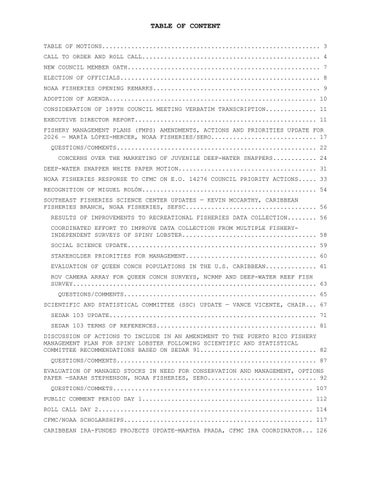
TABLE OF CONTENT TABLE OF MOTIONS............................................................ 3 CALL TO ORDER AND ROLL CALL................................................. 4 NEW COUNCIL MEMBER OATH..................................................... 7 ELECTION OF OFFICIALS....................................................... 8 NOAA FISHERIES OPENING REMARKS.............................................. 9 ADOPTION OF AGENDA......................................................... 10 CONSIDERATION OF 189TH COUNCIL MEETING VERBATIM TRANSCRIPTION.............. 11 EXECUTIVE DIRECTOR REPORT.................................................. 11 FISHERY MANAGEMENT PLANS (FMPS) AMENDMENTS, ACTIONS AND PRIORITIES UPDATE FOR 2026 — MARÍA LÓPEZ-MERCER, NOAA FISHERIES/SERO............................. 17 QUESTIONS/COMMENTS....................................................... 22 CONCERNS OVER THE MARKETING OF JUVENILE DEEP-WATER SNAPPERS............ 24 DEEP-WATER SNAPPER WHITE PAPER MOTION...................................... 31 NOAA FISHERIES RESPONSE TO CFMC ON E.O. 14276 COUNCIL PRIORITY ACTIONS..... 33 RECOGNITION OF MIGUEL ROLÓN................................................ 54 SOUTHEAST FISHERIES SCIENCE CENTER UPDATES — KEVIN MCCARTHY, CARIBBEAN FISHERIES BRANCH, NOAA FISHERIES, SEFSC.................................... 56 RESULTS OF IMPROVEMENTS TO RECREATIONAL FISHERIES DATA COLLECTION........ 56 COORDINATED EFFORT TO IMPROVE DATA COLLECTION FROM MULTIPLE FISHERYINDEPENDENT SURVEYS OF SPINY LOBSTER..................................... 58 SOCIAL SCIENCE UPDATE.................................................... 59 STAKEHOLDER PRIORITIES FOR MANAGEMENT.................................... 60 EVALUATION OF QUEEN CONCH POPULATIONS IN THE U.S. CARIBBEAN.............. 61 ROV CAMERA ARRAY FOR QUEEN CONCH SURVEYS, NCRMP AND DEEP-WATER REEF FISH SURVEY................................................................... 63 QUESTIONS/COMMENTS..................................................... 65 SCIENTIFIC AND STATISTICAL COMMITTEE (SSC) UPDATE — VANCE VICENTE, CHAIR... 67 SEDAR 103 UPDATE......................................................... 71 SEDAR 103 TERMS OF REFERENCES............................................ 81 DISCUSSION OF ACTIONS TO INCLUDE IN AN AMENDMENT TO THE PUERTO RICO FISHERY MANAGEMENT PLAN FOR SPINY LOBSTER FOLLOWING SCIENTIFIC AND STATISTICAL COMMITTEE RECOMMENDATIONS BASED ON SEDAR 91................................ 82 QUESTIONS/COMMENTS....................................................... 87 EVALUATION OF MANAGED STOCKS IN NEED FOR CONSERVATION AND MANAGEMENT, OPTIONS PAPER —SARAH STEPHENSON, NOAA FISHERIES, SERO.............................. 92 QUESTIONS/COMMETS....................................................... 107 PUBLIC COMMENT PERIOD DAY 1............................................... 112 ROLL CALL DAY 2........................................................... 114 CFMC/NOAA SCHOLARSHIPS.................................................... 117 CARIBBEAN IRA-FUNDED PROJECTS UPDATE—MARTHA PRADA, CFMC IRA COORDINATOR... 126
QUESTIONS/COMMENTS...................................................... 130 INFORMATION ON PERMITTING AND RESEARCH ON FISH AGGREGATION DEVICES (FADS)– EXPERIENCE IN PUERTO RICO— WESSLEY MERTEN, BEYOND OUR SHORES.............. 134 QUESTIONS/COMMENTS...................................................... 146 OVERVIEW OF PROPOSED ACTION TO REVIEW THE GROUPER UNIT 4 SEASONAL CLOSURE IN ST. THOMAS, USVI—MARÍA LÓPEZ-MERCER, NOAA FISHERIES, SERO................. 156 QUESTIONS/COMMENTS...................................................... 165 OUTREACH REPORTS.......................................................... 176 OUTREACH AND EDUCATION ADVISORY PANEL REPORT............................ 176 COUNCIL SOCIAL NETWORK UPDATE........................................... 180 QUESTIONS/COMMENTS.................................................... 182 ST. THOMAS/ST. JOHN, USVI — ANJOLIE LAPLACE............................. 183 PUERTO RICO—WILSON SANTIAGO SOLER....................................... 184 QUESTIONS/COMMENTS...................................................... 187 ACTION PLAN AND EDUCATIONAL PROPOSALS FOR SUSTAINABLE FISHING COMMUNITIES IN PUERTO RICO.......................................................... 189 ST. CROIX, USVI—OLIVIA L. WALTON........................................ 194 QUESTIONS/COMMENTS...................................................... 196 ENFORCEMENT REPORTS....................................................... 197 PUERTO RICO DNER........................................................ 197 NOAA FISHERIES OFFICE OF LAW ENFORCEMENT................................ 202 QUESTIONS/COMMENTS.................................................... 206 DAP REPORTS............................................................... 211 ST. THOMAS, U.S.V.I. — JULIAN MAGRAS, CHAIR............................. 211 STT/STJ DAP MEMBERSHIP APPOINTMENT.................................... 213 PUERTO RICO — NELSON CRESPO, CHAIR...................................... 214 ST. CROIX, U.S.V.I. — GERSON MARTÍNEZ, CHAIR............................ 221 COUNCIL DIRECTION ON JIGGING PROPOSAL................................. 221 UPDATED LIST OF FISHERY MANAGEMENT PLANS AMENDMENTS, ACTIONS AND PRIORITIES FOR 2026–2027—MARÍA LÓPEZ-MERCER, NOAA FISHERIES, SERO.................... 223 CFMC ARTIFICIAL INTELLIGENCE (AI) POLICY.................................. 229 ADVISORY BODIES MEMBERSHIPS............................................... 231 PUBLIC COMMENT PERIOD DAY 2............................................... 231 CFMC 50TH ANNIVERSARY PRESENTATION ........................................ 231 NEXT MEETING.............................................................. 237
2
1 2 3 4 5 6 7 8 9 10 11 12 13 14 15 16 17 18 19 20 21 22 23 24
TABLE OF MOTIONS PAGE 32: Direct staff to develop a white paper evaluating the deepwater snapper fishery (Snapper Unit 1 and Snapper Unit 2) in Puerto Rico to investigate concerns regarding increased fishing pressure and juvenile harvest. Motion carried on page 33. PAGE 125: Motion to appoint the committee for CFMC/NOAA Scholarships: Committee members would include Dr. Angeli, Dr. López, Dr. Vicente, the Council chair and a TBD member of NOAA Fisheries Southeast Fisheries Science Center with support from Council staff. Motion carried on page 126. PAGE : The Council recommends convening a group to provide input on the questions presented in the Grouper Unit 4 presentation. The group should include but is not necessarily limited to the following: the District Advisory Panel chair for Saint Thomas/Saint John, NMFS Southeast Regional Office and Southeast Fisheries Science Center representatives, U.S.V.I. Director of Fish and Wildlife, Tony Blanchard, Graciela García-Moliner, Saint Thomas Fishery Advisory Committee President, Saint Thomas Fisherman Association, U.S.V.I. Director of Environmental Enforcement or designee and U.S.V.I. Director of Parks and Protected Areas. Motion carried on page .
3
1 2 3 4 5 6 7 8 9 10 11 12 13 14 15 16 17 18 19 20 21 22 23 24 25 26 27 28 29 30 31 32 33 34 35 36 37 38 39 40 41 42 43 44 45 46 47 48
CARIBBEAN FISHERY MANAGEMENT COUNCIL 190th REGULAR COUNCIL MEETING HYBRID MEETING COURTYARD BY MARRIOTT ISLA VERDE, PUERTO RICO AUGUST 11-12, 2026 The Caribbean Fishery Management Council convened at Courtyard by Marriott Isla Verde Beach Resort, on Tuesday morning, August 11, 2026, and was called to order at 9:00 A.M. by the Council Chair, Carlos Farchette. CALL TO ORDER AND ROLL CALL CARLOS FARCHETTE: Testing one, two. So, good morning, everyone. We're going to get started here in a couple seconds. Good morning, everyone. We're going to call our meeting to order the 190th Caribbean Fisheries Management Council being held in San Juan, Puerto Rico. It's August 11, 2026. Roll call. So, with Cristina.
I'm
going
to
start
a
roll
call
on
my
left
CRISTINA D. OLÁN-MARTÍNEZ: Buenos días. Good morning. Cristina Olán, Council Staff. LIAJAY RIVERA GARCÍA: Buenos días. Liajay Rivera García, Council Staff. GRACIELA GARCÍA-MOLINER: Gracias. Graciela García-Moliner, Council Staff. MARÍA LÓPEZ-MERCER: María López, NOAA Fisheries. LOUIS ANTHONY BLANCHARD: Thomas/Saint John.
Tony
NICOLE F. ANGELI: Good morning. Division of Fish and Wildlife.
Blanchard,
Councilman
Saint
Nicole Angeli, Virgin Islands
RICARDO LÓPEZ-ORTIZ: Buenos días. Good morning. Ricardo López, Puerto Rico DNR. VANESSA RAMÍREZ: Good morning. Vanessa Ramírez, Vice Chair. SAMUEL D. RAUCH III: Good morning. Sam Rauch, Deputy Assistant 4
1 2 3 4 5 6 7 8 9 10 11 12 13 14 15 16 17 18 19 20 21 22 23 24 25 26 27 28 29 30 31 32 33 34 35 36 37 38 39 40 41 42 43 44 45 46 47 48
Administrator for Regulatory Programs, NOAA Fisheries. EUGENIO PIÑEIRO SOLER: Good morning. Eugenio Piñeiro Soler, NOAA Fisheries. Good to be here. CARLOS FARCHETTE: Morning. Carlos Farchette, Caribbean Council. MIGUEL A. ROLÓN: Miguel Rolón, Council Staff. DIANA T. MARTINÓ NOGUERAS: Diana Martinó, Council Staff. Good morning. ANDREW STRELCHECK: Good morning. Andy Regional Administrator, NOAA Fisheries.
Strelcheck,
Southeast
KATHERINE M. ZAMBONI: Kate Zamboni, NOAA Office of General Counsel, Southeast Section. JUAN U. TORRES CRUZ: Good morning. Juan Torres, Council Member. CLAY PORCH: Good morning. Clay Porch, NOAA Fisheries, Southeast Fishery Science Center. ADYAN RÍOS: Buenos días. Good morning. Adyan Ríos, Southeast Fishery Science Center. KEVIN MCCARTHY: Good morning. Kevin McCarthy, Southeast Fishery Science Center. JULIAN MAGRAS: Good morning, everyone. Julian Magras, DAP Chair Saint Thomas/Saint John. NELSON CRESPO: Buenos días. Nelson Crespo, DAP Chair, Puerto Rico. GERSON N. MARTÍNEZ: Buenos días a todos. Gerson Martínez, Saint Croix, DAP Chair. MAUREEN C. TRNKA: Good morning. Maureen Trnka, NOAA Fisheries Regulatory Programs. MIGUEL A. GARCÍA-BERMUDEZ: Buenos días. Miguel García, Puerto Rico DNER y AFS, American Fisheries Society. DANIEL MATOS-CARABALLO: Good morning. Daniel Matos-Caraballo, Puerto Rico Department of Natural and Environmental Resources. COLLEEN ALENA O’BRIEN: Good morning. Colleen O'Brien, University of Miami. 5
1 2 3 4 5 6 7 8 9 10 11 12 13 14 15 16 17 18 19 20 21 22 23 24 25 26 27 28 29 30 31 32 33 34 35 36 37 38 39 40 41 42 43 44 45 46 47 48
PARKER RAYBOURNE: Indonesia.
Good
morning.
Parker
Raybourne,
Fulbright,
KATHERINE DZIEDZIC: Good morning. Katie Dziedzic, Senior Adviser to the NOAA Fisheries Assistant Administrator, NOAA Fisheries. ANN B. WILLIAMSON: Good morning. Ann Williamson with the NOAA Fisheries front office. SEAN R. MEEHAN: Good morning. Sean Meehan, NOAA Fisheries. ROBERTO SABATER: Roberto Sabater, past member. MARTHA C. PRADA Coordinator.
TRIANA:
Good
morning.
Martha
Prada,
IRA
MARÍA DE LOS A. IRIZARRY: Buenos días. María Irizarry, Council Staff. OLIVIA L. WALTON: Good morning. Olivia Walton, Liaison Officer, Saint Croix USVI. WILSON G. SANTIAGO SOLER: Good morning. Wilson Santiago, Puerto Rico Fisheries Liaison. VANCE P. VICENTE CERNUDA: Good morning. Vance Vicente, Scientific and Statistical Committee. JANNETTE RAMOS-GARCÍA: Buenos días. Jannette García. Outreach and Education Advisory Panel Chair.
Ramos-
CARLOS FARCHETTE: So, we're going to do a swear swearing of the new Council member, Mr. Juan Torres. CRISTINA D. OLÁN-MARTÍNEZ: Excuse me, Chair. CARLOS FARCHETTE: Yeah. CRISTINA D. OLÁN-MARTÍNEZ: We have to read the names of the people that are in Zoom. CARLOS FARCHETTE: Sorry about that. Online. CRISTINA D. OLÁN-MARTÍNEZ: Online we have Guillermo Cordero, our interpreter. Aitza Pavón, Alan Belt, Anjolie LaPlace, Cynthia Grace-McCaskey, Jesús Rivera Hernández, Jonathan Brown, Kylie Bigley, Lauren Remsberg, Maggie Ríos, Olivia Parez, Sarah 6
1 2 3 4 5 6 7 8 9 10 11 12 13 14 15 16 17 18 19 20 21 22 23 24 25 26 27 28 29 30 31 32 33 34 35 36 37 38 39 40 41 42 43 44 45 46 47 48
Stephenson, Yamitza Rodríguez, and Heather Blough. CARLOS FARCHETTE: Thank you. MIGUEL A. ROLÓN: Mr. Chairman, if anybody wants the radio for translation, Spanish-English, they are available. So, just raise your hand and the technician will bring it to you. NEW COUNCIL MEMBER OATH ANDREW STRELCHECK: Good morning. It's my pleasure to have Juan Torres join the Caribbean Council. And as every Council member does, they take an oath. And so, I will read a few lines, and then Juan will recite the oath of the Council office. As trustees of the nation's fishery resources, all voting members must take an oath specified by the Secretary as follows. JUAN U. TORRES CRUZ: I, Juan Torres Cruz, as a duly appointed member of a regional fishery management Council established under the Magnuson-Stevens Fishery Conservation and Management Act, hereby promise to conserve and manage the living marine resources of the United States of America by carrying out the business of the Council for the greatest overall benefit of the Nation. I recognize my responsibility to serve as a knowledgeable and experienced trustee of Nation's marine fisheries resources, being careful to balance competing private or regional interests, and always aware and protective of public interest in those resources. I commit myself to uphold the provision, standards, and requirements of Magnuson-Stevens Fishery Conservation and Management Act and other applicable law, and shall conduct myself at all times according to the rules of conduct prescribed by the Secretary of Commerce. This oath is freely given and without mental reservation or purpose of evasion. ANDREW STRELCHECK: Please join me in congratulating Juan on his appointment. JUAN U. TORRES CRUZ: Gracias. ANDREW STRELCHECK: So, I'll just briefly say thank you to Juan and all the Council members that are appointed by the governors. I know it takes a substantial commitment and the National Marine Fisheries Service Federal Government appreciate the time, effort, input you provided this process, the time away from family to 7
1 2 3 4 5 6 7 8 9 10 11 12 13 14 15 16 17 18 19 20 21 22 23 24 25 26 27 28 29 30 31 32 33 34 35 36 37 38 39 40 41 42 43 44 45 46 47 48
participate in these meetings and resources. So, thank you very much.
contribute
to
our
marine
CARLOS FARCHETTE: Thank you, Andy. And welcome aboard, Juan. JUAN U. TORRES CRUZ: Thank you. CARLOS FARCHETTE: Julian? JULIAN MAGRAS: Yeah, Julian Magras for the record. I just wanted to say a special congratulations to Juan joining the team here at the table. If it's-- This is a perfect example of what comes out of the MREP program. So, I met Juan last year in Puerto Rico at the MREP program, and it's so good to see that going through that educational program, we have one of our attendees now sitting as a Council member. And that just proves that he learned a lot. He was willing to step into this role, and the government felt that he was a great candidate to be here to represent the fishers and be part of the management process. So, I just wanted to say that on behalf of the MREP team, which I sit on, congratulations, and welcome aboard. JUAN U. TORRES CRUZ: Thank you. CARLOS FARCHETTE: Miguel. MIGUEL A. ROLÓN: Graciela just reminded me that we cannot forget that Roberto Sabater is here. And we want to thank Roberto Sabater for his work at the Council. Very effective. He's going to remain with us as a member of the DAP. The Council appointed him in the last meeting in April. So, we're going to see his face, through the next three or four years. And I'd like to-- Where are you? Right there. Thank you, Roberto, on behalf of everybody sitting around the table. Gracias, Graciela. ELECTION OF OFFICIALS MIGUEL A. ROLÓN: Okay. We have now the election of officers, and Sam Rauch graciously accepted to conduct this part of the meeting. So, Mr. Rauch? Thank you. SAMUEL D. RAUCH III: Thank you for the honor of running the election of officers. I will now take nominations for both the 8
1 2 3 4 5 6 7 8 9 10 11 12 13 14 15 16 17 18 19 20 21 22 23 24 25 26 27 28 29 30 31 32 33 34 35 36 37 38 39 40 41 42 43 44 45 46 47 48
Chair and the Vice Chair for the coming term. Are there any nominations? Mr. Blanchard. LOUIS ANTHONY BLANCHARD: Carlos Farchette for Chair, Vanessa for Vice-Chair. SAMUEL D. RAUCH III: Thank you. Any other nominations? All right. Seeing none, we will now have an election for Chair and ViceChair. All in favor of Carlos Farchette for Chair and Vanessa Ramirez for Vice-Chair, please indicate by saying “aye.” GROUP: Aye. SAMUEL D. RAUCH III: Any opposed? Nope. The motion passes or the nominations passes to the election. Successful. Thank you. And congratulations to Mr. Farchette, Ms. Ramirez, Chair and Vice Chair. MIGUEL A. ROLÓN: Thank you, Sam. CARLOS FARCHETTE: So, before we begin, we'd like to get some words from Eugenio Piñeiro, our assistant administrator for NOAA. Eugenio? NOAA FISHERIES OPENING REMARKS EUGENIO PIÑEIRO SOLER: Bueno, good morning, everyone. GROUP: Morning. Good morning. Good morning. EUGENIO PIÑEIRO SOLER: A long, long time ago, I began my journey in the Caribbean Council. I never knew I'd make it this far. I always wished that I could get to a place where I could make more sound decisions to impact in a positive way the lives of the fishermen, the resources, and do whatever it was in my power to make the oceans more sustainable and the economies more vibrant and the life of the folks better. So, I'm here. And it's very sweet to see some of the old faces that’re still here in the fight. Julian, Nelson, Tony Blanchard, Graciela, Angie, Miguel, Carlitos. So, it's very sweet for me to be here and to see how things have changed for the better, for everyone. First, I just want to make sure that everyone understands that there's a commitment from the Agency, Regional Offices, everyone, for the partnership that we have with the Caribbean folks. And number two, to let you know that we are implementing some changes. 9
1 2 3 4 5 6 7 8 9 10 11 12 13 14 15 16 17 18 19 20 21 22 23 24 25 26 27 28 29 30 31 32 33 34 35 36 37 38 39 40 41 42 43 44 45 46 47 48
As you know, we sent you a-- President Trump sent you an Executive Order. And in those Executive Orders, we want to make sure that we promote commercial recreational fishing to the max and also keep in mind the protection of their resources. It is never free of controversy when changes are on the horizon. But that's what we're here for. Every single day that I spent here with Miguel and Carlos and many others that are not here, we faced crisis and we faced changes. And, the important thing is to step to the plate, to confront it, and take the lead. That's what we're here for. We have a formidable science team in the region. We have great scientists here too. I'm very confident, very comfortable with them. We have great leadership, in particular, in the District Advisory Panels, which are the real trenches. That is where things occur. In this administration, we have three things when I took this job, I told them there's three things that that are important for me. Number one, we have to have better science, more modern science technology. We have to manage better and not only with what we have, but we are improving and giving our science team the tools to manage better. Number two, Councils. We want to put all of our efforts in order that you guys can do your job. Because in Washington, I’m not going to do it for you. You're going to have to do it yourselves, and you're capable of that and more. And number three, I had a friendly conversation this morning with the DAP. We want more participation from the fishermen in the way that they are solving issues and the way they manage their fisheries. Because this is Puerto Rico, this is Saint Croix, and this is Saint Thomas. So, one size does not fit all. So, we have to give you guys the flexibility and the tools. And we have great respect for your capabilities and what you do. And so, I want to let you know that I'm very, very confident that these Executive Orders are going to be handled properly by you, Council members, and by the representatives of all the state governments, and SERO and our Science Center. So, with that said, I, once again, I'm very glad, very proud to be here with all of you, and, I wish you a very successful meeting today. Thank you, Mr. Chair. ADOPTION OF AGENDA CARLOS FARCHETTE: Thank you, Mr. Piñeiro. Any question for Señor Piñeiro? 10
1 2 3 4 5 6 7 8 9 10 11 12 13 14 15 16 17 18 19 20 21 22 23 24 25 26 27 28 29 30 31 32 33 34 35 36 37 38 39 40 41 42 43 44 45 46 47 48
Okay. Hearing none, we're going to go with the adoption of the agenda. We need a motion to adopt the agenda as written or any corrections or additions. LOUIS ANTHONY BLANCHARD: Motion to adopt. Tony Blanchard. VANESSA RAMÍREZ: Vanessa Ramírez, second. CARLOS FARCHETTE: Okay. We have a motion by Blanchard, seconded by Vanessa, to adopt the agenda as written. All in favor, say “aye.” GROUP: Aye. CARLOS FARCHETTE: Okay. Any nays? Any abstention? Hearing none, motion carries. CONSIDERATION OF 189TH COUNCIL MEETING VERBATIM TRANSCRIPTION CARLOS FARCHETTE: Next, we have the consideration of the 189th Caribbean Council Verbatim Transcriptions. Any corrections or additions to the verbatim minutes? We need a motion. LOUIS ANTHONY BLANCHARD: Motion to adopt, Tony Blanchard. NICOLE F. ANGELI: Second, Nicole Angeli. CARLOS FARCHETTE: We have a motion to adopt the verbatim minutes by Blanchard, seconded by Nicole Angeli, Director of Fish and Wildlife. All in favor, say “aye.” GROUP: Aye. CARLOS FARCHETTE: Any nays? Any abstentions? Hearing none, motion carries. Director's report, Miguel Rolón.
Next,
we
have
the
Executive
EXECUTIVE DIRECTOR REPORT MIGUEL A. ROLÓN: Thank you, Mr. Chairman. I also would like to thank, Eugenio Piñeiro and Sam Rauch to be with us today. And we're looking forward to a continued collaboration with National Marine Fisheries Services, our action agency. I would like to keep this 11
1 2 3 4 5 6 7 8 9 10 11 12 13 14 15 16 17 18 19 20 21 22 23 24 25 26 27 28 29 30 31 32 33 34 35 36 37 38 39 40 41 42 43 44 45 46 47 48
very brief. Starting with WECAFC, the Western Central Atlantic Fishery Commission, Eugenio and I were talking about this before, and he was able to secure funding for the working group meetings that are important to the Council. The first one will be November. These meetings are run by FAO but are supported by the countries. In this case, the NOAA Fisheries of the United States. The meeting will be addressing the spawning aggregation. It's the working group. It has all the countries of The Caribbean involved, including Central America. And we're looking forward to the discussions which are going to be held in November and December. The following meeting will address the Queen Conch Fishery, that will be probably in the spring next year. And again, we also have another group of experts and members of the countries involved that will be addressing the concerns about the queen conch fisheries, across the Caribbean. It goes from Brazil all the way to Bermuda, the Greater Caribbean. Some of the countries do have queen conch fisheries. Some of them contribute to the distribution of queen conch because of the currents, etcetera. So, these two meetings are going to be taking place in 2026 and 2027, and we will report-- whatever comes out of the meeting will be report to you at the August meeting. Our contact person in the region is María López, and she's been working with NOAA Fisheries to help us put together the meeting. And also, we have a person from the Office of International Affairs, Trade, and Commerce that will be-- What is the name again? Ken? MARÍA LÓPEZ-MERCER: This is María López. Kent Laborde from IATC. MIGUEL A. ROLÓN: Yeah. He replaced Laura Cimo that you know. So, the meeting is already well coordinated, and the Council will cover expenses of the venue, simultaneous interpretation, and the invitation to some of the key participants. The other thing that I was going to mention today is that we have a brainstorming session, we call it, with Nelson Crespo and Wilson Santiago. Out of the storming session came up a meeting that we have with the Sea Grant offices in Mayagüez on the fifteenth of the past month. And there we identify things that we can do to improve outreach 12
1 2 3 4 5 6 7 8 9 10 11 12 13 14 15 16 17 18 19 20 21 22 23 24 25 26 27 28 29 30 31 32 33 34 35 36 37 38 39 40 41 42 43 44 45 46 47 48
and education with the communities, which we all believe is very important. One of the particular activities that we identified that we could do is an island conference in Puerto Rico. We will have two, one in the West, one in the East. At the conference, we are going to invite a representative from the fishing associations in Puerto Rico, scientists, the government of Puerto Rico, the staff of the Council to give presentation about the status of the fisheries, among others. Then we will have discussions, with fishers and the representative of government to see how can we improve the management of the fishery by providing better information and also get information from the fishers and the general public back to the Council to work on the management measure that we have to implement for the overall benefits of the fishery. The conferences, they will be in the summer. We are going to invite Julian Magras and Gerson Martínez from Saint Croix and the Saint Thomas area along with the two liaison officers. You will be able to participate. And if you believe that this is something that we also can do in Saint Thomas/Saint John, and Saint Croix, then we will plan ahead in 2027 based on your recommendations to do that. I believe that this interaction between fisher scientists and managers is the key to a successful management of the fishery of the U.S. Caribbean. This year we are celebrating the fiftieth anniversary of the Magnuson-Stevens Act, of course, creation of the Council. And for those of you who are very patriotic, we're also celebrating 250 years of the U.S.A. And today we are going to have a get together, this afternoon from 06:30 tonight at this place. Just be some hors d’oeuvres, an opportunity for people to mingle and know the others working with fisheries. And now that I'm talking, I want to go ahead and thank people that have worked with me for the last 40 years. The one coughing here. Diana Martinó. She's the one who kicked me under the table, and whenever I'm about to make a big issue, she says, “you cannot say that because you're a Council member.” “Yeah. But he’s a--,” “You cannot say that. You have to behave.” Then I have Angie in the back there. I keep saying that she cannot play poker because she can say everything with her face. And when I'm about to make a mistake with the budget, she says, “no, you don't have the money for that.” So, she had been doing that for more than 30 years, on and off. And then we have Graciela, the lady with white hair in the corner. We have three Chief Scientists, and she's taken that role with—or 13
1 2 3 4 5 6 7 8 9 10 11 12 13 14 15 16 17 18 19 20 21 22 23 24 25 26 27 28 29 30 31 32 33 34 35 36 37 38 39 40 41 42 43 44 45 46 47 48
I don’t know what the title is but she's the best ever of the three chief scientists that we’ve had. She knows where everybody's buried. She's on top of everything that has to do with science. And she also tells me a lot of time-- because the staff I have are all women, and they are not just persons. When I'm going to do something, they can tell me, “Miguel, you cannot do that because this, this and that.” And for that, I'm grateful for these three. Because they are at the core. They have been here for a long time. In addition, we have the newcomers, the new blood, starting with Cristina. Cristina is a quiet lady over there, but she has a master’s degree and everything. Sometimes I wonder what the hell is she working with us. She can do something else, but she has been instrumental in all social networks. She's an organizer, and we are very grateful for that. Liajay, our new scientific acquisition. She put together a presentation for the Coral Reef Task Force, and she was the only soul there. I have a picture to prove it. And she was able to represent this Council better than anybody I can think of. And for that we are so very grateful. We have some people that are not here or maybe there. But, back at the office we have others that have helped us put together this meeting, and they have been helpful operating the Council. Kiara is one of the new ones. Vivian, not so new, but Vivian is the key. She's here. Where are you? Okay. She said quietly, but she's our accountant. She has an eye for looking at errors in my travel voucher that I cannot think of anybody's better than her. And then Luz Gonzále. Luz, is part of the group that works with everything related to fiscal matters. If you look at it, they're all women. I'm the last of the Mohican, and I'm very grateful for that. My wife, Evelyn, has been my help for 54 years. Without her, I would never have been able to work. I used to travel a lot. So, we had three kids and she stayed there and never complained but always doing the work and taking care of the house. So, still talking about women and the more I go to meetings, the old goats like me are out of the picture and we have new people. They are women working, and we are very grateful to have two here, one on the screen and or the Internet and one here, María López and Sarah. They are the key to putting together the best papers that you can think of option papers that we have to keep us, 14
1 2 3 4 5 6 7 8 9 10 11 12 13 14 15 16 17 18 19 20 21 22 23 24 25 26 27 28 29 30 31 32 33 34 35 36 37 38 39 40 41 42 43 44 45 46 47 48
working on the right track with the management plans that we have. We have Adyan Ríos. I didn't know that she was going to be here, but Adyan is one of those brains that I'm proud to call a Puerto Rican lady. She’s a member of the Southeast Fishery Science Center. Bonnie Ponwith with she was the first one. He told me once, we need to dedicate more time to the Caribbean and she did it. Laura Cimo is no longer with us, not because she passed, but because she retired. And she was instrumental in putting together many of the international initiatives that we had. And we have, in Washington also, Kelly Denit. Kelly is a member of the group that worked with Eugenio, with Mr. Piñeiro, excuse me. And she has been instrumental in keeping us on track of everything that we do. I always say that I might as well be with luck because sometimes when I have problems, I find somebody who'll solve them. At one time I was trying to figure out how the heck are we going to prepare a management plan for queen conch and the spawning fish aggregation. And then, I ran into Martha Prada. Dr. Prada and Yvonne Sadovy, she's a British lady who used to study here, and they helped us put together the management plans, and we are grateful for that. And then there are some key people that you have on your side, the lawyers. And through the years, we’ve had several lawyers, but we have now Kate and Anne, and for that we are also very grateful. Every time I talk to Kate, learn something new that legally I cannot do. So, I'm very grateful for that. And if you look around the table, we have Council members, Vanessa and Nicole, that are representing, very dignified, the government of the Virgin Islands and the fishery of Puerto Rico. So, thank you for this time, Chairman. I know that I've left a lot of people outside because through 50 years of fishery management, we have members that are no longer with us. Omar Muñoz, our first elected Executive Director, and he was, my mentor, excuse me. Jack Dammann, our first chief scientist. Ignacio Morales, our statistician. Fernando Castillo, a member of the Council who was a fiscal officer. Carlos Ramos, also a member of the staff. They're no longer with us. And we are grateful for all the contribution that they made to the Council. I was looking at a picture the other day. I'm the last of them. And probably not for long. Three more haircuts and I'm gone. And then, Hilda Ramírez was our first chair. I mean, first Executive Secretary. They really did a lot of work.
15
1 2 3 4 5 6 7 8 9 10 11 12 13 14 15 16 17 18 19 20 21 22 23 24 25 26 27 28 29 30 31 32 33 34 35 36 37 38 39 40 41 42 43 44 45 46 47 48
For example, Hilda Ramírez was the first one who developed-- she invented a way for archiving and cataloging all the information that we have. That was copied by other Councils and the action agency. She never received a penny for that. Not even a thank you. But I want to remember her because what she did. And then we have other people here. But I feel sorry for Ricardo because I used to sit where Ricardo's sitting. And everything, if everything goes smoothly, someone else did it. Headquarters did it. Something goes wrong; we have to blame Ricardo. They used to blame me. So, thank you, Ricardo, for being here. I also want to make a mention of another lady. I met her a long time ago, a member of Sea Grant. But Jannette Ramos, she's a dynamo. She has energy for her and a lot of other people. Thank you, Jannette, for all the work that you do, connecting the Council with the agency, the fishers, and everybody that has anything to do with the U.S. fisheries. And then they are not ladies, but I want to thank Julian, Gerson, and Nelson. I met Julian on the phone a long time ago. We used to fight every Saturday. One time Julian told me, “Miguel, I have to stick my neck out for this.” So, you have to keep doing it because nobody will do it for the fishers. And sometimes we will agree, sometimes we disagree a 100%. But I have a lot of support for Julian. You have been with us for 17 years now? 24 years! And then Nelson. I met Nelson-- He was introduced to me by Eugenio here. He said, “Nelson is a good guy. He knows what he's doing.” And he was right. And Gerson, he represents a lot of people. He's even selling [barrels?], a diver from Saint Croix. And thank you, Mr. Chairman. This is a long, long report, but I haven't forgotten about you. Because when I met Carlos Farchette, he was carrying a gun. I said, “Jesus, he's very serious about this.” But he was the head of the enforcement agency, in the Bureau of Enforcement of the U.S. Virgin Islands. And he became a Council member and we have been friends for a-- he and his wife Nora, we have been friends for a long time. And he has always been interested in working with the fisheries. We have a good group of people working here. But so, again, sorry for the people that I missed. And I thank you again, Carlos, for this opportunity.
16
1 2 3 4 5 6 7 8 9 10 11 12 13 14 15 16 17 18 19 20 21 22 23 24 25 26 27 28 29 30 31 32 33 34 35 36 37 38 39 40 41 42 43 44 45 46 47 48
CARLOS FARCHETTE: Thank you, Miguel. So, next on the agenda is the Fishery Management Plan Amendments, Actions, And Priorities Update by María López-Mercer. FISHERY MANAGEMENT PLANS (FMPS) AMENDMENTS, ACTIONS AND PRIORITIES UPDATE FOR 2026 — MARÍA LÓPEZ-MERCER, NOAA FISHERIES/SERO MARÍA LÓPEZ-MERCER: Thank you, Mr. Chair. This is María López, NOAA Fisheries, Southeast Regional Office Caribbean Branch. As is customary during the beginning of each one of the meetings, we go through all of the actions and amendments that the Council is currently working on. And we also talk about the different phases of development they are in, and we also talk about the priority actions that the Council has chosen during past Council meetings so that staff can be working on. Okay, the first two items that I'm going to be mentioning is the Puerto Rico FMPs for Amendment 4. This is reclassifying the rainbow runner as a pelagic species. During May, the notice of availability of the amendment was published, and there was a comment period that was open for 60 days. In July, that notice of availability comment period closed, July 20th. There was a proposed rule that was published as well and the period closed last Friday. So far, all the comments that we received were in support of this measure. As you recall, this is a measure that was requested by the fishermen. The rainbow runner was, originally, put on the island-based FMP, in the Puerto Rico FMP, as a reef fish species along with other jack species. However, the fisherman noted that this species behaves more as a pelagic fish and, their fishing methods and gear is different than those are used for reef fish and there was a lot of interest for fishermen that fish in the water column to be able to fish for this species during the Bajo de Sico closure that was a six-month closure. So, this is one of the measures that should be-- which we're going to be working now with the final rule and hopefully we'll be able to publish the final rule and get this effective, during the next couple of months. The next item that we have is the stocks in need of conservation and management. This is an action that the Council has been working on for a while now. The purpose of this action is to maximize management efficiency. It also falls below the priorities that the 17
1 2 3 4 5 6 7 8 9 10 11 12 13 14 15 16 17 18 19 20 21 22 23 24 25 26 27 28 29 30 31 32 33 34 35 36 37 38 39 40 41 42 43 44 45 46 47 48
Council shows, under Seafood E.O. 14276. This is an action where the Council is going to evaluate all of the species that are included in each one of the fishery management plans and determine if there is a continued need for conservation and management based on the Magnuson-Stevens Act. So, during the April meeting, the Council reviewed a decision tree that staff has, and a small working group have developed to help with these decisions. And, during the summer, staff worked to develop some options while we were also scoping, meaning that we were collecting information, meeting with stakeholders, meeting with the states, etcetera, to get their input. During this meeting, the idea is for the Council to discuss draft options. There was a paper that was included in the briefing book and a presentation that will be given to you so the Council can talk and discuss to see if the options are on the right track, if they have other concerns or questions or things that needed to be addressed to continue developing this action. After this meeting, we will be forming an interdisciplinary planning team and start developing the draft amendment with the idea that during the meeting in December, the Council can discuss a draft amendment. Next slide, please. Next is Framework 4. This is to the U.S.V.I. spiny lobster based on the outcomes from the SEDAR 91. The purpose is to update and integrate the outcomes from the assessments, and also this would result in a revision of the ACLs. During the past Council meeting, the Council discussed the actions, selected preferred alternatives, and took final action, meaning that they they were ready to submit the action to NOAA Fisheries for implementations, for approval and implementation. During May and June, staff worked, the IPT worked to finalize the document. In July, the Council submitted to NMFS because there were some sections that still needed to be finished. So, the Council, when the document was finalized, it was sent back to the Council chair, who revised it, and then the Council submitted it to NMFS. And then NOAA Fisheries started the process of developing the proposed rule, which is where we are right now. So, the idea here would be that during the next couple of months, we will be publishing the proposed rule. This opens up a period of-- an opportunity for the public to comment on this rule. And as all of you know the comments that we received during the proposed rule are addressed during the final rule. The next action is what would be Framework 4 to the Puerto Rico 18
1 2 3 4 5 6 7 8 9 10 11 12 13 14 15 16 17 18 19 20 21 22 23 24 25 26 27 28 29 30 31 32 33 34 35 36 37 38 39 40 41 42 43 44 45 46 47 48
FMP, and these are updates to the spiny lobster management reference points based on SEDAR 91. During the past Council meeting the Council requested additional input from the SSC on their ABCs and their OFLs. During May and June and during the summer, they were in what we call the AP process, which is Advisory Panel's process, which includes the SSC. They have a meeting in July to revise those recommendations. And during this meeting, we will hear from the SSC what the outcomes of that meeting are and those revisions to their recommendations that the Council requested. And that's going to happen early today. During this meeting, the Council will re-evaluate the SSC recommendations. And if they desire to do that, they can recommend developing a draft framework amendment to implement the results from the assessment from SEDAR 91. So, during the next few months, depending on what decisions the Council makes today, the IPT will start developing the action so they can bring it back in December. Related to this is the revision of AMs for Spiny Lobster, and this is something that came from the need to address ACL overages for Puerto Rico, and also a need for reevaluating the accountability measures that we currently have. That action was put on hold, as you recall, because the Council was waiting for the process for the SEDAR 91 to be completed so then, the accountability measures could be addressed. Now, during this meeting, depending on what the Council wants to do with the action, with the Framework 4 action, which is the outcomes for the SEDAR 91, that could be something that the Council could bring back to the table and then consider adding that actions to the Framework 4 so that the staff can begin working on that. Because this is something that is very important that the Council has discussed but, again, it was tabled to let the other processes go. Okay, next slide. Okay, so now these three actions were brought to the Council's attention during the past Council meeting. One is the evaluation of the grouper's seasonal closure for Saint Thomas/Saint John, and it was chosen as priority number one to work with by the Council during the April meeting. For Puerto Rico, priority number two was selected to evaluate the Tourmaline Bank and Abrir La Sierra Bank. The staff was tasked with initiating an overview and information compilation. And then the third one for Saint Croix is the evaluation of the Mutton Snapper Seasonal Closure in Saint Croix. 19
1 2 3 4 5 6 7 8 9 10 11 12 13 14 15 16 17 18 19 20 21 22 23 24 25 26 27 28 29 30 31 32 33 34 35 36 37 38 39 40 41 42 43 44 45 46 47 48
So, as you can see, the Council decided to work on these priorities, starting with Saint Thomas and Saint John. During this time, staff have been scoping and gathering information, and we want to continue doing that. The staff was able to prepare a presentation on some of the background information to probably obtain a little bit more of-- be able to discuss a little bit more what the objectives are, what's the Council specifically wants to do. So, the paper that is included in your briefing book is meant to be a background as part of the scoping. What are the questions that need to be answered? What type of information is needed to do this evaluation? Etc. So that's going to be discussed tomorrow afternoon or in the morning, I don't recall, but it's going to be tomorrow. The idea here is to get as much input as possible so the action can be developed. So, the last slide, something I wanted to mention before, depending on the progress that staff continue to be doing with these actions, the evaluations, the idea is for concurrently start working on the second priority, which is the Tourmaline Bank and Abrir La Sierra Bank, and also in the mutton snapper. But, however, we wanted to start right away with the evaluation of Saint Thomas so we can get this moving, right? But this also depends on staff’s time because, as you can see, we have several other actions that we have been working on. But these are the priorities that definitely we're going to be working with as soon as possible. Okay, these are the recently completed and implemented regulations. This is-- so we have Amendment 2 to all the fishery management plans. This is the amendment that prohibited trawling in the EEZ, had some regulations for the net gear and introduced the requirement of having a descending device available and ready for use when fishing for reef fish. So, the prohibition on the nets in federal water is excepting specific gillnets for bait, as you all selected, became effective on November 3rd, 2025. Now, for the descending device, the Council requested that the regulation became effective later so that the Council Outreach and Education AP, had time to increase outreach and education for the use of this device and they have been extremely successful on this. This regulation became effective on April 1st, 2026. Another recently completed and implemented regulation is Framework 3. This is based on the results from SEDAR 80 for the queen triggerfish ended up revising the ACLs that are in place for the 20
1 2 3 4 5 6 7 8 9 10 11 12 13 14 15 16 17 18 19 20 21 22 23 24 25 26 27 28 29 30 31 32 33 34 35 36 37 38 39 40 41 42 43 44 45 46 47 48
U.S. Virgin Islands that became effective on April 17th, 2026. Then we have Amendment 3 to all the fishery management plans. This is the one that established management measures for dolphins and wahoo in the EEZ of all the islands. As you recall, these species were not managed before. They became part of the management plans in 2022 when we implemented the island-based FMPs. This one established harvest size limits and recreational bag limits, and right now they are active in all federal waters since July 25th, 2025. And this is another one of those actions that the Council has been working to increase their outreach and education so fishermen can understand that these regulations are applicable and then comply with them. Lastly, we have the Puerto Rico Framework 3. This is also based on SEDAR 81. Triggerfish stock complex, revised ACLs in place for Puerto Rico. That became effective on July 25th, 2025. Now, one of the things that the Council does whenever they have regulations that they have implemented is they send letters to the states requesting compatible regulations. Those letters have been sent to Puerto Rico and the U.S. Virgin Islands for Amendment 2 for the ones of the descending devices and the trawl. Some of them already have regulations that are compatible, some not. And then, also for the dolphin fish and the wahoo, those letters were sent. We have received response from Puerto Rico that they're going to be looking into this, of course. The U.S. Virgin Islands already has measures implemented for the dolphin and wahoo. They already have some bag limits implemented. But the thing is that every time the Council has an action, they will be sending these letters. And, of course, the governments will determine if that is something that they want to pursue with or not. Okay, so the last slide that I have is I wanted to bring to the Council’s attention the prioritized list of actions to NMFS, on E.O.14276 and NMFS recommendations. Recently, NMFS submitted a letter to all their Councils where they were recommending the Council to focus on several of the actions that the Council had previously submitted in response to NMFS E.O.14276. So, here I have a list of what are the key management priorities that were recommended by NOAA Fisheries. One is, evaluating a transition of queen conch and spiny lobster to territorial management, amending accountability measures for spiny lobster and pelagic stocks, reviewing the overall effectiveness of marine protected areas, assessing compatibility between federal and territorial waters. There are also strategic mandates for Council consideration, which is evaluating the managed stocks need for 21
1 2 3 4 5 6 7 8 9 10 11 12 13 14 15 16 17 18 19 20 21 22 23 24 25 26 27 28 29 30 31 32 33 34 35 36 37 38 39 40 41 42 43 44 45 46 47 48
active conservation and management, and to expand and continue the use of exempted fishing permits. Now, what I have put in red are those actions that we are already working with okay, which is the AMs, the marine protected areas. As I mentioned, the Council set those priorities during the past Council meeting for specific areas in each of the three islands. And evaluating the managed stocks need for active conservation and management. We're going to have continue that discussion today with the options paper. That's going to happen later during today. Okay. And this last one also serves as a transition for our next topic. There's going to be the response-- that NMFS’ response to the Councils on priorities. So, this is all I have. If you have any questions, many of these things are going to be discussed throughout the day today or tomorrow, but I'm happy to answer any questions we have on all of this. QUESTIONS/COMMENTS CARLOS FARCHETTE: Eugenio? EUGENIO PIÑEIRO SOLER: Thank you, María. María, I have a question regarding Saint Thomas on the grouper and the closed areas. Has there been any degree, if any, of participation with the Saint Thomas Fishing Association or other commercial fishing groups in this aspect? Thank you. MARÍA LÓPEZ-MERCER: Thank you, Eugenio. Yes, so this was an action that was submitted by the DAPs when we were at the last April meeting where they expressed desire for the Council to evaluate if it was possible to remove the seasonal closure that currently applies to the deep-water groupers because they wanted the Council to determine if there was duplication or redundancy with other regulations. For example, there are two areas in Saint Thomas, the Hind Bank, and the Grammanik Bank, that serve as areas to protect spawning species, for precisely for deep deep-water groupers. The Hind Bank was set up to protect the red hind grouper, but also a place were other species, aggregate to spawn. And this is an area that has been closed, for a long, long time to all fishing, anchoring, etc., and it has been very successful. There's also the Grammanik Bank, which is a seasonal area closure. And this is an area that was originally established for the 22
1 2 3 4 5 6 7 8 9 10 11 12 13 14 15 16 17 18 19 20 21 22 23 24 25 26 27 28 29 30 31 32 33 34 35 36 37 38 39 40 41 42 43 44 45 46 47 48
yellowfin grouper to protect the aggregations that occur in that area. Now, there's also-- it was also discovered that there is a very, very productive nassau grouper aggregation in that area as well. So, this is a very important area. The fishermen have reite-- they have mentioned how important these two areas are for the protection of the grouper species, nassau grouper, etc. So, their interest is for the Council to evaluate if the seasonal closure that applies for the groupers can be removed throughout the entire territory. So, that's what the Council is going to be evaluating. CARLOS FARCHETTE: Miguel? MIGUEL A. ROLÓN: Thank you, María. A couple of things. The first line, queen conch and spiny lobster to territorial management, that's for discussion or something that is already a done deal? MARÍA LÓPEZ-MERCER: Nothing is a done deal. Thank you, Miguel. This is-- everything is for discussion and thank you for bringing that up. So, this is-- when we discuss, soon, the evaluation, evaluating managed stocks, this is an action that the Council has been working on. All of the species that are currently in the fishery management plans are going to go through this process. So, when the Council discusses that, I think that will be a good opportunity for this discussion to happen. And this is going to happen, my understanding is, in the afternoon of today. MIGUEL A. ROLÓN: Then, the fisher of the West Coast of Puerto Rico, called to my attention the issue of people fishing small snappers and selling it without a license, actually. Most of these people are recreational fishers. And, I probably will ask Nelson to explain a little bit, but the question will be whether this is something that the staff, especially with your schedules, can work on probably in 2027, maybe an option paper, something that the Council can consider. And there we can look at the areas like Bajo de Sico. We can look at the size limits of the species, etcetera. Because if these species that are mostly caught within the area of jurisdiction of Puerto Rico affect the federal waters fisheries, then the Secretary can go all the way to the shoreline to make sure that these species are protected under the appropriate management. So, that's one question. But for the record, Nelson, what are the issues with the small fish, the small snappers that we have and also the jigging. The use of this art, of this gear in this fishery. 23
1 2 3 4 5 6 7 8 9 10 11 12 13 14 15 16 17 18 19 20 21 22 23 24 25 26 27 28 29 30 31 32 33 34 35 36 37 38 39 40 41 42 43 44 45 46 47 48
CONCERNS OVER THE MARKETING OF JUVENILE DEEP-WATER SNAPPERS NELSON CRESPO: Thank you, Miguel. This is a situation that I consider increasingly concerning regarding the harvest and commercialization of juvenile individuals within Snapper number Unit 1 and 2. Because they progressively become a direct target of the fishery driven by their increased commercial value. So, tomorrow I'm going to present a complete statement with maybe the potential measure for an options paper because-- Cristina? Oh okay. You have the picture there. --because they are everywhere. Fish markets, direct individual sales, restaurant, I [request?] the small-- the juvenile fish, and you can see they make cheeks, small fillets. And if they kill the juvenile, they are going to kill the resource. So, we have to move forward and do something about it. So, tomorrow I'm going to talk widely about it. MIGUEL A. ROLÓN: Thank you, Nelson. MARÍA LÓPEZ-MERCER: Thank you, Nelson, for the information. So, one of the things that we would like to do is, tomorrow, after we have all of these discussions, the Council can go back and revisit all of the priorities that they have. And if this is an action that the Council would like staff to start looking into, we can definitely add it to the list of priorities. And Nelson, you mentioned that you are going to be discussing this tomorrow, some of these things. So, if you think it's appropriate, we can add this tomorrow, when everything is revisited after we go to all the topics. Or if you want, we can add it into the list as right now. Up to you. CARLOS FARCHETTE: Andy? ANDREW STRELCHECK: Yeah, thank you, María, for the presentation. I first want to acknowledge Miguel's comments and just appreciate all the kind words for the people that contribute to this process and make it work. Two things. One, in terms of your question, Miguel, about spiny lobster and queen conch. Eugenio’s letter essentially says, “we strongly encourage” right? It doesn't say “you have to” but I think that'll be part of this process, right? I see really that first bullet being in red as well because we're working on the document of species in need of conservation and management. And so, spiny lobster and queen conch fit into that conversation 24
1 2 3 4 5 6 7 8 9 10 11 12 13 14 15 16 17 18 19 20 21 22 23 24 25 26 27 28 29 30 31 32 33 34 35 36 37 38 39 40 41 42 43 44 45 46 47 48
directly with regard to species that we would include or not include in the Fishery Management Unit. In terms of Nelson and some of the things that were brought to our attention, Eugenio's been talking to us. We've been working on some information internally within the Fishery Service just to understand the issue better from the industry's point of view, from the standpoint of federal management. I really want to talk to Ricardo as well in Puerto Rico about some of the restrictions or regulations that have been lifted in recent years and how that affects obviously this issue. But certainly, if that's a priority of the Council, we would need to discuss it and figure out where it fits into the queue of all the other actions. Based on everything that María just presented, you have probably a two-to-three-year work plan. So, we definitely have plenty of work to do in the coming years. CARLOS FARCHETTE: Graciela. GRACIELA GARCÍA-MOLINER: Graciela García-Moliner. So, one issue that keeps coming up has to do with the gaps that we have in the information. And one of those has to do with a lot of MPAs or protected areas that are within either the state and territorial waters or under the jurisdiction of, for example, the Department of Interior. So, most of South of Saint John, for example, has been close to all fishing for a number of years. That connects to the Grammanik Bank, to the MCD. So, at some point, we really need to bring to the table our counterparts from the Department of Interior, for example, to talk about the impact of those regulations. The problem is that we also have a lack of monitoring in most of the areas that we have been managing for so long. So, this past year we had cooperative research through the Coral Reef Conservation Program with the fishers on the West Coast looking at Tourmaline specifically. So, they were part of the proposal of the statement of work, the work that was developed, they participated in the collection of scientific data from Tourmaline, and they've been involved, these past few weeks in what it's called an exit call. So, they've been listening to what the scientists have been finding out of Tourmaline, and we'll be hearing from them hopefully within the next month or so with the final report. So, this is competitive research. It's extremely important to the local industry as well as the information from those other agencies and jurisdictions that have very restrictive regulations in a very large area of the marine environment that is critical to the 25
1 2 3 4 5 6 7 8 9 10 11 12 13 14 15 16 17 18 19 20 21 22 23 24 25 26 27 28 29 30 31 32 33 34 35 36 37 38 39 40 41 42 43 44 45 46 47 48
industry. CARLOS FARCHETTE: Okay. So, I'm not sure if Nelson is ready to discuss what María mentioned now or they want to wait until later on tomorrow. Nelson? NELSON CRESPO: About the juveniles? I can read my statement right now if you want. I will do it now. MIGUEL A. ROLÓN: The question is for María. When she-- this issue, do you want to include this as part of the priorities, or do you want to wait until tomorrow? So, the question is, are you ready to do it now? And we just go ahead and do it, and that's something that we can consider this time. And she will then have the marching orders from the Council regarding this part. So, you want to do that now or wait until tomorrow? CARLOS FARCHETTE: Yeah. We can do that now. NELSON CRESPO: Can I go ahead? Okay. Thank you. My statement reads as this. “Dear member of the Caribbean Fishery Management Council, I would like to bring to the Council's attention a situation that I consider increasingly concerning regarding the harvest and commercialization of juvenile individuals within the Deep-water Snapper Unit 1 and 2. In the past, the catch of small individuals of these species was considered primarily bycatch because they represent a relatively small proportion of the catch. In addition, fish buyers frequently pay very low prices for this individual or simply refuse to purchase them, which provides an economic incentive to discourage their retention. Juvenile Deep-water Snappers 1 and 2 have progressively become a direct target of fishery, driven by the increase of commercial value. There is currently demand from fish markets, restaurants, and individual consumers at the price being paid make the catch of small individuals economically attractive. According to the information gathered from participants in the fishery, this product may reach approximately $6 to $7 per pound when sold to the reseller or restaurants. While once processed into products such as cheeks or small fillets, their value may reach 26
1 2 3 4 5 6 7 8 9 10 11 12 13 14 15 16 17 18 19 20 21 22 23 24 25 26 27 28 29 30 31 32 33 34 35 36 37 38 39 40 41 42 43 44 45 46 47 48
approximately $15 per pound to the consumers. For the restaurant is higher. This change in the market value may be creating a significant economic incentive to retain individuals that previously had little or no commercial value. I believe it is necessary to evaluate whether the current harvest pattern is unnecessarily increasing mortality among juvenile individuals and whether the existing management measures are sufficient to protect the population's size structure and future productivity. In conversation with fishermen who participate directly in this fishery, it has been repeatedly reported that a considerable portion of the catch consists of small individuals. If this perception is confirmed through landings data, size sampling, and other scientific information, it could represent an important indication that fishing effort is increasingly concentrating on juveniles or smaller individuals. There have been reports of significant decline in the availability of large individuals enough to produce marketable fillets. As a result, some fishermen have indicated that they have begun traveling to Culebra, staying there for several days and conducting fishing operation in Saint Thomas water in order to obtain larger or more economical valuable catches. And this opens another concern, where do they report those catches? In Puerto Rico? That’s going to affect the ACL. Queen snappers was a well managed species until their requirements for obtaining a permit to harvest it were relaxed. We now need to carefully evaluate the options available to us to mitigate this situation. In addition, the fisheries research lab does not have sufficient resources, and this situation has effectively resulted in a voluntary reporting system because there's not effective monitoring system in the majority of the main fishing ports. In conversation with fishermen, the increase of underreporting has been described as alarming. Given this change in the harvest pattern, I believe it would be prudent for the Council to evaluate, based on the best scientific information available, different alternatives to reduce mortality of juvenile individuals using independent data for more credibility. Potential measures for the option paper are: establishing a minimum size limit if it's supported by biological data; evaluating hook size regulation as a potential tool to reduce the capture of smaller individuals; evaluating spatial management measures, 27
1 2 3 4 5 6 7 8 9 10 11 12 13 14 15 16 17 18 19 20 21 22 23 24 25 26 27 28 29 30 31 32 33 34 35 36 37 38 39 40 41 42 43 44 45 46 47 48
including the possibility of establishing restrictions at specific depths or areas where significant concentration of small individuals are documented; scientifically evaluating the area between approximately 80 to 100 Fathoms if scientific data and fisherman's knowledge confirmed that this area represent an important concentration area for juveniles; evaluating control on fishing effort, including limited entry mechanisms if analysis demonstrates that the current number of participants or the level of fishing effort contributing to the problem; improving the landing monitoring and reporting system, particularly information regarding fish size, fishing area, fishing effort, and catch composition; evaluating whether there is an alternative under which federal management could assume a broader and more consistent role in this fishery, including an effective limited entry system capable of controlling fishing effort from the jurisdictional boundary into the water closer to shore. I am not suggesting that any of these measures should be implemented immediately. My position is that given the evident change in economic incentives and harvest patterns we should begin evaluating this alternative before the situation develops into a larger management problem. A serious economic analysis of the fishery is also necessary Understanding the change in market value, demand, fishing profitability, and the economic incentive associated with retaining juvenile fish should be an important component of any management evaluation.” Thank you. CARLOS FARCHETTE: Thank you. Vamos a coger un break. MIGUEL A. ROLÓN: Sí. CARLOS FARCHETTE: Okay. All right. Andy? ANDREW STRELCHECK: So, Nelson, thank you for your comments. Thank you for your thoughts on potential management measures to consider. I guess I'd want to hear a little bit of discussion from Council members about what Nelson has said. And if we do want to consider this as an action or priority moving forward, we'd want a motion to at least direct staff to develop a scoping document at a date to be determined. So, I'm asking for-I think it's something that's worth exploring. I think it would be worth, obviously, evaluating some of the science and data that we have around this issue and bringing this back to the Council for further consideration, but want to find out if others agree.
28
1 2 3 4 5 6 7 8 9 10 11 12 13 14 15 16 17 18 19 20 21 22 23 24 25 26 27 28 29 30 31 32 33 34 35 36 37 38 39 40 41 42 43 44 45 46 47 48
LOUIS ANTHONY BLANCHARD: Tony Blanchard, for the record. I think it does need to be looked at because what was not targeted is now targeted. And what I believe is going to happen is because now they're targeting a smaller species, the bigger fish species are going to eventually die out. You're going to leave that gap between the breeders and the nonbreeders. We have got to either eat too small to breed or they are too old and they're gone already or they're all gone already. So, I believe a gap is going to come into a play somewhere along the line. And I think it does need to be looked at because, like I said, now we just put a target on it. The money is there, and till the end of the day is about the money. So, I think-- I'm not sure what needs to be implemented, if anything, but I do need it. I do believe it needs to be looked at. CARLOS FARCHETTE: Miguel? MIGUEL A. ROLÓN: Yeah. Mr. Chairman, before the break, just to tell, Graciela, can you help us put together a motion along the lines of what Andy just mentioned? María, you can-- So we can, after the coffee break, we can put it on the screen. And for that, I will need a motion maker and a secondary so you can vote on it. CARLOS FARCHETTE: Okay. We're going to take a-- Vanessa. VANESSA RAMÍREZ: Thank you, Mr. Chair. Vanessa Ramírez for the record. I just want to put some comments about the situation that Nelson presented right here. This is not only a situation that will, of course, affect our federal waters. It's also something that is affecting the way we make our sales in our markets. From my experience, we have been trying to give more education to the fishermen about the life cycles and the importance of maintaining the reproduction of the juveniles and the size. But this is something that goes on more about how the market is right now and the economy, especially when we are talking about Puerto Rico. So, most of our restaurants are asking for smaller and if we don't buy them, because we usually don't do that in our fish markets, but then the fisherman goes directly, and as Nelson mentioned, especially for the price, a regular snappers that is between 10 or 11 per pound, they just pay 6 or 7 per pound, but then they use these as offers or hooks so that you can have a-Like, for the people that is hard to go to a restaurant because the price of a snapper could go up to 50 per pound, they just have, like, this special offer that for $20 you can get a snapper small, 29
1 2 3 4 5 6 7 8 9 10 11 12 13 14 15 16 17 18 19 20 21 22 23 24 25 26 27 28 29 30 31 32 33 34 35 36 37 38 39 40 41 42 43 44 45 46 47 48
one size, but it's a hook that the people are using. This is also going on with the lobster. So, I think that this is one of the important things that we should put on the table for today. And thank you, Nelson, for bringing it. CARLOS FARCHETTE: Ricardo? RICARDO LÓPEZ-ORTIZ: Thank you, Mr. Chairman. Ricardo López, for the record. I have some doubts about this. Do we have scientific evidence of the amounts of small fishes that have been captured? Do we know which is the size we want to have for a sustainable fishery? Can we have time to check the data to see how often this is happening and how significantly this is happening? Those are some of the questions that I have. I don't have the answer for that now, but maybe you want to consider those questions. MIGUEL A. ROLÓN: Yeah, precisely, Ricardo. Those are the types of questions that are addressed in the document that we are proposing. The action for the Council at this time will be to include it in the priority list, and then all that will have to be discussed. And for the record, that doesn't mean that we're going to do X, B, and C. It's just that the Council is going to consider all this, and then we have to follow the procedure as to what will be alternative management approach that we can use in this case. And remember, we always, always start with no action. If the process tells us that there is no need for an action at this time, that's what we tell the Secretary. But there's a long way for this process to be implemented. RICARDO LÓPEZ-ORTIZ: Thank you. Thank you for your answer. And I believe Nelson just raised his hand. CARLOS FARCHETTE: Crespo? NELSON CRESPO: Thank you, Mr. Chair. Ricardo, este, the amount of poachers that are catching the small individual are huge. And that is because of the lack of enforcement, and that is illegal fishing. And I can tell you what I see in the field, that we are talking about thousands of pounds of small individual juveniles that have been cut and go straight to the people and to the market, to the restaurants. I have videos and pictures on my phone that I can share with you, and it's something that is really alarming. And, you know, I'm really engaged in the protection of a resource 30
1 2 3 4 5 6 7 8 9 10 11 12 13 14 15 16 17 18 19 20 21 22 23 24 25 26 27 28 29 30 31 32 33 34 35 36 37 38 39 40 41 42 43 44 45 46 47 48
that I make a living with. My kids are growing with the products of that fishery. I want to see that fishery be healthy for many, many years because this is a serious issue. RICARDO LÓPEZ-ORTIZ: Okay. CARLOS FARCHETTE: Clay? CLAY PORCH: Yeah. Thank you. I was just conferring with our team here, and we certainly could look at the size composition of the landings by the next Council meeting, but of course, that would not address the problem Nelson's just rising if there's a lot of unreported catch of very small fish. The other thing I would add is, this is important from the perspective of the ACL because remember the ACL was set based on a fishery that only targeted the larger fish. If in fact now there's a lot of small fish being caught, that would imply that actually the ACL would need to be reduced because it takes a lot more small fish. You're catching a lot more small fish to reach the ACL. And then, of course, now if you have unreported, that's a whole another problem. So, yes, I would certainly support looking into this further. CARLOS FARCHETTE: So, we're going to have a little more discussion on this after the motion is made, but we're going to take a quick 15-minute break. So, ten-minute break. So, 10:40. (Whereupon, a brief recess was taken.) CARLOS FARCHETTE: Are we good? Okay. We're going to get started again. Okay. Let's get started again. Where's Graciela? DIANA T. MARTINÓ NOGUERAS: Everybody, we want to begin the meeting again. Please come back to your seats. CARLOS FARCHETTE: So, we're going to need a blank screen for the motion. Okay. Okay. LIAJAY RIVERA GARCÍA: So, this is Liajay Rivera, Mr. Strelcheck. Please revise if this motion is addressing it correctly. DEEP-WATER SNAPPER WHITE PAPER MOTION ANDREW STRELCHECK: Yes. So, thank you, staff, for putting this 31
1 2 3 4 5 6 7 8 9 10 11 12 13 14 15 16 17 18 19 20 21 22 23 24 25 26 27 28 29 30 31 32 33 34 35 36 37 38 39 40 41 42 43 44 45 46 47 48
together. I'll read the motion “To direct staff to develop a white paper evaluating the deep-water snapper fishery, Snapper Unit 1, and Snapper Unit 2, in Puerto Rico to investigate concerns regarding increased fishing pressure and juvenile harvest.” LOUIS ANTHONY BLANCHARD: Second. CARLOS FARCHETTE: Okay. So, the motion reads, “To direct staff to develop a white paper evaluating the deep-water snapper fishery, Snapper Unit 1 and Snapper Unit 2, in Puerto Rico to investigate concerns regarding increased fishing pressure and juvenile harvest.” Motion by Andy, seconded by Tony Blanchard. Any discussion? Andy? ANDREW STRELCHECK: Yeah. I think Nelson has provided, obviously, a lot of rationale. I appreciate Ricardo's comments about looking at, obviously, some of the science and data and information, bringing that back to us. I think my only other comment will be tomorrow when we look at our priorities. Where does this slot in terms of a priority? When will we begin working on this? We don't have, obviously, a timeline to work on at this point and when it would be brought back to us. So, that'll be something the Council will want to weigh in on. CARLOS FARCHETTE: Any further discussion, Vanessa? VANESSA RAMÍREZ: Thank you, Mr. Chair. Vanessa Ramírez for the record. I just want also to mention that the situation that we have in the market right now is something that we see every day in our fish markets and the restaurants. So, I think that also education is very important, but at this time, I really support the motion. Thanks. CARLOS FARCHETTE: Any further discussion? So, we're going to take it to a vote. I'm going to do this with a roll call vote. I'm going to start on my right with JUAN U. TORRES CRUZ: Juan Torres, for the record. Yes. ANDREW STRELCHECK: Andy Strelcheck, yes. VANESSA RAMÍREZ: Vanessa Ramírez, yes. RICARDO LÓPEZ-ORTIZ: Ricardo López, yes. 32
1 2 3 4 5 6 7 8 9 10 11 12 13 14 15 16 17 18 19 20 21 22 23 24 25 26 27 28 29 30 31 32 33 34 35 36 37 38 39 40 41 42 43 44 45 46 47 48
NICOLE F. ANGELI: Nicole Angeli, yes. LOUIS ANTHONY BLANCHARD: Tony Blanchard, yes. CARLOS FARCHETTE: Carlos Farchette, yes. abstentions? Hearing none, motion carries.
Any
nays?
Any
NOAA FISHERIES RESPONSE TO CFMC ON E.O. 14276 COUNCIL PRIORITY ACTIONS CARLOS FARCHETTE: Next on the agenda is the NOAA Fisheries Response to Executive Order 14276, Council Priority Actions. GRACIELA GARCÍA-MOLINER: So, Mr. Chair, Graciela García-Moliner. So, you received a letter from NMFS stating a number of priorities for dealing with Executive Order 14276. That was sent out to the Council members, and there was a request made for input from the local governments on the specifics of that letter. That would then be discussed here at the Council. In writing, we don't have any response from local government, so the floor is open for discussion. We are going-- this is part of the issue that María discussed also, the spiny lobster and the queen conch issues, sending that to the local government. So, that probably is the most significant-- subela, por favor. Donde dice spiny lobs-- es para-- Okay. So, everyone should have received a copy of this letter, and the Council needs to discuss this in order for us to move forward. You are going to be looking at the evaluation of those stocks that are in need of conservation and management later on. Sarah is going to present on that. Regarding compatibility of regulations, we've been working slowly with everything that we've been implementing to request either compatibility or not from the local governments. And you do have the letters that they have sent back regarding working on the issues, because compatibility in terms of moving it forward in the States might be a little bit more tedious than in the federal government. So, that's underway. There have been other issues that have been brought up regarding the duplication or redundancy of management measures that we have in place, so that is also being looked at. So, every time we do any kind of framework amendment, because we do have to keep up with the ACLs and the accountability measures and so forth, the results from the SEDAR process, that has to continue. So, in 33
1 2 3 4 5 6 7 8 9 10 11 12 13 14 15 16 17 18 19 20 21 22 23 24 25 26 27 28 29 30 31 32 33 34 35 36 37 38 39 40 41 42 43 44 45 46 47 48
addition to that, what is the pleasure of the Council regarding the information that NMFS presented to us? CARLOS FARCHETTE: Waiting for-- Miguel? MIGUEL A. ROLÓN: Graciela, can you help us do it one by one? GRACIELA GARCÍA-MOLINER: So, first one is the shift spiny lobster and queen conch to territorial management. Can we put that a little bit bigger so that everyone or at least so that I can read it? Okay. So, this, the Council has not, except for sending this letter to the local governments and to Council members, the Council has not moved forward with a response in terms of this issue. In terms of the matrix of evaluation of those stocks, I mean, spiny lobster, it's one of the main fisheries in the area. Queen conch is under the ESA, the Endangered Species Act, and there had been requests to remove queen conch from the Endangered Species Act, which is a separate process from what we're doing now. But the federal waters in terms of queen conch, west of 64 degrees, are close to all fishing. So, the only area that remains under federal jurisdiction is Lang Bank. So, it's East of Lang Bank. So, those are the only federal waters that have any kind of fishing for queen conch. Lobster, however, has had a minimum size in place since the 70s in the Virgin Islands, since the 80s in Puerto Rico and in the Exclusive Economic Zone. So, management is compatible throughout all the jurisdictions. But then again, it is one of the main fisheries for all of the islands. So, what is the pleasure of the Council? CARLOS FARCHETTE: Julian? JULIAN MAGRAS: Julian Magras for the record. Is it appropriate for me to give my statement on how we feel about the lobster for Saint Thomas/Saint John? Yes? So, this comes from my DAP members for Saint Thomas/Saint John and the Saint Thomas Fisherman's Association. We respectively request that the management of the Saint Thomas/Saint John lobster fishery remain under federal jurisdiction and not be transferred to the Virgin Islands Department of Planning and Natural Resources, Fish and Wildlife. This request is based on several concerns regarding the current capacity to effectively manage this important fishery. One,
limited
law
enforcement
capacity. 34
DPNR
currently
lacks
1 2 3 4 5 6 7 8 9 10 11 12 13 14 15 16 17 18 19 20 21 22 23 24 25 26 27 28 29 30 31 32 33 34 35 36 37 38 39 40 41 42 43 44 45 46 47 48
sufficient law enforcement personnel to effectively monitor and enforce fishery regulations throughout the U.S. Virgin Islands. Insufficient fisheries research capacity, additional investment in scientific expertise and technical resources are needed to support sound stock assessment and fisheries management decision. Lack of recreational fishery data. There is currently no comprehensive data collection program for the recreational lobster fishery resulting in an incomplete understanding of the total fishing industry. Significant delays in commercial fishery data analysis. Commercial fisher's data are often analyzed after substantial delays limiting the usefulness for timely management decision and adaptive fisheries management. Until these deficiencies are adequately addressed, we believe that the continued federal management provides the most effective framework for ensuring science-based management, regulatory consistency, and the long-term sustainability of the Saint Thomas/Saint John lobster fishery, which is one of our most important fisheries in the Saint Thomas/Saint John District. Thank you. CARLOS FARCHETTE: Crespo? NELSON CRESPO: Thank you, Mr. chair. I also want to read a statement regarding the queen conch and the lobster. I would like to begin by making my position clear. I support keeping the management of queen conch and spiny lobster under the jurisdiction of the government of Puerto Rico. In the case of the queen conch, the reality is quite straightforward. Practically 100% of the harvest occurs in state water since harvesting queen conch is prohibited in federal waters. Therefore, I believe its management should reflect the reality of the waters where the fishery actually takes place. Regarding spiny lobster, the situation is somewhat more complex. Only a small portion of the reported harvest comes from the federal water. However, there is an important limitation in the information we receive. The trip report identifies the area where the largest quantity of the reported species was harvested, but it does not necessarily allow us to determine precisely where each individual catch occur. For a long time, this Council has discussed these two species, studies have been conducted, data has been collected, and management plans have been developed, including studies conducted 35
1 2 3 4 5 6 7 8 9 10 11 12 13 14 15 16 17 18 19 20 21 22 23 24 25 26 27 28 29 30 31 32 33 34 35 36 37 38 39 40 41 42 43 44 45 46 47 48
in state water. However, whenever it has been necessary to implement an accountability measure in federal water the best I remember, the government of Puerto Rico has not agreed to make those measures compatible with the management measure in place in our state waters. I would like to take this step further. Both queen conch and spiny lobster are currently so abundant that in many cases the problem is not a lack of product, but rather a lack of demand. Price has declined considerably, and some fish markets have been forced to limit their purchase from fishermen to only two or three days per week and to specific quantities because, quite simply, supply is exceeding demand. We cannot look only at the biological indicators of a fishery and ignore the economic reality of fishermen and the local market. Puerto Rico is an aging society. In addition, a significant portion of our young population and workforce has had to migrate to U.S. in search of a better economic opportunities and a better quality of life. At the same time, per capita income in Puerto Rico remains low compared to the high cost of living that we face. That is a direct impact of the consumption of seafood products. Several years ago, a family could go out to eat on a weekend and push out a three-and-a-half-pound lobster without this representing an extraordinary expense. Today, many families have difficulty doing so. If they are fortunate, they may go out to eat once a month and if their budget allows, they may share one-anda-half-pound lobster and look for another alternative such as a turnover which is not as inexpensive as they used to be either. Meanwhile, restaurants are also facing increasing electricity, inventory, payroll, and virtually every other cost associated with maintaining their operations. That is why I believe fisheries management must take into consideration not only the biology of their resource, but also the economic reality of fishermen, the consumer, and the entire food supply chain. I don't want to open a Pandora box, but there's another issue that we cannot ignore. Even though these two fisheries are in healthy condition, our local fishing industry faces unfair and relentless competition from imported seafood products. So, we have to ask ourselves, what are we actually trying to solve? If we have abundant local resource, fishermen who need a market, consumers who are dealing with a high cost of living, and a local fishing industry competing with imported product, we need to make sure that our management decisions are based on the reality of 36
1 2 3 4 5 6 7 8 9 10 11 12 13 14 15 16 17 18 19 20 21 22 23 24 25 26 27 28 29 30 31 32 33 34 35 36 37 38 39 40 41 42 43 44 45 46 47 48
Puerto Rico. I also believe we need to evaluate how we use our financial resources. Instead of continuing to invest large amounts of money in repetitive study on species that we already know are abundant and healthy. Some of those resources could be used to strengthen enforcement in our state waters. And here we have a complete example. Despite having limited resources in less than one-year, local authority has successfully intercepted two substantial trips of undersized lobster coming from the Southwestern Part of Puerto Rico. That demonstrates that when resources are available to enforce the regulation, can be achieved. Therefore, my position is simple. We should trust the government of Puerto Rico ability to manage this fishery in states' water, and we should direct our resource toward areas where they can actually make a difference. Fisheries management cannot simply become an endless accumulation of studies and regulation. We have to look at the biological data, yes, but we also have to look at the fisherman, the consumer, the market, and the economic reality of Puerto Rico. If the resource is abundant, if the fishery is healthy, and if the problem we are facing is an excess of supply, then we need to ask ourselves whether the measure we are considering actually addresses the problem or whether instead they end up harming the people who depend on this fishery. I believe Puerto Rico have the ability to manage these fishes according to its own reality because they have been doing it forever and that our efforts and resources should be directly where they are the most needed enforcement of regulations, protection of the resource, and strengthening our local fishing industry. Thank you. CARLOS FARCHETTE: Blanchard, and then Gerson. LOUIS ANTHONY BLANCHARD: Tony Blanchard, for the record. The question is with the start here, or we're start at the top. We have three different fishery management plans. Now speaking for Nelson, I understand Nelson's point of view because from what I hear, he feels that the government of Puerto Rico can manage that fishery and that the majority of the stock is caught in state waters. I can't speak for Saint Croix. I understand Nickey's point of view, and this is where we have a difference of opinion. But Nickey and Saint Croix have their own plan. But the problem is when it comes to the Virgin Islands, we got two different districts, two different plans, and one government. And to the end of the day, my 37
1 2 3 4 5 6 7 8 9 10 11 12 13 14 15 16 17 18 19 20 21 22 23 24 25 26 27 28 29 30 31 32 33 34 35 36 37 38 39 40 41 42 43 44 45 46 47 48
personal take is we have been doing things a certain way. It has been working. So, me, not being wanting to change, and I have got to be honest with you, if it ain't broke, then don't try to fix it. Although I am not a believer in giving everything to the federal government because that's why we have state and federal government, I do believe that some things need to be left in their hands because they're running well. When it comes to the lobster fishery and a conch fishery, these are two of the biggest fisheries in the Virgin Islands, and I think it needs to be managed properly. I don't think-- And I will be blunt, honest with you, that the territory has the staff to manage this properly. So, if somebody doesn't have the staff and we know, and I could tell you I know just by what I'm seeing, to manage something, you are setting them up to fail. Now I don't know about you, but if I see a problem and it's going to cause a problem, I am not going in that direction. So, I like to make it very clear. I'd like to leave the lobster and the conch fishery speaking for Saint Thomas because Nickey has his own opinion on how it needs to be run. Saint Croix has his own opinion. For Saint Thomas to be left under the federal government's jurisdiction. Now, like I said, Puerto Rico has their own issues. Nelson put it very clearly that he believes that the local-- the state government can manage their fishery. So, if he believes that is the case, I believe that we need to-- If that's what they are asking, to go in that direction with Puerto Rico because Puerto Rico has their own management plans. And all the effort was put forward into pushing these management plans forward if we are not going to use them. Explain to me why we went through all of that. Why did we waste all our time? Why did we waste all the money going down the road if we ain't going to use it? So, it is not a one-size-fits-all deal here, and we all agree to them. So, I think we need to stick to that scenario and keep each management plan separately and manage it on that level. I can't make the rules for the territorial government. I don't have that kind of power, and everybody knows that. But what I'm seeing is we would be setting the department up for failure. And to the end of the day, when they fail, it is going to be an hour heads, meaning the user groups, the commercial fishers, the 38
1 2 3 4 5 6 7 8 9 10 11 12 13 14 15 16 17 18 19 20 21 22 23 24 25 26 27 28 29 30 31 32 33 34 35 36 37 38 39 40 41 42 43 44 45 46 47 48
recreational fishers. So, to the end of the day, their failure would cost us. So, that's my point of view on this. CARLOS FARCHETTE: Miguel, and then Gerson. MIGUEL A. ROLÓN: Yeah. Before just starting the discussion. Remember the staff don’t have any position here. But we're talking about management and I remember in a conversation with Kevin some time ago in a meeting that we had, if you define management by just keeping the management measure as they are, we're talking about the lobster, three and a half. You don't have to do anything except for enforcement. If you include management, monitoring, etcetera, you need to get the money for the scientists, for the programs that you need to have to monitor the fishery, to tell you whether your management measure is effective or not. And that's something that we wanted to include for your discussion. The other question I have is later when we finish it, can we do that? Have a separate management regime regarding the-- We already have separate management regimes, but can we give the authority to the local government in Saint Croix and not in the Virgin Islands, Saint Thomas/Sanit John for the management of spiny lobster of the Queen Conch. Can we do it in Puerto Rico? So those are the questions that they have been asking me, and I said, “well, we have to go to the Council and see what pans out. But we wanted to add that to the discussion. Tienes a Angeli también. GERSON N. MARTÍNEZ: Gerson Martínez, for record. I would like to hear what Vanessa has to say, and I would like to hear our director, Nicole Angeli, points on this because I have my strong thoughts, but I want to see what our government has to say about this concerning issue. NICOLE F. ANGELI: With the permission of the chair, I'm happy to- Yes, thank you. I just wanted to provide a few pieces of data that might inform some of our program decisions right now. And so, I'm going to speak about two things. First, programs and second, enforcement in our capacities. First on the side of programs, I just want to give you a little, a very clear visualization of our actual budgets for program staffing. We receive kindly $40,000 a year from the Caribbean Fisheries Management Council for liaison activities in both districts. That allows us to do things like hosting our territorial 39
1 2 3 4 5 6 7 8 9 10 11 12 13 14 15 16 17 18 19 20 21 22 23 24 25 26 27 28 29 30 31 32 33 34 35 36 37 38 39 40 41 42 43 44 45 46 47 48
fisheries advisory committees, have conference capacity, etc. We receive $290,000 a year from NOAA in total and that's for the entirety of our commercial fisheries, which is less than half of that amount, and the remainder is for fisheries independent research surveys. The remainder of that comes of our budget, which is $1,600,000 represents the majority of our fisheries staff from the sport fish restoration funds from U.S. Fish and Wildlife Service, and is entirely allocated to recreational fishing. So, when we're talking about Caribbean fisheries and commercial lobster fisheries, we're talking about $140,000 a year that are allocated for all staffing and all programs. On the second topic, which is enforcement, none of these funds go towards enforcement. That's locally funded. We have no law enforcement officers, federal law enforcement officers at this time in The Virgin Islands from NOAA or from U.S. Fish and Wildlife Service. Not one. We have two officers in one district and three, about to be four officers in another, and they are split across all functions of the government. They are not allocated to fisheries, and we provide no funding to them for enforcement of fisheries infractions. I agree with our DAP Chair, Mr. Magras, with Mr. Blanchard, and I'm excited to hear what Mr. Gerson has to say to us today because I think that should provide a pretty clear picture of our actual capacity and as we sit here and make decisions, not to set us up for failure but set us up for successful partnerships with our private partners, with our commercial fishers, our recreational fishers, and all of our stakeholders for the betterment of our fisheries, the stocks, and our economies. Thank you. CARLOS FARCHETTE: Vanessa? VANESSA RAMÍREZ: Thank you, Mr. Chair. Vanessa Ramírez, for the record. Well, thank you, Julian and Nelson, for bringing the reality of our fishery right there. My house lives from Spiny lobster and queen conch, so this really touches me, not only in my heart, but also in my pocket. Of course, I support Julian and as Dr. Angeli mentioned, the situation, if we think just as fishermen, if you ask me about Puerto Rico just as a fisherman, I will say, “yes,” put it just in state. But I have been talking with Ricardo, and I know that there are some things like was just explained about the budget. If we really, in Puerto Rico, have the capacity to have the management only from Puerto Rico with the staff, and with the things that have to be managed. 40
1 2 3 4 5 6 7 8 9 10 11 12 13 14 15 16 17 18 19 20 21 22 23 24 25 26 27 28 29 30 31 32 33 34 35 36 37 38 39 40 41 42 43 44 45 46 47 48
That's something that I, as a manager, need to think about it. So, as I'm saying this, I will also want to know some comments from Ricardo and the department and also hear about Gerson comments. Thanks. CARLOS FARCHETTE: Gerson. GERSON N. MARTÍNEZ: Gerson Martínez, for the record. Thank you, Dr. Angeli and Vanessa, for your comments. The reason I stand with Dr. Piñeiro's, motion to give us that ability to regulate queen conch and spiny lobster was the ability that we have as the FAC, the Fisheries Advisory Committee, that has been involved in decision making for over 25 years and all the harsh regulations that the Virgin Islands endure has come from that group of people. The reason why I stand strong in asking Dr. Angeli and our government to find funds to get people or get grant writers to get these funds for the ability for us to continue regulating the queen conch, especially because we have the harshest regulations on the queen conch. The federal level is only three months, and we have a five-month closure. That came from that FAC. I think that we are more, as a group, as a decision-making group, I think we have done our homework in protecting our resources. We just ask for the ability to find those funds, to have the people of the Virgin Islands and the Island of Saint Croix, which I'm speaking on behalf of, to continue protecting that resource and managing it. Because for a fisherman to have a word and have the ear of the Commissioner and the Director of Fish and Wildlife, to listen to the motions that come out of these meetings and to know that you are part of the process of protecting that resource, I think we should continue to give that ability to continue protecting their resource the way we have been doing it. I don't have the last word here, but I just wanted to say how I feel in being part of somebody or a group of this body that has been protecting. Before I became or even had the idea of being part of that committee, I was just the helper of José Alberto Sánchez, which I have a lot of respect for him. He told me, “I want you to be the chair. I want you to be the chair for this group. I'm a member. I'm a voting member there. And I think we have been doing great things for our resource. I will-- I don't know if-- How this goes, but I will respect the decisions. I'm not going to be an enemy or mad with you, Dr. 41
1 2 3 4 5 6 7 8 9 10 11 12 13 14 15 16 17 18 19 20 21 22 23 24 25 26 27 28 29 30 31 32 33 34 35 36 37 38 39 40 41 42 43 44 45 46 47 48
Nicole, for saying what you're saying. I’m a person that listens, but I have to say that we should have that ability, especially on the queen conch, because that is a fishery that we need. The diving industry and Saint Croix need that fishery. I think our local government has been listening to our concerns and has been working on protecting that species. CARLOS FARCHETTE: Thank you. Angeli? NICOLE F. ANGELI: Yeah, thank you so much for bringing that up. The Queen Conch Industry, I think, does deserve special consideration that we haven't focused on providing that fishery, as an artisanal and potentially heritage fishery. In The Pacific and in Alaska, there are stocks that are endangered, that have strict regulations and have certain people that can harvest those stocks. I think that's something that I would like for us to explore both on a territorial level as well as working with NOAA fisheries. This was part of our long comment that we provided for the rule for queen conch fisheries. We recognize how much the fishers of Saint Croix depend on that queen conch fishery specifically, and with recent technologies and proven capacity for harvest of queen conch and also for propagation and stocking of queen conch. There may be creative solutions to allow us to promote that section of our economy in ways that are beyond just traditional wild harvest all over the time that may allow us to provide capacity for those queen conch fishers who rely on that income every year, and also to create some sort of designation. We had a really interesting meeting in New Orleans, three years ago. I think that was related to the idea of public recovery and disaster funds and funding. I thought that meeting was well done because we discussed not only our large traditional fisheries, but also what recovery funds and disaster funds mean to the small and artisanal fishers who don't fit into the boxes that you have to check for disaster and recovery funding. And I would like for us to pull some of those notes and maybe we could talk about this on a territorial level, but also, we need to elevate it here at the federal level because the regulations that are coming to us on queen conch are federal regulations and we want to ensure that we're supporting you. I don't know about the rest of you, but I love conch. That's one of my favorite stocks every year. I've had stock conch from Nickey in my freezer many, many a time. And so, I do appreciate that. And if we were able to focus, I think, on fewer stocks and special stocks like this, we may be able to make inroads. 42
1 2 3 4 5 6 7 8 9 10 11 12 13 14 15 16 17 18 19 20 21 22 23 24 25 26 27 28 29 30 31 32 33 34 35 36 37 38 39 40 41 42 43 44 45 46 47 48
Recently, I heard Dr. Porch say something at a meeting that was, “We don't need a Cadillac to provide good science for everything. Sometimes your pickup truck is going to work just as well.” I think DPNR, Division of Fish and Wildlife, can drive a pickup truck around. We certainly do. That might be where we kind of intersect and fill that gap. And we could do that with the capacity of having a staff of six fisheries scientists across the territory. If we have that special type of cooperation and partnership with our federal scientists and with the Southeast Science Fishery Center and with SERO so that we can make sure that we're aligning our science, our policies, and staying compatible with the MSA and the ESA. I think it's doable and I think it's going to take a lot of work. So, I appreciate that. I appreciate that a lot. Thank you. And I also enjoy our Territorial Fisheries Advisory Committees. It's a very diverse panel in general with lots of different opinions. You're right, a lot of those regulations do come from those diverse viewpoints that aren't specific to the economic harvest and economic viewpoints of the fishery. So, it's nice that we get to talk about it here. Thank you. CARLOS FARCHETTE: Okay. I have Miguel, Andy, and then Blanchard. MIGUEL A. ROLÓN: Yeah. A diver who had been fishing for lobster and queen conch a long time asked me to ask the group here. Can the local government manage the queen conch independently from the federal government given that it's listed under ESA? That's the first question. With the lobster, he doesn't have any problem if you keep the three and a half carapace length. He doesn't care whether it's federal or local. But the other issue is management. Well, you just said you're relying on the money of the federal government to collect the information that you need. If we define management that way, it’s different from just saying, “okay, the Council, the NOAA Fisheries, is giving the queen conch and territorial governments to manage the fishery,” then we won't touch it again. We won't put any money into it. The Center will do something else with their money and the Regional Office. Just be sure, I wanted to make sure that everybody understood that. Because, again, this is not my idea. It's just things that the Council, the fisher from the jurisdiction is asking me to bring to 43
1 2 3 4 5 6 7 8 9 10 11 12 13 14 15 16 17 18 19 20 21 22 23 24 25 26 27 28 29 30 31 32 33 34 35 36 37 38 39 40 41 42 43 44 45 46 47 48
the table. And also, I agree with Kevin when you have to define management. And what is the goal and objective? You're saving money or you're just passing the buck to somebody else? And then the last question they have is going back to the point whether you can have different approaches from the three areas that we have. Can we just manage-- the federal government will keep managing the lobster and the queen conch surrounding Saint Thomas/Saint John the way we are doing it now and then give that authority to the local government in territorial areas like Saint Croix and Puerto Rico. So, those are the kinds of things that they want me to say for the record. Thank you. CARLOS FARCHETTE: Andy? ANDREW STRELCHECK: Yeah. I really appreciate the comments from everyone. I guess to pull this together, so this afternoon Sarah Stephenson is going to give a presentation about species in need of conservation and management. So, we've heard different perspectives with regard to the possible need for federal management on different islands. That's part of this process, and there's the ability to obviously tailor it based on the island's needs. We've looked very carefully through National Standard 1 and the factors for species in need of conservation management. And so, things to be really critical for the Council this afternoon to take a look at the process that we've started to develop with this options paper, how it aligns or doesn't align with inclusion/exclusion of spiny lobster and queen conch, any changes we'd want to make, we've already had some initial conversations with the territories and tried to revise and prove the document based on their input. But, ultimately, at the end of the day, I think we have at least, an options paper that's starting to take form that can take into consideration, obviously, a lot of the things that were just discussed around the table. CARLOS FARCHETTE: Blanchard and then Ricardo. LOUIS ANTHONY BLANCHARD: Okay. Let me just throw this water out here. Fishing community. As far as I remember, we were labeled a fishing community by the federal government. Now what benefits are the Virgin Islands getting from being labeled a fishing community? Where does this come into play on this table? Because by overlooking what we can get from the federal government, 44
1 2 3 4 5 6 7 8 9 10 11 12 13 14 15 16 17 18 19 20 21 22 23 24 25 26 27 28 29 30 31 32 33 34 35 36 37 38 39 40 41 42 43 44 45 46 47 48
from their designation of us being a fishing community, we could get financial support. We could be looked at differently because of our artisanal fishery. And we have other benefits such as when people move in with money and try to push us out, we are protected. So, in this grand scheme of things here, I think we need to come up with some ideas as to how the Virgin Islands are benefiting from this designation of being a fishing community. Because right now it's open grounds. You know that I know that, and I ain't afraid to say so. Money comes in and we are getting pushed out. So, I am going to call it what it is. So, if the federal government, once again, could protect us, “Listen, I am willing to take your help. Just tell me what you're willing to help me with.” So, we need to explore this fishing community that we were labeled as and see what benefits we could get out of this. Because you know what the next extinct species coming up analysis is? The fishermen. Because we drop in like flies. Okay? So let's think about it. CARLOS FARCHETTE: Ricardo? RICARDO LÓPEZ-ORTIZ: Thank you, Mr. Chairman. Ricardo López, for Record. Vanessa just asked for my comments to be said here. And I have to say, Vanessa, I only have a lot of questions. My comments are doubts that have been brought here today and other days before. For example, Tony just said, “what is broken, why do we have to fix it?” That is a huge question for me, and I don't have the answer. Miguel said, “What is management? Have we defined what kind of management are we talking about?” That is another question that I have. I believe those two questions are very important to address before we decide anything. I believe that we have been working together in the management of both species for many years, and that we are here today because of those meetings, because of those conversations. Those talking in public, talking privately, me talking with Nelson, me talking with Tony, me talking with another of the colleagues. Here we decide many important things, and this is working. So, why do we have to change this? Then I have another question. Is this really a problem of logistics or economics? Or is there a bigger question about trust? Are we trusting in each of the agencies? in both of the agencies? How many people are requesting this change to move more of the 45
1 2 3 4 5 6 7 8 9 10 11 12 13 14 15 16 17 18 19 20 21 22 23 24 25 26 27 28 29 30 31 32 33 34 35 36 37 38 39 40 41 42 43 44 45 46 47 48
management toward the local government? How many people are requesting that? Based on what? Is it based on lack of trust, lack of knowledge? Those are my questions and those are my comments, Vanessa. CARLOS FARCHETTE: Thank you, Ricardo. When Dr. Angeli was talking, maybe I picked up on a couple things there, but I’m wondering if maybe one of our options for this-- For Saint Croix would be to have a limited entry under harvest of queen conch, like how we have a limited entry in the fish trap fishery for Saint Croix. Maybe that might be one other consideration, although I don't think that's going to be well accepted by a lot of divers on Saint Croix either, but it's just something to look at. Miguel? MIGUEL A. ROLÓN: Guys, the problem is whether we have the authority, we, the federal government, have the authority or not to manage the fishery by this proposal under ESA. Right now, we are going to be sued. Actually, we are being sued. The federal government's being sued regarding the queen conch, same way it happened some time ago. So, the first question is, can the local governments be authorized to manage the queen conch fishery? Because if it's not, then we are spinning our wheels here. And that's the first question. The other one is, actually, going back to what Ricardo, I guess, those are very genuine questions. The documentation that we have regarding all this is an initiative by the White House to reduce amount of money that we spend on fishery management. And they are looking for options. They are not going like crazy. Okay, we're going to do this and that because we think it is good. Now they also told us that we need to support whatever action we are going to promote or the answers that we are going to give to Eugenio, like, these are the species. That's what I believe what Andy said. When you look at this table of all the species again, the presentation by Sarah, you have a clear picture of the things that you are going to do. But going back to the queen conch. If the queen conch is delisted, and then the local governments can manage it, then we can discuss it. And then we can discuss the specifics management measure that the local governments can adopt to protect the queen conch. In the case of the spiny lobster, again, if you just keep the 3.5 carapace length and you enforce it, you don't need anything else. It has been working for the last 40 years. Why the hell are going to change it? Lack of trust is a matter of subject opinion. I've 46
1 2 3 4 5 6 7 8 9 10 11 12 13 14 15 16 17 18 19 20 21 22 23 24 25 26 27 28 29 30 31 32 33 34 35 36 37 38 39 40 41 42 43 44 45 46 47 48
been sitting where you are, and they didn't trust me at all. No matter what you do, it's like a wedding, half of the room will be against the groom, the other half will be against the bride. So, in this case, the first question that we have on the screen is, does the Council agree or not with that shift? And if you are not ready by senate today, then you can say, “well, we need more information or whatever.” But we need to tell Eugenio, and now taking the opportunity that he's here, what the thinking of the Council is. Because that's why he sent this letter to us. He in turn had to gather all the information from all the different angles, and then they make a decision at the federal level. And remember the decision is made by the Secretary. So, he has to report to the Secretary and support whatever the decisions are sent to him, to the Secretary. CARLOS FARCHETTE: Blanchard. LOUIS ANTHONY BLANCHARD: I'm glad Miguel said that, because I think we are all fooling ourselves. Because if this is given to the local government now and this conch is upgraded, you understand me? The federal government could still go over the local government head and enforce-- Impose what they want. So, the local government being in charge, let's stop fooling ourselves. At the end of the day, they got a last say. The king rules the land. That's just how it is. Now let me make myself very clear since I don't like to mix words. I want the lobster to stay under the federal government. I would like to see the conch to stay under the federal government. I am going to bring another point out here. Since we are being sued, the Council, right, or the federal government is being sued over the conch. Now when you go and you give this authority to the local government, go run the conch, guess who will get sued? The local government gonna get sued. Because now you just give them the authority to do so. You just put it in their hand. Now it's in their ballpark. So, guess who gonna get sued? The local government. So, let's stop mixing what-I think some of us here are fooling ourselves thinking we have more power than we got. Let me not fool all you. Let me call it what it is. The king rule the land. We ain't the king. We are representatives of. So me, personally want the spiny lobster to stay where it is. I want a conch to stay where it is. I am going to repeat myself again 47
1 2 3 4 5 6 7 8 9 10 11 12 13 14 15 16 17 18 19 20 21 22 23 24 25 26 27 28 29 30 31 32 33 34 35 36 37 38 39 40 41 42 43 44 45 46 47 48
because I don't like to repeat myself because I think the message will get clear. If something ain't broke, don't try fix it. And I am going to leave it, but think about that. That's where I-- And I don't speak for the whole Council. I speak for me. I just represent. I am just one of the representatives on the Council. CARLOS FARCHETTE: Andy? ANDREW STRELCHECK: Well, and just to address Miguel, I mean, I don't think we're going to have the answer today, but I guess the way I would inform Eugenio is it sounds like the Council's willing to evaluate this. There are, obviously, opinions on both sides as to whether we should or should not remove it from federal management. My role will be to keep Eugenio and Sam and others updated as we make progress on this amendment to look at species in need of conservation and management and continue to obviously inform him of that progress. CARLOS FARCHETTE: Miguel. MIGUEL A. ROLÓN: Thank you, Andy. That's the kind of thing that we want on record. So, the point is that we are not going to make a decision now, but we need to inform them about the process. So, Andy, and Eugenio also, how soon do we need to have an answer sent to Washington? For next year? So, we have time to work on it between here and the next meeting, between here and spring. ANDREW STRELCHECK: Well, certainly, I'll let Eugenio and Sam speak about what they would need. But right now, we would be on schedule to I think, complete this amendment by next summer, so about a year from now. So, if that timing is in line with when Eugenio and Sam would need it, then they would obviously have that information a year from now. CARLOS FARCHETTE: Oh, should we-MIGUEL A. ROLÓN: So, the point is that we don't have to debate this any further, this paragraph at least. But we have our marching orders. Graciela, what is the second one? GRACIELA GARCÍA-MOLINER: Revise accountability measures for pelagic stocks and spiny lobsters. So, you're already taking care of the spiny lobster accountability measures. The pelagics have been discussed in terms of what the matrix is going to show us later on. That's probably-- everything is guiding us towards that evaluation of the stocks. I think that that's going to be very complete and very clear in the end as to what the Council will continue to manage and whatnot. 48
1 2 3 4 5 6 7 8 9 10 11 12 13 14 15 16 17 18 19 20 21 22 23 24 25 26 27 28 29 30 31 32 33 34 35 36 37 38 39 40 41 42 43 44 45 46 47 48
You will hear that presentation this afternoon, and I ask that you pay close attention to everything that's going to be discussed. The working group has already met and Sarah has put a lot of effort into this, both the Caribbean branch, getting the data from the Southeast Fishery Science Center. So, I think that that's going to be key to addressing the issues that we have left. You are already going to be looking at the MPAs and the evaluation of those. So, that's already in the queue. And the same thing for the compatibility review. So, I mean, that's a lot on the plate of all the staff to be looking at answering or responding to all these requests by next summer. MIGUEL A. ROLÓN: Thank you, Graciela. Do you need anything from the Council at this time regarding these three paragraphs? GRACIELA GARCÍA-MOLINER: No. Just really pay careful attention to the presentation this afternoon. I think that's the key. JULIAN MAGRAS: Yeah, Julian Magras is on the record. SO, I still just want to make a statement so it could be on the record. And while we have the powers that be at the table, I still have a problem with us trying to put any kind of accountability measures on pelagic species. Dolphin and wahoo, they do not need any accountability measures. They can be managed by a ACL, and you keep an eye on what the stocks are doing. But if they are overruns, they don't need to have any accountability measures. These fish are just passing through. And if we are to put accountability measures on them, we're going to impact a lot of families in the Virgin Islands and Puerto Rico. We just-- Tony just talked about us being designated a fishing community from congress. I was one of them that testified in congress for that designation, and that has to hold some kind of weight when making some of these management decisions here at this stable. So, I just want to make it clear while we have the powers that be that we don't want to see no accountability measures as it pertains to the pelagics, the dolphin, and the wahoo. Size limits can stay in place. Bag limits can stay in place. Look at what the stock is doing, but no accountability measures. Thank you. CARLOS FARCHETTE: So, I have a question on the pelagics. Well, and I guess later on during the discussion of the species listing, we can consider moving pelagics to the ecosystem-based management and keep the size limit and bag limits in place and just don't have an ACL on them. Okay. So, I said that-- Graciela? 49
1 2 3 4 5 6 7 8 9 10 11 12 13 14 15 16 17 18 19 20 21 22 23 24 25 26 27 28 29 30 31 32 33 34 35 36 37 38 39 40 41 42 43 44 45 46 47 48
GRACIELA GARCÍA-MOLINER: So, that's one question that we've been discussing regarding those species that you move to ecosystem management. Because, basically, I don't think but I think that we should clear that up that they might not have management measures, at least from the side of the Council. So, you'll be removing them from management without keeping any of the management measures that are in place now. So, that's-- I defer to Kate. CARLOS FARCHETTE: Kate? KATHERINE M. ZAMBONI: For the record, Kate Zamboni, Office of General Counsel. On this discussion, which has been really great so far, there are certain things that the Magnuson-Stevens Act tells us a fishery management plan has to include for stocks that are managed by the Council. ACLs and accountability measures are among those. So, if a stock is part of an FMP, it has to have ACLs and accountability measures. It's just an area where you as a Council don't have that discretion to say we don't think they're needed. That was something congress decided for us. With respect to ecosystem component species, so these are a bit unique because you can still identify those in an FMP and get information about them if it's important for data, but their role is really about their importance to the ecosystem for the species that you are managing. And if you intend to impose management measures for ecosystem component species, my advice to you is that you need to do that to protect their role in the ecosystem for the species and stocks that you are retaining. So, it's not-- It shouldn't be viewed as a way to cherry pick which management measures you want to retain and get rid of, but it should be, you've identified them as important to the ecosystem-- and, again, I kind of want to tie it back to --for the stocks that you do think are in need of conservation and management and therefore are appropriate to be retained in an FMP, those management measures should be protecting that role, not necessarily the stock itself. And if there are questions about that, I can entertain them now, but I'm sure this will come up again later this afternoon. CARLOS FARCHETTE: Ricardo? Clay? CLAY PORCH: Thank you. Just to add to that, it'd be hard to argue that species targeted by fishery are ecosystem components. However, you could use ecosystem-based management principles, which could include aggregate ACLs to manage those stocks, and we'll be having those conversations at SEDAR 103. So, I think there's ways that you can manage them by incorporating ecosystem 50
1 2 3 4 5 6 7 8 9 10 11 12 13 14 15 16 17 18 19 20 21 22 23 24 25 26 27 28 29 30 31 32 33 34 35 36 37 38 39 40 41 42 43 44 45 46 47 48
concepts without designating ecosystem components, which means they're not targeted by the fishery, which in this case, we know that's not the case. They are targeted. CARLOS FARCHETTE: Blanchard. LOUIS ANTHONY BLANCHARD: Let me run this scenario by you. Since we're talking about possibly moving them into the ecosystem management plan. Right? We manage fish like tuna. Right? And the point I'm trying to make is a fish like a wahoo is going to eat a tuna, and I'm pretty sure he does. Whether it be the bonito, you call it a small tunny or a yellowfin or whatever. He's going to eat it. As well as the dolphin. The dolphin is going to eat his own, and he is going to eat smaller fish. I don't think they discriminate as to what they're going to eat when they're feeding, especially if you-- when you're hungry, you eat. Let's put it-- Let's just put it that way. And these are pelagics moving in school. So, the point is we manage the species that they are eating. So, why can’t we just move them into the ecosystem management plan? We could look at it from that perspective. CARLOS FARCHETTE: Andy? ANDREW STRELCHECK: Yeah. I just wanted to ask about the last item, the compatibility review. So, I know María has coordinated some with the territories. But what is her thoughts, I guess, in terms of next steps? I think there was some discussion about having presentations at a coming Council meeting in regard to incompatible regulations and what we could start looking at in terms of increasing that compatibility. Obviously, it goes hand in hand with whether we're removing or including species in the management unit. But in particular, Ricardo or Nicole, do you have any thoughts on that? NICOLE F. ANGELI: Thank you so much for the-- this is Nicole Angeli from Virgin Islands. Specific compatibility requests that were provided to the territory for response in February regarding dolphin and wahoo and in July regarding geared. We do have a response that we're prepared to read into the record, and we'll be responding with a letter from the department. The idea, I think, here in this specific item and this letter had 51
1 2 3 4 5 6 7 8 9 10 11 12 13 14 15 16 17 18 19 20 21 22 23 24 25 26 27 28 29 30 31 32 33 34 35 36 37 38 39 40 41 42 43 44 45 46 47 48
been for an overall compatibility review, which we had done. And the majority of the changes that needed to be made would be difficult for us to do because they require changes to our state legislation. Of course, it's just as difficult to change federal regulations. But we have looked through all the stocks that are incompatible. I think there has been a request for us to share that list, and I believe it has been shared with some SERO staff. But at this time, we're trying to do the best we can with things that are easier for us to do, things that we, by your state law, can declare versus need to promulgate as rules and regulations or have our legislature pass as code. So, we do have that list, and we can share it and we're happy to have more discussions and we do have specific responses to those two other items. CARLOS FARCHETTE: Ricardo. RICARDO LÓPEZ-ORTIZ: Ricardo López, for the record. Thank you, Andy, for the question. In terms of the compatibility for wahoo and the mahi-mahi, the technical report was given to the Secretary of DNR suggesting that, yes, we continue with that compatibility. We also suggest making an Administrative Order just to move forward faster until we can revise the regulation, the 7949 regulation. But in the other compatibility, the one that talks about the nets and the descending device, that one is more complex. That one, most probably, we will have to maybe to do a public hearing to request the opinion of our fisherman or an already interested. And probably before that, we will request a revision by our board of advisory panel of fishermen. So, we are working on that. We already have a draft proposal for the Secretary for him to decide what to do. I was waiting for just a little small amount of numbers, data, and I hopefully have that in the Secretary office for this week. It depends on him when he is going to answer and how he is going to do this. But in most of the compatibilities, we are requesting to go forward with that. Only in the net devices we might have some differences. CARLOS FARCHETTE: Andy? ANDREW STRELCHECK: Yeah. And thanks for those responses, and sorry to put you on the spot. I really appreciate that. And, certainly, we can request compatibility. It's up to the territories to consider that. Obviously, you need to look at it from the standpoint of conservation and management of the resource.
52
1 2 3 4 5 6 7 8 9 10 11 12 13 14 15 16 17 18 19 20 21 22 23 24 25 26 27 28 29 30 31 32 33 34 35 36 37 38 39 40 41 42 43 44 45 46 47 48
This also cuts, the other way, which is there's potentially state territorial regulations that federal regulations are incompatible with. So, that's certainly within the purview of the Council to consider. So, María shared with me kind of a detailed comparison of those compatibility regulations. I think this is just something that we're going to want to work into the work plan going forward and appreciate, obviously, the territory's efforts to adopt compatible regulations where appropriate. RICARDO LÓPEZ-ORTIZ: Yes, Andy. What I wanted to do is, as I have done before. Usually, I prepare a draft, and I ask for María and for you to read the draft and see if it's okay with you and if you understand from that draft why we are going that way. So, be ready, and you're going to have that draft soon. CARLOS FARCHETTE: So, we only have six minutes more before lunch, and I think they need us out of here, I mean, at lunch for 12:00 sharp. We’ll break for lunch. No. No. ¿Di algo? GRACIELA GARCÍA-MOLINER: No, no. ¿Y qué es lo que quieren? Porque nos tienen que decir que van a hacer con esto, tenemos hasta el verano del año que viene para trabajar. MIGUEL A. ROLÓN: Eso ya lo dijimos. Pero eso es lo que yo voy a decir para récord. No te vayas lejos. Okay, Mr. Chairman. What the staff is preparing here, I mean, prepared for you is to actually tell you where we are. And if you remember what Andy just said a few minutes ago, the idea here is that the staff will be working on this and by the summer next year, we have to have the documentation that we need to take action. This afternoon, we are going to hear the presentation by Sarah. That will give you more light into what we are talking about, what are the species that we're discussing. And then, this is why I’m glad that Eugenio is here because he's the one who's going to take this back home. What we're doing at this time is, number one, addressing the question that he asked. Number two, telling him more or less the timing of when we are going to do this. So, the Council between here and summer, will have two meetings, and we will be able to see, presentation as to what are the actions that we need to do here. Today, we discussed the possibility of having island-based FMP treating differently when we discussed the issue of the spiny lobster and the queen conch. We also mentioned that in the case of 53
1 2 3 4 5 6 7 8 9 10 11 12 13 14 15 16 17 18 19 20 21 22 23 24 25 26 27 28 29 30 31 32 33 34 35 36 37 38 39 40 41 42 43 44 45 46 47 48
the queen conch, unless we have some exemption from ESA, the queen conch is managed by the federal government all the way to the shoreline. And that will be discussed sometime. Regarding the pelagics. In the case of the dolphin and the wahoo, we need to also to clarify what it is that we want to do. We also heard that people tend to think that when you don't have the money or you don't want to manage something, you put it under the rug called ecosystem management. Kate is also telling us that's not true. You need to prove why you're putting that species there. Let's say, an example, you have a predator/prey relationship between a species in the ecosystem and a species that you manage, you have to keep an eye on that prey. Make sure that it's healthy so the species that you're interested in will continue working. The other thing that we will discuss is the effectiveness of the area closures that we have. We need to address Tourmaline Bank, Bajo de Sico, and the other areas that we have to make sure that the Council will say, okay, for this area, this is our opinion. All this has to be done via motions. So, Mr. Chairman, it's a rough summary of where we are. But I believe that you need to have a clear picture after the presentation by Sarah this afternoon. And please make note of the things that you want to discuss. I will be sending documents to the Council members before the December meeting and before the spring meeting. Please read the darn thing because there's a lot of questions being addressed at those documents that the staff prepared for you. And we'll be able, you will be able to be more prepared to make a final decision. What I have done here is what they do on the TV. When they tell you to go like this, it is that we are not ready for lunch until I finish. So, I guess, Mr. Chairman, we are finished, and the lunch is ready. I got one more thing. One more thing before we break, Graciela. RECOGNITION OF MIGUEL ROLÓN GRACIELA GARCÍA-MOLINER: So, sorry to interrupt your lunch, but we're thinking about the 50 years of the Council, and we do have the longest running Caribbean Fishery Management Council person in our Executive Director. So, it took us a while to figure out what we were going to give him because he has so many plates and pictures and everything else. DIANA T. MARTINÓ NOGUERAS: He doesn't need anything else.
54
1 2 3 4 5 6 7 8 9 10 11 12 13 14 15 16 17 18 19 20 21 22 23 24 25 26 27 28 29 30 31 32 33 34 35 36 37 38 39 40 41 42 43 44 45 46 47 48
GRACIELA GARCÍA-MOLINER: He doesn't need anything else. So, we figured that a guava tree, which is his favorite fruit, and it has been very, very hard to find because of the drought that we've had and the issues that we have with agriculture. But we did find one, and it is alive. If there is one thing about what the Council has been doing in the person of Miguel is that he's gained the trust of most everyone. I cannot think of one person because I've been thinking about it of 50 years, even before my time of the people who participated in the Council process and I can't think of any one issue that has really cut ties with you. So, anyhow. SO, on behalf of everyone, we really want to thank you for the years that we've had with the Council and many more to come, not three more haircuts. But, anyhow, so here is your guava tree. Thank you, guys. MIGUEL A. ROLÓN: Thank you guys. Remember, it's lunch. Actually, Carlos, I have the book that Kitty put together, 30 pages. You want me to read it? No. Thank you to all of you. It's a pleasure to be working with this group of people. I remember John Boreman came to a meeting of the Council one time and said, “Miguel, this is not a Council meeting. This is a Thanksgiving dinner with people that get along well.” And I believe that he reflected that. And now that I'm talking, I want to thank a friend of mine, Vance Vicente. When I asked Vance, “do you want to be a member of the SSC?” He said, “What is that?” So I told him, then “do you want to be a member of the Chair?” “Why?” “Well, we don't have anybody else. So, do you want to do it?” And he did it. And Vance has been instrumental in moving forward the SSC, being able to work with this group, all this brainpower that you have in the SSC. So, for that we are really thankful, Vance. But, again, let's go to lunch, and thank you very much to all of you, especially this friend of mine here and everybody on the staff. Thank you. CARLOS FARCHETTE: Okay. Let's break according to this, 01:30 return.
for
lunch.
See
you
at,
(Whereupon, the meeting recessed for lunch on August 11, 2026.) - - -
55
1 2 3 4 5 6 7 8 9 10 11 12 13 14 15 16 17 18 19 20 21 22 23 24 25 26 27 28 29 30 31 32 33 34 35 36 37 38 39 40 41 42 43 44 45 46 47 48
AUGUST 11, 2026 TUESDAY AFTERNOON SESSION - - CARLOS FARCHETTE: Alright. So, we're going to get started again? Okay. So, next in the agenda is the Southeast Fishery Science Center, Kevin McCarthy. SOUTHEAST FISHERIES SCIENCE CENTER UPDATES — KEVIN MCCARTHY, CARIBBEAN FISHERIES BRANCH, NOAA FISHERIES, SEFSC KEVIN MCCARTHY: Thank you, Mr. Chair. I'll present if that works. Okay, good afternoon, everybody. It's time for your favorite presentation of the meeting, the update from the Southeast Fishery Science Center. And we'll get started. This is going to be a group effort, but I'll get us started and we're going to cover a number of topics. We want to talk about collaborative research, we want to talk about how we're improving efficiency in some of the work we do. We'll get an update on social science and stakeholder engagement, talk about some fishery-independent surveys, and finish up with electronic monitoring and cooperative research. Now each of these has a topic underneath it. We're doing more in each of these areas, but I just want to highlight things. We're going to do them in what we're calling lightning talks. That's a very short three-four-minute presentation. And if Grisel is on the call, I'm going to turn it over to her. I’ll do the presenting, but I'll just advance the slides as she needs it. CRISTINA D. OLÁN-MARTÍNEZ: Grisel, ya te, di “ask to unmute,” presiona ya para que puedas hablar. Te estamos escuchando ahora. RESULTS OF IMPROVEMENTS TO RECREATIONAL FISHERIES DATA COLLECTION GRISEL RODRÍGUEZ-FERRER: Saludos ¿Me escuchan? CRISTINA D. OLÁN-MARTÍNEZ: Sí. GRISEL RODRÍGUEZ-FERRER: Okay. Hi, everybody. I was trying to get into the computer, but it's not working, so I'm through my phone. So, bear with me. Thanks for inviting us to give you a little bit 56
1 2 3 4 5 6 7 8 9 10 11 12 13 14 15 16 17 18 19 20 21 22 23 24 25 26 27 28 29 30 31 32 33 34 35 36 37 38 39 40 41 42 43 44 45 46 47 48
of our project. Improving data collection programs generally leads to more accurate catch estimates, reducing sampling bias, therefore more reliable data for better fisheries management. And this is why, since 2022, DNER has been working with NOAA Fisheries Science Center to improve recreational fisheries data collection and today, we're going to present some of our results from this initiative. Next slide. We're going to be focusing on our fisheries data collection, but I should mention that this initiative started in 2022 with site characterization. This part of the project was discussed in a past Council meeting. The sampling started in January 2024. Site selection was not random until November 2024, where we began with randomized sites and time shifts. Most of our sampling efforts occur in the North and the West Coast, and this is due to having two samplers. Captains of all returning vessels were being interviewed, and all catch was measured. Our sampling effort is focused on boat-based recreational fishing, private recreational, and for hire. Trips were classified into seven types based on species, gear, depth, and location. These are deep hooklines for fishing at depths greater than 400 feet, especially, for example, for snappers. Pelagic hookline for fishing fish such as dolphin, tunas, or billfish. Shallow hook line for fishing at depths less than 400 feet for species such as lane snapper or yellowtail. Inshore hookline for inshore fishing for species such as tarpon and snook. Unknown hookline for trips that use hooklines but are a more specific trip type where it was unable to be determined, and dive trips that involve scuba diving, that's mainly for lobster, or free diving for spear fishing. Data collection is ongoing, and today we are presenting results from 2024 to June 2026. Next slide, please. The table on your left, that one shows the number of site visits, number of visits per trip categorized as for-hire and private recreational trips, number of non-fishing trips, and total number of trips per region. We have done a total of 591 site visits in these three years of data collection. Most of the trips are nonfishing trips with 920, and 234 recreational fishing trips. That is, 40% of the trips were private boats and 14 for-hire. The pie chart shows the percentage of trips per trip type per region. Size of each type is representative of the number of trip samples in each region. 57
1 2 3 4 5 6 7 8 9 10 11 12 13 14 15 16 17 18 19 20 21 22 23 24 25 26 27 28 29 30 31 32 33 34 35 36 37 38 39 40 41 42 43 44 45 46 47 48
As we mentioned, our effort is concentrated on the North and the West Coast of Puerto Rico. One interesting aspect of the data is the variety of fishing types on the West Coast compared to other zones. Next slide, please. Regarding the preference of species among fishing modes, it varies. For example, for the for-hire sector, regarding the release species alive is mostly tarpon with 26%, while the private sector release mainly barracudas with 21%. Next slide, please. Same as with species that were kept or landed. Our data shows that the diversity of species that the recreational sector targets is high, and that there is a marked variety and difference among modes. For example, the fish that are kept the most for-hire sectors are the blackfin tuna, while for the private sector are the yellowtail snappers. Next slide, please. Here is an example of size-frequency distribution for the species that were landed the most. This is a type of data that we can look into, and we can develop trends for the recreational sector. Next slide, please. This is the first recreational port sampling project since 2017 when MRIP ended in Puerto Rico. Our data clearly shows that there is a regional habitat difference that drives variation in trip sites and target species, highlighting the need for region specific management strategies rather than a uniform approach. The lack of shallow water reef habitat in the North explains low catches for snappers and groupers, for example, reinforcing the importance of habitat-based consideration in management decision. Recreational fishing is mostly hook-and-line, but dive effort is more common on the South and the East, which remain underrepresented, indicating a current data gap that could affect management accuracy. These survey results will provide landing estimations of this catch size composition and catch per unit effort that will be useful in stock assessment. Thank you. COORDINATED EFFORT TO IMPROVE DATA COLLECTION FROM MULTIPLE FISHERY-INDEPENDENT SURVEYS OF SPINY LOBSTER KEVIN MCCARTHY: Thanks, Grisel. I'm going to keep moving on. I want to highlight an effort that was made in April of this year right after the last Council meeting. A group of folks met in Saint John, and we were looking to coordinate several surveys, fisheryindependent surveys for spiny lobster.
58
1 2 3 4 5 6 7 8 9 10 11 12 13 14 15 16 17 18 19 20 21 22 23 24 25 26 27 28 29 30 31 32 33 34 35 36 37 38 39 40 41 42 43 44 45 46 47 48
So, what we have are multiple agencies that are conducting fisheryindependent surveys, but they were not talking to each other and they certainly weren't coordinated. They were aware of each other but there hadn't been a unified effort to get a complementary survey design, so we held a meeting to accomplish just that. As you can see here, there were a whole bunch of agencies represented. We won't dwell on that list, but we had people from the Science Center, from the NCRMP Survey, from SEAMAP-C, from the National Park Service, and lots of different folks in the room. And what we came up with was what we call the Collaborative Lobster Assessment Survey Caribbean, also known as CLAS-C. We took a long time to figure out that name. Maybe Adyan came up with it, I don't remember, but that was the one that won the vote. What we agreed upon as a group was that no single program can fully address all regional lobster collections on their own. The workshop has established a collaborative framework for spiny lobster surveys. We want to refine the survey design in a region wide. We're going to integrate-- We've got folks that are doing dive surveys, folks that are doing trap-based surveys; we want to integrate those. We've also got a need for continual coordination. This is not a one-off meeting. We want to maintain that coordination. The most significant thing here is that this CLAS-C survey represents a very significant step forward for monitoring lobster abundance in the U.S. Caribbean through multi agency collaboration. And that's the main takeaway. We've got multiple agencies working together. So, that's a brief update there. This is part of the team. This was at the Park Service office in Saint John. I honestly don't know how anybody gets anything done. I'd spent the whole day looking out the window, wishing I was on the water. But let's move on to the social science updates. Matt, if you're on, I'll turn the mic over to you. SOCIAL SCIENCE UPDATE MATTHEW M. MCPHERSON: Okay. Good Afternoon. Muy buenas tardes a todos. My name is Matt McPherson and I lead the social science research group at the Southeast Fishery Science Center. We are doing a number of projects in The Caribbean, but I'm not going to go through all of those today. The one that I want to mention is the social value assessment that we've been working on. And I think there was some discussion about this in the last Council 59
1 2 3 4 5 6 7 8 9 10 11 12 13 14 15 16 17 18 19 20 21 22 23 24 25 26 27 28 29 30 31 32 33 34 35 36 37 38 39 40 41 42 43 44 45 46 47 48
meeting. So, I wanted just to provide an update about where we are with that. So, the purpose of that social value assessment to jog your memory is that, was to assess the social value of U.S. Caribbean fisheries to support species prioritization and regulatory review. It was oriented initially primarily to provide social value information, integrate social value information into the risk value matrix that's currently on pause. Nevertheless, there's still considerable interest in doing work on social value, not only for the Caribbean, but throughout the Southeast Region and at a national level. So, the approach that I developed as a pilot is based on expert knowledge for the Caribbean, the geographic scope, it's not island based, but it's for the entire U.S. Caribbean. And it evaluated the seven species groups using five social value dimensions on a Likert scale from zero to none to three equals high. And you can see the species groups that were included and the social value dimensions over on the right-hand side of the slide. So, I'm not going to provide any results today of the pilot survey, but the pilot survey has been completed. 12 experts participated in the pilot survey. I have the draft results and also a report that's been prepared for the pilot survey. We have a working group for the whole Southeast Region, including members of the Caribbean Council that are currently reviewing, Caribbean Council staff, who are currently reviewing the subregional survey results. So, we're looking at the results from the South Atlantic Gulf and the Caribbean, and we're discussing how well the methodology worked. And then I have a meeting scheduled for later this week with Graciela and Liajay to discuss setting up a U.S. Caribbean specific review process of the pilot. I know there's been some discussion, I think, the last Council meeting of potentially replicating the process, but doing it on an island-by-island basis as opposed to U.S. Caribbean wide. So, I'm definitely open to doing that. I think that the pilot provided some really interesting results and I'm looking forward to reviewing those pilot results with initially everybody who took the survey and the team that we put together from the U.S. Caribbean so we can refine the method and hopefully apply it on, I guess, more of a not a pilot basis, but a more permanent basis that we agree upon. So, thank you. STAKEHOLDER PRIORITIES FOR MANAGEMENT 60
1 2 3 4 5 6 7 8 9 10 11 12 13 14 15 16 17 18 19 20 21 22 23 24 25 26 27 28 29 30 31 32 33 34 35 36 37 38 39 40 41 42 43 44 45 46 47 48
KEVIN MCCARTHY: Thanks, Matt. I'll keep us moving. The next project I want to highlight is the stakeholders' priority for management project that Colleen O'Brien is heading up. Some of you in this room have already been questioned or had an interview about this. So, we're getting insights from interviews with stakeholders that will inform future management strategy evaluations or MSEs. We want to prove-- that could provide the Council with additional perspectives that may help guide decision making. We're hearing from across-the-board stakeholder groups, so commercial fishers, recreational fishers, dive shop owners, pescadería owners across the board. The interviews have been conducted August and November 2024 and also just recently wrapped up as of maybe yesterday or the day before. So, June to August this summer. These are unstructured interviews with fishery stakeholders. They'll be continuing in the U.S. Caribbean in the future as well because we want to have some follow ups, give feedback to folks who participated in project. Preliminary observations will be written up and available January 1st. Results will be presented, hopefully if we've got time and the Council would like to hear the results, in the spring 2027 Council meeting. And here's a plea to get involved. Many of you are stakeholders, of course, in this room. We'd like to hear your opinions, with a 30-minute interview, with Colleen. So, she's right there in the back. And if you haven't chatted with her, please do so. She's now with the University of Miami, so she's not far away from the U.S. Caribbean. We'll keep going. Jennifer, are you on the call? I'll turn the mic over to you. EVALUATION OF QUEEN CONCH POPULATIONS IN THE U.S. CARIBBEAN JENNIFER C. DOERR: Hi there, Kevin. Can you hear me now? KEVIN MCCARTHY: Yes. Please go ahead. JENNIFER C. DOERR: Thank you. Thank you for allowing me to jump in for a few minutes this afternoon to just give you a quick overview of the queen conch survey work that we've been conducting in the Caribbean. Next slide. So, I think we all know, and it's been fairly common knowledge, but especially been particularly highlighted since queen conch was listed as threatened in 2024, that there are some urgent critical management needs that we need to address. And among those are updated population information that is both temporally replicated 61
1 2 3 4 5 6 7 8 9 10 11 12 13 14 15 16 17 18 19 20 21 22 23 24 25 26 27 28 29 30 31 32 33 34 35 36 37 38 39 40 41 42 43 44 45 46 47 48
and also spatially explicit so that we can support our ongoing management and recovery planning efforts. This project started as a combined approach to evaluate populations across the region using fishery-independent surveys along with the socioeconomic component to evaluate the current fishery and any potential impacts that proposed management actions might have. But today, I'll just be focusing on the biological surveys themselves. Our primary goal was to really collaborate with the SEAMAP-C program since they've been conducting surveys for quite a long time. But we really wanted to develop and implement a more standardized survey approach, so the results would be widely applicable. And using those surveys, the goals were to quantify abundance of conch, assess the population structures, and identify any key areas that serve as nursery and aggregation areas. The information compiled during our surveys is being used to generate island wide abundance estimates to support ongoing assessment efforts and also inform species recovery actions. Next slide. We conducted 10-meter radial surveys at locations that are randomly stratified by depth and benthic habitat type. We started in 2023, and we just recently completed our surveys in Puerto Rico, earlier this summer. And you can see on the images here just for reference, that the yellow dots indicate the exact locations of where we conducted our surveys. Next slide. We have a few remaining survey dates to finish up in Puerto Rico, but for the most part, we're done. So, aside from those, we've completed 397 surveys over the last several years. And I want to point out here really quick that the spots shown on this map of Puerto Rico do not include the surveys that have been completed or underway by the SEAMAP-C program. So, once those are completed, we'll have a much more comprehensive dataset for the island. Data from our surveys have been compiled. We're in the process of developing population structure information, mapping spatial distributions, and generating abundance estimates for each island. And you can see here, just briefly, I listed our overall mean densities from our surveys that were conducted around each island. Next slide. And finally, just following up on what we're going to do with this work. Well, obviously, our goal is to provide much needed current regional information on queen conch stocks. Among those, we're trying to identify where populations are concentrated, where aggregations are, and highlight those important nursery and reproductive areas. And of course, given the opportunity to conduct 62
1 2 3 4 5 6 7 8 9 10 11 12 13 14 15 16 17 18 19 20 21 22 23 24 25 26 27 28 29 30 31 32 33 34 35 36 37 38 39 40 41 42 43 44 45 46 47 48
repeated surveys, we'll be able to hopefully tell populations might be stable, increasing or decreasing.
whether
All of this helps improve evaluation of management and recovery actions, guide protections of critical habitat areas, inform restoration activities, and support other rebuilding actions to support fishing and livelihoods. Data from this project is also being incorporated into the current SEDAR 103 discussions, looking at alternative assessment methods for conch so that we can evaluate and manage these conch populations more as a spatial network instead of looking at isolated stocks. Thank you. ROV CAMERA ARRAY FOR QUEEN CONCH SURVEYS, NCRMP AND DEEP-WATER REEF FISH SURVEY KEVIN MCCARTHY: Thanks, Jennifer. I'm going to keep us moving. So, I wanted to let you all know about another initiative we've got to help with surveys of queen conch. This is a ROV or remotely operated vehicle camera array. You can see the little gadget right here. This is meant to improve efficiency in conch surveys, right? Divers are expensive and you can only have so many divers. And we really want to fully implement a two-stage survey design, meaning you locate the aggregation shelf wide since conch are herd animals. And once you find those aggregations, you can then survey within the aggregation. So, you get a better picture of the density of the animals. It's designed to be deployed from a small boat. You can see it's not very big. And the picture on the right, those are our two engineers that are building the gadget. The next steps are to use AI and machine learning to identify a conch. As we pull this through the water, is that a conch or is it a rock? And beginning in October of this year, we'll be field testing here in Puerto Rico with the assistance of a University of Puerto Rico graduate student. And we know that it doesn't sink and it doesn't flood. So, the first two important steps, and now we'll figure out the AI and how to fly the thing through the water because we don't want it to run into reefs and things. So, the next thing I wanted to talk about is the National Coral Reef Monitoring Program. This is the diver survey. We talked a little bit about it in regard to it being merging with some of the other diver surveys to survey for lobster. And that's going to 63
1 2 3 4 5 6 7 8 9 10 11 12 13 14 15 16 17 18 19 20 21 22 23 24 25 26 27 28 29 30 31 32 33 34 35 36 37 38 39 40 41 42 43 44 45 46 47 48
happen in their next round of surveys in 2027. Also, in 2027 here in The Caribbean, that survey will go from 30 meters to 50 meters in-depth. Again, we'll include sampling for lobster. That extension to 50 meters, coupled with habitat maps that are really quite good for the Caribbean, will allow us to get estimates of absolute abundance for some species and at least minimum abundance estimates for more cryptic species. And the important thing here is this will allow us to compute overfishing limits directly, and it will elevate the Caribbean from data limited in many cases to data moderate or maybe even close to data rich for some species. So, this is a thing we'll be taking a strong look at for use in SEDAR 103, which we'll talk about later. But that meeting is coming up next week. Past abundance of indices can be viewed at this website and I'm going to just jump over to that really quickly. So, when you go to that site, it looks like this. And when you go down, you can see, you can go over here. I've pulled up a yellowtail snapper, but we're not interested in the Gulf of America. We're interested in the U.S. Caribbean. And that drops you over to-here's Puerto Rico. This is Saint Croix. So, these are indices of abundance and Saint Thomas/Saint John. And you can go here to this website, and you can look at a variety of different species. If there's been a stock assessment for which we put together an index from the NCRMP data, you'll find it here. But I know we're pressed for time, so I'm going to open up this thing again. If I can find out how to because I've hidden it on myself. Well, that's not what I want to do. Oh, I see what's wrong. Bear with me, please. Okay, here we go. And so, I think this is the last thing I want to talk about. So, this is the deep-water reef fish survey. So, this is quite relevant to some of the conversations we've been having. This is collaborative fishery-independent survey. It's conducted with the help of commercial fishers in Puerto Rico. It's full island wide from 50 meters depth to 450 meters. But in recent years, beginning last year, it also included depths 20 to 50 meters. It's pretty low cost, but we think it's going to have a high impact. For one thing, there are no other fisheryindependent sampling at depths greater than 50 meters. They're collecting catch and effort data on deep-water species. Right now, it's limited to Puerto Rico. We'd like to move it over to the Virgin Islands funding dependent, of course. It provides fishery independent size-structured abundance indices. We're going 64
1 2 3 4 5 6 7 8 9 10 11 12 13 14 15 16 17 18 19 20 21 22 23 24 25 26 27 28 29 30 31 32 33 34 35 36 37 38 39 40 41 42 43 44 45 46 47 48
to take a hard look at these data also for SEDAR 103. We're leveraging funding from other sources to expand and optimize the survey. For example, we've got funds to build standardized stereo video array. You'll see that in just a second. It includes incorporation of AI and machine learning for video reading. And one thing that's going to be really important is calibrating between diving surveys. Those are the shallow water surveys that we just looked at. And this video survey system. Now that they overlap, we can develop calibration between the two. I saved this nifty little video to show you the thing in operation. So, there's going to be three little clips here. It's identifying those species as they swim within view of the camera. These first two, the last one and this one, were using these to train the AI. And the third one you'll see is all AI. No humans went in there and corrected it. So, I think this is really pretty cool stuff. And you can see every fish that goes by it's in a box. It's telling you what it is. Even this little, you can see that little wrasse. It didn't know what it was for a second, and then it figured it out. So, I think that's pretty cool stuff. And that's it. So, thank you all. If there are any questions, and I know Gerson had one, and we can go back to anything. I don't know how much time we've got. We covered a lot of ground. I know this was a lot but thank you all for your attention. QUESTIONS/COMMENTS CARLOS FARCHETTE: Thank you, Kevin. Gerson? GERSON N. MARTÍNEZ: Thank you, Mr. Chair. Kevin, can you go back to that map of Saint Croix on the queen conch study, please? Thank you. KEVIN MCCARTHY: Yep, working on it. Here we go. GERSON N. MARTÍNEZ: While he's looking for it, I just want to bring this to point because I figured it's very important that when you do surveys that the essence of the abundance of juveniles and adult stocks per hectare is grasp. And I can see from the refinery in the South Shore towards the Southwest Corner of Saint Croix where all those shallow waters is. You can see some points there in the deeper waters. But the inner reef from the snapper ground inward to land towards Krause Lagoon, that's one of the biggest and when I say biggest, I mean every 12 inches you can see a juvenile conch I was there this week. I was looking for queen triggers. That's from the snapper ground inward in the Southwest corner from Long 65
1 2 3 4 5 6 7 8 9 10 11 12 13 14 15 16 17 18 19 20 21 22 23 24 25 26 27 28 29 30 31 32 33 34 35 36 37 38 39 40 41 42 43 44 45 46 47 48
Point out. A couple years ago, I spoke about it, and I saw a school of queen conch as far as you can look in any direction and they were closer than 10 inches from each other. I was there this week, and I saw a humongous hammerhead shark he came by and said hello and I again saw the school. I don't fish in that area. I just did there because I was supposed to fly over for this meeting. So, I was doing 24, 18-foot dives, and the abundance of juvenile queen conch there is amazing. I see in this study, there's no dives done in that area. Again, from HOVENSA refinery towards Jack and Isaac, which is a little bit above Great Pond, that whole South shore from zero feet shoreline towards the drop off is completely flooded with juvenile conchs, and other conchs. And, again, in Point Udall, right there is where we catch the biggest, oldest conch that Virginia and Jesus did a study on some shells that are brought from there, they determined that some of the shells that are brought were 60 years old, six zero years old. So, I should-- I will axe whenever these studies are done ask the fisherman, we will give you coordinates we will not charge you so you can study these areas and I believe that is essential for you to grasp how healthy the conch fishery is in Saint Croix. And the abundance of juveniles there has a lot to say. Thank you. KEVIN MCCARTHY: Thanks, Gerson. What I would point out-- and I don't disagree with you at all. One of the things that we'll gain with this gadget right here is we can cover a lot of area and then you can point out, “Okay, I need divers here. I need divers here.” And divers do not cover a lot of areas where they don't see any conch. So, that's what I mean by a two-stage design. You figure out where they are, and this thing will eventually be able to go quite deep. And then you can assign your divers to those areas where there is actually conch known, and it'll make for a much more efficient survey. But I think it's also important, as you say, to make sure that we talk to the local fishers so that we've got a jump start on that. GERSON N. MARTÍNEZ: Gerson Martínez, for a record again. Kevin, another tool that you guys can use is our catch reports.Whenever we dive for conch, we give a sector, what do you call those-- ¿los cuadrito? The grid. The coordinate grid that you can use that as a reference of where the areas are. And even in the blue water charts, you can tell where the boundaries for the hard bottoms, sand, all of those stuff. It's tools that we use to locate queen 66
1 2 3 4 5 6 7 8 9 10 11 12 13 14 15 16 17 18 19 20 21 22 23 24 25 26 27 28 29 30 31 32 33 34 35 36 37 38 39 40 41 42 43 44 45 46 47 48
conch. Anybody that knows how to read a GPS nowadays can go and jump. I can find queen conch there and they will because the queen conch over there are even in the hard bottoms. I've seen them on top of Elkhorn corals. They have four-wheel drive. They can get anywhere they want to get. CARLOS FARCHETTE: Any more questions for Kevin and his team? KEVIN MCCARTHY: Just to be clear, they're not my team. Those are people I wrangled to help with the presentation, and I would like to thank all of those who contributed. CARLOS FARCHETTE: Okay. Thank you, Kevin. Next on the agenda is the SSC report. Vance Vicente. SCIENTIFIC AND STATISTICAL COMMITTEE (SSC) UPDATE — VANCE VICENTE, CHAIR VANCE P. VICENTE CERNUDA: Yeah. Thank you, Mr. Chairman. Good afternoon. Thanks for the invitation. And I want to give special thanks to the Council staff, specifically Liajay Rivera, Cristina Olán, Graciela. Dime. Yeah, thank you, Cristina. Well, again, I want to thank Miguel Rolón for lending me his staff to prepare this presentation. So, thanks again to all the ones that participated. Well, we had an SSC meeting on July 7th and July 8th. It was quite a dynamic meeting. Eight members of the SSC participated. Two were excused, Richard Appeldoorn and Skyler Sagarese, so we missed their input in this presentation. We had 14 Zoom participants listed, and like always, the DAPs, Julian Magras and Nelson Crespo participated actively during this meeting. We went through the regular protocol, reading the meeting rules. Also, listed the items of the agenda, and they were approved unanimously. And we had three presentations but covering various topics, all relevant to OFLs, overfishing limits and ABCs. Just to recall that the role of the SSC in SEDAR meetings or in the SEDAR process are three. Number one, whether we believe that the best available scientific information is being used and that information is useful for management decisions. And third, to propose to the Council what the OFLs and ABC for the stock in question should be evaluated. So first, Kevin gave us a presentation, from the South Atlantic SSC Working Group, who shared to provide context on treating recruitment and projection settings in age-structured models. 67
1 2 3 4 5 6 7 8 9 10 11 12 13 14 15 16 17 18 19 20 21 22 23 24 25 26 27 28 29 30 31 32 33 34 35 36 37 38 39 40 41 42 43 44 45 46 47 48
Kevin McCarthy explained the approach, that the approach uses recent recruitment trends rather than reverting long-term averages, justified by autocorrelation analysis. This method was proposed to provide an additional set of OFL projection options for the Puerto Rico spiny lobster. Adyan gave a presentation on the sensitivity runs and addendum projections for Puerto Rico SEDAR 91 as it was delivered. It examined two data weighting thresholds for the CPUE index. One using a standard error of 0.2 and the other using a SE, standard error of 0.1. And there are two recruitment scenarios, stock recruitment relationship versus recent average. Hindcast cross validation showed slightly better forecasting performance for the high-weight standard error of 0.1 index configuration. Both configurations identified a sustained period of high recruitment in the past decade. The presenter recommended using the high-weight configuration for short-term advice and applying recent recruitment assumptions strictly for short-term projections. Discussion covered the model assumption of high steepness of 0.99, which reflects that spiny lobster recruitment is likely driven by a larger up current region rather than the local stock. It also addressed the choice of a seven-year window for calculating average recruitment and the risk of banking on large recent recruitment events. Adyan Ríos also presented an analysis to classify unspecified trap types in commercial logbook data from 2000 to mid-2011 to extend the time series for the SEDAR 91 assessment. A classification tree algorithm used the percentage of Caribbean spiny lobsters in the catch and the number of unique species to classify trips as fish trap, lobster trap, or combined. This model achieved a 90% accuracy, allowing the time series for trap specific catch rates to be extended back to 2000. So, we're talking about 25 years of data. This is going to be very useful in making projections or hindcasting. Stephanie Martínez gave a short presentation on the standardized index of abundance for Saint Thomas/Saint John's Spiny Lobster. Stephanie presented the standardized index of abundance between 2000 and 2024 using a Delta GLM approach on reclassified commercial logbook data for fish traps only. Lobster traps were excluded due to a high proportion of positive trips targeting, which is not ideal for an index of relative abundance. The model included year, season, and gear quantity as factors. The resulting standardized index showed a slight increase over time, a decrease starting in 2019 and a subsequent increase since 2022.
68
1 2 3 4 5 6 7 8 9 10 11 12 13 14 15 16 17 18 19 20 21 22 23 24 25 26 27 28 29 30 31 32 33 34 35 36 37 38 39 40 41 42 43 44 45 46 47 48
Adyan, also, regarding interim update request of SEDAR 91 U.S. Caribbean Spiny Lobster Saint Thomas/Saint John assessment model, Adyan presented sensitivity runs for the Saint Thomas and Saint John stock, which incorporated the commercial logbook fish trap index. The models indicate that the stock is not overfished, and overfishing is not occurring. Two data weighting scenarios - a low weight of a standard error of 0.2 and a high weight of standard error of 0.1, were evaluated. The low weight scenario shows slightly better forecasting performance based on diagnostics, though both scenarios had a systematic retrospective pattern. Unlike Puerto Rico, Saint Thomas/Saint John did not show a sustained period of high recruitment. Concerns were raised about the concerning retrospective pattern where the model's estimated biomass scale dropped significantly when the last two years of data were removed. Members questioned if the two highest terminal catch per unit effort values were causing this instability. Let's go to slide number three. Number four, I'm sorry. Motion one. That's it. Thank you. The SSC passed two motions. One, recommending the use of average recent recruitment as a viable alternative for catch projections and another commending the work to develop abundance indices for spiny lobster. The group planned to prepare a table of OFLs and ABCs for Puerto Rico for the next day's meeting, considering different sigma and P* values. The discussion for Saint Thomas/Saint John was postponed pending resolution of the modeling issues. Motion number one reads, “The SSC recommends use of average recruitment over a specified time frame of recent recruitment estimates as a viable alternative to using recruitments taken deterministically from the stock recruit curve when defining recruitments in catch projections. This method is encouraged to be developed further and considered in catch projections for any stocks needing catch limits.” Next slide. Motion two. Thank you. Motion two reads, “The SSC commends the work to develop abundance indices, both fishery dependent and independent, for the federally managed spiny lobster stocks and encourages further efforts to provide these important data sources.” Next slide. Motion three. “The SSC recommends using the projected OFLs and MSY proxy (Spawning Potential Ratio 30%) for the Standard Error 0.1 model scenario using the Standard Stock Recruitment Relationship (SRR) presented in Table 1 of the Puerto Rico Spiny Lobster Updated 69
1 2 3 4 5 6 7 8 9 10 11 12 13 14 15 16 17 18 19 20 21 22 23 24 25 26 27 28 29 30 31 32 33 34 35 36 37 38 39 40 41 42 43 44 45 46 47 48
Projections and Sensitivity Trajectories presentation, that is SEDAR 91 Puerto Rico Spiny Lobster Assessment.” Next slide. Continue. Motion three continues. “The rationale is the high recruitment scenario greatly influenced by the most recent CPUE data point. The high recruitment coming from that one data point needs more data to establish its strength. While considering alternative recruitment scenarios is supported by the SSC (see previous motion), in this particular assessment and data scenario, the most risk neutral projection choice is to use the recruitments coming from the stock-recruit relationship specified in the model. Creating the most risk neutral projections also allows a more straightforward treatment of the ABC buffer (meaning, not double dipping of uncertainty).” Kevin, you're welcome to come in at any time if you think I'm missing anything. Would you need to add something at this point? Yes, Kevin. KEVIN MCCARTHY: Thanks, Vance. This is Kevin McCarthy. So, I think what we were talking about this morning maybe is something that we can discuss with the Council in general, which is we've got motion one. If we can go back to that. So, this is really getting at what is best practice. How do we best utilize the data and just have standard practice, this is the way we're going to do things. And the SSC agreed with that. I think it would be useful to again, and I'm going to talk to Daniel Matos about this, about data availability. So, if we have 2025 data in November, which would probably be the next SSC meeting, maybe we'd take another look at this. Do we have another signal of high recruitment? Do we have another high CPUE for that 2025 data? If so, let's take a look at that. Let's reevaluate the assessment in light of that and maybe we end up with somewhat different ACLs. So, that's what I'm thinking as we discussed this morning we might want to bring to the SSC in November. In addition to-- and I don't want to steal your thunder here, but we never got to Saint Thomas and Saint John. So, we still need to do that. Right? So, we still need to make some final decisions about Saint Thomas and Saint John. VANCE P. VICENTE CERNUDA: Right. Thank you, Kevin. We can go now to motion four. That's slide eight. Motion four reads, “The SSC recommends using the time-varying OFL projections for 2027 to 2029 from the SEDAR 91 Puerto Rico Spiny Lobster stock 70
1 2 3 4 5 6 7 8 9 10 11 12 13 14 15 16 17 18 19 20 21 22 23 24 25 26 27 28 29 30 31 32 33 34 35 36 37 38 39 40 41 42 43 44 45 46 47 48
assessment that uses the stock recruitment relationship to define future recruitments. See Table one in the Puerto Rico Spiny Lobster updated projections and sensitivity trajectories presentation. Using constant catches, while simple in their constancy, when fishing down to an estimated MSY can create complications--” This point was raised by Jason Cope. “--if carried beyond more than two to three years, following the actual changes in catches down to the MSY is the most transparent and straightforward approach, but also should recognize that catches will continue to decline down to the MSY value.” Then we move to motion five. “The SSC recommends the Puerto Rico Spiny lobster be considered a tier two—" that's quite a quantum leap from tier three “--to Tier 2 stock under the ABC control rule included in the Puerto Rico Fishery Management Plan following the SEDAR 91 stock assessment. The assessment uses multiple data types, including a relative index of abundance, which was not included in the former SEDAR 57 stock assessment, and estimates process dynamics through time-varying recruitment. It is also now able to quantify both within and among model uncertainty useful for P* buffer consideration. The SSC has determined this meets the current requirement of a Tier 2 stock.” This motion was moved by Jason Cope and seconded by Elizabeth Kadison and approved by all SSC members. Then here we have a summary of what does the data moderate Tier 2 classification comprises. Go to the next slide, 11. And here we are. Motion six. “The SSC recommends using a sigma minimum of 0.5 with the assigned Tier 2 multiplier of 1.5, and assuming a Council chosen P* of 0.45 to calculate ABCs from the OFLs projected from the SEDAR 91 Puerto Rico spiny lobster assessment.” So therefore, SEDAR 91, using an index of the standard error of 0.1 with a standard SRR under Tier 2, sigma_minimum of 0.5 and a provisional P* of 0.45. Here are the reference points in pounds that we are recommending the Council for 2027, 2028 and 2029. The OFL for 2027 will be 597,111. For 2028 it will be 557,309 and for 2029 it will be 541,153 pounds. The ABC for 2027 would be 543,406, 507,184 pounds for 2028, and for 2029, 492,481. Next slide. SEDAR 103 UPDATE VANCE P. VICENTE CERNUDA: Concerning SEDAR 103, we review and recommend options SEDAR 103 reviews and recommend options for alternative assessment approaches to better inform management of 71
1 2 3 4 5 6 7 8 9 10 11 12 13 14 15 16 17 18 19 20 21 22 23 24 25 26 27 28 29 30 31 32 33 34 35 36 37 38 39 40 41 42 43 44 45 46 47 48
U.S. Caribbean federally managed species. Approaches are likely to differ from among species and species groups. The goal is to have analytical approaches recommended for most federally managed species in the U.S. Caribbean. Our job as SSC was to review and approve the method review the terms of reference. So, we voted unanimously to accept the terms of reference which are listed. I will not read them because, I think, Kevin might want to expand more on SEDAR 103. Kevin? KEVIN MCCARTHY: Yeah. Thanks, Vance. Kevin McCarthy. So, just to add a little bit more information here, as Vance noted here in the slide, the real idea is to identify and test analytical methods. We've had a very limited range of analyses that we've tried, and so we've brought together a group of over 60 participants which is a huge number of SEDAR participants for the Caribbean. They come from five NMFS Centers, four consulting groups, four universities, the Council, SERO, NMFS Headquarters, National Park Service, Puerto Rico and U.S.V.I., even people from North Carolina and the Pacific Islands. We have one postdoc who's located in Brazil. So, we're spreading a wide net to look at a number of different approaches, and these are everything from very data limited single species to ecosystem level approaches. And we're in the process now of having a workshop next week. This will be an in-person workshop in Miami. Following that, during that workshop, we'll evaluate and recommend different analytical approaches and then people will go back and start to run those. So, following that in-person workshop we'll have the application testing phase. We'll check-in on people through a series of webinars. Really, November will probably be the first webinar to February of next year. There'll be a review workshop in May of next year. These will be Center for Independent Experts, the CIE. You've heard that term occasionally before and they'll evaluate how well we've done and if our recommendations are sound. These people are outside of this process, so they are truly independent. And so, that's where we are with SEDAR 103. It promises to be very much changed the way we do business in the Caribbean. Right now, about 95% of the species are what we would call Tier 4, meaning there has been no stock assessment. The ACL is set by expert opinion, and they've been in place for a dozen years or more. So, when I first started thinking about this kind of process, my thought was, how well are they doing? They've had an ACL set by expert opinion for ten, 12 years. Do those make sense? Can we apply 72
1 2 3 4 5 6 7 8 9 10 11 12 13 14 15 16 17 18 19 20 21 22 23 24 25 26 27 28 29 30 31 32 33 34 35 36 37 38 39 40 41 42 43 44 45 46 47 48
some of these novel new methods for the Caribbean? Can we apply those to that 95% of species we don't have a stock assessment for and see how well those ACLs are doing and do they make sense? So that's where we're at. We have the meeting next week and some of you will be there and I'm looking forward to seeing you in Miami. Thanks. VANCE P. VICENTE CERNUDA: Yeah. Thank you, Kevin. Tony? LOUIS ANTHONY BLANCHARD: I got a couple different views on this, but I'm glad for the last statement that Kevin just made there. He's saying that he was looking at stocks that have not been evaluated for the last 12 years. Correct? Okay. So, still a point in hand come up where we have stocks that we still have a close season on a seasonal closure that has been in place for years, longer than 12 years. Correct me if I am wrong. 24. What assessments we got in there, man? The other thing is I said, “no hair scratching my head” because I have a feeling that most of us in this room here didn't grasp half of what Kevin's sitting with his calculation because I'm not a-This ain't my thing. I'm seeing numbers, I'm seeing calculations, and I have to trust that what he tells me is true. So, point in hand is what I see here is that we have a way of predicting just like anything else. A perfect example is the weather. We have a weather report every day. Tomorrow it is going to rain or tomorrow may not rain. It's a prediction. That's what we're doing here. We're predicting what the stocks will do what we think they're going to do in that period of time. There's no guarantee about this. So, my question is asking myself, hey. Just like everything else, this is a prediction that we're going on that we're hoping it'll work how you guys think it'll work. But I sit in my chair here saying this is a prediction. And, like I'm saying, I'm trusting that what you're telling me is written on the board because I don't know calculations, and I don't know these formulas, this ain’t my thing. The way you tell me is actually telling me, but it's actually telling you because that's how you study to deal with fisheries. I don't study that way. I can't tell you what I am going to catch between today and tomorrow. And that's the honest truth. And I've been doing this for about 40 years. I've been doing this since I was a little boy. So, if I can't predict what I am going to catch tomorrow, how you go tell me what will happen in three years? And, really, to you, 73
1 2 3 4 5 6 7 8 9 10 11 12 13 14 15 16 17 18 19 20 21 22 23 24 25 26 27 28 29 30 31 32 33 34 35 36 37 38 39 40 41 42 43 44 45 46 47 48
that makes sense. To a man like me, to a man like Julian, probably Nickey, Gerson-- I mean, Nelson, that absolutely makes no sense. Now the other part of this scenario is with the SSC meeting, it was brought to my attention that there was not a voting quorum on the second day. And I'm going to turn this part of the conversation over to Mr. Magras who was at that meeting because I don't want to say that I speak out of hand. So, I'm going to leave the messenger, deliver the message, so it is clear. So, I'll turn my time to Mr. Magras. JULIAN MAGRAS: Well, I don't know if exactly-- It didn't have a voting quorum. I asked the question on the second day because we only had five SSC members. And my question to the attorney that day, which I didn't get an answer, Vance answered, was, what is the voting quorum number for the SSC? There is a quorum number in order to conduct a meeting, but a quorum-- A voting quorum number was set by the Council for the SSC. And if I'm not mistaken, it was seven, because I think it's 11 members. I want to make sure that what we're doing, we are doing it correctly because some of the key players on the decisions that would be made that day were not on the meeting. So, I'm not pointing any fingers at anybody. What I wanted was a clarification. Just like the Council has seven members, but they must have four members for a voting quorum. So, if I can get that answer, I'll feel a little bit more comfortable. And then also, if you looked at all the motions that were put up there, we don't see-- We're not seeing seven yes, two no, four absent. That's very important because when people look at that document, they're looking at that document to see what actually took place, and it can come back to bite the Council. Who suffers at the end of the day is the fisherman. So, all I'm asking for is a little clarity, and if I can get that today, it'd be greatly appreciated or tomorrow. If not, I just put it on a record. Thank you. CARLOS FARCHETTE: Vanessa? VANESSA RAMÍREZ: Thank you, Mr. Chair. Vanessa Ramírez for the record. I just want to put in the record that I was also observing the meeting, and I have the same question that Julian put on the record. Thanks. VANCE P. VICENTE CERNUDA: I think that what-- That you're right. I mean, I think there were four-- By the end of the meeting, we 74
1 2 3 4 5 6 7 8 9 10 11 12 13 14 15 16 17 18 19 20 21 22 23 24 25 26 27 28 29 30 31 32 33 34 35 36 37 38 39 40 41 42 43 44 45 46 47 48
were four. I'm trying to look here in my notes. I cannot find it. But, yes, there wasn't a full staff. But from what I gather is that if there is a unanimous decision, even though there's not a majority, that the motion would pass. That's what at least I heard, I think, it was from Graciela. Graciela, do you know what, I remember that point that you brought up, Julian. GRACIELA GARCÍA-MOLINER: Mr. Chair, Graciela García-Moliner. So, for the record, we did have the count of the-- Sorry. We did have the count of SSC members who were present. The voting was done by name, so everyone who was present was voting. It varies because on the first day we had two SSC members that were excused. The second day we had another SSC member who was excused for the whole day and another one who was excused for part of the day. If you want, we can read out each motion the way that it carried. But by the majority of the SSC members present, the motions carried. MIGUEL A. ROLÓN: Graciela, I guess the question is whenever you vote whether you have a quorum or not. So, the question is, for each one of the motions here, did they have a quorum for the voting session or not? And if they did, then each one of the motions were valid. And the next step is the Council has to do something with those motions. CARLOS FARCHETTE: Kate. KATHERINE M. ZAMBONI: Kate Zamboni, Office of General Counsel. I don't think I was present for this part of the SSC meeting, but just to clarify, a quorum requires half, at least, more than half. Right? So, if there are 11 SSC members, you need to have at least six present. Once you have a quorum, though, so if you only have six present, then you only need a simple majority of those present for a motion to pass. So, the question I think at hand is, were there at least six SSC members present at the time the vote was taken on these motions. And then, of those present, you would need a majority for the motion to pass. GRACIELA GARCÍA-MOLINER: So, the answer to those questions is yes. We had six members present throughout the SSC meeting. Yes, they were present when the votes were called, and yes, there was this75
1 2 3 4 5 6 7 8 9 10 11 12 13 14 15 16 17 18 19 20 21 22 23 24 25 26 27 28 29 30 31 32 33 34 35 36 37 38 39 40 41 42 43 44 45 46 47 48
- The majority, for example, three, four, and two would be six. So, that's the way that the motions carry. MIGUEL A. ROLÓN: Yes. And, Mr. Chairman, then we'll have to question the motions again by the SSC. What you need to really know or do is remember the one that provides the input from the point of view to the Council and the Council has to follow it or not. And, actually, you have to have a strong rationale for not, accepting the SSC recommendations. These are the next steps. You have six motions. I've been sitting here doing this for 50 years. I still cannot tell one motion from the other unless I read it and read it again. So, I go along with what Tony was saying. It’s difficult. But what we are telling us to do now at this time is-- Vance, do you have more motions, or you haven't finished? So, if you have the motions, then, after he finishes, the Council has to consider the motion that you have on the table. Doesn't mean that you have to do it right now. But we need to ask the staff when the appropriate time for the Council is to take action on those motions. CARLOS FARCHETTE: I have, Andy and then Clay. ANDREW STRELCHECK: Yeah, thanks. And if we could go back a few slides to the table that showed the different recruitment scenarios and calculations keep going back. I think it was one-- yeah, right there. So, I wanted to speak about Tony's comment because I think it's really important and there's been discussions that have happened since the SSC meeting, but Tony's exactly right, right? We don't have a crystal ball. We can't accurately predict the future, right? Our job around this table and the scientist is to try to do our best to determine current stock conditions and sustainability levels for the fishery, right? A great example is spiny lobster, right? If you looked at spiny lobster three or five years ago, we would be indicating that we were exceeding the overfishing limit and that stock is undergoing overfishing, but we didn't know that this really good recruitment was coming into the fishery. More juveniles were entering the fishery that was resulting in the catch levels that could be sustained at a higher level, right? And so, what the SSC had before them was different scenarios to look at well, how good is recruitment that's potentially going to enter this fishery going forward over the next three years as we 76
1 2 3 4 5 6 7 8 9 10 11 12 13 14 15 16 17 18 19 20 21 22 23 24 25 26 27 28 29 30 31 32 33 34 35 36 37 38 39 40 41 42 43 44 45 46 47 48
try to predict the health and status of the population. And they were presented with three scenarios, and you can see that they produced markedly different results. Numbers in the middle produce the highest catch levels or ABCs. And then you have obviously those bounded by levels that are lower than that depending on if you accept recruitment's going to be lower or more on average, kind of standard level over the long term. And so, that's the challenge for scientists is we can't predict obviously what the future holds, but we want to try to come to as close to real time conditions as we possibly can. So, I wanted to tee this up because then Clay and others have some thoughts with regard to next steps on spiny lobster. But it really hinges a lot on what our predictive capabilities are for these recruitment levels that have entered the fishery. CARLOS FARCHETTE: Clay? CLAY PORCH: Thanks for queuing me up there, Andy. I also was going to make a similar comment. Prediction is hard and predicting fisheries is more difficult than predicting the weather. That's why we have to buffer for scientific uncertainty. That's one of the jobs of the SSC is to account for how much uncertainty there are in our projections and then compute an ABC that is commensurate with that level of uncertainty. And so, that's why I was super excited to see that we finally have a stock assessment that makes it up to Tier 2 and they're buffering down for uncertainty. But to the point that Andy left us off with I think Kevin made a great intervention that could kind of be an answer to this conundrum that we're in. We have a situation now where we have an assessment that says recruitment has been higher in recent years. Normally what we would do is say the best predictor for the near future is the recent past. So, we would want to use those higher levels of recruitment for the OFL and the ACL. If we did that, as you can see here, the OFL for recent recruitment is substantially higher than if you use what they indicated the standard stock/recruitment relationship. Really, that's the longterm mean. Normal standard practice, we would say, yes, we'll use that recent recruitment, which would give you a higher ACL. The problem is the SSC identified some important areas of uncertainty, and they're not clear that those high levels of recruitment are real. What they would want to do is see if that CPUE, the catch per unit effort series that they use in the assessment, is going to stay high. One of the points that we discussed, that Kevin alluded to, is 77
1 2 3 4 5 6 7 8 9 10 11 12 13 14 15 16 17 18 19 20 21 22 23 24 25 26 27 28 29 30 31 32 33 34 35 36 37 38 39 40 41 42 43 44 45 46 47 48
that we could-- Pointer. Pointer. In case I wasn't clear, almost shot you with the laser. You can see with the recent recruitment, the OFL is substantially higher than it is for the long-term average by nearly 100,000 pounds, 90 something thousand pounds. So, if we were to use recent levels of recruitment from the assessment, you would get a higher OFL and therefore a higher ACL. But the SSC has good reasons for their caution because there's only a few years with that catch per unit effort index is going up and when you fit the model and you remove some of those years, there's what they call a retrospective pattern that gives a different signal. So, they want to be cautious. But one way that we can deal with this is to say, okay, at the next SSC meeting, which I think is November, is it? Yeah. We can update the catch per unit effort series through 2025 and see if that level remains high. If that level is still high, we have more confidence that in fact recruitments have been high over the last several years. And then I think we could comfortably move towards motion one that the SSC made and use those high levels of recruitment. Does that make sense? CARLOS FARCHETTE: Miguel. MIGUEL A. ROLÓN: So, okay, so we have now a recommendation from the SSC, and then, María and Graciela, what are the next step? When does the Council need to make a decision whether to accept these three, six motions or whatever number of motions they have to continue to work on the spiny lobster? GRACIELA GARCÍA-MOLINER: Well, from the information that you had, the next presentation will be dealing with Puerto Rico specifically, because you've already moved on the framework changes for Saint Thomas/Saint John. So, given that, I think that we should probably either look at the presentation that's upcoming and then decide whether we are going to send anything back to the SSC or to move forward with what they have proposed and presented to you given the ABC values. ANDREW STRELCHECK: Yeah, and I don't think it's so much as sending back information to SSC. We would actually be providing them with additional information that they didn't have before them for consideration in November, right? And with that said, María is going to be presenting some options shortly. That framework is expected to come back to the Council in December. So, based on the 78
1 2 3 4 5 6 7 8 9 10 11 12 13 14 15 16 17 18 19 20 21 22 23 24 25 26 27 28 29 30 31 32 33 34 35 36 37 38 39 40 41 42 43 44 45 46 47 48
timing of the SSC meeting, that advice could be incorporated obviously into that framework action for further development. So, I think timing we’re fine, and I like the approach of looking at has this high recruitment continued? Because what we want is, obviously, to reflect that current kind of real time conditions when we are setting the catch-level advice. LOUIS ANTHONY BLANCHARD: And I agree with Clay's approach for looking at 2025 and seeing where it goes, whether we still got a kind of recruitment or not. And then I think we could make a better decision. That's my personal take on it. CARLOS FARCHETTE: Miguel? MIGUEL A. ROLÓN: Yeah. My whole intervention, we wanted to clear because Graciela and I, we discussed this. So, the next step will be then to have the November meeting of the SSC. At that time, they will receive more information from the Center. And then the staff will have, I'll say, for lack of another word, a package for you guys as Council members to decide about the next steps. So, Graciela, you have a one-day meeting of the SSC in November. GRACIELA GARCÍA-MOLINER: But I wrote down November. Now I have to go check with the SSC members how many will be available then. MIGUEL A. ROLÓN: It will be in November. Make sure you have six of them when you make a motion. And then, that report will be given to the Council at the December meeting. It doesn't necessarily mean that we will have a final word at the December meeting, but at least we will know where we are. And if you follow Clay's intervention, by that time we will know more or less what the effects of have been or not the effect, but what is the status of what we assume for 2025 for the Spiny lobster. GRACIELA GARCÍA-MOLINER: And for the December, you also have the interim assessment for Saint Thomas/Saint John for Spiny lobster. So, all of that is moving. CARLOS FARCHETTE: Kevin? KEVIN MCCARTHY: Thank you, Mr. Chair. Kevin McCarthy. Yeah, I was just going to mention that. Graciela, thank you. So, with that in mind, and given the way these conversations can take their time for the SSC to come to decisions and really go 79
1 2 3 4 5 6 7 8 9 10 11 12 13 14 15 16 17 18 19 20 21 22 23 24 25 26 27 28 29 30 31 32 33 34 35 36 37 38 39 40 41 42 43 44 45 46 47 48
through all of the deliberations they need to make. I would recommend a two-day meeting. That's obviously up to the Council, but we do need to go through Saint Thomas/Saint John in addition to Puerto Rico. What we've been doing tends to be an afternoon meeting for four hours or so. So, having two days might be helpful, but again, entirely up to the Council and Council staff. CARLOS FARCHETTE: Andy? VANCE P. VICENTE CERNUDA: Mr. Chair a second, please. MIGUEL A. ROLÓN: Wait, before we go into that. Graciela, make it two days. We have the money for that, and we don't have to discuss it again. VANCE P. VICENTE CERNUDA: Yeah, Miguel, I will also, I will suggest that the next meeting, SSC meeting, would be in-person because this situation that we're having now may be a side effect from having a virtual meeting. Once you have a person, one day there, he's going to be there the second day, if you have him in there physically. But virtually, well, you're on the phone or on the computer in your own home and say, hey, I could go and go to the dentist maybe and do this and that. But if you hold them, “hey, two days, we'll pay your trip,” especially in this kind of situation, which is so serious with so serious consequences for the fishermen. So, that would be my advice. At least not every SSC meeting, but at least once every other SSC meeting to have the meeting in-person. MIGUEL A. ROLÓN: Yeah, this goes those ways because sometimes we have a meeting in persona, people cannot make it. They can make it for four hours. But anyway, the point that we're trying to make is that we, Angie and I, secured the funding for that meeting, it could be a two-day in-person or hybrid meeting. Probably in person it would be only yourself. But we will try to just follow your idea. And I concur with you. Sometimes at the coffee break you get more information than sitting around the table. CARLOS FARCHETTE: Andy? ANDREW STRELCHECK: Yeah, I just wanted to respond to Miguel. So, I don't think there's any action that the Council needs to take in terms of adopting the SSC motions. I think what I would emphasize 80
1 2 3 4 5 6 7 8 9 10 11 12 13 14 15 16 17 18 19 20 21 22 23 24 25 26 27 28 29 30 31 32 33 34 35 36 37 38 39 40 41 42 43 44 45 46 47 48
is we're not rejecting the SSC motions either. At this point, this ABC, acceptable biological catch advice, would be binding on the Council unless further changed by the SSC through any sort of interim analysis, right? So, what María is going to present shortly will be reflective of the numbers we have today. But obviously, if that new guidance and information emerges between now and the December meeting, then we would obviously update the framework action to reflect obviously that new SSC advice. So, I just wanted to emphasize that, that we can't set catch levels above the recommendations of the SSC. And right now, this would be essentially what we would have to abide by until further changed. CARLOS FARCHETTE: You have somebody online? Oh, okay. SEDAR 103 TERMS OF REFERENCES GRACIELA GARCÍA-MOLINER: So, the last thing is that you do have the terms of reference for the SEDAR 103 that the SSC has approved. So, although the meeting is next week, we need the consensus of the Council that we can move forward with the terms of reference for the SEDAR 103. CARLOS FARCHETTE: Vance? GRACIELA GARCÍA-MOLINER: Los ToRs. MIGUEL A. ROLÓN: Are you finished? VANCE P. VICENTE CERNUDA: Yes. That was the last motion. Motion number seven, I believe. Yeah. Yeah. Motion number seven, “motion to approve the terms of reference for SEDAR 103.” CARLOS FARCHETTE: Kevin? KEVIN MCCARTHY: So, just to be clear-- Kevin McCarthy, just to be clear, I think you all have seen that-- Has the Council not seen the terms of reference for the meeting next week? That you've already seen and agreed to. I think the new terms of reference are for the review workshop, which is not next week. It's in six or seven months. So just to be clear on what you all are about to see. I think that's true. GRACIELA GARCÍA-MOLINER: Thank you. Okay. So, SEDAR 103 will continue. Next week there will be the methods workshop, and then for almost a year after that, there'll be a review and a completion 81
1 2 3 4 5 6 7 8 9 10 11 12 13 14 15 16 17 18 19 20 21 22 23 24 25 26 27 28 29 30 31 32 33 34 35 36 37 38 39 40 41 42 43 44 45 46 47 48
of SEDAR 103. So, this is new for most everyone. So, these have evolved as SEDAR 103 moves along. So, I think that this is the last of what you'll see regarding terms of reference for SEDAR 103. Okay? CARLOS FARCHETTE: Okay. On the agenda is Discussion of Actions to Include in an Amendment to the Puerto Rico Fishing Management Plan for Spiny Lobster Following the SSC Recommended Base on SEDAR 91. GRACIELA GARCÍA-MOLINER: So, for the record, I mean, you approved the ToRs for the review workshop. CARLOS FARCHETTE: Right. GRACIELA GARCÍA-MOLINER: Okay? CARLOS FARCHETTE: Yeah. GRACIELA GARCÍA-MOLINER: Thanks. DISCUSSION OF ACTIONS TO INCLUDE IN AN AMENDMENT TO THE PUERTO RICO FISHERY MANAGEMENT PLAN FOR SPINY LOBSTER FOLLOWING SCIENTIFIC AND STATISTICAL COMMITTEE RECOMMENDATIONS BASED ON SEDAR 91 MARÍA LÓPEZ-MERCER: Mr. Chair, this is María López. The next presentation is going to be given by Sarah Stephenson. Like Andy mentioned, this is a very short presentation that will set the background for the action that the Council requested staff to work on to update management reference points based on SEDAR 91 for the spiny lobster, and it was pending the recommendations from the SSC. And as Andy said, depending after the meeting of the SSC in November, the numbers may change. However, as I mentioned this morning, there are a couple more topics that we want to include. We want the Council to consider including in here, such as the accountability measures that were tabled before. So, Sarah will go through that so that when we come back during the next Council meeting, we can have a draft amendment for you so we can move forward with that if the Council wants to do that. CARLOS FARCHETTE: Okay. SARAH P. STEPHENSON: Thank you, María. Can you hear me okay? CARLOS FARCHETTE: Yes. 82
1 2 3 4 5 6 7 8 9 10 11 12 13 14 15 16 17 18 19 20 21 22 23 24 25 26 27 28 29 30 31 32 33 34 35 36 37 38 39 40 41 42 43 44 45 46 47 48
SARAH P. STEPHENSON: Okay. Hi, everybody. This is Sarah Stephenson with the Southeast Regional Office. And I'm going to just try to go through this relatively quickly, but hopefully clearly. So, next slide. At the August meeting last year, we were in the process of the SEDAR 91 stock assessments. At that time, the Council went ahead and directed staff to start developing an action to the Puerto Rico Fishery Management Plan to address the updated management reference points for spiny lobster from SEDAR 91. So, we've already gotten the motion to start a framework action. And at that time, we were also talking about modifying accountability measures for spiny lobster. So, as we went through the last year and into the early part of this year, we were waiting for the SEDAR 91 stock assessments. So, as María mentioned, those accountability measures action kind of got tabled until we caught up. So, that's kind of where we are today. I thought we were going to get caught up, but maybe not completely yet, but we'll deal with that in the fall. So, as Vance just said, at their July meeting, the SSC finalized their recommendations. It may go back to them. So maybe at this point, they're not quite finalized. We just saw those numbers. What's here in the table matches the numbers that Vance just showed us. But again, if those go back and they get revised, these numbers will change. But for now, they match what Vance, and the SSC just recommended. So, I'm just going to leave them here but just know that they may change. They did recommend annual numbers. So, you have a different number for 2027 than for 2028 and for 2029. In the past, we've used threeyear averages, but for this, they went ahead and recommended that the numbers change from year to year. Next. So, our typical framework actions when we have a stock assessment is to set annual catch limits from those recommended biological catches. We usually start with the same kind of management uncertainty levels, which is no management uncertainty. So, your annual catch limit would be set equal to the recommended ABC, or we do a 5% reduction for management uncertainty. And so, the ACL equals 95%. And then we also usually do a 10% buffer reduction. So that would be option three in this one. And those were calling the changing values because since the SSC recommended numbers that will change from year to year, your ACLs will also change from year to year. In the past, the Council has 83
1 2 3 4 5 6 7 8 9 10 11 12 13 14 15 16 17 18 19 20 21 22 23 24 25 26 27 28 29 30 31 32 33 34 35 36 37 38 39 40 41 42 43 44 45 46 47 48
opted for ACLs that are constant over time just to make it easier to remember what they are. So, we've included a couple of options that you could do as well as those standard ones that would set a constant ACL. So, an ACL number that doesn't change over time. And you could set those equal again to 95% of the recommended average ABCs. So, we would average those three ABC numbers, and then we would take 95% of that. And that is what option four is. Or we could do the same thing with the 10% buffer and do the average of those three ABCs and then set the ACL equal to 90. And that's only if the Council is interested in having a constant number. If that is not of interest at that time, then you could go ahead and tell us today to remove those. And then when we bring the first draft of the framework action back to you wouldn't even see those as alternatives. So, we just put in a lot of things here because this one is slightly different than the last ones and we wanted you to have maybe all the options on the table. And then, of course, if there's anything else that the Council thinks of today, we could also include those as an alternative and bring it back in the Framework Action. Next slide. So, assuming those numbers that the SSC recommended were the final numbers, here’s what each of those options would have looked at. We don't need to spend a lot of time on these because it's likely that the numbers might change. But you can see how from 2027 to 2028 to 2029, the ACL would decrease from year to year. And then, of course, for options four and five, which uses a constant number, they would be the same over those three years. But this is kind of how the different options that we're proposing here for you to think about would result in catch limits. Next slide. The other action that we've talked about already, and we would probably include in this Framework action, is a second action to update the spiny lobster accountability measures. So, just to give you a quick history that the trigger part, which is the years of landings that's compared to the catch limit, that trigger part was modified under Framework Action one at the same time that we were updating from our very first stock assessment, the SEDAR 57. So, we updated reference points, and we updated part of the accountability measure in that first framework. And that was effective in April 2023. And that modification said that we don't want to wait and use the spin up process, if you will. So, a single year of landings, then another single year of landings, then a two-year average landings. And then finally, a three-year average of landings. We didn't want to wait that long. We wanted to go right to using a three-year average landings in to compare that to the annual catch limits. So, that's what was modified at that time. 84
1 2 3 4 5 6 7 8 9 10 11 12 13 14 15 16 17 18 19 20 21 22 23 24 25 26 27 28 29 30 31 32 33 34 35 36 37 38 39 40 41 42 43 44 45 46 47 48
And so, that's still in place. And so, under the accountability measure, it's triggered if your average three-year landings exceed the average ACLs that were in place during those years. So, you kind of want to compare apples to apples. And then the accountability measure requires a closure in federal waters. But as we talked about in the past, because the majority or most of spiny lobster landings in Puerto Rico come from territorial waters, the AM, as it's written, is somewhat ineffective at constraining landings to the ACL. And we've seen that in the past where we've had spiny lobster closures. When we finally get the landings data from that year, we can't really detect that the landings were decreased closer to and under the annual catch limit. So, the National Standard Guidelines recommend that if your catches are exceeding the catch limits for a given stock or stock complex more than once in the last four years, then you should revisit your system of catch limits and accountability measures. And so, we've revisited our catch limits through the SEDAR process. And so, we want to take this opportunity to also revisit the accountability measures and see if there's any part of that we could modify. Next. So, we're going to ask today that you provide guidance on revising it. The first part, as I mentioned, is the trigger. So, we compare the three-year average commercial landings to the average ACLs in place during that time period. I believe three years is the most that you can use under the guidelines. The second part is kind of how that accountability measure is applied. Currently, for lobster, if those landings exceed the catch limits due to increased catch and not due to enhanced reporting, then NMFS will reduce the length of the fishing season within the current fishing year to prevent the current ACL from being exceeded. We're going to assume that the landings data that we have that we're using would continue. And so, we want to make sure that we don't exceed the ACL in place at this time. And so, that's how we estimate the length of the closure. And then there's also the part of the regulations that tells us when to apply the closure if it's needed. And so, it's a bit hard to understand, but we calculate the number of days that we need to close to prevent the catch limit from being exceeded starting September 30th and kind of working backwards earlier in the year. So, if we know what the catch rates are and we know we need a fiveday closure to prevent the catch limit from being exceeded, then we would close September 30th, September 29th, September 28th. So, 85
1 2 3 4 5 6 7 8 9 10 11 12 13 14 15 16 17 18 19 20 21 22 23 24 25 26 27 28 29 30 31 32 33 34 35 36 37 38 39 40 41 42 43 44 45 46 47 48
we kind of work backwards. When you see it in noticed in the Federal Register notice, we actually put the season will close from-- I forget. The last one, I think was like August 11th through September 30th. So, we'll tell you the whole period. But when we're calculating it, this is how we calculate it. And then if we need more days available than what we have going backwards from September, then we add on the tail end of the year. We try really hard to avoid that because we know that the Christmas season is big for lobster. So, that's why it's written this way. Next. For the action that we'll develop in the framework, there's, again, two parts that we could probably modify. We could either look at changing the trigger, so the landings in comparison to the catch limit, or we could change the application, like when we decide to do the closure. We've, in the past, at a past meeting, talked about changing the trigger. And so, it's likely that we would just continue along those lines. And we could change it so that the accountability measure is triggered if the catch limit is exceeded using the current process that we have and add on some sort of fishery-dependent abundance trend. For example, we could use average carapace length or catch per unit effort that was developed as part of SEDAR 91, if that additional trend is also declining during that same time period. So, we could kind of look at two different things as the trigger. We could also change the application to shift when the closure applies. And that may change how long the season needs to be, but it might still result in a closure that is during an unfortunate time. I know right now when Puerto Rico closes, it kind of overlaps with the queen conch closure. So, I know that that's not perfect. But that is something else that if the Council was interested in you could tell us today, yes, consider both the trigger and the application in the framework and bring us alternatives to review. Next slide. Just a quick timeline today, looking for your feedback on both those options for setting catch limits and any options that you may have that you want us to consider for the accountability measures. During the fall, we would develop an interdisciplinary planning team. We, even though you said last August to start the process, we hadn't actually done that yet. So, we will officially start an IPT and we will develop the draft framework action, which you would see in November.
86
1 2 3 4 5 6 7 8 9 10 11 12 13 14 15 16 17 18 19 20 21 22 23 24 25 26 27 28 29 30 31 32 33 34 35 36 37 38 39 40 41 42 43 44 45 46 47 48
Obviously, if the SSC updates numbers, we will hopefully have enough time to plug that into the draft that you see. But we also might leave both in there so you could see what it was before and what maybe it could potentially change to. And then at the December meeting, we'll review that draft framework action and go next steps from there if there's any additional work on the accountability measures you want to see or if the catch limits options need to change again, we can discuss that in December. And then next year's to be determined. But hopefully, we could move relatively quickly on this. It's a pretty simple framework action. I believe that's the last slide. So, with that, are there any questions? QUESTIONS/COMMENTS CARLOS FARCHETTE: Any questions for Sarah? Andy? ANDREW STRELCHECK: Not a question but wanted to maybe address a few of Sarah's comments. So, if you go back to-- it's either slide two or three. It's fairly early on. Maybe it's four. I don't know. The options. Go to four. Go to slide four, please. So, Sarah had asked about whether we would want to include the average based options. In my view, because you have this good recruitment, you have these higher catch levels that could be set that obviously do start to drop over time, that it makes more sense to use the annual based options and not consider average based approaches because that would be more restrictive to the fishery and not account for current conditions. So, my recommendation is that we only consider options one through three. MIGUEL A. ROLÓN: Do we need a motion for that, or is it enough to just put it in the record? ANDREW STRELCHECK: We don't have an options paper at this point. So, I don't think we need a motion, but I definitely would want to hear from other Council members just to make sure there's consensus around that recommendation. LOUIS ANTHONY BLANCHARD: Okay. I agree with Andy. I think seeing the potential for where the fishery is actually going, and we're looking at it from year to year, I think we should lead an option open. And if that doesn't work, then we know how to deal with it. We'll just have to come with a different approach.
87
1 2 3 4 5 6 7 8 9 10 11 12 13 14 15 16 17 18 19 20 21 22 23 24 25 26 27 28 29 30 31 32 33 34 35 36 37 38 39 40 41 42 43 44 45 46 47 48
CARLOS FARCHETTE: comment?
Any
other
Council
member
wants
to
make
a
CARLOS FARCHETTE: Oh, Andy. RICARDO LÓPEZ-ORTIZ: Ricardo López, for the record. Yes. It has a lot of sense to me also just to stay with option one to three. Thank you. ANDREW STRELCHECK: Yeah. Thanks for that. And so, it sounds like we have support to simplify action one. And then for action two, if you could advance a few slides. One more. So, one of the challenges we've had with the accountability measures, so as Kate mentioned earlier, when we have catch limits, we're required by law to have accountability measures, but we have some flexibility in terms of how we establish those accountability measures. And the way it's been working, obviously, up to this point is if the catch limits exceeded, right, then, we trigger that accountability measure. What we're suggesting is possibly exploring our additional triggers, which could look at catch per unit effort, fisherydependent abundance trends to see is the fishery continuing to grow or is it remaining flat or stable or possibly even looking at average carapace length or some other information to indicate has the fishery started to fall off? Is it declining? So that it's kind of a secondary validation for our accountability measures? But I wanted to see if there was any other thoughts or ideas of things that people would want us to consider as part of options as well as weigh in on the timing of those accountability measures in the event that they'd have to be triggered. CARLOS FARCHETTE: Blanchard. LOUIS ANTHONY BLANCHARD: Since we're talking about options, like we're looking at it on a year-to-year basis. If we see the trends going up that the fishery is actually growing, even if it overruns the ACLs that was set for the year, we could decide not to do anything because the trends are showing that they're going up. You see what I'm saying? It doesn’t always have to go down. It could go up without flexibility. Just like if we see what they're saying. This ain't working now. So, we have got to drop, then we have got to drop. So, that could be an option.
88
1 2 3 4 5 6 7 8 9 10 11 12 13 14 15 16 17 18 19 20 21 22 23 24 25 26 27 28 29 30 31 32 33 34 35 36 37 38 39 40 41 42 43 44 45 46 47 48
CARLOS FARCHETTE: Andy? ANDREW STRELCHECK: Yeah. And that's kind of exactly what we're envisioning here, Tony. Right? We don't want to be punitive to the fishery when things continue to remain healthy. Obviously, if things start to fall off and drop, we want to have corrective actions to make sure we're limiting fishing mortality when needed. Right? And so those trends in abundance or carapace length or whatever other metric would be an ability for us to validate kind of what's going on in the fishery in as real time as possible. So just two other things if people don't have any other ideas here. So, certainly Sarah, María, the team will bring back a more fleshed out document in December. We have, I believe in the amendment a provision that indicates overfishing occurs when the landings exceed the overfishing limit. We're not required to have that. We could just base our overfishing determinations on stock assessments or interim analyses. And so, my recommendation is actually we remove that provision. And the reason is, I mentioned earlier, is we've essentially determined that overfishing has been occurring in recent years, yet because of good recruitment, in reality, overfishing wasn't occurring and the fishermen were just exceeding the current overfishing limit based on high levels of landings because the fishery's healthy, right? And so, my preference is to use the stock assessments for that overfishing determination. We could certainly address that in the amendment. And then the second thing that we want to explore is these amendments can take a while to develop. We want to try to simplify our framework process so that status determination criteria like overfishing limits and annual catch limits can be implemented more quickly with simpler documents and simpler actions. We're not sure if that would go in this amendment or some other action, but we want to just explore that. So, I want to find out if those two items were favorable for the Council for us to further consider and then come back to. CARLOS FARCHETTE: Miguel? MIGUEL A. ROLÓN: Yeah. That-- I was thinking along those same lines. First, we need to know whether it's legal or not to accept another procedure to do this, and I believe that it's okay to do that once we have the rationale. But I want to make sure that we can do it. KATHERINE
M.
ZAMBONI:
So,
Mr. 89
chairman,
I
will
answer
that
1 2 3 4 5 6 7 8 9 10 11 12 13 14 15 16 17 18 19 20 21 22 23 24 25 26 27 28 29 30 31 32 33 34 35 36 37 38 39 40 41 42 43 44 45 46 47 48
question. Kate Zamboni, for the record. So, if you're looking at changing the procedures in a fishery management plan, you certainly can do that through a plan amendment. You can't do a framework to make that kind of change, but absolutely, that's what plan amendments are. You're amending the plan. MIGUEL A. ROLÓN: That probably will happen 2027. And if we do a plan amendment like that, we have to have public hearings. Isn’t it? So, I need to plan ahead with our budget for-KATHERINE M. ZAMBONI: Yes. You would need to comply with the procedures for plan amendments. Yeah. MIGUEL A. ROLÓN: Because I believe that, Mr. Chairman, probably, this is the way to proceed. One of the best ways to proceed. So, the staff will have the authorization, let's say, to modify or present that to us in 2027. I need to budget for public hearings, at least two in Puerto Rico and one each Saint Croix and Saint Thomas, and then we'll continue with the process. This was summarized to me by one former chairman. He told me how much I can get away with according to the law. And it's kind of interesting because it's still the same question, you know. And thank you for that, Andy, because that's something that we will be able then to harmonize. The realities out there where the Fisher tells with information that we have with stock assessment, etcetera, rather than just jumping into AMs next year that you have an overage, because of the landings. KATHERINE M. ZAMBONI: Mr. Chair, Kate Zamboni again. I just want to clarify that the public hearing requirement, we can often satisfy through these meetings as long as it's on the agenda, right? People would have to know that was coming up. So, it just sounded like-- okay, understand. MIGUEL A. ROLÓN: I agree with that. We have to be careful with that because people are complaining that we don't go out asking the right questions. And I'd rather have a public hearing that nobody shows up than having a meeting here, and we-- you know. So, anyway, Angie and I, we are budgeting for that next year. And at least with four public hearings. We don't have to cover the whole island. Four public hearings, we'll do it. And of course, we also can open an hour or whatever time at any Council meeting for that too. And the last thing is that people are asking me, can you send me information that I can understand? Put it in layman's term. Because 90
1 2 3 4 5 6 7 8 9 10 11 12 13 14 15 16 17 18 19 20 21 22 23 24 25 26 27 28 29 30 31 32 33 34 35 36 37 38 39 40 41 42 43 44 45 46 47 48
every time you send me ten pages of formulas and everything, I don't know what the hell you're talking about. So, some of them that call me, I can explain to them as best I could. But the point is if we have public hearing, in the past we used to have a summary that was easier to follow for the people to understand. We still had to accompany the summary with the original document, etcetera for future reference. Now that we have the Internet, we can use it at all times, you know. I'm sending a QR code, and here's all the information. But what the fishermen are telling me in Puerto Rico and some of the people I have talked to-- Actually, Julian, and I have been talking to this a long time, in order for us to have more effective public hearings input, they would like to see it in a way that they can understand and that they can provide the input to us. So, Mr. Chairman, we all really agree, that's the way we're going to proceed for 2027. CARLOS FARCHETTE: Andy? ANDREW STRELCHECK: Yeah. And just a couple of final thoughts. So, it sounds like we can take a look at the framework procedures and a future plan amendment. One idea would potentially be to include it in a plan amendment we're working on like the evaluation of species in need of conservation and management. So, we can just look at obviously the workload and decide where the appropriate vehicle would be. The other question would be for Kate. With regard to modifying the definition for determining overfishing, would that also have to be a plan amendment, or would that be something we could do in the framework? KATHERINE M. ZAMBONI: I'd have to confirm, but my-- I think that would require a plan amendment. So, maybe you can align these things together, but they don't have to be. MIGUEL A. ROLÓN: Sorry. We can go to the next agenda item then. CARLOS FARCHETTE: We'll take a ten-minute break. Okay. (Whereupon, a brief recess was taken.) CARLOS FARCHETTE: We're going to get started again. SARAH P. STEPHENSON: Hello, Mr. chair. Am I okay to start, or do 91
1 2 3 4 5 6 7 8 9 10 11 12 13 14 15 16 17 18 19 20 21 22 23 24 25 26 27 28 29 30 31 32 33 34 35 36 37 38 39 40 41 42 43 44 45 46 47 48
you Yeah. CARLOS FARCHETTE: Give everybody to sit down.
me
a
second
here.
I'm
trying
to
get
SARAH P. STEPHENSON: Thank you. CARLOS FARCHETTE: I'll give you a-- I’ll let you know. Hello, I want to get started again. Okay. So, next on the agenda, we have Sarah Stephenson. Evaluation of Managed Stocks in Need of Conservation. Floor is your Sarah. EVALUATION OF MANAGED STOCKS IN NEED FOR CONSERVATION AND MANAGEMENT, OPTIONS PAPER —SARAH STEPHENSON, NOAA FISHERIES, SERO SARAH P. STEPHENSON: Okay, thank you. Hi, everybody. It's me again. This is a kind of lengthy presentation. So, apologies, especially if you just had a brownie and a cookie. But we've been talking a lot about this today. And hopefully, I can kind of help tie some of these issues together with this presentation. Next slide, please. One of the Council's priority actions in response to Executive Order 14276 is to review the list of species managed under each of the island-based fishery management plans to determine if any of the species are no longer in need of conservation and management. For those that the review determines are not in need of conservation and management, we're developing a process that will help determine if they should be reclassified as ecosystem component species or removed completely from the fishery management plan. This action, revising the list of species, would be expected to improve the efficiency and effectiveness of federal fisheries management in the U.S. Caribbean. And just to clarify, by federal fisheries management, we mean what is managed under the fishery management plan. So, for right now, that's kind of what we're talking about today. Additionally, during development of the island-based fishery management plans, some of the species that were included were reported as not targeted by the fishermen, but they were included because of their ecosystem role. And so, if you remember back to the different letter categories, the letter C was assigned to select species that were included because of their importance to the ecosystem. These
species,
right
now,
would 92
likely
be
better
suited
as
1 2 3 4 5 6 7 8 9 10 11 12 13 14 15 16 17 18 19 20 21 22 23 24 25 26 27 28 29 30 31 32 33 34 35 36 37 38 39 40 41 42 43 44 45 46 47 48
ecosystem component species, which don't require active management. And so, I'm going to use this term active management throughout this presentation a lot to kind of refer to those species that are managed under the fishery management plan using annual catch targets, size limits, seasonal closures, and other types of management measures that the Council and NMFS have developed in the past and could develop and have implemented to protect our Caribbean species. So, actively managed species are also going to be referred to as species in the Fishery Management Unit or FMU. I'm going to try not to use acronyms, but I might slip up and say that. But if so, if I say FMU, it means a species that is actively managed with a catch limit. So, species that may be reclassified as ecosystem component species will be listed in the FMP just as ecosystem component species, but those would not be included in the list of species that are in the Fishery Management Unit. That means they wouldn't be managed using catch limits or accountability measures, probably not management measures like size limits or things like that, as Kate mentioned earlier, that maybe could be developed down the line depending on the rationale, the importance for why you need that management measure. And I'll try to come back around to that when we start talking about the species that are going to be moved. So, next slide, please. So, what does this mean? What does revising the list of species actually mean? So, the Council and NMFS will work together to develop a process that systematically evaluates which species that we're managing should be included in the fishery management plan and actively managed, meaning again, in the Fishery Management Unit and manage with catch limits and accountability measures. This process will start with the list of species that we're currently managing. So, we're not going to include new species, but the list that we currently have. And we'll identify species that require management. For example, those that are overfished or undergoing overfishing or could become so in the future, or just species that the Council would like to retain because they benefit from federal management. So, this could include species for which spawning occurs in federal waters, and the current seasonal or area closures that are in place provide protection for the local population. So, those are just some types. Next, the process that we're going to develop will help identify 93
1 2 3 4 5 6 7 8 9 10 11 12 13 14 15 16 17 18 19 20 21 22 23 24 25 26 27 28 29 30 31 32 33 34 35 36 37 38 39 40 41 42 43 44 45 46 47 48
which species could be reclassified as ecosystem component species. These are the species that are ecologically important. For example, corals is a good one, herbivores, prey species, which could stay listed in the fishery management plan, but not be actively managed with catch limits. For these species, we would likely want to continue collecting information like landings and life history, because it could be useful in monitoring ecosystem health or developing ecosystem reference points. And that kind of ties nicely into the alternative assessment methods with SEDAR 103. So, you can kind of see how this is all trying to gel together. And then finally, from our little process, from what's leftover, what we haven't identified that we want to retain, we haven't identified that we might want to reclassify. The process will allow us to remove any species that may be adequately managed by either Puerto Rico or the U.S.V.I. Or if there's any whose federal management is not effective, for example, species that are primarily caught in territorial waters, or those at the Council and NMFS determine just don't need federal management at this time. These species would be removed completely from the fishery management plan. That doesn't mean that things are going to drastically change. It would just mean we are not managing that species under the fishery management plan with catch limits at this time. So, that's kind of what that means. Next slide, please. How will this be accomplished? The process that we're developing is kind of based on two main steps. First, we would look at recent commercial landings data to distinguish between what's directed catch and what's incidental catch and then try to estimate the percentage of those landings that are reported from federal waters. This isn't perfect, but we're going to do our best with the data that we have to estimate where the fish are being caught. This will help determine if our federal regulations will be effective. From this first look at what the fisheries are targeting, we can also develop options for management approaches that would range from retaining many of our current species down to many retaining just a few. And that we're going to see that slide in a little bit. And hopefully you'll understand what I mean about choosing options. This is all just a process. This is all just preliminary at this point. Nothing in this presentation is set in stone. It's the starting point for this conversation. And what direction do we want to go in?
94
1 2 3 4 5 6 7 8 9 10 11 12 13 14 15 16 17 18 19 20 21 22 23 24 25 26 27 28 29 30 31 32 33 34 35 36 37 38 39 40 41 42 43 44 45 46 47 48
Once these options are developed and the list of species is revised, then step two, we would want to systematically apply a list of decision tree steps or questions to evaluate all of the species that were excluded from step one. So, step one is heavily dependent upon landings. We acknowledge that some of those maybe would fall through the cracks. And so, step two steps in to make sure we're not missing anything. The decision tree steps or questions would help us determine if the species should be kept in the fishery management plan and either as a Fishery Management Unit species, so one with the catch limit and other management measures, or as an ecosystem component species, which would not have those same management measures. Next slide. So, as we move through this presentation, what we want you to think about today are the steps in the process and where can we make adjustments to the steps. The analysis, the options, the decision tree steps are all preliminary. So, we're asking you to focus on the process, not on the results that we're going to show you. The next few slides will show how species are separated into directed and incidental catch based on the landings. So, for instance, for those, do you have suggestions on more appropriate catch threshold? And I know you haven't seen it yet, so apologies for laying these questions out before you've had a chance to digest it. So, do you have suggestions on more appropriate catch thresholds to separate directed and indirect catch for each management area. Again, we do have three plans. We can tailor. They don't have to be the same. So, keep that in your mind as well. Then after we've looked at how the species fall out based on the landing’s threshold, we'll look at a range of options for selecting which targeted species should be retained in the fishery management plan. And when we get to this step, think about are we missing any other options or are there some that are redundant? Could they be combined? So that's the kind of the thoughts that we want you to think about during the process. And then finally, we'll go through the decision tree steps and see how that part of the process works for the species that were not selected to be retained as a managed species. So, again, here, are there any considerations? And by that, I mean, like questions we could be asking that we may be overlooking? Or is there anything that as it's currently written, you would want to maybe edit?
95
1 2 3 4 5 6 7 8 9 10 11 12 13 14 15 16 17 18 19 20 21 22 23 24 25 26 27 28 29 30 31 32 33 34 35 36 37 38 39 40 41 42 43 44 45 46 47 48
And again, I know it's a lot. So, maybe it's something you chew on over the evening, and you can come back tomorrow. But anyway, that's what we want you thinking about. And then as I mentioned, there is a lot of information to go through. So, I'll just ask that everyone kind of hold their questions or comments until the end, and then we can open it up. Next slide. So, step one is like I said, that first cut is going to use the available landings information that we have to help determine what species are targeted by the fisheries or subsequently what might be incidental and not targeted. So, for each species, we calculated the average commercial landings using the five most recent years. So, what we had available to use was 2020 to 2024. And then additionally, for Puerto Rico, we did want to kind of include the recreational information. So, we calculated the average recreational landings from the entire MRIP time period that we had. So, that was from 2000 to 2016. And we combined those averages with the average commercial landings to get the average total catch. It just simplified it a little bit more. And we want to kind of think about total catch in general. So that's what we did. Again, that might be something where if you think that's inappropriate, you mentioned it at the end, and we could modify that. If recreational landings were not collected for a species, for example, they were not collected for spiny lobster and queen conch, then the process just used the average commercial landings. The next step, we estimated the percentage of those average landings that were reported from federal waters and assigned location categories for those based on the percentage, the level of percentage. That's all just straight from the data. We didn't do anything based on grid or anything fancy. It was just the column that's as it's reported. And as we heard earlier, maybe things get reported slightly differently. And again, it could be tweaked. But for now, for this preliminary data, that's what we did. The minimum category, as you see there, represents species with less than 5% of the average landings in federal waters. Low category is five to 25, medium is 25 to 50, high is 50 to 75, and maximum is 75 to 100% of the average landings were reported from federal waters. Then step three here next, we preliminarily just selected a de minimis threshold. That's what we're going to call that throughout this process as well. For each island management area, so it was different per FMP. That was based on the median landing. So, not 96
1 2 3 4 5 6 7 8 9 10 11 12 13 14 15 16 17 18 19 20 21 22 23 24 25 26 27 28 29 30 31 32 33 34 35 36 37 38 39 40 41 42 43 44 45 46 47 48
the average, but kind of what fell out in the middle from our managed species. And we did that again to separate species that were directed catch from those that are incidental catch. And just so, the term de minimis just simply means that something is very small or of little importance. And it doesn't mean that those catches are of little importance to us. It's just an easy kind of catch all term to get at maybe something that isn't targeted. That's something that's incidental, that's minor, that shows up infrequently. So, the de minimis threshold for Puerto Rico total catch, again, that's the commercial plus the recreational, was 8,500 pounds. The Saint Croix de minimis threshold was 2,500 pounds. And then the Saint Thomas/Saint John de minimis threshold was 2,000 pounds. And this means that if the average landings for a species managed under each fishery management plan was greater than that de minimis threshold, we assumed that the species then is directly targeted by the fishery. And then the last step in this step one is we assigned risk levels to each species that was based on the susceptibility scores that were assigned to each species by the Council's Scientific and Statistical Committee during development of the island-based fishery management plans. In those management plans, susceptibility was defined as the potential for the stock to be impacted by the fishery, which included direct captures, as well as indirect impacts to the fisheries, such as the loss of habitat. So, that's all included in the fishery management plans. Those scores that they assigned range from low, which had a numerical value of 1.0, to high. It was a simple three, and the high was assigned a 3.0 numerical. So, it was very simple, low, medium, and high. And those can be found if you're interested to see what they are in table 2.3.4 for each FMP. It's the same table number for each fishery management plan. For this analysis here today, we combined some of those scores to create the following risk categories. High risk included susceptibility scores from 2.5-3. So, just so 2.5, the SSC classified that species as a “moderate to high” susceptibility. So, we wanted to include those in between scores as well. So, high risk is 2.5-three, moderate risk included scores that ranged from 1.5-two, and then low risk was just equal to the low susceptibility score of one. Next slide, please. This is the first table of six, and it's going to show the list of species that kind of results from the analysis, the preliminary 97
1 2 3 4 5 6 7 8 9 10 11 12 13 14 15 16 17 18 19 20 21 22 23 24 25 26 27 28 29 30 31 32 33 34 35 36 37 38 39 40 41 42 43 44 45 46 47 48
analysis of the landings data. So, each table shows the list of species across the five different location categories-- that should be low, medium, high, or max, and then also across the three different risk levels. So, high risk, moderate risk, low risk. And again, those were based on the susceptibility scores. These species in this table are managed under the Puerto Rico Fishery Management Plan and have total average landings. So, again, commercial plus recreational greater than the preliminary de minimis value of 8,500 pounds. The species in bold font were the indicator stock for their corresponding stock complex. And then the species in red texts were ones that were recommended for removal during the Council's ad hoc committee meeting in July 2025. I kind of wanted to show you where those fell in relationship to this preliminary landings-based analysis. Again, these results are probably going to change during development of the amendments. You will notice for Puerto Rico here, there are not very many species in the high or max location category. So, those last two rows. Which is probably due to the larger amount of fishable area that occurs in Puerto Rico waters as opposed to federal waters around Puerto Rico. Next. The species in this table are also managed under the Puerto Rico Fishery Management Plan, but their total average landings is less than that preliminary de minimis value of 8,500 pounds. This table does include an additional row at the top that corresponds to species with no landings reported. Harvest for the majority of these species in this table or in this row, sorry, is prohibited. But we wanted to show the corresponding risk level for those species. So, most of them you could see also fall under the high risk. Also, just to let you know that 33 of the 37 species in this table are not currently on Puerto Rico's commercial catch report form, which may be one reason for the landings being below that de minimis threshold. Next. These are the preliminary results for Saint Croix species with the average commercial landings greater than the preliminary de minimis value for that fishery management area of 2,500 pounds. So, I'll let you just take a look while I-- There were not any species in this table that were recommended for removing from that ad hoc committee. Next table, please. Next slide. This one does have a couple that are red that were recommended for 98
1 2 3 4 5 6 7 8 9 10 11 12 13 14 15 16 17 18 19 20 21 22 23 24 25 26 27 28 29 30 31 32 33 34 35 36 37 38 39 40 41 42 43 44 45 46 47 48
removal. And, again, this is the Saint Croix species with the average landings less than the preliminary de minimis value of 2,500 pounds. And again, that row at the top that have zero reported landings. Again, you could see that the majority of those are the high-risk species. And they also are the ones that have prohibited harvest. Next slide. Is the same information for Saint Thomas, except the species here have average landings above a preliminary de minimis value of 2,000 pounds. In addition to the bold text, which was the indicator, and the red text, which were the ones recommended for removal from the ad hoc committee, this table also has some species in blue text, and they were recommended for removal by the Saint Thomas Fisherman's Association. That was also during July of last year due to either their rare recurrence, their high potential for misidentification, or to their pelagic nature. Next slide. And these are the results for the ones with average commercial landings less than that preliminary de minimis value of 2,000 pounds. And again, that top row or those for which the reported landings were zero, most likely because harvest is prohibited. Next slide. The options paper that was also included in the briefing book along with this presentation includes six different options for using these de minimis thresholds, to help us determine maybe which species could be retained under each island-based fishery management plan. Option one in this table is your typical do nothing, so no action. And that would retain all the species currently managed under each FMP. And you can see kind of a highlevel summary list in the first row of what's managed. So, for instance, all three manage spiny lobster and queen conch. But then Puerto Rico manages 51 reef fish, nine pelagic fish, and three ray species. And then again, all of them do all the species of corals, urchins, and cucumbers. Saint Croix has fewer reef fish and fewer pelagic fish than Puerto Rico. And then Saint Thomas/Saint John, you can see 45 reef fish and two pelagic fish. So, we wanted to show you in that high level of results, the types of options that could be developed and how that would change the results. If you want to see that broken down by exact species, it’s included at the end of this presentation, where you can see that exact species of reef fish or pelagic fish for each of these options. Options two through four would retain species regardless of the 99
1 2 3 4 5 6 7 8 9 10 11 12 13 14 15 16 17 18 19 20 21 22 23 24 25 26 27 28 29 30 31 32 33 34 35 36 37 38 39 40 41 42 43 44 45 46 47 48
risk level that is assigned to that species, but it would do so across varying degrees of the location categories. So, 5% or more of the species are reported from federal waters for option two. 25% or more are reported in federal waters for option three, and then 50% or more are reported in federal waters for option four. And so, you can see how that changes the list, the grouping numbers of species. For Puerto Rico, you're dropping from 51 reef fish in option one, down to just 17 reef fish in option two. So, this is where you can kind of see, you're not seeing the exact species. Again, if you want to see those go to the end of the presentation in the briefing book. But it kind of gives you an idea of how just by picking a different risk category or landings location, you can revise the list of species that are managed under the fishery management plan. Options five and six here are only going to retain those species that fall in the moderate or the high-risk levels. And again, with varied degrees of how much is reported in federal waters. For this example, we just chose a small 5% or more. That's going to be, that's going to capture more species. Or we did a more extreme cut, if you will, of 50% or more of the landings were reported from federal waters. And you can see, for instance, that for Puerto Rico, no species fell into that category. I also want to point out that for options two and three in Saint Thomas and Saint John, those options return the exact same number of species. So, maybe that's where you don't need both option two and option three for Saint Thomas. You could either get rid of one, you could revise them in some way. So, this is what we're talking about when we say from the options that are presented here, what might you change? Maybe all you change is you get rid of it. Likewise, option six for Puerto Rico. If it's not going to return any species based on these de minimis values, maybe you don't need it. So, those are the types of things that we want to be thinking about throughout. Next slide. So, that was all step one. It was all heavily landings based. And it used landings information that we have. It used the assigned susceptibility scores. And it's really trying to get at which species require conservation and management because they're targeted, maybe because they're vulnerable if they’re at a higher risk. Step two now is the second part. And this is going to look at all of the species that were not retained under step one. Could some of those still be retained in the fishery management plan and 100
1 2 3 4 5 6 7 8 9 10 11 12 13 14 15 16 17 18 19 20 21 22 23 24 25 26 27 28 29 30 31 32 33 34 35 36 37 38 39 40 41 42 43 44 45 46 47 48
actively managed in the Fishery Management Unit or reclassified as ecosystem component species? And we do that using systematic qualifying questions to decide their final status. Again, nothing here in this presentation is final. This is all just preliminary. This is all just us working out our kinks and our process. But I think it's a good process and will help us get to eventually a final status. The list of questions that we're going to show you we also refer to it as a decision tree. And that decision tree incorporates simple yes or no screening questions, to hopefully prevent incorrect exclusion of a species based strictly on landings statistics, which was the whole step one part. The core purpose of the decision tree is to guarantee that any species determined by the Council to require conservation and management remains in the Fishery Management Unit. It remains managed with management measures such as catch limits and size limits and everything that is important and may be already set up or that you might want to set up. For example, deep-water snappers, if we want to set up size limits for those, you will want those species to remain in the Fishery Management Unit. Additionally, it can help determine which species we want to reclassify as ecosystem component species. Those are the ones that don't require conservation management but are important in supporting the managed species that we are retaining, or they're important in achieving ecosystem management objectives. Ultimately, the decision tree will determine which species should not be retained in the fishery management plan, either actively managed with catch limits or designated as an ecosystem component species. And these species can be removed from the fishery management plan, thereby accomplishing the goal of the action, which was to improve efficiency and effectiveness of federal fisheries management. Next slide, please. Here's the current draft of the decision tree. Each step asks a yes or no question that results in a corresponding action. So, for instance, question one asks if the species is a target species and currently benefiting from federal regulations, such as catch prohibitions or seasonal closures. If the answer to both of those is yes, then the species should remain in the Fishery Management Unit. Again, that means ACLs. If the answer to one or both of those is no, then we're going to move to the next question. So, question number one will help sort out the species with low 101
1 2 3 4 5 6 7 8 9 10 11 12 13 14 15 16 17 18 19 20 21 22 23 24 25 26 27 28 29 30 31 32 33 34 35 36 37 38 39 40 41 42 43 44 45 46 47 48
landings or ones that are currently prohibited by asking, are they targeted by the fishery even though landings are low? And are they currently benefiting from regulations? If the answer to the target part is no, for example, corals, or the regulations’ part was no, for example, angelfish, then both of those would move on to question number two. Question number two asks, can federal regulations improve or maintain stock condition, meaning active management under a fishery management plan? Can it promote species recovery or advance recovery efforts for Endangered Species Act listed species? Or can it address economic, social, or operational concerns? Question two is trying to determine for those that the answer to either of those was no, for example, in the previous corals or angelfish, would keeping them in the Fishery Management Unit and manage with catch limits and other management measures improve or maintain the condition or provide any other benefits? If the answer to this question is yes, then the species will remain in the Fishery Management Unit. If it's no, then we move to the next question. Question three asks if the stock is an important component of the marine environment. This could mean it provides support to the list of species that are going to be managed under the fishery management plan, or it helps achieve ecosystem management objectives. As I mentioned at the start, there were several species that were included in the island-based fishery management plans because they were important to the coral reef ecosystem, even though it was noted that they were not targeted by the fishery. So, if the answer to this question is yes, they are important, then those species could be reclassified as ecosystem component species. They would still be listed in the fishery management plan as ecosystem component species, but they wouldn't require annual catch limits or accountability measures. If the answer to this question is no, then they could be removed from the fishery management plan. Question four is the last look kind of in this tree. It's not really flowing from one of the other questions, but it's your last look at the list of species that this process, step one, step two, has suggested be retained for management under the Fishery Management Plan as an actively managed species. So, those ones with catch limits. For this question, we want to know if any of those retained species 102
1 2 3 4 5 6 7 8 9 10 11 12 13 14 15 16 17 18 19 20 21 22 23 24 25 26 27 28 29 30 31 32 33 34 35 36 37 38 39 40 41 42 43 44 45 46 47 48
are already adequately monitored-- managed or monitored, it's just managed, sorry, by Puerto Rico or U.S.V.I. agencies, or by other state federal programs or under another federal fishery management plan? If the answer is yes to those, then that species could be removed from the fishery management plan. If it's no, then it should remain in the Fishery Management Unit and manage with catch limits and other management measures. We want to note that even though this is set up as a stepwise and systematic process, the Council can make exceptions to the ultimate disposition of each species. For example, the Council could recommend that a species that was flagged to be retained in the Fishery Management Unit, either based on the step one landings analysis or by questions one or two here in the decision tree, that if those are maybe better suited as an ecosystem component species, they could just provide the rationale for that reason and the species could be moved. So, just because we're following a process doesn't mean that there can't be exceptions. And all of that rationale and exceptions and this process would be documented in the amendments that will be developed to make these changes. Next slide, please. We wanted to show how the decision tree steps would work. So, we took all of the species that were listed for Puerto Rico under the de minimis threshold. So, these are ones that have landings, total landings under 8,500 pounds. We've listed here in the blue box. Again, they're just preliminary. It's just as an example, but we're going to put each of all of those species through the decision tree questions. So, for question one, species from this list are targeted and benefiting from regulations. And those we've kind of identified could include black grouper, red grouper, tiger grouper, yellowedge grouper, black snapper. And as you know those all have seasonal closures associated with them to protect spawning aggregation. So those are ones that have low landings levels but are caught by the fishery and are benefiting from current regulations. So, those would remain in the Puerto Rico Fishery Management Plan and managed with annual catch limits. So, that's how the step one part would go. For question two, we want to know if active management would help maintain or improve the stock condition and address any ESA, Endangered Species Act related concerns. And so, we kind of flagged for that question the answer of yes, kind of fit with nassau grouper. 103
1 2 3 4 5 6 7 8 9 10 11 12 13 14 15 16 17 18 19 20 21 22 23 24 25 26 27 28 29 30 31 32 33 34 35 36 37 38 39 40 41 42 43 44 45 46 47 48
For question three, several species from the blue box are critical to the ecosystem. I do need to point out that the ESA aspect in this question was captured under question two. So, that's an error here. So, this is just looking at who's critical to the ecosystem. For those species that the answer to question two was yes, which are listed here in yellow. Hopefully you can see it. Those could be reclassified as ecosystem component species under the Puerto Rico Fishery Management Plan. We would still want to know what landings information for those species are, especially if the SEDAR 103 develops ecosystem level assessment models or reference points. And so, the list of species from question three that the answer was no, those are the ones listed here in red, and they could be removed from the fishery management plan. For question four, we didn't really do the procedure or the example, which is to list all of the species that would be retained in the Fishery Management Unit because that kind of depends also on what options from step one might be developed and then preferred. When we bring the amendment back, if we've whittled down the list of options, we can show you what each of those question four list of species might have in it, so you can kind of compare them side by side. And then this is where discussions about removing spiny lobster and queen conch from the Puerto Rico fishery management plan could occur. Those are both targeted species with landings well above the de minimis threshold. So, they're automatically going to get pulled in for the most part, probably, and kept in the Fishery Management Unit. But question four here allows you the opportunity to look back and say, should it be included? Or do we want to maybe remove it and let the other management systems in place handle that one? So, I did want to kind of bring that one back around here. Next slide. As we develop the amendments to these island-based fishery management plans to revise a list of species, other actions may be needed as a result of that revision. First off, the Council could evaluate whether any of the species that are reclassified as ecosystem component species might require regulations for the purpose of either collecting data, minimizing bycatch or bycatch mortality, protecting their role in the ecosystem, and/or addressing other ecosystem issues. For example, continuing the harvest prohibition of corals would help protect their role as critical habitat. So, that might be something that could be developed as an action, and then the Council could discuss it and make preferred decisions.
104
1 2 3 4 5 6 7 8 9 10 11 12 13 14 15 16 17 18 19 20 21 22 23 24 25 26 27 28 29 30 31 32 33 34 35 36 37 38 39 40 41 42 43 44 45 46 47 48
Second, once the stocks that are in need of conservation and management are determined and the list of species to be managed in the Fishery Management Unit is set, a logical next step might be to revise the structure of the stock complexes and their associated reference points. This is because some of the species currently managed in a stock complex might be removed from the fishery management plan or identified as ecosystem component species, which are not, neither of those are managed with reference points. So, the management reference points included the ACL would need to be established for a new stock complex or just revised. The Council may also choose to update management reference points for species that will continue to be managed individual, like, spiny lobster is a good example, it's managed by itself. Or for those where the composition of species didn't change just because more time has gone by. Or more appropriate methods might come out of SEDAR 103, and they might say, is a good time to update those management reference points. And then additionally, they may consider updating reference points for stocks or stock complexes for which our accountability measures have been triggered following the implementation of the islandbased fishery management plans, but for which the exceedances of those ACLs were determined to be from enhanced reporting. This was a previous Council priority action that was kind of tabled as this process develops and can be rolled into this amendment if it's still needed and wanted. Third, as the list of managed species is revised, the Council may want to evaluate an update as needed. Current species-specific measures like recreational bag limits or seasonal closures, if that's needed. And the interdisciplinary planning team could kind of go through the regulations and identify where that might be needed. And then finally, Section 306(a)(3) of the Magnuson-Stevens Act states that a state may regulate a fishing vessel outside the boundaries of the state if the fishing vessel is registered under the law of that state, and there's no fishery management plan or other applicable federal fishing regulations for the fishery in which that vessel is operating. So, for those species that are removed from our island-based fishery management plans, the benefits of extending territorial management into federal waters could be discussed. We've heard a little bit about that this morning, but we wanted to put that in here just as it could be discussed during next steps of this document development. As the amendment to revise the list of management species develops, 105
1 2 3 4 5 6 7 8 9 10 11 12 13 14 15 16 17 18 19 20 21 22 23 24 25 26 27 28 29 30 31 32 33 34 35 36 37 38 39 40 41 42 43 44 45 46 47 48
the Council could also discuss other regulatory pathways, measures, management options that should be evaluated. We mentioned, a while ago, updating our framework procedures. So, some of those other actions may be included in this amendment. There are multiple amendments because we have multiple fishery management plans, but that might be developed as this progress progresses. We just kind of wanted to put that out there. Next slide. Now that we've made it through the process, with some of the options to consider and preliminary results being reviewed, here's a list of questions that we want to discuss. And so, I'll go through this and, at the end, we can put this slide back up to help facilitate discussion. Do you, the Council, have any suggestions on the options based on step one? So, step one again was the landings analysis. And the options were select species or retain species if they are this risk level and this location, from this location. So that's what that means. Are there any other options that we might want to consider? If you don't have any now, again, the interdisciplinary planning team will likely review those and propose similar ones to maybe what was shown here but based on the planning team's collective kind of understanding, and recommendations. Number two, do you have any ideas on what the landings threshold that de minimis value should be in order to separate directed catch from incidental catch for each management area. Again, Puerto Rico, the combined value was 8,500, Saint Croix was 2,500, and Saint Thomas/Saint John's was 2,000. Are those close? Are they way off? Do you have any input on that? Number three, do you agree with the proposed decision tree questions, those steps that we went through? Are there any that you would change, modify? Are there any that we've totally overlooked, and you think we should add? And then lastly, number four, what benefits do you foresee from us removing species from the Fishery Management Unit? So again, not maybe managing those with annual catch limits and accountability measures. And then also what concerns do you have? And we want to discuss how those could best be addressed. Next slide. Here's the proposed timeline for developing the amendment to the three fishery management plans to revise a list of species. So today we've reviewed the process and the potential options, and we will capture all the discussion and rationale and the direction 106
1 2 3 4 5 6 7 8 9 10 11 12 13 14 15 16 17 18 19 20 21 22 23 24 25 26 27 28 29 30 31 32 33 34 35 36 37 38 39 40 41 42 43 44 45 46 47 48
for staff that the Council gives us. And we will report that to the inter disciplinary planning team and also include some of that where it's appropriate in the draft amendment. After the Council meeting, we will formally request and establish that inter disciplinary planning team and start drafting the amendment with all of its different actions and alternatives that we've kind of discussed today that we know of are probably going to come. And then we'll bring that draft amendment to the Council meeting in December and then can determine the appropriate next steps at that time. During this process, we will want to get input from the Council's advisory groups and from both the Puerto Rico and U.S. Virgin Islands government agencies. So, it's going to be a fun year. And I think with that, my next slide is just the question slide. There are two slides after that, which are just those tables with all the species listed if you just want to throw one up so people can see what it looks like. The next slide. So, yeah, here are the exact species that correlate to the options that we saw earlier, where, for instance, option two would say queen conch. I think it was 47 reef fish, nine pelagic fish. But here they all are listed out in case you're interested. It's in your briefing book. You can go review it as you want. But for now, to help facilitate the discussion, you could leave it landing on the slide before the question slide. And then with that, I'll take any questions, comments. And thank you very much. QUESTIONS/COMMETS CARLOS FARCHETTE: Vance and then Blanchard. VANCE P. VICENTE CERNUDA: Yes. Thank you for the presentation. Many of these taxa that you have listed in your tables are essential fish habitat components. And I don't see that category anywhere in your presentation. Do you think that would be a valid categorization to segregate these species because of ecological importance, that's too much of an ample term. If you're able to distinguish between essential fish habitat components or including keystone species per se. In other words, to refine the taxa that you list. That's just a comment and a question. Thank you. SARAH P. STEPHENSON: Thank you. Yes. I think we can bring that to 107
1 2 3 4 5 6 7 8 9 10 11 12 13 14 15 16 17 18 19 20 21 22 23 24 25 26 27 28 29 30 31 32 33 34 35 36 37 38 39 40 41 42 43 44 45 46 47 48
the planning team and see how, because there will be people from our Habitat Division in there, as well as protected resources. And hopefully the collective mind can help maybe formulate that either into one of the current questions that we have or add another one. So, thank you, Vance. VANCE P. VICENTE CERNUDA: Thank you. CARLOS FARCHETTE: Blanchard? LOUIS ANTHONY BLANCHARD: Could you go back to the first step, the screenshot with the first step? Step one. Keep going back. Right there. I think all of this could come into play. We could use average landings, right, along with the spatial categories and the catch threshold as well as the risk assessment. And I'll come up with some-For example, the minimum of 5% or less, or let's say even 5% to 25%. Right? We set a threshold that all the numbers come into play, whether it is a low risk of 1.0, and that could go along with the catch thresholds that are set, which I'm not sure whether that should be where the thresholds are set. But let's say we have determined what the catch thresholds are. We could go with a low percentage in a spatial category and then also go with a low risk and work a table using all three, including the landings. That is what I think would probably make sense, at least for me. SARAH P. STEPHENSON: So, can I ask, does that mean, if you fast forward to the slide, I think it's after the tables that has the options laid out, are you saying that we could consider-- yes, thank you right here, --an option? So, these say like all risk categories, but you're saying maybe instead just pick one that is low risk and some level of the amount from federal waters. Is that what you would like to see? So right here-LOUIS ANTHONY BLANCHARD: Yeah. That’s what I am looking at. SARAH P. STEPHENSON: Okay. Thank you. LOUIS ANTHONY BLANCHARD I'm looking at what-- A low risk of what's caught in federal waters with a-- I forget what the other categories was. --the threshold, we set a threshold depending on what island we're dealing with. We agree on the threshold. We go at a low risk as to what it's got in federal waters, and then we 108
1 2 3 4 5 6 7 8 9 10 11 12 13 14 15 16 17 18 19 20 21 22 23 24 25 26 27 28 29 30 31 32 33 34 35 36 37 38 39 40 41 42 43 44 45 46 47 48
go with a low risk of value, and we set a table using that scenario. SARAH P. STEPHENSON: Okay. Thank you. CARLOS FARCHETTE: Andy? ANDREW STRELCHECK: Yeah. I appreciate Tony's comment. And, one of the reasons we wanted to lay out the options kind of in generic form like we did with this slide is to show that depending on how you draft the options, you could actually eliminate most of the species that are in your Fishery Management Unit in step one. And then the decision tree obviously is kind of your next step to then say, “okay, well, let's double check this. Let's make sure that all the species we eliminate, or we want to eliminate from the Fishery Management Unit and if we were wrong about some of those because of the landing threshold or risk categories, then we could retain them for other purposes and other reasons.” So, I think there's a myriad of options that we could look at here. To me, obviously, the main thing is considering the fact that it's a targeted fishery, it's substantial enough landings to be considered targeted, and it is actually occurring in federal waters because that's what we're charged with managing, right, it is federal waters. And then the next set of options would then further clarify, obviously, the species in need of management based on the decision tree. CARLOS FARCHETTE: Clay? CLAY PORCH: Yeah. One of the concerns I have is precisely because it's a multi-species fishery. So, there's a lot of species caught that don't, maybe, exceed 5%, but collectively they're still substantial. I would just remind folks that there's a fourth option besides taking them out of the FMU, keeping them in the FMU, or designating something as an ecosystem component. And that fourth option would be to put them in an aggregate ACL that's essentially an ecosystem informed or an ecosystem cap. I think that's something we could also consider for species that are still regularly caught in the fishery. My second comment would be regarding question four and the preliminary decision tree. I think the question isn't so much whether it's adequately managed now with the existing framework, which is often a partnership between federal and territorial agencies. But more, would the species be adequately managed if federal resources were removed? Because if we're talking about taking the species out of an FMU, there would be eventually an 109
1 2 3 4 5 6 7 8 9 10 11 12 13 14 15 16 17 18 19 20 21 22 23 24 25 26 27 28 29 30 31 32 33 34 35 36 37 38 39 40 41 42 43 44 45 46 47 48
argument that those federal resources used to support those species might go elsewhere, even another Council or to the species that are in the FMU. So, there's no guarantee there, especially as you look down through the years. I mean, the whole point of taking it out of an FMU, right, means that you're taking those resources and putting them into something else. CARLOS FARCHETTE: Ricardo? RICARDO LÓPEZ-ORTIZ: Ricardo López. Clay, thanks for those two points. Can you provide an example for that aggregated classification that you mentioned as an option? CLAY PORCH: Sure. And in fact, in SEDAR 103, there'll be a paper presented, a couple papers presented to that effect where they look at the different taxonomic levels and can come up with an ACL based on the potential productivity of the ecosystem. Then you can subtract out the individual ACLs that the Council sets and figure out what's left. Then all those other species would just fit under those cap. I'm not saying we have to do that. I'm just saying that is a potential option. There are various ways to do it. And I think it'll become a little more clear when we see the presentations that are coming out in SEDAR 103. RICARDO LÓPEZ-ORTIZ: Yes. I have another question maybe for Sarah. For example, the blackfin snapper, silk snapper, cardinal snapper, and queen snapper, they are all together into moderate risk, but in medium location, 25 to 50% from federal waters. Why is it not under the high 50 to 75% from federal waters? Why is it not over there? SARAH P. STEPHENSON: It could be because of adding it with the recreational information. Maybe that changed it just enough, so it brought it back from the high back to the moderate. So, it could be something like that. But these are good questions. I think, as the planning team develops, that we can-- when we have a more fleshed out version, we definitely want to come to both you and to Nicole and say, this is what we've got. We did double check this. This is why we can answer the question, that particular question we'll be able to answer. But we can ask you, does it look right? And that's where you can say, “No, it does not look right.” And then we go back to the team and we say, this needs to be tweaked, and we can revise it.
110
1 2 3 4 5 6 7 8 9 10 11 12 13 14 15 16 17 18 19 20 21 22 23 24 25 26 27 28 29 30 31 32 33 34 35 36 37 38 39 40 41 42 43 44 45 46 47 48
So, all I can think of right now is that maybe that recreational information is throwing it off. It was a much longer period, 2000 to 2016, versus the last five years. It's obviously a different period in time. I did verbally chat with Grisel before presenting this to make sure that the species that she's seeing in her efforts kind of are the same ones that the MRIP recreational landings saw. And they were. But again, those are avenues that if the Council was like, you know what, we I don't trust the recreational or this doesn't seem right or you could direct us to do something different rather than using the average commercial catch from the last five years and the average recreational catch from MRIP period of 2000 to 2016. But thank you for that. I've captured it in my notes. and I can try to answer it better. RICARDO LÓPEZ-ORTIZ: Thanks to you. Great answer. Muchas gracias. SARAH P. STEPHENSON: Thank you. CARLOS FARCHETTE: Andy? ANDREW STRELCHECK: Yeah. And just to add to that, I appreciate the comment, Ricardo, because that's why we wanted to kind of treat step one as kind of this initial step using the data and statistics, but recognizing that the data and statistics is going to be imperfect and that there may be some inaccuracies with regard to that data and information. And so, then the decision tree obviously gives us another opportunity to really carefully look at the information for deciding which species remain in FMU. But if you, your team, Nicole, your team see kind of things that are just obvious in terms of outliers, things that just don't look right, yeah, please share those with Sarah, María, and myself, others, obviously, to correct those as we move forward. CARLOS FARCHETTE: Any other comment? SARAH P. STEPHENSON: And again, I know-- this is Sarah. I know this was a lot of information late in the day. And so, I'm here all day tomorrow. And you should hopefully all have my email or María's email or Andy's email. If there's something that you think of next week or even two weeks from now, please let us know. This will only get better with the more input that we get from external sources. So, if there aren't any more questions, I'll say thank you and, happy evening. But if you do have more, I'm willing 111
1 2 3 4 5 6 7 8 9 10 11 12 13 14 15 16 17 18 19 20 21 22 23 24 25 26 27 28 29 30 31 32 33 34 35 36 37 38 39 40 41 42 43 44 45 46 47 48
to answer them. CARLOS FARCHETTE: Andy? ANDREW STRELCHECK: Yes. So, I think we've gotten some good feedback with regard to step one. Vance made some comments about the decision tree as well as Clay on step two, which I think has been helpful, and we can work on refining it. I guess the two other questions that you posed, Sarah, one, we have used the de minimis value thresholds of the pounds 8,500 or pounds 2,500 and pounds 2,000 for the various islands. Do the Council members have any reactions to those numbers, recognizing that we're going to continue to obviously refine this and work with the Science Center? And then Sarah's last question to us is either benefits or concerns with regard to removing species from the FMU? CARLOS FARCHETTE: I like the numbers, de minimis numbers. So, I don't know what other Council member's opinions are on that. But, Miguel? MIGUEL A. ROLÓN: As Sarah said, you don't have to do it here, but at least stay on the question that Andy is emphasizing at this time from the list of the question that Sarah made. And you can send an email to Graciela or Sarah directly, and we're sure we're included in the documents and the discussion. Of particular interest are for you to look at the decision tree, for example. And then, if you have any additions to that decision tree or modification, please let us know by sending an email to Sarah. Yo creo que con eso terminamos, que terminaste ya. A ver, public comment period. PUBLIC COMMENT PERIOD DAY 1 CARLOS FARCHETTE: Okay. So, we're going to move on to the public comment period. Blanchard. LOUIS ANTHONY BLANCHARD: Cristina. Could you bring up the slide for me? Okay. Okay. This is Tony Blanchard, the fisherman. I'd just like to bring this to the attention of the Council. And for what we were designated to be fishing community. Just as a reminder that when we come for the regulations, I think we need to be looked at a little differently.
112
1 2 3 4 5 6 7 8 9 10 11 12 13 14 15 16 17 18 19 20 21 22 23 24 25 26 27 28 29 30 31 32 33 34 35 36 37 38 39 40 41 42 43 44 45 46 47 48
I had a conversation with Mr. Piñeiro earlier, and we seem to be on the same page as to certain things. I mean, as of right now, to be honest with you, I don't see us getting anything, or we have not gotten anything in my opinion, from being a designated fishing community. So, what I would like to see from here forward is that we see some of these benefits that are allocated to us. Because I have a list. It's not on the screen right now, but there's a list of things that comes into play with being designated a fishing community. One of it is funding for certain things. The other one is where people with money move in and push the local guys out, the local community out because the demographics are changing. Right now, that's exactly what is happening. We have a fish house in Frenchtown, and I know this has nothing to do with the Council. But I just like to bring to the intention where we’re not allowed to keep traps on the bayside. Now, in a fishing community, as far as I know, you should be able to keep gear on the facility or around the facility. Is a problem for keeping fish traps? Is it a problem for keeping coolers? It seems like it's a problem for just being there if you ain't actively doing something. I find that to be a problem because what is a fishing community? I thought when you go to the States or other places and you go to a fishing town, you see fishing gear, you see fisherman. But once again, like I made a comment earlier, we’re being pushed out. We could be the next extinct species on this list that you will be putting on this board because that's the direction it headed. So, to be honest with you, I'm going to put it out there. We need help, and I'd appreciate the help that comes with it. Thank you. CARLOS FARCHETTE: Any other public comment? MIGUEL A. ROLÓN: ¿Hay alguna en la Internet? CARLOS FARCHETTE: No. Alrighty. So, we'll be in recess until tomorrow morning. MIGUEL A. ROLÓN: Mr. Chairman, after this meeting, we're supposed to have a closed meeting, but we don't have anything that is for the closed meeting. Tomorrow, Julian is going to present, during the public session a candidate that he has for the Saint Thomas/Saint John Fisher. And I will invite everybody sitting around here. We're going to have right here a little get together to celebrate the 50th 113
1 2 3 4 5 6 7 8 9 10 11 12 13 14 15 16 17 18 19 20 21 22 23 24 25 26 27 28 29 30 31 32 33 34 35 36 37 38 39 40 41 42 43 44 45 46 47 48
anniversary of the Caribbean Council. We're going to do that outside, but it's raining. I do not think that you want to go and get wet. So, they are going to prepare this area here for 06:30 to 09:00. The bar will be open, but will be on you. And also we have a cake that we want to cut in celebration of these 50 years. DIANA T. MARTINÓ NOGUERAS: We're going to have some hors d'oeuvres and we're going to have some sangria. There's a cash bar. MIGUEL A. ROLÓN: Excellent. No lo puedes decir aquí. DIANA T. MARTINÓ NOGUERAS: No, no, no, no. It is non-alcoholic. But there's a cash-- there's a cash bar you can access if you have money to pay for your drinks, because we can't. (Whereupon, the meeting recessed for August 11, 2026.) - - AUGUST 12, 2026 WEDNESDAY MORNING SESSION - - CARLOS FARCHETTE: Good morning, everyone. We're going to get started here. Alrighty. We're going to start our meeting here. So, before we get started, I want to thank everyone for coming to our reception last night for the 50th anniversary of the Caribbean Fisheries Management Council. And we have a photo of a very special time for Miguel and myself. We're going to put it up on a screen here. There you go. It was a special moment. Our anniversary. Okay. Now back to serious business. ROLL CALL DAY 2 CARLOS FARCHETTE: Continuation of the 190th Caribbean Fisheries Management Council being held in San Juan, Puerto Rico. It is August 12, 2026. We're going to start with a roll call. I'm going to start this time on my left with Cristina. CRISTINA D. OLÁN-MARTÍNEZ: Buenos días. Cristina Olán, Council Staff. 114
1 2 3 4 5 6 7 8 9 10 11 12 13 14 15 16 17 18 19 20 21 22 23 24 25 26 27 28 29 30 31 32 33 34 35 36 37 38 39 40 41 42 43 44 45 46 47 48
LIAJAY RIVERA GARCÍA: Buenos días. Liajay Rivera García, Council Staff. GRACIELA GARCÍA-MOLINER: Graciela García-Moliner, Council Staff. MARÍA LÓPEZ-MERCER: Good morning. María López, NOAA Fisheries. LOUIS ANTHONY BLANCHARD: Good morning. Tony Blanchard, Councilman, Saint Thomas/Saint John. NICOLE F. ANGELI: Good morning. Nicole Angeli, Virgin Islands Division of Fish and Wildlife. RICARDO LÓPEZ-ORTIZ: Good morning. Ricardo López-Ortiz, Puerto Rico Department of Natural Environmental Resources. VANESSA RAMÍREZ: Good morning. Vanessa Ramírez, Vice-Chair. SAMUEL D. RAUCH III: Good morning. Sam Rauch, Deputy Assistant Administrator for Regulatory Programs, NOAA Fisheries. EUGENIO PIÑEIRO SOLER: Good morning to all. Eugenio Piñeiro Soler, NMFS Director. Thank you. CARLOS FARCHETTE: Carlos Farchette, Council Chair. MIGUEL A. ROLÓN: Miguel Rolón, Council Staff. Good morning. DIANA T. MARTINÓ NOGUERAS: Good morning, Diana Martinó, Council Staff. ANDREW STRELCHECK: Good morning. Andy Strelcheck, Administrator Southeast Region, NOAA fisheries.
Regional
KATHERINE M. ZAMBONI: Good morning. Kate Zamboni, NOAA's Office of General Counsel. JUAN U. TORRES CRUZ: Good morning. Juan Torres, Council member. CLAY PORCH: Good morning. Clay Porch, NOAA Fisheries, Southeast Fishery Science Center. KEVIN MCCARTHY: Good morning. Kevin McCarthy, Southeast Fishery Science Center. JULIAN MAGRAS: Morning, everyone. Julian Magras, DAP Chair, Saint Thomas/Saint John. 115
1 2 3 4 5 6 7 8 9 10 11 12 13 14 15 16 17 18 19 20 21 22 23 24 25 26 27 28 29 30 31 32 33 34 35 36 37 38 39 40 41 42 43 44 45 46 47 48
NELSON CRESPO: Good morning, everyone. Nelson Crespo, DAP Chair, Puerto Rico. GERSON N. MARTÍNEZ: Buenos días a todos. Gerson Martínez, DAP Chair, Saint Croix. MAUREEN C. TRNKA: Good morning. Maureen Trnka, Senior Advisor for Regulatory Programs of NOAA Fisheries Headquarters. MARTHA C. PRADA TRIANA: Buenos días. Martha Prada, Caribbean Fishery Management Council, IRA coordinator. WILSON G. SANTIAGO SOLER: Good morning. Wilson Santiago, Puerto Rico Fisheries Liaison. OLIVIA L. WALTON: Good morning. Olivia Walton, Liaison Officer, Saint Croix, U.S.V.I. VANCE P. VICENTE CERNUDA: Good morning. Vance Vicente, Chair of the SSC. JANNETTE RAMOS-GARCÍA: Buenos días. Jannette Ramos-García, Outreach and Education Advisory Panel's Chairperson. MARÍA DE LOS A. IRIZARRY: Good morning. María Irizarry, Council Staff. KATHERINE DZIEDZIC: Good morning. Katherine Dziedzic, Adviser to NOAA Fisheries Assistant Administrator. DANIEL MATOS-CARABALLO: Daniel Matos-Caraballo, Department of Natural and Environmental Resources.
Puerto
Senior Rico
ANN B. WILLIAMSON: Good morning. Ann Williamson, Adviser in NOAA Fisheries Front Office. SEAN R. MEEHAN: Good morning. Sean Meehan, NOAA fisheries. RUSSEL DUNN: Russ Dunn, NOAA Fisheries. DIANA T. MARTINÓ NOGUERAS: Cristina? CRISTINA D. OLÁN-MARTÍNEZ: In Zoom, we have Guillermo Cordero, our interpreter, Alan Belt, Anjolie LaPlace, Heather Blough, Kylie Bigley, Lauren Remsberg, Sarah Stephenson and Wessley Merten. CARLOS FARCHETTE: Okay. Thank you, Cristina. And I know that our 116
1 2 3 4 5 6 7 8 9 10 11 12 13 14 15 16 17 18 19 20 21 22 23 24 25 26 27 28 29 30 31 32 33 34 35 36 37 38 39 40 41 42 43 44 45 46 47 48
Assistant Administrator, Mr. Piñeiro, won't be here for a whole day. I don't know if you would like to say any words before you leave. Up to you. No? No, you are good. Okay. Thank you. CARLOS FARCHETTE: Okay. Okay. First thing on the agenda is the CFMC Scholarship. CFMC/NOAA SCHOLARSHIPS MIGUEL A. ROLÓN: Thank you, Mr. Chairman. In discussion with Mr. Piñeiro, during the year he found some monies for establishing a scholarship for the U.S. Virgin Islands and Puerto Rico, similar to the program they have in the Western Pacific. We already have discussed ways that we can implement this scholarship. Basically, what we are going to do is to establish a committee of the Chair, the local government representative, Dr. Angeli, Dr. López. Those three people will be with vote on the committee, and the staff, without vote, will be Graciela, María del los Angeles Irizarry, and myself. We need to implement the program as soon as possible because we want the students to be able to start January 1st, 2027. The idea is to help students study marine sciences that can be applied, their knowledge, when they finish, to the management of the fisheries of the U.S. Caribbean. The students, preferably, should be from Saint Thomas/Saint John area, from Puerto Rico, local student that will stay here. We will provide them with a scholarship. The scholarship will include the monthly stipend. We also will pay the registration cost during the two years of master degree program or PhD program. If the program, goes well, they have to also commit themselves to work in any office or project related to the U.S. Caribbean Fisheries. Being the local government offices, NOAA Fisheries, or anybody who has an agency that belongs, or not that belongs, but that work in the U.S. Caribbean in the management of the fishery. The management of the fishery is a broad concept. You have stock assessment, biologists, economists, expert on our ecosystem, and ecosystem that support the fisheries that we have here. So, Mr. Chairman, what we, need from you at this time is for the record to appoint these members for the committee so we can start the process. We need to advertise the scholarship in local newspapers and other media that we have so students that are now interested in pursuing a career like this can apply. The monies that, Mr. Piñeiro, gave us, are enough for two years. One student 117
1 2 3 4 5 6 7 8 9 10 11 12 13 14 15 16 17 18 19 20 21 22 23 24 25 26 27 28 29 30 31 32 33 34 35 36 37 38 39 40 41 42 43 44 45 46 47 48
in The Virgin Islands or any university that is associated with the University of the Virgin Islands. As the universities, local universities, has corresponded to all universities outside the area, but those students get the degree from the local university. There are some candidates that we think that could participate, but we rely on and Dr. Angeli, for example, and the universities of Virgin Islands to find suitable candidates that you can submit to us. And the same with Ricardo. Also, we have members of the committee. Ah, and by the way, I forgot, but the Chair of the SSC also will be part of the committee, because the connections and everything that we have the SSC can tell us, “Okay, this field applies to X, Y, Z actions that we have under the Council via the SSC.” So, this is good news. Eugenio, thank you very much. This is something that will contribute. Julian and I were talking the other day that we are trying to promote the youngsters to be fishers, the youngster to work on fisheries related matters. So, this is a good opportunity to have that here. So, that's all we have, Mr. Chairman, unless you have any questions. Tony? LOUIS ANTHONY BLANCHARD: I got a question. The individuals that are going to be receiving this money, right, are they going to be bound by a contract? MIGUEL A. ROLÓN: Yes. LOUIS ANTHONY BLANCHARD: Okay. MIGUEL A. ROLÓN: They have to have a contract. They have to have- These are the requirements. The student has to be accepted at the university for a master or Ph Degree in marine science that covers the fields that we discussed before, like I mentioned. They have to sign a contract. Also, they have to supply to us a report of their performance, the grades, every so often as we need it. The other thing is they have to commit themselves in writing, saying, after I graduate, I will be working locally or with an agency that works with an issue that is pertaining to the marine science development programs that we have or the marine fishery development program that we have. They have to do that. If they don't do it, then they have to give us the money back. This is not new. In Puerto Rico, for example, I'm sure the Virgin Islands, they have, if you are a doctor, for example, and you get 118
1 2 3 4 5 6 7 8 9 10 11 12 13 14 15 16 17 18 19 20 21 22 23 24 25 26 27 28 29 30 31 32 33 34 35 36 37 38 39 40 41 42 43 44 45 46 47 48
the money from the government for the scholarship, you are committed to work for two years for every year that you receive the money, for example. And some of them, they do that, then they finish and they go their own way. So, that's what we are copying. The other thing is we are not reinventing the wheel because all this, we copied it from the program already approved for the Western Pacific. Kitty Simonds and Mark were gracious enough to send us whatever they have there. In their case, remember, they have one state and several territories. So, they have an agreement written with each one of the territories. Here it's easier to do that because we only have Puerto Rico and The Virgin Islands, and there's no state involved. So, the other thing is we are going submit to the Council whenever needed. For example, by the summer, a report on the status of the program, who benefits, who's doing what, etcetera. The students also, when they finish, they will present a report on their studies. For example, a master’s degree or dissertation, they will come and we'll invite them to the Council to give a presentation or whatever they did with the scholarship that we got them. Graciela was able to get the information regarding the registration requirement for the U.S. Virgin Islands. I did it for Puerto Rico. So, we are on the right track. The next step will be to have the advertising-- first the committee, because we have to have that committee. We can meet virtually or hybrid, and then we are going to prepare the documentation for the contracts and everything. We have a draft of each one of them, and you will see in the newspaper and the social media the advertising. So, if we do that this year starting August, September, we will have the selection August, November so the students can start with the scholarship in January 2027. And that will go all the way to December 31st, 2028, those two years. CARLOS FARCHETTE: Blanchard and then Vance. MIGUEL A. ROLÓN: Blanchard. Vance and Blanchard. Tony primero y después tú. VANCE P. VICENTE CERNUDA: Okay, Tony, go ahead. LOUIS ANTHONY BLANCHARD: I got another question. Seeing this program is going to last, like, let's say the student just starting up from college, or is this just for master's degree? MIGUEL A. ROLÓN: Yep. 119
1 2 3 4 5 6 7 8 9 10 11 12 13 14 15 16 17 18 19 20 21 22 23 24 25 26 27 28 29 30 31 32 33 34 35 36 37 38 39 40 41 42 43 44 45 46 47 48
LOUIS ANTHONY BLANCHARD: Just for the master's? MIGUEL A. ROLÓN: Master or PhDs. LOUIS ANTHONY BLANCHARD: Okay. What are you looking at here is how are you going to ensure-- Or is the money going to be ensured that if the new administration change that this money is not lost? MIGUEL A. ROLÓN: No. This administration, Eugenio has the authority, Mr. Pineiro, excuse me. They have the authority until 2028, and that's what he did. Yep. He approved that money for 2028. If the administration changes, it's up to the new administration whether to follow-up with the scholarship program or not. If we copy what we have in the Virgin Islands, I mean, in the Western Pacific, they have done it through administrations. LOUIS ANTHONY BLANCHARD: Because we're looking at here, we're thinking about if they get started on this program, right, and then all of a sudden the administration change, the money disappeared. Now, whey don't have the money to pay the bill. MIGUEL A. ROLÓN: Yeah, no. LOUIS ANTHONY BLANCHARD: Basically, they’re up in limbo. MIGUEL A. ROLÓN: Well, actually, it will be up to the-- For example, if I give a scholarship to a PhD student, if he or she believed that they will do it in seven years. They know that in the first two years everything will be okay. After the second year, they have to be on their own. And that's common, you know. When I went to school, I used to have $300 a month because I was married. That's not a long reason to buy bread every day. Nowadays, it's about 1,500, what they have. But they buy-Vance primero, después Graciela. Vance? VANCE P. VICENTE CERNUDA: Yes, sir. Thank you, Miguel. Regarding the fellowship, would the student be required to have a thesis proposal or a dissertation proposal signed by the graduate committee? MIGUEL A. ROLÓN: Yes. Yes. We need to-- A graduate student, usually, when you're in the first year, you take the core courses and you don't have that. And that means that we will probably go 120
1 2 3 4 5 6 7 8 9 10 11 12 13 14 15 16 17 18 19 20 21 22 23 24 25 26 27 28 29 30 31 32 33 34 35 36 37 38 39 40 41 42 43 44 45 46 47 48
into the second year master’s degree program. But yes, they need to show to us, and that's what the committee has to review. If I have a PhD proposal for English major, I mean, that won't qualify, of course. So, we'll need that. Yes. Graciela? GRACIELA GARCÍA-MOLINER: So, the other thing is that the first year, it's the most expensive year when you're coming to a graduate program. So, your first and second year, which covers the most credits and the highest registration fees, are covered. So, that's- And then you get it stipend for every month for the years that you're studying. And if you're covering-- That allows you, also, to do the summer courses because you'll be getting a stipend, so you can accelerate the-So, I was just told that there are some fast-track types of degrees. So, we're going to find that because the person might be able to finish in two years. So, one of the things that we need to discuss is whether there's going to be a requirement for a thesis per se or if it's the completion of a master's degree without a thesis. So, those are the things that we need to discuss on the committee. MIGUEL A. ROLÓN: Actually, that's a good point. Because the university has changed. I talked to the Graduate School of Puerto Rico, and they just told me that too. So, we are going to require from those students to get a degree, master’s or a PhD. The university is the one who decides whether it's through a PhD dissertation or not. But that's the information that we got from the University of Puerto Rico. I don't know about the Virgin Islands. Angeli wants to say something, and then Ricardo. NICOLE F. ANGELI: Well, good morning, Nicole, Angeli. Thank you. I applaud this initiative and this effort. One of our major gaps in the Virgin Islands is capacity and training. In fact, several of our staff we recruited from the University of Puerto Rico because we have no fisheries faculty at the University of the Virgin Islands at this time. And both myself and Dr. Sennai Habtes is our courtesy faculty at the university and serve on master’s and doctoral student committees. And so, I'm excited to hear about the details for this and see how we can move this type of initiative forward to support Virgin Islanders who are interested in assisting us in the fisheries and sciences and making sure that we're not focused on habitat solely. Like, we need more staff who are really focused on 121
1 2 3 4 5 6 7 8 9 10 11 12 13 14 15 16 17 18 19 20 21 22 23 24 25 26 27 28 29 30 31 32 33 34 35 36 37 38 39 40 41 42 43 44 45 46 47 48
stocks and this hopefully will fulfill that role. Thank you very much. CARLOS FARCHETTE: Ricardo. RICARDO LÓPEZ-ORTIZ: Hola, again, Ricardo López, for record. Thanks for that initiative. It's an excellent idea. Do you have-Do you know when the information is going to be available through the page of the Council? MIGUEL A. ROLÓN: Yeah. Once you guys meet and tell us to go ahead, we are going to publish it in the newspaper, the page of the Council, everywhere that we can reach the public. We want to, number one, make it very public. Number two, as much as possible we will try to be-- we cannot be partial about anything, we have to be impartial. We all know that. But at the same time, around the table, we have people there who knows somebody who's doing what, PhD. That's why Dr. Angeli's intervention is so important because we need to have that knowledge, especially, from the U.S. Virgin Islands Puerto Rico, we have Dr. J.J. and others. Ricardo, you have a position where you teach. So, this committee that we are proposing to be created today, we have enough element of judgement and people. Vance knows everybody that has done anything around here in the university and Graciela. So, I'm confident that, number one, it will be an honest process to select the best students. Number two, it will give an opportunity to local students to be able to, at least, start or finish their master degrees and PhD with the option of working locally. Carlos, I guess que Tony quiere decir algo mas. CARLOS FARCHETTE: Vanessa and Tony. VANESSA RAMÍREZ: Thank you, Mr. Chair Vanessa Ramírez. For the application process, if we already have identified a student that have been working with us in the fishery area, could we submit that an email or a letter recommending that person? MIGUEL A. ROLÓN: Yeah. Once we have the process established and we advertise the opportunities, anybody can submit the names of students, and then the committee has to look at it. The reason why the staff doesn't have a vote is because we know a lot of people, and we don't want to interfere inappropriately about this. So, going back to your question, that's a very important 122
1 2 3 4 5 6 7 8 9 10 11 12 13 14 15 16 17 18 19 20 21 22 23 24 25 26 27 28 29 30 31 32 33 34 35 36 37 38 39 40 41 42 43 44 45 46 47 48
question. We are going to advertise this. Anybody around the table, anybody from NOAA Fisheries, can submit this. Just to give you an idea. I participated in a committee several years ago and we put together a program to promote students, to promote the studies of marine sciences applied to fisheries in the States, the Southeast Region. We have a lady from Puerto Rico. She finished her PhD, and actually they came here, they met with us and everything. I was about ready; I got the authorization; I was ready to hire her to do stock assessment for us. But her major professor said, “if you want to die, you go and work for Miguel.” You won't be able to get enough material for what you want to do. So, she's now working in the States. The second student decided to go to the West Coast. So, I'm saying all this because if I'm a student, I will grab any opportunity I have, but not necessarily I will be able to work here. And that's why it's so important what Tony said, you have to have a contract, you have a commitment. If you don't fulfill that commitment, then you have to send the money back to us. And that's another $20 like we say in Puerto Rico because then we have a problem. But it's important, number one, that we all have this in the record. And number two, Mr. chairman, to appoint this committee, probably we can have a motion to approve the committee so Angie and I can start putting together the schedule and the monies that we're going to pay. The committee members will receive compensation as they do, when they come to a Council meeting. Dr. Angeli, Dr. Ricardo will be so happy about all the compensation that they will receive extra, which is zero, because they work in the local government. But they are key components of the committee. So, Mr. chairman, can we have that? And then, Eugenio would like to add some words when we finish. LOUIS ANTHONY BLANCHARD: I just need a little clarity here. Is this program a two-year program or this program wants you in it? As long as you qualify, it takes you through the process. That’s number one. Number two, and who is going to be the individuals picking the names of the students? How is that going to be done? MIGUEL A. ROLÓN: It's two years. That's it. LOUIS ANTHONY BLANCHARD: Okay. MIGUEL A. ROLÓN: And the committee is the one who are going to be selecting the students. 123
1 2 3 4 5 6 7 8 9 10 11 12 13 14 15 16 17 18 19 20 21 22 23 24 25 26 27 28 29 30 31 32 33 34 35 36 37 38 39 40 41 42 43 44 45 46 47 48
LOUIS ANTHONY BLANCHARD: Okay. MIGUEL A. ROLÓN: And the students need to fulfill several requirements that the committee will establish. Registration, documentation of their grades, etcetera, and at least a preliminary proposal, planned study proposal for a PhD or a master’s degree. And that's usually signed by the professor in charge of the committee that overlooks the grad student's work. CARLOS FARCHETTE: Mr. Piñeiro? EUGENIO PIÑEIRO SOLER: Thank you, Mr. Chair. I want to briefly thank, first of all, Kitty Simonds and of course, Miguel Rolón for your timely and efficient way of having done this. I was not expecting this to be done in such a quick fashion. So, thanks for your perseverance. And thanks to the staff for all the-- because he's going to take up a lot of work. Thank you, Miguel. And then I have a comment or a question here. Maybe that's Carlos and the committee that is going to-- is it going through your thinking process that perhaps the students, once they graduate, for example, in Island, and the government of the Virgin Island assign them to work with the fishing associations or anything? The same thing in Puerto Rico. Is that a possibility? MIGUEL A. ROLÓN: Yes. Of course, we cannot commit to either Puerto Rico or the Virgin Islands to have a place for them. But the idea is that once we have the student, they might be able to work with NOAA, local governments, or even with the Council. Because probably once they graduate, a step in the right direction will be to have, let's say, a contract with the Council to look at the, for example, stock assessment. He or she can work with the stock assessment people for the Center, Adyan Ríos and others, and get the experience that we need to have those people here. Yesterday, I was talking to the granddaughter of Diana Martinó here. She's a teenager, ninth grader, and she wants to study sharks. And she's committed to studying sharks. I won't be around when she finishes but at least it gives me hope that a youngster will go into fisheries. That when Vance and I are retired, having fun in Hawaii, the youngsters will come and replace us and that's what we are after. Tony says something that's very important. If this program works and we can show that we have good a product out of two years, probably further administrations could follow-up and have this program continue. That's the way the university started. After I 124
1 2 3 4 5 6 7 8 9 10 11 12 13 14 15 16 17 18 19 20 21 22 23 24 25 26 27 28 29 30 31 32 33 34 35 36 37 38 39 40 41 42 43 44 45 46 47 48
was talking to Kevin, they have similar programs in the federal government with help putting this together. The New England area, they also do that. So, I think that this is a step in the right direction, but it's a very important first step. And that first step we need do it right. If we make a mistake, it will go down the hill. So, it will be in the open doing that. So, now, Mr. Chairman, what we need-- Thank you, Eugenio, for those words. --is to have the committee and then you go to the next agenda item. So, you're going to just appoint it. CARLOS FARCHETTE: Okay. So, appointed and we need to review the scholarship program, that was talked about. MIGUEL A. ROLÓN: Yeah. So, the members are Dr. Angeli, Dr. López, Dr. Vance Vicente, and from the staff Dr. García García-Moliner, Miguel Rolón, and Angie, María de los Ángeles Irizarry. We willYes. Go ahead. This is for the record, so it's approved by the Chair has the authority. But Angeli, you have some questions? NICOLE F. ANGELI: I just wanted to make one suggestion to have an addition to the committee. I haven't spoken to the Southeast Science Fishery Center about this, but I wanted to suggest that perhaps one of their staff, just putting it out, Kevin McCarthy or someone else that Dr. Porch would suggest could also be on the committee because we collaborate so closely. I think it makes sense for that person to also be able to review and provide directions on the student committee. CLAY PORCH: Yeah. I think we can arrange for that to happen. I'll consult with our staff and figure out the best person for it. MIGUEL A. ROLÓN: So, we can-- Then the committee will be formed by Dr. Angeli, Dr. López, Dr. Vance Vicente, the Chair of the Council, the Staff, and, an ex -fficio member of the Southeast Fisheries Science Center. And I'm glad that you asked for it, not me. Thank you. CARLOS FARCHETTE: Blanchard? LOUIS ANTHONY BLANCHARD: So, move. CARLOS FARCHETTE: Thank you. All in favor say, “aye.”
125
1 2 3 4 5 6 7 8 9 10 11 12 13 14 15 16 17 18 19 20 21 22 23 24 25 26 27 28 29 30 31 32 33 34 35 36 37 38 39 40 41 42 43 44 45 46 47 48
GROUP: Aye CARLOS FARCHETTE: Any nays or abstentions? None, motions carries. MIGUEL A. ROLÓN: Poor Henry Martyn Robert will be turning in his grave because we didn’t have a motion. But the Chair has the authority to appoint the committees. I mean, with the consensus of the group, if that is okay. So, for the record, we have the committee. CARLOS FARCHETTE: Okay. Thank you. So, next on the agenda is, Martha Prada, Inflation Reduction Act update. CARIBBEAN IRA-FUNDED PROJECTS UPDATE—MARTHA PRADA, CFMC IRA COORDINATOR MARTHA C. PRADA TRIANA: Thank you. And I'm glad to be here today, again, presenting a summary of what the Caribbean Fishery Management Council's IRA projects are moving on. So, next. As you may be aware, the Council is implementing six projects in total. Majority of the projects are moving along as expected in both aspects, technical and financial. In the last quarter, we actually were able to advance the pace that we were doing. And we expected to continue these positive trends in the next two quarters, which are the last ones, to complete the entire allocated funding. Next. In this slide, you can see the projects and both implementation in technical aspects and in financial aspects. We have two projects that are expected to be completed by December. One, majority of the others will be until March 2027. And after that, they will have three months to complete final reports and close the allocation. Yes. So, let's start describing more or less in detail how these projects are advancing. I will start with the one that we call, in simple terms, the educational project. So, through this project, we are trying to maximize participation from teachers and fishers, which are the main objectives. And to do that, hopefully, the last iteration of the storybook will be completed. We are about to finalize everything, improving at the last moment graphic designs. And right now, we working on planning on how the printing process will go on. So, this storybook is being developed in a very collaborative way. We are proud of that. In addition, which was not initially 126
1 2 3 4 5 6 7 8 9 10 11 12 13 14 15 16 17 18 19 20 21 22 23 24 25 26 27 28 29 30 31 32 33 34 35 36 37 38 39 40 41 42 43 44 45 46 47 48
presented in the award, was the conduction of virtual activities, and that will support the in-person participations and workshops and other ways to contribute with experience and scientific and traditional knowledge. And that is, for instance, working with teachers in Puerto Rico and perhaps in the U.S. Virgin Islands, conducted a last virtual workshop. We did that for Puerto Rico at the end of March this year, and it was really well attended. This allows teachers from all over the island to participate in this three-hour workshop. The coordination with the project team and the Puerto Rico educational department is allowing them to certify the participation in this workshop as a regular training project for them. So, they are very happy because they are not only learning and expressing concepts and interchanging ideas, but also, they are compensating in the regular way. The teachers are training on education themselves. Right now, there is an educational campaign to the Councils, webpages, and virtual social networks. So, I invite you to share what we are publishing on that and help us in distributing the message. The first five posts have been published, and there are another 25 posts that will be progressively published on social networks. So, as a conclusion to this project, we are expecting to have a final in-person workshop in Vieques. And in that, we're trying to maximize participation again from teachers and fishers from them. Maybe we will be able to invite some other people around. So, we're planning to do that. Hopefully, the hurricane season doesn't come in our way. Next. This is the dolphin fish project. This is one of the projects that has been advancing very fast since the beginning. All of the expected outputs are working well. Acquisitions of satellite tags, deployment of conventional tags, compiling data, analyzing, moving, and tracking data, comparing and doing statistical analysis and simulations. Where, when, which areas can be more abundant than other areas. In this, remember, six areas located in the box here. So, the different aspects of this project are moving very well despite all of the difficulties of working outside in mostly rough conditions. Sometimes they plan field trips and the weather doesn't collaborate, even if they introduce traditional knowledge and analyze data for the weather conditions and so on. Like for instance in this slide in the two green maps you can see a track over the sea surface temperature changes. So, it has different environmental parameters, and they are also comparing different 127
1 2 3 4 5 6 7 8 9 10 11 12 13 14 15 16 17 18 19 20 21 22 23 24 25 26 27 28 29 30 31 32 33 34 35 36 37 38 39 40 41 42 43 44 45 46 47 48
information through fishery. So, at the end, this project will present some very interesting results on how the scientific work can be applied into the management of the species. Next. Now, I can talk briefly about the Climate Vulnerability Assessment Project. This project is advancing very well too. The process has been established. It's one of the few places in the nation that are applying the methodology to the marine environment. The 25 selected species are being comprehensively analyzed first of all through the experts' knowledge. The project conducted is in-person workshop here with experts. Six months after that, still they are revising, understanding the trends and the experts' opinions, redoing a lot of the statistical analysis that was done at the beginning. So, and right now they are working very hard in completely what they call the species narratives for each one of the 25 species. As you can see on the left side, is the content of what a species narrative would be. So, it's a very comprehensive aspect, but in summary, with maps and with access to supplementary information. Right now, they are working on planning an additional two workshops, one here and one in the U.S. Virgin Islands, to have the opinion of the stakeholders complement what the experts have provided through this process. A very interesting project too. It deals with the nassau grouper and queen conch. It's particularly focused on getting information to supply the recovery plan for these two species. As such, they are compiling and collecting information from the field with teams of scientists and fishers in the Southwest area of Puerto Rico. So, they have some measurements that are daily with, like, every two weeks visits to the field for abundance of juveniles of these species and characterization of juvenile habitats. And now they started working on aspects related to the reproduction of the species, particularly on the queen conch. And so, they are completing the protocol and the fieldwork has started. And very interesting, they have found a lot of unknown reproduction sites for the queen conch that were not in the vision or in the site for many of the scientists. So, this is an advantage of collaborating with these two groups, and they have developed a very good trusting relationship, which is important. And now with an upcoming workshop in Saint Croix, hopefully by October or November, that depends on how planning and everything goes on. In combination with results from Puerto Rico and the U.S. 128
1 2 3 4 5 6 7 8 9 10 11 12 13 14 15 16 17 18 19 20 21 22 23 24 25 26 27 28 29 30 31 32 33 34 35 36 37 38 39 40 41 42 43 44 45 46 47 48
Virgin Islands will be combined, and the project will broaden its knowledge and experience. This is the project that is developing climate change scenarios for spiny lobster and red hind. It's been under the leadership of Bob Glazer and Alejandro Acosta from GCFI, and the project has finally completed the third step, which is the science analysis. That took them a lot of time because of the complexity of developing the scenarios for many different parameters, and the environmental parameters, on the socioeconomical parameters, and on the governance parameters. That information was shared here and in the U.S. Virgin Islands in June, back in June. And they are right now trying to analyze and complement the results of the workshops with the results they produced previously to the workshop from the science perspective. And with that, they are now trying to develop some strategies, short-and-long-term strategies, some kind of indicators and thresholds indicators for that. Not just for specific parameters, so many indicators came out, but they have to choose particularly the ones that may be the more important to indicate if certain conditions in the future would have higher probability or happen considering the three different scenarios from climate change. Very high changes, no changes or negative changes. So, it's an interesting project. The next step in this project will have, like, an internal or some selected group of experts now looking at those identification and prioritization to have them share their results with other stakeholders. We have our last project which has been confronted with several changes over time. Not much advance has happened at this point in time that I can share with you. We are trying to change our strategy for implementation. And so, the opportunity to perhaps work collaboratively with another organization that, in conjunction with the DPNR, can lead the implementation of this project. It's taking place right now because we have not much time left. This project was initially expected to be developed in two and a half years. We only have half of the year left right now because everybody knows that we don't have extensions. Some innovative implementation strategies should be adopted. If that, by the end of August 2025, we are not able to complete and start good implementation of this project, the Council may be forced to reallocate some of the funds that are now expected under this project. We hope that we don't need to get to that point, but we 129
1 2 3 4 5 6 7 8 9 10 11 12 13 14 15 16 17 18 19 20 21 22 23 24 25 26 27 28 29 30 31 32 33 34 35 36 37 38 39 40 41 42 43 44 45 46 47 48
also want to work and use all of the allocated funds. So, we are confronting these challenges, but I'm sure that together we can advance significantly on that. QUESTIONS/COMMENTS MIGUEL A. ROLÓN Thank you. Umm-MARTHA C. PRADA TRIANA: Well, okay. I have some other updates. MIGUEL A. ROLÓN: Wait before you go into that one. Number six is something that is important, and Eugenio will have a meeting with Dr. Angeli. And talking with Martha and Dr. Angeli, Dr. Angeli has been able to find a solution for this situation. I believe that if we have that contract as soon as possible, before the end of January, we can start the project then January 1st, and we can finish on time for 2027. But I want to— MARTHA C. PRADA TRIANA: You mean the end of August, not January. MIGUEL A. ROLÓN: The end of August. Yeah. The end of August. So, I wanted to hear from Dr. Angeli, the update. And thank you also for your effort because this is a way to be able to have that money used as intended. NICOLE F. ANGELI: Yes. Thank you. The project will proceed exactly as intended, but rather than the government of the Virgin Islands cutting the checks, the Council would cut those checks to the vendors that were already selected, and we already have subawards in place for. So, we'll be amending the subaward to have the totality of the project run through BioImpact. So, they'll pay themselves or the Council will pay them for the work that they're doing and then they'll also pay the other two vendors and I think that will make it really simple. Our issue is always procurement. So, the project has had executed sub awards for several months and we've had some issues with ensuring that all of the funds are distributed in the correct ways through our centralized government. So, we appreciate-- and this is one of our consistent problems is, for the record, the administrative burden of receiving monies. If you gave us infinity money tomorrow, we wouldn't be able to spend it. And I think that's something that's important for us to remember as we're having conversations about funding moving forward is that other places have commissions that they run money through. 130
1 2 3 4 5 6 7 8 9 10 11 12 13 14 15 16 17 18 19 20 21 22 23 24 25 26 27 28 29 30 31 32 33 34 35 36 37 38 39 40 41 42 43 44 45 46 47 48
We shouldered the administrative burden of all of our recovery funds and had to pass that through. The same with the COVID and CARES money. And that's not fair to a small staff in a small jurisdiction. We need alternative mechanisms like the one that's proposed for this project where the projects can go in place, the territory can manage the funds, and the partners that are needed, but then the money can be distributed by a partner who has the ability to quickly cut checks and has their checks and balances set up in a way that's streamlined within a single entity instead of the four entities that my contracts have to go to for approval before a check can be cut, which takes 12 to 18 months. So, for anything I have this computer took me two years to get. And so, as we're talking about the duration and the project performance period of awards, if you give us a project that has a performance period of one year, it won't happen. And so, I really appreciate that you're going to be able to be that intermediary because we know what we need on the ground and programmatically, but we don't have that support financially. So, I appreciate it. Thank you, Mr. Rolón. MIGUEL A. ROLÓN: Yeah. Thank you for the comment. That's very important for you to by the way. These fundings are not for the Council to decide how to spend it. The monies are given to us passing through. So, Dr. Angeli will take the burden of telling us, “Okay, these people are on their contract, this is what they have done.” Once you sign it, we send a check. That way it will be easier for everybody. Timing is important. Actually, that's what Eugenio told me, you know. Make sure that you have the contracts by the end of this month, starting September, and everything will be done. In talking to Dr. Angeli and Graciela and others, this company has done work before in this area. They are not from outside, etcetera. They know the area. They know the people, and they know the-- What they're getting into. So, I believe that we will hope that this will be done. I hope that you will stay here after days. You said everything that you said about the government, but, anyway, because I've been sitting there in the same place. In Puerto Rico, when I was the director of the fishery development program, I could not receive money from outside because of that constraint. So, Mr. Chairman, the idea to present this to you is that the next step will be a contract by the end of this month with the appropriate company. That contract will identify the certification 131
1 2 3 4 5 6 7 8 9 10 11 12 13 14 15 16 17 18 19 20 21 22 23 24 25 26 27 28 29 30 31 32 33 34 35 36 37 38 39 40 41 42 43 44 45 46 47 48
officer from The U.S. Virgin Islands. Once they have an invoice, he or she will sign it, send it to us, and Angie will send a check. And that way, we will be able to comply with the requirement timing of finishing this by March 31st. Question for Dr. Prada. Actually, not a question. It's a question and also the request for the principal investigators. Do you think that they will be able to give us a final report next year by- Probably this year, by this time, August? Because April probably will be too soon for them to finish everything that had the writing. So, what is your idea about the timing for that final report to the Council by each one of the PIs? MARTHA C. PRADA TRIANA: Once the grant starts, really the implementation, I guess the first step is to meet with everybody and agree on a new timeline with new outputs. And then I will follow through with that agreement. And to my knowledge, always they have let us know that the majority of the expected outcomes can be delivered on time. There will be the need for some adjustments, like some of the in-person workshops may need to go virtual or things like that. But it's just an adjustment in order to fulfill the implementation. All of the activities should be completed and payments, particularly payments, should be made by the end of March. So, the Council has not paid anything after the end of March 2027. So, that's why it's important that the first coordination meeting agrees on how these developing activities will be conducted, and we will be assured that what they're proposing is actually feasible. Otherwise, we need to make some adjustment just right there at the beginning. MIGUEL A. ROLÓN: So, in other words, Mr. Chairman, I believe that probably by August 2027, we will be able to receive a report from each one of the projects, and also part of the deliverables they have. I think that we need to do that in order to prove that we use the IRA funding. And this is for all eight Council, by the way. We agree to-- This will prove that we use the fundings as it was intended. Then, we cannot add any more dollar after 2027, but the PIs, and actually I've been talking with Dr. Prada for some time about this, there's a lot of materials, a lot of products that will be able-the other investigator will be able to use it for other proposals using other funding, etcetera. So, I think that the agenda for August 2027 will include probably half a day or so to hear all these reports and also to see how we can best distribute the products, books, etcetera that they will have. 132
1 2 3 4 5 6 7 8 9 10 11 12 13 14 15 16 17 18 19 20 21 22 23 24 25 26 27 28 29 30 31 32 33 34 35 36 37 38 39 40 41 42 43 44 45 46 47 48
So, you haven't completed. Go ahead, please. Sorry for the delay. MARTHA C. PRADA TRIANA: Well, now that we had the discussion before I finished the presentation, I won't say anymore instead I'm inviting you to look at our webpage at the CFMC, because now they included some of the presentations that the PIs have done under NOAA lunch-and-learn initiative. They are very interesting presentations. They are very short presentations right to the point of what the project is intended for and what has been completed for now. So, you can read the other updates here. Thank you so much. CARLOS FARCHETTE: Tony Blanchard. LOUIS ANTHONY BLANCHARD: Tony Blanchard, for the record. I'm glad that the Director said exactly what she said because when you send- When money goes into the Virgin Islands, and I am sure it is not the Virgin Islands alone, it has a way of not moving quickly enough, not moving properly. It goes back where it comes from. So, like I was speaking with Mr. Piñeiro yesterday, we was on a subject of federal funding, and I asked him if there was any way of when money has to come into the territory that there is somebody that handles that money other than the local government because it is a fight to get our money, and I'm sure it is for home in certain instances. And if you get it, you have to wait. And this ain’t just what Tony Blanchard’s saying. I'm glad she said it because when I just say it, people think, “well, he don’t know what he's talking about.” But I have got to say it the way it is. So, I think anytime federal funding needs to go into the Virgin Islands, or any kind of funding would be my suggestion, there is a handler that handles that money and distribute it where it needs to go in a timely manner. That's just my suggestion. VANESSA RAMÍREZ: Thank you, Mr. Chair. Vanessa Ramírez for the record. Thank you, Martha, for the update and the presentation. I just want to put in the record the feedback from the commercial fishermen that participate for the first time in the workshops that were made this past month. They brought back to the association and to the fishermen's area the good way that they felt, how they were well respected, and the knowledge that they brought to the table was recognized. So, this is one big step to make the fishermen come back and participate 133
1 2 3 4 5 6 7 8 9 10 11 12 13 14 15 16 17 18 19 20 21 22 23 24 25 26 27 28 29 30 31 32 33 34 35 36 37 38 39 40 41 42 43 44 45 46 47 48
again on these kinds of workshops. Thank you for that. CARLOS FARCHETTE: Question for Martha. Hearing none. Thank you, Martha. MARTHA C. PRADA TRIANA: Okay. Thank you. CARLOS FARCHETTE: Okay. Next on the agenda is permitting and research with fish aggregation devices. Wessley Merten. CRISTINA D. OLÁN-MARTÍNEZ: Wesley is already a cohost, and also I asked him to unmute. So, Wes, are you ready for your presentation? WESSLEY MERTEN: Yes. Can you hear me? CRISTINA D. OLÁN-MARTÍNEZ: Yes. WESSLEY MERTEN: Okay, the video feed on my end is not working. I don't know if that's okay or not, but I will share my screen and we'll get started. CARLOS FARCHETTE: Graciela? GRACIELA GARCÍA-MOLINER: So, it's -WESSLEY MERTEN: Host disabled participant screen sharing. I don't know that I could-INFORMATION ON PERMITTING AND RESEARCH ON FISH AGGREGATION DEVICES (FADS)–EXPERIENCE IN PUERTO RICO— WESSLEY MERTEN, BEYOND OUR SHORES GRACIELA GARCÍA-MOLINER: Wes? ¿Está hablando con alguien allá? Okay. So, we are discussing fishing attracting devices because Dr. Nicole Angeli had requested some information regarding FADs. So, this is a case study because WES is going through the process of acquiring the permitting in Puerto Rico and the setup of the FADs. They are also in the process of developing different types of FADs. But it's not that the Council has any money or anything like that to work on fish attracting devices right now. It's just information that needs to be brought up because it will impact the landings of dolphin and wahoo, for example, and other species that are under management. WESSLEY MERTEN: Thank you, Graciela, for that introduction. And can you guys hear me loud and clear?
134
1 2 3 4 5 6 7 8 9 10 11 12 13 14 15 16 17 18 19 20 21 22 23 24 25 26 27 28 29 30 31 32 33 34 35 36 37 38 39 40 41 42 43 44 45 46 47 48
All right, great. Well, good morning, ladies and gentlemen. So, my name is Wessley Merten. I'm the director of a nonprofit Fisheries Research Foundation, the Beyond Our Shores Foundation. We're based in Newport, Rhode Island. Our last talk with regard to our FAD research to the Council was on August 16, 2023, so three years ago. I'd just like to say thanks to the Caribbean Fishery Management Council for your continual engagement with our group with regards to our FAD research and as well as our dolphinfish research during these important meetings. So, today's talk is to serve as a comprehensive update to our work through time with information on permitting and FAD compliance that will be presented towards the end of the talk. Okay. So, to begin, it's important for me to start today by emphasizing that the Dolphinfish Research Program, which is an international citizen science mark-recapture program for dolphinfish, which is designed to collect data on the movements, life history patterns, and population dynamics of the species, and is now in its 25th year of research, is really a driving force behind our interest and need to engage in FAD research, mainly due to the propensity for mahi, dolphin to aggregate at floating objects, and also the popularity of the species both in terms of recreational fishing pursuits, but also for commercial industries. And so, this tagging program continues to chip away year after year enhancing data collection on the species. We're currently at 40,663 fish tagged with nine thirty recovered, and we've deployed 170 satellite tags on the species between the Atlantic and Pacific Oceans. 16 scientific papers have been published based on this citizen driven initiative. Now I brought up the DRP because we collect data on whether fish are tagged and released at FADs. And as of last week, 38.9% of all fish tagged and released for the DRP in the Caribbean Sea were tagged and released at FADs. And so, this is a valuable dataset. It also shows the distribution of FAD use throughout the region, which is another benefit of the tagging data. In terms of length frequency, more than half of the records that have lengths associated with the releases are less than 23½ of fork length, showing broad participation by anglers in tagging small mahi at FADs to aid conservation and data collection on the species. So, research on FADs is really a necessary endeavor for our group given these key themes that I just introduced. But now I want to focus in on the history of our specific FAD work in the U.S. Caribbean Sea through time to give the Council and 135
1 2 3 4 5 6 7 8 9 10 11 12 13 14 15 16 17 18 19 20 21 22 23 24 25 26 27 28 29 30 31 32 33 34 35 36 37 38 39 40 41 42 43 44 45 46 47 48
webinar participants the best available information from me about our experience, what we have learned, and where we're trying to get with this work. And so, let's start way back in 2014. So, many of you may know, but some may not, I'm actually an alum of the Departamento de Ciencias Marinas at UPRM. And on Cinco de Mayo in 2014, I defended my PhD thesis on the horizontal vertical movements and population structure of dolphinfish in the Western Central Atlantic. And right after my thesis defense, I began work as an independent consultant with the Departamento de Recursos Naturales on developing and guiding FAD research. And the first project was entitled Determining Pelagic Fish Diversity, Movements, and FAD Fishery Dynamics Relative to a Stationary FAD System off San Juan, Puerto Rico. And so, the first FADs that were deployed in this new modern PR FAD system were deployed on June 2, 2015. And essentially I had, for a couple months prior to those deployments, developed some visual census survey protocols, acquired acoustic tags, acoustic hydrophones, started to devise plans on working with the recreational and commercial fishing community to gather catch reports. And the project began and we began our visual census surveys, we started tagging fish and continued to work on this first project. So, my work as an independent consultant continued through three projects into 2016, and the project essentially was under the same title. When we continue to conduct visual census surveys by doing dives at the surface FADs, deploying surface and subsurface cameras to acquire time lapse, imagery, acoustic hydrophones for acoustic tagging, and conducting conventional and satellite tagging work on opportunistic species that we're catching at the FADs, mainly dolphinfish, wahoo, yellowfin tuna, at this time. So, it was shortly after that I began project three in 2016 that I decided to form a nonprofit fisheries research organization, to grow not only the FAD work that we had started to do, but also to build and expand the dolphin fish research program. And so, the process to form the nonprofit, which was created in Washington DC on May 1st, 2017, actually took around eight months. So, it took a long time for me to legally form the nonprofit. But even after that, I successfully navigated that process. I still worked as an independent consultant with DRNA because I hadn't officially incorporated the nonprofit in Puerto Rico. So, I continued, working on project four and project five, which remain the same title, and that work continued through 2018. And at that time, we actually had published our first scientific paper 136
1 2 3 4 5 6 7 8 9 10 11 12 13 14 15 16 17 18 19 20 21 22 23 24 25 26 27 28 29 30 31 32 33 34 35 36 37 38 39 40 41 42 43 44 45 46 47 48
on data collected on vessel activity at FADs acquired with the time-lapse cameras that I was mentioning. And so, this first paper using camera data we acquired 139 FAD days of data and classified 233,000 images, which represented 81 calendar days of a year or about 22.1% of a year. And so, using these images, we were able to assess multi sector fishing activity and catalog 158 unique vessels that were visiting the FADs, which represented a 2.4% vessel detection rate. And so, of the images acquired, actually, 0.7% were unable to be attributed to one of the catalog vessels. And then using the cameras, we were able to determine that catalog vessels could be viewed up to 500 meters from the FAD. We used logistic regression and found significant differences in daytime vessel activity by time of day and by day of week, with weekends and tournaments having the highest vessel activity at the FADs that had cameras. And for tournaments specifically, there's a threefold increase in the amount of time that vessels were active at the FADs. We use a contrast matrix here to show that time of day difference. So, this study really represented like a new technique for rapidly identifying and detecting multi-sector fishing activity near moored FADs, and it really highlighted the potential to gather comparable data wherever MFADs are deployed. For example, just last week, the foundation Legado Azul redeployed some of the steel yellow buoys offshore. There was a buoy deployed off of Loíza, off of Cataño, Dorado, and Arecibo. And so, it'd be interesting to replicate this type of science and compare the data we collected back from 2016 through 2018 to see if there was an expansion of the amount of boats that are visiting or a contraction. So, in 2019, our first FAD project as a registered 501(c)(3) in Puerto Rico began, and this was a much larger project. And it was entitled Construction and Deployment of Four Submerged FADs and Comparing Surface and Submerged FADs in Terms of Catch Per Unit Effort, Fish Abundance, Diversity, And Movements off San Juan, Puerto Rico. And so, this project was actually our sixth, and it was a two-year initiative from 2019 through 2021. It entailed working with Captain Colin Butler of Saint Thomas, who's a very knowledgeable angler and captain and has a lot of experience building and deploying FADs. And so, we contracted him to build and deploy four submerged FADs off the North Coast of Puerto Rico. Over this time period, we also gave four presentations to the Caribbean Fishery Management Council and one presentation to the Western Central Atlantic Fisheries Commission, FAD Working Group. We also published our second FAD paper during this project period.
137
1 2 3 4 5 6 7 8 9 10 11 12 13 14 15 16 17 18 19 20 21 22 23 24 25 26 27 28 29 30 31 32 33 34 35 36 37 38 39 40 41 42 43 44 45 46 47 48
So, the impetus for this specific project to deploy these submerged FADs was born out of the fact that heavy shipping activity off San Juan was leading to significant FAD losses. So, this figure is based off AIS data from shipping vessels coming in and out of San Juan and basically shows that there's a lot of activity coming in and out of San Juan Bay. And in the areas of where FAD(c) and FAD (e) were deployed, those are the FADs that were being damaged the most, and we proposed to deploy submerged FADs there so that the submerged FADs were actually out of the draft of all those vessels coming through the area. And so, through this project and through the previous segments, we consistently acquired images such as this, which clearly shows, a very large dent in the side of this steel buoy from like a cargo ship or a tugboat pulling something or even one of those other types of ships coming through for tourism. And one of the issues here is that FAD longevity was being affected. So, average FAD longevity through up to this point was 453 days for these FADs, but some of the FADs only lasted 12 days, while others in certain locations actually lasted up to 1,200 days, which is about four years. Average time for redeployment for these FADs was just shy of nine months. So, it takes a long time to redeploy these steel buoys. They're very costly to deploy, costly to make. And so, the submerged FADs were proposed to be used to increase longevity of the FADs, decrease cost of deployment, and decrease cost of materials. So, working with captain Colin Butler, he designed a submerged FAD, and we worked with him to deploy four single submerged FADs off the North Coast of Puerto Rico. In addition, at this time, Legado Azul, which is led by Dr. Alfredo Torruella, he deployed clusters of submerged FADs, which is this design in the lower left part of the slide. So, following the deployment of both the single submerged and the clusters of submerged FADs, we attach cameras, acoustic receivers, and sensors to acquire data. And lastly, not shown on this slide is the fact that we were still recording the catch and effort of several vessels off the North Coast of Puerto Rico to document FAD performance before and after deployment. And these images just show some of the sensors that we're deploying on the clusters of FADs and also the single submerged FADs. So, within this project period and based off of the vessel tracking work, we were able to document that dolphin represented more than half of the fish landed at both surface and submerged FADs during this time period. And with our continual monitoring for two 138
1 2 3 4 5 6 7 8 9 10 11 12 13 14 15 16 17 18 19 20 21 22 23 24 25 26 27 28 29 30 31 32 33 34 35 36 37 38 39 40 41 42 43 44 45 46 47 48
complete years, we're able to assess seasonal trends in the catch of dolphinfish. For example, during summer, FADs led to a consistent catch of dolphin fish in the one-to-20-pound range, which historically was never consistent component of the North Coast recreational fishery. Now during fall, with the influx of sargassum, catch became actually non-FAD dominant, meaning that anglers were not just fishing the FADs, but also venturing to current breaks, finding, flotsam and offshore, weed lines, and catches were predominantly small fish. Now during winter, after the pulse of fall fish, catch was once again FAD dominant, and there was a greater increase in larger fish and dolphinfish above 30 pounds versus all other time periods. Now during spring, catch declined from a winter peak but remained FAD dominant. And during spring, less documented individuals above 30 were reported, and most of the large individuals were caught at FADs. Then during summer, catch became mostly fish under 10 pounds, and the cycle repeated itself. Now the percentages in the gray boxes also show what percent dolphin fish was of the total catch during this monitoring period. And dolphin fish consisted of less than the overall total catch during summer and fall but dominated in winter and spring. Now during summer and fall, yellowfin tuna dominates the catch. And during this period, during projects six and seven from 2019 through 2023, using our volunteer vessel tracking program, we're able to document an incredible run of yellowfin tuna off San Juan, which also led to exploratory acoustic and satellite tag deployments at the FADs, in this region. Now, lastly, during this project period, we also published our second paper on data collected over this time period, and it was really a paper published, utilizing different methods, which were used to kind of show a multipart approach to documenting catch success at and away from FADs. So, during this project, a lingering tropical storm or hurricane, named Leslie, actually lingered a thousand miles northeast of the island, which is that track in the upper left of the screen. And this led to largely tranquil sea state and very calm conditions off the North Coast of Puerto Rico due predominantly to the light southerly winds and the large, groomed groundswell. So, the middle image in the screen shows the meteorological and oceanographic data from NOAA buoys that shows light winds and big, big swell. We were able to do visual census surveys. We documented very large schools of Dorado at the FADs during those surveys, and we also 139
1 2 3 4 5 6 7 8 9 10 11 12 13 14 15 16 17 18 19 20 21 22 23 24 25 26 27 28 29 30 31 32 33 34 35 36 37 38 39 40 41 42 43 44 45 46 47 48
were able to tag a lot of fish during this time period at FADs. The lower middle image is the vessel tracking data that we collected during this time period. And during this time period, these vessels did extremely well over this period. Now we use Dr. Hu’s floating algae index, and we're able to identify sargassum, vessel tracking, and tag recaptures at large sargassum features during this monitoring period. And so, this paper was published, and this publication was really like a proof of concept that intense FAD research can identify anomalous periods of increased catch or, alternatively, poor catch, and document how storms and environmental variability affect the population dynamics, trends, and abundance of dolphin fish on short temporal scales. And so, this type of research is important for improving dolphin fish resource monitoring, conservation, and management. And now during this project time period, we also experimented with deploying loggerhead echo sounders to detect vessels using sound. We deployed submerged FAD cameras that were pointed basically up towards the surface. We acquired some really amazing imagery through that initiative, and we started doing wahoo tagging with acoustic and satellite tags. And so, this was really like our biggest project to date, which leads me now to the current project that we are working on which is entitled a Multifaceted Review and Implementation of Nature Based Fish Aggregating Devices for Puerto Rico Effectiveness, Compliance, Performance, Monitoring. And so, this really builds off of our experience to the previous seven projects, and the justification for this project is the following. So, our vessel tracking work began in 2016. It peaked in 2018, but it's consistently continued ever since. Now anglers inherently want to engage in this work to document FAD catch success, but we've also incentivized participation through a FADs award program. And so, at the end of each year we’re shipping fishing rods and other types of equipment to these anglers for providing their insight when they fish. Now through this work we have recently submitted a paper and this paper details our volunteer vessel tracking catch and effort program and working with our group's data and fishery analysts, Corey Gosciminski, he was able to utilize linear mixed models based on FAD catch per unit effort, vessel catch, vessel trip distance, and vessel catch per unit effort, and found that vessels that fish the FADs caught anywhere from 20% to 200% more meat fish, so 140
1 2 3 4 5 6 7 8 9 10 11 12 13 14 15 16 17 18 19 20 21 22 23 24 25 26 27 28 29 30 31 32 33 34 35 36 37 38 39 40 41 42 43 44 45 46 47 48
dolphinfish, yellowfin tuna, and wahoo, at the FADs than away from the FADs. Now one vessel that had limited access to FADs, meaning the closest was 20 miles away, had much more catch away from the FADs. Basically, because the vessel was not going to that FAD because it was too far from its port. Now in addition, incorporating catch per unit distance, catch increased from 31 to 265% for vessels that fish the FADs, meaning that they were catching that much more fish at these FADs than at non-FAD locations. So, the take home message, FADs, if utilized frequently and with the proper repertoire of techniques can yield significant increases in catch. And through our research, we've quantified quantitative evidence of this. So why is this important? Well, this is why anglers want FADs. Obviously, they're catching much more fish at the FADs than they are at non-FAD locations, and it's taking them less time and less fuel to do so. But, additionally, for management purposes, FADs can have a profound impact on catch, which means by all intents and purposes, Councils and RFMOs should work to implement FAD array best management practices to ensure the conservation of pelagic resources targeted at FADs. And so, that is really part one of the justification for this type of project of implementing nature-based FADs. Anglers want FADs. The steel buoys that are being deployed are extremely costly. They're being hit by shipping interests and we're losing them. It's costly to deploy them. So, we want a FAD that's cheaper to deploy, that's effective. Now the second part of this justification relates back to our overall longevity. So, these are all of the FAD deployments from 2015 through to 2023. So, overall FAD longevity is 471 days with a median of 510 days. Now there's 13 FADs with unknown loss dates. Most of those are submerged FADs. But the submerged FADs that do have lost dates, the actual FAD longevity of those is five ninety days. So, the submerged FADs were staying longer than the surface FADs. Now this table does not include the FADs deployed off of Desecheo off the West Coast in 2024 or the ones that were just deployed last week. But now the second part of this justification for this type of project relates to currents. Currents are likely another major cause for FAD loss. So, our group monitors catch relative to anglers off the South Coast Dominican Republic. This year, an angler that we monitor has lost 24 of 29 of the FADs that he's 141
1 2 3 4 5 6 7 8 9 10 11 12 13 14 15 16 17 18 19 20 21 22 23 24 25 26 27 28 29 30 31 32 33 34 35 36 37 38 39 40 41 42 43 44 45 46 47 48
deployed off D.R. This is a video shared with me just a couple weeks ago of him fishing a FAD, and you can see how he clearly drifted away from that FAD extremely fast. Now in Saint Kitts and also in Martinique, currents can be extremely strong, and so there's a lot of stress on these surface features in these locations. Now I don't have specific current videos off Puerto Rico, but it's likely that at times we have the same type of phenomenon occurring off the North Coast of Puerto Rico or the West Coast. Now the point being, a lot of these FADs are made with plastic cargo netting and styrofoam. And so, when these FADs are lost to the environment, it's basically just marine debris that's becoming a part of the marine environment, which is detrimental because the plastic breaks down to just microplastics. And also, the netting can serve as a ghost fishing type of condition where things get entangled, sea turtles get entangled, or sharks get entangled. And so, this type of project, this multifaceted review and implementation of a nature-based fish aggregating device is meant to be a solution for the loss of the FADs that are occurring, that are contributing to marine debris and also bringing down the cost of the FADs. And so, step one of this project was a global review of drifting fish aggregating devices and moored fish aggregating devices in terms of their use and their designs. And so, we did a global review of all the regional fishery management organizations to assess what FADs have been used for and how their designs have been. One part of this review was to acquire counts of the amount of drifting FADs that were deployed and the amount of anchored FADs that are deployed annually for these RFMOs. And you can see some of the ranges of these deployments are extremely high. From 8,000 to 40,000 drifting FADs are deployed by these commercial large scale fishing operators and nations, amongst these RFMOs annually. Now we're able to calculate that anchored FADs are also deployed in a very high number. Within the International Commission for the Conservation Atlantic Tuna, so the Atlantic Basin, 9,000 anchored FADs are deployed annually. We also compared Wilson et al. 2020 and Vallès 2025, which was a specific FAD count project for the Caribbean Sea. And we're able to compare and contrast these two papers and found that there was in order 3,500 anchored FADs deployed in the Caribbean Basin. And so, a solution to the amount of marine debris being put into the environment from these plastic styrofoam cargo netting type FADs is to implement a biodegradable FAD. 142
1 2 3 4 5 6 7 8 9 10 11 12 13 14 15 16 17 18 19 20 21 22 23 24 25 26 27 28 29 30 31 32 33 34 35 36 37 38 39 40 41 42 43 44 45 46 47 48
So, the second part of this project was to rank all the materials that we were able to assess from the global review in terms of their biodegradability. And so, we-- All the different components of the FADs include the floats, the structure, the lines, the ballast, and the tackle. And so, we went through this matrix to devise, what are these materials? What's their properties in terms of their biodegradability? And rank them. Step three was to create a FAD design library, and we were able to find more than 20 designs and dozens of modifications applied to both the stationary FADs and also the drifting FADs, which were used to increase FAD effectiveness and also lower environmental impact. And so, one of the things that RFMOs are doing is they do have resolutions right now to reduce the amount of debris that these FADs are contributing to the environment, by making them biodegradable and also to make them non-entangling. And so, those types of designs are really what we focused on during our review. Now we have created a kind of a qualitative, quasi quantitative, qualitative assessment of all the designs that we came up with in terms of longevity and biodegradability. Now there's a trade off because if you're using completely biodegradable materials, the FADs in the marine environment are going to be lost very, very quickly. And so, we found that there are materials that kind of are in the middle of the range in terms of longevity and biodegradability, and that is what we went with in terms of our design. And so, based off the design that we worked with Captain Colin Butler, we modified it to include a surface feature that will include, bamboo bushels, palm fronds, and canvas strips, and also use glass buoys as surface reflectivity for anglers to locate them while in the water. And so, basically, it's a hybrid between a submerged and surface FAD where this top shot, if it's lost, it's essentially biodegradable. It's going to break down and it's not going to contribute to marine entanglement and it's not going to contribute to microplastics and stuff like that. Now we're also experimenting with developing a recreational drifting fish aggregating device, which is a completely biodegradable FAD. And we're going to put a spot tag on it and have at least three transmissions per day that could be broadcast to anglers for them to locate basically this drifting bamboo pallet, if you will. There's going to be a glass float on it for reflectivity and locatability when you're on the water, and it's going to be drogued with an iron weight. But everything within this design is biodegradable. 143
1 2 3 4 5 6 7 8 9 10 11 12 13 14 15 16 17 18 19 20 21 22 23 24 25 26 27 28 29 30 31 32 33 34 35 36 37 38 39 40 41 42 43 44 45 46 47 48
Now one of the key things that Graciela wanted me to speak about today was permitting and compliance. So, in our previous projects, projects one through seven, we worked with Departamento de Recursos Naturales on all of the approval and the permitting. So, they really took the lead on that. During this project, they actually wanted us to engage in this initiative, in this component. And so, one of my deliverables was to work with the Army Corps of Engineers to create a profile and go through the regulatory request system to submit our designs and get approval for our designs through that system. And so, while I was able to tell you this in about 30 seconds, this is an ongoing process to this day that started six months ago. Now working with a technical manager at the South Atlantic Division in Atlanta, she also pointed me to work with Sector San Juan, U.S. Coast Guard to create an application process for how we're going to light the buoys and how we're going to allow for navigational purposes to see them while they're on the water. And so, we're working with the Coast Guard through that application as well. Now one thing that I was unaware of at the time when I started this project was that individuals in the Departamento de Recursos Naturales actually have nonfederal representation for ESA consultations on these FAD designs. So, when we started this project, I thought that I was going to have to go through these consultation processes, but actually, DNER personnel are leading this. And so, they years ago went through some sort of training, and they now have that nonfederal representation for this ESA and NMFS consultation. Now once the ESA and the National Marine Fisheries Service consultations are done, I'm able to work again with the Army Corps of Engineers, and then they continue doing a Section 106 consultation. So, suffice to say, there's just a lot of paperwork being done, and this is still an ongoing process for our permitting. And the FADs that were just deployed offshore of San Juan last week went through the same process. Now step five of this project was sourcing. So, like I mentioned, we're using bamboo. We sourced our bamboo from Colombia, and this process has also taken seven months. And we had to get a US Department of Agriculture, APHIS permit for it to be imported into Puerto Rico. We had to work with the exporter to get a phytosanitary certification on the exported goods. We had to work with Maersk to bring in the actual cargo, have it properly taxed in Puerto Rico. And so, there's a lot of paperwork in getting the 144
1 2 3 4 5 6 7 8 9 10 11 12 13 14 15 16 17 18 19 20 21 22 23 24 25 26 27 28 29 30 31 32 33 34 35 36 37 38 39 40 41 42 43 44 45 46 47 48
bamboo here, but we now have it in Puerto Rico, and we are building the FADs. We sourced steel, recycled steel beams from a local steel provider in Puerto Rico. We bore holes using welding equipment in the steel beams, which will serve as our ballast. We sourced the main line, which will serve as the main line for the FAD and the top shot from a provider in Louisiana. We got chain from a supplier in Puerto Rico, and then we got countless small parts. So, the shackles, the thimbles, the different types of tackle being used, the glass floats, the trawler buoys. We have all those small parts, and everything is in an 18-foot container that we have access to access the FAD materials, to build them, and to deploy them. So, step six of this project, which is in process right now, is to deploy the stationary and drifting FADs off of San Juan. This figure shows the previous FAD sites, with the exception of the Arecibo surface FAD that was deployed last week, as well as the FADs that were deployed off of Rincón, Puerto Rico two years ago. We are proposing to deploy the nature-based FAD off of Cangrejos, as well as deploying the drifting FADs from that location. We are also trying to create this into a community event where we work with the Marina. We actually had a meeting with the Marina back in April about this. And so, once we have the permit approval to deploy the FADs, we are going to orchestrate an event and try to create a community approach to deployment, to monitoring, and to FAD, kind of governance on a local scale in a way. So, in summary, we've been building experience in FAD research themes through time. Projects one through five were FAD visual census, vessel activity, catch and effort, and tagging, acoustic satellite and conventional tagging. Projects six through seven, we funded submerged FAD construction and deployment. We enhanced our vessel tracking study. We introduced new sensors. And then with project eight, we've developed a nature-based FAD design. We sourced the components. We're continuing the permitting process. The vessel tracking study is ongoing, and we're pending deployment. Now another way to kind of summarize all of this information is that there's been 48 FADs deployed in the Puerto Rico FAD system since 2015. There are currently four FADs active. We've acquired 3,800 offshore reports through our vessel tracking program. We've had 1,288 fish tagged at FADs in the Caribbean. We published two papers. We got one in review, one in prep. We've deployed 37 satellite tags on various species, 26 acoustic tags, and we've gotten 51 vessels involved in our vessel tracking program, which is where I'd like to acknowledge all of the participation of the 145
1 2 3 4 5 6 7 8 9 10 11 12 13 14 15 16 17 18 19 20 21 22 23 24 25 26 27 28 29 30 31 32 33 34 35 36 37 38 39 40 41 42 43 44 45 46 47 48
captains through the years. I'd also like to acknowledge Dr. Nilda Jiménez, Craig Lilyestrom, and Dr. Richard Appeldoorn for their continuing push of me to stay engaged in this FAD research, as well as Kelvin Serrano and Omar Collazo for their early participation in the FAD work, and then Johanna Gutierrez and Vanessa Santiago, for their continual work with me at DRNA. And this research was funded by the Federal Aid and Sport Fish Restoration, Dingell-Johnson Program of the United States Fish and Wildlife Service with grants administered through DNER. And at that time, I'd like to take any questions. QUESTIONS/COMMENTS CARLOS FARCHETTE: Blanchard and Cristina. LOUIS ANTHONY BLANCHARD: Great presentation. Lot of information. What I'm seeing here, what I take from this whole presentation is that now that we have the information where the boat traffic is, we need to avoid the boat traffic. Number one. That's what I get from it. Number two, as for the biodegradable material. Years ago, a lot of guys used to use palm leaves, like, from the coconut tree. That's not going to last long, and it goes into an environment big deal. The other point that we're missing here, I think, and I think it probably was pointed out, is the dolphin and the FADs. The FADs work. Point blank. They work. Ain’t no disagreeing with that. Now what that does, in my opinion, is it changes the way in which fish move and then the way in which fish act. Because pelagics are not like a reef fish. A reef fish stick to the reef. The reef don't ever move. A pelagic will stick to something that's floating or moving. When you anchor it in place, now you have trained the fish. It's like training a dog. You ring the bell; the dog will come. He knows it's time to eat. Same thing with a FAD. The fish is going to continuously visit the FAD until you catch him because that's what it's designed to do. You got a-- There be a fish coming in. You got a bigger fish moving in. Now, will they move off? Yes, when you see weather passing, meaning, like hurricanes where the barometric pressure changes, and the fish is going to move. Some will stay to the FAD, but they are going move. And they have a tendency to bite much better with changes again the environment. It's like a trigger.
146
1 2 3 4 5 6 7 8 9 10 11 12 13 14 15 16 17 18 19 20 21 22 23 24 25 26 27 28 29 30 31 32 33 34 35 36 37 38 39 40 41 42 43 44 45 46 47 48
The other thing is how are we compensating now that we are investing in FADs or now that FADs are going on. How does that come into play with the ACLs? Because now you are stopping the fish at this point. The fisherman come and catching it, where this is drifting, stuff was drifting, tides was moving, bait fish was moving, looking for something floating or looking for structure to congregate on. Now you put it in place. Now they will come to this. Now you are keeping them in an area. Basically, you're confining them. It's like a yard without a fence. I think where we are overlooking this is where this is going to come into play with the ACLs because now, you're manipulating it. It's being manipulated. You’re training your dog to do something different. You understand now? So, to the end of the day, I think we need to incorporate that into how we look at the ACLs. I think we need to recognize where the high-pressure zone is for boats to avoid when we deploy the FADs. And to the end of the day, I know we're talking about putting lights on FADs and stuff like that. But the size of these metal balls, if a small boat hit this thing, you understand? They are going to get damaged. They probably are going to sink. So, I think we need to identify an area where we could deploy the FADs that is on a chart to avoid navigational problems, especially for small boats. A big boat hit a big deal. They might get a little damaged, but to the end of the day, ain't going to sink. A small boat hit it, he got some problems. And, like I said, the material, these metal buoys, when they break away, they become a hazard. They become a navigational problem if you hit them. And they will constantly need the lights on them changed to make sure they are visual. So, I think if we simplify the process in which we decide to put FADs out like all the paperwork got to be simplified, we’ll find an area where we could deploy them and we find biodegradable material like the presenter say. I think we would be better off. It's going to be, yes, in a way more work because you have to replace them more often if that's what you're doing, but it's going to be cheaper in a way that it does not cause some of these problems where you have floating garbage that you don't want in the water to begin with but now it break away. So, now that becomes a problem. And like I said, years ago they used to use a lot of the palm leaves, like, form the coconut trees as FADs floating. I think they still do it in certain places. And to the end of the day, FADs work. But you have got to recognize that when you make a 147
1 2 3 4 5 6 7 8 9 10 11 12 13 14 15 16 17 18 19 20 21 22 23 24 25 26 27 28 29 30 31 32 33 34 35 36 37 38 39 40 41 42 43 44 45 46 47 48
change, this is a ripple effect. It'll affect everything else. It don't just do this. It does this. And that's why I think we need to incorporate into the management of that with the deployment of FADs. CRISTINA D. OLÁN-MARTÍNEZ: Cristina, for the record. Good morning, Wes. As always, a great presentation. Regarding the bamboo. Here in Puerto Rico, we have a project that is by the name is Bamboo Pueblo. They are two engineers, Yachira and Pablo, who are dedicated to bioconstruction, mostly in super adobe and bamboo. They are still using the same kind of bamboo that you have to import, the one from Colombia, but also they are growing that variety in Puerto Rico. And they have the farm in San Germán. So, I'm going to send you their contacts so you can also talk with them regarding bioconstruction with bamboo. WESSLEY MERTEN: Great, thank you. And could I also respond to Tony's comments? CARLOS FARCHETTE: Yes WESSLEY MERTEN: So, yes, that was a lot to unpack. And I agree with you on everything that you say. I just want to kind of touch on a couple of things. So, the nature-based FADs greatly reduce the cost of deployment. So those steel buoys that are being deployed, it's estimated that they cost $20,000 to get out there. And so, these nature-based FADs are a quarter of that, even less if we're implementing the drifting FADs. Also, the time to redeployment of the FADs is much quicker. And so, as I presented, it takes around nine months to get one of those steel buoys back out in the water or even longer. Now with regards to the biodegradable materials, regional fishery management organizations are utilizing biodegradable materials. And so, we're just basically utilizing what they've been doing at the RFMO level and bringing it to the recreational community. Now the top shots that we're proposing to use, which is, in our design here they're replaceable. And so, the idea here is that the submerged FAD will stay in place. And if we lose that top shot, which will have a breaking strength, we can dive and redeploy the top shot so that you always have a surface feature in that place. And so, there's been estimates that these FADs have been around on all places of the Virgin Islands for up to eight years. And so, I got that information from Captain Colin Butler. And so, these FADs 148
1 2 3 4 5 6 7 8 9 10 11 12 13 14 15 16 17 18 19 20 21 22 23 24 25 26 27 28 29 30 31 32 33 34 35 36 37 38 39 40 41 42 43 44 45 46 47 48
can remain for a long time, but the surface feature of the parts that are going to be lost. And then with this drifting FAD, this is a really interesting experiment because, obviously, when you go out and fish and you find a pallet or a big log, anglers do well. But we've never experimented with putting sensors on these types of things to gather more data on what the fish are doing, and tracking this type of recreational FAD, for anglers to go target. And this really goes to your point about the ecological trap, kind of theme that you were talking about where FADs are sequestering, dolphin and yellowfin tuna. We've actually had a lot of recoveries from Puerto Rico to the Dominican Republic for the fish that we've been tagging, for the dolphinfish we've been tagging. In particular, we've had-- This is an old slide, but we've had five satellite tags recaptured in the Dominican Republic FAD fishery, which represents an 18% recapture rate. And so, we cannot get a satellite tag past the Dominican Republic. We've been trying for years to get a track that goes beyond D.R. And we've had five satellite tags recovered there. And so, there is some merit to what you're saying about the ecological trap, which there's been nothing published to my knowledge for dolphinfish or maybe other meat fish species. But nonetheless, the drifting FAD aspect of this project could be part of the solution in the future. So, I just wanted to add in those points. CARLOS FARCHETTE: I have, Vance, and then-VANCE P. VICENTE CERNUDA: Yes. Sorry, Tom. Wessley, that's a lot of work, and congratulations for such wonderful research you're doing. If I recall correctly at the beginning of your talk, I think I heard that you have used 40,000 satellite tags and a recovery of 900, which is about 2.3%, of recovery. I don't know whether that's low or good or high because I’m unfamiliar with this type of research. What would you explain this relatively, low recovery that you can attribute to technical problems or oceanographic conditions, natural mortality, predation. What are your thoughts on that? WESSLEY MERTEN: Yes. So, the 40,663 tags, those are conventional tags that have been deployed, not satellite tags. So, we've deployed 170 satellite tags with about half of that deployed in the Atlantic Basin. But to your point about recapture rates, if you look at recapture rates regionally, there's some places with anywhere from 6 to 9% recovery rates, and that's for the conventional tags. Now with the satellite tags that are being recovered, we have a higher recapture rate because we could see 149
1 2 3 4 5 6 7 8 9 10 11 12 13 14 15 16 17 18 19 20 21 22 23 24 25 26 27 28 29 30 31 32 33 34 35 36 37 38 39 40 41 42 43 44 45 46 47 48
the tags transmitting from land when they're recovered. And that basically prompts me to start communicating with people that I know in that region to try to get someone to help us get the tag back. And so, in one of the cases of the Dominican Republic, we actually, they had the tag in their car and they're driving around the island between different locations. And we were able to figure out who had it through that, like, four weeks. And we were able to get people in D.R. to get us the tag back. And we gave them money for that, obviously a reward. And so, we've been working with people over there to recover these tags. But conventional and satellite tags have different recovery rates due to that, due to the fact that the conventional tags don't transmit. So, some people might get those tags, and they just don't report the tag to us. VANCE P. VICENTE CERNUDA: Okay. Thank you CARLOS FARCHETTE: Blanchard and Vanessa. LOUIS ANTHONY BLANCHARD: I'm glad you pointed out the D.R. And maybe part of the reasoning behind that, that you can't get the tag past it is because the amount of FADs that are deployed in the Dominican Republic. Coming back to where the FADs really work. Not only that, but like you said, predation. And the fish only live two to four years. The dolphin is a fast-- He has a short life span. So, to the end of the day, if the farthest you could get a tag is in the D.R., the D.R. got a ton load of FADs to my understanding. So, maybe the FADs that we're talking about actually affecting it that big. CARLOS FARCHETTE: Vanessa. VANESSA RAMÍREZ: Thank you, Mr. Chair. Vanessa Ramírez for the record. Wes, thank you for the information. I have a couple of questions. I know that you maybe don't have the answers right now, but I also represent the Puerto Real Fisherman Association in Cabo Rojo. We have some questions about how this is affecting our commercial fishery; the ones deployed in the West area. Do you have any information about the socioeconomic data after this was deployed? We have some issues with that because what we have found out is that most of the boats that use those FADs are recreational, especially recreational charters. And they come in and sell the 150
1 2 3 4 5 6 7 8 9 10 11 12 13 14 15 16 17 18 19 20 21 22 23 24 25 26 27 28 29 30 31 32 33 34 35 36 37 38 39 40 41 42 43 44 45 46 47 48
catch which they are not supposed to. So, that is affecting directly our catch and our sales as commercials. Do you have any information on that? And second question. Do you know, if we have some or any enforcement directly focused on checking on the FADs, if they are doing things right? Thanks. WESSLEY MERTEN: Yeah. So, on the first point about the illegal sale of recreationally caught fish at the FADs, I don't have any, like, direct information about that. Obviously, it's probably happening, and that's why you're here about it. But nobody that I work with has basically provided me data that they're selling the fish that they're catching as a recreational angler. So, that's the first point. Another point that I'd like to mention is that there was a recent paper that was just published by Henri Vallès, who works down in Barbados, through the FAO. He did a census of FADs throughout the Caribbean Basin. So, he was able to calculate that there's 72 public FADs throughout the Caribbean Basin, but there's 3,500 private FADs. And so, those private FADs are mainly used for commercial fishing interests, while the public ones are for recreational. Now in Puerto Rico and The Virgin Islands, the FAD programs are based on the recreational fishery because the funding is coming from the Sport Fish Restoration Program from the United States Fish and Wildlife Service. And so there really is this dichotomy in FAD use throughout the Caribbean with U.S. Caribbean Sea being mostly for recreational use, while outside of the U.S. Caribbean Sea, it's for commercial interests. But commercial anglers still do really well when they fish the public FADs around Puerto Rico and the Virgin Islands when they're there. So, we do have data through our voluntary vessel tracking program of commercial boats doing really well, at the FADs. But they're not deployed timely. The programs suffer due to redeployment times, the costs and stuff like that. Does that address your questions? VANESSA RAMÍREZ: Yes, thank you. CARLOS FARCHETTE: Any more questions for Wessley? Wes, this is Carlos. How long does it take you to get Army Corps Permits for FAD deployment? WESSLEY MERTEN: So, we're still going with this. It's been six 151
1 2 3 4 5 6 7 8 9 10 11 12 13 14 15 16 17 18 19 20 21 22 23 24 25 26 27 28 29 30 31 32 33 34 35 36 37 38 39 40 41 42 43 44 45 46 47 48
months. And one thing I'd like to mention is that one of the real, I guess, roadblocks is the fact that our group cannot obtain that nonfederal representation to conduct ESA or NMFS consultations. And so, if we were able to acquire or any other group was able to acquire that type of nonfederal representation through process, that likely could speed it up. Because day in and day out, I'm working on this FAD research. We have to wait for PRDNER personnel to go through that. And they're juggling a lot of other projects. They've got other deliverables. And so, it's not their main priority. And so, one thing I will say is that if our group or any other nonprofit or a private business was able to become a nonfederal representative through that process, it would likely be much faster. But yeah, six months, still going. CLAY PORCH: Okay. CARLOS FARCHETTE: Clay? CLAY PORCH: Yeah, thank you for the presentation. I'm curious if during your work you had any sense of how much FADs have proliferated across the Greater Caribbean. I'm asking this from the point of view that the data that we have suggests that dolphinfish populations are actually been decreasing in the last few years, possibly because of the greatly expanded use of FADs all across the Caribbean, not just in the U.S. Caribbean, which then again opens up the question of whether there needs to be more international management. I'm not sure that our particular plan is really going to affect-- the Caribbean Council's plan is going to affect populations so much since they are highly migratory. But I am curious if you have any information on the expansion of FADs in the entire Caribbean. WESSLEY MERTEN: Yes. Very good question. So, Wilson et al. From 2020, Molly Wilson was a UCSB graduate. She conducted work with, I believe, Steve Gaines, and they did a census of moored FADs, and they published that work in 2020. Now Henri Vallès, who I just mentioned, he replicated that work in 2025, and he calculated that there was an increase in the amount of moored FADs. He estimated that there are 3,511 moored FADs and Molly was lower than that. Now, that kind of gets to your point about proliferation. One thing that we are unable to really quantify is the drifting FAD impact from the fisheries, the large-scale commercial fisheries and the RFMOs. One thing with our dolphinfish tagging program, we used to 152
1 2 3 4 5 6 7 8 9 10 11 12 13 14 15 16 17 18 19 20 21 22 23 24 25 26 27 28 29 30 31 32 33 34 35 36 37 38 39 40 41 42 43 44 45 46 47 48
get a lot more commercial recoveries from those long liners when we first began our work back in 2002-2008. Since then, we have not received reports from the Spanish vessels, from U.S. vessels, any of those long-line fleets. We do not receive reports from them. And so, I don’t know if there is maybe a policy now where they are not supposed to report recoveries, but we are tagging more fish and you would think that we would get more of those recoveries. Versus the earlier days when we did get a lot of recoveries but we weren’t tagging as much. And so, yeah. There is a lot more work to be done but that’s kind of, I guess, my response to your question about proliferation. Are you still there? I may have lost you. CARLOS FARCHETTE: Okay. WESSLEY MERTEN: Oh. I hear you. (Whereupon, a short recess was taken due to technical difficulties) CRISTINA D. OLÁN-MARTÍNEZ: Uno dos, uno, aquí va Alberto. Uno. Uno. Uno dos tres. Hi, Sarah. I am asking you to unmute. Could you speak so we can hear you? SARAH P. STEPHENSON: Yes, I can hear you. Can you hear me? CRISTINA D. OLÁN-MARTÍNEZ: Yes, we hear you. Thank you for that. We are dealing with some issues regarding electricity and Internet, and all of our systems went down. So, we have to test it as we are starting the meeting again. Okay. Thank you, Sarah. Sarah hablo y yo la escucho. ¿Estamos? Alberto. Mr. Chair, we are ready to resume the meeting. CARLOS FARCHETTE: Thanks. Alrighty. We're going to start again. Everybody can have their-- Grab their chairs, grab their seats. I want to thank Wesley for his great presentation on FADs. I know that we had a few more questions, but we can maybe get back to him later on. Right now, we're going to move to the-WESSLEY MERTEN: Hello. Can you guys hear me?
153
1 2 3 4 5 6 7 8 9 10 11 12 13 14 15 16 17 18 19 20 21 22 23 24 25 26 27 28 29 30 31 32 33 34 35 36 37 38 39 40 41 42 43 44 45 46 47 48
CARLOS FARCHETTE: Yes, we can. WESSLEY MERTEN: Okay. Sorry for the delay. I had to run out and run some errands because I'm flying down there tomorrow and participate in the recreational [crosstalk] MIGUEL A. ROLÓN: I know, so thank you for joining us again. This is an important question from Clay that we wanted in the record. Clay? Your question? Quick, before we lose electricity. CLAY PORCH: I'm sure he remembers, but I was just curious if you had information on the proliferation of FADs throughout the Caribbean since we'd know that at least, in fact, you are a coauthor on that paper, in recent years, dolphinfish populations are showing signs of decrease. WESSLEY MERTEN: Yes. So, can you hear me? MIGUEL A. ROLÓN: Go ahead. WESSLEY MERTEN: Can you all hear me? CRISTINA D. OLÁN-MARTÍNEZ: Yes, we hear you. Were you able to hear Clay's question? WESSLEY MERTEN: I am not getting an audio from you. CRISTINA D. OLÁN-MARTÍNEZ: Do you hear us, Wes? LIAJAY RIVERA GARCÍA: Can anybody else in the Zoom hear us besides, Wessley not hearing us? Okay. I see a thumbs up from Sarah. Thank you. MIGUEL A. ROLÓN: ¿Se puede Cristina todavía? CRISTINA D. OLÁN-MARTÍNEZ: We have audio. MIGUEL A. ROLÓN: No, pero-CRISTINA D. OLÁN-MARTÍNEZ: Wes is the one that needs to restore his audio. Wes, do you hear us? No va click-- See, wait. MIGUEL A. ROLÓN: Anyway, if we miss them, the question that Clay is asking is very important, and we are going to be discussing that at the West-- At the WECAFC meeting in November/December. We tried that before, I mean, the Caribbean countries. The issue was that we had the famous gauntlet fishery, which each country fish 154
1 2 3 4 5 6 7 8 9 10 11 12 13 14 15 16 17 18 19 20 21 22 23 24 25 26 27 28 29 30 31 32 33 34 35 36 37 38 39 40 41 42 43 44 45 46 47 48
whatever they catch while the dolphins are migrated, and other species are migrating around. By the time they reach, let's say, the Northern Part of the Caribbean, because Puerto Rico has two populations. One that comes from the South, from North Carolina down to the North of Puerto Rico, and then the dolphinfish that comes. Those of you who are fisher, you know that. They come from the South of the Caribbean all the way up here. We tried to have a management plan for the entire Caribbean, including the Gulf Council and South Atlantic Council. It lost momentum because at that time people thought, “it's not my problem. It's somebody else's problem.” So, here we are. In the case of Puerto Rico and the U.S. Virgin Islands, for example, if you have a minimum size put in the management measures, and the other countries don't do that, you're shooting yourself in the foot because nobody else is doing anything for the fish. The only thing that you can do is, “okay, I have this in my country. How about adopting it for the—" WESSLEY MERTEN: Can you all hear me now? MIGUEL A. ROLÓN: Yes. We can hear you. Can you hear us? Thank you, Wes. But, anyway, the thing is that taken the opportunity that Clay just mentioned this because the core of the matter is more people are fishing for the dolphin in other countries, and they're not connecting. And that's why the WECAFC wants to have this management plan, same way we did with others. The other thing I was talking to Eugenio, there was a lot of netters, seiners in the Southern Caribbean that used to catch whatever goes through including the dolphin, and they are gone. Economically, for them, it’s not feasible to stay here. So that's one of the issues that we have. So, we are going to ask for-- Tiene que admitir a Wessley otra vez. WESSLEY MERTEN: Okay, can you hear me? MIGUEL A. ROLÓN: Yes, can you hear us? WESSLEY MERTEN: Yes, all right! MIGUEL A. ROLÓN: Okay, great. WESSLEY MERTEN: Sorry for all the technical difficulties on my end. MIGUEL A. ROLÓN: So, Clay promised to talk very quickly so we don't 155
1 2 3 4 5 6 7 8 9 10 11 12 13 14 15 16 17 18 19 20 21 22 23 24 25 26 27 28 29 30 31 32 33 34 35 36 37 38 39 40 41 42 43 44 45 46 47 48
lose our electricity again. WESSLEY MERTEN: I heard the question from Clay. He doesn't need to repeat the question. MIGUEL A. ROLÓN: Okay, go ahead. WESSLEY MERTEN: So, there's two papers that have been published. One in 2020 by Wilson et al. that did a census of moored FADs in the Caribbean Sea. And then Henri Vallès of the FAO just replicated that work for 2025. CARLOS FARCHETTE: Okay. GRACIELA GARCÍA-MOLINER: Okay. So, he apologizes because it's not working, but he will send the information that Clay was asking about, and we'll provide that information to Clay and to anyone else interested. CARLOS FARCHETTE: Okay. Great. Thank you, Graciela. Thank you, Wes. So, we're going to make a little change to the agenda here. We're going to go first to the Overview of Proposed Actions to Review the Grouper Unit 4 Seasonal Closure in Saint Thomas by María, and then we'll continue with the Outreach And Education after lunch. OVERVIEW OF PROPOSED ACTION TO REVIEW THE GROUPER UNIT 4 SEASONAL CLOSURE IN ST. THOMAS, USVI—MARÍA LÓPEZ-MERCER, NOAA FISHERIES, SERO MARÍA LÓPEZ-MERCER: Thank you, Mr. Chair. I requested the change because, this is an overview of an action that we are going to be starting to develop. So, it should be shorter than the allocated time for the Outreach and Education Advisory Panels, the Social Networks and the Liaisons, have allocated. It's more time allocated, so I think it will be fair just to do this one right now, if that's okay. Okay. Thank you very much. This is María López-Mercer, NOAA Fisheries, Caribbean branch. During the past Council meeting, the Council requested staff to start looking into evaluating, as priority number one, evaluating of marine managed areas, they requested staff start looking into evaluating the seasonal closure for the groupers, and the groupers in Saint Thomas versus other actions that are already there to protect the groupers, to check for redundancy and checks for duplication.
156
1 2 3 4 5 6 7 8 9 10 11 12 13 14 15 16 17 18 19 20 21 22 23 24 25 26 27 28 29 30 31 32 33 34 35 36 37 38 39 40 41 42 43 44 45 46 47 48
So, we mentioned during the last time that depending on the time, that we have to prepare something, we may or may not bring something to this meeting. So, we were able to put some, like, an overview of the things that the Council may want to be looking at with the idea to get input from the Council as to what should be looked at. Okay? So, the way I put this presentation, you're going to see it's meant to create questions and to, hopefully, at the end, we can get additional input. So, when we start looking into this, we will have the information that we need. Okay, next slide, please. Okay. SO, the action objective and regulatory evaluation as requested during the past Council meeting was to review the effectiveness and necessity of the seasonal closure for black, red, tiger, and yellowfin, which belong to the Grouper Unit 4 for the Saint Thomas and Saint John fishery management plan and the yellowedge grouper, which belongs to Grouper Unit 5 in federal waters around Saint Thomas and Saint John. Considering other management measures in place that restrict harvest of the stocks and protect the habitat supporting their spawning aggregation such as the Hind Bank, MCD and Grammanik Bank. This is coming straight from the last Council meeting. The objective, as we understood, is to determine if the closure could be eliminated or adjusted to reduce administrative and economic burdens on domestic fishing while boosting industry productivity. So, the way that this could be approached, how this management could be reviewed, how they process. The way it could be envisioned is through a strategic conservation framework where we are going to be reviewing and incorporating new scientific data, adapting and adjusting regulations as needed, while fully safeguarding essential spawning aggregation and marine habitats. So, next to this I put the directives of the E.O. 14276 which is one of the reasons that this action is being evaluated. This is Restoring Seafood Competitiveness. The objectives of that are to stabilize regional seafood markets, improve sustainable access for domestic fisheries, enhance the overall economic profitability for local fishers, and prevent unnecessary or prolonged regulatory closures. Okay, next slide. So, as an overview, I just wanted to present to you what are the current marine protected areas and the closures that we have right now that were set by the Council in the area. So, as you can see, this action would be mostly related to these three areas, right? So, we have-- three areas? three actions. So, 157
1 2 3 4 5 6 7 8 9 10 11 12 13 14 15 16 17 18 19 20 21 22 23 24 25 26 27 28 29 30 31 32 33 34 35 36 37 38 39 40 41 42 43 44 45 46 47 48
one we have the Hind Bank Marine Conservation District. It was established in 1990. Originally, when it was established, it was a seasonal closure from December 1st to February 28th, and it was established to protect the red hind grouper. Okay? It covers an area of 45 square kilometers, which corresponds to 38 square kilometers of what is considered EEZ fish habitat. Since 1999, the Hind Bank Marine Conservation District has been a year-round closure. I put the sources there. This is all coming from our amendment. This one was amendment one to the coral FMP, while the establishment was done through the reef fish FMP, which, as you all know, we don't have those FMPs anymore. We have island-based FMPs. The regulations that apply is a full closure. It's a year-round fishing closure and there's an anchoring provision, and the reason is because there's critical habitats in there that needed to be protected. When it was set, the objectives were to conserve marine habitats and biodiversity, to protect spawning aggregation, for example, the red hind yellowfin grouper; to restore extinct spawning aggregation, for example, the nassau grouper; to protect unique coral habitat and species, such as, the listed Orbicella annularis coral; And the areas, as you know, is designated also as essential fish habitat for both reef fish and corals. Next, we have the Grammanik Bank Closure. It was established in 2005 through Amendment 3 to the reef fish FMP, and it was established, it’s first purpose was established to protect yellowfin grouper. It covers an area of 1.5 square kilometers and is a seasonal area closure where the area is close to certain activities from February 1st to April 30th. No fishing for or possession of any species of fish, but fishing for HMS is allowed in that area. There's also gear restrictions. No pots, no traps, gill nets, trammel nets, or bottom long lines year-round. The objective was to protect documented yellowfin grouper and nassau grouper spawning aggregation, and this area is also designated as EFH or essential fish habitat for reef fish. Lastly, the other measure that we are looking into is Grouper Unit 4 Seasonal Closure. It was established in 2005. Also to Amendment 3 reef fish FMP. This is the Sustainable Fisheries Act Amendment. This was one of the biggest amendments that the Council had had so far. It's regional, so, it's Saint Thomas/Saint John EEZ of which 567 square kilometers fishable habitat, meaning that the seasonal closure for the grouper covers all of that area. I just wanted to 158
1 2 3 4 5 6 7 8 9 10 11 12 13 14 15 16 17 18 19 20 21 22 23 24 25 26 27 28 29 30 31 32 33 34 35 36 37 38 39 40 41 42 43 44 45 46 47 48
point out point that out. It's seasonal from February 1st to April 30th. As you can see is the same dates as the Grammanik Bank closure. The target species the closure covers black, red tiger, yellowfin, and yellowedge groupers. The objective was to eliminate directed fishing mortality during the peak spawning period, and at the time when this was said, those species of grouper were determined to be overfished, so there was a rebuilding plan that was targeting a 24% catch reduction annually, which was to be accomplished through these measures that were implemented in 2005. Next slide. Okay. So, these slides are for your reference. These are the estimates of fishable habitat, which is, for purposes of the Council management, is less or equal to 100 fathoms in the U.S. Caribbean. This is all from the island-based FMPs. So, I don't— I'm not going to read all of the numbers here. They're here for your reference. But bottom line is that in Saint Thomas/Saint John 40.6% of fishable habitat occurs in the EEZ. Okay? All right. Next slide. Okay, so in this slide we're just summarizing or giving an overview of the rationale for the proposed action, right? So, the purpose is shift from a regional provision to a targeted spatial management approach that would focus on protected banks, right? The need for the action is to evaluate whether the localized benefits of the protected Hind Bank, MCD and Grammanik Bank effectively protect the grouper stocks, including the ESA listed nassau, or if the broader EEZ closure provides protection that the localized areas cannot? This is a question, right? And this is a question that we want to answer. So, there are three things in here that we could be looking at. Number one, reduce the regulatory burden. As we mentioned earlier, this is an action that aligns with E.O. 14276 to reduce domestic fishing burdens while maintaining sustainability. What would an action like this mean? Well, removing the EEZ wide closure would grant fishers access outside protected banks, potentially increasing their production and stabilizing markets without sacrificing critical spawning protections. But one thing that I want to note in here as another aspect of the regulation is that the MSA also requires ACLs to prevent overfishing. So, whatever action is taken, it needs to ensure that catches are constrained to the ACL and ensure accountability. So, 159
1 2 3 4 5 6 7 8 9 10 11 12 13 14 15 16 17 18 19 20 21 22 23 24 25 26 27 28 29 30 31 32 33 34 35 36 37 38 39 40 41 42 43 44 45 46 47 48
in other words, whatever action the Council ends up taking, you need to make sure, right, that it doesn't compromise the sustainability of the fishery. Number two, targeting de minimis impacts. And this is something that you all mentioned during the past time. The black, tiger and yellowedge grouper landings in Saint Thomas and Saint John are very low, and this is from landings data from 2012-2024 landings. The average landings run under a thousand pounds per year. So, based on that information, the seasonal closure should be evaluated in light of other spatial management areas that may be more effective at accomplishing Council's objectives. Number three is essential fish habitat. What is the focus in terms of that? Because as I mentioned earlier, we have two areas in there, Grammanik Bank and Hind Bank, that are essential fish habitat. They are both critical high-density spawning sites, and because most spawning occurs here, targeted protection may be more effective than broad regional closures. So, it's one of the things that we should look at when we are comparing the regional seasonal closure for the species, the protection that it provides to the groupers versus the other two areas. Okay, next slide. Okay, here I just wanted to show landings for the species that are included in Grouper Unit 4, just so you have an idea of what we're talking about. So, the average annual landings for all of these species are 3,447 pounds, which represents approximately 9% of the total annual landings of all grouper species combined in the Saint Thomas and Saint John region. This all comes from landings from the CCR forms. Red grouper and yellowfin grouper comprise 91 to 100% of these annual landings, consistently representing the vast majority of the Grouper Unit 4 catch. Okay? And I think this is very important to keep in reference because we have other species that are included in that closure that, as I mentioned, only constitute a very, very small percentage of the landings there. So, when the Council is considering options to make changes to the seasonal closure, if that's what they want to do, it would be important to know what species are contributing more, what species are mostly fished in this area. Next slide. Okay, so these are just a list of key considerations that could be taken into consideration during the evaluation. There could be other things that could be included. If the Council proceeds with exploring the removal of the grouper regional closure, the following ecological and management scenarios must be addressed to ensure sustainable fishing populations. These are just some examples. For example, what if there is a spatial mismatch in spawning? And these are questions that we need to ask: Is the 160
1 2 3 4 5 6 7 8 9 10 11 12 13 14 15 16 17 18 19 20 21 22 23 24 25 26 27 28 29 30 31 32 33 34 35 36 37 38 39 40 41 42 43 44 45 46 47 48
Grouper Unit 4 yellowedge spawning exclusive to Hind and or Grammanik Bank? If the spawning is dispersed, the broad regional closure would serve as the primary safeguard. Targeted research into potential habitat shifts will be beneficial before the action. Okay, those are the things that are provided by the information that is available or any new other information. Information that is provided by the fishermen themselves will help us, answer these questions. Again, because one of the most important things is to ensure that an action that you're taking is not going to jeopardize the sustainability of the species that you were intending to protect in the beginning. Number two, it is known that localized closure inherently creates edge effects, meaning that when there's a closure fishing pressure could concentrate in other areas, right? So, one thing that needs to be looked at is if removing that closure may increase pressure on protected bank perimeters, right? So, these are this is marine protected areas classic science, when you have an area closure there's usually increased pressure in the borders, right? Because, obviously, fish do not know, bound-- thank you --boundaries, right? They're going to move around. So, is that something that is expected to happen? Is it something that does not happen? So those are things that need to be considered. Number three. Regulatory discards. If species specific regulations remain post removal, discard rates need to be accounted for as an additional mortality source. Will fishers discard high rates of undersized or non-target species in newly opened areas? Like if there are fishing opportunities for these other species that you were not able to catch before, would there be an increase in discards? So that's something that we need to look at because, again, it's important to keep the sustainability of this fish. Number four: connectivity and stability. How much will fishing mortality increase in non-spatially protected areas, which is related to what I just said? So, remember, in their original strategy, which is true that rebuilding plan established in 2005, assumed a 24% annual catch reduction. So, if there are side goals, they may require some modeling, right? Okay, number five: effects on ESA listed species. Will removing the closure increase by catch of the ESA listed nassau grouper? These are things that we have talked about before. How much nassau grouper is in the areas that would be fished, if there's any. We don't have that information. Can that information be collected? So, those are questions that need to be answered. I know we have talked about this in the past. 161
1 2 3 4 5 6 7 8 9 10 11 12 13 14 15 16 17 18 19 20 21 22 23 24 25 26 27 28 29 30 31 32 33 34 35 36 37 38 39 40 41 42 43 44 45 46 47 48
Will there be any impact on critical nassau habitat that it's situated outside protected banks? These are just like normal things that are evaluated when you have listed species that are present in the area. Lastly, what we call optimization and management tools. We can consider optimizing through spatial or temporal modifications based on EBFM or ecosystem-based fisheries management. One thing that was mentioned last time was considering minimum size limits to protect grouper species. But one thing that probably needs to be done is to revise the current ACLs based on improved reporting and more recent catches and I'm going to talk about that in the next slide, please. Okay, the reason I'm putting this here is because I don't know if you recall that every time that we have monitoring of ACLs, there are overages for Grouper Unit 4, but they do not trigger or don't do not cause closure. And the reason is because NMFS determine that the ACL overages for these groupers and all those years that I listed in there and you can see the percentage over the ACL for those were due to enhanced reporting. Our accountability measure said that if the reason for the overage is not due to actual increase in landing but to improved or enhanced reporting, then NMFS will not apply the accountability measure, which is what's going on here. Why is there enhanced reporting? It is because not all of the species that are in Grouper Unit 4 were listed in the catch report forms during the years that were used to set the ACLs. Okay? So, in the past, and you may recall, the Council has discussed revising these ACLs based on improved reporting and more recent catches. Okay? So, they consider the species that are now included here. So, there was a reason why the Council kind of put that table like that, and it's because we were waiting for additional information, were waiting for the SEDAR 103, we were waiting for other things that needed to happen so we can address revising the ACLs for those stocks that are always going over the ACL, but it's not because of increased harvest, it's because of enhanced reporting. And as you all recall, in the U.S. Virgin Islands, the groupers used to be in the forms-- It used to be all groupers, right? Then not all of their species, and then after that when they changed, some of the species were included to be listed individually. So, if you are fishing for a species, then that's the one you can set it, but there's going to be other species that were not included in there. So, as we have better information, there's a better opportunity to get revised ACLs that are based on more recent catches. Okay, next slide. I'm almost done. 162
1 2 3 4 5 6 7 8 9 10 11 12 13 14 15 16 17 18 19 20 21 22 23 24 25 26 27 28 29 30 31 32 33 34 35 36 37 38 39 40 41 42 43 44 45 46 47 48
So, the suggested next steps for evaluation, I think it would be super important to get Council and advisory panel input early in the process. I'll take clarification from the Council about the action objectives. We presented some of the objectives as you described during the past Council meeting. Is there anything else or changes that you would like to see here? Well, today's the day. As I mentioned, get early input from the Saint Thomas District Advisory Panel, the SSC, and the EBFM TAP, and that is something that the Council perhaps can coordinate to happen between now and December if possible. And we also would like to get early input from the U.S.V.I. Division of Fish and Wildlife as well. Okay, number two. Another thing that should be done is evaluate the trades-offs, right? Because this is an action that deals with trade-offs. So, you are asking to remove a seasonal closure because you have other closures. So, we need to balance it out and see what we are gaining, what we are losing, and make that balance. So, there's a risk of reduced production from closure removal that could increase fishing pressure. If that is the case, we need to find out. If it's not the case, then that's something that would be included in the analysis. What are the potential economic benefits from reducing the administrative burdens and removing species from the FMP? And this is also related to the action for the matrix because if you remember from yesterday going through that evaluation, there were some options that were suggesting or proposing that some of the species that do not have a lot of landings could be removed from the FMPs, Okay? And if that is the case, and if some of the species that could be removed from the FMP are already in or were already included in the seasonal closure, then that will go away. Right? Okay, so data driven decision making to bridge knowledge gaps. Those related to spawning habitat, the discard rates, we talked about earlier. How much fishing activity occurs in there and this is information that it's very important to get from the actual fishers. To ensure economic goals do not compromise stock sustainability or recovery of ESA listed species, remembering that we have an active aggregation of the nassau grouper over there. Number three, ecosystem and habitat use and fishing activities. Prioritizing collection and analysis of critical scientific information on localized, ecosystem function and species habitat use. A lot of this is related to species habitat use in those protected areas, right? This is part of the evaluation of 163
1 2 3 4 5 6 7 8 9 10 11 12 13 14 15 16 17 18 19 20 21 22 23 24 25 26 27 28 29 30 31 32 33 34 35 36 37 38 39 40 41 42 43 44 45 46 47 48
management. So, for example, NMFS/SERO has recently granted a oneyear internal MARFIN grant to protected resources, and they are aiming to reevaluate and optimize spatial and temporal fishing closures for specific grouper species, including the nassau grouper along the Saint Thomas Insular shelf. And that is an initiative that seeks to balance the recovery of spawning aggregation, including the threatened species like the nassau grouper, with the need to improve commercial and recreational fishing opportunities. So, this project may produce information that could be considered in this action as well. Other information that would be needed and will be ideal if we have is quantifying discard rates and mortality during seasonal closures. And, also integrating fishery-independent survey data sets that come from the coral reef monitoring programs, the national and the territorial one. Now, what are the key evaluation questions? And this is part of the scoping that needs to be done to continue developing this action. Where does fishing for species, in Grouper Unit 4 and Grouper Unit 5, because this is the yellowedge, takes place. If you recall Sarah, I think, I believe, like a couple of meetings ago, she provided a lot of information, already, to answer some of the questions that the Saint Thomas Fisher Association has. So, we have already gathered some information that could be used for this as well. Is commercial fishing activity expected to increase if seasonal grouper closure is removed? We don't know. That’s a question that needs to be answered. How much recreational activity occurs in the area? What type of recreational fishing and species are targeted? There's no collection of recreational data, so this is not something that we have easily accessible, right? So, it will be important for you guys to tell us what is going on with the recreational fishing in this area too. Are there any concerns about illegal fishing in the area? If yes, how will removing the grouper closure increase or decrease illegal fishing? Maybe it will, maybe it won't. Are discards being recorded? My understanding is that discards are not recorded unless they are written in. That is my understanding. As you recall, the U.S. Virgin Islands also have a similar territorial grouper seasonal closure. Would that change if the federal regulation changes? Would it remain? So that's something that also needs to be brought to the attention, right? Because this is one of those regulations that are compatible with the two. Okay, so the next slide. 164
1 2 3 4 5 6 7 8 9 10 11 12 13 14 15 16 17 18 19 20 21 22 23 24 25 26 27 28 29 30 31 32 33 34 35 36 37 38 39 40 41 42 43 44 45 46 47 48
These are potential options that you all discussed during the past Council meeting. I'm just listing them there so you can see them and then you can comment on them because if they are this is not an options paper, this is just the background, right? So that staff can come back with an options paper then we're going to need some input on that. Obviously, the option of eliminating the seasonal closure, which is the primary reason for requesting the Council to do this evaluation. Number two, eliminating the seasonal closure while adjusting area closures as needed to ensure conservation goals are still achieved. Another option could be reducing the length of the grouper seasonal closure or apply it only to a certain species because landings of the other species are low. And any other options that you would like the Council to consider or if you don't want to consider anything that's in there, that's up to the Council as well. So, these are just some of the things. I'm throwing out there some of the things that were discussed during the past Council meeting. Nothing here is new. Okay, and then the last slide. This is just a proposed timeline. During the past Council meeting, the Council prioritized this as priority number one. And then during this meeting, we're just giving you an overview of the action. And then at the December meeting, the idea will be to have an options paper that could be presented to the Council. And after that, it obviously depends on what the Councils want to do. We put in there April 2027 to have a public hearing draft if we want to move this forward faster. But again, that's up to the Council. So, as you can see, those arrows there point to “schedule advisory panel meetings” because it's important if the Council wants to move forward this action to get early input from the advisory panel so what they want to do. Not just the DAPs, but also obviously the other, the SSC, EBFM TAP if that's the Council what they want to do. Okay, so that's the overview. I can take comments from Council members or/and suggestions and things that we can look at things that we don't have to look at. So, go for it. Thank you. QUESTIONS/COMMENTS MIGUEL A. ROLÓN: Before we go into the discussion, actually, we have to break in five minutes, but this is important. I was talking 165
1 2 3 4 5 6 7 8 9 10 11 12 13 14 15 16 17 18 19 20 21 22 23 24 25 26 27 28 29 30 31 32 33 34 35 36 37 38 39 40 41 42 43 44 45 46 47 48
to Julian, and we are thinking of having—During the first quarter of 2027, we are going to have DAP meetings. Would that be appropriate then? Will that go with your schedule? After the December meeting, you will have the option paper. Do you think we'll be on time to have the DAP during that time? MARÍA LÓPEZ-MERCER: Ideally, if you-- For the options paper, it will be ideal to get early input. So, before we create an options paper, if the DAPs could meet before that, that would be great. But if they're going to meet after December, then we can probably push the options paper for another meeting if that's agreeable. MIGUEL A. ROLÓN: But the thing is, this is a chicken and the egg situation. With the option paper, they will have something to shoot at, something that they can discuss at that time. MARÍA LÓPEZ-MERCER: Well, up to you. Whatever you guys want to do. MIGUEL A. ROLÓN: But if that's doable, our proposal is that one, that we have the option paper. MARÍA LÓPEZ-MERCER: Well, an options-- yeah, an options paper, the idea was to bring something. If we get enough input from over here, we can bring that options paper, and then you can have the DAPs and comments. And, again, this is just an option paper. That's where you decide what you want to bring-- whether you want to turn it into an amendment or not. So, yes, that would work. MIGUEL A. ROLÓN: Mr. Chair, I propose that we break for lunch, and we will come back. Probably if we all get together and try to be here earlier. If we come back, then we can talk about the Options Paper. I believe this would be key. We don't want to give the staff more than they need to go ahead and do it because there's infinite things that-- So we rely on the recommendation from María. What is it that you need to be discussed here? So, they can take it and work on it. María, what do you think? MARÍA LÓPEZ-MERCER: So, what you're saying just to come back after lunch and then have the discussion? MIGUEL A. ROLÓN: Yeah. MARÍA LÓPEZ-MERCER: Okay. If everybody's okay with that, yeah I am fine. MIGUEL A. ROLÓN: Okay. Well, if the chairman is
166
1 2 3 4 5 6 7 8 9 10 11 12 13 14 15 16 17 18 19 20 21 22 23 24 25 26 27 28 29 30 31 32 33 34 35 36 37 38 39 40 41 42 43 44 45 46 47 48
CARLOS FARCHETTE: Julian? JULIAN MAGRAS: Well, I think I'm going to need more than five minutes. Julian Magras, for the record. MIGUEL A. ROLÓN: That's the point. That’s why we wanted to do it after lunch. JULIAN MAGRAS: But one thing before we go to lunch that we can think about we do not want the seasonal closure of the Grammanik Bank itself open. We want the seasonal closure outside of all spawning aggregation open. And from there, we can discuss. I have a list of things, but I think the best thing would be is a small group of us sit down, take María's presentation. We are the users. I have the answers to all of those questions. Those questions can come from people who-- Those answers for those questions can come from people who don't fish, who has not fished in those areas. Those questions are directly for fishermen to answer. I know, Miguel, we talked yesterday about a meeting next year, but I think we need to have a meeting sooner than later. Like, if I could have the meeting tomorrow, I'll have the meeting tomorrow. Because I think they're going to need the answer to those questions in order for them to create what they're trying to create. I am going to leave it here so we could go to lunch and we could come back and discuss. MIGUEL A. ROLÓN: No, but that’s important before we go to lunch. That's the kind of thing that we were hoping to have. We don't have to have the full DAP. We can have a subcommittee of DAP, you and whomever wants. And including, because this is Saint Thomas and Saint John, I propose that we have, for example, Tony involved and the division involved there. So, they will be there. Yeah. I know. But remember that her boss is here. So, yeah. No, the thing is that they have their budget and everything, but I believe that we have already more or less an idea. We can have this small committee work with the group that is going to develop the options paper. We have the options paper in December. Next year, if we still need it, then we can take the DAP meet officially. But this way we help the staff to focus on the answers that you want. And this is for Saint Thomas and Saint John. And we need to also-- and the U.S. Virgin Islands, we need to also do whatever is needed in other areas. 167
1 2 3 4 5 6 7 8 9 10 11 12 13 14 15 16 17 18 19 20 21 22 23 24 25 26 27 28 29 30 31 32 33 34 35 36 37 38 39 40 41 42 43 44 45 46 47 48
MARÍA LÓPEZ-MERCER: Thank you, Miguel. Just wanted to clarify in case, it wasn't obvious from the presentation, the ask was to review the seasonal closure for the species. It was clear from what you asked about the Hind Bank and the Grammanik bank. So, the ask was for the seasonal closure. So, the evaluation would be for the seasonal closure, for the objective of the seasonal closure in relation to the protections that are provided in the other two. That's kind of like the purpose of this. CARLOS FARCHETTE: Andy? ANDREW STRELCHECK: Yeah, and I just wanted to further emphasize what María and Julian are saying. I think, from our vantage point, this will benefit immensely from fishermen input early on. I think there's a science component to this. So, Vance and the SSC, once they meet in November, can inform us. Obviously, based on advisory panel input that happens before then, I recognize there's funding limitations from the Council, and you'll have to take that into consideration. The only other thing I'll note, just because you were talking about possibly a subgroup, is just we need to be very careful with regard to ensuring we're meeting public notice requirements for any sort of decision making or recommendations that might be coming from that process. CARLOS FARCHETTE: Okay. Wanna break for lunch? See you all at 01:30. (Whereupon, the meeting recessed for lunch on August 12, 2026.) - - AUGUST 12, 2026 WEDNESDAY AFTERNOON SESSION - - CARLOS FARCHETTE: Okay. We're going to continue the discussion, where we left out with María. Julian? JULIAN MAGRAS: Yeah, Julian Magras for the record. So, I think what I would like to recommend right now, instead of us going back and forth into heavy discussion over this presentation, that we should plan the group who will meet, and we discuss everything 168
1 2 3 4 5 6 7 8 9 10 11 12 13 14 15 16 17 18 19 20 21 22 23 24 25 26 27 28 29 30 31 32 33 34 35 36 37 38 39 40 41 42 43 44 45 46 47 48
that María presented as a group, the small group. That way we will save a lot of time. Because if we were to get into this discussion right now, I think we would waste the whole entire rest of the afternoon and still run out of time. So, I really think that the group should be the director or representative for the U.S.V.I., María, Tony. I would like Graciela, if possible, to be there also because she has a wealth of information on the whole process. Of course, anyone else from Andy's team that needs to be there and myself. And I would also like to invite the president of my association to be there, Daryl Bryan. So, I think a small group of us could sit down, go through this. And then after we finish answering the questions, it could be presented back to the Council in December. María could give her update on what we discussed, and then the entire Council can take a jab at it. And then after that, we can take it to the district advisory panel to discuss what we went through. I think we will save a lot of time doing it that way, but I don't make those decisions. You guys make that decision. So, that’s where I would like to leave it right now. MIGUEL A. ROLÓN: If the meeting is virtual or hybrid, we can do it. And then we can take the info that we get in the December meeting, and they have the full DAP. I guess that that's what you're proposing. JULIAN MAGRAS: Yeah. I think, even if we can do the meeting in your office, at the Council's office, we don't have to have no hotel to have a meeting room already. MIGUEL A. ROLÓN: No. The point is I have to be hybrid because of the money that we have. JULIAN MAGRAS: Yeah, I'm just saying, so. MIGUEL A. ROLÓN: Because, with the federal government, María can participate through the Internet and everything. But the main point is that the names that you mentioned-JULIAN MAGRAS: Yes. MIGUEL A. ROLÓN: We have them in the record. JULIAN MAGRAS: Okay. MIGUEL A. ROLÓN: And then we need to ask specific questions because the presentation covers everything, but those specific questions 169
1 2 3 4 5 6 7 8 9 10 11 12 13 14 15 16 17 18 19 20 21 22 23 24 25 26 27 28 29 30 31 32 33 34 35 36 37 38 39 40 41 42 43 44 45 46 47 48
are the thing that you want to go over. María, is that okay for the Saint Thomas and John? Do we need to have something similar to any other area? MARÍA LÓPEZ-MERCER: This is María. Whatever the Council wants to do, as long as it's okay with having a subgroup, they need to form that subgroup to discuss. MIGUEL A. ROLÓN: No, no. My question, this is for Saint Thomas and John. MARÍA LÓPEZ-MERCER: Yeah, we haven't started any of the other actions yet. We're just working on that priority number one. After we're done with the actions, we said that we were going to go back to the priorities based on other discussions and see if you guys want to shuffle things around. But for now, this is just the one that we're starting. I think Andy has a comment. NICOLE F. ANGELI: Yeah, thank you. And thank you for this, I think, solution to what I was anticipating to be a long conversation, Mr. Magras. I also think that there are some stakeholders who might not be here in the room today, so a virtual hybrid would be useful. Several of those entities that we should invite to that conversation include our new Division of Territorial Parks, who would be working with our enforcement agents to actually enforce these closures in the spaces since we do not have law enforcement in our federal waters by federal agents beyond the Coast Guard. And so, I think that there are a lot of stakeholders in this room that we might want to engage with for that hybrid conversation. MIGUEL A. ROLÓN: Before I do that, I have a question for Kate. Because in the past, we could have an ad hoc committee or-- Not an ad committee, but a subgroup like this, and we could go and meet. But nowadays, any meeting of this nature where you have to make a decision or recommendation has to be published in the federal register. And for the federal register, you need 40 days in advance of the date you're going to meet. Is that a requirement for this type of meeting yet? KATHERINE M. ZAMBONI: It depends. Based on what Julian had been describing-- by the way, Kate Zamboni for the record --based on what I was hearing and what Julian was describing, my understanding is that the group was not going to be making recommendations but instead simply providing input that NMFS staff could use in developing an options paper and that input would be reflected in what was actually presented to the Council and to the public at 170
1 2 3 4 5 6 7 8 9 10 11 12 13 14 15 16 17 18 19 20 21 22 23 24 25 26 27 28 29 30 31 32 33 34 35 36 37 38 39 40 41 42 43 44 45 46 47 48
the December meeting. And if that were the case, then there would not be a need to make this a public meeting with Federal Register notice. But then Nicole mentioned that there may be additional stakeholders who should be invited, and I don't know how you would invite them without Federal Register notice. So, if you could figure out who those people are and-One of two things. Either it's pretty easy to identify them and they could be part of this subgroup who, again, are not making recommendations but instead simply providing input, then great. Otherwise, there will be a future federal register notice about August-- I mean, the December Council meeting, and additional input can be provided then as well and later in the process. MIGUEL A. ROLÓN: That's my point, Mr. Chairman. In order to facilitate the discussion of what we want, we should avoid the Federal Register then. We can go with the names of the people that Julian presented. The only thing that this group is going to do is to add or delete or whatever modify what has been presented today. And the actual decision will be made at the December meeting in front of everybody. So, if that good for the record? Then the staff already has-- We have our marching orders, and Graciela can put together the timing. Just do the post thing, and then we can do it. And then I'll shut up because there's a lot of discussion of other people who want to talk. CARLOS FARCHETTE: Andy? ANDREW STRELCHECK: Yeah, I mean, I'm certainly on board with the suggestion. I think where I'm struggling is that list of names was rattled off pretty quickly. I don't really fully grasp who's in the group. Do we have the right composition? I'm wondering if it would be to our benefit just to have a simple motion that says Council recommends convening a subgroup before the December Council meeting. These are the participants and list those on the screen so that we're all clear with regard to participation. MIGUEL A. ROLÓN: Can you say so and move? ANDREW STRELCHECK: Well, I’m suggesting it right now. I haven't moved it, but do other Council members feel the same way? Do you feel like staff has direction where we don't need the motion? I'm happy to move a motion like that, but I just want to make sure we're clear in terms of participation because, for example, Nicole offered someone in addition, and I don't necessarily know everyone that Julian had suggested. VANESSA RAMÍREZ: Vanessa Ramírez, for this record. Yes, Andy. I 171
1 2 3 4 5 6 7 8 9 10 11 12 13 14 15 16 17 18 19 20 21 22 23 24 25 26 27 28 29 30 31 32 33 34 35 36 37 38 39 40 41 42 43 44 45 46 47 48
think that the motion could be a better way to put in the record the names that were suggested. ANDREW STRELCHECK: Okay. So, I'll make a motion. Okay. And so, after the end of “Grouper Unit 4,” “The group would include--" And I'll just be generic. “DAP chair for Saint Thomas/Saint John. NMFS representative.” And then I'll leave it to others. The “U.S.V.I. Director of Fish and Wildlife.” And then feel free for others to add. GRACIELA GARCÍA-MOLINER: So, I would also suggest that you bring in someone from the Science Center for the actual data to see if we can come up with objective information. MIGUEL A. ROLÓN: So, is that language, Andy? Okay. ANDREW STRELCHECK: Let me just check with Nicole and Julian who commented on the list of participants. NICOLE F. ANGELI: Yeah, I would add the U.S.V.I. Director of Environmental Enforcement or his designee, and the U.S.V.I. Director of Territorial Parks and Protected Areas. I was also going to suggest a fisheries biologist who's retired from the University of the Virgin Islands who might have more objective data, but if we're happy with the NMFS Southeast Science Fisheries Center representative, that's fine. Yeah, Kevin? CARLOS FARCHETTE: Kevin. KEVIN MCCARTHY: Thank you. Kevin McCarthy. So, I guess my question here is there's going to be an opportunity for looking at all of the available data and there'll be a conversation among scientists, right? So, this might be a little bit of mission creep here because if the scientists are going to weigh in another meeting, that may cover it, right? Because I think this is let the fishers and various other local folks have this conversation. There'll be a different meeting or maybe series of meetings with the scientists to look at data and that kind of stuff. So, I don't know how much we need to or you all need to sweat who's going to be there that's outside of the local stakeholders. I mean, I'm happy to have somebody sit in from my team. They probably won't travel, but if it's virtual, I'm happy to have them sit in and be aware of the conversation. But I think really diving into the data is maybe a different meeting.
172
1 2 3 4 5 6 7 8 9 10 11 12 13 14 15 16 17 18 19 20 21 22 23 24 25 26 27 28 29 30 31 32 33 34 35 36 37 38 39 40 41 42 43 44 45 46 47 48
ANDREW STRELCHECK: Yeah. I mean, I appreciate that, Kevin. And I think we're talking a virtual meeting, and I would see benefit in having your staff listening even if they're not contributing to the conversation fully. CARLOS FARCHETTE: Tony. LOUIS ANTHONY BLANCHARD: Tony Blanchard for the record. I know we're going to have this group having this conversation as to what direction we're going in. But I just want to put a couple things out there for the full Council. Before the Hind Bank was the place, that is the Hind Bank now, I fished there. Some of these groupers never showed up in numbers. So, to bring the point across the table is if they weren’t showing up in numbers, then I don't think they'd be showing up in numbers now for whatever reason. That's number one. Number two, we're talking about the bank. Right? This bank, and I made this point several times in a Council meeting. We have information on a very small part of that bank because every time the bank is studied, the Hind Bank that we're talking about, which was originally the group of bank which was a much smaller bank, it was done in the same small area. We're protecting how much acres I helped a while ago, and we only got information on a very small portion of this bank. So once again, we have no idea what's going on in the rest of this bank. I'm sure there's other species that are there spawning. I'm sure there's other things going on there, but we can't see. I have a pretty good idea of what is happening because I guarantee that when the hind is up, they ain’t just up on this little spot where they were, like, diving on. I shot through that stretch. They will hit patch for patch. So, once again, we are making a decision on something we don't still have the information on. But when I bring it up, it's like, it just doesn’t register. And like I'm saying, I know what my hand is doing, but my hand doesn’t reflect what my foot is doing. So, if we study this little portion, okay, per se, does the rest of this bank matter or does it not? Because, obviously, we don't see the need to study the rest of the bank. We only see the need to study at the head of the bank. So, the point at hand is we just shut off. Well, we didn't just shut off. This was a decision made above our head. But we just shut off. It was just shut off 14 miles stretch. But we only have information and probably one eighth of a mile into the bank. So, what was the need for the rest of the bank to be shut off? I don't 173
1 2 3 4 5 6 7 8 9 10 11 12 13 14 15 16 17 18 19 20 21 22 23 24 25 26 27 28 29 30 31 32 33 34 35 36 37 38 39 40 41 42 43 44 45 46 47 48
know because we don't know whether it’s working or it ain’t working. And I'm coming back to once again, managers. In order to be a good manager, and this is my opinion, you got to be on top of it. Meaning, you have to look at how the whole business runs, not just part of the business. There's other fish that come inside and they go spawn. Remember when this bank was open, me and my father used to fish during the daytime, and my uncle. Some would fish for hind, and some would fish for yellowtail. We're catching yellowtail up to seven pounds. So, there's a lot more going inside it, going on inside it than we know about. But we still insist on just studying part of the bank when a survey is done. My question is, and I'll put it point blank. If we only study in one, let's say, an eighth of a mile into the bank, what do we need the rest of the bank for? Just to say we got it. Cause we ain’t doing a good job managing, in my opinion. That's not how I do business. So, I just put that out there, for us to think about, since the whole Council is here, for somebody to come back and make sense of it to me. ANDREW STRELCHECK: Yeah. So, I don't think I got a second to the motion because it wasn't finalized, and we jumped into discussion. But one addition. So, after Grouper Unit 4, just put presentation. So, “input on the questions presented in Grouper Unit 4 presentation.” And then, I think we're good with the group composition. So, Vanessa, you second the motion? VANESSA RAMÍREZ: Yes. But before I want to make a comment, if it's possible to include Ruth Gomez in the stakeholders of this group because for the history of the participation in the Council and all the meetings that have to be with Saint Thomas, I think she can be a good one also to be part of this group. If Julian can tell me if she's-- Wait. MIGUEL A. ROLÓN: Let me-- let me-- For the record, because we're screwing this up. This is the motion. You second the motion, and then you modify the motion. So, in this case, what you are doing is seconding the motion, but you also want to modify. So, that way we'll be able to add, and then you people can vote. VANESSA RAMÍREZ: Well, I'm just asking the question about because as Julian was presented before, he was asking to have some 174
1 2 3 4 5 6 7 8 9 10 11 12 13 14 15 16 17 18 19 20 21 22 23 24 25 26 27 28 29 30 31 32 33 34 35 36 37 38 39 40 41 42 43 44 45 46 47 48
stakeholders. We want the fishermen that are actively in this fishery be part of this. So, for the-- What I see right now in there, we only have Julian and Tony that are active fishermen and the president of the association. So, I'm asking if we can put Ruth also or if you want my second, I will second the motion and then ask to include Ruth. MIGUEL A. ROLÓN: Yeah. In the case of Ruth, we need to talk to her because she's no longer working directly with that. And she's a member of our Outreach and Education Panel, so certainly it's something that we can do and talk to her. See if she's available. She told me that for any internet meeting she might be available, so we can do that. VANESSA RAMÍREZ: Okay. Well, Vanessa Ramírez, second the motion. CARLOS FARCHETTE: Julián. JULIAN MAGRAS: Yeah. Julian Magras, for the record. I just texted her and she says, “yes,” she would find the time to be part of it. She's also going to be working in congress with our new congressperson that is being elected in November. So, she'd be working on the fishery side and the agriculture side up in congress also. So, I think it's a great opportunity. But with her history, I've known from when this bank was originally closed to present and been involved in the entire process all the way back to the SFA when the SFA was implemented 21 years ago. I think it would be good to have not her knowledge because people see things that other people don't see and can be able to answer some of this stuff. Thank you. Yeah. ANDREW STRELCHECK: I mean, I can't speak to whether Ruth would be a good addition or not. I guess my concern now is this is becoming a pretty large group, and this is very early on in the process. There's going to be lots of opportunities for input and comment. And so, my recommendation is to kind of maintain the group as proposed on the board. Certainly, if Ruth is able to join or other fishermen are able to join and listen in and to the extent contribute their local knowledge, we'd be highly supportive of that. But, for the purposes of what we're trying to accomplish here, we're really trying to focus on answering some initial questions. We're not looking, obviously, to get the recommendations on options at this point because that'll require public notice and a more complex process.
175
1 2 3 4 5 6 7 8 9 10 11 12 13 14 15 16 17 18 19 20 21 22 23 24 25 26 27 28 29 30 31 32 33 34 35 36 37 38 39 40 41 42 43 44 45 46 47 48
KATHERINE M. ZAMBONI: Thanks. Kate Zamboni for the record. Along those lines, the way this motion is currently drafted with kind of saying who would be in the group, it’s starting to look like you're establishing a committee, which I don't think you're intending to do. So, I would recommend small modification to “The group should include the” foll—“but is not limited to the following.” And that way, it's a little bit more flexible in terms of who may want to be invited and who can participate, but you're not necessarily identifying these are the members of the group and period, and then it's kind of like a closed committee. ANDREW STRELCHECK: Yeah. It's acceptable to me, is that acceptable, Vanessa? VANESSA RAMÍREZ: Yes. KATHERINE M. ZAMBONI: So, I would say, yeah, “the group should include but is not necessarily limited to the following” and then a colon. CARLOS FARCHETTE: All right. ANDREW STRELCHECK: So, I'll read the motion. The Council recommends convening a group to provide input on the questions presented in the Grouper Unit 4 presentation. The group should include, but is not necessarily limited to the following, the District Advisory Panel Chair for Saint Thomas/Saint John, NMFS Southeast Regional Office and Southeast Fishery Science Center representatives, U.S.V.I. Director of Fish and Wildlife, Tony Blanchard, Graciela García-Moliner, Saint Thomas Fishery Advisory Committee President, Saint Thomas Fisherman Association, U.S.V.I. Director of Environmental Enforcement or designee, and the U.S.V.I. Director of Parks and Protected Areas. CARLOS FARCHETTE: So, there's no more discussion? Are we ready to vote on the motion as read? All in favor, say “aye.” GROUP: Aye. CARLOS FARCHETTE: Any nays? Abstentions? LOUIS ANTHONY BLANCHARD: Tony Blanchard, abstain. OUTREACH REPORTS OUTREACH AND EDUCATION ADVISORY PANEL REPORT CARLOS FARCHETTE: The next on the agenda is the outreach and educational advisory panel report from Jannette Ramos. 176
1 2 3 4 5 6 7 8 9 10 11 12 13 14 15 16 17 18 19 20 21 22 23 24 25 26 27 28 29 30 31 32 33 34 35 36 37 38 39 40 41 42 43 44 45 46 47 48
JANNETTE RAMOS-GARCÍA: Good afternoon, everyone. I'm Jannette Ramos-García, chair of the Outreach and Education Advisory Panel. Today, I will present the OEAP report and our strategic recommendations designed to strengthen fishery governance, marine education, and community resilience across our region. Next slide, Cristina. Well, we had our regular working session on July 24th, 2026, bringing together members and collaborators, both in person and virtually. Next slide, Cristina. One of the things that-- one of the critical issues that was reported by our commercial fishers is the rising concern over unauthorized charter boats operations conducting illegal fishing activities in coastal waters. Specifically, these unpermitted charters are taking tourists on recreational trips where nassau grouper, a critically protected species under strict harvest closures, is being caught and retained. This illegal retention jeopardizes the biological recovery of these species and creates unfair competition for commercial fishers who abide by regulations. To counter this, we urgently recommend stepping up enforcement, increasing surveillance, and targeted educational campaigns aimed at recreational charters operators. As a proactive step, we have initiated discussions with the tourism department to utilize their island wide digital screens to educate tourists and boaters of nassau grouper conservation and combat illegal charter operations. Yesterday, it was brought to my attention that a group of young noncommercial foreign fishers in my area, where I live in Cabo Rojo, Puerto Rico, are regularly catching and retaining nassau groupers in broad daylight, and where everyone can see them fishing the nassau groupers. They are not their targets, but they are fishing for them. Next slide. In this slide, we'll highlight a pressing regulatory discrepancy- No, Cristina, the next slide. Thank you. --pressing regulatory discrepancy between federal and state waters. While the use of descending devices is mandatory in federal waters, they are not required in state jurisdictional waters. This gap creates unnecessary confusion on the water and hinders effective enforcement. Harmonizing this regulation across jurisdictions is essential to minimize discard mortality from barotrauma in deepwater fish. Ensuring post release survival is critical for safeguarding the long-term sustainability in our deep-water commercial fisheries. Next slide. 177
1 2 3 4 5 6 7 8 9 10 11 12 13 14 15 16 17 18 19 20 21 22 23 24 25 26 27 28 29 30 31 32 33 34 35 36 37 38 39 40 41 42 43 44 45 46 47 48
Well, on this slide, we are addressing a persistent knowledge gap among fishers and regional stakeholders. Many still lack clarity about how the CFMC functions. Its legal authority, jurisdiction, and decision-making processes. Also, we want to bridge this gap. OEAP is going to develop an engaging, user-friendly booklet available in both print and interactive digital formats. This publication is going to break down the Council’s organizational structure, highlights channel for public engagement, and details our strategic partnership with NOAA Fisheries, empower fishers to actively participate in fishery management. Next slide. Well, turn to slide five. We respond to consistent reports from commercial fishers regarding the deep-water migration of invasive lionfish. There is currently a critical lack of scientific data on how lionfish expanding into deeper zones impact the habitat, recruitment, and survival of key commercial species, such as deepwater snappers and groupers. The OEAP formally recommends that the Council prioritize a targeted scientific study to assess the ecological and socioeconomic impacts of this deep-water invasion. Next slide. Well, in line with lionfish management, slide six presents our revamped approach to the Eat Lionfish Festival, built around two strategic pillars. The first one is we're moving the festival to Mayagüez City in the West Coast of the island, targeting coastal sectors with known high lionfish densities to promote targeted removal, local consumption, and market development. Also, we are reframing the festival to feature women as central leaders across all components. Scientific research, marine gastronomy, environmental education, culture, and event hosting. This initiative is made possible through the Puerto Rico Sea Grant program in close collaboration with the CFMC, the Puerto Rico Department of Agriculture, the Department of Tourism, Mayagüez municipality, and other local municipal partners. Next slide. On Slide seven, we focus on leveraging technology to improve regulatory compliance and outreach. Translating complex fishery management boundaries and seasonal closures into clear digital visual is key to preventing accidental violations. We are working to standardize regulatory boundaries and integrate them directly into commercial GPS navigation charts via NOAA API integration. Furthermore, we continue to actively promote the FishRules app as the primary tool for instant regulatory verification on the water for both commercial and recreational fishers. Next slide.
178
1 2 3 4 5 6 7 8 9 10 11 12 13 14 15 16 17 18 19 20 21 22 23 24 25 26 27 28 29 30 31 32 33 34 35 36 37 38 39 40 41 42 43 44 45 46 47 48
We are highlighting a major achievement in our report. Marine ecosystem protection truly begins on land agricultural runoff, pesticides, and sedimentation are primary drivers of coastal habitat degradation. We have taken direct action by meeting with the Secretary of Agriculture team in Puerto Rico to organize educational workshops for farmers, agronomists, and students on sustainable land practices and watershed management. The Secretary expressed strong support for finalizing the ridge-to-reef land management approach, connecting land stewardship directly to the health of our marine environment. Next slide. This slide is the way to engage, how we saw this scene about marine ecosystem protection begins on land by partnering with farmers, agronomists, students, and the broader agricultural community. So, the root causes of the marine habitat degradation, so agricultural well, what I talk about in the other, slide. Cristina, next slide. In this slide, we're looking at what happened with the IRA project. This morning, Martha Prada talked about the IRA project, about extreme events-- extreme weather events in the Caribbean. The objective is to build climate resilience within fishing communities through strategic resource management and capacity building, ensuring operational continuity and food security across local fishing sectors. This scientific study was presented in diverse areas in Puerto Rico, North Coast, East Coast, South, and West Coast with fishers and teachers. Next slide. We address our operational reality. We have a total available budget of $60,000 to execute all planned educational scientific and outreach projects. Careful allocation and strict prioritization are essential to maximize our impact across Puerto Rico and the U.S. Virgin Islands. Leveraging interagency partnerships, such as the Department of Agriculture, Tourism Department, and local municipalities is crucial for us to pull resources, share logistics, and extend our overall, reach. Next slide. Thank you. In closing, our goal remains to translate marine science and regulatory policy into practical tools for our coastal community. Thank you for your time and attention. I'm now open for any questions or comments. CARLOS FARCHETTE: Thank you, Jannette. Any questions or comments from Jannette? Hearing none. Thank you again, Jannette. Next will be Council Social Network Update. Cristina Olán. 179
1 2 3 4 5 6 7 8 9 10 11 12 13 14 15 16 17 18 19 20 21 22 23 24 25 26 27 28 29 30 31 32 33 34 35 36 37 38 39 40 41 42 43 44 45 46 47 48
COUNCIL SOCIAL NETWORK UPDATE CRISTINA D. OLÁN-MARTÍNEZ: Hi, good afternoon. Thank you for the time for sharing some updates regarding the social media of CFMC. As always, I share with you the kind of content that we post through our social media, such as seasonal closures, regulations, meeting and workshops, outreach and educational activities, marine species, shared content, also content from NOAA like requests for comments periods, for example, collaborative content, followers' requests, funding opportunities, bulletins, Big Fish Initiative, Salvapeje or Assist the Fish, the descending device campaign. And also, we answer the questions that we receive through our inbox and direct message. All the content is in English and Spanish. We have a presence in Facebook, Instagram, Threads, LinkedIn, X, and BlueSky. As always, I share with you the amount of followers that we have on each platform. As in the other past meetings, it remains the same thing. Facebook and Instagram are the ones that are most followed by fisheries and people that are interested in fisheries. We have 7,400 followers on Facebook and 2,576 followers on Instagram. Instagram is the one that grows the most. We have presence on other platforms such as YouTube, that right now we are doing the livestream through YouTube, and also ISSUU where you can find documents from the Council, including the documents that are used during the meetings. You can visit also our Linktree, where you can find all the links to our social media, also links to different announcements. And we have a section dedicated to the descending device. We also continue sharing content through WhatsApp. And thanks as always to Wilson Santiago and Gerson. They both have broadcast lists and chats. In the case of Saint Croix, Nelson, Gerson gave me access to the chats. And Wilson has thousands now, thousands of fishers, recreational and commercial, that receive information through WhatsApp. We continue adding more contacts through our contact list in the CFMC. Thanks to Kiara, who is the person that is always adding the contacts that we get when we have workshops. Workshops, for example, the Salvapeje workshops. Every time that we go to a workshop, people during the registration process, they give us their names, their addresses, emails, phone numbers, so we have more information every time that we have a workshop or an activity. We continue sharing content from the Big Fish initiative. We also have some updates on our website. We have updated content on our general archive. We also have updated content in the actions and 180
1 2 3 4 5 6 7 8 9 10 11 12 13 14 15 16 17 18 19 20 21 22 23 24 25 26 27 28 29 30 31 32 33 34 35 36 37 38 39 40 41 42 43 44 45 46 47 48
amendments section. And also, as Martha Prada mentioned this morning, we added some presentations to update the area of the page that is dedicated to the IRA projects. We also continue publishing the bulletins. This is an example of a collaboration that we have with CariCOOS, that also we turn the bulletin in posts in social media, and we had a social media collab with CariCOOS. Salvapeje, descending device. We continue publishing information regarding the descending device, also regarding the workshops, pictures of the workshops. There we have-- I added there a picture in Saint Thomas. We were-- during the summer we visited Saint Thomas. Thank you to Julian to hosting us our visit and also Kevin, the president of the Game Fishing Club. Also, those other pictures, I know that you saw them in past meetings. Those are pictures of different workshops. We continue using the bulletin that we produce to communicate updates regarding the descending device. And we also had a collaboration with Sea Grant to continue printing the bulletins. So, there are 250 copies in Spanish, 250 copies in English that also have Sea Grant’s logo because they are the ones that are printing it. As Martha mentioned during her presentation, we are publishing posts with information regarding weather, marine environment, and also as part of the education component of the IRA projects. Also, on MREP, you already know that MREP became MREP Caribbean instead of MREP Puerto Rico and U.S.V.I. And MREP workshop is always a great opportunity to produce content. Those are some of the pictures that we captured during the workshop, during the activities, the lab activity, the survey activity, etcetera, and the group picture. As I mentioned, MREP is always a great opportunity to share information and create content for social media. And thank you. I also want to share with you a short video as an example of a collaboration of the DAP members and liaisons. Give me a second, please, so I can share it. Okay. (Whereupon, a video started playing) WILSON G. SANTIAGO SOLER: Buenas tardes. El día de hoy estamos visitando al pescador Javier Arroyo, que es un pescador comercial que tiene su propio negocio llamado La Cala Seafood, que está ubicado en el municipio de Corozal. Javier Arroyo es 181
1 2 3 4 5 6 7 8 9 10 11 12 13 14 15 16 17 18 19 20 21 22 23 24 25 26 27 28 29 30 31 32 33 34 35 36 37 38 39 40 41 42 43 44 45 46 47 48
miembro del Panel Asesor de Distrito del Consejo Pesquero del Caribe. También, pues, tenemos al presidente aquí presente, este, el señor Nelson Crespo, que también es pescador comercial del área de Rincón. Le estamos haciendo entrega del dispositivo de descenso, dándole orientación y haciéndole la entrega del dispositivo de descenso. Algunas palabritas que quieras-JAVIER ARROYO: Sí, mi gente, mi nombre es Javier Arroyo, como dijo Wilson. Nosotros nos encontramos en el pueblo de Corozal. Este, quiero exhortarles que soy pescador comercial y yo pesco mi propia pesca, pero también le quiero exhortar a los muchachos que me pueden llamar, me pueden vender pesca. Nosotros apoyamos la pesca local y, nada, les exhorto a que usen el dispositivo de descenso que nos va a beneficiar en el futuro. Gracias, mi gente. NELSON CRESPO: Gracias, Javier, por las aportaciones tan excelentes que tú haces para las comunidades pesqueras y apoyar la pesca local. Eso deja mucho que decirle a ti, ¿verdad? Los pescadores se sienten cómodos contigo, ¿verdad? Y eso es lo que necesitamos, más personas como tú. CRISTINA D. OLÁN-MARTÍNEZ: This is an example of a collaboration, as I mentioned, and thanks to Nelson and Javier and Wilson. We posted it as a reel on social media, and we had a collaboration with La Cala Seafood so we can expand the amount of people that we reach every time that we post. Thank you very much. If you have questions or comments, feel free to do it now. QUESTIONS/COMMENTS CARLOS FARCHETTE: Any questions for Cristina? Okay. Next. MIGUEL A. ROLÓN: No, something that somebody asked me from the public yesterday. In the webpage, we have the briefing book, digitized briefing book of the Council. And it's important for the people who tell me how easy it is for them to get the web page because the complaint yesterday was that the person was trying to get the book, and he couldn't find it. And I said, “well, send the information.” So, I'm telling you just to make sure he-- sorry, but he told me that yesterday. CARLOS FARCHETTE: Okay. Next, we have the Council's liaison officers report, starting with Saint Thomas Saint John, Anjolie LaPlace. 182
1 2 3 4 5 6 7 8 9 10 11 12 13 14 15 16 17 18 19 20 21 22 23 24 25 26 27 28 29 30 31 32 33 34 35 36 37 38 39 40 41 42 43 44 45 46 47 48
MIGUEL A. ROLÓN: ¿Ella está disponible? GRACIELA GARCÍA-MOLINER: Que alguien la presente. CRISTINA D. OLÁN-MARTÍNEZ: Ya le abrí el micrófono. MIGUEL A. ROLÓN: Está ahí. CRISTINA D. OLÁN-MARTÍNEZ: Anjolie, can you hear us? ANJOLIE LAPLACE: I heard you, but I don't understand Spanish. CRISTINA D. OLÁN-MARTÍNEZ: Okay. ANJOLIE LAPLACE: Sorry. CRISTINA D. OLÁN-MARTÍNEZ: You can-- Sí. ¿Pueden? Mr. Chair, you can-ST. THOMAS/ST. JOHN, USVI — ANJOLIE LAPLACE MIGUEL A. ROLÓN: Actually, Anjolie LaPlace is our new liaison officer, thank you, Graciela, for reminding us. She's the new liaison officer for the Saint Thomas/Saint John area. She had been involved with the fishers. She was a member-- Also, she participated in MREP groups. And Anjolie, Julian, and the people, Dr. Angeli, the people who met her before, all thought that he was the right person for the job. So, Anjolie, we would like to welcome you to the Caribbean Fishery family, and, hopefully, you will stay with us for some time in the future. Feel free to ask any of us and the staff for any information, material, etcetera, that you might need for doing your job. I'm sure that connection with Olivia, Wilson, Gerson will be able to help you along with Jannette Ramos from the Outreach and Education. So welcome, and please go ahead if you have something to report. ANJOLIE LAPLACE: Thank you. I don't have anything to report. I just signed my contract, but I am excited to get started and willing and ready to get my hands dirty on any project that needs my attention. MIGUEL A. ROLÓN: Thank you very much. For the next meeting in Saint Thomas, you may be able to have more, and we will invite you to give a presentation on whatever activity you may have engaged in 183
1 2 3 4 5 6 7 8 9 10 11 12 13 14 15 16 17 18 19 20 21 22 23 24 25 26 27 28 29 30 31 32 33 34 35 36 37 38 39 40 41 42 43 44 45 46 47 48
between here and December this year. Thank you very much. ANJOLIE LAPLACE: That's a plan. CARLOS FARCHETTE: Thank you, Ms. LaPlace. Next, we have Puerto Rico, Wilson Santiago. PUERTO RICO—WILSON SANTIAGO SOLER WILSON G. SANTIAGO SOLER: Thank you, Mr. Chair. Wilson Santiago, for the record Puerto Rico Fisheries Liaison. Just I want to start congratulating Ms. LaPlace. The same with Juan Torres, the new recreational fisher Councilmember. Ms. LaPlace is a graduated from the MREP workshop this past June. So, we are seeing that, from the MREP workshop, we are having a lot of people that want to join in the Council process and other things in the fisheries. So congratulations, Ms. LaPlace. So, for my report-- dale a la otra, Cristina, please. My liaison officer report. Yeah. Executive summary, and Core Initiatives. We have been distributing educational materials as always. When they invite us to fishing tournaments, fisheries events, they invite us, and we take the educational table of the Council with materials. Regulatory Assistant. I provide real-time support regarding Puerto Rico state and federal water regulations. Communication and outreach, weekly. I maintain sending information via the WhatsApp broadcast list. Cristina, as always, thank you for always working each week on one or two or three communications for the fishers. And like Cristina said, the list has grown up with the past descending device workshops and other workshops around the island. Right now, we are around 14,000 fishers in the list. I mean, we'll continue growing commercial recreation and for hire. We are continuing with the descending device workshops. Right now, we are planning, Nelson and me are planning to, if we can, end these workshops. It has been a whole year. We have been giving them for a whole year, and the descending device is already going out. So, after my present-- After my report, we are going to present you some initiative that we had in mind, regarding federal regulation and state regulation. Interagency support. Assist NOAA Fisheries anthropologist, Suzana Blake. We were with her. She was doing interviews, social interviews across the East and the North of the island. So, we 184
1 2 3 4 5 6 7 8 9 10 11 12 13 14 15 16 17 18 19 20 21 22 23 24 25 26 27 28 29 30 31 32 33 34 35 36 37 38 39 40 41 42 43 44 45 46 47 48
gave her support with finding the fishers, going with her, doing the interviews. Committee involvement. We have been involved with the MREP steering committee. Tomorrow, we're going to have our annual meeting over here. So monthly, I am working beside the GMRI personnel with the MREP workshop. Next slide. So, about the descending device workshop. Somes completed workshops in this past three months have been La Parguera, Lajas and Vieques Island. We attended Vieques Island. That was one of the only islands that we had not visited, but we had the chance to go over there, and around 30 or 40 fishers form the Vieques Island showed up. In Punta Santiago, again. Every time, in Punta Santiago, Humacao, we have given the workshop, like, three times, but every time there's new people, and they are always finding more people to get to the workshop. Palo Seco Fishermen Association, Villa Pesquera De Canóvanas, that is a fishing village, recreational fishing village. And Diana Martino took us over there, and it was very, pretty good. So, with this fishing village, we invited recreational from the DNER personnel, and the dynamic was pretty good. We went to the Guayama Nautical Club. Yeah. We were invited by Juan Torres. So, some next slides, I'm going to show you some photos of this tournament. Saint Thomas Fishermen’s Game Fishing Club. We made two workshops. We went over there. We took information about the descending device to all the nautical clubs, to fishing stores. So, it was pretty good. It was a pretty good trip. And the coming workshops, Villa Pesquera en La Hoare en San Juan; Club Náutico San Juan; Cangrejo Nautica Club. We are planning to attend more the recreational sector right now. Okay. So, I want to talk more about the Guayama Nautical Club Kids Tournament and the educational outreach. Like I said, Mr. Juan Torres invited us. There was a youth and family outreach, engaging young anglers and family at the Guayama Nautical Club. There were 160 kids, subscribed to the tournament. I want to congratulate Juan Torres and all the personnel, his wife, Aileen, and all the personnel from the Guayama Nautical Club. It was pretty awesome to see 160 kids. They don't have to pay for anything. They have food. Every kid has a prize. So, congratulations on that. For
the
CFMC
educational
table, 185
we
distributed
specialized
1 2 3 4 5 6 7 8 9 10 11 12 13 14 15 16 17 18 19 20 21 22 23 24 25 26 27 28 29 30 31 32 33 34 35 36 37 38 39 40 41 42 43 44 45 46 47 48
outreach publication from the Council. We provide fishery management information, ecosystem guides to attendees, and display actual descending device samples. Next. I think in this presentation, I don't have the photos, but I can share them with you, Cristina? If you can, give me access to the cohost, please. So, continuing over here, while Cristina does that. Stakeholder feedback, interests and concerns. Like always, CFMC Governance & Advisory Processes Strong stakeholder interest in District Advisory Panels Outreach & Education Advisory Panel, Scientific & Statistical Committee and CFMC decision-making procedures. When we start all the workshops, the first question that I ask is do you know what the Council is? In our next presentation, we are going to present all of that. So, Puerto Rico state fishing regulations. The process of commercial license, state permits. We attended the PEPCO program, the educational program for commercial fishers. So, federal and marine regulation. That's another interesting concern that the fisher has told us. Cristina, next. Okay. Action items and next steps. Expand workshop to the north area. Our Salvapeje descending device workshop across the northern fishing communities and focus more on the recreational sector. I think that the commercial sector has been very, very well attended this past year. So, we are focusing now on the recreational sector. Collaborating with DAP chair Nelson Crespo to develop a structural workshop. Share it and present it to the Council. We're going to be presenting it in the next presentation after this. Continuation of the Pepco program. We are reforming the Pepco program, adding some other topics, and giving an update too, so we can continue with the Pepco program. MREP Caribbean Workshop support. Information on table outreach in every area that they invited us if we have educational materials available. Next. So, thank you. Any questions? I just want to show you the pictures. Yes. Let me just share that really quick. Ok. So, While I’m looking for pictures. I want to ask the Council if it's possible, talking about the fishing tournament recreational for the Nautical Club of Guayama. For next year-well, they are an NGO, and for this fishing tournament, they give money to everyone. Everyone gets money. They look for companies that give them money or gifts, sponsors. So, maybe I can ask the Council if it's possible, if for next year maybe we can 186
1 2 3 4 5 6 7 8 9 10 11 12 13 14 15 16 17 18 19 20 21 22 23 24 25 26 27 28 29 30 31 32 33 34 35 36 37 38 39 40 41 42 43 44 45 46 47 48
collaborate. Maybe you can collaborate with the Nautical Club of Guayama. Like, I don't know, maybe a sponsorship with money or something, if it's possible. But next year, because this tournament is a very huge, and I think next year is going to be bigger. Bigger. In two years, there were, like, 100 kids. Right, Juan? 100 and this past year it was 160. So, I want to show you the photos so you can see the extent of this tournament. Okay. Okay. Over here. You see this photo down here? This is where they were giving the gifts and the prizes to the winners. But, like I said, every kid has his own prize. Over here is the photo of Nelson and me with the Council member Juan. And over here, the educational table that we have. When those kids enter the room, they go crazy with the coloring books, Pepe Uca, ecosystem-based booklet. They were very interested, and in, like, in five minutes, we ran out. Okay. Okay. And before I finish, I want to present you guys Ms. Mayali Rodríguez. Mayali Rodríguez is in the back. She's the president of the Recreational Fishermen Association in Puerto Rico. So, I want to recognize her. And we are working together. She has created a coloring book for kids. The coloring book has games regarding protection, recreational fishery, conservation, and security in the sea. She made that book, so we talked with Miguel Rolón so we can find funds, so we can print this book. So, we are working on that. I mean, in the December Council meeting, we're going to be talking more about it. So, thank you if you have any questions for me. QUESTIONS/COMMENTS CARLOS FARCHETTE: Andy? ANDREW STRELCHECK: My question is, do you sleep, Wilson? Because this is-- And I just want to commend you. Right? I mean, this is a tremendous amount of work. Right? And I'm grateful for all your efforts, especially with the new regulations on descending devices. Nelson, you joining him. Juan, obviously, your efforts with the children's going-- and others that I'm sure I'm not mentioning in this room that you work with. But I'm just impressed by how far your efforts are going and extending and the network of people that you've obviously been able to build to communicate with and educate them about fishing 187
1 2 3 4 5 6 7 8 9 10 11 12 13 14 15 16 17 18 19 20 21 22 23 24 25 26 27 28 29 30 31 32 33 34 35 36 37 38 39 40 41 42 43 44 45 46 47 48
regulations and the work we're doing. And so, I just want to offer obviously our support from the fishery service. If there's things we can do to help with developing materials, communication, things like that, please reach out. We're happy to obviously participate in those efforts because we see the benefits of that. WILSON G. SANTIAGO SOLER: Thank you, Andy. And, yes, I sleep sometimes. My wife said to me, yeah, you have to do it. You have to be home. And more now than I have my baby. So, yes, thank you, Andy. Thank you for your support, for those words. CARLOS FARCHETTE: Vanessa? VANESSA RAMÍREZ: Thank you, Mr. Chair. I just want to thank Wilson and also Cristina and Jannette and, of course, Diana. Because, Andy, what you see there is just practically half of what they really do. They participate a lot, especially in their schools, activities. Sometimes we get invited to make presentations for the kids or for kids' tournaments around the fishermen village in Cabo Rojo. And I'm always looking for them and they're always, of course, finding the best way to get me the materials. But I just want to put in the record that we know as a Council we spend a lot of money in different things outside Puerto Rico and outside the Virgin Islands. But we think that education is one of those things that we should pay more attention to, especially for the new generations. The hard copies are very important because we know that technology is available, but many of these activities need to bring the hard copies of the booklets and the materials because fishermen are more visual, and they can handle that. Especially the kids, they get very interested in continuing. It's very good. This summertime we received a camp and they were just, like, they passed the whole day in the fisherman village and in the marina. They walked around all the seven fisheries market that we had in there. They talked with the fishermen, and at the end of the day, they learned how to go catch their fish and clean it. So, it was a great activity that we had there, and thanks to these great education persons that we have here, we had those materials. I will just make focus, for the record, that for the next year, 2027, I hope that everything that they ask for is given, especially for the support and of course, for the money that they need for that. Thanks.
188
1 2 3 4 5 6 7 8 9 10 11 12 13 14 15 16 17 18 19 20 21 22 23 24 25 26 27 28 29 30 31 32 33 34 35 36 37 38 39 40 41 42 43 44 45 46 47 48
WILSON G. SANTIAGO SOLER: Thank you, Vanessa. CARLOS FARCHETTE: Okay. Thank you, Wilson. ACTION PLAN AND EDUCATIONAL PROPOSALS FOR SUSTAINABLE FISHING COMMUNITIES IN PUERTO RICO WILSON G. SANTIAGO SOLER: So, yes, if I have a chance, there's another presentation for some initiatives that Nelson Crespo and I are creating. Cristina? Okay. So, this presentation is an Action Plan and Educational Proposals for Sustainable Fishing Communities in Puerto Rico. This presentation was created by me and Nelson. Nelson, that's the slide. Next slide, please. NELSON CRESPO: During the island wide salvapeje workshops, local commercial and recreational fishermen raise critical concern regarding fisheries management, regulatory compliance, and marine conservation. The dynamic that Wilson and I developed is to start talking a little bit about the Council, what the Council does, and then I start talking about the DAP and why we are there. So, let the fisherman's-- We talk also about some regulations. So, we let the fisherman make their brainstorming during the workshops. And then when the workshop adjourns, we stay as much as we can with them. So, they bring all their concerns. So, we collect all the information that we give to us and request a meeting with Miguel Rolón ٴat the Council office to present what we find. And from that, on July 15th, past July 15, 2026, a brainstorming meeting was held at Sea Grant UPR in Mayagüez with Miguel Rolón, Diana Martinó, Jannette Ramos, Cristina, Wilson, and myself to develop this educational strategy. Wilson? Next slide. WILSON G. SANTIAGO SOLER: Yes. Key fishing, like, some key fishing community concerns, as I mentioned in my report, as a liaison too. The first question that we ask to all the participants is, you know what is the Council? Do you know the process of the Council? Do you know what NOAA Fisheries is? Do you know the process of NOAA Fisheries? So, we started talking about all the Council structure, if they are commercial fishers. When the topic of the statistical reports. Then, we'll start talking about all the process and all the offices that this information passes through. That way they know, NOAA Fisheries and the Council. 189
1 2 3 4 5 6 7 8 9 10 11 12 13 14 15 16 17 18 19 20 21 22 23 24 25 26 27 28 29 30 31 32 33 34 35 36 37 38 39 40 41 42 43 44 45 46 47 48
So, another measuring tools. We were talking about that. We're going to talk more a little further. The jigging issues, regulatory gaps, like, low awareness of federal regulation, island-based FMPs, and law enforcement jurisdictions. Sector rules, unclear requirement for charter boats, kayak and shore fishing, tourists, among others. Next, Cristina. NELSON CRESPO: From that brainstorming meeting in Mayagüez, we are suggesting two mainland, island-wide workshops to delivery critical information on regulation, law enforcement jurisdictions, managing agency, and federal state management plans. The following slides include the topics from the workshop and special meeting with the fisheries of the U.S. Caribbean. The meetings, the tentative dates and location is going to be in Mayagüez on Wednesday, July 14th, 2027, and Fajardo, the Multipurpose Center on July 21st, 2027. The main topics that we are considering discussing are the Caribbean Fishery Management Council and Advisory Bodies presentations; federal and regulation training; charter and kayak fishing rules; shore fishing regulation; tourist and outreach campaign; diving safety and accident prevention; law enforcement species ID training; regulated species and marine protected areas; gear diversification and economic resilience. The group recommends extending this workshop to U.S.V.I., the Liaison Officers, DAP chairs, and local governments. If the Council approves these workshops, U.S.V.I. DAPs and Liaison Officer will be invited to our meetings to get an idea on how to develop these workshops on their respective islands. Next slide, Wilson. WILSON G. SANTIAGO SOLER: Okay. I just want to add, in this July 15th past meeting, we gathered in the Sea Grant office in Mayagüez. So, there were, over there, Miguel Rolón, Diana Martinó, Cristina Olán, Jannette Ramos, myself, Nelson. We all got together, and Nelson and me presented all of these concerns and ideas that we have. So, we make a brainstorming in that group, in that ad hoc group. We make a brainstorming, and after that meeting, we have this presentation and these ideas. So, the first topic is the Council advisory body presentation at the two workshops. We talk about the DAP panel, the Outreach And Education, the SSC panel, the work of the liaisons, island-based management plan, present the islandbased fishery management plan, specifically for Puerto Rico, supported by newly developed information, brochures, educational 190
1 2 3 4 5 6 7 8 9 10 11 12 13 14 15 16 17 18 19 20 21 22 23 24 25 26 27 28 29 30 31 32 33 34 35 36 37 38 39 40 41 42 43 44 45 46 47 48
guides like the brochure that Ms. Jannette Ramos spoke about during her report. We are we are giving-- We are helping her to add the IBFMPs. Next, please. The federal regulation training. Like I said, I think this month or next month, we are going to be ending the descending device workshops. So, we are now turning to federal regulation training. Not only talking about the descending device, but bringing more federal regulations to workshops, like descending device, Mahi and Wahoo, the IBFMPs. So, any other regulations, we are going to bring them in this topic. Next, please. Charter and kayak fishing rules. We have charter vessels, kayak anglers, and compliance. So, they know the regulations. Next, Nelson. NELSON CRESPO: Regarding the shore fishing regulation, Workshops addressing state-level shore fishing rules and federal regulations for protected coastal species. Organized in direct collaboration with the DRNA Recreational Fishing Program to ensure consistent message delivery across coastal communities. Local fishers have a lot of concerns regarding the shore fishing by tourists. They are targeting species under management like nassau, permits, and tarpons. That isn’t uncommon. They are catching small babies, nassau grouper, from the shore, and they don't know that it's prohibited. Wilson? WILSON G. SANTIAGO SOLER: This concern was brought by the fisher. Yes. But in the past MREP workshop, we talked with a of a girl that was participating in the MREP, and she told us that she had seen tourists taking the dead corals from the sea and everything. And this idea comes together with that, like, Jannette said, she's having communication with the tourism company, so we can make a campaign, more specifically for tourist, fishery recreational tourists so they know what is the regulation and to tell them you cannot take this. This is the species that are regulated because of this, so they know. If they catch it, don't take it. Right? Next, please. Tourist outreach campaign. Like I said, a joint awareness campaign with the Puerto Rico Tourism Company to inform visitors about the protected marine species, coral reef conservation and fishing 191
1 2 3 4 5 6 7 8 9 10 11 12 13 14 15 16 17 18 19 20 21 22 23 24 25 26 27 28 29 30 31 32 33 34 35 36 37 38 39 40 41 42 43 44 45 46 47 48
prohibitions. Okay? Like I said, the OEAP Chair, Jannette Ramos, will establish official contact with the tourist authorities. Okay? Next. Okay. Diving safety and accident prevention. I know this effort in past years, the Sea Grant program has had this effort, but their workshop was more directed to the commercial fisher so they could get their diving license. In this topic, we are we are bringing only diving safety and accident prevention. Like, we are planning to invite one or two diving instructors so they can give us these topics in the workshop. All these topics are for the two main workshops across the island. And from there, we are going to invite, Nelson and I, this year, we're going to be visiting all the fishing villages and associations so we can invite the fishing leaders, like, one or two or three from different areas, from the different fishing village and different association. So, they can join us in these two workshops. And regarding what their necessity of what they want in these two workshops, we can create specialized workshops and take them to their areas if they solicit them. Cristina? Okay. Law enforcement species ID training. To this workshop, we didn't mention, but we are going to be inviting the local government enforcement, if OLE can be present, state, FURA, law enforcement, and other people among those. We are going to be talking with the law enforcement, specifically the rangers of DNER, and what their needs are. I know that these past two years, there have been new ranger schools. One of the issues and concern from the fishers is that they are getting detained. They are getting stopped in the water, and some of the new rangers don't know what the species are, like a grouper. They think that it is a grouper, but not. So, this comes from that concern from the fishers. So, law enforcement, especially specialty training. Well, myself and Nelson, we are going to be presenting this via Ricardo López to the-- no me mires así, --to the comandante of the rangers, to see if they are interested in us taking this workshop to them. But in these two workshops, big workshops next year, they're going to be present in the workshop. Next. Okay. Regulated species and marine protected areas. The MPA's awareness. Dale, sigue adelante. These are topics that are going to be in these workshops. Okay? Gear diversification and economic resilience. Nelson, you want to talk more about this topic?
192
1 2 3 4 5 6 7 8 9 10 11 12 13 14 15 16 17 18 19 20 21 22 23 24 25 26 27 28 29 30 31 32 33 34 35 36 37 38 39 40 41 42 43 44 45 46 47 48
NELSON CRESPO: Sí. I always promote fishers about not putting all the eggs in the same basket because we're in a tropic, and sometimes we have to deal with bad weather, storms, you know. Sometimes, your boat is broken. And if you are diversified or develop different types of fishing, you can be more successful. Also, if the fisherman learn that they can build fishing equipment or repair fishing equipment for another fisherman or maybe study outboard mechanic, or electric system like I do, they can make some profits when there is bad weather or the fishing is bad. So, they can keep moving forward and don't stay stuck. WILSON G. SANTIAGO SOLER: Next, Cristina. Okay. I bring this over here because we talked in the group of July 15th, the past meeting. We are giving some ideas to Jannette Ramos, the OEAP Chair, for an education and brochure development. Next, Cristina. Jannette, I don't know if you mentioned it, Jannette, in your report-- about the calipers. But we-- Yeah. Okay. So, we talked about it, and we are going to be working via the OEAP panel. Jannette, you want to-MIGUEL A. ROLÓN: Wilson, No tengo mucho tiempo y tiene que avanzar. Ok. Pero el caliper already has an authorization with Dr. Angeli for the reproduction of it. And the caliper will measure the lobster, yellowtail, whelk, and conch. WILSON G. SANTIAGO SOLER: Okay. Perfect. Thank you, Miguel. Yes. Next slide, please. Yes. The species measurement rulers, this was talked-- Next. This was talked about in the meeting. Okay? And another idea was weather-resistant outdoor poster. I put this photo of an old poster. This idea came because we can make a durable, sun and water-resistant posters so we can put them in marinas in all the areas where there's shore fishing. Yeah. Shore fishing, and tourists go more so they can know the federal and state regulation. Next. Okay. And these other ideas for the descending device. We bring to the group that we can create a video experience contest. So, we will talk about it. It is to promote barotrauma mitigation. We are going to be launching an interactive contest where fishers submit short videos demonstrating the proper use of the descending device.
193
1 2 3 4 5 6 7 8 9 10 11 12 13 14 15 16 17 18 19 20 21 22 23 24 25 26 27 28 29 30 31 32 33 34 35 36 37 38 39 40 41 42 43 44 45 46 47 48
For the winner, there are going to be two selected fishers, one from Puerto Rico and one from the U.S.V.I. The best video we are going to be inviting them to present their practical experience directly at the Council meetings. If it's in Puerto Rico or here in San Juan, the U.S.V.I. in Saint Croix or Saint Thomas. So, we are working on this, and our idea is to promote the use of the descending device so they can use it with the regulatory species and other species. Cristina, next. We're finishing. Okay. So, that will be our presentation. Nelson, do you want to add something? If there are any questions for us, we're going to be around all day today and tomorrow. And if you can send off any questions or comments to our email and phone, and Nelson’s. Thank you for listening. NELSON CRESPO: Thank you, everyone. I was very pleased to interact with fishermen around the island. I get a different perspective from each zone. So, I enjoyed that, and we want to bring what we got from them. Thank you. CARLOS FARCHETTE: Okay. Thank you, Wilson and Nelson. Next, we have Saint Croix, Olivia Walton. ST. CROIX, USVI—OLIVIA L. WALTON OLIVIA L. WALTON: Yes. Olivia Walton, Outreach and Education Liaison for Saint Croix. And this is a brief update. I'm relatively new to the position. Not as new as Saint Thomas/Saint John, but I have been making some progress, and I want to share it with you all. So, the first few months involved a lot of research, learning the regional fisheries management landscape and building local relationships needing meaningful outreach. And then this groundwork was translated into more visible community outreach and partnerships. The first few months were intentionally foundational, reviewing both CFMC and DPNR educational and communication materials to better understand the current priorities, the alignments, and start strategizing ways to make those messages, relevant for Saint Croix. Then I also prepared outreach table for The Nature Conservancy's Coral Week Event. I also attended a CFMC meeting and observed in April, and that was 194
1 2 3 4 5 6 7 8 9 10 11 12 13 14 15 16 17 18 19 20 21 22 23 24 25 26 27 28 29 30 31 32 33 34 35 36 37 38 39 40 41 42 43 44 45 46 47 48
my first time attending the meeting. And I met many of you there. And then I also attended MREP, which was really fascinating and a fantastic experience. It helped me to better understand the management process and connect directly with fishers, agency representatives, scientists, and community organizations. Finally, that research and relationship building was put into action with the Kids Handline Tournament that was hosted by a local fishing club. And the work on this included logistics, educational messaging, managing community partnerships, volunteer coordination, media outreach, and photography. Next slide. Oops. And so, I see my role, and the focus of it being to develop a stronger local network around fisheries education and outreach, particularly one that includes youth. And so, these are some of the networks that we've been growing, within the fishing community, government and science, environmental partners, and our local community. Next slide. So, the tournament was really the first major outreach event, as a liaison that I was able to participate in. It's a long-standing Golden Hook Fishing Club tradition that is run under the theme hooked on education. It was for youth 15 years and under and we really did have, like, from two years old to 15 years old. It was fantastic. And the gear, the bait, and lunch were provided by various sponsors, so it was accessible to the community members. And the educational goal was really to connect the excitement of catching a fish. For many of these youth, it was their very first time ever catching a fish, with a deeper understanding of sustainable fishing, marine stewardship, and the cultural importance of fishing in The Virgin Islands. Next slide. That's back. So, we had over 100 registered kids, and they came from about 70 different families. And out of the final number was a 107 registered, 78% had never participated in the tournament before, which really speaks to the outreach efforts and the interest within the community. One of the most meaningful parts of this event was the intergenerational mentorship. We had a lot of fishers come out and work with the youth, and work with their parents as well. And they got to keep their yo-yo’s, and so this is something that they're going to take back to their families and continue. They also left with a bag of educational materials from various partners, CFMC, also special thanks to DPNR for handling our weigh station and species ID. A local bait and tackle shop provided a brief handline tutorial and included raffle prizes such as rods 195
1 2 3 4 5 6 7 8 9 10 11 12 13 14 15 16 17 18 19 20 21 22 23 24 25 26 27 28 29 30 31 32 33 34 35 36 37 38 39 40 41 42 43 44 45 46 47 48
and tackle boxes. The reach continued-- Next slide, please. Yes. So here are some photos from the event. The reach continued with the media coverage that we received, photographs and storytelling. The event was covered by a lot of outlets on Saint Croix. Next slide. And these are just some more adorable photos of families having a really great time out at the weigh stati-- or at the Christiansted Waterfront. Next slide. And if anyone's interested, I think Cristina shared the-- Yes. Yes. Shared the link. Okay. Yes. So, that was just one of the pieces of press from Saint Thomas Source. And then Sandy's Bait and Tackle giving a demonstration with the yo-yo. It provided-The tournament provided a useful model for future Saint Croix outreach and shows that fisheries education can be built into experiences and traditions that are already meaningful to the community, like handlining. Next. And so, really, my priority now is consistency and want to piggyback off of this successful event and create a regular visible CFMC presence on Saint Croix, especially with youth and schools, fishers, and community partners. Next slide. I personally love to collaborate. I'm passionate about getting the youth involved, especially when it comes to culture and heritage. And I don't feel like you can separate the two in the Caribbean, fishing and culture and heritage. So, if you have not met me yet, please reach out. I'm looking forward to getting to know everyone better in this role and working in collaboration with all of you. Thank you. QUESTIONS/COMMENTS CARLOS FARCHETTE: Any questions for Olivia? Nicole? NICOLE F. ANGELI: Yeah, thank you. This is Nicole Angeli. I just wanted to express my gratitude to Olivia for the work, both attending the MREP and meeting many of the fishers who will become graduates and hopefully join us here at the CFMC meetings in our different committees, as well as this really well attended handline tournament, which is one of, I think, the best times for many families. Lots of our fishers also had their kids out at this event and mentioned how wonderful it was to see that and have a space for them to do this. Normally, you can't actually fish off of this space, and so, was wonderful that we got, that extra permission to do that.
196
1 2 3 4 5 6 7 8 9 10 11 12 13 14 15 16 17 18 19 20 21 22 23 24 25 26 27 28 29 30 31 32 33 34 35 36 37 38 39 40 41 42 43 44 45 46 47 48
So, thank you so much, Olivia. CARLOS FARCHETTE: Okay. Thank you, Olivia. OLIVIA L. WALTON: Thank you, Cristina. This is the article, from the Saint Thomas Source. CARLOS FARCHETTE: Okay. Thank you, Olivia. We're going to take a quick ten-minute break back to finish up this agenda. We're going to make some changes to the agenda. After the break, we're going to do the enforcement reports, then the DAP reports, and then finally the updated list of fisheries management plan amendment. (Whereupon, a brief recess was taken.) CARLOS FARCHETTE: Alright. We're going to get started again. Okay. Since we made changes to the agenda, we're going to start off first with the Enforcement Report. Okay. Okay. Well, I'm going to start with DB—DNER Enforcement Report. ENFORCEMENT REPORTS PUERTO RICO DNER RICARDO LÓPEZ-ORTIZ: Good afternoon to everybody. Ricardo López, for the record. Law Enforcement Report for this period. As usual, you can see the tables, we don't have much time, so I'm going to be brief. We can see that the most important aspect is Law 278 and Regulation 7949, where we can see that the DNER rangers attended 23 cases and 172 cases, respectively. I mean, please, next. Okay in this graphic you can compare the differences among those periods that you can see in the bottom, and it is very conspicuous that during this season the interventions have been much higher than the previous seasons. We have two new academies for this year. These rangers in the academies are better trained, more experienced, and we have more equipment and more materials to do the interventions, for both the Puerto Rico Fisheries Law and the Fisheries Regulations. Next. This is a new graphic. I have never presented a graphic like this one, but to me it was kind of impressive how in the right end you can see the column of this period, how high it is. Close to 2,000 interventions in comparison or compared with previous reports. So, in this graph, you can see. Ok. Ok, you can see in this, at the right last column how high it is compared to the rest. It's not a trend, but it is because we have more equipment and more materials 197
1 2 3 4 5 6 7 8 9 10 11 12 13 14 15 16 17 18 19 20 21 22 23 24 25 26 27 28 29 30 31 32 33 34 35 36 37 38 39 40 41 42 43 44 45 46 47 48
and more rangers during this period. No, the other way. Okay. In this intervention, you can see lobsters that were small, too small. They didn't get to the legal size and the rangers took them. In this other one, in this intervention, you see small fishes and a small shark. Okay. And they were selling without permits also. Hammerhead shark was also-- yeah, that is a scalloped hammerhead shark was also, collected in an intervention, and it was analyzed in the fishery research lab. That was on June 2. Here, the rangers were looking for that manatee. It was found dead. I don't know the reasons yet. It was sent for necropsy to the fishery research lab, and I'm waiting for the results. And that is the number one ranger. Another intervention with small lobster and gravid lobster, by illegal poachers. Nurse shark with two punctured wounds in the head. Sometimes these small sharks get into the fishing cages, fishing traps, and the fisherman take it out and kill the animal and leave the animal in the water. And sometimes the movement of the water takes the animal to the coast, to the beach. In this case it was reported and the rangers took pictures and took the animal for necropsy. This was an intervention with gravid jueyes, crabs, land crabs. You can see three of those over there. They released the animals, but some of the animals die during the process. That was a rescue with the new boats of the Rangers. Everybody survived except the boat. The boat was later removed from the water. That is the information of each of the people that helped me provide you with this presentation. Do you have any questions? I'm here available. CARLOS FARCHETTE: Vanessa? VANESSA RAMÍREZ: Thank you, Ricardo, for the information. Yes, we have seen the presence of the new agents around, and they are doing a better job now, and also in the way they make their approach to the fishermen especially. I just have two comments to put on the record. We have been having issue. The fishermen are reporting that some of the rangers and 198
1 2 3 4 5 6 7 8 9 10 11 12 13 14 15 16 17 18 19 20 21 22 23 24 25 26 27 28 29 30 31 32 33 34 35 36 37 38 39 40 41 42 43 44 45 46 47 48
also Coast Guard don't recognize the Administrative Order for leave the shell in the water. That's an issue that they are having. Second one is about also some of the agents. They don't know— (Part of Ms. recording.)
Ramírez’s
comments
are
inaudible
on
the
audio
Now, they also mentioned that some of the enforcement agencies don’t recognize the license and the special permit of the helper or the other-- or the second diver in the boats. So, they're having issues on that for the amount of queen conch that they can have in that moment and also for the lobster. They are saying that if the helper is on the boat just driving, they can’t count that license. And if there are two divers that are just, like, one in the water and one in charge of the boat, they say that only one license could be counted. Also, there are some issues with when they stop them. They're not, if the diver is in the water, they're not maintaining the security distance between the boats, and they don't want to wait until the diver comes out. That's very important, especially for our divers that are in the water. They practically get in, most of the time it is around 30 or 45 minutes in the water, and they are making them get out earlier, because they don't want to wait. So, those are some issues that the commercial fishermen are bringing to the table. CARLOS FARCHETTE: Thanks. RICARDO LÓPEZ-ORTIZ: Yes, I took note about that. I have a question for you, Vanessa. How many times has that happened? Do you have a record of that? And do you have any pictures or any evidence that you can lend me? VANESSA RAMÍREZ: Well, I don't have picture because usually fishermen are not able to take pictures of the rangers or any enforcement. They don't let them. With the situation of the boats, for the divers and the license, we have had three reports in this past two weeks. It was some-- I think it's maybe a new or coast guard or one of the other enforcements with the new contract that are together, that they don't have that information. But we have three fishermen from the Fisherman Village that have the same issue. I brought it also to the permit office, and she explained to me that for taking action they need the name of the ranger or the division and the enforcement agency that it was, the number, name, and in what part of the island they report. So, it's a lot of information that usually they don't give to the 199
1 2 3 4 5 6 7 8 9 10 11 12 13 14 15 16 17 18 19 20 21 22 23 24 25 26 27 28 29 30 31 32 33 34 35 36 37 38 39 40 41 42 43 44 45 46 47 48
fishermen. RICARDO LÓPEZ-ORTIZ: Okay. But that is important information because if we have to manage that situation, we cannot address all the rangers. We have to address those rangers that are making the mistake. VANESSA RAMÍREZ: Maybe an orientation to all of them about the Administrative Order. We know that we are now in closure, so we have three months to let them know about this. And about the license also, maybe we can give, like, a refresher for them, like, just let them know. Because sometimes the fisherman asks for the name and the region or the office or where they report to and they don't give that information. I have been in a boat on that. RICARDO LÓPEZ-ORTIZ: Okay. Let's work together on email. And I will send that email to the commissioner, and he will decide how to deal with that. Thank you. VANESSA RAMÍREZ: Thank you. GRACIELA GARCÍA-MOLINER: Thank you, Ricardo. I just had a question regarding most of what I saw was at night. So, is this lobster fishing at night from non-commercial fishers? Or what's the story behind that? RICARDO LÓPEZ-ORTIZ: That is a great observation. It amazed me also when I saw the pictures. Many things happen during the night, and, you know, the poachers know that the rangers, most of them are sleeping or with the family during the night. And this commissioner has been looking forward to making interventions during nighttime to catch those persons that are doing the illegal thing during the night. ANDREW STRELCHECK: Yeah. So, first, Ricardo, it's great that you've been able to get some additional rangers. We often hear about the lack of enforcement. So, a lot of great work happening. There was mentioned by Wilson earlier in the outreach presentation about the illegal harvest of nassau grouper. I'm curious if there's any way to kind of only do outreach and education, maybe some targeted enforcement efforts, especially if there's kind of illegal charter activity that's harvesting those nassau grouper. RICARDO LÓPEZ-ORTIZ: That's a concern. That is a big concern of all my teammates. I have talked to the person in charge of the permits to put, like, a quote in the application of the license and permits that will say something like, you're responsible for 200
1 2 3 4 5 6 7 8 9 10 11 12 13 14 15 16 17 18 19 20 21 22 23 24 25 26 27 28 29 30 31 32 33 34 35 36 37 38 39 40 41 42 43 44 45 46 47 48
knowing the laws of fisheries in Puerto Rico, especially the endangered species habitat, etcetera. I requested that, like, a year ago. I haven’t been following up on that. I didn't get that done, but I think that will work very good in terms of letting the people know that it is your responsibility to know even when you go to a judge and the judge say, “No, you haven't given him a training to recognize the fish.” It is complicated because that's another office. It's not my office. It's, in fact, out of my bureau. But we are aware of that, and we're going to manage that. CARLOS FARCHETTE: Wilson. WILSON G. SANTIAGO SOLER: Yes. Thank you, Mr. Chairman. Andy, yes, in the two main workshops that we are going to be proposing for next year, we will be inviting the rangers and the for-hire sector too. So, maybe after that, we can create a workshop, a specialized workshop for charters and for-hire guys on regulated species, corals, and then all the other topics. CARLOS FARCHETTE: Any more questions for Ricardo? Okay. Hearing none. We're going to go to the NOAA Fisheries Office Of Law Enforcement. MATTHEW WALIA: Hey, can you hear me? GRACIELA GARCÍA-MOLINER: Yes. MATTHEW WALIA: I appreciate it, Mr. Chair. I'll just stand by. Christina, I don't know if you have the presentation to share it or if you want me to do it on my end. CRISTINA D. OLÁN-MARTÍNEZ: Yes, I have the presentation. MATTHEW WALIA: Okay. CRISTINA D. OLÁN-MARTÍNEZ: Estoy teniendo problemas aquí con-- Can you share it from your screen if I make you a cohost? MATTHEW WALIA: Sure. Yeah. Let me see if I can do that on my end here. CRISTINA D. OLÁN-MARTÍNEZ: I'm making you a cohost. I'm having some issues with my computer here, so I appreciate that you can share your presentation. MATTHEW WALIA: Alright. Let me know. Can you see that okay? MIGUEL A. ROLÓN: Yes. We can see it. 201
1 2 3 4 5 6 7 8 9 10 11 12 13 14 15 16 17 18 19 20 21 22 23 24 25 26 27 28 29 30 31 32 33 34 35 36 37 38 39 40 41 42 43 44 45 46 47 48
CRISTINA D. OLÁN-MARTÍNEZ: We see it. We-- Yeah. NOAA FISHERIES OFFICE OF LAW ENFORCEMENT MATTHEW WALIA: Okay. Sorry. I'm on one screen, so that's all I see. I don't see you now. But thank you, I'll run through this here. So, Matt Walia, compliance liaison for NOAA Office of Law Enforcement. I want to give you all a few updates on where we are. And what I want to do is kind of take a step back, especially after the last Council meeting from some of the comments that I heard, just kind of do a refresher. What I want to do is kind of go over what our authorities are, what we can do, what our jurisdiction is, kind of explain that in more detail. And hopefully, that'll clear up a few things that I've heard too between yesterday and today as well. But if you have the time, that QR code, that takes you to our main website more than I can speak during this time right now. But we have a wealth of information on there. Our enforcement priorities are on there. That's a mix of international, national, and divisional priorities that we split up. That covers all the regions that our authorities cover. The main regulations that we are responsible for you see there, right? So, on the top is anything to do with Magnuson, the Endangered Species Act, the Marine Mammal Protection Act, sanctuaries, and LACEY Act, and that's usually interstate commerce. A lot of what we see in your area may be someone bringing conchs over from B.V.I. over to U.S.V.I. or, something like that is what we see. But there is a lot of information on how we have our overarching support to NOAAs on there, so please check that out. I want to provide this. I'd use this a lot in MREP to kind of give you an idea and show you what our capabilities are and how sometimes we can be limited. So, this is our full staff in the Southeast Division, and I'll show you a map here in a second where that is. But it's not a lot, right? And we are not at full staff. So, normally, we have two different groups on top, mission support, investigative support. You see the work they do. They are nonsworn personnel. We have our enforcement operations. And when we're fully staffed, you see it's 35 folks that we have. 15 agents, 20 officers across our whole region to enforce the federal jurisdiction along with supervisors, myself as a compliance liaison, and then we have our management with our assistant 202
1 2 3 4 5 6 7 8 9 10 11 12 13 14 15 16 17 18 19 20 21 22 23 24 25 26 27 28 29 30 31 32 33 34 35 36 37 38 39 40 41 42 43 44 45 46 47 48
director and deputy special agent. So, that's ideally what we have to work with. And you see this map here kind of gives you an idea of where our vacancies are. Obviously, as it has been brought up and you know, we are vacant. There's no one in U.S.V.I. has been able to get backfilled since we had an officer down there. So, that is still, currently, vacant. But we are currently 12 out of 15 agents and 12 out of 20 EOs. And that's with a couple of them that are on extended leave. So, we have the same, if not more work to do with our shifting priorities with less staff. So, I just wanted to highlight our challenges, but you can see where we're split up. One thing that we can do is surge patrols, surge operations where it's needed. Perfect example is we just had the mini season up in Florida in The Keys, and that's essentially all hands-on deck. We had our EOs come from all over. They stayed before, during, and after the mini season for enforcement operations. So, that's something I'm going to show an example how we've done that in Puerto Rico as well here in a bit. But that's an option that we could do if there's something high profile or in U.S.V.I. I'm hearing all this stuff about nassau grouper for the first time. I definitely plan to talk to my management that, that could be a good example of use of that staff. So federal jurisdiction, just a real quick reminder. Right? So, Puerto Rico is nine miles. U.S.V.I. is three. That's what we're responsible for. In general, there's always some caveats, but kind of the generalities are Magnuson is outside of that. Right? We have to be outside of state territorial waters to enforce those regulations. Endangered Species and the Marine Mammal Protection Act, in general, that's any waters. So, it could be a violation that occurs, or take in state waters, and we're able to pursue that. HMS can get tricky. The BAYS tunas, the bigeye, albacore, yellowfin, skipjack, those essentially through management and ICCAT, we can manage those and enforce those all the way through shore. Sharks are where they get tricky. It depends on the elements, where possession occurred, and that's where we work with the rangers a lot of state enforcement too if it's something onshore as far as sharks go. But, really, a lot of what we're able to enforce relies on this jurisdiction, and it relies on how the regulations are written. So, like I heard yesterday, there was a lot of concern on the deep203
1 2 3 4 5 6 7 8 9 10 11 12 13 14 15 16 17 18 19 20 21 22 23 24 25 26 27 28 29 30 31 32 33 34 35 36 37 38 39 40 41 42 43 44 45 46 47 48
water snapper of juveniles being illegally caught and brought in. There is actually no federal regulation on size limit for reef fish in the FMPs on the islands. The only one that's there is Yellowtail Snapper that’s 12 inches. So, there is no regulation for us-- For someone to violate, for us to enforce in that case. We do have bag and possession limits, and those are in place. So, that's something more that we will pursue in those types of situations if it gets noted over. The FADs, kind of something similar when all the FADs were talking about earlier today. I heard a comment about whether there was any enforcement on the FADs use and where they are. In open EEZ waters, there are no restrictions on FADs. In the closed areas that are there off the West side of the island, Bajo de Sico, Tourmaline, you can't have bottom gear on there and pots. So, FADs won't be allowed in some of those areas if they're anchored down in place like you saw. But when we get complaints, we'll investigate them. There was one I talked about at a recent Council meeting where someone thought they were laying down some-- It was traps, but it was an open area allowed. We looked into it. It was in EEZ waters. Meanwhile, another one was over on U.S.V.I. and Hind Bank where they were illegally setting them in a closed area, and we pursued that case. So, it just depends on what's happening and what our authorities are. That's kind of what this breaks down to. I like using this slide as a reminder for Council folks to think of when you're having all these discussions and the grouper closures of what you may or may want to do. When regulations are made for us to be effective and enforce them, that's what you see. Right? Like, if something's simple, compatible, accountable. Industry likes that. We like to see that easy to understand. Our main idea is to be clear and concise and avoid loopholes. So, any regulations that's made at the table, whether we're able to enforce it depends on those three things on the left. We have to have some way to monitor it, whether that's technology, some sort of reporting means, at sea boardings, air over flights, and dockside intercepts. So, that's kind of how we're able to use our tools to enforce. Compatibility was brought up. That's a big one we always harp on. Obviously, if the regulations are the same in state and federal waters, it makes it easier for everyone. The dolphin possession limits are a great example of it not being compatible in Puerto Rico, so that can make that difficult to pursue certain cases. And you even just heard in the outreach report with the descending 204
1 2 3 4 5 6 7 8 9 10 11 12 13 14 15 16 17 18 19 20 21 22 23 24 25 26 27 28 29 30 31 32 33 34 35 36 37 38 39 40 41 42 43 44 45 46 47 48
device, that's a great example of incompatibility between state and feds. So just something to keep in mind. But some areas of success that I did want to highlight with our partnership were a couple cases here. So, this picture you see here reported on the initial of it when we had it, but this was a joint patrol that we worked with the rangers and coast guard. This was off the West side of the island over in Abrir La Sierra, and it was a commercial fisherman. He was found to have over the limit, had 25 deep-water snapper. So, they were in federal waters. We had that case. You see the end result. We worked with our lawyers at general counsel, enforcement and they ended up having a close to $6,000 NOVA, notice of violation and assessment fine. So, that was a really good example of working together. This one here is another one on the West side of the island off of Tourmaline. This was a referral that we had straight from the rangers, and this was a great case. This commercial boat was actually boarded a handful of times. But this particular case, how we wrapped it up, it originated from the ranger. The ranger went and boarded the boat. There were two fishermen on board. They had-- They were diving for conch, and he noticed that there was a buoy next to the boat. So, he asked, “hey. Is that your buoy?” The fisherman denied it. Then he changed his story saying it was marking a trap. The ranger thought it was suspicious. He pulled the line. When he pulled the line, you see the picture there. He had 14 conchs out of shell as well as an egg bearing lobster. And the fisherman denied all use of it, all the gear, all the rope match what was on the vessel. So, you see the end result. We were able to pursue that one pretty hefty fine. But a little over $14,000 NOVA is what assessed for that. So that's just a great example of us working with our partners when we have that JEA relationship. Marine Mammals Endangered Species Act, that's another, I would say it's been a concern recently. We have received a lot of tips and complaints in the area of it, more typically off of on the East Side. So, off of Culebra on Fajardo and even over in U.S.V.I. So, just a reminder, folks are supposed to stay 50 yards off from dolphins, a hundred from whales. You cannot feed them. You cannot pet them. Anything that alters their natural behavior, you want to avoid. That screenshot on the top, that's from a dive charter or a charter that promotes it. You can see how close they are to the dolphin 205
1 2 3 4 5 6 7 8 9 10 11 12 13 14 15 16 17 18 19 20 21 22 23 24 25 26 27 28 29 30 31 32 33 34 35 36 37 38 39 40 41 42 43 44 45 46 47 48
and they're promoting that. They're getting clients on board doing that, that's what we want to avoid. So, this is an example of how we try to avoid that. We worked with the rangers recently. This was off of Culebra, and this was a real good success. We had a team with them out there as well as some of our folks, and we were using drones. That was our main enforcement tool where we were able to observe charter boats coming in anchoring up. All the clients were then jumping into the water. You see the pictures here. They corralled and definitely altered the behavior of these dolphins. We were able to show that element and touching them, petting them, disturbing their behavior. So, we ended up issuing some civil penalties to those folks on the charters. But one thing that stood out to me is when our agents were on there and they showed the drone surveillance to the captain and crew as well as the passengers that were doing this behavior, everyone cited they had no idea. So, I think education and stewardship, whether that comes from the charter fleet before they take their clients out there and they kind of give them a brief one zero one of “Hey. If you see dolphins, this is what you have to do. Don't approach them. Don't feed them. They swim by you. They swim by you, but we don't want to chase after them.” I think that would be a great first step, and that would avoid situations like that. But we are continuing to see these, and we do have similar ops. We have been in regular comms with the rangers, and there's some similar operations planned that are coming soon in the future as well. So, I want to highlight that. And then our slide, I always want, if you have info, get in touch with me, use our hotline. This email address is something that we have that's relatively new. You can email this address as well with any activity and get everything over us, and we'll look into anything and everything. And I am willing to stand by if there's questions. But I will un-share my screen, but that concludes my report. So, thank you, Mr. Chair. QUESTIONS/COMMENTS CARLOS FARCHETTE: Thank you, Mr. Walia. Questions? Andy? ANDREW STRELCHECK: Not a question. Just wanted to further emphasize this issue with the dolphin. So, some of you may be aware I was talking to Ricardo at the break, but we have been working very closely with Puerto Rico DNER on this issue. It's considered Marine Mammal Protection Act of harassment, if you are closer than 206
1 2 3 4 5 6 7 8 9 10 11 12 13 14 15 16 17 18 19 20 21 22 23 24 25 26 27 28 29 30 31 32 33 34 35 36 37 38 39 40 41 42 43 44 45 46 47 48
obviously the distances that Matt shared. My understanding is that it either nipped or bit someone recently and the behavior can be fairly aggressive around individuals. We've been trying to work very closely with the tour operators and others to discourage them from going out and visiting this dolphin, which is off of Northeast Coast of Puerto Rico. But we continue to try to provide information. Obviously, enforcement is not where we want to land in terms of steps, but we have enforcement involved as well. So, anything you can do to help share that with individuals and people, this is becoming a situation where it could be very dangerous for those individuals that are interacting with the dolphin, and they're not even aware of some of the restrictions and requirements. MIGUEL A. ROLÓN: Yeah. Along the lines of what, Dr. Strelcheck was saying. There's a newspaper article about Miguelito, by the way, my tocayo, the dolphin, he has my name, el tocayo. They found that the people interacting with him hurt him. So, the Department of Natural Resource, is now helping the cure the dolphin. This is something that, Jannette can take note, and we can have bulletins and everything telling the people about the mammals. Also, I will contact Marcos Hanke. As he was, chair of the Council and a member, and he's a charter boat operator, so he can help us reaching those people to make sure. Most of the people that interact with the dolphin, they don't know. Most of them, they don't know the regulations that apply for us in these animals. But I have a question for Walia, people are asking, where is Miguel Borges? And how can they contact him? MATTHEW WALIA: So, he's on some extended leave right now. So, I mean, our agents and other staff are in contact with all the rangers. You have the 800 number that I have on there, our email. I have my email available. Our management's there. We've made that pretty clear to all the rangers and when we interact with folks as well. So, happy to pass that on for now, but that's all I have on that. MIGUEL A. ROLÓN: And also, they asked me whether there's a-- In the past, there used to be an agreement with the Department of Natural Resources and the DPNR of U.S. Virgin Island. Is that in effect to have a deputize local rangers to be able to intervene on enforcement actions with local folks? MATTHEW WALIA: I missed part of that. Was that related to U.S.V.I.? 207
1 2 3 4 5 6 7 8 9 10 11 12 13 14 15 16 17 18 19 20 21 22 23 24 25 26 27 28 29 30 31 32 33 34 35 36 37 38 39 40 41 42 43 44 45 46 47 48
Is that what you're asking about? MIGUEL A. ROLÓN: Yes. In the past, Puerto Rico government and the U.S. Virgin Islands and used to have a memorandum of understanding with the NOAA Fisheries enforcement of-- your office. And they asked me to ask you whether this is something that is in effect. And if not-- and if the rangers have, in the case of Puerto Rico, have the authority to intervene on behalf of the federal government, enforcement activities. MATTHEW WALIA: Sure. Yeah. Yeah. No. I appreciate the-- Puerto Rico, absolutely. That's in effect, and you saw that with the joint operations and all our work with the rangers. U.S.V.I., we used to have a formal agreement partnership with them, the cooperative enforcement program, but that is not currently in effect right now. So, if that's something they want to pursue down the road, we can do that. But as of now, that is not current. MIGUEL A. ROLÓN: Thank you. CARLOS FARCHETTE: So, this is Carlos. How do we get that MOU back in place with DPNR enforcement for U.S.V.I. to enforce in federal water? MATTHEW WALIA: So, we have a JEA, Joint Enforcement Agreement coordinator here in the Southeast. I have her contact info as well as at headquarters, and it would be a matter of them having communications with the head of enforcement at U.S.V.I. So, it's just a matter of seeing what people's capacity are, agreeing to it. If they're open and amenable to it, then that's something we can pursue. CARLOS FARCHETTE: Okay. Thanks. Ricardo? RICARDO LÓPEZ-ORTIZ: Hello, Officer Walia. I'm Ricardo López for the record. We used to have NOAA's support for federal waters, and we still have several pending issues. Like, for example, the illegal fishing of eels. Can we continue to count on Miguel Borges for this? He was involved already. Or is there another officer, a name for another officer that should be in charge of this now? MATTHEW WALIA: Yeah. Yeah. Thank you, Mr. López. Yeah. Like
I
said,
to
the
chair.
So, 208
Miguel
is
still
there.
His
1 2 3 4 5 6 7 8 9 10 11 12 13 14 15 16 17 18 19 20 21 22 23 24 25 26 27 28 29 30 31 32 33 34 35 36 37 38 39 40 41 42 43 44 45 46 47 48
position's there. He's just on extended leave right now. So, all our contact info that I have in that last slide with our email, our address, I can message you as well and give you my info. I can give you my management's info. But, yeah, we’re in touch with the rangers. Yeah. That was a great case. I went criminal and worked with Coast Guard on that as well and went DOJ on the eels. So that's something we can absolutely continue on. If you want to message me on the side and we can have further discussions on that too, that'd be great. RICARDO LÓPEZ-ORTIZ: Well, we already have a big meeting with many law enforcement agents, and we are also have been talking to the Caribbean Biological Corridor staff to see if, in a diplomatic form, they can help us to manage that in the Dominican Republic. I would like to have you in the next meeting if it's possible. I will be contacting you. MATTHEW WALIA: Perfect, yeah. And I can make sure we have the appropriate personnel from my office on that meeting. That'd be great. Thank you, Ricardo. MIGUEL A. ROLÓN: Mr. Chair. And then the last question a fisherman asked me to ask today is that they are looking at the capturing of nassau grouper. And they have this idea that only the federal government, and that's why I asked you the question. So, it seems that from this discussion, they can contact the local rangers of Puerto Rico to intervene in these cases. So, if that's true, we'll pass the word to them to contact the local law enforcement agents from the Department of Natural Resources regarding these cases. They claim that there's a lot, actually, of them took even videos using their phone of people, catching nassau grouper illegally in the Southwest Coast Of Puerto Rico. So, can we tell them that they should contact the vigilantes, the rangers, because they are deputized to enforce the law? Federal government? MATTHEW WALIA: Correct. Yeah. They can do both. Yeah. Contact them. They're deputized under us, and the nassau grouper are endangered species. Right? They're listed on there. So, that's MIGUEL A. ROLÓN: Yeah. 209
1 2 3 4 5 6 7 8 9 10 11 12 13 14 15 16 17 18 19 20 21 22 23 24 25 26 27 28 29 30 31 32 33 34 35 36 37 38 39 40 41 42 43 44 45 46 47 48
MATTHEW WALIA: Yeah. Something we can do. I didn't realize how prevalent it was. I've been hearing a lot of that today. So, thatLike I said, that's something I plan on bringing up with my folks as well, and, hopefully, we get a plan in the future to address and get some more details of when and where that's occurred or some of these videos, that'd be great to kind of corroborate some of that. If that's available, you see our contact info on there or message me as well, and we can definitely look into that some more. MIGUEL A. ROLÓN: So, Okay. Thank you very much. MATTHEW WALIA: Thank you. CARLOS FARCHETTE: This is Carlos again. I just wanted a little clarity on this JEA because when I worked in enforcement and in the late 80s, we were deputized by NMFS to enforce federal laws in the EEZ without any funding. Is it because the funding was stopped? Is that why we don't have that agreement in place anymore? Or can the officers still be deputized without a JEA? MATTHEW WALIA: So, we have, nationwide we have that cooperative enforcement program. We did have a formal agreement signed with U.S.V.I. enforcement, but when we went to renew it, I think it was two years ago, and a half ago, they declined to renew it. So, that was on their side saying, “hey, we don't want to renew this. We don't, we're not able to handle the capacity.” I know they're extremely short staffed to police the whole island, not just marine fisheries. So that's a real challenge that they have to do all of that on top of marine fisheries. That was one of the reasons. But like I said, that was them declining it. And we’re always renewing our contracts. We have, I want to say, close to 30 nationwide right now of where we are with agreements with different states and territories. CARLOS FARCHETTE: Okay. Another question. What documents are required for people that are bringing queen conch from Anguilla or B.V.I. into the U.S.V.I.? MATTHEW WALIA: Maybe I can send something over to the Council. There's some previous outreach material and information that's with US Fish and Wildlife as well, but I believe it's under 10 pounds for personal consumption that you're allowed to bring in. But usually in the past when we had our officers stationed in 210
1 2 3 4 5 6 7 8 9 10 11 12 13 14 15 16 17 18 19 20 21 22 23 24 25 26 27 28 29 30 31 32 33 34 35 36 37 38 39 40 41 42 43 44 45 46 47 48
U.S.V.I., he did some really good work reaching out and getting some of those links and info out to folks. I know they were posted up in the airports as well. So, maybe I can get with you offline, if you wouldn't mind, I can make sure you have that for the future. CARLOS FARCHETTE: And anything over 10 pounds? MATTHEW WALIA: Anything over 10 pounds is prohibited, I believe. But it goes along with U.S. Fish and Wildlife CITES regulations as well. So, it's not all solely under NOAA's jurisdiction. CARLOS FARCHETTE: Okay. Thanks. Any more questions for NOAA OLE? All right, hearing none. Thanks again, Mr. Walia. I want to make sure that there's no reports from U.S.V.I. DPNR for enforcement. Nobody online? Okay. So, next we have The District Advisory Panel Reports. We'll start with Julian Magras. DAP REPORTS ST. THOMAS, U.S.V.I. — JULIAN MAGRAS, CHAIR JULIAN MAGRAS: Julian Magras, for the record. I don't have a report, but I have just a couple updates. I attended, actually Nelson and Wilson came over to Saint Thomas on July 9th. Well, they were there a few days before and met the fishers at a different area. And they came over to do two nights of descending device training out at the Game Fish Club, which we were thankful for Kelvin Bailey and his team allowing us to use the building. We didn't have a large attendance, but we did have attendance and it was very engaged and the presentations were good. I'm very happy that, Miguel, that you allowed them to come over and do these training. It was good. I look forward to doing more stuff as time goes by with workshops and events like that. So, thank you again for that. Then also, I'm the representative for the U.S.V.I. for MREP. So, we had a MREP training in June and it was an excellent training. It was actually the first MREP training of a joint U.S.V.I. and Puerto Rico. It was a great experience to see the two different platforms get together and accomplish such a great training. And, with that said, we have two members who graduated at that meeting that have interest in becoming involved in the process. And actually, Anjolie LaPlace was the first one that we recognize has a great potential and asked her to become the liaison and which 211
1 2 3 4 5 6 7 8 9 10 11 12 13 14 15 16 17 18 19 20 21 22 23 24 25 26 27 28 29 30 31 32 33 34 35 36 37 38 39 40 41 42 43 44 45 46 47 48
she accepted on Friday, signed that contract, and now we'll be our liaison for the Saint Thomas/Saint John area. And then I have an open seat on my DAP. And we had another graduate, and his name was Matthias Thomas Bitterwolf from Water Island. So, he attended a workshop, and we realized what great interest and what an asset he can be in being involved in the entire process. And we also put him on the steering committee now for our next MREP. He would have been here already today and been able to be here while we're making this announcement, but all the flights in Saint Thomas were delayed from high winds and heavy rain earlier. But I would like to recommend that he can fill my seat that's vacant under the District Advisory Panel. So, if you guys can make a motion and put him in that seat, that would be greatly appreciated. But that's just showing the most important workshop that I have seen yet is MREP. And the educational process from all the different parties between the local state, the federal partners, the fishers themselves who were teaching fishers. It's such a great event, such a great training. And over the past two years, we actually have gotten, I think, is about seven between Puerto Rico and the U.S. Virgin Islands. Seven of the participants have actually either gone on a committee. Perfect example, Juan Torres, he's a Council member now. He graduated last year, you know? So, what we're doing it right. So, I just wanted to say that as part of my report, and I'm going to leave it open up for the rest of the guys to give their presentation. Go ahead, Miguel. MIGUEL A. ROLÓN: Yes. Probably you can save some time, Mr. Chairman, because in the agenda, we advise everybody, and there's no controversies or anything. And the only vacancy that we have at this time is one in Saint Thomas/Saint John, and two in Saint Croix. And Gerson is going to try to get some candidate for the next meeting. So, we can have that motion now in the-- Of that person. Also, talking about MREP. In Alaska, when we met with the CCC, the group of all the Councils adopted a motion to support MREP. And one example they used was the meeting that you just mentioned. It was the first meeting, a joint meeting, where we have a simultaneous interpretation, etcetera, and it was well received by everybody. And MREP had been on the fire for many, many years, many reasons. And this is the step in the right direction, and 212
1 2 3 4 5 6 7 8 9 10 11 12 13 14 15 16 17 18 19 20 21 22 23 24 25 26 27 28 29 30 31 32 33 34 35 36 37 38 39 40 41 42 43 44 45 46 47 48
also, it was a good example of the use of MREP. Actually, Vanessa is a student of MREP. And so, Mr. Chairman, if you wish, we can, once again, we can save that money. All the other members of the other committees have been appointed for the next two years, so there's no issue with them. CARLOS FARCHETTE: Ricardo? RICARDO LÓPEZ-ORTIZ: Yes. Thank you, Mr. Chairman, for the opportunity. I to say something about this. I have the opportunity to go to the MREP in Saint Thomas, the last one, the hybrid one. I have to say that was my first one because I went to one in Aguadilla, but it was more a visit than staying. The experience was awesome. I have never had an experience like the one that I have in that MREP. It was so such a great experience that I will recommend each of you to go to an MREP and have that opportunity for yourself to see how all the pieces of the puzzle interact. And I want to congratulate Julian, Nelson, Gerson, Vanessa, including Clay was in that last one, and he participated. Again, the word is amazing. I cannot search for another word, and I recommend that each of us go to at least one MREP. Thank you. STT/STJ DAP MEMBERSHIP APPOINTMENT CARLOS FARCHETTE: So, somebody wants to make the motion to appoint the member of Julian— VANESSA RAMÍREZ: Vanessa Ramírez, for the record. Mr. chair, I want to present the motion to accept, as suggested by Julian, Matthias Thomas Bitterwolf. Something like that. Yeah. The name is French for me. I have the opportunity also to be in-MIGUEL A. ROLÓN: No, pero lo tienes que poner en el screen. VANESSA RAMÍREZ: Yeah. Yeah. Spell it for me, please. MIGUEL A. ROLÓN: Díctaselo, Diana. JULIAN MAGRAS: Last name, Bitterwolf. MIGUEL A. ROLÓN: Díctaselo allá. DIANA T. MARTINÓ NOGUERAS: Matthias, m- a- t- h-.
213
1 2 3 4 5 6 7 8 9 10 11 12 13 14 15 16 17 18 19 20 21 22 23 24 25 26 27 28 29 30 31 32 33 34 35 36 37 38 39 40 41 42 43 44 45 46 47 48
MIGUEL A. ROLÓN: If something happened, if we pronounce his name- Hello? DIANA T. MARTINÓ NOGUERAS: m- a- t- h- a- i- s-. B- i- t- t- e- rw- o- l- f- You got it right. Bitterwolf. VANESSA RAMÍREZ: Yes. Appoint Matthias Thomas Bitterwolf as DAP Saint Thomas/Saint John member. LOUIS ANTHONY BLANCHARD: Second. CARLOS FARCHETTE: Okay. We had a motion to appoint Matthias Bitterwolf to the DAP for Saint Thomas/Saint John District. Motion by Vanessa, second by Tony Blanchard. All in favor, say “aye.” GROUP: Aye. CARLOS FARCHETTE: Any nays? Any abstentions? One-- Nicole Angeli absent. Motion carries. CARLOS FARCHETTE: Next is Nelson Crespo, DAP. Puerto Rico. PUERTO RICO — NELSON CRESPO, CHAIR NELSON CRESPO: Thank you, Mr. Chair. I don't have any report, but I want to read a statement regarding the jigging at Bajo de Sico. “Dear member of the Caribbean Fishery Management Council, I request that the Caribbean Fishery Management Council evaluate the establishment of a specific prohibition of the use of jigging in the Bajo de Sico area of Puerto Rico as an additional measure to protect the nassau grouper spawning aggregation. Jigging has become an increasingly effective and widely used fishing technique for targeting a variety of reef-associated and pelagic species. Its effectiveness, however, can also create a conservation concern when it is practiced in an area where a protected species form a documented spawning aggregation. The importance of Bajo de Sico to nassau grouper is scientifically documented. NMFS has identified Bajo de Sico as a nassau grouper spawning aggregation. Scientific information cited by NOAA also documents strong site fidelity by nassau grouper at Bajo de Sico, with approximately 80 percent of tagged individuals returning to the same aggregation site during the 2014 and 2016 tracking period. This is a particularly significant because the nassau grouper depends on specific spawning aggregation sites for reproduction. When fish concentrates in this relatively limited area, they become substantially more vulnerable to fishing pressure. 214
1 2 3 4 5 6 7 8 9 10 11 12 13 14 15 16 17 18 19 20 21 22 23 24 25 26 27 28 29 30 31 32 33 34 35 36 37 38 39 40 41 42 43 44 45 46 47 48
NOAA Fisheries has identified fishing at spawning aggregation as a high-risk threat to nassau grouper recovery. The removal of spawning adults can reduce reproductive output and ultimately affect recruitment and population recovery. For this reason, protecting Bajo de Sico should be considered as important component of nassau grouper conservation and recovery efforts. My concern regarding jigging is based not only on the biological importance of the area but also on an actual fishing interaction that occurred there. Sometime ago, a chartered fisherman contacted me and sent me a picture of a grouper that he had caught while using the jigging technique. He contacted me because he wanted to determine whether the capture was legal or not. After examining the photograph, I identified the fish as a nassau grouper. Luckily, the fish was released alive. I recognize that a single incident cannot be used to determine the frequency of magnitude of nassau grouper interaction with jigging. However, it clearly demonstrates that an interaction between his fishing method and nassau grouper can occur. The fact that such an interaction occurred in that area with the documented nassau grouper spawning aggregation deserves consideration from a fisherman management perspective. Bajo de Sico is already recognized as an important spawning aggregation area for reef fish and seasonal management measures have been established to reduce fishing pressure during the spawning period. However, the existence of seasonal closure does not necessarily mean that every fishing method presents the same level of risk, of that additional gear specific measure should not be considered. Jigging is fundamentally different from several other fishing methods because it's specifically designed to actively attract and hook individual fish. In an area where nassau grouper aggregate and where the species is already protected from harvest, even occasional encounter can result in handling stress, injury or mortality if the fish are deeply hooked or otherwise unable to survive release. For that reason, I believe it is appropriate to evaluate whether allowing jigging to continue in the Bajo de Sico area is fully consistent with the conservation objective established for nassau grouper. I request to evaluate the documented and potential interaction between jigging and nassau grouper at Bajo de Sico. Also, review available information regarding nassau grouper abundance, size composition, seasonal presence, and spawning activity in the 215
1 2 3 4 5 6 7 8 9 10 11 12 13 14 15 16 17 18 19 20 21 22 23 24 25 26 27 28 29 30 31 32 33 34 35 36 37 38 39 40 41 42 43 44 45 46 47 48
area. Evaluate the potential of jigging to result in incidental capture injury or mortality of nassau grouper, including fish that are subsequently released. Evaluate whether the existing management measure provide adequate protection from interaction associated specifically with jigging. Consider establishing a spatial prohibition on jigging within the Bajo de Sico management area, particularly during the periods when nassau groupers are present for spawning. Consider whether an amendment to the applicable Puerto Rico Island-based fishery management plan is warranted if the Council determines that such a measure would provide, meaningful additional protection for the species. I understand that fisheries management decisions must be based of the best scientific information available and should consider the economic and social impact on the fishermen and fishing communities. My request is therefore not for a general prohibition on jigging through Puerto Rico. Rather I am asking the Council to evaluate a targeted, spatially limited management measure in Bajo de Sico, an area that has been scientifically documented as a nassau grouper spawning aggregation site. Such a measure could provide additional layer of protection for spawning nassau grouper while minimizing potential impacts on fishermen who use jigging in other areas of Puerto Rico. Given the conservation status of nassau grouper, the documented importance of Bajo de Sico, and the vulnerability of spawning aggregation to fishing pressure, I believe that evaluating such a measure is consistent with the precautionary approach to fisheries management. The recovery of the nassau groupers represents an important conservation objective for Puerto Rico and the wider Caribbean. Protecting known spawning aggregation is particularly important because this area represents a critical component of the species reproductive process. Bajo de Sico is not simply an area where nassau groupers have occasionally been observed. It is documented spawning aggregation sites with demonstrated site fidelity. For that reason, I request that the Caribbean Fishery Management Council give serious consideration to evaluating and if supported by the best available scientific information, establishing a prohibition of jigging in Bajo de Sico. I believe such a measure could provide a meaningful additional protection for nassau grouper while allowing jigging activities to continue in other areas where the conservation risk is lower. 216
1 2 3 4 5 6 7 8 9 10 11 12 13 14 15 16 17 18 19 20 21 22 23 24 25 26 27 28 29 30 31 32 33 34 35 36 37 38 39 40 41 42 43 44 45 46 47 48
Thank you. MIGUEL A. ROLÓN: Nelson, what is jigging? NELSON CRESPO: Jigging is a type of fishing that you use, like a rod with a lure that you have to move sexy. You have to move like this. And, yeah, you're going to be a sexy fisherman if you try. So-- But it-It's so successful that, also, the deep-water snapper fisherman, when the catch is bad, they start using jigging. And in the same place that the fish is not biting, they catch their fish with jigging. So, that type of fishing is, really, really powerful, you know. And we need, in this area, especially at Bajo de Sico, I think we need to make that prohibition. MIGUEL A. ROLÓN: Okay. The reason I asked that question is because if we're working on it, we have to define it as best as possible, probably even with drawings and everything. Thank you very much. CARLOS FARCHETTE: Andy. ANDREW STRELCHECK: Yeah, Nelson, thanks for the comments. I guess, clarification. So, Bajo de Sico is closed from October 1 through March 31st. And during that time, no person may fish for or possess any reef fish in or from those parts of Bajo de Sico. Right? It doesn't speak about the methods, just says it's prohibited. Right? So, is your concern that fishing's occurring outside of the closed season in that area? Because nassau grouper primarily is going to be spawning during the January through April time period. NELSON CRESPO: I recommend that you exclude the jigging the whole year because that nassau grouper was catch out of season. So, it's alarming, you know. And, also, I recommend that I forgot I always forgot the name memorandum of understanding with the government of Puerto Rico have established to cover the local size of the Bajo de Sico. CARLOS FARCHETTE: Gerson? GERSON N. MARTÍNEZ: I just sent Cristina a video of jigging being done, and it's a new method, and it's very accurate, and it's very, ¿cómo se dice? Attractive towards commercially and recreationally fishing. LOUIS ANTHONY BLANCHARD: Tony Blanchard for the record. I hear 217
1 2 3 4 5 6 7 8 9 10 11 12 13 14 15 16 17 18 19 20 21 22 23 24 25 26 27 28 29 30 31 32 33 34 35 36 37 38 39 40 41 42 43 44 45 46 47 48
what Nelson is saying, but we already have Bajo de Sico closed for several months. It's almost like saying that you will find grass in a forest. You might find a blade of grass or two, but I seriously doubt you'll find a patch. What I don't want to do is go down the road of where we start nitpicking on something that is incidental. It might happen now and it might happen ten years from now, and we make regulations to prevent people from using a technique. In and of itself, the nassau grouper is protected, so to the end of the day it should be released. Period. Nine out of ten, I’m willing to bet were fishing in the area. You might find one or two of them, but they don't hang around there if it's a breeding site. So going down the road of preventing a fishing technique from being used because you might hook a nassau group, I don't think that's a very good idea. I think we're going on a wrong road. And like I say, I believe regulations work, but I don't believe in putting on regulations for everything. I think the regulations we have there already covers it. And, like I say, it’s just like anything else. It's a shot in the dark. I mean, do we want to put on regulations for every time you turn around something happen? I don't think so. So, that's just my opinion on it. NELSON CRESPO: That's why I said that studies have to be made before we move forward because I think that it's appropriate that scientific or with fishermen go to the site and try to fish for a nassau grouper out of the closure to find out if they're still catching more. And it's more abundant during this day with the jigging, during that season. That's why I said that more studies have to be made before doing that. GRACIELA GARCÍA-MOLINER: So, a couple of things. Nelson, is the nassau grouper being fished through jigging by recreational fishers or commercial fishers? That's question number one. NELSON CRESPO: This one was a caught with by a charter operator, but it's not-- Everybody knows that recreational fishers used to go to Bajo de Sico and practice jigging. Before that, they used to fish with live bait, but now jigging is the new techniques in the market that’s the new wave. So, everyone is practice jigging everywhere. GRACIELA GARCÍA-MOLINER: Second and third question. The second question is this happening in the federal side of Bajo de Sico or in the state side of Bajo de Sico? And third, if they're 218
1 2 3 4 5 6 7 8 9 10 11 12 13 14 15 16 17 18 19 20 21 22 23 24 25 26 27 28 29 30 31 32 33 34 35 36 37 38 39 40 41 42 43 44 45 46 47 48
recreational, they should have a bag limit. So, it's an issue of enforcement also if there is more than, enough fish coming from Bajo de Sico. So, is it in state waters? NELSON CRESPO: I cannot tell you where this one was caught because honestly, I don't know. But everybody knows that the nassau group, when they aggregated, it is everywhere at Bajo de Sico. GRACIELA GARCÍA-MOLINER: So, in terms of the biology, there are resident nassau groupers at Bajo de Sico. So, they are down to 50 meters or so, and they are resident in that area. So, they might be fishing outside the spawning season and they will bite. CARLOS FARCHETTE: Julian and then Tony. JULIAN MAGRAS: Yeah, Julian Magras for the record. I hear what Nelson is saying, but we have a bigger problem here in our hands. We have protected the nassau grouper of over 20 years, and you are seeing high numbers of nassau groupers from the shoreline to the shelf, and the numbers are continuing to increase, increase. I think this is more of an enforcement issue and an education issue. Because we have a large group of-- And this isn't-- I'm talking about the Virgin Islands also. Because we have the same problem, but we don't have a large recreational group of people. Our fishers, like, manage each other. We are policing each other, making sure that everybody's doing the right thing. But we know people still catch them and bring them in but not in large quantities that you can see or hear about it in the market. But I think the Council needs to look at a way that we can get more education out about a nassau grouper and talk more about the fines, talk more about-- The numbers are rising. So, it's going to become an issue where it's going to be an accidental catch every time you go out. Sure, we're doing descending device training and giving the descending devices out. But I think more education needs to be given. Because every time it says, “Well, it came from Bajo de Sico.” “It came from Magens Bay.” “It came from the South Shore Saint Croix.” We can't close all of those areas down. We can't eliminate, like Tony said, a new process of fishing. We're evolving with change every day and trying to improve our way of either cutting costs for fishing or trying to make our fishing more effective. So, I think the bigger picture is the numbers are really increasing, and we need to find a way to enforce it more, and more education and outreach going out to the public, the 219
1 2 3 4 5 6 7 8 9 10 11 12 13 14 15 16 17 18 19 20 21 22 23 24 25 26 27 28 29 30 31 32 33 34 35 36 37 38 39 40 41 42 43 44 45 46 47 48
newspapers, social media, everything of this is an endangered species and it's protected and it's no harvest. That way, if somebody is caught, there's no excuse. So, that's just my take. CARLOS FARCHETTE: Tony. LOUIS ANTHONY BLANCHARD: Tony Blanchard. Again, we're talking about overlapping regulations. We are already-- this is already an endangered species. We are already shut off. How much months after this fishing ground for fishing? Point blank. Either way, whether the season-- whether the bank is open or not to fishing, this is an illegal fish. So, that should cover the whole table. Coming back to, again, where we make regulation for making regulation and we don't think about it. You are going to have fish in this bank. You're not going to have a bulk of fish in this bank, but just like Graciela and I said before her, you are going to have certain fish sticking around. Are we in such a panic that every time the name nassau grouper have come up, we want to put on another regulation? Is that how this go? I thought we were managers. Managers ain't free to manage, and managing does not mean another regulation. It's almost like a gun law. The only one that the gun law prevents from actually getting the guns is the legal-- the citizen that actually does the right thing. It don't prevent the criminal. The criminal just don't care. He go find a way around it. But what I'm saying is it seem that every time the war nassau grouper comes up on the table, everybody run in a panic. Coming back to the Hind Bank and the Grouper Bank in Saint Thomas and the Grammanik Bank. How much years has this bank been closed? Where's the information and the stocks in the bank? But yet, we have the bank closed. And I'm not saying to open it. But once again, if you're a manager, you know what going on where your workplace is. And obviously, in my opinion, we don't. So, we need to change some things, in my opinion, and do a better job at managing what we're supposed to be managing and not be afraid every time we hear nassau grouper come up or anything else. That's just my opinion. CARLOS FARCHETTE: Andy? ANDREW STRELCHECK: Yeah. I mean, I just want to add that I've been taking some notes. I'm going to circle back with our Endangered 220
1 2 3 4 5 6 7 8 9 10 11 12 13 14 15 16 17 18 19 20 21 22 23 24 25 26 27 28 29 30 31 32 33 34 35 36 37 38 39 40 41 42 43 44 45 46 47 48
Species Act coordinator for nassau grouper. I'm going to put him in touch with our district advisory panel chairs. I think there's some outreach opportunities. I asked the question about enforcement from Ricardo. We can circle back on that. I think that's the approach for now. We can certainly think about what Nelson has suggested in terms of regulatory approaches, but I don't see that as an immediate need until we try some other steps. CARLOS FARCHETTE: Next is Gerson from DAP. ST. CROIX, U.S.V.I. — GERSON MARTÍNEZ, CHAIR GERSON N. MARTÍNEZ: Thank you, Mr. Chair. Gerson Martínez, Saint Croix, DAP Chair. We haven't had a meeting, but we do sneak in WhatsApp chat meetings every time we have an issue that we have to bring to the Council. And the conversation we had yesterday concerning the Executive Order, where's the number? 14276 came out from that discussion. Also, we had an invitation by the Gulf and Caribbean Fisheries Institute sometime this year. Mr. Magras from Saint Thomas was invited also, and they were trying to determine, to get information from fishermen in areas where we normally see lobsters and red hind. And it was determined in the meeting that they were all over the island, especially in close by shallow waters and in coordination with lobsters. Wherever we found lobsters, the red hinds, they're present also. I think that the red hind and the wrasse and the squirrel fish do the job for the lobster, and then the lobster comes in and take over their house. So, all that information was got up there. And I think that would be all. I think that's all. Thank you. COUNCIL DIRECTION ON JIGGING PROPOSAL MIGUEL A. ROLÓN: Yeah. For the record, what is the Council is going to do with the request by Nelson regarding jigging? Table it, look at it more, report. What is it that you want to do? ANDREW STRELCHECK: So, my recommendation, what I stated, was that we do not take action at this time. I think the other comment I'll make is I believe this is a recommendation coming solely from Nelson and not from the District Advisory Panel. So, if we wanted the district advisory panel at least to weigh in on this 221
1 2 3 4 5 6 7 8 9 10 11 12 13 14 15 16 17 18 19 20 21 22 23 24 25 26 27 28 29 30 31 32 33 34 35 36 37 38 39 40 41 42 43 44 45 46 47 48
recommendation, we could have them discuss it at the next DAP meeting. LOUIS ANTHONY BLANCHARD: And I go agree with Andy. We don't need to do nothing about this. Because, like I said, the regulation, in my opinion, take care of what the problem here already is. You shouldn't even have this fish. Now, if you ask me, do we need to educate the people that actually go fishing? I would say yes. Because they probably don't know. But to go and come up with more regulations, more restrictions because that's what you're doing. Just because you have an incidental catch, I find that to be a problem. That's just me. So, either we table it or we do, like, what Andy is saying, my opinion. MIGUEL A. ROLÓN: Yeah. Well, you present the horse. Anyway, I'm supposed to be keeping, the records straight and everything. What we're doing now here is if-At least now we don't take any action. We will take it to the DAP Puerto Rico group and see what they have to say. If they have a specific recommendation and want to endorse whatever Nelson is saying, fine. This recommendation came a long time ago from Puerto Rico fishers in Mayagüez. Recreational fishers that wanted to stop jigging. And at that time, nobody knew what jigging was. We had to look it up. At the end, the Council didn't do anything because it was not a high priority. Probably, it's still not a high priority. We are not just talking about nassau grouper. Jigging is used for undersized snappers of other species, etcetera. So, the point is that we have to be careful with taking decisions, from the cuff. What the Council should do, I believe, is what Andy proposed. We have this as an agenda item for the DAP Puerto Rico whenever we meet. Probably in 2026, that's when we're going to meet and see what happened. Probably the response by the group will be, the hell with that. We don't need to do it. Or they can say, “Yeah. We all agree,” and they have more information. Then, staff could prepare your document or something. But at this time, our priorities are already set after this meeting, and jigging is not the one at this time. So, let's take it to the DAP next meeting, and then you, as Chair, can report back as to what the reaction of the DAP was. At the time that they were discussing jigging, the idea was to prohibit jigging all around Puerto Rico from the shoreline to the edge of the EEZ. 222
1 2 3 4 5 6 7 8 9 10 11 12 13 14 15 16 17 18 19 20 21 22 23 24 25 26 27 28 29 30 31 32 33 34 35 36 37 38 39 40 41 42 43 44 45 46 47 48
Virgin Islands was not in agreement with that. They have a less amount of fishers, recreational fisher, and they were not interested in Saint Croix, or in Saint Thomas/Saint John to do the jigging. Sorry, Mr. Chairman. That's for the record so we know what we're going to do. Okay. CARLOS FARCHETTE: Next, we have the updated list of the fishery management plan amendments, María. UPDATED LIST OF FISHERY MANAGEMENT PLANS AMENDMENTS, ACTIONS AND PRIORITIES FOR 2026–2027—MARÍA LÓPEZ-MERCER, NOAA FISHERIES, SERO MARÍA LÓPEZ-MERCER: Good afternoon, everybody. Sí, ahora. Okay. Good afternoon, everybody. Okay. So, like we mentioned yesterday morning, we're going to go back to the table that has the actions and, amendments that the Council has been working on so we can just take a quick look at those and see if there are any changes that the Council would like to do. Can you go to the next slide? Okay, nothing really changed here other than the stocks evaluation. We had that discussion during the meeting. The IPT-- everything is going to proceed as it was discussed. There's going to be an IPT that's going to be formed and start developing a draft amendment. If everything goes well, then for the December meeting, a draft amendment can be discussed to get input from the Council. So, nothing really changed from what was discussed. So, we're going to leave that as is. Next slide. Okay. So, in here the framework for Puerto Rico spiny lobster, there was a lot of discussion in here. The SSC provided their report and then were because the Council had requested the SSC to revise their recommendations that were provided back in April. During this meeting, the Council reviewed the new recommendations from the SSC, and then the SSC is going to be meeting in November. The action is going to be-The IPT is going to start developing the action. However, we're going to wait for the updated recommendations on OFLs and ABCs, assuming that landings information will be available for the SSC to be able to plug those numbers into the models with the Science Center. So, during the December meeting, the idea would be to discuss the 223
1 2 3 4 5 6 7 8 9 10 11 12 13 14 15 16 17 18 19 20 21 22 23 24 25 26 27 28 29 30 31 32 33 34 35 36 37 38 39 40 41 42 43 44 45 46 47 48
draft action because after the November meeting, staff should have, that information available so that it can be included in there. We also discussed that the action that would update the accountability measures for Spiny Lobster would be included as another action in this framework amendment. So, if that is, correct, then, I don't think there's anything else to do with this, other than just wanted you to get your updates on the decisions that were made yesterday. Next slide. Oh, Kevin, sorry. Go ahead. KEVIN MCCARTHY: So, I just want to can we go back a slide? I'm just thinking about timing of when everything needs to happen in order for us to have another look at SEDAR 91, for the SSC meeting. So, we're waiting for some data entry to be completed, and we can't get started on the updated analyses until that happens. So, we're talking about a delivery date of October 15 for that. That doesn't give the analyst a lot of time because I assume we want to have this meeting, this SSC meeting, sometime in November, which also butts up against Thanksgiving, which I'm not quite sure what the dates are of that, but I think it's right at the end this year. So, we're going to have to do some-- I don't know if the Council needs to set the date. I don't-- how do we set the dates for the SSC? GRACIELA GARCÍA-MOLINER: If I may. So, we have to start counting back from the Council meeting. That's December 9th and 10th in Saint Thomas. So, from there, sometime in November, depending on the availability of the Council, of the SSC members, and whether it's going to be a hybrid or in person, then, I need 40 days for the Federal Register notice. So, first thing, as soon as we can, we'll get onto the availability of the SSC members. Remember that the last week in November is Thanksgiving. So, that's really-- the only other option that I see would be the first week in December. So, it would be back-to-back SSC/Council. So, you and I have to sit down and go over dates. KEVIN MCCARTHY: So, which is fine. I just wanted to make sure that was not a decision that the Council needed to weigh in on. So, if the logistics of planning, scheduling the SSC meeting is just us, then I'm content. GRACIELA GARCÍA-MOLINER: No, the SSC-- I mean, we will go through the availability. The Council needs the SSC to provide the ABCs so that's-- we have to do it. It's just that-224
1 2 3 4 5 6 7 8 9 10 11 12 13 14 15 16 17 18 19 20 21 22 23 24 25 26 27 28 29 30 31 32 33 34 35 36 37 38 39 40 41 42 43 44 45 46 47 48
KEVIN MCCARTHY: Right. No, I just meant does the-GRACIELA GARCÍA-MOLINER: The logistics are ours. KEVIN MCCARTHY: Yes, perfect. MARÍA LÓPEZ-MERCER: Thank you, Kevin. Yeah, so there are several, things that need to fall in place before this-- Yeah. Understood. Go ahead. MIGUEL A. ROLÓN: Not for discussion, María. But Ricardo asked me to clarify some issues regarding priority in spiny lobster. I just sent you the email that he sent to us because I was in confusion yesterday whether he supported receiving the management authority for a spiny lobster or not. So, he sent me an email, and I just sent it to you. And he has a series of question and comments that goes into the priority action. So, it's not for discussing, just for your information. MARÍA LÓPEZ-MERCER: Okay. So, for clarification, this is the response from the state regarding the letter from E.O. 14276 requesting the Council to evaluate management of conch and lobster. Is that correct? MIGUEL A. ROLÓN: It's part of it. Yes. MARÍA LÓPEZ-MERCER: Okay. Yeah. Thank you. We'll make sure that it gets to-MIGUEL A. ROLÓN: Yeah. the whole idea is-- Ricardo asked me to tell. MARÍA LÓPEZ-MERCER: Okay. Thank you. MIGUEL A. ROLÓN: He is right here. But the whole idea is that Ricardo cannot tell the Secretary we are going to do A, B, C until we have some of these questions answered. He wanted to-- Is that it, Ricardo? So, we are okay? RICARDO LÓPEZ-ORTIZ: Exacto. MIGUEL A. ROLÓN: Okay. Perfect. MARÍA LÓPEZ-MERCER: Okay. Thank you for the information. Okay. So, 225
1 2 3 4 5 6 7 8 9 10 11 12 13 14 15 16 17 18 19 20 21 22 23 24 25 26 27 28 29 30 31 32 33 34 35 36 37 38 39 40 41 42 43 44 45 46 47 48
moving on to the next-- The last slide or the next slide, please. No. Not the last one. The one before. Sorry. Okay. The things that are in blue are the things that we just updated. So, these are the actions that were discussed, the first one and the last one. The evaluation of groupers, seasonal closure. We had that discussion earlier today. The Council decided that they wanted to plan a meeting. They decided to form a group that should include different members of the Saint Thomas and Council, NMFS, government, etcetera, as it was put into the motion. The idea for the group is to provide input on for the preparation of the options paper, input on the questions, that we had today on that presentation. One of the things that the Council could consider is asking the SSC for input on the science part of the questions that we have. So, that's something that if the SSC were to meet in November, maybe that would be a good opportunity for the SSC also to provide some input on the questions, the scientific questions that are needed to be able to evaluate these actions. So, in the meantime, with the information that would be collected from today and also from discussions today and also from the groups and what comes from the SSC meeting, etcetera, that will, continue the development of an option paper, and hopefully that could be presented at the December meeting. So, the question would be if the SSC meets in November, would they be able to entertain a discussion on this or would it be left for a future? So that will be a question for the Council. GRACIELA GARCÍA-MOLINER: That's a question? MARÍA LÓPEZ-MERCER: It is a question. GRACIELA GARCÍA-MOLINER: So, we have a number of items in the agenda. So, we had talked about whether it was going to be in person meeting versus hybrid or all virtual. So, I have to talk to Miguel about the budget, etcetera. So, it depends on how many items we have in the agenda, whether it's going to be a one-day meeting or one day and a half. I think that's where we left it, Kevin, right? A day and a half. So, they can entertain other topics. MIGUEL A. ROLÓN: Graciela, it was agreed yesterday. When Vance requests, it will be a hybrid meeting, probably at our office.
226
1 2 3 4 5 6 7 8 9 10 11 12 13 14 15 16 17 18 19 20 21 22 23 24 25 26 27 28 29 30 31 32 33 34 35 36 37 38 39 40 41 42 43 44 45 46 47 48
MARÍA LÓPEZ-MERCER: Okay. So, I will leave that as pending confirmation. And if there's a case that once the agenda is done and there's the opportunity for the SSC to review this, then, you can let us know with time so we can prepare information for the SSC members to review. Okay. Lastly, the other two-- nope. Can you go back? I'm sorry. So, the evaluation of Tourmaline Bank and Abrir La Sierra is priority number two that has not been started. Same as the evaluation of the mutton snapper seasonal closure for Saint Croix. It also hasn't been started because the Council has other priorities that is working on. So, I just wanted to leave that in there so you're aware. And then the last thing that was added during this meeting is evaluation of the Puerto Rico deep-water snapper fishery to investigate the concerns of increased fishing pressure and juvenile harvest. And during this meeting, the staff was tasked with developing an options paper and that is something that, there's not a timeline that was scheduled for that, and that's something that the Council will have to consider as to when would be a good time to task staff to start looking into this, considering that they also have other priorities in there. So, that's all I have. I'm going to leave that one on because I think this is the only one that needs some, probably, some decisions or if you want to leave it as is. And then we can also update some of these things in December. Thanks. CARLOS FARCHETTE: Andy? ANDREW STRELCHECK: Yeah. Thank you, María. And you may have said this, and I may have missed it. So, we talked also about the modifications to framework procedures and possibly considering that in an amendment. We can figure out whether it's an existing amendment or a new action, but I just wanted to make sure we didn't lose that in terms of information. And then I guess the comment about the deep-water snapper fishery white paper. NMFS internally has already started preparing some materials. I see María and Sarah at full capacity for the next meeting given the top three actions. But if you want that to come back in December, I would see that as something we would need support from Miguel, you and your team in order to move forward. Otherwise, we would move that probably into next year at the April meeting. So, just wanted to acknowledge workload constraints based on what we have capacity to work on. 227
1 2 3 4 5 6 7 8 9 10 11 12 13 14 15 16 17 18 19 20 21 22 23 24 25 26 27 28 29 30 31 32 33 34 35 36 37 38 39 40 41 42 43 44 45 46 47 48
MIGUEL A. ROLÓN: Yeah. Graciela, please, coordinate with María, and then we have the priority. So, if we cannot do it by December, we can move it for the April meeting. That way we prioritize what we decided at this time and follow Andy's suggestion. ANDREW STRELCHECK: Yeah. And to that point, Miguel, we're happy to share some of the materials and information we've already started drafting. So, it's not-- It's a starting point for you guys to then add to. MARÍA LÓPEZ-MERCER: Do you have any other comments? Andy, yes, about the framework. That is something that we will probably have to add to one of the amendments? For example, if it's the evaluation of conservation of matrix because this has to be a plan amendment, then maybe we will just add it in there. There's not a super urgency to do that one, but we will put it in a-- We will use a vehicle to get that one done. Thank you for the reminder. We will put it in the table. Then, I am assuming that the other two actions will, we're-- We can start working on those actions as soon as we have, more. The other actions that we're working on are a little bit more farther in the process. So, I am not thinking that there could be anything for December. Like Andy said, we already have our full capacity with the other things that we have to do. However, if we have chance, we can start with priority number two, which is Abrir La Sierra and Tourmaline. We were able to make some progress with the evaluation of the grouper seasonal closure, although we did say that we were not going to be able to bring something in December, but we had an opportunity to do that. So, if that is the case, if something like that happens again, then we will definitely start working on that and collecting, at least, putting together some background information. And the same as we did for Saint Thomas, putting some quest-- Throwing some questions out there so that can help, get this done. Okay. Thank you. GRACIELA GARCÍA-MOLINER: So, Mr. Chair, if I may, Graciela here. So, the Tourmaline and Abrir La Sierra, issue for Puerto Rico, especially Tourmaline, it's waiting for the results of the work that just finished. So, the written report will not be out until the end of September. So, that's something that we need to incorporate because that's the most recent larger study that we've done at Tourmaline.
228
1 2 3 4 5 6 7 8 9 10 11 12 13 14 15 16 17 18 19 20 21 22 23 24 25 26 27 28 29 30 31 32 33 34 35 36 37 38 39 40 41 42 43 44 45 46 47 48
And then, we would have to bring back all the information from the previous studies at Abrir La Sierra, fishery-independent surveys that were conducted. And we're speaking about the deeper water areas, so that's the mesophotic reefs and very specific work that was done for that purpose. MIGUEL A. ROLÓN: Graci, is that something that you are going to-Or you plan to address with the SSC or is that for next year? GRACIELA GARCÍA-MOLINER: Well, the Tourmaline work, it's coming out of the coral reef conservation program. We have two concurrent studies happening right now, so we're finishing all work. That, I mean, usually the report goes-- sometimes comes to the Council and then goes to NOAA, but it might be good to bring it to the SSC, but it would be in relation to that evaluation. So, that's a topic that would take probably more time than we would have allotted for what we have right now. MIGUEL A. ROLÓN: The reason I ask is because Nelson and I were talking about next year’s topics in the agenda. We have the jigging and we have others, and that is one that, perhaps Nelson, we can include in the DAP Puerto Rico meeting in 2027, the first half of 2027. So, you will have the reaction by the April meeting or the spring meeting of the CFMC. CFMC ARTIFICIAL INTELLIGENCE (AI) POLICY CARLOS FARCHETTE: Okay. Okay. Artificial Intelligence Policy.
Are we finished. Next, I have
MIGUEL A. ROLÓN: Mr. Chairman, Regarding the artificial intelligence. I've been working with Kate Zamboni regarding this issue. This started, as I mentioned before, in the spring meeting. It is advisable for all the Council to have the use of artificial intelligence on a subset of a policy. There are several issues there. And this started with a meeting that I had with the Pacific Council, the Executive Director. Some of the issues, they may have more information after September when they're planning to adopt this. National Marine Fisheries already has a policy for artificial intelligence. What it does is that the policy will tell you which tools you can ChatGPT, Gemini, all-- By the way, Gemini is now the one adopted by NOAA. So, what we are going to do, I advise the Council now that we probably, by the December meeting, we have 229
1 2 3 4 5 6 7 8 9 10 11 12 13 14 15 16 17 18 19 20 21 22 23 24 25 26 27 28 29 30 31 32 33 34 35 36 37 38 39 40 41 42 43 44 45 46 47 48
more information. Because when we look at this, it's kind of interesting, all the legal implications. For example, let's say that I use ChatGPT, and I say, “well, Ricardo López caught three nassau groupers.” So, Ricardo López will be in the realm, and anybody can get the information. That's privileged information besides all the other considerations. Just to give you an idea, supposedly Vanessa found using an AI tool, that I retired last year. And a Council member from another Council in Alaska asked me, “Why are you here? You retired.” So, AI is not as simple as you can think of. So, if we are going to use it by December probably, we will have better tools for you, better elements of judgment so the Council can make a decision of the best way to approach this policy. For those of you who asked me, you can go to the National Marine Fisheries Service or Google the AI policy of NOAA Fisheries, and they spell out everything that you need to talk about. The other question they asked me today was, what if I use it in my phone? What if I use it? Well, as long you use it with you're own equipment, go ahead and do it. But if you have equipment from the Council or any equipment that is paid by the federal government, you have to follow certain regulations. My advice now until we get the policy of the Council, try to use the policy of National Marine Fisheries Service, stay away from problems. That's all that I have. Kate? KATHERINE M. ZAMBONI: Sorry. I don't mean to prolong this. Kate Zamboni, Office of General Counsel. Just everyone should be aware, these AI tools are constantly learning from the information that you give it. So, whether you're doing it from your personal computer, personal devices, or a government owned piece of equipment, you should be aware of whether or not you're feeding it anything that should be considered privileged or confidential that isn't necessarily available to the public because once you give that information to an AI tool like that, that isn't approved, that isn't in compliance with whatever policy the Council comes up with or NOAA's policy, almost anybody may be able to get that information. It now is going to be part of that particular tool's information set and could be used to answer other people's questions. So, it's just a reminder and any use of it, whether it's for your personal health information or your financial information, you may want to be really careful about what you're putting into those tools generally.
230
1 2 3 4 5 6 7 8 9 10 11 12 13 14 15 16 17 18 19 20 21 22 23 24 25 26 27 28 29 30 31 32 33 34 35 36 37 38 39 40 41 42 43 44 45 46 47 48
ADVISORY BODIES MEMBERSHIPS CARLOS FARCHETTE: Okay. Next, advisory body membership. I think we covered that. Other business? Public comment. Vanessa? PUBLIC COMMENT PERIOD DAY 2 VANESSA RAMÍREZ: Thank you, Mr. Chair. I want to mention a public comment as part of the Puerto Real Fisherman Association. We have been talking this evening about the nassau grouper, and we want to mention, nassau grouper was practically the most targeted species for the Puerto Real fishermen around the ‘70s, the ‘80s, up to the ‘90s when the regulations started. So, just to put in the record, Rosa's Fish Market and the fleet that Thomas Rosas used to have ended in the ‘90. So, it has been 30 years since the biggest predator that the nassau grouper has doesn't exist. Most of those captain and crew change to be divers. So, the generation that we have of divers that are around 55 or more, they recognize the species and they know about the existence of the regulations. But we want to put on the record that we have a young generation fisherman from 18 up to 35 years that they don't recognize yet that situation. They didn't leave through that situation. So, for them, now that they see a lot around, especially in the Southwest Coast, they just think it's another grouper. So, I think education is very important. Usually, every year we give a workshop in the village, try to get all the fishermen around, but it's impossible. So, I know that Cristina and Wilson are doing a great job around the island, but I think that education is one of the things that we should focus, at least making every week a post about the importance of that grouper. Thanks. CARLOS FARCHETTE: Okay. Any more public comment? CRISTINA D. OLÁN-MARTÍNEZ: No, we don't have any person waiting for a turn to speak. CARLOS FARCHETTE: Okay, we have something. CFMC 50TH ANNIVERSARY PRESENTATION GRACIELA GARCÍA-MOLINER: So, we have a little presentation. It won't take too long. You can read most of it. But the idea is that, when we started looking at the Council minutes from back in 1976, 231
1 2 3 4 5 6 7 8 9 10 11 12 13 14 15 16 17 18 19 20 21 22 23 24 25 26 27 28 29 30 31 32 33 34 35 36 37 38 39 40 41 42 43 44 45 46 47 48
we were able to recognize Miguel's signature back in-- we made it back to March of '77. But he was named a designee to the Council in June 1977. So, really he's the longest serving Council staff, member, etcetera, because he's been in every single position that the Council has held. So, if we can have that— So, we just wanted to go over the history of the Council very quickly. Go ahead. Can I have the next one, please? And most of it you already know. So, you recognize the MSA in 1976, the first meeting of the Council. Can I have the next one, please? No, para el otro lado. So, it actually created the Fishery Management Councils, as you know. Next one. We don't know exactly why it's not moving in the right direction. Okay, so we are working and we've been working together for that long a time. Can I have the next one? Okay. So, we created a little timeline. That's Miguel and Evelyn on there. Thanks to his older daughter that provided some pictures for us. So, this is just, he started way back in '74 the Department of Agriculture and has been in almost every position from agriculture to CODREMAR, the Fisheries Research Lab. Then he came to the Department of Marine Sciences. Then he was chief scientist at the Council. Before that, was the designee of Secretary of Agriculture. And over his tenure, these are all of the things that have happened since then. And I mean, we ended up in the SFA because all of you have been involved in the-- can I have the next one please? In the actual happening of the island-based FMP-- le tienes que dar, dale. Okay. So, that was an accomplishment by the DAPs, the stakeholders, especially the commercial fishermen from Saint Thomas, specifically Mr. Julian Magras. Can I have the next one, please? So now everyone is separated in their ACLs. So, we are not finished. We are working on the ecosystem plan. That's more to come. Next one please. And this is part of what has been happening with the ecosystem, the development of the fishery ecosystem plan. So, all these things, a Science Center, with the Regional Office, with the CFMC, with the stakeholders, because the conceptual models that were developed were just a fantastic effort and they brought out a lot of work that had been happening since then. Can I have the next one, please? So, we have had some milestones since the creation and some of these are-- can I have the next one, please?
232
1 2 3 4 5 6 7 8 9 10 11 12 13 14 15 16 17 18 19 20 21 22 23 24 25 26 27 28 29 30 31 32 33 34 35 36 37 38 39 40 41 42 43 44 45 46 47 48
So, history, that was the actual first meeting of the Council. We had the first elected chairman Omar Muñoz-Roure, may he rest in peace. And the first elected vice chair, Virdin Brown, who will be I don't know if we'll see him at the Council meeting in December, but he's been calling us and he's been engaged since then. Can I have the next one. So, on your left, those are the original headquarters. There is nothing else around Hato Rey when that building was there and the Council was at the site. Ilda was one of the-- I believe the second Secretary-- the first one. Ah, I thought Elizabeth Alsina was the first. Ilda was the first one. That was the original way that she would capture the meeting notes. And we do have the meetings from the very first meeting. And on the right, it took one person. Now it takes three to deal with the minutes. And that's not counting Sarah over the internet as you saw her earlier typing away and then our next building. At the top you have-- we cannot see him but Miguel is there. It's just that he doesn't have any-- he has a black beard rather than a white beard. But you'll have access to the presentation so you can take a closer look. Can I have the next one please? So that's the original picture in 1979 book on El Mar De Puerto Rico and those are the people who were the first voting members and the non-voting members. Let's see? Miguel is probably the only one that recognizes, let's see, Héctor Vega on the right-hand side and Omar next to him. Can I have the pointer so that? MIGUEL A. ROLÓN: Actually, we were required by law to have a suit and tie. And Omar and I hate it. So, a lawyer-- No, you're not-Jack Dunnigan, our first lawyer, told me, “Miguel, the secret is, get a suit and tie, hang it somewhere in your office. If somebody comes in you put it on.” And that's what we didn't. We, Omar and I have a suit and tie in our offices. And it was kind of interesting. Gracias, Graciela, for letting me-- When we did this, we thought that our job would be finished in three to five years. We created copying a presidential expression, a beautiful FMP. And we thought that we would be out of a job. 50 years after, we're still talking about the same thing. Not only that, we gave-- 35 years after, we gave a token of appreciation to Héctor Vega and Virdin Brown. They told me, “Miguel, what the hell we're not going to talk? We forgot it.” They couldn't believe that we were talking exactly about the same thing, and we have the same approach to what we had here. 233
1 2 3 4 5 6 7 8 9 10 11 12 13 14 15 16 17 18 19 20 21 22 23 24 25 26 27 28 29 30 31 32 33 34 35 36 37 38 39 40 41 42 43 44 45 46 47 48
So, I believe that we have made a lot of progress. And I, again, fishing and management is not a one-shot deal, it's a continuum. I did, for my boss. I started working for the Council in 1975 when they gave me the report from Congress to see it. So, I put together the value of the fishery, the money that you need to enforce it or manage it, and the money that you need for science. It's exactly the same graph that you put together, Clay. So, I went to my boss and said, this is not for us. And he said to me something similar to what you said. “Miguel, science is not the only thing. Politic is important. We got 4,000,000 people that are U.S. citizens. Since you are so negative about it, you could be in charge of coordinating this.” And that's how I started working for the-- I was the director of the fishery program. And they told me to do that. But anyway, continue, Graciela. Sorry. GRACIELA GARCÍA-MOLINER: No, that's fine. I love these anecdotes because they're not written anywhere. So, this is the new group of voting members. La próxima. CFMC staff. We have Natalia who was here yesterday and Taysha who's back at the office. Recently retired staff on the right-hand side. Some of you might remember Iris and Livia specifically because they used to come to all the meetings. Next one. So, we have been looking through-- and that's why I was confused because we thought that it was Elizabeth Alsina, the first Secretary. So, we'll fix that because I think it's good that we write up the [crosstalk] DIANA T. MARTINÓ NOGUERAS:
No, fue Ilda Ramírez.
MIGUEL A. ROLÓN: Si, ya ella lo dijo. No le des. GRACIELA GARCÍA-MOLINER: Ya, ya lo corregí. Next one. And then all our recent panel chairs. We're tracking down all the other panel chairs that we've had over the years. Next one. Our liaisons. Next one. And we really celebrate the Caribbean branches, the Regional Office. Next one. Heather has been found nowhere. We couldn't find a picture of Heather. And we also celebrate the Caribbean branch of the Southeast Fishery Science Center. So, we really appreciate all the work. Next one, please. 234
1 2 3 4 5 6 7 8 9 10 11 12 13 14 15 16 17 18 19 20 21 22 23 24 25 26 27 28 29 30 31 32 33 34 35 36 37 38 39 40 41 42 43 44 45 46 47 48
We did have, we started looking through the archives and, we have people from NOAA like Joe Kimmel, David Olson from the DPNR at one point, Carlos Ramos, our fiscal officer, Berto Román, who's presented to the Council a number of times. That was a very early departure. So, we are working on the history as we move along into the next anniversary. Can I have the next one, please? La próxima. Okay. So, we do have, really good meetings, but we also have some activities and celebrations. Next one, please. So, that was then. And I think in this one, you can see Miguel on the left-hand side right there. And here you can see him sitting right next to the U.S. Coast Guard. The next one. And here you go. Fish fry over the years. Especially that one. That’s probably one of my favorite pictures. MIGUEL A. ROLÓN: Yeah, the monkey on the left is at the head of NOAA Fisheries. Be careful. GRACIELA GARCÍA-MOLINER: Next one please. So, the CCC has met in the area eight times, I believe. And these are-- ¿Puedes poner el ese, por favor? This was a-- Okay, ya pasalo. So, that was a pretty active CCC meeting in San Juan, May 2024. Next one. Okay. So, we had big celebrations with the Saint Thomas Fisherman Association back in 2005, with Roy Crabtree and the SFA being and passed at the then the most recent one where Miguel was recognized by the Saint Thomas Fisherman Association at that meeting. Always bringing, very good spirits and especially very good food. Next one, please. So, we've had, the SFA workshop. This is the way we used to we did business back then. Yeah, and that's me on the back there with darker hair. Next one. And we've celebrated birthdays, Christmas, three times. We celebrate almost everything at the office. So, these are just some memories, especially when we couldn't meet in person. We actually celebrated all the birthdays via Zoom. Next one. So happy 50 years CFMC. This was one of the latest meetings in Saint Croix. I think that we pretty much have everyone. So, let's have some more. And having said that, Alberto is not here.
235
1 2 3 4 5 6 7 8 9 10 11 12 13 14 15 16 17 18 19 20 21 22 23 24 25 26 27 28 29 30 31 32 33 34 35 36 37 38 39 40 41 42 43 44 45 46 47 48
Ese es el último, ¿verdad? MIGUEL A. ROLÓN: We have an avocado tree for him. GRACIELA GARCÍA-MOLINER: We were supposed to have music now. We were going to play These are Some of My Favorite Things. MIGUEL A. ROLÓN: Thank you. Wow, gracias. Well, guys, I believe that this has been the best celebration of 50 years. I don't know, Graciela, who put all this together? You and who are the other culprits? Those three? And Kiara also. So, thank you for all this. I believe that this should be in our web page, seriously. So, Cristina can put it there. We are going to-- by the way, we are going to have a video, in our web page on this one. I was asked by the organizers at the National Marine Fisheries Service and the other Councils to put together something that you will see that says the highlights of each Council. Yeah. And in our case, we have, well, people that we lost. Yeah. And this is very emotional because when you see those people that are in memory, they were my mentors. I started with it with Máximo Cerame-Vivas. It was when he was the head of the marine science department. Inigo, he was the head of the Special Services and Agriculture, and the last one was Omar Muñoz-Roure. I remember one time I got into a big issue. I didn't know Omar Muñoz-Roure. And at that time, I was the only one who was able to speak English in my department. So, I was put in charge of federal government and everything. And he called me one time, said, “Be careful. Because they put you in charge of this, but if something goes wrong, you're going to be blamed and fired.” And he used to be the Secretary of Agriculture. So, that's the first lesson of being careful, locking with the local government. So, Graciela and the rest of the staff, thank you very much. GRACIELA GARCÍA-MOLINER: One more. Two more. MIGUEL A. ROLÓN: Oh. ¿Tú tienes algo más? GRACIELA GARCÍA-MOLINER: So, we really wanted, to make sure that everyone we have encountered over the years believe in a better future. Next one. Due to AI, I don't know if you guys don't know who this person is. Can I have the next one? Do you know who this person is? 236
1 2 3 4 5 6 7 8 9 10 11 12 13 14 15 16 17 18 19 20 21 22 23 24 25 26 27 28 29 30 31 32 33 34 35 36 37 38 39 40 41 42 43 44 45 46
MIGUEL A. ROLÓN: Lo debiste haber puesto cuando él estaba aquí. GRACIELA GARCÍA-MOLINER: So, back in the ‘80s that is Eugenio, I actually had the opportunity also to fish with him and, with networking with Nelson and Guelo over that period of time. And I think that's it. And the next one is just to thank you to all the partners that we've had over the years. We know we are missing some. So, our apologies, sorry, if we forgot to mention anyone, you know who you are and we thank you. MIGUEL A. ROLÓN: Graciela, when they told me that you were doing this, I said “I don't know what the heck she's doing it, but I’ll let her do it.” Thank you again, the three of you. CARLOS FARCHETTE: Okay. Yeah. Thank you, everyone. MIGUEL A. ROLÓN: The Wait. The next meeting. NEXT MEETING CARLOS FARCHETTE: December.
What?
Oh,
yeah.
The
next
meeting
will
be
MIGUEL A. ROLÓN: This meeting will be December 9, 2026, and it will be in Saint Thomas at the Westin. Used to be called the Frenchman Reef. DIANA T. MARTINÓ NOGUERAS: And I will be sending everybody the link so that you can make the reservations. MIGUEL A. ROLÓN: Diana, micrófono. DIANA T. MARTINÓ NOGUERAS: I'll be sending the link for you guys to make the reservations within two weeks. But since it's a very, I mean, festivity time, they want us to make the reservations, I mean, early. MIGUEL A. ROLÓN: And there's, yeah, and there's only one flight from JetBlue. So, unless you want to fly in the other-- the other flight is the Cessna. So, now you know it. CARLOS FARCHETTE: So, the 190th Council meeting is adjourned. Thank you. (Whereupon, the meeting adjourned on August 12, 2026.)
237