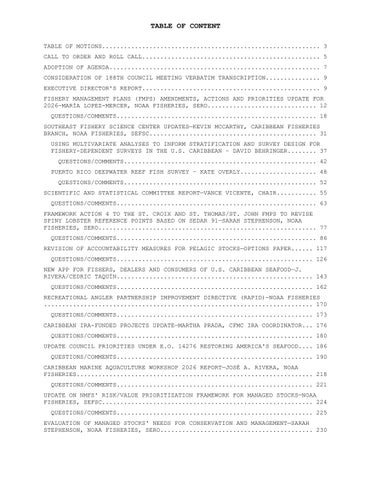
ACTION 4 TO THE ST. CROIX AND ST. THOMAS/ST. JOHN FMPS TO REVISE SPINY LOBSTER REFERENCE POINTS BASED ON SEDAR 91 SARAH STEPHENSON, NOAA
PAGE 71: The Council requests the SSC to provide additional
rationale for their recommendation to derive OFL (502,387 lbs.)
and ABC (443,062 lbs.) from the MSY proxy 30% SPR considering the
Puerto Rico spiny lobster assessment concluded overfishing was not
occurring in recent years (2022-2024) when average landings
(571,265 lbs.) exceeded the current OFL (426,858 lbs.) Motion
carried on page 72.
PAGE 72: The Council requests that the SSC consider alternative
approaches for setting the Puerto Rico spiny lobster OFL and ABC,
including setting variable OFLs and ABCs that are consistent with
the predicted values from the assessment to achieve optimum yield
while stock biomass is above the target level. Motion carried on
page 73.
PAGE 85: The Council select Action 1, Alternative 2 as the
preferred. Update the Saint Croix spiny lobster OFL and ABC values
and set the ACL equal to the recommended ABC of 186,063 pounds.
The ACL would equal 186,063 pounds. Motion failed on page 90.
PAGE 91: The Council selects Action 1, Alternative 3 as the
preferred. Update the Saint Croix spiny lobster OFL and ABC values
and set the ACL equal to 95% of the recommended ABC of 186,063
pounds. The ACL would equal a 176,760 pounds. Motion carried on
page 92.
PAGE 93: The Council selects Action 2, Alternative 2 as the
preferred. Update the Saint Thomas/Saint John spiny lobster OFL
and ABC values and set the ACL equal to the recommended ABC of a
132,964 pounds. The ACL will equal 132,964 pounds. Motion carried
on page 100.
PAGE 106: For Action 2, because Saint Thomas/Saint John spiny
lobster landings have been consistently higher than in the past,
the Council requests the Southeast Fisheries Science Center to
provide an interim assessment by December 2027 to update OFL
projections and inform catch levels using updated available
information (e.g., fishery-dependent abundance index). Motion
carried on page 107.
PAGE 108: The Council moves to approve Framework Action 4, U.S.V.I.
spiny lobster, and submit the action to the Secretary of Commerce
for review. We thereby allow staff to make editorial, non-
substantive changes to the Framework Action 4. We give the Council
Chair the authority to deem any modifications made to the proposed
rule and regulations as necessary and appropriate for implementing
Framework Action 4. Motion carried on page 109.
PAGE 202: Request staff to review the effectiveness and necessity
of the seasonal closure for Grouper Unit 4 in Saint Thomas/Saint
John, considering other management measures that restrict harvest
of the stocks and protect the habitat supporting those aggregations
such as the Hind Bank MCD and Grammanik Bank, among others. Motion
carried on page 204.
PAGE 208: Request staff draft an options paper to review the
effectiveness and necessity of prohibiting all fishing in the
Tourmaline and Abrir la Sierra seasonal management areas relative
to the management objectives to protect red hind. Motion carried
on page 211.
PAGE 213: Request staff to review the effectiveness and necessity
of the spatial and seasonal closures of mutton snapper in Saint
Croix relative to their management objectives. Motion carried on
page 216.
PAGE 241: Request staff to develop an options paper to apply the
Decision Tree for evaluating managed stocks presented by staff at
the April 2026 meeting and bring it back to the Council at the
August 2026 meeting. Motion carried on page 242.
PAGE 253: Motion to prioritize Motion 8 as #1, Motion 9 as #2 and
Motion 10 as #3 from the motions discussed today. Motion carried
on page 254.
The Caribbean Fishery Management Council convened at The Buccaneer
Hotel in Saint Croix, U.S.V.I. on Wednesday morning, April 21,
2026, and was called to order at 9:08 A.M. by the Council Chair,
Carlos Farchette.
CARLOS FARCHETTE: Okay. Good morning, everyone. Welcome to the
189th Caribbean Fisheries Management Council meeting being held at
The Buccaneer Hotel in Saint Croix, U.S.V.I. on April 21st 2026.
We're going to start with the roll call.
I’m going to start on my left with Cristina.
CRISTINA D. OLÁN-MARTÍNEZ: Good morning. Cristina Olán, Council
Staff.
LIAJAY RIVERA GARCÍA: Good morning, buenos días. Liajay Rivera,
Council Staff.
GRACIELA GARCÍA-MOLINER: Graciela García-Moliner, Council Staff.
MARÍA LÓPEZ-MERCER: María López-Mercer, NOAA Fisheries.
LOUIS ANTHONY BLANCHARD: Tony Blanchard, Councilman.
NICOLE F. ANGELI: Nicole Angeli, U.S. Virgin Islands Division of
Fish and Wildlife.
RICARDO LÓPEZ-ORTIZ: Ricardo López, Puerto Rico, DNER.
VANESSA RAMÍREZ: Vanessa Ramírez, Vice-Chair.
CARLOS FARCHETTE: Carlos Farchette, Council Chair.
MIGUEL A. ROLÓN: Miguel Rolón, Council Staff.
DIANA T. MARTINÓ NOGUERAS: Diana Martinó, Council Staff.
HEATHER BLOUGH: Heather Blough, NOAA Fisheries.
KATHERINE M. ZAMBONI: Kate Zamboni, NOAA's Office of General
Counsel.
JOHN WALTER, III: John Walter, Southeast Fisheries Science Center.
ROBERTO SABATER: Roberto Sabater, Council Member.
VANCE P. VICENTE CERNUDA: Vice Vicente, SSC Chair.
JANNETTE RAMOS-GARCÍA: Buenos días a todos. Jannette Ramos-García,
Outreach and Education Advisory Panel Chair.
GERSON N. MARTÍNEZ: Good morning, all. Gerson Martínez, Saint
Croix, DAP Chair.
JULIAN MAGRAS: Good morning, everyone. Julia Magras, DAP Chair,
Saint Thomas/Saint John.
NELSON CRESPO: Good morning, everyone. Nelson Crespo, DAP Chair,
Puerto Rico.
KEVIN MCCARTHY: Good morning, Kevin McCarthy, Southeast Fisheries
Science Center.
ADYAN RÍOS: Hello, everyone. Adyan Ríos, Southeast Fisheries
CEDRIC TAQUÍN: Good morning. Cedric Taquín, Puerto Rico DAP Member
and, PescApp.
JOSÉ RIVERA: Good morning, everyone. José Rivera, PescApp.
MARTHA C. PRADA TRIANA: Good morning. Martha Prada, IRA
Coordinator.
SENNAI HABTES: Buenos días. Sennai Habtes, Ecosystem-Based Fishery
Advisory Panel Chair.
DANIEL MATOS-CARABALLO: Good morning. Daniel Matos-Caraballo,
Puerto Rico department of natural and environmental resources.
WILSON G. SANTIAGO SOLER: Good morning, everyone. Wilson Santiago,
Puerto Rico Fisheries Liaison.
DINORAH CHACIN: Good morning. Dinora Chacin, NOAA Fisheries
Habitat Conservation Division.
CARLOS FARCHETTE: Okay, thank you. Online?
CRISTINA D. OLÁN-MARTÍNEZ: We have online, David Behringer , Kiara
Matías, Mick Walsh, Sarah Stephenson, Jesús Rivera Hernández,
Leigh Fletcher, Kate Overly, And Brent.
ADOPTION OF AGENDA
CARLOS FARCHETTE: Okay, thank you. Adoption of agenda. Any
additions or corrections to the agenda? Nelson?
NELSON CRESPO: Thank you, Mr. Chair. Nelson Crespo, for the record.
In other business, I want to read a letter received from the
Culebra Fishermen Association.
CARLOS FARCHETTE: Okay. Thank you. Yeah, I read that. Graciela?
GRACIELA GARCÍA-MOLINER: So, Mr. Chair, if I may, Graciela here.
I think we have a change to the agenda for tomorrow. The 09:30 to
09:45 2026 Annual Catch Limit Monitoring Updates that will be given
by Heather Blough today, right? Before the Pelagic Stocks Options
at 02:15.
Sure. Thank you. Graciela.
GRACIELA GARCÍA-MOLINER: And so that's a change in the agenda. And
the other. For clarification purposes, during the public comment
period, Nelson will read the letter, correct? Es que dijo,
“business.” Okay. Thank you.
CARLOS FARCHETTE: Anything further on the agenda? If not, we need
a motion to accept agenda as corrected.
LOUIS ANTHONY BLANCHARD: Motion to accept the agenda as corrected.
VANESSA RAMÍREZ: Vanessa Ramírez, second.
CARLOS FARCHETTE: Included a motion by Blanchard to accept the
agenda and seconded by Vanessa. All in favor, say aye.
CARLOS FARCHETTE: Next is
MIGUEL A. ROLÓN: Thank You, Mr. Chairman. We had an incident with
the SSC where we got unruly behavior through the internet. We had
to re-start the meeting. We are developing now a protocol to avoid
or minimize that happening in any meeting of the Council or the
advisory bodies. We received help from Kevin and other people. 1 They sent us information on how to establish that protocol that
will prevent this from happening.
At this meeting, we don't have it, but the Chairman has given
authority to Cristina to stop the meeting if something that
happened. Then we would try contacting the people afterwards. I
mean, it takes about maybe ten to twenty minutes to get another
zoom id and password. And, of course, the issue with this is all
this is public. And when you put it in the federal register, people
can pick everything from there and mimic the name of any of us and
put it in there.
The other thing for the record, please state your name before we
talk. I will say that I’m the first culprit. I forget to say it in
every meeting. But we are having some difficulties sometimes with
the people who do the translation. And this time, Mr. Chairman, we
have
DIANA T. MARTINÓ NOGUERAS: Yes. This is to excuse Kayla Ishida
from the U.S. Coast Guard. She just sent me an email saying that
she will not be able to attend the meeting today. Tomorrow, she
will be entering virtually to give the report.
MIGUEL A. ROLÓN: Thank you, Diana. They also promise to be at the
next meeting, if possible, in August.
KATHERINE M. ZAMBONI: Kate Zamboni, Office of General Counsel.
Just so the record is clear, the unruly behavior was not on the
part of any member of the SSC or anyone participating in good
faith. It was somebody that was intending to be a disruptor. So,
I just want the record to be clear that there's no reason to
follow-up with anybody that didn't obey our rules of conduct.
MIGUEL A. ROLÓN: Thank you for the clarification. We call it unruly
behavior because it's the only thing I found in the paper. So, we
call it that. But people call it hacking or related behavior. But
thank you for your clarification.
At this time, Mr. Chairman, if I may, I want to ask a minute for
a friend of mine, David Olsen. David Olsen passed this March 7th ,
2026. I met David in the seventies when he came to Puerto Rico to
give us a presentation about his dissertation. Through the years,
we met and worked on different projects and offices and everything.
But he was a former director of the Virgin Islands Department of
Fish and Wildlife. He did it twice. Firstly in 1990, and then in
2007. He also was instrumental in helping the fishers with the
science that they needed to provide documents for the Council and
other entities that were of importance to the fisheries of these
islands, they U.S.V.I. and Puerto Rico too, because he did some
work in Puerto Rico also.
He was a surfer. He loved sailing and diving. He told me one time
he was controversial, but with a good heart, whatever that means.
And at this time, Mr. Chairman, we would like to, after this
horrible sound there, the hotel is trying to fix that, a minute of
silence honoring Dr. David Olsen.
CARLOS FARCHETTE: So we're going to do a minute of silence.
CONSIDERATION OF 188TH COUNCIL MEETING VERBATIM TRANSCRIPTION
CARLOS FARCHETTE: Okay. Thank you. Next on the agenda is the
consideration of the 188th Council meeting verbatim transcriptions.
Any corrections to those minutes?
Hearing none, we need a motion to accept the verbatim
transcription.
LOUIS ANTHONY BLANCHARD: Motion to accept the verbatim. Tony
NICOLE F. ANGELI: Second, Nicole Angeli.
CARLOS FARCHETTE: Motion to accept the minutes verbatim
transcriptions. Motion by Blanchard , seconded by Angeli. All in
favor, say aye.
GROUP: Aye.
CARLOS FARCHETTE: Thank you. Moving forward, we have the Fishery
Management Plan Amendments. María López-Mercer. Oh, I’m sorry.
Yeah.
Director's Report.
MIGUEL A. ROLÓN: I need to talk a lot, but, anyway, very, very
quick. I will take this time to pass the word that I got from
Federal Register. The Federal Register is not going to publish
anything, after forty days. They require forty days before the
They said forty days before August 11, we need to submit the agenda
to the Federal Register. We can tweak it a little bit, 23 days
before August 11. They told us that this is the last time that
they would give us a break. But the issue with this is I need to
have that agenda at least two or three days before that date,
meaning forty days before August 11, and we can tweak it a little
bit twenty-three days. After that, it's locked. If we fail to do
that, then we need to move the Council meeting, and that costs a
lot of money because the contract with the hotels has to be done
actually right now. So, the staff will do their best to comply
with that requirement regarding the agenda.
The other thing is that we are receiving presentations on the date
of the meeting or the day before. We are not going to do that
anymore. You will have five days to submit the presentation to
Cristina. After that, if you have something to correct, you do it
here, and then you send us the presentation with a correction.
Cristina works eight hours a day, and anything after that, we have
to pay double. We don’t have that much money to pay Cristina. But
at the same time, Cristina is an excellent professional. Sometimes
she calls me at midnight “Miguel, I have this, to put in the
agenda. Should I do it?” So, I say, “if I were you, I would not
put it there.” So, anyway, please cooperate as much as possible
with Cristina by sending your presentation five days before any
meeting.
That also, for some of the presentations, for example, if we have
new information that we need to cover here, something that come
from some from María, Sarah, one of the scientists, we can make
room for that and put it there. But the rest, we are not going to
have any presentation after the five days included in our meetings.
I checked with the other Councils, and they're worse. They have
other strict measures of this. So, that's that.
And then with the budget, we are okay. We received money to cover
the second quarter of 2026. All the Councils are expected to
discuss this at the May meeting, the CCC in Alaska, where the
Washington folks are going to tell us the schedule for giving us
the rest of the money for 2026. 2027 and '28, are a question mark.
We don't know yet what is going to happen during those days, but
they told us that at least we will be able to have level funded
for those two years after 2026.
The AI policy, everybody now has worked with AI. The National
Marine Fisheries Service has had some cases where AI was inproperly
used.
For example, sending fake papers to affect the outcome of an SSC
meeting in one of the Councils. So, we were instructed, the
executive directors, to prepare a policy for using AI at the
Council level, and it will follow a similar approach of NOAA, not
NOAA fisheries, but NOAA level. For example, they adopted Gemini,
and they have courses that we need to take if we want to use it.
So, the protocol will be presented to you at the August meeting,
when we finish it. We also have to send it to the legal counsel
just to make sure that we are following the law, applicable laws.
There's another thing. We cannot lock up a meeting. For example,
if somebody if we have to stop the meeting here, we open it
again, but it has to be public. We cannot lock it. All of that
will be included in the protocol that we are going to send to you.
One thing that they told me to advise everybody sitting here is if
you use AI, you are responsible for the product. Staff members,
NOAA, Council Members, staff member of the Council. So, more
information will be provided at the meeting in August.
That's all that we have for now, Mr. Chairman.
Also, we want to welcome Olivia. She's the new Saint Croix Liaison
Officer. Angeli, would you like to Dr. Angeli, would you like to
say something about Olivia? I don't know if she's here or not,
but
MIGUEL A.
Where is she? Olivia?
MIGUEL A.
Esa no es Olivia.
NICOLE F. ANGELI: Good morning. Thank you so much. Nicole Angeli,
U.S.V.I. We have a new liaison for the Saint Croix district, Olivia
Walton, and she'll be joining us later today. Once she arrives,
I’ll make sure I ask the Chair if we can introduce her properly.
Thank you so much.
MIGUEL A. ROLÓN: And, also, lastly, Nicole Greaux, resigned
February, and I was advised by Dr. Angeli that they will be looking
into a replacement for her. Liaison officers are very important to
connect the communities, fishers, the government, etcetera, with
the Council and vice versa, the Council with the communities. So,
we have Wilson, in Puerto Rico, Ms. Olivia Walton now in Saint
Croix. We're looking forward to seeing who can replace Ms. Greaux
in Saint Thomas/Saint John. Thank you, Mr. chiman.
CARLOS FARCHETTE: Thank you, Miguel. So, moving on. Fisheries
management plan by, María López-Mercer.
MARÍA LÓPEZ-MERCER: Good morning. This is María López-Mercer with
NOAA Fisheries Southeast Regional Office with the Caribbean
branch. Like, at the beginning of every meeting, the Council and
us prepared a presentation that summarizes all the actions,
amendments, regulations, priority dates, etcetera, that the
Council discussed during the past meeting so Council members and
the public can get an update on where these stand currently. Okay.
We can go to the next slide, please.
Okay. So, this is where we are with three of the actions that are
in the regulatory phase, which means that the Council had already
taken final action and then NMFS, NOAA Fisheries, is responsible
for the regulations part, developing the regulations and comment
periods, etcetera.
So, Amendment 2 to all the Fishery Management Plans, this is the
trawl net gear and descending devices. It has been in effect since
November 3rd , 2025. The descending device requirement for vessels
fishing for reef fish became effective on April 1st . So, by April
1st you must have seen the Council outreach letting everybody know
about the requirement to have a descending device ready on the
boats to be used in case is needed, when the fish exhibits signs
of barotrauma, it’s in place since April 1st
Okay. So, with that, that concludes the actual action. Okay? So,
everything is in place for that action. So, the next time you see
this slide that's not going to be there because it's already
completed.
The next one is Framework 3 to the U.S. Virgin Islands Fisheries
Management Plan. This is SEDAR 80. These are updates to the queen
triggerfish from SEDAR 80. The final rule was published in March,
and it became effective in April, recently. So, the new ACLs for
triggerfish became effective. If you go to the Federal Register,
you will see that those new numbers are in there. With that, that
concludes the regulation and that action.
The next one that we are currently working on is Amendment 4 to 1 the Puerto Rico FMP, the reclassification as a pelagic fish for 2 rainbow runner. We're currently preparing the notice of 3 availability of the amendment, which means that it will open a
comment period of sixty days, where the amendment will be
published, and the public can revise this amendment and make
comments through regulations.gov.
Then, during that time, after the first thirty days, we usually
publish the proposed rule, which is what you are going to see in
the regulations that is going to make the actions in this amendment
be codified under the Federal Register. That's also going to be
open for a public comment for thirty days. After that comment
period ends, NOAA Fisheries will address any comments that are
received, either for the amendment or the proposed rule, and then
we'll publish a final rule when those comments are addressed.
After the final rule is published, there is a thirty-day cooling
period. We call it the cooling period, which is the thirty days
before any regulation becomes effective. We will notify the public
of the availability of all the comment periods through fishery
bulletins, and coordinate with the Council outreach and education
so they can ensure that this information is available to you so
you can comment, and also all the dates where this would be
applicable. Next slide, please. Okay.
So, this is what we are currently working on, the Council is
working on. We talked about it during the past Council meeting and
the one before about a modification to the pelagic AMs. The reason
is because there is no corrective action defined for accountability
measures for this group of species, which has been new to
management since the island-based FMPs were put in place.
It's important to get Council input. The Council provided a lot of
input. It was a really good discussion during the last time. And
then another reason is that this is a good opportunity to focus on
the trigger for the AM, which means, what is it? What needs to
happen for an accountability measure to be triggered?
So, as we discussed during the last time, the focus could be on
that AM trigger so that it provides the flexibility for NOAA
Fisheries on the Council to look at those landings and see what's
going on. So, we're going to be talking about that.
So, in the December 2025 meeting, I mean, the first column, yellow
column, there were some options, preliminary options discussed,
and there was some guidance provided by the Council as to what
they wanted to see up for discussion during this Council meeting.
So, during this Council meeting, the Council is going to be
reviewing an options paper, and go through those options, discuss,
give input, and see what they want to do next. Okay? So, this is
not an amendment yet. This is not an action. This is an options
paper where, again, we're going to be discussing what you guys
requested from staff to bring during this Council meeting.
The next action is SEDAR 91 spiny lobster Saint Croix, Saint
Thomas/Saint John. This is the modification of the reference points
for the spiny lobster in Saint Croix and Saint Thomas/Sain John
based on SEDAR 91. Why? Because there were assessments that
provided updates to these numbers, and then there's a need to do
an action to revise the ACLs, which will be based on the
recommendations from the ABCs.
So, during the December 2025 meeting, the Council discussed the
SSC recommendations. The Council also selected the P star (P*),
the probability of overfishing. And then, they provided options
for ACL buffers, which means what reductions they would see
included in an amendment, or in an action that could be evaluated
for that recommended ABC. So, all those things were done during
the December meeting. And then, the Council tasked staff to bring
a draft framework action that will incorporate those and an
evaluation and an analysis of the effects of the different
reductions or different buffers that would be applied to the ACL.
So, during this meeting, the expectation is that the Council
discusses the action. If they are ready to move on, they could
select preferred alternatives based on that after they discuss.
And if they are ready, they could decide to take final action,
too. So, when this is discussed today, the Council can decide how
they want to move forward.
The next action is SEDAR 91 spiny lobster for Puerto Rico. Again,
this is because there was an update assessment, and the result
from that update assessment would allow the Council to take action
to revise the ACLs based on those numbers that came from that
assessment. In December 2025, there were still pending updates
from the Science Center. They were working on updates for that
SEDAR 91. And then, also, after that, SSC reviews.
So, during April, earlier this month, the SSC met from the 8th to
10th, and they reviewed the outcomes from SEDAR 91. And then they
also provided ABC recommendations. So, during this meeting, during
the SSC presentation, the Council will review the ABC
recommendations and will also talk about the discussions that the
SSC had. They can review that, and then they can make decisions as
to how to move forward with an action to update ACL. So, that's
The next one is SEDAR 84, for yellowtail Puerto Rico and Saint
Thomas/Saint John, and then also for the stoplight parrotfish in
Saint Croix. Why? Because there were stock assessments that were
done for this species, and that will provide the opportunity for
the Council, through an action, to revise the annual catch limits
for those species based on the recommendations that come from those
assessments.
During December 2025, there were no further actions for the Council
because they were still pending some updates from the SSC, or from
the Science Center, and that will lead to what was discussed during
the SSC meeting. That happened during April 8th through the 10th
where the SSC reviewed and made their recommendations. Those will
be discussed also during the SSC presentation and discussion and
for the Council to consider what are their recommendations on
these, too. Okay. Let's go to the next slide, please.
Lastly, the review stocks. Review stocks need for conservation and
management. This is what we call the matrix. This was also set as
a priority for the Council back in August. This is an action that
the Council and NMFS have been presenting to you for discussion to
maximize management efficiency and, also, is one of the actions
that was included under Seafood E.O. 14276. This is the review, as
you all know, of the stocks that are currently managed under each
one of the FMPs to determine if they are still in need of federal
So, during December 2025 meeting, there was some discussion. During
the months leading to today, there's a working group that has been
working on that Decision Tree. The idea today, for the Council, is
to take a look at the presentation on the Decision Tree, which has
some criteria that could be used or could be proposed to move
forward with this action as to help the Council, assist the Council
in making a decision as to whether there are any species that we
need to reevaluate, the need for conservation and management, and,
also, if there are some of those species that could be moved to a
category that is called ecosystem component species because of the
role that they have in the ecosystem.
So, that's another presentation that we are going to be seeing, I
believe, today. Yes. Okay. So, at this point, as you will hear
from Sarah when she's giving the presentation, the idea is for the
Council to provide input on that Decision Tree so the working group
can continue working on that. This one is a little tricky, so it's
very important, your input is super, super important.
The other one that I decided to put in here because it's something
that we have talked about in the past. We were waiting for a couple 2 of things to happen before. It's the revision of AMs for Puerto
Rico's spiny lobster. Why? Because there's a need to address ACL
overages that have been happening pretty much every year and also
reevaluate current AMs. As you all may recall, that has been on
hold because there's other things ongoing, such as the SEDAR 91
reviews and the SSC, etcetera.
So, we just wanted to bring it here because this is something that,
eventually, once the Council is ready, they may want to decide to
move forward with this. Okay? So, something to consider. Okay. The
next slide, please.
Okay. So, we introduced this during the last, Council meeting.
It's a prioritized list of actions to NMFS that were submitted by
the Council on E.O. 14276. These are some of the items that the
Council wanted to explore.
One of them is the revision of incompatible regulations between
territorial and federal waters. That's an action and it's something
that the Council would like to consider. So, there's also revision
of duplicative regulations in federal waters. There’s been
expressed interest in evaluating the regulations currently
applicable to Puerto Rico West Coast Marine Managed Areas,
specifically Tourmaline and Abrir la Sierra. With regards to these
two, revision of incompatible regulations and revision of
duplicative regulations, depending on the actions that the Council
decide to move forward with today or not, it's advisable for the
Council to consider if there's any of these items in here that
were listed priority that the Council may be wanting to task staff
to start evaluating.
If there is time during this year and the workload gets a little
bit lighter depending on what happens, today and tomorrow, then
maybe tomorrow, the Council can go back to this and discuss and
say, “Okay. So, these are the things that we want to focus on based
on this list.” The example that I have here is for Puerto Rico
because that was something that has been explicitly discussed
during past Council meetings.
This is an evaluation of the current regulations that are
applicable to these two areas. Tourmaline is an area on the West
Coast of Puerto Rico that is shared between state and federal
waters, and it was originally put in place to protect the red hind
spawning aggregation that occurs in that area. It's the same for
Abrir la Sierra, although Abrir la Sierra is completely in federal
waters.
So, there are regulations that are applicable from December 1st
through the last day of February, for both, to protect the hind
aggregations. However, there are also other regulations that apply
to the red hind that could be evaluated as well to see if there is
a need to remove the duplicate regulations if that's the case or
if there are other things that the Council would like to explore,
in terms of the regulations that apply. For example, are the
objectives of these marine managed areas, the reason what they
were put in place, are they still valid? So those are some are the
things that the Council can ask staff to start evaluating.
And then in terms of the U.S. Virgin Islands, well, the Council
can also identify if there's anything from the U.S. Virgin Islands
that has either been discussed in the past or that they would to
look into here. So, that's a discussion that can be had later, Mr.
Chair.
We'll also talk about exploration of carryovers of unused ACLs.
That one is a little bit more complicated, based on data lags that
we have in the Caribbean, at this time, but that's something that
could be explored as well. There's also the SEDAR 103, which is
the U.S. Caribbean Application of Alternative Assessment Methods,
which the expectation is that it will provide ways, better and
more efficient ways to assess the species that are more in tune
with the nature of our fisheries.
So, that is a process that is ongoing, and the Science Center is
going to give us an update on that later on. And then we added
“Other (Council to provide input)” because if there are other
things that the Council will want to discuss during this year or
set as a priority for the next year, then, that can be discussed
during this meeting. Okay. The last slide, please. Okay.
So, this is just important reminders of things that are in place.
Size limits for all harvests of dolphin and wahoo are in place.
They have been in place for a while. It's important, I think we
have talked about this in the past, to consider that we know that
there are some discrepancies between these regulations and state
regulations, so that's a good conversation that the Council, at
this stage, may want to have. That way we avoid regulatory
loopholes on this. Right? This is an amendment that the Council
voted on last year, and these regulations are in place.
The Council's outreach and education have been promoting and doing
outreach on this. And one of the requests that we may want to make
for outreach and education is to continue to put in effort on this.
Super important.
Recreational bag limits for dolphin and wahoo are also in place.
And then, as I mentioned earlier, the prohibition on the use of
nets, except for a specific gillnet for certain species. If you
recall, there were some exceptions for species that are not managed
by the Council, which are baitfish. And there are specific
measurements for those nets, and those are all in place for federal
waters.
And then, as I mentioned earlier, the descending device requirement
for fishing vessels, all vessels, recreational and commercial that
are fishing for reef fish, has been in place since April 1st, 2026.
So, thank you everybody for everything that you have been doing to
conserve our species, especially the use of descending devices.
Okay. SO, that's all I have. Open for questions or discussion?
QUESTIONS/COMMENTS
CARLOS
MIGUEL A. ROLÓN: Thank you, Mr. Chair. Miguel Rolón, for the
record. María, what will be the best use of this time that you
recommend And, by the way, thank you for the excellent report as
always. So, the Council can then move forward with the actions
that we need.
MARÍA LÓPEZ-MERCER: I think for the first, second, and third, I
mean, obviously, it's an update of what we have been doing. So, I
think it will be nice if the Council wants to take any of the
actions you want to go to the one before, please? If the Council
wants to, I don't know if we have enough time to discuss anything
about compatibility of regulations or duplicative regulations,
maybe this will be a good time to talk about that. Because I don't
think there's any other space allotted in the Council's agenda to
talk about any of these other things. I’m going to focus here, in
the “Other (Council to provide input)” of anything else. So, we
can certainly discuss anything that you want to discuss right now.
I think we have it's 09:39, and this goes until 10:15. So, okay.
CARLOS
GRACIELA GARCÍA-MOLINER: So, a question for Nicole regarding you
do have now compatible regulations regarding size of dolphinfish,
and wahoo and bag limits. Right? Or you've been talking about it.
I just wanted an update
MARÍA LÓPEZ-MERCER: On yeah.
NICOLE F. ANGELI: So, thanks. Nicole Angeli, U.S. Virgin Islands.
So, we did receive a letter from the Caribbean Fisheries Management
Council earlier this year, and we're still drafting a response in
regard to compatible and incompatible regulations. As we've
expressed to this body before, we do have a list of regulations
that are and are not compatible, federally and territorially. And
this has been a project of our Fisheries Advisory Committees, which
are our territorial equivalents, really, to our Council, but
they're an advisory body. And so, they've suggested different
approaches for us to make more consistent the federal and the
territorial regulations.
At this time, our dolphin and wahoo regulations are not compatible
between federal and territorial waters.
CARLOS FARCHETTE: Ricardo?
RICARDO LÓPEZ-ORTIZ: Thank you, Mr. Chairman. Ricardo López, for
the records. This morning, the update was that the fisheries
research lab wrote a letter to the secretary of DNR requesting
full compatibility in terms of wahoo and dorado, and I’m waiting
for that answer.
Yeah, dolphinfish and wahoo. We are waiting for that answer, but
we request the compatibility to be full. That's my comment.
CARLOS FARCHETTE: So, I have a question. How do we initiate the
start of discussing compatibility? Because I know the territorial
FACs submitted their recommendations a couple years ago. So, I’m
not sure when we can start to discuss this.
NICOLE F. ANGELI: So, yeah, Carlos, Mr. Chair. The exercise that
we worked on with our Fisheries Advisory Committees was really the
creation of a work plan, looking at what was very possible for us
to do, things that our commissioner could easily change, and then
things that were a little more challenging to do that might have
to go into our rules and regulations. And last, drafting
legislation that our senators would have to bring to our
legislative bodies.
And so, we have been diligently working first on the things that
are easiest, those declarations that we have promulgated,
including one that we had discussed, I think, at the last, or the
one before, Council meeting. So, we are working on those. We are
working on drafting those legislative pieces, and our legal
counsel, who has been on board now for about fourteen months, has
been working with our fisheries biologists, reviewing all of our
rules and regulations, the federal and the territorial statutes to
ensure that we have the best possible legislation available when
legislators come to us and say, “hey, we're ready to go.”
We have been doing a major update to our entire title in our
mandates so that we have more flexibility in the future. I mean,
we still have things in our books from 1973, a 25¢ bounty for
mongoose. So, we have a lot that we really need to work through in
our statutes, but I promise you we have not forgotten that
exercise. It was one of the, I think, most exciting things that
we've done on our Fisheries Advisory Committee in the past several
years. And we are looking at it as our work plan and how it guides
all of our policy.
MIGUEL A. ROLÓN: Yeah. Yeah. We are talking one way from the
federal to the local government. Are there any species that the
local government, both Puerto Rico and Virgin Islands, believe
should have compatible regulation at the EEZ level, provided that
they comply with the requirement that the species must be present
in the EEZ, part of their life history, etcetera. Any species at
this time that you can identify that we need to work on it, or are
we okay with that?
NICOLE F. ANGELI: Yeah. Nicole Angeli, for the U.S. Virgin Islands.
I think that a request for a list of species that we could work on
is something that we could address in our response letter, which
we're still working on. So, thank you for the question.
RICARDO LÓPEZ-ORTIZ: Yes, Ricardo López for the record. In Puerto
Rico, at least, what I believe is that we are okay with the
compatibility as it is right now.
CARLOS FARCHETTE: Graciela?
GRACIELA GARCÍA-MOLINER: Thank you for that response. I do have a
question regarding, for example, the comments about opening MPAs
and maintaining just seasonal closures for the species across. So,
would that be something that we could ask for in reference to
whether you think it's a good idea or not and whether it would be
compatible in the territorial and state waters? So do away with
the MPAs. Close the season for those species that were protected
in those MPAs.
See what I mean? So, either one. Yes. So, would that be one specific
item to put at the top of the list on the agenda?
NICOLE F. ANGELI: I think at this time, it it's challenging for us
to give you good feedback on where we want you to prepare a work
plan and to move forward. And we would prefer to respond to
prioritization and strategic work plans with a little more
preparation, because we do have that very long list of things that
are compatible and not compatible, and many of the items that we
would want to change are on our territorial side. And so, I think
at this time, we don't want to have or to task the federal Council
or Fisheries Science Center with anything specific.
RICARDO LÓPEZ-ORTIZ: Yes. For Puerto Rico DNR, Ricardo López. We
are open to reanalyzing anything that you will suggest to us. So,
please go ahead and write us an email or a letter with that request,
and we will do the analysis.
CARLOS FARCHETTE: Julian?
JULIAN MAGRAS: Julia Magras for the record. This is for María. My
question is I don't know if this is where it falls in. Is where we
at with the suggestions or the request I’m going to speak for
Saint Thomas/Saint John that the Fisherman’s Association asked
for, as it pertains to Executive Order 14276, for changes to be
done. For example, seasonal closures, etcetera, etcetera. There
was a long list, and I know at the last meeting, it was said at
this meeting, we will be given updates on where we are at with the
request.
So, if I could get some clarification on that.
MARÍA LÓPEZ-MERCER: Yeah. Thank you, Julian. This is María. But
that's what we're talking about right now. We're talking about
that's on number one and number two, revision of incompatible
regulations between territorial, federal waters or duplicative
regulations. Those things will fall in there.
If you look at the list of priorities that were sent by the Council
to NMFS, I think that's a discussion that we're going to have later
today. I think that it will also be a good time to talk about that.
But that's precisely what we're talking about right now.
For example, for the seasonal closures. The example that I have,
that's something that I know that we have been requesting also,
same as yours, several times, is, for example, Tourmaline and Abrir
la Sierra. I mentioned earlier, the evaluation of the red hind
seasonal closure in that area. Plus, the red hind seasonal closure,
which the seasonal species closure is also occurring at that time
and see if there is a way to remove or modify some of those
regulations so that they are not duplicative.
So, that is something that could fall in there and the Council
could decide, “Hey, we want " maybe when we're discussing later
today or tomorrow the E.O. 14276, that list of priorities that
will be brought back to you, you can say, “Okay. Council, we want
for staff to start discussing that.” The same for, what the U.S.
Virgin Islands have been requested through the 14276.
So, what time is that? If somebody can check me. It's tomorrow,
before noon. There's going to be that list of things that were
requested, and I think that will be a good time for the Council to
make decisions as to how they want to move forward and start that
evaluation.
So, that's where we are right now, and I hope that answers your
question. Okay.
CARLOS FARCHETTE: Okay. Do you want to say something else before?
MARÍA LÓPEZ-MERCER: Think, we're good for now. I think the request
for seasonal closures, evaluation, etcetera, can be discussed
tomorrow when they have that list. So, I don't know. I think
there's a comment here from somebody else. We're good on our side.
CARLOS FARCHETTE: Nelson?
NELSON CRESPO: Thank you, Mr. Chair. Nelson Crespo, for the record.
I am wondering about the status of the compatibility regulation
for the descending device in Puerto Rico, because most of the under
management are caught in the risk species under management are
caught
waters.
RICARDO LÓPEZ-ORTIZ: Yes, Ricardo López. Nelson, thanks for that
question. We don't have that compatibility yet. We don't have a
request for that yet. But we can work on that. If the request comes
to our office, we will lead the way.
CARLOS
María?
MARÍA LÓPEZ-MERCER: Thank you, Mr. Chair. With regard to this, I
want to remind the Council that one of the things that the Council
decided was that every time here was an amendment, regulations
that are finalized or an amendment, and it goes for final actions,
the Council decided to send a letter to the states requesting
compatibility of regulations, consistency of regulation as much as
possible.
That letter, I believe, is going to be, now that the descending
devices is effective, that letter will be prepared by the Council
and sent to the states with all the regulations that NOAA Fisheries
For the dolphinfish and wahoo amendment, Amendment 3, those letters
were sent to the states, and that's what both Nicole and Ricardo
were referring to because the Council is requesting those
regulations. So, that's coming. I think staff were going to be
sending those letters out. So, every time there is an action that
the Council takes final action and there's regulations that’s going
to be implementing those actions, then that letter will go as a
request to the Councils.
Then, the other thing I wanted to mention regarding compatibility
is that we work with Council staff and prepared, for Puerto Rico,
we prepared basically the equivalent that the U.S. Virgin Islands
prepared, in terms of a list of the regulations that are compatible
and noncompatible. Some of them, the state would have to make those
changes. Some of them federal would have to make those changes.
So, we have been working with the DNER, and we'll be working with
the U.S. Virgin Islands too to go through that list and see what
those priorities are.
I think at this point, perhaps, maybe, it will be something that
could be presented in August when this list is more refined, and
we have an opportunity to meet with that. But we have been working
on that, identifying what things are not compatible. And as Nicole
mentioned, there's a long list of things, so it's very important
for the states and for the federal to prioritize how they want to
do this, based on the workload and based on the things that are
more doable than others, right? So, okay. Thank you.
Heather?
Thank you. Heather Blough, NOAA fisheries. So,
Sarah will be presenting this afternoon the options that we've
been looking at for revising the list of species that we might
want to include in the various FMPs. I’m just wondering if this
first bullet from what I’m understanding, the first bullet
wouldn't really be Council action to revise federal regulations,
but more territorial action to revise state regulations to be
consistent. And if that's correct, I’m wondering if we would want
to consider having the work that PRDNR is doing to respond to the
letter in terms of planned changes in territorial waters. What you
have planned or not planned could maybe be incorporated into the
development of that document because we'll be looking at, like,
where federal management is effective, is not effective, and our
work with the states on managing those species.
It just seems, to me, it might be more related to that document
that we're developing, looking at where we have coordinated
management or not, versus developing a separate action related
just to that.
NICOLE F. ANGELI: Mr. Chair? Yeah. Can I just? Just to ensure that
I’m understanding. I just want to repeat back what you've just
suggested, which is to not conflate the issues of the dolphin and
wahoo regulations in that request letter, but to help support us
with the process that we're working on to look at those compatible
regulations. You mentioned PRDNR.
SO, are you working on a specific document with them that's outside
of what I’m understanding?
HEATHER BLOUGH: I’m sorry. I meant DPNR.
NICOLE F. ANGELI: Okay. Okay. Very good. So, you're suggesting
that SERO provides support for us as we work on that plan? I’m
sorry. I’m just not understanding.
HEATHER BLOUGH: Yeah. I probably didn't articulate it well. So,
from what I heard you say so, I think I’m hearing from DNER that
we're mostly compatible, and there's no real changes planned. For
DPNR, I understand you guys are looking at areas where you may
want to implement compatible changes. Maybe in some cases, yes, in
some cases, no, and that you guys are going to develop some sort
of a You're going to let us know what. You’re working with the
DAP to figure out what those will look like. What we do with that,
right, I think that response could inform our work on the species
matrix, how we decide to move forward with federal management of
certain species versus not.
I don't think it would result in a Council action because the
change wouldn't be for federal waters. It would be so, instead
of keeping a separate action, right, prioritizing this among other
act that would just end up informing our work on the action that
we're already developing. Does that make more sense?
NICOLE F. ANGELI: Yeah. Yeah. Thank you.
HEATHER BLOUGH: Okay. So, it would I think, just the discussion
and maybe we can have it when Sarah presents that action. I think
that would be more around, maybe, the timeline for when you guys
think you'll have something ready and how we could incorporate
that into the evaluation that we're the Decision Tree she's
working on.
NICOLE F. ANGELI: Sure. That sounds great.
HEATHER BLOUGH: Okay. And if there are changes for federal
management, of course, we could do that in a separate I just
wasn't hearing that.
NICOLE F. ANGELI: Okay.
RICARDO LÓPEZ-ORTIZ: Thank you, Mr. Chairman. Ricardo López. Just
to clarify, in Puerto Rico DNR, we don't have full compatibility
for all the species. But in most of the cases, we have full
compatibility.
Some cases the lobsters and the wahoo and the dolphin fish, we
don't have compatibility. But with the ones that we are dealing
with now, the dolphinfish and the wahoo, we are requesting full
compatibility with the federal government. Thank you.
MARÍA LÓPEZ-MERCER: Yeah. This is María López. I just want to give
an example perhaps of what we're talking about. So, for example,
Puerto Rico, there's a mackerel. The mackerels are species that
are managed the Council started managing this species with the
Island-Base FMPs.
Puerto Rico manages the mackerel with size limits. They have been
having those size limits forever, right? So, the mackerel in
federal waters in Puerto Rico does not have compatible size limits,
and that could be creating some loopholes that the Council may
want to address. However, the mackerel is also a species that is
included in the Decision Tree, right? So, it's a species that the
Council is going to make decisions like with other species, whether
the need for conservation and management in federal waters
continues to be something that needs to be done.
So, before the Council perhaps considers going with compatible
size limit, if that is what they want to do, right, if we're moving
tower compatibility, there's that process of evaluating the
species, right? And this is something that also falls within other
actions that the Council will be taking. So, these are things that
are all happening at the same time.
So, if we're evaluating species, we're considering what
regulations the states have in place for those species and also
seeing how the species are being managed at the state, and it could
be species that are more abundant or more fish state waters,
etcetera. All of those things, the Decision Tree is going to be
considering, as well as the current management that we have that
if the species ends up, for example, continued to be managed under
federal, then there are going to be things that the Council may
want to consider in order to make those regulations compatible.
And then the same would apply to the states if that's something
that they want to do as well. Thank you.
MIGUEL A. ROLÓN: Yeah. Yeah. We also try not to complicate matters
more than needed. I liked what María said before. When we get into
the meeting in August, we can have a list of those species that we
manage in the local government of Puerto Rico, the local government
of the Virgin Islands, and the federal government. That will be
our road map.
Because many of those species, we don't know. Some of the species,
we even forgot that we have regulations in either of the three
jurisdictions. So, we need to look at that, so everybody will know
what it is that we're talking about.
So, that's why I wanted to pursue María's idea a little bit because
that probably will be the next step at the Council meeting. Between
here and the next meeting, we are going to send a letter about the
descending devices to both governments. That's okay.
But then we also, Graciela and the staff, María and Sarah, we look
at the species that we have compatible regulations and the species
that we do not have compatible regulations. And then look at ways
that we can solve that matter, either by because some of the
species can be dropped from the EEZ. So, the regulations in Virgin
Islands or the regulation in Puerto Rico will predominate. For
those species, that are predominantly in state waters. And for
other things that we do with the species in terms that we manage.
That complies with the 14276 because they are looking at we
cannot talk about the matrix that we're developing, but we also
have been working with a matrix for several years now, and Sarah
has given the presentation to us several times.
So, María, do you think that if we follow your idea, we can have
at least a simple list at the next meeting or some time that people
can take a look at it?
MARÍA LÓPEZ-MERCER: I think this is also part of the Decision Tree.
This is actually part of what the Decision Tree is evaluating.
Right? So, the list of species that are currently federally
managed, the Decision Tree is going to apply to all of that. So,
all that information about whether it's a species that is managed
under state, what regulations the state have, what we have, what
we don't have, landings, predominantly, where is it landed, where
is it fished, etcetera. All of those things are part of the
Decision Tree.
So, my recommendation will be, at this point, just to let the
process of the Decision Tree bring that to the table, and then the
opportunity for the states to provide their input. It’s part of
this process that the Council and NOAA Fisheries are expecting at
this point because, obviously, the state’s input on this is super,
super important. So, yeah, we're getting there.
CARLOS FARCHETTE: So, on that same note. So, maybe, in August,
when we look at that list, we can look at the regulations that
Nicole mentioned that may need legislative action opposed to those
that don't need That the commissioner has started to promulgate
changes. A good example is that the use of fish traps by
recreational fishers in the federal side is prohibited on the local
side, but I don't think that needs legislative approval. So, we
can separate all of those and then make it easier. The simple ones.
MARÍA LÓPEZ-MERCER: Yeah. This is María. So, there's information
in the matrix already as to whether there are compatible
regulations between federal and state waters. And I think if it's
helpful, that could be we can prepare a table or bring that table
that is already in the matrix specifying, “okay, this is compatible
or not.” And, of course, whatever is under federal jurisdiction
and there's something that the Council can actually take action,
well, that's something that can be discussed here. But then there's
other things that belong to the state, and that's their prerogative
whether they are wanting to do that or have the capacity to do
that, etcetera.
But we can certainly, obviously, prepare something simple that
shows, okay, so these are the areas where we will need
compatibility versus not, so we can all have an idea of what we're
looking at. But Sarah, in her presentation and in the Decision
Tree, she already incorporated all of that. So, we'll make sure
that everybody can have access to that.
JULIAN MAGRAS: Yeah. Julian Magras, for the record. So, as a
fisherman, I see a lot of issues when it pertains to compatibility
because some of the species are harvested more in local waters
than in federal waters. And if for some reason the federal
government decides that the iguana fish has a problem in federal
waters and want to shut it down, but the iguana fish doesn't have
a problem in territorial waters, if we do compatibility and they
shut down the federal waters, automatically, the local water shut
down. And I have a serious problem with that as a fisher because
my future depends on this and my fishers and future generations.
And the reason saying that because I have seen over years of being
involved, different presidents on their way out of office,
especially democratic presidents. I’m just saying it because
that's how it is. Have made decisions to make large area closures,
or we're going to do away with this species, etcetera, etcetera.
That can affect the future livelihood of the commercial fishers in
territorial waters.
So, all I am requesting that when we go through this process, my
local government, Nicole, her staff, which we have the FACs, which
I was involved in that document a couple years ago when we
discussed it, that we are very careful in what we decide
compatibility to be.
And as it pertains to Puerto Rico, a perfect example is the
lobsters, and it's going to be discussed here very soon on the
agenda, and we're going to discuss it heavily. So, we must take
our time when we are looking at compatibility. Some can work, which
is very easy, descending device. The large parrotfish. We already
did the yellowtail snapper. Those are just examples. Nassau
grouper. Those are easy ones.
But when we come to the individual stocks, we need to be very,
very careful on how it's addressed. I understand the concerns of
the management, but I think there are ways around it.
LOUIS ANTHONY BLANCHARD: Tony Blanchard, for the record. Let me
just piggyback on what Mr. Magras says. Let me move this away
because I’m loud. I do believe and I do understand the need for
comparability, but I don't believe in putting all the power in one
man’s hand. Meaning, once you go compatible, just like he says,
for whatever reason, we got one man running the show. And a one
man is either federal government or local government.
Now, the federal government always holds a stronger hand. Whichever
way you want to turn it, that's just how it is. So, just like him,
I think we need to be very, let's say, serious about how we take
this decision. Because, although I believe in compatibility, I
don't believe in full compatibility. Because if and it's just
like religion and government. You don't ever mix them too. Well,
just like the state Ah. No, okay, good.
We should not have the state and the federal government being in
full compliance because you put all power in one man’s hand. So,
to the end of the day, guess who holds all the cards? Guess who's
making all the decisions? So, I will agree with him. And, yes, I
should be sitting on hand, saying we should go compatible straight
across the board, but I am not a blind man walking through the
door.
FARCHETTE: Miguel.
MIGUEL A. ROLÓN: Yeah. Just to clarify, both of you are right.
When we say compatibility, that doesn't mean that it would be
identical in every means or way. So, what María is bringing to the
attention to the Council is that they are preparing this list where
you can analyze the species that you have, which species have a
regulation in the federal government, which have regulation in the
local government, where they are landed or where they are caught,
which is really the important part.
Since the get go, since the beginning of the Magnuson-Stevens Act,
we identified the species that are predominantly in federal waters,
predominantly in the local waters, and the ones in between, that's
why we have the species management plans that we have.
If you look at the spiny lobster, it's the only species that have
compatible regulation across the Caribbean and the U.S. Caribbean
with the 3.4 carapace length, except for Florida, they have 3.0.
So, that was a decision made by all the countries, taking into
consideration the fishers, the way that they fish, and the
socioeconomics issues were involved. So, that's why I believe that
it is very important that every Council member and the members of
the of the advisory bodies and the public will be presented with
that list of species. So, you can go one by one, and then you can
say, not blindly, but you can say, “Okay, these species could be
compatible or are in need of compatible regulations. Some of these
species might not be in need of compatible regulation.” That's
what Nicole was saying too. They will be prepared probably by the
meeting.
The mechanism that we have is the Decision Tree. With the Decision
Tree, you start with the number of species, and then you go down.
You go through them; you look at each one of them. The status they
have, the regulations they have, etcetera, and where they’re caught
and where the regulations are. That's why I agree with both of
you, Julian and you, because we are not asking the Council to
blindly approve a blanket of compatible regulations. Neither are
the local governments asking for the same thing.
So, remember, under the Magnuson Act we have to also have a
rationale for everything that we do. It has to be supported by
science and supported by everything before we make any decisions.
So, what María is presenting today is sort of a schedule of event
that is going to happen. So, we are going to be addressing these
compatible regulations. And the 14276 called for all the Councils,
the National Marine Fisheries Service, to take a look at all the
species that we manage and decide which one you will manage in
another way. Which can you drop from the management plans that you
have because you can put it into the ecosystem, etcetera.
So, the schedule, María, will be then for the next meeting, we can
discuss the table. What is, in your words, what we are going to
have for the next step in August?
MARÍA LÓPEZ-MERCER: Yeah. Thank you. This is María López. So, at
this time, I think we should let the presentation of the Decision
Tree take place, and I think that will give Council members and
the public an idea of how this is moving.
Again, at this time, there are no decisions. This is the
discussion. I think that discussion is going to be happening today
when the presentation and then discussion starts happening. Then,
the Council can decide what are the next steps of what they want
to look at in August. Right?
So, consistency, compatibility, whatever makes sense is what we're
thinking. Right? And there are, as I mentioned earlier, other
processes that are ongoing at the same time, dropping species,
changes here and there, etcetera; SEDAR 103 helping the Council
make decisions on how to manage, etcetera. So, I think it's very
important to take all of that into consideration, and then we'll
listen to that discussion a little bit later today and wait on
that. Yeah.
Okay. And then, Mr. Chair, I think I’m done with this part. Right
on time. I’m proud of that. So, it's 10:13. Okay. Thank you.
CARLOS FARCHETTE: Thank you, María. Yes. Let's take a quick,
fifteen-minute
break.
CARLOS FARCHETTE: We're going to get started again. Next on the
agenda is the Southeast Fisheries Science Center with Kevin
McCarthy.
KEVIN MCCARTHY: Thanks, Carlos. Kevin McCarthy, Southeast
Fisheries Science Center.
Can you not hear me now? How is that? I can project. How's that?
DIANA T. MARTINÓ NOGUERAS: I’m going to be giving these papers for
the lunch menu so that everybody marks what they want, and I can
give them to Brad so that he can prepare them. This way we’ll have
a little less time to wait for it to be served. Thank you.
KEVIN MCCARTHY: Okay, Carlos. We ready to get going?
FISHERY SCIENCE CENTER UPDATES KEVIN MCCARTHY,
CARIBBEAN FISHERIES BRANCH,
KEVIN MCCARTHY: Okay. We'll try this again. So, Kevin McCarthy,
Southeast Fisheries Science Center. Welcome back from break,
everybody. The good news is for the next forty-five minutes you
don't have to make any decisions. I’m not going to tell you about
who got arrested. We're going to wait for that for tomorrow. And
you can just sit back and relax, and, hopefully, everything is
interesting and informative.
So, I’m going to give the update for the work that the southeast
fisheries science center is doing here in the U.S. Caribbean. These
are some of the topics we'll talk about. I’m going to give a brief
overview of the various SEDARs. That's 84, 91, and 103. I won't
steal any of the punchlines from our SSC Chair. He'll get into
more of those SEDARs, after this presentation, but I’ll just give
you sort of an intro to them.
Then we'll talk about some social science projects, collaborative
research projects, some other projects that the Caribbean
Fisheries Branch is doing, some fishery-dependent work, Puerto
Rico deepwater snapper survey, and a lobster recruit survey if we
have time. Those last three will be more in-depth presentations,
maybe ten, twelve minutes each, and we'll have other speakers. You
won't have to listen to me droning on and on. We'll have two
different speakers talking about fishery-dependent surveys and the
survey.
So, let's talk about the stock assessments. So, we'll talk later.
The Council will ponder later, results of SEDAR 84. There were
some additional model runs that were requested by the Council and
as recommended by the SSC back in September. We had planned on
providing those in the fall, but with the lapse in funding and
everything, we had to move that to the SSC meeting, here in April.
So, those were reviewed then.
There were no additional modeling requests to consider for the
U.S. Virgin Islands. And so, all of these models went through CIE
review. So, that's Center for Independent Experts. That review was
last summer. They didn't recommend additional work in the U.S.
Virgin Islands, so they were presented as is to the SSC, during
that April 8 through 10 meeting. So, the Chair will tell you more
about the SSC deliberations of those.
So, spiny lobster, SEDAR 91, this goes back a way. So, there were,
at the Council meeting back in August, some requests for additional
analyses. We have to give credit to DRNA and their presentation of
some nominal indices of abundance and really sticking with the
value of those indices. So, my group developed what we call a
standardized index of abundance. What we ended up with was a fish
trap and a dive index, two separate ones as those data were handled
separately. And, again, this was Puerto Rico DRNA really, really
leading the effort to get those included.
The work was done back at the Science Center, to take their initial
work and expand upon it. These were very significant and positive
additions to the assessment process. And again, this was reviewed
during that last SSC meeting, April 8 through 10.
So, on the right I don't know if you could see. Yeah. You can.
So, on the right here, these are the indices. So, the longer time
series is the fish trap. The shorter time series, that gray line,
is dive.
These were truncated. The data do go back to 1983. However, due to
available data, what we need for one of these things is not just
what was the catch per trip, but what was the catch per trapped
fish? What was the catch per diver? So, we need some very detailed
effort information.
When you look at all that and look at the data that's available in
the logbook, in the CCL, you have to cut off the time series a
little bit. But still, 2001, to 2024 and 2012, I think, to 2024.
We don't quite know what was going on with that big drop in 2013.
But overall, what you see is an increase as fishers have been
reporting. There are more lobsters in the water, and that's
certainly backed up by these indices.
And so, you see a really strong increase in the relative abundance 1 of lobsters in the water as seen by these data. And these are,
again, the CCL data. So, those were included in some additional
modeling runs, which Vance will talk about in the next
presentation.
So, an update on SEDAR-one 103. This is the process that's ongoing
now. And the whole idea there is to look at alternatives to the
kind of single species stock assessments that are really data
demanding. So, the kinds of assessments that you all have seen
take a long time to do. It requires a lot of data. We're looking
at other approaches so that we can provide more timely information
for the Council to act upon and also more rapid turnover, and more
species that we’ll be able to provide some scientific information
for the Council to act upon it with management actions.
So, the goal here is to really have an analytical approach
recommended for every federally managed species in the U.S.
Caribbean. Right now, we don't have that because a lot of species
are really data limited. So, we want to be able to have an approach
for every species. So, we've got an organizing committee that's
made up of Council staff, SSC members, a lot of the SSCs are part
of this process, Science Center, the University of Miami, CIMAS
group, and also the SEDAR staff are involved.
So, so far, we've had two webinars that have provided overviews of
fishery-dependent and fishery-independent data. The idea isn't
really to review the available data, but we have over 50 experts
involved in this process, and they're not all familiar with the
kinds of information we have in the Caribbean. So, that's the idea
of these webinars.
We'll have an in-person workshop where we really go over the
methods. What methods are people bringing to the table that will
help provide management advice. That's going to be in August.
So, the next couple of webinars will look at life history
information, all the Lenfest work that has been funded over the
years, some additional fishery-independent surveys, and
socioeconomic studies. We want to get all of this data out there
for people to be able to consider. They'll know what is available,
and that will help inform them what kinds of analyses can be done.
So, just moving along quickly. There are some social science
projects that are in the works. We're all quite interested in the
social science aspect of fishery.
So, our SSRG, that's a Social Science Research Group that is
located at the Science Center, they're developing a Caribbean 1 spotlight for fisheries economics of the U.S., and, of course,
that's got an acronym associated with it.
The fisheries economics of the United States. So, this is a
collaborative effort between the Social Science Research Group and
the Office of Science and Technology. Those are folks located at
headquarters. They've got a section in the Fisheries Economics of
the U.S. 2024 report. It's 2024 because that's the most recent
year that's fully available with information. So, the topics that
will be included, and we're all interested in this cultural,
social, and historical fabric of the Caribbean. So, this is very
timely, given all the other discussions that are ongoing. So, this
is something that our Social Science Research Group is actively
working on right now.
The economic information on the commercial fisheries that'll be
included in this kind of evaluation is the volume and value of the
landings. They're particularly going to highlight, of course,
important species. We'll get estimates of the contributions of
fisheries to the broader economy of the islands. I think that's
really important. How big of a chunk of the economy does fisheries
represent? I think that's really important. And then it'll include
recreational fishing and sport fishing as well.
They're completing, in another project, fieldwork in Puerto Rico
examining dive, trap and some hook-and-line fisheries, documenting
fishing practices, gear use, the cost structures across those
gears. Juan Agar, whom many of you know, is studying the role of
tourism in the lobster fishery in Saint Thomas as a case study to
understand that link between tourism and fisheries and those
linkages.
So, a lot goes on with SSRG. We'll also talk about some
collaborative projects, the first one being NCRMP, the National
Coral Reef Monitoring Program. This is a dive survey. So, the last
survey was conducted in 2025 here in the Caribbean. It happens
every other year. So, last year was one of the years for the
Caribbean. The other years they're in south Florida. But for us,
here in this region, they sampled 325 sites in Saint Croix, 340 in
Saint Thomas/Saint John, and 232 in Puerto Rico. All those data
have been quality controlled. They're publicly available. There's
nothing confidential about them. So, other researchers can access
and use those data.
I should also say that SEDAR 103, which I just spoke about, this
data will play a significant role, I think, in that process. So,
there are a couple links there that take you to the data that can
We also and I’ll talk more about this in a minute. Immediately
following this meeting, some of us will be going over Saint John
to participate in a spiny lobster workshop. The idea there is we've
got several fishery-independent surveys. They're all dive surveys.
They all need to be collaborating and coordinating and on the same
page for things like methods and their survey designs so that those
data can be integrated instead of having three different surveys.
They'll still be three surveys. They're funded by different
mechanisms, but they'll use common methods so that we can combine
those data for when we need to analyze them for other analyses.
Okay. We've also got a life history project that’s going on in
Puerto Rico. This collection of data from 2022 through 2025. We've
got some additional funding. This is cooperative research program
money. So, we're going to get another contract in place for 2026.
The way this works is that we have on board observers who collect
the samples, but they're on commercial vessels. So, it was a very
collaborative project. They're focused on snappers, groupers,
hogfish, grunts, triggerfish, and parrotfish. Those groups have
Not only are they important, economically, but also those are some
that have been identified to have some real holes in life history
information and so they’re sampling to try and fill those gaps.
They're collecting otoliths, which are these things right here.
So, those are the ear bones, essentially, and you can age the fish
with those. They're collecting gonads. So, here's a cross section
in the lower left. And then they also collect the eyes, which is
another way to age the fish, and then DNA samples.
The otoliths and the eyes are being archived in the Science Center
of Panama City lab where a lot of life history work is done. We've
got to get they are pretty over they've got a lot to do there,
so we're going to be looking for partners to help analyze those
data. But we do have a partner at Puerto Rico DNER, Noemí Peña,
who has already worked up all the gonad samples. And so, we're way
ahead on that work.
We've got another project that some of you may have seen. This is
using this gadget here on the right, and it integrates getting
lengths, weights, and species identification. All of that is
automated. So, in the Virgin Islands, with DPNR, there's a
validation project going on. So, we want to make sure that the
data that comes out of this electronic data collection matches up
with what a person gets if they measure the fish, if they ID the
fish, if they weigh the fish.
So, that's an ongoing process. And what will happen, we think, is
that it is going to be validated, and it will vastly improve the
speed at which landings can be processed. Because the fishers don't
want to stand around there waiting for us to take hours and hours
to measure all the fish. But if we could process those in a fraction
of the time, and by “we,” I don't mean me, I mean DPNR staff.
That’s going to make everybody happier and make the whole process
go more smoothly.
In Puerto Rico, with DRNA, we're focused right now on including
that in the recreational fishing sampling. So, there's sometimes
a different suite of species that the recreational fishery catches
versus the commercial fishery. Not always and not exclusively, but
they tend to catch more pelagics. So, they're working on validating
those.
There's a lot of words here, so I’ll try and walk you through it
pretty quickly. So, these are additional projects that are going
on. I mentioned that spiny lobster survey workshop that will be
happening on Thursday and Friday this week in Saint John. That
involves SEAMAP-C, NCRMP, and the National Park Service. Those are
the three studies that we're going to try and get coordinated and
with more collaboration. So, we'll be working on that at the end
of the week.
Something that's really pretty exciting. The second one, there's
this GFISHER that is shown there. What that is, those are cameras
that are in the Gulf that drop down, and they get video to sample
rather than using divers. So, that gives you a lot of advantages
in the sense that they can go deeper than divers. They can maybe
sample, maybe/maybe not sample more places at once, but you
certainly need fewer staff. So, they take videos, and this VIAME
software identifies the fish in the water and gets a length
measurement. And so, what we want to do is work with the folks
doing that in the Gulf and bring that down to an existing video
survey in Puerto Rico that we'll hear about later in this
presentation.
But that's pretty exciting stuff, from my perspective, to be able
to have automation of those surveys, and then you don't have people
looking at hours and hours of video to identify and get length
estimates on fish if you can automate it all. But that’s in
process. And, luckily, people in the Gulf are spending all the
money to make this thing work, and we can bring it down here at a
lower cost. Or at least that's the plan. Teach it to recognize the
fish that are down here and have that same process work.
We've got a couple more automation things that are data driven.
So, the Trip Information Program. So, those are the folks who come
around and measure the fish at the dock. We want to automate the
data side of that process. Also associated with that sort of thing
is having the database. These are things that aren't very don't
get a lot of attention, but they're critical to the whole process.
You can measure as many fish as you want, but if you don't have a
system behind it to store and analyze those data, you've spent a
lot of time on very little reward.
And then, we've also got a project where we're taking the existing
data, and looking at the history of the catch forms that really
drives what the data look and doing some comparative analyses of
the commercial landings in Puerto Rico and in the U.S. Virgin
Islands for the full time series of data that we have.
So, I want to now switch over and let David Behringer take over.
I think he's going to become presenter, and he's going to go
through this presentation that is some data analysis. This came
from the contract that we had with MER Consultants years ago.
They've taken those data and really done some really interesting
new analyses.
So, if we could turn it over to David, that would be great. Do I
need to stop presenting, or can you just take it from me?
CRISTINA D. OLÁN-MARTÍNEZ: Is he going to
He's going to present.
CRISTINA D. OLÁN-MARTÍNEZ: Okay. If he wants to share the screen,
you have to stop.
KEVIN MCCARTHY: Okay. I can do that. If I can see how to do it.
DAVID
KEVIN
DAVID
Hello. Can everyone hear me?
Alrighty. Let me get this into presenter mode. We
can get started. Okay. Does everyone now see the full slide in
presenter mode?
CRISTINA D. OLÁN-MARTÍNEZ: Yes.
DAVID BEHRINGER: Okay. Awesome. Hello, everyone. My name is David
Behringer, and today I’ll be presenting some preliminary work using
multivariate analyses that will help inform stratification and
improve survey design for fishery-dependent surveys in the U.S.
One of the main reasons for conducting fishery-dependent port
sampling surveys is to be able to estimate landings, and most of
these surveys use some sort of stratification to group sampling
sites based on similarities. Common strata include regions, day of
the week, time of day, and site usage. And the reason that
stratification is incorporated into these surveys is that it
reduces variance of catch rates, which ultimately improves
landings estimates.
The overall objective of the work I’m presenting today is to
investigate alternative stratification schemes to improve survey
design, catch rates, and landing estimates. We are addressing this
objective by using the species composition of the commercial catch
at different landing locations to group areas with similar species
composition and create fishing regions, rather than geographic
regions, which can be used for stratification in future fishery-
dependent surveys.
The data used for this analysis comes from the MER Commercial port
sampling survey that was conducted in Puerto Rico in 2018 and 2019.
This survey used a randomized sampling design. And for this survey,
they sampled the entire catch for every commercial trip that they
encountered. For each trip, total pounds and the number of
individuals for each species were recorded. They also collected
gear information as well as effort information, such as hours
fished, number of lines, number of traps, and number of divers.
Post data collection, a trip type was assigned based on the gear
and method used as well as the species landed. So, just as an
example, if a trip used okay. Yep. Can you guys still hear me
alright?
you.
So, post data collection, the trip type was assigned. And so, just
as an example, if a trip used hook-and-line and landed dolphin,
the trip was assigned “trip type, hook line pelagic.” The trips
were broken into six trip types, shallow hook line, deep hook line,
pelagic hook line, dive trips, fish trap trips, and lobster trap
trips. We don't have enough time to cover the results for all the
trip types, so I'll focus on fish trap trips and dive trips for
It's important to note that the fishing location on the water was
not recorded during the MER survey. So, for this analysis, we're
using landing location as a proxy for fishing location. On the map
here, the MER sampling sites are represented by black dots, and
there's a fifteen-minute by fifteen-minute grid system. For each
sampling site, the adjacent fifteen-minute by fifteen-minute grid
was assigned as the fishing grid. This decision was based on
analysis of the commercial logbook data as well as discussions and
understanding that most of the fishing occurs relatively close to
the landing location.
So, just as an example, a dive trip that landed in Fajardo would
be assigned to the fishing grid highlighted by the red square. And
just one additional note is that these grids are larger than the
grids that you may be familiar with on the CCL forms, but those
CCL grids fit within these larger grids.
So, once all the fishing trips were assigned a trip type and a
fishing grid, trips were grouped by trip type, and total catch per
unit effort or CPUE was calculated for each species in each fishing
grid. So, the total CPUE for each fishing grid for each species
equals the total number of individuals landed across all trips for
that fishing grid divided by the total sum of the effort across
all trips for that fishing grid. And the effort variables used
were number of traps for trap trips, diver hours for dive trips,
and line hours for hook line trips. I also want to note that, for
each trip type, grids with less than 15 trips were dropped from
the analysis. And, also, rare species that did not have at least
five occurrences in one or more grids were removed.
So next, using the CPUEs for each species and each fishing grid,
the similarity of species composition and their respective CPUEs
between fishing grids was measured using a statistic called Bray–
Curtis Similarity. Then, using the results of the Bray–Curtis
Similarity, a cluster analysis was performed. And what a cluster
analysis essentially does it sorts the data into groups based on
how similar they are to each other. And the final step was to
calculate percentage similarity, which identifies which species
contribute most to the dissimilarity between those groups.
So, now on to some results. The first set of results I’ll walk you
through is for fish trap trips. So, on the top of the slide is a
dendrogram showing the results of the cluster analysis. And a
dendrogram is similar to a family tree in that the more closely
related groups are closer together, and more dissimilar groups are
further apart. So, we have the fishing grids on the x axis and
percent similarity on the y axis. And groupings as determined by 1 the analysis are represented by different colors. And the same
results from the dendrogram are plotted in space on the map at the
bottom of the screen.
There were seven grids with fish trap trips, so the gray grids
didn't have enough trap trips to be included in the analysis. But
those seven fishing grids were grouped into five groups. We can
see by looking at the dendrogram that the orange group is the most
dissimilar from the other groups with only 41% similarity to all
other grids, followed by the brown grid with 46% similarity. You
can see that the two green grids in the east are grouped together,
with 81% similarity, as are the two blue grids in the south, which
have 77% similarity. Now although these two groups are distinct
from each other, you can also see, by looking at the dendrogram,
that these two groups are actually quite similar to each other
with 73% similarity.
So, we see that fish trap trips in the South and the East are much
more similar, while the fish trap trips in the North are very
dissimilar from the trips in the South and East. It's also
interesting to note that while the orange and brown grids are both
on the North Coast and geographically very close, the species’
compositions landed are quite dissimilar. And just one important
reminder is that the results represented here show the species
composition of the landed catch, not necessarily what's in the
water.
We're going to take this analysis one step further and examine the
species that contribute most to the dissimilarity between certain
groups. So, let's compare the blue group with the brown grid group
by taking a look at the table in the bottom right. This table
contains the species whose CPUEs contributed most to the
dissimilarity between groups.
So, the table has species in the far-left column and then average
CPUE for the blue grids, and then the brown grids, and then how
much each species contributed to the overall dissimilarity between
those two groups. And so, one major difference is that the trips
leaving out of the San Juan area and fishing the area represented
by the brown grid are catching deepwater snappers, while the trips
fishing in the blue grids did not catch any deepwater snappers.
And so, you can see that by comparing the average CPUEs between
the two groups. And the opposite is true for more shallow water
species. These species were not observed at all in the brown grid
while the trips in the blue grid landed these species.
And so, this is just highlighting and suggesting that the fish
trap fishery in the North is distinct from the fish trap trips in
the South. So, using this sort of information, we can use this to
inform survey design to ensure that these distinctions are
accounted for and sampled sufficiently.
Let's take a look at results from another type of trip, dive trips.
These results are not quite as straightforward compared to the
fish trap results, largely due to the fact that there are many
more dive, dive fishers and dive trips in Puerto Rico. There are
a few things that I want to point out. First is that the South and
the East were grouped into four distinct groups represented by the
royal blue, the light blue, the green, and the aqua blue. However,
it's important to note that these distinct groups are actually
quite similar. So, if you look at the dendrogram, you can see that
they all share about 70% similarity to each other.
The dive trips in the North are quite dissimilar to the trips in
the South and the East. Also, if we look at Vieques, the dive trips
out of Vieques, they're quite dissimilar from the mainland eastern
grids, which to me is a little surprising. However, in the survey,
Vieques were sampled inconsistently across seasons. So, some of
those dissimilarities could be due to the way and the frequency in
which vehicles were sampled. And then another interesting thing
here is that the dive trips in the northwest off of Rincon in the
pink grid, are the most dissimilar from all the other groupings.
And this is due to the fact that the only dive trips that were
observed from here were divers collecting fish for the aquarium
trade. So, there's kind of a unique quirk, to that region and the
data.
So, now for dive trips, let's compare the blue grid group to the
adjacent reddish pink group on the West Coast. Once again, the
table contains the species whose CPUEs contributed most to that
dissimilarity. And so, we see here that octopus were the highest
contributor to dissimilarity, and that's because octopus are
caught at a much higher rate in the blue grids than in the reddish
pink grid. We also see that parrotfish is caught at higher rates
in the blue grids as well, while boxfish are caught at higher rates
in the reddish pink grid.
So, what are some of the main takeaways from this work so far?
While the data analyzed is only a snapshot in time, right, it was
2018 and 2019, the species compositions and respective catch rates
of the commercial catches varied across Puerto Rico even when
comparing trips using the same gear type. This approach, we
believe, can be used to identify and group areas with high
similarity as well as identify areas with high dissimilarity. And
we can also see that the groupings do not always fit neatly into
predetermined geographic regions, and this also varies from gear
type to gear type.
And finally, what are some of the next steps? While I was only
able to cover dive trips and fish trap trips today, we're working
on analyzing all the other trip types. And, ultimately, we plan to
use this survey, use the results from these analyses to create
fishing region strata and incorporate those strata into future
fishery-dependent surveys. So, this will result in strata that
more closely reflects the realities of the fisheries, and better
strata will help control variants of the catch rate, ultimately
resulting in better estimates of total commercial landings by
species by gear. This information from these analyses can also
give us insight into how to allocate sampling effort.
And then, all the work presented here was commercial catches, but
we also plan to use the same approach to start looking into the
recreational fishery data in Puerto Rico. And if there's time,
I’ll take any questions.
QUESTIONS/COMMENTS
LOUIS ANTHONY BLANCHARD: Tony Blanchard for the record. I just got
a couple questions and a couple statements. Out of curiosity, how
much of these studies was done in state waters? What percentage?
DAVID BEHRINGER: So, yeah, so this was collected by MER
Consultants, and they actually didn't collect the fishing location
on the water. So, we don't know for sure with 100% certainty where
all of the fishers were fishing, but we used information from the
CCL commercial logbook data to kind of inform this analysis. So,
yeah, I mean, I think, for the pelagic trips, there's a good bit
more in federal waters. But then for the dive trips and stuff, a
lot of that was closer in. But as far as the exact proportion or
ratio, I couldn't give you that just based on how the data was
collected.
LOUIS ANTHONY BLANCHARD: Okay. Another question.
Mhmm.
LOUIS ANTHONY BLANCHARD: What I see is us putting fish in box,
meaning the areas what was more fished or more used, bigger
percentages we use. The others we basically put aside. The other
thing is the time the year span in which this was done. The two
hurricanes had just gone through this area in 2017. Okay?
DAVID
Correct. Yep.
LOUIS ANTHONY BLANCHARD: But to the end of the day, the point I’m
trying to make is how valid is this data? Because once a hurricane
goes through an area, it destroys and disrupts everything for a
certain amount of time, and then it rebuilds. So, really, what
percentage was caught in federal water? Because that's what we
manage to a certain degree or for the most part. And how valid is
this information seeing that this just happened right after a
hurricane?
And why are we discarding areas that were not heavily fished and
keeping areas where were heavily fished? What are you actually
doing to a certain degree is putting a target on it, in my opinion?
And that's my statement, and that's my questions.
DAVID BEHRINGER: Yeah, I think you make a good point about the
hurricane issue and the way that could impact the fish themselves
and also the way the fishers and fishery was operating. And so,
yeah, I do think we could take the same approach and apply it to
different sets of data, and just really look at how's the best way
to stratify and organize future surveys to really get at just to
improve that efficiency.
And then, yeah, as far as the areas that were not included in this
survey just based on a small sample size, that is just the way the
analyses work that if there is a fishing grid, with only five trips
that were observed by the by the samplers, it's just not enough
information for the analyses to really use. But, yeah, I do think
that, ideally, we could kind of apply the same approach to longer
datasets to really, figure out how it's changing over time and
things of that nature.
CARLOS FARCHETTE: I have Vance and then Vanessa, Kevin, and then
John.
VANCE P. VICENTE CERNUDA: Yeah. David, thanks a lot. This is
excellent work. The kind of fine tuning that we need to make
management decisions or make suggestions for management decisions.
I really like the way that you were able to partition the variance.
In other words, how you explained what percent of the similarity,
dissimilarities were attributed to what, especially pointing out
that the CPUE is a major factor in determining the dissimilarity
between the different locations. But my recommendation will be
I mean, this is really excellent. I really admire you for doing
that work. I don't fish, but I hire fishermen. They move me around
and in speaking to them many of them say, “Vance, this landing
data is really doubtful because many fishers fish in one location,
and then they transport their catch either by boat or by car, by
vehicles into a totally different location depending what the
demand is for that species by localities.” And I understand why,
the exact position of catch was not determined. I mean, fishers
don't want you to use a GPS in their boat. Okay? If it's locating
my station that’s fine. Locating their stations, we really have to
go way ahead because we still have a far way to go. In other words,
work more together with the fishers. Thank you.
CARLOS FARCHETTE: Vanessa? Yep.
VANESSA RAMÍREZ: Thank you, Mr. Chair Vanessa Ramírez, for the
record. I have a question. Cristina, if we can go back to the map
for the traps, please.
CRISTINA D. OLÁN-MARTÍNEZ: Is David the one that has it. He is
sharing the screen.
VANESSA RAMÍREZ: Yes. Thank you. Okay. Knowing that Puerto Rico,
the best platform that we have is on the West Coast and I don't
see any information about, for example, from Aguadilla up to Cabo
Rojo in the Southwest. We only see there the Parguera and Guánica
area. Is there any data about that not being included in here, or
just that they didn’t sample?
DAVID BEHRINGER: So, they sampled that region. So, if there were
trips coming through, they would have encountered those. And then
these are so, the way the samplers asked, “what gear were you
using?” So, it'd be trap. And then, “What type of traps.” So, the
fishers responded with either fish trap or lobster trap. So, there
may be lobster trap trips over there. But, yeah, the MER, they
didn't pick up a lot of traps over on the West Coast.
VANESSA RAMÍREZ: So, from what I see in here, for the area that we
have up to 12 miles, the best platform in the West and the more
fishermen of Puerto Rico. We don't have any data right now for
traps. Right?
DAVID BEHRINGER: This was I mean, there should be plenty of data
in the CCL database. But this, yeah, this was just the two-year
MER commercial port sampling.
VANESSA RAMÍREZ: Okay. Then can we move to the map for the divers,
please? The next one?
DAVID BEHRINGER: Oops. Sorry.
VANESSA RAMÍREZ: Yeah. So, also, the same question. From what I
see in this map, the two areas that are most used by our divers,
and, practically, we have more divers than trapped fishermen right 1 now. They were also not included in this area that is going to be,
practically, all the southwest after the blue and the pink area.
Those are the most areas that the fishermen use right now for
diving, and they were also not sampling in here. Just for question.
DAVID BEHRINGER: Yeah. So, yeah, so this goes back to, I guess,
kind of a comment that Vance made as far as so the MER samplers,
they didn't ask the fishers where they were fishing on the water.
So, as far as location data, all they all that we had was what
port or marina did they landed their catch at. And so, we use that
as a proxy for where they were fishing on the water. But really,
the map here is just kind of a helpful visual essentially.
But, like you said, the far bottom left grid, it's showing up as
blank or with no data. But really, if you look at one grid to the
right, a lot of the trips that were in that far left grid are being
placed in the grid one to the right just based on the fact that we
don't know for sure where exactly they were on the water. But if
we were to allocate some of those trips or even all the trips from
the blue grid that's the most to the left to the bottom left corner
grid, it is still really the same picture.
So, it's kind of just, yeah, a result of we don't have fine scale
to know exactly where they were in the water. But that’s good
information to have, because we can look at reallocating the
designated fishing zone for those different sampling sites.
So, it's not that there wasn't data. It's just the way that we had
to assign a
fishing grid.
VANESSA RAMÍREZ: Thank you. Vanessa, for the record. The southwest
coast is very well known as the fishermen's hotspot, which is
between Cabo Rojo and Aguadilla. So, I had the opportunity to be
there and look around where this survey was conducted. One of my
questions was why we didn't have enough information about the
number one town and best area to get sampling. I never got that
answer, I just want to put that in the record.
DAVID BEHRINGER: Thank you for that.
CARLOS FARCHETTE: Julian?
JULIAN MAGRAS: Julian Magras, for the record. So, I have a lot of
issues with this whole study altogether, but I’m going to start
off with the first question that Tony asked. He asked, what's the
percentage of this study being done in territorial waters? I’m not
a mathematician, but if I look at the squares, the squares all
come with coordinates. So, that would be able to tell me what the
percentage of the landings in this project was in federal and local
waters.
I see a lot of faults with this study. The reason why I see that
is because you can be looking at an area today, this is the square
that we are fishing in today. I’ll use a perfect example. The
alleyway between the Grammanik Bank and the MCD. We only fish there
for three months out of the year. So, if your study falls outside
of those three months, it's going to show no activity. So, when
you come to do it, “well, the fishers are fishing in this box.
There's nothing there. They don't fish there.” Fishers move their
gear around to the different areas where the fish are located
throughout the year throughout the season. We're not going to stay
fishing in an area that is not productive. That's not how we make
a living. We make a living by moving all over the place.
And this here, I don't understand where we are going with this.
All I’m seeing that's coming out of this is more money for more
studies. That's what I am seeing. Without studying the fisherman,
you don't have to study the fisherman, then you don't need a
scientist. And this has always been my problem and my fisher's
problem.
All I continue seeing coming out of these meetings is more studies,
more studies, more studies, more studies. The Council has been
designated to come up with annual catch limits, and we report our
annual landings. We report everything that is caught, and that's
what you're supposed to be going with.
What do we need to know what's going on in this box? That box is
out there. That box can change, Tony said it, in a split of a
minute. Anything can go on. They'll have a deep coral disease.
They'll have a storm that's passing through. Strong rip currents.
The guys in the West go through that in Puerto Rico. When you have
these big north swells that are coming in, they have to move in
order for them to survive.
So, I have a lot of issues with what's going on here, and I hear
a lot of hesitation and questions and answering the questions by
saying, “I’m not a 100% sure on how to answer the question.” So,
I’m not feeling that what is coming through is actually what is
there.
DAVID
KEVIN MCCARTHY: So, David, let me handle this one
DAVID BEHRINGER: Yep. Sure.
KEVIN MCCARTHY: Let's recall what the purpose of this is. It is
not to say, “This is what's going on in this square.” It is not to
say, “There's no fishing in that square.” The purpose of this is-
- and, by the way, these are data we already have. This isn't a
new study. This was a study that was funded by the Science Center
years ago, and we're now extracting more information out of
existing data.
The purpose of this is if you're going to have port sampling, how
do you maximize the effectiveness of that port sampling? And one
of the ways you do that is to figure out in all of those ports how
similar they are to the one down the road. How similar is that to
the one around the corner on another coast? So, once you know that,
you can then design your survey to maximize the effectiveness of
the survey based upon the kinds of trips that are coming in.
So, that's the purpose of this. This isn't to say, “Here's what's
going on in that square.” This is to illustrate, as a visual aid,
the water that's right next to those ports, these are the kinds of
trips that are coming in. So, the idea is not to say, “This area
is more important than that area.” That's not what it is at all.
I also want to so, when I’m done, I have one more thing to say.
So, that's not the point of it. The point is to say, “In the
Southwest, those trips are very similar when they come in.” That's
going to help us design a better survey. Those trips that are over
on the East Coast are different to the ones in the Southwest, and
they're different than the ones in the North.
We already know that, but in what way, quantitative, can we say
they're different? It's to design a better survey. It's not to
change management. It's not to do any of that. It's to get better
data from the existing programs that are already being paid for.
If we're going to maximize the utility of a TIP sample, well, let's
maximize it.
So, that's the point of all this, is to have a better survey that
requires fewer days in the field, fewer dollars because you don't
need to survey you won't be surveying in an inefficient way. So,
the whole idea is to save money and to do a more efficient job in
existing programs.
And the one thing I would add is, I don't know what we're doing
how we're doing for time, but we have one more presentation that
I would like to get through, and that's Kate Overly who's kind
enough to be waiting on the phone for us. So, I just want to put
that out there.
CARLOS FARCHETTE: John, you still want to
JOHN WALTER, III: Yeah. [inaudible] be describing the objective.
KEVIN MCCARTHY: We're going to move on to Kate. I’ll take control
back. For five to ten minutes. Thanks.
KEVIN MCCARTHY: Okay, Kate, are you there? Take it away, please.
KATHERINE E. OVERLY: Hey. Can you hear me now? Sorry. I was muted.
I think everyone got muted briefly. So, I think I just got control
back.
KEVIN MCCARTHY: I wasn’t clear.
KATHERINE E. OVERLY: Perfect. Okay. Hello, everyone. So, my name
is Kate Overly, and I am going to be presenting today on the Puerto
Rico deepwater reef fish survey. And it is a fishery-independent
survey that's focused on those deeper reef fish complexes.
For the purposes of this presentation, what I’m calling deep is
from about 50 to 450 meters. Although, you may hear mention of our
new, 20-to-50-meter depth bin as well in this presentation. Just
a heads up. Next slide, please.
Alright. So, a little bit of an overview of the survey. So, back
in about 2015, there wasn't really any existing fishery-
independent survey that focused on the deepwater species complex.
We had fairly limited data for the species that are pictured in
the middle of the slide here. That's predominantly going to be
your snappers and groupers. But what we were able to gather from
TIP data at that time was that there were two prominent species in
the deepwater catch data, and those were queen snapper and silk
snapper. So, that is really what prompted this work initially.
And then, what we have developed is a fishery-independent survey
that is capable of supplying data, producing indices of abundance,
size composition, life history samples to support stock
assessments and management going forward. So, our initial
objectives were to develop, with the commercial fishers, a standard
sampling method for using a hook in line specifically around Puerto
Rico that targeted these deepwater fishes of interest. So, we
collaborated with a local consulting firm, that's HJR Reefscaping,
along with the commercial fishers and local observers to actually
collect that scientific information as well as the DRNA.
So, our goal was to develop a statistically rigorous sampling
design that optimized for two primary species, that silk and queen
snapper, while also generating data on other species within those
complexes, of course. We also wanted to collect biological samples
for our target species, for future life history work, and then
conduct research and development on camera and lighting systems to
really start to figure out how to effectively sample these fishes
and these habitats, which are very complex, with optical data and
methods. Next slide, please.
So, a brief history. There's a lot going on of the survey
development just to kind of orient you. So, this work began
initially in 2015 with Steve Smith and his team at University of
Miami RSMAS. Michelle Schärer and Hector Ruiz within each share of
Reefscaping, and then the commercial fishers who obviously have
the experience with this deepwater complex to fully develop a
So, that's the gear they're using, the grid size we're targeting,
time fishing, all of that. And so, this work was also informed not
only by that group, but by work that was previously conducted
within the Hawaiian Islands to develop a fishery-independent
survey for their deepwater complex.
So, from 2017 to 2022, what's now is the Gulf and Caribbean Reef
Fish Branch, where I’m at within NOAA, we kind of took that over
following that pilot study that was conducted by Steve and
generated data around the island using that standardized fishing
protocol that they developed while also conducting R&D on camera
and lighting systems as well as exploring the depth range for a
lot of these species to make sure that everything was optimized
and we were actually, targeting the depth ranges for the species
of interest.
So, then in 2023, we ran the first island-wide survey, taking into
account all that initial pilot work that had been done, and we
continued to do this for two consecutive years through 2026. So,
that spanned seven different depth strata and three rugosity strata
from 50 to 450 meters. And then this past year, we were able to
add an additional shallow water depth stratum from 20 to 50. Next
slide, please.
So, here is a look, real quick, at our sampling universe. It's
obviously island wide in Puerto Rico, as is shown on the map on
the right there, across the depth range that we determine through
our pilot phases for the species of interest. Our standardized
fishing occurs in a 500-by-500-meter sampling grid. So, fishing
hook-and-line gear within one of those grids constitutes a single
sample. And so, this survey follows a stratified random sampling
design. It has two principal strata, rugosity and depth. The map
on the right is color coded, you can see that, for the three
rugosity strata. And lastly, the survey has been occurring
annually. Next slide, please. There we go. Okay.
Here's just a quick look at the strata themselves. So, we have
depth and rugosity bins. The rugosity metric that we're using is
actually the vector ruggedness metric. So, as I mentioned, we have
seven depth bins, three rugosity bins. With math, that gives us 21
total strata. So, you can see that on the left there, S01 through
S21. And, obviously, these are the combinations of depth and
rugosity.
And then I’ll point out a couple other columns here. So, the
“ntot_h,” that column is the number of 500-by-500-meter grid cells
that exist for that habitat and depth combination within the
universe. And then, the “wh” column is the proportion of the
sampling frame that actually goes into that stratum. And so, for
example, you look at that first row, S01, about 11.495% of the
survey area falls into those particular strata.
And I think lastly on this slide, that far right column is our
current allocation. So, that's based on the stratum area and the
variance of per unit effort or CPUE of our two main target species
that we're designing the survey for. So, as I mentioned, it's queen
and silk snapper. So, we're allocating effort to about 200 grid
cells per year based on this. Next slide.
And then, Kevin mentioned this a little bit. So, we are supplying
data from this survey to SEDAR 103 in that process. So, on this
slide, I just have a quick background and kind of an overview of
what we're providing.
So, we have four total years that we're analyzing for SEDAR. We
have that first year from 2017 to 2018 that covered three different
regions, somewhat island wide. But due to a lack in mapping data,
it's a little patchy in areas. Starting in 2023, we were able to
begin island wide sampling. We filled out those gaps with mapping
data, and we have two island wide surveyors that are fully
completed, QA/QC done ready to go. And the third, we're hoping to
have full QA/QC done, have it analyzed by the time the workshop
occurs in the fall time. But from each of those four years, we
have 200 grid cells that have been sampled each year.
So, as far as the data that's been collected is your standard hook-
and-line survey. We have catch data. We have the species that we've
caught, the length data, depth range coordinates, things of that
nature. And from our preliminary analysis, we found we have fairly
robust data collection on the species on the right-hand side here.
So, these are the species of interest.
There are six snapper species. You have blackfin, cardinal, queen,
vermillion, silk, wenchman. But that's not all we generate data so
those are the more robust species where we have a lot of samples,
but we do have 66 total species that have been caught on hook-and-
line over the course of the survey. That's not just fish. It's
sharks as well. And this does not include the video data, like,
all of that R&D we did, this is just the hook-and-line species.
The main data products that come from this then are going to be
your CPUE indices, CPU at length, and frequency of occurrence. And
while we might not be able to do that for all 66 of those species,
we are optimistic that we can do it for the six on the right-hand
side of the slide there. And we're going to look into a few others.
I think some of the squalus’ species of sharks, we might have
enough
as well.
We don't have to spend a whole lot of time on this, but, basically,
it's just a quick look at our sample sizes for those six main
species for the years that we're currently analyzing for SEDAR.
You'll notice that last column there is still TBD because we're
just undergoing QA/QC still. Next slide, please.
And I think this is the last slide. And the video works, which is
great.
So, we are expecting the survey to continue at this point.
It's funded predominantly by the NOAA Cooperative Research
Program, so the CRP. We have received additional funding very
recently to do additional work involving the survey with
optimization and calibration across different gear types. So, that 1 would be stereo video. So, a lot of the R&D work that we did in
earlier years with our wavelength modified lighting systems, then,
obviously, the established hook in line method and diver based.
So, the idea here is to conduct quantitative year intercalibration
studies to determine the relative fishing power and eventually
expand that into a full pilot survey over the next couple of years.
So, what we really want to do is find the most effective sampling
method that we can use given a habitat step and complexity while
reducing sampling effort overall. So, that'll be taking place in
the coming years. And I will also mention, because Kevin mentioned
that, for the video, as we collect this video, we are working, I’m
in the Gulf and Caribbean reef fish branch, the GFISHER survey,
Golf Fishery-Independent Survey of Habitat and Ecosystem
Resources, which is a mouthful. We do a lot of AIML work with our
video that we collect in the gulf, as Kevin mentioned. And so, we
are going to be training those AIML models to help us read this
video data that we'll be generating in Puerto Rico as well.
And I think that is it, Kevin. Any questions? That is my email too
if you think of something after the fact.
QUESTIONS/COMMENTS
VANCE P. VICENTE CERNUDA: Yes, Kate. Very interesting and useful
information. In one of your slides, you mentioned a light
wavelength study. Are you referring to photosynthetic active
radiation wavelength or below 400 nanometers and above 700
nanometers?
My other question is about essential fish habitat. Recently, there
was a publication on the occurrence on essential fish habitats of
the queen snapper that just came out. Can you say something about
it?
you.
KATHERINE E. OVERLY: Yeah. So, for the lights, we've collaborated
with the Pacific Islands Fisheries Science Center as well. So,
they've done some side studies on wavelength modification and how
fish respond to it, and we have done a bit in Puerto Rico as well.
So, what we found basically is that anything that is in the blue
to green to white spectrum has a pretty significant bias in the
fish response. It's different for different species, though.
And so, through our study that we did in those earlier years, for
most species, red-orange, or sorry. Red/orange wavelength works
the best, but it attenuates the least amount into water, so it
really simple limits your field of view. The amber, which is what's
in that previous slide, that video clip, we saw very, very little
response to, we still saw queen snapper. We still saw the queen
snapper, we still saw the pristipomoides species. So, cardinal and
wenchman, those are the three in particular that when we had white
lights initially, they would not come near. They would stay right
on the outskirts. You could barely identify them. But with these
wavelength modifications, we're looking at starting with amber.
And then your other question on essential fish habitat of queen
snapper, I haven't seen that paper yet. We did do, using this data,
we did some habitat suitability modeling for queen snapper. And
so, I can speak to that, but I haven't read that new manuscript.
VANCE P. VICENTE CERNUDA: Yeah. I can send you the reference in a
little while. Right now, I’m dealing with my next presentation.
KATHERINE E. OVERLY: No. No worries. That would be great. Thank
you.
LOUIS ANTHONY BLANCHARD: Tony Blanchard for the record. I was just
noticing a couple of things. We are going back, how far is the
information that we're using? Number one. And the point I’m going
to make is, we I understand using information from before, to a
certain degree, but how far back are we going to go digging into
the information that we are going to use to make decisions now?
And it would be kind of me to expect the fishery to ever be what
it was when I was a young boy. That will never happen.
There are too many things that have come in and just made it
impossible for that to ever become what it was. So, the whole thing
here is, what I’m looking at is, I understand that we're trying to
save money, and I think that's a big factor here. But the question
is if we're using information that is that far outdated, in my
opinion, how valid are the results that we are going to get? And
that's the statement I’d like to make.
Because I’ve noticed this with a couple different slides where
we're going so far back. But how far back is too far back is my
question, realistically, that we could use that information and
guess more and out of it.
KATHERINE E. OVERLY: Yeah. So, I can speak about that, a little
bit in turn with reference to this survey at least. So, what we're
trying to do to the best of our ability is kind of build a time
series. So, we're looking at each year independently, and the
survey is still operating. So, we do have that initial year that
we're trying to we have robust data, so we would like to look at
those top six pieces of interest to kind of build something out of
that data, but we do have more current years of data. So, they are
sampling right now, and given funding, we'll continue sampling.
So, each of those years will have its own indices. It'll have a
mark on a graph for how that abundance is doing for that species,
in theory. So, this isn't compiling everything starting back from
2015 altogether and lumping it together and saying that that's the
trends of these species. It's more, looking at those individual
years where we can see how those trends may have changed given
that the survey itself has been standardized over that time frame.
So, those three years of island-wide sampling were all concurrent,
and then we were looking at also using that 2015 to 2017 pilot
study as well just to kind of get an idea of what that looks like.
But, yes, going forward, we would be utilizing that island-wide
survey that started really in 2023 to current day. If that makes
sense.
RICARDO LÓPEZ-ORTIZ: Ricardo López, for the record. Katherine,
thanks for an excellent presentation. I have only two questions.
One is, are you planning for the future for the 2024/’26 to
implement more use of robotics or new technology in order to get
that information?
And the second question is, do you have plans to In order to
move from the CPUE to abundance estimates? Those are my two
questions. Thanks.
KATHERINE E. OVERLY: Yeah. So, regarding your first question, as
far as advanced technology is concerned in implementing camera
systems, what we are developing is going to be back-to-back facing
stereo video system. So, they're going to be pointed in two
different directions, facing opposite direction that is. And then
from that, we're able to generate length data through, basically,
software. So, we can rather than bring up a fish on hook-and-line,
we can get a very good estimate of the length of the fish that
swims across the view of the camera.
We have to implement the lighting because after about 250 meters,
you can't see anything on video, unfortunately, and we obviously
operate a lot deeper than that. So, that's where the lighting
system comes in. And it's kind of a semi-neutrally buoyant system,
so it has a weight on the bottom, and then the camera system hovers
just over that. We did a lot of trial and error in the Western
region in particular, and we tried tripods and a bunch of different
setups. But because of the bathymetry and the way that the sea
floor is, they fall over.
So, we've taken all that into account to build this new system.
And then, in post processing, because right now it would just be
me reading through the video data, and we don't have a whole lot
of people, what we are doing in the Gulf that is working really
well is this AIML identification of species. So, you would train
a model that has a high level of confidence in select species to
reduce the workload of a human having to read the video. So, it's
not that we would be getting rid of humans. I would still be
reading the video as well, but it would be assisted with AI, and
it would speed the process along.
We have looked at ROVs and things that, to do more of a transect
method. But with the currents, and the limitations we have on the
vessels that we're using, this is completely cooperative, it would
just require a lot more to do something like that, and we probably
have to limit our sampling just because of the high current areas.
It just gets kind of crazy with that.
And then your second question, we are exploring different ways.
So, we haven't produced final data for SEDAR 103. That is what we
are doing over the next three to four months. So, I should have
another update prior to that workshop this fall where we have
generated information that I can share with you all on those six
pieces of interest, but it's something that we're currently in the
works on, but we'll have updates for you. Hope that helps.
KEVIN MCCARTHY: Yeah. So, I can see that we're way overtime. So,
I want to thank the Council for the opportunity to present. I want
to thank David and Kate for their excellent presentations, and
we'll yield the floor.
CARLOS FARCHETTE: Thank you, Kevin. We have Vance for SSC report.
Any
questions for Kevin or his crew? Okay. Vance?
VANCE P. VICENTE CERNUDA: Okay. Thank you, Mr. Chair, and thanks
to Council for this invitation. Okay. This is the SSC report for
the 189th Caribbean Fishery Management Council meeting. Next slide,
please.
Before I continue. Well, here you see on the left side the SSC
participants. Unfortunately, Michelle Schärer was not able to
participate, so, therefore, we missed her, always, valuable
comments. We hope that, sometime, we might get them in written
form. And, also, I want to thank the SSC meeting, which was held
by the participants listed on the left, DAP Chairs, Southeast
Fisheries Science Center, personnel SERO, Southeast Regional
Office, researchers, and the CFMC members and staff. Here,
specifically, I want to thank Liajay Rivera for organizing and
maintaining order during the April 2026 meeting. So, thanks a lot
Liajay. And for this specific presentation, Kiara Matías is
responsible for setting it up really nicely. So, thank you, Kiara,
and thanks to the Council Staff, as always, giving their support.
Well, the agenda overview for the April 8-10, April 2026 SSC
meeting was the following. We reviewed the SEDAR 91 U.S. Caribbean
Spiny Lobster, Puerto Rico. There were two presenters, Kevin
McCarthy and Adyan Ríos, which covered this topic, in very much
detail. We also had a final review for the SEDAR 84 Caribbean
Yellowtail Snapper, Puerto Rico. Also, review, SEDAR 84 Caribbean
Yellowtail Snapper, Saint Thomas/Saint John. Also, we made a final
review of the SEDAR 84 Caribbean Stoplight Parrotfish Saint Croix.
We also listed the SSC Final Review and Recommendation for SEDAR
91 Puerto Rico and SEDAR 84 P.R. and U.S.V.I. Then lastly, we had
a nice brief presentation from Liajay Rivera on an update on the
SEDAR 103 U.S. Caribbean Application of Alternative Assessment
Methods. Next slide.
SEDAR 91 Caribbean Spiny Lobster Puerto Rico. Next, please.
In March 2026, the SSC received from the Caribbean Fisheries Branch
a good summary of Puerto Rico's spiny lobster SEDAR 91 additional
sensitivity runs incorporating standardized fishery-dependent
indices of abundance and 2024 terminal year. This was a request,
a request from the SSC meeting of September 2025, specifically
motion eight proposed by Richard Appeldoorn and second by Jason
Cope.
So, this report was very valuable in finalizing, looking and
evaluating the final review for SEDAR 91 spiny lobster of Puerto
Rico. The report that was submitted describes the requested
supplemental analysis following the SSC initial review of the SEDAR
91 assessment highlighting a fundamental improvement to the
modeling framework through the incorporation of standardized
indices of abundance, reference Martínez Rivera and McCarthy 2026,
and b, recruitment deviation into the final assessment model.
The original SEDAR 91 base model, which lacked these dynamic
components, indicated then that the stock was overfished, in other
words, standing stock biomass over standing stock biomass, SPR 30% 1 was less than one, and undergoing overfishing F/FSPR 30 more than 2 one. The updated sensitivity run, label 8324, suggests a more
optimistic stock status by transitioning to F parameter estimation
and enabling recruitment deviations the model identifies a decade
of very strong recruitment signals that reconcile the simultaneous
increases in catch per unit effort and catch observed in recent
commercial landings, citation of Matos Caraballo et al. 2024.
Under this more biologically representative configuration, the
sensitivity run indicates the Puerto Rico spiny lobster stock is
not overfished and not undergoing overfishing. Incorporating
abundance indices fundamentally improved the SEDAR 91 modeling
framework by allowing the model to distinguish between overfishing
and natural recruitment fluctuations, providing more accurate and
responsive management advice. Next slide, please.
SEDAR 91 Caribbean Spiny Lobster Puerto Rico. Standard Index of
Abundance Presented by Kevin McCarthy. It shows the fishery-
dependent indices of abundance available data.
One, landing and fishing effort of commercial fishers from the
Caribbean commercial logbook. Two, each fishing trip has a unique
identifier. The landing date, the fishing gear, the location or
coast, gear specific effort, species caught, and weight in pounds
of the landings. Also included data subsetting, that's extracting
specific information from the general file. Catch per unit effort
defined as a whole weight per gear quantity. Between parenthesis,
traps fished, SCUBA tanks used. Next slide, please.
The outline is, one, background; assessment approach, SEDAR 57
assessment approach; SEDAR 91 assessment approach; SEDAR 91
sources of data; data and life history overview, in other words,
what information went to the model; SEDAR 91 models; quantile
analysis, looking at different quantiles in the length data;
figures; and finally, the SSC discussion and next steps. Okay.
Let's go to the background. Next slide.
SEDAR 91 addressed the stock assessment for U.S. Caribbean spiny
lobster. The process consisted of an in-person data workshop with
several webinars before and after the workshop and a series of
assessment webinars. The stock assessment report for U.S.
Caribbean spiny lobster, Puerto Rico was disseminated to the public
in September 2025. The SSC was tasked with recommending whether
this assessment represents the best available science or best
available information or best scientific information, and whether
the results are useful for providing management advice and
developing fishing level recommendations. Next slide, please.
Here we have a comparison regarding SEDAR 57 assessment approach
and SEDAR 91 assessment approach. SEDAR 57 assessment approach was
the first application of the stock synthesis SS3 in the U.S.
Caribbean. This was in 2019. Also, under SEDAR 57, the Puerto Rico
assessment models developed during SS7 during SEDAR 57, I’m
sorry, were fit to catch time series and length composition
information from dive and pot/trap fisheries using a data-limited
to moderate implementation of the SS3. SEDAR 57 also resulted in
a satisfactory determination for providing management advice. A
data-only update was conducted through 2022 to provide OFLs,
overfishing limits, and ABC acceptable biological catch through
2023 to 2025.
The SEDAR 91 assessment approach. One. Iterates on existing SEDAR
57, SEDAR 57 update, length-based statistical catch at age models
using SS3 through the year 2023. SS3 was implemented as a length-
based statistical catch at age model, or we're projecting a
structured population dynamics model that is fit to landings or
removals, length composition data, and indices of abundance. Next
slide, please.
The SEDAR 91 sources of data were, one, landings from self-reported
fisher logbooks. Length composition from shore-based port
sampling. Three. Life history parameters carried over from SEDAR
57. The following are new. Incorporated into the assessment,
included in the base run. One. Length composition obtained from
SEAMAP-C dive surveys conducted off the Southwest Coast of Puerto
Rico during 2021 through 2023. Two. Length composition obtained
from an HJR Reefscaping lobster trap survey conducted throughout
Puerto Rico coastal waters during 2021 and 2022. Fishery-dependent
indices of abundance third, fishery-dependent indices of
abundance from fisher logbooks by Kevin McCarthy. Next slide,
please.
These are the SEDAR 91 models. These are all in detail. I’m not
going to go through all of them. You have them on record. So, let's
go to the next slide.
So, the SSC meeting, action items, the motions that were proposed.
Topic one. Review SEDAR 91 U.S. Caribbean Spiny Lobster Puerto
Rico Assessment Report. Motion one. The SSC considers the
assessment for SEDAR 91, U.S. Caribbean Spiny Lobster for Puerto
Rico to represent the best available science. Motion two. The SSC
also finds that the results presented in SEDAR 91 U.S. Caribbean
Spiny Lobster Puerto Rico are indeed useful for providing
management advice and developing fishing level recommendations for
the Council. Next slide, please.
Following, SEDAR SSC meeting, action items, motion proposed. Topic
one. Review SEDAR 91 U.S. Caribbean Spiny Lobster Puerto Rico
Assessment Report. This is now motion three. The current assessment
indicates that the stock is currently above target and therefore
experiencing a fishing down to the maximum sustainable yield proxy.
In addition, the new stock assessment shows an increase in the
overall size of the population. That is a higher unfished
population size, which leads to an increase in catch with all other
things being equal. This increase in stock scale is greatly
influenced by the final point in the new abundance indices, which
adds further uncertainty in the model, between parenthesis as shown
in the retrospective analysis.
These conditions lead to a three-year average ABC that will exceed
the proxy MSY OFL in 2029. Instead, the SSC recommends using the
ABC that is derived from the OFL based on the proxy m s MSY,
between parenthesis, F at SPR 30% as a constant catch value for
management. Further, the SSC recommends using the 2022 to 2024
landings average for each fleet as the provisional landing values
for 2025 and 2026. Next slide, please.
SSC review decisions. In this table, we see there's one, two,
three, four, five, six columns. In the first column, we have the
MSY 30 SPR in metric tons, 227.879 metric tons. In pounds, that is
502,387 pounds. The ABC proposed in metric tons are 200.97 tons,
and the ABC proposed in pounds are 443,062 pounds. The current ABC
is 376,452 pounds. The tentative ABC is based on CFMC on the
Caribbean Fisheries Management Council of P* 0.45. Next slide.
Now we go to SEDAR 84 Caribbean Yellowtail Snapper Puerto Rico.
Next slide, please.
Regarding SEDAR 84 U.S. Caribbean Yellowtail Snapper Puerto Rico
Assessment Report. Motion four. The SSC considers the assessment
SEDAR 84 U.S. Caribbean yellowtail snapper for Puerto Rico to
represent the best available science. However, in motion five, the
SSC finds that the results presented in SEDAR 84 U.S. Caribbean
yellowtail snapper for Puerto Rico are not at present useful for
providing management advice and developing fishing level
recommendations for the Council. Next slide, please.
Now we go to SEDAR 84, Caribbean Yellowtail Snapper Saint
Thomas/Saint John. Next slide, please.
Six. The SSC considers the assessment for SEDAR 84 U.S. Caribbean
Yellowtail Snapper for Saint Thomas and Saint John to represent
the best available science. But motion seven, given the
uncertainties noted during the review workshop, the SSC finds that
the results presented in the SEDAR 84 U.S. Caribbean Yellowtail
Snapper for Saint Thomas/Saint John are not at present useful
providing management advice and developing fishing level
recommendations for the Council. Next slide, please.
SEDAR 84, now we go to Saint Croix for the stoplight parrotfish.
Next slide, please.
There are two motions. Motion eight. The SSC considers the
assessment for SEDAR 84 U.S. Caribbean stoplight parrotfish for
Saint Croix to represent the best available science. Motion nine,
however, the SSC finds that the results presented in the SEDAR 84
U.S. Caribbean stoplight parrotfish for Saint Croix are not at
present providing management advice and developing fishing level
recommendations for the Council. Next slide, please.
SSC’s final review and recommendation for SEDAR 91, Puerto Rico,
and SEDAR 84, Puerto Rico, and U.S. Virgin Islands. That is Saint
Thomas/Saint John, and Saint Croix. Next slide, please.
Final review. Best available science, SEDAR 91 PR SL. Yes. Useful
for providing management advice and developing fishing level
recommendations for the Council. Yes. So, SEDAR PR SL SSC presents
the ABC to the Council Members. Results of the models demonstrate
that they are not undergoing overfishing and/or underfishing.
Action items. Okay. Next slide, please.
Final review is SEDAR 84, PR, U.S.V.I. Best available science.
Final review. The best available science, SEDAR 84, Puerto Rico
yellowtail. Yes. SEDAR 84 Saint Thomas/Saint John, yellowtail
snapper. Yes. SEDAR 84 Saint Croix, the parrotfish, is that the
parrotfish. Yes. Whether the final review, whether the information
was useful for providing management advice and developing fishing
level recommendations for the Councils. No. No. No. Next slide.
Motion 10. The SSC endorses the recommendations made by the data
and review panels and also makes the following recommendations
related to SEDAR 91 and SEDAR 84. Next slide.
SEDAR 91 SSC recommendations. One. Investigate further potential
factors for use in the catch per unit effort index standardization.
The fish trap survey, in particular, shows large dynamics outside
biological bounds that may be due to other factors currently not
included in the standardization process, such as historical
management decisions, that is size limits, socioeconomic factors,
and fishing behavior. Example, given how traps are baited.
Collection and analysis of local ecological knowledge and other
socioeconomic data can contribute to understanding potential 1 drivers.
3
Two. When developing fishery-dependent indices of relative
abundance, consider alternative trip selection methods and/or
improvements to the Stephens and MacCall (2004) trip selection
approach, such as exploring whether species is correlation
coefficients (Example, index of association) vary over time
periods. Next slide.
Recommendations continued. Model sensitivity analysis shows that
when catch is given a larger variance, the model will deviate from
the inputted catch time series, especially towards the end of the
time series. This period of catches is also recognized as more
uncertain and currently derived from a catch correction process
that contains in itself its own uncertainty. Local ecological
knowledge may bear further insight into the best catch time series
on how to calculate it, as it is preferred to model catches with
low uncertainty rather than let the model estimate catches.
Four. Adding recreational or other removal fleets will help
estimate the overall scale of the lobster population and offer a
more complete estimate of the overall fishing mortality. Five.
Explore potential impacts of warming water temperatures on spiny
lobster recruitment and growth. Next slide.
Okay. So, that's a summary. SSC recommendations for SEDAR 84 with
respect to the Puerto Rico yellowtail snapper, with respect to the
Saint Thomas/Saint John yellowtail snapper, and the SEDAR 84 Saint
Croix. Take a look at it. Next slide.
Regarding increased data collection for determining discards,
increased comparative research effort, increase FI sampling in
waters deeper than 30 meters, evaluate the utility of NCRMP and
TCRMP surveys, and investigate whether landing time series can be
extended back in time with either available data or total
ecological knowledge. There you have the three columns, one for
SEDAR 84 Puerto Rico yellowtail snapper, SEDAR 84 Saint
Thomas/Saint John yellowtail snapper, and SEDAR 84, the Saint Croix
parrotfish. Next slide.
Then we had a really good presentation by Liajay Rivera, who gave
us an update on SEDAR 103, U.S. Caribbean Application Of
Alternative Assessment Methods. Next slide.
On SEDAR 103, U.S. Caribbean Application Of Alternative Assessment
Method details. Review and recommend options for alternative
assessment approaches to better inform management of U.S.
Caribbean federally managed species. Approaches are likely to 1 differ from species and species groups. The goal is to have
analytical approaches recommended for most federally managed
species in the U.S. Caribbean. The Project started in January 2026,
a delay from the original 2025 start, due to the 2025 government
shutdown. Next slide.
Then Liajay provided us with SEDAR 103 scheduled data for data
webinars. So, these are the dates that are listed in the
presentation, so I won't go one by one. Next slide.
You see the SEDAR 103 schedule. To be determine and extended in
this slide. Next slide.
SEDAR 103 schedule to be determined. Again, we heard it during the
presentation. I’m not going to read them all. We are running short
of time. Next slide. I’m sorry.
And this is SEDAR website, where you can find reference documents,
working papers, terms of reference, and the project schedule. Next
slide, and I think that's it. No. That's it.
VANCE P. VICENTE CERNUDA: Thank you very much. That's it.
CARLOS FARCHETTE: Okay. Thank you, Vance. We're going to hold your
questions for Vance until after lunch. So, we'll be back at 01:30.
NICOLE F. ANGELI: Mr. Chair, may I just make one announcement
before
NICOLE F. ANGELI: Thank you. I would like to introduce everyone to
the Saint Croix district liaison. So, if you haven't met her as
yet during the first break, you may meet her during lunch. Olivia
Walton, if you could stand up. Olivia Walton is a Saint Croix
native.
She has come back home to work with environmental education across
the territory. Some of the projects that she's worked on with the
Saint Croix environmental association included a program for high
school students to be environmental change makers, some of whom
had projects that included education around queen conch and also
promoting the kids' handline tournaments with Golden Hook. So, we
really appreciate Olivia joining us, and make sure you say, “Hi”
over the lunch break. Thanks, Olivia.
CARLOS FARCHETTE: Thank you. Thank you, and welcome aboard.
(WHEREUPON,
21, 2026.)
CARLOS FARCHETTE: We're going to get started again. You all can
grab your seats.
When we left out with the SSC, I don't know if anybody had questions
for Vance. Floor is open for Vance. Okay. So, question for Vance
on the SSC report. Heather, do you have something?
Do you have anything for Vance?
QUESTIONS/COMMENTS
HEATHER BLOUGH: Okay. Thank you. Thank you, Mr. Chair. So, thank
you, Dr. Vicente, for the summary of the SSC meeting. I didn't
have the opportunity to listen to that myself but was really
encouraged by the positive results that we saw after we had
incorporated the abundance indices in there.
And I did have some questions about the SSC motion that you
reviewed, and also about the rationale that the SSC used to
recommend the ABC and OFL values that would be derived from the
30% SPR proxy. So, I don't know. Could we put the maybe the motion
back up on the screen so we can talk about that first?
VANCE P. VICENTE CERNUDA: Okay. These motions
CRISTINA D. OLÁN-MARTÍNEZ: They are not on the screen yet.
Thanks, Cristina.
HEATHER BLOUGH: So, the statement, “these conditions lead to a
three-year average ABC that will exceed the proxy MSY OFL in 2029.”
I was curious about 2029, including 2029 in there. It looks like,
based on the table and values that they provided that the three-
year average ABC they calculated would actually exceed the proxy
CERNUDA: I will ask Adyan to help me with that.
She is the analyst that made all the calculations based on the
discussions that we had during the meeting. In other words, there's
plenty of discussion after each presentation, and those motions
resulted from the discussion previous to the motion. And then,
they were read and discussed and voted on, and that's what the SSC
finally determined. So, that's the reason. That’s where the motion
comes from.
With regards to the ratio of the SPR, etcetera. Well, those are
standard ways of determining whether our population is being
overfished or underfished using the different values. I don't know
whether that answers your question, but maybe Adyan or Kevin needs
to expand on that. Or Kevin?
KEVIN MCCARTHY: Yeah. Kevin McCarthy. So, we're looking so I
emailed Jason Cope who proposed this motion, about some of the
wording. So, we're just reviewing that. Adyan and I are just
reviewing his response.
He says he agrees that a motion to a modification to the SSC
statement is required so that it says, “The average ABC almost
exceeds the OFL in 2029.” I think he just wants to clean up the
language so that it's an accurate statement. He's not proposing a
change to this recommendation. He just wants to clean it. He thinks
the language needs to be adjusted so that it's an accurate
statement. I think there was a little confusion as to when things
would be exceeded, and I think that's what he's recommending gets
cleaned up.
The main point here is that last underlined, the second to the
last bullet, which is a recommendation to use the ABC that is
derived from OFL based on the proxy MSY as a constant catch value
for management. I think that recommendation stands. It's just where
it's mentioned, the bullet right before that. “These conditions
lead to a three-year average ABC that will exceed proxy MSY OFL in
2029.” I think that just needs to be corrected, as to when that
would happen, like if it's 2029 or some other year. I think that's
what needs that's what Jason is suggesting needs modification.
Not the ultimate recommendation, which is that last underlined
part, “using proxy-MSY as a constant catch value.”
HEATHER BLOUGH: My question in part is, how is that influencing
the rationale for the ABC and OFL recommendations that they've
provided, that instead because the three-year average ABC will 1 exceed the proxy. Instead, we want to recommend this other value.
And for me, it creates a little bit of confusion because the 2022
to 2024 average landings, right, are above all of those values and
were included in the assessment when the assessment concluded that
there's no overfishing and the stock is not overfished. So, to
recommend using that proxy rather than some other alternative ABC
and OFL value, it would just be helpful to have some more rationale
from them, I think, about how that determine the basis for that
recommendation.
LOUIS ANTHONY BLANCHARD: Tony Blanchard, for the record. I’m just
curious to know how we are going to move from where we were an
overfish stock to now not overfishing. The point I am trying to
make is how easily one could be swayed from one position to the
next. If this survey was not done or study or however you want
to call this, this process that we just went through was not done,
Puerto Rico would have suffered a shortened season again. OAO.
Let's say they would have been called out again and suffered some
restrictions. That's my terminology. So, I’m just a little curious
about how we could make such a big mistake.
Because now I’m questioning how much time before this happened?
So, from taking one piece of information and plugging it in, we’ve
gone from overfishing to not overfishing. Until the end of the
day, when we make mistakes here at this table, you know who suffer?
Me, Mr. Magras, Salvador. The guys that are actually in the fishery
or participating in the fishery. Not the guys sitting down at this
table, some of us.
So, I’m just a little curious because I sit down here saying, we
want to put reductions on Puerto Rico for a fishery that is now
not suffering overfishing. So, once again, I ask myself, how much
time are we going to make this boo-boo? That somebody had to pay
the price for something that was not theirs to pay.
VANCE P. VICENTE CERNUDA: Yeah. Blanchard, the way this goes is
that the more information we get, the more recent information
becomes further analyzed. Okay? So, this is an ongoing process.
And, yes, we went from an overfish to an underfish based on new
data, based on new analysis, and based on an advancement of the
SS3 modeling. That's the way it goes.
JOHN WALTER, III: Many years ago, there were many things that we
didn't know were bad for us that now we know are bad for us. I
mean, smoking wasn't bad for us fifty years ago. So, we do learn,
and this is not just one new piece of information. I think we
really need to reinforce the value of a long time series of an
index. And that's what this is.
This is not just one year. This is, if we look at that time series
that Kevin presented, a long-time series of information. And now
we've got the capacity to incorporate it into the stock assessment,
and we see the value that provided. And when we say that we need
indices for a lot of the stocks, that's what it provides because
otherwise, our stock assessments are largely static.
They're looking at the long-term catches and then saying that's
essentially what we can get out of the stock. And I agree. We don't
necessarily know what we can get out of these stocks till the
indices tell us that we've caught this and the index continued to
go up. And that's what this did. We caught more than we than the
OFL before, previous OFL, and the index still went up. That is
telling the model, oh, there's more lobster out there than we
previously thought.
So, it's not just one new piece of information. It's a critical
time series of information. And I think that's what we want to get
for, ideally, more of our species so that we have that feedback.
And then we really want to develop fishery-independent indices
because then we know that we don't have to rely on the fishery
staying constant because we know the fisheries are going to change.
And so, that's really the goal for us is to get those long-term
surveys. And we're getting them with a number of the other
initiatives NCRMP and the deepwater snapper survey so that we're
building those long time series.
And you're probably going to see stock assessments change based on
getting that long time series, and they should change based on
that. Good point.
LOUIS
Let me just follow up here. This was what
I was talking about earlier in the meeting when I said, how far
back do we actually have to look to get good information, and what,
realistically, can we ask the fishery to produce it now with the
circumstances that surround us.
I do believe going back to a certain period of time, but when you
start to plug in too much information into something, it becomes
so complex that it just goes out of whack, in my opinion.
Because to be honest with you, as a fisherman, and I sit on here
and watch this screen sometimes, and you have all these graphs and
all these different ways of dealing with fishery and how you figure
it work and how it doesn’t work. I am totally confused sometimes,
and I’m saying to myself, logically, this doesn’t make no sense to
me. I am trusting somebody to plug information up there and write
down a bunch of numbers, and I have to believe in it.
That's how it looks from my standpoint sometimes. And some people
may say that, hey, you are a little crazy. But you know what?
Sometimes a little crazy is good because, I mean, I don't trust
anybody. So, I have to be the tenth man out here, and I go look
from at this whole thing here from a whole different angle. So,
when I have to ask the question, I am going to ask the question
because I’m not afraid to ask. I am not afraid to push.
So, if I run, you point me in the right direction so I could see
for myself because I am not following a blind man. And sometimes
I think that's what it is. We plug up numbers here, and I understand
it works for you because you think differently. A man that has
done this all his life, not looking at this, says it don't make no
sense. And I am sure Mr. Magras would back me on that statement
because we don't deal with anything like this. We don't deal with
these kinds of numbers and graphs and all of that. We deal by going
out there and adjusting to what comes in. That's what we deal with.
MAGRAS: Yeah. Julian Magras, for the record. So, just to
piggyback a little bit on what tony said. I have seen over and
over on many occasions from attending more meetings than Mr.
Blanchard has attended because the DAP members actually get to see
everything that a lot of the Council Members only get it in
reports. We are actually involved in those meetings. So, we are a
little bit more I don't want to use the word educated, but we
are a little bit more familiar with the process.
What I see happens a lot of times in the meetings is we are trying
to create a model that's going to fit the data. And we always run
into a lot, a lot of issues trying to make the data fit the model
or the model fit the data. Here's a perfect example. From what I
just understand is that we didn't do it right before, or we weren’t
doing it to come up with the correct numbers for Puerto Rico.
Puerto Rico has taken, what?, three closures already.
So, how do we credit the fishermen of Puerto Rico back for not
getting the job done correctly? We want to correct it going
forward, but we don't want to go credit the fishers back for what
they lost already. They went days or months with closures of lost
income. We, here at the table, not the fishers, don't lose income.
We're still paid. So, this is where it becomes a problem. So, I
just want to leave that statement there, then you guys can
elaborate if you have to or if you want to.
And then, the next problem. Vance, thank you for excellent report.
But a problem that I just had with this SSC meeting that took place
is the three of us were trying to get our hands up to say something,
and we never were recognized to say anything. Every time we press
the button, “the host will get back to you.” “The host will get
back to you.” Well, this is a problem. This is our fishery. We
want to speak about it. I understand there's a budget issue, but
out of all the meetings that we try not to do in person anymore,
the most important meeting besides the actual Council meeting is
the SSC meeting.
That meeting needs to be an in-person meeting because more is
accomplished around the table during breaks, after the meeting, or
before the meeting with the side meetings, if that makes sense to
everyone. How this just took place, I couldn't talk to advance. I
couldn't talk to none of the scientists, nothing. So, I have been
told over and over by many of the scientists at the table, “Oh,
well, we didn't know that. Your input made us look at things
differently. We would have gone a different way if we didn't
understand that information from the fishers.
That's why it's very important that we need to try to get back the
SSC as a in-person meeting. Find some way, somehow, talk with
powers that be about at least that one meeting, the SSC meeting
that takes place two-to-three times a year that that is an in-
person meeting.
We're not looking for a vacation. What we're looking for is the
future of our fishery and our fishermen and our people. And it's
very, very important that this takes place. So, those are my
comments. If anybody wants to elaborate on anything that I said,
I’m open to respond back.
FARCHETTE: Heather?
So, while I have a lot of questions about the
motion and the recommendation they made, I don't necessarily
interpret this to mean, the model was wrong. To me, what I’m
reading is when they incorporated the additional abundance indices
information, right, we're seeing that recruitment has been really
high, and that's pushed stock biomass above target levels. So,
we've got really high biomass levels right now and there are
different options for ABCs and OFLs and fishing mortality rates
when that happens. Right?
The SSC is recommending that we use a constant catch value at a
lower level, which means if we did something like that we wouldn't
have to bring down catches in subsequent years, but they would
come down now. We'd be fishing, and there'd be more stability in
the fishery. But understanding that recruitment's high right now,
we can also be fishing at a higher level if we had the ABC and OFL
that would support that until biomass comes back down to target
level.
So, those are the kinds of questions I had about what they
recommended and the rationale that they used to recommend the MSY
SPR values. And I would just like to hear more about that rationale
and also ask them to consider some other strategies that wouldn't
be necessarily inconsistent with, right now, where our landings
are. Right? Right now, we have landings above both the OFL and ABC
values and a stock assessment that concludes overfishing, and
Overfishing hasn't been occurring, and the stock wasn't overfished
during the same years.
MIGUEL A. ROLÓN: Okay. I have the memo from Andy, and we are
discussing this up and down. But, when on the agenda can we take
final action regarding the spiny lobster? And when are we going to
be ready with this today to take that action?
The other thing that he wanted, and we discussed yesterday, is the
spiny lobster. The SSC will provide an update on the stock
assessment, etcetera.
So, Heather, are we ready to discuss that at this time, or do we
have to wait for another presentation?
KATHERINE M. ZAMBONI: Kate Zamboni, General Counsel's Office.
There’s nothing for the Council to act on today with regard to
spiny lobster Puerto Rico, but you have the SSC making a
recommendation on an ABC level. And if that gets accepted, you
will not be able to have an ACL higher than that ABC.
MIGUEL A. ROLÓN: Mhmm.
KATHERINE M. ZAMBONI: So, what Heather is telling everybody here
is that landings are currently higher than that value, and she is
suggesting that perhaps it's appropriate to ask the SSC for a
little bit more rationale for why they recommended the approach
that they did and perhaps see if there's other alternatives.
Because it does sound there's a higher biomass that can sustain an
elevated level of fishing. But if you accept the ABC that's been
presented, that's going to really constrain future options for the
Council.
MIGUEL A. ROLÓN: That's my point. If we have that motion, then we
can move forward, right, rather than keep going around the same
thing. And the motion has to be put on the screen.
HEATHER BLOUGH: So, I do have a couple of motions I can put forward
if there are seconds, and the Council would like to weigh in on
them.
CARLOS FARCHETTE: We need a new screen.
MIGUEL A. ROLÓN: ¿Me avisan cuando estén listos? Heather, you have
them already in writing? You can send it to us. Oh, she’s got it?
No, she already has them. You can send it to me, and I’ll send it
to Cristina. Ya la tiene, pues ponga la primera. Okay. Yeah, she
got it. No, she got it there. You can read it for the record.
HEATHER BLOUGH: Okay. The first motion is the Council requests the
SSC to provide additional rationale for their recommendation to
derive OFL and ABC from the 30% MSY proxy considering the
assessment concluded I wanted to add, considering the Puerto
Rico
assessment, just to be clear.
CRISTINA D. OLÁN-MARTÍNEZ: Where should we add
MIGUEL A.
CRISTINA D. OLÁN-MARTÍNEZ: Okay. Yeah.
HEATHER BLOUGH: Concluded that overfishing was not occurring in
recent years, which are 2022 to '24 when landings exceeded the
current OFL.
LOUIS ANTHONY
Second, Tony.
MIGUEL A. ROLÓN: Discussion. Further discussion about the motion.
CARLOS FARCHETTE: Any further discussion? Blanchard?
LOUIS ANTHONY BLANCHARD: Well, my rationale for this thing here is
because what just occurred, we went from one, from being overfished
to now not being overfished, basically. Got me sitting down in my
chair here sitting down, thinking what other options we're going
to get on table. So, I want to see this explored, to see what other
options we're going to be able to look at, before I agree to
anything. That's my rationale.
MIGUEL A. ROLÓN: Mira, a ver si hay alguien más que quiere decir
algo, y llama el roll call.
CARLOS FARCHETTE: Vanessa?
VANESSA RAMÍREZ: Vanessa Ramírez, for the record. Yes. Thank you
for that, Tony. I just want to follow-up that, as Julian mentioned,
that they were not able to make any comments on that SSC meeting,
I think it is very important to us, as the Council, to have all
the information, especially with this presentation before the
meeting so that we can do our homework as well and check all this
information that is just presented here today. Thank you, Heather,
for this motion.
CARLOS
Kevin?
KEVIN MCCARTHY: Thank you, Mr. Chair. Kevin McCarthy. So, I’m not
in the Council, obviously, but I think we've got a wording issue
here. So, it's not 30% MSY proxy. It's sort of out of order there.
I think what you want to do is refer to this as MSY 30% SPR or
even better, the long-term equilibrium proxy for MSY, parenthesis,
30% SPR.
MIGUEL A. ROLÓN: Wait. Wait.
KEVIN MCCARTHY: We can send you that. We can send you that. It's
MIGUEL A. ROLÓN: I know. I’m glad you're not a Council member.
KEVIN MCCARTHY: It's just incorrect.
MIGUEL A. ROLÓN: Yeah. But, yeah, she made the change. So, do you
agree with that, Heather? You are the owner of it. y le quita el
MSY 30%.
KEVIN MCCARTHY: So MSY proxy. That's fine. I would have put 30% in
front of SPR, but that's works too.
MIGUEL A. ROLÓN: Okay, Heather. You have to check it and read it
again if you agree with the language.
CARLOS FARCHETTE: Ricardo?
MIGUEL A. ROLÓN: Espérate, no, tiene que leerla primero antes de
seguir discutiendo.
CARLOS FARCHETTE: Okay. So, the new motion is, “The Council
requests the SSC to provide additional rationale for their
recommendation to derive OFL (502,387 lbs.) and ABC (443,062 lbs.)
from the MSY proxy 30% SPR, considering the Puerto Rico spiny
lobster assessment concluded overfishing was not occurring in
recent years (2022-2024) when landings (571,265 lbs.) exceeded the
current OFL (426,858 lbs.)”
MIGUEL A. ROLÓN: Motion by Heather Blough and second by Tony
Blanchard.
CARLOS FARCHETTE: Motion by Heather Blough, seconded by Blanchard.
MIGUEL A. ROLÓN: Heather wants to says something and then tienes
a Ricardo.
CARLOS FARCHETTE: Heather?
HEATHER BLOUGH: Thank you, Mr. Chair. Just one more edit. If we
could insert “average” before “landings.” “When average landings
exceeded the current OFL.”
CARLOS FARCHETTE: Okay. Ricardo?
RICARDO LÓPEZ-ORTIZ: You, Mr. Chairman. No comment.
CARLOS FARCHETTE: Roll call vote. So, I’m doing a roll call vote.
I’ll start on my right with Sabater.
ROBERTO SABATER: Aye.
HEATHER BLOUGH: Yes.
CARLOS FARCHETTE: Carlos Farchette, yes.
VANESSA RAMÍREZ: Vanessa Ramírez, yes.
RICARDO LÓPEZ-ORTIZ: Ricardo López, yes.
NICOLE
LOUIS ANTHONY BLANCHARD: Blanchard, yes.
CARLOS FARCHETTE: So, hearing no nays or abstains, motion carries
HEATHER BLOUGH: May I present the second motion? Okay.
VANCE P. VICENTE CERNUDA: Yeah, go ahead.
HEATHER BLOUGH: Thank you, Mr. Chair. So, this motion reads, “The
Council requests that the SSC consider alternative approaches for
setting the Puerto Rico spiny lobster OFL and ABC, including
setting variable OFLs and ABCs that are consistent with the
predicted values from the assessment to achieve optimum yield while
stock biomass is above the target level. And if I can get a second,
I’ll just say a little bit more about that
VANESSA RAMÍREZ: Vanessa Ramírez, second.
CARLOS FARCHETTE: Motion by Heather, seconded by Vanessa. Any
discussion? Heather?
HEATHER BLOUGH: Thank you, Vanessa. So, this motion is just to ask
the SSC reconsider. I talked about how the assessment is showing
that the stock is above target biomass at present because of the
high recruitment levels we're seeing in the fishery, and the
constant catch value that they recommended would require us to
immediately bring down fishing mortality so that we're not
overfishing, which would require closures and other measures to
bring the catches down. And so, to also consider, as an
alternative, giving us variable OFLs and ABCs while the stock
biomass is at that higher level that would allow us to achieve
optimum yield and take advantage of those higher yields, while
recruitment is high.
I’ll just add that this could ultimately end up with us having to
reduce harvest in the future, right, if we did something like
started with higher mortality rates now as recruitment comes down.
So, the benefits of constant catch is stability, we might bring
them down now, but they would have to stay at that level versus,
looking at an alternative approach like this.
CARLOS FARCHETTE: Any further discussion, john?
JOHN WALTER, III: I’m not in the Council, but I have seen the
opposite. So, this is a really positive situation, and I think we
really should recognize it as a positive. In a lot of other
regions, we have the opposite where recent recruitment is really
down. So, the SSCs often choose to use recent recruitment to
develop ABC and OFL advice under the situation where recruitment
in recent years is low. This is the opposite and a positive one.
So, SSCs could choose the recent recruitment, which is high. And
I think that's the question of it being asked of the SSC just for
the rationale there. So, I think it’s a good situation to have un
some of the ones we've seen in the South Atlantic. Thanks.
CARLOS FARCHETTE: Any further discussion? Okay. So, we're going to
do a roll call vote again. This time I am going to start on my
left with Blanchard.
LOUIS ANTHONY BLANCHARD: Blanchard. Yes.
NICOLE F. ANGELI: Nicole Angeli, yes.
RICARDO LÓPEZ-ORTIZ: Ricardo López, yes.
VANESSA
Carlos Farchette, yes.
HEATHER BLOUGH: Heather Blough, yes.
ROBERTO SABATER: Roberto Sabater, yes.
CARLOS FARCHETTE: Okay. So, all in Unanimous vote. All in favor,
no abstentions and no nays. Motion passes unanimously
So, next on the agenda we have we finished with Vance. Right?
Okay. Next on the agenda, we have the Review on Final Action for
Framework Action 4 to the Saint Croix and Saint Thomas/Saint John
FMPs to Revise Spiny Lobster Reference Points Based on SEDAR 91.
Then this is going to be by Sarah.
Kevin?
KEVIN MCCARTHY: Thank you, Mr. Chair. Did the Council need to do
anything about SEDAR 84? Were there anything Talk to me about
what the next part of that process is. You’ve had stock assessments
reviewed by the SSC. They've made some recommendations. Does the
Council not then have to take action?
I mean, the recommendation was best available science, however,
not useful at this time to inform management, which I think,
correct me if I’m wrong, but I think means the status quo continues
for those species. I don't know if the Council needs to do anything
about that. I’m just asking for my own so that we don't miss
something and so I understand the process.
KATHERINE M. ZAMBONI: There's nothing that the Council needs to
do. I don't remember all the recommendations from the SSC whether
there was anything that could improve upon SEDAR 84 to make that
suitable for management advice. But, yeah, as it stands now, it's
best available but not suitable for management advice, so you
wouldn't make decisions based on it. But if there's something more
that can be done with it to make it suitable, that would be
appropriate. But I don't remember what those recommendations were.
KEVIN MCCARTHY: Thanks, Kevin McCarthy. Yeah. I don't recall that
there were specific recommendations. There were certainly
recommendations coming from the SSC, but those were more long term,
larger issue kinds of things, generally speaking. Correct me if
I’m wrong, Vance.
So, I just wanted to make sure that we're making sure we take care
of everything before we move on to the next thing. I’m not
suggesting you all get into a big, long discussion about it. I
just want to make sure we you all took care of whatever needed
to happen for 84 to be finalized. Thanks.
MIGUEL A. ROLÓN: The Council, at this time, said let the record
show that we consider 84 in the report by the SSC. And at this
time, we don't need any further action.
HEATHER BLOUGH: Thank you, Mr. Chair. I do think that's a good
question. I don't think we need additional action on 84, but should
we talk about so we just recommended the SSC, right, provide
some additional rationale and consider other alternatives for 91.
Should we talk about the timeline for that?
We will need to start a Framework Action for SEDAR 91 to revise
OFLs and ABCs. Do we want to have the SSC meet between now and the
next meeting so that we could start the framework action for
amendment 91? The August meeting is
MIGUEL A. ROLÓN: Yes. It's a little different from what Kevin was
addressing. But we were discussing if we want to do that before,
I mean, meeting the SSC forty days before the meeting, the SSC. We
need to have that agenda, and we have a couple of topics. Graciela,
you can put that together, the agenda for the SSC based on the
discussions that we had today and maybe tomorrow. So, we can have
a meeting to address those concerns of the Council, and we can
report back at the Council meeting in August. I guess that follows
your Okay. Gracias.
GRACIELA GARCÍA-MOLINER: So, staff and staff from the Science
Center need to work on the timeline of when things can happen and
then we need the availability of the SSC to set everything up and
the forty days plus the twenty-three days for the SSC agenda to be
accomplished. So, we'll be working on that.
MIGUEL A. ROLÓN: And if I may, Mr. Chairman, we already told the
SSC what we want when we discussed this. We don't have to populate
the whole agenda, one day agenda with a lot of stuff at the same
time. But I follow your way of thinking, and we can report to the
Council.
GRACIELA GARCÍA-MOLINER: So right now, that would be the only thing
that we would have for the SSC. SEDAR 103 is running, so that would
be the next thing. And, actually, that would also involve EBFM
Technical Advisory Panel, to be involved when that comes to the
table for discussion.
Now part of what the SSC does is that it provides recommendations
of what to do, what to look at, etcetera, for SEDAR 84. So, the
Council has had research priority starting in 2023, and we have
been adding addendums from the SSC as we move along.
So, if it's the desire of the Council to do that, we'll add another
addendum, and then we pass that information over to the Science
Center and to the Regional Office, so that everyone is on the same
page.
MIGUEL A. ROLÓN: Yeah. Well, let's do something. Draft an agenda,
circulate an agenda among the Council, make sure that we cover all
the bases. Especially the Regional Office and the Center, make
sure that we are all, as you say, on the same page. And then mid-
September, we need to plan for that meeting this month if you want
it in the summer.
So, we report back to you on the development of the schedule.
CARLOS FARCHETTE: Okay. So, we got that done. We'll continue with
the agenda and the Review on Final Action for Framework Action 4
to the Saint Croix and Saint Thomas/Saint John FMPs Spiny Lobster
Reference Points. Sarah Stephenson.
SARAH P. STEPHENSON: Good afternoon. Can you hear me okay?
SARAH P. STEPHENSON: Yes. I’m Sarah Stephenson. Cristina's going
to drive for me. Thank you, Cristina. I’m going to present on the
results of SEDAR 91 for Saint Croix and Saint Thomas/Saint John.
So, the stock assessments that we're updating reference points for
spiny lobster in those two islands. So, I know the numbers are the
same, and I just wanted to be clear that these are just for the
U.S.V.I. Next, please.
As a quick reminder background, both the Saint Croix fishery
management plan and the Saint Thomas/Saint John fishery management
plan set status determination criteria and management reference
points for spiny lobster. To do that, they used Tier 4a of the
acceptable biological catch control rule that was included in each
FMP.
Tier 4 meant that it was data limited with no available stock
assessment, and the “a” part meant that the stock was not
vulnerable to fishing pressure. So, that's how they kind of
determined, where spiny lobster fell. And from that process, the
SSC recommended ABCs, and the Council took those ABCs and set the
ACL equal to 95% of those values.
Then we had our first stock assessment, SEDAR 57, for spiny
lobster, and we updated management reference points for lobster
using Tier 3 of the control rule. And then, again, a couple years
later we updated those same numbers just during an update
assessment.
And so, those new numbers are reflected in the Council document
Framework Amendment 1 and then Framework Amendment 2. And the table
here shows you what's currently in place for spiny lobster for
each FMP, and that, again, correlates to Framework 2. So, you can
see all of the numbers for the overfishing limit, the acceptable
biological catch, and the annual catch limits that are in place
right now for Saint Croix, spiny lobster, and Saint Thomas and
Saint John.
I put a little asterisk here by Saint Thomas/Saint John because I
wanted to point out that the value that's included in the draft
document that was included in the briefing book for this Framework
is incorrect. It says, 159,993. But this value here in the
presentation is the correct number, and we will fix that between
this version and the next version that you see. Next slide, please.
The proposed updates that are included in Framework Action 4 for
spiny lobster are based on the SEDAR 91 stock assessment, which
the SSC reviewed back in September of last year. They determined
them both appropriate for management use and recommended updated
ABCs.
So, the models used commercial landings and length data to
understand the productivity of the stocks, like how productive
they are, how big they are, and from that produced the overfishing
limit and the acceptable biological catch values that are designed
to keep each stock at its most productive. So, that's what the
assessment set out to do, and that's these are the numbers in the
table that were recommended for the overfishing limit and the
acceptable biological catch.
The Council was given that same SSC Chair presentation with these
numbers at the December Council meeting, and they agreed and asked
staff to develop a Framework Action to set annual catch limits
using, no buffer, between the ACL and the ABC, a 5% buffer and a
10% buffer. And so, that's what’s included in the Framework Action,
and that's what we'll be kind of reviewing today, those
alternatives for setting the catch limits. Next slide.
I got a little ahead of myself. At this meeting, we're not going
to review the document itself, but we're going to review the
proposed alternatives and some of the effects of those alternatives
for modifying the spiny lobster reference points, again, based on
the SEDAR 91 stock assessment for the U.S.V.I., FMPs. So, through
this framework action, you're going to set annual catch limits for
spiny lobster based on those recommended ABC values that we saw
back in December and then decide on what level of management
uncertainty buffer you have for the Saint Croix spiny lobster and
for Saint Thomas/Saint John spiny lobster.
And just to kind of remind you what the management uncertainty
buffer is because there is a scientific uncertainty buffer that
the SSC considers, but you have a management uncertainty buffer
that kind of reflects your uncertainty to constrain the catch to
the catch limits that we set. So, we don't want those ACLs to be
exceeded. We do want them fishing right up to them, but we don't
want them exceeded. So, what kind of uncertainty do you have in
the fishery around being able to do that?
And then, of course, is there any uncertainty in knowing the true
catch amounts? Are they overreporting, underreporting? Are they
that's what we call estimation errors. So, again, just if there's
any uncertainty by the Council, for either of these two stocks,
that’s the management uncertainty buffer you want to select. And
then, with that, of course, what's your rationale for that? I don't
think I put that anywhere in here, but we really want to hear, if
you if you pick an alternative, always give us the rationale so we
can document that.
And then lastly, you can select a preferred alternative for setting
the catch limit. You can pick the same one. You can pick a different
one. That's a benefit of having these individual island FMPs is
that you can tailor your management to the respective island. Next
slide, please.
We include this in almost every presentation that we do for
Framework Actions or Plan Amendments because it really tells you
what we're doing and why we're doing it. So, what are we doing? We
are updating status determination criteria and management
reference points for lobster under both the Saint Croix FMP and
the Saint Thomas/Saint John FMP to ensure that management is
consistent with the most recent spiny lobster stock assessment,
that's SEDAR 91, and recommendations from the Council's SSC. That's
the acceptable biological catch that they recommended.
Why are we doing it? The need for this action is to ensure that
management measures for spiny lobster are based on the best
scientific information available, to prevent overfishing and
achieve optimal yield in accordance with requirements from the
Magnuson-Stevens Act. Next slide, please.
This is a lot, but I kind of wanted to be aware of what was
requested at the previous meeting. These are huge terms, big
numbers, acronyms, all of that. So, I tried to explain, and these
definitions are included in the document. They're in an appendix,
kind of a glossary of terms to try to help you understand. So,
first off, Framework Action 4 is going to update the status
determination criteria and management reference point value. So,
it's not changing the formula that the control rule uses to do
that. It's just updating the numbers. So, I wanted to make that
kind of clear too.
So, the assessments recommend a new maximum sustainable yield
proxy. I think we've been talking about it a lot. It’s 30% SPR.
And so, that's just the longest I’m sorry, the largest long-term
average catch that can be taken from a stock under the current
conditions and fishing characteristics. So, that's kind of what
that is. It's the size of the stock long term, like much you can
take from it.
And then your maximum fishing mortality threshold, that's another
one. And this one, I’ve underlined the word overfishing because I
wanted to try to tell you or show you the terms that align with
what's a status determination criterion versus maybe just a
management reference point, like a reference point. So, the
overfishing, the maximum fishing mortality threshold, that's the
point that we compare to look at is overfishing occurring. So,
it's the level of fishing mortality per year, above which so if
your number is larger than, say, one, you're going to be undergoing
overfishing. And please, Science Staff, if I say anything wrong,
please correct me.
And then the last one is the minimum stock size threshold, and
this is your biomass. And this is linked to if the stock is
overfished or not. And so, those are the numbers that came out of
the assessment that will just be updated. They don't get put in
the regulations. They're just kind of a part of the Framework
Action, and they'll stay static until they're updated again. So,
those are those terms. Next slide, please. It's just a divider.
Now we're going to look island by island. So, Action 1 is specific
to Saint Croix. Action 2 is specific to Saint Thomas and Saint
John. They're going to kind of mirror. The next few slides will
mirror what we do for each island. So, hopefully, it'll be familiar
by the time we get to Saint Thomas. Next slide.
The Framework Action includes four Alternatives. The number one is
always no action, do nothing, stick with what you have. And so, it
shows you there that if you do nothing, you're going to keep the
numbers that are in place now. The spiny lobster catch limit for
Saint Croix was set equal to 95% of the recommended ABC, and
there's that value. So, the catch limit equals 137,254.
Alternative 2 is going to update the values for OFL and ABC, and
then the Council is going to choose to set the ACL, the annual
catch limit, equal to the recommended ABC under this Alternative.
So, the catch limit for spiny lobster in Saint Croix under this
one would equal 186,063. Alternative 3 uses a 5% uncertainty
buffer, and so it sets the catch limit equal to 95% of the
recommended ABC. And so, the annual catch limit under this one
would equal a 176,760 pounds. And then finally, Alternative 4 is
going to set the ACL equal to 90% of the recommended ABC, and so
that catch limit would equal 167,457 pounds. Next slide.
This figure is not included in the draft document, but it includes
all of the values that are. So, I tried to put a visual
representation of the current landings, which are included in
chapter three if you're looking for them, what the current ACL is,
the current catch limit for spiny lobster, and then what are each
of the proposed catch limits based on the no uncertainty buffer,
a 5% and a 10%. And then, of course, we also wanted to kind of
show you where everything is in relation to the five-year average
landings from the period of 2020 to 2024, because that's kind of
used in the analysis of the action.
So, showing you this and walking through it, for spiny lobster and
Saint Croix, you can see that the annual landings are well below
the current ACL, which is that solid black line, just slightly
under the 150,000 mark. And then all three of the proposed
Alternatives are above the current ACL, and you can see how they
relate to each other from the ACL equaling the ABC to equaling
95%, which is the great sorry. Equal to is the blue line. Equal
to 95% of the recommended ABC is the green line. And then finally,
equal to 90% of the ABC is the pink line.
So, you can kind of see there's already kind of a natural large
buffer just in how they're fishing to the current catch limit and
then the proposed one. And then, again, down below, if you wanted
to see the actual landings and numbers there in table 3.1 in the
document. Next slide.
So, then the other thing we want to do is kind of compare the
effects of each of the alternatives, biological and ecological
effects, so effects to the stock. social and ecological effects to
the fishermen. And then administrative, and that would be effects
to the managers and regulators.
And so, if you do nothing, if you keep what you have, there would
be no changes to the reference points, but it would not be based
on best scientific information. And one of our kind of mandates
under the Magnuson-Stevens Act is that we do kind of base things
on best scientific information. The SSC did recommend these as
such back in December, and so we really want to conform to that.
So, for biological/ecological effects for Saint Croix. You could
have potential long-term negative effects from not managing
reference to reference points that are based on best scientific
information. As we just showed, the landings are very low, so
that's probably going to be on the low side. But that is the
potential. If you're not managing to the best scientific
information, you could not be managing sustainably.
For social and ecological, you're really not going to have any
short-term effects because nothing would change. But for Saint
Croix, if fishing levels increased above the current ACL, then you
might have more long-term negative effects. For example, negative
effects for the fishers are going to be decreased income or fishing
opportunities. And those are going to be because you're not using
reference points that are based on best scientific.
And then, of course, administrative. There's really no effect if
we're not changing anything. Next slide.
I’ve kind of lumped Alternatives two through four, altogether.
These are the ones that are going to be updating those overfishing
limits, acceptable biological catch, and annual catch limits,
based on the SEDAR 91 assessment.
So, for the biological/ecological, you're going to have short term
negative effects from increased removals, but that's only if the
fishers really start harvesting above the ACL that's proposed. So,
right now, there probably wouldn't be any short-term negative
effects, but we put it in there because that’s analyzing the effect
of the Alternative. And then, again, you would have those long-
term positive effects from managing, based on best scientific
information. And then just out of the three Alternatives,
Alternative 4 does set the lowest catch limit. And so, with that
one, you would theoretically have more lobster left in the water.
So, it would be better for the biology of the stock.
From the socioeconomic perspective, you're going to have positive
effects from the potential increased revenues because, remember,
all three of these proposed alternatives are increasing the catch
limits above the current catch limit. So, you're going to have
positive potential there. And then, again, pointing out, but they
are fishing at a much lower level. So, the theoretical might not
be the actual. And then, again, Alternative 4 is going to provide
the smallest revenues gains, and that's because the ACL under that
is the smallest number.
And then administrative. You're going to have some short-term
effects from creating this framework amendment, administering, and
enforcing new regulations, and from any additional outreach
efforts that's needed to notify stakeholders of the changes. And,
generally, those administrative effects are equal across
Alternatives 2, 3, and 4. Next, please.
So, now we're going to walk through the same slides for Saint
Thomas/Saint John. Yes. Thank you.
So Alternative 1, again, does nothing, doesn't update anything.
The ACL would still be set at 95% of the previously recommended
ABC, and that's based on the SEDAR 57 update. And so, under that,
the catch limit is 133,207 pounds. Alternative 2, setting the catch
limit equal to the recommended ABC from SEDAR 91. The catch limit
would equal 132,964 pounds. So, there is a slight decrease.
Alternative three is going to set the catch limit equal to 95% of
the recommended ABC, and that ACL would equal 126,316 pounds. And
then finally, Alternative 4, setting the annual catch limit equal
to 90% of the recommended ABC sets that number at 119,668 pounds.
Next slide, please.
Same kind of layout as the landings for the last five years. And,
again, five years for what we have available. Obviously, not five
calendar years. But this is what we have available. This is what’s
used in the Framework Action to analyze the alternatives. And so,
you can see the landings here are a lot closer to the current ACL,
which are very close together.
The black line at the top and the dotted dashed blue line are
almost right on top of each other. So, the solid black line is the
current ACL, and you can see that landings are increasing from
2020 to 2024. And they're getting close to that current slash
actually, they're getting close to the green dashed line, which is
Alternative 3, and then close, to the current and the 5% I’m
sorry. The ACL is equal to the AC So, Alternative 2.
They are, in the last two years, you can see, the landings are
above the five-year average. They're also above the ACL that's
proposed in Alternative 4. So, again, these are all just proposed,
nothing's final yet. The Council needs to deliberate on that today
and make a decision. And if you want to see the landings numbers,
they're in table 3.9 in the Framework Action. Next slide, please.
Same concept here. If you do nothing, if you keep what's on in
place, no changes. And then, also, the current ACL is greater than
the acceptable biological catch that was recommended by the SSC
for SEDAR 91, which is inconsistent with the Magnuson-Stevens Act.
The ACL cannot be greater than the recommended ABC.
So, this is another aspect of why Saint Thomas/Saint John, we
probably can't select alternative one because it's just
inconsistency with our mandates. We didn't see that for Saint
Croix, but we do see it for and so that's explained a little bit
more in the Framework Action when we're talking about all of the
effects of the action.
So, biological/ecological. There's the potential for negative
effects from not managing to reference points that are set using
best scientific. That's the same as it was for Saint Croix.
Social/ecological. No short-term effects because, again, there's 1 no changes to the current levels, but you are going to have those
long or you could potentially have the long-term negative effects
from not managing based on best science. And then, again,
administrative. No effects because we're not changing anything.
Next slide.
Alternatives 2 through 4, update the numbers based on SEDAR 91.
And, again, all three alternatives do have a reduction from the
current ACL.
So, for biological/ecological, what does that mean? You're going
to have maybe short-term positive effects from the decreased
removals. Again, that's assuming fishermen fish right up to the
ACL that they're allowed to. And that's because we're allowing
them to take less under these three alternatives. So, that means
that there's more lobster potentially left in the water. It's
better for biology. And then, again, long term positive effects
from using reference points that are based on best scientific
information. And out of the three proposed Alternatives, same
thing. Alternative 4 sets the lowest ACL, so it leaves the most
lobster in the water.
This one, for social/economics, is going to have negative effects
from decreased revenues and fishing opportunities. And those are
going to range from minimal under Alternative 2, and that's
because, if you remember the plot, those two lines were almost
right on top of each other. So, there's not a lot of change there.
But you're going to have moderate effects and then major effects,
social/economic effects, for Alternatives 2 and then 4. And, again,
that's just because of the amount of decrease in the proposed catch
limits for those two.
Administratively, you're going to have short-term effects from
creating, administering, and enforcing new regs and then from
additional outreach efforts. And then, additionally, if
Alternative 4 was selected, you remember it showed that that catch
level was below the 2023 and 2024 landings. So, there's a higher
likelihood that if that one was selected, if that Alternative was
selected, that future accountability measures, for spiny lobster,
the accountability measure is a fishing season reduction.
Those could be required if landings continue at that level that we
saw in 2023 or '24 or if they increase. And so, that's going to be
a potential that's also part of the why alternative four is going
to have major negative social and economic effects because it's
not just the decrease in the catch level. It's the potential for
that one to also trigger future catch accountability measures. So,
that's going to affect the fishers as well as the managers having
to do these closures and put those in place. Next slide, please.
So, now we're to the items and next steps. And so, for the rest of
this discussion, you can, if you're ready to, based on what was
presented, select a preferred alternative, for both Saint Croix
and Saint Thomas/Saint John lobster. Again, it can be the same
alternative, or it can be something different. You can, if you do
select it, then you could also review the regulatory text, and
that's just how the regulations are going to look in the future.
And, really, it's just kind of taking what's there and updating
the number for the annual catch limit.
There's not a lot that's included in this regulatory text. But we
did prepare it, and you could review it just to see how it's going
to look. And then you could, if you're, again, if you're ready,
approve Framework Action for submission to the Secretary of
Commerce. And then allow us we always make the motion to allow
staff to make minor editorial changes. For instance, I’ll go in
there, and I’ll fix that typo in that table. If we see any other
kind of grammatical or that's what we call minor.
And then the next step. So, over the summer, after we come home
and we start trying to finish it up, if you've recommended that
you submit it for the secretary's review, we're going to finalize
it, which we have to add some required analysis, which those are
chapters five and six. You'll see them in the draft document, and
it just says to be determined because those are regulatory economic
act analysis that we have to kind of always include with the
Framework Actions with any of our amendments. And so, we have to
populate those, our economists do, and that's what it means by
finalizing the amendment.
And then, once we have it all together, we send that back to the
Council Chair with the changes that were done. And if you'd like,
you give him the approval to accept those, and then the Council
would then submit it back to the NMFS to begin the rulemaking. And
so, that's going to probably be closer to the August time period,
when we would start the rulemaking process.
And so, during that, the public would have an opportunity to
comment on the proposed rule, and that would be announced in the
Federal Register, and we would do a fishery bulletin, which
Cristina would help us distribute to all of your stakeholders.
And I believe that's the last slide other than my “Thank you.
Question?” slide. So, with that, I’ll stop and see if anybody has
any questions or wants to go back and discuss anything that I’ve
MIGUEL A. ROLÓN: The question is for María and Sarah. This is a
long presentation. But from this meeting, do we need, what? And
then can we go back to the specific slides so we can address that,
and the Council can discuss and vote on it?
SARAH P. STEPHENSON: Are you asking what we need the Council to
make a decision on?
MIGUEL A. ROLÓN: Yeah. At this time. Also, at the beginning, when
you were saying, the uncertainty of the Council, the management
uncertainty, we call that risk, because uncertainty is the sigma,
then the risk percentage is what the Council is supposed to
SARAH P. STEPHENSON: So, you did already do that. You did, at the
December meeting, you selected the risk of overfishing. That's the
P*. You selected that already, and so that was included in the
document summary. You selected 0.45, which is kind of what you had
selected for the previous spiny lobster assessments.
So, you did already do that, so good job. Today, we need you to
decide which Alternative, of the ones presented, you prefer. If
there's one there that if there's a different one that you would
want us to add, then theoretically, we would take that back and
have to add that and analyze it. But these are generally the
standard ones that we do for most of our actions where we're
setting catch limits, the different management uncertainty
buffers. But you're definitely willing to choose a different buffer
if you’d like.
MIGUEL A. ROLÓN: Yeah. But at this time, where do we start?
SARAH P. STEPHENSON: Thank you. This slide is a good starting
place. So, for Saint Croix, would you like to discuss between
Alternatives 2, 3, and 4? Also, try to maybe toggle between that
and the graph to familiarize yourself again with landings and where
those levels fall. Do you have can you make a motion to select
your preferred Alternative for Saint Croix?
MIGUEL A. ROLÓN: Okay. I’ll leave that to the discretion of the
Council members. Which one do you want to call the preferred
alternative?
VANESSA RAMÍREZ: Thank you, Mr. Chairman. Vanessa Ramírez, for the
record. Already reviewing all the discussion that we have in the
December meeting and also with the report that the SSC presented,
I think that we are ready to present Action 1 and Alternative 2.
CARLOS FARCHETTE: That would need a second?
HEATHER BLOUGH: I’ll second the motion.
CARLOS FARCHETTE: Any discussion? Blanchard?
LOUIS ANTHONY BLANCHARD: (Mr. Blanchard’s comments are inaudible
on the audio recording.)
CARLOS FARCHETTE: Okay. The motion reads, “The Council select
Action 1, Alternative 2 as a preferred. Update the Saint Croix
spiny lobster, OFL, and ABC values and set the ACL equal to the
recommended ABC of 186,063 pounds and the ACL would equal 186,063
pounds.”
HEATHER BLOUGH: Because of the current status quo regime has a 5%
buffer between the ABC and ACL to account for management
uncertainty. I just want to hear a little bit from Council members
about that and the rationale, if there's rationale for reducing
the size of that buffer from 5% to zero.
LOUIS ANTHONY BLANCHARD: Well, I could give you some rationale.
Just the mere fact of the error that we made earlier with Puerto
Rico. That's the rationale. And we are even meeting the ACLs right
now. So, why should this not fly? That's my question.
I mean, there could be something else happening here that this is
what's going on. But, I mean, until I could really see that there
is a problem, I could go with equal straight across the board.
CARLOS FARCHETTE: I think Nicole.
CARLOS FARCHETTE: Okay. I was looking at this, and I was looking
at Alternative 3 because we don't know the recreational catch right
now. And I think I believe it'll take at least three years of data
collection from DPNR, with this new recreational license program
they have in place, to really get a hold of what's being removed
by the recreational sector. So, if this doesn't pass, then we'll
select and I’m speaking only for Saint Croix to be Alternative
3, if this motion doesn't pan out. Because we don't have that
recreational data.
NICOLE F. ANGELI: Thank you, Mr. Chair. So, just for a reminder,
setting the ACL equal to 95% of the acceptable biological limit
means that we don't think there's any uncertainty in what we're
producing and that we know that all of our landings are accurate
and that all of our data is accurate. But first off, we aren't
including the recreational catch. Second, we know that there is
uncertainty in the landings, that we don't have good correction
factors. And as we collect more data, we want to ensure that there
is a buffer.
I would also point out that, at least for the Saint Croix decision,
this doesn't matter perhaps very much because we're nearly 90,000
pounds under our ACL. So, for DPNR and for the U.S.V.I., on this
specific motion, we are neutral.
CARLOS FARCHETTE: I’m glad you made that point, Nicole, because I
was thinking the same thing that we're way below our ACL threshold.
So, I mean, I think we're doing pretty good, but we still don't
have that recreational data. Julian?
JULIAN MAGRAS: Julian Magras for the record. This is a question.
So, because we don't have the recreational information, presently,
this is all commercial that we are seeing that we are looking at
right now. So, wouldn't that mean that the fishery actually can be
harvested more once you plug those recreational numbers in because
they never were plugged in before compared to Puerto Rico where
they had prior recreational landings. So, this is a question for
Kevin and his team.
So, we had 100 let's say, 150,000 pounds landed in the U.S. in
Saint Thomas right now. I use Saint Thomas as an example. But then
after collecting three years of recreational data, it shows that
the recreational is harvesting another 30,000 pounds. That would
bring us to 180,000 pounds. Wouldn't that reflect you resetting a
new ACL where it would include both recreational and commercial.
It shouldn't go towards what's the commercial guys are already
doing. So, this is a question that I need to get clarified.
CARLOS FARCHETTE: On that on that point, what I’ve been looking at
maybe in the future is that we separate recreational and commercial
ACLs. Because right now, the way it sits, if we go over our ACL,
which is commercial data, the recreational pays the piper. They
pay the price because they have to stop fishing if it's over 1 overrun. If we have separate ACLs, one for commercials, one for
recreational, then I think that would balance out a little more.
Miguel?
MIGUEL A. ROLÓN: To that point, Mr. Chairman, we we're talking
about the future, and we have the presence right in front of you
here. The uncertainty that is created by science, the smaller the
uncertainty, the more risk you can take, which is P*. This is for
Saint Croix only.
What we are saying here is given the situation that we have, the
preferred alternative and this is for public hearings, by the
way. This is nothing that you are going to decide right now, and
it won’t be set in stone. But, anyway, for Saint Croix spiny
lobster, the OFL and ABC values are set to the ACL equal to the
recommended ABC.
So, what you're saying is that you are certain of what you have,
and you are saying the ABC and the ACL, we trust them, and it could
be equal, because we are way under what the ACL could be. If this
is your rationale? Fine. You can vote on this one. But remember,
you have to review this whenever we have more information.
Regarding dividing the ACL between the commercial and the
recreational. Until you have recreational data, you cannot do that.
And that's the problem when we get the data, you penalize one
sector versus the other when you don't have the data. So, probably
Dr. Angeli is telling us that we may have that data in three years
because of the license. And you’ll repeat that. So, probably at
that time, you will be able to review this.
But at this time, the question that is presented on the screen to
the Council voting members is whether you are, for lack of another
word, at ease with Alternative 2. Your preferred alternative.
Actually, the preferred alternative is not the one that's going to
be the final one, because you take these to public hearings, and
you may have people that will destroy this and provide you better
data, and you will have to go with another one.
But that's the question that we have here. Do you trust that the
language that you have in front of you is acceptable at this time
as a preferred alternative to be taken to public hearings?
FARCHETTE: I have someone with a raised hand over zoom.
CRISTINA D. OLÁN-MARTÍNEZ: Sarah Stephenson.
SARAH P. STEPHENSON: Well, I just wanted to answer Julian's
question about the ACLs and accountability measures. The way they
were set for both Saint Croix and Saint Thomas/Saint John, because
we only had commercial landings is that we set ACLs, but those
were to govern both the commercial and the recreational. So, we
don't have recreational landings. We only have commercial
landings.
We compare those to the ACL that was set, which was only based on
commercial landings. If there is an overage that's determined to
be a true overage and not because of enhanced reporting, and we
trigger and apply the accountability measure, then Carlos was
right, we close the portion of the fishing season to try to prevent
that catch limit from being exceeded again. But that closure
applies to everybody. So, we only have commercial landings as kind
of our lever. But then if we say, “Oops, there's a problem, they
exceeded, the hammer,” if you will, it applies to everybody.
So, I hope that answers your question, Julian. So, if recreational
landings, all of a sudden, we get that data, what would have to
happen is we would have to go back and amend whichever fishery
management plan to now include recreational catch limits. What
would be specific just for them, and so that would require an
amendment. So, until that happens, we do want recreational data.
We do want things to improve, but it's not going to be an instant
plug and play. We'll have to do some heavy lifting to set
recreational catch limits.
MIGUEL A. ROLÓN: Heather, levanto la mano.
HEATHER BLOUGH: Thank you, Mr. Chair. I just wanted to clarify. I
believe where we are with this document is it won't go to public
hearings. This is final action. So, if we select preferreds
MIGUEL A. ROLÓN: Yeah. But no. That's
KATHERINE M. ZAMBONI: Kate Zamboni. The Council can select
preferreds and tell the staff, “hey, now bring back the completed
document.” As Sarah noted, there were additional sections that
haven't been written yet. They're required because they have to
analyze ultimately what's selected, and so the Council could bring
it back at a later time. They don't have to.
Sarah laid that out as well, but you would have to have public
KATHERINE M. ZAMBONI: The Council doesn't have to adopt the final
at this meeting. They could decide we're just selecting preferred
alternatives at this meeting.
MIGUEL A. ROLÓN: Okay.
CARLOS FARCHETTE: So, any further discussion, we'll take this to
a vote. I’ll do a roll call. I’ll start with, Sabater on my right.
ROBERTO
Roberto Sabater, no.
Heather Blough, yes.
VANESSA RAMÍREZ: Vanessa Ramírez, yes.
RICARDO LÓPEZ-ORTIZ: Ricardo López, abstain.
NICOLE F. ANGELI: Nicole Angeli, no.
LOUIS ANTHONY BLANCHARD: Tony Blanchard, abstain.
CARLOS
Carlos Farchette, no.
MIGUEL A. ROLÓN: So, ¿qué pasó?
CARLOS FARCHETTE: Two yays, three noes, and two abstentions.
MIGUEL A. ROLÓN: Asegúrate que sumen a siete.
CARLOS FARCHETTE: So, the motion fails.
MIGUEL A. ROLÓN: The motion is defeated. Motion fails.
CARLOS FARCHETTE: So, I’d to, for somebody, I can't do it, but I
would rather see Alternative 3.
MIGUEL A. ROLÓN: Tú puedes decir que Vanessa sea Chair, y entonces
tú hablas sobre la tres y te explicas.
CARLOS FARCHETTE:
HEATHER BLOUGH: Thank You, Mr. Chair. So, should we make a
substitute motion. A new motion. So the Council selects Action 1,
Alternative 3 as the preferred?
MIGUEL A. ROLÓN: ¿quién la presenta y quién la segunda?
CARLOS
We need a second?
NICOLE F. ANGELI: Angeli, second.
CARLOS FARCHETTE: Discussion?
MIGUEL A. ROLÓN: No. ¿Quién la va a move? Necesitas a alguien que
move the motion. Oh, y otra que la segunde o
CARLOS FARCHETTE: Okay. The motion is to
MIGUEL A. ROLÓN: No, we need the moving party. ¿Quién la presento?
CARLOS FARCHETTE: It was Heather.
MIGUEL A. ROLÓN: Por eso te digo. Tienes que decirlo para el
récord.
Is that your motion Heather?
CARLOS FARCHETTE: Yeah. Yeah.
MIGUEL A. ROLÓN: Yeah, it wasn’t her, but
It was!
MIGUEL A. ROLÓN: She made it for you.
CARLOS FARCHETTE: Okay.
MIGUEL A. ROLÓN: You owe her something.[laughter]
CARLOS FARCHETTE: Okay. Thank you.[laughter]
MIGUEL A. ROLÓN: Further discussion and voting.
CARLOS FARCHETTE: “The Council selects Action 1, Alternative 3 as
the preferred. Update the Saint Croix spiny lobster OFL and ABC
values and set the ACL equal to 95% of the recommended ABC of
186,063 pounds and the ACL would equal a 176,760 pounds.
GERSON N. MARTÍNEZ: Gerson Martínez, for the record. DAP Chair of
Saint Croix. I agree with Action 1, Alternative 3.
CARLOS FARCHETTE: Thank you, Gerson. Any other discussion from the
Council on this alternative? And, of course, we're doing this
because we don't have the recreational data right now.
Any further discussion? Okay. I’ll start roll call. I’ll start on
my left this time. Tony Blanchard?
LOUIS ANTHONY BLANCHARD: Yes.
NICOLE F. ANGELI: Angeli, yes.
RICARDO LÓPEZ-ORTIZ: Ricardo López, yes.
VANESSA RAMÍREZ: Vanessa Ramírez, yes.
MIGUEL A. ROLÓN: Heather?
HEATHER BLOUGH: Heather Blough, yes.
CARLOS FARCHETTE: Carlos Farchette, yes.
ROBERTO SABATER: Roberto Sabater, yes.
CARLOS FARCHETTE: Unanimous vote. All in favor. No nays, no
abstentions. Motion carries
SARAH P. STEPHENSON: So, this is Sarah. When we're done with the
motion there, you could put the same alternatives for Saint
Thomas/Saint John, and go through the same process for them,
please.
MIGUEL A. ROLÓN: So, Carlos, en el caso de San Tomas, ¿quieren la
primera, segunda o tercera?
CARLOS FARCHETTE: Saint Thomas?
MIGUEL A. ROLÓN: Si, ahora van para San Tomas/San John. Pero
preguntale a Tony, que él es el council member de allá.
CARLOS FARCHETTE: So, it'll be for Saint Thomas/Saint John, spiny
lobster.
MIGUEL A. ROLÓN: ¿Cuál sería el preferred alternative?
CARLOS FARCHETTE: Preferred alternative? I’ll leave that to the
LOUIS ANTHONY BLANCHARD: I’m asking for a five-minute break. I
need to think about this.
MIGUEL
yourself?
LOUIS ANTHONY BLANCHARD: No. I Don't need help thinking for myself,
believe me.
MIGUEL A. ROLÓN: It's because we have a process. So, go ahead and
talk to the people. Digo, Mr. Chairman ¿usted aprobó eso o pasó
más? Yeah.
CARLOS FARCHETTE: Yeah. Okay. So, we'll take a quick couple minute
pause here.
CARLOS FARCHETTE: Okay. We're going to get back to the Saint
Thomas/Saint John’s OFL ABC ACL alternatives.
So, we're going to need a motion for the Saint Thomas/Saint John
spiny lobster.
LOUIS ANTHONY BLANCHARD: I won't necessarily see a motion, because
to be honest with you, I don't feel moving forward, at least not
in the direction the rest of the Council seems to want to move. My
approach is this, question number one, I think we need to revise
the ABCs and also have the same study done in Saint Thomas as was
done in Puerto Rico for the lobster recruitment before I make any
decision. That’s my decision.
CARLOS FARCHETTE: Well, I think we still need to address this.
ROBERTO SABATER: Roberto Sabater, I think that the motion should
be Alternative 2.
VANESSA RAMÍREZ: Vanessa Ramírez, second.
CARLOS FARCHETTE: So, the promotion reads, “The Council selects
Action two, Alternative 2 as the preferred. Update the Saint
Thomas/Saint John spiny lobster OFL and ABC values and set the ACL
equal to the recommended ABC of a 132,964 pounds. The ACL will
equal a 132,964.
LOUIS ANTHONY BLANCHARD: I have to agree to this alternative, and
I will give you the reasons why. Because this is the least damage,
in my opinion. So, this is damage control. But I would like to see
the same study that was done for recruitment in Puerto Rico, done
in the Virgin Islands before we make a final decision.
CARLOS FARCHETTE: Nicole, do you want to say something?
NICOLE F. ANGELI: So, there are a few points of discussion I would
like to make. First off, as you can see in the document and the
draft, there are several fewer lobster fishers in the Saint
Thomas/Saint John district in recent years. And despite that, there
are increased landings.
I’m wondering if, as part of this motion, we could put in some
sort of clause that would protect us if we are going in a way that
we see landings are increasing a certain percentage consistently
over time to go back and look at recruitment, to go look back at
some of those unknown factors that maybe weren't incorporated into
the ABC at the time that it was assessed. And if so, that would
make this motion very palatable, and it would also help us protect
fisheries from accountability measures. It would help us protect
our stocks, and it would help us get better science on the table.
CARLOS FARCHETTE: Julian?
JULIAN MAGRAS: Yeah. Julian Magras, for the record. I totally agree
with what Dr. Angeli just said. We could put a clause in there.
And to add to that clause, also, is our market because we are
market driven. And if our markets are doing well, our demands go
up, our numbers go up. When our markets are not doing well, the
numbers go down because the fishers scale back because we don't
export out of the Virgin Islands.
Over the last two years, we have seen an increase in landings. And
through discussions that I have had here shortly, because our
demands were up over the last two years, it is the reason why our
numbers have gone up. But I’ve seen prior to that, the numbers
down because we were still recovering from the hurricanes, and it
took a long time to build back up the restaurants and the hotels
and everything to start to get that demand for people to start to
come back to visit the islands, so the demand was lower.
Right now, with what's going on in the world, throughout the world,
with wars and everything, our tourism in the Virgin Islands has
greatly increased. I thought it might have been the opposite way,
but where the people can travel to these other places Europe or
wherever, I can name several places, they're coming to the
Caribbean Islands, the Virgin Islands and Puerto Rico because we
are part of the U.S., and it's a safe haven for them to come and
enjoy their vacation still.
So, our demands right now are through the roof. So, all of that
means that, in some way, I agree, a nice clause to be put inside
of there for the buffer protection, I think it would be great. So,
Mr. Sabater, I know you made the motion. If you want to add that
clause, it would be greatly appreciated. And Vanessa second, if
you can support us in this, please. Thank you.
FARCHETTE: Miguel.
MIGUEL A. ROLÓN: Whatever language you put there, it has to be
checked by Kate and the process that we have. Kate, do we have
some mechanism to have such a clause in this motion, or do we need
to have a substantive motion that includes that part?
KATHERINE M. ZAMBONI: Well, the moving party and the secondary can
amend their own motion. I don't really understand what that clause
says, so I cannot help you with phrasing that. Because normally
the buffer is in the form of something yeah, something like
Alternative 3 or 4. So, I’m unable to help with that. But the
moving party can make their own changes.
NICOLE F. ANGELI: Yeah. So, maybe I’ll have to have some folks,
especially science driven folks, help me a little bit with this.
But I think it would be something like we could keep this. The
Council selects Action 2 Alternative 2 as the preferred. Update
the Saint Thomas/Saint John spiny lobster OFL and ABC values and
set the ACL equal to the recommended ABC. The ACL would equal
132,964 pounds. But if landings consistently reach 2023-2024
landings and surpass those rates by 10% of those totals, the ABC
would be revisited through additional study or something that.
MIGUEL A. ROLÓN: Once you've set an ACL and you have it approved
in a management plan, you get the ball rolling. So, when you get
there, the ACL, you kick in the AMs, control measures. You cannot
stop it by saying, “No. Well, if we get there, let's see how much
we can get.” That's why we need to make sure that whatever we put
here will [crosstalk]
NICOLE F. ANGELI: Mhmm. Mhmm. Mhmm.
MIGUEL A. ROLÓN: with the federal government. And that's why I
asked Kate, and she said that we needed to write something there,
and then she can tell us whether this will be acceptable or not
from the legal standpoint.
But I believe that what you're saying is that it will not be an
immediate AM kicking in when you reach the ACL for whatever reason.
But then you have to have the mechanism to allow you to do that.
MARÍA LÓPEZ-MERCER: I was just the way I interpreted it, and
Nicole, correct me if I’m wrong. When you say, “if landings
consistently reach 2023-2024 landings and surpass that by 10%,”
that doesn't mean that they're going to go over the ACL. Right?
So, you will still be under the ACL. So, that means it doesn't
trigger an AM, but it's showing a landings trend that is going
upwards. So, it needs some sort of verification and look into it
to see what's going on, and then the Council can ask the SSC to go
and revisit the ABC using perhaps an index of abundance or some
other tools that could be prepared for this matter. Am I correct?
NICOLE F. ANGELI: Yes, correct. So, having something that in SEDAR
103 that would be specific to lobster abundance indices could be
one preferred option. But yes.
MARÍA LÓPEZ-MERCER: So, and then, again, I need some guidance here,
but perhaps instead of saying 2023-2024 landings, maybe say within
10% of the ACL or because you do want to fish to your ACL. You
just don't want to exceed it. So, perhaps you just want to say
something about yeah. Kind of like that. It's like, if we see
that the landings and I know this if this flies or not, but I’m
just trying to capture what Nicole is trying to say. then this
will trigger something, some action from the Council, whether it
is to have the SSC look into it or something that.
So, we're not talking about accountability measures here. The way
that this is set right now, our accountability measures are not
changing. Right? You go over your ACL, if the landings are over
because of increased landing and not because of enhanced reporting,
etcetera, an AM will be triggered, and it needs to be applied. So,
that's a completely different thing. So, thank you.
KATHERINE M. ZAMBONI: Kate Zamboni. Yeah. So, all the language
that's been added after the 132,964 pounds, everything else, that
would not be regulatory text. That would just be basically
direction that the Council knows this is what we've committed to
doing, which you could do in a separate motion. I mean, if you
feel you need to put all this in one to make it palatable, I
understand that.
But you could commit to revisiting the ABCs whenever you want. A
bit of an issue that you have right now is that the SSC has already
told you that you have adequate information suitable for management
advice. They're telling you what the ABC should be. So, not doing
something consistent with that runs afoul of the Magnuson-Stevens
Act. But anyway, like I said, you could keep them together, but
those don't necessarily have to go together.
CARLOS FARCHETTE: Would that be like a catch target? Would that be
similar to a catch target, an ACT?
MIGUEL A. ROLÓN: Well, if I may, Mr. Chairman. The issue with this
is that I would go with what Kate said. If I were you, I would
have two separate motions just to make sure that you commit the
Council to do something when you get within that 10%. That's what
she's saying.
Let's say that when we get to that point, none of us will be here.
Either because we retire, get we are not going to be here. With
that motion, people sitting here will know what they are supposed
to do. With this other one, they can say, “Nah. We said that two
years ago. We won't do it anymore.”
KEVIN MCCARTHY: Thank you, Mr. Chair. Kevin McCarthy. So, we've
been chatting amongst ourselves back here, and let me offer this
up as a way that might take care of this, and you wouldn't have to
wrangle the language as much as you might. One option is you could-
- and I’m kicking myself for saying this. You could pause this. We
could go back, as we did with Puerto Rico, take a look at an index.
Because what you're really talking about when you're talking about
recruitment is an index of abundance. It's not the same thing, but
it informs the model about possible recruitment.
So, anyway, that jargon aside, we can put together an index for
Saint Thomas. We don't need to do it for Saint Croix. Saint Croix
is well at hand. You've already passed that motion. Things have
moved on. There are no guarantees about how this is going to come
out. So, let the chips fall where they may, but we'll put together
an index or maybe a couple of indices. We'll see what the data
looks like. And, also, there again, no promises. There are a lot
of things that you have to have. Like, it's not sufficient to say,
for example, catch per trip. That's not good enough because we
don't know if everybody now is fishing more traps per trip.
Right? What we need is they reported the number of traps they
fished. They reported the number of dives they made, whatever that
fine level of effort is. So, we'll give that a try. We'll do a
strict update of SEDAR 91.
This is exactly what we did for Puerto Rico. We'll do a strict
update of SEDAR 91 Saint Thomas. Have that ready for when do we
think the next SSC will be? Beginning of August, end of July?
Sometime in the summer, at the end of July. So, we'll shoot for
the end of July.
That will update what you're asking for in that second half of the
motion here. And I don't know how it's going to turn out, but
that's the best we can do. If that's acceptable to the Council,
then that's what we'll do.
Keep in mind we're in the middle of SEDAR 103. It's a lot of work.
So, thank Adyan ahead of time because it's all going to fall on
her. I’m going to help with the index construction. Stephanie
Martínez-Rivera will help with the index construction. But at the
end of the day, Adyan's got to take some time out from her otherwise
busy schedule to rerun this.
We'll do it. We don't know what the answer's going to be. And if
that works for the Council, we can make that happen. Under those
caveats. Strict update, and we'll see what happens.
CARLOS FARCHETTE: Can I have John and then somebody from online?
JOHN WALTER, III: Yeah. So, I think, while I like Kevin's generous
offer of his staff's time, it does often take more time to get
these things through, particularly because it was going to take
constructing the index and then getting a revised model through.
So, it actually probably would be beneficial to take this action
and then have a stated desire to have this process that Kevin
outlined done fairly quickly so that something could be updated.
But I think we've got an ABC from the SSC already. So, I’m not
sure we've got a it's going to be hard to get something changed
right away.
So, perhaps the Council consider taking action and then saying
this is the desire that they would like to see in the request from
the Science Center and then from their SSC in a stepwise fashion.
Thanks.
CARLOS FARCHETTE: Oh, Sarah? 1
SARAH P. STEPHENSON: Yes. I would actually, that fits. I was
going to remind the Council that in Framework Amendment 1, you put
a sentence in there, “Council intent would be to request the
Science Center provide an interim assessment by 2023 to update OFL
projections and set catch levels for 2024 and later.”
So, you did put a clause kind of in there that asked the Science
Center to do something. So, I think you could do a similar kind of
thing here. It’s a clause, but it's not attached to the alternative
to the motion that you just made.
So, I just wanted to put that, that you have done that before,
requested additional work from the Science Center. Thank you.
JULIAN MAGRAS: Yeah. Julian Magras, for the record. So, I agree
with what was just said by John and Sarah, that we move forward
with a motion and make a separate motion on what we would to see
from what Dr. Angeli said and what we said and put it off 2027 to
give, Kevin and his team some time since they got a lot on their
plate to go back and revisit this, and then we can bring it back
to the table if that works for the team.
CARLOS FARCHETTE: Blanchard.
LOUIS ANTHONY BLANCHARD: I’ll go with John’s suggestion and Mr.
Magras’ suggestion.
MIGUEL A. ROLÓN: Mr. Chair, just to move forward. Graciela, Liajay-
- ¿y Cristina está por ahí? Okay. Take the last part, where you
start with “but” take that out. Don't throw it away.
And then the motion will be I mean, the vote will be to adopt
this as is, and then we'll have another motion that will
incorporate that language plus what John was mentioning before and
Sarah.
So, Mr. Chairman, in order to be able to move forward, can we vote
on this one?
CARLOS FARCHETTE: Okay. We'll do a roll call vote. We'll start
with, Mr. Sabater.
ROBERTO SABATER: Roberto Sabater, yes.
VANESSA
RICARDO
NICOLE F.
LOUIS
CARLOS FARCHETTE: Carlos Farchette, yes.
MIGUEL A. ROLÓN: Unanimously.
CARLOS FARCHETTE: So, unanimous. No abstentions and no nays,
MIGUEL A. ROLÓN: No. no tienes que decir eso. Lo que tienes que
decir es “unanimous” and that's it.
CARLOS FARCHETTE: Okay. So can
MIGUEL A. ROLÓN: Can we get the other language that we just remove?
Okay. No, esa es. Okay, people. Este, límpienla para que quite
“from previous.”
Okay. Does that language reflect what we have been discussing? Do
we need to add something else to this motion at this time?
MARÍA LÓPEZ-MERCER: So, for clarification. So, I thought that we
were talking about There are two things that we're talking about.
One is if landings consistently reach 10% of the ACL, I don't think
they have to surpass the rates. I think they just have to get to
that point of the ACL, and then they can be revisited.
But, however, what Sarah was saying is a little bit different.
What Sarah's saying, there can be text included that says, “The
Council is going to request the Science Center to do an interim
assessment in 2027.” I need to read the text.
So, those are two different things. One is telling you to do
something, an additional study, and I think the other one is a
little bit more direct and is giving directions to the Council.
“Hey, you don't have to wait until you get a 10% of the landings.
You just have to compromise that there will be an interim
assessment.
So, you need to decide what it is that you want to do. Maybe I’m
incorrect, but that was my understanding. These are two different
things, and the Council will need to see what will be more to
what you guys want to accomplish.
MIGUEL A. ROLÓN: Mr. Chairman, if I may. If we all understand what
the mechanism is, then the correct language will go along with
what María is saying. We have a commitment for 2027, and the Center
is going to address this, and we will review it in 2027. That will
give you some flexibility, and at the same time, it will achieve
what you want to do.
ROBERTO SABATER: I don't think that right now, if you look at that
by itself, it doesn't refer to anything. So, you have to say that
this refers to the previous motion or to motion such and such or
to this or that or that. Because right now, it stands by itself in
space in the cloud. So, it must be referred to whatever we are
referring to here.
MARÍA LÓPEZ-MERCER: So, Mr. Chair, this is just an example, whoever
made the motion can fix it. We're just putting it here because
this is what we have. This is the screen that we have available
right now. So, what is under there is something that is based on
what was said about the interim assessment that was done for
Framework Action 1. So, that could be a possibility.
So, what’s on top is the 10%, so that's what needs to be fixed.
So, what do you want to do? And then give us a couple of minutes
so we can get the text right.
CARLOS FARCHETTE: I guess you'll want to add in there, “Saint
Thomas/Saint John's spiny lobster alternative” or something.
MIGUEL A. ROLÓN: María, does the first one makes sense with what
we're discussing?
MARÍA LÓPEZ-MERCER: I think Nicole is the one that suggested this.
The only thing I said, “what does ‘consistently’ mean?” But if
Nicole is fine with that I think that's fine. But I think Heather
has a comment maybe related to the motions.
HEATHER BLOUGH: Thanks. Well, I did want to hear more from Nicole
about her thinking behind, right, the first so right now,
revisiting the ABC would be linked to an increase in landings. And
so, I did hear both. I heard that at the outset and then other
discussion about trying to incorporate a new abundance index into
the next assessment. So, I wondered about your thinking on those
two different options.
And then, also wondered if the SSC could really revisit the ABC
outside of new information, right, like an abundance index or an
update assessment. So, just wondering if we should combine those
two together or if the 10% increase, if you are asking that we
only do it in the event of a 10% increase, right, then we would
keep that in. Otherwise, take it out.
NICOLE F. ANGELI: Yeah. I think we should keep that in, and we
could say, “if Saint Thomas/Saint John's spiny lobster landings
consistently reach within 10% of the ACL, the Council will request
the SSC to revisit the ABC. In addition, the Council requests NOAA
Fisheries -“ and then that whole second clause, “in all cases to
explore during SEDAR 103 the potential to incorporate a fishery-
dependent abundance index.”
And then I guess we're working in parallel towards getting the
best available data, the best available science to inform this
Alternative 2. Does That clarify the thinking that we're working
parallel? Okay. Thank you.
KEVIN MCCARTHY: Thanks, Kevin McCarthy. So, two questions. The
first one is in that first part, that first sentence. You just
passed the motion.
The Council just passed the motion that the ACL equals the ABC.
There's nothing that the SSC can do to make that higher. So, I
don't know what they would do to revisit the ABC other than make
it lower the ACL would end up being lower. That's the only
direction they could go.
So, I’m not sure what you want from them. I’m not on the SSC
anymore, so that's something [crosstalk].
NICOLE F. ANGELI: So, we can clarify. So, yeah. So, Kevin, you're
suggesting that we clarify what it means to revisit the ABC.
KEVIN MCCARTHY: Yes, what it means to revisit the ABC because if
it and then the next part is, it's sort of an order of operations
thing too. Right? So, in order to revisit the ABC, they would need
something from the Science Center to better inform that decision.
Because they've got all they're going to get, under the guise of
SEDAR 91. We're now going sort of outside the SEDAR process, which
is, I think, that second part. But
NICOLE F. ANGELI: Yeah. You're right. So, the intent isn't there
in that first space. So, to revisit the ABC, we meant to revisit
data gaps and any additional studies that might be necessary in
order to account for why there are consistently higher landings.
And that might be socioeconomic data. That might be recruitment in
the fishery. That might be lots of different things. And so, that's
the intent. So, if someone could help us to ensure that that's the
intent of what we're writing, that would be useful.
MARÍA LÓPEZ-MERCER: Can I? Okay, so let me see if I got this right.
So, what we could do as we mentioned earlier, can request an
interim assessment by x date to update the OFL projections and set
catch levels for 2027 and later years. I think that will this is
not new. This is something that was done for Framework 1 for the
spiny lobster.
The Council accepted the ABC recommendations, set their ACL, and
then they added that clause in there. There's going to be an
interim assessment that it's going to provide new projections, and
the expectation is that if there is new information that can be
used in that assessment, it will be used to provide new catch level
recommendations.
So, my recommendation is that instead of doing the second part,
just deal right now with the interim assessment. And we can and
this is a suggestion because I’m not a Council member, but, we can
send you the text right now. Sarah has it.
She's going to write it for you in the chat, and then you can cross
out the “in addition,” and then we'll put the text that we're about
to send you. And then you guys can decide if that is something
that you want to proceed with or not.
And that, I think, will cover it. That will cover all the studies
and all new information and then gives clear guidance to the
Council and the Science Center as to what they need to do. If you
guys agree.
MIGUEL A. ROLÓN: María, while they are fixing that, what will be
the next thing that you need from the Council today regarding this
topic?
MARÍA LÓPEZ-MERCER: That is a Sarah question. Sarah, Miguel is
asking what the next step is after this is done. We cannot hear
you if you're talking.
GRACIELA GARCÍA-MOLINER: Sarah, can you hear us?
MARÍA LÓPEZ-MERCER: Hold on.
GRACIELA GARCÍA-MOLINER: I didn't do it.
MARÍA LÓPEZ-MERCER: She needs to be admitted.
SARAH P. STEPHENSON: I can hear you, but I couldn't speak.
CRISTINA D. OLÁN-MARTÍNEZ: We can hear you now.
SARAH P. STEPHENSON: So, can you hear me now? Okay. You've made
motions for preferred alternatives. So, the only thing left to do
would be to decide, would you like to are you happy with those
decisions and would you like to make motions to submit this to the
Secretary, with all of those clauses that we usually do, like the
staff to make minor editorial changes and the Chair to review it
and accept it? Would you like to do that today, or would you like
us to bring the more completed Framework back in August that is
going to include the chapter five and the chapter six? Both of
those require knowing what the preferred alternative is. So, we
can do those now and bring you back the full document and review
that in August if you’d like. So, that's the only remaining kind
of decision for today.
CARLOS FARCHETTE: I agree with what Sarah just said.
MIGUEL A. ROLÓN: We will move forward with what Sarah just said,
but we have to get this motion on the screen. María, is that what
we wanted, or are we still working on it?
SARAH P. STEPHENSON: I’m almost done. I’ll send it to Liajay.
MARÍA LÓPEZ-MERCER: We just put it in there, but please feel free
to correct it. Sorry. We're asking you to do a lot of things at
the same time. You just need to make sure that we have the correct
years.
SARAH P. STEPHENSON: And I was actually going to only put when we
would the interim assessment by and not put the OFL projections
because those can come out of the process, and I don't want to put
a limit on that now. So, I’m almost done. And then, I will send it
for your review. Sent it.
KEVIN MCCARTHY: Kevin McCarthy. So, could we scroll up just a tiny
bit? Oh, it oh, there it is. So, when we're saying this, “an
interim assessment by 2027,” does that mean December ‘26, or does
that mean one year from now? Meaning the Council would see it in
their December meeting or the SSC would see it in their
November/December meeting, or the SSC would see it in their April
meeting next year. I just need a verification on that.
KATHERINE M. ZAMBONI: As written, it means by, and so your deadline
would be December 2027. So, up to the moving party whether that's
really reflective of the timing, but that's the latest. It could
be anytime earlier than that, but that's kind of your deadline,
would be December 2027.
KEVIN MCCARTHY: Could we put those words in there instead of “by”?
KATHERINE M. ZAMBONI: Well, are you saying, it's not for me to
speak for the moving party here of what it should say, but is the
Science Center saying we're not going to be able to do this before
December 2027?
KEVIN MCCARTHY: I’m saying I just want to make sure we don't have
a moment where we're discussing what the word “by” means. I just
want to have a deadline.
NICOLE F. ANGELI: Okay. So, it looks like okay. So, thank you
for the additional as the moving party, thank you for the
additional text, Sarah. So, it looks what this should say is, “for
Action 2, if Saint Thomas Saint John's spiny lobster landings
consistently reach within 10% of the ACL, the Council will request
the SSC to revisit the ABC. In addition " I still think we need
“in addition,” “Council would be requesting the SEFSC provide an
interim assessment,” I would say, “in one year's time.” Are we
saying by. I was thinking we were doing it within a year because
that would still give us
MIGUEL A. ROLÓN: Kevin is saying he’d rather have it by no later
than the December 31, 2027, and that he will pass the deadline.
NICOLE F. ANGELI: Go ahead. I don't
KEVIN MCCARTHY: Kevin McCarthy. So, if you have the second one,
you don't need the first one.
NICOLE F. ANGELI: Then just take out that part. “The Council will
request the SSC to revisit the ABC.” Right? And then you say, “the
Council intent.”
KEVIN MCCARTHY: I don't even think you, right. Because we're not
going to know if it's 10% until October anyway, because of the
delay of data availability. So, I don't think you need that first
sentence at all. It's up to you.
NICOLE F. ANGELI: Please, don't remove It just yet.
KEVIN MCCARTHY: Yeah. I think that you could
NICOLE F. ANGELI: I think what we want, though, is to signal why
we're doing this. And so, we're signaling here. So, it doesn't
have to be within 10% of the ACL. But, we could say for Action 2,
as we know that Saint Thomas/Saint John spiny lobster landings are
consistently higher than in the past, we are requesting the SSC or
the SEFSC to provide an interim assessment to update OFL
projections and set catch limits levels using updated available
information.
KEVIN MCCARTHY: Right. Yeah. Whatever your rationale is great with
me.
NICOLE F. ANGELI: Okay.
HEATHER BLOUGH: “Because Saint Thomas/Saint John's spiny lobster
landings have been consistently higher than in the past, the
Council requests the SSC provide an interim assessment.” So, that's
one sentence. It begins with “because.” Oh, sorry. “The Council
requests the Science Center provide an interim assessment.” So,
that's a comma, and take out the “would. ”
NICOLE F. ANGELI: That works for me.
MIGUEL A. ROLÓN: Liajay, Graciela, añádele “to provide,” después
del “SSC. ” “To provide,” en vez de dejarlo así, esnú’.
DIANA T. MARTINÓ NOGUERAS: En vez de “provide,” “to provide.”
MIGUEL A. ROLÓN: Despues de “SSC, ” “to provide”
HEATHER BLOUGH: And change “set to inform” to “update OFL
projections and inform catch levels.”
MIGUEL A. ROLÓN: Is that okay now?
NICOLE F. ANGELI: Thank you for workshopping this motion. It's
greatly appreciated.
MIGUEL A. ROLÓN: Teamwork.
CARLOS
MIGUEL A.
We need a second.
Who's going to second the motion?
Second.
CARLOS FARCHETTE: The motion reads, “For Action 2, because Saint
Thomas/Saint John's spiny lobster landings have been consistently
higher than in the past, the Council requests SEFSC to provide an
interim assessment by December 2027 to update OFL projections and
inform catch levels using updated available information. Example,
fisheries-dependent abundance index.”
Any further discussion? So, I’ll do a roll call vote. I’ll start
on my left this time with Blanchard.
LOUIS ANTHONY
NICOLE F. ANGELI: Angeli, yes.
RICARDO LÓPEZ-ORTIZ: Ricardo, yes.
VANESSA
MIGUEL A. ROLÓN:
SARAH P. STEPHENSON: This is Sarah. Real quick, I said that you
could do one of two things, to finish this up, and I wasn't clear
if the “yes” meant finish it now or bring it back in August. So,
can you just let me know which one you'd like?
MIGUEL A. ROLÓN: We have a bunch of things in the agenda. We are
way late. So, to answer, Sarah, do you want to continue and finish
this if we only need two actions? Or you want to go into Heather's
presentation before the pelagic and then tomorrow finish the
discussion. What is your pleasure?
MARÍA LÓPEZ-MERCER: So, if I may, Mr. Chair, this is María. So, we
are done with this action. So, the decision for the Council is
that the Council will do final action and submit this to the
Secretary, submit it to NOAA Fisheries, or do they want us to
finalize the amendment and bring it back in August. And then the
Council makes a decision because nothing's going to happen other
than finalizing the analysis that is already included for these
numbers that are included. Everything else is going to happen
later.
So, that will be the decision. If you think that this is ready to
move forward, then that could be the guidance given to staff. If
not, then it can be brought back in August. So, that's the decision
to make.
MIGUEL A. ROLÓN: Graciela, ¿puede decir la idea tuya? Can you say
the Graciela has some ideas. So, go ahead.
GRACIELA GARCÍA-MOLINER: Thanks. And I think that John mentioned
this earlier too, that the amendment can move forward. It's a
framework amendment. And you've already made the arrangements for
anything new that comes online. So, we already have that. If you
move forward now, then we can dedicate time to other matters.
MIGUEL A. ROLÓN: So, María, what will be the best way to move
forward? Motion?
HEATHER BLOUGH: Thanks. I also believe it's ready to move forward.
I just have a process question as a relative newbie. So, we have
public comments tomorrow. Like, should we wait until after public
comments on the amendment and then approve it for secretarial
review and implementation?
Or is this how it's typically Do we typically take final action
before?
MIGUEL A. ROLÓN: Yeah. In the good old days, NOAA GC told us you
don't have a final action until you have a public comment period
announced. Right now, you say you have a comment period, but people
don't know what we are talking about today. So, it's up to you.
What is it that you want to do?
But in the past, we discussed this to death, actually. So, you can
say, “the Council approved to move this forward, give some license
to the staff, for some language corrections,” things that, but
then we'll move forward with it. But you have to say that in a
motion so they can go ahead and do it.
MARÍA LÓPEZ-MERCER: Okay. So, usually, well, what we do is this is
public comment, this meeting is public comment. If the Council
wants to move forward, then we get it done. Somebody can do a
motion. These are the typical motion that we always do for final
action. So, we can provide some assistance with that. We can put
what we think is that is but somebody has to provide the motion,
although we will help you.
HEATHER BLOUGH: I will, move I will provide a motion that the
Council moves to approve Framework Action 4, U.S.V.I. spiny
lobster, and submit the action to the Secretary of Commerce for
review. We thereby allow staff to make editorial, non-substantive
changes to the Framework Action 4. We give the Council Chair the
authority to deem any modifications made to the proposed rule and
regulations as necessary and appropriate for implementing
4.
VANESSA RAMÍREZ: Vanessa Ramírez, second.
CARLOS FARCHETTE: So, the motion is that the Council moves to
approve Framework Action 4, U.S.V.I. spiny lobster, and submit the
action to the Secretary of Commerce for review. We thereby allow
staff to make editorial, non-substantive changes to the Framework
Action 4. We give the Council Chair the authority to deem any
modifications made to the proposed rule and regulations as
necessary and appropriate for implementing Framework Action 4.
So, we'll take that on a vote.
I'll go to my left with Blanchard.
LOUIS ANTHONY BLANCHARD: Blanchard, yes.
NICOLE F. ANGELI: Angeli, yes.
RICARDO LÓPEZ-ORTIZ: Ricardo López, yes.
HEATHER BLOUGH: Vanessa Ramírez, yes.
HEATHER BLOUGH: Heather Blough, yes.
ROBERTO SABATER: Roberto Sabater, yes.
CARLOS FARCHETTE: Carlos Farchette, yes.
Alrighty. So, the next part of the agenda is, I believe, Heather
has some presentation to make before we move on to pelagics.
HEATHER BLOUGH: Okay. Thank you, Mr. Chair. So, we recently
reviewed landings data relative to our ACLs, and the landings data
we reviewed were the three-year averages of the most recent three
years that we have, which were 2022 through 2024. Our preliminary
review of those data indicates that we are over ACLs for eight
reef fish species. Six of those reef fish are managed under the
Puerto Rico FMP. They are the crevalle jack, rainbow runner, cubera
snapper. Oh, apologies. One, two, three, four. Four reef fish under
the Puerto Rico FMP. Those four. And then there are two reef fish
under the Saint Thomas/Saint John FMP. It's Grouper Unit 4, which
includes black, red tiger, and yellowfin, and then also hogfish.
For the pelagics, the analysis shows that we are, under the Puerto
Rico FMP, over for wahoo and great barracuda. And then the last
overage was for spiny lobster under the Puerto Rico FMP.
So, for reef fish species, the accountability measure requires us
to send the data to the science center, and we ask them to take a
look and see if they think that the overage was caused by a change
in data, enhanced data, versus an actual increase in landings. So,
we're sending the reef fish data to them to analyze for that
reason. In the past and prior years, overages for those species
were determined to be caused by enhanced reporting instead of
actual increases in landings, and no corrective action was
required.
For wahoo and great barracuda, we're also sending them a memo to
take another look at those. We talked a little bit at the last
Council meeting about wahoo. So, we have, recently, implemented
new regulations for wahoo. They just took effect in 2025. And so,
the overages that we're seeing based on the 2022 to 2024 time frame
wouldn't have taken into account any reductions in catch that we
achieved from the regulations we implemented in 2025.
So, we'd to hear a little bit I'd to hear a little bit from
Council members as to whether they think it might be prudent to
wait and see how those regulations affect catches before taking
any corrective action for wahoo in case no further action is
needed.
For great barracuda, once we looked a little bit more into that,
it looks like the barracuda landings that we're seeing, the high
landings might be for a species other than great barracuda because
they're reported at the family level. From what we're hearing, the
commercial fishery doesn't really target great barracuda because
it's ciguatoxic. And so, we are also going to ask the Center to
take another look at those landings and give us their thoughts on
whether that's a reporting and classification issue versus an
actual increase in landings. The other thing with great barracuda,
when we looked back at when the island FMPs were developed, the
rationale that the Council used to incorporate great barracuda in
the plan was that it had it important to the ecosystem, not because
it was important to commercial fishery.
And so, we're also thinking that the other action we're working on
is to take another look at what stocks we're managing, actively
managing versus classifying as ecosystem species that great
barracuda might end up getting moved into the ecosystem component
species, which would also support no additional action on that.
And then finally, with spiny lobster, so that's the last one. And
I think given the conversation we had earlier today and the
additional questions that we have outstanding for the SSC. We've
asked them to take another look at it. And the fact that the
landings that we evaluated were from 2022 to 2024, but the
assessment showed that no overfishing was occurring during that
time frame. We'd like, I guess, to hear from the Council about the
need for any potential corrective action to address that.
CARLOS
Blanchard.
LOUIS ANTHONY BLANCHARD: I could just comment on wahoo. Me,
personally, I think we already have a size limit and a bag limit
on it. Okay? With an increase in size, you're going to also have
an increase in weight. And I know we are also struggling with five
small wahoo.
You probably have a wahoo that weighs more than those five small
that you were already catching. So, you are kind of selecting what
you're catching to a certain degree. I personally think just
setting bag limit on a fish like the wahoo and the dolphin should
be sufficient. You're talking about a fish that is here now.
And how many different countries are there in the Caribbean? 26,
30. So, they're in who elses waters in a couple hours from now?
And we're trying to manage that. The only way you're going to
manage something like that is by having the regulations throughout
every country managing those species the same way. Because what we
are going to lose here, they will catch it over there.
So, are we really protecting the species, or are we really fooling
ourselves thinking that we're doing so? So, that's my comment.
FARCHETTE: Crespo.
NELSON CRESPO: Thank you, Mr. Chair. Nelson Crespo, for the record.
100% with Mr. Magras. The wahoo is pelagic.
JULIAN MAGRAS: Blanchard!
NELSON CRESPO: Sorry, Blanchard. Wahoo is a well, they look
The wahoo is a pelagic species. It's a seasonal species. So, while
we have now size limit and a bag limit for recreational, it's more
than enough. We don't need to implement any accountability
measures. So, exactly how Mr. Blanchard says, if we are now able
to catch only big fish, the weight is going to be higher.
In the past, most of the fishermen used to catch what we call the
pencils, those are the small wahoo, that maybe one wahoo weighs
two, three pounds. They used to bring 40 of them. If you compare
now, maybe they can bring 10 wahoo that is going to weigh more
than the 40 that they used to bring in the past. So, in my opinion,
we don't need to implement any accountability measure for the
wahoo.
ROBERTO SABATER: I believe that we discussed the wahoo and the
mahi situation for, what, two years? And we discussed it back and
forth, and we came to some conclusions, and we voted for them. So,
I think we just put a lid on it. I mean, that's it. Why should we
bring something up again, which is in bed sleeping?
CRESPO: Julian.
JULIAN MAGRAS: Well, I totally agree with what they are saying.
The size and the bag limits should be more than enough to protect
these species. They're pelagics. They're moving in and out, in and
out.
The Caribbean Islands to the East of us, as we call Down Islands,
the waters have been given to the Chinese and the Taiwanese people.
This is not making up anything. The waters were given to them
because they build infrastructure for the people on the land.
Schools, government buildings, fix their roads, etcetera,
etcetera. Did they realize how bad it was by giving them their
waters? The fish, all the pelagics, the tunas, everything.
Everything you could think of. Sailfish, marlin, everything.
They're harvesting everything. They have processing plants there.
They're shipping it out. We're getting the bits and pieces that
are left.
So, if we do have a good season, it's by some miracle that the
tides change, the pattern has changed, something good has happened
in our favor. Otherwise, on that, we're not going to see those
species we used to see them.
This is April. Today is April 21. We're in the height of the mahi
season here in the U.S.V.I. You see any numbers coming in? You see
any fish coming in? No. We're not. One or two fish. When we used
to catch hundreds, is it because of overfishing? No. It's because
the fish can't pass through and get to us anymore.
And like Mr. Sabater said, we had great, great discussions about
this, but because it's on the list as a managed species, we have
got to do something. Yeah. Well, we can do something. We can manage
it with size limits and bag limits and keep eye on it. Not that it
disappears. Keep an eye on it for the next five years, and let's
see what's actually taking place. I’m going to leave it there.
I want to go back to one of the groups of species, well, two other
species that were mentioned that we have overruns on. Grouper Unit
4. How long have there been seasonal closures in place for Grouper
Unit 4? Twenty-two years.
What do you expect is going to happen? In the Grammanik Bank, it's
been closed for almost thirty years. All of those species spawn
there also. So, outside of the seasonal closure, what do you
expect? Don't you expect your numbers are going to increase?
We see them. They increase, and we are catching them. And we should
be allowed to catch them because we have protected them for so
long and no assessments have been made. And none of the seasonal
closures that were put in place through this SFA back in 2005. And
those are the same species that we have asked for an executive
order to be removed.
We have three managements. Let's use Grouper Unit 4 as an example.
Tree management processes. We have the Grammanik Bank closure and
the Red Hind Bank closure where they're all inside of there
spawning. We're protecting them that way. We are protecting them
with seasonal closure, and then we are protecting them with an
annual catch limit. That's an overkill to the fishermen.
Your closures should be what's protecting these species right now.
And when the Science Center goes to visit what's going on, this
must be taken to great consideration. Fishermen have done their
job. They gave those closures in order to meet the 30% reduction
from the SFA, which was supposed to be 30% across the board because
we didn't have Island-Based Fishery Management Plans at the time.
And each one of the platforms ended up giving 30% reduction, which
ended up being a 90% reduction overall between the entire platforms
back in 2025.
Was that error revisited? No. Fishers took the hit for that.
Hogfish. Hogfish fall into the same group. They hang out in the
same area as where the groupers hang out during the spawning
aggregations. They spawn at the same time. They're protected in
those areas.
So, are you going to see increases? Sure. You're going to see them.
And I should have said something earlier when we were discussing
the lobsters. But when we look at the lobsters, we have to remember
to the East of the Saint Thomas/Saint John shelf, we have the
B.V.I. They have a three-month closure, year-round closure. Three
months they're closed. Where do you think all of their lobby and
all of their recruitment and all the lobsters are traveling to?
Into our waters. That also helps to stock our fishery.
So, all of these different things need to be taken into account
when we're looking at the process moving forward. Thank you.
SENNAI HABTES: Thanks. Just wanted to make one comment. I do think
it's important for us to look at the actual landings data to
support. So, we are talking a lot about things that could be
possibly happening, we don't actually know based on the data.
That is a mistake, and it's what leads to a lot of these questions
regarding the uncertainty. Right? If we look back and see in the
actual landings data, it's hard to follow which specific areas
we're talking about. If I saw it up there, I’d put it up. Right?
We have this data available, even if it's preliminary. For a lot
of these what's likely happening is you have a single year where
there is, a huge increase relative to a very small ACL. When that
happens, that is saying something different to a lot of the
information that we are hearing regarding these stocks, which if
they are market driven and you do see a large peak where it can
jump that high, that is different than the uncertainty that we've
been arguing about for holding these things at changes of ACLs of
zero. Right? So, this is direct evidence that contradicts certain
things.
Now, I’m not saying that that's the direction we need to head in,
but we need to honestly look at the data and evaluate it and make
realistic decisions because things will come back to bite us if we
were not actually looking at that. If you have an SSC that is
telling you something based on data and we disregard it at the
Council level and send it back, and then we look at that data and
it is saying the exact same thing, then that isn't effectively, us
describing that the data that is telling you something, we simply
don't want to listen to. And if that is the case, then we should
change the management structure. Right? We can come up with better
ways to do that, but that's not what we're doing.
We're spending a long time discussing and arguing over things that
aren't really making that sense. What I would recommend is that we
make a motion for that data to be presented at the next meeting
where we can actually look at changes in landings, identify if
there have been large jumps associated with those, and have
justifications as to why.
For instance, if that market has changed and there is an increase,
that is something that we have to revisit for the ACL, and that's
what we should be doing. But simply describing and saying why we
shouldn't change that is a mistake. It doesn't provide us with
good reasoning as to what we're supposed to be doing, which is
reevaluating that management structure.
So, if we see that it has changed and we think the data supports
it, we should simply say that and make the recommendation that we
look at changing those ACLs based on new data that's coming in
from the fishery.
MIGUEL A. ROLÓN: So, Mr. Chairman, where are we regarding the
agenda item that we have in front of us?
CARLOS FARCHETTE: Okay.
HEATHER BLOUGH: So just following up on Sennai’s suggestion. So,
where we currently are in the process is sending the preliminary
comparison to the Science Center per the way that the
accountability measure is structured in the regs, right, to review
and let us know if they believe the overage was due to a change in
reporting, enhanced reporting, or an actual increase in landings.
Per your suggestion, Sennai, we could bring the results of that
back at the next Council. If we do, in fact, determine that any of
the overages were due to increased landings versus enhanced
reporting, we could bring that back at the next Council meeting
and get some Council discussion around that.
I do think that for the different species groups reef fish versus
pelagics versus spiny lobster, there might be different levels of
flexibility in terms of if there is an overage, if we could decide
no corrective action is needed based on a consideration of other
things changing markets and things like that. That might be true
for some groups and not others, but we could look at all that when
we bring it back at the next meeting. Does that sound reasonable,
María?
CARLOS FARCHETTE: Do we need a motion for that? We don't need a
motion for that. No. Okay. Cool.
Alrighty. So, we'll move to the next agenda item. On this topic
is, I guess, Saint Croix gets a gold star because they didn't
overrun any species at all. So, that's a good thing.
MARÍA LÓPEZ-MERCER: Hello again? This is María López. Okay. So,
this is completely related to what Heather was talking about.
Right?
This is exactly the situation that we want to make sure that what
we have in the regulations, what the Council decided to do, would
allow that type of analysis, that flexibility to be able to look
at landing trends, index of abundance, best available science. And
right now, explicitly, that's not included in our regulations.
Okay?
So, we talked about this last time. There were a lot of comments.
There were some directions that the Council wanted staff to take.
So, this is what we're going to be focusing on today. The idea is
for getting your input. How are we moving this forward? Okay?
So, please bear with me here. And if you have any questions, I’ll
take them at the end. Okay. So, let's go to the first slide,
please. Okay.
So, this is what we talked about during the August meeting. So, we
have been discussing this for a couple of meetings now. So, we
talked about these are the triggers, the accountability measures
triggers, and corrective actions. We compare pelagic AMs with reef
fish AMs, noting the differences, how the pelagics have an ACT,
the reef fish doesn't have ACTs.
The reef fish have seasonal closures that would go into place if
there's an AM overage. For pelagics there's no such thing. There
is what Heather was mentioning before. If the landings go over the
ACT, then NMFS and the Council will decide if corrective action is
needed, etcetera, etcetera.
So, one of the other things I would like to discuss is that AM
corrective actions are undefined for pelagics when an ACT or ACL
is exceeded. What do you do? Okay.
So, we also reviewed Magnuson-Stevens Act requirements for ACLs
and AMs. We all know that this is a requirement for all managed
species under the Magnuson-Stevens Act. We also discussed
replacing the ACT with the ACL as the pelagic AM trigger because
the ACT was not a complicated purpose, based on past monitoring
when both ACTs and ACL have been exceeded. There are also no real
time commercial landings available or collection of recreational
landings by the Marine Recreational Information Program. So,
monitoring commercial and recreational landings to the ACT in
season, as you all know, is not possible at this time.
So, those are some of the issues that we discussed during August.
Then we discussed new measures and potential options. How the new
dolphin and wahoo size limits might help maintain our harvest,
maintain the harvest below the ACT or ACL, which is what Heather
was discussing before. Those are brand new; they were just
implemented.
We also explore adjusting triggers and other corrective actions
were discussed such as the closures in size limit changes and the
Council and other members from DAP. We had several discussions
about that, pros and cons, etcetera. There also was discussion
about how challenging this action is because of the seasonality of
the species and also because right now we're monitoring commercial
ACLs and those ACLs for some of those species are fairly low.
We also talk about how the matrix process, which is that process
that the Council is doing now to reevaluate the management and
conservation need for some of the species could affect the species
that we're currently managing under the pelagics. And we also
agreed at the end that AMs must be biologically appropriate for
each one of the species. Next slide.
I’m going to try to hurry up a little bit here. Sorry.
Okay. So, what did we discuss in December. We presented preliminary
options for two actions. The first action was to modify the
trigger. We talked about two things. First, replace that ACT with
an ACL as the trigger. So, if the ACT is not doing its purpose,
let's just use the ACL for monitoring purposes. Fine.
And then the second thing we considered was to add some text in
there to allow NMFS to review the best available signs to determine
if corrective action is needed. So, the purpose here is that we
wanted to make that trigger more flexible so we can fully
understand what's happening in the fishery before stepping in. So,
making sure that we only act when that evidence is clear, which is
what we were talking about before. Let's look at what's really
happening, so that there can be support for the decisions that
need to be made to protect the fish stocks. So, that’s the
objective of that first action. Be able to provide that flexibility
for when the ACLs are exceeded. Okay? We can use landing trends or
indices of abundance, whatever is available to confirm if that AM
would be trigger.
Then we had to discuss the second action, and that second action
was a corrective action. Right?
So, this was the action that we are required to have a corrective
action if after all this evaluation, it is still determined that
a corrective action something has to be done to prevent that ACL
from going over. And I understand that this has been the problem
here, right, to be able to agree what would be good corrective
action taking into consideration the species, the pelagic species,
the seasonality and the variability and how dependent they are on
the environmental variables. Right?
Okay. So, what were the next steps that we decided to take in
December? We were asked to make a detailed comparison of all the
options. We were also asked to take into consideration that there's
that matrix process that would help the Council determine if some
of these species would remain under federal management or will be
removed. And we were also asked to refine options. Okay? So, let's
go to the next slide.
I’m going to go through all of this because we have already talked
about this, but currently for pelagic species it says the AM will
be triggered if the applicable landings, sector landings as
available, apply to Puerto Rico. We know we don't have recreational
landings, so we are monitoring the commercial landings exceed the
applicable ACT for that stock. If NMFS estimates that landings
have exceeded the applicable ACT for a stock or stock complex,
NMFS, in consultation with the Council, will determine appropriate
corrective action. This is kind of what we did today preliminarily.
So, we were talking about, okay, so it may be possible that the
wahoo in Puerto Rico went over its ACT. But then as Heather
mentioned earlier, one of the things is that the landings that
were used to make that determination, a preliminary determination,
because we still have to send it to the Science Center, they did
not incorporate the changes that were made in 2025 for size limit
and bag limits, right? And one of the reasons that those were put
in place is basically to constrain landings to protect for the
size limit to protect the fish so they can mature and also to
constrain the landing by using the bag limit. Okay? So, we don't
know yet what the outcomes of that are. Right? So, that's something
that is very related to the current AM that we have for AMs. Okay.
Let's go to the next slide.
So, in our current monitoring process, as soon as landings are 1 available, SERO Staff compares each pelagics stock landings to the
applicable ACT. If the landings are less than the ACT, then no
further action is required. If landings are more than the ACT,
then NMFS notifies the Council of the overage. And although we are
not required by the AM, this is not in the regulation, we typically
send a summary memo to the Science Center so they can tell us
what's going on with those landings. Is it due to increase or
enhance reporting, as you have seen from many of the risk species
that continue to go over every year? Or is it really due because
of increased landings? And then, NMFS and the Council discuss and
determine appropriate corrective action. So, let's go to the next
slide.
So, why are we proposing, and I say “we,” meaning the Council. Why
is the Council proposing to modify pelagic AMs? Some species have
exceeded the ACT and ACL within the first three years of
management, triggering the need for NMFS and the Council to discuss
and determine appropriate corrective actions. Our current
regulations do not specify corrective actions for this AM, and the
existing requirement for the NMFS/Council consultation prevents
timely implementation of corrective measures.
We also have delays in landings data, which doesn't allow us to do
in-season responses to ACT overages, which is mostly how it's done
in other areas, too, where they have available in-season landings.
So, you can do an action that will actually constrain landings
during the time when you see that that's happening. So, that
requires that the Council reviews whether the ACT remains an
effective management buffer. Okay? So, let's go to the next one.
The goal. Due to their pelagic nature, develop a trigger that
adequately accounts for the expected variability in catch rates
and to explore actions that would effectively correct ACL overages.
So, there's two proposed actions. This is an options paper. There
are no decisions or anything. This is to obtain input.
The first one, as I mentioned earlier, modifies the AM trigger to
provide greater confidence that corrective action is required.
That would allow the Council to have the flexibility so we can
understand what's happening in the fishery, okay, before stepping
in. And then, Propose Action 2, define one more corrective actions
that could be implemented to confidently constrain catches in those
instances where the ACLs for pelagic species are exceeded and
corrective action is needed. Okay? So, in the case that it's
determined that the corrective action is needed because you don't
want to put your population in risk, right, then there has to be
a definition of what needs to be done, and that needs to be agreed
upon by the Council. Okay. Let's go to the next slide. Let's see.
Do I have the same one? Okay.
So, over here, I just want to mention this really quick. These are
some of the things that you mentioned last time. You want to be
able to minimize socioeconomic impacts on both the commercial and
recreational fishers as much as possible. That was super important.
You want to effectively constrain catch to prevent future
exceedances. And you also want to have measures that you can
enforce using currently available resources that are not
administratively burdensome or complex to ensure effective
regulatory implementation. So, that's kind of your wish list. Let's
go to the next slide.
This is the Proposed Action 1. I’m going to go through this. So,
one of the things that you asked was that we compare the pros and
cons of the options. So, I’m going to read these options, and then
the next slide is going to have the pros and cons.
Option 1 is to not do anything. Retain what you currently have,
right? We continue to evaluate landings relative to applicable ACT
based on the three-year average landings, which is what we
currently use, as describing the FMP. If NMFS estimates that they
have exceeded the applicable ACT, NMFS in consultation with the
Council will determine appropriate corrective action. So, that's
what we currently have that we need to modify.
Option 2 says, “Evaluate landings relative to the applicable ACL
based on the moving three-year average of landings.” Nothing
changes there. However, if average landings, as estimated by NMFS,
exceed the ACL, apply the AM. So, this is very straightforward,
but it doesn't include a NMFS review process. Okay? So, this is
kind of your comparison, opposite of Option 3.
And then, Option 3, you do the same thing, which is let's go
again. Evaluate landings relative to the applicable ACL based on
the three-year average landings, which is what we currently do,
except currently we use the ACT, not the ACL. If average landings
as estimated by NMFS exceed the ACL, NMFS will consider landing
trends and any other best scientific information available in
determining if corrective action is necessary to prevent another
overage. Okay? So those are just two options.
Let's go to the next slide. What happened? No problem. I’m just
going to start talking about it while she gets that working.
So, what are the pros and the cons of what we currently have? The
pros of what we currently have is we don't have to do anything.
Right? There's not going to be any administrative changes, and
then there's some flexibility for case-specific corrective
actions, like you saw that earlier.
What are the cons of this? That the monitoring is based on the
ACT, not the ACL. And we just saw that that's ineffective. It's
not working very well because they're always reaching that ACT.
There's not really a buffer. If you go over the ACT, we have been
seeing that for those couple of species that went over the ACT
also go over the ACL. So, “it's really not letting us know, hey,
we're you're approaching the ACL.” No, it's just not happening.
So, what happens right now is that that doesn't allow us to
implement corrective actions on time, which could be a problem if
that puts the population at risk. So, that's what we currently
have. That's the first row.
The second row is evaluating landings against the ACL. Again, this
one is the one that has no NMFS review. The pro is that you monitor
based on the ACL instead of the ACT. The cons are that there is
increased likelihood of mandatory corrective action because you
are not evaluating landings trends, okay? And then you also need
to make administrative changes.
Now let's contrast that with alternative three, which, again, you
evaluate landings against the ACL, not the ACT, but you have a
NMFS review. So, the pros. You monitor based on the ACL, and then
you have flexibility to consider additional data before triggering
an action. It provides flexibility for case-specific corrective
actions. You're not looking at this as a whole. You can see that
you had, like for example, if you have one year that you went
completely up, why did that happen? Because this is based on
landings, what you guys were talking about the market. You can see
what happens next year. We can see if there's a sargassum influx
and that increases your landings of a specific species. So, all of
those things could be considered as part of this review process.
What are the cons? Obviously, you need administrative changes,
which is why we're here. And then, there could also be delayed
implementation of a needed corrective actions if there's the chance
that this takes a little bit longer. Okay. So, that's action one.
I’m going to move to Action 2. Okay? So, any questions with Action
1 until now? We're not talking about corrective actions or anything
yet. We're just talking about the process. I will take questions
later then.
Okay. So, this is proposed Action 2. So, Option 1 is that you
retain your current AM, which does not specify but we already
talk about having a need to specify a corrective action. It is
part of what the MSA requires from us. So, last time we talked
about three or four different things, and these are just regular
management tools.
We are putting all of this in here and then we can discuss what
are the pros and the cons are of everything based on the actual
nature of the species, which is the pelagic species. So, one of
the options that we discussed last time is the seasonal closure.
It says, “In the year following a determination that the ACL has
been exceeded and corrective action is necessary, reduce the
fishing season for all sectors by the amount necessary to constrain
catch to the ACL. Any fishing season reductions would apply only
during the year following an ACL overage.
Okay. So, that's a seasonal closure option. I believe that we also
talked about if that were the case, if that's were something that
you would want to do for one species, for two species, for any of
the species because it doesn't have to be the same, then you need
to decide, if you were to do that, if there was a need after all
these analysis and it says that, “hey, you really need to do
something because it was determined and it was agreed that there
is a problem,” then if you were to do a seasonal closure for one
of these species, when do you want to have it? And this is where
the seasonality comes by. Right?
You know that the species come in pulses. You know that you have
high seasons, and you have low seasons. So, then you have to
determine if that's what you wanted to do, what would be the least,
let's call it the least painful. Right? What will minimize those
effects if this has to happen? Okay?
We have done this in the past for reef fish. Before we used to
have December 31st as the last day of any closure if it needed to
be implemented. And then it was changed to September 30th because
in the U.S. Virgin Islands the Christmas season, the winter season
is important for some of the fisheries to stay open. That was
something that was decided a long time ago.
Okay. So, that's something that you could consider. Again, these
are just options. Let's go to the next one.
Another option is can you go to the next slide? Okay. Thank you.
Another option that could be discussed we discussed this last
time is adjusting or establishing recreational daily bag limits
and commercial trip limits, dolphin and wahoo Puerto Rico, and/or
U.S. Virgin Island, and all other species in Puerto Rico
remember, Puerto Rico has more species that are included in
pelagics to constrain catch to the ACL following a determination.
Any measures would apply only during the year following an ACL
overage.
So, why is it both included in their bag limits and trip limits?
Because the option would need to be applied to both commercial and
recreational fishers for effectiveness and fairness, right? If
there is an imposition of recreational bag limits without a
commercial trip limit, and we're talking about AMs in here, right?
That will not constrain actual landings because, at least not the
landings data that is used to monitor the ACL, because as you know
we are monitoring the commercial.
Once the recreational landings data is available, as we talked
about earlier, that ACL could be determined for a recreational
sector, this can completely change. Okay? So, there's a couple of
options here. You can modify the recreational bag limits that you
have. You can set a commercial trip limit. You can implement those
other pelagic species that you don't have under the Puerto Rico
FMP. Yes? Under the understanding that there's already size limits
and bag limits implemented for dolphins and wahoo.
So, that will require an adjustment of the bag limit, but also
consideration of a trip limit. With the understanding, also, that
during Amendment 3, the Council, in general, decided not to
consider commercial trip limits. So, we are aware that this was a
discussion that was already happening during Amendment 3. Okay.
So, what are the issues with this? In terms of analysis, you have
to analyze a range of trip limit options or see what would be the
appropriate bag limit that will give you that reduction in landings
that you need so you don't go over again. And, again, all of these
things can be done, making it a little bit more complicated. Just
throwing that out there.
Okay. And the last one that we discussed, you go to the next slide.
We talked also about size limit, and we spent some time last time
talking about this a little bit. Adjust existing size limits or
implement new ones to constrain catch to the ACL for the year
following a determination. Any adjusted implemented size limit
would apply only during the year following an ACL overage.
So, the sub-options are only talking about what would be
applicable. Size limit for dolphin and wahoo, you already have it
in federal waters. You would have to adjust them. For other species
in Puerto Rico that do not currently have it, then, if you decide
that that's the corrective action that you want to take, if in the
event that it goes over and there is a need to do a corrective
action, then that's something that you could do.
Okay. So, from Amendment 3. Amendment 3 is the one that implemented
the dolphin and wahoo size limit and bag limits. There's analysis
there that was done to determine how much of reduction of landings
would come from implementing a size limit. And if you recall during
that, it was less than one percent for the proposed limit for ‘24.
So, if we're talking about it as a reactive measure, lowering
landings, reducing landings, then it's not entirely clear how much
that will reduce landings. So, that's something that should be
taken into consideration.
Okay. So, the last slide that I have here can you go to the next
slide, please? This is what you guys you requested a comparison
of all of these options, corrective actions that were discussed
during the last time. So, we put in here one, two, three, four
criteria. Stock protection. I’m going to read it.
For Option 2, the closure, stock protection high. That's expected
because you're stopping all mortality during that closure. Data
monitoring, you don't really need additional data because there's
no fishing activity. Socioeconomic activity has an impact but
compared to the other options that are there, it could be lower
because, ideally, you can plan around it, right, ideally.
Enforcement, it's easy to do a possession check. You either have
the fish, or you don't have the fish.
Let's go to Option 3a. Recreational bag limits. For stock
protection, low. You're limiting the harvest, but you could also
increase the discards, okay? Because, for example, you're fishing
and then you catch more than the number and then you have to
discard that fish. And we all know that some of these species are
not going to survive when you throw them back. Data monitoring is
high. It requires some robust catch estimation. Socioeconomic
impacts. They’re high impacts because it will affect the year-
round value of the fish, particularly for charter fishing.
Enforcement. It is low. It is difficult to enforce this at sea or
at the dock side.
For commercial trip limits, stock protection is lower than others,
but it will slow harvest, okay? For data and monitoring, it
requires real time data. For socioeconomic impact, it may affect,
for example, market orders. Enforcement is low, it's difficult as
it requires more port rangers.
Lastly, size limits. Stock protection, low only reduces the
undersized catch. It has high requirements for monitoring, for
example, length data. Socioeconomic impacts, and this is something
that you already analyzed when you were doing Amendment 3, short
term loss, long term gain because of the protection of the fish.
And enforcement requires dockside intercept. Okay. So, can we go
to the last slide, please?
So, what is expected today? What can we do today? I know it's a
little late, so we need to consider if we will continue this
tomorrow or if we are going to talk about this right now. As I
mentioned before, this is an option presented. This is an options
paper.
For the Action two, it will be really good if we get This is a
difficult one, right? It’ll be really good if we get input from
the Council members, from the DAP members as to what do they see
as feasible for corrective action given all the situations that we
explained here. We could also consider ongoing processes such as
the matrix, which is the stock evaluation, and new management
measures for dolphin and wahoo for deciding when to further develop
the action. Like, if this is something that we need to do right
now or if we want to wait until later to do it, until we have
additional information from other actions that are ongoing.
If we decide to move forward, then the IPT can develop a draft
amendment for the Council to evaluate. Okay? But before we do that,
they need to decide what options they need to include and how they
want to move forward. Okay? So, I hope that helps, and we are ready
to discuss it if you want.
QUESTIONS/COMMENTS
CARLOS FARCHETTE: Miguel. And then, Gerson,
MIGUEL A. ROLÓN: Instead of discussing it a bit. Can we just go
with
limit and forget about the other stuff? Yeah.
GERSON N. MARTÍNEZ: I’m going to try to make it as less painful as
possible. How many of you guys this is the least painful way for
you can go without work for three months. This fishery, not only
the pelagic fishery, but the fishing industry, I’ve been involved
with you guys for over thirty years. Maybe I’m exaggerating, maybe
twenty-seven years, and we have evolved from regulations after
regulations after regulation.
Every time we get a closure, for any species, I know you're doing
your job, but you're taking away money from my table. When we get
close for five months for conch, we go to pelagic. When conch
season opens up again, people go back to diving. The industry, the
fishing industry has learned to evolve, but you're pushing us to
a corner where I’ve been seeing that you're just opening up doors
for imports. Because when conch season is closed, imports of conchs
are coming in.
Now we want to establish and it's a species that is going through.
It's a species that doesn't stay here. A study was made a couple
years ago where they were tagging mahis and wahoos to see where
they were going in the Gulf. So, we are promoting closing or
seasonal closures for the Virgin Islands so these species could go
down to the gulf. These species grow, I think, an inch. Bery fast.
We have we have bag limits established. We have size limits
established to make sure that the babies get enough time to spawn.
When I used to do that kind of fishing, I used to see baby mahis,
maybe three pounds with gonads already on it. This species
reproduces, but we cannot afford to take more closures, more You
guys need to look for other alternatives of making money because
you're taken away from our tables.
I think a pelagic species like this, you should just take it out
of your protected species list because you're not doing anything
to help this species to help himself, because the currents that
bring this species to our waters can turn in any direction, and we
don't have them. This is the month that we usually catch 10
monster, 30 pounders in the Lang Bank area, and we do not see them
because we have this big industry up here catching them with nets
and landlines.
I feel that you guys are protecting the species for other people
to harvest and other people, other countries to benefit from it.
I don't think you guys are doing something to protect the species
for us. You might be doing your job, and I don't want to use you
as reference, but the way I see you guys are doing this is take it
away from my table and putting it to foreigners. I think you guys
have done a lot in the twenty-eight years that I’ve been involved
with you guys, that you guys have protected the resource enough
that you can say, “Let me just study, let me just monitor, and let
fishermen, work with a little 15% that they got left of the ability
to fish.
I remember when this process started. When the annual catch limits
were established. Our industry catches lobster, conch, reef fish,
pull pot, if we see mahi, we pick it up, we go after them. And a
lot of that data wasn't used because the models that you guys were
using in the states were only for one species at the time. So, we
lost 75% of our data. We had we were catching I think it was
260,000 pounds a conch, and then we got 50,000 pounds from 260,000.
And we survive around that.
On top of that, we have five-month closures for our conch. We
learned to survive on that. We cannot afford to lose more. I think
you guys have done your homework. I think you guys can pat yourself
in the back and say we have done our homework, and give us a break.
No more closures, no more taken away from us. When the 7,000 pounds
of mahi-mahi was established for Saint Thomas, I told Julian,
“Julian, that number cannot square in my mind.” I have a fisherman
here, Mr. Maldonado. When I told him 7,000 pounds, he told me “I’ll
catch that in a month.” One fisherman, he'll fish alone. And you
established an annual catch limit of 7,000 pounds for Saint Thomas.
Those numbers cannot be right. Never in my lifetime I’ve seen an
industry that have so many shutters running catching fish, and
they could survive with 7,000 pounds of mahi a year. No way that
could do them bad.
So, you guys need to sit back, relax a little bit, and look for
other ways of finding funds to support you. Because I know you
cannot stay home for three months. My funds don't allow me to stay
home for a month with the bills that I have, more or less three
months. So, it's not going to be less painful for me to give you
my ability to catch something when I cannot catch conch or when I
cannot catch hind because we have a season for that.
We are moving around, and it's thin the ability for us to move
around. And I think enough is enough. You guys have done a great
job protecting this resource, and I think that should be taken
into consideration. Don't add new things to what you guys have
already done.
I give you a round of applause because in the twenty-seven, twenty-
eight years I’ve been around here, you guys have protected this
resource. Study it. And let us continue living with that 15%
ability of fishing that we have because we have a lot of beds, and
we cannot afford three months of less painful, more hardship on
us. Thank you.
FARCHETTE: Heather?
BLOUGH: Thank you, Mr. Chair. So, the challenge that we
face is if we decide that these stocks are in need of federal
fishery conservation and management, then we're required to
establish annual catch limits for them based on the best scientific
information available. And we're required to constrain catches to
the limits that we set. Our goal with this action is to so we've
heard we've heard a lot of concerns about unnecessarily restricting
catches for pelagic species based on ACL overages.
Our goal for this action is to, a, look at how we can develop a
more flexible trigger, a trigger that will allow us to consider
more information in determining whether corrective action is
needed. So, that's goal one so that we can consider the kinds of
things you guys are talking about. If there is an overage, right,
if corrective action is required to address the overage.
Goal two is that so right now, there is no corrective action
specified. If we get a trigger in place that provides people more
confidence that corrective action really is needed, while there's
really a problem in the fishery for these reasons, we've looked at
all the available data. Everybody agrees we need to do something
to protect these stocks, right, then this is the corrective action
we'll take. And we need it to be specified because we can't decide
on the fly, and then it takes two years to get it in place.
The alternatives to this and remember, this isn't just dolphin
and wahoo. This is all the pelagic species in the plan. Right? The
alternative to this is so, María's second bullet is about the
ongoing processes such as the matrix. If we believe, as a Council,
that we can effectively control harvest of dolphin, wahoo, maybe
other pelagic species with annual catch limits because of their
migratory nature and the impacts of other countries on the stock,
then we have an opportunity through the matrix action that Sarah
is going to review with us later to move those stocks out from
under federal fishery conservation management.
We could put them in the ecosystem component species, still have
a couple of regulations on them to protect their ecosystem
function, right, but not try to manage them with catch limits if
we don't think that's effective. The other, I think, option we
have or thing we could explore is I don't know within SEDAR 103.
If we determine, no, we really do need to manage them with catch
limits, but maybe the catch limits aren't set at the right levels.
Maybe we could look through SEDAR 103 to see if there's additional
information that we could use to increase those catch levels.
Those, I feel like, are the options that we have. What we don't
have the flexibility to do is just to ignore overages of the catch
limits that we have in place.
CARLOS FARCHETTE: Blanchard.
LOUIS ANTHONY BLANCHARD: Okay. Let me try to simplify things
because I think sometimes we overcomplicate it. Question number
one can this be moved to the management plan where, just like
Heather has stated, there's no accountability measures. We just
study them. That's question number one.
Because I believe any way you twist this or turn this, we're
getting on the wrong road. I don't believe that this species should
be managed like the rest of the species, and that's the problem we
have here. We try to put everything in a box and think it will fit
because we want it to fit. It doesn’t work that way. You can't
expect the lobster to act like the wahoo. You can't expect the
yellowtail to act like the lobster. It just don't work.
So, to simplify things and making regulations or going down a road
when you don't feel like it's the right road to go down only
because you have the Magnuson-Stevens Act, which I understand,
that we have to follow it, but just because this states that, it
does not mean we're not going down the wrong road. I know we'll
catch some heat for this; we'll call it what it is.
If we are really managers, we have to do what is right. We have to
go down the right road even though sometimes the right road ain't
what everybody else says. And I don't believe you could twist this
or turn this any other way, where you could make this walkable,
that you could get a reasonable ACL or that you could even study
or manage these fish properly.
When this first came up years ago, and I was at the Council, I was
a Council member, and Roy brought it up about the dolphin. There
was no way I wanted this dolphin, this study into this dolphin
because I know it just doesn’t make no sense. The numbers were not
there to begin with because this is not really a species that a
commercial man target. In Saint Thomas I’m talking about now. Now
the recs do, but we don't have any recreational data.
So, who is it going to fall back on? It is going to fall back on
our numbers. So, if we catch 10 fish calculated at 100 pounds,
right, that is what our ACL is set at. That's the numbers we're
working off of to set the ACL.
So, I don't see no way or form we could manage a species that is
here now and in somebody else's country in another hour. If we
don't have the same guidelines that go for us, go for them. And
then I would say, “I could understand that” but we don't. And we
can't make them follow our lead just like we don't have to follow
their lead.
So, putting all of this aside, let's put common sense into play
here. This ain't working. I only agree with some of this because
I have to follow the standards too. But when the standards ain't
meeting the standards that I think they need to follow, well, let
me vote on it. Because then, I mean, I am following somebody else
down the wrong road, and that don't work for me. I am here to give
my input, and that's what I’m here to do.
I know some people are going to get rubbed wrong, but you know
what? That's life. Let's get over it. But to the end of the day,
the right thing is still the right thing. I don't believe any
management plan that we have for this wahoo business and the
dolphin is working. I don't see it working.
So, let's try to fit it into the management plan like Heather
suggested and study it. But to say you'll manage it with an ACL,
I can't see this working.
CARLOS FARCHETTE: Miguel, and then Julian, and then John.
MIGUEL A. ROLÓN: Yeah. I have a personal opinion, but like a
correction, I have to officially disagree with myself. In this
case, I agree with you 100%, by the way. I believe that Heather is
giving us an opportunity to have something elegantly getting out
of this predicament. Remember, we have 14276. We're supposed to
drop some of the species that we have. If we have a good rationale
for it, put it in the ecosystem category.
She also said that we should be responsible for those species in
a way to manage the species without having to have an ACL. So, if
we I’m talking about the dolphin and the wahoo. If we have the
dolphin and the wahoo with a size limit and bag limit, that's what
we have now. But if we put it in the ecosystem category, would
that work? Or if we have a management measure, do we still need to
have an ACLs and all the other acronyms.
KATHERINE M. ZAMBONI: So, I always want to caution when we talk
about ecosystem component species, it reflects a decision that
this species is not in need of federal conservation and management.
Right? So, then there's a tension. If you're, on the one hand, are
saying, “Not in need of conservation and management, but we still
want regulations.” It’s not impossible to do it, but those
regulations, if you find a need to regulate a species that is an
ecosystem component species, it needs to be tied to its role in
the ecosystem, as Heather said. She actually used those words.
So, if that species provides an important ecosystem function for
other species that you manage, you need to identify what those
functions are, and then you can have management rules in place to
protect that function. I’m aware that among the reasons there was
a recreational bag limit for dolphin and wahoo, it was this
perception that recreational fishers were catching, like they had
extra. I’m not sure that would fit within what I’m talking about
in terms of protecting the role of a species in the ecosystem.
That's it.
MIGUEL A. ROLÓN: Yep. That's the point from the beginning. We have
been working with dolphins and the wahoo for more than thirty
years, internationally and nationally and here. In the case of the
dolphin and wahoo, it was an allocation issue between the
commercial fishers and the recreational fishers. That's where the
bag limit came in. And that's where the local government, some of
them were talking about it, and they have
So, the question is, can we drop it and let other people worry
about it? Because listen, we do not do anything to protect the
dolphin and the wahoo when the other 30 countries don't do the
same. We have what we call the gauntlet fishery. The gauntlet
fishery is the principle by which each county grabs whatever is in
front of them and lets the other ones worry about it. We have been
doing that for the last hundred years, for the dolphin and the
wahoo.
So, can we drop it? And then can we do it in an elegant way that
will comply with MSA and make some people happy with the 14276?
Roberto? I mean, Mr. Chairman.
ROBERTO SABATER: I have a question. Are the restraints that we
have on the wahoo and the mahi here, are they the same ones they
have in the Southeast? You know, the Carolinas, Florida, etcetera.
Are they the same? Do they not have any restrictions? What is the
status over there concerning the mahi and the wahoo? Because
otherwise, we're not doing anything.
MIGUEL A. ROLÓN: Yes. Sometimes we go, three Councils, the Gulf,
the South Atlantic, and the Caribbean, look at this possibility of
having a co-management regime for the three of them. The whole
Southeast Region will have the same management measures, but it
was dropped by one Council, and then the other two Council decided
we have other things to do with our money. And that was the end of
it.
I work specifically with some Caribbean countries to do the same
thing. With the FAO and a bunch of other people. We came to the
conclusion that without having all countries having exactly the
same management plan, the same management measures, it would
jeopardize the opportunities to maintain the stock forever.
However, we didn't do anything, and the stock is still there.
I mean, those things haven't read the book. They're supposed to
disappear. They don't disappear. They come by every year.
ROBERTO SABATER: Do they have a bag limit and a size limit in
Florida, Southeast?
MIGUEL A. ROLÓN: I don't know. I don't know.
CARLOS FARCHETTE: I think they do.
MIGUEL A. ROLÓN: don’t know whether they have it. I believe that
they did. Ellos lo tiene María?
CARLOS
Yeah.
MARÍA LÓPEZ-MERCER: There's regulation applicable. They also have
accountability measures that apply if they over the ACL. This is
not exclusive, obviously, to the Caribbean. In every single region,
if the species is managed under a Fishery Management Council, they
will have ACLs and AMs.
It’s just that they in the South Atlantic, for example, they
collect the data in-season. They also have recreational data, and
most of the landings are recreational. So, their accountability
measures, and I could read it from the regulations, they have that
combination. Like, if the commercial goes over and the recreational
too. So, things that we could do. We could do many more things if
we had recreational data, right, like on how to better address
this. Is just that we don't have it.
So, believe me, the first thing I did was let me see what other
regions are doing to address this problem because they are managing
the same species. It's just that there are certain limitations
that we have that they don't have. So, yeah. So, it’s a problem.
ROBERTO SABATER: My question is, do they have, right now, a bag
limit and a size limit? Any other place besides
MARÍA LÓPEZ-MERCER: They have regulations. I have to look it up,
but if you give me an opportunity, I’ll read them to you.
CARLOS FARCHETTE: Julian
then john.
JULIAN MAGRAS: I had to laugh. You know, considering the ongoing
process such as the matrix is very interesting. From the time I
saw it, before Heather even said the first thing, it makes a lot
of sense. We’re here going back and forth, and we've been doing
this for two and a half going to three years. We've been asking
for the same thing. Remove them or manage them by bag limits and
size limits. I don't care who has investment in stocks for the
importation of wahoo and dolphin into the Caribbean. Not worried
about them. I’m worried about the people who are here.
We need to continue harvesting them. And just Miguel made a
comment, and it’s an excellent comment. Have they disappeared
without any management in the other areas? No. They're going to
continue coming back because they are migratory.
What's going to stop them from coming to our waters is the boats
that are fishing them with the trammel nets, and they get them
down the islands from us. That's what's killing us right now.
Otherwise, they would have been here in big numbers.
We are not overfishing something that you can't overfish. We
continue beating this to death. E.O. from the president, remove
it, kick it out. We don't need it. We've been saying so from day
one. There was no reason for these two species to be in the
management process.
When we identified the 32 species through the SSC from that day,
and I am talking about more than seven, eight years ago, it was
said back then they did not need to be managed. Andy Strelcheck,
Roy Crabtree said right here at the tables, they don't need to be
managed, but still we move forward and put them into management.
We need to remove them, get them out of there. Let's move on with
more important things. There are so many more important things,
but every time I come to these meetings, hear snappers, groupers,
wahoo, dolphin, lobster. Five of the top Oh, and conch. Six top
species that are being imported into our islands on a daily basis.
Every time we put a new regulation, right here, in our markets the
next day. So, who really got the investment in stocks? It's not
us. Otherwise, I wouldn’t be here fighting. I would be like, “yeah.
Shut it down.” I got investment in the stocks coming in.
We really need to consider what we're doing here and stop wasting
time. Thank you.
MIGUEL A. ROLÓN: Mr. Chairman, I want to answer Roberto. In the
South Atlantic, they have a bag limit of 10 per person/per day of
dolphin fish. They have a vessel limit, 54 per vessel/per day,
excluding head-boats. They have the size limit, a minimum size
limit in federal water, but Florida has a 20-inch fork length
limit.
ROBERTO SABATER: What was that?
MIGUEL A. ROLÓN: Fork length, in the case of Florida. And then
also the commercial has 4,000 pounds round way trip limit, and
that’s 75% of the annual catch. If you move to the Gulf of excuse
me. the Gulf of America, they have a bag limit of 10 per person,
and they can combine it with reef fish and others.
So, to answer your question, yes, they do have it. They are similar
to what we have here, and they also have the Caribbean - you know,
the different size limits that we have.
CARLOS FARCHETTE: John?
JOHN WALTER, III: So much of this conversation is we invoke the
South Atlantic as something that the South Atlantic has been
wrestling with, and the South Atlantic is embarking upon a
management strategy evaluation for exactly the same reason, that
so much of either the productivity or availability of the species
is driven by external factors. It's either what nature or foreign
fleets allow into the waters of the South Atlantic, which is the
same issue writ large for the islands here, probably even on a
greater basis in terms of the area is smaller here.
So, the South Atlantic is trying to develop an index-based
management procedure. Essentially, when the index goes up, the
catch limit goes up. When the index goes down, the catch limit
goes down. That's essentially the kind of trigger that Heather was
talking about to be able to say, is there a need for accountability
measures? If the ACL is gone high above the ACL, it's probably
because there were a lot of dolphinfish locally available to each
island. If they aren't catching it, it's probably because the
dolphin fish aren't available. If there was an index that would
say they went over the ACL because of a lot of availability, that's
not a conservation problem.
Could that then allow for, “Okay, we don't need to impose the
accountability measures?” So, it's essentially using that index-
based approach to trigger or not trigger accountability measures.
South Atlantic is going to use an index basically to adjust the
catch limit up and down so that you, in good years of availability,
don't bang up against the catch limit and have unnecessary
closures. And in a bad year when there's not a lot of dolphin, you
actually spread out the opportunity among the states so that
Florida doesn't catch all the fish before Georgia, South Carolina,
and North Carolina.
So, that's essentially the goal there. And then to use tactical
measures perhaps bag limits or regional management if they want to
go there to ensure that in low abundance years, everyone gets some
opportunity. In high abundance years, you don't actually hit
painful closures.
We probably don't need to go that far here for this to get something
that would at least be a trigger to say, “do you need to impose
the AMs?” If that's something that would be useful to explore,
that's probably a process that you could pay attention to the South
Atlantic process and see if you could borrow something from it.
The other comment, which I think is really pertinent to a lot of
the Executive Orders, is addressing the elephant in the room,
really, which is what's going on outside of waters of U.S.
jurisdiction for dolphinfish. And I think that's something where
if this Council does have high concerns about and/or knows what
might be going on in other waters, I think that's something the
Council could think about because the U.S. is taking action with
other fisheries in the international fora.
Right now, that would be, I think, the Western or WECAFC, right
now, has got dolphin fish. It's not a fully functioning binding
RFMO right now, in terms of it doesn't have teeth or anything like
ICCAT does, where ICCAT management is binding. But, again, if
that's a concern, that's something that could be raised. It
certainly is a concern of the South Atlantic Council because
there's a lot of concern about what foreign fleets might be doing.
And the fact that most of the mahi that come into the United States
are imported. Now they do come from Ecuador and Peru, primarily in
the Pacific.
So, to summarize, would an index-based AM trigger be useful? In
which case, it would perhaps tell us, “No. You don't need to apply
it then because it's just an abundance thing.” Thanks.
(Part of Dr. Walter’s comments are inaudible on the audio
recording.)
AM, pay attention to what perhaps is something that could be
borrowed from one of the indices that South Atlantic will be
testing. And there are indices from tournaments in Puerto Rico.
There's long line fishing in the Caribbean, that can be used to
produce an index to say, “yeah, there's a lot of dolphin fish this
year because the catch rates are high” or “There's not a lot.”
Thanks.
HEATHER BLOUGH: I think that's a perfect example of the kind of
flexibility that we were looking to build into Alternative 3. I
think it was. Right? The flexibility trigger that we had included
in this paper. We would need to pair it with corrective action
should that index indicate that it hasn't gone up, right, because
there's more dolphin fish available.
I guess I’m curious to hear from the other Council members, the
territories. Not to put you on the spot, what you think about,
further flushing some of this out in this options paper or Okay.
Thanks.
RICARDO LÓPEZ-ORTIZ: Ricardo López for the record, Puerto Rico
DNR. Heather, thanks for the opportunity, and Mr. Chairman. What
I believe is that this might be a good example for an issue that
is above the local government and the federal government. As you
just said, many other countries will be utilizing will be using
this resource. Therefore, either we all convince ourselves to do
some protection, or we line it up for another endangered species
eventually. The question is, do we want to eat sea turtles? No.
It's an endangered species.
Is there a reason for it being protected. Puerto Rican sea turtles
go back to Nicaragua. A lot of countries will eat them. The ones
that we protect here are food in Nicaragua and other places. It's
the same idea for me. That's my opinion.
I cannot think, well, we are not going to do anything because it
might be eating in another country. No, no. We have to do something
exactly because of that. Not right now in the locality, but
internationally. Like in the example of sea turtles.
For example, we have an Ecological Corridor Committee. It is some
name that. I think that's the name. We have Cuba, Dominican
Republic, Haiti, Jamaica, Puerto Rico, and others. They get
together every year, probably twice a year, and they talk about
migratory species. No one is talking about fish. They talk about
marine mammals, they talk about birds, sea turtles. No one is
talking about fish. Maybe the Council, maybe NOAA, maybe we all
together can go there and try to get them some ideas to together
protect the species that are internationally used.
NICOLE F. ANGELI: Yeah. So, thank you so much. I think we have an
opportunity here to evaluate the use of the matrix and determine
which species we actually want to manage. We have quite a few
species to manage and really not enough capacity to do the types
of assessments to properly do that management.
In the case of dolphin and wahoo, I do think this is an issue that
is above the territory, that is above even the federal government,
and is a state department issue, frankly. And so, if there is a
way for us to respectfully and constructively engage, I think that
is a place that we might all want to be at this time.
This other issue of imports of seafood from other countries,
especially during our closed season, is an issue that is, I think,
of the utmost importance for us to identify mechanisms to avoid or
to put restrictions into place. I do think this idea of
international trade, there are mechanisms. I know that this
Council, Miguel, goes to some of these, ICCAT, lots of these
different coordinating bodies that are binding or nonbinding.
We have other mechanisms as well. Ricardo and I both are now in
contact with the CITES Standing Committee with U.S. Fish and
Wildlife Service, and we've successfully been able to provide
information so that things like sea cucumbers, queen conch aren't
listed on an appendix that would further restrict their trade, or
they're allowed to be on appendices that would allow research and
other things. And there may even be opportunities for us to
mitigate some of our CITES issues. But all of this requires trust
and partnership and real engagement in issues in constructive ways.
And so, I think for this specific issue, we might not want to ask
us to go further into an options paper. Maybe right now is the
time to take a pause in this, and for us to think about what other
mechanisms we have in place and are going on in parallel so that
we can identify and prioritize what we really want to do and which
species we really need to manage and could effectively manage.
We're really small bodies of water when we look at the entire
Caribbean, even the South Atlantic. Are we putting a dent in
population of mahi and wahoo worldwide?
And so, let's ask ourselves where we can be most constructive and
put our energies and our very restricted funding and other types
of scientific inquiries in there, and into those spaces and not
provide further burdens on fishers who are, frankly, the one
mechanism that we use consistently to manage species. So, if we
can restrict those kinds of burdens on fishers; if we can
prioritize species and do some really good work on fewer species
that we can go more in-depth on, I think we'll be able to raise
all of our management goals and actions.
And I like this idea that Nickey had earlier. It was this, we've
done a lot of good work, and we've been conserving species. And
so, now is the time to really think about what we want to conserve.
I’m just kind of going on a little tangent so I’m done because
it's really late, but I see other people have things they wanted
to say.
MIGUEL A. ROLÓN: We're not going to finish this today. So, I
propose that we cut it here and pick it up tomorrow or some other
time. The thing is we have already discussed all this, and we came
up with the idea of having size limits. It started on July 25th ,
2025. So, right now we have our size limits and bag limits. That's
it.
Like I said, if everybody agrees, that's okay. The issue is when
we start talking about ACL and all that and putting close seasons
and all that. So, if we agree that this is okay and we have done
enough, that's okay. It's just that thing, that monster behind our
door saying we have an ACL, and you have to stop fishing and doing
everything if we reach the ACL.
In this case, that measure doesn't make any sense, really. But you
already approved of this. It went through the Secretary of
Commerce. Everybody was happy. And I’ve been told to tell Jannette
here to put out an emphasis on the dolphin/wahoo regulations that
were approved in 2025, with their outreach and education.
And we need to do that until somebody tells me, no, forget about
it. This is not a rule. But my role now is that I have to follow
this. So, I mean, if that's where we are with the dolphinfish and
you want to do something else or drop it altogether, that's a whole
conversation.
KEVIN MCCARTHY: Kevin McCarthy. So, I’d just remind everybody in
case you're not remembering that, under WECAFC, dolphinfish are a
priority species.
KEVIN
They're going to be managing at much greater
spatial scales than this body is tasked with. So, just something
to keep in mind.
CARLOS
LOUIS ANTHONY BLANCHARD: Let me just give one final comment. I
agree with WECAFC. But WECAFC don't control all the countries in
the Caribbean Basin. So, that don't mean everybody is falling in
line. That's my last statement.
My other statement is I think we need to table this because we are 1 not getting no place.
CARLOS FARCHETTE: Ricardo.
RICARDO LÓPEZ-ORTIZ: Ricardo López, again, Puerto Rico DNER. I
just want to clarify that, in my position, I completely agree with
Tony, with everybody here, and what they are talking about. But,
again, you all said that the problem is the industrial fisheries
of another countries, far away countries coming to the Caribbean
waters. Those should be the targets. And I don't think that we can
do that alone. We need the other Caribbean countries in order to
fight that.
CARLOS FARCHETTE: Okay. So, what do we do?
MIGUEL A. ROLÓN: Cierra la reunión y terminamos mañana y hablamos
mañana porque tienes
HEATHER BLOUGH: Thanks, Mr. Chair. I mean, I feel this is a really
good stopping point for this. I’m hearing general agreement around
the table that we should pause work on this particular action.
María’ ٴs going to try not to smile. The species matrix action that
we're going to talk about tomorrow is really, I think, the perfect
place to pick this back up when we look at the effectiveness of
federal conservation and management and how we want to spend our
limited resources.
CARLOS
Excellent. Okay. We'll do that.
Okay. So, we're going to recess until tomorrow morning. We have a
closed session immediately following or five minutes after
everybody leaves.
MIGUEL A. ROLÓN: No, a las ocho y quince.
y cuatro.
Eight, one, five.
NELSON CRESPO: A las seis de la mañana. [laughter]
CARLOS FARCHETTE: Okay. Good morning, everyone. This is the
continuation of the 189th Caribbean Fisheries Management Council
being held at Saint Croix Buccaneer Hotel, April 22, 2026. We're
going to start with the roll call. I’m going to start on my right
with Mr. Sabater.
KATHERINE M. ZAMBONI: Kate Zamboni, NOAA's Office of General
Blough, NOAA Fisheries.
LOUIS
MARÍA LÓPEZ-MERCER: María López, NOAA Fisheries.
Graciela García-Moliner, Council Staff.
VANCE P. VICENTE CERNUDA: Sí, okay. Thank you. Vance Vicente, good
morning. SSC.
JANNETTE
Jannette Ramos-García, Outreach and
Panel Chair.
SENNAI HABTES: Sennai Habtes, Ecosystems-Based Fisheries
Management Panel, Chair.
GERSON N. MARTÍNEZ: Good morning, all. Gerson Martínez, Saint Croix
JULIAN MAGRAS: Good morning. Julian Magras, DAP Chair, Saint
Thomas/Saint John.
NELSON CRESPO: Good morning, everyone. Nelson crepo, DAP Chair,
Puerto Rico.
KEVIN MCCARTHY: Good morning. Kevin McCarthy, Southeast Fisheries
Science Center.
ADYAN RÍOS: Good morning. Adyan Ríos, Southeast Fisheries Science
Center.
NICOLE F. ANGELI: Nicole Angeli, U.S.V.I., Division of Fish and
Wildlife.
MIGUEL A. ROLÓN: Miguel Rolón, Council Staff.
MARÍA DE LOS A. IRIZARRY: María Irizarry, Council Staff.
CEDRIC TAQUÍN: Cedric Taquín, DAP Member, Puerto Rico. PescApp.
LIC. JOSÉ RIVERA: Licenciado José Rivera, CEO PescApp.
SPEAKER: Mayte Rivera, citizen.
MARTHA C. PRADA TRIANA: Good morning. Martha Prada, IRA
Coordinator.
WILSON G. SANTIAGO SOLER: Morning. Wilson Santiago, Puerto Rico,
Fisheries Liaison.
ALBERTO FORT RIVERA: Alberto Fort, Council Staff.
DIANA T. MARTINÓ NOGUERAS: We're good.
CARLOS FARCHETTE: Okay. Online.
CRISTINA D. OLÁN-MARTÍNEZ: Okay. Mr. Chair. Sorry. We have to also
read the Alfredo Sefíl, Jesús Rivera-Hernández, John Walter,
Kayla Ishida.
CARLOS FARCHETTE: Thank you, Cristina. The first thing on the
agenda this morning is the new app for fishers, dealers, and
consumers. Okay. You got it?
MIGUEL A. ROLÓN: Thank you, Mr. Chairman. What they are going to
present today, by the way, the Council doesn’t necessarily endorse
the application. That's a statement that I have to make.
Cedrin Taquín, as you know, is a member of the District Advisory
Panel of Puerto Rico. He’s been a friend for a long, long time.
Attorney José Rivera, put together an application that might help
fishers, consumers, and dealers of fish in Puerto Rico and the
U.S. Virgin Islands. So, I asked them to give the presentation
here today. The application is bigger than just the market. It can
include anything related to the data that we collect in the U.S.
Virgin Islands and Puerto Rico. But at this time, they are going
to concentrate on the market side of the application.
José, where are you?
LIC. JOSÉ RIVERA: Hello. You hear me? Perfect. Right.
So let me introduce myself. I’m really excited to be here. I think
this is a very important moment for us and for the fishing,
artisanal fishery industry in the U.S. Caribbean.
Let me introduce myself. My name is Licenciado José Rivera. I am
attorney at law in Puerto Rico. I specialize right now in
governmental relationships and social impact projects. I’ve been
in a few industries from now, but I think it's important for you
to know why I’m here. I’m not a fisherman. I do not own a
restaurant. I am a consumer. But I am a friend of this character
right here, Cedric Taquín since 1996. We are high school bodies.
We graduated from Hatillo, Puerto Rico in 1999. And we have been
friends for almost thirty years now.
The reason I’m here is almost poetic. We caught up in a gastronomic
event almost six months ago. While we're catching up about, you
know, what you're doing with your life, I know he has my favorite
restaurant, for having the best local fish in Puerto Rico, is
MenTa, in Hatillo, you have to go there. It is in a beautiful spot
in the North part of the Island. And I was talking to him catching
up. “What were you doing right now?” I say, “Oh, man, I’m doing a
lot of things. But right now, I’m invested. I’m in a black hole
trying to understand and learn about this new revolutionary
So, it was in a black hole trying to understand the capabilities
of this new technology. And I was really deep into education and
research about what were the capabilities of this new technology.
I remember he said to me, it was a thirty-minute conversation
during the event. “I have been thinking about an idea for two
decades, and I think you could be the one I’m looking for.” So, he
started explaining his thoughts, his idea. That was a thirty-
minute conversation. I got, that night, to bed really late.
I remember waking up at 6am in the morning with a jolt.[gasp] I
cannot stop thinking about what Cedric was telling me about
yesterday. I knew at that moment that it was not only it was a
great idea. This was not something that Cedric was just throwing
out. It was a clear understanding of the problems and the obstacles
of the fishing industry, the way to solve them, a deep and profound
knowledge of regulations, and a deep love for the sea.
I knew at that moment that what he was talking to me about was
actually his legacy. What he's been doing for two decades in his
restaurant. He wanted to try and create something to help the
fishermen, to help the restaurants that are making the things
right, that are supporting the local fishermen, that know their
fishermen by their name.
So, I got up. I sat down at 6am in the morning, barely two or three
hours of sleep. I start working on all these new technologies. And
the rest of the story, I think, is Cedric to talk about. But first,
introduce yourself, and then finish the story.
CEDRIC TAQUÍN: Okay. Good morning, everybody. Well, thank you.
That's a very nice, nice introduction you gave of me. My name is
Cedric, as my friend said over here. A lot of you guys have known
me as a DAP Member for the past, I don't know how many years, quite
a few years we've been here.
LIC. JOSÉ RIVERA: One interruption. This QR code, if you want to
see the app right now, it's in its beta version. It's not public.
It's just for better use. If you want to scan this, you can just
go to the main page of the app just to see it.
CEDRIC TAQUÍN: So, anyways, I’m going to pick up where he a quick
introduction of myself. I’m a chef. I’m a fisherman. I’ve been a
commercial fisherman for quite some years. I’ve been a help on
commercial fishing boats, recreational fishermen since I was born
from my parents, from my grandparents. So, I have the ocean and
the fish very close to heart.
As a matter of fact, I wanted to be a marine biologist for most of
my youth, but, I eventually made it into culinary arts, and I
figured out I’d be better with my hands and with my feet than,
than as a biologist. So, I went into culinary arts, and,
eventually, I managed, a little bit indirectly, to combine my
passion for marine biology and education with my culinary arts
expertise. And this was a turning point I had at my restaurant
when I opened it seventeen years ago, when I had certain fish
species on my menu and I was obviously buying local because that
was my philosophy for my restaurant.
After a couple of weeks with the menu, I stumbled across the first
time where I couldn't get hold of certain species. I couldn't get
some silk snapper, is the chillo, which is very famous. And then,
after that, I couldn't find the dorado. And I was like, “wow.” I
have these items on my menu, and I can't buy them. I had some last
week. I had something before. My restaurant just opened. The people
want fresh fish, and I couldn't buy any. And, obviously, I didn't
want to go out to the supermarket or call a supplier.
I was like, “my restaurant is going to be serving local fish.” But
it was the first time I realized you can't always have local fish.
You can't always have the species when you want them, when they
are. So, I realized I have to start working with what's available.
I was fishing, while I opened my restaurant, I was catching
kingfish. I was catching blackfin snapper. Yeah. Blackfin snapper.
I was catching blackfin tuna. I was catching these lesser-known
species, and I wasn't serving them at my restaurant.
I figured people don't know what this fish is. It's not common. I
wanted to stick with the common stuff with the things that, back
in the day, you kind of knew they were easy to sell, the easy
sellers. So, one of those days, I remember, I didn't have any fish
for lunch, but I had a couple of kingfish in my car. On ice because
I’d give them away. I'd sell them cheap, whatever. And that was
the day that I realized, “Well, you know what? I’m going to have
to fillet one of these bad boys, and I’m going to serve it. I’m
going to put a little cream sauce on it. I’m going to salt and
pepper it. I’m going to sauté it really nicely” and I started
serving kingfish.
People were just going crazy over this kingfish, which is something
that normally people would eat in steaks with the bone, with the
skin, maybe forced to eat it for religious holidays, maybe
something that was in a on the beach, in a vitrina with something
dry. We all know that kingfish isn't top fish, but I started
treating it like top fish.
That's when I started realizing there's a market for these lesser-
known species. And another thing is that I’m catching them, I’m
saving money, I’m surviving over here because, obviously, opening
a restaurant is quite an expensive hobby. That's kind of where I
had a click moment where I’m going to just work with local with
whatever I can catch, whatever I can find, whatever the fisherman
brings me, and I don't have to worry about what people want. I’m
going to offer and I’m going to sell what I think is fresh and
available at the moment.
But, obviously, I had to educate. So, that's where I started
feeling that I had all this knowledge of my fish, the species, the
inner feeling that I wanted to be a marine biologist all my life,
which never happened. But then here, I’m in front of a table, and
I’m explaining to people what a kingfish is, what a mutton snapper
is, what a lionfish is. All these other species that nobody had
heard about or maybe they had but they didn't really they weren't
familiar with. And then I realized that they still didn't know
what it was, so I started putting pictures up on the wall. It was
a nice way to decorate my restaurants. I was putting my catch up
on the walls on frames.
Whenever I talk to somebody about a mutton snapper, or about a
blackfin snapper, or about a black snapper or about any other
species that weren’t the popular red fish; they’d be like “Oh.
Well, what is it?” ”Well, here it is.” And they were like, “Oh.
That’s a wahoo.” And I’d be like “No, that’s a kingfish.” And then
I showed a mutton snapper, and they be like “Oh that’s a chillo”
and id be “No, that’s a mutton snapper. Look at the dot.”
And so, I started realizing that if the person has the fillet in
front of them, if he sees the fish and he hears me talking, they’ll
learn. Next thing you know I had customers coming in and saying
“Hey, do you have any mutton snapper?” “Do you have any this?”
They weren’t asking for chillo. They weren’t asking for dorado.
They weren’t asking for lobster. They were interested in these
lesser-known species. For me, that was that was a moneymaker
because it's obviously cheaper fish. It's available. And as the
seasons were changing, I was changing my menu.
I immediately got rid of my menu, got rid of the ones that said
dorado or chillo or whatever, and I put catch of the day. And for
the past sixteen, seventeen years, I’ve had catch on the day on my
menu, and everybody knows. You go to MenTa, and you might not know
what you're going to eat, but you know it's going to be local, and
you know it's going to be fresh. And maybe there's a time, and it
has happened, where you come to MenTa, and I have no fish. Why?
The sea's rough, the boat broke.
So, there's all these reasons that we know that finding local fish,
consistently, is hard. It's very hard. And as a consumer, it's
hard. You go to places, you think it's there, it's not there, they
ran out. They're giving you one thing for the other. There's a lot
of fraud. We all know about seafood fraud. So, for me, it was very
special to feel that I was educating my customers. They were eating
what I was serving. I was making money with it, and it was just
kind of a win-win. And thank God, to this day, seventeen years
later, MenTa's still open, and I’m still serving whatever the
fisherman brings.
So, anyways, coming back to coming back to the big idea over here.
A couple of years ago with, Dr. Wessley Merten from the dolphin
research program, he was working on a program to measure catch per
effort, and I was giving him data for my catches. And we're kind
of working together to get the FADs going in Puerto Rico. And we
started working together, and we figured out that we have these
boats with GPS on them that are fishing. They're showing us their
track.
If I buy fish from them, we have a track. We have a fisherman. We
have a restaurant that's serving it, we have traceability. So, we
managed to make a little project about traceability that was very
cool, but the huge problem is that I’m asking fishermen to put a
GPS on their boat, show me where they're fishing, and we're going
to show that to everybody. Obviously, you said something about
that. Yes. Somebody here said something about having a GPS on their
boat and showing the numbers. Nobody wants that as a fisherman,
and I knew that. I was like, I had one on my boat, but I wasn't
too happy about that either.
But, anyways, a hurricane came around, and that project just
finished. We never went anywhere with it. But it was there, and it
was cute. I always wanted to have something that would I wanted
to have a traceability program going.
The people that know me, that follow me on my Instagram, on my
Facebook, whatever. They know I’m fishing. They know what's
happening with my fish. But there's all these other places that
don't know, all these other people that don't know who I am. And
I wanted a marketing tool for restaurants, like me, that were
sacrificing time, money, energy, and working solely local seafood
or something local. Doesn't matter. It could be just a lobster or
just one fish or whatever. But as long as you're buying seafood
from a local certified licensed fisherman, I wanted some kind of
seal of approval.
I wanted something that people could say, “Hey. Look at that sign
over there.” Like, on bottles of wine from Europe or the mustards
or whatever. I wanted a seal, something to give to customers, and
some guarantee that their product is fresh. Not that the restaurant
says, “Hey. We have fresh fish. We have fresh lobster. We have
this and we have that.” That’s easy. Anybody can say that. But how
can we design a system where that information is out there, and
customers and consumers can know with at least a big percentage
that there's some truth in that. And that's where PescApp comes
from.
LIC. JOSÉ RIVERA: Let me jump in a little bit. I gave you a QR
code in a blank paper here. This is what happens when a fisherman
delivers fresh local inventory to a restaurant. Every item the
restaurant receives from the fisherman creates a unique QR code.
That QR code is the traceability for the consumer. They know the
history behind the plate; behind the fish they are eating.
CEDRIC TAQUÍN: Let me just jump in one second. Because I have to
say this because I want you guys to understand how we got here.
So, how do we get to this application? How do we give the consumer
the best knowledge possible that this fish is locally caught, and
we give a personality and the customer can see that this is a
person that got up in the morning, went fishing, caught it. So,
what we have come out with my idea here was how about we have a
data driven platform where the data that is offered to the consumer
is one given by the fisherman.
So, we're going to have the fisherman telling the consumer where
his fish is, where his fish is going to be sold, where you as a
consumer can go and have his product. It's not the restaurant
saying I just bought fish. I have a restaurant. I say it all the
time. I bought this. I bought that. I put the picture up, whatever.
Anybody can do that. But I wanted some
I mean, with this system, with this idea of having the fishermen,
having this platform where the fisherman is the one that says, “I
just sold a 100 pounds of queen snapper at MenTa. “ And as soon as
he sends that text out, the consumers receive a text. We have fish
at MenTa and you can actually steer the customers in that
direction.
It was this idea I gave José that night, I was like, he was telling
me about his working with apps. Was doing this. I was like, “Hey,
man. I have an idea.” And I told him the idea, and I blew his mind.
And this is crazy because it started as something small like this,
and he just started figuring out different ways, and we just 1 started adding on to it, and it got very complicated.
It's very complicated in the sense that there's a whole bunch of
cool features to it. But in essence, this is an app where the
fisherman's going to have an account. He's going to log the fish.
The restaurant is going to receive a notification. The restaurant
has barely anything to do with this app. The restaurant cannot
advertise itself. The restaurant is present. He has his features,
but he will only be advertised when the fisherman notifies that he
has sold fish to that restaurant.
Then we have a bunch of other features that happen. So, here we
go.
LIC. JOSÉ RIVERA: This is the most complete and complex in terms
of it being multi-regulatory, multilingual, marketplace,
educational platform, traceability, compliance embedded
application that serves as a marketplace and connects all the main
actors of the artisanal fishing industry. From agriculture of the
sea, from the fishermen to the consumer, passing through all the
fishing markets, restaurants. And then eventually, government
could have access to all this data that's created as part of the
transactions.
I want you, Cedric we have to respect their time, and this is a
very I give you a lot of deliveries, so you can know, if later
on, you have specific questions, we could answer any question maybe
after this brief. But I think at the moment, it's important to
respect time.
So, I want you to talk a little bit about this, and then we can
pass through directly so you can see the app working. So, you can
ask questions about the real app. Can you talk about this?
CEDRIC TAQUÍN: Yeah. So, basically, with this app, the fisherman
has his marketplace. He has his little profile. He can expose as
much as he wants, and he can limit it as much as he wants. He has
his profile.
He has pictures. He can have connections to his website, to his
social media and whatever. And, basically, with one post, you could
be doing two actions. We all know that fishermen, commercial
fishermen need to report their catches and hand them in monthly.
With this tool, we figured out that it would be cool that when the
fisherman makes his log, he's going to have his dashboard with all
his information. And in one step, you can advertise the restaurant,
and then you also do your homework as a fisherman.
So, basically, we have structured data in real time. There's no
cost for enforcement, and there's an automatic compliance and
complete traceability. Just posting and advertising the
restaurant. Obviously, as they advertise the restaurant, the
restaurant gets visibility. He sells more fish, then he needs to
buy more fish.
So, you kind of have to do your homework, but in a good sense,
you're advertising at the same time. So, we consider it a win-win
situation here.
LIC. JOSÉ RIVERA: This is 100% free for the fishermen and for the
consumers. So, we are hopefully wishing to have the endorsement of
the Departmento de Recursos Naturales and the equivalent
Department of Planning and Natural Resources here in U.S. Virgin
Islands. Because with endorsements, as a certified provider, we
can have in one click, in ten seconds, the fisherman from his phone
can do both things at the same time, and it's optional. It's
voluntary compliance.
If we are certified, the fisherman could have, in one action,
market his inventory for the consumers, for the restaurants, for
the fisheries. And at the same time, he can comply with his
statutory responsibility. So, I think we have thirteen minutes
left in the presentation. I think we should go directly to the
app. Can you connect here as a fisherman, please?
CEDRIC TAQUÍN: I cook. I fish. I talk fish. I’m sorry if I’m
nervous. I haven't stood up in front of a bunch of people like
this that aren't customers of mine.
LIC. JOSÉ RIVERA: Since culinary school twenty-five years ago!
CEDRIC TAQUÍN: Twenty-five years ago, I had to do a presentation.
I hated doing presentations in front of people. When I graduated
from culinary school
LIC. JOSÉ RIVERA: Please, connect, Cedric.
LIC. JOSÉ RIVERA: He's been talking about this for two decades.
So, imagine if I let him that's it. Okay. That's it. Alright.
Mirror it.
CEDRIC TAQUÍN: Dios mío. Espérate. Help. I feel like the fish under
the boat and my light is not out. What do you need?
LIC. JOSÉ RIVERA: So, Cedric is going to represent a fisherman.
So, I just want you to know how easy and user friendly the
application is. It's GEO located, so if you are you have your
location set up, it's going to identify if you are in Saint Croix,
San Thomas, Saint John, Puerto Rico. Alright?
Right now, Cedric just entered. This is the main let's travel a
little bit. Vamos un poquito abajo. Para abajo, right there. This
is the bottom. This is this is it.
Log my catch. Everything you're going to do is touch that bottom,
but I need you to understand all the other things you have. Go to
the main panel. Main panel. Arriba.
So, you have active catches, what you have in your own inventory
available for restaurants, or consumers. The fishermen got the
option to tell it, “I want to sell to the customers.” Or “I want
to sell to restaurants.” or “I don't want to sell. I have my own
customers, but I just want people to see that I’m here.”
We want to make fishermen visible. We're going to give them the
value they deserve, their story. You have the active catches. Go
here. Go a little un poquito arriba, here.
My allies, any restaurant that is in our platform is invisible
unless he’s got an affiliation with a fisherman. The fisherman is
the one that approve the visibility of the restaurant. Every
transaction has to be through a fisherman. So, this is important.
You have allies. You have communications like Instagram, Facebook,
WhatsApp. Delivering restaurant, the fisherman doesn't have to
make a transaction directly. He just knows the restaurant. He
already has a business relationship with the restaurant. He just
hits this button. Once he posts his catch, he hits “delivers it to
the restaurant,” and he delivers it directly. The restaurant
receives a notification, “You have this pending delivery. Does the
restaurant accept?” Two posts are generated in our Instagram’s
community wall. One from the fisherman announcing that he just
delivered to a restaurant x amount of pounds of fish, and another
post for the restaurant saying, “Hey. I just received local catch
from this fisherman.
Life at sea. This is our lifestyle. We want to promote the
lifestyle, the history of the fishermen. This is where they post
the pictures of the boat, the sunrise early in the morning, the 1 deck, lifestyle, so people can follow the fishermen. And when you
post, like in Instagram, people that are following you are going
to receive, “oh, there's something happening with tony right now.
He's fishing at five in the morning, taking some local lobsters.”
So, we are promoting the life.
My catches, restaurant orders, direct orders. Let's go to make a
catch, Cedric. Let's report the landing.
CEDRIC TAQUÍN: Okay. Log my catch.
LIC. JOSÉ RIVERA: Log my catch. Just arrived from the sea.
CEDRIC TAQUÍN: Just arrived or I have inventory ready to sell. So,
just arrived. Yes, sir. I was fishing at night. It has daytime or
nighttime.
LIC. JOSÉ RIVERA: Do you see the documentation matches all the
requirements you need to have to report the landing.
CEDRIC TAQUÍN: We're fishing in Arecibo. We docked at Villa
Pesquera. We go next.
LIC. JOSÉ RIVERA: Next.
CEDRIC TAQUÍN: Wait. Sorry. That's my phone. My phone's gotten
it's not working.
LIC. JOSÉ RIVERA: Yeah. IPhone 13.
CEDRIC TAQUÍN: All right. So, what are the species? For example,
let's say you bring in cartucho, which is a queen snapper.
Quantity. I caught I wasn’t too good, but I did catch 67 pounds.
LIC. JOSÉ RIVERA: You can upload a picture of the catch you just
caught.
CEDRIC TAQUÍN: Yep. I have, I caught it obviously with línea y
anzuelo, hook-and-line. Price is optional, guys.
LIC. JOSÉ RIVERA: Price is optional.
CEDRIC TAQUÍN: He doesn’t have to have his prices. His prices vary
from restaurant to restaurant, whatever. But if you want to have
your marketplace, if you want to have your prices available
LIC. JOSÉ RIVERA: If you want your consumers or restaurants to see
your price in the marketplace, you put it. It is optional.
Restaurants only see restaurants’ prices. Customers only see
customer prices.
CEDRIC TAQUÍN: This isn't the case that a fisherman doesn't have
customers. He just likes to advertise, and whoever comes buys
whatever. That's fine.
It just feels weirder like this. I get nervous more with this than-
- okay. So, anyways, so the prices are there. That's optional, we
want to add that to the report. Then we will go next.
LIC. JOSÉ RIVERA: You have the option here. If you only want to
use the marketplace and you don't want to report because you
reported it by eReporting or by manual logging.
You can also only have compliance. If you don't want to be in the
marketplace, and we have the endorsement, of course, you can go
directly and just register your landing.
CEDRIC TAQUÍN: So basically, I’m going to go marketplace only?
LIC. JOSÉ RIVERA: Go to yeah. No. No. Do both.
CEDRIC TAQUÍN: Both. Yeah. We'll do both.
LIC. JOSÉ RIVERA: And publish.
CEDRIC TAQUÍN: And we're going to publish. Boom.
LIC. JOSÉ RIVERA: That's it. Ten seconds.
All the compliance is there. If you have fishermen companions doing
it with you, you can edit the boat. You can edit your
CEDRIC TAQUÍN: Separate the fish amongst fishermen. If there's
three commercials on the boat and [crosstalk]
LIC. JOSÉ RIVERA: Everything is considered from the perspective of
a fisherman. So, this is very important. This is not a Silicon
Valley. It is an app made by fishermen and chef.
CEDRIC TAQUÍN: Puerto Rico Valley.
LIC. JOSÉ RIVERA: So, I’m going to present someone to you, right
there, the beautiful woman right there, is my wife, Maite. Maite,
I want you to connect. She used to have a restaurant in Fajardo a
few years ago. Know her
CEDRIC TAQUÍN: She went to the Culinary Institute of America with
me. We went to school together. We've been together for a thousand
years. Things these guys hooked up again, but she's a graduated
chef from the Culinary Institute of America. She's a sommelier,
and she went towards the wines department.
LIC. JOSÉ RIVERA: This is Maite.
CEDRIC TAQUÍN: You can’t take the chef out of the kitchen.
LIC. JOSÉ RIVERA: Look at look at the picture. Me and Maite, the
time we met Cedric. 1996. This is Maite. Go to the main panel.
This is the restaurant dashboard. This is where the restaurants
are looking for where the local fish is. I want local fish in my
restaurant. So, where is it?
She can go directly. She has to be affiliated to a fisherman. It
doesn't work. If you're not visible, you have a fisherman that has
to pass through. So, she has eleven fishermen, she got El Anzuelo,
which translated in English means The Hook.
It's the name of the restaurant. She got 11 fishermen already
affiliated to her.
CEDRIC TAQUÍN: Your lucky girl.
LIC. JOSÉ RIVERA: She has the Freshometer. Freshometer is something
really, really cool. I’m going to explain it to you a little bit,
sooner. She got the marketplace. She can go just directly to there
and just right, Maite just search for what do you catch right
now? Cartucho?
CEDRIC TAQUÍN: Yeah. Cartucho or dorado.
LIC. JOSÉ RIVERA: What do you catch right now?
CEDRIC
LIC. JOSÉ RIVERA: Can you find cartucho? Atun, for example. You
can search by species, you can search by zone, you can search by
fishermen. So, you know what real time catch is available. So,
Maite, close this. I just wanted them to know. Close this.
Go back. Go to the bottom, slowly, to the bottom of this. They can
change their Facebook wall, their menu, their pictures. The
restaurant can change the picture of the catch that the fisherman 1 delivers to her, but only in their post. Not in the post of the
fisherman, but in the post of the restaurant. So, go ahead. You
can promote your restaurant. Go ahead.
This is publication. Cedric, I want you to make a delivery to El 6 Anzuelo, but not right now, in a moment. We have delivered ten
pounds of cartucho you just caught, real fresh.
I want you to know. This is really life. It's happening right now.
Yeah, ten pounds of cartucho.
You’re ready with what you just caught. You caught 100 pounds?
Alright. You can have payment terms, COD cash. The transaction
doesn't matter. You can do it through the app, but you can just
have the transaction the way you are used to having it. So, this
is absolutely optional. And then please complete the delivery.
Ten seconds. You already delivered the catch. So, Maite, I want
you to refresh. Look at that little beautiful
MAITE: Little alert is going to tell me [crosstalk]
LIC. JOSÉ RIVERA: Cedric Taquín just register a delivery to the
restaurant. Go to the main panel and just receive the go. Scroll
down. Go. Right there. Right there.
You have the confirmation. You could modify it. You can make some
notes. You can tell something to the fisherman. Just confirm it,
please. That's it. In this moment, right now, it's been generated
real time. Real life is going to be generated.
The two posts are going to upload and update the interactive map
where people know where the catch is right now. And at the same
time, her restaurant is public. Let me connect.
This is it. This is PescApp. Well, I am a consumer right now. So,
you have fishermen, restaurant, and a consumer. I want to know
about the Freshometer. Sir, can you explain a little bit what this
is? This is an interactive mode. It is basically a proprietary
algorithm. It doesn't exist. Explain it Cedirc, please.
CEDRIC TAQUÍN: Yeah. So, the Freshometer is basically when a
transaction is made, there's a QR code that's generated, and the
restaurant can print it out or can have it on their menu, have it
on their websites. A regular customer can come to the restaurant
and just kind of see the QR code and scan it. And as soon as he
scans it, he's going to run into the Freshometer. The Freshometer,
I don't know how this happened. I don't know how this works, but
I know what it does.
CEDRIC TAQUÍN: Yeah. He's not going to tell me. But I have recipes
I’m not going to tell him either. Anyways, we have the frequency
here of arrivals, of purchases. It measures the consistency of
purchases.
So, you have fishermen or you have restaurants that buy fish maybe
once every six months. That doesn't go well with a Freshometer,
but maybe we can train restaurants to buy fish six times a month
perhaps, and then that divides more and gives you a little bit
more action, so you have more frequency with the purchases. And it
measures also the amount of inventory. Uh-oh.
worry. Don't worry.
CEDRIC TAQUÍN: The amount of inventory and the variety of species
that the person is buying. This is so a restaurant can actually
make this look better by calling his fishermen more, buying fish
maybe less quantities but more frequently, varying the species
they're buying. Maybe some restaurants only buy lobster, only buy
this. And they're going to do well on the Freshometer because it's
going to say they have fresh fish, but the numbers aren't going to
move a lot because there isn't the variety.
So, this is going to be kind of a little bit of an incentive for
LIC. JOSÉ RIVERA: You can enter here without logging. This is the
way to let people play with the app. So, you know exactly the
variety, the frequency. It's an algorithm. The frequency and the
inventory available at the restaurant.
If you are not a restaurant here, for example, Mermaid, the app is
going to tell you that Mermaid is not at PescApp. Are you a
restaurant owner, you buy local catch, you have a fisherman in
your allies. You can enter here. But if not, it's going to show
you who are the restaurants that really have the local catch
guarantee seal near to you, and we're going to traffic the public,
the consumers to your restaurant.
So, I want to show you directly what is going to happen when you
are a customer. This is what you see when you're a customer. You
have directly the local catch. Every available species that are in
the marketplace, they have the AI intelligence embedded to give
you recipes. If you want to know, for example, how to cook it, you
have cartucho, fresh catch. What do I do with the cartucho? It
just generates an immediate recipe for you to cook it. It's one of
the good features.
What else do you see? You can see the post. Look at the pictures.
That was yesterday right here on the beach. Beautiful sunset, one
of the most beautiful sunsets I’ve ever seen. Social catch,
cartucho available for El Anzuelo. You have everything. You can
filter this for fishermen, for restaurants, for fish markets.
What else do you have? Do you have an interactive map that you
could see live inventory. Where are the restaurants that have
inventory? Where are the fishermen? Where are the fish markets?
What do they have available? You can order directly to the
fishermen. You can order directly to reserve those 2 pounds of
chillo for next Friday, because maybe you'll see the chillo today,
but you can’t go to the restaurant till maybe Sunday. So, you can
reserve it right here. You can filter by species, by zone, by
users.
CEDRIC TAQUÍN: José, let me interrupt really fast. So, one of the
one of the things that I that I really wanted, and I really enjoyed
about this for the fishermen is, for example, my fisherman catches
bottom snappers. He catches a lot of queen snappers, the silk
snappers. I tend to buy whatever is like a pound or a pound and a
quarter up. So, there's a lot of these smaller fish that I’ll buy
sometimes, but not all the time because they're not best sellers.
With this app, the fisherman has the option. He's my fisherman. He
only sells to me. Very rarely does he find other customers. He
doesn't know people, whatever. But in this app, when you're in the
circle of this app, the restaurants, the other restaurants that
are in the app that are also buying from local fishermen are going
to have access to see this excess fish inventory that some
fishermen, the bycatch, the whatever, the smaller fish, maybe even
the larger fish.
For me, I don't want it, for example, but maybe there's somebody
else down the road that really wants it and is really interested
in that product. So, the lovely part about this app is that
eventually, there's going to be the restaurants and the
pescaderías and consumers are going to be aware of all this other
floating fish that's out there, and it could incentivize a
fisherman to go out there and fish because they know they're going
to have a place where they can market it, and they can sell it,
and not necessarily just rely on their few customers.
So, it's really a nice way to broaden and open up the market for
these lesser-known species because the consumers are going to be
able to go after certain species.
I know very well that there are customers in Puerto Rico that only
want to eat certain species. I know people that want to eat, for
example, the cabarilla. They want to eat queen trigger
fish. They want to eat all these species that are very hard to
sell, and I don't know that, in many cases, restaurants buy them,
process them, and try to sell them as something else because, for
example, the pez puerco, which is a triggerfish, it's called the
pez puerco in spanish. It's tough as a restaurateur to try to sell
people a filete de pez puerco. It’s something that’s tough.
So, basically, you just make fish nuggets, whatever, and sell it
as something else.
LIC. JOSÉ RIVERA: We’re almost out of time, Cedric.
CEDRIC TAQUÍN: But here you are going to be able to let people
that actually know what pez puerco is, they want to eat pez puerco,
be like, “Oh my god, there is pez puerco at that restaurant,” which
is a triggerfish, and go specifically to that triggerfish. You
open a market for these lesser species. And that is just
fascinating.
LIC. JOSÉ RIVERA: Really quick. Talk about the glossary, the
educational platform, please.
CEDRIC TAQUÍN: Yeah. We're combining marine biology. I think that
a huge part of selling better seafood in the future, better the
market for fishermen, better the market for restaurants, and better
the market for consumers is education. For me, if I had not
educated my customers on these lesser-known species or even on the
known species, on the seasonalities, on the vedas, why can't we
eat chillo during these months? I have people coming, “Oh, I want
chillo.” “We don't have chillo.” “If you want chillo, you are going
to have to come back in January.” “Oh, what do you mean? I had
some yesterday.” “Well, you either had some illegal fish, or you
had something that wasn't a real chillo, because chillo's been in
veda or the season's been closed for the past month.”
So, over here, it's very important, I think, that we educate the
consumers, and that'll be, at the long run, the best way to
eventually sell seafood. There's no other way to save seafood and
make correct decisions on the moment of eating seafood because the
consumer isn't educated.
LIC. JOSÉ RIVERA: This is the last part. I’m sorry if I extend it
by just five more minutes. This is one of my favorite features of
this app. I am consumer right now. I’m seeing what El Anzuelo has,
for example. I’m eating in El Anzuelo. So, I have a little tag
here that says, “Dish story.” Do you see it right there? “Dish
story.” If you're in the restaurant, the restaurant could have a
QR code on the menu or on the table.
You go to the QR code. This is the QR code for the restaurant. If
you scan this, it's almost the same thing you got in the QR code
over there. The consumer is going to see each species that has
been delivered by a local fisherman, develop or create a
specialized and individualized QR code. So, when the consumer wants
to know the story behind the dish, you have to go to the cartucho,
if they're ordering cartucho, o carrucho, o foncini, and they're
going to scan the history of the fish. When was it caught? Deliver
where? When did it arrive at your plate? What species is it? The
amount, the fisherman, the license. You can go to see the fisherman
profile.
CEDRIC TAQUÍN: Obviously, the fisherman always puts what he wants
the public to see. The fisherman can simply have his face, no face,
whatever. It's his job. This is his marketing tool. The tools are
there, but the fisherman can do whatever he wants there.
LIC. JOSÉ RIVERA: You can thank Cedric directly. You can follow
Cedric directly, and you can make the reservation for the
restaurant.
CEDRIC TAQUÍN: A very cool thing about this app for a consumer,
for example, I have a restaurant where I buy any species my
fisherman brings me, and I can buy fish a Monday, a Tuesday, a
Thursday, a Saturday. And I’ll have customers walking on a Friday
and be like I saw on Instagram that you brought some lionfish on
Tuesday or a couple of days ago. I’ll be like, “Oh, sorry. We sold
out already.
So, with this application, the day that I received the lionfish,
for example, you're in your house, you get a notification, “Oh,
there's lionfish at MenTa. I can't go to MenTa for another three
or four days,” for example, because you live an hour away or
whatever the reason is. You can actually reserve directly with the
restaurant. They're obviously participating in this. You can
reserve, and you can separate whatever species you want, whatever
quantity you want for the day you want. So, this is a way to and
it happens to me a lot, where people come expecting there to always
be tuna or to always be lionfish or whatever, and you have to
explain to them that we're working with seasonality, etcetera,
etcetera. This way, they can always be on top of what they want to 1 eat.
MIGUEL A. ROLÓN: Wait. You are over your time, but there are two
important things there. How do you think this application could
help with the sustainability of the fisheries? And second, can
this application be used to certify that what I’m eating as a
consumer is a local fresh fish?
CEDRIC TAQUÍN: All right. Sustainability is full because the
fisherman is advertising whatever species he has, and he can
advertise lesser-known species. He can advertise underdogs. He can
advertise whatever because we're opening markets of all these
different species, and we're giving accessibility and the data to
restaurants to buy these other species, to play with them. Let's
play with some lionfish. Let's change this. I’ve been working with
a grouper for years. Let me try some snappers.
So, in the sense of sustainability, the fishermen and the
businesses are going to work together and advertise themselves.
So, that's a pretty cool part.
Your other question, how is you asked the guarantee of how do
you know, as a consumer, that you're eating a 100% fish? It's
impossible. I’m not going to go into your fridges. I’m not going
to be going into restaurants. There is still a very small level of
trust that has to happen here.
But the trust that this will give is that if that restaurant bought
10 pounds of lobster and you make it on time, you're eating 10
pounds of lobster that he bought from a commercial fisherman. If
he bought 10 pounds of lobster from a commercial fisherman and, on
the other hand, bought a 100 pounds of imported, that is the hard
part of traceability is that it's going to be impossible to
eventually be in everybody's fridges and every business.
So, there is a level of trust. And how does that trust happen?
Well, as a consumer, you're going to go to a restaurant, and maybe
that lobster is going to be tough, or maybe something's going to
happen and you’ll be like, “Well, they're advertising over here.
It says 10 pounds. I see there's a 100 people here.” Red flags
perhaps. Red flags for consumers, maybe one thing doesn't match
with the other.
Amongst fishermen they can be like, “How come that restaurant
always has silk snapper? We haven't been fishing in two weeks
because it's been windy.” So, there's some red flags that happen.
We do have something in place over here that when reports might
look shady or something, it's something that'll eventually happen.
But really, Miguel, there is no way to absolutely be 100% sure
that a restaurant or a or somebody is going to be giving genuinely
what it is. This, in my opinion, is one of the ways you can at
least track whatever's being sold at the moment.
MIGUEL A. ROLÓN: How about what
CEDRIC TAQUÍN: If something happens behind that, It’s tough.
MIGUEL A. ROLÓN: How about certifying whether the fish is local or
imported.
CEDRIC TAQUÍN: Certifying whether the fish
MIGUEL A. ROLÓN: Is local or imported?
CEDRIC TAQUÍN: Then again, it's a commercial fisherman. He's got
his responsibility. He fishes. As a restaurateur, you should know.
I mean, there's some level
That's where education comes. The restaurateur needs to know. He's
got pictures over here. He's got videos. He's got contacts. He's
got whatever. So, you kind of train them a little bit, and it comes
to trust with your fishermen.
This is a trustworthy business. The data's there. The information's
there. The tools are there. There's always going to be a little
bit of I mean, there could be some cheating involved or whatever,
but over here is going to be very difficult.
LIC. JOSÉ RIVERA: Let me wrap it up just a little bit. Just if you
have any other question. Everything that happens in the app goes
right here. This is PescApp analytics. This is a platform where we
make alliance with researchers, scientists, agents, government
agencies, regulators, and policymakers. Everything that happens
here is embedded in a secure platform where you would have access,
specifically with all the zones that they use to establish the
regulations, NOAA and CSM.
You have captures, you have species, you have geographics, you
have compliance, you have everything here. But the most important
part, it's multilingual also. The most important part is this new
technology. This is an ai called Marina. It's a bot that lives
inside the data, and it has the knowledge of everything that
happens in the app on identifying data. You cannot know
specifically for fishermen, but you have every data conglomerate
here.
For example, if I go here and I just want to look at a prompt right
here, “give me a report for NOAA of the queen's snapper and silk
snapper for the last three months and give me a projection of the
total catches for the next six months based on the previous data.”
I just go to Marina and just put the prompt right here. She's going
to go directly and she's going to instantly have all the knowledge
of what happened in the movement of the data. And that's going to
take you to all the reports directly, instantly.
This is a cherry off the top. This is what I’ve been doing. I truly
believe this is going to change the model of sustainability and
artisanal fisheries in not only U.S. Caribbean, but this could be
the gate to enter all Caribbean, to start talking about
compatibility and regulations, to start talking about
conservation, to start talking..
LIC. JOSÉ RIVERA: Education. This is the way to enter. I truly
believe that Cedric has one of the greatest ideas in modern times
of change and restructuring the artisanal fishery economy.
QUESTIONS/COMMENTS
MIGUEL A. ROLÓN: Do you think that this could also be part, or can
include the continental U.S. in the future?
LIC. JOSÉ RIVERA: Artisanal coast, artisanal fishery.
CEDRIC TAQUÍN: Well, this is based on the small model of my small
restaurant working directly with fishermen. I do not know if you're
inland in the United States somewhere, how they receive their fish.
I know that this is something that's going to work very well when
there's that direct, one to one with a pescadería, with a small
group of people, and with a fisherman. So, on a larger scale on
the mainland, I can't get into that. I don't know what the flow
is.
I made this for us island people.
LIC. JOSÉ RIVERA: But definitely, it's a model that you can
implement anywhere that you have an artisanal fishery economy.
Anywhere that you have an artisanal a relationship we the
fishermen and the small fish markets are directly with the
consumers and the restaurants. This is a model you can implement
all around the world.
CEDRIC TAQUÍN: This app gives a personality to the fishermen. So,
on a larger scale, I don't know how many fishermen have bigger
pescaderías, but this is something where there's a very direct
relationship between consumer, restaurant, pescadería, and
fishermen.
LIC. JOSÉ RIVERA: So, this is it. Any questions, please?
CARLOS FARCHETTE: Sabater?
ROBERTO SABATER: I have a question. You're talking about the
fisherman directly with the restaurant.
CEDRIC TAQUÍN: Yes.
ROBERTO SABATER: Where do we put the local pescadería or the co-
op or anything like this?
LIC. JOSÉ RIVERA: Every fisher has their own their own dashboard.
The way that flows is different from the fishermen. When the
fishermen are affiliated with a small fish market, with a licensed
fish market, the fishermen just log on, publish the report, the
report landing, but it’s not going to be public. The fish market
has to receive it. They're going to validate it. Once the fish
market validates it, the fish market is the one that’s going to be
promoting with all their fishermen as allies.
CEDRIC TAQUÍN: So, the fish market works a little bit as a
restaurant. He's going to receive the information of his eight,
ten, twelve, fifteen fishermen. He receives that data, whatever.
He checks it, looks good, and we send it. And he gets advertised
like a restaurant.
So, the pescadería acts or has a similar role as a restaurant. As
well as we're advertising the fishermen from the pescaderías at
the pescadería.
CARLOS
LOUIS ANTHONY BLANCHARD: Tony Blanchard. Well, I got you one thing.
I don't think I’ve ever been quite entertained I was entertained
this morning with this presentation here. Maybe you should get
into the entertainment. But, anyway, I do see a lot of potential
with this whole thing here.
I mean, I’m not saying it's a fix at all, but I do see a lot of
potential with it. And Cedric, that's a good friend.
CEDRIC
LIC.
one.
CEDRIC TAQUÍN: He's the better version of me. He’s taller, he's
strong.
LIC. JOSÉ RIVERA: He's the best cook.
CEDRIC TAQUÍN: Okay. Question. Anybody else? Question over here.
Yes, sir.
Nelson?
NELSON CRESPO: Thank you, Mr. Chairman. Nelson Crespo, for the
record. I love it. I think it's a great tool for the communities,
because I receive, in my house, many people that want to buy fish.
Because I am a reseller, most of the time I don't have fish for
the public.
With this application, people around, many tourists in my area can
find where they can get fresh fish. That is excellent.
Also, I think that maybe it can be another tool to help DNER do
the correction factors if they think it's appropriate. It can also
help our scientific friends have another idea to evaluate the catch
and have it not only in papers, but you know, the reality of what's
going on around.
I think, like Blanchard says, it has good potential. It’s going to
be very helpful.
LIC.
your words.
JULIAN MAGRAS: Okay. Julian Magras, for the record. So, like my
fishermen said, I think it has great opportunity. In my area, the
difference is we deal directly with the public. We don't have fish
houses.
Myself, I buy from five fishermen, and I resell to the entire
public and to all the restaurants. So, I’m trying to figure out
the app is excellent. How do we include it getting out to the
public? Right now, I am using Facebook, and that's it. because I’m
JULIAN MAGRAS: I’m advertised in a few of the hotels to the guests
that are coming. Right now, I’m being put in the Airbnb’s in Saint
John. So, it's a huge gray number similar to what you guys got. I
would just want to see how we can reach out more to the public.
I understand that fish markets buy a lot of fish that the fishers
catch. But in my area, in the Virgin Islands, we deal directly
with the public, and we don't have a co-op or a fish market directly
like that.
CEDRIC TAQUÍN: So you would be
JULIAN MAGRAS: But this is excellent.
CEDRIC TAQUÍN: Yeah. You would be a pescadería. You would have-
a fish market. We have four ways to get here. And you basically,
if you will receive during the day 300 pounds of five or six
different species, you're going to sit down for ten minutes. Pfft.
Not
CEDRIC TAQUÍN: Sixty seconds because, you got x amount of whatever.
You're going to set that up. Boom. And how do your customers know
about this? Well, that's where the advertising campaign comes in.
This is part of our project. We have the tool. Now we need people
to know about this.
LIC. JOSÉ RIVERA: That is why we are here.
CEDRIC TAQUÍN: I mean, this is a little baby that needs to get the
word spread out. We're going to go to restaurants. We're going to
go to fishermen. We're going to nautical clubs, and we're going to
have I’m putting stickers everywhere. So, the idea is that you
want the community to grow.
It's going to grow you know, the more posts that come in, the
more people, it's a snowball. Right now, it's a snowball that has
no snow. I mean, there's a little bit in there.
LIC. JOSÉ RIVERA: We have the project. We have the heart. We have
the compromise. We are looking for guidance. We need to have
CEDRIC TAQUÍN: Jeannette from Sea Grant is already excited about
the education process. Because this is an education process.
LIC. JOSÉ RIVERA: We need help, guys, to get endorsement from the
agency. We need help to find the funds, the grant to launch the
first phase. The first phase of this project has to be the
onboarding and educational process with the fishermen and the fish
markets. That comes along with the restaurants also.
But then the second phase is the integration of the agency. And
the third phase is the full commercial launch for customers. So,
the people in the U.S. Caribbean know if you want to have certified
guarantee where the local fish is, where you can eat local fish
from local fishermen, it's PescApp.
CEDRIC TAQUÍN: We have a question over here.
CARLOS
Kevin?
KEVIN MCCARTHY: Yeah. Thanks, Kevin McCarthy. So, my question is,
do you see this as an opportunity for fishermen to make more money?
And here, let me explain. So, there's several ways to do that.
Right? One is I just catch more; I sell more for the same price or
whatever the price is. Another way to do it, another marketing
idea is, “Okay. Now I can demonstrate it's local, it's fresh, it's
sustainable because the Council has a stock assessment that says
it's sustainable, therefore, is that worth more money?
Absolutely. Yeah.
KEVIN MCCARTHY: Right? So, I think it is.
KEVIN MCCARTHY: So, I’m wondering, is this a mechanism, so then
the fisherman doesn't have to work harder to make more money.
They're selling a product that has some kind of
CEDRIC TAQUÍN: Well, that's kind of the idea. I have a small
restaurant, and I have the choice. I can order food. I mean, I can
order my seafood in a box, sometimes cheaper, frozen from God knows
where, or I can work with local fishers.
Local fishers, we all know that prices are more expensive for the
local product than the imported product. Why? Because cost of
production on the island is expensive. Look at the fuel prices
right now. And I am paying a very high price for my fish. If it
goes up a little bit more, it might come to a point where it's
unsustainable in the sense that my customers aren't going to pay
for it. So, it's we're in line I don't know if it's always
been like this, but right now, we're at a point where to sell local
seafood is a risky business, and I’m in a risky business right
now. I’m stuck with it. I’m in for it. I’m in for the long run,
but I realize how other restaurants could probably be like, “Let
me just order this stuff. Let me go safe. Let me order the same
sizes. Let me have consistency in the product. Let me have an IQF,”
whatever.
So, this is going to be the factor that is going to give the added
value and let people know he's got fresh fish. It might be a little
bit more expensive but look at all the process. Look at the
fishermen; he got up early.
KEVIN MCCARTHY: I’m especially thinking about where you've got
tourism. Right?
KEVIN MCCARTHY: Where you've got tourism, maybe you've got local
customers that have this price. But maybe the tourists have a
different price.
CEDRIC TAQUÍN: Sure. Are you referring to selling filets or
restaurant food? I wish I could sell it more expensive to the
tourist, I can’t. I have the same price for everybody.
KEVIN MCCARTHY: Well, sure. In a restaurant, you do. Right? But
when you've got
CEDRIC
KEVIN
But when you've got a business model where you're
selling directly to, like the guys here who are selling direct,
but then you sell to a restaurant. Maybe that's a different price.
I’m just thinking of other ways for these guys to make more money
than to just have to always catch more.
CEDRIC TAQUÍN: Indirectly, they're going to be making more money
because they're selling top dollar. We're marketing their product.
I maybe sell I’m going to sell fifteen, twenty, 30% more per
week, so I’ll be calling you more frequently.
As a fisherman, maybe you have one that’ll be like, “Hey, buddy.
Go back fishing. I need more fish.” So, it's just kind of a you
scratch my back, I scratch yours, and slowly but surely. But the
whole idea is that I really wanted people to know, why is my fish
expensive? Why is my fish not always available? Why does my fish
vary a lot? And I think that with this, we can solve a lot of those
problems.
With this, we can have people see where it's coming from, where it
went, how it got here, and the fisherman can just play with it.
And he's got everything from just having his face on there or
nothing, or he can just have the full all his list, all his
species, all his prices, all his contacts, and just be as
aggressive as he wants with this. And that's free for the
fisherman. Yes, sir? Okay. Yeah.
JOHN WALTER, III: John Walter, Southeast Fisheries Science Center,
for the record. I would've used this app the last two nights that
we ate here because we were looking for fresh seafood. Local
seafood. So, I could say that it would have been valuable to us.
I think this is a really good thing.
You mentioned that you, potentially, might need to seek funding,
and I would say that there is potential for Saltonstall-Kennedy
Grant, which is the grants to support the seafood industry. So,
pay attention to see if those grants post this year, because this
would be, probably, a good project that would be applicable to
that. And then garner the community’s support for it, so that is
something that is likely to resonate. Which seems you've gotten
support from a number of the fishing industry leaders here. So,
thank you.
CEDRIC TAQUÍN: Thank you. Thank you very much. Yeah. You see, it
would have been cool if we had this for tourists on this island.
I would have loved to go straight to where where’s my friend
over here? Gerson’s lobsters are at. Where are Gerson's lobsters?
We don't know. Maybe he could tell us.
N. MARTÍNEZ: Bombay.
CEDRIC TAQUÍN: Bombay, why didn’t you tell us two nights ago? We
would have gone over there. Did she? Yeah. We didn't even
advertise. So, let us advertise for you. Just post. Yeah. I’m
sorry. I’m sorry. I’m just excited.
VANESSA RAMÍREZ: Yes. Thank you for this presentation. I’m going
to be the last comment. So, as a commercial fisher in the industry,
I have been doing this since 2011, and we have been looking for
this. We're always talking about needing to put the technology on
the hands of the fishermen. We need to help them to market better.
We know that the market right now is very hard for us. It's very
hard for sales, but this is a great tool not only using our regular
social media, it's also to be connected. All the restaurant, all
the fishermen's, the fish markets, altogether, and also with the
education and better management of our fishers. So, I think this
is a great tool.
You have all my support. Our Commercial Fisherman Association in
Puerto Real, we have around 150 members in there. So, we're open
to this process and testing this. I know it's going to be a great
tool, and I really appreciate your time on this.
CEDRIC TAQUÍN: Thank you. Thank you for having us. Any questions
or anything? Anybody else?
MIGUEL A. ROLÓN: No. this wait, wait. So, this is the end of it,
because otherwise we're going but this was a great presentation.
What the Council can do what we did was to bring you here to
talk to the people.
Take home messages. You have support. The Council can help you,
not with advertising, but we can publish anything that is neutral
that will be towards sustainability of the fishery, using
underutilized species, and promoting local fish. This is great.
The other thing is Saltonstall-Kennedy, I told you this before,
but they have a schedule. That's probably one of the best avenues
for securing funding for what you have. The other one is Sea Grant.
The program Sea Grant, I told you to meet with Dr. Rene Esteves.
They can help you with the outreach and education materials that
you need.
Jannette Ramos, she's the Chair of the Outreach and Education
Panel. Anything that converts into what we are supposed to do, our
responsibility, which is promoting sustainability of the fishery,
etcetera, we can help you with that. In the case of the Liaison
Officers, we have two. Maybe in the near future, we’ll have a third
one in Saint Thomas. That's the person that you can contact to
help you with the distribution of information of what you need.
So, thank you for coming here.
CARLOS FARCHETTE: Yeah. I want to thank you all for that. That was
real good. Many times, I have wanted to eat a triggerfish or a
queen snapper and find them at local restaurants on Saint Croix.
So, if I can google and see which one has it, perfect. Thank you.
Thank you very much. Yes.
MIGUEL A. ROLÓN: Next on the agenda.
CARLOS
TIM
So, next on the agenda is the Recreational Anger
opportunity.
Good morning. Can you all hear me?
TIM SARTWELL: Excellent. Thank you. Thank you for inviting me here
today to discuss RAPID, known as the Recreational Angler
Partnership Improvement Directive. My name is Tim Sartwell. I’m
currently serving as a Special Adviser for Recreational Fisheries
to the Deputy Under Secretary for Oceans and Atmosphere. That
sounds like a fancy title, but I’m just working on Dr. Neil Jacobs
and Laura Grimm's recreational fisheries priorities from NOAA.
Prior to that, I did sit fisheries and was the Deputy Policy
Adviser for Recreational Fisheries. So, just expanding my
portfolio for the current time.
I want to thank Dr. Jacobs and Genio, particularly, for their
leadership in recreational fisheries issues and for providing me
with the opportunity to work with them directly on RAPID and their
other priorities.
So, what is RAPID? And it's just not another NOAA acronym. Our
vision is that RAPID will lead the transition from the current
MRIP system to a new recreational fishing data enterprise that
improves trust and confidence in recreational fishing data and
management. The resulting ecosystem will be built on a strong state
federal partnership and combine all available and approved
recreational catch and effort data for use by assessment scientists
and decision makers.
The transition will require partnership throughout the process and
will result in clearly articulated roles for NOAA, States,
Territories, and Interstate Fishery Commissions. We seek to
empower our partners and states to develop and use data systems
that fit their needs and support them to ensure our fishery
mandates under the Magnuson-Stevens Act can still be achieved.
One thing I do want to be clear on is that the current MRIP data
collection systems will continue. They'll continue to collect data
as we go through this transition process, and some of the
underlying surveys may exist in the future. Right now, we are in
open process, and we are going to work with our partners to develop
what the new recreational data enterprise looks like.
I see the interstate commissions as playing a pivotal role in
helping to collect, organize, and produce trusted recreational
fisheries data. With that role, I have developed a small steering
committee to help guide and support the RAPID transition. The
steering committee consists of Gregg Bray, the Assistant Director
of the Gulf States Marine Fisheries Commission and the Fishery
Information Network Program Coordinator for the Gulf States. Also,
Alex DiJohnson, he's the Deputy Director for Recreational
Fisheries Data at the Atlantic Coast Statistics Program under the
Atlantic States Commission. I also have Dr. Luiz Barbieri, the
Section Leader for Marine Fisheries Research at the Florida Fish
and Wildlife Research Institute. Doctor John Hare, the Science
Director for NOAA's Northeast Fisheries Science Center, and doctor
Evan Howell, the NOAA Fisheries Deputy Assistant Administrator for
Scientific Programs. Those five individuals with myself will help
navigate and coordinate commission state level activities and
facilitate the regional workshops and truly help build the
strengthened state federal partnership.
I’m excited to work with this talented group and the expertise
they provide. We've had one meeting so far, and their energy and
optimism on improving recreational fishing data, it really is
infectious. I’m excited about where this goes. And as I just
mentioned, we will be doing regional workshops across the country
to help design the new partnership, including a workshop in the
Caribbean so we can work with you all there to understand your
needs and how we would to design a data collection program for
recreational fisheries into the future.
As many of you have heard, hopefully, Dr. Evan Howell say before,
“we envision a national standard regional flexible approach to the
partnership.” NOAA can help provide standards and support to ensure
recreational data is statistically valid while the states and
territories can implement surveys that meet their needs as well as
the National Standards. The workshops will help us identify the
capabilities and needs on a regional basis for how recreational
data can be collected and recreational harvest estimates be
produced. I’m working with the Atlantic State Commission to procure
a neutral facilitator to help us navigate these discussions and
bring everyone together around a shared partnership vision.
These workshops will occur starting late summer, early fall if
everything moves quickly. I’m hoping that everything can move
quickly. I’ve got the commission excited to do this, so I think
I’m also planning on having an angler industry workshop, most
likely a hybrid so as many people can participate as possible to
get more direct ideas on how anglers think the nuts and bolts of
data collection systems should work. A lot of these regional
workshop discussions will be in the weeds, program management,
roles, responsibilities, resource needs. But I want to ensure that
we are transparent with this process and that fishermen also have
an input into how their data is collected and their fisheries
managed.
Finally, I do want to mention that the 3,000,000 investments that
Dr. Jacobs announced at the boat show in February is moving out
the door to commissions. There's about $2,000,000 going to the
Atlantic States Commission, about 650k to the Gulf States. And
this is really to improve sampling and precision around some of
the high-profile species in those regions. The remaining money is
supporting an increase in the effort survey to improve precision
for effort estimates and then the funding for the RAPID
facilitator.
I’ve been asked many times before, what makes this process
different? How is this MRIP envisioning, reenvisioning different
from what's happened before? My first answer is leadership. Dr.
Jacobs, Deputy Undersecretary, Laura Grimm, Genio, Evan are all
leading this process from the top of NOAA. They brought me in to
help implement their vision, but improving recreational fishing
data has never had as much momentum behind it as it does right
now. Second is the partnership focus. We can't do this without our
partners and buy in from everyone involved in recreational
fisheries. I’ve already started conversations with the
commissions, like I’ve mentioned before, and they're all excited
to help support the process and the realignment.
Finally, technology. That last presentation was very interesting.
There was so much interesting technology deployed there, but
technology makes change unavoidable. We cannot continue to operate
as we always have as technology screams as we just saw in that
last presentation. We'll embrace the new technology and figure out
the best way to utilize it to improve not just recreational, but
all fisheries management. And this has been a cornerstone of Dr.
Jacobs and Secretary of Lutnick's vision for NOAA.
So, that is it for my opening remarks. Again, thank you again for
having me here. I much would prefer to be in Saint Croix with you
all in person than on the rainy day I have in Washington DC right
now. But I welcome the Council's input and discussion on how to
best champion the RAPID initiative within your respective networks
and will stay to answer any questions you may have about RAPID.
CARLOS FARCHETTE: Alright. Thank you. Any questions?
KEVIN MCCARTHY: Yeah. Thanks, Kevin McCarthy. Hi, Tim. We chatted
briefly when you were down at the Science Center. I’m looking
forward to the meeting in the Caribbean.
As we discussed then, we work very closely. The Science Center
works very closely with our partners at DRNA and at DFW in the
Virgin Islands. We do have ongoing efforts. I’m involved and
several other folks in the region are involved in the regional
implement implementation teams. So, looking forward to continuing
those conversations.
Every region is a little unique, and certainly that's no exception
here in the Caribbean. So, yeah, it’s great that you'll be holding
a region-specific meeting, to sort out the challenges and the
opportunities in the Caribbean. So, looking forward to that.
TIM SARTWELL: Thanks, Kevin. Yeah. I couldn't agree more. Every
region is different. Every region has its challenges.
So, we're going to try to devise a system that can be regionally
flexible to allow those nuances and those data collection systems
to collect the data that's needed.
CARLOS
Any more Graciela?
GRACIELA GARCÍA-MOLINER: Thank you, Tim. Graciela García-Moliner
for the record, Council staff. So, as we spoke earlier, we're in
full support of the Science Center efforts towards providing us
with data collection for the U.S. Caribbean. We are different from
the three islands that we have, and we have management plans that
are different for each of those regions. So, it gets a little bit
more complicated than expected.
But we would really much we're really much in need of that
recreational data. And more than anything else, real-time data,
because we're still dealing with annual catch limits here, and the
recreational catch of many of the species that are also shared by
the commercial fishers are lacking data since 2017. So, to us,
this sector is extremely important to gather that information and
bring it up to speed, as it is for the commercial sector.
So, we're looking forward to a RAPID transition and gathering the
data for the local fishers. Thank you.
TIM SARTWELL: Yes. Thank you. And, heard loud and clear. I know
Kevin just mentioned southeast is working on it. You guys have an
amazing advocate in Genio, and I know it's one of his priorities
to get more data in the Caribbean as well.
So, I hear you, and I will do my best to bring a quick transition
and support that.
CARLOS FARCHETTE: Any more questions for Tim? Okay. Vanessa?
VANESSA RAMÍREZ: Thank you. Vanessa Ramirez, for the record. As
commercial fisherman, we know in Puerto Rico we don't have, sadly,
data from the recreational sector, so we're very interested to see
this process move on, especially because we know that there's a
lot of more recreational fishermen that are using the area,
especially, at least, on the west side where I live and I fish. Do
you have any timeframe, as to when we could maybe see this start
or how our fishermen in the recreational sector in Puerto Rico can
know about this? Because most of them don't even know that this
exists. Thank you.
TIM SARTWELL: Yes. Thank you. Yes. We are getting feedback that
there is confusion, or maybe not even awareness that this process
is working. So, I’m working with our communications team right now
trying to get more information out.
I don't have a definitive timeline for you, but there is more
information coming. My desire is to be as open and transparent as
we can as we move this forward. So, we will lean on the Council to
help us disseminate this information, and we'll work with our
networks through the Southeast Center or Southeast Regional Office
to help make sure everyone's aware of where we're going.
CARLOS FARCHETTE: Kevin?
KEVIN MCCARTHY: Yeah. Kevin McCarthy, just one last thought, and
credit where credit is due. So, Grisel Rodriguez, in particular,
with DRNA in Puerto Rico, has been sampling recreational fishers
for coming up on two years now. Now the struggle there is having
enough people in the field. So, she's got two port samplers and
working with us and with our CIMAS colleagues.
We've been taking those data, those preliminary data, and designing
a survey that allows her to maximize the use of those two port
samplers. In the meantime, although she's got money to hire
additional port samplers, there's some bureaucratic struggle 1 there. So, we're working with her, to try and move the money in a
different way. This is money that's coming from Interior. It's
sport fish restoration money focused on the recreational fishery.
So, things are happening here, especially in Puerto Rico. So, I
think we've got a good base to build on, especially as this RAPID
transition moves forward. So, I just wanted to make sure
everybody's aware that things are happening, particularly with
Grisel’s group in Puerto Rico.
CARLOS
Graciela.
GRACIELA GARCÍA-MOLINER: So, team, also in the U.S. Virgin Islands,
they do have the recreational fishing license online. So, they are
working on that aspect of the fisheries. Also, requesting voluntary
data from the recreational fishers, which is a really big step,
and it's all online. So, those efforts really should be part of
the if there is any funding available to continue those efforts
and to actually be able to analyze the data that's coming in, that
would also be very much appreciated. Thank you.
TIM SARTWELL: Yeah. Thank you for flagging that. I was unaware of
that voluntary data stream. But these are the types of things that
make the regional workshops so important, so that we know what
data streams are out there, how we can support them in the future,
and how we can best use them. So, thank you for flagging it. I’ll
follow up and figure out what we can do, learn more about that
program.
Was that for all of the U.S.V.I. or specific islands?
NICOLE F. ANGELI: Yeah. Thanks. Nicole Angeli, Virgin Islands
Division of Fish and Wildlife. We've had a mandatory recreational
fishing license mandated since October 2022 and are working with
the company Brandt to deploy that recreational fishing license.
At this time, harvest and sport fish logs are voluntary, so the
data collection is actually voluntary, but we get quite a bit of
data. Any support for data collection efforts for coordinating
with the federal entities so that we can ensure that data can be
easily transferred to NOAA would be really supportive. We are the
first territory with mandatory recreational fishing licenses.
TIM SARTWELL: Great. Thank you so much. And you and I can have a
direct conversation after this meeting. Thank you.
CARLOS
Okay. Thank you, Tim.
TIM SARTWELL: Thank you all. I appreciate it. And please always
reach out if you have questions. My email's there at the bottom of
that slide. Happy to work with you all whenever needed.
CARLOS
GRACIELA
lot.
CARLOS FARCHETTE: Okay. Next on the agenda is the Caribbean IRA-
Funded Projects.
PROJECTS UPDATE—MARTHA PRADA, CFMC IRA
COORDINATOR
MARTHA C. PRADA TRIANA: Good morning. I wanted to share with you
the update of the Caribbean Fisheries Management Council progress
on IRA projects. Maybe this presentation will not be as funny and
entertaining as my antecessors, but we have a lot of interesting
information to share with you today. Next.
As you may be aware, the Council was awarded in the summer of 2024
with six technical projects under this IRA initiative. All of these
projects are expected to be completed by the first quarter of 2027.
So, I have been reporting progress at the Council meetings since
December 2024, about how this initiative and entire set of projects
are advancing. So, far, we have expanded approximately 31% of the
$2.6 million allocated under this initiative to the CFMC. We are
running a little bit behind schedule since we have less than one
year to finalize all expenditures and complete all the technical
outputs.
So, let's see how, overall, these projects are progressing. We
have two that were presented to be completed in two years' time.
Those are advancing very smoothly, and we have no expectations of
having any problem with that. Other projects are making steady
progress. Some of them may be a little bit behind schedule, but
not too far. Unfortunately, we have one project that has not been
able to initiate its implementation.
So, I will go quickly over the six projects that we are
implementing right now, starting with the one that focuses on
understanding how extreme events may be affecting the fishery
ecosystem and the fishing community. In the last quarter of this
project, the storybook was completely redesigned. Texts were also
simplified following recommendations from the four workshops
conducted in Puerto Rico. We also conducted two workshops in the 1 U.S. Virgin Islands, one here and one in Saint Thomas. And we
received additional local ecological knowledge that right now we
are in the process of, again, updating text on this storybook.
So, upcoming work under this project is to organize a final series
of virtual workshops. Those virtual workshops were not initially
included in the project. However, in order to maximize
participation in the fishing community, we are now going with
this strategy. At these virtual workshops, maybe following
recommendations, participation will be expanded to other
stakeholders. Until now, only fishers and teachers have been
participating actively in this project.
Our second project is to understand how changing environmental
conditions and fishing pressure may be impacting dolphinfish
distribution. This is a very interesting project. I don't want to
read everything that is being conducted under this project, but
it's a very active project. It's compiling existing databases on
environmental factors as well as different datasets on fishing
information and is complemented with satellite tags and
conventional tags.
So, far from the 31 satellite tags that were initially proposed,
21 have been already deployed, and a total of 324 conventional
tags have been also deployed. Information from species movements,
species growth rate, the relationships with sea surface and the
water temperature, currents, and so many other environmental
parameters and fishing parameters are going on right now.
These two slides, for instance, illustrate that the analysis at
the end will consider different subareas for the purpose of
identifying the distribution patterns. These areas more or less,
coincides with other sub-areas on their highly migratory species,
but in addition it includes the gulf area. These graphs, for
instance, illustrate more than one and a half years of information,
color coded by monthly on seven of the species movements from
satellite tags.
So, I cannot spend a lot of time on each of the projects. But if
you are interested, we can exactly provide a specific time and set
up encounters to share with you more in detail.
Another interesting project is the one that evaluates
vulnerability of 25 selected priority species on how they react to
changing environmental conditions. This perhaps is one of the most
technical projects that the Council is implementing, and already
the team have structured a series of matrixes per species. On each
matrix, they are compiling all the life history information 1 available that is associated with experts scoring on 13 2 quantitative exposure factors plus another three qualitative 3 factors. And so, they are evaluating sensibility, rigidity, and
validation on these responses on these species upon, probably,
future changes. Those, for instance, for each of the species and
for each of the parameters there are thematic maps, there are
statistical analysis, and so on.
For future work, the team is, trying to understand better how the
scoring made by experts that are variable in nature are
illustrating some of the parameters, and they are also preparing
in-person workshops here in the U.S. Virgin Islands and in Puerto
Rico to share the scores that experts have made validated and
updated in the cases necessary in order to generate the final
analysis. At the end of this project, each species will have like
a summary of all of the information and evaluation of their
vulnerability to those environmental parameters.
The other project is now evaluating on trying to better understand
how the vulnerability and changes in the environment may be
affecting two species on their recovery plan. Focusing mostly on
those live stages that are usually outside the fishery, which are
the early live stages and the reproduction. Those two species are
the queen conch and the nassau grouper, and the study area is the
Southwest section of Puerto Rico.
Illustrated in the maps are the 12 stations. On those 12 stations,
at least once a month, a combined group of fishers and experts
visit the area, conduct underwater visual services, the surveys,
and record, and fill in information on water quality and habitat
quality. So, at the end of this project, it's expected to produce
very valuable information to complete the recovery plans for those
two species.
Their project already had a workshop in Puerto Rico and is planning
to conduct another workshop here in Saint Croix. So, more maybe by
October or something along those lines. When the timing is
approaching, the team will contact everybody here to plan and
organize all the details.
The next project is about identifying planning management
scenarios under three different potential climate change. Minimum
changes, medium changes, or maximum changes, and how the different
islands may adjust some kind of regulation depending on the current
conditions.
So, far, the team is evaluating three main dimensions,
environmental change, governance structure, and socioeconomic
aspects. Under each of these variations, several parameters and
factors are being considered. Under the three potential climate
change scenarios the responses are being evaluated. As a result of
this, the project has, right now, completed its science analysis,
but the process is an eight-step process. The science analysis is
only the three step, and we have another five steps to go.
This is an example of the current conditions and maybe how the
currents and seawater temperature maybe in the future change for
spiny lobster and red hind, which are the two selected species
that are being considered.
And we have this project, the one that is not able to start
implementation. We have been conducting a lot of conversations
with the team, the local team here in the U.S. Virgin Islands. We
understand there are several factors that situation is happening
right now. Majority of these factors are outside of their control.
Also, the Caribbean Fisheries Management is being asked to report,
in five days from now, to NOAA, in writing, to report what our
strategy will be to use these funds. They gave us a green light to
reallocate the funds through the approved proposals if that is the
case we need to face. But in five days from now, the Council has
to present this plan to NOAA. So, most probably, a scenario that
I can share with you is that they may be forced to reallocate those
funds through executing proposals and projects. We don't know. We
are not 100% sure that will be the case, but until now that is the
most probable scenario that we are facing.
And to conclude my presentation, I am inviting you to look at the
last two bulletins. In those bulletins, the CVA project, the
vulnerability project, and the climate scenarios are presenting
the updates with greater detail. So, that is very nice. Those
bulletins have been developed in combination with the project
Responsible, my role as a coordinator and the support of the
Council staff. They are available in English and Spanish. And
right now, all of the projects have at least one bulletin available
online.
Thanks to Michelle Walsh, Verena, and Laura that are other IRA
coordinators in the region we have structured a series of
workshops, talks, short talks to present IRA projects to the
different teams at NOAA level. We have presented once one project,
and all of other projects have been scheduled with this NOAA
calendar. So, I guess, all of you have been invited to participate
in those very short presentations. It is just to share with them,
directly with the PIs and make questions and understand how
everything is
and, in a way, coordinated.
Finally, I recognize that some of this project contains a lot of
technical information. Not necessarily everything is understood by
everybody within the Council, I am now in the process of starting
the coordination with DAPs and OEAP, asking them if there is a
need for them or desire to learn more about specific projects. So,
we can accommodate in your regular calendar a presentation on a
specific project so you can have the opportunity to better exchange
information in addition to the workshops or in addition to the
bulletins or whatever. So, if you have more doubts or want to learn
more about those projects, I will be in my following two months
coordinating with you and finding out a calendar, if it's
necessary, to present specific advancements on specific projects.
That's all that I have to say now and thank you for listening. Any
questions? Thank you.
QUESTIONS/COMMENTS
CARLOS FARCHETTE: Thank you, Martha. Miguel.
MIGUEL A. ROLÓN: Not a question, but you mentioned that with one
of the projects we need to we are running against the clock in
order to save that money. I just received an email from Dr. Angeli,
and it seems the way that they operate is similar to Puerto Rico.
You have to have a number. You have to have the okay to use the
funds and everything. Finally, they got it, and they got it on
April 21st
So, do you think then that we can report back to Kelly? We don't
need to unplug the money. We're going to continue because that way
we will have something to show to federal government. These are
the milestones of the things that we are going to do to work on
this project. And we have a deadline of March 30th, 2027. So, do
you think that you can do the whole thing by that time?
Because that way, when we receive your report, we can pass it on
to Kelly Denit, who's in charge and waiting for that report. That
way we save that money, and we don't have to redistribute the
funding. The key part here is that we need to commit to the
milestones or the deadlines and everything. Otherwise, they’re
going to unplug it.
The thing about IRA is that whatever money you don't use, it goes
back to the treasurer. That's very difficult because that's a
presidential order, for those monies. So, I’m glad to receive that
from Dr. Angeli. I believe that Martha and you will have a lot to
Once we receive that, Martha, what will be the next steps regarding
MARTHA C. PRADA TRIANA: Well, we need to have written new timeline
a new outputs calendar, and we must follow that. If we are not
able to follow strictly that new proposal, it will be difficult
for us to oversee and coordinate. So, once we have that in written
and we evaluate it and present it to NOAA, I’ll need to be in close
contact with you on coordination and providing support in any way
possible to help you to move forward.
The project was originally proposed for one and a half years. It
was reduced by one year and now will be reduced again for almost
seven months of implementation. That doesn’t give us any time to
lose. So, as soon as possible, we need to really start seeing steps
of us moving in the right direction.
CARLOS FARCHETTE: Nicole.
NICOLE F. ANGELI: Hi. Yes. Good day. It would be useful to have
all of the requirements that you're requesting from us in five
days in a written list because you've said them to me a few times.
But I think if we have a written list, then we can ensure that we
have everything for you.
MARTHA C. PRADA TRIANA: Okay. I can again share with you. And now
that list will increase because, that list that I shared with you
was for the first three months, and now we need to add, an
additional couple of months just to have in mind that the things
that you propose in your accommodated timetable, can be effectively
developed.
MIGUEL A. ROLÓN: Yeah. Well, what is it? Dr. Angeli, I believe
that Dr. Habtes will also be the person to coordinate with, you
and Martha, isn't it?
NICOLE F. ANGELI: Yeah. I think we could just continue having that
same group that we met with, which would be Martha, Carlos,
yourself, Dr. Habtes, and myself. And we can include commissioner
Oriol in there. If we had a written chain of correspondence, it
would be easier for us to respond appropriately.
CARLOS FARCHETTE: Okay. Thank you, Martha.
MARTHA C.
JULIAN MAGRAS: I’m a little lost with the whole presentation. But
the comment that I have to make is about the workshops that were
that took place in Saint Croix and that took place in Saint Thomas.
My comment is they were poorly organized, and I think attendance
at those meetings was not there from the fisheries because we found
out a couple of days before the meeting, and the key players were
not involved. In Saint Thomas, there weren’t any fishers. In Saint
Croix, I know Gerson was there, and I don't think there was any
other fishers but the team of the university and a couple other
people.
I think when we are doing these workshops we need to have the key
players involved in order to get the best outcome that we need. It
was a very tense situation. It was last minute. It was on a Friday
afternoon. So, the timing was all done wrong.
If communication comes through, even if let's say the DAPs. It
doesn't have to be the DAPs. But if it came in the right way, we
could have had that room filled with fishers and farmers and other
people from respected agencies on the proper day of the week and
at the proper time. So, that's the only issue.
Finding out a few days before the meeting when we received the
emails and then showing up and it's like no one is going, it
becomes difficult. It became stressful for Martha and her team,
and it was stressful for me and my team. So, it ended up it
wasn't a good productive meeting. That's the only concern that I
have.
If we're going to be spending this kind of money, I think we need
to ensure that we are using the money properly. So, what do you
say? They offered the fisheries $40 to come to the meeting. The
fisheries started on the last day, that's three days. You know?
We're going to leave the boat on Friday afternoon to come to get
$40. They didn't want to hear that.
For me, I don't need the $40, but I would have like to have it
organized where we could be people there and people could've
answered the question and be part. Because the DAP really spent a
lot of time. All the DAPs, the SSC, and the Council spent a lot of
time identifying the projects for the IRA, and a lot of hours went
into that. If we really want to get the true outcome for this
project to present the final report, we need to have it organized
properly. That's my only comment.
MARTHA C. PRADA TRIANA: Yeah. We had a person from here that was
responsible for recommending the team in Puerto Rico for how to
follow the logistics and everything. There were some lessons
learned from both sides. Communications were done perhaps not one
month in advance, but, what, ten days a week, perhaps. And maybe
we did receive the wrong recommendation.
We were recommended to organize this workshop at least with
fisheries on a Friday afternoon, considering that there were some
markets going on in the mornings. And so, it wasn't the best advice
we received, but what we can do once you are already on board and
plan with ahead of time with this small project team.
In Saint Croix, we had participation from 11 fishers. There was
timely communication and support from Gerson and Kai and other
guys. Liandry also helped us a little bit and fishers. Really there
were not so many in the end, but all of the ones that came were
really active participating, proposing things, and they evaluated
the workshops really nice.
That's why, following this situation, we are now thinking in
organizing these virtual workshops, trying to maximize this
communication. But the storybook that will be produced through
this project will support the continuation of this conversation.
This is an initial phase, and the exercise is expected to be
continued. And thank you all for your support.
HEATHER BLOUGH: Thank you, Mr. Chair. Just a couple of clarifying
questions. So, am I hearing I think that I’m hearing that we do
think that we can do the project, that one project here, the DPNR
one that has not been initiated. Because I also saw in the
presentation that we were going to discuss strategies for
reallocating the funds.
So, just trying to make sure I understand, we want to continue
with the current plan.
NICOLE F. ANGELI: Yeah. I think there's a misconception of not
initiating this award. As part of our timeline for year one Q2,
which was January to March 2026, we sent complete contract setup
and initialization in DPNR budgeting systems. We're exactly on
time for that. The second item, advertise and hire an FEP technical
writer and researcher for January to March 2026, we have done that.
For plan and host the EBFM TAP FEP drafting meeting, that was the
only item in Q1 that we have not done, and that's because we were
waiting for this initiation of the contract set up in our financial
systems, which has now happened because we couldn't get started on
the award until the budget was available to us. So, of the items
that we sent in December, only one of the three we were waiting
on, and we're ready to now go with that.
So, the project has been initiated, and we've been consistently
working. And, honestly, the amount of paperwork it takes to put
these things into place and the amount of time I’ve already spent
on it is large. And that's all in kind that DPNR has spent on it.
I haven't charged anything to these awards. We're just working on
this. So, I want to just address that misconception of what has
happened or not, and we can certainly put that into our reports.
MIGUEL A. ROLÓN: Wait. Wait. They say that we didn't receive a
penny for this, but we also didn't receive a report. And that's
what Washington is concerned about.
MIGUEL A. ROLÓN: They did all that, but we didn't know anything
about it, and they were supposed to report to us. Now we are
talking to Dr. Angeli, and she has graciously put all this
together. I think that it will be a go for the U.S. Virgin Islands.
So, the concern that Washington has is that we went through a
struggle to get that money. Also, we went through a struggle to
keep that money, especially when they changed the administration.
And that's the only concern. But now on record, we have Dr. Angeli
and Dr. Sennai Habtes here, and I believe personally that the
project could be done within the time allocated. And we don't have
to redistribute. But as Martha said, we have to have the
milestones, as we have to report to Kelly. And we have to say,
this is what is going to happen, and these are the dates and times
that is going to happen.
This is an election year. We don't know what is going to happen in
2027. But I was talking to Dr. Angeli, and as much as possible,
they will do that they need to do to fulfill not only this, but
all the because Nicole has a lot of other things that I thought,
and they're really trying to put all this together and make sure
the Division fulfills all the mandates and also be on schedule
with all the projects they have.
The Division is on soft money. It's different from Puerto Rico
where you have allocated money for all this. That's why we are
sympathetic with all the things that they go through. Sometimes in
a state you have 20 people doing one thing. They only have one or
two. So, we thank you for that and Martha will follow this.
Regarding the other project. The one where we will have the virtual
meetings. If we have a chance to have an in-person meeting with
the fisheries, Martha and I will work to see if that could happen.
The other thing I want to mention is that this is not a Council
money necessary. That money is passing through us. The leaders of
the projects are the ones in charge, and they're responsible for
undertaking everything that they have in the proposal, as we all
know.
But, luckily, we have our coordinator pursuing all this, making
sure that we do not fail in any of the milestones that we put
together for the IRA. Somebody asked me about the future of IRA.
From the get-go, they told us that this was a one-shot deal. Once
the IRA funding is finished, you cannot say, for example, “We need
to continue with a, b, and c.” That's it.
But some of the results of the project will be useful for a long
time, because we have a road map for outreach and education that
we can use. We have other things that we can use.
I want to thank Dr. Angeli especially and also Dr. Habtes, he is
there, for their effort to put this together. And, Martha, you
have your orders to continue working with it, and I want to also
take this time to recognize the work that Martha does. I always
said I’m an SOB with luck, because whenever I have a problem, I
find somebody that can solve it for me. I was pulling my hair,
trying to figure out, I don't know where I’m going to find an IRA
coordinator. So, I asked her. She said, “Yeah, I can do that.” So,
we were lucky to have you here, and I take this opportunity to
thank you for all the work that you have been doing. Beyond what
you're supposed to do.
Then we'll continue the communication not only with Dr. Angeli,
but all the other project leaders so that we can make sure that we
are on time for everything that we have here. And we can report
then. At the end of this month, we have to report to Washington
about the outcome of everything that we're doing and the update.
At every Council meeting, you will hear a presentation. That's
something that we agree on. And NOAA Fisheries told us that this
is the only way that we will be able to, on the record, have an
update of all the other projects that you have. So, you will see
this until March 27, 2027, which is the last day that they gave us
for all the projects that we have.
The other thing that they asked me to say here. Okay, you finished
the project. What is going to happen next? So, all the projects
have suggestions for continuation of some of the activities,
especially outreach and education. That's something that the
Council can do. Other things that are coming out of the project,
we are telling people, “You can prepare proposals for Saltonstall-
Kennedy Grant and other sources of funding. That's something that
was told to us by Kelly Denit’s office.
So, I think that we are on time. And thank you a lot, Martha, for
your work and Dr. Angeli for helping us put all this together.
VANESSA RAMÍREZ:
you.
CARLOS FARCHETTE: Okay. Thank you, Martha. Next on the agenda, we
have the 2026 Annual Catch Limit Monitoring. That's coffee break.
We're going to take a ten-minute coffee break.
Wait. Hold on. We're going to make a little adjustment to the
agenda. Graciela.
GRACIELA GARCÍA-MOLINER: Coffee break, and we need to make some
changes to the agenda. So, we are going to have, probably, first
the Executive Order 14276 for discussion with the Council, then
we'll have the evaluation of managed stocks' needs for conservation
and management by Sarah. And then we can go into the Mariculture
report and then the Outreach, etcetera. The rest of the agenda
will remain as is. Okay?
MIGUEL A. ROLÓN: And, also, during the presentation by Jannette,
Outreach and Education, we are going to include presentation by
Mr. Funk.
CARLOS FARCHETTE: Thank you. Okay. Thank you. We're going to take
a quick, ten-minute break. Okay.
(WHEREUPON, A BRIEF RECESS WAS TAKEN.)
CARLOS FARCHETTE: We're going to continue with the agenda and the
changes that were made. So, next up is the update Council
priorities under EO 14276. That'd be, Graciela?
GRACIELA GARCÍA-MOLINER: Yes. Thank you, Mr. Chair. So, we're going
to review the comments that the public comments, that were received
during the extended comment period. If I can have the next one,
please. Okay.
So, just a short timeline for you. I mean, we had the request for
the Council input regarding Executive Order 14276 that came on
August 27. The letter from the Council was sent on September 23rd ,
2025. And the letter, you have a copy of that, and you have a copy
of the big table that was sent with the priorities that the Council
put forth. Then they put a notice out of to extend public comment
period until December 15th , 2025.
April 22nd, today we are reviewing those comments that came in. We
have a deadline of April 30 for the CFMC revisions, if any, for
the information that was sent to Mr. Piñeiro. And then out of all
the public comments that came in, and they were, I think, over
158 individual or, specifically, individual comments, seven had to
do with the Caribbean. If I can have the next slide, please.
So, this follows the order that you had that you had seen before
on the table. So, what you are going to be seeing here is the
priority ranking that the Council provided. So, priority number on
the left-hand side of the table. The action or the changes that
the Council was suggesting were priorities for the work that we
do. We'll put a column that says, talks about the ongoing efforts
to fulfill those actions. And then the additional input is the
input that came in through the public comments between December
1
and December 15th
So, the first one is that we separated all of the islands because
it's a separate process for each of the islands. So, this is to
review the species that are currently managed, that it's already
ongoing. And you'll be listening to the next presentation by Sarah
Stephenson on the evaluation of management stock needs for wait
the title is Evaluation of Managed Stocks' Needs for Conservation
and Management. So, you are already I mean, the Region and the
Science Center and the Council are already working on that.
So, the additional input that came in from those public comments
was for Puerto Rico specifically and for Saint Croix to actually
remove spiny lobster from federal management. So, that's one of
the comments that you have, and the Council, it's in its matrix,
we'll be reviewing whether that's going to be part of the of the
changes.
So, one of the comments actually has to do, two comments, with the
SEDAR process. And that has to do because SEDAR just happened when
all the public comment was open. So, seeing what was happening
with SEDAR 91 spiny lobster, people were concerned and actually
wanted to include the aspects of the social and economic sciences
into the SEDAR process. So, that's part of what the comment was.
So, I wonder if it's I much rather go through each of the pieces
of the table and have the discussion now. So, if there is anything
that you need to say regarding this ranking, I mean, that's a top
priority for the Council right now.
VANCE P. VICENTE CERNUDA: Thank you, Graciela. With so much
additional information that we have of the assessments of the
lobster and the yellowtail snapper, etcetera. Do you think it's
time to reevaluate what Tier number we should address the stock
assessment? For example, if there can be an upgrade, that means a
lower number in the tier number. I don't know. Just a question.
GRACIELA GARCÍA-MOLINER: Okay. So, the control rule has four Tiers.
We are mostly in Tier 4, which is just basically commercial data,
landings data, catch based data. We have improved in terms of
lobster, for example. We have improved in terms of some of the
life history information that we’ve put forth. And we have improved
because the SEDAR is looking at alternative methods to deal with
the reference points for the species that we manage. So, in that
sense, we most likely would have to review if SEDAR 103 gives us
a different way of approaching our management than the control
be reviewed.
VANCE P. VICENTE CERNUDA: Thank you, Graciela.
GRACIELA GARCÍA-MOLINER: Okay. So, we'll move on. I don't hear
anything else. So, can I have the next one, please?
Okay. So, in this case, we've been talking a lot about
compatible/incompatible regulation, about redundant regulations,
about assessing the results of the MPAs that we have in place,
etcetera. So, these are grouped together because they are of
interest to both the stakeholders and the Council, and we have
moved forward with some compatibility, for some species and for
some of the islands. So, as you heard yesterday from Dr. Angeli,
they are working on a plan for the Virgin Islands. They're working
on the same for Puerto Rico. So, that's ongoing. Okay? So, we do
have this communication open.
The other thing that is happening is that, for the first time, we
have had a water reef conservation program working on in Tourmaline
with the fishers alongside the scientists. So, right now they're
in the process of planning what we call the exit meeting. So, they
were part of the evaluation of Tourmaline, and now they're going
to be part of the analysis and the conclusion and the presentation
to the Council in terms of what they have found in Tourmaline.
So, people are asking for these areas to be open again. They were
originally set for the production of the red hind spawning
aggregations, but the Council prohibited, in Abrir la Sierra and
Tourmaline, all fishing. So, that means that the water column is
closed, that the bottom tending gears are prohibited from those
areas. So, we will have new information that was not available
before, but that project doesn't end until September 2026. We
probably won't have it until the Council meeting in December.
So, the comments that we received, some of them really are not the
purview of the Council, but they are here because people are
requesting that parts of the monuments, of the Coral Reef Monument,
get open to fishing. So, they are included here, and that's, for
example, the North and West portion of the Buck Island Reef
National Monument. So, that's something that we have been talking
about the addition of all these areas that are closed to fishing
and have been closed for so long. So, that's part of the evaluation
that needs to take place.
Now, it's not the jurisdiction of the Council. That's under the
Department of Interior. So, that means that at some point we have
to sit at the same table and talk about it, because the Department
of Interior has a no-take regulation for all species where they
have the monuments and the parks. So, that percentage that Julian,
I think, was talking about yesterday of the 30% that have been
lost here and there from these areas that are closed, I mean, they
add up to quite a bit of submerged lands that are not available
for fishing.
So, the other issue that has to do with the MPAs is that they would
to see, or at least one comment said that they would be interested
in implementing only seasonal closures and do away with the MPAs.
So, again, that's something that the Council has to discuss because
right now you have the two things. You have seasonal closures for
a number of species. You have an MPAs that are for the protection
of the red hind specifically but prohibit all other fishing. So,
these are the issues that the Council needs to address.
So, we had ranked them at that time, the bottom two as they need
to be talked about now and looked at now. The compatibility because
it's ongoing and there is already much compatibility among the
local governments and the federal government. So, that got a rank
of two. Ranks are one, two, and three. So, one is very important.
And finally, as I mentioned, Tourmaline and Abrir la Sierra. So,
instead of protecting the spawning aggregations, there was a
suggestion, to protect the juvenile habitat. Now most of the
juvenile habitats for the species that we manage would be within
the state or territorial waters. So, that's really I mean, and
they are part of the FMPs that we've had in place because they are
mentioned as essential fish habitat, as areas of particular
concern, but we really cannot do anything about it. So, the
juvenile habitat, except for the deepwater snappers, which would
be, for example, Tourmaline Bank, has a report of juvenile blackfin
snapper happening there. Other than that, most of the other
juvenile habitats are in shallow water on the insular platform in
the state waters. Okay?
So, those were the comments that you received regarding these kinds
of regulations. If we can open the floor for discussion, we can
take notes and see where the Council wants to change the ranking,
give us more direction about how to address that situation, and
request from the local governments that we continue discussion of
compatibility, etcetera. Mr. Chair?
QUESTIONS/COMMENTS
CARLOS FARCHETTE: Okay. Any comments so far on this, Julian?
JULIAN MAGRAS: So, as it as it pertains to the MPAs for Saint
Thomas/Saint John shelf, we don't want like the MCD, we don't
want it to be reopened. The fisheries already agreed to that. We
want to keep that closest bin. It's a 14 square mile closure, and
we feel that it continues to stock our entire shelf with all the
different species. It's not only for the red hind. As it pertains
to the Grammanik Bank, I would also like to see that kept closed
for bottom gear year-round, and the seasonal closure during the
spawning aggregation time.
But what we would like to see is Grouper Unit 4 removed from the
entire seasonal closure. Keep the Grammanik Bank, keep the Marine
Reserve District, the MCD. Keep that in place but be allowed to
fish outside of those closed areas instead of having an annual
catch limit, having seasonal closure, and having complete closure.
It's three different ways of protecting the same species, and I
don't think we need to have that overkill.
It's been closed. Those species have been protected for over twenty
years, and I said so yesterday. I think it’s time for us to be
able to harvest. We're going to be looking at, of course, the ACLs.
Of course, the landings are going to go up because we're now going
to be able to catch during that period of time, but they're going
to still be protected through the MCD and through the Grammanik
Bank closure. That's what I would like to see for Saint
Thomas/Saint John. So, Mr. Blanchard, you want to help me out
there?
LOUIS ANTHONY BLANCHARD: I would have to agree with Mr. Magras
because I think we have given up enough. We had given up for a
long time because this grouper bank was closed, and it was
originally the grouper bank, which is now the Hind Bank. It was a
very small area before where the grouper used to come up and spawn.
Then it was extended and became the Hind Bank. Now we went to the
Grammanik Bank.
I agree with him. I think we got overkill here. I don't see why,
if you are keeping us out of the areas that these fish are spawning
on, why can't we catch them outside, why can't we have a seasonal
closure taken away. Because they are there to breed for three
months or whatever. The area is closed.
So, for me, I think we overkill. I think we are not asking for too
much. Because, really, if we got asked what a stock building how
long it takes to rebuild a stock. As far as I remember, it takes
ten years. We done got double that time. So, I mean, how much
longer? I could be a dead man before this ever get raised, if it
ever gets raised.
Because it looks like once we set a target, once we got this in
mind about this fish whatever the fascination is, right, we can't
let it go. It's like a dog with a bone. So, I think we need to
lift some of this, give us a break, and leave us to make money.
Because everybody else seems to be making money when they import
it in our off
So, some of the issues that specifically
need to be considered when you open up seasonal closures or open
up area closures is that there should be a monitoring type of
program in place because you are going to be overrunning your ACLs
for those species that you're opening up to fishing, and that at
some point will need to be accounted for. So, all that is part of
the information that we provided on the table.
So, if you're going to do x, you have to make sure that when you're
doing x, you're doing a monitoring program of this sort so that
your ACLs will not be overrun. You have to make sure that the
seasonal closure covers for the recovery of that species. So,
that's part of what's in there for the Science Center to look into,
and that's where we're trying to put our priorities on the same
level so that all that information can be collected on time if
management changes. And people are not Fisheries are not If
the ACL is overrun, it's overrun because, yes, your population has
been increasing rather than for other reasons.
So, those things are considered in the plan of how to address these
issues. But the first thing is an assessment of whether these MPAs
and the seasonal closures have been working.
JULIAN MAGRAS: Yeah. Just to add to what Graciela just said also,
we would be even willing to have a size limit on these groupers.
So, it's something to consider also. Just like we did with the
parrotfish in Saint Croix. We left the parrotfish, but we were
given a minimum size limit. And we can do the same thing.
We can do the same thing that the juvenile fish are protected so
they can grow large also and continue to spawn as the adults do.
We can look at stuff that. We're willing to work with the team and
put something together. I don't think we're asking for a whole
lot.
I know the Science Center has to do their job and evaluate and so
forth, but it could be a working document that we get together as
a team, and we draft something up and see how it works.
CARLOS FARCHETTE: I have Tony, Nelson and then Vanessa.
LOUIS ANTHONY BLANCHARD: It's like they say, we want to give, but
we don't want to give. That's my personal take on this. Because
anytime you say, “but” everything else before that, that’s all
gone. What I see here is we putting obstacle in the way instead of
saying, “well, let's say we will give this to them. We will deal
with what we need to deal with it, the process,” instead of trying
to, let's say, shoot it down before it actually goes through.
And my thing is this, I think we're reasonable about this. I think
this is actually a reasonable thing. We are supposed to be here,
according to the president, trying to open the fishery to make
more money. But every time we try to open it, you want to shut it
down. And I’m speaking from the point of a fisherman because that's
how I am sitting down here looking at this as.
So, do you really want me to make money? You really want to follow
the president's directive? You really want to stop imports, to
shut them down to a certain degree to slow that up? Or that's what
you're telling us, but you don't really want us to do that? And
that's my perspective sitting here.
We could all make excuses for everything. I could make 100 excuses
why something can't work. Give me one. Tell me one vision you have
that you think could work. That's what I want to see. Instead of
every time we ask for something, “Well, you know this can work
because we have to do this.”
I don't want to hear excuses. And I’m coming back to you again.
This is the fisherman sitting on here, not the Councilman. Because
the Councilman will be saying, which I am saying, we need to stop
this and use a different approach.
CARLOS FARCHETTE:
GRACIELA GARCÍA-MOLINER: In the review of effectiveness, I mean,
that's the assessment that we're talking about. Anytime the Council
makes any changes to the management, there is an assessment of
what that entails. So, María talked yesterday about the biological
and ecological effects, the social and economic factors, etc. So,
that's all part of what normal business is.
The second part is that in the letter by the Council and in the
table that we referenced in terms of what needs to be done, there
is a big increase in pushing for cooperative research with the
commercial fishers. So, in the case of Tourmaline, which was our
first experience, they're getting paid the same as the scientists.
They're being part of that same crew. So, in this case, for
example, in terms of removing Grouper Unit 4, in terms of opening
up the seasonal closure, etcetera, one situation could be that
there is that cooperative research that the fishers are providing
the exact data that it's needed to evaluate the impact of opening
up that seasonal closure. That's just an example because
cooperative research is one of the main points of E.O. 14276.
So, the Council has that included in the table of priorities. Okay?
Nelson.
NELSON CRESPO: I saw Blanchard, you want to follow-up while you're
LOUIS ANTHONY BLANCHARD: You know we're talking about doing
research. Every year, the college has gone in there and done
research, in the Grammanik Bank as well as a Hind Bank. I mean,
how much research we actually need. I brought it up at several
Council meetings where they are only sampling a part of a 14-mile
stretch Bank. Now I am not a scientist, but you can't tell me if
you're looking at your hand what happened to your foot. You can't
tell me that.
I was saying from before that they are looking they are studying
these Bank wrong. The smaller Grammanik Bank, yes, that's a very
small area. I could see that. Now you're saying we have to do more
research. How much more research do we need? How many years have
the college been going on this bank and studying this bank? Look
at it. How many years have been you know who is making money off
of this? The researchers, not us.
You show us nickel and dime to come and show up on board, but to
the end of the day, guess who getting the lion's share? It ain't
us. It is not us getting the lion's share here. It is a scientist
who is doing the research, and everybody else whose got a hand in
it. And every time we try to put a hand in it, it gets slapped.
So, let me just let out how I see it. That's what is going on here.
It is like every time I reach for the cookie you slap my hand. I
have got to pull back my hand. You want us to have it, or you don't
want us to have it? You want this fishery to produce, or you don't
want it to produce?
We overrun it. We get accountability measures, which are penalties
because that's what it really is. So, we are here talking and the
president is promoting, not buying fake seafood from everybody
else. And when we get the real deal, all you want is to shut us
down. And I’m speaking from the fisherman's point of view because
I think sometimes we have to hear the reality of it.
Just like I was saying about Puerto Rico, we went from Puerto Rico
being overrun on the lobsters us; to now, they're okay. And then
guess who suffers that penalty when that mistake is made again? Is
us. To the end of the day that's what it is. The only one who's
suffering penalties here is us. Nobody else at this table that has
got any power outside of this room here is suffering any penalties.
So, let's be realistic as to who is taking the blows here. We have
always taken a blow because we are always on a receiving end. The
government come in and tell us what to do, tell us what not to do.
And believe me, don't get me wrong. I do believe in regulations,
but I do believe sometimes we got the regulations so tight around
our neck that we are choking. When the fisherman when they don't
have no more fisherman to study, who is going study? That's my
real question. Who is going to study after we are gone? Because
we're dwindling by the day.
Are you helping us for that to happen? Because I’ll be honest with
you, if I had insurance, I wouldn't encourage them to do this.
Just having to deal with the pressure that is put on by the
government and the type of job that we have to do. This is not a
young man's job. This is not a forgiving job with aging. And then
we have to deal with the government trying to handcuff us every
day.
CARLOS
NELSON CRESPO: Thank you, Mr. Chair. Nelson Crespo, for the record.
Recommendation for Tourmaline and Abrir la Sierra coming from the
frustration of the old fishing communities, commercial,
recreational charters, that they cannot fish at hot areas for
pelagics because you are protecting a reef fish. It's so
frustrating because when the season comes, the close season comes,
ironically, it is this hot season for pelagics in those areas. And
even worse, we don't have any evidence through that moment that
there's some aggregation of red hinds in Tourmaline. That's why
fishers want to open both areas.
In my opinion, I will be more than happy if you open the water
column and keep protecting every fish, because I recognize that
it's needed. But, I mean, it's needed to allow the fishers to fish
for other species like the management plan of Bajo de Sico that
when it's closed, everyone can fish in the water column. Maybe
sometimes you can catch a red hind or other species, but because
it's closed, those fish have to be released. There's no problem.
I don't see any problem with opening the water column. And see if
maybe that's going to be a fair move. Thank you.
HEATHER BLOUGH: Thank You, Mr. Chair. And thank you, Graciela, for
reviewing this with us. I have a couple of process questions and
maybe a suggestion. We currently have three actions that we're
working on. We've got U.S.V.I. spiny lobster. We have
I mean, we also have other things in the rulemaking process, but
currently the ones that are still with the Council. We have Puerto
Rico spiny lobster that will be coming back to us at the next
Council meeting after we get more information from the SSC, and
we've got the species matrix action. Species matrix, so I’ve seen
four, I think, different actions here on your list. Species matrix
you had identified as one on the previous slide, and then we have
these three. One of my questions is could those two priority ones
in the bottom two rows be potentially combined into one action?
To me, I see a lot of overlaps there and then put into the here,
from the Council, where they would fit into the priority list of
the actions we have currently open. That number two, priority
number two, we heard from Sarah yesterday that, I mean, I think to
some extent, some of that's going to get addressed in the species
matrix conversation and document there might be actions that come
out of that we need to develop a new amendment for. But I think
we'll handle a lot of that in species one.
So, to me, I guess I’m seeing that there might be one additional
priority action that comes out of this, right, these comments and
the results of this that would be to review the seasonal and area
closures effectiveness. I heard you say, I think, Graciela, that
we were expecting to get some additional data in September. I’m
just wondering, a, where folks think this should fall into the
list of actions that we currently have opened. And then, b, could
we maybe, while we're waiting for that, the results of that one
study that's open do like some scoping with the fishermen to just
maybe, as the first step, identify the list of all the seasonal
closures and areas that we want to address in this evaluation and
just begin gathering that data so we have a good starting point if
we pick it up in August or December meeting.
GRACIELA GARCÍA-MOLINER:
Okay. So, we have been working on these
seasonal area closures for various reasons. So, the CCC, for
example, had a group of area-based management. So, all that
information has been presented to the CCC because one of the things
that the Council had not prohibited was the use of trolls in the
MPA. So, now that's taken care of.
In addition to what you see here, I mean, that regulatory
amendment, in terms of the other areas that are closed, that are
other, under the jurisdiction of the Department of Interior, for
example, might have a little bit of priority perhaps because it
adds up to quite a large amount of fishing ground that has been
lost to regulations. So, that's part of the information that we
had in the rationale for keeping them separate, because those
interjurisdictional issues end up impacting the same group of
fishermen. So, that was a concern that the Council had.
So, that's part of the reason why they were kept separately,
because one would have to deal with the other jurisdictions and
bring them to the table. The other one had to do with the assessment
that we can do for the data that is available.
HEATHER BLOUGH: Is the one you're talking about keeping separate
priority number two, or are you saying there are those DOI closures
or areas in the two bottom rows?
GRACIELA GARCÍA-MOLINER: So, I think I made a mistake. So, you see
the additional input on the Buck Island Reserve, that should have
been part of the bottom one, the last one, of the MPAs, because
they are MPAs under DOI. So, my apologies for that.
But that's, that's also a problem of compatible and non-compatible
regulations because they promulgate regulations. The state and the
territories promulgate regulations. So, it should be all those
players sitting at the table when we talk about this.
But again, that's not the purview of the Council. We understand
that. But it adds up, and the economic impact is on the same
stakeholders.
CARLOS FARCHETTE: Vanessa.
VANESSA RAMÍREZ: Thank you, Mr. Chair Vanessa Ramírez, for the
record. Of course, I support Nelson, Julian, and Tony, comments
and frustration that they just put on the record. But I have a
question about this survey that is being conducted on Tourmaline.
Are there commercial fishermen from the area collaborating on this?
GRACIELA GARCÍA-MOLINER: Yes. There, in fact, are eight members of
the fishing community from the west coast; people who knew
Tourmaline before it was closed; people who were still fishing;
trap fishermen and divers that know the area. So, all that was
taken into consideration. There was a call for people to
participate and come forth and discuss the project how it was going
to be. So, the exit meeting is taking place in the next month or
so, and that's for the fishers that participated so that the data
analysis will be walked through with them to the end result of
what the recommendation coming out of that study is.
VANESSA
GRACIELA
beginning to the end.
So, they are part of everything from the
VANESSA RAMÍREZ: I’m just asking because, as we are the biggest
association and the highest in divers, especially for these
generations. And I don't know anyone that is working on this just
to say that for the record.
And also, I have a second question. Does this sudden interest to
open the Tourmaline have anything to do with the energy cable that
is going to be passing from Dominican Republic to Mayaguez area?
GRACIELA GARCÍA-MOLINER: I don't think that was part of the
information that we received regarding the comments that were
provided. I didn't see anything about cables. That's another issue
that, in terms of the habitat, has to be taken into consideration
because that was actually an HAPC, Habitat Area of Particular
Concern because of its function as a spawning ground.
So, I’ve been asking about the cables, RFPs and to see what's going
to do, but I don't have the information with me.
VANESSA RAMÍREZ: Okay. Just for the record, the company that has
this intention have been, for two years, around the Southwest Coast
making their research, talking with fishermen also, about the
implications of that maybe this cable could be and how the
fishermen feel about that. And, also, from what I saw in the
original plans that they have, that cable will pass through the
Tourmaline area. Thank you.
MIGUEL A. ROLÓN: Yeah. Yeah. In the case of our job, we don't care
about the cable. We are supposed to respond to this because of
MSA. And whether we open or keep Tourmaline closed depends on any
issues related to the fishery of this area.
The question for Graciela, what are the next steps? We have the
comments, the schedule of events. I know that Genio is going to
review this in the summer. He told us already. He is going to touch
on it at the May meeting, the CCC.
So, in our terms, according to what you have read and everything,
what would be the step of the Caribbean Council regarding any of
this?
GRACIELA GARCÍA-MOLINER:
our steps are, number one, whether
the ranking that we have and the comments that you received and
the comments that we provided to NMFS are all on the same page.
So, for example, in terms of reviewing the MPAs and the seasonal
closures, etcetera, the comments are telling you that that's what
the public wants to see. Open up these areas, allow for the pelagic
fishing of that area. So, if you want to make it even finer grain
as Heather was proposing, please give us the information on how
you want it done, so that by April 30 we can say, “Okay, so we
reviewed our listing and we need to change. We're changing the
last two to make it one and then change the ranking.”
So, that's what I need from you.
recommend that the action type be more
specific and that we rank them sequentially, just so that we don't
have three number ones and a number two given capacity to move
things forward. Right? , I think it'd be helpful to know what is
the highest priority for us to work on next after the three that
we have in motion now.
GRACIELA GARCÍA-MOLINER: So, that's what the Council has to let us
know. Staff can then rework those, as needed.
We don't have anything in terms of what capacity is available,
what funding is available. I mean, there is a lot of information
here on what cooperative work could do. For example, contracting
out some of the assessments of these areas, etcetera. So, given
that, what would be the Council's priority regarding MPAs and
seasonal closures, which have been the hot topics this morning.
CARLOS FARCHETTE: I wanted to make a comment to you. I want to
make a comment regarding this list from the Saint Croix fisheries
perspective. The U.S. Virgin Islands has 33 MPAs, so the fishermen
feel like they're being pushed into one corner because Saint Croix
has a very limited fishing shelf available to them. Actually, Lang
Bank and a Little Elbow on the South Shore of Saint Croix, where
a mutton snapper closure is, are the only two areas that fall in
the EEZ. Most of the fishers feel like you're pushing them out,
and they don't have any other grounds to go fishing in.
One of the things with those seasonal closures compared to a
completely closed area is that you have invasive species that
settle into these areas, and there's no way of managing that
because nothing's being done about the invasive species. Nobody
can go fishing there. Buck island is probably the same thing. The
fishermen feel that the column of water, like what Nelson was
saying, you need to allow for pelagics if you're in 3,000 feet of
water, there's no coral growing there. And that's one of the
fisherman's complaints also.
LOUIS ANTHONY BLANCHARD: I Agree with Nelson. If you are protecting
a reef fish, ain't no reason why they shouldn't be able to drag
line over at it? Number one. Number two, I am having María write
a motion for me to have this moving forward, and I would like some
support on it. So, that's my statement.
CARLOS FARCHETTE: Ricardo?
RICARDO LÓPEZ-ORTIZ: Ricardo López, for the record. Sorry if I
missed anything, but talking about all this, I want to go back to
the main principal question of Tony. If got it right, I understood
that you asked, “For how long?” For how long are we going to have
these regulations? Either closing the areas, the periods. For how
long, that was his question, the principal question.
Are we able to answer that question? What do we have to do to
answer that question?
MIGUEL A. ROLÓN: The question is already answered in the regulation
that we follow. There's a protocol for reviewing what we have.
Actually, Tony mentioned the rebuilding of a stock for ten years,
but that's the minimum. If you take a fish like the nassau grouper.
The nassau grouper matures at twenty-two years old. So, if you
only take about one and a half generations, we are talking about
thirty-three years before the darn thing can be declared as open.
So, it all depends. So, it’s not set in stone. However, with the
socioeconomic factor involved, the Council has to look at the whole
thing and see if our strategies, like the closures, are fulfilling
the needs of the Council, are helping the management of fishery.
So, at any time, by the way, once the plan is approved at the
Secretary level, it's no longer a Council plan. It's a regulation
approved by the secretary. So, the action agency is the one who
decides what to do in the future with anything. But any Council
can ask if the Secretary would like to review this part because we
have new data, or we have better ways of dealing with the issue.
We had issues, not issues but we have new data that hopefully will
happen in Puerto Rico in the next three at the end of three
years. We have finally recreational fisheries data that indicates
that we need to review this. That's what we do.
So, in other words, we cannot tell the people we are going to open
this by this year, but we can tell them this is the process to do
it. And, actually, now that I’m talking, in the case of Tourmaline
and Abrir la Sierra, let's say that and remember, when we started
the whole thing, the idea was to open everything, monuments,
etcetera, etcetera.
Actually, Julian was contacted directly, and me and other people.
And I talked to some of the key players, some of the fishers, and
they said, “Miguel, this can be open, but this one should remain
closed because it works.” Like, for example, Grammanik Bank, we
discussed it with Julian and other fisheries. But there are many
other areas that have been closed. And, by the way, some of them
are not closed by the federal government. They are closed because
of the local government.
We need to focus on what they told us to do, focus on those areas
that are in the EEZ, followed by the areas that I share. For
example, Bajo de Sico is shared between Puerto Rico jurisdiction
and the federal government, and the same with Tourmaline. So, if
at the end of the process we find that we need to revisit any of
these areas, then we have to follow the process, prepare the
documents and everything. S
o, what Graciela is asking is, what is the pleasure of the Council?
What priorities are you going to give her regarding this table?
GRACIELA GARCÍA-MOLINER: So, there is something called the
management evaluation strategy that looks at the management that
is in place, and that's part of what we had in the rationale for
some of these. So, perhaps, I don't know if alongside, at the same
time that the SEDAR 103 and the lobster 91 are taking place, this
would be too much, but that would be a priority in this case from
what we're hearing, revise what we have in place, see if it's
working or not, but it has to be revised and assessed.
So, asking the Science Center if the capacity or the directive to,
perhaps, among staff work on something that? That would be the
question that I have.
MIGUEL A. ROLÓN: Actually, the question will be whether we want to
review or not the MPAs and then what it will take to do it. And
remember, 14276 recognizes that what they are asking is not going
to happen immediately. So, the question to the Council, do we think
do you think that we need to review and assess? Take a look at the
areas that we close and decide whether we should keep it closed,
expanded, or do something with it. And then if the answer is yes,
we need to ask also what it will take to do that.
Do we need information from the Center? Do we need information
from the local government? Their priorities, María mentioned the
priorities of the Council because every time that you meet, you
tell staff to do this and that, but there's only two people here
and maybe one there. We are not able to do everything. Yeah.
In our case, the full technical staff are sitting right there. And
Kevin told us that the stock assessment person is sitting next to
him. So, María, do you think that this is something that can be
addressed?
MARÍA LÓPEZ-MERCER: I think John wanted to say something, and I
think, Tony and Ricardo, maybe they can propose motions that would
deal directly with this. I think what you have listed as number
one, the two number ones review possible redundancy regulations
and seasonal closure areas is pretty much the same as the other 1 ones. Because once you are reviewing the MPAs, which are the
seasonal area closures, the redundancy of regulations will come
up. So, those two can be combined.
These are the ones that are under Well, we will need to take
care of the ones that are under our jurisdiction. The ones that
are not under our jurisdiction, we could facilitate a conversation
about those, but what would be on our table is what we currently
manage, you know.
Puerto Rico's talking about Tourmaline and Abrir la Sierra. U.S.
Virgin Islands is talking about, Grammanik, and the MCD with the
seasonal species closure for the groupers. So, we could focus on
those now that we're going to have some staff time because the
SEDARs are not going anywhere for now and then do those specific
actions. And through that process, the information that is already
available, the information that is needed, and all the questions
that they have and possibilities. For example, they mentioned that
perhaps the size limit could be for the groupers. So, all of those
things could be included within that action.
So, we'll make it general enough so you can look into all of these
things. But the staff would have to have a mandate to start looking
into that through this process. So, that's my take on this.
MIGUEL A. ROLÓN: Thank you, María. Because that's what we were
discussing there. Maybe we need to have a motion to include all
this. And then once you have the motion, we need to have the
discussion and give the staff the mandate, this is what we want,
for what date you receive. So, Tony, you said that you were working
on a motion with María. Is that what you're asking for?
LOUIS ANTHONY
Okay. I have a motion that María is going
to put on the board here for me.
MIGUEL A.
Nicole, we are addressing the issue of marine
areas, to review it. And at this time, Tony will have a motion to
address this issue and to see what are the next steps, the
instruction that the Council would to give to the staff. That's
where we are at this time. So, Tony?
LOUIS ANTHONY BLANCHARD: Okay. The motion is to request staff to
review the effectiveness and necessity of the seasonal closures
for grouper 4 in Saint Thomas/Saint John considering other
management measures that restrict harvest of the stocks and protect
the habitat supporting those aggregations.
MIGUEL A. ROLÓN: We need a second.
VANESSA RAMÍREZ: Vanessa Ramírez, second.
CARLOS FARCHETTE: Okay. So, we have a motion to request staff to
review the effectiveness and necessity of the seasonal closure for
Grouper Unit 4 in the Saint Thomas/Saint John district, considering
other management measures that restrict harvest of the stocks and
protect the habitat supporting those aggregations. Moved by
Blanchard, second by Vanessa. Discussion?
RICARDO LÓPEZ-ORTIZ: Yes. One suggestion. Just put the word “Unit”
after number 4. “Grouper Unit 4.”
MIGUEL A. ROLÓN: Miguel. This addresses seasonal closures, are you
also considering the MPAs for the area closures? Or you could so
if you want to do that, you can just use seasonal area closures.
Do you want to do that in one sentence, or do you want to split
it? María? Or Graciela?
GRACIELA GARCÍA-MOLINER: Sí. One thing is what you're directing
the staff to do. Another thing is the priority ranking that we
have to send to NMFS to be aware. So, these are very specific for
what we're trying to do regarding the changes.
I was going to suggest if I can work with María for the refinement
of what Heather had proposed regarding putting together those two
and making it, one, locking it in. So, it would take care of the
MPAs and the seasonal closures, and actually address this other
issue that is so important for stock assessment when you have so
many other MPAs that we cannot do anything about it, but we can
account for them and let everyone know that this is the sum of all
those areas that are closed to all fishing.
So, if it's okay with I mean, you have to vote on this. I think
this is a good directive for the staff to work on as an amendment
to the FMP for Saint Thomas. So, but that's extremely specific for
what we're trying to do regarding the priority listing for NMFS.
So, if I can just make a parenthesis and please vote on this so
that it would give us direction on where we're heading, and then
we'll refine those two priorities that we had, make it into one,
and that would reduce again the number of ones that we have on the
list.
MARÍA LÓPEZ-MERCER: Thank you, Graciela. This is María López. And
just to answer your question, Miguel, I think when the motion says
“considering other management measures that restrict harvest of
the stock and protected areas,” we're talking about the marine
protected areas that we were talking about. So, if the Council
wants to add the names to the motion, that's fine, but this is
going to be the assessment.
In relation also, like Graciela said, there's other marine
protected areas that are not under our jurisdiction that we are
pretty sure are contributing also to the protection of this
population. So, I don't want to necessarily constrain it to what
we are doing, but I think it's important to note what she said,
that, maybe, that connectivity of all those marine managed areas
is giving protection for the species too. So, that's why it's a
little bit more general. Although we do have several other
measures, like they mentioned, in these areas that would also be
acting to protect the populations of groupers in addition to the
seasonal closures.
MIGUEL A. ROLÓN: Thank you, María. That’s what we wanted. So, once
we have that very clear for the record, and especially the owner
of the motion is clear of what is next. And then we are ready to
vote because all this will be in the transcript.
JULIAN MAGRAS: Yeah. Julian Magras, for the record. So, María just
said, we don't have to list it out, but I think it's very important
that what we can do in parenthesis in there is “For example,
Grammanik Bank, Marine Reserve, the MCD, etcetera.” We know it's
more than those two areas that are protecting these species, but
those are the two key areas that are protecting these species. And
I think it would put a little weight into the motion.
We put a little weight when looking into it. So, that's just my
suggestion. But you don't have to list them over there. You put,
“For example,” and then you list those two, “etcetera.”
LOUIS ANTHONY
Okay. Let me add this to it.
MIGUEL A. ROLÓN: And we should include if we're going to mention
that we should include one from Puerto Rico, one from the Virgin
MIGUEL A. ROLÓN: People don't like “etcetera” in motion. So, you
better put something there that would make sense besides
“etcetera.
LOUIS ANTHONY
So just take it off?
MIGUEL A. ROLÓN: Yes. Just mention, “For example” yeah. So, yeah.
VANCE P. VICENTE CERNUDA: Even among others, requires, exempli
gratia, like e.g., like what? Really?
MIGUEL A. ROLÓN: Yeah. Among other MCDs, not among other ducks and
geese. So, Kate, do you think this is okay? Okay. She does. So,
Vance, we're okay.
CARLOS FARCHETTE: Okay. Let me reread this. Request staff to review
the effectiveness and necessity of the seasonal closure for Grouper
Unit 4 in Saint Thomas/Saint John, considering other management
measures that restrict harvest of the stock and protect the habitat
supporting those aggregations such as the Hind Bank, MCD, and
Grammanik Bank, among others.
I’m going to do a roll call vote. I’m going to start with Blanchard.
LOUIS
RICARDO
VANESSA RAMÍREZ: Vanessa Ramírez, yes.
ROBERTO
All in favor, unanimous vote. No nays and no abstentions.
MIGUEL A. ROLÓN: María, I’m sorry to keep asking you things. Shall
we do the same for Puerto Rico? What is the pleasure of the Council?
Would you also like to do the same thing for Puerto Rico?
GRACIELA GARCÍA-MOLINER: So, if I may interrupt.
GRACIELA
Before we go to the nitty gritty, we need
guidance on whether you want what Heather had suggested of putting
the language together for those two, combining the review of the
MPAs, etcetera, and make it just one priority item, and that would
be one. Is that the pleasure of the Council?
MIGUEL A. ROLÓN: I guess that's clear what we have been discussing,
and it's in the record. But what we are asking here is do we want
to do the same for Puerto Rico, or would “among others” cover all
of the U.S. Caribbean?
GRACIELA GARCÍA-MOLINER: So, two things. One, if we combine those
two that would cover all of the islands because there are MPAs in
the West Coast of Puerto Rico, in Saint Thomas, and in Saint Croix.
The staff could begin working on this one, and then the Council
can say, “Please review also Puerto Rico and Saint Croix.”
But that's, again, if you want to do it by motion, that's a specific
directive to the staff rather than at the higher level that we're
trying to complete now.
FARCHETTE: Heather?
HEATHER BLOUGH: Thank you, Mr. Chair. I guess the difference I
see, the question I have. So, combining those two for the purposes
of the deregulatory exercise and the response to headquarters about
what are our priorities and in what order is one thing.
But then it's like teasing out specific actions that the Council
can take, right, to address some of those. And, when we combine
I do think those two should be combined because there's a lot of
overlap. But I also don't think there's enough specificity in them
to get to an actual Council action. Right? It seems it'd be a
really big amendment that could cover so many different things
versus this very specific thing that we can look at and move pretty
efficiently.
And so, I guess I’m wondering, when you say, do we want to do the
same for Puerto Rico and Saint Croix? Like, do we have other very
specific things that we want to look at that's related to the
right, seasonal closure, area closure overlap that we would want
to initiate new amendments on.
GRACIELA GARCÍA-MOLINER: Okay. So, if that's the specificity that
you want in your priority list, then under a heading of reviewing
the regulations that deal with MPAs and seasonal closures, the
same, motion that you have for Saint Thomas except for taking out
the Grouper Unit 4, which is different for the islands, then that
should suffice because that would be for Puerto Rico, for Saint
Thomas/Saint John, and for Saint Croix. Review “considering other
management measures that restrict harvest of the stocks and protect
the habitat supporting those aggregations such as” Then you can
mention all of them. Is that then what you would like to see?
So, there would be a heading saying, “we're revising the
regulations regarding MPAs and seasonal closures, and the
specificity is for Puerto Rico areas on the West Coast, for Saint
Thomas areas, the two that are mentioning this motion, and for
Saint Croix Lang Bank and Mutton Snapper Area.
HEATHER BLOUGH: I mean, I guess I’d to hear from the other Council
members. Are there priority areas within those? Right? It just
seems this is a lot to bite off. Are there specific areas that
will be the highest priority?
And then how do we prioritize those three relative to each other,
Saint Thomas, Saint Croix, Puerto Rico?
CARLOS FARCHETTE: Sure, María.
MARÍA LÓPEZ-MERCER: Okay. So, I just want to clarify, see if we
get this right. For what Graciela has, the priority ranking, the
presentation that she had, which is what the Council needs to
submit to NMFS. They want to see if they need to update what it
is. So, we talk about combining. And then, NMFS is wanting specific
lists, specific actions, which is this, for example.
So, the Council needs to tell us if there's any, like Heather said,
if Puerto Rico and Saint Croix, they would want to pursue actions
that are related to this. Correct? Okay. And then the Council needs
to rank how these are going to go because, it's going to be three
different actions. Okay. Yep. Just for the record rephrasing. Thank
you.
MIGUEL A. ROLÓN: That's what I was asking before, Mr. Chairman. Do
we need a motion for that, or is it clear in the record? You prefer
to have the motion, isn't it? So, I propose to allow Graciela and
María help us with drafting that motion. And then the next step
will
GRACIELA GARCÍA-MOLINER: You mean
MIGUEL A. ROLÓN: The motion? Do you need a motion for doing what
you are talking about? Yes or no?
MARÍA LÓPEZ-MERCER: No. We do not need a motion for updating the
priority list that will be submitted to NMFS. The motions that
we're working on right now for specific projects would be, I think,
will be the guidance that is given to the staff. And then that
specific information for those motions, we can put it in the
updated project.
MIGUEL A. ROLÓN: That’s what I’m saying. The priority list is
something else. But here, do we need to have something similar for
Saint Croix and Puerto Rico? That's what I’m asking the Council to
say yes or no. Do we need a motion? Yes or no?
CARLOS FARCHETTE: Sabater?
ROBERTO SABATER: I believe if we have this, I believe we should
have something similar to this for Puerto Rico too.
CARLOS FARCHETTE: Vanessa and then Nelson.
VANESSA RAMÍREZ: Thank you, Mr. Chair. Vanessa Ramírez, for the
record. Before that motion, I need some assistance and some
recommendations from the DAP, please. If I can give my turn to
Nelson. Thank you.
NELSON CRESPO: Thank you, Mr. Chair. Gracias, Vanessa. I think
it's necessary to move forward. This Council should move forward
and make a motion for Puerto Rico.
CARLOS FARCHETTE: Gerson?
GERSON N. MARTÍNEZ: Also, for Saint Croix.
GRACIELA GARCÍA-MOLINER: So, would a motion be something request
staff to draft
VANESSA RAMÍREZ: Thank you, Miguel. Vanessa Ramírez, for the
record. I will ask for a motion for Puerto Rico and Saint Croix.
I will ask María and Graciela if they can help with the language,
please.
MARÍA LÓPEZ-MERCER: So, for this motion to work, we will need to
know specifically what you want to do. Okay? I’ll help out a little
bit. So, in the priority list of actions that the Council
submitted, there's a specific request for Tourmaline and Abrir la
Sierra seasonal management areas to evaluate pretty much the same
thing, effectiveness and necessity of this seasonal area closure
in relation to other management measures in place.
Now the request from Puerto Rico may be a little different because,
while the one for Saint Thomas and Saint John is focusing on the
Grouper Unit 4, the objective for the seasonal area closures in
Abrir la Sierra and Tourmaline was for the red hind grouper. The
red hind grouper has a seasonal species closure during the same
time that these areas are close to fishing. So, that would be the
duplication of regulations that the Council will want to evaluate
as well.
And then related to that, the modification of management measures
because the objective of this seasonal area closures will need to
be evaluated to see if it's still being fulfilled or not. So, with
that said, and then we'll deal with Saint Croix if that's what the
Council wants to do. But we need guidance as to what specifically
they want to do.
VANESSA RAMÍREZ: Thank you, María. In the case of the Tourmaline
and Abrir la Sierra area, we want to check if it could be opened
up to the bottom sorry, for the water column, but still
protecting the bottom.
Yes. I need clarification before that.
You're putting there fishing for pelagic species because we asked
for the water column. But in the case of Tourmaline, it's specific
for the red hind because that is what I check on that.
GRACIELA GARCÍA-MOLINER: Both areas, all three areas were
originally closed for red hind.
VANESSA RAMÍREZ: Okay. So, the motion is to request a draft options
paper for modifying the tournament and Abrir la Sierra, seasonal
management areas to consider fishing for pelagic species in the
water column.
GRACIELA GARCÍA-MOLINER: Allowing fishing for pelagic?
VANESSA RAMÍREZ: I think that should be clear. Allowing, yes.
LOUIS ANTHONY BLANCHARD: Second, Tony Blanchard.
CARLOS FARCHETTE: Heather?
HEATHER BLOUGH: Thank you, Mr. Chair. I would like to offer Vanessa
maybe a friendly amendment to tie this back to the objectives of
the Tourmaline to the closure, similar to what we had for the
first amendment. So, may I take a shot at that, and then you can
help me refine?
HEATHER BLOUGH: I’m going to pull up, the original one. So, maybe
something like request staff draft options paper to review the
effectiveness and necessity of the Tourmaline and Abrir la Sierra
seasonal management areas.
HEATHER
Request staff draft an options paper to review the effectiveness
and necessity of the Tourmaline and Abrir la Sierra seasonal
management areas considering so are all of these is this all
related to red hind?
MARÍA LÓPEZ-MERCER: Well, the original, objective of these
closures was to protect the spawning aggregations of the red hind
during that time, December 1 to February 28.
GRACIELA GARCÍA-MOLINER: To allow- I mean, to also protect the
functionality of the habitat and for the multispecies that spawned
during that period of time in that area.
HEATHER BLOUGH: What about if we said effectiveness and necessity
of the water column fishing prohibition in the Tourmaline and Abrir
la Sierra seasonal management areas? “Water column fishing
prohibition.” There's probably a better way to say this, but. Oh,
that's a better way. “Necessity of prohibiting all fishing in the
Tourmaline.” Let's do that.
And then we could just put the period there. Yep. Okay. Do you
like that,
VANESSA RAMÍREZ: Thank you, Heather, for the help on this. So, the
motion will be to request staff draft an option paper to review
the effectiveness and necessity of prohibiting all fishing in the
Tourmaline and Abrir la Sierra seasonal management areas.
Yes, I’m okay with that.
LOUIS ANTHONY
Yeah, that's good.
CARLOS FARCHETTE: Any further discussion on this motion? Sabater?
ROBERTO SABATER: So, the way it's written now is going to not only
talk about the water column, but it’s also going to talk about the
red hind too. So, they're going to both be checked.
MIGUEL A. ROLÓN: Graciela, and María. Are we okay with that one?
Okay.
CARLOS FARCHETTE: Julian?
JULIAN MAGRAS: Just a suggestion or a go ahead Heather.
HEATHER BLOUGH: Sorry. Just wondered if we should add after “areas”
“relative to the management objectives” because that will get at
to protect red hind. “Relative to the management objectives to
protect red hind,” that will get at what I think Roberto is
bringing up.
VANESSA RAMÍREZ: Yes. Vanessa Ramírez, for the record. I agree.
LOUIS ANTHONY BLANCHARD: Yes. Tony Blanchard, for the record.
CARLOS FARCHETTE: Julian?
JULIAN MAGRAS: Okay. So, we're revisiting the rules and regulations
that are in place presently. This is what this is saying. And
Nelson is saying, should we add in And the reason for doing this
is in order to see if the water column can be open.
No. I’m just asking, he asked me to ask to ask because we're trying
to understand
MIGUEL A. ROLÓN: No. No. No. I got it. But, yeah.
Yeah. I believe that it's clear for the record. María, is the
intent here, or do you need to add something else? So, it's okay.
Mr. Chairman, maybe we have to call the question and vote. It's
you. I cannot do that.
CARLOS FARCHETTE: Okay. So, we're going to take you to a vote. I’m
going to do a roll call. Sabater?
ROBERTO SABATER: Yes. Roberto Sabater.
HEATHER BLOUGH: Heather Blough, yes.
RICARDO
LOUIS
CARLOS
MARÍA LÓPEZ-MERCER: Yes. Thank you, Mr. Chair. Okay. So, now that
we have Saint Thomas and Saint John and Puerto Rico submitted their
own motions, we would like to hear if the Council members want to
propose something for Saint Croix, and what would that be?
GERSON N. MARTÍNEZ: Gerson Martínez, for the record. Using
Executive Order 14276, I want to ask the Council to consider a
special closure for the snapper ground to continue. But for us to
have the ability to catch snapper outside of that targeted closure
area that is in the Southwest corner of Saint Croix. Snapper is
the only species in Saint Croix that is close from shoreline to
200 miles out, and we would like for you guys to consider reopening
the outer areas from shoreline.
It's a need for not just the fishermen, but it's a cultural thing
for a person to go in the shoreline with their family and throw a
line and catch a snapper to carry it home and have it for dinner.
In the first half of the close season, they permit us to catch the
snappers outside the special closure area. But when the last three
months come into play, we cannot catch a snapper nowhere in the
island.
So, we’d like to ask the Council to do a special closure only for
the mutton snapper for the four months and permit us to catch the
snapper outside of the closed area. And that's the closed area in
the Southwest corner of Saint Croix.
MARÍA LÓPEZ-MERCER: I would to request a clarification. So, are we
talking about the mutton snapper aggregation area? So isn't that-
- are you referring to the little part of that is in federal
waters.
GERSON N. MARTÍNEZ: The state and federal waters can remain close.
GERSON N. MARTÍNEZ: What we want is the ability to catch them from
the shoreline and in other areas. Because of the law that NOAA
passed years ago by Robert Mathis that he made a law that you
cannot possess or sell snapper during the close season, and they
were closed from shoreline to 200 miles. So, that affected our
market and affected our ability to catch fish in other areas. And
they are all over right now. We are seen them in numbers in Lang
Bank.
MIGUEL A. ROLÓN: Gerson. We're going with what María is saying.
Remember, we only can address the EEZ. The rest is the local
government’s jurisdiction. So, what is it exactly that you would
like to ask the Council to do within the EEZ with that species?
GERSON N. MARTÍNEZ: Yes. Mr. Magras would like to help me here,
please.
JULIAN MAGRAS: So, I think what he's asking is similar to what we
asked for the Grammanik Bank and for the MCD, to leave that closed,
but only during the seasonal closure, keep the Mutton Snapper Bank.
Keep that permanently closed, but allow the fishing on the outside
of there. So, he wants a seasonal closure lifted. That's what he's
trying to say.
So, right now, they're in the mutton snapper season. It's closed
right now, but it's closed from the shoreline to 200 fathoms. So,
what he's asking 200 miles. What he's asking is during the
seasonal closure, just have it for the Bank of the spawning
aggregation itself, but leave outside of the bank opened up. So,
lift the seasonal closure, but keep the snapper bank closure in
place.
NICOLE F. ANGELI: Yeah. So, I think I would like to make a motion
that we request staff draft an options paper to review the
effectiveness of snapper and let's just go with both spatial and
seasonal management in areas related to do you want all snapper
species? Just mutton? related to mutton snapper. You don't want
to add lane?
GERSON N. MARTÍNEZ: Gerson, for the record. We don't have a fishery
for lane snapper. They're here, but they're really tiny.
NICOLE F.
Tiny. Okay.
GERSON N. MARTÍNEZ: I’ve never seen them be of
NICOLE F. ANGELI: So, just for mutton. Okay.
GERSON N. MARTÍNEZ: marketable size.
MIGUEL A. ROLÓN: So, let's give the staff a few minutes so they
can draft.
CRISTINA D. OLÁN-MARTÍNEZ: Thank you. Okay.
CARLOS FARCHETTE: So, what we're going to do is we're going to
break for lunch and finish this up after.
NICOLE F. ANGELI: We would request staff to review the
effectiveness and necessity of the spatial and seasonal closures
for mutton snapper in Saint Croix relative to the management
objectives to protect mutton snapper
VANESSA
Vanessa Ramírez, second.
CARLOS FARCHETTE: Any more discussion?
NICOLE F. ANGELI: Any discussion or amendments that I would
HEATHER BLOUGH: Thank you. I guess I just have a question. The
management objective to protect mutton snapper, should we tie that
to manage it for optimum yield or relative to annual catch limits?
You know what I mean? Do we want to tie it to
NICOLE F.
Maybe sustainable yield?
NICOLE F.
CARLOS
Yeah. So, then that would
John?
JOHN WALTER, III: Question because I heard, this is general and
across all of the management, but the mutton snapper seasonal or
the mutton snapper spawning aggregation closure seems to be
something that's specific that is that something that people
want evaluated out of this? Whether to lift that?
JOHN
NICOLE F. ANGELI: I don't think so.
JOHN WALTER, III: Then that's good clarity because that limits the
scope. So, that people are feeling is a useful managing tool. Okay.
No. I think just getting on the record, so that we are clear too
that that's not in scope for changing.
HEATHER BLOUGH: In that case, I wonder if we should remove
“spatial” from the “review the effectiveness and necessity of
seasonal closure relative to the management,” but not if you, Dr.
Angeli, want to include that.
NICOLE F. ANGELI: Go ahead, Sennai.
CARLOS FARCHETTE: Sennai?
SENNAI HABTES: I think it's necessary to review the effectiveness
of both. The issue is that the reason they're both there is these
are organisms that are all going to a directed place during a
directed time for the purpose of spawning. So, understanding the
effectiveness of the regulations, which these are for limiting
harvest during a biologically sensitive period for these
organisms, you need to understand by looking at both of them to
see which would be the most effective to limit the impact on
fishers.
So, I think it's important to have both of them in there to look
at that effectiveness and understanding whatever direction we go
in for the next iteration of management, how it would have impact
on both of those things.
NICOLE F.
I agree.
HEATHER BLOUGH: Okay. Can I make one more suggestion to my edit?
Maybe instead of adding that sustainable yield, then I’m just
thinking because of the spatial closure, I’m sure it has different
objectives. So, maybe we could just say relative to their
management objectives. “Review the effectiveness and necessity of
spatial and seasonal closures for mutton snapper in Saint Croix
relative to their management objectives,” period.
NICOLE F. ANGELI: That's fine. I think that was the original
intent.
NICOLE F. ANGELI: So yeah. And I thought that maybe your suggestion
had to been to limit the scope of all the management objectives.
HEATHER BLOUGH: No. That wasn't the intention. It was just the
protect mutton snapper part. I wasn't sure what that meant. Okay.
CARLOS FARCHETTE: Miguel?
MIGUEL A. ROLÓN: I shouldn't say this before lunch. But, anyway,
when we have this kind of discussion, these motions, people think,
okay, they're going to eliminate that. They're going to eliminate
this. On the contrary, probably at the time that you have the
review, you need to have more restrictions rather than less
restrictions. So, let's get that clear because we need this motion,
what it says, we need to look at it, review it, and then come back
to the Council and say, “Okay. This is what we found, and this is
what we should do.”
So, we have to that to make that very clear, because in the past,
some people think, and they call me after the meetings saying,
“Oh, they're going to do this.” No. What we are saying is that
we're going to review it and see it.
So, I believe that if the owner of the motion, and the secondary
are in agreement, you can vote.
CARLOS FARCHETTE: Sabater?
ROBERTO SABATER: Following what you're saying, can we say here
what the objective is of what Well, we haven't voted on it.
MIGUEL A. ROLÓN: I know. So, we are at a stage of discussion. So,
what is your question?
ROBERTO SABATER: Nope. That the objective here is to open it up,
not to close it all up. You cannot say that?
MIGUEL A. ROLÓN: No. The law says that you have to review and
convince the Secretary that this is the best option for this
particular fishery. So, while we're standing here, we're telling
the scientists, the staff, look and review this, and come back to
us and tell us whether any a, b, or c can be done. That's what
we're doing.
CARLOS FARCHETTE: Okay. I’m going to yeah, take it to a vote.
Let’s do a roll call vote. I’m going to start with Blanchard.
LOUIS
RICARDO
RICARDO
VANESSA
HEATHER
ROBERTO SABATER:
CARLOS FARCHETTE: Carlos Farchette, yes.
So, before we break Heather?
HEATHER BLOUGH: Before we break, I’m hoping we can actually
prioritize these because now we have three new actions in addition
to the three that we have open.
MIGUEL A. ROLÓN: And that's what I was saying before, and I asked
María, if you were deciding priorities, what would you do? No.
Just tell us, in your best opinion, what could we do.
MARÍA LÓPEZ-MERCER: I cannot do that because they're all equally
important. Right? So, I think that's maybe what we could do is
look into the rest of the actions that we need to discuss today
and see at the end of the day, like we normally do, come back to
the list. And then by that time, the Council has had some time to
think about how this may go and then prioritize. How about that?
Okay. Let's go to lunch.
CARLOS FARCHETTE: Okay. Before we break, I want to recognize our
past Chairman of the Council, Mr. Vernon Browne. He's also a past
senator for the U.S. Virgin Islands and a past Commissioner for
DPNR.
(WHEREUPON,
CARLOS FARCHETTE: We're going to start again. We have some changes
again to the agenda, and we're running out of time.
So, we're going to try and knock these agenda items off real fast.
So, next on the agenda is Caribbean Marine Aquaculture Workshop by
José Rivera.
CARIBBEAN MARINE AQUACULTURE WORKSHOP 2026 REPORT JOSÉ A.
MARTHA C. PRADA TRIANA: Hi. Good afternoon. It's not José Rivera.
He cannot make it this afternoon, but I’m presenting on behalf of
the organizing team. This is a short presentation that will
summarize the results of the workshop that was held in Puerto Rico
approximately a month ago.
The initiative of this workshop actually started several months
ago with the dream and expectation of exploring possibilities to
increase production in the U.S. Caribbean. Some mariculture is
being lately seen as a viable alternative, and the workshop was
specifically aimed to identify those potential collaborations and
topics, important topics.
It was held in a hybrid format, very participative, highly
interactive. Approximately, 60 persons attended the one in San
Juan, and there were another thirty, more or less online that were
all the time continuously interacting through zoom.
Representations from five countries, as you can see from this
table, were hosted there.
It included mariculture initiatives that focus on restoration,
initiatives in Puerto Rico, most of them with several species, as
well as commercial mariculture taking place throughout the region.
Those were from Panama, Dominican Republic, Guadalupe. And online,
we had Jamaica, even though they didn't present at this time. There
were representatives from the state governments and the federal
authorities as well as one donor that are actually working on
providing funding for sustainable aquaculture.
As I mentioned before, the main objective was to extract and learn
from experiences existing or in the past that can support the
development of new collaborations for planning and evaluating
possibilities for developing mariculture in the U.S. Caribbean.
The workshop report is expected to be completed in August this
year, and a potential follow-up meeting is also being considered.
The multicultural workshop learned from the experiences of those
actors that I described before, but the most important, perhaps,
outcome of the encounter was the development of planning sessions
through two different techniques, PESTEL and SWOT. That was divided
into two subgroups. One, that was the commercial/industrial
mariculture, and then was the restorative mariculture.
So, the following slides will briefly present the main topics that
those two subgroups discussed on different perspectives. So, I
will start with the PESTEL.
PESTEL is a planning tool that includes and evaluates in a macro
scale several of the factors. This is the first, the political
factors. Strong policy interests; permitting complexity; limited
resources; and regulatory fragmentation were discussed in these
groups. On the economic factors, this list was discussed, and pros
and cons of this initiative were under different perspective
recommended or evaluated.
On social factors, mariculture was recognized as a good potential
for security in food and communities but also discusses how it
might create some conflicts with different users and different
uses of the maritime space. And so, those different complexities
were analyzed and view on how they complement and not be
conflictive.
Technological factors. That was a company that, and other
experiences that were received at this workshop. They recommended
developing specific tools and methodologies to accommodate threats
and challenges that activities, when you are working at sea, are
experienced nowadays. Particularly, through the U.S. Caribbean.
Environmental factors. These four were also highlighted. Favorable
ocean conditions; hurricane exposure; water quality risk; and
climate impacts, in particularly those from sargassum.
On the legal and regulatory aspects, these other four were also
discussed in deeper context. Improving permitting process; the
Jones Act constraints, that maybe make transportation a little big
and supply chains a little bit expensive; some restrictions on
labor laws; and the lack of multi-agency coordination among
agencies were highlighted on many different perspectives.
Now going through the SWOT, which is the strength, these four were
considered. Pristine waters, specifically where you work, outside
in the more oceanic environments; the access to U.S. markets; the
potential for receiving federal support, I mean, not only
technical, but also economical or funding support; and the
availability of having research institution to collaborate with
the research that is needed to overcome some challenges.
Weaknesses were identified as infrastructure gaps, high cost,
limited workforce, and investment challenges. While the
opportunities were highlighted, again, the aquaculture that can be
successful most involves the community, the local communities. So,
they need to be involved from the beginning, and they can
participate through different stages of the business. But it's
also to learn and include their local ecological knowledge in the
development of these initiatives. Species diversification was
highlighted frequently, so they are not competing with local
markets from the fishing industry. And then the value chain
development. It is important for mariculture to go through the
entire process of the value chain. Threats, in that context, were
highlighted as these four: important competition, political
uncertainty, climate risk, and poaching.
So, the last slides that I’m going to present to you refer to the
overall recommendations from both analyses. So, secure long-term
policy is relatively. It’s definitely a key issue if you like
establishing activities industry that is for stay for a long time
and longer term. So, there is a need to invest in hatcheries, and
those hatcheries can support the development of community
participation and other local enterprises in the industry and the
mariculture activity in general.
So, there is a need to adopt resilient technology given the fact
that natural events are becoming extreme. And so, there's a need
for adaptation to those changes in the environment. And then, as
I mentioned before, what was highlighted, the most needed
participation of local involvement.
These other recommendations were by consensus from everyone. So,
create a technical agriculture team within SIRO, the regional
office at NOAA. Investment in hatchery is very important for
initiating the industry, but that will need to take into
consideration not to compete with the fishing markets.
Recommendation for the utilizing of some species that are
predominantly filter feeders could be relatively easy to pursue
and was recommended. And, again, the participation of local
So, with that, I conclude this presentation. If you have any
questions, I will try to answer. I was there. Many of you were
there too, but we have online a couple of the team organizers. And
if we can’t come up with a response, we have Miguel here too. Thank
you. And if you have any questions, we will happy to address those
at this time.
QUESTIONS/COMMENTS
VANCE P. VICENTE CERNUDA: Yes, Martha. Thank you. You pretty much
covered all the topics that were discussed in that meeting. I want
to thank Miguel and the Council for inviting me to participate
also. But there were two things that caught my attention that I
think were given the most amount of time in the discussion period,
and one was the permitting process.
That's one thing that really scared the potential aquaculture
investors. That was one. And the other thing that they made public
was the situation of hurricanes, because we're within the hurricane
belt, and that's why many of these companies moved elsewhere, like
Belize or further south to Panama, away from the hurricane belt.
It was a lot of time discussing that, but you covered all the
important topics. Thank you, Martha. And thanks, Joe Rivera.
MARTHA C. PRADA TRIANA: I appreciate it, Vance.
NELSON CRESPO: Thank you, Mr. Chairman. Nelson Crespo for the
record. I’m going to read some concerns that came from the fishing
community that participated, especially in the Sea Grant meeting
that we celebrate on the West Coast of Puerto Rico after the
mariculture meeting.
Mariculture could be an alternative to contribute to the supply of
fresh fish on the island, but we must be very careful. Attempting
to farm fish similar to those that we catch in the Caribbean would
create a direct competition with local fishing, potentially
leading to the displacement of the local fishermen.
Following the manicure workshop held a few weeks ago, I had the
opportunity to participate in a meeting at the Sea Grant Office
where leaders in the fishing industry were present. Their main
concern was about the species to be cultivated that could bring
direct competition affecting the local fishermen and species
eventually leading to their displacement from the market. There is
also a concern that access to fishing will be prohibited in areas
where these activities take place.
There is great concern about the pollution of surrounding habitats
and ecosystems due to the large amount of sediment and waste that
would be generated. They expressed concern about the possibility
of an increase in predators in those areas. Should an accident
occur, whether due to atmospheric events or other causes, these
species could escape and become invasive, impacting local species.
They also inquired about who would be responsible for removing the
infrastructure as it would pose a significant danger to navigation
and surrounding habitats and ecosystem, that is if an accident
occurred. On the other hand, it was also mentioned that
mariculture, if it doesn't compete with local fishing, could help
supply fresh fish to the island. It would be a great opportunity
to train fishing communities so they could integrate into the
process and generate additional income.
There's a significant concern, and it is necessary to develop an
educational campaign in Spanish that is simple and easy to
understand. Consideration should be given to taking leaders in the
fishing industry to sites where the mariculture is being developed
so they can see the process firsthand.
Thank you, Mr. Chair.
MARTHA C. PRADA TRIANA: Thank you, Nelson. I would like to ask
Kieley or José if they can respond to anything regarding the
letter. Is it open if you are there?
In the meantime, I find out if they are present and are able to
talk. I just wanted to remind everyone that, actually, those two
topics were continuously discussed in the session, and they are
aware.
However, the educational part in Spanish maybe is something new
that the organizers need to be considering. Kieley, would you say
anything more?
KIELEY HURFF: Hi, Martha. Thank you and thank you for your
feedback. So, yes, definitely those concerns, the majority of those
concerns were also discussed during the workshop as well, concerns
regarding potential displacement, but also potential opportunities
to provide fresh seafood as long as it's not duplicative or
competitive with the species that are locally wild harvested. And
there was mention and a need to enhance the education opportunities
and programs, to provide those opportunities and be collaborative
with the local communities as well. So, those are certainly points
that were resonating in the workshop as well.
So, thank you for bringing those to our attention today. To do
this, or did you
MARTHA C. PRADA TRIANA: Is there anything else that you would like
to comment? Yes, Julian?
CARLOS
JULIAN MAGRAS: Yeah. Julian Magras, for the record. I thought the
meeting overall was a very educational meeting, and a lot came
across the board. And I think it was very important that the
stakeholders were involved in the process of the discussion because
it opened up a lot of dialogue and what would really affect the
fishing communities, both U.S.V.I. and Puerto Rico.
I know at one point there was a discussion with Miguel on the
meeting that we were considering forming a committee where we can
continue the process of discussing the mariculture here in the
Caribbean, I don't know if that's still on the table, where we
could, I think I think if a plan is created the correct way, I
know the Virgin Islands, Nicole and her team is working on a lot
of stuff.
I think if we bring the managers to the table and all the user
groups to the table, which can create a plan that would work,
investor, somebody's coming in. Alright. We hand them this plan.
It could be a working document that over the next three to five
years, you work this document until it's tweaked to the right where
you want it.
Then, when someone comes in, “Alright, you want to do mariculture,
aquaculture, or agriculture.” We hand them that folder. This is
what is expected, and this is how we need to move forward. All of
this is laid out for them. And they’ll know right off the bat,
“well, am I going to invest $5,000,000 to get involved in this?”
This is all what I need to do. Exactly what Vance said, the
permanent permitting process seems to be the lengthiest part of
the whole process, which can take you anywhere from three to five
years. And I think with creating a plan, that timeline can be
decreased.
But when you start, “oh, yeah. I’ll get this.” And then all of a
sudden, you're in the middle of an application process and your
administration changes and your administration decides, “well, we
want to change the requirements around.” Then you have got to start
all over, and we have already invested all of this money.
So, I just wanted to throw that out there. But overall, I’m very
happy that we were engaged in that meeting. I thought it was a
good meeting.
MARTHA C. PRADA TRIANA: I just wanted to conclude my presentation
saying that as we learn in the meeting, working on mariculture is
not an easy task. It requires a lot of dedication, not just
funding, but it needs to overcome several different challenges at
the same time and perseverance. As fishing industry has persevered
through history, mariculture is expected to be the same way. So,
production together, mariculture and fishing, are called an
invitation to go on the same path collaboratively. Thank you.
CARLOS FARCHETTE: Thank you, Martha. Any more questions for Martha?
Okay. So, next, update on NMFS’ Risk/Value Prioritization
Framework for Managed Stock.
JOHN WALTER, III: I’ll take this, very quickly. NMFS has sent a
letter through the CCC announcing that there's going to be a pause
on the June 30th deadline for responding to the risk value matrix
and that NMFS is looking forward to working closely with the
Councils on further developing out some of the ideas and
quantitative information that was used in that. And just to refresh
people's memory, that was presented in 2025 to the Councils at the
CCC as a way of helping to prioritize which species may need to
get full federal management and which might be able to be taken
out of the management units. It then expanded a bit to include
economic analyses and then risk analysis based on environmental
risk to some of the stocks.
And then one of the concerns that was raised among many by the CCC
as well as some of the individual Councils, one, was that they
needed more time. Now there's a lot more time to work on that
together. Two, that it that there were questions about how the
economics were calculated. Those, we've worked with each of the
Councils, to better flesh out how those economics are worked out.
And then three, that it didn't include a very good understanding
of the social and cultural importance of species. This was raised
particularly by the Pacific Islands’ Fishery Management Council,
and we think it also is quite applicable to this Council in terms
of many of the species may not have as high of economic value as
they have a social and cultural value.
So, to address that, our staff have put together a pilot survey to
determine what and to try to pull opinion on the social and
cultural value of different species. This right now is working its
way through an initial expert group to at least evaluate the
efficacy of that survey and whether we're asking the right
questions. And what I guess we want to get from the Council here
is that that can be done in really three steps of increasing time
and complexity. Noting that if the goal is to be able to inform
the matrix of stocks that you might choose to take out of the
fishery management unit, do you want that information, number one,
on the on the social and cultural value of species, or is that
already inherent in your minds. And so if that's the case that you
want that information from us, if you don't and it's good, then
we'll stop here. If you do want that information, we can either
use an expert group of which the Council members could be included
in that, because I think that number falls underneath the Paperwork
Reduction Act in terms of the number of people that would that we
would could pull, and that could be just Council members.
Then if the goal is for full stakeholder inclusivity, then that's
going to have to go through the Paperwork Reduction Act in terms
of and that would take longer to get that kind of survey, fully
approved through that process. That could take six to eight months,
in which case it may not be available in time for the to inform
the matrix. So, really, the decision is, do we do you want that
information from us? So how much investment in time and energy?
Thanks.
SENNAI HABTES: This wouldn't be in a comment to John's question,
but just another thing that I wanted to point out or ask about the
aquaculture workshop. And was there any discussion towards
changing the structures that exist in the U.S. Caribbean for
research and extension? Because beyond just permitting, I find
that that structure right now is prohibitive towards the
development of more research and extension towards aquaculture,
which in my opinion is one of the more limiting factors to
developing it as a true economic industry in the U.S. Caribbean.
And so, I didn't see that listed on the outcomes from the workshop,
and I was wondering if that was discussed specifically, how we've
structured funding for aquaculture in the Caribbean and the
necessity for partnerships between things Sea Grant, which doesn't
exist in all areas, or for things NRCS, for funding extension work
towards that kind of things that actually other jurisdictions use
to fund aquaculture for restoration. So, I didn't know if any of
those had come up at the workshop.
And I think those would be important things to include beyond
simply just identifying which species because developing those
kind of programs, which, Puerto Rico has done for a lot of the
freshwater aquaculture that they've done already, would be
important for moving towards the mariculture space, which we can
do that process through extension and research if it's adequately
developed and funded.
MIGUEL A. ROLÓN: Yeah. We discussed it, actually, and there are
internal conversations with NOAA Fisheries. One idea came out to
have a unit in the southeast region, and they have some of the
components of that unit from the Center and the Regional Office.
We looked at the possibility of mariculture from the standpoint or
the point of view of science. They are not going to be involved in
much money given programs, but they can look at the science related
to mariculture, species composition, and socioeconomics of the
mariculture.
Also, the local government is going to be, in the case of Puerto
Rico, it was in the newspaper the other day, the governor is trying
to streamline the process of permitting. And Dr. Angeli also
presented to us what you already did in the Virgin Islands with
the initiative that started in 2026. The other thing is that Sea
Grant, they already have a program or a project with money for the
development of mariculture in the U.S. Caribbean. They are looking
at the, well, outreach and education component of that.
And, also, they need to focus on what type of mariculture we're
talking about. Mariculture to produce marketable sized fish.
Agriculture to replenish some of the areas, like the queen conch
in Naguabo, others that are just at the earlier stage. Like, some
in Culebra, for example. They have TNC money to work with the local
fishers and develop the oyster farm that they have. So, all that
was discussed. It's just that, in the summer, it's very difficult
to put that together.
The other thing that they mentioned is that the mariculture is
mostly a local government venture, and the federal government can
supply information, etcetera, that they might need. But the
conclusion of the mariculture soci workshop I keep calling it
society is that the local governments are the ones who are to
initiate with the collaboration of the federal government as much
as possible. That’s what we did.
I don't know if that answered your question, but those were the
points that were considered by the workshop participants.
Genio, Mr. Piñeiro, who was the one who started the whole thing,
he believes that these components that I just mentioned are
important for him then to, let's say, plan ahead for the thing
that NOAA Fisheries likely has. We already have, as you all know,
aquaculture opportunity areas. But the problem with the million
dollars, the first part started in the Gulf of America, and the
other half is in the south of California. So, we expect it to be
included sometime in the future, but at this time, those are the
two main areas.
So, the Regional Office, Andrews and Kieley, they were involved in
this. So, NOAA Fisheries want to do just to go ahead and see, side
by side with the aquaculture opportunities, look at what we can do
here. Of course, we are not fooling ourselves. There's a lot, a
lot to do for some of these projects.
The fishers made a point, I remember, I guess it was Julian, “Do
all the aquaculture you want here, but sell the fish in some other
place,” because they don't want the competition. And the other
thing that they mentioned is that if you have a hurricane event
and the [campechanos?] gets lost the water, what will happen to
the local population? So those are the kind of things that Sea
Grant is working on now. And they will have a pilot project where
they have it seems that they are ready to deploy some large cages
on the West Coast of Puerto Rico, and they will produce information
for that. They also have seed money, something that you mentioned.
They have seed money, not specific to aquaculture, but they have
seed money, that can be used for starters, for projects that can
start working on my mariculture here. Somebody asked you about the
investment. Well, investment is time and money. Right now, José
Rivera is in Panama looking at some companies. Bets go anywhere
from 1,000,000 to $7,000,000 for the agriculture venture on cages.
So, all that was included.
In the case of the Caribbean, the group mentioned that we should
look at using cakes that sink whenever you can venture. But those
are very expensive. The technology is there, but it's expensive.
All that you mentioned was discussed at that time.
We will have the transcription. So, for anybody who wants to have
the transcription, Cristina put it together on the web page so
anybody can look at it.
JULIAN MAGRAS: It’s not a comment. It's a question for John because
I’m not a 100% sure that I understand what he was just talking
about. The species what you were talking about, what does that
pertain to? The presentation what you just gave.
JOHN WALTER, III: So we're in the process of identifying the
species that might be taken out of the fishery management. That's
the matrix conversation that's going on. The risk value matrix was
something that NMFS was putting together for each of the Councils,
which quantified the economic value and the risk of species that
could have helped inform that, but it's not going to really be
ready, and we have to put a pause in that.
So, the question is and one of the concerns that what came up was
that if that matrix did not adequately take into account the social
and cultural value of species, which is, I think, a fair criticism.
So, we and our Science Center put together an initial survey to
try to gather that information about which species are valuable
beyond just economics.
It's right now internal. We would like, in a perfect world, to
make that external so everyone can participate in that, but the
timing of that may not inform the majors. So, the question is two
stages. Do we just go to Council members? Because that's less than
the 10 that we would have to get high level approval. Or do we
take our time and make it so that it can go to everyone? Thank
you.
JULIAN MAGRAS: Thank you. So, I did understand it right. So, I
would like, because of the timeline, if the Council can take a
look at it, at least you guys communicate with all of the fishers
already, and we could answer some of your questions if you have.
I think that it should be overlooked with you guys at the Council
level.
It's a recommendation from us DAP members. I just wanted to make
sure I understood it wasn't tied to the mariculture because when
he asked the question, it threw us off, the question on the table
if anybody had any questions for you. So, thank you for the
clarification.
MIGUEL A. ROLÓN: Miguel. Yeah. Just following on what he just
mentioned, this is a rapid way of looking at the questions that we
have. So, let's say that we have the Council participation. The
people who can participate are right here in this meeting.
So, we can have a committee of Council members, the three DAPs,
and then we will have to have the questions there.
So, anyway, that's the idea that we were thinking about during the
lunch break. That's what John wants to hear from the Council. What
is the pleasure of the Council? How do you want to proceed?
Vanessa.
VANESSA RAMÍREZ: I’m Vanessa Ramírez for the for the record. Thank
you, John, for the clarification and Julian for asking the
question. Yes, I think that we are going to make that
recommendation. And as Miguel says, be part, as Council, including
the DAP members is the best way to proceed, if possible, with this.
Thank you.
CARLOS FARCHETTE: Any more con I think we already did our listing.
Right? The DAP submitted their listing. Okay.
MIGUEL A. ROLÓN: That's what John is saying. You have several
different rationales for keeping the species or putting them in
another category that he mentioned. What he's asking now is to
look at the sociocultural component, because maybe the species
doesn't have, let's say, the abundance, etcetera, etcetera, that
you think is important for keeping them in the management unit.
But there are some other species. For example, you have the
parrotfish.
Parrotfish, socially and culturally speaking, are very important
for Saint Croix, and we are in Saint Croix today. So, if we tell
the people, “Well, we're going to drop all the management, for
parrotfish because of 14276.” The question will be, “What will
happen to the fishery? What will happen to the fishers that depend
on that particular fishery?”
So, there we have a couple of species, not all of them, but we may
identify species of parrotfish that sociocultural speaking, are
important for Saint Croix. And therefore, we should keep it in the
management unit. That's just an example. We did this on July 25
with all the members of the groups, and we came up with a listing.
But at that time, we were not talking about sociocultural.
And, also, when we have the sociocultural, we have to identify the
right information. We need to, in some cases, like Brent said,
anecdotal information is as good as a paper that was written some
time ago. So, I believe that the next step, John, my question is,
what will be the next step? Practically speaking, when do you
expect the Council to meet or to comply with your question?
JOHN WALTER, III: Sure. Well, right now, in this case, given if we
stay under the 10, then it can go right to Council members
immediately, and we can submit it to Council members. And it's a
very, very easy survey to take. I took it to test it. And I think
it might need it could maybe get polished in a bit, but it's
useful because it makes you think about species that might have a
high cultural value and social value, and then you have to write
down what that is, so that we know that information.
I think it could happen right away because we wouldn't have to
worry about PRA.
MIGUEL A. ROLÓN: So, in that case, we have 10 members. One of them
is a RA representative, and that means that we have six. And we
can include the three Chairs that we have here plus six members of
the Council for that survey. And with that, you can send the survey
to these people if they don't want to help. Do you need anything
else at this time, John?
JOHN
III: Nope.
CARLOS FARCHETTE: Okay. So, next, we have the Evaluation of Managed
Stocks’ Needs for Conservation and Management with Sarah.
SARAH P. STEPHENSON: Good afternoon. Can you hear me? Good
afternoon. Can you hear me?
FARCHETTE: Yes.
Okay. Okay. Okay. Thank you.
I’m going to, yes, be running through the evaluation of managed
stocks, and these are the stocks that we manage under the three
fishery management plans. I know we've been calling it matrix, and
I apologize if there's any confusion in terminology. So, I’ll try
to be as clear as I can as we walk through this. Next slide.
So, again, this process will eventually result, if we go forward
with it, in either one amendment that modifies each of the three
plans or maybe three separate amendments. It's just going to depend
on the road, but it's going to require an amendment. It's not just
something that we can just do. And so, as I showed yesterday with
that purpose and need statements, we always want to kind of talk
about upfront what we are doing and why we are doing it. So, for
this review of our managed stocks, what are we proposing to do?
We're proposing to maybe change, refine, and update the list of
stocks that we manage under those fishery management plans to only
include those that are in need of federal conservation and
management at this time. We did that. We did that process when we
developed the fishery management plans. And so, now it's been a
few years. We're just kind of taking a pulse point and going
through that process again.
We also want from the species that maybe no longer require federal
conservation management to reclassify any of those that maybe
should be retained as an ecosystem component species because of
their importance to the ecosystem, the Caribbean ecosystem. And
then if there's any left over, maybe remove those completely from
the fishery management plan. During development of the fishery
management plans, they talked about ecosystem component species,
but none were ever classified as such. So, now, again, we're coming
back, and we're just kind of looking at how we manage and seeing
does anything needs a facelift. And so, why are we doing that?
As was described in the fishery management plan, some of these
stocks that we're managing are not actually targeted by either the
commercial or the recreational fishers, but they were included in
the plans due to their importance to the ecosystem. So, those
stocks may be better suited as ecosystem component species. So,
they would still be listed under the management plans, but as
ecosystem component species, they wouldn't require some of the
management measures that the managed stocks do, annual catch limits
and accountability measures. We talked about that a little bit
yesterday. And then finally, another secondary reason why we are
doing this now is we do want to improve efficiency and
effectiveness of federal fisheries management for the stocks that
we manage. Next.
So, how are we proposing to revise this list? We definitely want
to make sure we comply with all the mandates under the Magnuson-
Stevens Act and the National Standard Guidelines, which I showed
in the previous presentations at the December meeting and the
August meeting. I’m not going to show them here, but I have them
listed in front of me. So, for instance, is the stock a target of
the fishery? Can the fishery management plan actually improve, or
maintain the condition of the stock? That one might come into play
with, for instance, dolphins.
So, we have these factors to consider. We definitely want to kind 1 of make sure we have those. And in today's presentation, we talked 2 a lot about the matrix previously, but in reviewing and preparing
for this meeting, we kind of realized we also need the process.
So, we don't want to just know how we are going to use the matrix
to maybe select or not select species. We want to know what steps
we are going to take? How are we going to do that? Because we want
to do it in an effective manner that is stepwise.
So, today, I’m introducing a new term, the Decision Tree. It's
basically just a flow chart that helps visualize the process. I
took an example here from one that the Science Center has shown
you previously. And, again, it's just step one, and you do the
step, and the next step is yes or no. And then you move to the
next step and yes or no.
So, it's a similar kind of process. That's just showing what a
Decision Tree helps you do. And so, we're going to kind of walk
through our yes or no questions, our steps, and then, kind of some
thoughts for each of those steps, things that we want to think
about that might help us make those yes or no questions. Obviously,
all of the information that we've gathered for the matrix,
landings, history of management, what criteria was originally
included under, what's the productivity and susceptibility score
assigned by the SSC.
All of that information is already in the matrix. And so, we want
to think about how we can use the matrix as a tool, but, also, are
there other things that currently aren't in the matrix that are
maybe more qualitative than we want to consider? And so those are,
in this slide, going to be called maybe criteria under each step.
Next slide, please.
So, here's the high-level overview. Right now, we have four steps
of our Decision Tree. And then, we're going to only start with a
list of species under each FMP. So, at this time, we're not
proposing to add new species. So, step one is going to be to retain
species that are determined to be high value or high risk. And
then in the following slides, I’ll go through how we might do that.
Step two would then be to retain species that are targeted by these
fisheries. And then step three, the next thing is we might want to
retain species that are benefiting or could benefit from the
current management structure. And then lastly, you know, you're
going step by step, kind of take a look at what's left and maybe
reclassify any that we've retained or not retained as ecosystem
component species. And then we really want to kind of tie that to
the role that they play in the ecosystem.
So, you could have different roles in the ecosystem, but we really
just want to be very descriptive on, for instance, corals are the
base. They are the habitat that forms the ecosystem. Parrotfish
are ecosystem engineers, if you will. I think that's what the
original FMP called them. So, they all have different roles, and
maybe they don't. And if they don't, then we just know that, and
that'll help us just kind of describe everything again at this
point in time, our understanding of our socks, and that'll help us
revise the list. Next slide, please.
So, taking a closer look at step one, which was to retain species
that are determined to be high value or high risk. Again, we're
only starting with what we currently have. One thing that we could
think about is which species are currently determined to be
overfished. Maybe they need to be retained.
Also, which species are currently listed under the Endangered
Species Act? Maybe those need to be retained. And then species or
species groups that are high value or considered to be high risk.
From that, we could use the productivity and susceptibility scores
or the information from the July 2025th ad hoc committee. All of
that data, as I mentioned, is already included in the matrix.
So, if we have a metric to use, we can go say, “Okay. We want the
group, the committee, whichever other committees you’re looking
at, SSC or the ad hoc, determined which were high value/high risk,”
and those get put in a pile. So, that that's kind of how we're
doing it.
These are just things to consider. It doesn't mean it's an absolute
at this point. It's just things we want to consider. So, as we
step walk through each of these steps, I’m going to just ask the
Council if there's anything that you think should automatically be
something we should consider, like a criterion, that kind of
information, and it's not here, please let us know. Next slide.
Step two was to retain species that are targeted by the fisheries.
And so, for this, this one makes the most logical sense. We have
data. Let's use the data.
So, you set some sort of threshold based on your commercial
landings, based on the recreational landings. Granted, that was
only for a certain period, and it was mostly for Puerto Rico. But
we're not limited to those things. We can go outside based on other
information that we have. For instance, the catch validation
project. So, that's what David was reporting on yesterday. The MER
Consultants. As I mentioned, the recreational landings, we could
get together with, both the Puerto Rico DNER and the U.S.V.I. DPNR
and say, “Even if you don't have anything that's finalized, do you
have preliminary information that might help us answer these
questions or whether or not the species is targeted by the either
the commercial fishery, the recreational fishery, some combination
of that. We really want to get everything that we can and not just
be limited to commercial landings.”
And then, also, as we're thinking about what's targeted by the
fishery, we do want, if it makes sense, kind of come up with a
level of landings that kind of correlates to the fact that they
really don't target the species. This is either bycatch or it's
just nontargeted. And so, that's what the minimis threshold is.
Again, it was something that the Council kind of deliberated upon
when putting together the FMPs, but it just never got put in stone.
There was so much to lift in getting those FMPs in place. But we
can do it now.
So, for instance, it does not make sense to maybe have an ACL of
77 pounds. That’s just especially if it's a larger sized fish,
you catch five and now you're over. So, we want to kind of take a
look at not just what they might be targeting, but at what levels
and kind of really kind of include those in whatever future options
or alternatives you guys might see and review and vote on.
And, again, with this, as I mentioned, we want to use all
information we have. So, any information that was provided by
either that July ad hoc committee or previous District Advisory
Panels. We want to include all of that information. We definitely
want to build upon everything that's been discussed since these
FMPs have been in place. Next.
Step three retained species that are benefiting or could benefit
from the current management structure. Our first question that we
thought of was, is the management structure that's in place now
either just federal or the combination of federal and territorial,
is that supporting the sustainability of the species? And we
thought that maybe we could look at, for instance, are there
fishing prohibitions for the vulnerable species?
Of course, we would have to define what we mean by vulnerability.
Are there size limits in plates to protect juvenile individuals?
Are there seasonal closures to protect fish during their critical
periods when they're getting together to spawn? Are there
management measures in place that limit how many you can remove?
So that's either going to be a recreational bag limit or
potentially a commercial trip limit.
Are there gear restrictions for a specific species to try to
protect it? And the best example we could think of there was that
we don't allow spear gear to harvest spiny lobster. So, these are
ones that we thought of in yesterday's discussion with the dolphin
and wahoo. Maybe we want to add a criteria about, whether it's
managed at an even higher level, at that state level is what I
believe what we were calling it yesterday, WECAFC, ICCAT, some of
those broader things to maybe try to help with the question of
those few pelagic species that we have that are here for a short
period of time and then in someone else's jurisdiction.
So, that's something we could think of maybe that we would want to
look at under this step. It could also go into a new step if we
thought there was a better step to add. But for right now, this is
kind of where we flagged that we might want to add something to
try to address that, based on yesterday's discussion of dolphin
and wahoo. Next slide, please.
Last step that we put together, step four, is to reclassify any of
the kinds of remaining species, the ones that we didn't say, “Yeah,
this one probably needs to be kept retained in the FMP.” So, the
ones that we either don't know about or maybe we do know about,
that aren't targeted, but are important, we want to go ahead and
reclassify them.
So, again, we need to identify what their role is in the ecosystem
because we really want to protect that. So, is it habitat? Is it
a grazer who might provide settlement substrate for more coral?
The habitat engineers, that's what I was trying to think of earlier
too, who regenerate nutrients that are stored in sediments. Is it
bait for other species that we do want to manage? Like, I think
I forget. You use maybe little tunny for bait to catch some of the
other fish.
So, again, we really want to know which of these species that maybe
you don't target in your top catch, but they're important to you
to the ecosystem. We want to do that. And we do have some of that
already identified if it was captured in the FMP. So, the FMP kind
of went through and described each species that we're managing and
where those discussions came out in either SSC meetings, Council
meetings, DAP meetings. We tried to include that information.
So, we do have some of it, but, again, that's the type of
information we want to collect during this process. And then, of
course, is there any other, essential value that maybe is not
listed here that you know of a fish does that maybe that's why we
don't want to remove it completely. We want to classify it as an
ecosystem component species. And so, we just kind of keep an eye
on it over time. And so, I did have a note that the selection
criteria that was used, so there was a b was removed, so I’m not
going to count b.
A, c, d, and e. You had four criteria that were used to assign and
include species. That's all in the matrix. And so, we can look at
that too right off the top if that makes the most sense. Next
slide.
Next steps are just, again, input on anything that was said here
today, that was said yesterday that you don't see here, that you
want us to consider as we're taking all of this information back
home and getting a group together to look at options to bring back
to you. And then, the criteria are just those things that we need
to think about. So, this is the order of operations and then what
questions do we need to be asked? We did get a lot of that
information yesterday for the pelagic, so we will update, and bring
that back.
And then, yeah. So, NMFS staff and Council staff will work together
and develop that options paper for the August meeting. And so, of
course, during that time, we do want to get input from DNER and
DPNR. Again, to either ask for things we're missing, to get their
input, to make sure that if they think a species is mandatory, for
instance, they just did compatible yellowtail snapper size limits
in the U.S.V.I. So, they would probably want us to keep that to
just be compatible. So, those types of conversations we’d like to
have.
And then, if any results are available, in the meantime, from that
the science center's risk value matrix, the one that John was just
talking about, we will include those. So, yeah, that's what the
apologies are for. There are two matrixes.
But I think that's the last slide. I think the next one is just
the questions. Yep. So, you can leave it, go back to the previous
slide, leave it on here and see what people think and what they
would say and make sure that we incorporate.
QUESTIONS/COMMENTS
MIGUEL A. ROLÓN: Thank you for the presentation, Sarah. Just to
ask you, where do we plan to include the sociocultural criteria
for decision making regarding the species?
SARAH P. STEPHENSON: Do you mean what John was just saying that
the Council is theoretically going to be providing Like that, or
do you mean something else?
MIGUEL A. ROLÓN: No. That one.
SARAH P. STEPHENSON: Okay. So, if they put together a summary that
says, for instance, the Caribbean constituents acknowledge that
queen conch is vital too and there's lots of different, I don't
know what they call them, but the social cultural I know that's
too high of a term. I’ve taken it, so I should theoretically be
able to respond better. But if they can provide all of that
information to us, then as we're going through step by step and
maybe using the matrix tool.
Let's say queen conch falls out because it's prohibited, so there
is no harvest that we would consider. But wait. The social and
cultural says it's very important. That would just mean that those
two pieces of information get put side by side and brought to you
as a Council, and you get to decide, “Oh, well, the data says this,
but the people say this. What do we want to do with this stock? Do
we want to include it and,” I don't know, have the potential to do
protective measures, “or do we want to just kick it out completely
because it's caught mostly in territorial waters? And that's that”
So, that's how I envision this would happen. It's just all data.
It's just a different type of data. And it would be brought back
to you kind of the same way we talk about the biological and
ecological effects, and then you we stack on top of that the social
econ effects.
It's just more data for you guys to make the best-informed decision
that you can, if that helps.
you.
VANCE P. VICENTE CERNUDA: Thank you, Sarah. Very good presentation.
You cover a lot of aspects here. But one in particular that I am
concerned about are the species, the ecosystem species, which will
be any remaining species that have an important ecosystem role
such as or whatever. You know?
What concerns me a bit, I mean, we have tried to list priority of
species based on both their vulnerability to environmental change,
their vulnerability to climate change. And, normally, this
consists of a group of scientists, many of which are part of the
SSC. But what really has overwhelmed me, I’ve been trying to keep
partially up with the scientific literature on this species, on
this ecosystem species, and how to determine their major functional
role in the ecosystem and it's just amazing the amount of
information, the amount and the rate of new information is being
produced on this aspect.
I am concerned because this will take, really, a lot of effort and
time on reviewing literature more than meetings. And, anyhow,
that's just a concern that I have regarding the ecosystem species
that will be listed as such. Thank you, Sarah.
SARAH P. STEPHENSON: Mhmm. Thank you.
CARLOS FARCHETTE: Any more questions for Sarah, Heather?
HEATHER BLOUGH: Thank you, Mr. Chair. Sarah, I’m just wondering,
would it be helpful to just pause on each of your steps, step one,
step two, step three, and see if just to make sure folks don't
have other criteria that they would us to use when we apply this?
And I think for step two, maybe. Do you want input on potential
thresholds at this point?
SARAH P. STEPHENSON: Can you, driver of this presentation,
Cristina, go to that step two?
I think if the Council had a really good idea of what they wanted,
then yes. But if it's, we're not quite sure, I would probably let
the IPT or workgroup, whichever we're going to have for this, kind
of look at the information and then provide a couple different
options. But I can tell you when I presented this in December, I
think I picked a proposed threshold of 90%. So, if it's in the top
90%, then maybe it would be caught.
But, again, that was just preliminary messing around. So, if the
Council has a strong feeling, then sure. But, otherwise, I would
let the planning team, their drafting team, come up with those
options.
CARLOS FARCHETTE: Sennai.
SENNAI HABTES: Thank you, Mr. Chair, and thank you, Sarah, for
this Decision Tree is the, I guess, term we are using the for this?
Ah, okay. It's not a framework, just a Decision Tree. Okay.
SARAH P. STEPHENSON: You can call it a framework if you'd like.
SENNAI HABTES: Oh, thank you. Anyhoo
SARAH P. STEPHENSON: I had to say it.
SENNAI HABTES: My question is and this is more a comment to the
Council. That is, I’m going to make the same point that I made
when we first went through going through this list of species,
which is we are continually developing methodologies for
determining management at the Council level despite already having
existing advisory panels and groups that are going through these
processes and existing management frameworks for doing some of
these things.
I think what we're doing is spreading ourself too thin, doing
double work on things that will eventually have those if we give
those groups and that management, advisory panels the time and
ability to come up with things that can answer a lot of these
questions. But continually going through it, developing another
panel to answer just one question and then expanding it to every
species that we have under management is monopolizing our resources
and time.
And not that I am thankful for all the work that Sarah and María
puts into this. I think we really have to address what is it that
we want to do as a Council, the management that we are trying to
make happen, and really put together a pathway to doing that, as
opposed to making a split-second decision to create management
frameworks that aren't fully thought out or fleshed out through
the processes that we've already established for management.
I really think one of the good examples for this is that we're
talking about putting species into ecosystem management. We have
an Ecosystems Based Technical Advisory Panel that is trying to
develop a fisheries ecosystem plan that also gives you management
tools and frameworks to make those decisions, while at the same
time, we're coming up with another framework and decision to do
that exact same thing through another process that we are
developing yet another group to write and develop that.
I don't think that makes sense. I think we really have to identify
the necessary things that we need to do, focus on the main
priorities, and identify those management needs that we really do
have. Are there species that we can move off of management? Yes.
Let's identify those prioritized ones and do just that and then
work on these other things through the existing structures that we
have.
I’m a broken record, but I feel it is necessary to say it over and
over again. Thank you.
HEATHER
I guess I just want to make sure I better
understand, Sennai, what you say. So, I do feel the goal of this
is to do just that, focus our efforts on those species that we can
actually affect, right, with the limited resources that we have.
I did understand what you said about having the Ecosystem Advisory
Panel, and I guess I think it could be an option when we get to
the, what is it, step four or whatever. Once we've decided that
things don't meet the first three criteria and we're trying to
decide whether to move them into the EC species that we could
consult the Ecosystem Advisory Panel on that. But I might be
missing more of what you're saying. I’m just not following
completely what other process you would want us to use.
SENNAI HABTES: To clarify, I think my larger question is who is
going to be on this panel that is developing this and drafting it?
You know? Like, is it going to be the same people that are already
setting up our SSC and our FEPs trying to make these other
decisions and taking time away from doing that to do yet this other
thing? Go ahead.
MARÍA LÓPEZ-MERCER: So, this is María. And, Sarah, you can so
when Sarah's referring to the team, she's talking about their
Interdisciplinary Planning Team, which is the framework that we
already have established under our regulations, that are the team
that is composed from people from the different, like, for example,
you have people from SERO, Science Center, the Council,
Enforcement.
So, this is your regular team of people, experts, that only varies
depending on the action that are the ones that will develop an
amendment. Because this will be the product of this is an
amendment to each one of the FMPs, and that amendment will have
the actions that say, “Remove this species, or move this species
to ECs.” Like, very simple.
What she's explaining to you here is just the process that will
give us those alternatives at the end that will be included in an
amendment, and all of those analyses are going to be done by the
people that are included in the IPT. So, this is not an external
group of people.
So, what she, Heather is recommending, about the EBFM TAB, it could
be added as a step because, again, you guys are the experts on the
ecosystem component species, and you are developing the tools to
make that decision, to help the Council make that decision through
your recommendations. So, the framework is already there.
We're using exactly the same framework for all of that we're doing
on all of these actions. This is like the scoping part. Right? And
the product from this is going to be what is going to end up in
those amendments. And I believe that at this time, the guidance
that we are trying to get from the Council is, are you okay with
these criteria that we have over here, which are very similar to
what we had before in the FMP?
And if you can see, I don't know if you go to the slide before? It
says in here “the productivity and susceptibility scores assigned
to each species by the Scientific and Statistical Committee during
development of the FMPs and the results from the July 2025 Ad Hoc
Committee are included in the matrix.” So, that means the
information that the Council has already evaluated to make the
decision as to what species were going to be included in the FMPs,
that's there, and that's valid. And we will continue to use that
because that was your expert's advice.
I hope that clarifies a little bit of what the plan is to do with
this. I don't know, Sarah, if you have anything else that you would
like to add.
SARAH P. STEPHENSON: No. Thank you.
CARLOS FARCHETTE: Okay. Anymore?
HEATHER BLOUGH: Yes. I would like to make a motion to apply the
Decision Tree that Sarah has presented to us for the development
of an
paper to bring back to the Council at the August
Yeah. Maybe just “for” should be “to.” Apply the Decision Tree
present to the Council to the development of an options paper.
María, Sarah, do you have any suggested edits there?
VANCE P. VICENTE CERNUDA: Maybe August 2026 Council meeting, maybe.
Just add the date or the year.
SARAH P. STEPHENSON: Oh, yes. I made some edits in our working
document that I believe Liajay’s going to show you right now. So,
it starts off with that same request to staff to develop the
options paper to apply the Decision Tree as presented at this
meeting, the April 2026 meeting, and bring back to the Council at
the August 2026 meeting.
HEATHER
VANESSA
Can I get a second from someone?
VANCE P. VICENTE CERNUDA: Okay.
CARLOS FARCHETTE: So, the motion is to request staff to develop an
option paper to apply the decision-making tree. We seem to want to
have that word in there. I’m not sure. As presented at the April
‘26 meeting and bringing it back to the Council at the August ‘26
meeting. Sabater?
ROBERTO SABATER: Shouldn’t it say by whom it was presented, and
that is for the evaluation of managed stocks to clarify a little
bit better because many things have been presented here.
HEATHER BLOUGH: That's a good suggestion, Roberto. The Decision
Tree presented by staff let's not put Sarah's name. Presented by
staff at the April ‘26 meeting. And maybe we could say the Decision
Tree for evaluating What's the title?
stocks.
CARLOS FARCHETTE: Okay. So, now it's request staff to develop an
option paper to apply the Decision Tree for evaluating managed
stocks presented by the staff at the April 2026 meeting and bring
it back to the Council at the August 2026 meeting. Moved by
Heather, seconded by Vanessa. Any more discussion? Hearing none,
I’m going to start a roll call vote with Blanchard.
LOUIS
HEATHER
Heather Blough, yes.
ROBERTO SABATER: Roberto Sabater, yes.
CARLOS FARCHETTE: Carlos Farchete, yes.
SARAH P. STEPHENSON: Thank you, everyone. I would just add, if you
think of anything in the meantime or you weren't comfortable
speaking up today, just reach out to either María or I, and we'll
make sure your concerns get added in. And, otherwise, thank you
very much.
CARLOS FARCHETTE: Thank you, Sarah. María?
MARÍA LÓPEZ-MERCER: Thank you, Sarah. I think that concludes that
presentation for the matrix. I do want to bring to your attention
the fact that when we were discussing the priority ranking of the
Caribbean actions and that we got a little bit sidetracked with
very important motions for specific activities, there were still
two slides that were priorities that were listed as number one.
So, that's one of the things that we will have to go back to
because the Council needs to submit this back to NMFS.
And one of the requests from a Council member was to decide. There
cannot be that many number ones because, because obviously staff
limitations, etcetera, and workload. So, that will need to be
brought back to this table. I understand that we already have
several presentations going. So, I don't know when you would like
to do that or, if you want to move on and then at the end we can
come back to this.
So, just wanted to bring that to your attention.
CARLOS FARCHETTE: So in that agenda, when it says competitiveness
summary, that's what you're talking about?
MARÍA LÓPEZ-MERCER: Okay. So, this was scheduled for today at
11:30, which I think that's when it happened. It was when Graciela
was talking. And then we started talking about we stop at the
that priority about the seasonal closures and marine managed areas,
and we're going to combine that, etcetera. And then we went to
specifics, which is great.
But we still have a couple of things that we have to go through.
I think it may be easy to get through them. We can do it right now
if you want. Okay. Let's do that. And I will take over from Graciela
then, if you want to show it.
So, it will be, I believe we need to do slide number two and three.
No, slide number three and four.
CARLOS
Yeah. Oh, yeah.
MARÍA LÓPEZ-MERCER: Okay. So, this is where we stop. Right? And we
make decisions over here, the specific motions for each one of the
islands. And then let's go to the next slide.
Okay. So, the listing here says, “Priority rank number three,
collect recreational data in the U.S. Caribbean.” There are several
projects that are ongoing, with the Science Center with the
territories to collect this information. That information is not
in there. It doesn't say well, it says “ongoing.” Right?
So, there were additional comments received. What is on the left-
- on the right corner. “Implement recreational license” was a
comment that somebody, from the public, submitted to NMFS, and
that's why it's listed in there. But it’s falling under the
collection of recreational data in the Caribbean.
Not sure if the comment was related to a federal recreational
license or if it was referring to Puerto Rico or the U.S. Virgin
Islands, which already has it. So, we need we may need a little
bit more clarification on that one. And then the other one says
that “Regulatory (amendment). revised the AMs for the Caribbean
spiny lobster in Puerto Rico. Science/data collection survey that
samples individuals larger than those being caught in the fisheries
to confirm there are large individuals in the population. Those
are SSC and fisher recommendations.” That's one of the priorities
of the Council. There were not really any comments received on
that, but that is set as number one.
So, with that, the revision of the accountability measures, this
is something that was included in the priorities for the year, and
I think I talked a little bit about that on the first day. It is
listed as priority number one. Based on the discussions that you
had yesterday regarding the SEDAR 91 and all of that, then the
decision will need to be made if this is still a priority number
one given all of the other things that you have in here or if you
want to move it to a different number. Let's go to the next slide,
please.
So, that one, priority number one, “Revise AM for pelagic stocks.”
These are the comments received. “Allowing fishing for pelagics
during the seasonal closure for red hind and the EEZ of Lang Bank
of Saint Croix.” That was one of the comments that were received.
The other one was “Fast track the National Permit process for the
U.S. Virgin Islands to install six fish aggregating devices in the
EEZ of Saint Croix and six in the EEZ of Saint Thomas.” Again,
comments received from the public.
So, the revision of the accountability measures is something that
we discussed yesterday, and the Council decided to table that for
now. So, I’m assuming that will change the priority number for
this one. “Consider alternative approaches for ACLs.” This is SEDAR
103. It's listed as priority number one. This is something that is
ongoing. And that comment that is in there says, well, there's two
comments. This says, “Carryover unused annual catch limits except
conch.” And another comment said “Include and pay elite fishermen
for their knowledge and include these in stock assessments and
avoid use of single species model meant for temperate ecosystems.
Instead, use models for multispecies tropical fisheries and
include an estimate of effort.” Based on my understanding, I think,
part of this this comment should be addressed through the SEDAR
103 process because they're looking at alternative methods for
assessing species. Is there another slide? Okay. One more.
Oh god. Okay. Okay. Another so you see what I’m saying? There's,
one, two, three, four more priorities that are number one. I
thought this was going to be fast, but it's not. So, let's see.
“Conduct queen conch population assessment in the U.S. Caribbean
(Regulatory Amendment).” a comment received that could be related
to that. “Remove queen conch from ESA listing.”
Another one, “Assess commercial and recreational fishing data to
determine fishing effort in the U.S. Caribbean. Develop
methodology to determine fishing effort by gear type as needed.”
Another priority one, “Enforce import regulations for spiny
lobster and queen conch.” A comment received that could be related
to that “Address lack of enforcement of fisheries regulations.”
“Prioritize socio-economic data needs for decision making in the
U.S. Caribbean fisheries.” “Re-evaluate SEDAR, especially social
and economic elements)” was the comment. “Policy and Funding.
Implement policies that would help domestic spiny lobster and queen
conch products compete against imports.” Additional comment “For
seafood imported to U.S. Implementing a tariff could fund upgrades
for U.S. fishermen, for example, gear, boats, facilities and create
a more competitive industry.” Is that the last one of the Okay.
Let's go back then to the other ones. So, the question is, what do
you want to do? My understanding is that at least this one could
be easy. Revision of accountability measures is not going to be a
priority number one anymore because if the Council decided to table
that, that could be either removed from the list or ranked lower.
So, I think that's an easy one.
Consider alternative approaches. I mean, it depends on how we
prioritize this. If it's something that is already done and it's
very important to us and there is an activity that is associated
with this, I am assuming that it could stay for priority number
one. This is SEDAR 103.
NICOLE F. ANGELI: Yeah, sorry. As a point of clarity, I’m just
So, you're asking us if we want to keep You're asking us right
now, we're going to go through each of these actions, and we're
going to give you an updated priority number.
MARÍA LÓPEZ-MERCER: I believe that was the intent this morning to
update the priority numbers. Right? And I guess the question is,
with so many number one, is it okay to have more than one number
one or no? Kevin? Kevin, I think Mr. Chair, Kevin has a comment.
KEVIN MCCARTHY: Thank you. Kevin McCarthy. I mean, for some things
that are actually already happening, does it could you not just
take them off this list? 103 is happening. Is further comment
needed? I’m just trying to simplify for [crosstalk]
MARÍA LÓPEZ-MERCER: I do not think we need further comment. I think
this is more about, there's too many number ones. Right? But then
again, maybe some guidance. Heather, maybe a little bit more on
how this could be phrased or redone so that we comply with what
they're asking for.
HEATHER BLOUGH: So, unfortunately, Graciela's gone. I’m not sure
exactly what the objective was. I don't think we should remove
things we're working on. I think we should show them that we have
prioritized certain things, and maybe we bin them by things that
are underway. So, the matrix document that we just talked about,
that's underway. That was on the list. The ACL alternative
approaches, SEDAR 103, that's underway. Ongoing. That's on the
list.
I saw the queen conch population assessment. We did I was going
to report under the RA report later on that we have initiated
another review of another status review of queen conch. So,
presumably, that would address the conduct queen conch population
assessment one. We could say that is ongoing underway. Maybe we
want to bin these by what's ongoing/underway and then rank the
rest of them in priority order.
I see several things on here that the Council it does not appear
that the Council has any jurisdiction or the ability to do on its
own. And so, I don't know if we would want to bin them by things
that are under the Council's control and then other things that we
might be able to facilitate, right, or help with, but that we can
actually impact on our own and only focus on prioritizing those
things where we can work. Go ahead, Nicole.
NICOLE F. ANGELI: Yeah. No. Thank you. I guess two things. I have
the same comments as you, and I’m not going to repeat those on. If
you're already working on them, they're likely a priority. And so,
after Kevin's comment, I was going to ask, are we removing those
as a priority, or do those actually become priority one, because
we're already working on them?
Second, we do have a strategic plan. It would be nice to see where
within the CFMC strategic plan these align. I think many of them
do align with objectives and strategies in the 2022 to 2026
strategic plan. And if they don't align with the strategic plan,
they should immediately go to the end of the list. And so, I don't
know if someone has already cross walked the strategic it was
done, but it's just not presented.
MARÍA LÓPEZ-MERCER: So, yeah. So, the first time that this was
presented, I believe it was not in the past meeting. I think it
was at the August meeting. There should have been a table that
says “priority,” and we can look it up and maybe we can bring it
back. It would say next to each one of those priorities, it has
to say the number of the and under the strategic plan and where
it falls.
So, that should have that should be in the Council's briefing
book for two meetings before.
MIGUEL A. ROLÓN: Okay. Two things. We need to supply headquarters
with a list of the species that, as you all know, will be retained
in the management unit, those that will be put in the ecosystem,
and those species that we are not going to manage at the federal
government jurisdiction. And then, the list that we put together
here, we want for example, in the case of the queen conch, there's
a possibility that the queen conch will be delisted. So, will that
affect the priorities that we have here and the spiny lobster?
So, when we discuss this at this meeting, that number one should
be number one, the spiny lobster and the queen conch. And what
María is saying, okay, because we have all these number ones here,
do we have number one a, c, d? So, that the staff can continue
working on each one with the priorities that you set here.
We are supposed to bring that to the attention of the group at the
CCC meeting in May. All the Executive Directors were asked to bring
to the attention of the group, although I’ve received an email now
that we're going to pass on that one too.
So, what we need to say at this time is, okay, given all the things
that we that we’ve discuss, what priorities are we going to give
the staff to work on? That's where we are at this time.
HEATHER BLOUGH: So, I feel we've already talked about we have six
at this time. We have the three we started with, two spiny lobster
amendments, the species matrix Sorry. I keep calling it that. –
that Sarah just went over, and then we came up with three
additional amendments right before lunch. Right?
So, we have those six, which I can't imagine taking we're not
even going to be able to do all those six at the same time. So,
what about if we and enforce import regulations for spiny
lobster. We can't do that. We could somehow maybe facilitate, write
a letter about it or right. But that's not the Council's job.
So, what what's the thinking, I guess, maybe somebody going through
what's here, bidding them under what the Council can do and not
do. Right? Like, what's under our control? And then Kate had a
good suggestion, maybe for the things that we're working on, we
could sequentially number and order 1, 2, 3, 4, 5, 6. What's the
order we're going to work on them?
For these other things that are under the Council’s control, maybe
we could, as a Council, notate them, high, medium, low priority.
Just not try to like, which group would we get to next? Maybe
there are some things on here that we don't intend to ever get to.
I don't know. I don't know if we want to
MIGUEL A. ROLÓN: That's the point. If we say something like that,
we have to have the rationale of why not.
NICOLE F. ANGELI: That's why I think I’d like to see where they
align with strategies. Like, if one of these actions aligns with
six strategies, then that would be higher than [crosstalk]
MIGUEL A. ROLÓN: But we already did that. We already did that last
year.
NICOLE F. ANGELI: Maria can you look in the briefing books. I would
like to have that information before I have to give feedback right
now. So, if you can tell me which presentation I’m looking through
everything in August.
MARÍA LÓPEZ-MERCER: Okay. Yes. Thank you for that. And I think
that's a good idea. So, that means that at this point right now,
I don't think we're ready to move forward with this particular
ask, which is what Graciela was working on.
Everything that's in here has already been deemed by the Council
as a priority. That's why it was included here. I believe there
was a discussion a couple of meetings ago. I don't know if it ended
up in a presentation, but I know that there's something done
because I saw it. So, it will be nice if we can get that available.
I'll work with Liajay and Cristina to see if we can make that
available to the Council members.
And then because this was already submitted to NMFS, right, they
already have that. The difference is that the comment period was
opened again, and there were other comments, right? But nothing
that was included there, from my understanding, was so different
as to add something that the Council could do into this list. So,
it looks like the list will stay that, and that will be submitted
to NMFS because that's something that you have already decided.
Now the question that we were doing, I think we can work with the
things that we are doing, okay, one, two, three, etcetera. And
then, you suggested the rest of the stuff, then ranking those
priorities. But if we don't have specific actions at this time to
accomplish them, then that means, to me, that means that they will
be lower. Right?
So, I think the things that we already have motions on and projects
that are already ongoing, they're already ranked number one, and
then we just have to 1a, 1b, 1c or something that. So, maybe just
pause it for now and maybe see if Council members can look at the
list and see if there's anything else to ensure that this is part
of it.
MIGUEL A. ROLÓN: Yep. And one point, María brought. Anything that
we send to Washington is already there, and we are not supposed to
change it unless we have a significant rationale for changing it.
Because they collected that day from every Council, and they are
going to discuss it. Actually, we were supposed to submit this by
April 30th . They move it to June.
The matrix is paused at this time. So, we have to be careful that
what we submitted already is there. We cannot change it unless we
have a very significant rationale for it. At this time also, we
wanted to know what the priority for this list is, at least for
the staff to work.
For example, we were talking about close season, spatial the
sites of the fish that the site that we prohibit fishing, like
Tourmaline, for example, do we want to address that as a top
priority? Do we need to review the priorities that we have sent
already to Washington for the review, or do we want to wait until
If anyone sent an email to all the executive directors, we were
supposed to, number one, wait until they have a reaction, and we,
all the Councils, have to react to whatever they send to us. They
moved it a little bit further into the summer so that we would
have time to discuss it as much as possible at the CCC in May.
That would be the week of May 20, 21, 22.
At this time, María, do you need anything else for the Decision
Tree besides what we already have? I mean, not the Decision Tree,
for the priority list besides what we already have.
MARÍA LÓPEZ-MERCER: So, let's see how okay. So, this is the
priority ranking Council actions that were submitted to NMFS.
Within these are the motions that we passed today and what we have
been working on. So, my recommendation now to the Council, if they
want, is just let's put this aside. This list here, let's put it
aside. We already know what we're working on.
We can submit the documents that Nicole is requesting, and then
maybe that will be a conversation that can be had maybe by email
or something when this list is refined through the Council members.
I don't know.
But now, setting this aside, we can go back to the updates and
actions and updates that I was talking about yesterday where we
had the list of all the things that we were discussing, and then
we need to look at that, see what fell off from our priorities,
like for working this year for staff. And we have motions that
were passed today so that the Council needs to decide what staff
are going to start working on. So, we can put the slide again.
Can you put the presentation for the actions and updates, the ones
for yesterday morning?
LOUIS
I got a suggestion. I think we should go
with the motions that were made earlier because this is tied in
today. The executive order I believe we have a timeline for that.
Then what should come second into play is what we are already
working on. And then third into play the rest of them that we
decide are on which to file into play.
That's my suggestion.
MIGUEL A. ROLÓN: That's exactly what María said.
LOUIS
MIGUEL A. ROLÓN: So, what you're going to see now is based on what
we already have discussed, and then María needs for you as a
Council to tell her, “Okay, this is what I want the staff to
prioritize for the August meeting and the rest.”
MARÍA LÓPEZ-MERCER: Okay. This is María. So, this is what you guys
saw today. I haven't had a chance to update it yet. But
modification on AMs, we reviewed the option papers. We're tabling
that for now. So, that’s not going to be for the rest of the
year, that's not going to be something that the Council staff is
going to be working on directly.
SEDAR 91, spiny lobster, Saint Croix, Saint Thomas. I believe and
correct me if I’m wrong with so much stuff, that we're moving
forward with an amendment with that. Okay. So, that's something
Rulemaking. Okay. So, that is outside of the Council's, of the
Council's plate right now it is on NMFS plate. But that's staff
time.
HEATHER BLOUGH: Yeah. It will still need to be finalized and yeah.
Correct.
MARÍA LÓPEZ-MERCER: Okay. Alright. So, SEDAR 91 spiny lobster,
Saint-Croix, Saint Thomas, that is something that we're going to
be working on during the rest of this year. SEDAR 91, spiny
lobster, Puerto Rico. Also, that's not something that is going to
be moving forward right now. Neither is SEDAR 84, for the
yellowtail or for the stoplight.
Okay? So, from this slide, only one thing. We can update it and
show it to you. It's just that it’s a pdf. Yes.
HEATHER BLOUGH: SEDAR 91, we would pick up in August after we get
the SSC response.
MARÍA LÓPEZ-MERCER: Correct. Okay. So, that action is alive. Yes.
Sorry about that. Go to the next slide, please.
We continue to work on the matrix. So, that's project number three
for staff. This is the revision of AMs which the Council’s not
working on right now. Can you go to the next slide?
Okay. And in here, which also falls on the prioritized list of
actions on the incompatible regulation and duplicative
regulations, etcetera, we have the three motions that you did
today. Okay? So there has to be a decision as to what would be any
of the projects that staff can be working on. Based on that there
are three other projects that staff has to be working on, I would
say that, to be fair, only one of those motions perhaps would be
reasonable to start working on at this time until at least the
rulemaking for the spiny lobster has moved forward.
MIGUEL A.
MARÍA
MIGUEL A. ROLÓN: Do you want to do that? Just put the slides so
they can
LÓPEZ-MERCER: The what?
MIGUEL A. ROLÓN: Do you want the Council to pick one of the three
at this time?
MARÍA LÓPEZ-MERCER: Yes. Yes. And then, the other thing that's
happening in SEDAR 103, that's a different process. So, yes, so I
would think that, as Heather was mentioning before, from those
three motions that were made today for each one of the islands, if
that's something that the Council can be tasked to work with. So,
you need to decide what do you want to do.
MIGUEL A. ROLÓN: Cristina, ¿podemos ponerle esas tres? Un
momentito. Okay. So, we have, from the presentation, what Heather
is recommending. That's one.
And then from the three motions, we have to pick which one you
want to address immediately or now.
HEATHER BLOUGH: Yeah. I would suggest that we keep all three on
the list, but maybe just order them in order of priority because
there might be downtime on one that we could start working on the
others, but we would know which one is the highest, most time
sensitive. Right?
MARÍA LÓPEZ-MERCER: I agree.
MARÍA LÓPEZ-MERCER: So, the suggestion was just to start working
during this period, because right now we're just looking at 2026.
So, trying to figure out what will be most doable, that will be
MIGUEL A. ROLÓN: So, we leave that at the discretion of the staff,
to start working on the ones that they yeah. Out of the three,
then they will start working on one of them with the understanding
that they will keep working.
HEATHER BLOUGH: Yeah. But we need Council input to help prioritize
between Saint Thomas, Saint Croix, and Puerto Rico. Which ones, in
order of importance, time wise, should we begin first?
MIGUEL A. ROLÓN: That's why I asked them to put on the screen.
Espérate, Tony. Pues nada, las tres emociones que hicimos hoy de
la vaina de ponlas ahí.
CARLOS FARCHETTE: Vanessa.
VANESSA RAMÍREZ: Thank you, Mr. Chair. Vanessa Ramírez, for the
record. I will suggest to start with motion eight for Saint Thomas
first, and then do the same, next Puerto Rico and next Saint Croix
in the same way that we presented the motions.
MIGUEL A. ROLÓN: Deja que lo ponga en el screen primero, entonces,
lo que tú acabas de decir se hace oficial.
So, motion eight, Vanessa, motion eight is number one? Motion nine
will be number two, and motion 10 will be number three.
VANESSA RAMÍREZ: Yes. Correct.
MIGUEL A. ROLÓN: So, María, is that enough for you to work? We
need a motion for that or
LOUIS ANTHONY BLANCHARD: We need to make a motion to accept this
order, the order which you will follow.
MIGUEL A. ROLÓN: Actually, it will be better if you do that.
LOUIS ANTHONY BLANCHARD: Okay.
MIGUEL A. ROLÓN: Have a motion to accept the order using the
language that Vanessa just mentioned. It will be clearer for
everybody.
LOUIS ANTHONY BLANCHARD: Okay. I’m making a motion to accept the-
MIGUEL A. ROLÓN: Tony, it’s not to accept, but a motion to
LOUIS ANTHONY BLANCHARD: Okay. Motion to prioritize Saint
Thomas/Saint John. The motion that was made this morning, which is
not up on the board that I can't really see. Okay.
Motion to make number eight, number one, number nine, number two,
and number 10, number three.
MIGUEL A. ROLÓN: ¿y le puede quitar San Tomás/San John?
CARLOS FARCHETTE: We need a second.
VANESSA RAMÍREZ: Vanessa Ramírez, second.
MIGUEL A. ROLÓN: But we need to say, “prioritize motions made
today” or “motion made at the CFMC meeting today.”
CARLOS FARCHETTE: So, the motion is to prioritize motion eight as
one, motion nine as number two, and motion 10 as number three.
MIGUEL A. ROLÓN: From the meeting of the CFMC that were discussed
today.
HEATHER BLOUGH: Have a clarifying question. My understanding of
this is these are behind the actions that we have opened. These
would be behind Puerto Rico spiny lobster that will pick up in
August. It doesn't mean they can't be happening at the same time,
but that's also first priority and completing the species matrix.
So, would there be those and then these three in this order?
A.
MARÍA LÓPEZ-MERCER: Thank you for the discussion. Just want to
clarify too that staff probably won't be bringing anything to the
August meeting on this one because we have the other one. So, just
wanted to make that clear.
CARLOS FARCHETTE: Oh, yeah. Any further discussion?
MIGUEL A. ROLÓN: All in favor, say aye. All in favor, say aye.
CARLOS FARCHETTE: Any nays? Any abstentions? Hearing none, motion
carries unimosly.
MIGUEL A. ROLÓN: Sí. ¿Vamos a hacer un break ahora?
MIGUEL A. ROLÓN: Sí, porque van al baño.
CARLOS FARCHETTE: Okay. So, we're going to take a quick minute
break.
Every time we take a break, it's so hard to get them back.
(Whereupon, a brief recess was taken.)
CARLOS FARCHETTE: Okay. Next on the agenda is the Outreach And
Education Advisory Panel, Jannette Ramos. And then we have Michael
Funk who's going to do a presentation with Jannette, right after
Jannette.
JANNETTE RAMOS-GARCÍA: Thank you, Mr. Chairman. Good afternoon,
everyone. It's a pleasure to be here today presenting the Outreach
and Education Advisory Panel report to the Council. Next, Cristina.
Oh, sorry. Next. Thank you.
We carry out a range of activities, including community events,
school presentations, development of educational materials, and
collaboration with partner agencies. Next one, Cristina.
The first one was one of the outreach highlights. An educational
talk at an elementary school in Puerto Real, in Cabo Rojo, my
hometown. The presentation focused on invasive species, their
impact on marine ecosystems, and the importance of fisheries
awareness. Working with students was, at this level, especially
valuable because it helps build understanding early and encourages
long-term stewardship. I’m sorry for the word. And I have to say
students always bring a level of curiosity that makes these
conversations very engaging. Next one.
Also, at another meeting, the liaison asked for some educational
material. So, during this period the educational materials were
reproduced to support the work of the CFMC liaisons. These
materials are being used in workshops and community outreach
activities across the regions and also at schools. Next one.
Well, remember the 2026 calendar? Well, this content is recognizing
multigenerational fishing families. It's going to be used in the
2027 calendar. It was announced, but it couldn’t be done for 2026.
Now all the material is done for the 2027 calendar. Next one.
In February 2026, Diana, Gerson and me, were participating in the
Agrifest in Saint Croix. He says that he is the most handsome
fisherman is Saint Croix. This event provided an opportunity to
engage with a broad audience, including farmers, fishers, and
families. We distributed educational materials and promoted the
CFMC initiatives, reaching people who may not typically attend
fisheries focused activities. Events allow us to expand our reach
and connect with communities in a more accessible way. Next one.
And then, we participate in Fisher’s Day organized by the Puerto
Rico Department of Agriculture. In Puerto Rico, the Department of
Agriculture is in charge of fishing villages. So, we were there,
and this event gave us the opportunity to connect directly with
other fishers, share information with the public, and even with
the Secretary of the Department of Agriculture who doesn't have a
notion of what the CFMC does. These interactions are important
because they create a space for conversation, questions, and
feedback that help strengthen our outreach efforts. Next one.
And finally, the fish species catalog, requested by fishers and
District Advisory Panel members, has been completed and submitted
for revision. This catalog is designed to improve species
identification, support understanding of regulations, and assist
both fishers and consumers. It's a practical tool that responds
directly to the needs expressed by stakeholders, which makes it
especially valuable. Next one.
And now, we have a new outreach tool, and it's a sticker. This
outreach was also developed in the form of a sticker featuring 10
species managed under the CFMC. I’m going to send this one I’m
going to send one of the stickers for you to see in person. It’s
still under review. Go ahead, please. Pass it down.
Even though it's simple, this tool can be very effective because
it's very visual, easy to distribute, and helps reinforce key
messages in every setting. So, what you are seeing, the sticker,
is an interactive tool. You put Cristina, please touch the orange
one, the orange one. No the orange, the orange one. Yeah. Yeah.
So, you see? I put the bubbles just to make the presentation fun,
but when you touch the fish, there is information. The name in
Spanish, the scientific name, the name in English, and some
information about the fish.
I’m going to do that with all the fish in the sticker. So, if
you're at the school and you don't have the information, you just
go in your phone or your tablet or your pc or your mac and touch
the fish and learn the information. That will also be included in
the catalog. And touch ahora, Cristina, the triggerfish. another
form of showing it. So, that is going to be part of this new tool.
And, also, we are going to create a QR code. If I don't have
stickers or posters, the interactive posters, you go to the QR
code with your phone, and then you are allowed to see all those
things. It's very simple but No, no. This one is not working
still.
Well, today, I received I am so happy. Today, I received approval
to offer the course again for the chefs. And, once again, it would
be delivered with the support of Chef Cedric Taquín, reaffirming
our commitment to education, responsible use of marine species,
and threatening the opportunities for the gastronomic and fishing
sectors. Thank you. That will be all. Thank you for your attention
and support.
QUESTIONS/COMMENTS
CEDRIC TAQUÍN: Just a quick anecdote. One of the loves of working
with lesser-known species was working with Jannette many years ago
on promoting lionfish consumption. And her and Chelsea contacted
me, and they were like, we're going to make a lionfish cooking
contest in La Parguera. We really want you there, this and that.
I was a little nervous about going out there and competing with
other chefs. But I got ready.
I got my knife sharp, and I went down there, and I was the only
chef. So, I’m up on stage, and I’m the only chef that prepared
several dishes of lionfish. I filleted them and It was a great
show. But that's probably funny, and it's really something that
affected me and made me want to just keep going and working these
lesser species and educate consumers about the importance of eating
all these other species.
So, good job, Jannette. You can always use MenTa as a platform for
education for all these things.
Thank you.
CEDRIC TAQUÍN: That's it. Thank you very much.
JANNETTE RAMOS-GARCÍA: Well, I will be happy to take any questions.
Vanessa?
VANESSA RAMÍREZ: Thank you, Mr. Chair. Vanessa, for the record.
Thank you, Jannette and Cristina and Wilson, that I’m always around
asking for materials, especially for our young fishermen and the
schools around the Puerto Real Fisherman Village. I was very happy
to participate in a couple of the activities that you mentioned
here. Also, I just want to let you know that we're going to have
some activities during the month of May, so you're going to be
receiving some invitations. Always, your table is welcome in our
association, and it's going to be a community. On May 9, it's going
to be a community activity, and we hope that you can participate
also.
I have a question about the sticker. Is the sticker also going to
be labeled with the Caribbean Fishery Management or the logo of
the Caribbean
JANNETTE RAMOS-GARCÍA: If you saw it in the slide, it had the
logos.
VANESSA RAMÍREZ: Oh, okay. It was the one that I saw first. Yeah.
Thank you.
CARLOS FARCHETTE: Okay. I also want to thank the Outreach and
Education Panel for participating in the Agrifest on Saint Croix.
That three-day weekend, about 10,000 people passed through that
Agrifest property. So, that was a lot of outreach.
CARLOS FARCHETTE: So, I have Michael Funk he will talk about
lionfish. Michael funk is going to do a presentation next.
MICHAEL FUNK: Well, good afternoon. Can you hear me? Is this mic
working? Okay. Great.
Thank you, Mr. Chairman. I have a presentation. It's about forty-
five minutes. But in the interest of brevity, I’ll make it thirty
seconds.
My name is Michael Funk. I’m with the Core Foundation, and I’m
working on a lionfish project in Saint Croix. There's a lot of
discussion in meetings like this about the harvest of sustainable
harvest for managed species. Lionfish is one of the few species in
which the more we take, the better.
So, one of the things that we're trying to do is, I’ve been speaking
with my colleagues here from Puerto Rico. One of the ideas that
keeps coming up with harvesting lionfish is fishers are afraid of
getting stuck by a lionfish. They're a little more difficult to
deal with. So, one of the things we do on Saint Croix is we train
fishers in the safe removal of lionfish.
Let's see. We've been training recreational fishers for over a
decade. Last year, in 2025, we removed 2,500 lionfish from one
area on the west end of Saint Croix. So, on May 16, we have a
lionfish derby, and that's going to be a real-world opportunity
for us to bring fishers, restaurants, and the public together to
try and make or bridge this gap between the fishers bringing them
in and people wanting to consume them. And I’m very interested in
any advice or help anybody has to offer. Thank you very much.
QUESTIONS/COMMENTS
CARLOS FARCHETTE: Well, thank you, Funk. I wanted you to let them
know how much you all gave as a price to the smallest lionfish in
the last derby.
MICHAEL FUNK: That’s always a funny story. So, this was the first-
- the one coming up is our Fourth Annual Lionfish Derby. The first
derby that we had in 2023, we offer prizes for the most lionfish,
the biggest lionfish, and the smallest lionfish. So, in that derby,
we had one guy. He was a snorkeler. He's not a scuba diver. He
told me he went out at 08:00 in the morning. He was snorkeling all
over Saint Croix.
He came into the waste station at 03:00 with this cooler. He had
a big old cooler, and he set it down full of ice. I opened it up,
and there was one lionfish. Like this. And he won the prize. That
one lionfish, he got the prize for the smallest lionfish with
$1,500.
CARLOS FARCHETTE: If you all don't know Michael Funk, he's also a
member of our DAP. He's also a member of the Saint Croix
Fisherman’s Advisory Panel. Julian?
JULIAN MAGRAS: Yeah. Julian Magras, for the record. I just wanted
to make a comment as it pertains to the lionfish. I just was
watching a documentary here the other day, and now they have found
that the lionfish has started to eat lionfish. So, they gutted
some lionfish in a study that they were doing, and they found
lionfish inside of their guts.
So, that's positive that they're eating their own right now also.
So, not only the other small fish, but they're actually lionfish 1 eating lionfish.
MICHAEL FUNK: If I could comment about that. So, that was a study
done out of University of Florida, and a lady did DNA gut content
analysis, DNA analysis of lionfish gut content. Because
oftentimes, if you open up their gut, you can see fish, but they're
partially digested and you can't identify it. What she found was
26% of the lionfish gut content is lionfish.
I could show you a couple of pictures. We landed a lionfish the
other day, a pretty big lionfish, and sticking out of its mouth
was part of a baby lionfish.
MIGUEL A. ROLÓN: Yeah. Cannibals.
MICHAEL FUNK: Yeah. So, they are eating them. So, they do have
more than one predator. We’re the only other predator. But
MIGUEL A. ROLÓN: Michael, when is the derby? What dates are the
dates of the derby?
MICHAEL FUNK: The Saint Croix derby is May 16, and there's a Saint
Thomas derby on June 11.
MIGUEL A. ROLÓN: Do you need anything from us to help you with
that? Advertising it or anything, or bringing information?
MICHAEL FUNK: Aw. Anything you can do to help would be great.
MIGUEL A. ROLÓN: Okay. I have the queen of lionfish, Jannette. She
has been working with lionfish forever, and she can help you. She
is the Chair. So, if you need anything that we could put in our
pages.
MICHAEL FUNK: Okay.
MIGUEL A. ROLÓN: To announce it, and then Cristina can load that
up, and we can help you with that. And, also, if you need any
materials, we have some videos that Diana told me about the
anything that you need that we can help you, please call us.
MICHAEL FUNK: Alright. Fantastic. I’ll get with Carlos so we can-
MIGUEL A. ROLÓN: Yeah. And Jeannette.
MICHAEL FUNK: Thank you so much. Great to be here.
CARLOS FARCHETTE: Thank you, Michael. Appreciate your patience.
Alrighty. So, next we have Cristina on the Social Network.
CRISTINA D. OLÁN-MARTÍNEZ: Okay. Good afternoon and thank you as
always for letting me present what we have been doing on social
media. As Carlos mentioned, my name is Cristina Olán. I work for
the Caribbean Fisheries Management Council. So, I have a couple of
updates to share with you today.
I will be as quick as possible because I know that we have been
here for two days, and there are people that also have other
responsibilities. As always, I mentioned where we are on social
media. We are on Facebook, Instagram, Threats, LinkedIn, X, and
BlueSky. But the one that has the most engagement right now is
Instagram. We have almost now, 2,500 followers.
It's the ones that have the highest engagement in terms of views,
reposts, and shares. Excuse me. All the content that we publish is
in English and Spanish. So, people in the U.S. Caribbean are able
to understand what we are communicating. Other platforms where we
have a presence are YouTube and ISSUU.
ISSUU, you use that for documents, especially for meetings. And in
the case of YouTube, we are live right now. So, hi to the people
that are following us on YouTube for the meetings and also to watch
the videos that we include on YouTube channel.
You can visit our Link Tree. There is a QR code, and there you can
find all the links to our social media platforms, and also some
updates. Like, for example, we have an area that is dedicated to
Salvapeje, the descending device. Also, every time that we have a
meeting, like right now, there is an area dedicated to the meeting
as well. And, also, new products, for example, Bajo La Luna, the
book. If you go there, you can just click, and you can go to the
new book.
We also produce content to share through WhatsApp. And I have to
say thank you, as always. Thank you to Gerson in Saint Croix and
Wilson in Puerto Rico. They are the sexiest fisherman in Saint
Croix and Wilson there. This was a picture that I took of him in
La Parguera. And I’m very thankful for them because with their
help, we can reach almost 2,000 fishers that are subscribed to the
broadcast list and the chats.
The content that we share is mostly focused on seasonal closures,
regulations, meetings and workshops, outreach and education
activities, marine species, shared content, and also content that 1 we share from other agencies and other partners, collaborative
content that we do with agencies, influencers, among others,
followers' requests, funding opportunities, bulletins, Big Fish
Initiatives, Salvapeje, or Assist the Fish in the V.I. And we also
have the inbox and the direct messaging, so people write to us,
and we answer their questions through the inbox and direct message.
And, again, all is in English and Spanish.
We have an email contact list to which we add contacts every time
someone writes to us through social media, but also in the
workshops. For example, when Wilson goes to a fishing village or
association or a nautical club and he gives a workshop, there is
a registration form. So, from the registration form, we add that
information to the contact list, and people are able to receive
information through the Council and through their emails.
We have been updating the general archive. Right now, we have all
the documents from past regular meetings from 2020 to 2025, also
the Scientific and Statistical Committee, the Outreach and
Educational Advisory Panel also. And we are working on Ecosystem-
Based Fishery Management Technical Advisory Panel meeting
documents as well. So, I think that next month, we will have the
EBFM TAP documents there also included.
We have been producing, as Martha mentioned in her presentation,
the CFMC Takes Action or el Consejo Toma Acción. This bulletin is
dedicated or focused mostly on the projects that are funded by
IRA. We have also been producing the CFMC Updates or Noticias del
CFMC. It's a monthly bulletin in which we share some updates
regarding species, closures, scientific information, and
management among other topics.
The example that I am presenting there is one that we published
with support and help I’m very thankful for what María and Sarah
have done and for their support to produce this bulletin. In this
one specifically, we produced an overview or a summary of fishing
regulations. That one is from April 2025. The other one is May
2025. Also, that summary is accompanied by a one pager that could
be reproduced and you can take that with you in the boat. Or if we
need to distribute that information, it is already done. The only
thing that we had to do is to print it.
So, again, thank you to the staff, but also María and Sarah that
did a lot of work there and are always giving me support on
producing the bulletins.
Salvapeje, descending device. We have been producing a lot of
material, pictures, announcements of the workshops, bulletins, the 1 video that is there already. So, it's kind of a messy slide because
I put a lot of pictures. But what I wanted to convey there was how
the collaboration and people get together to have the work done.
So, there is, for example, the promo of the workshop. But if you
go to this picture of David, David is a fisher from Mayagüez. He
is a fisher that after taking the workshop, he went for a second
time to the workshop. I mean, he showed us his own Salvapeje, and
we recorded a video. The video had a lot of views on social media.
So, this is an example of the impact that we have been having on
the community.
There is Nelson in some of the pictures, and also Wilson, and some
of the posts that we have been publishing in social media, and
also the faces of the fishers that have been involved in the
workshop. The salvapeje video, that was a project coordinated by
Dr. Michelle, Marcos Hanke, Elizo, Pichón, Raul Ortiz and me. And
also, we have an updated version of the bulletin that was published
this year in February 2026, we already have copies to distribute
on the workshops.
And, again, I have a lot of examples, but I took the one related
to dolphinfish, the mahi, the dorado, of what happens when people
collaborate. As always, what we do with the bulletin is that we
take the pages, and we put it in an image format. We do posts on
Instagram and other social media platforms. So, there you have,
100 people that share that in their stories. Among these people
are agencies, influencers, fishers, etcetera. There were 14,
reshares, in the case of the Spanish version. We also had
involvement in the English version.
Also, what I was showing, I wanted to show there in ISSUU is the
impact that we had sharing this publication through WhatsApp and
through social media because the one that is related to the dorado
is the one that is the most viewed by people in ISSUU. Also, as
you see in the picture, Wilson is using the bulletin in the
workshop. So, again, it's a combined effort of many people there
that are moving the information so people can get informed about
what is happening, and especially because people are very
interested in this topic.
We continue with the Big Fish initiative. They have been creating
beautiful content in English and Spanish videos, mostly focused on
fish aggregations in the wider Caribbean.
We have been producing the fiftieth anniversary video, celebrating
the fiftieth anniversary of the Regional Management Councils. I
included their pictures of what we have been doing. Some of the
interviews were recorded in Saint Thomas, others in Saint Croix
and others in Puerto Rico. And I’m very thankful to all the people
that have been participating in the interviews. We are in the
process of editing and producing the video.
I have some pictures of the thank you cards that we sent to the
people that were involved in the interviews. I’m very sorry about
Saint Thomas because I was in and out of the meeting. I couldn't
take a lot of pictures of the process. But in the case of Saint
Croix, I was able to do that. So, thank you for [inaudible].
Included, of course, was Gerson, Marcos Hanke, Vanessa is there.
Viste, Vanessa, está ahí. Robando cámara.
And, again, muchas gracias. Thank you. Thanks to all the staff
members, panel members, committee members, fishers, liaison
officers, followers, scientists, managers, local and federal
agencies, collaborators, friends, among many other persons for all
the support, information and idea.
QUESTIONS/COMMENTS
CARLOS
Okay. Tony.
LOUIS ANTHONY BLANCHARD: I just got a quick question. Do you think
the social media is that popular because of Mr. Gerson Martínez?
CARLOS FARCHETTE: Okay. Next, we have Wilson Santiago, Puerto Rico
liaison.
WILSON G. SANTIAGO SOLER: Good afternoon, everyone, and thank you,
Mr. Chair. So, this is my report. My name is Wilson Santiago,
Puerto Rico Fisheries Liaison for around the Island, Vieques and
Culebra too. So, this is my report after the last meeting in
December.
So, we have been working around the outreach and education
participation. We have been working around seven workshops for the
descending device, continuing to deliver materials of the Council
and DNER materials too for the fishers around the island, including
Culebra and Vieques too. We are participating in the MREP Steering
Committee. The MREP workshop is coming next June. So, we have been
working hand in hand with them. Yesterday and today, I think I
recruited two U.S.V.I. fishers. So, we needed them, so we continue
working with them.
The weekly posts for the WhatsApp broadcast list, and this, like
always, I want to thank Cristina Olán. Whatever I ask her for, she
first starts scratching her head. And then, okay, she sends it to
me. So, with the WhatsApp broadcast list, I have an update of all
the descending devices and the visits to the fishing villages.
It has gone up. There are almost 1,400 contacts that I have in my
in the WhatsApp broadcast list. Those come from all sectors,
recreational, commercial, for hire and other restaurant owners. I
have fishing shop owners too. So, it's been growing.
The educational table for the Council, me and Nelson, were invited
to the DNER. That was last December; after the December meeting.
We have continued attending calls and questions from fishers
regarding Puerto Rico State and Federal Waters. That’s my day.
If you see me in the back getting the phone is because fishers are
calling me with questions or something that I send in the WhatsApp
broadcast list. If they don't understand, they prefer to call me
so I can explain it to them, in arroz y habichuelas, as we say,
rice and beans. So, that’s all my days.
So, federal state water regulation workshops like the mini-PEPCO.
We are not giving the educational program for commercial fisher
the whole workshop that was three hours. They have been soliciting
mini workshops. Okay? So, when we go give the descending device
workshop, they just ask me, “Oh, can you explain something about
the statistic reports, or something about Puerto Rico
regulations?” So, I just start with the PEPCO presentation and
give that part of the state regulations. Okay? Next, Cristina.
So, for the descending device workshop, like I said, since December
last meeting, we've been in seven workshops engaging fishers in
the community. 64 recreational fishers attended, and 101
commercial fishers. And since April 1st, since the regulation has
been implemented, more recreational fishers have been more
interested in the workshop. So, those are the workshops given,
Culebra, Cabo Rojo, Humacao, Fajardo, Luquillo, Arecibo, and
Mayagüez again, because they got more than 20 fishers. We gave it
again in the same place.
So, future locations will be La Villa Pesquera La Hoare, the Club
Náutico San Juan. I just contacted them, and I am waiting for them
to give me updates for the workshop. Vieques Island has been 1 coordinated already. Villa Pesquera Canovanas, I’m waiting for 2 Diana’s friend so we can contact each other. I haven’t been able
to contact him yet, so we can coordinate that workshop over there.
Everybody from Puerto Rico must be thinking, “There's a Fishing
Village in Canovanas.” Well, yes, there it is recreational, but
they call it a Fishing Village. It's near the river. Right? It is
a very beautiful place near the river. So, we're going to be
attending soon, and Villa Pesquera La Parguera, in Lajas. That is
next week, I think.
I didn't put there Ceiba Fishing Village of Ceiba and Cebuco. Next
week, I think, it will be Wednesday and Thursday, those two. Okay.
Yeah. So, next week, we're going to attend those two workshops.
Next, Cristina.
So, here are some photos of the impact that we have. I’ve been
giving descending device workshops. That's from the bottom left
is for Culebra. The one with the marline is in Club Náutico
Arecibo. Nelson and I are the ones that go to give this workshop.
I give the presentations. I explain the regulations. I explain to
them everything about the regulation or anything.
Then Nelson shows them because he has a table because the
regulation permits the fisher to make the devices at home. So,
Nelson has a lot of them, even with a hanger he made a descending
device. So, he shows he makes the presentation about all the
descending devices that he has done in his house, from scratch.
Okay? And, also, for the fishers from fish traps. So, he has this
soldante, leftover wire from the nasa. Well, the wire left over
from his traps. So, he made this cage. It was very interesting,
and the fishers are very interested.
Like the picture in the center. Right now, Nelson has one in his
hand and all of them just gather around him, ask him to ask him
questions, like, “How do you do this? How can I do this? How can
I use this?” And, we have been getting fishers that come to the
workshop with their own homemade descending device that they have
been using for months and years already. So, this worship has been
very, very productive. And I said before, when we are in this
workshop, they always ask us about regulation from the states.
The last one in Club Náutico of Arecibo they asked us about the
regulations of wahoo and mahi. So, I just put in the bulletin that
Cristina made or the presentation from the educational program,
and we just explained to them everything that is happening. Okay?
Next one.
So, the fisheries interests and concerns. This is like all my
reports are almost the same, but it has continued to be their
interest and concerns. I am interested in the DAP or OEAP, SSC,
and CFMC process.
When we start my workshops, I always explain what the Council is,
what the process is, what the DAP is, what the SSC is, what the
Outreach and Education Panel part is in all this. So, they have
been very interested. After that, if they are more interested in
all of this then I just invite them to an MREP workshop so they
can educate themselves and learn the whole process. So, there has
been huge interest.
Interest in the Puerto Rico State Regulations, that has been
attended by the mini-PEPCO that I have given. Chartered license
process. There have been a couple of charters fishers that have
been calling me regarding the permits of tourism and the DNER
permit. So, I always assist them.
State fishing license process. Every day, I help them with the
little that I can do, I just work with them in the license process.
The Federal Water Regulations implemented. As I mentioned, the
wahoo and mahi and the descending device. We are explaining those
regulations in the orientations for the fishing communities. Next,
Cristina.
So, my next steps. I will continue with the descending device
workshops, like I said, in Vieques. We have to do more in the north
side of the island, which has not been very, very we have not
had that many workshops. We just had, this past month, one in
Arecibo, and in the coming weeks in Vega Baja. So, it's going to
be held on the north side of the Island. And soon, we're going to
be bringing it to Saint Thomas/Saint John, U.S.V.I. Okay? So, we're
coordinating it.
So, the return with the educational commercial program, the PEPCO,
as we call it. We're close with DAP Chair Nelson, to create a set
of workshops for all sectors. This is something that Nelson and I
are planning, and I hope that at the next meeting, I have a full
report of these ideas that we have. So, in the next report at the
next Council meeting, we're going to have a complete report on
these workshops that we are planning.
Participating in educational tables by invitation. They always
invite me to tournaments in fishing communities. So, we just take
the CFMC table. We are going to participate in Cabo Rojo in Puerto
Real, both days, the tournament for the kids and the other day.
So, we're going to be over there and participate in the 2026 MREP
Caribbean workshop at Saint Thomas.
So, that will be all my report. If you have any questions?
JULIAN MAGRAS: Yeah. Julian Magras, for the record. Excellent
presentation as usual. I just want to mention, he mentioned there
that we're organizing for Wilson and Nelson to come to Saint
Thomas/Saint John. I think they're looking at Saint Croix also to
do some of the descending device’s workshops.
Some of the guys got the devices, but they don't know how to use
them. We have a lot of our commercial fishers that are interested,
and we have direct contact with the Chairman of the Game and Fish
Club. Also, we have contact with one of our MREP guys, Corey Pugh
from Neptune Fishing, and he's going to work with getting some of
the recreational boats for-hire and not-for-hire to attend.
So, we're looking at doing a couple workshops over there. Yesterday
I also contacted the Northside Sports Fishing Club who has a big
tournament coming up on July 12, and I have asked for a space for
Wilson and Nelson to set up and Cristina. Let me not forget
Cristina. to set up an educational table. Also, they'll be doing
the descending device training right there at the tournament when
the fishers come in and they drop off the fish and they come into
the big area.
We'll have a couple tables there and have the CFMC tablecloths and
everything laid out. So, we're looking forward to that. I think
it's going to be a nice little boost to see the presence of the
Council at the tournament and to be involved with what's going on.
And for the training, of course. Thank you.
FARCHETTE: Nelson.
NELSON CRESPO: Thank you, Mr. Chair. Nelson Crespo, for the record.
Wilson, something that maybe you didn’t mention is that at every
meeting, meeting by meeting, we see the fishermen bring the ones
that want to get more involved in all the Council issues. They
keep asking us how to participate, how to get more engaged. And
that's really good. Maybe we are doing something right, maybe the
dynamic or something because they are asking, “We want to
participate, what is the right way to do it? And then, after the
meeting, we spend more time showing them the different ways they
can participate. We love that. I really love that. I mean, it's
really good for me.
WILSON G. SANTIAGO SOLER: I want to add something. We tell them
that if they don't you know, because some of them don't dare to
talk. If it's in English, then it is no good for them. So, we
always tell them you can come with us, send a letter to Nelson, or
send it to me, that we can make that reach the Council, we can
bring it to the Council. Right? So that would be all.
CARLOS FARCHETTE: Vanessa.
VANESSA RAMÍREZ: Thank you, Mr. Chair. Vanessa, for the record.
Wilson, I just want to say that I don't think that there's anyone
in the Caribbean that has the excellent communication skills that
you have with our commercial fishermen. The recreational as well.
And as I know, there's a lot of things going on, especially with
the way that the commercial fishermen perceive the things that we
do in the management process. But since I have been here and I see
the way that you make things happen, with Nelson and Cristina, all
of you do a great job, specially making the easiest ways and in a
nice language for the fishermen, and to get that compromise from
them to continue collaborating and attending, especially for the
issues that we have in management.
Thank you for that. And Some day you know that I want to see you
at this table.
WILSON G. SANTIAGO SOLER: Thank you, Vanessa. Before I finish, I
just want to welcome my counterpart from Saint Croix, Ms. Walton.
So, if you need anything, from my part or if you don't understand
something, you can call me or send me an email. We're here to help.
CARLOS FARCHETTE: Thank you, Wilson. Okay. We have the DAP reports.
I have Julian.
JULIAN MAGRAS: Julian Magras. I’ve said enough for the last two
days, so it covered everything I would say in my report.
CARLOS FARCHETTE: That’s good. Gerson?
GERSON N. MARTÍNEZ: Good afternoon. I don't have a report at the
moment.
NELSON CRESPO: Thank you, Mr. Crespo. I don't have any report, but
I want to read the letter that was sent by the Culebra Fishermen
Association. So, may i? Okay. So, dice:
Asociación Pesquera de Culebra Inc. PO Box 637 Villa Pesquera,
Barrio Playa Sardinas Culebra, Puerto Rico.
It says it is for Miguel Rolón, Nelson Crespo, Carlos Farchette
It says, “Request for Interagency Support on Enforcement and
Nautical Charting of the Canal Luis Peña Natural Reserve.
To the Members of the Caribbean Fishery Management Council,
Greetings from the Culebra Fishermen Association, a nonprofit
organization composed of local fishers working to advance
sustainable fisheries and marine ecosystem stewardship in Culebra,
Puerto Rico.
We respectfully submit this letter so that Mr. Nelson Crespo, Chair
of the Puerto Rico District Advisory Panel, may read it aloud for
the record during this Council Meeting.
Over the past several years, we have actively participated in the
review process of the Action Plan for the Collaborative Management
of the Canal Luis Peña Natural Reserve 2025 to 2030, which includes
priority actions related to enforcement, biodiversity
conservation, sustainable use, applied science, and outreach. The
ecosystems protected within the Canal Luis Peña Natural Reserve
include coral reefs, seagrass beds, and associated habitats that
function as nursery areas and refuges for many species managed by
the Council. These habitats contribute directly to the
productivity of regional fisheries, and its protection aligns with
the Essential Fish Habitat conservation objectives under the
Magnuson-Stevens Fishery Conservation and Management Act.
Within the CLPNR Action Plan review process, two management actions
have consistently been identified as local priorities, essential
to protecting the ecological integrity of the reserve and
supporting the sustainability of our fisheries:
Number one. Need for increased enforcement. Members of our fishing
community have repeatedly witnessed illegal fishing and poaching
occurring within the no-take boundaries of the reserve. These
incidents often occur at night, as well as during dawn and dusk,
and are frequently associated with vessels arriving from the main
island of Puerto Rico. These activities include the illegal capture
of species managed by the Council, including queen conch, as well
as other reef species. In addition, vessels have been observed
anchoring illegally over protected seagrass beds and coral reef
habitats, causing damage to sensitive marine ecosystems.
For this reason, we respectfully request the Council’s support to
communicate this concern to federal enforcement authorities,
including the NOAA Office of Law Enforcement and the United States
Coast Guard Sector San Juan and to encourage coordinated
enforcement joint efforts with the Puerto Rico Department of
Natural and Environmental Resources Rangers.
Number two. Need to include the Canal Luis Peña Natural Reserve
boundaries in NOAA Nautical Charts. Another identified priority is
the need to improve public awareness and navigational visibility
of the reserve’s boundaries.
Visitors and boaters frequently claim they were unaware of the
existence or limits of the reserve and its regulations. Many have
pointed to the absence of the reserve boundaries on official
nautical charts as a reason for entering the area or engaging in
prohibited activities. For example, fishing and anchoring directly
on sensitive protected ecosystems.
We therefore respectfully request the Council’s support in
communicating to the NOAA Office of Coast Survey concerning the
importance of incorporating the official polygon and regulations
of the CLPNR into NOAA Nautical Charts.
We understand clear cartographic representation would
significantly improve compliance, reduce accidental violations,
and assist enforcement personnel in protecting the reserve.
Improving chart and regulation visibility would benefit both
conservation and navigation safety in the waters surrounding
Culebra.
The CLPNR is a vital ecological refuge that contributes to the
recovery of reef ecosystems and the long-term sustainability of
fisheries throughout the Puerto Rico archipelago. Strengthening
environmental enforcement and charting the reserve boundaries are
critical steps to ensure the long-term effectiveness of this
important marine conservation area.
If no action is taken, illegal fishing and anchoring will continue
to damage our natural fish nurseries, threatening the future of
our fisheries, and undermining the livelihoods and well-being of
the people of Culebra, particularly us artisanal fishers who depend
directly on healthy marine ecosystems.
We appreciate the Council’s attention to this matter and
respectfully request your support in advancing these actions.
Thank you for your time and consideration.
by Nicolás X. Gómez Andújar. Secretary of Asociación
CARLOS
Vance.
VANCE P. VICENTE CERNUDA: Yes. Thank you, Nelson. I am already in
communication with him by email. I have been providing the
information that I have collected over the years on Cayo Martin
on the Reserve of Martin Peña Canal. So, we're in contact, and I’m
continuing to help him. Thank you.
Great guy, by the way.
CARLOS FARCHETTE: Vanessa?
VANESSA RAMÍREZ: Thank you, Mr. Chair. I just want to ask for some
guidance to make this letter I don't know if the staff could
help with this. To give a copy of that letter to the enforcement
of NOAA and also request Ricardo to bring a copy of this to the
rangers that maybe can address better the situation or take action
regarding the enforcement that is needed in that area.
I just want to say also that the Association of Culebra was
reestablished in 2025, and they have done a great job with the
community. Also, Cabo Rojo helps them a lot, and we share a lot of
similar things. So, it's very important because it's not only this
situation occurring in the Culebra area, it's practically passing
throughout Puerto Rico in the natural resource area. Thank you.
CARLOS FARCHETTE: Ricardo.
RICARDO LÓPEZ-ORTIZ: Vanessa, gracias for the opportunity.
Ricardo, for the record. Nelson, thanks for the information. Please
let me know how I can help? Bring me the letter, and I will be
sure to take that letter to the Commissioner of DNR in Puerto Rico.
CARLOS FARCHETTE: Nicole?
NICOLE F. ANGELI: Yeah, thank you so much. I really appreciated
that. I know that we have similar enforcement challenges, and I
think it would be really nice if we thought about having, maybe,
a larger session rather than just reports on enforcement at a
future Council meeting. And we could kind of discuss some pathways
forward for these areas that are plagued by enforcement challenges.
CARLOS FARCHETTE: Any more comments for nelson?
HEATHER BLOUGH: I also liked that idea of having a session
dedicated to the topic. And we can, of course, also share the
letter with our enforcement agents.
CARLOS
Miguel.
MIGUEL A. ROLÓN: Yeah. The letter will be part of the record of
this meeting, so it will be available in ISSUU. But, Dr. Angeli's
suggestion, we have done it before, and we can do it again. We can
have a session addressing enforcement issues, and we can have it
as part of a Council meeting. Before or after the Council meeting
in, for example, August, we can preplan and have that. And invite
Miguel, for example. He's in charge of the Enforcement in NOAA
Fisheries. And, of course, somebody from Virgin Islands and someone
from Puerto Rico so they can come.
Also, we to have, given that it will be close to the Council
meeting or next to a Council meeting before it, the three Chairs
of the DAPs because there are many issues with enforcement. We
have done that before, and, actually, we did it with an interagency
cooperation in Mayagüez. It was a long time ago.
We had the Coast Guard, the National Marine Fisheries Services
and the local government people there and also the fishers. It was
an excellent exercise. We also have the Coast Guard Auxiliary Corp.
The majority of people think that everybody knows about the laws
and regulations. No.
Sometimes even the people that enforce the regulation don't know
about it. There was an enforcement agent that stopped a fisherman
for carrying a fish that was allowed in Puerto Rico because he
confused the strawberry grouper with a red hind. So, they called
me. And that triggered that meeting that we held in Mayagüez.
So, the staff will work on this one. And if you still decide, then
it will be basically, like maybe half a day or something to address
enforcement issues at the next meeting in August.
CARLOS FARCHETTE: Next on the agenda, we have the enforcement
RICARDO LÓPEZ-ORTIZ: Thank you, Mr. Chairman. Good afternoon to
all of you. This is my report. I can shorten the report a lot.
The DNER rangers cover all the federal areas, waters, but they
didn't have any intervention during this period. What they told me
was that the activity was very low and no intervention were done
in the federal waters during this period. But I will bring you a
lot of other interventions that they did have in territorial waters
and inland.
For example, in this period, which is from December 1st, 2025, to
March 31st, 2026, 958 interventions were conducted, almost 1,000.
Even with the surveillance in place, as I said, none occurred in
federal waters.
Regarding our area, our responsibility, two cases involve
violations of the Puerto Rico fishery laws, and 35 were for
breaches of fisheries regulations. In the next slide, you can see
a comparison among periods. You compare the period that I am
presented with the same period last year and with the previous
period of this period. And you can see there the two blocks in
green are the most important ones in terms of fisheries.
We had five more interventions than in the last period for the
fishery regulation law. I mean, for the fishery regulation. It was
a record. Down in the graph, you can see a record of 656
interventions in Puerto Rico water navigations and safety laws.
So, they are there. The DNER rangers are doing the job, as much as
they can.
In the next slide, you can see pictures from an intervention in
Barrio Obrero. That is in Santurce, downtown. And over there, they
cracked down on an unauthorized street vending. That was a person
that didn't have the permit, licenses, or anything, and he was
selling fish. He was doing commercial fishery without any paper.
On the next one. This one was presented by the news. It's available
you can stop that if you want. And you can see there that they
intervened with a diver. It wasn't a scuba diver. It was a free
diver. It was an old person, as you can see. This person has been
doing this for a long time and he was caught with, not only small
lobsters, also small queen conch, but he was also using Clorox to
catch octopus. Over there, you can see, on the right to the top,
there's another intervention with another diver doing the same
thing. So, these were two cases out of three cases. The last case,
you will see it later. Please, next.
Okay. Here you can see in Ojo del Buey one fisherman was trapped
and result in an illegal migrant. A person that was undocumented
in Puerto Rico, he was doing illegal fishery. On the middle, you
can see an intervention with snooks. Small snooks, about six months
snooks were gathering in that fish market. On the one to the right,
you can see an intervention with a person that was selling crabs,
land crabs without permits. Next.
Here to the left, another group of migrants. In this case, they
arrested two of them. In that pickup, you can see that they had
enough fuel to travel a lot. They said that they were planning to
go to Florida. I doubt that. I think they were going back to the
Dominican Republic to sell something. I don't know yet what it
was.
In the middle, another person diving, also with the Morey Boogie,
as the last two, with small lobsters. That was in Los Machos, in
Ceiba, very close to Roosevelt Road. And to the right, in La
Pescadería la Robalera, that is in San Juan, yellowtail snapper
that were too small to be sold, they ceased that fisherman. Next.
On this last one, there's a video over there. You don't have to
see it now. We don't that much time, but you can see over there an
endangered species, right? A nassau grouper entangled in a trammel
net that was abandoned. Okay? That one also went into the news.
It's available on YouTube. That was caught by the Special Operation
Division Unit, and that was in Rincón, with a ranger from Aguadilla
also.
Over there you have many emails if you want to report anything,
and the name of the contacts and the telephone numbers. Do you
have any questions?
QUESTIONS/COMMENTS
NELSON CRESPO: Thank you, Mr. Chair. Nelson Crespo, for the record.
So, Ricardo, I have to recognize that since you have been involved
in all this that the DNER rangers are improving and doing a great
job. I know that is because of you.
But, sadly, regarding the trammel nets, it's so sad, and
frustrating to hear this news. I’m sure it's not an isolated
incident. I have been raising this concern for a long time without
any results. Although, I maintain that the trammel net is a
technique that if fished correctly would be successful,
unfortunately, I have never seen it used responsibly.
The local government requires that when any type of net is used,
it must be under constant supervision. That doesn't happen because
the fishing gear is thrown out and, if we are lucky, are retrieved
the next day. But really, it is left for two, three days, or even
more, killing a large number of fish and other species that then
have to be thrown away because they are rotten, causing great
damage. And on many occasion, I have shown the photos and videos
that a fisherman sent to me.
However, I recognize that this is also a great source of income
from many fishermen. This fishing method have been prohibited for
many years in federal waters, and now we have an excellent
opportunity to make compatibility regulation and offer an
honorable way out for fishermen who use this fishing method just
like fishing with traps, diving, maybe a buyback or something that.
Maybe we can coordinate that with Mr. Piñeiro. I spoke to him, and
he said that maybe he can evaluate something, to do something and
get rid of this dangerous gear.
RICARDO LÓPEZ-ORTIZ: Nelson, thanks for your concern and for your
letter. Thanks for letting me know. Yes, the work of the Puerto
Rico DNER rangers is not because of me. I am only the messenger.
I do some pushing, but they are doing a lot, because they have new
personnel, they have more equipment, more materials.
I asked that question. Why the difference? Why are you doing more
now than a lot of years ago? And they told me that they were also
doing a lot of new plannings. So, it is because of them. But
anyway, thanks for your concern and for your suggestion.
In the case of the trammel nets or any nets, I will do my best if
the Council or if the fisherman sends me an email or a letter
asking for compatibility or to control more the nets. I will do my
best to take that to the Secretary and do something about it. I
agree with you.
CARLOS FARCHETTE: Sure. Saint Croix was successful in doing a ban
on gill and trammel nets, because of the buyback program that was
developed, and it worked out successfully. Ricardo?
RICARDO LÓPEZ-ORTIZ: Yes. I have one question. I don't see any of
the law enforcers from NOAA or Today, I don't see the person
from NOAA or the Coast Guard. I have been trying to get in touch
with them.
Ah, Coast Guard is here.
CRISTINA D. OLÁN-MARTÍNEZ: Cristina Olán, for the record. Coast 9 Guard is here. Her name is Kayla Ishida. She is in zoom. Also, Mat
Walia from NOAA OLE, he was connected, but he had to leave some
minutes ago.
RICARDO LÓPEZ-ORTIZ: So, my question is, are we okay with the law
enforcement by NOAA in the Caribbean? Are we okay with Do we
have the people, or has anything changed? Are we okay with the
personnel of law enforcement from NOAA working in Puerto Rico and
the Caribbean, or do we not have the people yet? Is there any
changes?
MIGUEL A. ROLÓN: No. That's something that we have been discussing
for the last forty years. We only I’m serious about it. The
Southeast Region have, let's say, a minimum amount of money they
receive every year, and they cover from Texas all the way to the
Carolinas. We were able to secure, an enforcement agent in the
U.S. Virgin Island some time ago, and then another one in Puerto
Rico. Now we only have one, and that’s Miguel Borges. That's why
we've been trying to reach him.
That's been a constant issue that we have. The latest that I
participated in that meeting some years ago was to reauthorize the
memorandum of understanding between Puerto Rico, the U.S. Virgin
Islands and the federal government. Through that memorandum of
understanding, for example, in the case of Puerto Rico, they
received $140, or something like that, $140,000. And they were
supposed to deputize the rangers.
But at that time, there was something that happened. I don't want
to it was an unfortunate incident that happened. But to give you
an idea, there were a lot of people passing as enforcement agents
from Puerto Rico and the Virgin Islands, and they were not. That
created a problem, and the Secretary decided to do away with the
memorandum of understanding at that time.
So, probably now Puerto Rico can revisit that part and see if the
memorandum of understanding can be activated again with the NOAA
enforcement agency. The same goes for the Virgin Islands.
In the case of enforcement, actually, I have a letter from Paúco, 1 Mr. Edwin Font, a fisherman from Puerto Rico. He wrote a letter in
2019. And he is wondering what happened. Have they done anything?
He was talking about many other things about the lack of
enforcement and compatibility regulation, especially in Bajo de
Sico. Because in the case of Bajo de Sico, we have Puerto Rico and
the federal government, jurisdiction both at the same time.
Sometimes when you are in Puerto Rico, you have zero regulations.
When you are in the federal zone you have another. And he was
asking for compatible regulations and everything, to make sure
that the fisher understand which regulation applies to Bajo de
Sico.
So, he's asking whether the Council has done anything with it, and
what is the status of that request that he made some years ago. He
said that most fishers currently use GPS and sonar to find the
place and locate the area. But, at that time he told us that
sometimes they are intervened by the Coast Guard. That becomes
very difficult because, “Yeah. I didn't know where I was.” “Well,
tough luck. You are in violation.”
So, he wanted the Council to revisit that part whenever possible.
So, probably this is one issue that we can get to the attention of
the group at the August meeting that will be addressed in only the
enforcement session. We have a special enforcement session at the
next meeting in August.
RICARDO LÓPEZ-ORTIZ: Thank you, Mr. Chairman.
MIGUEL A. ROLÓN: Cristina, por favor, ponla un ISSUU como que fue
sometida en esta reunión, please. I mean, sorry. Cristina can put
it
ISSUU as resubmitted at this meeting.
CARLOS FARCHETTE: Okay. So, we have U.S.V.I. DPNR. I don't believe
that they're present.
CRISTINA D. OLÁN-MARTÍNEZ: Yes. We have Kayla. I’m going to give
her permission to speak, and also, I’m going to share her
presentation. Kayla, can you hear us?
Kayla, can you hear us? Cristina Olán, for the record. I sent her
a chat, but I didn’t get any answer. So, I have information that
Mat Walia shared with us before he left the zoom meeting, can we
share that. Mr.
Mr. Chair. Is it okay to do that? Before Mr. Walia left the zoom,
he sent us an email with this information. Report a violation.
Please, contact NOAA's Office Of Law Enforcement if you see a
possible violation of federal marine resource law. There is a phone
number 800-853-1964, and the email address.
Kayla I’m going to admit Kayla again. She was having trouble
with the connection.
KAYLA ISHIDA: Hi. Good afternoon, everyone. Can you hear me now?
CRISTINA D. OLÁN-MARTÍNEZ: Yes. Thank you.
U.S. COAST GUARD
KAYLA ISHIDA: Thank you. Sorry about that. I had to switch
computers. I guess it wasn't working on the first one. But this is
Lieutenant Kayla Ishida with sector San Juan, U.S. Coast Guard. We
cover both Puerto Rico and the U.S. Virgin Islands.
So, I just want to highlight some of our enforcement operations
over the last couple of months. First of all is the Operation Clean
Catch, which took an effect in December 4th through 5th, so kind of
concurrently with the last meeting. This was a joint operation
with both NOAA, Coast Guard, and then Puerto Rico's DNER as well,
both with surface assets and then also one of our helicopters
providing boarding targets predominantly on the West Coast of
Puerto Rico focused on the three closure areas. With that, we
conducted 18 boardings. No, federal fisheries violations, one
safety violation. But this just highlights some of the compliance
that was going on the West Coast of Puerto Rico, and it was a great
opportunity to work with our DNER partners. So, really appreciate
the collaboration on that side.
In addition, to that operation, while our cutters are out doing
other law enforcement operations, they're also doing boardings of
opportunities. So, one that was highlighted was the Coast Guard
cutter, Joséph Tezanos, was doing a routine patrol on the West
Coast of Puerto Rico, and they identified a vessel that was
actively fishing in one of the closed areas. With that, they issued
that boat a violation and also educated them on some of the federal
fishery fishing regulations from that.
We also conducted a Caribbean LMR boarding officer training course.
So, that's a Coast Guard course that our boarding officers go
through to learn about species ID, the federal regulations, and
Moving forward, what we want to do is continue doing Operation
Clean Catch as an annual operation to enforce those West Coast
closed areas and then also increase our boat forces unit in the
Virgin Islands to increase their presence in the closure areas
around there as well. But that's all I have from the Coast Guard.
any questions you may have.
QUESTIONS/COMMENTS
CARLOS FARCHETTE: Any questions for U.S. Coast Guard? Vanessa.
VANESSA RAMÍREZ: Thank you. Vanessa Ramírez, for the record. I
just want to put one comment and thank you for the way that you
approach our fishermen. It’s good to hear from them when they come
back to pier about the good way that the Coast Guard always makes
their boarding and how respectful all your people are. I just want
to ask, and this is addressed also to the people from NOAA, is
there any way that once the fishermen gets the first letter or the
communication when they get stopped and have any situation, that
these letters that are addressed to the Puerto Rican fishermen
come translated in both languages.
Because usually, those letters come in English. Our fishermen don't
understand or read English. So, practically, they just put it on
the table or leave it in the car. When they receive the second one
with the bill, that’s when they are running, asking for help to
translate and all that.
I have to say that all the legal people have are very friendly
with us when we ask for translation and all that. Also, Miguel
Borges has helped a lot with that, by bringing the document if
they find the way to do it by mail. But it's something that is
taking more time than it is supposed to, and it's because of the
barrier of the language.
So, is there any way that you can bring this message, that in the
case of Puerto Rico, when they send the letter, the first letter
notification should be already in both languages so that, for
example, in the fisherman association we can help them give their
answer in the least time possible, and don't wait until the case
is already on review, and just receive the bill for big amounts of
money. Thank you.
MIGUEL A. ROLÓN: Yes. Yes. I asked Diana to read for the record,
the report that they sent from the OLE Office. This is the first
quarter of 2026 regarding CFMC. Enforcement intervention is very
DIANA T. MARTINÓ NOGUERAS: Sure. Number of incidents by primary
law, regulation, program, and location Quarter 1, 2026. There were
endangers for the endangered species act, in Puerto Rico there was
one, and in U.S.V.I. there was one. For highly migratory species,
one for Puerto Rico. And then I’m sorry. Zero for international
trade. That's about it. Thank you.
MIGUEL A. ROLÓN: The full report will be sent to Cristina as part
of this meeting.
CARLOS FARCHETTE: Okay. Moving on. Advisory Body Membership.
ADVISORY BODIES MEMBERSHIPS
MIGUEL A. ROLÓN: Yesterday, when we were discussing this at the
closed session, Dr. Angeli asked for the staff to put them on the
screen so we can read, for the record, the names of the people who
are going to be reappointed for each one of the advisory bodies.
Then Diana will address each one of them.
DIANA T. MARTINÓ NOGUERAS: Okay. For Puerto Rico, I was requested
to contact No. Hold on. ¿tú lo puedes subir, Cristina, ¿para que
se vea completa? Thank you. Roberto Silva.
Roberto Silva, said that he would like to continue, and that he
would participate in the next meetings. He is not for reappointment
until April 2027. So, we are just, I mean, keeping him in the DAP.
The other one was Genius Fernández. Genius is going to be replaced
by Roberto Sabater, who will be joining the DAP after he exits the
Council.
So, we would need a motion to appoint Roberto Sabater to the Puerto
Rico DAP.
VANESSA RAMÍREZ: So, I want to put the motion to Miguel?
MIGUEL A. ROLÓN: The motion will be to appoint Roberto Sabater
once he finishes his term as a Council member in August 2026. So,
we need a second.
VANESSA RAMÍREZ: Thank you, Miguel, for the language.
LOUIS ANTHONY BLANCHARD: Second.
MIGUEL A. ROLÓN: All in favor, say “aye,” Mr. Chairman.
CARLOS FARCHETTE: All In favor, say aye.
CARLOS FARCHETTE: Any nays? Any abstentions? Motion carries
DIANA T. MARTINÓ NOGUERAS: Cristina, can you put the Saint Thomas
DAP panel chart?
For Saint Thomas DAP there's only one vacant seat. That would be
it.
MIGUEL A. ROLÓN: Do we need to reappoint anybody at this time.
DIANA T. MARTINÓ NOGUERAS: No. We don't need to reappoint anybody
at this time. Hey, Carlos.
CARLOS FARCHETTE: Julian?
JULIAN MAGRAS: Julian Magras for the record. So, I’m trying to
figure out where the vacancy came from.
DIANA T. MARTINÓ NOGUERAS: It was a vacancy that was still there.
I mean, it was not addressed. Somebody was going to look for a
person to submit, but nobody did.
JULIAN MAGRAS: Oh, I think it was someone from Saint John at the
last Council meeting that was chosen in the after meeting, and
that person never came onboard. Is that am I correct?
JULIAN MAGRAS: Right? So, do I go and look for someone for the
next for the August meeting to fill that seat? Okay. Thank you.
DIANA T. MARTINÓ NOGUERAS: Cristina, can you please put in Saint
Croix? Thank you.
Okay. For Saint Croix, there's an open seat from a person that was
appointed and died. Daniel Santiago. And, also, there's two open
seats in Saint Croix. No reappointments needed at this time.
MIGUEL A. ROLÓN: Yeah. Also, yesterday, we said, usually what we
do is that whenever we have a vacancy, the Council members and/or
the DAP Chairs, they look for a substitution. If by August we don't
have that, then we should publish and advertise that there's a
vacancy in x panel so we can fill that vacancy.
DIANA T. MARTINÓ NOGUERAS: Next is the is the Outreach and
Education Advisory Panel, Cristina. Uh-huh. Okay.
For the Outreach and Education Advisory Panel, we are going to
have Olivia Walton, who is going to be replacing Leandry. And then
Nick Smilley will be for Kim Iverson from the Southeast Atlantic
Council. And then we also need to reappoint del Delmis Alicea,
Jannette Ramos, Ruth Gómez, Vilmarie Román, and Emily Muehlstein.
So, we would need a motion to reappoint those people.
VANESSA RAMÍREZ: So, I want to submit the motion for the
reappointment and the appointment of the list that was just read.
Cristina, if you can put the motion on there.
CARLOS FARCHETTE: So, motion to reappoint the members that Diana
submitted.
DIANA T. MARTINÓ NOGUERAS: Do you need me to repeat them? Delmis
Alicea, Jannette Ramos, Ruth Gómez, Vilmarie Román, and Emily
Muehlstein.
MIGUEL A. ROLÓN: Okay. We already there are people who are ex-
officio, so you don't have to reappoint those people.
Olivia Walton will be substituting the lady who was in Saint Croix
as liaison, Leandry. Nick Smilley is substituting the lady who
retired from South Atlantic. The motion that we need now is to
reappoint Delmis Alicea, Jannette Ramos, Ruth Gómez, Vilmarie
Román, and Emily Muehlstein for another term to the Advisory Panel
of Outreach and Education.
Y dale con poner la vaina ahí, no lo tiene que poner ahí, pero ya.
¿ah? Okay. So, somebody says, “so move.” And then, “Second.”
LOUIS ANTHONY BLANCHARD: So moved.
MIGUEL A. ROLÓN: Falta el SSC. ¿Qué más? Carlos, ¿ya votaron por
la moción?
CARLOS FARCHETTE: No.
MIGUEL A. ROLÓN: Pues di, “all in favor, say, ‘Aye’”
DIANA T. MARTINÓ NOGUERAS: Wait. I’m sorry.
MIGUEL A. ROLÓN: Esperate. Diantre.
DIANA T. MARTINÓ NOGUERAS: Gerson needs to be reappointed too.
MIGUEL A. ROLÓN: Yeah. Ese es en Santa Cruz.
CARLOS FARCHETTE: No. Right. That's what I’m I need a second for
the motion.
DANIEL MATOS-CARABALLO: Seconds.
CARLOS FARCHETTE: Have a motion by Blanchard , seconded by Daniel
Matos for the reappointments of the OEAP. All in favor, say aye.
CARLOS FARCHETTE: Any nays? Any abstention? Hearing none the motion
carries.
MIGUEL A. ROLÓN: And then we have Gerson Martínez. He's a Council
member, but he's also I mean, he's a DAP member, but he's also
a member of the Outreach and Education, and we need to reappoint
him for another term. Do you agree to be reappointed?
GERSON N. MARTÍNEZ: Gerson Martínez. Yes, sir.
MIGUEL A. ROLÓN: Okay. So, we need a motion to reappoint Gerson
Martínez Thank you, Diana. for another term as a member of the
and Education Advisory Panel.
DANIEL MATOS-CARABALLO: Puerto Rico motions Gerson for this
position.
VANESSA RAMÍREZ: Vanessa Ramírez, second.
CARLOS FARCHETTE: Okay. Motion by Daniel, seconded by Vanessa, for
reappointing Gerson Martínez to OEAP. All in favor, say aye.
CARLOS FARCHETTE: Any nays? Any abstention? Hearing none. Motion
carries.
DIANA T. MARTINÓ NOGUERAS: Okay. For the SSC, it's to reappoint
all members of the SSC. But Skyler. I forgot the name.
MIGUEL A. ROLÓN: Except one.
DIANA T. MARTINÓ NOGUERAS: Except one. Yeah. Gracias. Skyler
MIGUEL A. ROLÓN: Dr. Skyler Rose Sagarese is already appointed.
Her time expires in 2027. So, at this time Sorry. So, at this
time we to reappoint all the SSC members.
Elizabeth Kadison, Jorge García Sais, Richard Appeldoorn, J.J.
Cruz-Motta, Todd Gedamke, Michelle Schärer. We better appoint by
Vance Vicente, otherwise, we won't know who’s Chair. Walter Keithly
and Tarsila Seara and Jason Cope. All of them expressed that they
are willing to continue for another term in the SSC Caribbean.
So, moved and then second?
LOUIS ANTHONY BLANCHARD: So move.
VANESSA RAMÍREZ: Vanessa Ramírez, second.
CARLOS
All in favor, say aye.
CARLOS
A.
Any nays? Any abstention? Hearing none, motion
DIANA T. MARTINÓ NOGUERAS: Cristina, can you put the TAP table,
please?
For the TAP table, we have a vacant seat, which would be Álida
Ortiz. And then to reappoint all other members, Juan Cruz-Motta,
Kevin McCarthy, Edwin Cruz Rivera, Sennai Habtes, Stacey Williams,
Tarsila Seara, and Orian Tzadik. So, we would need a motion for
that.
VANESSA RAMÍREZ: Second, Vanessa Ramírez.
CARLOS FARCHETTE: All in favor, say aye.
CARLOS FARCHETTE: Any nays? Any abstentions? Hearing none, motion
carries.
MIGUEL A. ROLÓN: And then we encourage anybody who has a substitute
for Dr. Álida Ortiz to bring it to the next meeting in August so
we can consider that person for a term at the TAP meeting at the
TAP panel.
Dr. Álida Ortiz, because of health issues, she retired from Council
activities, TAP, the EBFM. Yeah. Okay. Nicknamed TAP. So, if
anybody has somebody, please, send us a note where you can contact
the Chair Sennai Habtes so that we can consider them at the next
meeting in August. That's it. Are we finished, Diana?
DIANA T. MARTINÓ NOGUERAS: We're
finished.
CARLOS FARCHETTE: Okay. So now we have an Update on the Queen Conch
Status Review.
HEATHER BLOUGH: Thank you, Mr. Chair. I actually had two topics I
wanted to cover under other business. Can I start with Cultivar?
Just because I have it up first. Okay.
Yesterday, we published a fishery bulletin requesting comments on
an application for an exempted fishing permit (EFP) that we
received from Cultivar Technologies Inc, and that's for activities
related to establishing a dedicated broodstock population of
american red snapper at a hatchery research facility in Arecibo,
Puerto Rico. This was one of the projects that was on the
presentation that Martha shared with us earlier today. Cultivar
was at that aquaculture workshop that we had here just recently.
So, the exempted fishing permit that they're requesting us to issue
would authorize them to collect 200 sexually mature fish from
federal waters off the Atlantic Coast of Florida and transport
them to the research facility in Arecibo in recirculating holding
tanks on a chartered research vessel. The primary objective of
their project is to establish a genetically diverse breeding
population of red snapper for use in studying their biology,
physiology, and aquaculture potential.
The fish would be maintained at the hatchery in Arecibo and would
not be sold or transferred. They're asking for the EFP to be
effective from May 1 through March 2027. The comment period on the
EFP is open through May 21, so it would not be issued as early as
May 1, but could be issued, maybe by June, July, sometime this
summer if we approve it. The EFP would not include any exemptions
for Caribbean fisheries regulations because the collection will
actually occur in South Atlantic water. So, they're requesting
exemptions from south Atlantic Council regulations, not from
Caribbean regulations.
But because the fish will be transported to and maintained in
Arecibo, we wanted to advise you of the opportunity to review the
project proposal and comment on the request for the EFP. And like
I said that the comment period on that is open through May 21. We
did put out a fishery bulletin yesterday with information on how
you can comment. If you guys did not receive that and someone would
comment, we could share that with you.
QUESTIONS/COMMENTS
CARLOS FARCHETTE: I have a question real quick. Is this a land-
based hatchery or a cage?
HEATHER BLOUGH: It's a land-based hatchery. What's the best way,
María, we can share the fishery bulletin with them?
MARÍA LÓPEZ-MERCER: I will share the fishery bulletin with
Cristina, and she can distribute it to Council members and DAP
members and post it in their social media.
CEDRIC TAQUÍN: Are american red snappers over here.
HEATHER BLOUGH: Okay. Any other questions on that?
Okay. The other update I wanted to provide, so in March we asked
the Southeast Fisheries Science Center to conduct a comprehensive
scientific review of the queen conch population to ensure the
listing decision that we made in February 2024 is informed by the
best available science consistent with the administration's
Executive Order to restore gold standard science. The review that
they're doing will reexamine existing data that we used in the
original status review in light of information and questions that
we received by stakeholders and academics since the species was
originally listed.
It will also integrate any new data from peer reviewed literature
and NOAA funded studies that we have obtained since the listing.
We'll look at both biological factors like life history,
reproductive abundance and density, and population connectivity,
and also look at fishery management factors impacting the status
of the population. And the results of this study are intended to
inform the upcoming five-year status review that we'll do on the
population.
That
CARLOS FARCHETTE: Okay. Any questions for Heather? Okay. Hearing
none. Thank you, Heather.
MARÍA LÓPEZ-MERCER: Mr. Chair, before, before the public comment
period, there was a presentation that was requested About Fishery
Aggregating Devices, that was requested to be given at this Council
meeting. The Council staff prepared the presentation, but I don't
know if you want to leave that for the upcoming meeting for August.
Just for the record, if that can be clarified.
MIGUEL A. ROLÓN: Yeah. That's what we agreed yesterday. So, for
the record, the FAD presentation will be done in August.
CARLOS FARCHETTE: Okay. So, that concludes the 189th Caribbean
Fishery Management Council Meeting. Nobody. Nobody online? Okay.
Yeah.
¡Oh, sí! We have Vanessa.
VANESSA RAMÍREZ: Thank you, Mr. Chair. Vanessa Ramírez now as a
member of the Fishermen association I just want to put in the
record that I asked Daniel Matos from DNER.
We have been talking a lot about spiny lobster in Puerto Rico. So,
I requested yesterday, and thank you, Daniel, for bringing the
information today before this meeting ended, about the landings
for 2024. And the numbers show that 94% of the landings were in
state waters. So, only 6% of the number that we have, because it
is the only data that we have. Only 6% of that was in federal
waters.
So, from the perspective of the fishermen's, commercial
fishermen's, and as we stand as the number one fish market in 1 Puerto Rico, we ask for the Councils to be part of this process
for the next August meeting, and please show us and let the spiny
lobster be free. Thank you.
CARLOS FARCHETTE: Alrighty. And I want to thank Alberto Fort, our
IT guy, for all the work that he does here, and Cristina and Liajay
for all the hard work they do managing our internet stuff. And for
María and Sarah for all the hard work they do with NOAA.
Also, I want to thank Vanessa for keeping me in line with my
tracking the names of the people that had the questions. Thank
you. And, Roberto Sabater, it was a pleasure meeting you. Don't
become a stranger. Come by and visit.
ROBERTO SABATER: I would like to thank all of you for being part
of this. I did not know what this was when I was asked to be in it
by Elena and Wigi and those people that I helped during the
problems that we have with some laws in Puerto Rico, especially
the 1014. But I decided that since I always try to find new ways
and new things, I investigated it. I am very happy that I joined
this group.
I would have never thought about the decisions that control the
fisheries, and I imagine many other things, were taken with such
a team of people here behind me and the people in front. It’s a
real combination of the ones in the water and the ones in the lab.
I have learned a lot.
It's too bad that I’m not as young as I used to be, and I don't
function as good as before. I’m having trouble capturing everything
that is being spoken, and I’m sad to say that I have to leave. But
to me, it was fantastic. It was a real pleasure to be part of this
team.
VANESSA RAMÍREZ: Thank you, Roberto, for your service, and I really
appreciate all the things that you’ve helped me, especially from
the recreational sector, every time that I have any requests or
question about that. So, I also hope that someday we can have a
lady in there, and you will be a nice coach. So, keep in touch,
and I’m happy that you're going to be in the DAP. Thank you.
MIGUEL A. ROLÓN: Roberto, from our part, it's been a pleasure
working with you, knowing with you. Now I know that you are the
father of Dr. Sabater, the one that we knew. So, you have been a
pleasure, and you have friends here. Whenever you swing by or need
NELSON CRESPO: Thank you, Mr. Chair. Roberto, I really appreciate
that from day one you treated us as friends, and we value that a
lot. So, we share your trust and some confidence. And it's really
good.
I appreciate the concerns you bring to us, your help and your
support for the fishing community. We're not going to get rid of
you. You know you're going to be part of the DAP. So, we are going
to see you around. Thank you for your service, Roberto.
JULIAN MAGRAS: Roberto. From Julian. You know? When I first met
you, I didn't know what to expect. And at the first meeting you
sat in, you couldn't vote with us yet, but you still had a lot of
questions.
And over the three years working with you, it's been a great
pleasure. You gave the fishers of Saint Thomas/Saint John, and
Saint Croix a lot of help. You were there when we needed you. But
one thing I respect you a lot for is you didn't vote on what we
asked you to vote unless you understood what was going on, and you
always had an interest in learning what the fisherman had to say.
Sitting at the table or outside when we're gathering together after
the meeting or in breaks, you would come and say, “well, explain
this to me.” And I really want to thank you.
It was a great pleasure working with you, and I look forward to
seeing you at some of these meetings as a member of the DAP and
continuing to work close with you. Again, thank you for your
service.
CARLOS FARCHETTE: Okay. So, that concludes our 189th Caribbean
Fisheries Management Council Meeting. Meeting adjourned. It's
05:28pm.
(Whereupon, the meeting adjourned on April 22, 2026.)