
Office of INTEGRITY, COMPLIANCE AND ACCOUNTABILITY
Annual Report 2017

Toussant Boyce, Ph.D. Head, Integrity, Compliance and Accountability

Office of INTEGRITY, COMPLIANCE AND ACCOUNTABILITY
Annual Report 2017
Toussant Boyce, Ph.D. Head, Integrity, Compliance and Accountability
This Annual Report is a summary of the Office of Integrity, Compliance and Accountability’s (ICA) second year of operation. During 2017, ICA advanced significantly its work to operationalise the Strategic Framework for Integrity, Compliance and Accountability 2015 using a phased, accelerated and risk-based approach.
There is no single blueprint on how to build and maintain an effective, reputable and resilient international development bank. The Caribbean Development Bank (CDB) is a mature institution and yet after 47 years, it is still evolving.
Similarly, there is no single blueprint for building an independent office like ICA. ICA has a very broad and important fiduciary-driven mandate. It is a convergence of five different, but not disparate functions that cover institutional integrity, compliance, whistleblowing, ethics and accountability, in a single office. Each function goes to the heart of our mission to combat poverty, promote development and exercise appropriate stewardship of our funds and other resources. Logically, CDB cannot disburse funds that it does not have and cannot harvest. Each function has unique, often challenging rules, which among other things, help to protect CDB’s reputation and resilience. These rules enable the Bank to continue to harness necessary funds and to use, invest and disburse those funds with integrity.
In 1972, when CDB was two years old and its creditworthiness was a paramount factor in its ability to raise funds, its first President Sir Arthur Lewis said,
“The Bank is well respected in international circles. The very rules that some of our customers find so irksome serve to reassure potential creditors that money lent to us is carefully invested and likely to be repaid. […] I hope that our public will learn to judge its Bank by its success in borrowing money, rather than by ease with which it shovels it out.”
CDB has evolved since then, but the respect for its work remains intact. Our development partners and member countries place their trust and confidence in the Bank’s ability to provide stewardship. Stewardship, confidence and trust are superior long-term measures of success for all financial institutions. Trust is earned. It requires integrity of character, credibility and competence. Confidence is built over time and with patience. CDB’s resilience could be severely tested if fiduciary failures like fraud, corruption and money laundering disrupt or threaten to disrupt its mission. That is precisely why ICA exists, and places strategic importance on preventing wrongdoing and any social and environmental harm from CDB-financed projects.
After two years of existence, ICA is still very much a work in progress. During 2017, ICA’s work across all five functions helped significantly to buttress CDB’s pillars of trust, confidence and stewardship. A strategic emphasis on prevention enabled ICA to achieve the highlights outlined in this Report, including successfully training all Staff across all functions, completion of key procedures for five functions, the conduct of integrity due diligence, and the resolution of 31 matters through investigative activities.
Crises tend to focus minds on short-term prevention and mitigation measures, which often fade quickly, until the next crisis comes. However, ICA is being built for the long term, for good and bad times, with trust and confidence, and on a robust foundation that recognizes the critical importance of stewardship.
Toussant Boyce, Ph.D. Head, Integrity, Compliance and Accountability

152
Staff attended ICA’s mandatory training and awareness events
Average passing score for Staff who took mandatory ICA training quiz
3,954
Contacts received through whistleblower system
Cybersecurity training conducted in collaboration with the United States Federal Bureau of Investigations (1,014 in 2016)
31 1 88%
Relevant matters resolved including through investigative activities Advisory issued on cybercrime-related fraud
Co-hosted MDB Private Sector Integrity Meeting 2017
Hosted CDB Anti-Corruption Week 2017, in observance of International Anti-Corruption Day
ICA is an independent office mandated to operationalise, manage and refine the Strategic Framework. The Board of Directors (BOD) oversees ICA through its Oversight and Assurance Committee (OAC).
The Strategic Framework is fundamental to CDB’s internal governance. Its implementation is key to the Bank’s ability to deal with myriad modern integrity, compliance and reputational risks. Some of these risks did not exist (in form or magnitude) when the Bank was created 47 years ago.
This is not unique to CDB. These risks threaten every international financial institution (IFI) concerned about stewardship of development resources; protection of assets from wrongdoing; ability to access finance; relevance to stakeholders; and overall effectiveness.
The Strategic Framework covers a broad range of functions as illustrated in Figure 1.
ICA designed a Change Management and Implementation Strategy that will act as the foundation for operationalising the Strategic Framework.
This Strategy seeks to implement the Strategic Framework in a phased and streamlined manner as appropriate to the Bank’s operating environment, needs, size, risks and resources. It is fundamentally risk-based and proportional; strategic, to emphasise the prevention of violations which will help to reduce investigation-related activity; incremental; and phased.
ICA conducts necessary investigative activities in a prompt and fair manner, but does not measure its success only by the number of investigations conducted. A focus on strategic prioritisation of prevention is critical to the successful operationalisation of the Strategic Framework.
WHISTLEBLOWING
Fraud and Corruption
Intake and screening
Preliminary assessments and recommendations
Preliminary assessments and recommendations Preliminary
Confidential complaints processing Integrity due diligence training
Protection from retaliation
Escalation and referrals (internal and external)
Resolution
Monitoring and compliance
In-reach and out-reach by ICA or in collaboration with other IFIs
Integrity investigations
Notification and referrals (internal and external)
Sanctions and sanctions appeals
Issuance of procedures, guidelines and advisories
Enforcement
Monitoring and compliance
In-reach and out-reach by ICA or in collaboration with other IFIs
Employee due diligence training CDD, financial sanctions
Ethics investigation
Escalation and internal referrals
Recommendations to HRD for disciplinary action
Issuance of procedures, guidelines and advisories
Monitoring and compliance
In-reach and out-reach by ICA or in collaboration with other IFIs
Compliance investigation
External referrals and remediation
Recommendations for remedial action
investigation Eligibility assessments and registration
review
In-reach and out-reach by ICA or in collaboration with other IFIs
In-reach and out-reach by ICA or in collaboration with other IFIs
Implementation of the Strategic Framework commenced on December 1, 2015 and continued as planned through 2017, on a phased basis in accordance with the Strategy. Some significant milestones were achieved.
Key work undertaken included extensive research on best practices, benchmarking, drafting of procedures, consultations, training, prevention exercises and investigations.
The year was dominated by the drafting of procedures required for full operationalisation of all five of ICA’s functions, in particular, the Procedures for Integrity Due Diligence.
Policies and procedures issued pursuant to the Strategic Framework are being designed to emphasise the use of a risk-based approach. This covers the work of ICA, collaboration with other independent offices in the Bank, and the need to optimise the Bank’s resources.
In this regard, ICA works with BOD and Management to identify and proactively mitigate any vulnerabilities to integrity, ethics, compliance and related risks that may also arise in the Bank’s internal systems and external operations.
These risks may arise particularly from Staff-related conduct and external client-related conduct, and could potentially disrupt CDB’s mission, damage its reputation, and give rise to financial losses from fraud, corruption, money laundering, and terrorist financing, and violation of financial sanctions.
ICA’s Risk Radar for 2017 is outlined in Figure 2.
The vulnerabilities identified were considered to be key operational risks during 2017, particularly fraud, cybercrime, money laundering, terrorist financing and sanctions compliance.
De-risking of correspondent banking relationships
Environmental and social harm
Ethical violations: code of conduct
Money laundering violations
Terrorist financing violations
Integrity violations, fraud and corruption
Failure of national governancecorruption
Cyberfraud: hacks, malware, ransomware Data theft
Financial counterparty and fiduciary relationships
Financial sanctions violations
During 2017, ICA paid special attention to the threat of cybercrime. The office issued advisories to Staff on ransomware payments, and also hosted a special mandatory training session in July in partnership with the United States Federal Bureau of Investigations (FBI).
ICA is obligated to work with BOD and Management to proactively mitigate the Bank’s vulnerability to integrity and reputational risks that may arise, both internally and in external operations.
During 2017, there was an uptick in significant integrity-related reputational risk concerns, none of which were received in 2016. There were four such concerns raised with or reported directly to ICA, each of which had the potential to adversely impact the Bank’s reputation from an integrity and compliance perspective.
Intake and Resolution Statistics
Preliminary General Intake Statistics
A total of 31 matters relevant to four functions (integrity, ethics, compliance and accountability) were received through the Whistleblower System and resolved. These included 24 matters that required integrity due diligence (IDD), integrity-related preliminary reviews and other investigative activities.
Joint Investigations Investigations, Preliminary Assessments and IDD Resolved
General Statistics on Resolution of Matters
Figure 3 illustrates matters resolved successfully as at the end of 2017. It is important to note that:
(a) the investigation, sanctions and enforcement mechanisms under Pillar I are not yet fully implemented;
(b) the accountability function under Pillar III is not yet operationalised; and
(c) formal outreach has not yet commenced.
ICA is drafting procedures to fully operationalise the integrity and ethics functions. These include documents used for:
(a) integrity due diligence;
(b) investigations;
(c) integrity risk assessments;
(d) reporting;
(e) integrity and ethics training;
(f) accessing information from multiple internal and external sources;
(g) sharing information with other MDBs; and
(h) referrals and internal and external communications.
In addition to intake and investigative work, the Office conducted consultations and training exercises for staff in the first half of 2017, aimed at promoting prevention of fraud, corruption and other corrosive conduct in the Bank’s internal systems and external operations.
During the year, ICA conducted multiple IDD exercises to assist the Operations Area.
This included the drafting of an IDD Toolkit to be implemented in 2018, which comprises the following sections:
(a) IDD introductory memorandum;
(b) IDD Guidelines for CDB Operations;
(c) IDD Guidelines for Engaging Counterparties
(d) IDD Red Flags Master Checklist;
(e) IDD Wire Transfer Red Flags Checklist; and
(f) Web Searches – List of Sources.
The Toolkit is intended to:
(a) provide written guidance to Staff;
(b) enable Staff, who are at the first line of defense, to identify and report red flags. These concerns can then be escalated to ICA to conduct enhanced due diligence and design integrity management plans as appropriate;
(c) ensure that the appropriate scrutiny and levels of controls are in place for potential and ongoing engagements with the Bank’s counterparties; and
(d) enable the conduct of appropriate IDD in the Bank’s public- and private-sector operations to mitigate and manage any potential integrity risks, allow for better decision-making during the course of those operations; and to protect CDB generally.
ICA took proactive steps to prevent the occurrence or recurrence of integrity and ethics violations. These included:
(a) consultations;
(b) training;
(c) engagements with internal personnel involved in financial management and procurement processes;
(d) provision of specific guidance and general advice on controls; and
(e) the use of other tools like internal advisories.
In addition, the Office also managed two ethics matters related to gifts.
ICA conducts investigative activity, particularly screening, preliminary assessments and internal and external investigations in accordance with the Conference of International Investigators Uniform Principles and Guidelines for Investigations.1
Internal integrity and ethics investigations cover violations and misconduct allegedly committed by or involving Staff arising from any type of CDB activity. External integrity investigations cover allegations related to violations specifically, one or more of the prohibited practices (fraudulent practice, corrupt practice, coercive practice and collusive practice) in CDB’s external operations. During 2017, ICA conducted 22 integrity and internal ethics-related preliminary assessments and investigative activities as illustrated in Figure 3.
Comprehensive procedures for investigations, sanctions and enforcement are expected to be completed by the third quarter of 2018.
During the year, ICA assisted an IFI with an integrity investigation. Pursuant to a Memorandum of Understanding with another organisation, the Office shared information, collaborated and led the conduct of joint investigative activity related to integrity concerns arising from a CDB project.
1 As endorsed by the 10th Conference of International Investigators held on June 10-12, 2009 at the Dead Sea, Jordan
During 2017, ICA responded to eight requests for assistance for the conduct of counterparty due diligence (CDD) by financial counterparties (mainly global banks). Some CDD processes can be very time-consuming and require detailed research to help ensure that CDB maintains its correspondent banking relationships.
Steps were taken to fully operationalise the compliance function. This included drafting procedures related to onboarding counterparties, wire transfers and training aids, which will be refined and implemented in 2018.
In addition, ICA continued to conduct CDD as part of its know your customer (KYC) information collection and assessment of CDB’s potential and current financial counterparties.
The Office’s mandate includes the provision of guidance to management of risks related to correspondent banking. In 2017, ICA contributed to the Bank’s advocacy on the global challenges and regional impacts of de-risking and in finding solutions to address the decline in correspondent banking relationships. During 2017, the Head of ICA made presentations on de-risking at various fora hosted by the private sector in Barbados; at conferences and meetings hosted by the Florida International Bankers Association, Caribbean Association of Banks (CAB) and Columbia University in the United States of America; and an event hosted by CAB in the Dominican Republic.
During the year, the Office participated in multiple international events, some of which included collaboration among IFIs, shaping international best practice and networking. Specifically, the Head of ICA attended training and contributed to various fora. Other events attended included those hosted by the Association of Certified Anti-Money Laundering Specialists; and the Conference of International Investigators, on a broad range of issues including corruption; money laundering financial crime; de-risking; and the conduct of integrity investigations.
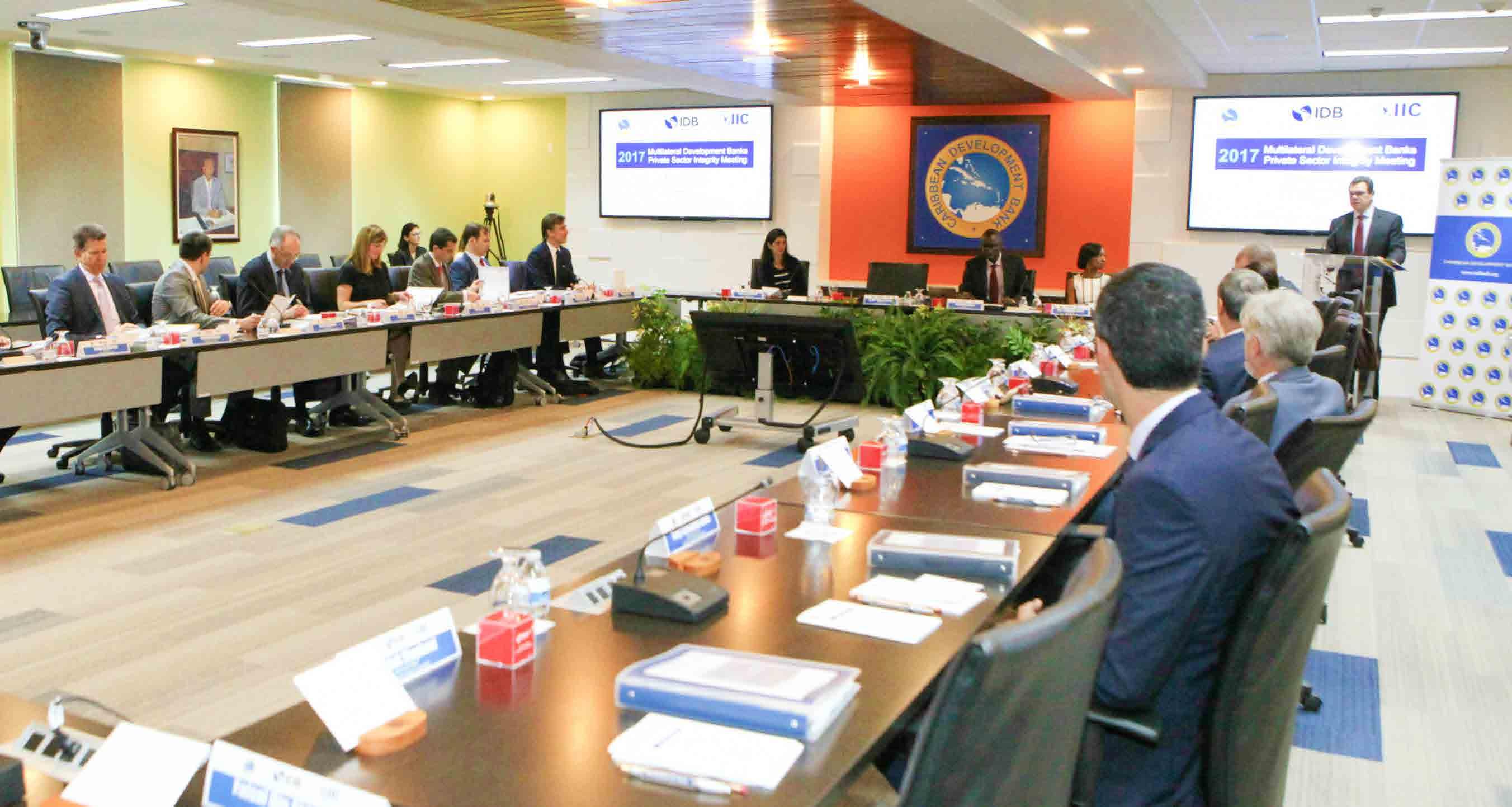
CDB and the Inter-American Development Bank Group (IDB) co-hosted the Annual MDBs Private Sector Integrity Meeting from March 21 to 23, 2017, held at CDB’s Headquarters. The event was spearheaded by ICA (with assistance from the Legal Department) and IDB’s Office of Institutional Integrity.
Three key objectives were accomplished at the Meeting:
1. Benchmarking of integrity policies, practices and organisations across similar institutions. This Meeting provided MDBs with an opportunity to raise and discuss issues and questions related to best practices and policies relevant to CDB’s integrity work. MDBs, as international supranational organisations, enjoy special privileges and immunities. They also have unique business models, which increases their reliance on best practices adopted and used by comparator institutions. Comparator practice is a key measure used by MDB boards and management to assess whether to adopt certain governance policies. The opportunity to benefit from the experiences of other MDBs is fundamental to CDB’s existence in the global development arena.
2. Networking. The Meeting enabled attendees to foster new and strengthen existing relationships among the integrity offices and legal departments of MDBs, which cover the private sector. The networking opportunities the Meeting provided, supports more efficient communication among integrity offices.
3. Buttressing global and regional reach of MDBs’ anti-corruption work. In addition to CDB, the group comprises representatives from all of the major IFIs.2
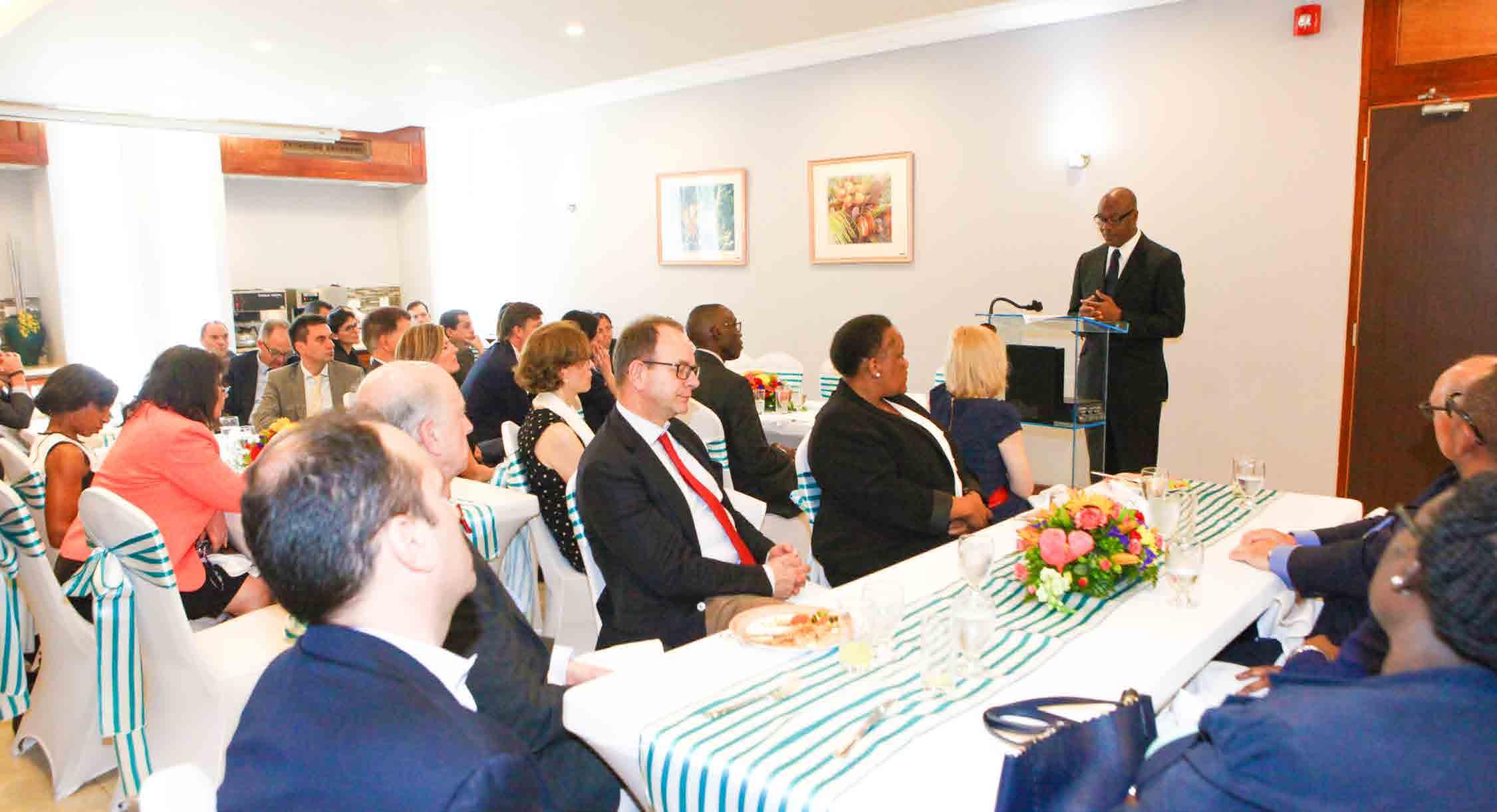
2 International Finance Corporation and the Multilateral Investment Guarantee Agency of the World Bank Group; African Development Bank; Asian Development Bank; West African Development Bank; Black Sea Trade & Development Bank; Council of Europe Development Bank; European Bank for Reconstruction and Development; European Investment Bank; European Investment Fund; IDB together with the Inter-American Investment Corporation, collectively the IDB Group; and the Islamic Development Bank.

ICA has made significant progress on draft procedures for the accountability function, which covers environmental and social harm allegedly caused by projects financed by the Bank.
During 2017, new procedures were refined and drafted for the Projects Complaints Mechanism (PCM), including dispute resolution, compliance review and investigations together with frequently asked questions and training aids.
Some of the other procedures currently being worked on focus on key process issues such as: eligibility criteria for complaints; selection of experts to conduct reviews; and reports and protocols for internal communication between the PCM and management. The enhanced PCM is expected to be fully operationalised during 2018.
In August, ICA attended and participated in the annual meeting of the Independent Accountability Mechanisms Network (IAMnet), and contributed to IAMnet surveys and collaborative discussions on the shaping and sharpening of relevant best practices.
ICA provided an update to all members of IAMnet on the status of CDB’s PCM. Importantly, ICA engaged in bilateral consultations with other Independent Accountability Mechanisms partners and secured commitments for assistance, information sharing and collaboration.
ICA assisted one MDB with an integrity investigation and collaborated with the fraud investigations office of another development agency on investigative activity of mutual interest to CDB and that agency.
ICA is currently negotiating terms for Memoranda of Understanding (MoU) with two key relevant offices in international organisations for information sharing, collaboration and cooperation under it accountability function.
ICA conducted two induction training and awareness sessions for new Staff on the Strategic Framework and the Whistleblower System, Institutional Integrity and Ethics functions.
Mandatory Cybersecurity and Cybercrime Training 2017
In July 2017, ICA collaborated with the FBI and internally with the Finance and Information Technology Division to host two mandatory training sessions on cybersecurity and cybercrime training for all Staff.
ICA completed two targeted consultations (one initial and one follow-up session) and training with the Finance Division on proposed procedures and controls to mitigate risk and increase the robustness of the Bank’s internal mechanisms to combat money laundering and terrorist financing.
ICA conducted mandatory annual training for Management and OAC members.
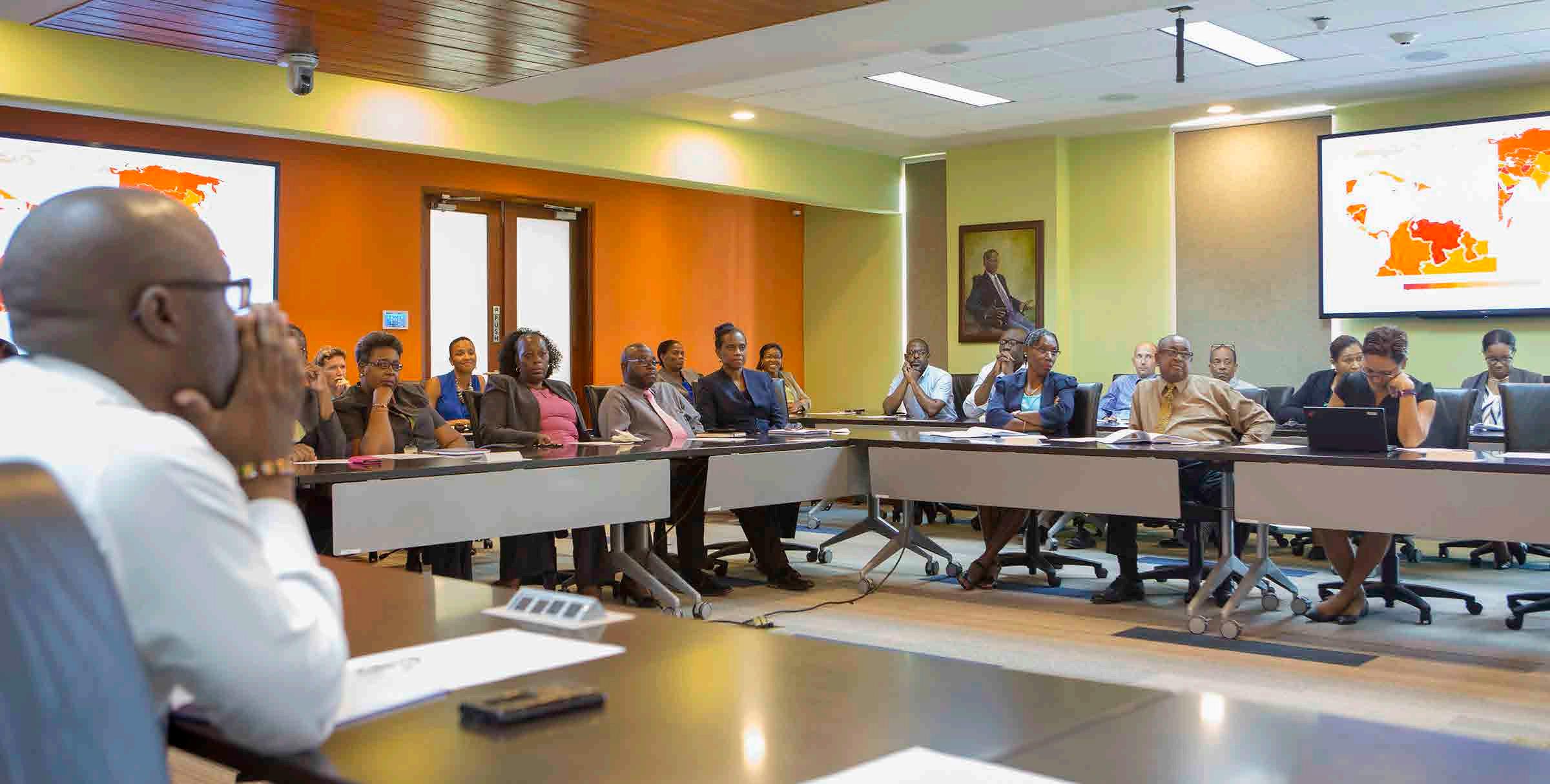
Consistent with its strategy to emphasise prevention, ICA conducted mandatory training and awareness sessions for the Board, management and Staff during 2017. This included, among other things, a case study based on actual events, to increase awareness of key issues related to the Strategic Framework and all five of ICA’s functions.
Upon completion of training, a voluntary anonymous quiz was administered to 190 of 203 eligible staff who attended the sessions, the results of which are displayed for the 93 respondents in Figure 4. The results support ICA’s view that its prevention-focused training over the last year was far reaching and was highly effective.
During 2017, corruption was identified as a major obstacle to economic and social development around the world, which poses special challenges for small island developing states like most of CDB’s borrowing member countries.
The United Nations Convention Against Corruption (UNCAC) is an international agreement aimed at reducing corruption. UNCAC became effective on December 14, 2005 pursuant to which global International Anti-Corruption Day is observed annually on December 9.
During the period December 11- 15, 2017, ICA led the Bank’s second observance of CDB’s Anti-Corruption Week in accordance with global observances of International Anti-Corruption Day.
CDB’s Anti-Corruption Week 2017 coincided with the week of the December meeting of the BOD. This provided an opportunity for OAC to be notified of the observance, for stakeholders to be updated on ICA’s work through multimedia displays, and for the hosting of mandatory and voluntary training for all Staff.