The Caribbean Development Bank (CDB) encourages the printing, copying or adaption of information contained in this publication exclusively for personal and non-commercial use with proper mutually agreed acknowledgement of CDB as the source of the information.
Wildey, St. Michael
Barbados, West Indies
June 3, 2026
Senator The Honourable Michael Halkitis Board of Governors
Caribbean Development Bank
Dear Chair,
I enclose the Annual Report of the Caribbean Development Bank for the year ended December 31, 2025, which the Board of Directors, acting pursuant to Paragraph 2 of Article 38 of the Agreement establishing the Caribbean Development Bank and in accordance with Section 18 of the By-Laws of the Bank, has requested me to submit to the Board of Governors.
Yours sincerely,
Mr. Daniel M. Best President Caribbean Development Bank
PURPOSE
“The purpose of the Bank shall be to contribute to the harmonious economic growth and development of the member countries in the Caribbean and to promote economic co-operation and integration among them, having special and urgent regard to the needs of the less developed members of the region.”
MISSION STATEMENT
Reducing poverty and transforming lives through sustainable, resilient and inclusive development.
CONTENTS
OPERATIONAL HIGHLIGHTS
Total Value of Projects Approved
$464.6 million (mn)
$364.7 mn in loans
$99.9 mn* in grants
53.1% increase from 2024
$462.4 mn Total Disbursements
$321.1 mn in loans
$141.3 mn in grants
48.1% increase from 2024
**2025 grants total includes $46 mn for the Basic Needs Trust Fund 11 (BNTF 11), which covers the next four years. Also includes $10 mn investment in the Caricom Resilience Fund.
SOCIAL RESILIENCE
Building Capacity of Individuals, Communities and Institutions to Sustain Well-being and Improve Quality of Life.
BNTF 10
• 92 of 96 sub-projects completed under $47 mn BNTF 10 programme benefiting 9 Borrowing Member Countries (BMCs).
• 30 Early Childhood Development and primary school classrooms constructed (Belize, Guyana, Saint Vincent and the Grenadines), benefiting 359 students (158 females; 201 males).
• 1.26 kilometres (km) of road (Jamaica) and 1 community bridge (Grenada) providing access for 2,422 people (1,231 females; 1,191 males).
• 11.86 km of water supply lines and 30 m³ water storage capacity installed, serving over 126 households (Belize and Suriname).
• 975 registered participants from 25 countries for the region’s first online Community Engagement Course
• 662 persons participated in human resource development activities (Guyana and Suriname).
• 450 community members are benefiting from modern training facilities following completion of the Salem Community Resource Centre Construction Project (Montserrat).
EDUCATION AND TRAINING
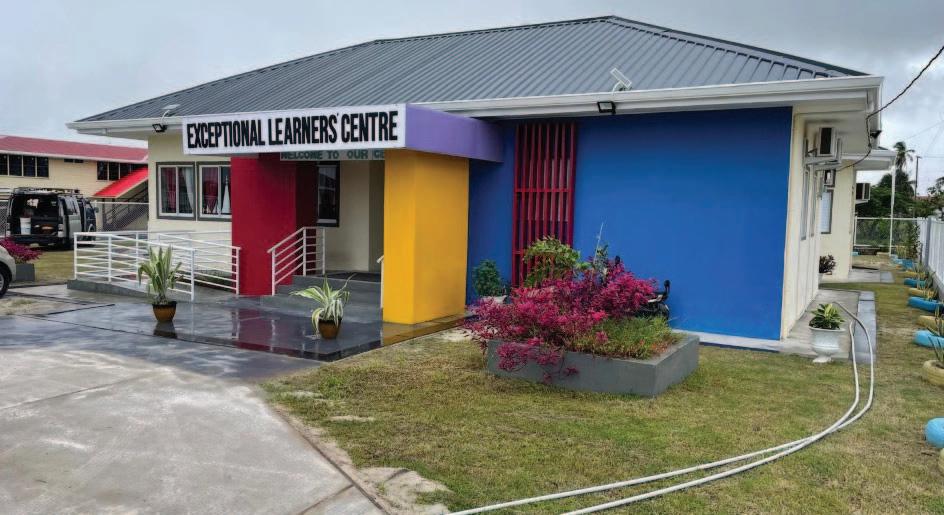
• 3,994 students across 6 communities in Guyana are benefitting from 6 new practical instructional facilities.
• 230 teachers in Saint Vincent and the Grenadines, trained in mathematics pedagogy.
• Over 180 stakeholders participated in the 2nd Regional Transforming Education Symposium and Policy Dialogue (TESPD).
• Caribbean Council of National ParentTeacher Associations (CCNPTA) established to promote sustained parental engagement with regional education system.
• The first regional analysis of gender gaps in upper secondary education completed for interventions to address disparities.
CITIZEN SECURITY
• 11 Community Action Plans developed to address causes of crime and violence in vulnerable communities in Suriname.
• 16 Neighbourhood Policing Officers certified, and 12 instructors receive training to increase community-oriented policing capacity.
SOCIAL RESILIENCE
Building Capacity of Individuals, Communities and Institutions to Sustain Well-being and Improve Quality of Life.
YOUTH EMPOWERMENT AND ECONOMIC INCLUSION
• 1,080 young entrepreneurs receive grant financing for businesses through the Saint Lucia Youth Economy Project.
• 77 secondary and tertiary students across 10 BMCs participate in policy dialogue at the TESPD.
DISABILITY INCLUSION
• Over 320 stakeholders participated in the 2nd Caribbean Disabilities Conference (CDC 2025).
• Regional Disability Assessment and Policy Brief and the Inclusion in the United Kingdom Caribbean Infrastructure Partnership Fund’s (UKCIF’s) Infrastructure Projects Toolkit and Checklist developed to drive mainstreaming disability inclusion in infrastructure investments.
AGRICULTURAL LIVELIHOODS AND FOOD SECURITY
• Over $5.4 mn approved to establish 3 irrigation schemes and rehabilitate 5 farm access roads and bridges in Grenada, under Phase II of the Climate Smart Agriculture and Rural Enterprise Programme (SAEP).
• 1,850 m² pack house and 15 food safety and sanitation areas developed to enable small farmers in Jamaica to comply with international standards.
• 315-hectare irrigation system, including three wells and 14 km of pipeline, completed to support year-round production of high-value crops in Jamaica.
• 86 Jamaican farmers benefit from capacitybuilding efforts.
• 23.5-hectare small-scale irrigation scheme completed and training provided for 250 farmers under the Community-Based Agriculture and Rural Development Project Phase II in Haiti.
• Regional Maritime Transportation and Logistics Study completed to improve movement of agricultural commodities across BMCs.
ENVIRONMENTAL RESILIENCE
Promoting Environmental Sustainability.
CLIMATE ACTION
• $700 mn Green Climate Fund (GCF) pipeline developed to implement water, energy, blue economy, food security and early warning system initiatives.
• $200 mn GCF-financed Blue Co Umbrella Coordination Programme advanced.
• $27.1 mn secured from GCF for scaling up of Caribbean Hydrometeorological and Multi-Hazard Early Warning Services (CREWS) in Belize and Trinidad and Tobago.
• $26.7 mn GCF-financed Integrated Utility Services (IUS) project to benefit Barbados, Belize and Jamaica.
• $25 mn Adaptation Fund (AF) Locally Led Aggregator (LLA) concept developed for five countries.
• $10.25 mn Regional Platform for Catalysing Climate Action in the Caribbean proposal completed.
• Climate Change Project Preparation Fund (CC PPF) operationalised.
POLICY-BASED LOANS (PBLS) FOR ENVIRONMENTAL RESILIENCE
• $125 mn environmental PBL disbursed to Guyana for reforms in biodiversity conservation, climate action, and water resource management.
• $30 mn disaster risk management (DRM) PBL disbursed to Saint Vincent and the Grenadines to build institutional, technical, & financial capacity for managing climate and hazard risks.
• $30 mn macroeconomic, environmental, and climate resilience PBL committed for Dominica to foster macroeconomic, environmental and climate resilience.
DISASTER PREPAREDNESS AND RESPONSE
• Up to $200 mn in loan financing available to Jamaica for Hurricane Melissa recovery.
• $3mn in Caribbean Catastrophe Risk Insurance Facility (CCRIF) premium support provided for Haiti.
PRODUCTION RESILIENCE
Fostering Inclusive, Sustainable, Economic Growth and Development.
ECONOMIC INFRASTRUCTURE
•$181.8 mn in capital projects and $10.8 mn in technical assistance approved.
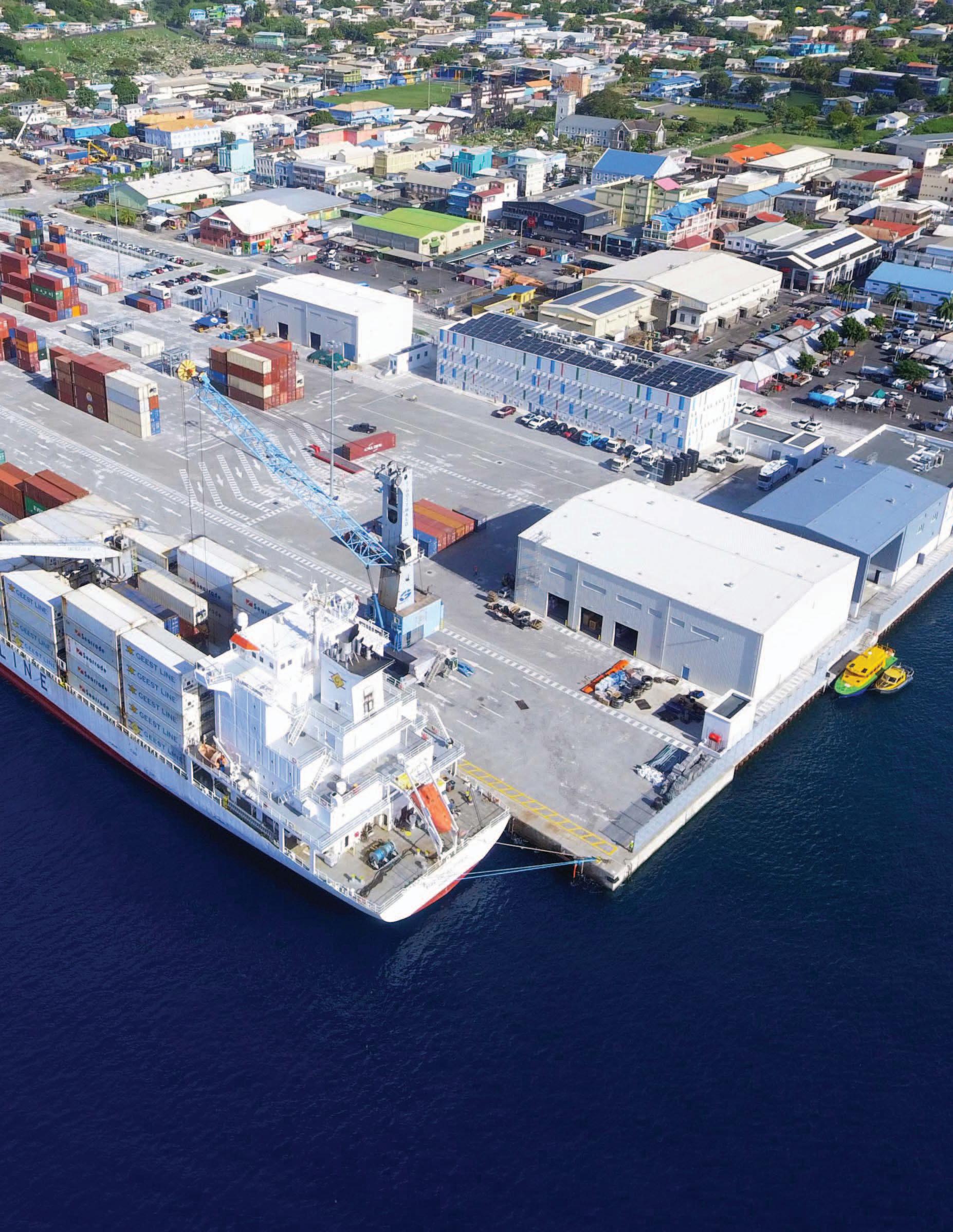
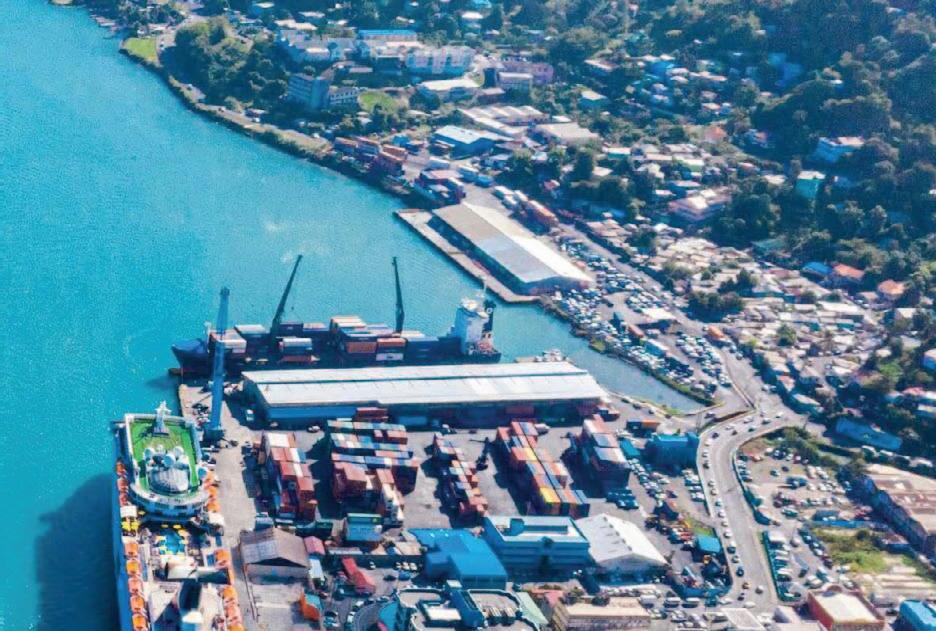
• Kingstown Port (Saint Vincent and the Grenadines) completed with 50 percent (%) increase in average annual container throughput expected by December 2026.
• $47.2 mn approved for Barbados Grantley Adams International Airport Expansion Project, to add 120,000 square feet of terminal space and 3 passenger bridges by December 2027.
• $46.8 mn approved for the Canouan Airport Rehabilitation (Saint Vincent and the Grenadines).
• $29.9 mn approved for The Bahamas Water Supply Improvement Project Phase 2, to improve. water supply for 1,550 households.
• $27.7 mn Belize Eighth Power Project approved to improve power supply for 92,000 households by December 2029.
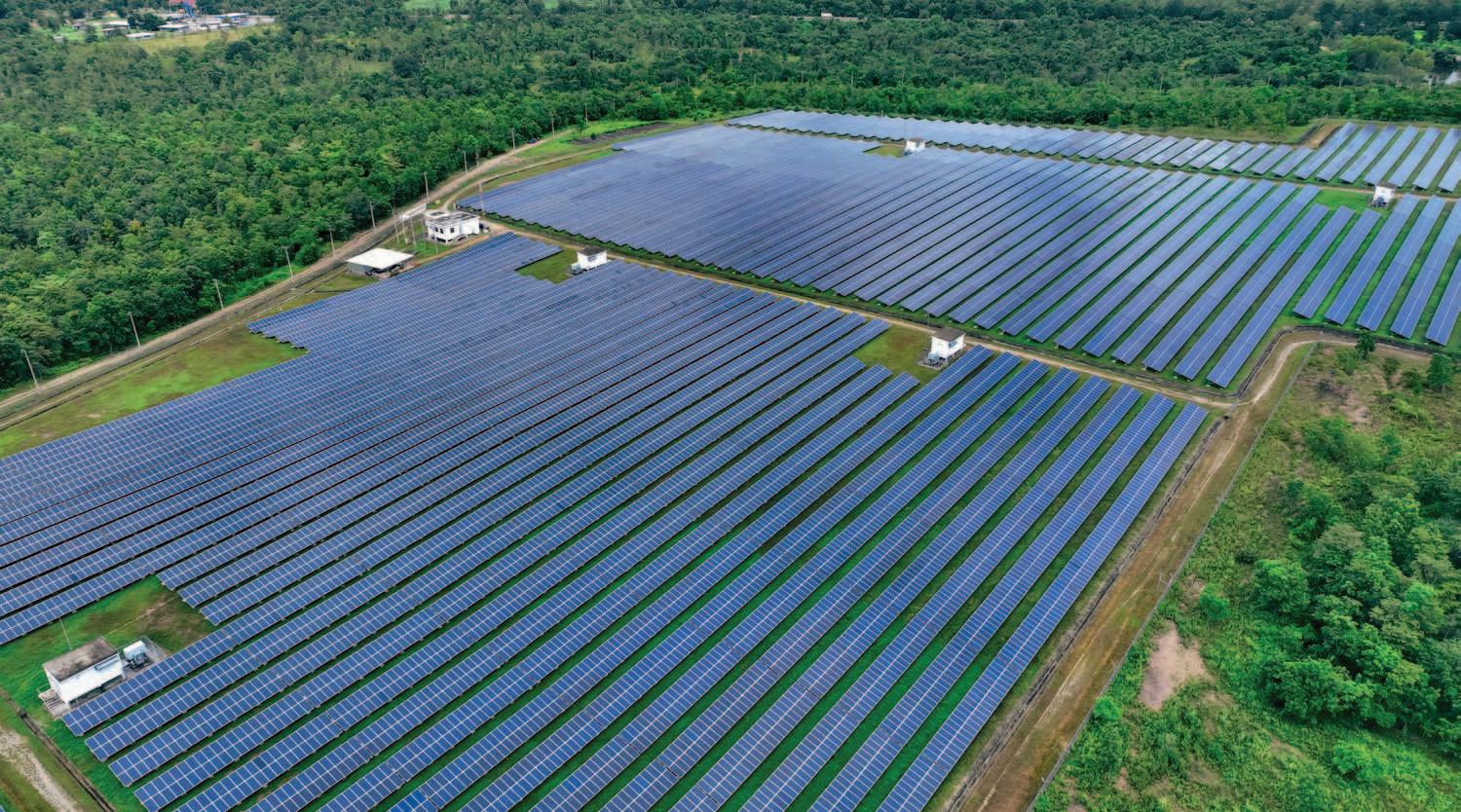
• $8.7 mn approved for 10 megawatt-hour Grenada Battery Energy Storage System (BESS) to replace 3.28 mn gallons of fossil fuel annually.
• First disbursement for historic Dominica Geothermal Power Project financed through a blended concessional package.
ACCESS TO FINANCE FOR THE PRIVATE SECTOR
• Trade Finance Guarantee Programme approved
• $10 mn investment in Caribbean Community Resilience Fund, the region’s largest climate-focused private equity fund.
• $200,000 technical assistance for Digilab Finance Programme to devise digital transformation strategies for 10 financial institutions across 8 BMCs.
WOMEN’S ECONOMIC EMPOWERMENT
• 1,300+ women-owned/women-led MSMEs supported through SheTrades Caribbean
• 2,650+ enterprises joined SheTrades Hub
• 280 beneficiaries trained through SheTrades
• $420,000 in grants disbursed to 20 womenowned/women-led businesses
• Flagship Study on Access to Finance for Women-led micro, small and medium-sized enterprises (MSMEs) published with four country assessments.
• $2.96 mn SheTrades Caribbean II
PRODUCTION RESILIENCE
CULTURAL AND CREATIVE INDUSTRIES
• $339,000 Cultural and Creative Industries Innovation Fund (CIIF) deployed.
• 200+ participants from 14 BMCs trained in proposal writing (70% women); 86 completion certificates awarded.
• 12 MSMEs awarded grants across audiovisual, festivals, visual arts, fashion, and design subsectors.
• $290,000 funding envelope for new CIIF grant calls.
• Standard and Poor (S&P) Global Ratings: LongTerm Issuer Credit Rating AA+; Short-Term Issuer Credit Rating A-1+
RESOURCE MOBILISATION
• $460 mn approved for Special Development Fund (SDF) 11, up from $383 mn under SDF 10.
• First bond issued under Sustainable Finance Framework: Swiss Franc (CHF) 100 million five-year bond at 0.59% fixed interest (Swiss market, November 2025).
• Landmark Exposure Exchange Agreement (EEA) of $450 mn executed with the Central American Bank for Economic Integration (CABEI).
• Euro (EUR) 4 mn Agence Française de Développement (AFD) Grant Facility finalised for climate resilience and gender mainstreaming infrastructure.
INSTITUTIONAL RESILIENCE
Building A Result-Based, Client-Centric, Agile, Transparent, Gender-Sensitive, and Cost-Efficient Organisation.
REGIONAL COMPETITIVENESS
• New client portal for procurement document reviews completed; rollout to BMCs planned for 2nd quarter of 2026.
• Consultants Registry and Database platform developed; rollout anticipated in 2nd quarter of 2026.
• Sustainability Self-Assessment Tool for Procuring Entities made available in English.
INTEGRITY, COMPLIANCE AND ACCOUNTABILITY (ICA)
• 95%+ of staff received comprehensive integrity, ethics, compliance, and accountability training
• 22nd Annual Meeting of the Independent Accountability Mechanism Network, co-hosted in Barbados, with 80+ international accountability professionals participating.
BMC PROCUREMENT CAPACITY BUILDING
• Procurement Manual, Standard Bidding Documents, and training programme developed for Montserrat.
• Procurement Manual developed and training codelivered for Dominica.
• 28 scholarships financed for BMC candidates for Digital Transformation of Public Procurement online course.
• Value-for-Money Multilateral Development Banks (MDBs) Guidance Tool, developed collaboratively with 15 MDBs; release scheduled for early 2026.
BMC EVALUATION CAPACITY BUILDING
• New CDB Evaluation Policy, Manuals for Independent and Self-Evaluation, approved.
• Partnership established with the Center for Learning on Evaluation and Results for Latin America and the Caribbean (CLEAR-LAC) to boost monitoring and evaluation in BMCs
• 8 government officials from 6 BMCs sponsored for EVALAC training.
GENDER
• 183 participants attended the Global Gender Equality Summit, hosted by CDB as Chair of the MDBs’ Working Group on Gender.
• 124 senior justice, security, and gender policy officials convened at the Regional High-Level Symposium on Advancing State Responses to Domestic Violence, coorganised by CDB, Inter American Bank (IDB), and the Government of Barbados.
• 30 project implementation team members across UK-CIF projects received training integrating gender equality and social inclusion.
THE PRESIDENT’S STATEMENT
For 55 years, the CDB has stood with Caribbean people and governments, financing opportunities, strengthening institutions, and advancing progress across generations. From classrooms and clinics to roads, ports, power systems, climate action, social protection, and gender equality, the Bank’s work has laid foundations for development and improved millions of lives in the region.
Yet the context for this mission has changed dramatically. Geopolitical fragmentation, the weakening of long-standing international norms, and intensifying economic and climate volatility are reshaping the global development landscape. In Caribbean countries, while these pressures are reflected in macroeconomic indicators, they are felt most sharply by households facing rising living costs, small businesses struggling to access capital, and communities forced to rebuild repeatedly after climate shocks.
In this environment, incremental adjustment is insufficient. We need to fundamentally rethink how development institutions operate, how capital is mobilised, and how impact is delivered, at speed, at scale, and with lasting effect. For us in the Caribbean, building resilience is the central development imperative of our time.
This reality underpins the Bank’s Rebirth vision. Rebirth is a deliberate shift toward sharper impact, deeper relevance, and outcomes that improve lives across the Caribbean. As the region’s only indigenous MDB, CDB brings proximity, trust, and unique contextual understanding. With that advantage comes responsibility: to act decisively, to deploy knowledge precisely, and to stand firmly with member countries at a moment of vulnerability and possibility.
Rebirth is anchored in three imperatives that now define how the Bank positions itself for the decade ahead: Innovate. Transform. Thrive.
INNOVATE | New Tools for New Realities
As we innovate to deliver better solutions, we do so with a clear-eyed recognition that traditional development finance approaches are no longer sufficient to address the complexity and urgency of the Caribbean’s challenges. Constrained fiscal space, recurrent climate shocks, and compounding vulnerabilities demand financing solutions that are flexible, responsive, and capable of mobilising capital at scale.
Our innovation has therefore focused on deploying instruments to unlock new sources of finance, share risk more effectively, and deliver tangible results for our Member Countries. In 2025, CDB launched its Trade Finance Guarantee Programme, expanding access to working capital for small
and medium-sized enterprises—the backbone of Caribbean economies and a critical source of jobs and livelihoods. By reducing risk for domestic financial institutions, the programme enables businesses to grow, invest, and compete beyond national borders, reinforcing the private sector’s role as a driver of economic resilience and inclusion.
The Bank reached a milestone in capital markets with our first bond under the Sustainable Finance Framework. We raised CHF 100 mn in the Swiss market. Strong investor demand closed the book in ninety minutes, demonstrating confidence in the Bank’s financial strength and its development strategy. These resources expand CDB’s ability to finance climate resilience, social inclusion, and long-term development priorities at the needed scale.
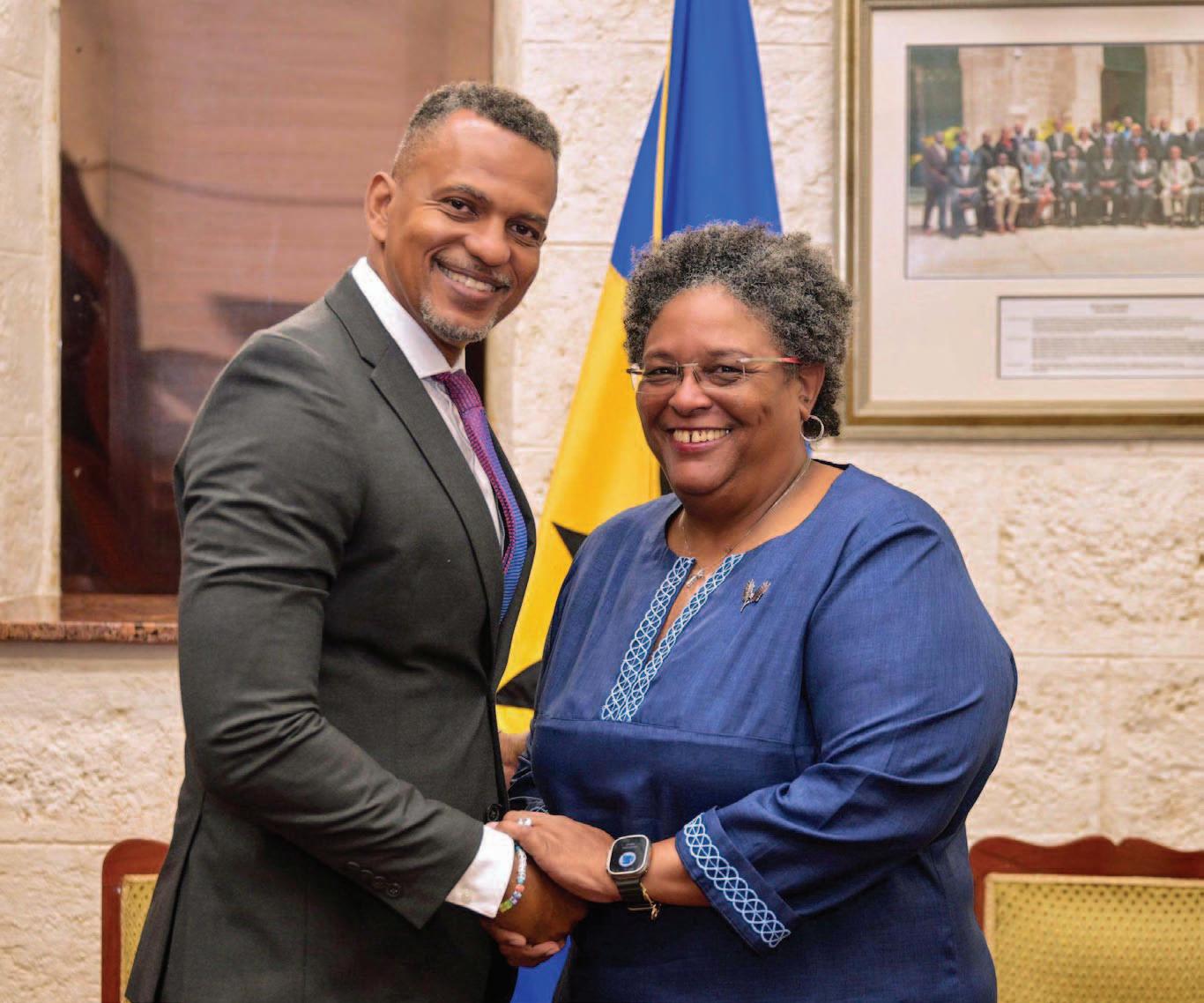
CDB President Mr. Daniel M. Best paid a courtesy call on the Prime Minister of Barbados, the Hon. Mia Mottley, at her official residence, Ilaro Court, St. Michael, shortly after assuming office in February 2026.
Presently, the Bank is partnering with the GCF to develop a landmark Regional Readiness Platform that will transform how Caribbean countries access and manage climate finance. This forward-looking platform will streamline readiness support by creating a unified, digital-enabled mechanism that accelerates project preparation and execution. By pooling resources and harmonising readiness activities, the platform will drive innovative, climateresilient development across the Region.
Innovation at the Bank also extends beyond financing systems to the institutions and partnerships that shape development outcomes. In this context, the CDB-supported CCNPTA was officially established and its first executive elected at the Second Regional TESPD. The Bank convened this in partnership with the Ministry of Educational Transformation, Barbados. This new regional platform elevates parents as essential partners in shaping Caribbean education. A unified regional Parent Teachers Association (PTA) gives parents a stronger collective
voice to advocate for better learning conditions, safer schools, improved resources, and policies that support student success.
TRANSFORM | Partnerships and Institutional Excellence
Impact at scale comes from innovation rooted in strong partnerships and institutions. In 2025, strategic collaboration with peers and review of internal systems improved the Bank’s reach and kept us agile to regional needs.
In May, CDB executed a $450 mn EEA with CABEI, one of the first such transactions of its kind. By diversifying sovereign credit concentrations and strengthening capital positions, the arrangement creates additional lending capacity for our member countries. It demonstrates how cooperation among development partners can translate financial innovation into tangible development headroom, supporting expanded delivery and impact where it is most needed.
CDB President Mr. Daniel M. Best (left) in a show of solidarity with Dr. Abdulhamid Alkhalifa, President of the OPEC Fund for International Development (centre), and Mr. Sergio Díaz-Granados Guida, Executive President of CAF – Development Bank of Latin America and the Caribbean. The three leaders met at the session “Bridging Regions: Arab Coordination Group and Latin America and the Caribbean,” on the sidelines of the 4th International Conference on Financing for Development in Seville, Spain in June 2025.
At the closing ceremony of the Caribbean Development Bank’s (CDB) 55th Annual Meeting in Brasilia, Brazil in June 2025, CDB President, Mr. Daniel Best (left) joined CDB Governor for Brazil, Ms. Viviane Vecchi Mendes Muller, (centre) outgoing Chair of the Board of Governors, who officially handed over the Chairmanship to The Bahamas, represented by Parliamentary Secretary for the Ministry of Economic Affairs, Bahamas, Mr. Wayde Watson (right). The Bahamas will host the 56th Annual Meeting in June 2026.
We advanced our collaborative approach by initiating discussions on a Caribbean MultiGuarantor Debt-for-Resilience Joint Initiative with CAF - Development Bank of Latin America and the Caribbean and the IDB. Under this initiative, the partners aim to coordinate debt-forresilience swaps that provide countries with fiscal space to invest in adaptation and preparedness. By combining immediate relief with durable financing, the initiative lays the groundwork for sustained investment in resilience and attracts private and institutional capital.
The value of coordinated action was particularly evident when Hurricane Melissa struck Jamaica in October. Within weeks, CDB worked with CAF, the IDB, the International Monetary Fund, and the World Bank (WB) Group to mobilise a $6.7 billion (bn) recovery and reconstruction package. For affected communities in Jamaica,
this meant faster access to emergency liquidity, reconstruction financing, and technical assistance supporting recovery, as well as a stronger, more resilient rebuilding effort.
And in 2025, momentum in innovation was further reinforced through the 11th Cycle of the Special Development Fund (SDF11), which secured $460 mn in commitments, surpassing the previous cycle and signalling strong partner confidence. SDF advances a more innovative and adaptive financing approach, marked by stepped-up climate ambition, deeper community-centred programming, expanded regional initiatives, a gender equality setaside open to all, and programmatic interventions. With only five years remaining to achieve the 2030 Sustainable Development Goals (SDGs), SDF 11 reflects a shared recognition that innovation in policy, financing, and delivery is critical at this pivotal moment in the region’s development trajectory.
At the same time, the Bank sharpened its focus on institutional excellence. In 2025, CDB began a Governance Review, welcomed an assessment by the Multilateral Organisation Performance Assessment Network, and commissioned an Implementation Capacity Study. These efforts sharpen decisionmaking, streamline operations, and strengthen the Bank’s fitness for purpose. Transformation is as much about how we work as how we finance.
THRIVE | A Blueprint for the Next Decade
And finally, a thriving Caribbean is built on sustained prosperity, where people are equipped to reach their full potential, institutions are capable and trusted, and economies are resilient, competitive, and prepared for a rapidly changing world. Achieving this requires expanding opportunity, safeguarding the most vulnerable, and strengthening the systems that deliver public value. For CDB, this means helping our member countries to continue to build foundations for progress that endures across generations.
Guided by this purpose, 2025 marked a year of decisive action and a moment that shaped the Bank’s future direction. The Strategic Plan 20262035, which will take effect in 2026, defines how the Bank will support the Caribbean over the next decade of uncertainty and opportunity. Developed through extensive regional consultation, the new Plan focuses on where CDB delivers distinctive value and maximum impact.
At its core is an Integrated Resilience Framework encompassing three mutually reinforcing dimensions: Social resilience, through stronger education, health, social protection, and gender-responsive systems; Economic resilience, by enhancing competitiveness, diversification, and private-sector participation; and Environmental resilience, through climate-smart infrastructure, green solutions, and sustainable natural resource management.
This framework is grounded in three operational priorities: Youth Development, Stronger Institutions, and Climate Action, and is guided by three
At the Brazil-Caribbean Summit on June 13, 2025, in Brasília, CDB President, Mr. Daniel M. Best, met with Brazilian President Luiz Inácio Lula da Silva. Brazil announced a $5 million contribution to SDF 11 during the Summit.
cross-cutting priorities: gender equality, digital transformation and innovation, and regional integration. Together, they articulate a clear and deliberate strategic focus: to invest in people, to strengthen the systems that serve them, and to build the region’s resilience.
REBIRTH | Meeting the Moment
The road ahead is complex, but the Bank is prepared to navigate it boldly. We confront today’s realities with confidence grounded in demonstrated capability and a clear sense of purpose. The progress reflected in these pages over the past year points to an institution that has strengthened how it sets direction and delivers results, driven by staff who approach development as service to our
In October 2025, CDB hosted the 22nd Annual Meeting of IAMnet in Barbados, in collaboration with the IDB’s Independent Consultation and Investigation Mechanism (MICI) and the Office of the Compliance Advisor Ombudsman of the International Finance Corporation (IFC) and the Multilateral Investment Guarantee Agency. Ahead of the meeting, Ms. Janine Ferretti, Director General, Office of the Compliance Advisor Ombudsman, IFC paid a courtesy call on President Daniel M. Best at this office at CDB’s Headquarters in St. Michael.
Member Countries, their communities, and future generations.
As the Bank enters its next chapter, we move forward with urgency and resolve. While uncertainty will remain a feature of the global landscape, disciplined strategy, trusted partnerships, and sustained institutional renewal position the CDB to unlock new possibilities and continue delivering development that endures for our region.
Mr. Daniel M. Best President Caribbean Development Bank
Overview
Economic conditions across the Caribbean became more challenging in 2025 as growth momentum weakened in most BMCs. Excluding Guyana, the region’s real GDP growth slowed from 1.4% in 2024 to 0.6%, reflecting weaker outturns in most economies, including several of the region’s larger countries. Including Guyana, regional growth eased to 4.7% from 8.3% in 2024, largely reflecting a moderation of Guyana’s exceptionally rapid expansion the prior year, even as the country continued to account for most of the regional growth.
The 2025 economic performance unfolded against a more challenging external backdrop with a less supportive global environment amid heightened geopolitical tensions and trade policy uncertainty. Climate shocks also weighed on activity, particularly in Jamaica and Haiti, countries still rebuilding from cascading disasters. In addition, weakened fiscal conditions, lower public investment and still high debt burdens in many BMCs remained key factors constraining growth. The regional debtto-GDP ratio (excluding Haiti) increased slightly from 54.6% to 55.2%. While most BMC’s have brought debt ratios down from their pandemic highs, climate shocks and elevated borrowing costs continue to challenge fiscal resilience and debt dynamics. In 2025, nine BMCs remained above the 60% debt benchmark while debt service burdens remained high.
Inflationary pressures eased further in 2025, mainly reflecting lower global commodity prices, providing some relief to households. In Jamaica, the decline in food inflation was interrupted after Hurricane Melissa caused significant damage to food-producing parishes in October 2025.
Looking ahead, regional growth is projected to reach 6.2% in 2026, driven primarily by Guyana’s continued oil fuelled expansion. Excluding Guyana, growth is expected to remain modest at 1.1%. The outbreak of war in the Middle East introduces additional downside risks to this outlook, particularly for service-exporting economies, through higher energy prices, and weaker external demand. Given the heightened uncertainty surrounding inflation and growth trajectories in the region, these projections do not incorporate the potential economic effects of the conflict.
BMC Economic Performance
Economic activity across most BMCs moderated further in 2025 as the post-pandemic rebound largely ran its course, giving way to slower expansion amid weaker external demand, heightened uncertainty, structural bottlenecks and climate shocks1. Excluding Guyana, regional growth slowed to 0.6% from 1.4% in the previous year. Including Guyana, regional real GDP decelerated to 4.7% from 8.3%, as expansion in the oil-producing economy slowed from an exceptionally high base. The regional performance unfolded in the context of a more challenging external environment, despite global growth remaining broadly unchanged at 3.4% in 2025, but below the pre-pandemic average of 3.7%2. Headwinds from trade tensions, elevated policy uncertainty and geopolitical tensions continued to weigh on confidence and external demand.
Service-exporting economies grew by 0.6%, down from 1.0%, though performance varied. Key contributors to aggregate output included The Bahamas (2.6%), Barbados (2.7%), the Cayman Islands (2.6%), and the Turks and Caicos Islands (4.5%). Tourism remained central to economic activity but lost momentum. The outbreak of war in the Middle East introduces additional downside risks to this outlook, particularly for service-exporting economies, through higher energy prices, and weaker external demand. Given the heightened uncertainty surrounding inflation and growth trajectories in the region, these projections do not incorporate the potential economic effects of the conflict. Across smaller markets, outcomes were mixed, with several recording declines or slower growth. Even as momentum eased, St Vincent and the Grenadines and Dominica continued to post double-digit growth. These developments reflected softer conditions in source markets, alongside disruptions following Hurricane Melissa, which caused damage and losses in Jamaica equivalent to an estimated $12.2 billion or 56.7% of GDP3. Cruise tourism and tourism-linked sectors, including food services and retail trade, also expanded at a slower pace. Construction remained a key driver of economic activity, underpinned by public and tourism-related investments and post-disaster reconstruction.
Sources: International Monetary Fund, Central Banks, Ministries of Finance, Statistical Offices, CDB.
Performance among commodity exporters diverged. Guyana’s growth slowed to 19.5% from 43.6% in 2024, as oil-sector expansion moderated from its high base. Oil production increased by 15.8% to 261 million barrels, while the non-oil economy expanded strongly, supported by scaled-up public investment. Suriname’s growth strengthened to 3.7%, supported by spillovers from offshore oil-sector investment ahead of expected production in 2028. In contrast, Trinidad and Tobago’s growth slowed to 0.1%, amid weak performance in the energy and non-energy sectors.
1 Real output in Haiti, Suriname and Trinidad and Tobago remains below pre-pandemic levels.
2 International Monetary Fund World Economic Outlook, April 2026.
3 Planning Institute of Jamaica (2025), Review of Economic Performance, October–December 2025, media briefing.
Figure 1: Real GDP Growth Trends (%)
External sector developments mirrored domestic economic conditions in 2025. Merchandise trade deficits widened across most BMCs, as import growth, driven by consumption, investment, and reconstruction, outpaced generally weak goods exports. Tourism receipts and remittance inflows provided important support, but external current account deficits widened in most economies and were largely financed through external financing and foreign direct investment. Most BMCs maintained adequate import coverage, with international gross reserves exceeding three months of goods imports.
Prices
Inflationary pressures eased further across most BMCs, largely reflecting lower international commodity prices, restructured supply chains, and the lagged effects of monetary tightening in advanced economies. The transmission of U.S. protectionist trade measures to regional prices was limited, as exemptions and policy reversals helped contain potential increases in imported prices. Regional inflation continued to decelerate from its 2022 peak of 9.6%, declining from 4.4% in 2024 to 3.4%, but still above the pre-COVID average of 2.7%. Food inflation also eased, declining to 3.8%, down from 5.8% in 2024. In Jamaica, however, the downward trajectory of food inflation was interrupted in the final quarter of the year, as Hurricane Melissa disrupted food-producing parishes and supply chains, placing renewed upward pressure on prices. Haiti remained the outlier with persistently high inflation, rising to 29.0%, mainly driven by severe supply disruptions. In Suriname, inflation eased significantly to 9.1% from 16.2% but remained elevated due to continued exchange rate pressures. Excluding Haiti and Suriname, regional inflation averaged a lower 1.5% in 2025.
Even as inflation moderated, governments maintained a range of measures to support affordability, including targeted tax relief, duty waivers, and social transfers. However, some countries began to unwind temporary measures introduced during the inflation surge, including the reinstatement of fuel excises and the expiry of selected tax concessions.
Sources: Statistical Offices, CDB.
Figure 2a: Global and Regional Trends in Inflation (%)
Sources: Statistical Offices, CDB.
Labour Market
BMC labour markets continued to show resilience, with falling unemployment rates, rising participation rates, and strong labour demand across key sectors. Labour force participation increased in most reporting economies, including The Bahamas (76.4%), Barbados (63.2%), Jamaica (68.7%), Grenada (62.1%), and Belize (58.6%), while remaining flat in Trinidad and Tobago (54.7%). Unemployment declined to historically low levels in several countries, including Belize (2.0%), Jamaica (3.4%), Trinidad and Tobago (4.5%), and Barbados (6.2%), but rose in The Bahamas (10.0%) and Saint Lucia (14.1%).
Despite these gains, structural disparities persisted. Youth unemployment continued to exceed national averages, reaching around 21.0% in The Bahamas and Saint Lucia. Female unemployment remained
consistently higher than male unemployment in several economies. At the same time, participation gaps endured, with male participation exceeding female participation by 8–25 percentage points, most notably in Belize and Trinidad and Tobago.
Labour shortages remained widespread in several fields, including construction, hospitality, agriculture, health care, and education. Governments across the region continued minimum wage adjustments to support household incomes.
Fiscal and Debt Performance
Fiscal conditions weakened in several BMCs. Excluding Guyana, the regional primary balance remained positive at 1.3% of GDP but narrowed from 1.6% from 2024. Interest costs of 2.8% of GDP converted this primary surplus into an overall deficit of 1.5% of GDP, from 1.4% in the previous year.
Sources: Central Banks, Ministries of Finance, Statistical Offices, CDB.
Figure 3: Primary Balance to GDP (%) 2024 vs 2025 by Country
Figure 2b: Regional Trends in Inflation (%)
Revenue performance remained supportive but insufficient to offset spending pressures. Total revenue increased by 4.5% to $28.7 billion (21.3% of GDP), down from 5.8% growth in 2024, reflecting slower economic activity, tax relief measures implemented as part of cost-of-living support in several BMCs, and weaker non-tax revenue outturns. Tax receipts rose by 5.0%, driven mainly by higher collections from taxes on income and profits. In comparison, nontax revenue declined by 1.9%, reflecting a sharp fall in Citizenship by Investment (CBI) inflows. CBI receipts, an important but volatile revenue source for several Eastern Caribbean Currency Union (ECCU) members, fell to around 4.0% of ECCU GDP, from 6.5% in 2024. Anguilla was a notable exception, recording a surge in non-tax revenue, driven by strong “.ai” domain registration fees.
Total spending increased by 5.0% to $30.8 billion (22.8% of GDP), outpacing revenue growth. The expansion was driven primarily by current expenditure, which rose by 6.0% (20.6% of GDP). Spending pressures were broad-based, with increases in goods and services (11.1%), personal emoluments (7.7%), and transfers and subsidies (2.7%). Interest payments remained broadly stable, edging up by only 0.4%. Capital
spending was weaker, reflecting project delays and the winding down of a few large projects, even as outturns varied across countries. Investment in 2025 continued to be directed toward critical development priorities, including airport and port modernisation, road and school rehabilitation, renewable energy expansion and utility upgrades, housing initiatives, major hospital construction, and disaster recovery programmes.
In Guyana, fiscal balances remained in deficit in 2025, largely driven by a 37.2% increase in capital spending under its large public investment programme. When Guyana is included in the regional aggregates, the regional primary surplus falls to 0.2% of GDP, while the overall deficit widens to 2.2% of GDP.
The region’s financing needs were met through a mix of domestic and external sources. Debtmanagement operations and disaster-risk financing instruments helped ease near-term pressures, including a liability management operation in Suriname, the buyback of higher-cost external debt through a Eurobond issuance in The Bahamas, and disaster-risk financing support in Jamaica following Hurricane Melissa.
Sources: Central Banks, Ministries of Finance, Statistical Offices, CDB.
The regional central government debt-to-GDP ratio declined to 46.6% in 2025, as nominal GDP growth outpaced debt accumulation. This headline improvement largely reflected inflation-driven nominal GDP growth in Haiti rather than broad-based improvements across BMCs. Excluding Haiti, the regional debt-toGDP ratio increased slightly, from 54.6% to 55.2%. Debt-to-GDP ratios rose across the majority of BMCs, underscoring continued pressure on debt dynamics. Nine BMCs remained above the 60% benchmark, and debt-service burdens remained elevated, with a regional debt-service-to-revenue ratio of 42.3%.
FIGURE 4: Central Government Debt to GDP (%) 2024 vs 2025
2026 Outlook
Projections for 2026 point to continued but uneven growth, shaped by subdued global conditions and rising geopolitical uncertainty. Global growth is projected to slow to 3.1%, remaining below pre-pandemic averages, while global trade growth is expected to moderate as the effects of U.S. tariff measures become more fully realised. The outbreak of war in the Middle East in early 2026 introduces additional headwinds with significant implications for the Caribbean and will weigh on outturns relative to current projections. Regional GDP growth excluding Guyana is forecasted at 1.1%, reflecting constrained tourism momentum and persistent structural bottlenecks. Including Guyana, regional growth is projected to rise to 6.2%, driven by the continued expansion in oil production.
Guyana is expected to grow by 21.9%, supported by oil output expanding by 25.3% to 327 million barrels. Growth in other commodity exporters is expected to remain mixed, while service-exporting economies are projected to record modest growth, largely dependent on tourism and construction activity. Labour-market constraints, which have been a structural constraint to growth in the region, may be partially alleviated following the implementation of full free movement of CARICOM nationals in October 2025 by Barbados, Belize, Dominica, and St. Vincent and the Grenadines, improving productivity and supporting growth. These countries face labour shortages in key sectors, including tourism and construction. Inflation dynamics will largely depend on developments in global commodity prices, particularly in light of the outbreak of war, which has contributed to higher energy prices across the Caribbean. In this context, recent disinflation trends are likely to be interrupted in the near term.
The fiscal outlook is mixed, with continued consolidation supporting primary balances in some BMCs, while others face pressures from post-disaster recovery, rising wage and energy costs, and declining CBI revenues. Fiscal space remains constrained, as elevated debt levels, and high exposure to external shocks continue to shape fiscal outcomes across the region.
Risks remain tilted to the downside. A prolonged or escalating war could weaken global growth, disrupt supply chains, and sustain higher commodity prices, particularly for oil and energy products, with adverse implications for inflation, import costs, tourism demand, fiscal balances, and debt sustainability across the region. With public debt already elevated in several BMCs, policy space remains constrained, even as some governments have begun to cushion the impact of higher energy prices on consumers. Such measures should remain temporary and well-targeted to contain risks to debt sustainability. Additional downside risks include climate-related shocks, weaker-than-expected external demand, particularly from the United States, heightened uncertainty surrounding trade policy, volatile revenue sources, and implementation constraints. Upside risks are concentrated in faster-than-expected energy-sector developments and improved execution of public investment and resilience-building projects.
SOCIAL RESILIENCE
STRATEGIC INTERVENTIONS AND IMPACT
In 2025, the Bank’s social resilience interventions advanced an integrated agenda spanning education transformation, gender equality, citizen security, agricultural livelihoods, and inclusive development. These interventions addressed critical barriers to social cohesion, economic participation, and equitable access to opportunity across BMCs.
BNTF
The BNTF is CDB’s flagship community development programme, delivering targeted infrastructure and capacity-building interventions in the region’s most vulnerable communities. Rooted in participatory planning, BNTF addresses critical gaps in education infrastructure, rural water and sanitation systems, and community road access that constrain economic opportunity and social wellbeing.
The $47 mn BNTF 10 programme neared completion in 2025, with 92 of 96 sub-projects delivered across nine Participating Countries (PCs), specifically Belize, Dominica, Grenada, Guyana, Jamaica, Montserrat, Saint Lucia, Saint Vincent and the Grenadines, and Suriname. The Programme has delivered critical infrastructure, which is strengthening community-level resilience. Construction of 1.26 km of roadway in Jamaica and one community bridge in Grenada provided improved access for 2,422 people (1,231 females and 1,191 males) to markets, services, and employment, reducing transportation costs and improving access to healthcare and education, particularly for women who bear disproportionate household provisioning responsibilities.
Installation of 11.86 km of water supply lines and 30 m³ water storage capacity expanded reliable water access to over 126 households in Belize and Suriname. In climate-vulnerable communities, this infrastructure is foundational for household resilience to drought, for reducing the incidence of waterborne disease, and for enabling various productive activities.
Construction of 30 Early Childhood Development and primary school classrooms in Belize, Guyana, and Saint Vincent and the Grenadines benefited 359 students (158 females and 201 males) through improved physical learning environments, which are foundational to educational outcomes for children from vulnerable households. Additionally, the human resource development component of the Programme benefitted 662 persons in Guyana and Suriname, building skills for livelihood diversification. Similarly, renovation of a resource centre and training facility in Montserrat and Suriname benefited 456 persons with increased access to training and community services.
Through BNTF 10, CDB launched the region’s first online Community Engagement Course with over 975 registered participants from 25 countries, building capacity in participatory planning and community development methodologies. In partnership with UNECLAC, Kobo Toolbox, and the World Bank, CDB hosted a knowledge-sharing initiative to
mark the International Day for the Eradication of Poverty. The event attracted over 100 participants and focused on catalysing multi-stakeholder action to address structural inequalities and amplify the voices of vulnerable communities. The undertaking was also part of the effort to establish BNTF as a global model for effective, community-driven development. In 2025, BNTF made measurable progress in advancing private sector partnerships as a complement to public financing for community development. Building on lessons from Cycle 10, BNTF focused on consolidating a structured, riskmanaged partnership model that enhances value for money, strengthens institutional capacity, and improves sustainability of development outcomes. During the year, more than $650,000 in combined cash and in-kind contributions were mobilised through partnerships with private entities, foundations, and media organisations, supplementing BNTF’s core resources.
The Bank approved BNTF 11 in June 2025 with a $53.6 mn allocation, expanding to 10 PCs with Barbados joining the portfolio. The new cycle includes 81 sub-projects, which are earmarked for completion by December 2028. By year-end, six countries, Belize, Dominica, Guyana, Montserrat, Saint Vincent and the Grenadines, and Suriname, signed Grant Agreements and met conditions for first disbursement, enabling rapid resource mobilisation.
Education and Human Capital Development
The Second Regional TESPD, which convened over 180 stakeholders, including parents, students, educators, and policymakers, emphasised the vital role of parents and guardians as partners in education. The event, which sought to strengthen partnerships to improve educational equity and quality, culminated in the adoption of the Constitution of the recently established CCNPTA. The new entity will facilitate permanent institutional mechanisms for parental engagement in education policy across the region. This represents a fundamental shift from ad hoc consultation to structured, sustained partnership that strengthens accountability and responsiveness in education systems.
In Saint Vincent and the Grenadines, 230 teachers completed training in mathematics pedagogy, with formal adoption of the professional competency framework for mathematics teaching, establishing standardised pedagogical expectations that will enhance teaching quality and student outcomes. In Guyana, the Guyana Skills Development and Employability Project commissioned three Practical Instructional Centres and three Practical Instructional Departments, expanding access to technical-vocational education for 3,994 students across six communities—directly addressing youth unemployment and skills gaps that constrain economic participation.
The newly elected Executive of the Caribbean Council of National Parent-Teacher Associations (CCNPTA) at the Second Transforming Education Symposium and Policy Dialogue in Barbados in October 2025. The CCNPTA was established with CDB support in early 2025 to create permanent institutional mechanisms for parental participation in education policy across the region.
SOCIAL RESILIENCE
Country representatives from the CDB’s Future Leaders Network who lent their voices to a discussion on “Student and Youth Perspectives: What Helps Us Learn, What Holds Us Back” at the Bank’s Second Regional Symposium and Policy Dialogue on Transforming Education which was held in October 2025 in Barbados. From left, attorney-at-law, Gillian Rowe, Barbados; Rondell Nedd, Guyana, 1st Vice President of the Barbados National Student Council and Harrison College student, Naomi Jordan, Barbados; President of the Barbados National Student Council and Queen’s College student, Gevariah Young, and Global Youth Leader with the Global Partnership for Education, Rianka Chance, Saint Vincent and the Grenadines.
Collaboration with United Nations Educational, Scientific and Cultural Organisation’s (UNESCO) Global Education Monitoring (GEM) Report and the University of the West Indies, Cave Hill, launched the first regional analysis of gender gaps in upper secondary education completion, to equip policymakers with evidence to design targeted interventions that address persistent disparities.
Enhanced Country Poverty Assessment Programme
In 2025, the CDB successfully concluded Country Poverty Assessments (CPAs) for Belize, British Virgin Islands, Jamaica and St. Kitts and Nevis under its Enhanced Country Poverty Assessment Programme. The poverty assessment reports provided updated and harmonised poverty diagnostics to guide national and regional development planning. The CPAs delivered robust insights into multiple dimensions of poverty, inequality, and vulnerability, while strengthening national statistical systems and analytical capacity. Building on this analytical work from the CPAs,
the Bank convened a High-Level Ministerial Forum on the Programme in Saint Lucia in August 2025, bringing together government ministers and senior officials responsible for social development, planning, and finance from across the OECS, along with development partners. The Forum provided a platform for peer learning and strategic dialogue on poverty trends, policy responses, and the integration of multidimensional poverty measures into national decision-making. Discussions underscored the importance of data-driven social policy, adaptive social protection, and coordinated regional approaches to addressing vulnerability in the context of climate change and economic shocks.
In parallel, the Bank provided targeted technical assistance to Jamaica, culminating in the preparation of the country’s first Multidimensional Poverty Index (MPI) Report. This support strengthened national capacity to measure and analyse poverty beyond income, capturing deprivations across health, education, living standards, and other critical dimensions. The MPI Report provides policymakers with a powerful tool to better target interventions, monitor progress, and align social policies with national development priorities and the SDGs.
Indigenous Peoples and Ethical Engagement
The Bank finalised its Guidelines for Engagement for Ethical Collaboration with Indigenous and Tribal Peoples, developed in partnership with the Institute for Gender and Development Studies, University of the West Indies and Indigenous and Tribal Peoples across the region, including members of the Bank’s Indigenous Peoples Advisory Group. These Guidelines establish best practices for CDB’s ethical interaction with Indigenous and Tribal communities, enhancing institutional capacity for rights-based engagement across the project cycle.
Youth Empowerment and Economic Inclusion
A blended Regional Youth Consultation engaged 77 secondary and tertiary students across 10 BMCs, with Future Leaders Network (FLN) members moderating discussions that directly informed TESPD II policy dialogue, ensuring education transformation initiatives reflect the lived experiences and priorities of young people. Support for 11 delegates to
the Caribbean Festival of Arts (CARIFESTA) Youth Village, including FLN representatives and Indigenous and creative entrepreneurs, fostered cultural exchange and regional cohesion. The Youth Economy Project in Saint Lucia delivered tangible economic empowerment, providing grant financing to 1,080 young entrepreneurs, 572 women (53%) and 508 men (47%), to start and expand businesses in hospitality, cultural and creative industries, education, and Information and Communications Technologies. The goals of these grants are to catalyse employment creation and build entrepreneurial ecosystems in underserved communities.
Disability Inclusion
The Second Caribbean Disabilities Conference (CDC 2025) convened 251 registered representatives of persons with disabilities, with daily virtual attendance of 71 participants, including policymakers, education officials, disability advocates, and international development partners. The conference advanced regional policy dialogue on equitable access to quality education for persons with disabilities.
Participants at the Second Caribbean Disabilities Conference, convened by the Caribbean Development Bank in Barbados in November 2025. The conference brought together over 250 participants, including persons with disabilities, policymakers, education officials, disability advocates, and international development partners, to advance regional policy dialogue on equitable access to quality education for persons with disabilities across the Caribbean.
SOCIAL RESILIENCE
The Bank developed critical knowledge products including the Regional Disability Assessment and Policy Brief and the Inclusion in UKCIF Infrastructure Projects Toolkit and Checklist with Digital Accessibility Form and Virtual Booklet. These products provide actionable guidance for mainstreaming disability inclusion in infrastructure investments, translating rights commitments into operational practice. CDB’s participation in the Global Disability Summit in Berlin and provision of a Letter of Support to the AMMAN-BERLIN Declaration reinforced the Bank’s commitment to inclusivity across all development programming. The declaration emphasises that at least 15% of international development programmes implemented at the country level pursue disability inclusion.
Citizen Security
Recognising that crime and violence remain among the region’s major impediments to social and economic growth, the Bank expanded its engagement in citizen security. CDB joined the Project Steering Committee for the IDB’s Technical Cooperation initiative, “ONE Safe Caribbean Against Organised Crime,” supporting seven BMCs in combating transnational organised crime through coordinated national, sub-regional, and regional interventions.
In Suriname, the Bank implemented a technical assistance project that developed a replicable model framework for neighbourhood policing, with clearly defined roles and responsibilities, and an Operations Manual. The intervention trained and certified 24 Neighbourhood Policing Officers (16 achieving full certification) and 12 trainers, building sustainable capacity for community-oriented policing. Critically, Community Action Plans were developed for 11 vulnerable communities, with three community-focused small projects implemented that target vulnerable women and youth in domestic violence prevention, responsible social media use, and skills development— demonstrating how security programming can address the root causes of crime and violence.
Agriculture and Food Security
Guided by the Bank’s Agriculture Sector Policy and Strategy, interventions strengthened agricultural productivity and climate resilience to reduce import dependence and promote sustainable livelihoods. In Grenada, the SAEP rehabilitated four farm access roads and strengthened farmer capacity through training in climate-smart practices. In addition, CDB approved SAEP Phase II to support climate-resilient infrastructure, water governance, and value chain development with emphasis on gender and youth inclusion.
In Jamaica, investments delivered critical agroprocessing and food safety infrastructure, a 1,850 m² pack house and 15 food safety and sanitation areas, enabling smallholder farmers to comply with international standards. A 315-hectare irrigation system, including three wells and 14 km of pipeline, supports year-round production of high-value crops. Capacity-building reached 86 farmers (62% women), with 26 informal farmers regularised, thereby improving land tenure security and access to services.
In Haiti, the Community-Based Agriculture and Rural Development Project Phase II established apprenticeship plots for hands-on training and completed a 23.5-hectare small-scale irrigation
scheme. Training reached 250 farmers (48% women), building capacity in climate-adaptive practices and value chain participation. The Bank financed regional technical assistance to strengthen the enabling environment for intraregional trade and market integration. In partnership with the Inter-American Institute for Cooperation on Agriculture, the Agri-MSME Business Development Project is improving operational efficiency and market access for agricultural enterprises across five BMCs: Antigua and Barbuda, Dominica, Grenada, Saint Lucia, and Trinidad and Tobago.
In collaboration with the Food and Agriculture Organisation (FAO), the Bank is undertaking evidence-based commodity and investment prioritisation exercises in Suriname, Dominica, and Saint Lucia to guide strategic value chain enhancement. To strengthen the enabling environment for intra-regional trade, the Bank financed the development of regional food safety standards in collaboration with the Caribbean Agricultural Health and Food Safety Agency (CAHFSA). A pilot project in Belize is developing a gender-responsive framework for market infrastructure, agrifood logistics, and distribution.
The Bank completed the Regional Maritime Transportation and Logistics Study, providing technical recommendations to improve and streamline the movement of agricultural commodities across BMCs -addressing a critical constraint to regional food security and market integration.
In June 2025, the Bank joined the Global Alliance Against Hunger and Poverty as its 192nd member, aligning with a global mission to eradicate inequality through evidence-based policy. By acceding to the Alliance, CDB underscored its commitment to supporting BMCs through increased financing, technical expertise, and strengthened social protection, while prioritising agricultural development and disaster resilience.
RESILIENCE OUTCOMES
Social resilience in the Caribbean is fundamentally about whether communities can withstand shocks, whether individuals have pathways to economic participation, and whether the most vulnerable are protected and empowered rather than left behind. CDB’s 2025 social resilience interventions sought to address these imperatives by strengthening systems, institutions, and capacities that enable people to navigate unpredictable conditions and build secure futures.
The Bank worked to address fundamental service gaps in vulnerable communities, delivering roads, water systems, and education facilities designed to reduce the daily burdens that prevent families from accessing opportunity. Safety and security interventions are tackling the underlying drivers of violence and crime that undermine social cohesion and limit productive participation, particularly for women, youth, and vulnerable populations.
Continued investment in infrastructure development and teacher training, alongside mechanisms for policy dialogue and partnership, supports the ongoing transformation of regional education systems. Research efforts such as the Country Poverty Assessments provide governments with diagnostic tools to design evidence-based interventions that address the multidimensional nature of poverty and vulnerability.
Rural livelihoods anchor food security and economic stability in communities often most vulnerable to climate and economic shocks. The Bank’s interventions are strengthening economic viability and building adaptive capacity through climatesmart training, water infrastructure, and improved market access for smallholder farmers.
Taken together, these interventions reflect a recognition that social resilience is built not through isolated projects but through reinforcing the systems, capacities, and institutions that enable communities to protect themselves, adapt to change, and seize opportunities for advancement.
ENVIRONMENTAL RESILIENCE
STRATEGIC INTERVENTIONS & IMPACT
CDB advanced environmental resilience across its BMCs in 2025 by scaling early warning capacity, accelerating climate-smart investments, and unlocking concessional climate finance. The Bank also continued its institutional strengthening efforts, including substantive progress on a new Environmental and Social Review Framework and development of a Climate Resilience Strategy to enhance governance, risk management, and alignment with multilateral development bank
Unlocking Concessional Climate Finance
In 2025, CDB committed $226.7 mn in climate finance to support programmes and projects across our client countries, representing nearly 50% of all approvals for the year, exceeding our climate finance target. The Bank secured approval for approximately $54 mn in GCF resources through two major initiatives that address critical climate vulnerabilities. The Integrated Utility Services (IUS) programme received $26.7 mn in grant and loan financing to support Barbados, Belize, and Jamaica in scaling distributed energy resources, accelerating the transition to renewable energy while strengthening energy security and reducing emissions. The $27.1 mn Scaling up CREWS project will upgrade radar and forecasting systems and improve impact-based forecasting and last-mile risk communication in Belize and Trinidad and Tobago, strengthening national early warning systems and operational readiness for climate-related hazards.
Implementation continued for the $9.8mn AFfinanced Building Resilience for Adaptation to Climate Change and Climate Variability in Agriculture project in Saint Lucia. Under this initiative, approximately 12,000 farmers will benefit from vulnerability assessments, disaster risk management training and the establishment of green agro-parks. The project will strengthen agricultural livelihoods against climate shocks while building adaptive capacity in one of the region’s most climate-vulnerable sectors.
CDB strengthened its climate finance pipeline through the development of a $25 mn AF Locally Led Aggregator (LLA) concept targeting five countries, and advanced the proposed $200 mn GCF-financed co-investment platform, Blue Co Umbrella Coordination Programme, to support a climate-resilient, low-emission blue economy. These programmatic approaches enable the Bank to aggregate smaller country needs into scalable financing mechanisms that reduce transaction costs and accelerate deployment of climate resources.
CDB operationalised its CC PPF, initially capitalised with $3 mn from SDF 11, to help BMCs identify and prepare high-impact climate projects. This fills a critical gap in the climate finance value chain: many BMCs lack the technical and financial capacity to develop bankable climate proposals that meet the stringent requirements of multilateral climate funds. The CC PPF enables the Bank to provide upstream support that converts early-stage climate concepts into fundable projects.
Deepening Regional and Global Partnerships
CDB deepened partnerships with regional and global actors to accelerate climate action. The Bank co-hosted a workshop with the Caribbean Community Climate Change Centre (5Cs) and AF in Belize aimed at equipping participants to convert climate concepts into bankable proposals, building national capacity for climate finance mobilisation.
At the 30th Meeting of the Conference of the Parties (COP30) to the United Nations Framework Convention on Climate Change in Belém, Brazil, CDB championed regional priorities on climate finance and climate justice, showcased its work, engaged existing partners, established new partnerships, and demonstrated its commitment to innovate and scale up climate action.
The Bank submitted a $1mn Direct Access Entity
Readiness proposal to GCF to expand capacity to design larger, more ambitious programmes and projects. CDB also completed a $10.25 mn proposal to mobilise resources to establish a Regional Platform for Catalysing Climate Action in the Caribbean. The platform aims to accelerate access to climate finance by addressing pipeline development barriers and fragmentation through an integrated programmatic approach, prioritising sustainable energy transition, resilient transport infrastructure, innovative financial instruments such as debt swaps, and youth capacity building.
Among the events CDB convened at COP 30 was a panel discussion on “Agriculture and Food Security in the Caribbean: Scaling Innovative Solutions for Climate-Resilient Agriculture”. Participating experts included (From left) Martial Bernoux, Climate Change Team Leader at the FAO, Kristin Lang, Director for the Latin America and Caribbean Region at the GCF Secretariat, CDB President, Daniel M. Best, Dr. Todd Rosenstock, Director of Climate Action at CGIAR, and Dr Donneil Cain, Climate Change Coordinator, CDB. COP30 was held on November 10 – 21, 2025, in Belém, Brazil.
ENVIRONMENTAL RESILIENCE
Following the passage of Hurricane Melissa, a Category 5 storm that devastated parts of Jamaica in November 2025, CDB was among the first regional organisations on the ground as part of a multi-agency emergency mission that assessed the damage firsthand and met with senior government representatives to discuss immediate needs and longer-term response approaches. (From left) Dr. David Farrell, Principal, Caribbean Institute for Meteorology and Hydrology; Dr. the Hon. Andrew Wheatley, Minister without Portfolio in the Office of the Prime Minister; Hon. Desmond McKenzie, Minister of Local Government and Rural Development; Ms. Elizabeth Riley, Executive Director, Caribbean Disaster Emergency Management Agency; Dr. Andrew Holness, Prime Minister of Jamaica; Hon. Fayval Williams, Minister of Finance and the Public Service; Mr. Daniel M. Best, CDB President; Senator the Hon. Kamina Johnson Smith, Minister of Foreign Affairs and Foreign Trade; and Mr. Paul Saunders, Operations Officer, Environmental Sustainability, CDB.
Strengthening Climate Resilience
Through the European Union (EU) funded Caribbean Action Resilience Enhancement (CARE) Programme, CDB approved two new technical assistance projects totalling over $1.2 mn. The CARE portfolio now comprises 10 projects with over $9.6 mn in CDB financing, a further $6 mn leveraged from partners. One project, to be implemented with the CCRIF, focuses on enhancing the resilience and disaster preparedness of water utilities across the Caribbean, addressing a critical vulnerability as water infrastructure faces increasing climate stress. The second project, in Belize’s Toledo District, an underserved area, aims to enhance community preparedness, response capacity, and resilience to climate change and natural hazards by empowering local stakeholders and supporting sustainable livelihoods.
A notable achievement was the finalisation of a draft Climate-Resilient Water Supply and Wastewater Master Plan for Saint Lucia, alongside a draft guidance manual for climate-resilient water and wastewater master planning. These knowledge products provide replicable frameworks for integrating climate considerations into water infrastructure planning across BMCs.
Embedding Resilience Through Policy-Based Financing
PBLs remained a key instrument for embedding environmental resilience reforms into national policy frameworks. In Saint Vincent and the Grenadines, CDB disbursed $30 mn through a disaster risk management PBL to strengthen institutional, technical, and financial capacity for managing climate and hazard risks. In Guyana, CDB approved and disbursed an environmental PBL of $125 mn, the first of a two-loan programmatic series totalling $175 million. The financing will support reforms in biodiversity conservation, climate action, and water resource management. In Dominica, CDB committed $30 mn under a two-loan agreement to foster macroeconomic, environmental, and climate resilience. Developed with the WB, this initiative fortifies resilience against future climate and environmental challenges.
Reinforcing Financial Preparedness for Climate Shocks
CDB continued to reinforce financial preparedness for disasters and climate shocks. The Bank provided $3 mn in premium support to Haiti for
its CCRIF policies, ensuring sustained parametric insurance coverage for rapid liquidity following catastrophic events. Following Hurricane Melissa, CDB supported a regional Rapid Needs Assessment Team and indicated its readiness to the Government of Jamaica to provide $500,000 in technical assistance grants and up to $200 mn in loan financing to support medium- and longterm recovery.
Strengthening Internal Systems and Capacity
A regional Monitoring, Reporting and Verification system for climate finance flows advanced. It is now being internalised, enhancing the Bank’s capacity to track and report on climate finance allocations with rigour and transparency. Internal capacity was strengthened through joint training with the IDB on climate finance tracking, thereby increasing the robustness of CDB’s systems and aligning them with international best practices.
RESILIENCE OUTCOMES
CDB’s 2025 environmental resilience interventions strengthened BMC capacity to anticipate, absorb, and adapt to climate and environmental shocks through enhanced early warning systems, climatesmart infrastructure investments, policy reforms, and financial preparedness mechanisms.
Approval of $53 mn in GCF resources for distributed energy and early warning systems addresses critical infrastructure gaps that leave communities vulnerable to climate hazards and energy insecurity. The operationalised CC PPF removes a binding constraint on access to climate finance, enabling BMCs to convert climate action concepts into fundable projects. PBLs in Saint Vincent and the Grenadines, Guyana, and Dominica embed environmental and climate resilience into national policy frameworks, creating enabling conditions for sustained adaptation and mitigation action. Premium support for CCRIF coverage and readiness to deploy rapid recovery financing following Hurricane Melissa demonstrate the Bank’s role in reinforcing financial preparednessensuring countries can respond swiftly to disasters without derailing development progress.
The development of climate-resilient water infrastructure planning frameworks and technical assistance for community-level resilience in Belize’s Toledo District demonstrates how climate action can simultaneously address infrastructure vulnerability and strengthen livelihoods in the region’s most marginalised communities.
While bolstering environmental adaptive capacity, these interventions also contributed to the building of social and production resilience in benefiting countries.
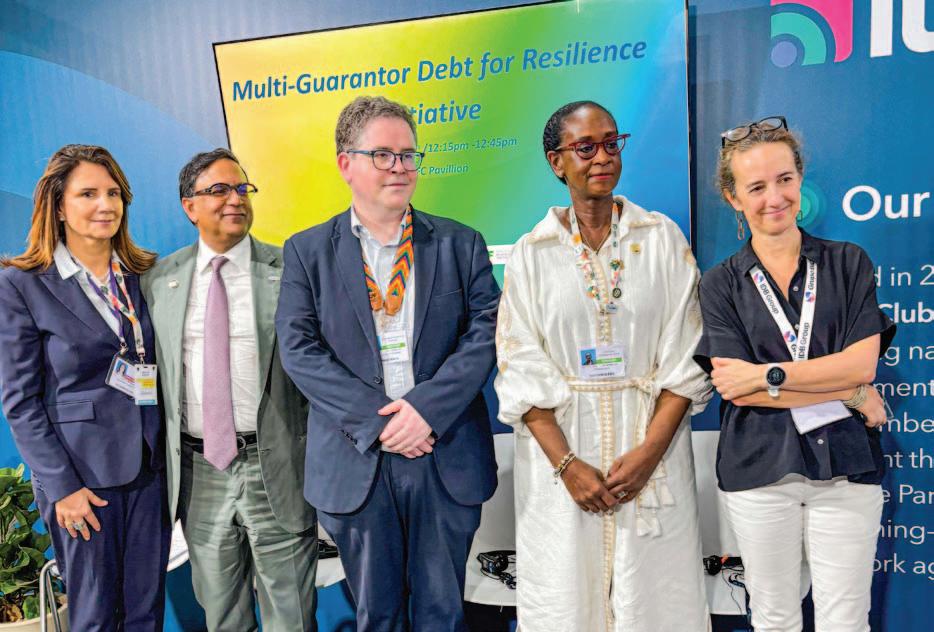
Representatives from CDB, IDB, and CAF at the launch of the Caribbean Multi-Guarantor Debt-for-Resilience Joint Initiative during COP30 in Belém, Brazil. This landmark regional partnership leverages guarantees from multilateral development banks and the private sector to unlock fiscal space, allowing Caribbean nations to invest in vital resilience measures and regional public goods. Participating in the launch were (from left): Ms. Ana Toni, COP30 Executive Director; Mr. Avinash Persaud, Special Advisor to the President of the IDB; Mr. Jorge Concha, Director of Green Operations and Financing at CAF; Ms. Valerie Isaac, Division Chief, Environmental Sustainability, CDB; and Ms. Isabelle BralyCartillier, Lead Specialist, Structured Partnerships, IDB.
PRODUCTION RESILIENCE
STRATEGIC INTERVENTIONS & IMPACT
Economic Infrastructure
2025 Completed and Operational Initiatives
Building on multi-year development cycles, the Bank successfully advanced and delivered several highpriority initiatives in 2025. These achievements represent the culmination of strategic investments designed to modernise trade hubs, secure renewable energy futures, and foster regional knowledge exchange.
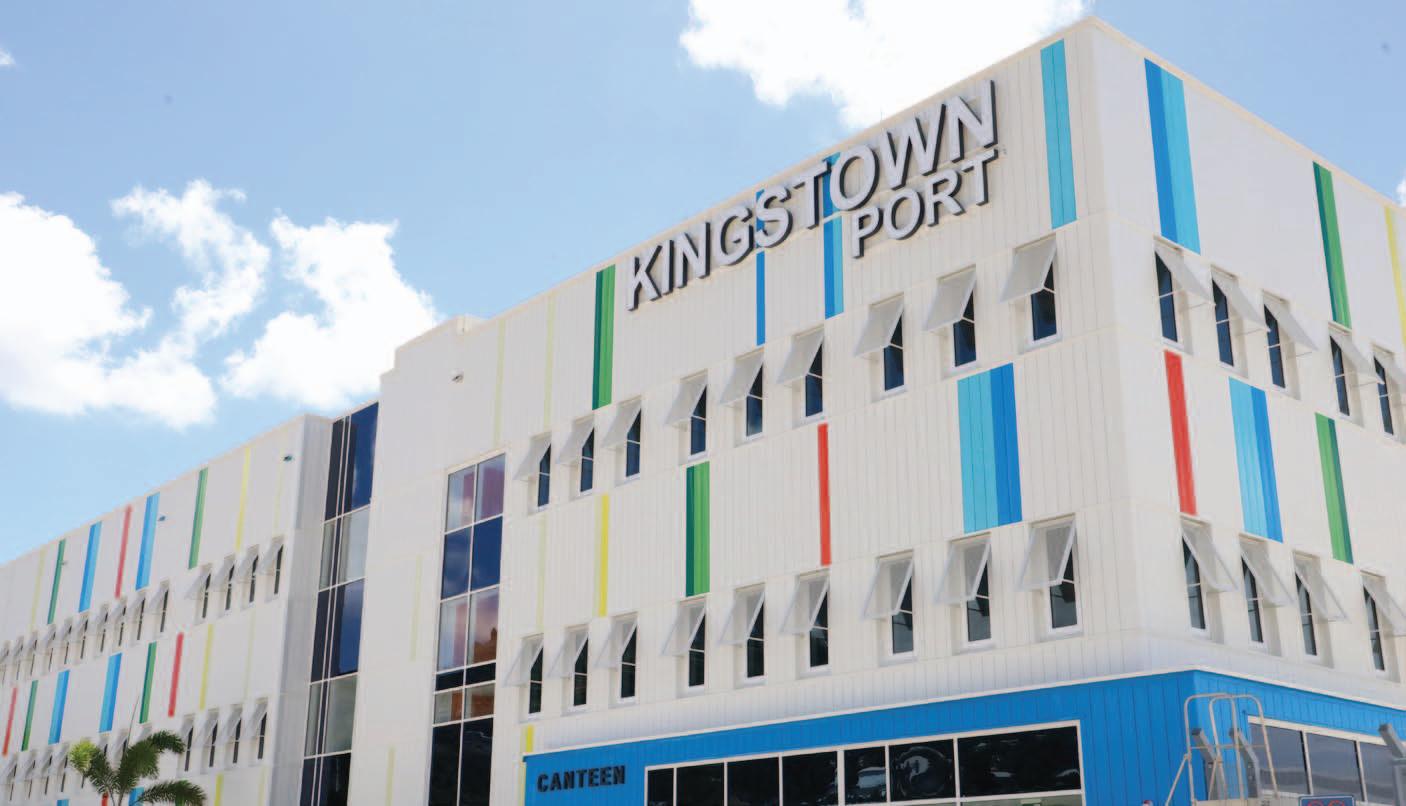
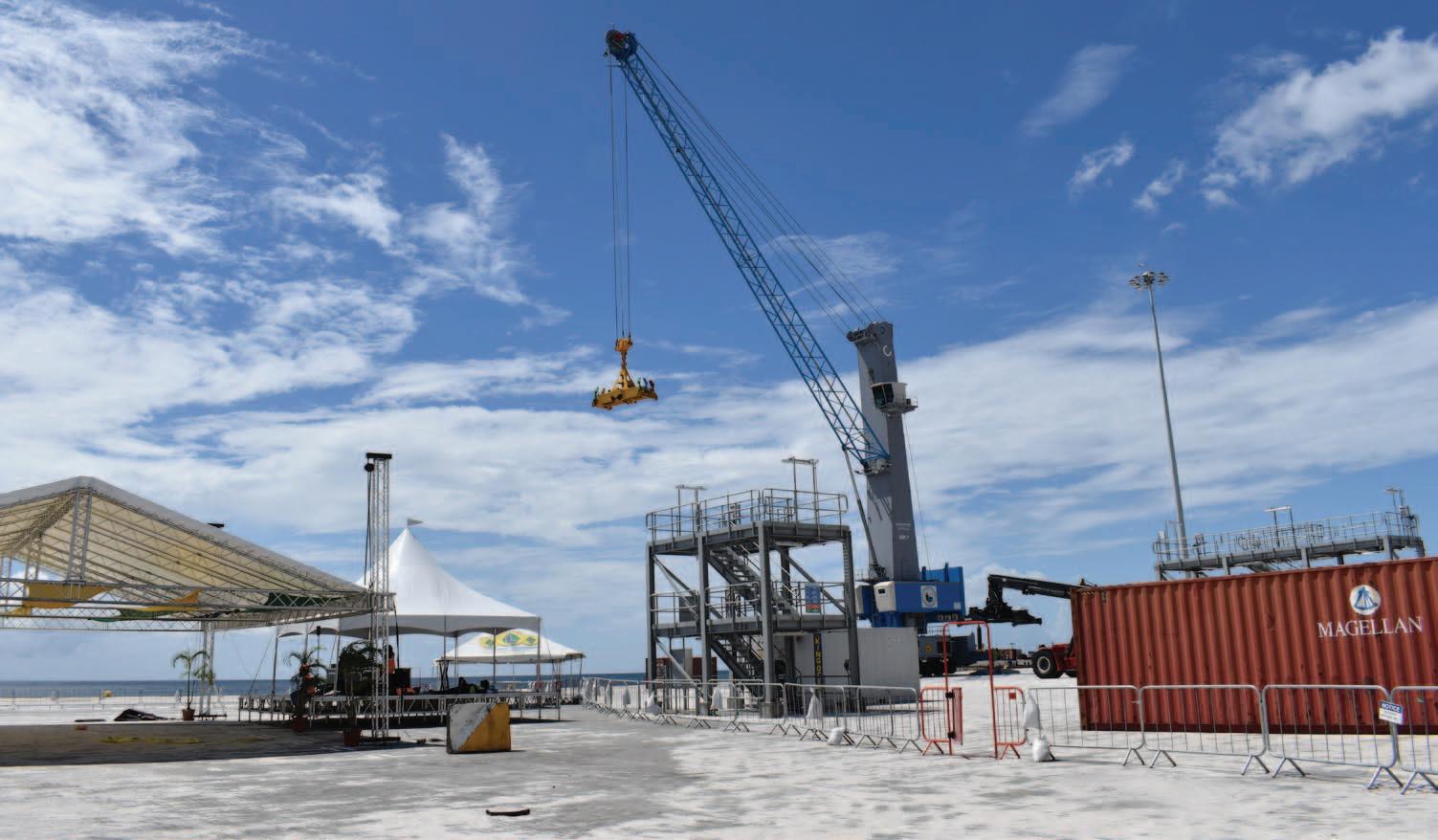
A landmark achievement was the official opening of the new Kingstown Port in Saint Vincent and the Grenadines in October 2025. This first phase of a transformational infrastructure investment was completed despite significant challenges, including the COVID-19 pandemic, supply chain disruption and eruption of the La Soufrière volcano. The Port Modernisation Project was implemented with $130 mn in loan financing from the Bank and a
$36 mn grant from the United Kingdom’s Foreign, Commonwealth and Development Office (FCDO) under UKCIF. The new facility will deliver improved efficiency in cargo port services and enhanced climate resilience and environmental sustainability in the Kingstown Port area. By December 2026, the project is expected to achieve a 50% increase in average annual throughput of containers, strengthening trade competitiveness and reducing logistics costs for businesses and consumers.
CDB achieved a critical milestone with the first disbursement for the Dominica Geothermal Power Project in August 2025, following financial close in June 2025. This landmark project represents a transformative shift toward indigenous, renewable baseload energy. By structuring a blended concessional financing package and mobilising private sector investment, CDB demonstrated its catalytic role in de-risking complex climate infrastructure projects. The model provides a replicable framework for developing geothermal and other renewable energy options across the region.
representatives of host organisations at the opening ceremony of the Caribbean Sustainable Infrastructure Conference, held in November 2025 in Barbados: (from left) Mr. Thomas Coward, UK Development Director for the Caribbean; Mrs. Mylène Lerigab, Regional Project Manager, Financial Institutions, Agence Française de Développement; Her Excellency the Most Honourable H. Elizabeth Thompson, Ambassador Extraordinary and Plenipotentiary of Barbados with Responsibility for Climate Change, Small Island Developing States, and Law of the Sea; Ms. Cheryl Senhouse, Finance Innovation Director, Caribbean Climate-Smart Accelerator; and Dr. Isaac Solomon, Vice President (Operations), Caribbean Development Bank. The conference, convened in partnership with the United Kingdom Foreign, Commonwealth and Development Office and the Agence Française de Développement, brought together 156 regional and international stakeholders to advance climate-resilient infrastructure across the Caribbean.
High-level
In November 2025, CDB convened the inaugural Caribbean Sustainable Infrastructure Conference with support from the FCDO and AFD. The conference brought together 156 participants, including regional and international experts, policymakers, and practitioners, to address how Caribbean nations can strengthen climate resilience through sustainable financing, inclusive planning,
and science-based infrastructure. Panel discussions showcased the Caribbean’s growing leadership in embedding equity, sustainability, and innovation within development frameworks around four key themes: environmental (tackling climate risks), social (promoting equity and gender inclusion), economic (advancing innovation-led economic development), and governance (strengthening collaboration).
2025 Infrastructure Investment and Capital Project Approvals
191,935,575
Table 1
inclusive economic opportunity throughout the region.
The new administrative centre of the Kingstown Port in Saint Vincent and the Grenadines, a facility was modernised through a partnership between the Bank and the United Kingdom FCDO under the UKCIF. The state-of-the-art facility, which is engineered to withstand extreme weather, will position Saint Vincent and the Grenadines as a dynamic maritime hub to drive
PRODUCTION RESILIENCE
CDB approved $181.8 mn in capital projects and $10.2 mn in technical assistance in 2025, as detailed in the summary above. The capital projects allocation represents a 12.9% increase compared to the $161.0 mn approved in 2024, signalling continued expansion of strategic infrastructure financing across BMCs. These tactical investments are designed to strengthen trade, energy security, water supply, and transport connectivity, ultimately driving economic productivity and climate resilience across the region. Highlights of the major projects approved during this period are presented in this section.
Transportation
In December 2025, CDB approved $46.8 mn for the Canouan Airport Rehabilitation Project, which will enhance the climate resilience and operational safety of airport infrastructure in Canouan, Saint Vincent and the Grenadines. The work will include rehabilitation, marking, and lighting of runways and taxiways, addressing critical safety and climatevulnerability constraints. Slated for completion by December 2028, the project will provide an
average of 34,000 people per year with improved access to air transport infrastructure.
The Barbados Grantley Adams International Airport Expansion Project, approved in December 2025, will improve service delivery, passenger experience, and operational efficiency in terminal and airside systems. The Bank allocated $47.2 mn in financing for the project, which will deliver approximately 11,150 square metres of new or renovated terminal space and three passenger bridges by December 2027.
Water Infrastructure
The Bank’s water security investments approved during the period will address fundamental climate vulnerabilities while strengthening household and economic resilience. The Bahamas Water Supply Improvement Project Phase 2, approved in March 2025, will increase citizens’ access to the resource through the installation or upgrading of 88 km of water supply lines. The $29.9 mn intervention will improve water supply and sanitation services for 1,550 households by December 2030.
CDB officials at the official opening of the modernised Kingstown Port in Saint Vincent and the Grenadines in October 2025: (from left) Mr. William Ashby, Division Chief (Ag.), Economic Infrastructure; Mr. Lenski Douglas, Operations Officer, Economic Infrastructure Division; and Dr. Isaac Solomon, Vice-President, Operations.
An additional grant of $1.3 mn was approved in September 2025 for the Southern St. George Water Supply Expansion Project in Grenada. This new allocation supplements the initial investment of $20.7 mn (GBP16.3 mn) financed through the UKCIF. Projected for completion by March 2027, the Project will increase the availability of safely managed drinking water services and strengthen capacity for integrated water resources management within Grenada’s Southern Water Supply Network. The initiative will also provide 2,196 households with access to improved water supply and sanitation through the installation or upgrading of 14 km of water supply lines. Additionally, 70 citizens will benefit from watershed management training scheduled for delivery by September 2026.
Energy Transition
Energy sector investments will accelerate the transition to renewable energy while strengthening grid resilience and operational efficiency.
The Belize Eighth Power Project, approved in September 2025, will provide 92,000 households with access to improved power supply by December 2029. The Bank has allocated $27.7 mn for the initiative, which involves installing and commissioning 114,000 Advanced Metering Infrastructure meters by December 2028. The project will enhance the grid resilience, reliability, and operational efficiency of Belize Electricity Limited’s sub-transmission and distribution systems, while empowering consumers, especially women, with real-time energy usage data to improve energy management.
The Bank approved an $8.7 mn allotment for the Grenada Battery Energy Storage System (BESS) Project in December 2025. The intervention will increase the efficiency of the electricity grid by installing and commissioning a 10 megawatt-hour BESS by December 2028. The system is projected to replace 3.28 mn gallons of fossil fuel annually, contributing significantly to greenhouse gas emission reduction and energy cost stability.
The Barbados Grantley Adams International Airport
PRODUCTION RESILIENCE
Founding members of RevUp Caribbean at a retreat in Jamaica. The organization’s community platform provides Caribbean entrepreneurs with curated resources, mentorship, and investor access through a tiered membership model. To date, a collaboration between CDB and RevUp Caribbean has supported at least 60 early-stage companies in improving their business operations.
Private Sector Development and Enterprise Competitiveness
In 2025, CDB advanced its private sector development agenda through deployment of innovative financial instruments, catalytic investments, and targeted technical assistance aimed at strengthening enterprise resilience, crowding in private capital, and expanding inclusive access to finance across BMCs.
Unlocking Trade Finance and Climate Investment
A key milestone in the period was the approval of CDB’s Trade Finance Guarantee Programme, designed to mitigate the risk exposure of confirming banks by providing partial guarantees against defaults by issuing banks on trade finance facilities. The programme is expected to strengthen
correspondent banking relationships, unlock additional liquidity for trade support, and improve access to trade finance products for regional enterprises, particularly MSMEs engaged in crossborder trade.
Consistent with its mandate to mobilise climate finance, CDB approved a $10 mn investment in the Caribbean Community Resilience Fund, a resiliencefocused impact investment facility supporting private sector activity in climate-critical sectors, including renewable energy, the blue economy, information and communications technology, housing, transport, financial services, and climate-smart agriculture. By allocating capital to the fund’s first-loss tranche, CDB strengthened the fund’s blended capital structure, provided downside protection for private institutional investors, and catalysed investment into the Caribbean’s largest climate-focused private equity fund to date.
Advancing Digital Financial Inclusion
Complementing these financing initiatives, the Bank approved $200,000 in technical assistance under the Digilab Finance Programme, implemented in partnership with the International Finance Corporation and the Caribbean Association of Banks. The programme supported the development of digital transformation strategies for 10 financial institutions across eight BMCs, enabling improved use of data analytics and digital solutions to enhance product design, reduce bias in credit decisions, and extend financial services to underserved individuals and enterprises.
Advancing Women’s Economic Empowerment
In 2025, the SheTrades Caribbean Regional Hub supported over 1,300 women-owned and women-led MSMEs through capacity-building, market access,
technical assistance, and networking interventions. Under the SheTrades Caribbean Grow and Go Grant Facility, the Hub disbursed $420,000 in nonreimbursable grants to 20 women-owned or womenled businesses to address technical, operational, and financial constraints and strengthen capacity to scale, trade, and export. All grant projects were in advanced stages of completion by year-end, with full delivery expected by March 2026.
Between 2023 and 2025, more than 2,650 women-owned and women-led enterprises across CDB’s 19 BMCs joined the Hub, with approximately 280 participants benefiting from in-person and virtual training delivered in 2025. The year saw the publication of two major knowledge products: CDB’s Flagship Study on Access to Finance for Women-led MSMEs and four accompanying country assessments for Belize, Jamaica, Saint Lucia, and The Bahamas, as well as the SheTrades Caribbean Hub Training Manual for BMCs.
CDB had a significant presence at CARIFESTA XV, held in Barbados in August 2025. Among the events the Bank supported was a symposium titled “Designing for Collective Impact Across the Value Chain: Regional CCI Development,” which took place at the University of the West Indies, Cave Hill Campus. Ms. Kellie Magnus, Executive Director of the Caribbean Culture Fund, and Ms. Malene Joseph, CIIF Fund Coordinator at CDB, were the featured speakers, while Ms. Farmala Jacobs, Gender Specialist at CDB, served as the moderator.
PRODUCTION RESILIENCE
A final project evaluation report was published in September 2025, followed by the dissemination of a project impact video in December. In recognition of demonstrated results and continued demand, the CDB Board approved $2.96 mn in grant funding for SheTrades Caribbean II (2026–2028).
Strengthening Cultural and Creative Industries
Through the Cultural and Creative Industries Innovation Fund (CIIF), CDB deployed $339,000 in technical assistance and grant resources in 2025. More than 200 beneficiaries from 14 BMCs (70% women) received proposal-writing training, with completion certificates awarded to 86 participants. This initiative served as a strategic precursor to the launch of new grant calls, supported by an enhanced digital grant management system and a $290,000 funding envelope.
CIIF awarded grants to 12 MSMEs for digital business solutions, market access initiatives, and professional service support across the audio-visual, festivals and carnivals, visual arts, fashion, and contemporary design subsectors. The Fund also leveraged regional platforms, including CARIFESTA XV in Barbados, and hosted a CIIF Creative Talk to examine how data optimisation can improve artists’ social and economic status. These engagements informed preparations for a 2026 technical assistance programme to support development of national cultural registries and databases.
Building Institutional Capacity and MSME Competitiveness
CDB advanced its Private Sector Strategy through the CTCS Programme by combining institutional strengthening with enterprise-focused interventions that enhance MSME competitiveness.
A full house of participants follow on during one of the training and knowledge-sharing sessions held as part of Belize Procurement Week. The nationwide initiative trained over 80 professionals across multiple districts to strengthen local capacity.
“Equally important is the capacity of enterprises, particularly smaller and medium-sized entities, to access finance, reach markets, and weather disruption. CDB’s interventions in 2025 are expanding that capacity on multiple fronts.”
In Saint Vincent and the Grenadines, support for the Centre for Enterprise Development Inc. is guiding development of a five-year strategic plan to improve governance, service delivery, and sustainability. In Haiti, CTCS provided a $72,163 grant to Banque Nationale de Développement Agricole (BNDA) to complete its strategic plan, strengthening institutional capacity and expanding access to finance for agricultural stakeholders as BNDA positions itself to become Haiti’s first universal bank by 2030.
CDB partnered with RevUp Caribbean to deliver a $250,000 grant programme supporting at least 60 early-stage companies, equipping entrepreneurs with tools to adopt technology, improve operations, strengthen financial viability, and prepare for investment. Enterprise-level capacity building was reinforced through CTCS’s Online Training of Trainers Workshops in Customer Service and Project Management (March–May 2025), creating a multiplier effect by preparing trainers to cascade knowledge to MSMEs across BMCs.
In Saint Lucia, CTCS partnered with the Youth Economy Agency and Ministry of Agriculture to implement the $74,000 Boys-to-Men Mushroom Agribusiness Employment Pilot Project, training 50 vulnerable young men in mushroom cultivation. This transformative initiative will advance food security while fuelling job creation.
Advancing Trade Facilitation and Export Readiness
The year marked the culmination of several marketfacing interventions under the EPA and CSME (CARICOM Single Market and Economy) Standby
Facility for Capacity Building, advancing trade facilitation, MSME competitiveness, and agrifood sector development. The Fit 4 Europe II project in Trinidad and Tobago and agro-processor cluster initiative in Jamaica strengthened export readiness through diagnostics, market intelligence, tailored capacity-building, and structured buyer engagement. Participating firms reported improved compliance with international standards and enhanced capacity to pursue export opportunities.
Significant progress was achieved with the completion of the Barbados Port Inc. Port Community System, which delivered a fully digital trade and logistics ecosystem that streamlined business processes, strengthened institutional capacity, and enhanced national competitiveness.
MSME competitiveness was further enhanced through targeted support in Suriname and Jamaica, where enterprises improved branding, digital presence, operational coordination, and export preparedness through cluster-based approaches. In the agrifood sector, the Grenada food safety project concluded with the commissioning of three refrigerated trucks, strengthening the national cold chain system. Combined with earlier Hazard Analysis and Critical Control Points and postharvest training, the intervention reduced spoilage, improved product quality, and enhanced supply reliability through a shared-use model that continues to deliver value across the value chain.
Building on these achievements, CDB has concluded negotiations with the European Union to implement the third phase of the Standby Facility, which will consolidate and scale successful interventions, deepen regional integration, and further strengthen
PRODUCTION RESILIENCE
“CDB’s interventions in 2025 are expanding that capacity on multiple fronts. New mechanisms are unlocking liquidity for cross-border trade, catalysing private capital into climate-critical sectors, and driving digital transformation in financial institutions to extend access to underserved entrepreneurs.”
trade facilitation, MSME competitiveness, and institutional capacity across CARIFORUM states.
Strengthening Regional Competitiveness and Climate-Smart Enterprise Development
In 2025, CDB approved an additional $3 mn contribution to Compete Caribbean+, a regional partnership programme implemented with the IDB, the FCDO, and the Government of Canada, to advance a competitive, equitable, and climatesmart Caribbean. Following targeted capacity building on clusters and value chains, a Call for Proposals resulted in seven shortlisted projects across agriculture, fisheries, and tourism. These initiatives received advanced technical support in climate-smart innovation, digitalisation, quality management, and sustainability, thereby improving their readiness for implementation.
The programme commissioned a regional analytical study of economic sectors with high growth potential, taking into account global market trends, technological change, and climate vulnerabilities. Compete Caribbean+ also delivered the fourth edition of the Economics of Innovation Master Class, supporting continued ecosystem development and public–private collaboration across the region.
Procurement Training for Private Sector Entities
In 2025, CDB strengthened its private sector engagement agenda by hosting and supporting three major procurement events to enhance market access for regional firms.
The Bank collaborated with the Government of Belize, the IDB, the WB, and the CABEI to deliver Belize Procurement Week, which engaged more than 80 Belizean procurement officials through sessions held across multiple locations across the country. CDB’s Office of Integrity, Compliance and Accountability (ICA) supported the outreach with a session on identifying and mitigating integrity risks in procurement processes, reinforcing the critical link between effective procurement systems and strong governance frameworks.
In partnership with the Government of Saint Vincent and the Grenadines, the OECS Commission, and the World Bank, CDB co-hosted the 2025 OECS Procurement Fair, which attracted over 600 registrants. Additionally, in close collaboration with the Government, the Bank organised a targeted procurement event in Antigua and Barbuda for local contractors and consultants.
“Underpinning all of this is a commitment to the enabling environment. Stronger business development ecosystems, improved compliance with international trade standards, and a growing body of regional knowledge are equipping Caribbean institutions to make smarter, faster, and more evidence-based decisions.”
RESILIENCE OUTCOMES
Across the Caribbean, the foundations of economic life, such as enterprises, ports, energy grids and water systems, are being tested by climate pressures, market volatility, and the structural constraints that have long defined small island economies. CDB’s 2025 production resilience interventions are addressing these challenges at their roots, strengthening BMCs’ productive capacity through transformative investments.
Infrastructure remains the bedrock. The opening of the modernised Kingstown Port signals a new era in maritime connectivity for Saint Vincent and the Grenadines. At the same time, newly approved airport expansions in Barbados and Saint Vincent and the Grenadines will sharpen the logistics performance on which tourism and trade depend. Water security investments will reduce climate vulnerability in The Bahamas and Grenada, and the landmark Dominica Geothermal Project is accelerating the region’s transition to clean, affordable, and reliable energy.
Equally important is the capacity of enterprises, particularly smaller and medium-sized entities, to access finance, reach markets, and weather disruption. CDB’s interventions in 2025 are expanding that capacity on multiple fronts. New
mechanisms are unlocking liquidity for cross-border trade, catalysing private capital into climate-critical sectors, and driving digital transformation in financial institutions to extend access to underserved entrepreneurs. Particular attention has been paid to women-owned businesses with targeted support enabling more than 1,300 women entrepreneurs across the region to build more competitive, exportready enterprises. This will drive diversification of income streams and strengthen economic stability at the household and community level.
Underpinning all of this is a commitment to the enabling environment. Stronger business development ecosystems, improved compliance with international trade standards, and a growing body of regional knowledge are equipping Caribbean institutions to make smarter, faster, and more evidence-based decisions. Regional procurement initiatives are deepening public-private linkages and ensuring that Caribbean firms are better positioned to compete for opportunities within their own markets.
Taken together, these interventions reflect the Bank’s strategy of supporting infrastructure development, promoting enterprise, facilitating market access, and building institutional strength, which can enable regional economies to withstand shocks and achieve growth and expansion.
FINANCIAL RESILIENCE
Financial Performance & Credit Ratings
CDB continued to operate profitably in 2025, closing the year with operating income of $36.0 mn, representing a 48% increase over the $24.3 mn reported at the end of 2024. Favourable variances in both interest income and interest expense primarily drove the uplift. Total comprehensive income of $60.7 mn was reported, up 99% from $30.5 mn the previous year, reflecting unrealised gains on debt securities, actuarial gains and reduced derivative costs. Total assets improved to $2,221.8 mn compared to $2,017.3 mn in 2024, largely due to growth in the loan portfolio and increased cash from market borrowings.
A landmark development was the execution of an EEA for $450 mn with the CABEI. The first such agreement between non-AAA and regional MDBs, the EEA diversifies risk exposure in lending portfolios and reflects CDB’s broader commitment to adopting innovative financial instruments that enhance balance sheet efficiency and expand development impact.
All three major credit rating agencies affirmed the Bank’s financial strength during the year, each
maintaining strong positive ratings with stable outlooks. In February, Fitch Ratings upheld the Bank’s Long-Term Issuer Default Rating of AA+ and its Short-Term Issuer Default Rating of F1+ with a Stable outlook, citing the Bank’s high governance standards, excellent capitalisation, low credit risk, and very high liquidity as key ratings drivers. In June, Moody’s Ratings affirmed the Bank’s Long-Term Issuer Rating of Aa1 with a Stable outlook, noting CDB’s strong capital and liquidity metrics, prudent risk management, robust shareholder support, and ongoing efforts to improve asset quality and reduce portfolio concentration through balance sheet optimisation. In November, S&P Global Ratings reconfirmed the Bank’s Long-Term Issuer Credit Rating of AA+ and its Short-Term Issuer Credit Rating of A-1+ with a Stable outlook, attributing the affirmation in part to an increase in the Bank’s riskadjusted capital ratio to 59.6% and the historic EEA with CABEI, which reduced portfolio concentration and enhanced risk management.
Maintaining uniform ratings across all three agencies reinforces the Bank’s negotiating position with potential lenders and its standing as a trusted partner in regional development finance.
SDF Contributors celebrate after approving a US$460 mn programme for SDF 11 at a special meeting held in Barbados in March 2025. SDF 11 garnered strong international and regional support, with several partners increasing their commitments for the eleventh cycle of the concessional financing facility, which will run from 2025 to 2028.
“Financing secured through the SFF will be available to BMCs specifically for projects that promote climate action, environmental sustainability, and inclusive economic and social development across the region, expanding the range and volume of concessional resources available for development investment.”
Expanding Access to Finance for BMCs
In March 2025, contributors approved a historic $460 mn programme for SDF 11, establishing a new envelope of concessional financing for BMCs. Representing a significant increase over the $383 mn allotted for SDF 10, this allocation strengthens the region’s capacity to build resilient communities through investments in poverty reduction, education, water and sanitation systems, disaster risk reduction, and sustainable energy.
CDB achieved a further milestone with the issuance of the first bond under its Sustainable Finance Framework. The Bank successfully raised CHF 100 mn through a five-year bond paying a fixed interest rate of 0.59% in the Swiss market in November 2025. Financing secured through the SFF will be available to BMCs specifically for projects that promote climate action, environmental sustainability, and inclusive economic and social development across the region, expanding the range and volume of concessional resources available for development investment.
In collaboration with IDB and CAF, the Bank developed the Multi-Guarantor Debt for Resilience Initiative, a facility designed to reduce debt pressures on the region’s most vulnerable economies while creating fiscal space to strengthen social protection, health systems, and climate resilience. This instrument reflects the Bank’s commitment to innovative approaches that address the structural fiscal constraints facing small island developing states.
The Bank fully operationalised its CC PPF during the year, providing increased support for BMCs in the design and preparation of high-impact climate adaptation and mitigation projects. By improving readiness and technical capacity, the Fund shortens the time between concept and implementation, enabling faster delivery of results for benefiting countries. The Bank also finalised a new EUR 4 mn Grant Facility from AFD to help BMCs implement critical infrastructure projects with environmental, climate resilience, and gender mainstreaming benefits.
New financing is now available to CDB’s Borrowing Member Countries for agriculture, climate action, and gender equality initiatives under an AFD-financed €4 million Grant Facility for the Caribbean. The grant agreement was signed in June 2025 by Dr. Isaac Solomon (right), CDB’s Vice President, Operations, and Mr. Dominique Hautbergue, AFD Director for the Brazil-Southern Cone Region, during the CDB Annual Meeting in Brasilia, Brazil.
INSTITUTIONAL RESILIENCE
INTERNAL FOCUS
In 2025, CDB advanced a broad agenda of institutional strengthening, modernising its operational systems, reinforcing governance and accountability frameworks, and deepening its commitment to integrity and evidence-based decisionmaking. These efforts collectively strengthen the Bank’s capacity to deliver effective, sustainable, and inclusive development outcomes across its BMCs.
Modernising Procurement Infrastructure
Significant progress was made in modernising CDB’s procurement infrastructure. The new client portal for procurement document reviews was completed, with rollout to BMCs planned for the second quarter of 2026. This centralised digital platform is designed to simplify submissions, accelerate turnaround times, and strengthen oversight, enhancing operational efficiency and deepening transparency across all project procurement activities. Development of a Consultants Registry and Database and a consultancy opportunities platform also advanced during the year, replacing the existing Register of Consultants, with the rollout anticipated in the second quarter of 2026. The enhanced platform offers improved functionality, increased transparency, and strengthened performance and due diligence features, including comprehensive management of
In response to demonstrated regional interest in sustainable procurement, CDB provided financial support to make the Sustainability SelfAssessment tool available in English. Developed by the Organisation of American States (OAS) and the Inter-American Network on Government Procurement and previously available only in Spanish, this Sustainability Self-Assessment Tool assists public entities in assessing their action plans and government management practices in
CDB also advanced regional collaboration on procurement professionalisation through two significant joint declarations with regional and international partners. Four major MDBs, the IDB, CABEI, CDB, and the WB, issued a Joint Statement committing to collaborate on advancing the professionalisation of public procurement across Latin America and the Caribbean, to strengthen procurement systems and enhance governments’ ability to address regional priorities, including climate resilience, gender equality, inclusive economic growth, and anti-corruption efforts. A second declaration was formalised during the XIX Annual Inter-American Network on Government Procurement
“A significant development was the commencement of work to transition CDB’s internal audit activity in alignment with the new Global Internal Audit Standards issued by the Institute of Internal Auditors.”
Conference, reinforcing a unified commitment to elevating procurement professionalisation as a strategic pillar of good governance and institutional performance across the region.
Strengthening Governance and Internal Controls
CDB continued to strengthen its governance, risk management, and internal control environment through a comprehensive risk-based Internal Audit Work Programme comprising assurance, advisory, and consultancy engagements focused on areas of highest institutional risk. Activities included audits of key operational and financial processes, follow-up on Management Action Plans, a SWIFT Independent Assessment, and advisory support for major institutional initiatives, including enterprise risk management, governance reforms, and the transition to enhanced digital and compliance systems.
A significant development was the commencement of work to transition CDB’s internal audit activity in alignment with the new Global Internal Audit Standards issued by the Institute of Internal Auditors. The Bank also advanced preparatory work for implementing an integrated Governance, Risk and Compliance system to improve oversight, reporting, and coordination across assurance functions. Through these activities, the Bank obtained independent assurance over 12 key risk areas spanning financial integrity, operational effectiveness, governance, and information security. Internal audit reviews confirmed that core controls were generally well designed and functioning, while identifying opportunities to strengthen consistency in execution, documentation, and management
oversight. By year-end, the Bank made solid progress across the 34 outstanding Management Action Plans, with many at advanced stages of implementation. Regular reporting to the Board’s Oversight and Assurance Committee, reinforced accountability and supported timely remediation in reducing residual risk and protecting development resources.
Advancing Integrity, Compliance, and Accountability
The Office of ICA marked a significant milestone in 2025, celebrating ten years of operations since its establishment on December 1, 2015. Over the past decade, ICA has played a fundamental role in strengthening CDB’s governance architecture by promoting ethical conduct, safeguarding accountability, and ensuring that integrity remains central to the Bank’s development mission. During the year, the Office intensified its internal outreach and capacity-building efforts, with over 95% of staff receiving comprehensive training in integrity, ethics, compliance, and accountability. Specialised training was also delivered in partnership with the Human Resource Department on CDB’s new Professional Working Environment Procedures, reinforcing the Bank’s commitment to a respectful and professional workplace culture. The Office efficiently managed and resolved allegations of ethics, integrity, and accountability violations across both internal and external operations. With increased private sector activity in 2025, integrity due diligence was expanded to ensure robust oversight and risk mitigation across this growing portfolio. ICA also co-hosted the 22nd Independent Accountability Mechanism Network Annual Meeting in Barbados in October, bringing
INSTITUTIONAL RESILIENCE
In October 2025, CDB joined forces with the MICI, the Office of the Compliance Advisor Ombudsman (CAO) of the IFC and the Multilateral Investment Guarantee Agency to stage the 22nd Annual Meeting of IAMnet in Barbados. The event brought together nearly 70 accountability professionals from development finance institutions worldwide, including the WB, IDB, IFC, Asian Development Bank, and European Bank for Reconstruction and Development.
together more than 80 accountability professionals from international financial institutions bilateral agencies, and civil society organisations for the first time in the Caribbean. This gathering provided a vital platform for exchanging ideas, experiences, and best practices to promote and safeguard accountability amid evolving global challenges.
Embedding Evidence-Based Decision-Making Through Independent Evaluation
The Office of Independent Evaluation (OIE) advanced its mandate significantly in 2025. A new Evaluation Policy and associated manuals for both self-evaluation and independent evaluation were developed and approved by the Board of Directors in December 2025, providing more explicit guidance, enhanced procedures, and stronger
quality assurance mechanisms to deliver more relevant, timely, and actionable insights for CDB’s operations and strategic planning.
During the year, the OIE completed evaluations of the Country Engagement Strategies for Trinidad and Tobago and Saint Lucia, and CDB’s Youth Policy and Strategy. The OIE also piloted a Real-Time Evaluation of the Guyana Water Supply Improvement Project, conducted a Synthesis Study of the BNTF, validated six Project Completion Reports, and finalised the evaluation of CDB’s Policy-Based Lending. In response to Peer Review recommendations, OIE strengthened its internal capacity through increased staffing and launched the first Evaluation Advisory Committee in line with global evaluation standards, deepening collaboration with Operations by embedding evaluation into CDB’s planning cycles and ensuring that evaluation insights are better integrated into strategic decision-making.
“Beyond its internal institutional strengthening agenda, CDB invested significantly in building procurement and evaluation capacity across BMCs, recognising that strong national institutions are foundational to effective development outcomes and long-term resilience.”
BMC CAPACITY BUILDING
Beyond its internal institutional strengthening agenda, CDB invested significantly in building procurement and evaluation capacity across BMCs, recognising that strong national institutions are foundational to effective development outcomes and long-term resilience.
Advancing Procurement Reform And Professionalisation
CDB provided targeted support to procurement reform processes in Dominica and Montserrat, while contributing technical expertise to wider regional efforts. In Montserrat, the Bank developed a comprehensive Procurement Manual, Standard Bidding Documents, and a training programme to support implementation of the new Procurement Act enacted in September 2025 with CDB financing. In Dominica, support included developing a Procurement Manual, contributing to earlier work on procurement legislation, and co-delivering procurement training alongside WB and the US Department of Commerce Commercial Law Development Program. In Suriname, CDB provided technical assistance for a Country Procurement Workshop organised by the Islamic Development Bank to address procurement challenges encountered by MDBs operating in the country.
In collaboration with the IDB, CDB continued to invest in long-term capacity building by offering scholarships for the International Public Procurement Management programme in Italy, equipping graduates to lead procurement reform efforts in their respective countries. The Bank also partnered with the OAS School of Government to develop and launch a Digital Transformation of Public Procurement online
course in the third quarter of 2025, targeting public sector procurement practitioners, policymakers, and other stakeholders. CDB financed 28 scholarships for candidates from BMCs to complete this training.
The Bank also contributed to the development of a Value for Money MDB Guidance Tool, scheduled for release in early 2026. Developed collaboratively with 15 MDBs, the tool provides a harmonised methodology for assessing value for money in MDB-financed projects throughout procurement and contract execution, applying the four dimensions of economy, efficiency, effectiveness, and equity across the entire procurement cycle to strengthen development outcomes and impact.
Building Evaluation Capacity Across The Caribbean
The OIE advanced its commitment to strengthening evaluation capacity across the Caribbean through a partnership with CLEAR-LAC. This collaboration aims to build robust national evaluation systems and monitoring and evaluation frameworks in BMCs, enabling governments to make more evidenceinformed policy decisions.
A milestone in BMC evaluation capacity building was an initiative under which OIE co-sponsored eight government officials from six BMCs to participate in the EVALAC training programme in October 2025. This intensive programme equips participants with practical monitoring and evaluation skills tailored to real-world policy contexts, helping to integrate evidence into decision-making processes. Looking ahead, OIE will host the first Caribbean Evaluation Week in September 2026, designed to cultivate a new generation of evaluation professionals and strengthen evaluation culture and systems across Caribbean countries.
GENDER
Gender equality is both a standalone strategic priority and a cross-cutting theme in CDB’s Strategic Plan, recognising that sustainable development requires deliberate action to address barriers that limit the full economic and social participation of all people. In 2025, the Bank advanced gender equality through regional leadership, institutional capacity-building, and operational mainstreaming across its portfolio.
Strategic Leadership and Institutional Capacity Building
As chair of the MDBs Working Group on Gender, the Bank hosted the bi-annual Global Gender Equality Summit in Barbados, bringing together 183 participants to address gender equality challenges through the integrated lenses of finance, climate action, and leadership. The Summit strengthened leadership-level capacity among development finance institutions for gender lens investing, with participating institutions committing to enhanced accountability mechanisms. This outcome will expand gender lens investing capacity and improve access to finance for women and women-owned enterprises, addressing a critical constraint to economic participation and business development across the region. CDB also introduced the innovative format of the Knowledge Exchange Marketplace within the MDB Working Group on Gender, which focused, inter alia, on lessons from evaluations of gender equality strategies and programming. This has led to a strengthening of the Bank’s Gender Equality Evaluation Guidelines.
In partnership with IDB and the Government of Barbados, CDB co-organised the Regional High-Level Symposium on Advancing State Responses to Domestic Violence, convening 124 senior justice, security, and gender policy officials. This engagement strengthened coordinated, survivor-centred responses to domestic violence, a critical human security challenge that undermines social cohesion and economic productivity across the region.
Operational Mainstreaming
Training programmes for UKCIF projects integrated gender equality and social inclusion into infrastructure delivery, reaching approximately 30 participants across project implementation teams. This capacitybuilding embedded gender equality and social inclusion considerations into infrastructure design, procurement, and monitoring, ensuring investments serve the needs of all community members. By mainstreaming gender analysis into productive infrastructure, including roads, water systems, energy, and public facilities, the Bank is ensuring that development investments support equitable access and benefit.
“The
Bank’s 2025 gender equality interventions demonstrate how strategic convening, institutional capacity-building, and operational mainstreaming advance development effectiveness. ”
High-level representatives from the Government of Barbados, CDB, and IDB joined more than 120 senior justice, security, and gender policy officials at a regional symposium the institutions co-organised to advance state responses to domestic violence. Held in Barbados in November 2025, the forum focused on strengthening coordinated, survivor-centred strategies across the Caribbean.
Advancing Development Effectiveness
The Bank’s 2025 gender equality interventions demonstrate how strategic convening, institutional capacity-building, and operational mainstreaming advance development effectiveness. By strengthening capacity for gender lens investing,
supporting coordinated responses to domestic violence, and embedding gender considerations into infrastructure delivery, CDB is addressing barriers to full economic and social participation. The Bank’s interventions therefore help to create enabling conditions for inclusive development while ensuring that CDB’s investments across all sectors contribute to sustainable and equitable outcomes.
The new Kingstown Port, Saint Vincent and the Grenadines Credit: Aecon Construction
SOCIAL RESILIENCE
A School of Their Own: Expanding Special Education to Guyana’s Essequibo Region
AT-A-GLANCE
Country: Guyana.
Community: Cottonfield, Essequibo River.
Total Investment: $490,372.
Partners: CDB and the Government of Guyana.
Financing Vehicle: BNTF 10
Sector: Education/Special Needs & Disability.
Status: Completed & Operational.
Direct Beneficiaries: Approximately 29 children with disabilities, from nursery to secondary level, and their families.
Key Impact: The only dedicated special education facility within a 36mile radius is now providing structured, inclusive learning for children with disabilities who previously had no access to this kind of support.
“Parents and guardians have embraced the Centre with relief and gratitude. Many report greater confidence in sending their children to school.”
The Challenge
For families of children with disabilities living along Guyana’s Essequibo River, accessing quality education meant one thing: leaving. Special education services were centralised in Georgetown, the capital, approximately 40 miles away, a distance that was insurmountable for many rural families.
Without local facilities or professional support, parents and caregivers bore sole responsibility for children whose educational and developmental needs they were often not equipped to meet. Children with Specific Learning Disabilities, Autism Spectrum Disorder, Intellectual Disabilities, and Vision and Hearing Impairments grew up without the structured learning environments they needed to thrive. For their families, the isolation was compounded by stigma, financial strain, and the quiet weight of doing it alone.
The Solution
Through the 10th cycle of CDB’s BNTF, the Bank’s flagship community-driven development programme, CDB and the Government of Guyana invested more than $490,000 to construct and fully equip the Exceptional Learners Centre in Cottonfield. The BNTF targets the most vulnerable communities across the Caribbean, channelling resources into foundational social infrastructure that directly improves quality of life.
The Centre serves students from nursery through secondary school and accommodates approximately 29 children contending with a range of disabilities. Thoughtfully designed for its students, the facility includes three multipurpose learning rooms, each accommodating up to 10 students; a staff room; a head teacher’s office; a kitchen; a sick bay; accessible sanitary facilities; and a storage room. A dedicated wheelchair-accessible bus service ensures that children are transported safely to and from the Centre every day, removing the last mile as a barrier to attendance.
The Impact
The Exceptional Learners Centre is the only school dedicated to children with special needs within a 36-mile radius. Its opening marks a significant milestone in expanding Guyana’s Special Education Needs and Disability (SEND) infrastructure beyond the capital, bringing the region closer to equitable access to education.
Parents and guardians have embraced the Centre with relief and gratitude. Many report greater confidence in sending their children to school, and a tangible reduction in the stigma that once surrounded disability in local educational settings.
The difference the Centre is making is perhaps best heard in the words of the families themselves.
One guardian, who described the transformation in her nephew, who has a speech impediment, said, “Having been enrolled in the school, he now speaks a few words and even calls me Auntie.”
For another parent, the Centre did something she had not dared hope for; it brought her home. After relocating to Georgetown so her son could attend a costly private institution, she has since returned to her Essequibo community. Her son is now enrolled at the Centre, and she is once again surrounded by family and her support network.
These are the kinds of changes that ripple across families and communities for generations.
Looking Ahead
The Exceptional Learners Centre demonstrates what becomes possible when investment reaches the communities that need it most. As Guyana continues to expand its SEND infrastructure across its regions, Cottonfield stands as both a model and a milestone. The facility provides proof that inclusive education is achievable beyond the capital and that no child should have to travel 40 miles to belong.
Purpose: To help BMCs identify, design and prepare high-impact climate adaptation and mitigation projects for financing by CDB and international climate funds.
Areas Supported: Resilient infrastructure, climate-resilient agriculture, renewable energy, disaster risk management, low-emissions transport, and more.
Key Impact: A streamlined pathway for Caribbean nations to access climate finance at greater speed and scale to address climate vulnerability and reduce climate change impacts, which can derail development progress.
For BMCs, the Fund represents a new kind of partnership with CDB. Collaboration begins at the idea stage as the Bank walks alongside countries from concept through to implementation.
The Challenge
The Caribbean is among the world’s most climatevulnerable regions, yet it receives a fraction of the global climate finance it urgently needs. Accessing concessional funding from major international climate mechanisms such as the GCF and the AF requires technically complex proposals, extensive data, and specialist expertise that many small island states do not have the resources to mobilise. The result is a painful paradox where the countries that need climate finance most are least equipped to secure it.
The Solution
In 2025, CDB launched the CC PPF, a purpose-built mechanism designed to dismantle the bottlenecks standing in the way of Caribbean nations accessing the climate investment they need.
The CC PPF provides grant resources to BMCs to cover the full range of project preparation activities from early-stage concept development and climate risk assessments to investment-ready proposal design. Critically, the Fund supports four types of climate action: capital projects financed directly by CDB; proposals targeting international climate funds; sustainable development projects integrating climate risk management; and requests for technical assistance to strengthen national capacity in disaster risk management and climate change adaptation.
The application process has been deliberately streamlined. Where a project concept is sound and preparation needs are well defined, the entire approval process can be completed in as little as 10 to 12 weeks, marking a significant improvement
over the lengthy timelines of many project preparation resources to which BMCs have access.
The Impact
The CC PPF addresses a structural inequity at the heart of global climate finance. By investing in readiness, the critical but often invisible work that happens before a project breaks ground, CDB is shortening the distance between climate ambition and climate action across the region.
“Caribbean countries are on the frontlines of climate change, yet too often the complexity of the application process has kept transformative funding out of reach,” says Ms. Valerie Isaac, CDB’s Division Chief, Environmental Sustainability. “The Climate Change Project Preparation Fund changes that equation. It puts technical support and resources directly in the hands of our member countries so they can compete effectively for the climate finance they deserve and deliver results on the ground faster.”
For BMCs, the Fund represents a new kind of partnership with CDB. Collaboration begins at the idea stage as the Bank walks alongside countries from concept through to implementation.
Looking Ahead
With areas eligible for support spanning resilient infrastructure, climate-resilient agriculture, renewable energy, integrated urban development, and disaster risk management, the CC PPF has the breadth to catalyse a robust regional pipeline of high-impact climate investments. As that pipeline grows, so too does the Caribbean’s collective capacity to attract and absorb the scale of climate finance commensurate with its needs.
PRODUCTION RESILIENCE
Kingstown Port Modernisation Project: Building a Gateway for Growth
AT-A-GLANCE
Country: Saint Vincent and the Grenadines.
Total Investment: $169 mn
CDB Loan: $130 mn
Grant Funding: $39 mn (administered by CDB on behalf of UK FCDO via the UKCIF.
Sector: Transport & Logistics Infrastructure.
Status: Completed & Operational (October 2025).
Direct Beneficiaries: 110,000+ citizens.
Key Impact: Saint Vincent and the Grenadines is now positioned as a dynamic maritime hub with climate-resilient infrastructure designed to boost trade, create jobs, and drive inclusive economic opportunity.
The Challenge
For decades, Saint Vincent and the Grenadines’ ageing port infrastructure constrained trade flows, limited export potential, and left the nation vulnerable to climate shocks. As a small island state in an increasingly competitive global market, the country needed modern facilities engineered to withstand extreme weather while unlocking new pathways to prosperity for its 110,000 citizens.
The Solution
Through an unprecedented partnership between the Government of Saint Vincent and the Grenadines, the CDB, and the United Kingdom Government via UKCIF, the Kingstown Port underwent a complete modernisation. This flagship UKCIF initiative is one of the largest capital investment loans CDB has issued to a BMC to date.
The state-of-the-art facility features expanded cargo handling capacity, upgraded roadways, and climateresilient engineering designed to withstand extreme weather events. Environmental, gender, and social safeguards were embedded throughout every phase from construction to operations, ensuring sustainability and inclusion at the core.
The Impact
When the Kingstown Port officially opened on October 25, 2025, it signalled a new chapter in regional connectivity and economic transformation. The modernised port delivers enhanced logistics efficiency, creating conditions for increased exports and economic diversification. Employment opportunities are expanding across the maritime value chain, with dedicated training programs ensuring youth and women can access new roles in port operations and related industries.
Beyond economic metrics, the project demonstrated peoplecentred development in action. Through careful planning and counterpart funding, 49 families from the Rose Place community were successfully resettled. The process preserved community ties while improving quality of life and safety.
Looking Ahead
“This facility stands as a tangible demonstration of what is possible when vision, partnership, and perseverance converge to promote holistic development and transformative social and economic change,” said Dr. Isaac Solomon, CDB’s VicePresident, Operations.
“This facility stands as a tangible demonstration of what is possible when vision, partnership, and perseverance converge to promote holistic development and transformative social and economic change,” said Dr. Isaac Solomon, CDB’s Vice-President, Operations.
FINANCIAL RESILIENCE
Unlocking Capital Through Innovation: CDB’s Exposure Exchange Agreement
AT-A-GLANCE
Partners: CABEI
Transaction Value: USD 450 million
Instrument: Exposure Exchange Agreement (EEA)
Signed: May 2025
Purpose: To diversify sovereign credit risk, strengthen capital adequacy, and create additional lending capacity for member countries
Key Impact: The historic first EEAs between non-AAA rated MDBs and regional MDBs, unlocking new lending headroom to finance critical infrastructure, climate action, and social development across the Caribbean and Latin America
“As the Bank continues to pursue Balance Sheet Optimisation strategies, the fundamental objective remains unchanged: to ensure that every dollar of institutional capital translates into maximum development impact for the people and communities of the Caribbean.”
The Challenge
Development banks operate under a fundamental constraint: their ability to lend is governed by the strength and diversification of their balance sheets. For institutions like CDB, whose lending is concentrated within a finite membership of small island and coastal states, portfolio concentration can limit capital efficiency and restrict the volume of new financing available to BMCs even when demand for development capital is high, and the institution’s credit standing is strong.
The question facing CDB and its regional counterparts was not whether they had the financial strength to do more, but whether they could deploy that strength more efficiently to deliver greater development impact without compromising balance sheet resilience.
The Solution
In May 2025, CDB executed a landmark USD 450 million EEA with CABEI. This transaction is the first EEA between non-AAA rated MDBs and the first between regional MDBs, a milestone in innovative development finance.
EEAs are sophisticated risk management instruments that allow MDBs to synthetically exchange portions of their sovereign credit exposures, diversifying portfolio concentration without transferring loans or altering relationships with BMCs. The result is a more balanced risk profile, improved capital adequacy metrics, and critically, additional lending headroom and capacity to approve new loans and finance new projects across member countries.
For CDB, the EEA with CABEI is about operationalising innovation. It reflects the Bank’s commitment to exploring forward-looking capital solutions that enhance its ability to deliver sustainable and impactful financing to BMCs, even as global economic uncertainty and climate pressures intensify demand for development capital.
The Impact
The financial mechanics of an EEA may be technical, but the development impact is straightforward. Additional lending capacity will mean more projects financed, more infrastructure built, more jobs created, and more communities strengthened. By efficiently diversifying its sovereign credit risk, CDB has expanded its ability to finance the critical infrastructure, renewable energy transitions, water security investments, climate adaptation measures, and social development projects that BMCs urgently need. This is balance sheet optimisation in service of poverty reduction.
Looking Ahead
The EEA align with recommendations from the G20’s capital adequacy framework and position CDB as part of a vanguard of MDBs adopting innovative instruments to modernise development finance. As the Bank continues to pursue Balance Sheet Optimisation strategies, the fundamental objective remains unchanged: to ensure that every dollar of institutional capital translates into maximum development impact for the people and communities of the Caribbean.
INSTITUTIONAL RESILIENCE
Strengthening Procurement Capacity Across the Caribbean
AT-A-GLANCE
Country: Belize.
Partners: Ministry of Economic Transformation (Belize), CABEI, IDB, World Bank
Sector: Public Procurement/Institutional Capacity Development.
Status: Delivered June 30 – July 4, 2025.
Participants: Public procurement officers, business owners, entrepreneurs, and contractors.
Format: Five-day procurement fair with technical training, awareness sessions, and direct engagement with development partners.
Key Impact: Expanding access to $11 bn in annual regional procurement opportunities by strengthening the capacity of both public institutions and private sector bidders.
The Challenge
Public procurement is the engine room of development finance in the Caribbean. Every year, approximately $11 bn flows through public contracts for infrastructure, goods, and services across the region, representing one of the largest sources of economic opportunity for local businesses, contractors, and consultants.
Yet too often, that opportunity remains out of reach. Complex bidding processes, unclear documentation requirements, limited technical knowledge of procurement standards, and insufficient feedback mechanisms leave many regional firms, particularly smaller enterprises, women-owned businesses, and youth entrepreneurs, struggling to compete. On the other side of the table, public institutions face their own constraints: understaffed procurement units, gaps in technical expertise, and systems that haven’t kept pace with best practices.
The result is a sub-optimal system and missed opportunities to turn public investment into inclusive economic growth.
The Solution
CDB is tackling the procurement challenge from both sides. Through a series of regional procurement fairs and sector-focused engagement events, the Bank is building the capacity of public institutions while simultaneously equipping private sector actors with the knowledge and tools they need to compete effectively.
In July 2025, CDB led a five-day Procurement Fair in Belize, hosted in collaboration with the Ministry of Economic Transformation, CABEI, IDB, and the WB. The event brought together public officers, business owners, and entrepreneurs for intensive training on procurement framework, standards, and best practices. Sessions covered everything from understanding tender documents and preparing competitive bids to navigating evaluation criteria and learning from feedback.
The initiative reflects CDB’s broader commitment to strengthening institutional resilience across its BMCs by ensuring that public procurement becomes not just a transactional process, but a strategic tool for economic inclusion and development impact.
The Impact
Companies and individuals within the region secure most of the contracts awarded under CDB financing. Even large or complex contracts typically rely heavily on subcontractors and consultants from BMCs, which makes local procurement capacity a direct determinant of how effectively development finance translates into jobs, business growth, and poverty reduction.
“The public sector urgently needs more skilled professionals, especially procurement officers and evaluators who understand both the rules and the responsibilities that come with their roles,” said Naomi Akoy-Bougenon, Division Chief (Ag) at CDB. “At the same time, the private sector deserves a level playing field: one where missteps in documentation or unclear feedback don’t cut them out of the game before they’ve even begun. It’s time to shift that story.”
CDB is working to do exactly that. Beyond technical training, the Bank is championing procurement as a vehicle for social inclusion, creating pathways for women, youth, and persons with disabilities to access contracting opportunities that have historically been out of reach.
As CDB expands its procurement capacity-building efforts across the Caribbean, the goal is to establish a regional procurement ecosystem where public institutions operate efficiently and transparently, private firms compete on a level playing field, and development finance more effectively supports initiatives the people and communities it is meant to serve. “CDB and its partners are pushing the boundaries of what procurement can look like in our region,” said Akoy-Bougenon. “That transformation, from bottlenecks to opportunities, is institutional resilience in action.”
The Office of Risk Management (ORM) manages risk through a comprehensive Enterprise Risk Management Framework (ERMF) that integrates a strengthened Risk Appetite Framework (RAF), enhanced economic and risk-adjusted capital adequacy assessment, prudent market and liquidity risk practices and continuous improvement of operational risk controls. Together, these elements provide a coherent, holistic and forward-looking approach to identifying, assessing and managing current and emerging risks across the institution, while supporting the effective delivery of the Bank’s development mandate.
The Office of Risk Management (ORM) manages risk through a comprehensive Enterprise Risk Management Framework (ERMF) that integrates a strengthened Risk Appetite Framework (RAF), enhanced economic and risk-adjusted capital adequacy assessment, prudent market and liquidity risk practices and continuous improvement of operational risk controls. Together, these elements provide a coherent, holistic and forward-looking approach to identifying, assessing and managing current and emerging risks across the institution, while supporting the effective delivery of the Bank’s development mandate.
Risk Appetite Framework
In 2025, the ORM revised the RAF as a central pillar of its risk governance architecture. The RAF defines the level and types of risk the Bank is willing to accept in pursuit of its mandate, while safeguarding capital strength, liquidity and institutional reputation.
Rather than operating as a standalone document, the RAF functions as a key implementation tool for the 2026–2035 Strategic Plan, ensuring that the Bank’s strategic objectives are pursued within clear, measurable, and sustainable financial and risk boundaries. This alignment strengthens the link between strategy, balance sheet management, and organisational culture. Key enhancements included:
i. The expansion of the risk taxonomy to fully integrate non-financial risks alongside traditional financial risks.
ii. The introduction of a more structured risk appetite architecture with defined appetite scales and explicit linkages between qualitative risk statements, quantitative Key Risk Indicators, and limits.
iii. Strengthened governance arrangements with clearer roles, escalation pathways, and review processes.
This enhanced structure supports early identification of deviations from risk appetite and enables timely and proportionate management responses.
Collectively, these improvements reinforce proactive and forward-looking risk and capital management, strengthen financial resilience, and ensure continued alignment with the Bank’s strategic objectives and institutional commitments. Through these reforms, ORM has transformed the RAF into a dynamic management tool that underpins disciplined strategy execution across the organisation.
Capital Adequacy
“CDB
closely aligns its risk appetite and capital adequacy framework with its strategic objectives and credit rating ambitions, ensuring that risk-taking decisions remain consistent with long-term financial sustainability and the preservation of the Bank’s strong credit profile. “
In 2025, CDB preserved a strong capital adequacy position, reinforcing its financial resilience and lending capacity to support BMCs. At year-end, the Bank’s Risk-Adjusted Capital (RAC) ratio stood at 38.6%, remaining well above internal policy thresholds and external credit rating agency benchmarks, providing substantial capacity to absorb shocks while maintaining prudent growth. It is noteworthy that, under S&P’s revised methodology for calculating RAC, introduced later in the year, the Bank’s capital adequacy position reflected even more favourably, further underscoring the underlying strength of CDB’s capital base. As it stands, S&P’s calculated RAC is now 59.6%.
During the year, CDB also introduced enhanced monitoring of the Deployable Strategic Capital ratio under the newly adopted Economic Capital Adequacy Policy and methodology. The ratio stood at 56.7%, comfortably exceeding the minimum benchmark of 46% and demonstrating strong capital headroom to support strategic priorities while remaining aligned with the Bank’s risk appetite.
CDB closely aligns its risk appetite and capital adequacy framework with its strategic objectives and credit rating ambitions, ensuring that risk-taking
decisions remain consistent with long-term financial sustainability and the preservation of the Bank’s strong credit profile.
Financial Risk Management and Portfolio Resilience
CDB strengthened its financial resilience by actively managing market, liquidity and credit risks within a robust enterprise-wide risk governance framework. In response to heightened interest rate uncertainty and foreign exchange volatility, the Bank adjusted its balance sheet and applied risk mitigation instruments to limit earnings volatility and protect capital. Consistent use of hedge accounting and asset–liability management practices reduced exposure to adverse market movements and supported balance sheet stability. Liquidity risk remained well controlled, supported by conservative internal policies that ensure sufficient funding availability over a multi-year horizon and by the maintenance of strong liquidity buffers.
Credit risk management continued to underpin portfolio stability. The Bank applied prudent lending standards and closely monitored borrower creditworthiness, maintaining a stable portfolio risk profile. The Weighted Average Risk Rating of BMCs improved to the B+ category over the last year, reflecting strengthened credit quality across the portfolio and effective credit surveillance. Portfolio quality remained strong, with no non-performing loans recorded during the year. The Bank actively managed borrower concentrations through clearly
defined exposure limits and ongoing portfolio diversification, ensuring alignment with the Bank’s risk appetite and capital adequacy objectives. Targeted portfolio assessments were conducted to support diversification and inform future approval decisions, helping to maintain a balanced and resilient risk profile.
Balance Sheet Optimisation
During the year, CDB, within the G20 CAF report recommendations action plan, continued to advance its Balance Sheet Optimisation (BSO) initiatives through the implementation of a US$ 450 million EEA with CABEI that delivered an immediate uplift in Risk-Adjusted Capital, Top 5 concentration (from ~58% to ~39%) and supported sustainable growth in lending capacity upwards of $460 mn. The EEA represented a landmark BSO transaction that further strengthened the Bank’s capital adequacy and credit rating resilience.
In parallel, CDB progressed discussions with the Government of Canada on a Partial Credit Guarantee designed to improve funding efficiency and diversify risk. The Bank also advanced preparatory work on a Contingent Capital Facility through the completion of a feasibility study, which will be followed by legal documentation and structuring requirements. Collectively, these initiatives strengthened CDB’s capital and funding toolkit, enhanced financial flexibility and improved the Bank’s capacity to respond effectively to shocks while continuing to meet the development needs of its BMCs.
Table 2 - Policy Ratio Analysis:
“Portfolio quality remained strong, with no non-performing loans recorded during the year. The Bank actively managed borrower concentrations through clearly defined exposure limits and ongoing portfolio diversification, ensuring alignment with the Bank’s risk appetite and capital adequacy objectives. “
*Note:
Maintaining Compliance with Risk Policies
As of December 31, 2025, CDB remained fully compliant with its internal risk policy thresholds, affirming the Bank’s strong capital adequacy position. International credit rating improvements in Barbados, The Bahamas, Jamaica, and the Turks and Caicos Islands contributed to this performance, alongside continued portfolio diversification efforts. In addition, Guyana and St. Kitts and Nevis received internal rating upgrades, reflecting their strong economic performance.
Through proactive portfolio risk and capital management and strategic financial planning, CDB continues to strengthen its ability to navigate uncertainties, sustain its development mandate, and enhance its resilience in an evolving global financial environment.
Operational Risk Management
In 2025, ORM advanced the Bank’s operational risk and internal control framework through targeted initiatives aligned with enhancements to the ERMF and the revised RAF. Building on a comprehensive operational risk gap analysis, ORM launched a structured 2026–2028 Operational Risk Management Work Plan, establishing a phased roadmap for governance enhancements, policy development, system enablement, and risk culture initiatives. These actions strengthen the Bank’s
ability to proactively identify, assess, and mitigate operational risks, ensuring alignment with strategic objectives.
Additionally, CDB became a member of the Global IFIs Operational Risk Management Forum, expanding opportunities for collaboration, leveraging best practices, peer benchmarking, and knowledge exchange with leading IFIs. This engagement enhances the Bank’s capacity to adopt global standards and continuously improve its operational risk management practices.
Credit Rating
The Bank maintained a strong and stable credit profile in 2025, underpinned by high capitalisation, robust liquidity and a very strong enterprise risk profile. S&P Global Ratings affirmed the Bank’s long-term issuer credit rating at ‘AA+’ and improved its short-term rating to ‘A-1+’, both with a Stable Outlook, highlighting its solid business profile, strong risk management and preferred creditor status, alongside a strengthened capital position with the risk-adjusted capital ratio rising to 59.6%. This assessment was complemented by Fitch Ratings’ affirmation of CDB’s ‘AA+’ rating with a Stable Outlook and Moody’s Ratings’ confirmation of the Bank’s ‘Aa1’ ratings, together underscoring CDB’s financial resilience and capacity to support climate action, resilience and sustainable development across its BMCs.
Regional ConferenceRisk
In September 2025, CDB partnered with CCRIF, the development insurer of the Caribbean and Central America, and CAF to host the 2nd Wider Caribbean Regional Risk Conference which focused on strengthening country risk management to advance sustainable development. The two-day flagship event brought together more than 50 speakers and panellists and attracted broad participation, with over 1,400 online attendees and approximately 250 participants attending in person.
The Conference facilitated highlevel, cross-sector dialogue among central bankers, MDBs, government officials, credit rating agencies, private sector leaders, industry practitioners, and youth representatives. The forum reinforced regional collaboration, promoted integrated approaches to managing interconnected risks, and highlighted the importance of coordinated, forward-looking risk governance in addressing the region’s evolving risk landscape.
“Portfolio quality remained strong, with no non-performing loans recorded during the year. The Bank actively managed borrower concentrations through clearly defined exposure limits and ongoing portfolio diversification, ensuring alignment with the Bank’s risk appetite and capital adequacy objectives. “
Caribbean Economist and Advisor. The hybrid event, which attracted more than 1,650 participants, was co-organised by CDB, CAF, and CCRIF SPC.
risk and financial sustainability at the 2nd Wider Caribbean Regional Risk Conference. They were among more than 40 high-level experts from regional and international organizations who gathered to address the complex challenges facing the Wider Caribbean.
Mr. Ian Durant (centre), Vice President, Corporate Services, (Ag) CDB, speaks during a panel discussion at the 2nd Wider Caribbean Regional Risk Conference. Listening in are fellow panellists Ms. Monique French (left), Chief Risk Officer at CIBC Caribbean, and moderator Ms. Marla Dukharan,
Mr. Stefano Capodagli (right), Chief Risk Officer at CDB; Ms. Lilia Burunciuc (center), World Bank Director for Caribbean Countries; and Mr. Joshua Grundleger, Director, Sovereign – Americas at Fitch, discuss sovereign
OVERVIEW
Caribbean Development Bank (“The Bank” or “CDB”) is a multilateral financial institution dedicated to the development of the economies of its BMCs with special and urgent regard to the needs of the less developed members of the region, primarily through project loans and technical assistance to the governments, public agencies, and other entities in those countries. The Bank’s main goals are the promotion of sustainable economic development, poverty reduction and the facilitation of regional integration. The Bank was established in 1969 and is owned by its member countries. These comprise nineteen BMCs and nine non-borrowing members.
The operations of the Bank are structured into two fund resource categories through which it delivers on its mandate. These comprise the Ordinary Capital Resources (OCR) and the Special Funds Resources (SFR). The OCR operations are financed from CDB’s share capital, capital market borrowings, lines of credit from other multilateral institutions and commercial banks, and internally generated equity. The SFR operations represent the Bank’s concessionary resource pool, comprising the Special Development Fund (SDF), financed by contributions from members and non-members of the Bank, and the Other Special Funds (OSF), financed by reimbursable and non-reimbursable contributions.
The Bank is highly rated by three major international rating agencies. In June 2025, Moody’s Investor Services affirmed CDB’s Long-Term Issuer Rating as Aa1 with a Stable Outlook. In November 2025, Standard and Poor’s (S&P) affirmed its Long-Term Issuer Credit Rating of AA+ with a Stable Outlook. In February 2026, Fitch Ratings reaffirmed CDB’s Long-Term IDR of AA+ with a Stable Outlook.
The following discussions should be read in conjunction with the audited financial statements of the Bank and accompanying Notes as set out in Section 6 of this report.
ORDINARY CAPITAL RESOURCES
Financial Statement Reporting
The financial statements of the OCR are prepared in accordance with IFRS Accounting Standards (IFRS) on a historical cost basis, except as modified by the measurement of debt securities held at fair value through Other Comprehensive Income (OCI), and derivative financial instruments, which are reflected at fair value through Profit & Loss (P&L). Additionally, the Bank has adopted hedge accounting for the fair value exposures of its borrowings. The carrying values of recognised assets and liabilities that are designated as hedged items in fair value hedges that would otherwise be carried at amortised cost are adjusted to reflect changes in the fair values attributable to the risks that are being hedged using the effective hedge relationship principles.
All amounts shown in the financial statements are stated in US dollar equivalents.
“The Bank is highly rated by three major international rating agencies. In June 2025, Moody’s Investor Services affirmed CDB’s Long-Term Issuer Rating as Aa1 with a Stable Outlook. In November 2025, Standard and Poor’s (S&P) affirmed its Long-Term Issuer Credit Rating of AA+ with a Stable Outlook. In February 2026, Fitch Ratings reaffirmed CDB’s Long-Term IDR of AA+ with a Stable Outlook. ”
Management Reporting
Management has determined that its operating income is the best representation of the results of the Bank’s core activities, and it is therefore used in the determination of CDB’s financial performance evaluations, liquidity and other ratios and analyses. Operating income is allocated to reserves by the Board of Governors in accordance with the Bank’s Charter. The accounting treatment in accordance with IFRS requires that derivatives be recorded at their fair value through P&L. This created significant income volatility due to foreign exchange and interest rate movements and is not representative of the underlying strategy or economics of the transactions since it is the Bank’s policy to hold these instruments to maturity. As a result, the Bank excludes the impact of these fair value and related foreign exchange translation adjustments associated with these derivatives from the determination of its operating income. The Bank also elected to adopt hedge accounting to mitigate the resulting volatilities experienced in the determination of comprehensive income. The impact of this is also excluded from operating income.
Loans are recorded on an amortised cost basis.
In compliance with the international standards, the Bank calculates the impairment of its financial instruments under the provisions of IFRS 9. This standard is based upon the “expected credit loss” methodology as well as various rules governing the classification and subsequent treatment of financial instruments. This methodology is forward-looking and based on changes in credit risk that determine whether impairment is calculated on a 12-month expected loss, a lifetime expected loss or an impaired basis, with movements between categories being based on assessed increases or decreases in credit risks. Impairment provisions are calculated based on the exposure at default, which includes commitments, measured against expected cash flows that are factored by probability of default, loss given default applicable to the credit ratings of counterparties, the time value of money and probability weighted optimistic and pessimistic scenarios against the base scenario.
Results of Operations of the OCR
Operating income: Operating income is defined as income prior to derivative fair value, hedge accounting and debt security adjustments. Operating income for the year ended December 31, 2025, amounted to $36.0 mn (2024: $24.3 mn), representing an increase of 48.1%. This improvement was largely attributable to a $6.2 mn reduction in interest expense, which declined to $38.2 mn (2024: $44.4 mn), as well as to the unrealised positive movement in foreign exchange translation, which recorded income of $5.1 mn (2024: expense of $1.1 mn).
Total comprehensive income: Total comprehensive income is defined as the sum of operating income and the effects of foreign exchange and interest rate adjustments related to derivative and hedge adjustments, fair value gains or losses on debt securities, and actuarial re-measurements relating to post-employment obligations. The OCR operations of the Bank for the year ended December 31, 2025, recorded total comprehensive income of $60.7 mn (2024: $30.5 mn).
Unrealised gains or losses do not affect the Bank’s cash flow, liquidity or impair its ability to meet its ongoing commitments.
Income from loans: Loan income for the year increased by $3.4 mn to $78.6 mn (2024: $75.2 mn). This was primarily a result of the growth of the loan portfolio to an average balance of $1,469.2 mn in 2025 (2024: $1,400.0 mn). The average interest rate on the loan portfolio in 2025 was 5.3% compared to 5.4% in 2024.
Income from cash and investments: For the year, income from cash and investments totalled $13.0 mn (2024: $10.6 mn), an increase of $2.4 mn, reflecting mainly higher yields on shorter duration instruments.
Interest expense: Interest expense of $38.2 mn (2024: $44.4 mn) was reported for 2025. The decrease of $6.2 mn primarily reflected the impact of reduced short-term interest rates to which the borrowing portfolio is exposed. This benefit was partially offset by the increased portfolio of borrowings across the period.
Operating expenses: In 2025, operating expenses amounted to $18.2 mn (2024: $20.2 mn). This movement was largely associated with the unrealised foreign exchange translation gain of $5.1 mn (2024: expense of $1.1 mn), partially offset by increased administrative expenses, which increased to $23.3 mn (2024: $19.2 mn). (See table).
OPERATING EXPENSES
Rate/Volume analysis: The rate/volume analysis shows the effect on interest income (excluding fees, charges and unrealised gains and losses) of the Bank analysed by the various drivers.
RATE/VOLUME ANALYSIS
Financial Position of the OCR
Total assets: As at December 31, 2025, total assets were $2,221.8 mn (2024: $2,017.3 mn), representing an increase of $204.5 mn (10.1%). This was largely due to increased loan disbursements in the last quarter.
Loans: In 2025, the loan portfolio grew to $1,552.3 mn (2024: $1,465.6 mn). This was an increase of 5.9% when compared to the prior year. Net transfers to December 31, 2025, totalled $74.7 mn compared to net transfers of $39.6 mn at December 31, 2024.
The Bank has only two impaired loans with one counterparty, which are in its non-sovereignportfolio. The impaired amount is $1.4 mn, and a full provision for this amount is reflected in financial records.
Borrowings and other liabilities: Total liabilities increased by $143.8 mn (13.0%) to $1,252.7 mn (2024: $1,108.9 mn). This increase resulted from borrowings drawn during the year, partially offset by declines in derivative liabilities.
Shareholders’ equity: At December 31, 2025, CDB’s equity was $969.1 mn (2024: $908.4 mn). This movement reflected the comprehensive income of $60.7 mn (2024: $30.5 mn) recorded for the year. Total equity currently represents 43.6% (2024: 45.0%) of total assets.
SELECTED FINANCIAL DATA
(Expressed in millions of United States dollars)
SPECIAL DEVELOPMENT FUND
The SDF was established in 1970 and is the Bank’s largest pool of concessionary funding, offering loans on more concessionary terms and conditions than those that are applied in the Bank’s OCR. The SDF also provides grants and technical assistance to BMCs.
The SDF is a significant and important enabler in the Bank’s mission to reduce poverty and contribute to sustained welfare enhancement in eligible BMCs. Successive replenishments of the SDF since its inception have served as a critical tool in CDB’s contribution to the transformation of the lives of underserved and at-risk members of the population, particularly those in rural communities.
The SDF is composed of SDF (Unified) and SDF (Other) fund groups. SDF (Other) comprises a conglomeration of funds that operated under varied terms and conditions fixed by the Fund’s various contributors. These differing terms and conditions created a number of complexities in the Fund’s management and operations. The SDF (Other) no longer accepts new funds.
All members of the Bank are required to contribute to SDF(U), and contributions are also sought from non-members. Contributions are interest-free and provided on a multiyear basis, for an indefinite term at predetermined times which are called Cycles and currently run for four years. SDF(U) has consistent terms, objectives and procurement conditions and thus overcomes the challenges associated with individual donors and funding arrangements. There is a supplementary governance structure through an Annual Meeting of Contributors which focuses on the SDF(U)’s operations and an annual report on the performance of the fund is provided. Non-members are also invited to participate as observers in meetings of the Bank’s Board of Directors (BOD) and Board of Governors (BOG).
Prior to new cycles, Contributors enter into negotiations with the Bank with the objective of agreeing on the priority areas and programmes that should be addressed and the amount of SDF (U) resources which will be necessary to realise the agreed objectives. The eleventh cycle of SDF (U) was formally agreed by contributors with effect for the period 2025-2028 to address the themes of building environmental, social, production, financial and institutional resilience.
SUMMARY OF RESULTS
Result of Operations of the SDF
For the year ended December 31, 2025, comprehensive income of $8.5 mn (2024: $1.6 mn) was recorded. Total interest income for the year was $18.3 mn, a marginal decrease from the prior year (2024: $18.9 mn). Net realised and unrealised gains of $7.8 mn (2024: $4.8 mn) resulted from declines in longer-term yields.
Total expenses were $17.7 mn (2024: $22.1 mn), with the decrease in administrative expenses of $1.0 mn being complemented by the favourable movement in foreign exchange translation of $4.5 mn.
Income from loans: Loan income of $11.9 mn (2024: $12.4 mn) declined marginally from the prior year, reflecting a reduced average lending rate while the average portfolio size remained relatively stable. The lending rates on this portfolio are set based on development objectives and not on market rates.
Income from cash and investments: Income from cash and investments recorded an outturn of $6.4 mn (2024: $6.5 mn), a marginal decrease compared with the prior year.
Administrative expenses: Administrative expenses were $22.2 mn (2024: $23.2 mn), reflecting a 4.3% decrease. The SDF’s share of the Bank’s total administrative expenses is determined by a costsharing formula approved in 2025 that incorporates both approval activity and asset volumes. The policy applicable in 2024 was based on the number of loan accounts and their status.
Financial Position of the SDF
Total assets: At December 31, 2025, total assets were $1,074.6 mn (2024: $1,097.1 mn).
Investments: At December 31, 2025, SDF cash and investments amounted to $319.7 mn (2024: $333.5 mn).
Loan portfolio: Total outstanding loans were $640.3 mn (2024: $641.6 mn), a decrease of $1.3mn from the prior year.
Receivable from contributors: This amounted to $105.1 mn (2024: $115.2 mn), reflecting additional settlements from members.
Liabilities and Contributions: At the end of the year, liabilities and contributions totalled $826.3 mn (2024: $872.4 mn), where the change was due to increased allocations to technical assistance and settlement of accounts payable.
Contributed resources: Contributions to the SDF net of allocations to technical assistance and grant resources increased by $15.3 mn to $189.4 mn (2024: $174.1 mn). This was due to the contributions received with respect to SDF11.
OTHER SPECIAL FUNDS
The Other Special Funds (OSF) was established to carry out the special operations of the Bank by providing resources on concessionary terms to assist BMCs in achieving the goal of poverty reduction. The Bank accepts resources from members and other contributors to the OSF for on-lending or administration on terms agreed with these contributors, where the purposes are consistent with the Bank’s objectives and functions.
SUMMARY OF RESULTS
Results of Operations of the OSF
For the year, comprehensive income of $2.3 mn (2024: $1.3 mn) was recorded, an increase of $1.0 mn. This change was primarily due to the increased level of interest and similar income to $8.4 mn (2024: $6.3 mn) and increased unrealised gain on foreign exchange translation of $2.1 mn (2024: $0.2 mn), which were partially offset by a $2.2 mn increase in administrative expenditure to $5.7 mn (2024: $3.5 mn).
Income from loans: Income from loans was $3.7 mn (2024: $3.2 mn), an increase of $0.5 mn compared to the previous year.
Interest Income from cash and investments: This was recorded at $4.7 mn (2024: $3.0 mn), an increase of $1.7 mn, reflecting a moderate extension in duration.
Administrative expenses: Administrative expenses totalled $5.7 mn (2024: $3.5 mn). The OSF’s share of the Bank’s total administrative expenses is determined by a cost-sharing formula approved in 2025 that incorporates both approval activity and asset volumes. The policy applicable in 2024 was based on the number of loan accounts and their status.
Financial Position of the OSF
Total assets: This registered $320.1 mn (2024: $311.5 mn), representing an increase of $8.6 mn (2.76%). The main drivers of change were:
Cash and Investments: Cash and investments amounted to $160.5 mn (2024: $134.6 mn), reflecting additional contributed resources.
Loan portfolio: Total outstanding loans were $123.1 mn (2024: $98.5 mn), representing an increase of 25.0% from the prior year.
Accounts Receivable: This totalled $31.5mn (2024: $59.3 mn), reflecting settlement of resources due from contributors.
Receivable from contributors: This declined to $5.0 mn (2024: $19.1 mn), the result of the encashment of promissory notes in respect of the UKCIF.
Liabilities and funds: Liabilities and funds totalled $320.1 mn (2024: $311.5 mn). This increase largely reflects the increase in accounts payable.
“In 2025, there was a positive net transfer of resources (i.e. the net of disbursements of loans and grants less repayments of principal) between CDB and its BMCs. The net flow of resources amounted to $240.6 mn (2024: $100.0 mn), an increase of 140.6%. ”
OPERATIONS
In 2025, the Bank approved $464.6 mn (2024: $303.5 mn) in loans, grants and equity. Loan and grant disbursements amounted to $462.4 mn (2024: $312.6 mn).
Details are shown in the Table below.
The three largest portfolios held across the Bank’s Funds were by Guyana (13.8%), St. Vincent and the Grenadines (12.4%) and The Bahamas (9.7%).
Resource Transfers: In 2025, there was a positive net transfer of resources (i.e. the net of disbursements of loans and grants less repayments of principal) between CDB and its BMCs. The net flow of resources amounted to $240.6 mn (2024: $100.0 mn), an increase of 140.6%.
The Bank continued to drawdown on existing facilities mainly held with development partners and global funds, including the IDB, GCF, AF, EIB, Governments of Canada, United Kingdom and Italy during the year.
Repayments: During the year, CDB was repaid 99.6% (2024:104.2%) of the total amounts that were charged to its borrowers. A breakdown by fund group follows:
Total Administrative Expenses
A comparative analysis of major administrative expenditure items is shown below. At December 31, 2025, total administrative expenses amounted to $51.3 mn, increasing by $5.5 mn over the expenditures of $45.8 mn experienced in 2024, mainly due to increased employee costs.
INDEPENDENT AUDITOR’S REPORT
Ernst & Young Ltd
P.O. Box 261 Bridgetown, BB11000 Barbados, W.l.
Street Address One Welches Welches St. Thomas, BB22025 Barbados, W.I.
TO THE BOARD OF GOVERNORS OF CARIBBEAN DEVELOPMENT BANK
Report on the Audit of the Financial Statements
Opinion
We have audited the financial statements of the Ordinary Capital Resources of the Caribbean Development Bank (“the Bank”), which comprise the statement of financial position as of 31 December 2025 and the statement of comprehensive income, statement of changes in equity and statement of cash flows for the year then ended, and notes to the financial statements, including material accounting policy information.
In our opinion, the accompanying financial statements present fairly, in all material respects, the financial position of the Bank as of 31 December 2025 and its financial performance and its cash flows for the year then ended in accordance with IFRS Accounting Standards.
Basis for Opinion
We conducted our audit in accordance with International Standards on Auditing (ISAs). Our responsibilities under those standards are further described in the Auditor’s Responsibilities for the Audit of the Financial Statements section of our report. We are independent of the Bank in accordance with the International Ethics Standards Board for Accountants’ International Code of Ethics for Professional Accountants (including International Independence Standards) (IESBA Code), and we have fulfilled our other ethical responsibilities in accordance with the IESBA Code. We believe that the audit evidence we have obtained is sufficient and appropriate to provide a basis for our opinion.
Key Audit Matters
Key audit matters are those matters that, in our professional judgment, were of most significance in our audit of the financi al statements of the current period. These matters were addressed in the context of our audit of the financial statements as a whole, and in forming our opinion thereon, and we do not provide a separate opinion on these matters.
INDEPENDENT AUDITOR’S REPORT (Continued)
TO THE BOARD OF GOVERNORS OF CARIBBEAN DEVELOPMENT BANK
Report on the Audit of the Financial Statements (continued)
Key Audit Matters (continued)
Key audit matter
Allowance for expected credit losses (ECL)
Related disclosures in the financial statements are included in Notes 3, 5, 7, 8, 10, 11 and 22.
IFRS 9 requires the Bank to record an allowance for expected credit losses (“ECL”) for loans outstanding and all other financial assets not held at fair value through profit and loss, along with undisbursed loan balances.
This is a key audit matter as the estimation of ECL is inherently uncertain and requires the application of judgment and use of subjective assumptions by management. Furthermore, models used to determine credit impairment are complex
Management compensates for any model and data deficiencies by applying judgmental overlays to ECL model outputs.
How our audit addressed the key audit matter
We evaluated the modelling techniques and methodologies developed by the Bank in order to estimate the ECL and assessed their compliance with the requirements of IFRS 9.
We tested the completeness and accuracy of data inputs into the model used to determine the ECL and assessed the reasonableness of the “preferred creditor treatment” (PCT) factor applied.
We assessed the reasonableness of the methodologies and assumptions applied in determining 12 month and lifetime probabilities of default (PD), loss given default (LGD), exposure at default (EAD) and triggers for significant increase/decrease in credit risk.
We involved our internal financial services risk management specialists to evaluate the methodology for validating models and analysing modelling accuracy and consistency of impairment parameters.
We assessed the reasonableness of all qualitative adjustments or overlays derived outside of specific model output.
In addition, we assessed the adequacy of the disclosures in the financial statements.
INDEPENDENT AUDITOR’S REPORT (Continued)
TO THE BOARD OF GOVERNORS OF CARIBBEAN DEVELOPMENT BANK
Report on the Audit of the Financial Statements (continued)
Key Audit Matters (continued)
Key audit matter
How our audit addressed the key audit matter
Fair value of financial instruments – derivatives and hedge accounting
Related disclosures in the Financial Statements are included in Notes 3 and 12.
This is a key audit matter due to the complexity of valuation models used to determine fair value. These valuation models can be subjective in nature and involve observable and unobservable data and various assumptions. These include the valuation of financial instruments with higher estimation uncertainty for which observable market prices or market parameters are not available. The use of different valuation techniques and assumptions could result in significantly different estimates of fair value. Inaccurate application of hedge accounting estimates could result in incorrect classification and could have a significant impact on the statement of comprehensive income.
The associated risk management disclosure is also complex and dependent upon high quality data.
We involved our internal derivative valuation specialists on our team who independently recomputed the fair value of all derivatives held by the Bank and who also tested the reasonableness of hedge effectiveness in accordance with IFRS 9.
We also assessed the adequacy of the disclosures in the financial statements, including the disclosure of valuation sensitivity and fair value hierarchy.
INDEPENDENT AUDITOR’S REPORT (Continued)
TO THE BOARD OF GOVERNORS OF CARIBBEAN DEVELOPMENT BANK
Report on the Audit of the Financial Statements (continued)
Other information included in the Bank’s 2025 Annual Report
Other information consists of the information included in the Bank’s 2025 Annual Report, other than the financial statements and our auditor’s report thereon. Management is responsible for the other information. The Bank’s 2025 Annual Report is expected to be made available to us after the date of this auditor’s report.
Our opinion on the financial statements does not cover the other information and we will not express any form of assurance conclusion thereon.
In connection with our audit of the financial statements, our responsibility is to read the other information identified above when it becomes available and, in doing so, consider whether the other information is materially inconsistent with the financial statements or our knowledge obtained in the audit or otherwise appears to be materially misstated.
Responsibilities of Management and the Oversight and Assurance Committee for the Financial Statements
Management is responsible for the preparation and fair presentation of the financial statements in accordance with IFRS Accounting Standards and for such internal control as management determines is necessary to enable the preparation of financial statements that are free from material misstatement, whether due to fraud or error.
In preparing the financial statements, management is responsible for assessing the Bank’s ability to continue as a going concern, disclosing, as applicable, matters related to going concern and using the going concern basis of accounting unless management either intends to liquidate the Bank or to cease operations, or has no realistic alternative but to do so.
The Oversight and Assurance Committee is responsible for overseeing the Bank’s financial reporting process.
Auditor’s Responsibilities for the Audit of the Financial Statements
Our objectives are to obtain reasonable assurance about whether the financial statements as a whole are free from material misstatement, whether due to fraud or error, and to issue an auditor’s report that includes our opinion. Reasonable assurance is a high level of assurance but is not a guarantee that an audit conducted in accordance with ISAs will always detect a material misstatement when it exists. Misstatements can arise from fraud or error and are considered material if, individuall y or in the aggregate, they could reasonably be expected to influence the economic decisions of users taken on the basis of these financial statements.
INDEPENDENT AUDITOR’S REPORT (Continued)
TO THE BOARD OF GOVERNORS OF CARIBBEAN DEVELOPMENT BANK
Report on the Audit of the Financial Statements (continued)
Auditor’s Responsibilities for the Audit of the Financial Statements (continued)
As part of an audit in accordance with ISAs, we exercise professional judgment and maintain professional skepticism throughout the audit. We also:
• Identify and assess the risks of material misstatement of the financial statements, whether due to fraud or error, design and perform audit procedures responsive to those risks, and obtain audit evidence that is sufficient and appropriate to provide a basis for our opinion. The risk of not detecting a material misstatement resulting from fraud is higher than for one resulting from error, as fraud may involve collusion, forgery, intentional omissions, misrepresentations, or the override of internal control.
• Obtain an understanding of internal control relevant to the audit in order to design audit procedures that are appropriate in the circumstances, but not for the purpose of expressing an opinion on the effectiveness of the Bank’s internal control.
• Evaluate the appropriateness of accounting policies used and the reasonableness of accounting estimates and related disclosures made by management.
• Conclude on the appropriateness of management’s use of the going concern basis of accounting and based on the audit evidence obtained, whether a material uncertainty exists related to events or conditions that may cast significant doubt on the Bank’s ability to continue as a going concern. If we conclude that a material uncertainty exists, we are required to draw attention in our auditor’s report to the related disclosures in the financial statements or, if such disclosures are inadequate, to modify our opi nion. Our conclusions are based on the audit evidence obtained up to the date of our auditor’s report. However, future events or conditions may cause the Bank to cease to continue as a going concern.
• Evaluate the overall presentation, structure and content of the financial statements, including the disclosures, and whether the financial statements represent the underlying transactions and events in a manner that achieves fair presentation.
We communicate with the Oversight and Assurance Committee regarding, among other matters, the planned scope and timing of the audit and significant audit findings, including any significant deficiencies in internal control that we identi fy during our audit.
We also provide the Oversight and Assurance Committee with a statement that we have complied with relevant ethical requirements regarding independence, and to communicate with them all relationships and other matters that may reasonably be thought to bear on our independence, and where applicable, actions taken to eliminate threats or safeguards applied.
INDEPENDENT AUDITOR’S REPORT (Continued)
TO THE BOARD OF GOVERNORS OF CARIBBEAN DEVELOPMENT BANK
Report on the Audit of the Financial Statements (continued)
Auditor’s Responsibilities for the Audit of the Financial Statements (continued)
From the matters communicated to the Oversight and Assurance Committee, we determine those matters that were of most significance in the audit of the financial statements of the current period and are therefore the key audit matters. We descr ibe these matters in our auditor’s report unless la w or regulation precludes public disclosure about the matter or when, in extremely rare circumstances, we determine that a matter should not be communicated in our report because the adverse consequences of doing so would reasonably be expected to outweigh the public interest benefits of such communication.
Report on other Legal and Regulatory Requirements
This report is made solely to the Bank’s members, as a body, in accordance with Article 38, sub -section 2 of the Agreement establishing the Caribbean Development Bank entered into force on 26 January 1970. Our audit work has been undertaken so that we might state to the Bank’s members those matters we are required to state to them in an auditor’s report and for no other purpose. To the fullest extent permitted by law and subject to any enactment or rule of law to the contrary, we do not accept or assume responsibility to anyone other than the Bank and the Bank’s members as a body, for our audit work, for this report, or for the opinion we have formed.
The partner in charge of the audit resulting in this independent auditor’s report is Mr. John-Paul Kowlessar
BARBADOS 27 March 2026
STATEMENT OF FINANCIAL POSITION
As at December 31, 2025 (expressed in thousands of United States dollars, unless otherwise stated)
The accompanying notes form an integral part of these financial statements .
CARIBBEAN DEVELOPMENT BANK
ORDINARY CAPITAL RESOURCES
STATEMENT OF CHANGES IN EQUITY
For the year ended December 31, 2025 (expressed in thousands of United States dollars, unless otherwise stated)
The accompanying notes form an integral part of these financial statements.
CARIBBEAN DEVELOPMENT BANK
ORDINARY CAPITAL RESOURCES
STATEMENT OF COMPREHENSIVE INCOME
For the year ended December 31, 2025 (expressed in thousands of United States dollars, unless otherwise stated)
The accompanying notes form an integral part of these financial statements.
CARIBBEAN DEVELOPMENT BANK
ORDINARY CAPITAL RESOURCES
STATEMENT OF CASH FLOWS
For the year ended December 31, 2025 (expressed in thousands of United States dollars, unless otherwise stated)
The accompanying notes form an integral part of
CARIBBEAN DEVELOPMENT BANK
ORDINARY CAPITAL RESOURCES
NOTES TO THE FINANCIAL STATEMENTS
For the year ended December 31, 2025 (expressed in thousands of United States dollars, unless otherwise stated)
NOTE 1 – NATURE OF OPERATIONS
Corporate structure
The Caribbean Development Bank (“CDB” or “the Bank”) is an international organisation established by an Agreement (“Charter”) signed in Kingston, Jamaica, on October 18, 1969 and accepted and ratified by all the member countries which are signatories thereto. The Charter is an international treaty which, together with the instruments of ratification and accession by member countries, is deposited with the United Nations Secretary-General. The Charter entered into force on January 26, 1970 and CDB commenced operations on January 31, 1970. Since then, other countries have become members of CDB by acceding to the Charter.
The Bank’s headquarters is located in Wildey in the parish of Saint Michael in the island of Barbados.
Purpose and objectives
CDB is a regional financial institution established for the purpose of contributing to the harmonious economic growth and development of the member countries in the Caribbean ( “the Region”) and to promote economic cooperation and integration among them , with special and urgent regard to the needs of the less developed members.
Membership
The membership of the Bank is open to:
(a) States and Territories of the Region;
(b) Non-Regional States which are members of the United Nations or any of its spe cialised Agencies; or of the International Atomic Energy Agency.
The Bank’s members are classified as either:
• Borrowing member countries (“BMCs”) which comprise members of the Region that are qualified to borrow from the Bank.
• Non-regional members (“NRMs”) which comprise members outside of the region that do not qualify to borrow from the Bank.
The BMCs are also shareholders of the Ordinary Capital Resources (“OCR”) of the Bank and are therefore considered related parties.
The current membership of the Bank is comprised of twenty-three (23) regional states and territories and five (5) non-regional states (2024: 23 regional states and territories and 5 non-regional states). A detailed listing of the membership is provided at Note 19(c) - Equity.
Reducing poverty in the region is CDB’s main objective and it finances development projects in its BMCs primarily through its OCR which comprises shareholders’ paid-in capital, retained earnings and reserves and borrowings. In advancing this objective, the Bank participates in the selection, study and preparation of projects contributing to poverty reduction and, where necessary, provides technical assistance and support
CARIBBEAN DEVELOPMENT BANK
ORDINARY CAPITAL RESOURCES
NOTES TO THE FINANCIAL STATEMENTS
For the year ended December 31, 2025 (expressed in thousands of United States dollars, unless otherwise stated)
NOTE 1 – NATURE OF OPERATIONS …continued
Special funds resources
Attainment of the Bank’s objectives are also supplemented by the Special Development Fund (“SDF”) and Other Special Funds (“OSF”) which comprise its Special Fund Resources (“SFR”) with distinct assets and liabilities and which are subject to different operational, financial and other rules as set out by the contributors, some of whom are not members of the Bank. The SFR is independently managed from, and has no recourse to, the OCR for obligations in respect of any of the liabilities of the SDF or OSF.
Mobilising financial resources is an integral part of CDB’s strategic and operational activities, where alone or jointly, it administers funds under agreements that are restricted to specific uses such as technical assistance, grants and regional programmes.
These funds are provided by donors, including members, some of their agencies and other development institutions.
NOTE 2 – ACCOUNTING POLICIES
All policies have been consistently applied to the years presented, except where otherwise stated. Accounting policies which are specific in nature are included as part of the relevant Notes to the financial statements. The accounting policies that are of a general nature are set out below:
Foreign currency translation
The functional and presentation currency of the Bank is the United States dollar (USD). Monetary assets and liabilities in currencies other than USD are translated at market rates of exchange prevailing at the reporting date. Non-monetary items measured at historical cost in currencies other than United States dollars are translated into USD using the prevailing exchange rates at the effective dates of the initial transactions.
Foreign currency transactions are initially translated into USD at applicable rates of exchange on the transaction dates. Any gains or losses arising as a result of differences in rates applied to income or expenses and to assets or liabilities are shown as an exchange gain or loss in the determination of net income for the year.
Taxation
Under the provisions of Article 55 of the Charter and the provisions of the Caribbean Development Bank Act, 1970-71 of Barbados, the Bank’s assets, property, income and its operations and transactions are exempt from all direct and indirect taxation and fr om all custom duties on goods imported for its official use.
CARIBBEAN DEVELOPMENT BANK
ORDINARY CAPITAL RESOURCES
NOTES TO THE FINANCIAL STATEMENTS
For the year ended December 31, 2025 (expressed in thousands of United States dollars, unless otherwise stated)
NOTE 2 – ACCOUNTING POLICIES …continued
Basis of preparation
Statement of compliance
These financial statements are prepared in accordance with IFRS Accounting Standards (IFRS). These financial statements have been prepared on the historical cost basis, except for the following material items in the statement of financial position:
• the measurement of debt securities at fair value through other comprehensive income (FVOCI)
• net post-employment obligations, which are measured at the fair value of plan assets less the present value of the defined benefit obligation
• the measurement of derivative financial instruments (cross currency interest rate swaps and interest rate swaps) at fair value
• land which is measured at fair value
• the carrying values of recognised assets and liabilities that are designated as hedged items in fair value hedges that would otherwise be carried at amortised cost are adjusted to recognise changes in the fair values attributable to the risks that are being hedged in effective hedge relationships
The financial statements are presented in United States dollars and all values are rounded to the nearest thousand ($000), except where otherwise indicated.
Presentation of financial statements
The presentation format of the Bank’s statement of comprehensive income reflects the Operating Income from the Bank’s core activities. In the opinion of management, this enhances the information to the users of the Bank’s financial statements, as Operating Income is the basis upon which the Bank’s financial, liquidity, capital adequacy, efficiency and other performance ratios and measures are determined.
The Bank presents its statement of financial position in order of liquidity. An analysis regarding recovery or settlement within 12 months after the reporting date (current) and more than 12 months after the reporting date (non–current) is presented in Notes 6 – 18 as applicable.
Financial assets and financial liabilities are generally reported gross in the statement of financial position. They are only offset and reported net when, in addition to having an unconditional legally enforceable right to offset the recognised amounts, the parties also intend to settle on a net basis in all of the following circumstances:
• The normal course of business
• The event of default
• The event of insolvency or bankruptcy of the Bank and/or its counterparties
CARIBBEAN DEVELOPMENT BANK
ORDINARY CAPITAL RESOURCES
NOTES TO THE FINANCIAL STATEMENTS
For the year ended December 31, 2025 (expressed in thousands of United States dollars, unless otherwise stated)
NOTE 2 – ACCOUNTING POLICIES …continued
Basis of preparation …continued
Presentation of financial statements …continued
Derivative assets and liabilities with master netting arrangements (e.g. ISDAs) are only presented net when they satisfy the eligibility of netting for all of the above criteria and not just in the event of default.
Effective October 1, 2022, the Bank designated certain of its interest rate and cross currency interest rate swaps, into a hedging relationship. These a re presented in Note 12.
Certain immaterial comparative amounts have been reclassified to conform to the presentation adopted in the current year.
Material accounting judgements, estimates and assumptions
The preparation of the Bank’s financial statements requires management to make judgements, estimates and assumptions that affect the reported amount of revenues, expenses, assets and liabilities, and the accompanying disclosures, as well as the disclosure of contingent liabilities. Uncertainty about these assumptions and estimates could result in outcomes that require a material adjustment to the carrying amount of assets or liabilities affected in future periods. In the process of applying the Bank’s accou nting policies, management has made the following judgements and assumptions concerning the future and other key sources of estimation uncertainty at the reporting date, that have a significant risk of causing a material adjustment to the carrying amounts of assets and liabilities within the next financial year. Existing circumstances and assumptions about future developments may change due to circumstances beyond the Bank’s control and are reflected in the assumptions if and when they occur.
Judgements
Information about judgements made in applying accounting policies that have the most significant effects on the amounts recognised in the financial statements is included in the following notes.
• Note 5: Financial Assets
o establishing the criteria for determining whether credit risk on a financial asset has increased significantly since initial recognition, determining the methodology for incorporating forward-looking information into the measurement of Expected Credit Losses (ECL) and selection and approval of models used to measure ECL.
CARIBBEAN DEVELOPMENT BANK
ORDINARY CAPITAL RESOURCES
NOTES TO THE FINANCIAL STATEMENTS
For the year ended December 31, 2025
(expressed in thousands of United States dollars, unless otherwise stated)
NOTE 2 – ACCOUNTING POLICIES …continued
Material accounting judgements, estimates and assumptions …continued
Assumptions and estimation uncertainties
Information about assumptions and estimation uncertainties at the reporting date that have a significant risk of resulting in a material adjustment to the carrying amounts of assets and liabilities within the next financial year is included in the following notes:
• Note 3: Measurement of fair value of financial instruments with significant unobservable inputs.
• Note 5: Financial Assets - impairment of financial instruments; determination of inputs into the ECL measurement model, including assumptions used in estimating recoverable cash flows and incorporation of forward-looking information.
• Note 17: Post-employment obligations - measurement of defined benefit obligations; key actuarial assumptions.
Going concern
The Bank’s management has made an assessment of its ability to continue as a going concern and is satisfied that it has the resources to continue its operations for the foreseeable future. The Bank also continues to have the full support of its Members through the provision of additional financial, technical, material and other assistance as well as guidance and support from the Board of Directors.
New and amended standards and interpretations which are applicable to the Bank
In these financial statements, the Bank has applied the following standards and amendments for the first time. The nature and effect of the changes as a result of the adoption of these new accounting standards are described below. The new and amended standards and interpretations are effective for annual periods beginning on or after January 1, 2025, unless otherwise stated. The Bank has not early adopted any standards, interpretations or amendments that have been issued but are not yet effective.
Lack of exchangeability – Amendments to IAS 21
For annual reporting periods beginning on or after 1 January 2025, Lack of Exchangeability –Amendments to IAS 21 The Effects of Changes in Foreign Exchange Rates specifies how the Bank should assess whether a currency is exchangeable and how it should determine a spot exchange rate when exchangeability is lacking. The amendments also require disclosure of information that enables users of the Bank’s financial statements to understand how the currency not being exchangeable into the other currency affects, or is expected to affect, the entity’s financial performance, financial position and cash flows. This amendment did not have a material impact on the Bank’s financial statements.
CARIBBEAN DEVELOPMENT BANK
ORDINARY CAPITAL RESOURCES
NOTES TO THE FINANCIAL STATEMENTS
For the year ended December 31, 2025
(expressed in thousands of United States dollars, unless otherwise stated)
NOTE 2 – ACCOUNTING POLICIES …continued
Standards in issue not yet effective that may be applicable to the Bank
The following is a list of standards and interpretations issued that may be applicable but are not yet effective up to the date of the issuance of the Bank’s financial statements. The Bank intends to adopt these standards when they become effective. The impact of adoption depends on the assets held by the Bank at the date of adoption.
Classification and Measurement of Financial Instruments - Amendments to IFRS 9 and IFRS 7
Effective for annual periods beginning on or after January 1, 202 6.
In May 2024, the Board issued Amendments to the Classification and Measurement of Financial Instruments (Amendments to IFRS 9 and IFRS 7), which:
• Clarifications of the requirements for recognition and derecognition of financial assets and liabilities
• A clarification that a financial liability is derecognised on the ‘settlement date’ and introduce an accounting policy choice (if specific conditions are met) to derecognise financial liabilities settled using an electronic payment system before the settlement date
• Additional guidance on how the contractual cash flows for financial assets with environmental, social and corporate governance (ESG) and similar features should be assessed
• Clarifications on what constitute ‘non-recourse features’ and what are the characteristics of contractually linked instruments
• The introduction of disclosures for financial instruments with contingent features and additional disclosure requirements for equity instruments classified at fair value through other comprehensive income (OCI)
Entities can early adopt the amendments that relate to the classification of financial assets plus the related disclosures and apply the other amendments later. The new requirements will be applied retrospectively with an adjustment to opening retained ear nings. Prior periods are not required to be restated and can only be restated without using hindsight. An entity is required to disclose information about financial assets that change their measurement category due to the amendments.
Contracts Referencing Nature-dependent Electricity – Amendments to IFRS 9 and IFRS 7
In December 2024, the IASB issued Amendments to IFRS 9 and IFRS 7 - Contracts Referencing Naturedependent Electricity. The amendments apply only to contracts that reference nature -dependent electricity. The amendments:
• Clarify the application of the ‘own-use’ requirements for in-scope contracts
• Amend the designation requirements for a hedged item in a cash flow hedging relationship for in-scope contracts
• Add new disclosure requirements to enable investors to understand the effect of these contracts on a company’s financial performance and cash flows
CARIBBEAN DEVELOPMENT BANK
ORDINARY CAPITAL RESOURCES
NOTES TO THE FINANCIAL STATEMENTS
For the year ended December 31, 2025
(expressed in thousands of United States dollars, unless otherwise stated)
NOTE 2 – ACCOUNTING POLICIES …continued
Standards in issue not yet effective that may be applicable to the Bank continued
Contracts Referencing Nature-dependent Electricity – Amendments to IFRS 9 and IFRS 7 continued
The amendments will take effect for annual reporting periods starting on or after 1 January 2026. Early adoption is allowed, but it must be disclosed. The amendments concerning the own -use exception are to be applied retrospectively, while the hedge accounting amendments should be applied prospectively to new hedging relationships designated from the initial application date. Additionally, the IFRS 7 disclosure amendments must be implemented alongside the IFRS 9 amendments. If an entity does not restate comparative information, it cannot present comparative disclosures.
IFRS 18 – Presentation and Disclosure in Financial Statements
Effective for annual periods beginning on or after January 1, 202 7
In April 2024, the Board issued IFRS 18 Presentation and Disclosure in Financial Statements which replaces IAS 1. IFRS 18 introduces new categories and subtotals in the statement of profit or loss. It also requires disclosure of management-defined performance measures (MPMs) and includes new requirements for the location, aggregation and disaggregation of financial information. Narrow-scope amendments have been made to IAS 7, Statement of Cash Flows, which include changing the starting point for determining cash flows from operations under the indirect method from ‘profit or loss’ to ‘operating profit or loss’. The optionality around classification of cash flows from dividends and interest in the statement of cash flows has also largely been removed. Some requirements previously included within IAS 1 have been moved to IAS 8 , Accounting Policies, Changes in Accounting Estimates and Errors, which has been renamed IAS 8, Basis of Preparation of Financial Statements . IAS 34, Interim Financial Reporting has been amended to require disclosure of MPMs. IFRS 18, and the consequential amendments to the other accounting standards must be applied retrospectively. Early adoption is permitted and must be disclosed.
Annual Improvements to IFRS Accounting Standards Volume 11
The IASB’s annual improvements process deals with non-urgent, but necessary, clarifications and amendments to IFRS. In July 2024, the IASB issued Annual Improvements to IFRS Accounting Standards Volume 11 which identified various amendments to IFRS 7, Financial Instruments: Disclosures, IFRS 9, Financial Instruments and IAS 7, Statement of Cash Flows which may be applicable to the Bank. These amendments are applicable for annual reporting periods beginning on or after 1 January 2026. Earlier application is permitted.
CARIBBEAN DEVELOPMENT BANK
ORDINARY CAPITAL RESOURCES
NOTES TO THE FINANCIAL STATEMENTS
For the year ended December 31, 2025
(expressed in thousands of United States dollars, unless otherwise stated)
NOTE 3 – RISK MANAGEMENT
The Bank’s principal financial liabilities, other than derivative financial instruments, comprise borrowings and accounts payable, the main purpose of which is to finance the Bank’s operations. The Bank also provides guarantees to its borrowers under set t erms and conditions. The Bank’s principal financial assets are loans outstanding, receivables, cash and cash equivalents and debt securities at fair value through other comprehensive income that are all derived directly from its operations.
The Bank also holds derivative contracts and enters into derivative transactions when deemed necessary by senior management. All derivative activities for risk management purposes are undertaken by senior management in accordance with the approved Board of Directors (BOD) policy which includes the provision that derivatives are held to maturity except under specific conditions and that no trading in derivatives for speculative purposes may be undertaken.
The Bank’s BOD sets the governance framework for the Bank by setting the risk and risk appetite framework, and the underlying policies and procedures. Financial risk activities are governed by the policies and procedures and financial risks are identified, measured and managed in accordance with the Bank’s approved policies and risk objectives.
The ability to manage these risks is supported by an enterprise-wide risk management framework which was approved by the BOD. Operationally, CDB seeks to minimise its risks via the implementation of robust mitigating controls aimed at achieving adherence t o approved risk appetite portfolio limits. The Bank’s risk mitigation approaches include adopting processes, systems, policies, guidelines and practices which are reviewed and modified periodically in line with the institution’s changing circumstances.
The Bank’s Office of Risk Management (ORM) manages, coordinates, monitors and reports on the mitigation of all risks that the Bank faces such as strategic, financial, operational, and reputational risks. The ORM also has the responsibility for recommending and implementing new or amended policies and procedures for effective risk management to the BOD for approval and to ensure that risk awareness is embedded within the Bank’s operations and among its employees. CDB’s risk management framework is built around its governance, policies and processes. The risk management governance structure supports the Bank’s senior management in their oversight function in the coordination o f different aspects of risk management, and is built around the following committees:
(i) The Enterprise Risk Committee (ERC) which is responsible for monitoring adherence to BOD approved policies related to financial and other risks;
(ii) The Adjudication and Review Committee (ARC) which reviews and recommends Loans, Grants and Technical Assistance (TA) applications to the BOD for consideration;
(iii) The Oversight and Assurance Committee (OAC) through which the ORM, the Office of Institutional integrity, Compliance and Accountability (ICA), the Office of Independent Evaluation (OIE) and the Internal Audit Division (IAD) report to the BOD;
(iv) ICA operationalises the strategic framework for integrity, compliance and accountability. It is responsible for managing institutional integrity, compliance, anti -money laundering (AML), countering the financing of terrorism (CFT) and financial sanctions, ethics, whistleblowing, and project accountability;
(v) The Strategic Advisory Team (SAT) which is the highest decision -making body of the Bank.
CARIBBEAN DEVELOPMENT BANK
ORDINARY CAPITAL RESOURCES
NOTES TO THE FINANCIAL STATEMENTS
For the year ended December 31, 2025 (expressed in thousands of United States dollars, unless otherwise stated)
NOTE 3 – RISK MANAGEMENT…continued
The Bank is exposed to credit risk, market risk (currency and interest rate risk), liquidity risk and operational risk. By its very nature the Bank is also exposed to concentration risk in relation to its BMCs. The Bank manages and controls concentration of credit risk through financial policies which limit the amount of exposure in relation to a single borrower and to groups of borrowers, by counterparties , credit ratings and by type of investments Performance against these limits is measured and reported on a monthly and quarterly basis to the ERC and the OAC respectively
(a) Credit risk
Credit risk relates to potential losses in the event that a BMC is unable or unwilling to service its obligations to the Bank. CDB manages this risk through its financial policies and lending strategies, including the setting of individual country exposure limits and evaluation of overall creditworthiness. Individual BMC exposure to the Bank on outstanding loans as at December 31, 2025 is reported in Note 4 and Note 10
The Bank manages its credit risk related to liquid funds and derivative financial instruments by ensuring that all individual investments carry a minimum credit rating as follows:
Standard & Poor's Moody's Investors Service
Additionally, CDB can invest in non-freely convertible currencies in unconditional obligations issued or guaranteed by indigenous commercial banks provided that no such bank holds more than $1 million of the investible amount of the given currency or 10% of CDB’s capital, whichever is smaller. In relation to derivative transactions, all counterparties must have a minimum rating of BBB/Baa2 (by Standard & Poor’s and Moody’s respectively), with a minimum rating for new transactions of A -/ A3 (stable outlook) by Standard & Poor’s and Moody’s respectively.
CARIBBEAN DEVELOPMENT BANK
ORDINARY CAPITAL RESOURCES
NOTES TO THE FINANCIAL STATEMENTS
For the year ended December 31, 2025 (expressed in thousands of United States dollars, unless otherwise stated)
NOTE 3 – RISK MANAGEMENT …continued
(a) Credit risk …continued
(i) Credit risk measurement
The Bank assesses borrowers based upon their external credit ratings. For borrowers without an external rating, judgment and benchmarking against similar credits are used to assign an appropriate internal rating. Borrowers are segmented into four rating classes. The rating scale, shown below, r eflects the range of default probabilities defined for each rating class and related exposures can migrate between classes based on the results of the re-assessments of their probability of default
The internal rating scale and mapping of external ratings are as follows:
CDB Grade Description of the grade CDB Rating 1 Basic monitoring AAA, AA, A Range 2 Standard monitoring BBB, BB, B Range 3 Special monitoring CCC to C Range 4 Sub-standard D Range
The CDB ratings are aligned to a large extent with external ratings and mapped to corresponding proxy default rates. The observed defaults per rating category vary year on year, based on current and projected economic results.
(ii) Risk limit control and mitigation measures
Loans
Currently the approved exposure limit to the single largest borrower is 40% of total outstanding loans or 50% of total available capital, whichever is greater. The limit for the three largest borrowers is 60% of total outstanding loans or 90% of total available capital whichever is greater.
CARIBBEAN DEVELOPMENT BANK
ORDINARY CAPITAL RESOURCES
NOTES TO THE FINANCIAL STATEMENTS
For the year ended December 31, 2025 (expressed in thousands of United States dollars, unless otherwise stated)
NOTE 3 – RISK MANAGEMENT
…continued
(a) Credit risk …continued
(ii) Risk limit control and mitigation measures continued
Cash and cash equivalents and Debt securities at FVOCI
The Bank’s results as at December 31 against the BOD approved policy ratios were as follows:
(iii) Credit related commitments
Guarantees and standby letters of credit represent irrevocable assurances that the Bank will make payment. The primary purpose of these instruments is to ensure that funds are available to a borrower as required. The Bank currently has guarantee s not exceeding the equivalent of $20.9 million (2024$12 million) with respect to bonds issued by the Government of St. Kitts and Nevis (GOSKN) and Exposure Exchange Agreements (EEA). These commitments expose the Bank to similar risk s as loans outstanding and are mitigated by the same control processes and policies.
(iv) Master netting arrangements
All of the Bank’s derivatives are executed under International Swap Dealers’ Association (ISDA) Master Agreements and the Schedule to the Master Agreement in order to limit exposure to credit risk through the provisions in these agreements for offsetting of amounts due to or by both counterparties. Under the provisions of these agreements both parties compute amounts owing to and by each other and the party with a net amount owing makes payment to the other party. The ISDA and related Schedule also make provision for the voluntary netting of currencies and transactions and for the computation methodology of and settlement of final net payment in the event of termination. CDB is currently party to six swaps with two counterparties.
CARIBBEAN DEVELOPMENT BANK
ORDINARY CAPITAL RESOURCES
NOTES TO THE FINANCIAL STATEMENTS
For the year ended December 31, 2025 (expressed in thousands of United States dollars, unless otherwise stated)
NOTE 3 – RISK MANAGEMENT continued
(a) Credit risk…continued
(v) Maximum exposure to credit risk before collate ral held or other cre dit enhancements
The table below shows the maximum exposure to credit risk based on the Bank’s internal credit rating system and year-end stage classification. The amounts presented are the gross carrying amounts net of the allowance for expected credit loss (ECL). Details of the Bank’s internal grading system are explained in Note 3(a)(i) and policies about the calculation of the ECL allowance are disclosed in Note 5.
CARIBBEAN DEVELOPMENT BANK
ORDINARY CAPITAL RESOURCES
NOTES TO THE FINANCIAL STATEMENTS
For the year ended December 31, 2025 (expressed in thousands of United States dollars, unless otherwise stated)
NOTE 3 – RISK MANAGEMENT…continued
(a) Credit risk…continued
(v) Maximum exposure to credit risk before collateral held or other credit enhancements
Commitments
The above tables represent a worst-case scenario of credit risk exposure as at the reporting date, without taking account of any collateral held or other credit enhancements attached.
The Bank’s policy in relation to collateral is disclosed in Note 10 to these financial statements.
As shown, the total gross maximum exposure to sovereign loans and commitments was 74.2% (2024: 74.0%), and to the non-sovereign was 2.0% (2024: 2.8%).
CARIBBEAN DEVELOPMENT BANK
ORDINARY CAPITAL RESOURCES
NOTES TO THE FINANCIAL STATEMENTS
For the year ended December 31, 2025 (expressed in thousands of United States dollars, unless otherwise stated)
NOTE 3 – RISK
MANAGEMENT
…continued
(a) Credit risk…continued
(vi) Credit quality
Debt securities, treasury bills and other eligible bills
The main investment management objectives are for capital preservation and liquidity. In accordance with these parameters, CDB seeks the optimal return on its investments. CDB’s Investment Policy restricts its investments to government and government -related debt instruments, corporate bonds and time deposits. Investments may also be made in unconditional obligations issued or guaranteed by commercial banks rated A-/A3, or better, AAA rated asset-backed securities, and AAA-rated mortgagebacked securities. Adherence to the investment policy guidelines is monitored on a continuous basis by the ERC.
The following tables present an analysis of the credit quality of debt securities, treasury bills and other eligible bills, neither past due nor impaired based on Standard & Poor’s rating or equivalent. As at December 31, 2025, the Bank’s debt securities were classified as fair value through other comprehensive income. These assets were individually assessed for ECL Amounts totalling $353,211 (2024: $398,034) were classified as Stage 1 and amounts totalling $6,684 (2024: $9,314) were classified as Stage 2 financial assets
1 Freely convertible currencies in Government and Government -guaranteed obligations which are members of the G7 or EU and its agencies.
2 An international organization, or union, whereby member states transcend national boundaries or interests to share in the decision-making and vote on issues pertaining to the wider grouping.
CARIBBEAN DEVELOPMENT BANK
ORDINARY CAPITAL RESOURCES
NOTES TO THE FINANCIAL STATEMENTS
For the year ended December 31, 2025 (expressed in thousands of United States dollars, unless otherwise stated)
NOTE 3 – RISK MANAGEMENT…continued
(a) Credit risk…continued
(vi) Credit quality continued
treasury bills and other eligible bills continued
In accordance with the Bank’s internal rating scale 100.0% (2024: 98.7%) of debt securities, treasury bills and other eligible bills are classified as ‘Basic monitoring’.
1 Freely convertible currencies in Government and Government -guaranteed obligations which are members of the G7 or EU and its agencies.
2 An international organization, or union, whereby member states transcend national boundaries or interests to share in the decision-making and vote on issues pertaining to the wider grouping.
ORDINARY CAPITAL RESOURCES
NOTES TO THE FINANCIAL STATEMENTS
For the year ended December 31, 2025 (expressed in thousands of United States dollars, unless otherwise stated)
NOTE 3 – RISK MANAGEMENT…continued
(a) Credit risk…continued
(vi) Credit quality…continued
Loans and advances
As at December 31, 2025, loans that were classified as Stage 1 and Stage 2 represented 99.9% (2024: 99.9%) of gross loans outstanding. Loans are summarised as follows:
CARIBBEAN DEVELOPMENT BANK
ORDINARY CAPITAL RESOURCES
NOTES TO THE FINANCIAL STATEMENTS
For the year ended December 31, 2025 (expressed in thousands of United States dollars, unless otherwise stated)
NOTE 3 – RISK MANAGEMENT…continued
(a) Credit risk…continued
(vi) Credit quality…continued
Loans and advances…continued
The credit quality of the loan portfolio classified as Stage 1 and Stage 2 was assessed by reference to the internal rating system adopted by the Bank.
CARIBBEAN DEVELOPMENT BANK
ORDINARY CAPITAL RESOURCES
NOTES TO THE FINANCIAL STATEMENTS
For the year ended December 31, 2025 (expressed in thousands of United States dollars, unless otherwise stated)
NOTE 3 – RISK
MANAGEMENT…continued
(a) Credit risk…continued
(vi) Credit quality…continued
Other financial assets
Other financial assets comprise amounts due from the Bank’s member countries, local institutions and staff.
Other financial assets carried at amortised cost and classified as Stage 1 and 2
There were no other assets classified as Sub -Standard as at December 31, 2025 or 2024.
CARIBBEAN DEVELOPMENT BANK
ORDINARY CAPITAL RESOURCES
NOTES TO THE FINANCIAL STATEMENTS
For the year ended December 31, 2025 (expressed in thousands of United States dollars, unless otherwise stated)
NOTE 3 – RISK MANAGEMENT…continued
(a) Credit risk…continued
(vi) Credit quality…continued
Other financial assets…continued
Other financial assets – Fair value through profit or loss
There were no derivative financial assets as at December 31, 2025 or 2024
(vii) Risk concentration of financial assets with exposure to credit risk
Concentrations of risk arise from financial instruments that have similar characteristics and are affected similarly by changes in economic or other conditions. The Bank manages risk concentration by counterparty and geography.
Geographical sectors
The following table presents CDB’s main credit exposures at their gross amounts, net of impairment allowances. For this table, the exposures are allocated to regions based on the country of domicile of the counterparties. A further analysis of the Bank’s exposure to loans by geographical region is provided at Note 10.
ORDINARY CAPITAL RESOURCES
NOTES TO THE FINANCIAL STATEMENTS
For the year ended December 31, 2025 (expressed in thousands of United States dollars, unless otherwise stated)
NOTE 3 – RISK MANAGEMENT…continued
(a) Credit risk…continued
(vii) Risk concentration of financial assets with exposure to credit risk …continued
Geographical sectors…continued
CARIBBEAN DEVELOPMENT BANK
ORDINARY CAPITAL RESOURCES
NOTES TO THE FINANCIAL STATEMENTS
For the year ended December 31, 2025 (expressed in thousands of United States dollars, unless otherwise stated)
NOTE 3 – RISK
MANAGEMENT…continued
(b) Market risk
CDB takes on exposure to market risks, which is the risk that the fair value or future cash flows of a financial instrument will fluctuate because of changes in market prices. CDB is exposed to two types of market risk - foreign currency risk and interest rate risk. Financial instruments affected by market risk include loans, debt securities at fair value through OCI, borrowings and derivative financial instruments.
(i) Foreign currency risk
Foreign currency risk is the risk that the fair value or future cash flows of a financial instrument will fluctuate because of changes in foreign exchange rates.
The Bank manages foreign currency risk by ensuring that all loans by the Bank are made either from currencies available from members’ subscriptions or from currencies borrowed, and the principal amounts are repayable to the Bank in the currencies lent. It also manages this risk by entering into currency swaps where borrowing currencies are not denominated in USD. The following table summarises the exposure to foreign currency exchange rate risk. Included in the table are the financial instruments at carrying amounts, categorised by currency. Management has considered the impact of non-freely convertible currencies and the risk is minimal.
All of the Bank’s loans are denominated in United States dollars , with the exception of three which are denominated in Euros
CARIBBEAN DEVELOPMENT BANK
ORDINARY CAPITAL RESOURCES
NOTES TO THE FINANCIAL STATEMENTS
For the year ended December 31, 2025 (expressed in thousands of United States dollars, unless otherwise stated)
NOTE 3 – RISK MANAGEMENT continued
(b) Market risk continued
(i) Foreign currency risk continued
of foreign currency risk
ORDINARY CAPITAL RESOURCES
NOTES TO THE FINANCIAL STATEMENTS
For the year ended December 31, 2025 (expressed in thousands of United States dollars, unless otherwise stated)
NOTE 3 – RISK MANAGEMENT continued
(b) Market risk continued (i) Foreign currency risk continued
Concentrations of foreign currency risk continued
CARIBBEAN DEVELOPMENT BANK
ORDINARY CAPITAL RESOURCES
NOTES TO THE FINANCIAL STATEMENTS
For the year ended December 31, 2025 (expressed in thousands of United States dollars, unless otherwise stated)
NOTE 3 – RISK MANAGEMENT continued
(b) Market risk…continued
(i) Foreign currency risk…continued
Foreign currency sensitivity
In calculating these sensitivities management made the assumption that the sensitivity of the relevant item within profit or loss is the effect of the assumed changes in respect of market risks based on the financial assets and liabilities at the reporting period.
The Bank entered into currency swap agreements by which proceeds of one Yen, one Swiss Franc (CHF), and one Euro (EUR) denominated borrowing were converted into US dollars in order to hedge against ongoing operational currency and interest rate risks.
The following is the estimated impact on profit or loss that would have resulted from management’s estimate of reasonably possible changes in the Yen and EUR and the CHF rates respectively:
CARIBBEAN DEVELOPMENT BANK
ORDINARY CAPITAL RESOURCES
NOTES TO THE FINANCIAL STATEMENTS
For the year ended December 31, 2025 (expressed in thousands of United States dollars, unless otherwise stated)
NOTE 3 – RISK
MANAGEMENT
(b) Market risk…continued
continued
(i) Foreign currency risk…continued
Foreign currency sensitivity continued
The ‘Other’ currency category comprises various individual currencies which management does not consider to be material and therefore sensitivity analysis has not been applied.
(ii) Interest rate risk
Interest rate risk arises from the possibility that changes in interest rate s will affect future cash flows on the fair value of financial instruments. CDB manages its interest rate exposure by ensuring that the changes in the cash flow of its assets closely match those of its liabilities. This relationship is maintained by the use of interest rate swaps which converts its liabilities from fixed rate into floating rate obligations where applicable
ORDINARY CAPITAL RESOURCES
NOTES TO THE FINANCIAL STATEMENTS
For the year ended December 31, 2025 (expressed in thousands of United States dollars, unless otherwise stated)
NOTE 3 – RISK MANAGEMENT continued
(b) Market risk continued (ii) Interest rate risk continued
Exposure to interest rate risk
The following table summarises the exposure to interest rate risks including financial instruments at carrying amounts, categorised by the earlier of contractual repricing or maturity dates. 2025 At December 31
ORDINARY CAPITAL RESOURCES
NOTES TO THE FINANCIAL STATEMENTS
For the year ended December 31, 2025 (expressed in thousands of United States dollars, unless otherwise stated)
NOTE 3 – RISK MANAGEMENT…continued
(b) Market risk continued (ii) Interest
At December 31
CARIBBEAN DEVELOPMENT BANK
ORDINARY CAPITAL RESOURCES
NOTES TO THE FINANCIAL STATEMENTS
For the year ended December 31, 2025 (expressed in thousands of United States dollars, unless otherwise stated)
NOTE 3 – RISK MANAGEMENT
(b) Market risk…continued
continued
(ii) Interest rate risk…continued
Interest rate sensitivity
All other variables held constant (and excluding the effects of the derivative instruments), if interest rates had been 50 bps higher, net income for the year would have increased by $3,758 (2024: $4,348). Had interest rates been 50 bps lower, net income would have declined by the same amount.
All other variables held constant and including the impact of the derivative instruments, if interest rates had been 50 bps higher, net income for the year would have decreased by $12,309 (2024: $9,980) Had interest rates been 50 bps lower, net income for the year would have increased by $13,340 (2024: $10,852).
The sensitivity analyses have shown the exposure to interest rates for both derivatives and non-derivative instruments at the reporting date. For floating rate liabilities, the analysis is prepared assuming the amount of liability outstanding at the reporting date was outstanding for the who le year. The 50-bps movement represents management’s assessment of a reasonable possible change in interest rates.
(c) Liquidity risk
Liquidity risk relates to the probability that the Bank will be unable to meet the payment obligations associated with its financial liabilities when they fall due. The consequence may be the failure to meet obligations or to disburse on its loan commitments. This risk is managed by conformity to the Bank’s policy of maintaining a net three years’ funding requirement of $398 million (2024: $306.0 million) or 40% of undisbursed loan commitments and loans not yet effective (comprising loans approved by the BOD for which all conditions precedent have not yet been met) of $236.9 million (2024: $133.6 million), whichever is greater.
The Bank holds a diversified portfolio of cash and securities to support payment obligations and contingent funding in the event of a highly stressed market environment. The Bank’s assets held for managing liquidity risk comprise:
• Cash and balances with commercial banks;
• Time deposits;
• Government bonds and other securities that can be readily liquidated; and
• Secondary sources of liquidity including a line of credit with a commercial bank.
ORDINARY CAPITAL RESOURCES
NOTES TO THE FINANCIAL STATEMENTS
For the year ended December 31, 2025 (expressed in thousands of United States dollars, unless otherwise stated)
NOTE 3 – RISK MANAGEMENT…continued
(c) Liquidity risk…continued
(i) Non-derivative cash flows
The table below presents the cash flows by remaining contractual maturities at the reporting date. The amounts disclosed in the table are the contractual undiscounted cash flows.
CARIBBEAN DEVELOPMENT BANK
ORDINARY CAPITAL RESOURCES
NOTES TO THE FINANCIAL STATEMENTS
For the year ended December 31, 2025 (expressed in thousands of United States dollars, unless otherwise stated)
NOTE 3 – RISK MANAGEMENT…continued
(c) Liquidity risk…continued
(ii) Derivative cash flows
The following table shows the derivative financial instruments that will be settled on a net basis into relevant maturity groupings based on the remaining period at the reporting date to the contractual maturity date. The amounts disclosed in the table are contractual undiscounted cash flows.
CARIBBEAN DEVELOPMENT BANK
ORDINARY CAPITAL RESOURCES
NOTES TO THE FINANCIAL STATEMENTS
For the year ended December 31, 2025 (expressed in thousands of United States dollars, unless otherwise stated)
NOTE 3 – RISK MANAGEMENT…continued
(c) Liquidity risk…continued
(iii) Commitments, guarantees and contingent liabilities
Loan and capital commitments
The table below summarises the amounts of the Bank’s commitments and guarantees to which it has committed for the extension of credit to its BMCs.
Loan commitments represent amounts undrawn against loans approved by the BOD . Capital commitments represent obligations in respect of ongoing capital projects. Balances are aged based on expected disbursement dates.
2025 At December 31 0-12 months 1-5 years
December
ORDINARY CAPITAL RESOURCES
NOTES TO THE FINANCIAL STATEMENTS
For the year ended December 31, 2025 (expressed in thousands of United States dollars, unless otherwise stated)
NOTE 3 – RISK MANAGEMENT…continued
(d) Fair value of financial assets and liabilities
(i) Fair value hierarchy
IFRS 13 specifies a hierarchy of valuation techniques based on whether the inputs to those valuation techniques are observable or unobservable. Observable inputs reflect market data obtained from independent sources; unobservable inputs reflect the Bank’s market assumptions. These two types of inputs have created the following fair value hierarchy:
Level 1 – Quoted (unadjusted) market prices in active markets for identical assets or liabilities.
Level 2 – Inputs other than quoted prices included in Level 1 for which the lowest level input that is significant to the fair value measurement is directly or indirectly observable.
Level 3 – Inputs for the asset or liability for which the lowest level input that is significant to the fair value measurement is unobservable.
(ii) Financial assets and liabilities measured at fair value
All of the Bank’s financial assets and liabilities which are measured at fair value are classified as Level 2 as follows:
There were no transfers between Level 2 and Level 3 during the year.
CARIBBEAN DEVELOPMENT BANK
ORDINARY CAPITAL RESOURCES
NOTES TO THE FINANCIAL STATEMENTS
For the year ended December 31, 2025 (expressed in thousands of United States dollars, unless otherwise stated)
NOTE 3 – RISK MANAGEMENT…continued
(d) Fair value of financial assets and liabilities …continued
(ii) Financial instruments not measured at fair value
The fair value measurement using valuation techniques for the Bank’s assets and liabilities which are not measured at fair value but for which fair value is disclosed is as follows:
Financial assets – loans and receivables
$1,465,566 $1,365,680 $1,284,932
Financial liabilities –amortised cost
Borrowings
$1,132,970 $967,297 $1,115,063 $981,467
The fair value of both the loans outstanding and borrowings disclosed above is ranked as Level 2 in the fair value hierarchy. There is no active market for loans made by CDB to its BMCs and therefore there are no quoted market prices which can be used to value such assets. The discounted cash flow method which is used to derive the fair value of the loans contains inputs in the form of a series of interest rates which reflect the tenor and the credit risk associated with the cash flows arising from the loans Yield curves which are derived from observable market trades of US -dollar denominated bonds, issued by US-based financial institutions with credit-ratings similar to those assigned to CDB’s BMCs, are deemed to be acceptable proxies for the yield curves required by the discounted cash flow valuation process. The credit ratings for BMCs which have been assigned ratings by internationa l credit rating agencies are used in the cashflow analysis.
Other financial assets/liabilities are not shown above as their carrying values approximate their fair value.
CARIBBEAN DEVELOPMENT BANK
ORDINARY CAPITAL RESOURCES
NOTES TO THE FINANCIAL STATEMENTS
For the year ended December 31, 2025 (expressed in thousands of United States dollars, unless otherwise stated)
NOTE 3 – RISK MANAGEMENT…continued
(e) Capital Management
CDB’s objectives when managing capital, which is a broader concept than “equity” on the face of the statement of financial position, are to:
(i) Safeguard the Bank’s ability to continue as a going concern; and
(ii) Maintain a strong capital base to support its development mandate.
The Bank uses a Risk Adjusted Capital (RAC) policy framework to measure and manage its capital adequacy. This methodology permits the consideration of a comprehensive scope of risks including credit, operational, concentration, and market risk. It also captures the mi tigating impact of Preferred Credit Treatment, which is a beneficial factor unique to Multi-Lateral Institutions. The policy requires the Bank to maintain risk adjusted capital (as defined in the Bank’s Board approved policy) at a minimum level of 24% of risk weighted assets
As at December 31, 2025 the Bank’s RAC ratio was 38.6% (2024: 26.0%).
(f) Interest rate benchmark reform
A fundamental reform of major interest rates benchmarks is being undertaken globally, replacing some interbank offered rates (IBORs) with alternative nearly risk-free rates (referred to as ‘IBOR reform’).
The Bank conducted a review of its LIBOR exposures from financial, legal and risk management perspectives in order to manage its transition to alternative rates. The review evaluated the extent to which borrowings, liabilities, and derivatives reference LIBOR cash flows, and whether such contracts need to be amended as a result of IBOR reform The results of the review were reported to the Bank’s Enterprise Risk Committee and Board of Directors.
For contracts indexed to LIBOR that mature after the expected cessation of the LIBOR rate the Bank has signed fallback mechanisms for centrally cleared derivatives to transfer exposures to the new benchmark rate ahead of the activation date of the fallback provisions.
Non-derivative borrowings
During 2025 and 2024, the Bank had one principal LIBOR exposure in respect of non-derivative borrowings subject to the reform. This was a USD borrowing indexed to LIBOR with Agence Francaise de Developpement. This borrowing remains unreformed as at December 31, 2025 with a carrying value of $10,176 (2024: $14,295). There are no unreformed non-derivative financial assets.
CARIBBEAN DEVELOPMENT BANK
ORDINARY CAPITAL RESOURCES
NOTES TO THE FINANCIAL STATEMENTS
For the year ended December 31, 2025 (expressed in thousands of United States dollars, unless otherwise stated)
NOTE 3 – RISK MANAGEMENT…continued
(f) Interest rate benchmark reform …continued
Derivatives and hedge accounting
The Bank holds derivatives for risk management purposes (see Notes 3 and 12). Derivatives held for risk management purposes are designated in hedging relationships. The interest rate and cross-currency swaps have floating legs that are indexed to LIBOR. Th e Bank’s derivative instruments are governed by ISDA’s 2006 definitions and the Bank is adhering to the ISDA 2020 IBOR Fallbacks Protocol.
There were no unreformed derivative instruments at December 31, 2025 or 2024
NOTE 4 – COUNTRY ANALYSIS & REPORTING
The Bank’s operations are managed as a single business unit and it does not have multiple components for which discrete financial information is produced .
The following table presents CDB’s outstanding loan balances inclusive of accrued interest and net of impairment provisions as at December 31, 2025 and 2024, and associated interest income by countries which generated in excess of 10% of the loan interest income for the years ended December 31, 2025 and 2024:
CARIBBEAN DEVELOPMENT BANK
ORDINARY CAPITAL RESOURCES
NOTES TO THE FINANCIAL STATEMENTS
For the year ended December 31, 2025 (expressed in thousands of United States dollars, unless otherwise stated)
NOTE 5 – FINANCIAL ASSETS
Initial recognition and measurement of financial assets
Financial assets, with the exception of loans, are initially recognised on the settlement date, i.e., the date on which the transaction becomes final and payment must be made. This includes regular way trades – purchases or sales of financial assets that require delivery of assets within the time frame generally established by regulation or convention in the marketplace. Loans are recognised when funds are transferred to the customers’ accounts. The Bank recognizes balances due to customers when funds are transferred to the Bank.
Initial measurement of financial instruments
The classification of financial instruments at initial recognition depends on their contractual terms and the business model for managing the instruments. Financial instruments are initially measured at their fair value. Trade receivables are measured at t he transaction price.
Measurement categories of financial assets
The Bank classifies all of its financial assets based on the business model for managing the assets and the assets’ contractual terms, measured at either:
• Amortised cost
• Fair value through other comprehensive income (FVOCI)
• Fair value through profit or loss (FVPL)
The Bank classifies and measures its derivatives at FVPL. The debt securities are classified as FVOCI.
The Bank has not designated any financial instruments at FVPL in order to eliminate or significantly reduce measurement or recognition inconsistencies (accounting mismatches).
CARIBBEAN DEVELOPMENT BANK
ORDINARY CAPITAL RESOURCES
NOTES TO THE FINANCIAL STATEMENTS
For the year ended December 31, 2025 (expressed in thousands of United States dollars, unless otherwise stated)
NOTE 5 – FINANCIAL ASSETS
Subsequent measurement
continued
Loans outstanding, receivable from members and receivables
Loans and receivables are non-derivative financial assets with fixed or determinable payments and are not quoted in an active market. After initial measurement, such financial assets are subsequently measured at amortised cost using the effective interest rate (EIR) method, less impairment. Amortised cost is calculated by taking into account any discount or premium on acquisition and fees or costs that are an integral part of the EIR. The EIR amortisation recognised is included in ‘Interest and similar income’ in the statement of comprehensive income. The losses arising from impairment of loans and receivables are recognised in the statement of comprehensive income in ‘Impairment charge/(recovery)’.
The Bank measures loans outstanding, receivable from members and receivables at amortised cost having determined that both of the following conditions are met:
• The financial asset is held within a business model with the objective to hold financial assets in order to collect contractual cash flows; and
• The contractual terms of the financial asset give rise on specified dates to cash flows that are solely payments of principal and interest (SPPI) on the principal amount outstanding. The details of these conditions are outlined below.
The Bank determines its business model at the level that best reflects how it manages groups of financial assets to achieve its business objective. Loans to members, receivables from members and receivables are assessed on a counterparty level having regard to the small number of borrowers in the portfolio
Assessment is based on observable factors such as:
• How the performance of the business model and the financial assets held within that business model are evaluated and reported to the Bank’s key management personnel.
• The risks that affect the performance of the business model (and the financial assets held within that business model) and, in particular, the way those risks are managed
The business model assessment is based on reasonably expected scenarios without taking ‘worst case’ or ‘stress case’ scenarios into account. If cash flows after initial recognition are realised in a way that is different from the Bank’s original expectations, the Bank does not change the classification of the remaining financial assets held in that business model but incorporates such information when assessing newly originated or newly purchased financial assets going forward.
CARIBBEAN DEVELOPMENT BANK
ORDINARY CAPITAL RESOURCES
NOTES TO THE FINANCIAL STATEMENTS
For the year ended December 31, 2025 (expressed in thousands of United States dollars, unless otherwise stated)
NOTE 5 – FINANCIAL ASSETS
continued
Subsequent measurement …continued
The SPPI test
As a second step of its classification process the Bank assesses the contractual terms of the financial asset to identify whether it meets the SPPI test.
‘Principal’ for the purpose of this test is defined as the fair value of the financial asset at initial recognition and may change over the life of the financial asset (for example, if there are repayments of principal or amortisation of the premium/discount, if applicable). The Bank’s loans are approved for fixed amounts with pre-determined repayment dates and other terms in settlement of principal and interest amounts. The receivables from members and receivables are for fixed amounts, but without pre -determined repayment dates.
The most significant elements of interest within a lending arrangement are typically the consideration for the time value of money and credit risk. To make the SPPI assessment, the Bank applies judgement and considers relevant factors such as the currency in which the financial asset is denominated, and the period for which the interest rate is set. The Bank’s operating currency is US Dollars and interest rates for loans are set on a quarterly basis based on the cost of funds and an appropriate margin to co ver operating expenditures and to realise a return. Receivables from members and receivables are interest free.
Debt securities
The Bank classifies its debt securities at FVOCI when both of the following conditions are met:
• The instrument is held within a business model, the objective of which is achieved by both collecting contractual cash flows and selling financial assets.
• The contractual terms of the financial asset meet the SPPI test.
FVOCI debt instruments are subsequently measured at fair value with gains and losses arising due to changes in fair value recognised in OCI. Interest income and foreign exchange gains and losses are recognised in profit or loss in the same manner as for fi nancial assets measured at amortised cost. The ECL calculation for Debt securities at FVOCI is explained below. Where the Bank holds more than one investment in the same security, they are deemed to be disposed of on a first –in first–out basis. On derecognition, cumulative gains or losses previously recognised in OCI are reclassified from OCI to profit or loss.
CARIBBEAN DEVELOPMENT BANK
ORDINARY CAPITAL RESOURCES
NOTES TO THE FINANCIAL STATEMENTS
For the year ended December 31, 2025
(expressed in thousands of United States dollars, unless otherwise stated)
NOTE 5 – FINANCIAL ASSETS
continued
Subsequent measurement …continued
Derivatives recorded at fair value through profit or loss
The Bank’s derivatives are classified at FVPL.
The Bank enters into interest rate swaps and/or cross currency swaps with various counterparties and in accordance with approved policy. Derivatives are recorded at fair value and carried as assets when their fair value is positive and as liabilities when their fair value is negative. The notional amount and fair value of such derivatives are disclosed in Note 12 Changes in the fair value of derivatives are presented as ‘Derivative fair value adjustment’ in the statement of comprehensive income in the period during which they arise. Income and expenditures related to derivative financial instruments are shown as ‘Net interest expense from derivatives’ in Note 20 (b) and are included in ‘Interest expense and similar charges’ in the statement of comprehensive income.
Fair Value Measurement
Fair value related disclosures for financial instruments and non -financial assets that are measured at fair value or those for which only fair values are disclosed , are itemised in Note 3(d)(ii).
For financial instruments traded in active markets, the determination of fair value is the price that would be received to sell an asset in an orderly transaction between market participants at the measurement date. The fair value measurement is based on the presumption that the transaction to sell the asset takes place either in the principal market for the asset or in the absence of a principal market, in the most advantageous market for the asset or liability. The principal or most advantageous market mu st be accessible to the Bank.
The fair value of an asset is measured using the assumptions that market participants would use when pricing the asset assuming that the market participants are acting in their economic best interest.
The Bank uses widely recognised valuation models for determining fair values of non -standardised financial instruments for which the inputs into models are generally market observable. Models are also used to determine the fair value of financial instruments that are not quoted in active markets. All models are calibrated to ensure that outputs reflect actual data and comparative market prices. To the extent practical, models use only observable data; however, consideration of inputs such as credit risks, liquidity risks, volatilities and correlations require the inclusion of estimates by management. Changes in assumptions about these factors could affect the reported fair value of financial instruments.
CARIBBEAN DEVELOPMENT BANK
ORDINARY CAPITAL RESOURCES
NOTES TO THE FINANCIAL STATEMENTS
For the year ended December 31, 2025 (expressed in thousands of United States dollars, unless otherwise stated)
NOTE 5 – FINANCIAL ASSETS
continued
Fair Value Measurement…continued
Financial assets are allocated within the fair value hierarchy based on the lowest level input that is significant to the fair value measurement as a whole.
For assets that are recognised in the financial statements on a recurring basis, the Bank determines whether transfers have occurred between Levels in the hierarchy by re -assessing categorisation (based on the lowest level input that is significant to the fair value measurement as a whole) at the end of each reporting period.
Impairment of financial assets
Overview of the ECL principles
The Bank records the allowance for expected credit losses for all loans and other financial assets not held at FVPL, together with loan commitments and financial guarantee contracts (all referred to as ‘financial instruments’ below)
The ECL allowance is based on the credit losses expected to arise over the life of the asset (the lifetime expected credit loss or LTECL), unless there has been no significant increase in credit risk since origination, in which case, the allowance is based on the 12 months’ expected credit loss (12mECL) that represent the ECLs that result from default events on a financial instrument that are possible within the 12 months after the reporting date.
Both LTECLs and 12mECLs are calculated on an individual basis.
Determination
of significant increase in credit risk
The Bank has established a policy to perform an assessment, at the end of each reporting period, of whether a financial instrument’s credit risk has increased significantly since initial recognition, by considering the change in the risk of default occurring over the remaining life of the financial instrument.
CARIBBEAN DEVELOPMENT BANK
ORDINARY CAPITAL RESOURCES
NOTES TO THE FINANCIAL STATEMENTS
For the year ended December 31, 2025 (expressed in thousands of United States dollars, unless otherwise stated)
NOTE 5 – FINANCIAL ASSETS
continued
Impairment of financial assets continued
Determination of significant increase in credit risk…continued
Based on the above process, the Bank groups its financial assets into Stage 1, Stage 2, Stage 3 as described below:
• Stage 1: When financial assets are first recognised, the Bank recognizes an allowance based on 12mECLs. Stage 1 financial assets also include those assets where the credit risk has improved and the asset has then been reclassified from Stage 2. The 12mECL is calculated as the portion of LTECLs that represent the ECLs that resu lt from default events on a financial instrument that are possible within the 12 months after the reporting date. The Bank calculates the 12mECL allowance based on the expectation of a default occurring in the 12 months following the reporting date. These expected 12-month default probabilities are applied to a forecast exposure at default (EAD) and multiplied by the expected loss given default (LGD) and discounted by an approximation to the original EIR. This calculation is made for each of three scenarios , as explained below.
• Stage 2: When a loan has shown a significant increase in credit risk since origination, the Bank records an allowance for the LTECLs. These also include assets for which the credit risk has improved and the loan has been reclassified from Stage 3. The mechanics are similar to those outlined above for Stage 1, including the use of multiple scenarios, but PDs and LGDs are estimated over the lifetime of the instrument. The expected cash shortfalls are discounted by an approximation to the original EIR.
• Stage 3: For loans considered credit-impaired the Bank recognises the lifetime expected credit losses for these loans. The method is similar to that for Stage 2 assets, with the probability of default [PD] set at 100%.
The calculation of ECLs
The Bank calculates ECLs based on three probability-weighted scenarios to measure the expected cash shortfalls, discounted at an approximation to the EIR. A cash shortfall is the difference between the cash flows that are due to an entity in accordance wit h the contract and the cash flows that the entity expects to receive.
The three probability weighted scenarios comprise a base case, an optimistic scenario and a pessimistic scenario, each of which is associated with different PDs, Exposure at Def ault [EAD]s and Loss given default [LGD]s.
CARIBBEAN DEVELOPMENT BANK
ORDINARY CAPITAL RESOURCES
NOTES TO THE FINANCIAL STATEMENTS
For the year ended December 31, 2025
(expressed in thousands of United States dollars, unless otherwise stated)
NOTE 5 – FINANCIAL ASSETS
continued
Impairment of financial assets …continued
The calculation of ECLs…continued
The maximum period for which the credit losses are determined is the contractual life of a financial instrument unless the Bank has the legal right to call it earlier. The mechanics of the ECL calculations are outlined below:
• PD – The Probability of Default is an estimate of the likelihood of default over a given time horizon. A default may only happen at a certain time over the assessed period, if the facility has not been previously de-recognised and is still in the portfolio.
• EAD – The Exposure at Default is an estimate of the exposure at a future default date, taking into account expected changes in the exposure after the reporting date, including repayments of principal and interest, whether scheduled by contract or otherwise, exp ected drawdowns on committed facilities, and accrued interest from missed payments.
• LGD – The Loss Given Default is an estimate of the loss arising in the case where a default occurs at a given time. It is based on the difference between the contractual cash flows due and those that the lender would expect to receive, including from the realization of any collateral. It is usually expressed as a percentage of the EAD.
• PCT factor – The Preferred Creditor Treatment (PCT) factor is calculated as a mitigation of the total ECL computed in accordance with the standard formula, to reflect the status of the Bank as a preferred creditor by its sovereign borrowers. PCT treatment includes the obligation to meet the payments of all sovereign debts in full and on time, no re -negotiation or “haircuts” on outstanding amounts and the role of the Bank as a lender of last resort which rests in large part on the respect of PCT treatment to all institutions similar to the Bank.
Impairment losses and releases are accounted for and disclosed separately from modification losses or gains.
The inputs and models used for calculating ECLs may not always capture all characteristics of the market, counterparties or business model at the date of the financial statements. To reflect this, adjustments or overlays are occasionally made when such differences are significantly material. This includes taking into account the Bank’s PCT afforded by its borrowing members as well as forward looking inform ation
Loans outstanding, receivables from members and receivables
The amount of the provision is the difference between the assets’ carrying value and the present value of expected cash flows including amounts recoverable from guarantees and collateral, discounted at the financial asset’s original effective interest rate . The carrying amount of the asset is reduced through the use of an allowance account and the amount of the loss is recognised in the statement of comprehensive income.
CARIBBEAN DEVELOPMENT BANK
ORDINARY CAPITAL RESOURCES
NOTES TO THE FINANCIAL STATEMENTS
For the year ended December 31, 2025 (expressed in thousands of United States dollars, unless otherwise stated)
NOTE 5 – FINANCIAL ASSETS
continued
Impairment of financial assets …continued
Debt instruments measured at fair value through OCI
The ECLs for debt instruments measured at FVOCI do not reduce the carrying amount of these financial assets in the statement of financial position, which remains at fair value. Instead, an amount equal to the allowance that would arise if the assets were m easured at amortised cost is recognised in OCI as an accumulated impairment amount, with a corresponding charge to the statement of comprehensive income. The accumulated loss recognised in OCI is recycled to the profit or loss upon derecognition of the assets.
Forward looking information
In its ECL models, the Bank relies on a broad range of forward-looking information as economic and financial inputs, especially for its sovereign borrowers, such as:
• GDP growth projections
• Unemployment rate trends
• Debt profiles, debt management and projected debt levels
• Foreign exchange reserves outlook
• Political and social stability
• Growth trends in significant economic sectors
• External evaluation reports such as those of other IFIs such as the World Bank, IMF and internationally recognised credit rating agencies
The inputs and models used for calculating ECLs may not always capture all characteristics of the market and economy at the reporting date. To reflect this, qualitative adjustments or overlays are occasionally made as temporary adjustments when such differences are significantly material.
Definition of default and cure
The Bank considers a loan defaulted and therefore Stage 3 (credit-impaired) for ECL calculations when the borrower becomes 180 days past due in the case of sovereign borrowers and 90 days past due in the case of non-sovereign borrowers on their contractual payments. Members’ receivables are considered defaulted when the payments are 180 days past due. Debt securities and other receivables are considered defaulted when the contractual payments are 90 days past due.
CARIBBEAN DEVELOPMENT BANK
ORDINARY CAPITAL RESOURCES
NOTES TO THE FINANCIAL STATEMENTS
For the year ended December 31, 2025 (expressed in thousands of United States dollars, unless otherwise stated)
NOTE 5 – FINANCIAL ASSETS
continued
Impairment of financial assets …continued
Definition of default and cure continued
As a part of a qualitative assessment of whether a sovereign or non -sovereign borrower is in default, the Bank also considers a variety of instances that may indicate inability to pay in order to determine whether the event should result in treating the customer as defaulted and therefore assessed as Stage 3 for ECL calculations or whether Stage 2 is appropriate. Such events (only some of which will be applicable to each type of borrower), include:
• External and internal credit rating of the borrower
• Prognosis of economic performance
• Debt restructuring, consolidations or defaults to lenders
• The borrower requesting emergency funding from the Bank or other sources
• The borrower entering into a structured economic programme with other MDBs
• The borrower having past due liabilities to public creditors or employees
• A covenant breach not waived by the Bank
• Breach of the Bank’s preferred creditor treatment
• The debtor (or any legal entity within the debtor’s group) filing for bankruptcy application/ protection
• Debtor’s listed debt or equity suspended at the primary exchange because of indicators or facts about financial difficulties.
It is the Bank’s policy to consider a financial instrument as ‘cured’ and therefore re-classified out of Stage 3, when none of the default criteria have been present for at least six consecutive months in the case of sovereign loans. In the case of non-sovereign loans and other financial assets the assessment period would be at least for a minimum of one year. The decision whether to classify an asset as Stage 2 or Stage 1 once cured depends on the updated economic and financial performance at the time of the cure, and whether this indicates there has been a significant increase in credit risk compared to initial recognition.
The Bank’s internal rating and PD estimation process
The Bank’s ORM uses its internal rating models. The models incorporate both qualitative and quantitative information and, in addition to information specific to the borrower, utilise supplemental external information that could affect the borrower’s behaviour. Where practical, they also build on information from external rating agency action and information. These information sources are first used to determine the PDs within the Bank’s Basel III framework. The internal credit grades are assigned based on t hese Basel III grades. PDs are then adjusted to incorporate forward looking information and the stage classification of the exposure. This is repeated for each economic scenario as appropriate.
CARIBBEAN DEVELOPMENT BANK
ORDINARY CAPITAL RESOURCES
NOTES TO THE FINANCIAL STATEMENTS
For the year ended December 31, 2025 (expressed in thousands of United States dollars, unless otherwise stated)
NOTE 5 – FINANCIAL ASSETS
continued
Impairment of financial assets …continued
Sovereign loans
Due to the nature of its borrowers and guarantors and relevant aspects of the Bank’s business model, management expects that all of its sovereign and sovereign guaranteed loans will be repaid in full. The OCR has had a fully performing sovereign and sovere ign guaranteed loan portfolio since its inception in 1970.
Recognition of interest income on written -off loans
Once a financial asset or a group of financial assets has been written down as a result of an impairment loss, interest income is recognised using the rate of interest used to discount the future cash flows for the purpose of measuring the impairment loss. The estimated future cash flows projected in the effective interest rate method consider all contractual terms but do not consider future c redit losses that have not yet been incurred.
Significant accounting judgements, estimates and assumptions
The measurement of impairment losses across all categories of financial assets requires judgement, in particular, the estimation of the amount and timing of future cash flows and collateral values when determining impairment losses as well as the assessment of a significant increase in credit risk. These estimates are driven by a number of factors, changes in which can result in different allowance amounts.
The Bank’s Expected Credit Loss (ECL) calculations are outputs of complex models with a number of underlying assumptions regarding the choice of variable inputs and their interdependencies. Elements of the ECL models that are considered accounting judgemen ts and estimates include:
• The Bank’s internal credit rating model, which assigns PDs to the individual ratings;
• The Bank’s criteria for assessing if there has been a significant increase in credit risk;
• Utilisation of appropriately tested ECL models, including the various formulas and the choice of inputs;
• Determination of associations between macroeconomic scenarios and, economic inputs and the effect on PDs, EADs and LGDs;
• Selection of forward-looking macroeconomic scenarios and their probability weightings to derive the economic inputs into the ECL models;
• Evaluation of the impact of unique mitigating factors against credit losses based on the nature of the Bank, its ownership, borrowers and its preferred creditor status ;
• Determination of the mitigating factor for the Bank’s PCT status.
CARIBBEAN DEVELOPMENT BANK
ORDINARY CAPITAL RESOURCES
NOTES TO THE FINANCIAL STATEMENTS
For the year ended December 31, 2025 (expressed in thousands of United States dollars, unless otherwise stated)
NOTE 5 – FINANCIAL ASSETS …continued
Collateral valuation
To mitigate its credit risks in its non-sovereign portfolio the Bank seeks to use collateral to secure or further secure its loans primarily in non-interest-bearing cash deposits and charges against trade assets in the non-sovereign portfolio. Non-cash collateral, unless repossessed, is not recorded on the Bank’s statement of financial position. However, the fair value of collateral affects the calculation of ECLs. I t is generally assessed, at a minimum, at inception and re -assessed annually. The Bank held cash collateral with respect to three non-sovereign borrowers amounting to $5.1 million (2024: $5.1 million)
Write-offs
The Bank does not write-off, renegotiate or take “haircuts” on its sovereign loans in accordance with its business model, polices and its legal status. Financial assets of a non -sovereign nature are written off either partially or in their entirety only when the Bank has stopped pursuing the recovery. If the amount to be written off is greater than the accumulated loss allowance, the difference is first treated as an addition to the allowance that is then applied against the gross carrying amount. Any subse quent recoveries are credited to credit loss expense.
Renegotiated loans
It is the Bank’s policy not to renegotiate sovereign loans. In respect of its non-sovereign portfolio the Bank seeks to restructure loans in preference to taking possession of collateral. This may involve extending the payment arrangements and the agreement of new loan conditions. Once terms have been renegotiated any impairment is measured using the original effective interest rate as calculated before the modification of terms and the loan is no longer considered past due. The re are no renegotiated loans in the Bank’s portfolio.
De-recognition
A financial asset (or, where applicable, a part of a financial asset or part of a group of similar financial assets) is primarily de-recognised (i.e., removed from the statement of financial position) when:
(i) The rights to receive cash flows from the asset have expired; or
(ii) The Bank has transferred its rights to receive cash flows from the asset or has assumed an obligation to pay the received cash flows in full without material delay to a third party under a ‘pass-through’ arrangement; and either:
(a) the Bank has transferred substantially all the risks and rewards of the asset; or
(b) the Bank has neither transferred nor retained substantially all the risks and rewards of the asset but has transferred control of the asset.
When the Bank has transferred its rights to receive cash flows from an asset or has entered into a passthrough arrangement, it evaluates if and to what extent it has retained the risks and rewards of ownership. When it has neither transferred nor retained substantially all of the risks and rewards of the asset, nor transferred control of the asset, the Bank continues to recognise the transferred asset to the extent of the Bank’s continuing involvement. In that case, the Bank also recognises an associated liability. The transferred asset and the associated liability are measured on a basis that reflects the rights and obligations that the Bank has retained. Continuing involvement that takes the form of a guarantee over the transferred asset is measured at the lower of the original carrying amount of the asset and the maximum amount of consideration that the Bank could be required to repay.
CARIBBEAN DEVELOPMENT BANK
ORDINARY CAPITAL RESOURCES
NOTES TO THE FINANCIAL STATEMENTS
For the year ended December 31, 2025 (expressed in thousands of United States dollars, unless otherwise stated)
NOTE 6 – CASH AND CASH EQUIVALENTS
For the purposes of the statement of cash flows, cash and cash equivalents comprise balances with maturities of three months or less from the date of acquisition which are subject to an insignificant risk of changes in value and are used by the Bank in the management of its short-term commitments Cash and cash equivalents include cash, time deposits, and amounts due from other banks.
Cash and cash equivalents comprise the following balances :
$72,446 $90,253 Time deposits 171,113 8,926
$243,559 $99,179
Due from banks includes cash and inter-bank placements. The estimated fair value of floating rate placements and overnight deposits is their carrying value.
NOTE 7 – DEBT SECURITIES AT FAIR VALUE THROUGH OTHER COMPREHENSIVE INCOME
The accounting policy is as defined in Note 5
(a) A summary of the Bank’s debt securities at fair value through other comprehensive income as at December 31 is as follows:
December 31
$359,895
CARIBBEAN DEVELOPMENT BANK
ORDINARY CAPITAL RESOURCES
NOTES TO THE FINANCIAL STATEMENTS For the year ended December 31, 2025 (expressed in thousands of United States dollars, unless otherwise stated)
NOTE 7 – DEBT SECURITIES AT FAIR VALUE THROUGH OTHER COMPREHENSIVE INCOME…continued
December 31
The ECL computed for debt securities at FVOCI was $12 as at December 31, 2025 (2024: $10).
An assessment of the allowance for ECL as at December 31 is as follows:
(b) A maturity analysis of debt securities at fair value through other comprehensive income as at December 31 is as follows:
CARIBBEAN DEVELOPMENT BANK
ORDINARY CAPITAL RESOURCES
NOTES TO THE FINANCIAL STATEMENTS
For the year ended December 31, 2025 (expressed in thousands of United States dollars, unless otherwise stated)
NOTE 8 – RECEIVABLES AND PREPAID ASSETS
The accounting policy for receivables is as defined at Note 5. Prepaid assets are not financial assets. They are recorded on the statement of financial position when cash is paid and expensed over the relevant contract term.
Due to the short-term nature of receivables, fair value is assumed to be equal to carrying value.
Receivables and prepaid assets comprise the following:
An assessment of the allowance for ECL as at December 31 is as follows:
CARIBBEAN DEVELOPMENT BANK
ORDINARY CAPITAL RESOURCES
NOTES TO THE FINANCIAL STATEMENTS
For the year ended December 31, 2025 (expressed in thousands of United States dollars, unless otherwise stated)
NOTE 9 – CASH COLLATERAL ON DERIVATIVES
The cash collateral on derivatives is a financial asset as defined in Note 5.
The Bank attempts to reduce counterparty credit exposure in derivative transactions through bilateral collateral requirements. Under these arrangements collateral is not required to be posted up to an agreed valuation threshold, beyond which collateral is posted in cash by either one of the parties based on the exposure that is in excess of the credit threshold. When the Bank’s derivative is in a liability position, it posts collateral to the counterparty and records the collateral posted as an asset receivable. When the Bank’s derivative is in a receivable position, it receives collateral from the counterparty and records the collateral received as a reduction in the receivable or an increase in the liability
The Bank’s currency swap with Credit Suisse International AG to convert $145 million CHF to USD at a fixed exchange rate on a fixed date and to exchange a fixed interest rate of 0.297% for a floating rate was subject to such an arrangement. This swap was novated to JP Morgan Chase Bank NA on July 3, 2024 under the same terms and conditions as those which existed with Cred it Suisse International.
As at December 31, 2025 and 2024, there was no collateral receivable from JP Morgan Chase Bank in respect of this cross-currency interest rate swap and no interest was earned on this account for the year (2024: Nil).
NOTE 10 – LOANS RECEIVABLE
Loans outstanding are financial assets as defined in Note 5
The Bank’s loan portfolio comprises loans granted to, or guaranteed by, its BMCs and are disbursed and repaid in US Dollars. Loans are granted for a maximum period of twenty-two years, including a grace period which typically covers the period of the project implementation, and are for the purpose of financing development projects and programmes, and are not intended for sale. Interest rates are reset quarterly The interest rate prevailing as at December 31, 2025 was 5.00% (2024: 5.60%)
The estimated fair values of the loans are based on discounted cash flow models using an estimated yield curve appropriate for the remaining term to maturity. The loans are evaluated based on parameters such as interest rates, specific country risk factors and individual credit worthiness.
CARIBBEAN DEVELOPMENT BANK
ORDINARY CAPITAL RESOURCES
NOTES TO THE FINANCIAL STATEMENTS
For the year ended December 31, 2025 (expressed in thousands of United States dollars, unless otherwise stated)
NOTE 10 – LOANS RECEIVABLE …continued
Collateral
CDB does not take collateral on its sovereign loans. The Loans (CDB) Acts or other applicable legislation are enacted in the various BMCs and authorise the governments to raise loans from CDB or guarantee loans provided by CDB to their statutory authorities. They also provide for repayment of any loan made by CDB to the Government or to any statutory corporation, to be charged upon and paid out of the consolidated fund. CDB also derives comfort from the negative pledge condition included in its loan agreements which prohibits, except with CDB’s written consent, the charging of Government assets to secure external indebtedness unless CDB is equally and ratably secured. Furthermore, CDB continues to be accorded preferred creditor treatment (PCT) by its BMCs by which, in applicable circumstances, the Bank’s loans are not included in any debt rescheduling arrangements and defaults of its BMCs and the Bank is also given preferential access to foreign currency.
With respect to non-sovereign loans, CDB requires its commitments to be secured, the nature and extent of which is determined on a case-by-case basis. The Bank secures non-interest-bearing cash collateral against certain non-sovereign loans, the amounts of which are estimated to be sufficient to maintain the loan in a current status in the event that this would become a requirement. If not utilised the amounts are refundable to the borrower upon maturity of the loan. In addition to security pledged by the borrower, the security against the non-sovereign loans, where applicable, also comprises that pledged against sub-loans (comprising loans on-lent by the borrower in accordance with terms of the original loan agreement) assigned to trusts that are managed by the borrower at no cost to CDB
The fair value of the collateral held (off-balance sheet) for the impaired non-sovereign loans was not able to be valued due to the nature of the collateral and the cost effectiveness of establishing the value of the security, being the fair value of sub-loans and the Bank’s portion of the estimated realisable value of a property. These values would not, in management’s view, be material to the financial statements.
CARIBBEAN DEVELOPMENT BANK
ORDINARY CAPITAL RESOURCES
NOTES TO THE FINANCIAL STATEMENTS
For the year ended December 31, 2025 (expressed in thousands of United States dollars, unless otherwise stated)
NOTE 10 – LOANS RECEIVABLE…continued
(a) Credit exposure
The following tables disclose the Bank’s credit exposures at their carrying amounts, as categori sed by Borrowing Member Countries, regional institutions and non-sovereign entities as at December 31. 2025
Allowance for ECL - - (5,047) Accrued interest and other charges - - 24,815
1 Loans not
ORDINARY CAPITAL RESOURCES
NOTES TO THE FINANCIAL STATEMENTS
For the year ended December 31, 2025 (expressed in thousands of United States dollars, unless otherwise stated)
NOTE 10 – LOANS RECEIVABLE continued (a) Credit exposures continued
ORDINARY CAPITAL RESOURCES
NOTES TO THE FINANCIAL STATEMENTS
For the year ended December 31, 2025 (expressed in thousands of United States dollars, unless otherwise stated)
NOTE 10 – LOANS RECEIVABLE…continued
(b) An analysis of the composition of outstanding loans was as follows:
CARIBBEAN DEVELOPMENT BANK
ORDINARY CAPITAL RESOURCES
NOTES TO THE FINANCIAL STATEMENTS
For the year ended December 31, 2025 (expressed in thousands of United States dollars, unless otherwise stated)
NOTE 10 – LOANS RECEIVABLE…continued
(c) Reconciliation of the allowance account for ECL on loans is as follows:
as at December 31, 2023
(Note 22)
as at December 31, 2024
charge/(recovery) (Note 22)
as at December 31, 2025
NOTE 11 – RECEIVABLE FROM MEMBERS
The accounting policy for receivable from members is as defined at Note 5. Receivable from members comprise the following:
$11,474
Amounts payable to members are made up as follows:
All asset values were classified as Stage 1. An assessment of the allowance for ECL as at December 31 is as follows:
December 31, 2023
22)
as at December 31, 2024
recovery (Note 22) (1)
as at December 31, 2025
$- $7 $24
CARIBBEAN DEVELOPMENT BANK
ORDINARY CAPITAL RESOURCES
NOTES TO THE FINANCIAL STATEMENTS
For the year ended December 31, 2025 (expressed in thousands of United States dollars, unless otherwise stated)
NOTE 11 – RECEIVABLE FROM MEMBERS …continued
(a) Non-negotiable demand notes
Under the provisions of its Charter the Bank shall accept, in place of any part of the members’ currency paid or to be paid with respect to capital subscriptions, promissory notes issued by the Government of the member or by the depository designated by the member, subject to such currency not being required by the Bank for the conduct of its operations. These notes are non-negotiable, non-interest bearing and payable at their par value on demand. They are classified as current assets and their fair value is therefore estimated to be their carrying value.
As at December 31, the non-negotiable demand notes were comprised as follows: -
(b) Maintenance of value (MOV) on currency holdings
In order to ensure that receipts for capital subscriptions originally paid in currencies other than US dollars retain at a minimum their value as determined in accordance with Article 24 of the Charter, each member is required to maintain the value of its currency held by the Bank If in the opinion of the Bank, the value of a Member’s currency depreciates or appreciates to a significant extent, the Bank or Member may be required to repay an amount of currency equal to the increase or decrease in the value of its currency which is held by the Bank in respect of capital subscriptions. For the purposes of effecting settlement, MOV obligations are established at December 31 in each year.
The Board of Directors has agreed that MOV obligations on any part of a member’s paid -up capital which is represented by loans outstanding be postponed and become payable on each portion of the principal of such loans when such portion is repaid to the Bank. MOV obligations that are not so deferred are due for settlement within 12 months of the date established. The regime approved by the Board with respect to MOV payments does not allow for the making of MOV payments by the Bank where circumstances are unfavourable to the Bank. In particular, it permits the offsetting of Notes and will allow the encashment of Notes only with the prior and specific approval of the Board.
CARIBBEAN DEVELOPMENT BANK
ORDINARY CAPITAL RESOURCES
NOTES TO THE FINANCIAL STATEMENTS
For the year ended December 31, 2025 (expressed in thousands of United States dollars, unless otherwise stated)
NOTE 11 – RECEIVABLE FROM MEMBERS …continued
(b) Maintenance of value (MOV) on currency holdings…continued
Member countries, whose currencies do not have a fixed relationship with the US dollar but for which there have been adjustments to the exchange rate, are obliged to maintain the value of their currencies in respect of capital contributions if such currencies depreciate. These adjustments are made to maintain the value of the member’s subscriptions received by the Bank and are based on the prevailing exchange rates at the end of each reporting period, therefore reflecting fair value and can constitute a lia bility of the member or the Bank.
As at December 31 maintenance of value on currency holdings was comprised as follows:
Gross carrying amount $3,930 $4,952
Allowance for ECL was Nil (2024: Nil).
Amounts payable to members
As at December 31, 2025 there was no MOV payable by the Bank (2024: $47).
(c) Subscriptions in arrears
Member countries are required to meet their obligations for paid -in shares in six instalments. Subscriptions in arrears therefore represent amounts that are due and not yet paid by certain membe rs.
The amount reported as subscriptions in arrears is comprised as follows:
For the year ended December 31, 2025 (expressed in thousands of United States dollars, unless otherwise stated)
NOTE 12 – DERIVATIVE FINANCIAL INSTRUMENTS AND HEDGE ACCOUNTING
The accounting policy is described in Note 5
The Bank is party to six swaps with two counterparties
One dual-currency interest rate swap was executed in February 2000 and used to transform an underlying fixed rate borrowing in Japanese Yen to a floating rate obligation in USD. The fixed rate Japanese Yen note which matures in 2030 carries an interest rate of 4.35%. The principal amount due upon maturity is in Japanese Yen, while the interest payments are due in U SD.
Two plain vanilla interest rate swaps were executed in August 2013 and September 2014, which transformed a 4.375% fixed rate borrowing of USD300 million due in 2027, into floating rate obligations based on US LIBOR
One cross currency interest rate swap was executed in July 2016 related to a bond issue of 145 million Swiss Francs This swap was used to transform the underlying 0.297% fixed rate borrowing in Swiss Francs due in 2028, into a floating rate obligation in USD and based on US LIBOR.
One cross currency interest rate swap was executed in September 2021 related to a pre-existing 0.875% fixed rate bond issue of 250 million Euros which matures in 2039. This swap was used to transform 180 million Euros of the underlying fixed rate borrowing into a floating rate obligation in USD based on US LIBOR
One cross currency interest rate swap was executed in November 2025 related to a bond issue of 100 million Swiss Francs. This swap was used to transform the underlying 0. 60% fixed rate borrowing in Swiss Francs due in 2030, into a floating rate obligation in USD and based on Term SOFR.
All swaps held mature concurrently with their related borrowings and each of the Bank’s floating rate swap obligations contractually linked to US LIBOR are now governed by the ISDA IBOR Fallbacks Protocol to which the Bank adheres.
Counterparties to derivative contracts are selected in accordance with the Bank’s approved policy. In accordance with this policy, engaging in speculative activities is prohibited and all derivative financial instruments are held to maturity but may be terminated in those instances where the contract no longer satisfies the purpose for which it was intended, or is detrimental to the Bank’s profitability in any way.
CARIBBEAN DEVELOPMENT BANK
ORDINARY CAPITAL RESOURCES
NOTES TO THE FINANCIAL STATEMENTS
For the year ended December 31, 2025 (expressed in thousands of United States dollars, unless otherwise stated)
NOTE 12 – DERIVATIVE FINANCIAL INSTRUMENTS AND HEDGE ACCOUNTING
…continued
Derivatives are recorded at fair value and carried as assets when their fair value is positive and as liabilities when it is negative. The fair values of derivative financial instruments held at December 31, were as follows:
For the purpose of hedge accounting, hedges are classified as fair value hedges when hedging the exposure to changes in the fair value of a recognised asset or liability or an unrecognised firm commitment.
At the inception of a hedge relationship, the Bank formally designates and documents the hedge relationship to which it wishes to apply hedge accounting and the risk management objective and strategy for undertaking the hedge. The documentation includes id entification of the hedging instrument, the hedged item, the nature of the risk being hedged and how the Bank will assess whether the hedging relationship meets the hedge effectiveness requirements (including the analysis of sources of hedge ineffectiveness and how the hedge ratio is determined).
CARIBBEAN DEVELOPMENT BANK
ORDINARY CAPITAL RESOURCES
NOTES TO THE FINANCIAL STATEMENTS
For the year ended December 31, 2025
(expressed in thousands of United States dollars, unless otherwise stated)
NOTE 12 – DERIVATIVE FINANCIAL INSTRUMENTS AND HEDGE ACCOUNTING
…continued
Cross-currency interest rate swaps are held to manage the fair value or cash flow exposures of borrowings denominated in foreign currencies and are designated as fair value hedges and cash flow hedges as appropriate. Interest rate swaps are held to manage the interest rate exposures of fixed rate borrowings and may be designated as fair value hedges or cash flow hedges as appropriate.
A hedging relationship qualifies for hedge accounting if it meets all of the following effectiveness requirements:
• There is ‘an economic relationship’ between the hedged item and the hedging instrument.
• The effect of credit risk does not ‘dominate the value changes’ that result from that economic relationship.
• The hedge ratio of the hedging relationship is the same as that resulting from the quantity of the hedged item that the Bank actually hedges and the quantity of the hedging instrument that the Bank actually uses to hedge that quantity of hedged item.
Hedge accounting will be discontinued when the hedging instrument is sold, matured, terminated, exercised, or no longer qualifies for hedge accounting.
Hedges that meet all the qualifying criteria for hedge accounting are accounted for, as described below:
Fair value hedges
The change in the fair value of a hedging instrument is recognised in profit or loss in the statement of comprehensive income as ‘derivative fair value adjustment’. The change in the fair value of the hedged item attributable to the risk hedged is recorded as part of the carrying value of the hedged item and is also recognised in profit or loss in the statement of comprehensive income as ‘fair value and foreign exchange movement on borrowings’
For fair value hedges relating to items carried at amortised cost, any adjustment to carrying value is amortised through profit or loss over the remaining term of the hedge using the EIR method. The EIR amortisation may begin as soon as an adjustment exists and no later than when the hedged item ceases to be adjusted for changes in its fair value attributable to the risk being hedged. If the hedged item is de-recognised, the unamortised fair value is recognised immediately in profit or loss in the statement of comprehensive income.
When an unrecognised firm commitment is designated as a hedged item, the subsequent cumulative change in the fair value of the firm commitment attributable to the hedged risk is recognised as an asset or liability with a corresponding gain or loss recognised in profit or loss in the statement of comprehensive income.
CARIBBEAN DEVELOPMENT BANK
ORDINARY CAPITAL RESOURCES
NOTES TO THE FINANCIAL STATEMENTS
For the year ended December 31, 2025
(expressed in thousands of United States dollars, unless otherwise stated)
NOTE 12 – DERIVATIVE FINANCIAL INSTRUMENTS AND HEDGE ACCOUNTING
…continued
Impact of Hedges
USD Debt - Fair Value Hedge
The Bank hedges fair value risk due to interest rates on $300m of fixed rate debt using pay floating / receive fixed interest rate swaps. These swaps were entered into in prior periods, however they were designated in hedge relationships for accounting purposes prospectively from October 1, 2022. Within the fair value hedge, the component designated is the risk-free interest rate.
Although ineffectiveness is expected to arise due to the day 1 fair value of the derivative, the Bank considers that an economic relationship exists as the hedged item and hedging instrument are impacted in opposite directions by movements in interest rates.
The hedge ratio is 1:1. The Bank therefore performs a qualitative and quantitative assessment of effectiveness. During the period, ineffectiveness of $224 (2024: $(336)) was recognised in profit or loss in the statement of comprehensive income in relation to this relationship. Ineffectiveness might arise:
• due to the fair value of the derivative at hedge inception;
• if the timing of the forecast transaction changes from originally estimated; or
• if there are changes in the credit risk of the derivative counterparty.
Summary information relating to the hedge relationship is as follows:
Fair Value Hedge
Periodic change in value of the hedging instrument used to determine hedge ineffectiveness $(1,135) $(932)
Periodic change in value of hedged item used to determine hedge ineffectiveness $1,359 $596
Cumulative change in the value of hedged item included in ‘ fair value and foreign exchange movement on borrowings’ $882 $477
Weighted
CARIBBEAN DEVELOPMENT BANK
ORDINARY CAPITAL RESOURCES
NOTES TO THE FINANCIAL STATEMENTS
For the year ended December 31, 2025
(expressed in thousands of United States dollars, unless otherwise stated)
NOTE 12 – DERIVATIVE FINANCIAL INSTRUMENTS AND HEDGE ACCOUNTING
…continued
Impact of Hedges…continued
CHF & EUR Debt - Fair Value Hedges
The Bank hedges fair value risk due to interest rates and foreign currency risk on the interest and principal of:
• CHF145m of fixed rate debt and commission costs using a cross-currency interest rate swap.
• EUR180m of EUR 250m fixed rate debt using a cross-currency interest rate swap.
• CHF100m of fixed rate debt and commission costs using a cross -currency interest rate swap.
The fair value risk due to movements in interest rates arising on the risk-free component of the interest payments are designated in a fair value hedge.
The CHF145m swap was entered into at the same time as the related debt, and the EUR swap was entered into after the issuance of the related debt, however they were both designated in hedge relationships for accounting purposes prospectively from October 1, 2022.
The CHF100m swap was entered into at the same time as the related debt and was designated in a hedge relationship for accounting purposes from inception.
Although ineffectiveness is expected to arise due to the day 1 fair value of the derivative, the Bank considers that an economic relationship exists as the hedged item and hedging instrument are impacted in opposite directions by movements in interest and foreign exchange rates. The hedge ratio is 1:1. The Bank therefore performs a qualitative and quantitative assessment of effectiveness.
During the period, ineffectiveness was recognised in profit or loss in the statement of comprehensive income in relation to these relationships as follows:
CHF145m
EUR180m
CHF100m
Ineffectiveness might arise:
$852 (2024: $(222))
$(1,217) (2024: $(6,422)
$405 (2024: Nil)
• due to the fair value of the derivative at hedge inception;
• if the timing of the forecast transaction changes from originally estimated; or
• if there are changes in the credit risk of the derivative counterparty.
CARIBBEAN DEVELOPMENT BANK
ORDINARY CAPITAL RESOURCES
NOTES TO THE FINANCIAL STATEMENTS For the year ended December 31, 2025 (expressed in thousands of United States dollars, unless otherwise stated)
NOTE 12 – DERIVATIVE FINANCIAL INSTRUMENTS AND HEDGE ACCOUNTING …continued
Impact of Hedges…continued
CHF & EUR Debt - Fair Value Hedges …continued
Summary information relating to the hedge relationship is as follows:
Value Hedge
CARIBBEAN DEVELOPMENT BANK
ORDINARY CAPITAL RESOURCES
NOTES TO THE FINANCIAL STATEMENTS
For the year ended December 31, 2025 (expressed in thousands of United States dollars, unless otherwise stated)
NOTE 12 – DERIVATIVE FINANCIAL
…continued
Impact of Hedges…continued
INSTRUMENTS AND HEDGE ACCOUNTING
CHF & EUR Debt - Fair Value Hedges …continued
Notional amount of the derivative $151,341 $210,906
date 7-Jul-28 29-Nov-39
Fair Value Hedge
Carrying amount of hedging instrument $5,597 $94,213
Carrying amount of hedged item $167,042 $256,947
Periodic change in value of the hedging instrument used to determine hedge ineffectiveness $(7,422) $(1,887)
Periodic change in value of hedged item used to determine hedge ineffectiveness $7,200 $8,309 Cumulative
JPY Debt
The Bank hedges fair value risk due to USD interest rates and foreign currency risk on the principal of JPY6,500mn of fixed rate debt using a cross-currency interest rate swap. No hedge accounting was applied at this time.
CARIBBEAN DEVELOPMENT BANK
ORDINARY CAPITAL RESOURCES
NOTES TO THE FINANCIAL STATEMENTS
For the year ended December 31, 2025 (expressed in thousands of United States dollars, unless otherwise stated)
NOTE 13 – PROPERTY AND EQUIPMENT
Land is measured at fair value and is not depreciated as it is deemed to have an indefinite life. Valuations are performed with sufficient frequency to ensure that the carrying amount of a revalued asset does not differ materially from its fair value.
A revaluation surplus is recorded in other comprehensive income and credited to other reserves (specifically the asset revaluation surplus) in equity. However, to the extent that it reverses a revaluation deficit of the same asset previously recognised in profit or loss, the increase is recognised in profit or loss. A revaluation deficit is recognised in profit or loss, except to the extent that it offsets an existing surplus on the same asset.
Upon disposal, any revaluation surplus relating to the particular asset being sold is transferred to retained earnings.
All other categories of fixed assets are stated at historical cost less accumulated depreciation and any accumulated impairment. Historical cost includes expenditures that are directly attributable to the acquisition of the assets.
Subsequent costs are included in the asset’s carrying amount or are recognised as a separate asset, as appropriate, only when it is probable that future economic benefits associated with the item will flow to the Bank and the cost of the item can be reliab ly measured. All repairs and maintenance are charged to operating expenses during the financial year in which they are incurred.
Depreciation of all categories of fixed assets subject to such, is computed on the straight -line basis at rates considered adequate to write-off the cost of these assets over their useful lives as follows:
Years Buildings and ancillary works 15 - 25
4 - 8
The assets’ residual value and useful lives are reviewed and adjusted if appropriate at each reporting date. Assets that are subject to depreciation are reviewed for impairment whenever events or changes in circumstances indicate that the carrying amount may not be recoverable. Where the carrying amount of an asset is greater than its estimated recoverable amount, it is written down immediately to its recoverable amount. The asset’s recoverable amount is the higher of the impaired asset’s fair value less costs to sell and its value in use.
Gains or losses on disposals are determined by comparing proceeds with the carrying amount and costs to sell. These are included in the statement of comprehensive income.
ORDINARY CAPITAL RESOURCES
NOTES TO THE FINANCIAL STATEMENTS
For the year ended December 31, 2025 (expressed in thousands of United States dollars, unless otherwise stated)
NOTE 13 – PROPERTY AND EQUIPMENT…continued
The carrying values of property and equipment were as follows:
CARIBBEAN DEVELOPMENT BANK
ORDINARY CAPITAL RESOURCES
NOTES TO THE FINANCIAL STATEMENTS
For the year ended December 31, 2025 (expressed in thousands of United States dollars, unless otherwise stated)
NOTE 13 – PROPERTY AND EQUIPMENT…continued
At December 31
Valuation techniques and significant unobservable inputs
The Bank’s land was appraised by a professional, independent property appraiser and is stated at fair market value. The value for the property was determined using the market approach which best reflects the nature of the property.
Land shown at revalued amounts are included in Level 2 on the fair value hierarchy. The original cost of the land was $880. There were no transfers between levels for both years.
CARIBBEAN DEVELOPMENT BANK
ORDINARY CAPITAL RESOURCES
NOTES TO THE FINANCIAL STATEMENTS
For the year ended December 31, 2025
(expressed in thousands of United States dollars, unless otherwise stated)
NOTE 13 – PROPERTY AND EQUIPMENT…continued
Valuation techniques and significant unobservable inputs …continued
The following table shows the valuation techniques used in measuring Level 2 fair values, as well as the significant unobservable inputs used.
Category Valuation techniques
Land Market Approach
Significant unobservable Inputs
Adjustment to price based on commercial land sales in the area – USD$9.05 to USD$16.50 per square foot for commercial
NOTE 14 – FINANCIAL LIABILITIES
Inter-relationship between key unobservable inputs and fair value measurement
The estimated fair value would increase /(decrease) if:
• Sales value of comparable properties was higher/(lower)
• Comparability adjustment was higher/(lower)
Financial liabilities are recognised on the statement of financial position when the Bank becomes a party to the contractual provisions of an instrument. Financial liabilities are classified, at initial recognition, as financial liabilities at fair value through profit or loss, loans and borrowings, payables, or as derivatives designated as hedging instruments in an effective hedge, as appropriate.
The Bank’s financial liabilities include accounts payable and borrowings Further information is included at Notes 15 and 18 respectively. All financial liabilities are recognised initially at fair value and, in the case of borrowings and accounts payable, net of directly attributable transaction costs.
Subsequent measurement
For purposes of subsequent measurement, financial liabilities are classified in two categories:
• Financial liabilities at fair value through profit or loss
• Financial liabilities at amortised cost (loans and borrowings)
Financial liabilities at fair value through profit or loss
Financial liabilities at fair value through profit or loss include derivative financial instruments entered into by the Bank that are not designated as hedging instruments in hedge relationships as defined by IFRS 9.
Gains or losses on are recognised in the statement of comprehensive income
CARIBBEAN DEVELOPMENT BANK
ORDINARY CAPITAL RESOURCES
NOTES TO THE FINANCIAL STATEMENTS
For the year ended December 31, 2025 (expressed in thousands of United States dollars, unless otherwise stated)
NOTE 14 – FINANCIAL LIABILITIES …continued
Financial liabilities at amortised cost
This is the category most relevant to the Bank. After initial recognition, interest -bearing borrowings are subsequently measured at amortised cost using the EIR method. Gains and losses are recognised in profit or loss when the liabilities are de-recognised. Amortised cost is calculated by taking into account any discount or premium on acquisition, and fees or costs that are an integral part of the EIR. The EIR amortisation is included as a borrowing expense in the statement of comprehensive income. This category generally applies to interest-bearing borrowings.
Fair value measurement
Fair value disclosures for financial liabilities are contained in Note 3(d)(ii) Fair value is determined using valuation techniques and are estimated from observable data in respect of similar financial instruments, using models to estimate the present value of future cash flows, or other valuation techniques using inputs.
The Bank uses valuation techniques that are appropriate in the circumstances and for which sufficient data is available to measure fair value, maximizing the use of relevant observable inputs and minimising the use of unobservable inputs.
De-recognition
A financial liability is de-recognised when the obligation under the liability is discharged, cancelled or expired. When an existing financial liability is replaced by another from the same lender on substantially different terms, or the terms of an existing liability are substantially modified, such an exchange or modification is treated as the de-recognition of the original liability and the recognition of a new liability. The difference in the respective carrying amounts is recognised in the statement of comprehensive income.
CARIBBEAN DEVELOPMENT BANK
ORDINARY CAPITAL RESOURCES
NOTES TO THE FINANCIAL STATEMENTS
For the year ended December 31, 2025 (expressed in thousands of United States dollars, unless otherwise stated)
NOTE 15 – ACCOUNTS PAYABLE AND ACCRUED LIABILITIES
The accounting policy for accounts payable is as defined at Note 14
Accrued liabilities are not financial liabilities. These are recorded as liabilities on the statement of financial position when the OCR has a present obligation (legal or constructive) as a result of a past event, it is probable that an outflow of resources embodying economic benefits will be required to settle the obligation, and a reliable estimate can be made of the amount of the obligation.
Due to the short-term nature of these liabilities with no stated maturity, fair value is assumed to be equal to carrying value which is the amount payable on demand.
The carrying values of accounts payable and accrued liabilities are as follows:
NOTE 16 – DEFERRED INCOME
Deferred income comprises freehold land donated to the Bank as a Government grant and is stated at historical value of $875 (2024: $875). The grant was recorded using the income approach and will be recognised in profit or loss in line with the useful life of the assets scheduled for construction on the property, approval for which was given by the Bank’s BOD and preliminary undertakings are in process.
CARIBBEAN DEVELOPMENT BANK
ORDINARY CAPITAL RESOURCES
NOTES TO THE FINANCIAL STATEMENTS
For the year ended December 31, 2025 (expressed in thousands of United States dollars, unless otherwise stated)
NOTE 17 – POST-EMPLOYMENT OBLIGATIONS
Pension obligations
CDB has both a contributory defined benefit New Pension Plan (“the Plan” or “NPP”) and a hybrid Old Pension Scheme (“the Scheme” or “OPS”) to secure pensions for eligible employees of the Bank. Both the Plan and the Scheme are final salary defined benefit and are managed by independent Trustees who are appointed by representatives from the management and staff respectively and operated under the rules of respective Trust Deeds. The OPS is closed to new entrants effective January 1, 1999.
A defined benefit plan is a pension plan having terms that specify the amount of pension benefits to be provided at a future date or after a certain period of time. The amount specified usually is a function of one or more factors such as age, years of service, and compens ation prior to retirement.
The cost of providing benefits under the defined benefit plan is determined using the projected unit credit method. Current service costs, past service costs and gains or loss on settlement and net interest expense or income on the net defined liability are recognised immediately in profit or loss under “Operating expenses”. Net interest is calculated by applying the discount rate to the net defined liability or asset.
Re-measurements of the net defined liability/(asset) comprising actuarial gains and losses, return on plan assets excluding amounts included in net interest on the net defined liability/(asset) and any change in the effect of the asset ceiling (if applicable) excluding amounts included in net interest on the net defined liability (asset), are recognised immediately in the statement of financial position with a corresponding debit or credit to equity through other comprehensive income (“OCI”) in the period in which they occur. Re-measurements are not reclassified to profit or loss in subsequent periods.
Other post-retirement obligations
The Bank provides post-retirement medical benefits to its retirees. The expected costs of these benefits are accrued over the period using an accounting methodology similar to that for defined benefit pension plans. The present value of the post-retirement obligation is determined by discounting the estimated future cash outflows (relating to service accrued to the reporting date) using the yields available on highquality corporate bonds.
CARIBBEAN DEVELOPMENT BANK
ORDINARY CAPITAL RESOURCES
NOTES TO THE FINANCIAL STATEMENTS
For the year ended December 31, 2025
(expressed in thousands of United States dollars, unless otherwise stated)
NOTE 17 – POST-EMPLOYMENT OBLIGATIONS…continued
Description of the plans
The plans require contributions to be made to independent investment managers under respective management agreements and who are authorised to exercise complete discretion over the investment and reinvestment of the plans’ assets and the reinvestment of the proceeds of sale and the variation of investments made.
The solvency of the plans is assessed by independent actuaries every three years to determine the funding requirements for the plans. The most recent actuarial valuation was performed as at January 1, 2023 The financial statements of the plans are audited annually by independent external auditors. The level of contributions necessary to meet future obligations is approved by the Trustees acting on professional advice.
With respect to the hybrid pension scheme, members other than those of the NPP or those who have completed 33 1/3 years of pensionable service, pay regular contributions of 5% of salaries The Bank meets the balance of the cost of funding the defined benefits and must pay contributions at least equal to 16 9% of contributing members’ salaries and fund any deficit over a maximum period of 40 years.
In accordance with the rules of the NPP, members contribute 7% of their annual salary and the Bank contributes such sums as are certified by the Actuary to be sufficient together with the existing assets of the plan to provide the benefits payable and preserve the solvency of the plan The current contribution rate effective January 1, 2023 as certi fied by the Actuary and applied by the Bank is 33.76% (2024: 33.76%) of the aggregate amount of the annual salaries of eligible employees All contributions (init ially determined in Barbados dollars) are immediately converted to United States dollars and held or invested in that currency. The latest changes to the Plan were approved by the BOD in 2014 and in 2019.
The post-retirement medical benefit is provided through a group insurance contract which is available to all defined benefit pension plan and hybrid pension scheme retirees (including those who took their hybrid pension scheme entitlement as a lump sum) pr ovided they retired from the service of the Bank after completing at least 10 years’ service. It is not available to persons who leave the service of the Bank before retirement. The Bank and the retirees share the burden of the medical premiums using a predetermined ratio of 65:35, respectively.
CARIBBEAN DEVELOPMENT BANK
ORDINARY CAPITAL RESOURCES
NOTES TO THE FINANCIAL STATEMENTS
For the year ended December 31, 2025
(expressed in thousands of United States dollars, unless otherwise stated)
NOTE 17 – POST-EMPLOYMENT OBLIGATIONS…continued
Key assumptions and quantitative sensitivity analyses
The cost of the defined benefit pension plan and other post -employment medical benefits and the present value of the pension obligation are determined using independent actuarial valuations. An actuarial valuation involves making various assumptions that may differ from actual developments in the future. These include the determination of the applicable discount rate, future salary increases, mortality rates and future pension increases. Due to the complexities involved in the valuation and its long-term nature, a defined benefit obligation is highly sensitive to changes in these assumptions. All assumptions are reviewed and approved by management at each reporting date.
The parameter most subject to change is the discount rate. In determining the appropriate discount rate, Management considers the interest rates of corporate bonds in currencies consistent with the currencies of the post-employment benefit obligation with at least an ‘AA’ rating or above, as set by an internationally acknowledged rating agency, and applying a single weighted average discount rate that reflects the estimated timing and amounts of benefit payments and the currency in which the benefits are to be paid, extrapolated as needed, along the yield curve to correspond with the average expected term of the defined benefit obligation.
With respect to the post-retirement medical plan, the appropriate discount rate has been determined to be based on the yield on Government of Barbados long term Bonds since there is no deep market in Barbados Dollar denominated long term Corporate Bonds. Barbados Dollar Bonds are used as the liability is denominated in that currency.
The mortality rate is based on publicly available mortality tables for the specific countries. Those mortality tables tend to change only at intervals in response to demographic changes.
Future salary increases and pension increases are based on expected future inflation rates of the country of the Bank’s location. The key assumptions and their sensitivity analyses are discussed further below.
Risks factors that may impact the Bank
The defined benefit new pension plan exposes the Bank to:
• longevity risk;
• inflation risk since although pension increases are capped, the benefits to current employees are based on final average salaries;
• interest rate risk due to the liabilities being of longer duration than the dated securities;
• investment risk in order to counter the inflation risk and improve the investment return. As at the reporting date 57.11% (2024: 58.11%) of the plan assets were invested in equities.
The hybrid pension scheme also exposes the Bank to the same longevity, inflation and interest rate risks
The investment risk inherent in the cash balance option has been managed by concentrating on short and medium-term, high-quality securities, leaving the Bank exposed to the inflation and interest rate risks in the pension option.
CARIBBEAN DEVELOPMENT BANK
ORDINARY CAPITAL RESOURCES
NOTES TO THE FINANCIAL STATEMENTS
For the year ended December 31, 2025 (expressed in thousands of United States dollars, unless otherwise stated)
NOTE 17 – POST-EMPLOYMENT OBLIGATIONS...continued
Net post-employment obligations
(Note 21)
(Note 21)
Net re-measurement gain recognised in other comprehensive income
The amounts recognised in the statement of financial position for the individual plans are determined as follows:
CARIBBEAN DEVELOPMENT BANK
ORDINARY CAPITAL RESOURCES
NOTES TO THE FINANCIAL STATEMENTS
For the year ended December 31, 2025 (expressed in thousands of United States dollars, unless otherwise stated)
NOTE 17 – POST-EMPLOYMENT OBLIGATIONS...continued
The amounts recognised in profit or loss are as follows:
Re-measurement recognised in other comprehensive income are as follows:
CARIBBEAN DEVELOPMENT BANK
ORDINARY CAPITAL RESOURCES
NOTES TO THE FINANCIAL STATEMENTS
For the year ended December 31, 2025 (expressed in thousands of United States dollars, unless otherwise stated)
NOTE 17 – POST-EMPLOYMENT OBLIGATIONS...continued
Movement in the liability recognised in the statement of financial position was as follows:
Movement in the defined benefit obligation over the year was as follows:
ORDINARY CAPITAL RESOURCES
NOTES TO THE FINANCIAL STATEMENTS
For the year ended December 31, 2025 (expressed in thousands of United States dollars, unless otherwise stated)
Movement in the fair value of plan assets over the year was as follows:
The asset allocation as at December 31 for the Hybrid pension scheme is as follows:
CARIBBEAN DEVELOPMENT BANK
ORDINARY CAPITAL RESOURCES
NOTES TO THE FINANCIAL STATEMENTS
For the year ended December 31, 2025 (expressed in thousands of United States dollars, unless otherwise stated)
NOTE 17 – POST-EMPLOYMENT OBLIGATIONS...continued
The principal actuarial assumptions used for accounting purposes are:
It was assumed that there would be no future pension increases with respect to the hybrid pension scheme.
The proportion of the defined benefit pension plan preserved for members opting for pension was assumed to be 75% (2024: 75%) The proportion of other members opting for pension was assumed to be 75% (2024: 75%).
Mortality rate
Assumptions regarding future mortality experience are set based on actuarial advice, published statistics and experience.
The average life expectancy in years of a pensioner retiring at age 60 for current pensioners as at the reporting date is as follows:
The average life expectancy at age 60 for current members age 40 as at the reporting date is as follows:
ORDINARY CAPITAL RESOURCES
NOTES TO THE FINANCIAL STATEMENTS
For the year ended December 31, 2025 (expressed in thousands of United States dollars, unless otherwise stated)
NOTE 17 – POST-EMPLOYMENT OBLIGATIONS...continued
Sensitivity analysis and liability profile
(a) Defined benefit pension plan
A quantitative sensitivity analysis for significant assumptions as at December 31, 2025 is as shown below:
A quantitative sensitivity analysis for significant assumptions as at December 31, 2024 is as shown below:
CARIBBEAN DEVELOPMENT BANK
ORDINARY CAPITAL RESOURCES
NOTES TO THE FINANCIAL STATEMENTS
For the year ended December 31, 2025 (expressed in thousands of United States dollars, unless otherwise stated)
NOTE 17 – POST-EMPLOYMENT
OBLIGATIONS…continued
Sensitivity analysis and liability profile…continued
(a) Defined benefit pension plan …continued
The sensitivity analyses have been determined based on a method which extrapolates the impact on the net defined benefit obligation as a result of reasonable changes in key assumptions occurring at the end of the reporting period.
The following payments are expected contributions to be made in the future years to the defined benefit obligation:
the next 12 months (annual reporting period)
1 and 2 years
The defined benefit obligation is allocated among the plan members as follows:
The weighted average duration of the defined benefit obligation was 14.05 years (2024: 13.92 years)
91.0% (2024: 91.5%) of the benefits for active members were vested, 22.53% (2024: 22.64%) of the defined benefit obligation for active members was conditional on future salary increases.
ORDINARY CAPITAL RESOURCES
NOTES TO THE FINANCIAL STATEMENTS
For the year ended December 31, 2025 (expressed in thousands of United States dollars, unless otherwise stated)
NOTE 17 – POST-EMPLOYMENT OBLIGATIONS…continued
Sensitivity analysis and liability profile…continued
(b) Hybrid pension scheme
A quantitative sensitivity analysis for significant assumptions as at December 31, 2025 is as shown below:
A quantitative sensitivity analysis for significant assumptions as at December 31, 2024 is as shown below:
The sensitivity analyses disclosed have been determined based on a method which extrapolates the impact on the net defined benefit obligation as a result of reasonable changes in key assumptions occurring at the end of the reporting period.
CARIBBEAN DEVELOPMENT BANK
ORDINARY CAPITAL RESOURCES
NOTES TO THE FINANCIAL STATEMENTS
For the year ended December 31, 2025 (expressed in thousands of United States dollars, unless otherwise stated)
NOTE 17 – POST-EMPLOYMENT OBLIGATIONS…continued
Sensitivity analysis and liability profile…continued
(b) Hybrid pension scheme …continued
The following payments are expected contributions to be made in the future years to the defined benefit obligation:
The defined benefit obligation is allocated among the plan members as follows:
(2024: 27.39%)
(2024: 9.07%)
(2024: 63.54%)
The weighted average duration of the hybrid pension scheme was 7.85 years (2024: 6.65 years).
100% (2024: 100%) of the benefits for active members were vested , 0.27% (2024: 0.72%) of the hybrid pension scheme for active members is conditional on future salary increases.
ORDINARY CAPITAL RESOURCES
NOTES TO THE FINANCIAL STATEMENTS
For the year ended December 31, 2025 (expressed in thousands of United States dollars, unless otherwise stated)
NOTE 17 – POST-EMPLOYMENT OBLIGATIONS…continued
Post-retirement medical plan
Changes to the medical obligation are determined as follows: Pension
CARIBBEAN DEVELOPMENT BANK
ORDINARY CAPITAL RESOURCES
NOTES TO THE FINANCIAL STATEMENTS
For the year ended December 31, 2025 (expressed in thousands of United States dollars, unless otherwise stated)
NOTE 17 – POST-EMPLOYMENT OBLIGATIONS…continued
Post-Retirement Medical Plan …continued
Principal actuarial assumptions
The principal actuarial assumptions used for accounting purposes are:
Mortality rate
Assumptions regarding future mortality experience are set based on actuarial advice, based on published statistics and experience. The same assumptions used for the pension plans regarding mortality rates were used for the medical plan.
An increase of 1 year in the assumed life expectancies would increase the medical obligation at the reporting date by $88 (2024: $89)
Sensitivity analysis
A quantitative sensitivity analysis for significant assumptions as at December 31, 2025 is as shown below:
A quantitative sensitivity analysis for significant assumptions as at December 31, 2024 is as shown below:
The expected contributions to be made to the post-retirement medical obligation within the next twelve months is $217 (2024: $199).
CARIBBEAN DEVELOPMENT BANK
ORDINARY CAPITAL RESOURCES
NOTES TO THE FINANCIAL STATEMENTS
For the year ended December 31, 2025 (expressed in thousands of United States dollars, unless otherwise stated)
NOTE 17 – POST-EMPLOYMENT OBLIGATIONS…continued
Post-retirement medical plan…continued
Liability profile
The post-retirement medical obligation is allocated among the plan members as follows:
Active members
Pensioners
30% (2024: 30%)
70% (2024: 70%)
The weighted average duration of the post-retirement medical obligation was 10.27 years (2024: 10.40 years).
82% (2024: 81%) of the benefits of active members were vested.
NOTE 18 – BORROWINGS
The accounting policy for borrowings is as defined at Note 14
It is the Bank’s policy to limit borrowing and guarantees chargeable to the Bank’s Ordinary Capital Resources to 100% of the callable capital of its investment grade non-borrowing members plus the paid in capital and retained earnings less receivables from members (cash reserves).
The aggregate fair values are based on discounted cash flow models using a current yield curve appropriate for the remaining term to maturity, similar terms and credit risk.
As at December 31, 2025, the ratio of total outstanding borrowings and undrawn commitments of $1,441,534 (2024: $1,331,626) to the borrowing limit of $1,611,769 (2024: $1,533,889) was 89.4% 2024: 86.8%)
ORDINARY CAPITAL RESOURCES
NOTES TO THE FINANCIAL STATEMENTS
For the year ended December 31, 2025 (expressed in thousands of United States dollars, unless otherwise stated)
NOTE 18 – BORROWINGS…continued
(a) A summary of the borrowings was as follows:
CARIBBEAN DEVELOPMENT BANK
ORDINARY CAPITAL RESOURCES
NOTES TO THE FINANCIAL STATEMENTS
For the year ended December 31, 2025 (expressed in thousands of United States dollars, unless otherwise stated)
NOTE 18 – BORROWINGS…continued
(a) A summary of the borrowings was as follows: …continued
Inter-American Development Bank
Agence Francaise de Developpement Loan
1/ Net of cancellations and borrowings fully paid
ORDINARY CAPITAL RESOURCES
NOTES TO THE FINANCIAL STATEMENTS
For the year ended December 31, 2025 (expressed in thousands of United States dollars, unless otherwise stated)
NOTE 18 – BORROWINGS…continued
(a) A summary of the borrowings was as follows: …continued
CARIBBEAN DEVELOPMENT BANK
ORDINARY CAPITAL RESOURCES
NOTES TO THE FINANCIAL STATEMENTS
For the year ended December 31, 2025 (expressed in thousands of United States dollars, unless otherwise stated)
NOTE 18 – BORROWINGS…continued
(a) A summary of the borrowings was as follows: …continued
Inter-American Development Bank
Agence Francaise de Developpement
1/ Net of cancellations and borrowings fully paid.
ORDINARY CAPITAL RESOURCES
NOTES TO THE FINANCIAL STATEMENTS
For the year ended December 31, 2025 (expressed in thousands of United States dollars, unless otherwise stated)
NOTE 18 – BORROWINGS…continued
(b) Currencies repayable on outstanding borrowings were as follows: 2025
CARIBBEAN DEVELOPMENT BANK
ORDINARY CAPITAL RESOURCES
NOTES TO THE FINANCIAL STATEMENTS
For the year ended December 31, 2025 (expressed in thousands of United States dollars, unless otherwise stated)
NOTE 18 – BORROWINGS…continued
A maturity analysis of borrowings as at December 31 is as follows:
Equity is comprised of capital stock, retained earnings and reserves.
20-Jun-25
24-Nov-25
Note 27
The capital stock of the Bank was initially expressed in terms of United States dollars of the weight and fineness in effect on September 1, 1969 (“the 1969 dollar”). However, with effect from April 1, 1978, the Second Amendment to the Articles of Agreement of the International Monetary Fund came into force, as a result of which currencies no longer have par values in terms of gold.
Prior to December 1986, the Bank had not taken a decision on the implications of this change on the valuation of its capital stock and had translated its capital stock into current United States dollars at the rate of 1.206348 current United States dollars (“current dollars”) per 1969 dollar. On December 11, 1986, the Board of Directors of the Bank agreed that, until such time as the Charter may be amended in respect of the standard of value, the expression "United States dollars of the weight and fineness in effect on September 1, 1969" be interpreted, pursuant to Article 59 of the Charter, to mean the "Special Drawing Right" (SDR) introduced by the International Monetary Fund as the SDR was valued in terms of United States dollars immediately before the introduction of the baske t method of valuing the SDR on July 1, 1974, such value being 1.206348 current dollars for one SDR as at June 30, 1974 (“the 1974 SDR”).
CARIBBEAN DEVELOPMENT BANK
ORDINARY CAPITAL RESOURCES
NOTES TO THE FINANCIAL STATEMENTS
For the year ended December 31, 2025
(expressed in thousands of United States dollars, unless otherwise stated)
NOTE 19 – EQUITY…continued
For the purposes of the financial statements, the Bank has expressed the value of its capital stock on the basis of the 1974 SDR.
The Bank’s capital stock is divided into paid-in shares and callable shares. Payment of the amount subscribed to the callable capital is subject to call by the Bank to meet its obligations as and when required by the Bank subject to certain conditions. Payment for paid-in shares subscribed by its members is made over six (6) annual instalments. Of each installment, up to 50 percent is payable in nonnegotiable, non-interest-bearing promissory notes or other obligations issued by the subscribing member and payable at their par value upon demand Subscriptions that are not yet payable are presented as subscriptions not yet matured. Amounts paid in advance of the due dates by members are treated as a liability and classified as subscriptions in advance.
The Charter states that payment of the amount subscribed to the callable capital is subject to call by the Bank to meet its obligations incurred pursuant to Article 7, paragraph 6 taking into account paragraphs (b) and (d) of Article 13 on borrowings of fu nds or on guarantees, only as and when required by the Bank.
The Charter also allows for a member country to withdraw from the Bank, at which time the Bank is required to arrange for the repurchase of the former member’s shares. There has been only one occurrence of membership withdrawal in the Bank’s existence whic h occurred in 2000, and no other member has indicated to the Bank that it intends to withdraw its membership. The stability in the membership reflects the fact that the purpose of the Bank is to contribute to the harmonious economic growth and development of its BMCs individually and jointly. Moreover, there is a significant financial disincentive to withdrawing membership. The repurchase price of the shares is the value shown on the books of the Bank on the date a country ceases to be a member. However, th e former member shall remain liable for direct obligations and contingent liabilities to the Bank for so long as any part of the loans or guarantees contracted before the date of withdrawal are outstanding. The Bank may partially or fully offset amounts due for shares purchased against the member’s liabilities on loans and guarantees due to the Bank. Were a member to withdraw, the Bank may set the dates in respect of payments for shares repurchased. In the instance where paying a former member would have a dverse consequences for the Bank’s financial position, the Bank can exercise its option to defer payment until the risk has passed, and indefinitely if appropriate.
If the Bank were to terminate its operations, within six months of the termination date, all liabilities of the Bank would first be settled out of the assets of the Bank and then, if necessary, out of members’ callable capital, before any distribution could be made to any member country, including the withdrawing member. Management has therefore determined that members’ shares are deemed to be a permanent investment in the Bank and are appropriately classified as equity.
CARIBBEAN DEVELOPMENT BANK
ORDINARY CAPITAL RESOURCES
NOTES TO THE FINANCIAL STATEMENTS
For the year ended December 31, 2025
(expressed in thousands of United States dollars, unless otherwise stated)
NOTE 19 – EQUITY…continued
A puttable financial instrument that includes a contractual obligation for the Bank to repurchase or redeem that instrument for cash or another financial asset is classified as equity if it meets all of the following conditions:
• it entitles the holder to a pro rata share of the Bank’s net assets in the event of the Bank’s liquidation;
• it is in the class of instruments that is subordinate to all other classes of instruments;
• all financial instruments in the class of instruments that is subordinate to all other classes of instruments have identical features;
• apart from the contractual obligation for the Bank to repurchase or redeem the instrument for cash or another financial asset, the instrument does not include any other features that would require classification as a liability; and
• the total expected cash flows attributable to the instrument over its life are based substantially on the profit or loss, the change in the recognised net assets or the change in the fair value of the recognised and unrecognised net assets of the Bank over the life of the instrument.
The Bank’s subscriptions matured meet these conditions and are classified as equity. Incremental costs directly attributable to the issue or redemption of the subscriptions matured are recognised directly in equity as a deduction from the proceeds or part of the acquisition cost. To date, no incremental costs were recognised in equity.
(a) At the fortieth meeting of the Board of Governors in May 2010, a general capital increase of 150% was approved. The Bank’s capital as at December 31 was as follows:
(b) There was no movement in the Bank’s paid-up capital or subscriptions matured during the year. The determination of the par value of the Bank’s shares is as disclosed above.
CARIBBEAN DEVELOPMENT BANK
ORDINARY CAPITAL RESOURCES
NOTES TO THE FINANCIAL STATEMENTS
For the year ended December 31, 2025 (expressed in thousands of United States dollars, unless otherwise stated)
NOTE 19 – EQUITY…continued
(c) The subscriptions by member countries and their voting power at December 31 were as follows: 2025
1/In accordance with Article 3 of the Charter and Board of Governors Resolution No. 4/81, these territories are considered as a single member of the Bank for the purpose of Articles 26 and 32 of the Charter 2/Gross of ECL.
CARIBBEAN DEVELOPMENT BANK
ORDINARY CAPITAL RESOURCES
NOTES TO THE FINANCIAL STATEMENTS
For the year ended December 31, 2025 (expressed in thousands of United States dollars, unless otherwise stated)
NOTE 19 – EQUITY…continued
(c) The subscriptions by member countries and their voting power at December 31 were as follows: …continued
States:
ORDINARY CAPITAL RESOURCES
NOTES TO THE FINANCIAL STATEMENTS
For the year ended December 31, 2025 (expressed in thousands of United States dollars, unless otherwise stated)
NOTE 19 – EQUITY…continued
(c) The subscriptions by member countries and their voting power at December 31 were as follows: 2024
1/ In accordance with Article 3 of the Charter and Board of Governors Resolution No. 4/81, these territories are considered as a single member of the Bank for the purpose of
26 and 32 of the Charter. 2/Gross of ECL.
CARIBBEAN DEVELOPMENT BANK
ORDINARY CAPITAL RESOURCES
NOTES TO THE FINANCIAL STATEMENTS
For the year ended December 31, 2025 (expressed in thousands of United States dollars, unless otherwise stated)
NOTE 19 – EQUITY…continued
(c) The subscriptions by member countries and their voting power at December 31 were as follows: …continued
States:
CARIBBEAN DEVELOPMENT BANK
ORDINARY CAPITAL RESOURCES
NOTES TO THE FINANCIAL STATEMENTS
For the year ended December 31, 2025 (expressed in thousands of United States dollars, unless otherwise stated)
NOTE 19 – EQUITY…continued
(d) Prepayment discounts
The Board of Governors of the Bank approved a “Variation of conditions of subscription of shares to permit a discount for prepayment” policy The provision of this policy is that members are entitled to a discount from the Bank for prepayment of an instalment or part thereof (including those members which have already made prepayments) only if the prepayment is received more than three months prior to the date of the scheduled General Capital Increase (GCI) payments. The discount is computed based on a present value methodology and is disclosed as a charge against equity. During the year, no discounts were provided to members. The cumulative discount provided to date is $344 (2024: $344)
(e) Retained earnings and reserves
Retained earnings and reserves is comprised of:
(f) Post-employment obligations reserve
$580,926 $520,198
The post-employment obligations reserve comprises various gains/(losses) arising from the actuarial valuation where actual performance results differ from projected results due to changes in assumptions and in differences between actual investment returns and assumed returns from the previous year’s calculations. These differences are classified as experience gains/(losses). A reconciliation of the cumulative gain of $18,046 (2024: $13,185) is shown in the statement of changes in equity.
CARIBBEAN DEVELOPMENT BANK
ORDINARY CAPITAL RESOURCES
NOTES TO THE FINANCIAL STATEMENTS
For the year ended December 31, 2025 (expressed in thousands of United States dollars, unless otherwise stated)
NOTE 19 – EQUITY…continued
(g)
Fair value reserves
The Bank’s debt securities are classified as fair value through other comprehensive income (FVOCI). As a result, all fair value gains or losses are accounted for through a fair value reserve in equity. As at December 31, 2025, the cumulative fair value reserve amounted to a loss of $13,293 (2024: $29,998). An unrealised gain of $16,705 was reported through OCI as at December 31, 2025 (2024: $8,146) as a result of changes in the fair value of debt securities. For securities which matured during the year, a fair value loss of $1,634 (2024: $1,055) was reclassified to realised fair value (gains)/losses included in ‘Operating expense’ in the statement of comprehensive income.
(h)
Other reserves
Special reserve
In accordance with Article 18 of the Charter, commissions and guarantee fees received on loans made from OCR are required to be set aside in a Special Reserve which shall be kept for meeting liabilities of the Bank. The assets of the Special Reserve are to be held in such liquid form as the BOD may decide.
At the One Hundred and Nineteenth Meeting of the Board of Directors held on July 21, 1988, the Board decided that appropriations to the Special Reserve should be discontinued with effect from January 1, 1989. Pursuant thereto, no commission is charged on l oans approved after January 1, 1989, and all amounts received after that date as commission on loans approved before that date are treated as interest and accounted for as such. During 1993, the Special Reserve was converted into United States dollars and is valued at $6,254 (2024: $6,254).
Revaluation surplus
The Bank’s revaluation surplus arises on the increase in the fair value of the Land owned upon the assessment of an independent valuer. As at December 31, 2025 and 2024, the cumulative revaluation surplus amounted to $3,550 as no gains/losses were recorded during the financial year.
Cost of hedging reserve
The Bank’s cost of hedging reserve relate s to the cross-currency basis adjustment on its crosscurrency interest rate swaps. A net gain of $4,425 (2024: loss of $6,544) was recorded as at December 31, 2025 related to CHF (Gain - $222) and EUR (Gain - $4,203) swaps.
CARIBBEAN DEVELOPMENT BANK
ORDINARY CAPITAL RESOURCES
NOTES TO THE FINANCIAL STATEMENTS
For the year ended December 31, 2025 (expressed in thousands of United States dollars, unless otherwise stated)
NOTE 20 – INTEREST INCOME/EXPENSE AND SIMILAR INCOME/CHARGES
Interest income and expense
Interest income and expense are recognised in the statement of comprehensive income using the effective interest method.
In the event of an asset becoming credit-impaired and therefore being regarded as ‘Stage 3’, the Bank calculates interest income by applying the effective interest rate to the net amortised cost of the financial asset. If the financial asset cures and is no longer credit-impaired, the Bank reverts to calculating interest income on a gross basis.
Other fees and charges
Fees and other income are recognised on an accrual basis when the service has been provided.
(a) Interest and similar income
Interest income earned from loans outstanding and debt securities at FVOCI was as follows:
ORDINARY CAPITAL RESOURCES
NOTES TO THE FINANCIAL STATEMENTS
For the year ended December 31, 2025 (expressed in thousands of United States dollars, unless otherwise stated)
NOTE 20 – INTEREST INCOME/EXPENSE AND SIMILAR INCOME/CHARGES …continued
(a) Interest and similar income …continued
Interest income earned under the effective interest method was as follows:
– FVOCI
(b) Interest expense and similar charges
Interest expense and other charges from borrowings and interest income and expense from derivative financial instrument swaps were as follows:
carried at amortised cost (borrowings)
CARIBBEAN DEVELOPMENT BANK
ORDINARY CAPITAL RESOURCES
NOTES TO THE FINANCIAL STATEMENTS
For the year ended December 31, 2025 (expressed in thousands of United States dollars, unless otherwise stated)
NOTE 21 – OPERATING EXPENSE
Administrative expenses
Administrative expenses incurred by the Bank are allocated to the OCR and the SFR in accordance with a methodology approved by the Board of Directors
Other operating expenses
Other operating expenses result from realized fair value losses/(gains) on debt securities at fair value through OCI and foreign exchange losses/(gains) as a result of daily transactions.
Operating expenses are broken down as follows:
CARIBBEAN DEVELOPMENT BANK
ORDINARY CAPITAL RESOURCES
NOTES TO THE FINANCIAL STATEMENTS
For the year ended December 31, 2025 (expressed in thousands of United States dollars, unless otherwise stated)
NOTE 21 – OPERATING EXPENSE…continued
Employee costs charged to the OCR were as follows:
1/This represents the allocation of the net pension costs to the OCR. The full pension expense for the hybrid scheme amounted to $221 (2024: $284), for the defined benefit new pension plan it amounted to $4,221 (2024: $5,142) and for the medical plan it was $379 (2024: $309).
ORDINARY CAPITAL RESOURCES
NOTES TO THE FINANCIAL STATEMENTS
For the year ended December 31, 2025 (expressed in thousands of United States dollars, unless otherwise stated)
NOTE 22 – IMPAIRMENT CHARGE/(RECOVERY) (ECL)
The table below shows the ECL charges/(recoveries) on financial assets recorded in profit or loss in the statement of comprehensive income
CARIBBEAN DEVELOPMENT BANK
ORDINARY CAPITAL RESOURCES
NOTES TO THE FINANCIAL STATEMENTS
For the year ended December 31, 2025 (expressed in thousands of United States dollars, unless otherwise stated)
NOTE 23 – ALLOCATION FROM NET INCOME
In accordance with Article 39 of the Charter, the Board of Governors shall determine at least annually the disposition of the net income of the Bank arising from its OCR (“operating income”). The OCR net income is typically allocated to the Ordinary Reserves. These reserves are available to meet possible future losses on loans and guarantees made by the Bank in its Ordinary operations and possible future losses from currency devaluations.
NOTE 24 – DERIVATIVE AND FOREIGN DENOMINATED BORROWING ADJUSTMENTS
The revaluation of the derivative financial instruments (cross currency and interest rate swaps) gave rise to a gain of $20,687 (2024: loss of $25,333). This was inclusive of the cross-currency basis adjustment of $4,425 (2024: $6,544) which was recorded in the cost of hedging reserve . The foreign exchange effect thereon was $(50,203) (2024: $27,386) The fair value adjustment as a result of the application of hedge accounting was $28,198 (2024: $11,631). In total these adjustments resulted in total derivative and foreign denominated borrowings adjustments $(1,318) (2024: $(9,578)).
NOTE 25 – RELATED PARTY TRANSACTIONS
(a) The movement in the net inter-fund receivable or payable during the year was as follows:
The receivable account represents net amounts due from/(payable to) the SDF and OSF as a result of payments by OCR on their behalf as well as the allocation of administrative expenditure in accordance with Bank policy. Inter-fund balances are settled in cash on a quarterly basis.
CARIBBEAN DEVELOPMENT BANK
ORDINARY CAPITAL RESOURCES
NOTES TO THE FINANCIAL STATEMENTS
For the year ended December 31, 2025 (expressed in thousands of United States dollars, unless otherwise stated)
NOTE 25 – RELATED PARTY TRANSACTIONS…continued
(a) The movement in the net inter-fund receivable or payable during the year was as follows: …continued
The composition of the balances (included in “Receivables and prepaid assets”) as at December 31 was as follows:
to SDF
to Pension Scheme $(1,107) $(1,603)
(to)/from Others $(153) $122 $11,973 $11,297
(b) Key management compensation for the year ended December 31 was as follows:
(c) Interest subsidy fund
In 2008, the interest subsidy fund was established by the Board of Directors of the Bank to subsidise part of the interest payments for which certain borrowers are liable on loans from the OCR. During the reporting period $110 in interest (2024: $340) was received from the OSF on behalf of the borrowers The fund balance is included in Receivable and prepaid assets in the statement of financial position.
CARIBBEAN DEVELOPMENT BANK
ORDINARY CAPITAL RESOURCES
NOTES TO THE FINANCIAL STATEMENTS
For the year ended December 31, 2025 (expressed in thousands of United States dollars, unless otherwise stated)
NOTE 26 – COMMITMENTS AND GUARANTEES
Legal claims are recognised when the Bank has a present legal or constructive obligation as a result of past events, and it is more likely than not that an outflow of resources will be required to settle the obligation and the amount has been reliably estimated. The Ba nk recognises no provisions for future operating expenses
Commitments
The Bank’s commitments are represented by loan disbursement obligations to its borrowers up to the approved amount of these loans (Note 3(c)(iii) and Note 10).
Guarantees
Financial guarantee contracts are contracts that require the issuer to make specified payments to reimburse the holder for a loss it incurs because a specified debtor fails to make payments when due, in accordance with the terms of a debt instrument.
At its two hundred and forty-ninth meeting held on December 8, 2011, the Bank approved a guarantee in an amount not exceeding the equivalent of $12 million with respect to Bonds issued by the Government of St. Kitts and Nevis (GOSKN) on a rolling, re-instatable and non-accelerable basis.
The guarantee contains a Counter Guarantee and Indemnity clause whereby the GOSKN undertakes irrevocably, and unconditionally agrees to reimburse the Bank for any amount paid under the guarantee together with interest and other charges at a rate specified by the Bank. Where reimbursement to the Bank is not made (in whole or in part) within a period of 90 days, such unreimbursed amounts shall be converted to a loan due from the GOSKN to the Bank’s OCR.
CDB entered into an Exposure Exchange Agreement (EEA) with Central American Bank for Economic Integration (CABEI) on May 26, 2025. The notional value of sub-portfolio of assets in this exchange was USD$450 million.
NOTE 27 – SUBSEQUENT EVENTS
On February 5, 2026, Fitch Ratings affirmed the Bank’s Long -Term IDR of ‘AA+’ with a stable outlook
Street Address One Welches Welches St. Thomas, BB22025 Barbados, W.I.
TO THE BOARD OF GOVERNORSOF CARIBBEAN DEVELOPMENT BANK
Report on the Audit of the Financial Statements
Opinion
We have audited the financial statements ofthe Special Development Fund Caribbean Development Bank , which comprise the statement of financial position as of31 December 2025, and the statement of comprehensive incomeand accumulated net income and statement of cash flows for the year then ended,andnotes to the financial statements, including material accounting policy information.
In our opinion, the accompanying financial statements present fairly, in all material respects, the financial position of the Funds as of 31 December 2025and its financial performance and its cash flows for the year then ended in accordance with the basis of accounting described in Note 2.
Basis forOpinion
We conducted our audit in accordance with International Standards on Auditing (ISAs). Our responsibilities under those standards are further described in the section of our report. We are independent of the Bankin accordance with the International Ethics Standards Board
Standards) (IESBA Code), and we have fulfilled our other ethical responsibilities in accordance with the IESBA Code. We believe that the audit evidence we have obtained is sufficient and appropriate to provide a basis for our opinion.
Emphasis of Matter Basis of Accounting
We draw attention to Note 2 of the financial statements which describes the basis of accounting. The financial statements are prepared for the specific purpose of reflecting the sources and applications of member subscriptions and contributions and other development resources and as a result, may not be suitable for any other purpose. Our opinion is not modified in respect of this matter.
Other informa
2025Annual Report
Other information consists of the information included in the 2025Annual Report, other than the financial 2025 Annual Report
Our opinion on the financial statements does not cover the other information and we will not express any form of assurance conclusion thereon.
In connection with our audit of the financial statements, our responsibility is to read the other information identified above when it becomes available and, in doing so, consider whether the other information is materially inconsistent with the financial statements or our knowledge obtained in the audit or otherwise appears to be materially misstated.
TO THE BOARD OF GOVERNORS OF CARIBBEAN DEVELOPMENT BANK
Report on the Audit of the Financial Statements (continued)
Responsibilities of Management and the Oversight and Assurance Committee for the Financial Statements
Management is responsible for the preparation and fair presentation of the financial statements in accordance with select accounting policies as described in Note 2, and for such internal control as management determines is necessary to enable the preparation of financial statements that are free from material misstatement, whether due to fraud or error.
concern, disclosing, as applicable, matters related to going concern and using the going concern basis of accounting unless management either intends to liquidate the Fund or to cease operations, or has no realistic alternative but to do so.
Our objectives are to obtain reasonable assurance about whether the financial statements as a whole are free from
Reasonable assurance is a high level of assurance butis not a guarantee that an audit conducted in accordance with ISAs will always detect a material misstatement when it exists. Misstatements can arise from fraud or error and are considered material if, individually or in the aggregate, they could reasonably be expected to influence the economic decisions of users taken on the basis of these financial statements.
As part of an audit in accordance with ISAs, we exercise professional judgment and maintain professional skepticism throughout the audit. We also:
Identify and assess the risks of material misstatement of the financial statements, whether due to fraud or error, design and perform audit procedures responsive to those risks, and obtain audit evidence that is sufficient and appropriate to provide a basis for our opinion. The risk of not detecting a material misstatement resulting from fraud is higher than for one resulting from error, as fraud may involve collusion, forgery, intentional omissions, misrepresentations, or the override of internal control.
Obtain an understanding of internal control relevant to the audit in order to design audit procedures that are appropriate in the circumstances, but not for the purpose of expressing an opinion on the effectiveness of the
Evaluate the appropriateness of accounting policies used and the reasonableness of accounting estimates and related disclosures made by management.
the audit evidence obtained, whether a material uncertainty exists related to events or conditions that may cast ty to continue as a going concern. If we conclude that a material financial statements or, if such disclosures are inadequate, to modify our opinion. Our conclusions are based may cause the Fund to cease to continue as a going concern.
REPORT (Continued)
TO THE BOARD OF GOVERNORSOF CARIBBEAN DEVELOPMENT BANK
Report on the Audit of the Financial Statements(continued)
(continued)
Evaluate the overall presentation, structure and content of the financial statements, including the disclosures, and whether the financial statements represent the underlying transactions and events in a manner that achieves fair presentation.
We communicate with the Oversight and Assurance Committee regarding, among other matters, the planned scope and timing of the audit and significant audit findings, including any significant deficiencies in internal control that we identify during our audit.
Report on other Legal and Regulatory Requirements
This report is made solely to the Fund s contributors, as a body, in accordance with Article 38, sub-section 2 of the Agreement establishing the Caribbean Development Bank entered into force on 26 January 1970.Our audit work has been undertaken so that we might state to the Fund scontributorsthose matters we are required to state to them
responsibility to anyone other than the Fundand the Fund smembers as a body, for our audit work, for this report, or for the opinion wehave formed.
BARBADOS 27March2026
CARIBBEAN DEVELOPMENT BANK
SPECIAL FUNDS RESOURCES – SPECIAL DEVELOPMENT FUND
STATEMENT OF FINANCIAL POSITION
(Schedule 1)
(Schedule 2)
Receivable from contributors Non-negotiable
Liabilities and Funds
As at December 31, 2025 (expressed in thousands of United States dollars, unless otherwise stated) - 4 -
The accompanying schedules and notes form an integral part of these financial statements .
CARIBBEAN DEVELOPMENT BANK
SPECIAL FUNDS RESOURCES – SPECIAL DEVELOPMENT FUND
STATEMENT OF FINANCIAL POSITION…continued
Funds – Note 5 Contributed resources (Schedule 3)
Less: Amounts not yet made available (Schedule 3)
Allocation to technical assistance and grant resources (Schedule 3)
net income (Schedule 4)
assistance and grant resources – Note 7
The accompanying notes form an integral part of these financial statements
As at December 31, 2025 (expressed in thousands of United States dollars, unless otherwise stated) - 5 -
CARIBBEAN DEVELOPMENT BANK
SPECIAL FUNDS RESOURCES – SPECIAL DEVELOPMENT FUND
STATEMENT OF COMPREHENSIVE INCOME AND ACCUMULATED NET INCOME
and unrealised
The accompanying notes form an integral part of these financial sta tements.
For the year ended December 31, 2025 (expressed in thousands of United States dollars, unless otherwise stated) - 6 -
CARIBBEAN DEVELOPMENT BANK
SPECIAL FUNDS RESOURCES – SPECIAL DEVELOPMENT FUND (UNIFIED)
STATEMENT OF CASH FLOWS
Operating
The accompanying notes form an integral part of these
For the year ended December 31, 2025 (expressed in thousands of United States dollars, unless otherwise stated) - 7 -
CARIBBEAN DEVELOPMENT BANK
SPECIAL FUNDS RESOURCES – SPECIAL DEVELOPMENT FUND (OTHER)
STATEMENT OF CASH FLOWS…continued
Operating activities
Total
loss for the year
Adjustments for non-cash items
For the year ended December 31, 2025 (expressed in thousands of United States dollars, unless otherwise stated) - 8 -
The accompanying notes form an integral part of these financial statements.
CARIBBEAN DEVELOPMENT BANK
SPECIAL FUNDS RESOURCES – SPECIAL DEVELOPMENT FUND
SUMMARY STATEMENT OF INVESTMENTS
securities at fair value through profit or loss – Note 4
As at December 31, 2025 (expressed in thousands of United States dollars, unless otherwise stated) - 9 -
Residual term to contractual maturity
CARIBBEAN DEVELOPMENT BANK
SPECIAL FUNDS RESOURCES – SPECIAL DEVELOPMENT FUND (UNIFIED)
SUMMARY STATEMENT OF LOANS
As at December 31, 2025 (expressed in thousands of United States dollars, unless otherwise stated)
Accrued interest 2,881
– December 31
1/ There are no overdue installments of principal (2024 - nil)
CARIBBEAN DEVELOPMENT BANK
SPECIAL FUNDS RESOURCES – SPECIAL DEVELOPMENT FUND (UNIFIED)
SUMMARY STATEMENT OF LOANS…continued
1/ There are no overdue installments of principal.
As at December 31, 2025 (expressed in thousands of United States dollars, unless otherwise stated) - 11 -
CARIBBEAN DEVELOPMENT BANK
SPECIAL FUNDS RESOURCES – SPECIAL DEVELOPMENT FUND (OTHER)
SUMMARY STATEMENT OF LOANS…continued
As at December 31, 2025 (expressed in thousands of United States dollars, unless otherwise stated)
1/ There were no overdue installments of principal (2024 - Nil) There were no loans approved but not yet effective at December 31, 2025 (2024 – Nil) There were no undisbursed loan amounts (2024 – Nil).
2024
interest
CARIBBEAN DEVELOPMENT BANK
FUNDS RESOURCES – SPECIAL DEVELOPMENT FUND
SUMMARY STATEMENT OF LOANS…continued
by Contributor
Development Fund (Unified)
1/There were no overdue installments of principal ( 2024- nil).
As at December 31, 2025 (expressed in thousands of United States dollars, unless otherwise stated) - 13 -
CARIBBEAN DEVELOPMENT BANK
SPECIAL FUNDS RESOURCES – SPECIAL DEVELOPMENT FUND
SUMMARY STATEMENT OF LOANS…continued
As at December 31, 2025 (expressed in thousands of United States dollars, unless otherwise stated)
Special
Fund (Unified)
1/There were no overdue installments of principal
CARIBBEAN DEVELOPMENT BANK
SPECIAL FUNDS RESOURCES – SPECIAL DEVELOPMENT FUND
SUMMARY STATEMENT OF LOANS…continued
As at December 31, 2025 (expressed in thousands of United States dollars, unless otherwise stated)
(a) Special Development Fund (Unified)
– December 31
(b)
Fund (Other)
Maturity structure of loans outstanding
January 1, 2026 to December 31, 2026
January 1, 2027 to December 31, 2027
January 1, 2028 to December 31, 2028
January 1, 2029 to December 31, 2029
January 1, 2030 to December 31, 2030
January 1, 2031 to December 31, 2035
January 1, 2036 to December 31, 2040
January 1, 2041 to December 31, 2045
January 1, 2046 to December 31, 2050
January 1, 2051 to December 31, 2055
January 1, 2056 to December 31, 20 60
January 1, 2061 to December 31, 2065
CARIBBEAN DEVELOPMENT BANK
SPECIAL FUNDS RESOURCES – SPECIAL DEVELOPMENT FUND
SUMMARY STATEMENT OF LOANS…continued
As at December 31, 2025 (expressed in thousands of United States dollars, unless otherwise stated)
(d) Special Development Fund (Other)
January 1, 2025 to December 31, 2025 $46,327
January 1, 2026 to December 31, 2026 47,608
January 1, 2027 to December 31, 2027 47,856
January 1, 2028 to December 31, 2028 46,664
January 1, 2029 to December 31, 2029 44,581
January 1, 2030 to December 31, 2034 190,720
January 1, 2035 to December 31, 2039 135,840
January 1, 2040 to December 31, 2044 72,742
January 1, 2045 to December 31, 2049 9,278
Total – December 31
CARIBBEAN DEVELOPMENT BANK
SPECIAL FUNDS RESOURCES – SPECIAL DEVELOPMENT FUND
STATEMENT OF CONTRIBUTED RESOURCES…continued
Special Development Fund (Unified) Members
As at December 31, 2025 (expressed in thousands of United States dollars, unless otherwise stated) - 17 -
SCHEDULE 3
CARIBBEAN DEVELOPMENT BANK
STATEMENT OF CONTRIBUTED RESOURCES…continued
Special Development Fund – Other
3/ There were no amounts not yet made available
As at December 31, 2025 (expressed in thousands of United States dollars, unless otherwise stated) - 18SCHEDULE 3
CARIBBEAN DEVELOPMENT BANK
SPECIAL FUNDS RESOURCES – SPECIAL DEVELOPMENT FUND
STATEMENT OF CONTRIBUTED RESOURCES…continued
As at December 31, 2025 (expressed in thousands of United States dollars, unless otherwise stated)
SCHEDULE 3
Special Development Fund Members(Unified)
CARIBBEAN DEVELOPMENT BANK
SPECIAL FUNDS RESOURCES – SPECIAL DEVELOPMENT FUND
STATEMENT OF CONTRIBUTED RESOURCES…continued
As at December 31, 2025 (expressed in thousands of United States dollars, unless otherwise stated)
SCHEDULE 3
Contributors
Sub-total brought forward – SDF –
Development Fund – Other
– SDF -
1/Net of repayments
2/Contributions not yet firmly pledged by Governments
3/ There were no amounts not yet made available
3/ Receivable from members nonnegotiable demand notes
CARIBBEAN DEVELOPMENT BANK
SPECIAL FUNDS RESOURCES – SPECIAL DEVELOPMENT FUND
STATEMENT OF ACCUMULATED NET INCOME
(a) Special Development Fund (Unified)
(b) Special Development Fund (Other)
1/Net of conversations to United States dollars in accordance with the funding Rules of the Unified Special Development Fund.
For the year ended December 31, 2025 (expressed in thousands of United States dollars, unless otherwise stated) - 21SCHEDULE 3
CARIBBEAN DEVELOPMENT BANK
SPECIAL FUNDS RESOURCES – SPECIAL DEVELOPMENT FUND
STATEMENT OF ACCUMULATED NET INCOME…continued
For the year ended December 31, 2025 (expressed in thousands of United States dollars, unless otherwise stated )
(c) Special Development Fund (Unified)
(d) Special Development Fund (Other)
1/Net of conversations to United States dollars in accordance with the funding Rules of the Unified Special Development Fund.
STATEMENT OF ACCUMULATED NET INCOME…continued
For the year ended December 31, 2025 (expressed in thousands of United States dollars, unless otherwise stated )
CARIBBEAN DEVELOPMENT BANK
STATEMENT OF ACCUMULATED NET INCOME…continued
For the year ended December 31, 2025 (expressed in thousands of United States dollars, unless otherwise stated )
Special Development Fund (Other)
CARIBBEAN DEVELOPMENT BANK
SPECIAL FUNDS RESOURCES – SPECIAL DEVELOPMENT FUND
NOTES TO THE FINANCIAL STATEMENTS
For the year ended December 31, 2025 (expressed in thousands of United States dollars, unless otherwise stated)
1. NATURE OF OPERATIONS
The Special Development Fund (SDF) was established to carry out the special operations of the Caribbean Development Bank (the Bank) by providing resources on concessional terms to assist borrowing members primarily for poverty reduction. Resources are provided by contributions from members and other contributors.
2. SUMMARY OF MATERIAL ACCOUNTING POLICIES
Due to the nature of the SDF, these financial statements have been prepared for the specific purpose of reflecting the sources and applications of member subscriptions and contributions an d other development resources. These financial statements are not intended to be presented in accordance with International Financial Reporting Standards (IFRS) and have been prepared in accordance with the accounting policies outlined below.
Preparation of these financial statements requires management to make estimates and assumptions that affect the reported amounts of assets and liabilities and disclosure of contingent assets and liabilities at the date of the financial statements and the reported amounts of revenue and expenses during the reported period. Actual results could differ from these estimates.
Foreign currency translation
Functional and presentation currency
The functional and presentation currency of the Fund is the United States dollar (US$) and the Fund’s financial statements are rounded to the nearest thousand. Monetary assets and liabilities in currencies other than United States dollars are translated at market rates of exchange prevailing at the reporting date. Non-monetary items measured at historical cost in currencies other than United States dollars are translated using the exchange rates at the dates of the initial transactions.
Foreign currency transactions are initially translated into United States dollars at applicable rates of exchange on the transaction dates. Any gains or losses arising as a result of differences in rates applied to income and expenses and to assets and liabilities are shown as an exchange gain or loss in the statement of total comprehensive income for the year.
Debt securities at fair value through profit or loss
All debt securities are in a portfolio designated at fair value through the profit or loss and reported at fair market value. Securities are recognised on the statement of financial position when the Fund assumes related contractual rights and de-recognised when the rights to secure cash flows from the financial asset expire or when all risks and rewards of ownership have been substantially transferred.
CARIBBEAN DEVELOPMENT BANK
SPECIAL FUNDS RESOURCES – SPECIAL DEVELOPMENT FUND
NOTES TO THE FINANCIAL STATEMENTS… continued
For the year ended December 31, 2025 (expressed in thousands of United States dollars, unless otherwise stated )
2. SUMMARY OF MATERIAL ACCOUNTING POLICIES…continued
Debt securities at fair value through profit or loss …continued
Regular way purchases and sales of financial assets are rec ognised on the settlement date which is the date the Fund becomes a party to the contractual provisions of the instrument.
All securities are initially recognised at fair value, and transaction costs are expensed in the statement of comprehensive income and accumulated net income. Unrealised gains and losses arising from changes in the fair value of debt securities through profit or loss are included in the profit for the year in the statement of comprehensive income and accumulated net income in the period in which they arise. Interest income earned whilst holding securities is reported as “ Interest and similar income - investments and cash balances” in the statement of comprehensive income and accumulated net income.
Determination of fair value
For securities traded in active markets, the determination of fair values is based on quoted market prices or dealer price quotations. A security is regarded as quoted in an active market if prices are readily and regularly available from an exchange, dealer, broker, industry group, pricing service or regulatory agency, and those prices represent actual and regularly occurring market transactions on an arm’s length basis. If the above criteria are not met, the market is regarded as being inactive.
For securities in inactive markets, fair values are determined using valuation techniques. In these techniques, fair values are estimated from observable data in respect of similar financial instruments, using models to estimate the present value of expected future cash flows, or other valuation techniques, using inputs (for example, floating rate yield curves, FX rates, volatilities and counterparty spreads) existing at the reporting date.
The Fund uses widely recognised valuation models for determining fair values of non-standardised financial instruments. For these securities, inputs into models are generally market observable.
CARIBBEAN DEVELOPMENT BANK
SPECIAL FUNDS RESOURCES – SPECIAL DEVELOPMENT FUND
NOTES TO THE FINANCIAL STATEMENTS… continued
For the year ended December 31, 2025 (expressed in thousands of United States dollars, unless otherwise stated )
2. SUMMARY OF MATERIAL ACCOUNTING POLICIES…continued
Loans
Loans and receivables are non-derivative financial assets that have fixed or determinable payments that are not quoted in an active market. After initial measurement, loans and receivables are subsequently measured at amortised cost using the effective interest rate method net of impairments if any
All loans by the Fund are made either from currencies available from members’ subscriptions or from currencies borrowed and the principal amounts are repayable to the Fund in the currencies lent. The balances outstanding on loans to members and their agencies are secured by guarantees of the Governments of the member countr ies in which the loans are made.
The Fund is one of very few lenders of development and structural adjustment loans to Caribbean countries. There is no secondary market for development loans nor does the Fund intend to sell these loans and as a result, the use of market data to arrive at the fair value of loans will not yield any meaningful results.
Cash and cash equivalents
For the purposes of the statement of cash flows, cash and cash equivalents comprise balances with maturities of three months or less from the date of acquisition.
Technical assistance and grants
Technical assistance and grants for capital projects to borrowing member countries are provided either from grants received from contributors or from other resources specifically allocated for this purpose. The contributions from donors are included in the financial statements from the date of the contribution agreement. Technical assistance is recognised when the project is approved and becomes effective.
Interest income and charges on contributions
For instruments carried at amortised cost, interest income and expense are recognised in the statement of comprehensive income and accumulated net income using the effective interest rate method. Interest income and expense are recognised as earned for items classified as fair value through profit or loss.
The effective interest rate is the rate that exactly discounts estimated future cash payments or receipts through the expected life of the financial instrument or, when appropriate, a shorter period to the net carrying amount of the financial asset or fina ncial liability.
CARIBBEAN DEVELOPMENT BANK
SPECIAL FUNDS RESOURCES – SPECIAL DEVELOPMENT FUND
NOTES TO THE FINANCIAL STATEMENTS… continued
For the year ended December 31, 2025 (expressed in thousands of United States dollars, unless otherwise stated )
2. SUMMARY OF MATERIAL ACCOUNTING POLICIES…continued
Administrative expenses
Administrative expenses incurred by the Bank which cannot be directly charged to individual funds are allocated between the Ordinary Capital Resources (“OCR), the Other Special Funds (“OSF”) and the SDF in accordance with a method of allocation approved by the Board of Directors.
3. CASH AND CASH EQUIVALENTS
Cash and cash equivalents comprise:
4. DEBT SECURITIES AT FAIR VALUE THROUGH PROFIT OR LOSS
As part of its overall portfolio management strategy, the Bank invests in Government, agency, supranational and bank obligations, including time deposits and euro commercial paper as well as corporate bonds. The Bank limits its activities of investing in securities to well established dealers and counterparties meeting minimum credit rating standards set by the Bank.
The annualised rate of return on the average investments held during the year, including realised and unrealised gains and losses was a gain of 5.71% (2024: 4.16%). Net realised gains on investments traded during 2025 for the Unified and Other funds amounted to $58 (2024: $69) and net unrealised gains were $7,754 (2024: $4,694).
CARIBBEAN DEVELOPMENT BANK
SPECIAL FUNDS RESOURCES – SPECIAL DEVELOPMENT FUND
NOTES TO THE FINANCIAL STATEMENTS… continued
For the year ended December 31, 2025 (expressed in thousands of United States dollars, unless otherwise stated )
5. FUNDS
In accordance with the Agreement establishing the Bank (the Charter), Special Funds Resources comprise the Special Development Fund and Other Special Funds established or administered by the Bank, including technical assistance and other grant resources co ntributed on a nonreimbursable basis. The Special Development Fund was established to receive contributions or loans which may be used to make or guarantee loans of high developmental priority, comprising longer maturities, longer deferred commencement of repayment and lower interest rates than those determined by the Bank in its Ordinary Operations. As a result of Rules adopted by the Bank in May 1983 for the Special Development Fund, contributions to the Special Development Fund currently comprise funds made available to the Bank under the rules applicable to the old Special Development Fund (referred to herein as “Other”) and shown separately from funds made available to the Bank from the Unified SDF (referred to herein as “Unified”).
Details of contributions and loan resources to the Special Development Fund are stated at the equivalent in thousands of United States dollars where such contributions and loans have been made in currencies other than United States dollars , and are as follows:
(i) Special Development Fund – Unified
Contributions (as per Schedule 3) $762,691 $781,953
All contributions to the Special Development Fund - Unified are interest-free with no date for repayment.
Effective October 27, 2000, France ceased to be a member of the Bank, however under the Rules of the Special Development Fund, its contributions are non-reimbursable.
(ii) Special Development Fund – Other
Colombia (as per Schedule 3) $5,000 $5,000
The contribution is interest-free and was not repayable before 2000. The agreement with the contributor provides that not less than 5% or more than 10% of the contribution may be used for technical assistance.
CARIBBEAN DEVELOPMENT BANK
NOTES TO THE FINANCIAL STATEMENTS… continued
For the year ended December 31, 2025 (expressed in thousands of United States dollars, unless otherwise stated )
5. FUNDS…continued
(ii) Special Development Fund – Other …continued
Mexico
The contributions are interest-free and were not subject to call before 2009.
Venezuela
Sub-total (as per Schedule 3) $17,473 $17,473
The contributions are interest-free and were not subject to call before 1999 and 2006, respectively. The agreement with the contributor provides that up to 10% of the first contribution may be used to finance technical assistance on the basis of contingent recovery.
CARIBBEAN DEVELOPMENT BANK
SPECIAL FUNDS RESOURCES – SPECIAL DEVELOPMENT FUND
NOTES TO THE FINANCIAL STATEMENTS
For the year ended December 31, 2025 (expressed in thousands of United States dollars, unless otherwise stated)
5. FUNDS…continued
(ii) Special Development Fund – Other…continued
Sweden (as per Schedule 3)
The contribution is interest-free with no definite date for repayment.
United States of America
6. ACCUMULATED NET INCOME AND TOTAL COMPREHENSIVE INCOME FOR THE YEAR
In accordance with the rules of the Special Development Fund, the accumulated net income and total comprehensive income for the current year form part of the contributed resources of the fund and are not available for allocation by the Board of Governors.
CARIBBEAN DEVELOPMENT BANK
SPECIAL FUNDS RESOURCES – SPECIAL DEVELOPMENT FUND
NOTES TO THE FINANCIAL STATEMENTS
For the year ended December 31, 2025 (expressed in thousands of United States dollars, unless otherwise stated)
7.
TECHNICAL ASSISTANCE AND GRANT RESOURCES – UNIFIED AND OTHER
In accordance with paragraph 4.9.2 of the Rules for the Special Development Fund, allocations/appropriations of income and capital of the Fund may be made for the purpose of the Bank's technical assistance and grant operations. The movements during the years ended December 31, 2025 and 2024 were as follows:
Balance at December 31, 2023 $164,238
Allocations for the year 23,000
Expenditure for the year (13,110)
Balance at December 31, 2024 $174,128
Allocations for the year 28,750
Expenditure for the year (13,510)
Balance at December 31, 2025 $189,368
8. LOANS OUTSTANDING – UNIFIED AND OTHER
The average interest rate earned on loans outstanding was 1.67% (2024: 1.80%). There were no impaired loans at or during the financial years ended December 31, 2025 and 2024
9. ACCOUNTS PAYABLE – UNIFIED AND OTHER
TO THE BOARD OF GOVERNORS OF CARIBBEAN DEVELOPMENT BANK
Report on the Audit of the Financial Statements
Opinion
We have audited the financial statements of the Other Special Funds Caribbean Development Bank , which comprise the statement of financial position as of31 December 2025, and the statement of comprehensive incomeand accumulated net income and statement of cash flows for the year then ended, and notes to the financial statements, including materialaccounting policy information.
In our opinion, the accompanying financial statements present fairly, in all material respects, the financial position of theFundsas of31 December 2025and its financial performance and its cash flows for the year then ended in accordance with the basis of accounting described in Note 2.
Basis for Opinion
We conducted our audit in accordance with International Standards on Auditing (ISAs). Our responsibilities under those standards are further described in the section of our report. We are independent of the Bank International Code of Ethics for Professional Accountants (including International Independence Standards) (IESBA Code), and we have fulfilled our other ethical responsibilities in accordance with the IESBA Code. We believe that the audit evidence we have obtained is sufficient and appropriate to provide a basis for our opinion.
Emphasis of Matter Basis of Accounting
We draw attention to Note 2 of the financial statements which describes the basis of accounting. The financial statements are prepared for the specific purpose of reflecting the sources and applications of member subscriptions and contributions and other development resources and as a result, may not be suitable for any other purpose. Our opinion is not modified in respect of this matter.
Other informa
2025Annual Report
Other information consists of the information included in the 2025Annual Report, other than the financial 2025 Annual Report
Our opinion on the financial statements does not cover the other information and we will not express any form of assurance conclusion thereon.
In connection with our audit of the financial statements, our responsibility is to read the other information identified above when it becomes available and, in doing so, consider whether the other information is materially inconsistent with the financial statements or our knowledge obtained in the audit or otherwise appears to be materially misstated.
(Continued)
TO THE BOARD OF GOVERNORSOF CARIBBEAN DEVELOPMENT BANK
Report on the Audit of the Financial Statements(continued)
Responsibilities of Management and the Oversight and Assurance Committee for the Financial Statements
Management is responsible for the preparation and fair presentation of the financial statements in accordance with select accounting policies as described in Note 2, and for such internal control as management determines is necessary to enable the preparation of financial statements that are free from material misstatement, whether due to fraud or error.
In preparing the financial statements, management is responsible for assessing the Funds concern, disclosing, as applicable, matters related to going concern and using the going concern basis of accounting unless management either intends to liquidate the Funds or to cease operations, or has no realistic alternative but to do so.
The Oversight and Assurance Committeeisresponsible for overseeing the Funds
Our objectives are to obtain reasonable assurance about whether the financial statements as a whole are free from
Reasonable assurance is a high level of assurance butis not a guarantee that an audit conducted in accordance with ISAs will always detect a material misstatement when it exists. Misstatements can arise from fraud or error and are considered material if, individually or in the aggregate, they could reasonably be expected to influence the economic decisions of users taken on the basis of these financial statements.
As part of an audit in accordance with ISAs, we exercise professional judgment and maintain professional skepticism throughout the audit. We also:
Identify and assess the risks of material misstatement of the financial statements, whether due to fraud or error, design and perform audit procedures responsive to those risks, and obtain audit evidence that is sufficient and appropriate to provide a basis for our opinion. The risk of not detecting a material misstatement resulting from fraud is higher than for one resulting from error, as fraud may involve collusion, forgery, intentional omissions, misrepresentations, or the override of internal control.
Obtain an understanding of internal control relevant to the audit in order to design audit procedures that are appropriate in the circumstances, but not for the purpose of expressing an opinion on the effectiveness of the Funds
Evaluate the appropriateness of accounting policies used and the reasonableness of accounting estimates and related disclosures made by management.
audit evidence obtained, whether a material uncertainty exists related to events or conditions that may cast ability to continue as a going concern. If we conclude that a material uncertainty statements or, if such disclosures are inadequate, to modify our opinion. Our conclusions are based on the audit
Funds to cease to continue as a going concern.
Evaluate the overall presentation, structure and content of the financial statements, including the disclosures, and whether the financial statements represent the underlying transactions and events in a manner that achieves fair presentation.
(Continued)
TO THE BOARD OF GOVERNORSOF CARIBBEAN DEVELOPMENT BANK
Report
on the Audit of the Financial Statements(continued)
We communicate with the Oversight and Assurance Committeeregarding, among other matters, the planned scope and timing of the audit and significant audit findings, including any significant deficiencies in internal control that we identify during our audit.
Report
on other Legal and Regulatory Requirements
This report is made solely to the Fund , as a body, in accordance with Article 38, sub-section 2 of the Agreement establishing the Caribbean Development Bank entered into force on 26 January 1970.Our audit work has been undertaken so that we might state to the contributorsthose matters we are required to state to them in an responsibility to anyone other than the Fundsand the members as a body, for our audit work, for this report, or for the opinion we have formed.
27March2026
BARBADOS
CARIBBEAN DEVELOPMENT BANK
SPECIAL FUNDS RESOURCES – OTHER SPECIAL FUNDS
STATEMENT OF FINANCIAL POSITION
As at December 31, 2025 (expressed in thousands of United States dollars, unless otherwise stated)
and Funds
– Note 10
Note 3
(Schedule 3)
The accompanying schedules and notes form an integral part of these financial statements
CARIBBEAN DEVELOPMENT BANK
SPECIAL FUNDS RESOURCES – OTHER SPECIAL FUNDS
STATEMENT OF COMPREHENSIVE INCOME AND ACCUMULATED NET INCOME
For the year ended December 31, 2025 (expressed in thousands of United States dollars, unless otherwise stated)
The accompanying schedules and notes form an integral part of
CARIBBEAN DEVELOPMENT BANK
SPECIAL FUNDS RESOURCES - OTHER SPECIAL FUNDS
STATEMENT OF CASH FLOWS
For the year ended December 31, 2025 (expressed in thousands of United States dollars, unless otherwise stated)
Operating
The accompanying schedules and notes form an integral part of these financial statements.
CARIBBEAN DEVELOPMENT BANK
SPECIAL FUNDS RESOURCES - OTHER SPECIAL FUNDS
SUMMARY STATEMENT OF INVESTMENTS
As at December 31, 2025 (expressed in thousands of United States dollars, unless otherwise stated)
Residual Term to Contractual Maturity
CARIBBEAN DEVELOPMENT BANK
SPECIAL FUNDS RESOURCES - OTHER SPECIAL FUNDS
SUMMARY STATEMENT OF LOANS
As at December 31, 2025 (expressed in thousands of United States dollars, unless otherwise stated)
SCHEDULE 2
2025
Member countries in which loans have been made
but not yet
1/There were no overdue installments of principal at December 31, 2025 (2024 - nil)
2/There was an amount of $8,560 approved for Belize but not yet effective at December 31, 2025. Total loans approved not yet effective at December 31, 2025 was $10,699
CARIBBEAN DEVELOPMENT BANK
SPECIAL FUNDS RESOURCES - OTHER SPECIAL FUNDS
SUMMARY STATEMENT OF LOANS…continued
As at December 31, 2025 (expressed in thousands of United States dollars, unless otherwise stated)
1/There were no overdue installments of principal at December 31, 2024 (2023 - nil).
2/There was an amount of $8,560 approved for Belize but not yet effective at December 31, 202 4. Total loans approved not yet effective at December 31, 2024, was $20,000.
CARIBBEAN DEVELOPMENT BANK
SPECIAL FUNDS RESOURCES - OTHER SPECIAL FUNDS
SUMMARY STATEMENT OF LOANS…continued
As at December 31, 2025 (expressed in thousands of United States dollars, unless otherwise stated)
1/ There were no overdue installments o f principal at December 31, 2025 (2024 – nil).
2/ Italy contributed $10,699 which was approved but not yet effective at December 31, 2025
CARIBBEAN DEVELOPMENT BANK
SPECIAL FUNDS RESOURCES - OTHER SPECIAL FUNDS
SUMMARY STATEMENT OF LOANS…continued
As at December 31, 2025 (expressed in thousands of United States dollars, unless otherwise stated)
1/ There were no overdue installments of principal at December 31, 202 4
2/ Italy contributed $20,000 which was approved but not yet effective at December 31, 202 4.
CARIBBEAN DEVELOPMENT BANK
SUMMARY STATEMENT OF LOANS…continued
As at December 31, 2025 (expressed in thousands of United States dollars, unless otherwise stated)
Maturity structure of loans outstanding
January 1, 2026 to December 31, 2026 $9,414
January 1, 2027 to December 31, 2027 9,404
January 1, 2028 to December 31, 2028 9,634
January 1, 2029 to December 31, 2033 44,848
January 1, 2034 to December 31, 2038 27,704
January 1, 2039 to December 31, 2043 14,101
January 1, 2044 to December 31, 2048 2,612
January 1, 2049 to December 31, 2054 5,399 $123,116
CARIBBEAN DEVELOPMENT BANK
SUMMARY STATEMENT OF LOANS…continued
As at December 31, 2025 (expressed in thousands of United States dollars, unless otherwise stated)
Maturity structure of loans outstanding
January 1, 2025 to December 31, 2025
$8,607
January 1, 2026 to December 31, 2026 8,101
January 1, 2027 to December 31, 2027 7,994
January 1, 2028 to December 31, 2028 7,177
January 1, 2029 to December 31, 2033 32,567
January 1, 2034 to December 31, 2038 15,687
January 1, 2039 to December 31, 2043 10,685
January 1, 2044 to December 31, 2047 2,269
January 1, 2048 to December 31, 2054 5,399 $98,486
CARIBBEAN DEVELOPMENT BANK
SPECIAL FUNDS RESOURCES - OTHER SPECIAL FUNDS
SUMMARY STATEMENT OF CONTRIBUTIONS
As at December 31, 2025 (expressed in thousands of United States dollars, unless otherwise stated)
1/Net of cancellations and repayments Maturity structure of repayable contributions outstanding
January 1, 2026 to December 31, 2026
January 1, 2027 to December 31, 2027
January 1, 2028 to December 31, 2028
January 1, 2029 to December 31, 2033
January 1, 2034 to December 31, 2038
January 1, 2039 to December 31, 2043
January 1, 2044 to December 31, 2053
CARIBBEAN DEVELOPMENT BANK
SPECIAL FUNDS RESOURCES - OTHER SPECIAL FUNDS
SUMMARY STATEMENT OF LOANS…continued
As at December 31, 2025 (expressed in thousands of United States dollars, unless otherwise stated)
1/Net of cancellations and repayments.
Maturity structure of repayable contributions outstanding
January 1, 2025 to December 31, 2025
January 1, 2026 to December 31, 2026
January 1, 2027 to December 31, 2027
January 1, 2028 to December 31, 2028
January 1, 2029 to December 31, 2033
cJanuary 1, 2034 to December 31, 2038
January 1, 2039 to December 31, 2043
January 1, 2044 to December 31, 2053
CARIBBEAN DEVELOPMENT BANK
SPECIAL FUNDS RESOURCES - OTHER SPECIAL FUNDS
SUMMARY STATEMENT OF CONTRIBUTIONS …continued
As at December 31, 2025 (expressed in thousands of United States dollars, unless otherwise stated)
2024
CARIBBEAN DEVELOPMENT BANK
SPECIAL FUNDS RESOURCES - OTHER SPECIAL FUNDS
STATEMENT OF ACCUMULATED NET INCOME
For the year ended December 31, 2025 (expressed in thousands of United States dollars, unless otherwise stated) - 17 -
CARIBBEAN DEVELOPMENT BANK
SPECIAL FUNDS RESOURCES - OTHER SPECIAL FUNDS
STATEMENT OF ACCUMULATED NET INCOME…continued
For the year ended December 31, 2025 (expressed in thousands of United States dollars, unless otherwise stated)
CARIBBEAN DEVELOPMENT BANK
SPECIAL FUNDS RESOURCES - OTHER SPECIAL FUNDS
STATEMENT OF TECHNICAL ASSISTANCE AND OTHER GRANT RESOURCES
As at December 31, 2025 (expressed in thousands of United States dollars, unless otherwise stated )
Other contributors
1/Net of cancellation and resources fully utilized and expended in non -reimbursable operations.
CARIBBEAN DEVELOPMENT BANK
SPECIAL FUNDS RESOURCES - OTHER SPECIAL FUNDS
STATEMENT OF TECHNICAL ASSISTANCE AND OTHER GRANT RESOURCES
As at December 31, 2025 (expressed in thousands of United States dollars, unless otherwise stated )
Other contributors
1/Net of cancellation and resources fully utilized and expended in non -reimbursable operations.
CARIBBEAN DEVELOPMENT BANK
SPECIAL FUNDS RESOURCES - OTHER SPECIAL FUNDS
NOTES TO THE FINANCIAL STATEMENTS
1. NATURE OF OPERATIONS
The Other Special Fund Group (“OSF” or “the Fund”) was established to carry out the special operations of the Caribbean Development Bank ( “the Bank”) by providing resources on concessional terms to assist borrowing members primarily for poverty reduction. Resources are provided by contributions from members and other contributors.
2. SUMMARY OF MATERIAL ACCOUNTING POLICIES
For the year ended December 31, 2025 (expressed in thousands of United States dollars, unless otherwise stated) - 21 -
Due to the nature of the OSF, these financial statements have been prepared for the specific purpose of reflecting the sources and applications of member subscriptions and contributions and other development resources. These financial statements are not intended to be presented in accordance with International Financial Reporting Standards (IFRS). These financial statements have been prepared in accordance with the accounting policies outlined below.
Preparation of these financial statements requires management to make estimates and assumptions that affect the reported amounts of assets and liabilities and disclosure of contingent assets and liabilities at the date of the financial statements and the reported amounts of revenue and expenses during the reported period. Actual results could differ from these estimates.
Foreign currency translation
Functional and presentation currency
The functional and presentation currency of the Fund is the United States dollar (US$) and the Fund’s financial statements are rounded to the nearest thousand. Monetary assets and liabilities in currencies other than United States dollars are translated at market rates of exchange prevailing at the reporting date. Non-monetary items measured at historical cost in currencies other than United States dollars are translated using the exchange rates at the dates of the initial transactions.
Foreign currency transactions are initially translated into United States dollars at applicable rates of exchange on the transaction dates. Any gains or losses arising as a result of differences in rates applied to income and expenses and to assets and liabilities are shown as an exchange gain or loss in profit or loss in the statement of comprehensive income and accumulated net income for the year.
Investments
All investment securities with the exception of equities are in a portfolio designated at fair value through profit or loss and reported at fair market value. Securities are recognised on the statement of financial position when the Fund assumes related contractual rights and de -recognised when the rights to secure cash flows from the financial asset expire or when all risks and rewards of ownership have been substantially transferred. Equity instruments are carried at cost where they do not have a quoted market price in an active market and their fair value cannot be reliably measured.
CARIBBEAN DEVELOPMENT BANK
SPECIAL FUNDS RESOURCES - OTHER SPECIAL FUNDS
NOTES TO THE FINANCIAL STATEMENTS
2. SUMMARY OF MATERIAL ACCOUNTING POLICIES…continued
For the year ended December 31, 2025 (expressed in thousands of United States dollars, unless otherwise stated) - 22 -
Regular way purchases and sales of financial assets are recognised on the settlement date which is the date the Fund becomes a party to the contractual provisions of the instrument.
All securities are initially recognised at fair value, and transaction costs are expensed in the statement of comprehensive income and accumulated net income in the period during which they arise. Unrealised gains and losses arising from changes in the fair value of securities designated at fair value through profit or loss are included in technical assistance (TA) contributions/expenses for the year based on the terms of the specific fund Interest or dividend income earned whilst holding securities is reported as “Interest and similar income - investments and cash balances” in the statement of comprehensive income and accumulated net income.
Equity investments are assessed for impairment annually. The impairment assessment is based on the net book value of the underlying asset and adjusted if the carrying value is less than the Fund’s proportionate share of net assets. Impairment losses are recorded within “Interest and similar income - investments and cash balances” in the statement of comprehensive income and accumulated net income. Amounts distributed to the Fund are recorded as a return on investment until such investments are disposed and recorded as gains or losses.
Determination of fair value
For securities traded in active markets, the determination of fair values is based on quoted market prices or dealer price quotations. A security is regarded as quoted in an active market if prices are readily and regularly available from an exchange, dealer, broker, industry group, pricing service or regulatory agency, and those prices represent actual and regularly occurring market transactions on an arm’s length basis. If the above criteria are not met, the market is regarded as being inactive.
For debt securities in inactive markets fair value is determined using valuation techniques. In these techniques, fair values are estimated from observable data in respect of similar financial instruments, using models to estimate the present value of exp ected future cash flows, or other valuation techniques, using inputs (for example, floating rate yield curves, FX rates, volatilities and counterparty spreads) existing at the reporting date.
The Fund uses widely recognised valuation models for determining fair values of non -standardised financial instruments. For these securities, inputs into models are generally market -observable.
Loans
Loans and receivables are non-derivative financial assets that have fixed or determinable payments that are not quoted in an active market. After initial measurement, loans and receivables are subsequently measured at amortised cost using the effective interest rate method less any impairment.
All loans by the Fund are made either from currencies available from members’ subscriptions or from currencies borrowed and the principal amounts are payable to the Fund in the currencies lent.
CARIBBEAN DEVELOPMENT BANK
SPECIAL FUNDS RESOURCES - OTHER SPECIAL FUNDS
NOTES TO THE FINANCIAL STATEMENTS
2. SUMMARY OF MATERIAL ACCOUNTING POLICIES …continued
For the year ended December 31, 2025 (expressed in thousands of United States dollars, unless otherwise stated) - 23 -
The balances outstanding on loans to members and their agencies are secured by guarantees of the Governments of the member countries in which the loans are made.
The Fund is one of very few lenders of development and structural adjustment loans to Caribbean countries. There is no secondary market for development loans nor does the Fund intend to sell these loans. As a result, the use of market data to arrive at the fair value of loans will not yield any meaningful results.
The Fund does not make provisions for impairment on loans but where a bad debt is incurred , the expense would be recognised in the statement of comprehensive income and accumulated net income in the year that it occurred.
Cash and cash equivalents
For the purposes of the statement of cash flows, cash and cash equivalents comprise balances with maturities of three months or less from the date of acquisition.
Technical assistance and grants
Technical assistance and grants for capital projects to borrowing member countries are provided either from non-reimbursable grants received from contributors or from other resources specifically allocated for this purpose. The contributions from donors are included in the financial statements from the date of the contribution agreement. Technical assistance is recognised when the project is approved and becomes effective.
Interest income and charges on contributions
Interest income and charges on contributions are recognised in the statement of comprehensive income and accumulated net income for all interest-bearing instruments carried at amortised cost using the effective interest rate method. The effective interest rate is the rate that exactly discounts estimated future cash payments or receipts through the expected life of the financial instrument or, when appropriate, a shorter period to the net carrying amount of the financial asset or fina ncial liability.
Administrative expenses
Administrative expenses incurred by the Bank which cannot be directly charged to individual funds are allocated between the Ordinary Capital Resources (OCR), the Other Special Funds (OSF) and the Special Development Fund (SDF) in accordance with a method of allocation which is approved by the Board of Directors.
CARIBBEAN DEVELOPMENT BANK
SPECIAL FUNDS RESOURCES - OTHER SPECIAL FUNDS
NOTES TO THE FINANCIAL STATEMENTS
3. CASH AND CASH EQUIVALENTS
Cash and cash equivalents comprise:
4. INVESTMENTS
As part of its overall portfolio management strategy, the Fund invests in Government agency, supranational and bank obligations, including time deposits. The Fund limits its activities of investing in securities to well established dealers and counterparties meeting minimum credit rating standards set by the Fund.
The annualised rate of return on the average of these investment types held during the year, including realised and unrealised gains and losses was 5.35% (2024: 2.98%) Net realised losses on investments traded during 2025 amounted to $12 (2024: Nil), and net unrealised gains amounted to $135 (2024: $656)
Net realised losses on equities and mutual funds were $402 (2024: $362) and net unrealised gains amounted to $627 (2024: $688)
5. FUNDS
For the year ended December 31, 2025 (expressed in thousands of United States dollars, unless otherwise stated) - 24 -
In accordance with the Agreement establishing the Bank (the Charter), Special Funds Resources comprise the SDF and OSF established or administered by the Bank, including technical assistance and other grant resources contributed on a non-reimbursable basis. For the purposes of these financial statements, the OSF has been presented separately from the SDF The OSF was established in accordance with agreements between the Bank and the contributors and is for specific types of projects as agreed between the Bank and the contributors. In accordance with the Agreement, each Special Fund, its resources and accounts are kept entirely separate from other Special Funds, their resources and accounts.
These financial statements reflect the aggregated position of all the funds that comprise the OSF.
Technical assistance and other grant resources include resources for the Basic Needs Trust Fund and other resources established for specific purposes as determined between the Bank and the contributors.
CARIBBEAN DEVELOPMENT BANK
SPECIAL FUNDS RESOURCES - OTHER SPECIAL FUNDS
NOTES TO THE FINANCIAL STATEMENTS
For the year ended December 31, 2025 (expressed in thousands of United States dollars, unless otherwise stated)
5. FUNDS…continued
Details of contributions, loans and technical assistance resources of the OSF are stated at the equivalent in thousands of United States dollars where such contributions, loans and technical assistance grants have been made in currencies other than United States dollars and are as follows:
(Schedule 3)
Depositi e Prestiti2/ (Schedule 3)
5)
(Schedule 5)
(Schedule 5)
(Schedule 5)
(Schedule 5)
5)
1/ The contributions are interest -free with no date for repayment.
2/ The loan is subject to a fixed interest rate of 0.4% per annum and is repayable during the period 20 32 to 2041
CARIBBEAN DEVELOPMENT BANK
NOTES TO THE FINANCIAL STATEMENTS
5. FUNDS…continued
Inter-American Development Bank…continued
For the year ended December 31, 2025 (expressed in thousands of United States dollars, unless otherwise stated) - 26 -
Regional Global Loan – OECS
4712/GN-RG SEF for EAST C’BEAN
5156/OC-RG Global Loan Covid19-OECS
(Schedule 3)
$(907)$24,493 $-
$41,064
Loan 975/SF-RG is subject to interest at the rate of 1% per annum until 2006 and thereafter at 2% per annum and is repayable during the period 2003 to 2036.
Global Credit 1108/SF-RG was subject to interest at the rate of 1% for the first ten years and 2% thereafter and is repayable during the period 2012 to 2042.
Grenada Reconstruction 1637/SF -RG is subject to interest at the rate of 1% per annum until 2015 and thereafter at 2% per annum and is repayable during the period 2016 to 2045.
2798/BL Regional Global Loan is subject to interest at the rate of 0.5% fixed and is repayable in 2053.
5156/OC-RG Global Loan Covid19 -OECS is subject to interest at the rate of 1.2% per annum and is repayable in full by 2045
Loan 4712 GN-RG SEF is subject to interest at the rate of 1.5% per annum and is repayable in full by 2039.
The loans are subject to a credit fee of 0.5% per annum on any undrawn balance.
CARIBBEAN DEVELOPMENT BANK
SPECIAL FUNDS RESOURCES - OTHER SPECIAL FUNDS
NOTES TO THE FINANCIAL STATEMENTS
For the year ended December 31, 2025 (expressed in thousands of United States dollars, unless otherwise stated)
5. FUNDS…continued
United
(Schedule 5)
Repayable contributions (Schedule 3) $- $-
The contributions are subject to interest at the rate of 1% per annum. The first contribution is repayable during the period 1992 to 2021 and the second contribution is repayable over the period 1994 to 2025
International Development Association
(Schedule
The credits are subject to a service charge of 0.75% per annum on amounts outstanding
CARIBBEAN DEVELOPMENT BANK
NOTES TO THE FINANCIAL STATEMENTS
5. FUNDS…continued
For the year ended December 31, 2025 (expressed in thousands of United States dollars, unless otherwise stated) - 28 -
Bank
(Schedule 5)
BMZ/ The Federal Government of Germany
(Schedule 5)
European Investment Bank Climate Action Support
5)
5)
Francaise de Developpement
(Schedule 5)
(Schedule 5)
The Global Partnership for Education (GPEF) Technical assistance resources (Schedule 5)
Improve Public Investment Management through Procurement
5)
Included in the amounts shown against each contributor in Schedule 5 –“Statement of Technical Assistance & Other Grant Resources” are the following programmes for which specific disclosures are included in these financial statements.
CARIBBEAN DEVELOPMENT BANK
SPECIAL FUNDS RESOURCES - OTHER SPECIAL FUNDS
NOTES TO THE FINANCIAL STATEMENTS
For the year ended December 31, 2025 (expressed in thousands of United States dollars, unless otherwise stated)
5. FUNDS …continued
European Union
Sustainable Energy for the Eastern Caribbean (SEEC)
Geothermal Risk Mitigation for the Eastern Caribbean (EU-CIF)
United Kingdom
Increasing Renewable Energy and Energy Efficiency in the Eastern Caribbean
Sustainable Energy for the Eastern Caribbean (SEEC)
Inter-American Development Bank
[Acting as Administrator for the Global Environment Facility (GEF)]
Sustainable Energy Facility for the Eastern Caribbean (SEF)
Inter-American Development Bank [Acting as Implementing entity for the Clean Technology Fund (CTF)]
Sustainable Energy Facility for the Eastern Caribbean (SEF) $19,050 $19,050 $19,050 $-
Canada
Canadian Support to the Energy Sector in the Caribbean Fund (CSES-C)
CARIBBEAN DEVELOPMENT BANK
SPECIAL FUNDS RESOURCES - OTHER SPECIAL FUNDS
NOTES TO THE FINANCIAL STATEMENTS
For the year ended December 31, 2025
(expressed in thousands of United States dollars, unless otherwise stated)
5. FUNDS…continued
European Union
Sustainable Energy for the Eastern Caribbean (SEEC)
Geothermal Risk Mitigation for the Eastern Caribbean (EU-CIF)
United Kingdom
Increasing Renewable Energy and Energy Efficiency in the Eastern Caribbean
Sustainable Energy for the Eastern Caribbean (SEEC)
Inter-American Development Bank
[Acting as Administrator for the Global Environment Facility (GEF)]
Sustainable Energy Facility for the Eastern Caribbean (SEF)
Inter-American Development Bank
[Acting as Implementing entity for the Clean Technology Fund (CTF)]
Sustainable Energy Facility for the Eastern Caribbean (SEF)
Canada
Canadian Support to the Energy Sector in the Caribbean Fund (CSES-C)
$19,050 $19,050 $19,050 $-
6. TOTAL ACCUMULATED INCOME AND TOTAL COMPREHENSIVE INCOME FOR THE YEAR
On an annual basis the Board of Governors determine the disposition of the accumulated net income and net income for the current year of each of the OSF, subject to any rules and regulations governing each Fund and any agreement relating thereto.
CARIBBEAN DEVELOPMENT BANK
SPECIAL FUNDS RESOURCES - OTHER SPECIAL FUNDS
NOTES TO THE FINANCIAL STATEMENTS
For the year ended December 31, 2025 (expressed in thousands of United States dollars, unless otherwise stated)
7. LOANS
The average interest rate earned on loans outstanding was 3.56% (2024: 3.36%). There were no impaired loans at December 31, 2025 and 2024
8. NON-NEGOTIABLE DEMAND NOTES
The non-negotiable demand notes of $4,987 (2024: $19,084) represent the equivalent of GBP 3,705 million (2024: GBP 15,220 million) submitted to the Bank by the UK Department for International Development (DFID) against commitments under the UK Caribbean Infrastructure Fund (UKCIF). The UK Government has committed to donating GBP300 million over an eight (8) year period 2016 - 2024, from which grants are to be provided to build economic infrastructure which have been identified by DFID in countries eligible for overseas development assistance. By amendment letter dated July 26, 2018 the donation commitment f rom the UK Government under the UKCIF was increased to GBP330 million.
9. ACCOUNTS RECEIVABLE
10. ACCOUNTS PAYABLE
CHAIR AND VICE-CHAIR 2025-2026
Senator The Hon. Michael Halkitis
Baroness Jennifer Chapman
Ms. Viviane Vecchi Mendes Muller
COUNTRY GOVERNOR
Anguilla, British Virgin Islands, Cayman Islands, Montserrat and Turks and Caicos Islands
Antigua and Barbuda
The Bahamas
Barbados
Belize
Brazil
Canada
The Bahamas United Kingdom Brazil Chair Vice-Chair Vice-Chair
The Hon. Cora Richardson Hodge Premier ANGUILLA
ALTERNATE GOVERNOR
The Hon. Charles W. Misick Premier TURKS & CAICOS ISLANDS
Hon. Gaston Browne, Prime Minister and Minister of Finance and Corporate Governance
Senator the Hon. Michael Halkitis, Minister of Economic Affairs and Leader of Govt Business in the Senate, Ministry of Finance
Hon. Mia Amor Mottley, QC. MP, Prime Minister and Minister of Finance, Economic Affairs and Investment
Hon. John Antonio Briceño, Prime Minister and Minister of Finance, Economic Development and Investment
Mr. Whitfield Harris, Jr., Special Advisor, Ministry of Finance and Corporate Governance
Mr. Simon Wilson, Financial Secretary, Ministry of Finance
Ms. Vivianne Vecchi Mendes Muller Deputy Secretary for International Affairs and Development, Ministry of Planning and Budget
The Hon. Randeep Sarai Secretary of State (International Development) Ministry of International Development Canada
Mr. Ian St. C. Carrington, Director of Finance and Economic Affairs
Dr The Hon. Osmond Martinez Minister of State Ministry of Economic Transformation
Mr. Jo o Luis Rossi Director for International Organisations and Development Ministry of Planning and Budget
Mr. Rick Stewart Assistant Deputy Minister Int. Trade and Finance Branch Department of Finance Canada
COUNTRY GOVERNOR ALTERNATE GOVERNOR
Hon. Diego Alejandro Guevara Castañeda
Colombia
Dominica
Germany
Minister of Finance and Public Credit
Dr. The Hon. Irving McIntyre, Minister of Finance and Economic Development, Climate Resilience and Social Security
Mr. Johann Saathoff
Parliamentary State Secretary Federal Ministry for Economic Cooperation and Development
Hon. Lennox Andrews
Grenada
Minister of Economic Development, Planning, Tourism, ICT, Creative Economy, Agriculture and Lands, Fisheries and Co-operatives
Hon. Dr. Bharrat Jagdeo, Vice-President
Guyana
Haiti
Italy
Hon. Alfred Fils Metellus, Minister of the Economy and Finance
Mr. Giancarlo Giorgetti, Minister of Economy and Finance
Mrs Luz Stella Campillo Hernandez Deputy Director of Financing with Multilateral Banks and Government Ministry of Finance and Public Credit
Jamaica
Mexico
Hon Fayval Williams
Minister of Finance and the Public Service
Mr. Édgar Abraham Amador Zamora
Minister of Finance and Public Credit
Dr. Rüdiger Wilhelm von Kleist Acting Deputy Director General International Finance Federal Ministry of Finance
Mr. Mike Sylvester, Permanent Secretary, Ministry of Finance, Economic and Physical Development, Public Utilities and Energy
Dr. The Hon. Ashni Singh, Senior Minister with Responsibility for Finance, Office of the President
Mr. Ronald Gabriel, Governor, Central Bank of Haiti
Mrs Manuela Nenna, Director General, International Financial Relations, Ministry of Economy and Finance Via XX Settembre Rome ITALY
Ms. Darlene Morrison, Financial Secretary (Ag.), Ministry of Finance and the Public Service
Ms. María del Carmen Bonilla Rodriquez
Deputy Minister of Finance and Public Credit
COUNTRY GOVERNOR
People’s Republic of China
St. Kitts and Nevis
Saint Lucia
Saint Vincent and the Grenadines
Mr. PAN Gongsheng Governor People’s Bank of China
Dr. The Hon. Terrance Michael Drew, Prime Minister and Minister of Finance, National Security, Citizenship and Immigration, Health and Social Security
ALTERNATE GOVERNOR
Mr. Xuan Changneng, Deputy Governor People’s Bank of China
Mrs. Hilary Hazel, Financial Secretary, Ministry of Finance
Suriname
Trinidad and Tobago
United Kingdom
Hon. Philip J. Pierre, Prime Minister and Minister for Finance, Economic Development and the Youth Economy
Dr. The Hon Godwin Friday Prime Minister and Minister of Finance, Legal Affairs and Justice, Economic Planning and Private Sector Development Ministry of Finance, Economic Planning and Private Sector Development
H.E Ms. Adelien H. Wijnerman Minister of Finance and Planning
S.M. Jamaludinstraat 26 Paramaribo
Senator Dr. The Hon. Kennedy Swaratsingh Minister of Planning, Economic Affairs and Development
Baroness Jennifer Chapman, MP Minister of State (International Development, Latin America and Caribbean), Foreign, Commonwealth and Development Office
Mr. Paul Hilaire, Permanent Secretary, Department of Economic Development and the Youth Economy
Hon. Dwight Fitzgerald Bramble Minister of Foreign Affairs, Foreign Trade, Foreign Investment and Diaspora Affairs
Venezuela
Ms. Aarti Bedassie Maharaj Permanent Secretary (Ag) Ministry of Planning, Economic Affairs and Development
Mr. Chris Elmore
Parliamentary Under Secretary of State For Multilateral, Human Rights, Latin America and the Caribbean Foreign Commonwealth & Development Office
Ambassador Raul Licausi, Deputy Foreign Minister for Caribbean Affairs, Ministry of People’s Power for Foreign Affairs
DIRECTOR
JAMAICA
Ms. Dian Black, Deputy Financial Secretary, Economic Management Division, Ministry of Finance and the Public Service, 30 National Heroes Circle, P.O. Box 512, Kingston
TEL NO: (876) 932-5402
FAX NO: (876) 922-5975
Email: dian.black@mof.gov.jm
TRINIDAD AND TOBAGO AND HAITI
Ms. Aarti Bedassie Maharaj, Permanent Secretary (Ag), Ministry of Planning and Development, Level 14, Eric Williams Financial Complex, Independence Square, Port of Spain
TEL NO: (868) 612-3000
FAX NO: (868) 625-0363
Email: aarti.bedassie-maharaj@planning.gov.tt
ADVISER
Mr. David J. Mompoint
Head, Inter-Ministerial Investment Committee, Ministry of the Economy and Finance, 9 b Senghor Street, Martin Luther King Avenue Port-au-Prince
TEL NO: (509) 444-77606 / (509) 487-03356
Email: mjdave2000@yahoo.fr
ALTERNATE DIRECTOR
Mr. Trevor Anderson, Chief Fiscal Economist, Ministry of Finance and the Public Service, 30 National Heroes Circle, P.O. Box 512, Kingston
TEL NO: (876) 932-5441
FAX NO: (876) 932-5975
Email: trevor.anderson@mof.gov.jm
Ms. Suzette Taylor Lee Chee, Permanent Secretary, Ministry of Finance, Level II, Eric Williams Finance Building, Independence Square, Port of Spain
TEL NO: (868) 627-9700 Ext 5132-4
FAX NO: (868) 627-6108
Email: leechees@gov.tt
DIRECTOR ALTERNATE DIRECTOR
THE BAHAMAS
Mr. Simon Wilson, Financial Secretary, Ministry of Finance, P.O. Box N-3017, Nassau
TEL NO: (242) 327-1530
FAX NO: (242) 327-1618/1620
Email: simonwilson@bahamas.gov.bs
GUYANA
Dr. Tarachand Balgobin Chief Planning Officer Ministry of Finance
49 Main & Urquhart Streets Georgetown
TEL NO: (592) 226-8548
Email: tbalgobin@finance.gov.gy
BARBADOS
Mr. Ian St. C. Carrington Director of Finance and Economic Affairs Ministry of Finance, Economic Affairs and Investment Government Headquarters Bay Street St. Michael, BB111
TEL NO: (246) 535-5668
FAX NO: (246) 535 5630
Email: ian.carrington@barbados.gov.bb
Ms. Christine Thompson Deputy Director Economic Unit Ministry of Finance P.O.Box N-3017 Nassau
TEL NO: (242) 702-1586
FAX NO: (242) 327-1618/1620
Email: christinemthompson@bahamas.gov.bs
Mr. Bernard Lord Director of Projects Project Cycle Management Division Ministry of Finance
49 Main & Urquhart Streets Georgetown
TEL NO: (592) 669-1343
Email: blord@finance.gov.gy
Mrs. Nancy Headley Permanent Secretary Ministry of Finance, Economic Affairs and Investment Government Headquarters Bay Street St. Michael
TEL NO: (246) 535-5336/7
Email: nancy.headley@barbados.gov.bb
DIRECTOR ALTERNATE DIRECTOR
DOMINICA AND SAINT LUCIA
Mrs. Denise Edwards, Financial Secretary, Ministry of Finance and Planning, 5th Floor, Financial Centre, Kennedy Avenue, Roseau DOMINICA
TEL NO: (767) 266-3221/448-1868
FAX NO: (767) 448-0054
Email: financialsecretary@dominica.gov.dm
GRENADA AND SAINT VINCENT AND THE GRENADINES
Mr. Recardo Frederick
Director of Economic Planning Ministry of Finance, Economic Planning, Sustainable Development and Information Technology
1st Floor Administrative Centre Kingstown SAINT VINCENT AND THE GRENADINES
TEL NO: (784) 457-1746
FAX NO: (784) 456-2430
Email: rfrederick@svgcpd.com
BELIZE AND ANGUILLA, BRITISH VIRGIN ISLANDS,
CAYMAN ISLANDS, MONTSERRAT, AND TURKS AND CAICOS ISLANDS
Mr. Kenya Lee
Honourable Financial Secretary Ministry of Finance and Economic Management Government Headquarters MONTSERRAT
Mr. Paul Hilaire, Permanent Secretary, Department of Economic Development and Youth Economy, First Floor, Financial Complex SAINT LUCIA
TEL NO: (758) 468-5825
FAX NO: (758) 451-9706
Email: paul.hilaire@govt.lc
Mr. Kendall Alexander
Advisor, Economic Development and Planning Ministry of Economic Planning, Tourism, ICT, and Creative Economy
Ministerial Complex, Botanical Gardens, The Carenage St. George’s GRENADA
TEL NO: (473) 440-2255
Email: kendallalexander@eda.gov.gd
TEL NO: (664) 491-2777
Email: leek@gov.ms
Mr. Carlos Pol Chief Executive Officer
Ministry of Economic Transformation Community Development, Local Government and Labour Belmopan BELIZE
TEL NO: (501) 828-5756
Email: ceo@met.gov.bz
BOARD OF DIRECTORS LISTING AS AT DECEMBER 31, 2025
DIRECTOR ALTERNATE DIRECTOR
ANTIGUA AND BARBUDA AND ST. KITTS AND NEVIS
Mrs. Hilary Hazel
Financial Secretary Ministry of Finance
P.O. Box 186 Basseterre ST. KITTS AND NEVIS
TEL NO: (869) 467- 1091
FAX NO: (869) 465-1532
Email: finsec@gov.kn
SURINAME
Mrs Iris Sandel
Permanent Secretary Directorate of Planning and Development Ministry of Finance and Planning Tamarindelaan # 3
Paramaribo
SURINAME
TEL NO: +011597 472-610
Email: iris.sandel@finance.gov.sr
BRAZIL
Ms. Marcela Tetzner Liaz
Deputy Coordinator for International Financial Institutions
Ministry of Planning and Budget
Esplanada dos Ministérios Bloco K, 8º Andar, CEP: 70040-906 Brasília-DF
TEL NO: +55 61 98186-1424
Email: marcela.laiz@planejamento.gov.br
Mr. Whitfield Harris, Jr.
Special Advisor Ministry of Finance and Corporate Governance Government Office Complex Parliament Drive St. John’s ANTIGUA AND BARBUDA
TEL NO: (268) 462-5002
FAX NO: (268) 462-5093
Email: Whitfield.Harris@ab.gov.ag
Mrs. Anuska Ramdhani
Deputy Director Directorate of Planning and Development Finance Ministry of Financing and Planning Paramaribo
Mr. Luis Ismael López Salsa Director of Politics with the International Financial Organizations Ministry of Finance and Public Credit Av.
Insurgentes Sur 1971
Torre III
Piso 7, Colonia Guadalupe Inn Alcaldia Alvaro Obregon Ciudad de Mexico, C.P. 01020 MEXICO
TEL NO: +52 55 3688 2664
Email: luis_lopezs@hacienda.gob.mx
Mr. Gerardo Romel Espitia Peña
Sub-Directorate for Financing with Multilateral Organizations and Governments General Directorate of Public Credit and National Treasury Ministry of Finance and Public Credit Carrera 8 #6-64, Santafe Bogota
TEL NO: (57) 601 3811700
Email: gerardo.espitia@minhacienda.gov.co
Mrs. Mariangelina Urbina Executive Manager Economic and Social Development Bank (BANDES) Avenida Universidad Traposos a Colon Torre Bandes, Caracas 1010 VENEZUELA
TEL NO: +58 212-5058725
Email: murbina@bandes.gob.ve
Mr Miguel Adrián Ramírez Vigueras Deputy Director for Financial Affairs with Latin American Financial Organisations Ministry of Finance and Public Credit Av. Insurgentes Sur #1971,Torre III, Piso 3, Plaza Inn Col. Guadalupe Inn Alcaldia, Álvaro Obregon, CP 01020 MEXICO
TEL NO: +52 55 3688 2664
Email: miguel_ramirez@hacienda.gob.mx
BOARD OF DIRECTORS LISTING AS AT DECEMBER 31, 2025
Development Director for the Caribbean UK Foreign, Commonwealth and Development Office
British High Commission
Lower Collymore Rock PO Box 676
Bridgetown BARBADOS
TEL NO: (246) 256-8127
FAX: (246) 430-7959
Email: tom.coward@fcdo.gov.uk
ITALY
Ms. Paola Pettinari
Senior Advisor, Multilateral Development Banks Ministry of Economy and Finance Department of the Treasury
Directorate for International Financial Relations Via XX Settembre 97 00187
Roma ITALY
TEL NO: +39 33 4656 6414
Email: paola.pettinari@mef.gov.it
Ms. Katie Birks
Alternate Director to CDB
High Commission of Canada Bishop’s Court Hill P.O. Box 404
Bridgetown BARBADOS
TEL NO: (246) 629-3550
Email: katie.birks@international.gc.ca
Ms. Victoria Penson
Deputy Development Director for the Caribbean Foreign, Commonwealth and Development Office
British High Commission
Lower Collymore Rock PO Box 167
Bridgetown
BARBADOS
TEL NO: (246) 430-7800
FAX: (246) 430-7959
Email: victoria.penson@fcdo.gov.uk
Mr. Simone Alberto Platania Ministry of Economy and Finance Department of the Treasury
Directorate for International Financial Relations Via XX Settembre 97 00187
Roma ITALY
TEL NO: +39 06 4761 8462
Email: simonealberto.platania@dt.tesoro.it
BOARD OF DIRECTORS LISTING AS AT DECEMBER 31, 2025
DIRECTOR ALTERNATE DIRECTOR
GERMANY
Mr. Fabian Klemme
Advisor to the Executive Director for Germany
The World Bank Group 1818 H Street NW Washington DC 20433 UNITED STATES OF AMERICA
TEL NO: (202) 813-5161
FAX NO: (202) 522 0222
Email: fklemme@worldbank.org
PEOPLE’S REPUBLIC OF CHINA
Dr. ZHOU Yu
Director-General International Department
The People’s Bank of China 32 Cheng Fang Street West District Beijing 100800 CHINA
TEL NO: (86) (10) 6619-4266
FAX NO: (86) (10) 6601-6725
Email: zhouy@pbc.gov.cn
Mr. Marcel Rafael Grella
Senior Policy Officer, Federal Ministry for Economic Cooperation and Development (BMZ) Division 414: Regional Development Banks Stresemannstr. 94 10961 Berlin GERMANY
TEL NO: +49 228 99 535 3587
Email: marcel.grella@bmz.bund.de
Mr. LIU Wenzhong
Chief Representative of the Liaison Office of the People’s Bank of China and CDB’s Alternate Director for China Embassy of the People’s Republic of China No. 25 Foursquare Rockley Golf & Country Club Golf Club Road Christ Church BARBADOS
TEL NO: (246) 285-1489
Email: lwenzhong @pbc.gov.cn
PRINCIPAL OFFICERS OF THE BANK AS
OFFICE OF THE PRESIDENT
President
Senior Advisor to the President
Chief Risk Officer
Head, Internal Audit
Head, Office of Integrity, Compliance and Accountability (Ag.)
Head of Evaluation, Office of Independent Evaluation
Bank Secretary (Ag.)
CORPORATE SERVICES
Vice-President, Corporate Services (VPCS) (Ag.)
Advisor to the VPCS
General Counsel
Advisor to the General Counsel
Deputy General Counsel
Chief Financial Officer
Deputy Director, Finance
Deputy Chief Information and Technology Officer (Ag.)
Director, Human Resources and Administration (Ag.)
Advisor to the Director, Human Resources & Administration
Deputy Director, Human Resources (Ag.)
Director, Communications and Corporate Affairs
Head, Corporate Communications
OPERATIONS
Vice-President, Operations (VPO)
Advisor to the VPO
Deputy Director, Strategy and Development Effectiveness (Ag.)
Director, Economics (Ag.)
Deputy Director, Economics (Ag.)
Director, Projects
Advisor to the Director of Projects
Division Chief, Social Sector
Head of Procurement (Ag.)
Division Chief, Environmental Sustainability
Division Chief, Economic Infrastructure (Ag.)
Programme Manager, Infrastructure Partnerships
*Chairman, Strategic Advisory Team
**Member, Strategic Advisory Team
Mr. Daniel Best*
Ms. Ann-Marie Warner**
Mr. Stefano Capodagli**
Mrs. Tamara Baugh-Brissett
Ms. Thandiwe Lyle
Mr. Roberto La Rovere
Ms. Alana Goodman**
Mr. Ian Durant**
Mrs. Fay Alleyne Kirnon
Mrs. Diana Wilson Patrick**
Ms. Frances Okosi
Mr. Dave Waithe
Mr. German Deffit**
Mrs. Faye Hardy
Mr. Angus Aird
Mr. Warren Hokan**
Mr. Filip Borkowy
Mrs. Lianne Fingall
Ms. Valerie Poire**
Ms. Camille Taylor
Dr. Isaac Solomon**
Dr. Darran Newman
Mr. Damien Reeves**
Ms. Christine Dawson**
Mr. Jason Cotton
Mr. L. O’Reilly Lewis**
Mr. Stephen Sandiford
Dr. Martin Baptiste
Ms. Naomi Akoy-Bouguenon
Ms. Valerie Isaac
Mr. William Ashby
Mrs. Sharon Griffith
ABBREVIATIONS AND ACRONYMS
$ refers to US Dollars throughout unless otherwise stated.
AF - Adaptation Fund
AFD - Agence Française de Développement
ASPS - Agriculture Sector Policy and Strategy
BESS - Battery Energy Storage System
BMC - Borrowing Member Country
bn - Billion
BNDA - Banque Nationale de Développement Agricole
BNTF - Basic Needs Trust Fund
CABEI - Central American Bank for Economic Integration
CAF - Capital Adequacy Framework
CAHFSA - Caribbean Agricultural Health and Food Safety Agency
CARE - Caribbean Action Resilience Enhancement
CARICOM - Caribbean Community
CBI - Citizenship by Investment
CCNPTA - Caribbean Council of National Parent-Teacher Associations