


“The purpose of the Bank shall be to contribute to the harmonious economic growth and development of the member countries in the Caribbean (hereinafter called the "region") and to promote economic co-operation and integration among them, having special and urgent regard to the needs of the less developed members of the region.”
Article 1 - Agreement establishing the Caribbean Development Bank
CDB intends to be the leading catalyst for development resources into the Region, working in an efficient, responsive and collaborative manner with our Borrowing Member Countries and other development partners, towards the systematic reduction of poverty in their countries through social and economic development.
Wildey, St. Michael Barbados, West Indies
July 21, 2020
Hon. Kevin Peter Turnquest, MP Chairman
Board of Governors
Caribbean Development Bank
Dear Chairman
I enclose the Annual Report of the Caribbean Development Bank for the year ended December 31, 2019, which the Board of Directors, acting pursuant to Paragraph 2 of Article 38 of the Agreement establishing the Caribbean Development Bank and in accordance with Section 18 of the By-Laws of the Bank, has requested me to submit to the Board of Governors.
Yours sincerely

Wm. Warren Smith, Ph.D., CD President

Environmental Sustainability
Building Resilience to Climate Change and Disasters
Renewable Energy and Energy Efficiency
CDB GeoSmart Initiative and Resource Mobilisation
Geothermal Development
Capacity-Building
Economic Infrastructure
Transportation
Agriculture
Private Sector
Beneficiaries of CDB’s Financial Intermediary Lending
Micro, Small and Medium Enterprise Development
Cultural and Creative Industries Innovation Fund
Regional Cooperation
Government and Civil Society
Gender
Social Sector
Youth
Poverty Assessments
Basic Needs Trust Fund
Procurement and Disbursements




Despite the strong show of countries where hurricane reconstruction efforts bolstered economic activity, 2019 was another year of lacklustre growth for the Borrowing Member Countries (BMCs) of the Caribbean Development Bank (CDB).
Economic growth of only 1% in 2019 mirrored the relatively sluggish international economy, constrained by increasing global trade, political tensions and mounting social protest. Performance was also negatively affected by the effects of drought in some BMCs, and the considerable damage to the Abaco and Grand Bahama islands as a result of the passage of Hurricane Dorian through The Bahamas in September 2019.
The achievement of a sustainable rate of economic growth is at the forefront of our Region’s development agenda. This imperative underpins the commitment made in 2015 to support the United Nations’ 2030 Agenda for Sustainable Development - a global blueprint for ending poverty, achieving a level of human development that is fair and inclusive, and offering a more sustainable future for all by 2030.
Consistent with CDB’s own mission to assist the BMCs to reduce poverty in an inclusive and sustainable manner, we maintained our resolute commitment to assist them in 2019. Generating inclusive and sustainable growth and shared prosperity require ensuring that all people have access to decent work, social protection, and financial services. This thrust provided the framework for CDB’s approvals and disbursements totalling $340 million (mn) and $306 mn, respectively in 2019.
We responded to our BMCs’ need for major investments in infrastructure that will not only create jobs but lay the foundations for long-term growth. Montserrat and St. Vincent and the Grenadines were the main beneficiaries of funding
to modernise port services, significantly expanding the islands’ international trade and tourism potential. Building the resilience of communities to coastal hazards and the impacts of climate change was the main driver behind the sea defences project in St. Vincent and the Grenadines. Meanwhile, the emphasis in Belize was on providing access to cleaner and more reliable energy by using submarine cable to connect an offshore island to the national power grid.
In pursuit of the Bank’s mandate, we aim to ensure that all Caribbean people can fulfil their true potential - free from poverty, ill-health and inequality. People, then, are the ultimate beneficiaries of our projects and take centrestage in all of our interventions. In Jamaica, therefore, funding will provide essential production and market infrastructure and marketing systems to help small and medium-sized farmers to boost their productivity and gain increased market access. We also targeted small and medium scale enterprise development by channelling a line of credit through a financial intermediary in Trinidad and Tobago.
Also featuring prominently in our 2019 programme was the restoration of macroeconomic stability, which we sought to achieve in our BMCs by providing budgetary financing in support of fiscal and other reforms aimed at transforming these economies for sustained economic growth and development. In this regard, Barbados was the beneficiary of a second policy-based loan (PBL) to finance its ongoing economic stabilisation and recovery programme; and a $50 mn exogenous shock PBL was approved for The Bahamas following the passage of Hurricane Dorian.
In 2019, the Bank reached a significant milestone in its history – fifty years since the agreement establishing the Bank was signed in Kingston, Jamaica on October 18, 1969.
The financing needs of the BMCs are enormous, demanding resources far beyond CDB’s capacity. At the strategic level, therefore, we continued to pursue and leverage international partnerships to secure improved access to concessionary funds. In this regard, we successfully concluded the Accreditation Master Agreement with the Green Climate Fund, paving the way for the mobilisation of additional climate financing. We secured an $8.5 mn grant from the Adaptation Fund to build resilience in Saint Lucia’s agriculture sector. We also partnered with the German development agency, Deutsche Gesellschaft für Internationale Zusammenarbeit (GIZ), to provide almost EUR250,000 to help Eastern Caribbean countries prepare projects for funding consideration by the Green Climate Fund, the Adaptation Fund and CDB. We also signed a Contribution Agreement with the European Union for the management of EUR8.75 mn under the 11th European Development Fund Standby Facility.
At the strategic level also, we pressed on with our internal transformation programme, to make CDB stronger, and more relevant while enhancing organisational efficiency, effectiveness and financial viability. We have been undergoing major technology and organisational changes to become better equipped and more effective partners with our BMCs. In 2019, three credit rating agencies reaffirmed our credit rating, a strong statement of their confidence in the direction in which the Bank is going. This also paved the way for us to successfully conclude our inaugural borrowing in the German capital market.
None of these would have been possible without the commitment and efforts of a dedicated Management and Staff and an engaged Board of Directors providing guidance along the way.
In 2019, the Bank reached a significant milestone in its history – fifty years since the agreement establishing the Bank was signed in Kingston, Jamaica on October 18, 1969. We have launched a year of activities to celebrate this achievement, but more importantly to recommit the Bank to contributing to the harmonious growth and development of member countries in the Caribbean.

Wm. Warren Smith, Ph.D., CD

111.9
TRANSPORTATION AND COMMUNICATION
POWER, ENERGY, WATER AND SANITATION
ENVIRONMENTAL SUSTAINABILITY AND DISASTER RISK REDUCTION FINANCIAL, BUSINESS AND OTHER SERVICES
MULTI-SECTOR AND OTHER
124.3 10
36.4
2


CARIBBEAN ECONOMIC REVIEW AND OUTLOOK
Overview
In 2019, economic performance in the Caribbean was set against a background of decelerating global activity.
There were ongoing trade tensions between the United States and China; continued uncertainty surrounding BREXIT; growing geopolitical uncertainty, particularly in the Middle East, and significant political and environmental protest in many parts of the world.
Consistent with the global slowdown, most of CDB’s BMCs experienced slower economic expansion than in the previous year. Regional gross domestic product (GDP) increased by 1.0%, following 1.6% growth in 2018.

The outlook for all BMCs is clouded by the global spread of the novel coronavirus, which causes COVID-19. Their medium-term prospects will depend on how long the pandemic persists, as well as a combination of measures to mitigate its adverse impact on the health of the population and socio-economic conditions of the BMCs.
Once again, extreme weather affected the Region, highlighting its vulnerability and the importance of improving resilience. On September 1, Hurricane Dorian made direct impact on The Bahamas, causing devastation and considerable loss of life in the islands of Grand Bahama and Abaco. Damage and loss was estimated at $3.2 billion (bn), or 25% of GDP. The passage of the hurricane dampened output growth, particularly in the last quarter of the year. The
economy grew by about 0.9%, mainly due to developments in the tourism sector, which reported the highest-ever recorded visitor arrivals across all categories. Robust pre-hurricane performance and increased airlift from North America accounted for the surge in tourist arrivals in 2019.
Tourism was once again a vital source of jobs and income region-wide. Overnight visitors rose in nearly every country, according to data from the Caribbean Tourism Organization (CTO). In addition to The Bahamas, there was double-digit growth in St. Kitts and Nevis and the Cayman Islands.
Tourism also played a big part in the recovery of countries that had been affected by the hurricanes of 2017. Along with reconstruction activity, this helped to drive significant growth in Anguilla, Dominica, and the Virgin Islands (BVI).
Sources: Central Banks, Ministries of Finance, Statistical Offices, IMF, CDB.
Among the Region’s commodity-exporting countries, severe droughts affected agricultural output in Belize and Jamaica. Economic growth slowed to a modest 0.3% in Belize, with agriculture and electricity being the areas most affected, although tourism still expanded.
Dry weather conditions, which affected agricultural production as well as weaknesses in mining and quarrying severely constrained economic activity in Jamaica. The 1.2% increase in GDP in the year to September 2019, therefore mainly reflected growth in tourism, manufacturing and finance services.
The Guyana economy grew by an estimated 4.5% in 2019, compared with 4.1% in 2018. Real GDP expanded, mainly because of increased timber and gold production. In advance of commercial oil production due to start in 2020, there was growth in other areas, such as construction and services.
Although weaker than in the previous year, economic activity rose by 2.0% in Suriname. The manufacturing sector, which includes gold milling and processing activities, was the main growth driver with prices increasing by 9.8%.
In contrast, there was zero growth in Trinidad and Tobago. The lethargic performance was mainly due to reduced activity in energy, manufacturing and construction.
Barbados reported marginal decline of 0.1% in 2019. Gains from a modest increase in visitor arrivals during the year were offset by declines in agriculture and construction. Lower than average rainfall constrained agricultural production, while the deferred start-up of significant private sector investments contributed to weak construction activity.
GDP also fell in Haiti, where a year of social unrest and political instability undermined confidence and resulted in a recession. Repeated industrial action, motivated by demands for higher wages, disrupted manufacturing
output. Value-added in agriculture also declined due to drought-induced lower crop yields.
Unemployment fell in Antigua and Barbuda, Grenada, Jamaica and Suriname. In Antigua and Barbuda, the Social Security Board estimated a 2% rise in active employment, coinciding with the increase in economic activity. Preliminary estimates also indicate that the unemployment rate in Grenada fell to 15.2% at the end of the first quarter in 2019 from 16.7% at the end of the third quarter of 2018.
In Jamaica, the rate fell to 7.2% in October. This record low level of unemployment was attributed, in part, to a rise in the number of persons employed in the manufacturing and finance sectors.
Unemployment trended downward in Suriname, dropping to 7.1% in 2018 and to 6.7% in 2019, according to the International Monetary Fund (IMF).
Meanwhile, unemployment rose slightly in Barbados as a result of public sector layoffs, coupled with the slow pick-up in private sector projects. In Trinidad and Tobago, labour market conditions continued to deteriorate and increased lay-offs in the oil and gas sector affected employment. Unemployment also rose in Belize following the drought, and in The Bahamas following Hurricane Dorian.
Unemployment rates remained higher for women than for men. Men also tended to earn more than women. The concentration of women in lower paid jobs can be a source of vulnerability for this group, leading to increased unemployment and poverty levels. Meanwhile, the rate of youth unemployment remained high, with adverse socio-economic consequences, including loss of income as well as reduced self-esteem; increased feelings of exclusion and alienation; and involvement in criminal activities.
Sources: Statistics Offices
High levels of debt restricted the fiscal space for countries to invest in realising their development priorities. In 2019, the debt ratio decreased in nine BMCs. These included Barbados, Grenada and Jamaica, three countries with recent or current home-grown fiscal reform programmes supported by their development partners.
In 2019, CDB provided further support for the Barbados Economic Recovery and Transformation (BERT) Plan, with the second in a series of PBLs, focused on assisting the Government in critical reforms targeting broad-based growth and social development. The loan coincided with improvements in the fiscal framework that led to a strengthened primary surplus. Additionally, the debt stock fell by nearly nine percentage points to 119.5% of GDP; and Barbados’ credit ratings improved after the Government concluded negotiations with its external creditors.
In Grenada, the fiscal outturn remained positive, exceeding the Fiscal Responsibility Law’s primary balance target of 3.5% of GDP. Strengthened tax administration led to increased revenue collection; and debt fell below 60% of GDP.
Once again, Jamaica recorded a primary surplus, as higher tax revenue outweighed rising expenditure. The Government of Jamaica remained committed to fiscal consolidation and debt reduction, and on track to achieve its debt target of 60% of GDP.
Guyana recorded an overall fiscal surplus. In the first nine months of 2019, current revenue grew by 7.6%, mainly due to increased collections of direct and indirect taxes. Non-interest expenditure rose, driven by employment costs (14.5%), purchases of goods and services (15.6%) and transfer payments (0.5%). Interest expenditure rose by just 0.4%, with fewer domestic payments on treasury bills and debentures. Capital expenditure increased by 37.3%, exceeding the increase in capital revenue from grants and debt relief.
Belize’s fiscal stance weakened during 2019. The Government met its 2% primary surplus target for fiscal year (FY) 2018/19, as required following the commercial debt restructuring exercise in March 2017. However, with revenues below expectations and expenditure (mainly on wages and public investment) increasing, the target is unlikely to be met in FY 2019/20. Meanwhile, public debt remained elevated, and rose slightly to 93.4%.
Prior to Hurricane Dorian, fiscal balances in The Bahamas were trending in line with the recently enacted Fiscal Responsibility Law. However, a combination of increased spending on post-disaster recovery efforts, and a reduction in revenue, particularly during the October–December period, led to a weakening of fiscal accounts. From a balanced position in 2018, the Government recorded a primary deficit of 0.5% of GDP; and the overall deficit widened to 3.1% of GDP in 2019. Consequently, Central Government debt rose to 60.7% of GDP and the national debt increased to 66.3% in 2019. Following Hurricane Dorian, CDB provided an emergency relief grant of $200,000 and approved a $50 mn exogenous shock PBL to the Government of The Bahamas. The PBL
supports Government’s reforms aimed at achieving fiscal stability and resilience building, as well as debt sustainability, even against a background of a sharply increased financing need for reconstruction.
The fiscal picture was less encouraging elsewhere. In Haiti the weak economy contributed to the decline in tax revenues; and debt rose. Suriname recorded a deficit of over 11% of GDP for the second consecutive year.
In 2019, the debt-to-GDP ratio decreased in 11 BMCs. These included Barbados, Grenada, Jamaica and St. Kitts and Nevis - countries with recent or ongoing home-grown fiscal reform programmes.
Fiscal balances improved in FY 2018/19 but remained precarious in Trinidad and Tobago. Total revenue increased by 7.9%, due partly to gains from the energy sector and the recently concluded tax amnesty. However, a decline in non-energy the overall improvement, and resulted in a larger non-energy fiscal deficit of 11.5% of GDP.

Sources: IMF World Economic Outlook Database, Central Banks, Ministries of Finance, CDB estimates
At the start of 2020, CDB was projecting regional economic growth, consistent with forecasts of increased global economic activity. Since then, there has been the rapid global spread of the novel coronavirus, with significant adverse impact on developed and developing countries. With many countries going into lockdown to contain the spread of the virus and to ease pressure on health services, economic activity collapsed. Closure of borders led to a rapid decline in international travel, putting pressure on transport providers, particularly airlines. Governments and central banks announced fiscal and monetary policies in an effort to protect businesses and workers.
The impact on the Caribbean Region was significant. Many tourism dependent economies reported mass cancellations. Hotels had become virtually empty by March, and cruise ships ceased to operate.
Commodity producers were also affected. Guyana made its first delivery of crude oil in January. Since then, a price war between Saudi Arabia and Russia caused prices to decline below the breakeven price in Guyana’s oilfield. ExxonMobil announced suspension of construction of its headquarters at Ogle, and exploration and production budgets of other operators were cut. Trinidad and Tobago, which is heavily dependent on oil and gas, is likely to experience economic contraction.
The duration of the impact is difficult to predict; but foreign exchange earnings, income, employment, public sector indebtedness, and government revenues and expenditures are likely to be severely affected. Tourism recovery will depend on the extent to which the outbreak is contained in major source markets (Canada, European Union, United Kingdom (UK), and United States of America (US) ), how quickly economic activity recovers, and renewed confidence in the safety and security of these markets.
In the meantime, CDB’s BMCs have taken action to minimise the adverse impact by boosting social protection for those that have lost their jobs. They also eased credit conditions and provided tax breaks to businesses and individuals. These measures to mitigate the impacts must be balanced against the availability of buffers, especially foreign reserves.
In the medium term, BMCs need to return to the theme of building resilience. Disaster preparedness and healthcare systems will need to be fortified, possibly using enhanced digital technology. Parametric insurance and contingent credit facilities should be broadened to cover pandemics. In addition, increased emphasis must be placed on promoting private sector development and new sources to earn foreign exchange by, for example, diversifying the economic base and strengthening the regulatory and institutional framework.





In 2019, the Adaptation Fund approved a grant of $9.9 mn to build resilience in the agriculture sector in Saint Lucia, with CDB as the regional implementing entity. The Bank has been increasing access to climate finance so that BMCs can scale up investments in climate change adaptation and mitigation. Approximately 9,600 people are expected to benefit from this project.
Deutsche Gesellschaft für Internationale Zusammenarbeit (GIZ) provided a grant of EUR249,860 to CDB for a project to aid the efforts of the Organisation of Eastern Caribbean States (OECS) Commission to support the identification and implementation of member states’ Nationally Determined Contributions under the Paris Agreement. Through this grant, four countries received assistance to develop Green Climate Fund (GCF) concept notes on mitigating greenhouse gas emissions from solid waste; enhancing resilience of the water supply and sector; and investing in a climate-resilient and
low-emissions electricity grid. In October 2019, the Bank hosted a peer review workshop to assess and strengthen the concept notes.
Under the GCF Readiness and Preparatory Support Programme, the Bank assisted Belize, St. Kitts and Nevis and Suriname in developing project proposals. These proposals, which were submitted in December 2019, will allow for capacity building and private sector development. Project implementation will commence in 2020.

Financing of $6.84 mn to Belize Electricity Limited to connect the island of Caye Caulker, to the mainland power grid by submarine cable, with the intended result of replacing 730,000 gallons of imported diesel and reducing greenhouse gas emissions by 4,000 tons yearly.
In collaboration with the UK Department for International Development (DfID), CDB provided technical assistance to the Caribbean Disaster Emergency Management Agency (CDEMA) to strengthen its procurement policy. This support included a two-day regional procurement training workshop for representatives from national emergency management organisations and Ministries of Finance. The Bank provided a $3 mn grant to the Government of Haiti to meet the cost of its annual insurance premium to the Caribbean Catastrophic Risk Insurance Facility (CCRIF).
Emergency Relief Grants were provided to The Bahamas in the aftermath of Hurricane Dorian and to Belize to address the impact of prolonged drought conditions on vulnerable small farmers.
CDB assisted the Caribbean Community Climate Change Centre in its support of the Caribbean agenda at the 25th Meeting of the United Nations Framework Convention on Climate Change Conference of Parties held in Madrid Spain. The grant was used to assist with technical and logistic efforts, as well as a Caribbean Pavilion space to allow for the caucus of member countries and affiliated alliances such as the Alliance of Small Island States during the negotiations, and to showcase their climate work programmes.
In compliance with the Environmental and Social Review Procedures, four capital investment projects were screened, categorised, and analysed for environmental and social

risks. Of the four projects approved, three were categorised “A”; and one “FI” - financial intermediary. Environmental analysis was also completed for two PBLs. All investment operations were assessed to determine climate risks, and to identify opportunities for integrating mitigation and adaptation actions into project designs.
CDB provided technical assistance to financial intermediaries in Trinidad and Tobago and Belize to develop environmental and social management systems so that these institutions can better manage environmental and social risks in their operations. As a result, they have improved their capacity to screen potential investments to avoid environmentally and socially unsuitable investments and to comply with CDB’s environmental and social requirements and international standards.
During the year, CDB staff participated in two key regional workshops - one at the Understanding Risk Conference which was sponsored by the World Bank and held in Barbados in May, and another at CDEMA’s annual Comprehensive Disaster Management Conference, which was held in St. Maarten in December.
The Bank assisted BMCs and regional institutions in implementing 19 technical assistance projects. This support came under the African Caribbean Pacific-European UnionCDB Natural Disaster Risk Management programme, known as NDRM. Significant achievements included completion of the upgraded Rio Cobre flood early warning system in

Jamaica, and the Caribbean Institute for Meteorology and Hydrology’s installation of 16 new hydrometeorological stations, expanding the monitoring networks in Dominica, Grenada, Guyana, Saint Lucia, and St. Vincent and the Grenadines. The programme also funded technical assistance, which aided the Climate Studies Group Mona in completing the State of Caribbean Climate Report 2017. Other key projects funded under the NDRM were completed in 2019 Guyana finished its National Climate Change Policy and Action Plan 2020-2030 following extensive national public consultations. CTO developed a Caribbean Sustainable Tourism Policy Framework. A suite of tools to help assess and design effective and gender-sensitive climate resilience actions for the water sector across the Caribbean was also published
Under the Community Disaster Risk Reduction Fund (CDRRF), 59 communities across Belize, Jamaica, St. Vincent and the Grenadines and the Virgin Islands benefitted from various sub-project activities designed to improve knowledge of disaster risk reduction, climate change adaptation and sustainable livelihoods. In the Virgin Islands, early warning systems linked to the national emergency response system were installed in Tortola and Jost van Dyke.
In collaboration with the Food and Agriculture Organization and national community development agencies, CDRRF held livelihood baseline assessments workshops for community development officers in Belize, Jamaica, and St. Vincent and the Grenadines. Community based organisations in Jamaica also benefitted from CDRRF project proposal writing capacity-building workshops.
Approximately 580 farmers from Belize and Jamaica received training in sustainable crop production methods and were sensitised to the potential impacts of climate change on their livelihoods. Furthermore, nine farmers’ cooperatives were established in Belize to promote the production of local food crops using climate smart agriculture techniques.
Promoting renewable energy (RE) and energy efficiency (EE) across its BMCs remained an important strategy for improving energy security and long-term sustainability of the energy sector. It was also a critical strategy to assist BMCs in achieving their carbon emission reduction targets. RE and EE projects approved for funding in 2019 included the design and installation of transmission cable in Belize; and a solar photovoltaic plant and undergrounding of distribution lines in Antigua and Barbuda. Additional funding was approved for geothermal energy development in St. Vincent and the Grenadines. The Bank also focused on advancing the implementation of other approved investment projects as well as providing technical assistance for capacity strengthening, particularly of regulatory frameworks and increasing resilience in the energy sector.
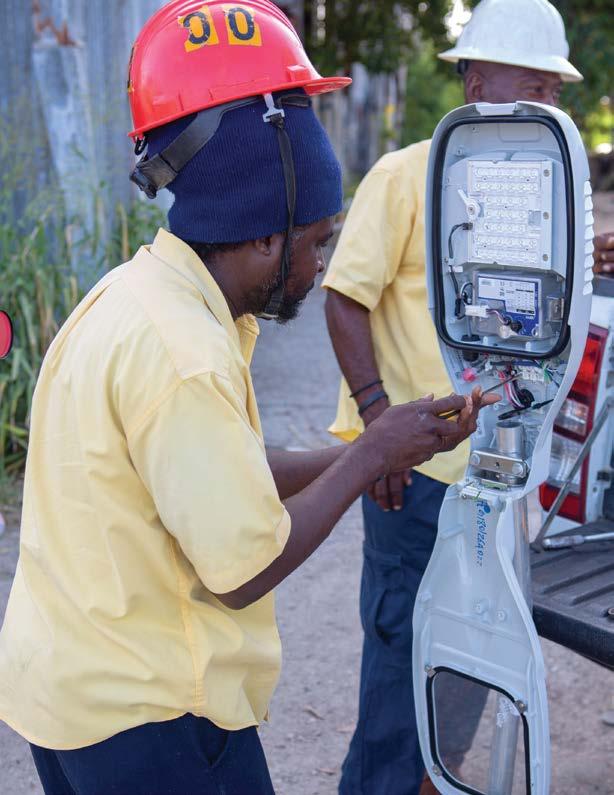
Implementation of energy efficient street lighting projects advanced in Antigua and Barbuda, The Bahamas, Jamaica, St. Kitts and Nevis, St. Vincent and the Grenadines, and Suriname. Upon completion, these projects collectively will impact up to 3.5 mn people, with total cost savings of approximately $26 mn per annum for the respective governments and carbon emission reduction of 86,400 tonnes per annum. Implementation of RE and EE initiatives in public sector facilities advanced in St. Vincent and the Grenadines, with potential cost savings of $900,000 per annum.
In geothermal energy development, drilling of exploratory wells commenced under the St. Vincent Geothermal Drilling Project in the second quarter of 2019. This represents the first geothermal energy project being financed by CDB and
is the most advanced of the projects under the Bank’s GeoSmart Initiative. Three exploratory wells were drilled, with the outcome showing mixed results. There was evidence of a good thermal resource but limited permeability of the rock formation. This has formed the basis for developers to conduct further investigation of an alternate approach for tapping the heat for power production.

In Grenada, environmental and social impact assessment for test drilling advanced; and CDB provided capacity support to the Government for a geothermal energy project management unit.
Technical assistance interventions focused on strengthening the energy sector regulatory framework and capacity building in the public sector, as well as on the promotion of increased resilience in the electricity sector. To this end, CDB funded training for four key technical staff and executives of the National Utilities Regulatory Commission in Saint Lucia to improve their regulatory skills in energy pricing and benchmarking infrastructure. In addition, CDB in collaboration
with the Organisation of Caribbean Utility Regulators and the Barbados Fair Trading Commission trained 26 senior officers and regulatory specialists from across the BMCs, in grant proposal writing, thereby equipping their institutions to be better able to access international grant resources. These initiatives were funded using resources from the Canadian Support to the Energy Sector in the Caribbean (CSES-C) Fund.
Under the Sustainable Energy for the Eastern Caribbean Programme, technical assistance projects were approved for capacity assistance to the Government of Antigua and Barbuda to conduct energy audits for public sector facilities, whilst public sector energy efficient assessments were advanced in Dominica and St. Kitts and Nevis.
For the second year, CDB, with funding from CSES-C, co-sponsored the Island Resilience Action Challenge (IRAC), as part of the Caribbean Renewable Energy Forum in October. This event brought together executives from electric utilities, electricity regulators, ministers and senior government officials, to discuss resiliency challenges and identify specific interventions for increasing resilience of electricity systems in the Caribbean. Additionally, CSES-C and CDB funded the attendance and participation of members of the Women in Renewable Energy network in the IRAC workshop as part of the effort to ensure that women’s contributions are integrated into the regional energy transition.
In 2019, the Bank continued to invest in critical economic infrastructure, funding construction of roads that gave communities better access to key services; power projects which increased the reliability and efficiency of electricity supply; water and wastewater management infrastructure; and the development of critical port infrastructure. In total, CDB approved just over $200 mn in loans and grants for the construction and preparation of economic infrastructure projects.

The Government of St. Vincent and the Grenadines benefitted from a loan of $110 mn from CDB and a grant of GBP25.6 mn through the United Kingdom Caribbean Infrastructure Partnership Fund (UKCIF), whilst enhancing the climate resilience and environmental sustainability of the port infrastructure.
The Bank also approved a loan of $29.8 mn to the Government of Barbados for the South Coast Sewerage Outfall project. The project will provide for the construction of a new marine outfall, which will assist in protecting the health and livelihoods of the approximately 50,000 people occupying that coast.
CDB also provided a loan of $6.8 mn to Belize Electricity Limited to connect the island of Caye Caulker to the national grid with approximately 10 kilometres of submarine cable. This will effectively switch the island’s energy consumption to 50% renewable energy, replace 730,000 gallons of imported diesel and reduce greenhouse gas emissions by 4,000 tons annually.
In 2019, the CDB-funded San Ignacio Bypass project in Belize was completed. This project saw the design and construction of a multi-span bridge over the Macal River and the rehabilitation of nine kilometres of roads and associated drainage. As a result, the efficiency of road transportation in and through San Ignacio has increased.
In 2019, CDB launched a joint study with the Food and Agriculture Organization entitled “The State of Agriculture in the Caribbean”. The launch took place at the seminar ‘Agriculture: Let’s Embrace the Opportunities’ held at the Bank’s 2019 Annual Meeting. The findings of the study, along with recommendations coming out of the seminar, will inform the development of CDB’s new agricultural sector policy and strategy.
Consistent with the recommendations of the study, CDB maintained its support for innovative agricultural projects across its BMCs. Key achievements in 2019 included projects which improved water management for over 700 farmers and 4,000 residents in northwest Haiti and capacity building in climate smart agriculture in Guyana. The Bank also funded interventions to strengthen compliance with international food safety management systems in Grenada and Jamaica.
CDB’s private sector policy and strategy outline the Bank’s commitment to increase engagement with the private sector through a range of interventions. Traditionally, financial in-
termediaries have been the conduit for CDB to provide cost effective support to priority areas. However given the current high level of liquidity in the banking system and falling interest rates, commercial banks are increasingly competing with development finance institutions for select clients. In response, development finance institutions have sought access to lower cost financing. During 2019, disbursements through financial intermediaries in five BMCs totalled $8 mn, down from previous years. Funding approved by CDB included a new credit facility targeting small and medium-sized enterprises in Trinidad and Tobago.
Ninety-seven business enterprises across a range of sectors received funding to support increased production and services. Similarly, some 40 beneficiaries from low to lower income households had access to finance for home acquisitions and retrofits. In addition, student loan financing for 315 beneficiaries (65.4% went to women) contributed to critical skills enhancements at the tertiary level, which remained a critical area of need in several BMCs.
CDB also funded interventions to improve the environment for small and medium-sized enterprises, with an emphasis on increasing access to finance. In the Turks and Caicos Islands, the Government received funding to determine the feasibility of establishing a partial credit guarantee scheme. In addition, work progressed on a technical assistance to review the operations of the state-owned development bank in The Bahamas. On completion of this exercise, business enterprises will have improved access to resources from a restructured Bahamas Development Bank.
During the year, CDB held a conference in Saint Lucia under the theme ‘Development Banking in the Caribbean: A Regional Approach to Sustainable Development’. Its objective was to provide a forum for development finance practitioners to share knowledge of best practices, gain a deeper understanding of the business environment and strengthen their business models. The conference attracted 73 participants, including development partners who reaffirmed their willingness to collaborate with CDB on strategic issues affecting development finance institutions.
In an effort to broaden the range of interventions for supporting private sector development, CDB approved financing for private infrastructure development for electricity service providers in Belize, Dominica and Jamaica. Disbursements totalling $17 mn were made for investments in plant modernisation and rehabilitation post natural disasters; and renewable energy and energy efficient technologies. Through these investments, electricity is expected to become more affordable and accessible in BMCs.
During 2019, CDB’s Caribbean Technological Consultancy Services (CTCS) promoted private sector operations by enhancing the operational capacity of micro, small and medium-sized enterprises (MSMEs) and building resilience in its BMCs. CDB approved $800,000 and disbursed $700,000 to facilitate CTCS activities. Two regional and 15 national workshops benefited 1,781 businesspersons (1,078 men and 703 women) in 19 BMCs.
In keeping with the Bank’s digital transformation and youth economic empowerment agendas, CDB funded training for 600 young entrepreneurs in 12 BMCs to help them start or grow technology-based businesses through two projectsStrengthening the Entrepreneurial Spirit of Caribbean Youth and the Caribbean Tech Entrepreneurship Programme. These projects were implemented in collaboration with youth development agencies.
In 2019, CTCS also expanded its focus on building resilience in BMCs following the devastating impact of hurricanes on housing infrastructure in 2017. In collaboration with Ministries and Departments of Housing and Planning CDB trained 432 artisans, small contractors, building inspectors, engineers, and architects in ‘Improved Construction Practices for the Construction of Houses’.
This intervention was complemented by capacity building for 41 trainers of technical training institutions in the use of the Computerised Job Estimation Tool (CJET). CJET was developed by CDB to train artisans and small contractors to accurately and reliably prepare tender documents and job estimates that would enable them to present bids, especially the Bill of Quantities. This objective is to to institutionalise CJET in technical training institutions across the Region in order to strengthen their construction-related training programmes for both aspiring and practising artisans and small contractors. To date, CJET has been institutionalised in technical training institutions in six BMCs (Antigua and Barbuda, Belize, Cayman Islands, Grenada, Guyana, and Jamaica).
CTCS was also actively involved in the development of agriculture including providing training in post-harvest handling of fruits and vegetables for 67 farmers (45 men and 22 women), exporters and airport staff in Suriname to reduce losses.
In collaboration with the Caribbean Climate Innovation Centre, CDB facilitated two capacity-building boot camps to enhance the skills of entrepreneurs involved in climate mitigation and resilience-focused businesses. Eighty-seven ‘green tech’, entrepreneurs underwent training in workshops, which were held in The Bahamas and St. Kitts and Nevis during 2019.





Since the launch of the Cultural and Creative Industries Innovation Fund (CIIF) in December 2018, grants totalling $550,000 have been approved and $130,000 already disbursed. Beneficiaries of CIIF grants come from 14 BMCs - Antigua and Barbuda, Barbados, Belize, Dominica, Grenada, Guyana, Haiti, Jamaica, St. Vincent and the Grenadines, Trinidad and Tobago, Virgin Islands, Saint Lucia, and Suriname.
Four Enabling Environment Grants totalling $350,000 were part of the amounts awarded and these practitioners in the music, animation, and fashion and carnivals sub-sectors are working on initiatives to improve the business environment for the creative industries.
In 2019, CIIF also conducted three accelerator programmes designed to quickly build practitioners’ capacity in key areas while providing enhanced market and networking access. Through these accelerators, 20 persons were trained in fashion and contemporary design, 34 in animation and eight persons in film. Fifty-two percent of the 62 persons trained, were female and 48% were male.

During 2019, CDB played a leading role in collaborating with other development partners to support the expansion of the regional integration, maritime security and trade spheres. The Bank funded or facilitated regional meetings and workshops on the Caribbean Community (CARICOM) Single Market and Economy (CSME), helping regional officials to develop and agree on roadmaps for further implementation of the CSME regime. CDB also provided assistance to complete the CARICOM Interactive Marketplace and Suspension Procedure, an online portal to facilitate buyers seeking regional goods to purchase. The portal will promote regionally produced goods as a first option to third country alternatives by finding regional products by description or tariff code. It will also become the new medium for managing the request and approval process for suspensions of the Common External Tariff under the movement of goods regime.
CDB also invested in developing national quality policies in Antigua and Barbuda, Grenada, and Suriname, and provided technical assistance to facilitate accreditation of laboratories in Saint Lucia and Suriname. These activities are critical for improving the quality of infrastructure in CARICOM.

Standby Facility for Capacity Building
Through its partnership with the European Union, CDB received EUR8.75 mn to manage the CARIFORUM-EU Economic Partnership Agreement and the CSME Standby Facility for Capacity Building. The Facility will provide direct assistance to beneficiary countries, business support organisations and the private sector to implement projects at the national level and enhance capacity-building measures.
The regional Public Policy Analysis and Management and Project Cycle Management (PPAM-PCM) training programme was completed in 2019, successfully delivering ten face-to-face training modules to civil servants in Suriname, the last BMC to undertake the training. Over the course of the programme, 1,700 public servants (65% female) and more than 60 CDB staff members were trained in the face-to-face component. To culminate the programme, two regional conferences brought together public sector leaders from CDB’s 19 BMCs to reflect on policy, leadership, and improving implementation performance with the help of strong project cycle management practices. The events offered good practice examples and fresh insights on

sustainable approaches to meet current and future public policy challenges, and implementation behaviour.
Implementation of the CDB-funded Local Government Reform project in Guyana and the Sanitation and Governance project in Haiti progressed in 2019. Both projects seek to review and improve governance structures and systems to increase transparency and accountability; ensure better
delivery of services; and build capacity at the local or municipal level. In Haiti, the project’s capacity building for sanitation professionals in governance-related areas produced eight project concepts aimed at removing bottlenecks to improved access to sanitation and water for everyone in Haiti, for financing by the Government and development partners. Participants also examined critical areas such as low cost technologies and the impacts of gender and climate change.
Participants brainstorm over ideas at a workshop held as part of a four-year sanitation and governance training initiative for officials from government, non-government and private sector organisations.

Gender equality and empowerment are critical factors in achieving CDB’s overarching mandate of poverty reduction. The Gender and Equality Policy and Operational Strategy (GEPOS), approved by the Board of Directors in 2019, reaffirms CDB’s commitment to uphold diversity and inclusion. The strategy underscores equality in access, economic empowerment, education and training and resilience for all, as well as the combatting of gender-based violence in BMCs. Internally, the strategy aims to provide for work-life balance, upholding CDB’s core values, equitable treatment, and safety and security for all staff. The GEPOS Action Plan sets an overarching target of achieving a ’gender mainstreamed’ rating for 90% of all approved projects.
At the operational level, the Bank assesses gender differentials in the way males and females experience poverty, their coping strategies, and the availability of options to exit from situations of material and psychological deprivationsandensuresthesearefactoredintoallinterventions.
CDB-funded infrastructure projects have become increasingly gender responsive with well-defined Gender Action Plans designed to ensure gender norms, including masculinity, and site conditions which may provoke incidents of sexual exploitation and abuse, are fully analysed and documented. CDB also placed emphasis on enhancing the gender analytical capabilities of implementing agencies. Sixty-seven percent of all approved capital projects were rated as ‘gender mainstreamed’ in 2019, compared with 43% in 2018.
In 2019, CDB invested in inclusive education and training initiatives to improve learning outcomes for economic competitiveness.
In St. Vincent and the Grenadines, a framework was developed for expanding access to technical and vocational education and training for persons with disabilities
and inclusive of institutional strengthening of four technical institutes and the Ministry of Education. This framework will be adopted to support similar advances across BMCs, especially within the OECS member states.
In Antigua and Barbuda, CDB collaborated with the Ministry of Education to develop psycho-social curricula tools and a framework for the provision of psycho-social services for children and families following natural hazards.
Other initiatives include the University of the West Indies’ Sport for Development Community Inclusion Programmes. Communities adversely affected by diverse negative social issues, including crime and violence were targeted. Through this programme, 60 participants ages 11-16, experienced positive social interaction through team building and sporting activities.
Across eight BMCs, expanding access to demand-driven technical and vocational education and training opportunities remained a priority.
Upgrading workshops and laboratories, training assessors and verifiers and certifying both female and male trainees in a range of Caribbean Vocational Qualifications (CVQ) programmes characterised the ongoing investments made in skills development. A good example was the provision of skills training for out-of-school, at-risk, youths and young adults in St. Vincent and the Grenadines. To date, approximately 410 persons (57% female) have been certified at CVQ Levels I and II. In Dominica, 140 residents (46% women) in five communities were certified in a range of skill areas to add to the rebuilding efforts following Hurricane Maria. This was complemented by training 43 contractors and suppliers in Climate Resilience Construction Best Practices.
Teacher effectiveness was a central focus of CDB’s interventions in 2019. Several capacity-building initiatives provided training for over 1,300 teachers in Grenada, Saint Lucia and St. Kitts and Nevis in areas such as special education needs, differentiated instruction, effective mathematics pedagogy, gender sensitisation, health and family life education and

mental health. These enhanced the capacity of Ministries of Education, learning institutions and other agencies to provide an appropriate suite of prevention, diagnostic, remediation and intervention programmes for vulnerable learners across all sub-sectors.
CDB also provided assistance, which allowed over 60 teachers from BMCs to commence or continue tertiary programmes in a number of areas currently lacking trained specialists. These included special education, technical and vocational education, early childhood development and science and literacy.
Following the adoption of the CDB-funded CARICOM Human Resource Development Strategy 2030, the Bank supported the CARICOM Secretariat and BMCs in their efforts to commence implementation of the strategy with the preparation of the 2019 Baseline Report. The report, adopted by the CARICOM Council for Human and Social Development in October 2019 is a guide for policy dialogue on developing regional targets and an accompanying action plan for the strategy.
At the policy level, the Bank participated in the
In Haiti, new community primary schools with pre-school classrooms were constructed and equipped at four rural locations in the south (Bresilienne, Simon, Goman Mapou, and Source Jean Jacques), benefitting 1,280 students and 24 teachers. Solar energy installations are providing the energy needs of these facilities. This is the start of a programme to expand access to quality public education in rural and remote rural communities in Haiti.
Commonwealth Secretariat and Government of Antigua and Barbuda’s IAmAble2 Conference in December 2019. Conference attendees discussed pragmatic strategies for fulfilling SDG 4’s commitment to inclusive education and related promotion of school to work transition for people with disabilities. The imperative of advancing inclusive education was also underscored at the CDB-sponsored Disabled Peoples’ International North America and the Caribbean,
Inc. Tenth Regional Assembly held in St. Kitts and Nevis in August 2019. Examination of the quality of access to education by people with disabilities is a major focus of CDB’s Regional Disability Assessment Project, which commenced in Saint Lucia in June 2019. The lessons will help to strengthen implementation of CDB’s 2017 Educational Policy and Operational Strategy.

CDB scaled up its youth engagement in 2019, providing opportunities for Caribbean young people to amplify their voices, and demonstrate concrete actions, as agents of development. Key to these efforts was direct engagement with over 500 young people as part of the development and validation of the Bank’s draft Youth Policy and Operational Strategy. CDB also invested close to $200,000 in four interventions that resulted in capacity building for almost 150 young people.
Importantly, CDB continued its support across the Region for citizen security interventions. In Belize, nearly 8,000 young people benefitted from the Youth and Community Transformation and the Youth Resilience and Inclusive Social Empowerment (RISE) programmes. Both were intended to reduce the vulnerability of children and youth to crime and violence, to enhance their life chances and, in the longer term, to improve citizen and community security. A total of 4,205 young people (2,124 males and 2,081 females) benefitted from the transformation programmes, including those designed to improve basic literacy and numeracy, adaptive life skills, employability, community support and conflict resolution. The Youth RISE programme, which is under implementation in two at-risk communities in Belize, reached 3,587 beneficiaries – 1,979 males and 1,608 females.
CDB advanced its work to improve the availability of timely and reliable poverty data, through the Enhanced Country Poverty Assessment (CPA) Programme. Six BMCs – Belize, Grenada, St. Kitts and Nevis, St. Vincent and the Grenadines, Trinidad and Tobago and the Virgin Islands undertook various activities using the Enhanced CPA Toolkit developed by the Bank. The activities included the Survey the of Living Conditions-Household Budget Survey, the Participatory Poverty Assessment, Macro Social Economic Analysis and Institutional Assessment.
CDB convened a capacity-building Participatory Poverty Assessment Workshop in St. Vincent and the Grenadines to strengthen researchers’ skills so that persons with disabilities and other vulnerable groups are included in the research process. Training in data cleaning and data set preparation was also provided to staff in the Statistics Office.
The Board of Directors of CDB approved the Basic Needs Trust Fund Ninth Programme (BNTF 9) in March, 2017. Total funding for BNTF 9 was $47.4 mn comprising grants of $40.8 mn and counterpart funding of $6.6 mn from the governments of the nine participating countries. The participating countries are Belize, Dominica, Grenada, Guyana, Jamaica, Montserrat, Saint Lucia, St. Vincent and the Grenadines and Suriname, which joined BNTF in the current cycle.
The BNTF Programme, now in its fortieth year, continued to address the needs of the Region’s most vulnerable groups by investing in small-scale, demand-led community-based initiatives in basic education, rural water and sanitation systems, minor community road infrastructure and basic education. This ninth cycle included an expanded focus on livelihoods enhancement, entrepreneurial development and training and private sector partnerships.
A mid-term evaluation of BNTF 9 concluded that the Programme remained highly valued in all participating countries. The assessment also concluded that the community development model embodied in the Programme is genuinely responsive to country/community-identified needs; poverty reduction remains a key priority in all participating countries; its programmatic nature provides the potential for enhanced visibility and continuity; and it allows for flexibility and customisation to local situations.
An important assignment of the mid-term evaluation was the determination of the distribution of an unallocated
$5.2 mn performance-based incentive to the seven eligible participating countries. The relative performance of these seven countries was assessed; and CDB issued additional grants, which were fully executed by December 31, 2019. During 2019, an additional 89 sub-projects were approved, committing a further $23.3 mn of CDB’s grant resources. Approvals were given to 13 sub-projects in the water and
sanitation sector (13%); 12 sub-projects in the transport and storage sector (14%) and 64 sub-projects in the education sector, including capacity building and livelihoods enhancement (73%).
Implementation of sub-projects was accelerated in 2019. Disbursement increased from $1.5 mn in 2018 to $10.8 mn in 2019. To date, 496 subsistence farmers from the Bull
Savannah and Southfield Farmers Benevolent Societies in Jamaica have benefitted from livelihoods training in smart agriculture techniques and more than $400,000 in drip irrigation equipment. Some 130 teachers, including 128 women, also completed certified training in inclusive education techniques. In addition, 58 youth (29 males, 29 females) in Guyana received training in entrepreneurial skills.
In Dominica, implementation of the BNTF Seventh and Eighth Programmes moved to completion. During 2019, three water supply sub-projects were completed providing 0.8 km of pipelines and connections to 3,121 households. Two
basic community access and drainage sub-projects were also completed, enhancing the resilience of a community resource centre and access road to climate change impacts and benefitting 1,560 persons. Two education and human resource development sub-projects provided 10 upgraded classrooms for 137 boys and girls.
In 2019, CDB strengthened its policies and procedures for project disbursements and procurement to reflect best international practices as well as the current needs of
the Bank and its BMCs. In January, the Bank introduced new disbursement guidelines to provide a wider array of disbursement options, which can be better tailored to the specific needs of individual projects. The guidelines facilitate the introduction of new e-disbursement modalities to increase efficiencies.
In June, the Board of Directors also approved a new project procurement framework, which became effective for new projects from November 2019. This followed an extensive consultation process with member countries, private sector associations, other multilateral development banks and staff. The new framework seeks to promote the use of best international procurement practices, to deliver value for money and the highest standards of integrity, in order to provide the intended development outcomes in a timely manner. It is harmonised with other development banks operating in the Region and aids co-financing.
The Bank continued to work with BMCs on procurement reform and capacity building. A cohort of 12 OECS senior procurement officials completed a 12-month Chartered Institute of Procurement and Supply diploma course at the Regional Procurement Centre at the University of Technology in Jamaica. The Centre was established with CDB and World Bank funding. In addition, CDB supported the participation of its BMCs in the Inter-American Government Procurement Network to facilitate the sharing of best practice. The Bank continued to provide technical assistance to BMCs in the OECS, and to collaborate with multilateral and bilateral partners on procurement reform.
During the year, CDB also rolled out a roster of procurement specialists who are able to provide ad hoc inputs to BMCs in order to facilitate more robust procurement planning and to expedite procurement activities.



In 2019, the Caribbean Development Bank joined with the Pan-American Health Organization (PAHO) to launch the Stronger Together public awareness campaign as part of a broader initiative to build resilience across the Caribbean.
The campaign was part of a new focus on facilitating mental health and psychosocial support in the wake of disasters and complementing other resilience building efforts that included economic policy reforms, climate change mitigation, and investment in climate resilient infrastructure. The campaign, which ran from July to November 2019 (covering most of the Region’s hurricane season) also involved the production of an illustrated booklet on psychological first aid, public service announcements for video and radio, video testimonials, and a radio jingle.
It highlighted how vulnerable people, such as children and adolescents, women, older people and persons with disabilities can be supported, as well as the specific ways in which they may be impacted.
Issues related to the different roles men and women have in the family and community, gender-related access to mental health services, and the risks of gender-based violence increasing following disasters were also addressed in the campaign. A psychological first aid (PFA) course was offered for free to the public for self-learning via PAHO’s Virtual Campus for Public Health. In Antigua and Barbuda and in The Bahamas, this training was delivered to frontline and essential workers, such as primary health professionals, social workers and shelter workers.

The gender-sensitive and socially inclusive campaign provided information and strategies to help communities better cope with the psychological impact of adverse events before, during and after a disaster situation and sought to undercut the stigma associated with seeking mental health and psychosocial services.
Stronger Together was part of a wider project facilitating mental health and psychosocial support, which PAHO and CDB collaborated on in the wake of the devastating 2017 hurricane season.
A cadre of 16, psychologists psychiatrists and social workers received training in mental health and psychosocial support, creating a roster of health professionals from which PAHO can mobilise resources to affected countries in an emergency. Ahead of the 2019 hurricane season, PAHO also convened refresher training on mental health and psychosocial services in disaster management for representatives from 15 BMCs.
Over the last five years, CDB has been at the forefront of promoting sustainable energy development in the Caribbean.
The Region’s heavy dependence on imported fossil fuels for power generation has contributed to economic vulnerability, and is the main source of its energy insecurity. With electricity being vital for all economic activities, the small and isolated nature of the markets results in high unit energy price to end-users, while the over-reliance on imported fuel exposes countries to the negative impacts of global oil price spikes.
Against this backdrop, the Bank has been working with BMCs to develop their renewable energy potential, including supporting the exploration of options such as geothermal energy resources in some countries of the Eastern Caribbean.
Traditionally, the barriers to indigenous renewable energy development for these small developing states can be significant, involving high up-front costs to confirm the feasibility of the resource. In the case of geothermal energy, these barriers can be prohibitive, necessitating innovative financing mechanisms. CDB has sought to offer appropriate financing instruments under its GeoSmart Initiative. In this way, governments can finance the exploratory phase without incurring debt or by using highly concessional resource; and encourage private sector participation while also having a stake in the development.
Through the GeoSmart Initiative, CDB mobilises concessional financing and provides appropriate technical expertise to support the various stages of geothermal energy projects.
Since 2015, CDB’s Borrowing Member Countries (BMCs) in the Eastern Caribbean have accessed grant funding to support early stage assessments of geothermal energy potential through GeoSmart.
In Grenada and the island of St. Kitts, CDB is providing technical assistance for capacity strengthening and environmental and social impact assessments, and has also allocated grant funding for slim-well test drilling. On the island of Nevis, the Bank has provided grant technical assistance, which will help inform the scope for possible funding of production.
In St. Vincent and the Grenadines, exploratory geothermal energy drilling began in May 2019. This project is at the most advanced stage reached thus far under the GeoSmart programme. CDB secured $27 mn in concessional financing from multiple sources, including:
• $16.3 mn through the Inter-American Development Bank consisting of a contingently recoverable grant from the Clean Technology Fund and a grant from the Global Environmental Facility, under the Sustainable Energy Facility for the Eastern Caribbean Programme.

• a GBP4 mn grant from DFiD;
• a grant of EUR 4.9 mn from the European Union Caribbean Investment Facility under its Geothermal Risk Mitigation for the Eastern Caribbean Programme; and
• assistance from the Government of New Zealand for the engagement of experts to provide technical, advisory and managerial services
The Bank’s efforts and innovation through GeoSmart were recognised in July 2019 when the Geothermal Congress for Latin America and the Caribbean (GEOLAC) awarded CDB its top prize for Best Financing Programme at the GEOLAC Industry Awards. The prize was given specifically for the
Sustainable Energy Facility for the Eastern Caribbean programme, which is part of GeoSmart.
Joseph Williams, Head (ag.) of CDB’s Renewable Energy and Energy Efficiency Unit said: “A goal of GeoSmart is to empower regional governments to have a stake in any future geothermal power production entity that is established. This support can form part of their equity contribution to public-private partnerships with private developers. In this way, citizens too can have a share in the power generation entity.”


The end of 2019 marked the close of CDB’s 2015-2019 Strategic Plan which encapsulated the Bank’s objectives and priorities as well as its ongoing efforts to help BMCs meet their national development goals and global commitments, including the Sustainable Development Goals.
Embodied in the plan is a results management framework (RMF), a management tool used to track implementation progress. The corporate results management framework forms part of a broader Managing for Development Results (MfDR) agenda geared at institutionalising within CDB a results and performance culture, which uses results for decisionmaking, learning, improving performance and service delivery and enhancing transparency and accountability.
Caribbean economies continued to show signs of improvement in 2019; however, growth remained fragile due largely to heavy dependence on a few sectors, namely financial services, commodity exports, and tourism. The ongoing impacts of climate-related events, which have increased in intensity and frequency in recent years also contributed to the fragility of economic growth. This fragility was evident in September when Hurricane Dorian, a slow-moving and devastating Category 5 system caused extensive damage and loss estimated at $3.4 bn, one-quarter of GDP in The Bahamas. The significant costs of such shocks, coupled with the high and
rising debt levels jeopardise the achievement of sustainable, and inclusive economic growth and development in the Region. Nevertheless, BMCs continue to invest heavily in the social sector, with most countries achieving near universal enrolment at the primary level and access to safe drinking water.
In an effort to meet various global, regional and national commitments, regional governments have increased their focus on critical areas such as youth development, renewable energy, energy efficiency, disaster risk reduction and climate change, private sector development, and public sector service delivery.
CDB’s Contribution to the SDGs and Development Outcomes
CDB’s investments through loans, grants, and technical assistance have produced significant results across key sectors and the Region, bringing meaningful benefits and positive change to Caribbean citizens and their communities. The achievements are consistent with the priority areas of CDB’s 2015-2019 Strategic Plan, which are economic infrastructure, education and training, agriculture and rural development, citizen security, disaster risk reduction and climate change, community development, capacity building, regional cooperation and integration, the cultural and creative industries, private sector development and MSMEs. Key achievements in 2019, as assessed through.
CDB sustained its efforts to improve efficiency and effectiveness of its back-office and front-office operations. Internal reforms underpinned by the digitalisation and transformation agendas as well as the Business Process Review are key enablers to the operational improvement process. Additional activities undertaken by CDB to advance the reforms include increased support and country
SUPPORTING INCLUSIVE AND SUSTAINABLE GROWTH AND DEVELOPMENT AND PROMOTING GOOD GOVERNANCE
Financial intermediaries provide $19.9 mn in loans to 916 individuals, and which included mortgages to 170 people (72 women)
Training and technical advisory services to MSMEs benefitted
3,002 individuals and entrepreneurs, including 1,528 females
Continued support to Compte Caribbean promote enhanced competitiveness and productivity, especially in agro-processing and tourism.
586 new and upgraded classrooms and support facilities benefitting 128,445 students (60,370 girls) as well as training for 4,606 teachers and educational and administrative staff at the basic education level.
Improved access to efficient, reliable and sustainable potable water.
Installation or upgrade of 24,768 cubic metres per day and 238 km of water supply lines, mainly in rural areas.
Construction or upgrade of 183 km of primary, secondary and other roads benefitting 255,436 people (129,785 females).

presence using CDB Staff and consultants, in critical areas such as project management and procurement. The aim of these reforms is a business model that is client-focused and results-focused with improved processes, procedures and systems to deliver on the Bank’s mandate.
Resilience building is a core component of CDB’s development thrust. This is articulated in the new Strategic Plan 2020-2024, which was approved by the Board of Directors in December 2019 and the associated RMF. The plan identified three strategic objectives - building social resilience; building economic resilience; and building environmental resilience - with digital transformation, regional cooperation and integration, gender equality, and governance as cross-cutting areas. This increased focus on resilience building is consistent with the core message of the SDG 2030 Agenda and the Paris Agreement on Climate Change.
The MfDR mainstreaming activities for the period 2015-2019 were satisfactorily completed at all levels of the Bank. These included corporate, country, sector and project/programme levels, with improved policies and strategies and enhanced processes and systems, improved knowledge management and strengthened learning and development. Activities also led to improved dialogue and awareness among staff and stakeholders regarding performance and efforts to improve results management, development effectiveness and service delivery. There are other areas that need attention to support the preparation of another action plan for the new strategy period 2020-2024.

A US$110 million loan from CDB and a £25.6 million grant from the CDB-administered United Kingdom Infrastructure Fund (UKCIF) to modernise the Kingstown Port in St. Vincent and the Grenadines.



The Internal Audit Division (IAD) is an independent and objective assurance and advisory function designed to enhance and protect organisational value by improving CDB’s operations.
It assists the Bank to accomplish its objectives by bringing a systematic and disciplined approach to improving the effectiveness of the Bank’s governance framework, risk management, and control processes. IAD’s work is carried out in accordance with the Institute of Internal Auditors International Professional Practices Framework (Standards).
The IAD reports administratively to the President and is under the oversight of the Oversight and Assurance Committee.
In 2019, the IAD completed five assurance and nine consultancy/advisory engagements. These engagements included its contribution to the Bank’s ongoing transformation programme; accounting and financial reporting processes; information technology general controls; review of new applications; and information security.
This resulted in IAD providing one major engagement related to management and administration of the Bank’s Other Special Funds. In addition, IAD reviewed the level of compliance by CDB with the mandatory controls identified in the SWIFT Customer Security Controls Framework v2019 - Customer Security Programme and provided the independent attestation required by SWIFT.
IAD also participated in a number of business development activities in addition to the transformation programme for which the adequacy of associated internal controls processes needed to be assessed.
IAD completed an assessment on the adequacy of Management Action Plans stemming from the 2018 External Auditors’ Management Letter for financial controls and IT general controls alongside its follow-up activities on previous assurance engagements. These activities served to foster increased management ownership over the timely reporting and mitigation of identified risks.
In 2019, the Office of Independent Evaluation (OIE) assessed CDB’s GEPOS, focusing on the period 2013 to 2018. A final report highlighted six main messages:
1. There are persistent and emerging gender challenges that warrant increased attention and effort from CDB and BMCs.
2. Some BMCs have expressed demand for increased gender equality support from CDB; but the political will to prioritise gender equality is inconsistent across BMCs. A compounding factor is the lack of conceptual clarity on gender equality, which affects the extent and sustainability of behaviour change in both the Bank and the BMCs.
3. CDB’s strategies and operational frameworks have evolved to strengthen the Bank’s promotion of gender equality and to begin a process of internal organisational change.
4. It is time to move beyond the practices and tools of gender mainstreaming and to begin to address the development effectiveness of the Bank’s work on gender equality.
5. To date, few initiatives have focused on the root causes of inequality or taken a multi-dimensional or integrated approach to addressing socio-economic challenges as experienced differentially by women and men.
6 CDB’s value added draws on its visibility and role as a regional lending institution. A trusted partner in the Region, the Bank has strong relationships with planning and finance ministries and plays critical roles in policy dialogue, advocacy, and knowledge generation (including data).
The report offered seven recommendations to inform a revised GEPOS, enjoining the Bank to:
• further develop its strategic approach;
• clearly define and communicate gender equality concepts;
• enhance accountability in implementation;
• make better use of partnerships with national and regional actors;
• support capacity development of national gender machineries;
• stress the key leadership role of the Bank’s senior management and
• continue to mainstream gender equality in the Bank’s operational work.
These messages and recommendations were taken into account in the Bank’s new GEPOS, approved by the Board in September 2019.
OIE also undertook a Haiti Country Strategy and Programme Evaluation. It found that despite some delays, and amidst
a high-risk environment exacerbated by a major natural disaster, the Bank managed to deliver its projects with a smart choice of implementation approach.
However, results on the ground were found to be mixed. Project outputs cannot always be traced through to sustainable outcomes.
In the education sector, CDB supported several components of the Education for All initiative. The Primary Education Student and School Subsidies component was reported to have surpassed its originally planned outputs. However, questions arose concerning the targeting and administration of the subsidies. The Pre-Service Teacher Professional Development component was aimed at increasing the number of teachers at the primary level. Despite training the targeted number of teachers, very few were actually placed in classrooms. The Student Nutrition and Health Programme, a school feeding programme, was reported to have reached a very large number of children.
CDB provided capacity building and equipment to the Ministry of National Education and Vocational Training as part of its attempt to improve the governance of the system, but there is no evidence of changes in the capacity of the Ministry, or of improved governance.
In the area of technical and vocational education and training, the Bank’s project design was modified following the 2010 earthquake to take into account the destruction of infrastructure in the sector and emerging needs and requests from the Government. Three technical and vocational education and training centres were completely rebuilt. CDB also financed studies on centre prototype design and youth employability.
CDB investments in community-driven development and agriculture; technical assistance activities for public-sector capacity building; and support to MSME through CTCS
were also assessed. Available information suggests that the technical assistance interventions were implemented with the appropriate target groups, generally well received, and are leading to expected changes. Although CDB has paid Haiti’s insurance premiums to the Caribbean Catastrophic Risk Insurance Facility since May 2013, its support for resilience remains otherwise hard to assess due to lack of evidence. During the period 2007-2015, CDB’s overall portfolio was not managed through a gender lens; but there are recent indications of better support for gender equality initiatives.
Finally, a cluster of six education sector project completion reports in OECS countries were validated addressing important infrastructure and education quality constraints. Most projects were aimed at reconstruction in the aftermath of natural disasters. Their important contribution was noted, as were implementation delays and some sustainability challenges.
The Office of Integrity, Compliance and Accountability (ICA) is a key part of CDB’s robust internal governance framework. ICA’s work enhances integrity, ethics, compliance and accountability in CDB’s internal systems and external operations. ICA’s model is a unique convergence of five internal governance functions into a single independent office that reports functionally and directly to the Board of Directors. ICA commenced operationalisation in 2016 with a mandate that covers: institutional integrity (fraud and corruption); ethics; whistleblowing; money laundering, terrorist financing and financial sanctions; and accountability for environmental and social harm allegedly caused by projects financed by the Bank.
During 2019, ICA helped CDB to take a holistic, proactive and agile approach to delivery of its mission and development mandate. Despite an increase in integrityrelated investigative activities, ICA successfully conducted
significant preventive and investigative work that assisted in detecting and mitigating integrity and accountability risks on CDB’s projects. ICA’s work helped CDB to observe its fiduciary duty to ensure that its financial resources reached intended beneficiaries without diversion by corrupt and fraudulent actors. Its work covered:
• management of the six channels of the Bank’s whistleblower system;
• the conduct of integrity and counterparty due diligence; outreach to stakeholders and beneficiaries of CDB financing;
• training of staff and management on corruption, fraud prevention, sexual harassment, integrity due diligence, including to embed the toolkit;
• conduct of integrity investigations and;
• collaborations with other multi-development banks.
ICA’s response to complaints led to investigative activities, which included the imposition of temporary suspensions on entities and individuals subject to ICA investigations. ICA also led the Bank’s observance of Anti-Corruption Week 2019.
ICA will help to ensure CDB observes the fiduciary duty owed to its beneficiaries and other stakeholders while CDB transforms and to ensure that the CDB of the future is shaped with integrity and accountability.



In 2019, the Bank maintained its Enterprise Risk Management approach with scope of coverage including financial, strategic, operational and developmental risks.
The operational risk pillar includes environmental, climate and disaster risk management, given its increasing visibility and potential impact on the sovereign risk profiles of BMCs. At yearend, CDB was in full compliance with all of its risk appetite thresholds, as shown in Table 1.
TABLE 1A: OCR RISK APPETITE THRESHOLDS AT DECEMBER 31, 2019
TABLE 1B: OCR RISK APPETITE THRESHOLDS AT DECEMBER 31, 2019
The Office of Risk Management (ORM) is an independent but integral part of CDB’s activities, free from influence. The Bank’s risk liaison framework is formally aligned to ORM as part of an extended, Bank-wide monitoring framework.
The framework is anchored in a strong three lines of defence governance structure:
Line 1 - Front Line functions: This represents areas where activities directly either take place - in the front, middle or back office.
Line 2 - ORM: ORM provides leadership, guidance, monitoring, and independent oversight of the activities conducted by Line 1.
Line 3 - Internal Audit: IAD is responsible for, and provides assurance on internal compliance with controls.
CDB continued using its new aCCelerate operational risk system, which was utilised in the next round of its automated risk control self-assessment. The aCCelerate system automates the Bank’s end-to-end operational risk management process, including but not limited to, its annual risk and control assessments; risk register; and escalation and management processes. The system also serves as an automated internal surveillance and early warning system for identifying potential threats to the Bank. During the course of the year, ORM continued to monitor the progress of control actions against the base line previously set.
The Bank’s operational risk management process is underpinned by the annual risk control self-assessment exercise and daily risk register process. The output from these processes were monitored by ORM and reported periodically to the Bank’s
Enterprise Risk Committee. The Chief Risk Officer reported the high impact strategic aspects of these to the Bank’s Oversight Assurance Committee and the Board of Directors throughout the year.
CDB’s business continuity framework remained a reliable recovery framework for emergencies. The Bank improved its documentation during the course of 2019 and reviewed the entire process to ensure it remained fit for purpose. The stakeholders of the lines of defence structure, that is, the ORM, IAD; Human Resources Division and Information Technology and Solutions Division continued to collaborate to improve the entire framework in the context of the Bank’s transformation programme. These key internal stakeholders will continue to collaborate in 2020 to rationalise and revise the current framework to take full advantage of the new cloud architecture.
The Bank currently has a warm backup and information technology recovery site located away from its campus and a secondary site in another country.
The risks of catastrophic loss are mitigated with the use of comprehensive insurance programmes.
Matters relating to environmental risk and climate change are systematically addressed at various levels of the institution. The Bank’s appraisal process specifically screens for environmental vulnerability. There is also active dialogue with the BMCs to address this via resilience building, purchase of cover from the Caribbean Catastrophic Risk Insurance Facility and the building of fiscal buffers. The enterprise risk reporting captures environmental and climate change issues on a country and on a regional basis and these are tracked to ensure the continuous implementation of mitigation actions. Matters relating to environmental risk and climate change continue to be discussed at Enterprise Risk Committee meetings.

The sovereign risk profiles of BMCs, credit improved in 2019 as evidenced in limited credit rating actions.
During the year, exposure to Barbados, the Bank’s largest borrower, increased to 20% (previously 15%) relative to the entire portfolio. This was due to the disbursement of a second loan of $75 mn. The loan was advanced in accordance with the Bank’s mandate to remain relevant in supporting its BMCs in times of need and after careful risk assessment and consideration of the incremental impact on the capital
adequacy position. Inversely, exposure to Jamaica, which is the second largest borrower, fell to 12% (previously 14%) relative to the portfolio.
CDB maintains its efforts to diversify its portfolio by targeting highly rated BMCs for new business growth, while also reducing exposure to challenged credits via the target review and cancelling of aged, undisbursed balances. These efforts will ensure that the overall exposure in Barbados is reduced over the next two years.
The Bank maintains its efforts to diversify its portfolio by targeting highly rated BMCs for new business growth.

CHART 7: CDB’S GEOGRAPHIC EXPOSURE AT DECEMBER 31, 2019
ANTIGUA AND BARBUDA
THE BAHAMAS
BARBADOS
REGIONAL
ST. KITTS AND NEVIS
SAINT LUCIA
ST. VINCENT AND THE GRENADINES
TRINIDAD AND TOBAGO
TURKS AND CAICOS ISLANDS
VIRGIN ISLANDS
CHART 8 : CDB’S GEOGRAPHIC EXPOSURE AT DECEMBER 31, 2018
KITTS AND NEVIS
ST. VINCENT AND THE GRENADINES
TRINIDAD AND TOBAGO
TURKS AND CAICOS ISLANDS
VIRGIN ISLANDS
Overall, concentration remained at manageable levels and within the risk appetite of the Bank, with the exception
The measures adopted by CDB to improve its capital adequacy included encouraging new lending to highly rated BMCs; supporting lower-rated entities with interventions sourced from its soft funding window; enforcing hard credit limit controls; minimising concentration; strengthening Country
of Barbados, which rose to 20% at year-end 2019. The Bank’s top six sovereign trends are represented in Chart 9.
operational risk controls; managing undisbursed balances; and maintaining a robust capital generation strategy.
These efforts maintained a reduction in the Bank’s risk-weighted assets, while increasing its capital levels, as reflected in Chart 10.
CHART 10: S&P RISK WEIGHTED ASSETS VERSUS CDB EQUITY CAPITAL TRENDS
ORM computes the Bank’s capital adequacy manually, utilising the Basel II framework.
Under Pillar I, ORM uses a Basic Indicator Approach for Operational Risk and a modified Standardised Approach for Credit Risk.
Under Pillar II, the Bank ensures that all other residual risks over and above Pillar I are computed, which includes, but is not limited to, additional liquidity requirements, interest rate in the banking book, and business and concentration risks. This is complemented with top-down and bottom-up scenario assessments to determine the extent of additive capital that may be needed as a cushion against unexpected risk losses.
Under Pillar III, CDB has been meeting its enhanced disclosure reporting obligations by improving the dissemination of risk reviews.
The Bank is currently monitoring newly implemented Basel III rules and the impending Basel IV to determine if amendments to its modus operandi will be necessary. Compliance, which is voluntary, ensures that the Bank’s procedures are in alignment with best practice.
CDB’s overall objective is to manage its market risks in order to minimise market losses and optimise return. During 2019, the Board approved a revised treasury framework intended to maximise returns within conservative risk parameters.
CDB manages its interest rate exposure by ensuring that the changes in the cash flow of its assets closely match those of its liabilities. This relationship is managed with the use of interest rate swaps, which convert fixed rate liabilities into floating rate liabilities. There is, however, residual exposure resulting from interest rate movements, which is effectively monitored and managed operationally with governance oversight provided by the Enterprise Risk Committee. Any residual interest rate exposure risk arising out of these during the year were well within the Bank’s risk appetite.
CDB’s exposure to currency exchange movements is minimised by the extent of its activities, which limit its assets and liabilities to a single currency, United States dollars.
Mismatches are managed effectively via the use of derivative hedging instruments, where necessary. All loans by the Bank are made either from currencies available from members’ subscriptions, or from currencies borrowed. The principal amounts are repayable to the Bank in the currencies lent. Any residual currency exposure risk arising out of these during the year were well within the Bank’s risk appetite.
CDB’s objective is to ensure that all foreseeable funding commitments can be met when due, and that access to the wholesale market is maintained.
To that end, the Bank seeks to maintain a portfolio of highly liquid assets augmented with a diversified funding base to enable it to respond promptly to unforeseen liquidity gaps.

Following approval from the Board of Directors, the Bank raised Euros fixed funding to diversify its funding base and to also provide an option to its BMCs.
The risks relating to rollover have been eliminated, with no immediate maturities anticipated.
CDB loans are usually fully disbursed over several years. As a result, the Bank continues to have undisbursed balances on approved loans. The liquidity risk remains with CDB, as it is required to provide funds to the borrowers, as and when requested, once the conditions precedent for disbursement are satisfied. This risk is managed by conformity to the Bank’s policy of maintaining a net three years’ funding requirement, or 40% of undisbursed commitments, whichever is greater. At yearend, CDB’s liquid assets exceeded the 150% prudential minimum guideline, which was in keeping with Management’s decision to maintain high liquidity levels.
ORM’s risk-based pricing model was validated by a United Kingdom risk consultancy firm and is now deployed into the production environment. This will enable the Bank to independently price interventions for the non-sovereign sector.
ORM also further improved its risk adjusted capital models designed to mimic Standard & Poor’s (S&P’s) new methodologies. These were intended to enable the Bank to ex-ante assess and determine its capital adequacy position to effectively support its strategic planning efforts.
ORM worked closely with the Finance Department in reviewing the Bank’s treasury guidelines and derivatives exposures to determine the extent of risks and develop mitigation actions and controls. The output of this assessment indicated there were no material risks to CDB.



MANAGEMENT DISCUSSION AND FINACIAL STATEMENTS
CDB (“The Bank”) is a multilateral financial institution dedicated to the development of the economies of the BMCs, with a focus on the Least Developed Countries, primarily through project loans and technical assistance to the governments, public agencies and other entities in those countries. The Bank’s main goals are to promote sustainable economic development, to reduce poverty and facilitate regional integration. The Bank was established in 1969 and is owned by its member countries. These include 19 borrowing member countries and 9 non-borrowing members.
The Bank is structured into two entities comprising the Ordinary Capital Resources (OCR) and the Special Funds Resources (SFR) through which it delivers on its mandate. The OCR operations are financed from CDB’s share capital, borrowings raised in the capital markets, lines of credit from commercial and other multilateral institutions and internally generated equity. The SFR operations are financed from the Special Development Fund (SDF) and Other Special Funds (OSF) comprising the Bank’s concessionary funding window.
The Bank is rated by three major international rating agencies. In March 2020, Fitch Ratings affirmed its LongTerm Issuer Default Rating (IDR) of AA+ with a Stable Outlook. In May 2019, Standard and Poor’s (S&P) affirmed its Long-Term Issuer Credit Rating to AA+ from AA with a Stable Outlook. Moody’s Investor Services affirmed CDB’s Long Term Issuer Rating as Aa1 with a Stable Outlook.
The following discussions should be read in conjunction with the audited financial statements and accompanying Notes of the Bank set out in Section 7 of this report.
The financial statements of the OCR are prepared in accordance with International Financial Reporting Standards (IFRS) on an historical cost basis, except as modified by the revaluation of investment securities held at fair value through other comprehensive income (OCI) and derivative financial instruments which are reflected at fair value through profit and loss (P&L).
The preparation of the financial statements in conformity with IFRS requires management to make estimates and to exercise judgement in the process of applying its accounting policies.
All of the amounts shown in the financial statements are US dollar equivalents.
The accounting treatment under IFRS requires that derivatives be recorded at their fair value through P&L. This creates income volatility, which is not representative of the underlying strategy, or economics of the transactions since it is the Bank’s policy to hold these instruments to
maturity. As a result, therefore the Bank excludes the impact of these fair value and related foreign exchange translation adjustments associated with these derivatives from the determination of its Operating income. Management has determined that Operating Income is the best representation of the results of the Bank’s core activities and used in the determination of CDB’s financial performance evaluations, liquidity, capital adequacy and other ratios and analyses.
Loans and borrowings are recorded on the amortised cost basis.
Total comprehensive income: The OCR operations of the Bank for the year ended December 31, 2019 recorded total comprehensive income of $34.0 mn (2018: $6.3mn). This change was due to an increase in net interest income in addition to a substantial favorable movement in the derivative fair value adjustments, reflecting the regular volatilities mentioned earlier.
Operating income: Operating income is defined as total comprehensive income adjusted for the effects of derivative adjustments, the foreign exchange translation on the related Japanese yen and Swiss Franc borrowings, fair value gains or losses on derivates and debt securities, and actuarial re-measurements. It is this metric which is used to analyse the Bank’s performance and is allocated to reserves by the Board of Governors in accordance with the Bank’s Charter. The operating income increased by $10.1mn or 70% over the previous period.
Income from loans: Loan income for the year increased by $9.3mn to $58.6mn (2018: $49.3mn).This was due to a higher average interest rate of 4.80% (2018: 4.23%) primarily driven by the Bank’s increased cost of borrowings, as measured by the policy, as well as a higher average portfolio balance.
Income from cash and investments: For the year ended December 31, 2019, income from cash and investments was $8.3mn (2018: $6.9mn). This increase of 21% was due to higher average balances despite the average reduction in interest rates during the year.
Interest expense: Interest expense for the year was $27.0mn (2018: $26.3mn), an increase of $0.7mn. This was primarily due to the higher average volume of borrowings.
Operating expenses: In 2019, operating expenses amounted to $15.4mn (2018: $15.3mn). This change resulted from an increase in administrative expenses of $0.5mn. There was an impairment recovery reflecting adjustments to the IFRS computations that offset the foreign exchange translation loss related to the Euro borrowing in 2019. (See table below).
Rate/Volume analysis: The rate/volume analysis shows the effect on interest income (excluding fees, charges and unrealised gains and losses) of the Bank analysed by the various drivers.
Total assets: As at December 31, 2019, total assets were $2,095.5mn (2018: $1,747.7mn), representing an increase of $347.8mn (20%). This was due higher cash and investment balances reflecting proceeds from the new borrowing in November 2019 and higher loan balances.
Loans: In 2019 the loan portfolio grew by $85.8mn (7.4%) from $1,163.5mn to $1,249.3mn. There were two non-performing non-sovereign loans in the portfolio with a total amount outstanding of $3.0mn reflecting a reduction of $1.8mn as funds from collateral disposals were received.
Borrowings and other liabilities: Total liabilities increased by $312.8mn (36.9%) to $1,161.9mn (2018: $849.1mn). This increase was mainly due to a new borrowing of EUR250mn (approximately USD275mn) during the year.
Shareholders’ equity: At December 31, 2019, CDB’s equity was $933.6mn (2018: $898.6mn). This movement was due to the increase in comprehensive of $34.0mn compared to $6.3mn in 2018. Total equity currently represents 44.6% of total assets (2018: 51.4%).
(1) Net of provisions.
The Special Development Fund, (“SDF” or ‘the Fund’), was established in 1970 and is the Bank’s largest pool of concessionary funding, offering loans on more concessionary terms and conditions than those that are applied in the Bank’s Ordinary operations, that is, longer maturities and grace periods and lower interest rates.
SDF represents a significantly important enabler in the Bank’s mission to reduce poverty and contribute to sustained welfare enhancement in eligible BMCs. Successive replenishments of the SDF since its inception have allowed CDB to make a meaningful contribution to the transformation of the lives of underprivileged and at risk members of the population, primarily those in the rural communities.
The SDF originally comprised a conglomeration of funds that operated under varied terms and conditions fixed by their various contributors. These differing terms and conditions created a number of complexities and inefficiencies in the Fund’s management and operations, which prompted the decision to set up the fund as one with a uniform set of rules, hence the formation of the Special Development Fund (Unified), (SDF(U)) in 1983.
All members of the Bank are required to contribute to SDF(U), and contributions are also sought from nonmembers. Contributions are interest-free and provided on a multi-year basis, for an indefinite term. SDF(U) also has consistent terms, objectives and procurement conditions and thus overcomes the challenges associated with individual donors and funding arrangements. There is a supplementary governance structure through an Annual Meeting of Contributors which provides the focus for the SDF(U)’s operations and they are provided with an annual report on the performance of the fund. Non-members are invited to participate as observers in meetings of the Bank’s Board of Directors (BOD) and Board of Governors (BOG).
Contributors to the SDF (U), which is usually replenished in four-year cycles, enter into negotiations with the Bank with the objective of agreeing on the priority areas and programmes that need to be addressed and on the amount of SDF (U) resources which will be necessary to realise the agreed objectives. The ninth cycle of the SDF(U), covering the period 2017 – 2020, was underpinned by the Bank’s efforts to support the BMCs in achieving their development goals consistent with the Sustainable Development Goals (SDGs). Negotiations on a new funding cycle (SDF 10) are scheduled to commence in 2020.
RESULT OF OPERATIONS OF THE SDF
For the year ended December 31, 2019 there was comprehensive income of $8.7mn (2018: $0.1mn). Gross income for the year was $26.3mn (2018: $17.3mn). The increase of 52.0% was primarily due to unrealised gains on investments compared to losses in the previous year. Total expenses was $17.6mn, a small increase over 2018.
Income from loans: Loan income of $12.5mn was marginally lower than the $12.6mn recorded in 2018 as the portfolio balance remained flat.
Income from cash and investments: Income from cash and investments of $13.8mn (2018: $4.6mn) reflected the unrealised gains mentioned above and a higher average portfolio balance.
Administrative expenses: Administrative expenses were $16.5mn (2018: $17.4mn), a decrease of $0.9mn. The SDF’s share of the Bank’s total administrative expenses is based on a predetermined cost-sharing formula, which is determined by the number of loan accounts and their status.
Exchange: Foreign exchange translation losses were $1.1mn (2018: Gain of $0.3mn) and reflects the volatility in the various currencies against the US dollar.
Total assets: At December 31, 2019, total assets were $1,040.2mn (2018: $1,019.6mn). The movement is discussed below.
Investments: At December 31 2019, SDF cash and investments amounted to $391.3mn (2018: $370.4mn). This change was marginal but mainly due to an increase in cash and investments from funds received.
Loan portfolio: Total outstanding loans were $560.2mn (2018: $559.2mn) as disbursements of $32.2mn were matched by repayments of a similar amount.
Receivable from contributors: This amounted to $71.5mn (2018: $80.2mn) reflecting encashments of demand notes during the year.
Liabilities: In 2019, subscriptions in advance decreased by $3.1mn from the proportional application of the 2019 amounts.
Contributed resources: Contributions to the SDF net of allocations to technical assistance and grant resources increased by $9.9mn (1.3%) to $769.0mn (2018: $759.1mn) arising from the additional contributions received for SDF 9 during the year.
The Other Special Funds (OSF) was established to carry out the special operations of the Bank by providing resources on concessional terms to assist BMCs in achieving poverty reduction. The Bank accepts contributions to the OSF for on-lending or administration on terms agreed with the contributors once the purposes are consistent with its objectives and functions.
In 2019, total comprehensive income amounted to $2.9mn (2018: $0.9mn). This was due to unrealised gains compared to losses in 2018, dividends from equity investments and forex gains.
Income from loans: For the year income from loans was $1.9mn (2018: $2.0mn).This decline was caused by a lower average balance in the loan portfolio compared to the previous year. All loans are provided at fixed rates.
Income from cash and investments: This increased to $1.9mn (2018: $0.6mn) due to unrealised gains and dividends received.
Administrative expenses: Administrative expenses remained flat at $0.9mn. The OSF’s share of the total administrative expenses for the Bank as a whole is based on a predetermined cost-sharing formula, calculated by the number of loan accounts and their status.
Exchange: There was a foreign exchange translation gain of $0.9mn (2018: nil). This was primarily due to the movement in the Pound Sterling on the notes received from UKCIF. Foreign exchange translation movement is a result of the volatility in various currencies in relation to the US dollar.
Total assets: At December 31, 2019, total assets were $451.4mn (2018: $470.6mn), representing a decrease of $19.2mn. The main components of the change are discussed below.
Cash and Investments: Cash and investments amounted to $82.6mn (2018: $99.9mn), reflecting a significant level of Technical Assistance (TA) disbursements which exceeded contributions during the year.
Loan portfolio: Total outstanding loans were $85.1mn (2018: $90.8mn), a decrease of $5.7mn due to repayments exceeding disbursements during the year.
Receivable from members: This declined marginally by $3.1mn to $246.6mn. This balance includes promissory notes in respect of the UK Caribbean Infrastructure Partnership Fund (UK CIF).
Liabilities and funds: Liabilities and funds totalled $451.4mn (2018: $470.6mn). This decrease largely reflects the decline in TA and Grant resources.
In 2019, the Bank approved loans of $297.0mn (2018: $302.7mn and $48.1mn in grants. UK CIF approvals were $40.7mn.
During the year, there were loan disbursements of $231.4mn (2018: $240.0mn) and grant disbursements of $74.3mn (2018: $38.0mn) UK CIF disbursements amounted to $12.6mn.
Loans: Lending to the public sector amounted to $280.2mn while $16.8mn was approved for the private sector. Of the loans approved during the year, five (5) were entirely funded from the OCR, while three (3) were a blend of OCR and SFR funding. The three (3) largest borrowers across the Bank’s funds were Barbados (20.9%), Jamaica (12.0%) and Belize (9.4%).
Grants and Equity: Grant and equity approvals, excluding UKCIF, amounted to $7.4mn (2018: $10.6mn). Approvals for UKCIF for 2019 amounted to $40.7mn (2018 – $33.2mn).
Resource Transfers: In 2019, there was a positive net transfer of resources (i.e. the net of disbursements of loans
and grants against repayments of principal, interest and charges) between CDB and its BMCs. The net flow of resources amounted to $84.6mn (2018: $73.2mn), an increase of $11.4mn (15.6%).
Financing: During 2019, the Bank successfully concluded a 20 year fixed rate Bond issue in the German market with a coupon rate of 0.875%.
The Bank continued to drawdown on existing facilities mainly held with development partners and global funds including the Inter-American Development Bank, the Green Climate Fund, the Adaptation Fund, the European Investment Bank, the Government of Canada and the Government of Italy.
Repayments: During the year, repayments of debt service to CDB were 98.5% (2018 – 97.7%) of the total amounts charged to its borrowers. A breakdown by fund group is shown below:
Major administrative expenditure items are shown below. At December 31, 2019, total administrative expenses amounted to $32.6mn, decreasing by $0.5mn (1.5%) from $33.1mn in 2018 as costs continued to be actively managed.
Ernst & Young Ltd
P.O. Box 261
Bridgetown, BB11000
Barbados, W.I.
Street Address One Welches
Welches
St. Thomas, BB22025
Barbados, W.I.
Report on the Audit of the Financial Statements
Opinion
We have audited the financial statements of the Ordinary Capital Resources of the Caribbean Development Bank (“the Bank”), which comprise the statement of financial position as of 31 December 2019 and the statement of comprehensive income, statement of changes in equity and statement of cash flows for the year then ended, and notes to the financial statements, including a summary of significant accounting policies.
In our opinion, the accompanying financial statements present fairly, in all material respects, the financial position of the Bank as of 31 December 2019 and its financial performance and its cash flows for the year then ended in accordance with International Financial Reporting Standards (“IFRSs”).
Basis for Opinion
We conducted our audit in accordance with International Standards on Auditing (“ISAs”). Our responsibilities under those standards are further described in the Auditor’s Responsibilities for the Audit of the Financial Statements section of our report. We are independent of the Bank in accordance with the International Ethics Standards Board for Accountants’ Code of Ethics for Professional Accountants (“IESBA Code”), and we have fulfilled our other ethical responsibilities in accordance with the IESBA Code. We believe that the audit evidence we have obtained is sufficient and appropriate to provide a basis for our opinion.
Key audit matters are those matters that, in our professional judgment, were of most significance in our audit of the financial statements of the current period. These matters were addressed in the context of our audit of the financial statements as a whole, and in forming our opinion thereon, and we do not provide a separate opinion on these matters. For each matter below, our description of how our audit addressed the matter is provided in that context.
We have fulfilled the responsibilities described in the Auditor’s responsibilities for the Audit of the Financial Statements section of our report, including in relation to these matters. Accordingly, our audit included the performance of procedures designed to respond to our assessment of the risks of material misstatement of the financial statements. The results of our audit procedures, including the procedures performed to address the matters below, provide the basis for our audit opinion on the accompanying financial statements.
Report on the Audit of the Financial Statements (continued)
Key Audit Matters (continued)
Key audit matter
Related disclosures in the financial statements are included in Notes 3, 5, 7, 8, 10, 11, 12 and 13.
IFRS 9 requires the Bank to record an allowance for expected credit losses (“ECL”) for loans outstanding and all other financial assets not held at fair value through profit and loss, together with undisbursed loans and financial guarantee contracts.
As at 31 December 2019, an allowance for expected credit losses in the amount of $14.8M was held on the Bank’s financial assets in accordance with IFRS 9. This was a reduction of $3.2M when compared to the allowance held as at 31 December 2018.
This is a key audit matter as the estimation of ECL is inherently uncertain and requires the application of judgment and use of subjective assumptions by management. Furthermore, models used to determine credit impairment are complex.
How our audit addressed the key audit matter
We evaluated the modelling techniques and methodologies developed by the Bank in order to estimate the ECL and assessed their compliance with the requirements of IFRS 9.
We tested the completeness and accuracy of data inputs into the model used to determine the ECL and assessed the reasonableness of the “preferred creditor treatment” (PCT) factor applied.
We assessed the reasonableness of the methodologies and assumptions applied in determining 12 month and lifetime probabilities of default (PD), loss given default (LGD), exposure at default (EAD) and triggers for significant increase/decrease in credit risk.
We involved our internal financial services risk management specialists to evaluate the methodology for validating models and analysing modelling accuracy and consistency of impairment parameters.
We assessed the reasonableness of all qualitative adjustments or overlays derived outside of specific model output.
In addition, we assessed the adequacy of the disclosures in the financial statements.
Report on the Audit of the Financial Statements (continued)
Key Audit Matters (continued)
Key audit matter
Related disclosures in the Financial Statements are included in Notes 3 and 5.
Valuation models are in use which require the input of market-observable data. The use of different valuation techniques and assumptions however could produce significantly different estimates of fair value. The associated risk management disclosure is complex and dependent upon high quality data.
How our audit addressed the key audit matter
We included derivative valuation specialists on our team who independently recomputed the fair value of all derivatives held by the Bank and the related sensitivity disclosures in accordance with IFRS 7, using their own internal model.
We reviewed the market prices applied to the Bank’s debt securities by comparing the prices used to an independent external source.
We also assessed the adequacy of the disclosures in the financial statements, including the disclosure of valuation sensitivity and fair value hierarchy in Note 3 and the subsequent impact of the global pandemic in relation to Covid-19 in Note 29.
Report on the Audit of the Financial Statements (continued)
Other information included in the Bank’s 2019 Annual Report
Management is responsible for the other information. Other information consists of Management’s Discussion and Analysis included in the Bank’s 2019 Annual Report but does not include the financial statements and our auditor’s report thereon.
Our opinion on the financial statements does not cover the other information and we do not express any form of assurance conclusion thereon.
In connection with our audit of the financial statements, our responsibility is to read the other information and, in doing so, consider whether the other information is materially inconsistent with the financial statements or our knowledge obtained in the audit or otherwise appears to be materially misstated. If, based on the work we have performed, we conclude that there is a material misstatement of this other information, we are required to report that fact. We have nothing to report in this regard.
Responsibilities of Management and the Oversight and Assurance Committee for the Financial Statements
Management is responsible for the preparation and fair presentation of the financial statements in accordance with IFRSs, and for such internal control as management determines is necessary to enable the preparation of financial statements that are free from material misstatement, whether due to fraud or error.
In preparing the financial statements, management is responsible for assessing the Bank’s ability to continue as a going concern, disclosing, as applicable, matters related to going concern and using the going concern basis of accounting unless management either intends to liquidate the Bank or to cease operations, or has no realistic alternative but to do so.
The Oversight and Assurance Committee is responsible for overseeing the Bank’s financial reporting process.
Our objectives are to obtain reasonable assurance about whether the financial statements as a whole are free from material misstatement, whether due to fraud or error, and to issue an auditor’s report that includes our opinion. Reasonable assurance is a high level of assurance but is not a guarantee that an audit conducted in accordance with ISAs will always detect a material misstatement when it exists. Misstatements can arise from fraud or error and are considered material if, individually or in the aggregate, they could reasonably be expected to influence the economic decisions of users taken on the basis of these financial statements.
Report on the Audit of the Financial Statements (continued)
Auditor’s Responsibilities for the Audit of the Financial Statements (continued)
As part of an audit in accordance with ISAs, we exercise professional judgment and maintain professional skepticism throughout the audit. We also:
Identify and assess the risks of material misstatement of the financial statements, whether due to fraud or error, design and perform audit procedures responsive to those risks, and obtain audit evidence that is sufficient and appropriate to provide a basis for our opinion. The risk of not detecting a material misstatement resulting from fraud is higher than for one resulting from error, as fraud may involve collusion, forgery, intentional omissions, misrepresentations, or the override of internal control.
Obtain an understanding of internal control relevant to the audit in order to design audit procedures that are appropriate in the circumstances, but not for the purpose of expressing an opinion on the effectiveness of the Bank’s internal control.
Evaluate the appropriateness of accounting policies used and the reasonableness of accounting estimates and related disclosures made by management.
Conclude on the appropriateness of management’s use of the going concern basis of accounting and based on the audit evidence obtained, whether a material uncertainty exists related to events or conditions that may cast significant doubt on the Bank’s ability to continue as a going concern. If we conclude that a material uncertainty exists, we are required to draw attention in our auditor’s report to the related disclosures in the financial statements or, if such disclosures are inadequate, to modify our opinion. Our conclusions are based on the audit evidence obtained up to the date of our auditor’s report. However, future events or conditions may cause the Bank to cease to continue as a going concern.
Evaluate the overall presentation, structure and content of the financial statements, including the disclosures, and whether the financial statements represent the underlying transactions and events in a manner that achieves fair presentation.
We communicate with the Oversight and Assurance Committee regarding, among other matters, the planned scope and timing of the audit and significant audit findings, including any significant deficiencies in internal control that we identify during our audit.
We also provide the Oversight and Assurance Committee with a statement that we have complied with relevant ethical requirements regarding independence, and to communicate with them all relationships and other matters that may reasonably be thought to bear on our independence, and where applicable, related safeguards.
Report on the Audit of the Financial Statements (continued)
Auditor’s Responsibilities for the Audit of the Financial Statements (continued)
From the matters communicated to the Oversight and Assurance Committee, we determine those matters that were of most significance in the audit of the financial statements of the current period and are therefore the key audit matters. We describe these matters in our auditor’s report unless law or regulation precludes public disclosure about the matter or when, in extremely rare circumstances, we determine that a matter should not be communicated in our report because the adverse consequences of doing so would reasonably be expected to outweigh the public interest benefits of such communication.
This report is made solely to the Bank’s members, as a body, in accordance with Article 38, sub-section 2 of the Agreement establishing the Caribbean Development Bank entered into force on 26 January 1970. Our audit work has been undertaken so that we might state to the Bank’s members those matters we are required to state to them in an auditor’s report and for no other purpose. To the fullest extent permitted by law and subject to any enactment or rule of law to the contrary, we do not accept or assume responsibility to anyone other than the Bank and the Bank’s members as a body, for our audit work, for this report, or for the opinion we have formed.
The engagement partner in charge of the audit resulting in this independent auditor’s report is John-Paul Kowlessar.

BARBADOS
30 June 2020
CARIBBEAN DEVELOPMENT BANK ORDINARY CAPITAL RESOURCES STATEMENT OF FINANCIAL POSITION
AS OF DECEMBER 31, 2019 (EXPRESSED
The accompanying notes form an integral part of these financial statements.
$2,095,514 $1,747,693
CARIBBEAN DEVELOPMENT BANK ORDINARY CAPITAL RESOURCES
STATEMENT OF FINANCIAL POSITION …CONTINUED
AS OF DECEMBER 31, 2019 (EXPRESSED IN THOUSANDS OF UNITED STATES DOLLARS, UNLESS OTHERWISE STATED)
Liabilities and Equity
Approved by the Board of Directors on March 31, 2020 and signed on their behalf by:

$1,747,693

Wm. Warren Smith President Carlyle Assue Director, Finance and Information Technology Solutions
The accompanying notes form an integral part of these financial statements.
CARIBBEAN DEVELOPMENT BANK ORDINARY CAPITAL
STATEMENT OF CHANGES IN EQUITY
FOR THE YEAR ENDED DECEMBER 31, 2019 (EXPRESSED IN THOUSANDS OF UNITED STATES DOLLARS, UNLESS OTHERWISE STATED)
The accompanying notes form an integral part of these financial statements.
CARIBBEAN DEVELOPMENT BANK ORDINARY CAPITAL RESOURCES
STATEMENT OF COMPREHENSIVE INCOME
FOR THE YEAR ENDED DECEMBER 31, 2019 (EXPRESSED IN THOUSANDS OF UNITED STATES DOLLARS, UNLESS OTHERWISE STATED)
STATEMENT OF CASH FLOWS
FOR THE YEAR ENDED DECEMBER 31, 2019 (EXPRESSED IN THOUSANDS OF
Changes
NOTES TO THE FINANCIAL STATEMENTS
FOR THE YEAR ENDED DECEMBER 31, 2019 (EXPRESSED IN THOUSANDS OF UNITED STATES DOLLARS, UNLESS OTHERWISE STATED)
Corporate structure
The Caribbean Development Bank (“CDB” or “the Bank”) is an international organisation established by an Agreement (“Charter”) signed in Kingston, Jamaica, on October 18, 1969 and accepted and ratified by all the member countries which are signatories thereto. The Charter is an international treaty which, together with the instruments of ratification and accession by member countries, is deposited with the United Nations Secretary-General. The Charter entered into force on January 26, 1970 and CDB commenced operations on January 31, 1970. Since then other countries have become members of CDB by acceding to the Charter.
The Bank’s headquarters is located in Wildey in the parish of Saint Michael in the island of Barbados.
Purpose and objectives
CDB is a regional financial institution established for the purpose of contributing to the harmonious economic growth and development of the member countries in the Caribbean (“Region”) and to promote economic cooperation and integration among them, with special and urgent regard to the needs of the less developed members.
Membership
The membership of the Bank is open to:
(a) States and Territories of the Region;
(b) Non-Regional States which are members of the United Nations or any of its specialised Agencies; or of the International Atomic Energy Agency.
The Bank’s members are classified as either: -
• Borrowing member countries (“BMCs”) which comprise members of the Region that are qualified to borrow from the Bank.
• Non-regional members (“NRMs”) which comprise of members outside of the region that do not qualify to borrow from the Bank.
The BMCs are also shareholders of the Ordinary Capital Resources (“OCR”) of the Bank and are therefore considered related parties.
The current membership of the Bank is comprised of twenty-three (23) regional states and territories and five (5) non-regional states (2018: 23 regional states and territories and 5 non-regional states). A detailed listing of the membership is provided at Note 21(c) - Equity.
Reducing poverty in the region is CDB’s main objective and it finances development projects in its BMCs primarily through its OCR which comprises shareholders’ paid-in capital, retained earnings and reserves and borrowings. In advancing this objective, the Bank participates in the selection, study and preparation of projects contributing to poverty reduction and, where necessary, provides technical assistance and support.
Special funds resources
Attainment of the Bank’s objectives are also supplemented by the Special Development Fund (“SDF”) and Other Special Funds (“OSF”) which comprise its Special Fund Resources (“SFR”) with distinct assets and liabilities and which are subject to different operational, financial and other rules as set out by the contributors some of which are non-members of the Bank. The SFR is independently managed from, and has no recourse to, the OCR for obligations in respect of any of the liabilities of the SDF or OSF.
FOR THE YEAR ENDED DECEMBER 31, 2019
(EXPRESSED IN THOUSANDS OF UNITED STATES DOLLARS, UNLESS OTHERWISE STATED)
Mobilising financial resources is an integral part of CDB’s strategic and operational activities, where alone or jointly, it administers funds under agreements that are restricted to specific uses such as technical assistance, grants and regional programmes.
These funds are provided by donors, including members, some of their agencies and other development institutions.
Accounting policies which are specific in nature are included as part of the disclosures that are relevant to the particular item in these Notes to the financial statements. All policies have been consistently applied to the years presented, except where otherwise stated. Prior year comparatives have been adjusted or amended to conform with the presentation in the current year where applicable. The accounting policies that are of a general nature applied in the preparation of these financial statements are set out below:
Foreign currency translation
The functional and presentation currency of the Bank is the United States dollar (USD). Monetary assets and liabilities in currencies other than USD are translated at market rates of exchange prevailing at the reporting date. Non-monetary items measured at historical cost in currencies other than United States dollars are translated into USD using the prevailing exchange rates at the effective dates of the initial transactions.
Foreign currency transactions are initially translated into USD at applicable rates of exchange on the transaction dates. Any gains or losses arising as a result of differences in rates applied to income or expenses and to assets or liabilities are shown as an exchange gain or loss in the determination of net income for the year.
Taxation
Under the provisions of Article 55 of the Charter and the provisions of the Caribbean Development Bank Act, 1970-71 of Barbados, the Bank’s assets, property, income and its operations and transactions are exempt from all direct and indirect taxation and from all custom duties on goods imported for its official use.
Basis of preparation
Statement of compliance
These financial statements are prepared in accordance with International Financial Reporting Standards (IFRS) under the historical cost basis, except as modified by the revaluation of debt securities at fair value through other comprehensive income (FVOCI) (refer to Note 5) and derivative financial instruments (cross currency interest rate swaps and interest rate swaps) which are reflected at fair value. The financial statements are presented in United States dollars (USD) and all values are rounded to the nearest thousand, except where otherwise indicated.
FOR THE YEAR ENDED DECEMBER 31, 2019 (EXPRESSED IN THOUSANDS OF UNITED STATES DOLLARS, UNLESS OTHERWISE STATED)
Basis of preparation …continued
Content of financial statements
The financial statements comprise the statement of financial position, the statement of comprehensive income, the statement of changes in equity, the statement of cash flows and the notes to the financial statements for the year ended December 31, 2019 (the reporting date).
Presentation of financial statements
The presentation format of the Bank’s statement of comprehensive income reflects the Operating income from the Bank’s core activities. In the opinion of management, this enhances the information to the users of the Bank’s financial statements as Operating income is the basis upon which the Bank’s financial, liquidity, capital adequacy, efficiency and other performance ratios and measures are determined.
The Bank presents its statement of financial position in order of liquidity. An analysis regarding recovery or settlement within 12 months after the reporting date (current) and more than 12 months after the reporting date (non–current) is presented in Notes 6 –20 as applicable.
Financial assets and financial liabilities are generally reported gross in the statement of financial position. They are only offset and reported net when, in addition to having an unconditional legally enforceable right to offset the recognised amounts without being contingent on a future event, the parties also intend to settle on a net basis in all of the following circumstances:
• The normal course of business
• The event of default
• The event of insolvency or bankruptcy of the Bank and/or its counterparties
Derivative assets and liabilities with master netting arrangements (e.g. ISDAs) are only presented net when they satisfy the eligibility of netting for all of the above criteria and not just in the event of default.
The preparation of the Bank’s financial statements requires management to make judgements, estimates and assumptions that affect the reported amount of revenues, expenses, assets and liabilities, and the accompanying disclosures, as well as the disclosure of contingent liabilities. Uncertainty about these assumptions and estimates could result in outcomes that require a material adjustment to the carrying amount of assets or liabilities affected in future periods. In the process of applying the Bank’s accounting policies, management has made the following judgements and assumptions concerning the future and other key sources of estimation uncertainty at the reporting date, that have a significant risk of causing a material adjustment to the carrying amounts of assets and liabilities within the next financial year. Existing circumstances and assumptions about future developments may change due to circumstances beyond the Bank’s control and are reflected in the assumptions if and when they occur.
Management’s judgment for certain items that are especially critical for the Bank’s results and financial situation due to their materiality is included in the relevant note disclosures in these financial statements, except as denoted on the following page:
NOTES TO THE FINANCIAL STATEMENTS
FOR THE YEAR ENDED DECEMBER 31, 2019
(EXPRESSED IN THOUSANDS OF UNITED STATES DOLLARS, UNLESS OTHERWISE STATED)
NOTE 2 – ACCOUNTING POLICIES (GENERAL) …continued
Significant accounting judgements, estimates and assumptions …continued
Going concern
The Bank’s management has made an assessment of its ability to continue as a going concern and is satisfied that it has the resources to continue its operations for the foreseeable future. Furthermore, management is not aware of any material uncertainties that may cast significant doubt upon the Bank’s ability to continue as a going concern and therefore the financial statements continue to be prepared on this basis.
New and amended standards and interpretations which are applicable to the Bank
In these financial statements, the Bank has applied the following standards and amendments for the first time. The nature and effect of the changes as a result of adoption of this new accounting standard are described below. The new and amended standards and interpretations are effective for annual periods beginning on or after 1 January 2019, unless otherwise stated. The Bank has not early adopted any standards, interpretations or amendments that have been issued but are not yet effective.
The amendments address the accounting when a plan amendment, curtailment or settlement occurs during a reporting period. The amendments specify that when a plan amendment, curtailment or settlement occurs during the annual reporting period, an entity is required to:
• Determine current service cost for the remainder of the period after the plan amendment, curtailment or settlement, using the actuarial assumptions used to re-measure the net defined benefit liability (asset) reflecting the benefits offered under the plan and the plan assets after that event.
• Determine net interest for the remainder of the period after the plan amendment, curtailment or settlement using: the net defined benefit liability (asset) reflecting the benefits offered under the plan and the plan assets after that event; and the discount rate used to re-measure that net defined benefit liability (asset).
The amendments also clarify that an entity first determines any past service cost, or a gain or loss on settlement, without considering the effect of the asset ceiling. This amount is recognised in profit or loss. An entity then determines the effect of the asset ceiling after the plan amendment, curtailment or settlement. Any change in that effect, excluding amounts included in the net interest, is recognised in other comprehensive income. These amendments had no impact on the financial statements of the Bank.
Under IFRS 9, a debt instrument can be measured at amortised cost or at fair value through other comprehensive income, provided that the contractual cash flows are ‘solely payments of principal and interest on the principal amount outstanding’ (the SPPI criterion) and the instrument is held within the appropriate business model for that classification. The amendments to IFRS 9 clarify that a financial asset passes the SPPI criterion regardless of the event or circumstance that causes the early termination of the contract and irrespective of which party pays or receives reasonable compensation for the early termination of the contract. These amendments had no impact on the financial statements of the Bank.
IFRS 16 supersedes IAS 17 Leases, IFRIC 4 Determining whether an Arrangement contains a Lease, SIC-15 Operating LeasesIncentives and SIC-27 Evaluating the Substance of Transactions Involving the Legal Form of a Lease. The standard sets out the principles for the recognition, measurement, presentation and disclosure of leases and requires lessees to recognise most leases on the statement of financial position.
NOTES TO THE FINANCIAL STATEMENTS
FOR THE YEAR ENDED DECEMBER 31, 2019
(EXPRESSED IN THOUSANDS OF UNITED STATES DOLLARS, UNLESS OTHERWISE STATED)
NOTE 2 – ACCOUNTING POLICIES (GENERAL) …continued
New and amended standards and interpretations which are applicable to the Bank …continued
IFRS 16 Leases …continued
Lessor accounting under IFRS 16 is substantially unchanged from IAS 17. Lessors will continue to classify leases as either operating or finance leases using similar principles as in IAS 17. Therefore, IFRS 16 did not have an impact for leases where the Bank is the lessor.
The Bank’s sole lease contract for the rental of printing equipment entered into force on 9 January 2019. Prior to this the Bank held no lease contracts. The Bank considered these assets to be low value and made an accounting policy election to apply the recognition exemption for leases of low-value assets. The Bank therefore did not recognise a lease liability or right-of-use asset on its statement of financial position. Lease payments are recognised as an expense within ‘operating expenses’ in the statement of comprehensive income on a straight-line basis.
Annual improvements 2015 – 2017 cycle: IAS 23 Borrowing Costs Borrowing costs eligible for capitalisation
The amendments clarify that an entity treats as part of general borrowings any borrowing originally made to develop a qualifying asset when substantially all of the activities necessary to prepare that asset for its intended use or sale are complete. An entity applies those amendments to borrowing costs incurred on or after the beginning of the annual reporting period in which the entity first applies those amendments. These amendments had no impact on the financial statements of the Bank.
Other standards, interpretations and amendments effective January 1, 2019
The following are the amendments and interpretations which apply for the first time in 2019, but do not have an impact on the financial statements of the Bank.
• IFRIC Interpretation 23 – Uncertainty over Income Tax treatments
• Amendments to IAS 28 – Long-term interests in Associates and Joint Ventures
• Annual IFRS Improvement Process:
• IFRS 3, Business combinations – previously held interest in a joint operation
• IFRS 11, Joint arrangement – previously held interests in a joint operation
• IAS 12, Income taxes – income tax consequences of payments on financial instruments classified as equity
Standards in issue not yet effective which may be applicable to the Bank
The following is a list of standards and interpretations issued that are applicable but not yet effective up to the date of the issuance of the Bank’s financial statements. The Bank intends to adopt these standards when they become effective. The impact of adoption depends on the assets held by the Bank at the date of adoption.
Interest Rate Benchmark Reform – Amendments to IFRS 9, IAS 39 and IFRS 7
Effective for annual periods beginning on or after 1 January 2020.
In September 2019, the IASB issued amendments to IFRS 9, IAS 39 and IFRS 7 Financial Instruments: Disclosures, which concludes phase one of its work to respond to the effects of Interbank Offered Rates (IBOR) reform on financial reporting.
The amendments provide temporary reliefs which enable hedge accounting to continue during the period of uncertainty before the replacement of an existing interest rate benchmark with an alternative nearly risk-free interest rate (an RFR). The amendments also introduce specific disclosure requirements for hedging relationships to which the reliefs are applied.
NOTES TO THE FINANCIAL STATEMENTS
FOR THE YEAR ENDED DECEMBER 31, 2019
(EXPRESSED IN THOUSANDS OF UNITED STATES DOLLARS, UNLESS OTHERWISE STATED)
NOTE 2 – ACCOUNTING POLICIES (GENERAL) …continued
Standards in issue not yet effective which may be applicable to the Bank …continued
Interest Rate Benchmark Reform – Amendments to IFRS 9, IAS 39 and IFRS 7 …continued
The amendments must be applied retrospectively. However, any hedge relationships that have previously been de-designated cannot be reinstated upon application, nor can any hedge relationships be designated with the benefit of hindsight. Early application is permitted and must be disclosed.
Definition of Material – Amendments to IAS 1 and IAS 8
Effective for annual periods beginning on or after 1 January 2020.
In October 2018, the IASB issued amendments to IAS 1 Presentation of Financial Statements and IAS 8 Accounting Policies, Changes in Accounting Estimates and Errors to align the definition of ‘material’ across the standards and to clarify certain aspects of the definition. The new definition states that, ’Information is material if omitting, misstating or obscuring it could reasonably be expected to influence decisions that the primary users of general-purpose financial statements make on the basis of those financial statements, which provide financial information about a specific reporting entity.’
The Conceptual Framework for Financial Reporting
Effective for annual periods beginning on or after 1 January 2020.
The revised Conceptual Framework for Financial Reporting (the Conceptual Framework) is not a standard, and none of the concepts override those in any standard or any requirements in a standard. The purpose of the Conceptual Framework is to assist the Board in developing standards, to help preparers develop consistent accounting policies if there is no applicable standard in place and to assist all parties to understand and interpret the standards. The Conceptual Framework includes some new concepts, provides updated definitions and recognition criteria for assets and liabilities and clarifies some important concepts.
Other standards, interpretations and amendments not yet effective which may not be applicable to the Bank
Amendments to IFRS 3 Definition of a business – January 1, 2020 IFRS 17 Insurance Contracts – January 1, 2022
NOTES TO THE FINANCIAL STATEMENTS
FOR THE YEAR ENDED DECEMBER 31, 2019
(EXPRESSED IN THOUSANDS OF UNITED STATES DOLLARS, UNLESS OTHERWISE STATED)
NOTE 3 – RISK MANAGEMENT
The Bank’s principal financial liabilities, other than derivative financial instruments, comprise borrowings and accounts payable, the main purpose of which is to finance the Bank’s operations. The Bank also provides guarantees to its borrowers under set terms and conditions. The Bank’s principal financial assets are loans outstanding, receivables, cash and cash equivalents and debt securities at fair value through other comprehensive income that are all derived directly from its operations.
The Bank also holds derivative contracts and enters into derivative transactions when deemed necessary by senior management. All derivative activities for risk management purposes are undertaken by senior management in accordance with the approved Board of Directors (BOD) policy which includes the provision that derivatives are held to maturity except under specific conditions and that no trading in derivatives for speculative purposes may be undertaken.
The Bank’s BOD sets the governance framework for the Bank by setting the risk and risk appetite framework, and the underlying policies and procedures. Financial risk activities are governed by the policies and procedures and financial risks are identified, measured and managed in accordance with the Bank’s approved policies and risk objectives.
The ability to manage these risks is supported by an enterprise wide risk management framework which was approved by the BOD. Operationally, CDB seeks to minimise its risks via the implementation of robust mitigating controls aimed at achieving adherence to approved risk appetite portfolio limits. The Bank’s risk mitigation approaches include adopting processes, systems, policies, guidelines and practices which are reviewed and modified periodically in line with the institution’s changing circumstances.
The Bank’s Office of Risk Management (ORM) manages, coordinates, monitors and reports on the mitigation of all risks that the Bank faces such as strategic, financial, operational, and reputational risks. The ORM also has the responsibility for recommending and implementing new or amended policies and procedures for effective risk management to the BOD for approval and to ensure that risk awareness is embedded within the Bank’s operations and among the Bank’s employees. CDB’s risk management framework is built around its governance, policies and processes. The risk management governance structure supports the Bank’s senior management in their oversight function in the coordination of different aspects of risk management, and is built around the following committees:
(i) The Enterprise Risk Committee (ERC) which is responsible for monitoring adherence to BOD approved policies related to financial and other risks;
(ii) The Loans Committee (LC) which reviews and recommends Loans, Grants and Technical Assistance (TA) applications to the BOD for consideration;
(iii) The Oversight and Assurance Committee (OAC) through which the ORM, the Office of Institutional integrity, Compliance and Accountability (ICA), the Office of Independent Evaluation (OIE) and the Internal Audit Division (IAD) report to the BOD. ICA was established to operationalise the strategic framework for integrity, compliance and accountability. It is responsible for managing institutional integrity, compliance, anti-money laundering (AML), countering the financing of terrorism (CFT) and financial sanctions, ethics, whistleblowing, and project accountability;
(iv) The Advisory Management Team (AMT) which is the highest decision-making body of the Bank.
NOTES TO THE FINANCIAL STATEMENTS
FOR THE YEAR ENDED DECEMBER 31, 2019 (EXPRESSED IN THOUSANDS OF UNITED STATES DOLLARS, UNLESS OTHERWISE STATED)
NOTE 3 – RISK MANAGEMENT …continued
The Bank is exposed to credit risk, market risk (currency and interest rate risk), liquidity risk and operational risk. By its very nature the Bank is also subjected to concentration risk in relation to its BMCs. The Bank manages and controls concentration of credit risk through financial policies which limit the amount of exposure in relation to a single borrower and to groups of borrowers, by counterparties, credit ratings and by type of investments. Performance against these limits is measured and reported on a monthly and quarterly basis to the ERC.
Credit risk
Credit risk relates to potential losses in the event that a BMC is unable or unwilling to service its obligations to the Bank. CDB manages this risk through its financial policies and lending strategies, including the setting of individual country exposure limits and evaluation of overall creditworthiness. Individual BMC exposure to the Bank on outstanding loans as at December 31, 2019 is reported in Note 4 and Note 10.
The Bank manages its credit risk related to liquid funds and derivative financial instruments by ensuring that all individual investments carry a minimum credit rating as follows:
Additionally, CDB can invest in non-freely convertible currencies in unconditional obligations issued or guaranteed by indigenous commercial banks provided that no such bank holds more than $1 million of the investible amount of the given currency or 10% of CDB’s capital, whichever is smaller. In relation to derivative transactions, all counterparties must have a minimum rating of BBB/ Baa2 (by Standard & Poor’s and Moody’s respectively), with a minimum rating for new transactions of A-/ A3 (stable outlook) by Standard & Poor’s and Moody’s respectively.
Credit risk measurement
The Bank assesses borrowers based upon their external credit ratings. For borrowers without an external rating, judgment and benchmarking against similar credits are used to assign an appropriate internal rating. Borrowers are segmented into four rating classes. The rating scale, shown below, reflects the range of default probabilities defined for each rating class and related exposures can migrate between classes based on the results of the re-assessments of their probability of default.
Internal rating scale and mapping of external ratings are as follows:
NOTES TO THE FINANCIAL STATEMENTS
FOR THE YEAR ENDED DECEMBER 31, 2019
(EXPRESSED IN THOUSANDS OF UNITED STATES DOLLARS, UNLESS OTHERWISE STATED)
NOTE 3 – RISK MANAGEMENT …continued
Credit risk …continued
Credit risk measurement …continued
The CDB ratings are aligned to a large extent with external ratings and mapped to corresponding proxy default rates. The observed defaults per rating category vary year on year, based on current and projected economic cycles.
Risk limit control and mitigation measures
Loans
Currently the approved exposure limit to the single largest borrower is 40% of total outstanding loans or 50% of total available capital, whichever is greater. The limit for the three largest borrowers is 60% of total outstanding loans or 90% of total available capital whichever is greater.
Cash and cash equivalents and Debt securities FVOCI
The Bank’s results as at December 31 against the BOD approved policy ratios were as follows:
Credit related commitments
Guarantees and standby letters of credit represent irrevocable assurances that the Bank will make payment. The primary purpose of these instruments is to ensure that funds are available to a borrower as required. The Bank currently has guarantees not exceeding the equivalent of $12 million with respect to bonds issued by the Government of St. Kitts and Nevis (GOSKN). These commitments expose the Bank to similar risks as loans outstanding and are mitigated by the same control processes and policies.
NOTES TO THE FINANCIAL STATEMENTS
FOR THE YEAR ENDED DECEMBER 31, 2019 (EXPRESSED IN THOUSANDS OF UNITED STATES DOLLARS, UNLESS OTHERWISE STATED)
NOTE 3 – RISK MANAGEMENT …continued
Credit risk …continued
Master netting arrangements
All of the Bank’s derivatives are executed under International Swap Dealers’ Association (ISDA) Master Agreements and the Schedule to the Master Agreement in order to limit exposure to credit risk through the provisions in these agreements for offsetting of amounts due to or by both counterparties. Under the provisions of these agreements both parties compute amounts owing to and by each other and the party with net amount owing makes payment to the second party. The ISDA and related Schedule also make provision for the voluntary netting of currencies and transactions and for the computation methodology of and settlement of final net payment in the event of termination. CDB is currently party to five swaps with four counterparties.
The table below shows the maximum exposure to credit risk based on the Bank’s internal credit rating system and year-end stage classification. The amounts presented are the gross carrying amounts net of the allowance for expected credit loss (ECL). Details of the Bank’s internal grading system are explained in Note 3 (above) and policies about the calculation of the ECL allowance are disclosed in Note 5.
CARIBBEAN DEVELOPMENT BANK ORDINARY CAPITAL RESOURCES
NOTES TO THE FINANCIAL STATEMENTS
FOR THE YEAR ENDED DECEMBER 31, 2019 (EXPRESSED IN THOUSANDS OF UNITED STATES DOLLARS, UNLESS OTHERWISE STATED)
NOTE 3 – RISK MANAGEMENT …continued
Credit risk …continued
Maximum exposure to credit risk before collateral held or other credit enhancements …continued
The above tables represent a worst-case scenario of credit risk exposure as at December 31, 2019 and 2018, without taking account of any collateral held or other credit enhancements attached.
The Bank’s policy in relation to collateral is disclosed in Note 10 to these financial statements.
As shown, the total gross maximum exposure from loans and commitments to the sovereign was 63.2% (2018: 71.0%), and to the non-sovereign was 3.3% (2018: 2.5%).
CARIBBEAN DEVELOPMENT BANK
NOTES TO THE FINANCIAL STATEMENTS
FOR THE YEAR ENDED DECEMBER 31, 2019 (EXPRESSED IN THOUSANDS OF UNITED STATES DOLLARS, UNLESS OTHERWISE STATED)
NOTE 3 – RISK MANAGEMENT …continued
Credit risk …continued
Credit quality
Debt securities, treasury bills and other eligible bills
The main investment management objectives are for capital preservation and liquidity. In accordance with these parameters, CDB seeks the highest possible return on its investments. CDB’s Investment Policy restricts its investments to government and governmentrelated debt instruments and time deposits. Investments may also be made in unconditional obligations issued or guaranteed by commercial banks rated A-/A3, or better, AAA rated asset-backed securities, and AAA-rated mortgage-backed securities. Adherence to the investment policy guidelines is monitored on a continuous basis by the ERC.
The following tables present an analysis of the credit quality of debt securities, treasury bills and other eligible bills, neither past due nor impaired based on Standard & Poor’s rating or equivalent. As of December 31, 2019, the Bank’s debt securities were classified as fair value through other comprehensive income. These assets were individually assessed for ECL and were all classified as Stage 1 financial assets.
(1) Freely convertible currencies in Government and Government-guaranteed obligations which are members of the G7 or EU and its agencies.
(2) An international organization, or union, whereby member states transcend national boundaries or interests to share in the decision-making and vote on issues pertaining to the wider grouping.
CARIBBEAN DEVELOPMENT BANK ORDINARY CAPITAL RESOURCES
NOTES TO THE FINANCIAL STATEMENTS
FOR THE YEAR ENDED DECEMBER 31, 2019 (EXPRESSED IN THOUSANDS OF UNITED STATES DOLLARS, UNLESS OTHERWISE STATED)
NOTE 3 – RISK MANAGEMENT …continued
Credit risk …continued
Credit quality …continued
Debt securities, treasury bills and other eligible bills …continued
In accordance with the Bank’s internal rating scale 100% (2018: 100%) of debt securities, treasury bills and other eligible bills are classified as ‘Basic monitoring’.
Loans and advances
As of December 31, 2019, loans that were classified as Stage 1 and Stage 2 represented 96.7% (2018: 99.6%) of gross loans outstanding. Loans are summarised as follows:
31, 2019
31, 2018
CARIBBEAN DEVELOPMENT BANK
NOTES TO THE FINANCIAL STATEMENTS
FOR THE YEAR ENDED DECEMBER 31, 2019 (EXPRESSED IN THOUSANDS OF UNITED STATES DOLLARS, UNLESS OTHERWISE STATED)
NOTE 3 – RISK MANAGEMENT …continued
Credit risk …continued
Credit quality …continued
Loans and advances – Stage 1 and Stage 2
The credit quality of the loan portfolio (gross) classified as Stage 1 and Stage 2 was assessed by reference to the internal rating system adopted by the Bank.
DEVELOPMENT BANK
NOTES TO THE FINANCIAL STATEMENTS
FOR THE YEAR ENDED DECEMBER 31, 2019 (EXPRESSED IN THOUSANDS OF UNITED STATES DOLLARS, UNLESS OTHERWISE STATED)
NOTE 3 – RISK MANAGEMENT …continued
Credit risk …continued
Credit quality …continued
Other financial assets
Other financial assets comprise amounts due from the Bank’s member countries, local institutions and staff.
Other financial assets carried at amortised cost and classified as Stage 1 and Stage 2
Other financial assets – Fair value through profit and loss
CARIBBEAN DEVELOPMENT BANK
NOTES TO THE FINANCIAL STATEMENTS
FOR THE YEAR ENDED DECEMBER 31, 2019 (EXPRESSED IN THOUSANDS OF UNITED STATES DOLLARS, UNLESS OTHERWISE STATED)
NOTE 3 – RISK MANAGEMENT …continued
Credit risk …continued
Credit quality …continued
Other financial assets …continued
Other financial assets – Fair value through profit and loss …continued
Concentrations of risk arise from financial instruments that have similar characteristics and are affected similarly by changes in economic or other conditions. The Bank manages risk concentration by counterparty and geography.
Geographical sectors
The following table presents CDB’s main credit exposures at their gross amounts, net of impairment allowances, as categorised by BMC and non-regional members, USA, and other countries. For this table, the exposures are allocated to regions based on the country of domicile of the counterparties. A further analysis of the Bank’s exposure to loans by geographical region is provided at Note 10.
CARIBBEAN DEVELOPMENT BANK
NOTES TO THE FINANCIAL STATEMENTS
FOR THE YEAR ENDED DECEMBER 31, 2019 (EXPRESSED IN THOUSANDS OF UNITED STATES DOLLARS, UNLESS OTHERWISE STATED)
NOTE 3 – RISK MANAGEMENT …continued
Credit risk …continued
Risk concentration of financial assets with exposure to credit risk …continued
Geographical sectors …continued
Market risk
CDB takes on exposure to market risks, which is the risk that the fair value or future cash flows of a financial instrument will fluctuate because of changes in market prices. CDB is exposed to two types of market risk - foreign currency risk and interest rate risk. Financial instruments affected by market risk include loans, debt securities at fair value through other comprehensive income, borrowings and derivative financial instruments.
Foreign currency risk
Foreign currency risk is the risk that the fair value or future cash flows of a financial instrument will fluctuate because of changes in foreign exchange rates.
The Bank manages foreign currency risk by ensuring that all loans by the Bank are made either from currencies available from members’ subscriptions or from currencies borrowed, and the principal amounts are repayable to the Bank in the currencies lent. It also manages this risk by entering into currency swaps where borrowing currencies are not denominated in USD. The following table summarises the exposure to foreign currency exchange rate risk. Included in the table are the financial instruments at carrying amounts, categorised by currency.
All of the Bank’s loans are denominated in United States dollars.
CARIBBEAN DEVELOPMENT BANK
NOTES TO THE FINANCIAL STATEMENTS
YEAR ENDED DECEMBER 31, 2019
NOTE 3 – RISK MANAGEMENT …continued
Market risk …continued
Concentrations of foreign currency risk
CARIBBEAN DEVELOPMENT BANK
NOTES TO THE FINANCIAL STATEMENTS
FOR THE YEAR ENDED DECEMBER 31, 2019 (EXPRESSED IN THOUSANDS OF UNITED STATES DOLLARS, UNLESS OTHERWISE STATED)
NOTE 3 – RISK MANAGEMENT …continued
Market risk …continued
Concentrations of foreign currency risk …continued
In calculating these sensitivities management made the assumptions that the sensitivity of the relevant item within profit or loss is the effect of the assumed changes in respect of market risks based on the financial assets and liabilities at the reporting period.
The Bank entered into currency swap agreements by which proceeds of two Yen denominated and one Swiss Franc (CHF) borrowings were converted into US dollars in order to hedge against ongoing operational currency and interest rate risks.
CARIBBEAN DEVELOPMENT BANK
NOTES TO THE FINANCIAL STATEMENTS
FOR THE YEAR ENDED DECEMBER 31, 2019 (EXPRESSED IN THOUSANDS OF UNITED STATES DOLLARS, UNLESS OTHERWISE STATED)
NOTE 3 – RISK MANAGEMENT …continued
Market risk …continued
Foreign currency sensitivity …continued
The following is the estimated impact on profit or loss that would have resulted from management’s estimate of reasonable possible changes in the Yen and the CHF rates respectively:
The ‘Other’ currency category comprises various individual currencies which management does not consider to be individually material and therefore sensitivity analysis has not been applied. Interest rate risk
Interest rate risk arises from the possibility that changes in interest rates will affect future cash flows on the fair value of financial instruments. CDB manages its interest rate exposure by ensuring that the changes in the cash flow of its assets closely match those of its liabilities. This relationship is maintained by the use of interest rate swaps which converts its liabilities from fixed rate into floating rate obligations where applicable.
CARIBBEAN DEVELOPMENT BANK ORDINARY CAPITAL RESOURCES
NOTES TO THE FINANCIAL STATEMENTS
FOR THE YEAR ENDED DECEMBER 31, 2019 (EXPRESSED IN THOUSANDS OF UNITED STATES DOLLARS, UNLESS OTHERWISE STATED)
NOTE 3 – RISK MANAGEMENT …continued
Market risk …continued
Interest rate risk …continued
The following table summarises the exposure to interest rate risks including financial instruments at carrying amounts, categorised by the earlier of contractual repricing or maturity dates.
Exposure to interest rate risk
CARIBBEAN DEVELOPMENT BANK
NOTES TO THE FINANCIAL STATEMENTS
FOR THE YEAR ENDED DECEMBER 31, 2019 (EXPRESSED IN THOUSANDS OF UNITED STATES DOLLARS, UNLESS OTHERWISE STATED)
NOTE 3 – RISK MANAGEMENT …continued
Market risk …continued
Exposure to interest rate risk …continued
interest sensitivity
Interest rate sensitivity
All other variables held constant (and excluding the effects of the derivative instruments), if interest rates had been 50 bps higher, net income for the year would have increased by $4,788 (2018: $3,988). Had interest rates been 50 bps lower, net income would have declined by the same amount.
All other variables held constant and including the impact of the derivative instruments, if interest rates had been 50 bps higher, net income for the year would have decreased by $13,014 (2018: $802). Had interest rates been 50 bps lower, net income for the year would have increased by $14,661 (2018: $5,922 ).
The sensitivity analyses have shown the exposure to interest rates for both derivatives and non-derivative instruments at the reporting date. For floating rate liabilities, the analysis is prepared assuming the amount of liability outstanding at the reporting date was outstanding for the whole year. The 50-bps movement represents management’s assessment of a reasonable possible change in interest rates.
NOTES TO THE FINANCIAL STATEMENTS
FOR THE YEAR ENDED DECEMBER 31, 2019 (EXPRESSED IN THOUSANDS OF UNITED STATES DOLLARS, UNLESS OTHERWISE STATED)
NOTE 3 – RISK MANAGEMENT …continued
Liquidity risk
Liquidity risk relates to the probability that the Bank will be unable to meet the payment obligations associated with its financial liabilities when they fall due. The consequence may be the failure to meet obligations or to disburse on its loan commitments. This risk is managed by conformity to the Bank’s policy of maintaining a net three years’ funding requirement of $538 million (2018: $412 million;) or 40% of undisbursed loan commitments and loans not yet effective (comprising loans approved by the BOD for which all conditions precedent have not yet been met) of $660 million (2018: $596 million), whichever is greater.
The Bank holds a diversified portfolio of cash and securities to support payment obligations and contingent funding in the event of a highly stressed market environment. The Bank’s assets held for managing liquidity risk comprise:
• Cash and balances with commercial banks;
• Time deposits;
• Government bonds and other securities that can be readily liquidated; and
• Secondary sources of liquidity including a line of credit with a commercial bank.
DEVELOPMENT BANK
NOTES TO THE FINANCIAL STATEMENTS
FOR THE YEAR ENDED DECEMBER 31, 2019 (EXPRESSED IN THOUSANDS OF UNITED STATES DOLLARS, UNLESS OTHERWISE STATED)
NOTE 3 – RISK MANAGEMENT …continued
Liquidity risk …continued
Non-derivative cash flows
The table below presents the cash flows by remaining contractual maturities at the reporting date. The amounts disclosed in the table are the contractual undiscounted cash flows.
CARIBBEAN DEVELOPMENT BANK ORDINARY CAPITAL RESOURCES
NOTES TO THE FINANCIAL STATEMENTS
FOR THE YEAR ENDED DECEMBER 31, 2019 (EXPRESSED IN THOUSANDS OF UNITED STATES DOLLARS, UNLESS OTHERWISE STATED)
NOTE 3 – RISK MANAGEMENT …continued
Liquidity risk …continued
Derivative cash flows
The following table shows the derivative financial instruments that will be settled on a net basis into relevant maturity groupings based on the remaining period at the reporting date to the contractual maturity date. The amounts disclosed in the table are contractual undiscounted cash flows.
DEVELOPMENT BANK
NOTES TO THE FINANCIAL STATEMENTS
FOR THE YEAR ENDED DECEMBER 31, 2019 (EXPRESSED IN THOUSANDS OF UNITED STATES DOLLARS, UNLESS OTHERWISE STATED)
NOTE 3 – RISK MANAGEMENT …continued
Liquidity risk …continued
Commitments, guarantees and contingent liabilities
Loan and capital commitments
The table below summarises the amounts of the Bank’s commitments and guarantees to which it has committed for the extension of credit to its BMCs.
Loan commitments represent amounts undrawn against loans approved by the BOD. Capital commitments represent obligations in respect of ongoing capital projects.
Other commitments comprise a proposed allocation, subject to the approval of the Board of Governors of the Bank, from the net income of the OCR to the operations of the Special Development Fund [SDF (U)] in respect of the four (4) year cycle (Cycle 9) covering the period 2017 to 2020.
CARIBBEAN DEVELOPMENT BANK
NOTES TO THE FINANCIAL STATEMENTS
FOR THE YEAR ENDED DECEMBER 31, 2019 (EXPRESSED
NOTE 3 – RISK MANAGEMENT …continued
Fair value of financial assets and liabilities
Fair value hierarchy
IFRS 13 specifies a hierarchy of valuation techniques based on whether the inputs to those valuation techniques are observable or unobservable. Observable inputs reflect market data obtained from independent sources; unobservable inputs reflect the Bank’s market assumptions. These two types of inputs have created the following fair value hierarchy:
Level 1 – Quoted (unadjusted) market prices in active markets for identical assets or liabilities.
Level 2 – Inputs other than quoted prices included in Level 1 for which the lowest level input that is significant to the fair value measurement is directly or indirectly observable.
Level 3 – Inputs for the asset or liability for which the lowest level input that is significant to the fair value measurement is unobservable.
Financial assets and liabilities measured at fair value
All of the Bank’s financial assets which are measured at fair value are classified as Level 2 as follows:
There were no transfers between Level 2 and Level 3 during the year
CARIBBEAN DEVELOPMENT BANK
NOTES TO THE FINANCIAL STATEMENTS
FOR THE YEAR ENDED DECEMBER 31, 2019
(EXPRESSED IN THOUSANDS OF UNITED STATES DOLLARS, UNLESS OTHERWISE STATED)
NOTE 3 – RISK MANAGEMENT …continued
Fair value of financial assets and liabilities …continued
Financial instruments not measured at fair value
The fair value measurement using valuation techniques for the Bank’s assets and liabilities which are not measured at fair value but for which fair value is disclosed are as follows:
The fair value of both the loans outstanding and borrowings disclosed above is ranked as Level 2 in the fair value hierarchy. There is no active market for loans made by CDB's to its BMCs and therefore there are no quoted market prices which can be used to value such assets. The discounted cash flow method which is used to derive the fair value of the loans contains inputs in the form of a series of interest rates which reflect the tenor and the credit risk associated with the cash flows arising from the loans. Yield curves which are derived from observable market trades of US-dollar denominated bonds, issued by US-based financial institutions with credit-ratings similar to those assigned to CDB's BMCs, are deemed to be acceptable proxies for the yield curves required by the discounted cash flow valuation process. The credit ratings for BMCs which have been assigned ratings by international credit rating agencies are used in the cashflow analysis.
CDB’s objectives when managing capital, which is a broader concept than “equity” on the face of the statement of financial position, are to:
(i) Safeguard the Bank’s ability to continue as a going concern; and (ii) Maintain a strong capital base to support its development mandate.
The Bank’s capital adequacy framework which is consistent with the guidelines developed by the Basel Committee takes into account the Bank’s total equity, which is defined as paid-up capital, retained earnings and reserves, less receivables from members, the effects of derivative adjustments and the General Banking Reserve. The goals of the Bank’s capital adequacy are to:
(i) Ensure a reliable framework and methodology to determine the appropriate levels of economic capital that the Bank should carry; and
(ii) Determine from time to time the appropriate changes in the level of economic capital that the Bank must have, based on changes in the risk profile of its credit exposures.
NOTES TO THE FINANCIAL STATEMENTS
FOR THE YEAR ENDED DECEMBER 31, 2019 (EXPRESSED IN THOUSANDS OF UNITED STATES DOLLARS, UNLESS OTHERWISE STATED)
NOTE 3 – RISK MANAGEMENT …continued
Capital Management …continued
The Bank’s enhanced capital adequacy framework is supported by an income targeting policy that would enable the Bank not only to safeguard, but also to strengthen its level of capitalisation and to meet its commitments. The policy requires the Bank to maintain available capital (as defined in the Bank’s Board approved policy) at a minimum level of 150% of baseline economic capital (comprising a methodology for calculating capital requirements based on the types and levels of risks, such as borrower defaults, operational losses, or market changes).
As at December 31, 2019 the Bank’s available capital was 232.9% (2018: 200.4%) of its economic capital.
No changes were made to the objectives, policies or processes for managing capital during the year ended December 31, 2019.
NOTE 4 – SEGMENT ANALYSIS & REPORTING
Operating segments are reported in a manner consistent with the internal reporting provided to the chief operating decision maker which is the person or group that allocates resources to and assesses the performance of the operating segments of an entity. Under Article 33.4 of the Bank’s Charter, the President is the Chief Executive Officer (CEO) and is required to conduct, under the direction of the Board of Directors (BOD) the current business of the Bank.
In accordance with IFRS 8 the Bank has one reportable segment, its OCR, since its operations are managed as a single business unit and it does not have multiple components for which discrete financial information is produced and reviewed by the chief operating decision maker for performance assessment and resource allocation.
The following table presents CDB’s outstanding loan balances inclusive of accrued interest and net of impairment provisions as of December 31, 2019 and 2018, and associated interest income by countries which generated in excess of 10% of the loan interest income for the years ended December 31, 2019 and 2018:
FOR THE YEAR ENDED DECEMBER 31, 2019 (EXPRESSED IN THOUSANDS OF UNITED STATES DOLLARS, UNLESS OTHERWISE STATED)
Initial recognition and measurement of financial assets
Financial assets, with the exception of loans, are initially recognised on the settlement date, i.e., the date on which the transaction becomes final and payment must be made. This includes regular way trades - purchases or sales of financial assets that require delivery of assets within the time frame generally established by regulation or convention in the marketplace. Loans are recognised when funds are transferred to the customers’ accounts. The Bank recognises balances due to customers when funds are transferred to the Bank.
Initial measurement of financial instruments
The classification of financial instruments at initial recognition depends on their contractual terms and the business model for managing the instruments. Financial instruments are initially measured at their fair value and except in the case of financial assets recorded at FVPL, transaction costs are added to, or subtracted from, this amount. Trade receivables are measured at the transaction price.
The Bank classifies all of its financial assets based on the business model for managing the assets and the asset’s contractual terms, measured at either:
• Amortised cost.
• Fair value through other comprehensive income (FVOCI)
• Fair value through profit and loss (FVPL)
The Bank classifies and measures its derivatives at FVPL.
The Bank has not designated any financial instruments at FVPL in order to eliminate or significantly reduce measurement or recognition inconsistencies (accounting mismatches).
Subsequent measurement
Loans outstanding, receivable from members and receivables
Loans outstanding, receivable from members and receivables are non-derivative financial assets with fixed or determinable payments and are not quoted in an active market. After initial measurement, such financial assets are subsequently measured at amortised cost using the effective interest rate (EIR) method, less impairment. Amortised cost is calculated by taking into account any discount or premium on acquisition and fees or costs that are an integral part of the EIR. The EIR amortisation is included in ‘Interest and similar income’ in the statement of comprehensive income. The losses arising from impairment of loans and receivables are recognised in the statement of comprehensive income in ‘Impairment (recovery)/charges’.
NOTES TO THE FINANCIAL STATEMENTS
FOR THE YEAR ENDED DECEMBER 31, 2019
(EXPRESSED IN THOUSANDS OF UNITED STATES DOLLARS, UNLESS OTHERWISE STATED)
NOTE 5 – FINANCIAL ASSETS …continued
Subsequent measurement …continued
Loans outstanding, receivable from members and receivables …continued
The Bank measures Loans outstanding, receivable from members and receivables at amortised cost having determined that both of the following conditions are met:
• The financial asset is held within a business model with the objective to hold financial assets in order to collect contractual cash flows; and
• The contractual terms of the financial asset give rise on specified dates to cash flows that are solely payments of principal and interest (SPPI) on the principal amount outstanding. The details of these conditions are outlined below.
The Bank determines its business model at the level that best reflects how it manages groups of financial assets to achieve its business objective and in which loans to members, receivables from members and receivables are assessed on a counterparty level having regard to the small number of borrowers in the portfolio.
Assessment is based on observable factors such as:
• How the performance of the business model and the financial assets held within that business model are evaluated and reported to the Bank's key management personnel.
• The risks that affect the performance of the business model (and the financial assets held within that business model) of meeting and, in particular, the way those risks are managed.
The business model assessment is based on reasonably expected scenarios without taking 'worst case' or 'stress case’ scenarios into account. If cash flows after initial recognition are realised in a way that is different from the Bank's original expectations, the Bank does not change the classification of the remaining financial assets held in that business model, but incorporates such information when assessing newly originated or newly purchased financial assets going forward.
The SPPI test
As a second step of its classification process the Bank assesses the contractual terms of the financial asset to identify whether it meets the SPPI test.
‘Principal’ for the purpose of this test is defined as the fair value of the financial asset at initial recognition and may change over the life of the financial asset (for example, if there are repayments of principal or amortisation of the premium/discount, if applicable).
The Bank’s loans are approved for fixed amounts with pre-determined repayment dates and other terms in settlement of principal and interest amounts. The receivables from members and receivables are for fixed amounts, but without pre-determined repayment dates.
The most significant elements of interest within a lending arrangement are typically the consideration for the time value of money and credit risk. To make the SPPI assessment, the Bank applies judgement and considers relevant factors such as the currency in which the financial asset is denominated, and the period for which the interest rate is set. The Bank’s operating currency is US Dollars and interest rates for loans are set on a quarterly basis based on the cost of funds and an appropriate margin to cover operating expenditures and to realise a return. Receivables from members and receivables are interest free.
NOTES TO THE FINANCIAL STATEMENTS
FOR THE YEAR ENDED DECEMBER 31, 2019
(EXPRESSED IN THOUSANDS OF UNITED STATES DOLLARS, UNLESS OTHERWISE STATED)
NOTE 5 – FINANCIAL ASSETS …continued
Subsequent measurement …continued
Debt securities
The Bank classifies its debt securities at FVOCI when both of the following conditions are met:
• The instrument is held within a business model, the objective of which is achieved by both collecting contractual cash flows and selling financial assets.
• The contractual terms of the financial asset meet the SPPI test.
FVOCI debt instruments are subsequently measured at fair value with gains and losses arising due to changes in fair value recognised in OCI. Interest income and foreign exchange gains and losses are recognised in profit or loss in the same manner as for financial assets measured at amortised cost. The ECL calculation for Debt securities at FVOCI is explained below. Where the Bank holds more than one investment in the same security, they are deemed to be disposed of on a first–in first–out basis. On derecognition, cumulative gains or losses previously recognised in OCI are reclassified from OCI to profit or loss.
Derivatives recorded at fair value through profit or loss
The Bank’s derivatives are classified at FVPL.
The Bank enters into interest rate swaps and/or cross currency swaps with various counterparties and in accordance with approved policy. Derivatives are recorded at fair value and carried as assets when their fair value is positive and as liabilities when their fair value is negative. The notional amount and fair value of such derivatives are disclosed in Note 14. Changes in the fair value of derivatives are carried in the statement of financial position at fair value with net changes in fair value presented as ‘Derivative fair value adjustments’ in the statement of comprehensive income in the period during which they arise. Income and expenditures related to derivative financial instruments are shown as ‘Net interest income from derivatives’ in Note 22 (b) and are included in ‘Interest expense and similar charges’ in the statement of comprehensive income.
Fair value related disclosures for financial instruments and non-financial assets that are measured at fair value or those for which only fair values are disclosed, are itemised in Note 3 – Risk Management – “Fair value of financial assets and liabilities”.
For financial instruments traded in active markets, the determination of fair value is the price that would be received to sell an asset in an orderly transaction between market participants at the measurement date. The fair value measurement is based on the presumption that the transaction to sell the asset takes place either in the principal market for the asset or in the absence of a principal market, in the most advantageous market for the asset or liability. The principal or most advantageous market must be accessible to the Bank.
The fair value of an asset is measured using the assumptions that market participants would use when pricing the asset assuming that the market participants are acting in their economic best interest.
The Bank uses widely recognised valuation models for determining fair values of non-standardised financial instruments for which the inputs into models are generally market observable. Models are also used to determine the fair value of financial instruments that are not quoted in active markets. All models are calibrated to ensure that outputs reflect actual data and comparative market prices. To the extent practical, models use only observable data; however, consideration of inputs such as credit risks, liquidity risks, volatilities and correlations require the inclusion of estimates by management. Changes in assumptions about these factors could affect the reported fair value of financial instruments.
NOTES TO THE FINANCIAL STATEMENTS
FOR THE YEAR ENDED DECEMBER 31, 2019
(EXPRESSED IN THOUSANDS OF UNITED STATES DOLLARS, UNLESS OTHERWISE STATED)
NOTE 5 – FINANCIAL ASSETS …continued
Fair Value Measurement …continued
Financial assets are allocated within the fair value hierarchy based on the lowest level input that is significant to the fair value measurement as a whole.
For assets that are recognised in the financial statements on a recurring basis, the Bank determines whether transfers have occurred between Levels in the hierarchy by re-assessing categorisation (based on the lowest level input that is significant to the fair value measurement as a whole) at the end of each reporting period.
Impairment of financial assets
Overview of the ECL principles
The Bank records the allowance for expected credit losses for all loans and other financial assets not held at FVPL, together with loan commitments and financial guarantee contracts (all referred to as ‘financial instruments’ below).
The ECL allowance is based on the credit losses expected to arise over the life of the asset (the lifetime expected credit loss or LTECL), unless there has been no significant increase in credit risk since origination, in which case, the allowance is based on the 12 months’ expected credit loss (12mECL) that represent the ECLs that result from default events on a financial instrument that are possible within the 12 months after the reporting date.
Both LTECLs and 12mECLs are calculated on an individual basis.
Determination of significant increase in credit risk
The Bank has established a policy to perform an assessment, at the end of each reporting period, of whether a financial instrument’s credit risk has increased significantly since initial recognition, by considering the change in the risk of default occurring over the remaining life of the financial instrument.
Based on the above process, the Bank groups its financial assets into Stage 1, Stage 2, Stage 3 as described below:
• Stage 1: When financial assets are first recognised, the Bank recognises an allowance based on 12mECLs. Stage 1 financial assets also include those assets where the credit risk has improved and the asset has then been reclassified from Stage 2. The 12mECL is calculated as the portion of LTECLs that represent the ECLs that result from default events on a financial instrument that are possible within the 12 months after the reporting date. The Bank calculates the 12mECL allowance based on the expectation of a default occurring in the 12 months following the reporting date. These expected 12-month default probabilities are applied to a forecast exposure at default (EAD) and multiplied by the expected loss given default (LGD) and discounted by an approximation to the original EIR. This calculation is made for each of three scenarios, as explained below.
• Stage 2: When a loan has shown a significant increase in credit risk since origination, the Bank records an allowance for the LTECLs. These also include assets for which the credit risk has improved and the loan has been reclassified from Stage 3. The mechanics are similar to those outlined above for Stage 1, including the use of multiple scenarios, but PDs and LGDs are estimated over the lifetime of the instrument. The expected cash shortfalls are discounted by an approximation to the original EIR.
NOTES TO THE FINANCIAL STATEMENTS
FOR THE YEAR ENDED DECEMBER 31, 2019
(EXPRESSED IN THOUSANDS OF UNITED STATES DOLLARS, UNLESS OTHERWISE STATED)
NOTE 5 – FINANCIAL ASSETS …continued
Impairment of financial assets …continued
• Stage 3: For loans considered credit-impaired the Bank recognises the lifetime expected credit losses for these loans. The method is similar to that for Stage 2 assets, with the Probability of default [PD] set at 100%.
The calculation of ECLs
The Bank calculates ECLs based on three probability-weighted scenarios to measure the expected cash shortfalls, discounted at an approximation to the EIR. A cash shortfall is the difference between the cash flows that are due to an entity in accordance with the contract and the cash flows that the entity expects to receive.
The three probability weighted scenarios comprise a base case, an optimistic scenario and a pessimistic scenario each of which is associated with different PDs, Exposure at Default [EAD]s and Loss given default [LGD]s.
The maximum period for which the credit losses is determined is the contractual life of a financial instrument unless the Bank has the legal right to call it earlier. The mechanics of the ECL calculations are outlined below:
• PD - The Probability of Default is an estimate of the likelihood of default over a given time horizon. A default may only happen at a certain time over the assessed period, if the facility has not been previously derecognised and is still in the portfolio.
• EAD - The Exposure at Default is an estimate of the exposure at a future default date, taking into account expected changes in the exposure after the reporting date, including repayments of principal and interest, whether scheduled by contract or otherwise, expected drawdowns on committed facilities, and accrued interest from missed payments.
• LGD - The Loss Given Default is an estimate of the loss arising in the case where a default occurs at a given time. It is based on the difference between the contractual cash flows due and those that the lender would expect to receive, including from the realisation of any collateral. It is usually expressed as a percentage of the EAD.
• PCT factor - The Preferred Creditor Treatment (PCT) factor is calculated as a mitigation of the total ECL computed in accordance with the standard formula, to reflect the status of the Bank as a preferred creditor by its sovereign borrowers. PCT treatment includes the obligation to meet the payments of all sovereign debts in full and on time, no re-negotiation or “hair-cuts” on outstanding amounts and the role of the Bank as a lender of last resort which rests in large part on the respect of PCT treatment to all institutions similar to the Bank.
Impairment losses and releases are accounted for and disclosed separately from modification losses or gains.
The inputs and models used for calculating ECLs may not always capture all characteristics of the market, counterparties or business model at the date of the financial statements. To reflect this, adjustments or overlays are occasionally made when such differences are significantly material. This includes taking into account the Bank’s preferred creditor treatment (PCT) afforded by its borrowing members as well as forward looking information.
Loans outstanding, receivables from members and receivables
The amount of the provision is the difference between the assets’ carrying value and the present value of expected cash flows including amounts recoverable from guarantees and collateral, discounted at the financial asset’s original effective interest rate. The carrying amount of the asset is reduced through the use of an allowance account and the amount of the loss is recognised in the statement of comprehensive income.
NOTES TO THE FINANCIAL STATEMENTS
FOR THE YEAR ENDED DECEMBER 31, 2019
(EXPRESSED IN THOUSANDS OF UNITED STATES DOLLARS, UNLESS OTHERWISE STATED)
NOTE 5 – FINANCIAL ASSETS …continued
Impairment of financial assets …continued
Debt instruments measured at fair value through OCI
The ECLs for debt instruments measured at FVOCI do not reduce the carrying amount of these financial assets in the statement of financial position, which remains at fair value. Instead, an amount equal to the allowance that would arise if the assets were measured at amortised cost is recognised in OCI as an accumulated impairment amount, with a corresponding charge to profit and loss in the statement of comprehensive income. The accumulated loss recognised in OCI is recycled to the profit and loss upon derecognition of the assets.
Forward looking information
In its ECL models, the Bank relies on a broad range of forward-looking information as economic and financial inputs, more especially for its sovereign borrowers, such as:
• GDP growth projections
• Unemployment rate trends
• Debt profiles, debt management and projected levels
• Foreign exchange reserves outlook
• Political and social stability
• Growth trends in significant economic sectors
• External evaluation reports such as those of other IFIs such as the World Bank, IMF and internationally recognised credit rating agencies
Definition of default and cure
The Bank considers a loan defaulted and therefore Stage 3 (credit-impaired) for ECL calculations in all cases when the borrower becomes 180 days past due in the case of sovereign borrowers and 90 days past due in the case of non-sovereign on their contractual payments. Members receivables are considered defaulted when the payments are 180 days past due. Debt securities and other receivables are considered defaulted when the contractual payments are 90 days past due.
As a part of a qualitative assessment of whether a sovereign or non-sovereign borrower is in default, the Bank also considers a variety of instances that may indicate inability to pay so as to determine whether the event should result in treating the customer as defaulted and therefore assessed as Stage 3 for ECL calculations or whether Stage 2 is appropriate. Such events (only some of which will be applicable to each type of borrower), include:
• External and Internal credit rating of the borrower
• Prognosis of economic performance
• Debt restructuring, consolidations or defaults to lenders
• The borrower requesting emergency funding from the Bank or other sources
• The borrower entering into a structured economic programme with other MDBs
• The borrower having past due liabilities to public creditors or employees
• A covenant breach not waived by the Bank
• Breach of the Bank’s preferred creditor treatment
NOTES TO THE FINANCIAL STATEMENTS
FOR THE YEAR ENDED DECEMBER 31, 2019
(EXPRESSED
NOTE 5 – FINANCIAL ASSETS …continued
Impairment of financial assets …continued
Definition of default and cure …continued
• The debtor (or any legal entity within the debtor’s group) filing for bankruptcy application/protection
• Debtor’s listed debt or equity suspended at the primary exchange because of indicators or facts about financial difficulties.
It is the Bank’s policy to consider a financial instrument as ‘cured’ and therefore re-classified out of Stage 3, when none of the default criteria have been present for at least six consecutive months in the case of sovereign loans. In the case of non-sovereign loans and other financial assets the assessment period would be at least for a minimum period of one year. The decision whether to classify an asset as Stage 2 or Stage 1 once cured depends on the updated economic and financial performance at the time of the cure, and whether this indicates there has been a significant increase in credit risk compared to initial recognition.
The Bank does not write-off, renegotiate or take “haircuts” on its sovereign loans in accordance with its business model, polices and its legal status. Financial assets of a non-sovereign nature are written off either partially or in their entirety only when the Bank has stopped pursuing the recovery. If the amount to be written off is greater than the accumulated loss allowance, the difference is first treated as an addition to the allowance that is then applied against the gross carrying amount. Any subsequent recoveries are credited to credit loss expense.
The Bank’s ORM operates its internal rating models. The models incorporate both qualitative and quantitative information and, in addition to information specific to the borrower, utilise supplemental external information that could affect the borrower’s behaviour. Where practical, they also build on information from external rating agency action and information. These information sources are first used to determine the PDs within the Bank’s Basel III framework. The internal credit grades are assigned based on these Basel III grades. PDs are then adjusted to incorporate forward looking information and the stage classification of the exposure. This is repeated for each economic scenario as appropriate.
Due to the nature of its borrowers and guarantors and relevant aspects of the Bank’s business model, management expects that all of its sovereign and sovereign guaranteed loans will be repaid in full. The OCR has had a fully performing sovereign and sovereign guaranteed loan portfolio since its inception in 1970.
Recognition of interest income on written-off loans
Once a financial asset or a group of financial assets has been written down as a result of an impairment loss, interest income is recognised using the rate of interest used to discount the future cash flows for the purpose of measuring the impairment loss. The estimated future cash flows projected in the effective interest rate method consider all contractual terms but do not consider future credit losses that have not yet been incurred.
The measurement of impairment losses across all categories of financial assets requires judgement, in particular, the estimation of the amount and timing of future cash flows and collateral values when determining impairment losses as well as the assessment of a significant increase in credit risk. These estimates are driven by a number of factors, changes in which can result in different allowance amounts.
NOTES TO THE FINANCIAL STATEMENTS
FOR THE YEAR ENDED DECEMBER 31, 2019
(EXPRESSED IN THOUSANDS OF UNITED STATES DOLLARS, UNLESS OTHERWISE STATED)
NOTE 5 – FINANCIAL ASSETS …continued
Impairment of financial assets …continued
Significant accounting judgements, estimates and assumptions …continued
The Bank’s Expected Credit Loss (ECL) calculations are outputs of complex models with a number of underlying assumptions regarding the choice of variable inputs and their interdependencies. Elements of the ECL models that are considered accounting judgements and estimates include:
• The Bank’s internal credit rating model, which assigns Probabilities of Default (PDs) to the individual ratings;
• The Bank’s criteria for assessing if there has been a significant increase in credit risk and so allowances for financial assets should be measured on a Lifetime ECL basis and the associated qualitative assessment;
• Utilisation of appropriately tested ECL models, including the various formulas and the choice of inputs;
• Determination of associations between macroeconomic scenarios and, economic inputs and the effect on PDs, Exposure at Default (EADs) and Losses given Default (LGDs);
• Selection of forward-looking macroeconomic scenarios and their probability weightings to derive the economic inputs into the ECL models;
• Evaluation of the impact of unique mitigating factors against credit losses based on the nature of the Bank, its ownership, borrowers and its preferred creditor status.
• Determination of the mitigating factor for the Bank’s PCT status
Collateral valuation
To mitigate its credit risks in its non-sovereign portfolio the Bank seeks to use collateral to secure or further secure its loans primarily in non-interest-bearing cash deposits and charges against trade assets in the non-sovereign portfolio. Non-cash collateral, unless repossessed, is not recorded on the Bank’s statement of financial position. However, the fair value of collateral affects the calculation of ECLs. It is generally assessed, at a minimum, at inception and re-assessed annually. The Bank held cash collateral with respect to two non-sovereign borrowers amounting to $2.3 million (2018: $2.3 million).
Renegotiated loans
It is the Bank’s policy not to renegotiate sovereign loans. In respect of its non-sovereign portfolio the Bank seeks to restructure loans in preference to taking possession of collateral. This may involve extending the payment arrangements and the agreement of new loan conditions. Once terms have been renegotiated any impairment is measured using the original effective interest rate as calculated before the modification of terms and the loan is no longer considered past due. There are no renegotiated loans in the Bank’s portfolio.
De-recognition
A financial asset (or, where applicable, a part of a financial asset or part of a group of similar financial assets) is primarily derecognised (i.e., removed from the statement of financial position) when:
(i) The rights to receive cash flows from the asset have expired; or
(ii) The Bank has transferred its rights to receive cash flows from the asset or has assumed an obligation to pay the received cash flows in full without material delay to a third party under a ‘pass-through’ arrangement; and either:
(a) the Bank has transferred substantially all the risks and rewards of the asset; or
(b) the Bank has neither transferred nor retained substantially all the risks and rewards of the asset but has transferred control of the asset.
DEVELOPMENT BANK
NOTES TO THE FINANCIAL STATEMENTS
FOR THE YEAR ENDED DECEMBER 31, 2019 (EXPRESSED IN THOUSANDS OF UNITED STATES DOLLARS, UNLESS OTHERWISE STATED)
NOTE 5 – FINANCIAL ASSETS …continued
De-recognition …continued
When the Bank has transferred its rights to receive cash flows from an asset or has entered into a pass-through arrangement, it evaluates if and to what extent it has retained the risks and rewards of ownership. When it has neither transferred nor retained substantially all of the risks and rewards of the asset, nor transferred control of the asset, the Bank continues to recognise the transferred asset to the extent of the Bank’s continuing involvement. In that case, the Bank also recognises an associated liability. The transferred asset and the associated liability are measured on a basis that reflects the rights and obligations that the Bank has retained. Continuing involvement that takes the form of a guarantee over the transferred asset is measured at the lower of the original carrying amount of the asset and the maximum amount of consideration that the Bank could be required to repay.
For the purposes of the statement of cash flows, cash and cash equivalents comprise balances with maturities of three months or less from the date of acquisition which are subject to an insignificant risk of changes in value. Cash and cash equivalents include cash, time deposits, treasury bills and other eligible bills, amounts due from other banks and short-term government securities.
Cash and cash equivalents comprise the following balances:
Due from banks includes cash and inter-bank placements. The estimated fair value of floating rate placements and overnight deposits is their carrying value.
CARIBBEAN DEVELOPMENT BANK ORDINARY CAPITAL RESOURCES
NOTES TO THE FINANCIAL STATEMENTS
FOR THE YEAR ENDED DECEMBER 31, 2019 (EXPRESSED IN THOUSANDS OF UNITED STATES DOLLARS, UNLESS OTHERWISE STATED)
NOTE 7 – DEBT SECURITIES AT FAIR VALUE THROUGH OTHER COMPREHENSIVE INCOME
The accounting policy is as defined in Note 5.
(a) A summary of the Bank’s debt securities at fair value through other comprehensive income as at December 31, 2019 is as follows:
December 31
December 31
(1)Freely convertible currencies in Government and Government-guaranteed obligations which are members of the G7 or EU and its agencies.
The ECL computed for debt securities at FVOCI was nil as at December 31, 2019 (2018: nil).
(b) A maturity analysis of debt securities at fair value through other comprehensive income as at December 31 is as follows:
NOTES TO THE FINANCIAL STATEMENTS
FOR THE YEAR ENDED DECEMBER 31, 2019 (EXPRESSED IN THOUSANDS OF UNITED STATES DOLLARS, UNLESS OTHERWISE STATED)
NOTE 8 – RECEIVABLES AND PREPAID ASSETS
The accounting policy for receivables is as defined at Note 5. Prepaid assets are not financial assets and are recorded as assets on the statement of financial position when cash is paid and expensed to profit and loss over the relevant contract term.
Due to the short-term nature of receivables and prepaid assets, fair value is assumed to be equal to carrying value.
Receivables and prepaid assets comprise the following:
– Note 27
An assessment of the allowance for ECL as at December 31 is as follows:
The cash collateral on derivatives is a financial asset as defined in Note 5.
The Bank attempts to reduce counterparty credit exposure in derivative transactions through bilateral collateral requirements. Under these arrangements collateral is not required to be posted up to an agreed valuation threshold beyond which collateral is posted in cash by either one of the parties based on the exposure that is in excess of the credit threshold. When the Bank’s derivative is in a liability position, it posts collateral to the counterparty and records the collateral posted as an asset receivable. When the Bank’s derivative is in a
in the
position, it receives collateral from the counterparty and records the collateral received as a
or an increase in the liability.
The Bank is party to a currency swap with Credit Suisse International AG to convert $145 million CHF to USD at a fixed exchange rate on a fixed date and to exchange a fixed interest rate of 0.297% for a floating rate based on USD Libor.
NOTES TO THE FINANCIAL STATEMENTS
FOR THE YEAR ENDED DECEMBER 31, 2019
(EXPRESSED IN THOUSANDS OF UNITED STATES DOLLARS, UNLESS OTHERWISE STATED)
As at December 31, 2019, the Bank held a collateral receivable of $2,400 (2018: $9,750) from Credit Suisse International in respect of this cross-currency interest rate swap. Interest on this account is calculated at the daily US Federal Funds rate and the amounts earned for the year was $125 (2018: $152).
These arrangements form part of the Credit Support Annex (“CSA”) to the ISDA Agreement and is an integral part of the valuation of the fair value of the underlying derivatives as disclosed Note 3 – Risk Management and Note 14 – Derivative financial instruments.
Loans outstanding are financial assets as defined in Note 5.
The Bank’s loan portfolio comprises loans granted to, or guaranteed by, its BMCs and are disbursed and repaid in US Dollars. Loans are granted for a maximum period of twenty-two years, including a grace period, which typically covers the period of the project implementation and are for the purpose of financing development projects and programmes, and are not intended for sale. Interest rates are reset quarterly. The interest rate prevailing as at December 31, 2019 was 4.80% (2018: 4.80%)
The estimated fair values of the loans are based on discounted cash flow models using an estimated yield curve appropriate for the remaining term to maturity. The loans are evaluated based on parameters such as interest rates, specific country risk factors and individual credit worthiness.
Collateral
CDB does not take collateral on its sovereign loans. The Loans (CDB) Acts or other applicable legislation are enacted in the various BMCs and authorise the governments to raise loans from CDB or guarantee loans provided by CDB to their statutory authorities. They also provide for repayment of any loan made by CDB to the Government or to any statutory corporation, to be charged upon and paid out of the consolidated fund. CDB also derives comfort from the negative pledge condition included in its loan agreements which prohibits, except with CDB’s written consent, the charging of Government assets to secure external indebtedness unless CDB is equally and ratably secured. Furthermore, CDB continues to be accorded preferred creditor treatment (PCT) by its BMCs by which, in applicable circumstances, the Bank’s loans are not included in any debt rescheduling arrangements and defaults of its BMCs and the Bank is also given preferential access to foreign currency.
With respect to non-sovereign loans, CDB requires its commitments to be secured, the nature and extent of which is determined on a case-by-case basis. The Bank secures non-interest-bearing cash collateral against certain non-sovereign loans the amounts of which are estimated to be sufficient to maintain the loan in a current status in the event that this would become a requirement. If not utilised the amounts are refundable to the borrower upon maturity of the loan. In addition to security pledged by the borrower, the security against the non-sovereign loans, where applicable, also comprises that pledged against sub-loans (comprising loans on-lent by the borrower in accordance with terms of the original loan agreement) assigned to trusts that are managed by the borrower at no cost to CDB.
The fair value of the collateral held (off-balance sheet) for the impaired non-sovereign loans was not able to be valued due to the nature of the collateral and the cost effectiveness of establishing the value of the security, being the fair value of sub-loans and the Bank’s portion of the estimated realisable value of a property. These values would not, in management’s view, be material to the financial statements.
NOTES TO THE FINANCIAL STATEMENTS
FOR THE YEAR ENDED DECEMBER 31, 2019 (EXPRESSED IN THOUSANDS OF UNITED STATES DOLLARS, UNLESS OTHERWISE STATED)
NOTE 10 – LOANS OUTSTANDING …continued
(a) The following tables disclose the Bank’s credit exposures at their carrying amounts, as categorised by Borrowing Member Countries, regional institutions and non-sovereign entities as at December 31.
CARIBBEAN DEVELOPMENT BANK ORDINARY CAPITAL RESOURCES
NOTES TO THE FINANCIAL STATEMENTS
FOR THE YEAR ENDED DECEMBER 31, 2019 (EXPRESSED IN THOUSANDS OF UNITED STATES DOLLARS, UNLESS OTHERWISE STATED)
NOTE 10 – LOANS OUTSTANDING …continued (a) Credit exposures …continued
CARIBBEAN DEVELOPMENT BANK ORDINARY CAPITAL RESOURCES NOTES TO THE FINANCIAL STATEMENTS
FOR THE YEAR ENDED DECEMBER 31, 2019 (EXPRESSED IN THOUSANDS OF UNITED STATES DOLLARS, UNLESS OTHERWISE STATED)
NOTE 10 – LOANS OUTSTANDING …continued
(b) An analysis of the composition of outstanding loans was as follows:
CARIBBEAN DEVELOPMENT BANK ORDINARY CAPITAL RESOURCES
NOTES TO THE FINANCIAL STATEMENTS
FOR THE YEAR ENDED DECEMBER 31, 2019 (EXPRESSED IN THOUSANDS OF UNITED STATES DOLLARS, UNLESS OTHERWISE STATED)
NOTE 10 – LOANS OUTSTANDING …continued
(c) Reconciliation of the allowance for ECL on loans is as follows:
as at January 1, 2018
(Note 24)
at December 31, 2019
Non-negotiable demand notes are financial assets as defined in Note 5.
Under the provisions of its Charter the Bank shall accept, in place of any part of the members’ currency paid or to be paid with respect to capital subscriptions, promissory notes issued by the Government of the member or by the depository designated by the member, subject to such currency not being required by the Bank for the conduct of its operations. These notes are non-negotiable, non-interest bearing and payable at their par value on demand. They are thus classified as current assets and their fair value is therefore estimated to be their carrying value.
As at December 31, the non-negotiable demand notes were comprised as follows: -
An assessment of the allowance for ECL as at December 31 is as follows:
as at January 1, 2018
Impairment recovery (Note 24 – included in “Receivable from
at December 31, 2018
Impairment (recovery)/charge (Note 24 – included in “Receivable from members” line)
at December 31, 2019
NOTES TO THE FINANCIAL STATEMENTS
FOR THE YEAR ENDED DECEMBER 31, 2019 (EXPRESSED IN THOUSANDS OF UNITED
MOV receivables are financial assets as defined in Note 5.
In order to ensure that receipts for capital subscriptions originally paid in currencies other than US dollars retain at a minimum their value as determined in accordance with Article 24 of the Charter, each member is required to maintain the value of its currency held by the Bank. If in the opinion of the Bank, the value of a Member’s currency depreciates or appreciates to a significant extent, the Bank or Member may be required to repay an amount of currency equal to the increase or decrease in the value of its currency which is held by the Bank in respect of capital subscriptions. For the purposes of effecting settlement, MOV obligations are established at December 31 in each year.
The Board of Directors has agreed that MOV obligations on any part of a member’s paid-up capital which is represented by loans outstanding be postponed and become payable on each portion of the principal of such loans when such portion is repaid to the Bank. MOV obligations that are not so deferred are due for settlement within 12 months of the date established. The regime approved by the Board with respect to MOV payments does not allow for the making of MOV payments by the Bank where circumstances are unfavorable to the Bank. In particular, it permits the offsetting of Notes and will allow the encashment of Notes only with the prior and specific approval of the Board.
Member countries, whose currencies do not have a fixed relationship with the US dollar but for which there have been adjustments to the exchange rate, are obliged to maintain the value of their currencies in respect of capital contributions if such currencies depreciate. These adjustments are made to maintain the value of the member’s subscriptions received by the Bank and are based on the prevailing exchange rates at the end of each reporting period, therefore reflecting fair value and can constitute a liability of the member or the Bank.
As at December 31 maintenance of value on currency holdings was comprised as follows:
An assessment of the allowance for ECL as at December 31 is as follows:
As at December 31, 2019 $498 (2018: $567) was due by the Bank.
CARIBBEAN DEVELOPMENT BANK ORDINARY CAPITAL RESOURCES
NOTES TO THE FINANCIAL STATEMENTS
FOR THE YEAR ENDED DECEMBER 31, 2019 (EXPRESSED IN THOUSANDS OF UNITED STATES DOLLARS, UNLESS OTHERWISE STATED)
NOTE 13 – SUBSCRIPTIONS IN ARREARS
Subscriptions in arrears are financial assets as defined in Note 5.
Member countries are required to meet their obligations for paid-in shares in six instalments. The values below represent amounts that are due and not yet paid by certain members.
The amount reported as subscriptions in arrears is comprised as follows:
ECL
An assessment of the allowance for ECL as at December 31 is as follows:
NOTES TO THE FINANCIAL STATEMENTS
FOR THE YEAR ENDED DECEMBER 31, 2019 (EXPRESSED IN THOUSANDS OF UNITED STATES DOLLARS, UNLESS OTHERWISE STATED)
The accounting policy is as defined in Note 5.
The Bank is party to five swaps with four counterparties. Two swaps were used to transform underlying fixed rate borrowings in Japanese Yen to floating rate obligations in USD. One of these swaps has subsequently been modified to reinstate fixed rate exposure, at a rate lower than that of the original underlying note. The two fixed rate Japanese Yen notes which mature in 2022 and 2030 carry interest rates of 2.75% and 4.35%, respectively. The principal amounts due on maturity are in Japanese Yen, while the interest payments are due in USD.
Two interest rate swaps were executed in August 2013 and September 2014, which transformed a fixed rate borrowing of 300 million USD into obligations with LIBOR based floating rates of interest. Both swaps mature in November 2027.
A cross currency interest rate swap was also executed in July 2016 related to a bond issue of 145 million Swiss Francs. The swap was used to transform the underlying 0.297% fixed rate borrowing in Swiss Francs to LIBOR based floating rate obligations in USD. The swap matures concurrently with the borrowing in 2028.
Counterparties to derivative contracts are selected in accordance with the Bank’s approved policy. In accordance with this policy, engaging in speculative activities is prohibited and all derivative financial instruments are held to maturity but may be terminated in those instances where the contract no longer satisfies the purpose for which it was intended, or is detrimental to the Bank’s profitability in any way.
Derivatives are recorded at fair value and carried as assets when their fair value is positive and as liabilities when it is negative. The fair values of derivative financial instruments held at December 31, were as follows:
NOTES TO THE FINANCIAL STATEMENTS
FOR THE YEAR ENDED DECEMBER 31, 2019 (EXPRESSED IN THOUSANDS OF UNITED STATES DOLLARS, UNLESS OTHERWISE STATED)
Property and equipment are stated at historical cost less accumulated depreciation. Historical cost includes expenditures that are directly attributable to the acquisition of the assets.
Subsequent costs are included in the asset’s carrying amount or are recognised as a separate asset, as appropriate, only when it is probable that future economic benefits associated with the item will flow to the Bank and the cost of the item can be reliably measured. All repairs and maintenance are charged to operating expenses during the financial year in which they are incurred.
Land is not depreciated as it is deemed to have an indefinite life.
Depreciation of other assets is computed on the straight-line basis at rates considered adequate to write-off the cost of these assets over their useful lives as follows:
The assets’ residual value and useful lives are reviewed and adjusted if appropriate at each reporting date. Assets that are subject to depreciation are reviewed for impairment whenever events or changes in circumstances indicate that the carrying amount may not be recoverable. Where the carrying amount of an asset is greater than its estimated recoverable amount, it is written down immediately to its recoverable amount. The asset’s recoverable amount is the higher of the impaired asset’s fair value less costs to sell and its value in use.
During the year the Bank undertook an assessment of the economic life of its computer assets for accounting purposes and it was determined that the current policy was still applicable.
Gains or losses on disposals are determined by comparing proceeds with the carrying amount and costs to sell. These are included in the statement of comprehensive income.
Under the Headquarters’ Agreement with the host country, Bank owned buildings in the host country are intended to be used for the purposes of the Bank. Land totaling 2.2 hectares and the associated buildings were conveyed to the Bank by the Government of Barbados in 1983. These assets are not accounted for by the Bank and therefore do not form part of the Bank’s financial records. Management does not consider the historical cost to be material and is in the process of obtaining legal vesting of the asset to the Bank.
DEVELOPMENT
NOTES TO THE FINANCIAL STATEMENTS
FOR THE YEAR ENDED DECEMBER 31, 2019 (EXPRESSED IN THOUSANDS OF UNITED STATES DOLLARS, UNLESS OTHERWISE STATED)
NOTE 15 – PROPERTY AND EQUIPMENT …continued
The carrying values of property and equipment were as follows:
DEVELOPMENT BANK
NOTES TO THE FINANCIAL STATEMENTS
FOR THE YEAR ENDED DECEMBER 31, 2019 (EXPRESSED IN THOUSANDS OF UNITED STATES DOLLARS, UNLESS OTHERWISE STATED)
NOTE 15 – PROPERTY AND EQUIPMENT …continued
Financial liabilities are recognised on the statement of financial position when the Bank becomes a party to the contractual provisions of an instrument. Management determines the classification of its financial instruments at initial recognition.
The Bank’s financial liabilities include accounts payable and borrowings. Further information is included at Notes 17 and 20 respectively. All financial liabilities are recognised initially at fair value and, in the case of borrowings and payables, net of directly attributable transaction costs. After initial recognition, the fair value option is not applied, and interest-bearing borrowings are subsequently measured at amortised cost using the effective interest rate (EIR) method. Gains and losses are recognised in profit and loss when the liabilities are de-recognised. Amortised cost is calculated by taking into account any discount or premium on acquisition, and fees or costs that are an integral part of the EIR. The EIR amortisation is included as a borrowing expense in the statement of comprehensive income. This category generally applies to interest-bearing borrowings.
NOTES TO THE FINANCIAL STATEMENTS
FOR THE YEAR ENDED DECEMBER 31, 2019
(EXPRESSED IN THOUSANDS OF UNITED STATES DOLLARS, UNLESS OTHERWISE STATED)
NOTE 16 – FINANCIAL LIABILITIES …continued
Fair value measurement
Fair value disclosures for financial liabilities are contained in Note 3 – Risk Management - “Fair value of financial assets and liabilities”. Fair value is determined using valuation techniques and are estimated from observable data in respect of similar financial instruments, using models to estimate the present value of future cash flows, or other valuation techniques using inputs.
The Bank uses valuation techniques that are appropriate in the circumstances and for which sufficient data is available to measure fair value, maximizing the use of relevant observable inputs and minimising the use of unobservable inputs.
De-recognition
A financial liability is de-recognised when the obligation under the liability is discharged or cancelled or expires. When an existing financial liability is replaced by another from the same lender on substantially different terms, or the terms of an existing liability are substantially modified, such an exchange or modification is treated as the de-recognition of the original liability and the recognition of a new liability. The difference in the respective carrying amounts is recognised in the statement of comprehensive income.
The accounting policy for accounts payable is as defined at Note 16.
Accrued liabilities are not financial liabilities. These are recorded as liabilities on the statement of financial position when the OCR has a present obligation (legal or constructive) as a result of a past event, it is probable that an outflow of resources embodying economic benefits will be required to settle the obligation, and a reliable estimate can be made of the amount of the obligation.
Due to the short-term nature of these liabilities with no stated maturity, fair value is assumed to be equal to carrying value which is the amount payable on demand.
The carrying values of accounts payable and accrued liabilities is as follows:
Deferred income comprises freehold land donated to the Bank as a Government grant and is stated at historical value of $875 (2018: $875). The grant was recorded using the income approach and will be recognised in profit and loss in line with the useful life of the assets scheduled for construction on the property, approval for which was given by the Bank’s BOD and preliminary undertakings are in process.
NOTES TO THE FINANCIAL STATEMENTS
FOR THE YEAR ENDED DECEMBER 31, 2019 (EXPRESSED IN THOUSANDS OF UNITED STATES DOLLARS, UNLESS OTHERWISE STATED)
Pension obligations
CDB has both a contributory defined benefit New Pension Plan (“the Plan” or “NPP”) and a hybrid Old Pension Scheme (“the Scheme” or “OPS”) to secure pensions for eligible employees of the Bank. Both the Plan and the Scheme are final salary defined benefit and are managed by independent Trustees who are appointed by representatives from the management and staff respectively and operated under the rules of respective Trust Deeds.
A defined benefit plan is a pension plan having terms that specify the amount of pension benefits to be provided at a future date or after a certain period of time. The amount specified usually is a function of one or more factors such as age, years of service, and compensation prior to retirement.
The cost of providing benefits under the defined benefit plan is determined using the projected unit credit method. Current service costs, past service costs and gain or loss on settlement and net interest expense or income on the net defined liability are recognised immediately in profit and loss under “Operating expenses”. Net interest is calculated by applying the discount rate to the net defined liability or asset.
Re-measurements of the net defined liability/(asset) comprising actuarial gains and losses, return on plan assets excluding amounts included in net interest on the net defined liability/(asset) and any change in the effect of the asset ceiling (if applicable) excluding amounts included in net interest on the net defined liability (asset), are recognised immediately in the statement of financial position with a corresponding debit or credit to equity through other comprehensive income (“OCI”) in the period in which they occur. Remeasurements are not reclassified to profit or loss in subsequent periods.
The Bank provides post-retirement medical benefits to its retirees. The expected costs of these benefits are accrued over the period using an accounting methodology similar to that for defined benefit pension plans. The present value of the post-retirement obligation is determined by discounting the estimated future cash outflows (relating to service accrued to the reporting date) using the yields available on high-quality corporate bonds.
The plans require contributions to be made to independent investment managers under respective management agreements and who are authorised to exercise complete discretion over the investment and reinvestment of the plans’ assets and the reinvestment of the proceeds of sale and the variation of investments made.
The solvency of the plans is assessed by independent actuaries every three years to determine the funding requirements for the plans. The most recent actuarial valuation was performed as at January 1, 2017. The financial statements of the plans are audited annually by independent external auditors. The level of contributions necessary to meet future obligations is approved by the Trustees acting on professional advice.
NOTES TO THE FINANCIAL STATEMENTS
FOR THE YEAR ENDED DECEMBER 31, 2019
(EXPRESSED IN THOUSANDS OF UNITED STATES DOLLARS, UNLESS OTHERWISE STATED)
NOTE 19 – POST-EMPLOYMENT OBLIGATIONS …continued
Description of the plans …continued
With respect to the hybrid pension scheme, members other than those of the NPP or those who have completed 33 1/3 years of pensionable service, pay regular contributions of 5% of salaries. The Bank meets the balance of the cost of funding the defined benefits and must pay contributions at least equal to 16.9% of contributing members’ salaries and fund any deficit over a maximum period of 40 years.
In accordance with the rules of the NPP, members contribute 7% of their annual salary and the Bank contributes such sums as are certified by the Actuary to be sufficient together with the existing assets of the plan to provide the benefits payable and preserve the solvency of the plan. The current contribution rate effective January 1, 2017 as certified by the Actuary and applied by the Bank is 30.7% (2018: 30.7%) of the aggregate amount of the annual salaries of eligible employees. All contributions (initially determined in Barbados dollars) are immediately converted to United States dollars and held or invested in that currency.
The latest changes to the Plan were approved by the BOD in 2014 and in 2019.
The post-retirement medical benefit is provided through a group insurance contract which is available to all defined benefit pension plan and hybrid pension scheme retirees (including those who took their hybrid pension scheme entitlement as a lump sum) provided they retired from the service of the Bank after completing at least 10 years’ service. It is not available to persons who leave the service of the Bank before retirement. The Bank and the retirees share the burden of the medical premiums using a predetermined ratio of 65% and 35% respectively.
The cost of the defined benefit pension plan and other post-employment medical benefits and the present value of the pension obligation are determined using independent actuarial valuations. An actuarial valuation involves making various assumptions that may differ from actual developments in the future. These include the determination of the applicable discount rate, future salary increases, mortality rates and future pension increases. Due to the complexities involved in the valuation and its long-term nature, a defined benefit obligation is highly sensitive to changes in these assumptions. All assumptions are reviewed and approved by management at each reporting date.
The parameter most subject to change is the discount rate. In determining the appropriate discount rate, Management considers the interest rates of corporate bonds in currencies consistent with the currencies of the post-employment benefit obligation with at least an ‘AA’ rating or above, as set by an internationally acknowledged rating agency, and applying a single weighted average discount rate that reflects the estimated timing and amounts of benefit payments and the currency in which the benefits are to be paid extrapolated as needed along the yield curve to correspond with the average expected term of the defined benefit obligation.
With respect to the Post-Retirement Medical Plan, the appropriate discount rate has been determined to be based on the yield on Government of Barbados long term Bonds since there is no deep market in Barbados Dollar denominated long term Corporate Bonds. Barbados Dollar Bonds are used as the liability is denominated in that currency.
The mortality rate is based on publicly available mortality tables for the specific countries. Those mortality tables tend to change only at intervals in response to demographic changes.
NOTES TO THE FINANCIAL STATEMENTS
FOR THE YEAR ENDED DECEMBER 31, 2019 (EXPRESSED IN THOUSANDS OF UNITED STATES DOLLARS, UNLESS OTHERWISE STATED)
NOTE 19 – POST-EMPLOYMENT OBLIGATIONS …continued
Key assumptions and quantitative sensitivity analyses …continued
Future salary increases and pension increases are based on expected future inflation rates of the country of the Bank’s location. The key assumptions and their sensitivity analyses are discussed further below.
Risks factors that may impact the Bank
The defined benefit new pension plan exposes the Bank to:
• longevity risk,
• inflation risk since although pension increases are capped, the benefits to current employees are based on final average salaries,
• interest rate risk due to the liabilities being of longer duration than the dated securities;
• investment risk in order to counter the inflation risk and improve the investment return. As at the reporting date 52.13% (2018: 53.4%) of the plan assets were invested in equities.
The hybrid pension scheme also exposes the Bank to the same longevity, inflation and interest rate risks. The investment risk inherent in the cash balance option has been managed by concentrating on short term high quality dated securities, leaving the Bank exposed to the inflation and interest rate risks in the pension option.
Net post-employment obligations
Net pension costs recognised in profit or loss
Net re-measurement loss/(gain) recognised in other comprehensive income
DEVELOPMENT BANK
NOTES TO THE FINANCIAL STATEMENTS
FOR THE YEAR ENDED DECEMBER 31, 2019 (EXPRESSED IN THOUSANDS OF UNITED STATES DOLLARS, UNLESS OTHERWISE STATED)
NOTE 19 – POST-EMPLOYMENT OBLIGATIONS …continued
The amounts recognised in the statement of financial position for the individual plans are determined as follows:
The amounts recognised in profit or loss are as follows:
CARIBBEAN DEVELOPMENT BANK ORDINARY CAPITAL RESOURCES
NOTES TO THE FINANCIAL STATEMENTS
FOR THE YEAR ENDED DECEMBER 31, 2019 (EXPRESSED IN THOUSANDS OF UNITED STATES DOLLARS, UNLESS OTHERWISE STATED)
NOTE 19 – POST-EMPLOYMENT OBLIGATIONS …continued
Movement in the liability recognised in the statement of financial position was as follows:
Movement in the defined benefit obligation over the year was as follows:
DEVELOPMENT BANK
NOTES TO THE FINANCIAL STATEMENTS
FOR THE YEAR ENDED DECEMBER 31, 2019 (EXPRESSED IN THOUSANDS OF UNITED STATES DOLLARS, UNLESS OTHERWISE STATED)
NOTE 19 – POST-EMPLOYMENT OBLIGATIONS …continued
Movement in the fair value of plan assets over the year was as follows:
The asset allocation as at December 31 for the Defined benefit pension plan is as follows:
The asset allocation as at December 31 for the Hybrid pension scheme is as follows:
NOTES TO THE FINANCIAL STATEMENTS
FOR THE YEAR ENDED DECEMBER 31, 2019 (EXPRESSED IN THOUSANDS OF UNITED STATES DOLLARS, UNLESS OTHERWISE STATED)
NOTE 19 – POST-EMPLOYMENT OBLIGATIONS …continued
The principal actuarial assumptions used for accounting purposes are:
It was assumed that there would be no future pension increases with respect to the hybrid pension scheme.
The proportion of the defined benefit pension plan preserved members opting for pension was assumed to be 75% (2018: 75%). The proportion of other members opting for pension was assumed to be 75% (2018: 75%).
Mortality rate
Assumptions regarding future mortality experience are set based on actuarial advice, published statistics and experience.
The average life expectancy in years of a pensioner retiring at age 60 for current pensioners as at the reporting date is as follows:
The average life expectancy at age 60 for current members age 40 as at the reporting date is as follows:
NOTES TO THE FINANCIAL STATEMENTS
FOR THE YEAR ENDED DECEMBER 31, 2019 (EXPRESSED IN THOUSANDS OF UNITED STATES DOLLARS, UNLESS OTHERWISE STATED)
NOTE 19 – POST-EMPLOYMENT OBLIGATIONS …continued
Sensitivity analysis and liability profile
(a) Defined benefit pension plan
A quantitative sensitivity analysis for significant assumptions as at December 31, 2019 is as shown below:
The sensitivity analyses disclosed have been determined based on a method which extrapolates the impact on the net defined benefit obligation as a result of reasonable changes in key assumptions occurring at the end of the reporting period.
The following payments are expected contributions to be made in the future years to the defined benefit obligation:
the next 12 months (annual reporting period)
$4,300 Between 1 year and 2 years
The defined benefit obligation is allocated among the plan members as follows:
members………………63% (2018: 70%)
1% (2018: 0%))
36% (2018: 30%)
The weighted average duration of the defined benefit obligation was 17.2 years (2018: 15.8 years).
$5,180
Ninety-one percent 91% (2018: 94%) of the benefits for active members were vested, 21% (2018: 22%) of the defined
obligation for active members was conditional on future salary increases.
DEVELOPMENT
NOTES TO THE FINANCIAL STATEMENTS
NOTE 19 – POST-EMPLOYMENT OBLIGATIONS …continued
Sensitivity analysis and liability profile …continued
(b) Hybrid pension scheme
A quantitative sensitivity analysis for significant assumptions as at December 31, 2019 is as shown below:
The sensitivity analyses disclosed have been determined based on a method which extrapolates the impact on the net defined benefit obligation as a result of reasonable changes in key assumptions occurring at the end of the reporting period.
The following payments are expected contributions to be made in the future years to the defined benefit obligation:
The defined benefit obligation is allocated among the plan members as follows:
The weighted average duration of the hybrid pension scheme was 11 years (2018:11 years).
One hundred percent 100% (2018: 100%) of the benefits for active members were vested, 8% (2018: 7%) of the hybrid pension scheme for active members is conditional on future salary increases.
NOTES TO THE FINANCIAL STATEMENTS
FOR THE YEAR ENDED DECEMBER 31, 2019 (EXPRESSED IN THOUSANDS OF UNITED STATES DOLLARS, UNLESS OTHERWISE STATED)
NOTE 19 – POST-EMPLOYMENT OBLIGATIONS …continued
Post-retirement medical plan
Changes to the medical obligation are determined as follows: Pension
NOTES TO THE FINANCIAL STATEMENTS
FOR THE YEAR ENDED DECEMBER 31, 2019 (EXPRESSED IN THOUSANDS OF UNITED STATES DOLLARS, UNLESS OTHERWISE STATED)
NOTE 19 – POST-EMPLOYMENT OBLIGATIONS …continued
Post-retirement medical plan …continued
Principal actuarial assumptions
The principal actuarial assumptions used for accounting purposes are:
Mortality Rate
Assumptions regarding future mortality experience are set based on actuarial advice, based on published statistics and experience. The same assumptions used for the pension plans regarding mortality rates were used for the medical plan.
An increase of 1 year in the assumed life expectancies would increase the medical obligation at the reporting date by $75 (2018: $74).
Sensitivity analysis
A quantitative sensitivity analysis for significant assumptions as at December 31, 2019 is as shown below:
The expected contributions to be made to the post-retirement medical obligation within the next twelve months is $123 (2018: $92).
Liability profile
The post-retirement medical obligation is allocated among the plan members as follows:
(2018: 59%)
DEVELOPMENT BANK
NOTES TO THE FINANCIAL STATEMENTS
FOR THE YEAR ENDED DECEMBER 31, 2019 (EXPRESSED IN THOUSANDS OF UNITED STATES DOLLARS, UNLESS OTHERWISE STATED)
NOTE 19 – POST-EMPLOYMENT OBLIGATIONS …continued
Post-retirement medical plan …continued
Liability profile …continued
The weighted average duration of the post-retirement medical obligation was 12.4 years (2018: 13.1 years). Fifty-nine percent 59% (2018: 57%) of the benefits of active members were vested.
The accounting policy for borrowings is as defined at Note 16.
It is the Bank’s policy to limit borrowing and guarantees chargeable to the Bank’s Ordinary Capital Resources to 100% of the callable capital of its investment grade non-borrowing members plus the paid in capital and retained earnings less receivables from members (cash reserves). As of December 31, 2019, total borrowings amounted to $1,103,190 (2018 $796,278).
The aggregate fair values are based on discounted cash flow models using a current yield curve appropriate for the remaining term to maturity, similar terms and credit risk.
As of December 31, 2019, the ratio of total outstanding borrowings and undrawn commitments of $1,235,556 (2018: $934,852) to the borrowing limit of $1,458,567 (2018: $1,417,031) was 84.72% (2018: 65.9%).
BANK
NOTES TO THE FINANCIAL STATEMENTS
THE YEAR ENDED DECEMBER 31, 2019 (EXPRESSED IN THOUSANDS OF UNITED STATES DOLLARS, UNLESS OTHERWISE STATED)
NOTE 20 – BORROWINGS …continued
(a) A summary of the borrowings was as follows:
NOTES TO THE FINANCIAL STATEMENTS
FOR THE YEAR ENDED DECEMBER 31, 2019 (EXPRESSED
NOTE 20 – BORROWINGS …continued
Development Bank
CARIBBEAN DEVELOPMENT BANK ORDINARY CAPITAL RESOURCES
NOTES TO THE FINANCIAL STATEMENTS
FOR THE YEAR ENDED DECEMBER 31, 2019 (EXPRESSED IN THOUSANDS OF UNITED STATES DOLLARS, UNLESS OTHERWISE STATED)
NOTE 20 – BORROWINGS …continued
(b) Currencies repayable on outstanding borrowings were as follows:
A maturity analysis of borrowings as at December 31 is as follows: (1) Unwinding of terminated fair value hedge.
NOTES TO THE FINANCIAL STATEMENTS
FOR THE YEAR ENDED DECEMBER 31, 2019
(EXPRESSED IN THOUSANDS OF UNITED STATES DOLLARS, UNLESS OTHERWISE STATED)
NOTE
On March 14, 2019 Standard & Poor’s affirmed the Bank’s long-term issuer credit rating of ‘AA+’ and its short-term credit rating of 'A-1+', both with a Stable outlook.
On May 23, 2019 Moody’s Investors Service affirmed the Bank’s long-term issuer rating at ‘Aa1’ and maintained the Stable outlook.
On March 05, 2019 Fitch Ratings Limited affirmed the Bank’s long-term issuer default rating of ‘AA+’ with a Stable outlook and a short-term issuer default rating of ‘F1+’.
Equity is comprised of capital stock, retained earnings and reserves.
The capital stock of the Bank was initially expressed in terms of United States dollars of the weight and fineness in effect on September 1, 1969 (“the 1969 dollar”). However, with effect from April 1, 1978, the Second Amendment to the Articles of Agreement of the International Monetary Fund came into force, as a result of which currencies no longer have par values in terms of gold.
Prior to December 1986, the Bank had not taken a decision on the implications of this change on the valuation of its capital stock and had translated its capital stock into current United States dollars at the rate of 1.206348 current United States dollars (“current dollars”) per 1969 dollar. On December 11, 1986, the Board of Directors of the Bank agreed that, until such time as the Charter may be amended in respect of the standard of value, the expression "United States dollars of the weight and fineness in effect on September 1, 1969" be interpreted, pursuant to Article 59 of the Charter, to mean the "Special Drawing Right" (SDR) introduced by the International Monetary Fund as the SDR was valued in terms of United States dollars immediately before the introduction of the basket method of valuing the SDR on July 1, 1974, such value being 1.206348 current dollars for one SDR as at June 30, 1974 (“the 1974 SDR”).
For the purposes of the financial statements, the Bank has expressed the value of its capital stock on the basis of the 1974 SDR
The Bank’s capital stock is divided into paid-in shares and callable shares. Payment of the amount subscribed to the callable capital is subject to call by the Bank to meet its obligations as and when required by the Bank subject to certain conditions. Payment for paid-in shares subscribed by its members is made over six (6) annual instalments. Of each installment, up to 50 percent is payable in non-negotiable, non-interest-bearing promissory notes or other obligations issued by the subscribing member and payable at their par value upon demand. Subscriptions that are not yet payable are presented as subscriptions not yet matured. Amounts paid in advance of the due dates by members are treated as a liability and classified as subscriptions in advance. The Charter states that payment of the amount subscribed to the callable capital is subject to call by the Bank to meet its obligations incurred pursuant to Article 7, paragraph 6 taking into account paragraphs (b) and (d) of Article 13 on borrowings of funds or on guarantees, only as and when required by the Bank.
NOTES TO THE FINANCIAL STATEMENTS
FOR THE YEAR ENDED DECEMBER 31, 2019 (EXPRESSED IN THOUSANDS OF UNITED STATES DOLLARS, UNLESS OTHERWISE STATED)
NOTE 21 – EQUITY …continued
The Charter also allows for a member country to withdraw from the Bank, at which time the Bank is required to arrange for the repurchase of the former member’s shares. There has been only one occurrence of membership withdrawal in the Bank’s existence which occurred in 2000, and no other member has indicated to the Bank that it intends to withdraw its membership. The stability in the membership reflects the fact that the purpose of the Bank is to contribute to the harmonious economic growth and development of its BMCs individually and jointly. Moreover, there is a significant financial disincentive to withdrawing membership. The repurchase price of the shares is the value shown on the books of the Bank on the date a country ceases to be a member. However, the former member shall remain liable for direct obligations and contingent liabilities to the Bank for so long as any part of the loans or guarantees contracted before the date of withdrawal are outstanding. The Bank may partially or fully offset amounts due for shares purchased against the member’s liabilities on loans and guarantees due to the Bank. Were a member to withdraw, the Bank may set the dates in respect of payments for shares repurchased. In the instance where paying a former member would have adverse consequences for the Bank’s financial position, the Bank can exercise its option to defer payment until the risk has passed, and indefinitely if appropriate.
If the Bank were to terminate its operations, within six months of the termination date all liabilities of the Bank would first be settled out of the assets of the Bank and then, if necessary, out of members’ callable capital, before any distribution could be made to any member country, including the withdrawing member. Management has therefore determined that members’ shares are deemed to be a permanent investment in the Bank and are appropriately classified as equity.
(a) At the fortieth meeting of the Board of Governors in May 2010, a general capital increase of 150% was approved. The Bank’s capital as at December 31 was as follows:
CARIBBEAN DEVELOPMENT BANK ORDINARY CAPITAL RESOURCES
NOTES TO THE FINANCIAL STATEMENTS
FOR THE YEAR ENDED DECEMBER 31, 2019 (EXPRESSED IN THOUSANDS OF UNITED STATES DOLLARS, UNLESS OTHERWISE STATED)
NOTE 21 – EQUITY …continued
(b) The movement in the Bank’s paid-up capital during the year was as follows:
The movement in subscriptions matured during the year was as follows:
The determination of the par value of the Bank’s shares is disclosed hereto.
$386,199
CARIBBEAN DEVELOPMENT BANK
NOTES TO THE FINANCIAL STATEMENTS
FOR THE YEAR ENDED DECEMBER 31, 2019 (EXPRESSED IN THOUSANDS OF UNITED STATES DOLLARS, UNLESS OTHERWISE STATED)
NOTE 21 – EQUITY …continued
(c) The subscriptions by member countries and their voting power at December 31 were as follows:
(1) In accordance with Article 3 of the Charter and Board of Governors Resolution No. 4/81, these territories are considered as a single member of the Bank for the purpose of Articles 26 and 32 of the Charter.
(2) Gross amounts
NOTES TO THE FINANCIAL STATEMENTS
FOR THE YEAR ENDED DECEMBER 31, 2019 (EXPRESSED IN THOUSANDS OF UNITED STATES DOLLARS, UNLESS OTHERWISE STATED)
NOTE 21 – EQUITY …continued
CARIBBEAN DEVELOPMENT BANK
NOTES TO THE FINANCIAL STATEMENTS
FOR THE YEAR ENDED DECEMBER 31, 2019 (EXPRESSED IN THOUSANDS OF UNITED STATES DOLLARS, UNLESS OTHERWISE STATED)
NOTE 21 – EQUITY …continued
(c) The subscriptions by member countries and their voting power at December 31 were as follows:
(1) In accordance with Article 3 of the Charter and Board of Governors Resolution No. 4/81, these territories are considered as a single member of the Bank for the purpose of Articles 26 and 32 of the Charter.
CARIBBEAN DEVELOPMENT BANK
NOTES TO THE FINANCIAL STATEMENTS
FOR THE YEAR ENDED DECEMBER 31, 2019 (EXPRESSED IN THOUSANDS OF UNITED STATES DOLLARS, UNLESS OTHERWISE STATED)
NOTE 21 – EQUITY …continued
CARIBBEAN DEVELOPMENT BANK ORDINARY CAPITAL
NOTES TO THE FINANCIAL STATEMENTS
FOR THE YEAR ENDED DECEMBER 31, 2019
(EXPRESSED IN THOUSANDS OF UNITED STATES DOLLARS, UNLESS OTHERWISE STATED)
NOTE 21 – EQUITY …continued
(d) Prepayment discounts
The Board of Governors of the Bank approved a “Variation of conditions of subscription of shares to permit a discount for prepayment” policy. The provision of this policy is that members are entitled to a discount from the Bank for prepayment of an instalment or part thereof (including those members which have already made prepayments) only if the prepayment is received more than three months prior to the date of the scheduled General Capital Increase (GCI) payments. The discount is computed based on a present value methodology and is disclosed as a charge against equity. During the year, no discounts were provided to members. The cumulative discount provided to date is $341 (2018: $341).
(e) Retained earnings and reserves
Retained earnings and reserves is comprised of:
(f) Other reserves
Special reserve
In accordance with Article 18 of the Charter, commissions and guarantee fees received on loans made out of OCR are required to be set aside in a Special Reserve which shall be kept for meeting liabilities of the Bank. The assets of the Special Reserve are to be held in such liquid form as the BOD may decide.
At the One Hundred and Nineteenth Meeting of the Board of Directors held on July 21, 1988, the Board decided that appropriations to the Special Reserve should be discontinued with effect from January 1, 1989. Pursuant thereto, no commission is charged on loans approved after January 1, 1989, and all amounts received after that date as commission on loans approved before that date are treated as interest and accounted for as such. During 1993, the Special Reserve was converted into United States dollars and is valued at $6,254 (2018: $6,254).
NOTES TO THE FINANCIAL STATEMENTS
FOR THE YEAR ENDED DECEMBER 31, 2019
(EXPRESSED IN THOUSANDS OF UNITED STATES DOLLARS, UNLESS OTHERWISE STATED)
NOTE 21 – EQUITY …continued
(f) Other reserves …continued
Post-employment obligations reserve
The post-employment obligations reserve comprises various gains/(losses) arising from the actuarial valuation where actual performance results differ from projected results due to changes in assumptions and in differences between actual investment returns and assumed returns from the previous year’s calculations. These differences are classified as experience gains/(losses). A reconciliation of the cumulative loss of $20,448 (2018: $8,554) is shown in the statement of changes in equity.
Fair value reserves
The Bank’s debt securities are classified as fair value through other comprehensive income (FVOCI). As a result, all fair value gains or losses are accounted for through a fair value reserve in equity. As at December 31, 2019, the cumulative fair value reserve amounted to $1,655 (2018: ($3,993)). An unrealised gain of $4,759 was recorded as at December 31, 2019 as a result of changes in the fair vaue of debt securities. For securities which were sold or which matured during the year, a fair value loss of $889 was reclassified to realised fair value (gains)/losses included in ‘Operating expense’ in the statement of comprehensive income.
Interest income and expense
For instruments carried at amortised cost, interest income and expense are recognised in the statement of comprehensive income using the EIR method. Interest income and expense are recognised on a level yield basis for items classified as fair value through profit or loss.
In the event of an asset becoming credit-impaired and therefore being regarded as ‘Stage 3’, the Bank calculates interest income by applying the effective interest rate to the net amortised cost of the financial asset. If the financial asset cures and is no longer credit-impaired, the Bank reverts to calculating interest income on a gross basis.
Other fees and charges
Fees and other income are recognised on an accrual basis when the service has been provided.
CARIBBEAN DEVELOPMENT BANK ORDINARY CAPITAL RESOURCES
NOTES TO THE FINANCIAL STATEMENTS
FOR THE YEAR ENDED DECEMBER 31, 2019 (EXPRESSED IN THOUSANDS OF UNITED STATES DOLLARS, UNLESS OTHERWISE STATED)
NOTE 22 – INTEREST INCOME/EXPENSE AND SIMILAR INCOME/CHARGES …continued
(a) Interest and similar income
Interest income earned from loans outstanding and debt securities at FVOCI was as follows: (b)
assets at fair value through profit and loss (derivatives)
CARIBBEAN DEVELOPMENT BANK
NOTES TO THE FINANCIAL STATEMENTS
FOR THE YEAR ENDED DECEMBER 31, 2019 (EXPRESSED IN THOUSANDS OF UNITED STATES DOLLARS, UNLESS OTHERWISE STATED)
NOTE 23 – OPERATING EXPENSE
Administrative expenses
Administrative expenses incurred by the Bank are allocated to the OCR and the SFR in accordance with a methodology approved by the Board of Directors.
The Other expenses category listed below includes expenses relating to leases of low value assets which amount to $151.
Other operating expenses
Other operating expenses result from realised fair value losses/gains on debt securities at fair value through OCI and foreign exchange losses/gains as a result of daily transactions.
Operating expenses are broken down as follows:
CARIBBEAN DEVELOPMENT BANK ORDINARY CAPITAL RESOURCES
NOTES TO THE FINANCIAL STATEMENTS
FOR THE YEAR ENDED DECEMBER 31, 2019 (EXPRESSED IN THOUSANDS OF UNITED STATES DOLLARS, UNLESS OTHERWISE STATED)
NOTE 23 – OPERATING EXPENSE …continued
Employee costs charged to the OCR were as follows:
(1)This represents the allocation of the net pension costs to the OCR. The full pension expense for the hybrid scheme amounted to $314 (2018: $291), for the defined benefit new pension plan it amounted to $5,447 (2018: $5,952) and for the medical plan it was $246 (2018: $229).
NOTE 24 – IMPAIRMENT RECOVERY/(CHARGES) (ECL)
The table below shows the ECL (recoveries)/charges on financial assets recorded in profit or loss in the statement of comprehensive income.
CARIBBEAN DEVELOPMENT BANK
NOTES TO THE FINANCIAL STATEMENTS
FOR THE YEAR ENDED DECEMBER 31, 2019 (EXPRESSED IN THOUSANDS OF UNITED STATES DOLLARS, UNLESS OTHERWISE STATED)
In accordance with Article 39 of the Charter, the Board of Governors shall determine at least annually the disposition of the net income of the Bank arising from its OCR (“operating income”). The OCR net income is typically allocated to the Ordinary Reserves. These reserves are available to meet possible future losses on loans and guarantees made by the Bank in its Ordinary operations and possible future losses from currency devaluations.
As part of the Agreement governing the new Special Development Fund Cycle (SDF 9) which forms part of the Bank’s SFR, an allocation of $15 million has been committed but not yet settled from the net income of the OCR to SDF 9 to be met over the 4-year cycle.
The derivative fair value adjustment of $15,691 (2018: ($11,235) included in the statement of comprehensive income is derived as a result of the revaluation of the derivative financial instruments (cross currency and interest rate swaps) of $20,654 (2018: ($8,419)) and the foreign exchange effect thereon of ($4,963) (2018: ($2,816).
(a) The movement in the net inter-fund receivable or payable during the year was as follows:
The receivable account represents net amounts due from/(payable to) the SDF and OSF as a result of payments by OCR on their behalf as well as the allocation of administrative expenditure in accordance with Bank policy. Inter-fund balances are settled in cash on a quarterly basis.
The composition of the balances as at December 31 was as follows:
Included in “Receivables and prepaid assets”:
CARIBBEAN DEVELOPMENT BANK
NOTES TO THE FINANCIAL STATEMENTS
FOR THE YEAR ENDED DECEMBER 31, 2019
(EXPRESSED IN THOUSANDS OF UNITED STATES DOLLARS, UNLESS OTHERWISE STATED)
NOTE 27 – RELATED PARTY TRANSACTIONS …continued
(b) Key management compensation for the year ended December 31 was as follows:
(c) Interest subsidy fund
In 2008, the interest subsidy fund was established by the Board of Directors of the Bank to subsidise part of the interest payments for which certain borrowers are liable on loans from the OCR. During the reporting period $359 (2018: $399) was received from the OSF in interest on behalf of the borrowers. The fund balance is included in Receivable and prepaid assets in the statement of financial position.
Legal claims are recognised when the Bank has a present legal or constructive obligation as a result of past events, and it is more likely than not that an outflow of resources will be required to settle the obligation and the amount has been reliably estimated. The Bank recognises no provisions for future operating expenses.
Commitments
The Bank’s commitments are represented by loan disbursement obligations to its borrowers up to the approved amount of these loans (Refer to Note 10 – Loans outstanding) and OCR commitments to the operations of the SDF(U) (Refer to Note 3: Risk Management – Commitments, Guarantees and Contingent liabilities).
Guarantees
Financial guarantee contracts are contracts that require the issuer to make specified payments to reimburse the holder for a loss it incurs because a specified debtor fails to make payments when due, in accordance with the terms of a debt instrument.
Financial guarantees are initially recognised as a liability in the financial statements at fair value, adjusted for transaction costs that are directly attributable to the issuance of the guarantee, on the date the guarantee was given. Subsequently, the liability is measured at the higher of the best estimate of the expenditure required to settle the present obligation at the reporting date and the amount initially recognised less cumulative amortisation.
At its two hundred and forty-ninth meeting held on December 8, 2011, the Bank issued a guarantee in an amount not exceeding the equivalent of $12 million with respect to Bonds issued by the Government of St. Kitts and Nevis (GOSKN) on a rolling, reinstatable and non-accelerable basis.
NOTES TO THE FINANCIAL STATEMENTS
FOR THE YEAR ENDED DECEMBER 31, 2019
(EXPRESSED IN THOUSANDS OF UNITED STATES DOLLARS, UNLESS OTHERWISE STATED)
The guarantee contains a Counter Guarantee and Indemnity clause whereby the GOSKN undertakes irrevocably and unconditionally agrees to reimburse the Bank for any amount paid under the guarantee together with interest and other charges at a rate specified by the Bank. Where reimbursement to the Bank is not made (in whole or in part) within a period of 90 days of such amounts being paid the Bank such unreimbursed amounts shall be converted to a loan due by the GOSKN to the Bank’s OCR.
Subsequent to the end of the financial year, the World Health Organisation (WHO) declared COVID-19, an infectious disease caused by severe acute respiratory syndrome coronavirus 2, a pandemic. The impact of the pandemic and the steps taken to treat infection and to mitigate its spread have had significant negative economic and social consequences for the Bank’s BMCs. Consistent with its mandate, the Bank has taken various actions to assist its BMCs by including the provision of grants for personal protective equipment and other equipment and for technical assistance, both from its own resources and in conjunction with regional and international agencies including international financial institutions.
The Bank has also made additional resources available from its concessionary window (Special Funds Resources) to qualifying BMCs, to address certain specific needs and has increased the volume of resources available for Policy Based Loans (PBLs) to deal with exogenous shocks such as natural disasters or COVID-19 or macro-economic issues. The Bank is also discussing with its BMCs the repurposing of existing loans and the application of undisbursed balances to appropriate COVID-19 related activities.
The Bank will continue to monitor developments in its BMCs and to aggressively mobilise resources to enable it to assist its members in these challenging times.
The fair value of debt securities in the Bank's portfolio has not been adversely impacted.
On May 26, 2020 Standard & Poor’s affirmed the Bank’s credit rating at “AA+/ A-1+” - Stable outlook.
On March 4, 2020 Fitch Ratings affirmed the Bank’s Long-Term Issuer Default Rating (IDR) of ‘AA+’ with a Stable outlook and a Short-Term IDR of ‘F1+’.
Ernst & Young Ltd P.O. Box 261 Bridgetown, BB11000 Barbados, W.l.
Street Address One Welches Welches St. Thomas, BB22025 Barbados, W.I.
Tel: 246 430 3900 Fax: 246 426 9551 246 430 3879 www.ey.com
TO THE BOARD OF GOVERNORS OF CARIBBEAN DEVELOPMENT BANK
Report on the Audit of the Financial Statements
Qualified Opinion
We have audited the financial statements of the Special Development Fund (“the Fund”) of the Caribbean Development Bank (“the Bank”), which comprise the statement of financial position as of 31 December 2019, and the statement of comprehensive income and accumulated net income and statement of cash flows for the year then ended, and notes to the financial statements, including a summary of significant accounting policies.
In our opinion, except for the effects of the matter described in the Basis for Qualified Opinion section of our report, the accompanying financial statements present fairly, in all material respects, the financial position of the Fund as at 31 December 2019, and its financial performance and its cash flows for the year then ended in accordance with the basis of accounting described in Note 2.
Basis for Qualified Opinion
The Fund’s records indicate that it holds an investment of USD$12.266M which matured on 19 February 2019. We have been unable to obtain sufficient and appropriate audit evidence to support the existence and recoverability of this investment. In the absence of such evidence, a provision for impairment may have been necessary to reduce the carrying value of the Fund’s investment holdings. Accordingly, had a provision been recorded, net income would have declined by USD$12.266M and the carrying value of the Fund’s investments reduced by the same amount through an impairment provision.
We conducted our audit in accordance with International Standards on Auditing (“ISAs”). Our responsibilities under those standards are further described in the Auditor’s Responsibilities for the Audit of the Financial Statements section of our report. We are independent of the Fund in accordance with the International Ethics Standards Board for Accountants’ Code of Ethics for Professional Accountants (“IESBA Code”), and we have fulfilled our other ethical responsibilities in accordance with the IESBA Code. We believe that the audit evidence we have obtained is sufficient and appropriate to provide a basis for our qualified opinion.
We draw attention to Note 2 of the financial statements which describes the basis of accounting. The financial statements are prepared for the specific purpose of reflecting the sources and applications of member subscriptions and contributions and other development resources and as a result, may not be suitable for any other purpose. Our qualified opinion is not modified in respect of this matter.
Other information included in the Bank’s 2019 Annual Report
Management is responsible for the other information. Other information consists of Management’s Discussion and Analysis included in the Bank’s 2019 Annual Report but does not include the financial statements and our auditor’s report thereon.
Our opinion on the financial statements does not cover the other information and we do not express any form of assurance conclusion thereon.
Report on the Audit of the Financial Statements (continued)
Other information included in the Bank’s 2019 Annual Report (continued)
In connection with our audit of the financial statements, our responsibility is to read the other information and, in doing so, consider whether the other information is materially inconsistent with the financial statements or our knowledge obtained in the audit or otherwise appears to be materially misstated. If, based on the work we have performed, we conclude that there is a material misstatement of this other information, we are required to report that fact. We have nothing to report in this regard.
Responsibilities of Management and the Oversight and Assurance Committee for the Financial Statements
Management is responsible for the preparation and fair presentation of the financial statements in accordance with select accounting policies as described in Note 2, and for such internal control as management determines is necessary to enable the preparation of financial statements that are free from material misstatement, whether due to fraud or error.
In preparing the financial statements, management is responsible for assessing the Fund’s ability to continue as a going concern, disclosing, as applicable, matters related to going concern and using the going concern basis of accounting unless management either intends to liquidate the Fund or to cease operations, or has no realistic alternative but to do so.
The Oversight and Assurance Committee is responsible for overseeing the Fund’s financial reporting process.
Auditor’s Responsibilities
Our objectives are to obtain reasonable assurance about whether the financial statements as a whole are free from material misstatement, whether due to fraud or error, and to issue an auditor’s report that includes our opinion. Reasonable assurance is a high level of assurance but is not a guarantee that an audit conducted in accordance with ISAs will always detect a material misstatement when it exists. Misstatements can arise from fraud or error and are considered material if, individually or in the aggregate, they could reasonably be expected to influence the economic decisions of users taken on the basis of these financial statements.
As part of an audit in accordance with ISAs, we exercise professional judgment and maintain professional skepticism throughout the audit. We also:
Identify and assess the risks of material misstatement of the financial statements, whether due to fraud or error, design and perform audit procedures responsive to those risks, and obtain audit evidence that is sufficient and appropriate to provide a basis for our opinion. The risk of not detecting a material misstatement resulting from fraud is higher than for one resulting from error, as fraud may involve collusion, forgery, intentional omissions, misrepresentations, or the override of internal control.
Obtain an understanding of internal control relevant to the audit in order to design audit procedures that are appropriate in the circumstances, but not for the purpose of expressing an opinion on the effectiveness of the Fund’s internal control.
Evaluate the appropriateness of accounting policies used and the reasonableness of accounting estimates and related disclosures made by management.
Report on the Audit of the Financial Statements (continued)
Auditor’s Responsibilities for the Audit of the Financial Statements (continued)
Conclude on the appropriateness of management’s use of the going concern basis of accounting and based on the audit evidence obtained, whether a material uncertainty exists related to events or conditions that may cast significant doubt on the Fund’s ability to continue as a going concern. If we conclude that a material uncertainty exists, we are required to draw attention in our auditor’s report to the related disclosures in the financial statements or, if such disclosures are inadequate, to modify our opinion. Our conclusions are based on the audit evidence obtained up to the date of our auditor’s report. However, future events or conditions may cause the Fund to cease to continue as a going concern.
Evaluate the overall presentation, structure and content of the financial statements, including the disclosures, and whether the financial statements represent the underlying transactions and events in a manner that achieves fair presentation.
We communicate with the Oversight and Assurance Committee regarding, among other matters, the planned scope and timing of the audit and significant audit findings, including any significant deficiencies in internal control that we identify during our audit.
This report is made solely to the Fund’s contributors, as a body, in accordance with Article 38, sub-section 2 of the Agreement establishing the Caribbean Development Bank entered into force on 26 January 1970. Our audit work has been undertaken so that we might state to the Fund’s contributors those matters we are required to state to them in an auditor’s report and for no other purpose. To the fullest extent permitted by law, we do not accept or assume responsibility to anyone other than the Fund and the Fund’s members as a body, for our audit work, for this report, or for the opinion we have formed.
BARBADOS
30 June 2020
31,
Liabilities and Funds Liabilities
The accompanying schedules and notes form an integral part of these financial statements.
CARIBBEAN DEVELOPMENT BANK
SPECIAL FUNDS RESOURCES – SPECIAL DEVELOPMENT FUND STATEMENT OF FINANCIAL POSITION ...CONTINUED
AS OF DECEMBER 31, 2019 (EXPRESSED IN THOUSANDS
Funds – Note 5
Contributed resources (Schedule 3)
The accompanying notes form an integral part of these financial statements.
CARIBBEAN DEVELOPMENT BANK
SPECIAL
STATEMENT OF COMPREHENSIVE INCOME AND ACCUMULATED NET INCOME
FOR THE YEAR ENDED DECEMBER 31, 2019 (EXPRESSED IN THOUSANDS OF UNITED STATES DOLLARS, UNLESS OTHERWISE STATED)
The accompanying notes form an integral part of these financial statements.
CARIBBEAN DEVELOPMENT BANK
The accompanying notes form an integral part of these financial statements. FOR THE YEAR ENDED DECEMBER 31, 2019 (EXPRESSED IN THOUSANDS OF UNITED STATES DOLLARS, UNLESS OTHERWISE STATED)
Operating activities Total comprehensive income for the year
Adjustments for non-cash items
CARIBBEAN DEVELOPMENT BANK
OF CASH FLOWS ...CONTINUED
FOR THE YEAR ENDED DECEMBER 31, 2019 (EXPRESSED
CARIBBEAN DEVELOPMENT BANK
SPECIAL FUNDS
SUMMARY STATEMENT OF INVESTMENTS
AS OF DECEMBER 31, 2019 (EXPRESSED IN THOUSANDS OF UNITED STATES DOLLARS, UNLESS OTHERWISE STATED)
SUMMARY STATEMENT OF LOANS AS OF DECEMBER 31, 2019 (EXPRESSED IN THOUSANDS OF UNITED
CARIBBEAN DEVELOPMENT BANK
SUMMARY STATEMENT OF LOANS ...CONTINUED
AS OF DECEMBER 31, 2019 (EXPRESSED IN THOUSANDS OF UNITED STATES DOLLARS, UNLESS OTHERWISE STATED)
(1) There are no overdue installments of principal.
SUMMARY STATEMENT OF LOANS ...CONTINUED
AS OF DECEMBER 31, 2019 (EXPRESSED IN THOUSANDS OF UNITED STATES DOLLARS, UNLESS OTHERWISE STATED)
CARIBBEAN DEVELOPMENT BANK
SPECIAL FUNDS RESOURCES – SPECIAL DEVELOPMENT FUND
SUMMARY STATEMENT OF LOANS ...CONTINUED AS OF DECEMBER 31, 2019 (EXPRESSED IN THOUSANDS OF UNITED STATES DOLLARS, UNLESS OTHERWISE STATED)
(1) There were no overdue installments of principal (2018- nil).
DEVELOPMENT BANK
SPECIAL FUNDS RESOURCES – SPECIAL DEVELOPMENT FUND
SUMMARY STATEMENT OF LOANS ...CONTINUED
AS OF DECEMBER 31, 2019 (EXPRESSED IN THOUSANDS OF UNITED STATES DOLLARS, UNLESS OTHERWISE STATED)
(1) There were no overdue installments of principal.
CARIBBEAN DEVELOPMENT BANK
SPECIAL FUNDS RESOURCES – SPECIAL DEVELOPMENT FUND
SUMMARY STATEMENT OF LOANS ...CONTINUED AS OF DECEMBER 31, 2019 (EXPRESSED IN THOUSANDS OF UNITED STATES DOLLARS, UNLESS OTHERWISE STATED)
(b) Special Development Fund (Other)
January 1, 2021 to December 31, 2021
January 1, 2022 to December 31, 2022
January 1, 2023 to December 31, 2023
January 1, 2024 to December 31, 2024
January 1, 2025 to December 31, 2029
January 1, 2030 to December 31, 2034
January 1, 2035 to December 31, 2039
January 1, 2040 to December 31, 2044
January 1, 2045 to December 31, 2047
– December 31
SUMMARY STATEMENT OF LOANS ...CONTINUED AS OF DECEMBER 31, 2019
(EXPRESSED IN THOUSANDS OF UNITED STATES DOLLARS, UNLESS OTHERWISE STATED)
(d) Special Development Fund (Other)
1, 2021 to December 31, 2021
January 1, 2022 to December 31, 2022
January 1, 2023 to December 31, 2023
January 1, 2024 to December 31, 2028
January 1, 2029 to December 31, 2033
January 1, 2034 to December 31, 2038
January 1, 2039 to December 31, 2043
January 1, 2044 to December 31, 2047
CARIBBEAN DEVELOPMENT BANK
SSTATEMENT OF CONTRIBUTED RESOURCES
AS OF DECEMBER 31, 2019 (EXPRESSED IN THOUSANDS OF UNITED STATES DOLLARS, UNLESS OTHERWISE STATED)
Development Fund (Unified) Members
CARIBBEAN DEVELOPMENT BANK SPECIAL FUNDS RESOURCES – SPECIAL DEVELOPMENT
STATEMENT OF CONTRIBUTED RESOURCES ...CONTINUED AS OF DECEMBER 31, 2019 (EXPRESSED IN THOUSANDS OF UNITED STATES DOLLARS, UNLESS OTHERWISE STATED)
CARIBBEAN DEVELOPMENT BANK
SPECIAL FUNDS
STATEMENT OF CONTRIBUTED RESOURCES ...CONTINUED
AS OF DECEMBER 31, 2019 (EXPRESSED IN THOUSANDS OF UNITED STATES DOLLARS, UNLESS OTHERWISE STATED)
Special Development Fund (Unified) Members
CARIBBEAN DEVELOPMENT BANK
STATEMENT OF CONTRIBUTED RESOURCES ...CONTINUED AS OF DECEMBER 31, 2019 (EXPRESSED IN THOUSANDS OF UNITED STATES DOLLARS, UNLESS OTHERWISE STATED)
CARIBBEAN DEVELOPMENT BANK
SPECIAL FUNDS RESOURCES – SPECIAL DEVELOPMENT FUND STATEMENT OF CONTRIBUTED RESOURCES ...CONTINUED AS OF DECEMBER 31, 2019 (EXPRESSED IN THOUSANDS OF UNITED STATES DOLLARS, UNLESS OTHERWISE STATED)
(a) Special Development Fund (Unified)
(b)
CARIBBEAN DEVELOPMENT BANK
STATEMENT OF CONTRIBUTED RESOURCES ...CONTINUED AS OF DECEMBER 31, 2019 (EXPRESSED IN THOUSANDS OF UNITED STATES DOLLARS, UNLESS OTHERWISE STATED)
(c) Special Development Fund (Unified)
(d) Special Development Fund (Other)
CARIBBEAN DEVELOPMENT BANK
SPECIAL FUNDS RESOURCES – SPECIAL DEVELOPMENT FUND
STATEMENT OF ACCUMULATED NET INCOME FOR THE YEAR ENDED DECEMBER 31, 2019 (EXPRESSED IN THOUSANDS OF UNITED STATES DOLLARS, UNLESS OTHERWISE STATED)
CARIBBEAN DEVELOPMENT BANK
STATEMENT OF ACCUMULATED NET INCOME ...CONTINUED FOR THE YEAR ENDED DECEMBER 31, 2019 (EXPRESSED IN THOUSANDS OF UNITED STATES DOLLARS, UNLESS OTHERWISE STATED)
CARIBBEAN DEVELOPMENT BANK
NOTES TO THE FINANCIAL STATEMENTS
FOR THE YEAR ENDED DECEMBER 31, 2019
(EXPRESSED IN THOUSANDS OF UNITED STATES DOLLARS, UNLESS OTHERWISE STATED)
The Special Development Fund (SDF) was established to carry out the special operations of the Caribbean Development Bank (the Bank) by providing resources on concessional terms to assist borrowing members primarily for poverty reduction. Resources are provided by contributions from members and other contributors.
Due to the nature of the SDF, these financial statements have been prepared for the specific purpose of reflecting the sources and applications of member subscriptions and contributions and other development resources. These financial statements are not intended to be presented in accordance with International Financial Reporting Standards (IFRS) and have been prepared in accordance with the accounting policies outlined below.
Preparation of these financial statements requires management to make estimates and assumptions that affect the reported amounts of assets and liabilities and disclosure of contingent assets and liabilities at the date of the financial statements and the reported amounts of revenue and expenses during the reported period. Actual results could differ from these estimates.
Foreign currency translation
Functional and presentation currency
The functional and presentation currency of the Fund is the United States dollar (USD$) and the Fund’s financial statements are rounded to the nearest thousand. Monetary assets and liabilities in currencies other than United States dollars are translated at market rates of exchange prevailing at the reporting date. Non-monetary items measured at historical cost in currencies other than United States dollars are translated using the exchange rates at the dates of the initial transactions.
Foreign currency transactions are initially translated into United States dollars at applicable rates of exchange on the transaction dates. Any gains or losses arising as a result of differences in rates applied to income and expenses and to assets and liabilities are shown as an exchange gain or loss in the statement of total comprehensive income for the year.
All debt securities are in a portfolio designated at fair value through the profit or loss and reported at fair market value. Securities are recognised on the statement of financial position when the Fund assumes related contractual rights and de-recognised when the rights to secure cash flows from the financial asset expire or when all risks and rewards of ownership have been substantially transferred.
NOTES TO THE FINANCIAL STATEMENTS
FOR THE YEAR ENDED DECEMBER 31, 2019
(EXPRESSED IN THOUSANDS OF UNITED STATES DOLLARS, UNLESS OTHERWISE STATED)
2. SUMMARY OF SIGNIFICANT ACCOUNTING POLICIES …continued
Debt securities at fair value through profit or loss …continued
Regular way purchases and sales of financial assets are recognised on the settlement date which is the date the Fund becomes a party to the contractual provisions of the instrument.
All securities are initially recognised at fair value, and transaction costs are expensed in the statement of comprehensive income and accumulated net income. Gains and losses arising from changes in the fair value of debt securities through profit or loss are included in the profit for the year in the statement of comprehensive income and accumulated net income in the period in which they arise. Interest income earned whilst holding securities is reported as “Interest and similar income - investments and cash balances” in the statement of comprehensive income and accumulated net income.
Determination of fair value
For securities traded in active markets, the determination of fair values is based on quoted market prices or dealer price quotations. A security is regarded as quoted in an active market if prices are readily and regularly available from an exchange, dealer, broker, industry group, pricing service or regulatory agency, and those prices represent actual and regularly occurring market transactions on an arm’s length basis. If the above criteria are not met, the market is regarded as being inactive.
For securities in inactive markets, fair values are determined using valuation techniques. In these techniques, fair values are estimated from observable data in respect of similar financial instruments, using models to estimate the present value of expected future cash flows, or other valuation techniques, using inputs (for example, LIBOR yield curves, FX rates, volatilities and counterparty spreads) existing at the reporting date.
The Fund uses widely recognised valuation models for determining fair values of non-standardised financial instruments. For these securities, inputs into models are generally market observable.
CARIBBEAN DEVELOPMENT BANK
NOTES TO THE FINANCIAL STATEMENTS
FOR THE YEAR ENDED DECEMBER 31, 2019
(EXPRESSED IN THOUSANDS OF UNITED STATES DOLLARS, UNLESS OTHERWISE STATED)
2. SUMMARY OF SIGNIFICANT ACCOUNTING POLICIES …continued
Loans
Loans and receivables are non-derivative financial assets that have fixed or determinable payments that are not quoted in an active market. After initial measurement, loans and receivables are subsequently measured at amortised cost using the effective interest rate method net of impairments if any.
All loans by the Fund are made either from currencies available from members’ subscriptions or from currencies borrowed and the principal amounts are repayable to the Fund in the currencies lent. The balances outstanding on loans to members and their agencies are secured by guarantees of the Governments of the member countries in which the loans are made.
The Fund is one of very few lenders of development and structural adjustment loans to Caribbean countries. There is no secondary market for development loans nor does the Fund intend to sell these loans and as a result, the use of market data to arrive at the fair value of loans will not yield any meaningful results.
The Fund does not make provisions for impairment on loans as any loss that may occur is taken in the statement of comprehensive income and accumulated net income for that year.
For the purposes of the statement of cash flows, cash and cash equivalents comprise balances with maturities of three months or less from the date of acquisition.
Technical assistance and grants for capital projects to borrowing member countries are provided either from grants received from contributors or from other resources specifically allocated for this purpose. The contributions from donors are included in the financial statements from the date of the contribution agreement. Technical assistance is recognised when the project is approved and becomes effective.
For instruments carried at amortised cost, interest income and expense are recognised in the statement of comprehensive income and accumulated net income using the effective interest rate method. Interest income and expense are recognised as earned for items classified as fair value through profit or loss.
The effective interest rate is the rate that exactly discounts estimated future cash payments or receipts through the expected life of the financial instrument or, when appropriate, a shorter period to the net carrying amount of the financial asset or financial liability.
CARIBBEAN DEVELOPMENT BANK
NOTES TO THE FINANCIAL STATEMENTS
FOR THE YEAR ENDED DECEMBER 31, 2019 (EXPRESSED IN THOUSANDS OF UNITED STATES DOLLARS, UNLESS OTHERWISE STATED)
2. SUMMARY OF SIGNIFICANT ACCOUNTING POLICIES …continued
Administrative expenses
Administrative expenses incurred by the Bank which cannot be directly charged to individual funds are allocated between the Ordinary Capital Resources (“OCR), the Other Special Funds (“OSF”) and the SDF in accordance with a method of allocation approved by the Board of Directors.
3. CASH AND CASH EQUIVALENTS
Cash and cash equivalents comprise:
$41,310 $5,877 $(1,228)
The amount shown as Due to Banks comprises the net balance of items in transit and was cleared subsequent to the year end.
4. DEBT SECURITIES AT FAIR VALUE THROUGH PROFIT OR LOSS
As part of its overall portfolio management strategy, the Bank invests in Government, agency, supranational and bank obligations, including time deposits and euro commercial paper as well as corporate bonds. The Bank limits its activities of investing in securities to well established dealers and counterparties meeting minimum credit rating standards set by the Bank.
The annualised rate of return on the average investments held during the year, including realised and unrealised gains and losses was 3.64% (2018: 1.37%). Net realised gains on investments traded during 2019 for the Unified and Other funds amounted to $495 (2018: $12) and net unrealised gains were $6,195 (2018: Losses of $1,264).
CARIBBEAN DEVELOPMENT BANK
NOTES TO THE FINANCIAL STATEMENTS
FOR THE YEAR ENDED DECEMBER 31, 2019
(EXPRESSED IN THOUSANDS OF UNITED STATES DOLLARS, UNLESS OTHERWISE STATED)
In accordance with the Agreement establishing the Bank (the Charter), Special Funds Resources comprise the Special Development Fund and Other Special Funds established or administered by the Bank, including technical assistance and other grant resources contributed on a non-reimbursable basis. The Special Development Fund was established to receive contributions or loans which may be used to make or guarantee loans of high developmental priority, comprising longer maturities, longer deferred commencement of repayment and lower interest rates than those determined by the Bank in its Ordinary Operations. As a result of Rules adopted by the Bank in May 1983 for the Special Development Fund, contributions to the Special Development Fund currently comprise funds made available to the Bank under the rules applicable to the old Special Development Fund (referred to herein as “Other”) and shown separately from funds made available to the Bank from the Unified SDF (referred to herein as “Unified”).
Details of contributions and loan resources to the Special Development Fund are stated at the equivalent in thousands of United States dollars where such contributions and loans have been made in currencies other than United States dollars, and are as follows:
(i) Special Development Fund – Unified
All contributions to the Special Development Fund - Unified are interest-free with no date for repayment.
Effective October 27, 2000, France ceased to be a member of the Bank, however under the Rules of the Special Development Fund, its contributions are non-reimbursable.
(ii) Special Development Fund – Other
The contribution is interest-free and was not repayable before 2000. The agreement with the contributor provides that not less than 5% or more than 10% of the contribution may be used for technical assistance.
CARIBBEAN DEVELOPMENT BANK
NOTES TO THE FINANCIAL STATEMENTS FOR THE YEAR ENDED DECEMBER 31, 2019 (EXPRESSED IN THOUSANDS OF UNITED STATES DOLLARS, UNLESS OTHERWISE STATED)
5. FUNDS …continued
(ii) Special Development Fund – Other …continued
The contributions are interest-free and were not subject to call before 2009.
Sub-total (as per Schedule 3)
The contributions are interest-free and were not subject to call before 1999 and 2006, respectively. The agreement with the contributor provides that up to 10% of the first contribution may be used to finance technical assistance on the basis of contingent recovery.
CARIBBEAN DEVELOPMENT BANK
NOTES TO THE FINANCIAL STATEMENTS FOR THE YEAR ENDED DECEMBER 31, 2019 (EXPRESSED IN THOUSANDS OF UNITED STATES DOLLARS, UNLESS OTHERWISE STATED)
5. FUNDS …continued
(ii) Special Development Fund – Other …continued
The contribution is interest-free with no definite date for repayment.
6. ACCUMULATED NET INCOME AND TOTAL COMPREHENSIVE INCOME FOR THE YEAR
In accordance with the rules of the Special Development Fund, the accumulated net income and total comprehensive income for the current year form part of the contributed resources of the fund and are not available for allocation by the Board of Governors.
CARIBBEAN DEVELOPMENT BANK
NOTES TO THE FINANCIAL STATEMENTS
FOR THE YEAR ENDED DECEMBER 31, 2019 (EXPRESSED IN THOUSANDS OF UNITED STATES DOLLARS, UNLESS OTHERWISE STATED)
7. TECHNICAL ASSISTANCE AND GRANT RESOURCES – UNIFIED AND OTHER
In accordance with paragraph 4.9.2 of the Rules for the Special Development Fund, allocations/appropriations of income and capital of the Fund may be made for the purpose of the Bank's technical assistance and grant opera¬tions. The movements during the years ended December 31, 2019 and 2018 were as follows:
Balance at December 31, 2017 $139,330
(15,310)
at December 31, 2018 $143,170
for the year 19,750
for the year (18,369)
at December 31, 2019 $144,551
8. LOANS OUTSTANDING – UNIFIED AND OTHER
The average interest rate earned on loans outstanding was 2.24% (2018: 2.29%). There were no impaired loans at or during the financial years ended December 31, 2019 and 2018.
9. ACCOUNTS PAYABLE – UNIFIED AND OTHER
& Young Ltd
P.O. Box 261 Bridgetown, BB11000 Barbados, W.l.
Street Address One Welches Welches St. Thomas, BB22025 Barbados, W.I.
TO THE BOARD OF GOVERNORS OF CARIBBEAN DEVELOPMENT BANK
Report on the Audit of the Financial Statements
Opinion
We have audited the financial statements of the Other Special Funds (“the Funds”) of the Caribbean Development Bank (“the Bank”), which comprise the statement of financial position as of 31 December 2019, and the statement of comprehensive income and accumulated net income and statement of cash flows for the year then ended, and notes to the financial statements, including a summary of significant accounting policies.
In our opinion, the accompanying financial statements present fairly, in all material respects, the financial position of the Funds as of 31 December 2019 and its financial performance and its cash flows for the year then ended in accordance with the basis of accounting described in Note 2.
Basis for Opinion
We conducted our audit in accordance with International Standards on Auditing (“ISAs”). Our responsibilities under those standards are further described in the Auditor’s Responsibilities for the Audit of the Financial Statements section of our report. We are independent of the Funds in accordance with the International Ethics Standards Board for Accountants’ Code of Ethics for Professional Accountants (“IESBA Code”), and we have fulfilled our other ethical responsibilities in accordance with the IESBA Code. We believe that the audit evidence we have obtained is sufficient and appropriate to provide a basis for our opinion.
We draw attention to Note 2 of the financial statements which describes the basis of accounting. The financial statements are prepared for the specific purpose of reflecting the sources and applications of member subscriptions and contributions and other development resources and as a result, may not be suitable for any other purpose. Our opinion is not modified in respect of this matter.
Management is responsible for the other information. Other information consists of Management’s Discussion and Analysis included in the Bank’s 2019 Annual Report but does not include the financial statements and our auditor’s report thereon.
Our opinion on the financial statements does not cover the other information and we do not express any form of assurance conclusion thereon.
In connection with our audit of the financial statements, our responsibility is to read the other information and, in doing so, consider whether the other information is materially inconsistent with the financial statements or our knowledge obtained in the audit or otherwise appears to be materially misstated. If, based on the work we have performed, we conclude that there is a material misstatement of this other information, we are required to report that fact. We have nothing to report in this regard.
Report on the Audit of the Financial Statements (continued)
Responsibilities of Management and the Oversight and Assurance Committee for the Financial Statements
Management is responsible for the preparation and fair presentation of the financial statements in accordance with select accounting policies as described in Note 2, and for such internal control as management determines is necessary to enable the preparation of financial statements that are free from material misstatement, whether due to fraud or error.
In preparing the financial statements, management is responsible for assessing the Funds’ ability to continue as a going concern, disclosing, as applicable, matters related to going concern and using the going concern basis of accounting unless management either intends to liquidate the Funds or to cease operations, or has no realistic alternative but to do so.
The Oversight and Assurance Committee is responsible for overseeing the Funds’ financial reporting process.
Auditor’s Responsibilities for the Audit of the Financial Statements
Our objectives are to obtain reasonable assurance about whether the financial statements as a whole are free from material misstatement, whether due to fraud or error, and to issue an auditor’s report that includes our opinion.
Reasonable assurance is a high level of assurance but is not a guarantee that an audit conducted in accordance with ISAs will always detect a material misstatement when it exists. Misstatements can arise from fraud or error and are considered material if, individually or in the aggregate, they could reasonably be expected to influence the economic decisions of users taken on the basis of these financial statements.
As part of an audit in accordance with ISAs, we exercise professional judgment and maintain professional skepticism throughout the audit. We also:
Identify and assess the risks of material misstatement of the financial statements, whether due to fraud or error, design and perform audit procedures responsive to those risks, and obtain audit evidence that is sufficient and appropriate to provide a basis for our opinion. The risk of not detecting a material misstatement resulting from fraud is higher than for one resulting from error, as fraud may involve collusion, forgery, intentional omissions, misrepresentations, or the override of internal control.
Obtain an understanding of internal control relevant to the audit in order to design audit procedures that are appropriate in the circumstances, but not for the purpose of expressing an opinion on the effectiveness of the Funds’ internal control.
Evaluate the appropriateness of accounting policies used and the reasonableness of accounting estimates and related disclosures made by management.
Conclude on the appropriateness of management’s use of the going concern basis of accounting and based on the audit evidence obtained, whether a material uncertainty exists related to events or conditions that may cast significant doubt on the Funds’ ability to continue as a going concern. If we conclude that a material uncertainty exists, we are required to draw attention in our auditor’s report to the related disclosures in the financial statements or, if such disclosures are inadequate, to modify our opinion. Our conclusions are based on the audit evidence obtained up to the date of our auditor’s report. However, future events or conditions may cause the Funds to cease to continue as a going concern.
Evaluate the overall presentation, structure and content of the financial statements, including the disclosures, and whether the financial statements represent the underlying transactions and events in a manner that achieves fair presentation.
Report on the Audit of the Financial Statements (continued)
We communicate with the Oversight and Assurance Committee regarding, among other matters, the planned scope and timing of the audit and significant audit findings, including any significant deficiencies in internal control that we identify during our audit.
This report is made solely to the Funds’ contributors, as a body, in accordance with Article 38, sub-section 2 of the Agreement establishing the Caribbean Development Bank entered into force on 26 January 1970. Our audit work has been undertaken so that we might state to the Funds’ contributors those matters we are required to state to them in an auditor’s report and for no other purpose. To the fullest extent permitted by law, we do not accept or assume responsibility to anyone other than the Funds and the Funds’ members as a body, for our audit work, for this report, or for the opinion we have formed.

BARBADOS
30 June 2020
CARIBBEAN DEVELOPMENT BANK
SPECIAL FUNDS RESOURCES – OTHER SPECIAL FUNDS STATEMENT OF FINANCIAL POSITION
AS OF DECEMBER 31, 2019 (EXPRESSED IN THOUSANDS OF UNITED STATES DOLLARS, UNLESS OTHERWISE STATED)
The accompanying schedules and notes and schedules form an integral part of these financial statements.
CARIBBEAN DEVELOPMENT BANK
SPECIAL FUNDS RESOURCES – OTHER SPECIAL FUNDS STATEMENT OF COMPREHENSIVE INCOME AND ACCUMULATED NET INCOME FOR THE YEAR ENDED DECEMBER 31, 2019 (EXPRESSED IN THOUSANDS OF UNITED STATES DOLLARS, UNLESS OTHERWISE STATED)
The accompanying schedules and notes and schedules form an integral part of these financial statements.
STATEMENT OF CASH FLOWS
FOR THE YEAR ENDED DECEMBER 31, 2019 (EXPRESSED IN THOUSANDS
SPECIAL FUNDS RESOURCES – OTHER SPECIAL FUNDS
SUMMARY STATEMENT OF INVESTMENTS
AS OF DECEMBER 31, 2019 (EXPRESSED IN THOUSANDS OF UNITED STATES DOLLARS, UNLESS OTHERWISE STATED)
DEVELOPMENT BANK
FUNDS RESOURCES – OTHER SPECIAL FUNDS
SUMMARY STATEMENT OF INVESTMENTS
AS OF DECEMBER 31, 2019 (EXPRESSED IN THOUSANDS OF UNITED
CARIBBEAN DEVELOPMENT BANK
SPECIAL FUNDS RESOURCES – OTHER SPECIAL FUNDS
SUMMARY STATEMENT OF LOANS …CONTINUED
AS OF DECEMBER 31, 2019 (EXPRESSED IN THOUSANDS OF UNITED STATES
FUNDS RESOURCES – OTHER SPECIAL FUNDS
SUMMARY STATEMENT OF LOANS …CONTINUED
AS OF DECEMBER 31, 2019
(EXPRESSED IN THOUSANDS OF UNITED STATES DOLLARS, UNLESS OTHERWISE STATED)
DEVELOPMENT BANK
SPECIAL FUNDS RESOURCES – OTHER SPECIAL FUNDS
SUMMARY STATEMENT OF LOANS …CONTINUED
AS OF DECEMBER 31, 2019
(EXPRESSED IN THOUSANDS OF UNITED STATES DOLLARS, UNLESS OTHERWISE STATED)
DEVELOPMENT BANK
SPECIAL FUNDS RESOURCES – OTHER SPECIAL FUNDS
SUMMARY STATEMENT OF LOANS …CONTINUED
AS OF DECEMBER 31, 2019
(EXPRESSED IN THOUSANDS OF UNITED STATES DOLLARS, UNLESS OTHERWISE STATED)
(1) Relates
January 1, 2035 to December 31, 2039
DEVELOPMENT BANK SPECIAL FUNDS RESOURCES – OTHER SPECIAL FUNDS
SUMMARY STATEMENT OF LOANS …CONTINUED
AS OF DECEMBER 31, 2019 (EXPRESSED IN THOUSANDS OF UNITED STATES DOLLARS, UNLESS OTHERWISE STATED)
(1) Relates to amounts disbursed and outstanding.
1, 2023 to December 31, 2023
January 1, 2028 to December 31, 2028
January 1, 2033 to December 31, 2033 19,027
January 1, 2038 to December 31, 2038 3,914
January 1, 2043 to December 31, 2043
January 1, 2044 to December 31, 2048
January 1, 2048 to December 31, 2052
CARIBBEAN DEVELOPMENT BANK
SPECIAL FUNDS RESOURCES – OTHER SPECIAL FUNDS
SUMMARY STATEMENT OF CONTRIBUTIONS
AS OF DECEMBER 31, 2019
(EXPRESSED IN THOUSANDS OF UNITED STATES DOLLARS, UNLESS OTHERWISE STATED)
CARIBBEAN DEVELOPMENT BANK
SPECIAL FUNDS RESOURCES – OTHER SPECIAL FUNDS
SUMMARY STATEMENT OF CONTRIBUTIONS …CONTINUED AS OF DECEMBER 31, 2019 (EXPRESSED IN THOUSANDS OF UNITED STATES DOLLARS, UNLESS OTHERWISE STATED) (1)
CARIBBEAN DEVELOPMENT BANK
SPECIAL FUNDS RESOURCES – OTHER SPECIAL FUNDS
SUMMARY STATEMENT OF CONTRIBUTIONS …CONTINUED
AS OF DECEMBER 31, 2019
(EXPRESSED IN THOUSANDS OF UNITED STATES DOLLARS, UNLESS OTHERWISE STATED)
CARIBBEAN DEVELOPMENT BANK
SPECIAL FUNDS RESOURCES – OTHER SPECIAL FUNDS STATEMENT OF ACCUMULATED NET INCOME FOR THE YEAR ENDED DECEMBER 31, 2019 (EXPRESSED IN THOUSANDS OF UNITED STATES DOLLARS, UNLESS OTHERWISE STATED)
CARIBBEAN DEVELOPMENT BANK
SPECIAL FUNDS RESOURCES – OTHER SPECIAL FUNDS
STATEMENT OF TECHNICAL ASSISTANCE AND OTHER GRANT RESOURCES
AS OF DECEMBER 31, 2019
(EXPRESSED IN THOUSANDS OF UNITED STATES DOLLARS, UNLESS OTHERWISE STATED)
(1) Net of cancellation and resources fully utilized and expended in non-reimbursable operations.
(2) Expenditure to be reimbursed.
(3) Approved grant of EUR3,000,000. Expenditure to be reimbursed.
CARIBBEAN DEVELOPMENT BANK
SPECIAL FUNDS RESOURCES – OTHER SPECIAL FUNDS STATEMENT OF TECHNICAL ASSISTANCE AND OTHER GRANT RESOURCES …CONTINUED
AS OF DECEMBER 31, 2019 (EXPRESSED IN THOUSANDS OF UNITED STATES DOLLARS, UNLESS OTHERWISE STATED) (1)
Other contributors
CARIBBEAN DEVELOPMENT BANK
NOTES TO THE FINANCIAL STATEMENTS
FOR THE YEAR ENDED DECEMBER 31, 2019
(EXPRESSED IN THOUSANDS OF UNITED STATES DOLLARS, UNLESS OTHERWISE STATED)
The Other Special Fund Group (“OSF” or “the Fund”) was established to carry out the special operations of the Caribbean Development Bank (“the Bank”) by providing resources on concessional terms to assist borrowing members primarily for poverty reduction. Resources are provided by contributions from members and other contributors.
Due to the nature of the OSF, these financial statements have been prepared for the specific purpose of reflecting the sources and applications of member subscriptions and contributions and other development resources. These financial statements are not intended to be presented in accordance with International Financial Reporting Standards (IFRS). These financial statements have been prepared in accordance with the accounting policies outlined below.
Preparation of these financial statements requires management to make estimates and assumptions that affect the reported amounts of assets and liabilities and disclosure of contingent assets and liabilities at the date of the financial statements and the reported amounts of revenue and expenses during the reported period. Actual results could differ from these estimates.
Functional and presentation currency
The functional and presentation currency of the Fund is the United States dollar (US$) and the Fund’s financial statements are rounded to the nearest thousand. Monetary assets and liabilities in currencies other than United States dollars are translated at market rates of exchange prevailing at the reporting date. Non-monetary items measured at historical cost in currencies other than United States dollars are translated using the exchange rates at the dates of the initial transactions.
Foreign currency transactions are initially translated into United States dollars at applicable rates of exchange on the transaction dates. Any gains or losses arising as a result of differences in rates applied to income and expenses and to assets and liabilities are shown as an exchange gain or loss in profit or loss in the statement of comprehensive income and accumulated net income for the year.
Investments
All investment securities with the exception of equities are in a portfolio designated at fair value through profit or loss and reported at fair market value. Securities are recognised on the statement of financial position when the Fund assumes related contractual rights and de-recognised when the rights to secure cash flows from the financial asset expire or when all risks and rewards of ownership have been substantially transferred. Equity instruments are carried at cost where they do not have a quoted market price in an active market and their fair value cannot be reliably measured.
CARIBBEAN DEVELOPMENT BANK
FOR THE YEAR ENDED DECEMBER 31, 2019
(EXPRESSED IN THOUSANDS OF UNITED STATES DOLLARS, UNLESS OTHERWISE STATED)
Regular way purchases and sales of financial assets are recognised on the settlement date which is the date the Fund becomes a party to the contractual provisions of the instrument.
All securities are initially recognised at fair value, and transaction costs are expensed in the statement of comprehensive income and accumulated net income in the period during which they arise. Gains and losses arising from changes in the fair value of securities designated at fair value through profit or loss are included in technical assistance (TA) contributions/expenses for the year based on the terms of the specific fund. Interest or dividend income earned whilst holding securities is reported as “Interest and similar income - investments and cash balances” in the statement of comprehensive income and accumulated net income.
Equity investments are assessed for impairment annually. The impairment assessment is based on the net book value of the underlying asset and adjusted if the carrying value is less than the Fund’s proportionate share of net assets. Impairment losses are recorded within “Interest and similar income - investments and cash balances” in the statement of comprehensive income and accumulated net income. Amounts distributed to the Fund are recorded as a return on investment until such investments are disposed and recorded as gains or losses.
For securities traded in active markets, the determination of fair values is based on quoted market prices or dealer price quotations. A security is regarded as quoted in an active market if prices are readily and regularly available from an exchange, dealer, broker, industry group, pricing service or regulatory agency, and those prices represent actual and regularly occurring market transactions on an arm’s length basis. If the above criteria are not met, the market is regarded as being inactive.
For debt securities in inactive markets fair value is determined using valuation techniques. In these techniques, fair values are estimated from observable data in respect of similar financial instruments, using models to estimate the present value of expected future cash flows, or other valuation techniques, using inputs (for example, LIBOR yield curves, FX rates, volatilities and counterparty spreads) existing at the reporting date.
The Fund uses widely recognised valuation models for determining fair values of non-standardised financial instruments. For these securities, inputs into models are generally market-observable.
Loans and receivables are non-derivative financial assets that have fixed or determinable payments that are not quoted in an active market. After initial measurement, loans and receivables are subsequently measured at amortised cost using the effective interest rate method less any impairment.
All loans by the Fund are made either from currencies available from members’ subscriptions or from currencies borrowed and the principal amounts are payable to the Fund in the currencies lent. The balances outstanding on loans to members and their agencies are secured by guarantees of the Governments of the member countries in which the loans are made.
CARIBBEAN DEVELOPMENT BANK
NOTES TO THE FINANCIAL STATEMENTS
FOR THE YEAR ENDED DECEMBER 31, 2019
(EXPRESSED IN THOUSANDS OF UNITED STATES DOLLARS, UNLESS OTHERWISE STATED)
2. SUMMARY OF SIGNIFICANT ACCOUNTING POLICIES …continued
The Fund is one of very few lenders of development and structural adjustment loans to Caribbean countries. There is no secondary market for development loans nor does the Fund intend to sell these loans. As a result, the use of market data to arrive at the fair value of loans will not yield any meaningful results.
The Fund does not make provisions for impairment on loans as in the event of any such occurrences, the impairment would be taken into the statement of comprehensive income and accumulated net income in the year that it occurred.
Cash and cash equivalents
For the purposes of the statement of cash flows, cash and cash equivalents comprise balances with maturities of three months or less from the date of acquisition.
Technical assistance and grants
Technical assistance and grants for capital projects to borrowing member countries are provided either from non-reimbursable grants received from contributors or from other resources specifically allocated for this purpose. The contributions from donors are included in the financial statements from the date of the contribution agreement. Technical assistance is recognised when the project is approved and becomes effective.
Interest income and charges on contributions
Interest income and charges on contributions are recognised in the statement of comprehensive income and accumulated net income for all interest-bearing instruments carried at amortised cost using the effective interest rate method. The effective interest rate is the rate that exactly discounts estimated future cash payments or receipts through the expected life of the financial instrument or, when appropriate, a shorter period to the net carrying amount of the financial asset or financial liability.
Administrative expenses
Administrative expenses incurred by the Bank which cannot be directly charged to individual funds are allocated between the Ordinary Capital Resources (OCR), the Other Special Funds (OSF) and the Special Development Fund (SDF) in accordance with a method of allocation which is approved by the Board of Directors.
3.
Cash and cash equivalents comprise:
CARIBBEAN DEVELOPMENT BANK
NOTES TO THE FINANCIAL STATEMENTS
FOR THE YEAR ENDED DECEMBER 31, 2019
(EXPRESSED IN THOUSANDS OF UNITED STATES DOLLARS, UNLESS OTHERWISE STATED)
As part of its overall portfolio management strategy, the Fund invests in Government agency, supranational and bank obligations, including time deposits. The Fund limits its activities of investing in securities to well established dealers and counterparties meeting minimum credit rating standards set by the Fund.
The annualized rate of return on the average investments held during the year, including realised and unrealised gains and losses was 2.05%. Net realised gains on investments traded during 2019 amounted to $29 and net unrealised gains $935.
In accordance with the Agreement establishing the Bank (the Charter), Special Funds Resources comprise the SDF and OSF established or administered by the Bank, including technical assistance and other grant resources contributed on a nonreimbursable basis. For the purposes of these financial statements, the OSF have been presented separately from the SDF. The OSF are established in accordance with agreements between the Bank and the contributors and are for specific types of projects as agreed between the Bank and the contributors. In accordance with the Agreement, each Special Fund, its resources and accounts are kept entirely separate from other Special Funds, their resources and accounts.
These financial statements reflect the aggregated position of all the funds that comprise the OSF.
Technical assistance and other grant resources include resources for the Basic Needs Trust Fund and other resources established for specific purposes as determined between the Bank and contributors.
CARIBBEAN DEVELOPMENT BANK
NOTES TO THE FINANCIAL STATEMENTS
FOR THE YEAR ENDED DECEMBER 31, 2019
(EXPRESSED IN THOUSANDS OF UNITED STATES DOLLARS, UNLESS OTHERWISE STATED)
5. FUNDS …continued
Details of contributions, loans and technical assistance resources of the OSF are stated at the equivalent in thousands of United States dollars where such contributions, loans and technical assistance grants have been made in currencies other than United States dollars and are as follows:
5)
(Schedule 5)
CARIBBEAN DEVELOPMENT BANK
SPECIAL FUNDS RESOURCES – OTHER SPECIAL FUNDS NOTES TO THE FINANCIAL STATEMENTS FOR THE YEAR ENDED DECEMBER 31, 2019 (EXPRESSED IN THOUSANDS OF UNITED STATES DOLLARS, UNLESS OTHERWISE STATED)
5. FUNDS …continued
Inter-American Development Bank …continued
1637/SF-RG Credit $9,923 $9,923 Less repayments (1,323) (992)
2798/BL Regional Global Loan - OECS 4,597 3,928
Repayable contributions (Schedule 3) $35,193 $35,929
(Schedule 5)
Loan 975/SF-RG is subject to interest at the rate of 1% per annum until 2006 and thereafter at 2% per annum and is repayable during the period 2003 to 2036.
Global Credit 1108/SF-RG was subject to interest at the rate of 1% for the first ten years and 2% thereafter and is repayable during the period 2012 to 2042.
Grenada Reconstruction 1637/SF-RG is subject to interest at the rate of 1% per annum until 2015 and thereafter at 2% per annum and is repayable during the period 2016 to 2045.
2798/BL Regional Global Loan is subject to interest at the rate of 0.5% fixed and is repayable in 2053.
The loans are subject to a credit fee of 0.5% per annum on any undrawn balance.
CARIBBEAN DEVELOPMENT BANK
NOTES TO THE FINANCIAL STATEMENTS
FOR THE YEAR ENDED DECEMBER 31, 2019
(EXPRESSED IN THOUSANDS OF UNITED STATES DOLLARS, UNLESS OTHERWISE STATED)
5. FUNDS …continued
All contributions are subject to interest at the rate of 2% per annum on the amount outstanding for the first ten years after first disbursement and thereafter, at the rate of 3% per annum.
The contributions are subject to interest at the rate of 1% per annum. The first contribution is repayable during the period 1992 to 2021 and the second contribution is repayable over the period 1994 to 2024.
CARIBBEAN DEVELOPMENT BANK
SPECIAL FUNDS RESOURCES – OTHER SPECIAL FUNDS NOTES TO THE FINANCIAL STATEMENTS FOR THE YEAR ENDED DECEMBER 31, 2019 (EXPRESSED IN THOUSANDS OF UNITED STATES DOLLARS, UNLESS OTHERWISE STATED)
5. FUNDS …continued
International Development Association
The credits are subject to a service charge of 0.75% per annum on amounts outstanding.
CARIBBEAN DEVELOPMENT BANK
NOTES TO THE FINANCIAL STATEMENTS
FOR THE YEAR ENDED DECEMBER 31, 2019
(EXPRESSED IN THOUSANDS OF UNITED STATES DOLLARS, UNLESS OTHERWISE STATED)
5. FUNDS …continued
Improve Public Investment Management through Procurement
Technical assistance resources (Schedule 5)
Included in the amounts shown against each contributor in Schedule 5 – “Statement of Technical Assistance & Other Grant Resources” are the following programmes for which specific disclosures are included in these financial statements.
Inter-American Development Bank
[Acting as Administrator for the Global Environment Facility (GEF)]
Facility for the
Inter-American Development Bank [Acting as Implementing entity for the Clean Technology Fund (CTF)] Sustainable
(1) Expenditure to be reimbursed.
CARIBBEAN DEVELOPMENT BANK
SPECIAL FUNDS RESOURCES – OTHER SPECIAL FUNDS
NOTES TO THE FINANCIAL STATEMENTS
FOR THE YEAR ENDED DECEMBER 31, 2019 (EXPRESSED IN THOUSANDS OF UNITED STATES DOLLARS, UNLESS OTHERWISE STATED)
5. FUNDS …continued
European Union
Energy for the Eastern Caribbean (SEEC)
Geothermal Risk Mitigation for the Eastern Caribbean (EU-CIF)
United Kingdom
Increasing Renewable Energy and Energy Efficiency in the Eastern Caribbean
Energy for the Eastern Caribbean (SEEC)
Inter-American Development Bank
[Acting as Administrator for the Global Environment Facility (GEF)]
Sustainable Energy Facility for the Eastern Caribbean (SEF)
Inter-American Development Bank
[Acting as Implementing entity for the Clean Technology Fund (CTF)]
Sustainable Energy Facility for the Eastern Caribbean (SEF)
Canada
Canadian Support to the Energy Sector in the Caribbean Fund (CSES-C)
CARIBBEAN DEVELOPMENT BANK SPECIAL FUNDS RESOURCES – OTHER
NOTES TO THE FINANCIAL STATEMENTS
FOR THE YEAR ENDED DECEMBER 31, 2019 (EXPRESSED IN THOUSANDS OF UNITED STATES DOLLARS, UNLESS OTHERWISE STATED)
6. TOTAL ACCUMULATED INCOME AND TOTAL COMPREHENSIVE INCOME FOR THE YEAR
On an annual basis the Board of Governors determine the disposition of the accumulated net income and net income for the current year of each of the OSF, subject to any rules and regulations governing each Fund and any agreement relating thereto.
7. LOANS
The average interest rate earned on loans outstanding was 2.15% (2018: 2.17%). There were no impaired loans at December 31, 2019 and 2018.
8. NON NEGOTIABLE DEMAND NOTES
The non-negotiable demand notes of $246,569 (2018: $249,733) represent the equivalent of GBP186.8 million (2018: GBP195.1 million) submitted to the Bank by the UK Department for International Development (DFID) against commitments under the UK Caribbean Infrastructure Fund (UKCIF). The UK Government has committed to donating GBP300 million over a four (4) year period 2016 - 2024, from which grants are to be provided to build economic infrastructure which have been identified by DFID in countries eligible for overseas development assistance. By amendment letter dated July 26, 2018 the donation commitment from the UK Government under the UKCIF was increased to GBP330 million.
9. ACCOUNTS RECEIVABLE
10.



CHAIR AND VICE-CHAIR OF THE BOARD OF GOVERNORS: 2019- 2020
The Bahamas
Colombia
United Kingdom
COUNTRY
Anguilla, Virgin Islands, Cayman Islands, Montserrat and Turks and Caicos Islands
Hon. Kevin Peter Turnquest Chairman
Hon. Alberto Carrasquilla Barrera Vice-Chairman
Rt. Hon. Rory Stewart, OBE MP Vice-Chairman
Antigua and Barbuda
Hon. Joseph Farrell
Premier and Minister of Finance
Office of the Premier, Government Headquarters, P.O. Box 292, Brades
Hon. Gaston A. Browne
Prime Minister and Minister of Finance, the Economy and Public Administration
Office of the Prime Minister
Government Office Complex
Parliament Drive, St. John’s
The Bahamas
Hon. Kevin Peter Turnquest
Deputy Prime Minister and Minister of Finance
Ministry of Finance
P.O. Box N-3017
Nassau
Mr. Whitfield Harris, Jr.
Financial Secretary
Ministry of Finance, the Economy and Public Administration
Government Office Complex
Parliament Drive, St. John’s
Barbados
Belize
Brazil
Canada
Colombia
Dominica
Hon. Mia A. Mottley, MP
Prime Minister and Minister of Finance, Economic Affairs and Investment
Office of the Prime Minister
Government Headquarters
Bay Street St. Michael
Rt. Hon Dean Barrow
Prime Minister and Minister of Finance
Office of the Prime Minister, New Administration Building
Belmopan
Mr. Marcos Prado Troyjo
Deputy Minister for Foreign Trade and International Affairs
Ministry of the Economy,
Esplanada dos Ministerios
Bloco K - 8˚ Andar,
Brasília-DF-CEP:70.040-906
Hon. Karina Gould, MP
Minister of International Development
Global Affairs Canada
125 Sussex Drive
Ottawa, Ontario
Hon. Alberto Carrasquilla Barrera
Minister of Finance and Public Credit
Ministry of Finance
Carrera 7a Numero 6-64 Bogota
Hon. Roosevelt Skerrit
Prime Minister and Minister for Finance, Foreign Affairs and Information Technology
Office of the Prime Minister
Financial Centre
Kennedy Avenue Roseau
Mr. Ian St. C. Carrington
Director of Finance and Economic Affairs
Ministry of Finance, Economic Affairs and Investment
Government Headquarters
Bay Street St. Michael
Mr. Joseph Waight
Financial Secretary Ministry of Finance
New Administration Building
Belmopan
Mr. Erivaldo Alfredo Gomes
Secretary for Int. Economic Affairs
Ministry of the Economy
Esplanada dos Ministerios
Bloco K - 5˚ Andar, sala 544 – Gabinete Brasília-DF-CEP:70.040-906
Mr. Rick Stewart
Assistant Deputy Minister Int. Trade and Finance
Department of Finance Canada 90 Elgin Street
Ottawa, Ontario
Mr. Juan José Echavarría
Governor, Banco de la Republica
Carrera 7a, Numero 14-18
Oficina Principal Bogota
Sen. the Hon. Miriam Blanchard
Minister of State with responsibility for Project Planning and Implementation
Financial Centre
Kennedy Avenue Roseau
Germany
Grenada
Guyana
Haiti
Italy
Jamaica
Mr. Norbert Barthle
Parliamentary State Secretary
Federal Ministry for Economic Cooperation and Development
Europhaus, Stresemanstr. 94 10963 Berlin
Dr. the Rt. Hon. Keith Mitchell
Prime Minister
Office of the Prime Minister
Financial Complex
The Carenage
St. George’s
Hon. Winston DaCosta Jordan
Minister of Finance
Ministry of Finance
49 Main & Urquhart Street Georgetown
Hon. Michel Patrick Boisvert
Minister of Economy and Finance
Ministry of Economy and Finance
204 Rue Mgr. Guillouix
Palais des Ministeres
Port-au-Prince
Hon. Roberto Gualtieri
Minister of Economy and Finance
Ministry of Economy and Finance
Via XX Settembre 97
Rome 00187
Hon. Nigel Clarke, DPhil, MP
Minister of Finance and the Public Service
Ministry of Finance and the Public Service
30 National Heroes Circle
P.O. Box 512
Kingston 4
Ms. Marianne Kothé
Deputy Director General
Int. Financial and Monetary Policy
Federal Ministry of Finance
WilhelmstraBe 97 10117 Berlin
Mr. Michael Basil Joseph
Finance Secretary
Ministry of Finance
49 Main & Urquhart Street Georgetown
Mr. Jean Baden Dubois
Governor of the Bank of the Republic of Haiti
Rue de Quai, Port-au-Prince, Haiti
Ms. Gelsomina Vigliotti
Head of International Financial Relations
Treasury Department
Ministry of Economy and Finance Via Settembre, 97-00187 Roma
Ms. Darlene Morrison
Financial Secretary (Acting)
Ministry of Finance and the Public Service
30 National Heroes Circle
P.O. Box 512
Kingston 4
Mexico
People’s Republic of China
Mr. Arturo Herrera Gutiérrez
Minister of Finance and Public Credit
Secretaria de Hacienda y Credito Publico
Insurgentes Sur 1971
Torre III, piso 3, Col. Guadalupe Inn
Del. Álvaro Obregón
C.P. 01020 México, D.F.
Mr. Gabriel Yorio Gonzalezr
Deputy Minister of Finance and Public Credit
Secretaria de Hacienda y Credito
Publico
Insurgentes Sur 1971
Torre III, piso 3, Col. Guadalupe Inn
Del. Álvaro Obregón
C.P. 01020 México, D.F
St. Kitts and Nevis
Saint Lucia
St. Vincent and the Grenadines
Mr. Yi Gang
Deputy Governor
People’s Bank of China
32 Cheng Fang Street West District, Beijing 100800
Dr. the Hon. Timothy Harris
Prime Minister and Minister of Finance
Office of the Prime Minister
Government Headquarters
P.O. Box 186, Basseterre
Hon. Guy Joseph
Minister of Economic Development,
Housing, Urban Renewal, Transport and Civil Aviation
Ministry of Economic Development, Housing, Urban Renewal, Transport and Civil Aviation
3rd Floor Greaham Louisy Administrative Building
Waterfront, Castries
Hon. Camillo Gonsalves
Minister of Economic Planning, Sustainable Development, Industry, Internal Trade, Information and Labour
Ministry of Economic Planning and Sustainable Development
1st Floor Administrative Building Bay Street, Kingstown
Mrs. Hilary Hazel
Financial Secretary
Ministry of Finance
Golden Rock Basseterre
Dr. Reginald Darius
Permanent Secretary
Ministry of Finance, Economic Affairs and Social Security, 3rd Floor Financial Centre Bridge Street, Castries
Suriname
Trinidad and Tobago
Hon. Gillmore Hoefdraad
Minister of Finance
Ministry of Finance
Waterkant 16-20
Tamarindelaan #3
Paramaribo
Dr. the Hon. Keith Rowley
Prime Minister and Minister of Planning and Development
Office of the Prime Minister
Ministry of Planning and Development
Level 14 Eric Williams Financial Complex
Port Spain
United Kingdom
Rt. Hon. Rory Stewart OBE MP
Secretary of State for International Development
Department for International Development
22 Whitehall
London SW1A 2EG
Venezuela
Mr. Simon Zerpa Delgado
President
Venezuelan Economic and Social Development Bank (BANDES)
Avenida Universidad
Traposos a Colon, Torre Bandes
Hon. Stephen Tsang
Minister of Trade, Industry and Tourism
Ministry of Trade, Industry and Tourism
Havenlaan
Havencomplex #1
Paramaribo
Hon. Colm Imbert
Minister of Finance
Ministry of Finance
Eric Williams Financial Complex
Port Spain
The Baroness Sugg CBE
Parliamentary Undersecretary of State Department for International Development 22 Whitehall
London SW1A 2EG
Mr. Raul Licausi
Director for Latin America and the Caribbean
Ministry of Popular Power for Foreign Affairs
Traposos a Colón Torre Bandes
Caracas 1010
DIRECTOR
Jamaica
Ms. Dian Black
Principal Director for Debt Management Branch
Economic Management Division
Ministry of Finance and the Public Service
30 National Heroes Circle
P.O. Box 512
Kingston JAMAICA
TEL: (876) 932-5402/(876) 922-8600-16
FAX: (876) 922-5975
Email: dian.black@mof.gov.jm
Trinidad and Tobago, and Haiti
Mrs. Joanne Deoraj
Permanent Secretary Ministry of Planning and Development
Level 14 Eric Williams Financial Complex
Independence Square
Port-of-Spain
TRINIDAD AND TOBAGO
TEL: (868) 612-3000
FAX: (868) 624-1149
Email: Joanne.Deoraj@planning.gov.tt
The Bahamas
Mr. Marlon Johnson
Financial Secretary (Ag.)
Ministry of Finance
P.O. Box N-3017
Nassau
THE BAHAMAS
TEL: (242) 327-1530
FAX: (242) 327-1618/1620
Email: marlon.johnson@bahamas.gov.bs
ALTERNATE DIRECTOR
Mr. Trevor Anderson
Chief Fiscal Economist
Ministry of Finance and the Public Service
30 National Heroes Circle
P.O. Box 512
Kingston JAMAICA
TEL: (876) 932-5441
FAX: (876) 932-5975
Email: trevor.anderson@mof.gov.jm
Mr. Vishnu Dhanpaul
Permanent Secretary Ministry of Finance
Eric Williams Finance Building
Independence Square
Port of Spain
TRINIDAD AND TOBAGO
TEL: (868) 627-3235
FAX: (868) 627-6108
Email: dhanpaulv@gov.tt
Ms. Christine Thompson
Deputy Director, Economic Unit
Ministry of Finance
P.O. Box N-3017
Nassau
THE BAHAMAS
TEL: (242) 327-1530
FAX: (242) 327-1618/1620
Email: christinemthompson@bahamas.gov.bs
DIRECTOR
Guyana
Ms. Denise Dawn DeSouza
Head, Multilateral Financial Institutions Department
Ministry of Finance
49 Main & Urquhart Streets
Georgetown GUYANA
TEL: (592) 226-8548 342-1114
Email: ddesouza@finance.gov.gy
Barbados
Mr. Ian St. C Carrington
Director of Finance and Economic Affairs
Ministry of Finance, Economic Affairs and Investment
Government Headquarters Bay Street St. Michael BARBADOS
TEL: (246) 535-5668
Email: carringtoni@gob.bb
Dominica and Saint Lucia
Mr. Claudius Emmanuel
Permanent Secretary
Department of Economic Development, Transport and Civil Aviation, First Floor Financial Complex
Castries SAINT LUCIA
TEL: (758) 468-5825
Email: cemmanuel@gosl.gov.lc
ALTERNATE DIRECTOR
Ms. Donna Levi Head
Bilateral Department Ministry of Finance
49 Main and Urquhart Street
Georgetown GUYANA
TEL: (592) 227-2440
Email: dlevi@finance.gov.gy
Ms. Nancy Headley
Permanent Secretary (Finance)
Ministry of Finance, Economic Affairs and Investment Government Headquarters Bay Street, St. Michael BARBADOS
TEL: (246) 535-5336/7
Email: headleyn@gob.bb
Mrs. Rosamund Edwards
Financial Secretary Ministry of Finance, Industry and Planning 5th Floor, Financial Centre Kennedy Avenue Roseau
DOMINICA
TEL: (767) 448-2401/266-3221
FAX: (767) 448-8690
Email: edwardsr@dominica.gov.dm, rjedwards66@gmail.com
DIRECTOR
Grenada, and St. Vincent and the Grenadines
Mrs. Ophelia Wells-Cornwall
Permanent Secretary (Ag.)
Ministry of Finance, Planning, Economic Development and Physical Development
Financial Complex
The Carenage
St. George’s GRENADA
ALTERNATE DIRECTOR
Belize and Anguilla, Cayman Islands, Montserrat, Turks and Caicos Islands and Virgin Islands
Dr. Aidan Harrigan
Permanent Secretary, Finance Ministry of Finance, P.O. Box 49, The Valley ANGUILLA
TEL: (264) 476-1594
Email: aidan.harrigan@gov.ai
Antigua and Barbuda, and St. Kitts and Nevis
Mr. Whitfield Harris, Jr.
Financial Secretary
Ministry of Finance and Corporate Governance
Government Office Complex
Parliament Drive
St. John’s
ANTIGUA AND BARBUDA
TEL: (268) 462-5002
FAX: (268) 462-5093/1622
Email: whitfield.harris@ab.gov.ag
Ms. Yvonne S. Hyde
Chief Executive Officer
Ministry of Economic Development, Commerce, Industry and Consumer Protection
Belmopan
BELIZE
TEL: (501) 822-2526
FAX: (501) 822-3673
Email: ceo@med.gov.bz
Mrs. Hilary Hazel
Financial Secretary Ministry of Finance
P.O. Box 186
Basseterre
ST. KITTS AND NEVIS
TEL: (869) 465-2521
FAX: (869) 465-1532
Email: finsec@govt.kn, sknmof@gmail.com
DIRECTOR
Suriname
Mrs. Iris Sandel
Director, Development Planning
Ministry of Finance
Tamarindelaan #3
Paramaribo SURINAME
Tel: 597 472610
Email: iris.sandel@finance.gov.sr, cciris@yahoo.com
Brazil
Mr. Marcos Machado Guimaraes
Director of the Department for Development Finance Ministry of Economy
Esplanada dos Ministerios
Bloco K - 5˚ Andar
BRASÍLIA-DF-CEP:70.040-906
BRAZIL
TEL: 55 61 2020 4827
Colombia
Dr. Murcia Pabón Andrés
Advisor
Office of the Governor
Banco de la Republica
Carrera 7 #14-78 Piso 11
Bogotá COLOMBIA
TEL: (57 1) 343-0597
Email: amurcipa@banrep.gov.co
ALTERNATE DIRECTOR
Mr. Eduardo Rolim de Pontes Vieira
General Coordinator of Regional Development Institutions
Secretariat for Int. Economic Affairs
Ministry of Economy
Esplanada dos Ministerios
Bloco K - 5˚ Andar
BRASÍLIA-DF-CEP:70.040-906
BRAZIL
TEL: 55 61 2020 4876
Mrs. Lina Mondragón Artunduaga
Deputy Director of Financing with Governments and Multilaterals
Ministry of Finance and Public Credit Ministerio de Hacienda y Crédito Público
Carrera 8 # Numero 6-64 Bogotá COLOMBIA
TEL: (57 1) 381 1700
Email: lmondrag@minhacienda.gov.co
Venezuela
Mr. Agustin Enrique Leon Navas Executive Manager of Int. Cooperation and Financing Venezuela Economic and Social Development (BANDES)
Av. Universidad Traposos a Colón Torre Bandes
Caracas 1010 VENEZUELA
TEL: 58 (424) 273 2716
Mexico
Mr. José De Luna Martínez
Head of Public Credit Unit
Ministry of Finance of Public Credit Insurgentes Sur 1971, Torre III, Piso 7, Col. Guadalupe Inn, C.P. 01020, Ciudad de Mexico
MEXICO, D.F.
Canada
Mr. Benoît-Pierre Laramée Head of Development Cooperation for the Caribbean High Commission of Canada
Bishop’s Court Hill
P.O. Box 403
Bridgetown BARBADOS
TEL: (246) 629-3586
FAX: (246) 629-3623
Email: benoitpierre.laramee@international.gc.ca
Mrs. Mariangelina Urbina Executive Manager Venezuela Economic and Social Development (BANDES) Av. Universidad Traposos a Colón Torre Bandes
Caracas 1010 VENEZUELA
TEL: 58 (212) 505 8725
Ms. Brenda Guadalupe Ciuk Cano
General Director of the International Financial Institutions Ministry of Finance of Public Credit Insurgentes Sur 1971, Torre III, Piso 7, Col. Guadalupe Inn, C.P. 01020, Ciudad de Mexico
Mr. Matthew Straub First Secretary (Development) High Commission of Canada
Bishop’s Court Hill
P.O. Box 404
Bridgetown
BARBADOS
TEL: (246) 629-3586
FAX: (246) 629-3623
Email: matthew.straub@international.gc.ca
DIRECTOR
United Kingdom
Mr. Stefan Kossoff
Head
Department for International Development (DFID) Caribbean
British High Commission
Lower Collymore Rock P.O. Box 167
Bridgetown BARBADOS
TEL: (246) 430-7901
FAX: (246) 430-7959
Email: S-Kossoff@dfid.gov.uk
Italy
Ms. Stefania Bazzoni
Senior Advisor to Executive Director Office of the Executive Director, EDS21 Italy
The World Bank
A 1818 H Street
NW Washington, D.C. 20433
United States of America
TEL (202) 458 1794
Email:sbazzoni@worldbank.org
ALTERNATE DIRECTOR
Mr. Ian Mills
Deputy Head
DFID Caribbean
British High Commission
Lower Collymore Rock
P.O. Box 167
Bridgetown BARBADOS
TEL: (246) 430-7981
FAX: (246) 430-7959
Email: i-mills@dfid.gov.uk
Ms. Ludovica Soderini
Senior Advisor
Office of the Executive Director, EDS21 Italy
The World Bank
A 1818 H Street
NW Washington, D.C. 20433
United States of America TEL: 1 202 473 8998
Email: lsoderini@worldbank.org
Germany
Mr. Christian Thiel Director for Germany
Federal Ministry for Economic Cooperation and Development (BMZ) c/o The World Bank 1818 H Street NW Room MC 11-125, Mail Stop MC 11-1109
Washington D.C 20433 UNITED STATES OF AMERICA
TEL: (202) 458-1182
FAX: (202) 522-0222
Email: cthiel@worldbank.org
People’s Republic of China
Ms. Zhu Jun Director-General
International Department
The People’s Bank of China 32 Cheng Fang Street West District
Beijing 100800
PEOPLE’S REPUBLIC OF CHINA
TEL: (86) (10) 6619-4266
FAX: (86) (10) 6601-6725
Email: zjun@pbc.gov.cn
Mr. Zhou Ye
Chief Representative of the Liaison Office of the People’s Bank of China and CDB’s Alternate Director for China Embassy of the People’s Republic of China 25 Foursquare
Rockley Golf & Country Club
Golf Club Road
Christ Church BARBADOS
TEL NO. (246) 435-9702
FAX NO. (246) 435-9702
Email: zhouye@pbc.gov.cn
President
Chief Risk Officer
Chief Transformation Officer
Deputy Director, Internal Audit Division
Head, Office of Integrity, Compliance and Accountability
Head of Evaluation, Office of Independent Evaluation
Vice-President (Corporate Services) and Bank Secretary
Director, Finance and Information Technology Solutions
Deputy Director, Finance
Chief Information Officer
Director, Human Resources and Administration
General Counsel
Deputy General Counsel
Operations
Vice-President (Operations)
Director, Economics
Deputy Director, Economics
Director, Projects
Division Chief, Social Sector
Head of Procurement, Procurement Policy
Division Chief, Economic Infrastructure
Division Chief, Technical Cooperation
Head, Infrastructure Partnerships
Head, Renewable Energy / Energy Efficiency Unit
Deputy Director, Corporate Strategy
*Chairman, Advisory Management Team
**Member, Advisory Management Team
William Warren Smith, Ph.D., CD*
Mr. Malcolm Buamah**
Mr. Phillip Brown**
Mr. Denis Bergevin
Dr. Toussant Boyce
Mr. James Melanson
Mrs. Yvette Lemonias Seale**
Mr. Carlyle Assue**
Mr. Earl Estrado
Mr. Julio Cesar Goncalves Lima
Mrs. Katrina Prescod-Sam (Ag.)
Mrs. Diana Wilson Patrick**
Mrs. S. Nicole Jordan
Ms. Monica La Bennett**
Dr. Justine Ram**
Mr. Ian Durant
Mr. Daniel Best**
Ms. Deidre Clarendon
Mr. Douglas Fraser
Mr. L. O’Reilly Lewis
Dr. Darran Newman (Ag.)
Mr. Andrew Dupigny
Mr. Joseph Williams (Ag.)
Mr. Carl Howell
DISTRIBUTION OF LOANS, SECONDARY MORTGAGE, EQUITY AND GRANTS APPROVED (NET) BY COUNTRY AND BY FUND - 2019 ($’000)
DISTRIBUTION OF LOANS, SECONDARY MORTGAGE, EQUITY AND GRANTS APPROVED (NET) BY SECTOR AND BY FUND - 2019 ($’000)
DISTRIBUTION OF LOANS, SECONDARY MORTGAGE, EQUITY AND GRANTS APPROVED (NET) BY COUNTRY AND BY SECTOR($’000)
DISTRIBUTION OF LOANS APPROVED (NET) BY COUNTRY AND BY FUND - 2019 ($’000)
DISTRIBUTION OF LOANS APPROVED (NET) BY SECTOR AND BY FUND - 2019 ($’000)
SUMMARY OF TOTAL FINANCING APPROVED (NET) (1970 - 2019) LOANS, CONTINGENT LOANS, EQUITIES AND GRANTS ($’000)
SUMMARY OF TOTAL FINANCING APPROVED (NET) BY SECTOR (1970 - 2019) LOANS, CONTINGENT LOANS, EQUITIES AND GRANTS ($’000)
DISTRIBUTION OF LOANS, CONTINGENT LOANS, EQUITY AND GRANTS APPROVED (NET)BY SECTOR AND BY FUND (1970 - 2019) ($’000)
DISTRIBUTION OF LOANS, CONTINGENT LOANS, EQUITY AND GRANTS APPROVED (NET)BY SECTOR AND BY FUND (1970 - 2019) ($’000)
COUNTRY AND BY SECTOR (19702019) ($’000)
603,217 172,345 1,126,531 6,194,449
APPROVALS OF LOANS, CONTINGENT LOANS, EQUITY AND GRANTS (NET) BY COUNTRY AND BY YEAR (1970 - 2019) ($’000)
Note: Cancellations prior to 2009 are deducted in the year in which approvals were made.
DISTRIBUTION OF LOANS APPROVED (NET) BY COUNTRY AND BY FUND (1970 - 2019) ($’000)
DISTRIBUTION OF LOANS APPROVED (NET) BY SECTOR AND BY FUND (1970 - 2019) ($’000)
CONTINGENT LOANS APPROVED (NET) BY SECTOR AND BY FUND (1970 - 2019) ($’000)
continued GRANTS APPROVED (NET) BY SECTOR AND BY FUND (1970 - 2019) ($’000)
GRANTS APPROVED (NET) BY COUNTRY AND BY YEAR (1970 - 2019) ($’000)
Note: Cancellations
$ refers to U.S. Dollars throughout unless otherwise stated.
BMC - Borrowing Member Country
BNTF - Basic Needs Trust Fund
CARICOM - Caribbean Community
CDB - Caribbean Development Bank
CPA - Country Poverty Assessment
EE - Energy Efficient
EIB - European Investment Bank
ERC - Enterprise Risk Committee
ICA - Office of Integrity, Compliance and Accountability
IMF - International Monetary Fund
mn - million
MSME - micro, small and medium-sized enterprise
OAC - Oversight and Assurance Committee
OCR - Ordinary Capital Resources
OECS - Organisation of Eastern Caribbean States
OIE - Office of Independent Evaluation
ORM - Office of Risk Management
OSF - Other Special Funds
RE - Renewable Energy
RMF - Results Management Framework
S&P - Standard and Poor’s
SDF - Special Development Fund
SDGs - Sustainable Development Goals
UKCIF - United Kingdom Caribbean Infrastructure Partnership Fund