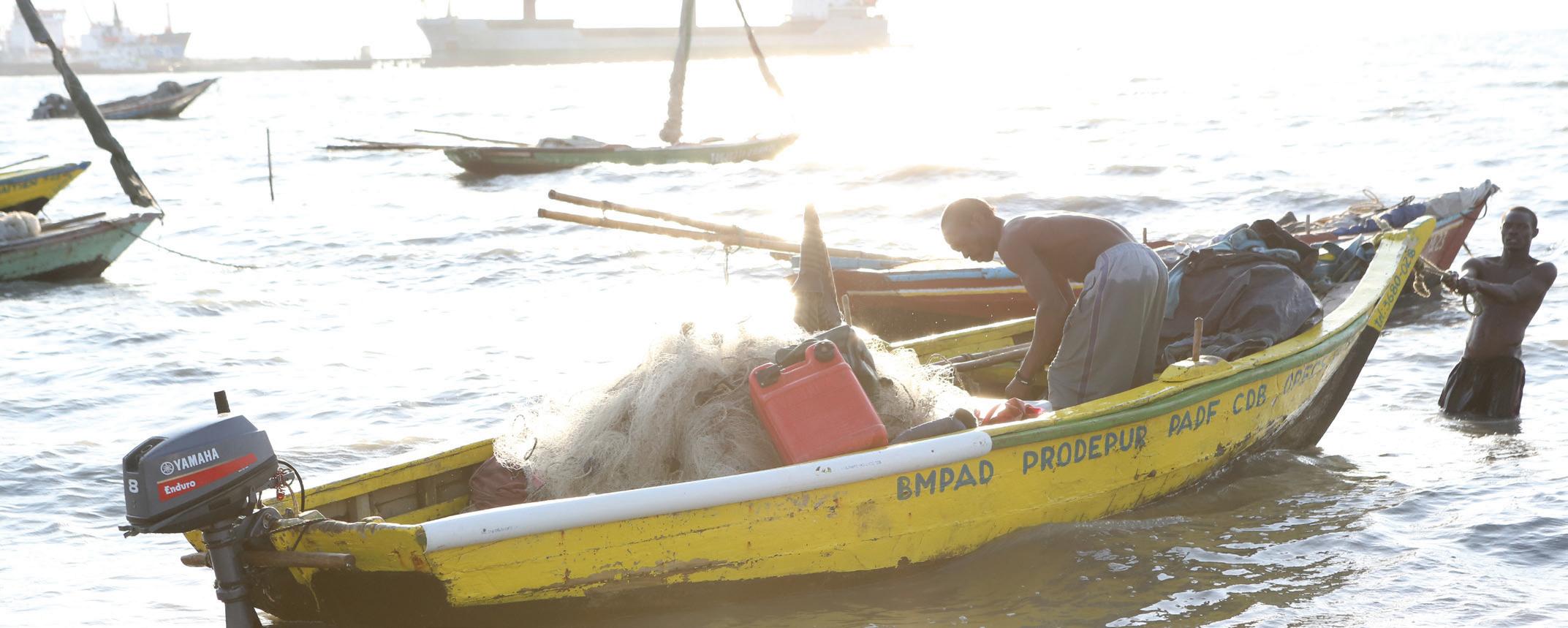
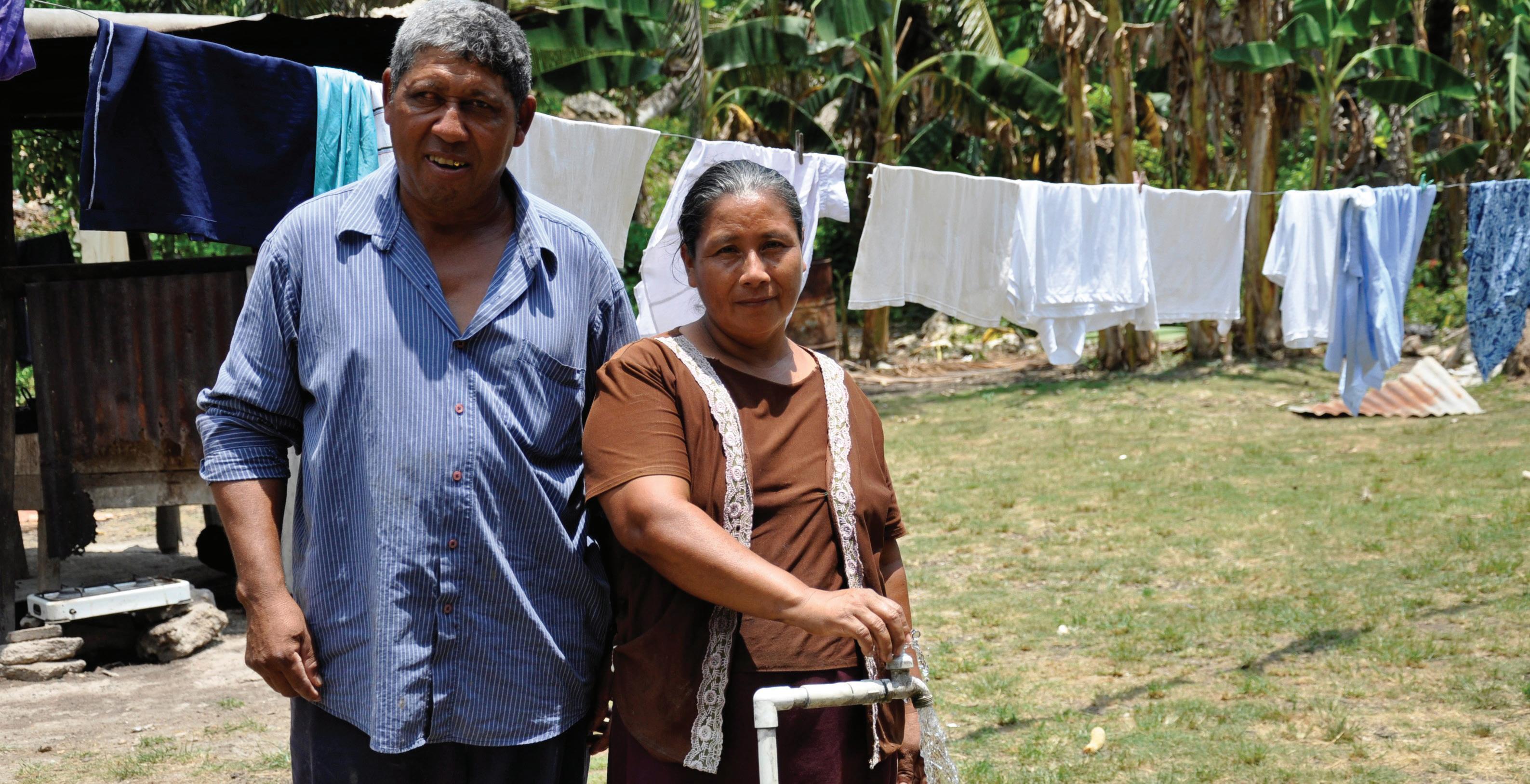
a girl drinks from a tap during the inauguration of a new water system financed by CDB through the Social Investment Fund II on August 31, 2016. (Selwyn King / Belize Social Investment Fund)
Cover Photo: In Belize,
PURPOSE
“The purpose of the Bank shall be to contribute to the harmonious economic growth and development of the member countries of the Caribbean (hereinafter called the Region) and to promote economic cooperation and integration among them, having special and urgent regard to the less developed members of the Region.”
Article 1 - agreement Establishing the Caribbean Development Bank
MISSION STATEMENT
CDB intends to be the leading catalyst for development resources into the Region, working in an efficient, responsive and collaborative manner with our Borrowing Member Countries and other development partners, towards the systematic reduction of poverty in their countries through social and economic development.
Wildey, St. Michael Barbados, West Indies
May 24, 2017
Honourable
Sharlene Cartwright-Robinson Chairman Board of Governors
Caribbean Development Bank
Dear Chairman
I enclose the Annual Report of the Caribbean Development Bank for the year ended December 31, 2016, which the Board of Directors, acting pursuant to Paragraph 2 of Article 38 of the Agreement establishing the Caribbean Development Bank and in accordance with Section 18 of the By-Laws of the Bank, has requested me to submit to the Board of Governors.
Yours sincerely
Wm. Warren Smith, Ph.D., CD President
PRESIDENT’S STATEMENT
In 2016, the borrowing member countries (BMCs) of the Caribbean Development Bank (CDB) marked the start of implementation of The 2030 Agenda for Sustainable Development. This was in keeping with the global commitment to end poverty, while building inclusive and resilient societies.
Even as BMCs commenced the journey, there were stark reminders of the complexity of the development challenges they face. Economic growth was uneven and low, keeping unemployment and poverty levels uncomfortably high. Youth unemployment, now in excess of 30%, may be fuelling growing concerns about an uptick in crime levels and citizen insecurity. Meanwhile, low growth and slow progress in improving the “doing business” environment kept concerns about unsustainable fiscal balances and public debt at the forefront of policy discussions.
The challenges are daunting but not insurmountable. We applaud the proactive stance of some regional Governments to implement difficult adjustment programmes to reverse macroeconomic imbalances and build a platform for sustained growth and development. We urge BMCs to “stay the course” and to be vigilant, but mindful, of the need to provide adequate social safety nets and protect the most vulnerable groups in society. And we encourage others not to delay any longer the start of corrective action.
CDB, meanwhile, continued to work in close partnership with our BMCs to reduce poverty and begin the transformation necessary to achieve the Sustainable Development Goals (SDGs). This determination defined our priorities and accomplishments in 2016. We made major strides in
deepening and leveraging strategic partnerships, in order to expand our resource reach—and with a strong focus on funding for climate adaptation and renewable energy/energy efficiency projects. We became, for example, an accredited partner institution of the Adaptation Fund and the Green Climate Fund (GCF), opening new gateways to much-needed grant financing to address climate change vulnerabilities in the BMCs. For the first time, we accessed, from Agence Française de Développement, a credit facility to support sustainable infrastructure projects and a grant to finance feasibility studies in eligible BMCs. We also entered into an arrangement with the Government of Canada for the establishment and administration of the CAD5 million (mn) Canadian Support to the Energy Sector in the Caribbean Fund.
We closed the year with the successful completion of negotiations for the ninth replenishment of the Special Development Fund (SDF), the Bank’s largest pool of concessionary funds. Contributors agreed to a $355 mn programme for the period 2017-2020. Notably, the SDF interest rate was lowered from 2% and 2.5%, and unified at 1% in an effort to strengthen the Fund’s overall competitiveness.
On the operational side, we surpassed our approval targets for loans and grants. Total approvals (including $45 mn in grants but excluding United Kingdom Caribbean Infrastructure Partnership Fund [UKCIF] approvals) reached $306 mn, compared with $292 mn in 2015. The Bank’s Board of Directors approved 16 capital loans, two policy-based loans and 84 technical assistance interventions in 2016. The improved performance reflects, in part, the impact of our diversification strategy to reduce portfolio concentration risk and our efforts to strengthen project supervision and overall project portfolio performance.
Of note is the approval of $15.3 mn for the Bank’s first geothermal project under the new CDB GeoSmart Initiative. Catalysing investments in geothermal and other renewable energy sources can unlock a better, cleaner, and more sustainable future for the people of the Caribbean. If exploratory and production-well-drilling results are favourable and feasibility is demonstrated, this could be a game-changer for St. Vincent and the Grenadines and other countries in the Organisation of Eastern Caribbean States (OECS) similarly endowed with geothermal energy.
Also of note is the operationalisation of the UKCIF, under which we approved five interventions totalling £16.4 mn in 2016. Investment in infrastructure, by facilitating improvements in productive capacity, competitiveness and exports, is an important catalyst for economic growth.
On the disbursement side, the Bank focused its efforts on strengthening project supervision and overall project portfolio performance. Total loan disbursements in 2016 stood at $154.8 mn.
CDB enjoyed a high credit rating in the capital markets. This rating, together with a broader strategy to diversify the Bank’s investor base, paved the way for CDB to enter and secure a borrowing of $150 mn on the Swiss capital market during the year.
In general, CDB made good progress in 2016. Let me express appreciation to:
• the Boards of Governors and Directors for their stewardship;
• Contributors who, by agreeing to the ninth replenishment of the SDF, reaffirmed their support for the Bank and its poverty reduction programme;
• the development partners with whom we share a common interest in working with BMCs towards the attainment of the Sustainable Development Agenda and SDGs; and
• the dedicated Management and Staff who worked tirelessly with BMCs during the year to deliver needed financing and technical assistance.
We will need this support again in 2017 to help create, shape, and build a sustainable future for every member of Caribbean society.
W . Warren Smith, Ph.D., CD President
DISTRIBUTION OF LOANS BY SECTOR - 2016 ($ MN)
DISASTER PREVENTION AND
FINANCIAL INTERMEDIARIES
POLICY-BASED LOANS
DISTRIBUTION OF LOANS BY COUNTRY - 2016 ($ MN)
ANTIGUA AND BARBUDA ANGUILLA
GUYANA
ST. KITTS AND NEVIS
SAINT LUCIA
SURINAME
ST. VINCENT AND THE GRENADINES
SECTION 1
CARIBBEAN ECONOMIC REVIEW AND OUTLOOK
CARIBBEAN ECONOMIC REVIEW AND OUTLOOK
Caribbean economies experienced another challenging year in 2016. Economic performance in the larger commodityproducing countries was driven by the slow recovery of international commodity prices from their 2015 lows. The service-based economies fared better, where tourism and construction activities continued to grow.
In addition, low oil prices helped improve the current accounts of the balance of payments in many BMCs. However, natural disasters affected a number of countries, most significantly, Haiti. The loss of correspondent banking relationships (CBRs) in
some countries continued to be problematic in 2016, leading to an increase in the costs of transactions, and threatening BMCs’ ability to trade with the outside world. BMCs’ debt dynamics were mixed in 2016, with some countries reducing their debt-to-GDP ratios via consolidation measures, while others faced an acceleration in their debt-to-GDP ratio to a worrying extent.
As Chart 1 shows, CDB’s BMCs’ real GDP growth underperformed when compared with other country groups. Since 2010, annual growth has averaged 0.8%1; while in other small states, growth averaged 4.7%. Much of this growth differential reflects a higher level of export diversification among other small states, underpinned by greater competitiveness.
Sources: International Monetary Fund (IMF), CDB
CHART 1: GROWTH (%) IN REAL OUTPUT, 2006-2016
BMC PERFORMANCE IN 2016
The Region’s five major commodity exporters — Belize, Guyana, Haiti, Suriname and Trinidad and Tobago – experienced weaker performance in 2016 than in 2015. Most significantly, Trinidad and Tobago’s economy contracted by 5%, as output in the petroleum and hydrocarbon industries declined by 12.6%, mainly because of the effects of maturing oil and gas fields, ongoing major maintenance and overhaul activity, and weak prices. In addition, production of petrochemicals fell by 4.7%, and the manufacturing and services sectors also reported declines.
In Guyana, the economy grew by 2.6%, compared with 3.2% in 2015. Gold production rose significantly due to rising prices, incentives for small-scale miners, and the opening of a mine in late 2015. Bauxite production was also up. However, rice and sugar production fell, partly because of drought early in the year, as did manufacturing output.
In Belize, drought also affected the agriculture sector, causing citrus, banana and papaya production to decline. In the fisheries industry, shrimp production fell as a result of disease. With reserves exhausted, oil production slowed. No further exploration is currently planned. On the upside, tourism grew, driven by increases in the number of overnight and cruise-ship visitors. Overall, the economy contracted by an estimated 1.2%, compared with 2.9% growth in 2015.
The economy of Suriname contracted by an estimated 9% in 2016, following a 2.7% reduction in 2015. This was attributed to the closure of the alumina refinery in late 2015 and a reduction in oil production.
Severely impacted by Hurricane Matthew in early October 2016, Haiti’s real growth rate slowed to 1.1%. Hurricane Matthew caused approximately $1.9 billion in infrastructure damages and affected more than 1.1 mn people.
Regional tourism activity improved in 2016, spurred by improved marketing campaigns and discretionary income in the major tourism source markets, reflecting improved employment conditions and low inflation. Most destinations recorded increases in total visitor arrivals, although the number
of overnight visitors grew at a slower rate of 1.7% compared with 4% in 2015.
Antigua and Barbuda, and the Turks and Caicos Islands (TCI), experienced growth of more than 4%, as a result of the recovery in the tourism sector. Following two years of contraction, The Bahamas recorded modest growth of 0.3% in 2016, impacted, in part, by the effects of Hurricane Matthew.
In Saint Lucia, tourist arrivals fell on account of a temporary reduction in hotel room stock; but increased construction activity helped to offset this decline. The Barbados economy grew by 1.6% (compared with 0.9% in 2015), based on a rise in long-stay arrivals of nearly 6% attributed to additional airlift, the refurbishment and expansion of the hotel room stock, and the 50th Anniversary of Independence celebrations. In Jamaica, both overnight and cruise-ship visitor numbers rose. This coincided with growth in the agriculture, construction and manufacturing sectors.
TABLE 1: GROWTH (%) IN REAL OUTPUT, 2012-2016*
Sources: National Statistics Offices, Central Banks and CDB *Data for 2016 are preliminary estimates
EMPLOYMENT AND PRICES
Double-digit unemployment across the majority of the BMCs remains an area of concern for the Region. In Saint Lucia, increased construction activity helped the overall unemployment rate to fall to an estimated 20% in 2016 from 24.1% in 2015.
The Bahamas, Barbados, Belize and Jamaica also reported declines. However, unemployment increased in Suriname and Trinidad and Tobago (Chart 2). Recent labour force surveys revealed high levels of unemployment in Grenada (28.6% in 2016) and St. Vincent and the Grenadines (25.1% in 2015).
Sources: National Statistics Offices, Central Banks
Notes: Rates for Cayman Islands, Saint Lucia and Trinidad and Tobago are as at mid-year. Rates for The Bahamas, Barbados, Belize, Jamaica and Suriname are annual averages.
Deflation persisted in Anguilla, Antigua and Barbuda, Cayman Islands, Dominica, and St. Vincent and the Grenadines; while inflation picked up elsewhere, as international commodity prices recovered slightly following their steep decline in 2015. In Trinidad and Tobago, inflation at the end of October was 2% (down from 2.4% the previous October), tempered by low aggregate demand. On one hand, in Jamaica, the end-December 2016 inflation rate of 1.7% was the lowest recorded since 1967. Suriname, on the other hand, witnessed inflation in excess of 60% by the end of December 2016 due to exchange rate adjustments and depreciation. Drought conditions caused inflation to increase in Belize, Guyana and Haiti.
EXTERNAL PERFORMANCE
Trade performance in the BMCs was once again dominated by weak commodity prices. Trinidad and Tobago, the Region’s largest oil and gas exporter, experienced a deterioration in its current account deficit, despite slight weakening in the exchange rate. However, increased foreign direct investment helped bring about an improvement in the overall balance of payments.
Belize’s current account deficit worsened due to the sharp decline in oil exports, along with a reduction in agricultural products. Suriname’s current account deficit stabilised as
imports fell on account of the exchange rate depreciation, amid a reduction in commodity exports. In contrast, Guyana’s current account deficit improved following an increase in gold exports that was accompanied by a fall in overall imports.
Many of the non-oil-producing BMCs experienced reductions in their current account deficits. Lower fuel prices and positive tourism performance contributed to reduced current account deficits in Barbados, Grenada, Jamaica, and St. Vincent and the Grenadines. These factors also helped keep the current account deficit stable in St. Kitts and Nevis, where inflows
from the Citizenship by Investment (CBI) programme fell. In The Bahamas, the current account deficit widened, as the slight improvement in travel credits was offset by a deterioration in the goods balance.
These flows had implications for the stock position of foreign reserves across BMCs. The reserves position improved in Guyana, Jamaica and the Eastern Caribbean Currency Union (ECCU) member countries. More significantly, foreign reserves in The Bahamas, Barbados and Suriname were below the global benchmark of three months of import cover.
CHART 3: FOREIGN RESERVES (IN MONTHS OF IMPORTS)
Source: Caribbean Central Banks Statistical and Monetary Reports, 2016
MONETARY DEVELOPMENTS AND FINANCIAL STABILITY
The nominal growth of the monetary bases across the BMCs slowed, on average, relative to 2015, reflective of the benign inflationary environment and weak economic growth. On balance, credit growth remained sluggish in the midst of weak growth expectations. Jamaica was the exception to this trend. Buoyant household and private sector credit growth of 16% and 14.8%, respectively, was underpinned by an easing of credit conditions in Jamaica. Conversely, in the ECCU area, credit did not increase. This was in spite of the lowering of the minimum savings rate, which was intended to reduce costs to the banks and, therefore, encourage them to lend. Continuing its downward spiral, credit declined by 8.3% in 2016.
The regional banking system showed improved resilience in 2016, with satisfactory capitalisation (capital adequacy ratios above prudential guidelines) and marginal profitability. However, vulnerabilities persist across BMCs, with high but declining levels of non-performing loans. The loss of CBRs posed a threat to the viability of several domestic banks, amidst tighter lending conditions and increased oversight for anti-money laundering and combating the financing of terrorism.
FISCAL PERFORMANCE AND DEBT
High and/or rising levels of indebtedness remain a challenge for many BMCs, with increasing debt service payments crowding out productive expenditure that is critically needed to stimulate growth. Table 2 shows that debt-to-GDP ratios in five BMCs fell in 2016. Grenada and Jamaica benefited from reform programmes that are being implemented with support from CDB, IMF and other international financial institutions and donors. Both countries recorded primary surpluses in 2016; with Grenada achieving an overall fiscal surplus for the first time in a decade. Their tax and non-tax revenues rose, while expenditures, including the wage bill, were contained. In November, Jamaica’s sovereign credit rating was upgraded by Moody’s to B3 from Caa2. Jamaica replaced its IMF Extended Fund Facility with a three-year precautionary Standby Arrangement (SBA), signalling its intention to continue its fiscal reform programme. Similarly, Grenada met all of the targets under the IMF Extended Credit Facility, with improved
revenue performance and falling public debt-to-GDP reflective of enhanced revenue administration and continued debt restructuring.
The debt burden also fell in St. Kitts and Nevis owing to scheduled principal repayments and lower interest costs, against a backdrop of lower government revenues (including from CBI). In Antigua and Barbuda, proceeds from the Citizenship by Investment Programme enabled the debt-toGDP ratio to fall. The debt-to-GDP ratio fell in Guyana, due to continued economic growth; and also in the Cayman Islands and TCI, where actual debt levels fell.
Elsewhere, debt-to-GDP ratios increased. In Suriname, the IMF SBA approved in May 2016 supported fiscal adjustment that had begun in late 2015. However, following the implementation of some planned reforms, progress slowed. For example, the growth in revenues was constrained by the freezing of fuel pump prices and partial reversal of the increase in electricity tariffs. The fiscal deficit fell in comparison to the previous year, but not enough to prevent public debt from increasing.
In Anguilla, where a small fiscal surplus was recorded, the main reason for additional debt was funding of the bank resolution programme. In Barbados and The Bahamas, fiscal deficits fell because capital expenditure was reduced to accommodate rising current expenditure. In Barbados, interest payments and the public-sector wage bill accounted for 47% of total spending in the first nine months of the financial year 2016/2017. Revenue collections in the same period fell, set against a background of weak domestic demand and erosion of the revenue base. In The Bahamas, recovery expenditure following Hurricane Matthew was estimated at 7% of GDP.
Belize recorded a small primary surplus in 2016, on account of a reduction in capital expenditure. However, the debt-toGDP ratio rose as a result of a one-off payment associated with a nationalised utility. With concerns about financing future expenditure, Belize approached creditors to renegotiate the terms of its commercial external debt. This prompted a credit downgrade to CCC+ from B- by Standard and Poor’s.
TABLE 2: DEBT/GDP RATIO 2015-2016
Sources: IMF World Economic Outlook Database, CDB estimates.
OUTLOOK
The IMF is forecasting that global growth will pick up in 2017 to reach 3.4% from 3.1% in 2016. Contrasting growth paths are forecast for the BMCs’ major trading partners – the United States (1.9%), the United Kingdom (0.8%), Canada (1.5%), the Eurozone (1.6%) and China (6.4%). Risks to the global forecast are tilted on the downside in terms of the policy
uncertainties surrounding the recently elected government in the United States; slowing productivity growth in the advanced economies and the likely volatility in capital flows and cost of borrowing surrounding the normalisation of U.S. interest rates; and slowdown in China that is more severe than expected.
At the regional level, economic recovery of 1.7% is projected for 2017. This is predicated on a return to positive growth in Trinidad and Tobago. Notwithstanding, the risks to the outlook are tilted on the downside. Domestic headwinds to growth reside with the legacy effects of the Zika virus (although no longer an international epidemic) in redirecting tourist arrivals away from the Region; and the loss of CBRs, which could affect financial stability. In addition, there are the perennial risks of natural disasters and other weather-related challenges.
Growth in all of CDB’s BMCs is projected for 2017 (see Chart 4). The projected 1% real GDP growth in Trinidad and Tobago will be driven by improvements in energy prices; investments slated for energy projects; and higher natural gas output.
4: GDP GROWTH - 2016 AND 2017
Sources: CDB estimates
The performance of Guyana and Suriname is expected to improve in 2017, commensurate with a gradual recovery in commodity prices. In Belize, recovery in agriculture and fisheries is expected. Real GDP growth is projected to range from 0.4% in Suriname to 3.5% in Guyana, where increased gold output and recovery in the agriculture and forestry sectors are expected.
In the tourism-dependent economies, real GDP growth is projected to range from 0.9% in The Bahamas to 4.3% in TCI, driven largely by increased tourist arrivals and buoyant investment in infrastructure. Improvements in the agriculture sector are projected for Grenada and Jamaica.
CHART
POLICY DISCUSSION
There are a number of key imperatives. Chief among these is the need to intensify policy actions that generate sustainable and more inclusive economic growth. The economies must be environmentally sustainable and adaptable to climate change. Additionally, they must provide, especially for young people, employment opportunities that reflect the changing way in which the world is working; by, for example, being complimentary to automation and artificial intelligence.
To achieve this shift requires an action plan that promotes regional participation in the global supply chains and increased employment opportunities. Policymakers must tackle the obstacles to growth by improving the doing-business environment; enabling better access to financing for micro, small and medium enterprises (MSMEs); and implementing labour market reforms, including making it easier for young people and women to work in all sectors. All of these measures could increase productivity and enhance competiveness.
The benefits of positive growth outcomes should be enjoyed by all. These outcomes can be achieved through targeting the SDGs. The Region needs improvements in social development in the areas of quality education and good housing. Policies and institutions should quickly and accurately target where support is needed, and continuously evaluate and improve their performance.
Economic stability is a precondition for breaking out of the unhappy cycle of high debt and low growth. Evidence suggests that a high debt burden compromises economic stability, a country’s economic growth agenda and government’s ability to support social programmes. With limited resources available to achieve desired outcomes, fiscal discipline is crucial. With that in mind, robust institutions and frameworks to manage public finances must be in place. Expenditure reforms should include adoption of fiscal rules (as was done recently in Grenada); close monitoring and streamlining of state-owned enterprises and parastatal companies to limit transfers; and better targetting of social expenditure to reduce subsidies. Reforms should have the objective of ensuring that revenue-generating systems are simple and equitable, can finance government operations, and promote economic efficiency. In relation to promoting economic efficiency, revenue-generating systems have to be configured to facilitate trade and competitiveness.
Public debt management should be improved, including the implementation of debt management strategies that focus on minimising cost and risks. Additionally, given the vulnerabilities to natural disasters, it is important for countries to use revenue windfalls to set up contingency or sovereign wealth funds to build greater economic and social resilience. Windfalls are not permanent, so they should be used to create buffers against unanticipated adverse events to protect economies.
A number of structural reforms can be readily undertaken to enhance inclusive growth. Such reforms should help businesses grow, reduce barriers to trade and strengthen the financial sector. For example, by introducing and then widening the scope of its credit bureau, Guyana has started to address the problem of access to finance for MSMEs. This was one reason that Guyana rose from 140th to 124th in the 2016 World Bank Doing Business ranking. Jamaica remains the highest ranked BMC, at 67 of 190 countries. In recent years, Jamaica has implemented a number of reforms aimed specifically at facilitating business: easier property registration; reduced port transit times through technology improvements; easier tax filing through the use of e-filing; and a wider range of assets that can be used as collateral.
The Region should encourage public private partnerships (PPPs) to help unlock value from underutilised assets. Reforms should facilitate and promote green energy production, provide incentives for raising capital, for example, on the junior stock exchange markets, and enhance venture capital ecosystems.
Efforts can also be made to engage the Region’s vast diaspora in the growth agenda.
A significant platform for consistent positive growth outcomes is good governance. A well-functioning system can effect change through open and enlightened policymaking, a professional and accountable bureaucracy, and a strong civil society participating in public affairs. Systems of government should be transparent, and foster inclusion, security and growth. Moreover, government operations and resources should be managed in such a way to promote good value for money.
OPERATIONS SECTION 2
OPERATIONS
CLIMATE ADAPTATION AND MITIGATION
As an accredited regional implementing entity for both the GCF and Adaptation Fund, the Bank now has the opportunity to access, and make available to its BMCs, even more lowercost resources for investment projects, as well as grants to support their design.
Consistent with its climate resilience focus, CDB introduced climate risk screening for all investment projects and country strategies, and maintained its focus on building internal technical capacity to allow climate considerations to be incorporated into its work. With support from the European Investment Bank (EIB) and the World Bank, CDB delivered in-house seminars and workshops, and developed guidance tools on climate change topics. These were designed to sensitise and improve the technical capacity of Operations staff to mainstream climate considerations in the Bank’s work. In November, CDB partnered with the Inter-American Development Bank (IDB) to host a Regional Policy Dialogue on environment licensing and enforcement in Kingston, Jamaica.
As it seeks to build resilience to natural hazards, climate variability and change, the Bank continued to provide technical assistance grants for national and regional capacity-building. Interventions included:
• development of a natural hazard profile and a “safe school” programme in Guyana;
• post-disaster training and needs assessment in Jamaica;
• strengthening of the procurement policy and procedures of the Caribbean Disaster Emergency Management Agency; and
• establishment of a national disaster early-warning system in St. Vincent and the Grenadines.
Under the Community Disaster Risk Reduction Fund, the Bank approved two new projects for implementation— Establishing Flood-Resilient SMART Communities in the British Virgin Islands and Building Adaptive Capacity and Resilience to Climate Change in the Toledo District in Belize.
The Bank provided Emergency Relief Grants to The Bahamas, Belize and Haiti to finance emergency supplies and services following the passage of Hurricane Earl. A $3.5 mn grant that was used to pay the annual insurance premium to the Caribbean Catastrophe Risk Insurance Facility on behalf of the Government of Haiti, yielded a $23.4 mn payout in the aftermath of Hurricane Matthew, which had devastating impacts on the south of the country in October.
RENEWABLE ENERGY AND ENERGY EFFICIENCY
CDB reached an important milestone in 2016 with the utilisation of a new risk mitigation financial instrument for geothermal energy development, comprising financing mobilised under CDB’s GeoSmart Initiative. St. Vincent and the Grenadines was the first recipient of funding for a Geothermal Drilling Project, with the approval of a grant of £4 mn (UK Department for International Development resources to CDB for the specific purpose) and a $9.5 mn contingently recoverable grant to a Special Purpose Vehicle operating as a PPP. The grant contribution to the Project would constitute the Government of St. Vincent and the Grenadines’ equity contribution to the company. The contingently recoverable grant, financed from Clean Technology Fund grant resources through IDB, would convert to a concessional loan if exploratory drilling yielded commercially adequate amounts of steam for a viable geothermal plant.
BMCs responded well to the launch of the Bank’s streetlight retrofitting product. The availability of resources for cofinancing under the EIB Climate Action Line of Credit (CALC) increased the concessionality of the CDB loans. Loans were approved for Antigua and Barbuda, St. Kitts and Nevis and Saint Lucia, with the cumulative potential to change more than 46,000 street lamps from existing energy-intensive lamps to LED lamps, which are estimated to be 50% more efficient. Potential benefits include energy savings of more than 16,000 megawatt hours annually and the corresponding reduction in greenhouse gas emissions (carbon dioxide) of up to 10,700 tonnes across the three countries. These projects will contribute
to the countries’ achievement of their Nationally Determined Contributions to emission reduction, under United Nations Framework Convention on Climate Change agreements.
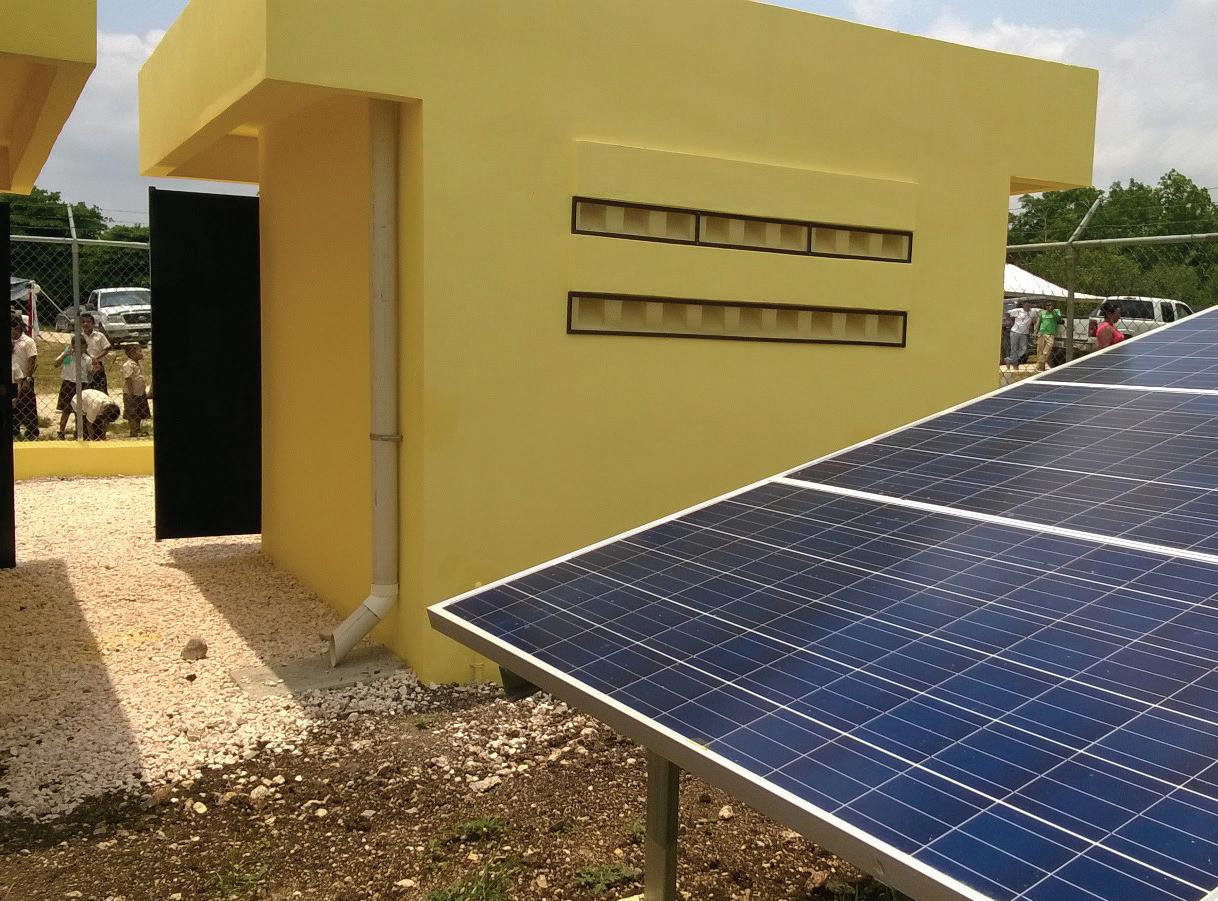
The Basic Needs Trust Fund (BNTF) also made its contribution to energy savings through the provision of grant financing in Belize and Guyana for seven small solar photovoltaic (PV) installations serving hinterland sites with more reliable water supplies and two for primary schools.
ECONOMIC INFRASTRUCTURE
During 2016, the Bank approved:
• Seven new capital and eight new technical assistance interventions for economic infrastructure development in Antigua and Barbuda, The Bahamas, Belize, Dominica, Grenada, Saint Lucia, and St. Vincent and the Grenadines;
• Two regional technical assistance projects addressing climate change adaptation in the road transport and water supply sectors; and
• A natural disaster management project in St. Vincent and the Grenadines with the expected outcome of reduced vulnerability of select communities to extreme rainfall and other climate change impacts.
Overall, new approvals were in the energy, water and sanitation, and road transport sectors.
Ongoing infrastructure projects included the construction and upgrading of approximately 25 km of roads, benefitting approximately 20,000 men, women, boys and girls. CDB also installed 2,800 cubic metres (m3) of water capacity, benefitting 1,600 households.
Energy
In addition to the three new street lighting projects in Antigua and Barbuda, St. Kitts and Nevis, and Saint Lucia, and the geothermal project in St. Vincent and the Grenadines, CDB approved a capital project to upgrade and expand the electricity system in Suriname. The project is expected
to improve reliability, enhance capability and increase the operational flexibility of the power company’s sub-transmission and distribution network, in the delivery of a quality power supply to customers.
Water and Sanitation
In Saint Lucia, the Bank approved a project to provide a safe, reliable and climate-resilient supply of potable water to residents and businesses in Dennery. Suriname also received technical assistance for the preparation of technically viable, socially inclusive infrastructure projects to upgrade water supply facilities in Nickerie, Paramaribo, Wanica and Para. In October, CDB supported the 12th High Level Forum for Water Ministers in the Caribbean, where it presented the findings of its water sector study, and committed further support for the sector.
Road Transport
In 2016, UKCIF grant funds financed most of the assistance in the road transport sub-sector. These projects included feasibility and design studies for selected roads in Belize, Dominica, and Antigua and Barbuda, for which the Bank also approved a capital project for road infrastructure rehabilitation. The expected outcome of the project is increased efficiency, climate resilience and improved safety along two main highways.
ASSESSMENT OF THE WATER SECTOR IN THE CARIBBEAN: KEY FINDINGS
In 2015, CDB completed an assessment of the water sector in Anguilla, Antigua and Barbuda, The Bahamas, Barbados, Belize, British Virgin Islands, Cayman Islands, Dominica, Grenada, Guyana, Jamaica, Montserrat, St. Kitts and Nevis, Saint Lucia, St. Vincent and the Grenadines, Trinidad and Tobago, and TCI.
WATER GOVERNANCE
Water utilities in the Caribbean are generally owned and controlled by governments, with limited involvement from private sector, non-governmental or community groups.
Water management is done through various government agencies, but has suffered from poor integration of policies and operations between key stakeholders.
With the exception of The Bahamas, Belize, Jamaica and Saint Lucia, there has been limited fundamental reform of the system of governance over the past 20 years.
The largest water supply is from groundwater abstraction (52.5%), followed by surface water supply (35.8%), desalination (11.6%), and rainwater harvesting (< 1%).
Between 1968 and 2012, freshwater availability declined between 2% and 40% in respective Caribbean countries.
This decline in freshwater has been attributed to variability in rainfall, and suggests a need to review assumptions regarding stream flows, aquifer recharge rates and sustainable levels of abstraction from surface and groundwater sources.
CLIMATE CHANGE
Caribbean water resources are extremely vulnerable to the impacts of climate variability and change. Adaptation measures must be undertaken urgently to protect water supply systems.
The Caribbean Community Climate Change Centre has prepared a climate adaptation programme for the Region. It presents strategies and projects for implementation from 2011 to 2021, but will need significant coordination.
Cost of inaction has been estimated to vary from 4.0% to 21.3% of GDP.
REGIONAL COLLABORATION RECOMMENDED SECTOR PRIORITIES WATER RESOURCES NON-REVENUE WATER (NRW) TARIFFS
Several bodies in the Region, mostly functioning as independent institutions, are involved in the oversight of its water sector.
A more symbiotic approach is needed to improve synergies for regional development, for example, through shared networks for data collection and information dissemination.
Water distribution networks were found to be highly inefficient, with NRW varying from approximately 17% to 66%.
Water tariffs do not meet the cost of production, let alone the need for the sector to create reserves for increasing capacity. Tariffs vary significantly through the Region from $0.14 per m3 to $6.60 per m3
Data Collection and Information Management Systems - Focus should be placed on the development of data management tools for water resources, network operations, financial performance, asset management, network design and benchmarking to assist the water utilities.
Efficient Operations - Support is required for NRW reduction that will establish operational targets and lead to improved demand management. There must be greater emphasis on enhancing the performance of operational systems and application of maintenance management principles and tools.
Sustainable Financing - Full-cost pricing, including determination of appropriate tariffs, is required to support capital works investments.
FEATURE
BOOSTING THE WATER SUPPLY IN BELIZE
Almost every four out of 10 families live below the poverty line in the Indian Church and San Carlos villages of Belize. Without a safe, reliable supply of water, building sustainable livelihoods has been even more difficult for the 100 households in these communities.
In May, the Indian Church/San Carlos Hybrid Solar Water System was inaugurated, signalling a turnaround. Through funding from CDB and the Government of Belize, households now have access to reliable and safe water.
In the communities, residents once used untreated water from handdug wells, hand pumps, lagoons and tanks. Now, a 20,000 gallon water reservoir, constructed at the entrance of Indian Church, will send gravity-fed water to the residents there and in San Carlos—a process powered by the sun.
With the new system, villagers will no longer have to buy purified water, or spend time gathering water. Many residents of Indian Church are engaged in food-services enterprises, which can now run more efficiently. The intervention will also expand business opportunities for people who live in San Carlos village where horticulture and habanero pepper production drive economic activity.
Under the sub-project, members of the Water Board received training in managing and operating the water system. They were also introduced to basic accounting principles through a programme organised by the Ministry of Labour, Local Government and Rural Development.
CDB financed the sub-project through a loan from the Social Investment Fund II. The Government of Belize and the San Carlos and Indian Church communities made counterpart contributions.
CARIBBEAN DEVLOPMENT BANK
TECHNICAL COOPERATION
In 2016, the Bank continued its work in advancing Regional Cooperation and Integration; the development effectiveness of technical assistance; and good governance and institutional development.
Through the provision of training in Public Policy Analysis and Management (PPAM) and Project Cycle Management (PCM), and the management of the Caribbean Technological Consultancy Services (CTCS) Network, CDB provided technical cooperation to public and private sectors. During 2016, the Bank enhanced the effectiveness of its technical cooperation by managing a number of demand-driven initiatives that focused on delivering sustainable results.
Technical Assistance Policy and Operational Strategy
The Bank implemented activities, consistent with its Technical Assistance Policy and Operational Strategy throughout the year. Emphasis was placed on revising, simplifying and standardising the technical assistance appraisal and approval processes, whilst ensuring appropriate due diligence. The Bank improved the scope and integration of technical assistance in its country strategies, and finalised technical assistance business requirements within the project performance management system, scheduled to launch in 2017.
A review of the Bank’s technical assistance portfolio showed that, as at the end of December 2016, 227 TA projects at a value of $94 mn were being implemented. This comprised both loans and grants in 15 countries, as well as projects at the regional level.
Deepening Regional Cooperation and Integration
CSME Standby Facility for Capacity Building, CARIFORUMEU EPA Standby Facility for Capacity Building
The Standby Facilities, made possible through a Contribution Agreement between the European Union (EU) and CDB, are designed to strengthen the capacity of CARIFORUM member
states to implement the Economic Partnership Agreement (EPA) and the CARICOM Single Market and Economy (CSME). In 2016, 13 projects with a total value of approximately $3 mn were under implementation for the CSME Standby Facility for Capacity Building. The Facility focuses on strengthening business skills and competencies to access markets in CSME at the national level. Ongoing projects in Antigua and Barbuda, The Bahamas, Belize, Jamaica, Saint Lucia, Suriname and Trinidad and Tobago focused on trade facilitation and trade promotion. Three of these projects support the improvement of the regional/national quality infrastructure to facilitate competitiveness and sustainable development of the Region. At the end of 2016, $1.9 mn (64% of the committed funds), had been disbursed.
Market-scoping and trade missions from Suriname to Barbados and Trinidad and Tobago were completed. The information gathered was used to identify potential niches for export. The missions focused on competitive issues such as pricing, consumer profiles and tastes, technical barriers to trade and the regulatory requirements for the importation of agri-foods into Barbados and Trinidad and Tobago.
Fifteen projects with a total value of $3.2 mn were implemented for the EPA Standby Facility. At the end of 2016, a total of $2.6 mn (80% of the committed funds), had been disbursed.
Four projects (two in Belize, one in St. Kitts and Nevis, and one in The Bahamas) supported the enhancement of the national quality infrastructure and standardisation, in accordance with the approved Regional Standardisation Strategy. When completed, these projects will result in affordable and accredited testing services being made available to agroprocessors who wish to access EU markets. The improvements in the national quality infrastructure will also contribute to consumer safety.
Promoting Results and Supporting Regional Public Goods
During 2016, under a CDB grant of $0.5 mn to support the operationalisation of the Caribbean Community (CARICOM) Results Based Management (RBM) System, the CARICOM Secretariat established an RBM Committee and made key personnel appointments. Consultants conducted a training
needs assessment, which will guide the design and roll-out of training in the first half of 2017.
Improving data availability
CDB continued to support, and play a key role in, the advancement of the regional statistical system. These efforts will improve the quality of statistical information for evidencebased policymaking and other uses at national, regional and international levels. This exercise complements the Bank’s ongoing work to set a higher standard for conducting multidimensional poverty assessments and analysing non-income dimensions of poverty and human development.
CDB supported regional capacity-building in the analysis and dissemination of 2010 national population and housing census data. The Bank invested in training for officials from national statistical offices and end users from line Ministries in demographic and social analysis and dissemination of census and survey data.
Activities under the CDB grant to the CARICOM Secretariat to support the implementation of DevInfo (a database system for monitoring human development, and institutionalising managing for development results) came to a close. Workshops in Anguilla,
Barbados, Grenada, Montserrat and Saint Lucia strengthened knowledge and skills for effectively managing DevInfo.
As Chair of the Development Partners Task Force on Statistics, CDB convened two meetings in 2016. They provided support for improving national and regional statistical capacity and building a comprehensive statistical infrastructure.
CTCS: Listening and Responding to MSMEs
Through CTCS, the Bank continued to promote the growth of the MSME sub-sector in the Caribbean. Bank approved $1.2 mn for the CTCS Network to implement technical assistance activities to strengthen MSMEs’ capacity. As at December 31, 2016, the Bank had disbursed $0.9 mn (78% of the total approval), to facilitate the implementation of 46 technical assistance activities. The interventions benefited 860 business people (556 women and 304 men) and included ongoing training to improve food safety; enhance production capacities; develop business advisory and management skills; and facilitate institutional strengthening.
Building on a train-the-trainer workshop held in 2015, business development officers in 15 BMCs participated in Managing for Development Results (MfDR) workshops to improve their
project preparation and assist the CTCS Network to measure, monitor and report the results of CDB-financed TA interventions.
The Bank delivered training workshops in hospitality services to hotel and restaurant employees in Haiti. Participating hotels and restaurants received follow-on, in-house technical assistance. Capacity building in food safety in three other countries helped to support a safer regional food industry.
Based on the demonstrated and potential significant contribution of the creative sector to the economies of BMCs, the CTCS Network conducted training to build the capacity of MSMEs in the music industry in Barbados and developed a business plan to establish a Caribbean Creative Industries Management Unit.
In collaboration with the Caribbean Tourism Organisation, the Bank conducted a regional workshop to train business advisors from 10 BMCs for the Hospitality Assured Certification Programme in the Caribbean. This helped to elevate the business performance and competitiveness of tourism-related MSMEs.
Public Policy and Project Governance
CDB launched a new programme to provide online and face-to-face training on PPAM and PCM for all BMCs and Bank staff. The programme recognises that the capacity of civil servants is important to the success of governance and institutional reforms in the Region and, as such, provides public administration training on key areas of relevance. PCM training, as well as the development of the Monitoring and Evaluation system, commenced in 2016 with a strong focus on project contracting and procurement.
HELPING ENTREPRENEURS IN HAITI FIND THE RECIPE FOR SUCCESS FEATURE
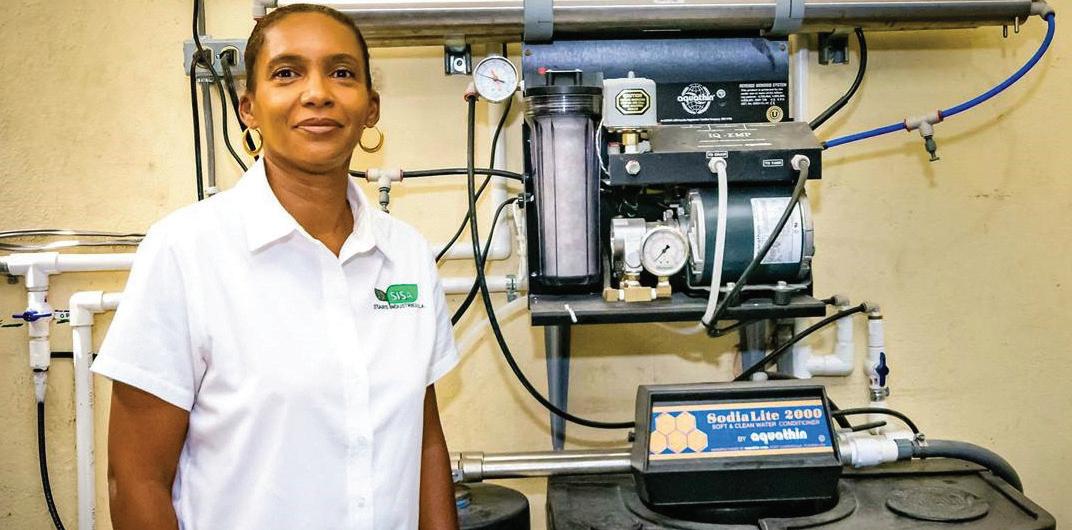
In Haiti, small-business owner Isabelle Laguerre Mevs has found the recipe for success. Her company, Stars Industries S.A. (SISA) turns local produce into condiments that are now on local supermarket shelves and in a number of restaurants and hotels.
In response to increased demand, Isabelle applied to CDB for assistance to grow SISA sustainably. The Bank facilitated Isabelle’s access to experts with business and technical experience, through the CTCS Network.
With the help of a CTCS-provided consultant, Isabelle gained access to market data and intelligence to help her make more informed business decisions. This information included the company’s market value; the structure of the Haitian market; and consumers’ preferences for pepper sauce products.
Having gained access to higher quality market data, in 2016, SISA won a business plan competition through. LEAD, Leveraging Effective Application of Direct Investments. LEAD provides capital to small- and medium-sized businesses in Haiti.
With the award, SISA will buy equipment to manufacture pepper sauce for a mass market. The new machinery could see SISA, which employs 13 persons, growing even more.
“We are excited and motivated in entering a new journey in our business,” said Isabelle.
SOCIAL SECTOR
Gender
In 2016, the Bank made progress on mainstreaming gender in its investments in quality infrastructure and public services in education, water and sanitation and transport.
The Bank began more strategic engagement on gender equality with BMCs. It engaged BMCs in policy dialogue that informed the design of country strategies, and the appraisal of capital projects and policy-based operations.
The Bank completed the Synthesis Report of ten Country Gender Assessments. CDB hosted a capacity building workshop for 50 policymakers from the education sector. Participants learned how to design comprehensive sector plans that include gender analysis.
Development partner collaboration and coordination
CDB broadened its engagement with development partners and co-chaired a Donor Coordination Group on Gender Equality. As a member of the Multilateral Development Bank Working Group on Gender, CDB participated, along with a regional team of private sector representatives, in a workshop entitled, “Challenging Gender Stereotypes in Women’s Economic Empowerment.”
The Bank collaborated with partners to:
• address data gaps for gender policymaking and programming (Development Partner Committee on Statistics - Organisation of Eastern Caribbean States Commission, CARICOM and other development partners);
• conduct Enhanced Country Poverty Assessments (Development Partners Task Force);
• improve available information on trade services, including specific economic sectors where gender segregation exists (CARTAC and Eastern Caribbean Central Bank); and
• finance a pilot prevalence study on gender-based violence (UN Women and Government of Grenada).
CDB’s cooperation with national partners has grown through its involvement with government agencies, nongovernmental organisations and stakeholders in the private sector, to address gender-based violence and inequalities in access to economic opportunities. In collaboration with the Coalition of Service Industries, in Saint Lucia, the Bank supported a pilot study on Gender and Information Communication Technologies (ICTs) to examine issues related to women’s access to ICTs, including attitudes that limit women's contributions to the sector. The findings of the pilot will inform the design of a regional study with a view to increasing women’s participation and entrepreneurship in ICTs.
The Bank maintained its support for the creation of systems required for the management of gender mainstreaming and the sustainability of gender equality outcomes in BMCs.
EDUCATION
CDB maintained its long-term focus on enhancing the learning environment at the basic and post-secondary levels of education, with the approval of financing for the construction and rehabilitation of schools and institutions.
However, the primary emphasis of the interventions in education during the year was on the continuation of the work started in 2015 to develop mechanisms and structures to assist all students in obtaining optimal benefit from education. Special emphasis was placed on those at greater risk of educational failure. To this end, projects approved for Saint Lucia, and to a lesser extent Guyana, included significant components for students with special educational needs. In the Saint Lucia Education Quality Improvement Project (EQuIP) interventions will:
• assess what institutional and infrastructural improvements are needed to provide quality education and equitable access to children with special educational needs;
• support policy and curriculum development;
• deliver continuing professional development and longterm training for special needs teachers; and
• provide learning resources and assistive devices for the delivery of instruction.
Addressing equity in the provision of education services was also a focus of CDB in 2016. For example, Practical Instruction Centres in the hinterland districts of Guyana, will be the primary beneficiaries of an $11 mn Technical and Vocational Education and Training (TVET) project. The aim of the project is to improve access to, and the quality and effectiveness of, the TVET system. It is expected to provide skills required in emerging sectors, to bridge the divide between remote and coastal communities, and to contribute to the sustainability of proposed townships in hinterland communities.
Further, in keeping with the need to address the common areas of weakness in mathematics teaching and learning highlighted in a CDB-funded study, the Bank sponsored a
regional consultation designed to develop a Framework for Action in Mathematics Education. CDB proposes to continue both regional and bilateral support for the implementation of the actions proposed.
Lastly, the Bank prioritised initiatives to address emerging issues that contribute to learning difficulties, school indiscipline, and citizen insecurity. CDB provided approximately $1.2 mn in technical assistance to assist BMCs in piloting and implementing programmes to identify solutions to these challenges. The findings and recommendations will inform other similar initiatives regionwide.
CITIZEN SECURITY
Shifting from the earlier approach to address citizen security issues as a component of its education projects, the Bank approved four standalone citizen security interventions. These new initiatives seek to address the concerns of BMCs about the increasing levels of social dissonance within and across communities, as well as the rising involvement of youth in particular communities in crime, violence and gang-related activity. The projects, approved for Belize, Grenada, Jamaica and Saint Lucia, were designed to, inter alia:
• provide empirical data to underpin rehabilitative interventions;
• enhance the resilience of children, youth and poor families in selected communities;
• reduce the number of juveniles coming into conflict with the law and rehabilitate youth offenders through education and psychosocial services; and
• share best practices nationally and regionally.
Approximately $5 mn of both loan and grant resources supported these interventions.
BNTF: FIGHTING POVERTY THROUGH COMMUNITY DEVELOPMENT
The Bank and Governments of BNTF’s participating countries (PCs) placed emphasis on promoting community empowerment, gender equality, environmental sustainability, and a more holistic approach to community development. These were all aligned with national priorities.
CDB and BNTF Implementing Agencies (IAs) in ten PCs focused on preparing and implementing the BNTF 7 and BNTF 8 Programmes. In this period, CDB approved 19 sector portfolios, comprising 120 new sub-projects valued at $18.6 mn, of which counterpart financing by governments was $0.9 mn. The sub-projects are expected to improve the livelihoods of 22,590 males and 23,901 females. New sub-projects approved during the period are highlighted in Chart 5.
CHART 5: BNTF 7 AND 8 SECTOR PORTFOLIO DISTRIBUTION ($MN)
These investments included:
• construction or upgrade of 133 classrooms and the conduct of teacher training, mainly in the areas of early childhood development, and for training in agriculture, marketing, webpage design, and in music theory and performance for at-risk youth;
• construction of approximately 11km of secondary and farm access roads; and
• the laying of 5 km of new water pipelines and construction of 786m3 of additional water storage capacity, including the conduct of Water, Sanitation and Hygiene training for beneficiaries in Guyana and Jamaica.
Some Early Results
During the year, PCs completed 74 sub-projects, which benefited:
• 5,817 males and 5,480 females through the construction or upgrading of 138 classrooms, with additional educational support facilities such as bathrooms, administrative spaces, and facilities for the disabled.
• 32 male and 374 female teachers who received training and certification in specific areas of early childhood education.
• 385 males and 510 females who graduated from various training activities across the BNTF PCs, most with National or Caribbean Vocational Qualifications in the subjects in which they were trained.
• 5,474 households through the provision of access to sanitation services and water supply.
• 14,544 males and 6,488 females through new or upgraded community road infrastructure including farm access roads.
• approximately 962 males and 909 females through newly constructed basic community infrastructure in Grenada and Saint Lucia.
Improving Disbursements
CDB was able to significantly address the issue of lagging disbursements by making changes to the operational modality of the BNTF Programme. In February, recognising the need to accelerate implementation, CDB approved the delegation of authority to additional BNTF PCs to operate special accounts and receive grant resources on an advance and reconciliation basis. Similar arrangements were already in place in Belize and Jamaica. As a result, total disbursement in 2016 was $26 mn, comprised of $22.5 mn under BNTF 7 and $3.5 mn under BNTF 8. This performance brings cumulative disbursements to $31.4 mn under both Programmes.
FEATURE SUPPORTING AGRICULTURE IN SAINT LUCIA
Agriculture is one of the economic pillars in Saint Lucia’s development agenda. Agriculture development and the country’s ability to achieve its food and nutrition security goals are inextricably linked.
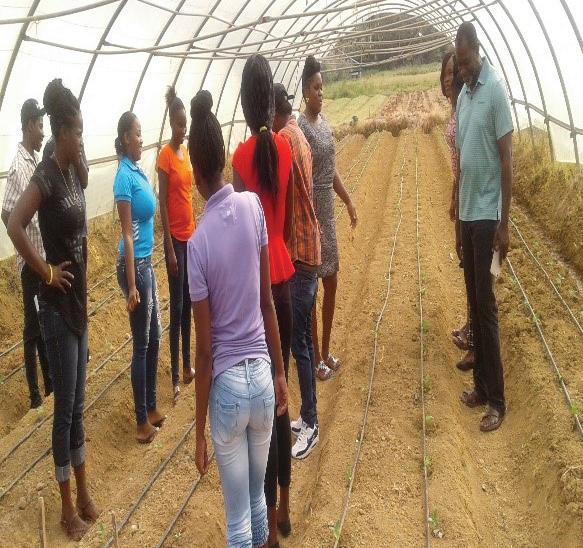
CDB recognises that youth involvement in agriculture and crop production is critical for sustaining regional food security and alleviating poverty through job creation for male and female youth. Through two sub-projects in BNTF 7 and 8, youth at risk (50 female and 50 male) between the ages of 17 and 35 will receive training to CVQ Level 2 Certification.
The youth from Babonneau and its environs in the North, and Grand Riviere and its environs in the East, will learn farm cultivation methods and practices, crop production and livestock rearing. The training is providing core skills and knowledge, and certification that allows participants to seek further training and employment. Already, 48 youth have completed preliminary modules of training. Graduates will also receive agricultural equipment and small tools.
A key stakeholder in this programme for youth at risk in agriculture is the Sir Arthur Lewis Community College. The institution has a proven track record of upgrading the skills of farmers and training students in agriculture. The beneficiaries are learning modern techniques and new approaches to farming through educational tours. There is a high level of engagement and excitement among beneficiaries, who have commited to building successful careers in this area. In the words of one student, “I am thankful to receive this scholarship and will return to my family’s land to make a career in agriculture.”
PPP REGIONAL SUPPORT FACILITY
In 2016, the Regional Support Facility successfully delivered on its objectives through capacity building, the launch of the PPP Helpdesk, the dissemination of a Caribbean PPP Toolkit, and advocacy and knowledge sharing.
Capacity Building
Three modular PPP Boot Camps took place in Barbados, Jamaica, and Trinidad and Tobago, where 41 public-sector officials from BMCs and four CDB staff were trained in all aspects of PPPs, including policy and enabling environments, and PPP procurement and project monitoring.
At workshops co-hosted by CDB, the IMF and CARTAC, participants from BMC governments received training in key issues concerning the potential long-term fiscal impacts of PPPs. In addition, the Regional Support Facility held workshops for government staff in Guyana and Trinidad and Tobago.
PPP Helpdesk
This component of the Regional Support Facility provides earlystage technical support to BMC governments, in order to screen and develop PPP project concepts. Screening reports were prepared on three PPP projects in Anguilla and Grenada. In Jamaica, the Helpdesk secured $75,000 in support from the IDB for a pre-feasibility study on a Water Supply and NonRevenue Water Reduction project in northern parishes, where growing demand is putting strain on current water sources.
Caribbean PPP Toolkit
The Toolkit is a comprehensive, best-practice guide on all aspects of PPPs in the Caribbean, based on the economic and political realities of the Region. This knowledge resource,
hosted on CDB’s website, was made available to BMC employees, private sector and other stakeholders, on all aspects of PPPs.
PROCUREMENT
Contracts with a value exceeding $56 mn were placed on CDB-financed projects in 2016, reflecting a significant increase compared with previous years.
The Bank strengthened procurement capacity through the rollout of online procurement training in early 2016, for which approximately 400 trainees registered. It also launched related online presentations and webinars at the end of the year. These initiatives were blended with a number of face-to-face training sessions tailored for specific projects.
The University of Technology in Jamaica was contracted in early 2016 to establish a regional procurement centre under a project financed by CDB and the World Bank. Work commenced towards offering accredited public procurement training at the centre by the end of 2017. The Bank, as part of its PPAM and PCM Training Programme, also co-financed the annual conference of the Inter-American Network on Government Procurement in November. CDB supported the participation of representatives from its BMCs to facilitate the dissemination and sharing of public procurement developments and knowledge amongst practitioners in the region.
The Bank also undertook a number of initiatives to better communicate its procurement procedures and present CDBfinanced procurement opportunities to the private sector. These included the formal launch of the Register of Consultants on the Bank’s website; the holding of a procurement fair in Belize, in collaboration with other development banks; and trade missions to Canada and the UK.
In October, CDB hosted the Multilateral Development Bank (MDB) Heads of Procurement group meeting in Barbados. Eight MDBs attended the event, which furthered the group’s
efforts to harmonise their procurement policy and procedures and promote best procurement practice.
SECTION 3
DEVELOPMENT EFFECTIVENESS
DEVELOPMENT EFFECTIVENESS
CDB maintained its focus on MfDR and continued to assess its development effectiveness using the Results Monitoring Framework (RMF).
The RMF tracks performance across four levels: regional development progress; CDB’s contributions to country outcomes; operational effectiveness; and efficiency.
The Bank completed reporting on regional performance against Millennium Development Goals (MDG) targets, and continued, with steady pace, on the road toward its ambitious 2019 corporate targets.
REGIONAL PROGRESS ON DEVELOPMENT GOALS
The global financial crisis hindered the achievement of the Caribbean-specific Millennium Development Goals (CMDG) targets. The gaps in BMCs’ implementation capacity, as well as their inadequate monitoring and reporting capability, impacted the effective monitoring of progress towards these goals. As a result, although progress was made on the CMDGs, gains were uneven across indicators and across countries.
The review of the Region’s MDG experience revealed that a transition to the ambitious SDG agenda will require support from CDB, along with other development partners, to achieve BMCs’ development goals. BMCs will need to improve collaboration to develop a core set of targets and indicators for the SDGs, and put in place systems to effectively monitor progress.
CDB’S CONTRIBUTION TO SDGS AND DEVELOPMENT OUTCOMES
The Bank’s ongoing and recently completed operations accomplished important results, contributing to national and regional development goals across all sectors (See infographic on page 45).
MANAGING OPERATIONS EFFECTIVELY
CDB improved its operational effectiveness. The Bank was on track toward meeting the targets for nine of its 19 indicators in this area. Notably, CDB made significant advances in laying the strategic, financial, and human capital groundwork for integrating energy security, a cross-cutting theme of the Bank’s strategy. The Bank made steady progress in mainstreaming gender equality. Meanwhile, CDB’s strong performance on risk management indicators is evidence of the major strides it has made in this area over the past few years.
MAINTAINING AND IMPROVING ORGANISATIONAL EFFICIENCY
The Bank made notable progress, meeting performance targets for seven of eight indicators in the area of organisational efficiency. Budget efficiency improved as a result of the narrowing of the gap between administrative expenses and disbursements. Operational efficiency was also bolstered by increasing the ratio of professional staff to support staff, and expanding capacity in important functional areas, including the Operations departments.
IMPROVING DEVELOPMENT EFFECTIVENESS
CDB prepared an MfDR Action Plan for the 2016-2019 period to guide focused and coordinated improvements in development effectiveness. The Bank established a Development Effectiveness Committee (DEC), consisting of operational managers from across the organisation, to coordinate and champion execution of the Action Plan. Key actions completed in 2016 included:
• clearing the backlog of Project Completion Reports (PCRs);
• increasing cross-Bank ownership of the Development Effectiveness Review by involving the DEC and hosting an interactive presentation for staff about key findings; and
• providing MfDR training to all new professional staff.
HIGHLIGHTS OF RESULTS ACHIEVED IN 2015 WITH CDB SUPPORT
Social and Economic Infrastructure
Provided improvements in classroom facilities in 4 BMCs and increased access to finance to students for tertiary education in 3 countries
Trained 757 teachers to improve the quality of teaching and education throughout the Region.
Private Sector Development
Helped 480 business people in MSMEs through skills training and technical assistance.
Increased access to credit for 289 small businesses and individuals
Increased the capacity of 12 BMCs to undertake PPP arrangements.
Social and Economic Infrastructure
Financed the construction or rehabilitation of 91 km of primary, secondary and minor community roads, benefitting an estimated 30,609 people directly in 4 BMCs, and many more users indirectly.
Provided 5,476 people with access to new or improved community buildings.
Installed or upgraded 12 km of water lines, affording households with access to clean water supply and improved sanitation.
Agriculture and Rural Development
Financed training for approximately 440 stakeholders in advanced agricultural production techniques.
SECTION 4
OPERATIONAL PERFORMANCE
OPERATIONAL PERFORMANCE
HUMAN RESOURCES AND ADMINISTRATIVE EFFECTIVENESS
CDB made considerable progress in the areas of employee engagement, talent development and talent acquisition. The Bank’s goal to create a high-performance organisation guided its talent management activities and programmes.
The results of CDB’s first Employee Engagement Survey indicated engagement of 70.5%. Following consultations
with, and feedback from employees, on the results of the Survey, the Bank started the implementation of a number of initiatives.
The Board established the Human Resources Committee to strengthen the oversight of human resources and the governance framework of the Bank. The Committee had two meetings in 2016.
A talent review of all Management and Professional Staff up to the Deputy Director Level was conducted through the
use of a 360-degree tool to identify high-potential employees and bench strength gaps. The results will be leveraged to create a development framework for Staff and build a strong leadership bench.
The Bank partnered with McGill University to deliver an international development certificate programme for employees who joined the Bank in 2014 and 2015. The intensive fourday course, which was conducted onsite, provided participants with the requisite knowledge, skills and strategies for working in the expanding field of international development.
Acquiring the right type and mix of talent remained a high priority for the Bank, as it sought to maintain a 95% capacity utilisation rate. Despite a net reduction of seven staff at the end of the year, the Bank achieved its targeted utilisation rate by resourcing 203 of the 212 established positions.
Configuration of the new Human Resources Information System (HRIS) commenced in February and will be completed by the end of 2017.
During the year, the Bank maintained its focus on energy-saving activities started in 2015. These included the commissioning of the Solar PV 150KW Grid Tied system; the installation of LED lighting throughout the Bank; and increased promotion of the “Switch Off” campaign intended to reduce the waste of electricity. By the end of the year, the Bank had realised savings of $31,000 from these projects.
A Safety and Health audit was completed during the third quarter of 2016. The results revealed some areas of good practice, including the security of office and compound; preparedness for emergencies; and ergonomically-designed workstations. Recommendations for improvement included the need for
additional exterior lighting; pedestrian safety areas; more visible signage on exits; and fire suppression instruments. These recommendations will be implemented in 2017.
INTERNAL AUDIT
The Internal Audit Division (IAD) is an independent and objective assurance and advisory function designed to enhance and protect organisational value to CDB by improving its operations.
IAD’s work is carried out in accordance with the Institute of Internal Auditors (IIA) International Professional Practices Framework (Standards).
IAD reports administratively to the President and is under the purview of the Oversight and Assurance Committee (OAC).
Activities
IAD fully adopted a risk-based planning approach in 2016. Consistent with the IIA Standards (Performance Standard 2010), the approach required IAD to conduct a formal risk assessment of the Bank’s operations, and to consider organisational goals in determining internal audit priorities.
During 2016, IAD focused on several internal reforms, including the implementation of the Audit Management System, and the development of a project audit plan and programme process.
In addition, IAD prepared an inventory of CDB’s policies and procedures for use in future assurance activities.
Three assurance activities were completed; and ten consultancy engagements and advisory services were undertaken with various departments. These activities helped CDB to enhance its governance and internal control environment. Throughout the year, IAD reviewed and evaluated the design of controls in the Bank's HRIS and the application that will replace the existing Project Portfolio Management System.
IAD also increased its focus on the follow-up of Management Action Plans for recommendations, stemming from the external auditors’ management letter and IAD’s assurance work.
INDEPENDENT EVALUATION
The Office of Independent Evaluation (OIE) built on its earlier experience with the evaluation of CDB’s investments in TVET, which complemented the CDB-commissioned study, “Youth are our Future: The Imperative of Youth Employment for Sustainable Development”. Both feature strongly in the revisions and reforms proposed for the regional education strategies and the emerging vision for the education sector under the SDGs.
OIE disseminated the Evaluation Brief on TVET, which summarised the main highlights, findings, lessons and recommendations that arose from the evaluation. Key lessons from the evaluation highlight the importance of forging stronger and effective links between the private sector, business and industry associations, and the education sector. Greater use of data obtained through labour market surveys, student information services, TVET councils and tracer studies can make TVET programming more effective and responsive. Also, investing in the capacity, skills and technical expertise available to countries can enhance both project effectiveness and efficiency. More inclusive stakeholder consultation and participation in design can help to improve implementation and strengthen sustainability and impact. Specific measures to advance gender equity should be included in design and implementation to improve broader and more inclusive access to services.
OIE finalised its Multicycle Evaluation of SDF 6 and SDF 7, which informed the SDF 9 Contributors’ negotiation meetings in 2016.
OIE presented a summary of the initial findings from the Haiti Country Strategy Programme Evaluation (CSPE) to the OAC and the second formal meeting of SDF 9 Contributors in May 2016. The final report is scheduled for completion in 2017.
In line with the common practice of development institutions, OIE started preparations for a Peer Review of CDB’s Independent Evaluation functions in late 2015. The Bank engaged a Review Panel of international evaluation experts to start work in January 2016. The objective of the Review is to highlight the strengths, weaknesses, opportunities and challenges of OIE’s current evaluation practices, with a view to recommending improvements that can strengthen its role and
functions. The Final Report of the OIE Peer Review is expected early in 2017.
OIE’s mandate under the 2011 Evaluation Policy also extends to the independent validation of PCRs. Over the course of the year, six PCRs were completed by OIE for review by the OAC.
INTEGRITY, COMPLIANCE AND ACCOUNTABILITY
The Board of Directors of CDB established the Office of Integrity, Compliance and Accountability (ICA) as an independent area within the Bank to operationalise, manage and refine a Strategic Framework for Integrity, Compliance and Accountability. The Strategic Framework articulates a strategy, pursuant to which the Board approved four policies that collectively enhance the Bank's internal governance. The policies cover institutional integrity, ethics, whistleblowing, compliance and accountability in CDB's internal systems and external operations.
Enhancing Integrity, Compliance and Accountability in CDB
ICA is a convergence of five internal governance functions. The Head, ICA reports administratively to the President and functionally to the Board of Directors. ICA commenced phased operationalisation of the Strategic Framework in late 2015. Throughout 2016, ICA worked on draft procedures for all five functions, consultations, training, prevention exercises and investigations. ICA also supported the Bank's work in finding solutions to the de-risking and withdrawal of correspondent banking relationships. During
the year, ICA commenced phased operationalisation of three functions. The:
• Institutional Integrity function, which covers prevention, investigation and sanction of violations related to fraud, corruption and other corrosive practices;
• Ethics function, for the investigation of ethics violations; and
• Whistleblowing function, which covers complaints intake, management, resolution and the protection of whistleblowers from retaliation.
In 2017, ICA plans to commence full operationalisation of the Compliance function and the Accountability function, which includes a projects complaints mechanism.
SECTION 5
RISK REVIEW
RISK REVIEW
In 2016, the Bank maintained its Enterprise Risk Management (ERM) approach with coverage, including financial, strategic, operational and developmental risks.
The operational risk pillar now formally includes environmental, climate and disaster risk management, given its increasing visibility and potential impact on the sovereign risk profiles of BMCs.
The ERM framework continues to be supported with key risk governance tools and resources, including risk appetite statements (RAS); risk taxonomy; risk control self-assessments; risk registers; internal risk ratings; risk based limits; market surveillance; risk due diligence; credit spreading; and an oversight Enterprise Risk Committee (ERC).
The RAS, in particular, sets out high-level quantitative and qualitative boundaries or thresholds within which the Bank’s strategic initiatives are executed.
At yearend, CDB was in full compliance with all of its risk appetite thresholds, as shown in Table 4.
ORGANISATION
The Office of Risk Management (ORM) is an independent but integral part of the Bank’s activities, free from influence and operating to three lines of defence governance structure:
• Line 1 - Front Line Functions: This represents areas where risk-taking activities directly take place either in the front, middle or back office.
• Line 2 - ORM: ORM provides leadership, guidance, monitoring, and independent oversight of the activities conducted by Line 1.
• Line 3 - Internal Audit: IAD is responsible for, and provides assurance, on the internal compliance with controls.
OPERATIONAL RISK
Process
In 2016, a manual Risk Register continued to effectively serve as an internal surveillance and early warning system for identifying impending threats to the Bank. The Risk Register was used to record operational risk issues, events, losses, near misses and accidental gains on a monthly basis. The outputs from the risk register were compiled into a single report and reviewed by the CRO to determine which risks to mitigate or new controls to introduce.
During 2016, the Bank completed and signed off its first manual firm-wide Risk Control Self-Assessment (RCSA) initiative across all of its functional areas. This process enabled ORM to gain first-hand insight into the Bank’s universe of actual and potential operational risks. The RCSA process will be conducted annually.
Systems
The Bank signed a contract and purchased an operational risk system called aCCelerate. The system will automate the Bank’s end-to-end operational risk management process, including, but not limited to, periodic risk and control assessments; dynamic risk logging; event capture and causal analysis; scenario and stress testing; modelling; reporting; escalation and management. aCCelerate is used by a number of multilateral institutions.
Policies are in place to manage the Bank’s information technology (IT) processes, systems development, change management, information security and access processes. All IT systems are backed up to host servers to ensure continuity in the event of a disaster.
Business Continuity
CDB has a firm-wide business continuity framework in place that provides for an assured contingency response in the event
of an emergency. The plan was revamped with assistance from an external expert to upgrade to a highly flexible model to deal with a wide range of service disruptions. The Bank currently has a warm backup and IT recovery site located away from its campus and a secondary site in another country. The risks of catastrophic loss are also mitigated with the use of comprehensive insurance programmes.
ENVIRONMENTAL RISK AND CLIMATE CHANGE
The matters relating to environmental risk and climate change are addressed systematically at various levels of the institution through enterprise risk reporting. It is also addressed by the ERC whose membership includes a representative from the
Environmental Sustainability Unit (ESU). ESU has primary responsibility for managing environmental and climate risk.
ORM worked on a number of initiatives to incorporate environmental and climate change in its internal sovereign risk assessments, modelling and portfolio management process.
The Bank also received two accreditations from international bodies during the year to enable it to access climate-related funding to support its own efforts at mitigating this risk.
CREDIT RISK
The Bank has been strategically diversifying its portfolio distribution by targeting its highly rated BMCs for new business growth, whilst also reducing exposure to challenged credits via the target review and cancelling of aged, undisbursed balances. These efforts have resulted in measurable improvements in the distribution of the portfolio as shown in Chart 6.
CHART 6: CDB’S GEOGRAPHIC EXPOSURE DIVERSIFICATION - 2013 AND 2016
ANGUILLA
ANTIGUA AND BARBUDA
BAHAMAS, THE BARBADOS
BELIZE
BRITISH VIRGIN ISLANDS
DOMINICA CAYMAN ISLANDS
GRENADA
GUYANA
JAMAICA
REGIONAL
ST. KITTS AND NEVIS
SAINT LUCIA
ST. VINCENT AND THE GRENADINES
TRINIDAD AND TOBAGO SURINAME
TURKS AND CAICOS ISLANDS
During the year, the Bank’s exposure to Jamaica, its largest borrower, continued to fall relative to the entire portfolio via controlled lending. CDB also took steps to reduce its exposure to its second largest borrower, Barbados, via the targeted
CHART 7: TOP 5 HIGH RISK EXPOSURE TRENDS
cancelling of aged, undisbursed balances. With these efforts, the Bank's top five sovereign exposures declined systematically as depicted in Chart 7.
With regard to investment credit risk, the Bank applied other, more specific controls, including restricting investment risk exposure to individual investments with a minimum credit rating of A-/A3 (by Standard & Poor’s Rating Agency and Moody’s Investors Service, respectively) for commercial bank obligations and AA-/Aa3 for government obligations and use of master netting agreements.
CAPITAL RISK
The measures adopted by the Bank to improve its capital adequacy included encouraging new lending to highly rated
BMCs; supporting lower-rated entities with interventions sourced from its soft funding window; introducing hard credit limit controls; minimising concentration; strengthening operational controls; managing undisbursed balances; and maintaining a robust capital and debt collection process.
These efforts have ensured that the Bank’s risk-weighted assets have maintained a downward spiral, whilst increasing its capital base.
CHART 8: S&P RISK WEIGHTED ASSETS VS. CDB EQUITY CAPITAL TRENDS
December 31, 2016
Equity Capital - CDB
Manual Internal Capital Adequacy Calculations
ORM computes the Bank’s capital adequacy manually utilising the Basel II framework.
Under Pillar I, ORM utilises a Basic Indicator Approach for Operational Risk and a modified Standardised Approach for Credit Risk.
Under Pillar II, the Bank ensures that all other residual risks over and above Pillar I are computed, which includes, but is not limited to, additional liquidity requirements, interest rate in the banking book and, business and concentration risks. This is then complemented with top-down and bottomup scenario assessments to determine the extent of additive capital needed as a cushion against unexpected risk losses.
Date
Risk Weighted Assets (RWA) - S&P
The Bank is currently monitoring Basel III developments closely to determine whether to make any amendments to its modus operandi to remain in voluntary compliance. The Bank does not need to comply with these requirements but does so, where relevant, to ensure alignment with best practice.
MARKET RISK
CDB separates exposure to market risk into trading or non-trading portfolios. Trading portfolios comprise positions arising from market making, position taking and others designated as markedto-market. Non-trading portfolios comprise positions that primarily arise from interest rate management. CDB’s overall objective is to manage its market risks in order to minimise market losses and optimise return.
Interest Rate Risk
CDB manages its interest rate exposure by ensuring that the changes in the cash flow of its assets closely match those 3,500,000 3,000,000 2,500,000 2,000,000 000's 1,500,000 1,000,000 500,000December 31, 2012 October 30, 2013 July 31, 2015 July 2, 2013 November 13, 2014 April 4, 2014 April 7, 2016 May 15, 2013 December 31, 2013 December 31, 2015 July 19, 2013 December 31, 2014 May 15, 2014 June 30, 2016 September 24, 2014
Under Pillar III , CDB has been meeting its enhanced disclosure reporting obligations by improving dissemination of risk reviews.
of its liabilities. This relationship is managed with the use of interest rate swaps, which convert fixed rate liabilities into floating rate liabilities. There is, however, residual exposure resulting from interest rate movements, which is effectively monitored and managed operationally with governance oversight provided by the ERC. Any residual interest rate exposure risk arising out of these during the year were well within the Bank’s risk appetite.
Foreign Exchange Risk
CDB’s exposure to currency exchange movements is minimised by the extent of its activities, which limits its assets and liabilities to a single currency, U.S. dollars. Mismatches could occur; but these are managed effectively via the use of derivative hedging instruments, where necessary. All loans by the Bank are made either from currencies available from members’ subscriptions, or from currencies borrowed. The principal amounts are repayable to the Bank in the currencies lent. Any residual currency exposure risk arising out of these activities during the year were well within the Bank’s risk appetite.
LIQUIDITY RISK
CDB’s objective is to ensure that all foreseeable funding commitments can be met when due, and that access to the wholesale market is sustained.
To that end, the Bank seeks to maintain a portfolio of highly liquid assets, augmented with a diversified funding base to enable prompt response to unforeseen liquidity gaps. In 2016, consistent with that objective, the Bank successfully raised funds in the Swiss market for the first time. The accessing of the European market represented a decisive effort on the part of the Bank to strategically diversify its geographic funding source.
The Bank also received approval from the Board of Directors during the year to increase its secured borrowing limit to boost its funding options.
The risks relating to rollover have been eliminated, with no immediate maturities anticipated.
9: ROLLOVER RISK - DEBT MATURITY BY YEARS, % OF TOTAL
CHART
CDB loans are usually fully disbursed over several years and the Bank, as a result, continues to have undisbursed balances on approved loans. The liquidity risk remains with CDB, as it is required to provide funds to the borrowers, as and when requested, provided the conditions precedent for disbursement are satisfied. This risk is managed by conformity to the Bank’s policy of maintaining a net three years’ funding requirement, or 40% of undisbursed commitments, whichever is greater. Presently, CDB’s liquid assets exceed the 150% prudential minimum guideline, which is in keeping with management’s decision to maintain high liquidity levels.
NEW DEVELOPMENTS
In 2016, the Bank initiated the development of a regional risk framework to be supported by a dedicated portal. The platform ensures the effective exchange of key information on sovereign risks and robust mitigation strategies among BMCs.
CDB also signed a letter of intent with the Caribbean Catastrophe Risk Insurance Facility to work on an initiative to merge disaster and climate risks with the Bank’s ERM approach. The result will be a comprehensive model that will help BMCs better manage national risks.
MANAGEMENT'S DISCUSSION AND FINANCIAL STATEMENTS
MANAGEMENT’S DISCUSSION AND ANALYSIS
I. OVERVIEW
CDB (The Bank) is a multilateral financial institution dedicated to the development of the economies of the BMCs, with a focus on the Least Developed Countries, primarily through project loans and technical assistance to the governments, public agencies and other entities in those countries.
The Bank’s main goals are to promote sustainable economic development and to reduce poverty. The primary financial objective is to earn adequate operational income to maintain financial strength and to sustain its developmental activities. The Bank was established in 1969 and is owned by its member countries. These include 19 borrowing member countries and nine non-borrowing members.
The operations of the Bank are divided into two categories, ordinary operations and special operations. Ordinary operations are financed from CDB’s Ordinary Capital Resources (OCR) which comprises share capital, borrowings raised in the capital markets, lines of credit from commercial and other multilateral institutions and internally-generated equity. Special operations are financed from the Special Funds Resources (SFR), comprising the Special Development Fund (SDF) and Other Special Funds (OSF).
Contributions are made to the SDF for loan financing to deserving projects at low fixed rates of interest and extended maturities, as well as grant financing, taking into account the economic circumstances of the BMC in which the project is being undertaken and the ultimate objectives of the project. The Bank also accepts contributions to the OSF for on-lending or administering on terms agreed with the contributors once the purposes are consistent with its objectives and functions.
The principal assets are loans to the BMCs. Projects may be funded by a combination of OCR and SFR resources. Resources may also be used to guarantee loans of high developmental priority, and will usually comprise longer maturities and grace periods, as well as lower interest rates than usually pertains in the operations of the OCR.
During 2016, the rating agency Standard and Poor’s (S&P) reaffirmed CDB’s long and short term ratings as ‘AA’ and “A1+’ with a Stable outlook while Moody’s Investor Services reaffirmed CDB’s long term issuer rating as Aa1 with a Stable outlook.
II. ORDINARY CAPITAL RESOURCES
The following discussion should be read in conjunction with the audited financial statements of the OCR and accompanying notes set out in Section 6 of this report.
FINANCIAL STATEMENT REPORTING
The financial statements of the OCR are prepared in accordance with International Financial Reporting Standards (IFRS) on an historical cost basis, except as modified by the revaluation of investment securities held at fair value through profit or loss and derivative financial instruments which are reflected at fair value.
The preparation of the financial statements in conformity with IFRS requires management to make estimates and to exercise judgement in the process of applying its accounting policies.
All of the amounts shown in the financial statements are US dollar equivalents.
CRITICAL ACCOUNTING POLICIES
Critical accounting policies are those that are important both to the portrayal of the financial condition and results and that require management’s most difficult, subjective or complex
judgements, often as a result of the need to make estimates about the effects of matters that are inherently uncertain. The following have been identified as critical accounting policies:
• Financial assets at fair value through profit and loss; and
• Loan loss provisions.
The accounting policies are more fully described in the Notes to the Financial Statements.
Financial assets: The OCR financial statements comply with IFRS which require that financial assets at fair value through profit and loss be classified as either financial assets held for trading or financial assets designated at fair value through profit and loss at inception. The Bank’s debt securities are designated at fair value through profit and loss at inception and all derivatives are categorised as held for trading and recorded at their fair value. All changes in the fair value of these instruments are recognised in profit and loss in the statement of comprehensive income. The Bank uses derivative financial instruments to hedge against the impacts of interest rates and currency risks in the borrowing portfolio and to align its borrowing and lending activities to a variable rate basis. These financial instruments are cross currency interest rate swaps and interest rate swaps with major international banks by which proceeds of borrowings made in other currencies and at fixed rates are transformed into U.S. dollars at floating rates linked to LIBOR. The Bank holds derivatives for each of the following: (i) two Japanese Yen denominated borrowings for a total notional amount of $163.2mn, (ii) a fixed rate borrowing negotiated in 2012 for $300.0mn and (iii) a Swiss Franc denominated borrowing negotiated in 2016 for $151.3mn for a total notional amount of $614.5mn.
Loan impairment provisions: Due to the nature of the Bank’s borrowers and guarantors, the Bank expects to receive all of the amounts due on its sovereign guaranteed loans. In addition, the Bank’s sovereign portfolio has been fully performing since the Bank’s inception. Management reviews the loan portfolios at least on an annual basis to assess for impairment. In determining whether an impairment should be recorded in the statement of comprehensive income, the Bank first assesses whether impairment exists individually for financial assets that are individually significant, or collectively for financial assets that are not individually significant. The
methodology also uses the Bank’s preferred creditor status treatment afforded by its borrowing member countries. The provision is calculated on a methodology which combines the external credit ratings of its members, the probability of default related to those ratings, the loss given default based on the Bank’s historical loss experience (if any) and the exposure at default. The Bank currently carries no loan loss provision on its sovereign portfolio and has a General Banking Reserve of $7.0mn which has been identified to mitigate any risk of non-performance. In addition, the non-sovereign portfolio has an accumulated provision of $6.3mn comprising of $5.4mn in respect of the loans which were mentioned in the previous paragraph and an inherent provision of $0.9mn.
Non-Performing Loans:
CDB’s policy on non-performing loans precludes new loan approvals to any borrower, or guarantor, which is in arrears on an earlier loan, until the default has ended or satisfactory arrangements have been made for payment of the arrears. The Bank also maintains constant dialogue with its borrowers to ensure prompt settlement of debts, which serves to minimise arrears in its loan portfolio.
Liquidity: The liquidity portfolio ensures availability of funds to meet the Bank’s operations, provides a buffer in the event of financial stress and contributes to the Bank’s operating income. The primary objective of CDB’s investment policy is capital preservation while optimising income. Investments are held mainly in government or government-related debt instruments and are reported at market value in the financial statements. At December 31, 2016 the portfolio was $434.5mn. This represented 80.4% of undisbursed loans and agreements not yet effective, with the Bank’s OCR liquidity requirement peg having a floor of 40%.
MANAGEMENT REPORTING
The accounting treatment under IFRS requires that derivatives are recorded at their fair value, while loans and borrowings are recorded based on the amortised levels. This creates income volatility which is not representative of the underlying strategy or economics of the transactions, as it is the Bank’s policy to hold these instruments to maturity. In accordance with policy, the Bank excludes the impact of the fair value adjustments and related foreign exchange translation adjustments associated with these derivatives from the determination of its operating
income. This operating income is, in turn, used to determine CDB’s financial performance, liquidity, capital adequacy and other analyses.
RESULTS OF OPERATIONS OF THE OCR
Total comprehensive income: The OCR operations of the Bank recorded total comprehensive loss of ($15.7)mn, a decrease of $24.2mn from the profit of $8.5mn earned for the year ended December 31, 2015. This change was mainly due to decreases in net interest income of $9.4mn and derivative adjustments, including the foreign exchange components, of $13.0mn.
Operating income: Operating income is defined as comprehensive income adjusted for the effects of the derivative adjustment, the foreign exchange translation on the related Japanese yen and Swiss Franc borrowings and the actuarial re-measurements. It is this metric which is used to analyse the performance of the Bank and is allocated to reserves by the Board of Governors in accordance with the Bank’s Charter. The operating income decreased by $9.8mn which was mainly driven by a reduction in net interest income of $9.4mn.
Income from loans: Loan income decreased by $5.6mn during the year from $37.7mn in 2015 to $32.1mn in 2016. This was due to a reduction of the average lending rates by
70bps when compared to the average rates in 2015. This reduction in rates was undertaken due to the subscriptions from members received during the year which also forms part of the Bank’s capital and strengthened the Bank’s capital adequacy ratios.
Income from cash and investments: For the year ended December 31, 2016, income from cash and investments was $3.7mn compared to $2.5mn in 2015. This was mainly due to an increase in the average portfolio from $276.2mn in 2015 to $379.4mn in 2016.
Interest expense: Interest expense for the year ended December 31, 2016, was $13.8mn, an increase of $5.1mn compared to $8.7mn in 2015. This was primarily due to the additional costs of a Swiss Franc borrowing and the related cross currency interest rate swap which were negotiated in 2016.
Operating expenses: In 2016, operating expenses increased by $1.1mn to $16.0mn compared with $14.9mn in 2015. This was due to net realised and unrealised losses on investments, declines in administrative expenses and exchange rate adjustments of $3.0mn, ($0.8)mn and ($1.1) mn respectively. These movements were partially offset by an increase in other income of $0.8mn.
OPERATING EXPENSES
Rate/Volume analysis: The rate/volume analysis shows the changes in the net earning assets due to changes in the
Bank’s lending rate, the yield on investments and the cost of borrowings.
RATE/VOLUME ANALYSIS
FINANCIAL POSITION OF THE OCR
Total assets: At December 31, 2016, total assets were $1,599.2mn, representing an increase of $192.1mn (14.0%) from $1,407.1mn in 2015. This change was due primarily to the inflows from the Swiss Franc borrowing of $151.3mn and capital subscriptions from members of $38.4mn.
Loans: In 2016, the loan portfolio grew by $24.4mn from $992.5mn in 2015 to $1,016.9mn in 2016 or by 2.5%. This growth is expected to continue slowly but consistently over the short term. At December 31, 2016, there were two non-performing private sector loans in the portfolio with a total amount outstanding of $5.1mn which has been fully provided for.
Debt and other liabilities: Total liabilities increased by $169.6mn (31.8%) from $533.1mn at December 31, 2015 to $702.7mn at December 31, 2016. This increase was mainly due to the new Swiss Franc borrowing of $151.3mn and the related derivative financial liability of $22.0mn.
Shareholders’ equity: At December 31, 2016, CDB’s equity totalled $896.5mn compared with $874.0mn as at December 31, 2015. The increase was due to new net paid-in capital of $38.2mn and total comprehensive loss of ($15.7)mn. Total equity currently represents 56.1% of the Bank’s liabilities and capital at the end of this reporting period.
SELECTED FINANCIAL DATA
(EXPRESSED IN MILLIONS OF UNITED STATES DOLLARS)
Balance Sheet Data
III. SPECIAL DEVELOPMENT FUND
The SDF (the Fund), was established in 1970 and is the Bank’s largest pool of “soft” funds, offering loans on “softer” terms and conditions than those that are applied in the Bank’s ordinary operations, i.e., longer maturities and grace periods and lower interest rates.
SDF represents a significantly important enabler in the Bank’s efforts to reduce poverty and contribute to sustained welfare enhancement in eligible borrowing member countries. Indeed, successive replenishments of the SDF since its inception have allowed CDB to make a meaningful contribution to the transformation of lives of ordinary men, women, boys and girls particularly those in rural settings who are likely to be more at risk.
The SDF originally offered an assortment of terms and conditions which were fixed by the Fund’s various contributors. These differing terms and conditions created a number of complexities and inefficiencies in the Fund’s operation, which prompted the decision to set up a fund with a uniform set of rules. Hence, in 1983, the Special Development Fund (Unified) [SDF(U)] was formed.
All members of the Bank are required to contribute to SDF(U), and contributions are also sought from non-members. Contributions are interest-free and provided on a multi-year basis, for an indefinite term. The SDF(U) also has consistent terms, objectives and procurement conditions and thus overcomes the problems associated with individual donors and funding arrangements. There is a supplementary governance structure through an Annual Meeting of Contributors which provides the focus for the SDF(U)’s operations and receives an annual report on the performance of the fund. Non-members are also invited to participate as observers in meetings of the Bank’s Board of Directors (BOD) and Board of Governors.
Contributors to the SDF(U), which is usually replenished in four-year cycles, enter into negotiations with the Bank
with the objective of agreeing on the priority areas and programmes that should be addressed and on the amount of SDF(U) resources that will be necessary to realise the agreed objectives. Negotiations for the replenishment of the SDF (U) for a ninth cycle, covering the period 2017 - 2020 were completed in December 2016. This cycle will be underpinned by the Bank’s efforts to support the BMCs in achieving their development goals consistent with the SDGs.
SUMMARY OF RESULTS
The following discussion should be read in conjunction with the audited financial statements of the SDF and notes set out in this report.
RESULT OF OPERATIONS OF THE SDF
At December 31, 2016, there was a comprehensive loss of ($1.2mn) for the year, compared with ($3.3mn) in 2015. Gross income for the year was $15.5mn, an increase of $1.6mn from $13.9mn in 2015. This increase was due to higher levels of investment income in 2016. Total expenses decreased from $17.2mn in 2015 to $16.7mn in 2016 mainly arising from a reduction in administrative expenses which were allocated to the funds based on the approved formula.
Income from loans: At December 31, 2016, loan income improved to $12.7mn from $12.5mn at December 31, 2015 arising from an increase in the average balances of the portfolio despite the overall decline in loan balances.
Income from cash and investments: At December 31, 2016, income from cash and investments of $2.8mn increased from the $1.4mn which was achieved in 2015. The increase in 2016 was due to a much higher level of unrealised gains in 2016 compared to 2015.
Administrative expenses: At December 31, 2016, administrative expenses were $16.9mn, a decrease of $1.0mn from $17.9mn in 2015. The SDF’s share of the Bank’s total administrative expenses is based on a predetermined cost-sharing formula, which is driven by the relative number of loans and their stage of execution.
Exchange: At December 31, 2016, foreign exchange translation gains were $0.3mn, compared with $0.7mn in 2015. This is as a result of the volatility in the various currencies in relation to the US dollar.
FINANCIAL POSITION OF THE SDF
Total assets: At December 31 2016, total assets were $1,005.1mn, representing an increase of $11.0mn (1.1%) from $994.1mn at the end of 2015. The main components of the change are discussed below.
Investments: At December 31, 2016, SDF cash and investments amounted to $374.8mn, compared with $349.6mn at the end of 2015. This increase was due to a reduction in receivable from contributors of $12.7mn and an increase in technical assistance of $15.5mn.
Loan portfolio: At December 31, 2016, total outstanding loans were $557.7mn, $1.5mn (0.3%) lower than the $559.2mn outstanding at the end of 2015.
Contributions: Contributions to the SDF net of allocations to technical assistance and grant resources increased by $22.6mn (3.1%) to $750.7mn in 2016 from $728.1mn in 2015. This was due to receipts from the amounts due under SDF 8.
IV. OTHER SPECIAL FUNDS
The Other Special Funds (OSF) was established to carry out the special operations of the Bank by providing resources on concessional terms to assist BMCs in poverty reduction. Resources are provided by contributions from members and other contributors.
The financial statements are prepared in accordance with accounting policies set out in the notes to the financial statements.
SUMMARY OF RESULTS
The following discussion should be read in conjunction with the audited financial statements of the OSF and notes set out in Section 7 of this report.
RESULT OF OPERATIONS OF THE OSF
At December 31, 2016, the net income was $4.6mn, an increase of $0.6mn from $4.0mn in 2015. This change was due to foreign exchange translation gains during the year.
Income from loans: At December 31, 2016, income from loans was $2.3mn, a marginal decrease from $2.5mn in 2015. This decline was caused by a smaller average balance in the loan portfolio than existed in 2015.
Income from cash and investments: At December 31, 2016, income from cash and investments increased to $3.5mn from $3.3mn in 2015. This change in investment income was due to the larger net realised and unrealised gains on investments.
Administrative expenses: At December 31, 2016, administrative expenses remained unchanged from 2015 at $1.4mn. The OSF’s share of the total administrative expenses for the Bank as a whole is based on a predetermined costsharing formula, which is driven by the relative levels of loan count.
Charges on contributions: At December 31, 2016, charges on contributions were $0.9mn, an increase of $0.1mn from $0.8mn in 2015 due to additional drawdowns on repayable contributions.
Exchange: At December 31, 2016, foreign exchange translation gains were $1.1mn, an increase of $0.5mn from $0.6mn in 2015. Foreign exchange translation movement is a result of the volatility in various currencies in relation to the US dollar.
FINANCIAL POSITION OF THE OSF
Total assets: At December 31, 2016, total assets were $289.6mn, representing an increase of $24.5mn from $265.1mn at the end of 2015. The main components of the change are discussed below.
Investments: At December 31, 2016, cash and investments amounted to $89.3mn, compared with $98.4mn at the end of 2015. The investment portfolio included assets from the Microfinance Guarantee Fund and the Interest Subsidy Fund that are externally managed. In addition, included in
the investment portfolio are equity investments amounting to $7.6mn (2015: $7.4mn).
Loan portfolio: At December 31, 2016, total outstanding loans were $103.6mn, a decrease of $6.8mn (6.2%) from $110.4mn in 2015. This was due to repayments during the year 2016.
Receivable from members: This represents a promissory note of GBP49.3mn received as a disbursement from the UKCIF.
Accounts receivable: There was a decrease in accounts receivable from $56.4mn in 2015 to $35.9mn in 2016.
V. OPERATIONS
In 2016, CDB approved $277.3mn in loans (2015 - $261.5mn) and $45.8mn in grants, excluding
Substantial increases in disbursement of BNTF funds required transfers of cash from the SDF(U) as reimbursement towards the BNTF account.
Liabilities and funds: At December 31, 2016, liabilities and funds totalled $289.6mn, representing increases of $28.2mn and $4.5mn in technical assistance and grant resources and accumulated net income respectively. There were decreases of $4.0mn and $4.2mn in accounts payable and contributed resources respectively.
UKCIF, (2015 - $32.7mn) totaling $323.1mn (2015$294.2mn). During the year, there were loan disbursements of $154.8mn (2015 - $135.3mn) and grant disbursements of $42.8mn (2015 - $26.1mn).
Loans: Lending to the public sector accounted for all of the loans approved in 2016. Of the 24 loans approved during the year, five were entirely funded from the OCR, while 19 were a blend of OCR and SFR funding. The three largest borrowers were Suriname, St. Lucia and Belize with 41.6%, 17.4% and 11.8% respectively.
Grants and Equity: Grant and equity approvals, excluding UKCIF, amounted to $45.6mn. The three major beneficiaries were St. Vincent & the Grenadines ($15.9mn), Haiti ($12.4mn) and Regional ($7.0mn).
Resource Transfers: In 2016, there was a positive net transfer of resources (i.e. disbursements of loans and grants less repayments of principal, interest and charges) between CDB and its BMCs. The net flow of resources amounted to $13.0mn, a significant increase of $21.5mn when compared to the negative net resource transfer of ($8.5mn) in 2015.
December 31, 2016
Borrowings: CDB uses its borrowings to ensure that funds are available for its operations. In meeting this objective, CDB seeks to diversify its borrowings across creditors and markets. In July 2016 the Bank transacted its first issuance of bonds for CHF145mn in the Swiss market. This was very important for CDB as it increased the diversification of its borrowing portfolio.
Financing: During 2016, additional sources of funding became available for CDB through;
a) Accreditation to the Adaptation Fund;
b) Accreditation to the GCF;
c) Award of a grant of GBP300mn from DFID UKCIF; and
d) An increase of the contingency funding limit from $50mn to $75mn.
Repayments: During the year, CDB was repaid 97.7% (2015 – 97.5%) of the total amounts which were charged to its borrowers. A breakdown by fund group is shown below:
31, 2015
ADMINISTRATIVE EXPENSES
A comparative analysis of major administrative expenditure items is shown below. At December 31, 2016, recurrent expenses were $32.2mn, increasing by $0.5mn (2%) from $31.7mn in 2015. The costs related to the one-off restructuring exercise undertaken in 2015 are excluded from the recurrent expenses.
ANALYSIS OF ACTUAL EXPENSES FOR 2016 AND 2015 $’ mn
CAPITAL RESOURCES
AS OF DECEMBER 31, 2016 (EXPRESSED IN THOUSANDS OF UNITED STATES DOLLARS, UNLESS OTHERWISE STATED)
CAPITAL RESOURCES
AS OF DECEMBER 31, 2016 (EXPRESSED IN THOUSANDS OF UNITED STATES DOLLARS, UNLESS OTHERWISE STATED)
Approved by the Board of Directors on March 16th, 2017 and signed on their behalf by:
FOR THE YEAR ENDED DECEMBER 31, 2016 (EXPRESSED IN THOUSANDS
CARIBBEAN DEVELOPMENT BANK
CAPITAL RESOURCES
STATEMENT OF COMPREHENSIVE INCOME
CARIBBEAN DEVELOPMENT BANK
CAPITAL RESOURCES
STATEMENT OF CASH FLOWS
FOR THE YEAR ENDED DECEMBER 31, 2016 (EXPRESSED IN THOUSANDS OF UNITED STATES DOLLARS, UNLESS OTHERWISE STATED)
CARIBBEAN DEVELOPMENT BANK ORDINARY CAPITAL RESOURCES
NOTES TO THE FINANCIAL STATEMENTS
FOR THE YEAR ENDED DECEMBER 31, 2016
(EXPRESSED IN THOUSANDS OF UNITED STATES DOLLARS, UNLESS OTHERWISE STATED)
NOTE 1 – NATURE OF OPERATIONS
Corporate structure
The Caribbean Development Bank (“CDB” or “the Bank”) is an international organisation established by an Agreement (“Charter”) signed in Kingston, Jamaica, on October 18, 1969 and accepted and ratified by all the member countries which are signatories thereto. The Charter is an international treaty which, together with the instruments of ratification and accession by member countries, is deposited with the United Nations Secretary-General. The Charter entered into force on January 26, 1970 and CDB commenced operations on January 31, 1970. Since then other countries have become members of CDB by acceding to the Charter.
The Bank’s headquarters is located in Wildey in the parish of Saint Michael in the island of Barbados.
Purpose and objectives
CDB is a regional financial institution established for the purpose of contributing to the harmonious economic growth and development of the member countries in the Caribbean (“Region”) and to promote economic cooperation and integration among them, with special and urgent regard to the needs of the less developed members.
Membership
The membership of the Bank is open to:
(a) States and Territories of the Region;
(b) Non-Regional States which are members of the United Nations or any of its specialised Agencies; or of the International Atomic Energy Agency.
The Bank’s members are classified as either of:-
• Borrowing member countries (“BMCs”) which comprise members of the Region that are qualified to borrow from the Bank.
• Non-regional members (“NRMs”) are comprised of members outside of the region that do not qualify to borrow from the Bank.
The BMCs are also shareholders of the OCR and are therefore considered related parties.
The current membership of the Bank is comprised of 23 regional states and territories and five non-regional states (2015: 23 regional states and territories and 5 non-regional states). A detailed listing of the membership is provided at Note 23(c) - Equity.
Reducing poverty in the region is CDB’s main objective and it finances development projects in its BMCs primarily through its Ordinary Capital Resources (“OCR”) which comprises shareholders’ paid-in capital, retained earnings and reserves and borrowings. In advancing this objective, the Bank participates in the selection, study and preparation of projects contributing to poverty reduction and, where necessary, provides technical assistance and support.
Special fund resources
Attainment of the Bank’s objectives are also supplemented by the Special Development Fund (“SDF”) and Other Special Funds (“OSF”) which comprise its Special Fund Resources (“SFR”) with distinct assets and liabilities and which are subject to different operational, financial and other rules as set out by the contributors (some of which are non-members of the Bank). The SFR is independently managed from, and has no recourse to, the OCR for obligations in respect of any of the liabilities of the SDF or OSF.
CARIBBEAN DEVELOPMENT BANK ORDINARY
CAPITAL RESOURCES
NOTES TO THE FINANCIAL STATEMENTS
FOR THE YEAR ENDED DECEMBER 31, 2016
(EXPRESSED IN THOUSANDS OF UNITED STATES DOLLARS, UNLESS OTHERWISE STATED)
NOTE 1 – NATURE OF OPERATIONS…continued
Special fund resources…continued
Mobilising financial resources is an integral part of CDB’s operational activities, where alone or jointly, it administers funds restricted for specific uses such as technical assistance, grants and regional programmes.
These funds are provided by donors, including members, some of their agencies and other development institutions.
NOTE 2 – ACCOUNTING POLICIES (GENERAL)
Accounting policies which are specific in nature are included as part of the disclosures that are relevant to the particular item in these Notes to the financial statements. The accounting policies that are of a general nature applied in the preparation of these financial statements are set out below:
Foreign currency translation
The functional and presentation currency of the Bank is the United States dollar. Monetary assets and liabilities in currencies other than United States dollars are translated into United States dollars at market rates of exchange prevailing at the reporting date. Non-monetary items measured at historical cost in currencies other than United States dollars are translated into United States dollars using the exchange rates at the dates of the initial transactions.
Foreign currency transactions are initially translated into United States dollars at applicable rates of exchange on the transaction dates. Any gains or losses arising as a result of differences in rates applied to income or expenses and to assets or liabilities are shown as an exchange gain or loss in the determination of net income for the year.
Taxation
Under the provisions of Article 55 of the Charter and the provisions of the Caribbean Development Bank Act, 1970-71 of Barbados, the Bank’s assets, property, income and its operations and transactions are exempt from all direct and indirect taxation and from all custom duties on goods imported for its official use.
All policies have been consistently applied to the years presented, except where otherwise stated. Prior year comparatives have been adjusted or amended to conform with the presentation in the current year where applicable.
Basis of preparation
Statement of compliance
These financial statements are prepared in accordance with International Financial Reporting Standards (IFRS) under the historical cost basis, except as modified by the revaluation of debt securities at fair value through profit or loss and derivative financial instruments (cross currency interest rate swaps and interest rate swaps) which are reflected at fair value. The financial statements are presented in United States dollars (USD) and all values are rounded to the nearest thousand, except where otherwise indicated.
CARIBBEAN DEVELOPMENT BANK ORDINARY CAPITAL RESOURCES
NOTES TO THE FINANCIAL STATEMENTS
FOR THE YEAR ENDED DECEMBER 31, 2016
(EXPRESSED
IN THOUSANDS OF UNITED STATES DOLLARS, UNLESS OTHERWISE STATED)
NOTE 2 – ACCOUNTING POLICIES (GENERAL)…continued
Basis of preparation…continued
Content of financial statements
The financial statements comprise the statement of financial position, the statement of comprehensive income, the statement of changes in equity, the statement of cash flows and the notes to the financial statements for the year ended December 31, 2016 (the reporting date).
Presentation of financial statements
The presentation format of the Bank’s statement of comprehensive income reflects the Operating income from the Bank’s core activities. In the opinion of management, this enhances the information to the users of the Bank’s financial statements as Operating income is the basis upon which the Bank’s financial, liquidity, capital adequacy, efficiency and other performance ratios and measures are determined.
The Bank presents its statement of financial position in order of liquidity. An analysis regarding recovery or settlement within 12 months after the reporting date (current) and more than 12 months after the reporting date (non–current) is presented in Note 3.
Financial assets and financial liabilities are generally reported gross in the statement of financial position. They are only offset and reported net when, in addition to having an unconditional legally enforceable right to offset the recognised amounts without being contingent on a future event, the parties also intend to settle on a net basis in all of the following circumstances:
• The normal course of business
• The event of default
• The event of insolvency or bankruptcy of the Bank and/or its counterparties
Derivative assets and liabilities with master netting arrangements (e.g. ISDAs) are only presented net when they satisfy the eligibility of netting for all of the above criteria and not just in the event of default.
Critical judgments and estimates
The preparation of financial statements in conformity with IFRS requires management to make estimates and assumptions that affect the reported amounts of revenues, expenses, assets and liabilities and the disclosure of contingent liabilities. All estimates and assumptions required in conformity with IFRS are applied in accordance with the applicable standard. Estimates and judgments are continually evaluated and are based on historical experience and other factors, including expectations of future events that are believed to be reasonable under the circumstances. Uncertainty about these assumptions and estimates could result in outcomes that require a material adjustment to the carrying amount of assets or liabilities affected in future periods.
CARIBBEAN DEVELOPMENT BANK
ORDINARY CAPITAL RESOURCES
NOTES TO THE FINANCIAL STATEMENTS
FOR THE YEAR ENDED DECEMBER 31, 2016 (EXPRESSED IN THOUSANDS OF UNITED STATES DOLLARS, UNLESS OTHERWISE STATED)
NOTE 2 – ACCOUNTING POLICIES (GENERAL)
…continued
Critical judgments and estimates…continued
Management’s judgment for certain items that are especially critical for the Bank’s results and financial situation due to their materiality is included in the relevant note disclosures in these financial statements, except as stated below:
Going
concern
The Bank’s management has made an assessment of its ability to continue as a going concern and is satisfied that it has the resources to continue in business for the foreseeable future. Furthermore, management is not aware of any material uncertainties that may cast significant doubt upon the Bank’s ability to continue as a going concern and therefore the financial statements continue to be prepared on this basis.
New and amended standards and interpretations which are applicable to the Bank
The Bank applied for the first time certain standards and amendments, which are effective for the reporting period. The nature and the impact of each new standard and amendment is described below:
IAS 16 and IAS 38, Clarification of Acceptable Methods for Depreciation and Amortisation (Amendments) (Effective date January 1, 2016). These standards relate to the accounting treatment for Property, plant and equipment as well as intangible assets and had no impact on the Bank’s financial statements.
Annual Improvements 2012 – 2014 cycle (Effective date January 1, 2016). Improvements were made to IFRS 5, IFRS 7, IAS 19 and IAS 34. The only amendment applicable to the Bank from this cycle was the amendment to IAS 19 which clarified that the market depth of high quality corporate bonds is assessed based on the currency in which the obligation is denominated, rather than the country where the obligation is located. The Bank was already applying this interpretation and thus there was no impact on the financial statements.
Standards
in issue not yet effective and which are applicable to the Bank
The following is a list of standards and interpretations issued that are not yet effective up to the date of the issuance of the Bank’s financial statements. The Bank intends to adopt these standards, if applicable, when they become effective. The impact of adoption depends on the assets held by the Bank at the date of adoption and it is therefore not practical to quantify the effect at this time.
• IAS 7, Disclosure initiative - Amendments to IAS 7 (Effective January 1, 2017), relating to required disclosures on changes in liabilities arising from financing activities.
• IFRS 9, Financial Instruments (Effective January 1, 2018), relating to the classification and measurement of financial assets and liabilities, Hedge accounting and impairment.
• IFRS 15, Revenue from contracts with customers (Effective January 1, 2018), relating to the principles to be applied for the measurement and recognition of revenue
• IFRS 16, Leases (Effective January 1, 2019), related to the accounting and disclosure requirements for leases by lessees and lessors.
CARIBBEAN DEVELOPMENT BANK ORDINARY CAPITAL RESOURCES
NOTES TO THE FINANCIAL STATEMENTS
FOR THE YEAR ENDED DECEMBER 31, 2016 (EXPRESSED IN THOUSANDS OF UNITED STATES DOLLARS, UNLESS OTHERWISE STATED)
NOTE 3 – RISK MANAGEMENT
The Bank’s principal financial liabilities, other than derivatives, comprise borrowings and trade and other payables, the main purpose of which is to finance the Bank’s operations. The Bank also provides guarantees to its borrowers under set terms and conditions. The Bank’s principal financial assets are loans, receivables, cash and short-term deposits and debt securities at fair value through profit and loss that are all derived directly from its operations. The Bank also holds derivative contracts and enters into derivative transactions when deemed necessary by senior management. All derivative activities for risk management purposes are to be undertaken by senior management in accordance with approved Board of Directors (BOD) policy which includes the provision that no trading in derivatives for speculative purposes may be undertaken.
The Bank’s BOD sets the governance framework for the Bank by setting the risk and risk appetite framework, and the underlying policies and procedures. Financial risk activities are governed by the policies and procedures and financial risks are identified, measured and managed in accordance with the Bank’s approved policies and risk objectives.
The ability to manage these risks is supported by an enterprise wide risk management framework which was approved by the Board of Directors. Operationally, CDB seeks to minimise its risks via the implementation of robust mitigating controls aimed at reducing exposure to achieve adherence to approved risk appetite portfolio limits. The Bank’s risk mitigation approaches include adopting processes, systems, policies, guidelines and practices which are reviewed and modified periodically in line with the institution’s changing circumstances.
The Bank’s Office of Risk Management (ORM) manages, coordinates, monitors and reports on the mitigation of all risks that the Bank faces such as strategic, financial, operational, and reputational risks. The ORM also has the responsibility for recommending and implementing new or amended policies and procedures for effective risk management to the BOD for approval and to ensure that risk awareness is embedded within the Bank’s operations and among the Bank’s employees. CDB’s risk management framework is built around its governance, policies and processes. The risk management governance structure supports the Bank’s senior management in their oversight function in the coordination of different aspects of risk management.
The Bank’s governance is built around the following committees:
(i) The Enterprise Risk Committee (ERC);
(ii) The Loans Committee (LC);
(iii) The Oversight and Assurance Committee (OAC) and
(iv) The Advisory Management Team (AMT).
The Office of Institutional Integrity, Compliance and Accountability (ICA) was established to operationalise the strategic framework for integrity, compliance and accountability. ICA is responsible for managing institutional integrity, compliance, anti-money laundering (AML), countering the financing of terrorism (CFT) and financial sanctions, ethics, whistleblowing, and project accountability. ICA reports to the BOD through the OAC.
CARIBBEAN DEVELOPMENT BANK ORDINARY
CAPITAL RESOURCES
NOTES TO THE FINANCIAL STATEMENTS
FOR THE YEAR ENDED DECEMBER 31, 2016
(EXPRESSED IN THOUSANDS OF UNITED STATES DOLLARS, UNLESS OTHERWISE STATED)
NOTE 3 – RISK MANAGEMENT…continued
The Board of Directors also approved a Code of Conduct for the Board of Directors, and a new Charter for the Internal Audit Division (IAD).
The Bank is exposed to market risk, credit risk, liquidity risk and operational risk which is overseen by its senior management through established committees with defined roles and responsibilities. Market risk includes currency, interest rate and price risk. The most important types of risk faced by CDB are associated with the borrowing member countries and relate to country credit risk and concentration risk.
The Bank manages limits and controls concentration of credit risk in relation to loans, debt securities, cash and investments, derivative and borrowing counterparties based upon policies approved by the BOD. These financial policies limit the amount of exposure in relation to a single borrower and to groups of borrowers, by counterparties and by type of investments and they are monitored on a monthly basis.
Credit risk
A major risk to CDB as a multilateral development bank is its exposure to country credit risk. This risk relates to potential losses in the event that a borrowing member is unable or unwilling to service its obligations to the Bank. CDB manages its country credit risk through its financial policies and lending strategies, including the setting of individual country exposure limits and evaluation of overall creditworthiness. Individual BMC exposure to the Bank on outstanding loans as at December 31, 2016 is reported in Note 3 and Note 10.
The Bank manages its credit risk in liquid funds and derivative financial instruments by ensuring that all individual investments carry a minimum credit rating as follows:
Additionally, CDB can invest in non-freely convertible currencies in unconditional obligations issued or guaranteed by indigenous commercial banks provided that no such bank holds more than $1 million of the investible amount of the given currency or 10% of CDB’s capital, whichever is smaller. In relation to derivative transactions, all counterparties must have a minimum rating of BBB/Baa2 (by Standard & Poor’s and Moody’s respectively), with a minimum rating for new transactions of A-/ A3 (stable outlook by Standard & Poor’s and Moody’s respectively).
CARIBBEAN DEVELOPMENT BANK
ORDINARY CAPITAL RESOURCES
NOTES TO THE FINANCIAL STATEMENTS
FOR THE YEAR ENDED DECEMBER 31, 2016
(EXPRESSED IN THOUSANDS OF UNITED STATES DOLLARS, UNLESS OTHERWISE STATED)
NOTE 3 – RISK MANAGEMENT…continued
Credit risk…continued
Credit risk measurement
The Bank assesses borrowers based upon their external credit ratings. For borrowers without an external rating, judgment and bench-marking against similar credits are used to assign an appropriate internal rating. Borrowers are segmented into four rating classes. The rating scale, shown below, reflects the range of default probabilities defined for each rating class and related exposures can migrate between classes based on the results of the re-assessments of their probability of default.
Internal rating scale and mapping of external ratings are as follows
CDB’s Rating Description of the grade External rating: Standard & Poor’s equivalent
The ratings of the major rating agency shown in the table above are mapped to the rating classes based on the long-term average default rates for each external grade. External ratings where available, are used to benchmark the internal credit risk assessment. Observed defaults per rating category vary year on year, especially over an economic cycle.
Risk limit control and mitigation measures
Loans
Currently the approved exposure limit to the single largest borrower is 40% of total outstanding loans or 50% of total available capital, whichever is greater. The limit for the three largest borrowers is 60% of total outstanding loans or 90% of total available capital whichever is greater.
Single largest borrower’s exposure to total outstanding loans
Three largest borrowers’ exposure to total outstanding loans
CARIBBEAN DEVELOPMENT BANK ORDINARY
CAPITAL RESOURCES
NOTES TO THE FINANCIAL STATEMENTS
FOR THE YEAR ENDED DECEMBER 31, 2016
(EXPRESSED IN THOUSANDS OF UNITED STATES DOLLARS, UNLESS OTHERWISE STATED)
NOTE 3 – RISK MANAGEMENT…continued
Credit risk…continued
Risk limit control and mitigation measures…continued
Cash and cash equivalents and Debt securities through profit and loss
The Bank’s results as at December 31 against the BOD approved policy ratios were as follows:
Credit related commitments
Guarantees and standby letters of credit represent irrevocable assurances that the Bank will make payment. The primary purpose of these instruments is to ensure that funds are available to a borrower as required. The Bank currently has guarantees not exceeding the equivalent of $12 mn with respect to bonds issued by the Government of St. Kitts and Nevis (GOSKN).
Master netting arrangements
All of the Bank’s derivatives are executed under International Swap Dealers’ Association (ISDA) agreements and the Schedule to the Master Agreement in order to limit exposure to credit risk through the provisions in these agreements for offsetting of amounts due to or by both counterparties. Under the provisions of these agreements both parties compute amounts owing to and by each other and the party with net amount owing makes payment to the second party. The ISDA and related Schedule also makes provision for the voluntary netting of currencies and transactions and for the computation methodology of and settlement of final net payment in the event of termination. CDB currently is party to five swaps with four counterparties.
Investment Type
Maximum policy limit (based upon total investment portfolio)
CARIBBEAN DEVELOPMENT BANK
CAPITAL RESOURCES
NOTES TO THE FINANCIAL STATEMENTS
FOR THE YEAR ENDED DECEMBER 31, 2016 (EXPRESSED IN THOUSANDS OF UNITED STATES DOLLARS, UNLESS OTHERWISE STATED)
NOTE 3 – RISK MANAGEMENT…continued
Credit risk…continued
Maximum exposure to credit risk before collateral held or other credit enhancements
Credit risk exposure relating to assets included on the statement of financial position is as follows:
The above table represents a worst case scenario of credit risk exposure as at December 31, 2016 and 2015, without taking account of any collateral held or other credit enhancements attached.
The Bank’s policy in relation to collateral is disclosed in Note 10 to these financial statements.
For assets included on the statement of financial position, the exposures set out above are based on gross carrying amounts as reported in the statement of financial position. As shown, the total maximum exposure from loans and commitments to the sovereign was 68.9% (2015: 73.4%), and to the non-sovereign was 1.7% (2015: 2.5%).
CAPITAL RESOURCES
NOTES TO THE FINANCIAL STATEMENTS
FOR THE YEAR ENDED DECEMBER 31, 2016 (EXPRESSED IN THOUSANDS OF UNITED STATES DOLLARS, UNLESS OTHERWISE STATED)
NOTE 3 – RISK MANAGEMENT…continued
Credit risk…continued
Credit quality
Debt securities, treasury bills and other eligible bills
The main investment management objectives are to maintain capital preservation and liquidity. Subject to these parameters, CDB seeks the highest possible return on its investments. CDB’s Investment Policy restricts its investments to government and government-related debt instruments and time deposits. Investments may also be made in unconditional obligations issued or guaranteed by commercial banks rated A-/A3, or better, AAA rated asset-backed securities, and AAA-rated mortgage-backed securities. Adherence to the investment policy guidelines is monitored on a continuous basis by the ERC.
The following tables present an analysis of the credit quality of debt securities, treasury bills and other eligible bills, neither past due nor impaired based on Standard & Poor’s rating or equivalent, as of December 31, 2016 and 2015.
CAPITAL RESOURCES
NOTES TO THE FINANCIAL STATEMENTS
FOR THE YEAR ENDED DECEMBER 31, 2016 (EXPRESSED IN THOUSANDS OF UNITED STATES DOLLARS, UNLESS OTHERWISE STATED)
NOTE 3 – RISK MANAGEMENT…continued
Credit risk…continued
Credit quality…continued
Debt securities, treasury bills and other eligible bills…continued
In accordance with the Bank’s internal rating scale 99.6% (2015: 99.4%) of debt securities, treasury bills and other eligible bills are classified as ‘Basic monitoring’. The residual securities are rated as ‘Standard monitoring’.
Loans and advances
Loans are summarised as follows:
December 31, 2016 December 31, 2015
allowance for impairment
As of December 31, 2016, loans that were neither past due nor impaired represented 99.5% (2015: 99.5%) of gross loans outstanding.
Loans and advances neither past due nor impaired
The credit quality of the loan portfolio that was neither past due nor impaired can be assessed by reference to the internal rating system adopted by the Bank.
CARIBBEAN
DEVELOPMENT
BANK ORDINARY CAPITAL RESOURCES
NOTES TO THE FINANCIAL STATEMENTS
FOR THE YEAR ENDED DECEMBER 31, 2016 (EXPRESSED IN THOUSANDS OF UNITED STATES DOLLARS, UNLESS OTHERWISE STATED)
NOTE 3 – RISK MANAGEMENT…continued
Credit risk…continued
Credit quality…continued
Loans and advances…continued
Loans and advances neither past due nor impaired…continued
As at December 31, 2016, there were no financial assets past due but not impaired (2015 – Nil).
Other financial assets
Other financial assets comprise amounts due from local institutions and staff as well as the Bank’s member countries.
Other financial assets neither past due nor impaired
CARIBBEAN DEVELOPMENT BANK ORDINARY CAPITAL RESOURCES
NOTES TO THE FINANCIAL STATEMENTS
FOR THE YEAR ENDED DECEMBER 31, 2016 (EXPRESSED IN THOUSANDS OF UNITED STATES DOLLARS, UNLESS OTHERWISE STATED)
NOTE 3 – RISK MANAGEMENT…continued
Credit risk…continued
Credit quality…continued
Other financial assets…continued
Other financial assets neither past due nor impaired…continued
CARIBBEAN DEVELOPMENT BANK ORDINARY CAPITAL RESOURCES
NOTES TO THE FINANCIAL STATEMENTS
FOR THE YEAR ENDED DECEMBER 31, 2016 (EXPRESSED IN THOUSANDS OF UNITED STATES DOLLARS, UNLESS OTHERWISE STATED)
NOTE 3 – RISK MANAGEMENT…continued
Credit risk…continued
Risk concentration of financial assets with exposure to credit risk
Concentrations of risk arise from financial instruments that have similar characteristics and are affected similarly by changes in economic or other conditions. The Bank manages risk concentration by counterparty and geography.
Geographical sectors
The following table presents CDB’s main credit exposures at their carrying amounts, as categorised by BMC and non-regional members, USA, and other countries. For this table, the exposures are allocated to regions based on the country of domicile of the counterparties. A further analysis of the Bank’s exposure to loans by geographical region is provided at Note 10.
CARIBBEAN DEVELOPMENT BANK ORDINARY
CAPITAL RESOURCES
NOTES TO THE FINANCIAL STATEMENTS
FOR THE YEAR ENDED DECEMBER 31, 2016 (EXPRESSED IN THOUSANDS OF UNITED STATES DOLLARS, UNLESS OTHERWISE STATED)
NOTE 3 – RISK MANAGEMENT…continued
Credit risk…continued
Risk concentration of financial assets with exposure to credit risk…continued
Geographical sectors…continued
Market risk
CDB takes on exposure to market risks, which is the risk that the fair value or future cash flows of a financial instrument will fluctuate because of changes in market prices. CDB is exposed to two types of market risk - foreign currency risk and interest rate risk. Financial instruments affected by market risk include loans, debt securities at fair value through profit or loss, borrowings and derivative financial instruments.
CARIBBEAN DEVELOPMENT BANK ORDINARY CAPITAL RESOURCES
NOTES TO THE FINANCIAL STATEMENTS
FOR THE YEAR ENDED DECEMBER 31, 2016 (EXPRESSED IN THOUSANDS OF UNITED STATES DOLLARS, UNLESS OTHERWISE STATED)
NOTE 3 – RISK MANAGEMENT…continued
Market risk…continued
Foreign currency risk
Foreign currency risk is the risk that the fair value or future cash flows of a financial instrument will fluctuate because of changes in foreign exchange rates.
The Bank manages foreign currency risk by ensuring that all loans by the Bank are made either from currencies available from members’ subscriptions or from currencies borrowed, and the principal amounts are repayable to the Bank in the currencies lent. It also manages this risk by entering into currency swaps. The following table summarises the exposure to foreign currency exchange rate risk. Included in the table are the financial instruments at carrying amounts, categorised by currency.
All of the Bank’s loans are denominated in United States dollars.
Concentrations of foreign currency risk
CARIBBEAN DEVELOPMENT BANK
CAPITAL RESOURCES
NOTES TO THE FINANCIAL STATEMENTS
FOR THE YEAR ENDED DECEMBER 31, 2016 (EXPRESSED IN THOUSANDS OF UNITED STATES DOLLARS, UNLESS OTHERWISE STATED)
NOTE 3 – RISK MANAGEMENT…continued
Market risk…continued
Concentrations of foreign currency risk…continued
Foreign currency sensitivity
In calculating these sensitivities management made the assumptions that the sensitivity of the relevant item within profit or loss is the effect of the assumed changes in respect of market risks based on the financial assets and liabilities at the reporting period.
The Bank entered into currency swap agreements by which proceeds of two Yen denominated borrowings were converted into US dollars in order to hedge against ongoing operational currency risks.
DEVELOPMENT BANK
RESOURCES
NOTES TO THE FINANCIAL STATEMENTS
FOR THE YEAR ENDED DECEMBER 31, 2016 (EXPRESSED IN THOUSANDS OF UNITED STATES DOLLARS, UNLESS OTHERWISE STATED)
NOTE 3 –
RISK MANAGEMENT
…continued
Market risk…continued
Foreign currency sensitivity…continued
The following is the estimated impact on profit or loss that would have resulted as a result of management’s estimate of reasonable possible changes in the Yen exchange rate:
The Bank entered into a currency swap agreement by which proceeds of one Swiss Franc denominated borrowing was converted into US dollars in order to hedge against ongoing operational currency risks.
The following is the estimated impact on profit or loss that would have resulted as a result of management’s estimate of reasonable possible changes in the Swiss Franc exchange rate:
The ‘Other’ currency category comprises various individual currencies which management does not consider to be material and sensitivity analysis has therefore not been applied.
CARIBBEAN DEVELOPMENT BANK
CAPITAL RESOURCES
NOTES TO THE FINANCIAL STATEMENTS
FOR THE YEAR ENDED DECEMBER 31, 2016 (EXPRESSED IN THOUSANDS OF UNITED STATES DOLLARS, UNLESS OTHERWISE STATED)
NOTE 3 – RISK MANAGEMENT…continued
Market risk…continued
Interest rate risk
Interest rate risk arises from the possibility that changes in interest rate will affect future cash flows on the fair value of financial instruments. CDB manages its interest rate exposure by ensuring that the changes in the cash flow of its assets closely match those of its liabilities. This relationship is maintained by the use of interest rate swaps which converts, its liabilities from fixed rate into floating rate obligations.
The following table summarises the exposure to interest rate risks including financial instruments at carrying amounts, categorised by the earlier of contractual repricing or maturity dates.
Exposure to interest rate risk
CARIBBEAN DEVELOPMENT BANK
CAPITAL RESOURCES
NOTES TO THE FINANCIAL STATEMENTS
NOTE 3 – RISK MANAGEMENT…continued
Market risk…continued
Exposure to interest rate risk…continued
CARIBBEAN DEVELOPMENT BANK
ORDINARY CAPITAL RESOURCES
NOTES TO THE FINANCIAL STATEMENTS
FOR THE YEAR ENDED DECEMBER 31, 2016
(EXPRESSED IN THOUSANDS OF UNITED STATES DOLLARS, UNLESS OTHERWISE STATED)
NOTE 3 – RISK MANAGEMENT…continued
Market risk…continued
Interest rate sensitivity
All other variables held constant (and excluding the effects of the derivative instruments), if interest rates had been 50 bps higher, net income for the year would have increased by $3,669 (2015: $3,568). Had interest rates been 50 bps lower, net income would have declined by the same amount.
All other variables held constant if interest rates had been 50 bps higher, the impact of the derivatives would have caused a decrease of $20,166 (2015: $12,563) in the net income for the year and an increase of $23,870 (2015: $13,304) if 50 bps lower.
The sensitivity analyses have shown the exposure to interest rates for both derivatives and non-derivative instruments at the reporting date. For floating rate liabilities, the analysis is prepared assuming the amount of liability outstanding at the reporting date was outstanding for the whole year. The 50 bps movement represents management’s assessment of a reasonable possible change in interest rates.
Liquidity risk
Liquidity risk relates to the probability that the Bank will be unable to meet the payment obligations associated with its financial liabilities when they fall due. The consequence may be the failure to meet obligations or to disburse on its commitments. This risk is managed by conformity to the Bank’s policy of maintaining a net three years’ funding requirement of $48 mn (2015: $48 mn) or 40% of undisbursed loan commitments and loans not yet effective (comprising loans approved by the BOD for which all conditions precedent have not yet been met) of $528,800 (2015: $473,166), whichever is greater.
The Bank holds a diversified portfolio of cash and securities to support payment obligations and contingent funding in the event of a highly stressed market environment. The Bank’s assets held for managing liquidity risk comprise:
• Cash and balances with commercial banks;
• Time deposits;
• Government bonds and other securities that are easily traded; and
• Secondary sources of liquidity including a line of credit with a commercial bank.
CAPITAL RESOURCES
The table below presents the cash flows by remaining contractual maturities at the reporting date. The amounts disclosed in the table are the contractual undiscounted cash flows. FOR THE YEAR ENDED DECEMBER 31, 2016 (EXPRESSED IN THOUSANDS OF UNITED STATES DOLLARS, UNLESS OTHERWISE STATED)
CARIBBEAN DEVELOPMENT BANK ORDINARY CAPITAL RESOURCES
NOTES TO THE FINANCIAL STATEMENTS
FOR THE YEAR ENDED DECEMBER 31, 2016 (EXPRESSED IN THOUSANDS OF UNITED STATES DOLLARS, UNLESS OTHERWISE STATED)
NOTE 3 – RISK MANAGEMENT…continued
Liquidity risk…continued
Derivative cash flows
The following table shows the derivative financial instruments that will be settled on a net basis into relevant maturity groupings based on the remaining period at the balance sheet date to the contractual maturity date. The amounts disclosed in the table are contractual undiscounted cash flows.
CARIBBEAN DEVELOPMENT BANK ORDINARY CAPITAL RESOURCES
NOTES TO THE FINANCIAL STATEMENTS
FOR THE YEAR ENDED DECEMBER 31, 2016 (EXPRESSED IN THOUSANDS OF UNITED STATES DOLLARS, UNLESS OTHERWISE STATED)
NOTE 3 – RISK MANAGEMENT…continued
Liquidity risk…continued
Commitments, guarantees and contingent liabilities
Loan and capital commitments
The table below summarises the amounts of the Bank’s commitments and guarantees to which it has committed for the extension of credit to its BMCs.
Loan commitments represent amounts undrawn against loans approved by the BOD, capital commitments represent obligations in respect of ongoing capital projects.
Other commitments comprise a proposed allocation, subject to the approval of the Board of Governors of the Bank, from the net income of the OCR to the operations of the Special Development Fund [SDF (U)] in respect of the four year cycle (Cycle 9) covering the period 2017 to 2020.
Fair value hierarchy
IFRS 13 specifies a hierarchy of valuation techniques based on whether the inputs to those valuation techniques are observable or unobservable. Observable inputs reflect market data obtained from independent sources; unobservable inputs reflect the Bank’s market assumptions. These two types of inputs have created the following fair value hierarchy:
Level 1 – Quoted (unadjusted) market prices in active markets for identical assets or liabilities.
CARIBBEAN DEVELOPMENT BANK
NOTES TO THE FINANCIAL STATEMENTS
NOTE 3 – RISK MANAGEMENT…continued
Fair value of financial assets and liabilities…continued
Fair value hierarchy…continued
Level 2 – Inputs other than quoted prices included in Level 1 for which the lowest level input that is significant to the fair value measurement is directly or indirectly observable.
Level 3 – Inputs for the asset or liability for which the lowest level input that is significant to the fair value measurement is unobservable.
Financial assets and liabilities measured at fair value:
There were no transfers between Level 2 and Level 3 during the year. FOR THE YEAR ENDED DECEMBER 31, 2016 (EXPRESSED
CARIBBEAN DEVELOPMENT BANK
ORDINARY CAPITAL RESOURCES
NOTES TO THE FINANCIAL STATEMENTS
FOR THE YEAR ENDED DECEMBER 31, 2016 (EXPRESSED IN THOUSANDS OF UNITED STATES DOLLARS, UNLESS OTHERWISE STATED)
NOTE 3 – RISK MANAGEMENT…continued
Fair value of financial assets and liabilities…continued
Financial assets and liabilities measured at fair value…continued
December 31
at fair value through profit or loss
assets designated at fair value through profit or loss
Financial instruments not measured at fair value
The fair value measurement using valuation techniques for the Bank’s assets and liabilities which are not measured at fair value but for which fair value is disclosed are as follows:
CARIBBEAN DEVELOPMENT BANK ORDINARY CAPITAL RESOURCES
NOTES TO THE FINANCIAL STATEMENTS
FOR THE YEAR ENDED DECEMBER 31, 2016
(EXPRESSED IN THOUSANDS OF UNITED STATES DOLLARS, UNLESS OTHERWISE STATED)
NOTE 3 – RISK MANAGEMENT…continued
Financial instruments not measured at fair value…continued
The fair value of both the loans outstanding and borrowings disclosed above is ranked as Level 2 in the fair value hierarchy. There is no active market for loans made to CDB's BMCs and therefore there are no quoted market prices which can be used to value such assets. The discounted cash flow method which is used to derive the fair value of the loans contains inputs in the form of a series of interest rates which reflect the tenor and the credit risk associated with the cash flows arising from the loans. Yield curves which are derived from observable market trades of US-dollar denominated bonds, issued by US-based financial institutions with credit-ratings similar to those assigned to CDB's BMCs, are deemed to be acceptable proxies for the yield curves required by the discounted cash flow valuation process. The credit ratings for BMCs which have been assigned ratings by international credit rating agencies are used in the cashflow analysis. Those BMCs without ratings from international agencies are assigned a default rating of "CCC".
Capital Management
CDB’s objectives when managing capital, which is a broader concept than “equity” on the face of the statement of financial position, are to:
(i) Safeguard the Bank’s ability to continue as a going concern; and
(ii) Maintain a strong capital base to support its development activities.
The Bank’s capital adequacy framework which is consistent with the guidelines developed by the Basel Committee takes into account the Bank’s total equity, which is defined as paid-up capital, retained earnings and reserves, less receivables from members, the effects of derivative adjustments and the General Banking Reserve. The goals of the Bank’s capital adequacy are to:
(i) Ensure a reliable framework and methodology to determine the appropriate levels of economic capital that the Bank should carry for prudential purposes; and
(ii) Determine from time to time the appropriate changes in the level of economic capital that the Bank must have, based on changes in the risk profile of its credit exposures.
CARIBBEAN
DEVELOPMENT
BANK ORDINARY CAPITAL RESOURCES
FOR THE YEAR ENDED DECEMBER 31, 2016 (EXPRESSED IN THOUSANDS OF UNITED STATES DOLLARS, UNLESS OTHERWISE STATED)
NOTE 3 – RISK MANAGEMENT…continued
Capital Management…continued
The Bank’s enhanced capital adequacy framework is supported by an income targeting policy that would enable the Bank not only to safeguard, but also to strengthen its level of capitalisation and to meet its commitments. The new policy requires the Bank to maintain available capital (as defined in the Bank’s Board approved policy) at a minimum level of 150% of baseline economic capital (comprising a methodology for calculating capital requirements based on the types and levels of risks, such as borrower defaults, operational losses, or market changes).
As at December 31, 2016 the Bank’s available capital was 209.8% (2015: 216.5%) of its economic capital.
No changes were made to the objectives, policies or processes for managing capital during the year ended December 31, 2016.
NOTE 4 – SEGMENT ANALYSIS & REPORTING
Operating segments are reported in a manner consistent with the internal reporting provided to the chief operating decision maker which is the person or group that allocates resources to and assesses the performance of the operating segments of an entity. Under Article 33.4 of the Bank’s Charter, the President is the Chief Executive Officer (CEO) and is required to conduct, under the direction of the Board of Directors (BOD) the business of the Bank.
In accordance with IFRS 8 the Bank has one reportable segment, its OCR, since its operations are managed as a single business unit and it does not have multiple components for which discrete financial information is produced and reviewed by the chief operating decision maker for performance assessment and resource allocation.
The following table presents CDB’s outstanding loan balances inclusive of accrued interest and net of impairment provisions as of December 31, 2016 and 2015, and associated interest income by countries which generated in excess of 10% of the loan interest income for the years ended December 31, 2016 and 2015:
CARIBBEAN DEVELOPMENT BANK ORDINARY CAPITAL RESOURCES
NOTES TO THE FINANCIAL STATEMENTS
FOR THE YEAR ENDED DECEMBER 31, 2016
(EXPRESSED IN THOUSANDS OF UNITED STATES DOLLARS, UNLESS OTHERWISE STATED)
NOTE 5 – FINANCIAL ASSETS
In accordance with IAS 39, the Bank categorizes its assets as follows: financial assets at fair value through profit or loss, or loans and receivables. Financial assets are recognised on the statement of financial position when the Bank assumes related contractual rights. Management determines the classification of its financial instruments at initial recognition.
Regular way purchases and sales of financial assets are recognised on the settlement date which is the date the Bank becomes a party to the contractual provisions of the instrument.
Initial recognition and measurement of financial assets
All financial assets are recognised initially at fair value plus, in the case of loans and receivables, directly attributable transaction costs which are related to the acquisition of the financial asset.
Subsequent measurement
Financial assets at fair value through profit or loss
This category has two sub-categories: financial assets held for trading and those designated at fair value through profit or loss at inception.
A financial asset is classified as held for trading if it is acquired principally for the purpose of selling in the near term or if it is part of a portfolio of identified financial instruments that are managed together and for which there is evidence of a recent actual pattern of short-term profit-taking. Derivatives are categorised as held for trading unless they are designated as hedging instruments. For more information on ‘Derivatives’ refer to Note 14.
Financial assets designated at fair value through profit or loss upon initial recognition are managed, evaluated and reported to management on a fair value basis. Once the asset has been so classified, it cannot be changed. Financial instruments in this category are included in the statement of financial position as ‘Debt securities at fair value through profit or loss’ representing all of the Bank’s investments. For more information on ‘Debt securities at fair value through profit or loss’ refer to Note 7.
Financial assets at fair value through profit or loss are carried in the statement of financial position at fair value with net changes in fair value presented as ‘Derivative fair value adjustments’ in the statement of comprehensive income in the period during which they arise. Income and expenditures related to derivative financial instruments are shown as ‘Net interest income from derivatives’ in Note 24(b) and are included in ‘Interest expense and similar charges’ in the statement of comprehensive income.
Loans and receivables
Loans and receivables are non-derivative financial assets with fixed or determinable payments that are not quoted in an active market. After initial measurement, such financial assets are subsequently measured at amortised cost using the effective interest rate (EIR) method, less impairment. Amortised cost is calculated by taking into account any discount or premium on acquisition and fees or costs that are an integral part of the EIR. The EIR amortisation is included in ‘Interest and similar income’ in the statement of comprehensive income. The losses arising from impairment are recognised in the statement of comprehensive income in ‘Operating expenses’ for loans and other receivables.
CARIBBEAN DEVELOPMENT BANK ORDINARY CAPITAL RESOURCES
NOTES TO THE FINANCIAL STATEMENTS
FOR THE YEAR ENDED DECEMBER 31, 2016
(EXPRESSED IN THOUSANDS OF UNITED STATES DOLLARS, UNLESS OTHERWISE STATED)
NOTE 5 – FINANCIAL ASSETS…continued
Loans and receivables…continued
This category applies to ‘Loans outstanding’ and ‘Receivables from members’ and generally applies to receivables. More detailed information in relation to these balances are disclosed in Notes 8 to 13.
Fair Value Measurement
The Bank measures financial instruments such as those designated at fair value through profit and loss and derivatives at fair value at each reporting date. Fair value related disclosures for financial instruments and non-financial assets that are measured at fair value or those for which only fair values are disclosed, are itemised in Note 3 – Risk Management – “Fair value of financial assets and liabilities”.
For financial instruments traded in active markets, the determination of fair value is the price that would be received to sell an asset in an orderly transaction between market participants at the measurement date. The fair value measurement is based on the presumption that the transaction to sell the asset takes place either in the principal market for the asset or in the absence of a principal market, in the most advantageous market for the asset or liability. The principal or most advantageous market must be accessible to the Bank.
The fair value of an asset is measured using the assumptions that market participants would use when pricing the asset assuming that the market participants are acting in their economic best interest.
The Bank uses widely recognised valuation models for determining fair values of non-standardised financial instruments for which the inputs into models are generally market-observable. Models are also used to determine the fair value of financial instruments that are not quoted in active markets. All models are calibrated to ensure that outputs reflect actual data and comparative market prices. To the extent practical, models use only observable data; however, consideration of inputs such as credit risks, liquidity risks, volatilities and correlations require management to make estimates. Changes in assumptions about these factors could affect the reported fair value of financial instruments.
Financial assets are allocated within the fair value hierarchy based on the lowest level input that is significant to the fair value measurement as a whole.
For assets that are recognised in the financial statements on a recurring basis, the Bank determines whether transfers have occurred between Levels in the hierarchy by re-assessing categorisation (based on the lowest level input that is significant to the fair value measurement as a whole) at the end of each reporting period.
Renegotiated loans
It is not the Bank’s policy to renegotiate sovereign loans. In respect of its non-sovereign portfolio the Bank seeks to restructure loans in preference to taking possession of collateral. This may involve extending the payment arrangements and the agreement of new loan conditions. Once terms have been renegotiated any impairment is measured using the original effective interest rate as calculated before the modification of terms and the loan is no longer considered past due. Management continuously reviews renegotiated loans (if any), to ensure that all criteria are met and that future payments are likely to occur.
CARIBBEAN DEVELOPMENT BANK ORDINARY CAPITAL RESOURCES
NOTES TO THE FINANCIAL STATEMENTS
FOR THE YEAR ENDED DECEMBER 31, 2016
(EXPRESSED
IN THOUSANDS OF UNITED STATES DOLLARS, UNLESS OTHERWISE STATED)
NOTE 5 – FINANCIAL ASSETS…continued
Provision for loan impairment
Management assesses at each reporting date (at a minimum), whether there is objective evidence that a financial asset or group of financial assets is impaired. A financial asset or a group of financial assets is impaired and impairment losses are incurred if, and only if, there is objective evidence of impairment as a result of one or more events that occurred after the initial recognition of the asset (a “loss event”) and that loss event (or events) has/have an impact on the estimated future cash flows of the financial asset or group of financial assets that can be reliably estimated. Objective evidence that a financial asset or groups of financial assets is/are impaired includes observable data that comes to the attention of the Bank about the following loss events including:
(i) Significant financial difficulty of the issuer or obligor;
(ii) A breach of contract, such as a default or delinquency in interest or principal payments;
(iii) The Bank granting to the borrower, for economic or legal reasons relating to the borrower’s financial difficulty, a concession that the Bank would not otherwise consider;
(iv) It becoming probable that the borrower will enter bankruptcy or other financial re-organisation;
(v) The disappearance of an active financial market for that financial asset because of financial difficulties; or
(vi) Observable data indicating that there is a measurable decrease in the estimated future cash flows from a group of financial assets since the initial recognition of those assets, although the decrease cannot yet be identified with the individual financial asset in the group, including:
(a) adverse changes in the payment status of borrowers; or
(b) national or local economic conditions that correlate with defaults on the assets in the portfolio.
Management first assesses whether impairment exists for financial assets that are individually significant, or collectively for financial assets that are not individually significant. If the Bank determines that no objective evidence of impairment exists for an individually assessed financial asset, whether significant or not, it includes the asset in a group of financial assets with similar credit risk characteristics and collectively assesses them for impairment. Assets that are individually assessed for impairment and for which an impairment loss is, or continues to be, recognised are not included in a collective assessment of impairment.
The methodology used for assessing collective impairment takes into account the Bank’s preferred creditor treatment afforded by its borrowing members. This provision is calculated on a methodology which combines the external credit ratings of the borrowers, the probability of default related to those ratings, the loss given default based on CDB’s historical loss experience and the exposure at default. The methodology is applied to both sovereign and non-sovereign loans.
A provision for loan impairment is established if there is objective evidence that the Bank will not be able to collect all amounts due according to the original contractual terms of loans (the “incurred loss” basis).
The amount of the provision is the difference between the assets’ carrying value and the present value of expected cash flows including amounts recoverable from guarantees and collateral, discounted at the financial asset’s original effective interest rate. The carrying amount of the asset is reduced through the use of an allowance account and the amount of the loss is recognised in the statement of comprehensive income.
CARIBBEAN DEVELOPMENT BANK ORDINARY CAPITAL RESOURCES
NOTES TO THE FINANCIAL STATEMENTS
FOR THE YEAR ENDED DECEMBER 31, 2016 (EXPRESSED IN THOUSANDS OF UNITED STATES DOLLARS, UNLESS OTHERWISE STATED)
NOTE 5 – FINANCIAL ASSETS…continued
Provision for loan impairment…continued
When a loan is deemed uncollectible, it is written off against the related impairment provisions. If, in a subsequent period, the amount of the impairment loss decreases, and the decrease can be related objectively to an event after the impairment was recognised, the previously recognised impairment loss is reversed by adjusting the provision amount and the amount of the reversal is recognised in the statement of comprehensive income.
Because of the nature of its borrowers and guarantors, Management expects that all of its sovereign and sovereign guaranteed loans will be repaid in full. The OCR has had a fully performing sovereign and sovereign guaranteed loan portfolio since its inception in 1970.
Once a financial asset or a group of financial assets has been written down as a result of an impairment loss, interest income is recognised using the rate of interest used to discount the future cash flows for the purpose of measuring the impairment loss. The estimated future cash flows projected in the effective interest rate method consider all contractual terms but do not consider future credit losses that have not yet been incurred.
De-recognition
A financial asset (or, where applicable, a part of a financial asset or part of a group of similar financial assets) is primarily de-recognised (i.e., removed from the statement of financial position) when:
(i) The rights to receive cash flows from the asset have expired; or
(ii) The Bank has transferred its rights to receive cash flows from the asset or has assumed an obligation to pay the received cash flows in full without material delay to a third party under a ‘pass-through’ arrangement; and either:
(a) the Bank has transferred substantially all the risks and rewards of the asset; or
(b) the Bank has neither transferred nor retained substantially all the risks and rewards of the asset, but has transferred control of the asset.
When the Bank has transferred its rights to receive cash flows from an asset or has entered into a pass-through arrangement, it evaluates if and to what extent it has retained the risks and rewards of ownership. When it has neither transferred nor retained substantially all of the risks and rewards of the asset, nor transferred control of the asset, the Bank continues to recognise the transferred asset to the extent of the Bank’s continuing involvement. In that case, the Bank also recognises an associated liability. The transferred asset and the associated liability are measured on a basis that reflects the rights and obligations that the Bank has retained. Continuing involvement that takes the form of a guarantee over the transferred asset is measured at the lower of the original carrying amount of the asset and the maximum amount of consideration that the Bank could be required to repay.
CARIBBEAN DEVELOPMENT BANK
CAPITAL RESOURCES
NOTES TO THE FINANCIAL STATEMENTS
FOR THE YEAR ENDED DECEMBER 31, 2016 (EXPRESSED IN THOUSANDS OF UNITED STATES DOLLARS, UNLESS OTHERWISE STATED)
NOTE 6 – CASH AND CASH EQUIVALENTS
For the purposes of the statement of cash flows, cash and cash equivalents comprise balances with maturities of three months or less from the date of acquisition which are subject to an insignificant risk of changes in value. Cash and cash equivalents include cash, treasury bills and other eligible bills, amounts due from other banks and short-term government securities.
Cash and cash equivalents comprise the following balances:
Due from banks includes cash and inter-bank placements. Time deposits included here have a maturity date of 90 days or less from the date of purchase. The estimated fair value of floating rate placements and overnight deposits is their carrying value.
CAPITAL RESOURCES
The accounting policy is as defined in Note 5.
(a) A summary of the Bank’s debt securities at fair value through profit or loss is as follows:
(b) A maturity analysis of debt securities at fair value through profit and loss is as follows: CARIBBEAN DEVELOPMENT BANK
CARIBBEAN
DEVELOPMENT BANK ORDINARY CAPITAL RESOURCES
NOTES TO THE FINANCIAL STATEMENTS
FOR THE YEAR ENDED DECEMBER 31, 2016 (EXPRESSED IN THOUSANDS OF UNITED STATES DOLLARS, UNLESS OTHERWISE STATED)
NOTE 8 – RECEIVABLES AND PREPAID ASSETS
The accounting policy for receivables is as defined at Note 5.
Prepaid assets are not financial assets. These are recorded as assets on the statement of financial position when cash is paid and expensed to profit and loss over the relevant contract term.
Due to the short-term nature of receivables and prepaid assets, fair value is assumed to be equal to carrying value.
Receivables and prepaid assets comprise the following:
Inter-fund receivable – Note 28 $4,472 $8,759
loans and other receivables
752
$11,396
During the year, no provision for impairment (2015: nil) was recorded as none of the above receivables was deemed to be impaired.
NOTE 9 – CASH COLLATERAL ON DERIVATIVES
The Bank attempts to reduce counterparty credit exposure in derivative transactions through bilateral collateral requirements. Under these arrangements collateral is not required to be posted until an agreed threshold is reached. When the threshold is reached collateral is required only for the exposure in excess of the threshold. When the Bank’s derivative is in a liability position, it posts collateral to the counterparty and records the collateral posted as an asset receivable. When the Bank’s derivative is in a receivable position, it receives collateral from the counterparty and records the collateral received as a liability.
During the year, the Bank undertook a currency swap with Credit Suisse International AG to convert $145 million CHF to USD at a fixed exchange rate on a fixed date and to exchange a fixed interest rate of 0.297% for a floating rate at USD Libor. As at December 31, 2016, the Bank had to post collateral of $11,655 to Credit Suisse International in respect of this cross currency interest rate swap. Interest on this account is calculated at the daily US Federal Funds rate. Interest accrued for the year was $5.
These arrangements form part of the Credit Support Annex (“CSA”) to the ISDA Agreement and is an integral part of the valuation of the fair value of the underlying derivatives as disclosed Note 3 – Risk Management and Note 14 – Derivative financial instruments.
CARIBBEAN DEVELOPMENT BANK
ORDINARY CAPITAL RESOURCES
NOTES TO THE FINANCIAL STATEMENTS
FOR THE YEAR ENDED DECEMBER 31, 2016
(EXPRESSED IN THOUSANDS OF UNITED STATES DOLLARS, UNLESS OTHERWISE STATED)
NOTE 10 – LOANS OUTSTANDING
Loans outstanding are financial assets as defined in Note 5.
The Bank’s loan portfolio comprises loans granted to, or guaranteed by, it’s Borrowing Member Countries and are disbursed and repaid in US Dollars. The amount repayable in each of these currencies shall be equal to the amount disbursed in the original currency. Loans are granted for a maximum period of twenty-two years, including a grace period, which is typically the period of the project implementation. Loans are for the purpose of financing development projects and programmes and are not intended for sale. Interest rates are reset semi-annually. The interest rate prevailing as at December 31, 2016 was 2.97% (2015: 3.43%).
For 2016 and 2015, the estimated fair values are based on discounted cash flow models using an estimated yield curve appropriate for the remaining term to maturity. The loans are evaluated based on parameters such as interest rates, specific country risk factors and individual credit worthiness.
Collateral
CDB does not take collateral on its sovereign loans. The Loans (CDB) Acts or other applicable legislation are enacted in the various BMCs and authorise the governments to raise loans from CDB or guarantee loans provided by CDB to statutory authorities. They also provide for repayment of any loan made by CDB to the Government or to any statutory corporation, to be charged upon and paid out of the consolidated fund. CDB also derives comfort from the negative pledge condition included in its loan agreements which prohibits, except with CDB’s written consent, the charging of Government assets to secure external indebtedness unless CDB is equally and ratably secured. Furthermore, CDB continues to be accorded preferred creditor treatment (PCT) by its BMCs by which, in applicable circumstances, the Bank’s loans are not included in any debt rescheduling arrangements of its BMCs and the Bank is also given preferential access to foreign currency.
With respect to non-sovereign loans, CDB requires its commitments to be secured, the nature and extent of which will be determined on a case-by-case basis. In addition to security pledged by the borrower, the security against the nonsovereign loans, where applicable, also comprises that pledged against sub-loans (comprising loans on-lent by the borrower in accordance with terms of the original loan agreement) assigned to trusts that are managed by the borrower at no cost to CDB. The fair value of the security pool is the future expected cash flows of the sub-loans discounted by a current market interest rate reflective of the risk of the borrowers. Marketable assets secure direct loans to the non-sovereign, while the fair value is the observable market price of the asset.
The fair value of the collateral held (off-balance sheet) for the impaired non-sovereign loans was estimated at approximately $1,000 (2014: $7,200). This is comprised of the fair value of sub-loans and the Bank’s portion of the estimated realisable value of a property.
CARIBBEAN DEVELOPMENT BANK
CAPITAL RESOURCES
NOTES TO THE FINANCIAL STATEMENTS
NOTE 10 – LOANS OUTSTANDING…continued
(a) The following tables disclose the Bank’s credit exposures at their carrying amounts, as categorised by Borrowing Member Countries, regional institutions and non-sovereign entities as at December 31. FOR THE YEAR ENDED DECEMBER 31, 2016
CARIBBEAN DEVELOPMENT BANK
CAPITAL RESOURCES
NOTES TO THE FINANCIAL STATEMENTS
FOR THE YEAR ENDED DECEMBER 31, 2016
NOTE 10 – LOANS OUTSTANDING…continued
(a) Credit exposures…continued
10 –LOANS OUTSTANDING …continued (b) An analysis of the composition of outstanding loans was as follows: FOR THE YEAR ENDED DECEMBER 31, 2016 (EXPRESSED IN THOUSANDS OF UNITED STATES DOLLARS, UNLESS OTHERWISE STATED)
$95,082 $1,076,783 $(84,253) $$992,530
–December 31
CARIBBEAN DEVELOPMENT BANK
CAPITAL RESOURCES
NOTES TO THE FINANCIAL STATEMENTS
FOR THE YEAR ENDED DECEMBER 31, 2016
(EXPRESSED IN THOUSANDS OF UNITED STATES DOLLARS, UNLESS OTHERWISE STATED)
NOTE 10 – LOANS OUTSTANDING…continued
(c) As at December 31, 2016, two loans relating to one borrower in the non-sovereign loan portfolio were assessed as impaired (2015: two). A specific provision for impairment has been made representing the full amounts outstanding. Based on the collective assessment and methodology as applied to the sovereign and non-sovereign loan portfolio, no additional collective provision for impairment was required (December 2015: $ Nil).
Reconciliation of the allowance account for impairment on loans is as follows:
(d) The Bank also maintains a General banking reserve of $7,006 (2015: $7,006) classified in equity –Refer to Note 23(f).
NOTE 11 – NON-NEGOTIABLE DEMAND NOTES
Policy
Non-negotiable demand notes are financial assets as defined in Note 5.
Under the Charter provisions the Bank shall accept, in place of any part of the members’ currency paid or to be paid with respect to capital subscriptions, promissory notes issued by the Government of the member or by the depository designated by the member, subject to such currency not being required by the Bank for the conduct of its operations. These notes are nonnegotiable, non-interest bearing and payable at their par value on demand and are thus classified as current assets. Their fair value is therefore estimated to be their carrying value.
As at December 31, 2016 the non-negotiable demand notes amounted to $45,682 (2015: $45,746).
CARIBBEAN DEVELOPMENT BANK
ORDINARY CAPITAL RESOURCES
NOTES TO THE FINANCIAL STATEMENTS
FOR THE YEAR ENDED DECEMBER 31, 2016
(EXPRESSED IN THOUSANDS OF UNITED STATES DOLLARS, UNLESS OTHERWISE STATED)
NOTE 12 – MAINTENANCE OF VALUE (MOV) ON CURRENCY HOLDINGS
MOV receivables are financial assets as defined in Note 5.
In order to ensure that receipts for capital subscriptions originally paid in currencies other than US dollars retain at a minimum their value as determined in accordance with Article 24 of the Charter, each member is required to maintain the value of its currency held by the Bank. If in the opinion of the Bank, the value of a Member’s currency depreciates or appreciates to a significant extent, the Bank or Member may be required to repay an amount of currency equal to the increase or decrease in the value of its currency which is held by the Bank in respect of capital subscriptions. For the purposes of effecting settlement, MOV obligations are established at December 31 in each year.
The Board of Directors has agreed that MOV obligations on any part of a member’s paid-up capital which is represented by loans outstanding be postponed and become payable on each portion of the principal of such loans when such portion is repaid to the Bank. MOV obligations that are not so deferred are due for settlement within 12 months of the date established. The regime approved by the Board with respect to MOV payments does not allow for the making of MOV payments by the Bank where circumstances are unfavorable to the Bank. In particular it permits the offsetting of Notes and will allow the encashment of Notes only with the prior and specific approval of the Board.
Member countries, whose currencies do not have a fixed relationship with the US dollar but for which there have been adjustments to the exchange rate, are obliged to maintain the value of their currencies in respect of capital contributions if such currencies depreciate. These adjustments are made to maintain the value of the member’s subscriptions received by the Bank and is based on the prevailing exchange rates at the end of each reporting period, therefore reflecting fair value and can constitute a liability of the member or the Bank.
As at December 31, 2016, the amount of $5,769 was due by certain members (2015: $4,606) and at the reporting date, no amounts were due by the Bank (2015: Nil).
NOTE 13 – SUBSCRIPTIONS IN ARREARS
Subscriptions in arrears are financial assets as defined in Note 5.
Member countries are required to meet their obligations for paid-in shares over a period determined in advance and in the case of the last approved General Capital Increase in 2010 comprises six instalments. The amount of $6,866 (2015: $5,590) represents amounts that are due and not yet paid by certain members.
CAPITAL RESOURCES
TO THE FINANCIAL STATEMENTS
FOR THE YEAR ENDED DECEMBER 31, 2016
(EXPRESSED IN THOUSANDS OF UNITED STATES DOLLARS, UNLESS OTHERWISE STATED)
NOTE 14 – DERIVATIVE FINANCIAL INSTRUMENTS
The accounting policy is as defined at Note 5.
The Bank is party to three cross currency interest rate swaps. Two swaps were used to transform underlying fixed rate borrowings in Japanese Yen to floating rate obligations in United States dollars. One of these swaps has subsequently been modified to reinstate fixed rate exposure, at a rate lower than that of the original underlying note. The two fixed rate Japanese Yen notes which mature in 2022 and 2030 carry interest rates of 2.75% and 4.35%, respectively. The principal amounts due on maturity are in Japanese Yen, while the interest payments are due in United States dollars.
Two interest rate swaps were executed in August 2013 and September 2014, which transformed the fixed-rate borrowing in US dollars into obligations with LIBOR based floating rates of interest. Both swaps mature in November 2027.
A cross currency interest rate swap was also executed in July 2016 related to a bond issue of 145 million Swiss Francs. The swap was used to transform the underlying 0.297% fixed rate borrowing in Swiss Francs to LIBOR based floating rate obligations in United States Dollars. The swap matures concurrently with the borrowing in 2028.
Counterparties to derivative contracts are selected in accordance with the Bank’s approved policy. In accordance with this policy, engaging in speculative activities are prohibited and all derivative financial instruments are held to maturity but may be terminated in those instances where the contract no longer satisfies the purpose for which is was intended, or is detrimental to the Bank’s profitability in any way.
Derivatives are recorded at fair value and carried as assets when their fair value is positive and as liabilities when it is negative. The fair values of derivative financial instruments held at December 31, were as follows:
CARIBBEAN DEVELOPMENT BANK
ORDINARY CAPITAL RESOURCES
NOTES TO THE FINANCIAL STATEMENTS
FOR THE YEAR ENDED DECEMBER 31, 2016 (EXPRESSED IN THOUSANDS OF UNITED STATES DOLLARS, UNLESS OTHERWISE STATED)
NOTE 15 – NON-CURRENT ASSETS HELD FOR SALE
Non-current assets classified as held for sale are measured at the lower of their carrying amount and fair value less costs to sell. Non-current assets are classified as held for sale if their carrying amounts will be recovered principally through a sale transaction rather than through continuing use. This condition is regarded as met only when the sale is highly probable and the asset is available for immediate sale in its present condition, management has committed to the sale, and the sale is expected to have been completed within one year from the date of classification.
Property and equipment once classified as held for sale are not depreciated.
Non-current assets held for sale are recorded at their carrying amount of $572 and represent property comprising a building and land for which buyers were solicited on the open market during the year. The estimated fair value of the property as at December 31, 2016 was $860. It is expected that a sale will be concluded during 2017.
NOTE 16 – PROPERTY AND EQUIPMENT
Property and equipment is stated at historical cost less accumulated depreciation. Historical cost includes expenditures that are directly attributable to the acquisition of the assets.
Land totaling 2.2 hectares and the associated buildings were conveyed to the Bank by the Government of Barbados in 1983. These assets are not accounted for by the Bank and therefore do not form part of the Bank’s financial records. Management does not consider the historical cost to be material.
Subsequent costs are included in the asset’s carrying amount or are recognised as a separate asset, as appropriate, only when it is probable that future economic benefits associated with the item will flow to the Bank and the cost of the item can be reliably measured. All repairs and maintenance are charged to operating expenses during the financial year in which they are incurred.
Land is not depreciated as it is deemed to have an indefinite life.
Depreciation of other assets is computed on the straight-line basis at rates considered adequate to write-off the cost of these assets over their useful lives as follows:
The assets’ residual value and useful lives are reviewed and adjusted if appropriate at each reporting date. Assets that are subject to depreciation are reviewed for impairment whenever events or changes in circumstances indicate that the carrying amount may not be recoverable. Where the carrying amount of an asset is greater than its estimated recoverable amount, it is written down immediately to its recoverable amount. The asset’s recoverable amount is the higher of the impaired asset’s fair value less costs to sell and its value in use.
CARIBBEAN DEVELOPMENT BANK
ORDINARY CAPITAL RESOURCES
NOTES TO THE FINANCIAL STATEMENTS
FOR THE YEAR ENDED DECEMBER 31, 2016 (EXPRESSED IN THOUSANDS OF UNITED STATES DOLLARS, UNLESS OTHERWISE STATED)
NOTE 16 – PROPERTY AND EQUIPMENT…continued
Gains or losses on disposals are determined by comparing proceeds with the carrying amount and costs to sell. These are included in the statement of comprehensive income.
Under the Headquarters’ Agreement with the host country, Bank owned buildings in the host country are intended to be used for the purposes of the Bank.
The carrying values of property and equipment were as follows:
At December 31
CAPITAL RESOURCES
NOTES TO THE FINANCIAL STATEMENTS
FOR THE YEAR ENDED DECEMBER 31, 2016 (EXPRESSED IN THOUSANDS OF
NOTE 16 – PROPERTY AND EQUIPMENT…continued CARIBBEAN DEVELOPMENT BANK
CARIBBEAN DEVELOPMENT BANK ORDINARY CAPITAL RESOURCES
NOTES TO THE FINANCIAL STATEMENTS
FOR THE YEAR ENDED DECEMBER 31, 2016
(EXPRESSED IN THOUSANDS OF UNITED STATES DOLLARS, UNLESS OTHERWISE STATED)
NOTE 17 – FINANCIAL LIABILITIES
Financial liabilities are recognised on the statement of financial position when the Bank becomes a party to the contractual provisions of an instrument. Management determines the classification of its financial instruments at initial recognition.
The Bank’s financial liabilities include accounts payable, subscriptions received in advance and borrowings. Further information is included at Notes 18, 19 and 22 respectively. All financial liabilities are recognised initially at fair value and, in the case of borrowings and payables, net of directly attributable transaction costs. After initial recognition, the fair value option is not applied and interest-bearing borrowings are subsequently measured at amortised cost using the effective interest rate (EIR) method. Gains and losses are recognised in profit and loss when the liabilities are de-recognised. Amortised cost is calculated by taking into account any discount or premium on acquisition and fees or costs that are an integral part of the EIR. The EIR amortisation is included as a borrowing expense in the statement of comprehensive income. This category generally applies to interest-bearing borrowings.
Fair value measurement
Fair value disclosures for financial liabilities are contained in Note 3 – Risk Management - “Fair value of financial assets and liabilities”. Fair value is determined using valuation techniques in which fair values are estimated from observable data in respect of similar financial instruments, using models to estimate the present value of future cash flows, or other valuation techniques using inputs.
The Bank uses valuation techniques that are appropriate in the circumstances and for which sufficient data is available to measure fair value, maximizing the use of relevant observable inputs and minimising the use of unobservable inputs.
De-recognition
A financial liability is de-recognised when the obligation under the liability is discharged or cancelled or expires. When an existing financial liability is replaced by another from the same lender on substantially different terms, or the terms of an existing liability are substantially modified, such an exchange or modification is treated as the de-recognition of the original liability and the recognition of a new liability. The difference in the respective carrying amounts is recognised in the statement of comprehensive income.
CARIBBEAN DEVELOPMENT BANK ORDINARY
CAPITAL RESOURCES
TO THE FINANCIAL STATEMENTS
FOR THE YEAR ENDED DECEMBER 31, 2016 (EXPRESSED IN THOUSANDS OF UNITED STATES DOLLARS, UNLESS OTHERWISE STATED)
NOTE 18 – ACCOUNTS PAYABLE AND ACCRUED LIABILITIES
The accounting policy for accounts payable is as defined at Note 17.
Accrued liabilities are not financial liabilities. These are recorded as liabilities on the statement of financial position when the OCR has a present obligation (legal or constructive) as a result of a past event; it is probable that an outflow of resources embodying economic benefits will be required to settle the obligation; and a reliable estimate can be made of the amount of the obligation.
Due to the short-term nature of these liabilities with no stated maturity, fair value is assumed to be equal to carrying value which is the amount payable on demand.
The carrying values of accounts payable and accrued liabilities is as follows:
NOTE 19 – SUBSCRIPTIONS IN ADVANCE
The accounting policy for subscriptions in advance is as defined at Note 17.
Payment of the amount due in respect of paid-up shares initially subscribed by a state or territory which is a member of the Bank is required to be made in six instalments. Amounts paid in advance of the due dates by certain members was fully extinguished in 2016 (2015: $4,326).
NOTE 20 – DEFERRED INCOME
Deferred income comprises freehold land donated to the Bank as a Government grant and is stated at historical value of $875 (2015: $875). The grant was recorded using the income approach and will be recognised in profit and loss in line with the useful life of the assets scheduled for construction on the property.
CARIBBEAN DEVELOPMENT BANK
ORDINARY CAPITAL RESOURCES
NOTES TO THE FINANCIAL STATEMENTS
FOR THE YEAR ENDED DECEMBER 31, 2016
(EXPRESSED IN THOUSANDS OF UNITED STATES DOLLARS, UNLESS OTHERWISE STATED)
NOTE 21 – POST-EMPLOYMENT OBLIGATIONS
Pension obligations
CDB has both a contributory defined benefit New Pension Plan (“the Plan” or “NPP”) and a hybrid Old Pension Scheme (“the Scheme” or “OPS”) to secure pensions for eligible employees of the Bank. Both the Plan and the Scheme are final salary defined benefit and are managed by independent Trustees who are appointed by representatives from the management and staff respectively, of the Bank and operated under the rules of respective Trust Deeds.
A defined benefit plan is a pension plan having terms that specify the amount of pension benefits to be provided at a future date or after a certain period of time. The amount specified usually is a function of one or more factors such as age, years of service, and compensation prior to retirement.
The cost of providing benefits under the defined benefit plan is determined using the projected unit credit method. Current service costs, past service costs and gain or loss on settlement and net interest expense or income on the net defined liability are recognised immediately in profit and loss under “Operating expenses”. Net interest is calculated by applying the discount rate to the net defined liability or asset.
Re-measurements of the net defined liability/(asset) comprising actuarial gains and losses, return on plan assets excluding amounts included in net interest on the net defined liability/(asset) and any change in the effect of the asset ceiling (if applicable) excluding amounts included in net interest on the net defined liability (asset), are recognised immediately in the statement of financial position with a corresponding debit or credit to retained earnings through other comprehensive income (“OCI”) in the period in which they occur. Re-measurements are not reclassified to profit or loss in subsequent periods.
Other post-retirement obligations
The Bank provides post-retirement medical benefits to its retirees. The expected costs of these benefits are accrued over the period using an accounting methodology similar to that for defined benefit pension plans. The present value of the postretirement obligation is determined by discounting the estimated future cash outflows (relating to service accrued to the reporting date) using the yields available on high-quality corporate bonds.
Description of the plans
The plans require contributions to be made to independent investment managers under respective management agreements and who are authorised to exercise complete discretion over the investment and reinvestment of the plans’ assets and the reinvestment of the proceeds of sale and the variation of investments made.
The solvency of the plans is assessed by independent actuaries every three years to determine the funding requirements for the plans. The next actuarial valuation will be performed as at January 1, 2017. The financial statements of the plans are audited annually by independent external auditors. The level of contributions necessary to meet future obligations is approved by the Trustees acting on professional advice.
CARIBBEAN
DEVELOPMENT
BANK ORDINARY CAPITAL RESOURCES
NOTES TO THE FINANCIAL STATEMENTS
FOR THE YEAR ENDED DECEMBER 31, 2016
(EXPRESSED IN THOUSANDS OF UNITED STATES DOLLARS, UNLESS OTHERWISE STATED)
NOTE 21 – POST-EMPLOYMENT OBLIGATIONS...continued
Description of the plans…continued
With respect to the hybrid pension scheme, members other than those of the NPP or those who have completed 33 1/3 years of pensionable service, pay regular contributions of 5% of salaries. The Bank meets the balance of the cost of funding the defined benefits and must pay contributions at least equal to 15.4% of contributing members’ salaries and fund any deficit over a maximum period of 40 years.
In accordance with the rules of the NPP, members contribute 7% of their annual salary and the Bank contributes such sums as are certified by the Actuary to be sufficient together with the existing assets of the plan to provide the benefits payable and preserve the solvency of the plan. The current contribution rate certified by the Actuary and applied by the Bank is 22.8% of the aggregate amount of the annual salaries of eligible employees. All contributions (initially determined in Barbados dollars) are immediately converted to United States dollars and held or invested in that currency.
In 2014 The Board of Directors approved certain changes to the plan. These included:
• Allowing members who leave the Bank’s services and are re-employed within a stipulated period to be eligible to re-join the plan with the earlier service to count as pensionable service subject to certain conditions being met;
• The increase in the normal retirement age from 62 years to 67 years subject to the consent of the Bank for those employees joining prior to August 1, 2014;
• A normal retirement age of 67 years for all members joining after August 1, 2014;
• A decrease in the qualifying period for attainment of benefits (vesting period) from 10 years to 5 years.
The post-retirement medical benefit is provided through a group insurance contract which is available to all defined benefit pension plan and hybrid pension scheme retirees (including those who took their hybrid pension scheme entitlement as a lump sum) provided they retired from the service of the Bank after completing at least 10 years’ service. It is not available to persons who leave the service of the Bank before retirement. The Bank and the retirees share the burden of the medical premiums using a predetermined ratio of 65% and 35% respectively.
CARIBBEAN DEVELOPMENT BANK ORDINARY CAPITAL RESOURCES
NOTES TO THE FINANCIAL STATEMENTS
FOR THE YEAR ENDED DECEMBER 31, 2016
(EXPRESSED IN THOUSANDS OF UNITED STATES DOLLARS, UNLESS OTHERWISE STATED)
NOTE 21 – POST-EMPLOYMENT OBLIGATIONS…continued
Key assumptions and quantitative sensitivity analyses
The cost of the defined benefit pension plan and other post-employment medical benefits and the present value of the pension obligation are determined using actuarial valuations. An actuarial valuation involves making various assumptions that may differ from actual developments in the future. These include the determination of the discount rate, future salary increases, mortality rates and future pension increases. Due to the complexities involved in the valuation and its long-term nature, a defined benefit obligation is highly sensitive to changes in these assumptions. All assumptions are reviewed and approved by management at each reporting date.
The parameter most subject to change is the discount rate. In determining the appropriate discount rate, Management considers the interest rates of corporate bonds in currencies consistent with the currencies of the post-employment benefit obligation with at least an ‘AA’ rating or above, as set by an internationally acknowledged rating agency, and extrapolated as needed along the yield curve to correspond with the expected term of the defined benefit obligation. The underlying bonds are further reviewed for quality.
With respect to the Post-Retirement Medical Plan, the appropriate discount rate has been determined to be based on the yield on Government of Barbados long term Bonds since there is no deep market in Barbados Dollar denominated long term Corporate Bonds. Barbados Dollar Bonds are used as the liability is denominated in that currency.
The mortality rate is based on publicly available mortality tables for the specific countries. Those mortality tables tend to change only at intervals in response to demographic changes.
Future salary increases and pension increases are based on expected future inflation rates for the respective countries. The key assumptions and their sensitivity analyses are discussed further below.
Risks factors that may impact the Bank
The defined benefit new pension plan exposes the Bank to:
• longevity risk,
• inflation risk since although pension increases are capped, the benefits to current employees are based on final average salaries,
• interest rate risk due to the liabilities being of longer duration than the dated securities;
• investment risk in order to counter the inflation risk and improve the investment return. As at the reporting date 41.8% (2015: 55.2%) of the plan assets were invested in equities.
The hybrid pension scheme also exposes the Bank to the same longevity, inflation and interest rate risks. The investment risk inherent in the cash balance option has been managed by concentrating on short term high quality dated securities (as all the Government and Government-guaranteed securities and two-thirds of the others had terms of five years or less), leaving the Bank exposed to the inflation and interest rate risks in the pension option.
CARIBBEAN DEVELOPMENT BANK ORDINARY CAPITAL RESOURCES
NOTES TO THE FINANCIAL STATEMENTS
NOTE 21 – POST-EMPLOYMENT OBLIGATIONS…continued
The amounts recognised in the statement of financial position for the individual plans are determined as follows:
CARIBBEAN DEVELOPMENT BANK ORDINARY CAPITAL RESOURCES
NOTES TO THE FINANCIAL STATEMENTS
NOTE 21 – POST-EMPLOYMENT OBLIGATIONS…continued
The amounts recognised in profit or loss are as follows:
Re-measurements recognised in other comprehensive income are as follows:
Movement in the liability recognised in the statement of financial position was as follows:
CARIBBEAN DEVELOPMENT BANK ORDINARY CAPITAL RESOURCES
NOTES TO THE FINANCIAL STATEMENTS
FOR THE YEAR ENDED DECEMBER 31, 2016 (EXPRESSED IN THOUSANDS OF UNITED STATES DOLLARS, UNLESS OTHERWISE STATED)
NOTE 21 – POST-EMPLOYMENT OBLIGATIONS…continued
Movement in the defined benefit obligation over the year was as follows:
Movement in the fair value of plan assets over the year was as follows:
CARIBBEAN DEVELOPMENT BANK
ORDINARY CAPITAL RESOURCES
NOTES TO THE FINANCIAL STATEMENTS
FOR THE YEAR ENDED DECEMBER 31, 2016 (EXPRESSED IN THOUSANDS OF UNITED STATES DOLLARS, UNLESS OTHERWISE STATED)
NOTE 21 – POST-EMPLOYMENT OBLIGATIONS…continued
The asset allocation as at December 31 for the Defined benefit pension plan is as follows:
The asset allocation as at December 31 for the Hybrid pension scheme is as follows:
The principal actuarial assumptions used for accounting purposes for both the defined benefit pension plan and the hybrid pension scheme are:
CARIBBEAN DEVELOPMENT BANK
CAPITAL RESOURCES
FOR THE YEAR ENDED DECEMBER 31, 2016 (EXPRESSED IN THOUSANDS OF UNITED STATES DOLLARS, UNLESS OTHERWISE STATED)
NOTE 21 – POST-EMPLOYMENT OBLIGATIONS…continued
It was assumed that there would be no future pension increases for the hybrid pension scheme.
The proportion of the defined benefit pension plan preserved members opting for pension was assumed to be 100% (2015: 100%). The proportion of other members opting for pension was assumed to be 100% (2015: 100%).
Mortality rate
Assumptions regarding future mortality experience are set based on actuarial advice, based on published statistics and experience.
The average life expectancy in years of a pensioner retiring at age 60 for current pensioners (in years), as at the reporting date is as follows:
The average life expectancy at age 60 for current members age 40 (in years), as at the reporting date is as follows:
and
(a) Defined Benefit Pension Plan
profile
A quantitative sensitivity analysis for significant assumptions as at December 31, 2016 is as shown below:
CARIBBEAN DEVELOPMENT BANK
ORDINARY CAPITAL RESOURCES
NOTES TO THE FINANCIAL STATEMENTS
FOR THE YEAR ENDED DECEMBER 31, 2016 (EXPRESSED IN THOUSANDS OF UNITED STATES DOLLARS, UNLESS OTHERWISE STATED)
NOTE 21 – POST-EMPLOYMENT OBLIGATIONS…continued
Sensitivity analysis and liability profile…continued
(a) Defined Benefit Pension Plan…continued
the defined
The sensitivity analyses disclosed have been determined based on a method which extrapolates the impact on the net defined benefit obligation as a result of reasonable changes in key assumptions occurring at the end of the reporting period.
The following payments are expected contributions to be made in the future years to the defined benefit obligation:
The defined benefit obligation is allocated among the plan members as follows:
Active members……………….60% (2015: 60%)
Pensioners…….……………….40% (2015: 40%)
The weighted average duration of the defined benefit obligation was 15.6 years (2015: 15.5) years. 94% (2015: 94%) of the benefits for active members were vested, 22% (2015: 22%) of the defined benefit obligation for active members was conditional on future salary increases.
CARIBBEAN
DEVELOPMENT BANK ORDINARY
CAPITAL RESOURCES
NOTES TO THE FINANCIAL STATEMENTS
FOR THE YEAR ENDED DECEMBER 31, 2016 (EXPRESSED IN THOUSANDS OF UNITED STATES DOLLARS, UNLESS OTHERWISE STATED)
NOTE 21 – POST-EMPLOYMENT OBLIGATIONS…continued
Sensitivity analysis and liability profile…continued
(b) Hybrid Pension Scheme
A quantitative sensitivity analysis for significant assumptions as at December 31, 2016 is as shown below:
defined
The sensitivity analyses disclosed have been determined based on a method which extrapolates the impact on the net defined benefit obligation as a result of reasonable changes in key assumptions occurring at the end of the reporting period.
The following payments are expected contributions to be made in the future years to the defined benefit obligation:
1 year and 2 years
The defined benefit obligation is allocated among the plan members as follows:
The weighted average duration of the defined benefit obligation was 12 years (2015:12 years). 100% (2015: 100%) of the benefits for active members were vested, 7 % (2015: 7%) of the defined benefit obligation for active members is conditional on future salary increases.
Remeasurement (gains)/losses in OCI
Post-Retirement Medical Plan Changes to the medical obligation are determined as follows: FOR THE YEAR ENDED DECEMBER 31, 2016 (EXPRESSED IN THOUSANDS OF UNITED STATES DOLLARS, UNLESS OTHERWISE STATED)
NOTE 21 –POST-EMPLOYMENT OBLIGATIONS …continued
Sub-total included in OCI Premiums paid by the bank 31-Dec-16
(Gain)/loss from change in financial assumptions
Experience adjustments
Pension charge to profit & loss
Sub-total included in profit or loss (Note 25)
Current Service Cost Net interest cost
1-Jan-16
Remeasurement (gains)/losses in OCI
Sub-total included in OCI Premiums paid by the bank 31-Dec-15
Experience adjustments (Gain)/loss from change in financial assumptions
Pension charge to profit & loss
Sub-total included in profit or loss (Note 25)
Current Service Cost Net interest cost
1-Jan-15
CARIBBEAN DEVELOPMENT BANK
NOTES TO THE FINANCIAL STATEMENTS
THE YEAR ENDED DECEMBER 31,
NOTE 21 – POST-EMPLOYMENT OBLIGATIONS
…continued
Post-Retirement Medical Plan…continued
Principal actuarial assumptions
The principal actuarial assumptions used for accounting purposes are:
Mortality Rate
Assumptions regarding future mortality experience are set based on actuarial advice, based on published statistics and experience. The same assumptions used for the pension plans regarding mortality rates were used for the medical plan.
An increase of 1 year in the assumed life expectancies would increase the medical obligation at the reporting date by $69 (2015: $111).
Sensitivity analysis
A quantitative sensitivity analysis for significant assumptions as at December 31, 2016 is as shown below:
The expected contributions to be made to the post-retirement medical obligation within the next twelve months is $86 (2015: $78).
Liability profile
The post-retirement medical obligation is allocated among the plan members as follows:
CARIBBEAN DEVELOPMENT BANK ORDINARY
CAPITAL RESOURCES
NOTES TO THE FINANCIAL STATEMENTS
FOR THE YEAR ENDED DECEMBER 31, 2016
(EXPRESSED IN THOUSANDS OF UNITED STATES DOLLARS, UNLESS OTHERWISE STATED)
NOTE 21 – PENSIONS AND POST-EMPLOYMENT OBLIGATIONS…continued
Post-Retirement Medical Plan…continued
Liability profile…continued
The weighted average duration of the post-retirement medical obligation was 15 years (2015: 17 years). 51% (2015: 46%) of the benefits of active members were vested.
NOTE 22 – BORROWINGS
The accounting policy for borrowings is as defined at Note 17.
It is the Bank’s policy to limit borrowing and guarantees chargeable to the Bank’s Ordinary Capital Resources to 100% of the callable capital of its investment grade non-borrowing members plus the paid in capital and retained earnings less receivables from members (cash reserves). As of December 31, 2016, total borrowings amounted to $654,530 (2015: $502,752).
The aggregate fair values are based on discounted cash flow models using a current yield curve appropriate for the remaining term to maturity, similar terms and credit risk.
In July 2016 the Bank successfully completed a market borrowing for CHF 145 million at a fixed rate of 0.297% which will be fully amortised in 2028. Concurrently with the completion of this transaction a cross currency interest rate swap was concluded to convert the borrowing currency to US Dollars and the interest rate from a fixed to a floating rate.
As of December 31, 2016, the ratio of total outstanding borrowings and undrawn commitments of $821,691 (2015: $575,386) to the borrowing limit of $1,405,510 (2015: $1,264,600) was 58.5% (2014: 45.5%).
ORDINARY CAPITAL RESOURCES
NOTES TO THE FINANCIAL STATEMENTS
FOR THE YEAR ENDED DECEMBER 31,
(EXPRESSED
NOTE 22 – BORROWINGS…continued
(a) A summary of the borrowings was as follows: CARIBBEAN DEVELOPMENT BANK
Market Borrowings
ORDINARY CAPITAL RESOURCES
NOTES TO THE FINANCIAL STATEMENTS
NOTE 22 – BORROWINGS…continued
(a) A summary of the borrowings was as follows: CARIBBEAN DEVELOPMENT BANK
CDB Market Borrowings
DEVELOPMENT BANK ORDINARY CAPITAL RESOURCES
NOTES TO THE FINANCIAL STATEMENTS
FOR THE YEAR ENDED DECEMBER 31, 2016 (EXPRESSED IN THOUSANDS OF UNITED STATES DOLLARS, UNLESS OTHERWISE STATED)
NOTE 22 – BORROWINGS…continued
(b) Currencies repayable on outstanding borrowings were as follows:
1/
CARIBBEAN DEVELOPMENT BANK
CAPITAL RESOURCES
NOTES TO THE FINANCIAL STATEMENTS
FOR THE YEAR ENDED DECEMBER 31, 2016 (EXPRESSED IN THOUSANDS OF UNITED STATES DOLLARS, UNLESS OTHERWISE STATED)
NOTE 22 – BORROWINGS…continued
A maturity analysis of borrowings as at December 31 is as follows:
On May 4, 2016 Standard & Poor’s reaffirmed its 'AA' long-term issuer credit rating and 'A-1+' short-term credit rating with a Stable outlook.
On September 30, 2016 Moody’s Investors Service reaffirmed the Bank’s long term issuer rating at Aa1 and maintained the Stable outlook.
(Also refer to Note 30 – Subsequent events).
NOTE 23 – EQUITY
Equity is comprised of capital stock, retained earnings and reserves.
The capital stock of the Bank was initially expressed in terms of United States dollars of the weight and fineness in effect on September 1, 1969 (“the 1969 dollar”). However, with effect from April 1, 1978, the Second Amendment to the Articles of Agreement of the International Monetary Fund came into force, as a result of which currencies no longer have par values in terms of gold.
Prior to December 1986, the Bank had not taken a decision on the implications of this change on the valuation of its capital stock and had translated its capital stock into current United States dollars at the rate of 1.206348 current United States dollars (“current dollars”) per 1969 dollar. On December 11, 1986, the Board of Directors of the Bank agreed that, until such time as the Charter may be amended in respect of the standard of value, the expression "United States dollars of the weight and fineness in effect on September 1, 1969" be interpreted, pursuant to Article 59 of the Charter, to mean the "Special Drawing Right" (SDR) introduced by the International Monetary Fund as the SDR was valued in terms of United States dollars immediately before the introduction of the basket method of valuing the SDR on July 1, 1974, such value being 1.206348 current dollars for one SDR as at June 30, 1974 (“the 1974 SDR”).
For the purposes of the financial statements, the Bank has expressed the value of its capital stock on the basis of the 1974 SDR
CARIBBEAN DEVELOPMENT BANK ORDINARY CAPITAL RESOURCES
NOTES TO THE FINANCIAL STATEMENTS
FOR THE YEAR ENDED DECEMBER 31, 2016 (EXPRESSED IN THOUSANDS OF UNITED STATES DOLLARS, UNLESS OTHERWISE STATED)
NOTE 23 – EQUITY…continued
The Bank’s capital stock is divided into paid-in shares and callable shares. Payment of the amount subscribed to the callable capital is subject to call by the Bank to meet its obligations as and when required by the Bank subject to certain conditions. Payment for paid-in shares subscribed by its members is made over 6 annual instalments. Of each installment, up to 50 percent is payable in non-negotiable, non-interest bearing promissory notes or other obligations issued by the subscribing member and payable at their par value upon demand. Subscriptions that are not yet payable are presented as subscriptions not yet matured. The Charter states that payment of the amount subscribed to the callable capital is subject to call by the Bank to meet its obligations incurred pursuant to Article 7, paragraph 6 taking into account paragraphs (b) and (d) of Article 13 on borrowings of funds or on guarantees, only as and when required by the Bank.
The Charter also allows for a member country to withdraw from the Bank, at which time the Bank is required to arrange for the repurchase of the former member’s shares. There has been only one occurrence of membership withdrawal in the Bank’s existence which occurred in 2000, and no other member has indicated to the Bank that it intends to withdraw its membership. The stability in the membership reflects the fact that the purpose of the Bank is to contribute to the harmonious economic growth and development of its BMCs individually and jointly. Moreover, there is a significant financial disincentive to withdrawing membership. The repurchase price of the shares is the value shown on the books of the Bank on the date a country ceases to be a member. However, the former member shall remain liable for direct obligations and contingent liabilities to the Bank for so long as any part of the loans or guarantees contracted before the date of withdrawal are outstanding. The Bank may partially or fully offset amounts due for shares purchased against the member’s liabilities on loans and guarantees due to the Bank. Were a member to withdraw, the Bank may set the dates in respect of payments for shares repurchased. In the instance where paying a former member would have adverse consequences for the Bank’s financial position, the Bank can exercise its option to defer payment until the risk has passed, and indefinitely if appropriate.
If the Bank were to terminate its operations, within six months of the termination date all liabilities of the Bank would first be settled out of the assets of the Bank and then, if necessary, out of members’ callable capital, before any distribution could be made to any member country, including the withdrawing member. Management has therefore determined that members’ shares are deemed to be a permanent investment in the Bank and are appropriately classified as equity.
(a) At the fortieth meeting of the Board of Governors in May 2010, a general capital increase of 150% was approved. The Bank’s capital as at December 31 was as follows:
NOTES TO THE FINANCIAL STATEMENTS FOR THE YEAR ENDED DECEMBER 31, 2016 (EXPRESSED IN THOUSANDS OF UNITED STATES DOLLARS, UNLESS OTHERWISE STATED)
NOTE 23 – EQUITY…continued
(b) The movement in the Bank’s paid-up capital during the year was as follows:
The movement in subscriptions matured during the year was as follows:
The determination of the par value of the Bank’s shares is disclosed hereto.
NOTE 23 –EQUITY …continued (c) The subscriptions by member countries and their voting power at December 31 were as follows: FOR THE YEAR ENDED DECEMBER 31, 2016 (EXPRESSED IN THOUSANDS OF UNITED STATES DOLLARS, UNLESS OTHERWISE STATED)
37,403 2,737
1/ In accordance with Article 3 of the Charter and Board of Governors Resolution No. 4/81, these territories are considered as a single member of the Bank for the purpose of Articles 26 and 32 of the Charter.
FOR THE YEAR ENDED DECEMBER 31, 2016 (EXPRESSED IN THOUSANDS OF
DECEMBER 31,
1/ In accordance with Article 3 of the Charter and Board of Governors Resolution No. 4/81, these territories are considered as a single member of the Bank for the purpose of Articles 26 and 32 of the Charter.
ENDED DECEMBER 31,
CARIBBEAN DEVELOPMENT
BANK ORDINARY CAPITAL RESOURCES
NOTES TO THE FINANCIAL STATEMENTS
FOR THE YEAR ENDED DECEMBER 31, 2016 (EXPRESSED IN THOUSANDS OF UNITED STATES DOLLARS, UNLESS OTHERWISE STATED)
NOTE 23 – EQUITY…continued
(d) Prepayment discounts
The Board of Governors of the Bank approved a “Variation of conditions of subscription of shares to permit a discount for prepayment” policy. The provision of this policy is that members are entitled to a discount from the Bank for prepayment of an instalment or part thereof (including those members which have already made prepayments) only if the prepayment is received more than three months prior to the date of the scheduled General Capital Increase (GCI) payments. The discount is computed based on a present value methodology and is disclosed as a charge against equity. During the year, discounts amounting to $158 (2015: $97) were provided to members who had made prepayments.
(e) Retained earnings and reserves
Retained earnings and reserves is comprised of:
(f) Other reserves
Special reserve
In accordance with Article 18 of the Charter, commissions and guarantee fees received on loans made out of OCR are required to be set aside in a Special Reserve which shall be kept for meeting liabilities of the Bank. The assets of the Special Reserve are to be held in such liquid form as the BOD may decide.
At the One Hundred and Nineteenth Meeting of the Board of Directors held on July 21, 1988, the Board decided that appropriations to the Special Reserve should be discontinued with effect from January 1, 1989. Pursuant thereto, no commission is charged on loans approved after January 1, 1989, and all amounts received after that date as commission on loans approved before that date are treated as interest and accounted for as such. During 1993, the Special Reserve was converted into United States dollars and is valued at $6,254 (2015: $6,254).
General banking reserve
The General banking reserve has been deemed a reserve for asset impairments. During the year no reserves (2015: Nil) were transferred to retained earnings. As at December 31, 2016, the amount of the general banking reserve was $7,006 (2015: $7,006).
NOTES TO THE FINANCIAL STATEMENTS
FOR THE YEAR ENDED DECEMBER 31, 2016 (EXPRESSED IN THOUSANDS OF UNITED STATES DOLLARS, UNLESS OTHERWISE STATED)
NOTE 23 – EQUITY…continued
(f) Other reserves…continued
Post-employment obligations reserve
Post-employment obligations reserve comprise various gains/ losses arising from the actuarial valuation where actual performance results differ from projected results due to changes in assumptions and in differences between actual investment returns and assumed returns from the previous year’s calculations. These differences are classified as experience gains/ losses.
NOTE 24 – INTEREST INCOME/EXPENSE AND SIMILAR INCOME/CHARGES
Interest income and expense
For instruments carried at amortised cost, interest income and expense are recognised in the statement of comprehensive income using the EIR method. Interest income and expense are recognised on a level yield basis for items classified as fair value through profit or loss.
Other fees and charges
Fees and other income are recognised on an accrual basis when the service has been provided.
(a) Interest and similar income
CARIBBEAN DEVELOPMENT BANK ORDINARY CAPITAL RESOURCES
NOTES TO THE FINANCIAL STATEMENTS
FOR THE YEAR ENDED DECEMBER 31, 2016 (EXPRESSED IN THOUSANDS OF UNITED STATES DOLLARS, UNLESS OTHERWISE STATED)
NOTE 24 – INTEREST INCOME/EXPENSE AND SIMILAR INCOME/CHARGES…continued
(b) Interest (income)/expense and similar charges
Interest expense and other charges from borrowings and interest income and expense from derivative financial instrument swaps were as follows:
Financial liabilities carried at amortised cost (borrowings)
Financial assets at fair value through profit and loss (derivatives)
CARIBBEAN DEVELOPMENT BANK
CAPITAL RESOURCES
THE YEAR ENDED DECEMBER 31, 2016
IN
OF UNITED STATES DOLLARS, UNLESS OTHERWISE STATED)
NOTE 25 – OPERATING EXPENSE
Restructuring costs
Termination benefits are payable when employment is terminated by the Bank before the normal retirement date, or whenever an employee accepts voluntary redundancy in exchange for these benefits. The Bank recognises termination benefits when it is demonstrably committed to either terminating the employment of current employees according to a detailed formal plan without possibility of withdrawal or providing termination benefits as a result of an offer made to encourage voluntary redundancy. Benefits falling due more than twelve months after the reporting date are discounted to their present value.
Administrative expenses
Administrative expenses incurred by the Bank are allocated to the OCR and the SFR in accordance with a methodology approved by the Board of Directors.
Other operating expenses
Other operating expenses result from realised and unrealised fair value losses/gains on debt securities at fair value through profit and loss and foreign exchange losses/gains as a result of daily transactions.
Operating expenses are broken down as follows:
CARIBBEAN DEVELOPMENT BANK
ORDINARY CAPITAL RESOURCES
NOTES TO THE FINANCIAL STATEMENTS
FOR THE YEAR ENDED DECEMBER 31, 2016 (EXPRESSED IN THOUSANDS OF UNITED STATES DOLLARS, UNLESS OTHERWISE STATED)
NOTE
25 – OPERATING EXPENSE
…continued
Employee costs charged to the OCR were as follows:
1/This represents the allocation of the net pension costs to the OCR. The full pension expense for the hybrid scheme amounted to $401 (2015: $409), for the defined benefit new pension plan it amounted to $4,367 (2015: $3,964) and for the medical plan it was $334 (2015: $320).
NOTE 26 – ALLOCATION FROM NET INCOME
In accordance with Article 39 of the Charter, the Board of Governors shall determine at least annually the disposition of the net income of the Bank arising from its OCR (“operating income”). The OCR net income is typically allocated to the Ordinary Reserves. These reserves are available to meet possible future losses on loans and guarantees made by the Bank in its Ordinary operations and possible future losses from currency devaluations.
Management recommended for the approval of the Board of Governors acting in accordance with Article 39 of the Bank’s Charter, an allocation of $6,000 (2015: $6,000) from the net income (operating income) of the OCR to the SDF (U).
CARIBBEAN DEVELOPMENT BANK ORDINARY
CAPITAL RESOURCES
NOTES TO THE FINANCIAL STATEMENTS
FOR THE YEAR ENDED DECEMBER 31, 2016 (EXPRESSED IN THOUSANDS OF UNITED STATES DOLLARS, UNLESS OTHERWISE STATED)
NOTE 27 – DERIVATIVE FAIR VALUE ADJUSTMENT
The derivative fair value adjustment of $(18,659) (2015: $4,817) included in the statement of comprehensive income is derived as a result of the revaluation of the derivative financial instruments comprising cross currency interest rate swaps and interest rate swaps.
NOTE 28 – RELATED PARTY TRANSACTIONS
(a) The movement in the net inter-fund receivable or payable during the year was as follows:
The receivable account represents net amounts due from/ (payable to) the SDF and OSF as a result of payments by OCR on their behalf as well as the allocation of administrative expenditure in accordance with Bank policy. Inter-fund balances are settled in cash on a quarterly basis.
The composition of the balances as at December 31, 2016 and 2015 was as follows: Included in “Receivables and prepaid assets”:
CARIBBEAN DEVELOPMENT BANK
ORDINARY CAPITAL RESOURCES
NOTES TO THE FINANCIAL STATEMENTS
FOR THE YEAR ENDED DECEMBER 31, 2016
(EXPRESSED IN THOUSANDS OF UNITED STATES DOLLARS, UNLESS OTHERWISE STATED)
NOTE 28 – RELATED PARTY TRANSACTIONS…continued
(b) Key management compensation for the year ended December 31 was as follows:
(c) Interest subsidy fund
In 2008, the interest subsidy fund was established by the Board of Directors of the Bank to subsidise part of the interest payments for which certain borrowers are liable on loans from the OCR. During the reporting period, $479 (2015: $513) was received from the OSF in interest on behalf of the borrowers. The fund balance is included in Receivable and prepaid assets in the statement of financial position.
NOTE 29 – COMMITMENTS AND GUARANTEES
Legal claims are recognised when the Bank has a present legal or constructive obligation as a result of past events and it is more likely than not that an outflow of resources will be required to settle the obligation and the amount has been reliably estimated. The Bank recognises no provisions for future operating expenses.
Where there are a number of similar obligations, the likelihood that an outflow will be required in settlement is determined by considering the class of obligations as a whole. A provision is recognised even if the likelihood of an outflow with respect to any one item included in the same class of obligations may be small.
Provisions are measured at the present value of the expenditures expected to settle the obligation using the rate that reflects current market assessments of the time value of money and the risks specific to the obligation. The increase in the provision due to passage of time is recognised as interest expense.
Commitments
The Bank’s commitments are represented by loan disbursement obligations to its borrowers up to the approved amount of these loans (Refer to Note 10 – Loans outstanding) and OCR commitments to the operations of the SDF(U) (Refer to Note 3: Risk Management – Commitments, Guarantees and Contingent liabilities).
CARIBBEAN
DEVELOPMENT
BANK ORDINARY CAPITAL RESOURCES
NOTES TO THE FINANCIAL STATEMENTS
FOR THE YEAR ENDED DECEMBER 31, 2016 (EXPRESSED IN THOUSANDS OF UNITED STATES DOLLARS, UNLESS OTHERWISE STATED)
NOTE 29 – COMMITMENTS AND GUARANTEES…continued
Guarantees
Financial guarantee contracts are contracts that require the issuer to make specified payments to reimburse the holder for a loss it incurs because a specified debtor fails to make payments when due, in accordance with the terms of a debt instrument.
Financial guarantees are initially recognised as a liability in the financial statements at fair value, adjusted for transaction costs that are directly attributable to the issuance of the guarantee, on the date the guarantee was given. Subsequently, the liability is measured at the higher of the best estimate of the expenditure required to settle the present obligation at the reporting date and the amount initially recognised less cumulative amortisation.
At its two hundred and forty-ninth meeting held on December 8, 2011, the Bank issued a guarantee in an amount not exceeding the equivalent of $12 million with respect to Bonds issued by the Government of St. Kitts and Nevis (GOSKN) on a rolling, re-instatable and non-accelerable basis.
The guarantee contains a Counter Guarantee and Indemnity clause whereby the GOSKN undertakes irrevocably and unconditionally agrees to reimburse the Bank for any amount paid under the guarantee together with interest and other charges at a rate specified by the Bank. Where reimbursement to the Bank is not made (in whole or in part) within a period of 90 days of such amounts being paid the Bank such unreimbursed amounts shall be converted to a loan due by the GOSKN to the Bank’s OCR.
NOTE 30 – SUBSEQUENT EVENTS
On March 9, 2017 Fitch Ratings Limited assigned to the Bank a Long-Term Issuer Default Rating of ‘AA+’ with a Stable Outlook and a Short-Term Issuer Default Rating of ‘F1’.
Subsequent to the reporting date the credit rating of one BMC was downgraded.
CARIBBEAN DEVELOPMENT BANK
SPECIAL FUNDS RESOURCES – SPECIAL DEVELOPMENT FUND STATEMENT OF FINANCIAL POSITION
DECEMBER 31, 2016 (EXPRESSED IN THOUSANDS OF UNITED STATES DOLLARS, UNLESS OTHERWISE STATED)
CARIBBEAN DEVELOPMENT BANK
SPECIAL FUNDS RESOURCES – SPECIAL DEVELOPMENT FUND
STATEMENT OF FINANCIAL POSITION CONT'D
AS OF DECEMBER 31, 2016 (EXPRESSED IN THOUSANDS OF UNITED STATES DOLLARS, UNLESS OTHERWISE STATED)
Funds – Note 5
Contributed resources (Schedule 3)
Less amounts not yet made available - - -
Allocation to technical
and grant
Accumulated net income (Schedule 4)
Technical assistance and grant resources – Note 7
SPECIAL FUNDS RESOURCES – SPECIAL DEVELOPMENT FUND
THE YEAR ENDED DECEMBER 31, 2016
CARIBBEAN DEVELOPMENT BANK
SPECIAL FUNDS RESOURCES – SPECIAL DEVELOPMENT FUND (UNIFIED) STATEMENT OF CASH FLOWS
FOR THE YEAR ENDED DECEMBER 31,
Operating
CARIBBEAN DEVELOPMENT BANK
SPECIAL FUNDS RESOURCES – SPECIAL DEVELOPMENT FUND (OTHER) STATEMENT OF CASH FLOWS
activities
Adjustments for non-cash items
flows
DEVELOPMENT BANK SPECIAL FUNDS RESOURCES – SPECIAL DEVELOPMENT FUND
SUMMARY STATEMENT OF INVESTMENTS
31,
Debt securities at fair value through profit or loss – Note 4
1/ There are no overdue installments of principal (2015 - nil). AS OF DECEMBER 31, 2016
SUMMARY STATEMENT OF LOANS CONT'D
1/ There are no overdue installments of principal (2014 - nil). AS OF DECEMBER 31, 2016
SUMMARY STATEMENT OF LOANS CONT'D
SUMMARY STATEMENT OF LOANS CONT'D
STATEMENT OF LOANS CONT'D
1, 2021 to December 31, 2025
January 1, 2026 to December 31, 2030
January 1, 2031 to December 31, 2035
January 1, 2036 to December 31, 2040
January 1, 2041 to December 31, 2045
1, 2046 to December 31, 2046
to amounts disbursed and outstanding. AS OF DECEMBER 31, 2016 (EXPRESSED IN THOUSANDS OF UNITED STATES DOLLARS, UNLESS OTHERWISE STATED)
STATEMENT OF LOANS CONT'D
1/Relates to amounts disbursed and outstanding AS OF DECEMBER 31, 2016 (EXPRESSED IN THOUSANDS OF UNITED STATES DOLLARS, UNLESS OTHERWISE STATED)
1, 2019 to December 31, 2019
January 1, 2020 to December 31, 2020
January 1, 2021 to December 31, 2025
January 1, 2026 to December 31, 2030
January 1, 2031 to December 31, 2035
January 1, 2036 to December 31, 2040
January 1, 2041 to December 31, 2045
– SPECIAL
AS OF DECEMBER 31, 2016 (EXPRESSED IN THOUSANDS OF UNITED STATES DOLLARS, UNLESS OTHERWISE STATED)
AS OF DECEMBER 31, 2016 (EXPRESSED IN THOUSANDS OF UNITED STATES DOLLARS, UNLESS OTHERWISE STATED)
Special Development Fund – Other
STATEMENT OF CONTRIBUTED RESOURCES CONT'D
AS OF DECEMBER 31, 2016 (EXPRESSED IN THOUSANDS OF UNITED STATES DOLLARS, UNLESS OTHERWISE STATED)
(a) Special Development Fund (Unified)
(b) Special Development Fund (Other)
1/Net of conversations to United States dollars in accordance with the funding Rules of the Unified Special Development Fund.
DEVELOPMENT BANK
FUNDS RESOURCES – SPECIAL DEVELOPMENT FUND STATEMENT OF CONTRIBUTED RESOURCES CONT'D
OF DECEMBER 31, 2016 (EXPRESSED IN THOUSANDS OF UNITED STATES DOLLARS, UNLESS OTHERWISE STATED)
(a) Special Development Fund (Unified)
(b) Special Development Fund (Other)
STATEMENT OF ACCUMULATED NET INCOME
THE YEAR ENDED DECEMBER 31, 2016 (EXPRESSED
STATEMENT OF ACCUMULATED NET INCOME CONT'D
FOR THE YEAR ENDED DECEMBER 31, 2016 (EXPRESSED
CARIBBEAN DEVELOPMENT BANK
SPECIAL FUNDS RESOURCES – SPECIAL DEVELOPMENT FUND
NOTES TO THE FINANCIAL STATEMENTS
FOR THE YEAR ENDED DECEMBER 31, 2016
(EXPRESSED IN THOUSANDS OF UNITED STATES DOLLARS, UNLESS OTHERWISE STATED)
1. NATURE OF OPERATIONS
The Special Development Fund (SDF) was established to carry out the special operations of the Caribbean Development Bank (the Bank) by providing resources on concessional terms to assist borrowing members primarily for poverty reduction. Resources are provided by contributions from members and other contributors.
2. SUMMARY OF SIGNIFICANT ACCOUNTING POLICIES
Due to the nature of the SDF, these financial statements have been prepared for the specific purpose of reflecting the sources and applications of member subscriptions and contributions and other development resources. These financial statements are not intended to be presented in accordance with International Financial Reporting Standards (IFRS) and have been prepared in accordance with the accounting policies outlined below.
Preparation of these financial statements requires management to make estimates and assumptions that affect the reported amounts of assets and liabilities and disclosure of contingent assets and liabilities at the date of the financial statements and the reported amounts of revenue and expenses during the reported period. Actual results could differ from these estimates.
Foreign currency translation
Functional and presentation currency
The functional and presentation currency of the Fund is the United States dollar (USD$) and the Fund’s financial statements are rounded to the nearest thousand. Monetary assets and liabilities in currencies other than United States dollars are translated at market rates of exchange prevailing at the reporting date. Non-monetary items measured at historical cost in currencies other than United States dollars are translated using the exchange rates at the dates of the initial transactions.
Foreign currency transactions are initially translated into United States dollars at applicable rates of exchange on the transaction dates. Any gains or losses arising as a result of differences in rates applied to income and expenses and to assets and liabilities are shown as an exchange gain or loss in the statement of total comprehensive income for the year.
Debt securities at fair value through profit or loss
All debt securities are in a portfolio designated at fair value through the profit or loss and reported at fair market value. Securities are recognised on the statement of financial position when the Fund assumes related contractual rights and derecognised when the rights to secure cash flows from the financial asset expire or when all risks and rewards of ownership have been substantially transferred.
CARIBBEAN DEVELOPMENT BANK
SPECIAL FUNDS RESOURCES – SPECIAL DEVELOPMENT FUND
NOTES TO THE FINANCIAL STATEMENTS
FOR THE YEAR ENDED DECEMBER 31, 2016
(EXPRESSED
IN THOUSANDS OF UNITED STATES DOLLARS, UNLESS OTHERWISE STATED)
2. SUMMARY OF SIGNIFICANT ACCOUNTING POLICIES…continued
Debt securities at fair value through profit or loss…continued
Regular way purchases and sales of financial assets are recognised on the settlement date which is the date the Fund becomes a party to the contractual provisions of the instrument.
All securities are initially recognised at fair value, and transaction costs are expensed in the statement of comprehensive income and accumulated net income. Gains and losses arising from changes in the fair value of debt securities through profit or loss are included in the profit for the year in the statement of comprehensive income and accumulated net income in the period in which they arise. Interest income earned whilst holding securities is reported as “Interest and similar income - investments and cash balances” in the statement of comprehensive income and accumulated net income.
Determination of fair value
For securities traded in active markets, the determination of fair values is based on quoted market prices or dealer price quotations. A security is regarded as quoted in an active market if prices are readily and regularly available from an exchange, dealer, broker, industry group, pricing service or regulatory agency, and those prices represent actual and regularly occurring market transactions on an arm’s length basis. If the above criteria are not met, the market is regarded as being inactive.
For securities in inactive markets, fair values are determined using valuation techniques. In these techniques, fair values are estimated from observable data in respect of similar financial instruments, using models to estimate the present value of expected future cash flows, or other valuation techniques, using inputs (for example, LIBOR yield curves, FX rates, volatilities and counterparty spreads) existing at the reporting date.
The Fund uses widely recognised valuation models for determining fair values of non-standardised financial instruments. For these securities, inputs into models are generally market-observable.
Loans
Loans and receivables are non-derivative financial assets that have fixed or determinable payments that are not quoted in an active market. After initial measurement, loans and receivables are subsequently measured at amortised cost using the effective interest rate method net of impairments if any.
All loans by the Fund are made either from currencies available from members’ subscriptions or from currencies borrowed and the principal amounts are repayable to the Fund in the currencies lent. The balances outstanding on loans to members and their agencies are secured by guarantees of the Governments of the member countries in which the loans are made.
CARIBBEAN DEVELOPMENT BANK
SPECIAL FUNDS RESOURCES – SPECIAL DEVELOPMENT FUND
NOTES TO THE FINANCIAL STATEMENTS
FOR THE YEAR ENDED DECEMBER 31, 2016 (EXPRESSED IN THOUSANDS OF UNITED STATES DOLLARS, UNLESS OTHERWISE STATED)
2. SUMMARY OF SIGNIFICANT ACCOUNTING POLICIES…continued
Loans…continued
The Fund is one of very few lenders of development and structural adjustment loans to Caribbean countries. There is no secondary market for development loans nor does the Fund intend to sell these loans and as a result, the use of market data to arrive at the fair value of loans will not yield any meaningful results.
The Fund does not make provisions for impairment on loans as any loss that may occur is taken in the statement of comprehensive income and accumulated net income for that year.
Cash and cash equivalents
For the purposes of the statement of cash flows, cash and cash equivalents comprise balances with maturities of three months or less from the date of acquisition.
Technical assistance and grants
Technical assistance and grants for capital projects to borrowing member countries are provided either from grants received from contributors or from other resources specifically allocated for this purpose. The contributions from donors are included in the financial statements from the date of the contribution agreement. Technical assistance is recognised when the project is approved and becomes effective.
Interest income and charges on contributions
For instruments carried at amortised cost, interest income and expense are recognised in the statement of comprehensive income and accumulated net income using the effective interest rate method. Interest income and expense are recognised as earned for items classified as fair value through profit or loss.
The effective interest rate is the rate that exactly discounts estimated future cash payments or receipts through the expected life of the financial instrument or, when appropriate, a shorter period to the net carrying amount of the financial asset or financial liability.
Administrative expenses
Administrative expenses incurred by the Bank which cannot be directly charged to individual funds are allocated between the Ordinary Capital Resources (“OCR), the Other Special Funds (“OSF”) and the SDF in accordance with a method of allocation approved by the Board of Directors.
– SPECIAL
FOR THE YEAR ENDED DECEMBER 31, 2016
(EXPRESSED IN THOUSANDS OF UNITED STATES DOLLARS, UNLESS OTHERWISE STATED)
3. CASH AND CASH EQUIVALENTS
4. DEBT SECURITIES AT FAIR VALUE THROUGH PROFIT OR LOSS
As part of its overall portfolio management strategy, the Bank invests in Government, agency, supranational and bank obligations, including time deposits and euro commercial paper. The Bank limits its activities of investing in securities to well established dealers and counterparties meeting minimum credit rating standards set by the Bank.
The annualised rate of return on the average investments held during the year, including realised and unrealised gains and losses was 0.79% (2015: 0.41%). Net realised gains on investments traded during 2016 for the Unified and Other funds amounted to $50 (2015: $174) and net unrealised losses were $1,680 (2015: $1,649).
5. FUNDS
In accordance with the Agreement establishing the Bank (the Charter), Special Funds Resources comprise the Special Development Fund and Other Special Funds established or administered by the Bank, including technical assistance and other grant resources contributed on a non-reimbursable basis. The Special Development Fund was established to receive contributions or loans which may be used to make or guarantee loans of high developmental priority, comprising longer maturities, longer deferred commencement of repayment and lower interest rates than those determined by the Bank in its Ordinary Operations. As a result of Rules adopted by the Bank in May 1983 for the Special Development Fund, contributions to the Special Development Fund currently comprise funds made available to the Bank under the rules applicable to the old Special Development Fund (referred to herein as “Other”) and shown separately from funds made available to the Bank from the Unified SDF (referred to herein as “Unified”).
CARIBBEAN DEVELOPMENT BANK
SPECIAL FUNDS RESOURCES – SPECIAL DEVELOPMENT FUND
NOTES TO THE FINANCIAL STATEMENTS
FOR THE YEAR ENDED DECEMBER 31, 2016 (EXPRESSED IN THOUSANDS OF UNITED STATES DOLLARS, UNLESS OTHERWISE STATED)
5. FUNDS…continued
Details of contributions and loan resources to the Special Development Fund are stated at the equivalent in thousands of United States dollars where such contributions and loans have been made in currencies other than United States dollars, and are as follows:
(i) Special Development Fund – Unified
All contributions to the Special Development Fund - Unified are interest-free with no date for repayment.
Effective October 27, 2000, France ceased to be a member of the Bank, however under the Rules of the Special Development Fund, its contributions are non-reimbursable.
(ii) Special Development Fund – Other
3)
The contribution is interest-free and was not repayable before 2000. The agreement with the contributor provides that not less than 5% or more than 10% of the contribution may be used for technical assistance. To date $39 (2015: $39) has been incurred on technical assistance and has been charged against the income from the contribution.
CARIBBEAN DEVELOPMENT BANK
SPECIAL FUNDS RESOURCES – SPECIAL DEVELOPMENT FUND
NOTES TO THE FINANCIAL STATEMENTS
FOR THE YEAR ENDED DECEMBER 31, 2016 (EXPRESSED IN THOUSANDS OF UNITED STATES DOLLARS, UNLESS OTHERWISE STATED)
5. FUNDS…continued
(ii) Special Development Fund – Other…continued
The contributions are interest-free and were not subject to call before 2009.
Sub-total (as per Schedule 3)
The contributions are interest-free and were not subject to calls before 1999 and 2006, respectively. The agreement with the contributor provides that up to 10% of the first contribution may be used to finance technical assistance on the basis of contingent recovery.
CARIBBEAN DEVELOPMENT BANK SPECIAL FUNDS RESOURCES – SPECIAL DEVELOPMENT FUND NOTES TO
THE FINANCIAL STATEMENTS
FOR THE YEAR ENDED DECEMBER 31, 2016 (EXPRESSED IN THOUSANDS OF UNITED STATES DOLLARS, UNLESS OTHERWISE STATED)
5. FUNDS…continued
(ii) Special Development Fund – Other…continued
The contribution is interest-free with no definite date for repayment.
The contributions are subject to interest at the rate of 2% per annum on the amounts outstanding for the first ten years after first disbursement and thereafter at the rate of 3% per annum. The second contribution is repayable over the period 1984 to 2014.
6. ACCUMULATED NET INCOME AND TOTAL COMPREHENSIVE INCOME FOR THE YEAR
In accordance with the rules of the Special Development Fund, the accumulated net income and total comprehensive income for the current year form part of the contributed resources of the fund and are not available for allocation by the Board of Governors.
CARIBBEAN DEVELOPMENT BANK
SPECIAL FUNDS RESOURCES – SPECIAL DEVELOPMENT FUND
NOTES TO THE FINANCIAL STATEMENTS
FOR THE YEAR ENDED DECEMBER 31, 2016 (EXPRESSED IN THOUSANDS OF UNITED STATES DOLLARS, UNLESS OTHERWISE STATED)
7. TECHNICAL ASSISTANCE AND GRANT RESOURCES – UNIFIED AND OTHER
In accordance with paragraph 4.9.2 of the Rules for the Special Development Fund, allocations/appropriations of income and capital of the Fund may be made for the purpose of the Bank's technical assistance and grant opera¬tions. The movements during the years ended December 31, 2016 and 2015 were as follows:
Balance at December 31, 2014 $97,887 Allocations for the year 35,534 Expenditure for the year (14,442)
Balance at December 31, 2015 $118,979 Allocations for the year 28,500 Expenditure for the year (12,962)
Balance at December 31, 2016 $134,517
8. LOANS OUTSTANDING – UNIFIED AND OTHER
The average interest rate earned on loans outstanding was 2.32% (2015: 2.32%). There were no impaired loans at or during the financial years ended December 31, 2016 and 2015.
9. ACCOUNTS PAYABLE – UNIFIED AND OTHER
CARIBBEAN DEVELOPMENT BANK
SPECIAL FUNDS RESOURCES - OTHER SPECIAL FUNDS
STATEMENT OF FINANCIAL POSITION
CARIBBEAN DEVELOPMENT BANK
SPECIAL FUNDS RESOURCES - OTHER SPECIAL FUNDS
STATEMENT OF COMPREHENSIVE INCOME AND ACCUMULATED NET INCOME
FOR THE YEAR ENDED DECEMBER 31, 2016 (EXPRESSED IN THOUSANDS OF UNITED STATES DOLLARS, UNLESS OTHERWISE STATED)
CARIBBEAN DEVELOPMENT BANK
SPECIAL FUNDS RESOURCES - OTHER SPECIAL FUNDS
STATEMENT OF CASH FLOWS
FOR THE YEAR ENDED DECEMBER 31,
DEVELOPMENT BANK SPECIAL FUNDS RESOURCES - OTHER SPECIAL FUNDS
SUMMARY STATEMENT OF INVESTMENTS
Residual Term to Contractual Maturity
SPECIAL FUNDS RESOURCES - OTHER SPECIAL FUNDS
SUMMARY STATEMENT OF LOANS
AS OF DECEMBER 31, 2016 (EXPRESSED IN THOUSANDS OF UNITED STATES
1/There were no overdue installments of principal at December, 2016 (2015 -nil).
CARIBBEAN DEVELOPMENT BANK
SPECIAL FUNDS RESOURCES - OTHER SPECIAL FUNDS
SUMMARY STATEMENT OF LOANS CONT'D
AS OF DECEMBER 31, 2016 (EXPRESSED IN THOUSANDS OF UNITED STATES
1/There were no overdue installments of principal at December, 2015 (2014 -nil).
FUNDS RESOURCES - OTHER SPECIAL FUNDS
SUMMARY STATEMENT OF LOANS CONT'D
1/ There were no overdue installments of principal at December 31, 2016 (2015 – nil). AS OF DECEMBER 31,
SUMMARY STATEMENT OF LOANS CONT'D
1/ There were no overdue installments of principal at December 31, 2015 (2014 – nil). AS OF DECEMBER 31,
SUMMARY STATEMENT OF LOANS CONT'D
1, 2027 to December 31, 2031
January 1, 2032 to December 31, 2036
January 1, 2037 to December 31, 2041
1, 2042 to December 31, 2046
SUMMARY STATEMENT OF LOANS CONT'D
January 1, 2026 to December 31, 2030
January 1, 2031 to December 31, 2035 13,586
January 1, 2036 to December 31, 2040
January 1, 2041 to December 31, 2045
1, 2046 to December 31, 2052
CARIBBEAN DEVELOPMENT BANK
SPECIAL FUNDS RESOURCES - OTHER SPECIAL FUNDS
SUMMARY STATEMENT OF CONTRIBUTIONS CONT'D
AS OF DECEMBER 31, 2016 (EXPRESSED IN THOUSANDS OF UNITED STATES DOLLARS, UNLESS OTHERWISE STATED)
January 1, 2016 to December 31, 2016
January 1, 2036 to December 31, 2040
January 1, 2041 to December 31, 2053
$60,009
DEVELOPMENT BANK SPECIAL FUNDS RESOURCES - OTHER SPECIAL FUNDS
SUMMARY STATEMENT OF CONTRIBUTIONS CONT'D
RESOURCES - OTHER SPECIAL FUNDS STATEMENT OF ACCUMULATED NET INCOME
CARIBBEAN DEVELOPMENT BANK
SPECIAL FUNDS RESOURCES - OTHER SPECIAL FUNDS
STATEMENT OF TECHNICAL ASSISTANCE AND OTHER GRANT RESOURCES
CARIBBEAN DEVELOPMENT BANK
SPECIAL FUNDS RESOURCES - OTHER SPECIAL FUNDS
STATEMENT OF TECHNICAL ASSISTANCE AND OTHER GRANT RESOURCES CONT'D
CARIBBEAN DEVELOPMENT BANK
SPECIAL FUNDS RESOURCES - OTHER SPECIAL FUNDS
NOTES TO THE FINANCIAL STATEMENTS
FOR THE YEAR ENDED DECEMBER 31, 2016
(EXPRESSED
IN THOUSANDS OF UNITED STATES DOLLARS, UNLESS OTHERWISE STATED)
1. NATURE OF OPERATIONS
The Other Special Fund Group (“OSF” or “the Fund”) was established to carry out the special operations of the Caribbean Development Bank (the Bank) by providing resources on concessional terms to assist borrowing members primarily for poverty reduction. Resources are provided by contributions from members and other contributors.
2. SUMMARY OF SIGNIFICANT ACCOUNTING POLICIES
Due to the nature of the OSF, these financial statements have been prepared for the specific purpose of reflecting the sources and applications of member subscriptions and contributions and other development resources. These financial statements are not intended to be presented in accordance with International Financial Reporting Standards (IFRS). These financial statements have been prepared in accordance with the accounting policies outlined below.
Preparation of these financial statements requires management to make estimates and assumptions that affect the reported amounts of assets and liabilities and disclosure of contingent assets and liabilities at the date of the financial statements and the reported amounts of revenue and expenses during the reported period. Actual results could differ from these estimates.
Foreign currency translation
Functional and presentation currency
The functional and presentation currency of the Fund is the United States dollar (US$) and the Fund’s financial statements are rounded to the nearest thousand. Monetary assets and liabilities in currencies other than United States dollars are translated at market rates of exchange prevailing at the reporting date. Non-monetary items measured at historical cost in currencies other than United States dollars are translated using the exchange rates at the dates of the initial transactions.
Foreign currency transactions are initially translated into United States dollars at applicable rates of exchange on the transaction dates. Any gains or losses arising as a result of differences in rates applied to income and expenses and to assets and liabilities are shown as an exchange gain or loss in profit or loss in the statement of comprehensive income and accumulated net income for the year.
Investments
All investment securities with the exception of equities are in a portfolio designated at fair value through profit or loss and reported at fair market value. Securities are recognised on the statement of financial position when the Fund assumes related contractual rights and de-recognised when the rights to secure cash flows from the financial asset expire or when all risks and rewards of ownership have been substantially transferred.
CARIBBEAN DEVELOPMENT BANK
SPECIAL FUNDS RESOURCES - OTHER SPECIAL FUNDS
NOTES TO THE FINANCIAL STATEMENTS
FOR
THE YEAR ENDED DECEMBER 31, 2016
(EXPRESSED IN THOUSANDS OF UNITED STATES DOLLARS, UNLESS OTHERWISE STATED)
2. SUMMARY OF SIGNIFICANT ACCOUNTING POLICIES…continued
Investments…continued
Equity instruments are carried at cost where they do not have a quoted market price in an active market and their fair value cannot be reliably measured.
Regular way purchases and sales of financial assets are recognised on the settlement date which is the date the Fund becomes a party to the contractual provisions of the instrument.
All securities are initially recognised at fair value, and transaction costs are expensed in the statement of comprehensive income and accumulated net income in the period during which they arise. Gains and losses arising from changes in the fair value of securities designated at fair value through profit or loss are included in technical assistance (TA) contributions/ expenses for the year based on the terms of the specific fund. Interest or dividend income earned whilst holding securities is reported as “Interest and similar income - investments and cash balances” in the statement of comprehensive income and accumulated net income.
Equity investments are assessed for impairment annually. The impairment assessment is based on the net book value of the underlying asset and adjusted if the carrying value is less than the Fund’s proportionate share of net assets. Impairment losses are recorded within income from investments and cash balances in the statement of comprehensive income and accumulated net income. Amounts distributed to the Fund are recorded as a return on investment until such investments are written off and are subsequently recorded as income.
Determination of fair value
For securities traded in active markets, the determination of fair values is based on quoted market prices or dealer price quotations. A security is regarded as quoted in an active market if prices are readily and regularly available from an exchange, dealer, broker, industry group, pricing service or regulatory agency, and those prices represent actual and regularly occurring market transactions on an arm’s length basis. If the above criteria are not met, the market is regarded as being inactive.
For debt securities in inactive markets fair value is determined using valuation techniques. In these techniques, fair values are estimated from observable data in respect of similar financial instruments, using models to estimate the present value of expected future cash flows, or other valuation techniques, using inputs (for example, LIBOR yield curves, FX rates, volatilities and counterparty spreads) existing at the reporting date.
The Fund uses widely recognised valuation models for determining fair values of non-standardised financial instruments. For these securities, inputs into models are generally market-observable.
CARIBBEAN DEVELOPMENT BANK
SPECIAL FUNDS RESOURCES - OTHER SPECIAL FUNDS
NOTES
TO THE FINANCIAL STATEMENTS
FOR THE YEAR ENDED DECEMBER 31, 2016
(EXPRESSED IN THOUSANDS OF UNITED STATES DOLLARS, UNLESS OTHERWISE STATED)
2. SUMMARY OF SIGNIFICANT ACCOUNTING POLICIES…continued
Loans
Loans and receivables are non-derivative financial assets that have fixed or determinable payments that are not quoted in an active market. After initial measurement, loans and receivables are subsequently measured at amortised cost using the effective interest rate method less any impairment.
All loans by the Fund are made either from currencies available from members’ subscriptions or from currencies borrowed and the principal amounts are payable to the Fund in the currencies lent. The balances outstanding on loans to members and their agencies are secured by guarantees of the Governments of the member countries in which the loans are made.
The Fund is one of very few lenders of development and structural adjustment loans to Caribbean countries. There is no secondary market for development loans nor does the Fund intend to sell these loans. As a result, the use of market data to arrive at the fair value of loans will not yield any meaningful results.
The Fund does not make provisions for impairment on loans as any loss that may occur is taken into the statement of comprehensive income and accumulated net income in the year that the impairment occurred.
Cash and cash equivalents
For the purposes of the statement of cash flows, cash and cash equivalents comprise balances with maturities of three months or less from the date of acquisition.
Technical assistance and grants
Technical assistance and grants for capital projects to borrowing member countries are provided either from non-reimbursable grants received from contributors or from other resources specifically allocated for this purpose. The contributions from donors are included in the financial statements from the date of the contribution agreement. Technical assistance is recognised when the project is approved and becomes effective.
Interest income and charges on contributions
Interest income and charges on contributions are recognised in the statement of comprehensive income and accumulated net income for all interest-bearing instruments carried at amortised cost using the effective interest rate method.
The effective interest rate is the rate that exactly discounts estimated future cash payments or receipts through the expected life of the financial instrument or, when appropriate, a shorter period to the net carrying amount of the financial asset or financial liability.
CARIBBEAN DEVELOPMENT BANK
SPECIAL FUNDS RESOURCES - OTHER SPECIAL FUNDS
NOTES TO THE FINANCIAL STATEMENTS
FOR THE YEAR ENDED DECEMBER 31, 2016 (EXPRESSED IN THOUSANDS OF UNITED STATES DOLLARS, UNLESS OTHERWISE STATED)
2. SUMMARY OF SIGNIFICANT ACCOUNTING POLICIES…continued
Administrative expenses
Administrative expenses incurred by the Bank which cannot be directly charged to individual funds are allocated between the OCR, the OSF and the SDF in accordance with a method of allocation which is approved by the Board of Directors.
3. CASH AND CASH EQUIVALENTS
and cash equivalents comprise:
4. INVESTMENTS AT FAIR VALUE THROUGH PROFIT AND LOSS
As part of its overall portfolio management strategy, the Fund invests in Government agency, supranational and bank obligations, including time deposits. The Fund limits its activities of investing in securities to well established dealers and counterparties meeting minimum credit rating standards set by the Fund.
The annualized rate of return on the average investments held during the year, including realised and unrealised gains and losses was 4.95% (2015: 3.24%). Net realised gains on investments traded during 2016 amounted to $2,564 (2015: $7,779) and net unrealised gains of $124 (2015: Loss of $5,852).
5. FUNDS
In accordance with the Agreement establishing the Bank (the Charter), Special Funds Resources comprise the SDF and OSF established or administered by the Bank, including technical assistance and other grant resources contributed on a nonreimbursable basis. For the purposes of these financial statements, the OSF have been presented separately from the SDF. The OSF are established in accordance with agreements between the Bank and the contributors and are for specific types of projects as agreed between the Bank and the contributors. In accordance with the Agreement, each Special Fund, its resources and accounts are kept entirely separate from other Special Funds, their resources and accounts.
These financial statements reflect the aggregated position of all the funds that comprise the OSF.
Technical assistance and other grant resources include resources for the Basic Needs Trust Fund and other resources established for specific purposes as determined between the Bank and contributors.
DEVELOPMENT BANK
FUNDS RESOURCES - OTHER SPECIAL FUNDS
NOTES TO THE FINANCIAL STATEMENTS
FOR THE YEAR ENDED DECEMBER 31, 2016 (EXPRESSED IN THOUSANDS OF UNITED STATES DOLLARS, UNLESS OTHERWISE STATED)
5. FUNDS…continued
Details of contributions, loans and technical assistance resources of the OSF are stated at the equivalent in thousands of United States dollars where such contributions, loans and technical assistance grants have been made in currencies other than United States dollars and are as follows:
Inter-American Development Bank
CARIBBEAN DEVELOPMENT BANK SPECIAL FUNDS RESOURCES - OTHER SPECIAL FUNDS
NOTES TO THE FINANCIAL STATEMENTS
FOR THE YEAR ENDED DECEMBER 31, 2016 (EXPRESSED IN THOUSANDS OF UNITED STATES DOLLARS, UNLESS OTHERWISE STATED)
5. FUNDS…continued
Inter-American Development Bank…continued
(Schedule 3)
(Schedule 5)
Loan 975/SF-RG is subject to interest at the rate of 1% per annum until 2006 and thereafter at 2% per annum and is repayable during the period 2003 to 2036.
The second global loan was fully repaid in 2015.
Global Credit 1108/SF-RG was subject to interest at the rate of 1% for the first ten years and 2% thereafter and is repayable during the period 2012 to 2042.
Grenada Reconstruction 1637/SF-RG is subject to interest at the rate of 1% per annum until 2015 and thereafter at 2% per annum and is repayable during the period 2016 to 2045.
The loans are subject to a credit fee of 0.5% per annum on any undrawn balance.
Repaid in full in a single installment on September 30, 2016.
CARIBBEAN DEVELOPMENT BANK SPECIAL FUNDS RESOURCES - OTHER SPECIAL FUNDS
NOTES TO THE FINANCIAL STATEMENTS
5. FUNDS…continued
The contributions are subject to interest at the rate of 1% per annum. The first contribution is repayable during the period 1992 to 2021 and the second contribution is repayable over the period 1994 to 2024. FOR THE YEAR ENDED DECEMBER 31, 2016
States of America
All contributions are subject to interest at the rate of 2% per annum on the amount outstanding for the first ten years after first disbursement and thereafter, at the rate of 3% per annum.
(Schedule 3)
CARIBBEAN DEVELOPMENT BANK
SPECIAL FUNDS RESOURCES - OTHER SPECIAL FUNDS
NOTES TO THE FINANCIAL STATEMENTS
ENDED DECEMBER
5. FUNDS…continued
CARIBBEAN DEVELOPMENT BANK
SPECIAL FUNDS RESOURCES - OTHER SPECIAL FUNDS
NOTES TO THE FINANCIAL STATEMENTS
FOR THE YEAR ENDED DECEMBER 31, 2016 (EXPRESSED IN THOUSANDS OF UNITED STATES DOLLARS, UNLESS OTHERWISE STATED)
5. FUNDS…continued
Improve Public Investment Management through Procurement
5)
Included in the amounts shown against each contributor in Schedule 5 – “Statement of Technical Assistance & Other Grant Resources” are the following programmes for which specific disclosures are included in these financial statements.
United Kingdom
Increasing Renewable Energy and Energy Efficiency in the Eastern Caribbean
Energy for the Eastern
Inter-American Development Bank
[Acting as Administrator for the Global Environment Facility (GEF)]
Inter-American Development Bank
[Acting as Implementing entity for the Clean Technology Fund (CTF)]
Energy Facility for the Eastern Caribbean (SEF)
the
CARIBBEAN DEVELOPMENT BANK
SPECIAL FUNDS RESOURCES - OTHER SPECIAL FUNDS
NOTES TO THE FINANCIAL STATEMENTS
FOR THE YEAR ENDED DECEMBER 31, 2016 (EXPRESSED IN THOUSANDS OF UNITED STATES DOLLARS, UNLESS OTHERWISE STATED)
5. FUNDS…continued
European Union
Sustainable Energy for the Eastern Caribbean (SEEC)
United Kingdom
Sustainable Energy for the Eastern Caribbean (SEEC)
Inter-American Development Bank
[Acting as Administrator for the Global Environment Facility (GEF)]
Sustainable Energy Facility for the Eastern Caribbean (SEF)
Inter-American Development Bank
[Acting as Implementing entity for the Clean Technology Fund (CTF)]
Sustainable Energy Facility for the Eastern Caribbean (SEF)
6. TOTAL ACCUMULATED INCOME AND TOTAL COMPREHENSIVE INCOME FOR THE YEAR
On an annual basis the Board of Governors determine the disposition of the accumulated net income and net income for the current year of each of the Other Special Funds, subject to any rules and regulations governing each Fund and any agreement relating thereto.
7. LOANS
The average interest rate earned on loans outstanding was 2.19% (2015: 2.20%). There were no impaired loans at December 31, 2016 and 2015.
CARIBBEAN DEVELOPMENT BANK
SPECIAL FUNDS RESOURCES - OTHER SPECIAL FUNDS
NOTES TO THE FINANCIAL STATEMENTS
FOR THE YEAR ENDED DECEMBER 31, 2016 (EXPRESSED IN THOUSANDS OF UNITED STATES DOLLARS, UNLESS OTHERWISE STATED)
8. NON NEGOTIABLE DEMAND NOTES
The non-negotiable demand notes represent the sum of USD$60.7 million (GBP49.3 million) submitted to the Bank by the UK Department for International Development (Dfid) against commitments under the UK Caribbean Infrastructure Partnership Fund (UKCIF). The UK Government has committed to donating GBP300 million over a four year period 2016 - 2020, from which grants are to be provided for economic infrastructure which have been identified by Dfid in countries eligible for overseas development assistance. By agreement of the parties, subsequent to the end of the financial year the duration of the programme was extended to March 31, 2024.
9. ACCOUNTS RECEIVABLE
APPENDICES
APPENDICES
Board of Governors and Alternates: 2016-2017
CHAIR AND VICE-CHAIR OF THE BOARD OF GOVERNORS: 2016-2017
Turks and Caicos Islands
Colombia
Canada
Country
Anguilla, British Virgin Islands, Cayman Islands, Montserrat and Turks and Caicos Islands
Hon. Sharlene Cartwright-Robinson Chairman
Hon. Mauricio Cardenas Santa Maria Vice-Chairman
Hon. Stéphane Dion Vice-Chairman
Antigua and Barbuda
Hon. Sharlene Cartwright-Robinson
Premier and Minister of Finance
Government of the Turks and Caicos Islands
Office of the Premier
The Hon. N.J.S. Francis Building
Grand Turk, Turks and Caicos Islands
Hon. Gaston A. Browne
Prime Minister and Minister of Finance, the Economy and Public Administration
Office of the Prime Minister
Government Office Complex
Parliament Drive, St. John’s, Antigua and Barbuda
Hon. Marco S. Archer, JP
Minister of Finance and Economic Development
Ministry of Finance and Economic Development
Grand Cayman, Cayman Islands
Mr. Whitfield Harris, Jr.
Financial Secretary
Ministry of Finance, the Economy and Public Administration
Government Office Complex
Parliament Drive, St. John’s, Antigua and Barbuda
The Bahamas
Barbados
Belize
Hon. Michael B. Halkitis
Minister of State
Ministry of Finance
3rd Floor Cecil Wallace Whitfield Centre
P.O. Box N-3017, Nassau, The Bahamas
Hon. Christopher P. Sinckler, MP
Minister of Finance and Economic Affairs
Ministry of Finance and Economic Affairs
Government Headquarters, Bay Street
St. Michael, Barbados
Hon. Dean Barrow
Prime Minister and Minister of Finance
Office of the Prime Minister
New Administration Building
Belmopan, Belize
Dr. Louis Woodroffe
Director of Finance and Economic Affairs (Ag.)
Ministry of Finance and Economic Affairs
Government Headquarters
St. Michael, Barbados
Mr. Joseph Waight
Financial Secretary
Ministry of Finance
New Administration Building
Belmopan, Belize
Country Governor
Brazil
Canada
Colombia
Dominica
Germany
Grenada
Guyana
Minister Dyogo Henrique de Oliveira
Interim Minister of Planning, Development and Management
Ministry of Planning, Development and Management
Esplanada dos Ministerios
Bloco K - 5˚ Andar, Brasília-DF-CEP:70.040-906
Hon. Stéphane Dion
Minister of Foreign Affairs
Office of the Minister of Foreign Affairs
Lester B. Pearson Building 125 Sussex Drive
Ottawa, Ontario, Canada
Hon. Mauricio Cardenas Santa Maria
Minister of Finance and Public Credit
Ministry of Finance
Carrera 7a Numero 6-64, Bogota, Colombia
Hon. Roosevelt Skerrit
Prime Minister and Minister for Finance, Foreign Affairs and Information Technology
Office of the Prime Minister
Financial Centre
Kennedy Avenue Roseau, Dominica
Mr. Hans-Joachim Fuchtel
Parliamentary State Secretary
Federal Ministry for Economic Cooperation and Development
Deputy Director, Economic Unit Ministry of Finance
P.O. Box N-3017 Nassau
THE BAHAMAS
Tel: (242) 327-1530
Fax: (242) 327-1618/1620
Email: christinemthompson@bahamas.gov.bs
Ms. Donna Levi
Head, Bilateral Department Ministry of Finance
49 Main and Urquhart Street Georgetown GUYANA
Tel: (592) 227-2440
Email: dlevi@finance.gov.gy
Mr. Patrick McCaskie
Director of Research Economic Affairs Division
Ministry of Finance and Economic Affairs
Government Headquarters
Bay Street
St. Michael BARBADOS
Email: mccaskiep@gob.bb or mccaskiep@hotmail.com
Dominica and Saint Lucia
Mrs. Rosamund Edwards
Financial Secretary
Ministry of Finance, Industry and Planning
5th Floor, Financial Centre
Kennedy Avenue Roseau DOMINICA
Tel: (767) 448-2401/266-3221
Fax: (767) 448-8690
Email: edwardsr@dominica.gov.dm
Grenada, and St. Vincent and the Grenadines
Mrs. Laura Anthony Browne
Director of Planning
Ministry of Planning
1st Floor Administrative Building Bay Street
Kingstown ST. VINCENT AND THE GRENADINES
Tel: (784) 457-1746 / 456-1111
Fax: (784) 456-2430
Email: cenplan@svgcpd.com
Ms. Tracy Polius
Permanent Secretary
Department of Planning and National Development, Ministry of Finance, Economic Affairs and Social Security
Conway Business Centre Waterfront, Castries
SAINT LUCIA
Tel: (758) 468-5855
Fax: (758) 451-9760
Email: tpolius2000@yahoo.com
Mr. Fitzroy James Director, Economic Development, Trade, Planning, Cooperatives and Int. Business
Ministry of Economic Development, Trade, Planning, Cooperatives and Int. Business
Financial Complex
The Carenage
St. George’s GRENADA
Tel: (473) 440-9480
Fax: (473-440-4115
Email: Fitzroy.james@gov.gd
Belize and Anguilla, British Virgin Islands, Cayman Islands, Montserrat, and Turks and Caicos Islands
Ms. Yvonne S. Hyde
Chief Executive Officer
Ministry of Economic Development, Commerce, Industry and Consumer Protection
Belmopan BELIZE
Tel: (501) 822-2526
Fax: (501) 822-3673
Email: econdev@btl.net
Mrs. Athenee J. Harvey-Basden Director, Finance
Ministry of Finance, Investment and Trade
N.J.S. Francis Building
Pond Street
Grand Turk
TURKS AND CAICOS ISLANDS
Tel: (649) 946-1587
Fax: (649) 946-1498
Email: ajharvey@gov.tc
Antigua and Barbuda, and St. Kitts and Nevis
Mrs. Hilary Hazel
Financial Secretary (Ag.)
Ministry of Finance
P.O. Box 186
Basseterre
ST. KITTS AND NEVIS
Tel: (869) 465-2521
Fax: (869) 465-1532
Email: finsec@gov.kn
Suriname
Mrs. Iris Sandel
Director, Development Planning Ministry of Finance
Tamarindelaan #3 Paramaribo
SURINAME
Tel: (597) 472-610
Email: iris.sandel@finance.gov.sr or cciris@yahoo.com
Brazil
Mr. Carlos Eduardo Lampert Costa
Deputy Secretary of International Affairs
Ministry of Planning, Budget and Management
Esplanada dos Ministerios
Bloco K - 5˚ Andar
BRASÍLIA-DF-CEP:70.040-906
BRAZIL
Mr. Whitfield Harris, Jr.
Financial Secretary
Ministry of Finance, the Economy and Public Administration
Government Office Complex Parliament Drive
St. John's ANTIGUA AND BARBUDA
Tel: (268) 462-5002/5261
Fax: (268) 462-5093/1622
Email: wittled@hotmail.com
Mr. Rafael Ranieri
General-Coordinator of Relations with International Organisations
Ministry of Planning, Budget and Management
Esplanada dos Ministerios
Bloco K - 5˚ Andar
BRASÍLIA-DF-CEP:70.040-906
BRAZIL
Tel: (5561) 2020-4470
Fax: (5561) 2020-5006
Email: rafael.ranieri@planejamento.gov.br
Colombia
Mr. Alberto de Brigard Perez Advisor
Banco de la Republica
Calle 69 #6-46 Int. 1 Bogotá COLOMBIA
Tel: (57 1) 249-9824/3222-0719
Fax: (57 1) 281-7445
Email: adebrigard@yahoo.com
Venezuela
Ms. Vanessa Avendaño Executive Vice-President
Venezuela Economic and Social Development (BANDES)
Av. Universidad Traposos a Colón
Torre Bandes
Caracas 1010 VENEZUELA
Tel: 58 (212) 505 8010
Email: vavendano@bandes.gob.ve
Mexico
Mr. Raul Delgado Aranda Deputy Director
International Financial Affairs Unit Ministry of Finance
Insurgentes Sur 1971
Torre III, Piso 3
Col. Guadalupe Inn
C.P. 01020, MEXICO, D.F.
Tel: (5255) 3688-1209
Email: carlos_delgadoa@hacienda.gob.mx
Mrs. Lina Mondragón Artunduaga
Deputy Director of Financing with Governments and Multilaterals
Ministry of Finance and Public Credit Ministerio de Hacienda y Crédito Público Carrera 8 # Numero 6-64 Bogotá COLOMBIA
Tel: (57 1) 381 1700
Email: lmondrag@minhacienda.gov.co
Miss Siodelys María Arredondo Ojeda Executive Director of International Relations
Venezuela Economic and Social Development (BANDES)
Av. Universidad Traposos a Colón
Torre Bandes
Caracas 1010 VENEZUELA
Tel: 58 (212) 505 8010
Email: sarredondo@bandes.gob.ve
Ms. Maria Isabel Lozano Santin Director
International Financial Affairs Unit Ministry of Finance
Insurgentes Sur 1971
Torre III, Piso 3
Col. Guadalupe Inn
C.P. 01020
MEXICO, D.F.
Tel: (5255) 3688-1209
Fax: (5255) 3688-1182
Email: isabel_lozano@hacienda.gob.mx
Canada
Dr. Gail Miller
Senior Director, Caribbean Regional Programme
Department of Foreign Trade and Development
Canadian High Commission
Bishop’s Court Hill
St. Michael BARBADOS
Tel: (246) 629-3580
Fax: (246) 629-3623
Email: Gail.Miller@International.Gc.Ca
United Kingdom
Ms. Colleen Wainwright
Head, Department for International Development (DFID) Caribbean
British High Commission Lower Collymore Rock
P.O. Box 167
Bridgetown BARBADOS
Tel: (246) 430-7901
Fax: (246) 430-7959
Email: c-wainwright@dfid.gov.uk
Italy
Mr. Adolfo Di Carluccio
Division Chief, Directorate for International Financial Relations
Department of the Treasury, International Financial Relations
Directorate, Multilateral Development Banks Office, Ministry of Economy and Finance, Via XX Settembre 97-00187 Roma ITALY
Tel: (39) 06 4761 4289
Fax: (39) 06 4761 0693
Email: Adolfo.Dicarluccio@Tesoro.It
Mr. Matthew Straub
First Secretary (Development) High Commission of Canada Bishop’s Court Hill P.O. Box 404
Bridgetown BARBADOS
Tel: (246) 629-3586
Fax: (246) 629-3623
Email: Matthew.Straub@International.Gc.Ca
Mr. David Osborne
DFID Country Representative, Jamaica Head, DFID Caribbean Governance and Security Team Department for International Development British High Commission 28 Trafalgar Road
Kingston JAMAICA
Tel: (876) 877-9974
Email: d-osborne@dfid.gov.uk
Mr. Pablo Facchinei
Senior Adviser
Multilateral Development Bank Ministry of Economy and Finance 00187, Via XX Settembre 97 Rome
ITALY
Tel: 011-3906-4761-4289
Fax: 011- 3906 -4761-0693
Email: Pablo.Facchinei@Tesoro.It
Germany
Mrs. Johanna Brueggemann Advisor
Director for Germany
Federal Ministry for Economic Cooperation and Development (BMZ)
c/o The World Bank
1818 H Street NW
Room MC 11-125, Mail Stop MC 11-1109
Washington, D.C. 20433
Tel: (202) 458-1182
Fax: (202) 522-0222
Email: Johanna.Brueggemann@bmz.bund.de
People’s Republic of China
Ms. Zhu Jun
Director-General
International Department
The People's Bank of China
32 Cheng Fang Street West District Beijing 100800 CHINA
Tel: (86) (10) 6619-4266
Fax: (86) (10) 6601-6725
Email: Zjun@Pbc.Gov.Cn
Mr. BU Yu
Alternate Director for China to CDB and Chief Representative Representative Office for CDB in Barbados Embassy of the People’s Republic of China 25 Foursquare, Rockley Golf & Country Club Golf Club Road
Christ Church BARBADOS
Tel: (246) 435-8774
Fax: (246) 435-9702
Email: Byu@Pbc.Gov.Cn
Office of the President
President
Chief Risk Officer
Deputy Director, Internal Audit Division
Head, Office of Integrity, Compliance and Accountability
Head of Evaluation, Office of Independent Evaluation
Head, Corporate Communications
Corporate Services
Vice-President (Corporate Services) and Bank Secretary
Director, Information and Technology Solutions Department
Director, Finance and Corporate Planning Department
Deputy Director, Corporate Planning Division
Deputy Director, Finance Division
Director, Human Resources and Administration Department
Deputy Director, Human Resources Division
General Counsel
Deputy General Counsel
Operations
Vice-President (Operations)
Director, Economics Department
Deputy Director, Economics Department
Director, Projects Department
Division Chief, Social Sector Division
Head, Procurement Policy Unit
Division Chief, Economic Infrastructure Division
Division Chief, Technical Cooperation Division
Head, Infrastructure Partnerships
Head, Renewable Energy / Energy Efficiency
Principal Officers of the Bank as at December 31, 2016 *Chairman,
William Warren Smith, Ph.D., CD*
Mr. Malcolm Buamah**
Mr. Denis Bergevin
Dr. Toussant Boyce
Mr. Mark Clayton (Ag.)
Ms. Sueann Tannis (Ag.)
Mrs. Yvette Lemonias Seale**
Mr. Mark Taitt**
Mr. Carlyle Assue**
Ms. Monica La Bennett
Mr. Earl Estrado
Mr. Phillip Brown**
Mrs. Fay Alleyne Kirnon
Mrs. Diana Wilson Patrick**
Mrs. S. Nicole Jordan
Mrs. Patricia McKenzie**
Dr. Justine Ram**
Mr. Ian Durant
Mr. Daniel Best**
Ms. Deidre Clarendon
Mr. Douglas Fraser
Ms. Merlyn Combie (Ag.)
Mrs. Darran Newman (Ag.)
Mr. Andrew Dupigny
Mrs. Tessa Williams-Robertson
Advisory Management Team as at December 31, 2016
William Warren Smith, Ph.D., CD President
Mr. Carlyle Assue Director, Finance and Corporate Planning Department
Dr. Justine Ram Director, Economics Department
Mrs. Yvette Lemonias Seale Vice-President (Corporate Services) and Bank Secretary
Mr. Daniel Best Director, Projects Department
Mr. Mark Taitt Director, Information and Technology Solutions Department