CCRIF-SPC Caribbean Catastrophe Risk Insurance Facility-Segregated Portfolio Company
CDB Caribbean Development Bank
CIIF Cultural and Creative Industries Innovation Fund
CSME CARICOM Single Market and Economy
CTCS Caribbean Technological Consultancy Services
GDP Gross domestic product
GEAP Gender Equality Action Plan
ICT Information and communication technology
km kilometres
m metre
mn million
MSME Micro, small and medium-sized enterprise
OECS Organisation of Eastern Caribbean States
PPI Project performance index
PPMS Project Performance Monitoring System
PRISM Project Resource Interface for Systematic Management
SDF Special Development Fund
SDF (U) Special Development Fund (Unified)
SDF 8 Special Development Fund (Eighth Cycle)
SDF 9 Special Development Fund (Ninth Cycle)
SDF 10 Special Development Fund (Tenth Cycle)
SDGs Sustainable Development Goals
TA Technical assistance
Currency Equivalent
[Dollars ($) throughout refer to United States dollars unless otherwise stated]
SDF 9 thematic and programme highlights
• Support for SDG targets relevant to the Caribbean and specific to SDGs 1, 2, 4, 6, 7, 8, 9, 10, 11, 13, and 17
• Building resilience, environmental sustainability and climate change
• Regional cooperation and regional public goods
• Governance
• Gender equality
• CDB in Haiti Pillar 1 – Coordinating the Bank’s aid and providing project implementation support Pillar 2 – Strengthening relationships with key stakeholders
Basic Needs Trust Fund – Achieving results during the pandemic
Level 1: Progress towards Sustainable Development Goals and regional development outcomes
• Economic inclusion: Reducing poverty and inequality
• Quality education, training, and employment opportunities
• Sustaining growth: Building competitive economies
• Affordable and clean energy
Level 2: CDB’s contribution to SDGs, country and regional development outcomes
• Economic and social infrastructure development
• Agriculture and rural development
• Education and training
• Citizen security
• Environmental sustainability
• Private
•
•
Level 3: How well CDB manages its operations
• Operational processes and practices, and portfolio performance
• Resource allocation and utilisation
• Disclosure, transparency, and risk
Level 4: How efficient is CDB as an organisation?
Commitment authority
Financial results
Notes, encashments, and drawdowns
Financial projections
Tables
Table 2.1
Annual commitments
Table 2.2 Annual disbursements
Table 2.3
SDF 9 strategic operational themes, 2017-2020
Table 2.4 BNTF 9 allocations, approvals and disbursements as at December 31, 2020
Table 2.5 BNTF results in 2020
Table 2.6
Table 2.7
Table 2.8
Table 3.1
Summary of the number of beneficiaries from CTCS activities in 2020
Distribution of CTCS approvals and disbursements by country
Summary of projects flagged at risk for 2020
Level 1 – Progress towards SDGs and regional development outcomes
Table 3.2(a-h) Level 2 – Progress towards SDGs and regional development outcomes
Table 3.3(a-c) Level 3 – How well CDB manages its operations
Table 3.4 Level 4 – How efficient is CDB as an organisation
Table 4.1
SDF programme level
Table 4.2 Commitment authority and use of funds
Table 4.3 Allocation and use of resources
Table 5.1
Table 5.2
Summary of financial results, 2016-2020
Summary of projected financial results
Appendices
Appendix I The Unified Special Development Fund
Appendix II Contributions to the Unified Special Development Fund
Appendix III SDF 9 programme level, country groups and terms of lending
Appendix IV SDF 9 commitments, 2017-2020
Appendix V SDF portfolio analysis 2020
Appendix VI SDF financial statements
VI-1
VI-2
VI-3
VI-4
VI-5
Summary balance sheets as at December 31, 2016-2020
Summary income statements for the years ending December 31, 2016-2020
Summary of notes, drawdowns and encashments, 2020
Projected balance sheets as at December 31, 2021-2023
Projected income statements for the years ending December 31, 2021-2023
Message from the President
Wm Warren Smith, Ph.D., CD CDB President
The year 2020 will be permanently etched in the economic and social fabric of the Caribbean Development Bank’s (CDB’s) borrowing membership. The COVID-19 pandemic resulted in the unprecedented loss of lives and livelihoods in Caribbean economies, hindering the region’s already slow progress towards the attainment of the Sustainable Development Goals (SDGs).
However, the pandemic also highlighted the resilience of Caribbean people. The region moved swiftly to acquire personal protective equipment, and implemented stimulus and social protection programmes designed to mitigate the impact on vulnerable groups and small businesses. Also commendable were the region’s efforts to lessen the impact on education, as Borrowing Member Countries (BMCs) quickly transitioned to the provision of online learning.
The Special Development Fund (SDF) was at the forefront of the Bank’s response to the fallout from COVID-19. In addition to the provision of grants to aid in the procurement of personal protective equipment, the Bank was able to reprogramme uncommitted resources in the final year of the SDF 9 cycle to fashion a COVID-19 response that rested on the pillars of: debt service support; policy-based lending; and social sector and micro, small and medium-sized enterprise (MSME) assistance. BMCs drew down on resources most notably from the debt service and policy-based initiatives to help contain the fiscal fall-out from the pandemic and ensure that resources were available to meet critical health and other social and economic expenditures.
The SDF turned in an outstanding performance in 2020. Loan commitments amounted to $173 million (mn), the highest recorded to date, while grants also performed favourably, with approvals totalling $22.5 mn. The year 2020 also marked the end of SDF 9. As we reflect on the robust utilisation of resources in the final year, we are cognisant of the need to address the severe implementation deficits that led to slower-than-anticipated uptake in the preceding three years of the cycle.
In 2020, we continued rolling out our Transformation Programme, which at its core, places emphasis on deepening country engagement through the use of in-country implementation officers, greater hand-holding and closer supervision while at the same time improving operational efficiency by leveraging the technology.
The Bank also continued discussions on the replenishment of the Tenth Cycle of the SDF (SDF 10), hosting three negotiation meetings during the year. Consistent with the request by Contributors for the Bank to be ambitious, we proposed an aggressive SDF programme, designed to deal with critical development priorities. The SDF 10 programme will be consistent with our strategic plan for the period 2020-24 with core themes of building social, economic and environmental resilience and cross-cutting themes of gender equality, digitalisation, regional cooperation and integration, and governance.
The year 2021 holds a great deal of promise. The conclusion of negotiations for SDF 10 will see the region benefitting from much-needed concessional resources, as it grapples with deepseated structural issues that have now been exacerbated by the pandemic. At the same time, the development of vaccines offer hope that the world and the region will soon be able to shift from crisis mode to one of recovery.
On a more personal note, 2021 marks the final year of my sojourn at the Bank. As I reflect on the organisation, I am immensely proud of the work of the SDF. It has been the standard-bearer of development. It underpins the country poverty assessments and thematic research in critical development areas and focuses on inclusive development by ensuring that the most vulnerable groups and countries are not left behind. The SDF is poised to continue its strong development track record. With an ambitious SDF 10 programme, unwavering support of stakeholders, management and staff who are tireless in their efforts to advance regional development, the SDF will continue to transform the lives of Caribbean people for years to come.
Executive summary
The 2020 Annual Report of the SDF (Unified) [SDF (U)] is the fourth and final report on the performance of the Fund in the ninth cycle. It examines the Fund’s performance in 2020, which is the final year of the SDF 9 cycle, against the backdrop of agreed operational themes and set-asides. It also provides insights on the performance of the SDF for the entire 9th cycle (2017-2020) and showcases the activities of key grants-only-funded programmes, such as Haiti, the Caribbean Technological Consultancy Services (CTCS) network and the Basic Needs Trust Fund (BNTF).
Total commitments in 2020 amounted to $195.5 mn with the SDF spear-heading the Bank’s response to the COVID-19 pandemic. Uncommitted resources in the final year of the SDF 9 were reprogrammed to craft a COVID-19 response that rested on three pillars – focused policy-based lending; debt service support; and initiatives to strengthen social protection systems and the provision of education and MSME support. Approximately $106.4 mn in SDF loans were committed under the response with the bulk of resources being approved under the policy-based loan and debt service support pillars. This was reflective of the acute revenue shortfalls confronting the BMCs at the same time that they were required to increase expenditures to address critical health, social protection and economic concerns. Addressing other deep-seated needs primarily in the water, education and transportation sectors accounted for an additional $66.6 mn in loan commitments. Grant approvals totalled $22.5 mn in 2020. The majority of resources were in support of the Haiti programme to strengthen communitybased agriculture and rural development, enhance resilience to natural hazards and improve the capacity of the authorities to formulate and implement public policy and improve project cycle management. COVID-19 response grants amounted to around $3 mn and were directed towards providing personal protective equipment and psychosocial support to vulnerable women, their families, students and teachers. Total commitments for the cycle amounted to $348.2 mn out of a total programme of $355 mn. This compares favourably with the $324.6 mn in project approvals under SDF 8.
While the SDF was able to demonstrate its relevance particularly in the final year of the ninth cycle, the speed of implementation of investment projects and the realisation of results were adversely impacted by several factors. These included the impact of natural hazards, and deep-seated implementation capacity constraints. Additionally, the impact of the COVID-19 pandemic served to further compromise the attainment of results as full or partial lockdowns, travel restrictions and social distancing protocols hindered the movement of persons.
Implementation of the BNTF 9 programme was similarly stymied by the pandemic. Most BNTF implementing agency staff were required to work from home, but remote access proved a challenge in some participating countries. Construction activity and livelihoods enhancement subprojects were suspended. Works and training activities eventually recommenced, subject to national protocols and in 2020, some 50 sub-projects were completed. Around 17,000 people benefitted from BNTF activities in the areas of education and human resource development and livelihoods enhancement; basic community access and drainage improvement; and water and sanitation services enhancement.
As part of its continued mission to transform lives particularly through MSME development, in 2020, CDB approved $0.6 mn and disbursed $0.5 mn under its CTCS programme. Project approval and disbursement rates were adversely impacted by COVID-19. Notwithstanding these challenges, CTCS leveraged existing technologies and in partnership with national business support organisations, supported a number of virtual capacity building activities, which benefitted 426 people.
Formal negotiations for the replenishment of the SDF commenced in 2020. Set against the backdrop of slow progress toward the attainment of the SDGs and the impact of the COVID-19 pandemic, it was acknowledged that the needs of the region were significant and that a sizeable replenishment of the SDF was required. During the year, the Bank held three negotiating meetings, at the end of which, an ambitious programme
centred around building social, economic and in particular environmental resilience – given the region’s vulnerability to natural hazards – was taking shape.
SDF turned in a good financial performance in 2020. Lower investment income and higher administrative expenses were offset by favourable foreign exchange movements. This resulted in net income that was virtually on par with the 2019
level. Reflecting the substantial increase in SDF activity in 2020, loans outstanding increased by 10.4% to $593.2 mn, following a marginal rise in the previous year. Undisbursed balances ticked up by 4.8% to $207.3 mn largely due to the significant rise in approvals in 2020 while cash and investments declined on account of higher disbursements during the year.
Summary data sheet
Financial summary
SDF 9 operational strategy
The operational strategy for SDF 9 has, at its core, the principle of inclusivity while promoting poverty reduction through sustainable growth and development. It was formulated within the context of an expanded international development agenda through agreements reached on the SDGs; financing for development (Addis Abba Action Agenda); and climate change at the 2015 Paris conference
1 2 3
The ninth cycle has three core, and three cross-cutting themes. Given limited resources, and the existence of other partners in the development space, selectivity and focus were guiding principles in arriving at the key themes. It was also determined that development effectiveness could be enhanced, and the risk of duplication reduced through partnerships with other key stakeholders, and by adopting regional solutions, where appropriate. Consequently, the core themes are:
Support for the SDG targets relevant to the Caribbean and specific to SDGs 1, 2, 4, 6, 7, 8, 9, 10, 11, 13, and 17. With poverty reduction being the ultimate objective, the SDGs focus on inclusivity, equality and resilience as key components of sustainability. Principal components in this theme are inclusive and equitable education and training, and the provision of resilient social and economic infrastructure.
Building resilience to climate change and natural hazards events, and promoting sustainability. This is both a core and cross-cutting theme, explicitly recognising and provisioning for the need to respond to the incidence of natural hazards. It also acknowledges the threat posed to the region by climate change and prioritises accessibility of the Bank and BMCs to climate financing.
Promoting regional cooperation and support for regional public goods. As BMCs pursue socio-economic advancement, they must seek out opportunities to benefit from economies of scale and scope if they are to overcome the constraints posed by small size. Deepening regional cooperation and integration and seeking regional solutions to shared development concerns have therefore been maintained as a core priority in SDF 9.
Cross-cutting themes
The cross-cutting themes are gender equality (consistent with SDG 5), good governance (SDG 16) and environmental sustainability (SDG 13).
Other strategic issues
BNTF and Haiti
The Bank will continue to advance the work of BNTF through the increased allocation under SDF 9, and provide further support for Haiti as a country with special development concerns.
Reform measures to improve institutional capacity
This focuses principally on enhancing corporate governance and oversight; improving operational strategies, policies and guidelines; and strengthening BMC engagement.
Development effectiveness and reporting on results
This focuses on enhancing capacity to develop and implement SDF 9 priorities, as well as undertake programme and country strategy evaluations.
Introduction
Introduction
The 2020 Annual Report of the SDF (U) is the final instalment in the SDF 9. The report therefore examines the out-turn of the SDF in 2020 relative to 2019 and also provides insights on the performance of the SDF for the entire cycle, running 2017-2020. It also showcases the performance of programmes, funded exclusively by the SDF, namely CTCS, BNTF, and Haiti.
SDF continued to demonstrate its relevance in the region, forming the core of the Bank’s response to the COVID-19 pandemic. The response comprised three components – focused policy-based lending; a debt service support initiative; and assistance for the social sector and MSMEs. This allowed BMCs to close financing gaps and respond to the pressing health and economic needs being confronted. At the same time, BMCs still needed to address the more deep-seated structural challenges impeding poverty reduction and competitiveness. SDF responded to these demands by providing assistance to close infrastructure gaps in the water and transportation sectors and improve the provision of equitable and high-quality education services. The responsiveness of the SDF to both the underlying challenges facing the Bank’s membership, and in tackling the fallout occasioned by the impact of a one-in-one-hundred-year pandemic, contributed to the robust activity in 2020.
The year 2020 also marked the beginning of formal negotiations for the replenishment of SDF 10. Negotiations were conducted against the background of a heightened demand for concessional resources to mitigate the effects of the pandemic, as well as to respond to an ambitious global development agenda; tackle stubbornly high poverty levels; mitigate the impact of the rising frequency and intensity of natural hazards; and address capacity constraints that hinder
the region’s ability to implement projects and reforms. During the year, Contributors and the Bank held three negotiation meetings, at the end of which, an ambitious programme centred around building social, economic and in particular, environmental resilience, was evolving.
In order to examine the operational performance of the SDF more closely, the rest of the report is configured as follows: Section 2 examines the operational performance of the Fund and outlines critical interventions under the respective thematic areas of SDF 9. Section 3 reports on development results achieved to date within the context of SDF 9. Section 4 reports on programme levels and financial resources available during the ninth cycle and the final section shows the financial performance of the Fund for 2020 and makes projections for the period 2021-2023.
Operational performance of SDF in 2020
Operational performance of SDF in 2020
This chapter assesses the progress of the SDF on an annualised basis against key performance metrics. It tracks commitments against agreed-upon set-asides and strategic themes and compares actual and planned activities.
The chapter examines disbursements as an important initial indicator for achieving development outcomes and details some key achievements under the grant-only operations of BNTF, CTCS and the Haiti programme. Lastly, it briefly analyses the SDF portfolio, paying particular attention to projects flagged at risk.
Total commitments in 2020 amounted to $195.5 mn, the SDF’s highest annual approval level to date, primarily on account of the Bank’s assistance to the region in addressing the COVID-19-induced crisis (see Figure 2.1). This activity
was supported to a lesser extent by approvals to address more deep-seated structural issues of inadequate social and economic infrastructure.
While the uptick in activity in the final year of SDF 9 is consistent with prior cycles, as BMCs traditionally seek to utilise loan allocations, the performance in 2020 was more pronounced due to low commitment levels in previous years. This was due mainly to strict debt management practices on the part of one BMC, weak implementing capacity and the onset of a one-in-one-hundred-year pandemic. Total commitments for the cycle amounted to $348.2 mn out of a total programme of $355 mn. This compares favourably with the $324.6 mn in project approvals under SDF 8. Box 2.1 below highlights some key interventions over the cycle.
Figure 1: SDF commitments 2013-2020 ($’mn)
SDF 9 highlights 2017-2020 Box 2.1
Commitments
Loan approvals peaked at $173 mn in 2020, compared with an average of $19.6 mn in the three years prior, given implementation capacity gaps and concerns about additional borrowing amid high debt levels (see Table 2.1). The number of loans also increased to 17 in 2020 from two in 2019 and six in 2018. Loan commitments under the Bank’s COVID-19 response initiative amounted to $106.4 mn, with seven countries participating in the offer. The bulk of the assistance was directed towards the debt service initiative and focused policy-based lending. This was reflective of the acute
revenue shortfalls that confronted BMCs at the same time that expenditures increased on account of the need to provide economic stimulus and ensure adequate social protection for the most vulnerable (see Box 2.2). Participating countries utilised the third pillar primarily to support the provision of equitable and safe access to education services given the restrictions and social-distancing protocols, occasioned by the pandemic. Other approvals ($66.6 mn) were primarily to address long-standing infrastructure gaps in the education, water and road transportation sectors in four BMCs.
Grant commitments increased almost three-fold to $22.5 mn in 2020. Just over half of these approvals were directed towards the Bank’s Haiti programme, to strengthen community-based agriculture and rural development, enhance its resilience to
Table 2.1: Annual commitments
natural hazards and improve the capacity of the authorities to formulate and implement public policy and improve project cycle management. Around $3 mn was approved to help BMCs manage the impact of the pandemic.
SDF at the forefront of the Bank’s COVID-19 response Box 2.2
Cognisant that COVID-19 represented the single largest inhibitor to the attainment of the SDGs, the Bank programmed $139 mn of uncommitted loan resources in the final year of SDF 9 to craft a COVID-19 response initiative that rested on three pillars: focused policy-based lending; debt service support; and measures to strengthen social protection systems and the provision of education and MSME support.
The focused policy-based lending acknowledged that fiscal and growth impacts of COVID-19 would result in acute financing gaps and require a ramping up of policy actions. The indicative allocation under this component was $20 mn. Owing to the severity of the pandemic and the strong demand for the instrument, $23.8 mn in SDF resources were approved to Dominica and Saint Lucia.
The debt service initiative recognised that BMCs needed fiscal space to meet pressing demands in the health and other social sectors. About $94 mn was allocated to this pillar, however, not all countries participated in the initiative. Total approvals amounted to $66.6 mn with seven countries availing themselves of the offer (Antigua and Barbuda, Belize, Dominica, Grenada, Saint Lucia, St. Vincent and the Grenadines, and Suriname).
Initiatives to strengthen social protection systems and provide education and MSME support were also deemed to be critical given that household consumption and income streams were being affected by widespread disruption to livelihoods and remittance flows. Approximately $25 mn was earmarked under this pillar. Two countries, Grenada and St. Vincent and the Grenadines, utilised $16 mn under this pillar to improve the provision and access to quality education services.
Grants also formed an important part of the Bank’s assistance to BMCs. Early in the pandemic, $2 mn of SDF resources was mobilised to provide personal protective equipment and psychosocial support to vulnerable women and their families, students, and teachers. SDF also provided a grant to the University of the West Indies (0.2 mn) to support the continued education of disadvantaged students by facilitating the purchase of tablets, laptops and other information and communication technology (ICT) solutions. Additionally, cognisant that the private sector would be particularly hard-hit by the pandemic, the Bank approved $0.6 mn to Caribbean Export to assist in financing a recovery response grant for MSMEs.
Disbursements
On average, SDF 9 disbursements were lower than SDF 8, as implementation capacity issues in the first three years of the cycle curtailed project execution (see Table 2.2). Nevertheless, SDF turned in a strong performance in 2020, as the Bank responded to the exceptional circumstances confronting the region. Loan disbursements, which more than doubled compared with 2019, increased on account of the Bank’s COVID-19 response, in particular the debt service support loans, which disbursed $34.1 mn to the seven participating countries and the policy-based loans to Dominica and Saint Lucia, which disbursed $23.8 mn. Other noteworthy outlays were to Saint Lucia to enhance the reliability and quality of the water supply in Vieux Forte and Dennery ($4.3 mn); Guyana ($3.6 mn) to strengthen resilience to coastal and riverine hazards, as well as the effects of climate change through strengthened sea and river defence systems; and Suriname for the expansion and upgrade of the electricity system ($2.2 mn).
Table 2.2: Annual disbursements ($’mn)
Grant disbursements declined marginally in 2020. Higher BNTF disbursements on account of participating countries seeking to close-out sub-projects under BNTF 9, were offset by lower TA outlays, while disbursements under the Haiti programme remained virtually the same. Disbursement activity under the Haiti programme was driven by payment to the Caribbean Catastrophe Risk Insurance Facility-Segregated Portfolio Company (CCRIF-SPC) ($3 mn) and enhancing the provision of community-based agriculture ($1.5 mn) as a mechanism through which farmers can better sustain production through the impacts of climate change. Other disbursements included:
a) emergency support to aid the region in the initial COVID-19 response, including the provision of personal protective equipment ($2 mn);
b) enhanced country poverty assessments in the Organisation of Eastern Caribbean States (OECS) ($0.3 mn); and
c) provision of regional quality infrastructure to enhance product safety and facilitate export readiness ($0.2 mn).
SDF 9 thematic and programme highlights
This section reflects on SDF performance in 2020 within the context of the agreed-upon core and cross-cutting themes. These themes provide the strategic anchor for the SDF and were designed to assist BMCs in addressing deep-seated development challenges and underlying vulnerabilities. The core themes are:
a) supporting the achievement of SDG targets relevant to the Caribbean and specific to SDGs 1, 2, 4, 6, 7, 8, 9, 10, 11, 13, and 17 (see Figure 2.2);
b) building resilience to climate change and natural hazard events and promoting sustainability; and
c) promoting regional cooperation and support for regional public goods.
Figure 2.2: SDF-supported SDGs
These are supported by cross-cutting themes of gender equality, good governance and environmental sustainability, which are key considerations in ensuring the comprehensiveness of the SDF’s programmes and initiatives.
The overwhelming majority of approvals in 2020 was related to the SDGs, followed by building resilience to climate change, and regional cooperation and public goods. Performance in 2020 was even more skewed towards meeting the SDGs objectives as a result of the pandemic (see Table 2.3). BMCs sought to minimise the impact on poor and vulnerable people by, inter alia, implementing measures to stimulate economic activity, shore-up social protection systems, and reduce inequalities, most notably in the education sector. Consequently, SDGs surpassed the indicative allocation (at 115.6%) while building resilience, environmental sustainability and climate change and regional cooperation and regional public goods were just below half of expected allocations.
Support for SDG targets relevant to the Caribbean and specific to SDGs 1, 2, 4, 6, 7, 8, 9, 10, 11, 13 and 17
The Bank’s policy-based loan and debt service interventions in the face of severe revenue shortfalls and additional expenditure demands helped to mitigate the adverse impacts on SDGs occasioned by the pandemic. The fiscal space and additional financing provided by the support were consistent with SDG 1 (no poverty), SDG 2 (no hunger) and SDG 8 (decent work and economic growth) as BMCs crafted
economic stimulus packages and provided direct assistance to poor and vulnerable groups. Other interventions during the year sought to improve the quality and reliability of water supply in rural areas, improve the efficiency and resilience of road transport and increase the equity, access and quality of education, consistent with SDGs 4, 6 and 9 (see Figure 2.3).
Figure 2.3: Selected SDGs and interventions
Grenada
Education Enhancement Project – Phase II
$9 mn SDF loan; $0.2 mn SDF grant; and €6.2 mn CDB ordinary capital resources loan
The project is expected to improve the quality, relevance and equity of basic education to improve student engagement and learning outcomes.
The project finances:
• the climate-resilient reconstruction and rehabilitation of four schools including ICT-enhanced classrooms, workshops and laboratories, energy efficiency improvements and enhanced accessibility for people with disabilities;
• engineering and construction-related consultancy services; and
• capacity-building of teachers and principals to address institutional capacity gaps for inclusive teaching and learning and supporting life skills with emphasis on reducing gender-based violence.
Jamaica
Rural Water Supply Limited Programme
$30 mn SDF loan
The expected outcome of the programme is an efficient, reliable and sustainable supply of potable water in selected rural communities.
The project finances:
• the rehabilitation and upgrade of water supply systems, including a network infrastructure upgrade and ancillary works in respect of seven water supply systems in targeted rural communities;
• the integration of renewable energy and energy efficiency solutions;
• consultancy services for the supervision and certification of the infrastructure works;
• the completion of a feasibility study, final designs and bid document for community catchment and wayside tanks and rainwater harvesting systems in schools and institutions in the programme communities;
• the implementation of a social and gender-responsive communications plan; and
• institutional strengthening of Rural Water Supply Limited
Guyana
Linden to Mabura Hill road upgrade
$11mn SDF loan, $101.4 CDB ordinary capital resources loan; and £49.8 mn CDB-administered United Kingdom Caribbean Infrastructure Fund grant
It is expected that the project will:
• increase efficiency, accessibility, safety and resilience to climate-related hazards along the corridor between Linden and Mabura Hill;
• improve attitudes and practices regarding livelihood opportunities, social inclusion and gender equality among community residents along the corridor; and
• enhance compliance with the Axle Load Control Programme among transport operators and Government agencies in Guyana.
The project finances:
• road upgrading for some 121 kilometres (km) of roadway, along with safety improvements, including road furniture, signage and markings and climate adaption works; and
• supervision and certification of the infrastructure works, project management services and capacity building to improve socioeconomic resilience in affected communities.
Building resilience, environmental sustainability and climate change
In addition to helping Haiti meet its premium to CCRIF-SPC, the Bank sought to build resilience and enhance environmental sustainability in the agricultural sector during 2020. At the regional level, the Bank committed resources to aid in the development of a parametric risk insurance product for the agricultural sector. Cognisant that natural hazards and climate change are two important contributors to low productivity in the agricultural sector, and given the limited availability of risk transfer products (for the agricultural sector), the Bank will assist CCRIF-SPC in the development and marketing of two parametric agricultural insurance products for the BMCs. The first product is sovereign in nature, covering risk to national assets serving the agricultural sector and will provide a source of funds for central governments seeking to deliver immediate relief for post-disaster recovery efforts. Additionally, a microinsurance product will target small-scale entrepreneurs in the agricultural sector. During the year, the Bank also sought to assist Belize in the implementation of a drought recovery
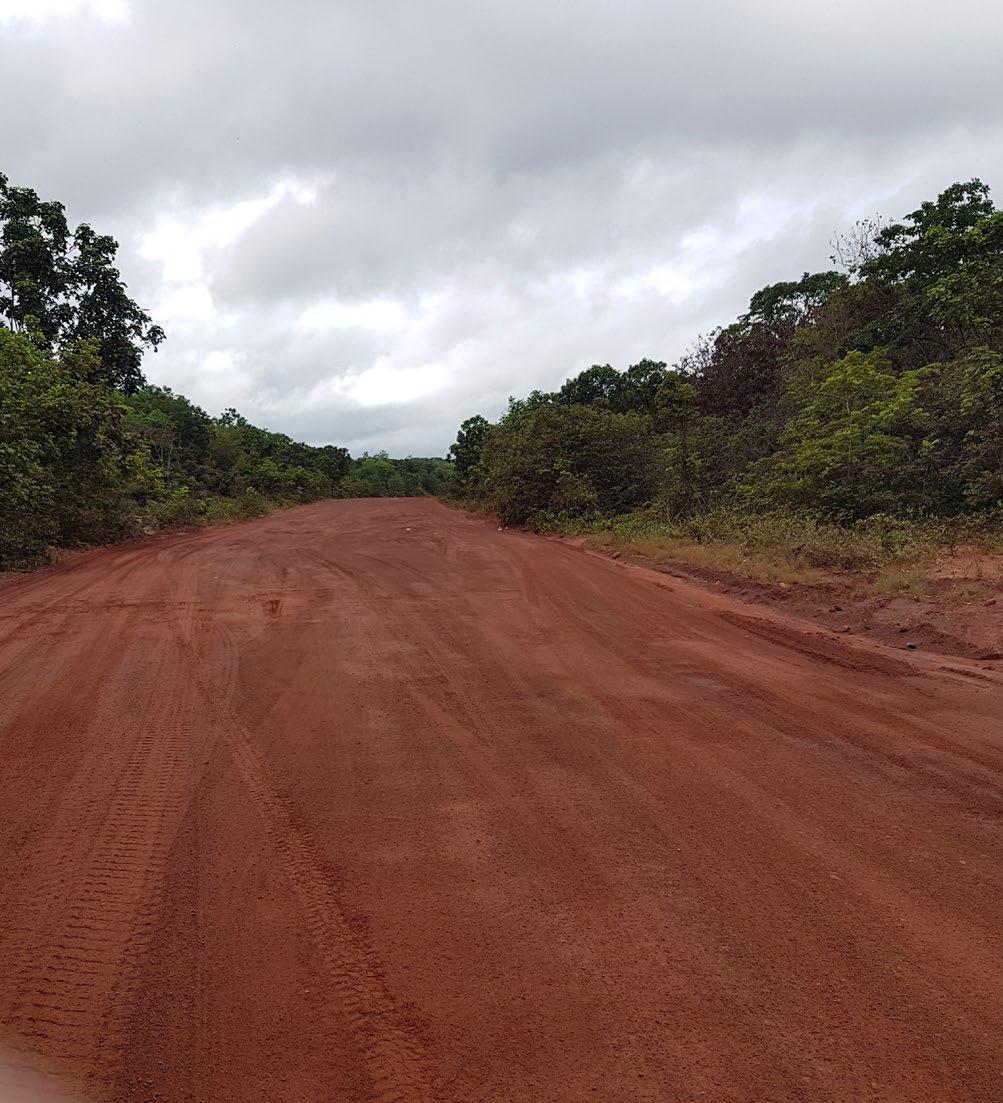
A section of road between Linden to Mabura Hill, which will be upgraded, using SDF resources
scheme aimed at supporting sugar cane farmers impacted by the drought in 2019. Assistance will be delivered through the provision of a specially designed voucher programme of inputs (planting material and agrochemicals) and services (land clearing and preparation).
Regional cooperation and regional public goods
Activity under this theme focused predominantly on boosting the region’s export readiness. Building on previous support to the Caribbean Community (CARICOM) Regional Organisation for Standards and Quality to strengthen regional quality infrastructure in five BMCs (Antigua and Barbuda, Grenada, Guyana, Saint Lucia, and Suriname ), the Bank approved resources to strengthen regional quality infrastructure in Barbados, Dominica, and St. Kitts and Nevis in 2020. This assistance will support:
a) the development of a national quality policy, as well as the implementation roadmap to strengthen the policy and regulatory framework for improved national quality infrastructure; and b) TA to three metrology calibration laboratories to assist BMCs in meeting international standards for testing and calibration facilities.
The region has long recognised the role of intra-regional trade in advancing economic development and reducing disparities in the level of development. However, the economic shock and possible disruption to traditional food supply chains, caused by the onset of the COVID-19 pandemic, have elevated the importance of increasing regional food supply and intra-regional trade as a means through which the region could increase food security.
One of the hurdles has been the absence of clear guidelines and protocols for the movement of plant and animal products. The Bank, therefore, through the Caribbean Agricultural Health and Food Safety Agency, will support the development of guidelines to facilitate intra-regional trade in selected plant and animal products. Ultimately, the support aims to strengthen the current governance and management framework on protocols and guidelines for both importing and exporting countries, improve BMCs’ food safety and agricultural health systems, and increase compliance among actors engaged in intra-regional trade.
Governance
Governance continued to feature prominently in the SDF work programme. During the year, the Bank, in collaboration with the World Bank, approved resources to assist Dominica in strengthening its public procurement legal and regulatory framework, to facilitate more efficient procurement and timely implementation of projects. This intervention has the potential to be transformational, as procurement challenges have been consistently identified as a key reason for delays in project execution, and in turn, disbursements and the realisation of the intended developmental outcomes.
The Bank also supported regional efforts to prioritise infrastructure investment. It is well-known that access to modern infrastructure systems and services such as roads, drainage and irrigation, are critical to improving socio-economic wellbeing and enhancing gender equality in rural communities in BMCs. However, given limited technical and financial resources, governments have to prioritise development projects. The Bank is therefore piloting the use of:
a) Infrastructure prioritisation methodology, which is a decision support tool designed to help governments prioritise infrastructure investments under conditions of limited resources, multiple policy goals and uncertainty; and
b) AGRI, which is a tool to support the identification of water sources for supplemental irrigation and can help to define the most cost-effective routes for gravitydriven conveyance. These are expected to enhance transparency in the selection and implementation of projects and utilisation of public resources.
Gender equality
Cognisant of the importance of incorporating gender considerations into project design and appraisal and at the same time, being mindful of the gendered impacts of projects, the Bank aims to mainstream gender in all of its interventions. In 2020, approximately 82% of the Bank’s interventions had mainstreamed gender concerns (from marginally mainstreamed to gender specific). Environmental and social impact assessments conducted as part of the Bank’s appraisal process can highlight a range of social maladies afflicting project communities, namely crime and gender-based violence, including human trafficking and
human smuggling. For example, to ensure that the Bank’s interventions adequately considered gender concerns and did not further contribute to gender inequalities, one project approved in 2020, stipulated that a social and gender specialist had to be engaged before disbursement could occur on any infrastructure works. Key responsibilities of the engagement were to ensure that good development practice was employed to manage key social and gender risks and issues; to promote social and gender benefits; and to support stakeholder participation in decision-making regarding issues that affect them throughout project implementation.
Consistent with the SDG theme of leaving no one behind, the Bank is seeking to improve access to quality education by conducting a study and developing a model policy and strategy for people with special education needs. This will assist BMCs and the Bank in determining the extent to which special education needs are addressed in the education sector across BMCs and will be used as a best practice to guide BMCs in providing for the needs of this vulnerable sub-sector. The policy and strategy will be aligned with, inter alia, targets 4.1 and 4.5 of SDG 4, which ensures that all girls and boys complete free, equitable and quality primary and secondary education, leading to relevant and effective learning outcomes; and ensuring equal access to all levels of education and vocational training for the vulnerable, including people with disabilities. All reports are expected to contain sex-disaggregated data and gender analysis of the available information to ensure the development of gender sensitive and socially-inclusive policy and strategy.
During the year, the Bank strengthened its capacity to advance gender concerns by approving the Gender Equality Action Plan (GEAP). The plan outlines how the Bank will implement the Gender Equality Policy and Operational Strategy 2019 as it seeks to become more gender responsive and deepen the gender equality work in BMCs and in the institution. Defined projects within the GEAP include TA interventions, capital projects and sub-components, training, country assessment, and research while defined internal organisational procedures include policy guidelines, training and dissemination of gender tools and knowledge products.
CDB in Haiti
Haiti is the third largest Caribbean nation by area and, with a population of 11.4 million people, is the Bank’s most populous
BMC. The country has tremendous economic potential and could stand to benefit from a young labour force, a large and vibrant diaspora, fertile land, geographic proximity to major markets and substantial historical and cultural assets. However, it is plagued with severe structural limitations. Poverty, vulnerability to natural hazards, lack of proper access to basic social services and low levels of education for much of the population represent substantial impediments to Haiti’s economic growth.
Categorised as a fragile state, Haiti requires special attention because of its enormous challenges. The pace of economic development over the last four decades has been disappointing due to a long history of political instability, severe institutional weaknesses, extreme vulnerability to a wide range of shocks, and repeated fiscal crises.
Against this backdrop the Bank established the Haiti Country Office in 2018. The main responsibilities of the office fall under two pillars:
a) coordinating the Bank’s aid and providing project implementation support; and b) strengthening relationships with key stakeholders.
Pillar 1 – Coordinating the Bank’s aid and providing project implementation support
In 2020, the Haiti Country Office continued to work closely with government ministries and implementing agencies to advance speedier implementation of projects. CDB’s main interventions are presently in education and training (early childhood development, primary and secondary education, technical and vocational education and training) and agriculture and rural development (see Box 2.3).
As a result of the COVID-19 pandemic, project funds were repurposed to enable the Government of Haiti to adjust project designs and implementation, so that the interventions could be more responsive to the needs of the beneficiaries. Other interventions were in the areas of environment and disaster risk management, sustainable energy, the creative industries, sanitation and governance, and trade facilitation.
The Haiti Country Office participated in and played a major facilitative role in the appraisal and subsequent Board approval of four new interventions during 2020, with one project and three TAs:
a) Community-based Agriculture and Rural Development II (project);
b) Support for Training in Geospatial Mapping for Rural Haiti (TA);
c) The Cultural and Creative Industries Innovation Fund (CIIF) Haiti (TA); and
d) Institutional Strengthening of the Ecole Nationale d’Administration Financière (the National School of Financial Administration) (TA).
Pillar 2 – Strengthening relationships with key stakeholders
The CDB representation in Haiti has sought to strengthen relationships with government officials, development partners and the international community. The Haiti Country Office gives the Bank an opportunity to contribute meaningfully to policy dialogue in the priority sectors in Haiti. Regular meetings are held with relevant ministries and their respective technical teams.
The Haiti Country Office remains an active member in the Heads of Cooperation Committee (CTP) and its sectoral sub-committees. The CTP meets, both internally and with the Haitian Government, on a regular basis. Bilateral meetings are regularly held with representatives and heads of cooperation of development partners and meetings have also been held with numerous international and national nongovernmental organisations, working in CDB’s priority sectors.
The interactions and sharing of experiences with development partners enable a better understanding of local development issues and priority needs and create opportunities for more efficient collaboration in priority sectors.
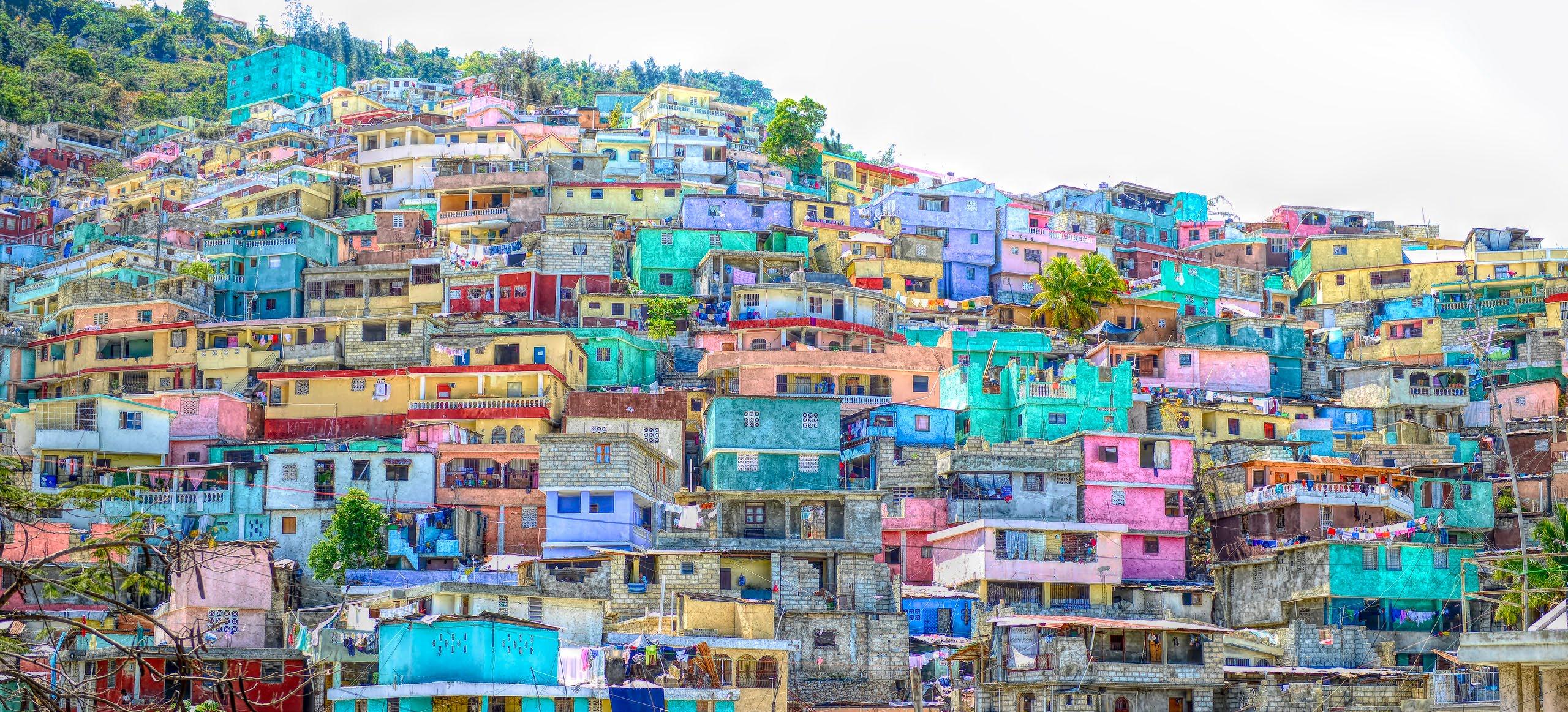
Housing stacked up a hillside in Port-Au-Prince, Haiti
Supporting inclusive, quality basic education in Haiti Box 2.3
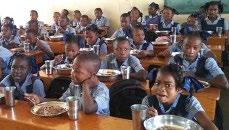
Through the Quality Enhancement of Public Education Project, CDB provided ongoing support to the delivery of quality education in the Centre Department in Haiti. The project benefitted approximately 20,275 students, 45% of whom are girls. The range of support includes:
a) School nutrition and feeding, including biometric monitoring of students’ growth and development.
b) Provision of school kits and textbooks for students.
c) Training for over 250 teachers and 40 principals in the systematic method of reading in Creole, the use of textbooks and effective back-to-school planning.
d) Supporting overall improvement in school operations to provide safer, child-friendly learning spaces.
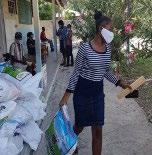
e) In response to the COVID-19 pandemic, several families of students were provided with food packages when schools were closed as part of the Ministry of National Education and Vocational Training’s mitigation measures.
Children eating meals from the school canteen programme and distribution of food packages to families as part of COVID-19 response.
Basic Needs Trust Fund – Achieving results during the pandemic
Belize, Dominica, Grenada, Guyana, Jamaica, Montserrat, Saint Lucia, St. Vincent and the Grenadines and Suriname are participating countries in the BNTF 9 programme, approved on March 16, 2017. BNTF is a cyclical grantfunded programme, which was launched in June 1979 and is the principal vehicle in CDB for targeted poverty reduction initiatives.
The implementation of BNTF 9 continued in all participating countries. The BNTF 7 and 8 projects in Dominica, which were implemented concurrently under the special assistance extended to the Government of Dominica in December 2018, ended within the extended terminal disbursement date of December 31, 2020.
As of December 31, 2020, 92.2% of grant allocations of participating countries under BNTF 9 had been committed. Figure 2.4 shows the distribution of resources. The approved allocation to education and human resource development was the largest at $20.2 mn of the total of $28.8 mn for subprojects across all participating countries.
Figure 2.4: BNTF 9 sector approvals
The BNTF 9 programme implementation rate accelerated during the first three months of 2020 with 73 sub-projects under various stages of implementation. However, almost immediately thereafter, project performance was stymied by the impact of the COVID-19 pandemic. Most BNTF implementing agency staff were required to work from home but remote access proved a challenge in some participating
countries. Construction activity and especially human resource initiatives and livelihoods enhancement sub-projects were suspended. Works and training activities eventually recommenced but were subject to national protocols, which have hindered progress. As a result, participating countries disbursement rate was lower than planned (see Table 2.4).
Table 2.4: BNTF 9 allocations, approvals and disbursement as at December 31, 2020
BNTF 2020 results
By the end of 2020, some 50 sub-projects were completed, benefitting over 17,000 people. Table 2.5 provides Level 2 and BNTF specific disaggregated results during the year for education and human resource development and livelihoods enhancement; basic community access and drainage improvement; and water and sanitation services enhancement.
Twenty-seven sub-projects were completed under education and human resource development and livelihoods enhancement benefitting 2,101 people (951 males, 1,150 females) (see Box 2.5). Fourteen sub-projects were completed under water and sanitation systems enhancement, benefitting 961 households. Activities included associated water, sanitation and hygiene training. Nine sub-projects were completed under basic community access and drainage improvement, benefitting 2,505 people (1,231 males, 1,274 females).
Table 2.5: BNTF results in 2020
Strengthening farmers’ resilience through climate-smart approaches in agriculture Box 2.4
Countries like Guyana are on the frontline of climate change as changes in temperature and precipitation impact farmers’ resilience.
Increasingly, livelihoods in agriculture are becoming more susceptible to these changing conditions, which could result in decreased yields, increased food insecurity and heightened exposure to conditions which perpetuate hardship and poverty at the household level.
The adoption of innovative strategies, particularly premised on climate smart approaches, is essential to help farmers and the agriculture sector as whole adapt to climate change. In 2020 under the BNTF 9, a collaborative and
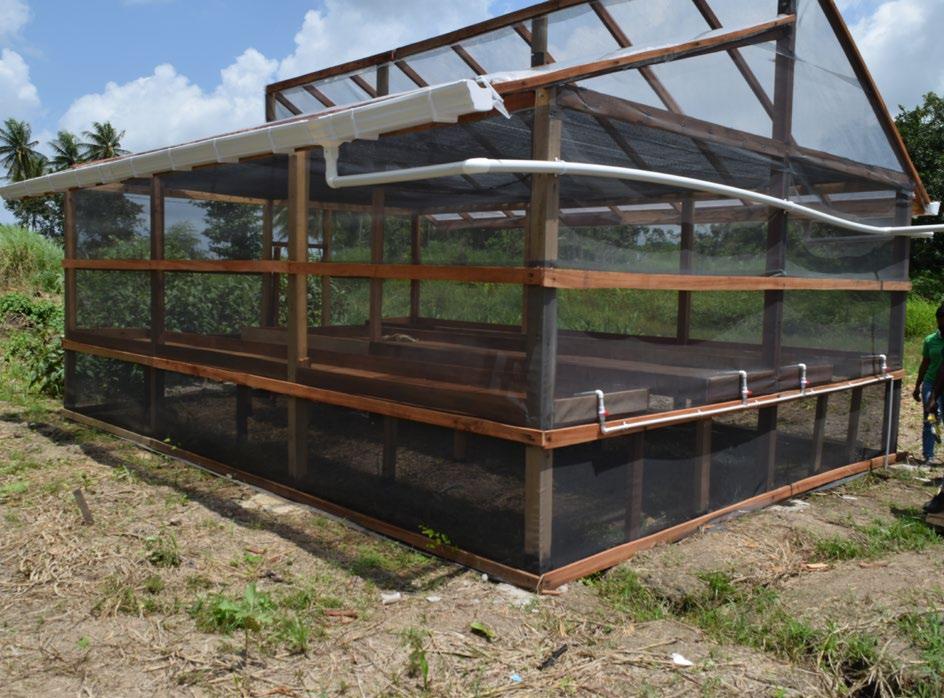
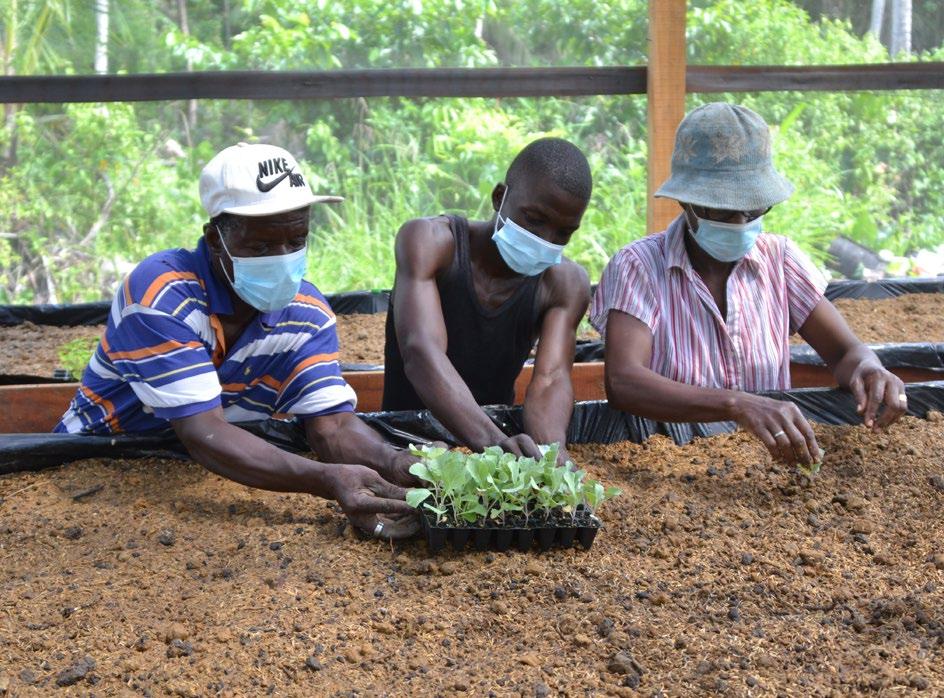
innovative partnership was formed between the BNTF Guyana, the Inter-American Institute for Cooperation on Agriculture, the National Agricultural Research Institute and the University of Guyana, Faculty of Agriculture and Forestry. As part pf the partnership, a sub-project was launched that aims at building climate resilience through climate-smart agriculture and focusses on the use of shade house technology to enhance productive livelihoods across Regions 1 to 6, 9 and 10. Some $140,000 from BNTF was earmarked for this initiative, targeting 260 people (100 males and 160 females) initially mainly through the construction of approximately 24 shade houses, conduct of capacity building activities and convening of peer-topeer exchanges.
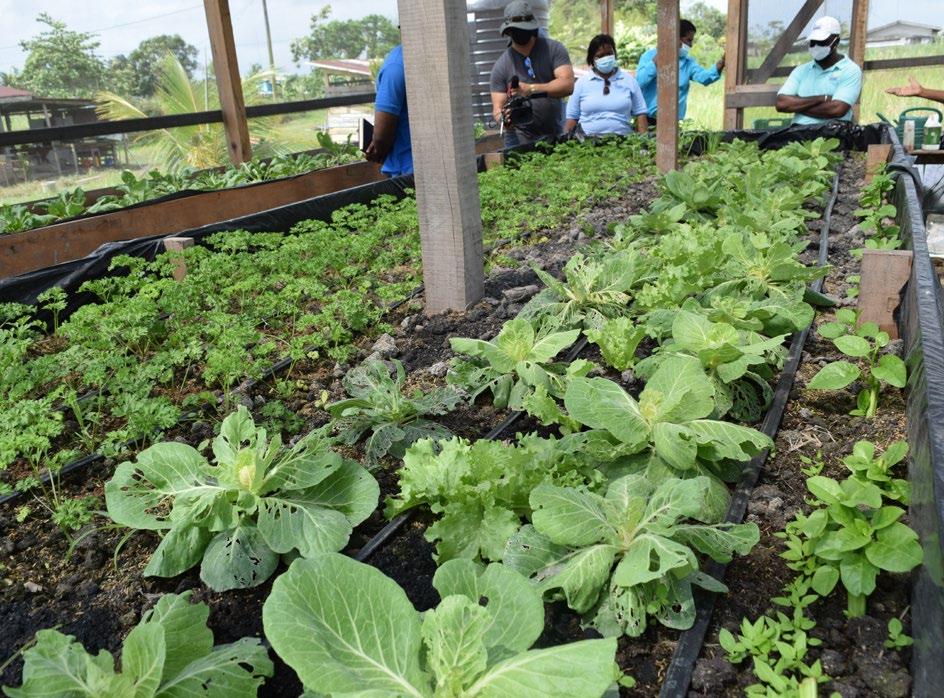
Stemming from the introduction of the COVID-19 protocols, total participation in the intervention was adjusted to 130 participants (50 males and 80 females). Erected shade houses are being used as instructional and observation centres. A variety of shortterm cash crops, such as cabbage, celery, pak choi, broccoli,
tomatoes, sweet peppers, cauliflower and thick leaf callaloo are grown in the shade-houses, with different groups growing different combinations of crops. During the rainy season and without the shade houses, none of these crops would be available because of flooding.
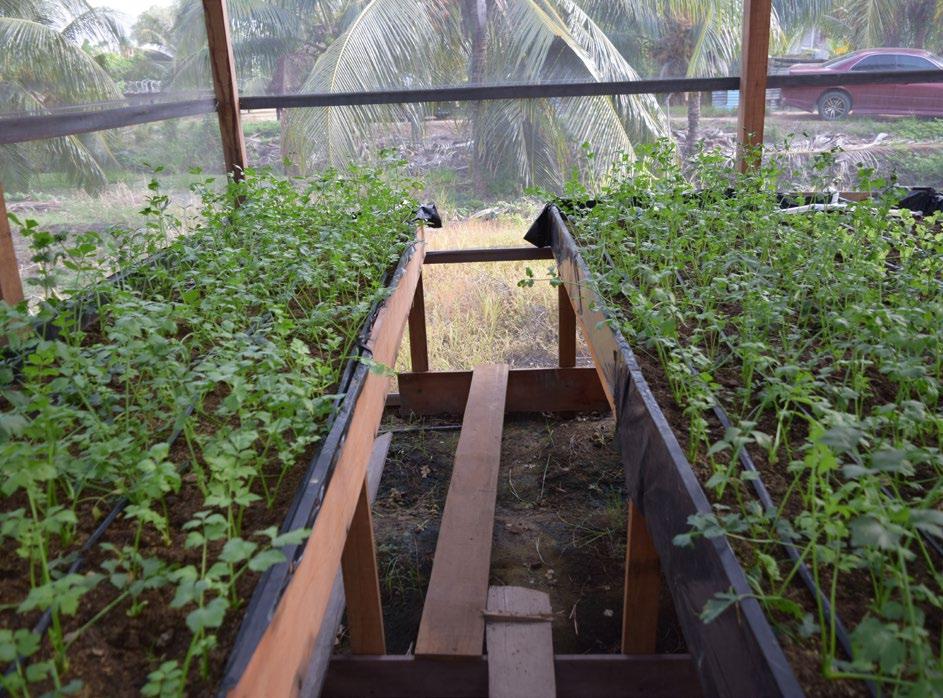
Shade house: measures 5.5 metres (m) by 7 m, has six beds, raised 1 m above the ground to protect from flooding and watered by filtered rain water, collected from the roof
Beneficiaries preparing to sew seedings
Strengthening farmers’ resilience through climate-smart approaches in agriculture
cont’d
A female participant of the Region 5 farmers’ group shared the experience of her all-female group, comprising mainly single mothers:
“From the women’s perspective we are able to farm in a more comfortable way. We can have the children with us and not worry about them falling into open trenches and canals while we work because the shade houses have doors, which we can close with the children inside with us. We can also feed our kids from what we produce.”
The training and shade houses were well-received, and the beneficiary farmers felt that this was indeed a very useful way to address some of the challenges which climate change present. One farmer shared that by just using raised beds he can retain up to 80% of certain crops during the rainy season. Overall, there is agreement among beneficiaries that learning about the impacts of, and exploring responses to, climate change provide important options for farmers to use new approaches that do not only help adapt to climate change, but have other advantages, such as a greater level of security.
In 2020, as part of its continued mission to transform lives in the region through private sector development, particularly MSMEs, CDB approved $0.62 mn under its CTCS network to support MSMEs in the BMCs. A total of $0.5 mn was disbursed to facilitate the implementation of new and ongoing projects. Project approval and disbursement rates were
adversely impacted by COVID-19 and the resultant full or partial lockdowns in March to June, travel restrictions and social distancing protocols. As a result of these measures, government officials and the private sector operated at minimum capacity. Despite these challenges, CTCS leveraged existing technologies and in partnership with national business support organisations, supported a number of virtual capacity building activities, which benefitted 426 people (229 males and 197 females) as reflected in Table 2.6.
Table 2.6: Summary of the number of beneficiaries from CTCS activities in 2020
In response to the pandemic, CTCS designed and launched measures to promote the recovery of the MSME sector. As such, a three-part webinar series was convened to assist MSMEs to cope with the challenges of COVID-19. The webinars, in which approximately 1,000 MSME operators participated, focused on:
a) pivoting your business to survive;
b) money management and managing your relationship with your financial institutions; and
c) cost effective marketing and client engagement.
Another two-part webinar series was convened in partnership with the Pan American Health Organisation to engage staff of business support organisations, primarily those that collaborate with CTCS, on issues surrounding mental well-being of owners of MSMEs and their staff in times of stress. The series also took into consideration, other natural hazards, which increased the vulnerability of the MSME sector, including the approaching hurricane season. The webinar brought to a focus key discussion topics, such as understanding the mental health impacts, needs and challenges for MSMEs during the COVID-19 pandemic; and doing what matters in times of stress – practical skills and tools to cope with adversity.
The Bank also approved $82,688 to establish a proposal writing facility for consultancy services to assist business support organisations and MSMEs in strengthening of project proposals, submitted to CDB for TA support. It is anticipated that this facility will also build institutional capacity in business support organisations in BMCs while contributing to greater access to funding and other forms of required support in order to facilitate increased competitiveness of MSMEs.
As part of ongoing efforts to address the challenges faced by MSMEs in accessing affordable finance, CDB approved $178,450 for a CTCS project that will train a cadre of consultants and staff of 20 development finance institutions in appraising loan applications for creative sector projects. This project complements CDB’s support to the sector by way of TA and grants through its CIIF. The project includes:
a) the design and development of a training manual, which will be used to facilitate online training and as reference material for beneficiaries;
b) videos to facilitate self-learning; and
c) direct consultancy services support to assist MSMEs in preparing project proposals to access loan financing and available grant resources.
In support of the Government of Dominica’s thrust to diversify the agriculture sector, $139,850 was approved for CTCS to implement, in collaboration with the OECS Competitive Business Unit, a project aimed at enhancing the competitiveness and sustainability of agro-processors. The project, which seeks to ensure that approximately 30 agroprocessors meet required standards for export, comprises training in good manufacturing practices, packaging and labelling, costing and pricing, product nutritional analysis, and a feasibility study for the establishment of a joint processing facility.
The Bank also approved $149,500 under CTCS to assist the Government of Barbados, through the Barbados Industrial Development Corporation, to implement Accelerate 20/20 (see Table 2.7). This incubator programme was designed to develop 20 high-growth, high-potential companies that have the capacity to earn or save significant foreign exchange through export earnings or import replacement. Project beneficiaries will benefit from access to business support services and finance. The goal of the programme is to enable companies in targeted sectors (creative industries, manufacturing, ICT and software development, and renewable energy) to be competitively positioned to access regional and international markets.
Table 2.7: Distribution of CTCS approvals and disbursements by country
In 2020, CTCS continued to support efforts to build resilience in BMCs to mitigate the impact of hurricanes on housing infrastructure. In that regard, training in improved construction practices for the construction of houses was conducted in Saint Lucia in collaboration with the Department of Physical Planning and the Institute of Architects. A total of 74 people (59 men and 15 women) were trained, comprising artisans and small contractors, building inspectors, architects, and engineers.
CTCS also continued to implement a pilot project –Strengthening the Entrepreneurial Spirit of Caribbean Youth – approved in 2018 as part of the Bank’s support for youth economic empowerment in the region. The project, which is being implemented in collaboration with youth development agencies in Barbados, Dominica, Jamaica, Saint Lucia, and Trinidad and Tobago, trained and mentored a total of 348
young entrepreneurs (170 men and 178 women) to help them start or grow their businesses.
To build capacity at the national level and in support of efforts to strengthen sustainable agriculture development in Jamaica, the Bank approved $69,222 to extend the implementation of a CTCS capacity building project, which began in 2018 to support aquaponics farmers. By the end of 2019, the project had trained 45 extension officers (34 men and 11 women) of the Rural Agricultural Development Authority and a total of 111 farmers (67 men and 44 women) in aquaponics farm management.
During 2020, the project implementing agency International Medical Services for Health Caribbean collaborated with the College of Agriculture, Science and Education and the Human Employment and Resource Training/National
Service Training Agency Trust to develop a curriculum for an aquaponics certification programme. These institutions will offer training in aquaponics to students who are aspiring to become aquaponics farmers, entrepreneurs, trainers, RADA extension agents, and policy-makers.
SDF portfolio analysis
As the Bank transitions to a more efficient system of tracking and monitoring projects through the entire project cycle, it is currently utilising two systems – the Project Performance Monitoring System (PPMS) and Project Resource Interface for Systematic Management (PRISM). These systems provide useful information on the performance of CDB’s portfolio of loans and grants, and highlight accomplishments and major
challenges affecting the portfolio and timely delivery of development results. While the two structures are not directly comparable, careful analysis of both systems reveals insights into the portfolio of SDF projects.
The performance of the SDF portfolio in 2020 was assessed to be favourable with most projects achieving a rating of satisfactory. However, as at December 31, 2020, four projects were flagged as at risk, an increase from three in 2019. Table 2.8 below identifies those projects and summarises the major factors impeding implementation progress. The Bank will continue to engage BMCs, and if required, design action plans to improve the execution of these projects and rescope the intervention to ensure delivery of results. Cancellation is considered as a last resort.
Table 2.8: Summary of projects flagged at risk for 2020 ($’000)
Name of project and approved value
1. Youth and Community Transformation Project ($5,200)
4. Sandy Bay Sea Defences Resilience Project ($13,467) St. Vincent and the Grenadines
31, 2020
Key issues
Challenges with the construction of the resource centre led to significant project implementation delays. The project was further delayed by the onset of the COVID-19 pandemic.
Delay in implementation due to lengthy determination on relocation of households.
The COVID-19 pandemic caused delays in some project activities, such as procurement of the building works contracts and several of the institutional strengthening and capacity building activities being extended or deferred.
Land acquisition and relocation issues are impacting project implementation. In addition, there are delays in the project design.
Reporting on SDF 9 results
Reporting on SDF 9 results
This chapter presents the 2020 results of the Bank’s development efforts in the context of the SDF 9 results monitoring framework. The SDF 9 cycle, which was completed in 2020, had an added focus on furthering the 2030 Sustainable Development Agenda.
The results monitoring framework for the SDF 9 is part of the corporate results monitoring framework, which is supported by three objectives: supporting inclusive and sustainable growth and development; promoting good governance; and enhancing organisational efficiency and effectiveness.
The results monitoring framework translates these three objectives into four levels. Level 1 assesses the progress made
Level 1
by the region towards SDGs and regional development outcomes. Level 2 measures CDB’s contribution to the SDGs and country and regional development outcomes. Efficiency is assessed at Levels 3 and 4, where CDB’s operational management answers the question of how well is CDB managing its operations at Level 3; and Level 4 highlights how efficient CDB is as an organisation. The status of the indicators at the four levels as at December 31, 2020 is provided in the text and tables below. A detailed presentation and analysis of CDB’s progress on these indicators is provided in CDB’s Development Effectiveness Reviews of 2019 and 2020, which reviewed progress based on CDB’s 2015-2019 and 2020-2024 corporate results monitoring framework.
Progress towards Sustainable Development Goals and regional development outcomes
Economic inclusion: Reducing poverty and inequality
Despite achieving high levels of human development on average, over the last three decades, the BMCs have exhibited high rates of poverty, inequality and vulnerability. Over the last decade, 25% of BMCs’ populations were estimated to be living in poverty. 1 Previous estimates suggested that the poorest quintiles’ share in national consumption was as low as 5%. 2 Furthermore, specific population groups, such as women, the elderly, people with disabilities, young people, and people living in remote and
1Data from CDB-financed country poverty assessments.
isolated communities, including indigenous populations, are more likely to be poor.3
COVID-19 poses unparalleled challenges to BMCs’ socioeconomic development. Gross domestic product (GDP) per capita is estimated to have contracted by 8.2% in 2020. (See Table 3.1 for a status of Level 1 indicators). Issues of multi-dimensional poverty, including living standards, health and education have been significantly impacted. Based on experiences to date and current projections, COVID-19 impacts are significantly precipitated through loss of income and livelihoods, as well as significant
2Towards a Caribbean Multi-Country Assessment, United Nations Caribbean (2015:75).
3/bid. cited in Caribbean Research Policy Institute Report-Impact of Covid-19 on Vulnerable Groups (2021: xii).
pressure on, and disruptions to, already overburdened social services. Although inequality generally persists across the region, the Inequality-Adjusted Human Development Index (IHDI) for selected years showed improvement for Guyana, Jamaica, and Saint Lucia in the areas of education, life expectancy and per capita income between 2017-20194 consequent upon increased public investments in education and health care as a percentage of GDP5. However, the onset of COVID-19 exacerbated existing inequalities across BMCs and threatened human development outcomes in the foregoing indicators. The scale of destruction of both lives and livelihoods caused by the pandemic represents the single largest inhibitor to attaining the SDGs.
The pandemic has worsened already high unemployment levels, caused widespread disruption of remittance flows, upended the creative sector and over-burdened social safety nets. With regard to the latter and in the absence of unemployment insurance provisions as part of an established national insurance fund, governments across the region continue to experience difficulty in providing support to those displaced from the labour market, especially those who required, at a minimum, short-term income support.
The lingering impacts of the pandemic have increased the stress on governments’ budgets and the national insurance fund as short-term income support has been extended to longer-term support in an environment of restricted revenue generation from key sectors, including tourism and other services. In the case of Saint Lucia, increased unemployment in both the formal and informal sectors affected the operations of the National Insurance Corporation. By the end of the fourth quarter of 2020, the level of impact on the active insured population was between 28-30% and estimated to cost the corporation some EC$80 mn. In the absence of such a fund in St. Vincent and the Grenadines, the Government’s response to COVID-19 saw an increased budget of EC$2,434,870 during the period May-November 2020, covering interim assistance benefits and family support.
The pandemic’s impacts highlighted the importance of introducing unemployment insurance provisions to play an important stabilisation role in supporting income security of the unemployed, particularly during periods of economic and in
this case pandemic shock. Unemployment insurance schemes, by partially compensating for loss of earnings, help to break the negative cycle of increased unemployment leading to reduced consumption, which leads to a further reduction in economic activity, increased hardship, and poverty.
Quality education, training and employment opportunities
The region has made notable strides in the provision of education services over the years particularly as it relates to performance in the Caribbean Examination Council (CXC) examinations and national assessments. However, the data suggest that there may still be room for improvement, especially at the secondary level where lack of universal secondary education in some countries compounded by data inadequacies contribute to lower secondary school enrolment rates being recorded. The survival rate at the secondary level also requires attention as difficulties retaining students in upper secondary may be the result of a confluence of factors, including the quality of teaching being provided, need for a more diversified competency-based curricula, and the attraction of paid work vis-à-vis staying in school. To address this, BMCs have been, inter alia, systematically trying to improve teacher effectiveness through ongoing professional development and are advancing the implementation of demand-driven technical and vocational education and training to ensure that the learning programme is more consistent with students’ aptitudes and interests.
Sustaining growth:
Building competitive economies
As BMCs try to jump start growth and return to some level of normalcy, they will need to improve the enabling environment for private sector activity. One of the causal factors associated with slow economic growth even prior to the pandemic, was a lack of international competitiveness, which was borne out by the deterioration in the average rank of BMCs in the World Bank’s Doing Business Report from 119 to 130. This will require a concerted effort on the part of BMCs to address, inter alia, inadequate legislative, regulatory and incentive frameworks. Improving the region’s economic fortunes will also require renewed focus on intraregional trade, which
4United Nations IHDI Human Development Reports (HDRs) for 2018 and 2020 showed a reduced loss for Guyana of 18.5% in 2019 compared to 18.6% in 2017, a reduction to 16.3% in 2019 compared to 17.0% in 2017, and for Saint Lucia, 17.1% loss in 2019 compared to 19.0% loss in 2017.
5UNDP HDR (2020:287). The Next Frontier: Human Development and the Anthropocene.
recorded only marginal improvement over the period. Some attention was given to this when the impact of COVID-19 disrupted global supply chains and there was recognition that issues related to trade information systems, logistics infrastructure, air and maritime connectivity needed to be addressed at the regional level, however, efforts need to be sustained.
Affordable and clean energy
The importance of building resilience, securing sustainable energy and adapting to a changing environment has been well-accepted in the region. While BMCs have managed to maintain some indicators at baseline or registered
small improvement, there is considerable scope for growth, particularly in the area of renewable energy. Cost considerations and the need for appropriate policies and regulatory mechanisms have contributed to the slow pace of developments in the sector. Nevertheless, BMCs remain committed to enhancing the use of sustainable energies given concerns about energy security, the fiscal impact of high and volatile prices, and concerns about environmental sustainability. Some BMCs have formulated national energy policies and have developed targets for renewable energy and energy efficiency. Also, at the regional level through CARICOM, BMCs have established targets for the contribution of renewable energy to total electricity generation (28% by 2022, and 47% by 2027).
Table 3.1: Level 1 - Progress towards SDFs and regional development outcomes
Grouping/indicator
Inclusive and
3. Multidimensional Poverty Index (Headcount (%) (2)
4a. Countries with high income inequality (no. of countries with Gini coefficient exceeding 0.4)
5. GDP per capita growth rate (%)
Quality education, training and employment opportunities
6. Net enrolment ratio in basic education (%):
7. Secondary school graduates achieving five CXC general proficiency or equivalent in national assessment passes or more, including Mathematics and English (%)
Grouping/indicator
Quality education, training and employment opportunities
8. Proportion of students starting from Form 1 who reach Form 5 (survival rate)
- Female
9. Students completing at least one Level 1 course in technical and vocational education and training (%)
10. Unemployment rate (%)
Sustaining growth: Building competitive economies
11. Intra-regional trade as a percentage of total regional trade
12. Doing Business average rank (out of 189 countries)
Building resilience, securing sustainable energy and adapting to a changing environment Clean water and sanitation
14. Population with access to an improved water source (%) -
15.
Affordable and clean energy
16. Renewable energy as a % total energy mix produced
17. Energy use per unit of GDP (barrels of oil equivalent 000s/$’mn GDP)
Climate action; life on land
18. Reported economic losses resulting from natural disasters and climate variability (% of GDP, three-year average)
19. Area protected to maintain biological diversity (%)
20. Proportion of land area covered by forest (%)
Level 2
CDB’s contribution to SDGs, country and regional development outcomes
Indicators at Level 2 measure the Bank’s contribution to SDGs, country and regional development outcomes through outputs delivered in key operational areas identified in the Strategic Plan. These are: economic and social infrastructure; agriculture and rural development; education and training; citizen security; environmental sustainability; private sector operations; governance and accountability; and regional cooperation and integration. The results for 2017-2020 are measured against targets set for the SDF 9 cycle. These expected results were based on projects approved under SDF 8 and planned approvals early in the SDF 9 cycle.
The Bank managed to achieve expected results in the area of regional cooperation and integration. However, the realisation of results in other areas was challenged by several factors. These included the impact of natural hazards, concerns about high debt levels, increasing competition notably within the private sector, long-standing issues related to implementation capacity and the COVID-19 pandemic. Additionally, targets set in some areas at the beginning of the programme were overly ambitious. Consequently, performance was less expected in private sector operations, governance, economic and social infrastructure, environmental sustainability, agriculture, education and training, and citizen security.
The Bank is taking concrete steps to improve the pace at which it can deliver project results through its Transformation Programme. These include the establishment of resident implementation officers, greater direct contact during project execution, and supporting improvements in the BMCs’ procurement frameworks. While these measures will help to accelerate project implementation, greater effort on the
part of BMCs to strengthen in-country systems will help the Bank and other development partners to deliver resources faster. Some of the areas, which still require further in-country attention, are lengthy decision-making, lack of familiarity of new staff with CDB processes, delays in the recruitment of consultants, and delays in procurement of goods and civil works. The Bank stands ready to assist BMCs in identifying effective and sustainable solutions that will accelerate the utilisation of resources in support of the attainment of development objectives.
Economic and social infrastructure development
Results in economic and social infrastructure development were less than expected as transportation and water supply improvement projects were affected by protracted implementation delays and the onset of a natural hazard. Project execution in 2020 was further compromised by the pandemic, which led to travel restrictions and stay-at-home orders. Nevertheless, the Bank managed to improve the lives of 268,277 people (over half of whom were female) through increased access to road infrastructure and reached 19,167 households with improved access to sanitation and water supply. Community infrastructure, which is primarily provided by the BNTF programme, was also below expectations due to a confluence of factors, including delays in land acquisition, shifting priorities on account of changes in administration, and overburdened implementing agencies. Nevertheless, SDF-sponsored projects also reached 38,328 people (21,336 female) through community infrastructure (see Table 3.2a).
Table 3.2(a): Level 2 – Progress towards SDGs and regional development outcomes
Economic and social infrastructure development
1. Transport: Primary, secondary and other roads built or upgraded (km)
2.
6.
7.
Agriculture and Rural Development
In 2019 and 2020, farmers in Belize and Haiti benefitted from approximately 555.4 hectares of land that had been improved through irrigation, drainage and flood management practices (see Table 3.2b). Projects also trained 1,742 agriculture stakeholders in production technology. Progress on these indicators was however hindered by the
non-materialisation of projects in a beneficiary country with a significant loan allocation. CDB is dedicated to continuing its work in the agriculture sector under the SDF 10 cycle. Going forward, interventions will be informed by the recentlyapproved Agriculture Sector Policy and Operational Strategy, to guide the Bank’s initiatives in transforming the agri-food system in a competitive, sustainable, and inclusive manner for CDB’s BMCs.
Table 3.2(b): Level 2 – Progress towards SDGs and regional development outcomes
8. Agriculture:
9.
Education and training
SDG 4 is aimed at ensuring inclusive and equitable quality education and promoting lifelong learning opportunities for all. The Bank acknowledges the importance of education in reducing poverty and has sought to provide education opportunities in all areas – from early childhood education (to post-secondary/tertiary education. Achievements in this sector were less than expected. This is attributable mainly to the non-approval of the planned education interventions in a primary beneficiary of SDF resources as the country sought to manage fiscal and debt sustainability concerns by delaying planned borrowing. As a result, anticipated significant teacher training to improve teacher effectiveness in technical and vocational education and training, literacy, gender responsive differentiated instruction and key subjects, as well as supporting therapeutic care and psychosocial services for children did not take place. Additionally,
lockdowns from March 2020 meant that the usual summer training workshops and other training activities through the year could not take place. This accounted for the difference in the number of teachers and principals trained and certified, which, invariably, had a corresponding adverse effect on the number of students who were expected to benefit from the enhanced teacher competence. Other contributing factors were implementation delays in Grenada, Guyana, and Saint Lucia that were further compounded by the pandemic.
Under the SDF 9 cycle, 1313 classrooms and educational support facilities were built or upgraded (840 in 2020 alone) and 939 teachers and principals were trained or certified and 3939 teachers and principals were trained or certified (600 in 2020) (see Table 3.2c). Through SDF 9 financing, CDB has enhanced the lives of 136,366 students by improving physical classroom conditions or enhancing teacher competence or providing access to student loan financing.
Table 3.2(c): Level 2 – Progress towards SDGs and regional development outcomes
Grouping/indicator
10. Classrooms and educational support facilities built or upgraded according to minimum standards (number), of which
(a)
11. Teachers and principals trained or certified (number)
(a) Early childhood development (total/female)
(b) Primary (total/female)
(c) Secondary and post-secondary/tertiary (total/female)
12. Students benefitting from improved physical classroom conditions or enhanced teacher competence, or access to loan financing (number)
- of whom female
Citizen security
Under the programme, CDB completed four citizen security interventions, which delivered results relevant to SDG 16 –promote justice, peaceful and inclusive societies:
a) Youth and Community Transformation project in Belize
b) Youth Resilience and Inclusive Social Empowerment in Belize;
c) Awakening Special Potential by Investing in Restoration and Empowerment of Youth in Grenada; and d) Youth Empowerment Project in Saint Lucia.
Performance under this rubric was however constrained by the non-approval of projects in a major beneficiary country. The Bank’s comprehensive gender-sensitive social interventions directly impacted 18,638 youth and their parents and
guardians in communities, of whom 9,306 were female (see Table 3.2d). The interventions reached 15,601 at-risk youth, including participants from out-of-school suspension programmes, of whom 7,126 were females. In March 2020, the Lake Independence Resource Centre was opened
in Belize under the Youth and Community Transformation Programme and this facility will support the Community Rehabilitation Department’s delivery of self-esteem, conflict resolution, anger management and independent life skills interventions for at-risk youth in Belize City.
Table 3.2(d): Level 2 – Progress towards SDGs and regional development outcomes
13. Beneficiaries of community-based citizen security interventions (number)
- of whom female
14. Beneficiaries of youth at risk interventions (number)
- of whom female
* Indicator 13 was revised from 248,768.
Environmental Sustainability
Mindful that the Caribbean is one of the most vulnerable regions in the world and that BMCs are committed to improving environmental resilience, several donors and funding sources are now available to assist the region in meeting its environmental targets. Some of these resources, administered by the Bank under other special funds have been instrumental in increasing energy security over the period 2017-2020. They have contributed to the Bank’s more vulnerable BMCs, achieving 44.8 GWh in energy savings and installing or upgrading 670.6 km of transmission or distribution lines.
Against the backdrop of increased availability of resources at the same time that countries are faced with implementation capacity constraints, targets for the SDF under this rubric were not met (see Table 3.2e). BMCs pursued alternative funding sources for both conventional and renewable energy power generation investment projects. Additionally, the private sector has taken on an increased role in pursuing renewable energy investments. Based on the number of players in the
region, a more targeted approach was adopted by CDB in its interventions to address deficits in BMCs in the fields of capacity, law, policy, and regulation.
Similarly, projects to support communities with improved capacity to address climate change and disaster risk management were addressed primarily through other resources. Several of the BMCs are also working with other development partners to enhance frameworks for environmental management.
Looking ahead, as the Bank has stepped up its level of ambition in the disaster risk management and climate space, and given the fact that the needs of the region will only increase on account of the rising intensity and frequency of climate change impacts, the Bank will seek to more aggressively leverage SDF resources to strengthen regional environmental resilience. Additionally, the refreshed Energy Sector Policy and Strategy, which is scheduled for completion in 2021, will provide additional insights into the opportunities available for the Bank and the SDF.
Table 3.2(e): Level 2 – Progress towards SDGs and regional development outcomes
20. National sector policies, strategies, plans or tools developed or implemented to improve capacity for climate resilience, conservation,
Private sector operations and development
CDB worked towards achieving SDG 8 (decent work and economic growth) and SDG 11 (make cities and human settlement inclusive, safe, resilient and sustainable). Two lines of credit were implemented during the period 2017-2020 for the financing of student loans, increasing the viability of MSMEs, improvement of housing solutions for low and lower middle-income countries and improving the institutional capacity of development finance institutions to assess and manage climate risk and to identify gender inequalities in their project appraisal processes. Growth in the development finance institutions’ portfolio faced challenges on account of highly liquid financial institutions, ordinary capital resources and SDF-blended terms, which were not very attractive to intermediaries, and the impact of the COVID-19 pandemic.
MSMEs play integral roles in driving economic growth for societies, and with this understanding, the Bank has worked with its BMCs to bolster MSMEs during the SDF 9 cycle. Between 2017 and 2020, 148 MSMEs (16 femaleowned) have benefitted from credit in Belize, Grenada,
and Saint Lucia (see Table 3.2f)]. The CTCS programme has also delivered results in the sectors of agriculture, hospitality and tourism, the creative industries (through the CIIF) and has built capacity through institutional strengthening and managing for results. Although TA interventions have reached 2,966 beneficiaries, 43% female, the low participation by female-owned enterprises (11%) highlights an area of focus for CDB to provide inclusive interventions for regional economic growth.
Mindful of the importance of the private sector, the Bank has taken concrete steps to enhance its footprint in the area. The Bank established the Private Sector Division in March 2021 with the recruitment of a new Division Chief and the unification of private sector functions, which previously existed in different units, under the new division. The thrust of the division’s work will be in the development of assistance to improve the enabling environment for the private sector. This includes strengthening business support organisations; enhancing legislative and regulatory frameworks and governance systems that facilitate inclusive private sector operations and increasing trade.
Table 3.2(f): Level 2 – Progress towards SDGs and regional development outcomes
Grouping/indicator
Private sector operations and development
21. Value of credit made available to the private sector (disaggregated by sector) ($’mn)
22.
23.
Governance and accountability
Supporting BMCs in strengthening good governance and public institutional frameworks remained a cross-cutting theme under SDF, consistent with SDG 16 – peace, justice and strong institutions. SDF 9 results for indicators under governance and accountability were fair. Launched under SDF 8, the Project Cycle Management/Public Policy Analysis and Management programme was completed in 2019. The programme continued its successful trajectory training 1,782 civil servants in public policy, project appraisal, results-based management, procurement, and monitoring and evaluation (see Table 3.2g). An independent post-training exercise confirmed that the training had improved participants’ skills and technical capacity. Six business climate and competitiveness enhancement projects were implemented during the SDF 9 cycle. Initiatives were geared towards increasing investment, improving governance and management systems, and strengthening institutional frameworks in
the financial sector, agriculture sector, medical tourism subsector sectors, and trade and integration in the region.
In 2016, the final year of SDF 8, CDB boosted the capacity of its BMCs through enhanced public-private partnership capacity building initiatives in partnership with the World Bank and the Inter-American Development Bank. Progress in Phase 2 was slower than expected. CDB has worked with Belize, Bahamas, Guyana, Jamaica and Trinidad and Tobago, as well as the University of the West Indies, Mona campus, reviewing public-private partnership projects in key sectors and providing technical advisory services.
The SDF 9 cycle witnessed two of the more disastrous years for the region, commencing with the 2017 hurricane season and culminating with a global pandemic. Group 2 economies have suffered much during this cycle but the SDF remained committed to supporting them. In 2020, the SDF funded two policy-based loans and established a delivery unit in Saint Lucia.
Table 3.2(g): Level 2 – Progress towards SDGs and regional development outcomes
26. Financial institutions with enhanced capacity for credit delivery, business planning, or sustainability (number)
27.
28. Stakeholders trained in results-focused project cycle management or public policy analysis and management (number)
31. BMCs with increased capacity to undertake public private partnership arrangements (number)
Regional cooperation and integration
Four main areas were addressed under this rubric in SDF 9:
a) strengthening statistical capacity for improved decision making;
b) improving intra-regional logistics in the movement of goods and people;
c) enhancing infrastructure quality to harmonise and provide a framework for mutually-recognised standards and regulations; and
d) strengthening financial sector regulation and supporting the establishment of a regulatory framework for consumer protection.
The SDF performed well in this area, implementing nine regional public goods programmes and 10 certification systems to support the free regional movement of goods and people (see Table 3.2h).
Table 3.2(h): Level 2 – Progress towards SDGs and regional development outcomes
33. Certification or accreditation systems supporting the free regional movement of goods and people, created, strengthened, or expanded (number)
Level 3
How well CDB manages its operations
Level 3 indicators focus on whether CDB manages its operations in an efficient and effective manner and the responsiveness of CDB’s business model in relation to the changing environment and needs of its clients. Over the SDF 9 cycle, the Bank implemented a measured approach in order to improve its business processes to deliver its interventions to BMCs. CDB’s performance at Level 3 was fair.
Operational processes and practices, and portfolio performance
At December 31, 2020, 87% of projects under implementation were rated satisfactory or highly satisfactory. This was slightly below the target of 90%. Due to issues related to land acquisition, project designs and the impacts of the COVID-19 pandemic, 90% of projects under implementation were flagged at risk (see Table 3.3a).
All project supervision reports were completed within the stipulated deadline. The efforts made by the Bank to enhance the timeliness of completing project completion reports were noted in the significant increase of reports completed within two years of completion. The Bank will continue its efforts in improving the timeliness and quality of project completion reports and project supervision reports.
CDB has been successful in reducing the time taken to appraise missions, as well as the time taken to make project disbursements. However, not surprisingly, delays in implementation were elevated in 2020 on account of the pandemic. This was witnessed in the percentage of projects requiring extensions of terminal disbursement date and the average length of its extensions, which remained at baseline levels.
Table 3.3(a): Level 3 – How well CDB manages its operations
processes and practices, and portfolio performance
1.
2.
3.
Resource allocation and utilisation
The disbursement ratio and the disbursement efficiency exceeded the baseline and targets for the SDF 9 cycle largely on account of COVID-19 response interventions. The performance-based allocation system is engrained in SDF operations and is used primarily in the allocation of loan resources. The SDF fulfilled its mandate to finance the poorest and most vulnerable in the region through its focus on financing less-developed countries, as seen by the threeyear average for SDF financing to less-developed countries exceeding the target set for the programme (see Table 3.3b).
BMCs experienced two of the worst economic years during this cycle. At the commencement of the cycle, in 2017, the region experienced one of the most active hurricane seasons on record, suffering over $1 billion in damage. Similarly, at the end of the cycle, in 2020, the region finds itself in an economic and health crisis, caused by the COVID-19
pandemic. BMCs in both Groups 1 and 2 countries were severely impacted and financing was redirected towards these areas. The SDF has provided resources for immediate response to exogenous shocks of 2017 and 2018; and in 2020, CDB availed $2 mn of SDF resources for the purchase of personal protective equipment. The SDF also provided $66.6 mn in emergency support loans to seven countries.
Currently, there are five active country engagement strategies, which called strategy papers before 2020. Progress towards financing gender equality continued in 2020. Although CDB had reached a commendable 70% of approved projects rated as gender mainstreamed or gender specific in 2019, due to the nature of COVID-19 response, there was some slippage in 2020. The Bank, through the recently-approved GEAP and renewed focus in SDF 10, will seek to consolidate on past gains and strengthen its gender equality thrust.
Table 3.3(b): Level 3 – How well CDB manages its operations
12. Financing directed to less developed BMCs (%, three-year average)
13. Approved country strategies in use with results frameworks (number)
14a. Approved projects with a gender-specific or gender mainstreamed
15. Approvals supporting (as a % of total financing): Environment,
16. TA projects in support of: (% of all TA financing): (a) Regional cooperation and integration
(b) Private sector development and public private partnership
7Indicator 14(b) „Projects reporting on gender results during implementation” was discontinued. In SDF 10, this indicator has been replaced with percentage of all projects under the GEAP (2020-2024) to achieve expected gender outputs.
Disclosure, transparency, and risk
Transparency, disclosure and prudent risk management are hallmarks of the Bank’s operations. The Bank scored favourably in all aspects under this rubric. In particular, the
Bank has maintained strong external credit ratings with three rating agencies as a necessary condition to offer favourable terms to its clients. Low or no operational risk losses are an indicator of the quality of the risk management systems and processes in place (see Table 3.3c).
Table 3.3(c): Level 3 – How well CDB manages its operations
Grouping/indicator
Disclosure, transparency, and risk management
17. Evaluation reports and reviews uploaded on the website (number)
18. CDB’s external credit risk rating
19. Operational risk losses for any given event or combination of events
Level 4
How efficient is CDB as an organisation?
Level 4 assesses CDB’s ability to leverage its human, financial and technological resources to achieve its development mandate in a timely and efficient manner. The indicators for harmonisation, alignment and partnerships were discontinued in 2019. Results in this area are reflective of achievements up to 2019.
CDB achieved most of its intended targets with respect to capacity utilisation and use of administrative budget resources as a result of increased efficiencies in its staffing to provide costeffective interventions to BMCs. The percentage of women in management staff positions fell below the baseline as some retirements in 2020 were of women who held management positions. The Bank is mindful of the need to ensure gender balance in all aspects of its operations and will continue to strive for parity (see Table 3.4).
CDB maintained its harmonisation, alignment and partnership with the global community for the achievement of SDGs for
the region by strengthening its relationships with bilateral and multilateral agencies, regional institutions, and the private sector. At the end of 2019, 39% of financing was done through close collaboration with BMCs and the donor community. CDB is an active participant in various working groups of multilateral development banks and has harmonised its policies with the wider global community.
Approximately 39% of financing was directed to capacity development through coordinated programmes. The SDF has provided capacity-building in the areas of disaster risk management and climate resilience, energy, procurement, agriculture, and the public sector. In 2019, the proportion of joint-funded partnerships fell slightly below the target of 65%. CDB participates in all International Monetary Fund missions to the OECS, including the post-mission discussions with donors and development partners.
Table
3.4:
Level 4 – How efficient is CDB as an organisation
1.
2.
3.
4.
Use of administrative budget resources
5. Administration expenses per $1 mn of project disbursements (three-year average, $’000s)
Harmonisation, alignment and partnerships
6. Projects using common arrangements or procedures
7. Capacity development support
8. Country strategy papers, other development partner missions, and project financings, conducted jointly with at least one other development partner (% annually)
Financial resources and programme levels
Financial resources and programme levels
The $355-mn programme, approved for SDF 9, comprised starting commitment authority of $6.5 mn, internally generated resources of $125.9 mn, pledged contributions of $166.6 mn and an allocation from ordinary capital resources net income of $15 mn.
SDF
Also included in the programme was a structural gap of $41 mn, that was expected to be filled by contributions from new pledges. The base funding level for the programme was therefore $314 mn (see Table 4.1).
*Actual balance as at January 1, 2017
At the end of the cycle, the programmable resources amounted to $359.9 mn. This was primarily on account of slightly higher beginning commitment authority; greater internally generated resources arising from increased net income, and greater pledged resources due mainly to the receipt of the United Kingdom bonus tranche. The programme also realised $44.9 mn in cancellations from improved portfolio management. These additional resources extinguished the structural gap and compensated for the absence of ordinary capital resources net income which was needed for continuous capital accumulation.
Commitment authority
In 2020, $218.4 mn was available for programming. This consisted of opening authority of $141.9 mn, $8.5 mn in net income due primarily to favourable movements in the investment portfolio; repayments of $31.6 mn and pledged contributions of $36.5 mn. Of the funds made available, $34 mn was allocated to grants while loans net of cancellations amounted to $172.7 mn. These movements resulted in an end-of-year commitment authority of $11.7 mn which will be carried over to SDF 10 in 2021 (see Table 4.2).
Table 4.2: Commitment authority and use of funds
Under SDF 9, eligible BMCs were allocated $195 mn in lending, with a further $25 mn in loans for natural disaster response and regional projects and $119 mn in grant set-asides (see Table 4.3). During 2020, all eight BMCs utilised their revised allocations with Jamaica, Belize and Saint Lucia accounting for the majority of loan commitments in 2020. Additionally, Antigua and Barbuda, a one Group 1 country, received support under the debt service pillar of the Bank’s COVID-19 response initiative. In terms of grants, activity in 2020 was dominated by support to Haiti, followed to a lesser extent by assistance for capacity building and to strengthen BMCs’ governance frameworks.
For the SDF 9 cycle therefore, loan commitments from country allocations were $218.1 mn or 61.4% of the programme while loans for natural disaster mitigation and rehabilitation stood at $13.7 mn or 3.9%. Grant approvals accounted for $116.3 mn or 32.8% of the programme with the remaining 1.9% of unutilised resources forming part of the commitment authority to the carried over to SDF 10. Over
the course of the cycle, Belize, Jamaica and St. Vincent and the Grenadines absorbed approximately 45.8% of the loan allocation (excluding the set-aside for natural hazards and regional public goods).
The set-asides for natural hazard management and regional public goods were not fully committed and as a result, a portion of the natural disaster management set-aside and the entire regional cooperation and integration allocation were redirected to core country lending to assist BMCs in addressing urgent development needs.
By the end of the cycle, resources in grant set-asides were fully or substantially committed. BNTF, TA and BMC capacity building statistics and governance were all fully committed with set-asides to Haiti, regional integration and regional public goods, environmental sustainability, and agriculture in excess of 90% commitment. Only the private sector enabling environment and immediate disaster response were lower at 73.3% and 86.7% utilisation.
Table 4.3: Allocation and use of resources (000s)
Country allocations - Loans
Group 1: Anguilla, Bahamas, Barbados, Cayman Islands, Montserrat, Turks and Caicos, Trinidad and Tobago, St. Kitts and Nevis, Turks and Caicos, and Virgin Islands
Antigua and Barbuda
2:
Financial performance and projections
Financial performance and projections
Financial results
SDF turned in a good performance in 2020. Lower investment income and higher administrative expenses were offset by
favourable foreign exchange movements to result in net income that was virtually on par with the 2019 level (see Table 5.1).
Table 5.1: Summary of financial results, 2016-2020 ($’mn)
Reflecting the substantial increase in SDF activity in 2020, loans outstanding increased by 10.4%, following a marginal rise in the previous year. Undisbursed balances ticked up by 4.8%, largely on account of the significant rise in approvals in 2020 while cash and investments declined on account of higher disbursements during the year.
With respect to income, the performance of the investment portfolio, though strong, was not as robust as in 2019 on account of a less favourable interest rate environment, resulting in a slight decrease in the yield on average cash and investment. Loan income remained relatively flat when compared with the previous year. Administrative expenses recorded a $1.1 mn increase on account of higher spending largely associated with the implementation of the Transformation Programme, and the Bank’s 50th
anniversary celebrations. Foreign exchange gains amounting $0.9 mn on account of favourable exchange rate movements compensated for the reduction in investment income and higher administrative expenses.
Notes, encashments, and drawdowns
Following an increase of $13.6 mn in 2019, total encashments rose by a further $4.8 mn in 2020 to $27.2 mn. Consistent with agreements with contributors and in an effort to avoid adverse exchange rate movements, non-US dollardenominated notes were encashed when received. Notes receivable declined from $71.7 mn in 2018 to $68.2 mn, while the value of approved contributions at the end of 2020 was $1,353.2 mn up from $1,348.6 mn a year earlier.
Loan growth is projected at around 6.6% over the medium term. Expectations are influenced by BMCs’ need to address lingering deep-seated structural imbalances and social inequalities that have been exacerbated by the COVID-19 pandemic. Additionally, through stepped up engagement with BMCs, the Bank is aiming to accelerate programming and commitment of SDF 10 resources. This, along with the improvements in operational efficiency occasioned by the Transformation Programme, should result in faster delivery of resources. With respect to investment income, some moderation is expected as the Bank holds instruments to maturity in an environment likely to be characterised by gradually rising interest rates.
Administrative expenditures are forecasted to benefit primarily from the increased use of technology to conduct the Bank’s operations and as a result, are expected to fall below the average of $15.9 mn over the past five years, even when one-off expenditures, such as those related to pension payments and the Transformation Programme are abstracted from the analysis. The summary of projected financial indicators is provided at Table 5.2 below with favourable movements in profitability ratios being the result of lower administrative expenses and higher net income, with liquidity linked to greater disbursements over the forecast horizon.
Table 5.2: Summary of projected financial results ($’mn)
Appendices
Appendix I
The Unified Special Development Fund
Background
Established in 1970, the SDF is the Bank’s largest pool of concessionary resources. The facility offers loans with longer maturities and grace periods and lower interest rates than those applied to the Bank’s ordinary operations.
Initially, the various contributors to the Fund applied an assortment of terms and conditions which created complexities and inefficiencies in the Fund’s operation. As a result, in 1983, the decision was taken to set up a fund with a uniform set of rules, and the SDF (U) was formed. With consistent terms, objectives and procurement conditions, SDF (U) sought to overcome the problems associated with individual donors and funding arrangements.
All members of the Bank are required to contribute to SDF (U) and contributions are also sought from non-members. Contributions are interest-free and provided on a multi-year basis, for an indefinite term. To focus the Fund’s operations, a supplementary governance structure, which includes an annual meeting of contributors, was created. Non-members are also invited to participate as observers in meetings of the Bank’s Board of Directors and Board of Governors.
Contributions to SDF (U)
SDF (U) has a four-year replenishment cycle except for the third replenishment cycle (SDF 4), which was extended by an extra year as a result of additional contributions from a new member of the Bank. The ninth cycle of the Fund commenced on January 1, 2017 and ends December 31, 2020.
Funding
Over the nine cycles, contributions or pledges of $1,427.8 mn have been made to the operations of SDF (U). A total of $285 mn (20%) of the contributions and pledges came from borrowing members with non-borrowing members and nonmembers accounting for $1,071.4 mn (75%), and $23 mn (1.6%), respectively. A total of $48 mn (3.4%) in allocations from the net income of the ordinary capital resources was pledged to fund SDF cycles 7, 8 and 9.
Contributions pledged for SDF 9 totalled $187.7 mn, inclusive of the allocation from the ordinary capital resources net income of $15 mn, with borrowing members pledging $60.9 mn and non-borrowing members, $111.8 mn. Contributions to each cycle by category of membership are shown in the chart below. Details are presented in Appendix II.
Appendix I Page 2
Themes and Priorities
During negotiations of each cycle, contributors and the Bank agree on the priorities and issues to be addressed. These discussions focus on the most appropriate entry points through which the Bank can support sustainable poverty reduction initiatives in eligible countries. In recent cycles, SDF has given significant support to thematic areas, such as environmental sustainability and advancing the climate change agenda; building capacity and maritime transport in beneficiary countries. Regional cooperation and integration and enhancing the Bank’s development effectiveness have also been key priorities. For SDF 9, the core themes, which are detailed in chapter SDF 9 operational strategy on page 11, are selected SDGs,
Programme Levels SDF (U) 1-9
Eligibility of countries
The BMCs are assigned to one of three country groups8 based on their relative per-capita incomes. The country groups help to determine the terms and conditions for SDF lending (refer to Appendix III). While all BMCs are eligible for SDF resources, countries in Group 1 do not receive a country allocation and can only benefit from regional projects and support for regional public goods and assistance in the event of a natural disaster.
Allocation of resources
Since 2001, a resource allocation strategy has been used to allocate both SDF loan resources to eligible countries
regional cooperation and integration and building resilience and supporting environmental sustainability.
Programme Levels
The programme level for each SDF (U) cycle is financed with new pledges from contributors, net income generated by the Fund, reflows from loan repayments, and since the SDF 7, an allocation from the ordinary capital resources net income. The programme levels over the nine cycles of the Fund are shown in the chart below. For SDF 9, contributors approved an overall programme level of $355 mn, details of which are given in Appendix III.
and BNTF resources to participating BMCs. The resource allocation formula used by CDB is comprised of a country performance or effectiveness component and a needs component. The country performance element of the formula recognises that countries, which have relatively strong policy and institutional frameworks, are likely to make more effective use of concessionary resources, especially with regard to poverty reduction and broad-based sustainable growth. It therefore acts as an incentive for improved policy and institutional performance. The needs component of the formula includes a CDB-developed measure of vulnerability, and with effect from SDF 8, a variable representing the number of poor people in a country as an indicator of country need.
Appendix II
Contributions to the Unified Special Development Fund (after transfers from earlier SDF and other adjustments) ($’mn)
Regional Members: BMCs
a At exchange rates as of dates of payment.
b Suriname joined the Bank in September 2013 and Haiti in 2007.
c Mexico contributed $5 mn and $3.33 mn to SDF Other in 1984 (SDF 1) and 1988 (SDF 2).
d SDF 1 contributions include amounts originally contributed to earlier special funds.
e No longer a member as of October 2000.
f Joined in 1998 subsequent to the replenishment negotiations on SDF 4.
SDF 9 programme level, country groups and terms of lending
SDF 9 programme level
Contributors approved a total programme of $355 mn, comprising $211 mn in country loans, $20 mn in natural disaster mitigation and rehabilitation and $5 mn in regional projects. Grant set-asides amounted to $119 mn, the bulk of which were earmarked for BNTF and Haiti.
Country groups and terms of lending
Country groups are used to determine both country eligibility to SDF resources and the terms and conditions of lending. The table below shows how lending terms vary according to country grouping. Under SDF 9, contributors approved a reduction in the lending rate – for Groups 1 and 2, the lending rate was lowered from 2.5% to 1%, and for Group 3 countries, from 2% to 1%.
Approved programme level for SDF 9 ($’mn) Loans
Country groups and terms of lending for SDF 9
Country group
Group 1 (mainly ordinary capital resources)
Group 2 (blend of SDF and ordinary capital resources)
Country
Anguilla
Antigua and Barbuda
Bahamas
Barbados
Cayman Islands
Montserrat
St. Kitts and Nevis
Trinidad and Tobago
Turks and Caicos Islands
Virgin Islands
Belize
Dominica
Grenada
Guyana
Jamaica
Saint Lucia
St. Vincent and the Grenadines
Suriname
Group 3 (mainly SDF)
Terms of Lending
SDF
9 commitments, 2017-2020* (classified by SDF 9 themes) Appendix IV
Appendix IV Page 2
Appendix IV Page 3
(South Ambergris Caye Water and Sewerage Expansion)
for the Enhancement of the T. A. Marryshow Community College
an Evidenced-Based Gender Equitable Framework for Climate
Strengthening of the Ecole Nationale d’Administration Financière
and Design Study – St. Catherine and Clarendon Agricultural Development
Appendix IV Page 4
to Jamaica Intellectual Property Office for Strengthening the Intellectual Property Ecosystem to Increase Innovation, Competitiveness and Growth of Micro, Small and Medium-Sized Enterprises
Capacities for
for the Meeting of the Standing Committee of Caribbean Statisticians and the CARICOM Advisory Group on Statistics and the Regional Census
the Capacity of the Fisheries Sub-Sector in Caribbean Development Bank BMCs
of Caribbean Regional Technical Assistance Centre – Continuation of Support (Contribution-Phase V)
IV Page 6
Provision of Consultancy Services to Support the Negotiations for the Replenishment of the Special Development Fund (Unified) – Tenth Cycle
Emergency Regional Support – Outbreak of Novel Coronavirus Disease
and Strategy
Human Resources Development Knowledge and Skills Audit for the Tourism Industry
Development of Parametric Insurance Products for the Agricultural Sector
Support for Exporting or Export Ready Micro, Small and Medium-sized Enterprises Affected by the Coronavirus
Development of Guidelines to Facilitate Intra-regional Trade in Selected Plant and Animal Products
Road Safety Capacity Building
Addressing Inequalities in Online Teaching and Learning at the University of the West Indies
Establishment of Integrated Border Systems for Organisation of Eastern Caribbean States (OECS)
Strengthening of the Regional Quality Infrastructure Programme in Barbados, Dominica and St. Kitts and Nevis
Supporting Assessment and Integrated Programmes for Special Education Needs Learners in Barbados and the OECS
Implementation of Personal Data Privacy Policy of the CDB
Piloting of Planning and Prioritisation Frameworks for Rural Infrastructure in the
Potato Value Chain
and Technology Transfer
Support to the Caribbean Water and Wastewater Association’s (CWWA) 2020 High-Level Forum for Caribbean
for Water and Solid
and Piloting of a Methodology to Improve Strategic Planning and Projects
in the Caribbean
Within the National
and the
St. Vincent and the Grenadines
– Ministry of Environment – Suriname
Neighbourhood Policing – Safety and Security, Enjoyed, Respected, and Valued by
Support to the Government of Suriname to Develop a Micro, Small and MediumSized
Promoting regional co-operation and support for regional public goods Regional
Strengthening Financial Transparency: Rebuilding Trust in Correspondent Banking in the Caribbean
CARICOM Single Market and Economy (CSME) Factor Mobility Regime (FMR) –Performance, Constraints, Challenges and the Way
Regional High-Level Meeting to Develop a Roadmap on Multi-Sectoral Action in Caribbean Countries to Prevent Childhood Obesity through Improved Food and Nutrition Security.
Support to the Conference Entitled „Delivering Economic Growth through Partnership – Private Sector Participation in Infrastructure Development“ –Regional
Support to the Small Business Association of Jamaica Limited (SBAJ) to Facilitate the Inaugural Caribbean Micro, Small and Medium-Sized Enterprise (MSME)
Preparation of a Conceptual Study/Proposal for the
the Tech Beach Retreat on November 30-December 2, 2017
Appendix IV Page 8
IV Page 9
the Caribbean to Paris: Supporting the Caribbean Agenda at the
Individual and Social Resilience to Cope with the Impact of Natural Hazard Events: Enhancing Capacity for Mental
*Does not include provision for the Haiti set-aside and includes gross approvals for CTCS operations.
Appendix V
SDF portfolio analysis, 2020
The quality and performance of the SDF portfolio is measured by a project performance index (PPI), using a composite score derived from the application of the project performance evaluation system. This composite score is an indicative measure of the likely impact of the project relative to the Bank’s development assistance objectives, and is the
sum of the weighted scores of four core criteria: Strategic relevance; cost efficiency/efficiency; efficacy/effectiveness; and sustainability. Project performance evaluation system composite scores were converted to their performance assessment system equivalent. Data available for 26 projects suggest that the portfolio performed well, with 89% achieving a performance rating of satisfactory.
Table 1: Project performance ratings and composite scores