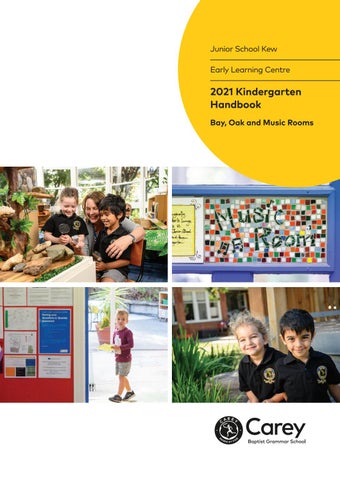
Junior School Kew Early Learning Centre
2021 Kindergarten Handbook Bay, Oak and Music Rooms
ONNECT
2 | ELC Handbook 2021
Contents
●● ●● ●● ●● ●● ●● ●● ●● ●● ●● ●● ●● ●● ●● ●● 2
Welcome to the Early Learning Centre
4
Carey’s Mission Statement
5
Carey’s Charter
6
Introducing our staff
10
Carey Positive Learner Attributes
11
The 100 Languages
12
Carey ELC Philosophy
15
Literacy and Numeracy in the ELC
16
Carey ELC Documentation
20
Carey ELC General Information
23
Carey ELC Health and Wellbeing
24
Sick or Injured Children
28
Carey Term Dates
30
ELC first day checklist
32
Contacts E LC H a n d b o o k 2 02 1 | 1
Welcome to the Early Learning Centre
We hope this information will help you to make the start of your child’s time here a successful and happy experience. We encourage you to read this booklet carefully. You will find any additional information you need on the School’s website www.carey.com.au and from the start of the school year on CareyLink, the School’s intranet. When your child commences at the Early Learning Centre you join the Carey Baptist Grammar School family. We warmly encourage you to become involved and take part in the many events and activities that are offered during the year. Your child’s time at Carey will be greatly enhanced through the partnerships created between your family and their teachers. Our staff create a special place for your child that fosters their natural curiosity and love of learning. Our quality programs aim to maximise each child’s creative and intellectual potential without sacrificing their need for play and exploration. The curriculum offered in the Early Learning Centre responds to and respects children’s interests and capabilities.
2 | ELC Handbook 2021
Finally, do not hesitate to contact your child’s teacher or either of us if you have any queries or concerns about your child’s education. Little concerns only become big ones if they are not dealt with immediately. On behalf of the Kew Early Learning Centre staff, we wish you and your child a happy and rewarding year in Carey’s Early Learning Centre. Wendy Seidler Director, Early Learning Centre
Libby Russell Head of Junior School Kew
E LC H a n d b o o k 2 02 1 | 3
Carey’s Mission Statement We are an inclusive community that celebrates diversity and nurtures the unique talents and growth of each student and member of staff.
Our vision for Carey in the 21st century is that it will continue to be recognised as a leading Christian, co-educational learning community committed to providing the best possible educational opportunities for its students. Learning at Carey will take place in a challenging but safe educational community in which all members are encouraged to enjoy learning, respect each other and love life. At Carey, students will be encouraged to develop an appreciation of Christian commitment and values. They will be challenged to develop the personal and intellectual skills and strategies for service to, and leadership of, a constantly changing society. Academic rigour will be fundamental in all learning, underpinned by a secure, supportive environment that will enable students to become lifelong learners. Carey will also promote global harmony and sustainability to facilitate an intercultural and international understanding and mobility of its students. Members of the School community will develop an awareness of, and respect for, social, economic and cultural differences while gaining an understanding of national and international issues.
4 | ELC Handbook 2021
Co-educational schools prepare students for the world by giving them the chance to practise their social skills within a diverse group.
Carey’s Charter What is Carey? Carey is a leading Christian, co-educational independent school community committed to learning, wellbeing, service and spirituality.
What does Carey do? Carey works in partnership with families to develop wise, independent and motivated young people who will engage with and lead in their local, national and global communities.
Carey values: Integrity …
care, honesty, morality, respect
Service …
altruism, generosity, passion, sustainability
Spirituality …
communal, contemporary, holistic, inclusive
Teamwork …
collaboration, communication, initiative, leadership
Thinking …
creativity, inquisitiveness, intellect, reflection
Wellbeing …
courage, happiness, health, resilience
How does Carey distinguish itself? Learning
At Carey, learning is dynamic, empowering and lifelong. All decisions are taken to improve student learning.
Excellence
At Carey, we strive for excellence across the three Carey pillars: curricular, co-curricular and wellbeing.
Staff
At Carey, our staff are expected to be expert in their fields, collegiate and passionate. They are supported to be the best they can be.
Co-education
At Carey, we nurture a balanced co-educational environment to prepare our students to lead, learn and serve with confidence, capacity and compassion.
Service
At Carey, we actively pursue social justice which is reflective of our Christian ethos.
Innovation
At Carey, we improve through courageous innovation, while respecting our traditions.
Partnerships
At Carey, we build strong relationships based on respect, trust and collaboration.
E LC H a n d b o o k 2 02 1 | 5
Introducing our staff Mrs Libby Russell BArts, GradDipEd Head of Junior School Libby commenced as Head of the Junior School, Kew in 2009. Prior to this she was Deputy Head at Geelong College Preparatory School and Director of Campbell House, the Junior Primary section of Geelong College. Libby comes from a family of educators and has been immersed in education all her life. She grew up in Canberra and literally lived in a school, as her father was Head of Canberra Boys Grammar School. Libby has a History and Visual Arts major from Flinders University, SA and Classical studies from Adelaide University, a Post Grad Diploma of Education from the Adelaide College of the Arts and Education. In 1990 she had a break from education while her children were young and established a small business manufacturing children’s woollen dressing gowns. She is also a keen painter and has exhibited her work.
Wendy Seidler DipTeach (EC), BEd, GradDipChildHlth, GradDipMovement/Dance Director of the ELC / Educational Leader After graduating, Wendy worked in local kindergartens for a number of years teaching threeand four-year-olds. She also ran a small private school and taught Prep. Wendy has lectured in Primary Education at tertiary level, set up a play program in a hospital and worked in a family support service. Wendy has travelled, studied and worked in the USA, UK and Portugal. She has run an early intervention centre and is Founding Director of the Early Learning Centres at Carey Kew and Donvale. Following maternity leave in 1999, Wendy returned to the ELC in Kew in 2000 as both Director of the Centre and mother to Tomas, who graduated from Carey in 2018.
Administrative Support Stella Axup PA to Director of the Early Learning Centre Stella joined the Carey Junior School and ELC in August 2020. Most recently, Stella worked at Deloitte Digital as Business Operations Manager. Having worked across various administrative functions and in project delivery at Deloitte Digital, Stella is well placed to support the Director of the ELC and her team. Stella is married to an Old Carey Grammarian and her father-in-law is also a former student. She has two daughters and brings wonderful energy and enthusiasm to the Junior School and Early Learning Centre and has the capacity to juggle the many demands of a vibrant school community.
6 | ELC Handbook 2021
Music Room (three-year-olds) Julie Coleman DipCommServ(ChildCare), GradCertSocSc Early Childhood Educator Julie comes from a large family and has always enjoyed working with children. She has worked in voluntary and paid employment with young children and adolescents. She commenced in the Staff Childcare Room in 1999. In 2007 Julie returned to the Centre in her previous role, with the addition of a new role as mother to Madison and Charlotte. In 2009 she became mother to Molly and returned in 2010 juggling motherhood and work. In 2013 Julie moved to the Music Room as co-educator working across both groups.
Bec Curtis BEd(Hons), BArts, BEarlyChlhdEd Early Childhood Educator/Assistant – part-time Bec Curtis came to the ELC as a new graduate with a Bachelor of Education (Early Childhood) from Flinders University in South Australia in 2012. She has a wealth of knowledge and a passion for understanding young children, their attachment and communication. She has a warm, caring and calm disposition and values the building of relationships with children and their families. She has grown up with a large extended family and enjoys playing basketball. In her spare time, she enjoys discovering all that Melbourne has to offer. In 2015 she split her role as part-time educator of Music Room children and remains co-educator in the Bay Room. In 2019 Bec took family leave, as she and her husband welcomed their daughter Evie into the world. Bec returned to teaching in the Music Room, part-time in 2020.
Alex Thompson CertIIIChildServ Early Learning Centre Assistant Alex joined the ELC as the General Assistant in 2015 as a replacement for a staff member on leave. Her enthusiasm, new skills and knowledge in early childhood, her genuine commitment to quality education and her ability to juggle the many demands of the diverse role have made her a wonderful asset to the team. Alex has a long history with Carey as the wife of an Old Carey Grammarian and with two daughters who are at the School, having begun their journey in the ELC. Alex’s passion for early childhood education is so strong that she is now studying her Diploma in Early Childhood Education part-time.
E LC H a n d b o o k 2 02 1 | 7
Oak Room (four-year-olds) Robyn Croucher DipEd, BEd, MSpecEd Early Childhood Educator Robyn has taught in country and metropolitan Victoria in local preschools. She was the founding teacher at Carey Donvale where she taught for four years prior to having her own family. She brings a wealth of experience as well as a passion for early childhood education and a joy for teaching. We welcomed her to the Music Room in 2010 and to the Oak Room in 2013. In 2019, Robyn was the Acting Director of the ELC and led the team through the Victorian government Early Learning rating assessment process, achieving the highest possible rating.
Sheila Harkness CertIIIChildServ, CertIVComServ, DipChildServ(EarlyChlhdEdC), BArts(Com)(Hons) Early Childhood Educator Assistant Sheila joined the Early Learning Centre team in 2013. Prior to having her children, she worked in the business sector as a personal assistant. Sheila has worked in early childhood since 2005. She enjoys seeing young children grow and develop during their early years and is passionate about positively contributing to their growth. Sheila has two children and has completed further study in early childhood to gain her diploma.
Megan Birt BEd, BT (EC) Early Childhood Educator – part-time After graduating in 2000, Megan was working with three- to five-year-olds in Sydney. Megan has a passion for working with pre-school children and working in a team. She is always inspired by the children and has been challenged professionally by the work of the centres and educators of Reggio Emilia. In 2006 we welcomed Megan as a teacher of the Bay Room. In 2009 Megan moved to the Oak Room and in 2014 returned to Carey after family leave to work in the Music Room. We are delighted to have Megan return in 2020 to work as the part-time educator in the Oak Room.
8 | ELC Handbook 2021
Bay Room (four-year-olds) Deborah Kondratowicz DipEarlyChlhdEd Early Childhood Educator In 2007 Deb joined the Early Learning Centre team as the teacher of the Oak Room children. She is a highly experienced and committed professional with a wealth of knowledge, having been the Director/Head teacher at several local kindergartens in the southern suburbs for many years. Deb has worked with both three- and four-year-olds and particularly enjoys working with the children in their year before formal schooling commences. In 2009 Deb moved to the Bay Room to work with the part-time four-year-old children. In 2012 we introduced the rotational model and Deb has been the teacher of this program, already being an expert with the format. .
Anna Lee BEarlyChlhdEd Early Childhood Educator/Assistant – Part-time Anna joined the ELC in 2014 and was initially a private English tutor before completing her Bachelor of Early Childhood Education at the University of Melbourne. Anna previously worked in the Royal Children’s Hospital ELC as a Room Leader. Anna is fluent in Korean and has a young daughter and son. She is an enthusiastic, calm and motivated professional. She is flexible and open to challenge and is excited about the prospect of returning to the ELC and the Bay Room.
Kay Thompson DipTeach, DipEarlyChlhd Early Childhood Educator Kay is our qualified reliever in the Bay and Jungle Rooms as well as our lunch reliever. Apart from Kay’s own adult children, she has a wealth of experience working with three- and four-year-olds. She has also been on parent committees of management and her experience and expertise, both as a parent and an early childhood educator, are highly valued in the Centre.
E LC H a n d b o o k 2 02 1 | 9
Carey Positive Learner Attributes Carey Positive Learner Attributes
THINKING
Reflection
THINKING
RELATIONSHIP RELATIONSHIP
Reflection
Communication I understand and Communication I understand and express myself express myself confidently in a confidently in a variety of ways. variety of ways.
SELF MANAGEMENT
SELF MANAGEMENT
I reflect on my I reflect on my experiences and experiences and strengths, looking for strengths, looking for opportunities toto grow opportunities grow in my learning. in my learning.
Knowledge
Knowledge
10 | ELC Handbook 2021
I search for facts and
ideas for which help me I search facts and understand important ideas which help me issues across subjects. understand important issues across subjects.
Imagination Imagination
I use my imagination
I use my imagination to form new ideas, to form new ideas, visualise and explore visualise and explore possibilities. possibilities.
Curiosity
Curiosity
I wonder and ask thoughtful
I wonder and ask thoughtful questions. questions.
Connectedness I always Collaboration trytry to build I recognise and respect Connectedness Collaboration I always to build I recognise and respect authentic relationships others’ viewpoints and I authentic relationships others’ viewpoints and I and I demonstrate contribute in a positive way and I demonstrate contribute in a positive way integrity, empathy, a to the work of a team. integrity, empathy, a to the work of a team. strong sense of fairness, strong sense of fairness, justice and respect. justice and respect. Courage
Courage
I approach uncertainty and am prepared I approach uncertainty toand explore am new prepared opportunities, ideas to explore new and strategies.
opportunities, ideas and strategies.
Resilience
I am able to persevere,
sustain effort and I am able tobounce persevere, Resilience back when experiencing sustain effort and bounce setbacks. back when experiencing setbacks.
The 100 Languages By Loris Malaguzzi, Founder of the Reggio Emilia Approach
No Way.
They tell the child:
The Hundred Is there.
To think without hands
The Child
To do without head
Is made of one hundred.
To listen and not to speak
The child has
To understand without joy
A hundred languages
To love and to marvel.
A hundred hands
Only at Easter and Christmas.
A hundred thoughts
They tell the child:
A hundred ways of thinking
To discover the world already there
Of playing, of speaking.
And of the hundred
A hundred always a hundred
They steal ninety-nine.
Ways of listening
They tell the child:
Of marvelling, of loving
That work and play
A hundred joys
Reality and fantasy
For singing and understanding
Science and imagination
A hundred worlds
Sky and earth
To discover
Reason and dream
A hundred worlds
Are things
To invent
That do not belong together.
A hundred worlds
And thus they tell the child
To dream.
That the hundred is not there.
The child has
The child says:
A hundred languages
No way. The hundred is there.
(and a hundred hundred hundred more) But they steal ninety-nine. The school and the culture Separate the head from the body.
The 100 languages of children are often expressed through drawings, sculpting, dramatic play, writing and painting. These languages are symbolic and are open to the endless potentials in children. This belief is based around the potential of a child’s ability to wonder. It is the belief that there are multiple ways of seeing and multiple ways of being. E LC H a n d b o o k 2 02 1 | 11
Carey ELC Philosophy The beginning of the journey We are committed to developing wise, independent and motivated young people.
How we view the child Each child in our Early Learning Centres is valued for who they are. They are seen as unique and competent with an intrinsic motivation to learn and a reverence for wonder and discovery in their world. We celebrate and acknowledge the diversity of our families. The differences in background, development, personality and ability that every child brings are welcomed. We start with what is present, not what is absent. Each child’s strengths are recognised and nurtured to build a positive sense of self.
Relationships It is important to us that the youngest members of our community feel secure, nurtured, supported and engaged in their learning and play. We build a sense of community and open communication is valued. Key to this is forming and maintaining strong relationships between the child, educators and parents. These strong relationships with families foster partnership, trust and consistency in our approach. Positive communication skills are explicitly modelled and taught to support healthy relationships between children through our play-based program.
Developing a wise, independent student through play Children construct their learning with others through a play-based curriculum that maximises opportunities for them to learn about themselves, others and the world around them in order to create meaning. Complex thinking occurs naturally during play, and thinking is vital
12 | ELC Handbook 2021
to learning. When young children are made aware of their thinking they become more curious; they question the world around them to deepen their understanding. Our approach is holistic. Opportunities to touch, manipulate and experiment with materials; to create; to take turns; and to negotiate are part of the daily experience in our Early Learning Centres. Supported by educators, children become more resilient as they learn to negotiate, bounce back from setbacks and see things from another’s viewpoint. In our Early Learning Centres, we set the foundations for developing principled learners. The notion of right and wrong, empathy and supporting others through ‘doing’ are explored through storytelling, role-play and active projects. Emerging literacy and numeracy skills are strengthened in preparation for school.
Learning through the environment The Early Learning Centre are structured to provide a pathway that supports children to progress according to their developmental needs. We work collaboratively with the children to ensure the physical environment supports their learning. We provide a beautiful, stimulating environment that encourages a sense of awe and wonder that nurtures children’s spirituality both indoors and outdoors. Foundations are built to create a sense of respect, appreciation of and responsibility for our natural environment. Our Indigenous heritage and its connection to the land is recognised and celebrated.
Making learning visible
Early Learning in a school setting
Children’s learning is made visible and celebrated through documentation using photos and transcripts. These records of the learning process as well as the outcomes enable children, staff and parents to reflect on the children’s experiences. They provide the basis for communication and evaluation between staff and the school community.
Our Early Learning Centre children enjoy a rich environment within a co-educational school community. Proximity to other sections of the School allows future years of schooling to be anticipated with enthusiasm. Children’s access to specialist educators, in areas such as music and art, provide opportunities that support the development of the whole child.
Expertise
Collaboration
Expert educators collaborate to provide targeted learning experiences that build on the children’s interests and allow them to thrive as they move through the Early Learning Centre.
We have collaborated with members of our community to build this philosophical statement in 2014 and reviewed it in 2018. We will review it again in 2022.
All decisions are made to improve children’s learning. The National Early Years Learning Framework provides a guide for planning and reflective practice. Further information is available on their website. We have a strong commitment to ongoing professional learning. Our educators constantly renew and reflect on their teaching practice.
E LC H a n d b o o k 2 02 1 | 13
14 | ELC Handbook 2021
Literacy and numeracy in the ELC
Research shows children begin to develop literacy and numeracy understandings from birth. As such, the role that parents and early childhood settings play in supporting children to develop strong foundational understandings is very important. Research also shows that linking literacy, numeracy and play is one of the most effective ways to make learning meaningful and enjoyable for children of this age. With this in mind, in the Early Learning Centre a rich literacy and numeracy environment is created, specifically designed to develop and explore important skills and concepts. Carefully planned learning through play opportunities are provided such as: cutting, pasting, painting, drawing, building, play doh and other fine motor activities. These support the development of dexterity in the children’s fingers and hands, which enables them to hold books, turn pages and eventually write. Making marks, drawing and painting, using different implements and tools and learning that these marks communicate a message, are all prerequisites for learning to write. We engage children in rich conversations in large group, small group, and one-to-one settings. Parents have an important part to play in further developing their child’s vocabulary by spotting opportunities to talk with them and making up stories with them. Numerous enjoyable stories, poems, and information books are part of the daily literacy and numeracy menu. We encourage repeated reading of favourite books as it builds familiarity, increasing the likelihood that
children will attempt to read those books on their own. Children are also regularly exposed to songs and rhymes, as this is a vital stage in the development of becoming an independent reader. Children are also encouraged to engage with materials that promote identification of the letters of the alphabet. We intentionally teach letter names that have personal meaning to the children, for example, ‘Look, Jennifer’s and Joey’s names both start with the same letter.’ Building capacity in number sense is done through games and activities that include naming numbers, using number words and counting. Reading, telling stories, singing songs and reciting poems that include numbers and counting stimulate interest in Mathematics. Playing board games that call on players to count spaces on the board, objects used in the game and to recognise printed numerals or their representations (such as dots on dice) are fundamental skills for mathematical development. Lots of opportunities for hands-on experiences are provided to develop mathematical concepts such as full, empty, behind, in front, on top, underneath and to recognise patterns, numbers, 2D shapes and 3D objects. Hypothesising and asking questions promote problem solving and challenges the children’s mathematical thinking and reasoning. Children are also provided with numerous opportunities to develop core muscles and gross motor skills through climbing, running, balancing and hopping. These motor muscles are important and necessary to manage everyday functions such as sitting upright, attending to and maintaining table top posture.
E LC H a n d b o o k 2 02 1 | 15
Carey Kew ELC General Information This section of the Handbook contains information to assist families in the understanding of current Carey ELC organisational procedures.
Department of Education and Training: Regulations All Early Childhood services in Victoria for children under five are required by law to be registered with the Department. You will find information relating to these government regulations displayed in the ELC foyer. All children attending a four-year-old kindergarten service, whether a government-run or a private kindergarten service such as Carey, are government funded. The funding is allocated per child and paid directly to the School. Sometimes, a child may require a second year of Early Learning before they are ready for school. In such instances, there are specific government criteria that determine whether or not a child qualifies for a second year of government funded Early Learning. Please discuss any concerns you have with the ELC staff. Organisations receiving Early Learning funding from the government are required by the Victorian Department of Education and Early Childhood Development to undertake two data collections each year. If your child is attending another registered early childhood service and is receiving funding for this, you must let the ELC staff know as soon as possible. There is funding allocated for each four-year-old child and it is not possible to claim funding from two centres.
The beginning of the year To help your child make a happy and smooth transition from home to Carey’s Early Learning Centre, we run a staggered intake program, meaning that not all the children in each group start on the same day. This allows the children and staff to get to know each other. The way a child begins the year has great implications for the year ahead. You will be notified by letter of your child’s start date in Term 4. Even if your child has attended kindergarten or childcare elsewhere, the transition to a new setting is both emotionally and physically challenging. Most children are very tired at the end of the day – it is often wise to reduce extra-curricular activities during Term 1, to help compensate for this. 16 | ELC Handbook 2021
Entrance to the Early Learning Centre Please note that main entrance to the ELC is at the rear of Farrer House.
ELC Extended Care – AM Before Care is available between 7.45am and 8.30am in the central space. Please email alex.thompson@carey. com.au or wendy.seidler@carey.com.au by 5.00pm of the night prior. Costs for Before Care will be advised at the commencement of Term 1. Billings will be made through the School’s Accounts Department.
ELC Extended Care – PM Carey offers an After Care Program for kindergarten children which is delivered by the company OSHClub in our ELC (Mon–Fri: 3.15–5.00pm) Bookings are made directly with OSHClub. All students attending must be registered. Parents enrol their children and manage their own accounts and bookings themselves through the OSHClub website. Students can be enrolled on a permanent basis or, if casual bookings are required, by contacting the program co-ordinator on 0423 777 331. Unregistered children are unable to attend so it is a good idea to register your child for the program at the commencement of the year, so if unforeseen circumstances arise, preventing you from collecting your child at dismissal time, you can phone OSHClub to book them in the Junior School Reception to arrange for a message to be given to your child. More information can be obtained on CareyLink and online at www.oshclub.com.au
ELC hours Both the three- and four-year-old programs commence at 9.00am Monday to Friday. If you have children in the Junior School who need to be at school earlier, we welcome their younger ELC brothers and/or sisters between 8.30am and 9.00am to the Centre.
Policies and Procedures
Clothing
All policies and procedures for the Carey ELC and Carey Baptist Grammar School can be found on CareyLink – we encourage you to review these. A hard copy can also be found in the Carey parent library ELC room.
Learning through play is encouraged in the ELC, enabling the children to explore and interact with a range of experiences, activities, and products which can be both tactile and messy.
Sign-in/out book
Parents are encouraged to send their children to the ELC in clothing which provides comfort, durability and can be easy for children to self-manage; clothing with belts, buckles, difficult buttons and overalls can be problematic for children during toileting exercises and dangerous for Early Learning when children climb. Pants which can be pulled up and down are recommended.
Under the Children’s Services Centre regulations, a parent or guardian who brings the child to our Centre and collects them, records the time of arrival and departure. There will be a sign-in/out book outside each room. Please write the exact times of arrival and departure of your child. All adults who will be collecting your child need to be named clearly on the enrolment form before children can be released from the ELC.
Settling children into the ELC For many children, coming to the ELC may be their first separated experience from their parents or grandparents. Prior attendance at a previous childcare or family day care centre does not always guarantee a smooth transition. All children require support in making adjustments to a new environment, educators and a routine. Carey staff recognise these difficulties and the importance of providing a supportive environment for students and parents. Parents can help to settle their child in by practising the following: • On arrival, help your child to choose a learning experience of interest inside the playroom. Join in with the experiences set out in the room for a short time and let your child know that you will be leaving after the activity shared together. • Be confident about leaving your child at ELC (if parents are feeling uptight and anxious, children can sense this and it can easily influence the way the child feels in a negative way). • Take time to bring your child to ELC (if a parent is rushing and drops their child off and leaves quickly, this can influence the way the child feels about being left at ELC).
Children are asked to bring in their bag: • A change of clothing including socks, shoes, singlet, underwear • A sunhat (legionnaire) which is required to be worn from September to April • A school bag (named) • Gumboots, warm hat and coat in winter. All items of clothing must be clearly labelled with the child’s name. Thongs, long dresses and slippery-soled shoes (party shoes, ‘croc’ clogs) are NOT SAFE or suitable for ELC as they can be dangerous when children climb or run.
Carey uniform It is optional for parents to buy the Carey school bag and legionnaire type sun hat. If parents do purchase these items they can then be retained for Prep and subsequent years of schooling. Other optional uniform purchases for ELC students is the ELC polo and fleece jumper also from Bob Stewart. The Carey crested bags and school hats are available from the school supplier, Bob Stewart, 207 High Street, Kew, 9853 8429; or email mail@bobstewart.com.au
• When ready to go, it is important to say ‘goodbye’ to your child and reassure them that you will be back at the end of the day. Some children require time to make adjustments for transition into ELC. Parents are encouraged to take their time with this process, allowing their children the opportunity to settle into their new environment with their teacher and peers.
Dismissal procedure ELC sessions generally conclude with structured. Educators request that parents wait for their child in the ELC foyer. Once educators have sighted a parent waiting to collect their child they will dismiss that child being mindful of everyone’s safety at all times. This is a calm and safe dismissal process and allows each child to individually say goodbye to their peers and teachers before they leave. E LC H a n d b o o k 2 02 1 | 17
ELC absentee
Queries and concerns
In the event of child absentee or late attendance, please notify the School at your earliest convenience with the following information:
If you have any concerns or queries about the ELC, the curriculum or your child, please make a time to talk to your child’s teacher. It is important to talk about your concerns for the benefit of your child.
• Your child’s name/ELC group • Reason for absenteeism • How long your child will be absent (if known) • The name of the person notifying the School The school can be notified by: •
Carey App: Install through App Store or Google Play Store – search for ‘Carey Baptist Grammar School’ then tap ‘install’. ‘Agree’ to permissions of the App. It may ask for you to enter your CareyLink password). Wait for the download to finish. Enter your notification to the school.
•
Email: JSKabsences@carey.com.au
•
Absentee phone line: 9816 1313
If your child will be absent for an extended period please notify the School in writing and address this notification to the Director of ELC, Wendy Seidler, and the Head of Junior School Kew, Libby Russell.
18 | ELC Handbook 2021
Unless a matter needs to be addressed immediately and because we want to avoid interrupting the ELC programs, it is requested that your queries and concerns be raised during an arranged appointment with your child’s teacher.
Lunchtime and snacktime In support of Carey’s health and wellbeing philosophy, Carey Donvale promotes a healthy eating program, supported by the Department of Education and Early Childhood. This program promotes the consumption and enjoyment of healthy foods and the inclusion of fruits and vegetables within healthy lunchboxes. Throughout their ELC day, all children will be required to bring a healthy food snack for morning tea and a healthy lunch and drink (preferably water). Children are required to bring a drink bottle filled with water, which will be available to them throughout the entire day. Parents are encouraged to supply food which is simple, healthy and individually packed for snack time and lunch time. Please ensure that all food is provided in containers easily accessible and clearly named for your child. Suggested food choices include cut-up fruit and vegetables, cheese, biscuits, healthy grain bread, rolls and wraps and yoghurt. Parents are discouraged from including chocolate, lollies and cakes within children’s lunchboxes. Please be mindful that chocolate products may contain traces of nuts resulting in potential anaphylaxis for those students at risk. The ELC ask that these food types be avoided. We also ask that you acknowledge our nut-minimisation guidelines which supports students with anaphylaxis and discourages the inclusion of foods which may contain nut products. Peanut butter, Nutella, hazelnut spread, sesame seed biscuits and hummus in particular are known for having nut-based ingredients. Whilst it is not possible to eliminate all traces of allergens, your co-operation in minimising higher risk food substances from the ELC will assist in the management of student allergies. Food which contains nuts or has not been eaten by the student will be returned home at the end of the day, enabling families to assess food consumption or food choices. Children will also have access to lunch orders from the canteen during the week. Parents are encouraged to consider healthy food options when ordering food for their child – preferably no lollies, icy poles or fizzy drinks.
In addition to these ongoing sustainable and recycling practices, the ELC particapte in the Plastic-Free July initiative where children learn about what the misuse of plastics can do to our precious environment, animals and oceans.
Parent/guardian participation We value parent involvement within our program, allowing for parents and grandparents to share in their child’s ELC experience. Parent participation can provide a valuable opportunity to observe the interactions and progress of your child, and to become involved in the varied activities on offer, such as assisting with cooking experiences, sewing, dancing and art. Our parent volunteer program will commence in Term 2. This allows for a settling-in period for children and teaching staff, whereby relationships can be strengthened and the impact of family separation can be minimised. Parent involvement is limited to one participant each session, allowing for the experience to be maximised by both the student and the parent involved. Parent volunteers are invited to register their interest on the parent roster provided, between the hours of 9.00am and 11.00am. Parent Volunteers – Working with Children Check From January 2019, parents volunteering their time at a school or early learning centre must have a volunteer Working With Children Check. This is free for volunteers and can be organised online (see website link below). For any questions regarding the arrangement of this card, please contact Donvale Reception on 8877 8500.
Birthdays Birthdays are an important event and we enjoy sharing them together. If you wish to supply birthday treats for the class, we require a commercially prepared individual cupcake or small iced biscuit for each child in the group – please discuss this with your child’s teacher. Some successful celebration ideas have been chocolate frogs, icy poles and small doughnuts. Food needs to be commercially packaged with ingredients listed and use by date to support our nut-minimisation policy.
Waste-free lunches and snacks The ELC support the general sustainable and recycling practices across the entire program to help lower the amount of rubbish that ends up in landfill. Additionally, the staff implement intentional teaching about sustainable practices, recycling and caring for the environment, animals and the planet. We encourage you to support this initiative by preparing waste-free lunches for your child. We recommend using segmented lunch boxes and snack boxes for your child and avoid using pre-packaged foods. Cold packs are recommended for use throughout the year to meet food hygiene and temperature standards. E LC H a n d b o o k 2 02 1 | 19
Communication with families
Quiet time
Staff availability
All children are encouraged to have a rest time each day, and all children will need a ‘bag’ for rest time.
ELC teaching staff are allocated weekly scheduled non-contact time. Parents requesting extended teacher feedback are encouraged to schedule an appointment. There will be an opportunity for parents to discuss student progress with teaching staff during mid-year interviews. Electronic communication The majority of Carey’s communication with families is electronic. It is important that you have provided the School with an email address and that you read the Carey Junior School newsletter and ELC communication to keep up to date with information relating to the program and school events. Important communications also come through Daily Messages by email and on CareyLink; our learning management system, Canvas; and the Carey app. Canvas Carey uses Canvas as our online Learning Management System. On Canvas you will find important information, activities and resources specific to your child’s learning in the ELC. Once you are logged in to Canvas, click on Early Learning Centre (ELC) on your Dashboard. There are many guides available online and on CareyLink to assist you in setting up and navigating Canvas. The Carey ICT Help Directory on CareyLink has a wealth of information. Click on the Canvas category on the righthand side to filter the help guides. You can also visit the Canvas community guides for more information on the Canvas basics and how to get started. Carey app The Carey app brings together several key information channels including Daily Messages, the Carey calendar, absentee notification, key contacts, timetable (Middle and Senior School) and sports fixtures (Middle and Senior Schools). You can download the Carey app for both Apple and Android on the App Store and Google Play Store respectively – search for ‘Carey Baptist Grammar School’ and select Install. We recommend allowing notifications from the Carey app. CareyLink The School’s intranet is CareyLink, where you will find all of our policies, staff information, updates from Carey and Daily Messages, among many other useful resources. Daily Messages will be emailed to you at 4.30pm each weekday, but you can also find them on the home page of CareyLink. Navigate to School Sections in the top menu and select ELC Kew for information about the Centre.
20 | ELC H an dbo o k 2 02 1
We also advise including a small favourite teddy or soft toy to help the children relax and get into the routine of rest times. All sleeping bag items will be returned home at the end of each school term for washing.
Toys from home Toys from home are strongly discouraged. Toys which may be precious, valuable or fragile can cause the student distress in the event that items may be broken or become lost. We request that families support their child in keeping precious toys at home.
Movement around campus As part of Carey’s ELC program, the children will attend specialist classes outside the Early Learning Centre rooms. These classes are held in the classrooms of the respective specialist teachers (Art, Music and Library). These various outings may involve walking around other areas of the School and will include the Ready Set Go transition to Prep sessions held in the Prep classrooms in Term 4. The children will leave the ELC as a group and walk to the specialist classroom with two of our ELC staff members. In the event of the absence of a staff member, relief staff will assume these responsibilities. At the conclusion of these classes or activities the children will walk back to the ELC accompanied by the staff.
Parent resources There are many resources that are available to support parents with their children’s learning and development. The Carey Kew Library has several parent resources to support parents with their parenting concerns and to build their knowledge further for the wellbeing and development of their children. We encourage parents to visit the library and borrow resources available. Educators will also support this with links to the latest research and informative articles on child development and learning with their weekly emails to families. Carey Community Forum events throughout the year also provide further opportunities for parents to access with many excellent speakers from across the Early Childhood Education and Development field. These events will be advertised on CareyLink and through other School communication channels.
E LC H a n d b o o k 2 02 1 | 21
22 | ELC Handbook 2021
Carey Kew ELC Health and Wellbeing This section of the ‘ELC Handbook’ contains information to assist families in the understanding of current Carey ELC health and wellbeing procedures.
SunSmart
Immunisation
SunSmart awareness is promoted at Carey, whereby all students participating in outside activities are required to wear a hat from September to the completion of April. Students will also be required to play in shaded areas and have sunscreen applied 20 minutes prior to outside play.
We are required to keep evidence showing your child is up to date with immunisations. If the Government/ Medicare Immunisation History Statement we have on file is current and no vaccines have since been due, you do not need to give us another copy of the statement.
We request that parents complete the Sunscreen Consent located in the ELC Family Information and Consent documentation, permitting staff to reapply student sunscreen, prior to outside play. Children with specific sunscreen requirements are encouraged to provide preferred sunscreen, for student application throughout their ELC day.
Your child’s Government/Medicare Immunisation History Statement can be accessed through your myGov account or the Express Plus Medicare smartphone app.
During the summer months, we ask that parents apply sunscreen to their child at the commencement of their Carey day. Teaching staff will reapply student sunscreen as required, as per the Sun Screen Consent. It is advisable that sleeveless and shoe string tops and dresses are not suitable to wear during this period of high UV ratings and this advice is consistent with our Sun Protection Policy. E LC H a n d b o o k 2 02 1 | 23
Sick or injured children Children experiencing illness or extreme tiredness are often unable to participate fully in the ELC program. If your child experiences symptoms of illness at the commencement of the day ELC staff would appreciate your support by keeping your child at home. Educators will not accept a child into the Centre if the child is not well enough to take part in the normal activities or they require special attention due to illness. To avoid cross-infection between students and staff members, children displaying the following symptoms should be encouraged to remain at home: • Fevers • Nasal discharge (yellow or green in presentation) • Persistent reproductive cough • Sore throats • Extreme tiredness or lethargy • Diarrhoea • Vomiting If your child develops an illness or an injury throughout the day and staff consider them to be unable to participate in the program, you will be contacted promptly on the emergency numbers provided on your enrolment form. If we are unable to contact you, your ‘next in line’ emergency contact will be contacted. If you suspect that your child has an infectious disease, please keep your child at home and/or seek further medical advice. Also, notify the ELC so that we can inform other parents while at all times keeping your details confidential. Please refer to The Victorian Department of Health Infectious Diseases Guidelines for updated information relevant to illness exclusion from the Carey ELC.
24 | ELC Handbook 2021
Gastroenteritis Gastroenteritis presenting in children is a common infection of the bowel, causing diarrhoea, vomiting or both. To minimise cross-infection, parents are requested to keep their child at home until 48 hours after the last episode of vomiting or diarrhoea. For more information, see the Royal Children’s Hospital Kids Health fact sheet on gastroenteritis.
Head lice Head Lice can be a common problem in schools and Early Learning Centres where infestations can be both difficult to detect and eradicate. We encourage all parents to conduct regular inspections of their child’s hair and administer prompt treatment following traces of head lice. Positive sightings of infestation should be reported to ELC staff to prevent further crosscontamination with other students and staff members. Students with head lice are not permitted to attend the ELC with traces of live infestation. For more information regarding the treatment and management of head lice, visit the Victorian Department of Health.
Medication Should a student require medication to be administered during ELC hours, parents are requested to read, complete and sign the Medication record sheet as supplied by ELC staff. All medications, including prescription and nonprescription medication, required to be administered at ELC, must be presented in the original medication bottle, clearly labelled with: • Administration instructions • The student’s name • The medication dosage/clear expiry date • The time in which the medication is to be administered to the student, including the time of the last dosage.
Anaphylaxis Anaphylaxis is a severe allergic condition which involves the respiratory or cardiovascular system. Children with anaphylaxis can react to a range of triggers, including eggs, milk, peanuts, tree nuts, fish, shellfish, wheat and soy. Some children can develop anaphylaxis to insect venom including: bees, wasps and Jack Jumper ants. Exposure to a specific allergen can then result in a severe life-threatening reaction.
Asthma Asthma is an allergic respiratory disorder which affects many children. In order for ELC staff to effectively manage your child whilst in our care we will require the following: • A current Asthma Action Plan which must be completed and signed by a medical practitioner. Please request a blank Asthma Action Plan from ELC staff. • Individual student medication including reliever medication (Ventolin) and a spacer. All children are required under health regulations to provide their own spacers and reliever medication (Ventolin) to remain at ELC for use as directed by the student action plan. Please ensure that your child’s medication is labelled clearly.
If your child has been diagnosed with Anaphylaxis we will require a current Anaphylaxis Management Plan, signed by your allergy specialist or general practitioner. This Anaphylaxis Management Plan will provide ELC staff with the necessary information to manage your child whilst they are at Carey. This action plan must also be accompanied by the child’s preferred medicine including: prescribed antihistamine and an adrenaline auto-injector. Parents of children with a diagnosis of anaphylaxis are encouraged to discuss the management of their child with ELC staff. Carey understands the significance of anaphylaxis and supports children with this condition through the provision of an ‘unassigned’ (back-up) adrenaline autoinjector. This extra auto-injector remains in the ELC at all times for general use in an emergency. All Carey ELC staff hold a current Certificate in Anaphylaxis Awareness and are required to update their knowledge of anaphylaxis on an annual basis.
• Notification of your child’s condition should their asthma deteriorate or there is a change to your child’s asthma status. • All ELC staff are required to have an accredited asthma certification • Annual asthma updates are compulsory for all Carey staff • Emergency asthma kits are readily available around the School for emergency use.
Management of allergies Allergies are common amongst young children and can contribute to a range of symptoms causing mild to moderate discomfort in some children. To effectively support your child’s condition the ELC Director must receive a current Allergy Action Plan on the management of your child. Children’s Services Regulations require all children with allergies to complete an Allergy Action Plan which should contain a current picture of your child and be completed and signed by a general practitioner, and will clearly identify: • Allergic triggers which may contribute to an allergic reaction • Management of your child should the allergic condition progress. E LC H a n d b o o k 2 02 1 | 25
High Temperatures
Hand Hygiene
High temperatures in young children are often the first symptom of illness or infection. Children’s temperatures can alter rapidly which may lead to febrile convulsions. A normal temperature in children is up to 38C. Above 38C requires that parents are contacted, and the child is taken home. If your child wakes with a temperature it is important that they stay home. If paracetamol is administered prior to arrival, we require that it is administered three hours prior to ensure the temperature does not return. Parents are asked to notify staff and fill out a medication form.
Effective hand hygiene is the best way to control the spread of infection. This can be undertaken by using soap and water which removes dirt and germs or by using alcohol-based rubs which reduce the number of germs on the hands. Effective hand drying is essential after a good wash, as damp hands pick up and transfer 1000 times more bacteria than dry hands.
Children cannot attend or remain at the Centre if they: • Have a temperature 38C or over or have experienced a high temp of 38C and over in the previous 48 hours • Experience an episode of diarrhoea or vomiting at the Centre or within the previous 48-hour period • Have a contagious rash • Are unwell in themselves and are not able to participate fully in the program or require constant one-to-one attention • Have a green, runny nose which they are not able to blow and clean hygienically by themselves • Have an infectious disease as per the DHHS exclusion table • Have commenced antibiotics in the last 24 hours.
Children can return to the Centre after illness: • 48 hours after the last episode of vomiting or diarrhoea • If they had an infectious illness, the Director or School nurse may ask the family to provide a medical certificate • 24 hours after commencing antibiotics so that antibiotics have a chance to have an effect • Children cannot commence with paracetamol administration requests unless for a specific purposeteething, immunisation pain at site etc.
26 | ELC Handbook 2021
Cough and sneeze etiquette The correct way to prevent the spread of germs that are carried in droplets is by coughing or sneezing into your inner elbow. The use of a tissue is also appropriate to cover the mouth and then dispose of the tissue into a bin and wash and dry hands appropriately. We appreciate your support in making these good hygiene practices a habit e.g. teaching your child to wash and dry their hands, to blow their noses and to cough and sneeze into their inner elbow.
E LC H a n d b o o k 2 02 1 | 27
Carey Term Dates 2021 TERM 1
Friday 29 January to Thursday 1 April
Public Holidays
Labour Day: Monday 8 March
Good Friday: Friday 2 April
Easter Monday: Monday 5 April
Term 1 Holidays
Friday 2 April to Monday 19 April
TERM 2
Tuesday 20 April to Friday 18 June
Public Holidays
Anzac Day Holiday: Sunday 25 April
Queen’s Birthday: Monday 14 June
Term 2 Holidays
Saturday 19 June to Monday 12 July (three-week school holiday for Carey)
TERM 3
Tuesday 13 July to Friday 10 September
Term 3 Holidays
Saturday 11 September to Sunday 3 October
TERM 4
Monday 4 October to Tuesday 7 December
Mid-term break
Monday 1 November
Public Holiday
Melbourne Cup Day: Tuesday 2 November
Term 4 Holidays
Wednesday 8 December 2021 to Sunday 30 January 2022
28 | ELC Handbook 2021
E LC H a n d b o o k 2 02 1 | 29
ELC first day checklist Before you leave home for your first day in the ELC, make sure you have checked off all the things you need to bring!
• Roll on sunscreen, named • Sun hat, legionnaire style • Water bottle full of water, named • Bedding send in an old pillow case • Fitted large cot sheet • Cot sized blanket or sleeping bag • Soft toy or comforter to sleep with • Full change of clothes in a zip-lock bag • Lunch box packed full with a yummy lunch • A separate fruit snack and savoury snack for morning tea
Please ensure all items are clearly named for hygiene and easy return if they get lost!
30 | ELC Handbook 2021
E LC H a n d b o o k 2 02 1 | 31
Carey Baptist Grammar School 349 Barkers Road Kew Victoria 3101 Telephone: 03 9816 1222
carey.com.au Carey Baptist Grammar School Limited ABN 83 051 576 062 | CRICOS #00135G