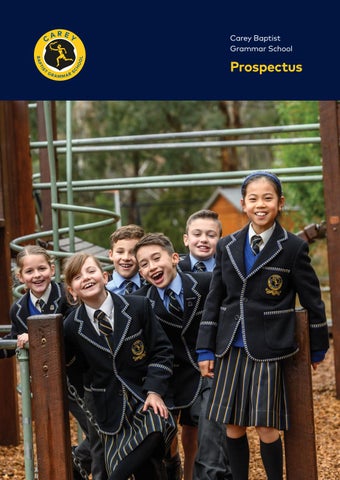
Carey Baptist Grammar School
Prospectus
Scan this code to apply now
Contents 2
Welcome to Carey
5
Why co-education?
9
Wellbeing
10
Early Learning Centres
13
Junior Schools
14
Middle School
17
Senior School
20
Co-curricular
26
Community at Carey
1
Welcome to Carey In our complex and ever-changing world, it’s clear that today’s young people will be faced with a unique set of challenges in the future.
Developing the whole student means looking beyond the traditional measures of success
2
To meet these challenges, fulfil their ambitions and contribute to the wider world, our students need to be equipped with capabilities that will enable them to thrive in a changing environment. We believe that Carey’s educational philosophy is the ideal framework for this. It enables us to adopt a broader expression of success and allows students to leverage their strengths and follow their passions, whether they be academics, creators, innovators or athletes. While we are proud of our strong academic results, we also understand there’s not only one script for success, and that the pathway to personal fulfilment will look different for different students. Developing the whole student means looking beyond the traditional measures of success to also supporting and celebrating achievements of creativity, innovation, aspiration, community, curiosity, and courage. By working in partnership with families, we can equip our students to play an active role in shaping the future and have a positive impact on the world.
The wellbeing of every student is at the heart of everything we do at Carey and our award-winning wellbeing program underpins all our activities. Through nurturing student wellbeing and supporting their individual interests, we foster an environment that enables students to achieve their best while also developing individuals with integrity, resilience and a social conscience. We strongly believe that co-education is a vital part of helping our students to develop who they are from an early age and are proud that our school maintains an even gender balance. By encouraging children to work effectively and respectfully with a diverse group of people, we are encouraging them to embrace differences and to learn to understand and empathise with others.
our care and is testament to our belief in a shared responsibility for creating tomorrow’s thinkers, leaders and positive changemakers. Carey is an engaged community made up of students, families, staff, alumni, donors and friends whose connections extend far beyond the classroom. We offer a range of opportunities for families to connect with each other and experience what it means to be part of the Carey community. We warmly invite you to join one of our regular tours or Open Mornings to learn more about th difference a Carey education makes. We look forward to meeting you soon. Jonathan Walter Principal
Over many years, Carey students have benefitted from the support that comes with being part of a large community. The ongoing and important contribution of our community enables the development and success of the young people in
3
Why co-education? Our co-educational environment provides the best preparation for our students to fulfil their potential individually and as part of their wider communities.
In co-educational schools, girls and boys work collaboratively, exchange ideas and debate issues in a supportive environment. Having both genders present their views adds to the richness and diversity of thinking and learning that benefits every classroom in every school. Students in co-educational schools are given a distinct advantage when they learn to collaborate with each other. In professional environments, men and women work together every day, so students who are introduced to these dynamics early on are better prepared for environments beyond school, such as university and the workforce. The best way for students to master social skills and learn conflict resolution is to practise. Coeducational schools prepare students for the world beyond school by giving them the chance to do so within a diverse group. When students feel comfortable expressing their views in front of their peers, they are more likely to develop healthy levels of self-esteem. Carey aims to show children that men and women contribute equally to society. By teaching them to act with dignity and respect, boys and girls learn to co-operate and participate equally in a wide range of activities.
in music groups, perform in plays and musicals, and share their recreational spaces. All students should interact with each other as equals in all aspects of their lives. In doing so, they build a sound platform for personal growth, peer connectedness, relationships with others, and the development of appropriate value systems.
Co-educational schools prepare students for the world by giving them the chance to practise their social skills within a diverse group.
Outside of the classroom at Carey, girls and boys stand side-by-side in leadership positions, play sport, attend outdoor education camps, combine 5
6
Wellbeing
Thriving together We are an inclusive community that celebrates diversity and nurtures the unique talents and growth of each student and member of staff.
Our students are at the heart of everything we do at Carey. We recognise that student wellbeing is of utmost importance when developing wise, independent and motivated learners. Carey’s award-winning wellbeing program is holistic, integrated and takes a multidisciplinary approach. All staff are responsible for student wellbeing, and are trained to deliver best practice pastoral care to each student. Our aim is to provide support for all students, and to differentiate this based on the type and amount of support the individual needs. The program provides learning opportunities to develop cognitive dispositions and resilience in all students, and is also explicit in providing reactive support to students whose mental health may be declining. This approach is supported through a wellbeing curriculum initiative as part of our preventative strand in the pastoral area. Each week 1.5 hours is devoted to House time, with part of this time used to deliver a wellbeing curriculum by school psychologists and House staff based on identified need and developmentally appropriate topics. The wellbeing curriculum is built around nine Attributes of a Positive Learner that Carey has identified as crucial for the development of each student, regardless of their age. These Attributes are grouped into three domains:
• Relationships: Connectedness, Collaboration, Communication • Thinking: Reflection, Imagination, Curiosity • Self-management: Courage, Resilience, Knowledge The Attributes are intertwined in all learning at Carey, with the intention to develop the students’ emotional intelligence and life skills. Students are not just seen as consumers of educational services, but as whole people whose needs are supported by the following key components: • An overarching program for all students, scope and sequenced throughout the School, delivered as proactive measures in addressing mental health. • A highly structured and purpose-driven House system underpinned by the School’s values and mission, including referencing Carey’s Attributes of a Positive Learner. • An integrated approach to student support where professional wellbeing staff work collaboratively in a multidisciplinary team to provide case management and education services. • Responsive intervention for students with poor mental health through a highly resourced department of wellbeing professionals. • Targeted staff professional development and training designed to support Carey’s positive education program. 9
Early Learning Centres Kew and Donvale
We are committed to developing wise, independent and motivated young people.
Our Early Learning Centres (ELC) house three and four-year-old Kindergarten and are designed and furnished to provide environments that are comfortable, secure and stimulating. We welcome the differences in development, personality and ability that every child brings to the school setting. Each child at Carey is valued for who they are and for what they know. The children in our ELC are encouraged to be co-constructors of their learning, enabling their journey of discovery to follow their interests and enthusiasms, rather than following a predetermined syllabus. Several learning areas are drawn together to explore ideas presented by the children. Emotional literacy helps children identify their own feelings and acknowledge the feelings of others, which is encouraged through role play using props and shared reading experiences. Social development and familiarity with a peer group not only foster friendships but, with support and guidance from staff, children learn strategies for entering play, expressing their ideas and solving social challenges. Music is an important part of the ELC program and takes in all areas of development – social, physical, emotional, psychological and intellectual. Our kindergarten children also have access to exceptionally well-resourced art studios that allow them to undertake open-ended experiences. 10
Fine motor skills (i.e. movements that coordinate fingers and eyes) are developed through drawing, painting, construction and puzzles. It is these skills that are needed to tie shoelaces and fasten buttons or zips. Gross motor skills (i.e. movements that use the large muscles of the body) are developed through balancing, crawling and climbing on the equipment in the wonderful adventure playgrounds at Kew and Donvale. Management of the transition from one section of the School to another has a high priority at Carey. For ELC children, familiarity with the rest of the School allows the future years of schooling to be anticipated with enthusiasm. During Term 4 of the preceding year, children in the four-year-old Kindergarten visit the Prep classrooms. There they meet the Prep staff and discuss what will be the same and what will be different when they begin formal schooling. Physical Education, Music, Art and Library visits are also arranged to familiarise the children with the areas they will have lessons from Prep onwards. These youngest members of our community are supported to be curious, imaginative and courageous from the moment they enter our school.
Junior Schools Kew and Donvale We are progressive and aspirational.
While each of our Junior Schools has its own distinctive character, both follow the same curriculum and educational philosophy. Teaching and learning is fun for both the students and their teachers. It is balanced in its approach using both inquiry and explicit methods in responding to the needs, ideas and interests of the children. Learning is often integrated. For example, a study on the human body may utilise technology for research in a variety of ways, and incorporate measurement tasks, art projects, written work, movement, research and presentation skills. Our core focus is helping our students to become literate and numerate. Literacy and numeracy blocks are planned for each day in which whole class, small group and individual teaching is conducted. The curriculum is differentiated within the classrooms to cater for the abilities of all students.
transformed the way that teachers and students interact with technology on an everyday basis. It allows students and teachers to be more creative. Rather than just interacting with software or websites, students create stories, presentations, comic strips, movies and podcasts. Helping our students develop a strong moral compass is also an important goal. This includes navigating the digital world where students are supported to be both safe and ethical in their use of digital communication tools. Creativity and intellectual character are fostered in a broad curriculum delivered by specialist teachers in Art, Music, Library, Physical Education and LOTE (Mandarin Chinese). Wellbeing, a sense of service and spirituality are explored and nurtured through the House program, Community and Religious Education, chapel services and assembly.
The program is also enriched with opportunities to learn beyond the walls of the classrooms. Excursions take the children off campus to learn about the community, into the environment to explore ecosystems, and into the future through virtual journeys around the world. In classrooms, the internet brings the children into the global community. Both Junior Schools operate an iPad program for all students from Prep to Year 6. This has 13
Middle School Years 7 to 9
We challenge our students to embrace the broad range of opportunities provided by the School.
At Carey we believe every student should feel empowered and confident that they have the skills, knowledge and attributes they need to have a positive impact on the world. Giving the child agency over what and how they are learning is crucial to this endeavour. A key component of the Middle School is the blend of core subjects with an extensive range of electives. The teaching and learning environment offers an exceptionally broad range of study options to inspire and encourage all students. Carey’s Middle School is also an environment that provides support, guidance and caring concern for each student. Year 7 is a mix of students from schools other than Carey, plus those moving into Middle School from the Junior Schools at Kew and Donvale. This is an exciting new stage in their education. We are conscious of the need for Year 7 students, particularly those new to Carey, to establish or expand friendship groups in their new environment and our primary concern is that every student is looked after. Our comprehensive transition program is important and highly regarded, beginning early in the year prior to entry. Incoming students and their families are invited to several major events towards the end of the previous year. By arrangement with parents and the principal of the relevant school, Year 6 students transferring to Middle School from outside Carey are visited 14
at their primary schools by a Middle School staff member. They are accompanied by one or two current Year 8 students who, as Year 9 students, will have a role as ‘buddies’ helping the new Year 7 students settle in. Our aim is that by the time the first day of school arrives, incoming students already feel part of the Carey Middle School community. Our programs accommodate all levels of ability and interest, and allow students to explore new areas of endeavour. We challenge our students to embrace the broad range of opportunities provided by the School. All students in Middle School use their own notebook computers to support their learning and there is access to the staff in the ICT Support Centre for assistance. The latest technology has been installed in classrooms to allow for the integration of resources in a variety of media. There are exciting changes ahead in Carey’s Middle School! The major redevelopment of our Middle School will enable generations of students to benefit from a purpose-built environment at a pivotal point of their maturity and growth. The project includes engaging educational spaces for new and emerging technologies, learning precincts specifically designed for areas such as science and the arts, and increased outdoor and social space. Construction is scheduled to be complete by the end of Term 1 2020.
Senior School Years 10 to 12
We build on our students’ individual qualities to develop young women and men who flourish and can lead and serve with courage, compassion and intelligence.
As is the case throughout Carey, the Senior School boasts outstanding curricular, cocurricular and wellbeing programs designed to accommodate individual interests and abilities. A Year 10 program caters for a range of skill levels, and academic, co-curricular, vocational interests and social development for students moving into our Senior School from Year 9 at Carey and elsewhere. There is flexibility in the program which enables us to personalise the learning experience to ensure that individual needs and interests are met. Students in Year 11 and 12 study for either the International Baccalaureate Diploma (IB) or the Victorian Certificate of Education (VCE). The IB is a two-year qualifying diploma, which provides academic challenge and community service opportunities. Alternatively, they may choose from a wide range of VCE subjects, which can be completed over two or three years and can include Vocational Education and Training (VET) studies and the University Extension program. The University Extension program caters for Year 12 students with a passion for learning and the desire to extend themselves beyond that which can be achieved through the normal Year 12 program. The program has a number of benefits: an increment on the student’s ATAR (Australian Tertiary Admission Ranking) of up to 5.5 points and inclusion in a special category that may draw
the attention of selection officers for tertiary institutions. Carey’s Year 12 classes regularly record academic results that place the School among the top Victorian and Australian schools. Usually, close to half of the students achieve ATAR scores equal to or more than 90 (that is, in the top 10% of the State). All students select a summer and winter activity from a breadth of offerings; including interschool sporting competitions, dynamic music groups, plays, musicals and debating are delivered by specialists in their field. Add to this an exciting Outdoor Education program in Year 10 and the opportunities are extensive. Carey takes great pride and pleasure in welcoming students from around the globe. Approximately 60 international students form part of our Senior School, bringing a cultural richness to the student body. By the time our young men and women are ready to leave Carey, they are self-assured, self-reliant, self-directed learners with an awareness of the local and global communities of which they are a part. They are ready to meet the future – whatever it may hold.
17
18
Co-curricular
Learning beyond the classroom A Carey education is about more than just academic studies. Preparation for future life must include an awareness of the importance of maintaining a balance between intellectual and physical stimulation, ‘left brain’ and ‘right brain’ activities, study and recreation. Under the co-curricular umbrella, Carey students involve themselves in music, drama, community service, debating, theatre production, outdoor education, sport and several other activities promoting physical activity such as yoga, dance and bike riding.
20
All students in Middle and Senior Schools must elect a summer and winter activity, and most will explore well beyond the minimum requirement. It is not unusual to continue a year-round participation in aspects of the performing and creative arts, and to balance this with an involvement in a diverse range of sporting activities chosen from a list of more than 20.
Sport As a member of the Associated Public Schools (APS) of Victoria, Carey competes in Saturday fixtures in many sports. The boys teams compete against schools in the APS, while the girls teams compete against schools in both the APS and the Associated Grammar Schools. Coaching and training take place either at the Kew campus or at our Carey Sports Complex at Bulleen. The Carey Sports Complex is magnificent. Set on 14 hectares close to the Eastern Freeway, it comprises a 25-metre indoor swimming pool and separate diving pool with seating for 250 spectators, a gymnasium, weight training room, four ovals, three turf wickets, tennis courts, two soccer fields and a rugby field. The Complex regularly wins awards for its water quality and the standard of its grounds.
Preparation for future life must include an awareness of the importance of maintaining a balance between intellectual and physical stimulation.
21
Music Performance opportunities come in many forms at Carey. The Performing Arts have a high profile and we are proud of our extensive and highly regarded range of music and drama programs within the curriculum and as co-curricular activities. Students perform from an early age, and our choirs and orchestras feature at many celebrations in and beyond the School. Our programs offer classroom music, private tuition and an exceptionally broad range of co-curricular events. More than 40 music groups cover the spectrum of music styles from rock and jazz to the Symphony Orchestra and Show Band. Opportunities for involvement in choral groups begin in the Junior Schools and continue to Year 12, in groups of differing sizes and repertoires.
Theatre Theatre has long been a Carey tradition and has earned a reputation for productions of great professionalism. Involvement in musicals is open to students as performers or musicians. Those who would rather work behind the scenes are also well catered for, and have the benefit of excellent technical facilities and advice. As our young people grow, so too do the opportunities for them to quench their thirst for adventure, challenge and new experiences. Recent productions include Monty Python’s Spamalot, Mary Poppins, The Cruicible, The Complete Works of the Brothers Grimm, Chicago, Hairspray, The Wizard of Oz, Les MisÊrables and Guys and Dolls.
Outdoor Education Outdoor Education is part of the curriculum for students from Year 4 to Year 10. It is a holistic study combining education of the mind, body and spirit – and it is also great fun. Camps at a variety of sites at different times of the year ensure that a wide range of experiences are offered. Outdoor Education provides our students with many important and fun-filled experiences, as they grow from children to young adults. They will make decisions, learn new skills, discover the link between action and consequence, be immersed in the beauty and importance of the natural environment, struggle now and then, and relish the chance to spend time with peers and adults in different and often challenging circumstances.
Outdoor Education is a holistic study combining education of the mind, body and spirit – and it is also great fun.
Community Service We encourage students to think about the world outside of their own experience.
Engaging students in social justice is key to developing young global citizens who are inspired and equipped to create positive change in their communities. We encourage students to think about the world outside of their own experience. Community service starts from the Junior School, with wholeschool participation in fundraisers and awareness campaigns, open discussion about current issues, and active service to the local community. When they move into the Middle School, students have more autonomy over choosing the causes they want to support. By the time they reach Senior School, most of our students choose to volunteer in their own time on projects like the Homework Club. In this program, our students spend one afternoon a week in Fitzroy Town Hall, helping refugee children with their homework. We also offer opportunities for students to travel to communities in need around the world, such as Nauru.
25
Community at Carey Feel connected
Carey is a positive and engaged community made up of our students, families, staff, alumni and friends whose connections extend far beyond the classroom.
Key to fostering an inclusive, engaging and thriving community is a school partnership with our many and varied community groups including students, families and staff; past, present and future. We value our enduring connections with every Carey community member and welcome their involvement and participation.
reunions taking place in the seven states and territories and 13 countries. We engage with our alumni through regular reunions and invitations to key Carey events, and through our new Young Alumni program, we provide mentorship, careers nights and opportunities for new Old Carey Grammarians.
Our current Carey families are engaged and supportive. Our four school section-based parent associations welcome all parents and guardians, providing a support network and regular social events for parents and friends. We also have a number of community groups relating to cocurricular activities, including the many sports groups, Friends of Carey Music and the Carey Theatre Association. Volunteers in these groups help to organise events, raise funds for student programs and activities, and engage in numerous social occasions throughout the year. To support our international and interstate community, the Carey Local and Overseas Student Association (CLOSA) is a group which helps new families to settle into life at Carey, make friends, and engage in a wonderful array of group activities and multicultural events.
Carey was founded on the generosity of donors, and nearly one hundred years on, our students continue to benefit from a supportive giving community. Philanthropy plays a vital role in ensuring a Carey education is the best it can be for every student. At Carey we believe we have a shared responsibility for creating the citizens of tomorrow. Our donor community brings this vision to life by contributing to a range of initiatives including scholarships and inspirational learning spaces and facilities.
Carey maintains a close relationship with its alumni body through the Old Carey Grammarians Association (OCGA). This group is an engaged and diverse community of alumni, made up of over 18,000 members. The OCGA is represented locally, domestically and internationally, with 26
We look forward to welcoming you to our Carey community!
28
Find out more We hold many information sessions for prosective parents throughout the year, in addition to our Open Mornings and private tours of the School. If you would like more information about our school, how to apply or any other queries, please visit our website or contact our Admissions team. Admissions 349 Barkers Road Kew Victoria 3101 Website: carey.com.au Phone: 03 9816 1242 Email: admissions@carey.com.au Or, you can scan this QR code to take you directly to our enrolment procedure and policy page.
Connect with Carey Facebook: @CareyBaptist Instagram: @careygrammar LinkedIn: @careygrammar
Carey Kew
Carey Donvale ELC and Junior School 9 Era Court Donvale Victoria 3111 Telephone: +61 3 8877 8500
carey.com.au
CRICOS # 00135G • ABN 83 051 576 062
ELC, Junior, Middle and Senior Schools 349 Barkers Road Kew Victoria 3101 Telephone: +61 3 9816 1222
1908-17