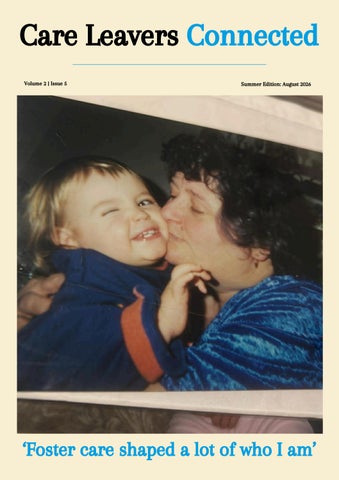
Care Leavers Connected Volume 2 | Issue 5
Summer Edition: August 2026
‘Foster care shaped a lot of who I am’
Inside this Issue
Phil, Archie and Luke completed an epic trek from Aviemore to John O’Groats in aid of The Care Leavers Association
3
Welcome Care Does not stop at 25
11
Care leaver culture Care leaver representation in the arts and media
4
Latest news and events Updates from the project
12
Care leaver voices Dylan’s story of how foster care shaped him
Creative corner Sarah May shares her poetry
5
12
Health & wellbeing Small steps
Summer holidays and being in care Jim’s story
13
Policy and practice Ceremony of Belonging
8-9
Hoarding Long term health issues
14
10
How to get involved Ways to get involved in the CLA
Parenting Terri -Anne’s fellowship findings
6-7
If you simply don’t have the time to get actively involved in the CLA, but you still want to support our work, you could think about making a donation. All donations will go towards helping the CLA run projects and campaigns for care leavers
2
Welcome “Every chapter tells a part of our story - not just where we’ve been, but who we’ve become” Welcome to the Summer Edition of Care Leavers Connected. Summer is often associated with holidays, celebrations, family gatherings, and creating memories. For many care-experienced people, however, these moments can bring a mix of emotions. While they can be times of joy and connection, they can also prompt reflection on the people, places, and experiences that have shaped our lives. This edition explores some of those experiences through the voices of care-experienced people themselves. In this issue, we hear from contributors reflecting on how foster care has shaped who they are today. Their stories are honest, thoughtful, and deeply personal, highlighting the lasting impact that care can have on identity, relationships, resilience, and belonging. We are also pleased to share a piece from Jim, who reflects on summer holidays and his experiences of growing up in care. His story captures the unique memories and emotions that this time of year can hold and reminds us that our experiences of childhood are rarely one-size-fits-all. Elsewhere, we explore the Ceremony of Belonging, an initiative designed to recognise and celebrate children and young people in care. While the intentions behind such events are positive, they have prompted a range of views within the care-experienced community. In this edition, we share some of those perspectives and encourage thoughtful discussion about what belonging means and how it can best be nurtured and recognised.
I Alongside these features, you’ll find poetry from careexperienced writers and reviews of literature written by and about people with care experience. These creative contributions offer insight, challenge, comfort, and inspiration, and demonstrate the power of storytelling in all its forms. As always, thank you to everyone who has contributed to this edition. Your experiences, creativity, and reflections continue to make Care Leavers Connected a space where care-experienced voices are heard, valued, and celebrated. We hope you enjoy reading.
If you are reading a hard copy of this magazine and need any of the links included, please contact connected@careleavers.com
3
Latest News New Guidance Strengthens Local Offers for Care Leavers From 30 September 2026, local authorities in England will be expected to implement strengthened Local Offers for care leavers, with a greater focus on helping young people transition successfully into adulthood. The updated guidance highlights the importance of clear plans around accommodation, preventing homelessness, financial literacy, and practical support for independent living. (GOV.UK)
Funding for New Guides We are so pleased to announce that we have been awarded the funding for a project to co‑produce a series of six self‑help guides with young care leavers aged 16–25. They will focus on aspects of independent living : managing finances, securing and maintaining housing, improving health and wellbeing, accessing education and training, navigating the youth justice system and building positive relationships.
Family Finding Programmes expanded The Government has announced an expansion of family-finding programmes, helping children in care and care leavers reconnect with relatives, former carers, teachers and other trusted adults who have played an inportant role in their lives. Read more here.
We understand that some of the articles in this magazine are about sensitive issues. If you need any support please contact us on 0161 826 0214 or email connected@careleavers.com or on social media. If you need urgent support please contact the Samaritans on 116123.
4
Care Leaver Voices ‘foster care shaped a lot of who I am’ Growing up in foster care shaped a lot of who I am. I was lucky in one very important way—I only ever had one foster family. They had four kids of their own, but they never treated me differently. From the moment I arrived, they made me feel like one of them. Their kids treated me like a brother, and their home truly felt like mine. Growing up, there were times when I questioned things like “Why has this happened to me” Things like monthly checks and visits remind you that your life is different. However, I had a good experience at school and was lucky to have a solid group of friends. They never treated me differently because I was in care; if anything, we just joked about it most of the time I think that was just our humour. Having mates who could have a laugh with me made everything feel more "normal." I realised how lucky I was to have amazing foster carers who gave me stability. To me, they were never just foster carers—they were my mum and dad. I do tend to overthink things, and anxiety has been a part of my life, but I’ve learned it’s okay to feel that way. I was really close with my foster mum and she always told me if I was ever in that situation to just talk about it so that helped me a lot.
Sadly, I lost both of my foster parents at a young age, which was incredibly difficult. But everything they gave me, their love, and support is something I carry with me every day. So I do my best to make them proud. Sometimes being in care gives you that extra chip on your shoulder. You feel like you have to work twice as hard as everyone else just to prove yourself.
Today, I’m a self-employed joiner and I’m renting my own flat. I’ll be honest—it’s stressful, but I manage it because I know I have to. I’ve also been lucky enough to travel to many different cities, and I have an amazing girlfriend who constantly supports me. What I’ve learned is that it’s okay to be different. Not everyone grows up with the same family situation, but different doesn’t mean worse—it’s just a different path. And sometimes that path is still filled with love, adventure, and the drive to build a future you're proud of. Dylan
Care Leavers Connected Magazine is produced by care leavers for care leavers. Please read through the magazine and give us feedback.
5
Summer Holidays and being in care “I’ve chosen these two photographs because they illustrate a theme about life in care that isn’t usually captured by photographs and is, in fact, often hidden by them” Most of us, when in care as children, will have been taken on summer holidays. Back then, a common holiday destination was Butlin’s or Pontin’s or caravan parks on the coast. I was living in a Family Group Home throughout the 1970s. This was a children’s home set within a normal house. In my case this was a council house in Birkenhead. The house could take no more than six children at any one time, though at least fifteen different children passed through the home during the decade I was there with my brother.
The two photographs are from one of our summer holidays to Butlin’s. I think I’m around 13 years old so it would have been in about 1976 (that famously hot summer of drought, much like the present one). I’ve chosen these two photographs because they illustrate a theme about life in care that isn’t usually captured by photographs and is, in fact, often hidden by them. In most photographs from my time in care I am smiling. The smile is usually fake but I was good at faking smiles as I had a lot of practice. The woman who ran the children’s home for almost all of that decade should not have had a job looking after children in any capacity. It is safe to say that most of us who lived in that home were terrified of her unpredictable moods and their equally unpredictable consequences. In the more public setting of a holiday this woman was more inclined to restrain her moods. However, I remained terrified of her. Hence the difference between these two photographs. I’d been entered in a Butlin’s children’s fancy dress competition. I’d been given no choice or warning and hated the idea of being so visible. I have no idea where the costume came from. I had to go alone, which I didn’t mind. The woman who ran the home took the first photo, before I set off. Hence my reasonably cheery demeanour. The second photo was taken at the competition, probably by one of the professional photographers that Butlin’s employed. I knew that my bandana had come undone and that I probably looked a bit silly.
6
Summer holidays and being in care... However, I was so terrified of doing anything without the permission of the woman who ran the home that I couldn’t bring myself to tighten it. I was essentially a fearful robot at that point. I could not, though, prevent at least some of my unease being reflected in my expression. I’m sure that others who grew up in care will understand this difference between how holidays in care can appear on the surface in photographs and what the reality of those holidays might be like behind the photographs. That’s why I wrote this story.
Super Hero Fundraisers Nearly 200 miles, 12 days, and £655 raised, thank you Phil, Archie and Luke! We are so incredibly grateful to our three amazing walkers, who have just completed an epic trek from Aviemore to John O’Groats in aid of The Care Leavers Association and what a journey it’s been! They battled torrential rain, wild camped through cold nights and rising tides, pushed through ticks, blisters, trench foot and injuries, and even survived an ambush by Arctic Terns all without losing their sense of humour or spirit along the way. Their camaraderie, determination and good humour carried them through some genuinely tough conditions, and we couldn’t be prouder of what they’ve achieved. Some of the magic they encountered: An unexpected invite into the actual Traitors castle for water, Wild camping under incredible far-north skies, with 3 extra hours of daylight compared to London, seals, a whale, swarms of butterflies and centuries of pre-history, pub stops to watch England, France and Argentina including a landlord who donated £40 and protein bars to the cause
Kind strangers donating £85, buying meals, and opening up village halls and beer gardens to help them along the way. A huge thanks also to everyone who sponsored them, hosted them, fed them, or simply cheered them on — this incredible community effort has raised £655 for care leavers. Phil, Archie and Luke thank you for your dedication, your fundraising and for representing us so brilliantly. Support the walk and read more here.
7
Hoarding I guess I have always had a problem with hoarding. I just didn't realise that’s what it was at the time. As a child, I filled my bedroom up to the ceiling with old newspapers, magazines, and all kinds of detritus. To me, it wasn't junk. It consisted of items I had a deep emotional attachment to. Looking back, it was a way to protect myself from the abuse I was experiencing. I hoped my abusers would leave me alone if they were repulsed by me and the state of my room. During this time, I was severely depressed. I stopped washing, dressing, or taking care of myself. I was also living with my grandparents, who gave me no privacy whatsoever. They would read my diary, look through all my things without telling me, and share my private information with my abuser. Eventually, I was taken into care, and I lost everything. All of my possessions and clothes were taken from me. In the 1980s assessment centres, children in care were stripped of their identity and given a number instead. Mine was Number 10. This led to a permanent placement in a "family" group home. It was a children's home that was anything but a family. It was totally dehumanising. By this point, I was completely used to feeling insecure and having absolutely nothing of my own. Because of this, I started to cling to anything I thought might be useful for repurposing later. A plastic fork, a blob of Blu-Tack—nothing was off-limits. I even tried to save uneaten food for later, but I never got to keep anything. Someone would always take it away.
8
When I left care, I faced years of living in homeless hostels and insecure, poor housing across Manchester. That is when I started to build up my collection of "stuff" again. During this period, I endured frequent burglaries, which were deeply traumatic. Waking up to find all my possessions stolen while I slept left me feeling incredibly scared and vulnerable.
To cope, I started filling my house with hoarded items and cardboard boxes. I tried to convince myself that I would use the boxes to store things away in some kind of order. I also bought items when I was depressed just to cheer myself up. Looking back, I think I was so terrified of being burgled again that I wanted the place to be in a total state of disarray. I hoped it would deter thieves, or at least make it too difficult for them to find anything to steal. Over the years, the situation grew into the terrible state I am in now. For example, years ago, before I became severely disabled, I used to look for work. The Manchester Evening News ran a job page every Thursday, so I would buy the paper every single Thursday without fail. I also bought all the weekly women's magazines that came out on the same day. Even though I stopped reading them years ago, I kept buying them out of habit. I refused to throw them away, so the piles just grew and grew until they reached the ceiling. You may think this was a massive waste of money. But if I tried to stop buying them, or tried to throw them away, it felt like someone was cutting off my arm. I was overwhelmed by a deep feeling of dread, convinced that something terrible would happen if I let them go.
Hoarding I have a lot of rituals that I must go through. Some of you might recall the old TV series Lost, where people stranded on an island after a plane crash took turns pressing a mysterious red button. They didn't know what the button did, but they were terrified of what would happen if they stopped pressing it. That was me. I felt like I had to keep doing it. Perhaps this is due to my autism, or perhaps it is unresolved trauma. It is incredibly unhelpful when someone simply says, "Just get a skip and throw it away." These are things I have built up over decades. I have a deep emotional attachment to them. If I ever tried to throw them away, I would panic and immediately retrieve them from the bin. I tried to get help from mental health services, but I was refused countless times. I then contacted adult social care for assistance. Instead of offering me support, they reported me to my housing association for hoarding, treating it as a breach of tenancy. I was horrified. The very people I asked for help put me at risk of eviction. This is the stressful situation I am trapped in today. Because of this, I can never let anyone into my property. I live with an overwhelming sense of shame. Some visits are mandatory, like the annual gas safety check. I live in a state of absolute dread when the engineers come, terrified that they will complain and report the condition of my home. When my boiler stopped working, I had to live without heating for a whole year. The engineers needed to get to the radiators, but they were completely inaccessible. My property is quite small, and every conceivable space is filled. For instance, I have piles of clothes that I bought from charity shops over the years. I have never worn them because my autism makes me highly sensitive to fabrics and how they feel on my skin.
As a result, I often end up never getting dressed, or wearing the exact same outfit over and over. Yet, I still cannot bear to get rid of them. Another example is a collection of old Sindy dolls I bought as a kid, which I always intended to restore as a project. I am now at the stage where it has become too overwhelming. I simply do not know where to start to clear it all. To complicate matters, I have become too disabled and in too much pain to tackle it myself. It has become a serious safety hazard. I cannot get in and out of bed properly, items keep falling on top of me, and I am at a constant risk of falling. On top of that, I have cataracts and I am struggling to see. I have done a lot of research into what help is available, but it depends entirely on where you live. While there are informal support groups in some areas, not everyone wants to be in a group setting. Many people need compassionate, one-to-one support. Some councils and landlords take an aggressive stance, forcing people into enforced clean-ups or threatening eviction. Thankfully, others realise that hoarding is officially classified as Hoarding Disorder— a recognized mental health condition. Under the Equality Act 2010, landlords and local councils have a legal duty not to discriminate. They must offer reasonable adjustments and must not rush to evict vulnerable tenants. They need to offer genuine support. Forcing people to clean up simply does not work. If you do not address the underlying trauma and root causes, the cycle will just start all over again. Debra Need help: Hoarding UK Phone: 020 3239 1600 (Monday to Friday, 10am to 5pm) Email: info@hoardinguk.org Hoarding Disorders UK Phone: 0330 133 2310
9
Parental Empowerment Breaking Cycles, Building Futures When people ask me what the biggest thing I learnt during my Churchill Fellowship was, they often expect me to talk about Denmark or Jamaica. And don't get me wrong, both countries taught me an incredible amount. I met passionate professionals, inspiring organisations and communities doing amazing work to support children and families.
As care-experienced people, our need for belonging doesn't expire because legislation says we've reached adulthood. Trauma doesn't work to statutory timescales. Neither does grief, becoming a parent, losing someone you love, changing careers or simply having one of those weeks where everything feels too much.
But somewhere between Copenhagen and Kingston, I realised something. The thing I had travelled halfway across the world looking for had been sitting in front of me all along.
The support we need changes throughout our lives, but the need for connection remains. That's why my fellowship has strengthened my vision for a Lifelong Village of Support. Not another service. Not another professional coming in to fix us.
The Connected Community. For the past few years at the Care Leavers Association, I've had the privilege of walking alongside careexperienced adults from every generation. Some join us because they're lonely. Some because they're struggling. Some because they simply want to laugh with people who "get it." What keeps bringing them back isn't the Zoom link. It isn't the activities. It isn't even us….It's each other. I've watched people who had never met before become genuine friends. I've seen members celebrate birthdays together, support one another through bereavements, encourage each other into education and employment, swap recipes, share parenting advice and check in when someone goes quiet. No one told them they had to. They simply became a village. Travelling overseas reinforced something I've always believed: healing doesn't only happen through services. It happens through relationships. In Denmark I saw systems investing earlier in families. In Jamaica I saw communities stepping in where formal systems couldn't always reach. Across both countries, one message kept coming back to me. People need people. Not just until they're 18. Not just until they're 25. For life!
10
But a place where care-experienced people can dip in and out throughout their lives. Somewhere that understands our stories without us having to explain them every time. Somewhere that celebrates the good days and catches us on the difficult ones. The beautiful thing is, we're already proving it's possible. Every Connected Community session reminds me that belonging isn't something professionals can manufacture. It grows through trust, shared experience, laughter, honesty and simply showing up for one another. My fellowship gave me evidence. The Care Leavers’ Connected Community gave me belief. And together they've strengthened my determination to keep building a future where no care-experienced person has to navigate adulthood alone. Because if there's one thing my travels confirmed, it's this: Sometimes the most powerful intervention isn't another programme. It's knowing you've got a village waiting for you.
Care Leaver Culture In Care and Incredible: 30 Care Experienced Superstars You Need to Meet Brand new book written by Rosie Canning and Dee Michell (who both grew up in care). “In Care and Incredible is a vital representation of resilience and talent from individuals who chose to not let their journey from care define their future goals or dreams, it’s an honour to be alongside so many amazing people!” – Dr. Fagan, author of five novels. “What a brilliant book. I am honoured to be included within this illustrious list. What they all have in common is ambition and determination. Ambition to be the best and determination to keep going. We are a tribe across the world. We are not alone. We have done the best we can with what we have got. This book makes you see the world in a different way. It helps us see the incredible people around us”. – Lemn Sissay
My Revolving Door Childhood by Peer Balken In his new book Peer Balken recounts a life marked by constant changes and uncertainty, institutional care, and the search for belonging. Removed from his family the day after he was born and placed in more than 26 different settings 80 times throughout his childhood and youth, Balken reflects on experiences of neglect, violence, repeated uprooting but also the importance of a fragile but still loving mother. The book is a deeply personal collection of poems, short stories from everyday childhood life, and reflections on formative experiences. Through vivid memories, imaginative storytelling, and poetry, Balken explores both the hardships of growing up in care and the resilience that helped him endure. He also examines the lasting impact of institutional placements and the significance they have had throughout his life. Please note this book is in Danish, contact from Peer 11 by email: pehb@peerbalken.dk
Creative Corner A poem written by Sarah- May I went into care at only eleven, A child on earth, but praying for heaven. Misplaced feelings, misery inside, Trying to fit in, nowhere to hide. Home after home, suitcase on wheels, Smiling outside, ignoring what heals. “Placement breakdown” but truth they missed: It’s hard to belong when you’ve never felt kissed By safety, by nurture, by someone who stays, I just needed love not another new place. Residential homes, life spinning fast, Met my son’s dad in a storm from the past. Left that home pregnant, frightened and small, Still standing strong when I should’ve felt fall. Found a good place where I felt truly seen, Happy, cared for something gentle, something clean. But risk came knocking, pregnancy fear, Mother and baby, new foster again year after year. Independence came next, but it came with a fight, No guidance, no roadmap, just day into night. A young mum alone, trying not to drown, Still searching for peace in a lifeless town. Met souls dressed as friends but poison inside, They took and they took I had nowhere to hide. Life hit so hard I fell to my knees, Hospital walls, sectioned, begging “please.” No freedom, no voice, no light, no sun But even then, my heart beat for my son. I fought through the darkness, pushed through the pain,
12
I Promised myself I would rise again. And I did. I rose. I stood back tall. I learned how to breathe after losing it all. After a year of tears, I brought him home. Education began I was no longer alone. Now I’m in university, house of my own, Planting seeds in the soil where my strength has grown. A mother. A fighter. A woman reborn. From chaos, from heartbreak, from weathered and worn. If you’re where I was lost, tired and bruised, Listen to me: You have never been used. Your story’s not over your chapters aren’t done. There is joy to come. You can still rise. You can still become. If I made it through storms that nobody chose Then so can you. Because still I rose. Sarah-May Dobinson Have you got a creative talent you want to share? Get in touch: connected@careleavers.com
Health & Wellbeing Small Steps Matter When people talk about wellbeing, it can sometimes sound like something we should have all figured out. In reality, wellbeing isn’t about feeling happy all the time or having everything under control. It’s about finding ways to look after yourself, especially during difficult periods. For many care-experienced adults, life can bring unique challenges. Experiences from childhood, changes in relationships, caring responsibilities, work pressures, health concerns, or simply feeling disconnected can all affect how we feel. You’re not alone if you sometimes find things difficult. One of the biggest influences on wellbeing is connection. Research shows that meaningful relationships and social connections play an important role in both our mental and physical health. Feeling connected to others can help us manage stress, build resilience, and improve our overall wellbeing.
It’s also important to remember that asking for support is a strength, not a weakness. Whether that’s speaking to a friend, joining a group, accessing professional support, or connecting with other careexperienced people, reaching out can be an important step.
The good news is that wellbeing doesn’t have to involve big changes. Small actions can make a difference:
At Care Leavers Connected, we know that wellbeing looks different for everyone. Some days it’s about trying something new, and other days it’s simply getting through. Both count.
Taking a short walk and getting some fresh air. Reaching out to someone you trust for a chat. Making time for a hobby or activity you enjoy.
This month, take a moment to ask yourself: What is one small thing I can do today that helps me feel a little more connected, supported, or cared for? Sometimes the smallest steps are the ones that move us forward the most.
Celebrating small achievements, no matter how minor they seem. Being kind to yourself on difficult days.
13
Policy and Practice A Ceremony of Belonging… But What Happened to All the People I Once Belonged With? How many people helped raise you? Now imagine you can only remember some of their first names. As the Government develops proposals for a new Lifelong Guardianship Ceremony for care-experienced adults, I've found myself thinking less about the ceremony itself and more about the people who disappeared from my own childhood. From the moment I was born, there were foster carers, respite carers, family friends who became carers, social workers and other adults who stepped into my life. Some cared for me for weeks, some for months, some longer. They fed me, comforted me, washed my clothes, tucked me into bed and became part of my everyday world. Then they were gone. Today, I can remember fragments of them. Some first names. A handful of faces. One or two photographs. I know there were many more, but trauma, time and frequent moves have blurred those memories. That is one of the strangest realities of growing up in care. Adults can become family overnight, yet disappear just as quickly when a placement ends or a decision is made. For many care-experienced people, those relationships shaped who we became. Yet the system often treated them as temporary, with little thought given to preserving the connection once professional involvement ended.
14
The proposed Lifelong Guardianship Ceremony aims to give care-experienced adults the opportunity to publicly recognise someone who has remained by their side. For some, that could be a beautiful and deeply meaningful moment.
But it also raises difficult questions. Before creating new ceremonies, should we be asking why so many important relationships were allowed to disappear in the first place? Why weren't carers and children better supported to stay in touch? Why weren't photographs, stories and memories preserved? Why was so much of our identity left scattered across case files, missing records and half-remembered names? And what about the care-experienced adults who don't currently have someone to stand beside them? Could a ceremony intended to celebrate belonging unintentionally highlight its absence? These are not arguments against the ceremony. They are questions about whether symbolism alone is enough. Throughout my Churchill Fellowship, I've been exploring what lifelong support could really look like. My vision of a Lifelong Village of Support is built around something much simpler, and much harder, than a ceremony. Belonging is remembering birthdays. It's answering the phone during a crisis. It's keeping the photographs. It's turning up for graduations, weddings, funerals and all the ordinary Tuesdays in between. Lifelong relationships are created through consistency, not certificates. A ceremony can honour a relationship that already exists, but it cannot create one. Before we celebrate lifelong belonging, perhaps we need to ask why the care system allowed so many of our lifelong relationships to disappear in the first place. Read the full article here
How to Get Involved? Get in touch
Become a member of our EB
Phone: 0161 826 0214 Email: connected@careleavers.com Address: The Care Leavers' Association 3rd Floor, Swan Buildings, 20 Swan Street, Manchester, M4 5JW
Editorial Board volunteers make a crucial contribution to every issue of this magazine. Interested in getting involved? There are more details on page 11 of this issue.
Connected Zooms
Free data for all care leavers
Join our next Care Leavers Connected Zoom will be on September 17th between 7.30-8.30pm. This is a drop in session for all care leavers of any age. Sign up here
Are you finding it hard to keep up with the cost of calls and need data? The CLA’s "Keeping Care Leavers Connected", in collaboration with The Digital Inclusion Network. Get in touch.
Jim’s Zoom Group
Write for our next magazine
Jim’s sessions are on every first Wednesday of the month between 8-10pm. They sometimes have a topic for discussion and sometimes we just talk about any topic that care leavers who turn up want to raise. Sign up here
Our next edition will be focusing on National Care Leavers Month which is all about leading change, we are encouraging care leavers to write about their achievements big or small.
Tik Tok
Campaign With Us
We have been sharing care experienced voices of all ages to raise awareness that care doesn’t stop at 25. If you would like to share your voice please get in touch.
We are determined to ensure that care leaver issues are addressed by government. We want to make sure that care leavers have as good a life as possible. If you want to join us in campaignimg, then get in touch.
15
Support Our Work! If you simply don’t have the time to get actively involved in the CLA, but you still want to support our work, you could think about making a donation. All donations will go towards helping the CLA to keep going and to running our projects and campaigns.