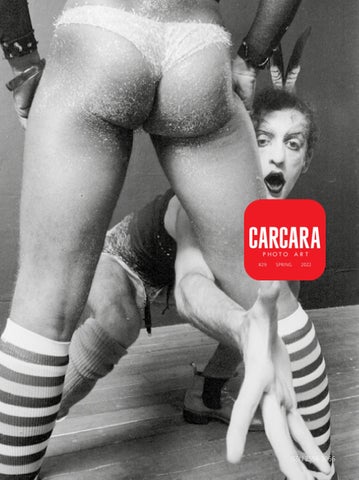
#29
SPRING
2022
ISSN 2596-3066
Cover Photo: Antonio Guerreiro
It all started with one essay - about some of the problems, aesthetic and moral, posed by the omnipresence of photographed images; but the more I thought about what photographs are, the more complex and suggestive they became. So one generated another, and that one (to my bemusement), another and so on - a progress of essays, about the meaning and career of photographs- until I’d gone far enough so that the argument sketched in the first essay, documented and digressed from in the succeeding, could be recapitulated and extended in a more theoretical way; and could stop. SUSAN SONTAG ON PHOTOGRAPHY
SWINGING RIO Camera in hand, an arm full of bracelets, high-heeled boots, hair past his shoulders, a strong accent from Rio, but with a different touch —could it be a lisp? This was the package of enchantment offered by photographer Antonio Guerreiro to those around him. I have retained this image in my memory since the 1970s, when he was eventually in São Paulo and I was his helper/assistant in photo sessions for the fashion magazines of Editora Abril. By then, I was 16 or 18, and I was starting my journey. I was fascinated by this character, who became the professional role model I dreamed of being. After Antonioni’s film “Blow-Up”, released in 1966, the figure of the charming, seductive, rich, powerful and eccentric photographer became paradigmatic, and generation after generation tried to achieve the degree of eccentricity of actor David Hemmings’ character, who emerged directly from the scene of “Swinging London”, a movement that expressed a radical transformation of behavior still seen over the following decades. Antonio embodied this character like no other, but there was a difference. Unlike the English photographer, he was sweet, fun and his laughter echoed throughout the studio. Over the years, his appearances in São Paulo have become rare and I turned into an adult, no longer able to be his assistant, but always following his work, which then took place, most of the time, in his studio in Rio, that he shared with the also genius American photographer David Zingg. Legend has it that the studio had a kind of amphitheater with stands so that the audience could see him photographing. His contortions in front of the models, the objectives as phallic simulacra, the loud music, constituted a sensual, transgressive, audacious spectacle and were the maximum expression of the Rio way of life at the time. A kind of swinging Rio. The performances/sessions were, in themselves, a subversive act, resistant to the conservative behavior instilled by the military during the years of the military dictatorship. However, his work was not restricted to all this movement. In this necessary and very fair publication, here, in Carcara, we see how much his generous gaze captured the spirit of an era, obviously within a microcosm of the elite, more specifically, the one from Rio. Beyond his public persona, he leaves a legacy full of experimentation, a chronicle of a time, and certainly an important chapter in the authorial history of Brazilian photography. BOB WOLFENSON
Antonio Guerreiro
Dzi Croquettes
Dzi Croquettes
Dzi Croquettes
Dzi Croquettes & Elke
Maria Alcina
Maria Gladys
Woman Without Face
Woman Without Face
Woman Without Face
Antonia Mayrink Veiga
Edy Star
Gonzaguinha
Ionita
Liege Monteiro
Lilly Marinho
Marcia Mendes
Maria Lamarca
Neville d’Almeida
Woman Without Face
Xuxa
Ziraldo
Alcione
Alcione Mazzeo
Amparo Grisalles
Antonio Fagundes
Baby do Brasil
Betty Faria - Bye Bye Brasil
Betty Faria
Betty Faria
Betty Lagardere
Bruna Lombardi
Caca Diegues
Betty Lago
Betty Lago
Betty Lago
Charlene Shorto
Chico Buarque & Marieta
Christiane Torloni
Carmem Mayrink Veiga
Carmem Mayrink Veiga
Claude A. Peixoto
Claudia Lucia
Claudia Ohana
Denise Dumont
Cleo Farias
Cleo Farias
Deise Nunes
Deise Nunes
Dina Sfat
Dina Sfat
Elis Regina
Fatima Osorio
Elke
Flavia Quaresma
Flavio Rangel
Franz Krajcberg
Fernanda, Italo & Sergio
Fernanda Montenegro
Fernanda Montenegro
Fernanda Montenegro & Family
Gilberto Braga
Gal Costa
Gal Costa
Gisela Amaral
Hermeto Pascoal
Jose Wilker
Jo Soares & Teresa
Jo Soares
Kenny
Leila Diniz
Luiz Carlos Barreto
Lucelia Santos
Luma & Isis
Luiza Brunet & Yasmim
Luiza Brunet
Luiza Brunet
Luiza Brunet
Luiza Brunet
Luiza Brunet
Marcia Brito
Maite Proença
Maite Proença & Maria
Maria de F. Monteiro
Maria H. Guinle
Marieta Severo
Marilia Pera
Marina Montini
Marise Gaspard
Markito
Maysa
Menina Cigana
Miele & Anita
Miguel Falabella
Mila Moreira
Milene
Monica Fraga
Monique Evans
Nanny Venancio
Nelson Rodrigues
Nora Esteves
Novos Baianos
Odile Rubirosa
Oscar Niemeyer
Patricia Chami
Pat Cleveland
Pat Cleveland
Patricia Perrone
Paula Burlamarqui
Raul Seixas
Renata Arruda
Regina Duarte
Rogeria
Regina Case
Regina Case
Roberta Close
Roberta Close
Rogerio Sganzerla
Rita Lee
Sandra Brea
Sandra Brea
Sandra Brea
Sandra Brea
Sandra Brea
Scarlet Moon
Silvia Martins
Silvia Pfeiffer
Simone
Simone Carvalho
Suzana Vieira
Teresa Raquel A Mãe
Tonia Carrero
Tonia Carrero
Varinia
Veluma
Vera Fischer
Veronica Castinheira
Wanderlea
Wilza Carla
Woman Without Face
Woman Without Face
Woman WIthout Face
Woman Without Face
Woman Without Face
Woman Without Face
Woman Without Face
Woman Without Face
Woman Without Face
Woman Without Face
Woman Without Face
Woman Without Face
Woman Without Face
Woman Without Face
Woman Without Face
Woman Without Face
Woman Without Face
Xuxa Lopes
Zuzu Angel
Zuzu Angel
Zeze Motta
Emily May
Emily May
Emily May
Emily May
Sonia Braga
Sonia Braga
Sonia Braga
Sonia Braga
Sonia Braga
Sonia Braga
Secos e Molhados
Secos e Molhados
Secos e Molhados
Arthur M. Lima & Nelson G.
Patricia Vieira
SWINGING RIO A câmera na mão, o braço cheio de pulseiras, as botas com salto, cabelos passando dos ombros, um sotaque carioca forte com um toque diferente na fala - seria uma língua presa? Assim era o pacote do encantamento que o fotógrafo Antônio Guerreiro oferecia a quem estivesse em seu entorno. Esta imagem retive na memória desde os anos 1970, quando eventualmente ele estava em São Paulo e eu era seu ajudante/assistente, nas sessões feitas para as revistas de moda da Editora Abril. Estava, então, aos 16 ou 18 anos, começando minha trilha. Fiquei fascinado por esta figura que passou a ser o modelo de profissional que eu sonhava em ser. A partir do filme Blow-Up de Antonioni, lançado em 1966, a figura do fotógrafo charmoso, sedutor, rico, poderoso e excêntrico virou paradigmática e gerações se sucederam buscando atingir o grau de excentricidade do personagem do ator David Hemmings, emergido diretamente da cena do “Swinging London”, movimento que expressou a transformação radical de comportamento vista ainda ao longo das décadas seguintes. Antonio personificava esta figura como nenhum outro, mas havia uma diferença. Ao contrário do fotógrafo inglês, ele era doce, divertido e sua risada ecoava por todos os cantos do estúdio. Ao longo dos anos, suas aparições em São Paulo se tornaram raras e eu fui me tornando adulto, não podendo mais assisti-lo, mas sempre acompanhando seu trabalho que então acontecia, na maioria das vezes, em seu estúdio no Rio que dividia com o também, genial, fotógrafo americano David Zingg. Reza a lenda que havia uma espécie de anfiteatro arquibancada , para que uma plateia o visse fotografando. Seus contorcionismos diante das modelos, as objetivas como simulacros fálicos, a música alta, constituíam um espetáculo sensual, transgressor, audacioso e eram expressão máxima do carioquismo vigente à época. Uma espécie de swinging Rio. As performances/sessões eram, em si, um ato subversivo e resistente ao comportamento conservador insuflado pelos militares durante os anos da ditadura militar. No entanto, seu trabalho não se restringia à toda esta movimentação. Nesta necessária e justíssima publicação, aqui, na Carcará, vemos o quanto seu olhar generoso capturou o espirito de uma época, obviamente dentro de um microcosmo da elite, mais especificamente, carioca. E para além de sua persona pública deixa um legado cheio de experimentações, crônica de um tempo e ele certamente já está inscrito na história da fotografia brasileira como um dos seus principais autores. BOB WOLFENSON
Tudo começou com um ensaio - sobre alguns dos problemas, estéticos e morais, propostos pela onipresença das imagens fotográficas; mas, quanto mais eu pensava sobre o quê são as fotos, mais complexas e sugestivas elas se tornavam. Assim, um ensaio engendrava outro, e este (para meu espanto), ainda um outro, e assim sucessivamente - uma sequência de ensaios a respeito do significado e da evolução das fotos - até eu ter ido tão longe que o argumento esboçado no primeiro ensaio, e documentado e explorado por meio de digressões nos ensaios seguintes, pôde ser retornado e ampliado de um modo mais teórico; e pôde parar. SUSAN SONTAG SOBRE FOTOGRAFIA
Credits Publisher: Alaide Rocha Editor: Carlo Cirenza Text: Bob Wolfenson Graphic Project: Marcelo Pallotta Designer Assistant: Katharina Pinheiro Daniela Naomi I Translation: Bruna Martins Fontes Acknowledgements: Barleu Edições Ltda, Bob Wolfenson, Branca Otero Freire de Freitas, Carlos Leal, Companhia das Letras, Maria Teresa de J. Freire Guerreiro de Brito, Penguin Books, Susan Sontag 1 - Suggestions, complaints and praise should be sent by email to: contact@carcaraphotoart.com 2 - Portfolios should be submitted in the following format: JPEG ( 20 x 30 cm ), 300 dpi by email to: contact@carcaraphotoart.com ISSN 2596-3066
www.carcaraphotoart.com.br