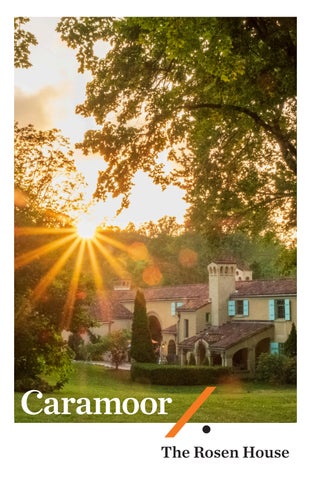
The Rosen House
The Formal Dining Room.
“We built this house, my husband and I, not to be new or old, but just to be beautiful. And we built it for music.” With these words, Lucie Rosen (1890–1968) described very simply what she and her husband Walter Rosen (1875–1951) had in mind when creating their country estate at Caramoor. Inspired by travels to Europe and to Italy in particular, the couple, who married in 1914, had their Mediterranean-style house built during the decade between 1929 and 1939. As a summer retreat, the Rosens intended the house to be a home for all that they loved and enjoyed—family, friends, works of art, and music performances. Now, the gates of the Rosen House, listed on the National Register of Historic Places, are Walter and Lucie Rosen with their son open for visitors to enjoy. The Caramoor Walter, c. 1940. experience, which began in the Rosen House for Walter and Lucie’s family and neighbors, continues to this day. The intimate musical performances to which the Rosens invited the public in 1946 have evolved into Caramoor’s year-round music programming. The Rosen House was formally opened as a historic site in 1972, welcoming visitors ever since.
The Burgundian Library.
Visitors to the house today encounter many artworks from Asia and Europe dating from the 15th–20th centuries, set in complete rooms the Rosens imported from private villas and chateaux in France, Italy, and England. In the Reception Room, eighteenth-century Chinese export wallpaper provides a spectacular setting for Venetian furniture and an Egyptian-Revival overmantel. Ranging from the Burgundian Library with its 17th-century French paneling and a brilliant blue groin-vaulted ceiling painted with scenes from the Old Testament to Mrs. Rosen’s Bedroom and Dressing Room furnished with personal mementos, as well as 17thcentury furniture, nineteen rooms on the main floor of the house showcase art treasures collected by the Rosens.
You are in for a treat when you step into this unique historic site, full of stories and music.
Wallpaper from the Formal Dining Room.
The Music Room.
The Music Room, the true heart of the Rosen House, provides a grand setting for many of the Renaissance objects in the collection, such as the intricate Franco-Flemish tapestry The Holy Family, earthenware from the workshop of Andrea della Robbia, and a portrait entitled Sibylla attributed to Lucas Cranach. Italian majolica from Urbino, Italy, is displayed in the Spanish Alcove, so called for its painted ceiling from the Castillo-La Mancha region of Spain and intricate inlaid chair (sillón de caderas). Lighting fixtures and metalwork from the New York firm of E. F. Caldwell & Company add to the character of the room, one of Caramoor’s intimate performance venues.
The Holy Family tapestry.
The Spanish Courtyard, one of Caramoor’s outdoor music venues.
The lush garden and shady cloisters of the Spanish Courtyard are adorned with imported tiles and hand-painted frescos. A colorful 20th-century glass mosaic by Elsa Schmid overlooks the audiences who gather in this distinctive space described as “Spanish under the influence of the Italian Renaissance” for summer concerts. Today, thousands of visitors participate in programming at the Rosen House, including students, families, and art and music lovers of all ages. Portions of the house are used for private parties, events, tours, afternoon tea, and as a location for film and photography.
Artists and students in the Music Room.
Jewelry box. E. F. Caldwell & Co. New York, c. 1928. Bronze, enamel, bone.
La Loggia Bedroom.
Doors from the Rosens’ townhouse. E. F. Caldwell & Co. New York, c. 1920.
Caramoor members enjoy a 20% discount on tours of the Rosen House. Visit caramoor.org/membership or call 914.232.8163. To book a tour, visit caramoor.org or contact us at boxoffice@caramoor.org or 914.232.1252. 149 Girdle Ridge Road, Katonah, NY, 10536