novatioinntheisWhen improvement?an objectivepartner'seachishatW innovation?thewith
ethallhaveunitymcomtheDoes culturalintellectual,necessaryand experience,andledgewknolegaland effectively?thisuseitcan
eraerehtfiretaergerasseccusfosecnahcehT
eht(ytinummoce ehttastifenebeno(citisarapnahtrehtar)stifeneb
andwillingnessathereIspossibility source”n“opeworkto andeveryonetobelongs(everythingtherefore whichnot,If?one)notobecaninnovationtheofpart source?nopeshared
How relevant is the innovation per partner a(on scale of 1-10) and why?
How is a community formed? How is it deter mined who participates and who does not?
Howisdecision-makingorganised?
Howcanthoseaffected bytheinnovationbeaffectedby it,andadapttoit?
Whatismeantbyinvestments andproceeds,andisthere agreementonthis?
Whatunderlyingfinancing modelisused?
Who forms the co mmunity dingsurroun this innovation: who is partici pating and who is not? Which groups do you represent as a stakeholder? Who else might not yet be at the table?
What agreements are made about investments by the community (whoinvests what?)? And how are these a greements safeguarded?
THE COLLECTIVE INNOVATIE CIRCLE
Collective innovation refers to the introduction of new products, processes, organizational forms and ways of working through active participation by as many stakeholders as possible within a community (community of practice) with the aim of achieving a particular improvement for the community and where all proceeds benefit that community.
TARGET GROUP
Use the Collective Innovation Circle as:
1. You are working on an innovation that will improve society.
2. You are working on this innovation together with others and want to know how you can truly make it a joint success.
WHY TO USE IT
Many new sustainable ideas are being developed, but they are still making little difference in everyday life. This is because their creators often only succeed when their product or service sells well, and that is often not the case. Companies, governments, and investors are cautious and have different interests, which hinders innovation. That is why there is a growing need for a way of working together in which the entire community participates from the outset and everyone benefits. This prototype shows how such a collaborative approach works and offers simple steps that anyone can use.
HOW IT WORKS
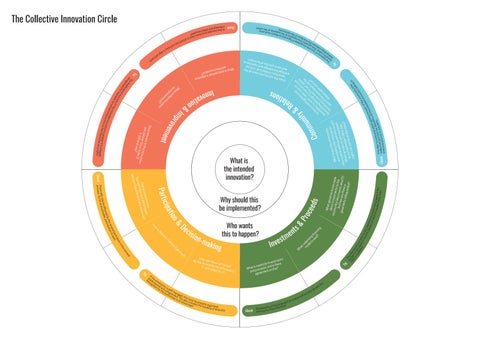
The Collective Innovation Circle helps to develop innovative ideas together. The model works from the inside out. In the middle, you start with three key questions that form the basis for the discussion:
1. What do we want to change?
2. Why is this change necessary?
3. Who wants this change to happen?
Surrounding this are four important themes that always play a role when you really want to innovate together. These pillars help users assess how ‘collective’ their innovation already is and where there is room for improvement.
1.Innovation & Improvement: Will the innovation really improve anything? And for whom exactly?
2. Community & Relations: Who is involved? Who forms the collective? And who actually owns the innovation?
3. Investments & Proceeds: How is the value of people’s contributions (time, money, energy) and what they get in return assessed? How is this organized?
4. Participation & Decision-making: How are decisions made? Who has influence and how is this organized?
Each pillar is accompanied by in-depth questions that help to facilitate discussion and gain insight. The third layer of the model contains a check and a tip to help users further improve their innovation process.
HOW TO USE IT
Collective Innovation takes time. The Collective Innovation Circle helps you make the best possible use of this time. There are roughly two different ways to use it.
1. At the start, in preparation: use the circle to determine what you need to consider in collective innovation and who you want to involve. You may come to the conclusion that the time is not yet right.
2 As a guideline during the collective innovation process: work through the circle together with all relevant stakeholders, discussing and answering all questions, checks, and tips. Organize as many meetings as possible and necessary to reach understanding and agreement. Make clear agreements about roles and responsibilities during these meetings. Prepare them well and record the results thoroughly.
The Collective Innovation Circle was developed as part of the CLICKNL project Collective Innovation for the Biobased Transition, led by Sebastian Olma, Rikst Westra (both CARADT, Avans University of Applied Sciences) and Kaj Morel (BWNO, Avans University of Applied Sciences) in collaboration with Biobased Creations, Dutch Design Foundation, Spark Innovation Campus, Haus der Materialisierung, and Electron.
Sebastian Olma, Kaj Morel en Rikst Westra, in cooperation of Myron Koster, Collectieve Innovatie fot the Biobased Transition. The development of an effective approach in the form of a prototype (2025), CC BY-NC-SA 4.0 licensed. The full license text can be read at: https://creativecommons.org/licenses/by/4.0/