CALLING FOR AUCTION ITEM DONATIONS!
The Capital Medical Society Foundation
Holiday Auction will be held on Friday, December 8, 2023. We want to make it bigger and better than ever, so we need donated items!
All items, large or small, are needed. Do you have any of the items on our wish list or know someone you can ask to donate them?


• Week/Weekend at Vacation Homes
• Hunting Trips or Fishing Trips

• Hunting or Fishing Gear
• Sports Memorabilia
• Children’s Toys
• Games
• Home Décor
• Jewelry
• Paintings/Art
• Fine Wine & Spirits
• Pet Items
• Holiday Items
The deadline to receive items is November 17.
If you have any questions or would like to donate an item, please call the CMS office at (850) 877-9018.
Holiday Auction invitations will be mailed in November!
Week/Weekend at Vacation Homes
Jewelry
Fine Wine & Spirits
CONTINUED ON PAGE 17 CAPITAL MEDICAL SOCIETY 2023 MEETINGS CALENDAR AUGUST EDITION, VOLUME 2023, NO. 8 August 15, 2023 CMS Membership & CME Meeting Cardiac Electrophysiology Tests and Subsequent Treatment Options Farhat Khairallah, M.D. 6:00 pm Maguire Center for Lifelong Learning at Westminster Oaks September 19, 2023 CMS Membership Meeting Panel Discussion: Caring for Aging Family –Care Planning and Resources 6:00 pm Maguire Center for Lifelong Learning at Westminster Oaks CONTINUED ON PAGE 6
MISSION: TO PROMOTE THE PRACTICE OF MEDICINE FOR THE ULTIMATE BENEFIT OF THE PATIENT. (850) 877-9018 Fax: (850) 878-0218 www.capmed.org

BOARD OF GOVERNORS
Sarah Ko, M.D., PhD, President
Helen Paulson, M.D., President-Elect
Russell Cole, M.D., Secretary/Treasurer
Paresh Patel, M.D., Immediate Past President
Danny Estupiñán, M.D.
Amulya Konda, M.D.
John Meade, M.D.
Jonathan Nava, M.D.
Niraj Pandit, M.D.
Kaushal Patel, M.D.
Heather Redfield, CMS Alliance President
Cielo Rose, D.O.
Brence Sell, M.D.
Kiana Taba, M.D.
Pam Irwin, Executive Director, CMS
PUBLICATION
EDITOR
Frank Skilling, M.D.
GRAPHIC DESIGN
Lauren Trudgeon
MANAGING EDITOR
Shannon Boyle
EDITOR EMERITUS
Charles E. Moore, M.D.
ARE YOU INTERESTED IN WRITING AN ARTICLE FOR CAP SCAN?


Please contact Shannon Boyle at sboyle@capmed.org. All articles submitted will be reviewed by your peers prior to publishing.
CMS Non-Endorsement Statement
The editors welcome contributions from members. Opinions expressed in the Cap Scan are those of the individual authors and do not necessarily reflect policies or opinions of the Capital Medical Society or Capital Medical Society’s endorsement.
Cap Scan is published during the first week of each month and is the official publication of the Capital Medical Society. Advertising in Cap Scan does not imply sponsorship or endorsement by the Capital Medical Society nor necessarily imply the accuracy or reliability of any advertisement displayed in this publication.
David A. Burns, M.D. - 1 st
Oliver A. Reyes, D.O. - 1 st
Cielo Z. Rose, D.O. - 1 st
Michael Douso, M.D. - 2nd
Sangeeta Nair-Collins, M.D. - 2nd
Mina Salah Mousa, M.D. - 3 rd
Marino A. Martinez, M.D. - 4th
Ronald D. Ray, M.D. - 4th
Stacia Groll, M.D. - 5th
Vamsi Ponnaganti, M.D. - 5th
William Paul Sawyer, M.D. - 5th
David Shapiro, M.D. - 5th
Candace Elise Gonzalez, M.D. - 6th
Alfredo Nova, M.D. - 6th
John F. Palmer, M.D. - 6th
Bob Soni, M.D. - 6th
Emily Ashmore, M.D. - 7th
T.Adam Oliver, M.D. - 7th
Adekunle Omotayo, M.D. - 7th
John L. Williams, Jr., M.D. - 7th
T. Dean Dalrymple, M.D. - 8 th
Lisa Flannagan, M.D. - 8 th
Stanley Gwock, M.D. - 8 th
David Pascoe, M.D. - 8 th
Simon J. Lopez, M.D. - 9 th
Marc Inglese, M.D. - 11th
Christopher Ryan Murphy, D.O. - 11th
Amy Harrison, M.D. - 12 th
Alice Pomidor, M.D. - 13th
SchMiyah Smith, M.D. - 13th
David E. Craig, M.D. - 15th
Gadi Silberman, M.D. - 17th
Eric Bouchard, M.D. - 18 th
Joshua Fuhrmeister, M.D. - 18 th
Terence N. Reisman, M.D. - 18 th
Peyton Lloyd, M.D. - 19 th
Rachel Vanderby, M.D. - 19 th
Marie O. Becker, M.D. - 20 th
William L. Morse, M.D. - 20 th
Frank C. Walker, M.D. - 20 th
Jiali Duan, D.O. - 22nd
Michael W. Forsthoefel, M.D. - 22nd
Shayla Gray, M.D. - 22nd
Russell Eggert, M.D. - 23 rd
Krishna Brown, M.D. - 25th
Tracy Graham, M.D. - 25th
P.S. Krishnamurthy, M.D. - 25th
Paul McFarlane, M.D. - 25th
Thandi Walters, M.D. - 25th
Susan Drake, M.D. - 26th
James R. Thomas, M.D. - 26th
Charles W. Yowell, M.D. - 26th
Jeffrey T. Ferraro, M.D. - 27th
Manoela Mota, M.D. - 27th
Alex Ho, M.D. - 28 th
Stan Whitney, M.D. - 28 th
Camille Blake, D.O. - 29 th
Rick A. Damron, M.D. - 29 th
Alexander Erbella, M.D. - 29 th
Gregory Hartlage, M.D. - 30 th
WE ARE SO GLAD YOU WERE BORN!
2 CAP SCAN - A CAPITAL MEDICAL SOCIETY PUBLICATION HAPPY BIRTHDAY!
IN THIS ISSUE: CMS Dues .......................................................................3 CMS News ..................................................................... 4 CMS Lunch and Learn Seminars 6 Practice Management ................................................. 7 Reflections from the Editor .......................................8 Viewpoint ..................................................................... 10 CMS Foundation Supports Local Organizations 12 We Thank Our Donors .............................................. 14 Donate to the CMS Foundation .............................. 15 CMS Foundation: We Care Network...................... 16
HAPPY BIRTHDAY! {AUGUST
DID WE MISS YOUR BIRTHDAY? IF SO, PLEASE EMAIL ROSALIE CARLIN AT RCARLIN@CAPMED.ORG!
BIRTHDAYS}


CAP SCAN - A CAPITAL MEDICAL SOCIETY PUBLICATION 3 Please tell the advertiser you saw their ad in the Cap Scan magazine! JUST GOT COLORFUL JUST GOT COLORFUL Healthcare Workers & First Responders: Experience the IncrediBOWL with 15% Off! Eating Healthy Eating Healthy Redeem at Island Fin Poké Co. Tallahassee, FL location only. Offer only valid in-store with a valid ID. Not valid on any third-party ordering apps. Management reserves all rights. 1415 Timberlane Rd, Ste 407, Tallahassee, FL 32312 • (850) 999-8306 IG: @islandfinpokeco • FB: /IFPCTallahassee • IslandFinPoke.com CMS DUES Renew your membership today. If you didn’t receive your dues invoice, please contact the CMS office at (850) 877-9018. Dues revenue enables the Capital Medical Society to provide mission-driven, physician-focused, and relevant services, communication, educational opportunities, and community-building activities for its members. We continue to work on your behalf and value you and your membership. We Are Here For You! CMS MEMBERS, DUES INVOICES HAVE BEEN SENT! MISSION-DRIVEN • PHYSICIAN-FOCUSED • RELEVANT
NEW DOCS ON THE BLOCK
FLORIDA STATE UNIVERSITY COLLEGE OF MEDICINE GENERAL SURGERY RESIDENCY PROGRAM AT TALLAHASSEE MEMORIAL HEALTHCARE
Hudson Milad Ash-Rafzadeh, M.D., USF Health Morsani College of Medicine, 2023

Katherine Alexis Chandler, M.D., Mercer University, 2023
Patrick M. Thomas, M.D., Marshall University, 2023
FLORIDA STATE UNIVERSITY COLLEGE OF MEDICINE INTERNAL MEDICINE RESIDENCY PROGRAM AT TALLAHASSEE MEMORIAL HEALTHCARE
Mahesh Bhattarai, M.D., Manipal College of Medical Sciences, 2003
David Bryant, D.O., Lake Erie College of Osteopathic Medicine, 2018
Sachin Joseph, M.D., Armed Forces Medical College, 2020

Dominika Moscicka, M.D., Wroclaw Medical University, 2020
TALLAHASSEE
MEMORIAL FAMILY MEDICINE RESIDENCY PROGRAM

Trinity Belgrave, M.D., University of the West Indies, 2014
Del Carter, M.D., University of Florida, 2023
Dajour Collins, M.D., University of the West Indies, 2014
Kevonne Kamoy O'Brien Dawson, M.D., University of the West Indies, 2023
Drake Donaldson, D.O., Liberty University, 2023
Duncan Lea Jackson, M.D., University of the West Indies, 2017
Nicole Larissa Mignott-Dawson, M.D., University of the West Indies, 2023
Daphne St. Juste, D.O., Ross University, 2022
4 CAP SCAN - A CAPITAL MEDICAL SOCIETY PUBLICATION CMS NEWS
INDEX Eye Associates of Tallahassee — PG 5 Island Fin Poké Co. — PG 3
— PG 4
ADVERTISER
MagMutual
Please tell the advertiser you saw their ad in the Cap Scan magazine! MagMutual.com | 800-282-4882 Get the most complete coverage available, anywhere
liability
management liability: MagMutual provides those coverages and others. Just like you, we focus solely on healthcare – and offer a full spectrum of insurance to protect you. Why settle for anything less? Expert guidance • Greater rewards • Better results
For more than 40 years, MagMutual has protected PolicyOwners from healthcare professional
risk – but we offer so much more. Workers’ compensation, cyber insurance for data breaches,
CMS WELCOMES INCOMING RESIDENTS
Dr. Russell Cole, CMS Secretary/Treasurer, and Pam Irwin, CMS Executive Director, hosted an orientation luncheon for new Family Medicine and Internal Medicine
Residents on June 14, 2023 at the Tallahassee Memorial Family Residency Program. Dr. Cole and Pam shared the importance of becoming involved in organized medicine at the local level. They encouraged the new residents to join CMS and to grow their understanding of legislation impacting the

practice of medicine, to attend CMS events, CMEs, and social activities to grow their understanding of the local medical community, the practice of medicine, and to build friendships. Please make them feel welcomed!
Please tell the advertiser you saw their ad in the Cap Scan magazine!

CAP SCAN - A CAPITAL MEDICAL SOCIETY PUBLICATION 5 CMS NEWS
CAPITAL MEDICAL SOCIETY LUNCH AND LEARN SEMINARS
MARK YOUR CALENDARS FOR THE REMAINING 2023 LUNCH AND LEARN SEMINARS!
September 20, 2023
HIPAA Regulatory and Enforcement Update
Presenters: Shannon Hartsfield, Mia McKown, and Eddie Williams, Holland & Knight
October 18, 2023
HR Workshop: Creating a Culture of Engagement and Respect
Presenter: Kelly Green, SHRM-SCP, HR Consultant, James Moore & Co., CPAs
Sponsor: CAMPUS USA Credit Union
Time: 12 Noon to 1:30 PM
(Seminar starts at 12:30 PM)
Place: CHP Auditorium, 2nd Floor, 1491 Governors Square Blvd.
Cost: $11 per person, per seminar
For more information or to RSVP, please contact Rosalie Carlin at (850) 877-9018 or rcarlin@capmed.org.
Seminars will be held at the Capital Health Plan on Governors Square Blvd. –and we thank CHP for providing this venue.
CAPITAL MEDICAL SOCIETY 2023 MEETINGS CALENDAR CONTINUED FROM COVER
October 17, 2023
CMS Membership & CME Meeting Prevention of Medical Errors (2-Hour CME)
E. Victoria "Tori" Penny, Esq. and Julia Weeks, M.D.
6:00 pm
Maguire Center for Lifelong Learning at Westminster Oaks
December 8, 2023 *NEW DATE* CMS Foundation Holiday Auction
6:00 pm
Dunlap Champions Club at FSU
6 CAP SCAN - A CAPITAL MEDICAL SOCIETY PUBLICATION
CMS LUNCH AND LEARN SEMINARS
THE BUSINESS SIDE OF MEDICINE: HEALTHCARE MANAGEMENT SURVIVAL GUIDE – 2023 ONLINE SEMINAR SERIES
Information provided by Ben Mirza and Mirza Healthcare Law Partners
The following virtual seminars are held on the third Tuesday of every month at 6:30 pm.
August 15
“So, I Signed a Non-Compete, Now What?”
To register: https://us02web.zoom.us/meeting/register/ tZUtdOipqzwqHtSpvDmBM_XmSZlFS5C20qIz
September 19
How to Minimize the Risk of Malpractice Lawsuits
To register: https://us02web.zoom.us/meeting/register/ tZcqd-6srDkiH9Iu9zHAxsfTWnRZ8hlNZwWU
October 17
How Experienced Physicians Protect their Assets
To register: https://us02web.zoom.us/meeting/register/ tZEtd-itrD0qGdKiTjTIuY-xesann4voCGSA
November 21
How to Handle Collection Challenges of Working With Health Plans
To register: https://us02web.zoom.us/meeting/register/ tZEvcemvqj0iGNS_EYr23URIRp1knKY6ATzO
December 12
Medical Marijuana Law for Physician Practices
To register: https://us02web.zoom.us/meeting/register/ tZwsd-GorT4oH9QthmrfIbCkRt9Kx5vnZhst
TEACH YOUR PATIENTS THE DANGERS OF GAS STOVES

Gas stoves are a health risk. This is true especially for children and the elderly. People who live in homes with gas stoves have more asthma, lung disease, and cardiovascular disease. This month, the Society’s My Green Doctor provides a short article (visit https:// mygreendoctor.org/learn-the-health-risks-ofgas-stoves/ or scan the QR) on this vital topic (reading time: 5 mins).
My Green Doctor is a free money-saving membership benefit from the Capital Medical Society. Members use the “Meeting-by-Meeting Guide” to learn how to adopt environmental sustainability, save resources, and help create healthier communities. The program adds just five minutes to each regular office staff meeting
or weekly office “huddle”, making small changes at each meeting that over time really add up.
Everyone in your practice can register as Partner Society members at www.MyGreenDoctor.org or at www. MyGreenDoctor.es (si, en Espanol). Use the discount code MGDCMS to get full free access to My Green Doctor, save $60 instantly, and save $1000s in the first year. Ask your practice manager to register today and to put My Green Doctor on your next agenda. You can do this!


CAP SCAN - A CAPITAL MEDICAL SOCIETY PUBLICATION 7 PRACTICE MANAGEMENT
ONE DEATH IN JACKSON MEMORIAL HOSPITAL
By Frank Skilling, M.D.

“We had the experience, but we missed the meaning.” T.S.
Eliot
“Life can only be understood backwards, but it must be lived forward.” Soren
Kierkegaard
In the early 1960s, there was a weekly TV melodrama called “Ben Casey.” The opening credits depicted the senior surgeon, Dr. David Zorba, writing five pictographs on a blackboard while he intoned, “Man, Woman, Birth, Death, Infinity.” It was an attempt to reduce the cycle of life to fit the contemporary theme of medicine as conceived by the writers.

I hadn’t thought about it for years, but now, over fifty years past my graduation from medical school, I recall it as a summary of an experience that has stuck with me since my early medical training.
I was an intern at Jackson Memorial Hospital (JMH) in Miami in 1973 when I was paged to the Emergency Department late one night to admit a patient who had been brought in by the ambulance service. I’ll call her Estelle Russell. She was a sixty-two-year-old white woman who’d been found unresponsive in her apartment in South Miami. I had no past medical history to go on. She was unaccompanied, and no relatives were listed. I immediately realized that she was severely dehydrated and in extremis with dangerously abnormal vital signs. After admitting her to one of the ancient non-air-conditioned wards at JMH, I did all the things that I had been taught to do: lab studies, urine cultures, blood
cultures, chest x-ray, abdominal x-ray, IV fluids. An initial chest film showed an opacity in one lung, so I immediately started IV antibiotics because I thought that she might have pneumonia. Over the next several hours, her vital signs continued to deteriorate, and on early morning rounds, it became clear that she was going to die. I gave her IV steroids, a vasopressor, and more antibiotics. She died about 11:00 AM, less than ten hours after admission. I was at the bedside when she died. I obtained permission for an autopsy because no clear cause of death could be ascertained.
A few weeks later, I was ordered to present her story at the weekly M & M (morbidity and mortality) conference. After my presentation, I was given a scathing evaluation by the chief of internal medicine who berated me for not finding a cause of her systemic collapse and for not saving her. He was sure that she had an occult infection that I had missed. Even though I’d given her the prescribed treatments for a comatose patient at the time, he was sure that I’d missed something. I stood at the podium without responding. As was the custom, the autopsy results were then presented to the audience. The head of anatomical pathology delivered his findings: there was no infection in the lungs and the cause of death could not be determined. Her demise remained a mystery. With this conclusion, I felt justified in my care for Estelle Russell, but I was humiliated, nonetheless.
Now that I’ve passed the age when Estelle died, I more intently recognize that the cycle of life is one that carries its meaning primarily in how we live and die in the context of others. The lonely, the abandoned, the unrecognized are swirling around us, and it’s only in the presence of our spouses, families, and loved ones that the chalkboard chain of men, women, birth, and death holds us together. Infinity, the last symbol on the TV show’s introduction, is essentially a breath or a heartbeat away. Each person’s journey is solitary without the support of our family and loved ones.
8 CAP SCAN - A CAPITAL MEDICAL SOCIETY PUBLICATION REFLECTIONS FROM THE EDITOR
Maybe this is why Estelle Russell’s death has stood out in my memory for over 50 years. I attended many deaths as a medical student and intern, but I remember hers more for the loneliness and abandonment that she experienced than for the medical aspects of her case. I can only speculate that perhaps she was aware that I was there when she died.
This is one of the most difficult aspects of medical education: we learn how to be doctors, to practice delivering medical care, but the implications and context of our practice isn’t realized personally until much later. During our training we’re so busy cramming facts into our heads that we can’t or don’t appreciate the great gift that we’ve been given to join a healing profession. Likewise, we put into the backs of our minds that what happens to our patients will inevitably happen to us eventually. We humans, who are eternally obsessed with determining who’s in charge or who’s ahead of us, eventually find that “all who have died are equal.”
We’re now living in the age of corporate healthcare (no longer called medical practice). Physicians have become replaceable cogs in the great wheel that doles out industrial style medicine. Everyone
is a member of the “healthcare team,” but no one physician appears to be in charge. Since few patients have a designated full time primary care physician anymore, it’s a lottery who will care for them when problems arise. I certainly don’t think that “the good old days of medicine” were all that good, but at least there could be some semblance of acknowledgement or recognition in the encounters that patients had with their physicians. Ironically, hospitals are returning to their roots in medieval times when they were constructed to provide a place for people to die if they could not afford to be cared for at home. Most Americans say that they want to die at home surrounded by loved ones, but many of us will die in a hospital anyway. Estelle Russell was a harbinger of the fate that still awaits many today.
R.I.P. Estelle. I was your last human contact before infinity. I haven’t forgotten you.
NEW DEA REQUIREMENT CME AVAILABLE


The Florida Medical Association (FMA) has announced they will be providing the 8-hour, required DEA continuing education requirement through their CME portal: www.flmedical.org
Visit https://flmedical.inreachce.com/ Details/Information/1078c14c-0830-4d57a906-4f7646f3cdae?ref=featured for further information and courses. Signing in is required, membership is not required.
Course fees apply. Member $200 / Non-Member $300 for the one-time requirement.
CAP SCAN - A CAPITAL MEDICAL SOCIETY PUBLICATION 9 REFLECTIONS FROM THE EDITOR
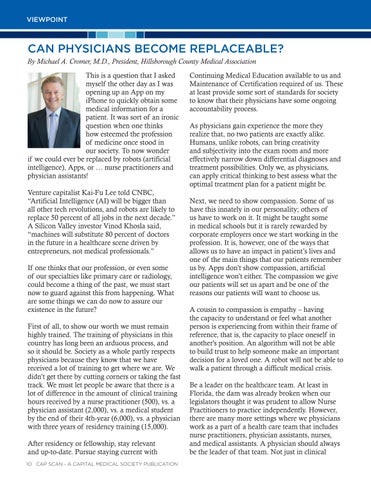
CAN PHYSICIANS BECOME REPLACEABLE?
By Michael A. Cromer, M.D., President, Hillsborough County Medical Association

This is a question that I asked myself the other day as I was opening up an App on my iPhone to quickly obtain some medical information for a patient. It was sort of an ironic question when one thinks how esteemed the profession of medicine once stood in our society. To now wonder if we could ever be replaced by robots (artificial intelligence), Apps, or … nurse practitioners and physician assistants!
Venture capitalist Kai-Fu Lee told CNBC, “Artificial Intelligence (AI) will be bigger than all other tech revolutions, and robots are likely to replace 50 percent of all jobs in the next decade.” A Silicon Valley investor Vinod Khosla said, “machines will substitute 80 percent of doctors in the future in a healthcare scene driven by entrepreneurs, not medical professionals.”
If one thinks that our profession, or even some of our specialties like primary care or radiology, could become a thing of the past, we must start now to guard against this from happening. What are some things we can do now to assure our existence in the future?
First of all, to show our worth we must remain highly trained. The training of physicians in this country has long been an arduous process, and so it should be. Society as a whole partly respects physicians because they know that we have received a lot of training to get where we are. We didn’t get there by cutting corners or taking the fast track. We must let people be aware that there is a lot of difference in the amount of clinical training hours received by a nurse practitioner (500), vs. a physician assistant (2,000), vs. a medical student by the end of their 4th-year (6,000), vs. a physician with three years of residency training (15,000).
After residency or fellowship, stay relevant and up-to-date. Pursue staying current with
Continuing Medical Education available to us and Maintenance of Certification required of us. These at least provide some sort of standards for society to know that their physicians have some ongoing accountability process.
As physicians gain experience the more they realize that, no two patients are exactly alike. Humans, unlike robots, can bring creativity and subjectivity into the exam room and more effectively narrow down differential diagnoses and treatment possibilities. Only we, as physicians, can apply critical thinking to best assess what the optimal treatment plan for a patient might be.
Next, we need to show compassion. Some of us have this innately in our personality; others of us have to work on it. It might be taught some in medical schools but it is rarely rewarded by corporate employers once we start working in the profession. It is, however, one of the ways that allows us to have an impact in patient’s lives and one of the main things that our patients remember us by. Apps don’t show compassion, artificial intelligence won’t either. The compassion we give our patients will set us apart and be one of the reasons our patients will want to choose us.
A cousin to compassion is empathy – having the capacity to understand or feel what another person is experiencing from within their frame of reference, that is, the capacity to place oneself in another's position. An algorithm will not be able to build trust to help someone make an important decision for a loved one. A robot will not be able to walk a patient through a difficult medical crisis.
Be a leader on the healthcare team. At least in Florida, the dam was already broken when our legislators thought it was prudent to allow Nurse Practitioners to practice independently. However, there are many more settings where we physicians work as a part of a health care team that includes nurse practitioners, physician assistants, nurses, and medical assistants. A physician should always be the leader of that team. Not just in clinical
10 CAP SCAN - A CAPITAL MEDICAL SOCIETY PUBLICATION VIEWPOINT
acumen, but also in our work ethic, our moral ethic, and in how we treat others on the team. Be a role model that others look up to and try to emulate.
Attempt to control your destiny. Part of this is done by carrying out the three objectives above. But it also comes up in our choice of who we work for and being careful of what kind of employment contracts we sign. At present, over 50% of physicians are employed by hospitals or healthcare corporations. There are some companies more than others that value physicians respect physician’s input. However, don’t be lulled into complacency believing that your employer will always make the decisions that are best for you or the medical profession. They will always look out for their own interests first.
Controlling your destiny also means being a part of the decision making when it comes to your profession. The latter often involves getting involved in your county medical society or specialty association. It may also include getting involved in the political arena. I encourage each of you to get involved in organized medicine before
it is too late. As the saying goes, “if you don’t have a seat at the table, you are more likely to be on the menu.”
Don’t misunderstand me, I know that more artificial intelligence will appear in healthcare in the next 10 years, many of it being helpful for physicians and improving health outcomes. As physicians, we need to speak up and get involved in how the automation happens and in what context it is best used. Due to AI, some tasks will disappear, while others will be added to the work routine. However, if we as physicians do the things we need to do now, there will be fewer opportunities where computers, either through a robot or an algorithm, will take the place of a doctor.
Reprinted with author permission from the HCMA Bulletin, Vol. 69, No. 1, Summer 2023.
YOUR DOSE OF MEDICAL HUMOR

CAP SCAN - A CAPITAL MEDICAL SOCIETY PUBLICATION 11 VIEWPOINT
CAPITAL MEDICAL SOCIETY FOUNDATION SUPPORTS ACCESS TO BEREAVEMENT SERVICES
Pam Irwin (pictured left), Executive Director of the Capital Medical Society Foundation, presented a check for $4,000 to Dena Strickland (pictured right), President of the Big Bend Hospice Foundation on July 10, 2023. “The CMS Foundation is happy to support Big Bend Hospice Bereavement Services Program,” said Pam Irwin. We applaud Big Bend Hospice for serving the community through this program. The funding may be used to provide individual, group, and community grief counseling to youth, schools, and caregivers.

CAPITAL MEDICAL SOCIETY FOUNDATION SUPPORTS ACCESS TO HEALTHCARE FOR SENIORS
Pam Irwin (pictured second from right), Executive Director of the Capital Medical Society Foundation, presented a check for $3,500 to Elder Care Services on July 19, 2023. The grant award was accepted by Elder Care Services’ Brian Marquez (pictured left), Communications and Development Coordinator; Nicole Ballas (pictured second from left), Chief Development Officer; and Jocelyne Fliger (pictured right), President and CEO. The grant award aligns with the Capital Medical Society Foundation’s mission that includes supporting efforts to increase access to health care services. Elder Care Services’ program of home-based care for seniors provides necessary services in-home, as well as, transportation to doctors and other healthcare providers. We appreciate Elder Care Services ongoing commitment to make these important services available to seniors in our community.
CAPITAL MEDICAL SOCIETY FOUNDATION SUPPORTS ACCESS TO CHILD SAFETY SEATS
Capital Medical Society Foundation’s Executive Director Pam Irwin (pictured middle) presented a check for $3,000 to KidSafe of Lutheran Social Services of North Florida, Inc. on July 11, 2023. Lutheran Social Services Executive Director Dorothy Hinkle (pictured left) and Board of Directors President Barbara Ehlmann (pictured right) accepted the grant award that will help fund the KidSafe program. KidSafe provides life-saving new safety seats to economically vulnerable families who cannot afford to buy them. The funding will be used for the expansion of the safety seat program and for the development of an educational/assistance community component that will increase the efficacy of child safety seat use in Tallahassee/Leon County. The Capital Medical Society Foundation is pleased to support this child safety program.


12 CAP SCAN - A CAPITAL MEDICAL SOCIETY PUBLICATION CMS FOUNDATION SUPPORTS LOCAL ORGANIZATIONS
CAPITAL MEDICAL SOCIETY FOUNDATION SUPPORTS THOSE WITH VISION IMPAIRMENT
On July 17, 2023, Capital Medical Society Foundation’s Executive Director Pam Irwin (pictured left) presented a check for $3,500 to Lighthouse of the Big Bend to assist in the purchase of aids for their clients with vision loss. Lighthouse of the Big Bend Chief Executive Officer Tina Torrance (pictured second from right) and Chief Development Officer Debara Jump (pictured far right) accepted the grant award. The aids improve the quality of life for the visually impaired and help them manage their health and medical care more independently. We applaud the work of the Lighthouse of the Big Bend!

THANK YOU FOR SUPPORTING THE FLORIDA STATE UNIVERSITY COLLEGE OF MEDICINE TALLAHASSEE REGIONAL CAMPUS FOOD PANTRY!
The Capital Medical Society Foundation and the Florida State University College of Medicine Tallahassee Regional Campus thank you for helping our next generation of physicians.
Financial donations may be made by check payable to the Capital Medical Society Foundation with “FSUCOM Food Pantry” on the memo line and mailed to the CMS office, 1204 Miccosukee Road, Tallahassee, FL 32308. You may make online gifts at https:// capmed.org/donate/ with “FSUCOM Food Pantry” selected in the dropdown.
A picture is worth a thousand words! On July 12, 2023, Yvonne Brown, Capital Medical Society Foundation Board Director (pictured left), delivered Food Pantry items to Elaine Geissinger, FSU College of Medicine Tallahassee Regional Campus Administrator (pictured right). Elaine Geissinger and the medical students continue to express their gratitude to CMS Foundation for helping address food insecurity issues on campus.

CAP SCAN - A CAPITAL MEDICAL SOCIETY PUBLICATION 13 CMS FOUNDATION SUPPORTS LOCAL ORGANIZATIONS
We Thank Our Donors
We thank the following donors who made a gift to the CMS Foundation this past month:
Capital Medical Society Foundation –included with their annual dues payment

C. William Applegate, M.D.
David E. Craig, M.D.
Larry Taylor, M.D.
Frank Walker, M.D.
Charles D. Williams, M.D.
Capital Medical Society Foundation –Area of Greatest Need
Robin McDougall, LCSW
We Care Network
Anonymous
The CMS Foundation Scholarship Fund
David Bellamy, M.D. – In Memory of Myrle R. Grate, Jr., M.D.
David Bellamy, M.D. – In Memory of Eleanor Hutchinson Smith
David Bellamy, M.D. – In Memory of Daniel Van Durme, M.D.
Capital Medical Society Foundation –FSU College of Medicine Tallahassee Regional Campus Food Pantry
Anonymous
J. Alan Cox
Elaine Geissinger
Patricia Holliday
Dr. and Mrs. David A. Jones
John P. Mahoney, M.D.
Francis C. Skilling, Jr., M.D.
Your gifts to the Capital Medical Society Foundation transform lives in the Big Bend.
14 CAP SCAN - A CAPITAL MEDICAL SOCIETY PUBLICATION WE THANK OUR DONORS
The Impact of Private Support:
The Capital Medical Society Foundation’s community of donors strategically help fulfill its mission “to support the charitable efforts of physicians and others, increase access to healthcare, promote education and serve the community’s health needs through innovative projects that are exemplary, affordable and dignified.”
➢ Access to healthcare is increased through gifts to the We Care Network and the We Care Network Endowment Fund. More than $129 million in donated specialty medical and dental care has been provided to low-income, uninsured patients since the program was created in 1992. In fiscal year 2022-23, which ended June 30, 2023, more than $5 million in healthcare was donated. Gifts support the operational expenses of the program including salaries and benefits of the case management team who coordinate the donated care.
➢ To provide incentives to keep medical students trained at the FSU College of Medicine in the Big Bend after completion of their residencies and help meet the growing demand for physicians in Florida, gifts to the CMS Foundation Scholarship Fund provide scholarships to FSU College of Medicine students who have expressed an interest in returning to the Big Bend to practice after completion of their residencies. $50,000 was awarded in 2022. An additional $1,000 was awarded from The Anesthesiology Associates of Tallahassee Scholarship Fund. $1,000 was also awarded from The Charles D. “Pedro” Williams, M.D. Scholarship Fund. In 2022, the first Julia Revell St. Petery, M.D. Scholarship in Pediatrics was awarded.
➢ Gifts to the Capital Medical Society Foundation help provide operational resources for the Capital Medical Society Foundation. In addition, modest grants are awarded to area non-profits whose programs improve access to healthcare for the underserved. In 2023, the CMSF awarded a total of $14,000 in grants to the Big Bend Hospice Foundation for bereavement services, Elder Care Services for in-home services to seniors, Lighthouse of the Big Bend to provide services to the visually impaired, and to Lutheran Social Services of North Florida, Inc. for the KidSafe program.
Gifts to Honor and In Memoriam:
You can make a gift to the CMS Foundation in memory of someone who has passed away or in honor of someone, such as a fellow physician, you hold in high esteem or has taken care of you or your family. The CMS Foundation will send an acknowledgement letter to those you memorialize and honor.
How to Give:
Through the generosity of donors, funds have been created in order to establish financial stability to meet our mission. You can make a gift at any time to one of the CMS Foundation’s current funds:
Gifts should be made payable to the CMS Foundation. Indicate on the memo line of your check to which designation you would like to give. Bring your check to the CMS Office or mail it: Capital Medical Society Foundation ~ 1204 Miccosukee Road ~ Tallahassee, FL 32308.
Gifts may be made by credit card or direct debit from the CMS website.
If you would like to discuss a gift of appreciated securities, an insurance policy, designation of retirement plan assets, estate gift, or multi-year pledge, please contact:
Pam
Irwin
Executive Director
pirwin@capmed.org or (850) 877-9018 or (850) 559-8611
CAP SCAN - A CAPITAL MEDICAL SOCIETY PUBLICATION 15 DONATE TO THE CMS FOUNDATION
1) The Capital Medical Society Foundation – Area of Greatest Need 2) The Capital Medical Society Foundation General Endowment 3) We Care Network 4) We Care Network Endowment 5) The Ronald G. Pickett Endowment 6) The CMS Foundation Physician Wellness Fund 7) The CMS Foundation Scholarship Fund 8) The FSUCOM Food Pantry
The Anesthesiology Associates of Tallahassee Scholarship Endowment 10) The Anesthesiology Associates of Tallahassee Scholarship Fund (Unendowed) 11) The J. Orson Smith, M.D. Scholarship in Internal Medicine Endowment
The
The
9)
12)
J. Orson Smith, M.D. Scholarship in Internal Medicine Fund (Unendowed) 13)
Julia Revell St. Petery, M.D. Scholarship in Pediatrics Endowment 14) The Julia Revell St. Petery, M.D. Scholarship in Pediatrics Fund (Unendowed) 15) The Charles D. “Pedro” Williams, M.D. Scholarship Endowment
16) The Charles D. “Pedro” Williams, M.D. Scholarship Fund (Unendowed)
THANK YOU
To our CMS members and We Care Network partners who provided healthcare to new patients in June 2023.
Your generosity and support of the We Care Network makes a difference.
Physicians
Jay Allard, M.D.
Marie Becker, M.D.
Michael Bernhardt, M.D.
Timothy Bolek, M.D.
Viet Bui, M.D.
Carlos Campo, M.D.
Francisco Carpio, M.D.
Gilbert Chandler, M.D.
Eric Chung, M.D.
William Dixon IV, M.D.
H. Avon Doll, M.D.
David Dolson, M.D.
Chesley Durgin, M.D.
Adam Engel, M.D.
James Farrell, D.O.
Alberto Fernandez, M.D.
Hong Gao, M.D.
W. Harris Green, M.D.
Gregory Hartlage, M.D.
Todd Hewitt, M.D.
Brook Hill, M.D.
Marc Inglese, M.D.
Joey Jarrard, M.D.
Kenneth Kato, M.D.
Sayeed Khalillullah, M.D.
James Killius, M.D.
Fang Sarah Ko, M.D., PhD
Hari Kolli, M.D.
Kurt Luhmann, M.D.
Michael Mangan, M.D.
Mina Mousa, M.D.
Kishor Muniyappa, M.D.
Mitchell Peabody, D.O.
Michael Pentaleri, M.D.
Hussein Rayatzadeh, M.D.
Pablo Rengifo-Moreno, M.D.
Allison Retzer, M.D.
Davis Rierson, M.D.
Tim Ruark, M.D.
Ronald Saff, M.D.
Eliot Sieloff, M.D.
Hardeep Singh, M.D.
Bhavik Soni, M.D.
Robert Steinmetz, M.D.
Ronald Sullivan, M.D.
John Thabes, M.D.
William Thompson, M.D.
Jean-Paul Tran, M.D.
Ernesto Umana, M.D.
Beatriz Cepeda Valery, M.D.
Kaisa van der Kooi, M.D.
Andrea Venturini, M.D.
David Vermess, M.D.
Tony Weaver, M.D.
William Yaakob, M.D.
Brian Zirgibel, M.D.
Dentists
Briano Allen, D.D.S.
Jean-Pierre Bastien, D.M.D.
David Cardman, D.M.D.
Walter Colón, D.M.D.
Alan Dransfield, D.M.D.
William McFatter, D.D.S.
Lawrence Pijut, D.M.D.
Lawrence Weaver, D.D.S.
Facilities
Advanced Urology Institute
Airway Works, LLC
Allergy & Asthma Diagnostic Treatment Center
Anesthesiology Associates
Apalachee Primary Care
Bastien Dental Care
Beachton Denture Clinic
Bond Community Health Center
Care Point Health & Wellness Center
Dermatology Associates
Digestive Disease Clinic
Enhanced Endodontics
Eye Associates of Tallahassee
FSU PrimaryHealth
Gadsden County
Health Department
HCA Florida Capital Hospital
Cancer Center
HCA Florida Capital Hospital
Primary Care
Jessie Furlow Medical Center
Ketchum, Wood, & Burgert Pathology Associates
Lawrence J. Pijut DMD PA
Madison Medical Center
Neighborhood Medical Center North Florida
Nephrology Associates
North Florida Womens Care
North Monroe Medical Center
Periodontal Associates of North Florida
Radiology Associates of Tallahassee
Red Hills Dental Associates
Shepherds Hands – Monticello
Southeast Radiology Partners
Southern Medical Group, P.A.
Southern Vitreoretinal Associates
Tallahassee Diagnostic Imaging
Tallahassee Ear, Nose, and Throat
Tallahassee Gastro Health Center
Tallahassee Memorial HealthCare
TMH Physician Partners
Cancer and Hematology
TMH Physician Partners
Cardiology and Internal Medicine
TMH Physician Partners
Cardiothoracic Surgery
TMH Physician Partners
Endocrinology Specialists
TMH Physician Partners
Gynecologic Oncology
Specialists
TMH Physician Partners
Heart Rhythm Clinic
TMH Physician Partners
Hospitalists Group
TMH Physician Partners
Pulmonary, Critical Care, and Sleep Specialists
TMH Physician Partners Quincy
TMH Physician Partners
Radiation Oncology Specialists
TMH Physician Partners
Surgical Specialists
TMH Physician Partners
Urology Specialists
TMH Physician Partners Wakulla
TMH Transition Center
Tallahassee Orthopedic Clinic
TOC Canopy
Tallahassee VA Clinic
Wakulla County Health Department
Wakulla Medical Center
Womens Clinic
Women’s Imaging Center
Please contact Diana Bixler at dbixler@capmed.org or (850) 201-0130 if you are a We Care Network volunteer and you provided volunteer specialty care in the month of June 2023, and your name is omitted.
The We Care Network strongly encourages our volunteer physicians and dentists to send their value of donated services to us. The value of donated services is important for us to share with our funders and the community. In addition, up to five hours, per biennium, of CE credit may be fulfilled by performing pro bono medical and dental services to We Care Network patients, if we have received documentation of value of services. You can send your value of donated services via fax to Diana Bixler at (850) 2010085 or mail to 1204 Miccosukee Road, Tallahassee, FL, 32308. Thank you!
16 CAP SCAN - A CAPITAL MEDICAL SOCIETY PUBLICATION CMS FOUNDATION: WE CARE NETWORK
F O U N D A T O N We Care Network
We thank our referring providers from June 2023:
Jonathan Appelbaum, M.D.
Adrian Baker, M.D.
Katrina Ball, APRN
Kendra Brady, APRN
Sherry Bramblett, APRN
Daniel Breivogel, APRN
Tim Broeseker, M.D.
Patrick Brown, M.D.
Viet Bui, M.D.
Callie Burch, APRN
Rachel Busby-Drewek, APRN
Francisco Carpio, M.D.
Carlos Castro, M.D.
Melba Colon-Renta, M.D.
Jill David, APRN
Brian Del Carlo, D.D.S.
William Dixon IV, M.D.
Nathalie Esellem, APRN
Cynthia Evans, APRN
Sharron Foster, M.D.
Gian-Carlo Giove, M.D.
Lillie Green, APRN
Judy Griffin, APRN
Aixa Guzman, D.M.D.
Hantz Hercule, M.D.
Todd Hewitt, M.D.
Amit Jain, M.D.
Anneka Johnson, APRN
Christopher Laing, D.D.S.
Elaine Larkins, APRN
Janice Lawson, M.D.
Jessica Lea, APRN
Ashok Manocha, B.D.S.
Damon McMillan, M.D.
Lisa Menchion, APRN
Marie Methellus, APRN
Jennifer Miles, APRN
Kelley Miller, APRN
Marcia Morris, APRN
Abiodun Ogunremi, APRN
Chukwuma Okoroji, M.D.
Rose Origa, APRN
Anthony Otekeiwebia, M.D.
Dianne Pappachristou, D.O.
Jorge Perez de Armas, M.D.
Lisa Perkins, APRN
Angela Pham, P.A.
Hussein Rayatzadeh, M.D.
Charlie Richardson, M.D.
Karen Russell, M.D.
David Saint, M.D.
Expedito Salvador, P.A.
Lucilita Salvador, P.A.
Kyla Shillington, APRN
Benjamin Shivar, P.A.
Jeannine Silberman, M.D.
Paul Smith, D.M.D.
Angela Smith, APRN
Christopher Sundstrom, M.D.
Yusef Syed, M.D.
Cristian Del Carpio
Tenorio, M.D.
Faye Tinson, APRN
Dwanna Ward-Boahen, APRN
Beatriz Cepeda Valery, M.D.
Lakeshia Washington, APRN
Jeffrey Wasserman, D.O.
Eula Weaver, APRN
Tony Weaver, M.D.
Barbara Williams, M.D.
Shana Wood, APRN
CAP SCAN - A CAPITAL MEDICAL SOCIETY PUBLICATION 17 CONTINUED ON NEXT PAGE CMS FOUNDATION: WE CARE NETWORK
DURING THE MONTH OF JUNE 2023, THE WE CARE NETWORK: RECEIVED 214 REFERRALS, WITH 125 PATIENTS NEW TO THE PROGRAM SCHEDULED 68 APPOINTMENTS WITH VOLUNTEER PHYSICIANS AND DENTISTS $476,300 IN DONATED CARE WAS REPORTED BY WE CARE NETWORK VOLUNTEERS
Back to School

Cap Scan Newsletter 1204 Miccosukee Road Tallahassee, FL 32308