
Saturday.

Saturday.
Celebrating a birthday 250 years in the making is always a big event, and around the Baton Rouge area, it was a red, white and blue affair.
From daylong celebrations along the riverfront and in parks, and plenty of patriotic music, the holiday concluded with fireworks over the Mississippi River, making it a Fourth of July for the history books.
ä SEE MORE PHOTOS FROM AREA FOURTH OF JULY EVENTS. PAGE 6A


Second emergency ruling by La. Supreme Court comes late Friday night
BY ANDREA GALLO Staff writer
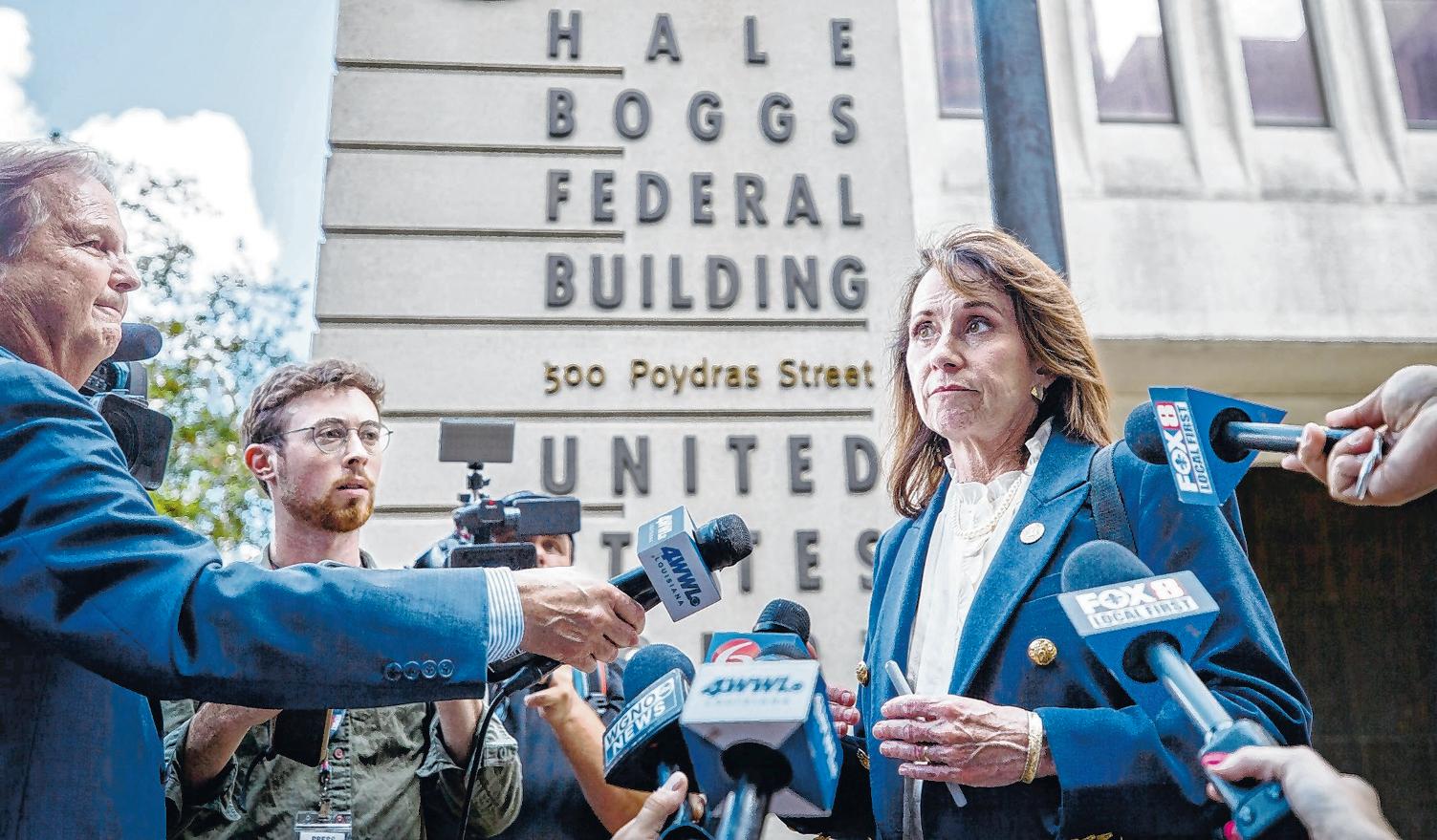
The Louisiana Supreme Court agreed to recall an arrest warrant for Louisiana Attorney General Liz Murrill in an emergency order late Friday night, the high court’s second major intervention to pause Murrill’s prosecution after her indictment by an Orleans Parish grand jury. The grand jury indicted Murrill on Thursday, charging her with 16 felony counts of malfeasance in office and intimidation. Orleans Criminal District Court Judge Leon Roche issued an alias capias arrest warrant and set Murrill’s bail at $400,000. The indictment, which happened behind closed doors, set off a flurry of filings to Louisiana’s high court.
The attorney general quickly asked late Thursday night for the state Supreme Court to intervene, and the court responded with an order Friday morning that stayed the indictment. The court issued the stay order on a 5-2 vote,

ä See MURRILL, page 5A
‘Once
Plan to restore wild Chandeleur Islands moves forward
BY MIKE SMITH Staff writer
Special coins flip the script on traditional pieces
BY MARK BALLARD Staff writer
WASHINGTON — While taxpayers are spending tens of millions of dollars on America’s 250th anniversary celebrations, such as a huge state fair on the National Mall and an epic fireworks show, a Mandeville native is raising millions for the government through the production and sale of coins that remember scenes from American history.
“The Mint this year is making more coin design changes than you’ve ever


seen in your entire life,” said Director of the U.S. Mint Paul Hollis, a former northshore state legislator and Board of Elementary & Secondary Education member.
The nation’s semiquincentennial is providing not just an opportunity to tell America’s story on special editions of nickels, dimes, quarters, half-dollar and dollar coins. The historic milestone also
ä See COINS, page 7A
They are Louisiana at its most remote, accessible only by boat or seaplane. But these islands could be lost forever in the decades ahead. Far out on the state’s southeastern boundary, what’s left of the Chandeleur Islands curves into the Gulf like a fading parenthesis, heavily eroded but still acting as a speed bump for storms while providing crucial habitat for wildlife and seagrasses.
That’s why, despite their remoteness and accelerating vanishing act, the state wants to
ä See ISLANDS, page 4A





Paul Pelosi accused of hit-and-run in Napa County
LOS ANGELES — The husband of former House Speaker Nancy Pelosi was involved in a hit-and-run in California that left a parked car with “major” damage authorities said Saturday, and he could face misdemeanor charges.
Paul Pelosi was driving his brown convertible Friday in Yountville, a town in the heart of wine country, when he struck a legally parked car on the side of the road, briefly stopped and then drove away, the Napa County Sheriff’s Office said in a statement. No injuries were reported.
A witness saw the collision and called 911. Shortly after, sheriff’s deputies found Pelosi with severe damage to the front of his car on a nearby road roughly one-quarter of a mile away. The octogenarian told officers that he knew he hit something but wasn’t sure when or what caused the damage to his car.
Pelosi didn’t have any alcohol in his system at the time of the crash, according to the statement.
3 children dead after boat capsizes in Wisconsin
LAKE GENEVA, Wis. — Three children who died when a boat capsized in Geneva Lake during a Wisconsin storm were wearing life vests, authorities said as the nation assessed damage from storms and a heat wave that marred the July Fourth holiday, leaving hundreds of thousands of utility customers without power.
As the Wisconsin Department of Natural Resources and the Geneva Lake Law Enforcement Agency investigated the Geneva Lake tragedy, the city’s police department issued a statement blaming it on a “sudden and severe storm” that rapidly produced hazards for boats.
It said a privately owned recreational motorboat carrying 10 occupants, including four children, tried to race to safety before it was overwhelmed by severe wind and waves. As it took on water, it eventually capsized and sank, the release said.
Six adults and a child were rescued from the water, but three children recovered from the lake after an intensive search were unresponsive, police said.
Boat sinks in Congo, killing at least 20, authorities say KINSHASA, Congo — A wooden boat transporting students back from state exams sank in central Congo, killing at least 20 people, authorities said. The vessel was traveling in Kasai province when it sank while entering the confluence of the Sankuru and Kasai rivers, according to witnesses.
“There were 80 survivors and 20 bodies,” said Francois Kabula, administrator of the Ilebo territory in Kasai province, where the sinking happened Friday.
However, Tshikudi Jean, who witnessed the crash, told The Associated Press that the boat was carrying over 200 people.
“The shipowners of the DRC are only after money and don’t care about human lives,” said François Malepo, president of the Ilebo civil society organization.

People swim in the Seine River in Paris on Saturday.
3 spots opened for swimming along Seine PARIS — Swimming in the Seine River is settling into a new Paris summer ritual as the city on Saturday opened three supervised bathing sites for the second year in a row.
The free swimming areas near City Hall, the Eiffel Tower and in eastern Paris will remain open through the summer, depending on water quality and weather conditions. They are placed under strict lifeguards’ watch and authorities conduct daily water quality testing.
Visitors described swimming in the heart of the French capital as an unforgettable experience.
“It’s amazing to be swimming in the Seine while looking at the Eiffel Tower,” said Stewart Talbot, a tourist from Melbourne, Australia.

BY STEVEN SLOAN Associated Press
WASHINGTON — Severe weather disrupted celebrations of America’s 250th anniversary of independence Saturday in several East Coast cities, including Washington, where storms prompted a roughly two-hour evacuation of the National Mall.
Elsewhere, severe weather prompted the cancellation of celebrations in Hartford, Connecticut, along with Harrisburg and Wilkes-Barre, Pennsylvania.
Spectators at Boston’s fireworks and concert were told to briefly seek shelter before events later resumed. An evacuation was also ordered in Philadelphia. New York and Pittsburgh moved forward with fireworks but shifted the time to accommodate the shifting weather.
Anticipation for the milestone holiday has been building for much of the year, serving as an opportunity for Americans to reflect on their complicated history as onetime colonists of an empire who became a superpower of their own. Organizers of celebrations months in the making had to adjust or cancel activities entirely as much of the East Coast sweltered under heat that approached and in many cases surpassed triple digits.
Heat is defining the big weekend in many places
The disruption was particularly acute in Washington, where signs at the Great American State Fair posted an alert shortly after 7 p.m.
Crowds were building in the area several hours before the evacuation. David Koshko, 42, and his
wife, Jennifer Koskho, of Harrisburg, Pennsylvania, came to Washington for a baseball game but planned to stay for the city’s fireworks show. After baking in the heat for hours during the Pittsburgh Pirates’ win over the Washington Nationals, they took a break in the shade of an overpass near the National Mall to plot their next stop.
“Just to be a part of the 250 years (anniversary) is an amazing thing,” said David Koshko, a commercial driver and veteran of the Marine Corps reserves.
In Philadelphia, fireworks began to crack as early as midday in the birthplace of the nation near the site where the Declaration of Independence was adopted by delegates to the Second Continental Congress. Hundreds of visitors were gathering at Independence Hall in the sweltering heat to await the celebrations coinciding with the France-Paraguay World Cup knockout game at Philadelphia Stadium, which began with commemorations of the holiday.
About 45 minutes before another World Cup match in Houston, a message from astronauts aboard the International Space Station noting the holiday was beamed into the stadium.
In New York, tall ships, with their masts, rigging and white sails outlined against a blue sky, made a procession around the
Statue of Liberty and up the Hudson River, recalling the fanfare around America’s 200th anniversary in 1976.
The 43 ships were followed by a display of aerial might with a stealth bomber and the Navy’s Blue Angels. Patrouille de France, the French Air Force’s acrobatic teams, flew over New York Harbor with their red, white and blue trails, evoking images of the American flag.
On Coney Island, crowds gathered in the sweltering heat to celebrate the United States’ 250th birthday by watching famed competitive eater Joey “Jaws” Chestnut defend his world hot dog eating championship in Coney Island, where he downed 66 hot dogs in just 10 minutes. Miki Sudo defended her title as well in the women’s division.
Saturday marked the 18th time Chestnut, 42, won the so-called Mustard Belt in just 21 appearances at the internationally televised Nathan’s Famous Fourth of July hot dog eating contest.
“It’s a dream, it’s electric, there’s no place better on Earth,” Chestnut said breathlessly in an interview immediately after the showdown.
Celebrations unfolded against the backdrop of a deep divide this election year that has been expanding for years, visible in everything from political expression to cultural norms to age-old questions over race, class and immigration.
At Mount Rushmore on Friday, Trump spoke of communism as a “mortal threat to American liberty” with the Republican president saying it was more dangerous than either World War or 9/11.
BY SAMY MAGDY Asscociated Press
CAIRO — A well-preserved Byzantine-era residential city in the western desert is one of two major archaeological finds announced by Egypt on Saturday.
The recent discoveries at the Dakhla Oasis and at the Marina el-Alamein archaeological site, near Alexandria, are the latest findings which the Egyptian government hopes will boost the country’s vital tourism sector, partially driven by antiquities sightseeing.
Along with the strategic Suez Canal, tourism is a major source of foreign currency in the cashstrapped country.
The Tourism and Antiquities Ministry said that the first discovery reveals details of daily life, urban development and economic activities in the Dakhla Oasis in the fourth century, when Egypt was part of the Byzantine empire.
The unearthed quarters included north-south thoroughfares intersected by east-west streets, forming open squares and public spaces, said Hisham el-Leithy, secretary general of the supreme council of antiquities.

PROVIDED PHOTO
A recently discovered artifact is displayed in the Marina el-Alamein archaeological site, west of the Mediterranean city of Alexandria, Egypt.
A basilica church dating back to the mid-fourth century stands at the settlement’s head, overlooking its main streets, along with remains of two watchtowers to safeguard the outskirts, said Mahmoud Massoud, who chairs the archaeological mission.
The oasis, located in Egypt’s western province of New Valley in the western desert, is on UNESCO‘s Tentative List, a step away from being added to the agency’s World Heritage List.
A heavily fortified structure with thick de-
fensive walls, and many houses consisting of reception halls and vaulted roofs were found in the area, Massoud said.
Among them were the house of Tisous, identified as a church deacon and dating to the second half of the fourth century, which archaeologists believe served as a house church before the construction of the city’s basilica.
Archaeologists also uncovered bread ovens, kitchens and stone grinding tools that had been apparently used to produce food. Also found were well-preserved bronze coins bearing portraits of Byzantine emperors, Latin inscriptions and Christian symbols, alongside a group of gold coins dating to the reign of Roman emperor Constantius II, who ruled between 337 and 361, the ministry statement said.
Diaa Zahran, head of the Islamic, Coptic and Jewish Antiquities department, said they found a collection of about 200 pottery fragments which would have been used as writing material. The fragments, known as octraca, have inscriptions detailing commercial transactions, correspondence and other details of daily life, Zahran said.
By The Associated Press
A Ukrainian drone attack struck an oil terminal in St. Petersburg on Saturday, Russian officials said, as Kyiv presses on with bombardment of Russia’s oil infrastructure.
Almost daily long-range attacks on Russian oil facilities have created a fuel crisis and heaped political pressure on the Kremlin as its all-out invasion of Ukraine stretches into its fifth year.
Gov. Alexander Beglov said the city’s Kirovsky district on the Baltic Sea was hit. He also said that air defenses shot down 72 Ukrainian drones across Russia’s second-largest city and the surrounding region.
Ukrainian President Volodymyr Zelenskyy described the attack as part of Ukraine’s “long-range sanctions” against Russia. He said that Ukrainian forces also hit a military target on the island of Kronstadt, just off the coast of St. Petersburg.
“The Ukrainian defense forces hit the port oil infrastructure, which earns money for the Russian war, and there were also hits on Kronstadt — an important military target,” he said in a post on Telegram.
St. Petersburg’s Kirovsky district was previously hit in June, ahead of Russia’s flagship St. Petersburg International Economic Forum.
The Crimean peninsula, which Russia annexed in 2014, has suffered particularly from heavy strikes, causing local authorities to suspend gasoline sales to civilians. A Ukrainian attack on Saturday killed one person and injured two more, including a 10-yearold child, the Moscow-installed Gov. Sergei Aksyonov said.
Russian President Vladimir Putin has shrugged off Ukraine’s strikes on Russia’s energy facilities as “not critical,” and insisted the war will continue until his goals are met.
He has described the attacks on Russian energy as an effort by Ukraine to distract attention from its losses on the battlefield, although analysts say the advance of Russian forces has been stymied in recent months.
On Friday, Putin visited the Russian military headquarters directing the war in Ukraine and received a report on the capture of the city of Kostyantynivka, after weeks of intense street battles.
theadvocate.com/eedition
theadvocate.newsbank.com
BY JESSE BEDAYN and ROD LAMKEY Associated Press
MOUNT VERNON, Va. — The people who were about to become United States citizens sat in folding chairs on George Washington’s lawn at Mount Vernon on Saturday, 250 years after the Declaration of Independence.
The sun beat down and the welldressed crowd was a flutter of paddle fans stamped with American flags. Their families clung to the shade of the trees on either side, where one woman had two American flags stuck through her ponytail.
“Well, good morning, everybody,” said Anne Neal Petri, the regent of the Mount Vernon Ladies’ Association.
“Good morning!” an excited crowd returned.
“And Happy Birthday, United States of America!” exclaimed Petri.
There were 150 people from 50 globe-spanning countries sitting in front of the small stage as they prepared to be sworn in as U.S. citizens on the July Fourth holiday and America’s 250th birthday.
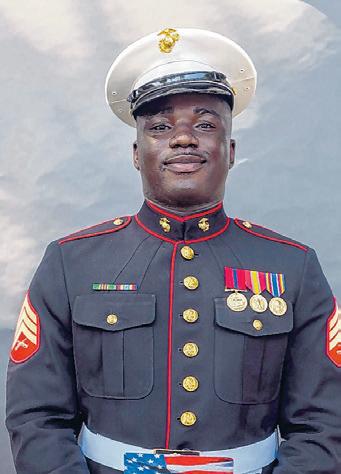
Among them was U.S. Marine Sgt. Diakaria Sangare from Guinea, who attended in his pressed Dress Blue uniform with three medals pinned to his left breast.
Sangare had served two deployments, and, like all assembled, had
gone through the long citizenship process: The test, interviews, green cards and biometrics. Others in the crowd, it was said, came from countries bathed in violence.
Some fled persecution.
After a speech about Washington, the crowd was asked to rise for the national anthem.
They did. Their hats came off and their hands covered their hearts. The paddle fans calmed.
The singer belted the words:
“And the rocket’s red glare, the bombs bursting in air, gave proof through the night that our flag was still there” — as Sangare held his right hand in a rigid salute, his face sober.
As the song concluded, the soonto-be citizens clapped and returned to their seats, while another speaker asked them to stand and remain standing when their country was called.
“Albania.”
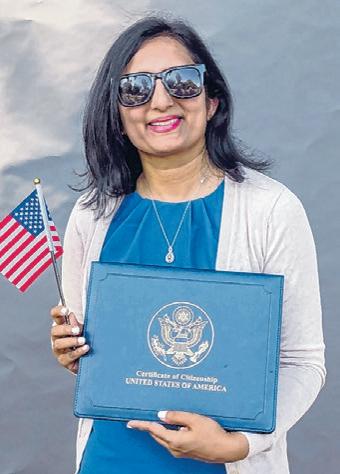
A woman in the front row with long black hair rose with a broad grin, a small U.S. flag in her hand.
“Bangladesh.”
A man in a black shirt stood. The Albanian woman, looking back,

ASSOCIATED
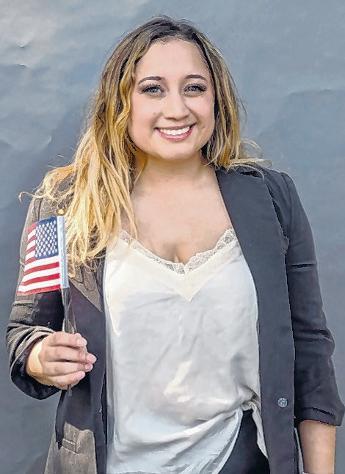
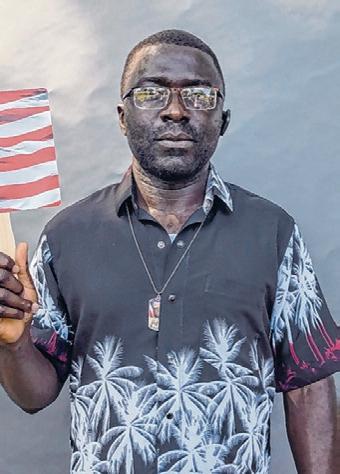
Following a naturalization ceremony on Independence Day at George Washington’s Mount Vernon in Alexandria, Va., new U.S. citizens pose for portraits, including from left, twice-deployed U.S. Marine Sgt. Diakaria Sangare, from Guinea; Raina Pinto, from India; Martha Flores de Martinez, from El Salvador; Tebid Munghey John-Paul, from Cameroon; and Yosselin May, from Honduras.
beamed at him.
It went on for 50 countries, through China and El Salvador and Iraq and Mongolia, as people stood, sometimes smiling, sometimes sedate.
At “Morocco,” a man in the back thrusts his fists in the air in support. A young boy looked up at him and then did the same, a little flag in his fist.
Then the crowd, with hands raised, recited an Oath of Allegiance, not so different from the oath Washington signed in 1778.
“Congratulations,” they were told. “You just became U.S. citizens.”
There was applause and laughter, then the Pledge of Allegiance. Sangare, his hand now over his heart, closed his eyes for a moment.
Nearby stood a tulip poplar tree, planted at Washington’s direction 250 years ago, that had lived through America’s history.
The next speaker, historian Douglas Bradburn, pointed it out in his speech before the day’s special guest.
“All the stories that are part of you, now become American stories,” said Bradburn. “When people ask me what are American people like, I now can talk about you, and your stories.”
“The second side of that is that, now, all America’s stories, and our history, are your stories. The father of your country is George Washington.”
The first president, it turned out, was the next speaker.
As he was introduced, the re-
enactor stood by a massive draped American flag, a sword scabbard on his hip. Then he donned the stage, doffed his cap to the audience, and began to speak.
“Today the name of ‘American’ belongs to you every bit as much as it does to me,” he said. He spoke to their arduous journeys to this point and their histories, now merged with America.
“So, my fellow Americans, to you, I say simply: ‘Welcome home’.”
Afterward, Sangare, the U.S. Marine, posed for a portrait, hands clasped in front of him, holding the American flag paddle fan, his Marine cap slightly askew.
“I just became a United States citizen,” he said, his emotions pushing out in an earnest smile.
BY NICOLE WINFIELD and ANDREA ROSA Associated Press
LAMPEDUSA, Sicily — Pope Leo XIV, who has sparred with the Trump administration over its immigration crackdown, spent the Fourth of July on Saturday in the epicenter of Europe’s migration debate to honor the tens of thousands of people who have died trying to reach Europe to find freedom and prosperity.
While the United States marked the 250th anniversary of the Declaration of Independence with rallies, parties and fireworks, the U.S.-born pope traveled to the Sicilian island of Lampedusa to pray at a migrant cemetery and celebrate a solemn Mass
for the island’s residents and newest arrivals. Later on Saturday, he got into the July 4 spirit with a visit to the residence of the U.S. ambassador to the Holy See, Brian Burch, a rarity for popes who usually don’t call on ambassadors. The U.S. Embassy said Burch gave Leo a commemorative baseball, an apple pie and a U.S. World Cup jersey.
Leo confirmed he was rooting for the U.S. team, the Embassy wrote on X, adding that the two discussed “American efforts to pursue peace, religious freedom and the need for moral clarity and courage around the world.”
A treeless strip of rock 5.6 miles long, Lampedusa is closer to Africa than the Italian mainland and is the
main port of entry into Europe for hundreds of thousands of migrants who crossed by boat from Libya or Tunisia, often smuggled by human traffickers.
Leo met with some migrants at the port and then walked alone onto the jagged jetty rocks, the wind whipping his cassock and blowing his zucchetto skullcap off as he looked out to the sea. He then blessed a plaque dedicating the dock to Pope Francis, who visited in 2013, before celebrating Mass on land.
“This is a place where gestures speak louder than words,” Leo said. “But for gestures to be human, they need a heart.”
In making the visit on this particular Saturday, Leo was sending
a powerfully symbolic message to the United States and Europe of the Christian obligation to uphold the dignity of every human being, migrants and the most vulnerable especially, while reminding the United States that it was founded by immigrants.
In a letter sent to Americans on July 4, Leo insisted that protecting the unborn and all human life also means “welcoming, protecting and assisting immigrants, whose hopes, sacrifices and contribution have formed part of the history of this country from its very beginning.”
“To receive them with compassion and generosity is not only an act of charity, but also a recognition of the dignity that belongs to every human person,” Leo wrote.

















































































restore as much of them as possible. An important lifeline has now arrived.
A long-developing plan to restore a 14-mile island in the chain, North Chandeleur, was granted a final $90.8 million tranche of funding last month, allowing construction to potentially begin early next year.
The $383 million project aims to rebuild beach, dunes and marsh with enough dredged sediment to fill the Superdome nearly three times.
It’s a unique project for a unique place, part of the country’s second-oldest wildlife refuge, a status that dates to 1904. A popular fishing spot, it is also an important habitat for endangered Kemp’s ridley sea turtles, a wide array of migrating birds and the northern Gulf’s most expansive collection of seagrasses.
The project will be largely paid for with funding related to the 2010 BP oil spill, which harmed the islands and related wildlife.
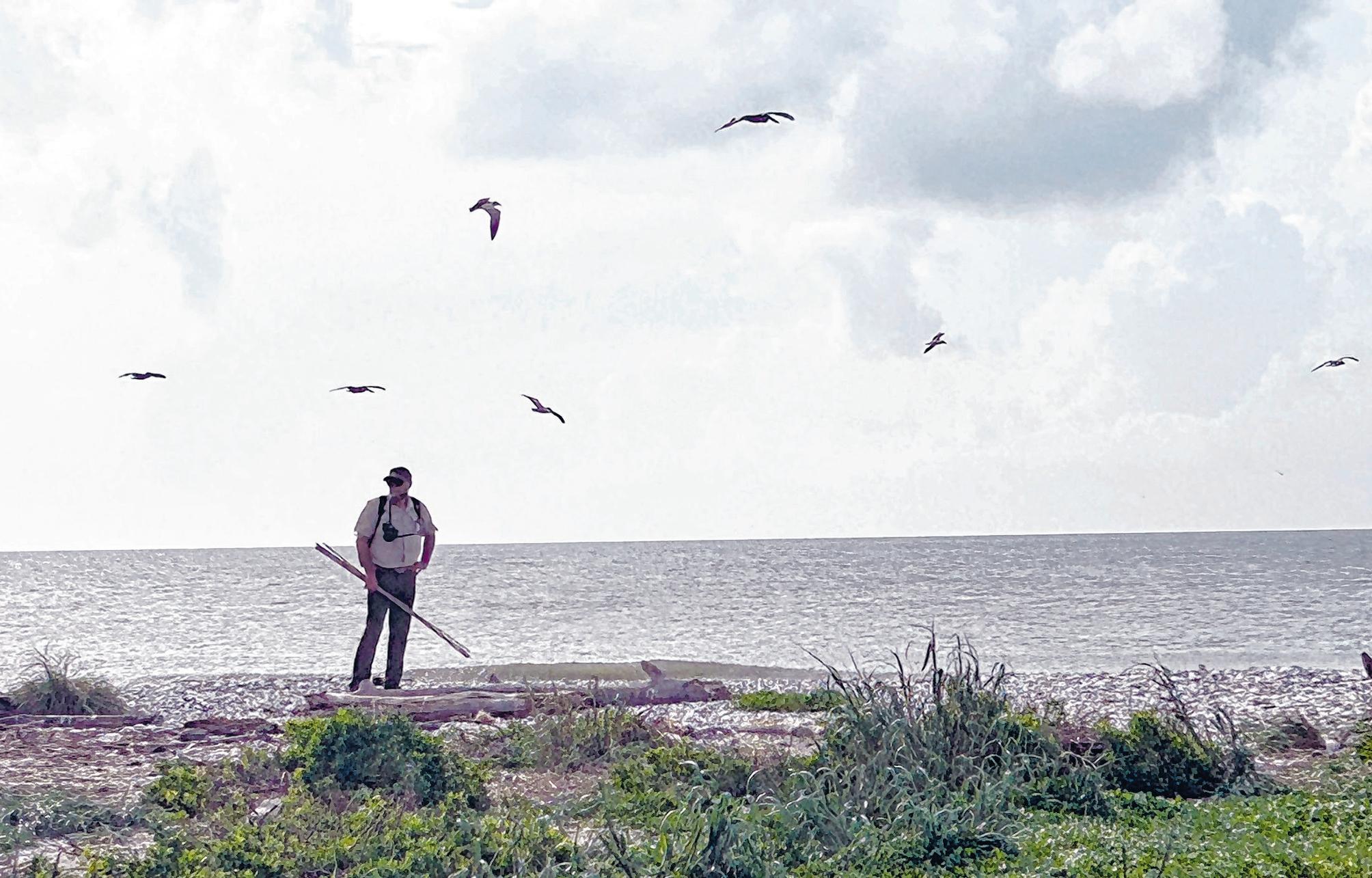
“It truly is a once-in-alifetime opportunity,” Todd Baker, project manager with the state’s Coastal Protection and Restoration Authority, said recently after landing by seaplane and wading ashore on one of his frequent visits there to document wildlife.
“When would we have gotten this kind of money for these islands? It wouldn’t happen. It makes it that much more important that it is appropriately used.”
Finding tiny turtles
Swept by the winds and tides, with the screech of gulls overhead and brown pelicans flapping among mangroves, the islands hold a rugged beauty far removed from the Gulf Coast’s manicured beaches and high-rise condos. While president, Teddy Roosevelt designated the Chandeleurs and nearby Breton Islands a national wildlife refuge. He later visited, and one classic picture shows him seated near the water, gentle waves breaking before him.
The Chandeleurs play many roles at once, giving them an importance that may be overlooked by Louisianans who have never been able to hitch a ride out there.
More than 170 different bird species have been documented there recently, including migratory piping plovers, red knots, snowy plovers and redhead ducks. They are the only known breeding ground for a species called the Chandeleur gull. In 2022, tiny sea turtle hatchlings were spotted on the islands for the first time in 75 years. They turned out to be critically endangered Kemp’s ridleys, the smallest of the sea turtles.
portance of the seagrasses.
They constitute Louisiana’s only marine seagrass beds, providing habitat for a long list of marine life.
‘Worth the effort’
But even for those with no interest in wildlife or remote isolation, the Chandeleurs remain vital. The barrier island chain provides a layer of natural storm protection that can slow hurricanes as they move toward southeast Louisiana.
Because of that location, they have taken a beating.
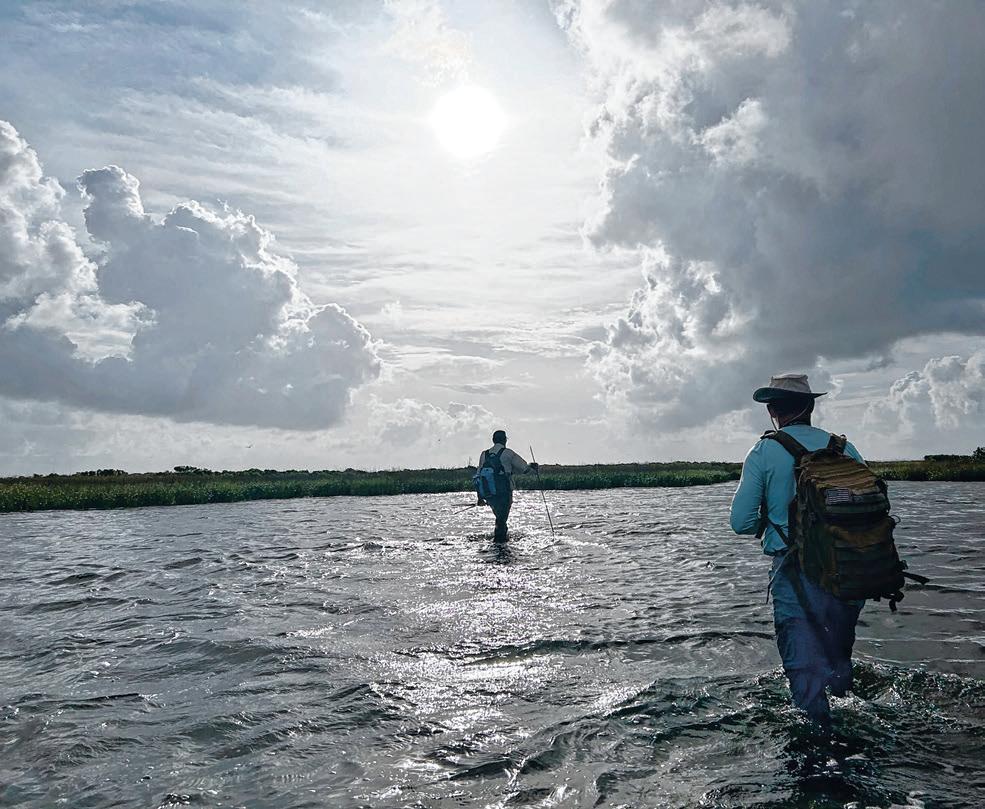
Fisheries circled the islands while Baker and Weigel searched for turtle tracks in the sand and shells below.
“Oh, there’s one,” said Weigel as he scanned the beach from his window, noting the coordinates.
After the seaplane dropped them in the water near North Chandeleur Island, they waded ashore and sought out the tracks, taking measurements and further location data.
They also explained the im-
Hurricanes Georges in 1998 and Katrina in 2005 battered them. Katrina’s damage included blasting out a cut that now divides North and South Chandeleur.
The islands are also subject to the other forces tearing away at Louisiana’s coastline — sea level rise, erosion and subsidence. Overall, they have lost around 90% of their land over the past couple centuries.
Projections show they could disappear entirely in the years ahead.
Kristi Trail, executive di-

Between 2022 and 2025, the state observed 202 “crawls,” or tracks, for Kemp’s ridleys, loggerheads and green sea turtles. Documenting them was an important part of the restoration plan. That’s why Baker and Matthew Weigel, from the state Department of Wildlife and Fisheries,
have been making repeated trips there.
On the flight over, pilot Michael Chauff of Wildlife and

rector of the Pontchartrain Conservancy, said that despite those difficult circumstances, the project must be pursued, even if it means repeatedly returning to replenish the work over time as it erodes.
She noted it forms part of the “multiple lines of defense” for the coast, and that the state cannot rely on “levees and floodwalls alone.”
“It’s worth the effort, even if it does involve repeated restoration efforts,” said Trail. “It would be a sad day if we were to throw our arms up and say it’s not worth restoring the Chandeleur Islands.”
The plan itself will use around 12 million cubic yards of sediment dredged from a nearby shoal to build some 2,500 acres of habitat. It would be focused on North Chandeleur Island and the smaller New Harbor Island.
A unique feature of the project involves building sand reservoirs that can buttress the work and replenish it over time. Construction is estimated to last for up to three years, putting potential completion time around 2030. But while the need for the project is widely recognized, it also points to a larger problem. The BP-related money paying for most of it expires at the end of 2031, and while projects underway at that point will continue, billions of dollars in new coastal restoration money will no longer be available in the future. The state has used the BP funds for a wide range of large-scale projects and faces a funding cliff when it expires. There are currently no replacements lined up for it. For Baker and Weigel, the Chandeleur project is a prime example of how the BP funds should be used, employing sound science to repair oil spill damage while also bolstering the resiliency of a crucial island chain. “All of these resources that were impacted — we now have the funds to make those resources whole,” said Weigel.
Email Mike Smith at msmith@theadvocate.com.





critiquing the lack of transparency, alleged conflicts of interest and other deficiencies in the case.
The Supreme Court ruled that Murill was “likely to succeed on the merits of a motion to quash this indictment on either a legal basis or due to apparent procedural irregularities.” They remanded the case back to district court for Murrill to file motions in her defense.
But by late Friday, Murrill returned to the high court and alleged the special prosecutor appointed to her case, former New Orleans Judge Laurie White, had refused to recall the alias capias arrest warrant despite the stay.
“I object to the removal of the capias (warrant), as the accused should not get any more preferential treatment than any other criminally charged defendant,” White allegedly told Murrill’s legal team, according to their second emergency filing to the Supreme Court.
The Louisiana Supreme Court issued another order shortly before midnight on Friday, saying it was “in order to add clarity and specificity where none should have been required.” The order recalled Murrill’s arrest warrant, ordered the warrant removed from law enforcement databases, and ordered White and law enforcement to “take all necessary actions to comply.”
“This Court’s July 3, 2026 Stay obviously prevents the state from pursuing the Attorney General’s arrest or any other step in the prosecution,” wrote the Supreme Court in its second emergency ruling.
The high court also ruled that the prosecution could still respond to Murrill’s defensive pleadings in district court while the stay was in place.
The court’s vote on recalling the warrant was 4-3, with Justices Billy Burris, Cade Cole, Jefferson Hughes and Jay McCallum voting in the majority. Chief Justice John Weimer and Justices Piper Griffin and John Michael Guidry each dissented.
Weimer and Guidry had also dissented earlier Friday from the decision to stay Murrill’s indictment; Griffin had voted in favor of the stay, but against the warrant recall.
Weimer wrote in his Friday night dissent that Murrill’s team had requested “an extraordinary remedy” that went far beyond requesting enforcement of the stay order.
“In criminal cases procedural rules are indispensable to serve justice and ensure that all are treated equally,” Weimer wrote over recalling the warrant. “Yet, ironically, on the eve of this July 4th when our nation will commemorate the 250th anniversary of the Declaration of Independence, this court is once again called upon to provide exceptions to the normal process pursuant to another feigned emergency by one party.”
Griffin wrote in a dissent that recalling the warrant goes to the merits of the case. She’d written in a concurrence earlier Friday that the reason she agreed to stay the prosecution was because it did not reach the merits of
the case.
Guidry wrote in his second dissent of the day that the majority had elevated “power and privilege over process.”
“This is yet another unprecedented preferential act by the majority bestowing a privilege that no other criminally charged defendant can reasonably expect to receive,” Guidry wrote about recalling the warrant.
‘Open court’ issue
Roche also defended the grand jury process in his own filing to the Supreme Court on Friday.
Roche’s court appeared to have “violated express provisions of state law requiring that grand jury returns occur in the public eye, ‘in open court,’ ” the Supreme Court said in its stay order.
Roche closed his courtroom to the public while the grand jury handed up Murrill’s indictment. Some reporters were handcuffed and others were threatened with arrest while they waited in the courthouse hallway for news of the grand jury return.
Roche wrote that “open court” does not mean “open to the public.”
“Rather, it means while the judge is present on the bench,” Roche wrote. “This interpretation is well-established in Louisiana law.”
He asked the Supreme Court to clarify their interpretation of “open court.” If it means “open to the public,” Roche said the justices should give guidance to lower courts about how to open their courtrooms while protecting anonymity and safety of grand jurors.
The Supreme Court has not issued any response to Roche’s filing.
Escalation of AG’s dispute
Murrill’s indictment represents the latest flare-up in a long-running power struggle between the Republican attorney general and Democratic local officials in the Crescent City.
The grand jury “chose to investigate” Murrill at the end of its six-month term, White said in a news briefing shortly after the indictment. They combed through evidence about whether Murrill tried to intimidate local political officials in New Orleans, including Mayor Helena Moreno, District Attorney Jason Williams and several City Council members. Williams recused himself, leading to the White’s appointment as special prosecutor. Murrill has alleged a tangle of conflicts involving White, including that the Attorney General’s Office represents the former judge in an ongoing sexual harassment lawsuit in state court.
The indictment specifically points to a series of letters that Murrill sent in May to New Orleans officials over a dispute about the city’s criminal clerk of court position. New Orleans voters last fall elected former life prisoner Calvin Duncan to the job, who was freed from prison when a judge found him innocent of murder. White also previously represented Duncan in his criminal case.
But before Duncan could take office, the Republicanled Legislature passed a new law to eliminate the criminal clerk of court position in New Orleans, combining the civil and criminal clerk roles into one role. As former Civil Clerk Chelsey Napoleon stepped into the combined job, Moreno and Williams argued that there should be another election to fill the role. Five City Council members voted to trigger an election. Murrill sent letters in response, warning the local officials were putting their jobs at risk by “usurping” Napoleon’s authority. Moreno at the time responded in a social media video, noting “there is also a criminal law that prohibits intimidating or threatening a public official in an effort to try to influence their decision or change their position.”
The law, which forbids “public intimidation, retaliation, retribution by the use of force and threat,” is now the backbone of eight counts in Murrill’s indictment. For the other eight malfeasance counts, grand jurors found she “intentionally refused or failed to perform any duty lawfully required of her,” the indictment states.
Convictions for public intimidation can lead to five years in prison and carry of fine of up to $1,000. Convictions for malfeasance can lead to 10 years in prison or a fine of up to $5,000.











Notice is hereby given pursuant to Article 7, Section 23(C) of the Louisiana Constitution and R.S. 47:1705(B) that a public hearing of the City of Baker School District in East Baton Rouge Parish will be held at its regular meeting place, in the board room of the City of Baker School Board Office, located at 14750 Plank Road, Baker, LA on Tuesday, August 4, 2026 at 6:00 p.m. to consider levying additional or increased millage rates without further voter approval or adopting the adjusted millage rates after reassessment and rolling forward to rates not to exceed the prior year’s maximum. The estimated amount of tax revenues to be collected in the next year from the increased millage is $3,079,092, and the amount of increase in taxes attributable to the millage increase is $455,922





















































provides the Mint with a way to increase its revenue.
By how much?
Hollis is unsure if the Mint will take in millions or billions but is confident the amount will be significant. The changes to pocket change are just for 2026. Designs return to pretty much what they were before in 2027.
“Coins were always my connection to United States history,” said Hollis, a numismatist whose first coin collected as a child, the one that launched his career buying and selling coins, was a silver dollar piece pressed in the 1790s.
“I wouldn’t know America’s story if it weren’t for a tangible link,” he added. What scenes to pick?
On July 4, 1776, the Second Continental Congress in Philadelphia formally adopted the Declaration of Independence in which the 13 colonies officially quit the British Empire and began calling themselves the United States of America.
The choice of which scenes to depict America’s journey from that point toward a “more perfect union” has not been without controversy. A coin showing Ruby Bridges integrating New Orleans public schools, for instance, was considered but dropped.
The U.S. Mint does not receive congressional appropriations. Rather, the agency makes money from making money.
The face value of a coin is generally greater than the cost to mint it. That gap — called a coin’s “seigniorage” — earns the mint money, but production prices are increasing.
“So where do you make up that revenue? You make it up in the sale of numismatic coins that you can sell at a premium over their face value,” Hollis said.
The value of commemorative medals and special coins — particularly the proof and

the 25-cent pieces to surprised children on a field trip to Mount Vernon, Washington’s plantation in the Virginia suburbs of the city that bears his name.
Third in the series, released June 16, focuses on the Declaration of Independence, with Thomas Jefferson, the lead author and third president. On the other side is the ringing Liberty Bell, crack exposed to show “fragility of a young nation at its founding.”
The fourth quarter celebrates the U.S. Constitution and features its primary author, James Madison, the fourth president. It will be released in August.
250th birthday. Controversy over coins
The Mint under Democratic President Joe Biden worked with an advisory committee that suggested including civil rights and women’s suffrage scenes, along with the Declaration of Independence and the Revolution.
The idea of a coin with Frederick Douglass, who worked to abolish slavery, was forwarded, as was the image of Ruby Bridges to represent racial integration of public schools.

uncirculated versions of the special edition coins sold to collectors — are set by demand, artistry, historical significance and scarcity.
Hollis, who as Mint director cannot trade coins, nevertheless still has his professional numismatic chops.
“You see how it’s shiny on Lady Liberty?” said Hollis, pointing out special features on a $50 gold piece for which collectors will pay a premium. “Most people don’t even know this, an advanced collector will, the U.S. Capitol is added, and then behind her are rays of sunshine. And we’ve never had a dual date. But to celebrate 250 years, we put 1776 and 2026.”
In March, the Mint released a $50 gold piece, which cost $5,250 each. It sold out in two and a half minutes, raising about $30 million, Hollis said.
But that’s for collectors.
Most people will come across the celebratory 1776-2026 coins as change from everyday purchases.
A lasting legacy Because coins are made of metal, they last almost indefinitely. Archeologists are constantly uncovering coins that are thousands of years old. The only confirmed contemporary image of Cleopatra’s face is on coins.
“I tell everyone here that the footprint that they provide to the American people, and beyond, is this coin isn’t
going to last not for hundreds of years, but for thousands of years,” Hollis said.
For this year, Jefferson is full-faced on the nickel and a profile of the Statue of Liberty replaces President John F. Kennedy on the 2026 half dollar.
The dime probably had the biggest makeover, which was tinged with controversy. Hollis includes this year’s dime on his business card.
President Franklin D. Roosevelt’s profile is replaced with “Lady Liberty” wearing a liberty cap. On the backside, a bald eagle clutches a bundle of arrows and the motto “Liberty over Tyranny.”
What caused controversy is the eagle’s talon, which traditionally clutches an olive branch signifying peace, is empty.
Eric David Custer, the artist, told the media in December he was referencing the eight-year Revolutionary War before peace was declared in 1783.
The semiquincentennial commemoration series of five new quarters, the most used coin, depicts various scenes of American history.
The series began in January with the release of the Mayflower Compact Quarter, which shows two pilgrims.
The Revolutionary War quarter features George Washington and Valley Forge, which was released in March. Hollis handed out
A 25-cent piece will be released in the fall featuring Abraham Lincoln’s Gettysburg Address, with the 16th president on one side and two clasped hands with the inscription “A New Nation Conceived in Liberty” on the other.
Congress authorized in 2021 changing designs to commemorate America’s
The U.S. Mint shelved previously approved designs of milestones like the abolition of slavery, women’s suffrage and the Civil Rights movement in favor of classical imagery.
“While I am glad President Trump responded to Senate Democrats’ pressure and abandoned his plan to plaster his face on our currency as if he were a king, I am deeply disappointed that he chose to scrap coin designs that were already approved to
celebrate historic moments for Black Americans, women and all of us who benefit from equal treatment under the law,” said U.S. Sen. Catherine Cortez Masto, the Nevada Democrat whose legislation in 2021 authorized the redesign. She supported a bill that blocked putting Trump on the dollar coin. His image is on a commemorative medal, however. Hollis said the Citizens Coinage Advisory Committee and Commission of Fine Arts provide opinions on proposed designs. Those panels include artists and engravers as well as public officials. But, considerations of art and practicality of pressing those designs also play a role. Treasury Secretary Scott Bessent ultimately decides what designs to use.
“The process is very sober-minded,” Hollis said. “We are creative by nature, and we like to think of everything. We recognize the importance of the coins that we strike and the fact that they’re going to outlive us.”























the current Trump administration.
BY MORIAH BALINGIT
AP education writer
— On Saturday, Presi-
WASHINGTON
dent Donald Trump’s administration was expected to launch Trump Accounts, tying the 250th anniversary of the signing of the Declaration of Independence to an effort to boost financial independence for American kids.
Under the program, parents can open investment accounts for any child born during Trump’s second term and automatically receive $1,000 from the government. Accounts can be opened on behalf of older children — as long as they don’t turn 18 before the end of the calendar year — but they will not receive the $1,000.
That money — and anything else deposited by employers, philanthropies and relatives — is invested in the stock market by private firms. Children can’t access the money until they turn 18, and then only for specific purposes, like paying for a home or school.
The accounts have already gotten a boost from billionaires beyond the $1,000 from the government. Michael Dell, the founder of Dell Technologies, and his wife, Susan, pledged to give $6.25 billion to the accounts of some kids who don’t qualify for the government’s $1,000. On Wednesday, Trump announced on Truth Social that Sanjay Mehrotra, CEO of Micron Technology, would give $250 million.
The donation “will help jumpstart the American Dream for these fabulous children as we celebrate America’s 250th Anniversary! This MASSIVE Investment will help MILLIONS of American children and families get a strong start in life, and give them REAL Financial Security,” wrote Trump, a Republican.

Trump Accounts launch amid widespread affordability concerns. The Federal Reserve’s preferred inflation gauge rose to a new three-year high in May as gas prices peaked during the war with Iran. Food prices have risen since Trump’s inauguration, too. Meanwhile, many Americans are bracing for changes to social safety net programs like Medicaid and the Supplemental Nutrition Assistance Program, or SNAP, which were cut under the same legislation that created Trump Accounts. What is a Trump Account?
It’s a new savings tool in which money is invested in the stock market on a child’s behalf. The child can’t access the money until they turn 18 and can use it only for specific purposes, such as paying tuition, starting a business or making a down payment on a home. Families can already sign up at trumpaccounts.gov.
After a parent or guardian opens an account, the U.S. Treasury Department will contribute $1,000 for
newborns. Private banks and brokerages will manage the money, which must be invested in U.S. equity index funds that track the stock market and charge the accounts no more than 0.10% in annual fees.
Parents can contribute up to $2,500 annually in pretax income, much like they do for retirement accounts. Parents’ employers, relatives, friends, local governments and philanthropic groups can also pitch in. Yearly contributions are capped at $5,000, but contributions from governments and charities don’t count toward that total.
“We’re doing something much better than giving the next generation a handout,” Trump said. “We’re giving them ownership of America’s future.”
Who gets $1,000?
As part of the initiative’s launch, parents of older children also are encouraged to open accounts, but they won’t get the $1,000 bonus. That money is reserved for babies born during the calendar years of









To qualify for the $1,000 seed money, a baby must be a U.S. citizen, have a Social Security number and be born between Jan. 1, 2025, and Dec. 31, 2028. Any parent can open an account for a qualifying child, regardless of the parent’s immigration status.
It’s important to note the child won’t be able to access the money until they turn 18, except in rare circumstances. So the money can’t help with immediate expenses. And disbursements from the accounts will be subject to taxes.
Can older kids get any bonuses?
Some can, thanks to contributions from some of the country’s wealthiest entrepreneurs.
The Dells’ $6.25 billion donation will allow some children who are age 10 or under to receive $250 in seed money if their parents open an account. That money is reserved for kids who live in ZIP codes with a median family income of $150,000 or less who are too old to get the $1,000 seed money from the Treasury.
Hedge fund founder Ray Dalio and his wife, Barbara, pledged $75 million for kids under age 10 in Connecticut, where Dalio lives. That would amount to $250 for 300,000 children in qualifying ZIP codes.
Trump announced in January that investor Brad Gerstner would donate $250 to Trump Accounts for every child under age 5 in Indiana.
Several major companies also plan to add Trump Account contributions to their benefits packages, including Uber, Intel, IBM, Nvidia and Steak ‘n Shake. The administration has encouraged such donations through what U.S. Treasury Secretary Scott Bessent calls the “50 State Challenge.”
What’s behind the accounts?
Backers of the accounts say they want to introduce more people to the stock market and give even children born into poverty a chance to benefit from it. Supporters also say the accounts bolster
capitalism when openly socialist candidates are growing more popular.
“The answer to more socialism is more capitalism,” Gerstner said in January at a White House event. “This makes every child in America a capitalist from birth.”
About 58% of U.S. households held stocks or bonds in 2022, according to the U.S. Securities and Exchange Commission, though the wealthiest 1% owned almost half the value of stocks in that year.
Before Trump created the accounts, California, Connecticut and the District of Columbia were piloting baby bonds programs, which are similar to Trump Accounts in some ways. Several other states, including Maryland, are weighing programs.
But those programs are targeted to youths growing up in poverty or foster care, plus children who lost a parent to COVID-19. Wealthier children don’t benefit from them. They’re also managed by the state, not private investment firms.
What do critics say?
Critics point out the accounts do little to help children in their early years, when they’re most vulnerable and most likely to be in poverty. The accounts, they say, also fail to offset cuts the Trump administration and congressional Republicans have made to other programs that benefit young people and the adults in their lives, including food assistance and Medicaid. Republicans created the accounts in the Trump tax and spending cuts bill that reduced spending for some of those programs.
And even with the contribution from the government, critics say the Trump Accounts will widen the wealth gap. Affluent families that can afford to make the maximum pretax contribution to the accounts will realize the greatest benefits. Poor families that can’t afford to set aside money for the accounts will benefit the least. Assuming a 7% annual return, the $1,000 in seed money would grow to roughly $3,570 over 18 years.





























Ayatollah Ali
Khamenei killed in the beginning of the war
BY NASSER KARIMI and JON GAMBRELL Associated Press
TEHRAN, Iran
— Hundreds of thousands of mourners began a dayslong funeral on Saturday for Iran’s Supreme Leader Ayatollah Ali Khamenei, beating their chests in sorrow before the glass case containing his flag-draped coffin in Tehran and calling for revenge against Israel and the United States.
The funeral for Khamenei, who ruled Iran for decades before he was killed at age 86 in a Feb. 28 airstrike in the opening moments of the Iran war, could provide a boost for the country’s theocracy and its new supreme leader, his son Ayatollah Mojtaba Khamenei.
That is important as Iran tries to leverage its hold on the Strait of Hormuz in negotiations with the U.S. over a permanent end to the war and as concern lingers that Israel could attack again. The funeral was delayed as the war raged,

Tehran. There was a chair like the one he once sat in while giving his sermons, complete with a microphone on a stand and a table next to it. Above it hung an image of the late Supreme Leader Ayatollah Ruhollah Khomeini, who died in 1989.
Khomeini’s funeral saw chaotic scenes as millions thronged his mourning ceremony and trip to the cemetery. Khamenei’s death was only the second time Iran has lost a supreme leader since the 1979 Islamic Revolution.
BY DAVID KEYTON, PIETRO DE CRISTOFARO and EBRAHIM NOROOZI Associated Press
and talks appear to be on hold until it is over.
During the ceremony, Iran’s top negotiator warned France and the U.K. over their comments about potentially launching joint patrols in the waterway, the narrow mouth of the Persian Gulf through which a fifth of all oil and natural gas once passed in peacetime.
Mourners wept at the sight of Khamenei’s coffin alongside those of his family members also killed in the airstrike, with some chanting: “Our word is one! Revenge! Revenge!” Some carried banners
and flags. Billboards across the city bore Khamenei’s image. Crowds of men rhythmically beat their chests in mourning, a common practice at Shiite funerals.
“Imam Khamenei was our heart, our father, our everything,” mourner Masoumeh Mohammadi said. “I still can’t believe they martyred him. We will not rest until we avenge his death.”
An outdoor stage at the Grand Mosalla resembled the stage where Khamenei once gave his speeches at a husseiniyah, or congregation hall, at his compound in downtown
BY BOUBACAR DIALLO Associated Press
FRIA, Guinea — Kazaliou
Balde’s parents started worrying about him when as a small child he avoided eye contact and had difficulty communicating.
First, the family in the West African nation of Guinea turned to a traditional healer who suggested protective amulets. Then, as the boy dragged himself along the ground instead of walking, they took him to a hospital in the capital, Conakry, where he was diagnosed with autism — something the family had never heard of before.
Neither had their neighbors. Some of them made rude comments about the child.
“Some suggested that I take him to the bush and throw him away,” said his mother, Kadiatou Diallo, a 55-year-old trader.
Misconceptions are common around children with autism in parts of Africa that lack reliable data, awareness and government support. Some mistakenly attribute autism to evil spirits. Experts say the misconceptions have often delayed diagnosis and brought stigma for children and their families.
Autism is a complex developmental condition now known as autism spectrum disorder that affects people in different ways. It can include delays in language, learning or social and emotional skills. For some people, profound autism means being nonverbal and having intellectual disabilities, but

“In Guinea, the care for autism is very poor,” said Dr. Alhassane Cherif, a psychologist and clinician in Conakry. “Private organizations and nonprofits are the only ones addressing this disorder and training staff to try to identify children.”
Balde first attended both private and public schools, but none fit him. His teachers did not introduce him to writing and reading, his mother said, recalling their comments that her son “has no provision for school.”
“I refused to consider these negative judgments. I refused to take him out of school,” Diallo said.
On Saturday, volunteers sprayed cooling water on crowds in the summer heat. Men and women congregated separately inside the Grand Mosalla after being checked by metal detectors and body searches. Police with assault rifles stood guard on surrounding streets. Many people stayed outside in the street, lounging under the shade of trees because the city had shut down.
The caskets of his dead family members sat beneath Khamenei’s, which had his black turban atop it, identifying him as a direct descendant of the Prophet Muhammad.
Khamenei’s body will be transported to cities in Iran and neighboring Iraq. Authorities have shut down streets, airspace and daily life for the mourning, which will end Thursday as he is buried at the Imam Reza shrine in Mashhad, Khamenei’s place of birth.
Mali government reports rebel attacks
By The Associated Press
BAMAKO, Mali — The Malian army said Saturday that several northern towns, including Gao and Sévaré, were targeted by rebels. The statement came as a rebel group announced a new offensive to capture a northern town.
Mohamed Elmaouloud Ramadane, a spokesperson for the Azawad Liberation Front (FLA), said in a Facebook post that the town of Anefis was being targeted by the separatists.
Mohamed Cissé, a resident of Gao, told The
Associated Press that the army is going door to door searching for attackers who are still in the city.
“For the moment, the calm has returned. But I learned that the attackers are still in a part of the city, so I stay inside the house with the family,” said Ousmane Maiga, another resident. In a later statement, the Malian army claimed that “the situation is completely under control.” It added that in Sévaré, “20 terrorists on motorcycles and equipped vehicles were neutralized.”
ERFURT, Germany — Delegates at the national convention of the far-right Alternative for Germany party on Saturday overwhelmingly reelected its leaders, including Alice Weidel, as tens of thousands of protesters aimed to disrupt the meeting and some clashed with police. Alternative for Germany, or AfD, sought to show unity as it voted to extend the terms of Weidel and Tino Chrupalla, who have headed it for four years as co-leaders and ran unopposed Saturday. Weidel was reelected with 81% of the vote, while Chrupalla earned 70%. German parties elect their leaders every two years.
The demonstrations outside the convention in the eastern city of Erfurt reflected how AfD has divided Germany even while becoming the biggest opposition party nationally and the strongest political force in Germany’s formerly communist east.
Saturday’s event was able to start on time despite the protests, which party officials hailed their “fundamental, legally guaranteed right to hold party conventions.”
“There are no peaceful seated blockades. There are no democratic roadblocks. Nor are there any gangs of thugs who deserve the harmless label ‘civil society.’ These troublemakers are the last resort of our political rivals,” Chrupalla said.
The weekend convention drew additional controversy by coinciding with the 100-year anniversary of a Nazi Party meeting held nearby that consolidated Adolf Hitler’s power over the fascist movement. Historians and political opponents say the timing carries powerful symbolism, an accusation the AfD rejects.
the majority of people experience milder effects.
Guinea’s government does not keep records around autism. The World Health Organization says about one in 127 people worldwide had autism in 2021, but it notes that the prevalence in many low- and middle-income countries remains unknown. Diallo decided to stand up for her son and seek better care. She said she has four children but loves him especially “because I’ve suffered so much with him.”
In Guinea, a nation of about 15 million people, only a few schools cater to children with autism and they can cost up to $300 per month. Not many families can afford it in a country where the minimum wage is $63 a month, and where 43.7% of citizens live below the poverty line, according to the World Bank.
She said her late husband “went to every corner of the country” looking for assistance for their son before dying in a road accident.
The solution appeared in their own hometown.
In 2023, Balde enrolled in the newly opened Salim Foundation for Children with Autism, a rare free school for children with autism. The school’s authorities were conducting an outreach program when they learned of Balde and visited his family.
The school, registered with Guinea’s educational authorities but not receiving government funding, teaches him and 14 other students in a large house with three teachers. It has toys in bright colors and pictures of animals on the walls.
Balde’s mother said that despite the challenges, she will not give up on her son’s education.
“My most ardent wish is that he knows how to read and write,” she said.











BY SEUNG MIN KIM and SUZAN FRASER Associated Press
WASHINGTON — President Donald Trump has berated and belittled many of his European counterparts expected to attend next week’s NATO summit in Turkey. But host Recep Tayyip Erdogan has drawn on his close ties with the U.S. leader to secure his presence at the Ankara event — an appearance that may even come with a significant gift related to Turkish defense.
“I would not have gone for most people,” Trump said last week. “But he called me up. He said: ‘Please, I have it in Turkey. You got to be there. The United States has to be in there.’ And so I’m going out of respect to President Erdogan.”
Leveraging that respect has helped Erdogan avoid the disarray that Trump’s absence would cause the alliance, particularly at a time when the Republican president has been repeatedly threatening to pull U.S. forces from Europe and scale back America’s role in NATO, unsettling allies.
Trump, who has frequently praised Erdogan and has called him a “hell of a leader,” has long rebuked other NATO countries over their defense spending. He claimed last year’s pledge to collectively boost it as a major personal win. More recently, he has clashed with alliance members for failing to back his war against Iran.
But Trump has sweetened the deal for Erdogan by also hinting that he could make news during his visit related to jet engines and the potential sale of F-35 fighter jets barred for years because of Turkey’s closeness with Moscow.
Trump’s affinity for strongmen leaders has long made him an admirer of Erdogan, who amassed power in Turkey first as its prime minister and now in his 13th year as president.
“His relationship with Erdogan, which is pretty strong, is consistent with what seems to be a pattern of his preference,” said Philip Gordon, who served as national security adviser for Vice President Kamala Harris. “It has often

been pointed out he seems to have better relationships with adversaries and autocrats, and he certainly says nicer things about them than with allies.”
Gordon, now at the Brookings Institution, added, “Erdogan is taking full advantage of it.”
Trump, who is expected to have a bilateral meeting with Erdogan on the sidelines of the NATO summit, will be the first U.S. president to visit Turkey since Democrat Barack Obama in 2015. By contrast, Democratic President Joe Biden kept Erdogan at arm’s length over Turkey’s democratic backsliding and close ties to Russia.
Opposition parties and human rights organizations have accused Erdogan of undermining democracy and curbing freedom of expression. They say baseless investigations and prosecutions of human rights activists, journalists, opposition politicians and others remain a persistent problem in Turkey.
Soner Cagaptay of the Washington Institute said Erdogan and Trump “clicked” personally during Trump’s first term. When Biden extended an invitation in 2024 for Erdogan to visit the U.S. after Turkey
endorsed Finland and Sweden’s NATO membership, Erdogan decided not to go.
“That was Erdogan’s way of signaling to Trump, ‘Hey, you are going to probably win the elections,’ ” Cagaptay said. “I think Trump saw that as a giant gesture.”
During a meeting with NATO Secretary-General Mark Rutte last week, a reporter asked Trump whether he was taking “a big gift bag for Erdogan” on the trip, noting that Ankara wants F-110 jet engines and F-35 fighter jets.
“Yeah, I think so,” Trump responded. “Yeah, I’m going to probably do something that’s going to make him very happy.” Trump had also suggested September that the U.S. could soon start selling F-35s to Turkey. Turkey was barred from the program in 2019, after it purchased Russian-made S-400 missile defense systems. U.S. officials have feared that Turkey’s use of the Russian system could enable Moscow to gather information on the F-35’s capabilities.
At the Oval Office meeting, Vice President JD Vance said Washington was exploring ways to sell Turkey the jets, emphasizing that any sale would ensure Turkey has
complied with U.S. law. There is significant bipartisan opposition on Capitol Hill, including from influential Republicans such as Sen. Jim Risch of Idaho, chairman of the Senate Foreign Relations Committee, to selling the F-35s to Turkey as long as Ankara is in possession of the Russian missile defense systems.
Meanwhile, the F-110 jet engines that Turkey is seeking to purchase would power its domestically produced KAAN fighter jets. The State Department last week took a step toward making those sales, sending key lawmakers a notice that it planned to bypass congressional opposition to more than $700 million of the jet engine sales to Ankara, according to two people granted anonymity to discuss details of a nonpublic notification.
“In this case, the State Department did not even attempt to justify its decision,” New York Rep. Gregory Meeks, the top Democrat on the House Foreign Affairs Committee, said in a statement last week. “It did not invoke any emergency authority, did not present a written rationale, and for months refused to make a good-faith effort to brief me on implications of the sale for the U.S.-Turkey relation-
ship, Turkey’s continued possession of the Russian S-400 system, and other regional security concerns.”
The relationship between the U.S. and Turkey is thawing in other ways, too. Earlier this year, Trump’s Department of Justice dropped a major case against Turkey’s state-owned Halkbank, which had been accused of helping Iran evade U.S. sanctions.
When he returned to the White House for his second term, Trump appointed a close friend as ambassador to Turkey: Tom Barrack, a longtime ally who also served as the chairman of his inaugural committee. “Barrack is playing a crucial role as a facilitator in the relationship,” said Ahmet Kasim Han, a professor of international relations at Ankara’s TED University.
Erdogan and Trump have frequently held telephone calls to discuss Syria, Gaza and the wider Middle East, and Turkey joined Trump’s Board of Peace aimed at overseeing the ceasefire in Gaza. Trump claimed this month that he asked Erdogan to stay out of the war in Iran and that the Turkish leader complied, though there is no indication that Turkey had ever intended to get involved.
Trump expressed admiration for Erdogan even while standing beside Israeli Prime Minister Benjamin Netanyahu at a joint news conference last year. Netanyahu, whose government is at odds with Ankara, had hoped to win Trump’s support for pushing back on Turkish influence in Syria, but instead found himself watching as Trump showered praises on Erdogan and urged Netanyahu to be “reasonable.”
Last year, after meeting with Trump at the NATO summit in The Hague, Erdogan told reporters that the U.S. president is quick to return his calls, an anecdote that illustrated their close ties.
“With my friend Trump, we are opening the door to a new era in Turkish-American relations,” Erdogan said. “The process of telephone diplomacy between us has never exceeded 24 hours so far. When we call, the other side responds within 24 hours.”




BY JOSHUA A. BICKEL and JENNIFER MCDERMOTT Associated Press
HOPKINTON, R.I. — At Ashawaug Farm in southwest Rhode Island, Dawn and Cassius Spears preserve their Indigenous knowledge of agriculture through the cultivation and keeping of three Narragansett heritage crops: white corn, succotash beans and crookneck squash.
They would like to expand their farm’s reach beyond their farm stand, but it’s challenging. Like many small food producers, the Spears have sought financial assistance through federal programs. Some have been cut or significantly scaled back under the Trump Administration, including U.S. Department of Agriculture programs that helped tribal farmers.
Tribes relied on these programs to grow and distribute culturally-significant foods locally.
“When we go into these federal programs, we’re hoping that they’ll last long enough,” Cassius Spears said. “They usually start out with a good song and dance. And they’re going to last a long time. And then something happens where they get cut.” The Biden administration started two programs during the pandemic to help states and tribes purchase local food from nearby farmers for food banks and schools: the Local Food Purchase Assistance Cooperative Agreement Program and the Local Food for Schools Cooperative Agree-
ment Program (LFS). These programs offered farmers, including tribal farmers, reliable markets for their products. Tribal governments received assistance to purchase food from local producers to distribute to tribal members.
This allowed tribes to get federal dollars directly to small-scale producers, said Carly Griffith Hotvedt, executive director of the Indigenous Food and Agriculture Initiative and a member of Cherokee Nation. The Spears’ farm provided food for a tribal farm in nearby Connecticut that used LFPA funds, after an agreement was signed in August 2022.
In some instances, tribes used those dollars to source culturally-significant foods for tribal members such as bison meat, certain types of berries and wild rice that were included as part of a food box distribution. For some low-income tribal members, it was the best way to access these types of foods, Hotvedt said.
“It wasn’t just commodity foods in that box. It was highly local, traditionally relevant, culturally relevant foods that were included,” Hotvedt said.
In March 2025, under the Trump administration, the Agriculture Department ended the two programs that provided more than $1 billion for schools and food banks, saying that they no longer aligned with the agency’s goals.
U.S. Sen. Jack Reed, a Rhode Island Democrat, and Sen. Jim Justice, a West Virginia Republican, introduced a bill they say takes

the best from the two programs and creates a permanent grant program. It would allow state and tribal governments to buy local foods from local and regional producers to distribute to nearby hunger relief programs and schools.
Reed said he feared that when the USDA programs were cut, families across the country would have a more difficult time getting access to food. And, he said, the access wouldn’t be to nutritious, freshly grown produce.
Reed said he’s hoping to get the legislation passed as part of the Farm Bill, the massive, multi-year law that governs agricultural and food programs. The House passed its version of the bill in April, and a Senate com-
BY COLLEEN BARRY Associated Press
MILAN — Venice’s new mayor is proposing a dynamic pricing system for the city’s three-year-old day-tripper access fee, seeking government approval to raise the charge to as much as 50 euros on the busiest days to ease overcrowding in the UNESCO world heritage city.
Mayor Simone Venturini told The Associated Press in an interview Friday that the current 10-euro fee for last-minute reservations has not done enough to discourage visitors on peak days. Instead of imposing a fixed higher fee, the city wants to enact a form of surgepricing, allowing the charge to rise with demand on the busiest days.
Venturini said the system would both discourage overcrowding and help cover the costs of maintaining the city.
“We spend 100 million euros a year just to maintain Venice physically, and nobody gives us that money. Not Europe. Not the Italian state. International critics don’t pay it either. It’s paid by the people of Venice, and in part through tourism taxes,” said Venturini, who was elected mayor last month after serving as the city’s top tourism official when the day-tripper tax was launched in 2024.
The access fee itself has been widely criticized by activists, housing advocates and opposition politicians for not doing enough to ease crowding in the city, while

mittee released its draft in late June. The House version also includes a bipartisan proposal for a permanent program modeled after the Local Food Purchase Assistance program. It would allow states, through the USDA, to establish cooperative agreements connecting local farmers and producers with local food distribution organizations.
Both proposals would set aside 10% of the program’s funding for tribes.
For a new program to succeed, Congress must include mandatory funding in order to help farmers better plan, purchase supplies and hire staff because they know they’re going to sell products through those programs, said Hannah Quigley,
a policy specialist with the National Sustainable Agriculture Coalition. The House version would require Congress to agree on funding annually, she added.
Reed said he’s advocating for mandatory funding in the Senate because without it very little is funded these days, and because farms are under so much pressure economically. An optional program wouldn’t help them as much, he said.
“We really want to punch through the existing obstacles for small farmers and Native American farmers,” he said.
Dawn and Cassius Spears would like to see Indigenous producers prioritized when tribal entities purchase food. And they said they think
having dedicated programs that Indigenous producers can access outside of their tribal government would help more Indigenous producers.
Under the canopy of one of her farm’s high tunnels at the start of this year’s planting season, Dawn Spears carefully organized her tomato crop, separating the tiny plants before moving them to a field outside. The name of the 6-acre farm is an homage to the Narragansett name of the river that flows through town. It started as a small community garden and food sovereignty project.
One of her grandsons, 9-year-old Giizhig, walked in to ask if she needed help.
“Only if you want to,” Spears replied. “It’s always good to know how to do it, right?”
Teaching the next generation about where food comes from and how to grow responsibly is key for her. But her culture isn’t just about cultivating crops. It’s also about gathering foods they eat from the wild and being able to preserve and access land where those foods are.
She’s working to protect the land around their farm as development grows with the hope of introducing native plants into that area that can be foraged for food. Federal funding programs can also help with securing access to land, she said.
“If you take a person away from the land that they come from, then it’s like they’re not whole,” she said. “We have to eat the food that’s naturally from that space that we come from.”




reducing Venice to a tourist attraction by charging admission. They also say the focus is too much on managing tourist flows, and not enough on bringing more residents back to the historic part of the city.
Venturini said the money is necessary to clean and maintain the city. The proposal for a surge-pricing structure would require an amendment to Italy’s special law governing Venice, and Venturini said he had already discussed the idea with the tourism minister.
“Day-trippers obviously generate waste — they eat, they drink, they throw things away. That comes at a huge cost,” which he said are driven up “because everything has to be done by hand, with brooms, boats and handcarts.”
While the 50-euro price proposal has made headlines and drawn criticism
for being prohibitive for many visitors, particularly families, Venturini said the amount was chosen as an upper limit, giving the city room to experiment with different pricing levels. He said they are still working with researchers to determine the right threshold.
“If, for example, more than 40,000 people had already booked for a given day, those above that threshold might be asked to pay a little more — 20, 25 or 30 euros,” Venturini said. “We asked for a broad range, up to 50 euros, and then it would be up to the city to manage the system through further testing. It doesn’t mean everyone who comes to Venice would pay 50 euros.”
While opposition politicians have proposed putting a cap on the number of visitors a day, Venturini said current Italian law does not allow that.













































































































WASHINGTON — House Speaker
Mike Johnson and House Majority Leader Steve Scalise likened recent democratic socialist primary victories to the revolution that founded the Soviet Union in 1917.
“You could call it the Bolshevik Revolution of 2026, but the Mamdani takeover of the Democrat Party is official now,” said Scalise, R-Jefferson, referring to New York City Mayor Zohran Mamdani, whose endorsed candidates knocked off incumbents in closed New York party primaries.
They’ll now represent Democrats in the Nov. 3 midterm elections that will decide which party will control the U.S. House starting in January.
Democratic Party candidates openly rallying around the democratic socialist banner — no party of that name is certified for elections — advanced to general elections for a variety of posts in New York, Denver, Los Angeles, Philadelphia and Washington — all decidedly blue cities. They beat incumbent Democratic officials.
“We are not done working and delivering for the American people while the Democrats are fighting to see how far left to the socialist left they can go,” Scalise added.
Johnson, R-Benton, picked up on the theme.
“It’s common sense versus communism, because that’s what’s happening in the Democrat Party. The insurgent left is taking it over — the insurgent left that hates America, hates our founding principles. They hate the idea of borders and prisons,” he told reporters.
Prior to ascending the speakership in October 2023, Johnson was in charge of messaging and making sure Republicans were saying the same things.
Trump approves disaster request for Arthur

President Donald Trump this week approved Louisiana’s request for $8.6 million in federal aid for the damage caused by Tropical Storm Arthur last month. The storm dumped record rainfall on Avoyelles Parish and the surrounding areas, causing widespread flooding. It also generated numerous tornadoes across southeast Louisiana. In a post on Truth Social announcing he had approved Gov. Jeff Landry’s request for federal funding, Trump praised Louisiana’s Republican leaders.
“Louisiana is truly a special place, with Governor Jeff Landry, Senator John Kennedy, soon to be Senator Julia Letlow, Speaker of the House Mike Johnson, House Majority Leader Steve Scalise, and Congressman Clay Higgins,” he said.


“We’re no longer in a battle just between Republicans and Democrats arguing over marginal tax rates or the size of regulation this election and this year,” Johnson continued. “Right now, we have a
Athlete agent registration system goes online
contrast between people who love the country and its founding principles, and those who have open disdain and hatred for them.”
President Donald Trump also likened Democrats to communists who need to be stopped.
“They use the word ‘social democrat’ because it sounds so nice, but it’s really communism you’re talking about,” he told reporters in the Oval Office.
Louisiana Democratic Party Chair Randal Gaines, of LaPlace, says this is falderal, an attempt to divert MAGA voters’ attention away from the Republican majority’s inability to govern. Over the past few weeks, GOP factions in the House have failed to rally enough to pass legislation, includ-
ing a raise for the troops, requiring Johnson to send Congress home early for the nation’s 250th birthday.
“That’s the usual tactic of the Republican Party when they’re losing,” Gaines said. “And typically, those sound bites are incorrect, wrong, and misleading, and dishonest.”
Republican leaders want to tie images of gulags to all Democratic candidates, Gaines said.
While perhaps more extreme in their rhetoric and conclusions, democratic socialists are adopting the general positions of more moderate Democratic candidates who also chafe at the GOP whittling down Medicaid and the Affordable Care Act while passing
in the case Louisiana v. Callais.
tax breaks, they see as mostly benefiting the wealthy, he added.
Gaines’ read is shared somewhat by Steve Bannon, the rightwing podcaster who helped get Trump elected president twice. Bannon told Politico last week that the democratic socialists’ prescription isn’t crazy, it’s resonating. Voters seem open to a widespread affordability appeal coupled with ousting mainstream incumbents.
“They campaign as anti-establishment,” which the GOP hasn’t fully grasped, said Bannon. “If you just sit there and demonize, that’s certainly not enough.”
Structurally, Republicans are in better shape to maintain their majority in the House. Trump insisted that GOP-run states draw more seats to favor GOP House candidates.
Democrats responded in kind, but Republicans have been more successful.
The House currently has 218 Republicans, 212 Democrats, an independent who usually votes with the GOP, and four vacancies.
For the midterm elections, 205 seats favor Democrats, 212 districts back Republicans and 18 races rated as “Toss Ups,” according to The Cook Report with Amy Walter, a respected electoral handicapper based in Washington. Democrats need to win 13 of the 18 toss-up contests to reach the 218 representatives necessary to retake the majority in the House, Still, Trump is unpopular with 60% to 75% of the voters as are many of the administration’s policies, according to a series of recent surveys conducted by pollsters from both parties.
Despite Johnson’s optimistic rhetoric, Republicans seem worried about losing their majorities in the House when the ballots from the Nov. 3 midterm are counted.
Email Mark Ballard at mballard@theadvocate.com.


Louisiana’s new system for registering agents who represent Louisiana athletes is now online, Attorney General Liz Murrill’s office announced Wednesday. The system is part of a new law the Louisiana Legislature passed this year seeking to more closely regulate how athletes — particularly high school and college students — navigate a new era in which they can be paid for their name, image and likeness.
Coaches and parents have raised concerns that, without some protections, agents could take advantage of young athletes.
Agents are now required to complete an application that includes a background check and must undergo mandatory training, among other requirements. Those applications are reviewed by the Attorney General’s Public Protection Division.
Agents can submit an application online at nil. ag.louisiana.gov.
“Louisiana’s student athletes deserve advocates who operate with integrity, transparency, and their best interests at heart,” said Attorney General Liz Murrill.
John Oliver mocks
Louisiana redistricting
As the redistricting battles that Louisiana helped launch continue to reverberate across the country in the lead-up to midterm elections this fall, comedian John Oliver took shots at Louisiana and Gov. Jeff Landry for eliminating one of the state’s two majorityBlack congressional districts.
On an episode of the HBO program “Last Week Tonight” that aired last Sunday, Oliver criticized President Donald Trump’s push for states to draw new voting maps favoring Republicans, which was supercharged by an April U.S. Supreme Court ruling
Oliver taunted the White Louisiana plaintiffs who originally brought the case challenging the constitutionality of a majorityBlack voting district, saying their reasoning amounted to, “This map hurt my feelings, and now I want to talk to your manager.”
William; and three, he sounds like Elmer Fudd if he exclusively went to schools named after Robert E. Lee,” he said.
A spokesperson for Landry did not respond to a request for comment.
The comedian mocked an interview Landry did with “60 Minutes” in which Landry defended the state’s redistricting effort, arguing that he understood the lived experience of African Americans because he grew up in a predominantly Black community, he should not be judged for being White, and the racism of the past has already been rectified.
“He shouldn’t be judged just because he is White,” Oliver said. “He should be judged because one, he just had to have the concept of racism explained to him on TV; two, he’s for some reason dressed like 30 Rock’s Leap Day
Landry has said Louisiana was required to draw a new congressional map after the Supreme Court ruled the state’s previous one was unconstitutional.
The watershed Supreme Court decision released in April weakened a key provision of the federal Voting Rights Act, which for decades had required some states with a history of racial discrimination to draw majority-Black districts as a remedy for the racist voting practices.
The justices ruled that using race to draw district lines is unconstitutional in virtually all circumstances.
In the wake of that decision, Louisiana and a number of other southern states drew new voting maps eliminating majority-Black districts that favor Democratic candidates in an effort to win more GOP seats in Congress in the November midterm elections.


Divided decisions vary on race, immigration
BY MATT BROWN Associated Press
WASHINGTON — The Supreme Court wrapped up a term that yielded significant rulings in cases involving race and discrimination that could have lasting effects on U.S. politics and society.
Justices were at times bitterly divided — and critical of one another — in rulings that winnowed key provisions of a landmark voting rights law, allowed the government to revoke protections for some immigrants and even challenged the historic understanding of birthright citizenship for the children of immigrants.
The decisions come at a moment when long-standing debates over race and identity have turned toward immigration, increasing racial diversity and the fairness of policies meant to prevent and redress discrimination.
Temporary protected status
The court allowed the government to end deportation protections for Haitians and Syrians in the U.S. who have fled violence and natural disaster. President Donald Trump’s administration revoked the temporary protected status last year.
With the president’s more than decadelong track record of denigrating developing nations and immigrants who come to the U.S. from Africa, Asia, Latin America and the Middle East, attorneys for some affected migrants contended that the government could not cancel the designations, in part because Trump’s comments about immigrants were racist.
“The true reason for the termination is the president’s racial animus towards nonwhite immigrants and bare dislike of Haitians in particular,” Geoffrey Pipoly, an attorney for the Haitian nationals in the case, said during April oral arguments in the case, Mullin v. Doe. The attorneys noted that, during his second presidential

campaign, Trump claimed immigrants “are poisoning the blood of our country” and suggested in another instance that migrants have “bad genes.”
In writing for the 6-3 conservative majority, Justice Samuel Alito said none of the cited statements was “overtly racial,” reasoning that any of Trump’s actions could have been taken without racial animus and attributing his anti-immigrant comments to “political discourse.”
That’s not how the court’s liberal minority saw the situation. “The references — of filth, disease, and primitiveness — are shot through with racial stereotypes and tropes. It is hard to imagine the statements being made today of any White community,” Justice Elena Kagan wrote in her dissent.
Birthright citizenship
In one of the highest-profile cases of the term, the court reaffirmed that the 14th Amendment to the U.S. Constitution means all people born in the U.S. are citizens.
On his first day in office last year, Trump signed an executive order seeking to restrict birthright citizenship to the children of U.S. citizens, a move that civil rights groups challenged as unconstitutional and racist.
In his majority opinion, Chief Justice John Roberts traced the arc of birthright citizenship — a principle that all people born on U.S. soil are citizens — from its origins in English common law to its codification in the 14th Amendment.
Roberts noted that race and citizenship had been fiercely debated in courts, speeches, Congress and battlefields because of Black Americans’ fight for freedom.
Freed Black Americans did not receive citizenship as a “reward,” Roberts wrote, but because “the Amendment recognized their rightful claim to birthright citizenship simply and solely by virtue of their having been born on American soil.”
The 6-3 ruling was a blow to the Trump administration, which has made restricting immigration its central goal.
“The clause does not extend citizenship to the children of temporary visa holders or illegal aliens,” U.S. Solicitor General John Sauer argued before the court in April.
Justice Clarence Thomas agreed and wrote in his dissent that African descendants of enslaved people in the U.S. are a unique case separate from the children of tourists or people in the country illegally.
“Blacks were entitled to citizenship because they were Americans. They had no other homeland, owed no allegiance to any foreign power, and were subject to no other authority,” Thomas wrote.
In a stark move, liberal Justices Ketanji Brown Jackson and Sonia Sotomayor directly criticized Thomas’ claim in a joint opinion.
Voting rights
The Supreme Court handed down a decision in April that gutted a key provision of the Voting Rights Act meant to remedy efforts to disenfranchise minority voters. Among the methods the law permitted to stop voting discrimination in states was the creation of majority-minority congressional districts.
In the majority opinion, Alito found that because race and partisan voting behavior were so intertwined, it was unfair to conclude that a partisan gerrymander of a state’s congressional districts could be racist, given there may be other reasons for the map’s results.
Alito reasoned that “in a state where both parties have substantial support and where race is often correlated with party preference,” partisan actors can “easily exploit” laws meant to protect minority political participation for disingenuous reasons.
The liberal justices balked at the logic and criticized the conservative majority for harming minority representation in politics and culture. They believed that the law’s provisions were still necessary to prevent discrimination by states and worried about the fallout from its removal.
The Trump administration is reportedly ordering staff not to confirm deaths or details about severe injuries at U.S. national parks — but officials are adamant the policy is not meant to conceal information from the public.
In a statement to the Los Angeles Times, an Interior Department spokesperson said the “narrative” that the agency is trying to obscure information “is false and reflects a significant mischaracterization of the Department’s guidance.”
An internal memo, circulated in December and first reported by The Washington Post, states that Department of the Interior employees, including National Park Service staff, are
not permitted to confirm deaths that take place in federal park facilities. Only “appropriate authorities” can confirm a fatality after coordinating with the communications office and notifying the decedent’s next of kin, the Post reported, citing the memo.
The memo did not specify what agency would be tasked with confirming deaths, according to the Post.
The Department of Interior did not respond to a request from the Los Angeles Times asking to review the memo. But as reported by the Post, it states that the department “shall not confirm the severity of injuries” and “may state only that an individual was transported and the method of transport.” Staff are permitted only
to confirm that an incident happened, the general location where it occurred and that authorities are responding, according to the Post.
Last month, Park Service staff have offered only minimal details about two deaths at California national parks, including a fatality at Yosemite in which a young man perished after falling from a nearly 600foot waterfall.
A Yosemite National Park spokesperson would only confirm the date of the incident, that it involved a 23-year-old man and that the agency is investigating.
“Emergency personnel responded to the incident, which remains under investigation. No additional information is available at this time,” the spokesperson wrote.

















BY KASEY BUBNASH Staff writer
It started with a horsefly bite. Or, at least, that’s what doctors think.
Steve Wilson didn’t have a cut when he cast his first line in the Gulf off the coast of Mississippi last Saturday, but Amanda Wilson remembers her husband pausing to apply bug spray.
Lifelong Mississippi residents and avid fishers, the Wilsons have heard all the horror stories about vibrio vulnificus, a dangerous flesh-eating bacteria found in warm, brackish coastal waters and raw or undercooked seafood. It’s rare to contract it at all, but 1 in 5 people who develop severe infection die, sometimes within 48 hours.
Amanda Wilson, a 47-year-old nurse, said she’s exceedingly careful when it comes to vibrio. The Wilsons never swim in the Gulf and stay on Cat Island’s south side while fishing, where the open waters are thought to be less prone to bacteria propagation. Before they hit the water, they always check for cuts and other open wounds, gateways through which vibrio can enter the body and trigger necrotizing skin infections, bloodstream infections or gastrointestinal illness.
Later on Saturday afternoon, when they launched their boat into Jourdan River from McLeod Park, the Wilsons made sure to head farther upriver away from the Gulf before getting in the water.
“It’s crazy because it was just a typical day,” Amanda Wilson said. Despite all the precautions, 50-year-old Steve Wilson awoke early the next morning to searing pain near his right ankle, pain so severe he couldn’t walk. His ankle was swollen and hot, Amanda Wilson said, and she noticed what looked like a small bruise at the center of the swelling.
Vibrio was her first thought. She rushed her husband to Slidell Memorial Hospital, and by the end of the 45-minute drive from Necaise Crossing, he’d developed a fever of 103.6 degrees and was septic. Doctors there confirmed the worst: he’d contracted vibrio vulnificus and the infection was eating away at the flesh of his foot and leg.
After surgery and a cocktail of antibiotics, Steve Wilson’s leg had finally shown some improvement by Tuesday. But he was still in the ICU, and doctors warned his wife that infections like these can take dramatic turns practically overnight.
“We have to take it day by day,” she said. “It’s a day-by-day issue.”
Last year’s spike in cases Cases of vibrio vulnificus spiked
across the Gulf Coast last year, prompting Louisiana public health officials to issue warnings about a sharp increase in hospitalizations and deaths related to the bacterium last fall.
Most Gulf states are seeing fewer cases so far in 2026, though health officials say infections peak between May and October, when Gulf waters are warmest and residents are most likely to swim and fish.
Rising summer temperatures and runoff from storms can also help vibrio flourish.
In Mississippi, where a total of 58 vibrio cases were reported in 2025, seven cases have been reported so far this year, none of which have proven fatal, according to data collected by the Mississippi State Department of Health. The rarer, flesh-eating species vibrio vulni-



ficus has been behind just one of those cases.
Twelve vibrio infections have been reported to the Alabama Department of Public Health so far this year, and three of those cases involved vibrio vulnificus specifically, according to ADPH spokesperson Ryan Easterling. One case proved deadly.
A total of 19 vibrio cases were reported in Alabama last year, Easterling said.
Louisiana’s numbers were not immediately available, but by September of last year, vibrio vulnificus had led to 26 hospitalizations and five deaths, compared to annual average of about 10 cases and one death over the previous decade.
Preventing infection
With much of vibrio peak season left to go and an upcoming warm holiday weekend, Amanda Wilson worries cases along the Gulf Coast could spike.
She and doctors aren’t sure where exactly Steve Wilson contracted the infection. Could it have been when he poured a cup of Gulf water onto his boat to wash away a little blood from a caught fish,
Roughly 10 hours after exposure to vibrio, Steve Wilson’s leg began to swell and was painful. His wife rushed him to Slidell Memorial Hospital.
using his foot to splash the water around? Was it his dunk in the Jourdan River, shortly after the area saw massive flooding from Tropical Storm Arthur?
“The thing I want people to know is to think outside the box,” Amanda Wilson said.
It’s easier than you might think to become infected, she said. It could be cutting yourself on something that’s been in the water recently, eating a bad oyster or going for a swim in the Gulf with a fresh tattoo.
Public health officials advise those with chronic health conditions to avoid eating raw oysters or undercooked shellfish, keep wounds covered when in brackish water and wear protective gloves when handling seafood.
Wash any cuts exposed to seawater or raw seafood with soap and clean water, and seek medical care immediately if a wound shows signs of redness, swelling or blistering.
“It takes just as little as a bug bite that we were not even aware of,” Amanda Wilson said.
Email Kasey Bubnash at kasey. bubnash@theadvocate.com.

































































































BY ROBIN MILLER Staff writer
The missing Fort Bute marker has been found, but it wasn’t reinstalled in time for America’s 250th anniversary on July 4.
“I would guess that it will be a month or two before we can get it back in the ground,” said Paul Bledsoe, secretary for the General Philemon Thomas Chapter of the Sons of the American Revolution. “There are a few things the Department of Transportation and
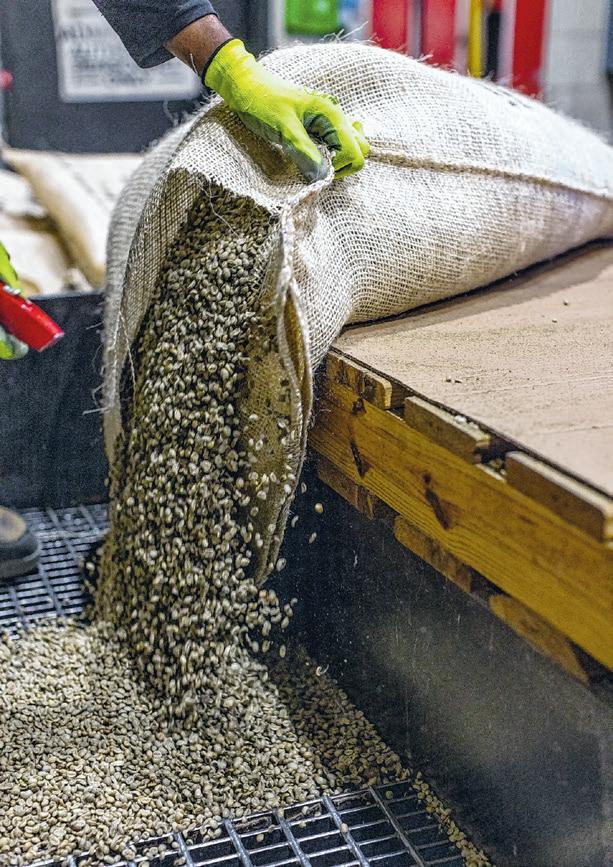
Community
Port Allen production plant.
Family-owned company works to entice next generation
BY LIZ SWAINE Staff writer
It is not unusual for Matt Saurage Sr. to strike up a conversation in the coffee aisle at the grocery store. If someone looks confused about a roast or flavor, he said he has given some advice.
Saurage is part of the fourth generation to own and run Baton Rougebased Community Coffee and is the current chair of the board. “We’re one of the few remaining regional companies, much less independent family-owned companies, in the United States,” he said. Community Coffee is available worldwide through e-commerce, but in terms of grocery store penetration, Saurage says to think of the reach of Southeastern Conference football — from south Louisiana through Texas to southern Missouri across to the Carolinas and up the East Coast.
The company’s connection to the communities they serve matters. Saurage’s emails include his cellphone number, which he answers. He is also a regular at the grocery store, where he buys his own coffee and occasionally shares recommendations with other shoppers.
“I want to know what it feels like to buy it and pay for it and drink it. So when people are able to reach me and tell me a story, good or bad, it really connects me to the business,” he said. “It connects my son and my daughter who work here. I share the emails with my mom. She responds to a lot of them because they may be stories of things that happened in the past.” Saurage’s day generally starts with a signature blend dark roast, hot, and usually black, one of his up to six cups of coffee per day. He might switch to one of the company’s cold brews before dinner.
He said he believes coffee is unique
Development have to figure out. They have to straighten out the pole and weld the cap on top.”
The local chapter of the Sons of the American Revolution partnered with the Baton Rouge Chapter of the Louisiana Society of the Daughters of the American Revolution to raise $4,000 for the creation and installation of the Louisiana State Historical marker commemorating the location of the British fort conquered by Bernardo de Galvez in 1779.
The marker was dedicated along
River Road on May 30 at the East Baton Rouge-Iberville parish line in the southeastern-most corner of the parish. This was 100 yards away from the fort’s actual location at the confluence of Bayou Manchac and the Mississippi River.
The marker’s installation coincided with the America 250 celebration. It not only told the fort’s story but also was inscribed with the America 250 emblem, marking it as an American Revolution historic site.
But the sign stood only until June 2, when a driver plowed into it. Then the marker disappeared altogether.
On Thursday, Bledsoe received word that the sign had resurfaced.
“It appears the grounds crew that does the mowing for the Atwater subdivision in that area found it and moved it to the grounds of Ebenezer Baptist Church, which is adjacent to the subdivision,” Bledsoe said. “So, the contractor for the grounds crew got in touch with the Department of Culture,
Recreation and Tourism and said, ‘Hey, we have this marker. What do we do with it?’ ”
The DOTD picked up the marker and will repair it. Meanwhile, the chapters of the Daughters and Sons of the American Revolution are working with Lynne Coxwell, director of research for the Department of Culture, Recreation and Tourism, on its reinstallation.
“Lynne Coxwell is the director of the historical marker program,” Bledsoe said. “She filters all of the applications for historical markers and such.”

parks leader to be paid $275K a year Salary is $100K more than predecessor
BY CLAIRE GRUNEWALD Staff writer
The incoming Baton Rouge parks system superintendent is getting closer to his first day on the job and recently signed a contract with a base salary roughly $100,000 higher than the last superintendent’s original base salary. The East Baton Rouge Parish Recreation and Park Commission recently selected Brooks Williams as the park agency’s next superintendent and ap -
proved his contract at the May 28 meeting. He will start on Aug. 3, according to BREC leadership.
Williams
Williams will be paid $275,000 annually, with the opportunity for salary adjustments subject to the BREC commission through August 2030, according to his contract with the parish parks agency.
“Our expectations are to build a great organization,” said BREC Commission Chair Michael Polito about expectations for the incoming superintendent. “If we
Volunteers transform intersection with plants BR initiative completed in 3 hours
BY ELLYN COUVILLION Staff writer
About 1,000 plants — all flowering Louisiana natives — were planted in under three hours on a recent Saturday morning along a well-traveled Baton Rouge intersection. A crew of about 30 volunteers — working in teams of two under an overcast sky on June 20 — kept up a steady pace, with one person shoveling the spot for the plant and the other placing it in the ground. When the work was done, two medians near the intersection of Government Street and Jefferson
Highway had been transformed by plants not commonly known, like Adam’s needle yucca plants, Leavenworth’s sedge and ornamental switchgrass. White gaura and black-eyed Susans also were planted.
A shipment of another plant, blue-eyed grass, hadn’t arrived yet, but would be planted when it did.
“These are plants that evolved here for thousands of years and are the best adapted for our ecosystem,” said Cameron Nelson, a volunteer from Baton Rouge Green.
The effort is being called a “demonstration planting” that may provide ideas for a future city-parish
State leaves federal funding unspent, records show
BY MEGHAN FRIEDMANN Staff writer
Louisiana, which struggles with a high infant mortality rate and is one of the lowestranked states when it comes to women’s health, could better tap federal resources to aid pregnant women by making the WIC program more accessible, a state audit has found.
The state’s participation rate in the WIC program, which provides routine testing, nutrition counseling and money for healthy foods to low-income pregnant women and their babies, was ranked the lowest in the nation by the U.S. Department of Agriculture, according to a June report from the Louisiana Legislative Auditor’s Office. Between 2021 and 2024, Louisiana did not use approximately $111 million worth of federal WIC funding, the report says. “Louisiana is ranked 50th in WIC participation and 52nd when you include Puerto Rico and Washington, D.C.,” said Gina Brown,
Continued from page 1B
want exceptional leadership, we have to realize exceptional leadership has a market.”
BREC, which operates dozens of parks and programs across East Baton Rouge Parish, conducted a national search for a new agency head this year. Former Superintendent Corey Wilson announced in March 2025 that he would not seek a contract renewal, and Janet Simmons has served as interim superintendent since June 2025.
Wilson first signed on as superintendent in 2019 under a three-year contract. His annual salary began at $170,000 in his first year, and he received pay increases throughout his tenure. Wilson’s predecessor, Carolyn McKnight, earned $175,000 a year.
BREC hired MGT Impact Solutions to conduct the national search to replace Wilson. The firm advertised the superintendent posting with a salary range of $190,000 to $300,000.
“I thought that all three candidates we interviewed were all in that higher range,” Polito said. “(Brooks Williams is) at the higher end of the range. … We were always looking for someone excellent.”
The BREC Commission chair said Williams has already been engaging with the staff and the commission, and he hopes the new superintendent builds on the momentum created by Simmons.
“We’re ready to roll,” Polito said.
Continued from page 1B
project that will landscape the medians on Government Street from Lobdell Boulevard to Interstate 110. Louisiana weather has taken its toll on the original plantings in the medians, which are showing bare patches of dirt and inroads by grass and weeds.
“The Government Street medians have been on my radar for a while,” said East Baton Rouge Parish Metro Council member Laurie Adams, whose district includes the Jefferson/Government intersection.
She focused on two medians that drivers may not have really noticed before: Where Jefferson splits to head east on Government, one of the medians runs along Jefferson, and a smaller one is near-
a state audit manager. “Given our health outcomes and our poverty rate, that kind of alarmed us.”
“Why are we dead last in this program that’s all federal funds, that’s intended to help women and children?” Brown added.
The $111 million figure is based on funds that could go to eligible women who are not participating in WIC, and on the value of food benefits that were not redeemed at stores, said Ashley Brecheen, a senior auditor with the state.
The Louisiana Department of Health, which oversees WIC, agreed with most of the audit’s recommendations and said it has already taken steps to address the concerns raised in the report and make WIC more accessible.
For example, the report found that over half of WIC clinics were not fully complying with a state policy that requires them to perform at least one outreach activity each month. The state Health Department said it would review reports from the clinics monthly, to ensure they complied with that requirement.
The agency also set a goal of increasing WIC participation by 25% by the end of the year.
Continued from page 1B
in that, as much as a beverage, it is an important social ritual. “You know, there’s not many things you do during the day that you have to go through a process of preparation for yourself and to enjoy. So there’s a lot of therapy to it. I believe that’s why people say that coffee relaxes them and centers them, even though it has caffeine,” Saurage said. Challenges aplenty
The coffee industry, like others, has faced years of challenges and changes. There was COVID-19, then supply chain issues, then weather, then tariffs.
“I’ve challenged the company, and we just kept doing what we can do, and as a family just accepted this is going to be a really tough year and we’re not gonna make money. But we’re not going to sacrifice the brand for short-term gain,” Saurage said.
Thankfully, things are looking better. While tariffs are unpredictable, agricultural conditions are “really good,” he said.
The grocery/retail part of the business is also changing. No longer is shelf space a determinant of the number of products that can be offered.
“In some ways, the shelf is getting larger, because of the Walmart dot com, the Amazon dot coms of the world have created a virtual shelf now,” Saurage said.
“You still have to perform, but it’s a little easier to have flavors in limited-time offers multiple times during the year by rotating them through e-commerce.”
It’s not just about flavored coffees, although Com -
by along Government Street.
“This project is the beginning of a conversation about what we can do to beautify Government Street,” Adams said. “We’ll see through all the seasons how it performs. Louisiana is a tough environment for gardens — droughts, huge rains, cold winters.”
The funding for the plants came from $10,000 in state money for each council district for outreach projects, she said.
Groups involved in the effort, along with Adams, were nonprofits Clean Pelican, Baton Rouge Green, the Goodwood Property Owners Association and the Mid-City Merchants, as well as local business GroundWorks.
CARBO Landscape Architecture, which has its offices on Government Street, and Baton Rouge Green picked the plants for the project.
“We let the professionals
Earlier this year, a United Health Foundation report found Louisiana had the worst health outcomes for women and children in the country. Last year, a state audit found pregnancy care had worsened in the state, despite increased attention and funding.
Accessibility challenges
Auditors identified several barriers that could be hindering WIC participation: online information about clinics’ hours and phone numbers was not always accurate, and WIC clinic staff did not always answer phone calls.
“According to one mother who responded to the survey, she was unable to receive WIC during her pregnancy because she was unable to get her local clinic to answer or return her calls after she completed her online application,” the report says.
In response, state health officials said they would conduct monthly reviews of online information about clinics for accuracy, and that they would conduct a “secret shopper phone program” to randomly screen calls and improve customer service.
The state could further improve accessibility by making sure more WIC clinics were open outside of normal business hours, since work-
ing moms may struggle to attend appointments on weekdays, the audit said. About 80% of clinics only offered appointments between 8 a.m. and 4:30 p.m. at the time of the audit.
A map included in the audit shows that north Louisiana is disproportionately impacted by that trend: Only one WIC clinic in the northern half of the state operated outside of normal business hours. It was located near Shreveport. Though there are exceptions, WIC participants must regularly attend in-person appointments to continue receiving benefits.
The Health Department said it was “expanding the number of clinics offering nontraditional hours.” As of May 31, all parish health units would offer such hours, officials added.
Over half of the state’s roughly 100 WIC clinics were at parish health units, according to the audit.
Food benefits
Another element of WIC highlighted in the audit was its food benefit program, where beneficiaries receive EBT cards they can redeem at participating stores for specific food products.
Each food benefit package is tailored to the individual WIC participant, auditors
noted. But in 2025, nearly half of the food items included in the packages were not redeemed, the report said. Brown, the audit manager, noted the low redemption rate has implications for economic development: It is money that could be going to Louisiana businesses.
Auditors found that some food products, such as yogurt, were being redeemed at particularly low rates. They concluded some moms weren’t purchasing the yogurt because it was only offered in half-quart or full quart sizes, and they thought such a large portion would go to waste.
The report suggested the Louisiana Department of Health offer more flexibility on which products could be purchased, a recommendation with which the agency agreed.
Though it is not addressed in the audit, the number of vendors participating in WIC may also be a barrier to food benefit redemption. Brown pointed to an early informational WIC report which found that some parishes only had one vendor.
The Legislative Auditor’s Office is working on a third report pertaining to WIC food vendors, but it has not yet been released.
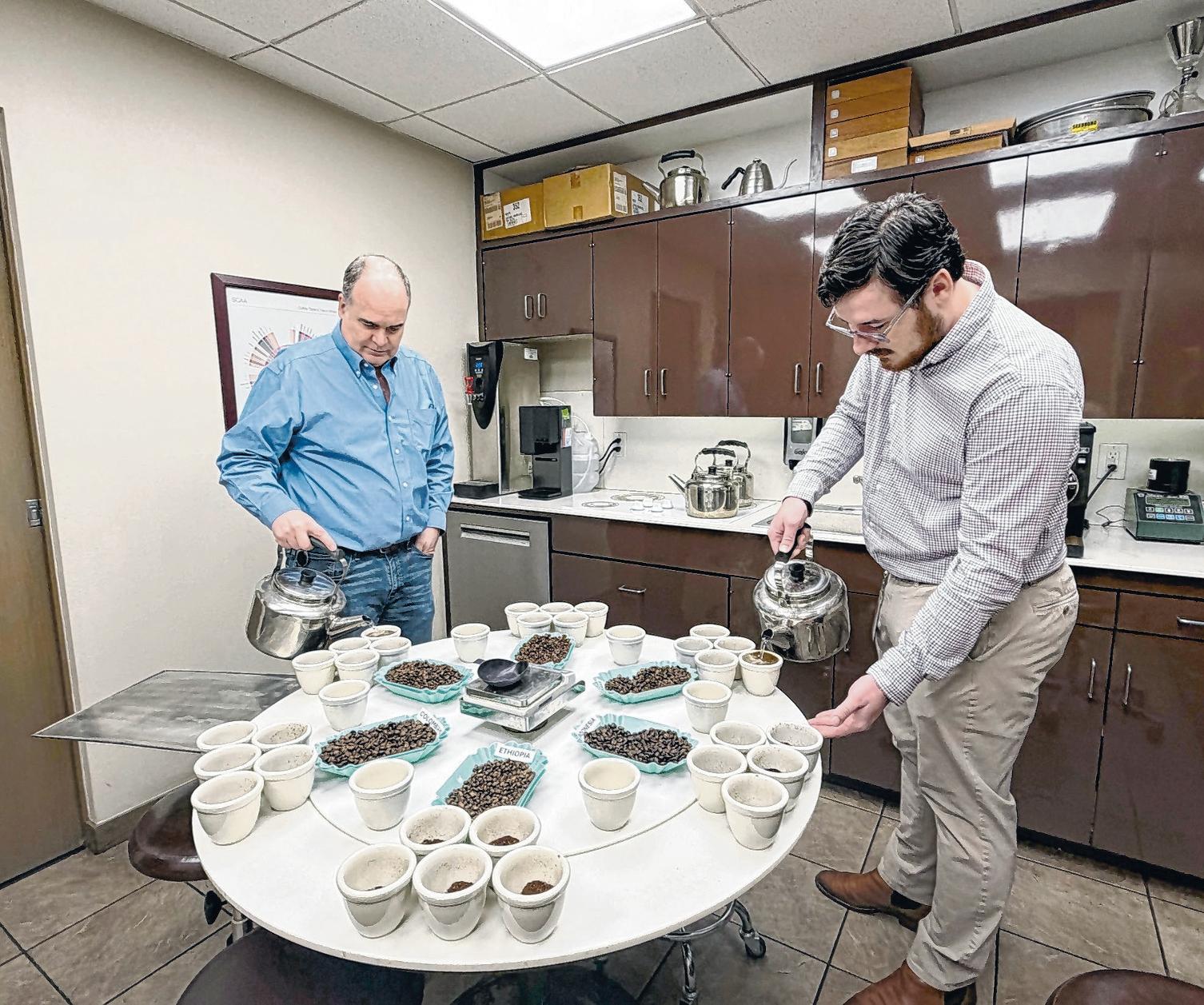
Mark Howell and
Community
Port
munity’s caramel cookie butter, French vanilla, hazelnut crème, Irish cream, pecan praline and vanilla waffle cone continue to duke it out with long-time favorite Mardi Gras king cake. It’s also about people wanting to buy whole beans to grind and brew at home.
“I see whole bean coffee and brewing at home to be an exciting area for our brand,” Saurage said.
Home preparation is changing as well, from a traditional drip pot to single-serve K-Cups and capsules. Younger customers are purchasing ready-todrink cold brews.
Community offers another unique regional appeal with its chicory-blend coffee, which incorporates endive root sourced from
pick the plants, simply because these plants have to be extra hardy,” said George Vidrine, a member of the board of directors of the Goodwood Property Owners Association, who was out with other volunteers.
Pointing to some newly planted Shenandoah switchgrass, Vidrine said, “Switchgrass is as hardy as it comes. It’s amazing — it’s going to thrive.”
FRIDAY, JULY 3, 2026
PICK 3: 3-5-4
PICK 4: 6-4-9-9
PICK 5: 2-4-7-8-2
MEGA MILLIONS: 5-9-29-47-57
MEGA BALL: 16
Unofficial notification, keep your tickets.
northeastern France. The carrot-shaped root, which is caffeine-free and sweet, is broken and roasted.
“It adds a lot of body and color and mouth feel to the coffee, so it can be heavy. To bring out the sweetness, though, you need to put just a touch of sugar, and it absolutely just brilliantly makes it kind of a sweet flavor to it,” Saurage said. “The hidden benefit to chicory is that it is a superfood.” It is possible coffee flows through Saurage’s veins. His mother first put a little coffee in milk and sugar for him when he was around 3 years old. “I remember
distinctly when I was in elementary school, drinking coffee with milk and sugar with my grandparents.”
His business is planning now for the next generation of coffee drinkers.
“We want to have a real growing, energetic, healthy industry for my children, my grandchildren to inherit, and our employees to participate in over a very long time. We owe all of our success as a brand to the people who consume our product, you know, it’s as simple as that,” he said.
Email Liz Swaine at Liz. Swaine@theadvocate.com.
The sign commemorates Louisiana’s colonial Gov. Bernardo de Galvez’s 1779 battle at Fort Bute, which was a pivotal point in the American Revolution. The fort was an important strategic post for the British, not only for defense but also for shipping and trade, and with subsequent forts along the Mississippi River in Baton Rouge and Natchez, they were well entrenched. That is, until Galvez and his collection of 1,400 Spanish, Acadian, and German troops marched from New Orleans to stage an attack on Sept. 7, 1779, and sent the British army running to Baton Rouge.
Rose Meyers’ 1976 book, “A History of Baton Rouge, 1699-1812,” is an often-cited source for the Fort Bute story. Meyers was the head librarian for the East Baton Rouge Parish Library’s Downtown Branch, now called the River Center Branch. Her book was published by LSU Press for the Baton Rouge Bicentennial Corp. and includes chapters chronicling Louisiana’s capital city under both British and Spanish rule, beginning with King George III’s proclamation of Great Britain’s 1763 takeover of West Florida following the French and Indian War.
Meyers writes that the British anchored their frigates at Fort Bute until they could build a “strong new fort in West Florida.” The fort also became important in Britain’s defensive strategy.
“Engineer Archibald Robertson supervised the planning and construction of Fort Bute, which consisted of a ‘blockhouse with a small stockaded fort,’ ” Meyers writes. “It housed 50 men and one officer, but, in an emergency, it could be made to accommodate 200.” In 1779, Meyers points out, though Galvez was young, he proved to be a competent governor for Spain, having anticipated impending war and striking first by marching his troops from New Orleans up the Mississippi River in August, with relentless sun, thick humidity and merciless insects. The troops arrived at Fort Bute on Sept. 6, then attacked at dawn on Sept. 7, forcing the British to retreat to Baton Rouge. The British surrendered to Galvez on Sept. 21, 1779, at the Baton Rouge fort.
“The marker’s recovery is good news for us,” Bledsoe said. “I’ve only seen a photograph of one side of it, so I just hope that the other side was not impacted by the car. If it was, the state may elect to send it back to the manufacturer in Illinois for repairs. That would be up to them.”
Email Robin Miller at romiller@theadvocate. com.





Former first lady promotes her book at event
BY VIOLET BUCARO Staff writer
When Michelle Obama first stepped into the spotlight as first lady, some media outlets who covered her appearances would often first describe her outfit — not the work she was actually doing.
So, she “made it a point not to talk about fashion,” Obama told a crowd on Friday at the Essence Festival of Culture, the largest Black music and culture event in the country.
But, realizing the importance of her presentation, the former first lady often let her well-styled hair and clothing do the talking for her.
“America is struggling enough, having a Black first lady. I didn’t want my hair to be the problem,” she said. “We need healthcare fast, getting kids educated. It wasn’t about what I needed to look like. I needed to show up in a way that the country needed me to show up.”
The lessons she learned are chronicled in “The Look,” her best-selling book that explores how fashion and beauty can make women feel like the best version of themselves. Obama, joined by actress Keke Palmer, used the main stage at Essence to promote the book and to tape a live episode of her podcast, “IMO: The Look.” Obama, a marquee name on the three-day festival’s lineup, last appeared at the Caesars Superdome in 2019 for an interview with Gayle King. Other headliners this year are rap stars Cardi B, Josh Levi, George Clinton and T.I., among several others.

The festival has pumped more than $4 billion into New Orleans’ economy in its three-decade run, festival organizers have said. Aside from the nightly concerts, the event boasts free daytime empowerment panels and opportunities for local and national vendors to sell and offer samples of their wares. The event runs through Sunday.
Of all of the festival’s many draws, for audience member Kinsha Walker, Obama was the biggest.
“She is what we all of us aspire to be,” Walker, of Baton Rouge, said. “I am so honored to see her tonight.”
Obama’s hourlong talk with Palmer covered fashion, social media and the lessons she offers her daughters, Malia and Sasha Obama. The live podcast taping will be released on July 15 on YouTube and other channels. It is produced by Higher Ground, a media company founded by former President Barack Obama and Michelle Obama.
Though her latest book is about fashion, Michelle Obama told Palmer that “clothes were never the point.”
“I love a pretty dress, but if my dress is saying more than what I am trying to say to a young person, then get it off of me,” Obama said.

The conversation shifted to the first lady’s public and private life. Obama in her role was frequently in the public eye, Palmer pointed out. “How does one protect their inner selves, being so perceived, constantly?” she asked.
“I think it is becoming more and more difficult with A.I., with social media,” Obama replied. “To put it in perspective, when we were in the White House, there was no social media. We had Blackberries. They did not let Barack have an iPhone because it was a social media breach.”
“When it became a part of my reality, social media, I wasn’t addicted to it. I’m on it, but not of it.”
She tries to get her daughters to stay off of social media platforms — and especially, not to read the comment sections, she said.
Obama gave a passing reference to some of the negative reactions she received as she and her husband stepped into the spotlight.
“The more popular I became, the more of a threat I became,” she said. Although, Obama added, holding on to her true self was not hard for her.
“I want us all, as Black people, as Black women, to own our spaces,” Obama said.
an emergency situation is greater than ever,” said Broussard Mayor Ray Bourque.
BY JOEL THOMPSON Staff writer
Acadian Ambulance has announced a plan to establish a regional response headquarters in Broussard, according to a news release the city issued Monday.
Broussard site set to reduce response times PROVIDED
According to Acadian Ambulance’s statistics for the fourth quarter of 2025, the average response time for Broussard residents was 8 minutes and 36 seconds, with around eight patients served daily.

The headquarters will operate out of Broussard Fire Station No. 2 building at 501 E. Main St., which Acadian Ambulance was set to lease from the city beginning July 1.
Broussard officials said the agreement was motivated by a desire to improve emergency response times in the city.
“The need for ambulance response in the event of
Acadian Ambulance expects these numbers to improve within the community following the establishment of the new response center.
According to Acadian Ambulance President Justin Back, the headquarters will have up to as many as six ambulances on standby for dispatch.
Acadian Ambulance, first founded in 1971 in Lafayette, operates across four states including Louisiana, Texas, Mississippi and Ten-
Acadian Ambulance has announced a plan to establish a regional response headquarters in Broussard, to be operated out of Broussard Fire Station No. 2 building.
nessee. Currently, they have 40 employees residing in Broussard. Additionally, they currently already operate one substation in Broussard off North Eola Road, which will remain open.





Amar,RalphJude
RalphJudeAmar,aretiredemployeeofDow ChemicalandtheEastBatonRougeParishLibrary System,passedawayon Tuesday,June30,2026,at theageof91.Alifelong residentandnativeofBatonRouge,hewillberememberedforhisdedicationtohisfamily,hiswork, andhiscommunity.Heis survivedbyhisbeloved wife,AliceBeverlyAmar; threedaughtersandtwo sons-in-law,AndreaNadineAmarofBatonRouge, KarenAmarThrelkeldand herhusband,Malcolm ThrelkeldJr.,ofBirmingham,Alabama,and MichelleAmarDuplantis andherhusband,JeffDuplantis,ofDenham Springs;oneson,David RandolphAmarandhis wife,ReneeAmar,ofBaton Rouge;fourgrandchildren, BrandonChristopher Goody,MatthewJoseph Amar,JourdanElizabeth Amar,andSophiaBellaGraceDuplantis;andfive great-grandchildren.He wasprecededindeathby hisfirstwife,Beatrice Amar;hisparents,Zachary andBerthaAmar;three brothers;andonesister. Relativesandfriendsare invitedtoattendtheFuneralMassat12:00PMon Monday,July6,2026,at MostBlessedSacrament CatholicChurch,locatedat 15615JeffersonHwy,Baton Rouge,La.Visitationwill beginat11:00AMwitha rosaryat11:45AM.Intermentwillfollowat GreenoaksMemorialPark, locatedat9595Florida Blvd,BatonRouge,La. Familyandfriendsmay signtheonlineguestbook orleaveapersonalnoteto thefamilyatwww.resthav enbatonrouge.com

Baxley,Charles Edwin'Bax'
Charles"Bax"Edwin Baxley,age88,passed awayonWednesday,July 1,2026.Hewasanativeof Colfax,Louisiana,aresidentofBatonRougefor29 years,andacurrentresidentofPonchatoula, Louisiana.Charlesliveda lifeoffaith,service,and unwaveringdevotiontohis family.AproudUnited StatesMarine,hewenton toservehiscommunityas alawenforcementofficer for30years.Throughout hisdistinguishedcareer, heworkedasamotorcycle officer,K-9handler,detective,uniformpatrolofficer, CATEofficer,andinstructorattheLSULawEnforcementTrainingAcademy beforeretiringfromthe TrainingDivision.Hetook greatprideinmentoring andpreparingthenext generationofofficers. Charleswasafaithful parishionerofSt.Thomas MoreandlaterSt.Joseph CatholicChurch,wherehe servedasaEucharistic Minister.Outsideofhiscareer,Charlesfoundhis greatestjoywithhisfamily.Annualtripstothe beachcreatedtreasured memories,andheloved spendingtimehuntingand fishing,especiallyhunting, whichremainedoneofhis greatestpassions.Above all,hecherishedhischildrenandadoredhisgrandchildren,wholovingly knewhimas"BigDaddy." Charlesissurvivedby hislovingwifeof64wonderfulyears,NelBaxley; daughter,ErinGatlin(Jeremy);son,ShaunBaxley (Tina);grandchildren, Charlie"CJ"Gatlin,Wyatt Gatlin,andEllyGatlin;sister,SabbieSmith(Paul); brothers,DoyleBaxley (Francis)andEddieBaxley; brother-in-law,Richard Lowry;sister-in-law,Claire Groves(Keller);aswellas numerousniecesand nephews.
Charlesisprecededin deathbyhisson,Kelly ThomasBaxley;parents, CarlBaxleyandSabbie BordelonBaxley;siblings, BuckBaxley,CarlBaxley Jr.,MargieRuthNettles (Roy),CarrieStevens
deathbyhisson,Kelly ThomasBaxley;parents, CarlBaxleyandSabbie BordelonBaxley;siblings, BuckBaxley,CarlBaxley Jr.,MargieRuthNettles (Roy),CarrieStevens (Lewis),sisters-in-law, SandraBaxleyandMargueriteArroyo;andbrother-in-law,EdwardLowry (Claire).
Relativesandfriendsof thefamilyareinvitedtoattendavisitationatSt. ThomasMoreCatholic Church11441Goodwood Dr.BatonRouge,LA70815, onTuesday,July7,2026, from9:00a.m.untiltheFuneralMassat11:00a.m.Intermentwillfollowat GreenoaksMemorialPark. Inlieuofflowers,please makeadonationtoSt. JudeChildren'sHospital. Condolencesandother informationmaybefound at www.thompsoncares.com. Arrangementshave beenentrustedtoBrandon G.ThompsonFuneral Home.
BezetJr.,Charles Curtis'Chuck'
Charles"Chuck"Curtis Bezet,Jr.passedawayon Wednesday,July1,2026,at hishomeinBrusly,atthe ageof57.Hewasanative andlifelongresidentof Brusly.ChuckwasamachinistwithIndustrial PartsSpecialtiesLLC.VisitingwillbeatWilbertFuneralHomeinPortAllenon Wednesday,July8th,from 5to8p.m.andagainon Thursday,July9th,from9 a.m.untilreligiousservice at11a.m.,conductedby Rev.SteveChadwickand Rev.TroyRomig.EntombmentwillfollowinSt.John theBaptistCatholic ChurchMausoleumin Brusly.Pallbearerswillbe BillyDeshotel,JessePeavy, JonBarbier,Phillip Deshotel,BarryDaigle, ToddLeray.HonorarypallbearerswillbeMikeyRayburn,LandonMartinez, EastonBezet,Jeremy "Frog"Bezet.Chuckissurvivedbyhisfather,Charles Curtis"Curt"BezetSr.; brother,Jeremy"Frog" Bezet;daughters,SavannahBezetRayburnand husbandChristopher "Mikey"Jr.,andEmily Bezet;grandchildren,EastonBezetandEloiseRayburn;honorarygrandchildren,DylanandAllie Behrnes,AvaGrace Franklin.Chuckwasprecededindeathbyhis mother,Patricia"Pat"King Bezet.ChuckwasamemberofRedDiamondHuntingClub.Hespenthisfree timeattheballparksupportinghisdaughtersand hisgrandson.Chuckenjoyedhunting,balinghay withhisdad,spending timewithhisfriendsand cooking.

Againstherwishes,we arewritingtotellyouthat ourmom,AnnetteMarino Brabetz,hasdiedatthe ageof86.
Shespent28years workingintheEmergency RoomatTheBatonRouge Generalforcedintoretirementat80afterafall. Throughouthertimeat bothBRGMid-CityandlaterBRGBluebonnet,Ms.Annetteprovidedcomicrelief tothedoctors,nurses, staffandthepatientsshe admitted.It'sfittingthat shereturnedthereonelast time,indramaticfashion, onFriday,June26,2026 whereshetookherfinal breathsurroundedbyher familyandformercoworkers.
TheBatonRougeGeneralERprovidedsomeofher closestfriendsandalifetimeofstories.Sheloved workingthenightshiftat Mid-City,sometimesmissingfamilygatheringsbecausetherewasnevera dullmomentintheER.
Wickedlysmart,sheattendedSt.Joseph'sAcademyall12yearsandwasa proudmemberoftheclass of1957.Untilherdeath, shewouldfondlyrecall walkingtoSJAfromher homeonSteeleBoulevard, pickingupherfriendElise onWestmorelandbefore
proudmemberoftheclass of1957.Untilherdeath, shewouldfondlyrecall walkingtoSJAfromher homeonSteeleBoulevard, pickingupherfriendElise onWestmorelandbefore crossingthegravelroad thatisnowAcadian Thruway.Shelaterstudied EnglishatLSU.
KnowntohergrandchildrenasNanette,nothing broughthergreaterjoy thanspendingtimewith WillandWalkerRidge, Claire,Edwin,Davidand CatePerrault.Becauseof hersight,shewasunable todrivethelastyearsof herlifeandlovedbeing pickedupbyhergrandkids.She'dhopinandout oftheirtrucksandjeeps likeateenagerandtreat themtobreakfastather favoritespot,NewYork BagelonJefferson.
Tinyinstature,you'd neverknowthatsheran entirelyonfastfood,Lucky Charms,Calvin'schicken saladand"Coca-Cola."She lovedSaturdaymornings atSuperiorGrill,Sunday breakfastatFrank'sand anafternoondrivetoSonny'sBBQ.
Avoraciousreader,she lovedtruecrime,historical scandalsandquality celebritygossip.We'recertainthatshewillspendher firstminutesinheaven findingoutwhokilledJonBenét.
Ourchildhoodmemories arefilledwiththesoundof classiccountry,thescent ofAquaNet,jauntstoK&B forthelatesttabloidsand visionsofherzipping aroundinthatredMercury Cougar.
Theonlythingthat slowedherdownwasher battlewithmaculardegeneration.Shewouldfrequentlyharassherdoctors atVRILouisianaaboutcorrectinghersightsoshe couldgetbackbehindthe wheel.Theydidtheirbest. Sodidshe.
Shewascaredforand lovedbyherchildrenDr. TomGarland(Linda),Greg Garland,JennyRidge(Billy),JuliePerrault (Michael),hersixgrandchildren,hersiblingsPhyllisMcKayandCharles Marino(Dale)andnumerousniecesandnephews.
Gonebeforeherwere herhusbandEdwinBrabetz,herlongtimecompanionDr.JimChoate,her parentsCharlieandJosie Marinoandherbrother-inlawJohnMcKay.
Shehasdonatedher bodytoLSUMedical School.Shehatednothing morethanattendingfuneralsandhassparedyou fromgoingtohers.Her familywillhaveaprivate massinherhonor.Youcan rememberherwithadonationtoSt.Joseph'sAcademy,theBatonRougeGeneralFoundationoraCapri SlimcigaretteandalatenightTacoBellrun.
Broussard,Savanna SavannaBroussard,a lifelongresidentofBaker, LA.,passedawaypeacefullyonJune26,2026,atthe ageof80.Shewillbe warmlyrememberedfor hergenerosity,community spirit,senseofhumor,and thekindnesssheshared witheveryoneshemet. Servicetohonorherlife willbesharedatalater time.Friendsandfamily arewelcometoattendand celebratetheremarkable lifeshelived.
RogerCador,75,ofVentress,Louisiana,legendary formerheadbaseball coachatSouthernUniversity,passedawayonJune 30,2026.AHallofFame coachandoneofthewinningestcoachesincollegiatebaseballhistory, CadorledtheJaguarsfor 33seasons,compiling913 victories,14SWACchampionships,twoHBCUNationalChampionships,and11 NCAARegionalappearances.HewasinductedintotheSWACHallofFame, LouisianaSportsHallof Fame,AmericanBaseball CoachesAssociationHall ofFame,andNationalCollegeBaseballHallofFame. Hewasprecededin deathbyhisparents,ExpertandEuniceCador,and asister,MaryJeanCador. Heissurvivedbyhissons, JohnthanCadorof Zachary,Louisiana,Jeremy CadorofMontgomery,Alabama,andabonusson, TimRomeroofKnoxville, Tennessee;hissiblings, BettyLeonardandHenry CadorofNewRoads, Louisiana;hisaunt,Marie JosephofNewRoads, Louisiana;andnumerous
TimRomeroofKnoxville, Tennessee;hissiblings, BettyLeonardandHenry CadorofNewRoads, Louisiana;hisaunt,Marie JosephofNewRoads, Louisiana;andnumerous familymembers,former players,colleagues,and friends.
Publicviewingwillbe heldMonday,July6,2026, from3:00p.m.until6:00 p.m.attheF.G.ClarkActivityCenteronthecampus ofSouthernUniversityand A&MCollege,followedbya memorialserviceat6:00 p.m.Funeralarrangements areentrustedtoHallDavis andSonFuneralService. Signtheonlineguestbook atwww.hallsinc.net.
CinderellaYoung Cayettewasbornon September12,1953,to EluiesYoungandMary JamesYounginModeste, Louisiana.Shedeparted thislifeonJuly1,2026,at herhome,surroundedby herfamily.
Shededicatedmany yearsofhercareertoPurpleShieldinBatonRouge, Louisiana,andSecurity PlanLifeandFireinDonaldsonville,Louisiana. Cinderellaleavesbehind cherishedmemorieswith hersons,HaroldKeith CayetteofFrisco,Texas andKendallCayette,along withherdaughter-in-law, KarlaCayette;twograndchildren,Destinyand Kymora;andheranticipatedfirstgrandson,Kane MaximilianoCayette,due inDecember;threesisters: RachelFord,MaryAnn Taylor,andBarbaraMillien,allofDonaldsonville, Louisiana. Shewasprecededin deathbyherhusband, HaroldCayette,Sr.;her parents,EluiesYoung,Sr. andMaryJamesYoung; hersister,Gwendolyn YoungRodrigue;two brothers,EluiesYoung,Jr. andJosephYoung. Gravesideserviceswill beheldonMondayJuly6, 2026at11:00am,AscensionofOurLordMausoleum,Donaldsonville,La
Enteredintoeternalrest athisresidenceinBaton Rouge,LouisianaonJune 22,2026.Hewasa34-yearoldnativeofBatonRouge, andaneducatorandcoach atWoodlawnHighSchool. VisitationwillbeatShiloh MissionaryBaptistChurch onMonday,July6,2026, from9:00amuntiltheCelebrationofLifeServiceat 11:00amconductedby PastorFredJeffSmith;intermentwillbeatSouthernMemorialGardens. Survivorsincludehismother,CrystalC.Ferdinand(Rev.Anthony,Sr.); father,CameronRobinson(Keisha),Spring,Texas; maternalgrandfather, HenryClark(Marlene);paternalgrandparents,DeborahandPrenticeRobinson, PortAllen,Louisiana;aunt, MieshaClark;brother, CameronRobinson,II; bonussiblings,Markus Perkins(Jenell),Anthony Ferdinand,Jr.(Britney), Donnell(Aletha)andYolandaJones;precededin deathbyhismaternal grandmother,AnneClark; andpaternalgrandfather, HermanDixon.ArrangementsentrustedtoMiller &DaughterMortuary
KarronAngelaClarkAlfordofBatonRouge,LA, wascalledhometoher HeavenlyFatheronJune 30,2026,attheageof48. Karron'sgreatestjoy andhighestcallingwas beingamother.Herdeep, unconditionalloveliveson throughhertwochildren, ZoeandKeaton,whowere theabsolutecenterofher worldandhergreatest blessings.Hergentlespirit anddevotionwillcontinue toguidethemastheycarryherlegacyforward. Someoftheirmostcherishedmomentsasafamily
worldandhergreatest blessings.Hergentlespirit anddevotionwillcontinue toguidethemastheycarryherlegacyforward. Someoftheirmostcherishedmomentsasafamily werespenttogetherright athome,bakingwithZoe, tendingtothegardenwith Keatonandactingashis numberonefan,orenjoyingtheirlaughterand friendlycompetitionon familygamenights. Hermemorywillalsobe lovinglykeptalivebyher sisterShannonandher husbandGeorgeVeeder, alongwiththeirchildren BaileyandIetta,andbyher brotherJasonandhiswife Dulcie.Karronisnow peacefullyreunitedinglorywithhermother,Susan, andherfather,StanClark. Afaithfulservantwitha quiet,humbleheart,Karronpouredherloveinto herhomeandcommunity. Whilesheenjoyedher workwiththeStateof LouisianaTourismand lovedhelpingothersdiscovernewplaces,hertrue dedicationwasalwaysto thefamilyGodentrusted toher.
Herkindness,grace,and steadylovewillforeverremainintheheartsofthose whoknewher.
TohonorKarron'smemoryandwalkinherspirit ofgenerosity,thefamily welcomesactsofkindness ordonationstotheMultipleMyelomaResearch Foundation(MMRF)at https://themmrf.org/.
AdateforKarron's memorialservicehasnot beendecidedatthistime.
CarolynEvanswasborn November3,1959,toJohn EvansandArthemiseMcKeeinBatonRouge, Louisiana.Shedeparted thislifeonJune28, 2026.Carolynleavesto cherishhermemoryher belovedsons:Andre Evans,Jeffery(Stephanie) Evans,KevinEvansand JohnnyEvans;precious grandchildren:JyraEvans, JeKobeEvansandKylie Evans;sisters:Katie-Mae St.Amant-Mitchell,LorraineEvans-Allen,Diane Evans,andRobertine Woods;andahostof nieces,nephews,cousins andfriends.Shewasprecededindeathbyherparents,JohnEvansand ArthemiseMcKee;sister DonnaFayeEvansEbronHenryandbrothersLarry McKee,JerryMcKeeand JohnEvans,Jr.Avisitation willbeheldat9:00AMwith funeralservicesstarting at11:00AMonJuly11,2026 atWinnfieldFuneral Homes(NorthChapel), 7221PlankRoadBaton Rouge,LA70811.
AlbertS.Greene,Jr. passedawayathomeon Tuesday,June30,2026,at theageof89.Hewasborn May24,1937,inHomer,LA, toAlbertSr.andLizzieMae ClaryGreene.Albertwasa 1956graduateofHomer HighSchoolwhereheletteredinfootballandtrack. Heservedhonorablyinthe NationalGuardandinthe ArmyReserve.Hemarried theloveofhislife,Janette Nelson,inBatonRougein 1958,ahappyunionthat lasted67years.Theywere membersofGreenwell SpringsBaptistChurch.Albertbecameaskilled flooringandceilinginstallerbeforefoundingAG BuildingSpecialistsin 1968,followedbyAcousticalSpecialties&Supplyin 1975.Hewasanavid hunterandgardener.Albertisprecededindeath byhisbelovedwife, JanetteNelsonGreene;his parentsandwonderful stepfather,GeraldRuple; hisson,AlbertNelson Greene;hissister,Patsy GreeneCahoon;hisbrother,GeorgeRuple;andhis granddaughter,Danielle ElizabethWright.Heissurvivedbyhisdaughters, RobinWright(Richard), andDonnaPhillips(Steve); hissister,WandaBoyles (latehusbandWoody Boyles);hisbrother,Gerald K.Ruple(Colleen);his grandchildren,Rebekah PhillipsPuryear(Dustin), andJoelPhillips.Heisalso survivedbyhisstep-greatgrandsons,CooperandLucaPuryear;aswellasnumerousotherlovingfamily andfriends.Thefamily wouldliketogivespecial thankstoTamiTuckerand
survivedbyhisstep-greatgrandsons,CooperandLucaPuryear;aswellasnumerousotherlovingfamily andfriends.Thefamily wouldliketogivespecial thankstoTamiTuckerand thewonderfulcaregivers ofCastALineandthe amazingstaffandnurses atHospiceinHisCare.Relativesandfriendsareinvitedtoattendthefuneral serviceat11:00a.m.on Wednesday,July8,2026,at ResthavenFuneralHome, 11817JeffersonHighwayin BatonRouge.AVisitation willbeheldatthefuneral homebeginningat10:00 a.m.EntombmentwillfollowintheChapelofEternalFaithMausoleumat ResthavenGardensof Memory.Inlieuofflowers, memorialsmaybemadein honorofAlbertS.Greene, Jr.toLouisianaFamilyForum.(https://lafamilyforu m.org/donate/)Familyand friendsmaysigntheonline guestbookorleaveapersonalnotetothefamilyat www.resthavenbatonroug e.com
Lorio,DeborahChavers
Deborahfaithfully servedherLordandSavior,JesusChrist.Hergenerosity,kindnessandlove forherhusbandandothers wereunmatched.Shewas nothingbutsweetnessand kindnesstoeveryoneshe metallofherlife.Shenevermetastranger.Shewas agreatprayerwarriorand prayedformanypeoplein needonthespot!Hertestimonywhilebattlingcancer encouragedmanyand humbledothers.Herpassionwastellingothers aboutJesusandallHewas doinginherlife.Shehada Godgivengiftformaking beautifulquilts.Quiltsfor newborns,adultquiltsfor cancerpatientsand friends,quiltsforcharities thatwereholdingfundraisers,justtonameafew. Sheandherhusbandwere thebestoffriends,were happilymarriedfor51 wonderfulyearsandfaithfullyservedtheLordtogetherformanyofthose years.Withherhomegoing,sheleavesbehinda lovinghusband,anaunt, siblings,nieces/nephews, great-nieces/nephewsand great-great-nieces/ nephews.Shewastruly lovedandwillbemissed byallwhoknewher.Our lossisHeaven'sgain.In lieuofflowers,consider makingadonationtoone ormoreofthefollowing organizationsinhername: ChristianMotorcyclistsAssociation,MaryByrd PerkinsCancerCenteror HospiceofBatonRouge. CelebrationofLifewillbe heldatZoarBaptist Church,11848HooperRd., BatonRouge,La.70818,on Thursday,July9,2026.Visitationwillbefrom10:0011:00,serviceat11:00, mealafterwards.
MichaelA.Musso,Jr. peacefullypassedawayon Saturday,June20th,2026. BornJuly1,1939to MichaelASr.andEffie MichaelMusso,inBaton Rouge,LA.Heissurvived byhiswife,DebraDantin Mussoandtheirchildren AshleyMussoNangle (Kevin)andMichaelTodd Musso,grandsons,Reid andBrantleyNangleand son,EllisMichaelMusso. Brothers,JohnnieMusso andDavidMusso(Sally), sisterMaryAnneMcCallum(Ronnie),sister-in-law MaralynAmedeeMusso, andniecesandnephews. Michaelgraduatedfrom BatonRougeHigh,attendedLSUandWinonaSchool ofProfessionalPhotography.Afterservinginthe NavyhewasaphotographerforDepartmentof Highways.Whileowning Michael'sPhotographyhe traveledLouisianahighways,photographingplantationhomesandpublishingPlantationHomesof Louisiana.Hewasprecededindeathbyhisparents andmanyspecialrelatives andfriends.Visitationis TuesdayJuly7at9:00am withMassat10:00amat OurLadyofMercyCatholic Church.Michaelrequested memorialsforSt.Joseph Academy,3015Broussard
andfriends.Visitationis TuesdayJuly7at9:00am withMassat10:00amat OurLadyofMercyCatholic Church.Michaelrequested memorialsforSt.Joseph Academy,3015Broussard St.,BatonRouge,LA70808.
Richardson,Rose MaryPicard
RoseMaryPicard Richardsonwasbornon November9,1942,in Shreveport,Louisiana,to AmelcarandEulaPicard. Shewasprecededindeath byherbelovedparents, AmelcarandEulaElizabeth PullamPicard;herbrothers,AmelcarPicard,Jr.and WillieJamesPicard;her sister,ShirleyElizabethPicardForbes;andher daughter,VickieLyn RichardsonWhitney.Sheis survivedbyherlovinghusbandof63years,Patrick SamuelRichardson;her son,PatrickWayne Richardson(Lisa);her daughters,KimberlyAnn RichardsonHeil(Todd)and JillElizabethRichardson Bluth(Mike);hertwelve grandchildren:Brandon (Amilyn),Lauren(Robert), Garrett(MaryCatherine), Madison(C.J.),Patrick Gene(Kalysha),Bryn (Josh),Alex,Kaitlyn (Caleb),Jenna,Andrew (Savannah),Abby,and Ethan;elevengreat-grandchildrenandhersister, SallieNorinePicardFlowers. FuneralServices:The ChurchofJesusChristof Latter-daySaints,502E. Highway30,Gonzales, Louisiana,Saturday,July 11.Visitation:8:00-10:00 a.m.FuneralService:10:00 a.m. Flowers:TheChurchof JesusChristofLatter-day Saints,502E.Highway30, Gonzales,Louisiana. Arrangementsentrusted withChurchFuneralServicesofSt.Amant,LA.
Romaine,MonaKay
MonaKayRomaine(née Johnson),abelovedmother,grandmother,sister, Aunt,andadvocate, passedawaypeacefullyon April23,2026,inBaton Rouge,Louisiana.Shewas 81yearsold. BornMay17,1944,in Seattle,Washington,to WilliamNedJohnsonand MildredLornaSaxton, Monagrewupwithapassionforlearningandcreativity.Shegraduated fromIngrahamHighSchool inSeattlein1962before pursuinghernursingeducationatShorelineCommunityCollegeinEdmonds,Washington,where sheearnedhernursingdegreeasanRNandbecame apediatricemergency roomnurse.
Mona'sadventurous spiritledhertotakearoad tripwithherbestfriend, Molly,wheretheytraveled throughouttheUnited States.Onthattrip,she metHoward,andshesoon decidedtomakeLouisiana herhome. Aftermovingto Louisiana,herthirstfor knowledgeledhertoLSU inBatonRouge,whereshe obtainedaBachelorofSciencedegreeinPsychology withaminorinFineArtsin 1981.Shesoonfoundher callinginthementalhealth field,whereherdedication toimprovingothers'lives becameevident.In1983, shefoundedthe Alzheimer'sAssociationof GreaterBatonRouge,an organizationthatcontinuestomakeaprofound impact.Mona'sleadership extendedtovariousroles overtheyears:directorat ParklandHospital,administratoroftheBehavioral HealthUnitatBatonRouge General,andpsychiatric supervisoratCapitalHome Health.Shewasalsorecognizedwithnumerous awardsforherexcellence innursing,includingthe "Who'sWhoinAmerican Nursing"awardin1991. Monasharedherwealth ofknowledgeandexperiencebyteachingfuture nursesasaninstructorat DeltaCollegefornumerous years.Herpassionfor mentalhealthadvocacy wasevidentthroughher speeches,seminars,and publishedworks.Sheinspiredcountlessindividualswithhercommitment tocareandeducation. Beyondherprofessional achievements,Monawas deeplyartisticandspiritual.Shefoundjoyandsolaceinpaintingwithwa-
alswithhercommitment tocareandeducation.
Beyondherprofessional achievements,Monawas deeplyartisticandspiritual.Shefoundjoyandsolaceinpaintingwithwatercolors,drawing,gardening,andcollectingrocks andseashellsduringtrips tothebeach—oneofher favoriteplaces.Shesold herartatshows,andshe shareditwithfriendsand family.Anactivemember oftheUnitarianChurchof BatonRouge,Monaserved onthewelcomingcommittee,intheCakesGroup, andtherefreshmentcommittee.Monaimmensely enjoyedfellowshipwith herchurchfamily,andshe embracedequalityforall andcherishedbeingpart ofthisinclusivecommunity. Mona'sfamilyand friendsbroughtimmense joytoherlife,andher homewasalwaysopenfor familyandfriends.As GrandmaandGabba,she wasactivelyinvolvedwith herfourgrandsons'lives. Shewasadedicated grandmawhoattendedher grandsons'activitiesand eventsandwasasteady, lovingpresence.Asan aunt,shewasasteady sourceofsupport,always givingsolidadvice.Sheis survivedbyherbrother, DougJohnson;niece,EmmyJohnson;daughter, MollyWattsandhusband, JayWatts;grandsons, JamesandOwenWatts; stepdaughter,Rita Rakestrawandhusband, ErichRakestraw;and grandsons,PaulandJack Rakestraw;HowardRomaineandsister-in-law, MaryLouRomaine Waymer.Shewaspredeceasedbyherparents, WilliamNedJohnsonand MildredLornaSaxton.
Monawillberememberedasacaringsoulwho touchedcountlesslives throughhercompassion, artistry,advocacy,andunwaveringbeliefinequality. Herlegacyliveson throughthosesheloved andwhoselivessheenriched.
MayMonaKayRomaine'smemorybring comforttoallwhoknew her.AMemorialService willbeheldonJuly10, 2026,at10:00AMatthe UnitarianChurchofBaton Rouge8470Goodwood Blvd.TohonorMona'slife, donationsmaybemadeto Alzheimer'sServicesofthe CapitalArea.
DianeElizabethSawyer (Atol)passedawayon Thursday,July2,2026,at theageof73.Sheissurvivedbyherchildren, DeniseAtol,JoeAtol,and CodyAtol;grandchildren, Blythe,Zoie,Phoebe,Faith, Grayson,Karleigh,and Hunter;greatgranddaughter,Leilani;siblings,Linda andDavid;children'sfather,Joey;andahostof otherfamilymembersand friends.Dianeispreceded indeathbyherparents, FrankandBettySawyer; andbrothers,Garyand Frankie.Visitationwillbe atGreenoaksFuneral Home,9595FloridaBlvd., BatonRouge,LA,on Wednesday,July8,2026, from9amuntilthefuneral serviceat10am.Burialwill immediatelyfollowat GreenoaksMemorialPark. Familyandfriendsareinvitedtosigntheonline guestbookatwww.greeno aksfunerals.com
Sexton,RaymondGray
Raymond"Gray"Sexton passedawaypeacefullyon Thursday,July2,2026,followingabriefillness. Heissurvivedbyhisdevotedwifeof38years, SuzanneFournetSexton; hissons,DavidSexton (Marcia)andScottSexton (Anja);hisbelovedsister, JessieSextonWilliams;his stepchildren,JillRoshto andTerenceRoshto;his honorarydaughterandson -in-law,JaneandRicky Bearden;andsixbeloved grandchildren:RobinSexton,NicholasandAndrew Roshto;Elizabeth,Anna, andKateBearden.Heisalsosurvivedbyhissister-in -law,KathleenHains(Johnny);hisbrother-in-law, MarcFournet(Karen);his goddaughter,Audrey DucoteBell;hischerished longtimeexecutiveassistant,AliceDiez;alongwith associatesAlesiaArdoin,
ny);hisbrother-in-law, MarcFournet(Karen);his goddaughter,Audrey DucoteBell;hischerished longtimeexecutiveassistant,AliceDiez;alongwith associatesAlesiaArdoin, BlairNaquin,andBlane Wilson. Hewasprecededin deathbyhisparents,Jesse RaymondSextonand ValentineClementsSexton;in-lawsCharles Williams,WalterFournet III,JackieandJimDaughtry andhischerishedfriend, JimmyTaylor. AnativeofPineville, Louisiana,Graywasa proudgraduateofCentenaryCollegeandthe LouisianaStateUniversity LawSchool.Hepracticed lawinBatonRougefor morethan60years,aprofessionheloveddeeplyuntiltheveryend.HefoundedTheLawOfficesofR. GraySextonandservedfor fourdecadesasGeneral CounseltotheLouisiana BoardofEthicsandtheSupervisoryCommitteeon CampaignFinanceDisclosure.Inthatrole,herepresentedtheStateof Louisianainadministrative andjudicialproceedings andhelpedshape Louisiana'sethicsand campaignfinancelaws fromtheirinception.Widelyrecognizedasoneof Louisiana'sforemostauthoritiesongovernmental ethics,campaignfinance, lobbying,andpublicsector law,Graywasespecially proudofhisroleinauthoringLouisiana'sEthicsCode andCampaignFinanceDisclosureprovisions.
Throughouthisdistinguishedlegalcareer,Gray earnedtherespectof judges,attorneys,elected officials,andclientsalike forhisbrilliantlegalmind, unwaveringprofessionalism,andcommitmentto publicservice.Healsoremaineddeeplycommitted tohisalmamaters,serving ontheCentenaryCollege BoardofGovernorsandas amemberoftheinaugural classoftheLSULawCenterHallofFame.Hewasa memberofBocageRacquetClub,amemberofthe BoardofDirectorsatThe CountryClubofLouisiana wherehewasamember forthirty-eightyearsand formerPresidentofthe CCLAHomeownersAssociation.
WhileGray'sprofessionalaccomplishmentswere extraordinary,hisgreatest joycamefromthepeople inhislife.Hetreasuredhis family,valuedhisfriendships,andwasprofoundly gratefultothemanymentorsandcolleagueswho influencedhiscareer.He genuinelyappreciated LaneGrigsby,whoserved ashisprimarymentorand steadfastprofessional supporterthroughouthis career.HealsovaluedcolleaguesBradDutruch,Ken Dutruch,JustinHaydel,Ken Jacob,MikePolito,Dave Roberts,andtheRobinson Brothersfamily,among manyothers.
Outsideofthecourtroom,Graywaseverybit ascompetitiveonthetenniscourt.Hisfavorite placewasCourtTwoatthe CountryClubofLouisiana, wherehespentcountless hourswithhisbeloved "Fearless Foursome"—BradLanehart, GeraldGarrison,andTommyJeterandalternates StephenMcCollisterand RustyJenkins.Those friendships,forged throughyearsofcompetitionandlaughter,brought himimmeasurablehappiness.
Graywantedtoextend heartfeltappreciationto hisdearfriendandphysician,Dr.EdVinci,forhis exceptionalcareand friendshipovertheyears. Healsonevermissedan opportunitytomention oneofhisfavoritecompanions,hisgrand-pup, Scarlett,whoalways broughtasmiletohisface.
Graylivedalifedefined byintellectualcuriosity andloyaltytohisfriends andfamily.Heleavesbehindaremarkablelegacy ofservicetothelegalprofession,totheStateof Louisiana,andtoallwho hadtheprivilegeofknowinghim.
VisitationwillbeMonday,July6atSt.John's UnitedMethodistChurch, 230ReneeDrive,Baton Rouge,Louisiana,from 11:00am-12:45pm,witha CelebrationofLifeService at12:45pm.Aprivateintermentwillbeheldata futuredate. Inlieuofflowers,donationsmaybemadeto: CentenaryCollegeScholarshipFund,LSULawCenter ScholarshipFundorSt. John'sUnitedMethodist Church.
Winifred"Winnie" CrousillacTuckerpassed awayonJune30,2026,at theageof97,justshyof her98thbirthdayonJuly 18.Winniepassedpeacefullyandunexpectedlyat herson-in-lawanddaughter'shome,whoshehad beenlivingwithforalmost 10years.Winniewasborn onJuly18,1928,inLivonia, LouisianatoDonatJoseph CrousillacandIdolieLejeuneCrousillac.Shegrew upinLivoniasurrounded by5olderbrothersand1 oldersister.Shegraduated fromLivoniaHighSchool andattendedcollegeat NorthwesternStateUniversityinNatchitoches, Louisiana.Whileworking asasecretaryindowntownBatonRouge,she mettheloveofherlife, JosephHaydenTucker,her husbandofover54years. TheyresidedinBaton Rouge. Winniewasawonderful lovingmother,grandmother,andgreatgrandmother. WinnieandHaydenhad threechildren,ToniMarie, CherylAnn,andHayden Gerard.Winnie'sgrandchildrenareCodyJosephHenderson,HillaryMarieTucker,MatthewColeSmith, andKatieGeiselbrecher. Hergreatgrandchildren areDeanWinstonDement, KolbyGraham,MilaJane Henderson,andSkylar JeanHenderson.Winnie lovedtocook,garden,and hostdeliciousmealsfor familyandfriends.Shealwayshadapotofcoffee readytoservevisitors.She lovedtorideintheboat, fish,andstayatthecamp atFalseRiver.Winniewas anactivememberofSt. GerardMajellaCatholic Churchfor60yearsand servedinmanyrolesthere untilherillnessin2020. Shewasaverydevout Catholic. Sheisprecededindeath byherparents,andher fiveoldersiblings,Eugenia MarieC.Bergeron,Hewitt Joseph,PaulJacob"Jake", EmmettL,andHenry Crousillac.Sheisalsoprecededindeathbyherhus-

fiveoldersiblings,Eugenia MarieC.Bergeron,Hewitt Joseph,PaulJacob"Jake", EmmettL,andHenry Crousillac.Sheisalsoprecededindeathbyherhusbandanddaughter,Toni Marie,andallherin-laws. Winnieissurvivedby daughterandson-in-law, CherylandKennethSmith; sonanddaughter-in-law, HaydenandLynneTucker; allhergrandchildrenand greatgrandchildren;and numerousniecesand nephews,especiallyher devotedniece,JudyKolb, whohelpedusthroughthis journeyincountlessways. Thefamilywouldliketo thankHospiceSpecialistof Louisianafortheirwonderfulcareforover4anda halfyears,especially Reshonda,Laura,Regina, Ricky,Markandmanyothers.Thefamilywouldalso liketothankallofWinnie's wonderful,devotedloving caregiversoverthelast5 andahalfyears,especially ToniD,Carol,Wanda, Kathy,Chantel,Merle,Sandra,ToniT.,Thunya,Doris, Cierraandmanyothers. Youwereablessingtoour familyandhelpedussucceedincaringforMomat home. Relativesandfriends areinvitedtoattendthe visitationatRabenhorst FuneralHomeEast,11000 FloridaBlvd.onSundayJuly5,2026from4:30pm8:00pmwithrecitationof rosaryat7:00pm,conductedbyKennyPaola.VisitationonMonday,July6, 2026atSt.GerardMajella CatholicChurch,5354 PlankRoad,from10:00am to12:00pmandMassof ChristianBurialat12:00 pm,celebratedbyFather LamarPartinandFather RickPotts.Intermentin RoselawnMemorialPark, 4045NorthSt.Pallbearers willbeCodyHenderson, MatthewSmith,Randall Kolb,KeithCrousillac,LucasCrousillacandCraig Neermann. Memorialdonations maybemadetoSt.Gerard MajellaCatholicChurch, Alzheimer'sAssociation,or St.VincentdePaulSociety. Familyandfriendsareinvitedtosharetheirfondest memoriesofWinnieat dignitymemorial.com.We willallmissherlovingblue eyes!
2026atSt.GerardMajella CatholicChurch,5354 PlankRoad,from10:00am to12:00pmandMassof ChristianBurialat12:00 pm,celebratedbyFather LamarPartinandFather RickPotts.Intermentin RoselawnMemorialPark, 4045NorthSt.Pallbearers willbeCodyHenderson, MatthewSmith,Randall Kolb,KeithCrousillac,LucasCrousillacandCraig Neermann. Memorialdonations maybemadetoSt.Gerard MajellaCatholicChurch, Alzheimer'sAssociation,or St.VincentdePaulSociety. Familyandfriendsareinvitedtosharetheirfondest memoriesofWinnieat dignitymemorial.com.We willallmissherlovingblue eyes!



The founding of a nation is serious business. And as they gathered in Philadelphia 250 years ago, the delegates of the Second Continental Congress knew this.
To break with all that they knew and to establish something the world had never before seen — a nation rooted in the right of the people to govern themselves — took a measure of courage that we can only marvel at today.
The Declaration of Independence opens with that famous triad of “Life, Liberty and the pursuit of Happiness.” And it ends with another as the signatories stood on a precipice of history and proclaimed, “we mutually pledge our Lives, our Fortunes and our sacred Honor” to this cause.
These final words are worthy of reflection for us two and a half centuries later.
The founders had no guarantee of success. No model to follow. They surely had their individual differences and petty grievances. Yet they put these aside and joined together with faith in one another and in the future. And what they started succeeded beyond their wildest dreams. Could they imagine that 13 colonies would grow into a nation that leads the world in commerce, technology, innovation and so many other areas? That our land mass would span from sea to shining sea? That one day, their descendants would be called on in two world wars to save the lands they had left? That the United States of America they created in pen and ink would land a man on the moon?
That’s not to say that there have not been failures, challenges and upsets over the course of this history. There were the dark days when we turned on each other in civil war. We still wrestle with the fact that the framers’ version of freedom left so many people on the outside looking in. But we also must acknowledge that they gave us institutions to address these injustices. How they found the strength to build the America we live in today is embedded in that last line of the Declaration — they mutually pledged. They stood together come what may. They were ready to lose everything — except belief in one another and this great experiment they were about to embark upon. That’s the only way anyone could take such a risk. So in this 250th year, we too must turn to one another and pledge again to uphold ideals of this nation come what may. For all our divisions and disagreements, when most Americans see their neighbor in need, they come to help. When we are called to serve, we answer. When there’s a job to do, we do it.
That’s the American way. It was true at our founding and it is true today. May this semiquincentennial year not only remind us of our history, but also of the continuing work of building a nation that began 250 years ago.
LETTERS TO THE EDITOR ARE WELCOME. HERE ARE OUR GUIDELINES: Letters are published identifying name, occupation and/or title and the writer’s city of residence. The Advocate | The Times-Picayune require a street address and phone number for verification purposes, but that information is not published. Letters are not to exceed 300 words. Letters to the Editor, The Advocate, P.O. Box 588, Baton Rouge, LA 70821-0588, or email letters@ theadvocate.com.

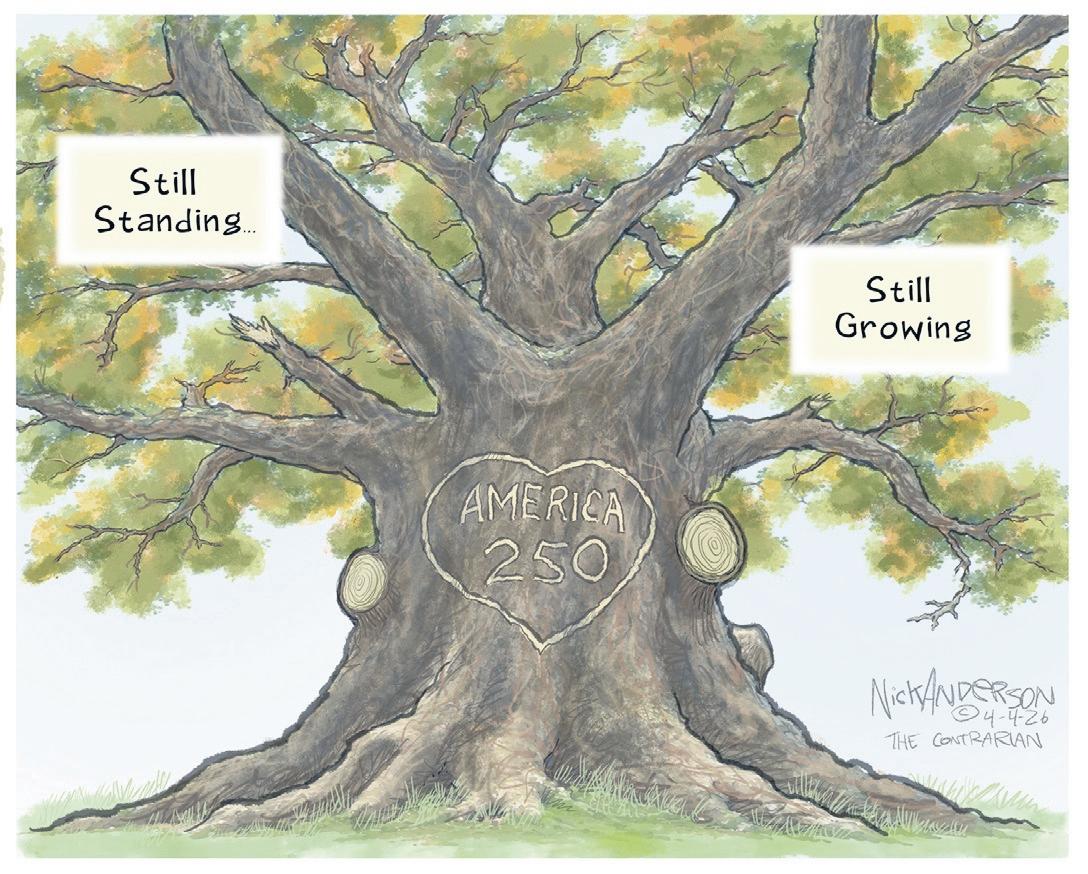

TO SEND US A LETTER, SCAN HERE



The Declaration of Independence was only the beginning. In order to form a working government, the founders drafted the Constitution, which laid a framework for our country. The Constitution was adopted on September 17, 1787. Shortly afterward, the framers appended 10 amendments known as The Bill of Rights to limit the powers of the government they had created. The Bill of Rights was ratified by the states on December 15, 1791.

We the People of the United States, in Order to form a more perfect Union, establish Justice, insure domestic Tranquility, provide for the common defence, promote the general Welfare, and secure the Blessings of Liberty to ourselves and our Posterity, do ordain and establish this Constitution for the United States of America.
THE Conventions of a number of the States, having at the time of their adopting the Constitution, expressed a desire, in order to prevent misconstruction or abuse of its powers, that further declaratory and restrictive clauses should be added: And as extending the ground of public confidence in the Government, will best ensure the beneficent ends of its institution.
RESOLVED by the Senate and House of Representatives of the United States of America, in Congress assembled, two thirds of both Houses concurring, that the following Articles be proposed to the Legislatures of the several States, as amendments to the Constitution of the United States, all, or any of which Articles, when ratified by three fourths of the said Legislatures, to be valid to all intents and purposes, as part of the said Constitution; viz. ARTICLES in addition to, and Amendment of the Constitution of the United States of America, proposed by Congress, and ratified by the Legislatures of the several States, pursuant to the fifth Article of the original Constitution.
Congress shall make no law respecting an establishment of religion, or prohibiting the free exercise thereof; or abridging the freedom of speech, or of the press; or the right of the people peaceably to assemble, and to petition the Government for a redress of grievances.
A well regulated Militia, being necessary to the security of a free State, the right of the people to keep and bear Arms, shall not be infringed.
No Soldier shall, in time of peace be quartered in any house, without the consent of the Owner, nor in time of war, but in a manner to be prescribed by law.
The right of the people to be secure in their persons, houses, papers, and effects, against unreasonable searches and seizures, shall not be violated, and no Warrants shall issue, but upon probable cause, supported by Oath or affirmation, and particularly describing the place to be searched, and the persons or things to be seized.
No person shall be held to answer for a capital, or otherwise infamous crime, unless on a presentment or indictment of a Grand Jury, except in cases arising in the land or naval forces, or in the Militia, when in actual service in time of War or public danger; nor shall any person be subject for the same offence to be twice put in jeopardy of life or limb; nor shall be compelled in any criminal case to be a witness against himself, nor be deprived of life, liberty, or property, without due process of law; nor shall private property be taken for public use, without just compensation.
In all criminal prosecutions, the accused shall enjoy the right to a speedy and public trial, by an impartial jury of the State and district wherein the crime shall have been committed, which district shall have been previously ascertained by law, and to be informed of the nature and cause of the accusation; to be confronted with the witnesses against him; to have compulsory process for obtaining witnesses in his favor, and to have the Assistance of Counsel for his defence.
In Suits at common law, where the value in controversy shall exceed twenty dollars, the right of trial by jury shall be preserved, and no fact tried by a jury, shall be otherwise reexamined in any Court of the United States, than according to the rules of the common law.
Excessive bail shall not be required, nor excessive fines imposed, nor cruel and unusual punishments inflicted.
The enumeration in the Constitution, of certain rights, shall not be construed to deny or disparage others retained by the people.
The powers not delegated to the United States by the Constitution, nor prohibited by it to the States, are reserved to the States respectively, or to the people.





















































BY MATTHEW PARAS Staff writer
It would be an overexaggeration to say the New Orleans Saints’ chances next season start and end with Tyler Shough.
But not by much.
Yes, the same could be said about every starting quarterback and team in the NFL. The idea has become a cliche for a good reason. But at the risk of relying on tired tropes, the Saints are banking on Shough to carry them in 2026. And the second-year signal-caller has more than embraced the responsibility.
From organizing workouts with teammates in the off hours to taking on more of a leadership role, Shough understands the weight the job entails. For the Saints to snap a five-year playoff drought, the 26-year-old will have to build on his electric rookie campaign — and then some.
“I’ve been able to learn over time just to be yourself,” Shough said. “To be a good leader, you have to serve others and you have to develop those relationships.”
That said, Shough isn’t in this alone. He and the Saints would likely point out that results rarely come down to just one player. And so, as much as the Saints are counting on their quarterback’s growth this coming fall, there are a handful of others who could also be on the verge of taking their game to another level.
These are the Saints’ breakout candidates of 2026, not including Shough.
CB Kool-Aid McKinstry
McKinstry already has changed his jersey number more times (four) than he’s played



Quarterback is first reason to believe Saints will break through in 2026
July is the season for optimism in the NFL.
Every team is undefeated and magically has fixed whatever ailed it in the offseason. It’s the time for unbridled hope and optimism, and the New Orleans Saints are in that number.
The Saints are coming off a 6-11 campaign that marked their third losing season in the past four years. They missed the playoffs for the fifth consecutive campaign.
But there are reasons to believe those streaks will end this season, and the Saints have become trendy picks by some league observers to go from worst to first in the NFC South.
Here are five reasons to believe the hype in New Orleans:
In a quarterback-driven league, the Saints might have found a franchise talent with the No. 40 overall pick of the 2025 draft — a massive coup.
Shough has started only nine games, so there’s reason to be cautious, but he has all the tools and is doing everything right in his first offseason as the starting quarterback. On the field, he has looked noticeably more confident and comfortable in Kellen Moore’s offense. Off it, he has embraced his role as one of the team leaders and galvanized the locker room behind him.
For the Saints, everything starts with Shough. He’s
Texas Tech pledge gives view into LSU coach’s pitch
BY JON BLAU Staff writer
How does a coach recruit an athlete who has everything?
Jalen Brewster, a 6-foot-3, 300-pound defensive tackle, is rated as the No. 1 prospect in the 2027 class. He’s committed to Texas Tech, one of the nation’s richest programs in the NIL era.


But this is also a day and age where “commitments” are one tantalizing pitch away from “flipping.” LSU’s title-winning coach, Ed Orgeron, who has returned to Lane Kiffin’s staff as an ace recruiter, tried his best to turn Brewster during a visit to Baton Rouge this summer.
“We all need something,” Orgeron told an athlete who not only pounces on quarterbacks for Cedar Hill High School (Texas) but also lines up at quarterback, running for touchdowns with frightening size and speed.
“We all need to get better,” continued Orgeron, who told Brewster that he could
make him even better. He pointed to a piece of advice Brewster heard moments earlier, which he otherwise never knew he needed.
“Because nobody ever told you that,” Orgeron said. “Think about that.”
Brewster, who posted a nearly 15-minute recap of his LSU visit to his personal YouTube channel on Friday, offered a glimpse of what Orgeron has brought back to LSU as a “special assistant to recruiting and defense.”
During the visit, the 64-year-old
ä See LSU, page 3C




6
BY KEN MAGUIRE AP sportswriter
LONDON — Iga Swiatek’s title defense at Wimbledon ended Saturday in a 7-6 (9), 6-2 third-round loss to 21-year-old Alexandra Eala, who continues to make history for the Philippines.
Eala is the first Filipino player, male or female, to reach the fourth round of a Grand Slam singles tournament on a day of upsets in the women’s draw.
The left-handed Eala dropped to her knees and rolled onto her back on Centre Court after hitting a forehand winner on her third match point.
“It’s incredible to have my countrymen cheering me on and knowing that we’re all in this together,” she said in an on-court interview as she looked around at the Philippines flags.
“This goes out to them, this goes out to my family, this goes out to all the little girls with ruffled socks and chubby cheeks. It means the world,” said the 29thseeded Eala, who saved two set points in the first-set tiebreaker.
The third-seeded Swiatek earned her first Wimbledon women’s title a year ago when she beat Amanda Anisimova 6-0, 6-0 in the final.
Eala, who has trained in Mallorca at the Rafael Nadal Tennis Academy, gained worldwide support last year on her breakthrough run to the Miami Open semifinals, which included an upset of Swiatek.
She next faces 13th-seeded Jasmine Paolini for a spot in the Wimbledon quarterfinals.
Shortly before Swiatek’s exit, 2022 Wimbledon champion Elena Rybakina was upset in the

third round by Elise Mertens 7-6 (4), 6-1. At No. 2, Rybakina is the highest seed on the women’s side to be eliminated. Her loss ensures that Aryna Sabalenka — who faces Naomi Osaka in the fourth round on Sunday — will keep her No. 1 ranking after the tournament.
Belgium’s Mertens is the No. 25 seed at Wimbledon, where she’s won two doubles titles. She will next face 21st-seeded Marie Bouzkova of the Czech Republic. In another upset, Madison Keys rallied to oust the sixth-seeded Anisimova 3-6, 6-2, 6-3 in an all-
American contest on the 250th anniversary of U.S. independence.
The 26th-seeded Keys, the 2025 Australian Open champion, was asked how she’ll celebrate the U.S. holiday.
“I have no plans,” she told the Centre Court crowd after her victory. “When you’re not in the States, it’s just kind of another day.” Keys will next play ninth-seeded Linda Noskova.
Ashlyn Krueger, another American, has come through qualifying to reach the fourth round. She beat Ukraine’s Daria
Snigur 6-3, 6-2 and will face another Ukrainian — 12th-seeded Marta Kostyuk — for a spot in the quarterfinals.
French Open champion Alexander Zverev, the No. 2 seed, got past American Marcos Giron 6-2, 7-6 (4), 6-4 to set up a fourth-round match against 13th-seeded Jiri Lehecka.
Ninth-seeded Flavio Cobolli — the runner-up at Roland Garros — overcame a slow start against Karen Khachanov to win 0-6, 7-6 (4), 6-7 (5), 6-2, 6-2 and will face No. 5 seed Alex de Minaur in the fourth round.
BY ANDREW DAMPF Associated Press
LONDON — Looking back, it seems perfectly understandable that it took Serena Williams some time to settle her nerves in her first singles match in nearly four years.
Rennae Stubbs, one of Williams’ coaches, pin-pointed a moment about an hour into the 44-year-old’s defeat to an opponent less than half her age earlier this week at Wimbledon.
“I noticed in the middle of the second set her take a big sort of deep breath and I actually turned around to Venus and said, ‘Oh I think she just relaxed,’ ” Stubbs said, referring to Serena’s older sister.
In an interview with The Associated Press on Saturday, Stubbs also revealed that she first started coaching Williams again in March and immediately noticed that the 23-time Grand Slam champion could still play.
Williams was beaten 6-3, 6-7 (6), 6-3 by 20-year-old Maya Joint of Australia on Tuesday.
While the result on the court was a loss, the reaction in the locker room from other players and coaches was a resounding victory, according to Stubbs.
“They know what it would be like to be in that position of not playing a match for close to four years, going on Centre Court at Wimbledon, knowing there’s how many millions of people around the world watching this match,” Stubbs said.
“There’s 15,000 people in Centre Court. They expect good tennis. They expect you to not embarrass yourself. So all the players know, to a small degree, what it must be like.”
The match set ratings records on ESPN and Coco Gauff, Naomi Osaka and Novak Djokovic are among the players who have publicly complimented Williams for her performance.
Williams injured her right knee

toward the end of the first set against Joint and withdrew from her doubles match with Venus on Saturday.
An Instagram update from Serena included images of four syringes that she said “shows the fluid they drained from my knee after my singles match.” An accompanying video showed her walking with strapping up and down her right leg and what appeared to be one of her daughters holding a cane for her.
“The good news is my knee shouldn’t swell or collect that much fluid again,” Serena said.
“The bad news is that, as hard as I tried, I just wasn’t able to get it ready for doubles.”
However, with the U.S. Open approaching, Serena indicated she could play again somewhere else soon.
“All I can say,” Serena said, “is stay tuned to a city near you.”
Right attitude
Serena became known for her emotional outbursts and run-ins with chair umpires and linesjudges toward the end of her career.
So Stubbs was concerned about
her on-court behavior during her comeback.
But Williams maintained her composure from start to finish.
“That was sort of like the one sort of thing that I asked, is that she try and — as hard as it was going to be — to control her emotions and her nerves and all that sort of stuff,” Stubbs said. “I don’t think people even remotely can quantify the amount of pressure that was on her to walk out there and do what she did.”
Negative reactions
Stubbs was disappointed, though, to see negative reactions to Williams’ return on social media. She was also criticized for skipping her post-match duties – since the injury was not announced until a day later.
Stubbs herself was also criticized on social media.
“I just don’t understand why people feel the need to tear somebody down,” Stubbs said. “What she’s doing out there is trying to play a sport she loves. That’s what it’s about. Show the kids, be out there, enjoy it and give the people another look at playing. … What is wrong
Serena’s knee injury forces
Williams sisters to withdraw Serena Williams withdrew from her doubles match with sister Venus at Wimbledon on Saturday due to a right knee injury.
The 44-year-old Serena was injured during her singles return earlier in the week in a three-set loss.
“I’m heartbroken to have to withdraw from doubles. Coming back to compete again has been a gift, and the opportunity to play alongside @venuswilliams once more meant the world to me. I did everything I could but unfortunately my knee just isn’t ready to compete,” Serena said in an Instagram post.
The post included images of four syringes that Serena said “shows the fluid they drained from my knee after my singles match.”
The sisters are six-time champions as partners in women’s doubles at Wimbledon.
Astros send OF Meyers to Triple-A in slew of moves
The Houston Astros optioned struggling outfielder Jake Meyers to Triple-A Sugar Land in one of four roster moves made before Saturday’s game against the Tampa Bay Rays.
The Astros also optioned outfielder Joey Loperfido to Triple-A, recalled outfielder/infielder Zach Dezenzo from Triple-A and reinstated infielder/outfielder LaMonte Wade from the injured list.
Meyers, a Gold Glove finalist in 2024 and the Astros’ third-longest-tenured position player, went hitless in Friday’s 3-1 loss to the Rays, dropping his batting average to .206 for the season. He has posted a .167/.231/.250 line since June 2, and he started just three of the Astros’ previous 10 games. Loperfido is batting .136 since returning from the injured list June 4.
Reese’s double-double not enough in Dream loss
Veronica Burton scored 21 points and Gabby Williams had 14 of her 19 points in the second half to help the Golden State Valkyries complete a season sweep of the Atlanta Dream with an 88-83 victory on Saturday.
Burton made 6 of 9 shots, with two 3-pointers and 7 of 8 free throws for Golden State (14-7) in its fourth straight victory. Williams sank 7 of 14 shots, including four 3-pointers, to help the Valkyries hand Atlanta (12-9) its fifth straight loss. Reserve Janelle Salaun had three 3s and scored 14 points. Allisha Gray led the Dream with 22 points, and former LSU star Angel Reese had 17 points and 13 rebounds for her 14th double-double of the season.
on with a seven-time Wimbledon champion — a 23-time Grand Slam champion — wanting to play another time at Wimbledon? God let her.”
Closed roof
Because the match started late in the day and there were concerns about darkness, the roof over Centre Court was closed for the match.
“She was hitting the ball so well in practice and moving really well and the conditions were very different indoors,” Stubbs said. “They were heavy. Her ball wasn’t shooting through the court like it was outside.”
Despite being away for so long, Williams still hit serves beyond 120 mph and showed off her heavy groundstrokes that landed within inches of the baseline.
The only real issue was her movement.
“When you’re great, you’re great,” Stubbs said. “When you have great timing, you always have great timing. I saw that from the moment I stepped back on court with her. I was like, ‘Well, you never lost that.’
“And then it’s just getting the movement going and getting the body going and all that sort of stuff again and at a certain age you also have to monitor the workload. So what I saw out there didn’t surprise me at all, because I had been seeing it for months: The capacity to hit the ball as well as she’s always hit the ball.”
What’s next
While Williams indicated in her injury post that she would play again, her team is still awaiting details.
“She’s not just going to do a one-off,” Stubbs said. “I think she would like to play more but that is 100% her decision. ... I’m sure she’ll re-evaluate and reassess how she wants go forward and then we’ll be there for her either way.”
The Boston Celtics have signed center Neemias Queta to a fouryear extension, according to a person familiar with the agreement.
The person spoke to The Associated Press on condition of anonymity Friday because the signing cannot be announced until Monday at the earliest. The extension is reportedly worth $56 million. Retaining Queta seemed to be a priority for the Celtics, who traded perennial All-Star Jaylen Brown to Philadelphia on Wednesday for Paul George and draft picks. Queta, who turns 27 on July 13, is coming off a breakout season with the Celtics. He averaged a careerbest 10.2 points, a career-best 8.4 rebounds and was a full-time starter for the first time. He averaged 11.2 points on 68% shooting after the All-Star break.
Hodges, Glover share lead at John Deere
SILVIS, Ill. — Lucas Glover chipped in for eagle early and made a birdie late, his only two subpar holes Saturday for a 2-under 69 that was just enough for him to share the lead with Lee Hodges in the John Deere Classic that now has plenty of possibilities.
Hodges had four birdies in a sixhole stretch on the back nine of the TPC Deere Run for a 67 to join Glover at 16-under 197 going into the final round.
Nine players were within four shots of the lead, a group that ranges from 50-year-old Zach Johnson to NCAA champion Preston Stout of Oklahoma State.
Zac Blair (67), Ben Kohles (66) and Jackson Suber (66) were one shot behind. Another stroke back was Doug Ghim (67).
BY RONALD BLUM AP baseball writer
Pittsburgh’s Paul Skenes, Milwaukee’s Jacob Misiorowski and Dodgers’ two-way star Shohei Ohtani all could miss All-Star mound appearances because of starts next weekend, while four players from the World Series champion Dodgers were voted to the National League’s starting lineup.
Los Angeles Angels outfielder Mike Trout earned his 12th AllStar selection and first since 2023 based on the second round of fan balloting announced Saturday by Major League Baseball. Trout, who grew up near Philadelphia in Millville, New Jersey, was voted by fans to start for the 11th time and hopes to return from a strained right hamstring suffered June 17.
First baseman Vladimir Guerrero Jr., among four All-Stars from the American League champion Toronto Blue Jays, said he will skip the July 14 game at Philadelphia’s Citizens Bank Park to rest a bad back that has bothered him for much of the season.
“Those four days will be great,” Guerrero said through a translator, “to come back strong in the second half.”
Yankees outfielder Aaron Judge, elected to his eighth start, will miss the game because of a broken rib that has sidelined him since May.
Skenes, the NL starter in the last
Continued from page 1C
Cajun called Michael Irvin on FaceTime, presenting a Hall of Fame receiver to Brewster in the palm of his hand.
“Me and Mike are buddies,” Orgeron said. “Been knowing Mike for a while.”
After the call ended, Orgeron added his pitch: He’s learned so much in four decades as a coach and defensive line guru that he could impart that wisdom to the nation’s top recruit.
Brewster turned to his own camera to say, “Getting coached by a legend, 1 of 1.” It remains to be seen if Orgeron left a strong enough impression to pry Brewster away from Texas Tech, but the Tigers are certainly battling across the border.
LSU just flipped four-star defensive back Karnell James from the University of Texas, and James said shortly after his Thursday announcement that he’s working to persuade Easton Royal, a fivestar receiver from New Orleans, to also flip from the Longhorns to the Tigers.
Lamar Brown, LSU’s top recruit in the 2026 class, posted to X on Friday, just before Brewster’s video release, writing: “Come be apart (sic) of something that will be the most dominant group in the country for the next 3-4 years brudda.” Nothing is ever over in recruiting, especially when NIL and revenue-sharing negotiations are invariably part of the process for five-star prospects. LSU is showing it has the resources, brand name and coaching cache to be in the mix for top recruits.
If the Tigers flip Brewster, it would supercharge a defensive line room that brought in fivestars Brown and Richard Anderson, and upper-tier four-star Deuce Geralds in 2026. It als currently has top-50 edge rushers KJ
Continued from page 1C
seasons (two). But the Alabama product is back wearing No. 1, the same number when he became a bona fide star in college and erased an entire side of the field. Will this be the year he earns that reputation as a shutdown corner in the NFL?
He has work to do for that to happen. According to Pro Football Focus, McKinstry allowed the seventh-most yards (676) among cornerbacks last season. But it wasn’t all bad. He allowed a passer rating of 101.1 on those plays, which ranks just 74th. He also recorded three interceptions and 12 pass breakups, making him disruptive at times.
This is a pivotal season for McKinstry. With Alontae Taylor leaving in free agency, McKinstry is unquestionably the No. 1 corner. And in the third year of a four-year contract, McKinstry’s performance next season could go a long way in determining his value if extension talks commence after the year.

ASSOCIATED PRESS PHOTO BY GENE J. PUSKAR
Pittsburgh Pirates pitcher Paul Skenes collects himself on the mound during the second inning of a game against the Cincinnati Reds on June 26 in Pittsburgh.
two All-Star Games, is scheduled to pitch for Pittsburgh on Tuesday and Sunday. The 24-year-old righthander is 0-6 in his last nine starts, dropping to 6-8 with a 3.62 ERA for the season. He was voted in by players, as was Misiorowski.
“To be honest, probably a little surprised,” Skenes said of his selection.
Misiorowski, averaging 100.4 mph with his fastball and leading the major leagues with a 1.47 ERA,
was an All-Star last year after just five big league games. He also is scheduled to start Sunday.
“We’re looking for September, October,” he said Friday. “It sucks — obviously I want to throw in a game like that — but so be it.”
Ohtani, a three-time, two-way AllStar and six-time pick overall, is unlikely to pitch in the game because of a right biceps issue that will push his last pre-break start to next weekend, Dodgers manager Dave Roberts said.

Former LSU coach Ed Orgeron watches his players before kickoff against Texas A&M on Nov. 27, 2021, at Tiger Stadium. Orgeron returned to LSU as a special assistant to recruiting and defense.
Green and Chris Whitehead committed in 2027. Brewster may be a Texas Tech commitment, but he’s not so devoted to the Red Raiders that he wouldn’t publicize his positive thoughts about LSU.
“As far as the people, it’s different,” Brewster said in his YouTube video.
At LSU, he shot jumpers on a basketball hoop brought into the Tigers’ team meeting room. He played pickleball on LSU’s courts.
He met with Kiffin.
He also toured the Tigers’ locker room and was impressed with their custom helmets and cleats that can change color.
“That helmet was hard,” Brewster said. “I ain’t gonna lie.”
Dialing up the former Miami Hurricanes legend wasn’t a new trick for Orgeron because Irvin recently joked on Instagram about another time Orgeron, who led the Hurricanes defensive line from 1988-92, brought him into an LSU recruiting visit virtually.
“I couldn’t say anything to Coach O because that’s my guy,” said Irvin, who burst out laughing when he recalled that recruit ultimately pledged to Miami.
He could be referring to fivestar edge rusher Jaiden Bryant, who flipped from the Tigers to the
OT Kelvin Banks
If not for an ankle injury early in the Saints’ season finale, Banks likely would have led all rookies in snaps last season. Heck, he still finished third with 1,066 snaps. No player on the Saints arguably benefited more from his playing time.
Banks demonstrated tremendous growth as his rookie season progressed, as the first-round tackle went from allowing 28 pressures in his first eight games to 18 in his final nine. Banks increasingly found ways to use his size (6-foot-5, 315 pounds) and athleticism to dominate his matchup. The next natural step for the 22-year-old would be to generate more consistency, so he can be viewed among the best at his position.
“Rookies that play early like that usually take a pretty big jump from Year 1 to Year 2,” offensive line coach Brendan Nugent said.
“And he’s on that path. Everything I seen here from the offseason program, he’s figured out what worked, what we needed to tweak and he’s worked on it. We’ve worked on it. And he keeps getting better.”
Freddie Freeman became a 10time All-Star when the LA first baseman was announced Sunday with Dodgers third baseman Max Muncy and outfielder Andy Pages as winners in the second phase on fan voting, which ran from June 29 to Thursday. They joined Ohtani, who won the NL designated hitter spot by finishing with the most votes in the initial round of fan selection announced June 25.
In the closest race, Pages edged Atlanta’s Michael Harris by fewer than 5,000 votes for the third NL outfield spot.
Four Dodgers were elected to start for the first time since Steve Garvey, Davey Lopes, Bill Russell and Reggie Smith in 1980. World Series MVP Yoshinobu Yamamoto was picked for the NL pitching staff by Major League Baseball with one of its six selections, giving the Dodgers five or more AllStars for the seventh straight time.
Twenty-six first-time All-Stars were among the 64 players picked, including four rookies: Cleveland second baseman Travis Bazzana, Detroit shortstop Kevin McGonigle, Cleveland left-hander Parker Messick and Cincinnati third baseman Sal Stewart.
McGonigle is the youngest player at 21, and Boston closer Aroldis Chapman at 38 is the oldest.
Atlanta and the host Phillies each have five All-Stars.
Philadelphia outfielder Brandon
Continued from page 1C
raised the expectations for everyone in the building and is the primary reason for optimism throughout the organization.
More dynamic passing attack
In a show of belief in Shough, the Saints front office spent the offseason building its offense around him and adding offensive weaponry to his arsenal. Veteran running back Travis Etienne is a multipurpose threat out of the backfield, a true every-down back.
Hurricans on June 3.
“He got my subliminal (messages),” Irvin said.
At least with Brewster, Orgeron didn’t let Irvin have the last word.
He led Brewster down a hallway to where previous LSU greats are depicted. Orgeron pointed to defensive tackle Rashard Lawrence, who could recall Orgeron telling him he’d be the captain of a national title team during a recruiting visit.
“Speak and it’ll become,” Orgeron said.
Next in line was Joe Burrow.
“Ohio State didn’t want him,” he said of the Heisman winner.
Then Orgeron tapped on safety Grant Delpit, adding “Texas boy, Houston,” before he ended with offensive lineman Lloyd Cushenberry, who was judged as too small and committed to South Carolina before LSU swiped him late.
Cushenberry is now in the NFL.
“How about that, guys? It’s gonna happen,” Orgeron said to Brewster’s family. “I’m gonna put a ring on y’all so darn big you’re gonna have to have three fingers to wear that thing.”
Brewster’s takeaway: “LSU and Louisiana coaching, way different. Life after ball, development and getting to the League — that’s the main goal for me.”
Veteran free agent Noah Fant and rookie Oscar Delp should team with Juwan Johnson to give the offense a capable trio of tight ends. And rookie receivers Jordyn Tyson, Bryce Lance and Barion Brown add speed and playmaking ability to the perimeter group.
Further, veteran left guard David Edwards was a priority signing in free agency. He should shore up a lingering hole on the left side of the line and improve the pass protection on Shough’s blind side.
The result has been noticeable this offseason. The offense is more versatile, dynamic and wide open in Year 2 under Moore.
Improved kicking game
There’s no sugar-coating how bad the Saints were here a year ago. The addition of free agent punter Ryan Wright and kicker Tanner Brown has bolstered two of the shakiest spots on the roster.
Wright should provide an immediate upgrade to the punter position and will give the Saints their first top-10 punter since Thomas Morstead’s run from 2009-20.
Few noticed when the Saints added Brown to the roster after a strong tryout last month, but he could be the surprise of the off-

DE Chase Young
Twenty sacks. That’s what Cam Jordan said he thought Young was capable of next season. And, for the first time since Young’s rookie season, the possibility didn’t feel absurd. Young, after all, racked up 10 sacks in just 12 games last year. That’s not quite
a 20-sack pace, but Young made his presence felt as a pass rusher in 2025. Notably, he started turning his pressures into sacks — finally reaching double digits as a pro. Admittedly, 20 sacks is a hard threshold to reach. Myles Garrett and T.J. Watt are the only rushers in the last five years to hit that mark, and those two are seen as
Marsh was elected to start and will be joined by four fellow Phillies: first baseman Bryce Harper, DH Kyle Schwarber, reliever Jhoan Duran and left-hander Cristopher Sánchez. Harper was a legend pick added by baseball commissioner Rob Manfred.
Atlanta catcher Drake Baldwin and second baseman Ozzie Albies were voted in as starters and will be joined by left-hander Chris Sale, a 10-time All-Star, and closer Raisel Iglesias. Toronto has four, with Guerrero joined by second baseman Ernie Clement, who led AL players in the first phase of voting from June 3-25, and pitchers Dylan Cease and Louis Varland.
“Our fan support is unlike any other team, obviously, because of the country backing you,” said Toronto’s John Schneider, the AL manager. “Not just Canada — I think a lot of baseball people really recognized how those guys play the game.”
Elected AL starters also include Athletics catcher Shea Langeliers; Kansas City shortstop Bobby Witt Jr.; Tampa Bay third baseman Junior Caminero; Houston designated hitter Yordan Alvarez; and the New York Yankees’ Judge and Minnesota’s Byron Buxton in the outfield. Guerrero will be replaced in the starting lineup by the Athletics’ Nick Kurtz and Judge by Yankees teammate Cody Bellinger. Replacements are based on player, manager and coach voting.
season. He was named the UFL Special Teams Player of the Year and became the first kicker in pro football history to make two field goals from 60 or more yards in a game this season.
Brown is not just the proverbial “camp leg,” brought in to ease the load on incumbent Charlie Smyth during camp. He has a strong chance to supplant Smyth and earn the starting spot on the final 53-man roster.
Full year (hopefully) of Young Chase Young is the most talented defender on the roster. He might be the most talented player on the team. When healthy and engaged, as he was in the second half of last season, he is a handful on the edge, where he racked up a career-high 10 sacks in only 12 games last season.
Young has blossomed in Brandon Staley’s 3-4 scheme and is poised for a breakout campaign if he can stay healthy. That’s a big “if.” Young has played a full season just once in his six-year NFL career.
Young looked terrific throughout the offseason and will be asked to play a key leadership role for the front line. He is poised for a breakout year.
Staff carryover
After a foundational 2025 season, Moore managed to keep almost the entire coaching staff intact for 2026, a rarity in today’s NFL. The lone exception is Jahri Evans, the assistant offensive line coach, who departed for Pittsburgh.
Otherwise, the Saints managed to protect their key coordinators, including prized defensive coordinator Staley, and position coaches from being poached this offseason.
The continuity has shown in practices, where players are noticeably more comfortable and confident in Year 2 of the offensive and defensive systems.
the two best pass rushers in today’s game. But 2025 was already a revelation for Young, and still only 27 years old, another breakout season could be in store.
S Jonas Sanker
It might seem lazy to put a third member of last year’s draft class on this list, but hear us out: The Saints have big plans for Sanker in 2026. They’re trusting him to replace Taylor at the Star position, defensive coordinator Brandon Staley’s version of an inside cornerback. Sanker earned the role after a surprising season in which he proved to be reliable after a season-ending injury to Julian Blackmon. Safeties coach Terry Joseph said Sanker displayed a “mental toughness” that will serve the 23-year-old as he adapts to a new position.
“I think it’s really hard to evaluate off of college film that this guy can (play the) Star,” Joseph said. “I think you got to get him in your organization, in your building, and you gotta really get a feel for where that guy is mentally, how tough he is and how much can he handle, because a lot’s on the plate of the star.”
BY JOE MACALUSO
Contributing writer
Don’t look now, not on this landmark holiday celebration, but time is running out to get youngsters on the water for one of those memorable summertime fishing trips.
That’s because, as much as young folks don’t like to look that far ahead, school begins for most of them in five weeks.
Oh, no! You mean in 35 days?
Or thereabouts, yes!
So with half of their summer vacation gone, what’s left?
Enough time for Andy Andolsek of Thibodaux to make sure his grandchildren know a little bit more about Louisiana’s summertime fishing than they knew when school ended back in late May.
“It’s what life is all about,” he said a couple of days after taking grandson Jack Bonvillain into the gulf to compete in the Fourchon Energy Fishing Tournament.
Andolsek’s children and grandchildren are spending this Fourth of July weekend on the Central Coast chasing after red snapper and other deep-water species and sprinkling in a nearshore try for speckled trout and redfish.
“Life’s about spending time with our children and grandkids,” Andolsek said. “I’m fortunate to have them and be able to do what we like to do — catch fish.”
He said he has a more-than-willing partner in 11-year-old Jack, who “enjoys this experience. If I say we’re going, then he’s ready to go. He’s in the truck and ready to head to the island (Grand Isle). And, last weekend, Jack caught his share.” Andolsek said he’s careful about the when and where of taking
youngsters into what sometimes is a hostile environment, being cautious about not starting a trip with the old “the sea was angry that day, my friend” saying.
“We always try to pick a calm day to do both offshore and trout fishing,” he said.
That advice follows what many a top-flight charterboat skipper has followed for years — guys like Mike Gallo, who works in the Pontchartrain Basin, Ryan Lambert at Buras and Grand Isle’s Frank Dreher
To a man, these veteran guides practice caution when taking young anglers on a trip.
Their first warning is weather, mostly staying at the dock when seas are too rough, and taking in account summer’s heat to leave early and make sure not to overdo time on the water when temperatures soar into the 90s.
“Make sure to take enough water and snacks,” Dreher said, in addition to ensuring the young folks wear life jackets and understand the importance of being safe while on the water.
Lambert and Gallo make sure parents understand the need to have their children wear appropriate clothing and hats and bring along sunscreen to protect tender skin.
“The one thing about youngsters is they want to catch fish, and it doesn’t mean you have to chase big fish,” Gallo said. “There’s nothing like putting a smile on their faces when they reel in their first speckled trout or redfish, and size doesn’t matter. Size might make a difference when they get older, but not now.”
In freshwater
Some of the same cautionary

Andy Andolsek, along with grandchildren Claire Bonvillain, 9, and Jack Bonvillain, 11, was proud to weigh these red snapper during last weekend’s Fourchon Energy Fishing Tournament at Port Fourchon. Andolsek said Jack is a constant fishing companion and is always ready to head out, whether it be for a deep-sea trip or in pursuit of speckled trout and redfish. Andolsek said his family is spending the Fourth of July weekend fishing because, he said, ‘Life’s about spending time with our children and grandkids.’
practices can be applied to bream and sac-a-lait trips in July and early August.
Take youngsters to places where you know they can catch any of a number of species like bluegill, chinquapin, sac-a-lait and catfish
After reviewing data collected by Wildlife and Fisheries’ Shrimp Study staff, the order was issued to close the spring inshore shrimp season effective at sunset Monday. The closure affects all
inshore waters except the “...open waters of Breton and Chandeleur sounds.” All “outside” waters will remain open. The closure came after biologists and managers found increasing numbers
of small white shrimp in test trawls. This closed period will allow the white shrimp to grow to marketable sizes for the fall inshore season, which usually opens in mid August.
— Joe Macaluso
WEDNESDAY
BUGS & BEERS: 6:30 p.m., Skeeta Hawk Brewing, 455 N. Dorgenois St., New Orleans. Casual fly tying. Open to public. Email A.J. Rosenbohm: ajrosenbohm@gmail.com. Website: neworleansflyfishers.com
THURSDAY
JUNIOR SOUTHWEST BASSMASTERS MEETING: 7 p.m., Seminar Room, Bass Pro Shops, Denham Springs. Boys and girls age-group bass tournaments for ages 7-10, 11-14 and 15-18 anglers. For details, call Jim Breaux, 225-772-3026.
THURSDAY-SATURDAY
CATHOLIC HIGH ALUMNI FISHING RODEO: Fourchon Marina, Port Fourchon. Adult and Youth divisions. Inshore, Rig and Offshore divisions. $50 & $100 Redfish Stringer, Mangrove Snapper, Red Snapper, Speckled Trout and Offshore Grand Slam calcuttas. Checkin/registration party 5-8:30 p.m. Thursday. Weigh-in 4-6:30 p.m. Friday and 3-6 p.m. Saturday. Website: catholichigh.org/alumni. Call Catholic High School Alumni Relations, 225-228-0831.
SATURDAY
NSCA REGISTERED SPORTING CLAYS: Bridge View Gun Club, Port Allen.
ONGOING STATEWIDE TOURNAMENT & ANGLERS
RODEO/S.T.A.R.: Through Sept. 7, Coastal Conservation Association’s summer-long fishing event. Tagged redfish, coastal/offshore species categories & youth division. CCA membership required. Website: ccalouisiana.com/star
AROUND THE CORNER
JULY 13 — RED STICK FLY FISHERS PROGRAM: 7 p.m., Bluebonnet Regional Library, 9200 Bluebonnet Blvd., Baton Rouge. Open to
the public. Email Brian Roberts: roberts. brian84@gmail.com. Website: rsff.org
JULY 15 — FLIES & FLIGHTS: 7-9 p.m, Rally Cap Brewing, 11212 Pennywood Ave., Baton Rouge. Casual fly tying. Open to public. Email Chris Williams: thefatfingeredflytyer@ gmail.com
JULY 16 — ACADIANA FLY RODDERS PROGRAM: 6 p.m., Pack and Paddle, 601 E. Pinhook, Lafayette. Open to public. Email Darin Lee: at cbrsandcdc@gmail.com. Website: acadianaflyrodders.org
JULY 16 — FRIENDS OF NRA/SOUTHWEST LA BANQUET: 6 p.m., Riverside Bar & Grill, 3748 Louisiana 3059, Lake Charles. Call Brack Cole, 337-912-1620. Email: jbcoleair@yahoo. com
FISHING/SHRIMPING
SHRIMP: Spring inshore season open; all outside waters open. Spring inshore season will close at sunset Monday, July 6, except Breton/Chandeleur sounds, which will remain open. OPEN RECREATIONAL SEASONS: Private recreational red snapper; gray triggerfish; flounder; lane, blackfin, queen and silk snappers and wenchmen among other snapper species; all groupers except closed for goliath and Nassau groupers in state/federal waters.
CLOSED SEASONS: Greater amberjack; bluefin tuna; gag, goliath & Nassau groupers in state/federal waters. Commercial greater amberjack season closed.
LDWF UPDATES
n Reopened: Pearl River WMA (including Honey Island Shooting Range) & Grassy Lake WMA.
n Closed: Roads on Pomme de Terre, Richard Yancey & Bogue Chitto WMAs (flooding); Hope Canal Road/boat launch (Maurepas Swamp WMA, levee construction) EMAIL: jmacaluso@theadvocate.com

— and make sure they know about how much a catfish’s fin can hurt.
Water is a must to keep young bodies hydrated. Pack snacks and sunscreen, too, and be ready to head out early and plan to return well before noon.
Don’t forget to take along a small first-aid kit to take care of the ouchies.
This goes for trips to a pond and adventures by boat. Yep, only five more weeks. Enjoy the days.


CA RC AR ET IP S
Thinking about fixing up your car beforetrading itin?
Scan to seewhy youshould do absolutely nothing.
Join SAMWICKARD from GERRYLANECADILLAC as sheanswers a question shegetsasked allthe time:how do you getthe most outofyourtrade -invehicle?Learn whytakingonexpensive detailing, body work, or mechanical repairsyourselfmight ac tually cost youmoremoney in thelongrun,and why bringing your vehicle in exac tly“as is”isthe smartest move youcan make
WICKA Sales Mana M R D ager







BY DAN GELSTON AP sportswriter
PHILADELPHIA — Kylian Mbappé
laughed and smiled — and scored, of course — when Paraguay tried to bait him and his French teammates into fouls and provoke fights, as hot heads became a recurring theme during one of the steamiest World Cup games on record.
After the final whistle, Mbappé kept on walking and left Paraguayan goalkeeper Orlando Gill hanging as Gill extended his right hand in a show of sportsmanship.
In response, Gill thew the ball right at the No. 10 on Mbappé’s jersey.
Mbappé got the last laugh as he scored his 19th career World Cup goal, and France survived stifling heat to beat Paraguay 1-0 on Saturday, sending Les Bleus into the quarterfinals for the fourth straight time.
“We knew what kind of match it was going to be,” Mbappé said in French. “We can also get our hands dirty, we know how to do it. We know how to play ugly football. Guess they were thinking we were going to show up in tuxedos, but we were ready.”
France advanced to play Morocco on Thursday in Foxborough, Massachusetts. France beat Morocco 2-0 in the semifinals of the 2022 World Cup in Qatar.
With an extreme heat warning

in effect throughout the match as temperatures hovered around 100 degrees Fahrenheit, Mbappé finally broke through against a physical, defensive-minded Paraguay side when he converted a penalty

ASSOCIATED PRESS PHOTO BY DAVID J. PHILLIP
Morocco’s Azzedine Ounahi is thrown in the air by his teammates after the World Cup round of 16 match against Canada on Saturday in Houston.
BY KRISTIE RIEKEN AP sportswriter
HOUSTON — Morocco is heading back to the quarterfinals and coach Mohamed Ouahbi believes his team has established itself among soccer’s elite.
Azzedine Ounahi scored twice to lead Morocco to a 3-0 win over Canada in the World Cup round of 16 Saturday to make the country the first African nation to reach the quarterfinals more than once.
“We are no longer a surprise,” Ouahbi said through a translator.
“Now when people talk about Morocco, we’re a major contender and it’s a great source of pride. I think it’s only the beginning, and I hope we continue to have runs like this.”
And despite already making history in this World Cup, Morocco has much higher goals.
“We want to keep going,” Ouahbi said. “We don’t want to stop.”
It’s Morocco’s second straight appearance in the round of eight after becoming the first African team to reach the semifinals in 2022.
“We are so proud to represent Africa because it’s a continent with a lot of talent and Africa deserves to be in the best level in football,” Morocco goalkeeper Yassine Bounou said. Neither team was able to break through until Ounahi took a free kick from Achraf Hakimi and made a right-footed shot through traffic from outside the box to the bottom right corner to put Morocco on top 1-0 in the 50th minute.
Ounahi made it 2-0 on a rightfooted shot from the middle of the box off a pass from Brahim Díaz in the 82nd minute.
Soufiane Rahimi added a goal in the final minute of stoppage time.
The loss ends a historic run for World Cup co-host Canada, which won its first-ever knockout round match with a 1-0 victory over South Africa to reach Saturday’s match. The country was playing in the World Cup for just the third time and the run enchanted a nation that is normally far more interested in hockey than the pitch.
Canada coach Jesse Marsch shared his postgame message to the team.
“I told them that I was proud of them and I challenged them to understand that we can play like this all the time against the best teams in the world,” he said. “We can be better on the day. And then the challenge is, can we hold that standard for 90 minutes?”
Morocco, which is ranked sixth in the FIFA rankings, dispatched the Netherlands in a penalty shootout to reach the round of 16.
Though Marsch mistakenly said Morocco is ranked one spot lower than it is, he lauded how his team performed against a squad of its caliber and of how Canada controlled the match for much of the day.
“The way we pushed, the way we were in the match, the quality we showed, the overall impact in the match, we were better,” he said. “We were better than the No. 7 team in the world today.”
kick in the 70th minute.
Mbappé was awarded the penalty when Diego Gomez was called for tripping after a video review. Then he stutter-stepped on his way to his 19th goal in 19 World Cup
appearances, one behind career record holder Lionel Messi of Argentina. Mbappé and Messi have seven goals in this tournament to top the Golden Boot race. Mbappé won that award four years ago, but
Messi and Argentina beat France in the final.
Mbappé — who frequently trashtalked the Paraguayans in Spanish — is now the only player to score at least three goals in the knockout stage of three World Cups.
Mbappé botched a breakaway attempt in the second half, and Manu Koné had his top-corner shot knocked away by Gill after he was wiped out in the netting by Ousmane Dembélé only moments earlier. Gill also stopped two strong attempts by Mbappé in second-half stoppage time.
The 26-year-old Gill had bested German great Manuel Neuer in a penalty shootout in the previous round. He then lost his cool after the loss to France when he chucked the ball at Mbappé.
BY STEVE REED AP sportswriter
Mexico is counting on a huge home-field advantage to help it reach the World Cup quarterfinals for the first time in 40 years.
England stands in the way.
It’s one of two epic round of 16 knockout matchups on Sunday. Brazil faces Norway in the other game.
Mexico appears to have its best chance in decades to end the drought in what many are calling the biggest match in the country’s history, largely because of where the game will be played.
Mexico has won eight matches and tied two at its “home” stadium since Estadio Azteca opened in 1966.
In this tournament, El Tri has three home wins without conceding a goal. Mexico won 2-0 against South Africa and 3-0 against the Czech Republic in the group stage, and beat Ecuador 2-0 in the round of 32. Mexico also defeated South Korea 1-0 in the group stage in a game that was played in Guadalajara.
“The stadium is a monster; that explains the high number of wins and draws, and the few losses — which were just accidents,” said Hugo Sánchez, the striker who played for Mexico in the 1986 World Cup and now serves as an ESPN analyst. “We approach this with optimism because we know it’s England, but if we play the way we did against Ecuador, we can beat them.”
Since last reaching the quarterfinals in 1986, Mexico failed to make the tournament once, failed to advance out of group stage play once and been bounced in the round of 16 seven times.
“I’m one of those who couldn’t make it through; it happened to me in South Africa and Korea,” said Javier Aguirre, who managed El Tri during those campaigns. “It’s deeply painful because you play a great group stage, only to be knocked out for a variety of reasons.”
England will be counting big time on Harry Kane to deliver against Mexico.
That’s nothing new for England’s all-time leading scorer in the World Cup.
England trailed for the opening 75 minutes of its round of 32 match against Congo on Wednesday, Kane remained confident. The 6-foot-2 forward scored two late goals to earn a 2-1 win and send England to the round of 16 to face Mexico in Mexico City.


Norway is hoping for a repeat of its stunning upset of Brazil during the 1998 World Cup.
However, Norway remains a slight underdog as it tries to advance to face the winner of the matchup between Mexico and England outside Miami on Saturday.
Seleção has won three in a row since opening the tournament with a draw against Morocco, also at the Meadowlands in northern New Jersey.
Norway has a win of its own at the stadium outside New York, defeating Senegal to advance to the knockout round. Brazil coach
Carlo Ancelotti called Norway a challenging opponent because of structure, as well as talent.
“They have great players,” Brazil midfielder Bruno Guimarães said through an interpreter. “They are not in the knockout rounds by accident. It’s not that we are not respecting Norway. We just believe in our football. We believe in our country, and we want to continue on this dream.”
Erling Haaland has five goals at the World Cup for Norway and 25 over his past 14 competitive matches internationally and 60 in 53 with the national team.
But he faces a formidable challenge against Brazil’s back line duo of Gabriel Magalhães and Marquinhos that Norway coach Ståle Solbakken called one of the best central defenses around.
“There will certainly be some tough duels between them and Erling,” Solbakken said. “But for me, it’s more about Brazil against Norway and not that those two against Erling.”
Brazil has a dangerous forward trio led by Vinícius Júnior, who has combined with Matheus Cunha for seven goals through four games.
Asked to compare the 6-foot-5, 205-pound Haaland and the 5-9, 170-pounder known as “Viní,” Solbakken said, “One is a machine that you can see the accelerations and the great physique, and the other is more a ballerina that can dance with the ball.”
BY NOAH TRISTER AP sportswriter
This weekend, England faces the ultimate road game at this World Cup. Sunday’s round of 16 matchup against Mexico at the Azteca Stadium will present challenges above and beyond what the Three Lions have faced so far.
The altitude, the hostile atmosphere, plus whatever extra gamesmanship might await, it’s all part of the experience of taking on El Tri in Mexico City.
It’s also gripping theater.
There’s nothing quite like a big World Cup match involving the host nation, and when that team has a famously impressive home record — which Mexico certainly does at the Azteca — there’s a real intimidation factor. Six times the men’s tournament has been won by the country playing at home, most recently in 1998. But there is hope for England. Some of the most famous matches in World Cup history were games the home team actually lost.
Here’s a look at home-field advantage through the years: Italy, 1934
The first two World Cups were won by the hosts — Uruguay in 1930 and then Italy in 1934. The latter gained infamy because of Benito Mussolini’s use of the tournament as a political tool — and perhaps his impact on the officiating?
“The fascist regime made a political abuse of the event,” Italian writer Marco Impiglia said nearly 80 years later. “It was a questionable win and it raised many doubts at the time.” It should be acknowledged that four years later, Italy became the

first team to win a World Cup away from home, prevailing in France. Brazil, 1950
The Brazilian men have won a record five World Cups, but have never triumphed at home. The hosts needed only a draw against Uruguay to take the title in 1950 — there was a final group stage instead of a singular title game — but with maybe 200,000 on hand at Rio’s Maracana Stadium, the Brazilians went down to an unthinkable
2-1 defeat.
Alcides Ghiggia, who scored the winning goal, once said only three people had silenced the Maracana: “The Pope, Frank Sinatra and me.”
That 1950 loss hovered over the proceedings when Brazil hosted again in 2014 — and the team’s semifinal loss to Germany may have been even more embarrassing. At least that time, the suspense was removed early when the visitors scored a flurry of first-half goals on their way to
BY JAY COHEN AP sportswriter
JOLIET, Ill. — It has been seven years since NASCAR last raced at Chicagoland Speedway. Seven years of Midwest heat, rain and snow covering the aging asphalt at the 1.5-mile track.
That last weekend also was before NASCAR moved into its Next Gen cars.
The Cup Series returns to Chicagoland on Sunday, and what was old is new again.
“It is definitely like learning a new racetrack,” Joe Gibbs Racing driver Chase Briscoe said.
NASCAR ran 19 Cup races on the D-shaped oval in Joliet — about 50 miles southwest of downtown Chicago — from 2001-19. It tried to build interest in the event in a crowded market, even making Chicagoland the opening race of the 2011 playoffs. But the race struggled with attendance before NASCAR pulled out.
NASCAR raced on a street course in downtown Chicago on the first weekend in July each of the previous three years. The future of that concept is in question; it could return in 2027 on a different weekend.
In the meantime, Chicagoland Speedway is back.
“I would say from a character standpoint, this is the closest thing we have to Homestead or maybe Darlington,” Richard Childress Racing driver Austin Dillon said. “But mile-and-a-half wise, this thing has a lot of character, so I love it and I think it’s going to put on a great show for TV.”
Denny Hamlin, Ryan Blaney and Kyle Larson participated in two days of tire testing at the facility in April. But the drivers largely stayed in one line lower on the track. As rubber accumulates on the asphalt this weekend, Hamlin and company could begin to explore the higher lines.
“I’ve been around long enough to know that a test racetrack and a race weekend track are two vastly different things,” said Hamlin, who has the pole position for Sunday’s race. “So, lots of unknowns.”
The biggest unknown is the Next Gen car, which debuted in 2022. Chicagoland Speedway is rough and bumpy, and the Next Gen cars do not like rough and bumpy. But Brad Keselowski thinks that might be a good thing.

a 7-1 rout.
England, 1966
England’s lone World Cup championship came on home soil, and not without controversy. In the final against West Germany at Wembley Stadium, Geoff Hurst’s shot in extra time bounced down off the crossbar. Did it go in or not?
Goal-line technology was still decades away.
Officials awarded the goal, which put England up 3-2. Hurst later scored again to complete a hat trick, and the final score was 4-2.
Argentina, 1978
The Netherlands lost backto-back finals in 1974 and 1978 — both times losing to the host country. In 1974, the Dutch scored early, but lost 2-1 to West Germany. Four years later, they had to take on Argentina in front of a frenzied crowd in Buenos Aires. The Argentines took the field several minutes after the Dutch, leaving the visitors by themselves in front of the hostile fans. Argentina eventually won 3-1 in extra time.
The Dutch nearly faced Brazil in that final. Argentina needed at least four goals against Peru in its final match in its second-round group to make the final. The Argentines won 6-0, leading to plenty of conspiracy theories.
Sometimes, it’s not all that clear who the home team really is. At least that’s what Diego Maradona was hoping when Argentina prepared to face Italy in the 1990 semifinal in Naples. A club star for Napoli, Maradona was beloved there, but would the local fans really cheer for him and Argentina against their own country? Maradona certainly tried to stoke divi-
sions between northern and southern Italy.
“After so much racism, only now they scurry to remember that Naples is part of Italy,” Maradona told Corriere dello Sport. ”Now that they have slapped the Neapolitans in every possible way, someone tells them they are Italians, that only Italy counts. It is incredible, absurd, offensive.”
Ultimately, fans cheered for Italy, but Argentina became the first team all tournament to score against the Italians, forging a 1-1 draw. Then Argentina won the penalty shootout to eliminate the Azzurri. In the final in Rome, Argentina received an unpleasant reception and lost to West Germany.
France, 1998
The most recent host country to win the title was France, which had never gone all the way until 1998. The French hadn’t even qualified for the 1990 or 1994 World Cups, but at home they reached the final, where they denied Brazil a repeat championship.
The 2002 World Cup was cohosted by Japan and South Korea, with the latter making a remarkable run to the semifinals. Italy and Spain saw little to celebrate about the Korean breakthrough.
After the Italians lost to South Korea in extra time in the round of 16, FIFA said it received hundreds of thousands of emails from Italy fans furious about the officiating. In the quarterfinals, South Korea beat Spain on penalties after the Spaniards had multiple goals disallowed.
FIFA president Sepp Blatter denied any conspiracy but acknowledged some bad calls.
The Associated Press COLUMBUS, Ohio — It is shaping up as another duel between Stewart Cink and Padraig Harrington for the U.S. Senior Open championship.
Cink shot a 64 in Saturday’s third round at Scioto Country Club, tied for the tournament’s lowest round. At 9-under 201, he leads reigning champion Harrington by one shot.
This is the second straight year Cink and Harrington will be in the final group. Harrington, Cink and Mark Hensby were tied after last year’s third round at The Broadmoor in Colorado Springs, Colorado, before Harrington won his second Senior Open title by one shot.
to become the first to win the first three senior majors. He has four victories in nine PGA Tour Champions starts this year, including the Senior PGA Championship and the Tradition.
The last player to win the Senior PGA, Tradition and U.S. Senior Open in the same year was Jack Nicklaus in 1991.
Cink and Harrington were tied going to the par-4 No. 18 when Harrington bogeyed.
“Today was a good day. The golf course was a bit softer,” Cink said. “It felt like you could be more attacking and had more control of the ball when it landed.”
(77) Carson Hocevar, Chevrolet, 176.869. 16. (38) Zane Smith, Ford, 176.748. 17. (42) John H. Nemechek, Toyota, 176.678. 18. (35) Riley Herbst, Toyota, 176.609. 19. (1) Ross Chastain, Chevrolet, 176.586. 20. (60) Ryan Preece, Ford, 176.304.
21. (88) Connor Zilisch, Chevrolet, 176.286. 22. (43) Erik Jones, Toyota, 175.993.
23. (2) Austin Cindric, Ford, 175.861.
24. (47) Ricky Stenhouse Jr, Chevrolet, 175.496.
25. (3) Austin Dillon, Chevrolet, 175.444. 26. (7) Daniel Suárez, Chevrolet, 175.353.
27. (10) Ty Dillon, Chevrolet, 175.251.
28. (67) Corey Heim, Toyota, 175.171.
29. (34) Todd Gilliland, Ford, 174.695.
30. (97) Shane Van Gisbergen, Chevrolet, 174.413. 31. (22) Joey Logano, Ford, 174.216.
32. (4) Noah Gragson, Ford, 174.076. 33. (41) Cole Custer, Chevrolet, 173.779.
34. (21) Josh Berry, Ford, 173.327. 35. (33) Austin Hill, Chevrolet, 173.238.
36. (44) JJ Yeley, Chevrolet, 168.914.
37. (51) Cody Ware, Chevrolet, .000.
38. (71) Michael McDowell, Chevrolet, .000.
“It should be interesting to see the car-versus-track combination,” Keselowski said, “because the fact that the car hates the track could
actually be really good for the racing, as it opens up different grooves and makes you do different things to try to accommodate that as a driver or as a team with the car setup.”
Bubba Wallace is driving a “Space Jam”-themed car in honor of the 30th anniversary of the Looney Tunes movie. Wallace also attended an event at Navy Pier paying tribute to the movie in the run-up to the race.
Wallace drives the No. 23 Toyota Camry for 23XI Racing, which is co-owned by Michael Jordan, one of the stars of the 1996 movie.
“I just remember watching that like on repeat and so to have that connection and be representing the Looney Tunes, Warner Brothers, ‘Space Jam,’ ” Wallace said, “you know just everything that that movie provided as a kid, to be reliving that is super cool. So appreciate all the parties involved. It was a great event at Navy Pier. Had a great turnout, met a lot of new fans.” Carson Hocevar is making his 100th career Cup Series start. He made his Cup debut in 2023 and got his first win at Talladega on April 26.
“I mean, you just kind of blink and you’re at 100, right?” he said. “And you know I’m going to blink twice and be at 200. ... I’m just glad I have a win in the win column before a hundred.”
“It probably naturally does add a little bit because we did this last year. We’ve done it a number of times other than last year, and before the PGA Tour Champions, as well, back in the early days. I think we did this in the Ryder Cup,” Cink said. “I’m going to have my hands full with him and all these other guys tomorrow, but mostly with Scioto and myself.”
Cink could become the fifth player to win the event after being runner-up the previous year. Fred Funk was the last to do so in 2009. George McNeill is the other player in the final pairing. He led by two shots after the second round but is now two shots back after shooting 69. Harrington birdied four of the first five holes on the back nine to reach 9 under for the tournament but dropped a shot on the final hole to finish with a 66. The 54-year-old from Ireland said earlier in the week that he felt some pressure being the reigning champion, but not anymore.
“I think that feeling is gone now, as in Stewart is leading the tournament. It’s on his shoulders. He’s the one with the lead. I’m now chasing, so I don’t have that feeling at all,” said Harrington, who is trying to become the first repeat Senior Open champion since Allen Doyle in 2006. Cink is also chasing a pair of milestones. The 53-year-old aims
Saturday’s tee times were moved up a couple of hours because of the threat of late-afternoon thunderstorms in central Ohio. Early morning showers helped soften the course. Final-round tee times were also moved up to avoid possible delays. More rain overnight will affect everyone’s strategy for Sunday.
“If that storm dumps a half an inch of rain on this golf course, it’s going to be a completely different test. I don’t think it would be smart to formulate any kind of a score plan right now,” Cink said. “Whatever score that leads to, part of my mantra is I have to be willing to accept that. That’s the only way I can free myself up.”
McNeill is a PGA Tour Champions rookie whose last PGA Tour victory was in 2012. The 50-year-old never broke 70 in five U.S. Open appearances but was one shot back after a firstround 68 and led with a 66 on Friday.
“Playing on the Champions Tour, I played in a couple final groups this year; played fairly well so far this year. Maybe I’ll just try and revert back to that,” said McNeill, who is at 7-under 203 after 54 holes.
McNeill is attempting to become the 13th player to win in his first U.S. Senior Open. The last to do it was Richard Bland in 2024. Miguel Angel Jiménez (67) is three shots back in fourth
6-under 204.
with
States, 6-2, 7-6 (4), 6-4.
Lehecka (13), Czechia, def. Jaume
6-4, 6-4, 4-6, 6-4.
Fery, Britain, def. Zizou Bergs, Belgium, 2-6, 7-5, 2-6, 7-6 (3), 7-6 (5). Taylor Fritz (6), United States, def. Lorenzo Sonego, Italy, 4-6, 6-3, 6-4, 7-6 (5). Grigor Dimitrov, Bulgaria, def. Matteo Berrettini, Italy, 6-3, 6-4, 3-6, 5-7, 6-3. Women’s Singles
Third Round Marta Kostyuk (12), Ukraine, def. Emma Navarro (23), United States, 6-2, 4-6, 6-1. Ashlyn Krueger, United States, def. Daria Snigur, Ukraine, 6-3, 6-2. Marie Bouzkova (21), Czechia, def. Liudmila Samsonova, Russia, 4-6, 7-6 (3), 6-4. Elise Mertens (25), Belgium, def. Elena Rybakina (2), Kazakhstan, 7-6 (4), 6-1. Jasmine Paolini (13), Italy, def. Maria Sakkari, Greece, 6-1, 6-2. Alexandra Eala (29), Philippines, def. Iga Swiatek (3), Poland, 7-6 (9), 6-2. Linda Noskova (9), Czechia, def. Sorana Cirstea (17), Romania, 2-6, 6-3, 7-6 (9). Madison Keys (26), United States, def. Amanda Anisimova (6), United States, 3-6, 6-2, 6-3. Men’s Doubles Second Round Simone Bolelli and Andrea Vavassori (4), Italy, def. Jesper De Jong, Netherlands, and Valentin Royer, France, 6-1, 6-4. Thanasi Kokkinakis, Australia, and Aleksandar Kovacevic, United States, def. Robert Cash and James Tracy (12), United States, 7-6 (4), 6-3. Hendrik Jebens, Germany, and Ray Ho, Taiwan, def. Albano Olivetti and Theo Arribage (10), France, 7-5, 7-6 (4). Sander Gille, Belgium, and Sem Verbeek, Netherlands, def. Marcel Granollers, Spain, and Horacio Zeballos (2), Argentina, 6-4, 7-6 (9).
Jean-Julien Rojer, Netherlands, and Theodore Winegar, United States, def. Edouard Roger-Vasselin, France, and Hugo Nys (9), Monaco, 7-5, 6-7 (5), 7-6 (6). Guido Andreozzi, Argentina, and Manuel Guinard (8), France, def. Fernando Romboli, Brazil, and John-Patrick Smith, Australia, 6-4, 7-6 (2). Fabien Reboul and Sadio Doumbia (13), France, def. Vit Kopriva, Czechia, and Filip Pieczonka, Poland, 6-2, 3-6, 6-3. Women’s Doubles First Round Camila Osorio, Colombia, and Solana Sierra, Argentina, def. Samantha Murray Sharan, Britain, and Lanlana Tararudee, Thailand, 6-3, 6-4.
Women’s Doubles Second Round Vera Zvonareva, Russia, and Laura Siegemund (7), Germany, def. Eudice Chong, Hong Kong, China, and Anastasia Tikhonova, Russia, 6-2, 6-2. Kristina Mladenovic, France, and Hanyu Guo (10), China, def. Ekaterina Alexandrova, Russia, and Maya Joint, Australia, 6-2, 6-3. Gabriela Dabrowski, Canada, and Luisa Stefani (2), Brazil, def. Caroline Dolehide and Alycia Parks, United States, 6-4, 6-2. Xu Yifan and Xinyu Jiang, China, def. Lyudmyla Kichenok, Ukraine, and Desirae Krawczyk (11), United States, 6-4, 7-5. Storm Hunter, Australia, and Caty McNally (14), United States, def. Alexandra Panova, Russia, and Magali Kempen, Belgium, 6-3, 5-7, 6-2. Irina Khromacheva, Russia, and Anastasia Detiuc, Czechia, def. Jelena Ostapenko, Latvia, and Sofia Kenin (8), United States, 3-6, 7-5, 6-4. Elena-Gabriela Ruse, Romania, and Marta Kostyuk, Ukraine, def. Aldila Sutjiadi and Janice Tjen, Indonesia, 6-4, 7-6 (8). Taylor Townsend, United States, and Katerina Siniakova (1), Czechia, def. Sara Sorribes Tormo, Spain, and Marie Bouzkova, Czechia, 6-2, 6-1. Aleksandra Krunic, Serbia, and Anna Danilina (3), Kazakhstan, def. Anhelina Kalinina and Dayana Yastremska, Ukraine, 2-6, 6-4, 6-0. Mixed Doubles Second Round Zhang Shuai, China, and Christian Harrison (3), United States, def. Andre Goransson, Sweden, and Erin Routliffe, New Zealand, 6-4, 6-4. Joe Salisbury, Britain, and Leylah Fernandez, Canada, def. Demi Schuurs, Netherlands, and Julian Cash (5), Britain, 7-6 (7), 6-4.
Maia Lumsden and Ben Jones, Britain, def. Eden Silva and Joshua Paris, Britain, 6-3, 3-6, 6-3. Sara Errani and Andrea Vavassori (1), Italy, def. Jodie Burrage and David Stevenson, Britain, 6-4, 6-1. Storm Hunter and Marc Polmans, Australia, def. Nicole Melichar-Martinez, United States, and Theo Arribage, France, 6-3, 6-3.
Mate Pavic, Croatia, and Fanny Stollar, Hungary, def. Hugo Nys, Monaco, and Quinn Gleason, United States, 3-6, 7-6 (5), 6-4. Neal Skupski, Britain, and Desirae Krawczyk (6), United States, def. Freya Christie and Billy Harris, Britain, 7-6 (3), 6-7 (5), 6-4. Marcelo Arevalo, El Salvador, and Jelena Ostapenko (2), Latvia, def. Vera Zvonareva, Russia, and Albano Olivetti, France, 6-2, 6-7 (4), 7-6 (7).
Golf
U.S. Senior Open Championship
Saturday At Scioto County Club Columbus, Ohio Purse: $4 million Yardage: 7,170; Par: 70 Third Round Stewart Cink
67-70-64—201 -9 Padraig Harrington
69-67-66—202 -8 George McNeill
68-66-69—203 -7 Miguel Angel Jimenez
Bezuidenhout
-12
-11
-11
-11
-11
-11
-11
-11
-10
-10
-10
-10
-10
-10
-10
-10
-9
-9
-9
-9
-9
-9
-9
67-68-69—204 -9
Thompson 69-69-66—204 -9
Yu 66-72-66—204 -9
Bridgeman 67-70-68—205 -8 Davis Chatfield 69-66-70—205 -8
Sungjae Im 68-69-68—205 -8 David Skinns 72-67-66—205 -8 Austin Smotherman 66-69-70—205 -8
Springer 66-68-71—205 -8
-8
-7
-7
-7
-7
A summer New Year’s party taught me we can always restart
I work at a nonprofit that orders its business by the fiscal year, a 12-month period that begins each July and concludes at the end of the following June. Every summer, though the calendar year is already at its halfway point, my fellow employees and I are turning a page and starting a new chapter in our work lives.
As our fiscal year ended last month and we prepared for another one, our staff decided to have a little fun with a workplace New Year’s party. It was the first New Year’s celebration I’d ever attended in June, and maybe the best one. To prepare for the gathering, I ordered New Year’s party hats and festive noise makers. In a nod to summer, we brought in gourmet ice cream and watermelon for the refreshment table.
With a knowing wink at our inside joke, we wished each other Happy New Year as we gathered in our conference room for summer treats.
While savoring sliced melon and frozen treats, we took a rare chance to catch up on each other’s lives. There was news of children, summer road trips and personal and professional challenges we’d navigated in recent months as a work family.
I was left with the thought that we should celebrate New Year’s every summer. When the traditional New Year’s Day arrives each January, I’m grateful for the chance to mark another milestone with friends and family. But by the time New Year’s rolls around at the close of the winter holiday season, I’m often pretty tired. When viewed through weary eyes, Jan. 1 can seem like just another box I’m checking before I finally put the holidays away.
Our June New Year’s party was much more relaxed, and it offered a welcome pause in the progress of the year. Many of us remarked at how surprising it felt that half of 2026 is already gone. It’s an abiding truth that as we get older, time seems to move more quickly. That’s all the more reason to create small moments of reflection so that we can consider where we’ve been and where we’re going. Those respites don’t have to be solemn affairs. They can even be as frivolous as a New Year’s party on a sweltering summer day. What I liked best about our summer New Year’s party is that it gave us all a new beginning. The celebration reminded me that beyond New Year’s Day each January, each year is full of other beginnings. There’s the start of spring, summer, fall and winter, the beginning of a school year, personal birthdays and wedding anniversaries.
Each offers a chance to think about the turning of time, our place in the world, what kind of people we want to be. Yes, the year might look a little shopworn right now. But as my summer New Year’s party reminded me, we always have the power to start again.
Email Danny Heitman at danny@dannyheitman.com.
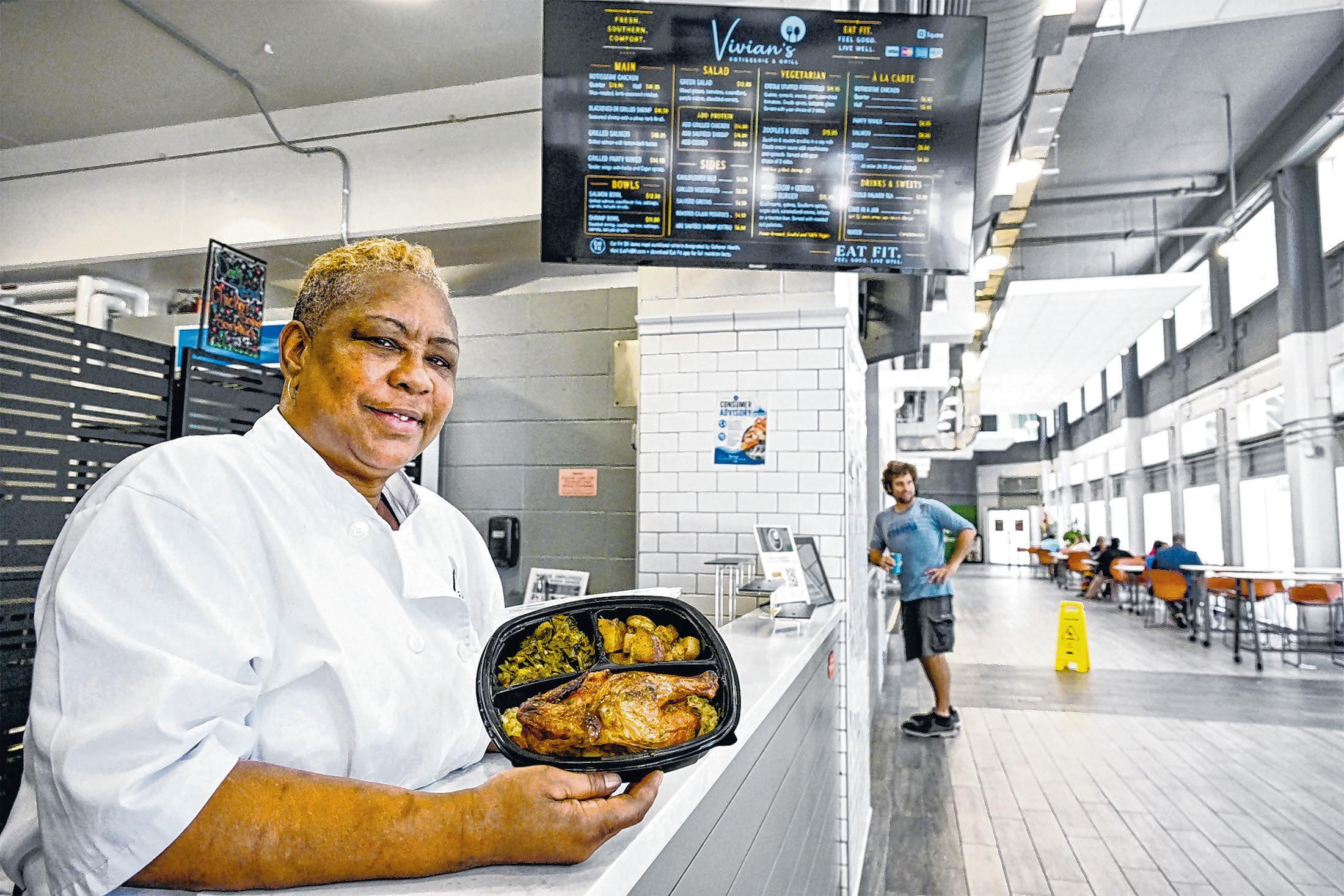
As the Main Street Market grows in offerings, alliance behind initiative seeks to build more community
BY MADDIE SCOTT Staff writer
Since 2002, Baton Rouge’s Main Street Market has been a pillar of the downtown community, serving as a gathering space and a way for local businesses to gain exposure.
Last year, the market, operated by Big River Economic & Agricultural Development Alliance, underwent a $1.5 million renovation that included new floors, paint, furniture, a 250-gallon grease trap under the parking garage, four restaurants and a coffee shop.
Main Street Market is a gateway to the Red Stick Farmers Market, as each restaurant in the facility uses ingredients from local farmers and producers that participate in the alliance’s weekly farmers markets.
“The mission of BREADA is about three things,” said executive director Darlene Rowland. “That’s supporting small farmers, increasing food access and building community. So everything we do with River and Roots and all of Main
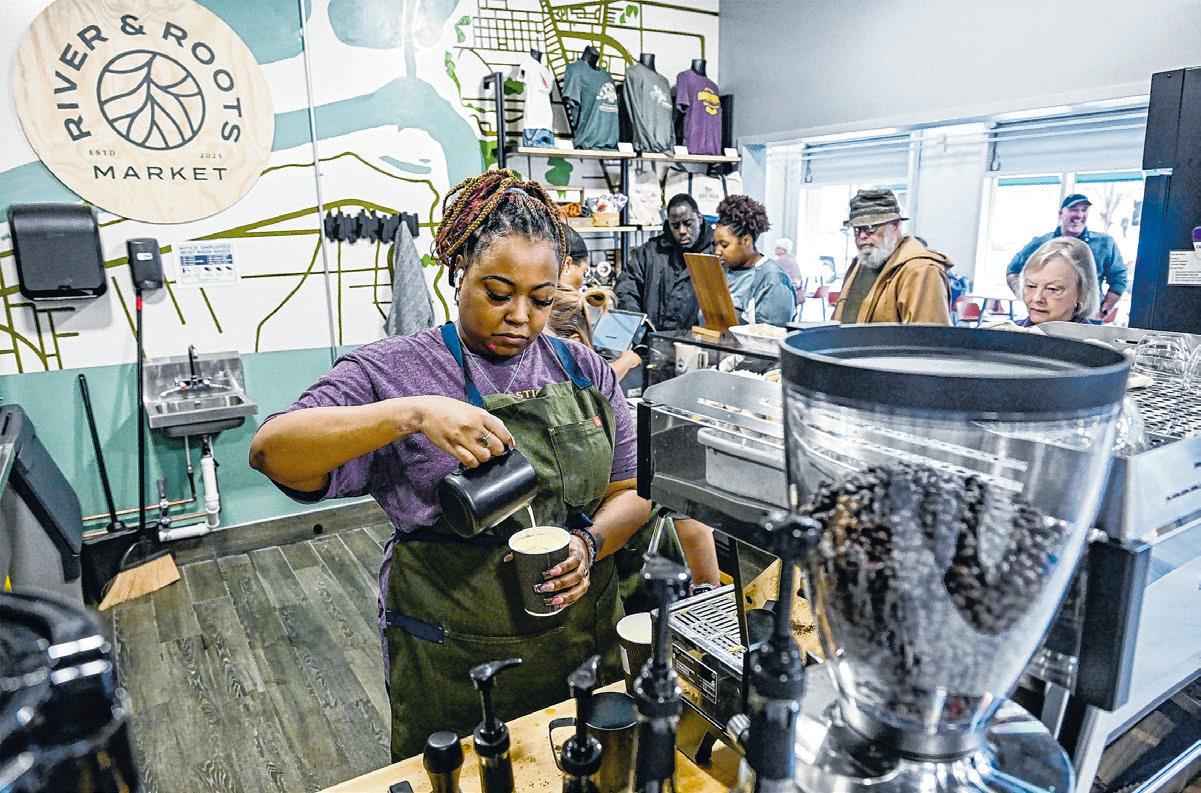
Street is really trying to touch on those three mission initiatives.”
Main Street Market customers can access free parking inside of the parking garage if they scan the QR codes inside of Main Street Market, which is open 7 a.m. to 2 p.m. Monday through Saturday
at 501 Main St., Baton Rouge.
River and Roots Market
River and Roots, an allianceoperated coffee shop and market, uses and sells local ingredients
Mary Ellen Miller, of the Shady Oaks Garden Club, from left, stands with Joe Willis, holding the National Garden Club Award of Excellence, and his wife, Paula Barton-Willis.

BY JOY HOLDEN Staff writer
LSU AgCenter horticulturist and Orleans Parish outreach agent Joe Willis has spent the last 10 years providing resources for gardeners so they can have success. This year, he became the first Louisianan to win the National Garden Club’s Award of Excellence, the organization’s highest honor. Willis speaks at garden clubs, teaches Master Naturalist class-
es, and shares horticultural wisdom with individuals around New Orleans and beyond.
“When I got the notice from the National Club saying that I had won, and that I was one of three winners, I thought, ‘Oh man, that’s quite an honor.’ I was very humbled at the same time,” Willis said. Willis won two Louisiana Garden Club Federation awards and a Louisiana County Agricultural
Livingston’s Purvis named school chief of the year
Livingston Parish School Superintendent Jody Purvis has been named the Louisiana Association of School Superintendents Superintendent of the Year for his leadership, vision and commitment to public education. The award was presented during LASSA’s annual conference in Lake Charles.
Purvis is serving in his third year as the district’s top administrative leader. He has worked for the Livingston Parish Public School System since 1998, starting as a teacher at Springfield High and Denham Springs Freshman High. He advanced to assistant principal at Southside Junior High and Springfield
Middle before serving as principal of Springfield High and French Settlement Elementary. Purvis was appointed supervisor of high school instruction for the district in 2012, then later became assistant superintendent. In that role, he coordinated educational programs, opened Livingston Virtual, and created the district’s Strong Start Plan for returning to operation following the COVID pandemic. He was overwhelmingly supported by school board members to become superintendent in 2024.
Denham Springs Junior High School recognized
Denham Springs Junior High School was selected as a 2026 Model
At Sullivan Theater
Tickets are on sale for the Sullivan Theater’s production of the musical, “The Addams Family,” opening July 17, on the theater’s stage at 8849 Sullivan Road, Central. Tickets are $28-$39. Visit sullivantheater.com.
Stitches in Time
The LSU Textile & Costume Museum, Human Ecology Building, 330 Tower Drive, will be open from 2 p.m. to 4 p.m. July 5 for free first Sunday. The museum is showing its current exhibit, “Stitches in Time: Quilts and Fashion,” which commemorates America’s 250th anniversary with quilted fashion, which highlights quilting, a handicraft rooted in national heritage and tradition. Admission is free. Call (225) 578-1087 or email textile@lsu.edu.
At Capitol Park
The Philemon Thomas Sons of the American Revolution and the John James Audubon Chapter of the Daughters of the American Revolution will conduct a public reading of the United States’ Declaration of Independence on July 8 at the Capitol Park Museum, 660 N. Fourth St.
The museum also will host Discovery Day: Independence Day from 9:30 a.m. to 1:30 p.m. July 11, featuring discounted admission and a free educational craft. Visit louisianastatemuseum.org/museum/capitolpark-museum.
At LSU Vet Med
The LSU School of Veterinary Medicine, Skip Bertman Drive on campus, is hosting its fifth artist-inresidence, Emily Ward
Bivens, an acclaimed visual artist and educator whose work is inspired by the intersection of art and science.
Bivens, distinguished professor of humanities and director of Graduate Studies in the School of Art at the University of Tennessee at Knoxville, will be in residence July 13-Aug. 7.
Bivens will meet with key members of the LSU Vet Med community and create sketches, drawings and paintings that she will develop into larger
pieces. She will donate one piece of art from her residency to LSU Vet Med’s growing permanent collection generated by its artists in residence. Her residency will culminate with a public art exhibition and presentation that will include works arising from her residency. More information about the exhibition to take place in the LSU Vet Med Library will be announced soon. Visit emilywardbivens. com.
At Baton Rouge Gallery Baton Rouge Gallery, 1515 Dalrymple Drive, is showing Mitchell Gaudet’s “Gilt Trip,” Mary Jane Parker’s “Entangled,” and Brandon Surtain’s “Confetti” in July. All three are artist members of the gallery. Gallery hours are noon6 p.m. Tuesday through Sunday. Admission is free. Visit batonrougegallery. org.
Folk Art Gallery
The LSU Museum of Art in the Shaw Center for the Arts, 100 Lafayette St., is now showing its Folk Art Gallery, spotlighting the work of self-taught American artists drawn from several distinguished collections. The gallery’s centerpiece is a one-year loan of six artworks from the American Folk Art Museum in New York — featuring works by Jimmy Lee Sudduth, Mose Tolliver, David Butler, Sam Doyle, Purvis Young, and Mary T. Smith — made possible through Art Bridges’ Partner Loan Network. Also, the museum will offer free admission on July 5, its Free First Sunday. No special programming is scheduled for this day. Visit lsumoa.org.
At Hilltop LSU Hilltop Arboretum, 11855 Highland Road, will host two professional development workshops in July led by the Monarch Teacher Network, a national nonprofit organization dedicated to helping educators use monarch butterflies, migration, nature, language, and the arts as powerful tools for teaching and learning. The workshops, “Teaching & Learning with Monarchs” and “Voices from the Land,” will be take place July 9–12.
Both offerings are open to traditional classroom teachers, as well as nontraditional educators, including homeschool educators, informal educators, Master Gardeners, nature center staff, librarians, youth program leaders and others who work with learners of any age. The fee is $99 for “Teaching & Learning with Monarchs,” which runs July 9-10. The fee is $99 for “Voices from the Land,” running July 11-12.
To register, visit lsu.edu/ hilltop/programs/adult/ monarch_teacher_network.php or contact.
At the Shadows
The Shadows-on-theTeche, 320 E. Main St., New Iberia, will host a family hands-on art event, where visitors will design and create their own paper lanterns. The program, “Light Your Own Path,” will take place from 10 a.m. to 11 a.m. July 18 and is suitable for all ages.
Participants will discover the significance of light in African American spiritual practices before bringing their lanterns to life, lighting them together as a group. Each lantern is “a symbol of the optimism we all carry within.”
Admission is $10 per family, and advance registration is encouraged, as space is limited. All program supplies will be provided. To register, visit visitingshadowsontheteche.org/upcomingevents/light-your-ownpath.
In Opelousas
The Opelousas Museum, 315 N. Main St., Opelousas, will host the Opelousas Library’s Story Hour at 10 a.m. July 7, 9, 14 and 16. Call (337) 948-3693 or (337) 948-2589 or email museum@cityofopelousas.com.
At NuNu
NuNu Arts & Culture Collective, 1510 Bayou Courtableau Hwy., Arnaudville, will open award-winning artist Aiden Beagal’s solo exhibit “Discovering Voice: A Consequence of the Collective” at 6 p.m. July 10. The show runs through Aug. 30. Admission is free. Visit nunucollective.org.
School at the 2026 Model School Conference in Orlando, Florida, June 28 to July 1.
The Center for Model Schools, which sponsored the conference, honors forwardthinking schools that drive transformation, inspire change and implement groundbreaking strategies to improve student outcomes. More than 5,000 nationwide educators were expected to participate in the conference’s presentations and discussions.
DSJH Principal Justin Wax presented “Becoming a Capacity Catalyst” to the large assembly as part of his school’s recognition.

Superintendent of the Year
Livingston Parish Public Schools Superintendent Jody Purvis, left, receives the 2026 Louisiana Superintendent of the Year award by the Louisiana School Superintendents’ Association from Executive Director David Claxton.
PROVIDED PHOTO Wax
Trump has done two makeovers of iconic space
BY JESSICA DAMIANO Associated Press
President Donald Trump’s two makeovers of the White House Rose Garden, including converting its lawn into a patio, have drawn recent attention to one of the nation’s most iconic gardens.
The garden has seen many changes over the years; presidents and first ladies have planted, removed, redesigned and even fully revamped it.
The Rose Garden was established by President Woodrow Wilson’s wife, Ellen Wilson, who worked closely with landscape architect George Burnap, in 1913. It replaced Edith Roosevelt’s Colonial Garden, planted 11 years earlier. Before that, greenhouses occupied the space.
The original Rose Garden remained close to its roots for nearly half a century until 1961, when President John F. Kennedy and first lady Jacqueline Kennedy brought in their friend and Cape Cod, Massachusetts, neighbor, Rachel “Bunny” Mellon, to oversee a redesign. Mellon, a horticulture expert, worked closely with landscape architect Perry Wheeler and White House Head Gardener Irwin Williams on plans for the new Rose Garden, aiming to create an outdoor room where press conferences, meetings with dignitaries and ceremonies could be held. It was installed the following year.
The space included an expansive central lawn, inspired by the croquet-match passage in Lewis Carroll’s “Alice in Wonderland,” with magnolia trees planted at each corner. Roses, interplanted with culinary herbs, spring-blooming bulbs, seasonal annuals and young Katherine crabapple trees, flanked the lawn in 12-foot-deep borders.
Since then, the space has hosted many historic events

and has become known as a place where presidents deliver important speeches to the American people.
New plants Mellon’s style favored classic, muted tones, reflected in the roses she selected. But the crabapples turned out to be a misstep. As they matured, they became so large that they shaded the sun-loving roses they were intended to complement.
In 2003, some of those trees were removed to allow sunlight to reach the failing roses. Over the years, various perennials were added and replaced. Dying roses were removed, and the remaining trees continued to grow.
Boxwood shrubs bordering the beds became threatened by boxwood blight disease, and the lawn developed drainage issues that prompted frequent replacements.
The remaining trees’ roots had grown so large that it became difficult to plant annuals in the borders without disturbing them. In addition, as walkway repairs became necessary, portions had been replaced, piecemeal, with various slabs.
A 2020 restoration
Then in 2020, first lady Melania Trump commissioned two architectural firms, Perry Guillot Inc., of Southampton, New York, and Oehme van Sweden & Associates of Washington,
D.C., to work with the Committee for the Preservation of the White House and the National Park Service to address those concerns and return the garden to its 1962 aesthetic. They removed and relocated the remaining crabapple trees, and replaced the dwindling plantings with pastel-colored roses, including the white, tall shrubby “White House Rose,” the cream-colored “JFK Rose,” the white hybrid tea rose “Pope John Paul II,” and the “Peace Rose,” a smaller tea rose with a pale yellow center and light pink edges.
The team also upgraded the garden’s infrastructure, adding electricity for TV appearances and uniform, 36-inchwide limestone walkways to accommodate wheelchair access and comply with the Americans with Disabilities Act. The shrubs were replaced with blight-resistant NewGen boxwoods.
Pavers replace the grass In 2025, President Trump revamped the space again, this time replacing the central lawn with a white limestone patio. He added solar-powered lighting, tables and umbrellas, and bronze statues of George Washington, Benjamin Franklin and Alexander Hamilton. He has hosted dinners on the patio and has called the space the Rose Garden Club. And on the perimeter, the roses continue to bloom.

Four trips to explore that are close enough to take by car
BY CHERÉ COEN
Contributing writer
Travel doesn’t have to mean flights, rental cars and a packed itinerary.
Sometimes, a great adventure may be had by the road, pausing for roadside attractions and sampling indigenous cuisine in unexplored towns.
Here are a few road trips to consider this summer, all only a few hours from south Louisiana.
Highway 7, Arkansas
One of the best ways to view Arkansas in all its diversity, from cotton fields to mountains, is to follow Route 7 from El Dorado at the Louisiana border to its finale at Missouri.
The highway was the state’s first state-designated scenic byway, and visitors can enjoy four geographical regions as they head straight up the center of the Natural State.
Scenic Byway 7 begins in the state’s coastal plains and continues through the Ouachita Mountains and Hot Springs, then up through the Ozarks, including passing through the Buffalo National River — perfect for hiking, camping and white water rafting. Along the way are springs, historic towns and authentic Southern cuisine.
Length: 290 miles.
Stop: Indulge in hot mineral soaks and massages on Bathhouse Row in Hot Springs National Park, one that is uniquely integrated into the downtown area.
Imbibe: Cliff House Inn and Restaurant in Jasper not only serves up Southern meals for the hungry traveler but offers amazing vistas of the “Grand Canyon of the Ozarks.” Most Arkansas establishments serve yummy Pos-
By Christopher Elliott


Although U.S. 61 begins in New Orleans and runs through Baton Rouge, the portion known as the Blues Highway starts around Vicksburg and moves north through the Delta to just shy of Memphis.
This stretch contains numerous blues landmarks and attractions, but the highway also marks the route many African Americans took heading north toward Chicago during the “Great Migration” during most of the 20th century.
Their movement brought the indelible sounds of the blues to the rest of the country and contributed to almost all of what Americans listen to today.
were born.
Imbibe: The Crown Restaurant in Indianola — B.B. King’s hometown — focuses on Delta favorites such as catfish, hushpuppies and homemade pies.
Stay: Choose between the Alluvian Hotel in Greenwood, The Peabody Hotel in Memphis or the Shack Up Inn outside Clarksdale, where sharecropper cabins were relocated for unique accommodations.
What’s unique: Did you know that Mississippi has more Grammy Award winners per capita than any other state? The Grammy Museum in Cleveland, Mississippi, celebrates their achievements.
Route 66
Arguably the most famous American road trip begins in Chicago and travels more than 2,000 miles to the Pacific Ocean at Santa Monica.
This year, Route 66 turns 100, so there will be lots of celebrations along the way.
Route 66 was established on Nov. 11, 1926, after the American Association of State Highways was formed to create solid surfaces now known as the nation’s highways. It was famous before Bobby Troup’s song, “Get Your Kicks on Route 66,” and everyone from tourists to celebrities traveled from Chicago to California, staying in “tourist homes” and motor courts built along the highway.
Length: 2,400 miles from Chicago to Los Angeles.
a boutique hotel in the former Masonic building in downtown Springfield.
What’s unique: Guy Mace has collected more than 70 classic sports and collector cars, and he displays them at his Route 66 Car Museum in Springfield. Look for a Batmobile, a 1963 Morgan owned by Desert Storm’s Gen. Norman Schwarzkopf and the truck used in the film “Grapes of Wrath” with Henry Fonda.
Old Spanish Trail
U.S. 90, known as the Old Spanish Trail, is considered by some as the “Route 66 of the South.”
The OST runs along Southern states from Florida to California, and includes the width of south Louisiana, from Slidell to Texas crossing the Mississippi Huey P. Long Bridge from New Orleans and west-northwest toward the Acadiana towns of Lafayette, Rayne and Lake Charles.
Length: 2,750 miles.
Stop: Highway 90 follows the Mississippi coast from Alabama to Pass Christian, Mississippi, where it veers northward toward Kiln and then Slidell. Stop and enjoy the beaches, great restaurants and fun attractions of Coastal Mississippi.
Imbibe: In Houston, savor crawfish with an Asian flare at the Viet-Cajun Crawfish & Noodles. Steaming and spiced boiled crawfish arrive with side dishes such as crawfish fried rice and shrimp spring rolls.
sum Pie, thankfully chocolaterich and not the mammal.
Stay: The 1920s Arlington Hotel Resort & Spa finished its massive renovations and continues to serve as a downtown Hot Springs icon.
What’s unique: You can hunt for diamonds — yes, diamonds — at Crater of Diamonds State Park or stop in Mt. Ida, where crystals are in abundance.
It’s the reason why the Mississippi Delta National Heritage Area was formed, a partnership with the National Park Service, one of only 55 such designations in the country.
Length: 1,400 miles if you head from New Orleans all the way to Minnesota. For Delta road trip ideas, visit www.visitthedelta. com/delta-blues-road-trip.
Stop: Just outside of Greenwood lies one of three graves of bluesman Robert Johnson. Dockery Farms near Cleveland is, arguably, the place where the blues
Stop: The Route 66 Museum in Lebanon, Missouri, explains not only the famous road but the chronology of America’s highways.
Imbibe: The halfway point of Route 66 is in Adrian, Texas, the perfect spot to stop and enjoy the Elvis Pie — among other diner favorites — at the Midpoint Café.
Stay: Imagine you’re traveling in time at the historic 1939 Boots Court in Carthage, Missouri, a motel that Clark Gable frequented. Or choose a more elegant stay at Hotel Vandivort,
Stay: For history lovers, the magnificent Hotel del Coronado, which just finished a restoration of its red spires, lies at the end in San Diego. Closer to home is Mobile’s historic Battle House. Coming up: South Louisiana community leaders, tourism professionals, municipal officials and economic development leaders will gather Sept. 25 for the OST Conference 2026, a regional summit focused on promoting the tourism and economic potential of the highway. The conference will be held at the Rayne Civic Center.
My wife and I have been looking forward to our six-day Rhine River cruise with CroisiEurope. It was supposed to be a relaxing trip before we continued on to Dublin. What we got instead was a series of mechanical problems — and a lot of anxiety.

Christopher Elliott
The trouble began almost immediately. On the first night, the ship stopped cruising early. The next morning, scuba divers worked under the hull. We departed late and a scheduled excursion to Heidelberg was canceled. That night, around midnight, the ship hit something. The hull shook. At 1:30 a.m., all passengers were woken up and sent to the lounge. This lasted for an hour before we were allowed to go back to our staterooms.
The final announcement came the next morning: The cruise was canceled because
of a bad motor.
Our original disembarkation was Amsterdam, and we had nonrefundable travel booked from there to Dublin. My wife and I did not want to risk further delays. We immediately booked noncancelable train travel to Amsterdam, plus two nonrefundable nights at the Hotel des Arts. Later that afternoon, a CroisiEurope representative advised that some guests would continue by bus, but by then, we had already made firm commitments and could not join that alternative trip.
CroisiEurope refunded the original cruise fare of $4,792, but we have additional expenses of about $1,400. Can you help us get a refund? — Michael Cawley, West Chester, Pa.
I think CroisiEurope should have reimbursed you for all of your expenses. Mechanical failures, an inter-


rupted night’s sleep after the ship struck something — these are not minor inconveniences.
Under EU Regulation 1177/2010, a European consumer protection law, passengers on inland waterway journeys are entitled to reimbursement in cases of cancellation because of technical faults, which includes meals and, if an overnight stay becomes necessary, reasonable accommodations.
But the regulation for inland waterways is a little tricky. Once an event like yours happens, the operator must offer two options: either rerouting you to the final destination free of charge or providing a full refund of the ticket price.
CroisiEurope offered a bus reroute after you had already com-
mitted to the nonrefundable train and hotel to Amsterdam. This timing is important. You were forced to make arrangements because the company did not provide the necessary assistance immediately. The offer of a bus came too late.
What could you have done differently?
The moment the cruise was officially canceled, you should have contacted a manager at CroisiEurope and ask that it book and pay for your rerouting, which the regulation implies it should do.
Booking nonrefundable tickets on your own, especially without a clear paper trail confirming CroisiEurope’s refused assistance, makes recovering that money harder.
Since CroisiEurope has already
issued the full cruise refund, your dispute is over the out-of-pocket expenses. After we contacted the company, CroisiEurope offered you a $1,400 credit for a future cruise.
“Per our legal analysis, the Regulation (EU) No. 1177/2010 does not apply to Mr. Cawley’s case, as this law concerns a package travel contract and not merely a river transport service,” a representative told us.
That’s not the resolution you were hoping for — and frankly, it wasn’t for me, either.
Christopher Elliott is the founder of Elliott Advocacy, a nonprofit organization that helps consumers solve their problems. Email him at chris@elliott.org or get help by contacting him on his site.





Martial arts icon will become the first Chinese American in state’s history with an annual namesake day
By The Associated Press
SAN FRANCISCO — Martial arts icon Bruce Lee, who was born in San Francisco, will become the first Chinese American in California history with an annual namesake day.
Gov. Gavin Newsom signed a law Tuesday afternoon officially designating May 17 as Bruce Lee Day, according to the office of state Assembly member Matt Haney, who represents San Francisco.
An 18-year-old Lee re -
turned to San Francisco on May 17, 1959, after spending his childhood in Hong Kong.
Lee’s daughter, Shannon, who is CEO of the Bruce Lee Foundation, said the honor is a testament to her father’s enduring legacy as a bridge between cultures.
“From young people who found confidence and possibility in his philosophy, to families who finally saw themselves represented on screen, to athletes who still draw on his teachings of discipline and inner strength, his reach is profound,” Shan-

represented with strength and dignity,” he said in a statement.
The foundation and various Asian American organizations hope Lee will be celebrated every year with voluntary commemorative activities around the state such as cultural exhibits, public events and classroom lessons.
non Lee said in a statement.
Haney called Lee the epitome of the best of California.
“At a time when Asian
Americans were too often absent from or stereotyped on screen, Bruce Lee helped generations see themselves
Born in 1940 to Chinese parents who were touring with an opera, Lee was allowed to have birthright citizenship. A few months later, the family returned to Hong Kong where Lee became a child actor and began learning Chinese kung fu. He moved back to the U.S. in 1959 and enrolled in the University of Washington in Seattle two years later.
He dropped out and threw himself into practicing and teaching martial arts. In the 1960s, Lee found work in Hollywood, most notably as Kato in the TV series “The Green Hornet,” but studios wanted him to play racist stereotypes and paid him less than his white counterparts. He pivoted back to Hong Kong and soon became a megastar of martial arts flicks, including “The Big Boss” and “Fist of Fury.” Lee died in 1973 at 32 after an allergic reaction to pain medication. Lee’s name and likeness remain popular. Fans gather on his birthday. A treatment for a proposed TV action series he wrote inspired the HBO Max show “Warrior.”

Continued
seen at the farmer’s market, Rowland said.
Right beside the ordering counter is the farm fresh fridge, stocked with produce from the farmer’s market so that people can have access to the market all week long. Shelf stable items are included in the mix such as local honey, jams, jellies and pickles.
“All of the milk served in your latte or cappuccino is from our local dairy farmer, Feliciana’s Best Creamery,” Rowland said. “They are one of our vendors at the Red Stick Farmer’s Market on Saturdays, right outside the main doors there.”
The menu includes espresso drinks, specialty drinks, teas, drip coffee, cold brew and Mexican hot chocolate. There are also seasonal green teas depending on what’s in season like the “Blueberry Hills,” a green tea that uses a syrup made from local blueberries.
Vivian’s Rotisserie & Grill
Deidre Brown, also known as Chef Victory, operates and owns Vivian’s, which Brown opened in honor of her grandmother who used to work at the longtime Poor Boy Lloyd’s downtown.
Continued from page 1D
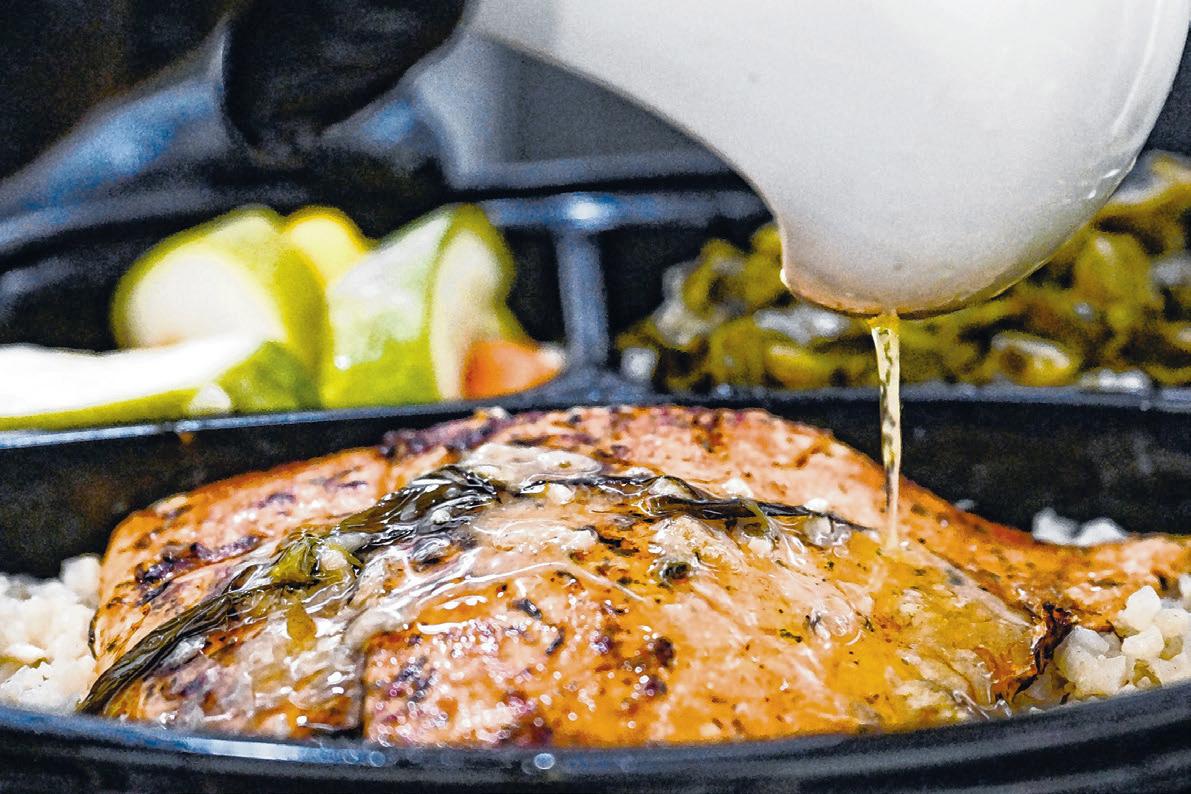
started Creole Creations, a familyowned business. Today, Creole Creations operates a stall inside of Death Valley and a food truck.
“We come from a cooking family where our goal is to offer Louisiana food for the soul,” Isiadinso said.
At Main Street Market, the menu is stocked with Louisiana staples and comfort foods. Daily specials include red beans and rice on Mondays, baked chicken and candied yams on Tuesdays, seafood pasta on Wednesdays and étouffée on Thursdays.
Also on Thursdays is a new item: crawfish étouffée fries called “Crawfete Fries.”
Everything at Creole Creations is made from scratch, Isiadinso said
elets. For lunch, there are bowls and plates featuring Indian cuisine like butter chicken, chili chicken and chicken korma. Each plate or bowl is also served with naan and rice.
The Cozy Griddle
Though the original Cozy Griddle location is at 11445 Coursey Blvd. in Baton Rouge, the restaurant now occupies a space in the market downtown.
At Main Street Market, the menu features a variety of breakfast options: customizable egg and cheese handhelds, biscuits and gravy, chicken and waffles and a bayou brunch bowl with shrimp and grits.
Owner Tarick Johnson’s goal is to provide high-quality food and service and incorporate the local community.
Oaks Garden Club meet-
“I was paying homage to her,” she said. “For hard work she put into downtown for many years.”
All of the food is cooked from scratch, and about half of the menu is registered with Eat Fit, a health program by Ochsner that partners with local eateries to identify healthy menu items.
There are also vegan and vegetarian options like the fresh greens with collards, turnips, mustards and kale. Though there’s no meat in it, there’s still a lot of flavor, Brown said.
“We’re trying to lean toward
ings and often helps the members with their gardens, as well as educating the general public on gardening and plants.
“Joe is a uniting force,” said Miller, who credits Willis for the Shady Oaks Garden Club’s flower show at the New Orleans Spring Garden Show in April. But what really convinced Miller and other members to nominate Willis was his work to save one of the Shady Oaks Garden Club’s gardens. When everything was dying in the garden, Willis came out, identified
more of a healthy lifestyle and help people that want to eat healthy,” she said. “Give them some good, healthy flavor for options.”
One of the popular items is the salmon bowl (also a shrimp option), served over cauliflower rice, carrots and teriyaki sauce. There’s also the Creole stuffed portobello with quinoa, spinach, onion, garlic and sun-dried tomatoes, thyme, Creole spice and balsamic glaze.
Creole Creations
In 2018, owner Chisolu Isiadinso
a fungus and helped the club take everything out and replace the soil.
“We thought he would win at the state, because he’s so good, and he cares so much,” Miller said. “But he didn’t just win state — he won for the Deep South and then the national. He has definitely earned it and made all this education of horticulture really accessible to everybody.”
Willis said that when he found out he won, he reflected on all of his work as a part of his job, outside of his job and working with people and plants.
“We don’t have any shortcuts. Nothing is from the can. Even the watermelon pineapple lemonade I make. I juice all the fruits, and there are no artificials and additives,” she said.
The boudin balls are a big seller so far, she said, and her personal favorite item on the menu is the shrimp po-boy.
Sapor Indian Fusion
Sapor serves spiced Indian fare with both breakfast and lunch options.
The menu has rotating items like breakfast wraps and masala om-
“I remembered that when I started this position 10 years ago, Mary Ellen had contacted me and asked me to be part of a tour bus group through the gardens of New Orleans — to talk about the plants. From the very beginning, I’d been working with the garden clubs, and it came full circle,” Willis said. Popular in the New Orleans area for his regular appearances on Fox 8 WVUE-TV and WWL, the community calls Willis “Dr. Joe,” for his gardening diagnoses and solutions. He says he gets recognized
“We do get some things from the farmer’s market as far as fresh ingredients, so we try to support the local economy,” Johnson said.
The Cozy Griddle also serves three to four rotating lunch items every day. Included in the rotation are stuffed chicken breasts with green beans, spaghetti and meat sauce, grilled pork chop, blackened shrimp pasta and more.
A popular menu item is the griddle stacks.
“Our griddle stacks are so amazing,” Johnson said. “They’re so good. Fluffy, big and buttery.”
in public, and people approach him with questions about their gardens.
“Essentially, I want to make it easier for people to have success and fun in their gardens and in their landscapes and garden clubs,” Willis said. His words of advice for anyone planning to start a garden are to “plant the right plant at the right place at the right time.”
Email Joy Holden at joy.holden@ theadvocate.com.
Happy birthday, America. And on behalf of Louisiana and New Orleans, you’re welcome.
That’s for the debt of gratitude owed for many contributions to this great nation, including in the world of food and drink.
The food culture thriving in New Orleans has made an outsized impact on the spectrum of American dining. It’s a narrative that flows through a progression of influential local restaurants like a common thread.
It starts with the fact that New Orleans has its own food. As the country’s most successful fusion cooking, Creole cuisine is a polyglot tale of blended influences in the New World.
It survived America’s culinary dark ages, the era of homogenization, and it kept evolving. It made New Orleans a gastronomic destination long before the current craze for it.
The grand Creole restaurant
Consider Antoine’s Restaurant, founded in 1840, the oldest in the country in continuous operation. It’s not just the restaurant’s longevity that makes it influential, nor even the canonical dishes created in its kitchen.
Instead, it’s Antoine’s role in establishing the idea of a restaurant destination serving a local cuisine distinctive to the city, an early “bucket list” to experience a place and its culture through dining. It set the template for the grand Creole restaurant that was in place when, nearly 80 years later, Arnaud’s Restaurant opened in 1918.
It was founder and namesake “Count” Arnaud Cazenave, a Frenchman and wine salesman with an assumed title of nobility, who issued a dare to French Quarter barkeep Owen Brennan. The count claimed an Irishman could never operate a proper fine dining restaurant.
Brennan, essentially saying “hold my Burgundy and watch,” proceeded to open Owen Brennan’s Vieux Carre across from Arnaud’s on Bourbon Street in 1946, and the Brennan family restaurant saga began. That would lead to the now-landmark Brennan’s on Royal Street in 1956, which today is the ongoing evolution of a historic Creole restaurant into a modern one.
A new American cuisine
From Brennan’s, we get to Commander’s Palace, which one branch of the Brennan family took over and, through the 1970s, turned into a forerunner of the idea of modern American cuisine.
It was a Louisiana cre-
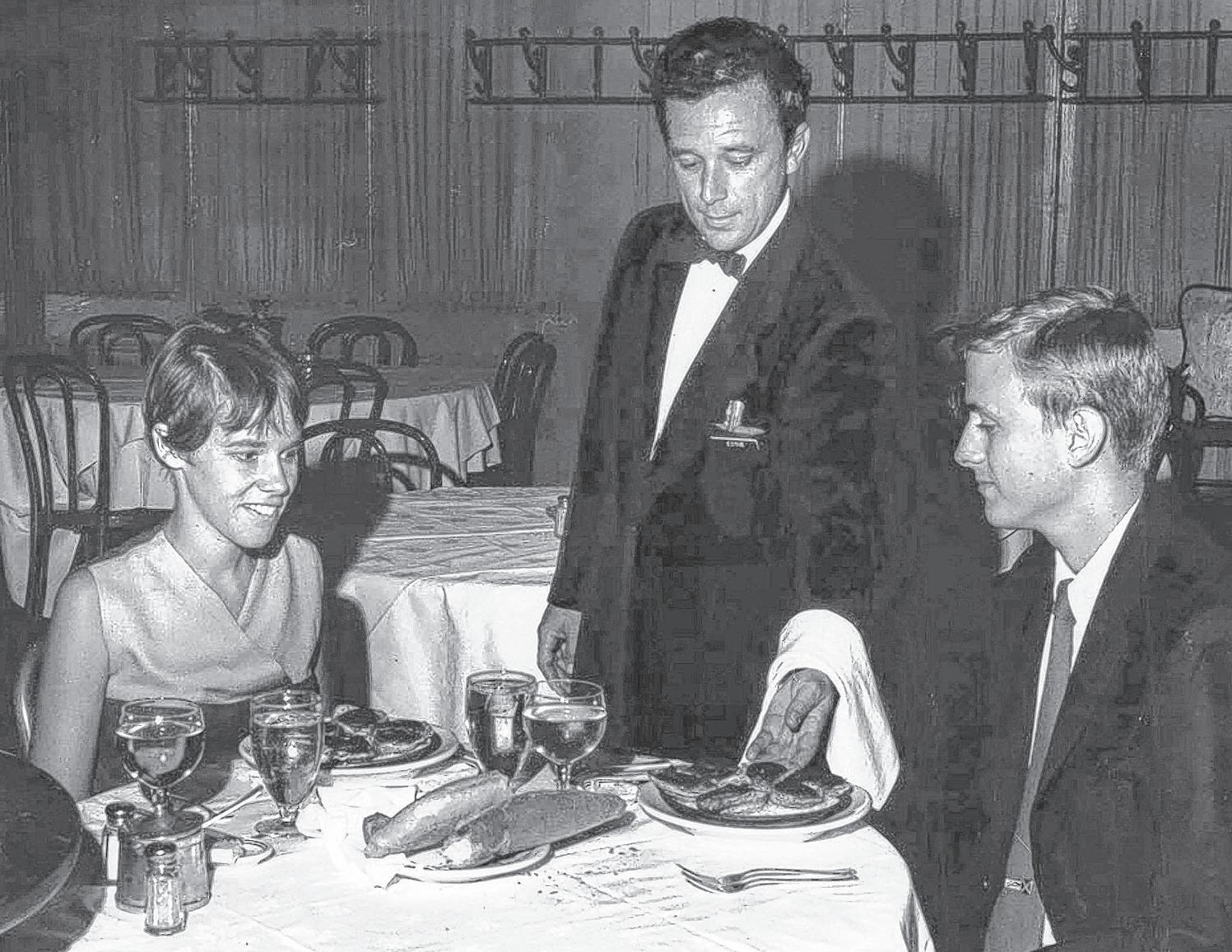

ation that elevated local ingredients and dishes at a time when regional cuisines from coast to coast were getting fresh recognition as worthy of pursuit.
Commander’s Palace was a pivotal example and helped embolden chefs all over the country to forge their own paths, rather than strive to fit European ideals. But perhaps it was the late Commander’s Palace matriarch Ella Brennan’s eye for talent, and ability to cultivate it, that would have the most wide-ranging influence nationally.
It was a break from the tradition of kitchens led by French-trained chefs when she named a young Louisiana native from Cajun country to be head chef.
That was Paul Prudhomme, of course, who went on to
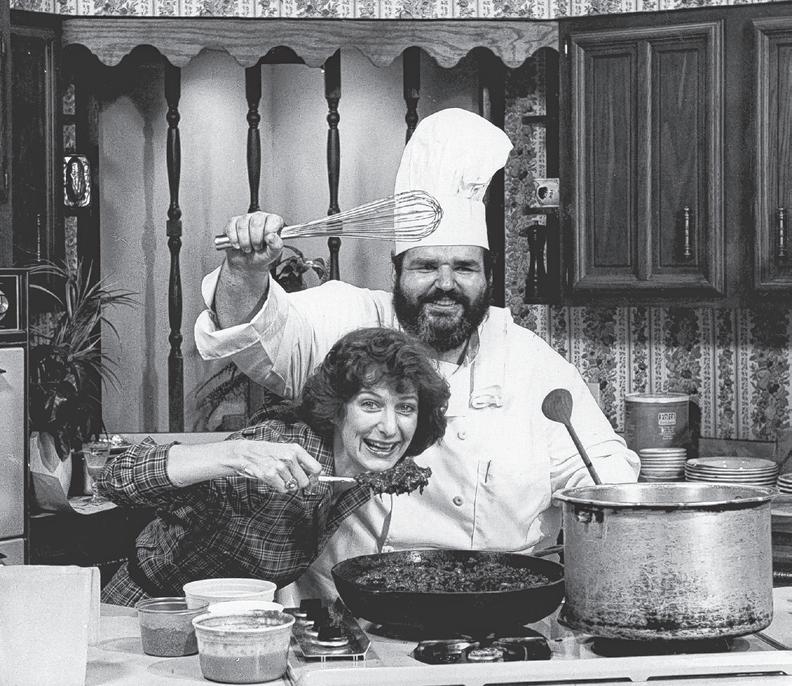
open K-Paul’s Louisiana Kitchen, which was its own engine of influence through the 1970s and 1980s.
In the beginning, K-Paul’s was small and casual, with communal tables and no reservations. That was a marked change from the traditional Creole restaurants of the day. It became a sensation for its robust Louisiana flavors, and Prudhomme became a superstar.
If it’s common now for casual, creative restaurants to win high-profile awards and draw throngs of eager diners, K-Paul’s blazed the path early.
Way before social media, Prudhomme’s blackened redfish “went viral,” igniting a national craze for the dish that prompted fishing restrictions on redfish. He even hosted the equivalent
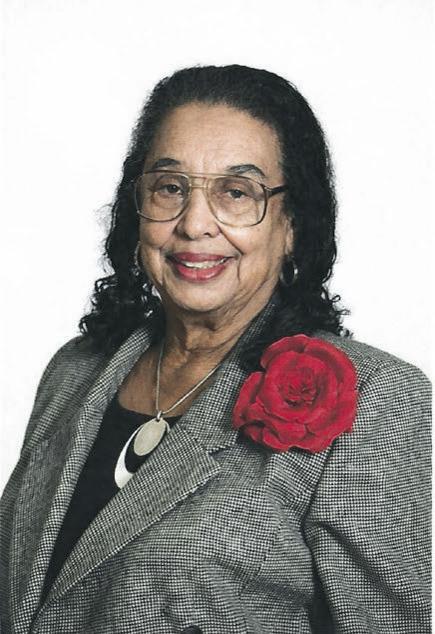
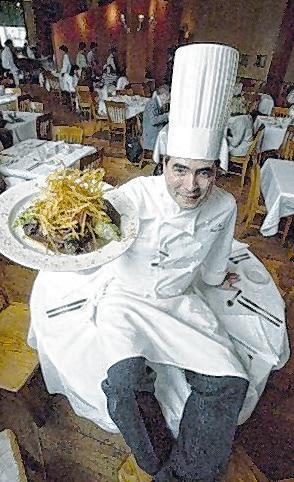
Orleans life through the lens of a homey, backstreet joint, with food as the entry point to bigger cultural issues.
Leslie’s way with fried chicken still lives on Jacques-Imo’s Café (where he cooked later in life) and the related Crabby Jack’s.
Part of his lasting legacy was to give a high profile face and persona to the Black chefs who have long been vital to New Orleans food and too often went unrecognized.
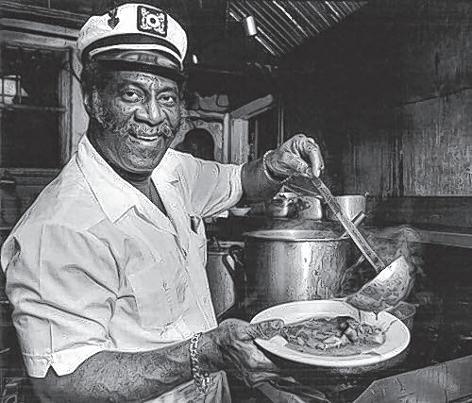
The story continues Back at Commander’s Palace, the chef who succeeded Prudhomme was Emeril Lagasse, who was just 25 when he was tapped for the job.
of pop-ups, setting up temporary traveling versions of K-Paul’s in other cities.
So much that feels new with modern restaurant trends had an earlier iteration flowing from New Orleans.
In the same era as Prudhomme, chef Austin Leslie rose to national prominence for his mastery of Black Creole cooking at his restaurant Chez Helene. It inspired the CBS television sitcom “Frank’s Place,” which in 1987 gave America a glimpse of New
It was the launching pad to open his own Emeril’s Restaurant in 1990 and that, in turn, set his star trajectory in creating a new kind of celebrity chef, one more akin to a rock star. From his cookbooks and TV shows, his influence on successive generations around the excitement of cuisine, and even the career path of a chef, can’t be understated. One of those he influenced clearly was his own son, E.J. Lagasse, who now leads Emeril’s Restaurant in its new age as a two-MichelinStar destination. It too, is showing a new side of American dining, one that sets local cuisine on the highest global plane of refinement. In New Orleans, history is around every corner. Sometimes on that corner is a restaurant where we can visit to experience the living laboratory of what American cuisine can be. Email Ian McNulty at imcnulty@theadvocate.



























professor’s book
BY RIEN FERTEL
Contributing writer
“Darkology: Blackface and the American Way of Entertainment,” by Rhae Lynn Barnes, Liveright, 528 pages.
A century and a half ago, as centennial celebrations touched off across the country, much of White America was united by the crude caricature known as blackface. Once the dominion of professional minstrel performers, amateur blackface began to proliferate in the waning days of Reconstruction, permeating everyday American life.
From coast to coast, blackface became inescapable.
Fraternal organizations used blackface to build brotherhood. Publishing houses marketed blackface-themed books. Blackface helped Hollywood sell tickets. Students in elementary schools and colleges performed in public blackface showcases. The government supplied troops with blackface kits for DIY minstrel shows.
In 1872, a reporter for the New Orleans Republican newspaper estimated that threequarters of Mardi Gras maskers costumed in blackface.
The ugly persistence of blackface in American culture is the subject of Princeton University professor Rhae Lynn Barnes’s bombshell of a book, “Darkology,” a rangy history that should be required reading this Semiquincentennial.
Barnes begins with the Benevolent and Protective Order of the Elks, a “burnt-cork brotherhood” founded by professional blackface minstrels in 1868 in New York City. The Elks produced and disseminated how-to manuals to welcome new members to the fold, training them in what Barnes terms darkology, “the commodification, study, and dehumanization of Black life.”


raised her hand: “Paint him black, and bring him to America.”

BY MOLLY TERRELL Staff Writer
Performing in blackface before their fellow brothers became a rite of passage for these respectable, patriotic-minded men, and later for the generation of Polish, Irish and Italian immigrants eager to enforce boundaries of race.
By the early 20th century, darkology had leapt from the cloaked confines of the Elks to Tin Pan Alley, where publishers churned out blackface-themed theatrical productions, joke books and sheet music that revived the career of minstrel maestro Stephen Foster — and paved the way for the preeminent blackface superstar of stage and screen, Al Jolson.
Destined for living rooms, church fellowship halls and schools, these publications were the blueprint for much of what White America called entertainment.
Following the twin crashes of the Great Depression and World War II, President Franklin D. Roosevelt, an exalted Elk member, leaned on blackface to add some pep to America’s step.
The New Deal’s Federal Theatre Project distributed original blackface content to a nation hungry for amusement, including three versions of “The Story of Little Black Sambo.”
The War Department flooded troops with burnt cork makeup, black wigs and banjos, ensuring that every G.I. Joe could put on a show for their fellow soldiers abroad. Back home, convalescing service members were treated to minstrel shows at Walter Reed Army Medical Center.
And the government provided Japanese-American concentration camp prisoners with the same racist accoutrement, an “unlikely cultural bridge,” Barnes writes, to Americanization.
In one of the book’s most damning sections, Barnes tells the story of the strange footnote to FDR’s embrace of blackface. On the day he died of a cerebral hemorrhage at his Little White House in Warm Springs, Georgia, the president had planned to preside over a kids’ musical showcase he had cowritten titled “Polio Minstrels.”
His wife, Eleanor, insisted that the show go on, with young White polio patients in blackface.
At war’s end, riding the tide of Black respectability and Civil Rights legislation to end Jim Crow segregation, the NAACP ramped up a cross-country antiminstrel campaign. The widespread use of blackface showcases in public schools, and the psychological damage they inflicted on children, were an early target. When a teacher asked a classroom what a “suitable punishment for Hitler” would be, a young Black girl
In 1963, the NAACP pressured the University of Vermont to tweak a popular campus tradition known as the Kake Walk. A dance competition featuring blackfaced fraternity members, the Kake Walk harkened back to bondage, when enslavers forcibly conscripted Black bodies to parade for the rare promise of sweet treats.
For three years, greenface replaced blackface, before the overwhelmingly White student body restored the insidious custom.
UVM officially banned the Kake Walk in 1969, after the university’s six Black students intrepidly attended the event. The following year, the fraternities surreptitiously walked anyway. A handful of Black students showed up, including Charlie Titus of nearby Saint Michael’s College, who came armed with a baseball bat.
“Anybody who wants to do a Kake Walk,” he screamed after walloping the multi-tiered cake the gathering planned to eat, “Kake Walk over my dead body!”
(In another 1960s episode that Barnes does not mention, the NAACP also called out the Zulu Social Aid & Pleasure Club for their continued use of black makeup, resulting in that organization banning the practice for several years.)
In a crowded field of blackface scholarship, one of the merits of Barnes’s book is her focus on individuals who pushed back against what she calls “the longest-running gag in American cultural history.”
One such true American patriot was Betty Reid Soskin, née Charbonnet, a New Orleanian who relocated to California after the 1927 flood (she later gained fame for being the oldest serving National Park Service ranger in the United States). In 1952, she was horrified to learn that her son’s integrated elementary school would host a minstrel show fundraiser, featuring the principal in blackface.
She showed up, sitting front and center, forcing the company to “perform that show in front of me.” California banned blackface in public schools soon after. But blackface has never really disappeared.
Cyberscholars warn of “digital blackface,” the application of AI and other technologies by non-Black individuals to perform and perpetuate racist stereotypes. In April, Georgia GOP State Representative Kasey Carpenter apologized for wearing blackface to a costume party over a decade ago. In Baltimore, Republican House of Delegates primary candidate Bobby Berger was forced to answer questions about his former career as a popular blackface entertainer. Though he retired his act in 2015, after performing over 1,000 shows, his longtime nickname appeared on the ballots: Al Jolson.
Rien Fertel is the author of four books.

In the ’80s and ’90s, much like the rest of the country, Shreveport was grappling with the peak of the AIDS crisis. Much of the government indifference, medical neglect and religious hostility during the height of the epidemic prompted activists to form support organizations, like AIDS Coalition to Unleash Power (ACT UP).
David W. Hylan, an award-winning documentary filmmaker and longtime LGBTQ+ advocate, has spent years preserving the stories of those who lived through the epidemic in northwest Louisiana. Hylan, a Shreveport native, co-directed “Small Town Rage: Fighting Back in the Deep South” (2016) with Raydra Hall, examining the work and influence of ACT UP Shreveport.
He has now written a book with the same title, released in June, that explores the organization and the activists who confronted fear, silence, discrimination and political indifference during the AIDS crisis in northwest Louisiana, according to a news release from Hylan.
The organization was founded in New York City in 1987 as a political action group in response to the AIDS crisis and has since expanded with independent local chapters across the country.
According to Hylan, it was important to write this book because he felt like there were a lot of stories and people that were left out of the original documentary.
“I was reliving all those stories all over again — and people’s memories and the pain of the pandemic ... the loss of my own friends and the friends and family of those that we had filmed,” said Hylan, who served for more than three decades as executive director of the Betty and Leonard Phillips Deaf Action Center in Shreveport.
Today, Hylan is retired and living in Mexico. In researching for the book, he conducted about 75 interviews and collected over 400 clippings from newspapers and magazines. He noted that telling the stories over again in print assured him that the AIDS pandemic experience for Shreveport residents would not be forgotten and would be documented through interviews and materials.
He said the silence and the way Shreveport and the surrounding areas chose to handle the AIDS epidemic made it even more painful for those involved.
“In the South, we have a culture of silence and politeness, and people didn’t want to deal with it,” Hylan said. “I think Shreveport had an overwhelming feeling that this was happening somewhere else.”
Hylan said he believes a lot of patients weren’t given the services they needed in some places, and some were starved because nurses didn’t want to go in their rooms, leaving food trays outside.
According to Hylan, the book is more in-depth than the film.
“The book is not an expansion in the sense of telling the same story as the movie — as the film — but it gave a lot more detail about who those people were and what was going on in their lives and what motivated them to get involved,” Hylan said.


By The Associated Press
Today is Sunday, July 5, the 186th day of 2026. There are 179 days left in the year.
Today in History:
On July 5, 1996, Dolly the sheep, the first mammal cloned from an adult somatic cell by scientists at the Roslin Institute at the University of Edinburgh, was born.
Also on this date:
In 1687, Isaac Newton first published his Principia Mathematica, a three-volume work setting out his mathematical principles of natural philosophy.
In 1811, Venezuela became the first South American country to declare independence from Spain.
In 1852, Frederick Douglass delivered his speech “What to the Slave is the Fourth of July?” at Corinthian Hall in Rochester, New York.
In 1865, the Secret Service Division of the U.S. Treasury Department was founded in Washington, D.C., with the mission of suppressing counterfeit currency.
In 1935, President Franklin D. Roosevelt signed the National Labor Relations Act.
In 1937, Hormel introduced a canned meat product called Spam; more than 9 billion cans have been sold since.
In 1940, during World War II, Britain and the Vichy government in France broke off diplomatic relations.
In 1943, the Battle of Kursk began during World War II; in the weeks that followed, the Soviets were able to repeatedly repel the Germans, who eventually withdrew in defeat.
In 1946, the modern bikini, designed by Frenchman Louis Reard, was first modeled in Paris.
In 1947, Larry Doby made his debut with the Cleveland Indians, becoming the first Black player in the American League three months after Jackie Robinson broke the color barrier in the National League.
In 1954, Elvis Presley recorded his first single, “That’s All Right,” at Sun Studio in Memphis, Tennessee.
In 1971, President Richard Nixon certified the 26th Amendment to the U.S. Constitution, which lowered the minimum voting age from 21 to 18.
In 1975, Arthur Ashe became the first Black man to win a Wimbledon singles title, defeating Jimmy Connors.
In 1977, Pakistan’s army, led by General Mohammad Zia ulHaq, seized power from President Zulfikar Ali Bhutto.
In 1980, Bjorn Borg became the first male player to win five consecutive Wimbledon singles titles.
In 1994, Amazon was founded by Jeff Bezos as an online marketplace for books.
In 2011, a jury in Orlando, Florida, found Casey Anthony, 25, not guilty of murder, manslaughter and child abuse in the 2008 disappearance and death of her 2-year-old daughter, Caylee.
In 2013, Pope Francis cleared two of the 20th century’s most influential popes to become saints in the Roman Catholic Church, approving a miracle needed to canonize Pope John Paul II and waiving Vatican rules to honor Pope John XXIII. Today’s Birthdays: Julie Nixon Eisenhower is 78. Rock star Huey Lewis is 76. Baseball Hall of Fame pitcher Rich “Goose” Gossage is 75. NFL Hall of Fame receiver James Lofton is 70. Cartoonist Bill Watterson (“Calvin and Hobbes”) is 68. Singer-songwriter Marc Cohn is 67. Actor Edie Falco is 63. Actor Kathryn Erbe is 61. Actor Michael Stuhlbarg is 58. Rapper RZA is 57. Author Gary Shteyngart is 54. R&B singer Joe is 53. Rapper Royce da 5’9” is 49. International Tennis Hall of Famer Amelie Mauresmo is 47. Actor Ryan Hansen is 45. Country musician Dave Haywood (Lady A) is 44. Actor Danay Garcia is 42. Retired soccer player Megan Rapinoe is 41. Actor Jason Dolley is 35. Los Angeles Dodgers pitcher and designated hitter Shohei Ohtani is 32.
Dear Miss Manners: It is like a compulsion for many people to forward emails they’ve received, usually filled with jokes and such. To my surprise, many seem to enjoy those emails.
I stopped everybody from forwarding me those emails by telling them the truth: If I want jokes, I will buy a book of jokes. I have TV sets, radios, newspapers and all kinds of ways I can get the latest news from around the world. I also have a computer that gives me everything I want and need, but when I want and need it.
Some of my friends were surprised at my decision. “Oh, but my jokes are SO funny!” they tell me, but I never lost an interesting correspondent by telling them not to send me any forwarded messages. I delete them right away.
Gentle Reader: So you already have a solution. You just want to admonish your humorless friends and boast about how dispensable they are?
Yes, the practice of forwarding these emails can be annoying. But
if that is your test for good companionship, Miss Manners fears you will have a lonely life of censoring everyone you know. Because bad taste in humor (or more accurately, taste that is something other than your own) is not just confined to inboxes, but to all social situations, even (especially) familial ones. One would think it would be easier just to humor the humorless and quietly delete their emails, rather than obliterate the relationship with their senders.
Dear Miss Manners: My partner, Derek, our lady friend, Jessica, and I dined at a highly renowned restaurant in the big city. The waitstaff was young and attractive, the silverware was clean, and the food was attractively displayed when we were served.
Derek and Jess each had a drink, I had water, and the bill came to something just south of $200.
My companions are used to fine dining, but I was shocked when the food was delivered. It was like a joke — the plate was nearly empty. The “meal” was artfully prepared, probably with rare and desirable
ingredients, but after dinner, I went to a real restaurant and got a cheeseburger. It’s not my inclination to make a scene when we’re out having a nice time, so I didn’t, but if we ever go “fine dining” again, what are my rights as a customer? Should I have sent the plate back to the kitchen and told them to put some real food on it?
Gentle Reader: You already know the answer to that.
“Fine dining” is often synonymous with pretentiousness and sadly, the joke is on us when the portions are laughably small — if no doubt artfully prepared and sustainably sourced.
Miss Manners suggests that next time a restaurant like this one is suggested, you look up the menu (and accompanying pictures) online beforehand. At least that way you can be prepared — either by suggesting somewhere else or by eating hearty appetizers beforehand.
Send questions to Miss Manners at her website, www. missmanners.com or to her email, dearmissmanners@gmail.com.
Dear Heloise: I make calls for work concerning client requests, and some numbers now have an app that screens all calls. This starts after waiting for the voicemail. You have to give a name, a reason for the call, or a phone number, then wait some more while a list is checked. Then, if you’re on the list, it goes to voicemail. None of this is efficient, as it wastes my time and also ties up your phone. The person can see who’s calling, and they don’t have to answer. Not all calls are spam. This isn’t respectful to people you’ve given your number to. — Ann, via email Ann, this may seem to be an annoyance to you, but the general public is tired of spam calls. I can tell you that when I’m sitting at my
Dear Harriette: I told my friend that I got into law school, and immediately I could see a shift in energy — she was jealous of me. We have both been applying to law schools, and she didn’t get into any of her top choices. I was already hesitant to tell her, but I felt weird trying to keep it a secret from her. When I shared the news, I expected her to be happy for me because we have supported each other throughout this entire application process. We spent months talking about entrance exams, personal statements, interviews and our dreams for the future.
Instead of congratulating me, my friend became distant and seemed uninterested in what I had to say. She changed the subject and made a few comments that felt dismissive of my accomplishment. Since then, she has barely responded to my texts and has not brought up my acceptance once. I didn’t picture this friend as the jealous type, so it hurts that she is acting this way toward me. I don’t want to come across as insensitive to her situation, but I also don’t think it’s fair that I have to downplay my success to make someone else feel better. How can I repair the relationship? — Jealous
Dear Jealous: Give your friend time. While she did not handle this situation well at all, what’s happening is that she is disappointed in herself and most likely embarrassed that you got in and, thus far, she has not. Do your best not to take her behavior personally; honestly, it has nothing to do with you. She is feeling vulnerable, isolated and panicked.
You don’t have to downplay your accomplishment, but you cannot look to her for affirmation. Turn to your larger world for that.
As far as your friend is concerned, let her know you love her, and give her space.
Dear Harriette: My crush is moving soon, and I’m considering asking him for his number before he goes. I’ve been interested in him for more than a year now, but I’ve been far too shy to express romantic interest. Instead, we’ve seen each other at parties and interacted mostly as friends of friends.
Although that’s not my ultimate goal with him, it gave me a chance to see if my crush was someone I should try to pursue. Now that he’s leaving, I think it’s time to be more direct. Our mutual friend let
me know that my crush has been waiting for me to say something all year and would be surprised by how long I waited to say something. Would asking for his number now be worth it, or has the ship sailed? — Say Something
Dear Say Something: If your crush knew you were interested and didn’t speak up while you also didn’t say anything, it seems that both of you must be shy. Don’t let this moment pass. Reach out to him and express your interest. Ask for his number and, more important, ask for a date before he leaves.
Send questions to askharriette@ harriettecole.com or c/o Andrews McMeel Syndication, 1130 Walnut St., Kansas City, MO 64106.
desk during working hours, it’s not uncommon to get between 10-11 spam calls in one day. Thank heavens my phone alerts me to these spam calls, and I ignore them. While I’m not thrilled by the system you’ve written about, I can certainly understand it. — Heloise
Disposing of shredded paper
Dear Heloise: Regarding Anni’s letter, I called 311 (the city helpline) in Houston about recycling shredded paper. I was told to empty the shredded paper into a paper bag, staple it shut, then put it in the recycle bin. — Linda S., via email Shampoo bars
Dear Heloise: A bar of shampoo that is packaged in a cardboard box saves our planet from more plastic. I found this product during COVID, and I’ll never buy a plastic bottle of shampoo again. Even my hair conditioner comes
in a bar. The best part is that it saves me money because these bars, when used properly, last for a while. — B., in Prairie du Sac, Wisconsin
Marking wine glasses
Dear Heloise: We keep cute little flower suction cups to stick on our glasses to identify them during the day.
They’re in different colors, and my husband and I have a particular one that we use all the time and different ones to give company. I also have cute little glass ornaments on metal rings that will fit around a wine glass stem so that when I have company, each person has their own wine glass. They can refill it, leave it somewhere, and know which one it is. This way, we only have to wash the glasses at the end of the day. — Emily M., in Kingwood, Texas Send a hint to heloise@heloise. com.
















Dave Walker
The royal porcelain factory on the outskirts of Paris has been producing beautiful works of breakable art for nearly three centuries. Because a New Orleans collector took special interest in a specific period of the factory’s output, 75 pieces made for France’s doomed royal family between 1758 and 1766 are now on view in “Sèvres Magnifique: French Porcelain from the Collection of Thomas B. Lemann” at the New Orleans Museum of Art. Founded in 1740 in Vincennes, the factory moved in 1756 to be closer to Versailles and its fancy residents.
“This little factory, which was modest in the beginning, became such an emblem of France that it caught the attention and the patronage of the royals,” said Mel Buchanan, NOMA’s RosaMary Curator of Decorative Arts & Design. “So, it was King Louis XV who became a patron of the factory, or, well, more directly his mistress, Madame de Pompadour.”
The trays, tea sets, plates and bowls in the exhibit beloved by the pre-guillotine set somehow survived the French Revolution, as did the factory, which still operates today.
Many of those who ostensibly handled the objects — including Marie Antoinette, or at least her servants — did not.
“These were used objects, but in a very rarified world of the elite in a court setting,” Buchanan said. “All of these things would have had a place and been part of that ceremony of daily life at the court.”
The answer is on the back
Some of the exhibit pieces are mounted so visitors can see their undersides, where various markings identify the factory, and sometimes the artist, that painted the piece.
“If you turn over ceramics, as I sometimes joke, the answer is on the back,” Buchanan said.
Because of these marks and the meticulous records kept by the factory, it’s possible, a few centuries later, to credit the proletariat painters and gilders in exhibit text accompanying the porcelain.
“So, each individual painter — which were some of the best artists

of their generation worldwide — had the privilege of marking their piece,” Buchanan said. “In a factory setting, that’s pretty rare. Generally in a factory setting, it’s the factory that gets the credit or maybe the original designer. It’s very rare that the individual artists get to claim ownership of the piece.
“There is an archive at the Sèvres factory today that you can go visit. If you make the appointment and request the right materials, you can be looking at the pay schedules for a gilder that worked in the 1760s. It’s really extraordinary. Incredible.”
So, thank you, 18th-century cake-eating annotators of Sèvres, from curators of the present and future.
The documentation was part of the appeal to Lemann, Buchanan said.
“As a historian, I imagine he was possibly attracted to Sèvres because they were their own historians,” she said.
Important to Lemann as well was that the pieces be in pristine shape.
“Condition was very important,” Buchanan said. “Some collectors are not as concerned with something having a little ding or a little repair. Tommy Lemann wanted everything to be perfect, which is wonderful for a museum because we feel the same way, to have pristine examples.”
From Versailles to City Park
The delicate porcelain’s journey into NOMA’s permanent collection spanned several decades. It’s been
on display at the museum a few times, dating back to the 1980s, but always anonymously. Lemann died in 2023 at age 97, and the collection was donated to the museum.
His story, well-known to a certain vintage of locals, is worth pondering as you enjoy his gift of the royal platters, etc., to his fellow citizens.
A New Orleans native, he served in World War II and was a Harvard Law graduate thereafter. There are YouTube videos of him reciting, late in life and in Greek, the poetry of Alcaeus and Homer.
“Often when we talk about Tommy Lemann, I always use a shortcut to describe maybe how his mind worked: He was a codebreaker during the Second World War,” Buchanan said. “He made his career as a lawyer (but) he lived a life of the mind, operating on a level that … most of us struggle just to keep up. He was a voracious reader, traveler and deeply knowledgeable about all parts of history and art.”
The exhibit will remain on view through Jan. 3, 2027.
Dave Walker focuses on behind-the-scenes coverage of the region’s many museums here and at www. themuseumgoer.com. Email Dave at dave@themuseumgoer.com.















From roller rinks to laundromats, Bywater company builds memorable marketing installations at festivals, sporting events, more

IDEAS INNOVATION &
“We want to continue to push the boundary of what’s possible in the time that you’re given to build something.
... Over the last 20 years, we’ve seen some amazing advances in technology, and I want Raven to be the leader.”
CHRIS
BERENDS, Raven co-founder
BY RICH COLLINS Staff writer
For the last two years, the half-million attendees of the Lollapalooza summer music festival in Chicago’s Grant Park have been treated to a new feature: a bright red Coca-Cola-branded pop-up roller skating rink, complete with a DJ booth, cubbies full of skates and plenty of frosty soda cans.
The marketing ploy was the brainchild of Coke and Live Nation Experiential, an in-house division of the global company that owns the festival. But the rink itself was built about a thousand miles south — in New Orleans’ Bywater neighborhood — by Raven PMG, an under-the-radar Louisiana business that’s found success in the $130 billion and growing experiential marketing industry.
Operating out of a warehouse on Montegut Street, not far from where the train tracks cross St. Claude Avenue, Raven is a specialty fabrication company that designs, builds, ships and installs elaborate temporary structures used to promote products and brands at festivals, sporting events and conventions while giving attendees a shady place to sip a drink, use the bathroom or get a great view of whatever action is going on outside.
The private company, which was founded more than a decade ago but grew dramatically after the pandem-
ä See EXPERIENCE, page 2E
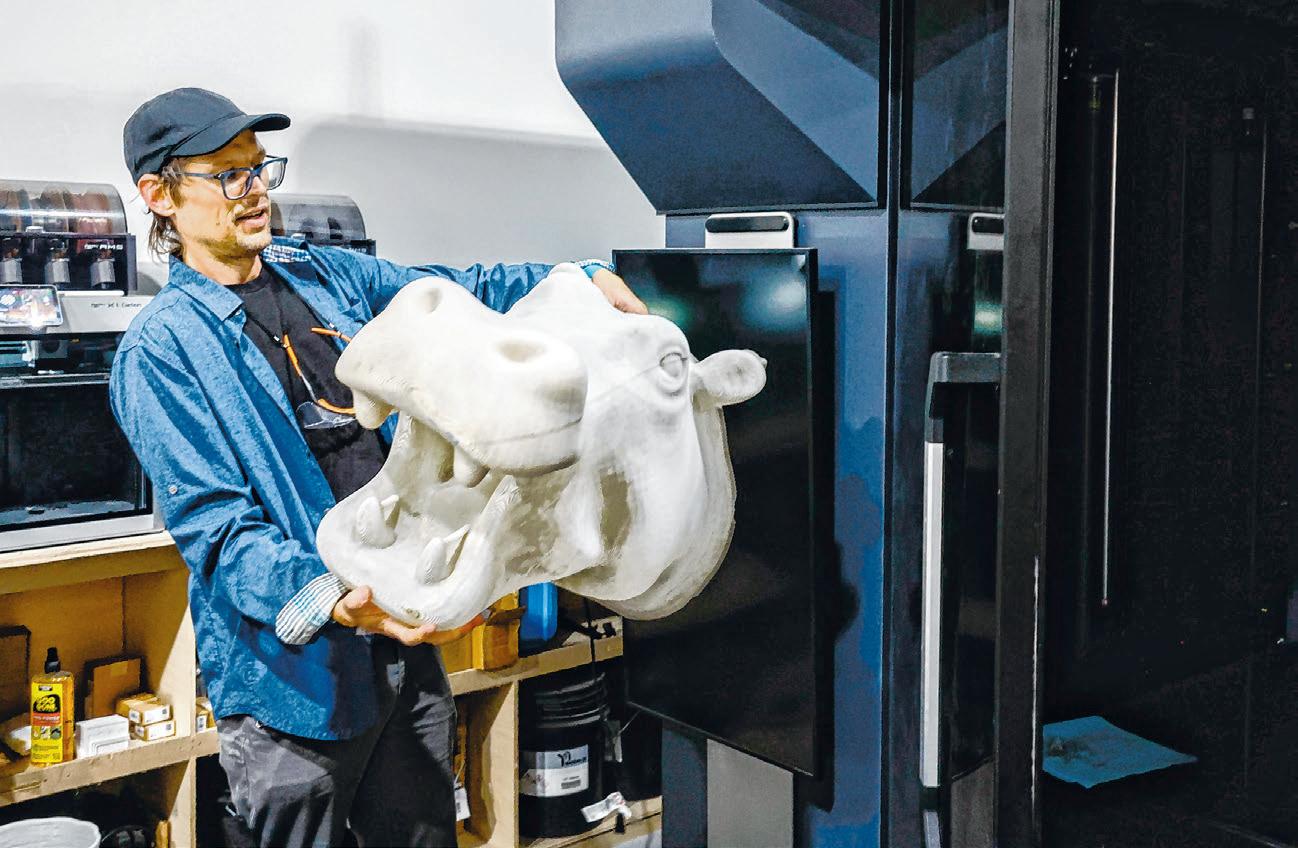

TOP: Workers build a structure made out of shipping containers, steel and other materials
LEFT: A walk-in disco ball is put in storage.
BY STEPHANIE RIEGEL Staff writer
On the same day last week that Air Products announced it was scrapping plans for its $4.5 billion “clean” hydrogen plant in Ascension Parish, which would have captured carbon emissions and stored them underground, ExxonMobil canceled offshore leases in the Gulf it had acquired for potential carbon-capture projects.
Two weeks earlier, Houston-based SunGas Renewables dropped its plans for a $2.4 billion plant in central Louisiana that also had a carbon capture and sequestration component.
And in February, a Houston firm that had been planning a $9.2 billion clean energy project at the Port of Greater
Baton Rouge since 2020 was acquired by a Silicon Valley company that has shelved the project — Grön Fuels — for the foreseeable future, if not altogether. Taken together, the projects totaled more than $15 billion in planned investments in the state and promised hundreds of permanent new jobs, though Louisiana Economic Development Secretary Susan Bourgeois said none of them was among the $110 billion worth of new capital spending that Louisiana has secured since 2024. Still, the recent decisions raise questions about the future of an industrial boom in the state that was predicated, at least in part, on state and federal policies that incentivized com-
panies to reduce their carbon footprint by capturing emissions and burying them underground.
Those policies, under President Donald Trump, are changing, at a time when Gov. Jeff Landry’s administration has paused permitting for new carbon injection wells amid growing environmental concerns from local communities.
“We thought the renaissance was going to be this energy transformation,” said Tim Barfield, president and CEO of Baton Rouge-based consulting firm CSRS, which was working with the developers of the Grön Fuels project. “Some of those projects have

Imagine you receive your credit card statement and find 32 pages of more than 1,700 unauthorized charges, made one right after another over three days. The majority of the debits are for $4.38, with about a dozen for $2.19, all to the same vendor, totaling close to $8,000.
Simple to fix, right?

Michelle Singletary THE COLOR OF MONEY
Well, for one 66-year-old widow from Minnesota, getting those transactions removed became an odyssey. Her story is a warning for anyone — and that’s many of us — who ever has to dispute fraudulent activity on a credit card.
Federal law provides protections for unauthorized charges. But you can’t procrastinate on reporting fraud. And in some cases, asserting your rights may require filing complaints with every state and federal agency responsible for protecting consumers.
Lisa’s saga began when she got a text message from Citibank. It flagged the very first unauthorized charges of $2.19 to Apple. com on her Costco-branded Visa card.
The bank representative didn’t suggest she cancel the card, and she didn’t think it was necessary, either.
Continued from page 1E
ic, oversees nearly 200 installations — or “experiences,” in industry parlance — annually for major events like Lollapalooza, the World Cup, Bonnaroo and Essence Festival of Culture. It works for roughly 100 brands or agencies, including Live Nation’s in-house team. It has about 70 full-time employees, and contractors swell that number to well over 100 during busy seasons.
Depending on the scale and complexity of the work involved, Raven will charge as little as $10,000 to more than $1 million for a project. The company declined to provide its annual revenues but says the number quadrupled over a three-year period after the pandemic.
It’s an impressive trajectory for a venture that began by providing sound systems for concerts at New Orleans bars. Raven co-founder Chris Berends said that success owes much to the company’s Louisiana roots, which have informed its ability to make massive events more fun.
“At the end of the day, we want to build something that when someone attends an event, they want more of it, whether it’s a tequila drink or a ticket to the next festival,” he said during an interview last week.
To the big time
Larose native James Dufrene founded Raven in 2009 primarily to provide audio production at New Orleans events. Three years later, he forged a professional bond with future business partners Berends and Mélinda Cohen while designing stages, lighting and sound systems on a shoestring budget for the fledgling BUKU Music + Art Project, an electronic music event that was active from 2012 to 2022. In 2015, Berends and Cohen joined Raven full-time as the company pivoted to focus on fabrication. Early New Orleans successes for the trio included a project to promote a Disney video game at the Voodoo music festival and another marketing Mountain Dew during the 2017 NBA All-Star weekend.
The company continued to grow through the end of the decade, moving its headquarters several times along the way, graduating from what was essentially a storage space underneath the Eiffel Tower building on St. Charles Avenue to a series of warehouses in town before moving to its current location in 2019. During the pandemic, which brought events-based marketing to a halt, Raven pivoted to using its fleet of 18-wheelers to haul loads for customers outside of the entertainment industry. Then, after the lockdown — when attendance at festivals, concerts, sports events and other gatherings skyrocketed
Lisa, who asked that I not use her last name to prevent further fraud, had no idea that those debits were the first in an onslaught of fraudulent activity spanning three days, March 9-11. After returning home from a trip to California, she saw the hundreds of charges. Citibank told her to call Apple. Apple, she learned, had no record of the small transactions, but it was aware of two legitimate charges, for a new iPhone and an Apple Watch.
She called Citibank back and was repeatedly told that they were looking into the matter.
Then came the “scary” letter, she said.
“During our investigation we learned that you provided the merchant(s) with your account information,” Citibank concluded.
“The charge(s) totaling $7,816.65 will remain on your account,” the letter from Citibank said.
There may have been some confusion, because the multitude of charges included two for Apple products she had actually purchased.
“I called Citibank, explicitly stated that none of these hundreds of charges were mine, and spent over an hour with the fraud
department representative,” Lisa said. “I live alone. I don’t play games. There is no kid in my house downloading games.”
If there is another lesson from Lisa’s situation, it is that quick, constant communication with your credit card company provides a better safeguard. It’s not a guarantee, but you have proof you tried. Keeping that in mind, here’s how federal law provides consumer protections for unauthorized charges.
If your physical card is lost or stolen, and you report the loss to your bank before a thief can use it, you are not responsible for a single penny. If the missing card is swiped before you report it, your maximum legal liability is capped at $50. In practice, however, you will rarely pay even that much, because almost all major credit card companies go further and offer zero-liability policies.
You should also have no liability for fraudulent billing if your card number is stolen but you still have the card — which happens far too often.
Because of federal consumer protections, financial companies are supposed to absorb these huge losses. But you must dispute the unauthorized action within 60 days of the date the bank mailed
or electronically delivered the billing statement showing the fraud. Missing that window can cost you your legal leverage.
In Lisa’s case, she took the right steps to clear up the matter. She called the number on the back of her card and reported the incidents to her bank immediately. She was eventually issued a new card. I suggest you get a replacement card if the dispute involves unauthorized activity, because it’s clearly been compromised. When the charges weren’t removed, Lisa sent Citibank a letter disputing the transactions. If you’re not sure what to include in such a letter or where to send it, the Federal Trade Commission has instructions you can follow. Go to FTC.gov and search for “Sample Letter for Disputing Credit or Debit Card Charges.”
The FTC suggests you send the letter by certified mail and ask for a return receipt.
She also complained to the Office of the Minnesota Attorney General, the Consumer Financial Protection Bureau and multiple senior executive offices at Citibank. With each call to the bank, she took notes that included the day and names of the representatives she spoke with.
“I had to keep complaining, because no one at Citi would state


Patrón, constructed by New Orleans-based Raven PMG for Live Nation Experiential, is a temporary structure that has made appearances at several major festivals since debuting in 2025 at Lollapalooza. The ‘moveable mansion’ — built using a combination of specialized steel construction and scenic carpentry — has space for a DJ, a bar and views of the festivities outside.
— Raven grew as well.
“People were clamoring for real experiences,” Berends said. “Audiences wanted to touch grass again and build relationships with brands in a more realistic way and not just get hammered by digital trash.”
Promoting brands
Experiential marketing is nothing new. Think of the world’s fairs from the 19th century, when companies assembled pavilions to unveil innovations like electric lights and washing machines.
But the industry is operating at a different gear this decade, as marketers and brands look to build consumer trust by connecting with audiences at big events like Formula 1 races, the Super Bowl, the World Cup and scores of big music festivals. At those gatherings, companies compete to create memorable experiences, hoping for exposure at the event plus coverage on traditional media and social media during and after.
The Wall Street Journal reported last year that advertisers’ interest in experiential and live marketing surged after the pandemic, with spending in 2024 increasing 10.5% year-overyear to $128.35 billion globally, surpassing 2019’s pre-pandemic spending of $121.87 billion.
This marketing arms race has led to increasingly elab-
orate “activations,” to use the industry jargon.
In addition to the temporary roller-skating rink, Raven has created a pop-up laundromat promoting the South Korean electronics company LG. The activation debuted in 2018 at Bonnaroo, the Tennessee music festival. Last year, the company built a movable mansion for Live Nation Experiential to promote the Mexican tequila brand Patron. The structure, recently named “best festival activation” by an industry publication, debuted at Lollapalooza and has since made the rounds.
This summer, Raven workers are putting the finishing touches on a free airbrush station to promote a T-shirt brand. The company’s list of creative builds also includes a 35-foot-tall steel middle finger that shoots fire, dragons that spray water and a temporary tattoo parlor.
“The space has become more and more competitive and impressive,” Berends said.
Busy workspace
Raven PMG’s Bywater manufacturing facility was bustling with activity recently as metal workers, carpenters and scenic artists finished building several structures using repurposed shipping containers and other materials. Employees assemble all projects completely at the factory before taking them apart and
shipping them to events using a flat-packing system that’s like IKEA on steroids.
In an open area outside the factory, workers applied finishes to a twostory VIP lounge, secondfloor viewing platform and garden promoting a national bank that will be installed at the Minnesota Yacht Club music festival this July in St. Paul. Elsewhere, team members worked on projects for other clients, including a liquor company, several clothing manufacturers, a doughnut and coffee chain, and a mouthwash maker.
The scene looked like a combination of what you’d see at one of Louisiana’s Mardi Gras float-building studios and its many industrial manufacturing facilities. Berends said that’s because Raven’s strength is pulling talent from many of the state’s industries, including artists from Bywater, carpenters and electricians with backgrounds in film production, construction pros, transportation industry vets, and a healthy contingent from “down the bayou.”
“There’s a heavy Cajun component to our business,” Berends said. “The build methodology for our steel structures really reflects that identity, because all of these guys are coming from the shipping industry or the oil field.”
Berends said those skillsets help Raven provide turnkey service and keep up with competitors as the experiential marketing industry continues to chase innovation.
“We want to continue to push the boundary of what’s possible in the time that you’re given to build something,” he said. “In 2005, you would have a tent with a folding table and someone giving out shots. Over the last 20 years, we’ve seen some amazing advances in technology, and I want Raven to be the leader.”
Email Rich Collins at rich.collins@ theadvocate.com.
anything with certainty except that they would keep investigating and call back,” she said. Extremely frustrated, Lisa finally emailed me earlier this month. I reviewed her statements and correspondence with Citibank and then called the bank.
“Citi has resolved the case and communicated the outcome directly to the customer,” a spokesperson emailed a few days after my inquiry. “We are committed to helping our customers protect their accounts and stand behind our $0 liability promise on unauthorized charges.”
In a letter to Lisa, Citibank said that after a “comprehensive reevaluation” of her account, it was reversing the thousands of dollars in Apple.com charges, “along with applicable interest adjustments.”
Yet, she’s still concerned about this point made in the letter: “The security investigation can take up to 90 days to complete. ... If you do not hear from us after 90 days, the credits will become permanent.”
“I thought the rules were that if it wasn’t you, it wasn’t you,” Lisa said. “And how obvious that it wasn’t me.”
Email Michelle Singletary at michelle.singletary@washpost. com.
Continued from page 1E
dropped down on the priority list because of broader, macroeconomic factors.”
“I do think it will come back,” he said. “Maybe not with the same kind of vigor and blind optimism we had at one time but eventually.”
Different priorities
Nearly two decades ago, as a growing body of research established the impact of greenhouse gas emissions on climate change, the federal government began offering federal tax credits to companies that lowered their carbon footprint by capturing and storing carbon dioxide.
President Joe Biden’s administration expanded the program in an effort to boost projects that would limit the impacts of climate change. That led to the proliferation of carbon capture and sequestration projects along the Gulf Coast.
Though Trump has not done away with the tax credits in his second term, he has questioned the effects of human activity on climate change and focused on increasing traditional fossil fuel production, shifting the focus away from low-carbon projects.
At the same time, the global market for lower carbon products like the so-called “blue” ammonia that Air Products planned to make in Ascension Parish has chilled somewhat, experts say, reducing the demand.
Closer to home, Landry has given credence to concerns about the impact carbon injection wells could have on aquifers and communities near where they’re located, imposing a moratorium on new well permits in 2025.
The combination of factors, experts say, is making some companies rethink decisions they made several years ago.
“It’s fair to say that that regulatory uncertainty has been one of the factors that contributed to some of these projects maybe not moving forward,” said Greg Upton, executive director of the LSU Energy Institute. Instability, unpredictability
While regulatory uncertainty impacted each of the recently canceled or shelved clean energy projects once planned for Louisiana, each project also faced unique circumstances.
As far back as last year, Air Products indicated to investors it was it was looking to sell off the ammonia and carbon-capture components of its project to focus on its core business of transporting and selling industrial gases.
Last week, its Norwegian partner in the deal announced that it would not acquire the ammonia component of Air Products’ Louisiana project, citing low projected financial returns. In the case of Beaver Lake, the proposed wood fiber-to-
low carbon methanol facility planned for a former paper mill in central Louisiana, SunGas blamed several factors for its decision not to move forward. Among them: “slower-than-expected market adoption of low carbon methanol, uncertainty regarding the carbon capture and storage pathway for the project and clarity on the available regulatory support and financing conditions needed to support a project of this scale.”
Grön Fuels, a low-carbon project planned for the west bank of Baton Rouge that would have used soybean and canola oil, tallow and used cooking oil to produce renewable diesel fuel, was put on the back burner after the Houston firm behind the project, Fidelis Energy, was acquired by California-based Nscale.
Though Nscale did not say outright that it is canceling the project, a release announcing the Fidelis acquisition said the deal would enable Nscale to focus on artificial intelligence data center construction.
Barfield, who worked with Fidelis on the Grön project for more than five years, said the country’s energy industry is in a different place than it was in 2020, with different priorities and mandates.
“There is more geopolitical instability, there is more unpredictability, the world was moving in one direction and now it is swinging back the other way,” he said. “Some of these projects that were good projects may have missed their window.”
Changing dynamics?
LED’s Bourgeois cautions against drawing too many parallels between recent company decisions and said the state’s energy policy is not based on carbon capture and sequestration.
“We have an all-of-the above energy strategy and carbon capture was never the driver of that,” she said. “It was a valuable component but I do not think the dynamics are changing as much as people think they are.”
To that point, on the same day Air Products canceled its project, a $2 billion renewable diesel project planned for Caldwell Parish in north Louisiana received a permit from the state to inject captured carbon in several deep underground wells. The project was one of several to have applied for permits before Landry’s moratorium last year.
Bourgeois said while lowcarbon projects may be on the back burner at the moment, she doesn’t think they’re dead.
“I still think that is the longer play,” Bourgeois said. “But when the Strait of Hormuz is closed, people quit worrying about sustainable jet fuel and just start worrying about jet fuel.”
Email Stephanie Riegel at stephanie.riegel@ theadvocate.com.
BY STEPHANIE RIEGEL Staff writer
When Tulane University announced last month it had reached an agreement to take control of the long-stalled effort to redevelop the former Charity Hospital downtown, Andy Kopplin was among those cheering the most.
Since 2016, Kopplin has served as president and CEO of the Greater New Orleans Foundation, backer of the BioDistrict, which would bring together hospitals, research and teaching institutions to reinvigorate downtown and stimulate the economy.
A reimagined Charity Hospital is a key part of the plan. Kopplin has decades of experience bridging the gap between government, business and nonprofits. He assumed the reins at GNOF after serving as former Mayor Mitch Landrieu’s chief administrative officer. His CV also includes stints as a senior adviser to Teach for America, executive director of the Louisiana Recovery Authority and chief of staff for Govs. Kathleen Blanco and Mike Foster.
In this week’s Talking Business, Kopplin discusses the role GNOF has played in the creation of the BioDistrict, why it matters and what he sees as New Orleans’ biggest opportunities — and challenges.
Interview has been edited for length and clarity.
We’ve been talking about a biomedical corridor downtown for 30

years, but there’s still not much to show for it. What is the problem?
The BioDistrict was created (by the state) in 2005 before Katrina but didn’t have any money. It got some one-time funding in 2008 but nothing after that. Then, in 2018, the GNOF board made a generational commitment to get behind the idea of a redeveloped Charity. So, we did a strategic plan that talked about everything that could flow from that — small-business development, entrepreneurship, increased research, reactivating that section of downtown.
Part of the plan called for creating an economic development entity — a publicprivate partnership — that would lead the way. We started working on that and
invested resources in getting the BioDistrict back up and secured funding from the city and the state. So, we really feel that from 2018 to today, the biggest champion of the BioDistrict, hopefully anchored now by Charity, is GNOF.
How much money does the district have now? What is it actually doing?
Between now and 2040, the district is eligible to receive up to $40 million from the city through tax increment financing, and the state will match up to $25 million. So, we have the ability to earn up to that amount assuming there is incremental sales tax revenue generated in that area.
But there’s not much around there yet, so where does the revenue come from?
Not yet, but the new Trad-
er Joe’s on Tulane Avenue is in the district, and it has been a significant generator of sales taxes, so that has been a real boost. We actually got our very first funds at the end of 2025, about $1 million in all.
What have y’all spent it on?
We spent some on an immediate beautification effort, landscaping the area. We also have been investing through the New Orleans Bioinnovation Center (a nonprofit business incubator on the edge of the BioDistrict), helping researchers get seed funding to develop new companies based upon their research.
Why does this have the power to be so transformative?
When you look at other cities around the country, you can see how this works.
Pittsburgh is one example. It has done some really impressive things, transforming the old industrial district into a medical district, thanks to the University of Pittsburgh and the University of Pittsburgh Medical Center.
Of course, there’s Kendall Square in Cambridge, Massachusetts, which has spawned countless tech companies. And from a medical district standpoint, Birmingham (Alabama) is a good example of a city that has become a hub of worldclass medicine in just one generation. There is no reason we cannot do that here.
But, again, this requires a lot of cooperation among rival teaching institutions that have not really collaborated over the years.
Thirty years ago, they did not. During Mike Foster’s administration, my job was to negotiate a détente between LSU and TU. What is different today is that the leadership of these institutions now recognize that as a small region, we have to work together to punch above our weight. Today, there is more collaboration than there has ever been, and I think the BioDistrict’s work has advanced that because it includes Tulane, LSU, Delgado, Ochsner, Xavier, LCMC and folks appointed by the mayor.
Why is GNOF, a community foundation, doing this kind of place-based work?
Because if you look at the biggest challenges facing this community, it is economic development. We cannot address the dis-
parities in our city without growing our economy. New Orleans, if it is going to be successful, has to grow, and we have to grow in a way that enables all our folks to benefit.
There seems to be an optimism in New Orleans around the new mayor. How much of that is grounded in real, positive change that is actually happening?
There is a lot of reason to be optimistic. Tulane’s research investments are the biggest untold economic development story of the past decade. They are bringing in $100 million more a year to New Orleans than they were a decade ago — net new money to the region. There is excitement around the BioDistrict.
And several big projects are finally moving forward. The NSA apartments in Bywater is under construction. Lindy Boggs is being knocked down. The River District is activated, and the Shell Building is beautiful and creating a new neighborhood. The port’s deepwater terminal is not a done deal, but there is strong support for it.
Those are all good reasons to be optimistic. What is the biggest challenge facing the community?
Economic growth, no question. We need to grow, and we do that by creating jobs. The more jobs we are able to create, the more we will be able to build a middle class.
Email Stephanie Riegel at stephanie.riegel@ theadvocate.com.

BY IANNE SALVOSA and STEPHANIE RIEGEL Staff writers
In early June, Meta identified Baton Rouge as the site of the first class of America’s Workforce Academy, a program training people how to build artificial intelligence infrastructure and data centers. As the tech giant invests billions of dollars in the AI boom, including a massive ongoing project in Richland Parish, the academy signals an intensifying need to fill worker gaps in the skilled trades.
Trainings will be hosted at the Associated Builders and Contractors Pelican Chapter training center, on Highland Road in the southeast corner of East Baton Rouge Parish, this fall.
“For years, we’ve talked about workforce shortages in the construction industry, and I think this partnership represents exactly the kind of innovative collaboration that we need.”
DAVID HALVESTON, Associated Builders and Contractors Pelican Chapter CEO
ABC Pelican Chapter President and CEO David Halveston said the academy has already received thousands of applicants. It’s free of charge to participants, who will receive a stipend and a guaranteed job with a Meta contractor following completion of the four- to five-week training program.
ABC Pelican has trained students on the craft trades since the early 1980s but has not seen a fully funded, large-scale partnership like this before, Halveston said. The program, which is still under development, will be unique to ABC due to its short-term, accelerated format.
Though many industries in the state have struggled with recruit-

Leaders at Grow NELA, the northeast Louisiana economic development
artificial intelligence data center in Richland Parish is helping to create a larger logistics
that will serve not only the Meta data center but projects throughout the region.
ing and retaining employees, Halveston said the academy’s promise of employment will make the difference.
Demand for trades workers in the U.S. increased by double digits from 2022 to 2026, according to consulting firm Randstad.
“For years, we’ve talked about workforce shortages in the construction industry, and I think this partnership represents exactly the kind of innovative collaboration that we need,” Halveston said.
Backlash, opportunity
The announcement comes as state and local governments
around the country are beginning to push back against the rapid proliferation of AI data centers, which use massive amounts of electricity and water to power super computers and have driven up utility rates in many communities where they operate.
Even Louisiana, which courted Meta two years ago with a generous incentive package, recently imposed what Gov. Jeff Landry’s administration described as guardrails intended to shield ratepayers from being saddled with higher costs because of Meta’s power needs. Critics have also pointed out that
while AI data center construction can create an economic boom in a region, as it has in northeast Louisiana, fueling land deals, spawning new retail establishment and creating thousands of construction jobs, the effects are temporary.
Once the construction work is over, the community may be left with empty man camps, dollar stores and only a few hundred fulltime jobs.
A new study by Dutch-based financial consulting firm ING, which specifically mentions the Holly Ridge project, says as AI data centers grow ever larger, communities have an opportunity to turn
short-term activity into longerterm economic gains.
The key is to transition from being a construction hub to part of a “broader AI ecosystem,” which could include partnerships with nearby colleges to support R&D, train skilled labor, and facilitate AI adoption among local companies, according to the report.
Leaders at Grow NELA, the northeast Louisiana economic development partnership, believe the Richland Parish data center already is helping to create a larger logistics hub in nearby Monroe that will serve not only the Meta data center but projects throughout the region.
They point to several companies that have relocated to the area signing long-term leases for warehouse space to provide mechanical and electrical supplies and equipment to data center projects.
“These are not three-year leases,” Grow NELA President and CEO Rob Cleveland said earlier this year. “These are companies making a 20-year commitment to the community.”
Construction fundamentals
Halveston believes the new Meta training program at the ABC training center is an important first step in preparing local workers for what economic development boosters hope will materialize in the months and years to come.
The curriculum will include fundamentals like safety and construction math and introductions to craft trades like electrical and plumbing work. The goal is to prepare students, who are not required to have construction experience, to enter a work site after the training and continue on with a construction career after their project with Meta.
Class size is to be determined, but Meta projects the academy to train thousands.
“This is just the first step of their career in construction,” Halveston said.

Good evening! Apair of importantstoriesfor this week’shighlight:
1) ViolentcrimeinNew Orleans hasfallen to itslowestlevel since the1960’s TheNew Orleans PoliceDepartment recorded 38 murdersthrough June25, representing oneofthe lowest year-to-date totalsthe city hasseen in decades. If this pace holds, NewOrleans will finish 2026 with about 78 murders, nearly matching the 76recorded in 1969. Violent crime has fallen dramaticallyinall othercategories, as well.
Four yearsago this month,the NOL ACoalitionwas founded to combat awaveof deadly violence in NewOrleans, andtoinvestinour children fora better future. Since thattime, themurder rate has fallen 74%.
New Orleans’improvement is about 60% betterthan thenationalaverage.Multiple factors aredriving this remarkable improvement, including:courageous first responders, broad civic action,proactiveand precisionpolicing, cooperation between city,state,and federal agencies, andtechnology andanalytics. Thenext stepfor safety will be theuse of first-responder drones,which arenow employed from NewYork City to Nashville to California; in Jefferson Parish,first-responder droneshavereduced response times to 90 seconds.
June2022-June2026
•Homicides-74% decline
•Shootings-64% decline
•Carjackings-78% decline
•Armed Robber y-66% decline
Youcan read more here
2) Tulaneannouncesmilestone in transformationofCharityHospital
After sitting vacant fortwo decades, Charity Hospital is comingback. Lastweek, TulaneUniversity announcedithas signeda purchase andsale agreement to become leadofthe transformational redevelopment, takinga $500+ million betona building the city has been tr ying to resurrect since HurricaneKatrina.
This is asignificant step forwardin what would be thelargest andmost consequentialeffortofits kindinthe history of Tulaneand perhapsinthe history of NewOrleansitself,” said TulanePresident MichaelFitts.
Project Details
•650,000+ square feet

devotedtoTulaneeducation, health,research, andinnovation, including newhomes forthe CeliaScott
WeatherheadSchool of PublicHealthand Tropical Medicineand theTulane University InnovationInstitute
•700 researchers, innovators, andsupportstaff concentratedinasingle building, creating oneofthe largesthealthand biomedical research clusters in the Gulf South
•Residential, retail, andcommunity spaceoccupying theremaining one-thirdof theone-million-square-foot structure
Constructionstartsbeforeend of 2026, with completion expected in 2029
•The project is projected to generatea $1.2 billion one-time economic impact onLouisiana’s economy, create approximately 7,300construction-phase jobs, and produce2,400 permanent newjobs once complete
GNO, Inc. haslongsupportedBioDistrict NewOrleans andthe broader innovation economyanchoredinthe medicalcorridor,including theTulaneUniversity InnovationInstitute. Theredevelopment of CharityHospital notonlyturbocharges theBioDistrict but moreover promisestorevitalize an urban “blindspot” into amajor economicand civic catalyst forthe cityand region
Finally,aspecialtip of thehat to Chalmette,St. Bernard’sown Mitchell Robinson, whohelpedthe NewYork Knickswin theirfirstNBA championship since,well, there wereactualknickerbockers in NYC. June25was Mitchell RobinsonDay in Louisiana.
RE GI ST ER NO W TO BE CO NNE CT ED
WI TH MA JO RP RO JE CT SH AP PE NI NG
AC RO SS LO UI SI ANA AT SO UR CE LO UIS IA NA .C OM
SOURCE LOUISIANA is LouisianaEconomicDevelopment’s official directoryofLouisiana-based vendors, subcontractors,and suppliers. It brings Louisianacompaniestogetherinone trustedplace,helping local vendorsbeconsideredfor majorprojectsastheytakeshape across thestate
From construction andinfrastructuretoprofessionalser vices, logistics, food andfacilitiessupport,large developments depend on awiderange of local partners. Source Louisianahelps project leadersidentifyqualified businesses early, so localcompaniesare included from thestart
Registration is free andopento ALL Louisiana-basedbusinesses. Companies canregister,verifyinformation andupdateprofileswithcurrent capabilities.
Earlyvisibilityhelps Louisianabusinessescompete as projectsare planned andcontracts areformed.
CO NN EC TLOCA LLY.
CO MP ET EN AT IO NAL LY
GR OW GL OB AL LY.


BY JUDITH KOHLER
The Denver Post (TNS)
Teens to 20-somethings hanging out at the mall, maybe trying on clothes, meeting friends at the food court or a nearby restaurant, checking out the window displays.
The scene isn’t from an ’80s movie or a flashback moment shared by millennials or baby boomers. Many of the young people strolling while also scrolling for the latest fashion trend are members of Generation Z, ages 14 to late 20s.
And Gen Z, which grew up with the internet and smart phones, is being credited with helping to energize shopping malls that have struggled through the Great Recession, the COVID-19 pandemic and the proliferation of e-commerce.
Flatiron Crossing in Broomfield, Colorado, is in the middle of a multimillion-dollar project outside the mall on the center’s grounds: a mixed-use development that will have housing, entertainment and new places to dine. Inside the mall, new stores are being added and existing stores are being transformed.
Several of the changes are geared toward Gen Z shoppers.
“We have a Gen Z group. We sit and focus and pay attention to what we think would attract Gen Z and continue that customer experiencing the mall,” said Kate Taggart, Flatiron’s general manager.
Employees at Flatiron and Macerich, which owns and operates the mall, use social media to track trends and new businesses that are opening, Taggart said.
“It’s not always just going to be pure retail,” she added. “It has to be all the other aspects that make it a little more holistic of an experience.”
For instance, Macerich is looking at incorporating businesses focused on wellness and fitness to the new development, called HiFi.
“I think nationally, Gen Z represents about 19% of shoppers. Here at Flatiron, we’re seeing it be about

30% of our shopper base,” Taggart said.
Macerich, which owns 36 malls across the country, told The Wall Street Journal that it is redesigning some of the centers’ common areas, making them photogenic for shoppers who want to take and post photos on social media.
Josh Weber, senior general manager of the Park Meadows mall in Lone Tree, Colorado, said it’s common to see younger shoppers in search of the right backdrop for a TikTok or Instagram post, whether in a retailer’s space or throughout the center. He said shopping centers used to discourage photography and video recordings.
“Today, social sharing is a natural part of the customer journey,” Weber said in an email. “Park Meadows’ distinctive lodge-inspired design creates an environment that
photographs well, and retailers have embraced that shift by creating visually engaging store experiences and they highlight products that are trending online.”
The shopping malls that have survived and even thrived are those that have transformed themselves to offer a mix of uses to appeal to customers looking for a different experience, said Ray Wimer, a professor of retail practice at Syracuse University.
High-end malls, considered Class A, are doing well, Wimer said. Others, especially ones that haven’t made updates, are struggling or closing, he said.
In 2016, there were roughly 1,220 of the traditional enclosed malls in the U.S. About 890 of them were left in 2025, Wimer said. E-commerce, overbuilding and lack of investment contributed to the de-
mise of shopping centers.
“Existing malls that are in decent metropolitan areas or near an urban population are trying to redevelop or recreate themselves,” Wimer said. “OK, there’s some shopping, but there’s dining, there’s entertainment, there’s condos, apartments. There’s office space.
“Instead of a retail mecca, it’s becoming a mixed-use development,” he added.
The evolution of shopping malls fits with what experts say is younger people’s craving for socializing.
About 58% of shoppers ages 1834 often or sometimes patronize malls, compared with 48% for ages 35-54 and 38% for those 55 and older, according to research by Ipsos, a market research and public opinion polling firm.
Younger shoppers emphasized
socialization, convenience and physical interaction when talking about in-store experiences, Ipsos reported.
Nearly almost 50% of total Gen Z spending on general merchandise is done in stores, a 2025 report by Deloitte said. “With Gen Z’s spending power projected to reach $12 trillion by 2030, retailers should consider evolving to meet their expectations,” Deloitte advised.
“The thing with Gen Z is that they enjoy it. It’s the social experience,” Wimer said of shopping malls. “We talk about digital and how isolated people are becoming, but there’s a social dimension to shopping because you go with your friends or you go with your mom.”
And it’s instant gratification if people find what they want at the store, Wimer said.
Mattea Drake, 19, a University of Colorado-Boulder student, likes not having to wait for a purchase to arrive.
“Especially if you’re crunched on time or you see something, you’re just like, ‘Wait, I need it now. I can’t wait,’ ” Drake said. “That’s a really fun aspect about the mall. It’s so accessible. You can just go in, grab it, super, super easy.”
Drake often visits Flatiron Crossing, which is a short drive from Boulder. She said going to the mall is “a great way to kind of unplug and hang out with my friends.” She likes touching the fabrics and trying on the clothes.
“I find things in the store that I never would have searched for online,” Drake said. “Finding my new favorite outfit is way more fun than scrolling on my phone, like I do on a day-to-day basis.”
Going to the shopping mall is almost a fresh concept for younger shoppers, said Meghan Kaltenstein, vice president of leasing at Flatiron.
“They grew up in the digital era,” Kaltenstein said. “We grew up in the mall, and then we kind of got over it. We were excited about online. Now, it’s full cycle back to that.”

Beyond isn’taplace —it’samindset . Andit’sabeliefthathas poweredusfor over 80 year s. We areJones Walker LLP,a firmdrivenbyanentrepreneurial spirit ,adeepsenseofcommunit y, and afierce determination to deliverexceptional serviceand valuefor our client s. Since1937, our firmhas been committed to workingwithcommunity leaderstodevelopbusiness opportunitiesacrossthe state. We aresteadfast in continuing ourdedicationtogobeyondinadvising client sand supportinginitiatives andorganizations that make Louisiana abet terplace to live andwork
William H. Hines,ManagingPar tner bhines@joneswalker.com 504.582.8000 201St. CharlesAvenue NewOrleans,L A70170 -5100
Fans try to fill 980 sticker album slots
BY DAVE SKRETTA AP sports writer
KANSAS CITY, Mo. — Adam Martin
remembers taking boxes of Panini stickers and their accompanying World Cup albums to a Formula 1 race in May, shortly after his collectibles shop had received a shipment and long before the tournament was to begin.
The idea was to give them to friends with kids. But what happened next surprised him.
“When I walked in with this box of cards,” Martin recalled, “hundreds of people of all creeds and cultures said something: ‘Where did you get those? How can I get some?’ Those Panini stickers are just that iconic collectible that goes beyond sports collectors.”
The stickers depicting players and teams in the World Cup have been around since 1970, when four Italian brothers paid $1,000 to procure the rights to produce the images. More than 50 years later, the stickers are available in packs all over the world, and fans young and old not only purchase them but also swap among themselves, helping each other fill their keepsake albums.
This year’s book is the largest ever, partly due to an enlarged 48team tournament, with 980 distinct stickers. They’ve become such a hot commodity that many stores are sold out, and back orders may not ship until the tournament has crowned a champion.
“We’ve sold an unbelievable amount of the stickers,” said Martin, one of the owners of Dave and Adam’s Card World, which has shops in New York and Europe.
“We thought the order we placed months ago would be enough to tide us over,” Martin said. “We’ve
had to reorder twice.”
Panini had produced more than 2 billion packs — each containing seven stickers — by the start of the tournament, said Jason Howarth, the senior vice president of marketing and athlete relations for Panini America. That’s quite a feat considering the field wasn’t set until April 1.
Most stickers are not valuable by themselves, though older ones — such as the debuts of Lionel Messi and Cristiano Ronaldo — can fetch hundreds of dollars. The value comes in trying to fill the World Cup album.
“In European and South American culture, completing the sticker album is something almost every child does at some point,” said Matt Blazey, of Milton Keynes, England, whose YouTube channel featuring cards and collectibles has more than 62,000 subscribers.
“Most rediscover it in adulthood,” Blazey said, “when they realize they have adult money, which brings back all of those memories of bringing stickers into school, showing them off to your mates and swapping them to complete the album.”
Indeed, part of the beauty of the Panini stickers is in their accessibility. Each pack only costs about $2 or 1.50 euros.
Beginning with the last World Cup in Qatar, though, Panini also began producing variations with special borders that are much more scarce. Suddenly, stickers with red, purple or orange edges became especially sought-after, and collectors have put huge bounties on ultrarare, black-bordered, 1-of-1s — as in, one in the world — depicting Messi, Ronaldo, Lamine Yamal and other big stars. Some industry experts believe

Youth exchange Panini World Cup stickers in Mexico City. The stickers depicting
Cup have been around since 1970 and are available in packs all over the
purchase them but also swap among themselves, helping each other fill their
the black Messi sticker alone could command $200,000 at auction.
“We’re tracking and following through social media who pulls the black 1-of-1s,” Howarth said. “Neymar, Leo, Ronaldo — this is probably their last World Cup. What do those stickers sell for?
That’s going to be a new high mark for the category.”
Sammi Kaewsawang had never participated in the World Cup album experience until this year, when the content creator from Long Beach, California, decided to see how long it would take to physically peel and stick all 980 examples into the album.
By the time Kaewsawang finished with Panama, the last of his 48 teams, he’d been at it for about 7 hours, 47 minutes.
“Now I’m on my second one, helping my fiancé’s nephew complete his,” Kaewsawang said.
“What made the experience so memorable was the people I met
along the way. Trading stickers brought me together with fans of all ages.”
That is undoubtedly part of the appeal: Even though Panini has a digital collection available, the sense of community that comes from swapping your doubles for a player you might need brings with it a quaint sense of nostalgia, not unlike the way American kids have collected and traded baseball cards for generations.
Many shops help by scheduling swap meets. Panini itself has a truck at Rockefeller Center in New York, where thousands have shown up in the evenings to trade. Message boards allow fans to connect anywhere in the world, and about 8,000 collectors recently showed up at a stadium in Santiago, Chile, to swap.
“I’ve made genuine new friends though this hobby,” Kaewsawang said, “and that means more than completing the collection itself.”
and
not
Even though Panini stickers have never been hotter — a partnership with Coca-Cola means stickers can be found under labels of certain bottles — the company is facing the end of an era after the 2030 tournament in Morocco, Portugal and Spain.
The Fanatics brand Topps will take over the rights to produce World Cup cards, stickers and other FIFA collectibles, and it’s unclear whether the U.S.-based company will produce a similar product as its Italian rival.
“It is a real bittersweet moment,” Blazey said. “From my side, and for probably 90% of collectors at the moment — more so outside the U.S., where Panini is a household name — it’s a very sad moment for this to be the end. So many people grew up collecting them, and it’s synonymous with their childhood, so the loss of the license is very much seen as sacrilege.”


Staff report
South Louisiana businesses and nonprofit groups recently announced the following promotions, new hires and resignations.
Baton Rouge
Missy Matherne has been promoted to senior vice president of finance, risk and payments for Pelican Credit Union. Before joining Pelican, Matherne was chief financial officer of Louisiana Federal Credit Union and vice president of finance for Jefferson Financial Credit Union.
Dr. Logan Townsend has been appointed as an assistant professor of LSU’s Pennington Biomedical
Fool’s Take:
E-commerce giant
MercadoLibre (Nasdaq: MELI)

Motley Fool
is an e-commerce giant in the fast-growing Latin American market that helps people acquire goods and pay for them, too. It recently operated in 18 countries and boasted 83 million monthly active users. Over the past 12 months, its shares were down 36%. Despite some challenges, though, there are good reasons to consider buying and holding MercadoLibre. For starters, it’s growing briskly. In the first quarter, MercadoLibre’s revenue grew by 49% year over year to $8.8 billion. That’s impressive, but its profit margins and profits declined meaningfully. Why? Well, it has been facing stiff competition and has chosen to sacrifice short-term margins and profits to extend initiatives that may pay off handsomely. For example, it lowered the threshold for free shipping in Brazil, which is resulting in greater sales volume. That may help MercadoLibre scale up its higher-profit-margin advertising business. MercadoLibre is also home to a major financial technology com-
Research Center, where he will lead the newly established Integrative Stress Metabolism Laboratory. Townsend was, most recently, a postdoctoral fellow at the Centre for Metabolism, Obesity and Diabetes Research at McMaster University in Canada.
The LSU Health Foundation announced the addition of four new board members and the election of new officers.
Paige Sensenbrenner becomes board chair, Dr. Najeeb Thomas vice chair, Deke Carbo treasurer and Dr. Anna Pou secretary. New board members include Nel-
pany, Mercado Pago, which is pursuing growth opportunities such as expanded credit card offerings.
Many of the people in the markets it serves are underbanked, providing another major growth opportunity.
Shares of MercadoLibre appear fairly valued or undervalued at current levels and could deliver strong long-term returns to investors who buy today. (The Motley Fool owns shares of and recommends MercadoLibre.)
Fool’s School:
Former University of Pennsylvania professor Jeremy Siegel has collected and reviewed data on investment returns going back to 1802.
His book “Stocks for the Long Run: The Definitive Guide to Financial Market Returns & LongTerm Investment Strategies,” features seven “guides to successful investing.” Here’s a recap:
n “Keep your expectations in line with history.” Siegel points out that, after accounting for inflation, stock market returns have been between about 6% and 7% historically, but might fall to 5%.
n “Stocks are real assets and ... excellent long-term hedges against inflation.” A share of stock, after
son Daly, Chris Dyba, Dr. Luke LeBas and
Michael Pou
New Orleans
Robby Travis has been hired as the communications director for KID smART, a nonprofit that brings arts education to public schools in the New Orleans area. Travis previously led communications and creative strategy for Dickie Brennan & Co. as its senior marketing and creative manager.
Dr. Brian Moore will become the next chief physician executive and president of Ochsner Clinic, leading clinical strategy for the health system.
Moore was previously medical director of the Ochsner Cancer In-
all, represents a small ownership claim on a real asset-owning business.
n “Stock returns are much more stable in the long run than in the short run.” He adds that people with longer investment horizons “should hold a greater proportion of their portfolio in (stocks) and a lower proportion in bonds.”
n “Invest the largest percentage of your stock portfolio in low-cost stock index funds that span a global portfolio.” Broad index funds, such as S&P 500 index funds, have performed well over long periods and are especially good for those of us who aren’t expert investors.
n “Invest at least one-third of your (stock) portfolio in international stocks.”
n “Tilt your portfolio toward value (stocks)” by favoring “those with lower prices relative to their fundamentals, such as earnings and dividends” — as they “have superior returns and lower risk than growth stocks.”
n Have “firm rules to keep your portfolio on track.” He urges investors to keep emotions in check and not act out of anxiety or fear. Ask the Fool: Valuation shortcuts
Are there any quick and easy ways to figure out if a company is over- or undervalued? —

stitute and Ochsner MD Anderson Cancer Center, overseeing the expansion of The Gayle and Tom Benson Cancer Center in New Orleans. He will succeed Dr. Robert Hart, whose retirement will be effective Jan. 1.
Katherine Seghers has been promoted to vice president, marketing manager, for Republic Business Credit. Seghers joined the company in 2023 in an accounting capacity
P.M., Hickory, North Carolina
Even if you undertake many calculations, it’s hard, if not impossible, to determine for sure what a stock is really worth — and, therefore, whether it’s over- or undervalued. Even smart stock analysts will likely arrive at different numbers for any company they study because they all make different assumptions, such as the company’s growth rate.
There are some quick and easy ways to get a rough idea of valuation. One is the price-to-earnings ratio, dividing a company’s stock price by its annual earnings per share; it can sometimes be helpful to use the EPS expected over the coming year. A low P/E suggests a low valuation, though it’s smart to compare it with peers’ P/E ratios and its own five-year P/E range.
The P/E shows how much you’d be paying for each dollar of earnings. You might also check out the price-to-sales ratio, which divides the company’s market capitalization (its market value — the total value of all its shares outstanding) by its annual revenue (sales). The P/S shows how much you’d be paying for each dollar of revenue.
My Dumbest Investment: No time machine
My most regrettable investment move was
before assuming leadership of the company’s marking functions.
Daniel Maurin, senior vice president and business banking manager for First Horizon Bank, has joined the board of Junior Achievement of Greater New Orleans.
Acadiana
John Blohm has retired as CEO of the University of Lafayette Foundation after 11 years in the role. Karl Meche, the foundation’s chief financial and administrative officer, has been appointed to the rule of interim CEO.
Separately, the university has appointed Geoffrey Stewart as interim vice president for advancement and strategy.
Do you have personnel changes to share or other ideas for our business coverage? Drop us a line at biztips@theadvocate.com.
Actually, my most
sume that anyone will be
about any given
Also, if you’re going to invest in individual stocks, you must accept that some will disappoint you. To minimize losses, try to keep up with your holdings so that you can notice when a company is struggling. At such times, determine whether the problems seem to be temporary or long-lasting, and then decide whether to hang on or sell. Selling for a loss can hurt, but it’s better than experiencing a bigger loss. And there are always other attractive stocks to move money into.



BY GRACE MAYER Staff writer
Not many retail businesses make it to 108.
Fewer still have survived the wars, economic downturns and disruptions of e-commerce over the past century without making major changes to their operations.
But Gem Printing has been selling custom party and wedding stationery in much the same way it always has — printing in-house and on-site — since it was founded in 1918 by the great-grandfather of its fourth-generation owners Tommy Cousans, 44, and Melissa Cousans Mortillaro, 45.
From an unassuming storefront in a Metairie strip mall, Cousans and Mortillaro have defied the odds — and the broader market forces of evites and Amazon — to keep their family business afloat by building on customer loyalty, diversifying into a broader array of party supplies and holding fast to a guaranteed 24-hour turnaround time that dates to the store’s founding.
“The one-day service is obviously a blessing,” Cousans said. “I silently curse my grandfather for that every once in a while, but it’s probably one of the biggest reasons that this business is still around.”
Storied history
Photos on a store wall trace the company’s history back to 1918, including one of Cousans and Mortillaro’s great-grandfather, Sidney Cousans, wheeling around a wooden cart with a Gem Printing sign. He sold business cards printed from a small hand press and offered to shine customers’ shoes.
Another picture shows the company’s brick-and-mortar storefront on St. Charles Avenue, opened by their grandfather Sidney Cousans Jr. sometime after he took over the business in the 1930s — when he was just 14 years old. His grandchildren today credit him with carving out Gem’s niche in the wedding and party invitation category and also for coming up with the one-day service guarantee.

Today, Gem operates from a bridal-white brick storefront on Veterans Boulevard near Bonnabel Boulevard that has been its home since 1976, with eight fulltime employees.
Though Cousans and Mortillaro, who are brother and sister, declined to provide company revenues, they say Gem regularly sees year-over-year sales growth of 5%-10%.
Customer service and loyalty
The siblings attribute their longevity and steady growth to several factors, chief among them being their quick turnaround time.
On the second floor of Gem’s otherwise unassuming 5,000-squarefoot storefront, the company has a printing studio that holds more than a dozen presses and modern digital printers, the key to fulfilling one-day orders.
While the store’s hours run from 11 a.m. to 7 p.m. during the week, the team prints products overnight, often working on Sundays and Mondays — their typical days off.
The team prides themselves on fast — sometimes instant — service.
“We’ve had people pull up in limos and run out in bow ties, going,
‘I need a pillow right now,’ and they get to skip the line and grab a ring pillow and head to their church and get married,” Mortillaro said. That customer service has helped fuel loyalty in a traditional market in the Deep South and a pervasive party culture.
Customers who designed wedding invitations with Gem come back for anniversaries, christenings, birthday parties, all the way up to condolence cards. The tradition is often passed down. Parents recommend Gem to their children, then grandchildren.
“I’m the fourth generation helping sometimes the fourth generation of a customer’s family,” Cousans said. “It’s kind of crazy that it’s a family tradition on both sides of the counter.”
Over time, Gem’s customer pool spread around the country, particularly after many New Orleans natives moved following Hurricane Katrina in 2005. Those customers are “constantly ordering” quintessential New Orleans items, including second-line handkerchiefs, party cups and feather-trimmed umbrellas, Mortillaro said.
The company ships dozens of orders a week all over the country.
Gem also benefits from New Orleans being a party town, Cousans


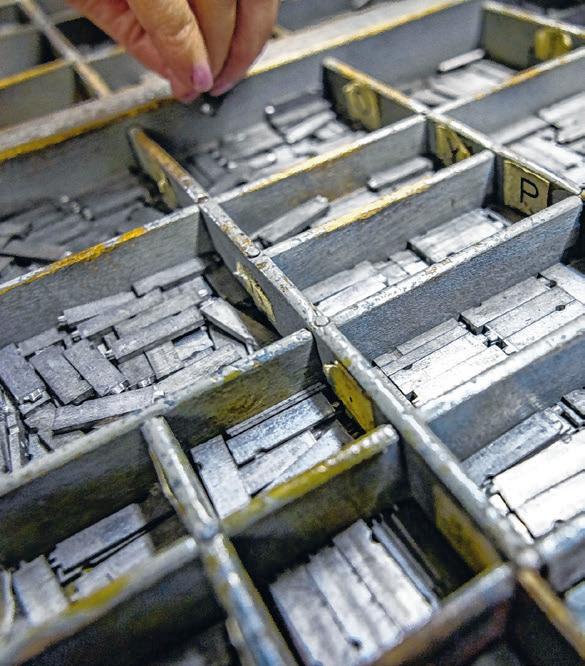
said. The shop stays busy during August through February during holiday and festival season.
“I don’t know if printers in Jackson, Mississippi, get a Halloween rush, but we get a Halloween rush,” Cousans said.
The business has also diversified by growing its party supplies line over the years. Lately, that’s meant learning how to print matchbooks. Wedding cake toppers currently displayed in-store, popular in the ’80s, are also making a comeback among younger generations. The team also learned how to print onto tambourines, another wedding favor reclaimed in recent years.
Planning for the future
As a kid, Cousans remembers watching Mardi Gras parades pass by the store windows. Mor-





Note pads celebrating the
were
tillaro recalls making netted rice bags for weddings, which Gem used to sell for 10 cents. In high school, they both started working in the shop. By college, they realized they couldn’t imagine doing anything else.
The biggest challenge Gem faces today is navigating fluctuating material prices, Cousans said. He vigilantly checks prices to purchase materials at a low cost, but due to inflation, their team has had to eat higher prices to avoid raising costs for customers.
While Gem has largely leaned on word-of-mouth referrals, the company is also making a concerted effort to bolster its social media presence to attract younger consumers, Mortillaro said. Cousans and Mortillaro hope to pass on the business to the fifth generation — possibly Mortillaro’s kids. Her 11-year-old daughter has already shown an early enthusiasm for the career: For a school career day, she wore business casual clothing and a name tag that read, “fifth-generation Gem Printing manager.”
“It’s definitely in our minds to keep this going. I want this to be a fifth-, sixth-generation business,” Mortillaro said. “When it comes to planning for the future, it’s honestly just watching the trends and making sure that you’re servicing the next generation.”
Email Grace Mayer at grace. mayer@theadvocate.com.






Ga llagher is co mmit te dtos ervin gLouisiana, co mbinin gc lien t- ce nt ric ser vi ce with globa lresource s. We ’reat ru sted partner fo rb usinesses and indi viduals seekin gi nsuran ce,r is km anagemen ta nd co nsulting solutions




















































































































































Many Americans are fortunate to have dental coverage fortheir entire working life, through employer-provided benefits. When those benefits end with retirement,payingdental bills out-of-pocket can come as a shock, leading people to put off or even go without care.
Simply put —without dental insurance, there maybe an importantgap in your healthcare coverage.
When you’re comparing plans
Look forcoverage that helps pay formajor services. Some plans may limit thenumber of procedures —orpay forpreventive care only.
Look forcoverage with no deductibles. Some plans may requireyou to pay hundredsout of pocket before benefits are paid.
Shop forcoverage with no annual maximum on cash benefits.Some plans have annual maximums of $1,000.
Medicare doesn’tpay for dental care.1
That’s right. As good as Medicare is, it was never meanttocover everything. That means if youwant protection, you need to purchase individual insurance.
Early detection canprevent small problems from becoming expensive ones.
The best way to preventlargedental bills is preventive care. The American Dental Association recommends checkups twice ayear.
Previous dental work canwear out.
Even if you’ve had quality dentalwork in the past, you shouldn’t takeyour dentalhealth forgranted.Infact, your odds of havinga dental problem only go up as you age.2
Treatment is expensive especially the servicespeople over 50 often need.
Consider these national average costs of treatment. $274for acheckup $299 for afilling $1,471 foracrown.3 Unexpected bills likethis canbea real burden, especially if you’re on afixedincome.
Medicare&Medicaid Services,2025. 2 “Aging changesinteeth and gums”, medlineplus.gov,4/17/2022.




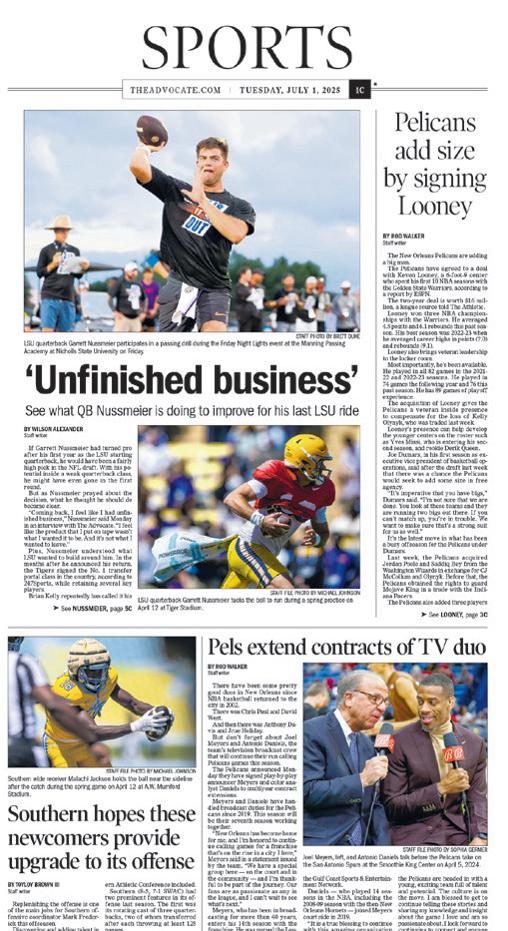








Yes, knowledgeispower,and thechoice is yours. But you MUST ACTNOW to put your estate planinplace.Itall star ts by attending one of LauraPoche’sfree educationaleventswhich makes it clear that regardless of your networ th, if you wanttopreserveyourhard-earned assetsorhavepeople in your life you need to protectorhavecauses that youwantto promote, EVERY PERSON NEEDSA LEGALESTATEPLAN. Let LauraPoche and her professional and knowledgeable staffmakethis process as easyaspossible so youcan livewith PEACEOFMIND.
BATO NROUGE
Monday, July 20 Poche LawOffice 4960 Bluebonnet,Ste.C 2: 00pm- 4:30pm REFRESHME NTSP ROVI DED AF TER
BATO NROUGE
Tuesday,July 21
Mestizos
2323 S. Acadian Thruway 11 :00am -1 :30pm LU NCH PROVIDED AF TER
BATO NROUGE
Wednesday,July 22 PocheLaw Office 4960 Bluebonnet, Ste. C 5:30pm -8:00pm DINN ER P ROVI DE DAFT ER
BATO NROUGE
Thursday,July 23 Poche LawOffice 4960 Bluebonnet,Ste.C 9:30am -12: 00pm LU NCH PROVIDED AF TER


• Howcan Ikeepthe governmentout of my estate settlement?
• What arethe twobiggest andmostexpensivemistakesfamiliesmakewhentryingtoavoid nursing home poverty?
• Howcan Ikeepmynot-quite perfectson-in-law and my over-controlling daughter-in-law from having influenceovermyestatesettlement?
• Howcan my family avoid estate tax, and other taxestheymightfacewhenIpassaway?
• HowdoIstart the five-yearlook back period fornursinghomeswithout having to giveeverything away to my family whileI am alive?
• Whydomostlawyers love Probate, and want my estate to go through it?
• Should Ihavea Will or Trust(or both)?
• Canmypatchwork quiltofWills,Powers of Attorney, Living Wills, andBeneficiary Designations actually be atimebombwaiting to explode?
• HowdoIensurethat my estate won’tincur legal expensewhen Idie,preserving 100% of my assets for my family?

If youhaveeverwantedtoeliminate worry becauseyou don’t have aprogram in placeto protectyourestateand family, without aslewofuntimelylegal and taxproblems,thenthiswill be one of the most impor tant workshopsyou ever attend. Iamgoingtoshowyou howtobulletproof what youhavetoday, and what youleaveyourkids tomorrow.You’llbeabletotakeadvantage of my estate planning legal strategieswithout youoryourlovedoneshavingtodeal with Succession Cour ts,long estate settlement delays,Medicaid liens, nursing home poverty, anddeath tax. ButbeforeIdothat,let me tell youa story of how we helped Mary.
MA RY’S STORY
“Asacouplewithanonlychild, we thoughtaWillwas all we needed. WRONG! My husbanddied,and Ihad to go through Probate- anightmare, andvery costly.Italsotook over9 months.I didn’twantour childtogothrough that,so Igaveher anadtoaPoche’ LawFirmworksho p, and sheand herhusband were impressed. They hadLaura setupa particular kind of Trustthattook care of their estate planning,but what aboutme? Idecided to go to aworkshop, and made my appointment. Lauraansweredall of my questions,and even gotmyfinancialadvisorinonaconferencecall. Icould nothavebeenmore pleased and relievedthatmyestateplanisnow in order. KudostoLaura and her professional staff. Ihighlyrecommend her forall estate planning needs.”
Mary,Baton Rouge,LA
IMPORTANT GUIDE L INE S
FO RO UR WO RKSHOP S:
Workshopsare open to FIRST-TIME ATTENDEES ONLYand aregearedtowards people who want or need your legal estate plan in placequickly Pleasehaveyourpersonal calendar handy at the workshop so youcan choose to star tyourplan NOW! If married, both spouses mustattend a workshop to ensurethatall decision-makers are involved in your family’scoordinatedplan.
Allpeople whoattendwillreceivea FREE copy of the updated 2nd edition of LauraPoche’s Book, “EstatePlanning AdvicebyaWoman forLouisiana Women: AGuide forBothMen andWomen About Wills,Trusts,Probate, Powers of Attorney, Medicaid, Living Willsand Taxes.”



“The sun is dangerous. If you’ve got a sunscreen, it’s better to put it on than not put it on.”
DR. GUY GERMAN, associate professor of biomedical engineering at Binghamton University, State University of New York
Bemotrizonal, a widely-used ingredient internationally, is coming soon to a sunscreen near you
BY MARGARET DELANEY Staff writer
In June, the Food and Drug Administration approved the active ingredient, bemotrizinol, for use in over-the-counter sunscreens — the first change to the active sunscreen ingredient list in 27 years.
But it’s not available on U.S. shelves just yet.
The European company, DSM Nutritional Products, has exclusive rights to produce and manufacture bemotrizinol sunscreens for 18 months. They expect to deliver products to American shelves, under the brand name Parsol Shield, as early as September.
Bemotrizinal, although new to U.S. markets, was authorized in European sunscreens in 1999 and has been widely used in international sunscreen brands from Asia, Europe and Australia.
Sunscreen protects the skin from two types of ultraviolet radiation. Ultraviolet
A rays penetrate the skin more deeply, causing skin aging, and ultraviolet B rays penetrate the surface layer of the skin, causing sunburns. Both types of UV can degrade the integrity of skin, damage its DNA structure and cause skin cancer.
“That’s why protecting your skin with sunscreen is so important,” said Dr. Guy German, associate professor of biomedical engineering at Binghamton University, State University of New York.
There are two forms of sunscreen: chemical and mineral.
Mineral sunscreens, with ingredients like zinc oxide and titanium oxide, coat the top layer of skin and physically block the sun’s UV rays from hitting the skin. These mineral sunscreens, approved by the FDA, often leave a chalky white cast.
“If you see lifeguards or cricketers, they usually have the white stripes on their
3X
RAYS, page
Editor’s note: This is a column in a series from Dr. Olivia Ragusa, a primary care physician at Baton Rouge General, sharing insight on a variety of health topics for patients of all ages, including prevention, wellness tips and everyday strategies to help individuals and families stay healthy. For years, public health efforts appeared to be working: tanning bed use was declining. But recently, I’ve become increasingly concerned by signs that indoor tanning may be making a comeback, particularly among younger women.
A recent survey from the American Academy of Dermatology found that about 20% of Gen Z respondents prioritize getting a tan over protecting their skin. Even more concerning,

Dr. Olivia Ragusa DOCTOR SAYS
one in four said they believe looking good now is worth potential health consequences later. As a physician, that mindset is troubling because we know the risks of tanning beds are not theoretical; they are well documented. Just look at the science. Tanning beds can emit up to 15 times more ultraviolet radiation than the sun. That exposure damages DNA in skin cells and increases the risk of mutations that can eventually lead to skin cancer. In fact, UV radiation is considered a carcinogen, in the same category as tobacco and asbestos.
Research continues to reinforce these dangers. People who use tanning beds are nearly three times more likely to develop melanoma, the deadliest form of skin cancer. Starting young raises the stakes even more: Using tanning beds before age 20 increases melanoma risk by nearly 50%. Unfortunately, myths still persist. Many young adults continue to believe a “base tan” offers meaningful protection against sunburn, despite evidence showing otherwise.
The desire for a tan may be understandable, but from a medical standpoint, the risks are clear. My hope is that better awareness helps people make choices that protect not just how their skin looks today, but their long-term health as well.




BY MARGARET DELANEY Staff writer
Zeeland Street owner Stephanie Phares was diagnosed with Stage 3 lung cancer in 2024, the same year The New York Times recognized her Baton Rouge restaurant in its “Restaurants List 2024.”
She started out hosting potluck dinners, which transitioned to a deli, which led to her opening the restaurant in 1992. During the pandemic, she prepared plate lunches for her elderly neighbors near the restaurant in exchange for fresh rosemary.
Phares completed treatment this year and received “encouraging news” from her doctors.
She credits much of her recovery to eating fresh, homemade food and maintaining a healthy routine.
“I thank my customers for the first 35 years,” she said. “Now we’re working toward 25 more.”
This interview has been edited for length and clarity.
Tell me about your lung cancer diagnosis. At the time I was going through a lot. I had just received The New York Times nomination, I had a biopsy on my lung and was visiting my daughter for a wedding.
When I came back from my trip, they gave me my diagnosis. They said I would be all right, but would have to do some radiation.
I was totally confused because I was the healthiest person.
When I was going through radiation and chemo, I told my doctor that I didn’t really want to hear any of his predictions. I was going to use mind over matter. I was going to stay positive.
I didn’t want to hear the possible symptoms. The more people plant stuff in your brain, it’s as if the body can manifest it.
They told me my lung cancer was an environmental cancer. I never smoked. The doctor said to quit using coated pans, no more styrofoam, use a filter for water, no more bottled waters — I did it all.
I just tried to stay positive and I ate real food. Now, my oncologists told me my
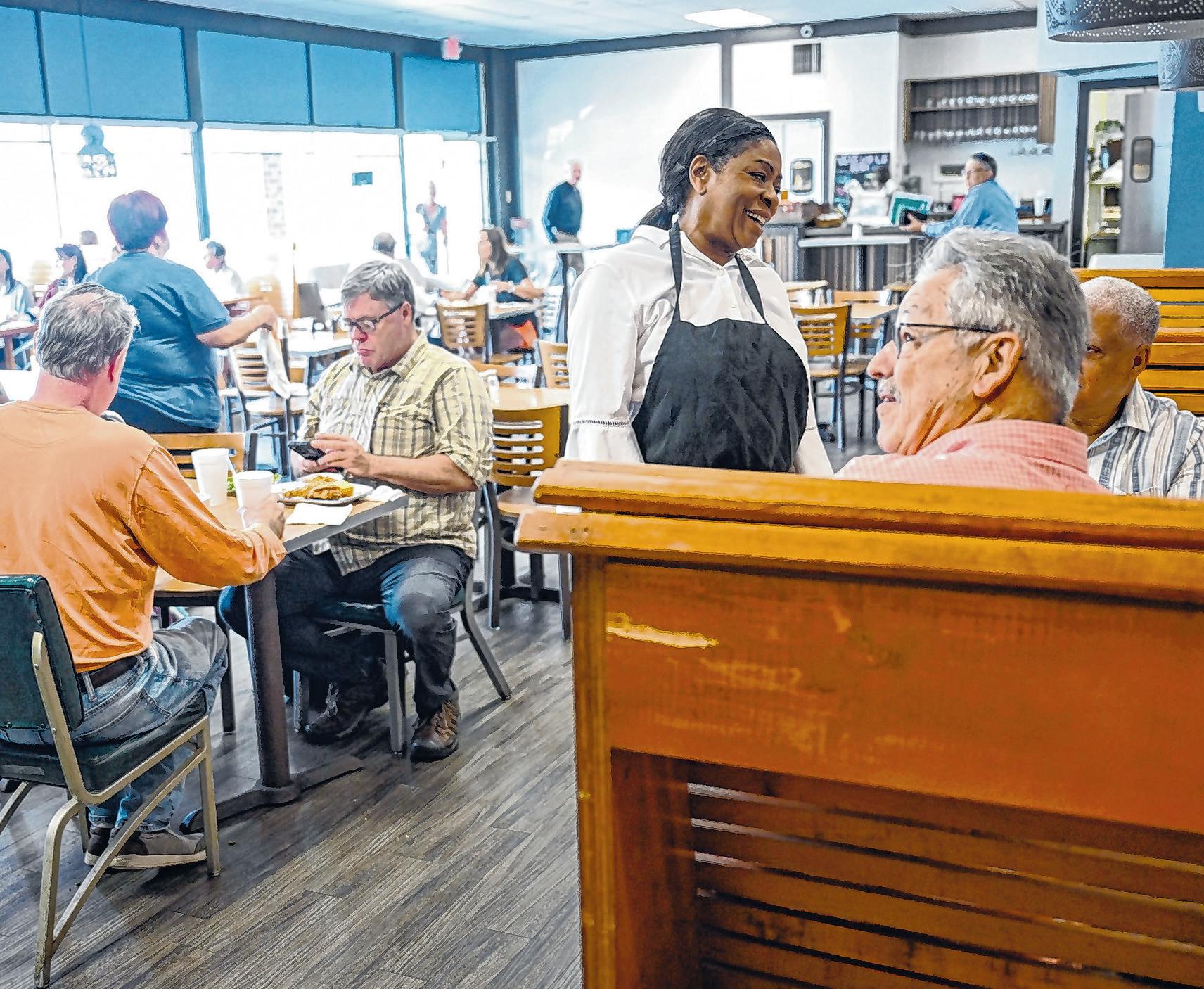
blood test shows that I’m 50 years old, rather than 65.
Where did your love for real, whole foods begin?
I’m always honoring my grandmother, Miss Rachel, and all the ways she made real food. She never threw anything away.
I always thought of cooking food like feeding (God’s) sheep. Would He be happy if I fed the sheep AstroTurf? No!
Once you start cooking from scratch, it’s hard to go the other way. I also had a child who was allergic to a lot of things, but she didn’t come along until I was 40.
I did work at one or two fast food restaurants when I was a teenager. I saw, even back then in the ’70s and ’80s, how bad the food was.
My husband, we married when I was 24, loved fresh food. We always cooked. One day, we gave a potluck on the last Friday of the month. There were 75 people outside our door. I fed them all. He told me I needed to own a restaurant.
What kept you going with the restaurant, even during your cancer battle?
I’m not just in to make a profit.
This is our 36th year, and I get up every morning. I did it every day that I was going through radiation and chemo. I got up every morning, I went into the restaurant and I made the biscuits. I cooked all day. Then right before close, around 1 p.m., I’d come home, take a shower and go to the hospital for chemo. It kept me with a routine. There was no time to feel fearful or scared.
I kind of treated cancer like it was a bad boyfriend I was breaking up with: We weren’t getting en-
gaged. We weren’t getting married. He’s not coming home with me. I had to kick Mr. Cancer to the curb. I’m just grateful for the following that I’ve had for 35 years — most restaurants don’t make it that long. I’m feeding third or fourth generations. I may not win all the awards, but I get so much love from my customers. I know I’m doing the right thing for my community.
Email Margaret DeLaney at margaret.delaney@theadvocate. com.
BY LAUREN PEACE Tampa Bay Times (TNS)
TAMPA, Fla. — Dr. Brian Collins was completing his medical residency at Georgetown University in the early 2000s when the institution invested in a new and groundbreaking technology that would shape the course of his career. The system was called CyberKnife.
Developed at Stanford University three decades ago, the CyberKnife System is one of the earliest adoptions of artificial intelligence in medicine, Collins said. It’s a specialized and effective way to treat challenging tumors — like those in the brain.
Today, Collins is a radiation oncologist and one of the world’s leading experts in CyberKnife treatments. That drew the attention of researchers at Tampa General Hospital and USF Health, who recruited Collins from D.C. to Florida’s Gulf Coast in 2022. He started the hospital’s CyberKnife program in 2024.
Why it matters
When tumors form in the brain, surgeons face a daunting task in the operating room.
The growths are often entrapped in clusters of arteries and nerves that control a person’s ability to see, hear, move and breathe. Error can result in paralysis and death.
The operations are risky. But CyberKnife helps minimize the likelihood that something will go wrong. Using the machine, doctors like Collins can zap away bits of tumor using highly targeted radiation after surgery. That means surgeons can be more conservative when making cuts — they can leave remnants of tumors behind.
That was the case for Mallory McLean, who learned she had a brain tumor while pregnant last year. McLean, who underwent surgery a week after giving birth, had a tumor the size of a golf ball growing near her brain stem.
In an hours long operation, doctors were able to remove around 93% of the mass. But the remaining 7% lingered dangerously close to her body’s essential wirings.
That’s where CyberKnife comes in.
How it works
Radiation can be used to treat cancerous and noncancerous tumors by exposing the abnormal cells to beams of high energy that kill them. The trouble is, radiation kills healthy cells, too.
Exposing areas of the brain to high doses of radiation could come with its own negative side effects. But the CyberKnife system has made it

TAMPA BAY TIMES PHOTO BY DIRK SHADD
Mallory McLean holds up the mask she wore during CyberKnife radiation treatment. She learned she had a brain tumor while pregnant with her second child. Doctors embarked on a treacherous waiting game — delaying surgery to protect her baby. Now, they’re both healthy.
possible to target fragments of abnormal cells while sparing healthy tissue.
First, doctors like Collins take images of a patient’s brain and plug them into a computer. Once they distinguish the healthy tissue from the unhealthy, telling the computer which areas to target, it forms a sophisticated plan.
Artificial intelligence is able to map the brain, or another part of the body, to find the best path to the tumor cells. When the tumor is hit from different, highly calculated angles, the unhealthy tissue is exposed over and over again, while healthy tissue avoids the repeated exposure.
And CyberKnife eliminates the higher risk of injury or error if a surgeon were to attempt it by hand.
“It does it independently, and it does it better than any human can deliver radiation,” Collins said.
Because of the degree of accuracy, this type of therapy can be used to treat a broader range of patients than those who were treated by radiation in the past. And, Collins said, the procedure is far less invasive. Previously, radiation oncologists would have
to still patients using heavy frames that were screwed into their skulls to prevent movement. Because the treatment is noninvasive, it can be administered over several sessions. That lessens the side effects and protects the brain stem and facial nerve from damage.
A robotic remedy
Outside of brain tumors, the system can be used to treat lung tumors and those in the spine. More recently, researchers have studied CyberKnife and its effectiveness in treating neurologic conditions like tremors, and mental health conditions like depression and obsessive compulsive disorder. But its primary use, Collins said, is treating brain tumors because of its precision.
For patients with small tumors, CyberKnife treatment can sometimes spare them from surgery altogether, clearing the growth on its own.
For others, like McLean, CyberKnife is the final step toward recovery. She underwent five sessions — each between 15 and 20 minutes — in the months after her surgery. Now, her tumor is gone.
WE WANT TO HEAR FROM YOU
The Louisiana Health section is focused on providing in-depth, personal accounts of health in the state. This section looks at medical innovations, health discoveries, state and national health statistics and reexamining tried and true methods on ways to live well.
Health editions will also profile people who are advancing health for the state of Louisiana. Do you have a health story? We want to hear from you. Email margaret. delaney@ theadvocate.com to submit health questions, stories and more.
A June 21 Health section story about colon cancer rates in Louisiana incorrectly reported Cherie Broome’s family background. Although she is from Louisiana, she is not of Cajun descent.
BROUGH TT OY OU BY
Water is always the foundation. Iwant to start there because electrolyte powders, tablets and ready-to-drinks are everywhere. While Ilove having those options, water is often the best option for manyofus, most of the time. If we’re inside in the A/C and moving through anormal day, water is usually enough. We also get electrolytes from food: sodium from salt and naturally salty foods; potassium from fruits, vegetables, beans and dairy; magnesium from nuts and greens; and calcium from dairy and fortified foods.
But Louisiana heat changes the math When we’re exercising, working outdoors or even just running errands in tripledigit “feels-like” temperatures, we’re losing more than fluid –we’re losing electrolytes, especially sodium. When sweat losses climb, plain water may not be enough to keep energy, focus and muscle function where we want them. Low-level dehydration can show up as fatigue, headache, higher heart rate and cramping while more significant dehydration raises the risk of heat illness and heat stroke.
Electrolytes help to regulate our fluid balance, nerve signaling and muscle contractions. Sodium is the big one when it comes to sweat. Potassiummatters too, especially for muscle contractions and fluid balance inside our cells, but we typically lose farless potassium than sodiuminsweat. Magnesium and calcium also support muscle and nerve function, though they’re not usually the top priority for sweat replacement.
Apractical rule of thumb for heavy sweating is to aim for about 300 to 600 mg sodium per hour of exercise or outdoor work. Some people may need more. Clues can include salt streaks
on clothes, gritty skin after workouts, frequent cramping or feeling wiped out despite drinking plenty of water.
Idon’t recommend most traditional sports drinks as adaily go-to because they bring more added sugar and synthetic food dyes than Iwould want in an everyday hydration choice.
LMNT, pronounced “element,” is my highest-sodium pick:1,000 mg sodium, 200 mg potassium and 60 mg magnesium, with no sugar and stevia as the sweetener. It tastes salty, not syrupy, which is what many heavy sweaters need Ilike it for long runs,intense workouts, tennis, pickleball, longoutdoor events or anyone who finishes with salt rings on their shirt.
TransparentLabs HYDRATE surprised memostthis year.Ithas 500 mg sodium, 250 mg potassium, 50 mg magnesium, 84mgcalcium and 1gramtaurine, with 5 calories, 1gramcarbohydrate and no sugar. It’s stevia-sweetened, with no artificial colorsorartificial sweeteners.Iappreciate the “transparent” part: the label gives amounts for even the smaller ingredients, and the company provides third-party testing and certificatesofanalysis. The package alsonotes banned-substance testing, helpful for competitiveathletes. UltimaReplenisher is acompletely different type of product. It has only


55 mg sodium, with 250 mg potassium, 100 mg magnesium and 47 mg calcium, 0calories, 0sugar and stevia as the sweetener. Thisisnot my pick for replacing large sodium losses after a sweaty workout, but it is agreat option for those who need to limit their sodium intake and want to sip something flavorful with added minerals. BodyArmor Lyte is my grab-and-go bottle option. It’s easytofind, which matters when we’re out and about. A 16-ounce bottle has about 20 calories, 2 grams sugar, no artificial dyes, roughly 30 to 40 mg sodium and about 680 to 700 mgpotassium. Like Ultima, it’s centered on potassium, not sodium, so Igenerally
Molly Kimball, RD, CSSD, is aregistereddietitian with OchsnerHealth and founder of Ochsner’sEat Fit nonprofit initiative. For more wellness content, tune in to Molly’s podcast, FUELED Wellness +Nutrition, and follow @MollykimballRD and @EatFitOchsneronsocial media. Email nutrition@ochsner.org to connect withMolly or schedule aconsult with herteam.
BY THE NUMBERS
don’t recommend it as aheavy-sweat sodium replacer, but Idolove it as alower-sugar, easy-access sports drink swap. The DIY option is the most affordable and customizable:add 1/4 teaspoon sea salt or table salt to about 20 ouncesof waterfor roughly 600 mg sodium. You can add apinch of potassium chloride (available online as asingle ingredient, or in stores as salt substituteslike NoSalt or Nu-Salt). Then, flavor it with lemon or lime, fresh ginger juice,hibiscus tea, mint teaornaturally sweetened no-sugar lemonade. The function is the sodium and potassium; the flavor just makes it more interesting and palatable for those who preferflavor
The Bottom Line Waterwins for everyday hydration. Whenheat, humidity and sweat losses go up –add electrolytes. Match the product to the purpose with highersodium for heavy sweat, lower sodium for everyday sipping and low sugar with no synthetic dyes whenever possible
In 2023, there were over 2 million marriages in the United States, at a rate of 6.1 marriages per 1,000 people.
Louisiana had the lowest marriage rate in the country when compared to other states at 3.7 marriages per 1,000 people, according to marriage rate data published by the Centers for Disease Control and Prevention.
Marriage rates, compiled by data from the National Center for Health Statistics, are calculated based on where, by state, a couple got married. Nevada, with Las Vegas in mind, has had the highest marriage rate in the U.S. for 36 years — although it has declined, from 99 marriages per 1,000 people in 1990 to 24.6 marriages in 2023.
Louisiana saw its lowest marriage rate in 2020 with 3.4 marriages per 1,000 people. The marriage rate for the state has been steadily declining since 1990:
n 9.6 marriages per 1,000 people in 1990;
n 9.3 marriages per 1,000 people in 1995;
n 9.1 marriages per 1,000 people in 2000; n 8 marriages per 1,000 people in 2005; n 6.9 marriages per 1,000 people in 2010; n 6.8 marriages per 1,000 people in 2015;
n 3.4 marriages per 1,000 people in 2020.
These states had the lowest marriage rates in 2023:
n Louisiana with 3.7 marriages per 1,000 people;
n Delaware and New Mexico with 4.7 marriages per 1,000 people;
n Minnesota with 4.8 marriages per 1,000 people;
n Michigan and Wisconsin with 5 marriages per 1,000 people;
n Illinois, North Dakota and Ohio with 5.1 marriages per 1,000 people;
n Iowa, Maryland and Massachusetts with 5.2 marriages per 1,000 people.
These states had the highest marriage rates in 2023:
n Nevada with 24.6 marriages per 1,000 people;
n Hawaii with 12.5 marriages per 1,000 people;
n Utah with 11.2 marriages per 1,000 people;
n Montana with 9.2 marriages per 1,000 people;
Continued from page 1X
faces, which is indicative of the physical sunscreen,” German said.
“It’s far more aesthetic to have an invisible layer.”
Chemical sunscreens are transparent and act “like a solar sponge,” German said, that absorb photons in a harmless chemical reaction.
Chemical sunscreens available in the U.S. combine ingredients that filter UVA rays with separate ingredients that filter UVB rays.
Those sunscreens, often called “broad-spectrum protection,” are only effective for a short time.
“(Bemotrizinal) is very stable in sunlight, so it keeps working longer
than some older sunscreen ingredients,” said Dr. Therese Pacheco, a dermatology professor at the University of Colorado Anschutz.
Bemotrizinal, a chemical sunscreen, blocks both UVA and UVB rays and does not leave a white cast on the skin.
“The chemical sunscreens are becoming better and better,” German said.
On top of the aesthetic benefits, bemotrizinal stays on the surface of the skin with very little absorption or irritation to the skin.
Regardless of new sunscreen ingredients, it’s important to still apply it before hitting the beach or the tennis court this summer.
Choosing the right sunscreen can help reduce the risk of skin cancer, including melanoma, the


Source:
n Arkansas and Colorado with 7.8 marriages per 1,000 people;
n Tennessee with 7.3 marriages per 1,000 people;
n Vermont with 7.2 marriages per 1,000 people;
n Florida, Idaho, Maine and Wyoming with 7 marriages per 1,000 people.
deadliest form of skin cancer.
Here’s what to look out for on the shelves:
Blocking both UV rays
Back in 2012, the FDA did a major update of sunscreen standards, including banning the inaccurate, misleading terms “sunblock” and “waterproof.” Now manufacturers can only label products “water resistant” and must state how soon they break down from swimming or sweating, either 40 or 80 minutes.
In the meantime, use sunscreen that protects against both harmful types of ultraviolet rays, UVA and UVB.
The level of protection against UVB rays is measured by SPF, or sun protection factor. For UVA rays, sunscreens are rated as
passing or failing government standards.
Pick sunscreen rated at least SPF 30, considered the minimum needed.
“The higher the SPF, the better,” German said.
Make sure the label says “broad spectrum” to ensure the ingredients block both UVA and UVB rays. Apply it properly
Most people using sunscreen don’t realize they’re applying too little, too late and too infrequently, says Dr. Darrell Rigel of the American Academy of Dermatology’s sunscreen regulations task force.
An average-sized person should apply roughly an ounce, or about two tablespoons, on all exposed skin. That’s about twice what most
people use. Apply it 15 to 30 minutes before going outside, then reapply at least every two hours, more frequently if swimming or sweating a lot. With spray-on sunscreen, apply two coats, then rub it in to ensure even coverage.
‘Anything is better than nothing’
“The sun is dangerous,” German said. “If you’ve got a sunscreen, it’s better to put it on than not put it on.”
While looking at the options on the shelf, if a greasy sunscreen feels better on the skin, or a scented one makes the summer day feel better, that’s fine, German said.
“The sunscreen that best suites you is the best sunscreen. Anything is better than nothing.”



At theOchsner Andrews Orthopedics andSports Medicine Institute, every decision we makeisfocused on helping our patients move forward. From the latest technology to the depth of our expertise, our team brings elite care, cutting-edge research and advanced training to the communities we serve. Your recovery, goals and quality of life drive everything we do—and we move forward with you, every step of the way.
Dr.Cefalu is available at several of our locations. Call (225) 388-6630 to schedule.

BY LAUREN CHERAMIE
Staff writer
When Lance Nacio started out in the shrimping industry in the late 1990s, he had a bag phone. At the dock, he could get $4 a pound for shrimp, and he paid a lot less for diesel.
Today, he has Starlink satellite internet, navigation technology and
an iPhone on his shrimping boat, the Anna Marie. The generation that came before Nacio didn’t have access to these tools, but, compared to today, those shrimpers and business owners weren’t grappling with the negative effects of imported shrimp.
Statewide, organizations like Shrimp Aid are dedicated to supporting the industry and shrimpers like

Nacio, whose family made a living off the land and grew up in a trapping camp. The nonprofit promotes responsible harvesting practices and connects with policymakers to enact change within the industry.
“We have this natural resource, and my family’s made a living for several generations — living off the resource. Now we’re just having to do it a lot differently than they used to. They’ve all had their share of struggles, but they never had imported shrimp to compete against,” Nacio said as he waited out a short summer rain shower from the dock of his home in Montegut, where he operates Anna Marie Shrimp.
Louisiana leads the nation in the shrimp industry, ranking as the top harvester of shrimp in the Gulf and the United States, according to the Louisiana Department of Wildlife and Fisheries. The state also has the largest commercial blue crab fishery and leads the way in oyster production and crawfish production.
“More than 70% of the seafood and other fisheries products landed in the Gulf each year comes through Louisiana, creating a total annual economic impact of nearly $2 billion,” LDWF states.
The shrimping industry is an anchor of the state’s seafood industry, but it’s at risk.
Shrimp Aid executive director and chef Dana Honn says that most of the seafood industry’s infrastructure was built around shrimping, in terms of the state’s waterfronts, processors, ice houses and docks.
“The whole thing would crumble if the shrimping industry collapsed,” said Honn, who owns Nikkei Izakaya and Tempero’s Kitchen in New Orleans. “There would be cataclysmic cultural effects throughout the region. I think it’s hard to quantify and qualify just how dire that would be for everybody.”
Through collaboration, education and advocacy, Shrimp Aid’s goal is to protect the livelihood of Louisiana’s shrimpers.
ä See SHRIMP, page 2Y
Jan Risher
More than a thousand miles from Louisiana, I felt completely at home in the steam sauna at Iron Mountain Hot Springs in Glenwood Springs, Colorado. The small room felt like a July afternoon in New Orleans after a rain.
Our daughter Piper lives in Denver. Two days after I arrived for a visit, she and I drove farther west to spend time in springs that run hot overlooking the Colorado River that runs cold.
We made the same trip at the same time last year — just weeks before our house fire in August. Since then, my days have been filled with work and my nights with insurance adjusters, tile samples, paint colors, delayed sinks, doors that open out when they ought to open in and the wrong-sized windows.
Piper and I arrived early and loved sitting in the hot pools watching the mist rise and fall across the surrounding mountaintops. A full day in and out of mineral water was just what I needed.
Iron Mountain has 35 pools that range from 45 to 107 degrees, with minerals from potassium to sodium, calcium and more. This year it also has five new saunas — steam, salt, red light, aromatherapy and a traditional Finnish one.
I’ve been fascinated by saunas since studying the role they play in life in Finland. I was eager to try them all.
Finland has been named the world’s happiest country for nine years running — a ranking that measures life satisfaction rather than passing joy. Researchers sometimes credit sauna culture as one contributor.
For all those reasons, I started the day in the saunas.
I skipped the cold plunge pools. I skipped them again after a while, and again after that. Last year, I tried a cold plunge once, got partway in, and decided it was not for me.
Drew Brees may swear by them, but I had made my peace. In the early evening, a woman who lives in Glenwood Springs started talking with us as we relaxed in a magnesium pool. The lady makes almost daily use of her annual pass and spoke about the cold plunge the way some people talk about a miracle drug. She explained how it had genuinely changed the way she felt. Her confidence made me reconsider, and I mustered the courage to once again try the cold plunge.
I got one foot in, up to the calf.
“Let’s do the steam sauna,” she said, “then try again.”
So we sat in the heat that reminded me of home, and then we went back out. The second time I got in up to my waist.
I counted that as a victory and retreated to the steam where a talkative group had gathered. They started discussing the cold plunge. One by one, they decided to try it.
One by one, they came back into the steam sauna. They had all gone in, all the way under.
Then this group of strangers began to encourage me to give it one more try.
When I stood up to try the cold plunge for a third time, people I had known for 20 minutes cheered me on.
I walked outside, walked right into the 45-degree water, lowered myself all the way in, even dunking my head.
I did not tarry. When I walked to the steam
BY JOY HOLDEN Staff writer
In 2024, artist and activist
Jackie Sumell established the nonprofit Freedom to Grow, an abolitionist-driven initiative of art, land-based healing justice, community empowerment and archival practices. The abolitionist movement works to end incarceration and create alternatives to punishment. Sumell serves as the creative director.
Freedom to Grow’s current projects include Herman’s House, Solitary Gardens, the Abolitionist’s Apothecary, the Abolitionist’s Sanctuary and an artists-in-residence program.
Originally from New York, Sumell moved to New Orleans in 2005 and says she’s lived there longer than she’s lived anywhere.
Sumell’s creative practice has been supported by residencies and fellowships, including the 2024 Guggenheim Fellowship, 2023 Christian A. Johnson Fellowship, 2022 Marguerite Casey Foundation Fellowship and Rockefeller Foundation. Her collaboration with Herman Wallace, one of the Angola 3 (Wallace, Albert Woodfox and Robert King — former Angola prison inmates who lived in solitary confinement for several decades), was featured in the Emmy Awardwinning documentary “Herman’s House.”
This interview has been edited for length and clarity. For those who may be unfamiliar with the term “abolitionist work,” how would you describe that?
It’s really important that we think about abolition as a practice that isn’t precisely defined. … I personally think of abolition as a practice where we respond to inevitable harm with the intention of not creating more.

There are many people who speak much more eloquently to this, but I think of abolition as something that not only exists as the desire to live outside of a punitive system, but as something that we do relationally every day with every thought, word and action.
How did you get involved in abolitionist work in Louisiana?
I started off as a pen pal with Herman Wallace and Albert Woodfox of the Angola 3. That evolved into moving here to be closer to them, and I began work on a project called “The House That Herman Built.”
It really reorganized my life and value system. The next 20 years of this work has been a way to say thank you to Herman and Albert and John Thompson. As a practice of gratitude to be closer to them, I have created family relationships with other folks who are still incarcerated.

Continued from page 1Y
sauna with my hair dripping, they cheered again. That sounds small. It was small. It was also something I had been sure I would never do, and I did it because a roomful of strangers encouraged me.
I smiled despite myself and had to admit: I felt fantastic. Maybe the moment wasn’t as much about the cold water as being reminded how quickly strangers can become allies.
For the past few weeks, the World Cup has been everywhere, with North America hosting visitors arriving from all over the world. That story keeps surfacing in interviews and clips — guests amazed by how welcoming Americans have been, how warm, how generous with directions, seats, time and breakfast.
For the first time, I have been glued to the World Cup this summer, mostly for that strangers-turning-
allies feeling. (As a side benefit, I’ve even begun to understand offsides.)
Lately, I’ve felt as if our country is constantly being reminded of what separates us. The World Cup has shown that we can still be the people I grew up believing we are.
I don’t know exactly what a cold plunge in Colorado says about a country turning 250. Maybe nothing. Maybe this: People who will never see one another again stood up and cheered for a stranger over something that did not matter at all and mattered completely.
We do not have to agree, but we can still be kind. We can still talk someone into the cold and cheer when she goes under — and welcome her back into the warmth.
A country turning 250 is a lot to hold in the mind at once. A roomful of strangers cheering someone in and out of cold water is not. I will take this small thing — and be ready to celebrate the next one.
Email Jan Risher at jan. risher@theadvocate.com.
hope is that we inspire a world where we don’t rely on punishment to respond to harm.
We just started a capital campaign to be able to retrofit the John Thompson Legacy Center to be this museum.
How do the Freedom to Grow Solitary Gardens spread that abolitionist practice?
Solitary Gardens, in particular, is birthed out of Herman’s House — creating garden beds that are the same size and blueprint that solitary cells are. Then they’re grown in collaboration with folks who are currently incarcerated and tended to by folks on the outside who are formerly incarcerated.
My elders often say those of us who are closest to the problem are also closest to the solution.
live and exist outside the world that we know. That’s terrifying. We’re asking them to look at the legacy, not only of the horrors that have happened on the land now occupied by the Louisiana State Penitentiary, but to imagine, to feel and to think about the magic or the resistance or ways that people not only survived the impossible, but transmuted it. Ultimately, to look at the ways that people can take the impossible and alchemize it into a different outcome.
How can Freedom to Grow impact Louisiana?
What’s been so beautiful is that it no longer is just Angola. It’s prisons across the country.
I feel very deeply committed to this land and this place. I’m here for the long haul.
How did Freedom to Grow evolve into the organization it is now?
It’s an outgrowth of this work and the legacy of the Angola Three.
Starting a nonprofit was not something that I, as an artist, ever imagined, but it became necessary in a world in which it has become increasingly difficult to fundraise. Doing abolitionist-centered work and visiting folks in prison has been a labor of love for most of this journey, but the larger the projects get, the more they require sustenance.
Freedom to Grow will continue long beyond my own life, and it allows us to create a means of fundraising and sharing. The
Continued from page 1Y
In 2024, Honn hosted the first Louisiana Shrimp Festival in New Orleans, which featured live music, food vendors, panel discussions and presentations from leaders in the industry. Last year, SeaD Consulting, a private thirdparty testing company that conducts genetic testing on shrimp dishes, was present to conduct testing. This year’s festival is scheduled for Oct. 18 at The Broadside (600 N. Broad St., New Orleans).
Honn also wants to start a “Shrimp Drops” initiative to bring Louisiana shrimpers, chefs, musicians and culture bearers to people beyond the South. His goal is to educate people on how their seafood choices can have an effect on Louisiana’s coastal communities.
“Ultimately, it is the consumer that has the power,” he said. “They wield a huge influence over the entire system.”
Nacio has also done his fair share of advocacy for the industry, working with the Louisiana Shrimp Task Force, making trips to Washington, D.C., to meet with lawmakers and encourage opposition to imported shrimp — which often poses health and environmental risks because of the use of banned antibiotics, habitat destruction to coastal communities and unsustainable farming practices.
Honn says these risks were introduced with imported shrimp, and awareness has increased over the past decade. Many imported shrimp include silicone that’s used make shrimp appear larger. Others include carcinogenic antibiotics, preservatives or biological toxins. Some processors use illegal and unethical labor practices.
Many European countries require shippers to prove they tested shrimp for contaminants. If it doesn’t pass, they destroy the packages. In the U.S.,
What is the Freedom to Grow Artistin-Residency program and who are the artists?
Artists are the vanguards of complicated and sometimes impossible conversations. Art is a critical vehicle, and so, how do we engage artists in abolitionist and revolutionary thinking?
New Orleans icons Chandra McCormick and Keith Calhoun are our inaugural artists in residence. This was a relationship that was like literally born out of deep admiration for their work and for their legacy, both inside Angola and inside New Orleans.
We’re asking Keith and Chandra, who are very established photographers, to work outside of their medium and comfort zone — as an abolitionist practice. It’s challenging them to be an example of growth within the realm of productive discomfort.
An abolitionist future is not reform, but it requires us to really
I want people to know that the entire world is born from the tip of intention. If our intention is to be kinder, faster, we can build that world. If our intention is to be bigger and meaner, then we will build that world. So, what Freedom to Grow is hopefully doing is creating an alternative universe that is rooted not only in possibility but in lived experience.
Herman used to say to me, “Slow down, baby, this is a marathon.” What I’ve come to realize is that it’s actually a relay race, and Freedom to Grow is the baton.
I want people to know, to trust, and to believe that another world is possible. The first step is an act of faith. Our relationship to faith and to spirituality is actually a superpower, and we can think of abolition as a practice of faith. In some ways, I want Freedom to Grow to be a container for folks to feel safe in abolitionist thought and practice.
Email Joy Holden at joy.holden@ theadvocate.com.

Nacio said, we return it to the shipper if contaminants are found.
“So, there’s no risk sending to the U.S. The risk is sending to the European countries, so that’s why we became a dumping ground for shrimp,” he said.
In June, Louisiana passed several laws to support shrimpers, including one that expands the authority of the agriculture department to destroy seafood that fails to meet the state’s testing requirements.
Shrimp fraud is also another industry concern.
Louisiana law requires restaurants to explicitly state when they serve imported shrimp, but some establishments are getting caught for serving it without accurate labels. SeaD Consulting has conducted
research throughout the state to expose seafood fraud — efforts that also move the needle.
“I want to see people survive and thrive in the industry. And the only way is if we can combat the fraud and get people to be aware of what they’re eating,” Nacio said. “That’s the biggest problem: People aren’t aware of what they’re consuming.”
Nacio and Honn encourage consumers to always ask a retailer where their shrimp comes from. Honn even suggests going a little deeper and making a connection with a local shrimper or fisher, because “your life, and your table, will be much richer.”
Louisiana’s fisheries are shaped by a mix of ethnic groups that are deeply tied to the Gulf’s coastlines,
including Vietnamese Americans, Cajuns, Croatians, indigenous African Americans, Native Americans, Filipino communities and others. When so much of the state’s culture is imbued in the spirit of gathering around food, what happens when those ties are severed? Honn, Nacio and other coalitions are championing the industry, in hopes that Louisianans don’t have to find out.
“We’re talking about an activity of harvesting wild seafood that is rarefied today, so we have to be in awe of and have respect for that,” Honn said. “We are stewards of that resource.”
Email Lauren Cheramie at lauren.cheramie@ theadvocate.com.
BY BRIANNA MEEKS
Contributing writer
Damon Walker remembers a different Scotlandville. As a child in the 1980s, he rode his bike through the neighborhood on Baton Rouge’s north side, visited the local “candy lady” and watched residents support nearby businesses.
At the time, he said, local stores were woven into the neighborhood and children could walk to gathering spots without traveling far from home.
“It was a fun place growing up,” Walker, now 40, said. “Parents could trust you to go to the corner store.”
It’s different today.
Walker and his partner in life and business, Brittany Moss, 43, are working to bring new investments into the neighborhood they once explored as children. They said they want to create opportunities for future generations while helping address housing needs.
“The idea was always there,” Walker said.
Earlier this year, they broke ground on the Cottages at Ravelle Homes, which they said will provide affordable housing for students at Southern University.
Investing in the community
Moss and Walker both knew they wanted to invest in their community. For years, separately and now together, they worked toward that goal through entrepreneurship, real estate and property development.
“Everything acquired over time,” Moss said. “So it was just destiny.”
The couple met at a Louisiana Leadership meeting in 2022. At the time, Walker owned a car wash and detailing business. Soon, they started real estate ventures, including a property they bought together
across from Walker’s businesses near where the Cottages at Ravelle Homes are being built.
Walker oversees development projects while Moss handles the real estate side of the business. Sitting recently at French Truck Coffee on Government Street, Moss and Walker reflected on their childhoods.
Moss described herself as a talkative kid. Walker said he had a knack for building things from the ground up.
In addition to operating a windshield repair business with his cousin, Walker invested in property throughout Scotlandville.
One of his earliest development projects was the Compound, located across the street from where the future Cottages will stand.
Moss started working at Chase Bank at 18, thinking she’d transition to college at Southern University with the goal of becoming a social worker. She was a first-generation college student, but there was another motivation pushing her forward.
She became a mother at a young age.
Still, at 22, she purchased her first home. It was in that home, she said, where her daughter took her first steps. After becoming a mother, she wanted to create stability for her daughter.
So, in 2019, Moss made a vision board of what her life could be in the future. She reimagined every piece she put on that board and couldn’t believe all that she’d already accomplished.
“You don’t realize you’ve done so much within a circle of time,” said Moss, who eventually changed her mind about pursuing a career in social work.
Moss said she has generated more than $15 million in sales as a real estate
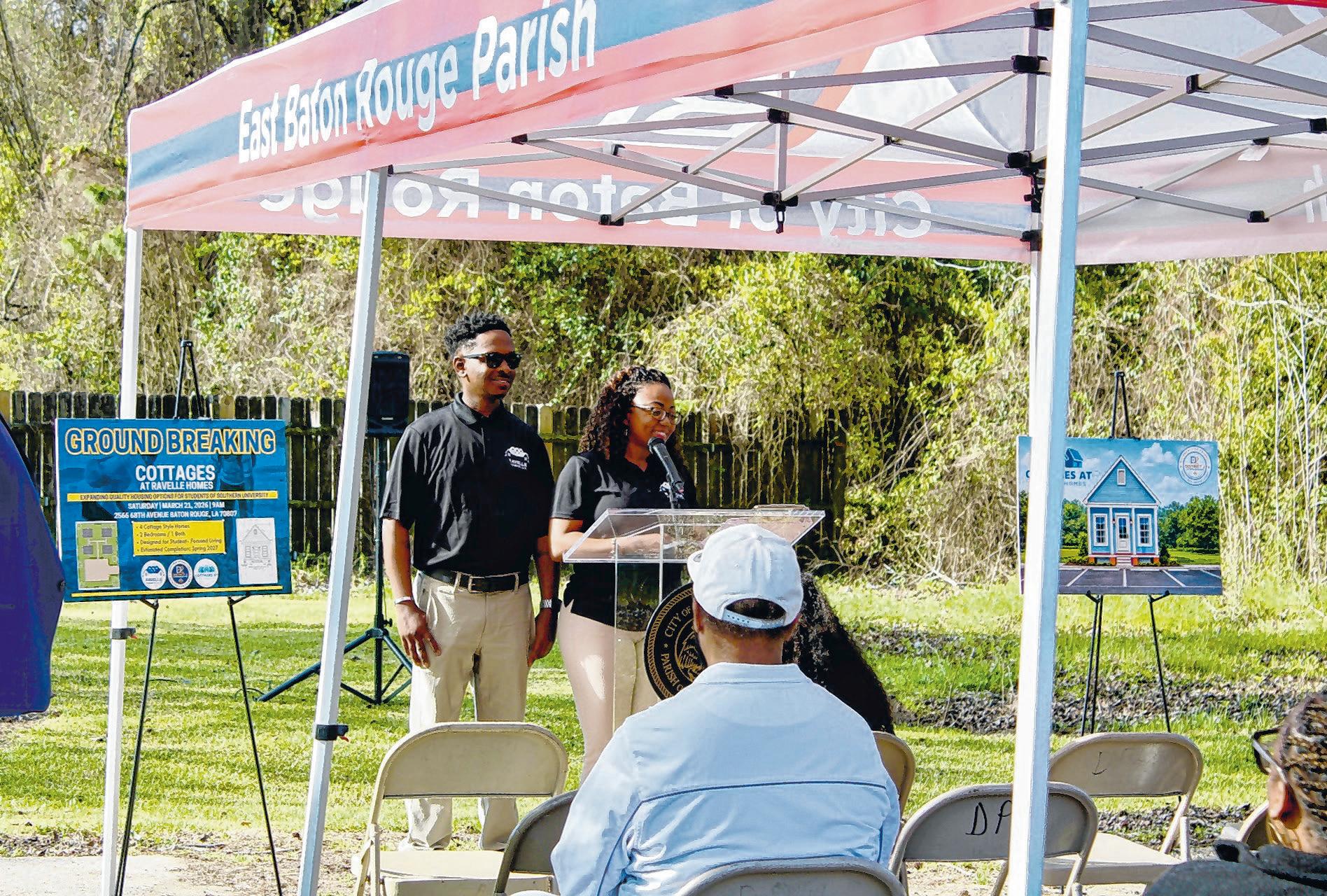
agent while helping over 50 families purchase homes in Baton Rouge. Years of vision, property acquisitions and community investment eventually led Moss and Walker to developing the Cottages at Ravelle Homes. Breaking ground
The Ravelle Homes LLC broke ground on new student housing near Southern at 566 68th Ave. on March 21. The project aims to address blight in the Scotlandville area. With increased enrollment at Southern, dorms have reached maximum capacity, creating a need for more affordable options for students.
Moss and Walker worked with local officials, including East Baton Rouge Par-
ish Metro Council member Anthony Kenney, to move the project forward. Kenney said the development will provide students with an opportunity to live closer to campus and was thrilled to help rezone the area.
“Out of the 8,000 students at Southern, about 5,000 need housing,” he said.
The development will consist of eight small, standalone houses under 1,000 square feet, each including two bedrooms, one bathroom and accessibility features for individuals with disabilities. The homes will also include kitchens, porches and designated parking spaces, along with in-unit stackable washers and dryers.
Construction is expect -
ed to take six months to a year, Walker said, with occupancy starting for Southern’s spring 2027 semester.
Current on-campus housing at Southern University typically ranges from about $1,880 to $3,000 per academic year, depending on the housing style, said Nevaeh Paschall, who works as a resident assistant. Affordability remains a concern, Paschall said, noting that housing applications fill quickly due to limited availability.
“A lot of students are barely making it with the rates we currently have,” Paschall said.
Rental rates for the Cottages at Ravelle Homes are expected to range from about $1,100 to $1,300 per
unit, according to Moss. Since this project is Moss and Walker’s first, they will also manage the properties and maintain safety measures, including 24-hour security cameras, they said. In the future, the team hopes to create more opportunities for development in the Scotlandville area and improve the community while doing so. This story was reported and written by Brianna Meeks, a journalism student at Southern University, with the support of the nonprofit Louisiana Collegiate News Collaborative, an LSU-led coalition of eight universities funded by the Henry Luce and John D. and Catherine T. MacArthur foundations.








“I am honored and excited to take on this newrole.Shell Norcoisanimpor tant site with alonghistory and areputationfor having greatpeople and astrongculture.”
ShellwelcomesAlexMarkosasthe newlyappointed Vice President of theNorco site. Markoshas worked in severalcountries in avariety of roles. Most recently,his leadership at Shell Polymers MonacainPennsylvania andthe Sarnia Manufacturing Centre in Canada prepared himfor balancingthe demands of large -scale operationswiththe impor tanceofculture, trust, andvisible leadership.AtNorco,he stepsintoaworkplace widely recognized within Shell forits strong culture.“There’sa real senseofpride here,”hesays. “People care about thesite, about each other, and about doingthingsthe rightway.You can feel that immediately.
At thecoreofhis leadership philosophyisthisprinciple :safet y comesfirst. “Nothing is more impor tant than making sure ever ypersonwho comesto work goeshome safely,” he says.His focus alsoincludes environmentalper formance reliabilit y, anddeveloping thepeople who keep thesiterunning. “You have to deliver todaywhile preparingfor tomorrow.”
ShellNorco is oneofthe most impor tant sitesinShell’sU.S. operations. Theonly Shell refinery in thecountry integrated with chemicals manufacturing, Norcoplaysa centralroleinthe company’soperationsand remains astrong economic engine forthe Gulf Coast.
Archaeologists are exploring beneath Notre Dame
BY THOMAS ADAMSON and JEFFREY SCHAEFFER Associated Press
PARIS — Wilting in the summer sun, a line of tourists waits to climb Notre Dame cathedral and meet its gargoyles.
13 feet beneath them, a team of archaeologists is digging the other way — straight down and back in time, to Roman Paris 2,000 years ago. In 2019, fire brought Notre Dame’s spire crashing down as the world watched. The cathedral was rebuilt and reopened in late 2024, and now Paris wants to soften the hot, bare square in front of it with trees and shade.
But in a city this old, the soil cannot be turned until what lies beneath it is excavated, in case it is damaged during works.
So a slice of Notre Dame’s forecourt has become an excavation site — an open pit ringed by barriers and crossed by a wooden walkway, a few steps from the lineup.
A modern Da Vinci Code
French media have dubbed it the “dig of the century.”
“It’s a rare opportunity for us to work on something that’s tangibly going to make a difference to the history of Paris,” Lucie Altenburg, a conservator with the Paris archaeology unit, told The Associated Press.
Among the hundreds of objects already found: a fourth-century coin stamped with the face of the Emperor Constantine, and shards of medieval pottery painted on the inside with marks no expert has yet deciphered — like a modern Da Vinci Code.
“It makes Notre Dame feel alive again,” said Emily Carter, 34, a tourist from Manchester waiting in line with her two children. “You come to see the cathedral, then realize there’s another city under your feet. That’s almost more moving.”
The first traces appear 20 inches down; 13 feet lower, the team is still pulling up the past. Some days they fill 15 crates — from ground that has lain untouched for decades.
Archaeologists monitoring digs
This is the bargain in every old city: The past is not in a museum down the street — it is under the

street.
Cities rise. Each age builds on the rubble of the last, and the ground climbs with it; in Rome, it has risen about 30 feet since the empire fell in the fifth century AD.
When Athens built its metro for the 2004 Olympics, it set off the largest excavation in Greek history and turned up tens of thousands of objects, now shown in the stations themselves. Paris is no different.
It all comes from the island in the Seine, the Ile de la Cite, where Paris began.
Centuries later, Notre Dame rose on the same ground.
At the cathedral’s birth in 1163, the entire square was packed with medieval houses, split by a single street, said Camille Colonna, the archaeologist leading the dig. Digging down, her team has reached their cellars — and therefore also the time in history they represent.
Below them lie Merovingian and Carolingian grain pits, from the sixth to the 10th centuries; below those, darker and deeper still, a dense Roman quarter from the fourth and fifth centuries.
Twenty centuries are stacked in 13 feet of earth — or about the height of two-and-a-half Napoleon Bonapartes standing on top of one another.
“Here you can see the layers
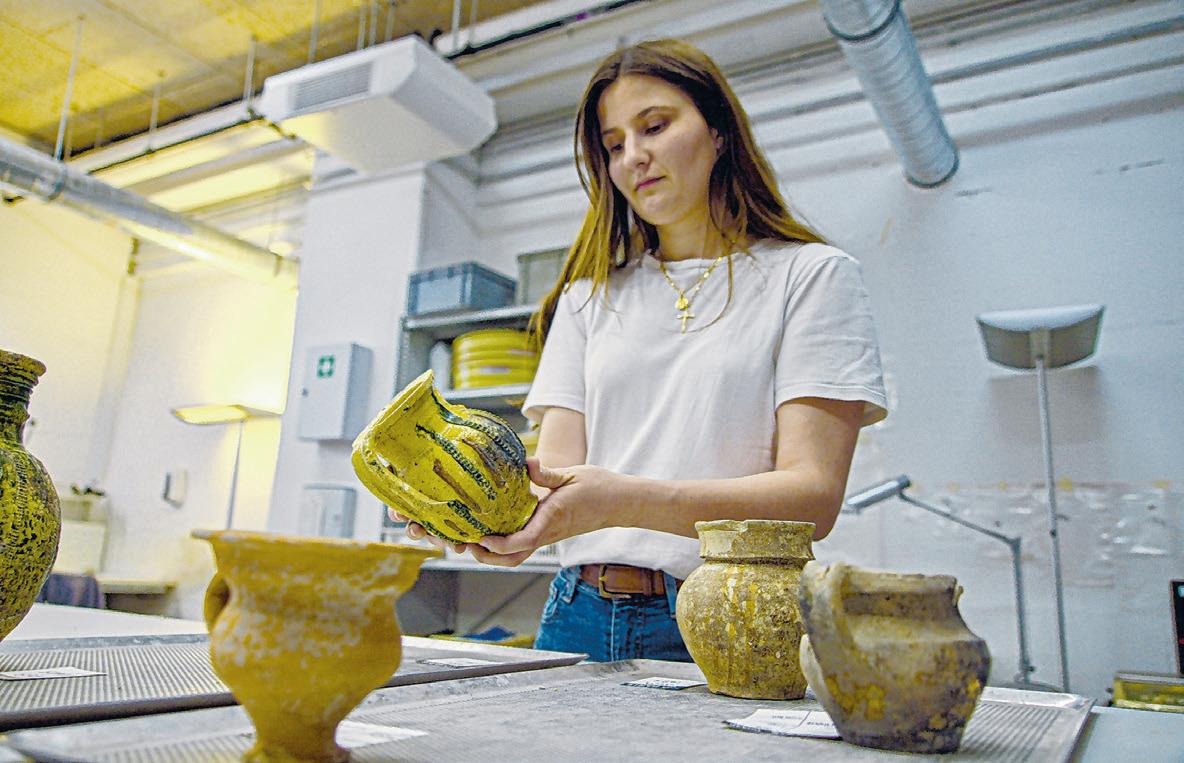
— medieval Paris, Roman Paris, maybe even before that,” said Yasmine Benali, 22, an archaeology student watching from behind the barriers. “It makes the city feel less like a postcard and more like something still being discovered.”
Coins, ceramics
The richest finds here come from the foulest place: the deep pits beneath the medieval houses, old latrines that doubled as rubbish dumps. Out of them the team keeps lifting whole jugs and cups — thrown away centuries ago, yet
still intact — among the broken plates and animal bones.
It’s “rare to find complete ceramics,” said Valentine Breloux, an archaeologist with the unit.
Here the soft waste cushioned them, and centuries later they miraculously came up whole.
Then some other objects came that confounded experts. As conservators cleaned what looked like ordinary medieval pottery, they found faint reddish writing painted on the inside — the same mysterious markings on shard after shard.
What they mean has yet to be
deciphered.
Of everything she has cleaned from Notre Dame, Breloux said, these are the most “astonishing.”
Coins can help date the layers
The coins came up as black discs, eaten by rust. But under an X-ray, a face returned: it was Constantine, the Roman emperor who ruled in the early 300s AD. Such objects also “can be invaluable in giving us the date of the (underground) layer,” Altenburg said.
The Roman finds are the ones the archaeologists value most — the deepest, oldest and least understood. In Roman times, the town was called Lutetia, and its center lay across the river, on the Left Bank.
As the Roman empire collapsed, people pulled back to the Ile de la Cite, where Notre Dame would later rise, and fortified the island with walls of stone taken from earlier buildings.
Colonna’s team found some proof: a Roman doorstep found in the dig, taken from a much bigger building, carried over, turned upside down, and laid in a road as paving.
Paris houses thousands
Every find leaves the pit and travels north, to the city’s archaeology center — what Colonna calls “a huge archaeological store,” a treasure house of Paris.
For archaeologists, the cathedral dig is a rare treat. In France, like elsewhere, they work only where building work is about to begin — a bit like how industrial quarry workers end up unearthing dinosaur remains.
“This only happens because the city of Paris decided it wanted to beautify the area,” Altenburg said.
The new square should be mostly finished by 2028: a kind of woodland clearing, with 160 new trees and a thin film of water sliding over the stone to cool it in summer — part of how Paris is bracing for ever hotter summers induced by global warming.
The tourists who now wait in the bare sun beneath the gargoyles will, in a few summers, line up in the shade. The old underground parking lot will reopen as a visitor center looking onto the Seine.
Until then, the Notre Dame team wants to go deeper still — past the Romans, toward whoever came before them, the Gauls who gave the city its first name.
“The hope is that we are able to go back in time even further than we’ve ever been before,” Altenburg said.
BY AUDREY PACHUTA Chicago Tribune (TNS)
CHICAGO — There’s something addictive about it. Sitting in bed late at night watching one 30-second clip after another. Bright, blue light illuminating the room. Whipping out a camera the moment a restaurant server brings a meal or a favorite performer appears onstage. Succumbing to the urge to scroll Instagram the second conversation grows quiet or social awkwardness creeps in.
The alarm bells began to ring in recent Loyola University graduate Kamryn McPhaul’s head when she realized a third of her waking life was spent on her cellphone.
She, like so many others, craved the “cheap hits of dopamine,” the sense of mindless joy she received from watching a short video only to forget it moments later.
Earlier this year, she decided enough was enough.
Goodbye to Instagram and Snapchat; hello to sightseeing adventures, solo trips to the movies and hours spent at the Art Institute.
The moment McPhaul installed a “permanent black-and-white filter” on her screen and deleted all her social media apps, she felt something shift. She doesn’t plan on going back.
While McPhaul’s mission to curb her screen time has been an individual endeavor, others are increasingly seeking out social spaces to join like-minded people hoping to unplug. The number of phone-free experiences grew by 567% globally in 2024 and 2025, according to Eventbrite, a platform where organizers can advertise events.
In Chicago, this trend has taken various forms: everything from creative spaces relegating devices to cotton bags and locked boxes to phone-free raves moshing into the morning’s wee hours.
Some of these events are planned and attended by young adults, most of whom hardly remember a world before instantaneous digital communication. In many cases,
phone-free parties emerge in the form of novelty pop-ups, advertised as a chance to escape the pressures of an ever-demanding online universe.
“Some people want to let loose and be free and they don’t want to be filmed while they’re doing that,” said 29-year-old Samantha Boehlen, an event producer who helped plan multiple phone-free dance parties around the city.
‘How all of our parents hung out’
After acquiring her first iPhone at 13, Olivia Gork spent most of her young life wondering what a party free of digital disruption would look like.
She dreamed of dance floors packed with crowds who let music move through them. Bars where people entered as strangers and left as friends. But the more she went out, the more she realized phones inherently stood in the way of the experience she longed to have.
“I was ending the night just being like: Where were we?,” Gork said. “Were we just capturing the moments or were we living them?”
Unbeknownst to her, Gork’s vision was one she shared with event producer Chinaecherem Nwaubani, whom she met at North Coast Music Festival in 2024. Now business partners, the pair founded an agency, Saturnalia, to plan “otherworldly phone free(dom) gatherings.”
Back in December, they hosted their first and only party to date at Fulton Street Collective, a West Town art gallery and event space.
The event, with bright colorful fabrics draped from the ceiling, drew a crowd of more than 100 people, Nwaubani said.
Some came with friends and others came alone, but all followed the night’s one rule: Phones must be kept in a locked box by the entrance.
“We debated putting them in little pouches, but something for me is that I just hate being encumbered and I was just like, what is
a way that everyone can be as unencumbered as possible?” Gork, now 23, said. “I think the phone just needs to be completely locked up.”
The zero-tolerance phone policy brought people together in ways even Gork and Nwaubani couldn’t have predicted. They were particularly struck by a moment when a group gathered to play chess with a security guard, and the fact that one attendee got so caught up in being screen-free, she forgot her phone at the venue when she departed for the night.
“This is how all of our parents hung out,” Nwaubani said. “There was a time not that long ago where this was just normal.”
Boehlen, the 29-year-old event producer whose work ranges from creative collage clubs to nightlife, said she wishes she had been “more stringent” about phone usage when she helped plan a January dance party in Wicker Park.
Over the years, she has advertised many of her events as being “phone-free,” but unlike the owners of Saturnalia, she never enforced the rule as anything more than a friendly suggestion.
Recently, she said, she attended a few events that weren’t marketed as screen-free, but ended up operating that way once she arrived. She recalled a concert’s policy of storing phones in automatically sealed bags as something that could be a good idea for her future functions.
“I think people can use their phone as a crutch,” Boehlen said. “It’s very easy to look down at your phone and just scroll or answer a text message, rather than sitting in that uncomfortability.”
Phone-free creative spaces
For some, the notion of unplugging isn’t a new idea. With its eclectic collection of vinyl records and board games, Kibbitznest, a WiFi-free book bar in Lincoln Park, has been capturing the fancies of those seeking a digital detox for nearly a decade.
While phones are technically permitted inside, those visiting find themselves hard-pressed to spot anyone choosing to use them. Instead, groups gather on comfortable furniture and chat while sipping cocktails and dealing playing cards. The dark interior features walls covered with books of every genre, encouraging those who enter to keep their laptop tucked away for the sake of the written word.
One weeknight in May, around 30 people gathered for an event called “Skip the Small Talk” in Kibbitznest’s back room. As the name suggests, the night was centered around facilitating deep conversations between strangers, a task much easier when phone usage is kept to a minimum, event organizers said.
Over two hours, attendees shuffled from partner to partner, engaging in 10-minute conversations centered around cardprompted topics like “What are some of your biggest hopes for your personal future?” and “What are some things you loved about yourself as a child?”
Jessa Fuller, an event curator and co-founder of experiential marketing agency Little Council, sought to cultivate a similar sense of belonging when her team hosted a phone-free pop-up event on a Saturday morning in River North last month. The event, called Fulfillment Center, was geared toward people of all ages who were encouraged to come, put their phone in a cotton bag and engage with one of the many activities centered around reading, writing, making and playing at a long, communal table.
“Right now, when you think of a fulfillment center, you think of a large, giant, warehouse-y building built to get us things we order online super fast,” Fuller said. “So we said: ‘What would it look like if … we took up space with one that was more focused on personal fulfillment?’ ” Fuller’s team hosted the pop-up over two days. For her, the most
striking part of the weekend was seeing people come to the Fulfillment Center alone and leave with plans to reconnect with the people they met at her event.
For some, the conversation around limiting screen time has extended beyond social circles and into professional or academic ones.
This spring, Olivia Stewart Lester, a Loyola professor who typically teaches classes on the New Testament and early Christianity, proposed and taught a new class that investigated the intersection of religion and technology.
Eighteen students joined her for her semester-long passion project, together exploring topics such as artificial intelligence and online religious communities, as well as participating in a monthlong digital fast coinciding with the start of Lent and Ramadan.
“They were surprisingly enthusiastic,” Stewart Lester said, adding she was unsure of how students would respond to a professor mandating a behavioral change. In assigned reflection papers, students described how the fast gave them the chance to take up new hobbies, she said. Given the choice of how to implement the assignment in their lives, some students opted to eliminate certain apps like TikTok, while others chose not to use their devices on public transportation in order to be more aware of their surroundings.
“(They found) once they got through the kind of rocky adjustment period of getting used to detaching from those devices, that their mental health improved,” she said. “That they were sleeping better and forming more connections with other people that felt more authentic to them.”
At the University of Illinois Chicago, 20-year-old engineering student Nawar Masood sometimes employs the help of an app called FocusFlight, which allows her to lock her phone for the typical duration of any flight.
And more than a century of powering the
Har vey Couch, president of Arkansas Power Company, has the idea to bring safe, affordable, reliable power to the Middle South. He and H.H. Foster president of Arkansas Land and Lumber, shake hands on a deal to use Foster ’s sawdust as fuel to generate power, the beginning of what would eventually become Middle South Utilities
Mississippi Power and Light Company, or MP&L, is formed.
Louisiana Power and Light Company, or LP&L, is created as par t of Electric Power and Light Corporation.
LP&L’s Little Gypsy Plant, near New Orleans, becomes the world’s first fully automated generating unit
Middle South Utilities officially changes its name to Entergy Corporation – a composite of the words “enterprise,” “energy” and “synergy,” three qualities that described the company’s new approach.
The Entergy Charitable Foundation is established to focus on low-income initiatives education and literacy programs
Hurricane Katrina devastates the Gulf Coast, leaving 1.1 million Entergy customers without power. Twentysix days later Hurricane Rita leaves 800,000 Entergy customers in Mississippi, Louisiana, Texas and Arkansas in the dark Thousands of our employees help the region recover, despite living in the hardest hit places
Entergy celebrates 20 consecutive years of recognition by Dow Jones as a leader in sustainability.
United Way of Southeast Louisiana names Entergy as the leading company in its Top 10 Most Generous Workplaces for 20242025. This is the 11th year Entergy has been recognized in the top 10 list.
New Orleans Public Ser vice Inc or NOPSI, is established as the sole provider of electricity, gas and transit ser vice in New Orleans
Gulf States Utilities Company is incorporated in Texas.
Originally headquar tered in New York Middle South Utilities Inc. is formed as a holding company for AP&L, LP&L MP&L and NOPSI.
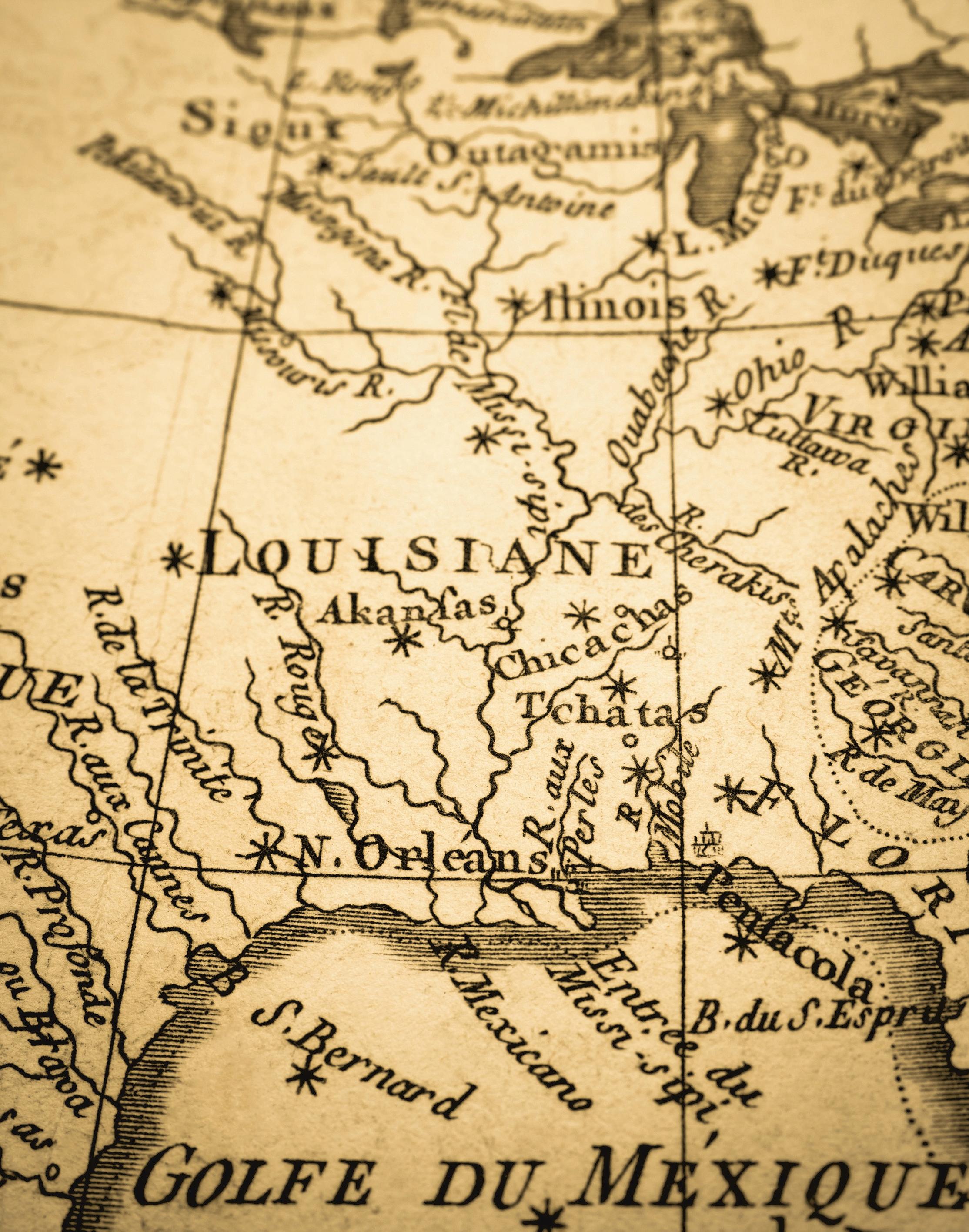


AP&L’s Arkansas Nuclear One becomes the first nuclear power plant to operate in the Southeast.
Entergy merges with Gulf States Utilities Company, adding River Bend Station as its four th nuclear site. Entergy now ser ves more than 2.3 million customers.
Entergy becomes the countr y’s first utility to pledge to hold greenhouse gas emissions to year 2000 levels
Entergy begins installing advanced meters for 3 million customers throughout its ser vice area The new technology allows for faster detection of outages and greater insight into energy usage.
Entergy announced as the founding par tner of the Super Bowl LIX Host Committee. The Super Bowl ultimately generates $1.25 billion in total economic activity statewide.
2026
Entergy establishes its Fair Share Plus pledge, which ensures that data center customers moving into our region pay for the power they use, plus create additional savings or benefits for all of our customers. To date, a total of $7 billion in savings to our customers are expected over the next two decades





Entergy is making the grid stronger to stand up against the effects of severe weather.
Across the state, we’re upgrading approximately 3,300 miles of power lines and reinforcing utility poles to withstand wind speeds up to 150 mph—efforts that will save customers an estimated $1.2 billion in avoided storm costs and means fewer and shorter outages when interruptions do occur.
Louisiana is our home, and we’re committed to powering our neighborhoods and communities today and for future generations.
SUNDAY, J U lY 5, 2026



























directions: Make a 2- to 7-letter word from the letters in each row. Add points of each word, using scoring directions at right. Finally, 7-letter words get 50-point bonus. “Blanks” used as any letter have no point value. All the words are in the Official SCRABBLE® Players Dictionary, 5th Edition.
instructions: 1. Words must be of four or more letters.
2. Words that acquire four letters by the addition of “s,” such as “bats” or “dies,” are not allowed. 3. Additional words made by adding a “d” or an “s” may not be used. 4. Proper nouns, slang words, or vulgar or sexually explicit words are not allowed.
todAY's Word — LeoPArd: LEH-perd:
A large, strong cat with black spots. Average mark 47 words
Time limit 60 minutes
Can you find 66 or more words in LEOPARD?


instructions:
1 - Each row and each column must contain the numbers 1 through 4 (easy) or 1 through 6 (challenging) without repeating.
2 - The numbers within the heavily outlined boxes, called cages, must combine using the given operation (in any order) to produce the target numbers in the top-left corners.
3 - Freebies: Fill in the single-box cages with the number in the top-left corner.
instructions: Sudoku is a number-placing puzzle based on a 9x9 grid with several given numbers. The object is to place the numbers 1 to 9 in the empty squares so that each row, each column and each 3x3 box contains the same number only once. The difficulty level of the Conceptis Sudoku increases from Monday to Sunday.
directions: Complete the grid so that numbers 1–132 connect horizontally, vertically or diagonally.

sHeLdon poLonsKy
Today’s deal is from a pairs tournament in Turkey and overtricks were crucial. West won the opening diamond lead with his king. The lead was a certain singleton given the missing spot card, so East returned the five of diamonds. West ruffed and shifted to the three of clubs. South played the jack from dummy and overtook it with his ace when East played low. An obvious line for an overtrick, assuming West held the queen of clubs, was to cash the ace of trumps and lead a trump to dummy’s queen for a ruffing finesse in diamonds. That would require West to be out of trumps in two more rounds. South found a more elegant way. He led a heart to the queen and began to run his trumps. This was the position with one trump remaining:
On the last heart, West had to keep all his clubs so he discarded a spade. Dummy then discarded a club and East a spade. A club to the 10 and the king of clubs forced East to discard another spade. The ace and eight of spades took the last two tricks. Very nice!
Tannah Hirsch welcomes readers’ responses sent in care of this newspaper or to Tribune Content Agency Inc., 2225 Kenmore Ave., Suite 114, Buffalo, NY. 14207. E-mail responses may be sent to gorenbridge@ aol.com. © 2026 Tribune Content Agency
CANCER (June 21-July 22) Let your mind wander and your creative imagination take you on a journey. Remaining dedicated and loyal and staying one step ahead of the crowd will position you for success.
LEO (July 23-Aug. 22) Take one step at a time. Don’t force matters that are unstable. Get everything in place, and go the extra mile to ensure your success. Spend more time and money preparing yourself and your talents to reach your desired goals.
VIRGO (Aug. 23-Sept. 22) Keep your eyes on money management. Look over documents that require attention. Make sure your finances and
legal matters are updated. Paying attention to detail will put your mind at ease.
LIBRA (Sept. 23-Oct. 23) You’ll be drawn to unique individuals who offer both enrichment and a learning experience that will help you curb unnecessary habits. You are overdue for a change.
SCORPIO (Oct. 24-Nov. 22) Indulge yourself in travel, social events or learning something new and exciting. A partnership will change how you view prospects and enhance your goals.
SAGITTARIUS (Nov. 23-Dec. 21) Change things up at home to help you explore
Edited by Rich Norris and Joyce Nichols Lewis
new possibilities. Use your imagination to elaborate on ideas and plans you want to pursue. Someone who interests you will warm up to the idea of collaboration.
CAPRICORN (Dec. 22-Jan. 19) Push for what you want. Dreaming won’t get you to the finish line. Take heed of what others do and say, but take control of your destiny. Don’t skirt issues or leave out important details.
AQUARIUS (Jan. 20-Feb. 19) Put your ideas and plans into motion. Turn your surroundings into a workspace dedicated to bringing in extra cash. Invest more time and money in
Take this Super Quiz to a Ph.D. Score 1 point for each correct answer on the Freshman Level, 2 points on the Graduate Level and 3 points on the Ph.D. Level.
SUBJECT: THE FIRST OF EVERYTHING
(Example: The first powered flight. Answer: The Wright Brothers.)
FRESHMAN LEVEL 1. The first female prime minister of the U.K.
The first president to live in the White House.
Who made the first telephone call?
The first woman to fly solo across the Atlantic.
The first president of democratic South Africa.
yourself and what you enjoy doing most.
PISCES (Feb. 20-March 20) Fact-check your resources before following through with your plans. Networking events will encourage you to explore new possibilities. Share your feelings and intentions with someone of interest.
ARIES (March 21-April 19) Distance yourself from trouble or those trying to talk you into something you don’t want to do. Volunteer work that addresses a cause touches you emotionally.
TAURUS (April 20-May 20) Don’t make unrealistic promises or ask for more
than others can offer. Pay more attention to detail, how you look and feel, and creating your lifestyle and personal happiness.
GEMINI (May 21-June 20) Focus on learning, preparing and perfecting what you want to pursue. Implement changes that require your time and energy and are not dependent on outside influences. Choose your words carefully.
The horoscope, an entertainment feature, is not based on scientific fact.
© 2026 by NEA, Inc., dist. By Andrews McMeel Syndication
1. Margaret Thatcher. 2. John Adams. 3. Alexander Graham Bell. 4. Amelia Earhart. 5. Nelson Mandela. 6. Yuri Gagarin. 7. Roald Amundsen. 8. Vladimir Lenin. 9. Roger Bannister. 10. "Wings." 11. Delaware. 12. "The Jazz Singer." 13. Thurgood Marshall. 14. Ferdinand Magellan. 15. Marie Curie.
SCORING: 24 to 30 points — congratulations, doctor; 18 to 23 points — honors graduate; 13 to 17 points — you’re plenty smart, but no grind; 5 to 12 points — you really should hit the books harder; 1 point to 4 points — enroll in remedial courses immediately; 0 points — who reads the questions to you?
Saturday's Cryptoquote: America was not built on fear. America was built on courage, on imagination and an unbeatable determination to do the job at hand. — Harry S. Truman
Answer