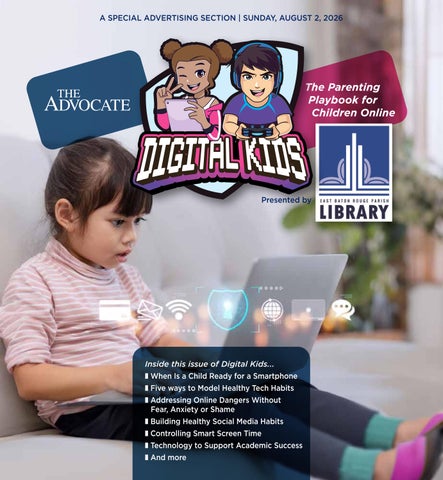
A SPECIAL ADVERTISING SECTION | SUNDAY, AUGUST 2, 2026
The Parenting Playbook for Children Online
Presented by
Inside this issue of Digital Kids... ❚ When Is a Child Ready for a Smartphone ❚ Five ways to Model Healthy Tech Habits ❚ Addressing Online Dangers Without Fear, Anxiety or Shame ❚ Building Healthy Social Media Habits ❚ Controlling Smart Screen Time ❚ Technology to Support Academic Success ❚ And more
Life moves fast. We help you stay ahead.
Top factors to consider before giving a child
From budgeting to card controls, Neighbors gives you everything you need to manage your finances in one easy-to-use app.
a smartphone
T
here is no perfect age for a child to get a smartphone. Instead, parents should consider their child’s maturity, needs and ability to handle the responsibilities that come with having a device. Here are some questions to ask before taking the plunge.
WHY DOES YOUR CHILD NEED A SMARTPHONE?
Identify the purpose. Is it for communicating after school, coordinating extracurricular activities or staying in touch with family? Understanding the need can help parents decide whether a smartphone, basic phone or smartwatch is the best fit.
IS YOUR CHILD READY FOR THE RESPONSIBILITY?
Age alone doesn’t determine readiness. Consider whether your child follows household rules, completes responsibilities and responds well to boundaries. A child who demonstrates good judgment and can handle increasing independence may be better prepared for smartphone ownership.
HAVE YOU ESTABLISHED CLEAR EXPECTATIONS?
Before handing over a device, discuss the rules. Screen time, social media, downloading apps, privacy settings and appropriate online behavior should all be addressed. Establishing expectations early helps children understand that smartphones come with responsibilities as well as privileges.
CAN YOUR CHILD HANDLE DISTRACTIONS?
Smartphones can make homework, sleep and family time more challenging. Think about whether your child can put a device down when necessary, focus on schoolwork and participate in activities without constantly checking notifications.
DOES YOUR CHILD UNDERSTAND ONLINE PRIVACY? Before getting a smartphone, children should understand basic digital safety concepts, including not sharing personal information,
using strong passwords and recognizing that not everyone online is who they claim to be.
COULD A SIMPLER DEVICE MEET THE NEED?
A smartphone isn’t the only option. Basic phones, smartwatches and devices with limited capabilities can provide communication and safety features. Starting small can help children ease into greater responsibility.
A modern online and mobile banking experience
Faster, simpler navigation
Enhanced security and card controls
Smarter budgeting and financial wellness tools
Spending insights and account reporting
WHAT IS YOUR FAMILY’S TECHNOLOGY PHILOSOPHY? Consider the values you want technology to support. Is your goal to encourage communication, learning and independence while protecting family time and sleep? Having a clear philosophy can help guide decisions about devices, apps and screen time as your child grows.
Become a member today. neighborsfcu.org
Easier account access
ESTABLISH HEALTHY SCREEN-TIME HABITS! Screens play a major role in how children learn, play, and connect—but balance is key. The pediatricians at The Baton Rouge Clinic are here to help your family build healthy screen-time habits and provide trusted guidance every step of the way.
The kids are watching: Five ways adults can model healthy tech habits
C
hildren often learn by watching the adults around them, and technology use is no exception. Parents who demonstrate healthy digital habits can help kids develop balanced relationships with screens and understand that technology is a tool, not the center of life.
PUT DEVICES AWAY DURING FAMILY TIME One simple ways to model healthy behavior is to be fully present. Put phones away during meals, family outings and conversations. Showing children that they have your attention reinforces the importance of face-to-face connections.
CREATE DEVICE-FREE TIMES AND SPACES Bedrooms, dinner tables and the hour before bedtime are good opportunities to
Communicate: Talk openly with your children about the content they engage with online! Make sure your children practice the 20-20-20 rule: for every 20 minutes spent looking at a screen, look at least 20 feet away for 20 seconds. Designate periods without screens such as during mealtime and two hours before bed. unplug. These boundaries can improve sleep, encourage conversation and remind kids that not every moment needs to involve a screen.
MAKE TIME FOR OFFLINE ACTIVITIES
Children notice when adults prioritize exercise, reading, hobbies and time outdoors. Whether it’s gardening, cooking, playing sports or simply taking a walk, making room for activities away from screens demonstrates that technology is just one part of a fulfilling life.
USE SOCIAL MEDIA INTENTIONALLY
Parents can show kids that social media doesn’t have to be mindless scrolling. Following educational or inspiring accounts, taking breaks from certain platforms and turning off unnecessary notifications help
demonstrate thoughtful technology use.
Lead by example: Demonstrate healthy screen habits, such as putting your phone on ‘do not disturb’ during family time.
BE HONEST ABOUT YOUR OWN HABITS
No one has perfect tech habits. Admitting when you’ve spent too much time on your phone or taking a break from screens teaches children that everyone benefits from reevaluating their digital routines. Modeling self-awareness and flexibility sends the message that healthy technology use is about balance, not perfection. Children are more likely to adopt healthy habits when they see those behaviors reflected at home. By modeling balance and prioritizing real-world connections, parents can help children build healthy relationships with technology that will serve them well.
PEDIATRICS AT PERKINS 7373 PERKINS RD PEDIATRICS AT INDUSTRIPLEX 12351 INDUSTRIPLEX BLVD
BATONROUGECLINIC.COM SCHEDULING: (225) 246-9290
Teaching modern life skills: How parents can address online dangers without fear, anxiety or shame
F
rom scams and cyberbullying to inappropriate content and online predators, the internet presents challenges that can feel overwhelming. But conversations about online safety do not have to be frightening. In fact, a calm, ongoing approach can help children feel more comfortable speaking up when something goes wrong. Rather than waiting until there is a problem, experts recommend treating online safety as another life skill. The goal is to help kids recognize warning signs and know what to do if they encounter them. Here are some tips to guide those discussions.
FOCUS ON BEHAVIORS INSTEAD OF SPECIFIC THREATS
Explain that people online should never ask kids to keep secrets from their families, send money, share personal information or provide photos that make them uncomfortable. Children should also understand that not everyone online is who they claim to be.
AVOID USING SHAME OR PUNISHMENT WHEN DISCUSSING ONLINE RISKS
Kids may be more likely to keep concerning experiences to themselves if they believe they will lose access to their devices or get in trouble. Parents can reassure children that they will work through difficult situations together. Kids should also know they can turn to adults for support without fear of being blamed if they receive a suspicious message, come across harmful content or experience bullying.
REGULAR CONVERSATIONS ARE MORE EFFECTIVE THAN ONE-TIME LECTURES. Asking kids about their favorite apps, creators or digital trends creates opportunities for meaningful discussions. These conversations also allow parents to teach children how to recognize scams, handle cyberbullying and respond to inappropriate content in age-appropriate ways.
ENCOURAGE PRACTICAL RESPONSES.
Blocking users, reporting inappropriate behavior, taking screenshots and asking an adult for help are all tools children can use to protect themselves. These actions help young people understand that they are not powerless when problems arise.
Beyond likes and followers: How parents can help kids build healthy social media habits
W
hether your child is into Instagram, TikTok, YouTube, Snapchat – or maybe all of them – you can help them develop healthy relationships with social media by teaching them to use platforms intentionally and in ways that support their well-being. One important lesson is that social media should be a tool, not a measure of self-worth. Follower counts, likes and comments do not
define a person’s value. Helping children understand that online content often represents carefully curated moments rather than everyday reality can reduce the pressure to compare themselves to others. Parents can encourage kids to pay attention to how certain content makes them feel. If following a particular account leaves them anxious, unhappy or insecure, it may be time to unfollow, mute or limit exposure to that content. On the other hand, following creators who inspire creativity, kindness, learning or healthy habits can be a positive experience. Regular conversations about social media can also help parents stay connected to their children’s online lives. Asking what they enjoy watching, which creators they follow or what trends they are seeing can create opportunities for meaningful discussions without making social media feel forbidden
or off limits. Parents can also encourage children to balance online connections with real-world experiences. Sports, clubs, family activities, reading and time with friends in person all help reinforce that social media is one part of life, not the center of it. Most importantly, parents can model healthy habits themselves. Demonstrating thoughtful use of social media, avoiding constant comparisons and taking breaks when needed show children that it is okay to step away and prioritize their mental and emotional well-being. Social media is here to stay. By teaching children to be intentional about who they follow, recognize when content affects their self-esteem and maintain balance between online and offline life, parents can help them build habits that support confidence, healthy relationships and overall well-being.
More than books
, r e v o c s i D g e
Here’s how parents can help kids and teens learn, create and explore at the East Baton Rouge Parish Library By Amanda McElfresh I amcelfresh@theadvocate.com
F
rom story times for toddlers to test prep for teens, the East Baton Rouge Parish Library offers a wealth of free resources for children and families. Of course, there are thousands of books, magazines, DVDs and audiobooks to check out. Beyond that, EBRPL is a safe place for kids and teens to build skills and discover new interests. Here are a few ways EBRPL can help them thrive.
SIGN THEM UP FOR A LIBRARY CARD
Parents can choose which type of card they want their child to have – standard, restricted, or unrestricted. The type of card determines what materials and services a youth can access from both print materials and online resources. Even babies can have their own East Baton Rouge Parish Library card. To learn more, visit your local EBRPL branch with your child (bring a photo ID and proof of current address) or email ebrplcards@ ebrpl.com.
A place to
Creat
TAKE ADVANTAGE OF TUTORING
If your child is struggling to grasp certain concepts, EBRPL can easily help them connect to an online tutor at no charge. All tutors have degrees in the subjects they are tutoring and have undergone extensive training and background checks. Kids can even meet with the same tutor regularly if they find them helpful. Visit www.ebrpl. com/departments/kids/homeworkand-learning/homework-help to learn more. Beyond tutoring in core subjects, EBRPL offers resources for kids to prepare for various standardized tests, including practice versions. AP students can watch content videos for biology, calculus, U.S. history and world history, while an online SkillsCenter helps kids of all ages build competencies by using flashcards, games, worksheets and quizzes.
EXPLORE ENRICHMENT OPPORTUNITIES
Besides reading materials, local families can check out items like board games, museum and state park passes, digital microscopes, and musical instruments. Patrons of appropriate ages and who have completed
the badging process can also reserve time to use devices such as 3D printers, sewing machines, virtual reality headsets and multimedia equipment to record videos, podcasts and more. Meanwhile, kid-friendly databases help elementary students learn the basics of research and get a glimpse of the world via thousands of video field trips and photos. For teens, online EBRPL resources can help them find local jobs, volunteer opportunities, even access to practice for driving exams, and so much more. “We’ve got the kids covered in East Baton Rouge Parish,” said EBRPL Assistant Director Mary Stein. “We are trying to help build capacity within the educational network because all of us want kids to succeed every day.”
d and
Belon
Discover free resources for every age and every stage.
r e v o c s i D You
W
WHAT THE LIBRARY W CAN DO FOR
hether your child loves to read, create, explore or learn something new, the East Baton Rouge Parish Library offers free programs, technology, tutoring, events and resources designed to help them thrive.
Read
Learn
Create 3D printing, musical
Library
15 Locations | Open 7 Days a Week Free programs • Free classes • Free digital resources All you need is your Library card! Visit ebrpl.com/library-services/ or scan this QR Code:
Thousands of books, audiobooks and digital resources.
Visit
Your
Free programs, tutoring,homework help and test prep.
instruments, museum passes, makerspaces and more.
CHILDHOOD MATTERS HERE Smart screen time: How parents can create healthy digital habits at home
Nurturing Mind, Body & Spirit
No rush to grow up. Just the right support at every stage. From play-based exploration in Early Childhood to strong academic foundations in Lower School and high school preparation in Middle School, students are challenged as they grow.
We believe in nurturing the whole child through meaningful experiences that develop the mind, body, and spirit. Students of all faiths are encouraged to explore, serve, and grow with confidence and purpose.
Feels Like Family Our Pre-K3 through 8th grade community allows students to grow alongside familiar faces, build lasting friendships, and develop confidence in a safe, supportive environment. Students are supported by teachers who know them well, recognize their strengths, and encourage them to reach their full potential.
T
echnology is woven into nearly every part of childhood today, from homework and extracurricular activities to entertainment and staying connected with friends. Instead of viewing screens as something to fear or eliminate, parents can help children develop healthy habits by setting clear expectations and creating routines that encourage balance. One strategy is to involve children in creating family technology rules. Discussing expectations together gives kids a better understanding of why boundaries matter and can make them more likely to follow them. Older children and teens, in particular, often respond well when they have a voice in establishing guidelines. Creating device-free spaces can help families stay connected. Bedrooms, dinner tables and family gatherings are common places where phones and tablets are set aside. These screen-free areas encourage conversation, improve sleep habits and help children learn that not every moment needs to be filled with a device. Many families also find success with device-free times. Turning off
Pre-K3 through 8th Grade
screens during meals, the hour before bed or certain evenings each week can create opportunities for family activities, outdoor play and meaningful conversations. Parents should also consider their own technology habits. Children are more likely to adopt healthy behaviors when they see adults putting phones away during conversations, limiting distractions and being fully present during family time. Healthy digital boundaries are about teaching children how to use technology thoughtfully and responsibly. By creating shared expectations, establishing screen-free spaces and making time for life beyond devices, parents can help children develop habits that support learning, relationships and overall well-being.
Why Families Choose St. Luke’s? • • • • • • • •
Pre-K3 through 8th Grade 2023 National Blue Ribbon School 7:1 Student-to-Teacher Ratio Athletics for 3rd–8th Grade Visual and Performing Arts Play-Based Early Childhood Engaging, Challenging Academics Innovation Lab & Learning Lab Support
SCAN TO SCHEDULE YOUR TOUR TODAY!
stlukesbrschool.org (225) 927-8601
St. Luke’s Episcopal School has a non-discriminatory admissions policy.
The best ways to use today’s technology to support academic success habits
F
rom interactive math lessons and virtual tutoring to educational videos and AI-powered study tools, technology can help students better understand classroom concepts, build confidence and develop skills. activities. Here are some ways families can make technology work for education. Reinforce classroom lessons. Online educational videos and practice websites let kids review concepts that challenged them or dive deeper into subjects they enjoy. Whether it’s mastering multiplication, understanding photosynthesis or reading more about an historical event, digital tools let students revisit lessons as often as needed. Stay organized. Digital calendars, reminder apps and homework planners make it easier to keep track of assignments, quizzes and projects. These tools reinforce due dates and help kids break their work into smaller tasks, which can reduce stress and prevent lastminute cramming. Explore learning beyond school walls. Virtual museum tours, educational podcasts, coding programs, language-learning apps and interactive science simulations allow
children to explore subjects that spark their interest. Today’s local libraries also have e-books, audiobooks and digital resources available to borrow for free in a matter of minutes. Build digital literacy skills. Learning how to research credible sources, collaborate on virtual platforms, protect personal information and communicate respectfully online are essential skills for people of all ages. Parents can begin reinforcing these habits early by talking to kids about online safety, encouraging responsible technology use and helping them think critically about what they see online. Technology isn’t replacing great teachers, hands-on learning or face-toface relationships. Students still benefit from robust classroom discussions, reading physical books, conducting science experiments and participating in extracurricular activities. But when used thoughtfully, digital tools can complement those experiences by providing additional practice, expanded information and ways to help students become independent learners.
Forming Disciples of Christ in a Digital World
Challenges of AI in the Classroom
• PK3 through 8th grade • ACCESS Special Education • 9 athletic sports; 12 clubs and activities
Artificial intelligence has quickly become one of the most discussed topics in education.
• Digital citizenship education: online safety, privacy, and respectful communication
11400 Sherbrook Dr. • Baton Rouge, LA 70815 • 225-275-2820 • stmbr.org/tourSTM
Ai
A
s students return to classrooms, schools and colleges are continuing to develop policies that encourage innovation while maintaining academic integrity. Generative AI tools can help students brainstorm ideas, summarize information, practice writing and explore complex topics. At the same time, educators are grappling with concerns about plagiarism, misinformation and over-reliance on technology. Many school districts and higher education institutions have adopted formal guidelines outlining acceptable uses of AI. Rather than banning the technology outright, educators increasingly focus on teaching students how to use AI responsibly and ethically.
Teachers say expectations vary depending on the assignment. Some instructors allow AI to assist with research and idea generation but require students to complete final writing independently. Others require students to disclose when AI tools were used during the completion of an assignment. Digital literacy has emerged as a major educational priority. Students are learning how AI systems work, how to verify information and how to recognize potential bias or inaccuracies in generated content. Educators argue that these skills will become increasingly important in future workplaces. Colleges face similar challenges. Professors are redesigning assignments to emphasize critical thinking, personal reflection and in-class participation. Oral presentations, project-based learning and collaborative activities are becoming more common as institutions adapt to evolving technology.
Edutopia recommends that educators talk to students about AI by treating it as an open, judgment-free dialogue rather than a list of restrictions. Frame discussions around skill-building and transparency, ask openended questions about their habits, and set clear boundaries for when AI is a helpful tool versus a shortcut. Students often express mixed opinions. Some view AI as a valuable productivity tool, while others worry about fairness and academic honesty. Many educators aim to prevent confusion and misunderstandings by having open discussions about expectations. School administrators emphasize that AI should supplement learning rather than replace it. The goal is to help students develop problemsolving abilities, communication skills and subject-matter knowledge that cannot be outsourced to technology.
Private School
The East Baton Rouge Parish Library has more than two million items in its collection, more than 313,000 active cardholders and 15 locations, including the new South Branch at the corner of Glasgow Avenue and Tupelo Street. In addition to its permanent locations, EBRPL operates bookmobiles and community outreach services to bring literacy and education to schools and learning centers in every corner of the parish. Besides offering free checkouts of digital and printed reading materials, EBRPL hosts and curates thousands of events each year and collaborates daily with local artists, writers, schools, church groups and parents to provide enrichment and an enhanced quality of life to all.
The Parenting Playbook for Children Online
Tips for Parents
FASHION | LIFE | DESIGN
Let kids choose their own books. This helps them get excited about reading, and children are more likely to become lifelong readers when they can explore topics that interest them. Library staff can help find the right book for each child. Visit the library as a family. Regular library visits give kids something to look forward to while reinforcing that reading and learning are enjoyable family activities. Set reading goals together. Create family reading challenges, encourage kids to try different genres, and celebrate milestones such as finishing a lengthy book or reading every day for a month. These achievements build confidence and motivation.
Presented by
www.ebrpl.com (225) 231-3750 Text Information Services: (225) 361-8476 Facebook and Instagram: @ebrpl YouTube:@EBRPLibraryTV
RESOURCE GUIDE FMOL Health | Our Lady of the Lake Children’s Hospital in Baton Rouge serves as the main campus and central hub for a statewide network of pediatric healthcare and offers one of the only pediatric emergency rooms in Louisiana staffed 24/7 by physicians certified in pediatric emergency medicine. It is home to the region’s only Level II pediatric trauma program and the area’s only specialized pediatric pharmacy. It offers a full spectrum of comprehensive pediatric services with more than 300 pediatric providers, including 60 specialists focused on immunology, cardiology, psychiatry, endocrinology, gastroenterology, neurology, sleep medicine and more. It is also one of only eight expanded St. Jude Affiliate Clinics in the U.S. The hospital is located at 8300 Constantin Boulevard in Baton Rouge.
For more than 70 years, Neighbors Federal Credit Union has been a full-service financial institution, serving members throughout the Baton Rouge area. Its solutions including checking and savings accounts, retirement accounts, credit cards, personal loans, mortgages, auto loans and more. Branches are located in Baton Rouge, Central, Denham Springs, Lafayette, Port Allen, Prairieville, Walker and Zachary.
For 80 years, The Baton Rouge Clinic has been a trusted healthcare partner for generations of families throughout our community. Since opening our doors in 1946, we have grown to offer comprehensive care for every stage of life through exceptional primary care and a broad network of specialty services. The Baton Rouge Clinic remains committed to providing compassionate, patient-centered care for generations to come. Our main campus is located at 7373 Perkins Road in Baton Rouge.
Tips for Parents
Tips for Parents
Focus on kids’ mental health. Pay attention to changes in mood, behavior, sleep habits, social interactions and activity levels. Encourage open conversations about what your child sees online. When in doubt, talk with your pediatrician. Don’t ignore recurring physical symptoms like stomach pain, headaches or chronic fatigue. Have information available at all times. Details about your children’s medications, allergies and known conditions can help guide pediatric care in all types of situations. Your child’s physical and mental health go hand in hand.
Give kids hands-on money experience. Allowances, birthday money or earnings from chores help children practice saving, spending and decision-making. Set family savings goals. Whether saving for a vacation, new bicycle or holiday gifts, shared goals teach planning, patience and teamwork. Discuss digital financial safety using trusted sources to teach about strong passwords, online scams, protecting personal information and using payment apps responsibly.
www.ololchildrens.org (225) 374-HEAL 8300 Constantin Blvd., Baton Rouge LA 70809 Facebook, X, and Instagram: @ololchildrens TikTok and YouTube: @fmolhealth
www.neighborsfcu.org (225) 819-2178 Facebook, X, Instagram and TikTok: @NeighborsFCU YouTube: @neighborsbatonrouge
Tips for Parents
• Establish Healthy Screen-Time Habits for your Children • Communicate: Talk openly with your children about the content they engage with online! • Make sure your children practice the 20-2020 rule: for every 20 minutes spent looking at a screen, look at least 20 feet away for 20 seconds. • Designate periods without screens such as during mealtime and two hours before bed. • Lead by example: Demonstrate healthy screen habits, such as putting your phone on ‘do not disturb’ during family time. www.batonrougeclinic.com (225) 769-4044 7373 Perkins Road Baton Rouge LA 70808 Facebook: @BatonRougeClinicAM Instagram and YouTube: @BatonRougeClinic TikTok: @batonrougeclinic X: @BRClinicAMC
At Oasis Counseling and Supervision, Kirsten Dantin offers a space that is collaborative, grounded and growthoriented. Kirsten helps clients work through anxiety, relationships, trauma and life transitions, while supporting supervisees in developing confidence, clinical skills and ethical practice through intentional mentorship. Individual and relationship counseling is available in-person or via telehealth. In-person counseling is available for individuals under age 18 who identify as queer or LGBTQ+.
Tips for Parents Counseling can give kids a safe place to talk. Many find it easier to open up to a neutral adult about worries they don’t want to discuss with family or friends. A trained counselor can help kids learn healthy coping skills, recognize their strengths and develop ways to express their feelings appropriately. For kids who identify as queer or LGBTQ+, counseling can reinforce that they deserve support and acceptance, which can lead to better overall mental health and lower rates of depression and anxiety. www.oasis-cas.com (225) 800-2041 office@oasis-cas.com
For more than 100 years, Capital Area United Way has been bringing people, resources, and organizations together to improve lives across our 10-parish region. By investing in youth opportunity, healthy communities, financial security, and community resiliency, CAUW helps children and families build stronger futures. Through initiatives like 211, Fueling the Future, and partnerships with local nonprofits, Capital Area United Way is committed to ensuring every child has the opportunity to learn, grow, and thrive.
Helping Kids Stay Safe & Thrive in a Digital World • Keep the conversation open: Talk regularly with your children about what they're doing online, who they're interacting with, and remind them they can come to you if something doesn't feel right. • Create a family media plan: Set age-appropriate screen-time limits, establish device-free times (like meals and bedtime), and encourage a healthy balance between online activities and family time. • Know where to turn for help: If your family needs support—from childcare and food assistance to counseling, parenting resources, or other community services—dial 211 to connect with free, confidential local resources available 24/7. www.cauw.org Facebook: @CapitalAreaUnitedWay X, Instagram, TikTok and YouYube: @UnitedWayBR LinkedIn: @Capital Area United Way
RESOURCE GUIDE At St. Luke's Episcopal School, every child is known, encouraged, and inspired to reach their full potential. Our nurturing community combines academic excellence with faith, character, and service to prepare students for success in the classroom and beyond. As a 2023 National Blue Ribbon School, St. Luke's offers small class sizes, dedicated teachers, and hands-on learning that help students grow intellectually, spiritually, creatively, and socially. From Pre-K3 through eighth grade, students develop the confidence, compassion, and leadership skills to thrive for a lifetime.
For Parents St. Luke's is the only Episcopal school in Baton Rouge offering a Pre-K3 through eighth grade model. Fewer transitions mean more time for students to build confidence, form lasting friendships, and grow with teachers who truly know them. St. Luke's graduates are confident, capable, and well-prepared for high school. They are consistently accepted into the high schools of their choice and leave ready to thrive academically and personally. At St. Luke's, education extends beyond the classroom. We nurture the whole child through strong academics, faith, service, the arts, athletics, and leadership opportunities that help students discover their strengths and reach their full potential. www.stlukesbrschool.org (225) 927-8601 Facebook: @stlukesbrschool.org Instagram: @stlukes_br
Owner Rebecca Law opened the first brick-and-mortar location of Lilly & Jace Kids Boutique in Baton Rouge in 2022. Since then, the boutique has become known for its thoughtfully curated selection of children's clothing, gifts, and accessories, many of which feature regional designers and Louisiana-inspired styles. Customers receive personalized service tailored to their needs, whether they're shopping for a special occasion outfit, a meaningful gift, or everyday essentials.
St. Thomas More is on a mission to provide spiritual guidance and Catholic education to students in grades PK3 through 8 that goes beyond the church and classroom. Through faith and fellowship, the collective body of parishioners, students, educators and visitors of St. Thomas More represent a Greater Baton Rouge community that accepts the responsibility to serve others and embraces the challenge to be more for each other.
Tips for Parents
STM students begin using Chromebooks in second grade for in-class work. As part of their weekly computer class in the Project Lab, STM third through eighth graders learn digital citizenship. This includes protecting personal information, using only safe websites, online stranger danger, cyberbullying and intellectual property. STM uses Securly, an online filter and monitoring system. Securly includes AI transparency to teach students how to use AI appropriately and safely in alignment with the Diocese of Baton Rouge Catholic Schools Office’s AI policy and web filtering to block websites and alert staff of unsafe or inappropriate digital activity. Securly also allows teachers to view students’ screens during class and block inappropriate websites.
• Choose quality over quantity. Children grow quickly, but well-made clothing lasts longer, maintains its appearance, and can be passed down to siblings, cousins, or friends. • Encourage self-expression. As children get older, allowing them to help choose their outfits builds confidence, independence, and decision-making skills. • Keep a few ready-to-wear outfits on hand. Having one or two outfits designated for school programs, family gatherings, church events, or last-minute celebrations helps reduce stress and makes getting ready much easier. www.lillyjacekids.com (225) 930-5751 Alexander's Grocery Shopping Center 18303 Perkins Road E, Suite 405B, Baton Rouge, LA 70810
Info for Parents
www.stmbr.org/school (225) 275-2820 Facebook: @stmbr.org Instagram: @stmbreagles
Ivy L. Graham is a graduate of St. Amant High School. She earned a bachelor’s degree in political science with a minor in business administration from LSU and obtained her Juris Doctorate from Southern University Law Center. She is a member of the Louisiana State Bar Association, past president and current member of the Rotary Club of Livingston Parish, and past president and current member of the 21st JDC Bar Association. As an attorney, Ivy L. Graham specializes in divorce, child custody, child support, alimony, adoptions, wills, successions, pre- and post-nuptial agreements and other family law matters.
Tips for Parents Keep adult conflicts away from children. Avoid arguing in front of kids or asking them to take sides. Children shouldn’t feel responsible for adult disagreements or for communicating between parents. Prioritize consistency. Kids thrive on routine, especially during uncertain times. Try to keep schedules for school, meals, bedtime and social activities the same, even if living arrangements have changed. Keep detailed records of parenting schedules, school communications, medical appointments and important conversations. Good documentation can provide clarity and resolve misunderstandings. Note: These are general family law tips and not legal advice. Parents should consult a qualified attorney about the laws and circumstances specific to their case. www.ivygrahamlaw.com (225) 663-8959 Facebook: @ivygrahamlaw
Our Lady of Mercy School provides an authentic Catholic environment where each student is given the opportunity to reach his or her fullest potential by discovering and developing their God-given gifts. Utilizing differentiated instruction and progressive technology, teachers engage each unique learner in acquiring knowledge and cultivating curiosity. Through service projects, extracurricular activities, the arts, athletics and leadership opportunities, students experience a full school life, while learning to become contributing members of the greater community.
What Parents Should Know Prayer and religion classes form the foundation of daily life at Our Lady of Mercy. Students attend weekly Mass, prepare for sacraments, and participate in grade-level retreats and service activities. The school's athletic and fine arts programs complement the academic curriculum by nurturing the whole child through mind, body, and spirit. Through participation in sports, music, theater, visual arts, and other extracurricular activities, students develop confidence, character, creativity, sportsmanship, teamwork, and a lifelong appreciation for using their unique gifts in service to God and others. www.olomschool.org (225) 924-1054 Facebook: @olomschool Instagram: @olomschoolbr