COURSEY HARRELLS FERRY MILLERVILLE OLD JEFFERSON PA R K V I E W SHENANDOAH TIGER BEND WHITE OAK
ADVOCATE THE SOUTHEAST
T H E A D V O C AT E.C O M
|
W e d n e s d ay, S e p t e m b e r 23, 2026
If you would no longer like to receive this free product, please email brtmc@ theadvocate.com.
1GN
Jan Risher
What happens when we stay curious? “I wonder” is one of my favorite ways to start a sentence. Wondering can be the first step toward a new understanding. It’s a place to start seeking new information, new places, new people or new experiences. In 2011, psychologist Sophie von Stumm analyzed some 200 prior studies trying to determine the factors behind academic success. Her work identified three elements that independently moved the needle on grades: raw intelligence, hard work (or conscientiousness) and curiosity. Interestingly, curiosity’s effect on success was roughly the same size as hard work’s. I wish I had read about her research 15 years ago — when my children were younger and I might have been inclined to better nurture curiosity in them. This week, I went down a curiosity rabbit hole. In 2024, Israeli research defined curiosity as “a quality related to an intrinsic desire to seek out new knowledge and experience.” I like that the definition includes experience — that’s my favorite kind of curiosity. Other research divided curiosity into two kinds: wanting to know more because something is interesting and, secondly, wanting to know more because not knowing is uncomfortable. Only the first kind — the interest-driven kind — showed up as a meaningful predictor of success. The second kind fizzled out. In other words, wondering itself is important, but why we wonder and what we do next matters a lot. I called my older daughter in Florida. She was busy at work but said she would give herself a seven on the curiosity 1-10 scale. I asked what she had been curious about lately. Without missing a beat, she said, “Oppenheimer — how did Nolan have a ‘practical’ atom bomb test?” Then with further thought, she said, “Elizabeth Holmes — what was her deal? And ‘La La Land’ — the use of colors in costuming.” It was a short conversation. Still, I couldn’t help but smile. I called my younger daughter in Colorado and asked her what she was curious about these days. She is working full time as a high school administrator and going to law school part time, so
STAFF PHOTOS BY ROBIN MILLER
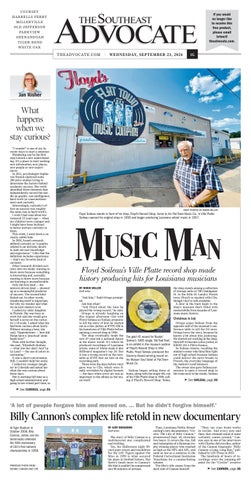
Floyd Soileau stands in front of his shop, Floyd’s Record Shop, home to his Flat Town Music Co., in Ville Platte. Soileau opened his original shop in 1956 and began producing Louisiana artists’ music in 1957.
Floyd Soileau’s Ville Platte record shop made history producing hits for Louisiana musicians BY ROBIN MILLER Staff writer
“Ask him,” Todd Ortego prompted. Ask him what? “Ask Floyd about the time he played the wrong record,” he said. Ortego is already laughing on this August afternoon visit with Floyd Soileau as Soileau prepares to tell the story of how he started out as a disc jockey at KVPI-AM in his hometown of Ville Platte before opening a record shop in 1956. The shop eventually made the The gold 45 record for Rockin’ now 87-year-old a national figure in the music world. It’s where he Sidney’s 1985 single, ‘My Toot Toot,’ produced recordings of Louisiana is on exhibit in the museum section artists, some of whom made it into of Floyd’s Record Shop in Ville Billboard magazine’s top 20. But Platte. Floyd Soileau produced the it was a wrong record on the turn- Grammy Award-winning record on table at KVPI that set him on the his Maison Soul label at Flat Town recording path. Those were the days before vinyl Music Co. gave way to CDs, which were finally overtaken by digital formats Soileau began selling these al— the days when cover art was as bums, along with the single 45s, out important to the album as the mu- of his Ville Platte shop in 1956, callsic itself. ing it Floyd’s Record Shop. Today,
the shop stands among a collection of storage units at 700 Chataignier St. in the little St. Landry Parish town. Floyd’s is stocked with CDs, though vinyl is still available. A door in the back leads to the shop’s museum that’s filled with memorabilia from decades of Louisiana music history.
Christmas in July Ortego urges Soileau from the opposite side of the museum’s conference table to tell the DJ story. Ortego loves the story, because he knows a bit about disc jockeying. He started out working in the shop, then left to become a disc jockey at KBON 101.1-FM in Eunice. So Soileau relents, recalling the station’s owner who hired him right out of high school because Soileau could deliver the news breaks in French, the everyday language of the station’s rural listeners. The owner also gave Soileau permission to open a record shop in the room next to the studio. Soileau
ä See SOILEAU, page 2G
ä See CURIOUS, page 2G
‘A lot of people forgave him and moved on. ... But he didn’t forgive himself.’
Billy Cannon’s complex life retold in new documentary At Tiger Stadium in October 2008, Billy Cannon, center, and his teammates celebrate the 50th anniversary of LSU’s first national championship in 1958.
PROVIDED PHOTO FROM BUNNIE CANNON AND LPB
BY JUDY BERGERON Staff writer
The story of Billy Cannon is a multilayered one, complicated and twisting. Yes, his Halloween night 89yard punt return and touchdown for the LSU Tigers against Ole Miss in 1959 is what secured his place in football history. But there’s much more to Cannon’s life that it couldn’t be compressed into 90 minutes of airtime.
Thus, Louisiana Public Broadcasting’s new documentary, “Circles: The Life of Billy Cannon,” premierered Sept. 14, stretches two hours. It covers the rise, fall and redemption of a Heisman trophy-winning player who reached as high as the NFL and AFL, and sunk as low as a sentence to the Federal Correctional Institution Texarkana for a counterfeiting scheme. The film’s title comes from the dark side of Cannon himself.
“They say your brain works in circles. And every now and then, that criminal mind of mine certainly comes around,” Cannon says in one of his interviews with Charles deGravelles, author of the Cannon biography “Billy Cannon: a Long, Long Run,” published by LSU Press in 2015. The hundreds of hours of recordings were the jumping-off point for the “Circles” creative
ä See CANNON, page 3G
2G ■ Wednesday, September 23, 2026 ■ theadvocate.com ■ The Advocate
lll
SOILEAU
Continued from page 1G borrowed $300 from his parents, visited a Baronne Street record distributor in New Orleans and returned with $240 worth of records and a $60 phonograph on which to play them. One Saturday, while manning the studio by himself, a couple came in to look at records. Soileau grabbed a random record, placed it on the studio’s turntable and stepped into his little shop to help the customers. “As soon as I could get the news done, I grabbed a 15-minute program and put it on the turntable,” Soileau said. “Then I went out there and started selling records.” It wasn’t long before the station’s owner stormed through the door. “I said, ‘Oh my God, what did I do now?’ ” Soileau said. “He said, STAFF PHOTO BY ROBIN MILLER ‘What did you do now? You played a Christmas transcription in the mid- Floyd’s Record Shop’s museum displays photos, awards and memorabilia from the Louisiana music artists whose dle of July, that’s what you did.’ ” music was produced by the shop’s owner, Floyd Soileau. Ortego has heard the story a million times, but he still doubles over The business partners named their I recorded my first record on that included Jivin’ Gene Bourgeois’ label, I was proud, and I showed it 1959 “Breaking Up is Hard to Do,” in laughter. His mentor wasn’t label Big Mamou. Johnnie Allan’s 1959 “Lonely Days “I taught myself how to produce to my dad.” fired that day, but the mess-up was His dad looked at the spelling and and Lonely Nights” and Tommy records,” Soileau said. “I took eva sign. erything I learned in the radio sta- asked Soileau if he was ashamed of McLain’s 1966 “Sweet Dreams.” A new direction, self-education tion and applied it to the recording his last name. The Swallow label attracted such “I said, ‘No, dad, but I’m thinking Cajun musicians as Dewey Balfa At that moment, Soileau knew studio.” His self-education proved suc- maybe, by luck, some day this re- and The Balfa Brothers, Nathan that his life’s purpose wasn’t playing records but selling them. So cessful. Jukeboxes were the hit- cord and this label are going to be Abshire, Hadley Castille, D.L. Mecame the birth of Floyd’s Record makers in 1950s south Louisiana, far away from here,” Soileau said. nard and Wayne Toups. Shop, where he would soon dis- because all of the nightclubs and “And they’ll be able to pronounce Framed photos of these musicians hang on Soileau’s museum cover that Cajun music recordings restaurants stocked them, and the that label name.” As for Jin, Soileau chose the wall complemented by display Big Mamou label had a hit with were in short supply. name to impress a young lady cases exhibiting their records and Not that there weren’t any Cajun “Manuel Bar Waltz.” Which prompted other Cajun named Jinver Ortego. awards, including a framed copy of recordings — there were — but “I said, ‘I need to make some McLain’s gold 45 single of “Sweet previous producers of the genre musicians to approach Soileau. By were fading. In 1957, Soileau then, he’d created his own label, points here,’ and it worked,” he said, Dreams,” which Soileau enhanced with an echo in the studio. founded the Flat Town Music Co. Vee Pee — for Ville Platte — then laughing. “She became my wife.” By 1964, Soileau moved his shop (the English translation for Ville dissolved it in 1958 to establish the Swallow label for Cajun record- Attracting music legends and recording studio to a bigPlatte) next to the radio station. Then he partnered with Mamou ings and Jin for swamp pop. The hits came rolling in, includ- ger space at 238 Main St. in Ville nightclub and jukebox business “Vee Pee just didn’t stand too ing Rod Bernard’s 1958 “This Platte, where a little song by Lebowner Ed Manual to record musi- good for me, so I said, ‘Well, I’m Should Go on Forever” on the Jin eau native Sidney Joseph Simien, cians Milton Molitor and Austin gonna call it Swallow, because label, which made the Billboard “My Toot Toot,” became an interPitre performing “Manuel Bar that’s my last name, but I spelled it Top 20 and led to an “American national hit. Most music fans know Waltz” and “Midway Two-Step.” like the bird,” Soileau said. “After Bandstand” appearance. Others him as Rockin’ Sidney.
CURIOUS
Continued from page 1G some of her questions were about the psychology of professional learning spaces, why certain things are pushed so hard and why people, particularly those in leadership positions, act the way they do. She is also curious about criminal law, civil rights, civil systems and the intersection of civil and criminal law. She told me that since seeing an early “Ted Lasso” episode with the line “Be curious, not judgmental,” she thinks about what the quote means every day. The show attributes the quote to Walt Whitman. However, factcheckers have traced it instead to a 1986 newspaper advice column, a detail that delighted me. Apparently, even a quote about curiosity needs a curious reader. I loved that. Curiosity means checking the things we think we know, too. Curiosity isn’t just about knowing more. It can change the way we look at other people — and ourselves, for that matter. Instead of making assumptions about why someone behaves in a certain way, we can wonder: n Why did she say that?
“Sidney had been recording some stuff on his own at home, and he brought some tapes to me,” Soileau said. “We cut an album, and there were two songs on it that were doing fine on the jukeboxes, but there was another that was really getting attention.” “My Toot Toot” had a zydeco beat, and though listeners were loving it, it was Simien’s weakest recording. The singer told Soileau that the song had been in his composition book for 10 years, and he’d recorded it on the fly.
An international hit Soileau brought the musician back in the studio and re-recorded it. That was in 1985. The song skyrocketed to a gold record, earned Simien a Grammy Award and led to an international audience. Back in Ville Platte, Soileau established Floyd’s Wholesale Distribution, Inc., to distribute his Cajun and swamp pop records, along with other labels, to small record shops throughout the region. And he wasn’t limiting himself to selling records. He also sold the Hitachi Rice Cooker out of his shop after a test-run by his wife. Sales were so high that the Hitachi heating division president paid Soileau a visit. Local indie musicians and labels still have their CDs wholesale distributed to music retailers throughout the U.S. by Flat Town Music Company today, but Soileau is trying to take it easy. “He takes a nap every afternoon now,” Ortego said. His wife passed away in 2021, and he hopes to make it to his birthday in November. “My dad made it to 88, and if I make it, I’ll be 88,” he said. At the record shop, Soileau’s iPhone rings. The name on the screen is swamp pop hitmaker Jivin’ Gene. “Sorry, I have to take this,” he says. The nap might have to wait.
weeks on small daily assignments designed to encourage curiosity: trying an unfamiliar podcast instead of a familiar playlist, asking a friend what they’d learned lately or pausing long enough to notice an ordinary moment instead of moving past it out of habit. By the end of three weeks, their curiosity scores had gone up, along with their sense of meaning — and boredom had gone down. Gross has a theory for why children ask “why” so relentlessly. Childhood doesn’t hold more mysteries. As adults, we often stop noticing them. Maybe curiosity simply asks us to notice, regardless of age. Then, to keep asking questions and following the interesting thought. Maybe the trick is to resist the temptation of believing we already STAFF PHOTO BY BRETT DUKE know. I believe curiosity makes us Vanessa Dupre, 5, raises her hand to ask a question as cellist Manuel Papale and members of the Louisiana better versions of ourselves — and can lead to happier lives, careers Philharmonic Orchestra visit the St. Charles Parish Library’s St. Rose Branch in St. Rose on July 14. and better relationships. n Why does he believe that? Thankfully, my daughters are I had assumed the window for But it also works on a much n What am I missing? still curious. Maybe they could teaching them curiosity was besmaller scale. n Why am I responding to this A child who asks “why?” for the hind me until my curiosity rabbit have been more curious had I gone down this rabbit hole earlier? fourth time is doing a small — hole convinced me that it isn’t. person in this way? Regardless, I’m happy that I’m and, yes, sometimes annoying — Research out of UC Santa BarVladimir Nabokov called curiosstill curious. version of the same thing. bara suggests we can become ity “insubordination in its purest I wonder what’s next. The child is refusing to accept more curious at any age. form.” The thought makes sense Psychologists Madeleine Gross considering his experience with au- that the first answer is necessarand Jonathan Schooler studied thoritarian societies that demanded ily the final answer. Email Jan Risher at jan.risher@ participants who spent three My daughters are grown now. obedience rather than questions. theadvocate.com.
COMMUNITY
PROVIDED PHOTO
BR Phi Mu Alumnae Members of the Baton Rouge Phi Mu Alumnae Chapter toured the National Hansen’s Disease Center-Leprosarium Museum in Carville in August. Gathered are, from left, front row, Karin Simmons, Pat Stadolnik, museum employee Caitlyn Jacobs, Mareen Treese, Laura Gibson and Katie Becker; back row, June Byrd, Tricia Merrick, Laura Collet and Sheila Yellott, alumnae chapter president.
The Advocate ■ theadvocate.com ■ Wednesday, September 23, 2026 ■ 3G
lll
CANNON
Continued from page 1G team, which also pored over countless newspaper reports and secured the input of the Cannon family to fully cover their subject. “The dark side, it’s the most important, because it shows how you really can’t see the goodness that he did in the last 20 years of his life without seeing how far down he was as a result of that,” Cannon’s daughter Bunnie Cannon said. “Really, he did it to himself, because a lot of people forgave him and moved on. We all did, but he didn’t forgive himself.” For the final 25 years of his life, Billy Cannon worked at the Louisiana Penitentiary at Angola first as a part-time dentist for the inmates, progressing to full-time, and then overseeing the dental clinic, medical clinic, pharmacy and eventually the ambulances. This time within prison gates, his family says he finally healed.
Billy Cannon receives the Heisman Award from then-Vice President Richard Nixon at a ceremony in December 1959 at Downtown Athletic Club in New York.
Why the documentary now? Bunnie Cannon says her father never wanted to see his life splashed across the big or small screen. Even after his death in 2018, she, her mother, Dorothy Cannon, and her siblings, although wanting to keep their patriarch’s legacy alive, were reluctant to reveal these personal reminiscences on a public scale with just any outlet. It would have to be LPB. “It’s a great figure to be interested in what Billy went through in his life,” said Linda Midgett, LPB executive producer. She was initially concerned
PROVIDED PHOTO FROM BUNNIE CANNON AND LPB
Billy and Dot Cannon are surrounded by grandchildren Laci McWilliams Gentry, Jessie Cannon Black, Cannon McWilliams, Kim Kelsoe Becker, Cassie Cannon Graham, Abbie Cannon Wright, Mandie Cannon and Billie Cannon Perry. about getting the Cannon family approval to cover the hard parts of the football player’s story, including his arrest, conviction and the impact it had on his reputation. “But Bunnie assured me that the family was willing to do that and prepared to do that. That was the most important thing to me,” Midgett said. Bunnie Cannon says the documentary explains why her father masterminded a counterfeiting scheme to print and distribute $6 million in fake bills. “He didn’t want his kids to have to scrap and work like he had to do when he was 12 years old, when his
dad lost his leg, and they became the charity case of Baton Rouge. To me, it just all makes sense, and it all fits,” she said.
The process Midgett recruited former elected official Jay Dardenne, a sports fanatic, as executive producer and Dardenne’s former chief of staff Cathy Berry as a producer. While Berry listened her way through the deGravelles interviews, taking copious notes, Dardenne rooted through his own collection of Cannon newspaper clippings, photos and assorted memorabilia. For the film, Dardenne sat down
with several of the football great’s former teammates at Istrouma High and opposing counterparts at Baton Rouge High. Theirs was a rivalry for the ages, punctuated by a 1956 matchup. “What I remember about that game may still be a record,” recalls Baton Rouge High’s Warren Rabb. “We usually played at Memorial Stadium in front of 21, 22,000 people. They had so many requests for tickets, so they moved it to Tiger Stadium. More people saw our game than watched the Tigers play.” Clarence “C.C.” Copeland, LPB’s president and CEO, recognizes Billy Cannon’s significance in LSU
history and the importance of showcasing his life to a broader audience. “I think this is one of the most important things,” Copeland said, “is to see the redemptive story.” “Circles: The Life of Billy Cannon” will be available to stream for free on LPB through Sept. 28, and thereafter on demand as an LPB Passport member benefit. For more information, visit https:// www.lpb.org/programs/billycannon/. Email Judy Bergeron at jbergeron@theadvocate.com.
Powering Progress A New Home for Discovery, Research and Collaboration at LSU
Shell Research Laboratories
Pictured L to R: Rob Stuart, LSU Real Estate and Facilities Foundation President & CEO; Wade Rousse, LSU President; Rochelle Touchard, Shell, Corporate Relations Regional Lead; Colette Hirstius, Shell USA, President; Lee Stockwell, Shell, General Manager, Carbon Capture and Storage North America; Krista Raney, LSU Foundation President & CEO; Robb Brumfield, LSU College of Science Interim Dean
“The opening of the LSU Our Lady of the Lake Health Interdisciplinary Science Building is a testament to the power of partnership and what can be achieved when industry and academia come together around a shared vision.
Shell USA, Inc. committed $2.5 million to the Our Lady of the Lake Health Interdisciplinary Science Building as part of a $27.5 million investment in energy-related initiatives at LSU. Shell Research Laboratories offers advanced research environments to enable faculty and students to work together on complex, real world challenges.
We are proud to support a space where students, faculty and industry can collaborate to drive discovery, explore new frontiers and develop the next generation of scientists, engineers and energy leaders.” – Colette Hirstius, President, Shell USA
shell.us/louisiana | #PoweringProgress
4G ■ Wednesday, September 23, 2026 ■ theadvocate.com ■ The Advocate
lll
THE PERFECT GIFT! Celebrate LSU baseball’s eighth national championship with this hardcover collector’s book
ONLY
35
$
95
OR VISIT STORE.THEADVOCATE.COM
ORDER
PLUS COMMEMORATIVE POSTERS Celebrate the Tigers’ eighth national championship with commemorative stadium edition and front page posters.
ADVOCATE THE
T H E A D V O C AT E.C O M
T H E T I M E S - P I C AY U N E
|
M o n d ay, J u n e 23, 2025
5
NOLA.COM
✦
M O N D A Y, J U N E 2 3 , 2 0 2 5
✦
1C
COLLEGE WORLD SERIES
$2.00X
1991 1 • 1993 • 1996 • 1997 • 2000 • 2009 • 2023 • 2025
COLLEGE WORLD SERIES L S U
✦
SPORTS
BATON ROUGE, LOUISIANA
C C U
3
GRRR-8 8!
NSHIP TIGERS WIN EIGHTH NATIONAL CHAMPION
LSU BASEBALL WINS ITS
EIGHTH
NATIONAL TITLE
NATIONAL CHAMPIONSHIP
NDISPUTED UN LEGEENDARY PITCHING, TIMELY HITTING AND LSU’S KNACKK FOR THE MOMENT RECHARGE DYNASTY TALK
CELEBRATION ALEX BOX STADIUM WEDNESDAY, JUNE 25TH, 2025
STAAFF PHOTO BY HILARY SCHEINUK
The Tigers celebrate after defeating Coastal Carolina 5-3 in game two of the College Worl d Series finals in Omaha, Nebraska, on Sunday. The roar is restored. When Jay Johnson took over aas the LSU baseball coach in 2022, the six-time national champion Tigers were in the midst of a 13--year title drought. The Tigers returned to the top of college baseball during the 2023 season. LSU survived s a dicey regional that went to a winner-take-all final at Alex Box Stadium against upstart LLittle Rock. Then LSU dominated, sweeping the super regional and College World Series in seveen games. After Sunday and Johnson’s second national title, he has LSU threatening to reboot a dynnasty that blossomed under legendary coach Skip Bertman. No. 8 is on its way to Baton Rouge. ä SEE COMPLETE COVERAGE OF THE TIGERS’ COLLEGE WORLD SERIES WIN. PAGGE 1B
WEATHER HIGH 94 LOW 74 PAGE 12A
Classified .....................6C Deaths .........................9A Metro ...........................8A Comics-Puzzles .....3C-5C Living............................1C Opinion .....................10A Commentary .............11A Lottery..........................8A Sports ..........................1B
100TH YEAR, NO. 358
STAFF PHOTO BY HILARY SCHEINUK
LSU center fielder Chhris Stanfield, right, celebrates with catcher Luis Hernandez as they both score on a two-run single by left fielder Derek Curiel in the fourth inning of Game 2 of the Collegge World Series finals against Coastal Carolina on Sunday at Charles Schwab Field in Omaha, Neb. LSU scored four runs in the decisive inning and won 5-3 to earn its ssecond title under coach Jay Johnson in four years. BY KOKI RILEY OMAHA, Neb. — To calll anything a dynasty requires a certain level of consiistent, championship excellence. The Boston Celtic cs in the 60s, New York Yankees in the 90s and UCo onn women’s basketball in the 2010s certainly fit th he description. LSU winning five national championsh hips in 10 years under Skip Bertman definitely qualiifies. Coach Jay Johnson n’s Tigers aren’t quite there yet, but what LSU acco omplished Sunday afternoon at Charles Schwab Fielld was remarkable nevertheless and potentially the b beginning of another baseball dynasty in Baton Roug ge. For the eighth tim me in program history, and for
the second time in three seasons, LSU won the national championship. The Tigers took down Coastal Carolina 5-3 in Game 2 of the College World Series final to secure the 2025 title. “Unbelievable. I’m so proud right now,” Johnson said. “It’s not to be taken for granted being here two years ago. That was special. Greatest night of my life. “This is equal and maybe even tops it in some ways.” The win secured Johnson’s second title in four years at LSU, making him the first coach in college baseball history to accomplish that feat at the same school. The Tigers did it despite bringing back just 12 players who appeared in a game from last year’s team, adding 12 players from the transfer portal,
three junior-college recruits and 10 freshmen in the offseason. “We (added) really talented freshmen ...,” Johnson said. “In a month’s time, we were able to add Chris (Stanfield). We were able to add Anthony (Eyanson), Zac Cowan, Luis Hernandez, Danny Dickinson to those 12 guys who were the right 12 guys.” With the score tied 1-1, the fourth inning proved to be the difference between a coronation and a Game 3 on Monday. The Tigers scored four runs on a walk, a hit by pitch and four singles to take a 5-1 lead. Sophomore Jake Brown led off with a walk before a single from junior Jared Jones and a hit by pitch loaded the bases for the junior Stanfield.
Rabalais: Thesse Tigers measure up to LSU’s toweringg expectations, Page 4C
Braswell’s fingerprints all over Tigers’ College World Series title, Page 5C
See which Tigers made an appearance on the All-CWS team, Page 5C
Staff writer
VISIT STORE.THEADVOCATE.COM OR
ä See LSU, page 4C