If you would no longer like to receive this free product, please email brtmc@ theadvocate.com.
G A R D E N D I S T R I C T • G O O D W O O D • TA R A
FAITH: Sister Helen Prejean continues her work — and her writing 3G
S PA N I S H T O W N • C A P I TA L H E I G H T S LSU LAKES • MELROSE PLACE BEAUREGARD TOWN
ADVOCATE THE MID CITY
T H E A D V O C AT E.C O M
|
W e d n e s d ay, Au g u s t 26, 2026
1GN
Jan Risher
Apparently, I needed a $10 flyswatter I have bought more things in the last 11 months than I have in the last 11 years. I am not happy about that claim, but it’s true. The purchases — from a longer chain pull for a ceiling fan to an oven, refrigerator, sofa and bed — have been necessary because of our house fire in August 2025. Shopping in the wake of a fire is largely utilitarian: light fixtures, socks, rug pads, a can of spray starch, all the furniture, doors, latches, knobs, tile, sinks, flanges. I didn’t even know what a flange was, but I do know that the list goes on and on. Whatever joy I once derived from shopping is long gone. (Except for purses. I still enjoy my quest for the perfect purse.) All that said, there is one item that arrived last week that has me rejoicing — a flyswatter. I had forgotten how satisfying it is to own something that has the sole purpose of smacking a fly. For reasons not fully understood, flyswatters have been missing from our lives for years — and I’m so happy I have one again. Flyswatters played a much larger role in my childhood than they have in recent decades. I’m not exactly sure what happened to them. Where did they go? What happened to the flyswatter, a word that rhymes so perfectly with ice water — thank you, Lyle Lovett? They used to be everywhere, but my family hasn’t owned one for years. Until last week. That absence doesn’t make a lot of sense since flyswatters are quite effective at the task at hand, and flies are very much still around. Maybe because I’ve spent a lot of time at a construction site lately, I’ve noticed the glaring hole in life more. Maybe it’s because air conditioning works so much better now than it did when I was a kid. Maybe more windows have screens. My quest to learn more about the decline of flyswatters led me to Iza van Riemsdijk, a Dutch internal medicine and nephrology specialist who owns more than 3,300 of them. Her collection of very ordinary and very exceptional swats from all over the globe has been turned into a museum display in multiple countries. She launched her collection in 1989 in Japan when she spotted a bow tie-shaped pink swatter with tweezers in the handle for picking up dead flies. Riemsdijk’s internet footprint is a strange one. Along with information about interesting and mundane swatters, her website includes
STAFF PHOTOS BY ROBIN MILLER
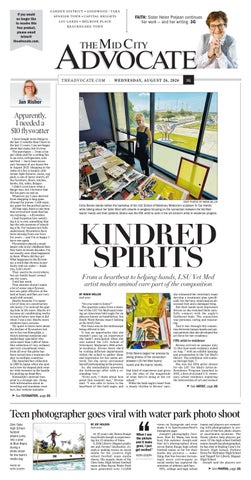
Emily Bevins stands before the backdrop of the LSU School of Veterinary Medicine’s sculpture ‘In Our Hands,’ while talking about her table filled with artwork-in-progress focusing on the connection between the Vet Med teams’ hands and their patients. Bivens was the fifth artist to work in the vet school’s artist-in-residence program.
KINDRED SPIRITS From a heartbeat to helping hands, LSU Vet Med artist makes animal care part of the composition
BY ROBIN MILLER
she witnessed the veterinary team develop a treatment plan specifically for the bird, which had an abscessed foot and a damaged wing. But their hands most impressed Bivens as she watched them carefully connect with the eagle’s feathered body. The connection was personal, caring and reassuring. And it was through this connection between human hands and animal patients that she developed the art form for her residency.
Staff writer
“Do you want to listen?” The question came from a member of the LSU Vet Med team treating an American bald eagle for an abscess known as bumblefoot, but Emily Ward Bivens wasn’t looking at the bird’s foot. Her focus was on the stethoscope being offered to her. It was an opportunity that she wouldn’t pass up, an experience she hadn’t anticipated when she was named the LSU School of Veterinary Medicine’s 2026 artistin-residence. Bivens knew she’d be visiting different departments within the school to gather ideas and inspiration for her onsite artwork, but she never envisioned herself participating in the process. So, she immediately answered the stethoscope offer with a resounding “yes.” “Even now, I think about how great that moment was,” Bivens said. “I was able to listen to the heartbeat of this bald eagle, and
Fifth artist-in-residence Bivens arrived on campus July 13. Her four-week residency ended on Aug. 7 with an exhibit opening Emily Bevins began her process by and presentation in the Vet Med’s taking photos of the connection library. The exhibition will continbetween LSU Vet Med teams’ ue through Sept. 7. She was the fifth artist chosen hands and the teams’ clients. for the LSU Vet Med’s Artist-inthat kind of experience just gives Residence Program launched in you the idea of the magnitude 2022, a first-of-its-kind U.S. veteriof what they’re doing at the vet nary school residency exploring school.” the intersection of art and science While the bald eagle’s heart beat ä See ARTIST, page 2G a steady rhythm in Bivens’ ears,
ä See FLYSWATTER, page 2G
Teen photographer goes viral with water park photo shoot Glen Oaks High School football players jump into a pool at Blue Bayou during a photo shoot for the team’s media day. PHOTO BY KEITH JOSEPH
BY JOY HOLDEN Staff writer
At 18 years old, Baton Rouge local Keith Joseph is experiencing his 15 minutes of fame. A 2026 Liberty Magnet graduate and former linebacker, Joseph is making waves on social media for his creative high school football team media shoots. His aquatic shots of the Glen Oaks High School football team at Blue Bayou Water Park have generated over 113,000
When I see the picture and it looks good, I just get excited.” KEITH JOSEPH
views on Instagram and even made it to SportscenterNext’s Instagram page. Joseph’s photography business, Shot By Mane, has been busy this summer. Joseph said that he’s photographed about seven Baton Rouge high school football teams so far for their media day pictures — something that has become increasingly more extravagant as social media has captured the attention of athletes and fans. NFL, college and high school
teams and players are connecting with photographers to create out-of-the-box photo shoots at unorthodox locations. The flashy photos help players get seen. Of the high school football teams Joseph has photographed, he has shot at Raising Cane’s for Brusly High School, Perkins Rowe for McKinley High School and Topgolf for Liberty Magnet High School. Joseph said the players are
ä See PHOTOS, page 2G
2G ■ Wednesday, August 26, 2026 ■ theadvocate.com ■ The Advocate
lll
ARTIST
Continued from page 1G with disciplines ranging from visual art and music to poetry and filmmaking. Bivens came to LSU from the University of Tennessee in Knoxville, where she is a distinguished professor of humanities and director of Graduate Studies in the School of Art. But she is no stranger to south Louisiana. It’s where her fascination with the natural world began at an early age, observing a large colony of armadillos beneath the old house of her childhood in Baton Rouge, which prompted her to pursue a career as a biologist before switching to art. Bevins’ parents still live in Baton Rouge, so visiting the capital city is like coming home. And it’s where she maintained a second-story studio overlooking the Vet Med’s “In Our Hands” sculpture above the school’s Stephenson Pet Clinic. The view wasn’t intentional, but it played perfectly into Bevins’ art theme of helping hands connecting with animals. Her message becomes even more vivid when unrolling one of her finished works. Well, “unravel” might be a better word, because each piece is a watercolor-based print on a long, narrow roll of watercolor paper attached to a white board by a magnet. Each piece requires two sets of hands to unravel, and each changes shape each time it’s reattached to the board.
STAFF PHOTO BY ROBIN MILLER
Emily Bevins explains her artistic process while standing beside her work table in the LSU School of Veterinary Medicine. Bevins was the LSU Vet Med’s 2026 artist-in-residence.
Sculptural installations Just as the Vet Med’s patients are different, so are Bivens’ watercolor-based, sculptural installations. “Each piece is an interactive exercise,” Bivens explains. “I wanted to reflect the subjects that I’m seeing, but I also wanted to think about something inherent in this place — that everything that happens here is really interactive and is specific to that patient, that moment, STAFF PHOTO BY ROBIN MILLER those clinicians and those residents. So, I came up Emily Bevins works on a watercolor-based drawing, which will be with this idea of creating transferred to a long strip of watercolor paper in a one-time print process. these long prints where Each of her prints depicts the connection between the LSU Vet Med you needed somebody else to be able to fully un- teams’ hands and their patients. derstand them.” Which also gives the interac- pens when my hand, with your nected with patients and spread tive viewer an understanding hand, unravels it, they become them across her worktable. After that, Bivens used waof the hands-on interaction be- part of the composition.” Bivens spent the first two tercolor-based color pencils tween Vet Med teams and their weeks of her residency photo- and pens to draw some of these patients. “The idea behind art being graphing the hands of faculty scenes on a light box screen. tactile is that it’s vulnerable to and residents interacting with She then covers the image with touch,” Bivens said. “It records patients. She printed out the a gel medium, which transfers touch just like the patients in photos, then cut out the part it to the watercolor strip. “When I start, the screen has the vet school. And what hap- of the photo where hands con-
nothing on it,” Bivens said. “It’s a screen that allows you to print anything silk screen. This process that I’m doing is not the norm, and that’s because it is a monoprint — a one-time print. Usually, printmaking is about reproduction. For me, it’s about vulnerability and translation, so once I print it, it’s gone from the screen.”
impressed with that. That stuck with me.” Along the way, conversations with faculty and students reinforced the things Bivens was observing. Anais Musso, a clinical instructor of animal osteopathy, had one such conversation with Bivens while delivering a book to the artist’s studio. “It’s been really amazing to ‘Constant awe’ see how she’s able to connect For this project, though, Biv- what we do with what she does,” ens prints the image a second Musso said. “There are so many time on the long watercolor interconnections in what we do strip from the remnants of the but don’t see, but she sees them. leftover image on the screen. I have been in a state of conThis creates a ghostly image on stant awe.” the roll, creating a reflection. “I really wanted it to have an- Email Robin Miller at other life, a kind of ghosting im- romiller@theadvocate.com. age,” she said. And though Bivens’ experience with the bald eagle hasn’t yet made it to print form, experience, itself, helped her form a clear understanding of the Vet Med’s work. “From day one, I realized that what’s going on here is this idea of a social science with a very caring and loving relationship to animals,” Bivens said. “And it’s individualized to that patient and the patient’s needs, as well as the owners’. They don’t just look at the numbers, they look at the patient, and I was really
It’s been really amazing to see how she’s able to connect what we do with what she does. There are so many interconnections in what we do but don’t see, but she sees them. I have been in a state of constant awe.” ANAIS MUSSO, a clinical instructor of animal osteopathy at LSU Vet Med on Emily Bevins
PHOTOS
Continued from page 1G
often ready with poses they’ve already practiced and ideas for group shots. If they’re hesitant, he helps them come up with ideas. “It just comes down to them being creative. I like what’s different,” Joseph said. “I try to get something that’s going to shock the eye.” The Blue Bayou location was Joseph’s concept. He reached out to a former classmate who worked at the water park this past summer and asked for the manager’s contact. The manager then passed along Leisure Sports managing partner Glenn Haggerty’s information. Joseph called and emailed him, and after some back and forth, Haggerty and Joseph agreed to a date and time. PHOTO BY KEITH JOSEPH Joseph said the team had a Glen Oaks High School football players float down the lazy river at blast. He knows the Glen Oaks head coach, Byron Wade, and Blue Bayou for the team’s media day photo shoot. Joseph said that Wade is surprised by all the attention but catch the eye. fall when he attends the Univer“When I was playing football, sity of Louisiana at Lafayette. He feels blessed. I brought my camera to a JV hopes to join UL’s media team. Sports photography is the way game and started taking pic- “When I take pictures, espeAlthough Joseph took photog- tures there. From there, it just cially sports photography beraphy his senior year at Liberty, took off,” Joseph said. cause I played football, I know Since then, Joseph has ex- what to look for,” Joseph said. he had already gotten into the hobby through making football panded his business into lifestyle “When I see the picture and it mixtapes. He started making shoots, prom photos, graduation looks good, I just get excited.” them for himself and then for pictures and senior portraits. friends. Crafting the mixtapes He plans to branch out into La- Email Joy Holden at joy. taught him to find images that fayette and Lake Charles this holden@theadvocate.com.
FLYSWATTER
PROVIDED PHOTO FROM LSU VET MED
Emily Bevins, left, listens to the heartbeat of an American bald eagle while an LSU School of Veterinary Medicine treats its for an abscess on its foot.
Crumbine eventually named the device the “flyswatter.” Continued from page 1G For decades, flyswatters were standard household equipment. Then came air conditioning, better window screens and bug zappers, scholarly papers with titles like which killed insects without requir“Steroid-Withdrawal at 3 Days After Renal Transplantation with ing anyone to get up from the couch. Anti-IL-2 Receptor (alpha) Therapy: Bug zappers had their own problem, A Prospective, Ranof course: They killed indiscriminately, good domized, Multicenter bugs along with the Study.” pests. I have a feeling she But I’m still not and I could be friends. sure what happened I do love a person to the flyswatter. At willing to be dedicatsome point, my famed to varied interests. Apparently, humans ily simply stopped have been annoyed by having one. There flies for a very long was no great decision. time. Three thousand No moment when we years ago, Egyptians announced that we may have used cerwere a flyswatter-free household. emonial fly whisks This summer, I made from ox tails or decided the time had horsehair. One, made STAFF PHOTO BY JAN RISHER come to bring back of ostrich feathers, the old technology. was even found in Tu- A new flyswatter Finding a flyswattankhamen’s tomb. In 1900, Robert R. Montgomery ter to purchase wasn’t as easy as it patented a contraption called a “flyused to be. Eventually, I found a $10 killer.” Fortunately, the name got leather number that, I must say, is better. incredibly effective. A few decades later, according to Turns out purses aren’t the only a 1948 account in The New Yorker, thing I can still get excited about purKansas health official Dr. Samuel chasing. Crumbine was at a Topeka softball Apparently, a flyswatter will do it too. game when he heard the crowd I swung it at a fly on the kitchen chanting, “Swat the ball.” counter last night. He began urging Kansans to “swat I missed. the fly,” and, in the spirit of the game, I didn’t care. a schoolteacher named Frank H. Rose created a “fly bat” by attaching Email Jan Risher at jan.risher@ a piece of screen to a yardstick. theadvocate.com.
lll
‘The dignity of all life’
The Advocate ■ theadvocate.com ■ Wednesday, August 26, 2026 ■ 3G
At 87, Sister Helen Prejean continues her work and her writing
BY BOB WARREN
Staff writer
It’s been more than three decades since Sister Helen Prejean’s first book, “Dead Man Walking,” chronicled her experiences as spiritual adviser to two men on Louisiana’s death row. Her gritty depiction of their executions renewed the nation’s debate over capital punishment. Prejean is 87 now, an age where most folks have long called it a career. Not her. The Catholic nun, a Baton Rouge native and New Orleans resident, recently helped produce a graphic-novel adaptation of her bestknown book with the aim of reaching a new, younger audience. She’s also writing a new book, about another man on Louisiana’s death row, Manuel Ortiz, who was convicted in the 1992 murder of his wife and another woman in Kenner. Do nuns ever retire? “This one doesn’t,” she said during a recent interview in the small New Orleans apartment where she lives and works amid her many books and papers. Next year will mark 70 years since she joined the Congregation of St. Joseph. She doesn’t plan to slow down. But a quick nap isn’t a bad idea between appointments. “That chair right there,” she said, pointing to an upholstered recliner, next to a TV tray covered with books. “It kicks out.” She is committed as ever to talking about her work and the death penalty. The speaking engagements continue, probably “20 or 30 a year,” though more are now done online. And, of course, there’s the new book. She said she draws strength and inspiration from prayer. Some of the art on the walls of her office also carry spiritual messages. A print of Fra Angelico’s “Annunciation” hangs near her computer — the Archangel Gabriel telling the Virgin Mary she will give birth to Jesus. “But we get small annunciations to do God’s work all the time,” Prejean says. “Dead Man Walking” has sold more than
800,000 copies, she says. The 1995 movie version starred Sean Penn as a death-row inmate and Susan Sarandon as Prejean. Sarandon won an Academy Award for it. Prejean still marvels at the reach her book has had. She said she spoke recently with a student, an eighth grader, who told her she had read “Dead Man Walking” three times. Prejean was floored. “It’s a heavy book,” she said. As she often does in interviews, Prejean refers to her Cajun roots as she describes the feelings she had when that first book was conceived. In short, she thought it would be a waste of time. “It just seemed passive,” she said of the thought that people would want to read what she wrote. “We’re from Louisiana — we talk. We tell stories.”
‘God woke me up’ Prejean says public opinion continues to shift toward opposing the death penalty, and notes that keeping the debate going helps move it further in that direction. The Catholic Church has increasingly opposed capital punishment and supports abolishing it; in 2018 Pope Francis revised the catechism to affirm that all uses of the death penalty are “inadmissible.” Prejean cites recent Gallup polls showing a 52% approval rate for the death penalty, down from a peak of 84% in 1994. Twenty-three states do not allow capital punishment. Nineteen people have been executed in four states in the U.S. in 2026, all by lethal injection. Twelve were in Florida and four were in Texas. The last person to be executed in Louisiana was Jessie Dean Hoffman Jr., who was convicted in the 1996 rape and murder of a woman in St. Tammany Parish. His March 2025 execution was Louisiana’s first in 15 years. Gov. Jeff Landry and Attorney General Liz Murrill both support the death penalty, saying it fulfills promises made to victims’ families. Prejean, who joined her order in 1957, describes her early life as one with blinders on,
STAFF PHOTO BY DAVID GRUNFELD a life where she had very little recognition of issues such as racial prejudice, even though she lived in the segregated South. Moving into the St. Thomas public housing development in New Orleans in 1982, where she worked with the poor and saw the difficulties in their lives, was pivotal. “I’m still so grateful God woke me up,” she said, explaining her transformation from someone who talked about religion to a person who tries to live the teachings of Jesus. Another eye-opener came later that year, when she began corresponding with Patrick Sonnier, who was on death row after being convicted in the rape and murder of a teenage couple in New Iberia. After witnessing Sonnier’s 1984 execution in the electric chair, Prejean initially said, “Never again.” She vomited after the execution. But months later she was back at the Louisiana State Penitentiary at Angola, this time corresponding with and visiting Robert Lee Willie, another man convicted of murder. “Dead Man Walking” chronicles Prejean’s time with Sonnier and Willie, but since then, she has been spiritual adviser for six additional executed inmates. “You have to be really clear: What’s your job and what’s God’s job?” she said when asked to describe her work with death-row inmates, including accompanying them their executions. “What’s your job? What’s the boundary of what you can do? I know my job is to give dignity and to respect them. That’s what I do.” As the new adaptation makes clear, Prejean doesn’t shy away from what she considers the missteps in her early work. She said she very painfully learned the devastation felt by victims’ families, and the hurt they sometimes feel over her work with the men on death row. She said she understands it can seem to some that she is taking sides. Now, in addition to the advocacy work, she also tries to prioritize the needs of a victim’s family, making sure to reach out to them when she becomes a prisoner’s adviser.
“It’s just unbelievable, the dark mystery they’ve been plunged into,” she says of the families. “Here, your loved one’s alive, and by that night at 10 o’clock, they’re dead … And they (the victims’ families) need healing help.”
‘Trust your artist’ The graphic novel took six years to complete. Rose Vines wrote the book’s script and Catherine Anyango Grünewald did the illustrations. It includes some updated information on the death penalty and decades of court decisions surrounding it. Two recurring characters, an owl and an ant, make appearances to offer comment throughout the book. Any good book can transport a reader to another place, Prejean said. “But the difference here is that you can go between the picture and thinking about it, and the words about it.” She praised Vines and Grünewald’s work. The three conferred often, “but they really did the work.” Prejean spent less time with Grünewald on the illustrations. She recalled Sarandon’s advice to her, decades ago, about such matters: “Here’s the thing you gotta do. You gotta trust your artist,” Prejean said. Prejean spends much of her day writing in her apartment-office, at a computer with a view of the bird feeder on a small patio outside. The working title of the book she is now writing is “Cry Justice: The Ordeal of Manuel Ortiz and the Louisiana Justice System.” Ortiz, a native of El Salvador, was convicted of first- and second-degree murder in the 1992 killings of his wife, Tracie Williams Ortiz, and Cheryl Mallory, in Kenner. Prosecutors said Ortiz hired someone to kill his wife so he could collect insurance money. Prejean believes he is innocent and has been his spiritual adviser for a couple of decades. As she advocates for Ortiz, Prejean says she will continue to work to abolish the death penalty.
Acadian is the only ambulance service in Louisiana to hold accreditations from both the Commission on Accreditation of Ambulance Services and the Commission on Accreditation of Medical Transport Systems, our industry’s most stringent accreditation agencies. That means Acadian exceeds the gold standard in EMS training, equipment, protocols and medics.
TRUST ACADIAN
The ONLY employee-owned and nationally accredited ambulance service in Louisiana.
Since 1995
Sign up or renew by September 11. Acadian.com/Membership 1.800.256.JOIN (1.800.256.5646)
4G ■ Wednesday, August 26, 2026 ■ theadvocate.com ■ The Advocate
lll
THE PERFECT GIFT! Celebrate LSU baseball’s eighth national championship with this hardcover collector’s book
ONLY
35
$
95
OR VISIT STORE.THEADVOCATE.COM
ORDER
PLUS COMMEMORATIVE POSTERS Celebrate the Tigers’ eighth national championship with commemorative stadium edition and front page posters.
ADVOCATE THE
T H E A D V O C AT E.C O M
T H E T I M E S - P I C AY U N E
|
M o n d ay, J u n e 23, 2025
5
NOLA.COM
✦
M O N D A Y, J U N E 2 3 , 2 0 2 5
✦
1C
COLLEGE WORLD SERIES
$2.00X
1991 1 • 1993 • 1996 • 1997 • 2000 • 2009 • 2023 • 2025
COLLEGE WORLD SERIES L S U
✦
SPORTS
BATON ROUGE, LOUISIANA
C C U
3
GRRR-8 8!
NSHIP TIGERS WIN EIGHTH NATIONAL CHAMPION
LSU BASEBALL WINS ITS
EIGHTH
NATIONAL TITLE
NATIONAL CHAMPIONSHIP
NDISPUTED UN LEGEENDARY PITCHING, TIMELY HITTING AND LSU’S KNACKK FOR THE MOMENT RECHARGE DYNASTY TALK
CELEBRATION ALEX BOX STADIUM WEDNESDAY, JUNE 25TH, 2025
STAAFF PHOTO BY HILARY SCHEINUK
The Tigers celebrate after defeating Coastal Carolina 5-3 in game two of the College Worl d Series finals in Omaha, Nebraska, on Sunday. The roar is restored. When Jay Johnson took over aas the LSU baseball coach in 2022, the six-time national champion Tigers were in the midst of a 13--year title drought. The Tigers returned to the top of college baseball during the 2023 season. LSU survived s a dicey regional that went to a winner-take-all final at Alex Box Stadium against upstart LLittle Rock. Then LSU dominated, sweeping the super regional and College World Series in seveen games. After Sunday and Johnson’s second national title, he has LSU threatening to reboot a dynnasty that blossomed under legendary coach Skip Bertman. No. 8 is on its way to Baton Rouge. ä SEE COMPLETE COVERAGE OF THE TIGERS’ COLLEGE WORLD SERIES WIN. PAGGE 1B
WEATHER HIGH 94 LOW 74 PAGE 12A
Classified .....................6C Deaths .........................9A Metro ...........................8A Comics-Puzzles .....3C-5C Living............................1C Opinion .....................10A Commentary .............11A Lottery..........................8A Sports ..........................1B
100TH YEAR, NO. 358
STAFF PHOTO BY HILARY SCHEINUK
LSU center fielder Chhris Stanfield, right, celebrates with catcher Luis Hernandez as they both score on a two-run single by left fielder Derek Curiel in the fourth inning of Game 2 of the Collegge World Series finals against Coastal Carolina on Sunday at Charles Schwab Field in Omaha, Neb. LSU scored four runs in the decisive inning and won 5-3 to earn its ssecond title under coach Jay Johnson in four years. BY KOKI RILEY OMAHA, Neb. — To calll anything a dynasty requires a certain level of consiistent, championship excellence. The Boston Celtic cs in the 60s, New York Yankees in the 90s and UCo onn women’s basketball in the 2010s certainly fit th he description. LSU winning five national championsh hips in 10 years under Skip Bertman definitely qualiifies. Coach Jay Johnson n’s Tigers aren’t quite there yet, but what LSU acco omplished Sunday afternoon at Charles Schwab Fielld was remarkable nevertheless and potentially the b beginning of another baseball dynasty in Baton Roug ge. For the eighth tim me in program history, and for
the second time in three seasons, LSU won the national championship. The Tigers took down Coastal Carolina 5-3 in Game 2 of the College World Series final to secure the 2025 title. “Unbelievable. I’m so proud right now,” Johnson said. “It’s not to be taken for granted being here two years ago. That was special. Greatest night of my life. “This is equal and maybe even tops it in some ways.” The win secured Johnson’s second title in four years at LSU, making him the first coach in college baseball history to accomplish that feat at the same school. The Tigers did it despite bringing back just 12 players who appeared in a game from last year’s team, adding 12 players from the transfer portal,
three junior-college recruits and 10 freshmen in the offseason. “We (added) really talented freshmen ...,” Johnson said. “In a month’s time, we were able to add Chris (Stanfield). We were able to add Anthony (Eyanson), Zac Cowan, Luis Hernandez, Danny Dickinson to those 12 guys who were the right 12 guys.” With the score tied 1-1, the fourth inning proved to be the difference between a coronation and a Game 3 on Monday. The Tigers scored four runs on a walk, a hit by pitch and four singles to take a 5-1 lead. Sophomore Jake Brown led off with a walk before a single from junior Jared Jones and a hit by pitch loaded the bases for the junior Stanfield.
Rabalais: Thesse Tigers measure up to LSU’s toweringg expectations, Page 4C
Braswell’s fingerprints all over Tigers’ College World Series title, Page 5C
See which Tigers made an appearance on the All-CWS team, Page 5C
Staff writer
VISIT STORE.THEADVOCATE.COM OR
ä See LSU, page 4C