If you would no longer like to receive this free product, please email brtmc@ theadvocate.com.
Louisiana Parole Project paves a path from prison release
BY JOY HOLDEN Staff writer
On June 9, 2016, Andrew Hundley was packing his things to leave the Louisiana State Penitentiary after 19 years. Other men serving life sentences gathered to tell him goodbye. He was 34. They were in their 50s, 60s and 70s. Hundley apologized for leaving them
Two men walked him to the door. He said they told him, “We know that you’re going to set an example, and you’re going to make it easier for the rest of us.”
Hundley took those words to heart.
“I couldn’t turn back the hands of time and undo the harm that I’d done in my youth,” Hundley said, “but I could better myself and better the lives of the people that I was living with in my prison community.”
Hundley was convicted of second-degree murder in the 1997 slaying of 14-year-old Terri Elizabeth Pitre when he was 15 years old
“The parole boards saw that I wasn’t the same person almost two decades before,” Hundley said, “and they thought I was worthy of a second chance.”
On his ride home, his sister asked him what was next
“I told her, ‘I have to figure out a way to help the people I’ve left behind,’ ” Hundley said.
Two months later he started Louisiana Parole Project with two LSU law professors. In 10 years, the organization has helped 703 parolees come home and adjust to life on the outside
First but not the last Hundley, credits Henry Montgomery for setting him on the road to freedom and a post-incarceration life dedicated to helping others. The two served time together in
Louisiana State Penitentiary at Angola, where juvenile lifers lived in close proximity
“Henry is such a part of my life,” Hundley said. “I told myself, ‘I’m gonna work here until I get Henry Montgomery out,’ — and now it’s a career because of Henry.” The Supreme Court’s 2012 Miller v. Alabama decision found mandatory life without parole for juvenile offenders unconstitutional — opening the door for juveniles to seek parole if they could prove they had changed.
With Montgomery’s case, Montgomery v. Louisiana, the Supreme Court upheld and solidified the decision by ruling it retroactive on Jan. 25, 2016.
Hundley was the first person in Louisiana sentenced to a life sentence as a juvenile to be granted parole. Montgomery wasn’t paroled until Nov 17, 2021, at the age of 75. Hundley said 70 juvenile lifers were released from prison before Montgomery, who had been sentenced to life at the age of 17 in 1963. Hundreds of other men and women were serving life sentences for crimes committed when they were children in
Louisiana when he was granted parole in 2016. “I was not the one who had served the most time in prison,” Hundley said. “I wouldn’t say I was the most deserving. I was just the one that had the path of least resistance to get the first parole hearing.”
Project’s beginnings Hundley didn’t know where to begin his new mission, so he reached out to his lawyer, LSU law professor Keith Nordyke, and another law professor, Robert Lancaster, for help on creating a nonprofit to help worthy prisoners win parole. He wanted the organization to give pro-bono legal representation to juvenile lifers
I had heard about the hot chocolate at the Prague Main Train Station before I went. A neighbor, a locally famous half-Romani woman in the Slovak village where I lived, told me I could find the best hot chocolate in the world there.
It’s been decades since I went and had it, but I still remember its rich flavor — I’ve never tasted anything like it before or since. The closest I’ve come was adding cocoa powder and melted good chocolate to sweetened condensed milk, then carefully heating it
A dab will do ya.
As good as that hot chocolate was, it was not the best thing about the Prague Main Train Station.
The best thing was the destination sign — the one that told where the next trains were headed and from which platform to board.
I’ve never seen another sign like it. I understand they replaced it with an electronic version a few years ago. But for decades, they used what was called a split-flap display a sensory marvel of digital electromechanics.
At various intervals, the whole sign would begin to change, line by line, and all these little cards would half-flip showing, for the briefest of moments, an array of European destinations before landing on one. Brno on platform 7. Paríž on platform 11. Víden on 2. Budapešt on 5. Mnichov on 3, and Berlin on 14. I would stand and watch it, sipping hot chocolate, dreaming of Paris, Berlin and everywhere in between and beyond.
It performed an incredible alphabetical dance, but even better than watching it was listening to it. The clitter-clatter of Brno to Budapešt was the most mesmerizing sound I’ve ever heard. It was that near whisper of sound an old clock radio made, going from 10:59 to 11:00 on steroids. It wasn’t loud, but it felt like “sound travel,” inviting me to imagine where I might go next.
Lately, I’ve had a similar feeling playing a game on my phone called MapTap a few moments to consider places I know and places I don’t and try to find them on a map.
For more than a hundred days, I’ve played it each morning with
STAFF PHOTOS BY JAVIER GALLEGOS
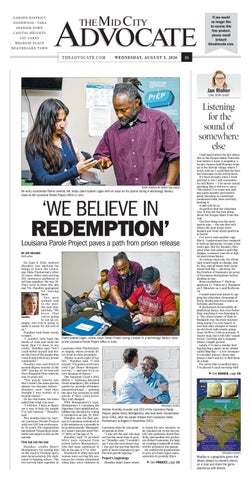
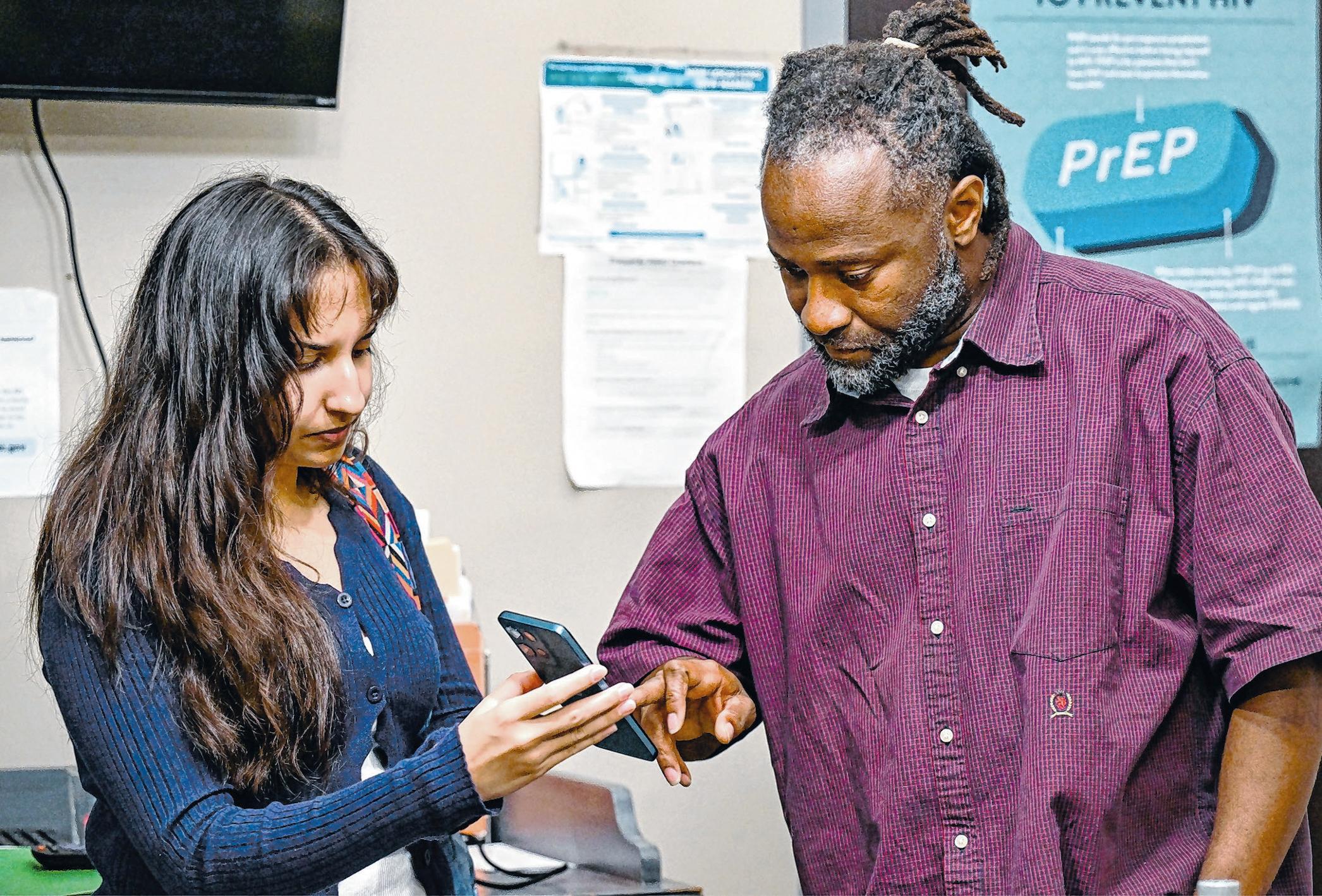
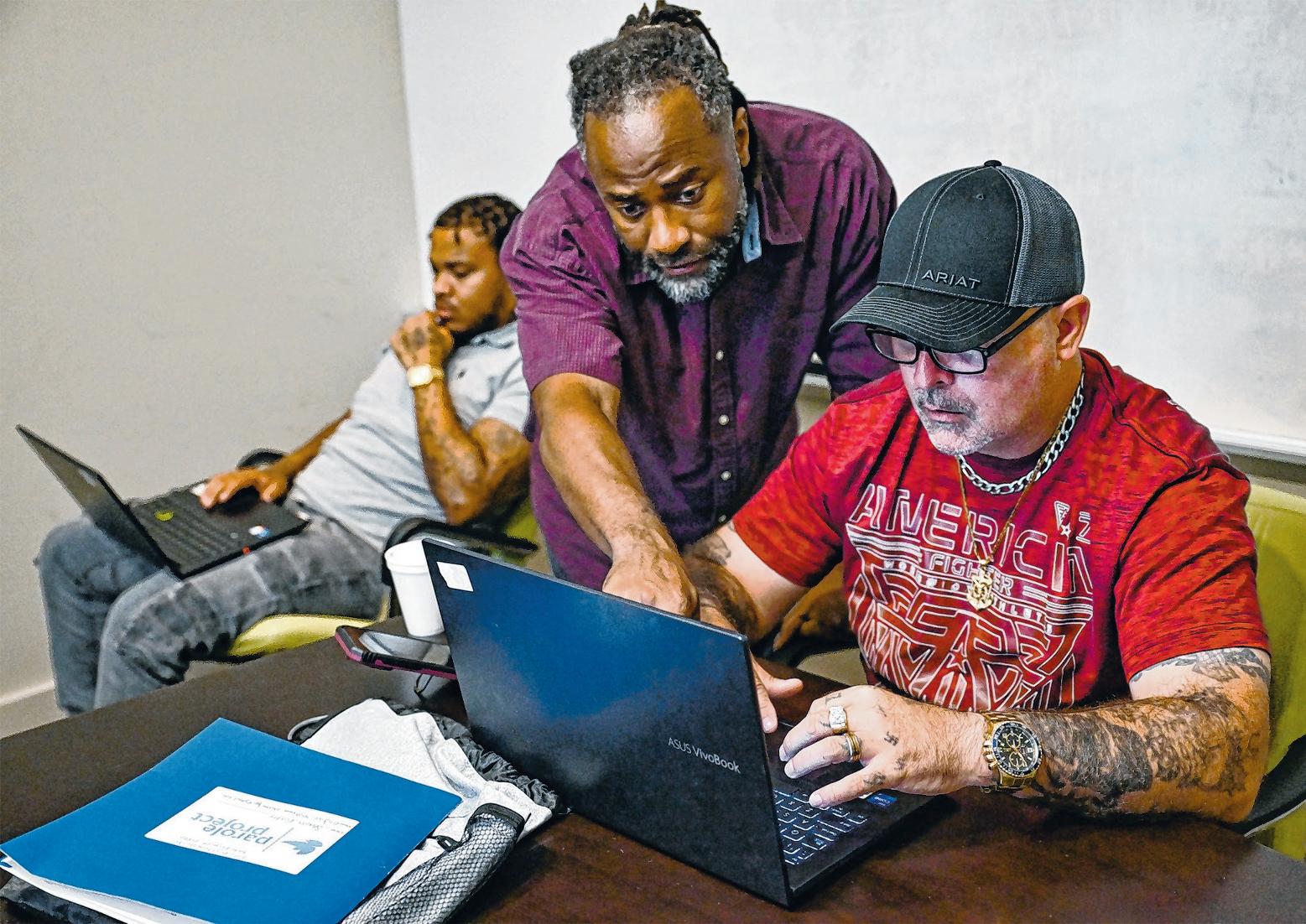
Re-entry coordinator Riana Leverett, left, helps client Gabriel Logan with an issue on his phone during a technology literacy class at the Louisiana Parole Project office in June.
Client Gabriel Logan, center, helps Shawn Foster during a lesson in a technology literacy class at the Louisiana Parole Project office in June.
PROVIDED PHOTO
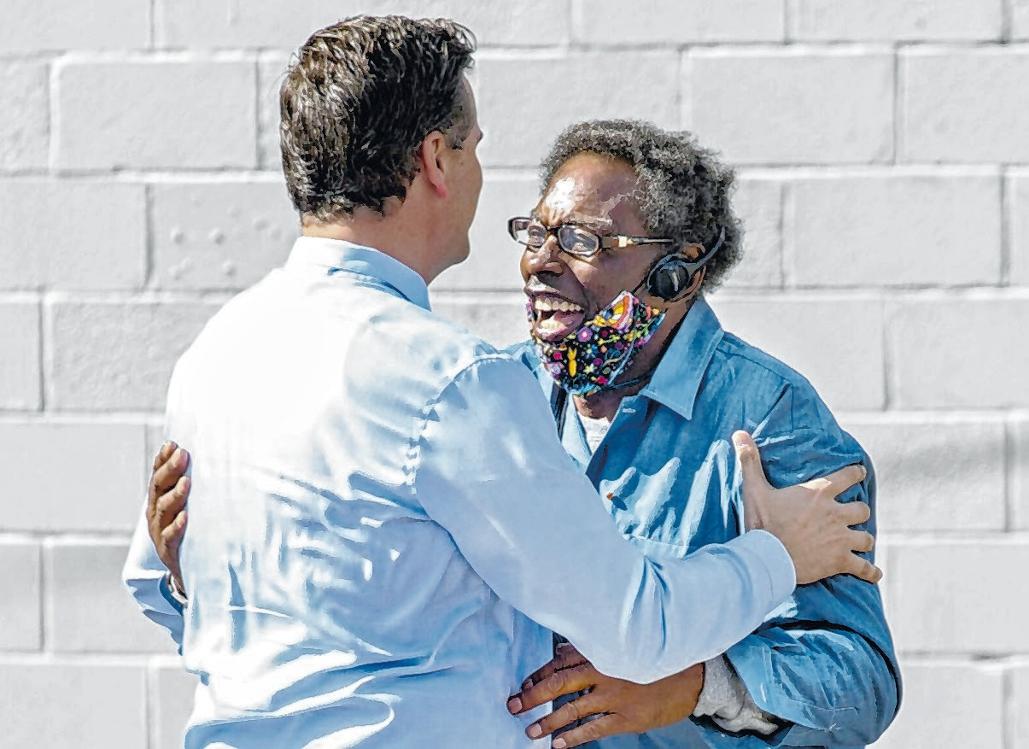
Andrew Hundley, founder and CEO of the Louisiana Parole Project, greets Henry Montgomery, who had been incarcerated since 1963, after his parole release from Louisiana State Penitentiary at Angola in November 2021
Hundley
ASK THE EXPERTS
Southern professor finds hope in Egypt’s museums
BY HALEY MILLER Staff writer
Dr Haitham Eid leads the Southern University at New Orleans museum studies master’s program, the only one of its kind in Louisiana.
In April, he completed a speaking tour in Egypt as part of the prestigious U.S. Department of State Speaker Program. He gave keynote addresses and lectures at the Grand Egyptian Museum, the American University in Cairo and the Arab Academy for Science, Technology, and Maritime Transport. He also joined roundtable discussions with cultural leaders, scholars and professionals. This interview has been edited for length and clarity.
On your speaking tour, what contemporary issues in museum studies did you highlight?
Museums are now envisioning themselves as civic institutions that bring people together, create more peaceful communities and a more peaceful world. The world is facing an interconnected polycrisis from wars to pandemics to social justice issues, and all of these compound and compel the civic society to act Museums are taking this responsibility and trying to be a space for communities to come together to build cohesion and understanding between the community and the world. That was most of the discussion I had on my speaking tour Of course, there were more specific issues related to Egypt and the museums in Egypt — a wonderful tour to the Grand Egyptian Museum — so I was fortunate
to be a part of this. Why was Egypt an apt place to deliver your lectures on these themes? This is a program sponsored by the U.S. Department of State, the Speaker
Program. I did a few programs with them before, one with Egypt as well that was last year, another one virtually with Libya. I was born and raised in Egypt, so of course I speak Arabic.
I’ve been here for 23, 24 years in the U.S., so I have these experiences from Egypt to the United States, and I can speak to both cultures, both institutions. I had a discussion with a
Q&A WITH DR. HAITHAM EID PROFESSOR AT SOUTHERN UNIVERSITY AT NEW ORLEANS
State Department officer, and we coordinated the program to Egypt.
You also participated in some roundtable discussions with professionals and scholars in the museum space.What were your biggest takeaways from them?
I was very inspired by the resilience of museum professionals in Egypt although they suffer from lack of resources, very limited support from governmental organizations.
The landscape of museums in Egypt is different from the U.S. We have nonprofit organizations (that) mostly govern museums in the U.S. In Egypt, nearly all museums are governmental organizations, so with lack of resources, funding, it becomes very hard to do your daily work. But the resilience is amazing. The innovation to overcome these obstacles was just very amazing. That’s one of the takeaways regardless of the challenges and the lack of resources, we can create or do great work in our institutions.
Are there any memories that stand out from your time abroad?
I think, when you do these types of programs, one of the things that you need to always maintain is flexibility
One time, I was traveling back from Alexandria to Cairo for a meeting with the director of the Supreme Council of Antiquities. We received a call that he was called for another meeting with the prime minister of
Egypt for something pressing. They wanted to postpone to another day or later in the evening. We had to rework the schedule to do that. With international travel, I think that’s the mindset you need to have, to be flexible, willing to adapt. In another incident, I was supposed to deliver a lecture in English. They gave the instruction that it would be in English. I went to the venue; it was a university in Aswan. I started speaking in English. I felt like people were not very comfortable. I was like, do you prefer Arabic? They said yes. So, I delivered the entire lecture in Arabic. What other thoughts did you have from this experience that you want to share with your students and colleagues?
The history, the culture, the sights in Egypt are just profound and inspiring. I always advise people, especially students, to travel to Egypt if they can. I can be biased about this, but it’s truly transformational. I try to take some of the students to Egypt when possible through a study abroad program we have here at SUNO. I’m excited that our program, and myself, started this study abroad program a few years ago. We’re trying to go to Egypt in October Also, I lead community trips different from the study abroad trips, just trying to bring these two countries together and these cultures together to build more understanding.
Journey’s biggest song is actually about Christian faith
BY JIM HARRINGTON
The Mercury News (TNS)
SAN JOSE, Calif There’s a deeper meaning to “Don’t Stop Believin ” — one that might not be widely evident to the some of the fans who hear the Journey anthem played at sporting events and on classic rock radio.
The song, which was released on Journey’s seventh studio album “Escape” in 1981, is actually a song based on Christian faith and dealing directly with the Holy Spirit, says the song’s co-author Jonathan Cain Cain says that, if one really thinks about it, the song is actually about the Holy Spirit. “We don’t stop believing,” Cain said in an interview with christianpost.com. “We never do.” Cain who co-wrote the “Don’t Stop Believin’” with fellow Journey members Neal Schon and Steve Perry (who is no longer in the band) — says that connection to Christian faith can be heard in one of the song’s best-known lyrics “And when we say ‘hold on to that feeling,’ that might just be the Holy Spirit,” he says. Neither Schon nor Perry have commented on the matter Cain, who has embarked
RISHER
Continued from page 1G
on a solo career in Christian music and plans to leave Journey after the Bay Area band’s current farewell tour, says that the song was originally inspired by an encouraging talk that he had with
Keith Long, of New Orleans, has been my friend since grade school. He says that playing this game is like looking at the Milky Way when you’re a kid “You get that awesome feeling of realizing how vast everything is. India is huge! China is huge! Africa is enormous!” he said. “It’s also extremely humbling. You think you should know where, say, the Philippines are, but once you’re required to put a pin on a map, you realize you may not know at all.” He’s right. Without borders, even familiar cities go missing.
his father that addressed God’s “vision” for the song-
writer
“I wrote the song based on what my father had said to me when I was going to quit the music business or come
One group of “friends” I play the game with daily is my younger daughter and her boyfriend in Denver They say they’ve become quite competitive, leading them to study maps independently My friend James McGuire in Chicago says that MapTap is a morning routine that doesn’t make him feel bad about looking at his phone. He also likes the trivia blurbs tied to each spot, but what surprised him more was what the game has revealed about his blind spots. We both use rivers and natural landmarks to find
home and regroup,” Cain remembers in the interview with The Christian Post.
“I was in L.A. and I said,
‘Should I stay or should I go?’ He said, ‘No, you’ve got to stay Don’t stop believing.
places we’re familiar with, but Russia and China don’t have the same easily recognizable hints for us. He also plays Wordle every morning with his college roommate and friends a habit he’s kept up for years. We put both games in the same category: small rituals that keep us tethered to people we don’t see enough. I tracked down John Donham, MapTap’s creator He says the game is a labor of love.
Donham had the idea in 2008 but didn’t begin building it until 2023. Last year about 3,000 people played Today, more than 2
God has a vision for you.’
“He was referring back to a fire that I was in when I was 8 years old, where 93 children died. And my father prophesized and said, ‘You were saved for music. I be-
million do. Part of the game’s charm is the stories Donham and his team attach to each place. “I generally pick the stories first that I think are the strongest. I aim for geographical, gender, cultural and era diversity I have so many favorite stories it will fill any article,” he wrote. Parachuting beavers, for example. When Idaho needed to relocate dozens of beavers into the mountains, they turned them into paratroopers. There’s Cecil Chubb, who bought Stonehenge.
lieve the Lord saved you for making music. And I’m going to get behind that. This was 1958 — dads didn’t do that They said get a real job.” Instead of getting a “real job,” Cain would pursue a career in music and eventually land a gig with Journey in the early ’80s.
“I went straight into the studio with them and created the ‘Escape’ album in 1981,” Cain said in the interview It sold 9 million copies So, my dad’s prophecy came true.
“Only God can do that. Only the Lord — the hand of the Lord — could take an accordion player from Chicago and put him in Steve Perry’s living room to write ‘Don’t Stop Believin.’” That’s pretty incredible. That’s kind of miracle stuff, you know?” Cain and Journey bring their Final Frontier Tour to the Chase Center in San Francisco on Nov 28. Journey is also playing Sept 17 at Adventist Health Arena in Stockton. Visit ticketmaster com for tickets and other information.
The current Journey lineup features Cain (keyboards, guitar, backing vocals), Schon (lead guitar), Arnel Pineda (lead vocals), Deen Castronovo (drums, vocals), Jason Derlatka (keyboards, vocals) and Todd Jensen (bass, vocals).
I asked if he had a favorite story about a place, and his answer explains part of why so many people enjoy the game so much. “Human history is so full of all these hopeful, joyful moments,” he wrote. “I don’t know that I could pick one. I think that’s part of why the game exists. Because there are thousands of them.” A thousand miles away, someone I love is dropping a pin on a place we’ve never been, and for a second, I can hear the cards flip. Email Jan Risher at jan. risher@theadvocate.com.
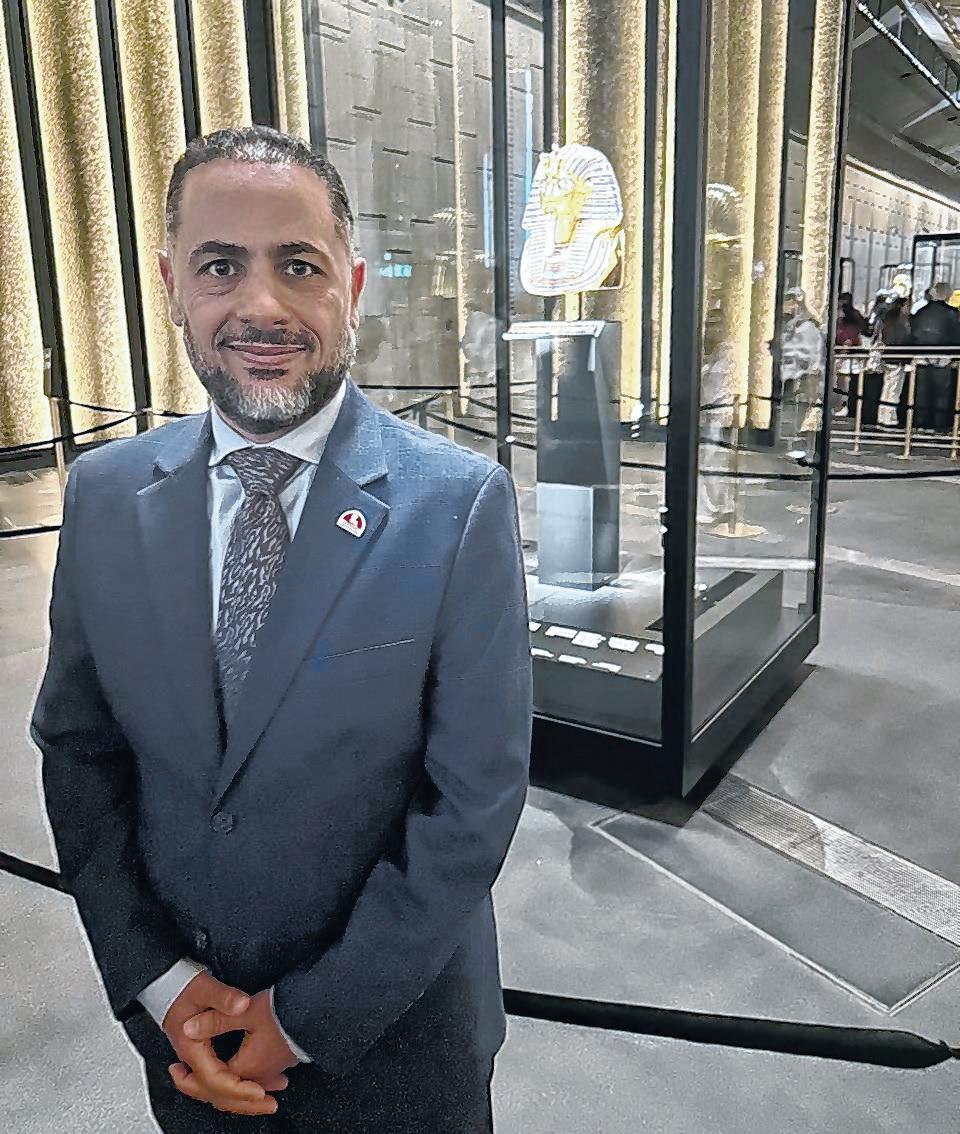
PHOTO PROVIDED BY HAITHAM EID Southern University at New Orleans professor Haitham Eid stands on April 8 in the King Tut Ankh Amun Gallery in front of the Golden Mask of King Tut Ankh Amun at the Grand Egyptian Museum
BAY AREA NEWS GROUP/TNS FILE PHOTO BY JOSE CARLOS FAJARDO
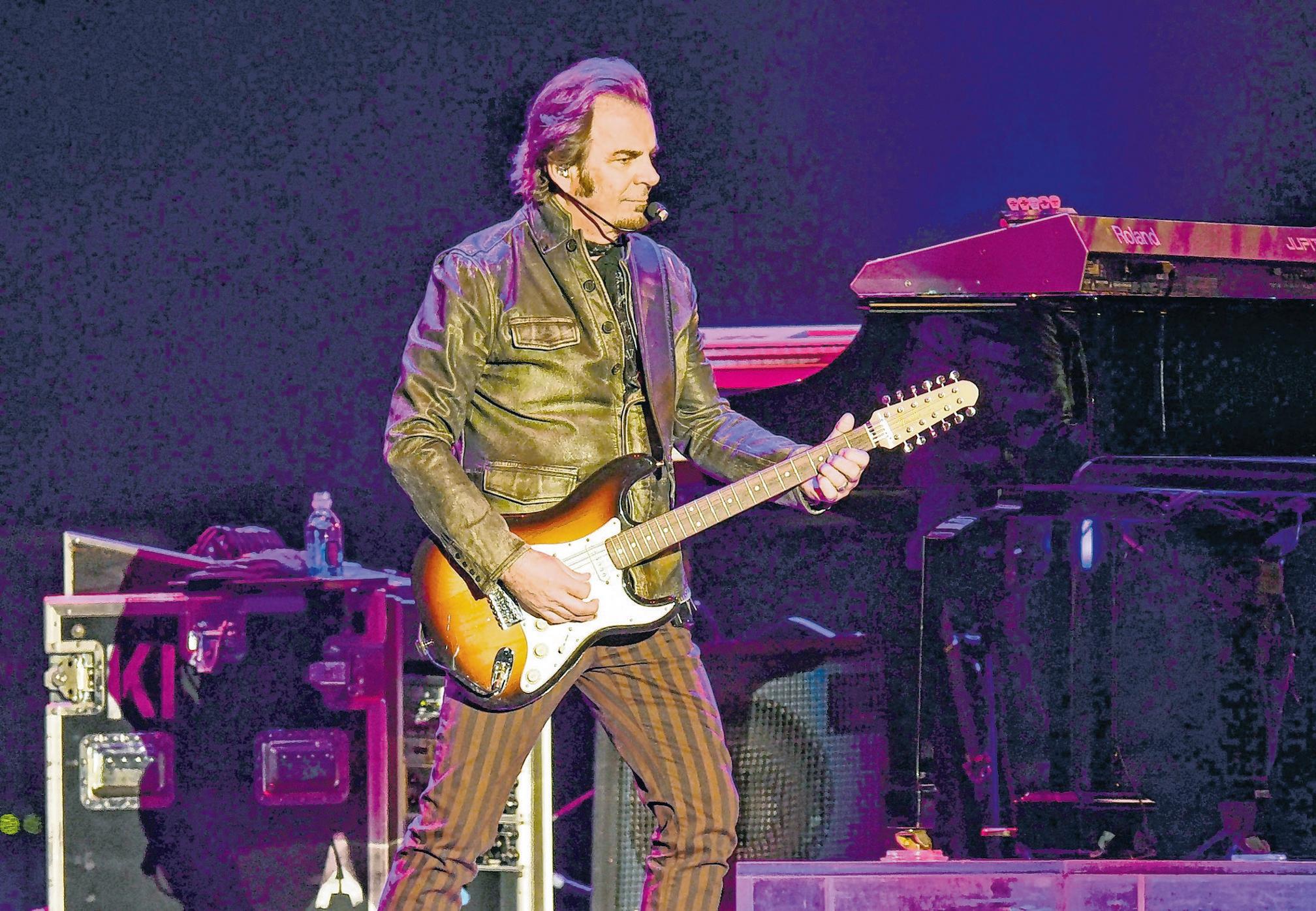
Jonathan Cain of Journey performs onstage during San Francisco Fest 2016 at AT&T Park in San Francisco.
“Thefuture’s
$1.6billionfor Louisiana businesses. Cateringfor 40 peopleused to be agood week.Now they hit400.And that’sjust thetacos.Fromcoffee shops to bustours,Meta’s RichlandParish investment isalreadypayingoff forbusinesses across Louisiana.