



TheGulfiswarming twiceas fast as theworld’s oceans, andLouisiana is at ground zero

TheGulfiswarming twiceas fast as theworld’s oceans, andLouisiana is at ground zero



BY ALEXLUBBEN| Staff writer
Batting away snakes, Wilkie Declouet trudged through chest-deep watertoreach his front door
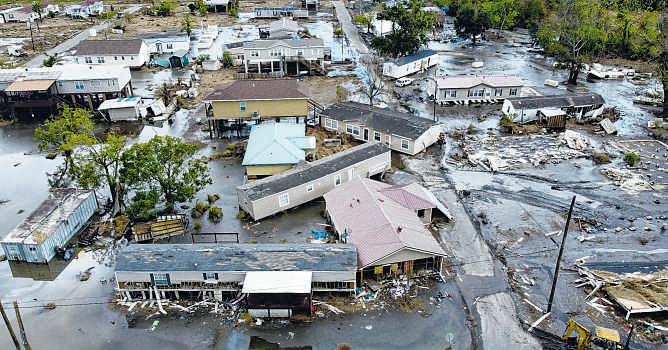
Hurricane Ida had flooded Ironton, asmall historic Black communitydown the MississippiRiver from New Orleans, only 10 miles outsidethe levee system that protects the city. Declouet, a61-year-old father of four,was the first to return.
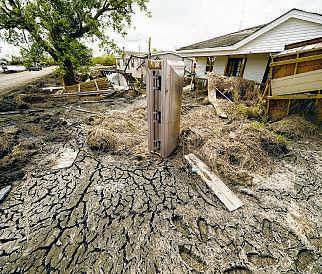
His house, raised on piers, hadheld.Almost nothing else had. Aweathered white casket wasstuckupright in the tangle the flood left behind. Insideitwas aman Declouet had known.Atleast adozencaskets lay scattered around Irontonfor weeks afterthe storm.
“Ida was astorm that cameupfast,”Declouet said recently as he sat under his rehabbed house. “Andit wasone of these thingswhere they couldn’t decide whether it wasgoing to be aCategory 3, 4or5.They couldn’t decide.”
Ida’ssupercharged winds were not afluke.The sudden force of the 2021 storm signaled much more.
The Gulf of Mexico, which the Trump administration has renamed the Gulf of America, is in the throes of a turbulent new erathatholds enormous consequences for Louisiana and theotherstatesalong its coast
It has become one of the fastest-warming bodies of water in the world, new researchisshowing. Humancaused climate changeisfusingwith cyclical weather patterns to create the newreality.
From sea levels to fisheries, deepwater drilling and storms, every vestigeoflife in the Gulfwill change as the water heats.
HotGulfwatersjuicedIda’s winds from 80 to 150 mph in the day before landfall, leaving people like Declouetand his neighborslesstime to prepare.But the changes will not belimited to hurricanes
“This is adramaticwake-up call,” said Donald Boesch, aprofessorofmarine science at the University of Maryland who previously served asthe firstdirector of the LouisianaUniversities Marine Consortium
“The people of the Gulf have long lived with the risks of living on thismarginalocean.But in recentyears, it’sbecome obviousthatit’sheatingdramatically.That has huge implications for the rapidintensification of hurricanes as well as for acceleratedsea-level rise.”
ä See WATERS, page 4A

Not‘special’?Governor downgrades city, shunsMoreno, rattles business leaders
BY TYLER BRIDGES Staff writer
For decades, one thing held true, no matterwho occupiedthe Governor’s Mansion in BatonRouge:The city of NewOrleans held aspecial place in Louisiana. Gov.JeffLandry is sounding as if he no longer holds that belief



‘Ida
up
whotrudged throughwaist-deep water to reach his home after the 2021 storm.
“The peopleofthe Gulfhavelong lived with the risks of living on this marginal ocean. But in recent years, it’sbecome obvious that it’sheating dramatically.”
DONALD BOESCH, professorofmarine science at the University of Maryland
The governor has targeted the city with aseries of actions aimed at bringing, in hisview, NewOrleans downtosize. On Monday he also publicly downgraded the city’simportance.

“Used to be, the saying was, ‘Where goes New Orleans, where goes the state,’” Landry said while announcing that Meta is dramatically expanding its footprint for adata center in northeast Louisiana.“Let me tell you what happened today: That has changed. ‘Where goes Louisiana will determine the fate of NewOrleans.’”
ä See TENSIONS, page 8A Landry
Entergyplans $30B expansion of powergrid
CEOsaysindustrialusers will offset much of cost, butplans face skepticism
BY SAM KARLIN Staff writer
Entergy Louisiana’splans to spend an extraordinary $30 billion to expand and improve its infrastructure are drawing new scrutiny from elected officials, regulators and advocacy groups concerned about the potential impact on ratepayers. If allofwhatEntergy wantstodoisapproved, the average residential customer’s
ä See ENTERGY, page 6A




Venezuela earthquakes deaths surpass 5,000
CARACAS The death toll from the two powerful earthquakes that shook Venezuela last month rose to 5,069 late on Friday, local authorities said.
The interim government of President Delcy Rodriguez added in a statement that the number of injured remains unchanged at 16,740, as in the past 11 days.
Ongoing recovery and debrisclearing operations have led to the increase in the death toll, particularly in the coastal state of La Guaira, the hardest hit by the quakes close to the Caribbean Sea. A total of 1,331 aftershocks had been recorded by Friday
Venezuela’s government says 856 buildings are damaged and 190 collapsed completely since the 7.2 and 7.5 quakes on June 24. Hundreds of other types of structures, such as bridges and roads, were also affected.

Fire destroys more than 100 homes in Norway
DRAMMEN, Norway — The largest residential fire in modern Norwegian history destroyed more than 100 homes and forced hundreds of people to evacuate authorities said Saturday
The fire in southern Norway started in a town house in the city of Drammen around 3:30 p.m. Friday, police said. It then spread through the area and into nearby forests. Firefighters on Saturday morning continued their efforts to bring the blaze under control.
The Norwegian Directorate for Civil Protection said Saturday that it was the largest fire of its kind in modern times.
NRK, Norway’s public broadcaster, said hundreds of people went to an evacuation center No residents have been reported missing, police said. It was not immediately clear what caused the fire. Drammen is roughly 21 miles southwest of Oslo. 2 arrested in kidnapping Forest Service workers
REDDING, Calif. — A father and son are expected to face federal kidnapping charges after they zip-tied two U.S. Forest Service employees and held them at gunpoint inside a trailer in Northern California near Mt. Shasta. Forest Service Chief Tom Schultz said the two workers were conducting routine field operations in the Shasta-Trinity National Forest when they were taken Thursday They were released early Friday morning after being held for more than 12 hours near Gunboot Lake.
“I want to say how profoundly grateful and relieved that we are, that our two employees were released safely. Their wellbeing continues to be our highest priority,” Schultz said The 49-year-old suspect and his adult son surrendered about 2:30 a.m. Friday and walked out of the trailer carrying an assault rifle and knives. He also told authorities he had grenades.
Shortly after deputies from the Siskiyou County Sheriff’s office reached the remote area around noon Thursday they deployed drones to help locate the trailer and started calling additional law enforcement agencies, including the FBI, for help.
FBI Sacramento acting Special Agent in Charge Brian Tosh said it’s fortunate no one was hurt during the standoff.
“Crisis situations like this don’t often result in everyone leaving the scene safely,” Tosh said.
U.S. Attorney Eric Grant said he plans to charge both men with kidnapping federal employees, but no charges were listed in online court records Saturday afternoon.
U.S. launches new attacks to ‘swiftly punish’ Iran for deaths
BY JON GAMBRELL, TOQA EZZIDIN and KONSTANTIN TOROPIN Associated Press
DUBAI, United Arab Emirates
The U.S. military said that it carried out new airstrikes against Iran on Sunday to “swiftly punish” the country’s Revolutionary Guard for an attack in Jordan that killed two American service members, left one missing and four requiring hospitalization.
The strikes were designed to further degrade Iran’s ability to restrict the traffic of oil tankers through the Strait of Hormuz, U.S Central Command said. The waterway accounted for roughly 20% of global oil supplies before the war
The new strikes came after the U.S military announced its first troop deaths from direct Iranian fire since the opening days of the war, following a drone and missile attack on a base in Jordan on Friday
The dead were not identified, and Central Command wouldn’t offer any further details on the deaths. Since the war began, 16 U.S. service members have been killed and over 430 wounded Strikes in southern Iran
An area near Sirik, on the Strait of Hormuz, was targeted about 1:30 a.m., according to Iran’s state-run IRNA news agency, which cited local authorities in

southern Hormozgan province.
A location near Hajiabad, in the same province, was also targeted, and explosions were heard in Bandar Abbas, according to IRNA.
An area near Qeshm Island, inside the strait, was also targeted, according to Iran’s state-run broadcaster, IRIB.
In neighboring Iraq, a base of the Kurdistan Freedom Party, an Iranian Kurdish dissident group, near Irbil was struck by a drone early Sunday, wounding eight of its members, according to Rebaz Sharifi, a military official with the group.
Residents of Irbil, the capital of Iraq’s semi-autonomous northern Kurdish region, also heard explosions from air defenses early Sunday Irbil has been targeted
BY WAFAA SHURAFA Associated Press
DEIR AL-BALAH, Gaza Strip Israeli strikes in Gaza City on Saturday killed at least nine Palestinians, including three children, hospital officials said.
A strike on an apartment in the Nasr neighborhood killed at least five people, including the children between the ages of 8 and 18, said Mohammed Abu Selmiya, director of Shifa Hospital where the bodies were taken. Six other people were wounded, including four children between the ages of 8 and 16, he said Israel’s military said it targeted Hamas infrastructure and had located Hamas militants in the area, without elaborating.
Another Israeli strike hit a group of people in the Zeitoun neighborhood, killing four and wounding
by drone attacks multiple times over the past four days, which coincided with a visit by new Iraqi Prime Minister Ali al-Zaidi to Washington last week and an ongoing escalation between the U.S. and Iran. No group has claimed responsibility for the attacks, but in the past both Iran and Iran-backed Iraqi militias have launched attacks in the Kurdish region, where both U.S. troops and armed Kurdish Iranian dissident groups are present.
Khamenei’s warning Minutes before the U.S. announced the troop deaths earlier Saturday Iran’s supreme leader warned of “unforgettable lessons” if the U.S. keeps attacking the Islamic Republic.
The remarks read out on state TV and attributed to Mojtaba Khamenei, still
unseen since the war began, also called President Donald Trump’s signature “worthless and invalid.”
An Iranian negotiator said Tehran was suspending its commitments to the interim deal signed about a month ago and aimed at permanently ending the fighting. Tehran’s declarations snapped another fragile thread as the war shows no end in sight. Now Khamenei warns of “lessons” not only from Iran but also its armed proxies in the region, calling them the “Axis of Resistance.” The U.S. issued a global travel alert over the rising tensions.
The battle has focused on control of the Strait of Hormuz. The widening strikes now threaten civilians and infrastructure, including desalination plants for drinking water, while the global economy again is on
alert. The U.S. has violated its commitments under the deal and now Iran is “no longer implementing them,” Kazem Gharibabadi, Iran’s deputy foreign minister told state TV
There was no new word on mediation efforts.
Troops face growing risks
The previous recorded death of a U.S. service member was that of a helicopter pilot who crashed in the Arabian Sea earlier this month. Early in the war, an Iranian drone strike on a command center in Kuwait killed six soldiers. One soldier died after an attack on a base in Saudi Arabia. Six were killed when a refueling aircraft crashed in Iraq. On Saturday, the most significant damage from Iranian strikes occurred in Kuwait, where a water desalination plant and an oil facility were hit, according to the Kuwait authorities and the Kuwait Petroleum Corporation. Both declined to provide locations. It was the second attack against a desalination plant in two days in the tiny desert nation that depends on desalination for 90% of its drinking water The strikes injured several people at the oil facility and caused a fire at the desalination plant, forcing several power generation units offline. Several firefighters and a worker were injured while battling two other blazes sparked by Iranian strikes, according to the Kuwait Fire Force. Kuwait briefly closed its airspace due to missile threats, and Kuwait Airways said it was rescheduling most flights to and from the capital.

Gaza City
another critically, health officials said.
The Israeli military said it targeted a “Hamas terrorist” and it was looking into the results of the strike.
Palestinians have reported an increase in the scale of Israeli strikes across the enclave over the past few days.
Despite a ceasefire
agreement reached in October between Israel and the Hamas militant group, Israel still carries out near-daily attacks across the territory It says it is targeting Hamas and other militants who pose a threat. Hamas and Israel have traded accusations of violating the ceasefire.
At least 1,127 Palestinians, including at least 260
Officials say 9 killed, more than 80 hurt
By The Associated Press
Ukrainian drones struck two sprawling warehouses, one of them just east of Moscow, as part of attacks overnight and on Saturday afternoon that killed nine people and wounded more than 80, Russian officials said.
Kyiv’s forces have pressed their relentless aerial campaign against energy infrastructure and military targets inside Russia, aiming to undermine Moscow’s war effort and make Russians feel the consequences of the Kremlin’s all-out invasion of Ukraine that is well into
its fifth year
Two sprawling warehouses of Russia’s major online retailer Wildberries, were hit by Ukrainian drones overnight, according to Russian officials — one in the town of Kotovsk in the Tambov region some 220 miles from the border with Ukraine, and another in the city of Elektrostal, about 30 miles east of Moscow
A Ukrainian drone also hit an oil depot in the city of Noginsk, just north of Elektrostal, sparking a fire and prompting evacuations of a nearby maternity hospital and a residential building, according to the governor of the Moscow region, Andrei Vorobyov Drone debris also hit a kindergarten building, Vorobyov said, sparking a fire that has since been put out. Seven night shift work-
ers were killed at the warehouse in Kotovsk and 25 others were wounded, Tambov regional Gov. Yevgeny Pervyshov said.
A total of 61 people were wounded in the Moscow region, Vorobyov said: 20 sought outpatient care, while 40 others were hospitalized. One person died of their injuries, he said.
One more person was killed and another wounded in a Ukrainian drone attack on Russia’s Belgorod region on Saturday afternoon, according to local authorities. Both warehouses caught fire, Wildberries founder Tatyana Kim said, and the blaze in Kotovsk was put out. Images and footage released by Russian online outlets showed a fire raging at the Elektrostal facility with massive plumes of smoke towering over it
children, have been killed since the ceasefire, according to Gaza’s Health Ministry Five Israeli soldiers have been killed in that time.
The Oct. 7, 2023, attack by Hamas-led militants that sparked the war killed some 1,200 people in Israel and saw 251 others taken hostage. Israel’s retaliatory offensive has killed 73,250 Palestinians, according to
Gaza’s Health Ministry
The ministry is part of the Hamas-led government and is staffed by medical professionals who maintain detailed records viewed as generally reliable by United Nations agencies and independent experts. It does not distinguish between civilians and militants but says women and children make up around half of all deaths.


7,500 constructionjobs,$1.6billionfor Louisiana businesses. Up to $50,000for teacherbonuses. Part of apartnership that’sjust

Continued from page 1A
‘Real-world experiences’
Since 1970, the Gulf’s surface has warmed twice as quickly as the combined average of the rest of the world’s oceans, federal data shows, climbing nearly 2 degrees Fahrenheit. That might not seem like much, but it is already having wide-ranging effects.
The changes are no longer projections. They are happening in real time, and they compound. Just this month, the Gulf hit a record high temperature for early July, driven by a recent heat wave.
As water warms, it expands, speeding sea level rise along the Louisiana coast that is already climbing six times faster than the global average, largely due to land subsidence. The heat is also spreading deeper as the climate gets hotter, with temperatures rising even at the very bottom of the Gulf.
Louisiana’s coastal marshes already fading away will drown faster, and high-tide flooding in coastal communities, once an occasional nuisance, will become chronic Scientists say, with a degree of confidence that’s uncommon among skeptical researchers, that a generation of sea level rise along the Gulf Coast is essentially guaranteed, no matter how aggressively the world cuts fossil fuel emissions.
Global weather is also intertwined with the Gulf. The warming currents that flow through it have reverberating effects on climate patterns far away from Louisiana. At the same time, the problem is becoming more complicated to address.
Funding for the elaborate, networked systems that monitor the temperature of the Gulf is at risk due to cuts by the Trump administration, hampering scientists working to understand what is unfolding
The federal government has also largely abandoned its fledgling attempts to address climate change, and governors across the Gulf Coast, including in Louisiana, have followed suit. Planet-heating carbon dioxide emissions, the result of burning fossil fuels, increased last year by an estimated 2.4%, according to the Rhodium Group, an independent global policy and economic research firm.
“These are not theoretical concepts that people keep talking about. Your insurance increases, you have water damage, you have damage to your house,” said Sönke Dangendorf, a Tulane scientist considered one of the world’s preeminent experts on sea levels. “These are real-world experiences.”
The workshop
In the days before Ida, as Declouet was preparing to evacuate, Kevin Martin was on the water, deploying a buoy that would sit anchored in the Gulf, in the storm’s path.
“Ida ripped right over the buoy, ripped every solar panel off of it,” said Martin, who works out of NASA’s Stennis Space Center in a lab run by the University of Southern Mississippi, operating the buoys, gliders and other instruments that take the Gulf’s temperature
The buoy carried enough battery power to keep recording without the panels, capturing data straight through the storm. It wasn’t the first time one of the program’s buoys rode out a hurricane. During Katrina, another gathered data continuously through that storm, even as the surge dragged it and its 5,000-pound anchor roughly nine miles.
While Martin’s instruments plumb the ocean depths, his desk rumbles as engine tests for the Artemis missions take place next door to his office at Stennis. The lab spills over into room after room filled with deep-water instruments, like Q’s workshop in a James Bond film.
One device, called Eagle Ray, is a giant torpedo-shaped autonomous vessel that maps the bottom of the Gulf down to about 6,500 feet. Another, Mola Mola, the scientific name for the ocean sunfish with which it shares its shape, uses lasers to take hyper-detailed photographs of the seafloor He also has spindle-shaped gliders that navigate the Gulf’s waters, taking measurements of temperature and salinity continuously over several months before they are retrieved. The intel his autonomous robots collect contributes to global datasets, collected from thousands of networked sensors across the world.
As the waters Martin studies heat up, he has had to recalibrate some sensors after they maxed out. The lab he works for even moved the servers that store the data he collects to Hattiesburg, Mississippi, some 60 miles north of the coast, to keep them farther from increasingly strong hurricanes.
Other changes he says, are stranger and harder to explain, pointing to a tooth-shaped indentation in one of his gliders.

“I hadn’t had a shark strike in all the years I was operating gliders since 2007,” he said. “In 2024, I had two. And you have to ask yourself why.”
Martin stressed he doesn’t study sharks, but a recent study found that one species is spending more time in the Gulf as its waters warm.
None of this work is cheap. Martin’s workhorse glider model costs $250,000 One glider, he said, can “run up a $1,000-a-month phone bill,” just to transmit its location and data.
A battery pack costs $22,000. And the lab operates on grant funding. Already, he can only afford to deploy gliders during hurricane season.
“These vehicles shouldn’t be sitting here. They should be in the water,” he said. “The funding’s not there.”
The Trump administration has repeatedly threatened to pull funding from long-running programs that allow scientists to take the temperature of the world’s oceans. The president’s latest budget request would have eliminated the federal program that funds the Gulf of America Coastal Ocean Observing System (GCOOS), the regional network to which Martin contributes, along with 10 sister networks around the country’s coasts.
Congress maintained funding for GCOOS this year Whether it will do so again is unclear
Following Trump’s lead, the National Science Founda-
tion cut funding for a sophisticated $368 million observation network. It has begun pulling up deep-sea buoys off the coasts of Alaska, North Carolina, the state of Washington and a crucial monitoring zone between Greenland and Iceland.
The amount of data collected to date is “a blip” on the timescales at which global systems change, said Renellys Perez, a deputy director of physical oceanography at the National Oceanic and Atmospheric Administration. “We really need many decades of data to better understand how the ocean is changing.”
While Trump has targeted the system because it contributes to the nation’s understanding of climate change, its primary role is to provide weather data, said Craig McLean, a former NOAA assistant administrator for research who oversaw it. The system is crucial, he argued, informing evacuations and storm preparations, information that he says pays for itself.
“It’s a fraction of a penny a day for what you’re getting,” he said “It’s not even the shaving of the copper on the edge of the penny.”
The deep Gulf
While Martin’s gliders largely measure the temperature of the Gulf at its surface, something equally concerning is happening at its depths.


Scientists have long known that the oceans absorb most of the excess heat that’s getting trapped in the atmosphere due to human-caused emissions, but they once thought that warming was largely confined to the ocean’s top layer. But when a team of researchers tethered deep-sea thermometers to the ocean floor in the western Gulf, they measured an alarming trend: Even at the bottom — at a depth of more than 11,000 feet — it is getting warmer, at a rate of about 0.15 degrees Fahrenheit per half-century.
The creatures that live at the bottom of the Gulf — the deep-sea corals and strange fishes are precisely tuned animals, adapted to live in a high-pressure, low-temperature environment. Small changes there ripple Many of those creatures form the basis of the food chain fueling the Gulf’s mega-fisheries that power the state’s coastal economy Corals at the bottom of the ocean are particularly vulnerable to temperature changes. Even a small rise can stress corals, causing them to expel the symbiotic algae that lives inside them — giving them their color and most of their nutrients — in a process called “coral bleaching.” These corals are crucial nurseries for dozens of critical species that coastal communities rely on.
“I was on a coral reef about 500 meters down and we saw groupers down there. We saw barrel fish. We saw alfonsino. We saw spot prawns,” said Erik Cordes, a biologist at Temple University who studies corals, often using remotely operated submarines. “These are all species that are fished in the Gulf of Mexico, that spend good parts of their lives way down deep on these coral reefs.”
What happens at depth doesn’t just affect the creatures that live near the seafloor As hurricanes tear over the Gulf’s balmy waters, they draw heat from its surface. If those waters are hot enough, storms become rapidly supercharged — as Hurricane Ida did before it slammed into Ironton. In previous decades once that heat from the surface of the Gulf was sucked up by the storm, which churns the waters like a blender as it passes over, the cooler waters below tended to slow a hurricane down.
Now, even those deeper waters are warmer than they used to be.
“A hurricane can blow itself out by causing this deeper water to well up,” said Boesch. But if the Gulf’s deep waters are warm, “it just wells up more heat and intensifies.” Ocean currents
The heat trapped in the Gulf’s depths doesn’t stay there. It is connected to a massive system of global ocean currents that help regulate the planet’s climate.
A monster current flows into the Gulf between the Yucatán Peninsula and Cuba, plodding north toward Louisiana before doubling back on itself and flowing out through the Florida Straits. That stream, called the Loop Current, is a key component of the global system of water flows that forms, as Texas A&M professor of oceanography Steven DiMarco put it, “the air-conditioning of the planet,” moving heat, through water, between the equator and the poles.
“Will that change?” DiMarco asks.
The question arises because, when the Loop Current flows out through the Florida Straits, it joins the Gulf Stream, the flow of warm water that brings heat from the tropics up toward northern Europe. Those currents, taken together, are part of what scientists call the Atlantic Meridional Overturning Circulation — a system of global ocean currents that plays a significant role in regulating the world’s climate.
All of those currents may be slowing Scientists are now debating the possibility that the system of currents — the flows of water that have circled the globe for millennia — could collapse entirely due to climate change.
The likelihood of that happening is “still debated,” said Matthieu Le Hénaff, a NOAA oceanographer “There is no certainty of a collapse. Some models show it It’s highly discussed.” If it were to collapse, the climate system would be thrown out of whack.
Parts of Europe could fluctuate between colder winters and warmer summers. Monsoons would be disrupted. Wildfire risk could increase. Sea level rise would accelerate — in the Gulf and globally — and agricultural systems could be upturned.
“Just because the Gulf is partially enclosed doesn’t mean we’re not connected to everything else,” Martin said.
Rising seas
While these shifting currents threaten to rewrite the global climate, the sheer volume of this warming is already threatening to redraw the map of the Gulf.
The contours of the Gulf 125,000 years ago may portend what is to come.
That was the last time global temperatures were comparable to what they are now, and the Gulf lapped against an ancient ridge that traverses the state from Mississippi to Texas, north of Lake Pontchartrain and Lake Maurepas The line is roughly where wetlands and loose mud give way to pine forests and denser soil Generations into the future, the Gulf may eventually
The sea surface has warmed about 1.8°F since 1970, and the heat reaches deep into the water column.

Near the surface: About +0.35°F per decade –the layer warming fastest
Warming falls off sharply around 800 feet below the surface

The upper 3,300 feet holds 80-90% of the warming in the upper 6,560 feet
Even near the seafloor –about 11,500 feet down –the Gulf is still warming, roughly 0.03°F per decade
return there, a recent paper from researchers at Tulane University argued, though scientists and local leaders say there are options to adapt and stave off that prospect. In the meantime, extreme events will — and have already become more frequent.
Dangendorf led a study, published in June, that found that globally since 1900, coastal extreme sea levels that used to happen once a century are occurring 12 times as often, with human-driven warming quadrupling their likelihood.
Communities like Ironton may bear the brunt of the extremes.
But as the Gulf heats and seas rise, no communities along the coast will be spared the impacts of a changing climate.
Audrey Trufant Salvant, Declouet’s neighbor there, said she has seen the changes play out. Many of her neighbors have left after they were unable to rebuild. The community has shrunk.
“They are getting worse,” she said of the storms “We are ducks in the water Every time June comes around we wonder: Will we have to run again?”
Email Alex Lubben at alex.lubben@theadvocate.com. His work is supported with a grant from the Walton Family Foundation, administered by the Baton Rouge Area Foundation.

The Gulf sea-surface temperatures, 2005 vs. 2025
Two snapshots of the average August surface temperatures in the Gulf show how it has warmed in recent years. In August 2005, the month Hurricane Katrina hit, the Gulf averaged 85.9°F Twenty years later, in August 2025, the Gulf averaged 87°F, about a degree hotter. That extra heat provides more fuel for hurricanes.


“These are not theoretical concepts that people keep talking about. Your insurance increases, you have water damage, you have damage to your house. These are real-world experiences.”
SÖNKE DANGENDOrF, Tulane scientist considered one of
experts on
monthly bill could rise by around $40, according to documents Entergy filed with the state Public Service Commission. But Entergy CEO Phillip May said in an interview that the eventual amount customers actually pay to help fund the buildout is likely to be much less because he expects a growing base of industrial users will offset 50% or more of the costs.
“What will happen is we will see additional revenues that will pay for much of that cost,” May said, “including revenues we anticipate from the substantial economic growth in the state.” Entergy’s plans reflect a never-before-seen level of growth in Louisiana’s electricity sector, drawing the interest of the governor state lawmakers and others who historically have stayed out of the complex business of utility regulation.
Just how much more residents pay will be decided by the PSC, a five-member elected body that regulates utilities with monopolies on their service territories, including Entergy
“There are too many variables to look at ($40 a month) as a final number,” said Commissioner JP Coussan, a Lafayette Republican. “It’s our job to make sure that Louisiana families are getting the best deal possible. That includes not rubber-stamping every proposal that comes before us.”
Regulators have already raised concerns about Entergy’s planned $1.8 billion acquisition of a Texas power plant called Cottonwood, with a staff consultant saying it’s largely needed because of Meta’s emerging data center in northeast Louisiana. Entergy and Meta insist that claim is false.
Entergy contends that it needs new infrastructure to address longstanding constraints in moving power long distances, to strengthen the grid and to ensure Louisiana signals to private companies including data center developers like Meta — that it is ready for them to relocate here.
The company has repeatedly cited an “economic resurgence” in applications to build more infrastructure, saying it must build new power plants and transmission lines to support new industrial companies building local plants.
The $40 a month projection is based on a customer using 1,000 kilowatt-hours a month, slightly less than the average customer usage. Entergy said that number will likely decrease as companies like Hyundai, CF Industries and Woodside Energy begin buying huge amounts of power Entergy has cut at least one of those companies, Hyundai, an economic development discount worth about $300 million, according to internal Hyundai documents. State officials say incentives are needed to attract companies to the state. In an interview with The

Times-Picayune | The Advocate, May said that the company still expects Louisiana’s electric rates to be 20% lower than the national average after the spending is finalized, compared to about 30% lower now May said some of the offsets are already guaranteed by contracts that require industrial customers to pay a minimum bill even if their demand never ramps up.
He declined to offer specifics on how much of the load growth is guaranteed
He also said Entergy is collaborating with the PSC on a working group to help ease the burden on low-income customers. He noted the company has lowered late fees and eliminated charges for disconnections and reconnections for certain customers.
The utility’s plans to ramp up spending are drawing the attention of consultants who analyze deals on behalf of the PSC, as well as consumer advocates and a group that represents large industrial users in the state which has long sought the ability to go around Entergy to get power
The concerns are creating an unlikely coalition of allies: The Louisiana Energy Users Group, a trade association representing dozens of industrial companies, and the Alliance for Affordable Energy, a consumer advocacy group, have both raised concerns about Entergy’s plans.
“While projected load growth will hopefully offset some rate increase impacts, the spending is happening now before the load growth has been realized and so there is risk to existing ratepayers in the meantime, and the projected load growth will not offset all of the cost risk and rate increases even if it does fully materialize,” LEUG attorney Randy Young wrote in PSC proceedings last month In a recent dispute over whether Entergy should be able to recover more of its costs associated with the troubled River Bend nuclear facility from customers, PSC consultant Lane Sisung cited customer affordability in recommending the PSC reject Entergy’s request. The case is still pending Sisung, who has analyzed utility proposals for the PSC for years, noted that Enter-
gy has delivered “substantial” profits to shareholders in recent years. And he said the company’s “future projected earnings trajectory is already positioned to grow through new capital deployment while customer affordability is being imperiled.”
Big plans
The spending plans that add up to $30 billion aren’t happening all at once.
Instead, Entergy has filed more than a dozen separate plans that are being litigated in “dockets” before the PSC, where regulators, opponents and other affected parties file evidence, testify and hold hearings before administrative law judges.
In 2022, the company won approval to spend $2 billion hardening the electric grid amid questions over failures during Hurricane Ida, adding more than $8 a month to the average electric bill.
Then, starting two years later, Entergy filed an array of proposals. It plans to spend nearly half a billion dollars on a transmission line between Iberville and St. Charles parishes, $1 billion on another line between Iberville and Jefferson parishes, $1.8 billion to buy a Texas power plant called Cottonwood and $4.1 billion to build new gas-fired power plants at sites in St. Charles and Calcasieu parishes, among others.
On top of those plans, which would be funded by all ratepayers, Entergy has struck deals with Meta to build at least $18.7 billion worth of infrastructure to serve its northeast Louisiana data center campus, including infrastructure that will power a massive $50 billion expansion Meta just announced.
At President Donald Trump’s urging, Meta pledged at a White House event earlier this year to pay for all its power needs for data centers.
Meta’s deal with Entergy requires it to fund the costs associated with those plans for the first 15 to 20 years, at which point it can renew or walk away The plans have drawn outcry from groups like the Alliance for Affordable Energy, which is calling for more regulations.
Entergy’s buildout has boosted its standing on Wall Street, where the company has seen significant growth


try in general and actually a bit lower than what you see in the southeast region.”
Political concerns
While the state constitution gives the PSC the ultimate power to decide what to do, Gov Jeff Landry and some legislative leaders are also now stepping into the arena.
Landry issued an executive order on ratepayer protections last month after The Times-Picayune’s reporting on one of Entergy’s most controversial components of its spending plan, to buy the power plant called Cottonwood. The order requires data center developers to pay for their own power if they want to take advantage of lucrative tax breaks from the state.
cess open enough,” Hensgens said. “I’m not sure we’re taking every step to make sure we’re not socializing these costs.”
The Alliance for Affordable Energy is asking for more oversight of Entergy’s plans for Meta and other projects. Executive director Logan Burke said Entergy’s spending plans come at a time when many households in the state are “already paying more than they can handle.”
The Alliance has also criticized Entergy’s huge expansion of its fleet of natural gasfired power plants, noting the state already heavily relies on gas and that rising natural gas prices have hit residents hard. Customers pay for the cost of fuel like natural gas.
in shareholder returns.
At its recent investor day in June, Entergy Corp. executives told investors that the company’s returns have outpaced the broader stock market. And leaders from the utility welcomed Meta and Amazon executives onstage for a discussion about the two companies’ data centers in Mississippi and Louisiana.
“Our sales growth from two years ago has doubled to 9%,” CEO Drew Marsh told investors at the event at the New York Stock Exchange.
“Our five-year capital plan has doubled to $67 billion. Our total shareholder return has more than doubled the S&P 500 over that time frame.”
May, CEO of Entergy Corp’s Louisiana subsidiary, said that while Wall Street is excited about Entergy’s growth opportunities, the company still has a target 9.7% profit that is regulated by the PSC. If it under-earns, customers will pay more, and if it earns too much, rates will come down to bring the profit back down.
“That does not mean we’re making an unusually high return on our investment,” May said. “The 9.7% return set by the commission is generally consistent with rates of return for the indus-
“These resources are vital to the welfare of our citizens and to the future of our economy, and that is why our approach demands thoughtful and responsible stewardship,” Landry said.
Sisung, the PSC consultant, concluded that Cottonwood is largely only needed because of Meta’s data center prompting Landry to issue the order Meta and Entergy have rejected the idea that the data center is responsible for the energy needs, and Entergy will soon file a rebuttal.
“This consultant’s report is inaccurate speculation given the facility will provide power to multiple Entergy customers and Entergy planned to acquire it before Meta decided to build in Louisiana,” Meta spokesperson Francis Brennan said in a statement.
Meanwhile, state Senate leaders have formed a task force on energy issues, including whether to allow industrial customers to buy or build their own power and go around Entergy
Sen. Bob Hensgens, R-Abbeville, a member of the task force, said in an interview that there’s a “new normal” in the electricity sector because of huge power needs of data centers and industrial plants, and the public has a hard time understanding how the PSC works.
“I just don’t find the pro-
“If all of these plans come home to roost, not only are the bills going to spike, these costs are going to be locked in for decades with no way out,” she said. “The commission must take action to limit the harms at the front end, even if they won’t be in office when the bills come due.” And the Louisiana Energy Users Group, which represents a group of industrial companies with 92 facilities in the state, is also raising questions about Entergy’s plans. LEUG has argued for years that its industry members should be able to get their own power, a proposal that has failed to win approval so far Last month, LEUG filed comments at the commission expressing concerns about the rate hikes on the way for customers because of the $30 billion in spending Entergy is planning. While growth in the number of customers may offset some of the impacts, “there is risk to existing ratepayers in the meantime.”
“Louisiana’s current rules for private generation investment were developed more than 40 years ago,” Young, LEUG’s attorney, wrote. “We don’t buy cellphones or computers from 40 years ago, so why should Louisiana limit itself to more than 40 year old rules for electric generation?”





BY SAVANNAH PETERS Associated Press
Taylor Farms has expanded avoluntary recall of its iceberg lettuce products sourced fromcentral Mexico because of apotential link
to themultistatecyclospora outbreak that has sickened peopleacross theU.S. Products with the potential to be contaminated with the diarrhea-causing parasitewere shipped to27 states including Louisiana, Texas, Florida, Pennsylvania, Illinois and New Jersey, theCalifornia-based company said in astatement Friday
“Weare actively remov-
ingthe implicated products,” the statementsaid, adding thatthe company hasstopped sourcing lettuce from an implicated lot in central Mexico. U.S. healthofficials earlier this week identifiedlettuce from asupplier in Mexico as asource of cyclosporacontamination in food served at Taco Bell restaurants in five Midwestern states. The Taylor Farms re-
call announcement listed 25 shredded lettuce and saladmix productssold under eight different brand codes.Taylor Farms did not respond to an emailed request forthe full names of those brands or retailers. The recalled products were shipped as recently as Thursdayand have “best by” dates as lateasAug. 3.
Sysco, thenation’s largest food distributor, hashalted
distribution of all Taylor Farms iceberg lettuce products sourced from Mexico and instructed customers to destroy them
Cyclospora is amicroscopic parasite thatinfects food thathas come into contact with humanfeces, most commonly when produce is irrigated or washed with contaminatedwater When ingested, the parasite causes intestinal illness
BY ALANNA DURKIN RICHER Associated Press
Influencer brothers Andrew and Tristan Tate, whose socialmedia empire promoting wealth,male dominance and misogyny has made them among the world’smost polarizinginternet personalities, were arrested SaturdayinMiami as British authorities sought their extradition on rape and sex trafficking charges.
The brothers were taken into custody by the U.S. MarshalsService on asealed warrant, agency spokesperson Brady McCarron told The Associated Press,placing the United States at the center of an international legal saga that has stretched from Romania to Britain British prosecutorsannounced Saturday that they were seekingthe brothers’ extradition on charges alleging they raped and trafficked women between 2010 and 2017. The dual U.S. and British citizens moved to Romania in 2016. They were arrested there in 2022, accused of participating in schemes to lure womenfor sexual exploitation. They denied those allegations and the Romanian case hasn’tgone forward because of legal and procedural problems. Last year,they were allowed to leave Romania and

ASSOCIATED PrESS FILE PHOTO By JULIA DEMArEE NIKHINSON
AndrewTate, right,and hisbrother Tristan arriveanevent on April 11 in Miami. The social media influencers were arrested SaturdayinMiami, according to the U.S. Marshals Service.
flew to Florida on aprivate jet.
Thebrothers are expected to appear inMiami’sfederal court early next week, accordingtoaperson familiar with thematter whospoke to on the condition of anonymitytodiscuss sensitive law enforcementoperations.
The pending charges in the UnitedKingdomaccused the brothers of abusingwomen in an area north of London,where they grew up. Their lawyers had said they deniedthe allegations Joseph McBride, an attorney representing the Tate brothers, said in aphone interview Saturday evening that he has notbeenableto speak with his clients but calledthe new charges out of the U.K. “filthand slander” intended to derail defa-
mation lawsuits filed by the brothers in theU.S.
“They’re pulling outall thestopstomake sure these guys never get theirday in court,” McBride said.
“Weare confident that once acompetent judge sees the facts, and once the Department of Justice confronts this egregious abuse of its own authority,Andrewand Tristan Tate will walk free. America does not do Britain’s political dirty work.
AndrewTate, 39, first reached amainstream audience as acontestantonthe U.K. realitytelevisionshow “Big Brother” in 2016. He was removed from theshow when avideo surfaced that appeared to show Tate assaulting awoman.Heand his brother TristanTate, 38,
are vocal supporters of U.S. President Donald Trump.
AndrewTate hasamassed over 10 million followers on Xbut has been banned from platformslike YouTube, TikTok and Instagram for violating hatespeech guidelines. His most widely con-
demned rhetoric includes comments that women who are sexually assaulted should bear some responsibility fortheir attacks, graphic descriptions of how he might attack womenand criticisms of people who seek treatmentfor mental
markedby“frequent and sometimes explosive bowel movements,” according to the CDC. In 2026, cyclospora has sickened at least 1,645 people in the U.S. and hospitalized 141, according to the CDC, which is investigating more than 5,000 additional illnesses that may be linked to the parasite. This time last year,only 249 cases had been reported.
illness. The Tate brothers have consistently deniedallegations of abuse and human trafficking, claiming that violent and misogynistic statements have been taken out of context or were intended as jokes.

















Landry said that after being asked by areporter whether he would heed the requestof New Orleans Mayor Helena Moreno to defuse the tensions between thegovernor and mayor that have plunged the relationship between the city andthe state to its lowest point in years.

Landry also indicated he is in no hurry to meet with Moreno and revive acooperativepartnership with thecitythat haswon the governor plaudits for ahistoric reduction in violent crime and the refurbishment of NewOrleans’ core areas in advance of the 2025 Super Bowl
That partnership spiraled downwardinrecentweeks after the governor pushedto eliminate three judges, five assistant district attorneys and the position of Calvin Duncan, the newly elected Orleans Parish clerkofCriminal District Court, and after an Orleans Parish grand jury indicted Attorney General Liz Murrill on charges of threatening New Orleans elected officials, including Moreno.
Shane Guidry,abusiness owner and key adviserto Landry on New Orleans matters, said the governor has no interest in resolving thedifferences until Murrill’s indictment vanishes
“The indictment shouldn’t have happened,” Guidry said, adding,“Liz has spent alot of timeand resources working for New Orleans to make it a better place.”
The split with Landry has left many New Orleans business and politicalleaders anxious, angry or on the defensive, scrambling to make sense of the governor’sactionsand trying to determine thebest path forward.
“A lot of people have reached out to me over the past couple of weeks,” said Moreno. “I’ve reachedout to acoupleofothers.We’retrying to figure out the path to get together.”
Differentpolitical bases
One figure helps explain why Landry is expressing more frustrationwiththe city and downplaying its importance now
The governor,who is up for reelection next year,won only 10%ofthe vote in Orleans Parish when he was elected
governorin2023. It was easilyhis worst showingacross thestate,accordingtoJohn Couvillon, aBaton Rougebased pollster and demographer Landry’sdismissive comments about New Orleans will helphim politicallyin therest of the state, said Roy Fletcher,a veteranpolitical consultantinBaton Rouge who works for Democrats and Republicans. “It rallies the base, absolutely,no question,” Fletcher said. Meanwhile, Moreno enjoys far more popularity in New Orleans —she was elected last year with 62% of thevote —and herdecision to notdefer to Landryand Murrill will play well with her supporters in the city,saidStephenPerry,who has served as alegislativeaide in Baton Rouge, as then-Gov.Mike Foster’s chief of staff and as the chief promoter of tourism in New Orleans.
“Bothare using an inflammatory incident to make sure they are completely aligned with their own politicalbases,” Perry said. “That’sthe norm in state and national politics now.The losers are thepeople and the economy.”
Landry is aRepublican in a state where Republicans now hold all the statewideelected offices and two-thirds of the seats in the state Legislature, while Moreno is aDemocrat in acity where virtually all the top electedofficials are Democrats.
Hurricane Katrina 20 years ago costNew Orleansabout one-fourth of its population, although the city remains the biggest in the state, and the seven-parish New Orleans regionbrings in more sales taxrevenuethan any other region, according to figures.
JohnAlario worked with seven different governors while serving 48 yearsin the Legislature representing Westwego.
“They all saw New Orleans asaneconomic plus for the state,” saidAlario, whoserved bothasHouse speaker and Senate president twice. “If Icould have moved theSuper Bowl to Westwego, Iwould havedoneit. But the big events come to New Orleans, and the tax dollarscirculate around the state.”
The dispute between the political leaders comes at a time when Landry is feeling fortified after he announced July 13thatMetawillnow

spend $50 billion to build an even bigger data facility in Richland Parish.
Landry is also coming off a politicalwin by raising money andsecuring support for U.S.Rep.Julia Letlow’svictory on June 27 in the Republican Senateprimary. Buthis efforts angeredRepublicans who backedstate Treasurer John Fleming.
With Fleming winning 43% of the vote, Landry has to pull together his fractured base and head off apotential challenge froma more conservative Republican candidate, said Fletcher,who advised Fleming’scampaign.
“He’sgot to get 70%ofthe Whitevote in next year’s governor’srace,” Fletcher said. “That’s thegold standard. Once he getsthat base put back together,there’s notmuch room left (for afar right-wing challenger).”
In hersix months in office, Morenohas overseen acontinued drop in crimeand has put greateremphasis on addressing quality-of-life issues thathave long bedeviled residents by filling potholes and repairing broken streetlights.
City leadersthisweek said New Orleans’ finances are trendinginthe right direction, with spendingdown andrevenue up as of May 31 compared to budgeted projections.
But Moreno is still grappling with ahuge budget deficit that she inheritedfrom her predecessor,LaToyaCantrell.
The city won state authorization last year toborrow $125 millionfromabank to meet payroll. The cityrepaid that money andthensought authorization from the State BondCommission to sell $110 millioninbonds to avoid budget cuts andcontinued furloughs of cityemployees. Moreno announced last week that she was withdrawing


that request in the face of oppositionfrom Landry’sBond Commission appointees.
New Orleans’ fiscal problems have strengthened Landry’sposition as he frames adifferent relationship between the city andthe state.
“New Orleans thinks they’re so special,” he said on Monday,aremarkthat went viraland inspired aT-shirt from alocal retailer
“That parish is going to operateexactly like therestof this state,and the people of this state want that. So, when the mayor recognizes that andwhenshe understands that they have to get their fiscal house in order —just like this state has got its fiscal house in order —we’ll have a discussion.”
Landry expressed similarly blunt sentiments about New Orleanswhenhespoke to a large group of Louisiana business, civic andpolitical leaders last Sundayevening in the FrenchQuarter. Gathered at Galatoire’s, and welcomed by the restaurant’sand The Times-Picayune’sowner John Georges, they heard Meta’s
president, Dina Powell McCormick, outline the tech giant’sexpansion plans in Louisiana. Someofthe leaders from New Orleansafterward privately expressed shock and anger at Landry’s remarks about thecity.
And even as they applauded the Meta news, some also noted that Tulane’splanned transformation of Charity Hospital’svacant property downtown would bring as many or more permanent jobs.
Moreno attendedthe event but saidshe didn’tspeak with thegovernor
“He was on theother side of theroom,” shesaidlater Collaborationneeded
TopNew Orleans business leaders allsaidinrecentdays that the city andstate must collaborate for the overall good and pointed to the successful partnership where Landrycreated Troop Nola andMurrill agreed to prosecute those arrested by State Police.
“The recipe between the city and state is crime reduction,” said Gregory Rusovich, alongtime leader in different business groups in New Orleans. “The governor uses his office and resources, and the city acts in collaboration.”
Almost none of the business leaderscontacted forthis article identified anyspecific efforts to bridge the divide between Morenoand Landry Several privately expressed concern about the governor’s reputation forexacting retributiononthose whodon’t support him.
Oneleader known to be making an effort to get the twoleaders on thesame page is Boysie Bollinger, asuccess-
fulshipbuilder andgenerous philanthropist who is abig donor for Republicans and livesinNew Orleans. Moreno asked himtoarrange ameeting with Landry.Bollinger saidhewill discuss it withthe governor Sunday night when they meet in Aspen, Colorado. Bollinger will be staying at his housethere, while Landry will hold afundraiser and attend ameeting of the Republican Governors Association Michael Hecht, who leads GNO Inc., which promotes investmentinNew Orleans, laments the fractured ties but cited several ongoing collaborations between the city and state, including Tulane’s plans for Charity Hospital, constructionunderway on the Louisiana International Terminal port in St. Bernard Parish and a1,000-roomOmni Hotel to be built in the city’s Warehouse District.
“Wejustcelebrated LSUNew Orleans opening up in the middle of my district,” said City Council member Eugene Green.
James Carville,the famed Democratic strategist who has served as an unofficial ambassador for New Orleans, saidLandry is using the city as apolitical foil to bolster his middling popularity.The governor hadanapproval rating of only 43% in March, down from 58% ayear earlier,according to the Pelican Institute forPublic Policy, a conservative group.
“Lawyershaveasaying, said Carville, an LSU Law School graduate. “If you have the law,pound the law. If you have the facts, pound thefacts. If you have neither, pound the table. If your approvalrating is stuckinthe 40s, pound New Orleans.”















LouisianaCommunityandTechnicalColleges(LCTC) knowsthatpreparingLouisiana’sfutureworkforcestarts withlisteningtoemployers.Acrossthestate,LCTC collegespartnerwithbusinessandindustryleaders toshapeprogramsthatreflectevolvingworkforce needs,helpingstudentsinruralcommunitiesprepare forhigh-demandcareersclosetohome AtLouisianaDeltaCommunityCollege(LDCC), thatcollaborationincludesaprecisionagriculture technologyprogramdevelopedwithdirectinputfrom GoldmanEquipment,agroupof13JohnDeeredealershipsinNorthLouisiana.HunterVallee,amanager withGoldmanEquipment,saidthepartnershipreflects thegrowingneedfortechnicianswiththeskillsto servicetoday’smodernagriculturalequipment.
“Tobeagoodtechnician,youhavetohaveacertain mindsetandsomeexperienceworkingwiththetools andknowinghoweachmachineisdifferent,”Vallee said.“Inaddition,technicianshavetobeabletowork ondifferenttypesofequipmentdependingonthetime oftheyear.Wehavealwayshadenoughsalespeople butwehavestruggledtohaveenoughtechnicians.”
LDCCalsorenovatedspaceatitsWinnsborocampus tomirrorthefacilitiesandequipmentstudentswill encounteronthejob,helpingensuregraduatesare preparedtocontributefromdayone.Thefirstcohortof studentsisexpectedtocompletetheprogramthisyear.
“I’vebeentoafewJohnDeeretrainingcentersin thecountry,andtheoneatLouisianaDeltaisupto par,”Valleesaid.“It’sexcitingtoseethestudentsget hands-onexperienceinelectricalwork,hydraulics andthefundamentals.Thatmeansthatwhenthey comeworkforus,theywillbeabletohittheground running.
TheexpansionofLDCC’sWinnsborocampus alsoincludesanindustrialelectricianprogramas wellasoneingeneralstudieswithaconcentration inagriculturescience.Together,theexpandedofferingsgivestudentsinsomeofLouisiana’smostrural communitiesaccesstocareer-focusededucation withouthavingtoleavehome
“Theseprogramsarepurpose-builttoaddressworkforcedemandsinourcommunity,”saidWinnsboro CampusDirectorMaryHoggatt.“We’reequipping studentswithskillsthatarenotonlyrelevantbutvital tothefutureofNortheastLouisiana’sagriculturaland industrialsectors. Similarpartnershipsarecreatingopportunities acrossthestate.InSoutheastLouisiana,Northshore TechnicalCommunityCollege(NTCC)servesmore than9,500studentsannuallyacrosscredit,workforceandadulteducationprogramsatitscampuses inLacombe,Greensburg,Hammond,Walkerand Bogalusa.Amongitsmanyemployerpartnerships, NTCClaunchedanewadvancedmanufacturing
apprenticeshipprogramearlierthisyearinpartnership withLaitram,aglobalmanufacturingleaderwitha locationinNewOrleans,anditsaffiliatedcompany, Intralox.Twostudents,EvelynKimballandIsaac Fairburn,werehiredatIntralox’sHammondlocation whileattendingclassesatNTCC’sLacombecampus In addition to earninganhourlywage, both apprenticesreceivefulltuitionsupportwhilegaining real-worldexperienceinahigh-demandfield.The programallowsstudentstocompletetheireducationwhilebuildingtechnicalskillsinaprofessional manufacturingenvironment
AnotherkeyNTCCpartnerisTextronSystems, whichcollaboratedwiththecollegetotransformits aluminumweldingcourseintoatargetedlearning experiencealignedwithTextronSystems’methods andrequirements.Studentslearnthedisciplineneeded tofollowprocess-drivenworkaswellasfundamental aluminumweldingskillssuchaspropermaterial preparation,correctmachinesettingsandstandard weldingtechniques. ThepartnershiphasbeensosuccessfulthatTextron SystemsisexploringsimilarpartnershipswithNTCC totrainfutureelectricians,shipfittersandoutfitters “Providing students with career pathways at TextronSystemsallowsthemtobeginacareerin theirhomecommunity,”companyleaderssaid.“In addition,theseopportunitieshavethepotentialtobuild long-termcommunitypride,strengthentheregional economyandsupportasustainableworkforcepipeline Additionally,throughourtuitionreimbursement andeducationassistanceprograms,employeescan advancetheirskills,pursuefurthereducationand growprofessionally—allwhileremainingintheir homecommunities.”
Beyonditsbrick-and-mortarcampuses,NTCC hassignificantlyexpandeditscommunityoutreach andworkforce developmentwithits Mobile MechatronicsLabandMobileSTEMLab.These mobiletrainingunitsareinstrumentalinproviding career exploration, industry certificationsand communityengagementtoa diverserange of students in theNorthshoreregion, from middle schoolersanduniversitystudentstoat-riskyouth andincarceratedindividuals Theseeffortsareexpandingtheskilledworkforce whileintroducingstudentsthroughouttheregionto careerstheymayneverhaveotherwiseconsidered FromprecisionagricultureinNortheastLouisiana toadvancedmanufacturingandtheskilledtrades intheNorthshore,LCTCcontinuestoprioritize employerpartnershipstohelppreparetheworkforce
Finally,there’s a treatmenttoconquer lowback, neck,leg andarm painwithout dangerousmedications or painful surgery.
If yousufferfrom:
•LOW BACK PAIN
•SCIATICA
•NECKPAIN
•HIP PAIN
•LEG PAIN
•NUMBNESSINARMS, LEGS OR FEET
Non-surgical Spinal Decompression maybe theanswerfor you!
Pain affects everypartofyourlife- walking, sitting, and even sleeping.Nothing’s worsethanfeelinggreat mentally,but physically feelingheldbackfromlifebecause your nerveorbackpainhurts -and it just won’tgoaway.
Scientificstudies tellusthatspinaldiscs aremostoften therootcause of achesand pain that people suffer from Thesediscs actascushionsbetween thevertebrae and create thenecessaryspacefor nerves to exit thespinal column.But when discsare injured, worn down,orbegin to degenerate,theybulge or herniate -pressingonnerve rootsand triggeringpaininthe backorneck This pressure canalsoleadtoradiating pain in thehips, legs,feetor arms
We areDr. ScottLeBlanc andDr. Dana LeBlanc, owners of LeBlancSpine Center.Weknowwhatit’sliketobein pain,because we see it everyday.Wehave treatedthousandsofpatientsoverthe past 14 yearsatour BatonRouge andKenneroffices.
Disc issuesare common,but patients sufferingare usually givenlimited optionsoftreatment.Werun thesebig newspaperads to letpeopleinthe communityknowthere is anotheroption- withoutinjectionsorsurgery!
NON-SURGICALSPINALDECOMPRESSION is abreakthrough, non-invasive treatmentfor herniated, ruptured, bulgingand degenerative discs. It hasbeenprovento reversedischerniations andrelieve nervepain, backpain, andradiating pain
At LeBlancSpine Center,wehave state-of-the-art technology that iisFDA clearedand very successfulin relievingpaininpain- even when othertreatmentshave failed.Unlikeother treatments that only mask symptoms spinal decompressionaddresses therootcause of your pain-restoringdischeight, improvingspinalalignment andreducingnerve compression.
PROOFTHIS TREATMENTWORKS There’splentyof researchtobackupthe claims of Spinal Decompression Therapyand itseffectiveness.Hereare just afew of the publishedscientificstudies

•“Patients reported amean88.9% improvement in back pain andbetterfunction. No patientrequiredany invasive therapies(e.g. epidural injections,surgery).”American Academy of Pain Management
•“We thus submit that decompressiontherapy should be considered first, before thepatient undergoesasurgicalprocedure whichpermanently alters theanatomy andfunctionofthe affectedlumbarspine segment.”JournalOfNeuroscienceResearch
•“86%ofthe 219patientswho completedthe therapy reported immediateresolutionofsymptoms.”-Orthopedic Technology Review
•“Vertebralaxial (spinal) decompressionwas successfulin 71%ofthe 778cases”-Journal of Neurological Research
•“Good to excellentreliefin86% of patients with Herniated discs” - TheAmericanJournal of Pain Management
•“Decompression Therapyreported a76.5% with completeremissionand 19.6%withpartial remissionof pain anddisability” -Rio Grande Hospital,Department of Neurosurgery
Youwillsit with thedoctorone on onetogooveryour x-rays,and you’ll gettosee everything firsthand. At LeBlancSpine Center,our goal is to help youlive pain-freeand return to theactivitiesyou love.Wegenuinelyenjoy meetingwithpatients, answeringquestions, andshowing firsthandhow spinal decompressioncan be alife-changing solution.Ifyou’vebeenlivingwith back or neck pain,weinviteyou to schedule aone-ononeconsultationand experience what sets ourclinic apart-personalized attention, proventechnology, and compassionatecare.
Thereisnochargeatall andyou don’tneedtobuy anything Youdon’t have to go on living in pain-Callustoday! 225-763-9894
WhenIcametoDr. LeBlanc, Iwas having lowerbackpain, right hip,and thighpain. Ihad been suffering between6-to-12 months SincebeginningSpinal Decompression treatments, Ican nowwalk farther, sleepbetterand drivewithlesspain. Ihavemoremobility andlesstension.I wouldrecommend LeBlancSpine Center-Iam treated excellentbythe staff, andwhatIlikemostabout thecare hereistheyare professional andprecise!
Dr.Larry Tujague,M.D (Retired,Radiologist) hometown -Baton Rouge,LA
IcametoLeBlancSpine Center with pain in my left arm, shoulder and neck,and Ihad two fingersonmylefthandthatwerenumb. I had been dealingwiththisfor over 8monthsand hadtried shots, therapy,MRIs, andX-raysbefore, butnothing wasreallyhelping. Since coming here,I’veimprovedabout 90%. Thestaff is amazing-always knowledgeable,friendly,and helpful, andthe servicefromthe doctors andteamhas been great.WhatIlovemostisthe pain reduction, because it’s allowedmetotakebettercareof my dadand grandkids, cut thegrass,dohousework,and even fish again.IfeellikeI have moremobilityand I’mmorerelaxed nowthatIcan do more activities Honestly,the only thingIdon’t love is thedrive -weneedanoffice in Gonzales!Theyare amazing, though. Please give them atry before any surgeries
KimLandry (Photographer) Hometown -St. Amant, LA

BeforecomingtoLeBlancSpine Center, Isuffered with tightnessin mylower back andnumbness in my left foot forapproximately seven months. Ihad been givenprescriptionmedicationand haddone physicaltherapy forabout threemonthstonoavail.Ibegan Spinal Decompression Therapytreatmentsonmylower back.Since beginning treatment,I am now80% improved!I nowhaveimproved flexibility ofmotioninmylower back andhavelessnumbness in my left leg. Treatmentshaveenabledmetodomostall normal dailyactivities, excluding heavylifting. Iwould highly recommendtreatmentsand servicesatLeBlancSpine Center. Comfortand care areofthe utmost importancetothe staff andtheyare very friendly andresponsive toneeds. Thedoctors areexcellent at answering anyand allofmy questions
Robert Kimbro Certified Public Accountant Hometown -New Orleans, LA



BY CHRISTOPHER L. KELLER and REBECCA BOONE
Associated Press
After deadly floods killed more than 100 people in Texas’ Hill Country last July, officials vowed major changes in hopes of preventing the failures that contributed to the high death toll. They promised better flood warning systems, tighter safety rules for children’s camps and improvements to the state’s water infrastructure
That work was far from done when a new round of storms began pummeling the state this week, triggering catastrophic flash floods in some of the same areas devastated in 2025 At least two people died. Hundreds needed rescue. But residents in some hardhit areas said a year of preparation did make a difference. Newly installed flood sirens sounded in the darkness, warning people to get out.
Phones buzzed with alerts that weren’t sent out in last year’s disaster Still, stories of people surprised to find their homes inundated by rising rivers illustrate the challenges of trying to bolster early warning systems in a vast, rural area known as Flash Flood Alley
Proactive alerts
Over the last decade, a variety of Texas state and local agencies missed opportunities to implement flood warning systems along the Guadalupe River the AP reported after last summer’s floods killed 136 people, including 28 at a sleepaway camp for girls. That changed after the tragedy as lawmakers and others scrutinized a lack of preparedness by government agencies and riverside camps Unlike last summer, when local officials in Kerr County said they had been reluctant to “cry wolf” and order evacuations and failed to send out wireless alerts to warn of flash floods, Kerr County issued four alerts and the city of Kerrville issued one early on Thursday as the risk for flooding became apparent, according to an Associated Press review

of available data.
They warned residents along Quinlan Creek to evacuate to higher ground, and of “extremely dangerous” flash flooding. Those alerts came alongside flood watches, warnings and emergencies sent to broadcast outlets, weather radios and mobile phones by the National Weather Service. People who signed up for the CodeRED notification emergency system in Kerr County also received text message warnings.
“Last year we got no alarms We had no idea what was going on,” said Suzanne Sutphin Gschwind, of Kerrville
“This year, very different,” she said, with multiple texts and calls coming in from local authorities, a weather channel and her doorbell camera. One night the warnings arrived “about every two hours.”
“I think we would all like to err on the side of too much,” she said.
Everyone not reached
Between the early morning hours of Tuesday and about 9 a.m Thursday, the National Weather Service sent 38 alerts to people in certain southwest Texas communities, including 14 tornado warnings and 24 warnings that flooding was occurring or imminent and could be “life threatening.”
Those Weather Service notifications, though, often don’t contain the highly localized information put in alerts sometimes sent by municipal and county emergency agencies — and
people in some places may not have gotten any of those local alerts, which can be more decisive for people considering whether to seek high ground.
An Associated Press review of wireless emergency alert data did not find any listed as sent by agencies in Uvalde County, which was hit hard by flooding, though agencies in that county might have used other means to alert the public.
Jaclyn Gonzales was awakened at 2 a.m. Wednesday by a friend who called to warn that a tornado might be headed toward her Uvalde-area home. When she jumped out of bed, the floor was wet
“It was the shock of the water to my feet that made me really wake up,” she said.
Kat Sprawls only learned floodwaters were nearing her Batesville home when a friend called her at 3:30 a.m.
Friday It took five or six calls before she woke up, because she had her phone on do-notdisturb mode.
“There’s no warning system at all. It’s just like the flood in Kerrville last year — we had no warnings,” Sprawls said “Over half of Batesville is under water now.”
Zavala County Sheriff’s Department secretary Jessica Belmarez said the department is updating its Facebook page with evacuation information and that law enforcement officers were going door-to-door in affected areas, including Batesville. Siren network expanding
Newly installed sirens in Ingram and in Kerr and
Kendall counties were used this week to warn residents, said state Sen. Paul Bettencourt, who authored legislation in 2025 to help fund the sirens Twenty-eight additional counties are also eligible for flood warning funding Most are in the process of putting together implementation plans for review by the Texas Water Development Board.
“Between the outdoor sirens, and the cellphone alerts, the response was very positive in getting people out of the way and to higher ground,” Bettencourt said.
“It’s an enormous improvement over a year ago.”
Three of six new sirens installed in Kerr County were used to warn people to seek high ground, said Tara Bushnoe, manager of the Upper Guadalupe River Authority
The other three were in areas with only minor flooding, Bushnoe said.
The small town of Comfort had one warning siren for years. The volunteer fire department recently installed two more.
“Some people just don’t want to leave — that’s our problem here,” said Danny Morales, the assistant fire chief. “But we did set them off twice, probably an hour from one to another, just because we had people just lingering, and not wanting to move.”
Filling the gaps
Ian Cunningham founded River Sentry after the 2025 floods, building flood siren towers for privately owned sites like RV parks, camps and hotels. The sirens are triggered by rising water levels.
So far, the company has installed 104 sirens along the Guadalupe River, Cunningham said, including several near the site of an RV park
where more than three dozen people died in 2025.
“We installed them about three months ago and did not expect them to be used so soon,” Cunningham said. Hononu, which has developed water-level sensor technology and a real-time data network, received a state contract that will make it easier for agencies to purchase its flood warning technology Watch Duty, a fire-tracking app used by millions, expanded earlier this year to help monitor floods.
‘Lives have been saved’ Texas Gov Greg Abbott said the lessons of 2025 led to a better emergency response this time.
“Everybody in Texas has been far more prepared to deal with what has happened this year,” Abbott said during a news conference in Uvalde. “Lives have been saved.”
BY MATTHEW BROWN Associated Press
BILLINGS Mont. The U.S. Interior Department on Friday canceled a rule meant to protect plants and animals that are determined to be threatened with extinction, the latest step by President Donald Trump’s administration to dismantle key provisions of the landmark Endangered Species Act at the behest of industry
Instead of receiving automatic protections, imperiled species will need individualized protection plans once they are added to the threat-
ened species list. That’s a potentially lengthy process in which companies could seek exemptions for oil and gas drilling, mining and other development where those species live.
Opponents said it would make it harder to save wildlife that’s awaiting federal protections and in danger of disappearing, such as monarch butterflies and alligator snapping turtles.
Interior Secretary Doug Burgum said in a statement that the Endangered Species Act had been used for too long “to stop almost any new project in America,
driving up costs for families, weakening our competitiveness, and undermining our national security.”
“Success should be measured by species recovery and delisting, not by adding more species to the list,” Burgum added.
A second change finalized Friday requires officials to analyze economic impacts when deciding whether habitat is critical to a species’ survival.
Critics say it gives corporations an opportunity to put their thumb on the scale so that officials will allow development in those areas.































ASSOCIATEDPrESS PHOTO By MOSES SAWASAWA
More than 12 attacksrecorded
BY PROSPER HERI NGORORA and CONSTANT SAME BAGALWA Associated Press
BUNIA, Congo— At least adozen attacks on health facilities and workers have been recorded during Congo’s Ebola outbreak as safety fears restrict the response in the worst-affected region, authorities said Saturday
Many health workers and other frontline workersin Ituri province have also gone on strike over unpaid salaries, further complicating response efforts in what’sbeen declared the fastest-growing Ebolaoutbreakonrecord. So far 2,181 cases have been recorded, including 864deaths.
The Bundibugyo virus responsible for this outbreak is less common than others that cause Ebola disease,and there is no approved vaccine or treatment.
Many of the attacks have been carried out by angry mobs who have stormed treatment centers or tar-

geted responseteams in the field, Pierre Akilimali, incident manager for the Ebola response, said at apress briefinginBunia,the capital of Ituri.
been seenleaving remote communities considered hot spots andheading to Bunia in recent days,localstold The Associated Press.
By The Associated Press
BAMAKO, Mali Islamic mili-
tants and aseparatistgroup ambusheda Malian army convoyinthe country’s hard-hit northonSaturday, resultinginthe killingor capture of scores of soldiers, the rebels said.
The Malian armyconfirmed the attack, saying in a statement thatarmed groups ambushed the convoyof Malian soldiers andtheir partners in aremote part of the northernGao region, and thatitwas launching counterattacks. It was the latest in aseries of militant attacks against Malian securityforces in recent months as armed groups compete for influenceand territories in the Sahel region.
Later on Sunday,the army saiditcarried out “precision strikesagainst enemy
positions” in the area where the attack happened. “Three terrorist positions were successfully targeted (and) several terrorists were neutralized. These operations allowed the convoy to break free from the ambushes and continue its route,” it said.
Both the regional al-Qaida affiliate JNIM and the separatist Azawad Liberation Front, or FLA, separately claimed responsibility for the attack as ajoint operation in statements that spoke about“great humanlosses” and “serious material damage” on the side of the Malian army.
The groups said the convoy was made up of both the Malian armyand Russia’s Africa Corps, whose forces have been supporting Mali’s military on the ground.
It is the latest such partnershipbetween the two
groups that observers say posesgreat risks to Mali’s stabilityand itsruling junta.
“Thereweremanysoldiers killed, others capturedalive.Army carsincluding armored cars were destroyed and others seized in good condition,” said FLA spokesperson Mohamed Elmaouloud Ramadane.
The military convoy was leaving the northern town of Anefis and headed to Gao city when it was ambushed in theSahara desert. The nature of the convoy wasn’t immediately clear,although fuel tankers could be seen as part of it, suggesting it could be aMalian logistics convoy The rebels shared videos purportedly showing the soldiers lined up as they appear to be surrendering while surrounded by the militants andMalianmilitary vehicles.
The attacks are not limited to healthcare teamsand affect frontlineworkers like burial teams, according to Dr.Adelard Lufongola,operationsmanager for theEbola response.
“Members of the various response teams have been held captive in some health zones.Teamsresponsible for safeand dignified burials have been threatened and continue to be threatened in some cemeteries and within several communities,”Lufongola said at the briefing.
Ebolaspreadsin thehuman population through contact with bodily fluids such as vomit, bloodorsemen, and with contaminated surfaces and materials. Traditional funerals in which loved ones wash andprepare bodies have been restricted, which has angered some residents. In Ituri, which accounts for around 90% of allcases, health and aid workers have
U.N. spokesman Stéphane DujarriconThursdaytold reporters that humanitarian actors are “deeply concerned by escalating violence” impacting the Ebola response and that access to treatmentcenters and surrounding communities remainsconstrained.
“The worsening security situation hasforced several humanitarianpartnersinvolvedinthe Ebola response to temporarily relocate staff to Bunia which is relatively safer,”hesaid.
The mostrecent attack recorded was on Wednesday, when residents in the town of Nyakunde attacked ahospital and torched an Ebola treatment center nearby Officials said treatment and care resumed on Thursday at the center after itsoccupants, including some patients, fledinthe aftermath of theattack. Concerns, however,remained about risks of transmission amid thechaos.


















































BY SAFIYAH RIDDLE Associated Press
A federal prosecutor in Texas shared new details Thursday evening about the moments before an immigration officer shot and killed a Mexican national and longtime U.S. resident in early July The disclosure complicates the government’s earlier claim that the man struck an ICE vehicle before he was shot.
A U.S. Immigration and Customs Enforcement officer killed Lorenzo Salgado Araujo, 52 on July 7 as he was driving to a Houston construction job site with three co-workers, one of whom was his brother The shooting sparked protests in the sprawling Texas city, echoing Salgado Araujo’s family’s calls for transparency The family describes him as a hardworking father very close to obtaining legal status in the U.S. after living in the country for 35 years. The shooting came just days before two other men in Florida and Maine died

A memorial grows Monday at the site where Lorenzo
Immigration and Customs Enforcement agents in Houston.
as part of President Donald Trump’s federal immigration crackdown, renewing scrutiny on the Department of Homeland Security’s law enforcement tactics Aaron Reitz, the U.S. attorney for the Southern District of Texas, said for the first time on Thursday that ICE
officers were targeting two Guatemalan men who were potentially subject to deportation. He said they were driving a van similar to the one Salgado Araujo was driving when he was killed. In an earlier statement released the day Salgado Araujo was killed, DHS said he was tar-
geted in an immigration enforcement operation, and he was living in the country without legal permission.
Reitz also said that the officers believed that Salgado Araujo and the passengers in his car fit the description of the Guatemalan men the agents were looking for
Four officers driving two separate law enforcement vehicles attempted to pull over Salgado Araujo’s van using their police lights. Salgado Araujo then made a U-turn and drove over a median to evade getting pulled over, Reitz said. Later that morning, the officers again encountered Salgado Araujo’s van and for the second time tried to pull him over this time effectively surrounding the vehicle, Reitz said. Two of the four agents got out of their cars and told Salgado Araujo to put the vehicle in park. Just before he was shot, one of the agents was “partially inside the van or immediately next to it” when Salgado Araujo tried to reverse and then drive forward again, Reitz said.
An earlier DHS statement accused Salgado Araujo of weaponizing his vehicle. The agency said he rammed his van into a law enforcement vehicle and said an officer opened fire in self-defense. The most recent statement from the U.S attorney’s of-
fice, however didn’t mention any collision between Salgado Araujo’s van and a law enforcement vehicle. It also didn’t explicitly say that the officer feared for his life There are no reported injuries for the officers involved. The latest statement didn’t name the officer who killed Salgado Araujo, nor did it specify if the officer who fired the shot was the same person who was next to, or partially inside, the van.
Reitz also said in the statement that officers “saw in plain view several small bags of a white, crystal-like substance inside the van” and that the FBI later executed a search warrant to investigate for possible illicit substances. Salgado Araujo’s brother, who was in the van when the shooting happened, has been in ICE detention since the incident. His attorney said the white substance was a salt mixture that the men used as electrolytes to stay hydrated while doing manual labor in the grueling Texas heat.
BY ANDY WONG and KANIS LEUNG Associated Press
CHONGQING, China Rescue crews on Saturday raced to find survivors from a landslide in the southwestern Chinese city of Chongqing that killed at least eight people and left 34 missing.
The landslide occurred in Pengshui County on Friday morning on the outskirts of Chongqing municipality, when massive amounts of rocks and soil washed down a slope, burying more than 10 residential buildings, state broadcaster CCTV said. Ten people were rescued and sent to the hospital, while more than 1,100 people have been relocated Associated Press photos
and videos showed that one of the fallen rocks appeared larger than a multistory building, with ruins scattered across the steep terrain. One of the damaged buildings had its top part crushed and a car was seen half-buried near another building
The landslide contained about 635,500 cubic feet of rocks and debris, and the largest single rock was around 106,000 cubic feet, Wang Chuanjun, head of Planning and Natural Resources in Pengshui County, told a news conference on Friday CCTV said persistent rain hit Pengshui from Friday night to Saturday morning, with nearly 8 inches recorded at a weather station The
unstable weather made the rescue operation more challenging, it said. As the rain eased slightly rescue teams entered the site to conduct on-the-ground inspections of the collapsed buildings and riverbank areas. While rescue operations are being carried out on one side of the massive rocks, teams will later need to look beneath them, where they may risk injury if the boulders become unstable and slide, CCTV reported. Once the search of the surrounding areas is complete, officers will drill into the boulders and fill the holes with explosives to break them apart, it said. Beyond the deployment of excavators, a CCTV video report showed a search dog

barking to alert a rescuer about signs of life. Volunteers rode on motorbikes to deliver supplies to rescuers and some stranded residents. Other residents in Pengshui reported that the water supply to their homes was only available at certain intervals.
China’s National Development and Reform Commission on Saturday allocated a relief fund of $4.4 million to support the restoration of infrastructure and public service facilities following the disaster
The rain-triggered landslide occurred near a stretch of the Wujiang River, which cuts through karst mountains peppered with small towns and terraces.
County is




BY WILL WEISSERT Associated Press
WASHINGTON Jimmy Carter
used to be one of President Donald Trump’s favorite political targets, a catchall foil for feckless Democrats that he could jeer at to make himself look strong and decisive.
But lately, Trump’s sentiments on the 39th president have become more wistful as he faces some of the same challenges the late Carter did.

Trump
Those include the war in Iran with no end in sight — and now escalating as the U.S. moves to control the Strait of Hormuz and inflation, a drag on the economy Trump hasn’t tamed despite long insisting that his business background would wipe it out
The comparison seems to be on Trump’s mind, too. Asked last month why he didn’t dispatch U.S. Special Forces into Iran to forcibly remove its enriched uranium, he responded, “I didn’t feel like being Jimmy Carter.”
That recalled the failed 1980 raid to free U.S. hostages that killed eight American servicemen. Trump also said in March that the unsuccessful mission “cost them the election” against Ronald Reagan in 1980 sounding cognizant of political realities in a way he didn’t when using Carter as a punchline.
The shift in tone coincides with Trump’s increased focus on his personal legacy and comes as the parallels between the two presidents become harder to ignore.
“I think it is dawning on him — it’s getting through even his thick skull — that he’s kicked over a hornet’s nest and his presidency might be remembered for some of the same things Jimmy Carter’s presidency is,” said Jonathan Alter author of “His Very Best: Jimmy Carter, A Life.”
Glaring differences
Asked about Trump’s change in tone on Carter and the two facing overlapping challenges, White House spokesperson Olivia Wales said, “Trump will never allow Iran to have a nuclear weapon” and “remains laser-focused on implementing his proven economic agenda to lower costs.”
“The president is a oneof-a-kind leader who will always unapologetically advance America’s interests,” Wales said in a statement “The only legacy he is concerned with is making America greater than ever before.”
Kori Schake, a former member of George W Bush’s National Security Council, said she doesn’t think Trump is reassessing Carter “He doesn’t stitch facts together and create theories,” she said. Still, Trump’s more recent comments are a long way from his 2024 reelection campaign, when he routinely called Joe Biden “the worst” president who
made Carter look “brilliant” by comparison Trump still frequently mentions Carter, who died two years ago at age 100, but usually to incorrectly suggest that he was wary of mail-in ballots.
Other disparities between the two are legion Carter was married to his wife, Rosalynn, for 77 years, was deeply religious and pledged to “never knowingly lie to the American people.” Trump is twice divorced, relishes cursing publicly and offers a never-ending onslaught of falsehoods.
As president, Carter placed his family’s peanut business in a blind trust.
Control of the Trump Organization has transferred to Trump’s sons, but the president took in nearly $1.2 billion from his crypto businesses last year while not being shy about turning his presidency into a major source of personal benefit in other ways.
Speaking in 1977, Carter declared, “We are now free of that inordinate fear of communism.” Trump has seized on primary wins by progressive Democrats to constantly stoke new fears about communism Carter also won the Nobel Peace Prize in 2002. Trump hasn’t, despite declaring himself more deserving than any of the award’s past recipients.
Inflation and Iran
While inflation plagued both presidents, Carter had it much worse, facing a peak inflation rate of 14.7% in April 1980. Consumer prices rose 4.2% this May from a year earlier — a three-year high — and though they fell sharply from May to June, that decline included lower gas prices fueled by a U.S.-Iran ceasefire. That deal is now in tatters, driving up oil prices again.
Trump suggested he didn’t think about Americans’ financial woes when it comes to Iran, a war he started in conjunction with Israel in February More recently, he shrugged off inflation concerns. But resolution has proved tricky and U.S. attacks have intensified anew after Iran’s attacks on commercial ships in the Strait of Hormuz.
Like Trump, Carter was also bedeviled by the strait, declaring during his 1980 State of the Union address that the situation “demands the participation of all those who rely on oil from the Middle East and who are concerned with global peace and stability.”
Another Trump-Carter parallel was the Democrat having considered military action to seize Kharg Island, though he ultimately decided against it so as not to jeopardize the hostages. Trump targeted the island with U.S. strikes early in the war, looking to thwart Iranian oil exports, and has threatened it again Schake, a senior fellow and director of foreign and defense policy studies at the American Enterprise Institute, noted a key difference was “while the Carter administration gave serious consideration to attacking Kharg Island, the reason they didn’t do it was they didn’t want to be at war with Iran.”
“And we’re already at war with Iran,” she said Alter said Iran tried to hurt Carter’s reelection chances and raised the pos-

sibility that they may do the same to Trump’s Republican Party ahead of the November midterm elections.
“These people are master diplomats, and they proved that during the Carter administration,” Alter said.
“They’re proving that again. They’re really good at ropea-dope.”
Presidential history
The president has lately name-checked many of his predecessors, praising William McKinley’s support for tariffs and Teddy Roosevelt as a “great he-man.” Trump said a key reason for reaching the now-imperiled June ceasefire with Iran was to avoid the “economic catastrophe “ that befell Herbert Hoover
“I’m a student of a lot of history,” Trump said this week.
During his first term, Trump frequently compared his own populist streak to Andrew Jackson’s. He still praises Jackson but has more recently extolled many past presidential records, including those of Democrats like Franklin Delano Roosevelt.
Trump even listed some of Carter’s accomplishments on the “Walk of Fame” he installed along the White House Colonnade despite displays for other Democrats, such as Barack Obama and Biden, offering biting attacks.
“Trump is thinking of his legacy, and he might have thought that attacking Iran would have enhanced it But, in fact, it will seriously hurt,” James P. Pfiffner, a professor emeritus at George Mason University and author of several books including “The Character Factor: How We Judge Our Presidents,” said via email.
After his presidency, Alter said, Carter asked Trump for a donation to help build Carter’s presidential library. Trump later wrote that Carter wanted $5 million, but he didn’t answer him.
Then, during Trump’s first term, Carter wrote the president a letter and Trump called to thank him, eventually leaving Carter with the impression that he might serve as a special envoy to China — an offer that never actually materialized.
“If he had learned anything from Carter’s experience — and listened to predictions about the Strait of Hormuz — he would have hesitated,” Pfiffner said of war with Iran. “But he ignored lessons of history and geography.”
By Amanda McElfresh,amcelfresh@theadvocate.com



When Dr.AghasienrolledinBaton Rouge Alliance forStudents’CHANGEMAKERS programafew yearsago,she wasn’t ateacher or aparent. Shesimplywantedtobetter understand howeducation influences all aspectsofthe localcommunity,fromeconomic developmenttoculturalenrichment.
Dr.Aghasisaidthe 10-monthprogram gave herthatand much more –aconnection with localleaders,teachersand community stakeholders that equipped hertobecomea more informed advocate forareastudents
“CHANGEMAKERS opened my eyes to thedisparities in localeducation as well as theopportunities,” said Dr.Aghasi, Executive Director at theLouisiana OldGovernor’s Mansion. “Ithelpedmenot only understand theissuesbut thetools that areavailable and howtohave avoice.Ittaughtmethatittakes more than onepersonorone system to fight foreducation.It’struly acommunity issue.
Now, CHANGEMAKERS is seekingapplicationsfor its2026-27 class, with applications open throughFriday, July 31,athttps://bralliance.org/changemakers/.There is no cost to applyorparticipate
Throughout theprogram,participantstake part in monthlydiscussions,schooltours and communityconversations,including avisit to an out-of-state city.Along theway,theyhear from teachers,principals, policymakers,state andlocal educationofficialsand education advocateswhile exploring both thesuccesses andchallengesfacingschools across thecity.
“Itwas really insightful to hear so many perspectives,” said Dr.David Whidden,FranU Vice Presidentfor Missionand Professorof Theology,who wasinthe 2025-26CHANGE-
MAKERS cohort.“OnethingIlearned through allofthose discussionsisthatthere areno easy answers. Theseare complexsystems and youhavetopull alot of levers to make change But, Iwas also encouraged by alot of thework Isaw on ourschoolvisits. Thereare people trying newideas anddoing good work in our community, andthatwas upliftingtosee.” Applicants from allsegmentsofthe community areencouragedtoapply to CHANGEMAKERS,regardlessoftheir currentlevel of involvementinlocaleducation.The ideal classisanassortedmixture of people from variousbackgrounds,political viewpoints, experiences andareas of theparish.
“Everyonecameintothe programwith differentvaluesand priorities,but also with a willingness to askquestions andhavehonest discussions. That’s somethingyou don’t often have accessto,”Dr. Aghasi said.“It broadens your horizons andyourthinking.You see things from differentlenses.
Dr.Whidden said thosediscussions emphasizedfor him howcriticaleducation is to everyaspectoflife, from companies’ ability to successfullyhire, to citizens’opportunities to engage in politics, to neighbors’ abilitiesto care forone another.
“Education helpsusbecomeour most fully humanselves. Iwas reminded of that time and again,”hesaid. “Italsotaughtmethatwhen yousee achallenge,the best response is to notgiveup, buttolearn more aboutitand how youcan help pull thoseleversofchange. In isolation, we feel like thereisnothingwecan do.CHANGEMAKERS is agreatopportunity to learnabout what youcan do andhow you candomeaningful work.”
Classsizeislimited.Selectedapplicants forthe 2026-27cohortwillbenotifiedby email. Theprogram is slated to beginwith aclass announcement breakfastonAugust 26,followedbya data deep dive in September andBaton RougeschooltoursinOctober and November.The2027programmingwillinclude discussionsoneducation from astatewide perspective, an analysis of education’sroleas acivil rights issue, anda roundtable with local school boardmembers,plusanout-of-state visitinMarch 2027.Visit https://bralliance org/changemakers/tolearn more or apply.



Mark Ballard
WASHINGTON —Last month in theSenate chamber,then at acouple of committee hearings, on aclowder of right-wing shows, and even while campaigningin New Hampshire for aGOP senate candidate, U.S. Sen. John Kennedy predictedyet another federal governmentshutdown on Oct. 1—this time only four weeksbefore voters decide which partycontrols the House and Senate in 2027. AMadisonville Republican, Kennedy’sopinions were viewed as theoretical a month ago, even dismissed in some quarters as part of his push to pass legislation. But the atmosphere has changed as members of Congress remain divided and Republicans have trouble rallying enough members to back “must-pass” legislation without help from Democrats.
The House Appropriationscommittee has approvedall 12 bills that authorize spending by government agenciesfor the fiscal year that begins Oct.1.Onlythree have cleared the House chamber —and oneofthose took some parliamentary razzle-dazzle to get passed afterconservatives had earlier blocked aproceduralstep.
The Senate hasn’tyet agreed on what the total spending —called topline numbers —should be in the three bills, much less assign what amounts should gotowhich programs If Congress fails to approveall 12 bills, or in the alternative, aresolution to continueoperations after Oct. 1, then government shuts down, services are curtailed most employees are temporarily furloughed and essential workers stay on the job without pay.That’shappened 22 times since 1977
House SpeakerMike Johnson, R-Benton and his leadershipteam on Friday afternoon released the “Continuing Appropriations Act, 2027” that would allow the government to continue operatingfrom Oct. 1
Cannizzaronamedto judicial commission
Leon Cannizzaro,the former OrleansParish district attorney with ties to Gov.Jeff Landry and Attorney General Liz Murrill, has been appointed to the Louisiana Judiciary Commission, which investigates judicial misconduct

Cannizzaro
The news comes in the wake of alegislative session where judges came under fire by Republican leaders who say they are not punished frequently enough for incompetence. Such complaints have oftenbeen enmeshed with broader concerns from Landry and Murrill that judges aren’ttough enoughon criminals.
Cannizzaro, who spent 22 years as ajudge before serving as New Orleans’ top prosecutor from 2008-20, says he is joiningthe Judiciary Commission without a political agenda.
As ajudge, “I wanted to listen to the cases and make decisions based on what’spresented to me,” Cannizzaro said. “I will dothatin this job.”
“I’m not there for any particular cause or anything,” he added.
Cannizzaro is aDemocrat but has drawn heavy criticismfrom criminal justice reform advocates who say his prosecutorial tactics in Orleans were overly aggressive and unethical. Those

to Dec. 4, which is after theNov.3midterm elections.
It’searly going and alot will change basedonconversations with members. But, generally,Johnson and his leadership team are looking at what is called a“clean CR,” meaning nothing but thenecessary wording to continue government operations at present spending levels past the Sept.30deadline. Leadership did not want to include anyother issues to which members might object
Thelast government shutdown, from Feb. 14toApril 30, for instance, came aboutbecause Democrats demanded and Republicans rejected —requiring federal immigration officers enforcing Trump’sdeportation efforts to remove their masks, wear their badges and follow other dueprocess standards. The shut-
same critics raised alarms about Cannizzaro’sappointment to the commission,which sortsthrough complaints against judges and recommends judges be disciplined by the Louisiana SupremeCourt.
“The LouisianaJudiciary Commission exists to uphold public confidence in the integrity,fairness, and independenceofour courts. Appointments to that body shouldreflect those same values,” AshleyCrawford, associatedirector of Vera Louisiana,a branchofthe Vera Institute of Justice, said in astatement. “LeonCannizzaro’s record as Orleans ParishDistrict Attorney was marked by deeply controversialprosecutorial practicesand longstanding concerns about accountability.”
down that began Oct. 1, 2025, and ended Nov.12, 2025, started when Republicans wouldn’tagree to Democratic demands to cover subsidies many workers used to purchase healthcare insurance on the private market that they now can no longer afford. GOP thinking is acontinuing resolution that is just an up-or-down vote to ward off agovernment shutdown would makeitpolitically harder for Democrats to oppose.
Polymarket, which takes bets on events, charted Thursday that two-thirds, 66%, of its wagers on whether the federal governmentwill shut down put money on yes.
Butafter chatter Thursday that included leadership’sthinking on a“clean CR,” only 55% were betting on ashutdown by Friday morning.
Even though the deadline is twoand a half monthsaway,Johnson andGOP lead-
could carry jail time, Cannizzaro said witnesses that failed to cooperate were never arrested.


Cannizzaro said his office used that tactic rarely and only in the mostsevere cases, when he worried it was the only way to keep adangerous criminal from walking away “I neverreally got a chance to sort of give my side of the story,”Cannizzaro said. “I thought we weretreated extremely unfairly by your newspaper.”
One of thebiggestcontroversies of Cannizzaro’scareer came when theOrleans Parish District Attorney’s Office was accused underhis leadership of using fake subpoenas andthreats of jail time to pressurewitnesses and victims to cooperate.
Cannizzaro vigorously defended hisrecord,disputing the use of the term “fakesubpoenas.” Instead, his office gave witnesses “district attorney’s notices,”a practice that dated back to the 1960s, hesaid
Most weregiven to cooperating witnesses who needed proof that they had been in court, according to Cannizzaro. Though some notices were labeled as “subpoenas” andindicated that defying them
Cannizzaro’soffice stopped using the notices after the practice madeheadlines. Cannizzaro said that was adecision made by a group of district attorneys to avoid the appearance of wrongdoing and restore trust withthe public, which he described as integral to afunctioning criminal justice system Still, manycriminal justice advocates in New Orleanslook sourly upon Cannizzaro’srecord.
Cannizzaro “was responsible for some of themost egregious prosecutorial abuses in Louisiana,” said Cecelia Trenticosta Kappel, a well-known defense attorney for deathrow inmates and the deputy director of litigation at the Promise of Justice Initiative, acriminal justice advocacy group based in New Orleans.
“Appointing him to any body charged with evaluating ethics, integrity,orthe rule of law undermines public trust and eviscerates any remnant of afair
ers hope to get aCRtothe floor this week. The House is scheduled to leave Thursday and the Senate twoweeks after that, before spending the entire month of August away from Capitol Hill. They’ll be back forafew weeks in September,then return to their districts forOctober campaigning.
Creating a“clean CR” is moredifficult because Trumprepeatedly has said he won’tsign any legislation until Congress passes astricter election-security measure. The Safeguard American Voter Eligibility Act would require proof of citizenship when registering to vote, identification when casting aballot and restrictions on using mail-in ballots.
The House has passed the SAVE Act several times. But it’sano-go forsome Republican senators and all of the Democratic ones. So Johnson and his team are adding SAVE Act wording on reconciliation bills in hopes that the Senate can find one instrumentthat 51 Republican senators would approve —and also to calm conservative fears by not attaching the issue to a“clean CR.” Reconciliation allows adjustments on existing appropriations that can be approved with asimple majority in both chambers, using aconvoluted procedure that circumvents Senate rules that require 60 votes for passage.
Adownsized Reconciliation 3.0, which Johnson said would get avote this week, gives the Defense Department $73 billion forintelligence programsand to help cover unexpected expenses in the military action against Iran, along with $12 billion forfarmers and $10 billion forgrants to incentivize states to pass their own strict voter identification laws.
“It’sour best shot at enacting our party’s top priority legislation, the SAVE America Act,” Johnson said.
Email Mark Ballardatmballard@ theadvocate.com.
legal system we might have,” she added.
StateRep. Phillip DeVillier,REunice, the speaker of the house, tapped Cannizzaro to serve on theJudiciary Commission under arecent rule change that allows high-ranking state officials to makeappointments to the body, whose members were traditionally appointed by fellow judges. DeVillier did not return arequest for comment.
Both Murrill and Landry applauded the appointment, with Landry calling DeVillier’sselection “outstanding” and praising Cannizzaro’slegacy In astatement, Murrill said Cannizzaro had “a deep understanding of andrespect forthe system.” Cannizzaro’sdaughter, Laura Cannizzaro Rodrigue, is representing Murrill in arecent criminal indictment that aNew Orleansgrand jury returned and thestate’shigh court has stayed.
“He is an excellentappointment to theCommission and will join several other Commission appointees whoare likewise committed to ensuring judicial accountability and transparency,” Murrill added.
Cannizzaro did not seek reelection as district attorney in 2020; he went on to workfor the Attorney General’s Office under Landry,and then under Murrill once Landry becamegovernor Cannizzaro headed the Louisiana Department of Justice’scriminal division andretired in May
He’snot the only recent appointmentwith close ties to Murrill’s
office. Landry recently appointed John Sinquefield, another one of Murrill’stop staffers, last year to the commission as it expanded from nine to 14 members.
Hackersattempt to breachtourismsystems
Hackers attempted to breach computer systemsatLouisiana’s state tourism agency over the weekend, but they were unsuccessful, the agency said.
The hackers tried to gather user data from the Department of Culture, Recreation and Tourism, apractice knownascredential harvesting, but cybersecurity software from the company CrowdStrike quickly recognized what was happening, shut down department computer servers in response, and prevented the attack, an agency spokesperson said.
Requests formore detailed information about the incident were referred to Louisiana State Police, which is investigating the attack.
“The Louisiana State Police Cyber Crimes Unit is investigating acyber incident involving electronic devices at the Louisiana Department of Tourism,” Sgt. Ross Brennan, aspokesperson, confirmed in astatement.
“At this time, no electronic devices have been seized, no arrests have been made, and no departmentemployees are believed to be suspects. The investigation remains in its early stages, and no further information is available at this time,” Brennan said.


Agency reports more on-time high school graduations than ever
BY SAVANNAH PETERS Associated Press
During his senior year of high school on the Puyallup Reservation, Gerald Dillon traded much of his academic coursework for career training.
When he walked into the second grade classroom where he worked as a teaching assistant, students would rush from their seats for a fist bump or a hug.
The 18-year-old, who once found classes boring and put in only enough effort to pass, found renewed purpose to come to school every day
“It motivates me. I like making connections with the kids, I like helping them,” Dillon said It began in his junior year when he enrolled in career training courses. Soon, Dillon said, his grades improved. He graduated in June from Chief Leschi Schools in Washington and is now considering going to college for a teaching degree.
Administrators at the school say a shift in focus to technical training and career readiness is paying off, with more students not only staying in school but graduating on time.
Those gains are emblematic of progress across the U.S. Bureau of Indian Education, which oversees 183 primary and secondary schools serving over 40,000 students. In 2015, just over half of high schoolers at BIE schools graduated within four years. That number soared to a record high of 79% by 2025.
Some BIE educators attribute that surge to local innovations. Assistant Secretary of Indian Affairs Billy Kirkland says they reflect the Trump administration’s commitment to Native American students, including efforts to strengthen teacher training. In addition, the way graduation rates are reported

otherwise have dropped out instead enter health sciences, education and fisheries management and find new motivation to stay in school.
Dillon, the recent graduate, said hands-on job training was a better match for his learning style.
“It was kind of the first time I felt excited to go to school,” said Dillon, reflecting on his time helping second graders practice reading skills and learn the life cycle of a frog.
Between 2019 and 2025, Chief Leschi Schools reported four-year graduation rates rose from 53% to 87%.
fulfill its treaty promise.”
Tribal leaders push back
From the dismantling of the federal Department of Education to DOGE reductions that swept out longtime staffers, as well as repeated threats of deep funding cuts, tribal leaders fear the progress that has been made could be undermined.
In November 2025, the Department of Education began handing off oversight of dozens of programs that serve Native students to BIE.
across BIE schools was changed to address flawed data collection that previously depressed the numbers.
But concerns loom that changes reshaping the BIE under the Trump administration — including the planned dismantling of the U.S. Department of Education and continued fallout from cuts instituted by DOGE — could undermine progress and prevent struggling schools from improving.
More accurate data
The surge in graduation rates reflects, in part, more accurate reporting rather than a sudden leap in student academic improvement, according to agency officials.
For years, school administrators across the system used flawed methods to track graduation rates, often counting students who had transferred to other schools as dropouts.
“We had to come to a consensus and set an accountability framework for our schools,” said Carmelia Becenti, the agency’s chief academic officer Beginning in 2018, BIE began standardizing data collection methods. In the years since, Be-
centi said, the data has painted a more accurate and encouraging picture.
An AP analysis of BIE data found that graduation rates across the system are up 55% since new reporting standards began rolling out, with nine of its secondary schools reporting 100% growth or higher New approaches help students
Less than one-third of BIE schools are operated by the agency itself. The rest are run by tribes and receive federal funding. At some of those, educators say data collection is only part of the story
Don Brummett, superintendent of Chief Leschi Schools, said his staff has been working to correct a “disconnect” between the high school’s previous laser focus on getting students ready for college and many students’ goals of finding a job upon graduation.
“We devalued the trades. That was a mistake,” Brummett said. The school launched its career and technical curriculum in 2020 with funding from the Puyallup Tribal Council. Since then, Brummett has seen students who might


A focus on trades is just one of the ways tribal-controlled BIE schools have innovated to keep students on track. At Choctaw Central High School, a BIE school operated by the Mississippi Band of Choctaw, administrators said a COVID-era experiment in virtual learning contributed to a surge in graduation rates from roughly 70% to 93%.
“For certain kids that have more responsibilities at home, kids that need to work, we saw that (virtual learning) gave them a flexible schedule and an opportunity to earn their diploma,” said principal Alaric Keams. When pandemic lockdowns lifted, the district maintained a virtual learning option for all high schoolers.
But not all tribal governments have the resources to pay for these kinds of programs or take over management of BIE schools.
Peter Lengkeek, chairman of the Crow Creek Sioux Tribe in South Dakota, says the BIE-operated high school serving his community is chronically understaffed and crumbling under a backlog of deferred maintenance, including a gymnasium with sinking walls and a rodent infestation.
It has reported graduating fewer than 60% of students on time in recent years.
“If we were able to, we would step in and try to remedy a lot of these things,” said Lengkeek. “We have to rely on the government to


At a tribal consultation session in February in Washington, D.C., dozens of tribal leaders spoke in opposition, saying the transition could overwhelm the already understaffed and stretched BIE with additional responsibilities. Several accused the department of ignoring its legal responsibility to seek their input before moving forward.
“We are here too late,” said Herschel Gorham, lieutenant governor of the Cheyenne and Arapaho Tribes. “The ink was dry on the agreements before the tribes were ever notified. That should never, ever happen.”
Jason Dropik, executive director of the National Indian Education Association, said turmoil at the agency’s Washington office trickles down to schools, pointing to a Trump administration executive order that aimed to turn the BIE into a school choice system but was scaled back after an outcry from tribes.
“That caused some delays and disruptions to services,” Dropik said “When drastic changes go into motion without tribal consultation, there can be unintended consequences for our students.” Lengkeek worries the BIE could be consumed by political upheaval while schools like the one serving his community continue to underperform.
“This system holds the future of our nations in its hands,” Lengkeek said. “We need stability. We need increased funding. We need infrastructure.”
















New arena and airport to boost tourism
BY MARTHA SANCHEZ Staff writer
MOBILE,Ala.
— The river that bounds this industrial city is still busy with its usual rhythms. Cranes stack cargo at the port.
Trains clank across tracks. Powerful ships keep forging toward the sea
But many leaders in Mobile, Alabama, are also embracing a new vision for the working waterway: Residents and visitors, they say, should be able to relax there too.
Their plan could transform a stretch of downtown Mobile’s waterfront into a walkable collection of shops, bars and restaurants. And it is one step in a bold new endeavor to reinvent the city’s center and lure newcomers converging in other cities across the Gulf Coast.


Cheriogotis
“We just never saw our waterfront as a tourist attraction,” said Spiro Cheriogotis, who was elected mayor last year He glanced across the concrete shoreline and down the Mobile River as a hulking ship plowed for the bay
“If people were walking down here to have lunch every day, I think that would be incredible,” he said. “How many people, in the middle of the day, have done this?” The shore was empty “Not enough,” Cheriogotis said.
But he is optimistic about downtown Mobile’s future. Last week, leaders celebrated news that a long-stalled plan to build a $3 billion bridge across the river will finally begin this year Nearby, a $300 million arena is under construction So is a new international airport.
More than 100,000 passengers have boarded Amtrak trains that began running last summer between New Orleans and downtown Mobile. And Cheriogotis is dreaming of adding food trucks and even a rooftop restaurant near the train stop on the waterfront, which has long been lined with a jail, warehouses and salvage yards.
Tourism leaders predict the new developments will attract more Louisiana residents for concerts and vacations. They say the boost could help raise Mobile’s annual visitor count from
about 3.5 million to 5 million over the next several years.
Whether that happens — and whether the attractions convince more newcomers to move downtown could chart a path for other industrial powerhouses around the region that want to reinvigorate their cities.
“We think that we can attract investment,” said Bradley Byrne, a former congressman who leads Mobile’s chamber of commerce. “All things are possible if people show up with money.”
Arena, airport, waterfront
Some progress is imminent. Regions Arena, nestled in a downtown neighborhood, is scheduled to open early next year It will hold 10,000 spectators and replace the city’s old civic center with a space that can attract bigger headliners. It will also bring a profes-







sional hockey team the Mobile Mysticks — back to the city after 25 years.
The new Mobile International Airport is set to open next spring near downtown and could bring a half-million more flights to the city over the next five years, said David Clark, president of the tourism agency Visit Mobile. It will replace the old regional airport about 17 miles west of downtown and could draw flights from Las Vegas, New York and Chicago.
“You don’t move an airport very often,” Clark said.
“All of these investments are sparking other people to invest, and that’s a key thing.”
The largest cruise ship that has ever been based in Mobile — the 3,000-passenger Carnival Valor will also begin service next May And city leaders are seeking millions in federal
grant money to redesign a major road that separates the river from the rest of downtown to make crossing safer for pedestrians.
“We want people to be able to get over here easily generally without fear of death,” Cheriogotis said along the street one recent day A tractor-trailer and a squatted truck roared past him.
Mobile is not giving up on its industries, either: A dredging project last year made the Port of Mobile among the deepest on the Gulf Coast, which means it can welcome the world’s largest ships. The aerospace company Airbus is expanding in the city and plans to build up to 20 planes a month.
Leaders say the city’s industrial growth remains crucial to its success, and could also lure more business travelers who arrive for meetings with shipbuilders and manufacturers. That, in turn, could raise demand for restaurants and boutique hotels. Mobile is also dusting up its image by refurbishing parks and battling signs of blight.
“It’s like a whole new skyline,” Dale Liesch, a city spokesperson, said.
Mobile’s waterfront vision Challenges remain. Long lines of cars snake east each evening as thousands of employees who work in the city return to homes across Mobile Bay The U.S. Census Bureau estimates the population in Baldwin County, home to the cities of Fairhope, Orange Beach and Gulf Shores, has gained almost 36,000 people since 2020 a growth rate of about 15%. Mobile County, in contrast, has lost about 3,000
people in the past five years, a decline of 0.8%. Ellis Foster, the economic development director for the nonprofit Downtown Mobile Alliance, said interest rates and tariffs are also creating uncertainty for some major developments. Other leaders have said Mobile needs more whitecollar jobs, downtown housing and a more robust retail district. But they say they are confident more investments will come.
“People don’t look for Mobile on a map,” Foster said, “but when they come to Mobile they always say, ‘Man, this is a great place to be.’”
“We’ve been here all along,” he added. “People just haven’t come over and experienced it as much as they have in New Orleans.”
Cheriogotis is still thinking about possibilities. Maybe some old warehouses with little need for waterfront access could make way for vibrant new restaurants. Or diners could enjoy rooftop views from a deck atop the National Maritime Museum of the Gulf, just behind the Amtrak stop. The building’s roof is still empty But Cheriogotis walked to its railing one evening last week and faced the river, the jail and the salvage yards.
“Imagine brand new mixed-use condos, hotels,












BY COSTAS KANTOURIS and ELENA BECATOROS Associated Press
LITOCHORO, Greece Snowcapped for much of the year, Mount Olympus, mythological home of ancient Greece’s12Olympian gods, has captured the imagination through the millennia. Rising to 9,573 feet from a base practically at sea level, the ancient Greeks believed the throne of Zeus, king of the gods, stood on the highest of its craggy,often mistshrouded peaks.
Now,modern-day Greeks hope their tallest mountain will be inducted into UNESCO’sWorld Heritage Listas amixed cultural and natural site. The nomination is to be discussed when the World HeritageCommittee meets in Busan, South Koreafrom Sunday through July 29.
“Olympus is our life. Itis the place we grew up in,” said Evagelos Geroliolios, mayor of Dion-Olympus, based in Litochoro,the mountain’smain town. “It is theplacewesee every day, but at the same time, it is also aplace which carries with it myth, history,biodiversity, extraordinary beauty and a verygreat cultural weight.”
Few locations are as central to ancient Greekmythology as Mount Olympus. It was here that Zeus was said to have established his court after overthrowing his father,Cronus, in a10-year war that ended the reign of the Titans.
Interest in Olympus may receive another boost with thetheatricalrelease this week of Christopher Nolan’s “The Odyssey,” anew adaptation of Homer’sepic, in which the mountain serves as the home of Zeus and the Olympian gods who influence Odysseus’ journey
On one of Olympus’slower peaks, excavations have uncovered an open-air sanctuary,with the oldest finds dating to the Hellenistic period, which ran from 323 B.C. to 30 B.C. According to Greece’s original UNESCO nomination,the sanctuary is believed to have been one mentioned by the ancient philosopher and historian Plutarch, who in the 2nd century wrote of processions to one of Olympus’s peaks for animal sacrifices to Zeus.
The mountain retained religious significance into the Christian era. Achapel on thepeakofProphetElias,at 2,803meters, is believed to be the highest altitude chapel in the Christian Orthodox world. The mountain’sEnipeas Gorgeholds the remains of amonastery foundedin 1542, while aroughly 20-minute walk from there leads to the Holy Cave of St. Dionysios, achapel built into acave from where asmall spring flows, believed to carry holy water
Themountain’sslopes, which reach practicallyto
Braziliancourt denies request forArgentina’s Mileitovisit Bolsonaro
ByThe Associated Press

greaterobligations on our part to protect this environment.”
Environmentalprotection is also foremost in the mind of mountain guide Babis Marinidis, president of the Alpine Club ofLitochoro.
Including Olympus on UNESCO’sWorld Heritage listwould likely attract morepeople to themountain and the surrounding area, Marinidis said.“Howmany people can this mountain, this ecosystem, bear?” he asked.Although much of Olympus wasdesignated a nationalparkdecades ago andthere are regulations in place, manyare openly flouted,with Marinidis say-
ing visitors regularly ignore “no swimming” or “no camping” signs.
The ever-growing numberofvisitorshad ledlocal authorities to consider imposing entrance fees and registering visitornumbers. “I used to be against that,” Marinidissaid.“But nowwithsomanypeople,I believe some limit mustbe imposed.”
Themythological home of the gods attracts hikers and mountaineers fromacross the world. While technical climbingexperience isn’t mandatory to reach the summit, the mountain is also not to be trifled with. With its combination of
changeable weatherand treacherousterrain, it has claimed manylives. The mostrecentfatalitywas on July 11, when a64-year-old Greek hikerdiedafter collapsing on atrail. In May, rescue crews found the body of a25-year-old Spanish man days after he went missing while attempting to reach the summit in the snow “You need to be careful,” andsafetymeasuresmust always be kept in mind, said 32-year-old hiker TriantafyllosGiannospyros, who was visiting the mountain for the first time. “But with care and with good organization,it isn’tsomething youshould be afraid of.”
the sea, also host awealth of flora and fauna, including endemic species. It is this blending ofculture, myth, natural beauty and biodiversity that localshopewillsee their mountain declared a World Heritage site.
“It is aplace we love. It is aplace thatmany people from all over the world visit to see, to live,to experience. We wanttoprotect it,” Geroliolios said.Its inclusion on UNESCO’s listwould be “something very big that goes beyond not justlocal boundaries, but national boundaries.It is something that concernsthe entire world.It is very important.”
Greece began the process to have Mount Olympus recognized as aWorld Heritage site in 2014, inscribing it on its Tentative List —the mandatory first stepinany nomination. The Tentative List is where countries include sites they can thenformallynominate over the next five to 10 years.
Thenominationprocess
includesapreliminary assessment followed by submissionofafull nomination file, whichisthenevaluated over 14 months by advisory bodies, including theInternational Council on Monuments and Sites, ICOMOS, and the International Union for ConservationofNature.
Recommendations by the advisory bodiesare then discussedduring the World Heritage Committee’s annual meeting, where representativesof21countries vote on nominated sites Greece’sMount Olympus nomination is far from certain. Adraft of theBusan meeting’sagenda indicates the committee will refer the nomination back to Greece and request further details. Still, locals hope themountain’sculturaland natural wonders will secure it aplace andwill playa role in securing more protectionfor the mountain.
Themayor,Geroliolios, said inclusion on theWorld Heritage list “places some








Area whichcovers East Baton Rouge, West BatonRouge,Iberville,Ascension,Livingston,St. Helena,EastFeliciana,WestFeliciana andPointeCoupee.
expected to attend theLiberal Party convention in Sao Paulo that will certify Sen.Flávio Bolsonaro, one of the sons of the former president, as its candidate against incumbent Luiz Inácio Lula da Silva.


































































BY AIDAN MCCAHILL Staff writer
The Iberville Parish Council has issued a two-year moratorium on industrial battery energy storage systems, following months of resident pushback over environmental and safety concerns.
The move will likely delay sever-
First update in 40 years incorporates visual design
BY IANNE SALVOSA Staff writer
The office of an organization that serves the state’s Deaf community is getting a new life.
Louisiana Association of the Deaf, headquartered at 3112 Valley Creek Drive, is making the first upgrade to its office since 1984 to make the building more accessible to the Deaf, DeafBlind and hard-of-hearing community Organization leaders aim to create a visually friendly space with room for expanded programming and staff using architectural principles designed for Deaf individuals like open layouts to make sign language communication easier
The association has worked on the design and execution of the renovation for the past four years and is able to move forward this summer thanks to three recently awarded state contracts.
“We’ve been trying to spread the love through access and really trying to educate society in general to embrace us as a part of the diverse human race,” Executive Director Jay Isch said in an interview facilitated by a sign language interpreter The almost $100,000 renovation has stripped the existing 1,400-square-foot office bare and will add meeting spaces, a video studio, a kitchen and teaching space.
The renovation has operated on a tight timeline due to the association’s new state contracts, intended to start July 1, that will allow the organization to begin an interpreting mentorship program, serve as a Regional Support Center and provide interpreting services to organizations that may not be able to afford an interpreter Rates for interpreting services range from $50 to $190 per hour, depending on the scope and nature of the request
The Louisiana Commission for the Deaf has Regional Support Centers across the state that distribute commission resources to those in need. LAD will serve Region 2, which includes East Baton Rouge, West Baton Rouge, Iberville, Ascension, West Feliciana, East Feliciana and Pointe Coupee parishes. LAD is the first Deaf-led organization to lead a Regional Support Center, which Isch said is recognition of Deaf leadership. An electrical fire in May placed a temporary roadblock for the project, causing some damage to the building. Isch said the aim is to complete the renovation by the beginning of August so four recent hires — expanding Isch’s current solo operation to five people — can start working in person.
The organization has maintained its operations throughout the renovations. The design of the office was created with DeafSpace principles, architectural guidelines created by Gallaudet University that facilitate the visual communication among Deaf individuals. Deaf
al energy infrastructure projects in the parish aimed at improving grid resiliency with technology seen as a bridge for the clean energy transition. At least two companies have indicated plans to build battery energy storage systems (BESS) facilities in the parish, which use thousands, sometimes millions, of lithium-ion
batteries to capture energy from renewable sources, natural gas plants and the electrical grid.
Entergy’s Cypress Harvest Solar Farm Project — a nearly $300 million project that has yet to be approved by the Parish Council — calls for a 30-acre facility in the middle of its proposed 1,600acre solar farm. That project is
located about 5 miles southwest of Plaquemine, between Milly Plantation and Derick Road, near Belleview Drive. Florida-based NextEra, the world’s largest electric utility company, planned to develop a similar $250 million, 30-acre BESS facility near White Castle.
The unanimous vote in favor of the moratorium came during a Parish Council meeting Wednesday, packed with residents opposed to
developing the technology in their community But neither of the projects was close to breaking ground, and Parish Council Chair Steve Smith said the 2-year pause wasn’t in response to anything specific. “But we know there are going to be companies wanting to do it,” he said. “We



leader will continue as state senator reese leads committee studying higher education funding formula in La.
PEDERSEN

who was selected as the next president of McNeese in May, officially began his new position July 1 while remaining a state senator and chairing a study committee that’s looking into Louisiana’s higher
funding formula.
spacesincorporate gathering rooms with circular or horseshoeshaped tables, rather than rectangulartables, andproper space for multiple people communicating through sign language to see each other
Matt Viguerie, of GD Architecture, the firm that designedthe new office and is located next door to LAD, said the design included widened corridors and more windows for people inside the office to see each other,let more light in and add alobby area. The renovation will also modernize the dated office and implement universal design for broader accessibility.
What is Deaf Focus?
Before the pandemic, theassociation operated as afundraising body, raising between$2million to $2.5 million each year from charitable gambling activities like bingo.After some leadership turnover,in 2021 the organization acquired Deaf Focus, anonprofitthat provides interpreting services, job counseling and life coaching, which nowservesasLAD’s interpreting services arm.
Deaf Focus works with clients to matchthem with interpretersand advocates for accessibility.Italso provides guidance for parents of deaf children who may not know what services they need.
“Everyone says, ‘Oh, we can fix them. We can give them cochlear
Continued from page1B
“I thinkit’sa reallyuniqueopportunity; the funding commission that Iestablishedwith aresolution has alot of perspectives on it,” Reesesaid. “Wehave the presidents of the various universitysystems on there. The Board of Regents is represented. We have other legislators that are represented there from otherregions of Louisiana that have collegesin theirdistricts. But Ithink it’sveryimportant to have the perspective that Ican offer having amore deep understanding of the daily operations of one of ourregional universities.” Reese said that while his top priority during his first year on campus is to get out, listen and understand how he cansupport the school, he is also interested in understanding higher education’s needs
“The other priority is really working withthe Legislature so that they better understand what the needs are of higher education and how the Legislature might …get the outcomes that they are aiming for,which is filling the workforce needs that exist in Louisiana today,making sure our students are getting into meaningful, high-return jobs,high-wage, high-growth, high-demand jobs in the state of Louisiana and that we as auniversity are fulfilling that mission,“Reese said. “So, (that means) working with the Legislature as they kind of establish what that futurefundingformula may look like, Ithink is going to be an important role in the during this first year as well.”
Reese’sunderstanding of how advocacy at the StateCapitol works was one of the qualities that the search committee for the position discussed during its inaugural meeting in March.
The committee Reese is chairing will begin in September andmust

implants andhearing aids, and it’sall verbal, audible,’”Ischsaid.
“We’re trying to be that friendly avenuefor American Sign Language. ASL is OK.”
Theassociation’sguidance has a far reach, said Jonathan Merritt, whose family uses the services. Merritt’sson Johnny immigrated from Dominican Republic,and when his son applied for U.S. citizenship, which requires the ability to read, write and speak English, his son’susage of ASL was not accepted
Theassociation advocatedfor Merritt’sson and assisted the family in finding alawyer andjudge who were familiar with theDeaf community. He said his son found “solace” in LADand stillkeeps in touchwith its staff.
have areport byFebruary
“Because of the multitude of very busy people that will ultimately be involvedinthe commission,I would be surprised if over that period of time we meet more than four times,” Reesesaid.
“There’ll be staff work that goes on between thecommittee hearings, and committee memberswill probably drive some direction in termsofresearch that they want done, or outside groups that they want to hear from, best practices from other states that may inform how we want to mold this going forward, butit’d be afairly small time commitment in actual meetings of the commission.”
In astatement, theUniversity of Louisiana system saidReese continuing to serveinthe LouisianaSenate is similar to what other electedofficials have done while working in both higher education andstate government.
“Toensure transparency and maintain aclear separation betweenthe responsibilitiesofeach role, he will take leave fromMcNeesewhen performing his legislative duties,” the statement reads.
“His dual service provides continuity and adirect understanding of statepolicydecisions thatimpactMcNeese and public higher education across Louisiana.”
Former interimPresident KedrickNicholas will serve as acting president whenReeseisonleave to work in Baton Rouge. Reese said that he doesn’tbelieve there is aconflict of interest in holding bothpositions.
“I thinkthat it’saunique perspective, whichiswhy thelaw kind of allows for people to sometimes have some of those dual roles to bring that perspective to the Legislature,” Reese said. “Thenyou just have to be cognizant of the things that are inappropriate for you to participate in voting on, and there’sawhole recusalprocessfor that.”
Public AffairsResearch Council of Louisiana PresidentSteve Procopiosaidthatitdoesnot fall
“They are an oasis for aDeaf man,” Merritt said.
TheacquisitionofDeaf Focus added services the association did notprovide before butare thenorm for most state associations for the Deaf.But Louisianaisuniquein that it runs itsservices as abusiness —most associationsget its revenue from donations and state funding —though LAD does accept donations.
The uncommon organizational structure has led thegroup to pursue somealternative revenue streams, like content creation and renting out the video studio space and equipment. The association works with the East Baton Rouge Sheriff’s Office to provide sensitivityand awareness training to officersand works
under thestate’sethics laws’specific definitions, whichspecify that conflicts of interest involve aperson doing somethingtopersonally enrich themselves.
Procopio used the example of a business owner who is also alegislator using their legislativeauthority to steer business and contracts to friends, whichisa conflictof interest.
“Using your ability as alegislator to drive more money to McNeese, even though people may think that’s not right,that is not aconflict of interest per thestate ethics laws because, let’s be honest, if he was ajust alegislator, he’sstill going to tryand drive money to McNeese becausethat’s partofhis job as alegislator,too,” Procopio said. “So, the conflict part isn’tthere.Idon’t see it as there.”
As far as thelegalityofholding the position as president of McNeeseState University anda state Senate seat goes, Procopio said there is alaw aboutlegislators nothaving employment in two branches of government
“He’s in the legislative branch and he’salso in thenow executive branch because that’swhere universities fall,” Procopio said. “However,there is an exception for persons employed in aprofessional educational capacity,so that’sreally where his exception falls, and that has been used to include things beyond just teachers, such as deans and, you know,vice presidents of auniversity.Idon’t knowthat’severbeen applied to apresident, but Ithink the logic still probably holds.”
In fact,onJune 1, the last day of the 2026 legislative session, the Louisiana HouseofRepresentatives and Senate passed HB258, which became Act 790, to add exceptions to the dual office-holding anddual employment laws.
Within the bill, it states “…to provide relative to an exemption for elected and appointed officials to serve in aprofessional educational capacity;toprovide for an
with thegovernor’sOfficeofDisability Affairs. At the library,itoffers free American Sign Language classes.
Organizational growth
When Ischmoved to BatonRouge 12 years ago from hishome state of Massachusetts, he said the Deaf communitywas “defeated,” with limited resources to advocate for themselves. Now, he describes their journey as awork in progress.
Many services for the Deafin Louisianaare ledbyhearing individuals, he said, prompting his passionfor running an association ledbythe Deaf, forthe Deaf.He believes in Deaf employment his new hires are Deaf, DeafBlind or hard of hearing —withdiverse opportunities, sincea lot of existing programs point Deaf individuals solely toward the service industry
Only 57.7% of Deafadults are employed, according to recent data from the NationalDeaf Center. While it is amilestone high, the employment rate of hearing adults is more than 15% higher than that of Deaf adults year over year
Isch says the association is working to providemoreservices for DeafBlind individuals. Louisiana hasthe largest DeafBlind community in the country due to Usher syndrome, agenetic disorder that traveled to the state withthe Acadian settlers from Canada.
Policymakers’ awarenessofthe Deaf community andthe community’squality of life have grown in the past decade, he said.
“Allthat hard work is paying off,” he said.
exception for persons employed in aprofessional educational capacitytoserve in certain roles as afederal employee…”
Procopio said the bill took an attorney general’sopinion and put it intolaw
While thedual office holding doesn’t fall under conflict of interest or violate any laws, Procopio said thereisa concernabout workloads.
“What youhavetobecareful of is making sure neither of the jobs get short-shrifted,” Procopio said “So, alegislator,even though they are technically part-time, works alot of hours, at least forpartof theyear,and thenthe head of the university has alot of responsibilities under them and not just the academics.”
Procopio said that while it is a policy issue, it is also apersonnel issue, so it’suptothe University of Louisiana board to decide if Reese can handle it.
Since starting at McNeese, Reese said that he plans to limit his involvement in the Legislature.
“I do currently serve on alot of interim committees and other committees, standing committees during the session, and so over the coming weeks andmonths, I’ll start slowly resigning from those responsibilitiesand passing thetorch to somebody else and passing responsibility to somebody else,”Reesesaid. “(That way)I can really minimize what my time commitment would be to the Legislature and to that job and to Baton Rouge while the responsibilities here growand the time commitment here grows over that period of time. This will clearly be ahuge, ahuge priority.I’m notgoing to let thatinterfere with it.”
However,Reesealso said he doesn’tplan to continue as both a state senator andMcNeese president for alongperiodoftime.
“I’m not going to seek reelection
”Reese said. “I think that’sthe plan now,tofinish out the term.”
Histerm ends in December 2027.
Continued from page1B
redevelopand improve selected areas by creating new amenities, business opportunities and removing areas of blight. The organization’snew refresh program is funded through the JPMorgan Chase Advancing CitiesGrant.Awarded to the city in 2022, it is anational initiative to fund affordable housing, business and educationalgrowth andoverall city improvement.
The FrontDoor Refresh programisfunded by the remaining $75,000 of the grant. Businesses that apply can be awarded up to $10,000 and do not have to provide afunding match,asisusually required with improvement grants.
“It(the no-match requirement) is ahuge piece for those businesses,” said Build EBR President and CEO Deidre Deculus Robert.
Owners of small businesses that face Plank Road and employ fewer than100 people can apply for the program. Tenants mayalso apply but must get permission from thebuildingowner For now,the project is limited to the strip of Plank Road from Clayton Drive to 22nd Street.
“Wewant to make sure we see that impact in that closely dense space, just to kind of showcase theirimprovements,” BuildEBR CommunityReal Estate Coordinator DexterAlexander said. The application asks applicants what they would like to do with their property,what obstacles owners face and how theadditions can improve public perception and economic opportunities in the area.
“Weare trying to coordinate theeffortsothat there’snot a uniform look,but acohesive look,” Robert said.
Build EBR expects to award eight to 10 businesses grants, dependingonwhatkindofimprovements are necessary Because of theearlyinterest in the program, Build EBR is exploring waystocontinue funding it past the JPMorgan Chase grant, andhopes to one dayexpand theproject to areas outside the designated stripof Plank Road, Robert said.
“Weare reaching out to our stakeholders and people in the communitytosee if anyorganizations wanttopotentially match our funding to be able to deploy more,” Robert said.
The Front Door Refresh Program is along the same stretch of road as part of MovEBR’snew rapid transitsystem, which is expected to beginservice at the end of the year
“I think it’sagreat next step with the corridor overlay they just did,” Robert said. “You’ve gotsidewalks, elevated lifts, you have businesses that are refreshing themselvesand looking new.”
Business ownerscan apply through the Build EBR website. Applications close Sept. 30.


Aman died Friday evening after a single-vehicle crash on La. 42 near Galvez Baptist Church Road in Ascension Parish, State Police report.
Patterson, Clint ResthavenFuneralHomeat3 p.m Obituaries
Continued from page1B
Council memberMatt Jewell said both residents and the council opposed the technology because they weren’t given enough informationon what it actually is.
“It blew up in their faces,” he said. “People don’ttrust what’sgoing on because we’ve been kept in the dark about it We have alot of questions; none of them have been answered.”
The moratorium’slanguage was flaggedas“convoluted” by the council’slegal counsel, attorney TimCollins, who warnedits wording could create problems in future litigation. As written, he said, it technically bans the battery energy storage systems used in homes, like Tesla Powerwalls.
The council chose notto follow its lawyer’sadvice.
“All these people came out to hear avote,” said council member Shalanda Allen.
“We’ll give them avote.”
Iberville Parish President Chris Daigle said thecouncil is now working to amend the moratorium’slanguage.
Jewell saida technicalban on residential batterysystems would not be enforced.
NextEra and Entergy did not respond to requests for comment.
Unfamiliar territory
Proponents of BESS say the technology improves grid resiliency and efficiency
by capturing electricityduringperiodsoflow demand and releasing it whendemand rises.Cleanenergy advocatesalsocallita “bridge technology,” since itletssolarfarms and wind turbines storeenergy when it’ssunny or windy and releasemore when theweather shifts.
BESS can serve anything from asingle hometoadata center thesize of an airport terminal
Texas has built around 200 battery energy storage facilitiesafter widespread blackoutsfrom a2021 winter storm that killedhundreds. Those facilities can now provide power to communities forhoursata time whenother sources fail, Public Service CommissionerDavante Lewis of Baton Rouge said. But the technologyisunfamiliarterritory for Louisiana. Only oneBESS facility, plannedalongside aNextEra solar development in Tangipahoa Parish, has been approvedsofar,Lewis said. Lewis saidBESS hasbecome cheaper over time and hasprovencapable of loweringutility billswhile improving reliability
“The challenge is, alot of people don’tknow about these new evolving technologies,” he said.“We wantEntergyand these power companies to be more reliable andto lowertheir prices, but at the same time, we are locally opposed to the technology that would make them more reliable and lower their costs.”
More than150 local gov-
Woman killed in EBR vehicle collision
Troopers began investigating thecrash just after 9:25 p.m., according to a newsrelease. Investigations showed that Ryan Mendoza, 44, was drivingeastonLa. 42 when —for reasons still under investigation —he failed to navigatea righthand curve, traveled off the roadway,entered aditch and struck an embankment. State Police said Mendoza was not properly restrained andwas partially ejected during the crash. He was taken to ahospital, where he later died from his injuries. Impairmentisunknown pending further analysis.
ernmentsacrossthe country have issued moratoriums, restrictions or bans on BESS facilities,according to Energy Storage News, amarket researchoutlet. In Iberville, the backlashoverlapswith broader opposition to largescalesolar projects, including Entergy’sCypress proposaland another NextEra solarfarmnear White Castle thatwas rejected in 2025.
NextEra representative Jared Delrosesaid the company scaled back itsplans in response to that opposition.
“Rather than pursuing a project requiring thousands of acres,weshifted to an energy storage facilityon just 30 acres,” he said during Wednesday’smeeting.
But assurances from industryrepresentatives haven’t assuagedlocal fears.
“It’smoving way too fast,” GaryHarrell, an Iberville resident, said duringa June 30 meeting discussing the moratorium. Echoing broader local sentiment, Harrell saidhebelieves the Cypress Harvest Project —which would replace sugar cane fieldsnearPlaquemine High —will be an eyesorethat’s too loud, will cause drainage issues, increaseheatand be difficult to disassemble when its useful life ends.
“Weneed to get the public more involved in this so we know exactly what’sgoing to happen,” he said.
The central fear of the battery facilities is fires. When lithium batteries overheat, chemical reactions inside the cellsgenerate theirown heat,

Troopers beganinvestigating thecrash around 5:30 a.m. Saturday, according to anews release. For reasons under investigation, Kelly Downey,41, was driving northonScenic Highway south of La. 964 when her
Awoman is dead after her vehicle ran off Scenic Highway,crashedand caught fire earlySaturday in EastBaton Rouge Parish, accordingto State Police.
meaning thefiredoesn’t need oxygen tokeep burning andcan smolder for days.The smokecan also be filled with toxicchemicals “Dowehave the infrastructure to be able to fight thesefires when thetime comes?” SavannahMorales, an Iberville Parish resident, said at the June 30 meeting.
John Walser,afire protectionconsultant and former Virginia-based firefighter, toldthe council Wednesday that improved manufacturing, added containment systems and tighter regulations have madethe technology’srisks far more manageable. The U.S. EnvironmentalProtectionAgency has alsonoted that BESS fire incidence has declined since2020.
“House firesand car fires producefar more smoke, and the constituent gases are largely the same that you see from BESS fires,” he said.
Regulation vs.investment
Jewell, the Iberville council member,said he wasn’tpersuadedbythe industry’sarguments. One of his main questions is how thefacilities would be regulated going forward. He pointed to the state’s thousands of orphaned oil wells as acautionary tale.
“There’sfive of them in thetown of White Castle leaking right now,” he said. “At onepoint, oil and gas was heavily regulated; all thatwent away If historyrepeats itself, and
vehicleexitedthe roadway, traveled into the median, struck aconcrete embankment and caught on fire.
Downey was pronounced dead at the scene. Seat belt use could not be determined due to the extent of vehicle damage, State Police stated. Impairment is unknown at this time, but is pending analysis.
we havenochecks and balances,we’realready dead.”
Daigle, the parish president, said thestateplans to release minimum guidelines on battery storage facilities later this summer
But the point of the moratorium enacted Wednesday was to give his office and thecouncil time to consult with expertsinthe energy field before returning in twoyears to draftanordinancetailoredtoIberville’s needs. He saidthe pause will also give the parish time to adequately train firefighters.
“There is alot of research to look into. They wanted to get it right the first time,”hesaidofthe Parish Council.
Still, he conceded thatthe type of moratorium was rare.
“There are not many moratoriums thatare initially imposedfor aperiod of two years,” said Daigle. Those with astake in the projects,including NextEra’sDelrose and Entergy representative Kristin Zatta, pushed forashorter, 90-day moratorium that the council could extend as needed.
“A short-term moratorium makes sense. Alonger moratorium will create uncertainty anddrive investment away from Iberville Parish,” said TimJohnson, an Iberville resident whose firm, theTJC Group, has been involved in one of the projects.
Acosta, Ruby Poche'

Ruby Poche'Acosta died peacefully on Tuesday, July 14, 2026, withher family by herside. She was99-1/2 years old. Shewas anative of Paulinaand aresident of Reserve.
Sheissurvivedbyher threechildren- Dianna A. Roussel and husbandLionel,Wayne (Tommy) Acosta and wife Betty and John (Wildman) Acosta andfiancéeSylvia Bonnette. Grandmother of Doreen Lang, Stacey Simmons, Bret and Ryan Roussel, Dusty A. Templet and Toby andTomy Acosta. Also survivedbyten greatgrandchildren.
Shewas the daughterof thelateLeonard(T-Jack) andHelen Poche'.Sisterof ShirleyMurry,Robertand Clarence(Todd) Poche and thelateinfantLeonard Poche, Jr., Allen(Jack) Poche,Russell Poche and Margaret Stein.
Shewas thespouse of thelateEdwin (Doc) Acosta for 64 years. Theyenjoyed afulllifetogetherdancing almost every weekend.She played cabbage ballfor many years and also coachedball. She enjoyed herdancing music,goingtothe casino, playing bingoand her grandchildrenwhichshe watched for several years.
Aspecial thanks to Chateau St.James for the care given herinher final years.
Relativesand friends are invited to attendservicesonTuesday, July 21, 2026. Visitation will be from9 to 11 AM at St.Peter Catholic Church at 1550 Hwy. 44, Reserve, La. Mass of Christian burial at 11 AM at St.Peter Church and


































Arrangements by MilletGuidry Funeral Home. To view or share condolences please visit www.milletguidry.com
Adomitis, Catherine Campo
Mrs. Catherine Campo Adomitis, age 94 of Baton Rouge, LA, passed away peacefully on July 9, 2026. She was born on May 22, 1932, to the late Joseph J. Campo and Fannie Schittone Campo. She wasa beloved mother, grandmother, and great-grandmother. Catherine is survived by her loving daughter, Elizabeth A. Melancon (Greg); sons, Joseph M. Adomitis (Kimali), August F. Adomitis III; grandchildren, Kristen M. Bourgeois (Daniel), Gregory A. Melancon Jr. (Cortni); greatgrandchildren, Jacob D. Bourgeois, Charlotte E. Bourgeois, Madelyn C. Melancon, Luke J. Melancon, and Molly G. Melancon; and 9step-grandchildren. She was preceded in death by her parents, Joseph and Fannie Schittone Campo; her husband, August F. Adomitis Jr.; her siblings, Steve J. Campo Jr., Sarah Guzzardo,Mary Lavigne, John J. Campo Sr. and John J. Campo. Adevout Catholic, Catherine was an active and beloved parishioner of St. Louis King of France Catholic Church and Our Lady of Mercy Catholic Church. For over 50 years,she volunteered as acantor and faithfully served in the church's various ministries. Her deep faith, radiant warmth, and dedication to serving others were the cornerstones of her life. Relatives and friends are invited to celebrate Catherine's life on Wednesday, July22, 2026, at Our Lady of Mercy Catholic Church, 445 Marquette Ave. in Baton Rouge, with visitation beginning at 9:00 AM, followed by the Mass of Christian Burial at 10:00 AM, officiated by Fr. Cleo Milano. Interment will follow at Resthaven Gardens of Memory. Pallbearers will be Gregory Melancon Jr., Daniel Bourgeois, Jacob Bourgeois, Raymond Lavingne, B.J. Guzzardo, and Bert Purgatorio. Family and friends may sign the online guestbook or leave apersonalnote to the family at www.resthavenbaton rouge.com.

Baddley,Dr. William Henry 'Bill'
To everything there is a season, and atime to every purpose under the heaven: atime to be born, and atime to die. Ecclesiastes 3:1-2
William Henry Baddley was born on September 6, 1935 in Water Valley, Mississippi and died peacefully at age 90 surrounded by his family on July 16, 2026. Bill's curiosity was ignited early. He received a chemistry set from Santa at age 12 and it set him on apath from which he never wavered. Reading "The Royal Road to Romance" instilled in him alifelong desire to travel and see the world. After graduating from Water Valley High School he enrolled at the University of Mississippi and was named the outstanding freshman Chemistry student. Upon receiving a Naval ROTC scholarship, he transferred to the University of North Carolinaat Chapel Hill. He loved being aTar Heel and graduated Phi Beta Kappa with aBSin Chemistry in 1957. The day after he graduated, he embarked upon three years of naval service as an ASW on the Destroyer USS Benham and as an instructor in Anti-Submarine Warfare at the US Fleet Sonar School in Key West, Florida. The summer before
graduate school,hewas introducedbyhis brother to the love of his life Gwyneth Morgan of Canton, Mississippi. Theywere married August 19,1962 for 63 years. Bill earned his Ph.D in Inorganic Chemistry from Northwestern University in Evanston, IL in 1964.
ANATO fellowship then took them to OxfordUniversity England for postdoctoral workwhere he discovereda new class of compounds known as cynocarbons. Gwyn and Bill always calledthistheir honeymoon year which includeda nine week tour across Europe
In 1965 Bill joinedthe faculty of Louisiana State University arriving in Baton Rouge welcomed by Hurricane Betsy! He rose from assistant to fullprofessor and served three years as Director of Graduate Studies in the Department of Chemistry. He also went on sabbatical with hisfamily as avisiting professor at the University of Bristol, England.
Retiring after 21 years at LSU, he and Gwynfounded Baddley Chemicals, supplying specialty chemicals to industrial clients.
Among his proudest achievements was developing Octopol which was an environmentally friendly and sustainable product used to clarify sugar. It was first introducedin Louisiana and is now used in sugar mills aroundthe world. He sold the business in 2022 and fullyretiredinhis mid-eighties.
Bill's love of travel carried him to roughly60 countries across sixcontinents. He neverlost his adventurous spirt andwas still desirous of seeing new places, eating new food and meeting interesting new people.Closer to home, he pursueda wide range of interests; LSUand UNC sports, photography, birding, genealogy and any new and cutting edge technology.
Bill's life was Christ-centered. He was adeacon and active member of First Baptist Church and had meaningful impact on the young adults through teaching Sunday School He lovedhis family. He was adevoted husband loving father and the greatest Papa to his grandchildren and very recently agreat-grand child.Hewill be rememberedbyall who knew him as kind, gentle, curious, patient, focused, intelligent and humble.He was atrue life-long learner. He was abundantly blessed.
Bill is survived by his wife Gwyneth MorganBaddley, his brotherJames Baddley of Bartlesville,OK; his children, Cynthia Baddley Kelley of Nashville, TN, John William Baddley of Baltimore,MD(Lorelle), Rebecca Baddley Porch (Todd) of Denver, CO; his grandchildren, Mary Morgan KelleyKravik (Ryan), Elizabeth Kelley Bresnahan (Michael), Eleanor Baddley Manfredi (Nick), Julia Baddley, Clayton Baddley, Mollie Porch, Anderson Porch, Emma Jane Porch; and great-grandchild, Hayes Kravik. He was preceded in death by hisparents Richard Henry Baddleyand Virginia Vaughn Baddley and Gwyn'sparents, Robert Calvin Morgan and Mary Nester Morgan. Afuneral service celebrating Bill'slifewill be held on Saturday, July 25, 2026 at 11:00 am with visitation from 9:00-11:00 am at First Baptist Church, Baton Rouge,Louisiana. In lieu of flowers, the family requests thatdonations be made to First Baptist Church or the charity of your choice.

Chambers, Margie Gladden

Margie G. Chambers, 84, lifelong resident of Baton Rouge, LA went to be with our Lord and Savior on July 15, 2026. Margie was acertified CNA who worked for the state with Hansen patients at Carville for over 20
Gardens in Baton Rouge. She is survived by two daughters, Ginger Honeycutt (Bill) and Vickie Weaver (Reed), oneson, James L. Broadway II; four grandchildren: Josh Honeycutt(Julie), Mandy Davis, Ashley Peeples (Josh) and AshtonWeaver; nine great-grandchildren and three great-greatgrandchildren; and special friend and companion, David Palmer. She was preceded in death by both parents, Johnny G. Gladden and Helen J. Gladden and grandson Austin G. Honeycutt. Share sympathies, memories, and condolences at www.CharletFun eralHome.com.


InezAnnette Clayton was born on October 23, 1959, to thelate Edna Mae Allen Clayton and Joshery Clayton, Sr. She was the ninthchild born to this union. Inezentered into eternal rest on July 12, 2026, at OLOL Hospital, she leaves to cherish her memories, twodaughters, China Spradley and Africia Spradley; grandchildren who affectionately called her "Momo", Doneshia Spradley, Lydell Link, Jr., Lyeshia Link, Tyree Link, and Troyneshia Link, Ja'Kwan Peterson, Ja'Vion Peterson, Ja'Shon Peterson, and Ja'Shad Spradley; great-grandchildren, Journee Snearl and Jrexel Snearl, A'riya Link and Arayla Link; sisters, Joann Bosley (Herman, Sr.) ,Cecile Marie Davis (Hall IV); sister-in-law, Carolyn Clayton; brothers, Larry Clayton and Cedric Clayton; special friend,Rodger Dale Williams; Godmother, Audrey Bosley; host of nieces and nephews; cousins and friends; lifelong friend,Inez Mitchell. Preceded in death by her parents; sisters, Osia Mae Baker and Gwendolyn Williams; brothers, Clifford Earl Clayton, Sr., Joshery Clayton, Jr., and Jessie Clayton, Sr. Visitation Tuesday, July 21, 2026, Hall's Celebration Center, 9348 Scenic Highway, Baton Rouge, LA 8:00 am until religious services at 11:00 am. Entombment Heavenly Gates Cemetery of Baton Rouge, Baton Rouge, LA.Pastor Carnel Joseph officiating. Funeral Service Entrusted to Hall Davis and Son. Funeral will be livestream theday of the service.

Clement Jr., George Edward
George Edward Clement Jr., known as "Dobe", passed away on Wednesday, July 15, 2026, at Our Lady of theLake Regional Medical Center in Baton Rouge, at theage of 81. He was anative and lifelong resident of Plaquemine. He was an Air Force Veteran who earned theNational Defense Medal, Air Force Good Conduct Medal, Air Force Medal, 13thTroop Carrier SquadronAward and Special Operations Group Medal. Visitation will be at St.Clement of Rome Catholic Church in Plaquemine on Monday, July 20th, from 9a.m. until Mass of Christian Burial at 11 a.m., celebrated by Father Martin Lawrence and Deacon RandyClement Burial will follow in Grace Memorial Park. Pallbearers will be Wayne Gomez, Micheal Gomez, Travis Taylor, Blake Ruiz, Micheal Martello Jr. and Brooks Grenfell. "Dobe" is survived by his wife of 55 years, Kathleen Callahan Clement; sister, Katie Clement Gomez and husband Wayne; nieces and nephews, Micheal Gomez and wife Heather, Dusty Gomez Taylor and husband Travis; great-nieces, Mary and Emily Gomez; brothers
Emily Gomez; and sisters-in-law, Bernadette Quatrevingt, Arlene Martello,Anita Gilchrist, Phillip Callahan, Lorena Claeyssen and husband Fernando; nieces and nephews, Rosalie Beard, Carrie Gross, Micheal Martello Jr, Rachel Ruiz, John Ruiz III, PJ Callahan, EdithRamos; great-nieces and nephews, Blake Ruiz, Mya Grenfell, Tyler Martello, Caroline Ruiz, and numerous others. "Dobe" was amember of American Legion Post 167 and served as Adjutant for many years. He was an usher at St.John the Evangelist Catholic Church in Plaquemine. "Dobe" was a loving husband,brother, brother-in-law, uncle, godfather and friend whose love also extended to others through him donating his organs. The family would like to thank Our Lady of the LakeNeuro Medical ICU Team and LOPA

Goudeau,Jr., Frank Warren Frank Warren Goudeau, Jr. passed away peacefully at home on July 15, 2026, with his daughter by his side. He was the beloved husband of Jettye Haynes Goudeau for 66 years. He is preceded in death by his wife, two daughters, and one son. He is survived by one daughter, two sons seven grandchildren, numerous great-grandchildren, and one great-greatgrandchild. Visitationwill be held Tuesday, July 21, 2026, from 9:00 a.m. to 11:00 a.m., followed by the funeral service at 11:00 a.m. at Greenoaks Funeral Home, Baton Rouge.

After alife filled with love, faith, and unwavering devotion to her family, Carolyn Ann Harger passed away peacefully on July 10, 2026, at theage of 83. Born in Dighton, Kansas, to Fern Louise and Earnest August Wilbert, Carolyn was raised in Alexandria, Louisiana, alongsideher three sisters. Adevoted Catholic, her faithinGod was the foundation of her life and guidedthe way she loved,served,and cared for others. Carolyn graduated from Holy Savior Menard HighSchool, where she was honored as the Key Club Sweetheart, and later attended the UniversityofSouthwestern Louisiana as aproud member of the Sigma Sigma Sigma sorority. She earned abachelor's degree in education and amaster's degree in special education from Louisiana State Universitybefore dedicating 30 years to teaching elementary special education Her compassion, patience, and belief in every child touched the lives of countless students and their families. She shared an extraordinary bond withher sisters, Marilyn, Sharon, and Arlene. Affectionately known as the"Wonderful Wilberts," they rarely missed an opportunityto celebrateholidays, birthdays, and life's special moments together, creating traditions and memories
that their families will treasure for generations. Carolyn's greatest joy was being the mother of Beau and Ben, she shared auniquely close bond with each of them, one built on unconditional love, constant support, and genuine friendship. She delighted in making every holiday and family celebration unforgettable, filling her home with beautiful decorations, laughter, and traditions. Whether cheering on their favorite teams, enjoying concerts and movies, or sharing ameal at Superior Grill, she treasured every moment spent with her boys. Carolyn is survived by her sons, Beau and his wife, SuEllen,and Ben and his wife, Celine; her sisters, Marilyn Wilbert and Arlene Ryder; and her cherished grandson,Reid. She waspreceded in death by her parents, Fern Louise and Earnest August Wilbert, and her beloved sister, Sharon Andrew, who passed away nearly 24 hoursbefore her. Visitation and funeral services will be held at Resthaven Funeral Home and Our Lady of MercyCatholic Church in Baton Rouge. Detailed service information and condolences may be shared at www.resthavenb atonrouge.com.

Psalm 116:15. Precious in the sight of the Lord is the death of His saints. James Richard Hatcher died at home, peacefully on July 1. He was 90 years old, born &raised and lived in Baton Rouge. He was aphysician- urologist for 35 years. He retired from medicine &wenton to work with Patrician Management for 25 more years. He served in the Air Force as an officer, being drafted during the Vietnam War. He was married for 48 years to Denise, had 4children &10grandchildren He loved Louisiana, Baton Rouge, LSU, golf, his patients, hisbusiness associates &his friends. Most of all he loved his family & his Saviour Jesus Christ. Revelation 7:17 For the Lamb in the center of the throne shall be their Shepherd, &shall guide them to springs of the water of life; &God shall wipe every tear from their eyes.
Shirley Victor Jines, a native of Baton Rouge, LA and resident of Gonzales, LA, lovingly knowntofamily and friends as "Vic," passed away peacefully in his sleep early Thursday morning, July 9, 2026 at the age of 96. He was preceded in
preceded death by the love of his life and wife of 69 years, Dorothy "Dot" Anne Thompson Jines. Vic was a graduate of Istrouma High School, where he first went steady with Dot at age 16, continuingwith his education at LSU where he graduated with adegree in Mechanical Engineering. He then served his country in the USAF, stationed at Wright-Patterson Air Force Base in Dayton, OH, with one tour of South Korea. Following his honorable discharge from the USAF, he accepted aposition from Gulf Oil in Port Arthur, TX. Dot and Vicraised three children: Brenda Jines, Debra Jines Pollock, and Douglas Jines. Five grandchildren:Charles Dean Shearin, Jr., Christy Podnewich, Lisa Teague, Lindsey Pollock, and Riley Victor Jines. Nine greatgrandchildren:Caden, Chase, Camryn, Cooper, Caylee, Cheska, Chaynee, Slade and Skylar. And four great-great-grandchildren: Clara, Charlotte, Hunter and Austin. After his transfers to Cincinnati, OH, and New Orleans, LA, Vic retired from Gulf Oil in 1989, settling in Gonzales, LA. Vic loved spending time in Destin, FL with Dot, sailing, working in his model shop, and flyingmodel airplanes. Vic often said he felt like he livedthe American Dream. His final restingplace will be with Dot at the Greenoaks Memorial Park in Baton Rouge, LA. Afamily remembrance will be held at alater date. In lieu of flowers, please make a donation to the charity of

Paul Gilbert Killgore, born on February 16, 1938, passed away in Baton Rouge, LouisianaonJuly 10, 2026. Paul obtained Master of Education degrees from both LSU and UNO. He began his 31-year teaching career in East Baton Rouge Parish and later moved to New Orleans where he worked as a teacher and library administrator. He served in the army reserve from 19561964. Paul was akind and generous person known for always acknowledging special events for family and friends with greeting cards, flowers and gifts. While livinginNew Orleans, he developed alove for music and the arts and was afanatic Saints supporter. He was predeceased by his parents Allen Gilbert Killgore and Beryl Guillot Killgore. He is survived by his sister Susan Killgore Miller, brother -in-law John C. "Jack" Miller, and nephews Granton A. Miller (Alexis) and Bradley C. Miller (Daisy). In accordance with his wishes, there will be no formal funeral serviceor visitation.The family kindly requests that memorial donations be made to Greater Baton Rouge Food Bank or TheHospice of Baton Rouge.






Dr. Maxwell Amos Lea Jr., 79, "Mack," aresident of Zachary, LA, passed away peacefullyonMonday, July 13, 2026. He is survived by his wife of 32 years, Sharon Gentry Lea; three sons, Maxwell LeaIII and wife Kellie of Ft. Worth, TX (children: Carter and Margaret Ann), Adam Lea and wifeKatie of Zachary (child: Grant), and Philip Lea and wife Maggie of Dallas, TX (children: Vivian and Rhett); two stepdaughters, Kristen McCool and husband Trey of Mayville, WI (child: Arlo), and Audrey Bell and husband Randy of Zachary (children: Amelia and Hunter). He was preceded in death by his parents, MaxwellLea Sr. and Ruth Lea. Mack was born on September 15, 1946, in Baton Rouge, LA. He graduated from Baton Rouge High School in 1964, attended Louisiana State University and then earned his Doctor of Veterinary Medicine from Oklahoma State University in 1970. Following his training, Mack establishedhis veterinary practice at TheAnimal Center in Zachary, where he was a co-owner for over twenty years. He then served as State Veterinarian with the Louisiana Department of Agriculture, acting as the state's chief animal health officer, and retired after seventeen years of service. Over the course of his career, Mack held numerous statewide and national leadershiproles within the veterinary profession, including president of the U.S. Animal Health Association (2002) and president of the Louisiana Veterinary Medical Association (1980). Mack was an active member of the Louisiana Cattleman's Association, Zachary Rotary Club, St. John the Baptist Catholic Church and enjoyed volunteering weeklyatthe Zachary Food Pantry. As a boy, Mack achieved the rank of Eagle Scout and spent much of his childhood exploring his family's property in Port Hudson, LA, land that would remain close to his heart for the rest of his life. He later made his home there, and in retirement he spent his days tending to the property he had loved since boyhood. Avisitation will be held on Tuesday, July 21, 2026, from 9:00 to 11:00 a.m., with aFuneral Mass to follow at 11:00 a.m. at St. John the Baptist Catholic Church in Zachary. Interment will be at alater date. In lieu of flowers, the family requests donations be made to the Zachary Food Pantry. Share memories, sympathies, and condolences at www.CharletF uneralHome.com.

Lowther, Bradley Hanesworth
Bradley Hanesworth Lowther, born November 6, 1950 in Alexandria, passed away at his home in Baton Rouge on Thursday, July 16, 2026, at the age of 75. He was lovinglycalled "Haney" by his only granddaughter, Violet. Brad was ajack of all trades. He was also aprofessional athlete and an even better storyteller. Brad is survived by his daughter, Angela Lowther; granddaughter, Violet; sister, Martha Burns and husband Mike. Brad was preceded in death by his son, Brian Joseph Lowther; parents, Robert and MerriamHanesworth Lowther; brother, Robert C Lowther Jr. Brad was cremated and services will be held at alaterdate

Thomas
Melchert,Wayne

WayneThomas Melchert livedlifeonhis own terms—andanyone who knew him wouldn't haveexpecteditany other way. It is with heavy hearts that we announce his passing this weekat the ageof69athis home in St. Amant, Louisiana Born on Feb 2, 1957, in New Orleans to Carl F. and Grace Melchert, Wayne never met astranger. He had alarger-than-lifepersonality, quick wit, and a knack formaking an ordinary day alittlemore entertaining. He was the kind of person who could strike up aconversationwith anyone,tella story that kept everyone laughing and leavea lasting impressionwherever he went. He enjoyed life's simplepleasures—a cold beer,good company, and never passed up the chance to flirtwitha pretty woman. He believedlifewas meant to be lived, not merelyendured, and he embraced every opportunitytoenjoy it.
Beneath his carefree spirit was someone who deeply valuedthe people closest to him. Family and friends always helda specialplace in his heart, and he treasured the time spent with them. He shared aspecialbond with his faithful dog, Jake, who wasnever farfromhis side andundoubtedlygreeted him with awagging tail at Heaven'sgate. Wayneissurvived by his sister, Lynn Melchert Dupont(Allen), hisnieces, Julie D. Lanaux (Andre)and Stacey D. Dufrene (Derek); Great nephews Cooper and Oliver along with extended family and many friends who willrememberhim with smiles,laughter,and more than afew unforgettablestories. He was precededin death by his parents, Carl F. and Grace Melchert, and his beloveddog, Jake. Wayne livedauthentically,laughed often, and made sure those around him had agoodstoryto tell. Whilehis passing leaves an emptiness in the hearts of those who loved him, his memorywilllive on everytime someone raises aglass, shares one of his stories, or smiles at the thought of the unforgettable man he was. Rest easy, Wayne. You livedlifeyour way, and that is exactlyhow you'll be remembered. Acelebrationof Wayne's life willbeheld on Wednesday,July22, 2026 at Garden of Memories Funeral Homeand Cemetery 4900 Airline Dr.Metairie, LA. 70001. Visitation will begin at 10:00AMwitha Service at 12:00PM. Inurnment willbeimmediately after.

SarahCatherine HendersonOivankipassed away Sunday, July 12, 2026at Ochsner Medical Center Sarah was borninBoston, MA February 18, 1951 and withinmonths was adopted by Wilmah and Charles Henderson. In 1956 the family moved to Louisiana. ShegraduatedfromWalker High School in 1969 and from Southeastern Louisiana University with a degree in nursing in 1973. Upon graduation, Sarah enlistedinthe Navy and was stationed at NAS Jacksonville, Florida fora period of two years. She was devotedtoher nursing careerhelping others. She was averykind and gentle nurse and veryproud of herservice in the Navy. Two days afterher service in the Navy, she married Gregory Oivanki, who she had met on afamily camping trip in 1970. Sarahand Gregory settledinDenham Springs where she worked at Baton Rouge General Mid-City, then Dixon Memorial HospitalinDenham Springs,then back at
Baton Rouge GeneralMidCity working in theChemical Dependency Unit.Her nursing careerspanned 46 years, retiring from OchsnerMedical Center whereshe was theNight Shift nurse on thetelemetry floor. During her nursing careerSarah formed close friendshipswith threeofher coworkers, Ellen, Christaand Cathy. They spent thirty-plus years working, loving, and supporting one another in thebuilding on O'Neal Lane and continuedafter retirement, getting together everymonth for lunch. They calledthemselves "the Ochsner Beauties." She also had alife-long friendship beginning in grammarschoolwithRicci who she cherished immensely.Sarah had family ties to NewEngland where she and Gregory traveled frequently,astheyboth lovedtotravel.She was a die-hard BostonRed Sox fan. She lovedthe Fall season colors and everything related to theNew England area and chose that décor forher home. She and Gregory especially enjoyed twotrips to Kenya and one to Botswana, Africa where she saw her favoriteanimals: thelion, Simba, and lioness, Simba Jike. Sarah was predeceased by her parents, Wilmahand Charles Henderson, her inlaws, Kaarlo and Marion Oivanki,her brother-inlaw, C. Scott Cannonand an adoptive sister. She is survivedbyher adoring husband of 51 years Gregory, brothers-in-law and sisters-in-law; Stephen Oivanki (Jan), PaulaOivanki Cannon, Millie Oivanki Bailey (Kirk), Lisa Oivanki,Anna Oivanki Lucas, twoadoptive sisters and many nieces and nephews, including her godchild, Rachael Cannon Koske. Sarah wasa kind, patient, loyal, humble, true friend and alover of cats, especially lions. She willbe greatlymissedbyall those who lovedher. Visitation willbeheldatImmaculate Conception Catholic Church in Denham Springs on Monday, July 20, 2026 from 10am until thefuneral serviceat11am. Family visitationwillbegin at 9:30 am. In lieu of flowers please considera donation in her name to your favorite charity.

Cindy Ann Ourso,76, a nativeofDonaldsonville LA,and resident of Metairie,LA, passedaway on Monday, July 13, 2026. Ann was alovingtwin, sister, aunt,godmother, cousin, and friend whose kindness and generous spirit touched everyone who knew her. She loved her nieces and nephews unconditionally,always making them feelcherishedand supported.Ann livedlifeonher own terms withquiet strength and independence. She took greatprideinher yard,her home and being atwin. Some of her greatest pleasures were bottled Coke,a boxofSno-Caps and her favoriteBiscoff cookies. Those little treats brought her happiness and an appreciationfor thelittle things that madeeach day special. Her greatest claim to fame was her famous Sensationsalad dressing afamily favoritethatonly she couldseemtomake. She leavesbehindtocherish her memory, her sister, Lori Ourso Babin, brother in-law,Dennis Caballero; nieces and nephews, Celie Webre (Gary), Kaye Templet(Marty),Paul Caballero (Penny), John Ourso (Stephanie), Chad Ourso (Mendy), Thomas Ross Babin, and Philip Babin; greatnieces and nephews, IsabelWebre, Anna Webre, Jane Templet, Sam Templet, Mackenzie Caballero, Cameron Caballero,PorterOurso, Miles Ourso,Beaux Ourso, and EthanOurso and her life-longdearfriend,Clare WeilNeely.She is preceded in death by her parents, Eucharist "EJ" Ourso and Marjory Barbier Ourso;siblings, Philip Ourso,Nancy Ourso,twinbrother, Sidney "Tuba" Ourso,and Cecile "Cissy" Caballero,who passed earlier thesame dayasAnn. Pallbearers willbeLannieDenoux Jr., Gary Webre, Marty Templet, Paul Caballero, John Ourso,Thomas Ross Babin, Philip Babin, and Sam Templet.A visitation willbeheldonTuesday, July21, 2026, at Ascension of Our Lord Catholic Church, located at 716
Mississippi Street, Donaldsonville,LA, from9 am until theMass of ChristianBurial at Noon. Celebrating the Mass willbeFr. Kurt Young, Fr. Parker Thompson, and Fr.Matt Dupre. Interment to follow in thechurch mausoleum. Donations in her memory can be madetoThe Sisters, ServantsofMary, 5001 Perlita St.inNew Orleans, LA,70122-1999.


Afew weeks ago, my wife decidedshe wanted to write her own obituary. She wanted it short and concise and told me, "People don'twant to read allthat stuff!" By "all that stuff," she meant the details of an amazing life well lived As Ipromised,here is her version: JP passed peacefully on July 5, 2026, at her homein New Orleans. She wasborn on January 3, 1948, in Oakland, California,to Milton Harold Parmelee of Berkeley,California,and Georgia Lucille Penny Parmelee of BatonRouge, Louisiana. She waspredeceased by bothparents. She is survived by her most beloved husband of more than 33 years, William"Bill" Hammack; her sister, JoanB Parmelee of Diamondhead, Mississippi; her stepchildren, Will Hammack and hiswife, Melissa,and Amanda Hammack; and her step-grandchildren, CassidyLinkand Nicholas Link.
Hercareer wasinfinance, publishing, and hospitality.She also served on many nonprofit boards. In lieu of flowers, please donate to one of her twofavorite local charities, Clover or theYouth EmpowermentProject.
Acelebrationoflife receptionwill be heldon August7 from 5:30 to 8p.m at Calcasieu, 930 Tchoupitoulas Street in New Orleans. Now,for the rest of us, here are the details.
JP,asshe wascalled by all whoknew and loved her, wasa philanthropist, an adventurer, aworld traveler, and ahighlyaccomplished businesswoman She had atrailblazing career in banking, where sheand her best friend of more than 50 years, Mary Catherine Maddox, broke through theglass ceilingof thegood-old-boys'networkthat defined the banking industry in the 1970s. JP wasone of the first female vicepresidents andcommercial loan officers in Baton Rouge.
While shaking up the banking world,she wasalso mastering scubadiving at atimewhen fewwomen were reaching theranks of Master Diver and Rescue Diver. She completed hundreds of dives throughout theCaribbean and on the Great Barrier Reef in Australia. She wasalso an expert snowskier whonever met

adoubleblack diamond runshe didn't love.She wasa great dancerand barber, too. But those were onlya fewofher many talents. JP andI met laterinlife, after we had both been marriedpreviously. The bondwas instant. Ourfirst formal datewas in September.I asked her to marrymeinOctober,and we were marriedin December .331/2 years ago. Sheleftbanking to join my publishing business in New Orleans, serving as ChiefFinancial Officer and helping grow it into avery successfulventure. Innovationwas partofher DNA.She helpedguide our traditional print operation into this "new" thing calledthe Internet, quickly pivoting thecompanyinto onlinepublishing, internet software development, andlocal searchmarketing.
Almost26yearsago, I wasconsideringa restaurant partnershipwith Donald Link,the father of my grandchildren, Cassidy andNico. JP's first comment was, "Restaurants areterriblebusinesses. Bankersavoidthem at all costs!"
Sheimmediately added, "But Donaldisa special talent.Let's do it!" That decisionbegan an amazing partnership with thehighly successful Link RestaurantGroup,now encompassing sixwonderful, award-winning restaurants andanextraordinary group of talentedteam members.
JP used herbusiness successtodowhatshe always didsowell: helpothers. Over the years, she devotedmanyhours to nonprofitboards and financially supported causes that made areal differenceinthe lives of countless people.She was also always quick to lend a helping hand to an individualinneed.
Hertravels took her acrossEurope, Africa, SouthAmerica, theUnited States, Canada, the Caribbean,and Antartica Sheembraced my love of flyingand becameanefficient radiooperatorand capable backup whenever thetwo of us took offon one of our flying adventures. Shewas also remarkablyforgiving whenever Itried to talk her into the"next"airplane. JP wassurrounded by dear friends andmade new ones easily.She had a gift forcreatingspecial relationships, and those of you reading this know exactly whatI mean. She couldbridgegenerations formingclose friendships with peopleolder than she wasand with many who were much younger including"theboys,"whom she lovedasiftheywereher own.
Iamnot going to go on because sheisalready fussing at me forincluding allthis"detail."But abook couldbewrittenabout her accomplishments, her character,her passions, her courage, andher strength.
JP, thankyou forsharing allofitwithus.
ACelebrationofBob's

GeneAllen Williams, a native of Gonzales, LA, passedawaypeacefullyat home withfamilyonJuly 16, 2026. He wasa U.S. Army Veteranand served in theKorean War.Heenjoyed singingand listening to Gospel Music and growinga large gardeneach year sharing thefruitsof hislabor with familyand friends. Survivedbyhis son, BarryG.Williams (Belinda),his daughter, Kathy W. Hearn(Charles); hissister, Zemly W. Clouatre; his grandchildren, RachelW Ducote (EricVaughn), Blaine Williams (Kacie), CourtlandBourgeois(Lexi), EmilyWilliams, Kaylee W. Lawrence(Jared); his great -grandchildren, Gaven Williams, Regan Ducote, Kadyn Williams, Brennan Ducote,James Madden Williams. Preceded in death by his wife,Beulah Walker Williams; hisson, Alan JamesWilliams; his parents, Grant andLula Williams; 6brothersand 2 sisters. The familywould like to thank theDoctors andStaff at Ochsner Baton Rouge,the Doctorsand Staff at FMOL/STE, andall thewonderfuland caring staff at Bridgeway Hospice.Pallbearers are Blaine Williams, CourtlandBourgeois, Jared Lawrence, Brennan Ducote,Kurt Ducote,and EricVaughn Visitation will be at FaithfulUnited Methodist Church, 14253 Highway431 St.Amant LA 70774, on Monday, July 20, 2026 from 9:00 am until funeral service at 11:00 am. Burial to follow at Church Cemetery


om




It’snoexaggeration to say that Louisianais not Louisiana without its bodies of water.
The Mississippi River borders thenorthern half of the state and bisects the southern half, countless other rivers, lakes andbayous dot the landscape and the Gulf of Mexicogivesthe state its dynamic and essential coastline
This last one is the focusofanew seriesof stories in this newspaper,the first of whichwas published today.Inthe story,reporterAlexLubben takes adetailed look into the warming Gulf andits impact on our coast, ourclimate andour lives. What he found is worrisome.
First and foremost, the Gulf of Mexico is warming faster than oceans around theworld. Over thelast half-century,the averageGulf surface temperatures have goneup roughly twice as fast as they have elsewhere, risingnearly 2 degreesFahrenheitover that span.
That’snot just some academic statistic.A warmer Gulf has ahost of knock-on effects, perhaps most notably that it can actasa supercharger for tropical storms andhurricanesthat find their way into its waters. One hasonly to look at Ida in 2021, which grew into amonster over the Gulf. Other effectsincludegreater sea level rise and deleterious effectsonfisheries. And the Gulf’s warmer waters flow in currents out into the AtlanticOcean,helping to lift temperatures there, too.
The warming is not just asurface problem Temperatures in the Gulf’s depths arealso increasing, and since warm water expands, it exacerbates sea level rise. Warmer depths also hurt the Gulf’s overall ecosystem. Even with drastic cuts in emissions, these trends are likely to continue for at leasta decade, Lubben found.
All of this is why it is especially importantto invest in research and data-gathering fromthe Gulf of Mexico. Before these trends andtheir effects can be clearlyunderstood, we must know exactly what’shappening andwhy Yetthe federal government, under the Trump Administration, seems determined to do just the opposite. The administration’smostrecent budget request would have eliminatedfunding for the Gulf of AmericaCoastal Ocean Observing system, akey network of data monitoring installations and researchers. Thankfully,Congress restored that funding before approving the proposal.
Additionally,the National Science Foundation has cut more than$350 million forobservation equipment and pulled up buoysinthe waters of the Pacific Northwestand off the East Coast, robbingscientists and others of keydataneeded to track these global systems.
These sortsofcutsspell troublefor Louisiana, which is on the front line of coastal issues.We hardly need to remind coastal residents of this —theyhave faced the effectsofwarmer waters severaltimes now.But even those whodon’tlive along or near the coast see these effects on our bottom line when we purchase insuranceortry to buy ahome.
More importantly,wesee it in the loss of key cultural and community resources as they flee theinexorableadvance of the Gulf.
These threats are existential for Louisiana. To meet them, we must face them head-on.And that means committing to studying and understanding what exactly is happening andhow we can mitigate it.
We might not be abletoget thecoast backto where it once was. But we should at leastwork to keep its challenges from growingworse than they already are.

There’snothing glamorous about the jury pool room on the third floor of the St.Tammany Parish Justice Center.Its off-white walls, beige chairs and fluorescent lightsare almost theplatonic ideal of bureaucratic decor Monday morning, ahundred or so people gathered there, somechatting, somestaringat phones and plentysipping coffee from one of thecarafes at theside of the room.
Iwas among them, with a jury summonsinmybag and, after checking in, aclip-on nametag that read “Juror #445.” Unlike many,Iwas excited to be there. I’d never been called for jury duty,and though I’ve seen plenty of trials as areporter,Ihad never been a participant St.Tammany Jury Coordinator Jeanell Landwehr spent themorning walking us through theprocess, which began withthe excuses. Folkswho wanted tobereleased from jury dutywere given index cards to fill out.Those would be reviewed by ajudge, who granted or denied the excuses.
and when it was over,our numbers had been reduced by at least athird. But that left aproblem.There werefewer potential jurors than the two judges with jury trials had requested.


“That’s not going to work,” Langwehr said at one point, looking out at those of us who remained.Inthe end, they split us intotwo groups —pink and purple —and sent us home with instructions to call back that evening to see if we were needed for the next day Iwasn’t. One trial had been delayed, so thepurple group was dismissed. Pink was instructed to return at 9a.m. Tuesday for jury selection. Iwas disappointed. Isuspect others were relieved. Many people see jury dutyonly as ahassle to be avoided.
Acourt official told this newspaper’s Willie Swett that out of some600 jury summonsissued forthat week, only a fewmore than 100 showed up. There are plenty of possible explanations: work obligations, childcare, travel, apathy or just general unwillingness. Isuspect the last twowere major factors. Yes, jury duty is boring. Yes, it could have taken an entire weekormore. Yes, Icould have been doing other moreproductive things. But it’salso crucial. Our entire criminal justice system is based on the fundamental right to trial by jury.It’s as foundational as free speech or freedom of religion.
That process took acouple of hours,
At thenewspaper,wealways disclose if we have personal or business connections with sources or subjects of news or opinion pieces. Often,there are no connections because we studiously avoid such conflicts of interest.
Butinthe rare cases they are unavoidable, lettingreaders know up front that they exist hopefully creates trust in the credibility of what we have to say
My summons brought me in one week after astate district judge in St. TammanyParish sent sheriff’sdeputies out onto the courthouse grounds to round up potential jurors. Such roundups, known as drafting “tales juries,” are extremely rare. But they are legal, and any eligible person whodeclines to participatecan be hit with acontemptofcourt charge.
Abraham Lincoln’sfamous line “government of the people, by the people, forthe people” —isamantra formany today.Often, we focus on the third clause. But the first twoare just as important. Our government only works when we participate in it. By voting, forinstance, or serving on ajury.Innoway glamorous, but in every way important.
Email Faimon A. Roberts III at froberts@theadvocate.com.

word not only in media but in government, too, as thepublic has reason to question themotives of insiders who seem tobenefitfrom sweetheart deals. And for those seeking answers, there are two powerful tools that we often use as journalists that are actually available to anyone in the public.

Of course, we do build relationships with powerful people in thecourse of our jobs. Butthe goal is to serve thepublic first and never let those relationships cloud our judgment. That’swhy transparency is so important.Wemakeour actions public for anyone to see and to judge. Even when we have sponsors or underwriters for our content, we maintain oureditorial freedom.But we don’texpect readers to takeour word for it. We reveal the information directly Transparency has become awatch-
The first of these is aFreedom of Information Act request.These requests apply to any federal agency.The law established in 1966 gives any adult the right to request information from the government.You can go to the website foia.gov to find out moreinformation on how to file aFOIA request. The second is Louisiana’sPublic Records Act. It applies to state and local agencies. Again, any person can file arequest on atopic, and the agency is obligated to let you inspect records in their possession. There are some tricks to filing requests—they can’tbeoverly broad,

forexample —but generally,ifthere is something about which you believe an agency has answers you seek, it’sa simple matter to file apublic records request. Go to the agency’swebsite, and they should have information on filing apublic records request. Turning to our letters inbox, Ican give you the numbers forthe first weeks of July.From July 2-9, we received 43 letters. No one topic stood out, but we did receive three letters on the Senate race and two letters on the America 250 celebrations.
For the week of July 9-16, we received 54 letters.
The topic that drew the mostinterest is the fight between the city of NewOrleans and state officials, which prompted five letters. Youwere also interested in the ongoing debate over what terms like socialism and communism mean.That led five of you to write.
Arnessa Garrett is Deputy Editor | OpinionPageEditor.Emailher at arnessa.garrett@theadvocate.com.

U.S. Rep. Troy Carter of New Orleans unfortunately has joined the wing of the Democratic Party that treats the Israeli government as the scapegoat for troubles in the Middle East.
Even if well motivated, Carter is wrong.
On July 15, Carter voted with Republican Rep. Thomas Massie of Kentucky and 102 other House Democrats for an amendment to eliminate $3.3 billion of annual U.S. aid to Israel. Democratic Leader Hakeem Jeffries of New York and 97 other Democrats, including Cleo Fields of Baton Rouge, joined all other Republicans to keep the assistance flowing.


denounced the amendment for being “overlybroad.” Jeffries, another big critic of Netanyahu, agreed, opposing the amendment because “it prohibits or would limit the useoffunds for long-standing initiatives related to humanitarian aid, refugee resettlement, peace-building andU.S. Embassy operations.”
In sum, passing the amendment would have been like cutting off our own nose just to spite Netanyahu’sface.
Carter is,ofcourse, right to lament civilian carnage. Yetconsidered from the long view,from amiddle view and from theimmediate perspective, he lays the blame in thewrong place.
Historically (the long view), Israel again and again, since itsbirth in 1948, has been willing to let another peaceful state emerge.
The (blessedly failed) amendment was an ill-aimed blunderbuss
Intended to punish the government of Israeli PrimeMinister Benjamin Netanyahu, the amendment instead would have harmed U.S. interests and peace in the region while rewarding the terrorists of Hamas, Hezbollah and Iran.
Even JStreet, the nominally Zionist butextremely anti-Netanyahu liberal advocacy group,
Carter released astatement insisting he supports “Israel’s right to defend itselfagainst Hamas and otherterrorist organizations,” but blaming Netanyahu for allegedly having “impededefforts toward peace.” He said his vote was necessitated by “the deaths of thousands of Palestinian civilians, especially women and children, the destruction of homes, hospitals, schools, and vital infrastructure, and the ongoing humanitarian crisis.”
His statement, however,didn’t address the realities identified by Jeffries, such as that theamendment would halt ongoing humanitarian efforts.
Butwhen offered the proverbial “two-state solution” by a unified United Nations in 1948, theArab nations instead immediately waged war.When thenPresident Bill Clinton insisted that Israel trade“land for peace” in the1990s, Israel provided the land but was met withmore terrorism —and Clinton himself always publicly blames the late, massively corrupt, terroristic Palestinian leader,Yasser Arafat, for ruining thebargain.
The middle-rangeview shows that in thedecades before Hamas’ murderous Oct. 7, 2023, attacks on Israel, the Jewish state provided much of Gaza’s water and almost all its power while regularly facilitating massive humanitarian assistance. Just days before Oct. 7, Netanyahu’ssecurity cabinet decided to redouble effortstomaintain
peace while ramping up humanitarian aidevenmore.
Andsincethe first dayofIsrael’sexistence,Arabs who choose to remainthere enjoy more rights, by lawand in fact, within Israel’sborders than any Arabs or Muslims enjoyamong Israel’s neighbors.
Meanwhile,asIsrael’sleader for 16 of the past 17 years, Netanyahu actually hasdonemore for long-range peace than anybody dreamedpossible. As early as 2014, Netanyahu informally had in placewhatlater became the“Abraham Accords” with four Arab nations. Better yet, constructive relations exist de facto with almost every nation in theregion, built on commercial exchanges andmutual opposition to Iran. This didn’tjust happen: Netanyahu did it.Inthe annals of the Middle East, this entente is ahistoricachievement.
Now for the more immediate record:Evensince the mass rapes and slaughter of that awful Oct. 7, Netanyahu’sgovernment has exercisedremarkable restraint.Yes:restraint. Almost neverinworld history has ahorribly victimizednation, in fighting back against enemies
who literally have sworn to wipe it fromthe face of the Earth and inflictedterroronitfor decades, shown as much forbearanceas Israel. Israel usesmultiple ways to warn civilians whenstrikesare coming; creates safe corridors for civilians to move through; andrepeatedly facilitated food deliveriesand humanitarian assistance, even as Hamas thugs literally attacked the aid workers andinterdicted suppliesmeant to help their ownpeople. Israel triestokeep civilians alive;Hamas uses them as human shields.
Troy Cartershould seethat the situationissimple: If the people in Gaza andthe West Bank will finally recognize Israel’sright to exist, andiftheywill permanently disband Hamas, there will be immediate, lasting peace. But if Israel is weakened by the U.S. withdrawing the assistance it hasgiveneversincePresident Jimmy Carter’sworld-changing Camp David Accords, the terrorism will continue,toeverybody’s detriment —through absolutely no fault of the Israelis.
Email Quin Hillyer at quin hillyer@theadvocate.com
“That parish.”
That’show Gov.Jeff Landry described New Orleans last week, as if it pained him to say its name, even though he’d just said it seconds before. As if Orleans is indistinguishable from the other 63 parishes, which was of course the point of his tirade.


“The state of Louisiana is tired. New Orleans thinks they’re so special,” Landry said. “That parish is going to operate exactly like the rest of this state. And the people of this state want that.”
Well, no disrespect to the rest of our fair state, but …seriously? Yes, every parish is unique and has residents who defend it fiercely,and many of them are seeing new economic development projects.
Yetit’sNew Orleans —which shares its boundaries with Orleans Parish —that’siconic. It’s oneofone, not only acultural hothouse butadriver of astate economy that very much relies on the city’scharms to attract visitors and investment alike.
“A unique town in the United States, not like any other town,” Mick Jagger,who’sbeen some places, said recently.“Irreplaceable,” according to the World Monuments Fund. Youget the idea. So why does Landry sayhe doesn’t? Well, it’sworth here

for amoment to talk about what prompted Landry to go off. It all started, improbably,when he backed theLegislature’s elimination of the city’sclerk of Criminal District Court. New Orleans, as Landry pointed out in his diatribe, has separate civil and criminal courts,and until recently, corresponding clerks. Whetherthat’s agood ideaisa reasonable question, but it was indisputablyunreasonable to fold one clerk’sjob into another just
as theman who’d been elected to afour-year term was abouttobe sworn in.
Next came aCityCouncil vote, with the support of Mayor Helena Morenoand DistrictAttorney Jason Williams, to say there should be an election to fill the newly created office. Then Attorney General LizMurrill threatenedtoremove them all fromofficeand have Landry appoint their replacements. Then Moreno posted avideohighlight-
ing astate law against threatening public officials.
Thencamethe strangest turn: Agrand jury —onits own,we’re told, withWilliams recused and Moreno saying shewas in the dark —indicted Murrill forallegedly violatingthatlaw
So nowhere we are, withMurrill’sallies spitting mad andtaking it outonthe whole city
After Morenopulledanapplication for amajor bond issue fromthe state BondCommission, Landry suggested that thecity hadbeen planning to use thestate as an “ATM,” as if permissionto borrowisthe sameasa handout
At the announcementofa big expansionofMeta’sAIplant in ruralRichland Parish, thegovernortookthe opportunitytolink that project to thecity’ssupposed diminished importance to the state But as Landry’spublic speeches tend to, this oneveered wayoff point
He said thecityused to have four assessors. It wasseven,but voters consolidated them in a post-Katrina civic-mindeddrive that also included reforms at the local levee board that Landryand his cronies have been busydismantling. He complained that thesheriff is elected at adifferenttime than other sheriffs. To whichIsay: Please show me thenorth Louisianaresident who loses sleep over NewOrleans’ election calendar. And the governor said he wouldn’tmeet withMorenoto
talkuntil thecityunderstands that it needstoget itsfiscal house in order.Morenohas spenther first sixmonthsinofficefocusing on nothing but that. She’s made deep cuts, sought outextra revenue andeveninvited thestate legislative auditor to embed at CityHall.
Andthenthere’sall thestuff Landrydidn’tbring up.
Like that NewOrleanshas its own big economicprojects in the works, from anew port to service today’s giant containerships and thelong-awaited redevelopment of theold Charity Hospital Like that agovernor only gets to preside over SuperBowlsand FinalFours if they come to New Orleans. The NFLand NCAA certainly aren’t looking to hold signature events anywhere else in Louisiana
Like Landry’sown record of investing in thecity, sending the State Policeintohelpfight crime andlaunching asuccessful drive to fix infrastructure before last year’sSuperBowl “Noone hasdonemore forthe city of NewOrleansthanme!” he claimed in arecentsocial media post.
I’mnot sure that’sthe case, but he’s actually done plenty. Surelythat’sbecause he understands that NewOrleansis indeed special,nomatter what he sayswhenthe cameras are rolling.
Email Stephanie Grace at sgrace@theadvocate.com.
So many of us have focusedso muchonthe Orleans Parish judicial cuts passed by the Louisiana Legislature and signed into law by Gov.Jeff Landry that Ithink most of us missed the dramabehind Act 748. Orleans Criminal Court Judge John Fuller has challenged 748, arguing that the law that nearly everyone thought was real is afake. On behalf of his client, Fuller,attorney James Matthews insists that neither the Louisiana House of Representatives nor the Louisiana Senate had enough votes to make thecut-a-judge bill law.Matthews argues that atwo-thirds vote was required to take such an egregious action. Of the four votes taken,two in the House and two in the Senate, only one met the threshold. Don’t
believe me?
Ask Judge Tarvald Anthony Smith of DivisionAofthe East Baton Rouge Judicial Court.He agreed to enjoin local and state of-
ficials from implementing the law until after candidate qualifying ends in early August Of course, Attorney GeneralLiz Murrillsays she’ll appeal
for the state’s high court to resolve the constitutional quagmire.


“As this matter impacts electionsand qualifying deadlines,wewill seek priority review to get this matter resolved quickly,” Murrill said
On Thursday,Fuller filed an emergency writ request asking the Louisiana Supreme Court to step in immediately,take the case andmake adecision as the state asks alower court to lift aruling blocking the law.
The Supreme Court granted Fuller’srequestFriday,leaving it
Fuller is relying on this sentence in Article V, Section 15(D) of the 1974 Louisiana Constitution: “The legislature may change the number of judgesinany judicial districtbylaw enacted by two-thirds of the elected membersofeach house.”
I’m not amathematician or a statistical analyst, but teachers taught me basic math. With one House tally,105 membersvoted on the measure. Those voting nay were34. Thosevoting yea were62. Two-thirds of 105 is 70, not 62. That seems ironclad. Overatthe Senate, 39 senators voted at one point. Tenvoted nay, and 25 voted yea. Two-thirds of 39 is 26, not 25. Am Imissing something?
Fuller attorney Matthews said no. State Sen. Jay Morris, R-West
Monroe, said yes. He acknowledges that the language cited by Fuller and Matthews is real, just not applicable.
Morris points to Article V, Section32ofthe Constitution, which says in part, elected officials can’t be changed by statute “Except for provisions relating to terms of office as provided elsewhere in this Article, and notwithstanding any other contrary provisionofthis constitution, the following courts and officers in Orleans Parish arecontinued, subject to change by law…” The language includes criminal, municipaland traffic and juvenile courts as well as clerks, sheriffs, constables and others.
In other words, he says the delegates to the convention made New Orleans the exception, where the number of judges could be changed by statute.
So, let me get this clear Landryand Morris say Orleans
Parish should operate like all of the other parishes —except when they want to interpret the state constitution in away that allows the state to cut however many judges they want.
In other words, we’ll accept the interpretation of the constitutional language that carves out Orleans Parish as not operating exactly like the rest of the state —inorder to make it operate like the rest of the state. Orleans Parish sends the state more than $460 million in direct sales taxes and New Orleans contributes about half of the state’s$1.5 billion in tourismrelated tax revenue.
If we’re going to treat all parishes the same, we need 63 parishes to send more money so we can keep our change —and keep our judges.
Email Will Sutton at wsutton@ theadvocate.com.

































Dome managerThornton’s departurewillripplethrough N.O. sports scene
BY JEFF DUNCAN Staff writer
Doug Thornton has occupied the largeoffice on the plaza level of thesouthwest side of the Superdome since 1997.
From this room filled with memorabilia from his29-year tenure as astadium manager,Thornton has overseen operations at one of the world’smost iconic buildings and hosted power brokersfromacross the sports and political landscape. It’salso where he rode out Hurricane Katrina and fearlessly managed the fallout from oneof the greatest crisesinU.S.history
In afew weeks, though, Thorntonwill pack his belongingsand vacate the office for good, leaving behind arich legacy and creating amajor void in theNew Orleans sports scene.
Thornton, 68, informed his bosses at Legends Global last week of hisplanstostep down as the president of venue planning.A formal announcement to therest of the staff will come Sunday.Hehas told only ahandful of other friends and colleagues about his plans.
ä See THORNTON, page 6C

Southeastern Conference football media days start Monday in Tampa,Florida, which means in essence the2026 football seasonisupon us.


In the name of NIL, thetransfer portal, conferencerealignmentand College Football Playoff expansion it’snot amoment toosoon Talking season will finally, at least in part, transition into some talk aboutquarterbacks andoffensiveand defensivealignments And Lane Kiffin.Leave no doubt that the first-year LSU coach and collegefootball’s favorite dart board will be one of the main attractions. The gross tonnage of words that willbe written and spoken about Kiffin will likely be enough to fill Tampa Bay before it’sall done. And lest you think that theSEC saved Kiffin and the rest of the LSUcontingent for Thursday —just before themedia days closingceremony —purely at random, think again. Attendance was apparently starting to get light on thefinal day, so the SEC wanted to hold one of itsheadliners



Former LSUstandout
SamBurns soarsinto firstplace at BritishOpen, 7C


BY JON BLAU Staff writer
FL scouts are pained when All-Americans bust as pros, and college coaches grow weary when five-star recruits fall short of their potential. Butwoe is the private-school coach whohas to evaluate eighth graders who haven’t made it through puberty
“Like, we don’thave anything,” said former Our Lady of Good Counsel coach Andy Stefanelli, whojabs NFLand college personnel staff members when they bellyache. “We’re looking at momand dad, trying to project.”
StefanellireadilyadmitsDilin
Stefanelli nearlyoverlookedDilin Jones,just as collegefootball writers did this spring when the mildly productive Wisconsin running back —hobbled by turf toe as aredshirt freshman —limped off to LSU to join astar-studded transfer class.
Once an afterthought,Jones
Jones wasn’tthe top prospect on his list when the tallbut lanky running back arrived at the Crab Bowl,an eighth-grade all-star game in Marylandthatused to serve as Stefanelli’s best scouting opportunity Jones was theson of aUPS driver, Dimitris, nicknamedMeech,who playedhigh school ball but maxed out there.Like his dad, Dilin had asthma, which first revealed itself at 8years old on adusty football field. Luckily, Meech had an inhaler with him.
cameout of spring practices as the Tigers’ most buzzed-about running back.Hedid theexact same thing at theCrabBowl
First series, Stefanelli calledanofftackle run, his bread-and-butter play. “You have to read theblocks, read the tackle, and then read the fullback’sblock. Youhavetobepaä See LSU, page 3C


4:30 p.m. NTT IndyCar:Music City Grand PrixFox
6p.m. NASCAr Cup:WindowWorld 450 TNT BEACH VOLLEYBALL
Noon AVP: League Week 6CBS
1p.m. AVP: League Week 6CBSSN BIG3BASKETBALL
1p.m. Week 5games CBS CFL
6p.m. Winnipeg at Ottawa CBSSN CYCLING
1p.m.Tour de France,Stage 15 (taped) NBC GOLF
6a.m. DP World/PGA: British OpenNBC
3p.m.DPWorld/PGA: Puntacana Champ.Golf GYMNASTICS
3p.m. USGA:U.S.ClassicNBC HORSE RACING
Noon SaratogaLiveFS2
1p.m. SaratogaLiveFS1
3:30 p.m. SaratogaLiveFS2 MEN’S LACROSSE
2p.m. Newyork vs. Boston ABC MLB
11:15 a.m.White Sox at Toronto NBCSN
3p.m. St. LouisatArizona MLBN
6:20 p.m. L.A. Dodgers at N.y.yankees NBC
NBA SUMMER LEAGUE
3:30 p.m.Brooklyn vs.Oklahoma City ESPN
5:30 p.m.Denvervs.Toronto ESPN2
8p.m.TBD,Championship ESPN WORLD CUPSOCCER
2p.m.Spain vs.Argentina Fox SOFTBALL
11 a.m. Oklahoma City at Carolina ESPN2
7p.m.Utah at ChicagoMLBN TENNIS
4a.m.(Mon.) ATP,WTATennis
5a.m.(Mon.) ATP,WTATennis WNBA
Noon Los Angeles at Dallas ABC
3p.m.Chicago at Atlanta CBS
6p.m.Connecticut at Phoenix ESPN
BY JOSH DUBOW Associated Press
When the Chicago Bears looked to rebuild their offensive line before the start of last season, the first big move they made was to acquire Joe Thuney from Kansas City Thuney helped turn aweakness for the Bears into astrength with his stellar pass blocking and he earnedthe honor of being picked as the top interior offensive lineman in the NFL by The Associated Press.
Apanel of eight AP Pro Football Writers ranked the top five players at guard and center,basing selections on current status entering the 2026 season. First-place votes were worth 10 points. Secondthrough fifth-place votes were worth 5, 3, 2and 1points
Thuney got four first-place votes and narrowly won the voting with 42 points. KansasCity center Creed Humphrey got two first-place votes and was second with 40 points. Denver’sQuinn Meinerz got one first-place vote and camein third, and Atlanta’sChris Lindstrom got the other first-placevote and was fourth. Indianapolis’ Quenton Nelson came in fifth.
1. JoeThuney, ChicagoBears
Thuney has been atop performer for the past decade,helping New England and Kansas City win two Super Bowl titles. He has been picked as an All-Pro thepast three seasons and is one of the best pass blockers in the game. He allowed no sacks, one quarterback hit and just 15 totalpressures during the 2025 season, according to Pro Football Focus, helping Chicagowin its first division title in seven years andwin a playoffgame for the first time in 15 years.
2. CreedHumphrey, Kansas City Chiefs
Thuney’sformer teammate in Kansas City has been atop center in the league since beingpicked in the second round in 2022. Hum-

phrey hasbeena Pro Bowler the past four seasons and an All-Pro thepast two as the anchor of the line for the Chiefs. Humphreyallowed just eight pressures, one sack and two QB hits last season,according to PFF
3. QuinnMeinerz, Denver Broncos
Meinerz made the leap from Division III Wisconsin-Whitewater to the NFL in 2021 with relative ease. He quickly established himself asone of the league’stop guards and akey part of one of the NFL’s topoffensive lines in Denver He is one of the game’sbest run blockers and has been named an All-Pro the past two seasons.
4. ChrisLindstrom, AtlantaFalcons
Lindstrom has been asecondteam All-Prothe past four seasons and isa key part of the line that hashelped running back Bijan Robinson earn All-Pro honors. Lindstrom hasmade four Pro

ASSOCIATED PrESS FILEPHOTO By PETEr AIKEN Kansas CityChiefs center Creed Humphreygets readytosnap the ball against the Indianapolis Colts on Nov. 23 in Kansas City,Mo.
Bowls and missedonly one game total thepast six seasons.
5. QuentonNelson, IndianapolisColts
Nelson was an All-Pro his first three seasons in the NFL from
2018-20. While his level of play has dropped atickinrecentyears, he’sstill one of the most dependable guards in the league.
He has been aPro Bowlerin each of his eight seasons and remains one of the game’stop run blockers.
BY JOSH DUBOW Associated Press
Jeffery Simmons followed his first All-Pro season by signing a contract that made himthe highest-paid defensive tackle ever in the NFL.
The Tennessee Titans believe the hefty price that included $100 million in guaranteedmoney was well worth it, and plenty of others agree as Simmons was picked as the top interior defensivelineman in the NFL by The Associated Press.
Apanel of eight AP pro football writers ranked the top five playersatinterior defensive line, basing selections on currentstatus enteringthe 2026 season. Firstplace voteswere worth 10 points. Second- through fifth-place votes were worth 5, 3, 2and 1points Simmons got four first-place votes and won the voting with 53 points. KansasCity’sChrisJones got three first-place votes and was second with 39 points. Dallas’ Quinnen Williams was third, Pittsburgh’s Cameron Heyward was fourth withthe other first-place vote and Cincinnati’sDexter Lawrence was fifth.
1. JefferySimmons, TennesseeTitans
The 2019first-round pick has become perhaps the best interior pass rusher in the NFL overhis time in Tennessee. Simmons had acareer-high 11 sacks last season

ASSOCIATED PrESS FILE PHOTO By STEW MILNE Tennessee Titansdefensivetackle JefferySimmons is introduced prior to agame against the Kansas City Chiefs on Dec.21inNashville, Tenn.
when he earned his fourthPro Bowl selection Simmonshas 371/2 sacks the past five seasons and is one of two players— alongwith Chris Jones with at least five sacks in each of thepast fiveseasons.
2. ChrisJones, Kansas City Chiefs
Jones has been the most important piece on Kansas City’s defense during an eight-year run that featured seven appearances in theAFC title game, five Super
Bowl trips andthreechampionships. Jones has 871/2 career sacksand hasoften deliveredclutchplays in key moments in theplayoffs. Jones is aseven-time Pro Bowler andhas been namedanAll-Pro three times.
3. QuinnenWilliams, Dallas Cowboys
The Cowboys traded afirst-and second-round pick to the New York Jetstoacquire Williams last season in the hopes he could help
Judge movedto60-day IL,needs another scan
NEWYORK Aaron Judge will need another scan before amajor rampup of activity while his fractured rib heals, andthe NewYorkYankees moved theircaptaintothe 60day injured list Saturday Sidelined since May 31,Judge hada scan during the All-Star breakthatwas reviewed by Dr Gregory J. Pearl, chair of the department of vascular surgery at Baylor Hamilton Heart and Vascular Hospital in Texas.
Judge is hitting .248 with 17 homersand 38 RBIs but hadjust one homerinhis last 18 games before going on the injured list.
Manager Aaron Boone said how Judge feelswill determine when he goes foranother scan. NewYork was36-23 whenthe 34-year-old outfielder last played but is 18-20 since.
British runner Kerr breaks men’smile world record
LONDON Josh Kerr,the British runner whohelped stoke arevival in middle-distance drama on the track, added anew chapter Saturdaybyrunning themilein3minutes, 42.66 seconds to break the 27-year-old world record forthe distance.
At aDiamond League meet in London, Kerr broke Moroccan great Hicham El Guerrouj’smark of 3minutes, 43.13 seconds, set in Romein1999. The 28-year-old native of Edinburgh celebrated with alap of honor at London Stadium
“It was just me,myshoes and the track,” he said. “I was absolutely deaf in that last 110meters.” Kerr finishedmorethanthree seconds clear of American Yared Nuguse’s second-place time of 3:45.69.
Reds lockinRHP Burns with 7-year,$105M deal
DENVER Now this givesnew meaning to acoffee break: Chase Burnssigning his new $105 million,seven-year contract was momentarily delayedwhen acup of java was spilled on the paperwork.
No matter.The Cincinnati Reds presented anew one and got the dealdonefor the23-year-old righthanded All-Star Burns spilled the beans Saturday on what happened behind the scenes.Itappears Redsgeneral manager Brad Meador toppled over coffee as they werefinishing up the final details.
“That took sometimetoprint a new one out,” Burns recounted before the Reds playedthe Rockies. “That was easy.”
Burns’ dealisthe largest guaranteed contract in themajors given to apitcher withlessthanfour years of service time.
Orioles, RHP Bradish agree to 5-year,$90M extension
HOUSTON The Baltimore Orioles have agreed to afive-year,$90 million contract extension with starting pitcher Kyle Bradish, the team announced Saturday
rebuild thelinethat wasweakened after Micah Parsons was traded away. Dallas hopes afull season with Williams will help do thetrick as he is one of the game’s top run defenders inside and also contributes as apass rusher Williams has been aPro Bowler thepast four seasons.
4. CameronHeyward, Pittsburgh Steelers
Heywardisstill going strong headed intohis 16th season, earning second-team All-Pro honors as a36-year-old in 2025. Heyward is a seven-timePro Bowlerand afourtime All-Pro forthe Steelers. He generated 55 pressures last season, accordingtoPro Football Focus, and also was strong against the run.
5. Dexter Lawrence, Cincinnati Bengals
Lawrence has established himself as the rare nose tackle who can generate pass pressure and stop therun. That made him worth the10th overall pick when Cincinnatitraded forhim from the New York Giants before the draftin hopes he canhelp rebuild astruggling defense. He had 21 sacksfrom 2022-24, when he madethe Pro Bowlall three seasons, but had only ahalfsack last season when he faced thefifth-highest double-team rate amongdefensive tacklesat 70.35%, according to PFF
The extension runs through the 2031 season and buys out Bradish’s final twoyears of arbitration while covering what would have been his first three years of free agency
The 29-year-old Bradish is 6-9 with a3.61 ERAin19starts this year,the right-hander’sfirst full season back from Tommy John surgery in 2024. He finishedfourth in American League Cy Young Award voting in 2023 after posting a2.83 ERA over 30 starts. He has a3.50 ERA in five major league seasons, all with the Orioles.
Clarkrewritesrecords with 45-point, 10-assist game
INDIANAPOLIS— Caitlin Clark seemed “bouncy”toIndiana coach Stephanie White before the Fever faced the Seattle Storm on Friday
The sharpshooting star nottoo farremoved fromaback injury bounced right into the record books—her own, her team’s and the WNBA’s Clark had the first 40-point game of her three-year career while helpingrally theFever to a110107 victory,scoring 45 points with 10 assists to becomethe first player with 40 or more pointsand 10 or moreassists in agameinWNBA history
Clark becamethe fastestplayer to reach 200 career 3-pointers in the first half, and her 45 points scored wasalso afranchise record.
tient,” Stefanelli said. “As soon as it opened, Dilinjust put his foot in the ground and took off north and south and outran everybodyto the end zone. That’show we train them to run. And he did it naturally as an eighth grader.
“I go, ‘Man, Igotta have thatguy.’ ” Jones has ahabit of announcing himself, especially whenhe’sunderestimated.
He wasn’tnecessarily born to run. Sheer will strengthenedhis lungs.
“Everything you do,” Meech told his son, “you learn to finish.”
At 5years old, Dilintailed his father on runs around the neighborhood. An energetic son was easier for Meech to handleaftera couple of laps, lasting about amile.
By the time Dilin reached Our Lady of Good Counsel’spractice field, he didn’tjust run until the whistle. He finished every carry in the end zone.
Every offseason workout, he pushed himself to the brink.
“There were times Icould hear him wheezing, and Iwas like, ‘Dude, you need to chill,sit back for alittle bit,’ ”said Skylar Saar, who headed up both the wrestling program andthe footballteam’s strength and conditioning. “He refused. He kept pushing through it.” Jones never stopped.
He loved football. So his father signed him up for two little leagues at atime, playing runningback on one team and safety on theother
He wouldn’t subout.Once, as a 6-year-old, he passed on bathroom breaks
“I was changing his clothes, taking his football stuff off. Iasked him why his girdle was wet,” Meech said with alaugh. “He said it was sweat.”
Dilin took well to his father’s lack of babying.
From the time he was 2, Dilin was called to the car by his father with agrown-up, “Let’sgo, man!”
If Dilin tried to give up with “I don’tknow” as they soundedor spelled out new words, Meech re-
Continued from page1C
for last. LSU and Texas —whose coach Steve Sarkisian has recently outpaced Kiffin in attentiongrabbing comments, along with Texas quarterback Arch Manning —will close out the SEC football showcase summer event. Kiffin has been mostly in radio silence as of late. He’sdone a couple of interviews, includinga news conferenceinlate May at the SEC spring meetings, but he hasn’tposted anything on his X account since May 11. In Kiffin years, that’saneternity
That changes this week,of course. The Kiffin faucet will be open full throttle,including an upcoming book about him. Just don’texpect Kiffin to stand at the media days podium and start blasting awaywith abunch of hot takes. That’snot his preferred medium.
LSU is the third differentSEC schoolthat Kiffin will represent at media days, following Ole Miss (stop that hissing, will you?) and Tennessee. He will be the first coach to do that, andheofficially is the first man to coach three different SEC teams. Paul “Bear” Bryant technically did it



plied with an insistent, “Figure it out.”
He had to figure outhow to compete in the most unglamorous sport, wrestling, because Meech wanted him tough. There were times Saarhad to pull afrustrated Meechaside aftermatchesbecause hethought Dilin eased up in aloss.
He hadn’t. Atechnical flawwas always theculprit,never effort. Saar,who coached Olympic wrestling gold medalist Kyle Snyder, believes Jones could have been a Maryland state championasa senior if an ankle injury hadn’tsidelined himfor theseason.
by coaching Alabama, Kentucky andTexas A&M,but his stint in CollegeStation was back in the Aggies’ days in the long-defunct Southwest Conference. While on asocial-media diet, Kiffin apparently has been making his presence felt in other ways. Recruitingexpert Steve Wiltfong of On3/Rivals recently predictedthat LSU will flipBrother Martin’s Easton Royal —the nation’stop-rated receiver and No. 6prospect overall —away from Texas. That could makefor an interestingencounter if Kiffin andSarkisian cross paths Thursday.
Then there’sscheduling. On Friday, LSUannounced that it is addingfournonconference games against in-state opponents to its schedulesoverthe next four seasons: Northwestern Statein2027, Southern and UL-Monroe in 2028, and Tulane in 2030.
Three of those games —Northwestern State nextseason, ULM in ’28 andTulane in ’30 —will be season openers. The lone outlier in that runwill be 2029, when LSU opens against SMU at theDallas Cowboys’ AT&T Stadium in Arlington,Texas.
That game will be athrowback to thekind of Power Four opener LSUhas played,and struggled to win,since 2021. Thekind of open-
When healthy, Jones’competitive drive was bottomless. Stefanelli would schedule Our Lady of Good Counsel’sgirls soccer team for afriendly exhibitionwith his squad. Thegirls always whooped his clumsy football players.
Then Jones cameout of nowhere, deftlydribbling the ball up the field, and put two in theback of the net to clinch awin.
“Dude, you play soccer,too?” Stefanelli asked.
“Yeah, coach,” Jones confirmed in his quiet, unassuming way His skills spoke loudly.Jones cut blitzers in half in pass protection andtosseda half-dozen tacklers
on arun. He slogged forward on arain-soaked field and scored the game’sonly touchdown in aconference title winover DeMatha. Jones’ biggest impactwas on the practice field. In time,every running back at Our Lady of Good Counsel sprinted to the end zone on every rush.
“Where I’m at now,we’re doing that there,” said Stefanelli, currentlythe associate head coach at St. John’sCollege High School.
“It’s like, ‘Hey,guys, Igot this guy, Google him, he’satLSU.You wanna get to that level? Here’swhat you need to do.’ He’sstill inspiring kids and he doesn’teven know it.”
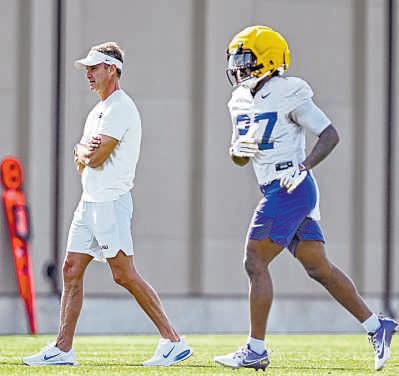
er LSU will play this season when it hosts Clemson on Sept. 5. Kiffin likes those kinds of high-stakes openers as much as he likes a dirt-stained visor.Clearly it looks like LSUisbuilding out astringof
openers to his liking.
By the way,when Kiffin was at Ole Miss, the Rebels lost their 2020 opener to Florida 51-35 when SECteams playedaconferenceonly 10-game schedule because of
Stefanelli wouldn’thave considered Jones theprototype whenhe first met him. Buthewas perfect, everypracticerep,every workout.
Saar had just one gripe in four years withJones: He DoorDash-ed McDonald’stoawrestling meet in Hagerstown. His diet wasn’tthe best, but it didn’tmatter because Jones burned so many calories while competing.
Evenifhehad to wheeze through it.
“He wasn’tjust gonna show up when the lights were on. He was showing up every single day,” Saar said, “because he hadbigger dreams.”
It surprised no onewhenJones, whobuilt himselfintoa5-foot-11, 210-pounder,went to Wisconsin and becamethe lead back as aredshirt freshman.
But injuries hurt Jones’ stats, and 15 losses in two seasons weighed on his soul. That combination tankedhis prestige when he leftthe Badgers.
Recruiting services barely rankedJones inside their top-80 transfer running backs in January Notexactly astandout addition to an LSU running back room that returnedformer five-starrecruit Harlem Berry and four-star Caden Durham
But Jones emergedfromambiguity and caught Lane Kiffin’seye in late March.
He’sdone that before.
“Really good feet and body control. Really smooth runner,” Kiffin told former Tigers safety Tyrann Mathieu in May.“Everybody knows about(tight end)Trey’Dez (Green) and (linebackers) Whit Weeksand T.J. (Dottery) …but I think Dilin has got areal chance.” Could an under-the-radar running back who burstontothe scene at the Crab Bowlall those years ago lead arevival of LSU’s run game?
Stefanelli wouldn’tbet against it.
“Down the road, they won’tbe surprised. They’ll start expecting it,” Stefanelli said. “If he can stay healthy,it’sgonna be funtowatch. Then good for LSU, because they got more than theythought they weregetting. That’seven better.”
Email Jon Blau at jon.blau@theadvocate.com.
the pandemic. After that, Ole Miss beat Louisville 43-24 in Atlanta, then Troy 28-10 in 2022, Mercer 73-7 in 2023, Furman 76-0 in 2024 and Georgia State 63-7 in 2025. Youcan see where this is going. As forthe opponents, LSU has shownapreference forkeeping the guaranteed money in state as much as possible, so these games makesense. But frankly,I didn’tthink the Tigers would play Southern again after what looked like aone-offin2022, and Ididn’t know whether LSU ever would play Tulane again after last facing the Green Wave way back in 2009. Younger LSU fans never have seen their team lose to Tulane, with an 18-game winning streak forthe Tigers since a31-28 upset loss in 1982. Ithink it’sgreat to see another meeting on the books against LSU’soldest and once most-played rival (Mississippi State now has that distinction), especially since Tulane reached the CFP this past season, losing to Ole Miss.
But those are games to focus on later.The attention is on what may wellbethe mostanticipated LSU football season ever where it should be.
For more LSUsports updates signupfor ournewsletter at theadvocate.com/lsunewsletter

































































J. Bridgeman, United States 70-69-68—207 3 N. Echavarria, Colombia
71-67-69—207 3
Max Homa, United States 71-69-67—207 -3
Sungjae Im, South Korea 66-72-69—207 3
Robert MacIntyre, Scotland 67-69-71—207 -3 Alex Smalley, United States
J. Thomas, United States
C. Young, United States
H. Du Plessis, South Africa
67-73-67—207 -3
70-69-68—207 3
67-67-73—207 -3
70-69-69—208 2
Casey Jarvis, South Africa 73-67-68—208 2
R. McIlroy, Northern Ireland 72-67-69—208 -2
Francesco Molinari, Italy 67-69-72—208 2
C. Morikawa, United States 68-70-70—208 2
Kristoffer Reitan, Norway 69-71-68—208 -2
Jordan L. Smith, England 68-70-70—208 2
S. Theegala, United States 71-69-68—208 -2
Matt Wallace, England 69-67-72—208 -2
Bud Cauley, United States 68-68-73—209 1
Corey Conners, Canada 71-67-71—209 -1
P. Coody, United States 67-70-72—209 1
Alex Fitzpatrick, England 69-67-73—209 1
R. Henley, United States 70-71-68—209 -1
John Keefer, United States 70-68-71—209
Alex Noren, Sweden 71-69-69—209
Shaun Norris, South Africa 69-70-70—209
Marco Penge, England 72-68-69—209
Patrick Reed, United States 72-66-71—209
Adam Scott, Australia 72-66-71—209
M. Thrbjrnsn, United States 70-68-71—209
M. Brennan, United States 72-68-70—210
P. Cantlay, United States 71-68-71—210
T. Detry, Belgium 67-69-74—210
C. Gotterup, United States 70-68-72—210
K.Kitayama, United States 69-71-70—210
B.Koepka, United States 70-71-69—210
Victor Perez, France 68-69-73—210
J.J. Spaun, United States 70-67-73—210
MJ Daffue, South Africa 67-72-72—211
Rickie Fowler, United States 71-69-71—211
Tyrrell Hatton, England
Naoyuki Kataoka, Japan
E. Lopez-Chacarra, Spain
Nick Taylor, Canada
Ryo Hisatsune, Japan
Min Woo Lee, Australia
John Parry, England
M. Plunkett, United States
A. Potgieter, South Africa
Sepp Straka, Austria
Andy Sullivan, England
Ben Griffin, United States
Kazuki Higa, Japan
Peter Uihlein, United States
Laurie Canter, England
Jack McDonald, Scotland
M. Southgate, England
K. Bradley, United States
Jesper Svensson, Sweden
Corales Puntacana Championship
Saturday At Corales Golf Club Punta Cana, Dominican Republic Purse: $4 million Yardage: 7,670; Par: 72 ThirdRound Todd Clements, England
B. James, United States
Stefano Mazzoli, Italy
M. McGreevy, United States
G. Sargent, United States
B. Brown, United States
J. Highsmith, United States
-13
J. Skov Olesen, Denmark 67-69-67—203 13
M.l Schneider, Germany 70-66-67—203 -13
Seamus Power, Ireland 68-72-67—207 9
David Skinns, England 73-66-68—207 9
Tom Vaillant, France 70-68-69—207 -9
Kris Ventura, Norway 72-67-68—207 9
N. Von Dllngshsn, Germany 71-70-66—207 -9
Kevin Yu, Chinese Taipei 68-71-68—207 -9
C. Bzudnhout, South Africa 69-69-70—208 8
Jorge Campillo, Spain 70-69-69—208 -8
Fabian Gomez, Argentina 71-69-68—208 8 Nick Hardy, United States 71-67-70—208 8 Jeong-Weon Ko, France 70-70-68—208 -8
Freddy Schott, Germany 70-69-69—208 8
B. Snedeker, United States 70-68-70—208 8
K. Aphibarnrat, Thailand 73-68-68—209 -7
I. Cantero Gutierrez, Spain 65-71-73—209 7
C. Champ, United States 69-71-69—209 -7
Austin Cook, United States 67-73-69—209 -7
Trace Crowe, United States 71-68-70—209 7
P. Fishburn, United States 67-70-72—209 -7
Romain Langasque, France 68-70-71—209 7
Peter Malnati, United States69-70-70—209 7
B. Robnsn-Thmpsn, England 70-70-69—209 -7
Robert Streb, United States 70-71-68—209 7
Camilo Villegas, Colombia 70-70-69—209 7
Jens Dantorp, Sweden 69-71-70—210 -6
S. Garcia Rodriguez, Spain 68-70-72—210 6
Joel Girrbach, Switzerland 69-71-70—210 -6
Bill Haas, United States 69-71-70—210 -6
Garrick Higgo, South Africa 72-68-70—210 6
Beau Hossler, United States 68-70-72—210 -6
Jeffrey Kang, United States 70-69-71—210 6
Chan Kim, United States 67-73-70—210 6
Luke List, United States 71-70-69—210 -6
Justin Lower, United States 69-72-69—210 6
Pontus Nyholm, Sweden 70-71-69—210 6
Chad Ramey, United States 70-71-69—210 -6
S. Soderberg, Sweden 71-68-71—210 6
Rafa Cabrera Bello, Spain 69-70-72—211 -5
K. Huskey, United States 73-67-71—211 5
Ben Martin, United States 71-69-71—211 5
N. Norgrd Moller, Denmark 69-71-71—211 -5
Renato Paratore, Italy 70-70-71—211 5
Kevin Roy, United States 70-71-70—211 5
Alejandro Tosti, Argentina 71-70-70—211 -5
Ugo Coussaud, France 73-66-73—212 4
Harry Higgs, United States 72-68-72—212 -4
H. Lebioda, United States 73-68-71—212 -4
D. Chatfield, United States 69-72-72—213 3 Rico Hoey, Philippines 70-71-72—213 -3
Jeremy Paul, Germany 72-69-72—213 3
Davis Riley, United States 72-69-72—213 3
C. Young, United States 71-70-72—213 -3
W. McGirt, United States 72-69-74—215 1
S-Yul Noh, South Korea 68-73-74—215 1 Tennis
ATP World Tour Swiss Open Results
Saturday At Roy Emerson Arena Gstaad, Switzerland Purse: €612,620 Surface: Red clay Results Saturday from Swiss Open at Roy Emerson Arena (seedings in parentheses):
Men’s Singles
Men’s Singles Championship Daniel Merida, Spain, def. Damir Dzumhur, Bosnia-Herzegovina,
-10 Ryan Fox, New Zealand 72-68-62—202 8 Si Woo Kim, South Korea 68-67-67—202 -8 Ryan Gerard, United States 67-67-69—203 7 Lucas Herbert, Australia 70-62-71—203 7 Ludvig Aberg, Sweden 71-66-67—204 -6 B. DeChmbu, United States 67-68-69—204 6 J. Suber, United States 65-69-70—204 6 Tommy Fleetwood, England 69-67-69—205 -5 R. Neergrd-Petrsn, Denmark 72-66-67—205 5 Daniel Brown, England 66-71-69—206 -4 Eric Cole, United States 76-64-66—206 -4 Cameron John, Australia 70-67-69—206 4 K. Kobori, New Zealand 70-69-67—206 -4 Shane Lowry, Ireland 69-68-69—206 4 Hideki Matsuyama, Japan 72-67-67—206 4 Jon Rahm, Spain 69-67-70—206 -4 X. Schauffle, United States 71-69-66—206 4 S. Scheffler, United States 68-68-70—206 4 Josele Ballester, Spain 71-70-66—207 -3
Aaron Wise, United States 71-66-66—203 -13
Dylan Frittelli, South Africa 72-66-66—204 12 Will Gordon, United States
T. Rosenmueller, Germany
J. Byrd, United States
Alejandro Del Rey, Spain
-11
Z. Bauchou, United States 71-67-68—206 10
Filippo Celli, Italy 67-70-69—206 -10
Joel Dahmen, United States 71-66-69—206 -10 Nick Dunlap, United States 67-72-67—206 10
A.J. Ewart, Canada 69-69-68—206 -10
M. Helligkilde, Denmark 69-68-69—206 10
P. Peterson, United States 68-70-68—206 10 Chez Reavie, United States 71-69-66—206 -10
H. Springer, United States 69-70-67—206 10
J. VanDerLn, United States 73-68-65—206 10
J. Veerman, United States 66-67-73—206 -10 Davis Bryant, United States 71-68-68—207 9 Mackenzie Hughes, Canada 66-72-69—207 -9
BY JOE REEDY
sportswriter
CLEVELAND Jared Jones struggled in his first six starts since missing last year due to a right elbow injury Since the calendar turned to July, though, the Pittsburgh right-hander has been on a dominant run. Jones became the third Pirates pitcher over the past 70 seasons to retire at least 30 straight batters, a streak that ended Saturday during a 7-1 victory over the Cleveland Guardians in the first game of a doubleheader Jones’ dominant run began on July 2 at Philadelphia After Bryce Harper lined an RBI double to left field in the third inning, the righthander retired the last four Phillies batters he faced. Jones then threw six perfect innings against Atlanta on July 8. On Saturday, he got out the first eight Cleveland batters. The run ended when Steven Kwan had a base hit to left. Guardians rookie AllStar second baseman followed with an RBI triple into the right-field corner to get Cleveland within 2-1.
“Giving up a run, I had some choice words for myself. But yeah, just hearing those numbers and sitting back and realizing what I’ve done over the last three games, it’s been pretty cool,” Jones said.
The 24-year-old allowed one run on three hits and struck out a season-high nine in five innings.
The last time a Pirates pitcher retired at least 30 batters in a row was 1981 when Jim Bibby recorded 32 straight outs. Bibby retired the final 27 Atlanta hitters he faced during a complete game one-hitter, then the first five against Philadelphia in his next outing. In 1959, Harvey Haddix retired 38 straight. He got

ASSOCIATED PrESS PHOTO By SUE OGrOCKI Pittsburgh Pirates hurler Jared Jones pitches in the first inning of the first game of a split doubleheader against the Cleveland Guardians on Saturday in Cleveland.
out the final two St. Louis Cardinals he faced and then the first 36 Milwaukee Braves on May 26, 1959. Haddix’s perfect game was broken up in the 13th inning when Felix Mantilla reached base on a throwing error by Pittsburgh third baseman Don Hoak.
Milwaukee would go on to win the game 1-0 and deal Haddix one of the greatest hard-luck losses by a pitcher in baseball history “(Jones) threw the ball extremely well again. The command was there. I think he’s done a great job of doing that, getting into a good flow, and these last two starts have been really good,” Pirates manager Don Kelly said. Jones had an impressive rookie campaign in 2024. His 132 strikeouts were sixth in the majors among rookies that season while he went 6-8 with a 4.14 ERA. But Jones missed last season after suffering a right UCL sprain to the elbow during spring training. He underwent internal brace surgery in May 2025, which
secures and reinforces the existing ligament instead of Tommy John surgery, which replaces the UCL with a graft from the hamstring or forearm. Brace procedures also require shorter recovery times.
Jones struggled in his first six big-league outings this season, going 1-1 with a 5.76 ERA Opponents hit 270 and homered five times in 25 innings. In his last three outings, opponents are 5 for 50 (.100) at the plate. Jones has given up only two runs in 15 innings with 23 strikeouts and three walks.
“I feel like not having thrown a baseball in a game for more than 12 months and coming back, I was a little shaky a little extra nerves going in that I haven’t felt before. It just feels like I’m able to get in my groove easier now,” Jones said.
A resurgent Jones could bolster a Pirates’ rotation that is in contention for an NL Wild Card spot. At 51-47, Pittsburgh was one game behind St. Louis and Miami going into the nightcap.
Semifinals Raphael Collignon (7), Belgium, def. Juan Manuel Cerundolo (6), Argentina, 1-6, 7-6 (5), 7-5. Stefanos Tsitsipas, Greece, def. Aleksandr Shevchenko, Russia, 6-4, 3-6, 6-3. Men’s Doubles Semifinals Marcelo Demoliner, Brazil, and Robert Galloway, United States, def. Sander Gille Belgium, and Sem Verbeek, Netherlands, 6-7 (4), 6-4, 10-5. Lucas Miedler, Austria, and Marc Polmans (1), Australia, def. Jakub Paul, Switzerland, and Ryan Seggerman, United States, 6-1, 6-4.
ATP World Tour Croatia Open Umag Results Saturday At ITC Stella Maris Umag, Croatia Surface: Red clay Results Saturday from Croatia Open Umag at ITC Stella Maris (seedings in parentheses):



Recalls, mileage milestones, and visualchecksis your car getting a complete checkup? Join BRE TT at GERR YL ANE CA DILLA C as he takes us behind the scenestodetail howtheir team manages your personal concerns, evaluates milestone maintenanceneeds based on mileage, checksfor open safety recalls, andvisually inspects your vehicle from top to bottom. BRE TT MOUNT ServiceManager



BY ALANIS THAMES AP sportswriter
MIAMI GARDENS, Fla. — Bukayo
Saka scored three goals to lead England to a 6-4 win over France for third place in the World Cup, while Kylian Mbappé surpassed Lionel Messi’s career tournament scoring record and took the lead in the Golden Boot race with a pair of second-half goals on Saturday It was the highest-scoring World Cup game since Hungary beat El Salvador 10-1 in 1982, and the 10 goals were the most in a thirdplace match.
Saka had goals in the 37th minute and in first-half stoppage time, then added his third on a penalty in the 87th for his second career hat trick with England. The Three Lions also got goals from Declan Rice and Ezri Konsa to build a 4-0 halftime lead, and they hung on during a wild second half to secure their second-best finish in the World Cup England won its only title in 1966.
Jude Bellingham of England capped the scoring in the eighth
Continued from page 1C
“It’s time,” Thornton said during an interview Wednesday “This is an opportunity for me to step back from the daily grind and pressures of this role and shift gears a bit. I’ve been doing this job now for almost 30 years and just think the timing is right for me personally It will give me a chance to do some things that I would like to do before it’s too late.”
During his tenure, Thornton held various titles with the companies that manage the Superdome and Smoothie King Center for the state of Louisiana, but he effectively served as the state’s éminence grise of pro sports, a behind-thescenes strategist whose influence touched virtually every major professional sports decision for a generation.
Thornton has been the point person in negotiations for multiple lease deals with the New Orleans Saints and Pelicans, and he’s overseen all major construction work and renovation projects at both buildings. He also helped recruit and relocate the NBA’s Charlotte Hornets to New Orleans, spearheaded the creation of Champions Square and oversaw the renovation of Tad Gormley Stadium.
His polished political acumen allowed him to relate to everyone from senators to service staff members, and it was a big reason he was entrusted by five different governors, representing both sides of the political aisle, to lead the state on such important sportsrelated matters. His leadership and strategic vision earned him recognition as one of the most influential figures in Louisiana’s sports scene and national respect in the industry. He is often credited by civic leaders for his role in ensuring New Orleans remains a major sports market and top competitor for major sporting events.
“I have been working with Doug for nearly 30 years, and he is the embodiment of a person who truly cares about his community and leaving things much better than he found it,” Saints and Pelicans president Dennis Lauscha said. “He is dedicated to finding solutions and working collaboratively His leadership has kept the best stadium
minute of second-half stoppage time, his seventh goal of the tournament.
Mbappé reached 22 career goals, one more than Messi. The star striker finished this World Cup with 10 goals, two ahead of Messi in the race for the Golden Boot, which is awarded to the tournament’s top scorer
“I would have preferred not to be the top scorer in history,” Mbappé told Fox Sports in French, “and play in the match tomorrow.”
Messi will get one last shot at the scoring title when he and defending champion Argentina face Spain on Sunday in East Rutherford, New Jersey Bradley Barcola and Ousmane Dembélé also scored for France.
Both teams had said they’d rather be playing in Sunday’s final France had enough offensive firepower to potentially win the tournament, but Les Bleus lost to Spain in the semifinals and squandered their chance at reaching a third straight World Cup final. England blew a 1-0 lead against Argentina and lost 2-1 when Messi assisted on
ever built still the best for over 50 years. And he has done it on time and on budget.”
A Shreveport native, Thornton played quarterback at McNeese State and started his professional career as an executive in the oil industry with Taylor Energy He segued to sports in 1988, when he was recruited to help start the Greater New Orleans Sports Foundation He eventually became the president and CEO of the GNOSF, but he left in 1997 to become the general manager of the Superdome and the then-New Orleans Arena.
In that role, he negotiated a major lease extension with the Saints at the Superdome in 2001 and coordinated the renovation of the Superdome after Hurricane Katrina. He oversaw an accelerated construction timeline that saw 35 subcontractors and 850 workers toil around the clock to rebuild the Superdome after it suffered $336 million in damage from the storm. Thanks largely to Thornton’s ingenuity, major improvements to the Dome were funded and incorporated into the repairs.
The historic reopening of the Dome on Sept. 25, 2006, enthralled a national TV audience and served as a milestone in the recovery of the storm-ravaged Gulf Coast region. Former NFL commissioner Paul Tagliabue called it “the greatest community moment in the history of the NFL.”
For his efforts, Thornton was honored with the Dave Dixon Louisiana Sports Leadership Award from the Louisiana Sports Hall of Fame in 2007, and the Legends of Charity award by St. Jude’s Hospital in 2015. He was inducted into the Greater New Orleans Sports Hall of Fame in 2023.
“I love New Orleans, and I have a deep sense of pride in the Superdome and Arena, and appreciation for what our past leaders have done to put us on the map as a sports destination,” Thornton said, citing Dixon, Tom Benson, Merv Trail, Ed McNeil, former New Orleans mayor Moon Landrieu, former Lt. Gov Jimmy Fitzmorris and former Gov John McKeithen.
“I’ve always felt it is important to preserve that legacy for them.”
To that end, Mike Hoss, the media relations manager for Legends Global at the Superdome, relayed the story of a meeting Thornton arranged in June 2008 between the founding fathers of the Superdo-
Continued from page 1C
since Pele and Brazil did it in 1958 and 1962. And for Messi, it’s a chance to write the perfect ending to what he has indicated will be his final run with his national team.
“On Sunday, we will watch a great show,” said Spain coach Luis de la Fuente, who has guided his side to a 28-0-9 record during this unbeaten run. “Two great national teams — two superteams, in my opinion — very similar in some aspects in terms of attitude, footballers’ talent. I think that it’s going to be an amazing final.”
back a decade, and this run — Copa América champions in 2021, World Cup champions in 2022, Copa América champions again in 2024 almost never happened for Argentina.
Messi retired from the national team in 2016, after he and Argentina lost that year’s Copa América final to Chile in penalty kicks one of which he missed.
“I’m done,” Messi said that night at MetLife Stadium, which just happens to be the site of this World Cup final.
two late goals.
Still, a sellout crowd of 64,478 showed up to watch the seventh and final match of this World Cup at Hard Rock Stadium. Plenty of supporters were cheering for both teams, but many were there simply for the atmosphere of the low-stakes match.
France trailed 4-0 when Mbappé flicked a shot past goalkeeper Dean Henderson in the 48th minute. Then he beat Henderson again with a left-footed strike from about 14 yards in the 66th. It was also the final match for France coach Didier Deschamps, who has said he will step down after 14 years. Deschamps embraced players and waved toward the crowd as he exited the pitch.
“In the end, we didn’t win, and that’s a shame for the coach,” Mbappé said. “The first half gives the impression that we let him down — that’s not at all how we wanted him to feel. This match isn’t going to tarnish Didier Deschamps’ legacy.”
In simplest terms, the matchup looks like best player vs. best team. In actuality, it’s so much more than that. There is history there, given that Messi was born in Argentina but spent part of his youth and most of his club career in Spain, and would have been eligible — if he wanted to play for that national team instead. Spain tried to convince Messi many times. He never wavered. Sunday will be the first time he plays against Spain since a friendly in 2010, when Argentina routed the then-reigning World Cup champions. He obviously understands the enormous stakes around this match and insists the approach will be simple regardless — spending a Sunday afternoon with some friends, kicking the ball around, albeit with 80,000 people watching in the stadium and probably somewhere around 2 billion watching worldwide.
And there’s also the incredible storyline of how Messi and Spain star Lamine Yamal, who were photographed together nearly two decades ago when Yamal was a baby will be sharing the pitch in a World Cup final.
“We grew up playing soccer with passion, eager to play,” Messi said in his native Spanish. “We played everywhere. We played on the street. We played at school. We played with teams. We didn’t think about the pressure. It was just natural play.”
But there will be pressure Sunday, and tons of it. Win or lose, Argentina knows this is likely the end of the Messi era in blue and white.
“The best footballer that the world has seen,” Argentina coach Lionel Scaloni said. It wasn’t always that way Go

me: Dixon, Fitzmorris, Landrieu, former state Rep. and Sen. Hank Lauricella, former LSED board member and treasurer Billy Connick and Harold Judell, the municipal bond attorney responsible for securing the financing to build the Superdome. It was an unprecedented gathering of the men responsible for the greatest capital project in state history, and Thornton made it happen.
“The story,” Hoss said, “speaks to Doug’s love of the city and (the Superdome), its history and its legacy, but also the people responsible for making it happen. That’s who Doug is a historian. He didn’t have to do that. In fact, it was nowhere near his job, but he knew that if he didn’t do it it wouldn’t get done.”
the $30 billion Kai Tak Sports Park in Hong Kong, the largest stadium project in the world.
“There’s a lot of things in New Orleans that would not be here if it weren’t for Doug,” said Evan Holmes, the general manager of the Superdome and one of many Thornton protégés. “In one way or the other, he was involved with every major project and negotiation during his tenure. He doesn’t take credit, but he was in the middle of everything.”
“I love New Orleans, and I have a deep sense of pride in the Superdome and Arena, and appreciation for what our past leaders have done to put us on the map as a sports destination. I’ve always felt it is important to preserve that legacy for them.”
The meeting was one of countless undertakings Thornton stewarded out of the spotlight. When prodded, Thornton reeled off a long list of career highlights, including the 2006 Dome reopening, the post-Katrina return of Essence Festival in 2007, the NFC championship game in 2010, the ongoing relocation of the Washington Commanders to Washington, D.C., and the 2025 opening of
In addition to Katrina, there were other moments that tested his management and leadership mettle, among them: the tragedy at the Travis Scott show at NRG Park in Houston, where 10 people died in 2021; the infamous blackout at Super Bowl XLVII in 2013; and the logistical pretzel of moving Super Bowl XXXVI back a week because of the Sept. 11 terrorist attacks earlier that season and the enhanced security protocols that accompanied it.
“I have been fortunate to have worked with some great leaders who provided me with a chance to watch, listen and learn from them,” Thornton said. “I’ve al-
He wasn’t done, of course. He continued starring for Barcelona, then Paris Saint Germain, then Inter Miami. He’s the two-time defending Most Valuable Player in Major League Soccer, the star of that league’s reigning champions, someone who can still create goals in the biggest moments with virtual ease.
“He is pure history,” Scaloni said. “History A legend.” Spain is chasing history as well. La Roja are the favorites for Sunday, deservedly so after giving up just one goal in the team’s first seven matches of this tournament. Spain has not spent a single second trailing at this World Cup; Argentina has trailed for more than 100 minutes, including stoppage time.
Defensiveperformanceslikethis simply do not happen, even in the World Cup. There are three teams Spain in 2010, Italy in 2006 and France in 1998 — who won the title and gave up a total of two goals in the tournament. This Spain team is in line to do even better than that.
“Argentina is far more than Messi,” Spain captain Rodri said. “They’ve proven that they’re a very complete team with top players. We are the best two teams playing in a collective manner as a group. Of course, we need to be mindful of Leo, but many other players.”
The 104th and final match of the biggest World Cup in history — 48 teams, spread out over the U.S., Canada and Mexico — comes down to the reigning champions against the heirs apparent, the biggest star in the game against those who have idolized him and now can end his reign.
But in the end, the World Cup will close as it always does, with one side celebrating and one side devastated.
“They’ve got their strengths. So do we,” Argentina goalkeeper Emiliano Martinez said “I wish it will be a final that goes down in history.”
ways said this is not just a job; it’s a lifestyle. You have to be committed to it every day with a sense of purpose, and you’re always on call, 24/7.
“The places I’ve been, the people I’ve met and the lifelong friendships that I’ve developed in this business has been awesome. I feel like we’ve done a lot of good.”
In recent years, as he ascended the corporate ladder and moved into larger roles with the company, he oversaw operations at hundreds of arenas and stadiums worldwide, including several other NFL venues. The job required a demanding travel schedule that took Thornton as far away as Hong Kong and for as often as 185 travel days a year Thornton enjoyed the challenge and constant action, but the grueling workload eventually took a toll as he reached his late 60s. He said he is looking forward to the slower pace and spending more time with family and friends. He plans to see his 15-year-old grandson, Mack Boudreau, play quarterback at Loyola Prep in Shreveport and wants to do some more fly fishing in Colorado and the Caribbean.
“He leaves big shoes to fill,” said Jay Cicero, who succeeded Thornton as the CEO and president of the Greater New Orleans Sports Foundation. “Doug’s leadership, experience and institutional knowledge were tremendous assets for the city and state. He will be difficult to replace. But we know he will always be just a phone call away.”
Thornton said he plans to stay in New Orleans, the city he’s called home for most of his adult life. He will remain active in the local community, maintaining his seat on various boards, including his spots on the New Orleans Aviation Board, City Park Conservancy and New Orleans & Company He also might continue to work on the ongoing lease negotiations between the state and New Orleans Pelicans if an arrangement can be made with Legends.
But his work as a high-ranking, high-profile executive for Legends Global will end Sept. 4.
“I don’t plan to retire, because I think ‘retire’ implies that you’ll never work again, and that’s not me,” Thornton said “I plan to remain active in the industry but I also plan on being selective about how I spend my time in the future. Who knows what the future holds.”
BY DOUG FERGUSON AP golf writer
SOUTHPORT England Sam Burns
gets his best chance at winning a major he never planned to play
Two weeks after his daughter was born, one week after Burns changed his mind and decided to fly from Louisiana to play in the British Open, he followed his record-tying 62 with a 5-under 65 on Saturday to build a two-shot lead at Royal Birkdale.
Perhaps even more impressive was he played with purpose amid the chaos that is Bryson DeChambeau, who played alongside Burns and heard big support from the gallery a day after he theatrically protested a two-shot penalty for improving the path of his swing.
DeChambeau seems to thrive among distractions — his week began with six-time major champion Nick Faldo saying he had “zero clue of strategy” in links golf — and the penalty for an infraction on the fifth hole Friday was a big one. The two shots took him out of the final group and moved him three shots behind instead of one back.
But he pressed on, high-fiving the gallery from green-to-tee, giving a thumbs up to the crowd when he walked onto the first tee and playing a high standard of golf. DeChambeau was even par through 14 holes until two birdies gave him momentum He bogeyed the last hole for a 69, his sixth consecutive round in the 60s in the British Open. He is four shots behind Burns.
DeChambeau didn’t speak to the media again Rory McIlroy did, referring to the way DeChambeau protested the penalty as “performative.”
“I think a lot of it’s for attention,” McIlroy said after a 69 left him eight shots behind. He also accused DeChambeau of holding

the tournament “hostage” because the extraordinary late-evening scene also delayed Saturday tee times.
The golf attention now falls to Burns, the former LSU golfer
He was at 10-under 200 for a twoshot lead over Si Woo Kim (67) and Ryan Fox, who became the third player this week to tie the major championship record with a 62. Fox finished some 90 minutes before the last group even teed off,
and now the 39-year-old from New Zealand will be in the final group with a shot at his first major Burns shot down a suggestion that golfers with newborns have a lot more freedom when they play
“If I was aware of that, I’d have like eight kids by now,” he said.
But there was freedom in knowing this is a chance he never thought he would have. His wife, Caroline, had been due to give birth to their second child the

‘Tommy Lad’ keeps hopes alive for a hometown Open victory
BY DOUG FERGUSON

SOUTHPORT,England Tommy Fleetwood has been dreaming about winning a British Open since he was a wee lad in Southport who could only sneak onto Royal Birkdale late in the evening He’s not about to stop dreaming now. Even with a pair of bogeys on the final four holes, Fleetwood did enough Saturday — a 1-under 69, his third round under par this week — and was five shots behind Sam Burns. He also had a record crowd at Royal Birkdale behind him.
“There’s no pressure on me at all really, except for my own expectations,” Fleetwood said. “And of course, it’s a really beautiful thing that the town is so hopeful for me and they want me to do well. I can’t ask for any more from thousands and thousands of people out there.
“They’ve made a massive difference to me,” he said. “Yesterday evening, the first tee every day today when I was in contention, that stuff that I’ll have for
life. How many people in the golfing world get to experience that with the crowd that much on your side? It’s been a very special week for me no matter what. If I can get it tomorrow, I could make it even more special. We’ll see.”
The support is unlike anything he’s ever heard, and for good reason. This is Southport’s favorite son, and one of golf’s most beloved figures because of his grace handling more tough losses than wins. Everybody seems to love
Tommy Lad
“Oh, Tommy, Tommy! Tommy, Tommy, Tommy, Tommy Fleetwood,” thousands sang to him in a football melody at practically every turn, particularly after birdies
He heard warm applause on every tee. He heard shouts —
“Go on, Tommy Lad!” down most every fairway The birdie he made Friday on the par-3 15th with the massive, three-story observation suite was deafening. The roar from around the 11th green Saturday told him his shot was no more than 2 feet away
“You can hear it constantly, no matter where he goes It’s constant, unconditional support,” said Jon Rahm, who played alongside Fleetwood on Saturday “I can’t imagine what it’s like to play his favorite event of the year at
home because I get a small pinch of what it feels like when I play in the Spanish Open.
“And if it was a major in Spain, I can only imagine.”
Fleetwood made his move midway through the front nine with two birdies in three holes. His shot into the 11th to 2 feet brought him to within one of the lead.
But the momentum changed when he missed the green down the slope to the right, hit a beautiful pitch and missed the 6-foot par He found a pot bunker on the 18th and had to lay up, and eventually scramble, just to salvage bogey But strange things happen in majors, especially this one on links golf. Royal Birkdale already has made history by giving up three record-tying rounds of 62, though they were in the morning before the wind picked up and the greens got a little more crusty Fleetwood is eager to find out how it all unfolds. Can he imagine what it would be like to walk onto the 18th green to collect the silver claret jug?
“I’ve done it most days since I was 7 years old, and it still hasn’t stopped,” Fleetwood said. “Life is all about experiences,” he said.
“And I think I’ve had some of the best experiences of my life so far this week.”
Tuesday before the British Open.
Their first was born four days late.
“I just didn’t think there was any possible way,” Burns said. “And little Belle had different plans.”
Belle is the name of their daughter born July 3, which at least planted the idea of Burns playing. That turned into a conversation with his wife, including a phone call to close friend Scottie Scheffler, and it led to him deciding a week ago Friday to fly over to England.
“Ultimately, she’s the one that really encouraged me to come over and play,” Burns said. “She basically said: ‘I’ve got this at home. Go over there and give it your best.’ And here we are.”
The timing is intriguing in another way Just one month ago, Burns was a 17-foot putt away from forcing a playoff in the U.S. Open at Shinnecock Hills He was the 54-hole leader in the U.S. Open at Oakmont the previous year, slowed on the back nine by having to play on rain-soaked fairways that affected his shots and led to a 78.
The four players closest to him Fox and Kim two shots behind, British Open newcomer Ryan Gerard (69) and Lucas Herbert (71) three shots back — have never won a major Herbert and Burns each shot 62 on Friday just 22 minutes apart.
“I think Sam Burns is going to be a man possessed,” Herbert said. “Given his results in majors and him not winning one, I think he’s going to be very tough to beat. I’m not thrilled about giving him a three-shot head start, but we are where we are.”
DeChambeau, four shots behind along with Ludvig Aberg (67) and Jackson Suber (70), is the only player among the top 10 who has won a major: the U.S. Open in 2020 and 2024.
Scheffler plays practice rounds at most majors with Burns, a close friend with whom he often share houses on the road.
“I know how good he is,” Scheffler said. “Sometimes you just need to continue to build that experience and put yourself in the positions. He was close at the U.S. Open last year He was close again at the U.S. Open this year But it’s just a matter of continuing to give yourself opportunities, continuing to knock on the door.”
Scheffler’s bid for another Open hurt by a lack of birdies
BY DOUG FERGUSON and STEVE DOUGLAS Associated Press
SOUTHPORT, England Scottie Scheffler rapped an 8-foot birdie putt on the 17th hole and gave a fist pump, which about summed up a third straight day for the reigning British Open champion.
It was a mock fist pump. He missed another one.

That’s been the story all week for Scheffler, the No. 1 player in the world on the verge of getting shut out of the majors. He has made only one bogey over the past 37 holes but could manage only three birdies during that span. He shot 70 on Saturday and was six shots behind.
Asked what he needed to do, Scheffler replied, “Just make more birdies.”
“I feel like I’m hitting the ball the way I need to in order to score,” he said. “That part is frustrating, but knowing my game is in a good spot is a good feeling as well. There’s been times this year where I feel like I was getting a lot out of my game. This week feels like I’m playing a lot better than my score.
“A little bit frustrating, but if I continue to do this and hole some putts tomorrow, I could shoot a really low round and move my way up the leaderboard.”
Scheffler won his first tournament of the season at The American Express, and it was looking like a third sequel to the previous two years. But that remains his only victory, and last week he ended his cut streak at 78 tournaments when he missed the cut in the Scottish Open.
“All I can do is continue to try and execute and give myself opportunities, which I did another good job of today,” he said.
The Scheffler effect
Two players atop the leaderboard spent a lot of time with the No. 1 player in the world.
Sam Burns the 54-hole leader has been a close friend of Scheffler since they competed against each other in college. They are frequent practice round partners. Burns said it has taught him to throttle back when necessary if he’s being too aggressive.
“It helped that I got to play a lot of golf with the best player on the planet and watch what he does,” Burns said. “He makes so few mistakes, and he doesn’t take on unnecessary risks very often, if ever, and seems to always hit the correct shot in the moment.”
Si Woo Kim is tied for second and is part of Scheffler’s money games at home in Dallas. Scheffler even helped the 31-year-old from South Korea get a membership at Royal Oaks.
Kim said earlier this year the matches have been one-sided. He said of Scheffler, “He calls me ATM.”
“I could lose my money but I want to watch his shot and learn,” Kim said. “I ask questions. He always gives me his opinion, so it helps me a lot.”
Herbert’s gamble pays off
Lucas Herbert’s British Open challenge was already going off the rails thanks to back-to-back bogeys when he was forced to take an unplayable penalty at the par-5 17th after hitting his tee shot way left and into a dune. The Australian stood over his third shot thinking: “This is either going to be unbelievable or this could be the end of my tournament.”
With one slash of a 3-iron, Herbert stayed in contention. His blind shot of some 238 yards somehow found its way onto the green nearly hitting the flagstick — and he two-putted for par, eventually signing for a 71
“I think that slots into the top 10 of shots that I’ve hit,” he said. Herbert, who
BY JOE MACALUSO
Contributing writer
Louisiana completes the second half of a fishing doubleheader this week when the International Grand Isle Tarpon Rodeo gets one year closer to its 100th anniversary Thursday on our state’s only inhabited barrier island.
The tour de force began in 1928 on Grand Isle, when the 8-mile isle was more fishing village than fishing destination.
Being 99 years old, it can lay claim to being the oldest saltwater fishing event in our country, and, with the City Park (New Orleans) Big Bass Rodeo the longestrunning freshwater fishing celebration in the U.S. the continuation of both adds another feather in our state’s fishing cap.
The competition begins at first light Thursday at Grand Isle Marina on the island’s east end. Weigh-ins are held at the Otto Candies Pavilion with crowds building around the 11 a.m.-8 p.m. weigh-in times Thursday and Friday and from 11 a.m.-6 p.m. Saturday The children’s division weigh-in deadline is 2 p.m. Saturday. The entry fee is $60. Online registration is available at Eventbrite, and you can enter by calling 504-469-7700.
If you’ve never been, it’s a three-day party complete with nightly music, a free shrimp boil Thursday evening and the awards ceremony set for 8:30 p.m. Saturday
Oh, if you’ve never been around the pavilion near 2 p.m on any of the three rodeo days, then make sure you get in on the excitement of the kids crab races. It’s a treat unto itself. Fishing-wise, there are 43 species categories divided among tarpon, big game, shoreline, inside, kayak and children’s divisions.
This year anglers won’t have to get to the weigh station to find out if their catches made the leaderboard. The rodeo committee is posting leaderboard updates throughout the three days on its website, tarponrodeo.org. Red snapper
The latest reporting date, June 28, came with the biggest one-week private recreational red snapper haul in recent years. In the last full week in June, the recreational take was 12,642 pounds to bring this year’s total to 415,091 pounds. That’s 47% of our state’s 882,439-pound annual allocation for this sector
Now, with weather cooperating and more rodeos to

PrOVIDED PHOTO
Sutton Fourrier won the youth division’s red snapper category with this 14.58-pound beauty he caught while fishing the depths of the gulf with his father Nathan, in the annual Catholic High Alumni Fishing rodeo held from Fourchon Marina. With the young angler is the school’s alumni director, Bart Saia, who doubled as the rodeo’s weighmaster
report — and numbers still to come from the 5-snapperper-day limit during the Fourth of July holiday — it will be curious to see what remains in the allocation through to the Labor Day weekend. One governing factor comes with a usual slowdown in the weekly catches after schools open in the first days of August. By comparison, the oneweek catch ending June 21 was 22,229 pounds as taken from the LA Creel sampling system.
The big show
ICAST is the biggest fishing show in the country and has been held in Orlando for nearly 20 years after a long
run in Las Vegas. Last week’s show began with the annual State of the Industry breakfast, which honored the legendary bass fisher and bass catcher Bill Dance
The show is the headliner for the American Sportfishing Association, and ASA celebrated the 85-year-old’s decades of contributions to the sport with the 2026 Impact Award.
Lost in the legend that bass fishing has become is that Dance was the first angler to catch a bass in the first Bassmaster tournament series (held on Beaver Lake in Arkansas) back in the early 1960s Dance won a lot of tournaments and used that as a springboard to becoming the host of Bill Dance Outdoors, which, for most bass fishermen around,
became can’t-miss TV for decades.
He’s become such a popular figure in the fishing world that most Southeastern Conference fans forgive him for wearing that orange T (for the University of Tennessee) on his hat, even when he shows up in Venice to catch redfish.
There’s more ICAST news: Buzbe is based in Prairieville and has produced innovative tackle boxes for nearly 10 years This year, Buzbe has two products judged best in their categories in ASA’s New Products showcase: its Magnetic Launch Pad and Basic Deep Urchin Bait Box. More on that in coming weeks. Rhino 30’s 6-foot-6 twopiece Medium Spinning Combo was judged Best of Show
TUESDAY LAFAYETTE KAYAK FISHING CLUB MEETING: 6 p.m., Pack and Paddle, 601 E. Pinhook, Lafayette. Call 337-232-5854. Website: lafayettekayakfishing.com
TUESDAY-WEDNESDAY
GULF COUNCIL SHRIMP COMMITTEE MEETING: Gulf Council office, 4107 W Spruce St., Tampa, Florida. In conjunction with Scientific and Statistical committees. Website: gulfcouncil.org
WEDNESDAY LA. OYSTER TASK FORCE MEETING: 10 a.m., Lakefront Airport, 6001 Stars and Stripes Blvd., New Orleans.
THURSDAY
ACADIANA BUGS & BREWS: 6 p.m., Pack and Paddle, 601 E. Pinhook, Lafayette. Casual fly tying and local beers provided. Open to the public. Email Darin Lee: cbrsandcdc@gmail.com. Website: packpaddle.com
THURSDAY-SATURDAY
INTERNATIONAL GRAND ISLE
TARPON RODEO: Grand Isle Marina & Otto Candies Pavilion, Grand Isle. Website: tarponrodeo.org
SATURDAY-SUNDAY
BASSMASTER JUNIOR CHAMPIONSHIP: Kentucky Lake, Paris, Tennessee. Website: bassmaster.com
ONGOING
STATEWIDE TOURNAMENT & ANGLERS RODEO/S.T.A.R.: Through Sept. 7, Coastal Conservation Association’s summer-long fishing event. Tagged redfish, coastal/ offshore species categories & youth division. CCA membership required. Website: ccalouisiana.com/star
LOTTERY HUNTS
DOVE/TEAL: July 27 application deadline for dove hunt on Elbow Slough Wildlife Management Area & teal hunt on White Lake Wetlands Conservation Area. Website applications only on Wildlife & Fisheries/ Louisiana Outdoors License, Permits and Tags webpage. Fee $8.50. Details: dove hunt, David Hayden at dhayden@ wlf.la.gov; teal hunt, Lance Ardoin at lardoin@wlf.la.gov
AROUND THE CORNER
JULY 26 — SOUTH LOUISIANA
HIGHPOWER CLUB MATCH: 8:30 a.m., Ascension Parish Sheriff’s Range, St. Landry Road, Gonzales. NRA XTC & F-Class match rifle or service rifle, 200-yard/50rounds match course. Fee $15 members, $20 nonmem-
bers, $5 juniors. $25 annual club (first match free) and Civilian Marksmanship Program membership (allows purchases from CMP). Call Mike Burke, 337-380-8120. Email: SouthLAHighPower@ hotmail.com
JULY 27 — RED STICK FLY FISHERS FLY TYING SESSION: 7 p.m., Bluebonnet Regional Library, 9200 Bluebonnet Blvd, Baton Rouge. Open to the public. Materials and tools available for beginners. Website: rsff.org
JULY 30-AUG. 1 — BASSMASTER HIGH SCHOOL CHAMPIONSHIP: Kentucky Lake, Paris, Tennessee. Website: bassmaster.com
AUG. 1 — WOOD STORK/ WADING BIRD VIEWING: 7-10 a.m., South Farm, Sherburne Wildlife Manage-
cate.com
CHS Alumni Rodeo
PORTFOURCHON— Top three places in the 22nd annual Catholic High Alumni Fishing Rodeo. All weights in pounds: ADULTDIVISION Cobia: 1, Hudson Aicklen, 36.05 pounds. 2, Brecken Meyer, 33.89. 3, Joey Coco, 21.88. Dolphin: 1/2, Kyle Rodrigue, 6.46, 6.33. 3, Aubrey Perry, 3.93. Flounder: 1/2/3, Derrick Bouziga, 2.36, 2.26, 2.25. Grouper: 1, FOAM-O, 55.0. 2/3, Joey Coco, 33.15, 15.95. MangroveSnapper: 1, Finley Jones, 9.03. 2, Preston Perry, 8.47. 3, Sean Valluzzo, 8.27. RedSnapper: 1/2/3, Joey Coco, 18.31, 17.91, 17.1. Redfish: 1/2, Derrick Bouziga, 9.18, 7.21. 3, Michael Clay, 6.97. Sheepshead: 1/2/3, Derrick Bouziga, 6.56, 4.41, 2.35. SpeckledTrout: 1/2/3, Ed Sexton, 5.44, 4.66, 4.63. BlackfinTuna: 1, Seth Corbin,
Blaney looks to stay hot as NASCAR heads to North
BY STEVE REED Associated Press
NORTH WILKESBORO, N.C. — Ryan
Blaney is hoping to turn a hot streak into history
The 2023 Cup Series champion is hitting his stride with eight straight top-10 finishes, including a win last week at Atlanta. That gives him plenty of momentum heading into Sunday night’s muchhyped historic return to North Wilkesboro Speedway for the track’s first championship points race in 30 years. The .625-mile track sat dormant, covered with overgrown bushes and weeds, for nearly a quarter century before being refurbished to host the NASCAR All-Star Race from 2023-25.
“I’ve enjoyed coming here the last few years for the All-Star race, and I was excited when they announced that there was going to be a points race here,” said Blaney, who will start on the pole based on
metrics after heavy rains washed out qualifying on Saturday “I feel like this place has done a really good job of revitalizing it, and the facilities. It’s going to be a good show.”

Blaney and his No. 12 Ford Mustang were dominant last week, leading 171 of 263 laps, capturing all stage points to move into third place in the Cup standings. He is currently just 65 points behind points leader Denny Hamlin. Blaney came out on a top after a three-wide battle with Bubba Wallace and Christopher Bell on the final lap of overtime in a race that ended after midnight Sunday because of weather Blaney is favored to win (+500)
again this week. That leaves him ahead of Hamlin and Bell (both +500), Kyle Larson (+900) and Tyler Reddick (+1000), according to Las Vegas sportsbooks.
In-Season Challenge semifinals
Blaney joins Bell, Chase Elliott and Todd Gilliland as the drivers still alive entering for this week’s semifinal round of the $1 million NASCAR In-Season Challenge.
Blaney faces Bell, while Gilliland takes on Elliott in the head-tohead matchups. Elliott said winning would be nice, but admitted the In-Season Challenge is “not something that I’m overly consumed over.”
“Kind of similar to the points situation in general, if you’re going out and you’re doing your job and you’re performing at a high level, then you’re likely going to take care of the other things,” Elliott said. “So I kind of look at that in a really similar light, but I do think it is really fun. I think it’s a
really good thing for just the sport, in general, to kind of have something else going on in the middle of the year.”
The winner will be crowned next weekend at the Brickyard 400 at Indianapolis Motor Speedway
The race for the Chase
Speaking of the Chase, there are only six races remaining before the 16-driver field is established, meaning every point counts.
Three of the next six races are at short tracks, beginning this week.
Ryan Preece, driver of the No. 6 RFK Racing Ford, stands 26 points below the cut line and is looking to make up ground.
“I’m biased, for sure, when it comes to short track racing and the racing that it provides, especially with the way the tire and all of that has gone,” Preece said. “So, I feel really good about it. North Wilkesboro, Iowa, New Hampshire, those are all places that I’ve had success at and I look forward to going to.”
18.35. YellowfinTuna: 1, Joey Coco, 139.6. 2/3, Seth Corbin, 57.0, 56.2. YOUTHDIVISION SpeckledTrout: Kate Miller, 1.33. Redfish: Connor Miller, 3.56. Sheepshead: Preston Valenciano, 2.1 RedSnapper: Sutton Fourrier, 14.58. Cobia: Preston Valenciano, 20.48. MangroveSnapper: Preston Valenciano, 7.09. Grouper: Jack Cusimano, 9.48. Dolphin: Blakely Rodrigue, 6.21. CALCUTTADIVISION 4-TroutStringer: Levels 1&2, Ed Sexton, 19.2 pounds. 5-MangroveSnapperStringer: Levels 1&2, Eric Valenciano, 17.26.


‘Stopbeing oneperson’ an answer to broken times
In the depths of another Louisiana summer,Iknow that no living thing will last long if it lingers on ascorching sidewalk. Which is why,asIstroll my neighborhood each morning, Istoop to collect stranded earthworms on the pavement and return them to the grass. While they inch through the lawns along my street, some of the worms find themselves on thehard, hot walkway,destined to die as the sun bakes them alive. Although Ican’t save them all, Ihelp the few that Ican.
My summers on earthworm patrol, Isuspect, must give the folks who live aroundme something to wonderabout.I find myself wondering, too.
Am Ireally doing anything by coming to the aid of an earthworm?
At such moments, Ifind myself thinking about “The Star Thrower,” along-agoessay by author and scientist Loren Eiseley about his encounter with someone who had assigned himself an equally unusual mission. Eiseley was walking along the shore one day when he spotted aman throwing starfish into thesea. They’d been beached by the tide and were sure to die unlesssomeone returned them to the ocean. The self-appointed Good Samaritanwas lifting them from the sand and hurling them back to the water “The stars,” he told Eiseley, “throw well. One can help them.”
Eiseley nicknames his acquaintance “the star thrower,” andhedoesn’tquite know what to makeofhim. But Eiseley decides to join his new acquaintance in his strange errand of mercy and become astar thrower,too.
“He is not alone any longer,” Eiseley writes of the star thrower.“After us there will be others.”
What Eiseley seems to say is that we’re touched by a
ä See AT RANDOM, page 4D

As the schoolyear starts,we’re thinkingabout thepeoplewho stand at the front of the room, who open classroom doorswith asmile. Sometimes astranger in August becomes the person a student never forgets. Certain teachers saysomething on arandom October afternoon and studentsrepeat it for decades to come —orateacher mayleadbyexample and give in waysthat changes lives.
We invite readers to tell us about thatteacher who made all the difference: write aletter directly to the teacher and send it to us. Or tell the story plain:a name, aclassroom andthe moment that stuck. We’relooking for the lessons that have outlasted the chalkboard(or the dry erase board,as the case maybe). Send your letter or story,includingthe name of the teacher, name of school, city and year to jan.risher@ theadvocate.com by 2 p.m.July 28. Photos of theteacherare also welcome.

Babysheep runaround aranch in roseburg,Oregon. Forsafety,sheep have to fast prior to shearing, so theyare separated into the barn the daybeforewhile
BY CLAUDIA LAWS Staff writer
Back in 2022, Claudia Laws shared the story of how her 40/40 bucket list came to be. She made alist of 40 things that were importanttoher.The goal was todo each of them before she turned 40.
When she aged out of that goal, she made anew list of 50 things to do before she turns 50. Today,at47 years old, she has accomplished 42 items on her 50/50 list. But there was one item on the40/40 list that she finally accomplished this year: Shear asheep.
Shear asheep
Ihave been trying to do this for over adecade:I’ve placedclassifiedsads,asked friendsand family and cold-called ranches and shearers—lots of false hope and no actual shearing. Then awoman at yoga clockedmysheep tattoos and, while talking, said she knew someone who had been to sheep shearing school. Ding ding ding. Of course, there is training for this! Iquickly learned there are few trainingprograms anda dearth of shearers; schoolsare scarce and competitive. Isigned up fornotificationsfor schools across the country.Most do it just once ayear,during the spring shearing season.

The sheep trailer in roseburg,Oregon, was ahiveofactivity forfour days as 12 students learned howtoshear sheep.
Iapplied to aschool in Oregon
Youhad to physically mail the application. Idon’tknow if it was the sheep stickers on the envelope, the answers Iprovidedorjust that I maileditout thatvery day applications opened, but Igot accepted. Twomonthsout, they emailyou more information: sheep fasting times, clothingneeds, the pattern you shave and aphysical training program. Itried to memorizethe fasting times.I practiced theholds on my cats, and Itook up running
anddid ab workoutsthreedaysa week. Ibought Carhartt pants and overalls andmadesuremyshirts were long enough to cover my back when Ibent over Friends and family rallied. Four friends made me asheepembroideredtoiletrykit andfilled it withthings likepain-relieving lotion, wet wipes and about adozen other comfort items. They also embroidered asheep on my new
ä See BUCKET LIST, page 4D
Construction is near completion on Counter Culture’snew truck.

BYMADDIE SCOTT Staff writer

The Greater Baton Rouge Children’s Choir recently concluded its four-day Forte Fun Camp: Movie Magic Edition, bringing together young performers from across the Baton Rouge area for a week of music, creativity, friendship and confidence-building.
Held July 6-9, the camp welcomed children ages 6 and older for an engaging performing arts experience featuring songs from beloved family films including “Moana,” “Toy Story,” “The Lion King” and “The Greatest Showman.”
Throughout the week, campers participated in vocal instruction, acting and stage movement, themed crafts, musical games, and collaborative activities that encouraged both artistic growth and personal development.
The week culminated in a showcase performance for family and friends, where campers demonstrated the skills they developed in just four days.
“Whether stepping onto the stage for the first time or returning with previous
LSU School of Art Summer Contemporary show
Thirty artists have been selected for LSU School of Art’s 2026 Summer Contemporary entitled SLOW, featuring work that engages slow states of being, slow processes and slow media. This year’s summer contemporary was juried by New Orleans-based art historian and curator Emily Alesandrini from over 280 submissions.
Artists selected for this summer’s exhibition are: Farzana Akhtar, Courtney Barr, Raina Benoit, Megan Bickel, Soumitra Kumar Biswas, Diane Bronstein, Maren Brown, Celine Browning, Virginia Candler, Rob Carpenter, Freddie Jen Cohen, Samantha Combs, Edem Dake, Rima Day, Boris Fitzgerald, Ghislaine & Lando Fremaux-Valdez Elizabeth Freeman, Tim Gonchoroff, Cynthia Greig, TahJah Harmony, Thrasyvoulos Kalaitzidis, Miles Kinney, Lilian LaBorde, Mark Leavens, Cora Nimtz, Jill Stoll, Emery Tillman, Caitlin Ezell Waugh and H. Cole Wiley. The exhibition is now on view in Glassell Gallery, 100 Lafayette St., Baton Rouge,
performance experience, each child had the opportunity to grow in confidence while discovering the joy of making music together,” according to a news release.
Forte Fun Camp reflects the Greater Baton Rouge Children’s Choir’s mission to provide high-quality, affordable music education in an encouraging and inclusive environment. Beyond developing vocal skills, the organization is committed to helping young people build character, leadership and compassion through music.
Throughout the year, members of the choir also participate in community service projects and outreach performances, using their voices to encourage and uplift others throughout the Greater Baton Rouge area.
“These experiences help children understand the value of serving their community while developing empathy teamwork and leadership,” the release also states.
through Aug. 22. All work is available for purchase To see available work and learn more about the artists and individual pieces, visit mailchi.mp/lsu/slow
Admission to LSU School of Art’s Glassell Gallery and its programs are free and open to all. Glassell Gallery is open from noon to 5 p.m. Tuesday through Sunday with public hours extended to 7 p.m. on Thursdays and Friday Glassell Gallery is closed on Mondays, between exhibitions and during LSU closures.
Christmas in July chorus
The Baton Rouge Chorus of Sweet Adelines International invites women 18 and older to a Louisiana-themed Christmas in July rehearsal and party 6:30 p.m. to 8:30 p.m. July 30 at Ingleside Methodist Church, 4264 Capital Heights Ave.
Guests will enjoy an evening of festive music, Southern hospitality and fellowship while learning holiday favorites with the chorus.
Women who join the Christmas season are invited to perform in several holiday events, including a Christmas performance at the Irene W. Pennington Planetarium at the Louisiana Art & Science Museum No audition is required to attend, and


The Community column runs Sundays in the Living section and accepts submissions for news of events that have taken place with civic, philanthropic, social and religious auxiliary organizations, as well as academic honors.
Submissions should be sent by noon Monday to run in the upcoming Sunday column. Because of space limitations, organizations that meet monthly or more are limited to one photo per month. If submitting digitally we prefer JPG files 300KB or larger If taking a photo of a group, have them stand or sit shoulder-to-shoulder If more than six people are in the photo, arrange them on multiple, distinct rows.Avoid strong background light sources.
Identify those pictured by first and last names as viewed from left to right, row by row.We prefer emailed Community column submissions to features@theadvocate.com.We also accept submissions by mail at P.O. Box 588, Baton rouge LA 70821.A phone number must be included.
previous barbershop experience is not necessary
Music is learned using listening tracks and chorus rehearsals which take place 6:30 p.m. to 8:30 p.m. each Thursday
The Baton Rouge Chorus is a chapter of SingUnited International, a worldwide organization dedicated to empowering women through education, performance and four-part a cappella harmony For more information, visit BatonRougeChorus.org.
Knock Knock has new sponsors for Story Tree
Knock Knock Children’s Museum has announced Kathy and Roy Martin III and RoyOMartin as the new sponsors of Story Tree, the museum’s reading library This partnership represents ongoing support from one of Louisiana’s oldest familyowned companies.
Story Tree is home to hundreds of curated books connected by subject to the museum’s 18 Learning Zones. The tree now stands as a symbol of the Martin family’s and RoyOMartin’s century-long legacy in conserving Louisiana’s forests and their commitment to education.
RoyOMartin, headquartered in Alexandria, has built both its business and its
culture around growing trees. Through programs like WoodWorks and Girls Can Too!, the company has spent nearly two decades introducing students to career pathways in the forest products industry The Martin Foundation also supports education and community needs across Louisiana and Texas.
The Story Tree Learning Zone was originally funded by LUBA Worker’s Comp in honor of beloved family member and longtime educator Nancy Bondy Kindy Sweet Lane to hold back-to-school tween event Sweet Lane — the mother-daughter tween apparel brand founded by 10-yearold tween designer Lane Marie and her mom, Jeanne McCollister McNeil — is teaming up with Court to Table for a backto-school event for tween girls and their families 4:30 p.m. to 6:30 p.m. July 30 at Court to Table, 7477 Burbank Drive Sweet Lane will bring its purple gameday sets made with cooling performance fabric; a special custom “LET’S GEAUX” sparkle add-on for purple sets purchased at the event; and a Stuff-a-Plush experience, featuring tigers and other animals in a build-your-own plush activity

BY JESSICA PUCKETT TravelPulse (TNS)
For family travelers in the know, anew league of travel influencers is emerging —and notonsocial media.
Rather,parents are following their children’slead when it comes to choosing destinationsand planning trips. It’spart of the larger “kid-fluenced”travel trend that has been growing in popularity among family vacationers in recent years.
Aside from pleasing kids and potentially avoiding tantrums,involving children in travel planning has additional benefits
According to the 2025 U.S. Family Travel Survey,84% of parents said helping with travel plans makes their children more adaptable and open to new experiences. Plus, 61% of parents said involving kids with planning had a“positive impact on their child’shappiness and engagementduring the trip.”
Travel experts agree that looping children into the process brings more excitement before atrip and can make the travel experience morepositive for the whole family
“Includingthe kids in travel planning is agreat way to help them feel invested in thetripand take ownership of the experience,” says Rachel Lipson, afamily travel expert who writes the Substack newsletter The Point. “Doing researchtogether ahead of time can calm anxious nerves,let achild know what to expect, and give the whole family plans to look forward to.”
Here are afew easy ways to get kids involvedinplanning your next family getaway
Setexpectations
Formanyyoung kids,helping out their parents and sharingtheir opinions can be reallyexciting. But it’s importanttoframe the con-
By ChristopherElliott
Ibooked aroom with twoqueen beds through Booking.com at ahotel in Brooklyn, N.Y.I needed the queen beds, andthe room wasclearly advertised as such.

versation around travel planning the right way to help keep children from becoming overwhelmed and to manage everyone’sexpectations.
Oneway to keep the conversation ageand skill-level appropriate is to start with broader questions, Lipson advises “For kids onthe youngerside, offeringachoice ofbeach, city, or country can beagood start—and a greatopportunity to find outwhat atmosphere they enjoy most on a trip,” she says No matter your children’sage, it’simportant to let them know that they rehelping and not taking control of the entirevacation.
Lipson advises parents to makeit clear that they value their kids’
interests and opinions, but the ultimate destination selection must work for the entire family
“I recommend letting the kids know theadultswill makethe final choice, but theirinput is appreciated,” Lipson says. “This way they don’tget too attached or disappointed if their pick doesn’twork out.”
Getthe ball rollingonplanning
Onceyou’ve started the conversation, you can involve your children in identifyingand researching potential destinations.
“Visit the travel section of your locallibrary or bookstoreand see what piques their interest,”Lipson says. Youcan encourage them to dive deeper by asking them what
they might like to do in each place. “Research kid-friendly activities together and makeillustrated lists of things to do,” Lipson says.
Parents and children can also sit down together to book specific tours and activitiesbefore vacation.Infact, an increasing number of families seem to be doing this, according to recent data from Tripadvisor,which showsa 40% increase year over year in children’s tickets for heritage tours and a 47% jump in children’stickets for cooking classes.
But that doesn’t mean parents should feel pressure to plan elaborateoutings or lengthy tours in order to get their children interested in travel planning. Even small stepscan geta childinvolvedand
grow anticipation for an upcoming trip.
“For somefamilies, the best placetostart maybescoping out gelato spots anddrawing ice cream cones on amap,orfinding playgroundsnear already booked accommodations,” Lipson says. When in doubt, keep it simple. Any opening to discuss what avacation might be like and what your child might like to do there is a step in the right direction.
Destinationselection process
Onceit’stime to choose avacation spot, you can include your little ones in that phase of planning, too.
Lipson advises offering alimited number of destinations that have been vetted and approved by the adultsinthe group, andopenthe conversation up with your kids.
“Start witha listofthree places, andashortlist foreach with topattractions that matchtheir interests and see where the conversation takes you,” says Lipson.
Trytobeasconcrete and visual as possible to help children understand the details. This will help guide the conversation and keep kids engaged. “Offering practical options and showingkidsphotos of the different possibilities can give them achancetomakeaneducated choice.”
Evenifthe childrendon’t get their topdestination, parents can still plan simple and affordable activities that keep them interested during the vacation. “Make ascavenger hunt or treasure map —end at acandy store!—with stops the kids are interested in along the way,”Lipson advises.
Overall, thegoal is to getkids interested in travel, help them get better at identifying their opinions and preferences, and even build a sense of gratitude along the way.
“Whenkids gettoexperiencethe process, they becomemore aware of the work that’sbeing done for them,and it teaches them how important it is for everyone to do their part and be grateful,” says Lipson.

Could you have avoided this?

goodwillcredit. Idisputed the chargeonmy credit card. Capital One initially credited the $922 chargebut thenrebilled it after the merchant responded to thechargeback. I’ve sent all my photoand video proof to all three parties, andyet I’mstill out almost a thousand dollars for aservice Inever used. What can Idotoget my full refund? —Rebekah Singleton,Alexandria,Va
Christopher Elliott
However,when Ichecked in, the beds were obviously smaller —Ilater measured them to be approximately 50 inches wide, which is afull-size, nota queen.To makematters worse, the room wasdisgusting.The sheets had grease stains, hair and what looked likesuspicious red stains.
Iasked for anew room, but the second one wasworse, featuring aclear splatter of red stains across the floor Ididn’tfeel safe or comfortableand left that night, finding another hotel.I immediately contacted the hotel and Booking com.The hotel denied my request for a full refund. Booking.com gave me the runaround for weeks and offered amere $106



This is an infuriating bait-andswitch case compounded by a gross disregard forpublic health and safety.The hotelfalsely advertised accommodations with two queen beds andthen gave youaroom with smaller beds and alarming,unsanitary conditions, includingsuspiciousred splatters. Ugh
Despite yourexhaustive paper trail documenting multiple attemptstoresolvethe issue with the hotel and Booking.com —includingseveral long phone calls—
bothcompanies refused afull refund. The hotel simply denied your photographic evidence, and Booking.com attempted to settle thematter with ameager credit, claiming your valid health and safetyconcerns were merely a matter of opinion. With thehotel refusing to budge and Booking.com failing its duty to ensure accurate listings and customer satisfaction, your most direct pathwas to resubmit a comprehensive dispute to Capital One, focusing on the clear contract violation of the room and bed size. This documented patternofdeceit and poor customer service should have ultimately won your chargeback. Incredibly, it didn’t. Your credit card company sided withthe hotel, claiming you had “used” the services. I thinkit’stime for you to switch to adifferent credit card.
Maybe. Reviewing the hotel’sratings might have kept you away It currently has 2 1/2 stars out of 5, and the first review warns, “You are going to regret booking this hotel.” (I asked you about this,and you said at the time you booked the reviewswere “a mixed bag but nothing completely egregious.”)
In asituation like this, you have options. Youcan escalate your complaint to Booking.com —I publish the names, numbers and email addresses of key Booking. com executives on my consumer advocacy site, Elliott.org. Or you could ask aconsumer advocate for help.
Youchose door number two, and Ireached out to Booking.com on your behalf to find out if it really planned to force you to pay $922 for these shoddy accommo-
dations. The answer,thankfully, wasno.
“After afull review of the case, our customer service team has engaged directly with both the guest and the accommodation to resolve the situation,” arepresentative told me. “Given the concerns raised around room conditions and the customer’soverall experience, we’ve issued afull refund.”
Iasked Booking.com if the hotel would be removed from the platform,and it said it would work directly with the property to make improvements. Iguess everyone deserves asecond chance, maybe.
Christopher Elliott is the founder of Elliott Advocacy,anonprofit organization that helps consumers solve their problems. Email him at chris@elliott.org or get help by contacting him on his site.







Stacks of wax packs, now obsolete, summon joy of
BY HOWIE RUMBERG Associated Press
NEWYORK The anticipation. The chase. The powdery, sugar-coated board of gum! For generations of baseball card fans, there was nothing like scrounging up some change and sprinting to the store to buy a wax pack.
Some tore the slightly tacky paper wrapper open and flipped through the cards in an insatiable instant (hence the popular phrase “ripping wax” for opening card packs even today, about 35 years since use of actual wax wrappers ceased). Others did the slow reveal: one card at a time, peeking out of a corner of the pack, or maybe upside down and reversed. However you did it, it was the right way
“There is something inherently magic about peeling away the paper of the wax pack. There’s something visceral about it, taking the pack to your face and smelling it,” says Brian Pirrip, owner of collectible business M1NT “It’s something about the mix of all these scents — the wax, the gum, the cardboard — that transports you back to a different time.”
Collecting and trading cards has been part of the baseball ecosystem since the 1860s But the wax pack emerged as the delivery method in 1951 by Topps.
Opening a pack was thrilling. Who were you going to pull?
Whether it was Hall-of-Famerto-be Brooks Robinson or Sixto Lezcano, a “common” card, the feeling was the same: “an innocent joy,” Pirrip says. You’d then scale them or flip ’em, turn that pack of 15 cards into 20 through some clever trades. The cards went with you everywhere.
Fueled by history, statistics and mythmaking, baseball card collecting rode the nostalgia craze of the 1980s into big business and overproduction of cards. While saturation of the market brought down prices, the abundance of fan favorites has driven a resurgence of interest in opening wax packs.
Sure, you can open modern foil wrappers and chase high-value autos, refractors or other gimmicky cards, But there’s nothing like tearing open a wax pack and chomping on the thin pink rectangle.
Pirrip has taken his love of collecting to 47 states. He has seen countless faces light up when a favorite card surfaces.
On a recent night at Citi Field, home of the New York Mets, Pirrip pulled out a box of 1987 Topps cards and had guests rip some wax. Nolan Ryan, Don Mattingly, Roger Clemens and Kirby Puckett drew gasps But it was all smiles, even for names not uttered in years.
“It instantly transports people to a happier time,” he says. “You can’t get that with anything else.”

Continued from page 1D
truck should be up and running by late August or early fall, Dunn said “I went a little overboard and added a giant sound system and programmable LED lights and underlighting,” Dunn said “It’s literally a massive, bright, rolling billboard wherever it goes.” Where it’s going
With Baton Rouge as its home base, the food truck will travel across southeast Louisiana and the Mississippi Gulf Coast for festivals and pop-up events. Dunn is currently starting the permitting and inspections process for other parishes so the truck can participate in large-scale events
“I get asked to do large events all the time, and the logistics of trying to move the yogurt machines and the oven it just doesn’t work very well,” he said. “Now we have all that stuff in a completely mobile platform ” Dunn plans to ride the truck in Mardi Gras parades, hence the purple, gold and green colors The truck will also come in handy for pop-ups at Baton Rouge businesses and participation in fundraisers, something the brick-andmortar already does.
Continued from page 1D
common impulse to root for life wherever we find it. I first learned about Loren Eiseley and the star thrower from Kathleen Dean Moore, an author and thinker who connected with me a few years ago when we collaborated on a magazine project. She sees Eiseley’s story as a parable about the power of joining with others to do good in ways large and small.
Moore was at a public event when a listener mulled over the world’s many problems and asked, “What can one person do?” For Moore, the answer was clear: “Stop being one person.”

Sheep hang out in the chute waiting to be
off the ground To remove them, one sticks their thumb in the sheep’s mouth, turns their head, pushes down the thin board and flips the sheep onto the shearer’s knee then softly on the ground onto the sheep’s rump
Continued from page 1D
overalls. Another friend, who lives in Oregon, bought me groceries so I wouldn’t have to (And when I say groceries, I mean she raided snack aisles, cut up and packaged veggies and local Oregon strawberries and made sure I had enough food for every meal.)
The kindness and support of my friends overwhelms me even now
So I headed to Portland, got my rental car and drove south to a lovely dinner with friends — where I picked up the above-mentioned groceries — then headed to Roseburg, Oregon, and my quaint Airbnb.
I unpacked, set my alarm, laid out a shearing-appropriate outfit, packed my lunch and went to sleep.
I awoke completely excited. You know when you just feel it in your stomach, the feeling of anticipation, joy and fear rolled into one? That was me. Wrapped in my Taylor Swift sweatshirt, the only one I had brought — I thought it would be warmer I headed to the ranch about 15 minutes outside town.

PrOVIDED PHOTO
Claudia Laws stands in a shearing trailer after shearing her first-ever sheep. While none of the sheep had names, most of them were deemed ‘Sweet Girl’ or ‘Baby’ during the shearing process.
they weren’t comfy by trying to escape. And they were rather successful at it.)
your body to control the sheep, keep it calm and to get yourself in the right position. You shear the sheep in a specific pattern. And at the end, the sheep is bald. You have long wool cut in one pass to make yarn with, and the sheep is in a position to leave the trailer easily Simple. Good shearers do it in about 2 minutes. I think my first one took just shy of an hour
This was not simple for any of us.
What’s not supposed to happen:
n Multiple passes of the shearer over the same part of the sheep, creating wool that is trash because it’s too short and can’t be made into yarn.
n Not holding the sheep right, so she is uncomfortable and gets away/kicks you.
n Nicking the sheep (I know this sounds horrible, but mostly it’s small nicks like a man might make shaving his face. Not great, but not terrible).
n Crying because you can’t do any of it (positioning, bending over holding the sheep right, handling the cutter, remembering the pattern, getting a long cut of wool). I cannot describe how hard it was emotionally, physically and mentally And how I had no starting reference for any of it.
“We do a lot with St. Jude, MS Society, Make-a-Wish Foundation,” Dunn said. “So the truck will allow that capability to expand outward as well.”
Menu rundown
Equipped with two frozen yogurt machines, the truck will offer most of the items served at the local brick-and-mortar
Their most popular dish will be on the menu: The Humphrey, a frozen yogurt dish topped with bananas, strawberries, grapes, granola and local honey In total, there’ll be four rotating frozen yogurt flavors with about 30 different topping options, plus a selection of shakes.
On the food side, the menu includes hot and cold sandwiches such as the hot melt, a handheld with a choice of protein, served on a wheat or jalapeño cheddar sourdough bun with lettuce, tomato, avocado, Swiss cheese and chipotle mayo. Other hot sandwiches include the hoagie, classic BLT, grilled cheese and the pizzaletta, which is like a muffuletta between slices of flatbread. There’s also the smoked turkey, a cold sandwich fully dressed with sprouts on sliced honey wheat bread. Other cold sandwiches include the avocado delight, chopped chicken, chicken salad and tuna salad.
She was affirming the basic truth that challenges seem smaller when they’re shared.
“There’s joy in that — joy to be in alliance with people who care about the living things you care about,” Moore writes.
I felt some of that joy recently when my wife and I joined other community volunteers to replant a neglected public flowerbed in our neighborhood Our sense of shared purpose seemed like a comforting answer to the cynicism of the times
Maybe, in an anguished year for the country and the world, “Stop being one person” should be the theme of the season.
Email Danny Heitman at danny@dannyheitman.com.
I drove through the rolling hills, lush green fields on either side of the road. Soon sheep started to dot the hillside, and as I started down the last hill before my turn off, Noah Kahan blasting on the stereo, the sun came out, shining on the light fog coating the valley below It was like a scene from a film. Magic was about to happen. Bumping along the ranch’s driveway goats, horses and cattle appeared.
As I parked, the sheep appeared as if out of nowhere: some running about the fields, some in the barn, little babies running around crying. Sheep do something to me. They just unleash this feeling of pure joy when I see them It’s a feeling of excitement that makes your mouth move into a giant grin and your chest feel full.
One sheep alone makes me feel that; seeing (and hearing) hundreds so close to me was overwhelming. I found my way to the trailer that would become my home for the next four days. Seeing everyone 11 other students, the instructor, ranch owner, former rancher assistant and another part-timer Oh man, was I out of place.
My clothes weren’t quite right, my Carhartts so glaringly new, my makeup, though subtle, was the only makeup in the room. Even the words they were saying didn’t make sense to me. I would soon find out I was the oldest, most out-of-shape student with the least (meaning no) animal husbandry experience.
I don’t know this for a fact, but my guess is the folks running it make a real or silent bet on who will drop out. I’m pretty sure I was everyone’s first pick.
There was the normal chaos of everyone getting settled and meeting one another all backed by a constant euphony of baas.
First up, shoes. You shear flatfooted in special moccasins. We laced those up and tried to get used to them. Then the singlet. Basically, it looked like a wrestling tank top. It keeps the sweat off you, but it’s also an extra layer on your lower back, which makes a huge difference in managing back pain. Mine was bright pink. Then the instruction. So much information. We learned the New Zealand method, the most humane way to shear a sheep. And if you do it right, the sheep are pretty relaxed and comfortable. (Please note: None of us did this right to begin with. They let us know when
The instructor and owner went over shearing a million times. They taught us why it’s imperative and healthy for the sheep. How owners make (very minimal) money off the wool, but only if the shearer does it right This is often the only time of year sheep get a close inspection, so even though we are not veterinarians, we need to pay attention and learn the things we should flag to the owners. The passion and devotedness these folks have for their craft was overwhelming. For me, this had started as a lark, but now it was a serious endeavor You can hurt the sheep, you can cost the owners money, and you are doing a really hard job that is so important. It was incredibly humbling.
Shearing is a dance. Get the sheep in the right position, hold their skin taut, push here to straighten their leg, hold them here for comfort, use your calf here your thigh here, your toe points this way or lifts at this point. It’s a carefully choreographed routine.
And then, with all those emotions and responsibilities running through us, they paired us up randomly and gave us shears.
They let the sheep in the chute and told us to get one out.
I did not know how to do that. This is apparently sheep 101, but I hadn’t even taken the prerequisites. To my partner I said, “Do you wanna go first?” Really, I wanted to watch her and others get it out of the chute. She took the bait, and I studied.
As the assistant, I was responsible for turning the shears off and on, making sure the shears were out of the way when sheep got feisty to help control the sheep if they got away, keep an eye on our neighboring shearers and to help remember what the hell we were doing.
I was not a terrible assistant.
Part of it was also cheerleading: both to your partner and to the sheep.
Just under three hours in, I was handed a shearing machine. I wrestled a 150-pound ewe out of the chute. I ended up being surprisingly good at this. And while I say wrestle, when you do it well, you use your full body and knee to softly sit the sheep down on their rump. (You put your thumb in the edge of the sheep’s mouth when you do this, which is such a silly feeling that I laughed every time I felt the inside of their mouth.)
Then you shear
I can’t explain how hard this is. You use every little movement of
The days were 10 hours The people are incredibly supportive. The sheep were very kind to us. When I got back to the Airbnb, I could barely grab dinner, pack lunch and shower before crashing out. I slept like the dead. My thighs ached, and my back cracked with every movement. I nicked a sheep on a vein. It was awful. She had to be stitched up. She was so tough and seemed to barely notice. Meanwhile, I cried. The instructors hurriedly finished shearing her so she could go, but I asked my partner if I could do another one because I knew if I didn’t do one right, then I wouldn’t ever again. My body was so tense, and I was so scared that by the time I finished, it felt like I had run a marathon. I cried again. My partner hugged me.
I was terrible at shearing. I got better slowly but was always at the bottom of the class. The last day, my partner did two sheep for every one of mine.
We went out to dinner together on our last night. I was chatting with our instructor, and I was talking about how tricky it all was and how bad I was. She looked me dead in the eye and said, “But you’re still here, Claudia.” I might have cried again in that restaurant attached to a bowling alley
In four days, I sheared 13 sheep.
I learned about machinery and blade sharpening, sheep care basics and that cuts of meat are actually terms we use to refer to parts of a sheep’s body and, yes, I can tell you how to shave the brisket.
I learned that in New Zealand, you have to be able to shear 32 sheep in an hour (including swapping out blades) to keep a job as a shearer I learned why fasting matters, how to shear ewes, rams, lambs, weathered (neutered) sheep and sheep with horns.
I learned that knots on your head from banging into machinery last over a week, that bruises from kicking sheep last more than three weeks and that my back was somehow both stronger and more fragile than I thought.
I learned that strangers could be oh so kind and supportive, and that I need more of that in my life. I learned that putting myself in uncomfortable and hard situations is gratifying.
I got to hold and pet and coo to hundreds of sheep.
I learned how to shear a sheep. And I graduated.
They’reon displayinhis hometown of Salzburg
BY PHILIPP JENNE Associated Press
SALZBURG, Austria Visitors
to Wolfgang Amadeus Mozart’shometown can see the composer —and his dog —inminiature as Salzburg celebrates the 270th anniversary of hisbirth. But they shouldn’twait too long. The Mozarteum Foundation on Wednesday unveiled 300 gold-colored statuettes of Mozart, which are less than 20 inches tall. They were designed by German concept artist Ottmar Hörl. Mozart was born on Jan. 27, 1756, in the Austrian city,where the Mozarteum Foundation offers concerts, maintains Mozartmuseums and supports research on him “I didn’twant to do amonument of Mozart. There are already enoughofthese But Iwanted to show his human side, that he was anormal human being despite his genius,” Hörl told The Associated Press.
To give the statues ahuman touch,Hörl depicted the composer with his favorite dog, Pimperl. Mozart and his family were known to take long walks with their dogs in the Mirabell Garden, next to where they lived. The mini-Mozartspopulate not only the garden, but alsoMozart’sformer living quarters as well as several pavilions. In all, 400 statues weremade, butonly 300 areondisplay at present

ASSOCIATED PrESS PHOTO By MATTHIASSCHrADEr
German artistOttmar Hörlfrom Nuremberg walks through his installation comprising of 400 gold-colored Mozart sculptures for the 270th birthdayofcomposer Wolfgang AmadeusMozartinSalzburg,Austria.
The rest are being kept in reserve in case of theft.
“Two already got stolen within the last few hours,” Linus Klumpner ofthe Mozarteum Foundation said.
Butthe statues are meant to attracta broader range of visitors and get them hooked on Mozart’s music.
“You come here, maybe you see the small golden heads shimmering in the sun on thehorizon. And people become curious,” Klumpner said. Andthen aprocess begins whichisvery much in our interest. That is to bring newpeople in contact with Mozart.”
For Hörl, the theft of his artworks in nothing new.At an installationinBayreuth, Germany, acompletearray of statues of Richard Wagnerwas stolen within 10 days.
“That’sjustthe nature of public space. That means when you work as an artistina public space, you mustn’t complainabout
what is happeningthere,” Hörlsaid. “It ranges from destruction to theft. That’s just how it is.”
The Mozart statues are scheduled to remainondisplayuntil Aug. 30. People who would like to own one but would prefer nottosteal it can purchaseone for $114 —while supplies last.
Hörl is known for his sculptures made from polymer In 2010,hedisplayed 10,000 plastic owls in Athens.
A“Homage toDürer” showcased oversized plastic copies of Albrecht Dürer’s hare at theDaeguart museuminSouth Korea.
In 2009, German prosecutors decided against investigating Hörl over aseries of golden garden gnomes doing theHitler salute, underalaw that forbidsusing insignia forbiddenby the German constitution. Hörl himself intended the gnomes as satire against the Nazis’ ideology
Children’s choirenrollment
Enrollment is open for the Greater Baton Rouge Children’sChoir’sfall 2026 semester.
The Greater Baton Rouge Children’sChoir equips children from first through 12th grades from diverse backgrounds with strong character, self-confidence, leadership skills and exceptional musicianship through high-quality choral training. No previous musical training is necessary Fall semester rehearsals will be 4:30-5:45 p.m. Tuesdays from Aug. 18 throughDec. 12 at GraceMidCity,630 Richland Ave. Tuitionis$250 per chorister with multi-child discounts available. Early bird tuition is $225 if registered by Aug. 4. To enroll, visit gbrccmusic org.
At UpStage
Tickets areonsalefor UpStage Theater’s productionof Clarence Holmes Jr.’s “Bridge the Distance,” at 6:30p.m. Aug. 15 and 3p.m. Aug. 16 at the Frank Hayden Theatreon the Southern University campus. Preceding the Aug. 15 performance will be ameet and greet with playwright from 5p.m. to 6p.m Tickets are$25. Visit upstagetheatre.biz.
RedMagnolia tickets
Tickets areonsale for Red Magnolia TheatreCo.’s production of “Men in Boats,” opening Aug. 21 at the Cary Saurage Community Arts Center, 233St. FerdinandSt. General admission tickets are $35, $30 for seniors and $25 for students. Visitredmagnoliatc.org.
AuditionsatMid City
Auditions for Mid City Civic Theatre’s upcoming production of thehit Broadway musical, “Dear Evan Hanson,” will be 3p.m. July 19 with callbacks at 6p.m. July 20 and July 21. if needed, at the theater, 7155 Florida Blvd. For details, visit midcitycivic.org/auditions-deh.
Balletauditions Baton Rouge BalletTheatre will host companyauditions at 10 a.m.Aug. 8atthe Dancers’ Workshop’sNeuromedical Center Studio, 10745 Linkwood Court.
Companydancers will perform in the ballet theater’s three 2026-27 mainstage productions, ”Lagniappe: Classical Masterpieces & Contemporary Visions,” “The
Nutcracker:A Tale from the Bayou” and “Mary Poppins.” To register, visit: givebutter. com/brbtfees.
At SullivanTheater Sullivan Theater’s production of the musical, “TheAddams Family,” runs throughAug.2 on the theater’s stage at 8849 Sullivan Road, Central. Tickets are$28-$39. Visitsullivantheater.com.
At BatonRouge Gallery Baton Rouge Gallery, 1515 Dalrymple Drive,isshowing Mitchell Gaudet’s “Gilt Trip,” Mary Jane Parker’s “Entangled,” andBrandon Surtain’s “Confetti” in July. All threeare artist members of thegallery Gallery hours arenoon to 6p.m. Tuesdaythrough Sunday. Admission is free. Visit batonrougegallery.org.
In Hammond The HammondRegionalArts Center,217 E. ThomasSt., Hammond, invites thecommunity to unplug, getcreative, andenjoyanafternoon of art during FunFridayfrom 2p.m. to 4:30p.m. July 31. Designed for all ages and skill levels,Fun Friday is arelaxed, self-guidedcreativeexperience where participants can drop in anytimeduring the
event and create at their own pace. The arts center will provide art supplies for drawing,painting, collage and simple crafts. Art instructor Shayla Kelly will be available throughout the afternoon to offer tips, inspirationand encouragement. Participants arealso welcome to bring their ownfavorite art materials.
As part of theexperience guests areinvited to create asmallpiece of artwork to leave in or exchange through the arts center’sFreeLittle Art Gallery,helping spread creativity throughoutthe community.Visitors also can browse aselection of gently used arts and crafts supplies available to takehome at no cost while supplies last. Admission is free, and donations areaccepted. Visit HammondArts.org.
At NuNu
NuNu Arts &CultureCollective, 1510 BayouCourtableau Highway, Arnaudville, will open award-winning artist Aiden Beagal’s solo exhibit “Discovering Voice: AConsequence of the Collective” continues through Aug. 30. Admission is free. Visit nunucollective.org.

Staff report
The LSU Museum of Art in the ShawCenter forthe Arts,100 Lafayette St., has been selected as Louisiana’s partner institution in “50 for 50,” alandmarknational loans initiative from the Smithsonian’sHirshhorn Museum and Sculpture Garden and the Art Bridges Foundation.
Timed to coincide with America’s250th anniversary,“50 for50” will place significant American artworks from theHirshhorn’s collection, spanning the19th centurytotoday,fromModernism to contemporary art, intoone museum in every state and Puerto Rico.
The programwill loan important American artworks fromthe Hirshhorn collection forthree- to fiveyear periodsbetween 2026 and 2029. Theprogram is thelargestand most geographically extensive loan effort ever undertaken by an American museum, and
it is free to participating organizations. The LSUMuseumofArt joins just 51 institutions nationwide chosen for this collection-sharing program.
The museumwill make its ownselections from the Hirshhorn to complement itsown collection andconnect with the Baton Rouge community
“This is ameaningful vote of confidenceinthe LSU Museum of Art’srole in the national museum landscape anda rare opportunity to bringmasterworks by artistslike Georgia O’Keeffe, Mark Rothko and Andy Warholhome to Louisiana on long-termloan,” said Mark Tullos, the museum’s executivedirector, in a news release. “We’re honored to be part of it.”
The initiative supports theHirshhorn’s andArt Bridges’ shared interest in expanding public access to significantworks of American art spanning from the 19th centurytothe present
day and from Modernism to contemporary art. Institutions were selected following areview that identified meaningful gaps and connectionsineach institution’scollection. While severalofthe chosen museums serve major metropolitan areas, most partners are in smaller communities. Twenty percent are affiliated with auniversity or college.
“Werealize thatnot everyone can visit our museum in the nation’scapital,” director Melissa Chiu said in the release. “‘50 for 50’ will place masterworks from our collection of modernand contemporary art, whichwould otherwise be in storage, inside communities across the country.Our museum partners knowwhat will spark interest so they will makethe selections themselves.”
The first group of loans is expected to be placed by December Visit lsumoa.org.




Dear Harriette: My husband forgot our 20-year wedding anniversary,and I’ve been sobbing about it for aweek. Iplanned asurprise romantic dinner for us, and I got him areally nice watch thathehas been eyeing for awhile. He, however had nothing planned for me and no gift awaiting me. I’ve been withhim for 20 years,and he can’teven remember me. The more Ithink about it, the moreIwonder if this is part of alarger issue. Throughout our marriage, Ihave often been theone
responsible for remembering birthdays, holidays, family gatherings and special occasions. Iamusually the person planning celebrations, buying gifts and making sure everyone feels appreciated. Sometimes it feels like Icarry the emotional load of keeping our family connected while everyone else simply shows up. My husband insists that it was an honest mistake and says he feels terrible. He has apologized several times and keeps telling me that it doesn’t mean he loves me any less. Iwant to believe him, but Ican’tseem to shake this feeling of sadness. Is it reasonable that Ifeel this hurt, or am Ioverthinking? —Unappreciated
DearUnappreciated: It seems you have awakened to the reality of your relationship dynamics, and you aren’t happy —but it also seems that your husband has been consistent over the years. If you haven’tpushed him to be thoughtful and you have taken all the responsibility for your relationship’smilestones, you shouldn’tbesurprised. That said, you can call for change now.Tell your husband how you feel and whatyou want: more attention, more proactivity and more thoughtfulness. Ask him to step up and do more for you. Perhaps he will get abit better Email askharriette@ harriettecole.com.















Lake Charles native dives into meaning of home
BY RIEN FERTEL Contributing writer
“Should the Waters Take Us,” by Stephanie Soileau, Doubleday, 336 pages.
In “Last One Out Shut Off the Lights,” her wickedly titled 2020 short story collection that didn’t receive its just laurels — perhaps blame the pandemic — Stephanie Soileau offered a fiercely piercing portrait of life in Louisiana’s southwest coastal parishes.

There, as in real life, the area’s subservience to the petrochemical industry gloomily bobbed in the background. Families frolicked on beaches within sight of inshore oil rigs, formaldehyde-infused interior furnishings welcomed home workers forced to remove their toxin-tainted uniforms before settling in for the evening. In “Should the Waters Take Us,” her equally well-titled debut novel, Soileau places Louisiana’s oil industry front and center, with mixed results.
As in her first book, Soileau, a Lake Charles native who teaches in the University of Chicago’s creative writing program, is primarily interested in the meaning of home when home loses all literal, tangible, standing-on-solidground meaning. Using a kaleidoscopic approach, featuring shifting viewpoints spread over the past four centuries, Soileau focuses her story on Wilford “Boy” Broussard.

es Father Dakolo back to his youth and the arrival of construction crews planting pipelines that swallowed up and poisoned his homeland.
“This pinprick in the earth has released a relentless, merciless swarm of demons, an ancient evil,” he reflects. “A plume? A spill? A leak? It is a holocaust.”
Many of the book’s chapters take up the shared plight of Boy’s aunt and uncle, Rosa and Jacot Terrebonne, and their orphaned grandson, Jamie. Boy covets a marsh-mired work camp, a “muddy, private Eden” he grew up on owned by Jacot. But his uncle, who’s leased out the property’s drilling rights for decades, stubbornly clings to the land while it slowly succumbs to rising tides.
In one of the book’s best sections, a New Orleans lawyer patiently explains the difference between navigable waterways and waterways that are navigable to Jacot. A flooded driveway could be a temporary waterway that is navigable, but that wouldn’t make it a navigable waterway — by law belonging to the State of Louisiana.
6 p.m., Monday: Garden District Book Shop 2727 Prytania St., New Orleans
Boy is Pelerin Parish’s resident rascal, a young man wise in the antiquated ways of Cajun trapping and still living on the MREs handed out five years ago, in the aftermath of Hurricane Katrina. Living in the back bayous, he “shoots or fishes for what he wants, wherever he wants, as long as he can eat it or sell it,” including the alligator eggs, stolen straight from the nest, he hawks for 10 bucks a pop. Enter his old flame, Mandy, with Lee, their tween daughter, in tow Needing money and, a reader suspects, an excuse to flee the confines of parenthood, Mandy has taken an offer to work on an offshore oil platform. Boy, no man, demurs at his former paramour’s request to take Lee. Then to get the plot moving along, he agrees It’s obvious, knowing the timeline the novel lays out in its early pages, what comes next. Remember the long summer of 2010 in Louisiana?
6 p.m.,Tuesday, Cavalier House Books, 302 Jefferson St., Lafayette
Jacot’s land the lawyer clarifies, began the slow process of transferring to the state after he allowed the oil industry to “cut an easement canal across the parcel, which let the salt water in, which killed the marsh grass, which made the canal grow.” Though this sort of literary legalese might lack the crash bang wallop of the largest marine oil spill in history, it tells a more patient story of how the waters continue to take our Louisiana land. I wanted more. In a novel that often feels overcrowded, its narrative drowning under the weight of its own structure, Soileau adds an interesting narrative scaffolding to the mix: a scattershot of chapters tracing the Broussard-Terrebonne clan’s search for home.
It’s a centuries-long odyssey that takes them across the Atlantic to establish North America’s first permanent French settlement at Port Royal in 1606; through their brutal exile to stake a claim in a new Louisiana homeland 150 years later; to the 1940s, when oil derricks began replacing orange groves and a young Jacot pocketed three dollars a day helping Texan oilmen pour over plat maps while looking to round up homeowners who “didn’t know the first thing about property rights and leases and deeds.”
BY JOY HOLDEN Staff writer
Lauren Henley’s first book, “Inquisition for Blood: The Making of a Black Female Serial Killer in the Jim Crow South,” explores a series of gory ax murders of Black families along the Sunset route of the Southern Pacific railroad from 1909 to 1912. The notorious killer was known as “the Axman.” Henley looks critically at southwestern Louisiana and Texas in the early 1900s and how newspapers and police handled the murders.

Henley is an assistant professor of leadership studies at Jepson School of Leadership Studies at the University of Richmond, whose research focuses on violent crime in the late 19th and early 20th centuries.
“Inquisition for Blood” won the Jules and Frances Landry Award, an annual award presented to an LSU Press book that the press deems the year’s most outstanding achievement in the field of Southern studies.
This interview was edited for length and clarity
What is your connection to south Louisiana?
My ancestors lived in Baton Rouge and then moved up to Chicago during the Great Migration. My husband is from Baton Rouge. I have family scattered throughout, like in New Iberia and Breaux Bridge.
Growing up, I was taught these jokey, one-off stories that made Louisiana seem distinct from the rest of the U.S. There was a joke whenever my parents would get into a disagreement that my dad had been “voodooed” into listening to my mom.
Growing up with this lore of Louisiana and Creole food, I just remember thinking, “What a cool place.”
”Inquisition for Blood” focuses on female serial killer Clementine Barnabet. How did you come to learn about her story?
In undergrad, I was helping my adviser do a project on infanticide, so we were cataloging Black women who, in theory, killed their own children. She wanted to find as many Black women as possible across different periods of U.S. history and at that time, the best way to do this was to send everything to a shared Google drive, which is where I found Clementine. I started doing Google searches, and all of the stuff that was public at that point was really sensational.
I got fascinated by the intersection of criminal history and Black women’s history I wrote about the Austin Servant Girl Annihilator, who killed Black female domestic servants in Austin, Texas, while I was at UT for graduate work. That gave me a vantage point to travel the route of the Southern Pacific, and I would find myself back and forth between Baton Rouge and Austin.
What was the writing process like for this book?

What is the significance of local newspapers and national journalism in “Inquisition for Blood?”
One of those rewrites was to focus on the local newspapers. Think of it as a jawbreaker, where the news circles out and gets more and more distorted the further away from the epicenter News wires were relatively new to the scene. The boosterism of late 19th century in Louisiana, New Orleans specifically, trickled westward and said Louisiana was this exotic place.
Clementine was such a national figure for a period of time, so how did she get lost in the collective American memory?
Her April 1912 confession is the most famous of them, but that confession came two weeks before the Titanic sank. When we tell the history of early 20th-century America, it’s the Titanic, World War I. You can see a very clear moment where Clementine goes from being front-page news to the Titanic. It flips overnight. Another element behind why the story is forgotten is that it’s uncomfortable. I appreciated that you went into detail describing the murdered families prior to their deaths. How did you approach that?
In an earlier iteration, I was very uncomfortable, because I felt like I was describing families at the moment of death, and I didn’t want that for every family It has to be there for the first family in part for the literary appeal, but also because I don’t know that much about them beyond their living arrangements.
I went back through all of my records and thought, “What little bits of daily life can I glean from these same sources? How can I understand these people as full people who have lives, hopes, dreams, friends and family?”
I made a concerted effort to try to reach out to descendants of all the families. What did you learn about investigative police work at the time compared to modern investigation work today?
There was no framework for serial murder at this point.
“A black plume roils across a gray sky above a darker sea,” Soileau writes. “The world ending, somewhere.”
Much like a pair of novels published in 2024 — Joselyn Takacs’s “Pearce Oysters” and Sharon Wishnow’s “The Pelican Tide” “Should the Waters Take Us” uses the same maritime disaster to explore its rippled effects on a small-town coastal community.
Most interesting among this network of characters is Fabian Dakolo, a Catholic priest in the local diocese. Born in a Nigerian fishing village not unlike south Louisiana the Gulf oil spill flash-
It’s these chapters that made me eager to keep reading, that should entice readers who feel inundated by all this water, water, water everywhere — and wonder what it means for our Louisiana home. In the book’s final pages, Soileau poses an old hurricane hypothetical: “If you had to leave your home, maybe forever, if there was no home to come back to, what would you take?” Important documents? Irreplaceable photographs? I recommend you pack a book, maybe even this one, that might remind you of the place that may not be there when you return.
Rien Fertel is the author of four books He can be reached at rienfertel@ gmail.com.

The research started in 2012 and continued intermittently the whole time. It was my dissertation, but I rewrote the whole thing from cover to cover five times for various reasons. Some of the rewriting came about with new sources.
Digitization efforts of newspapers has gotten better because I’ve been able to go grab more. Part of it has been thinking intentionally about how records are created.
Historians are told, “Gather all of the stuff that you possibly can and have this omnipotent world view about the past.” I find that really disingenuous to serial murder because there’s no way people in the past could have known what was coming next.
What did people know at that time? What did they know in November 1909 versus in October 1912? Different knowledges were circulating. They were living through a level of panic and uncertainty
It’s good that we have the intellectual framework these days to go back and find cases that clearly evince a pattern. At that point, people couldn’t know that. There were no investigative strategies. It seemed logical to think, if someone shows up murdered, somebody wanted them dead — not as a random killing.
Why do you think that the story of Clementine and the Axman murders matter today?
As I say in the book, we should believe Black women, and if we do, then what things are open to us? What things are possible, good, bad or indifferent?
I’m not out to glorify serial killers, but I am out to add nuance and say this trope of hyper-intelligent White men does a disservice. That doesn’t mean I’m for more policing, but it does mean anybody can commit really violent crimes.
Email Joy Holden at joy.holden@ theadvocate.com.


Monkey bread, crawfish braidare crowdfavorites
Few cities are as deeply connectedtofood as New Orleans. In south Louisiana, recipes are more thaninstructions for ameal —theyare family heirlooms carrying the history,culture and traditions of generations. Gumbo on acool afternoon, agrandmother’sbread pudding, or atreasuredcrawfish étouffée recipe are part of thefabric that makes this area unique.

Olivia Regard

After Hurricane Katrina devastated NewOrleans in 2005, manyfamilieslost far more than their homes andbelongings. Handwritten recipecards, communitycookbooksand cherished family recipes were swept away in thefloodwaters. In the aftermath of thestorm, preserving these culinary treasures became an importantpart of preservingthe cityitself. “Cooking Up aStorm: Recipes Lost and Found from The Times-Picayune of New Orleans” emergedfrom that effort.
The cookbook was inspired bythe newspaper’s popular recipe exchange, where readerssought to replace beloved recipesthathad beenlostduringthe disaster. Through thegenerosityoflocal chefs, home cooks and communitymembers, recipes were rediscovered andshared, helping restore asmall but meaningful pieceofwhatthe storm had taken away
The book is overflowing withquintessential south Louisiana recipes andheartfelt storiesfrom readerswriting to the paper aboutthe important role eachdish held in their lives, households and family traditions. Not only does the cookbook stand as atestament to theresilience of NewOrleans, but it is also atrue example of theenduring power of food to bring people together
This summer,food writers for TheAdvocate and The Times-Picayune were challenged to cook from “Cooking Up aStorm,” an easy task forme, as the cookbook is in steady rotationinmyhome. Iwas immediatelydrawntorecipes that would work well for alarge gathering,especially a weekend brunch. The first recipe for monkey bread is afamily favoriteand an easy way to involve children in thekitchen.The original recipe includesnuts; I have always baked this dish without. The second, crawfish braid, is an ode to thecrawfish bread served at the New OrleansJazz andHeritage Festival. This popular dish is rarely available outside of Jazz Fest, so here is yourchance to make it at home.For addedflavor,use crawfish tails left over from acrawfishboil.
ADVERTISEMENT

Monkey Bread
Monkey Bread
Makes approximately 10 servings. Recipe is adapted from “Cooking Up aStorm: Recipes Lost and Found from TheTimes-Picayune of New Orleans.”
1/2 cup unsalted butter,melted
1cup granulated sugar
1/2 cup lightbrown sugar
1to2teaspoons ground cinnamon
2cans refrigerated biscuits, each biscuit cut into quarters
1. Preheat theoven to 350 F.
2. Generously grease a10-inch tube pan withbutter or baking spray
3. Pour the melted butter into ashallow bowl.
4. In aseparate bowl, mix thesugars and cinnamon.
5. Roll each quarter of abiscuit into aball.
6. Dip 4or5 balls at atime in the melted butter and roll each in the sugarmixture.
7. Loosely arrange each ball in thetube pan. Repeat, layering the sugaredballs of dough over each layer
8. Sprinkle any leftover sugar mixtureontop of the rolls.
9. Bakeuntil golden brown, approximately 45 minutes to 1hour.Ifthe top getsbrown tooquickly,cover loosely with foil for the remainder of the baking time.
10.Turn thebread out of the pan onto the serving platter as soon as it is removed from the oven or the sugar may harden and stick to thepan. To do this, place theplatter on top of the tube pan and invert.
11.Pull thebread apart and serve warm
Notes:The original recipe calls for 1cup of chopped nuts (pecans or walnuts). If using nuts, sprinkle them between each layer of the cinnamonsugar biscuit dough.
Why you need dentalinsurance in
Many Americans are fortunate to have dental coverage fortheir entire working life, through employer-providedbenefits. Whenthosebenefits end with retirement, paying dental billsout-of-pocket cancome as a shock,leading people to put off or even go without care.
Simplyput —without dental insurance, there may be an important gap in your healthcare coverage.
When you’re comparingplans ...
Look forcoverage that helps pay formajor services. Some plans may limitthe number of procedures —orpay forpreventive care only.
Look forcoverage with no deductibles. Some plans mayrequire you to payhundreds out of pocketbefore benefits are paid.
Shop forcoverage with no annual maximum on cash benefits. Some plans have annual maximums of $1,000.
Medicare doesn’tpay for dental care.1 That’s right. As good as Medicare is, it wasnever meanttocover everything. That means if youwant protection,you needto purchase individual insurance.
Early detection canprevent small problems from becoming expensiveones.
The best way to preventlargedental bills is preventive care.The American Dental Association recommends checkupstwiceayear.
Previous dental work canwear out.
Even if you’vehad qualitydentalwork in the past,you shouldn’t take your dentalhealth forgranted. In fact, your odds of havinga dental problem only go up as youage.2
Treatment is expensive— especiallythe servicespeople over 50 often need.
Consider these national averagecostsof treatment. $274for acheckup $299 for afilling $1,471 foracrown.3 Unexpected bills likethis canbeareal burden, especially if you’re on afixedincome.
“Medicare&You,” Centersfor Medicare& Medicaid Services,2025. 2 “Aging changesinteeth and gums”,
3 FairHealth, Inc. National average dental fees.Datacurrent as of July 2025;subject to change


Makes 8-10 servings. Recipeisfrom “Cooking Up aStorm: Recipes Lostand Found from TheTimes-Picayune of New Orleans.”
3to31/2

1. In alarge mixing bowl, combine 11/2 cups of the flour,yeast, sugar,salt, thyme, oregano, basil and onion powder.Gradually stir in thewarm water andoil.
2. Beat for 2minuteswith an electric mixeratmedium speed, scraping the bowl occasionally.Increase the speed to high and beat foranadditional2 minutes.
3. Stir in enough of the remaining flour to make asoftdough. Knead the dough on aflouredworksurface until smoothand elastic about 5minutes.
4. Place the dough in alarge bowl greased with agenerousdrizzle of olive oil, turning to grease the topofthe dough. Coverand letrise in awarm, draft-freespot until doubled in size, 30 to 45 minutes.
5. Punch the dough down. Place the dough on aflouredworksurface and roll into a14-inch-by-10-inchrectangle.
6. Scatter the crawfishlengthwise over the centerthird of the dough. Topwith the pimientos, green onions, and cheese.
7. With asharp knife, make slashes from the filling to the dough edges along the length of the rectangle at 1-inchintervals. Alternating sides, fold strips of dough at an angle acrossthe filling fora braided effect
8. Place the bread on agreased baking sheet. Cover and let rise in awarm, draft-freespot until doubled in size, 30 to 45 minutes.
9. Preheat the oven to 400F
10. Brush the loaf with the beaten eggand sprinkle with sesame seeds.
11. Bake for 30 to 35 minutes, until golden. Serve warm.





By The Associated Press
Today is Sunday,July 19, the 200th day of 2026. There are 165 days left in the year
TodayinHistory: On July 19, 1848, the first “Convention to discuss the social, civil and religious conditionand rights of Woman”convened at the Wesleyan Chapel in Seneca Falls, N.Y Also on this date:
In 1812, during the Warof 1812, the First Battle of Sackets Harbor in Lake Ontario resulted in an Americanvictory as U.S. naval forces repelled a British attack.
In 1969, Apollo 11 and itsastronauts, Neil Armstrong,Edwin “Buzz” Aldrin and Michael Collins,went into orbit around the moon.
In 1975, the Apollo and Soyuz space capsules that werelinked in orbit for two days separated.
In 1979, the Nicaraguancapital of Managua fell to Sandinista guerrillas two days after President Anastasio Somoza fled the country In 1980, the Moscow Summer Olympics began, minus dozens of nations that boycotted the games because of Soviet military intervention in Afghanistan.
In 1989, 111 people were killed when United Airlines Flight 232, aDC-10 that sustained atail engine failure and the loss of hydraulicsystems, crashed while making an emergency landing at Sioux City,Iowa; 185 other people survived.
In 1990, baseball’sall-time hits leader,Pete Rose, was sentenced in Cincinnati to five months in prison for tax evasion.
In 1993, President Bill Clinton announced apolicy allowing gays to serve in the military under acompromisedubbed “don’task, don’ttell, don’t pursue.”
In 2006, prosecutors reported that Chicago police beat, kicked, shocked or otherwise tortured scores of Black suspects from the 1970s to the early 1990s to try to extract confessions from them.
In 2005, President George W. Bush announced his

choice of federal appeals court judge John G. RobertsJr. to replace SupremeCourt Justice Sandra DayO’Connor. (Roberts ended upsucceeding Chief Justice William H. Rehnquist,who diedinSeptember 2005; Samuel Alito followed O’Connor.)
In 2013, in arare and public reflection on race, President Barack Obama called on the nation to do some soulsearchingover the death of Black teenager Trayvon Martin and theacquittal of his shooter GeorgeZimmerman,saying Martin “could havebeen me 35 years ago.”
In 2018, aduckboatpacked with tourists capsized and sank in high winds ona lake in the tourist town of Branson, Missouri,killing 17 people.
In 2021, PaulAllard Hodgkins, aFlorida manwho breached the U.S.Senate chamberonJan. 6, 2021, received an eight-month prison term in the first resolution of afelony case arisingfrom theU.S. Capitol insurrection. (In 2025, President DonaldTrump pardoned, commuted theprison sentences or vowed to dismiss thecases of all 1,500-pluspeople charged with crimes in the riot.)
In 2022, Britain shattered itsrecord for thehighest temperature ever registered amid aheat wavethatseared swaths of Europe; theMet Office weather agency registered areadingof104.5 degrees at Coningsby in eastern England. Today’sBirthdays: Civil rights activist andeducator Rachel Robinson, widow of baseball’s Jackie Robinson,is104. Blues singer-musician LittleFreddie Kingis86. Singer-musician Alan Gorrie (AverageWhite Band) is 80. International TennisHall of Famer Ilie Nastase is 80. Rock musician Brian May (Queen)is79. Rock musician Bernie Leadon is79. Movie director Abel Ferrara is 75. Moviedirector Atom Egoyan is 66. Actor Campbell Scott is 65. Actor AnthonyEdwards is 64. Ukrainian politician and former boxingchampion Vitali Klitschko is 55. Actor Benedict Cumberbatch is 50. TV chef Marcela Valladolid is 48. Actor Trai Byers (TV:“Empire”) is 43.
Dear Miss Manners: When Imoved to the U.S., Ifound quite abit of difference in thedinner party etiquette compared to my home country.When an American co-worker invited me and other friends for dinner with his family at home, it turned out to be extremely stressful, as I was moreconcerned about avoiding acultural faux pas thanenjoying thedinner In my home country,unless asked by thehost, the guests are not expected tobring gifts, dishes, wine, etc. During asit-down dinner, the hosts would serve everyone elsebeforeserving themselves, and it is considered extremely rude to start eating beforethe guests. It is also frowned upon for the guests to help themselvestomultiple servingswithout getting acue from the host.This means it is important for thehosttoperiodically coax the gueststotake asecond or third serving and ensureeveryone has had achance to tryevery dish. During the dinner Iattended, I never got theopportunitytotry out all the dishes, as the host never mentioned them or they werekept at the other end of the table. How
do Iapproach such ascenario?


When everyone is busy talking and eating, is it appropriate to yell out to the person closest to the dish to pass it over?
Also, during the dinner, we ranout of gravy.Would it have been appropriate to ask the host to refill it? I have been invited over for dinner by another friend, and don’twant to offend the host accidentally GentleReader: The dinner party etiquette you cite is not peculiar to your home country.Itisageneral standard for being agood host. If there is acultural element in opposition, Miss Manners’ guess would be an Americanbias against being “tooformal.” But as you and she have noticed, the impending result is not casual, just thoughtless. Agood host should always be looking out for the guests’ comfort: refilling glasses, making sure everyone is served everything, offering morewhen plates are empty But even aproficient host cannot seeeverything, so guests are allowed such polite prompts as, “Oh, dear,weseem to be out of gravy,” “Pleasepass the creamed spinach”
and even, “This steak was delicious …” in hope of getting more. The key is to state these things helpfully and not as arebuke. Although perhaps in your co-worker’scase, the latter mayhave been warranted.
Dear Miss Manners: When people sit on machines at the gym that others want to use, texting and reading their phones, they mayjust be taking abreak between sets. Usually there are three sets of 10 to 12 reps, and they rest their muscles for afew minutesinbetween. Sometimes people are willing to alternate with someone else during their rest period.
Gentle Reader: OK …? If you are one of those people, and do not mind asking tactfully whether they are pausing or finished, do so. But those who are, perhaps, more timid and just want to do their workouts maynot be quite so understanding about having to wait forothers to post their stories before they can use public machines. Miss Manners will therefore continue to support them —while you continue to wait.
Email dearmissmanners@gmail. com.

Dear Heloise: Itotally agree with not answering aspam call because they usually askfor our personal information. But just as aheads-up: Ireceived ablocked call back to back, and Ididn’tanswer the first few times But when Idid answer,itwas from the emergency room in amajor hospital. The doctor was trying to inform me of my fiancé’sdeath. However,because of HIPPA,bylaw,they couldn’t tell me this information over the phone. The doctor justsaid, “He’s very sick. Can you please cometo the hospital?”
AfterIcollected myself at the hospital, Iaskedwhy the call was blocked. Iwas told thatsometimes, the numbers from certain businesses, hospitals, and even doctor’soffices may comeacrossas blocked, spam and/or unavailable.
Now this happened in 2008, and right at this moment, Ihave a relative in amajor hospital. Phone numbers have comethrough normally and sometimes blocked. So, yes, ignoring calls maywork because none of us wants to be questioned or set up for ascam,but Ijust wantedtoshare my own personalexperience for awareness.
Felicia P.,inHouston
Olderpetsfor seniors
Dear Heloise: Recently,you ran a brief letter about the concern of elderly people adopting young animals and the pet being abandoned when the pet parent dies. There are severalgroups who rescue senior pets in crisis, and there are groups who adopt out senior pets for senior people. Some even help with vet bills for senior citizens. Please let your readers know about them! They can just google “senior pets for seniorpeople” or something similar, and they’ll find several lo-
cal groups. Ithink it’sawonderful option. —Lynda H., via email Lynda, thank you for this hint. There’snothing sadder than dumping ahomeless pet somewhere and driving off. It’saliving creature that needs food, water,shelter,and aloving home. It gave its former owner love and comfort, so return the favor by making sure that the animal has agood future with people who’ll provide care to it
Heloise
Watersaver
Dear Heloise: Our shower takes awhile forthe water to heat up. Instead of watching the water go downthe drain, my husband had agreat idea to put abucket under the running water until it gets warm. We use the cold water for the birds and plants outside. Easy and awin-win! —Paula and Barry,in Omaha, Nebraska Email heloise@heloise.com.







































The
PrOVIDED PHOTO BELOW: Beyond the StateCapitol lies amix of industrial plants, a vibrant downtown and neighborhoods. Louisiana’spopulation has grownjust 3% since 2000 —from roughly 4.5 millionto 4.6 million people.
BY RICH COLLINS Staff writer


Tristan andEmily Babin moved from the New Orleans area to Houston in 2022 to follow Tristan’s job in the energy industry After th e birth of their first child, though, the couple discovered the challenges of living in a giant Texascity where everywhere you need to go —fromthe pediatrician’soffice to afriend’shouse —is at leastahalf-hour drive away So,last year,theycame home. And they’ve got no regrets about thedecision.
“It takes avillage to raise afamily but it’shard to do that in Houstonbecause of the way it’s laid out,” Tristan Babin said. “Everything is beautiful, newand modern, but certain parts are just endless concrete.”

The result?Louisiana’s population has grown just 3% since 2000 —from roughly 4.5 millionto4.6 millionpeople. South Carolina, by comparison, has added morethan 1.5 millionpeople —anearly 40% increase —inthat same span.
ä See POPULATION, page 2E
The Babins’story no doubt is musictothe ears of Louisiana economic developers working to lure investors,businessesand youngprofessionals to thePelican State in the hopes of reversing adecades-long trend of population stagnation. But it’salso an anomaly Sincethe turn of thecentury,Louisiana has lagged behind its Southern neighborsineconomicand population growth as its reliance on oil and gas suffered from global economicchanges and the industry’s consolidationinTexas.Anincrease in weather-related risk and costs exacerbated the state’sproblems, contributing to the “brain drain” that draws many young Louisianians out of state in search of opportunity

sold for more than $600,000 each.
“There is definitely more activity,”said Chandler,anassociate broker withReMaxAffiliates. “It feelslikethingsare startingto normalize after the post-COVID slump.”
BY STEPHANIE RIEGEL and ADAM DAIGLE Staff writers
New Orleans-area real estate agent Donna Chandler is busier this summer than she’sbeen in years. She and her colleagues are fielding more calls from potentialbuyers and sellers, and she’sselling more houses. In thepastmonth, she’sclosedthree deals, including two homesinMetairie that
Data appears to back what Chandlerisexperiencing.After three anemicyearscaused by interest rate increases and soaring insurance premiums, housing markets across southeast Louisiana are showing faint signs of recovering. Duringthe firstsix months of the year,the number of sales across the10-parish New Orleans region increased nearly 7% over the same period ayear ago, according to the NewOrleans Met-
ropolitan Association of Realtors In theBaton Rouge area, they were up almost 4%, figures providedbythe Greater Baton Rouge Association of Realtors show.And in theLafayette area,theywere up 5% fortheirsecond straight year andare at theirhighest totalsince2022,according to Bill Bacque, with Market Scope Consulting. Market watchersattributed theuptick to acouple of factors. Ahandful of newinsurers have startedwriting homeowners policiesinthe state, pushing premiums slightly lower.Also,buyers aregettingused to interest

NewOrleans broker Charlotte Dorion, with Berkshire Hathaway Homeservices Preferred, who specializes in high end and luxury properties Uptown, saiddemand for houses in the ‘$3 million and up’ rangefar outpaces supply.
Fool Take: Not too late to invest in Nvidia Is semiconductor giant Nvidia’s(Nasdaq: NVDA) incredible run finally over?


Motley Fool
Its shares have recently pulled back a bit, but there remain excellent reasons to invest in Nvidia. Nvidia’s bears point to increased competition in the graphicsprocessing unit market. They argue that hyperscalers —the company’s biggest customers —are increasingly relying on internally developed custom artificial intelligence chips, which could reduce their relianceon Nvidia’shardware But Nvidia still reigns supreme in the GPU space, with a94% market share, according to one research report. Furthermore, the company is launching anew, powerful platform, Vera Rubin: Rubin is the GPU while Vera is acentral processing unit. That should help Nvidia mitigate the threat from custom artificial intelligence chips since one of their appeals is that they offer better priceto-performance ratios for specific workloads.
Finally,Nvidia is tapping into anew opportunity with the Vera CPU, as the shift to agentic AI will bring about increasing demand for CPUs. Nvidia thinks this market could be worth $200 billion.
Nvidia’sAI-related tailwind appears to be far from over And in the coming years, the stock could generate above-average returns. (The Motley Fool owns sharesofand recommends Nvidia.)
Ask the Fool: Funds or stocks?
Ireally don’twant tolose money So should Ionly invest in mutual funds and not stocks? —K.T., Biddeford, Maine Mutual funds can lose money,just as stocks can, particularly funds that invest in stocks. Mostinvestments carry some risk. The least risky (such as U.S. Treasury bonds) willoften grow very slowly Stocks have awide range of risk. Establishedbluechip companies, such as Procter &Gamble and Visa, are likely to do well over the long term, albeit with some volatility.Smaller or younger companies can be more volatile. Mutual funds come in awide variety,too. Some focus on certain regions or sectors,while others are much broader (and often less risky),tracking the S&P 500 or most of the U.S.
Continued frompage1E
rates that have been holding steady at around 6.5% for more than ayear after spiking in 2023 and 2024.
“This is one of thebusiesttimes I’ve had in along time,” said Ron Barden, owner of Mandeville-based Barden Real Estate, as he drove between video shoots for four listings on Tuesday Still, while sale activity is up, acouple of other key measures suggest the south Louisiana housingmarket hasnot fullyrecovered from its post-pandemic funk. The amount of time properties spend listed for sale in the two largest metros is continuing to increase —it’supto71days in the Greater New Orleans area andtomore than 80 daysin the Baton Rougemetro though the rate of increase has slowed and in Lafayette Parish, it’sdroppedfrom80 days to 75.
More significantly,median home sale prices in most parts of the state, though generally higher,are barely keeping up with inflation, which averaged 3.5% in the firstsix months of 2026. Across metroNew Orleans, the median sale price rose by less than 2% to $285,000 in the first half of the year.Inthe Baton
or world stock market. If you have along investingtime frame, you’ll likely do relatively well with broad-market index mutual funds. But therewill be occasional periodsofdisappointment,because few investmentsgoupina straight line. When choosingmutual funds,favor ones with low fees. How often should Ireviewthe stocks I’m invested in? —S.N., Rapid City,SouthDakota Aim to follow those companies at least every three months, when they issue their quarterlyand annual reports, which generally include press releases and financial statements. (These are typically found on the companies’ websites.) Listening to or reading transcripts of theaccompanying conference calls that managementshold with analysts can be especially informative. You can look uparticles about the companies at sites like Yahoo Finance and at Fool.com,too. Though youcan keepupwith large established companieslessoften,the more youknow about all your holdings, thebetter
My Dumbest Investment: Canopy
My biggest mistakewas buying afew shares of Canopy Growth in 2020, when it wasat$140 per share. It had areally huge run, all the wayto$490.Then Idiscovered that it invested in Biosteel or somethingand hadto cut lots of jobs; Ididn’texpect as much of ahit as it took.I don’t know what Iwas thinking in not selling till it wasbelow $3 per share, as it hasn’t shown any signs of recovery. I’ve sincecut my losses and gainedabsolutely nothing but emotional and financial damage. —G.B., online Sadly, shares recently sank below $1, so it’s goodthat you got out whenever you did. CanopyGrowth, aCanadian cannabis company, has struggled for multiple reasons, akey one being its investment in BioSteel Sports Nutrition. Canopy stopped funding BioSteel in 2023, and it has been workingonstrengthening its business. Itsmedical marijuana business has been booming,but otherdivisions have seen slowing sales, in part due tosupply-chain issues.Canopy might do well in the long run, but many view it as aspeculative and risky proposition right now.While the cannabis industry is promising,not every company in it will prosper
Do you have asmart or regrettable investment movetoshare with us? Email it to tmfshare@ fool.com.
Continuedfrom page1E
It’salong-term trajectorythatisnot sustainable, whichiswhy economic development expertsand policy leaders have stepped up their focusonhow best to grow thepopulation. It’snot anew conversation, but it’s onethathas taken on anew sense of urgencyasstudy after study shows Louisiana continuing to lose ground to peer states.
Expertsknow thatjobs, ultimately,drive population growth. That’s why Louisiana Economic Development officials point to $150 billion in new industrial projectsthey have attractedto the state —including Meta, Hyundaiand LNG plants as thebest way to lure more people to the state.
But the same experts also say that the efforts must go beyond jobstocreate communitiesthatoffer what young familieswantina place to live: good schools, affordable housing, asafe environment and amenities like public parks andbike paths.
“Tobring and keep more people here,wehavetofix insurance affordability, increase educational access and investmoreincommunities,”saidAllisonHotard, executive director of the Young Leadership Council in New Orleans.
‘Peoplevotewiththeir feet’
The crowd in the cafeteria of theNew Orleans Saintstraining facility on a Wednesday morningearlier this monthwas noticeably less physically fit than usual.
That’s because, instead of professional football players, thespace was filledwith afew hundredbusinesspeople,political leaders andpolicy wonks gathered to hear apanel of experts talk about ways economic development can help the region grow.
Participantsinthe hourlong conversation hosted by theBureau of Governmental Research talked aboutstrategiestoboost jobsasaway to growthe population.
Jeffrey Schwartz, New Orleans deputymayor for economic development and community development, touted the city’s plan to revive New Orleans East. It involves courting investment related to thePort of New Orleans’ proposed container terminal in St.Bernard Parish andthe growth at the existingMichoud Assembly Facility in New Orleans East.
“Nearly every rocket that hasevertaken ahumanfrom U.S.soilinto outer space has been built in New Orleans,” he said. “If we are nottelling that story,how do we expect folks graduating from our 13 higheredinstitutions to stay in this region?”
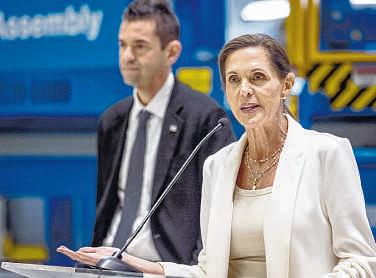
Panelists acknowledged the well-documentedchallengesoflife surrounding a city of 360,000 residents that is nowroughlyhalf its peak size.
Speakerssaid thefactors drivingpeople away from south Louisiana include high insurance costs, badroads subpar public transportation, public safety concerns and aperceived lack of economicopportunities.
“People votewiththeir feet,” Walt Leger,president and CEO of New Orleans & Co., told the crowd. “When communities provide educational opportunities and affordable housing, people move to those locations and they stay there.”
BGRisn’tthe only organization focused on population growth. Greater New OrleansInc., the regional economic development nonprofit, is preparing to launch an initiative called “5x5” in January that seeks to grow the metroarea’s populationby5% over the next five years— boostingthe number of people in the metro areafrom 1,440,000 next year to 1,512,000 in 2032.
Thegroup endorses efforts to “double down on sectors of the Louisiana economy with the best growth potential based on global trends and the state’sstrengths. Areasoffocusinclude energy,defense,aerospace andtrade.
affordabilityand brand,” said Michael Hecht, who will transition from GNO Inc.CEO to an emeritusrole next year
Hecht said the state is alreadymaking historiceconomic gains in the energy, maritime,defense andaerospace sectors, andthatquality of life can be improved vialow-cost policy and advocacy.Hecitesthe NOLA Coalition, an anti-crimealliance formed in 2022, as a successful example of the strategy.
GNO Inc. also plans to garner support from the business communitytofund anational marketing campaign.
“Wehaveastrongstoryto sell,”Hechtsaid.
Attracting GenZ Andrew Fitzgerald,anexecutive at theGreater Baton Rouge Economic Partnership, said the conventional wisdomthatpeople follow jobshas evolved.

“Growing population comes down to fourinterrelated imperatives: economic opportunity, quality of life, affordability and brand. We have astrong storytosell.”
MICHAEL HECHT Greater
NewOrleans Inc. CEO
Hand in hand will be efforts to “destroy dissatisfiers” by investing in public safety, flood control,homeless policyand educationwhile combating theinflated costofliving by advocatingfor more public support for fortified roofs and national hazard insurance.
“Growing population comes down to four interrelated imperatives: economic opportunity,quality of life,
Afterthreeyears of anemic growth,home sale activity in south Louisiana’sthreemajor metro areas was up in the firsthalfof 2026 over the same periodin2025.

Sources: NewOrleans Metropolitan Associationofrealtors; Greater Batonrouge Associationofrealtors; Market ScopeConsulting
Rouge area, it was up 3.8% to $275,000. In theLafayette area, itinched up 1.5% to $257,000. “Overall, Iwouldn’tcall theimprovements substantial,” said Scott Brannon, an associate broker with CompassRealEstateinNew Orleans. “But it’sdefinitely better than it was.”
‘Downwardpressure’?
Within the three metro areas, there were differences among the parishes —and some inconsistencies. In the New Orleans metro area, St. Tammany Parish
hada 14% increase in sales during the first half of the year,though themedian home sale price was flat at $300,000. Jefferson Parish sales activity was essentially unchanged,with two fewer sales in thefirst half of 2026 than the year before, though the median sale pricewas up nearly 4% to$275,000.
Orleans Parish, meanwhile, saw a5%jumpinthe number of closed salesand a2%increase in themedian homesale price to $285,000. EastBaton Rouge Parish sales activity was virtually unchanged over the same
period ayear ago, while the median sale price was up nearly 2.5%to$280,500.
Both Livingstonand Ascension parishes saw a6%jump in closed sales and slight increases in the median sales price.
New construction in the Acadiana region continues to dragdown prices of existinghomes duetothe incentives from buildersthat make theincreasedprice tag easiertoswallowfor buyers, according to Jim Keaty, owner of KeatyReal Estate in Lafayette.
“Never in history have we seen newconstruction at ahigher price and more affordable than existing homes,” Keaty said. “It’s putting downward pressure on theprice (ofexisting homes). New construction, which is always higher,is more affordableona monthly basis. That’s theinteresting story.”
Highsand lows
Another interesting trend across south Louisiana, according to residential brokers, is the disparity between the luxury home market,where all-cash buyers are still engaging in bidding wars in someneighborhoods, and the market for moreaffordable and starter homes.
New Orleansbroker Charlotte Dorion, with Berkshire HathawayHomeservices
“When Hyundai Steel announced its$6billionfacility in Ascension, it made sense in termsofincentives andlandavailability, but dozens of theirexecutives from South Korea plan to move there as well, so they care aboutthe community,” Fitzgerald said.
‘Chicken andegg’?
Ultimately,Louisiana’s economicdeveloperswrangle with a“chickenoregg” dilemma: Do people come to acommunityfor jobs, or do jobsgravitatetodesirable communities?
“One doesn’thappen without the other,” LED Secretary Susan Bourgeois said during aphone interview last week.“Looking for funding dollars forschools and roads becomes adifficult equation unless you are bringing in more economic activity and tax revenue.”
“Polling shows millennialsand Gen Zworktolive instead of living to work, so they’llbe willing to take a haircut on salary or job titletobein aplace that they enjoy,” he said. Fitzgerald attributes thegrowth of Ascension andLivingston parishes to their combination of efficient governments, strong public schools, new parks and relatively new housing that’sstill affordable, especially compared to alarger metro area like Houston or Atlanta.
“Tho se an d other amenities are really important to young talent,” he said. “They’ve just had a great time for four years and they want to continue that after college as well.”
Companies,too, are looking forappealing places not just whoever offers the biggest tax break. They want locations that will make it easier to attract and retain top talent.
Preferred, who specializes in high end and luxury properties Uptown, said demand forhouses in the “$3 million andup” range far outpaces supply.Sellers with milliondollar homes are getting above their asking price provided the house is newly renovated.
“Things are going off (the luxury) market fast,” Dorion said. “It just has to be the right location, the right price and in mint condition.”
Brannon, who recently was shopping for houses Uptown for aclient looking in the$850,000-to-$2 million range,saidhomes in top condition in the“sweet spot” between Magazine Street, AudubonPark,and St. Charlesand Napoleon avenues were“flying off the market.”
Brannoneventually found him a“beautifully renovated home” Uptown near the river that cost morethan $1 million.
Lafayette’sluxury market also is thriving. Ahome in River Ranch last week sold for more than $3 million, land records show.Another in RiverRanch,the one-time homeofoilfield tycoon Mike Moreno, is expected to close soon after being listed for $12.5 million.
The lowerend of themarket, meanwhile, is evaporating. In 2019, nearly 1out of every 4homes in Lafayette sold for $150,000 or below
Bourgeois said what’shappening in Richland Parish, where thenew Meta data center is under construction, is showing thepower of investment, as her team tries to leverage that tentpole project to attract clusters of relatedindustries. Now, nearby Monroe is showing signs of economic growth. The future Hyundaisteel plant in Donaldsonville could provide another example.
“You can bet that their public services should be much better once they start collecting that sales tax and property tax,” Fitzgerald said. “Then the ‘chicken and the egg’ becomes the virtuouscycle:A companyputs more money in people’s pockets, generating tax revenue, and that creates an attractive community.”
Activity related to those twoprojects and others like them might also be contributing to Louisiana’sincrease in laborforce participation, according to Bourgeois, and the state’smodest population growth for the second year in arow,particularly among 18- to 30-year-olds.
“Thoseare reallygood markers, and it’sreally important to that fundamental shift,” she said.
Email RichCollinsatrich. collins@theadvocate.com.
So farin2026, it’sbeen 1out of almost every 10 homes, due to inflation and asmaller pool of first-timehomebuyers, experts said.
“If there’sanything of concern that Ihaveabout the Lafayette Parish market, it’s thataffordability aspect,” Bacque said. “We’ve lost a certainsegment of themarketplace that I’mnot sure we can replace.” Chandler has seen asimilar dynamic in the New Orleans area. Among her clients is aseller in Metairie with athree-bedroom cottage in agood neighborhood with an assumable mortgage at 3.5%, which is rare. Thehouse waslisted for $215,000, about $250 a square foot, and didn’tmove after amonth on themarket. The seller lowered the price by $10,000 and it’sstill sitting.
“With a3.5% mortgage, this house should have flown off the market,” said Chandler, who servesaspresident of theNOMAR board. “Meanwhile, you have bidding wars over $3 million properties.”
“There’snorhyme or reason to it,” she said. Staff writersTimothy Boone and Grace Mayer contributed reporting to this story.
Email Stephanie Riegel at stephanie.riegel@ theadvocate.com.
BY IANNE SALVOSA Staff writer
Skincare company Saint Crewe started with a “no.”
Erin Piper, a mother of two, brought her 9-year-old daughter along to a store while she was purchasing beauty products, but some advanced skincare caught the eye of the girl.
It was an easy no from Piper, due to the dangers of anti-aging ingredients like retinol for children, but she could see other moms around the store saying “yes,” with shopping baskets filled to the top with skincare products for their children.
Piper has a social work practice in Baton Rouge
Seeing a need for skincare products safe for young skin, she teamed up with Laura-Lucia Carothers, her friend’s sister and a former executive at Skinceuticals, to launch the clinically tested, luxury skincare brand in March of last year She said Saint Crewe is intended for college-age adults though it’s not harmful if children get their fingers into it.
“It’s the social worker in me,” Piper said “I don’t want a young girl or a young boy that worried about their appearance at such a young age. On the flip side, you want to give them something that’s safe to do with their friends, if that’s all the craze.”
Young girls have taken a large interest in skincare in recent years, largely due to the popularity of the products on social media and “get ready with me”-style videos where content creators take viewers through

PrOVIDED PHOTO By SAINT CrEWE
“I don’t want a young girl or a young boy that worried about their appearance at such a young age. On the flip side, you want to give them something that’s safe to do with their friends, if that’s all the craze.”
ErIN PIPEr, founder of Saint Crewe
their beauty routines. U.S. teens spend a collective $1.7 billion each year on skincare and make up 10% of the beauty consumer market, according to Boston Consulting Group. Piper runs a small team of three full-time employees, with other part-time hire in sales and consulting. She declined to share the company’s first-year revenue. In just a year the brand has inked partnerships with well-known beauty com-
pany Revolve and trendy women’s clothing retailer Anthropologie and is available online on the Saint Crewe site.
Saint Crewe has developed an ambassador program geared toward college students to promote the brand and also has a scholarship.
The program awarded $2,000 to three college students who have displayed resilience after facing a challenge.
They’re just getting started, Piper says, aiming to stock with more retailers and eventually expand internationally in the future. In this week’s Talking Business, Piper discusses the skincare market, growing her brand and running a business in Louisiana.
This interview has been edited for length and clarity
How would you describe the market at the time of launch?
This is a really saturated market, as we all know
When I had this idea, I knew I needed to get to market quick because it was exploding, and I knew I would not be the only one who had this idea and who had the ability to get products to market.
We got to market in a little less than 18 months, which is sort of unheard of. We launched with four SKUs. It’s a very simplified line. I wanted to really focus on quality over quantity and really get those ingredients exactly right.
I’d love to hear the story behind the name.
You’re probably thinking Mardi Gras krewe. Saint is part of my mother’s maiden name Her maiden name is St. Clair, and I’ve always loved the maiden name St. Clair
I took Saint from that, and then Crewe is actually the last name of the protagonist in one of my favorite books is a child, “The Little Princess.” She embodies resilience and kindness and generos-
ity and grit and all of the things that I teach in my practice and in the way I aim to parent my children. Revolve and Anthropologie are such big names. Given that your company is so young, how did you go about cultivating those relationships with those brands?
Revolve reached out to us
They just reached out to me on Instagram because they saw the saw the line and loved the way it looked, and we immediately signed on with them very quickly We reached out to Anthropologie and they pretty quickly reached back out and said “sold.”
I’ve been lucky because the line really speaks for itself. People go to our Instagram and they sort of see I hate the word vibe — but they see the vibe and they love it.
What are some of the largest challenges you’ve faced?
We’re a small company
We don’t have a huge marketing budget and we can’t go spend thousands upon thousands of dollars to get the marketing out there, to get the messaging out there, to do these huge, beautiful in-person activations that these brands are doing.
We’ve had to come up with some really creative ways to get our messaging out there. That’s why I think we’re so proud of the ambassador program because that’s been such a great way to get content out there
These girls are loving receiving products and being able to make videos. It’s a culture now
What’s kept you here, and do you plan on keeping the business and yourself here in Baton Rouge for the long run?
That’s always the plan.
This is my home. I’m Louisiana through and through, and I love this place
There’s a lot of things that we have going for us, and there’s a lot of things that we don’t have going for us. There’s so much potential here.
My hope is that we continue to move forward as a state in a way that makes people want to stay here. Because it makes me very sad knowing that we’ve got these brilliant kids coming out of high school, and people are leaving for a multitude of reasons. How can the state improve to make things easier for business owners and founders to start and grow their businesses?
Educate the kids that are growing up in the state. Here’s the thing, if you give them a great education, they’re going to stay here
Then business owners like us have the pick of the litter to hire from, and then I’m able to give these kids a great job, and then they’re able to stay here and provide for their families. Is that what inspired the scholarship?
Oh, absolutely I’m a social worker first through and through, and I’ve always been interested in educating kids, always, and that’s been something that I’ve been interested in and been a part of way before the Saint Crewe scholarship. We have to help these kids break those barriers and be able to get to school.

BY LIZ SWAINE Staff writer
On the Frymaster website, a large red bar reads: “Trusted Worldwide. Built in Shreveport.”
The manufacturer that has called Shreveport home for 91 years could be one of the area’s best-kept secrets If you’ve eatenataBurger King, Popeyes, Taco Bell or aRaising Cane’s, you have likely had food fried by Frymaster equipment.

Kathryn Childs, director of operations, saidshe has heard that 30% of all of the fried food consumed every day is prepared by aFrymaster fryer While most have heard of the big companies, there are hundredsofindependent restaurants usingFrymaster products, too, said Wendell Hays, Frymaster’s vice president of new business and products

On avacation to the Virgin Islands, he went to asmall island accessible only by boat. After ameal at one of the two restaurants there,“Iwent to see what theyhad in their kitchen and there were two fryers made righthereinShreveport, sitting in there. I’m like, ‘That’sreally awesome that my fryersended up here.’”
Restaurants on the island are using products that did not get their start with executives sitting around atableina corporate office, said Hays.
“You don’tunderstand the real needs of the business until yougo get in the kitchen and youwatch the workflow,the 17-year-old kid that was trained for 10 minutes on how the fryer works and see the challenges they facetryingto do their job,” he said. “So you really have to figure out ways todumb it down,make it intuitive.”

whostaffthe factory sevendaysa week.
Hays said he got that perspective when he was working at a Bonanzasteakhouse andhad gotten “fiveminutes”offryer training. “My boss came in and theoil was black, and the food looked terrible, and it was smoking and he said, ‘Son, when was the last time you changed thisoil?’ And I said, ‘I didn’tknow Ihad to change the oil. Nobody told me.’ Iwould have cooked in that stuff forever because Idid not know what Iwas doing. And, you know,I’ve always looked at that as like,that’s who we’re designing our product for,” he said To help, Frymaster is nowusing touchscreens insteadofthe intimidating bank of buttons that Hays said, “scared people to death.”
“Wehad somebody tell us that that thinglookslike the cockpit of the 757, and somebody else is like, you know,I think it’scalled the 3,000 because there’s3,000 buttons on it.And my favorite was somebodywho hadsaid, ‘Whoever designedthis thing has neverworked
in akitchen.’”
In response,in2014, Frymaster becameone of the first restaurant equipmentmanufacturers to move from buttons to touch screens. The new technology has added benefits. Through thefryer’sinternet connection,Hayssaid he can see at aglance if there are equipment problems. He thinks artificialintelligence could prove to be very helpful.
Soon, Hays said he believes smartkitchen systems will be able to build predictivealgorithms on howmuchfood should be cooked even before theorders comein.
Outofsight,not topofmind
In December,Frymaster signed acontract on an adjacent 57-acre building. NorthLouisianaEconomic Partnership CEO Justyn Dixon said theproperty acquisitionsenta strong message that the company plans “to continue their success for years to come.” Earlier this year,Frymaster was
running 13 different production linesinits 270,000-square-foot facility at 8700 Line Ave. The plant adds another50,000 square feet for storage and upward of 100,000 square feet forproduction. Thereare 600 employees who stafflines that run seven days a week.

Because the Frymasterfacilities, which include the two Line Avenue locations and the partner Lincoln Foodservice in the Shreve ParkIndustrial Campus, are mostly out of sight, they are also back of mind. Frymaster President Oscar Villa said it’simportant that residents know the investments made and jobs created by thecompanies, whichare both part of the multinational Ali Group.
“Wedofeel like we have been alittle bit neglected by thelocal community because we’ve been here for such along

time. And you know,weare kind of taken for granted in away,” Villa said.
He said thecompany hasmade avariety of capital investments from newequipment andfabrication to anew building. He said they are also hiring and investing in their employees,improving compensation and adding morecareer opportunities.
“We’re goingtobehere fora long time,” Villa said. “Weare going to grow, andthere arelotsoflongterm opportunities.
“You know,I see someofthe otherpeople,theycome in, they make abig splash,and then maybe they’re gonna be gone in afew years, or they overpromise and maybeunderdeliver,right?I feel likewe’re alittle bit theopposite. We’re aprivate company,sowe don’tneed to show off or do any big proclamation or,you know,come up with any crazy plan, but we are very consistent.”
Email Liz Swaineatliz.swaine@ theadvocate.com.


As partofthe celebration of the250th anniversaryofthe Declarationof Independence,the WorldMonuments Fund has createdan“Irreplaceable America”list, which designatesthe topten sites in America thatare unique andindispensable
Thereisonlyone city on thatlist: NewOrleans.
Rather than highlighting asingle landmark, thenominationframesNew Orleans as an irreplaceable living cultural landscape: aplacewhere historic neighborhoods,vernaculararchitecture,publictraditions,water,culture, and daily lifeare inseparable.The local nomination wasinitiated by Kristin Gisleson Palmer,ExecutiveDirectorofthe Preservation ResourceCenter (PRC), who made thecase thatthe entire city -not asingle monument, building,ordistrict -isthe irreplaceable site. PRCworked with theHistoricPreservationprogram in Tulane’sSchool of Architecture andBuilt Environment, theLouisiana LandmarksSociety,The Ella Project,and TheWater Collaborativetodevelop thesubmission andhighlight therelationship among architecture, culture, water, community stability, andtraditional skills.
World Monuments Fund TopTen “Irreplaceable America”Sites
•Bartram’s Garden,Philadelphia, Pennsylvania -The oldestsurviving botanical garden in theUnitedStates, Bartram’sGarden helped shape American natural history andglobal plant exchange
•Black Mountain College StudiesBuilding, NorthCarolina -Atthe heart of Black Mountain College,this building represents oneofthe most influential experiments in American artand education.
•AfricanMeeting House,Boston, Massachusetts -The oldestsurviving Black church in theUnitedStates, theAfrican MeetingHouse helped anchor theearlyabolitionistmovement.


•CityofNew Orleans, Louisiana -Shaped by Indigenous,African, European,and Caribbean influences, thehistoricneighborhoodsofNew Orleans form oneof America’s most distinctivecultural landscapes.
•Colonial Homes of Newport, Rhode Island -Newport’s extraordinary concentrationofcolonial-eraarchitecturesurvives as aliving neighborhood,not amuseum
•Dallas City Hall, Texas -Designed by I. M. Pei, Dallas CityHall is oneofthe most significantworks of civic architectureand modernism in America.
•Mission Churches of Acomaand Laguna Pueblos,New Mexico -Built by Pueblo communities in the aftermath of Spanish conquest andstill active today, these Pueblo-Franciscan mission churches remain vitalcenters of spiritualand cultural life.
•New York’s Smallpox Hospital Ruin,RooseveltIsland, NewYork -The first U.S. facility built to treatepidemic disease, this nineteenth-centurysmallpox hospital, designed by architect James RenwickJr.,remains ararelandmark in thehistory of medicine.
•Watts Towers,Los Angeles, California -Italian immigrant Simon Rodiaspent more thanthree decadesbuilding thesesoaring sculptures by hand, producing oneofthe most singular worksoffolkart in American history
•Wright Brothers Sites in Dayton,Ohio -Inthe workshopsand fields of Dayton, Wilburand Orville Wright developed thetechnologythatmade poweredflight possible Youcan read about

SOURCE LOUISIANA is LouisianaEconomicDevelopment’s official directoryofLouisiana-based vendors, subcontractors,and suppliers. It brings Louisianacompaniestogetherinone trustedplace,helping local vendorsbeconsideredfor majorprojectsastheytakeshape across thestate
From construction andinfrastructuretoprofessionalservices, logistics, food andfacilitiessupport,large developments depend on awiderange of local partners. Source Louisianahelps project leadersidentifyqualified businesses early, so localcompaniesare includedfromthe start.
Registration is free andopento ALL Louisiana-basedbusinesses. Companies canregister, verify informationand update profiles with currentcapabilities.
Earlyvisibilityhelps Louisianabusinessescompete as projectsare planned andcontracts areformed.
CONNECTLOCALLY. COMPETENATIONALLY GROW GLOBALLY.


Ad campaign highlights gas price struggles
BY GRANT SCHWAB
The Detroit News (TNS)
WASHINGTON — A prominent environmental group is launching an ad campaign faulting automakers for consumer struggles with high gas prices.
“We need to put the blame for this unaffordable economy where it belongs. Automakers have the technology that could help America break the cycle of oil price shocks,” said Dan Becker director of the Center for Biological Diversity’s Safe Climate Transport Campaign.
“This is auto mechanics, not rocket science. Automakers can build and sell affordable EVs in other countries, but they’re just not building them for us,” he added. Becker’s group is spending $100,000 to place ads in major publications like the Financial Times, The Wall Street Journal and Bloomberg with the aim of reaching business-minded readers and capitalizing on frustrations with energy price hikes caused by the United States and Israel’s war with Iran.
“Laws required electric vehicles. Car companies promised to make them,” one of the ads says in all capital letters. “Then they lobbied to scrap the laws.”
“So we pay more because they kept us hooked on oil,” it adds, showing logos for Ford, General Motors and Toyota. “We need affordable electric vehicles. For energy security, for healthier communities, for a better future.”

The ads reference the ongoing war in Iran but do not directly mention President Donald Trump who led the United States into the conflict and has championed efforts to gut past environmental policies.
Political messaging around electric vehicles was common in the run-up to the 2024 presidential election, when Republicans frequently bashed Democrats over so-called “EV mandates.” Thencandidate Trump often wielded the term on the campaign trail as Democratic opponents struggled
to grapple with rocky EV adoption.
The Biden administration never explicitly required automakers to sell more vehicles with allelectric powertrains, but it did set aggressive tailpipe emissions targets that would have been impossible to achieve without EVs and in 2022 significantly expanded federal EV tax credits.
The topic has since faded from the airwaves after Trump took office.
Amid changing political tides under the GOP leader four of
Michigan’s Democratic lawmakers joined Republicans last year in backing a measure to roll back influential California rules that would have required EV sales in some states.
Becker, asked why his group was sponsoring an EV ad campaign in the current political environment, said times have changed since 2024.
“I’ve always said the biggest single step to saving money at the pump, and cutting our oil addiction, and protecting us from global warming is making cars
go farther — or not at all — on a gallon of gas. I don’t think there’s a change there,” Becker said in a phone interview
“What has changed is the time,” he added. “Our sense was that people who are paying through the nose at the gas pump may be willing to stop for a minute and say, ‘Oh yeah, there aren’t tax credits anymore. But this is what we really need.’”
Toyota and GM declined to comment on the ads. GM is the second-leading EV seller in the United States behind Tesla. Toyota, meanwhile, has significantly expanded its all-electric lineup in the past year Ford did not immediately respond to a request for comment.
Other groups on both sides of the EV debate previously ran ads on the topic in 2024 but have not done so yet ahead of the 2026 midterm elections.
EDF Action, the advocacy partner of the Environmental Defense Fund, ran ads in Michigan that year promoting EVs but has no plans for a national advertising campaign this year.
“We’re unlikely to see more ads, given the Trump administration rollbacks of federal support for EVs, which have pushed the issue back to the states, such as the recent developments in California,” Jack Pratt, associate vice president at EDF Action, said in a statement.
He was referencing California’s recent efforts to launch its own EV tax credit program now that the federal credit ended.
The oil and gas group American Fuel & Petrochemical Manufacturers ran ads opposing Bidenera EV policies in 2024 but did not immediately respond to a request for comment on 2026 midterm messaging plans.
“I’ve always said the biggest single step to saving money at the pump, and cutting our oil addiction, and protecting us from global warming is making cars go farther — or not at all — on a gallon of gas. Our sense was that people who are paying through the nose at the gas pump may be willing to stop for a minute and say, ‘Oh yeah, there aren’t tax credits anymore. But this is what we really need.’”
for
of the
DAN

Disasters come in many forms. Butstories of preparation, response,and recovery arecountless,and Jones Walker LLP is here to help at everystep. From awidespreadevent such as ahurricane,acyberattack or databreachtoaworkplace accident or adeveloping health threat,businessesrelyon Jones Walker forguidance.
Ourcross-disciplinarydisasterpreparedness&recoveryclient team advisescompanies,not-for-profit organizations, and individualsastheyprepare for, respond to,and recoverfrom crises.Withdeepexperience in preparing forand responding to majorevents, ourattorneys help clientsimplementeffective plansand move quicklytowardrecovery.
Ourgoalistoget clientsbackinbusinessassoon as possible
William H. Hines
Partner
Managing
bhines@joneswalker.com 504.582.8000
201St. Charles Avenue NewOrleans, LA 70170-5100 joneswalker.com
Attorney Advertising. No representation is made that thequality of legal services to be performedisgreater than thequality of legalservices performedbyother attorneys.
LA-26-20650
Proactivedisasterplanninghelps workplaces protectemployees,ensurecontinuity
Naturaldisasters such as hurricanes,floods andwildfirescan haltoperationsand disrupt employees’lives.Employers must protect people,maintainproductivity, andensure compliancewhile navigatinguncertainty
To ensureaneffective disaster response, employers should:
•Determinecrisismanagement responsibilities Identify essentialemployees, plan foron-site needs, andcommunicate rolesand accountability
•Prepare forremote work Revisitpolicies, enable rapidtransitions,and ensure employees have thenecessary tools.


•Communicatewithemployees Shareplansbefore, during, andafter events andclarifycommunicationchannels
•Train managers Help them recognizeemployeestressand refertosupport resources.
•Knowapplicable laws andaddress hazards. Implement safety measures andtrainingwhile supporting employees with flexibility
Thebottomline is to plan ahead.Clear policies reduce confusionand supportafasterrecovery.

BY DAVID DANZIS Las Vegasreview-Journal (TNS)
When billionaireTilman Fertitta offered $17.6 billion to take Caesars Entertainment private, industry observers viewed it as abold move by alongtimecasino operator seeking control of one of gaming’slargest companies.
Less thanone week later, another billionaire made an even bigger bet.
Media mogul Barry Diller’sPeopleInc. proposed aroughly $18 billion acquisition of MGM Resorts International, amove that, if completed, wouldremove the largest operator on the Strip from public markets. Neither transaction is finalized, and both proposals must navigate months of due diligenceand secureapprovals from gaming regulators in Nevada and dozens of other jurisdictions, including Louisiana and Mississippi, before they can close. Caesars has also established aspecial committee to evaluate Fertitta’sproposal, while MGM has not publicly endorsed Diller’sunsolicited offer Taken together,however, thedeals representsomething larger than two highprofile acquisitions. If approved, they would remove two of the gaming industry’smost recognizablecompanies from Wall Street, ending years of

Public companiesanswer to shareholders every three months. Executives spend significant time preparing earnings reports, responding to analysts and defending short-term financial performance.
Private companies face no such obligation.
“When they go private, they’re not subject to quarterlyreports,” saidStephen Miller, research director at CBER. “They can look more into the longer run in terms of their planning. They don’t have to meet everyquarter’s certain expectation.”
That flexibilitycould allowmanagementtopursue investments that may take years to pay off rather than focusing on thenext earnings report.
ertiesafterselling much of its real estate in previous transactions.
Adding acquisition debt could increase pressure to streamline operations, refinance existing obligations or divest assets, Wood said. “Itwouldn’tsurprise me if you see some streamlining and someassets reduced off their balance sheet,” he said, emphasizing that any prediction remains speculative. “Caesars, acouple years from now,might look alittledifferentthan it looks today.”
quarterly earnings scrutiny while placingbillions of dollars innew acquisition debt on their balance sheets.The transactionsalsocontinue abroader trend of gaming companiesabandoningpublicmarketsafter years of consolidation,followingrecenttake-private deals such as Golden Entertainment andInternational GameTechnology. Economistssay the shift could fundamentally change how the companies make decisions,investintheir properties andcompete for customers, thoughnot necessarily in thesame ways. Although theproposals differ in size and structure, both are examples of leveraged buyouts. In atraditional acquisition, abuyer pays for acompany primarily with cash or stock. In aleveraged buyout, rather than financing an ac-
quisition outright,buyers relyheavily on borrowed money,withthe acquired company’sfuturecash flow helping repaymuch of the debt over time. The acquiredcompany typically assumes muchofthat debt after the transaction closes. Thestrategy can amplify returns forinvestors if the company continues generating strong cash flow.But it also leaves the business with significant debt obligations during economic downturns or periodsofslowing growth.
Those tradeoffs areparticularlysignificantin LasVegas, where tourism spending has moderated afteryears of post-pandemic growth while borrowing costs remain elevated
“I think what I’m watching here is what the new ownership is signalingabout the strengthofthe gaming mar-
ket in general and where we are in the cycle,” said Andrew Wood, director of UNLV’sCenter for Business and Economic Research.
Las Vegashas remained near 40 million annualvisitors for years, while inflation-adjusted gaming revenue has largely plateaued, Wood said.Thatdoes not necessarily indicateweakness, but it does suggest theStrip has matured intoa market wherefuture growth may require different strategies than simply attracting moregamblers.
Instead, casino operators areincreasinglyrelyingon entertainment, sports, conventions and digital gaming to generatenew revenue.
“The industry is …needing abit of ashake-up,” Wood said.
The biggest change may notbefinancial. It may be philosophical.
Diller alludedtothatphilosophy in announcing his proposal, saying MGM’s leadership has built “the world’spremiergaming, hospitality and entertainment company” and that private ownership would allow management to continue executing its long-term strategy away from the pressures of public markets.
Wood believes those comments reveal an important distinction between the two proposals.
With MGM, he sees investors expressing confidence in the company’s existing direction.
“Theyare still convinced that their strategy is the right strategy,but they need space from public markets,” Wood said.
Caesars, however, presents adifferent picture.
Unlike MGM, Caesars already carries substantial debt and must make approximately$1.4 billioninannual lease payments to Vici Prop-
MGM, by contrast,appears more likelytocontinue pursuing itsexisting strategywhile benefiting from the flexibilityprivate ownershipprovides, he said. “I getthe sensethere is more confidencethatthe current strategy will work given time,” said Wood. The effects of private ownership maynot be immediately visible to visitors. Casino floors will still operate. Hotel roomswill still be cleaned. Showswill continue. Over time, however, guests couldnotice changes.
Private ownership gives companiesgreater freedom to introducenew amenities, experiences and longterm investments without worrying about howthose decisionsaffectthe next quarterly earnings report, Miller said.
“They can be innovative in the sorts of new services they offer,” he said. Butthe opposite also remains possible.
“The downside …the corporation maybeinterested in trying to raise revenue by parking fees and resort fees, and those could go up,” Miller said.




Staff report
SouthLouisiana businesses and nonprofit groups recently announced the followingpromotions, new hires and resignations.
BatonRouge

Krista Raney has been promoted to president and CE O of the LSU Foundation. Raney previously worked as the foundation’sexecutive vice president for de-
velopmentand leda group of fundraisingprofessionals on campus.

CraigNetterville has beenpromoted to senior vicepresident and Baton Rouge president of First Horizon Bank Net terville, who has been a leader on First Horizon’sBaton Rouge team for 20 years, also serves on theLouisiana CivilService Commission and thefinance committeeofOur Lady of

Manning Greene has joined thelaw firm Kean Miller as an associate in the Baton Rouge office with a focus on energy-related ma tte rs. Greene previouslyworked at Bradley Murchison.
The Board of Trustees of the HomeBuilders Self Insurers Fund announced its 2026 executive committee.
ScottWallace,owner of Melot Construction LLC andatwotime Builderofthe Year honoreefrom theHome Builders Association of Central Louisiana, has been elected chair
David Champagne,owner of David Champagne Construction anda life director of the St. Tammany Home Builders Association, will serve as vice chair
RandyNoel,founder of Reve Inc. anda member of the Louisiana Builders Hall of Fame, was elected secretary.
Rob Hamilton will serve as immediate past chair Hamilton is theowner of
RobHamilton Construction and leader of the Louisiana HomeBuilders Association PAC.
World WarIImuseum since 2017.

NewOrleans Erin Clancey,the associate vice presidentofcollectionsand exhibitsat TheNational WWII Museum in New Orleans, has been hired as the executive director of theCalifornia Museum in Sacramento. Clancey,anative of Davis, California, has worked at the
Stan Guidroz,CEO of Toucan Gaming, has been promoted to chief operating officer of Toucan’s parent company Accel Entertainment. Guidroz, who previously led Louisiana operations for JacobsEntertainment, founded the Louisiana GamingAssociation andserved as itspresident until last year. Do you have personnel changes to share or other ideas forour business coverage? Drop us aline at biztips@theadvocate. com.

Free cashaside, the much-touted “Trump accounts” are supposed to give the next generation ahuge financial head start in life. But by age 18, the reality looks less like afortune and more like a down payment on a new car
President Donald Trump has repeatedly used hischaracteristic hyperbole to describe the wealth-building potential of the child investment accounts created under the One Big Beautiful Bill. Parents, guardians and other authorized individuals can establish a new type of individual retirement account for their childrenunder 18. Children born between Jan. 1, 2025, and Dec. 31, 2028, are also eligible for aone-time $1,000payment.
During an Oval Office launch event earlier this month, Trump saidthat infants “who come into the world essentially with no money” will“at avery young age be very rich.”
The administration’sown estimate showsthat by the time achild turns 18 and can start to withdraw the money,they will have about $6,000.
Except for the $1,000 government seed, this endeavor is ayawn forme.
Anyparent, grandparent, auntie or uncle with extracash to spare already has access to other investment vehicles designed to do what theTrump accountsdo.
Theycould open acustodial investmentaccount, which allows adults to invest in stocks, bonds and mutual funds on behalf of aminor until they reach adulthood.
Alternatively,theycould utilize 529college savings plans, which aretax-advantaged accounts specifically structured to fund qualified education expenses.
Yet, despite the clear,compoundingbenefits of early investing, only asmall fraction of American families —disproportionately those with higherincomes —actually set up 529 plans or custodial accounts.
According to data from the Education Data Initiative, only 32% of families use dedicated college savings plans, primarily because 54% of parents are unaware these programs exist.
Alot of people have asked me for my takeonthe Trumpaccount
Strip away the political hype, and here are six reasons this plan won’t create true legacy wealthfor lowandmiddle-income families
Some flat-out hate thename
In discussing theaccounts’ launch, Trump claimed, “They said it would sellbetterifyour name is on it.”
But noteveryone is loving the Trump stamp.
Online commentary across social media shows adeep reluctance to engage withthe program simply because of how it is named.
On the dadReddit forum (r/ daddit), auser wrote, “Hate the name. Hope thatone day in future administrations, it gets removed.”
Many people said theywould open the account just to get the $1,000 but thennot make any additional contributions.
“Wesigned our twokids (6 and 4) up when we did our taxes,” another user on r/daddit wrote. “It’shard to turn down afree investment of any amount for your kids …but my main hesitation now is thatI got an email saying that in order tofinish setting up the accounts Iwill need to install the ‘Trump AccountsApp’ on my phone. …Ialready don’t trust the administrationand I’m very skeptical about installing any app on my phone thathas the name Trump on it.”
Theopt-infeature
In my experience, when abenefit requires extra paperwork to opt-in, there’s less buy-in.
In the case of these accounts, you sign up by going through trumpaccounts.gov,through your IRS online account under the “Forms” taborbyfilling out IRS Form 4547, which, again, is all about Trump—

the 45thand 47th president. One-time paymentisn’t enough
Youcannot save money youdo not have.
Forlow- to middle-income families who cannot afford to add even asingle dollartothe initial$1,000 seed, the account is projected to grow to about$6,000 by age18, depending on market performance. That’s ahelpful cushion, but it’s a far cry from Trump’sproclamations thatkids will getrich. If you’re afamily living paycheck to paycheck, finding an extra $400 amonth to lock away is a fantasy
The issue has never been alack of account types. The obstaclefor many families is alack of surplus cash. Byrelyingonfamiliesto invest up to $5,000 annually to see meaningful growth,Trump accountsdonot solve thefundamentalproblem of poverty
Financialaid bite
At age 18, the account hands controlover to the child andmorphs into atraditional IRA. This could make ahuge difference whenfilling out the Free Application for Federal Student Aid. Unless there is arule change, pullingmoney out of the account to payfor tuition is treated as student income, which the FAFSA penalizes heavily.This can slash financial aid
eligibility by up to 50% of the withdrawn amount. Parent-held assets such as a529 plan are only assessed at amaximum rate of 5.64%.
If your young adult child decides they would rather cash outthe account andput themoney toward buying anew car or funding a vacation instead of leavingitfor retirement, there is legally nothing theparents can do to stop them
Themoney is trappedfor years
Lower-income familiestend to experience alot of financial emergencies. Expensive auto repairs, surprise medical bills and rent hikescan create asudden gaping hole in afamily’s budget. The cash in theaccount is untouchable until thechild hits18, andeventhen, tapping it before age591/2 foranything outside of someexceptions— qualifiedhigher education or medical expenses or first-home purchases —triggers a painful 10% IRSpenalty on top of standard income taxes. Working familiescan’t afford to lock away theirthin margin of safety in a financial vaulttheycan’t access when acrisishits.
Sure, takethe free money,but don’texpect great riches from setting up this account.
Email Michelle Singletary at michelle.singletary@washpost. com.









BY JONAH MEADOWS Staff writer
The tarps rolled onto fields during rain delays at major league ballparks, the massive grain covers that protect mountains of freshly harvested grain across the Midwest and the wrapping on the scaffolding at the U.S. Capitol ahead of Joe Biden’s inauguration have one thing in common: They were manufactured in Tangipahoa Parish by J&M Industries.
The family-owned business and its 120 workers specialize in custommaking giant tarps — some as large as football fields for a variety of industries, cutting, sewing, grommeting and heat-sealing them, oneby-one, from a 280,000-square-foot Ponchatoula plant
J&M also distributes smaller items to customers from Galveston, Texas, to Mobile, Alabama, including the distinctive blue tarps that dot roofs across the Gulf Coast after a storm, crawfish sacks, hair nets and its own brand of gel ice packs called Cajun Ice.
Together the manufacturing and distribution sides of the business have enabled the 53-year-old firm to grow into an approximately $40 million annual operation with plans to expand out of state in early 2027.
The key, according to J&M’s president and managing owner, Maurice Gaudet IV is focusing on work that cannot be cheaply outsourced and using specialized equipment to create one-of-a-kind covers on demand without the long lead times of importing internationally
“We operate in a lot of niche markets,” said Gaudet, 74. “We’re always looking for things that are attached or similar to what we do where we can use our strengths to succeed. One reason why we’re here is we’ve adapted over time.”
Covering growth
J&M began in a New Orleans garage in 1973, when Gaudet’s father, Maurice III, and a partner named Jake the “J” to the elder Maurice’s “M” — repurposed used coffee bags for offshore oyster sacks, among other uses. Jake left after the

first year, but the name stuck.
The company expanded in the 1980s by buying out or merging with other local bag companies, and several of Gaudet’s uncles joined the business.
In the 1990s, it moved to Ponchatoula, shifted its focus from bags to tarps and opened a distribution center in Rayne. Just over a decade ago, it expanded the plant, which was followed by the creation of four subsidiaries for the company’s different areas of focus.
The manufacturing arms account for about 70% of company revenues, while the distribution side of the business makes up nearly 30%.
JMI Legacy Manufacturing, its heavy industry arm, makes custom canvas, vinyl and polyethylene tarps for construction, sandblasting and petrochemical, plus shade cloth for outdoor venues, greenhouse roofs and row covers for crops.
JMI Covers handles the largest, heavy-duty tarps, used for covering mountains of grains, wrapping landfills and lining retention ponds. This branch of the company also makes custom athletic field tarps — like the Reynolds Wrap-themed cover that’s rolled out at Wrigley Field.
The company’s distribution arm, JMI Packaging Solutions, supplies a sprawling catalog of everyday items — custom and stock — used by a range of industries to protect and transport their products.
“We are one of the most wellknown distributors in the area for
crawfish sacks,” said marketing director Tracey DeSoto.
J&M also has a consumer-facing ecommerce storefront, Tarps America, where online shoppers can buy tarps and covers directly from the company Old school vs. new school
On a mid-June visit to J&M’s Ponchatoula facility, bales of disaster relief tarps were stacked almost to the ceiling — about $4 million worth — ready to be shipped out upon the arrival of a destructive major storm.
“At this point, we have so many FEMA tarps we don’t know what to do with them, but we have to have them ready to go if something happens,” DeSoto said.
When Hurricane Helene hit in 2024, the whole company sprung into action to load up trucks and get the tarps out the door
“We had as many forklifts as we could,” DeSoto said. “It was all hands on deck, literally.”
A short walk away, workers were preparing for the harvest season.
From about March to August, J&M constructs the enormous custom tarps for grain producers and stacks them inside until shipping starts in July
The largest ones are measured to fit a specific pile, some as much as 1,200 feet long, and assembled, usually from four to eight pieces that are fused together J&M makes several million square feet of grain covers a year, accounting for about


dent’s import duties were invalidated by the U.S. Supreme Court.
a third of its business.
They’re finished using hot-air welding on 500-foot-long travelers machines that roll along rails fusing together fabric panels, sealing seams as an operator walks the length of the building
On the other side of the factory, workers operate from pits below floor level, allowing the heavy fabric fed through industrial sewing machines to remain level. Across the room, other workers cut and finish the smaller tarps by hand.
“I call one old-school and one newschool,” Gaudet said. “It’s a totally different operation.”
Broadening the focus
The biggest recent challenge the company has faced has been the uncertainty around national economic policy, which has wreaked havoc on J&M’s margins, Gaudet said Tariffs have cost the company about $600,000 since last year, though about a third of that has so far been recovered after the presi-
J&M has also fought a lengthy legal battle over its intellectual property. After suing a larger, publicly traded company over violating a patent on a grain tarp strapping system, it spent five years in federal court and millions of dollar in legal fees before prevailing in 2021. But the company is growing and, for the first time, expanding beyond Louisiana’s boundaries. It recently acquired an 11-acre site in Alabama near the Florida and Georgia borders and plans to break ground in February on a 50,000-square-foot building, with room to expand. The new facility will enable the company to extend the packaging business further east and stage disaster relief tarps closer to the markets that buy them.
Gaudet said the move is part of a broader push into disaster relief that could eventually include selling cots, medical kits and meals, not just tarps, to governmental clients. A certified public accountant for years before joining

















































































JUDE BRIDWELL




JEREMYWEIMER
BILL HOLT
HANCOCKWHITNEY 225-229-8783 •Bill.Holt@Hancockwhitney.com hancockwhitney.com/bill-holt •NMLS 148394
ANGELLEWIS
MICHAEL HEBERT


HANCOCKWHITNEY 225-603-1777 •Jude.Bridwell@hancockwhitney.com hancockwhitney.com/jude-bridwell •NMLS 92661
HANCOCKWHITNEY 225-978-2592 •Jeremy.Weimer@hancockwhitney.com hancockwhitney.com/jeremy-weimer •NMLS 175288
HANCOCKWHITNEY 225-413-6094 •Angel.Lewis@hancockwhitney.com hancockwhitney.com/angel-lewis• NMLS 700876
2,500 employees, anddoesnot discrim‐inateonthe basisofrace, color,
tional origin,sex,religion, ageordis‐ability in employment or theprovision of
MINIMUM ELIGIBILITY REQUIREMENTS: •Applicantsmustbeeligible to serveas aSuperintendentofSchoolsinthe StateofLouisiana in accordance with LouisianaState Bulletin 746. •The certificationendorsement re‐quired to serveasa school system Su‐perintendent or AssistantSuperinten‐dent is theLouisiana EducationLeader CertificateLevel3 (Superintendent),or aTypeA certificatewithSuperinten‐dent Endorsement. •Applicantsmustpossess requisite administrative experience: oFive(5) yearsofteachingexperience in his/herareaofcertification; oFive(5) yearsofsuccessfuladminis‐trativeormanagementexperiencein educationatthe levelofCentral Office supervisor or above; and •Applicantsmustpossess thephysical andmentalstaminaand abilitytoper‐form jobfunctions, tasksand duties APPLICATION: •Perspective applicants should go to www.toptalent-live.com forSuperin‐tendentsearchinformation,complete jobdescription,minimum qualifica‐tions, andtocompleteanapplication •Applicationsmustbecompleted on theTTMG’sform, copied andmailedto TopTalentManagement Group, 116 S GrantStreet, Roseville, CA 95678, ATTN: Tangipahoa Superintendent Search, or emailedto: ronhickey@toptalentmgllccom •Applicationsmustbepostmarkedby no laterthan4:00p.m.Central Standard Time,Friday, July 31, 2026. •Applicationsmustinclude thefollow‐ingitems: oCompleted applicationform. oCurrent resume’.
oCopyofLouisianaTeachingCertifi‐cate showingcertification or astate‐ment of eligibility forcertification for this position from theLouisianaState Department of Educationby4:00p.m CSTonFriday, July 31, 2026. oCertified copies of allgraduateorun‐dergraduatetranscripts oApplicationsreceivedwithout allof therequireditems attached will be considered incomplete andwillnot be returned to theapplicant •Application packetspostmarkedor emailedafter 4:00 p.m. July 31,2026will notbeconsidered, norwillapplications delivered in anyfashion otherthanby mail or emailtoaddresses above. •Pleasebe advisedthatLouisiana Su‐perintendent applications areconsid‐ered public recordsand aresubject to release.
SALARY:Negotiable •The Tangipahoa Parish School System will negotiate acompetitive salary and benefits packagedepending on the candidate’sexperience, accomplish‐mentsand credentials. TANGIPAHOA PARISH SCHOOL SYSTEM 59656 Puleston Road •Amite,Louisiana



HANCOCKWHITNEY 225-715-1133 •Michael.Hebert@hancockwhitney.com hancockwhitney.com/michael-hebert •NMLS 79769


















































































































March23, 2026 (“Petition Date”), Crosby Marine Transportation, LLC (“Transportation”),Crosby Tugs, LLC (“Tugs”), Crosby Dredging, LLC (“Dredging”),and Bertucci Contracting Company,L.L.C. (“Bertucci”and collectively,“Debtors”),asDebtors in Possession, each filed for relief under Chapter 11 of the Bankruptcy Code thereby commencing these cases (the “Chapter 11 Case(s)”)
PLEASE TAKE NOTICE the Court has set July 30, 2026,asthe deadline for any person or entity that holds aclaim against the Debtors as of the Petition Date (referred to as Creditor”or“Creditors”) to file a Proof of Claim as modified by the Order establishing the Bar Date. This Bar Date applies only to those Creditors who arenot listed in theDebtors’ Schedules, unless such Creditor asserts alien (other than preferred ship mortgage) under the Commercial Instrument and Maritime Lien Act (46 U.S.C. §§ 13101–13143 (“CIMLA”) againsta Debtor, or whose claim is scheduled as contingent, disputed, or unliquidated. See below for more information about how to determine the listing of your claim and what happens if the Debtors later amend the Schedules.
PLEASE TAKE NOTICE the deadline for any governmental unit to file aclaim is September 21, 2026,for any governmental unitto file aclaim pursuant to 11 U.S.C. §502(b)(9).
PLEASE TAKE NOTICE that if you areasserting alien (other than apreferred ship mortgage) under the Commercial Instrument and Maritime Lien Act (46 U.S.C. §§ 13101–13143) [known as aMaritime Lien], or other lien against any vessel owned by any debtor,you must include the attached addendum to your proof of claim providingthe following information:
(a) The name of each Debtor against whom you areasserting a lien, including the vessel against which you areasserting a




















lien; (b)The natureofthe maritime lien under 46 U.S.C. §13101(5);
(c) The datethe lien was established; (d)The amount of the lien claimed; AMaritime Lien can arise from amaritime tort or the provision of “necessaries” to avessel. Necessaries can include any essential goods, supplies, or services provided to avessel to keep it operating safely,efficiently,and in navigation.
ADDITIONALLY, if you areasserting amaritime lien against any of the Debtorsorthe Debtors’ vessels, you must also attach documentation supporting your lien claim (e.g. invoices, receipts, charter agreements, bills of lading, supply or repair contracts, vessel logs, time-and-material logs and/or ledger entries, any notices of claims of lien filed withNational Vessel Documentation Center). If you assert morethan one maritime lien (e.g. for services provided to multiple vessels), you will need to submit aseparateproof of claim and addendum for each claim/lien asserted.
PLEASE TAKE NOTICE the deadline forany Creditor with aclaim that arises from the rejectionofanexecutory contract or lease is on or beforethe later of (a) the General Bar Date; or (b) thirty (30) days after the effective date of such rejectionasordered by the Court.
PLEASE TAKE NOTICE Youcan file aProof of Claim using one of three methods:
1. By using the Court’sElectronicProof of Claim (“ePOC”) process on the Court’swebsite, https://ecf.laeb.uscourts.gov/cgi-bin/ autoFilingClaims.pl;
2. If the person or entity is represented by an attorney,by filing electronically through the Court’sCM/ECF system aProof of Claim conforming substantially to Official Form B410,acopy of which accompanies this notice; or
3. By delivering aProof of Claim conforming substantiallytoOfficial Form B410 (attached hereto) to the Court, either in person or by mailtothe U.S. Bankruptcy Court, 500 Poydras Street, Suite B-601, New Orleans LA 70130, subject to Covid-19 protocols. If you mail your Proof of Claim to the Court, you must mailitearly enough so the Court will receive it on or beforethe deadline in this notice and enclose asecond copy of the Proof of Claim with aself-addressed stamped envelope to receive confirmation the claim was filed. PLEASE TAKE NOTICE to determine if you arelisted on the Schedules in away that wouldexcuse you from filing aProof of Claim
you may review the Schedules at the U.S. Bankruptcy Court, 500 Poydras Street, Suite B-601, New Orleans LA 70130 –subject to Covid-19 protocols, online at www.pacer.gov,orbycontacting Michael Landis, with Lugenbuhl, Wheaton, Peck, Rankin& Hubbard, PLC 601 Poydras Street, Suite 2775, New Orleans, LA 70130 by emailatmlandis@lawla.com PLEASE TAKE NOTICE if you do not file aProof of Claim because you










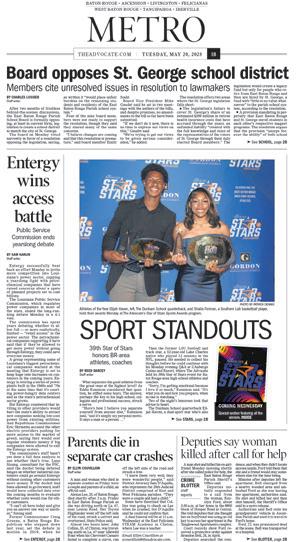



















Our 12-Year Power Plus Warranty picks up whereother warranties end.



•Longest full coverage warranty in the industry
•Transferable coverageifyou sell your home
• Backed by trusted local experts
•Faster repairs with no long delays
•Peace of mind for years to come

Q: What does “fullcoverage” mean.
A: Full coverage means parts,labor,travel, and majorcomponents are included.
Q: Do Ineed to pay extra for this?
A: We give you 12 years with no additional cost.
Q: What products does it cover?
A: The 12-year warranty is included on all Generac Air Cooled unit purchases.
Q: How do Ikeep my warranty active?
A: For allmanufacturer and dealer warranties, generators must have maintenance performed every year.Our warranty requiresthat we perform the maintenance to ensure proper upkeep and protect your investment.

&Complete the In-Home Assessment
•Location of generator
•Sizerequired
•How it works
•How install happens
•Qualify forfinancing
•Answerquestions
Receive aWritten Quote
•Location of generator
•kWsizer report
•Install details
•Total Price








Schedule Installation
•Pickinstall date
•Pay







Liquid-cooledgeneratorsare ahigher-performance option built with larger,heavier-dutyengines,similar to asmall truckengine with a radiator cooling systemlikeacar

Liquid-cooled units come in both 3600 RPM and 1800 RPM models The 1800 RPM models arewidelyconsidered the most durable and reliable standbygeneratorsavailable,designed forlonger runtimes, quieter operation, and reduced wear
We specialize in stocking premium 1800 RPM models for homeowners who want the verybest. If you have... Recommended



2 3 1












































Treatments claim to help with more than weight loss. researchers are still deciding if they deliver.
BY IAN FAUL | Contributing writer
Spend enough time in wellness circles, biohacking forums or men’s health clinics, and peptides begin to sound less lik of molecules and more like the new language of the healthy Its expanding vocabulary includes obscure-sounding names like GHK-Cu, BPC-157, PT-141 and semax — marketed online as the “beauty peptide,” “Wolverine peptide,” “date-night peptide” and “focus peptide.”
A quick social media search yields videos of animated, artificial intelligence-generated peptide vials cheerily explaining their benefits and of influencers demonstrating self-injection with hypodermic needles, followed by long comment threads about sourcing. These videos are usually accompanied by disclaimers that the content is “not medical advice” and appeals to moderators not to remove the posts.
Peptides are not new in medicine. The peptide hormone insulin, for example, has been used to treat Type 1 diabetes since its discovery over a century ago. The current craze can be traced back about a decade to members of CrossFit and other workout communities, who began experimenting with peptides as alternatives to anabolic steroids.
Then came the unprecedented success of weight-loss drugs like Ozempic and We whose key ingredient the naturally occurring GLP-1 — and the explosion of the “looksmaxxing” movement of the 2020s.

There have also been high-profile endorsements, including from U.S Department of Health and Human Services Secretary Robert F. Kennedy Jr who extols peptide use, claiming to have injected some himself and proposing to loosen restrictions on compounding pharmacies’ ability to manufacture them.


“(A peptide) is basically an amino acid telling your body how to … correct a mistake — it’s just sending that signal to do it — whereas most medications are blocking pathways.”
SHAWN GAB, manager at Gameday Men’s Health in Metairie
role-playing game night helps neurodivergent players learn to socialize
BY RACHEL MIPRO Contributing writer
Come to the Nerd Lair Game and Hobby Store in Westwego on the right night and you’ll find a new crowd: a group of autistic players exploring role-playing and tabletop card games.
Called Games and Gathering, the program is meant to foster a sense of connection and community for a variety of neurodivergent people, as well as give participants a way to practice turn-taking and sportsmanship, among other skills.
“You’re looking at teamwork and using your imagination for problem solving,” said Alicia Dardar, owner of the Nerd Lair “There’s lots of communication that needs to happen, and you have to really have flexible thinking. These are all really great lessons to learn, but in a structure that doesn’t feel like you’re being taught something.”
The program has been in operation since January, following an earlier test program, and is the result of a partnership between the Autism Society of Greater New Orleans, Prism Behavioral Consulting and Nerd Lair Games and Gathering offers tabletop card games like Pokémon and Magic: The Gathering, alongside role-playing adventure games. The sessions are split by age; Prism Behavioral Consulting hosts ages 8-15 while the Nerd Lair group welcomes those who are 16 and older and have low-support needs.
“It’s not just the Autism Society, it’s not just the Nerd Lair, it’s not just Prism,” said Claire Tibbetts, executive director of the Autism Society of Greater New Orleans. “We all worked together to make the program work.”
Younger ages play the prewritten adventure format Venture Society while the older group plays Dungeons & Dragons. Role-playing games are narrative-driven, with each player choosing a character and deciding their character’s choices to move the gameplay forward. The Nerd Lair’s game master — “dungeon master” in D&D terminology — works at a special needs
ä See GAMES, page 3
A player makes a move during a Games and Gathering session at Prism Behavioral Consulting
NASA Langley study gauges technology’s efficiency
BY GAVIN STONE The Virginian-Pilot (TNS)
Drones could be a viable way to make transportation of potentially lifesaving donated kidneys more efficient, according to a recent study conducted at NASA’s Langley Research Center in Hampton, Virginia.
On June 5, researchers had drones take human kidneys on two 15-minute flights in loops around NASA’s testing range beyond line-of-sight for about 7.5 miles each time, reaching a peak height of 250 feet. Based on biopsies of the kidneys before and after the preliminary findings show no sign that the flights negatively affected the kidneys, according to the researchers.
Organs are typically transported using a mix of ground transportation by a medical courier, and charter or commercial aircraft, but it’s always a race against time. Organs only last for so long before the health outcome for the recipient is impacted, though advancements in technology have allowed organs to survive longer trips.
Drone transportation could address challenges like traffic congestion and other bottlenecks, and expand access to patients in more remote locations, according to Doug Wilson, executive vice president of Virginia Beach-based LifeNet Health, which provided the kidneys used in the study and helped to assess their status before and after the flights.
“The goal is not necessarily to replace existing transportation methods but to explore whether drones could complement them in situations where speed, reliability, or access are critical,” Wilson said in an email.
Currently, 3,000 Virginians and 100,000 people nationwide are waiting for a lifesaving transplant, according to Wilson. Thirteen people die every day waiting for an organ transplant, according to the Health Resources & Services Administration, a federal agency The study was funded by NASA and conducted in partnership with LifeNet and the Richmond-based
Continued from page 1
This June, staff scientists at the Food and Drug Administration delivered a blow to Kennedy’s proposal, citing a lack of evidence for their efficacy The evidence is expected to be reviewed again by a second committee later this month, which will make a final recommendation.
What will become of today’s most talked-about molecules?
What is ‘peptide therapy?’
The human body produces thousands of peptides, which are short chains of amino acids and the precursors to proteins. Peptides act as hormones, neurotransmitters and cellular signaling molecules, and many of their functions in the body are still being discovered.
The term “peptide therapy,” however, encompasses a more diverse collection of compounds A small number of these — including GLP-1 peptides, sermorelin, tesamorelin and thymosin alpha-1 — have undergone extensive clinical testing and received regulatory approval for specific medical indications. A larger number remain investigational compounds supported by limited clinical data.
Because peptides lack approval, some users turn to the “gray market,” seeking peptides labeled as “research chemicals” from foreign manufacturers.
The rapid expansion of the peptide marketplace tends to blur distinctions, placing FDA-approved medications, experimental therapeutics and a holistic medicineinspired treatment philosophy under a common conceptual umbrella.
“It’s not really a drug in the way we looked at drugs in the past,” explained Shawn Gab, manager at the peptide and testosterone replacement therapy clinic Gameday Men’s Health in Metairie. “(A peptide) is basically an amino acid telling your body how to correct a mistake — it’s just sending that signal to do it — whereas most medications are blocking pathways.”
In some fitness communities the word “drug” has a negative

United Network for Organ Sharing. UNOS described the study in a news release as “groundbreaking,” and it was the first time NASA had tested whether human organs can be transported beyond line-of-sight by drone, according to John Koelling, director of NASA Langley’s Aeronautics Research Directorate.
Koelling said Hampton Roads is the perfect testing ground for this new means of transporting organs because “every problem you’re going to face in trying to make this a reality is all right here,” noting the presence of military installations, nuclear power plants, densely populated urban areas, and a major port.
To be adopted widely, Koelling said they would need to show that drones could safely handle the weight of the organ on flights
beyond line-of-sight and significant regulatory hurdles with the Federal Aviation Administration would need to be cleared.
“This is sort of proof of concept for us,” Koelling said. “The technology to do this is pretty much largely in place.”
The drone used in the study was an Alta X quad-rotor drone made by Freefly, which has the highest maximum payload of any drone in NASA Langley’s inventory, according to Jim Burgess, an unmanned aircraft systems engineer who was the flight-test team lead for NASA. The Alta X can carry a maximum payload of about 33 pounds, according to the company’s website.
Past studies have shown drones can carry organs safely but in those cases people had to be on rooftops to maintain line-of-sight,

according Burgess.
“It’s not necessarily scalable to always have spotters up on rooftops,” Burgess said.
The kidneys used in the study were donated for research because they were not accepted for transplant, according to Kaitlin Swanner, senior policy analyst for UNOS.
They were kept in a container similar to how organs are typically packaged for transport, put on pumps to help keep them healthy before and after the flights, and the researchers monitored vibrations and pressure throughout the flights.
Swanner said drones would likely be used to help with the “first mile, last mile” part of the organs’ journey, from the donor hospital to the airport and from the airport to the patient’s hospital.
“Most organs are traveling pretty far so that makes it more logistically challenging to get the organs from the donor to the patient,” Swanner said “We think (drones) will be particularly helpful in areas where there’s a lot of traffic congestion.” The majority of the donor organs Sentara receives are from farther than 250 miles, according to Karl Neumann, program manager for Sentara’s transplant clinic.
Neumann said any improvement in the efficiency of organ transportation would mean greater confidence that the organ is going to work for the patient. While this research is promising, Wilson said the most immediate way to help save lives is for more people to register to be an organ donor
connotation, stemming from an association with illegal performance-enhancing anabolic steroids.
Peptides are seen as a natural alternative, even though commercially available peptide products may differ substantially from naturally occurring molecules: Some must be chemically modified in a lab to increase their stability in the body, and some are mixed with other compounds or contain impurities.
Increasing interest in medical autonomy and distrust of medical authority in the post-COVID years may also explain the cultural shift toward “natural” medicines and supplements, said Mariana Craciun, a medical sociologist at Tulane University.
The turn toward natural medicine reinforces an inclination to reject medical expertise, she said.
“We want to be the ones who are the intermediaries between this expert knowledge and our bodies, rather than letting a doctor be that intermediary.”
Evidence, regulation, practice
For researchers like Dr Frank Greenway, chief medical officer of the Clinical Trials Unit at Pennington Biomedical Research Center in Baton Rouge, the central issue is not whether a compound is natural but whether its risks and benefits have been rigorously evaluated.
Greenway’s own research focus-
es on characterizing the pharmacological properties of everyday foods and herbal supplements, with the goal of discovering novel obesity treatments.

“I (went) into medicine because I really want to help people and when I do something, I don’t hurt them more than I help,” Greenway said. “When you go by people who are influencers or people who don’t really have medical knowledge you’re certainly not assured that the risks are outweighed by the benefits.”
Perhaps the most researched peptide is MOTS-c, a so-called “exercise mimetic” that regulates metabolism After promising studies in animal models, it was taken to a Phase 1 clinical trial, but was ultimately nominated to the FDA’s do-not-compound list for its potential to trigger immune system reactions. It has since been withdrawn from the list, pending a formal safety review Other popular peptides, such as BPC-157, have even sparser clinical evidence to date.
Despite many reported benefits related to speeding up muscle repair, healing ulcers, regenerating nerves and slowing neurodegenerative disease in cell and animal models, no controlled human trial

of the peptide has been published in the 30-plus years since its discovery Even among supporters of peptide therapies, concerns about sourcing and quality control are common. Dr Thomas Bond, an orthopedist who has incorporated peptides into his regenerative medicine practice in Lafayette for more than a decade, recalled treating patients hospitalized after obtaining peptide drugs online.
“I had three hospital admissions for acute pancreatitis for people that got stuff online,” he said.
There have been a number of reports of people being harmed after taking unknown peptides.
At the Revolution Against Aging and Death Festival last year, two women who received injections at a conference booth were taken to the hospital with swollen tongues, elevated heart rates and trouble breathing, and had to be intubated.
Bond acknowledged the reality of medical self-experimentation but urged peptide users to consult with a medical professional to ensure they would not have contraindications.
“I am a big fan of peptides, but peptides done the right way — as an adjunct to a medical or surgical procedure,” Bond said.
“They’re not the panacea hype that is all over social media. It’s really even beyond irresponsible
in my opinion. I think it’s reckless and dangerous.”
Looking ahead
The second upcoming FDA advisory committee review this month will consider whether compounding pharmacies should be permitted to manufacture seven peptide compounds.
Among those under review are BPC-157, which has been investigated for inflammatory bowel disease and tissue repair; TB500, promoted for wound healing; MOTS-c, studied experimentally for metabolic disorders; KPV for inflammatory conditions; semax for neurological disorders; emideltide for opioid withdrawal and insomnia; and epitalon for sleep-related indications. The committee’s recommendations could influence how readily these compounds remain available outside the traditional pharmaceutical approval pathway Half the committee’s members have professional ties to clinics, pharmacies or companies involved in peptide therapies. They include executives from wellness providers, physicians who prescribe peptide-based treatments and pharmacists with experience in compounding.
“All committee members underwent the same ethics review and vetting process required of all FDA advisory committee members.
Candidates that could not meet existing ethics requirements were removed from consideration,” an HHS spokesperson said.
WE WANT TO HEAR FROM YOU
The Louisiana Health section is focused on providing in-depth, personal accounts of health in the state.This section looks at medical innovations, health discoveries, state and national health statistics and re-examining tried and true methods on ways to live well.
Health editions will also profile people who are advancing health for the state of Louisiana. Do you have a health story? We want to hear from you. Email margaret.delaney@ theadvocate.com to submit health questions, stories and more.
Mydadis86,asomewhatregular featureinthiscolumnandoneof myfavoritesourcesofpractical nutritionquestions.
SoaftermyJuly6hydrationcolumn onelectrolytereplacers–theoneswe canaddtoourwaterbottles,including LMNT,TransparentLabsandUltima–he hadfollow-upquestions.“Youdidn’ttalk aboutLiquidI.V.Whataboutthat?”And then,morespecifictohisownroutine: “Whataboutpicklejuice?Whatabout cottagecheese?”
Hydrationandcrampingarefrequent conversationsbetweenus.Sometimeshe’s talkingaboutamiddle-of-the-nightcharley horsethatjoltshimawake.Sometimesit’s crampingafterfishingorworkingoutsidein Louisianaheatandhumidity.Eitherway,his routineincludesashotofpicklejuicewhen thecrampstarts,andcottagecheeseas partofhisregularelectrolyte-richlineup.
WhyPickleJuiceWorksSoFast
Let’sstartwithpicklejuice,whichIthink ismorefascinatingthanitsounds. Foryears,manyathletessworeby picklejuicetostopcrampinginstantly Manyhealthprofessionalsdismissedit asplacebo:Afewsipstostopcramping withinseconds?Howcouldthatbe? Thesodiumcouldn’tpossiblymovefrom thestomachintothebloodstreamand replenishelectrolyteslostinsweatthat quickly.Thatskepticismwasfair;itdid seemtoogoodtobetrue.
Alittlebackground:Thereare multiplecausesofmusclecramping. Onecommonculpritismusclefatigue, whennervesthathelppreventovercontractingbegintomisfire.Themuscle contractstightly,bunchesupand doesn’twanttoletgo.Thisiswhere picklejuicecomesin. Thekeybehinditseffectiveness appearstobeaceticacid,thevinegar-
likecompound thatgives picklejuiceits notoriousbite. Aswesipit, thataceticacid triggersnerve receptorsin ourmouthand throat.Those receptorssend signalsthat canhelpquiet thecramping responsealmost immediately–fasterthanthe traditionalroute ofdigestionandelectrolyteabsorption.

Inotherwords,picklejuicemay helpstopthecrampnotbecauseit instantlyreplacessodium,butbecause itinterruptsthenervesignaltellingthe muscletokeepcontracting It’snotacure-all,andit’snotforevery typeofcramp.Thestrongestevidence isforexercise-relatedmusclecramps especiallyduringorafteractivitywith fatigue.Somepeoplealsofindthatithelps withnighttimelegcrampsorrestless-legtypesymptoms,thoughtheresearchisnot nearlyasstrong.
Still,forasuddencramp,anounceor twoofpicklejuiceisareasonableoption formanypeople.Thesodiumloadiswhere
weusecommonsense:afewsipsare differentfrommakingpicklejuiceago-to beverage.
ElectrolytesBeyondSportsDrinks Now,ontoDad’scottagecheese question.
Thisfallsunderthebiggerideathatwe cangetelectrolyteswithouteversipping asportsdrink.Sweatismostlywater andsodium,withpotassiumandsmaller amountsofcalciumandmagnesium Sodiumistheprimaryelectrolytelost throughsweat,whichiswhycottage cheesecanmakesense.
Ahalfcupof2%cottagecheesehas roughly390mgsodiumand130mg potassium–aboutwhatyou’dgetin
MollyKimball,RD,CSSD,isaregistereddietitian withOchsnerHealthandfounderofOchsner’sEatFit nonprofitinitiative.Formorewellnesscontent,tuneinto Molly’spodcast,FUELEDWellness+Nutrition,andfollow @MollykimballRDand@EatFitOchsneronsocialmedia. Emailnutrition@ochsner.orgtoconnectwithMollyor scheduleaconsultwithherteam.
BY THENUMBERS

a20-ouncePowerade–plus calciumandprotein. Otherelectrolyte-richoptions canbejustassimple:analmond flourorwholegraintortillawith cheese,avocadowithasprinkle ofsaltoraturkeyandcheese sandwichonwhole-grainbread. Noneareflashy,butpairedwith plainwater,theyofferelectrolyterichhydration.
WhatAboutBananas?
Anytalkofelectrolyte-rich foodsusuallybringsabanana question.Here’sthething–bananasarefine.They’reportable, familiarandagoodsourceof potassiumandcarbohydrate.Butifyou’re losingloadsofsaltysweat,bananaswon’t replenishsodiumlosses.
Andyes,toanswerDad’sfirstquestion, LiquidI.V.canbeagoodoption.Itjust wasn’toneoftheproductsIfeatured.I’d choosethesugar-freeversionformost peoplegettingcarbohydratesfromfood.It containsallulose,alow-caloriesweetener thatcancausestomachupsetifoverdone.
Picklejuicemayhelpstopacramp throughnervesignaling.Sportsdrinksand electrolytepowderscanbeuseful,with sodiumrangingfromverylowto1,000 mgperserving.Talkwithyourdietitianor healthcareprofessionalaboutwhatfits yoursodiumneedsandhealthstatus. Butsportsdrinksarenotessential.We canalsogetelectrolytesthrougheveryday foods–wejustneedtobestrategic,and makesurewe’redrinkingplentyoffluids alongtheway.
In Louisiana, lungcancer is the leading cause of cancer death in both men and women.
In the United States, lung cancer is the second-most common cancer and theleading cause of cancer death.
An estimated 229,410 newcases arediagnosed annually,resulting in approximately 124,990deaths in 2026, theAmerican Cancer Society reports.
Therate of newlung cancer cases in Louisiana is 61.1 per 100,000 people, significantly higher than the national rate of 52.8.
Louisiana ranks 40th among all states. Only six parishes have lung cancer incidence rates lowerthanthe national average: St. Charles, Lincoln, East Baton rouge, Orleans, St. John the Baptist and Tensas.
These parishes hadthe highest rates of lung cancer per 100,000 people between 2018and 2022:
n Evangeline Parish with 88.8 cases; n East Carroll Parish with 84.5 cases; n Iberville Parish with 82.9 cases; n Bienville Parish with 80.5 cases; n WashingtonParish with 79.2 cases; n richlandParishwith 78.5 cases; n Livingston Parish with 77.6 cases; n Franklin Parish with 77.4 cases;
from page1
school and has years of experience as adungeon master.Staff atthe Nerd Lair helped teach the Prism team how to play the games for these sessions.Dardar described one session at the Nerd Lair,where the dungeon master had used props and sound effectsfor asmall group of D&D players.
“There were definitely two people who were just not comfortable,
n Caldwell Parish with 77 cases; n Terrebonne and West Carroll parishes with 75.6 cases;
n Vernon Parish with 75.4 cases; n Winn Parish with 75.2 cases; n and Jackson and red river parishes with 74.4 cases.
These parishes had the lowest rates of lungcancer per 100,000 people between 2018 and 2022:
n St. Charles Parish with 49.1 cases;
n Lincoln Parish with 49.7 cases;
n East Baton rougeParishwith 50.2 cases;
n Orleans Parish with 50.4 cases;
n St. John the Baptist Parish with 51.8 cases;
n Tensas Parish with 51.9 cases; n St. Helena Parish with 52.8 cases; n Madison Parish with 53.3 cases; n Pointe Coupee Parish 53.8 cases; n Catahoula Parish with 54 cases; n Jefferson Parish with 54.8 cases; n Concordia Parish with 55.7 cases; n Ouachita Parish with 56 cases; n LafayetteParishwith 56.7 cases; n rapides Parish with 57.1 cases; n and St.Tammany Parish with 57.9 cases.
In 2022,the most recentyear of data available for this report, the COVID-19
they were not into it, so when it was their turn, she toneditdown alittle bit, so that they’d be more comfortableastheyplayed,” Dardar said. Whenshe checkedonthe session about halfanhour later,Dardar already saw achange: one of the players thathad been uncomfortable had started relaxing. The game master started to play more sound effectsfor thatcharacter “By the end of that night that person, who was really very uncomfortable in the beginning, was like requesting the sound effects fortheir turn,” Dardar said. “I just





pandemic continued to disrupt access to medical care, including delaysand reductions in cancer diagnoses and screening,according to the American Lung Association.This led to adecline
thoughtthatwas really cool to see how just in onesession of D&D (her) shell kind of broke alittle bit.Even if just for that onesession, she got to letgoand have fun, that wasreally cool.” Dardar has previously been involved with theAutism Society of Greater New Orleans in some capacityfor nine years, serving as an event coordinator and thenasapast board president. When she opened the Nerd Lair,she and Tibbetts saw an opportunity for connection.
“Our motto has always been to be where you are celebrated, not toler-






in incidence rates for most cancers, including lung cancer Parish-levellung cancer incidence rates were reported by the Louisiana Tumor registryfrom LSU Health NewOrleans.
ated,” Dardar saidofthe Nerd Lair.
“Soit’sjust kind of theperfect fit with theAutismSociety.Neurodivergent, neurotypical, doesn’tmatter,everyone can enjoy games the same way.” There’sa strong network of neurotypical and neurodivergent players who meet frequently,Dardar said, andshe hopes some of the Games and Gathering participants can find communityinthese circles. The society itselfhas been apresence in theNew Orleansscenesince the 1980s,although it only became andofficialgroup in 2016, serving
nine parishes. Tibbetts, working alongside one otherstaff member, helps promoteprojects andinitiatives and helps families find the resources they need
“There’s always goingtobea challenge of helping people learn that being disabled is not abad thing, and that even the term disabled is notnegative,”Tibbetts said.“Ithink that in general, there’sa lotmoreacceptance andunderstanding of autistic individuals. …It’sjust alittle
days, Ithink, to show
is
that being






Partnershipwith Purpose
AtOchsnerHealth,ourmissionistoserve,heal,lead, educateandinnovate.OurpartnershipwithSpecial OlympicsLouisianabringsthatmissiontolifebysupporting anorganizationthatempowersthousandsofathletes withintellectualdisabilitiesandspecialneedsthrough year-roundsports,competitionandacommunitywhere everyonebelongs.AvitalpartofthatworkistheHealthy Athletesprogram,amultidisciplinaryeffortthatdelivers freehealthscreeningstoathleteswhotoooftenface barrierstocare.
Eachyear,athletesqualifythroughregionalevents beforecomingtogetherattheStateSummerGameson SoutheasternLouisianaUniversity’scampus,wherethey competeandcelebratethededicationthatbroughtthem there.Ochsnerisproudtosupportthisworkbystaffing theseeventsandrecruitingvolunteerproviderstogive athleteshealthscreeningstheymaynotreceiveanywhere else.Manyathletesfacehealthcareinequitiesbecauseof theirintellectualdisabilitiesorspecialneeds.Forsome,this istheonlytimeallyeartheycanaccessthislevelofcarein oneplace,completelyfreeofcharge.
AcrossLouisiana,SpecialOlympicsLouisianachangeslives bygivingathletesaplacetocompete,connectandthrive. Thatimpactreachesfarbeyondtheplayingfield.Through
ThehumanimpactofSpecialOlympicsLouisianais profound.OneyoungmanfromLivingstonParishhad beenturnedawaybyprovidersbecauseof hisintellectualdisability.ThroughaHealthy Athletesscreening,hewasfinallyconnected withaproviderwhounderstoodhisneeds andcoulddeliverthecarehedeserved.For athleteAiden,whotestifiedbeforeCongress, SpecialOlympicsprovidedsomethingjust asmeaningful:atruesenseofbelonging.He sharedthattheorganizationgavehimhispeopleandhis community,aplacewherehefinallyfelthefitin.Therewas notadryeyeintheroom.Thesestoriesreflecttheheart ofSpecialOlympicsLouisianabyopeningdoorstoaccess, dignityandbelongingforathletesacrossthestate.
250 athletes received careatthis pastyear’s Summer Games
Thispartnershipispoweredbycommitment.Atthe StateGames,20to25volunteers,manyofthemOchsner employees,dedicatetheirtimeandexpertisetoserving SpecialOlympicsLouisianaanditsathletes.Ochsner’s supportstrengthenstheorganization’sreachacross thestatebyfundingtraining,travel,equipmentand logistics.ThatsupportallowsSpecialOlympicsLouisiana tocontinuegrowingandbringitsprogramstomore athletesinunderservedregions.





‘WE’RE
BY JENNA ROSS Staff writer
In aparking lot near City Park in New Orleans on a recent evening, just before the light would turn gold, the bikes were out and their wheels were up Big wheel BMX bikes, street bikes and e-bikes with adirt-bike feel. On them, kids, teens and adults; Black, White and Latino; from New Orleans, Kenner and even Biloxi, Mississippi. Some leaned on handlebars, chatting, while others popped casual wheelies, their slow speed itself aphysical feat.
When Tommy Richard spoke, just after 7p.m., they quieted.
“Yo! Yo!” he shouted, straddling his own bike. “Let’sgo!” Then they took off, dozens of bikes rolling down Esplanade Avenue, with Richard leading the way Each Thursday,ifweather allows, this group called 1Up BikeLife rides across thecity, doing tricks, filming videos and having conversations often whilebalancingona single wheel.
It started in 2020, when Richard rallied friends for one ride, then thenext,convincing the occasional BMX star to come through. Zipping acrossNew Orleans neighborhoods, no permits, no rules, “I felt likea kid again.” And the kids! So many of them showed up, from all over the city,riding bikes pieced together from otherbikes.
“I call them Frankenstein bikes,” Richard, 32, said, “because it’snot aWalmart bike —it’sthree Walmart bikes put together to make one.” Over the years, 1Up BikeLife hasbecomea kind

of mentorship program, a positiveforce in thelives of dozens of kids.But callingit aprogram wouldn’texplain how cool it is. How rogue it is. The group meets kids “doingthe things they would be doingontheirown,” Richard said, riding bikesdownDesire Street. Richard, Josh Norris and other friendswho organize the group, mostly through Instagram, have resisted formalizingitintoa nonprofit,as another weekly ride-turnedfoundation did. But they’re doing good work, including gifting pricey bikes to kids whoshowpromise. Oneofthose first bikes wenttoSiah Pajeaud, who
was 15 when he saw on Instagram that 1Upwas bringing Dblocks, apro rider sponsored by SE Bikes, to New Orleans. He begged his mom to ride, “all day asking her 1,000 times.”
“She didn’tknowanything about it,” said Pajeaud, now 21. “I didn’teither,but Iwas ready togo.”
Until then, Pajeaud had been riding asmall, 20-inch BMXbikeinempty church parking lots and on the streetsofhis Upper 9thWard neighborhood. When his mom, Niesha Victor,picked him up after the ride with Dblocks, Pajeaud was testing out a29-inch SE bike.
“Showyour momwhat
you can do!” sheremembers Richard saying.
“He was so smallthen,” she said, “and the bike just looked so big.”
But Pajeaud could handle it, leaning back, back, back.
Thoseearly days were filled with such moments, some of them posted toInstagram wherePajeaud is now @1upsiah, doing tricks andsplaying cash. Richard, Norris and others would notice akid practicingcombos, posting decent grades and staying out of trouble. They’dmessagethe growinggroup chat, share the Venmoaccount andgather
See RIDES, page 4Y


Bob wrote only 26 words. Somehow,73years later,when Ishowed the postcard around the newsroom,five young womenactually swooned. In full disclosure, Idid too. On the back of aTimes Square postcard, Bob wrote:
“Dear Janie, Just came downfrom the Empire State Bldg, naturally my head is still up in the clouds —no wonder Ithought of you. Bob” Despite punctuation issues, Bob’smessage packs apunch. Bob had serious game. The postcard was postmarked 8:30 a.m. on April 24, 1953. Isuspect Bob had visited the Empire State Building the day before. The weather was perfect —sunny,75degrees, with alow of 56. Bob may have been so smooth that the sun was always shining. I’mnot exactly sure how or when Ireceived the postcard. It’s small. It’s yellowed. It’s printed on linen-finished cotton paper.A similar one is forsale on eBay for $17.50. It wasmade by aBoston company called ColourPicture Publication, which madepostcards from 1938 to 1969. Five summers of coordinating the Postcard Project have leftme with boxes of postcards —new handmade and decades old. I never know quite what to do with them,but every now and then, one turns out to be atreasure. The goal of the Postcard Project is to get postcards from all 50 states and as manycountries as possible. Bob’spostcard wasaddressed to Miss Mary Jane Gagnier at Marygrove College in Detroit. Itsmessage was enough to send me downarabbit hole. Who was the woman whocould inspire a young man to be so poetic and thoughtful? Iwanted to know her! Finding her didn’ttake long. Mary Jane Gagnier Gelpi lived the last twodecades of her lifein Baton Rouge. She died on the first day of April this year.Her obituary confirmed that she attended Marygrove College in Detroit. Then, my search led me to Facebook, where Irealized that three years ago, she had sent me afriend request.
Maybe that waswhen she gathered her old postcards and sent them my way.She and Ihad other mutual friends. Istarted talking to people whoknew her and learned that she was as delightful as Iimagined.
One distant relative described

BY JA’KORI MADISON Staff writer
For this University of Louisiana at Lafayette finance professor curiosity led him somewhere no Louisianan had gone before.
For 29 days, Linus Wilson hauled more than 200 pounds of food, fuel, and survival gear across glaciers, up icy slopes and through subzero temperatures on North America’s tallest mountain.
When Wilson stepped onto Denali’s 20,310-foot summit on June 17, he accomplished more than reaching the highest point in North America.
He became the first known Louisiana resident to stand on top the highest natural point in all 50 states, a milestone few even hope to achieve. But surprisingly this only became a personal goal a few years ago.
Before climbing became his passion, Wilson’s outdoor interests centered on distance running, marathons and long-distance sailing.
He even sailed around the world aboard a 31-foot sailboat, crossing the South Pacific after passing through the Panama Canal.
That journey came to an abrupt pause after the pandemic stranded his sailboat overseas, so Wilson turned to exploring the United States by road instead. While visiting South Dakota, Wilson climbed Black Elk Peak, which is the state’s highest natural point. That hike in-

spired him to start climbing the highest point in every U.S state. By the end of 2023, Wilson had climbed fewer than 10 state high points. Soon afterward, though, he committed himself to reaching them all.
“I was just surprised,”
Wilson said after learning he had become the first known Louisiana resident to complete the challenge “It makes sense because most people who do this are from places like Colorado or Washington.”
His final summit was Denali in Alaska, which he said had been by far the most difficult. The expedition lasted
29 days.
Unlike many of the world’s other famous climbs, like Mount Everest, Denali doesn’t offer any outside assistance. There are no porters to carry equipment, no stocked camps waiting with food or water and no shelters along the route, Wilson said. Everything needed to survive tents, sleeping bags, fuel, food, and emergency gear must be carried onto the mountain.
Wilson estimated he brought more than 200 pounds of equipment, hauling roughly 150 pounds to the 14,000-foot camp before making multiple trips high-
er up the mountain.
“The biggest issue is just moving the gear,” he said “There’s no food. There’s no water There’s no shelter waiting for you. You have to take all of that with you.”
The conditions only added to the challenge.
Temperatures often dropped to 40 degrees below zero, even in June. Water vapor froze on Wilson’s beard as he stood on top of the summit and at times, snowstorms forced him to stop moving altogether
Other days were spent making repeated trips between camps to position food, fuel and equipment higher on
the mountain before advancing.
“There were days when the weather wouldn’t let you move,” Wilson said. “You just try to do what you can do that day and control what you can control.”
Preparation began months before Wilson arrived in Alaska.
Knowing Denali would demand more than cardiovascular fitness, he shifted part of his training toward strength, adding weightlifting. He also traveled to Mount Rainier in Washington to practice pulling expedition sleds, camp on snow and complete crevasse rescue training.
While many climbers focus primarily on endurance, Wilson said strength played an equally important role on the mountain because every pound of gear had to be moved by hand.
“The summit is halfway,” Wilson said. “So once you reach it, you get your pictures and videos, get something to drink, eat something and then go back down.”
Back home, he learned just how rare his accomplishment was after the Highpointers Club confirmed he had completed all 50 state high points, making him the first known Louisiana resident to do so.
His climbing experiences have also influenced his academic work. In addition to teaching finance at UL Lafayette, Wilson has authored travel books documenting
his adventures and published academic research examining the difficulty of reaching state high points and climbing trends on Denali.
Long before Alaska, Wilson had already completed several of the country’s most demanding climbs. Wyoming’s Gannett Peak and Montana’s Granite Peak each required weeklong expeditions through remote wilderness, testing both endurance and logistics. Although he has completed one of the nation’s rarest mountaineering achievements, Wilson isn’t finished exploring. His next climbing goal is Aconcagua in Argentina, the highest mountain in the Americas. He attempted the climb in 2023 but did not reach the summit Beyond mountaineering, he also hopes to return to sailing by completing the Great Loop, a boating route that circles much of the eastern United States through rivers, canals, the Great Lakes and the Gulf of Mexico. For anyone inspired to pursue state high-pointing or mountaineering, Wilson encourages climbers to build experience gradually, joining clubs like Highpointers, and tackling smaller peaks before attempting mountains like Denali.
“I think anybody can kind of start the high-pointing journey,” Wilson said. “It’s something amazing to see when you visit a state.”
BY TRAVIS LOLLER Associated Press
NASHVILLE, Tenn.
— Anyone who has watched an episode of “9-1-1: Nashville” could be forgiven for thinking the city is constantly beset by tornadoes that turn outdoor concerts into scenes of carnage and blow scooter-riding tourists onto the tops of water towers.
That may be a TV exaggeration, but tornadoes and other dangerous storms do hit the city regularly When they do, many people here turn to Nashville Severe Weather
This group of dedicated volunteers can be found on social media, calmly explaining the storm movement, advising when to take cover and giving the “all clear.” The coverage by Will Minkoff, Andrew Leeper and Tom Johnstone draws tens of thousands of viewers who interact with them in real time. It’s a service that evokes the early promise of the internet, before the rise of the influencer
This is happening at a time when many people no longer watch local news and weather reports. Yet Kevin Trowbridge, who teaches strategic communication at Belmont University in Nashville, says an informal survey of his students found many are tuning in to Nashville Severe Weather
“The millennials and Gen Z — and teaching college students, I know this all too well — their source of information is that handheld device,” he says. “It’s not turning on a TV And it’s not even looking at a traditional media outlet’s online pres-
Continued from page 1y
her as “pure sunshine.” Seemed appropriate.
I was able to track down her son, Dr Greg Gelpi in Baton Rouge. I knew, based on the details of her life I had learned, that she didn’t meet and marry his father for several years after Bob sent this postcard in 1953. Still, asking about a parent’s old romance takes a certain sensitivity Explaining the postcard to him turned out to be trickier than I expected. Bob had written it to Janie. When I read that version of the card to Dr Gelpi, he didn’t register the connec-
ence. It’s finding sources that provide them quick information when they need it.”
‘Prepared, not scared’
The rise of Nashville Severe Weather is a modern case study in multiple areas — a shifting Tornado Alley, a changing climate, the prevalence of social media and the value of instantaneous, hyperlocal information that can save the day or save lives.
The initiative has evolved over more than a decade from its origins as a Twitter feed and blog. Today volunteers livestream on their YouTube channel whenever Nashville or surrounding counties face severe weather Because Leeper Minkoff and Johnstone all live here, they are facing the same threats as their audience.
“There’s something about Nash Severe Weather that’s different from the hobbyist enthusiast,” Trowbridge says. “I think that’s why people are following them. That’s why they are trusting them. That’s why they’re tuning in and turning to them It is authentic and real.”
Leeper, a church pastor, has a soothing voice and a sign on a shelf behind him that reads “prepared not scared.” He has had to leave the stream to wake up his family and hunker down in their safe space. He did so calmly, modeling the behavior of his motto. After the threat passed, he rejoined the stream.
Katherine Moffat, who works as the executive director of the Tennessee Academy of Physician
tion.
“Well, I don’t know either of those people,” he said at first. I then explained that it was addressed to his mom and, apparently, whoever Bob was had called her “Janie.”
Oh.
“Nobody really called her ‘Janie,’ but she might have been called that when she was at Marygrove or something,” he said. He explained that in his mother’s last days, she told him she had been engaged to someone else before she met his dad. Was it Bob?

rare, if they ever happen,” he says.
A ‘volunteer heart’
The popularity of Nashville Severe Weather defies much of the received logic about how to build an audience on social media. There’s nothing fancy or highly produced about their livestreams. They don’t try to play up danger or excitement. They certainly don’t try to chase down tornadoes or run around outside in hurricane-force winds.
Assistants, says local TV weather can be “a little over-the-top” when storms are threatening. Nashville Severe Weather, she says, is different.
“They’re a little more calm and telling it to you straight,” she says. “They don’t get people overly excited.”
Tornado Alley has shifted
The need for their service has never been greater “Tornado Alley” has been shifting from the Midwest plains to states further east, says Johnstone, a meteorologist who joined the group last year after 33 years with the National Weather Service.
“The mid-South, especially down through Alabama, Mississippi, and into Tennessee and western Kentucky, has been where tornadoes have been most frequent and people have been dying in the highest numbers,” he says.
Michelle Stewart gets all
her weather information via push notifications from Nashville Severe Weather on her phone. It’s a service she found invaluable during an ice storm that left much of the city without power or internet service for days.
“They are very informative about, not just what to expect, but how to be prepared, and just giving everybody the lay of the land without it being too sciencey. You know, it kind of feels like you’re talking to your neighbor,” says Stewart, a project manager at a healthcare research company “They are so calming to me during those live events.”
Brett Withers, a former Nashville city councilman who saw two people die in his district during a 2020 tornado that killed 24 people in Tennessee, calls Nashville Severe Weather a “godsend.”
“We have so many people moving to Nashville, and they might move from places where tornadoes are

We’re not certain. I told Dr. Gelpi that everyone I spoke with who knew his mom said that she was an incredible human. In 1967, she was working on the cutting edge of comput-
erization. At the age of 91, she earned her Life Master
Their streams are visually dominated by weather radar Minkoff, Leeper and Johnstone, sometimes joined by other volunteers, each stream from their own homes and appear in little boxes at the bottom or side of the screen. Graphics, when they have them at all, look like they could have been drawn by a 5-year-old.
Take the beloved “Dry Air Monster,” a stick figure with an huge head and chomping Godzilla jaws.
Nashville Severe Weather co-founder David Drobny drew this to explain how dry air could “eat” snow that was headed toward Nashville. In a Southern town that usually sees snow on the ground only a few days each year, many people look forward to it as a mini-vacation The monster’s motto is “No Snow for You.”
Hyperlocal focus
Their hyperlocal focus allows Nashville Severe Weather to fill a niche left open by the local TV meteorologists who have to report on dozens of counties.
“One of the things that Nash Severe can do that
status in bridge. I regretted not knowing her I said, “She must have read that I was looking for postcards.”
That made sense, he said.
“All the way up to her death, she was very hyper
She had 10 million things going on with the dietetic stuff and her food service career,” he said. “That would make sense that if she saw you were collecting cards.” I solved only half the mystery Without more than “Bob,” I didn’t have enough to go on — no last name, no college.
One postcard carried me into the life of a woman I never met and a man whose name I may never know That’s the magic of post-
even the TV stations have trouble doing is really bring it down to intersection level, school level, church level to let people know where the danger and the threat is,” Johnstone says. Their coverage is a twoway street. Audience members provide photos and video showing on-the-ground conditions and comment in the chat. Nashville Severe Weather shares that information with the National Weather Service and TV meteorologists. They also try to answer people’s questions as they stream. Leeper remembers a day when schoolchildren were sent home because of a tornado threat. When one child commented in the chat about being home alone, his heart sank.
“We just stopped what we were saying on the stream, and I said, ‘Hey It dawns on me that we’ve got a bunch of kiddos at home that are maybe by themselves. Hey Here’s what you do’,” Leeper recalls. “I love those moments where we can just sort of put everything else aside to talk to the people who are listening, in whatever situation they’re in.”
It’s moments like that that help them stay grounded. In 2023, a tornado killed a mother and young child here who lived in a trailer Leeper didn’t know them, but he attended the visitation.
“It just creates a whole other emotion when you walk into a funeral visitation for hurting families when it’s a weather event that you covered,” he says. “It’s not all action and adventure. It really affects people’s lives forever.”
cards they can outlive moments they were meant to preserve. Sometimes they outlive the people who wrote or received them. Nine states remain unclaimed in the 2026 Postcard Project. New, old or handmade postcards are welcome. We are missing: Connecticut, Hawaii, Nebraska, Nevada, New Hampshire, North Dakota, Oklahoma, South Carolina and Vermont. The 2026 Postcard Project ends on Labor Day If you’d like to participate, send postcards to Jan Risher The Advocate, 10705 Rieger Road, Baton Rouge, LA 70809.
Email Jan Risher at jan. risher@theadvocate.com.
STOrIES OF GLOBAL PrOGrESS, COMPILED By FIX THE NEWS
In 2013, the state of Oregon set up a Pollinator Health Task Force and trained around 13,000 licensed pesticide applicators to reduce the number of pesticide-related bee deaths And it worked. Since 2020, the state has not recorded a confirmed pesticide-related bee kill, according to researchers at Oregon State University as reported by Jefferson Public Radio
The program helps professionals recognize high-risk situations that harm bees, like adjusting spraying practices.
“Andony Melathopoulos, an Oregon State University associate professor of pollinator health, said the training helps applicators balance pest management needs with pollinator protection,” Jefferson Public radio reported.
And while pesticide poisonings have declines, honeybees still face threats from Varroa mites, viruses and poor nutrition. Beyond honeybees, though, researchers with the university are documenting Oregon’s wild bee populations through the Oregon Bee Atlas, which has identified more than 560 species so far
The International Rescue Committee reported in February that the reaching Every Child in Humanitarian Settings consortium administered 9 million vaccine doses to children living in “humanitarian and conflictaffected regions” across the Horn of Africa protecting against diseases like measles and diphtheria.This effort marks a milestone in trying to reach children who previously lacked access to routine immunization.
The main target group of the initiative — funded by Gavi, the

Vaccine Alliance, and led by the International rescue Committee — is “zero-dose children,” or children who have never received a vaccine shot. Data shows that, worldwide, 21 million children remain underimmunized, including 14.5 million who have received no vaccines at all. Since launching in 2022, rEACH has expanded its footprint.The consortium increased humanitarian access from 16% of its 156 target communities to 96%, using mobile clinics, community outreach units, geospatial mapping and local partners to deliver vaccines where existing government health systems cannot operate.
“Moreover, in low and middle-
income countries the costs for vaccine delivery range from less than US$1 to US$11 per dose; Gavi and IrC estimates that to date rEACH has delivered at an average cost of US$4 per dose in the Horn of Africa, at a lower and cost-effective end of the range,” the International rescue Committee reported.
Dr Sania Nishtar, CEO of Gavi, the Vaccine Alliance, told the committee that it’s essential to build on this progress in the Horn of Africa as Gavi looks to its next five-year strategic period.
New research presented at the Center for Global Development‘s
Second Annual research Conference on Global Lead Exposure suggests food may be the largest single pathway for lead exposure potentially accounting for about half of all human exposure The conference included 40 presenters from 14 countries who examined sources of lead exposure and policy solutions. Other sources include battery recycling adulterated spices, water in lower-income countries, pots and pans, edible clays and kohl eyeliners. Studies linked leafy vegetables in Nairobi to emissions from battery recycling plants, while surveys in India found high levels of adulterated turmeric in some regions.
But there’s also progress. Efforts to stop adulteration in Bangladesh has been “sustained over five years and has reduced blood lead levels by 25%.” researchers at the conference also discussed advances in blood lead surveillance, new methods for identifying enforcement points for lead regulation, the prospect of a new, safe chelation pill to treat lead poisoning and more.
Fixthenews.com is a solutions journalism newsletter that finds stories of progress and shares them with readers from across the world. Acclaimed author Steven Pinker calls Fix the News “the best source for positive news on the internet.”



With thousands of Shell men and women across thestate,we areworking everyday to reduce emissions, while increasing efficiency in ouroperations
Our tomorrowdepends on what we do today. Together, we arepoweringprogressfor abrighter future. Louisiana is whereweliveand we’reproud to call it home
Use at some Hindu temples
BY DEEPA BHARATH Associated Press
CHALAKUDY, India
The life-
size robotic elephants in Prasanth Prakashan’s backyard workshop have ears that flap, tails that swish and trunks that squirt water
But that’s about all they have in common with their real-life counterparts revered across India as manifestations of the divine. The animatrons, crafted from fiberglass, iron and rubber, are intended to take the place of live elephants in Hindu temples.
The change pleases animal welfare activists but upsets those who passionately believe real elephants are inextricable from the temple rituals and festivals where they are bestowed superstar status.
The animal welfare group PETA and other nonprofits have donated about 40 robotic elephants, costing about $6,000 each, to Indian temples to replace live elephants.
A robotic elephant is much lighter and lacks the fluid grace of the majestic pachyderm. Electric motors move its head and eyeballs. Body parts are pliable in an attempt to make them lifelike.
Prakashan, who holds a mechanical engineering degree, knows his elephant is far from the real thing.
“You can’t create an original elephant just as you cannot duplicate a human,” Prakashan said. “But we try to capture the majestic animal’s essence as much as we can.”
One thing his elephants can’t yet do is walk.
“But they will,” Prakashan said, smiling. “I’m working on it.”
Symbols of divinity
Venerating elephants is not a concept unique to Kerala or Hinduism.
Buddhists believe el-
Continued from page 1y
$600 to $1,000 to give a kid a new SE bike. No grants, no foundations. With their own money they’d replace tubes and fix chains. On the rides, stopping at a corner market or grocery store, they’d buy the kids snacks and drinks.
“Being in that space was something sacred,” Norris said. “Everybody was looking out for everybody.” The ride itself works that way, too. On a recent Thursday, Richard rode in front, looking left and right, front and back. Riders came to him with problems — a flat tire, a bad back. Young people on e-bikes flew alongside and ahead of the group, navigating streetlights and streetcars. Parents held up the back, protecting the pack
The youngest riders rode in the center, testing new tricks.
On Esplanade Avenue, Khloe Rodrigues, 6, stepped onto the seat of the e-bike moving beneath her, balancing for one second, then five. Rodrigues’ mom expected her to wear dresses and bows, said father Joshua Rodrigues, also along for the ride. Instead, her long blonde hair streams behind her bright green helmet as she zooms down the street on her Razor electric dirt bike, her “most favorite thing in the world.”
“She inspires,” her dad said.
These days, 1Up attracts all types, from Rodrigues, who lives in Metairie, to a 15-year-old from the Upper 9th Ward But for years, it attracted mostly Black teen boys. Takwon Edwards, who goes by Kwon, trekked to City Park from Avondale each week, a trip that involved a ferry ride. He now lives in Houston.
“It’d be therapy for real,” he said, “therapy for life.” Quickly Edwards grew close to the regulars: “We’re
ephants are Buddha-like, symbolizing patience, wisdom and enlightenment. In Kandy, Sri Lanka, 100 decorated elephants parade the streets, the largest carrying the Buddha’s tooth relic in a golden casket.
In Kerala, festivals with live elephants are crowdpullers. The Thrissur Vadakkunnathan temple’s annual Pooram parade features about 100 elephants adorned in golden headgear and colorful silk caparisons. The elephants are escorted by handlers who fan them with peacock feathers and yakhair whisks.
About 40 miles away, the Guruvayur Sree Krishna Temple houses nearly 50 elephants. The temple also holds an annual elephant race and a feeding ritual where, following prayers, the animals are given rice, ghee, jaggery, fruits and vegetables.
Elsewhere in Kerala, St. George Orthodox Syrian Church in Kunnamkulam and the Pattambi Mosque in Palakkad district routinely feature elephant parades during their festivals.
Some temple elephants are celebrities. An elephant named Thechikkottukavu Ramachandran has close to 150,000 fans on Facebook. Guruvayur Keshavan, arguably the most celebrated temple elephant who died in 1976, has been memorialized with a life-sized statue near the temple he served; his life story has been the subject of a film and a television series.
Andrea Gutierrez, a University of Texas professor who researched captive elephants in South Asia, said Kerala’s temple elephants are male, which poses a problem. Adult males go through musth, a periodic condition that heightens their aggression. It’s a dramatic surge in testosterone up to 60 times their normal levels.
“But people want these huge impressive tusks, which almost feels like a military presence,” Gutierrez said.

Despite tighter restrictions on owning and maintaining elephants, nearly 400 animals are still captive in Kerala, out of about 2,500 across India. That count is down by about half since 2010.
Perfecting the robots
Khushboo Gupta, vice president of policy at PETA India, said the aesthetic appeal of live elephants doesn’t justify shackling, beating and separating them from their families. Stressed elephants can also be deadly For example, nine people died in 2024 from elephant rampages at Kerala temple festivals.
“These elephants are forced to stand there for hours in the heat, with large crowds, drums and fireworks,” Gupta said. “Any trigger could cause them to go on a rampage.”
Prakashan, who builds animatronics for malls, parks and carnivals, got PETA’s attention in 2023 with a viral video of robotic elephants at a Dubai festival.
Gupta contacted him and Sooraj Nambiat, another Kochi-based artist who makes elephant sculptures, about


all brothers.” They attended one another’s birthday parties and graduations and, too often, funerals. A 1Up kid named Rickey Hamilton was 17 years old when he was shot and killed in 2024 while sitting in a car on Freret Street
“We’ve lost three, four kids to gun violence,” Richard said.
“It’s just crazy what they have to combat compared to 15 minutes up the road ” Richard, who is White, grew up 15 minutes up that road, in River Ridge. With 1Up, he’s often understanding while Norris, who grew up with a single parent in north Louisiana, is more likely to be strict.
“I know how to interact with the kids who are maybe choosing that street life,” Norris said.
in New Orleans.
Together, they offer guidance rather than rules, and act as brothers rather than parents.
Victor was grateful that her son, Pajeaud, “found something out of the neighborhood to do,” she said.
In those early years, on Father’s Day, Victor texted Richard: “Happy bike dad day.” He and Norris attended Pajeaud’s graduation from Eleanor McMain Secondary School. “Here’s this blonde, curly haired guy cheering for him as he crossed the stage.” A photo of that day shows them with their arms around Pajeaud, in cap and gown.
“They were like proud big brothers,” Victor said. Richard, Norris and Pajeaud speak of that era of 1Up with nostalgia. They’re
making a robotic version for temples. Prakashan’s elephants were immediately in demand.
His first was encased in rubber, but he’s moved on to more durable fiberglass molds. The moving rubber parts are shaped by artists who pay close attention to minute details, from the animal’s wrinkly skin to the veins that pop from its fanning ears. The entire process from mold making to animating the elephant now takes Prakashan and his crew about 15 days.
But being a pioneer comes with challenges.
“It was something we had to figure out on our own,” Prakashan said.
Embracing the robots
Prakashan’s first robotic elephant, Irinjadapilly Raman, came to the Irinjadapilly Sree Krishna Temple in 2023.
On a recent afternoon outside the temple in central Kerala, Raman stood motionless as two children played, giggling and hugging its trunk.
Rajkumar Namboothiri, the temple’s head priest, said children would never
be able to approach a live elephant so freely
He said tantric texts, which spell out the rules for daily rituals in Kerala temples, don’t require live elephants. He believes the practice came about when elephants were a part of kings’ cavalries and palaces a few centuries ago.
“They had trees and forests before,” Namboothiri said “Now, we have concrete jungles, heat and noise. Elephants are tortured and abused. It’s not right.”
The animals were also chosen as vehicles for deities during processions because of their height. But, that could be accomplished with portable palanquins and chariots, Namboothiri said.
P.C. Subhash, a temple devotee, said he is in favor of upholding tradition with live elephants in larger temples, but believes robotic elephants are more feasible for smaller temples, given the steep costs, including liability insurance coverage.
“I really hope more people come to accept them,” Subhash said.
K.I. Purushottaman, pres-
ident of the Cheekamundi Sri Mahavishnu Temple in Thrissur, said their robotic elephant has brought him peace of mind because he and other administrators feared the possibility of a fatal elephant attack.
“With a robotic elephant, we don’t have that fear,” he said. “That’s a big relief.”
Resisting the change
Still, many traditionalists don’t believe robotic elephants belong in temples.
K. Mahesh rents out his real elephant for festivals about 45 days a year He believes elephants are holy
“If you don’t believe elephants are sacred, what’s the point of a robotic elephant in a temple?” he asked. Mahesh has had his elephant for 25 years and says the animal “is like a family member or a pet” who brings joy to all, provided it is treated with care and caution.
Several temple administrators have denounced robotic elephants for rituals and festivals.
Nambiat, the artist, said he can’t attend temple festivals anymore because many resent his work.
“This is my trade I’m not out to ruin their tradition,” he said “But, if we don’t stop treating elephants like commodities, future generations won’t have them.”
P.S. Easa, a Kerala-based wildlife biologist and elephant expert, helped draft the state’s captive elephant regulations. While hard to enforce, they have helped protect elephants to some extent, he said.
“Sadly, there’s a lot of money to be made with elephants,” he said. “It’s not about spirituality or even tradition. It’s religious tourism.”
Easa is not sure if robotic elephants will be accepted in his lifetime.
“You cannot change centuries-old tradition anytime soon,” he said. “But who knows? Maybe if these robotic elephants can start walking.”


figuring out what’s next for the Thursday rides, how to continue the giveaways, and if it makes sense to formalize the group. They’re taking dozens of kids to the X Games League this month.
Over a year, a pair of filmmakers shot a documentary about the rides, which is now in postproduction. Pajeaud, now 21, still rides. On that night in early
June, he zipped along on an e-bike, steering the group around the Superdome, then onto Canal Street. An older woman in a Camry shook her fist at them. A man in an SUV leaned out his window filming them as they passed. They pedaled by the Joy Theater, its marquee blinking J, then O, then Y. A few of them had cameras strapped to their heads or their handlebars, and they’d act tough for one another their faces stoic even as they swerved and bounced and swung their front wheels into the air But the young ones were less guarded, grinning as they rode.
Contact reporter Jenna Ross at jenna.ross @theadvocate.com.
SUNDAY, JUlY 19, 2026


























directions: Make a 2- to 7-letter word from the letters in each row Add points of each word, using scoring directions at right. Finally, 7-letter words get 50-point bonus. “Blanks” used as any letter have no point value All the words are in the Official SCRABBLE® Players Dictionary, 5th Edition.
instructions: 1. Words must be of four or more letters. 2. Words that acquire four letters by the addition of “s,” such as “bats” or “dies,” are not allowed. 3. Additional words made by adding a “d” or an “s” may not be used. 4. Proper nouns, slang words, or vulgar or sexually explicit words are not allowed.
todAY's Word — eLectors: e-LEKters: People qualified to vote in an election.
Average mark 36 words Time limit 60 minutes
Can you find 59 or more words in ELECTORS?


instructions: 1 -Each rowand each column must contain thenumbers 1through4 (easy) or 1through6 (challenging) without repeating 2 -The numbers within the heavily outlinedboxes, called cages, must combine using thegiven operation (inany order)toproduce the target numbersinthe top-left corners. 3 -Freebies: Fillinthe single-boxcages withthe numberinthe top-left corner
instructions: Sudoku is anumber-placing puzzle based on a 9x9 gridwith several given numbers. The object is to placethe numbers 1to 9in theempty squares so that each row,each column and each 3x3 boxcontains the same number only once. The difficultylevel of the Conceptis Sudoku increases from Monday to Sunday
directions: Complete thegridso that numbers 1–132 connect horizontally, vertically or diagonally

Edited by Rich Norris and Joyce Nichols Lewis
By rebecca goldstein
Gabriel Chagas has been Brazil’s greatest player, winning several World Championships over the past 50 years. He was South in today’s deal. Aggressive bidding by Chagas got him to a poor slam. Could he find a way to make it?

Chagas won the opening spade lead and led a club to his queen. He had to risk the heart finesse so he led a heart to dummy’s jack. First hurdle cleared. He cashed the king of hearts, led a club to his jack, and discarded a spade from dummy on the ace of hearts. He ruffed his remaining spade and had to make a play in the diamond suit. He led a low diamond from dummy and played the nine from his hand! West won but had to concede a ruff-sluff and Chagas’s diamond loser disappeared. Why this play rather than the expected ace of diamonds and a diamond to the queen? Chagas reasoned that West, to avoid giving a ruffsluff, would have to lead a dia-
mond if he had one and give Chagas a chance to play the queen from dummy This was just a free extra chance that paid dividends on this lie of the cards. Well done!
Tannah Hirsch welcomes readers’ responses sent in care of this newspaper or to Tribune Content Agency inc., 2225 Kenmore Ave., Suite 114, Buffalo, Ny 14207. E-mail responses may be sent to gorenbridge@ aol.com. © 2026 Tribune Content Agency goren Bridge
lifestyle. Do the legwork instead of relying on someone else.
dreams and having conversations with someone who makes you realize your potential will help you take a step toward a lifestyle change that offers convenience.
VIRGO (Aug. 23-Sept. 22) Reviewyour financial situation. What comes in and goes out may require an adjustment if you intend to maintain your
LIBRA (Sept. 23-Oct. 23) Do something that sparks your imagination and brings you closer to the people you love, and the personal growth you experience will give you the push necessary to follow your heart.
SCORPIO (Oct. 24-Nov. 22) The process of recognizing your feelings and what you want and following through with a plan and a budget you can sustain — will help build confidence and encourage you to reach for higher goals.
SAGITTARIUS (Nov. 23-Dec. 21) You have choices. Ignoring the problem solves nothing, but telling it like it is will help you eliminate a discrepancy you have with someone causing you grief.
CAPRICORN (Dec. 22-Jan. 19) Talks can help you alleviate stress. Nothing will change if you don’t share your thoughts and feelings and offer compromises and incentives to ensure a better future.
AQUARIUS (Jan. 20-Feb. 19) A healthy attitude can help you achieve what you set out to do, but negativity and letting outside influences take over
will set you back. Don’t be afraid to embrace change and to do things differently
PISCES (Feb. 20-March 20) Interacting with people you can relate to will help you see your personal situation better and offer insight into the changes necessary to achieve peace of mind.
ARIES (March 21-April 19) Consider the cost involved before you start a project or decide to spend on entertainment, projects or loved ones. Cap your spending. Look for deals, and oversee any costly changes you wish to pursue.
TAURUS (April 20-May 20) Working on self-improvement projects and surrounding yourself with people who encourage you.
GEMINI (May 21-June 20) You’ll be torn between temptation and what you should actually do. Don’t let lovers, children or those you constantly try to please talk you into something questionable.
The horoscope, an entertainment feature, is not based on scientific fact. © 2026 by NEA, inc., dist. By Andrews McMeel Syndication
Answers to puzzles
super
1. Spain.2.Nepal. 3. Cuba. 4. Iran.5.Chile 6. Peru. 7. Chad.8.China.9.Kenya.10. Ireland 11. Oman.12. Norway.13. Malta. 14. France. 15. India
SCORING: 24 to 30 points —congratulations, doctor; 18 to 23 points—honorsgraduate; 13 to 17 points —you’replenty smart, but no grind; 5to12points —you really shouldhit the booksharder;1point to 4points —enroll in remedial courses immediately; 0points who reads thequestions to you?
CryptoquoteAnswer word

Saturday's Cryptoquote: It's asuresign of summer if thechair gets up whenyou do. Walter Winchell
sudoKu Answer jumble Answer

CrosswordAnswers
sCrAbble Answers wuzzles Answers
Ken Ken Answers hidAtoAnswers