
Traveling reminds me of wonders of home
As my wife and I landed back in Louisiana after a trip to California last month, I began thinking of a Jane Kenyon poem that I treasure. It’s called “Coming Home at Twilight in Late Summer,” and it’s about all the urgencies that greet you after you’ve been gone from home awhile.
“So much to be done,” Kenyon laments, “the unpacking the mail and papers the grass needed mowing.” Her poem reminded me what was ahead when we turned into our driveway A home misses you while you’re gone, which is a good thing, I suppose, although the longing can take complicated forms. As soon as we placed our bags into the car at the airport, our little household, peeved by our absence, began to air its grievances. The air conditioning in our car went out as we paid the airport parking fee, signaling a big repair bill that made me wince a bit after our vacation splurge. Pulling into the driveway after our ride home, I noticed that the gas lantern on our porch had blown out in one of the rainstorms we’d missed while we were gone Fire ant mounds rose like volcanoes from the corners of our lot, and our grass, of course, was as tall as corn.
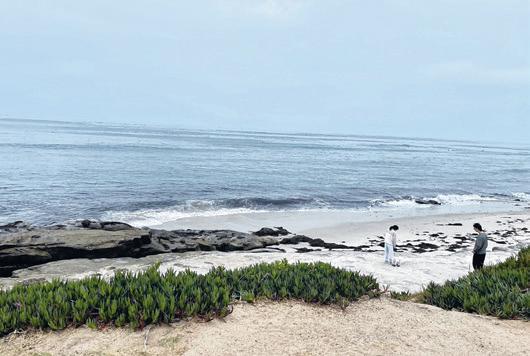
included great views,
Inside, a kind someone had saved our newspapers, arranged as neatly as cordwood just beyond the threshold. A little mountain of unopened parcels sat on the rug, and there was a stack of junk mail at its summit Slowly, we began to empty our luggage of laundry, which quickly formed a hill near the washer Like a midden of relics from a lost civilization, it yielded small clues about the life we’d led on the road. There were swimsuits from our evening in a hot tub, a shirt stained with caramel from an afternoon at an ice cream parlor and socks still crusted with sand from a lovely Pacific beach. Over several days, we reclaimed our regular life. I pushed our mower over the high blades of grass, and the yard shed its shaggy excess and revealed a calmer saner self I restocked our birdfeeders, repairing one that had been pillaged by a squirrel. The garden fountain, which had shorted out when we weren’t around, is fixed and working again.
It’s only now, in the return to routine, that I’ve had time to think about the second part of Kenyon’s poem. In the concluding stanza, after reciting the humdrum list of chores that awaits a returning traveler she remarks on a household pear tree, heavy with fruit, that had worked up its bounty while she and her husband were on the road. What Kenyon seems to say is that leaving home is a good way to savor its wonders when you return — something I’m learning again now that our luggage is back on the shelf.
Spiritual JOURNEY
Baton Rouge walkers of Camino de Santiago share stories of churros, chocolate, beauty and pain
ATBY JOY HOLDEN Staff writer
29, Dr Heidi Nowakowski had been walking for four days across Spain with her brother, Josh, 25, and her friend Rowan Knight from Scotland. As happens with siblings, the big sister fussed at her little brother for oversleeping.
They argued He got ready She was not. He hit the road without her and her friend — and he wasn’t at their preplanned meeting spot that night.
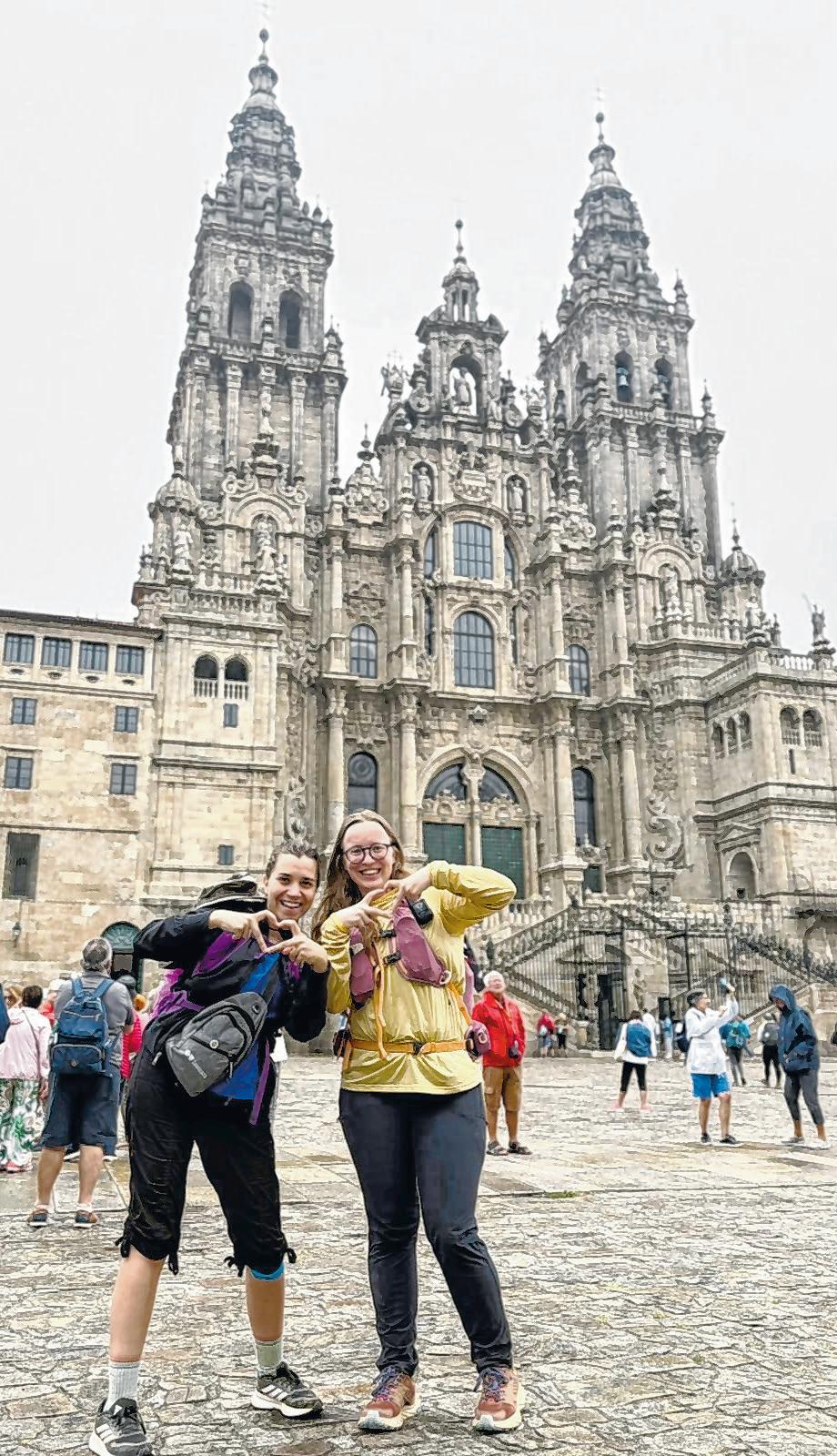
When Nowakowski and Knight arrived at the Cathedral of Santiago de Compostela the next day at noon, her brother was there waiting for them with water in hand.
“Then we had lunch and churros and hot chocolate. It just made the arrival all the more sweet,” she said. “My brother and I are very close. So we fight a lot, but we always make up.”
The pilgrims were three of 530,919 who walked the Camino de Santiago, earning a Compostela
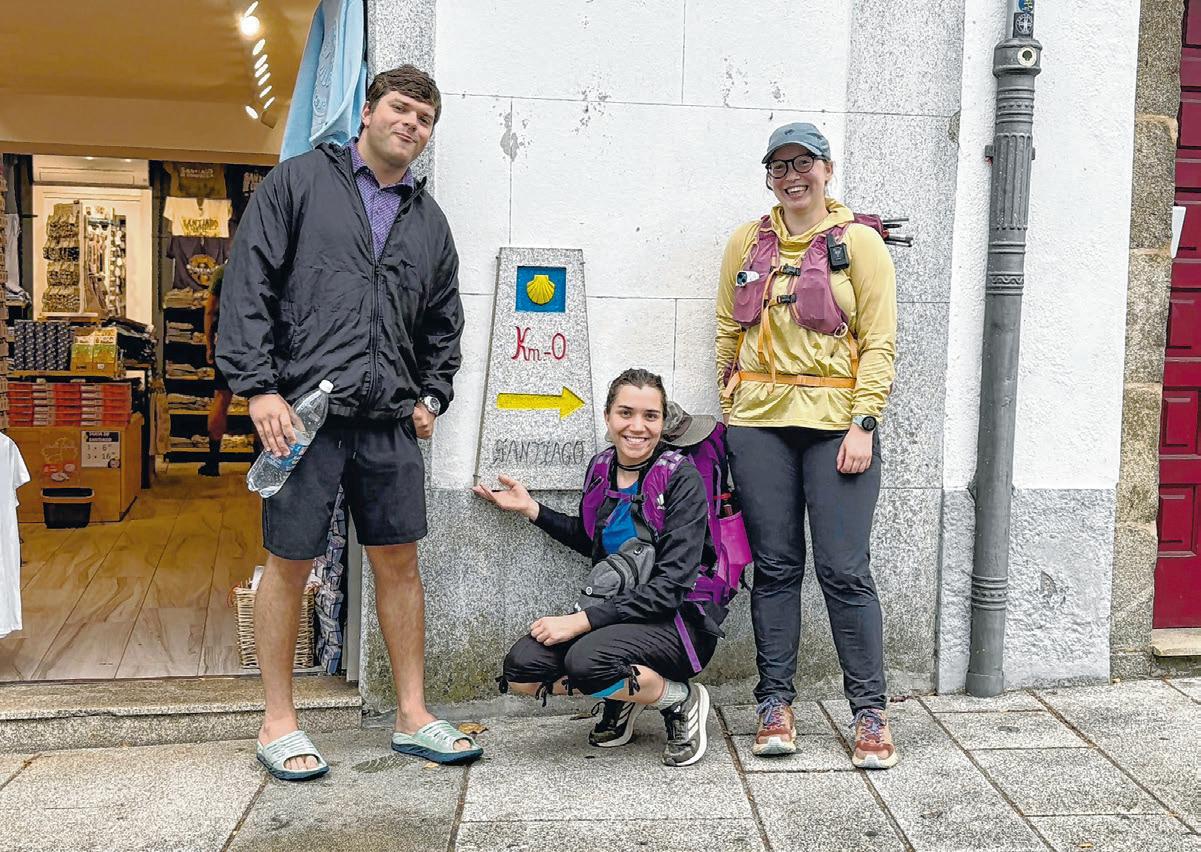
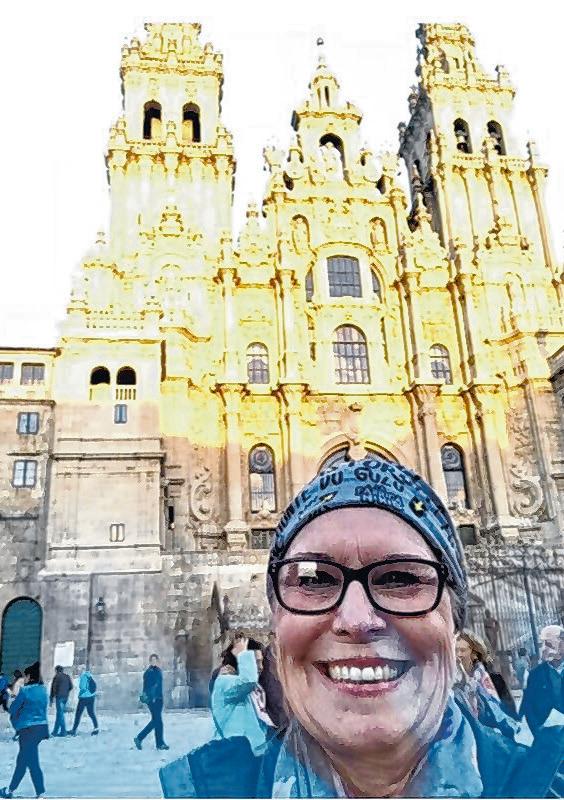
Josh and Heidi Nowakowski pose with Rowan Knight, center, in front
zero kilometer marker in Santiago after they had arrived.
Pilgrim Certificate in 2025. Twenty years ago that number was 93,923, evidence of the increase in popularity of the journey
Many make the walk without receiving the Compostela certificate, which requires proof of the
journey using a Camino Pilgrim Passport, with certain stipulations either 100 kilometers walked or ridden on horseback or 200 kilometers cycled.

State makes picks for National Book Fest
Staff report
Lt. Gov Billy Nungesser and the Louisiana Center for the Book at the State Library of Louisiana have announced Louisiana’s two “Great Reads from Great Places” selections for the 2026 National Book Festival, which will be held Aug 22 in Washington, D.C. Louisiana’s 2026 selection for young readers is “Soggy Like Cush
Cush” by Karly Pierre, illustrated by Kristen Uroda. A celebration of Creole culture, family and community, the story follows Petite Marie and her Gran-moman as a rainy day turns into an adventure filled with friendship, tradition and Creole cooking.
The National Book Festival is organized by the Center for the Book in the Library of Congress Each
ä See BOOKS, page 2G
Louisiana’s 2026 adult readers’ selection is “You Are My Sunshine: Jimmy Davis & the Biography of a Song” by Robert Mann. The book explores the story behind one of America’s most beloved songs, weaving together the rise of country music, Louisiana politics, World War II and the civil rights movement into a narrative of culture and history
PHOTO FROM GETTY IMAGES
Dating back to the ninth century, pilgrims have walked various routes of the Camino de Santiago, ‘The Way of Saint James,’ to the Cathedral of Santiago de Compostela in northwestern Spain.
PHOTO BY DANNY HEITMAN
Danny Heitman’s recent trip to California
like this beach scene in La Jolla.
PROVIDED PHOTO
of the
PROVIDED PHOTOS
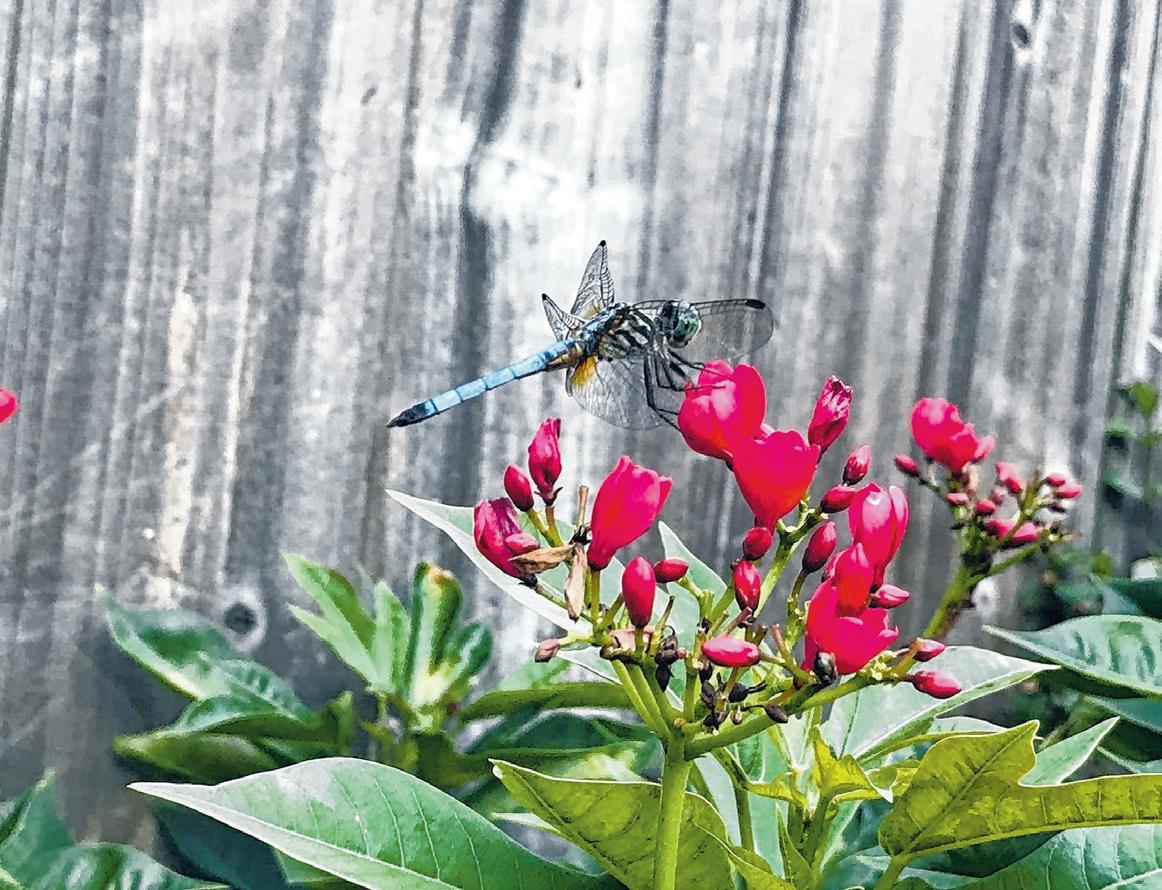
Capturing a dragonfly on a jatropha is one thing; having one rest on your hand is quite the feat
A moment with a dragonfly and a message
BY LISA G. STAFFORD Contributing writer
for a lifetime
I have been fascinated with dragonflies for as long as I can remember
Human Condition
Unlike some insects, dragonflies are great to have around. They eat pesky mosquitoes and they have four wings that allow them to do amazing stunts, like flying backward and snatching their prey midflight. They also are beautifully arrayed in a multitude of colors.
I often have attempted to lure the plentiful yet elusive insects onto my hand after I saw a friend coax a delicate dragonfly onto his extended finger
One day, I moved closer to my goal when, as I watered plants, a dragonfly rested on my outstretched arm. Amazed, I stood motionless, reluctant to scare it away It seemed to look into my face as it tilted its tiny head and with bulging eyes, seemed to try to anticipate my next move. Its body and wings, in emerald and sapphire hues, glistened in the dazzling sunshine, contrasting beautifully with the bright red petals of hibiscus and jatropha flowers, and blending harmoniously with my green and navy blouse After a few seconds of studying each other, the dragonfly zipped away, and I marveled that with so many options, it chose me for a short repose.
Dragonfly on jatropha
Over the years, I have attempted to get extra special photos in my garden, like that of two Eurasian collared doves perched atop the mandevilla-draped arbor, or a blue jay sitting among its pink blossoms, or the golden confetti of falling leaves in November, or brilliantly colored butterflies dancing on a breeze.
Some photos I captured; others I still seek. But after trying for several years to replicate my friend’s feat with the dragonfly, I snapped an event when I least expected it.
During an evening walk, I tried to persuade a dragonfly to rest on my hand and to my surprise, it accepted my offer I stood completely still to prevent startling it, then I realized I had no way to document the rare occurrence, because I didn’t have my phone with me. After the dragonfly flew away, I hurried to get my phone, then stationed myself back at the scene of my good fortune. Could
BOOKS
Continued from page 1G
year, affiliate centers from all 50 states, the District of Columbia and United States territories are invited to select two titles that reflect their literary heritage: one for young readers and one for adult readers. Selected books may be written by authors who live in or were born in the state or may focus on the state’s people, culture or history
Pierre grew up in Louisiana’s Creole and Cajun countryside, surrounded by sugarcane fields and a family of farmers and educators who fostered her love of nature, culture and storytelling. Mann is the author of 10 books on U.S. and Louisiana political history. He served as a senior aide to U.S. Sen. Russell Long and Sen. John Breaux and to Gov Kathleen Blanco. Mann spent
CAMINO
Continued from page 1G
cafes and churches to get their passport book stamped at least twice per day from Saria to Santiago.
For more than a thousand years
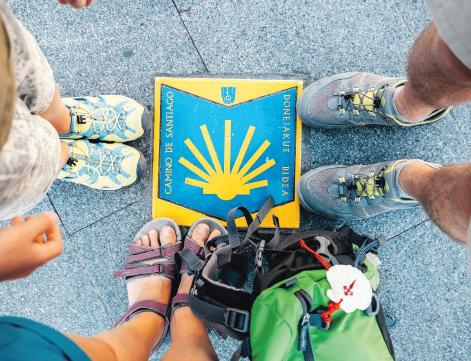
Dating back to the ninth century, pilgrims have walked various routes of the Camino de Santiago, “The Way of Saint James,” to the Cathedral of Santiago de Compostela in northwestern Spain, where the remains of the apostle St James the Great are believed to be buried. Its recent popularity is not a first During the medieval period, it was one of the three most important Christian pilgrimages, along with Jerusalem and Rome.
Martee Fry, at the Southeast Louisiana Chapter of American Pilgrims on the Camino, assisted Nowakowski with her planning.
“She helped me so much,” Nowakowski said. “She gave me some pointers on which trips would be the best for what I was looking for and with my time constraints. She also told me about the right guidebooks to use and little things to look out for.”
‘The Camino will tell you why’
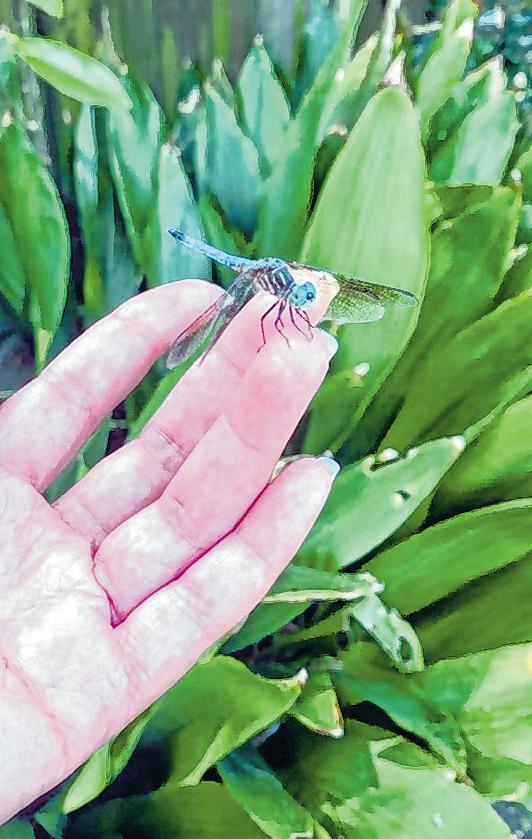
‘For several seconds we stood motionless, intently studying each other, communicating without words,’ Lisa G. Stafford writes of her enlightening dragonfly experience.
lightning strike twice?
Stealthy as a cat, I stalked my target. With my phone recording in my right hand, I gently stretched my left hand to the enchanting creature. Realizing that I was no threat it gingerly stepped onto my hand. For several seconds we stood motionless, intently studying each other, communicating without words.
The day I met a dragonfly
The magical moment ended when the dragonfly flew to a new perch to await the passing of a hapless mosquito or gnat that would become its next meal. I continued my walk, full of awe and inspiration.
Even though we were very different, we took a moment to truly see each other
And I wondered, how many other bonds can be made if we reach out to others — people, animals, birds, insects — that we don’t usually connect with, or even notice? And how much richer would our lives be for having made the effort?
— Stafford lives in New Orleans.
Advocate readers may submit stories of about 500 words to The Human Condition at features@theadvocate.com or The Advocate, Features, 10705 Rieger Road, Baton Rouge, LA 70809. There is no payment, and stories will be edited. Authors should include their city of residence.

18 years on the faculty of LSU’s Manship School of Mass Communication before retiring in 2024. The Louisiana Center for the Book was established in the State Library of Louisiana in 1994. Its mission is to stimulate public interest in reading, books, literacy and libraries and to celebrate Louisiana’s literary heritage.
Some walk the Camino for spiritual reasons. Some walk to honor a lost loved one. Some walk for fitness. Some walk for travel reasons. Some walk to mark a pivotal moment in their lives.
Fry, a 76-year-old pilgrim who has been on the Camino three times, says that the Camino reveals its purpose to each participant. She walked her first Camino at 66 years old. Fry lives in Poplarville, Mississippi, but for many years, she lived in New Orleans, working as an operating room nurse at Ochsner
The movie “The Way” with Martin Sheen motivated her to go on the Camino about 10 years ago. After a trip to Italy with friends was canceled, she pivoted to walking the Camino in Spain — by herself.
“When you’re out in the countryside, you can see the raindrops or the dew glistening on spider webs,” she said. “You can see the beautiful flowers. You can actually hear the sheep lowing out in the fields. You can see the little old ladies out sweeping their steps.”
She said the people who met along the way asked each other one major question: “Why are you walking the Camino?”
“The powerful thing about the Camino,” Fry said, “is you don’t have to have a purpose when you put your first step on the Camino, because the Camino is going to tell you why you are there.”
Nowakowski, the child of Catholic Polish immigrants, said the Camino was a spiritual journey for her
Even though her compatriots were not motivated by religion, they hustled to make sure she made it to Sunday Mass at one of their stopovers.
“It was so sweet that they were trying to get there for me,” Nowakowski said. “I remember getting to that church, and it was a bunch of smelly pilgrims. We were all sitting together, and I cried because it was so beautiful. I didn’t understand the Spanish very well, but I just felt so like lucky to be there.”
‘Catholic or not’
For Nancy Hicks, a Baton Rouge pilgrim who went on the Camino with her brother and her niece, every morning started with prayer
“Whether Catholic or not, we wanted this to be a spiritual walk because you are walking the walk that St. James’s ashes were brought to the cathedral,” Hicks said. “We prayed that God would show us something during the day.”
Larry and Jiji Jonas, who went in May, wanted to achieve the challenge of doing the Camino Portuguese, the second most popular route that begins in Portugal. As master naturalists, Larry, 83, said they also wanted to experience Spain’s flora and fauna. Jiji, 81, said she was able to identify wildflowers and bird sounds along the walk.
A social experience
Fry said many pilgrims take the trip with the expectation of having a quiet and meditative experience, but it’s surprisingly social.
“As you walked, a lot of people were doing your same walk and same distance, so after you slept for the night and got back on the trail, you’d run into the same people,” Hicks said. “You build up friendships along the way, and they would tell what they had seen and talk about their lives.”
Robert Hawkins and Nell Huard, two octogenarian Baton Rouge friends who walk together, have done the Camino twice. Both had memorable interactions along the way Huard met a young man who
TIPS FOR THE CAMINO
n Walking the Camino is surprisingly easy to plan with the help of a travel agency There are multiple agencies that specialize in the pilgrimage.
n Choose the route to take and estimate how many kilometers to walk per day as well as how long the trip will be, and the travel groups will make reservations at small hotels along the way.
n For an extra cost, the agencies will even transport luggage by car to the next accommodation.
n The most popular route is the Camino Frances, which starts in France, and the most traveled 100-kilometer trail begins in Saria, Spain and ends in Santiago.To go that route,Americans usually fly to Madrid and then take a train to Saria.
n Download your trail onto your phone for easy reference.
n Book reservations six months in advance.Two options for accommodations are hotels with private bathrooms or albergues, which are hostels with bunks and shared bathrooms.
n Check with banks before departure to make sure there is not a block on debit cards for foreign travel.
n The best gear is ultra lite with trail runners, not hiking boots, since most of the route is on pavement and farmland.
n Prepare by working up to the distance chosen per day before leaving for the trip.
asked her where she was from, and when she told him Baton Rouge, he asked if she knew Jay Johnson, the LSU Tigers baseball coach. Turns out he was one of Johnson’s former players. For Hawkins, it was a connection from his past that impacted him the most. He befriended a Vietnamese Canadian pilgrim who was from the same town that Hawkins was stationed in while serving in
the Vietnam War. They got along great and learned their timelines just missed each other Nowakowski, who is from Gonzales, picked up a bunch of free pins from Gonzalez City Hall and LSU that she handed out to people she met. Travelers from all over the world now have Jambalaya Festival and LSU pins as mementos from their Caminos.
Shoures soote
Just as Geoffrey Chaucer says in “The Canterbury Tales,” the best time for European pilgrimages is the spring — particularly April and May Nowakowski first heard about the Camino when she was in 10th grade at St. Michael the Archangel High School in Baton Rouge. Her religion teacher, Ryan Hallford, shared his Camino experience and told his students something she carried for nearly two decades.
“He said that it was the first time he realized that to experience beauty, you need to experience pain. He had a leg injury along the way but he said while he was walking, it was so painful, yet he was surrounded by such beauty,” Nowakowski said. She went on to attend LSU and medical school. When her residency ended and she finally had a break, she decided it was time for the Camino. She was ready to encounter the pain and the beauty
After walking 23 kilometers on the first day, her knees and feet started aching in ways she hadn’t expected.
“I had never felt my joints like that,” she said “I remember thinking, ‘I’m not sure how I’m gonna do this every day.’”
She did after applications of athletic tape and Tiger Balm.
After the fight with her brother and the reunion at the cathedral, after the churros and hot chocolate, after everything her joints had to say about it, Nowakowski understood what her teacher meant all those years ago.
“I think we underestimate ourselves a lot,” she said.
Email Joy Holden at joy.holden@ theadvocate.com.
PROVIDED PHOTO
Heidi Nowakowski, left, and Rowan Knight make heart signs in front of the Cathedral de Compostela after their arrival.
Martee Fry celebrates her arrival at Cathedral de Compostela with a selfie.
PROVIDED PHOTO
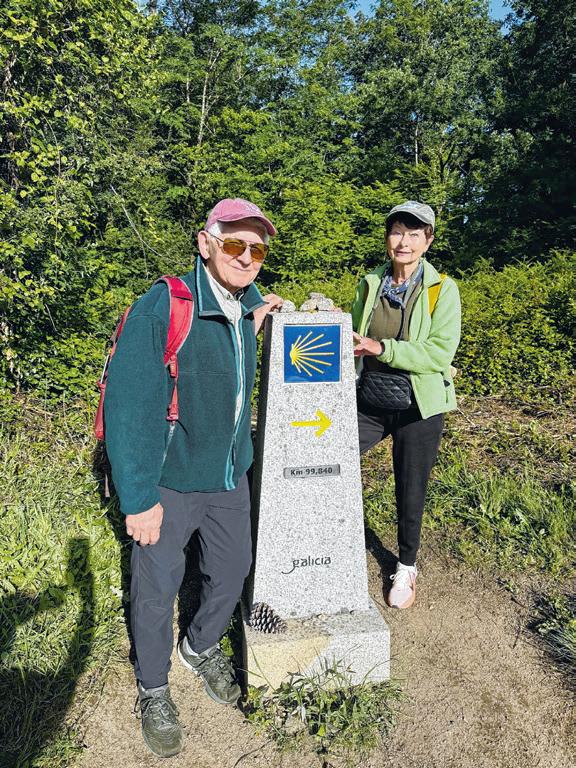
Larry and Jiji Jonas pause in front of the first marker on their journey in Tui, Spain.
TRAVEL
2 new species of fireflies turn up at LSU
Attorney thinks more may be hiding in her Mississippi woods
BY JAN RISHER Staff writer
When Amanda Butler Schley, a New Orleans attorney, emailed about Magee’s Creek Retreat in Walthall County, just across the Mississippi/Louisiana state line off Interstate 55, she mentioned the fireflies.
She said she and her husband have been working on the cabin for a year and again mentioned fireflies.
The more we communicated, the more I could tell that fireflies were not something Schley thought about on occasion she was a firefly evangelist. Yes, she has built a cabin that she rents, but it’s the fireflies that really light her up. Turns out, there’s a small window to see fireflies in and around south Louisiana, and we’re closing in on the use-by date, with fireflies being in the area from mid-May to mid-June.
So, I headed out to see the fireflies — something I spent much of the summers of my childhood doing. My husband and our friend joined me, one who had never seen a firefly
We were on a mission.
Once at the cabin, Schley took me on a tour and explained that she and her husband are working to make their 37 acres a haven for fireflies.
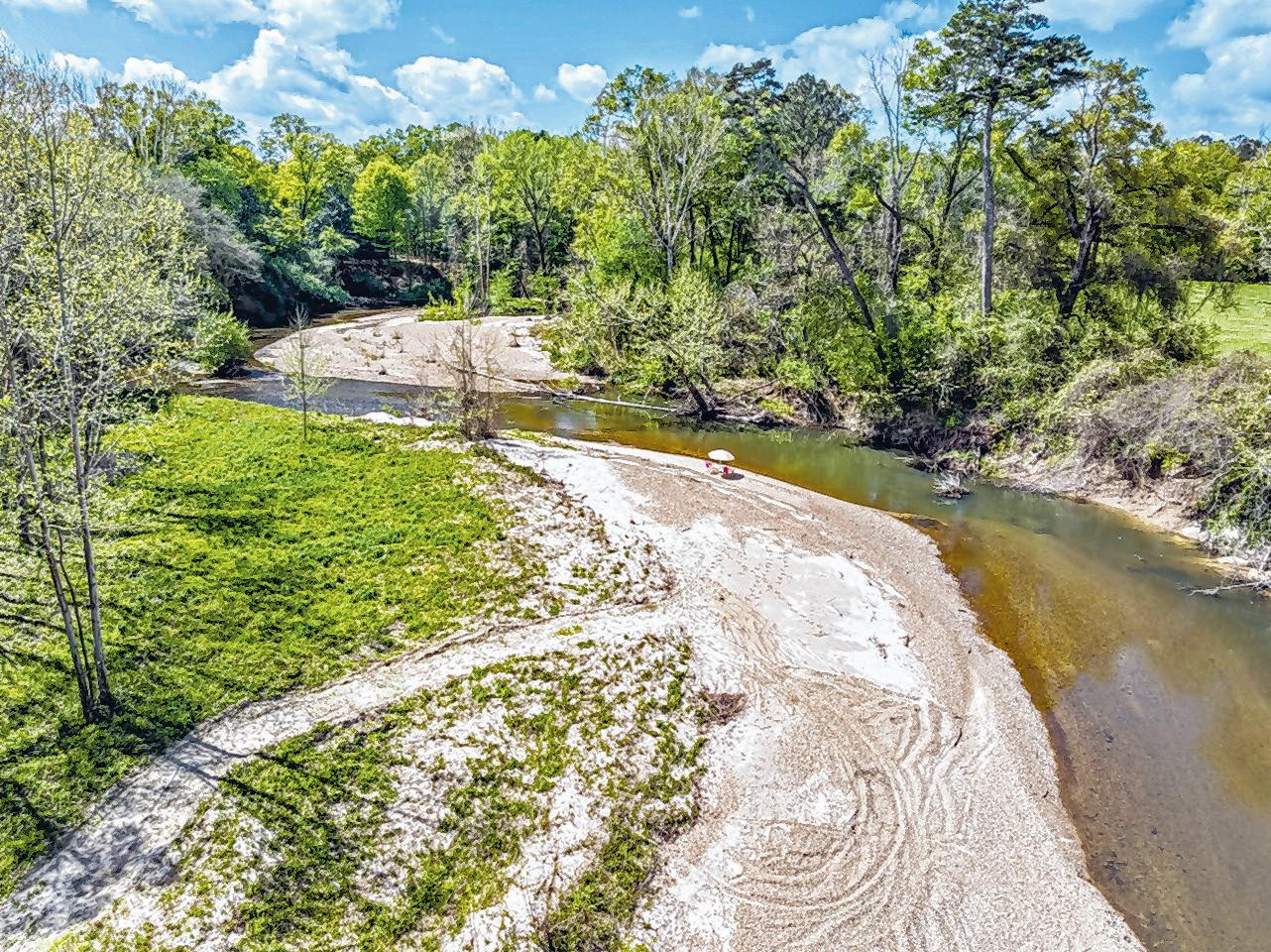
They’ve also spent much of the past year turning the site into the kind of spot that looks like it has already been photographed for a magazine. The two-bedroom cabin is thoughtfully outfitted, with an outdoor fire pit overlooking the creek and sandbars nearby for exploring. Out back, there’s a fire pit near the water with an old VW van pressed into service as a storage shed, lanterns and s’mores supplies.
Schley framed the firefly hunt as a choose-your-own-adventure.
Level 1, sit on the porch Level 2, sit by the fire pit. Level 10, walk a trail deeper into the woods in the dark of night. The deeper in, the better the show
Rarely have I met someone so excited about something as Schley is about fireflies She had her facts ready Fireflies thrive in hardwood forests with deep leaf litter In south Louisiana and south Mississippi, they appear from Mother’s Day through midJune. They like damp. They do not like rain.
So, at 8 p.m. on a Wednesday — the exact hour the fireflies were supposed to put on their best show — the rain began. The screened-in porch at Magee’s Creek Retreat, it should be said, was a fine place to be rained on.
We sat. We watched water sheet off the roof. We talked about our grandparents. It was the kind of night each of us will likely remember for years to come easy conversation, comfy seats and rain coming down.
WHERE TO FIND FIREFLIES
Entomologist Christine Gambino recommends these spots, all with documented firefly sightings.
The species’ active window in south Louisiana is roughly Mother’s Day through mid-June, between dusk and 10:30 p.m. Damp evenings without active rain are ideal.
In Baton Rouge
n BREC’s Bluebonnet Swamp Nature Center 10503 N. Oak Hills Parkway, features hardwood forest, boardwalks and documented firefly sightings on iNaturalist. n LSU AgCenter Botanic Gardens at Burden, 4560 Essen Lane, where Gambino is working to designate Burden as Louisiana’s first formal firefly sanctuary.
n BREC’s Comite River Conservation Area, 8900 Hooper Road, features more than 100 wooded acres along the Comite River and Cypress Bayou.
Within a day’s drive
n St. Francisville/Tunica Hills Wildlife Refuge — La. 66, St. Francisville n Bogue Chitto State Park, 17049 State Park Blvd., Franklinton, features cypresstupelo swamps and upland and bottomland hardwood forests in Washington Parish.
n Tammany Trace — Covington Trailhead, 419 N New Hampshire St., Covington n Abita Springs Trailhead, 22049 Main St.,Abita Springs, features a 31-mile rail-to-trail corridor through five northshore communities n Atelier de la Nature, 1050 Andrew Gautreaux Road, Arnaudville, features a 25-acre nature reserve and STEAM education center in Cajun country. It’s free to visit and open daily.
Farther afield Kisatchie National Forest, Kisatchie Ranger District, 229 Dogwood Park Road, Provencal, is Louisiana’s only national forest with more than 604,000 acres across seven parishes.
By 10:30 p.m., we were ready for bed. And then, the rain stopped.
I was already standing when I saw a single yellow blink in the dark high in the trees past the screen.
I gasped.
With that, and against my friend’s better judgment, off we went to Level 10. My husband went to bed. In doing so, he missed a small but real firefly show A dozen or so were blinking in the trees, including one newly emerging adult working its way through the leaves.
Christine Gambino, an entomologist at the LSU AgCenter and one of the few people in Louisiana doing serious firefly work, shed more light on the subject Gambino said fireflies are an indicator species of a healthy environment.
“Leaf litter” is critical to the life cycle of fireflies.
Leaving leaves on the ground, undisturbed and for a long time, is the only way for fireflies to grow to adulthood, which takes the larvae two or three years in the leaves — hunting snails and slugs, before they emerge as the briefly glowing adults we recognize.
The adults only live and shine their lights as a mating call for four to five weeks.
Schley is convinced synchronous fireflies — those that flash in unison, the ones people enter a lottery to see in the Great Smoky Mountains National Park in Tennessee could be in her woods, too.
Gambino says Schley may be right.
The most famous synchronous species, Photinus carolinus, lives only in the southern Appalachians. The chance to see them draws roughly 20,000 lottery applications for fewer than a thousand parking passes each year
But there is a second synchronous species, Photuris frontalis, nicknamed the Snappy Sync, which is found in central Mississippi.
Gambino said Lynn Faust an independent firefly researcher in Knoxville and one of the country’s foremost authorities on the insect, suspects Louisiana may have its own Snappy Sync a variant potentially distinct from populations farther north and east. Nobody yet knows. And that’s where you come in.
Gambino and her team are looking for firefly samples.
“There is zero baseline knowledge about the types of fireflies that we have here,” she said. Her team recently submitted a seed grant to begin DNA sequencing every firefly people send to the LSU Arthropod Museum. Until that work is done, identification comes down to comparing flash patterns and, when it really counts, examining the genitalia under a microscope.
Remarkably, LSU scientists have identified two new firefly species within the past few months found by a taxonomist working through specimens already on the shelves. More than 2,000 firefly species are known worldwide. In the United States more than 150 species are known — but that number keeps climbing because no one had looked closely enough until now Gambino says the reasons there are fewer fireflies than there once were turn out to be the obvious ones, in the obvious order Pesticides kill the larvae and the soft-bodied things they eat. Mowing and raking strip the leaf litter where the babies live. Urban sprawl removes the forest edge. LED streetlights drown out the females’ answering flashes, and the males never find them.
So, Schley is right: a pesticidefree cabin on a creek bank near the Mississippi/Louisiana line, with leaf litter left alone, is exactly what fireflies need The good news is that fireflies can be found even closer to home with more spots in Louisiana than most people realize.
After all Schley’s warnings about the narrow firefly season, I left thinking less about what I saw than what we still don’t know. There may be species blinking away in Louisiana woods that scientists haven’t fully identified yet. And that’s enough to make a person look more carefully the next time a tiny light appears in the trees.
To submit a firefly for ID Gambino said the LSU AgCenter accepts firefly specimens for identification through its Insect Identification service. She recommends sending three to five samples. Submission Checklist
n All specimens are dead.
n Specimens are on tape or in a tightly sealed container.
n Specimens have been killed and preserved by freezing or in alcohol or vinegar.
n There are no bodily fluids or tissues.
n Photos have a rule or reference item to determine size
n The included address label is taped to the box.
n You include your contact information within the box.
n You include a description of where specimens were collected. Please adhere this mailing label to insect sample submission: Department of Entomology Attn: Small Insect Specimen ID 404 Life Sciences Building Louisiana State University Baton Rouge, LA 70803 For more information: https://www.lsuagcenter.com/ portals/our_offices/departments/ entomology/id
To stay where this story began Magee’s Creek Retreat is a private, two-bedroom cabin on 37 acres in Walthall County, Mississippi, between McComb and Tylertown. For more information: mageescreekretreat.com.
Email Jan Risher at jan.risher@ theadvocate.com.
Alpha Kappa Alpha honors 12 debutantes
The Nu Gamma Omega Educational and Charitable Foundation, in partnership with the Alpha Kappa Alpha Sorority Inc., Nu Gamma Omega Chapter presented 12 debutantes at its recent cotillion at L’Auberge Event Center Under the theme “A Celebration of Becoming: Grace Realized, a Promise Fulfilled,” the evening celebrated achievement, elegance and service.
Chapter President Lauren Grundy-Byrd welcomed nearly 320 guests, while Erinn Gaines, foundation vice president, shared the significance of the cotillion. Foundation President Lynn Farris delivered the celebratory toast and official charge to the debutantes, with Dr Joan Fisher-Ranel serving as mistress of ceremonies.
Malia Rebecca Dogan was coronated as 2026 queen. Additional honorees included Miss Amity Savanna Grace Fort and Poise & Grace Tori Charisse Broussard The queen’s court included: n Kiersten Popillion, first prin-
cess n Gretchen Elizabeth Payne, second princess
n Baileigh Elisabeth Bradford, third princess n Allyson Marie Atkins, fourth princess n Baili Zoea Hilton, fifth princess Additional honorees were:
n Jaycee Alexis Burks, first maid
n Tori Charisse Broussard, second maid
n Promise Grace Fair, first pearl
n Kera Ana Sharae Chew, second pearl n Savannah Grace Fort, third pearl n Madison Tiana Stampley, fourth pearl The cotillion, the culmination of eight months of empowerment workshops, community service, cultural activities and dance rehearsals, continues to uphold a tradition of scholarship and service. Proceeds from the event support scholarships and community initiatives.

PROVIDED PHOTOS
Magee’s Creek in Walthall County, Mississippi, borders woods ripe for fireflies.
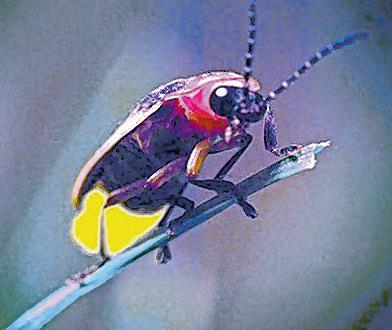
Fireflies are actually beetles that light up using a chemical reaction.
PROVIDED PHOTO BY CWASH PHOTOGRAPHY
Honorees at Alpha Kappa Alpha Sorority Inc., Nu Gamma Omega Chapter’s cotillion are, from left, Gretchen Payne, Baileigh Bradford, Madison Stampley, Allyson Atkins, Promise Fair, Tori Broussard, Kera Chew, Kiersten Popillion, Baili Hilton, Jaycee Burks, Malia Dogan and Savannah Fort.