Students learn about carbon capture process
ExxonMobil grant aids program for eighth graders; some critics have called the curriculum propaganda
BY DAVID J MITCHELL staff writer
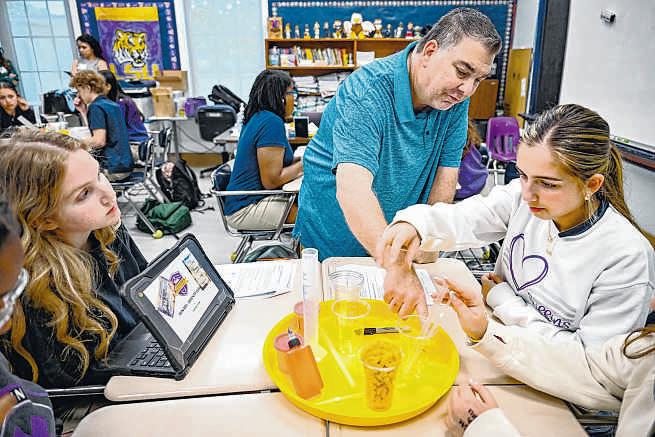
A group of eighth graders in Heath Juneau’s science class were on their second attempt at an unusual experiment: injecting liquid carbon dioxide deep underground — or at least a classroom model of that process.
“Coach Juneau can we get our CO2?” Ava Bourg, 14, asked Her group’s first try sprung a leak of the representative CO2, which was in reality orange vegetable oil. But Bourg and her classmates were ready to try again after Trenton Nash’s
careful handiwork using Play-Doh to try to plug it. In the waning days of the recently ended school year, the Dutchtown Middle School students in Ascension Parish were finishing a four-day lesson about climate change, carbon dioxide, and carbon capture and sequestration About 1,700 eighth graders in nine Ascension Parish middle schools received these lessons through a curriculum developed by Rice University’s Tapia Center It was another sign of industry’s attempts to improve understanding and acceptance of the new technol-
ogy, which supporters view as vital to Louisiana’s economic future. Not everyone is convinced. Critics point to ExxonMobil’s funding for the school program while arguing that it downplays controversy surrounding carbon capture. They view it as seeking to instill an industry point-of-view.
Known as CCS, the technology cuts climate-warming CO2 emissions by permanently injecting them underground in a near-liquid state. Enticed by federal tax credits and facing market pressures to reduce carbon
ä see CURRICULUM, page 5A
Private beach feuds explode on Florida coast
Visitors denied access to certain spots while owners want to be left in peace
BY MARTHA SANCHEZ staff writer
SEAGROVE BEACH, Fla.
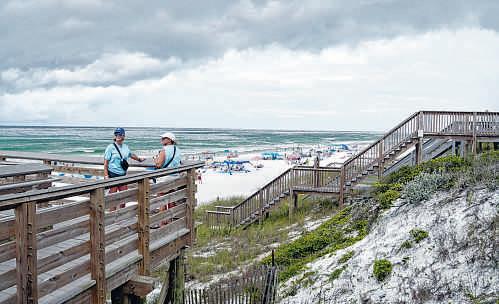
— As soon as Dave Rauschkolb stepped onto the sandy boardwalk, he spotted another example of the rising ten-

sions rippling along this coastline.
“See the private beach signs?” he said.
He pointed past a crowded stretch of public sand to a row of empty lounge chairs blocked by
“No Trespassing” warnings and a security guard watching from beneath a large umbrella.
“It’s tragic,” Rauschkolb, who has surfed here for decades, said as he looked out at the waves “I can’t go to the beach without being stressed out.”
There was a time when the
beach beside Florida’s Scenic Highway 30A was quiet, and a small group of waterfront homeowners and visitors shared the sand with few complaints But a surge of newcomers who began arriving over the last decade is transforming the coast into a bustling hub of tourism and wealth. The rush is creating a growing feud over who has the right to enjoy paradise.
ä see FEUDS, page 6A
N.O. courts became flash point in legislative session
Landry worked behind the scenes on bills aimed at city, insiders say
BY TYLER BRIDGES staff writer
Gov Jeff Landry’s opening address to the state Legislature three months ago took an emotional turn when he looked up at the visitors gallery in the House chamber and asked the family of Jacob Carter to stand up.

Jacob would be alive today, Landry told the hushed crowd, if a delinquent teenager had been at home, unable to leave without an ankle monitor betraying his departure Instead, Landry said, “incompetent” juvenile court judges in New Orleans had stopped tracking the teenager, and he killed Jacob, a visiting bagel shop owner, outside the French Quarter one evening. In his remarks, the governor then moved beyond juvenile court judges to indict the entire judicial system in New Orleans.
“I strongly urge this Legislature to implement rigorous judicial reform as justice delayed, denied, or neglected is no justice at all,” he told legislators, the Carter family and others in the House chamber By the time the regular legislative session ended June 1, Landry had gone farther than anyone anticipated against New Orleans. Thanks to his push, the Republican-controlled Legislature eliminated nine judgeships in New Orleans, eliminated funding for 10 assistant district attorneys and prevented Calvin Duncan from becoming the Orleans Parish clerk of criminal district court by erasing his job four days before he took office.
“The tide has turned against New Orleans politically It’s pretty drastic,” said Bernie Pinsonat, a veteran political consultant and pollster in Baton Rouge. “In the past, there’s always been a segment of the
ä see SESSION, page 6A






sTAFF PHoTo By JAVIER GALLEGos
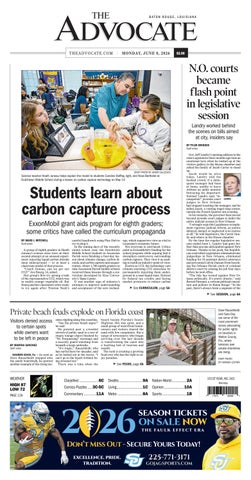
science teacher Heath Juneau helps explain the model to students Caroline Raffray, right, and Nova Berthelot at Dutchtown Middle school during a lesson on carbon capture technology on May 14.
Landry
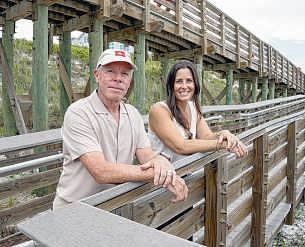
Dave Rauschkolb and sara Day are some of the most prominent voices advocating for public rights on beaches in Walton County, Fla., where tensions over private shorelines are rising
sTAFF PHoTo
By HANNAH LEVITAN
BRIEFS FROM WIRE REPORTS
Lawsuit seeks to stop White House UFC fight
NEW YORK A federal lawsuit seeks to halt the upcoming UFC fight card on the White House South Lawn in a mixed martial arts show timed for President Donald Trump’s 80th birthday and part of the celebration of the nation’s 250th anniversary.
The filing Saturday by the Public Integrity Project on behalf of two Virginia residents contends the Trump administration’s authorization of the June 14 event was unlawful.
The lawsuit says such approval violated National Park Service regulations prohibiting sporting events on federal parklands, Congress did not consent to the towering arch overlooking the event space and no environmental review was conducted before the construction.
“This is fundamentally a private, commercial, corrupt use of our most sacred national monuments for private gain,” said Brendan Ballou, a lawyer for the plaintiffs “And that is what is motivating this lawsuit.”
The White House said in a statement that the legal challenge was “an obstructionist, baseless, and dilatory” attempt to prevent Trump from hosting the fight and that the event was “no different than the various other White House-hosted events on the South Lawn and properly permitted events on the Ellipse and National Mall throughout the year.”
UFC did not immediately respond to a request for comment Sunday Crews are erecting an octagon-shaped cage on the South Lawn. Trump has said the finished UFC project will feature “a 5,000-seat arena right outside the front door of the White House.”
FBI fires analysts tied to disputed memo
WASHINGTON Several FBI analysts tied to the creation of a 2023 memo warning of a potential threat from Catholic “violent extremists” were fired Friday, according to their lawyer, the latest wave of terminations under the leadership of its director Kash Patel. The fired employees included four intelligence analysts and a supervisory analyst. The FBI declined to comment.
“This action is manifestly unjust, completely unsupported by the facts, and subverts standard FBI policy and procedure,” their lawyer, David Laufman, said in a statement. “These individuals deserved far better for the exceptional and faithful public service they rendered to protect our country.”
The January 2023 intelligence product produced by analysts in the FBI’s Richmond, Virginia, field office emerged as a political flashpoint after it was issued, with Republicans in Congress repeatedly citing it as part of their broader contention that the FBI during the Biden administration was targeting conservatives.
Man killed in another Australian shark attack
MELBOURNE, Australia A spearfisher was killed on Saturday in Australia’s third fatal shark attack in four weeks, police said. The 35-year-old man was spearfishing with family off Michaelmas Island near the port city of Albany in Western Australia state when he was attacked before noon, a police statement said.
The man was brought by boat to Albany where paramedics were waiting but he could not be revived, police said. Authorities suspect a 15-foot white shark was responsible
The spate of three fatalities is extraordinary in a nation that has averaged around three shark deaths a year in recent decades.
The last fatality was on May 24 when 39-year-old spearfisher Michael Jensz suffered unsurvivable head injuries in an attack on the Great Barrier Reef off Australia’s northeast coast. Bull sharks had been seen in the vicinity
A week earlier, on May 16, a 13-foot white shark fatally mauled 38-year-old spearfisher Steve Mattabonni northwest of Albany near Rottnest Island.
Iran launches missiles at Israel
Bombardment
is first such attack since fragile ceasefire
BY KAREEM CHEHAYEB, HASSAN AMMAR, SAMY MAGDY and MELANIE LIDMAN Associated Press
JERUSALEM Iran launched missiles at Israel in the first such bombardment since a fragile ceasefire took effect in early April, raising the possibility of a return to heavy fighting and complicating mediation efforts to end the war
Iran’s state broadcaster confirmed the launches, and Iran closed its western airspace to brace for a possible response. Tehran had warned of retaliation after Israel struck Beirut’s southern suburbs without warning earlier Sunday in defiance of Washington’s request days ago to stand down. Israel said the Iranian-backed Hezbollah fired at northern Israel earlier in the day
“Should these acts of aggression be repeated, the responses will be broader in scope and will encompass all American and Zionist targets throughout the region,” Iran’s Revolutionary Guard said in a statement that referenced attacks in Lebanon and on Iran’s coast and vessels around the Strait of Hormuz Sirens sounded in several

areas of Israel, sending millions running for shelter Israel’s military said it intercepted the missiles, and multiple explosions were heard in the north. Less than an hour later, the military said people could leave areas reinforced against missile attacks.
“Iran has made a grave mistake,” Israel military spokesperson Brig. Gen Effie Defrin said. The military’s chief of staff, Lt. Gen. Eyal Zamir, said it will “strike the enemy with determination as soon as the order is given.”
But Israel’s public broadcaster, Kan, said President Donald Trump told it that he doesn’t think Israel needs to respond further And Trump told the Financial Times: “I call all the shots.
He (Netanyahu) doesn’t call the shots.” Iran had warned that an attack on Beirut would renew full-scale war across the Mideast, even as Pakistan and other mediators try to restart talks between Tehran and Washington.
“U.S. forces across the Middle East remain vigilant and ready,” the U.S Central Command posted on X shortly before the missile launches. The U.S. Embassy in Israel later directed employees and family members to shelter in place.
Israel’s attack on Beirut came a few days after the Lebanese and Israeli governments agreed to a ceasefire in U.S.-hosted talks, though Hezbollah rejected the deal. The strike on a
residential building killed two people and wounded 20, Lebanon’s health ministry said.
“The army will continue to act in all of Lebanon,” the Israel military spokesperson said.
Israel’s strikes and ground invasion in Lebanon in pursuit of Hezbollah, and the militant group’s resistance to disarming, have complicated an overall deal to end the war in the Middle East.
Iran says any deal must include an end to fighting in Lebanon.
Trump told a Fox News Channel reporter that he wanted the Iranians to stop firing missiles and return to the negotiating table. He also said that Israel’s strikes earlier Sunday were not co-
ordinated with the U.S. and “I’m not happy about it.” Israel on Monday had announced it would strike the southern suburbs of Lebanon’s capital, but urgent talks via Washington halted that on the condition that Hezbollah stop targeting Israeli border towns. Hezbollah, which claimed responsibility for firing at Israel earlier Sunday, wants the direct talks between Lebanon and Israel to end. Instead, it supports Iran’s stance that an overall ceasefire deal between Tehran and Washington include the situation in Lebanon.
Israeli Prime Minister Benjamin Netanyahu, who seeks reelection later this year is under heavy domestic pressure to respond to both Iran and the Hezbollah threat, which has paralyzed life for thousands of residents along Israel’s northern border
But Trump has made clear he does not want to see the war resume.
Trump said earlier Sunday in an interview with NBC’s “Meet the Press” that he would like to see a “more surgical attack on Hezbollah.” He also said he was “not demanding” that Lebanon be part of an overall ceasefire deal in the Iran war Iran continues to assert its grip on the Strait of Hormuz and the U.S. continues its blockade of Iranian ports, with shipments of oil, natural gas and fertilizer affected and the global economy in pain.
Attacker opens fire in central Israel, killing 1
Authorities say 5 wounded
BY MELANIE LIDMAN Associated Press
TEL AVIV, Israel A Palestinian man with Israeli citizenship went on a shooting rampage in several towns in central Israel on Sunday, killing a reservist and wounding five other people, according to Israeli police and the military
The attacker was killed by police.
The attack came at a time of heightened tensions following a spate of Israeli settler attacks, and the deadly shooting of a Palestinian baby over the weekend, in the nearby West Bank. Police identified the attacker as a resident of the Arab town of Taybeh in his 20s, but his precise motives weren’t immediately known.
The attack began with a shooting Sunday morning at a gas station near the town of Kokhav Yair, located on the Israeli side of the boundary with the

occupied West Bank. Several other shootings were reported in two nearby Israeli towns and close to the Israeli settlement of Salit, inside the West Bank.
Police initially feared a series of coordinated attacks, but eventually determined that a gunman and an accomplice who may have served as his driver were involved. The suspected accomplice was arrested later after he tried to stab police with a glass bottle.
Israel’s military said
that a 55-year-old reservist was killed near Tzur Natan. The Magen David Adom rescue service said that five other people were wounded, two severely Fears of a widespread attack prompted authorities to order residents to stay at home, and children in the area were kept in lockdown at school for at least three hours.
“Since Oct. 7, the scenario we were expecting was terrorists crossing into our towns from over the boundary I don’t think
Police seek suspects in Ohio shooting that wounded 12
BY JAIMIE DING and THOMAS PEIPERT Associated Press
A search in Ohio for suspects who opened fire near a busy street festival stretched into Sunday after 12 people were wounded in the weekend shooting that sent crowds scrambling for cover in a historic Toledo neighborhood. Each of the dozen victims who authorities say ranged from teenagers to people in their 60s — were in stable condition, the Toledo Police Department said Sunday. No arrests have been made and authorities have not identified any potential suspects. The gunfire erupted Saturday near the Old West
End Festival, a popular annual summer gathering along streets dotted with Victorian homes. Videos posted to social media showed people running at the sound of gunfire and medics tending to the wounded in a park filled with event tents and food trucks.
Toledo Deputy Police Chief Joe Heffernan has said it appeared that at least two people fired weapons and were “probably shooting at each other.”
As the search for the shooters wore on, Lucas County Prosecutor Julia Bates vowed “justice will be swift and strong.”
“Those who were frightened, traumatized or harmed by this violence will remain at the fore-
front of our efforts. I’ve felt outrage before, but this is personal,” Bates said in a statement. “This is my home. These are my friends and neighbors. It is not OK.”
In a brief update posted to social media Sunday, Toledo police said investigators were continuing to make progress and were following multiple leads. Authorities have urged festivalgoers to come forward with any photos or videos that might have caught a glimpse of the suspects.
Hundreds of people were at the festival, an annual two-day celebration in Toledo’s historic district featuring live music, food vendors, home tours and shopping.
that anyone imagined that we would discover the attackers were Israeli citizens,” Oshrit Gani Gonen, the regional council head, told Israeli media, referring to the Hamasled attack on southern Israel on Oct. 7, 2023, that sparked the war in Gaza. Prime Minister Benjamin Netanyahu praised the security forces who killed the attacker, while Israel’s hardline public security minister Itamar Ben-Gvir who oversees the police force, released a video of himself standing next to what ap-
peared to be a blurred image of the dead gunman.
“This is the end of every terrorist, this is how it should look,” said Ben-Gvir who recently led an effort to pass a new law that seeks to impose the death penalty on Palestinian attackers. That law faces legal challenges. Ben-Gvir has come under sharp condemnation from other Israeli leaders for making contentious videos, such as his treatment of flotilla activists who were detained after attempting to break the maritime blockade to Gaza.

AssoCIATED PREss PHoTo By oHAD ZWIGENBERG
A projectile streaks through the sky sunday over central Israel during an Iranian missile attack.
AssoCIATED PREss PHoTo By ARIEL sCHALIT
Israeli security forces and ZAKA rescue service volunteers respond sunday to the scene of a shooting near Tzur yitzhak, Israel.
Trump asked in interview whether war broke promise
President dismisses idea that Iran conflict betrays ‘no new wars’ campaign message
BY MICHELLE L. PRICE Associated Press
BRIDGEWATER, N.J President Don-
ald Trump is dismissing the idea that launching the war with Iran this year betrayed his refrain of “No new wars” that he made repeatedly as he campaigned again for the White House.
Trump, in an interview that aired Sunday on NBC’s Meet the Press,” said he “didn’t guarantee” there would be no wars if he were back in office.
“First of all, I didn’t guarantee no war Why would I have built the strongest military in the world?”
Trump said.
Trump also defended plans for a now-scrapped $1.8 billion fund that would have compensated allies of the Republican president and he repeated his baseless claims of mass fraud in California’s drawnout vote count from Tuesday’s primary He ended the interview abruptly when he became frustrated with pushback from NBC’s Kristen Welker
Iran ‘is not an endless war’
In his 2024 campaign, Trump repeatedly cast his Democratic opponents as warmongers and said he was a president who started “no new wars” and would bring an era of peace.
But Trump said in the NBC interview, taped Friday in Wisconsin, that as a candidate, “I didn’t promise anything.”
“I don’t like these endless wars. This is not an endless war We’ve been doing this for three months,” he said of the war with Iran, which began Feb. 28.
Trump said he was “doing the

world a service” and “doing our country a service” because he had to stop Iran from having a nuclear weapon. But elsewhere in the interview, Trump repeated a contradictory message where he said U.S. strikes last year “obliterated” Iranian nuclear sites
He also defended his decision in his first term to withdraw from Democratic President Barack Obama’s nuclear deal with Iran, an agreement he has heavily criticized, without negotiating the “better deal” he has promised to reach.
“It takes years to do these things,” Trump said.
Claims fraud in California vote
California’s notoriously prolonged vote count has been a magnet for election conspiracy theories, and Trump since Tuesday’s
election has claimed without evidence that Democrats are rigging the election. The Trump-appointed top federal prosecutor in Los Angeles said Friday that his office had opened “multiple election fraud investigations.”
Late-tallied Democratic-leaning mail ballots have eaten into the vote totals for Trump’s preferred candidates for governor and Los Angeles mayor While Trump has often said that changes to vote totals as late ballots are counted are a sign of fraud, they are merely a reflection of a slow vote-counting process.
Trump in the interview kept claiming that it was a sign of “cheating” and “a rigged election,” and grew increasingly frustrated as Welker pressed him for evidence to support that.
“All I have to do is look. All I have to do is look,” Trump said.
“But that’s not evidence,” Welker responded.
“And I listen. And I listen to people. And let’s see what happens,” Trump replied.
‘Anti-weaponization’ fund
Trump defended plans that his Department of Justice said it has now abandoned to create a $1.776 billion “Anti-Weaponization Fund” as part of a settlement to resolve Trump’s lawsuit against the IRS over the leak of his tax returns.
Acting Attorney General Todd Blanche said Wednesday that the department was scrapping the plan. That announcement came after the plan was paused by a judge and after both Democrats and some Republicans said they
were concerned about the fund’s lack of oversight and the possibility of payouts being made to participants in the Jan. 6, 2021, riot at the Capitol.
Trump told NBC he thought the fund was “a great idea” and that he would be “disappointed” if it were not approved.
When asked if he thought people who attacked police officers on Jan. 6 should get a payout, Trump said, “I wouldn’t be inclined to say so, but I have to see it.” He then began making unfounded and false claims about the riot and those who stormed the Capitol. Trump granted a sweeping pardon on his first day back in office in January 2025 to the more than 1,500 people prosecuted over Jan. 6.
Rain interruptions, abrupt end
The NBC interview was conducted in Chippewa Falls, Wisconsin, before Trump was set to speak at a roundtable event with farmers. The interview was repeatedly interrupted as waves of heavy rain fell on the metal roof of the barn where the taping took place, making it difficult at times to hear At the end, Welker pressed Trump on the settlement fund and his claims about the California election. Trump raised his voice and began calling Welker and the media “crooked,” attacking her credibility and complaining about what he called “the fake, dirty press.”
As Welker tried to switch subjects, Trump continued on and there was cross talk between the two Trump ended the interview, saying said, “Let’s call it quits.” He took off his microphone, telling Welker, “Thank you, darling. Have a good time.” He said he had given the interview enough time, stood up and walked away Welker said during the broadcast that she spoke to Trump on Saturday and he agreed the rain had caused complications and said he would do another interview in the future.
Maverick former GOP U.S. Sen. Bob Packwood dies at 93
oregon lawmaker resigned after sexual harassment scandal
By The Associated Press
PORTLAND Ore. Former Sen.
Bob Packwood, a moderate Oregon Republican whose reputation as a champion of abortion and women’s rights was spoiled at the end of his career by allegations of sexual harassment, has died. He was 93.
Packwood’s death on Saturday was announced in an obituary sent to media outlets by his family The release didn’t include additional details.
Packwood was a political scrapper who first refused to quit the chamber in which he had served for 27 years, saying he didn’t want to be remembered only for that controversy Before the #MeToo era, Packwood stood out as an example of private behavior undermining a man’s public image. He had been praised by Planned Parenthood and others.
The great-grandson of a
BY DYEPKAZAH SHIBAYAN Associated Press
member of the 1857 Oregon Constitutional Convention, Packwood established himself as a social moderate and fiscal conservative who often voted across party lines. He considered running for president in 1980
Elected to the Senate in 1968, Packwood was best known as the leading Republican advocate of abortion rights and was widely admired by women’s groups throughout the country until the Senate Ethics Committee launched an investigation into the allegations of sexual and official misconduct in 1993
More than two dozen women, former employees and acquaintances, accused him of making unwanted or uninvited sexual advances.
The allegations remained the target of an ethics probe that widened to include other alleged acts of official misconduct He resigned in September 1995, then went to start a lucrative lobbying business in Washington.
Democratic U.S. Sen. Ron
Wyden, who replaced Packwood in 1996, said while he should be praised for his record on abortion rights and tax reform, how he treated women overshadows it all.
“His horrible history as documented in his own diaries will forever overshadow that public record.
Simply put, historians’ first line about Bob Packwood must include those women who he abused and assaulted for years and years,” Wyden said in a statement.
As chair and then ranking Republican on the Senate Finance Committee, Packwood was a master of cutting deals and forging compromises needed to pass tax legislation through Congress. He was most proud of the lead role he played in a sweeping tax reform of 1986 that lowered the top income tax bracket and eliminated many itemized deductions.
Over his career, he was described as a blunt, independent, outspoken politician who was a maverick, boatrocker, loose cannon, skilled partisan, and, above all, political survivor
“I think they probably all ring true,” Packwood told The Associated Press in De-
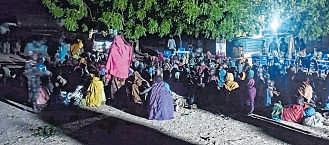
ABUJA, Nigeria The Nigerian army said Sunday it freed 360 people abducted by Boko Haram in southern Borno, in the northeastern part of the country The operation, according to the army’s statement, was conducted in the Mandara mountains which form a part of the militant group’s stronghold. It resulted in the release of several people, including children, who had been abducted across different communities in Borno. Two infants “succumbed to exhaustion” due to the challenging mountainous terrain and the hardship they endured during their prolonged captivity, an army spokesperson, Haruna Sani, said. “The remaining rescued abductees were successfully evacuated to safe locations for medical care and humanitarian support, marking a major operational success and a significant
cember 1992. “I would like to think that I am nobody’s lackey I try to
reach conclusions independently and then I’m willing to fight for those conclusions; if necessary, having to fight against my party or my party’s president,” he said.
Agreat savingsalternative forbusinesseslooking fora solid investment withoutrisking principal.
•Earnhigherreturns on your capital
•Rewards forhigherbalanceswithtiered interest rates
•24/7onlinebanking andapp access
•$2,500 minimumbalance
•Upto6 withdrawalsper month.

Packwood
AssoCIATED PREss PHoTo By MARK sCHIEFELBEIN
President Donald Trump speaks Friday at Custer Farms in Chippewa Falls, Wis.
Redistricting fight may turn to state, local governments
BY DAVID A. LIEB Associated Press
After a blitz of congressional redistricting ahead of the midterm elections, a national battle for partisan control is about to enter a new phase that could affect representation on everything from tax rates to social safety net programs, teacher salaries, housing regulations and local road repairs.
Georgia’s Republican-led Legislature will convene June 17 for a special session focused on redistricting for the 2028 elections. The agenda includes new voting districts not only for Congress, but also for the state House and Senate — and potentially even the state’s utility regulatory commission.
It will mark the first time since a recent U.S. Supreme Court ruling weakened minority voting protections that a state legislature will attempt to redraw its own districts. Mississippi Republicans and New York Democrats also could undertake legislative redistricting before their 2027 and 2028 elections, respectively It remains to be seen, though, how many legislatures will follow, and whether the outburst of mid-decade redistricting will extend down to county commissions, city councils and school boards that make myriad decisions affecting people’s lives. The impact could be widespread.
“The stakes here are not political, they are deeply human,” said Joe Kennedy III, founder of Groundwork Project, a nonprofit that supports local civil rights and democracy organizations.
Redistricting movement
Voting district boundaries typically are redrawn once a decade after each U.S. census to account for population

A woman leaves a voting center after voting on May 19 in Marietta, Ga. After a blitz of congressional redistricting ahead of the midterm elections, a national battle for partisan control is about to enter a new phase that could affect representation on everything from tax rates to social safety net programs, teacher salaries, housing regulations and local road repairs.
changes. But last summer, President Donald Trump urged Texas Republicans to redraw congressional districts to try to win additional seats in the midterm elections. Other states followed with their own partisan gerrymandering. Then a 6-3 Supreme Court ruling in late April jumpstarted even more redistricting. The court struck down a majority-Black congressional district in Louisiana as an illegal racial gerrymander, providing grounds for Republicans in other states to reshape districts with large minority populations that have elected Democrats.
Georgia redistricting
A federal judge ruled in 2023 that some of Georgia’s congressional, state Senate and state House districts were drawn in a racially discriminatory manner The Legislature quickly approved revised maps with new majority-Black districts, though they resulted in little change to Republi-
can majorities in the 2024 elections.
Republican Gov Brian Kemp has called lawmakers into special session to again redraw districts in light of the Supreme Court’s decision in the Louisiana case That could allow Republicans to undo the court-ordered changes they made in 2023 and potentially redraw other Democratic-held minority districts to the GOP’s advantage.
Republicans have yet to unveil details of their plans. But Democratic state Rep. Tanya Miller, who is running for attorney general, denounced the upcoming redistricting as a means of “rigging maps to maintain power.”
What’s at stake?
Several months before the Supreme Court ruling, a report by Fair Fight Action and Black Voters Matter forecast that Republicans in 10 Southern states could eliminate 191 Democraticheld legislative seats — including 140 districts with
Black or Hispanic majorities if the Supreme Court gutted federal Voting Rights Act protections for minorities.
“If anything, our report was an understatement,”
Cliff Albright, co-founder and executive director of Black Voters Matter recently told The Associated Press. “What’s at stake is the future of this democracy.”
Other analysts don’t expect that many seats to be redistricted. But they do expect the Supreme Court’s decision to ripple through states.
“We’re going to potentially see a lot of frenzied efforts at every level, including at the local level, to try out undoing district maps and configurations that have performed quite well in providing improved representation for communities of color,” said Kareem Crayton, vice president of the Washington office of the Brennan Center for Justice.
Pending court cases
The precedent from the
recent Supreme Court decision already is being applied in several states. In light of the ruling, a federal appeals court is allowing Alabama to use a state Senate map approved by Republican lawmakers in this year’s election instead of one imposed by a federal judge who found the state had diluted the voting power of Black residents. The change affects two state Senate districts in the Montgomery area.
The Supreme Court has sent legislative redistricting cases filed on behalf of Black voters in Mississippi and Native Americans in North Dakota back to lower courts for further consideration in light of its Louisiana decision. The Washington attorney general has asked the Supreme Court to do the same for legislative redistricting cases involving Hispanic voters in that state.
Redistricting hurdles
About half the states have provisions in their constitutions prohibiting mid-decade redistricting of state legislative seats, said Justin Levitt, a law professor at Loyola Marymount University in Los Angeles who runs the “All About Redistricting” website.
But even in states where it’s allowed, lawmakers may have fewer reasons to redraw their own districts than those for Congress, Levitt said. Politicians who promoted congressional redistricting for the 2026 midterms often justified it as a way to counter gerrymandering in other states and win as many seats as possible for their party They had extra motivation because a swing of only a few seats nationally in the November elections could affect control of the closely divided U.S. House.
By contrast, most state
legislative chambers already are dominated by one party
“There’s a lot less incentive, if you already control the state legislature by 10 or 12 seats, to eke out an incremental one or two at the expense of really ticking off your own party membership, or at the expense of maybe risking losing seats in a broader way,” Levitt said.
Local governments
The Supreme Court decision making it more difficult to prove Voting Rights Act violations already has affected some local governments.
Plaintiffs have voluntarily dismissed a challenge to commission districts in Meriwether County, Georgia. A federal court has accepted new legal briefs in a challenge to Board of Supervisors districts in DeSoto County, Mississippi. And Indiana’s attorney general has asked a federal appeals court to take note of the Louisiana case when deciding a challenge to how judges are selected in Lake County Over roughly the past four decades, data from the University of Michigan shows that cities, counties and school boards have been involved in more than threefifths of the 466 lawsuits alleging violations of Section 2 of the Voting Rights Act, which forbids providing minorities less opportunity than other voters to elect the representatives of their choice.
But that doesn’t necessarily mean local governments will rush to redistrict as a result of a weakened Voting Rights Act. The Supreme Court decision cleared the way for officials to justify redistricting based on partisan ambitions. But many local offices are officially nonpartisan.
European leaders voice need to bolster Ukraine’s defenses
BY PAN PYLAS Associated Press
LONDON The leaders of the U.K., Ukraine, France and Germany discussed the “urgent need” to ramp up production of weapons to combat Russia’s powerful hypersonic Oreshnik ballistic missiles in a meeting in London on Sunday British Prime Minister Keir Starmer hosted Ukrainian leader Volodymyr Zelenskyy, French President Emmanuel Macron and German Chancellor Friedrich Merz at 10 Downing Street. In a statement released by Starmer’s office following their evening meeting, the leaders condemned Russia’s “large-scale missile and drone attacks including the repeated use of the Oreshnik missiles — on Ukrainian cities with a tragic toll on civilians.” They also condemned Russia’s “irresponsible and dangerous Russian drone incursions” into NATO territory including last month’s in Romania. Russia has stepped up its aerial campaign against Ukraine recently, most notably with the launch of the
Oreshnik missiles.
“The leaders underlined the urgent need to scale up the production of interceptors and codevelop anti-ballistic missile and deep strike capabilities,” the leaders said.
No details, financial or otherwise, on how this would be done were provided Ukraine’s shortage of air defense systems, in part because of the depletion of U.S. stocks during the Iran war, has left civilians especially vulnerable to ballistic missiles, even as Kyiv’s defenses stop most of Moscow’s drones and its forces have made advances elsewhere on the battlefield.
The worry for Ukrainians is that the Iran war, which has been in abeyance for weeks, may now reignite after Iran launched missiles on Sunday at Israel in the first such bombardment since a fragile ceasefire took effect in early April, complicating mediation efforts for a deal to end the war
Following their meeting in London, the European leaders called on Russian President Vladimir Putin to agree “an immediate and complete

Britain’s Prime Minister Keir starmer second from right, stands sunday with France’s President Emmanuel Macron, right, Ukraine’s President Volodymyr Zelenskyy second from left, and Germany’s Chancellor Friedrich Merz, on the doorstep of 10 Downing street after their meeting in London.
ceasefire” with the current line of contact as a starting point for any negotiations.
The U.K., France and Germany, the so-called E3 group of European nations, have been prominent backers of Ukraine following Russia’s full-scale invasion in February 2022. The U.K. and France lead the “coalition of the willing” initiative to pro-
British official tells Vance he was wrong to blame immigration for teen’s murder H
BY PAN PYLAS Associated Press
LONDON Britain’s deputy prime minister said Sunday that he told Vice President JD Vance he was wrong to blame immigration for the death of a university student who was handcuffed as he lay dying from a stab wound. David Lammy, who is also the justice minister, said he challenged Vance in what he described as a “robust” phone call on Saturday Lammy and Vance have struck up a friendship, based on their religious beliefs and family backgrounds, even though they come from different sides of the political spectrum.
vide security guarantees for Ukraine as part of a peace process.
The meeting comes in the wake of a Russian drone strike that killed three people waiting at a bus stop in


southeastern Ukraine. A separate drone strike damaged a storage center for spent nuclear fuel in the Kyiv region, just 15 kilometers (9 miles) from the Chernobyl nuclear power plant,


Ukraine’s General Staff said. The attack sparked a fire that was extinguished within an hour Radiation remains within safe levels, officials said.
The International Atomic Energy Agency chief Rafael Grossi said the incident was “deeply concerning” due to the large amounts of nuclear material held at the facility He said in a statement that the agency would visit the site of the attack soon.
The Russian attacks follow a large-scale Ukrainian drone attack on Saturday that targeted Saint Petersburg, Russia’s second-largest city, underscoring Kyiv’s growing ability to hit deep inside Russia.
With the front line barely moving as swarms of drones hinder advances, both sides have sought an edge by launching long-range strikes.
Associated Press writer Katie Marie Davies in Manchester, England, contributed to this report.


“We had an agreeable conversation because we have got a relationship, but I wanted to make him clear that I disagree with some of the facts that he was asserting and to present the facts to him,” Lammy told Sky News.
the wounded man as a suspect before noticing his injury and trying to resuscitate him.

The call came a day after Vance said in a post on social platform X that there should be “righteous anger” in response to the murder of Henry Nowak, 18, who died in December after being stabbed by Vickrum Digwa in the English city of Southampton Digwa, who is Sikh, falsely claimed to police he was the victim of a racist assault by Nowak, who was white. When police officers arrived, they initially treated
Vance appeared to blame the murder in part on “the mass invasion of migrants, many of whom despise the West and the people who love it.”
Lammy said he wanted to “emphasize a number of things” to Vance, including that the killer was British and is now behind bars.
“This has got nothing to do with mass migration,” Lammy said. Digwa, 23, was convicted of murder for stabbing Nowak with
with


to
AssoCIATED PREss FILE PHoTo By MIKE sTEWART
AssoCIATED PREss PHoTo By ALBERTo PEZZALI
Health workers struggle to treat Ebola without compensation
outbreak worsens in Mongbwalu,
Congo
BY JUSTIN KABUMBA and OPE ADETAYO Associated Press
MONGBWALU, Congo
Dr. Richard Lokudu, the medical director of Mongbwalu General Referral Hospital, has received barely any compensation for his work on the front line of one of Congo’s deadliest Ebola virus outbreaks.
Lokudu and several of his colleagues work all day at the hospital treating an influx of patients. Notifications of suspected cases come even late at night.
“I have not received my allowance (and) what happened to others could happen to me as well,” Lokudu told The Associated Press.
“Despite all the infection prevention and control measures we are implementing, we do not know what may happen.”
Health authorities believe the outbreak, which took the eastern region of Congo by surprise after spreading silently for weeks without detection, started in the bustling mining area of Mongbwalu in Ituri province.
Mongbwalu has emerged as the epicenter of the rare Bundibugyo type. The town attracts large numbers of laborers who work in large gold mines with muddy pools of gold deposits, narrow pits and caves. They live in low-income areas including crowded camps and have little access to proper health

have been 19 confirmed cases and two deaths
Bundibugyo has no approved vaccines or treatment, so Congolese health workers have been targeting symptoms of the species. The government said at least five people have recovered from Ebola since the outbreak was officially confirmed by Congo’s health ministry on May 15.
The disease “had a big head start,” according to World Health Organization Director-General Tedros Adhanom Ghebreyesus.
Hospitals in the region couldn’t test for the right type of Ebola that had begun spreading several weeks before confirmation.
grave reality Asero Jeanne, 52, had five children Two died from the disease within two weeks. When her daughter became ill, the family thought it was malaria and neighbors advised them to avoid the hospital, saying “anyone who went there would die immediately,” Jeanne said.
The daughter died after three weeks of moving between hospitals and home, followed by a son who died days after Then Jeanne became sick.
“I saw about 20 people die,” Jeanne said. “I watched them being taken to the morgue, yet God is allowing me to leave here alive. I thank the doctors.”
intensity, oil, gas and petrochemical industries are pushing to introduce the technology to Louisiana. Though LSU scientists and industry advocates say the technology behind CCS is safe and well-tried through years of oil field use, the push has drawn opposition from environmental groups as well as conservatives who question the need and the effects.
The Tapia Center has been putting on CCS lessons for four years in Texas, Mississippi, Tennessee and Louisiana. Southern University has had summer camps for the previous three years, and pilot projects went on last year in individual Ascension and East Baton Rouge parish schools, according to ExxonMobil literature.
The large-scale Ascension Parish program was aided with a $51,000 professional development grant from the ExxonMobil Foundation to the Tapia Center that included material expenses, company officials said.
ExxonMobil is a proponent of the technology, which would benefit its operations in Louisiana and elsewhere. The company also owns a key CO2 delivery pipeline across southern Louisiana, western Mississippi and southeastern Texas that other companies may use to reach distant injection sites.
The oil giant has also been a financial benefactor of the Tapia Center, having provided seed money to develop the curriculum and $100,000 in scholarships annually for students to attend the center’s STEM summer camps, according to the center and ExxonMobil.
Paul Hand, the center’s executive director and creator of the CCS curriculum, said though ExxonMobil provided financial support, the scientific judgments behind the curriculum are his and his staff’s alone. He said the curriculum from the independent center takes no position on the debate surrounding the technology
The ExxonMobil dollars helped pay for center staff who spent about a year working through trial and error to find the right demonstration materials. What’s resulted from that work, he explained, allows students to see what the underground reservoir would be like through relatable items and face
“STEM challenges that are directly related to the lives of our students,” tied to Louisiana academic standards
“And CCS is something
protocols.
The conditions increase the possibility of transmitting the disease, which spreads through close contact with bodily fluids of the sick and deceased such as sweat, blood, feces and vomit.
There also has been widespread skepticism regarding the disease, making the job of medical treatment more difficult for Lokudu and his colleagues, while some of the health workers and first responders have died from the disease.
“It is one thing to be far away and hear statistics being reported, but what is happening on the ground is enormous,” Lokudu said.
“People are sacrificing their rest and comfort for this cause. There should be recognition that they deserve compensation. These workers should receive their salaries regularly.”
The Congolese government didn’t respond to a request for comment from the AP Congolese authorities released new statistics on Sunday, saying there have been 488 confirmed cases, including 86 deaths, as of Friday On Thursday, the Central African nation recorded 71 new cases in a day, which authorities said is a sign of “active community transmission.” In neighboring Uganda, there

that is happening today It’s happening over the next few decades, and our students should know about it, and we want to show it to them in a hands-on way,” he said In various materials about programs like the Ascension one, ExxonMobil officials say their support of CCS and other STEM-related curricula with hands-on components is a positive example of education, industry and communities working together The programs help make science relevant for students and inspire them to seek a future in scientific and technology-related fields, the officials say Impact on the environment
The students use a plastic cup, partially filled with pasta or pinto beans and green water, as their underground reservoir This cup is pierced by two straws meant to represent underground wells and sealed off at the top by a layer of PlayDoh. Students learn what the differences in rock porosity mean for storage. During teacher training sessions at LSU in early February — months before the classroom lessons rolled out — Ascension school officials and some teachers said their district should provide information about subjects students might encounter and tie them to Louisiana’s science standards. “Our standard is about how humans impact the en-
vironment, so that’s what we’re exploring with this partnership, both positive and negative,” said Erin Babin, middle school science supervisor for Ascension.
She said her school leadership never considered not exposing students to the information, but believes in sticking to the science: “We talk about controversial things. We talk about AI We talk about carbon capture. We talk about evolution, you know what I mean?”
In the lessons, Juneau’s students learned about the natural and human sources of CO2 emissions, the threat of climate change, and the role renewable power and CCS can play in cutting emissions.
They also learned about the geology tied to carbon storage and some potential downsides of different CO2 mitigation methods: windmills can kill birds; CCS isn’t suited for every geology, though it is on the Gulf Coast, the lesson says.
A teacher of 23 years who is also a soccer coach, Juneau taught the Tapia curriculum to 97 students in all. He said the lessons reinforced things they have already learned about the carbon cycle, global warming and states of matter
“I think the science is solid with it,” he said. He said he would use the lesson next year if he had more materials.
Health workers are handling the disease with minimal resources, because agencies have been scrambling to bring aid into the region Masks, gloves, boots and medications were initially all in short supply
“There has been an erosion of the health system,” said Heather Kerr, country director for the International Rescue Committee in Congo. “There has not been investment in the health system, and this has been going on for years.”
“During the first week, we did not even have time to go home and eat. The second week was the same. We only eat once a day what amounts to breakfast in the evening,” said Alice Bamuhinga, a nurse at the Mongbwalu hospital.
Even with widespread skepticism and disregard for health protocols, many in the town are becoming aware of the outbreak’s
Tedros on Friday launched a $518 million plan to combat the outbreak, saying “containing Ebola depends on political commitment, sustained financing, and the trust and engagement of communities.”
Efforts to contain the disease also have been hindered by the conflict between the government and Rwanda-backed M23 rebel group, in addition to attacks by Islamist militants.
For health workers on the front line of Congo’s Ebola outbreak, the work has become harder as the disease spreads faster than their current treatment capacity
“Despite the alerts we receive and the teams we have on site, we lack the means to travel into the field,” Lokudu said. “As a result, there are alerts we are unable to investigate.”

‘Complete and utter lie’
Some environmental and community groups who oppose CCS as an effective way to address climate change criticized the Tapia lessons because they say they appear to promote the technology These groups also suggested the curriculum doesn’t delve deeply enough into the technological questions they contend still surround the injection practice.
Concerns center around whether CO2 injection will work as advertised after a federal model project had underground leaks. Criticism has also come from rural residents worried about land rights, new delivery pipelines, the safety of underground aquifers and the cost to U.S. taxpayers.
Other opponents reject the curriculum entirely because they do not accept the overwhelming science surrounding man-made
climate change.
Caitlion Hunter, research and policy director of the Rise St James community advocacy group, argued that the use of everyday materials underplays the risks, from pipeline corrosion to the consequences of a high-pressure CO2 leak.
“Students exposed to this Exxon-funded curriculum are being misled, plain and simple,” she charged Hand said those kinds of questions are beyond the level of an eighth grade class focused on the basic science of the states of matter climate change and rock porosity
Mark T. Guillory, a retired U.S. Air Force colonel from Rapides Parish and one of the founders of Save My Louisiana, which strongly opposes carbon capture, took a harsher line. He called the program “outrageous indoctrination and propaganda,” and criticized teaching the “complete
and utter lie” of man-made climate change. He also said the curriculum ignored the potential dangers of CCS.
“The real question is, why is industry producing or financing the production of curricula for public schools?” he asked.
The two varying sets of criticisms illustrate the complex debate over carbon capture playing out across Louisiana. Play-Doh and green brine Back at Dutchtown Middle School, after Nash was done with the Play-Doh, he, Bourg and the others got their second batch of pretend liquid CO2 from Juneau. Classmate Miriam Miles began pouring the orange oil down a thick, plastic straw At first, no leaks. Eventually, though, some orange oil started to appear on the purple Play-Doh around the two straws, but a far smaller amount. And plenty of green brine was also moving up from the reservoir and out of the second straw as planned, and far more than in the first attempt. Juneau reminded the group that the difference is to be expected because of the spiral pasta’s greater porosity
The students recorded their results. Soon, it would be time for lunch. Before the work had begun on the final demonstrations, Juneau had offered his class a little grace. It proved correct.
“We’re going to make mistakes. Y’all never done this before Hopefully, we do better between the second and first trial,” he said.






AssoCIATED PREss PHoTo By MosEs sAWAsAWA Richard Lokudu, center the medical director of Mongbwalu General Hospital, speaks with U.N. peacekeepers in Mongbwalu, Congo, on Friday.
sTAFF PHoTos By JAVIER GALLEGos students put their hands on a bottle of vegetable oil that represents liquid Co2 as it begins to fall off the straw during a lesson on carbon capture technology at Dutchtown Middle school on May 14.
students Ava Bourg, left, and Lillian Melsheimer squeeze vegetable oil into a reservoir during a lesson on carbon capture technology.
Along 30A, in spots where the waves glow deep tropical blue, private beaches are now more common and their rules are more strictly enforced than anywhere on the Gulf Coast.
Some property owners are employing security guards to protect their sand and chase off anyone who tries to lounge there. Others are hiring vendors to place chairs and umbrellas near private shorelines as a deterrent to beachgoers who might otherwise lay down towels.
The acrimony is escalating so much that some beachfront homeowners say they fear locals will harass them when they dine or shop in nearby towns. Beachgoers who miss the days of open access also say they are worried that aggressive tactics by security guards — including reports of some using cellphones to film sunbathers until they leave — could soon lead to physical confrontations.
“It can be very tense,” said Walton County Sheriff Michael Adkinson, whose deputies responded to about 400 beach trespassing calls last year That amount — roughly a call every day is almost double the previous year’s rate.
Some homeowners who have paid millions for the promise of exclusive beach properties are becoming so upset they have resorted to
SESSION
Continued from page 1A
Legislature that felt the further you get away from New Orleans, the less you care about it. What’s changed is that there are so many Republicans they have twothirds control of the House and Senate — and there aren’t many White Democrats to protect the city.”
Landry’s moves represented a remarkable shift for a governor who has been saying since he took office 30 months ago that he is trying to lift up the city
Landry bulked up policing in New Orleans by making Troop NOLA a permanent presence and authorized infrastructure improvements to the city in advance of the 2025 Super Bowl.
“No governor has spent more time in the city of New Orleans than myself,” Landry told WBOK-AM listeners in November “I’m working to try to make the city of New Orleans a better, more hospitable place so we can attract people and businesses and folks can feel safe in that city.”
Some political analysts believe that Landry is attacking New Orleans, a Democratic stronghold, to play to his Republican base in advance of his 2027 reelection campaign. Polls indicate that Landry has lost enough popularity to be vulnerable. Several Republicans said Landry has simply grown frustrated with a legal system that he believes favors criminals at the expense of crime victims.
“His pushing these bills sends a shock wave through the judiciary system in New Orleans — and elsewhere,” said Senate President Cameron Henry, R-Metairie. “He expects a greater sense of urgency.”
Landry did not respond to a request for an interview
“Everyone knows the inefficiencies of these offices when compared to the rest of the state,” the governor said in a statement.
After his very public opening speech to legislators, Landry worked behind the scenes to pressure and cajole Republican legislators to pass the legislation aimed at New Orleans.
On March 18, he met at the Governor’s Mansion with three Democratic New Orleans senators — Jimmy Harris, Royce Duplessis and Gary Carter — to lay out his plans. They objected, saying that the governor was singling out New Orleans and that crime had dropped sharply in the city in
confronting beach bums themselves
“This is supposed to be the American dream,”
Brian Littrell, a Backstreet Boys singer who has filed several lawsuits over trespassing disputes near his home a few miles from Seagrove Beach, told Fox News last year. “It’s just frustrating.”
Kent Safriet, an attorney who represents several dozen beachfront homeowners, said many do not mind sharing their sand with a few respectful visitors.
“But when it gets overcrowded and you as the property owner can’t even go sit on your own beach,” he said, “that becomes a problem.”
recent years. Landry moved forward anyway
Why Landry picked Morris
Four bills targeted New Orleans.
Two bills eliminating nine judgeships and a third bill abolishing Duncan’s job were sponsored by Sen. Jay Morris, R-Monroe.
The fourth bill, sponsored by Rep. Peter Egan, R-Covington, took away 10 assistant district attorney positions from the office of Orleans Parish District Attorney Jason Williams, as part of a last-minute deal to give more of those positions to East Baton Rouge and St. Tammany and Washington parishes.
This account is based on interviews with 21 state legislators and others involved in the four pieces of legislation Morris, 68, has been something of a renegade Republican during his 15 years in the Legislature. In 2019, the Louisiana Association of Business and Industry and the Louisiana Chemical Association tried to defeat Morris, then a House member, when he ran for the state Senate. Morris had sponsored legislation to take away corporate tax breaks when legislators were trying to plug a budget gap Morris has not been on Landry’s legislative team, but the governor turned to him to sponsor the three New Orleans bills because Morris represents an area distant from New Orleans, chairs one of the Senate judiciary committees and is willing to take political heat.
Morris demonstrated that during the 2026 regular session by sponsoring redistricting legislation that is turning the district of U.S. Rep. Cleo Fields, a Black Democrat from Baton Rouge, into one that favors a Republican. Hundreds of people went to the Capitol to object to Morris’ bill.
Morris was receptive to sponsoring Landry’s New Orleans-related bills because he had concluded, while performing his oversight role in chairing his committee, that Jason Williams had not been tough enough on criminals. Morris had already sponsored a constitutional amendment approved by voters in 2024 that made it easier to investigate complaints against judges.
Like other Republicans, Morris thought New Orleans’ judiciary was ripe for downsizing to match the city’s population loss.
Morris told colleagues he also had a personal reason
Beach disputes
The saga is among the most extreme examples of growth consequences across the region, where many vacation spots beloved by visitors from Louisiana are scrambling to balance the often conflicting demands of locals and tourists. More than 17,000 newcomers have raised the population in 30A beach towns by about 24% since 2020, and U.S. Census Bureau estimates show Walton County is among the fastest-growing areas on the Gulf Coast.
The history of the conflict is complex. Some beaches on this part of the Panhandle have been privately owned for decades, but the public’s
use of them had gone undisputed for years. Then, as the population began soaring, the county passed a law in 2016 recognizing what leaders argued was the public’s longstanding right to relax at the beach
More than 500 homeowners pushed back, fearing their property rights could be lost forever
The county’s tourism agency says about two-thirds of the shoreline is available to the public. But after lawsuits and several shifts in state law, beach boundaries across 30A have become so convoluted that some private attorneys and county leaders still dispute how much sand is truly open to all.
The mess is aggravat-
ing visitors who are denied access to certain beaches and frustrating many owners who want to enjoy their views in peace. The tension is also exasperating local law enforcement leaders who are tasked with navigating tangled boundaries and mediating hostile disputes.
“It’s incredibly difficult,” said Adkinson, who grew up here in the days when Florida’s old coastline was still a blissful escape from the world’s troubles. “It desperately needs to be resolved.”
In many ways, the drama unfolding on 30A is unique.
Many neighboring beaches are owned by either the state or federal government Federal leaders are also paying to add sand on some eroded areas on the Gulf Coast, including Destin, which has expanded the land open to the public.
Many homeowners on 30A have refused to let the federal government onto their properties to complete similar projects. But local leaders are urging visitors to use dozens of public beach accesses across the region, and paying guests can use beaches owned by vacation rentals and resorts. The county is also buying more land to expand public reach.
One local resident has even created a phone app called Shoreline Defender to help beachgoers determine where they can legally sunbathe. But some areas of sand on 30A that technically belong to the public are nearly impossible to reach because they are wedged between private properties.
“This is not anyone’s backyard,” Sara Day, the app’s founder, said as she strolled along the beach past children boogie boarding in the waves. “It’s hard,” she said, “to know that there are people in your community who don’t want you anywhere near this place.”
Public and private
Sheriff’s deputies have already responded to almost 100 beach trespassing calls in 2026, and some visitors are complaining that public beaches are becoming packed while private sand next door sits empty Homeowners are arguing the crowds are all the more reason to keep private beaches sacrosanct.
“This is craziness,” said Peter Ticktin, Littrell’s attorney “What if I have a house that borders on a public park? Should they be allowed to come into my backyard? Where does it end?” Videos of beach confrontations are spreading online, but the tensions have led to no arrests so far and many signs of bliss endure. One recent day, families on a public beach put down their books and glanced up from their sandcastles to watch dolphins ride a wave.
Rauschkolb, a longtime 30A business owner, also paused to study the sea. For a moment, he paid no mind to the private homes atop a nearby dune. Then he decided to take a brief respite from his growing frustration. “I’m going surfing,” he said.
for wanting to crack down on New Orleans. His daughter had been mugged years earlier in the city one afternoon while walking her dog.
Morris’ Senate Bill 256 would abolish the job to which Duncan had been overwhelmingly elected in November by giving its responsibilities to the Civil District Court clerk.
During his campaign, Duncan had become a cause célèbre of liberals nationwide because he studied law while serving a life sentence at Louisiana State Penitentiary at Angola before winning his release and having his conviction vacated.
After Hurricane Katrina, state lawmakers required New Orleans to merge its seven assessor offices into one and to merge its civil and criminal sheriff offices — but only after allowing the current officeholders to serve out their terms.
In Duncan’s case, lawmakers moved swiftly enough for Landry to sign the legislation on April 30 Duncan was scheduled to take office on May 4.
On April 30, Landry told WBOK-AM that he wasn’t trying to keep Duncan from elective office.
Going after judges
In the meantime, Morris and Landry were pushing Senate Bill 197. In its original form, it would have eliminated four of New Orleans’ 4th Circuit Court of Appeal judgeships.
Facing pushback from judges and New Orleans legislators, Morris and Landry agreed to cut only two of the judgeships.
The legislation needed a two-thirds vote. It received the bare minimum of 26 votes in the Senate and then moved to the House for consideration.
Over a two-week period, the House was scheduled to take up SB197 four different times, but Landry and his legislative aides pulled the bill back each time because they lacked the 70 votes needed.
SB197 finally passed on May 27 with exactly 70 votes.
Two legislators involved with passage of the legislation said Landry had to agree to spending projects in the districts of several House members to secure their votes, a longtime practice of governors to pass legislation.
Morris and Landry were also pushing Senate Bill 217. In its initial form, it would have eliminated two of Orleans Parish’s 14 civil district court judgeships, one of the seven Municipal
and Traffic Court judgeships and one of the four Juvenile Court judgeships.
Harris, who has a close relationship with Senate President Henry told Henry that getting rid of civil district court judges made no sense, given the governor’s focus on crime, because those judges don’t handle criminal cases. Henry agreed and got Landry to save those positions on April 13 when the governor met in his office at the Capitol with the Senate Democratic Caucus.
But by then, SB217 also called for eliminating three criminal district court judges. By the time it won final passage on June 1, the session’s final day, it erased those three positions two Municipal and Traffic Court judges, and two Juvenile Court judges.
DAs also targeted
The fourth piece of legislation, House Bill 719 by Egan, began as an effort to provide 60 new “warrants,” which are worth $50,000 apiece and can be used to hire new assistant district attorneys or supplement the pay of the existing government lawyers.
Egan, 76, still speaks with an accent reflecting his upbringing in Ireland. He moved to Louisiana in 1971 to become a Catholic priest in Jefferson Parish, serving at two churches for eight years before leaving the priesthood, getting married, having four children and
getting into the home health and hospice industry
Egan sponsored HB719 because he especially wanted to add new positions to the 19th Judicial District Court (East Baton Rouge) and the 22nd Judicial District Court (St. Tammany and Washington parishes). Both areas had gained population in recent years.
But district attorneys in both judicial districts had failed to win the approval of local voters to agree to tax increases that would fund additional prosecutors. Now they had turned to the state.
After the House agreed to the 60 new warrants, the Senate Finance Committee approved an amendment that redistributed the warrants among district attorney’s offices throughout the state, at the expense of the 19th and 22nd judicial districts.
Furious, Egan threatened to the district attorneys association that he would kill the bill as a result.
Sen. Patrick McMath, RCovington, and Collin Sims, the district attorney for the 22nd district, spoke to Landry to ask for more warrants for their area. The governor proposed taking away 29 warrants from Williams’ office. Sen. Harris was livid when he learned this from Henry, whose Metairiebased district also includes Uptown New Orleans. They negotiated the loss of warrants for Williams down to 10.
Sen. Mike Reese, R-Leesville, presented an amendment the next day, on May 28 — just three days before the session ended — to carry out the change. The Senate approved the plan without discussion. Egan accepted the hijacking of his bill because it added more warrants for the 19th and 22nd judicial districts.
District Attorney Hillar Moore will go from 55 warrants to 71 for the 19th Judicial District, while Sims will go from 30 to 44 for the 22nd.
Williams never had a public forum to challenge the loss of 10 warrants, equal to $500,000 from his budget. Events moved so quickly that New Orleans legislators didn’t know that a report by the district attorneys association called for Williams to lose only three warrants.
Rep. Aimee Freeman, DNew Orleans, saw the reduction as yet another attack on New Orleans and sharply questioned Egan when he presented the bill for final passage on May 31, the penultimate day of the session. Rep. Mandie Landry, DNew Orleans, railed against the bill.
“Literally, the only people you’re hurting in Orleans are crime victims by this,” she said and then broadened her comments to the Morris bills as well. “There’s this irrational desire by some people in this building to stick it to New Orleans.”









sTAFF PHoTo By HANNAH LEVITAN


METRONEWS
Waterwalking


Sammy’s Grill closing Highland location
BY OLIVIA TEES staff writer
ABaton Rouge staple,Sammy’s Grill on Highland Road, will close its doors as it begins the search for anew location, the restaurant announced in aFacebook post. The lease will be up this month and the property owners have decided to go in adifferent direction, the Facebook post says. The restaurant says it is grateful forthe yearsithas spent there and is actively looking for a new location in Baton Rouge. It will officially close the Highland Road location on Sunday “Since 1988, Sammy’s on Highland has been aBaton Rouge and LSU tradition, serving famous crawfishand creating memories forgenerations of families, friends, and Tiger fans,” the post says. ThePrairievillelocation at 37306 Perkins Road will remain open.
Carencro is La.’s fastestgrowing city,outpacing nearby towns
span outpaced Youngsville andBroussard, andits medianhousehold income jumped by over 60% between 2019 and2024, census data shows.
owner of Keaty Real Estate.
BY ADAM DAIGLE Acadiana business editor
For decades, Gene Martin and his family kept the 20 acres just west of the Interstate 49 exit in Carencro mowed and manicured while commercial development sprung up all around it. But even beforeMartin’s death in 2024, the unsolicited offers to buy the land came. Now,with his three daughters overseeingthe property,the offers are more frequent. Investors want to buythe highly visible property for commercial development in acity that since 2020 is the fastest-growing in Louisiana.
City leaders, said Mayor Charlotte Stemmans Clavier,are investing in infrastructure to manage that growth, which is expected to continue. Since she took office in 2022, the number of homesunder development has hovered around 1,500.
Many of the areas where houses arebeing built are classified as rural and do not require adown payment, andbuilders offer lower interest ratesand generous promotions tofacilitate a sale. Buyers can easily own anew home with amortgage that’s often less than what they were paying in rent, he said.
Lafayetteand unincorporated areas: 45.8% (Total permits: 4,761)
“I am not the biggestproponentofgrowth —Igrew up in asmall town that was absolutely agreat place to grow up,” she said. “I didn’t want it to change much, but growthishappening and there’snothingI can do about it.We are making everyeffort to make sure we do it correctly.”
In the 70520 ZIPcode, which coversmostofCarencro’scity limits, the median sale price for ahome has been $216,000 or lesssince 2022, well below the$245,000 median for Lafayette Parish, accordingtodata from Bill Bacque withMarket Scope Consulting. Builders DSLD and DR Hortonhavebeen activein Carencrofor some time.


Wherethe newhomes were built Here’s abreakdown of wherenew homeswerebuilt between 2020 and2025inLafayette Parish: source:Lafayette
Carencro: 20.5% (Total permits: 2,129)
Youngsville: 17.8% (Total permits: 1,857)
Broussard: 10.7% (Total permits: 1,115) Scott: 5.1% (Total permits: 536)
City leaderstry to keep up with demand staffgraphic
anditseems alot of them are staying here —which is nice.”
Lafayette Parish also added nearly 20,000 jobs during that five-year span, according to Bureau of Labor Statistics data. The biggest gains werehealthcare and education(4,966) andleisure andhospitality (4,485). Manufacturing jobs also grew by 33%. Only jobs in oil and gas extraction declined.
“We’ve had alot of interest from people out of town,” said Melanie Martin LeBlanc, Martin’s middle daughter.“Iknow some guy —Ican’t remember his name, there’sbeen so many —out of New Orleans kept calling for alittle while. He said they were interested, but we’re not interested in selling.” Interest in the property hasthe mayor and other officials there optimistic about thenextphaseof growth in acity that grew like no otherinLouisiana.
According to census data releasedlast month, Carencro’spopulation swelled by 41.7% between July 1, 2020, and July 1, 2025, growing by nearly 4,000 residents to apopulation of 13,224. Already home to astrong retail base thatstraddles the I-49 exit, Carencro is becoming less aquiet suburb of Lafayette and more avibrant small city.Home starts during that five-year
TheMartin property couldbeaway to facilitate that growth. The city,with its small sports complex, could use ahotel and more food options. Alocal quickserve restaurant is in negotiations to build next to the post office, but the remainderofthe lot is ablank slate.
LeBlanc andher sisters want to partner with adeveloperonthe site and be involved in whatever gets built there. They areteamingwith Sal Crifasi and Capstone Investment Partners to find apartner
“Evenbeforemydad passed away,weknew we wanted to dosomething,” LeBlanc said. “There’stremendouspotential for any future development at this point. We want to explore opportunities that would allowthe property to flourish and also be something good for Carencro.”
Moving to Carencro
The cost of anewly built home has been abig reason why people aremovingto Carencro, saidJim Keaty,
“I know there’smore developmentstheyhaveslated,” Keatysaid. “I’ve presented properties to them that Iwas thinking would be great properties, but they’re turning them down because they have so much product coming online in that area.”
The growthhas changed thecity’sdemographics abit, pushing the median household incomeupto $63,401, which is almost identical to that of Lafayette Parishasawhole. That has yet to,however push up spending the city Total retail sales grew38.5% between 2020 and 2025, but other municipalities had bigger hikes while sales across theparish rose 43.7%, according to data from theLafayette Economic DevelopmentAuthority.
To handle that residential surge, city officialshave in recent yearsinvestedin infrastructure along with drainage, streets and parks, Clavier said. Among those projects is a$47 million sewer plantthatwill more than double thecity’scapacity with the opportunity for
expansion. City Hall will also be renovated. City officials alsoused American Rescue PlanAct funding to begin replacing old cast-iron waterlines, some of which are over 100 years old thatcan sometimes send brown water into homes, she said.
“Atthe first meeting with engineers, theyhad asample of the pipe and they told me nottotouch it,”Clavier said. “Of course, I’m going to touchit. The rust on the inside was sticky, andI had to washmyhands three times to get it off.”
Now the cityishoping to attract moreretail. One report donebyAlabama-based RetailStrategies revealed Carencrocould use more bars, medical outlets and hotels.
Construction of thesecond phaseofthe Center Square shopping center will begin soon, and the Walk-On’snext to it will open in July.Retail vacancies in Carencro are hard to find, said Clinton Shepard, acommercial real estate agent with Lee &Associates.
“I get alot of people who are like, ‘Why don’tyou get ahotel?’”Clavier said. “You just wantahotel if you’ve
got family and friends or have awedding. Youend up going all the waytoOpelousas or into Lafayette (to stay).”
LafayetteParishisgrowing
All of Lafayette Parish, as well as the town of Maurice in neighboring Vermilion Parish, hasgrown in that five-year span, putting the area at odds with every other metro area in the state that is shedding people, data shows.
The parish gainedjust under 16,000 people in that span, outpacing St. Tammany Parish for the biggest gain in the state Homes sales so far this year are strong and ahead of last year’space, and the numberofluxury home saleshas pushedthe averagesalepricetoover $300,000, Bacque’s data shows.
“I don’tget as manypeoplemoving out as Iused to,” said Robbie Breauxwith Real Broker.“We see so manywho are filling in from other industries. Iused to seeoil field like one(outof) everyfive (homes). Now it’s one in every 25. You’ve got more kids graduating from high school andcollege,
Lafayette Parish, which at 203 square miles is the third-smallest in the state, has ahigh quality of life factorthatisluringnew residents, LEDA President and CEO Mandi Mitchell said. The growth will continue in the coming year and likely continue in Carencro.
“The northern part of the parish, there’sopportunity there,” Mitchell said. “There arestill parcelsof land availablefor residential andcommercial development. There’sstill land available (in the south), but we’re at apoint now where the municipalities in the northern part of the parish are working hard to attract moreretailand rooftops, and it’s goingtofeed itself.”
Email Adam Daigle at adaigle@theadvocate.com.
LOTTERY SATURDAY,JUNE 6, 2026 PICK 3: 1-5-0 PICK 4: 6-9-4-6 PICK 5: 5-6-9-3-3 EASY 5: 7-11-13-20-37 LOTTO: 4-10-31-34-3542
sTAFF PHoTo By MICHAEL JoHNsoN Walkers strollalong the Water HeritageTrailon the leveeonsundayinPortAllen
Pope draws1.2 milliontoMassinSpain
Leochallenges Europe to acknowledgeits Christian roots
BY NICOLE WINFIELD and SUMAN NAISHADHAM Associated Press
MADRID Pope Leo XIV challenged Europe to acknowledge Christianity’s contributions to its cultural identity Sunday,ashepresided over aMass in Madrid attended by more than a million people andhonored Spain’scenturies-old traditionsofreligious devotion and culture.
Leo celebrated Spain’s Christian roots and culture with the huge morning Mass in downtown Madrid and an evening spectacle that featured flamenco dancers, classical guitar and amoving meditation by Spanish actor Antonio Banderas on art, faith and beauty In his remarks, Leo challenged Europe to consider what the continent’sidentity would be without the influence of Christianity.He cited its art, culture and the role played by Christians “motivated by their faith”— to build its schools, hospitals and other institutions.
“Is it seriously possible to believethat Europe —which we deeply love —would be thesamewithout theinfluence of faith?” Leo asked, in demanding thatreligious expression be allowed to keep its placeinthe public sphere.
Leo, who arrived in Spain on Saturday at the startof his weeklong visit, has been keen to highlight the long tradition of Christian culture and devotion here to encourageespecially young generations to find their faith. It’s a tall order in aonce-staunchly Catholic country where religious observance has largely beenonthe wane. Sunday fell on the Catholic Corpus Domini feast day, which often features pro-

cessions of faithful through towns and cities led by a priest carryingthe Eucharist. In Spain, as in other predominantlyCatholic countries, the processions often featureelaborate floral carpets arrangedalong the route.
DuringSunday’sMass, Leo said that thefloral carpets expressthe “spiritual sentiments of this country” through “altars erectedin the streets.”
“This is not an exhibition, aremnant of folklore or a simple display of beauty,” he said.“It is aprofession of faith in the presence of therisen Lord, who isalive and continues to walkamong us.”
He said that the continued observance of suchdevotionalpractices points to what Spaincan andshould be for the world.
“Herein lies thetask of Spain today and in the future: to ensure that thereligiosity which has shaped anddefinedthis countryfor centuriesisnot amuseum of the past to be visited, but a school of faith from which to draw eventoday,”hesaid. At the end of theMass,
Leo carried agilded monstrance, or container,holding aEucharistic host and walked over some of the 16 floral carpetsthat decorated thelessthanhalf-mile procession route, as children droppedadditionalpetals before him and the crowd tossed petals from behind the barricades.
Leo’svisit to the country of 50 million has drawn huge crowds, with avigil service Saturday night. drawing an estimated 600,000 young Spaniards. They knelt for several minutes in silent prayer alongsideLeo, suggesting that there is indeed interestinthe faith among young people, despite Spain’sheavily secularized society.
On Sunday,their numbers doubled: Organizers said that1.2 millionpeople had turnedout on abrilliant spring morning for Leo’s Mass at Madrid’siconic Plaza de Cibelesand surrounding streets, with more trying to get in.
“It’s spectacular,” said Julián Tapiador,a consultant who came to the Mass. “I’m so proud thatthe pope is in Spain after 15 years. Hope-
fully he comes again and we can all see him again.”
OctavioPuche,a retiree, thanked Leo for makingthe trip.
“Apparently societyisnot as secularizedasitseems because there are amillion people here in Madrid, and Ithink he has shown avery human face of Christ,very closetothe people, to their suffering,” he said.
Despite the warm welcome, the clergy sexual abuse scandal, which has erupted belatedly in Spain in recent years, has loomed over Leo’strip. TheCatholic hierarchy has begun to reckon withits legacy after reporting in the local media Leo is expected to meet survivors while in Spain, but several victims groups have complainedthatthey have been left in the dark about when themeeting is taking place andwhether they are invited.
MiguelHurtado,aprominent survivorwho accused amonkatMontserrat Abbey outside Barcelona of sexually assaulting him morethan two decades ago, protested outside the Vatican’sembassy in Ma-
drid on Sunday.Hesaid that he wrote to the Vatican requesting ameeting with Leo and forthe pope to cancel his planned Wednesday visit to the 1,000-year old Benedictine monastery
“I understand you can’t meet with all of us victims, because we are more than 400,000,” Hurtadosaid, speaking to acardboard photo of Leo.
As he spoke,acrowd of nuns and others lined the street outside the Vatican embassy,waving Spanish flags and chanting slogans in favorofformer dictator Gen. Francisco Franco, who ruled Spain with an iron grip for nearly four decades after the 1936-39 civil war.
The Catholic Churchwas apillar of Franco’sdictatorship, andatleastuntil the 1960s, the church enjoyed broad control and influence over Spanish society that waned after democracy took root.
“Spain is Christianand not Muslim!” the crowd yelled.
The tradition of laying flowercarpets —and destroying them when the procession tramples them —dates back twocenturies and is popular also in Latin America, whereelaborate sand designs are also made. The painstaking displays areconsideredanoffering to the Eucharist.
According to Spanish organizers, the 16 flower carpets decorating Sunday’s processionroute offPlaza de Cibeles were prepared by aSpanish florists association from the northern region of Galicia. Florists used morethan 30,000 flowers, most theyellowand white colors of the Holy See flag,for the carpets thatfeature decorations such as the Holy See keys.
Poland has already had its traditionofCorpus Domini flower carpets recognized by UNESCO,and Galicia is trying to have its tradition listed along with other countries as part of the world’sintangible cultural heritage
Graham Platnertakes questionsfromMaine voters
Candidatelooks to stabilize senate campaign
BY PATRICK WHITTLE and KIMBERLEE KRUESI Associated Press
PORTLAND,Maine Graham
Platner was met by an enthusiasticand supportive crowd Sunday at atown hall-style event in Maine as the Democrat moves to stabilize his Senate campaignafter new reportsabout hispast treatmentofwomen.
The evening event in Portland was taking place two days before aDemocratic primary that is still seen as Platner’stowin, but he has drawn questions about his past that could make it difficult to defeat longtimeincumbent Republican Sen. Susan Collins.
“We’re going to win on Tuesday andwe’regoingto win in November and we’re going to take power back for thepeople in this country,” Platner said to about 400 peopleclapping and cheering him on.
The New York Times on Thursday reported an exgirlfriend’sallegations that Platnerrepeatedly grabbed her by the shoulders during arguments and once twisted

her arm behind her back and locked her in aroom.Platner has repeatedly called those allegations of violence untrue.
Other Platner ex-girlfriends interviewedbythe Times describedpositiveexperiences, while somesaid he was volatile and insulting. That story came days after newsreportsrevealing that Platner had exchanged sexually explicit messages with several women while married.
Despite theallegations, no major Democrats who had previously endorsed Platnerhave rescinded their support.
AndatSunday’sevent,in
their initial questions the attendeesavoided asking aboutPlatner’s past andinsteadasked himabout the U.S. Supreme Court, what committees he would want to work on once in theSenate, and whether he supports afederal wealth tax.
“Whathas blown my mind is that everybody knows what’sgoing on,” Platner saidinresponsetoaquestion aboutwhat outsiders watching the Maine Senate race are getting wrong about the state’s voters.
Platner said he hoped eventually to jointhe Senate Appropriations Committee, as well as the committees overseeing agriculture and
healthcare,whilementioning he would like to work withKentucky’sRepublican Sen. Rand Paulbecause of his foreign policy positions. Platner took aswipe at Sen. JohnFetterman, who has criticized the Senate candidate recently, callinghim a “creep” and likening him to a“Nazi sympathizer.” Some have questioned whether Platner would be similar to Fetterman, who has areputationfor speaking and voting against his party, Platner said as asenator it’simportanttobuild relationships and that ”you can’t just go down there and be John Fetterman,” while also calling the Pennsylvania Democrat an expletive. He added that Fetterman “said mean things” about him recently Platnerheldarally with California Rep. Ro Khanna in Bar Harbor on Friday, where he receiveda standing ovation and declared that Mainers “have my back.” Acombat veteran, Platner has repeatedlysaid that he struggled with alcohol and post-traumatic stress disorderafter hismilitary service, but says he is a changed man.
The latest news has deepened someDemocrats’ nervousness about Platner, who already faced scrutiny
over online posts that were dismissive of sexual assault and askull tattoo recognized as aNazisymbol. Platner has apologized for the posts andcovered up thetattoo, saying he didn’trealize its significance when he gotit.
RahmEmanuel, apotential2028 Democratic presidential candidate who spent the weekend in neighboring NewHampshire, said the “jury is still out” on whether Platner can beat Collins.
“Everybody is holding their breath whether this is the start of something or the endofsomething,”hesaid.
“If it’sthe end, that’s one thing. If it’s thebeginning of something andwe’re not done, that’sanother thing.”
Kurt Fedora, 62, amental health workerfromBuxton, said he attendedSunday’s eventtohear Platnertalk about working-class issues andfighting corruption. He said he’sunmoved by recent revelations about Platner’s history,and considers them asmear campaign by conservative opponents.
“Maybe there will be something to it, but they’re really reaching far to try to pin something on him. And it’spolitics as usual,” Fedora said.
Others worried that Platner at times remindedthem of President Donald Trump.
Pakistan Kashmir’stop courtupholds refugeeseats
BY MUNIR AHMED Associated Press
ISLAMABAD The top court in Pakistan-administered Kashmir ruled Sundaythat 12 legislative seats reserved for Kashmiri refugees living in Pakistan are constitutionally protected and cannot be abolished without a constitutional amendment. Hours after the ruling, police said aviolent mob at-
tacked ahospital, killing four officersdeployed at the facility The ruling strengthened the regional government’s position in adispute that has fueled weeks of protests ahead of nextmonth’s assembly elections.
TheSupreme Court of Azad Jammu and Kashmir issued the opinion in response to apresidential reference seekingguidance on
constitutional questions surroundingthe refugee seats andthe upcoming vote for the 45-member LegislativeAssembly The landmarkruling removes legal uncertainty over the election process, stating that public order cannot be disrupted in the name of protest. It came a day after policearrested dozens of supporters of the Joint AwamiAction
Committee, agroup the regional government recently banned over alleged threats to public order and security On Sunday,alleged armed members of abannedgroup stormeda military hospital in Rawalakot, acity in Pakistan-administered Kashmir, killing at least four officers and wounding 20 others, police saidinastatement. It said membersofthe group deliberately targeted the
medical facility and opened fireonsecurity forces stationed at the hospital. Also on Sunday,the U.S. Embassy in Islamabad warned its citizens in Pakistan-administered Kashmir to exercise caution ahead of plannedprotests scheduled forJune 9, as local authorities issued atravel advisory discouraging tourism in the region from June 5toJune 20.
FuneralsToday
Black Sr., Gary ResthavenGardens in theChapelon the Campus,3355 DalrympleDr.,Baton Rouge,LAat10am. Charlet, Miriam OurLadyofthe AssumptionCatholic Church in Clintonatnoon. Henderson,Alesha Fundamental BaptistChurch in Livingstonat1 p.m RolfsIII, Emile
St.James EpiscopalChurch at 1pm Sibley,John VictoryBaptistChurch,31449 N. CorbinRoadinWalker, at 2p.m
Spitale,Catherine Greenoaks FuneralHome, 9595 FloridaBoulevard, at 11 a.m.
Obituaries
Claybrook, Susanne Karwath 'Susi'

Susanne"Susi" Karwath Claybrook was born on January 25, 1931, in Ratibor, Germany, to August and Helene Karwath. A longtime resident of Baton Rouge,LA, she passed away on June 4, 2026. Susi wasprecededindeathby herparents,August and Helene Karwath;brother, Udor Karwath and herhusband, LinderD.Claybrook, whoshe willbelaidtorest with at the LA National Cemetery.The burialwill happenprivately at alater date. In lieu of flowers, please consider making a donation in Susi'sname to St.Joseph Hospice of Baton Rouge

Howto place an Obituary Notice Howto place a Memorial Ad


AssoCIATED PREss PHoTo By ALEssANDRATARANTINo
Pope Leo XIV arrives sundaytopreside over aMass markingthe Catholic feast of Corpus Christi in Plaza de Cibeles in Madrid.
AssoCIATEDPREss PHoTo By RoBERT F. BUKATy Graham Platner,Democratic candidate for U.s. senate, speakstoanoverflow crowd outside acampaignevent on sundayinPortland, Maine.
YOUR VIEWS
WorldWar II warned us aboutfascism
Arecent letter penned by Billy Arcement explains what he considers the oxymoronic nature of theterm “Democratic Socialist” (“Democracy and socialism are not compatible,” May 7.) He accused the Democrats of being devious and using sleight-of-hand. He goesonto saythat one cannot believein both socialism and democracy —only one canexist.
Sitting across the aisle from Arcement, Iwould use asimilarargument about fascism and democracy Since aRepublican returned to the White House in 2025 and with majorities in both the House and Senate, fascism has been on full display —no“sleight-of-hand” about it. Numerous executive orders, starting awar with Iran without approval of Congress, demolition of the East Wing of the White House without prior approval, ignoring the right the Constitution gives to Congress to control tariffs are just afew examples of the exercises of the authoritarian arm of fascismwehave seen So far democracy,though bruised andbattered, is still hanging on. But will it continue to win the day?
As avolunteer at the National WWII Museum, Iamreminded weekly of how the events leading up to and during World WarIIare being repeated heretoday in America.Unfortunately,ittook aworld war and almost half amillion American lives to prove fascism and democracy cannot coexist.
Today Americans must choose fascism or democracy.Whichwill it be?
NELL AUCOIN NAQUIN Baton Rouge
GoPpoliticians are sacrificing everything fortheir party
It has never been more obvious Donald Trump, Steve Scalise, Mike Johnson, Jeff Landry and Liz Murrill are willing to sacrifice everything, including state and country,for their party To them, Republican domination takes priority over democracy,the rule of law or even common sense Ihave been aRepublican since 1971. Iwill continue to be one,despite my embarrassment, if only because Ihope Ican bring some small amount of sanity to my party Unfortunately,too manyfellow Republicans continue to followin lockstep their president, right off the democratic cliff.
WIL KNIPMEYER Neworleans

The unincorporated Vermilion Parish community of Pecan Island,witha population of about 100 peoplealong Louisiana Highway82, is believedtobeapotential location for the construction of a massive spaceX spaceport.
If spacecompany comestoLa., it should have astake in coast
The potential purchase of Exxon lands in VermilionParish by aspace exploration company providesanopportunitytocorrect the errors of centuries of mismanagement.
Foreons, thedrainage of 38 states and parts of Canada came unrestricted to Louisiana’s coastal zone, quickly building land; but in the past century,wehave built numerous dams throughout the Mississippi watershed —for navigation, irrigation and energy generation. All of these impoundments have stymied the flowofsediment and detritus material —having an enormous negative impact on our wetlands and fisheries throughout the Gulf.
Along with this, the1927 flood of SouthLouisiana demanded that we protect lands with a massive levee system.The situation has been further complicated by poorly designed roads
and navigation canals across wetlands, which
disrupt thenorth-south hydrological flow
The restoration of the tidalexchange in the marshes is critical totheir recovery andison us as astate to address throughour coastal restoration plans.
We could begin by takingout the damsinthe wildlife reserves. Also, existing roadways could be elevated at critical pointswhile new roads should be required to allow fortidal exchange. Restoring the hydrological flow to our wetlands is key to their survival. It should be taken into consideration by anyone whohas astake in South Louisiana, be they aduck hunting club or aglobal gazillionaire looking to launch space ships.
HAROLD
SCHOEFFLER Lafayette
Displayedincontext,Confederate statuescould help us move past ashamefulera of ourhistory
In response to State Rep. Mike Bayham’s proposal for the Confederate statues: Many people never had theopportunityto study the history of these monuments(none of us did, as the facts were not in our history books).
Thesestatues and other memorials to the Confederacy were erected in the post-Reconstruction era, concurrent with the reemergence of Whitesupremacy as the dominant political narrative and power structure in the old Confederate states. It was atime when laws werepassed denying voting rights to former slaves, establishing “separate but equal”aslegal doctrine and putting into place laws that discriminated against former slaves in everyaspectofcommerceand employment. Thestatues were erected as asymbol of the reemergenceof
White power andintendedtoconvey symbolically this fact.
Onesolution is to establish aGardenofReconciliation where the statues can be placed as partofaneducational effort to educateand informcitizens and visitorsastothe true nature of whythesestatues were erected. Then perhaps we can finally move past this shameful period of our history
Onenote: Robert E. Lee wasquite explicit that no statues or memorials were to be erected to memorialize the Confederacy “I think it wiser nottokeep open the soresof war,” he wrote, “but to follow the example of those nations who endeavoredtoobliterate the marks of civil strife, and to commit to oblivion thefeelings it engendered.”
PHILIP FRADY Neworleans
Congressional maps areabout power, butthey arealsoabout people
On May 8, Louisiana legislators began debating new congressional maps for the first time since the Supreme Court of the United States issued its decision in Louisiana v. Callais. The Court mayhave gutted the Voting Rights Act of 1965, but it did not give Louisiana permission to abandon fairness or democracy Maps are not abstract political exercises; they determine whether communitiesare kept whole or carved apart, whether neighborhoods can advocate for their shared needs and whetherBlack voters, who make up roughly one-third of Louisiana’spopulation, can meaningfully participate in decisions affecting their families and futures. Louisiana knows the consequences whenpower is used to exclude. From Plessy v. Ferguson to generations of voter suppression and the Civil Rights movement, our history has taught us what happens when representation is denied, but it has also taught us what courage looks like. The 14th and 15th Amendments (the “Love Amendments”) promised equal protection and voting rights after slavery and civil war,and those promises still matter today Lawmakers can treat Callais as alicense to weakenrepresentation further,orthey can recognize that democracy requires integrity restraint and fairness, even when courts step back.
The people of Louisiana are watching. Our elders who survived Jim Crow and witnessed the struggle are watching. Young people inheriting this democracy are watching. History will recall and long rememberwhat happens next.
ALANAH ODOMS executivedirector,ACLU Louisiana

Byrd High school in shreveport.
ownprimaries, they should pay

OUR GUIDELINES: Letters are published identifying name and the writer’scity of residence.The Advocate |The Times-Picayune require astreet address and phone number for verification purposes, but that information is not published. Letters are not to exceed 300 words. Letters to the Editor,The Advocate, P.o. Box 588 Baton Rouge, LA 70821-0588, or email letters@theadvocate.com. To sEND Us ALETTER, sCAN HERE
In respectfulresponse to Madison Weidert’s opinion,I must statethat in 2000, Iand a groupofeducators worked on agrantfor the Louisiana Virtual School. We researched best practices forboth students and teachers.Due to limited space thegrant allowed the schools to select students who met requirements for participation.The first groupofstudents were in honors/GT programs. Riverside Academy was one of the first schools to participate in the onlinelearningresearch. Students 26 years ago were very adept at internetusage.Asthe fine arts/advanced art teacher, Ihad to design classes that included research and creative ways to communicatethrough the arts. There werestudents, pressed to succeed in every endeavor,who very much used websites to plagiarize their projects. Assignmentswere giveninwhich students would design Power-

Point presentations. Several times Iwas amazed how these bright,advanced gifted andtalented students copied and pasted an entire website on one slide.Those were easy to flag as plagiarism. Then there werethose who copied and pasted entireparagraphs,rearranging them to cover their tracks.The developers of the software we wereusing at the time, Blackboard, recognized the need for plagiarism software. Iwas able to use thesame technology to seek out plagiarized work. Twenty-six years ago, and humans do not alter their behavior.Studentswill cheat, manytrying to meet thepressures of competition. It is the responsibilityofboth parents and teachers to correct it. Humans have, and seemingly always will, cheat, regardless of age.
SANDRA H. EVANS Baton Rouge

I’mone of the independent voters whohad to declare ateam to vote on the party candidates in the recent primaries. Iamnot against closed primaries. Iamagainst taxpayers footing the bill forparty primaries. That should be aprivate affair paid forwith party money We have too manyelections in Louisiana. Consolidate them.Never mind that we need aworkable constitution to eliminate local issues having to take the form of amendments to be voted on by people uninvolved in the issue every four months when we have another election.
Let the political parties work out their own processes to choose their candidate. Then, we vote.
PHILLIP WILLIAMS Covington

sTAFF FILEPHoTo By sTEPHANIE RIEGEL
sTAFFFILE PHoToByByJILL PICKETT An election worker explains a declaration form to avoter on May 16 at C.E.
King Donald, meet King Pyrrhus
In 279 B.C., King Pyrrhus of Epirus defeated aRoman legion at theBattle of Asculum. But that conflict cost so many casualties that his forces were left weak and vulnerable, leading the monarch to lament, “Onemore such victory andweare completely done for!”
lion fund that would reward his supporters while shielding himself and hisfamily from tax audits, potentially saving them $100 million in penalties.

Steve Roberts
The phrase “Pyrrhic victory” has survived for more than 2,300 years because it so aptly describes adriven but deluded leader who picks the wrong fight. Now it applies to President Donald Trump, who engineered successful primary challenges against two Republican senatorsthat he accuses of disloyalty: John Cornyn, R-Texas; and Bill Cassidy,R-Baton Rouge.

As aresult of his triumph,Trump has weakenedhis own influenceover the Senate, where Republicanshold a narrowthree-vote margin.
“After the president helped endthe careers of two of their own,manyin the Senate GOP feel he’s brokentheir politicalcontract,” writes thewebsite Puck. “Now,instead of constantly bowing to the executive branch, they’re agitating to fight, or at least stand up for themselves.”
“GOP aides characterized themood as one of raw fury at PresidentTrump over how he has treated senators,” reports The Wall Street Journal.
“They see Trump’sbehaviors as potentially paralyzing most action in the Republican-led Congress for the rest of the year and bruising the party’s efforts to hang on to the Senateinthe midterm elections.”
That “raw fury” was seriously in-
flamed by another Trump “victory”: his cynical scheme to createa$1.8 bil-
“No onethinks this is awinning issue, even those in safe Republican House andSenate seats that don’tusually havetoworry about an election,” aGOP strategist told Reuters. “Even those folkswant no part of this.”
Thebacklash was so fierce that Trump— who hates to admit defeat or back down onanything —reluctantly gave up. ActingAttorney General Todd Blanchetold acongressional hearing,“We are not moving forward with the fund.Period.” Suspicion of Trump’smotives and machinations runs so high that Rep. Grace Meng, of New York, felt compelled to ask, “Not moving forward ever?” Blanche answered: “Correct.”
The president’ssleazy tax avoidance deal apparently remains on thebooks, although afederal judge in Florida has opened an investigation,sayingthe settlement“raises profoundquestions aboutthe parties’ candortoward theCourt and manipulation of the judicial system.”
So while some uncertainty lingers, this political paradox is increasingly clear.Trump remains highly popular among hardcore MAGA loyalists who voteinRepublican primaries. But those loyalists arenot enough to win general elections, and as Trump’spoll numbers continue to slide, his critics are more emboldened to act on their rising resentment.
In the latest survey by The Economist, Trump’sfavorable rating plummetedto34%, the lowest score during either of his terms. Fully 63% say the economy is getting worse under his stewardship, with only 13% seeing an improvement.
Pollingbythe nonpartisan political group Third Wayreveals where that decline is coming from.Ayear ago, “moderateand liberal Republicans,” who might have voted for Trumpbut never joined MAGA Nation, thought thecountry was headed in the“right direction” by a39-point margin. Now that edge has shrunk to 11 points.
This shift can be explained by a common complaint from disillusioned Trumpsupporters: “This is not what I voted for.”
The president has clearly broken twopromises that he made repeatedly during the campaign: lowering prices and ending wars. But theself-dealing plot to enrich his supporters, and his family,symbolizes alarger discontent —agrowing belief that Trump is simply not focused on the problems ordinary Americans care most about:their own families and their own budgets.
In fact, he candidly admits his own indifference, telling reporters “I don’t thinkabout Americans’ financial situation” in avideo clip that is already featured in Democratic attack ads
Instead, what he does seem to be thinking about are three very personal goals: rewarding his friends, punishing his enemies and burnishing his legacy
He’smore concerned with putting his face on a$250 bill than putting money in voters’ pockets.More focused on renaming theKennedy Center and remodeling theWhiteHouse than restoring prosperity.More driven by revenge and grievance than consensus or compromise.
Buthis small victories are coming at ahigh cost. King Donald, meet King Pyrrhus.
Email StevenV.Roberts at stevecokie@gmail.com
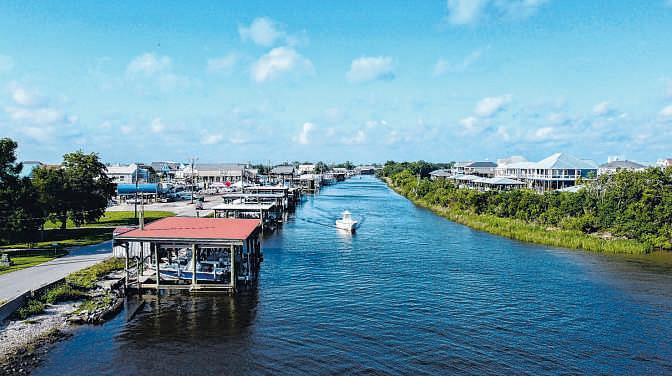
sea-levelrisethreatens away of life along the bayou near Campo’s Marina in shell
fearsone of the state’s ambitious projects toaddress it could put them out of business.
Seas will rise,but there’sroomfor optimism
AI fiction is thenew fast food
Three things you maynot know about me: Iam abig woman, 6foot 2inches in my stocking feet
My laugh is loud, if not to say piercing. And Inever apologize to furniture.
That’swhy Iidentified so strongly with Auntie Marsha, the hero from “The Serpent in the Grove,” one of five regional winners of the 2026 Commonwealth Short Story Prize.


“Big in the wayofwomen who never apologize to furniture,” the story tells us, “she had alaugh that shook dust from joists and avoice that could soften to coax achild from aledge.” I’m joking, of course. No one could possibly recognize themselves in this rococo garble. It reads as if the author had consumed abunch of novels and perhaps the Encyclopaedia Britannica, but somehow never interacted with humans in the real world.
Which maybethe truth.
While the author’snameislisted as Jamir Nazir, Pangram,anartificial intelligence detector with strong external validation, suggested the story was 100% AI-authored. When science fictionauthor James Yu ran the other stories through Pangram, he found that two of them also cameback as likely AI-written —wholly or substantially.They contain similarly almost-coherent metaphors.
The CommonwealthFoundation, which oversees theshort story competition, seemstobestanding by the prizewinners. Kelsey Piperhas an excellent essay explaining why“the agewhen youcan run aliterary magazine on trust is over.You can either decide AI submissionsare fine, or you can filter forthem.” Piper is right, and since Icannot improve on her conclusion, let me instead ask: Why should we care whether authors are carbon-based, ratherthansilicon?
Many writers and readers will assumethe answer is obvious. But if Pangram is correct, Commonwealth’sjudges, who were selected for their “expertise, passion for the literary community andstrong backgrounds in writing,” awarded amajority of their prizes to machine-written prose. If that’sthe case, presumably these certified experts rejected some human-written stories in favor of “AI slop” —asdid the many NewYork Timesreaders who preferredAI snippets to excerpts from award-winning writers in arecent blind test.
This suggests that many AI critics have it backward. If the proliferation of AI writing is aproblem, it’snot because it’sterrible slop unfit for human consumption; it’saproblem because in some specific ways, it’stoo good. It is the literary equivalent of fast food: convenient, cheap, hyper-consistent and relentlessly optimized to tickle our pleasure centers. Sure, AI produces some crazy metaphors and weird hallucinations, because the models have all of our text and none of our context. On the otherhand, AI is really good at optimizing for readability,both stylistically and structurally.AIfictiontends to be smoother,tighter and psychologically simplerthan its human-written counterparts, explicitly stating themes, constructing “single-track narratives with fewer loose ends” and portraying fewer morally ambiguous characters.
This describes the three AI-flagged storiesbut not the two identified as human-written. It also describes whatalot of people want from their fiction—possibly even some who pride themselves on their literary sophistication. After all, AI didn’tevolve this style by accident; it writes that waybecause that’swhathumanreaders rewarded. If so, one might argue that’s not aproblem for anyone except (she said nervously) professional writers. What’swrong with AI giving readers what they want?
Change’s Sixth Assessment Report projectsglobalmean sea-level rise of less than one meter by 2100. While those numbers are serious, they are afar cry away fromthe “inevitable” projections the paper treats as fait accompli.
Justin Callais


GUEsT CoLUMNIsT
Arecent study makes dramatic claims about our city and state, but the sciencedoes not back them up The paper published last month in Nature Sustainability madeheadlines with adire verdict about ourcityand state: “In paleo-climate terms, New Orleans is gone.” The study claims coastal Louisiana has already crossed a “point of no return,” and that some of our state’slargest cities Baton Rouge, Lafayette and New Orleans —will eventually become waterfront property as the Gulf encircles us. As aNew Orleanian andaneconomist who studies these kindsof claims for aliving, Iwanttooffer some pushback and reasonsfor optimism. This is not to deny that coastal Louisiana faces serious challenges, but bad science leads to bad policy, and our city deserves better than both.
The paper projects 3to 7meters (roughly 10 to 23 feet) of sea-level rise, pushing the shorelinemorethan 60 miles inland. That is an extremely wide range, and it corresponds to scenarios that even the most pessimistic projections cannot support. The Intergovernmental PanelonClimate
Thesedramatic numbers come from the Last Interglacial period (roughly 125,000 yearsago) when global sea levels were 5to9metershigher than today. Becausecurrent temperatures areapproaching comparable levels, they assume we face thesame outcome. But this ignores therate of change. The icesheet collapse unfolded over thousands of years.Applying that endpoint to near-term policy decisions is afar step.
Critically,the paper’sauthors acknowledge they have no timeline for whentheir projections would materialize.Remarkably,they frame this as a“strategic advantage,” arguing Louisiana shouldbegin managed depopulationnow.Inessence, they want the uprooting of morethan amillion people basedonprojections theycannotattach adate to The authorsshow net outmigration along Louisiana’scoast, and net in-migrationfor Florida’scoastas evidence of climate retreat. However underthose same3-to-7-meter projections, Florida’scoastwould sufferthe samefate.There are plenty of reasons
morepeople aremoving to Florida and leaving Louisiana, but if people were moving for climate retreat,the coast of Florida would not make sense. Perhaps mostfrustrating is that the authorstreat New Orleanians and coastalLouisianans as chesspieces to be relocated and implies thatany preventive measures are alostcause. But real solutions exist. The Dutch have battled theNorth Sea for centuries, but thesame projection from the authorsmeans that Amsterdam should be abandoned. Right here at home, companies like GlassHalf Full are turning recycled glass intosand to help rebuild our coastlines.There areinnovative, community-based approaches that deserve investment and attention Louisiana’s coast is not without problems. Subsidence and wetland loss are both important issues to take seriously.Solutions like restoration, smarterinfrastructure investment and honestcost-benefit analysis are crucial, instead of surrenderdressed up as science. New Orleans has survived floods, hurricanes and agreat deal else. Giving up on this cityand south Louisiana is not arealistic strategy
Justin Callais is chief economist at the Archbridge Institute and aNew Orleans resident.
Because as with fast food, what people want now isn’tnecessarily good for them in the long run. It would be badifnew reading materialmostly came from the same handful of models —akind of intellectual monocropping, if you will.
Those who are familiar with the Irish famine know why monocropping is dangerous: The populationof the island of Ireland still hasn’tfully rebounded from the potato blight that started in 1845and wipedout its staple crop, killing more than 1millionpeople and forcing as many as 2million to emigrate.
I’m not suggesting AI writing will result in mass death. I’m saying that just as it’sbettertocultivate avariety of crops than to rely on one highly productive species, it’sbetter to cultivate arange of ideas from different sources. When you go all in on onebig thing, you create asingle point of failure Intellectual monocropping is not solely an AI problem, of course (see the recent headlong institutional rush into social justice politics). However,despite the best efforts of totalitarian movements, humanity has always maintained ahealthy reserve of idiosyncratic thinkers. It would be ashame to lose that by ceding too muchofour cognitive work to machines, whichhave been trained on the same broadcorpus of human texts and tweaked to conform to the same narrow set of legal rules and culturalnorms.
That’sthe problem with AI fiction; when you’re taking aweighted average of prior humanwriting, without the leavening addition of personal experience, it’seasy to get something acceptable and hard to get something unforgettable. So, Ifear aworld where AI dominates fiction, think pieces and doctoral dissertations. We don’tneed human writers because AI offers us too many wild metaphors. We need human writers because AI provides too few wild ideas.

McArdle
egaM n


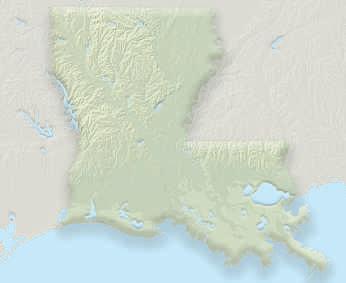


















In Brazil,Indigenouspractices reshapewildfirestrategy
BY GABRIELA SÁ PESSOA Associated Press
TOCANTINIA, Brazil Fire began crackling like approachingrainon arecent morning in theXerenteIndigenous Territory in Tocantinsin northern Brazil. Butthe Indigenous residents weren’tafraid and didn’t rush to put it out. The flames were intentional as part of awildfire prevention effort planned by the Xerente in coordination with environmentalofficials beforethe peak drymonthsofAugust and September
The Xerente live in the Cerrado, asavanna in central and northern Brazil. Every year,villages face the threat of large-scale forest fires, a dangerlikely to worsen with the arrival of El Niño, aphenomenon that prolongs droughtand pushes regional temperatures higher. After decades of experiencing prejudice, Indigenousleaders now coordinate with the government to applyancestralknowledge toprevent large wildfires. During the action, ajoint brigade of IBAMA,Brazil’senvironmental protectionagency, andtrained Indigenous people moved into the savanna. On the ground, part ofthe team used the traditionaltechnique of igniting fires with drip torches or dry palm leaves. Asmaller group dropped incendiary spheres from agovernment helicopter totargetmapped areas. If afire threatened to get out of control, crews intervened immediately.The result was apatchwork of burned areas across the savanna that should help protect the ecosystem in the months ahead
“They know the region, the climate, the vegetation, and the best times to set fires. We began seeking traditional knowledge, learning from them and adapting it to our objectives, aligning with their useoffire,”saidMarco Borges an IBAMA agentcoordinating fire prevention in Tocantins. “We’ve learned they are actually our best teachers.”
Brazilian officials long followed a“zero-fire” strategy,treatingany small burn as athreat to be quickly suppressed and banned under all circumstances. Over time, that approach fell out of favor and authorities began embracing new land
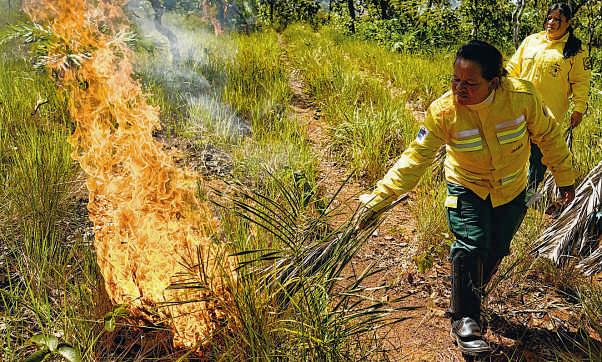
management approaches combining traditional knowledge with science. In 2014, the government began partnering with Indigenous communities on controlled burns.
Fire is part of thenatural evolution of savanna forests likethe Cerradoand several species benefit from periodicburns, saidLeandroMaracahipes, abiologist and Yale University researcher Fires historically have occurred naturally,sparked by lightning, at the startofthe rainy season between October and April.But human activity has led to more destructivefires during the peak drought months of August and Septemberthat often arelinked to pasture clearing near Xerenteterritory,whichissurrounded by soy and cattle farms. In the early dryseason, when vegetation isn’tyet fullyarid, small controlled burns help reduce flammablegrass buildup. Theseburn areas createbarriers around villages, headwaters and sensitive sites, protecting them from wildfiresduring peak drought.
“Totally excluding fire leads to abuildup of fuel that feeds high-
intensity burns. Such fires can kill evenresilient treesand make firefighting nearly impossible as flames spread rapidly acrossthe landscape, including into forests,” Maracahipes said.
Whenofficial vehicles arrived in Xerente territory tobegin their work, about 30 Indigenous people stood waiting, lined up at awoodand-thatch tentusedasthe people’sassociation headquarters. They formed twoparallel lines, creatinga corridor.Onthe left,a group wore officialfire brigade uniforms:brightyellowshirts, green pantsand protective boots. On theright stood mostly shirtless men, their bodies markedwith traditional painted patterns, some wearingshoes andothers with flip-flops. Facing each other,they chanted traditional songs,stomping their feet in rhythm.
At theend of the corridor,Chief LazaroXerente, 68, the eldest leaderofhis people, waited, also shirtless withhis torso painted, wearinga feathered headdress. He thanked officials for their presence, but also expressed concern. “People say,‘Oh, it’s the Indige-
nous people who are causing fires,’ when in fact, since Iwas born, and long before me,myancestors have always protected theforest,” he said in his native language with translation by Bolivar Rodrigues Xerente of Brazil’sIndigenous affairs agency FUNAI.
After major fires make headlines, out-of-context images of Indigenous people often circulate on socialmedia in Brazil, falsely blaming them and officials forthe destruction.Inreality,every burn is carefully planned by fire departments
The operation began with teams gatheredarounda longwooden table inside atenttomap outthe day’sburns, combining satellite data with Indigenous knowledge of the territory to identify areas requiring management.
SomeXerente werehired by the governmentfor two-year terms andreceive training anda monthly salary,while others serve as volunteers. The efforts are partly funded through apartnership between Bunge Foundation and IBAMA to support training and equipment for up to 40 Indigenous brigades
across five states in the Cerrado and the Amazon. In regions like the Cerrado and the Amazon, El Niño usually brings highertemperatures and prolongeddrought, creating conditions that allow wildfires to thrive. During themostrecenteventfrom 2023 to 2024, Brazil saw historic firesthatburnedmorethan76.1 million acres in 2024, an area larger than Italy, according to MapBiomas,anonprofit that tracks deforestation and fire. The Amazonwas hardest hit, accounting for nearly 60% of the burned area. The Cerrado ranked second with almost 24.7 million acres affected.
Brazil’sEnvironment Ministry said that it has tracked El Niño impacts since early this year,deploying morethan 4,000 brigade members nationwide. Under President Luiz Inácio Lula da Silva, the government established anational fire management policy in 2024 to coordinate authorities and civil society,including the use of controlled burns with Indigenous communities.
Humidity hasa dampening effect on wildfires, whichnormally helps protect the Amazon.
“However,inextremeyears like the approaching El Niño, tropical forests become moresusceptible to fire,” Maracahipes said, adding that the Amazon should remain protected by azero-fire policy But in the Cerrado, fireisaneffective land management tool.
“Whenappliedwithtechnical expertise, fire can significantly contributetoenvironmental conservation,” said André Lima, secretary fordeforestation control and landuse planning at the Ministry of the Environment. “In prescribed or controlledburns foragricultural production, forexample, it can help prevent major disasters.”
Bolivar Rodrigues Xerente of FUNAI said that his Indigenous elders have taught him that traditional knowledge and modern scienceare like thetwo wings of abird.
“A bird with twowings can navigate the wind,but with only one wing, it can’t,” he said. “Technology,without traditional knowledge in the Indigenous communities, doesn’twork.”
AssoCIATED PREss PHoToByANDRE PENNER
Xerente Indigenous people, partofa fire brigade formed by women, ignite fires in Mayaspartofacontrolled burnwithdry palmleavesduring a fire prevention operation along withBrazil’senvironmental protection agency at theXerente territory, near Tocantinia, Tocantins state, Brazil.

With NyCbuzzing,Knicks,
BY BRIAN MAHONEY
AP basketball writer
NEW YORK Madison Square Garden has seen just about everything in sports and entertainment,from the first Muhammad Ali-Joe Frazierfight to the first Wrestlemania
It just hasn’tseen much of the NBA Finals.
The New York Knicks have brought the finals back to their home court for the firsttimesince 1999 andcan make sure they don’tleave again this year.Fans are spending astonishingly high prices for ticketsand the potential to witness acelebration more than five decades in the making.
With a2-0 leadover Victor Wembanyama andthe San Antonio Spurs, theKnicks are halfwaytotheir first championship since 1973. They arethe biggestthing in the Big Apple, and it seems everyoneiscaught up in the hoopla except theKnicks themselves
“I know the fanbase is really excited, as theyshould be,” captainJalen Brunson said. “Butasateam, us inside the locker room, we have morework to do.” Game 3isMonday,withPresident Donald Trump in the building. Whether they’veplayed in the arena or satway up in the cheap seats—not that there is such athing this time, with tickets reselling for more than $10,000 —people know this night will be different.
“I thinkit’sgoing to be through theroof,” Spurs guard DylanHarper said. “I thinkit’sgoing to be everything that I’ve kind of seen or dreamed of times 10.” It will be thefirst NBAFinals game at Madison Square Garden since June 25, 1999, which ended with the Knicks watching the Spurscelebrate their first championship after winning Game 5. Thatseries, andone in 1994, werethe only finals games
ä see NBA, page 5B
Legacy Bowl relocating to Atlanta
BY RODWALKER staff writer
After afive-year run in New Orleans, the Allstate HBCU Legacy Bowl hasfound a new home. The Legacy Bowl, apostseason college football all-stargame fordraft-eligible players from Historically Black Colleges and Universities, is relocating to Atlanta. Doug Williams,the legendaryGrambling quarterbackand SuperBowlXXIIMostValuable Player,helped start the game in 2022.
“Atlanta represents tremendous growth and opportunity for the Allstate HBCU Legacy Bowl and the young people we serve,” Williams said in astatement released on Friday. “Webelieve this next chapter will elevate the experience forour students, fans, partners, andNFL scouts while continuing to honor the proudtraditions and lasting impact of HBCU football.”
The game was played at Tulane’sYulman Stadium forthe first five years.
The2027 gamewill be playedonFeb. 27 at Center Parc Stadium in Atlanta and will air live on the NFLNetwork.
Williams started the game with James “Shack” Harris, also aformer NFLquarterback whoplayed at Grambling.
ä see LEGACY, page 3B
PRoVIDED PHoToByLsU ATHLETICs Team UsA guard Mikaylah Williams looks to takeashot during aquarterfinal game on saturday in the FIBA 3x3 WorldCup. Williams scored the game-winning shot in sunday’s winoverAustralia.
lock step as they crossed the past 20 finish lines together
“We’ve done Mount Rainier,Mount Rushmore, Yellowstone, Grand Teton,” Pam said. “If Bubba was close to any famoussportsfield, he would want to see it.”


Love of running got Pam andher husband Wayne “Bubba” Begnaudcompeting in half marathons all across theUnited States. Love has kept her going— on herown. Severalyears ago, the Lafayette couple set agoal: they would compete in 50 half marathons in all50 states. “We’d donehalf marathons in Louisianaand Texas,” Pam said. “Bubbastarted about 10 years agoand I joined in aboutfive years ago. “Wewere running in the LittleRock marathonand IsaidI’d seenpeople who’drun in all 50 states. It blossomedfrom there.” At first,Bubba, able to maintain afaster pace, would run ahead, complete his 13.1 miles and come back to find Pamsothey could cross the finish linetogether.Eventually,his bad knees and her pace found a
Ahalf marathon this past Oct. 19 in Des Moines, Iowa, marked their 48th state. That left just Hawaii and Nebraska to be checked off their list. Unfortunately,Des Moines was the end of their racing journey together
On Nov.6,asthey were preparing to run in Lincoln, Nebraska, Bubba Begnaud died in his sleep at 66. An autopsy eventually revealed he diedofventricular fibrillation, a deadlycondition when the heart stops pumping blood normally
“He was an organ donor in Nebraska andLouisiana,” Pam said.
“It took two weeks to get his body back. Iwanted an autopsy.Noone could tell me (at first) what happened to my very healthy husband. It took aboutamonth.
“Looking back,” Pam said, her voice

see RABALAIS, page 3B
BY REED DARCEY staff writer
LSUwomen’s basketball starsMikaylah Williams and MiLaysiaFulwileyhelped Team USAwin agoldmedal Sunday at the 2026 FIBA 3×3World Cup in Poland. Williams and Fulwiley —two rising senior guards whoearned spots on the U.S. 3×3nationalteam alongside South Carolina’s Joyce Edwards and Oklahoma’sSahara Williams —secured the first-place finish by beating Australia 21-20 in the final. Williamshit the game-sealing shot, whileFulwiley scored a team-high nine points.
“I’m just blessed,” Williamssaid in her postgame interview.“I’m blessed to be on this stage, to play with someamazing teammates, to play for some amazing coaches and to rep USA.
“We’re young. Ithink we’re the youngest team in thetournament, andwecame in here with achip on our shoulder.” The win capped adominant run for the group,whichhas nowtaken 18 of
Pamand Bubba Begnaud runa half marathon on oct. 19 in Des Moines, Iowa. It was the last time they ran arace together PRoVIDED PHoTo
Zverev wins French Open for first Slam
BY ANDREW DAMPF Associated Press
PARIS Alexander Zverev is no longer one of the best players never to win a major title.
He’s finally a Grand Slam champion. In his fourth major final, Zverev beat Flavio Cobolli 6-1, 4-6, 6-4, 6-7 (5), 6-1 for the French Open title on Sunday It was a unique opportunity for Zverev without Jannik Sinner or Carlos Alcaraz across the net and the third-ranked German took full advantage on the red clay of Roland Garros.
When Cobolli missed an overhand on the second championship point after more than four hours of the five-set encounter, Zverev dropped on his back to the clay and covered his face with his hands as he began sobbing. When he got up, with his shirt and arms covered in clay, Zverev put his hands back on his face before he lifted both arms in celebration.
When Zverev was handed the Coupe des Mousquetaires trophy, he lifted it with both hands and let out a liberating roar
“This court is so special to me in so many ways. I’ve had the best moments of my life on this court; I had the worst moment of my life on these courts,” Zverev said, referring to when he was injured and pushed off on a wheelchair during a semifinal against Rafael Nadal in 2022.
“I was laying in that corner over there four years ago with seven broken ligaments and two fractured bones,” Zverev said. “I lost a Grand Slam final here two years ago but now finally it’s a happy end.”
Zverev has now joined an elite group of players that captured their first major in their fourth final: Eight-time major champion Andre Agassi, 2001 Wimbledon winner Goran Ivanisevic and 2020 U.S. Open champion Dominic Thiem.
No Sinner or Alcaraz
Zverev had been an overwhelming favorite for the title ever since the top-ranked Sinner struggled in the first week’s heat wave and wasted a two-set and 5-1 lead against Juan Manuel Cerundolo in the second round. A day later, 24time Grand Slam champion Novak Djokovic was also eliminated. Alcaraz, the two-time reigning

champion, withdrew before the tournament with an injured right wrist.
It was Zverev’s second French Open final, having wasted a lead of two sets to one against Alcaraz in the 2024 championship match.
Zverev had an even bigger advantage two sets to none in the 2020 U.S. Open final and lost that one, too, to Thiem He was also beaten in straight sets by Sinner in the 2025 Australian Open final
It was the 25th title of Zverev’s career
Cobolli’s first Slam final
The 14th-ranked Cobolli had never been past a Grand Slam quarterfinal until this week. He was attempting to become the first Italian man to raise the singles trophy at Roland Garros since Adriano Panatta 50 years ago.
Cobolli comes from the same tennis club in Rome as Panatta did, and Panatta was asked by tournament organizers to present the trophy to the champion to celebrate the anniversary of his 1976 triumph. The honors, however, went to Zverev
Russian teenager Mirra Andreeva won the women’s singles trophy on Saturday.
Zverev took control early on
The match was played in perfect conditions, and Zverev’s game was almost flawless at the start.
Zverev broke Cobolli’s serve in a long opening game when Cobolli shanked a forehand into the first row of the stands. The break came after Zverev had a bit of luck when a backhand return hit the net but dribbled over on game point for Cobolli. A group of women in the stands held up letters to form Zverev’s nickname: “Sascha.”
Cobolli likes to stand way over near the corner of the court and hit big kick serves out wide into the ad court. Zverev knew what was coming and returned one such kick serve early in the first set with a backhand that he wrapped around the outside of the net post. Cobolli ended up winning the point, but it was a message from Zverev that he knew how to handle his opponent’s tactics.
The next time Zverev hit a wrap-around-the-net-post return, Cobolli couldn’t handle it and
Zverev won the point.
Cobolli’s supporters in his box were all dressed in blue, the color of Italy’s national teams, and as Cobolli worked his way back into the match, there were chants of “Ole, Ole, Ole; Flavio, Flavio.”
After Zverev held for a 6-5 lead in the fourth, he had his upper right leg treated by a trainer
Then Zverev wasted a 3-1 lead in the tiebreaker which Cobolli concluded with a forehand winner up the line that produced a roar from the crowd
But Cobolli appeared to run out of energy in the fifth, running down a drop shot only for Zverev to then pass him up the line for a 3-0 lead and a double break.
Abuse allegations
Moments after Zverev’s previous Grand Slam final in Australia in 2025, a person in the stadium yelled out the names of two of his ex-girlfriends who accused him of physical abuse.
One case was resolved following an agreement between German prosecutors, lawyers for Zverev and his former partner The ATP Tour investigated another case and concluded there was insufficient evidence.
Poston loses 4-shot lead but rallies to win Memorial
BY DOUG FERGUSON Associated Press
DUBLIN, Ohio J.T Poston built a four-shot lead Sunday morning in the rain-delayed Memorial and won the biggest tournament of his career It just turned out to be a lot more work than he would have imagined.
Poston, who lost his lead after 12 holes, made a 7-foot birdie putt on the 18th hole to salvage an even-par 72 and force a playoff with Ryan Gerard, and then won on the second extra hole when Gerard missed a 6-foot par putt. Gerard made a 40-foot birdie putt on the 17th hole to briefly take the lead, closed with a 68 and didn’t really make a mistake over the final four hours until the final putt. So ended the longest day for both of them — 33 holes, including 13 in the morning to complete the third round and two playoff holes. But what a payoff for Poston in so many ways. He had not finished in the top 20 in his previous 13 tournaments this year And then he delivered the goods and celebrated with a handshake with tournament host Jack Nicklaus.
“A lot of holes, a lot of grit,”
Poston said. “Obviously didn’t play my best first 12, 13 holes, but I told myself I knew I was going to shake Jack’s hand walking off 18, and I wanted to be proud of that handshake regardless of how it turned out. So I’m thrilled it happened this way.” The perks went beyond the $4 million prize. Poston earned a spot in the next three majors with one great week — high enough in the world ranking to avoid a 36hole qualifier Monday for the U.S. Open, the one British Open spot
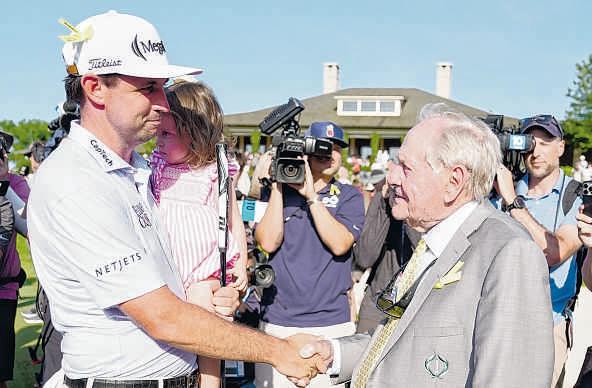
available this week, and a return to the Masters. They finished at 12-under 276 after Poston and Gerard pulled away from what had been a fiveway tie for the lead with an hour to go in the tournament. Tommy Fleetwood drilled a fairway metal to 5 feet for eagle on the par-5 15th. Wyndham Clark made a late surge. Former LSU golfer Sam Burns was never too far behind. All of them were at 11 under heading to the final few holes. Clark, who made birdie on the 16th to reach 11 under, closed with two pars for a 67. He wound up alone in third, one shot out of the playoff. Fleetwood hit into the rough with his first three shots on the 17th and had to scramble for bogey He shot 68. Burns also missed the 17th fairway, and his next shot tumbled back down the rough and settled on the bridge over a small creek. He hit that to 40 feet, and his long par putt peeked into the cup and somehow stayed out. A 10-foot birdie putt on the 18th narrowly missed. He shot 69 and tie for fourth with Fleetwood. Scottie Scheffler, trying to join Tiger Woods with a third straight victory at the Memorial, was never in the mix for so much of the week He closed with a 71
and tied for 12th, but felt he did enough right over the weekend that his game was headed in the right direction. His next stop is the U.S. Open, where a victory would give him the career Grand Slam. Rory McIlroy is now 0 for 14 at the Memorial. He birdied his first three holes before getting caught in dense rough that slowed his momentum. He shot 68 and tied for 12th. Two storm stoppages Saturday led to the marathon Sunday Poston did some of his best work in the morning, running off three straight birdies on the back nine for a 69 for a four-shot lead.
Korda wins U.S. Women’s Open with perilous putt
LOS ANGELES Nelly Korda won the 81st U.S. Women’s Open on Sunday for her second consecutive major victory, holding off Charley Hull and Gaby Lopez by one shot when her final 21/2-foot par putt curled perilously around the cup and finally dropped in.
Korda’s first U.S. Open win is the fourth major victory of her career, and she claimed it with a steady 2-under 69 in the final round — but only after her second putt on the 18th green caught the left edge and toured half the circumference of the hole before dropping. The top-ranked Korda put her hand over her open mouth in disbelief before finally laughing. She finished at 8-under 269 after sharing the lead throughout the windy finale of the first Women’s Open ever held at 100-year-old Riviera.
Fan-favorite broadcaster, former Bull King dies at 59
CHICAGO Stacey King, who played on three consecutive NBA championship teams with the Chicago Bulls from 1991-93 before returning to the organization as an Emmy-winning, fan-favorite broadcaster, has died. He was 59.
The Bulls announced that King died Sunday and said they were notified by a family member No other details were available.
King began his NBA playing career with the Bulls, who selected the 6-foot-11 forward/center out of Oklahoma with the sixth overall pick in the 1989 draft He averaged 6.6 points and 3.3 rebounds over his five seasons with the Bulls. He also played for Minnesota, Miami, Boston and Dallas. As a broadcaster, King spent more than two decades as a commentator on Bulls games.
Hatton holds on to win his second LIV Golf title
SOTOGRANDE,Spain Tyrrell Hatton had two late birdies to hold off Jon Rahm and close with a 1-under 71, giving him a two-shot victory in LIV Golf Andalucia for his second title in the league.
Hatton’s other victory came in 2024 in Nashville, Tennessee. Rahm closed with a 67 to finish alone in second and keep his place atop the points standings on LIV Golf, which now is off for nearly two months. Abraham Ancer (68) finished third, while Sergio Garcia played the back nine with one bogey and no birdies for a 70 to finish fourth.
Joaquin Niemann stayed third in the points standings to earn a spot in the British Open Thomas Detry had three early bogeys and never recovered, closing with a 74.
McDavid ties Gretzky with fifth Lindsay Award honor NEW YORK Connor McDavid of the Edmonton Oilers has won the Ted Lindsay Award as the NHL’s most outstanding player as voted by his peers. The league and the Players’ Association announced the honor Sunday This is the fifth time McDavid has won it, tying Wayne Gretzky for the most in league history for the trophy, which used to be named for Lester B. Pearson. McDavid, 29, led all scorers this past season with 90 assists and 138 points. San Jose’s Macklin Celebrini and Tampa Bay’s Nikita Kucherov were second and third in voting by members of the NHLPA McDavid is also a Hart Trophy finalist for league MVP
Texas Tech’s appeal for Sorsby reportedly denied Texas Tech’s appeal to the NCAA to have Brendan Sorsby’s eligibility reinstated has been denied, in a ruling that is separate from the transfer quarterback’s lawsuit against that same governing body
A person with knowledge of the NCAA’s decision told The Associated Press on Friday night that the NCAA for the second time denied Texas Tech’s petition to restore the quarterback’s eligibility He was ruled ineligible after he acknowledged gambling on sports, including on his own team while at Indiana. That came while the NCAA and Sorsby were still waiting for a ruling from a Texas judge after the quarterback filed a lawsuit May 18 seeking a temporary injunction against the NCAA in hopes of playing this season for the Red Raiders.
AssoCIATED PREss PHoTo By CHRIsToPHE ENA
Alexander Zverev hugs the trophy after winning the men’s final match against Flavio Cobolli on sunday at the French open in Paris.
AssoCIATED PREss PHoTo By sUE oGRoCKI
J.T. Poston shakes hands with golf legend Jack Nicklaus after winning the Memorial on sunday in Dublin, ohio.

Antonelli extends his win streak in Monaco
was a beast today.”
Hamlin dedicates victory at Michigan to Busch
By The Associated Press
BROOKLYN, Mich. — There were no boos for Denny Hamlin after this winning burnout at Michigan International Speedway
Holding a black No. 18 flag out the window the Joe Gibbs Racing star celebrated his 63rd career victory by smoking the tires of his No. 11 Toyota down the straightaway in honor of Kyle Busch, his late teammate whom he tied for ninth on the all-time win list in the NASCAR Cup Series.
“Truthfully, I had to outlive him to tie him,” said Hamlin, who radioed “We love you, KB” on his victory lap. “He was an amazing teammate. He taught me so much at tracks like this. I just can’t say enough.”

By The Associated Press
MONACO Kimi Antonelli is writ-
ing his place in Formula 1 history at record speed.
“You’re catching me up,” Lewis Hamilton, who has the most wins in history with 105, told Antonelli after the 19-year-old Italian beat him in a bizarre and much-delayed Monaco Grand Prix on Sunday
Antonelli replaced Hamilton at Mercedes last year, and only won his first race in March. He now has five wins in a row and a vast lead of 66 points over Hamilton, who was second Sunday
“He’s only 19, so just imagine what the future holds for him, but I’m going to do my best to try and chase him down for the rest of the year,” Hamilton said. “It’s a real privilege to witness it.”
Antonelli said he needed to find his focus again but stayed cool when the race was stopped and briefly seemed set to be abandoned before a restart. All that on a tight, twisty circuit threaded between metal barriers where any slip brings a crash.
An uncertain restart
Antonelli was on course for victory with 10 laps remaining when the race was red-flagged after parts of the asphalt broke away and two cars crashed in quick succession, one of them Charles Leclerc in third place.
After a long delay, officials said the race would be resumed from a standing start. When that happened, Antonelli took control again to become the youngest F1 winner in Monaco and was never in real danger of being overtaken.
“Thank you so much guys,” he told the Mercedes team. “The car
Isack Hadjar was confirmed third for Red Bull after battling engine problems and seeing off an investigation
Antonelli’s Mercedes teammate
George Russell missed the points for the second race running, dropping out of the top 10 with a penalty That followed an engine failure while battling Antonelli for the lead of last month’s Canadian Grand Prix.
Russell said Thursday the title was Antonelli’s “to lose.” Now it certainly seems that way
Max Verstappen started second for Red Bull but lost power at the start and dropped to the back before retiring the car at the end of the first lap. Like many F1 drivers, the four-time champion lives in Monaco and suggested he’d watch the rest of the race from home.
Hamilton’s turnaround
Hamilton was in a jubilant mood after placing second. The seven-time champion paid tribute to Ferrari team principal Fred Vasseur for his role in turning around Hamilton and the team’s fortunes
“Fred has been awesome in supporting me. I think last year was really tough for both of us,” said Hamilton, adding that he was “seeing the fruits” of changes which Vasseur implemented. Hamilton wasn’t on the podium in any Grand Prix in all of 2025 in his first year with the team.
Vasseur was back at the track with Ferrari on Sunday after he missed Saturday’s qualifying session. The team said he had been under observation at a medical facility without giving any further details of his condition.

sTAFF FILE PHoTo By sCoTT THRELKELD
Gaither’s Quinton Williams fakes a handoff to Latrell Collier during the first half of the HBCU Legacy Bowl on Feb 24, 2024, at yulman stadium.
Continued from page 1B
The purpose of the game is to give more players from HBCUs a chance to showcase their skills in front of NFL scouts. The number of players from HBCUs has declined drastically since the days when Williams and Harris played There were no players from HBCUs drafted in April. Carson Vinson, an offensive tackle from Alabama A&M, was selected in the fifth round of the 2025 draft by the Baltimore Ravens
“Everybody doesn’t get the opportunity that I had,” Williams said back in 2021 when the game was first announced. “We understand why that is. It’s because of what has transpired over the years from a recruiting standpoint, where most people think all the top players go to Power Five schools. Let’s be honest: It’s true. But I still think there are some diamonds that are being missed.” The game’s goal is to make sure those diamonds continue to be found. Pro coaches get to attend practices the week leading up to
the game, similar to what happens at the Senior Bowl. The week also featured a combine for players at the New Orleans Saints’ practice facility
“This type of exposure will at least make sure teams get a chance to see the athletic ability and watch them compete against each other,” Harris said. “The teams can work them out and see them up close and personal. It’s all about the opportunity.”
The game includes a career fair that gives students from HBCUs a chance to find jobs in various areas. Students from the local university — Xavier, Dillard and UNO — were frequent attendees at the event. Now the event moves to Atlanta, a city that calls HBCUs like Morehouse, Spelman and Clark and Morris Brown home.
“Atlanta’s national visibility, strong corporate community, thriving HBCU alumni base, and world-class event infrastructure make it an ideal destination for the game and its surrounding week of programming,” Legacy Bowl officials said in a statement.
Email Rod Walker at rwalker@ theadvocate.com
It was the second consecutive victory for Hamlin and his second consecutive win at Michigan, where he celebrated last year by taunting fans who booed him.
But there were only raucous cheers from the front-stretch grandstands Sunday as Hamlin jogged up to the flag stand to get the checkered flag while still carrying his Busch tribute flag.
Busch drove the No 18 from 2008-22 for Gibbs, teaming up with Hamlin for a NASCARrecord 523 races. Busch’s death on May 21 rocked the NASCAR world, which was already grieving over the offseason deaths of Greg Biffle and his family in a plane crash. Hamlin’s father also died in a Dec. 28 house fire.
Noting that Hall of Famer Ned Jarrett also died last week, Hamlin dedicated his third win this season to Busch and his family
“The offseason, it was rough for me, and it was rough for the NASCAR family,” Hamlin said. “Just an unbelievable feeling to be able to strap in every week, and I don’t take it for granted, this opportunity that I’m in. I just love we’re making the best of it.”
Just like last week’s win at Nashville Superspeedway when the Joe Gibbs Racing car started on the pole position but was penalized for jumping the start, Hamlin qualified first at Michigan but dropped to the back at the green flag because of a penalty for unapproved adjustments to his No. 11 Toyota.
Hamlin patiently worked his way to the front over 400 miles. He took the lead for good on a three-wide pass during a restart with 38 laps remaining, sweeping into first around Spire Rac-
RABALAIS
Continued from page 1B
quavering, “I’m so grateful what we were able to accomplish and the time we were able to spend together.”
The question soon became how Pam, who retired from her job as a radio station market manager in Lafayette for Townsquare Media at the end of 2024, would spend her time. How she would find something to fill her days, and that unfillable void, in her life.
“When I came back, I wanted to quit running,” Pam said. “I was done.”
Still, plans had already been made for Pam and Bubba to run in Hawaii, their 49th state, in January
After much thought, Pam decided to go. To complete another important milepost on their quest.
Accompanied by two of their three children, Jaden and Anais, Pam made the solemn but determined trip across the Pacific On Jan. 18, she ran the Maui Oceanfront Marathon.
Race organizers awarded a medal, posthumously, to Bubba.
“They said he finished his race,” Pam said. That still left one race to go to complete the 50. One in Nebraska. Pam couldn’t bring herself to go back to Lincoln, where Bubba died, so she found another event.
On May 11, Pam ran in South Sioux City, Nebraska, surrounded by the racing friends she and Bubba made through all their trips around the country
Would this be the end of Pam’s running journey? She decided it was not. Soon, Begnaud set off on a quest to complete 100 half marathons through a racing company she and Bubba worked with called Mainly Marathons. Runners who reach the 100-event mark get recognized as being part of the 50-state
ing teammates Daniel Suarez and Carson Hocevar a home-state favorite.
Hamlin won by 11.110 seconds, his widest margin of victory in Cup and the largest win at Michigan since June 1991.
“This Joe Gibbs team just keeps giving me amazing race cars,” Hamlin said. “This Toyota was just amazing. And at the last run there, it just hammered down. It had a few good restarts, and then once we got to the lead, I was going to lay it out.”
Erik Jones, another Michigan native, finished second after also starting from the rear for unapproved adjustments Bubba Wallace was a season-best third followed by Kyle Larson and Hocevar, who notched his best Michigan finish.
“I don’t think anyone was going to contend with Denny at the end,” Larson said. “He was flying.”
Crash causes red
The race was stopped with 51 laps remaining to repair a damaged SAFER barrier after a hard crash involving Christopher Bell and Chase Elliott.
During a restart on the 148th lap, the drivers were running side by side for second. Elliott’s No. 9 Chevrolet bobbled and skidded up the track into Bell’s No. 20 Toyota, which shot into the outside wall at the 2-mile oval where speeds top 200 mph.
The impact with Bell’s Camry severely deformed the SAFER barrier, which is comprised of steel and foam to absorb energy in wrecks. A red flag was displayed for 20 minutes to fix the damaged
section of the barrier
Both drivers climbed from their cars and walked to an ambulance for a trip to the track’s infield care center Team owner Joe Gibbs said after the race that Bell had wrist and ankle injuries that would need to be evaluated this week.
Elliott patted Bell on the shoulder and apologized for the wreck before they entered the ambulance.
“I’m fine; it was totally my fault,” Elliott said. “I feel really bad for Bell, just taking him out. I was trying to run on the bottom and make use of our fresh tires and at least get to second and hopefully stay side by side with him. I got in there and got free and thought I was going to spin and was committing to spin out, and as soon as I started to commit to spinning, it just hooked up and hooked a right. Unfortunately, it sent Christopher into the wall super hard, and then me shortly there behind.
“Just racing really hard. I felt like that was kind of a turning point in the race. We needed to make something happen. I stepped over the line again and paid for it. I just told him I’m sorry Obviously, it was not on purpose.”
Rough rookie season
A nightmarish debut season in the Cup Series continued for Connor Zilisch, who crashed twice in the first eight laps and finished last in the 37-car field. The Trackhouse Racing driver has finished outside the top 30 the past three races and is still seeking the first top 10 of his rookie campaign.

marathon half-marathon club.
“I know this is what he would want me to do,” Begnaud said.
“To keep busy I’m not sitting on a sofa crying 24/7. I’ve talked to other widows who said they’re no better off than when their husband died. I couldn’t do that.”
Pam is currently in the midst of her race to 100, taking on back-to-back racing series in the northeast, a total of 11 races in 11 days. She started Wednesday in Bear, Delaware, then ran through Maryland, Pennsylvania and New Jersey Sunday found Begnaud running in Montgomery, New York. If all goes as scheduled, after events this week in Connecticut, Rhode Island, Massachusetts, Vermont and New Hampshire, Begnaud will run her 100th race this coming Saturday in Sanford, Maine
“It’s pretty much rinse and repeat,” Begnaud said. “Run, take a shower, grab your luggage, drive to the next state. It’s ‘Groundhog Day’ every day.”
She runs alone now, but then again, not really Not with all the running friends Pam and Bubba made over the years. Not with all the memories.
“They’re like a family,” Pam
said earlier this week. “I went to packet pickup today and everyone knew I lost my husband. That he was a runner They’re kind, like-minded people.”
“No doubt” Bubba would want Pam to keep going, she said. She’s living his favorite phrase:
“I got it.”
“That’s the only reason I’m doing it,” Begnaud said. “To honor him. I know he’s watching.” If her words remind you a bit of “Forrest Gump,” you’d be right. Once in a race near the Four Corners of Arizona, Colorado, New Mexico and Utah, Pam and Bubba trekked down a highway traveled by Tom Hanks’ character in the famous movie as he thinks of his beloved Jenny
“I know this is where I feel closest to him,” Pam said. After Maine, what’s next? Begnaud hasn’t decided, just that she plans to keep running. For herself. For Bubba.
“He’s still running right beside Pam,” David Clark, a fellow runner, said at a gathering back in January in Hawaii.
Love doesn’t have to end with the grave. It certainly doesn’t end at the finish line of a race
PRoVIDED
PHoTo
Pam Begnaud, holding a photo, celebrates after running her 50th half marathon in 50 states with running friends on May 11 in south sioux City Neb
AssoCIATED PREss PHoTo By FATIMA sHBAIR
Mercedes driver Kimi Antonelli smiles after winning the Formula 1 Monaco Grand Prix race on sunday in Monte Carlo, Monaco.
AssoCIATED PREss PHoTo By PAUL sANCyA
Denny Hamlin celebrates winning a NAsCAR Cup series race on sunday at Michigan International speedway in Brooklyn, Mich.



WORLDCUP 2026


USMNTfeeling confident heading into WorldCup
BY JAYCOHEN AP sportswriter
CHICAGO Antonee Robinson
AssoCIATED PREss PHoTo By GREGoRyBULL
sunday in Tijuana, Mexico.
Iraniansoccerteam arrivesinMexico
severalmembers of Iran’s entouragestill lack U.s. visas
Associated Press
TIJUANA, Mexico Irandefender
Ehsan Hajsafi criticized soccer’s governing body after the team arrived in Mexico on Sundaywith some members of their entourage still lacking U.S. visas, before three World Cup group matches in theUnitedStateslater this month.
The team’sparticipation in the WorldCup,jointly hosted by the United States, Mexico andCanada, has been complicated by the Iran war.Problems with processing visas earlier led Iran tomove its training base from Tucson, Arizona, to Tijuana, Mexico, which is on the border with California.
“First of all, we’re veryhappy that the team has finally arrived, and we’re delighted about that,” Hajsafi said. “Thank God, the team’scondition is very good
“With everything that happened, visas were eventually issued. Personally,however,I do have acomplaint about FIFA Why did it take so long? As far as Iunderstand, visaswereissued only to the players and afew members of the coaching staff.”
Some membersofIran’sentourage are still without U.S. visas before games in Los Angeles and Seattle. Those includethe Iranian Football Federation’s secretary-general, Hedayat Mombeini, and its vice president, Mehdi Mohammad Nabi.
“Unfortunately,several key
members of our coachingstaff, whose roles are very important within the team,were notgranted visas,” Hajsafi said. “Thatincludes the team manager,the executive director and the media director
“From here, Iwould like to ask FIFAtoaddress this issue so that, God willing, thesituation can be resolved in the coming days.”
Iran hadbeentraininginthe Turkish city of Antalya. The team flew directly to Tijuana,Mexico, which is just south of San Diego, on aprivate jet from the Mediterranean city’sairport.
Hajsafi was the first player to exit theplanewith markings for German charter airline USC, whicharrived at about 5:05 a.m.
He ledthe team, dressed in blue blazers over whiteT-shirts, through abrief security check with Mexican officials anddogs before boardinga bus.
Thebus stopped brieflyatthe entrance to the Tijuana airport, where around 20 or so Iran fans waved flags.
Iran plays its first two games in Inglewood, California, against NewZealandonJune 15, andBelgium six days later,then heads to Seattle to face Egypt on June 26. Iran and the U.S. could meet in the round of 32 on July 3in Arlington, Texas, if both teams comesecondintheir groups.
In March, U.S. President Donald Trump had discouraged Iran from participatinginthe tournament, saying he didn’tthink it was “appropriate”and raising concerns over players’ “life and safety.”
Aday later,Iran’snationalteam pushed back, saying “no onecan exclude” it from playing.
struckthe ball perfectly with his left foot, and it rocketedinto the corner of the goal. Surroundedby adelirious sellout crowd at Soldier Field, the defender celebrated with acartwheel and abackflip.
Not abad way to go into the World Cup.
Robinson’sspectacular goal was the biggest highlight for the United States in a2-1 loss to Germany on Saturday.Itwas the ninth consecutive loss for the U.S. against European opponents dating to 2022, but the Americans wereencouraged by their performance in their final World Cup tuneup.
“I mean against areally good team,I thought we were dangerous at times,” forward Christian Pulisic said. “Wehad good stretches of possession,defendedwell for good portions of it.And, yeah, Imean honestly,I think, we’refeeling good.”
Members of the 1994 U.S.team were recognized on thefield before thegame.
Coach Mauricio Pochettino started what figurestobecloseto hisWorldCup lineup, with Matt Freese in goal,Sergiño Dest at right back, Alex Freeman, Miles Robinsonand TimReam in central defense, Antonee Robinson at left back, Tyler Adams and Malik Tillman in defensive midfield,Pulisic and Weston McKennie in advanced midfield andFolarin Balogun up front.
The U.S. played without top defender ChrisRichards, sidelined since tearing apair of left ankle ligaments on May 17. Richards, Mark McKenzie or Auston Trusty couldreplace MilesRobinson in theWorld Cup opener on Friday against Paraguay In its final testbefore the tournament, the U.S. generated ahandful of promising scoring opportunities, led by Pulisic andBalogun. The 16th-ranked Americans controlled the last part of the first half andfinishedwith 10 cornerkicks, compared to twofor the 10thranked Germans But the U.S.alsomade acouple of costly mistakes that Pochettino will look to clean up in his final preparations for the World Cup.
The U.S. has 14 wins, 10 losses

AssoCIATEDPREss PHoToByNAM y. HUH
United states forward Christian Pulisic,right, is tackled by Germany forward Leroysané during the first halfofaninternational friendly match on saturdayinChicago
and two drawssince Pochettino took over as coach in October 2024.
“Wecompete. Unlucky.I think wasaneven game,” Pochettino said. “If you see thestats, similar statsinsomestats forus. Iamso happy with the commitment and howthe team was.”
The Americans got off to atough start when Adams was calledfor tripping Felix Nmecha with the German’sback to the goal just 43 seconds into the game. Ream was picked by Nico Schlotterback on theresulting freekick, and awideopen Kai Havertz broke past Miles Robinson and converted an easy header in the second minute.
On Germany’sfinal goal, Miles Robinsonwas late in stepping up as LeroySané got ashort pass from Havertz and beat Freese to thefar post in the 57th minute.
“Disappointed that we lost, but many positives to take,” Antonee Robinson said. “I feel like conceding thatearly,wecould have easily crumbled,and it could have been avery,very bad day to be going into thetournament with. But we
fought back andattimesplayed some really good football and looked good, looked competitive.” Nothing on the U.S. side looked better than Antonee Robinson’s fifth international goal in the 37th minute.Jonathan Tah’sheaded clearance attempt on Pulisic’scornerkickwentjust outside the area, and Robinson had perfect form on his volley past Germany goalkeeper Oliver Baumann. “Sick. Imean,it’sa sick goal,” a smiling Pulisic said.
The 28-year-old Robinson, who gave himself the nickname of “ Jedi ”when he was just akid, said he had never scored agoallikethat in acompetitive game. It was reminiscentofBenny Feilhaber’stiebreaking goalfor the U.S. against Mexicointhe 2007 CONCACAF Gold Cup final at Soldier Field. “Going into aWorld Cup it means alot to have that kind of in my mind that I’ve scored something like thatand abit of freedom to shoot again if I’minthat position,” Robinson said.
Mexico City’s altitude poseskey challengefor teams
BY CARLOS RODRIGUEZ and JOHN DUERDEN AP sportswriters
MEXICO CITY Heat won’tbethe only environmental factor affecting players’ performance atthe World Cup. Teams playing in two of Mexico’s host cities must adapt to another challenge: altitude.
The Azteca stadium in Mexico City sits at more than 7,300 feet above sea level, while Guadalajara is at 5,138 feet. Visiting teamsthat aren’tusedto those conditions may struggle with fatigue.
“Wehave amassive advantage as the host country because we’re playing at the EstadioAztecawith our fans and the altitude,” Mexican football commissioner Mikel Arriola said. “It is avery potent setting.” In Mexico, leveraging that advantageisseenaskey to theteam’s chances. It is no coincidence that El Tri’sdeepest World Cup runs occurred on home soil
The last time Mexico hosted the tournament, in 1986, it advancedto the quarterfinals, ultimately falling to West Germany in apenalty shootout. That match was playedin Monterrey,where altitude is nota factor
Mexico plays South Africa in the World Cup opener June11atthe Azteca —which FIFAhas renamed Mexico City Stadium duringthe tournament —beforefacingSouth Korea just outside Guadalajara on June 18. It playsits last Group A game in Mexico City on June 24 against Czechia. Altitude won’tbea factor in the games played in the United States and Canada. The highest-altitude U.S. host city is Atlanta, at just 1,050 feet above sea level,while Canada’shighest venue is in Toronto, at just 249 feet.

Twowaystodealwithaltitude
Forelite athletes to perform at their peak at high altitude,a periodofadaption is required to reduce fatigue caused by lower atmosphericpressure and reduced oxygen availability.
“You would expect afaster onset of fatigue, higher heart rates at any given running intensity,and areduced capacity to sustain the high-intensityefforts that define modern international football—including sprints, pressing actions, and rapid changes of pace,” said Sam Shepherd, head of sports sci-
ence at sports nutrition company Precision Fuel &Hydration.
To mitigatethe physiological toll of thin air,sports scientists generally recommend two contrasting approaches:anextended acclimatizationperiod of at leasttwo weeks, or the “fly-in, fly-out”method—arriving as close to kick-off as possible before acute symptoms setin.
The latter is favored by visiting American professionalsports teams from theNBA, MLBand NFL, which routinely land in Mexico City theday before agame. For amonth-long tournament, however, long-term acclimatiza-
tion is becoming the standard.
SouthAfrica selected Pachuca— acity sitting even higher than the capitalatmorethan8,000 feet as their base camp, arriving last Tuesday despite initialvisadelays.
South Korea,facing twogroupstage matches in Guadalajara, has chosen asimilar approach. “We’ll play at about1,600 meters (5,250 feet),” said head coach Hong Myung-bo. “We’ve had very little exposure to this environment, so I’ve consulted withexperts to determine our needs. We now have detailed plans not only for training but alsofor what happens off the
pitch during our stay.”
To prepare,the Korean squad hasbeen stationed at morethan 4,300 feet(1,300 meters) in Salt Lake City,Utah, since May 18. According to Shepherd, that can makeasignificant difference.
“Spending twotothree weeks at altitude stimulates thebodytoproducemorered blood cells and improves oxygen-carrying capacity, meaning players arrive with some degree of adaptation rather than experiencing the full, acute environmental stress on match day.”
Colombia, which plays its first Group Kgame against Uzbekistan on June 17 in Mexico City,has been preparing forthe World Cup in its high-altitude capital, Bogotá,at 8,600 feet above sea level. No altitude training forCzechs
The Czechs were among the last teamstoqualify forthe World Cup through the European playoffs at the end of March. Their base camp near Dallas was chosen by FIFA and is about590 feet above sea level. They will fly directly into the thin air of Mexico City for ahighstakes group finale against Mexico on June 24.
“Itwon’t be ideal,” Czechia coach MiroslavKoubeksaidafterannouncing his squad last month. “Wewould have to spent amonth in the environment to get adapted to it but there’s notimeforthat.Wehaverecommendations from experts on how to cope with that but we can’tcope with that for 100%, that’sfor sure.”
The 1970 World Cup in Mexico was afiasco forCzechoslovakia, which two decades latersplit into Czechia and Slovakia. The team lost all of its group stage games against Brazil,Romania andEngland —and lack of acclimatization to the altitude was seen as acontributing factor
Iran’sEhsan Hajisafi,left, walks off aplane withhis teammates for training ahead of the WorldCup on

Trumpheadedbackto N.Y. to root forhis team
BY MICHAEL R. SISAK
Associated Press
NEW YORK There was atime when Donald Trump was just another celebrity sitting courtside at New York Knicks games.He was famous, but not yet flanked by Secret Service agentsor defined by the politics that have left him deeply unpopular in his hometown.
Now,more than adecade after attending his last Knicks game at Madison Square Garden, Trump is making arare trip backto New York City as president to cheer for them in Game 3ofthe NBA Finals against the San Antonio Spurs on Monday night. Invited by Knicks owner James Dolan, he will bethe first sitting president to attend an NBA Finals game.
The Knicks are seeking their firstchampionship since 1973, when Trumpwas 26 and arelative newcomer to the family real estate business that vaulted him to wealth and fame. Twoyears after that triumph, the team’sowners at the time hired him as aconsultant as they lookedtosell the arena.
Trump has been to more major sporting events than anyofhis predecessors, including the Super Bowl and Daytona 500, golf’sRyder Cup in the New York City suburbs, where he was cheered,and last year’sU.S. Open men’stennis championship in Queens, where he was booed and blamed for long security lines
NewYorkers love theKnicks
Trump is an avid sports fan, but
NBA
Continued from page1B
played at MSG since the Knicks won the 1973 title. They were rarely close again until this 13game winning streak, thesecondlongest by anyteam in theplayoffs, withthe atmosphere around the city seemingly becoming more raucous with each victory
“Fans have earned the right anddeserve theright to seefinals basketball be played here at Madison Square Garden,” Knicks center Karl-Anthony Townssaid.
“For this to be the first game in along time that they have seen finals basketball, it’s up tousto bring it, give them something to cheer for,give them something to get loud for and also give them something to believe in.”
Wembanyama, Brunson and the rest of the players willbe only part of the scene Monday, sharingitwiththe first sitting president to attendanNBA Finals game and the celebrity fans who surround the court. Some of them were already thereSunday for practices, with Knicks coach Mike Brown finally getting to meet actorBen Stiller,then having his news conference extended when rapper Fat Joe insisted on achance to speak from the back.
Wembanyamagot to show his stuff at MSG in his secondseason, when the Spurs were given the leadoff game on the NBA’smarquee Christmas schedule and he scored 42 points. Opportunities like that, which the Spurs increasingly have been treatedtosince drafting the 7-foot-4 phenom from France, could help them with what they will face Monday “This arena’slike no other.The addedcircumstances will beontop of that,” Spurs coach Mitch Johnson said. “We’ve been fortunateto
the affinity he professes for the Knicks is different.
It speaks to the Republican president’sidentity as aNew Yorker and harkens to abygone era where afront-row seat at aKnicks game was achance for him andother boldface names to see and be seen.
In acity whosewealthygatekeepers largely turned their noses at Trump’sbrash personality andplayboy image in the1990s and 2000s, the Garden’sCelebrity Row was one club where he felt at home
“I’vebeena Knick fanfor along time,” Trump told reporters in the Oval Office last week,aday after New York rallied to win Game 1. “I watched that end of the gameand theywere dominant —really amazing.”
After another win Friday in San Antonio, the Knicks head home with a2-0 lead in the best-of-seven series. They have won aremarkable 13 straight playoff games and last lost on April 23, uniting the city in away unseen since the Knickswent tothe NBA Finals twice in the1990s.
Enter Trump. He returns to the Knicks zeitgeist not as thetabloid curiosity who once sat shoulder to shoulder with the lateJohn F. Kennedy Jr.at agame in 1999, but as a president whoisdisliked by amajorityofthe city’sDemocratic voters.
Trump, whogaveuphis New York residency for Florida in 2019, is making his first triptoNew York City since he spoke at theUnited Nations in September.In2024, he wenton trialinthe cityand was
convicted of 34 felonycounts related to hush money paid on his behalf during his 2016 campaign.
Knicks fans, though, do notseem to be concerned so muchwith his politics as with his attendance, whichcould mess up the team’s momentum. The Knicks said people attending the game should arrive at least two hours before tipoff for airport-stylesecurity screening.
Trump’svisit also scuttled a Game 3watch party outside MSG. The New York Police Department said the decision was made in coordination with the Secret Service.
Mayor Zohran Mamdani,aDemocrat who struck up acordial relationship withTrump after thetwo met in November,was inviting.
“We’reexcited to welcome anyone and everyone who’srooting forthe Knicks in this moment,” said Mamdani, whowill also be at thegame —albeit not with Trump.
Last week, as Trump beganfloatingthe ideaofattending agame, New York magazinepublished an article, “Is TrumpReally aKnicks Fan?AnInvestigation.” The story, filledwith pictures of Trump at Knicks games from 1991 to 2014, described him as a“textbook example of acelebritybandwagon fan.”
NBAcommissionerAdam Silver disagrees.
“Before he ever ran foroffice, he was abig Knicks fan,” Silver told reporters last week.“I’ve been with theleaguefor alongtime. I was there at many Knicks games with him in theold days.”

The san Antonio spurs team practices before Game
against the Newyork
Newyork.
play some games in this arenarecently that have been, again, not finals, but aChristmas game. Again, Ijust think added attention around Victor and being in this arena a few times, we’ve experienced that. Iwouldexpect tomorrow will be more than that.”
TheKnicks have been so dominant duringthisrun that they haven’tgottentosee MSG much Theyhave played only four home gamessince May 4, when they opened thesecond round of the playoffs. So, even the home team struggles to put into words exactly what Monday will look andsound like.
“I’ve seen alot of crazy atmospheres,” guard Deuce McBride said.“Idon’t think I’m going to know what to expect,but I’m just proud to be here, I’m so blessed to play here and Iknow the fans are going to bring it and we’re going to do everything we can.”
The arena that shook when Willis Reed walked onto thecourt for Game 7in 1970 will be rock-
Wembanyama says he’s ‘built for’ the pressure of Finals
BY STEPHENWHYNO AP sportswriter
NEW YORK VictorWembanyama is not shying away from the spotlightinthe NBA Finals,and theSan Antonio Spurs would not want it any other way.
Lessthan 48 hours after missing ashotatthe end of Game 2 thatwould have beaten the New York Knicks andevened theseries, the 22-year-old big man from France whoisbecoming the face of the league said the pressure of thesituation does not bother him as the Spurs enter Game 3facing a2-0 deficit.
“There’sreally no reason to overthink it,” Wembanyama said Sunday.“This is whatI’m built for.”
Wembanyama has not been the problem for the Spurs. He led them with 26 points in the series opener and had aGame 2-high 29 points.
Teammate Keldon Johnson’s message after Wembanyama’s would-be game-winning jumper clanked off therim and outis, “Shoot it again.”
“He’s ourguy,” Johnson said.
“From day one, he’sbeen our guy. He’s theengineoffensively and defensively.You can’t make every game-winner,but you can’tmakeashotyou don’ttake.
Andwe’re living with that shot
Every day of the week, twiceon Sundays, we’re living with Vic taking our game-winning shot because that’sour guy and that’s the belief that we have in Victor.”
The belief team-wide is strong, players said before practicing at Madison Square Garden, where
they know they’ll confront ahostile atmosphere on Monday night. Guard Stephon Castle called each of the first two games at home winnable, but fallingshort has ratcheted up the urgency
“Our senseofurgency is probably the highest it’sbeen all playoffs,” said Castle, whoinsists his ankle feels better than expected after injuring it Friday night. “I think it’s just humannature to come outwitha certainsense of urgency,especially after aloss.” SanAntonio lost back-to-back games to Oklahoma City in the Western Conference finals, though thatcame after winning the opener.The Spurs have not lost three in arow all season.
“Ifthey’re not desperate now,I don’tknow,” Knicks guard Deuce McBride said. “They know their backs are against the wall, and they’re going to have to come out and they’re going to have to fight. We’regoing to be ready, we’regoing to exceed that and we’re going to do everything we can do to bring homeawin.”
Trying to turn things around, Spurs coach Mitch Johnsonhad not yet taken awalk around New York City before running practice Sunday.Heand his staff maintainedthe same routine they’ve gone through all playoffs.
“You diginto the film, you argue, beat yourself up,” Johnson said. “You give eachother feedback,figure outhow to help the guys forthe next game.”
One of his takeawaysisa feeling his team hasnot playedup to itsstandard as much as New York, which has won13inarow
Duplantis’winning streak ends at 40 in Stockholm
BY SCOTTRABALAIS staff writer
For thefirst timeinalong time, it wasn’tMondo Duplantis’ day Sunday Thepole vaultinglegendfrom LSU and Lafayette sufferedhis first defeat since2023, coming in aDiamond League meet in Stockholm, Sweden, part of the international track andfieldseries. The 26-year old Duplantis represents Sweden because of his dual citizenship.
Sunday’sresult brokea streak of 40 straight victories since Duplantis’ last loss in July 2023 in Monaco. Thatwin streak included his mostrecent world-record leap of 20 feet-81/2 inches on March12inhis own home meet, the Mondo Classic, in Uppsala, Sweden.
Duplantishas broken the world record 15 timessinceFebruary 2020, moreoften than any other pole vaulter in history Sunday,Duplantis missed at 18 feet, 41/2 inches, then cleared the barat19feet, 1/4 inch.Hethen missed twice at 19-81/4 andonce at 19-101/4 Still, Duplantis ended up only four inches off the winning mark of 19-41/4 by Australia’sKurtis Marschall.
“I felt abit unfocusedtoday,” Duplantis said according to
GOLD
ing again Monday.The current MSGhad opened just acoupleof years earlier,and theprevious one never even saw theNBA Finals The Knicks madeitthree straight years from 1951-53, but those gameswereplayedatthe 69th Regiment Armory on Lexington Avenue because theGarden was hosting thecircus. Game 3kicks off amassive sports week in the New York region, with aWorldCup game scheduled for Saturday in nearby East Rutherford, New Jersey, which will host the final.Knicks forwardJosh Hart hadsignedon in an ambassador role for the local World Cup committee, but knows the Knicks have put even the world’sbiggestsporting event on theback burner for themoment. “I love football, man,soobviously alittle bummed Ican’tgoto someofthose matches,but Ihave somethingalittle moreinteresting right now going on in my life,” Hart said. “It also adds to theenergy of the city.”
Continued from page1B
games it’s playedsinceMay 1. Before theyopenedplayinthe World Cup, Williams and Fulwiley helped USA Basketball win back-to-back titles on theWomen’sSeries circuitfor the first time since it joined the event in 2019. Williams ledthe U.S. in scoring at both stops, while Fulwileyblocked ateam-high 10 shots. In the World Cup, Williams collected ateam-high 46 points across seven contests. On Sunday,she hit not one, but twogamewinners —one to beat Azerbaijan in the semifinals and another to stealthe gold from Australia in thefinal. The Aussiesled 20-19 with 40 seconds lefttoplay when theBossier City product decided to pull up from 2-point range to steal the win. In 3×3basketball, thefirst team to 21 points wins thegame.

Olympics.com.“Ireally did not want to lose here in front of my family and fans.”
It was thefirst outdoor meet this season for Duplantis, who won Olympic gold medals in Tokyo in 2021 and Parisin 2024.
“I have not lost in three years,” Duplantis said, “but hats offto Kurtis today, whobeatmefair and square. Ihave no excuses.” It wasthe first Diamond League pole vaulting victory for Marschall.
“I did not mean to spoil the (Mondo)showbut Iamsodelighted with the win,” he said.
Before Williams drained the clincher, shehad missed allfour long-range shots shetried in the gold-medal game.
“Kudostomyteammatesfor believinginmetohit that shot,” Williamssaid. “I think, at that point of the game,Ijust wanted to getitover. Iknowweneeded agood bucket. We weren’t going into overtime, so Idid what Ihad to do.” USA Basketballhas nowwon gold four times at the 3×3World Cup since its inception in 2012. LSU center KateKoval also appeared in the event for theUkrainian team, which losttoAustralia in the quarterfinals. She tallied 12 points, 23 reboundsand six blocksacrossthe fivegames she played. Williams, Fulwiley and Koval areall settoreturn to LSUfor the 2026-27 season, the sixth year of Kim Mulkey’stenure as head coach.
Email Reed Darcey at reed. darcey@theadvocate.com.
AssoCIATED PREss PHoTo By Ross D. FRANKLIN
3ofthe NBAFinals
Knicks on sunday at Madison square Garden in
AssoCIATED PREss PHoTo By DAVIDJ.PHILLIP
Newyork Knicks center Karl-AnthonyTowns celebratesa basketwith guard Miles McBride during the second half of Game 2ofthe NBAFinals against the sanAntonio spurs on Friday in sanAntonio.
AP PHoTo By CHRIsTINE oLssoN Former LsUpolevaulter Mondo Duplantisofsweden fails to clear the bar during the IAAF Diamond League meet on sunday in stockholm, sweden.

PRoVIDED ANDPUBLIC DoMAIN IMAGEs
Martin Duralde, aFrench-borncommandantfor thespanish post of opelousas, documented the Attakapas Indians’ legendofthe mastodon and carrion crows in aletter to Indian Agent John sibley. sibleysentthe lettertothe American Philosophical society,which publisheditin1809.
Alittlebird told him…
Wasita mastodon carcassora fishkillthat attractedthe hordeofcarrion crowstoCarencro?
BY ROBIN MILLER | staff writer
IN1802, Spanish commandant Martin Duraldeshared the story of adead elephant carcass swarmed by vultures in southwest Louisiana with Indian agent John Sibley, whopassedit on to theAmericanPhilosophical Society
Thesociety publishedthe story in 1809 and has since been associatedwith the city of Carencro

Duralde, meanwhile, was anativeofFrance whowas serving as commandant of the Spanish postofOpelousas preceding the Louisiana Purchase. TheAttakapas Indian tribe also lived in the area, andDuralde spent timelearning itslanguage. And it wasthrough the Attakapas that Duralde learned the elephant story.Tribal membersdescribed thecarcassasenormous —sobig that it attracted ahorde of carrion crows, the black scavenger birds that feastondead animals’ decaying flesh.
ä see CURIOUS, page 2C
‘Whenyou seethisgardenatpeakbloom,there’s nothinglikeit.’
Tens of thousandstomakeannualpeony pilgrimage
BYMIKE HOUSEHOLDER
Calvin
that they
from differentplaces, andthere’s different varieties, different colors. It smells amazing.It’sjustareally beautiful place to be.” The AnnArbor school anticipates100,000 visitors will come to behold the unique perennials and theirshowy pink,white and red blooms of many
ä see PEONIES, page 2C

Peonies are on display at Nichols Arboretum’sW.E. Upjohn Peony Garden on May 30 in AnnArbor, Mich
AP PHoTo By MIKE HoUsEHoLDER
From ribs to brisketand beyond, American barbecue is adelicious part of U.s. tradition
BY DEEPTI HAJELA Associated Press
Warning: Reading thiscould makeyou hungry
That’sbecause we’retalking aboutbarbecue— the “low and slow” cooking method that’sa hallmark of American culture. Obviously,meat cooked over heatcan be found in great-tastingforms all over theworld— roasted, baked, grilled, allthe ways.Manyofthem are regulars on the American plate. But there’s something about the way barbecue developed in the U.S., cuts of meat madefalling-offthe-bone tenderthrough hours of cooking over indirect heat or smoke at lower temperatures, often with asauce used as a marinade or forbasting or perhaps amix of dry spices. See: Ribs. Brisket. Porkshoulder. (You’re hungry,aren’tyou. Told you.)
The roots of what’sbecome American barbecue go back before the U.S. officially even becameacountry,saysRobert F. Moss, contributing barbecue editor for Southern Living magazine and author of “Barbecue, The History of American Institution.”
It’samix of influences, he says, starting between theindigenous peoples already here with their owncooking methods, thecolonists who came from Europewithlivestock new to the Americas and the enslaved Africans with their own cultures and traditions forcibly brought over and put to work.

“A lot of visitors to the United States. called outbarbecue as being aparticularAmerican kind of thing,” Moss says. “From the very beginning, it was something distinctive to the Americas and something that Europeansrecognized as being something different than the waythey cooked meat.”
The development of what we think of as barbecuetoday had other influences over the centuries, like commercial refrigeration of the late 19th century and the subsequent popularity of the in-homeversion in the early decades of the 20th, which allowed people to buy and store cuts of meat in ways impossible in colonial times.
Anotherhallmark of American barbecue culture is how regionalitis, with different sauces and cookingtechniques in NorthCarolina vs Memphis vs Texas vs Georgia. Moss says that developed in the early part of the 20th century Alocal cook might start arestaurant and teach barbecue to hisemployees, whothen went out on their own. “You can literally map out these barbecue mentors who sort of spun out all these other cooks, and you can seehow theirstyle sort of was handeddownfromone generation to the next,” Moss says. “And that’swhere you start seeing all the things we think of as the iconic.”
AP PHoTo By DARIo LoPEZ-MILLs Aplate of ribs and sausagewith twosides is servedatthe Little Miss BBQ in PhoenixonMay 19.
No single test will assure hearthealth
Dear Doctors: Ihad acarotid ultrasound that shows 0% stenosis on both the right and left sides. Does that mean no plaque was seen? Also, is there any gold-standard test for heart health, such as the carotid ultrasound Ihad?
Dear Reader: At this time, there is no single test or tool that can assess heart health. This is because the cardiovascular system is complex and many factors can affect it. We’re talking not only about the heart muscle itself, but also the blood vessels that serve it. Other variables include blood pressure, age, weight, body fat percentage and blood lipid levels. The presence of visceral fat, metabolic health, lifestyle, stress and genetic risk also play important roles.
CURIOUS
Continued from page1C
and its subsequent city
Is it true?
So, did Duralde believe it? Or did it matter?
Dee Jeffers would like to know
“I grew up in Branch, and Carencro was only about 25 miles away,” the Baton Rouge reader said. “I know the name, ‘Carencro, comes from the French word for vultures, but I’ve heardstories over the years about the city’sname being connected to adead mastodon. Is it true?”
Jeffers is right. Historians and folklorists have interpreted the description of the large creature as being amastodon, which would make more sense than an elephant. Elephants are in no way native to Louisiana, but Mastodon remains have been discovered in the southern part of the state through the years.
Mastodons didn’tgo extinct until 10,000 years ago, meaning they coexisted with humans. But these were humans that would have predated the Attakapas. Even Duralde pointed this out in alater report
“Duralde later wrote a more detailed letter describing the discovery of the remains, which was published in the Transactions of the American Philosophical Society in 1809, but he only briefly alluded to the Atakapa legend,” the Encyclopaediaof Cryptozoology states in its “American Elephant” entry. “According to Duralde,the bones had been discovered shortly after 1760.”
The encyclopedia continues, pointing out that “’Fatherofpalaeontology’ Georges Cuvier (1769–1832) also discovered more mastodon remains near Carencro during his tour of the United Statesin1804. Cuvier referred to the discovery and the mastodon tradition as ‘curious and interesting.’”
PEONIES
Continued from page1C
features one of the largest collections of historic —pre1950 —herbaceous peonies in NorthAmerica and likely the world.


Dr.Elizabeth Ko Dr.Eve Glazier
AsK THE DoCToRs
That said,acombination of scans andtests can be used to create acomprehensive profile of cardiovascular risk. This refers to theprobability someonewill have an event that damages the heart muscle,which we call a heart attack.Ifpoor blood flow is detected, then treatment options might include angioplasty, stent or bypass surgery.Unstable an-
gina is thecondition of reduced blood flow to theheart with physical symptoms, including sudden chest pain and dizziness, but that hasn’tcaused aheart attack yet. The carotid ultrasound you had measures thethickness of thewalls of the blood vessels in the neck that supply blood to thebrain. The images also show whether plaque is present and how much thereis. Greater amounts of plaque correlate to moresevere risk of disease. Your 0% reading means there is no measurable narrowing of the vessels. It is still possible there may be someplaque, but not enough to narrow theartery
Theresult of your carotidultrasound is quite reassuring. However,itisimportanttounderstand

that it cannotcapture allaspects of cardiovascularrisk. Other tests to assess the arteriesofthe heart, as well as heartfunctionat rest andunderstress, areneeded Tests thatevaluate heartfunction include an echocardiogram. It uses sound waves to provide moving, real-time imagesofthe heart. A stress echocardiogramtakes images of the heartbeforeand after exercise. Nuclear medicine scans can also be useful. These use radioactiveisotopestosee the flowof blood through the heart. Theycan identify areas of reduced blood flow,particularly during stress. Many more cardiologists are now ordering coronary artery calcium scans, also referred to as CAC tests. This test uses X-rays to look for the presence of calci-
fied plaque in the coronary arteries. Also useful is the computed tomography angiogram, or CTA. It uses X-rays, contrast dye and computer processing to create detailed images of the blood vessels in the heart.
Not everyone needs each of these tests to assess heart health.Decisionsabout theiruse should be made based on your own medical history andgeneral health. These decisions shouldalways be made in consultation withyourdoctors.
Sendyour questions to askthedoctors@mednet.ucla. edu, or write: Ask theDoctors c/oUCLA HealthSciences Media Relations, 10880 Wilshire Blvd.,Suite1450, Los Angeles, CA, 90024.
By The Associated Press
Today is Monday
June 8, the 159th day of 2026. There are 206 days left in the year
Todayinhistory: On June 8, 2023, Donald Trumpwas indicted by a grand jury in Miamion37 felony counts related to thealleged mishandling of classified documents that had been moved to Mara-Lago, Trump’sFlorida home. (The case was abandoned following Trump’s November 2024 presidential election victory.)
Also on this date: In 1789, in an address to theU.S. House of Representatives, James Madison proposed amending the Constitution to include a Bill of Rights.
In 1966, amerger was announced between the National Football League and the American Football League, to takeeffect in 1970.
In 1967, during theArabIsraeli Six-Day War, 34 American crew members were killed and 170 were wounded when Israel at-
tacked the USSLiberty, an intelligence-gathering ship, in the Mediterranean Sea. (Israel later said the Liberty had been mistaken foranEgyptian vessel.)
In 1968, U.S. authorities announced the capture in London of James Earl Ray, the suspected assassin of civil rights leader Martin Luther King Jr
In 1978, ajury in Clark County,Nevada, ruled the so-called “Mormon Will,” purportedly written by the late billionaire Howard Hughes, was aforgery
In 1995, U.S. Marines rescued Air Force Capt. Scott O’Grady,whose F16C fighter jet had been shot downbyBosnian Serbs on June 2. In 2009, North Korea’s highest court sentenced American journalists Laura Ling and Euna Lee to 12 years’ hard labor for trespassing and “hostile acts.” (The women were pardoned in early August 2009 after atrip to Pyongyang by former President Bill Clinton.)
In 2017, former FBI Director James Comey,
testifying before Congress, asserted that President Donald Trumpfired him to interfere with Comey’sinvestigation of Russia’sties to the Trumpcampaign. In 2021, Ratko Mladic, the military chief known as the “Butcher of Bosnia” whowas convicted of war crimes committed during the Balkan nation’s199295 war,lost his final legal battle when U.N. judges rejected his appeal and affirmed his lifesentence. Today’sbirthdays: Singer Nancy Sinatra is 86. Musician Boz Scaggs is 82. Pianist Emanuel Ax is 77. Actor Sonia Braga is 76. Actor Kathy Baker is 76. Computer scientist Tim Berners-Lee is 71. Actor Griffin Dunne is 71. Actordirector Keenen Ivory Wayans is 68. Singer Mick Hucknall (Simply Red) is 66. Musician Nick
Author Clare D’Artois Leeper,inher book “Louisiana Place Names: Popular, Unusual, and Forgotten Stories ofTowns, Cities, Plantations, Bayous, and Even Some Cemeteries,” simply states that thebayou and settlement “probably owes its name to thefact that vast numbers of buzzards often gathered in that vicinity.”
AuthorBuddy Stall, in his book, “Louisiana Potpourri,” concurs, stating that“Carencro is the French designation for the turkeybuzzard. Thearea was inundated with turkey buzzards, hence thename Carencro.”’
However,neither author examines thereason forthe gatheringofcarrion crows. This is where yet another Native American legend enters thestory,thistime crediting thename to a “fish die-off” on the bayou. This makes more sense than amastodon carcass. Still, the mastodon makes for better folklore. And as for theStall’sreference to turkey buzzards, there’san explanation for that,too. In some accounts, the birds werecalled “carencro tête rouge,” or red-headed buzzard.Either way,they
The story of amastodon in the area is plausible, though not during the Attakapas’ time. But what aboutthe carrion crows? Whywerethe birdsthere?
were atype of vulture. Clare D’Artois Leeper,in her book, states that amove was made in the late 1800s to change the town’sname.
“Because the name Carencro does not have aparticularly pleasing aura, an effort was made to change it in 1874,” she writes. “Pierre Cormier donated ground for achurch to replace the chapel on thecondition that the name Carencro, which he deemed offensive, be changed to St. Pierre in honor of his patron saint.”
Cormier was aprominent planter in the area and quiteactive in the Catholic church.
“The villagers agreed but soon drifted back to thefamiliar appellation which the town still bears,”Leeper writes.
That happened on July 6, 1905, when the town was formerly incorporated. Andthe cityhas borne the nameofthe carrion crow since.
Do you have aquestion about something in Louisiana that’s got you curious? Email your questionto curiouslouisiana@ theadvocate.com. Include your name, phone number and thecitywhere you live.

“There’sbeen along fascination with this plant, because, when it’speak, it’s so outthere. It’s such abig show,” said Doug Conley horticulture lead of Nichols Arboretum, known locally as The Arb. “And our collection is overwhelming. When you seethis garden at peak bloom, there’snothing like it. You’re captivated by it.” The peony watch is aspectator sport with so many visitors arrivingatThe Arb each spring to behold the garden plant that they have to be bused in. The W.E. Upjohn Peony Garden contains hundreds of historiccultivated varieties from the19thand early 20th centuries, representingAmerican, Canadian and European peonies of the era. At peak bloom, the garden typicallyfeatures tens of thousands offlowers. Thegardenisfreetovisit

Calvin
down to look at peonies on displayatNichols Arboretum’sW.E. Upjohn PeonyGarden in Ann Arbor,Mich.
andopenfrom sunrise to sunset. For those drawn to the peony’sscent,it’sbest to show up early in the morning or late in the evening, when the fragrances are thebest. “Itisrestorative forall of us, Ithink, to come outinto natureand be surrounded by joy, beauty,” Conley said. “It’s adelightful place for people to just come and gather and be.

sTAFF FILE PHoTo By LEsLIE WEsTBRooK BayouCarencro as it appears today along the border between Lafayette andst. Landry parishes.
Nicole
crouches
AP PHoTo By MIKE HoUsEHoLDER







GEMINI(May21-June 20) Alittlehustle will pay off when dealing with tracking someoneorsomething.Determination will win in theend, so put your best foot forwardand maneuver your waytothe finish line.
CANCER (June 21-July 22) Refusetoletanyone put you on the defensive when it's time to concentrate on doing and being yourbest.Walkawayfromthoseseeking control, pressure tactics and emotional manipulators.
LEO (July23-Aug. 22) Be careful what you signupfor.Beingtoogenerouswithyour time, money or skillswill invite others to take advantageofyou. Choosetobe unique, and you'll outmaneuver anyone who wantstocompetewith you.
VIRGO (Aug. 23-Sept. 22) Ease your way forward. Pay attention to instructions, and be sure to do yourbestbysticking to proper protocol. Consider what others might be going through before you criticize or try to redirect them
LIBRA(Sept. 23-Oct. 23) Achange will sparkyour imaginationand encourage creative endeavorsand so much more. Take the high road,and putyourbest assetstowork foryou.
SCORPIO(Oct.24-Nov.22) Take pridein what you do, and find pleasure in the accolades that come your way. Don't waste timeand energy on those trying to tamper with your emotions or tempt you to do things that aren't in your best interest
SAGITTARIUS (Nov. 23-Dec. 21) Payattention to details,price tagsand hidden costs.
Partnershipsorjoint ventures require honestcommunication and compromise. Explore what's possible and how to use your skills optimally.
CAPRICORN (Dec. 22-Jan. 19) You'll be torn between what you must do and what you want to do. Consider less talk andmore action, and you'll discover you can fit more into your day than you expect
AQUARIUS (Jan. 20-Feb. 19) Don't let anxiety set in when action is theanswer Gather informationand choose thepath that offers what you long formost.It's time to letgoofthe past
PISCES (Feb. 20-March 20) Keep busy with plansorphysicaloreducationalimprovements that helpyou letgoofthe past and embrace people, places and projects that you findstimulating and encourage personal growth and financial gains. ARIES (March 21-April 19) Honesty, integrity and discipline will helpyou avoid conflict and interference. Go about your business, do thebest jobpossible and have apositive attitude. Letgoofwhat you cannot control TAURUS (April 20-May 20) Keep moving. Taking care of unfinished business will free you up to do as you please. An opportunity to make domesticchanges that add to your comfort or to make your space more functional will offerpeace of mind.
The horoscope, an entertainment feature, is not based on scientific fact. ©2026 by NEA, Inc., dist.ByAndrewsMcMeel Syndication

SALLYForth
beetLe bAILeY
Mother GooSe And GrIMM




Sudoku
InstructIons: Sudoku is anumber-placing puzzle based on a9x9 grid with several given numbers. Theobject is to place the numbers 1to9inthe empty squaressothat each row, each column and each 3x3 boxcontains the same number only once. Thedifficulty level of the Sudoku increases from Monday to Sunday.
Saturday’s Puzzle Answer
THe wiZard oF id
BLondie
BaBY BLueS
Hi and LoiS
CurTiS






Bridge
BY PHILLIP ALDER
Joyce Brothers, apsychologist and newspapercolumnist,wastheonlywoman to win the top prize in “The $64,000 Question.” Shesaid, “A philosopher is a personwho doesn’tcarewhichside his breadisbuttered on; he knows he eats both sides anyway.”
Abridge player, though, shouldtreat everydeal with care. In this one, after Westleads the heart queenagainst four spades, howwould acareless declarer play, and what would acareful declarer do differently?
North’s response was the Jacoby Forcing Raise, promising four or more spades and thevalues foratleast game. South rebid four spades because he had aminimum opening bid with no side-suit singleton or void. North had no reasonto bid higher. The openinglead marks East with the heart ace. So declarer should play low from theboard at tricks one and two. However, it is to no avail. The defenders take three heart tricks, thenEastshifts to the diamond king. South wins the trick with dummy’s ace anddraws trumps, noting the unfriendly 4-0break. Now he must takefourclub tricks so that he can discard his diamond loser
The carelessdeclarer casheshis club kingandplayslowtodummy’sace,going down with this line of play.
The more thoughtful declarer plays lowtodummy’sace, then returns aclub to his king. When he sees Eastdiscard, South knows to finesse dummy’s 10 on the third round.
wuzzles
ThenperhapsEastand Westwilldiscuss how they might have entered the auction, becausefive diamonds, if North and South play trumps quickly, is down onlyone, making it an excellent sacrifice. ©2026 by NEA,Inc dist.ByAndrews McMeel Syndication
Each Wuzzleisaword riddle which creates adisguised word, phrase, name, place, saying, etc. For example: NOON GOOD =GOOD AFTERNOON
Previous answers:
word game
InstRuctIons: 1. Words must
Averagemark15words

“But it shall not be so among you: but whoever will be great among you, let him be your minister;” Matthew 20:26
marmaduKe
Bizarro
hagar the horriBle
Pearls Before swiNe
garfield
B.C.