
Feliciana Wildflower Festival will feature speakers, more
The Feliciana Wildflower Project is hosting its third annual Feliciana Wildflower Festival from 8 a.m. to 4 p.m June 6 in downtown Clinton near the historic courthouse.
The festival will include educational presentations These include:
9 a.m.: Paul Davidson — founder Of Feliciana Wildflower Project
10 a.m.: Morgan Christman, assistant professor of pollinator ecology at LSU, speaking about pollinators
11 a.m.: Betty Miley Maypop Hill Nursery, on Wild About Wildflowers
1 p.m.: To be confirmed; Zachary Mendheim, Quail Forever Farm Bill Wildlife Biologist II Talks will be at Humble Beginnings Outreach Ministry, 12322 St. Helena St., Clinton Activities include vendor booths with garden related and other items, food vendors, activities for children, plant nurseries, cut flower bars by local flower farmers, art exhibits by local artists, and nearby business will be open. Visit www.facebook.com/ FelicianaWildflowerProject to volunteer, donate or sponsor the project and or festival, or to get more information.
In concert
Teen brother pianists perform at Jackson church recital
BY MELINDA RAWLS HOWELL Contributing writer
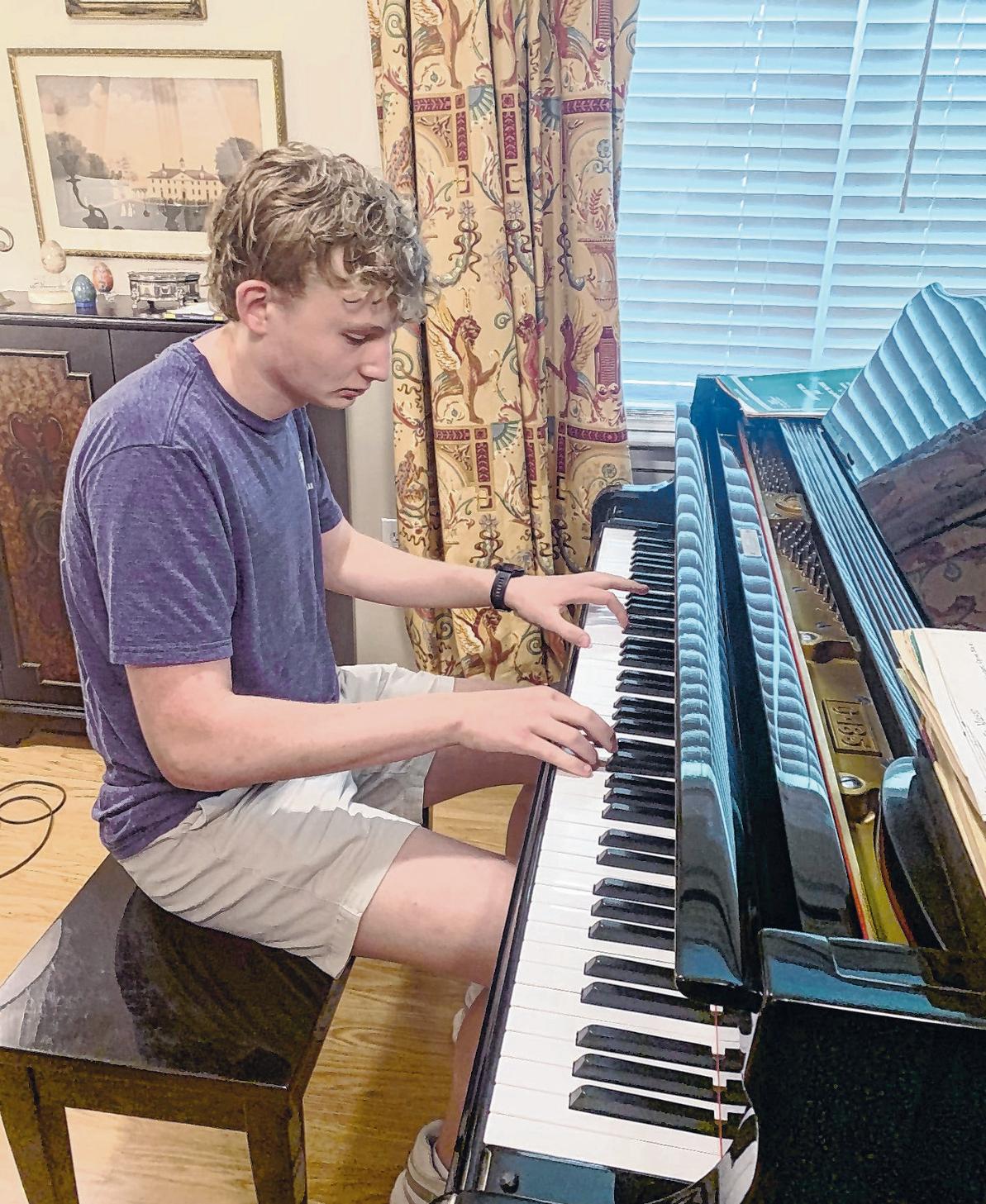
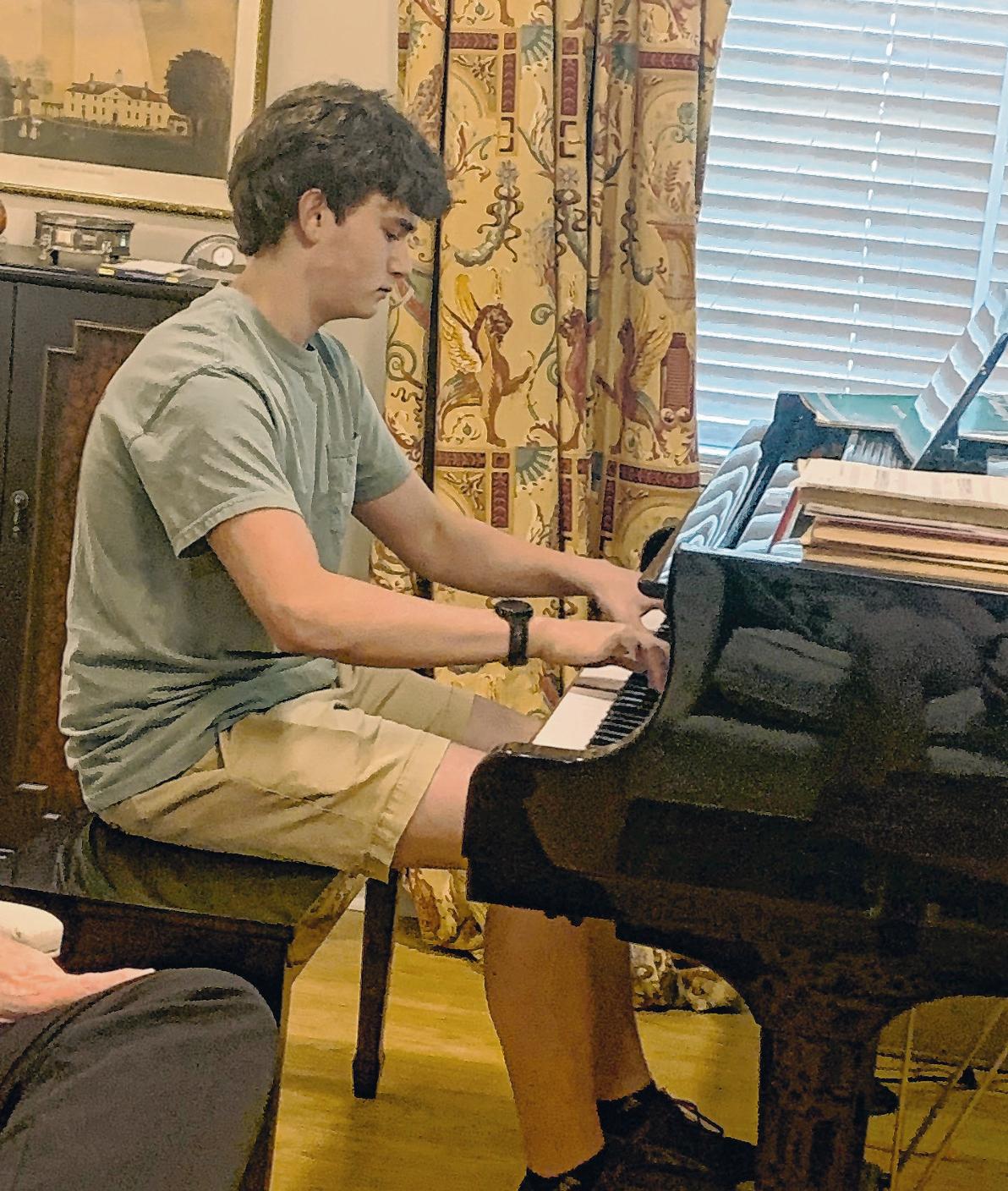
Teen brothers Kell and Worth Wicker recently carried on more than one family tradition with their piano recital.
The Rev Nesom, a tenor, also had a part singing in the recital held for the two young men.
As brothers/sons/grandsons
The older of the brothers, Kell, is 17 and the younger Worth, is 15. They are the sons of Will and Julie Newson Wicker, of Jackson. They have an older sister, Maggie, also a pianist, who is a sophomore at LSU studying piano pedagogy under Pamela Pike.
years. All of the Nesom grandchildren from their two daughters “play the piano and help with the music at our church,” Julie said. She shared that her mother “would be very proud of them.”
The May 8 musical program was at the First Baptist Church of Jackson. It’s the church where their grandfather the Rev Joe Nesom, has been the pastor for more than 40 years. Nesom family members have regularly offered their musical talents as they participated in the many kinds of services held over the years at at the church.
Two Angola guards cleared of excessive force
Inmate was pepper-sprayed while handcuffed
BY QUINN COFFMAN
Staff writer
Two Angola guards who handcuffed an inmate through his cell bars and then pepper-sprayed him did not break the law in the course of their duties, a federal appeals court ruled.
Inmate Alvin Williams sued two correctional officials, Capt David Voorhies and Lt Omar Walker, in November 2021 on grounds of excessive force over the pepper-spraying.
Williams claimed that on the morning of April 28, 2021, he asked Voorhies and Walker to be given mental health assistance because he was “high” in his cell and “feared for his life.”
Voorhies ordered Williams to put his hands through the bars so he could be handcuffed, and Williams complied. Then, Walker attempted to pepper-spray Williams, succeeding on the second attempt. Williams further claimed that while he was handcuffed and blinded by the spray Voorhies walked him into a wall after taking him out of the cell and moving into a stairwell He also claims Voorhies purposefully pressed him against the wall, giving his hand a stress fracture from where it was pressed.
A doctor found Williams’ right hand was swollen days later, court records say, but no evaluation revealed a fracture or break in Williams’ hand.
When Williams’ suit was first before a lower court, a judge denied Voorhies’ and Walker’s motions for summary judgment, which they sought on the grounds of qualified immunity as officers acting in the line of duty. The judge’s denial was due to believing Williams had a claim of excessive force against Voorhies for the stairwell incident and a claim of failure-to-intervene against Walker
Their paternal grandparents are Ted and Jan Wicker, of Zachary Maternal grandparents are Nesom and the late Janice Nesom who was the church’s organist for many
The Rev Nesom, an encouraging grandfather, was a voice major in his early university days and also earned a Bachelor of Arts in English. His interesting experiences as a young tenor included performing with the New Orleans Philharmonic and participation in a week-long music festival in Mexico.
Pieces performed
the recital by Worth Wicker were “Two Part Invention No 4” by J.S Bach; “Sonata, Opus 49, No. 2” by Beethoven; and “Waltz, Opus 69, No. 1” by Chopin. These were followed by the performance by the Rev Nesom, who sang two pieces in German and was accompanied by Kell Wicker on “An Die Musik” (To Music) by Schubert; and “Das Wandern” (Roaming), Opus 25 by Schubert. Kell Wicker performed “Gigue” from French Suite No. 4 by J.S. Bach; “Sonata, Opus 10, No. 2” by Beethoven:
ä See AROUND, page 2G ä See PIANISTS, page 2G
The music pieces performed at
Federal court agrees Angola’s Farm Line dangerous, but it can’t ‘micromanage’ prison administrators
BY QUINN COFFMAN Staff writer
In a ruling issued Tuesday, Judge Brian Jackson of the Louisiana Middle District reaffirmed that Angola’s socalled Farm Line program regularly puts inmates in danger of heat-related injuries.
However, Jackson said a higher court’s ruling prevents his court from issuing any permanent changes to how the Louisiana State Penitentiary operates the work assignment in which inmates toil in the prison’s agricultural fields.
Jackson’s ruling does highlight, however, that many changes to the Farm Line that inmate advocates sought had been carried out by the Angola administration as the case was litigated, including the construction of multiple “shade pavilions.”
The inmates’ attorneys originally sought an end to the Farm Line on Eighth Amendment grounds that the field work assignment is a cruel and unusual punishment.
During the length of the case, inmates’ attorneys narrowed what they were asking for, ultimately requesting an end to inmates being assigned to the Farm Line as punishment, no Farm Line work on any day where the temperature reaches 103 degrees, that Angola no longer charge inmates with medical co-pays for heat-related illnesses suffered while on the Farm Line, and other items.
Jackson’s ruling said that these requests were well-founded, but “the Court is constrained by the Circuit’s opinion in Parker, however, indicating that it would be inappropriate for the Court to ‘micromanage the prison’s facilities, personnel, procedures, and standards of care.’”
On March 30, the Fifth Circuit Court

Inmates working Angola’s Farm Line, image taken from Louisiana Middle District Court, Judge Brian Johnson’s ruling on May 2.
of Appeals preempted the lower court by ruling in Parker v. Hooper that “ongoing improvements and innovations” at Angola likely keep it from violating the Eighth Amendment. To violate the Eighth Amendment, a prison administrator must be found to be “deliberately indifferent” when inmates are faced with potential danger
The Fifth Circuit ruled that even when prison improvements are insufficient to fully protect inmates, the fact that improvements are being made at all shows “concern and sincerity” on the part of prison officials, and thus protects them from the “deliberate indifference” standard needed for cruel and unusual punishment.
“This litigation, however, has not been all for naught,” Jackson’s Monday ruling read. “The Court emphasizes that in several meaningful respects, due to the committed efforts of Plaintiffs’ Counsel and the class representatives, this litigation has obtained the relief Plaintiffs seek — more significant protections for
incarcerated person laboring on the Farm Line.” Darrel Vannoy, warden at Angola, confirmed that many changes sought by inmates’ attorneys had been delivered during the case, including:
n Construction of shade pavilions, outfitted with oscillating fans, ice water coolers, spigots, benches and a roof to provide shade,
n A 15-minute break for every 45 minutes working on the line, n Access to water at any time during Farm Line work, n An expansion to the list of medications that keep an inmate from being assigned Farm Line work, n An end to the “heat season,” meaning heat precautions continue yearround, and n Access to sunscreen, work gloves, drinking cups and hats.
“The safety of incarcerated individuals remains a top priority in all
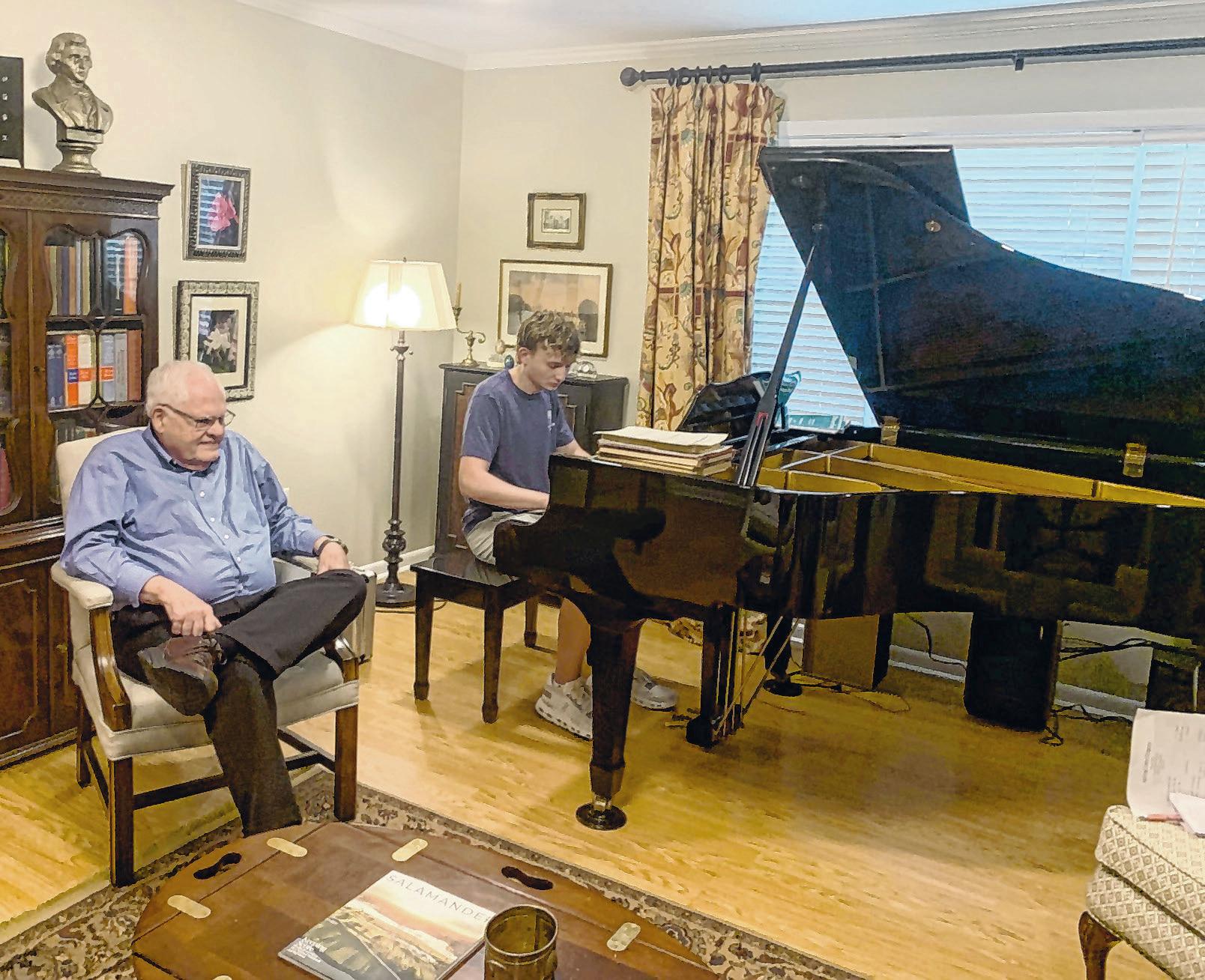
PHOTO BY MELINDA RAWLS HOWELL Worth Wicker 15, performs during an interview about the recent joint recital with his brother
Kell Wicker, 17, performs and was interviewed about his recent joint recital with his brother
and “Prelude in G Minor, Opus 23. No. 5” by Rachmaninoff.
Their lessons with White As for starting piano lessons, “Kell began at age six, Worth at age 8,” says their mother Their teacher was and is Carol White, nationally certified teacher of music. She and her husband live in the Ethel area. Prior to age eight, Worth was “more interested in climbing trees and chasing chickens at Mrs. Carol’s house than taking lessons,” his mother shared.
White has taught piano since 1984 and for 15 years was on the piano faculty at LSU. “There are no words to express how much of an influence she has been in the lives of all our children,” their mother added.” She said “her boys” say she taught them “discipline, consistency and patience.” Kell’s announcement
“When he was about four years old he told me that he wanted to play the organ at our church. I thought it was a joke because he hadn’t even had piano lessons at that point,” his mother Julie said. He now plays the organ at the church and has since 2020 when he was 11 years old. Although “he has had no formal organ lessons,” she said, but “plans to take lessons in college.” She added that it would mean so much to her mother “that Kell plays the organ in her place.”
The well-rounded pianists
The teens are homeschooled and have finished the 11th and ninth grades. They are active in the church’s youth group. They play sports basketball and flag football — through an Istrouma Baptist Church program and also attend dances with friends
They are avid readers, according to their mother
Their other interests include woodworking, some country music, playing the guitar (Kell) and learning to play the ukulele (Worth). They enjoy family trips to Disneyworld.
They are described by their grandfather as “well-rounded” young men. For example, he says they have survival skills. They are hunters, fish when they can and know how to raise a garden, the Rev Nesom said, and that he is ”very proud of them.”
Competition, support and thanks mentioned
The brothers have competed in numerous piano competitions including the Louisiana Music Teachers Association piano rally at LSU. according to their mother She added that “Kell will be competing at the state level at the
Torgrimson/Swanzy competition this year on June 6.” “It means a lot to all of us that
AROUND
Continued from page 1G
Retired teachers group to meet in West Feliciana The West Feliciana Retired Teachers Association will hold its June meeting at 10 a.m. June 17. The meeting will take place at the West Feliciana Parish High School, 8604 U.S. 61, St Francisville The West Feliciana Retired Teachers Association invites all retired teachers in the surrounding region to join this free meeting. The meeting offers fellowship and will discuss the 2026 Regular Legislative session as it relates retired teachers. The meeting is followed by lunch
Breast scans available in Zachary Woman’s Hospital mobile mammography coach offers 3D mammogram technology June 10 at United Methodist Church, 4205 Church St., Zachary Call (225) 924-8268 to schedule. A physician’s order is required.
June 13
The Day the War Stopped will be June 13 in St. Francisville.
Play mahjong to support dogs
Pungs for Paws, a fundraiser for Must Luv Dogs Rescue, is at 2 p.m. June 20 at First United Methodist Church, 930 North Blvd., Baton Rouge. The mahjong fundraiser is presented by Magnolia Mahj. Individual entry is $30 and the event will set up. A table for four is $100, which includes a table contest the entrants set up. On-site vendors, a raffle for a tile set and door prizes will be available. Register at form.jotform.com/mustluvdogs/pungpaws
Concerts to help build chapel
In September, Angola is holding a concert series to raise funds for the Allen Correctional Center Chapel Foundation.
The Louisiana Department of Public Safety & Corrections with God Behind Bars will hold shows Sept. 18-19. Details will be release later, so check https://angolarodeo.com/ for more as available. To donate to the chapel project, visit https://www.paypal.com/ncp/payment/
A66Y9R8FNUBYG.
Summer library activities are here
Be sure to visit the Audubon Regional Library and the West Feliciana Parish Library to find activities and reading programs.
East Feliciana Parish Extension Office to hold Master Gardener Class
The East Feliciana Parish Extension office in Clinton will hold a Master Gardener class beginning Aug. 12. Applications are due to Hoover by June 26.
The class is from 9 a.m. to noon on Wednesdays and concludes Nov 18. The course fee is $200. Classes will be held at the East Feliciana Parish Extension Office, 4419 Idlewild Road, Clinton. The application is available at www.lsuagcenter.com/FelicianaMG or
contact County Agent Jessie Hoover at jhoover@agcenter.lsu.edu or (225) 6833101.
The Louisiana Master Gardener Program is a volunteer development program offered by the LSU AgCenter Master Gardener volunteers are highly trained and provide proven, research-based educational programs to Louisiana residents. Participants in the Master Gardener class receive 40-plus hours of horticulture training in topics such as botany, plant propagation, entomology, plant pathology, weed science, soils, pesticide safety lawn care, vegetables, fruits, herbaceous plants and more. Upon successful completion of the training and volunteering for 40 hours, participants will become Certified Louisiana Master Gardeners.
Email Leila Pitchford at lpitchford@ theadvocate.com.




the community and our friends and family are so supportive of their hard work,” she said. The
turnout for the recital was good even though there had been rainstorms off and on that evening.
PHOTOS BY MELINDA RAWLS HOWELL
Kell Wicker plays Chopin’s Waltz, Opus 69, No 1, while his grandfather the Rev. Joe Nesom, listens.
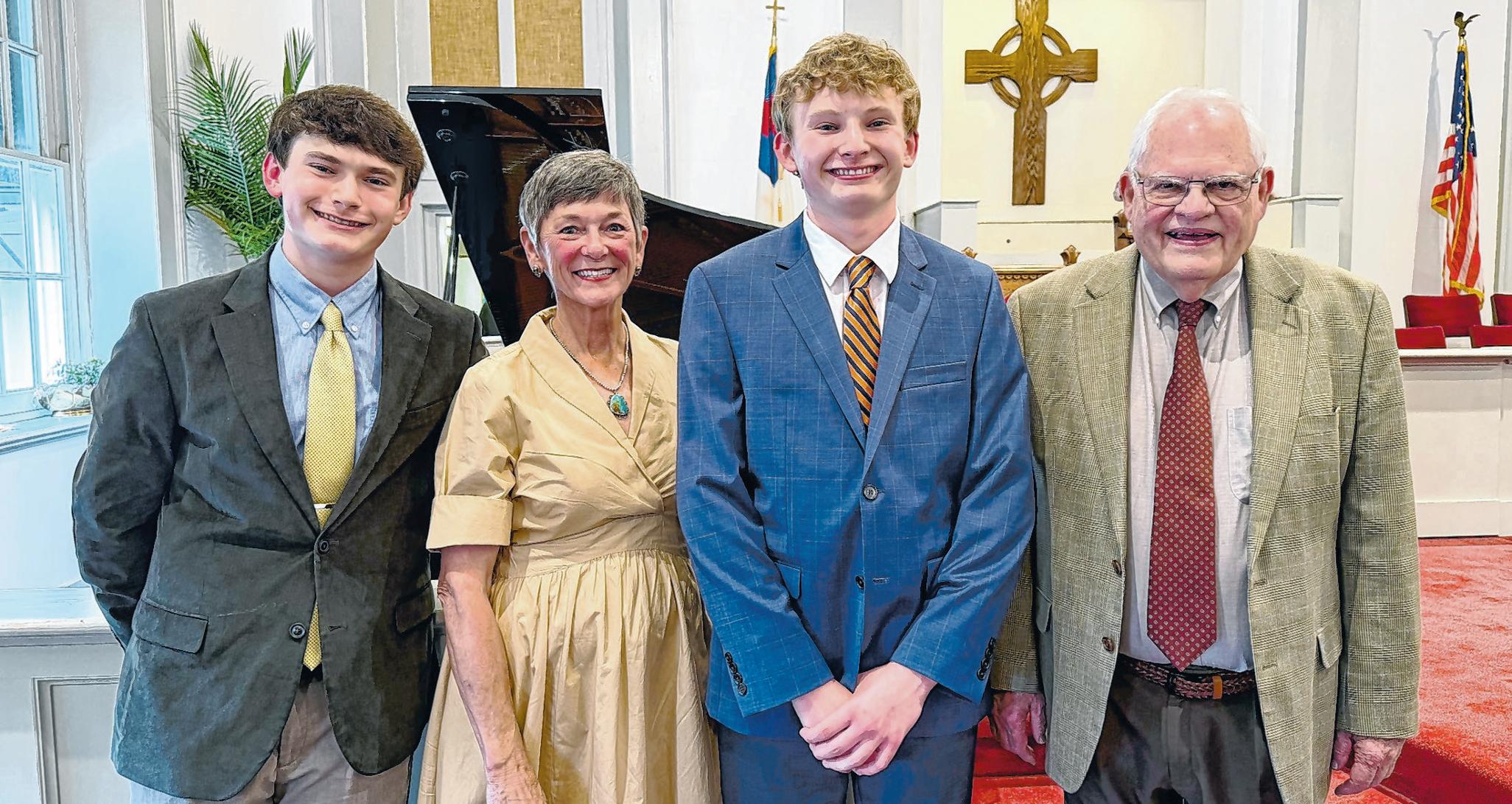
Attending the May recital at a Jackson church, from the left, pianist Worth Wicker, teacher Carol White, pianist Kell Wicker and special guest and tenor the Rev. Joe Nesom who is the grandfather of the pianists.
institutional operations, including outdoor work assignments,” Falon Brown, a spokesperson for the Louisiana Department of Corrections said Wednesday “The Department’s heat pathology policies in place include substantial risk-mitigation measures designed to protect inmates working outdoors, including required rest breaks and access to shade, fans, water, and other safeguards.”
Brown said LDOC is pleased with Judge Jackson dismissing the plaintiff’s claims.
“Agricultural work at LSP serves an important purpose, including harvesting fresh vegetables for inmate consumption while also providing valuable work opportunities The Department remains committed to balancing meaningful work programs with the health and safety of those in its custody,” Brown said.
Speaking at a news conference Wednesday, leaders with prisoner advocacy groups The Promise of Justice Initiative and Voice of the Experienced said that without permanent injunctions from the Middle District, the Louisiana Department of Corrections is free to roll back these improvements at any time.
Samantha Kennedy executive director of the Promise of Justice initiative, said the ruling was like a “victory without a remedy,” while Angola “was delivered a loss, but no consequences.”
“Tuesday afternoon, we learned that the court agrees with people in prison that the dangers caused by working
GUARDS
Continued from page 1G
The Fifth Circuit Court of Appeals reversed those rulings on May 8, dismiss-

outdoors in extreme heat, on the Farm Line, is indeed unconstitutional,” Kennedy said. “However, because of a recent Fifth Circuit ruling, the court believes that its hands are tied and it does
ing Williams’ claims against both officers on qualified immunity grounds. In the three-judge panel’s reasoning they say that the several cases Williams cites in his argument aren’t relevant to what Williams ex-
not have the authority to stop Angola from violating the rights of people forced to work on the Farm Line.”
Advocates also said that they were disappointed that the ruling didn’t touch on
perienced. In one, the prisoner who claimed excessive force had been beaten by a “swarm” of guards, which is “worlds apart” from what happened to Williams, the panel said. Judge Dana Douglas of-
the emotional and psychological aspects of the Farm Line, which they believe are caused by how the Farm Line simulates chattel slavery
“Black people, our experiences, our history and our
fered a dissent to the ruling. “Alvin Williams called out for help while suffering a drug-induced mental health episode. Instead of help, though, he was met with the spray of a chemical agent, while restrained, and was
ability to seek self-determination are under attack in Louisiana,” Kennedy said.
“We very much see our fight for the right to not be forced to reenact slavery just because we are as a critical
further subjected to unnecessary force, in violation of our circuit’s clearly established law,” Douglas said in her dissent. She continued that since Williams was sprayed only after he already had been
frontier in the rights of people. Black people in particular.”
Email Quinn Coffman at quinn.coffman@ theadvocate.com.
handcuffed through the bars of his cell, he was no longer a threat at the time of the pepper-spraying.
Email Quinn Coffman at quinn.coffman@ theadvocate.com.

. At Lane Regional Medical Center,weknowtoday’s investments shape tomorrow’scare. That’s whywe are committed to investing in advancing treatments, enhancing facilities,and expanding services so we can provide exceptional caretoday, tomorrow,and foryears to come. We arebuilding the futureof healthcaretoday.

One of Angola’s new Shade Pavilions, outfitted with four oscillating fans, benches and spigots Inmates working the Farm Line are allowed 15-minute breaks in the pavilion for each hour worked, with iced water provided. Image taken from Louisiana Middle District Court, Judge Brian Johnson’s ruling on May 26.