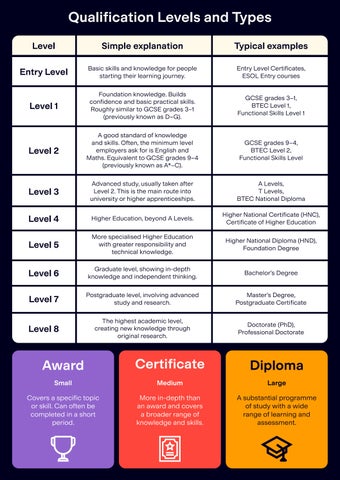
Qualification Levels and Types
Level Simple explanation Typical examples
Entry Level
Level 1
Level 2
Level 3
Level 4
Level 5
Level 6
Level 7
Level 8
Basic skills and knowledge for people starting their learning journey.
Foundation knowledge. Builds confidence and basic practical skills. Roughly similar to GCSE grades 3–1 (previously known as D–G).
A good standard of knowledge and skills. Often, the minimum level employers ask for is English and Maths. Equivalent to GCSE grades 9–4 (previously known as A*–C).
Advanced study, usually taken after Level 2. This is the main route into university or higher apprenticeships.
Higher Education, beyond A Levels.
More specialised Higher Education with greater responsibility and technical knowledge.
Graduate level, showing in-depth knowledge and independent thinking.
Postgraduate level, involving advanced study and research.
The highest academic level, creating new knowledge through original research.
Covers a specific topic or skill. Can often be completed in a short period.
Certificate
More in-depth than an award and covers a broader range of knowledge and skills.
Entry Level Certificates, ESOL Entry courses
GCSE grades 3–1, BTEC Level 1, Functional Skills Level 1
GCSE grades 9–4, BTEC Level 2, Functional Skills Level
A Levels, T Levels, BTEC National Diploma
Higher National Certificate (HNC), Certificate of Higher Education
Higher National Diploma (HND), Foundation Degree
Bachelor’s Degree
Master’s Degree, Postgraduate Certificate
Doctorate (PhD), Professional Doctorate
Diploma
A substantial programme of study with a wide range of learning and assessment.