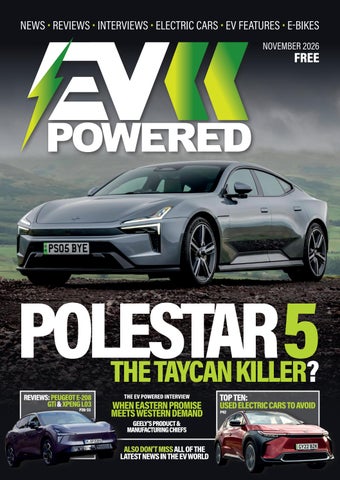
NEWS • REVIEWS • INTERVIEWS • ELECTRIC CARS • EV FEATURES • E-BIKES NOVEMBER 2026
FREE
POLESTAR5 THE TAYCAN KILLER?
REVIEWS: PEUGEOT E-208 GTi & XPENG L03 P26-33
THE EV POWERED INTERVIEW
WHEN EASTERN PROMISE MEETS WESTERN DEMAND GEELY'S PRODUCT & MANUFACTURING CHIEFS
ALSO DON’T MISS ALL OF THE LATEST NEWS IN THE EV WORLD
TOP TEN: USED ELECTRIC CARS TO AVOID P42
3 EV POWERED MAGAZINE
EDITOR’S NOTE A shining star
Welcome to the November edition of EV Powered. This month's issue is packed with everything from the biggest announcements from the Paris Motor Show to a dissection of how Chinese car makers are adapting to European demands, plus reviews of two of the most exciting new cars of the year. One of those cars in particular has been on my mind ever since I drove it – the Polestar 5. You can read my full review of it over on page 22 but the TLDR version is that it’s utterly phenomenal. Car brands often talk about pouring all their experience and knowledge into a car. Often such claims ring hollow as they churn out yet another middle-of-the-road C-SUV. But not here. With the Polestar 5 it really does feel like the culmination of nearly a decade of hard work. But it also feels bigger than that. Polestar has been struggling for years as a one-car brand but the arrival of the universally praised 5 in the wake of two other well-regarded recent models feels like a line in the sand. As good as the Polestar 2 is, it was never going to be enough to sustain a brand, especially one that arrived with the radical Polestar 1 promising electrified performance like no other brand. So the arrival of the 3 and 4 over the last two years and their generally positive reception has helped turn it from a one-trick pony into a brand with a legitimate model line-up. With the 5 it has bolstered that line-up further, delivered on the promise of the 1 and the Precept concept, and created a truly brilliant halo model to boost its reputation and reach. Of course, Polestar isn’t out of the woods yet. Its financial situation, while improving, is still far from rosy, and it’s been banned from selling cars in the US due to its Chinese ownership (a punishment sister brand Volvo has avoided, oddly).
Away from my Scandinavian musings, my eye was caught by the big announcements from the motor show in Paris last month. While the sheer volume of new EVs on show was pleasing, what particularly warmed my heart was the variety. There were plenty of sensible mainstream models such as the Leapmotor B03 and Smart #2, along with promising preproduction concepts like the Citroen 2CV. But there were also the completely wild show cars such as the Fiat Multiplay and Peugeot E-T16 which show manufacturers finally having fun with electrification. And there were one or two “concepts” which I reckon we’ll see on our roads within the next couple of years. Whatever Alpine says, the A310 Vision feels like far more than a “creative experiment”, and if we don’t see an all-electric Renault Espace before 2030 I’ll eat my own beret. You can catch up on all the big announcements from Paris along with a whole heap more over the page.
Until next month, enjoy the read.
Matt Allan Editor, EV Powered
But for the first time in its history it feels like it has the quality and breadth of product to start pulling in customers in big numbers. And that’s only going to keep growing with the imminent arrival of the Polestar 4 SUV, an all-new Polestar 2 in 2027 and the compact Polestar 7 SUV in 2028.
The EV Powered Team
EV Powered is published in London by
Capital Business Media Ltd, Level 18, 40th Floor, London, E14 5NR. Tel: 020 7148 3861 EV Powered is printed using sustainable paper sources and vegetable ink, and is PEFC certified. Copies are recycled at the end of each month. © EV Powered Ltd a Capital Business Media group brand.
Editor Matt Allan
Content Sales Manager Laura Phillips
Reporter George East
Capital Business Media, Group MD Richard Alvin
Graphic Designer Grace Moseley
Business Development Director Stephen Banks
Videographer Jacob Pinchbeck
Chief Creative Director Stuart Hyde Finance Director Andrew Martin
EV POWERED MAGAZINE 4
Contents 26
News 5 EV The latest from the EV industry.
10
Best Of Paris 2026 10 The Rounding up the best new EVs from this year's Paris Motor Show. Geely in Europe 14 INTERVIEW: When Eastern promise meets Western demands. Track To Road & Back Again 18 From We speak to Nissan's Formula E & UK road division bosses.
30
Polestar 5 22 REVIEW: The Porsche Taycan Turbo killer? Peugeot E-208 GTi 26 REVIEW: With big boots to fill, can this EV stand up to its rivals? Xpeng L03 30 REVIEW: An EV with a hope to blow away rivals with its tech and power. Raval Long-Term Month Two 34 Cupra Going head-to-head with its fiercest rival yet. Buying Guide: Audi Q4 E-Tron 36 Used Here's all you need to know if you're considering one. Estarli E28.X E-Bike 40 REVIEW: Commuter quality south of £2,000. Electric Cars To Avoid 42 Used The top ten worst EVs you can buy. Requirements 48 Range Most used EV buyers looking for a 300-mile range. Jaguar 50 Beyond The EV industry's brand loyalty problem.
42
5 EV NEWS
JAGUAR TYPE 01 heralds bold new era for British icon
Grand tourer ditches stuffy image for new luxuryfocused modernity.
At the rear, the strikethrough theme carries over from the grille and houses a pair of rear light bars. A rear windscreen is notably absent.
the strikethrough design element rears its head once again in the form of a full-width soundbar featuring a digital rear-view mirror in its midst.
Inside, gone are the wood and leather synonymous with “old-era” Jags, and the minimalist interior is dominated by a chunky central spine and a slim, two-tiered dashboard designed to emphasise the cabin’s space and its dimensions.
With a tri-motor setup, the Jaguar Type 01 generates an enormous 1,015bhp. On the rear axle, two motors producing around 900bhp sit in a single casting and provide 70% of the car’s torque.
The four slimline seats are upholstered in neograin ultrafabric and Kvadrat duoweave, a material blending 30% wool with polyester.
A torque-vectoring system controls how much power is sent to each wheel to improve traction and handling, and the rear motors can be switched off to optimise efficiency on a motorway drive.
Jaguar has unveiled the production version of its radical Type 01 almost two years after it was previewed as the controversial ‘pink Type 00' concept car. Inside and out, the car has been designed to appeal to a new, younger, wealthier demographic than Jaguar’s traditional customer base. While the Jaguar design team said the Type 01 is “a copy of nothing”, several design elements hark back to Jags of yesteryear: The long nose and back-set cabin are reminiscent of the E-Type and its successor, the XJS. Measuring 5.2 metres long and 1.4m high, Jaguar’s latest is a big car and its standard 23-inch wheels only accentuate its dimensions. The Jaguar Type 01 draws on the Type 00’s front end, courtesy of a strikethrough ‘grille’, a series of horizontal strikethrough lines embossed over sheet metal, and a low-set cooling aperture. Towards the back, a three-metre-long pressing comprising the roof rail, bodyside, and a curved shoulder that hints at more muscular Jags of yore is dubbed “the impossible panel” due to the difficulty in forging it from aluminium.
The inner door finishers, despite being brasscoloured, are dyed, embossed aluminium to add colour and tactility. Jaguar has broken with the current automotive trend of reviving physical buttons, incorporating all of the Type 01’s controls into a modestly sized, centrally positioned touchscreen rising from the centre console. The Type 01 cabin has no buttons at all, not even for the sound system or climate control. Behind the ’70s-esque two-spoke steering wheel is a 24-inch digital driver’s display, and
The Jaguar Type 01 has a top speed of 150mph and the 0-62mph run is dealt with in 3.2 seconds. Jaguar says the Type 01’s 850V JEA system gives the 120kWh battery a fast-charging rate of 350kW, which adds 200 miles of range in 13 minutes. Fully charged, it delivers a WLTP range of 435 miles. Entry-level Type 01s are expected to be priced from around £120,000, while better-appointed versions will start at around £150,000. Jaguar, however, is yet to make an official pricing announcement.
EV NEWS 6
MERCEDES-AMG flexes its muscles with world’s most powerful SUV Mercedes-AMG has built the most powerful production SUV on the planet.
battery cells and three axial-flux motors from Mercedes-owned British motor specialist Yasa.
The new all-electric GT SUV musters up to 1,153bhp and 1,475lb ft in range-topping GT 63 form, outmuscling both the Porsche Cayenne Electric and the Lotus Eletre. Porsche’s flagship Cayenne Turbo Electric makes 1,140bhp on overboost and costs from £130,900 in the UK. AMG has yet to confirm British prices, but the entry-level GT 53 is already on sale in Germany from €113,050 (£95,863), with UK pricing due in the coming months.
AMG says it was engineered to avoid the power fade many fast EVs suffer as motors and batteries heat up under repeated hard use. So while 1,153bhp grabs the headlines, the more telling figure is the 711bhp it can deliver continuously.
The five-seater is the first SUV AMG has developed entirely in-house, and all three versions are coming to the UK. The 55 and 63 follow the 53 in April 2027. Its performance is all the more remarkable given a kerb weight of 2,585kg to 2,695kg. The GT 63 dispatches 0-62mph in 2.7sec and 124mph in 7.2sec, making it AMG’s fastest-accelerating SUV yet. Top speed is limited, though the optional AMG Driver’s Package raises the cap to 168mph. Its peak output matches the electric GT 63 4-Door Coupé, beats the 1,048bhp AMG One hypercar and nearly doubles the 603bhp of the V8 GLE 63 S. Underneath sits the same AMG.EA platform, with an 800V electrical system, oil-cooled cylindrical
Two motors sit at the rear, each with its own single-speed gearbox for full torque vectoring, while the front motor disconnects when not needed. The GT 55 trims output to 805bhp and 1,372lb ft, still good for 0-62mph in 3.1 seconds. The GT 53 instead uses two permanent magnet synchronous motors, one per axle, for 536bhp, 590lb ft and a 4.2-second sprint.
AMG's first homegrown SUV arrives to outgun Porsche and Lotus with 1,153bhp.
Usable battery capacities of 106kWh and 128kWh give up to 364 and 435 miles respectively. Peak charging is 600kW and 710kW, and AMG claims the bigger pack can add 280 miles in 10 minutes, or go from 10-80% in 12 minutes in ideal conditions. Active Ride Control+ pairs air springs with hydraulically interconnected dampers to control roll, pitch and dive without anti-roll bars. It’s standard on the GT 63 and optional on the GT 55, as are carbon-ceramic brakes. The styling of the 5m by 2m SUV owes nothing to AMG’s combustion models. Up front, a blankedoff grille with an illuminated surround sits below an illuminated star, flanked by a duct-riddled bumper and three-element headlights. At the back, six round tail-lights sit beneath a large tailgate spoiler. Inside, the driver-focused dashboard brings a 10.2inch instrument display, a 14-inch touchscreen and an optional 14-inch passenger screen, while the 63 and 55 add rotary controls to adjust throttle response, cornering and traction control. Unlike the four-door, the SUV gets a completely flat rear floor. Boot space is 607 litres, or 1740 litres with the seats folded, plus a 111-litre front compartment.
7 EV NEWS The Volkswagen ID. Tiguan has been fully unveiled for the first time, bringing a massive update to the brand’s all-electric family SUV.
VW also offers a 12-inch passenger entertainment display. The ID. Tiguan comes in two- and all-wheel drive variants, with three power outputs and two battery options.
Effectively a heavy revision of the existing ID.4, VW says the ID. Tiguan is far more than just a midlife facelift, bringing major design, interface and powertrain changes worthy of a new name. The move brings the EV in line with its combustion-powered C-SUV sibling – the brand’s global best-seller – and acts as a replacement for both the ID.4 and the ID.5 SUV coupe. Volkswagen says the ID. Tiguan brings a pure, precise new design to its electric family SUV. The soft, ID.3-like lines of the old car have been sculpted and sharpened to bear a closer resemblance to the new ID. Cross. A full-width LED light bar features a 3D effect and higher-spec cars get an illuminated VW badge. The contrasting outer roof line and C-pillar of the old car has been replaced with a full body-coloured finish for a more coherent look and there are new-look rear LED lights with 3D effects and welcome animations. Based on customer demand, the semi-flush door handles of the ID. 4 have been replaced with good old-fashioned pull designs. Volkswagen says it has also “listened then implemented” when designing the ID. Tiguan’s
Basic models feature a 58kWh LFP battery paired with a 187bhp rear-mounted motor, giving a 0-62mph time of 8.5 seconds and a maximum range of 279 miles. interior, aiming to address the heavy criticism levelled at the original ID.4. It says that only the drive selector and wiper stalk have been retained. Everything else is new. The all-new cabin follows other ID models in reintroducing physical controls for key functions such as climate control, real buttons on the steering wheel, as well as adding individual window controls. The dashboard and centre console have a sharper shape and more practical layout, and material quality has been improved for a more welcoming and premium feel. At the heart of the new dashboard design are a 10-inch digital instrument display and 15-inch infotainment touchscreen. The new central screen runs a heavily updated Google-based operating system, and for the first time in Europe,
Above that, all models get a 77kWh NMC battery. The longest-range version pairs this battery with a 282bhp rear-mounted motor for up to 372 miles of range and a 0-62mph time of 6.6 seconds. At the top of the range, the ID. Tiguan 4Motion adds a front-mounted motor for all-wheel drive and boosts power to 295bhp. That cuts the 0-62mph time to 6.3 seconds and cuts the range to 348 miles. Pricing and specification details will be confirmed closer to the launch date in early 2027 but we do know that the ID. Tiguan will be offered in Trend, Life and Style grades, along with the sportier R-Line. Prices for the current ID.4 start at around £37,000 and we would expect a small uplift on that for this heavily updated version.
VOLKSWAGEN ID. TIGUAN revealed with 295bhp and 373-mile range
ID.4 undergoes massive overhaul with new name, new looks and major tech upgrade.
EV NEWS 8
Flying new TESLA ROADSTER is here but you can’t have it until 2028 After almost a decade, the Gen2 Tesla Roadster is here. There are a few catches, though...
Almost a decade after it was initially announced, the second-generation Tesla Roadster is finally here. With four SpaceX-developed cold gas thrusters standard on the entry-level ‘Performance’ model, the new tri-motor Tesla Roadster can, allegedly, hit 0-60mph in just 0.81 seconds. The claimed top speed is more than 230mph. While Tesla has not confirmed any performance figures, reports suggest the two-seater will deliver more than 1,500bhp. The wedgy, gullwing-doored new Tesla will also be offered in an invite-only ‘Rocket’ trim level. Demanding a $250,000 (around £187,300) deposit, this range-topping version has additional thrusters placed around the car to, in Tesla’s words, “support forward and upward acceleration, as well as lateral rotational movement”. In other words, to make it hover and spin as demonstrated in the live unveiling at the SpaceX test site in Texas. Leaning into the Elon Musk-led firm’s tech-focused philosophy, the new Roadster packs drive-by-wire and brake-by-wire systems and a Model S-style steering yoke. It also has a McMurtry Speirling-esque “Multi-Mode Suction System” that offers 2G’s worth of downforce. Pricing has yet to be confirmed, but it’s almost certain to be a six-figure affair, or potentially more for the range-topping Rocket model.
AUDI confirms new A2 price and specification Audi has confirmed that the price of its new A2 e-tron will start at £32,200, with the smallest Audi model available in four trim levels and with four power units. The line-up starts with the £32,200 Technik which gets 18-inch alloy wheels, LED lighting, heated seats and steering wheel plus a 12.8-inch curved touchscreen and 11.9-inch digital instrument display. Sport and S-Line trims start at £34,800 and £37,400 respectively and add 19-inch alloy wheels, an upgraded infotainment system and stereo, plus leather-wrapped steering wheel and metal pedals. S-Line also gets a more aggressive exterior design package and bespoke upholstery. At the top of the range the Edition 1 gets 20-inch wheels, adaptive headlights, acoustic glazing and parking assistance among other luxuries. It also starts at £48,350. Powertrain options range from 168bhp or 187bhp motors in lesser trim levels to 222bhp in mid-spec and up to 322bhp in the S-Line and Edition trims.
Range to start from £32k, but top spec models are far from cheap.
9 EV NEWS
PLANNING RED TAPE axed for kerbside EV charging
Drivers without a driveway can now fit a cross-pavement charging gully without a planning application. Drivers in England who park at the kerb no longer need planning permission to fit a cross-pavement charging gully. Axing what the government called the “unnecessary red tape” will save time, paperwork and could knock up to £300 off the cost of getting a home wallbox up and running. A gully is a shallow channel cut into the pavement, deep enough for a charging cable to sit below the surface. It lets a car parked in the street draw power from a wallbox on the house without turning the footpath into a trip hazard. Until now, installing one counted as development and needed its own planning application. Following a government’s consultation, that permission is now granted nationally, although councils still have to approve each installation as the local highway authority. The change means that the estimated nine million homes which have no off-street parking and no prospect of creating any now have a more affordable way to access cheap at-home charging.
MFG extends 25% discount on ultra-rapid charging Charging operator Motor Fuel Group (MFG) has announced it is extending a temporary discount on charging across its network.
The UK’s largest forecourt operator launched a special offer over the summer, slashing prices from 79p to 59p per kWh. It has now confirmed that the saving will carry on for users of the MFG Connect App. To take advantage of the extended MFG charging discount drivers simply have to download the MFG Connect app, register for a free account and pay for their charging session through the app at any MFG site. The 25% reduction equates to a £6 saving on a typical 30kWh top-up across the firm’s entire network of chargers. MFG currently operates around 1,000 devices spread across nearly 600 locations and offering between 150kW and 400kW outputs. It recently acquired Morrisons supermarket’s filling station portfolio and already has 300 chargers at Morrisons forecourts with plans for rapid expansion. The group plans to spend £400 million between now and 2030 to support the roll-out of more than 3,000 ultra-rapid chargers across 500 sites.
PARIS MOTOR SHOW 10
THE BEST OF PARIS 2026 Rounding up the brightest and best new EVs from this year's Paris Motor Show By GEORGE EAST
Recent weeks have seen car makers, media and motoring enthusiasts flock to Paris for this year’s Mondial de l’Auto. As ever, the motoring extravaganza delivered everything from the debuts of sensible, production-ready cars to the unveiling of completely off-the-wall concepts, plus a few concepts that could very easily become a reality. And, as ever, EVs dominated the conversation.
In the European corner, Stellantis introduced a raft of all-new, all-electric offerings from a cheap Citroen city car to a rally-inspired 800bhp hot hatch. Meanwhile Renault continued to drop hints at a return of yet another famous name from its past. As expected, Chinese manufacturers also played an enormous role in the City of Light. Avatr and Li Auto made their official European debuts, and BYD launched a new flagship SUV due to arrive next year. We don’t have space to cover every single new model shown in Paris, but read on for our round-up of the biggest and best EV reveals at this year’s show.
ALPINE A310 VISION Drawing heavily on the 2+2 Alpine A310 "berlinette" from 1971, the A310 Vision was designed to celebrate the original car's 55th birthday and mark Alpine's electric future. With "pop-down" headlights, a 'Y-Zero' S-duct blade running the length of the bonnet and sharp angles aplenty, this modern take on a French "icon" runs on Alpine's modular 800V platform, which will underpin the upcoming A110. Alpine maintains that the A310 remains a "creative exploration" for now. However, the fact that it even exists has prompted suggestions a production version could join the Alpine “dream garage” in future.
AVATR Founded in 2018, Avatr is a Chinese EV maker born from a tie-up between automaker Changan, tech firm Xiaomi, and battery specialists CATL. In Paris, Avatr announced its 2027 European debut, with Spain and Norway confirmed as initial markets. The first cars will be the Volvo EX60-rivalling 07 SUV, and the 938bhp, tri-motor 06 sports saloon. After early launches in Spain and Norway, and a wider rollout across continental Europe, a UK arrival could be on the cards, too.
11 PARIS MOTOR SHOW BYD ATTO 8 Aimed at the likes of the Škoda Peaq and the Peugeot E-5008, the seven-seat BYD Atto 8 introduces a new aggressive design language previously unseen on BYD's Atto line of cars, and its plush interior appears to be inspired by BYD’s posh Denza brand. Under the skin, the Atto 8 sounds equally as promising. The second-generation 115kWh ‘Blade’ battery offers up to 405 miles of range and can be charged from 10-97% in just nine minutes with a 1,500kW ‘Flash’ charger. If those numbers weren’t impressive enough, in range-topping all-wheel-drive Excellence trim, the Atto 8 produces an enormous 764bhp.
CITROËN 2CV The revived ‘deux-chevaux’ was one of the stars of this year’s Paris Motor Show. After almost 36 years, Citroen’s rustic icon is back as an all-electric city car, and it’s fully leaning into its heritage. The exterior is immediately recognisable as a tin snail, and the quirky, fuss-free interior is reminiscent of its predecessor, albeit with a modern twist. The new 2CV is likely to go on sale in 2028. When it does, it’ll be built on the Stellantis e-car platform designed to underpin a tranche of affordable, all-electric city cars. Citroen has confirmed that pricing for the 2CV will start around €15,000 - the equivalent of £13,600. Whether it can transport a box of eggs across an unploughed field without breaking them remains to be seen.
FIAT Fiat had some fun in Paris, revealing two confirmed production cars and a wild pick-up inspired electric concept. The Fiat Grizzly is the Italian firm’s answer to the Dacia Duster and will go on sale for €20,000 (around £16,900) in January next year in either SUV or fastback body style, sitting on the same platform as the smaller Grande Panda. Fiat also took the opportunity to announce its upcoming Pandina. Scheduled for unveiling in 2027, the electric-only Pandina will be underpinned by the 2CV’s e-car platform. We’d also like to give a shoutout to the ‘3-in-1’ Multiplay concept, which can transform from a six-seat MPV to a flatbed truck by switching out its modular rear end. Sadly, though, it remains a showcase vehicle for now.
GEELY The Geely Monjaro EM-I is the Chinese giant’s third UK-bound model, and it’ll be the second plug-in hybrid SUV in its line-up. Set to take a jab at the Skoda Enyaq and the Hyundai Santa Fe upon arrival early next year, the Monjaro aims to undercut both with an expected starting price of around £35,000. Geely also brought a second car to the Paris Motor Show, the K011. Technical details are scarce around the brand’s first dedicated off-roader, but its PHEV powertrain and rugged capabilities makes it a likely rival to the Land Rover Defender 110 and the BYD Ti7.
FEATURE 12
LEAPMOTOR In its usual drama-free fashion, Leapmotor quietly launched an all-new electric B03 supermini. Built to compete with the Renault 5, Volkswagen ID Polo, and the Hyundai Ioniq 3, the B03 has a 242-mile range and is expected to undercut its rivals with a price tag towards the low £20,000s. The Stellantis-owned Chinese firm also brought along its seven-seat D19 SUV, which comes with heaps of tech, including air suspension and an Odeon-dwarfing 21.3inch TV screen in the middle row. A tri-motor powertrain delivers 724bhp, while the 1,000V architecture means the 115kWh battery can take on 50% worth of charge in 15 minutes.
LI AUTO LI 6 Like Avatr, Li Auto is another Chinese newcomer to Europe that’s tasted plenty of success at home since it was founded in 2018. The brand marked its European premiere in Paris with its Li 6, the best-selling car in China over the first six months of 2026. Designed as an extension of the owner’s home, the C-segment SUV embraces a less-is-more approach to in-car tech in stark contrast to most Chinese manufacturers. The Li 6 is built on 800V electrical architecture and powered by a 310-mile, 87kWh battery. Additional technical details such as charging speeds and pricing will be confirmed closer to the official launch.
PEUGEOT When Peugeot took the wraps off its Group B-inspired E-T16 concept car, there was a collective outpouring of joy from the rally world. Introduced to mark the 40th anniversary of the all-conquering 205 T16, this all-electric take is powered by three electric motors that generate a whopping 816bhp. What's more, Peugeot says that if the E-T16 gets enough interest, it'll put it into production to go head to head with the Renault 5 Turbo 3E. Another Peugeot to make its home debut was the RCZ Concept. An electric-only reinterpretation of the 2+2 RCZ made from 2009 to 2015, this four-seater GT is another showcase of the STLA One platform's technical prowess and could hint at a future production model.
13 FEATURE RENAULT Paris saw France's undisputed EV champion introduce its E-Space, a concept car that almost certainly previews a fully electrified Espace MPV. Clearly inspired by the Mk1 Espace of the 1980s, very little is known about the wedgy concept's underpinnings. Based on an interview Renault UK boss Adam Wood gave us earlier this year, we'd expect the production model to run on Renault's upcoming 800V RGEV Medium 2.0 platform promising up to 466 miles of range. Renault also introduced the Twingobay, a panoramic-glass roofed version of its lovable electric Twingo city car.
SMART #2 The Smart #2’s debut has been a bit overshadowed by months of teaser images and details basically giving the game away early. Nonetheless, Paris saw the wraps officially come off as Smart goes back to its roots. Like the very first Smart car, the #2 is a compact two-seat city car with tiny overhangs and a boxy design that clearly calls back to the OG ForTwo. A rear-mounted 82bhp motor gets it moving and a 35.8kWh battery delivers up to 180 miles of range. Inside, Smart is promising a modern, premium feel plus class-leading safety kit. Sales are expected to start early next year.
XPENG G9L While European brands are focusing on smaller and smaller EVs, Chinese marques are super-sizing. Hot on the heels of the L03’s launch, Xpeng’s G9L made its public debut in Paris. A 5.12m-long three-row SUV, the G9L features everything from powered doors and side steps to a fold-down TV screen and reclining heated, cooled and massaging chairs for second-row passengers. It also packs up to 577bhp and a range of up to 367 miles from a 110kWh battery with 540kW charging. And it’s confirmed for a UK launch in 2027.
ZEEKR 9X Zeekr used Paris to show off its 9X SUV – a six-seat, €119,000 PHEV rival to the Range Rover. The 9X’s cabin is finished with lashing of Scandinavian trees, swathes of real cow, and screens aplenty for that luxury feel. Under the surface, Zeekr has mated a 2.0-litre turbocharged four-cylinder engine with an electric motor and 55.1kWh battery to give the 2.9-tonne 9X a total of 910bhp, a range of 458 miles and a 149mph top speed.
AN
INTERVIEW
GEELY 14
When Eastern promise
meets Western demands
Unless you’ve been asleep for the last three years, you’ll have noticed a massive influx of Chinese car makers arriving on these shores. At last count there were more than 15 in the UK and around 40 in mainland Europe, all hoping to steal customers from each other and from “legacy” European brands. But European buyers (including those in the UK) are a fussy lot, so Chinese brands are investing a lot of time trying to ensure their cars suit our tastes. They’re also spending a lot of time telling us that they’re doing it. Personal experience has shown that some are more successful than others, but to find out exactly how brands are trying to build more European-feeling cars, EV Powered sat down with Geely’s European director of product definition and customer excellence, Dennis Weinel, and carline lead for Geely Auto Europe, Serino Angelotti. Straight out of the gate, Serino is clear that what Geely’s Chinese customers want is not the same as what its European customers want. While the current
15 GEELY
AN
INTERVIEW
We hear from Geely’s product and manufacturing chiefs about the major differences in tastes between Chinese and European drivers, the challenges in adapting cars for Europe, and plans for a range of smaller European-specific future models
crop of cars is developed in China, the role of his and Dennis’s teams is to identify what matters to European buyers and propose changes accordingly. “There are areas of the vehicle that can stay as is because of the maturity that the product has in China is absolutely okay”, he says. “But there are areas where there is a clear need – not because China is wrong, but because Europe is different. “If we look at product development, the majority is happening in China. But there are specific areas where we either develop in Europe or we bind the development in China with our requirements.”
Digital differences Serino identifies three key areas where European and Chinese tastes diverge and where he, Dennis and their teams spend most of their time – infotainment, driver assistance and driving dynamics. “The digital experience in China has a very different ecosystem with very different requirements,” he explains. “Chinese [drivers] love very busy interruptions, a very
Serino Angelotti, left, and Dennis Weinel
busy way to interact with the product – very, I would say, annoying for a customer in Europe. It's their way to make the product successful [in China], but this doesn't work for Europe. So we redefine what are the ways to interact and then define this in a specific product. A large part of this development is happening in Europe. So we not only define what is the matter, but also the realisation of that.” Dennis goes further, noting that “it's almost a completely different ecosystem”, with different apps, mapping systems and digital assistants. Sticking with technological tastes, Serino brings up the bête noir of drivers everywhere – ADAS, or Advanced Driver Assistance Systems such as lane departure warning and driver attention alerts. While both Chinese and European regulators demand such systems, how drivers perceive them is "significantly different”.
Continued on next page
AN
INTERVIEW
Serino gives the example of lane centring assistance. “In China, the market is very keen to have a very quick early intervention where Europeans want the car to arrive at the line before you feel something that is trying to get the control.” There’s also the matter of very different road layouts and usage, which means Geely’s European team uses data gathered from across the region to retrain the ADAS algorithm to suit the geography and driver preferences. Ask anyone and it’s clear there’s still work to be done there – something Dennis admits. “We have a task force on that because we know right now we are not where we want to be.” Interestingly, that task force’s remit extends not just to how frequently or aggressively the ADAS kicks in but also to how easy it is for drivers to adjust the systems and even the tone and volume of the warning “bings and bongs”. And Dennis promises that updates are in the pipeline. On a more physical level, there are also very different tastes between east and west. European drivers, Serino explains, are far more demanding when it comes to vehicle dynamics. “China loves a lot of comfort, pretty soft control in the steering, things that we define as artificial, almost unnatural way to handle the car. European customers, even for the mainstream, appreciate more control, more direct steering, harder but not uncomfortable suspension. You need to feel the technical drive.”
"In China, the market is very keen to have a very quick early intervention where Europeans want the car to arrive at the line before you feel something that is trying to get the control.” So Geely Europe retunes everything from suspension and steering to the brakes. “This is a major effort for China because it will be more simple to do one and say, okay, please,” adds Serino. “But this is not what Geely stands for, it stands for a strong commitment to come into Europe with the product that we want for Europe.”
Learning process Part of their work to ensure their cars meet European tastes is to take feedback from the media and from owners. They’ve already held “clinics” with more than 1,000 customers and constantly monitor the press and social media to judge attitudes. Says Dennis: “We are taking all of this feedback to learn what works and what doesn't, to feedback into new projects, and updates and iterations we are doing here.” He gives the example of the central user interface which, in his words, “is not completely fulfilling the needs of the users with its ease of use”. “We are working already on a solution for the upcoming projects, but also all of our customers that are driving a Geely right now will receive this update.” Of course, listening to European customers is very different from convincing Chinese bosses that changes are necessary. Serino, a seven-year veteran with Geely, admits that it’s “not an easy journey” convincing headquarters that the differences really matter to the brand’s success. “Everything needs to have a rationale. We try to make our motivation funded by data as much as possible. For example, making a tuning for Europe costs
GEELY 16
17 GEELY
AN
INTERVIEW
"What we are doing right now is identifying clearly where we see the gap. And we're addressing that, and we will show in the very near future the first products that are made for Europe based on the request.” money. It's simpler not to do that. So you need to bring to the table what is the advantage, what is the value, what is the brand reputation? To demonstrate that spending this effort will pay off.”
Local cars for local people Refining Chinese cars for the European market is one thing, but plenty of rivals such as MG, BYD and Chery have plans to develop and build cars in Europe for Europe. And Geely is on a similar path. In July it announced a joint manufacturing plan with Ford in Spain, and Dennis says that the group is working on cars designed to meet European needs. “What we are doing right now is identifying clearly where we see the gap. What segment, what body type, what powertrain? And we're addressing that, and we will show in the very near future the first products that are made for Europe based on the request.” While coy on specific models, Dennis confirms that Geely has its eyes on the burgeoning small car sphere. And he says product, strategy and sales teams are all working as “one voice towards China” to guide plans for the European portfolio. “China is so far very price sensitive, but not dimension sensitive,” he notes. “In Europe, we are heavily dimension sensitive. And what we are looking for is vehicles in the smaller B or in the upper A, but also in the smaller C segment, where a big part of the volume is sitting." While that hints at plans for city cars and perhaps family hatchbacks, we already know that one of the cars to come out of the tie-up with Ford will be a smaller electric C-segment SUV. This is the car Dennis says will be a “key success driver” for Geely as it is specifically tailored for the European market. We also know Geely’s European line-up will continue to blend fully electric powertrains with hybrid options. Explains Dennis: “On a long-term plan, electrification is where the market will go to. And we have countries like the UK where this movement towards BEV vehicles is already very strong. But there are other countries where the transition is not happening so fast, where customers want to do daily driving with an EV experience, but they still have the demand to have the flexibility to drive 1,055km combined.” Before the first European-built Geelys arrive in 2028, we have the seven-seat Monjaro SUV and the rugged KO11 arriving, both developed in China then adapted by Serino and Dennis’s teams. However, there are also more European-led products on the horizon. Says Dennis: “We do have projects coming from next year where the center of it is Europe, where we are the ones driving the volume. “It's not even being launched in China yet. So we are requesting it. We are the centre of gravity, and we are defining the requirements towards it.”
TRACK TO ROAD ANDBACK AGAIN
FEATURE 18
FROM
by GEORGE EAST
For the most part, "motorsport-influenced" is a largely nonsensical term when it comes to cars. With the exception of a few manufacturers who actually bother to transfer learnings from their motorsport programmes to the showroom, it's an easy way for manufacturers to plaster a few stickers across an existing model, and charge a significant premium for the privilege. Yet alongside the likes of Audi and Subaru, whose motorsport heritage has had direct and long-term influence on their passenger car line-up, there sits a brand which is quietly letting the symbiotic relationship between its Formula E programme and its upcoming EV range do the talking. Step forward Nissan. Yes, the very same Nissan that pioneered the Mk1 Leaf. You know, the EV that the weird vegan hippies down the street bought around 2011. Stick with me, though. To find out about how Nissan’s FE programme is having an influence over its electrified models, join me in East London’s now-hip 'n kool Docklands, where the Formula E season 12 finale is being held at the ExCel. There’s a jubilant end-of-term atmosphere in the air, and Pascal Wehrlein has just claimed this year's FE title, his second with Porsche. And while the German has deposed Nissan's Oliver
19 FEATURE
We speak to Nissan's Formula E and UK road division bosses to learn how its racing programme is influencing its road-going EV range Rowland as FE World Champion, there's still an air of optimism in the Japanese manufacturer's camp as the sport gears up for the highly-anticipated Season 13 running from 2026 to 2027. Kicking off in Jeddah on December 18, Season 13 marks the arrival of the GEN4 Formula E car, an 816bhp coming together of how accomplished and well-regarded the sport has become since its rocky debut season back in 2014. And it's the debut of the most powerful, technologically-advanced Formula E car that provides Nissan with its sense of quiet confidence. The Yokohama-based firm was the first manufacturer competing in FE to commit to GEN4, thus becoming the first carmaker to confirm that it will race in Formula E until "at least" 2030. This ensures that its much-loved Sakura livery will continue to strike a gentle pink-coloured chord with fans into the next decade. Last year, Nissan, also rolled out a clear roadmap for its electrification strategy: By 2030, it will introduce 19 new electrified models to join its existing EV range already comprising the Ariya, the Leaf, and the Micra. No ifs. No buts.
FEATURE 20 Speaking to EV Powered from a Tapas bar adjacent to the unique indoor/outdoor ExCel circuit, Nissan Formula E team principal, Tommasso Volpe, explains that Nissan's ambitious EV expansion plan is largely hooked around the GEN4 car, which will be driven by Rowland and new arrival, Barbadian Zane Maloney, who jumped ship from the Lola ABT Yamaha outfit. From next season onwards, the FIA's latest set of regulations have said that GEN4 cars must be permanent all-wheel-drive (AWD). Instead of looking to fully-develop its own system, Volpe, who also became Nissan's global motorsports director in 2020, explains that Nissan has looked to its road-going line-up of e-4ORCE-branded AWD models for inspiration. "In the automotive business, Nissan's e-4ORCE system is very well known for being one of the best when it comes to AWD road cars and pick-up trucks in Europe and elsewhere," the 51-year-old says. "The GEN4 car will be permanently AWD, so that gives us the opportunity to transfer technologies we already have to our Formula E programme.” Like Audi's Quattro system, e-4ORCE constantly monitors grip and tyre slippage and can distribute torque between all four wheels individually to ensure best traction and control, and reduce energy losses. In Volpe's words, the e-4ORCE system empowers the driver "with the perfect way to independently control the four wheels. For a normal driver, it means more comfort and control. For a racing driver, it means more performance." Alongside showcasing existing technologies and onboarding road car tech, Volpe points out that Formula E is an almost rolling laboratory for all future intellectual property related to Nissan's future EV range. After, say, tweaking the e-4ORCE powertrain to "be as agile and as grippy as possible", engineers can then seek to transfer another control system from track to road. In Formula E, manufacturers are allowed to develop their own powertrains and with them, their own software. While that means getting the most out of their in-house powertrain on race weekends, it also means potential for the passenger car division. After all, helping a car get the very most out of its batteries is a shared aim across race and road applications. And with Nissan’s big-brained computing whizzes working the code to improve the race car, there are skills and learnings to be shared with the wider company. Already, Volpe is confident that the Nissan powertrain is "very efficient" at its base level. After all, he says, it was what helped the Sakuraliveried team cars to the 2024/2025 Drivers'
World Championship with Rowland. But it's the powertrain's control systems that will often dictate a Formula E team's on-track successes or failures. "We have so many control systems from energy efficiency to traction control. braking, and many more," he adds. "All of these systems have to work together to make your race car – and then your EV – as efficient as possible. "This isn't easy to transfer technical knowledge back and forth, but it's certainly easier to do with an electric powertrain than an internal combustion engine (ICE), because with the ICE you have a very rigid set of parameters to work with and a very strict power output wind that makes it very difficult to modify. With an electric powertrain, everything is dictated by the software." Volpe's latest statement all but affirms that Nissan's next generation of EVs will be software defined vehicles. In broad terms, an SDV’s performance and dynamics are driven purely by code. "In theory, then, you can use the same electric motor in a family car and a sports car," he elaborates. "It's a very flexible set-up, and while I can't speak about the other Nissan EVs in the pipeline, we'll have our Nismo version with potentially more direct from Formula E." With Formula E's role in the Nissan EV ecosystem well established, converting buyers from diesel and petrol to electric remains the next part of the two-way relationship between track and road. Earlier in the year, Nissan UK boss, James Taylor also pretty much confirmed that a Formula E-derived EV is on the way, when - also at the London ePrix - he told EV Powered: "there is definitely room for electric performance models". The Nismo badging looks likely. The Sakura livery, sadly, remain to be seen. "As an industry, we've perhaps not done enough to bring enough excitement around electric, and I think Nismo can help bring that to life," he says candidly. The key is to get people actually experiencing EVs and the technology for themselves, because I think some car enthusiasts feel as if they're letting go of their soul if they admit something is better than internal combustion."
Leading by example on and off-track With Season 13 around the corner, Formula E has more than proven it has the chops to attract and nurture a fanbase from scratch. It's now up to the participating manufacturers to make sure their race cars remain relevant to FE's audience to convert buyers to electric. Looking at what Nissan is doing with such transparency would be an excellent place to start.
21 FEATURE
By MATT ALLAN
POLESTAR 5
REVIEW 22
W
ith 872bhp and a £105,000 price tag, the Polestar 5 is gunning for the Porsche Taycan Turbo. We’ve driven it to see whether it can really stack up against Stuttgart’s best.
Towards the end of our Polestar 5 test drive, my driving companion turned to me and said “Matt, I’m calling it. I’d have this over the Taycan”. Big words, especially from a man as clued-up as him.
Polestar wants to beat the Porsche Taycan at its own game. Not just with supercar-baiting speed, but with the balance of driver engagement and everyday usability that scored Stuttgart’s first EV almost unanimous praise.
But that’s exactly what Polestar is aiming for with the Polestar 5. This is the brand’s flagship. The peak of more than seven years of work to position itself as a premium, purely electric performance brand.
So for the last six years, its designers and engineers have been developing the 5 from the ground up. Unlike other Polestar models, there’s no platform sharing here. The Polestar 5 is based on the bespoke Polestar Performance Architecture (PPA), developed to accommodate huge motors and batteries and deliver high-end space and comfort without compromising on the low, sleek lines of the Precept concept car.
Everything else, impressive as it is, has been building to this – a four-seat, 872bhp grand tourer with continent-crossing range and, Polestar hopes, the performance and poise to take on some of the most experienced names in the business.
23 REVIEW
REVIEW 24 strength of carbon fibre with a fraction of the environmental impact. You’ll find it on the seat backs and door cards. In the 365-litre boot and 62-litre frunk you’ll also find “UltraSilent” material, which is 5kg lighter than regular plastic and is a mono material, making endof-life recycling easier. At the heart of the Polestar 5’s pared-back interior look are two screens. A nine-inch unit covers the key instrument duties, while a 14.5-inch portrait unit handles everything else. Polestar says this Android Automotive-based system improves on those of the Polestar 3 and 4, but it still has many of the same irritants. The unit is crisp and responsive, and there are more shortcut keys and quicker access to some functions. But it still isn’t as user-friendly as it should be. Owners will get used to some of its idiosyncrasies but there are too many menus, and too many important functions are hidden two or three screen presses deep.
The world got its first clues to the Polestar 5’s looks in 2020 when the Swedish brand revealed the Precept concept, looking like something that had just landed from outer space. Jaws dropped and then everyone spent ages telling each other the final car wouldn’t look anything like it. Yet here we are and, rear-hinged doors apart, the Polestar 5 stays remarkably true to the Precept’s space-age design. And it’s stunning. Lots of engineering — from suspension components to battery design — has gone into allowing the all-aluminium Polestar 5 to be as low to the ground as possible. At just 142cm tall it’s 14cm lower than a Volkswagen ID.3. And thanks to its plunging shark-nose front end, massive 22-inch alloy wheels and razorsharp shoulder line, it looks glued to the road even when stationary. From every angle its crisp lines and well-gauged proportions deliver on the idea of an elegant grand tourer for the electric age. And they help with efficiency too. That slippery shape gives a great profile for cutting through the air, aided by active air shutters at the front, air vents at the rear and the Kamm-style tail which as well as housing some super-cool thin taillights helps optimise airflow. Inside, the sharp lines are softened slightly but there’s still a clarity and simplicity that borrows from Scandinavian design and manages to feel soothing rather than sterile. The driver and passenger are held in place by wonderfully shaped Recaro seats that provide just the right grip and support when pressing on without becoming tiresomely tight on long drives. Opt for the sustainably sourced Bridge of Weir leather and they offer cooling and massage along with the regular heating option. Behind them the Polestar 5 delivers a luxurious user-focused rear cabin. With the centre armrest covering the largely pointless middle seat, it feels every bit the grand tourer with heating, cooling, massaging and reclining seats, plus mutli-zone climate control. Space in the rear is also better than I expected. Passengers well over six feet will still have plenty of room behind similarly tall drivers. However, the very tall will struggle for headroom beneath the two-metre-long panoramic roof. Like the Polestar 4, there’s no rear window. Like the Polestar 4, you barely notice its absence once you’re moving. Along with performance, sustainability is a big part of Polestar’s identity, so there are carpet and headliners made from recycled fishing nets and plastic bottles, plus a MicroTech fabric upholstery or that sustainable leather. There’s also B Comp – a new material designed to deliver the light weight and
Like the 4, the steering wheel features two panels of unmarked haptic buttons whose functions are only revealed on the instrument cluster when you hover a finger over them. Again, owners will eventually get to grips with this, but it's a problem that doesn’t need to exist. Genuinely, those interface problems are the only things standing between this car and a full five stars. The Polestar 5 offers two motor options, both powered by the same 106kWh NMC battery. Polestar says this will give its grand tourer a range of 421 miles and efficiency of up to 3.49m/kWh in dual-motor form and 346 miles and 2.93m/kWh in the Performance which I tested. On real roads and driven with some (but not too much) enthusiasm, I saw bang on the WLTP energy consumption, and a predicted real-world range of 310 miles. That’s pretty good for a 2.4-tonne car with as much power and pace as a Lamborghini. Everything we heard from Polestar about this car is that it’s a true grand tourer — a car that can eat up massive miles with ease and comfort while delivering sports car pace and precision. And it fully delivers. Every input and response has a brilliant sense of balance, precision and control that’s set up to deliver both blinding performance and easygoing long-distance cruising. Straight-line performance is truly breathtaking. Even the “basic” dual-motor version can cover the 0-62mph sprint in 3.8 seconds, while the 872bhp/749lb ft Performance version will hit the benchmark run in a mere 3.1 seconds. And it does so with no squirrelling from the bespoke Michelin tyres or unpredictable torque steer. But what’s great is that the throttle is sweetly balanced to allow calm responses when you want them. This is a GT after all, not a twitchy track toy. The same goes for the brakes. The 400mm Brembo units are powerful and progressive and deliver massive but predictable stopping power. Even under extreme acceleration or braking, the Polestar 5’s body control is impeccable. There’s none of the squatting or diving that often comes with such brutal pace. This is carried into corners, where the road-hugging centre of gravity and ultra-stiff bonded aluminium body mean there isn’t a hint of roll. And you have the confidence to test that thanks to the balanced steering. It’s consistent, communicative and weighted just right to reflect the car’s size and mass while allowing it to nip quickly between turns. There are a few steering modes accessed through that blooming screen, where you’ll also find three suspension settings for the MangeRide adaptive
25 REVIEW dampers – soft, nimble and firm. Polestar extensively tested the 5 on UK roads, on the theory that if it can cope here, it’ll cope anywhere. On the relatively decent Tarmac of north-east England, it managed well, with Nimble offering a good balance of control and comfort that makes soaking up big miles easy. It’s a pleasure to drive, whether you're exploiting the 872bhp or just pootling along in a queue of traffic. As mentioned, Polestar offers two versions of the Polestar 5 – the “regular” dual-motor model and the Performance model. Prices for the Polestar 5 Dual-Motor start at £89,500, with the Polestar 5 Performance coming it at £104,950. Every car gets the kind of specification you’d expect of a premium GT, from a powered tailgate and soft-close doors to adaptive LED headlights and that huge sunroof. Although a heated steering wheel is an optional extra – disappointing for a Scandinavian brand. The Performance adds the extra power, cosmetic upgrades such as Swedish Gold brake callipers and seatbelts, along with a 21-speaker Bowers & Wilkins sound system, a head-up display and the Pilot Assist pack.
POLESTAR 5 PERFORMANCE PRICE: TRANSMISSION: BATTERY: POWER: TORQUE: TOP SPEED: 0-62MPH: RANGE: CONSUMPTION: CHARGING:
£104,950 (£117,700 as tested) Dual-motor, all-wheel-drive 106kWh 872bhp 749lb ft 155mph 3.1 seconds 346 miles 2.93m/kWh up to 350kW
In terms of rivals, Polestar will have the production version of the 1,300bhp MercedesAMG GT XX to worry about in 2027 but for now its Polestar 5’s most obvious rival is the Porsche Taycan. That offers similar space, comfort and performance, albeit for more money. To get a Taycan that can match the Polestar 5 Performance for power and pace, you’ll need a Turbo, which will set you back an extra £30,000. So was my colleague right? Is the Polestar 5 better than a Porsche Taycan? It might just be. Even without the £30k price difference, the Polestar 5 is a compelling package. It epitomises the grand tourer for the electric age – delivering supercar-humbling performance, stunning poise and remarkable comfort and refinement. And it looks every bit as good as it drives, while delivering the kind of longrange ability customers demand. In fact, were it not for its questionable user interface, the Polestar 5 would be a nailed-on five-star car. Better than a Taycan? Even with that lousy screen, I reckon so.
RIVALS
PORSCHE TAYCAN
LOTUS EMEYA
DENZA Z9GT
Power and poise to match the Polestar, but more expensive.
Even more grunt, but even more money and odd to look at.
Still an unknown quantity but packs even more punch for similar money.
PEUGEOT
REVIEW 26
The Peugeot E-208 GTi has big boots to fill, so with more than 270bhp and a starting price of under £35k, can this electric hot hatch stand up to its rivals?
GTi. Three small letters, a whole heap of history and expectation for the Peugeot E-208 GTi. Lots of brands have used the GTi label over the years but there are only a couple that truly resonate – that lot from Wolfsburg, and Peugeot.
With cars like the 205 GTi, the 309 GTi and the 306 GTi-6, the French brand proved itself a master of the hot hatch and set certain standards for the name. But it’s been a bit quiet in recent years. The Peugeot GTi badge was retired in 2020, with Peugeot launching
the Peugeot Sport Engineered brand for its electrified performance range. However, as VW has also found, sometimes the old ideas are the best. So for its first proper electric hot hatch, Peugeot has gone back to GTi.
The Peugeot E-208 GTi arrives just as the segment hots up. We’ve got sporty electric superminis from Spain, the UK, Germany and France already on the scene. But Peugeot is hoping that its heritage and expertise will help make the E-208 GTi stand out as a worthy successor to the famous 205 in the compact hot hatch market. The Peugeot E-208 has been around for seven years now, but still manages to cut a sharp and attractive profile on the road. Its stocky
BY MATT ALLAN
E-208GTi 27 REVIEW
proportions already had a sporty attitude before the GTi’s design team got to work.
To give it a true GTi appearance, the regular car is lower and wider than the standard model. A 25mm drop and 56mm wider front track (28mm at the rear) instantly give a more aggressive stance, aided by flared wheel arches with gloss black highlights, a deeper front bumper and gloss black rear diffuser. Smaller touches include red detailing around the grille, arches and headlights, and subtle GTi badges
– Peugeot want this to be sporty but not too showy. And it works. It’s reminiscent of the days when performance cars could subtly hint at their chops via slightly bigger wheels and some slimline trim, not acres of carbon fibre and comical body kits.
The 18-inch Belchamp alloys' design is inspired by wheels from the 205 GTi, as is the red and black two-section finish on the Alcantara-covered sports seats. The red theme continues elsewhere inside, with magnificently bright carpets, floor mats and seatbelts all calling back to the eyecatching design of the old 205. Even the seats nod back to the 208’s heritage
with their boxy ‘80s profile, but they’re also impressively grippy and supportive. They are quite narrow, however, so the fuller-figured driver may find them snug.
Apart from the GTi-themed touches, including a carbon fibre-effect dashboard finish, the E-208 GTi’s interior is largely the same as any regular 208. The design is seven years old now but manages to still feel fresh and modern, which is quite an achievement in the fast moving world of motors. The biggest clues to its age are the old-school physical i-Toggle switches for certain functions and the copious use of piano black plastic. There are a lot of shared Stellantis parts but the overall fit and finish is pretty good. Continued on next page
REVIEW 28 The E-208 GTi is a supermini, so space was never going to be its strong point. Front room is adequate, but the i-Cockpit setup with the wheel set below the dials is still an opinion splitter and I found the steering wheel brushing my knees at times. In the back, it’s even tighter. Young children will be okay, but average-sized adults will find it cosy. That said, it’s still better than a Mini and on a par with an Alpine A290, but for practicality, the Cupra Raval has it whipped. That goes for boot space as well, which is a stingy 309 litres in the E-208. As mentioned, the E-208’s interior hasn’t seen much in the way of updates in recent years and that’s true of its onboard technology. Ahead of the driver is an 10-inch digital instrument screen encased in a bold winged binnacle. The dials feature a neat 3D effect and customisable menus that still work perfectly well, even if they’re not as advanced as some rivals. At the centre of the dash is the same 10-inch screen as in the rest of the range. The E-208 GTi does get some GTi-specific functions, including telemetry read-outs, a lap timer and bespoke graphics, but the rest of the system remains untouched. That means a fairly small screen running an awkward and sluggish operating system that can’t match
modern rivals. Positively, there’s wireless Android and Apple mirroring, and the dreaded ADAS systems can be silenced via a single haptic button on the dashboard. As the top-spec car, the GTi gets all the high-tech touches Peugeot can offer. That includes adaptive LED headlights, vehicle-to-load ability, wireless phone mirroring and charging, keyless entry, and a full driver assistance suite. This features adaptive cruise control with stop/go function, lane position and lane keep assist, autonomous emergency braking with pedestrian and cyclist detection and low-light function. The Peugeot E-208 GTi comes with just one powertrain. A 277bhp motor powered by a 51kWh battery with a claimed 239 miles of range and efficiency of up to 3.9m/kWh. On a pretty demanding route testing its hot hatch credentials on Scottish B-roads, I saw a real-world range of around 150 miles and efficiency of 2.9m/kWh.
Its official range puts it directly in line with the Cupra Raval, just behind the Mini and just ahead of the Alpine. Its real world performance does similar. Like most key rivals, the E-208 GTi offers peak charging of 100kW, which should replenish the battery from 20-80% in 27 minutes in ideal conditions. It also comes with 11kW AC charging as standard and features vehicle-to-load capability for powering small appliances. Its 277bhp instantly puts the Peugeot’s performance ahead of most of its rivals (the identical Corsa GSE being the exception). It’s got 20bhp on the Mini JCW, more than 50bhp over the Alpine and Cupra, and weighing 1,535kg, the best power-to-weight ratio in its class. So it’s no surprise that it’s the quickest in its class in a straight line. The power and 254lb ft of torque allow the Peugeot E-208 GTi to get from 0-62mph in just 5.5 seconds. From standstill that
PEUGEOT E-208 GTi PRICE: £34,995 (£33,995 as tested, Including ECG) POWERTRAIN: Single-motor, front-wheel-drive
BATTERY: POWER: TOP SPEED: 0-62MPH:
51kWh 277bhp 112mph 5.5 seconds
RANGE: 239 miles CONSUMPTION: 3.9m/kWh CHARGING: up to 100kW
29 REVIEW pace is instantly apparent with immediate throttle response. In dry conditions it throws you up the road with remarkable force. In less than ideal conditions, it leads to a healthy armful of oldfashioned torque steer as well. Slowing down again, 355mm four-piston front brakes tuned by Peugeot Sport help bring things to a halt. In Sport mode, the car’s one-stage braking regeneration is completely deactivated to allow a more natural stopping feel. It works well enough and the brakes are powerful, but compared with the sharpness of the rest of the package, the brakes feel a little soft. But there’s more to the Peugeot E-208 GTi than just a punchy motor and big brakes. Peugeot Sport’s engineers have got the spanners out to retune the springs and dampers and add hydraulic bump stops to, apparently, balance stability with comfort. They’ve also added a rear anti-roll bar and the same Torsen mechanical limited-slip differential that helps bring so much fun to the Abarth 600e, Alfa Romeo Junior Veloce and Vauxhall Corsa GSE. The result is a proper hot hatch experience. In sport mode – which is the one you’ll want – the throttle and steering have an immediacy and directness which marries with the chassis tweaks to create
a properly playful, agile and stable little car. The Pug will dart up a road, dip its nose into a corner then drag itself out again with the spirit of its predecessors, instantly looking for the next corner. You’re aware that it’s a lot bigger than previous GTi models but there’s still a liveliness and keenness to how it eats up twisting country roads that’ll put a smile on your face. The E-208 GTi’s biggest weakness is its ride. Although these were French-registered cars, we were driving them around the Trossachs in central Scotland, home to some of the very worst road surfaces in Europe. Over the horrifically chewed up rural Tarmac, the Pug jostles and crashes and feels very much like a small, stiffly sprung car from 10 years ago. Rivals offer more composure and there’s no adaptive chassis to soften things down in “normal” driving. Over the course of a few hours it was tolerable. Long-term, the overly firm feel could become tiresome. The Peugeot E-208 GTi costs £34,995, with orders open now. That’s before the Band 2 Electric Car Grant, which cuts the on-the-road price to £33,495. There’s just one trim level and two options. You can add metallic paint for £750 or premium Elixir Red
paint for £950, and you can spend £500 to get the panoramic sunroof. Everything else is standard, from all the GTi hardware and cosmetic touches to the Drive Assist Plus package, plus adaptive LED headlights; heated seats; all-round parking sensors and camera; tinted rear glass; acoustic front glass and a six-speaker stereo. The small electric hot hatch segment has suddenly caught fire and the E-208 GTi is immediately competing for driver’s attention with the Cupra Raval, Mini JCW Electric and Alpine A290. it’s also got to square up to the technically identical Vauxhall Corsa GSE and pretty soon there will be the Volkswagen ID. Polo GTI to worry about as well. The good news for Peugeot is that the E-208 GTi is well equipped to take on all comers. Some alternatives are more rounded and practical – whether that’s in space, ride or technology. But the E-208 is sharp, quick and willing, and feels less sanitised than rivals. It has a rawness that’s more in keeping with the old-school hot hatches that have come before it and does the GTi name proud.
RIVALS
CUPRA RAVAL
MINI JCW ELECTRIC
ALPINE A290
Not as quick or raw but still dynamic dynamite and easier to live with.
Edgy and focused but uncomfortable and impractical.
Aggressive looks and grin-inducing handling, but not as precise or quick.
3 0 L G N E P X 0 3 W E I V RE
s l a v i r y a w a w o l b to s e e r p e o h h t 3 s i 0 t L u g b n , r e e p X w o e p h T d n a ? h e c p e t y h s t i e h h t t wi nce behind substa and a olestar 4 ade P a if s ks a r and m lly, it loo t togethe r with its o g damenta n ic u tr F c sta Ele g L03 is pure Pole eadlights, e Macan h The Xpen eal for Porsch . The front end is d e p a ig d d T-sh by E V n a a b es and e a n li quite a b chnnet ed-off lin bad te o th b o e o g s e m in s in g a plun the Ch with its hat’s not the rear aker. orsche. T for a pretty e P m il r ll h a a w c is d r le a ey make f th light b oduction, full-wid in combination, th surprised if lots o tr in s it , e d b n With y a ’t tl n g n thin g. Just do is. nd insta the bra UK model handsome thin g what it actually arious its askin doubles les and v est d ntly, people star t n a a rt h o p r o im o ore e of the b e, flush d line-up. M mid-sized The slippery shap lso give the L03 on efficiency. is th , a h res to better thoug aero featu s class in pursuit of expected e is v ti e c p a u o SUV c ients in it brand’s “premium come the rag coeffic cused on fo s a h quickly be hifting more d it a largely eng says rs on that, but in on the r, s best-selle the modestly Inside, Xp e e liv the badg to tell n And it de units tha . comfor t”. s fashion. Cover ed s s re p g G6 e hard b cterles d ra ’ re’s a a u h o c y performin tives. The le l and the a e h e rn it h e w w lt it a g g f o steerin 6 is mixin number o ntre cons While the G ia EV6 and Nissan from any deep two-level ce chgear. t r a p a K it it l Y, screen, a ysical sw Tesla Mode rger, pricier end of ig central mplete lack of ph b la e th g t in a o nd there’s is aim ar-c Ariya tructed a eet the nt, the L03 tream and a ne s e n m o g c e ll -s e /D m ls w the C re mains ment fee aterials to er and mo Every ele ust soft-touch m G6, it ’s a pleasant, a little low and price. size ty of rob n. Like the larger . The in terms of s plen the miles of io e it p is b u m t m a ro a e p m and nro with miu oing that d feel, lots pre r table place to sit y and massive su ce And it ’s d r n fo a te s m ls f k o o o o c uph nty pa ium lo y and a pale faux-leather ng and there’s ple eats. The g lo of a prem o n h c s eli new te an its ht, airy fe uppor tive of fancy power th give a lig ar in spacious, s adults in comfor t, re o m d re ur bucketloa front and y accommodate fo ot space, it might . rs il to s ti a f e e o p l s il m ere’s co tre bo ut to L03 w just 367 li . To help a little, th nd headed o h I it ? w d o h o g g e a g ny althou r models eir lugga But is it a find out. le with th tres in single-moto lso a neat g to g d u n tr a s rl a li Switze t a tough . There’s unk – 89 s often ge esigns also a fr otor cars ts. d m n lra a b u r d a Chinese c ric or derivative d ear- 44 litres in under the rear sea ene wer It ’s n time for g 10-litre dra different. o m n o fr is rt g a and Xpen tell its larger G6 ap iking age on nex t p to str le re ib o s m s ntinued o e o il C h imp w , d s odel Y an efinitely has cue a Tesla M 3d t, the L0 rands. than mos wed” from other b o “borr
llan By Matt A
REVIEW 32 Like the design, the Xpeng L03’s tech offering is a familiar story – a slimline digital instrument panel and a massive central touchscreen to control every function. And, like the G6 or any number of other recent imports, it’s a frustrating affair. The 15.6-inch display is largely taken up by a single app at any time, with tiny shortcut keys locked to the very bottom of the screen. These inevitably reveal multiple layers of menus to adjust everything from the door mirrors to the braking regeneration, headlight mode and, of course, the various ADAS settings. I’ll keep saying it til I’m blue in the face, but I don’t want to have to use a menu to adjust my wing mirrors or headlights. And if you’re going to put controls on the steering wheel, don’t make them unmarked like Xpeng has. There’s the usual selection of apps and connected services and, pleasingly, Xpeng has built its navigation system on Google Maps, delivering an easyto-use and accurate setup. Beyond the screen, there’s a head-up display which, among its various functions, shows images from the blind spot cameras when you indicate. It’s an interesting idea but one I found distracting rather than helpful. Xpeng is making a great deal of noise about its Next Generation Pilot semiautonomous driving system which takes a holistic approach to melding the various monitoring and control systems. Xpeng says this is “designed to understand and navigate highly complex real-world driving scenarios” and deliver a more human-like approach. The only problem is this level 3 system is not approved for use in Europe or the UK. What we will get are the remote parking system and reverse assist that can retrace your steps along a previously driven route. Some markets are being offered a range-extender version of the L03, but for now, we’re focused on the pure EV version. This comes with a choice of single-motor versions with either a 57kWh or 70.4kWh LFP battery, or a dual-motor variant that only gets the larger pack. The standard range rear-wheel drive offers up to 276 miles from its 57.6kWh battery while the long-range version boosts that to 323 miles. The extra power, pace and weight, cut it back to 273 miles in the all-wheel-drive Performance version. Those, of course, are official figures. On a couple of different test routes around France, Germany and Switzerland in the AWD Performance I saw
between 3.4m/kWh and 4m/kWh and a promised real-world range of between 227 and 273 miles. That’s fairly unremarkable but the L03’s charging speeds help make up for it, with the smaller battery charging at up to 193kW and the larger peaking at 236kW. In both instances, that should deliver a 10-80% charge in an impressive 20 minutes. Entry-level versions of the Xpeng L03 with the smaller battery get 219bhp, which covers the 0-62mph run in a very average 7.5 seconds. Opting for the larger battery also brings a bump in power to 245bhp and cuts the 0-62mph time to 6.6 seconds. At the top of the range, the Performance dual-motor model gets all-wheeldrive, 425bhp and a 0-62mph time of just 4.5 seconds, which seems unnecessary for what is, effectively, a family SUV. It certainly feels quick, getting up to motorway speed or pulling off a country road overtake are dealt with swiftly and smoothly. But my driving companion and I both questioned whether a car like this needs or benefits more power than a 2014 BMW M3. That’s doubly true because apart from its straight line speed, there’s not much to back up this car’s Performance tag. The steering is accurate but utterly lifeless and fails to instil any confidence, something not helped by the Giticontact tyres. Body control is actually surprisingly good and there’s relatively little lean in corners, but handling isn’t its strong suit. There’s a soft edge to the ride that means it’s generally very comfortable, but feels too spongy to lay any claim to being a “performance” model. I haven’t driven the single-motor version yet, but I suspect its slightly calmer performance will be better matched to the comfortable ride and generally impressive refinement. It’ll also offer more range for less money. Full UK pricing for the Xpeng L03 will be announced some time in November with orders opening around the same time. Like the rest of Europe, the UK will get three powertrain choices and just two trim levels – the regular L03 and the Ultra. While Xpeng is keeping tight-lipped on UK prices, we’d expect the range to start at around £33,000 and top out somewhere in the low £40,000s for the Performance model. The regular L03 comes with plenty of equipment, from full LED lights and 18-inch alloys to heated and cooled electrically adjustable seats, 17 active
33 REVIEW
safety systems, wireless Apple and Android support and wireless phone charging. Ultra adds 20-inch wheels, yellow brake callipers, more speakers and a massage function for the seats, plus the NGP VLA 2.0 system that we’re not allowed to use. However, it’s not yet clear whether the AWD Performance model will be offered in this high trim level in the UK. If it does come in priced as expected, the L03 will neatly undercut key rivals, which are likely to include the Skoda Enyaq Coupe, Ford Capri and Cupra Tavascan in that peculiar SUV coupe space somewhere between the C- and D-segments. The Xpeng L03 follows a similar path to its bigger G6 sibling. It’s roomy, comfortable and refined with build quality and materials to meet Xpeng’s ambition of being more than just another affordable Chinese brand. It is a perfectly likeable and largely capable car but a little unremarkable. The power of the AWD version isn’t matched by its chassis, and its maximum range is some way behind the best in class, meaning the single-motor longrange version is likely to be the range’s sweet spot. With a packed field of rivals from well-known brands, pricing for that midrange rival could be vital in helping the L03 stand out from the crowd.
XpengL03PerformanceUltra PRICE:
TBC
POWERTRAIN:
Dual-motor, all-wheel-drive
BATTERY:
70.4kWh
POWER:
425bhp
TOP SPEED:
TBC
0-62MPH:
4.5 seconds
RANGE:
273 miles
CONSUMPTION:
TBC
CHARGING:
up to 236kW
Rivals
SkodaEnyaqCoupevRS
CupraTavascanVZ
BYDAtto3
Slick styling and a better interior but down on power and up on price compared with the L03.
Better to drive and easier to use, but, like the Skoda, pricier and less powerful.
Another cheap Chinese option with big power and big screens.
BAPTISM OF FIRE
CUPRA RAVAL MONTH TWO By MATT ALLAN
Our long-termer goes head-to-head WITH ITS FIERCEST RIVAL YET
S
o, after a gentle first few weeks in the Allan household, my long-term Raval faced its first serious challenge this month. And I mean serious.
Cupra has the Raval VZ Extreme positioned as a true modern hot hatch. A car for people who love to drive and who care about more than raw horsepower and straightline
speed. It’s among a growing pool of electric hot hatches and, to my mind, instantly rocketed to the top of the list, ahead of the likes of the Alpine A290 and Mini JCW.
However, this last month saw the arrival of probably its greatest rival – the Peugeot E-208 GTi. Peugeot has been a little later to the hot hatch party than some, but this is a brand that has serious credentials and is putting a lot of weight behind its first spicy EV. After all, you
don’t invoke the legendary 205 GTi unless you really believe you’ve got something worthy to succeed it. And Peugeot definitely does. Over several hours on some suitably demanding Scottish roads, the little French firecracker lived up to its billing. This is a fast,
35 LONG-TERM REVIEW CUPRA RAVAL VZ EXTREME POWERTRAIN: BATTERY: POWER: TORQUE: TOP SPEED: 0-62MPH: RANGE: CONSUMPTION: CHARGING:
£36,310 (£38,580 as tested without ECG) Single-motor, front-wheel-drive 5 2kWh 222bhp 214lb ft 109mph 6.8 seconds 238 miles 3.8-4.5m/kWh up to 135kW
focused and ferocious option that showcases all that’s great about a hot hatch, electric or otherwise. Obviously, with the Pug’s launch happening just a couple of hours from my house, I took the Raval, covering similarly hot hatchfriendly roads there and back, and allowing a clear back-to-back comparison. On a tough road the Peugeot definitely feels the more raw,
edgy option. Driven hard, it’s just a little sharper, a little more focused and a little more agile than the Raval. There’s more bite to the steering, a proper mechanical LSD and an extra 55bhp, which gives a distinctly nippier feel. Countering that, the Raval is still brilliantly lively and nimble, and rides far better. Even in its stiffest mode, it’s more pliant and settled than the Pug, and
this actually allows for better progress over Scotland’s shoddy B roads. That’s backed up by better brakes which inspire confidence in the Cupra. Peugeot made a big deal about the 208 GTi using all-friction braking in Sport mode for a more natural feel. But Cupra’s smart “one-box” configuration is exceptional, offering a more natural, powerful response. It’s not just better than its direct rivals, either, the Raval has some of the best feeling brakes in the EV sphere. So each has its strengths but, in the final reckoning, I was glad to
LONG-TERM LOG
PRICE:
be leaving in the Raval rather than the 208. While on-the-edge performance is a key part of a hot hatch, so is everyday usability and, in the end, the Raval strikes that balance far better. It’s almost as agile as the Pug, but rides far better and delivers plenty of punch for the average British back road. Beyond that, though, it’s more spacious, more comfortable and significantly more modern feeling than the Peugeot, delivering a more complete package with very little compromise.
Arrived: Mileage since arrival: Average consumption: Monthly charging costs: Costs: Faults:
Sept 2026 1351 miles 3.5m/kWh £39.48 None None
USED BUYING GUIDE 36
USED
AUDIBUYING Q4
E-TRONGUIDE The Audi Q4 e-tron is the Volkswagen ID.4 and the Škoda Enyaq’s upmarket sibling. IT’S ALSO A VERY GOOD CAR THAT’S MORE THAN WORTHY OF WEARING THE FOUR RINGS.
Historically, the UK has always loved an Audi. With five of its current models all hitting five figures when it comes to brand new sales in 2026, it’s clear that the love affair is far from over between the British motorist and the Ingolstadt-based manufacturer.
37 USED BUYING GUIDE Given that the Audi Q4 e-tron SUV and its swoopy sibling, the Q4 e-tron Sportback, rank amongst some of the most popular pre-owned EVs around today, the love-in has clearly carried over to the used market, too. Introduced in 2021, the Audi Q4 e-tron rides on the Volkswagen Group’s electric-only MEB platform, which underpins the now-discontinued Volkswagen ID.4 and the ultrasuccessful Škoda Enyaq. Yet thanks to the brand cache that Audi’s four rings carry, the Q4 became the de facto posh one of the three. Moreover, the Q4 marked a pivot for Audi’s electrification programme: it was the first electric-only model to succeed the e-tron SUV, a car that while handsome, was widely criticised for its poor range. Capable of up to 316 miles on a single charge, the Q4 e-tron showed that
Audi could now compete with the best in the EV business.
black aplenty across the centre console and inner door cards.
While newer Audi fully-electric models such as the A6, Q6, and even the baby new A2 e-tron have the Q4 licked for range and charging speeds, the first properly usable electric Audi remains a very good used EV.
This switch from largely analogue to digital prompted ire amongst the Audi faithful. Do note, however, that each aluminium-trimmed piece of hardware would, according to automotive design critic, Christopher Butt, cost the firm at least “a few euros” to produce. Multiply that by thousands or even millions of units, and things soon add up. Not ideal when a car manufacturer is out ultimately - to make a profit.
UK Model history The Audi Q4 e-tron’s 2021 arrival opened a new and controversial chapter for Audi’s interior design. While the Q4 e-tron’s cabin remains very much an Audi in terms of subdued monochromatic hues and a logical layout, Ingolstadt ditched the swathes of soft touch plastics and lovingly-knurled aluminium switchgear found on its previous cars in favour of a driver-focused 10.1-inch infotainment screen in the centre of the dashboard, and piano
Nonetheless, the Q4 e-tron’s cabin is a well-built, spacious and easy-to-use affair. The centre console is huge with cubbyholes aplenty, along with two cupholders. Despite its well-cemented position as a premium carmaker, Audi hasn’t forgotten its practical, utilitarian roots with two specially-designed bottle holders in the doors. Audi initially offered the Q4 e-tron with three power outputs: 35, 40,
and 50. The 168bhp and 210bhp 35 and 40 were both rear-wheel-drive (RWD), while the 295bhp 55 is the only one fitted with Audi’s celebrated all-wheel-drive (AWD) Quattro system. In 2024, the Q4 e-tron underwent a mild facelift. A new drive unit introduced a more efficient motor. Additional updates to the steering and dampers improved weighting to return a more signature ‘Audi’ driving feel characterised by a balance of comfort and engagement. The same facelift saw Audi drop the 35 moniker in favour of 40. The 282bhp 45 went on to replace the 40, and the 355bhp 55 superseded the 50. The fact that Audi refused to enter a horsepower arms race with Tesla and Chinese competitors is testament to the brand’s focus on usability and accessible power.
Continued on next page
USED BUYING GUIDE 38 Equipment The Audi Q4 e-tron is available in three trim levels: base-spec Sport, mid-tier S line, and range-topping Vorsprung. Sport versions come with 19-inch alloy wheels, an electric tailgate, heated front sports seats, tri-zone climate control, and Audi’s MMI (Multi Media Interface) system. S line models add on sporty 20-inch alloys, stiffer suspension, a brawny two-tone body kit, and tinted privacy glass. The flagship Audi Q4 e-tron Vorsprung comes with a panoramic glass roof, 21inch alloys, a Nappa leather upholstery, additional driver safety features, and a Sonos sound system. An S line-based Black Edition is also available, featuring blacked out detailing inside and out. Edition 1 trims were also available during the car’s nascent days. The 10.1-inch touchscreen is standard fit across the range, as is the Audi Drive Select system with three drive modes: Comfort, Auto, and Dynamic. Pre-2022 Q4 e-trons did not come with Apple CarPlay or Android Auto compatibility. Remember that.
Price, range & running costs Audi’s premium residuals mean that the Q4 e-tron retains a fair chunk of its value on the pre-owned market. On Autotrader, we found a total of 993 cars for sale, spanning from around £14,000 for an early Sport trim model to approximately £40,000 for a facelifted 2024 S line. Using Audi’s official UK website, we came across 184 Q4 e-trons looking for new owners. The most affordable was a 2021 S line model priced at £20,000, while the most expensive
was a £37,000 S line. For reference, cars built from 2024 and afterwards start at around £26,000 depending on mileage, trim level, and powertrain. When it comes to buying any used or brand new car, you pays your money and makes your choice. However, we’d advise on spending a little more to buy from an official dealer for that extra peace of mind that having the backing of a nationwide dealer network brings. The Q4 e-tron's naming system can get a bit confusing. The pre-facelift entrylevel 35 produces 168bhp from its rear-mounted single motor, while its 55kWh battery is capable of anything from 193 to 215 miles on a single charge. Mid-spec 40 versions get a 77kWh battery, which delivers from 294 to 316 miles of range, making it the longest-legged of the bunch. Like the 35, the 40 is rear-wheel drive. The most powerful Q4 e-tron, the 50, gets a twin-motor AWD Quattro powertrain exclusive to S line cars and above. Its official range is between 278 miles and 298 miles. The 77kWh battery is shared with the 40, but the additional power comes at the expense of range. When Audi facelifted the Q4 e-tron in 2024, the new base-spec 40 retained the same 55kWh battery pack as its 35 predecessor. However, range increased significantly up to 250 miles for the SUV, and 258 miles for the Sportback. How much the Audi Q4 e-tron costs to charge will depend entirely on whether you’re relying on public charging, or you have a dedicated EV home charging tariff.
39 USED BUYING GUIDE Using a home charging tariff can bring off-peak EV charging prices to as little as 7p/kWh. This means that a 35 model can cost as little as £3.85 to charge fully overnight, while big-batteried 77kWh versions are still cheaper than a fish supper at £5.39. EVs are no longer road tax exempt, meaning that all electrified vehicles registered after April 1, 2017, will be charged £200 in VED (Vehicle Excise Duty) or road tax each year. If you're looking at a used Q4 e-tron registered between 1 April 2025 and 31 March 2026, you'll also have to pay the Expensive Car Supplement. This adds another £440 per year for years two to six after first registration.
Insurance With premium badging comes premium prices, and the Q4 e-tron sits in the mid-to-higher insurance brackets. Sport models sit in group 26 from 50, while S line and Black Edition versions come under group 41. The most expensive Audi Q4 e-tron to insure are group 43 Vorsprung models. For comparison, the mechanically similar Škoda Enyaq occupies insurance groups 22 to 37. Don’t forget that insurance costs will depend on where you live, your age, occupation, driving history, and whether you have on or off-street parking.
Reliability The Audi Q4 e-tron has been a mixed bag when it comes to reliability.
While there are plenty of happy owners out there, others have faced various electrical problems such as touchscreen glitches, connectivity issues, and charging port flap failures. As always, dealers were reported to be a mixed bag, and other issues have included un-Audi-like sticky pieces of trim around the cabin. Since 2021, Audi UK has recalled the Q4 e-tron twice. The most recent was in May 2025, when seven units were recalled to remedy an Electronic Stabilisation Unit (ESU) failure via a software update. However, the February 2024 recall was more severe, when 17,397 cars were brought in for an Electronics Control Unit and another software update. Using the Škoda Enyaq as a barometer once again, the Czech car finished ahead of the Q4 e-tron and the VW ID.4 in the latest What Car? reliability survey.
The ‘one to have’ Whatever Audi Q4 e-tron you choose, you’ll be buying into a wellbuilt, good looking SUV that’s more than worthy of its badge. If it were our money, though, we’d go for an S line 40 model. With up to 316 miles of range on tap, it’ll cover more miles than you need, and the styling enhancements make it a better looking proposition than the slightly dowdy Sport trim. Vorsprung cars are tempting, but do you really want any more intrusive ADAS systems? No. We didn’t think so.
E-BIKE REVIEW 40 By RICHARD ALVIN
ESTARLI E28.X
so there is no licence, tax or insurance to worry about.
COMMUTER QUALITY SOUTH OF £2,000 WHO IT SUITS Richard Alvin returns to Estarli's belt-driven step-through cruiser for a second, longer spell, this time with the upgraded 2026 build and a clutch of worthwhile custom options.
What a time to pick for a review of the Estarli e28.x, the step-through version of the British assembler's urban cruiser, a low-step frame built for effortless mounting, relaxed riding and everyday comfort. Just as the seasons seemed to be changing by the hour, I took this sharp, beltdriven commuter out for a test period where our weather flitted from sun to hail to rain and back again. The upshot is that I have now ridden it in every season in the space of a few months. You may be revisiting this review partway through your shopping and noticed the bike has changed colour. That is because this is a second time around the sun for the e28.x: an updated, upgraded 2026 build that still sits just under £2,000 in basic form. It continues a theme I keep seeing at the low-to-mid end of the market, where the trickle-down of technology now mirrors what was the preserve of pricier e-bikes only recently. Estarli's step-through has merged in look with the likes of Cowboy, yet it does so from just £1,945, a significant saving against the Cowboy ST, albeit without the proprietary software. Price is king while priorities revolve around making ends meet, and to my mind the e28.x is the more relevant bike right now.
THE ELECTRICS
The focal point is Bafang's excellent threespeed automatic hub motor, which arrives as an essentially free next-generation upgrade over the two-speed this bike debuted with. It is seamless, or at least it is if you do not repeat my mistake of choosing the smaller front chainring when customising. A larger chainring matched my pedal cadence far better, and I suspect that holds for most riders who like quick A-to-B progress. The automatic gear change lands with a reassuring but soft thud as the sensors detect you are up to speed. You do nothing in either direction: slow down and it slips into an easier gear, ready to get you going again. The execution is near perfect, and dead silent too. On my first ride I followed Estarli's founders up a steep, sustained climb and nudged the assistance to a mid-level 3 of 5, taking the hill with two notches still in reserve. The new system is just as punchy, with an extra gear to step through as you climb. That matters, because holding big inclines in the lower settings makes better use of the battery. At under 19.4kg I carried the bike up a flight of steps with no strain. Estarli specs a 360Wh Samsung pack here, a sweet spot given the trade-offs of weight: enough for most about-town cycling, if a little strained on longer leisure rides. As a UKassembled commuter it stays within EAPC rules,
Estarli has hit a sweet spot for restrained budgets while presenting a bike that looks a cut above on any shop floor. The powder-coat finish and smooth welds look premium, and almost every bolt and clamp is hidden, from flat-mount brakes to a kickstand tucked on the inner chainstay. A new adjustable stem, tunable with a single Allen key, lets you nail your fit and share the bike across the family. The touchpoints are excellent too: an ergonomic grip with changeable palm inserts, a Selle Royal Vivo saddle, and a gentle bar sweep that improves posture without blunting agility. Despite the weather, the fast-rolling 45mm tyres held grip through bends while staying efficient on tarmac. Going bespoke adds cost. The swept bars are a further £95 and the pannier rack £45, but the star upgrade is a Redshift suspension seatpost, a hefty £245 yet brilliant, soaking up small-bump buzz and pothole strikes alike. I would take it over the £120 lockable fork. A £300 checkout option adds a GPS tracker and insurance that replaces the bike if recovery fails, decent value for peace of mind.
VERDICT After a second, longer stint with the 2026 e28.x, it strikes me as one of the best-value electric bikes in this price range. It has been upgraded without the price shifting much, and while the competition has improved, Estarli stays in the front row of the peloton alongside Volt's urban range and the ADO Air Ultra.
Thinking about electrifying your commercial fleet?
Electrifying commercial vehicles and HGVs is not just about the vehicles themselves – it involves a detailed consideration of how to keep them on the road without disrupting existing operations. Mer has the experience and knowledge to support you on this journey.
Download Mer’s free eguide for fleet managers to learn more about installing the right EV charging to keep your vehicles powered for their mission-critical journeys Click here to find out more
TOP TEN 42
USED ELECTRIC CARS TO AVOID The WORST EVS you can buy
We know there are heaps of brilliant used EVs out there. But, of course, there are some that aren’t so brilliant. Just like petrol or diesel, there are used electric cars to avoid. In some cases it’s because technology has moved on and left them feeling outdated, in others there are simply better alternatives for the
money. And in a few cases it’s because they were ill-thought-out or badly made from the very start. So to help you steer clear of an EV nightmare and make the smart secondhand choice, here’s our list of the worst used EVs you can buy in the UK.
FISKER OCEAN
The Fisker Ocean promised so much. And so nearly delivered. A mid-sized family SUV with neat design, lots of range (up to 440 miles, allegedly), lots of power (564bhp) and a sensible asking price, it looked like a winner. But it was beset by problems – from dodgy door handles to a massively flawed central computing system that just never worked. On the back of financial problems, Fisker sank beneath the waves, leaving owners high and dry with no aftersales, repairs or warranty support. Some bold techies have home-brewed fixes for the failed infotainment units, but you’d have to be far braver than us to risk £16k on one.
CITROEN E-C4
The Citroen E-C4 is a fairly pleasant if unexciting family hatchback and if you buy a new one now, you should be perfectly happy with it. However, early models were a different story. They were cursed with Stellantis’s original 50kWh battery and 136bhp motor. The battery official returned 218 miles but in the real-world it displayed appalling efficiency that slashed that significantly. It also suffered from a wildly inaccurate range estimation that left owners with range anxiety. If you can find a later 54kWh version, they offer a somewhat better range and accuracy, but early examples are best avoided, especially when you consider what else your £10,000 could get you.
SKYWELL BE11
It might be hard to find a used BE11 – fewer than 100 were ever registered in this country. But should you find one, there are two big reasons to steer well clear. The first is that it’s a truly dreadful car. Don’t be fooled by the “big car, small price” appeal. Everything from the cheap and nasty materials and hopeless charging speed to the appalling infotainment system and downright dangerous driving experience is a red flag. It’s a car so bad its own distributors gave up on it, which is the second reason you should avoid it. With no official UK presence, decent aftermarket support is going to be hard, if not impossible, to find.
TOYOTA BZ4X
It has to be made clear that the current 2025-onwards bZ4X is a very different beast and a car that we at EV Powered would actually recommend. But, the early car is not. Even Toyota openly admits it got it wrong and had to learn a lot of hard lessons with its first bespoke EV. And when a car maker admits to messing up, you know they really got it wrong. The bZ’s biggest problem was its powertrain, which was nowhere near as efficient as Toyota claimed, or as rival cars were. The fact that the trip computer also seemed to pluck figures from the air and the climate control destroyed the range didn’t help build owners’ confidence.
GWM ORA FUNKY CAT
The silly name is almost reason enough to put the Ora Funky Cat on our list of used EVs to avoid, but even a mid-life name change to the Ora 03 can’t save this. Launched in 2023 as a rival to the VW ID.3 and MG4, the Funky Cat hasn’t made much of an impact and it’s easy to see why. Used examples are actually reasonably priced and it’s fairly spacious, but the attempt at funky retro design falls wide of the mark. More problematic are the poor driving experience, disappointing real-world range, tiny boot, sub-standard user interface and violently unpredictable driver “assistance” systems.
MAZDA MX-30
Mazda just can’t seem to get the hang of electric cars. Recently it’s turned to China’s Changan for help and that’s perhaps understandable after the reception its first EV received. There are some things to like. It looks good from the outside and features quirky interior touches such as the cork trim. The RX-8-inspired rear-hinged doors look neat too. But they’re a nightmare to use, and the rear seats are gloomy and cramped for a “family” car. Beyond that, the infotainment system is outdated, and the driving experience lacks any of Mazda’s trademark dynamism. The 124-mile WLTP range and 50kW DC charging are the disappointing icing on the mediocre cake.
TESLA MODEL X
There are elements of the Tesla Model X that make it a potentially appealing used buy. It’s a spacious seven-seater with plenty of power (up to 1,000bhp) and an impressive range, especially for a car that’s been around for a decade. However, its size makes it a pig to use on UK roads and while the ‘falcon’ doors look like a clever way to manage tight spaces, they also look like a warranty claim waiting to happen. There are also questions over the Model X’s reliability, and the interior features some truly appalling material quality. Add to that Tesla’s image problem, and it’s not a car we could recommend.
SMART FORFOUR EQ
At EV Powered, we’re really excited for the arrival of the Smart #2 later this year and there is some argument to be made in favour of its ForTwo successor as a quirky used city runaround. However, the ForFour is a tougher sell. It’s based on a 14-year-old petrol Renault with a tiny electric motor and battery shoehorned into the old Mk3 Twingo platform. Power for this oddly styled and faintly impractical four-seat hatch is a meagre 81bhp but the real issue is the 17.6kWh battery which delivers just 80 miles of range. For similar money, you can bag yourself a Nissan Leaf with twice the range and a heap more room.
CITROEN AMI
The Citroen Ami sort of makes sense on paper as a quirky, super-compact, super-simple city runaround that, when new, costs less than any other EV. Its appeal is even more obvious in parts of Europe, where because it’s a quadricycle rather than a “proper” car you can drive one from the age of 14. However, in the UK, you need a full licence to drive one, and its top speed of 28mph and range of 48 miles means it’s severely limited in everyday use. When you can get a 160-mile Nissan Leaf or Renault Zoe with five seats and creature comforts such as air conditioning for the same price, the Ami is tough to recommend.
REVA GWIZ
According to the UK owner’s club, the Bangalore-built Reva Gwiz is a “small city car with seating for two adults and two children” with a range of 48-75 miles and a top speed of 50mph. We’re not sure how you’d squeeze four people into this peculiar plastic quadricycle, but if you’ve ever seen the terrifying crash-test footage, you wouldn’t let any member of your family near it, nor dare to approach anything like 50mph. Back in 2007 a new one would have set you back a staggering £8,000, now there’s currently one on sale in the UK for £1,850. For which you can buy a nice electric bike, or a bus pass...
RESEARCH 48
MOST USED EV BUYERS LOOKING FOR 300-MILE RANGE Consumer awareness and understanding of used EVs and charging is growing, report retailers.
A range of 300 miles is what most used electric car buyers want, according to a new poll of used dealers. The latest Startline Used Car Tracker showed that 30% of used retailers believe the 300-mile landmark is the sweet spot for drivers choosing an EV, with range still a major consideration. The findings also showed that 23% of dealers believe UK motorists prefer a 400-mile range, and only 17% are happy with sub-200 miles. Just 3% of drivers will accept a 100-mile range, and another 3% want a range of more than 500 miles. Around 15% want the longest range possible. Paul Burgess, CEO at Startline Motor Finance, said: “Range is clearly a key issue for electric car buyers and, in asking these questions, we wanted to gain some insight from dealers into how used car dealers perceive the issue.
“Our research shows 300 miles is very much the sweet spot of the market but also that almost all demand fits into a band of 200-400 miles of range. There is very limited interest in cars that will travel less or more on a single charge. “To us, this makes sense. Motorists tend to view the question of range in terms of how far they
travel on their longest journeys – and 200-400 miles seems a useful distance before the need to use public highway charging arises.” The Startline Used Car Tracker also showed that two-thirds (65%) of dealers believe buyers are becoming more interested in charging speeds than range, and 55% say drivers are now more informed about their range needs. Also, half (50%) say most electric cars now have adequate range for most buyers, and 42% believe there is a customer for every mileage range. However, 37% report shorter range models can be tough to sell. Paul said: “Dealers feel their customers are developing a more sophisticated understanding of charging, especially that a faster charging speed can be more significant than outright range. As electric cars become increasingly common, this kind of well-informed attitude should become more widespread.” In parallel, programmes such as EV Retail Ready are offering independent car dealers training schemes related to costs, running, and maintenance for used EVs to help inform their staff and customers. The data correlates with a wider trend across the used car market where buyers are increasingly considering EVs. In September this year, the AA reported searches for electric-only vehicles were up 37% on August, and 49.6% higher year-on-year. This is at least partly due to rising petrol and diesel prices, with the latter reaching up to £2 per litre.
Want more control of your business budgeting?
This is Jasmin. She’s one of many business owners who already use a smart meter to feel more in control of their budgeting, because smart meters help you track your energy use and costs over time.
So like Jasmin, you can spend less time guessing and instead know how much you’re spending on your energy bills. Search ‘get a smart meter’ today.
Eligibility may vary. Consumer action required. ALBERT EINSTEIN rights licensed by the H.U.J./BEN Group, Inc.
OPINION 50
BEYOND JAGUAR: THE EV INDUSTRY’S
BRAND LOYALTY PROBLEM James Greenfield, CEO and co-founder of global creative company Koto, argues that in the growing EV world, identity is essential to survival.
Spend any time on social media over the past month and you’ll probably have seen Jaguar stealing the clicks again. The unveiling of its Type 01 EV, pictured right, has prompted another round of commentary about the next chapter for the iconic British brand and whether this striking new car can drive it forward. Behind the headlines, though, this is a niche vehicle. A car arguably too big for many British roads. One more at home on the streets of Dubai than navigating a country lane, especially with a price tag north of £150k. But Jaguar’s story is really two stories rolled into one. There is the debate about the reinvention of an iconic brand, and there is the challenge of taking a car company into its next electric chapter. The second story has implications far beyond Jaguar.
More choice, less loyalty? As new manufacturers and models arrive, established brands must give customers a reason to stay. Buyers, meanwhile, face an increasingly difficult task: making sense of all that choice. UK drivers now have around 80 car brands to choose from, and many are recent arrivals on these shores. In September 2026, the Jaecoo 7, pictured below, was the UK’s best-selling new car model, despite the brand having launched here less than two years ago. That example spans the wider car market, but it illustrates the speed at which unfamiliar names can become serious contenders. Brands need to help both existing and prospective customers navigate this change. They also need to give these drivers, often new to electric, a reason to choose their brand again.
to feel good about it. For some, that is showing off an impressive marque; for others, it’s about feeling like we got great value for money.
So how can OEMs secure long-term loyalty?
Beyond the aspiration, drivers want clear information about charging, software support and servicing, wrapped up in a slick experience. These are opportunities to build trust long after the initial sale.
Looking beyond the car
Give drivers something to stay for
On 9 January 2007, Steve Jobs introduced the iPhone. Nearly two decades later, Apple holds a UK market share of 47%. How does a brand which is significantly more expensive than its competitors hold this market share? Simple: it has built and protected a brand. Its staying power offers a useful lesson for carmakers.
I recently visited Shanghai and was struck by how similar most of the EVs looked. That sharpened the question for me: when products appear increasingly alike, what makes one manufacturer worth choosing again?
For a petrolhead like me, comparing cars with smartphones is painful. Yet software, interfaces and connected services are increasingly important parts of the driving experience. So, where engineering excellence was once the calling card of many car brands, at Koto we believe they now need to broaden their focus, making their new strengths meaningful to customers through a clear identity and a consistent ownership experience. For EV buyers, that should mean a more distinctive product name, identity or launch campaign. Car ownership is still an aspirational act. Beyond our homes, this is the big-ticket item, and we want
We know UK and Chinese consumers have different priorities. But established carmakers face the same challenge: turning a first EV purchase into a lasting relationship. An EV can be anything from an introduction to a new brand to a total restart for a familiar one. For established brands we’ve known for years, it’s about transferring that excitement to EVs. For new brands, building a trusted, distinctive brand needs to become a central commercial priority. Apple has me locked in generation after generation for my smartphone, even as competitors innovate and Apple charges a premium. How will car companies keep drivers coming back for more? It requires a serious effort in brand building — and quickly.
COMMUNITY FIBRE