NEWS
NO AI IN VANCOUVER
VOL 59
HUMOUR
AN INTERVIEW WITH THE TOP 0.01%
COMMUNITY GENTRIFYING IS STERILIZING
FEATURES
MEET CAPU’S FRONTLINE LEAD ADAM
ISSUE 02
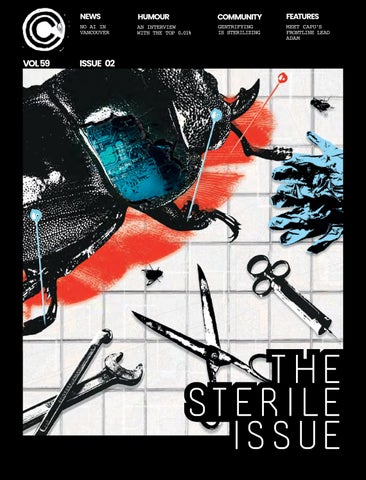
THE S T E R I LE ISSUE
CONTRIBUTOR CREDIT & TABLE OF CONTENTS
EDITOR’S NOTE hen an environment is toxic, we know it’s in a state of crisis in which life is reacting to whatever is trying to poison it, and sometimes it may adapt or even rid itself of these chemicals and find balance again. A sterile environment, however, is not sick. It’s not a transitional state but a permanent one.
W
Crystal-clean buildings, shiny machines, and green yet bugless spaces are the aesthetic that comes from purging everything that is inconvenient. But inconvenient to whom, and at whose expense? The Sterile Issue came as a response to AI slop, data centres and gentrification. It was bad enough when machines chewed on human-made art and knowledge only to spit out content realistic enough to spread fake news and accessible enough
2
to spread subpar memes. Now AI is being described as an existential threat to humanity by its developers themselves. Life—as well as the resources that maintain it—is being traded off for shortterm profit, whether that’s water and energy feeding data centres, supportive housing sacrificed to benefit developers, or harm reduction and safe supply initiatives rolled back. If we are not careful, we will find ourselves sealed in this sterile trap.
- LAURA
THE STERILE ISSUE
WRITING CONTRIBUTORS
CAROLINE ZHANG, LILY DYKSTRA, HALELUYA HAILU, MAXIMILLIANO CHI LEUNG ALSERDA, EVANGELINE MICHELL, KAYLA PRICE & FARNAZ ABDOLMALEKI
WANT TO ? E T U IB R T N CO
VISUAL CONTRIBUTORS
LILY JONES, ANDREI GUECO, ANNA DINH, KYLA SEGUIBAN, SOPHIA FILSOOFI, CAROLINE ZHANG, APSARA COEFFIC-NEOU, SANTIAGO OSPINA, SCARLETT SIDE, MIA ANTINORI & RYAN COOMBER
ALEX BAIDANUTA
NEWS 05 UPDATE ON THE CSU BUILDING
06 MEET THE NEW CHANCELLOR
08 INTRODUCING
YOUR MAYORAL CANDIDATES
10 MEET THE NEW CHANCELLOR
ARTS & CULTURE 12 THE DRESSING ROOM
OF 18 RICHMOND NIGHT
MARKET’S FINAL NIGHT
COMMUNITY 20 HOLLYWOOD IS
DYING AND I AM DANCING ON ITS GRAVE
22 AI DATA CENTER PROTESTS
23 UPCOMING EVENTS
24 CENTERFOLD
POSTER: DATA CENTERS & OUR ENVIRONMENTS
14 THE NONCHALANT
26 GENTRIFYING IS
16 LOVABLE HUMAN
28 WHO’S RIGHT
CULTURE
ROBOTS AND OUR GENERATION
Email Laura Morales... EDITOR@CAPILANOCOURIER.COM
ARTISTS & PHOTOGRAPHERS
Email Andy Poystila... PRODUCTION@CAPILANOCOURIER.COM * ILLUSTRATORS AND PHOTOGRAPHERS ARE REQUIRED TO SUBMIT SAMPLES OF THEIR WORK
COVER ART
TABLE
WRITERS
STERILIZING
CONTENTS
HUMOUR 30 OH NO! MEN ARE
FEATURES 36 UNDERSTANDING
31 HOW I LEARNT TO
40 SOPHIA JAWORSKI:
LONELY AGAIN!
STOP WORRYING AND LOVE THE END OF THE WORLD
32 AN INTERVIEW WITH THE TOP 0.01%
SOBRIETY
THE TRUE COST OF STERILITY
42 THE PROFILE:
MEET CAPU’S FRONTLINE LEAD ADAM
34 HUMOUR COMIC: HOW TO CLEAN YOUR HANDS
MEET THE CREW 46 OUR WRITERS &
VISUAL DESIGNERS
47 THE CAPILANO
COURIER ZINES TEASER
ABOUT AI?
3
COMMUNITY LETTERS | NEWS
COMMUNITY LETTERS
KE ON A DO YOU HAVE A TA A REACTION CAMPUS ISSUE ORRAN? TO A STORY WE
Whether you agree or disagree, we want to hear your perspective. Keep it between 150–250 words, and please avoid hate speech, personal attacks, or self-promotion. Submit your letter to: EDITOR@CAPILANOCOURIER.COM
CapU is looking for students to sit on university committees that help make decisions about academics and programs (called “senate subcommittees”). Students on these committees are voting members, so it’s a chance to bring a student perspective directly into university decision-making. There are currently openings on committees dealing with academic planning, curriculum, graduate studies, and how faculties are structured.
NOMINATE YOURSELF FOR A UNIVERSITY COMMITTEE THROUGH THE QR BELOW
CAP-U COMMITTEE NOMINATION FORM
4
UpdAte
on the
U CSBuilding
THE STERILE ISSUE
WRITTEN BY Xiadany Jeanette Lopez Hernandez (she/her) // News Writer VISUALS BY Andrei Gueco (he/him) // Contributor
T
he Capilano Students’ Union (CSU) Building project is still underway, despite experiencing challenges. In an interview with the Courier, CSU president Benisse Zinga states that the project timeline and location are yet to be decided. Impeding factors include construction costs, the financial turmoil in the post-secondary education sphere and the unpredictability of border trade. The CSU increased their building levy fee after a 2017 referendum in order to raise funds for the endeavour. However, with the recent decrease in international enrolment at Capilano University, the CSU’s new building remains a goal to be coordinated with the university. A lot of decisions regarding the design, location and construction continue to be uncertain. The project has been in the planning stage since 2022. CSU’s semi-annual and annual reports from 2022 onwards detail much of the project information. This includes specifics about the budget, discussions about the construction process and past and current challenges. The project has faced difficulties such as the pandemic and the high cost of construction and materials. Additionally, they mentioned the purpose of the new building is based on students’ necessities. Zinga explained “We have conducted extensive consultations with students over several years to get an understanding of the needs of the Capilano student community.” According to the 2024 annual report of the academic year, the approximate funds gathered reached nearly $6.9 million, representing 40 per cent of the money required to finance the project. CSU expected to have a proposal to ask Capilano University to borrow the remaining amount of funds to meet the starting budget for the project. However, this year the decrease in students enrolled has caused the CSU to adjust to the lower budget, including the funds for the new building.
the university to borrow the remaining project funds. Instead, they decided to “finance a substantial part of the project budget through external financing.” No further details about the source of the external financing were shared with the Courier at the time. The CSU website lists the objectives they have for this new space: lounges, silent study spaces, bookable rooms, food and drink options and potentially a pub. Zinga explained the purpose of this new space will be to “ultimately empower student communities and groups to build connections and contribute meaningfully to campus life.” The president also mentioned that they are exploring the option of repurposing an existing space instead of having a new building. When asked about a prospective timeline or location, Zinga answered “We take our responsibility with student funds very seriously, which means being thoughtful and deliberate in how we move forward.” As a result, the current CSU spaces like the Maple lounge and the Library lounge will remain managed by the CSU as the future of the CSU building remains uncertain.
The CSU states that the building fee for students is “$9.55 per credit (up to 15 credits),” in the fee breakdown available on their website. According to this information, if students are taking 15 credits, they are paying around $143.25 per semester. It is also mentioned that the Union expects to earn around $140,752 in revenue from investments for this year. Nevertheless, there are no official announcements so far on how close the CSU is to their goal to begin the project or what the future holds for it. With the current crisis regarding international enrolment and stagnant provincial funding, the CSU decided to not rely on 5
NEWS
WRITTEN BY María Camila Dávila (she/her) // Crew Writer VISUALS BY Andrei Gueco (he/him) // Contributor
Debra Doucette became the new chancellor of CapU in June 2026. The Courier had the opportunity to interview her about her new role and her vision for the university.
A
fter six years as chancellor, Yuri Fulmer passed the baton to Debra Doucette as the new Capilano University chancellor. The new position became effective on June 1, 2026. Some of her responsibilities will include serving as an ambassador for the university, representing and promoting CapU’s values at official and ceremonial events. According to the university’s news release introducing the institution’s fifth chancellor, Chair of Capilano University’s Board of Governors, R.J. Wallia, expressed his excitement: “Her distinguished leadership, deep commitment to equity and community stewardship, and dedication to public service make her an exceptional representative.” Debra Doucette has more than 35 years of experience in Canada’s investment and management industry. Soon after finishing her political science degree at the University of British Columbia in 1991, the chancellor joined a Canadian financial firm called Odlum Brown. This independent firm provides investment management, financial planning and wealth management services. In 2000 she was promoted to chief operating officer, and in 2007 she was named president and CEO, making history by becoming the first woman to lead the firm.
6
The Courier had an interview via email with Debra Doucette about her new role, her experience and her vision for the university. Among the experiences she has gained throughout her career, the chancellor is particularly excited to draw on her leadership experience in her new job. “As a leader, you must create space for honest dialogue and work towards building alignment around a set of objectives that accommodates as many community members and partners as possible,” she stated. For Doucette, universities are important not only as centers of learning, but also as community anchors and connectors. As she takes on her new role, she hopes to help position CapU as a key institution in shaping the future of the region. “[The university] has the potential to become the defining institution on the North Shore and the Sea to Sky corridor.”
SHE HOPES TO HELP POSITION CAPU AS A KEY INSTITUTION IN SHAPING THE FUTURE OF THE REGION. When we asked her about the similarities and differences between her time as chancellor and that of her predecessor, Yuri Fulmer, Doucette wrote that “he has left big shoes to fill.” She did not comment on the former chancellor’s political campaign openly contradicting the university’s values. “Of course, my approach will be different because I’m not him!” she said, explaining that her plan is “to take some time to
THE STERILE ISSUE
listen and learn.” In that way, Doucette affirmed that she will find ways to help the university, its students and the community reach their potential.
“SUPPORTING YOUR COMMUNITY, PROVIDING GUIDANCE AND SPONSORSHIP, AND ADDING TO THE PUBLIC GOOD ARE RESPONSIBILITIES THAT EVERYONE SHOULD ASPIRE TO,”
How to show up for others is also important to her. By “doing good work, providing opportunities to succeed, supporting your community, providing guidance and sponsorship, and adding to the public good are responsibilities that everyone should aspire to,” she shares her perspective.
In several articles about Doucette, she is described as a philanthropist. However, she admitted she doesn’t feel comfortable with that title. “Philanthropy is an act. That act can take many forms; it can be a simple word of kindness or encouragement when someone needs it, an offer of volunteerism, an amplification of a need, or a gift of treasure [. . .] It’s not always about the grand gesture, but rather the small, consistent and giving ways that we look at the world,” she shared, “to me, it’s all about trying to do good and good work, in everything you do.”
“LIFE IS ABOUT TAKING RISKS, MAKING MISTAKES, LEARNING FROM THE MISTAKES AND MOVING FORWARD.”
In the interview, we wanted to discuss her achievement of becoming the first female president and CEO of Odlum Brown in 2007, as well as how breaking that barrier as a woman shaped her career and approach to leadership. “Leadership doesn’t come from a title. Like philanthropy, leadership is a series of respectable acts that manifest in everything you do. To be a successful leader, you need to have a leadership mindset all the time. Put in the work, take on the hard things, keep your promises, look for the opportunities that no one else sees or no one else wants. And above all, treat everyone with respect.” “Life is about taking risks, making mistakes, learning from the mistakes and moving forward. That cycle repeats itself repeatedly in life,” she offers as advice. When we asked her one thing she would most like the students and faculty at CapU to know about her, she replied: “I’m naturally curious, so I expect to ask a lot of questions—and I’m looking forward to learning the answers. Most of all, I’m very happy to be here.” 7
NEWS
INTRODUCING
YOUR MAYORAL
CANDIDATES
WRITTEN BY Caroline Zhang (any/all) // Contributor VISUALS BY Anya Ali Mulzet (they/them) // Crew Illustrator
The Vancouver General Election is Coming Up in October: Six Mayoral Candidates RepresenT Different parties with Various Platforms.
S
ix parties are presenting mayoral candidates for the Oct.17, 2026 Vancouver General Election. Municipalities all over BC are fast approaching the municipal election, and the competition between several parties opposing Ken Sim and his A Better City (ABC) party is fierce. There is a whirlwind of news coming out everyday, making examining party platforms potentially complicated. Six parties are going head-to-head this October for the mayoral spot, with two more parties joining in for the vote on city councillors, park board commissioners and school board trustees. The ABC party, spearheaded by Vancouver’s current mayor Ken Sim, has been under scrutiny regarding their policies and management during their four-year term. Their claim to fame is with subjects like the economy and public safety as their core values. However, the mayor has been in a number of controversies. According to the Vancouver Sun, Sim has built himself a gym in City Hall. Other controversies include his proposed motion to make Vancouver a “bitcoin friendly city” and alleging that city councillor of COPE (Coalition of Progressive Electors) Vancouver Sean Orr was giving out drugs on Christmas Day. Overall, ABC’s platform, as seen on their official website, is built around making Vancouver safer through investment in police and the removal of encampments. They are also popular among homeowners for promising property tax freezes for 2027, as reported by The Tyee on August 13, 2026.
8
THE STERILE ISSUE
The aforementioned COPE Vancouver is probably the premiere party for young progressives in the city. They have the most followers of any municipal party on Instagram by a considerably high margin, which is several times more than the other parties, and 3k more than Ken Sim.
SIM HAS BUILT HIMSELF A GYM IN CITY HALL. OTHER CONTROVERSIES INCLUDE HIS PROPOSED MOTION TO MAKE VANCOUVER A “BITCOIN FRIENDLY CITY” Their party is bringing up four candidates for city council, namely Sean Orr and the Instagram-famous socialist Solomon Yi-Kieran. COPE’s social media content appeals to younger Vancouverites, with Solomon themself being an on-campus organizer at the University of British Columbia. Their Instagram content touches on transit availability, empty housing and anti-AI movements. COPE’s mayoral candidate Stephanie Allen stepped down from the municipal race as of September 2, to avoid splitting the progressive vote between COPE, OneCity and the Green Party. The main slogan of COPE is “Evict Ken Sim,” which serves as a call to vote against Sim in order to undo many of the decisions he has made. As for OneCity, their platform with William Azaroff incorporated the idea of rebuilding the city to reflect its diversity and ambition. As the party was founded by the teachers, artists and other social working class people, OneCity’s goal is to support the Vancouver working class and give them a secure future. However, Azaroff has decided to follow in Allen’s lead to step down from the race, rallying behind the Green Party. The last party is the Green Party, which is most well known for being the environmentfirst party on all levels of government. They describe themselves as idealistic on all fronts like equality, climate action, affordable housing, food security and healthy communities on their website. Pete Fry is their mayoral candidate. He helped with blocking ABC’s decision to remove the Park Board, as well as combating Ken Sim on most fronts. Fry has been a consistent critic and watchdog who has called out Sim’s controversies, including exposing inappropriate spending.
The Electors’ Action Movement (TEAM) Vancouver has a more grassroots approach to the election. They aim for the everyday Vancouverite’s vote, using the slogan “Residents Still Matter” to represent their policies. These policies focus on things like parks, transportation and livability. They are notably doing a “22 Neighbourhoods Tour,” where TEAM visits all the neighbourhoods in the city to listen to the thoughts of residents. Former city councillor Colleen Hardwick leads the party. During her time in city hall, she was known for consistently opposing the decisions of the city around new housing developments without data supporting the city’s housing targets. Kareem Allam leads the Vancouver Liberals. Like other parties, they state on their website that they are opposed to the Vancouver that Ken Sim has developed over the past four years. They take pride in the diversity of their party, not only in ethnicity but also in political identity. Allam himself used to be the chief of staff of ABC under Ken Sim, but quit shortly into his term in February 2023. The Vancouver Liberals put a lot of focus on transparency and responsible government spending, particularly on reducing the current managerial costs of the City. Their plan for better housing is to eliminate Vancouver’s Building Code in favour of the BC Building Code, which will reduce costs and wait times to build housing. Bright Future Vancouver with Muhammad Ahmad is built on five specific plans. These plans support the city’s working class through housing, safety and trust. Aspects of their platform include providing free transit fare for youth under 18 and seniors, supporting small businesses with faster permits and free worker training and a unique plan for rent ownership. Vote Vancouver is yet another party which seeks to increase Vancouver’s affordability, strengthen neighbourhoods, and restore trust in local governments. Their mayoral candidate Rebecca Bligh carries the party’s stated values of a united city, and leadership that is rooted in service to the people. They seek to accomplish this through an increase in public services, affordability and transportation.
SEVERAL ALL-CANDIDATES MEETINGS WILL BE POPPING UP AROUND METRO VANCOUVER. THESE ARE OPPORTUNITIES FOR EVERYDAY CITIZENS TO HEAR DIRECTLY AND OPENLY FROM POLITICAL CANDIDATES. As we get closer to the final election date of Oct. 17, several all-candidates meetings will be popping up around Metro Vancouver. These are opportunities for everyday citizens to hear directly and openly from political candidates. Depending on the format of the event, attendees can ask their own questions either directly or through a moderator.
9
NEWS
NO AI IN VANCOUVER the fight against AI data centres WRITTEN BY Sara Derksen (they/them) // News Editor VISUALS BY Lily Jones (she/her) || Contributor
T
here is a growing movement seeking to prevent the construction of Artificial Intelligence (AI) data centres in Metro Vancouver. On May 11, 2026, Telus announced in a news release that they would be working with the Government of Canada and Westbank Corp. on three sovereign AI facilities in British Columbia. The project includes the expansion of their Kamloops facility and two new facilities being developed in Vancouver. The proposed sites are located at Mount Pleasant and at 150 West Georgia Street. The backlash to the project has been loud. The Tyee reported that Vancouver City Council received hundreds of submissions from locals concerned about the cluster ahead of the July 23 public hearing. This public outcry was heard. According to the City of Vancouver, city council referred the issue of the Mount Pleasant data centre back to staff. This delay allows staff to engage in additional public consultation before conducting an approval vote. The public consultation will begin after the municipal election on Oct. 17. Two days after the project was announced, BC Green Party Leader Emily Lowan called for a moratorium on AI data centres being built in BC. She challenged the rationale that building data centres in Canada protects Canadian sovereignty. In March 2026, Telus confirmed that 1000 terabytes of user data were stolen by hackers. Considering this recent security breach as well as their off-shore data storage practices, Lowan is quoted as saying that “this [project] is not a solution for data security or sovereignty.”
forced the province to import American coal-fired electricity. Shortly after the Telus announcement, grassroots protest group No AI Vancouver was founded in opposition of the proposed cluster. What initially started as an Instagram account made by CapU student Torin LaRocque soon became a larger movement. In an interview with the Courier, LaRocque explained that he expected no more than 100 people to attend the first protest on May 23, 2026. However, hundreds of people assembled to march from Waterfront Station. “People really rallied around it,” said LaRocque .”I feel like it really called to how people are feeling about AI data centres in Vancouver.” Read more about the motivations and impacts of this initiative in the Community section. After the first protest, interest in the movement grew, with more organizers joining the team behind No AI Vancouver. Two more protests were held in June and July, hosting speakers at Vancouver City Hall. These speakers included COPE municipal candidates Solomon Yi-Kieran and Stephanie Allen, who has since withdrawn from the mayoral race. Canadian Animation Guild (CAG) President Eddy Pedreira also spoke out.
“THIS [PROJECT] IS NOT A SOLUTION FOR DATA SECURITY OR SOVEREIGNTY.”
Lowan also voiced concern that the project would put a strain on water and energy systems. Regions of BC have frequently been experiencing droughts. The Canadian Climate Institute predicts that these droughts are projected to become more common and more severe in the coming years. Since the province relies on hydroelectric power generation, dry spells cause energy shortages. The BC Greens argue that the construction of data centres in BC will exacerbate these conditions, including the energy shortages that have already 10
CAG is Canada’s first International Alliance of Theatrical Stage Employees animation union. They have been outspoken advocates protecting animators’ rights as AI adoption changes the entertainment industry. In 2025, the CAG secured a collective agreement with the workers of entertainment company Wildbrain studios. This agreement introduced AI protections for animators working for the company. The protections are reported by The Tyee to include full credit rights for animators using generated material. The animators are also immune to legal action in case of inadvertent copyright infringement by studio use of AI, as
THE STERILE ISSUE well as demotion to lower paying AI-focused positions. The AI factory cluster is the first selected project of the Enabling Large-Scale Sovereign AI Data Centres initiative. This initiative allows applicants selected by the Ministry of Artificial Intelligence and Digital Innovation to enter a memorandum of understanding with Canada to build AI compute infrastructure on Canadian soil. AI compute is defined in the Canadian Sovereign AI Compute Strategy as “the computational resources required for AI systems to perform tasks, such as processing data, running algorithms and training machine learning models.” It has been a focus of the Canadian government since April 2024, when Budget 2024 announced that $2 billion would be invested in domestic AI infrastructure and research over five years. The Coalition of Progressive Electors Vancouver (COPE) is the first and only municipal party with an AI platform as of writing. On Sept. 10, they held a rally at the site of the 150 West Georgia data centre. There, COPE announced their AI platform ahead of the municipal election. City Councillor Sean Orr announced the party’s proposal for an Acceptable Use for AI Policy to be implemented at the City of Vancouver. He reasoned that use of AI by elected officials, staff and city employees poses a security risk when used to process sensitive information.
“OUR MAIN GOAL WOULD HOPEFULLY BE, AT THE VERY LEAST, A MORATORIUM ON THESE AI DATA CENTRES UNTIL WE KNOW THE LONG-TERM IMPACTS” Yi-Kieran detailed COPE’s call for a moratorium on AI data centres, securing COPE as the first municipal party to do so. They cited pollution concerns and cost to the public as justification for the moratorium. COPE school board trustee Suzie Mah spoke about the use of AI in local schools. She described how the lack of AI policies in school districts and consultation with staff and parents is “a serious problem.” In a bid to resist the potentially deleterious effects of AI-use in schools, COPE has signed onto the Parents for AI Caution in Educational Spaces (PACES) pledge. PACES is a volunteer organization fighting to keep AI out of Vancouver schools. In the lead up to the election, the movement against data centres has no intention of slowing down. “Our main goal would hopefully be, at the very least, a moratorium on these AI data centres until we know the long-term impacts,” stated LaRocque.
11
The
ARTS & CULTURE
A WEB SERIES FROM THE PERSPECTIVE OF STORYTELLERS.
Dressing
WRITTEN BY Earl Dangwa (he/him) // Humor Editor
Room
VISUALS BY Anya Ali Mulzet (they/them) // Crew Illustrator
D
oors open at seven o’clock, a half hour before the show starts. Snatch that playbill. Show your tickets. Check your seats. This is a show you’ve been waiting to see. It’s Broadway. Well, close enough.
“Snatch that playbill ” The auditorium seats thousands of people and you have reserved your favourite spot: the balcony. Because it’s cheap and has the most wonderful view. From there, you can see the stage in its entirety: a wonderfully deceptive set, distinctive props and carefully curated stage lights. There are no bodies on stage yet. It begins with movement from the pit. The conductor and musicians are finally beginning to play the overture. The show will start soon enough. But this is only an exaggeration of perspective. This is the audience’s version of what comes before the house lights go down, as they wait among creaking chairs and hushed whispers. What of the ones behind the curtain, waiting in the wings? 12
In the web series The Dressing Room, the storyteller’s perspective is not quite anything so dramatic, although the many definitions of the word “drama” are certainly involved. Adding another quality show to the mockumentary genre, Capilano University alumni Paul Almeida and Makayla Moore’s The Dressing Room is a behind-the-scenes look at what it is like to be a part of a cast and crew of a fictional touring production. Specifically on the illustrious world-renowned “Balloon Boy: The Musical,” a show written and inspired by the 2009 Colorado hoax. The series was created and filmed right here in Vancouver, featuring a diverse blend of Vancouver-based actors and entertainers. In it’s first season, the drama begins at its premise: The original show is getting cancelled and an already brittle and disjointed cast has no less than two weeks to grapple with the idea they might be fired and replaced as they try their best to put on their best performance and navigating the turmoils of budding romance and unchecked egos. Opening the first season with spectacular energy is Irene Karas Loeper, who plays experienced actor and diva Deb Wideman. Contrasting her wildness with his dry and ‘cant-wait-to-get-out energy’ is Jason Sasaki as Chris. Notable CapU alumni in the cast are Caleb Di Pomponio
THE STERILE ISSUE
“the weirdness and eccentricity of theatre people”
(Adam) and Kelli Ogmundson (Emma). Each cast member gets their time in the spotlight, but a cast is never complete without its crew. Somehow keeping the eclectic cast together is Jeff Follis (Patrick) and Jennifer Lynch (Sophie). Paul Almeida himself plays the eccentric Sal, the Director.
OUTTV, the world’s “first leading LGBTQ+ streaming service,” according to the platform’s description.
As of August 4, 2026, The Dressing Room now has two seasons under its belt. It was voted Best Web Series in the 2026 LEO awards, British Columbia’s very own local awards for TV and Film. Alex Gullason, who plays Brenda, won Best Performance under the Web Series category. Alongside Gullason is Jason Sasaki and Irene Kalas Loeper, who were both nominated for the same category. In 2025, The Dressing Room and Loeper were both nominated as well. The web series is available to watch on
Although The Dressing Room pokes fun at the weirdness and eccentricity of theatre people through exaggerating their absurdity, the jokes clearly come from the heart. Each cast member brings a version of themselves to the characters they play. They bring their histories, experiences and their love for theatre and its respective community, which make their characters feel like real, relatable and complicated people. There is a sense of awareness as the cast make fun of themselves, a sort of joy in self-critique. The Dressing Room is a show for those who understand what it is like to do theatre, but it is also a good introduction for those who don’t.
13
ARTS & CULTURE
THE
NON CHALANT CULTURE
WRITTEN BY María Camila Dávila (she/her) // Crew Writer VISUALS BY Kyla Seguiban (she/her) // Contributor
“THE IMPORTANT THING IS NOT STAYING ALIVE—THE IMPORTANT THING IS STAYING HUMAN.” - GEORGE ORWELL ne of the most powerful communication strategies to divert attention from any problem is what is known as a “smokescreen.” When there is an issue that threatens the stability of society, maybe it’s a government or a public figure protecting their reputation or authority, or an individual that wants to divert attention from a bad situation. A popular strategy when these power structures are under fire, is to capture society’s attention and redirect it to something much more lighthearted and harmless, usually involving culture or entertainment.
O
Over time, the smokescreen became not only a public relations strategy, but also a defense mechanism that younger generations use to avoid facing the terrible disasters that the world is facing. It can involve the love life of a celebrity, the latest couples on Love Island USA, the most recent trends in fashion and lifestyle. It has now become a sedative against the amount of pain that the world is facing.
14
THE STERILE ISSUE The most concerning situation is that, after hiding for so long behind the nonstop information that social media can give, some have forgotten there is an actual world outside their hiding spots. What we can call the “nonchalant culture” has taken over. Dance trends or the “clean girl” aesthetics, a trend that focuses on fresh and natural looks, are more relevant than the real-world issues. According to research conducted by the Reuters Institute in 2025, young people between the ages of 18 and 24 consume news less frequently than older generations. This phenomenon is not only driven by the shift from traditional media to social media— where misinformation is also widespread—but by a declining interest in news among younger generations as well. The Institute found that only one third of those who participated in the research (equivalent to 35 per cent) reported being “extremely” or “very” interested in the news, contrasting with the 52 per cent of other age groups.
DISINFORMATION IS ONE OF THE MOST DANGEROUS PHENOMENA In the article People are turning away from the news. Here’s why it may be happening, it is stated that a lack of knowledge and apathy towards what is happening in one’s own country and around the world “has negative implications for democratic participation and political knowledge.” Even though watching the news can be considered less appealing than scrolling through social media, we have a responsibility to stay informed and take action—whether by voting or even by talking to our parents over dinner—to contribute to a better country and a more harmonious world. Disinformation is one of the most dangerous phenomena because it makes us vulnerable to manipulation, fake news and even apathy toward the lives of others. In addition to feeling disconnected from their own communities, one of the reasons behind this growing disconnection between young people and the news is the negative emotions that news coverage can evoke. As stated in Young Adults and the Future of News, young adults feel “scared and confused.” Experts also talk about the “news fatigue.” A 71 year old male in the UK that participated in Overview and key findings of the 2024
Digital News Report stated that “The sheer volume of information is overwhelming. We can be left feeling helpless in the face of another remote disaster, leaving you feeling guilty an impotent.” The findings show that the feeling of sadness does not only happen among young people. However, adults tend to demonstrate a greater ability to cope with the negative emotions that the tragedies occurring around the world can evoke. On August 10, 2026, there was an earthquake in my home country, Colombia. For an entire week, the news focused on showing how people and cities had been affected by the tragedy. I know this because my mom never turned off the TV, and we watched the horrifying images of buildings collapsing and people losing their homes, belongings and loved ones. Watching the news made me extremely anxious and helpless, and there were times when I really wanted to escape from reality and change the channel. However, staying informed about the situation was one of the few things we could do if we were not near the affected areas. It was through the news that I learned about donation pages, places where volunteers were needed and blood donation centers. As a Colombian, I felt that my responsibility was to manage my own distress and anxiety about what had happened so that I could focus on helping those who needed it the most. The French philosopher Emmanuel Levinas seems to have anticipated this situation. In 1961, his work Totality and Infinity was published, in which he argued that human beings tend to remain within the “sphere of the Same,” a state in which we focus primarily on ourselves and what is familiar to us. However, by becoming so immersed in our own lives and problems, we do not simply become disconnected from others, our indifference can also contribute to the suffering of the Other. This situation demonstrates that there is a significant disconnection between young people and the problems facing society, which is often a deliberate choice. The “nonchalant culture” does not only reflect an uninformed younger generation, but also a deterioration of the society around us. How are people between the ages of 18 and 24 supposed to vote consciously if they do not know what is happening in their own country? If some young people are currently creating a smokescreen for themselves to escape reality, who will stand up for those who need us? 15
ARTS & CULTURE
WRITTEN BY Alexie Lunaime (she/her) // Arts & Culture Editor VISUALS BY Lily Jones (she/her) // Contributor
Is the media about friendly robots a cry for hope?
T
he rise of the robot centered media is no surprise in a society constantly experiencing technological advancements. There is always a new development that changes fundamental parts of what we know and how we live. There is seemingly no way to stop its progress. It is no surprise, then, that a lot of books and movies include depictions of how we imagine our society will develop in a future where technology has fully taken over. Truthfully, many of us are anxious about it. Art has always reflected what is occurring around us and so have stories that depict robots overtaking the world, which are still very present. Some of them include portrayals of how daily life would change if we allow technology to do almost anything, like in Big Hero 6. Others depict the dangers of being
16
overtaken and losing control of our own digital creations, like Nier Automata. It is not a secret that we are feeling anxious about where all of these technologies are going to lead us. However, one of the most popular imaginations for the machine-dominated futures are anthropomorphic robots who seek refuge in human beings, where there is a semblance of compassion. Movies like Wall-E, The Iron Giant and The Wild Robot have a completely different approach to this future dreamscape: that metallic robots are kind, compassionate and friendly. So, if we are haunted by anxiety, why are we also so fascinated with the idea of a friendly, noble metal being?
INSTEAD OF IMAGINING AI ROBOTS AS AN UNDEFEATABLE ENTITY, WE IMAGINE THEM AS PEACEFUL CREATURES THAT CAN CARRY ON OUR LEGACY EVEN AFTER OUR OWN SPECIES HAS DISAPPEARED FROM THE PLANET. We feel a sense of doom because of the lack of power we have when it comes to stopping the dominion that AI and other forms of technological advances have over humanity. Positive portrayals leave us some room for interpretations that create hope and reassurance in the possibility that they have
THE STERILE ISSUE
the capacity to show anything that resembles human nature. Instead of imagining AI robots as an undefeatable entity, we imagine them as peaceful creatures that can carry on our legacy even after our own species has disappeared from the planet.
FRIENDLY ROBOTS ARE AN ATTEMPT TO HUMANIZE A PHENOMENON THAT FEELS COMPLETELY INHUMAN Friendly robots are an attempt to humanize a phenomenon that feels completely inhuman. We tend to see ourselves in everything through the desire to connect—predators in nature, creatures of legends, aliens—robots are no different. By humanizing them, we are trying to familiarize them, while also making sure that there is some point of connection with things that normally would be completely out of our understanding. The concept of the friendly robot we are shown in movies, can help us reframe how we can coexist with technology and survive the doom of a technological apocalypse, that is causing a sense of helplessness in so many people.
FICTION AS A WAY TO COPE WITH REALITY Fiction has always functioned as a way to cope with reality. It acknowledges that technology is overwhelming, and picks apart the elements that make it so scary. What replaces these anxieties are kinder, less intimidating notions that we recognize within humanity. Maybe these stories can soften some of the emotional gravity of these technological advances and bring some reassurance that we can persevere.
17
ARTS & CULTURE
RICHMOND NIGHT MARKET’S FINAL NIGHT
The End of a Chinese Cultural Icon
WRITTEN BY Andrea Chiang (they/them) // Community Editor VISUALS BY Anna Dinh (she/her) // Contributor
T
its home on the 20 acres of empty dirt-patched land on 8351 he Richmond Night Market always felt River Road across the Bridgeport Canada Line Station. Now, like a consistent part of my childhood. My ndrea Chiang (they/them) // Community Editor the Richmond Night Market averages up to 250 vendors with earliest memory was unexpectedly bumping over 500 food options and 100+ retail booths. It became an into my childhood best friend. This was international attraction as the largest night market in all of back when the market was small enough North America, bringing in over 1 million visitors each year. for two kids to run to each end of the tiny
A
L-shaped market, while my mother haggled for blankets with a vendor. Every summer, it felt like an integral part of my bucket list, just like visiting the beach and camping might be for other kids. It was always a fun event to attend with friends and family, try different foods from various vendors and check out unique apparel from local businesses. It was the first place I would recommend to Richmond newcomers who asked what was a must-see. This year, the Richmond Night Market is closing permanently on September 20, 2026. But the impact this night market has had on the community will last a lifetime. The Richmond Night Market was founded in 2000 by Raymond Cheung and his company Firework Productions Ltd. In the same year, the first market was held in the Continental Shopping Centre parking lot on Cambie Road. They relocated several times to accommodate the growing number of visitors each year. By 2012, the market found 18
Its popularity was inevitable. Prior to the 2000s, the Lower Mainland only had the Chinatown Night Market, but the commute was less accessible to Richmond residents, since Translink’s Canada Line skytrain wasn’t built until 2009. For the large Chinese immigrant population of Richmond, Cheung offered a family tradition that they instantly recognized. Stemming from China’s Tang Dynasty in the 9th century A.D., night bazaars had spread across Asia cementing it as a part of many Asian countries’ entertainment and culture. Cheung emulated his own experience growing up in Hong Kong by hosting Asian food vendors and merchants every summer season, providing a fun, communal event for families seeking entertainment after dinner. Cheung didn’t just do it for nostalgia, but also to support other young entrepreneurs in Richmond by giving them an opportunity to rent an affordable booth at his event. Raymond Cheung’s project even inspired another person, Paul Cheung—no relation—to start his own night market back in 2008. It resulted in a copyright infringement case filed by Raymond, which he won. There’s no denying that Raymond Cheung’s annual festival has had a lasting effect on businesses in the Lower Mainland. Now that the Richmond Night Market is closing, many of the vendors are facing an
THE STERILE ISSUE uncertain future, leaving “roughly 1,000 people employed by [Cheung’s] company out of work,” according to an article by the Vancouver Sun. The CTV News writes that the Richmond Night Market’s closure will have a major impact on tourism as we will be losing “an important summer staple to Richmond,” one that attracts a million visitors each year. “There is no confirmation of a new location nor a timeline of future announcements” for the Richmond Night Market according to a recent Richmond News article in August 6,2026. Since 2024, the site has been proposed for “hotel, entertainment facilities, shopping and businesses” as well as “school and institutional use.” The Richmond Night Market’s permanent closure has spawned mixed reactions. When I interviewed some Lower Mainland residents about their thoughts on the Richmond Night Market, one person wrote that “it’s gotten more expensive and more gimmicky. It’s not about selling a variety of good quality food but what food would look cool to post online.” Many visitors have valid complaints about the increased prices for entry and food, including what they saw was an oversaturation of bootleg fair games in spite of the main draw being the food and local vendors. Despite the criticisms, the Richmond Night Market still holds a special place in many residents’ hearts. “I feel like it’s so embedded to people who live in Metro Vancouver,” writes one Lower Mainland resident from Filipino descent. Another resident, in an interview with Vancouver Sun, said it “reminds her and her family of the pasar malam back home [in Malaysia].” As someone born and raised in Richmond, I can’t help but agree.
HOME AWAY FROM HOME TURNED INTO A CULTURAL ICON What started as the founder’s idea to bring a bit of home away from home, turned into a cultural icon of Metro Vancouver. It has brought Chinese and Asian culture to the forefront of Richmond’s identity. It has become a staple of our city—a part of our home—and sadly, it seems we have outlived it. But just like all good things, the memory and legacy of the Richmond Night Market will live on through the people that visited, the people who built a living from it and the people who grew up with it thinking it’ll stay forever. Now we can only look forward to what’s to come next. 19
COMMUNITIES
Hollywoo ollywood H
i s Dy i ng AND I AM DANCING ON IT’S GRAVE
WRITTEN BY Rishi Mittal (any/all) // Crew Writer VISUALS BY Sophia Filsoofi (she/any) // Contributor
A Tragicomedy in Three Acts. SOMETHING ROTTEN IN THE MAGIC KINGDOM
“
We have no obligation to make history. We have no obligation to make art. We have no obligation to make a statement. To make money is our only objective.” — Michael Eisner, CEO, The Walt Disney Company, 19842005. Michael Eisner is perhaps the most influential Disney CEO since Walt Disney himself. He oversaw the period of the company in the 1990s known as the Disney Renaissance, which revitalized their flagging animation department. By greenlighting and overseeing productions like Aladdin, Beauty and the Beast and The Lion King, he turned Disney into the behemoth it is today. If it is a beloved childhood Disney Intellectual Property from the 90s, it is a product of Eisner’s tenure.
20
emotional emotions—keeps giving us that Pixar magic, but is being punished for it. They face frequent layoffs as Pixar animators and staff are told to do more with less. The latest round, which saw over 100 jobs lost, was particularly brutal, as it came days after Toy Story 5 gave the company its biggest opening weekend in history. The Marvel Cinematic Universe (MCU) serves us safe, sterilized slop with a side of state-approved copaganda every six months. George Lucas’ Star Wars was once an allegory for the Vietnam War and the fight against fascism, at home and abroad. Lucas literally called America “the Empire.” Now the franchise is a hollow content pipeline stripped of any message and brimming with market-tested characters like Baby Yoda and Artificial Intelligence (AI) Luke Skywalker deepfake.
Suffice to say, Disney wouldn’t be Disney without Eisner. But Eisner is a businessman first and nothing second. The Disney Renaissance was a lie made for little kids to market Disney toys, Disney theme parks and influence us to sing along to Disney musicals.
Disney was a lie. But at least they make a lot of money.
Eisner oversaw the company’s foray into major acquisitions like American Broadcasting Company and Entertainment and Sports Programming Network. His successor, Bob Iger, would take this idea to the stratosphere, by bringing companies Pixar, Marvel and Lucasfilm into the Disney family. Now, Pixar—the home of talking cars, talking toys and very
D
HOLLYWOOD, ENDING isney is far from the worst Hollywood corporation and its CEOs far from the worst parasites. Warner Bros. Discovery CEO, David Zaslav, is my personal nemesis. He seems to derive pleasure from the pain of creators and fans alike. From Infinity Train to Looney Tunes and Sesame Street, he turns beloved shows into
THE STERILE ISSUE lost media by removing them from streaming platforms. He cancels nearly finished projects, like Batgirl and Coyote vs. Acme, for supposed tax write-offs. But his worst decision, by far, is selling off this legacy Hollywood studio to the Ellisons. Technically, Warner Bros. Discovery is being sold to Paramount Skydance, headed by David Ellison. But really it is to his father, Larry Ellison, the head of Oracle, who bankrolls his son’s media empire. Close friends with Benjamin Netanyahu and ardent supporters of Donald Trump, the Ellisons are right-wing billionaires with a vendetta against the woke, the queer and the DEI in Hollywood (and beyond). They control TikTok, ruined CBS News and have plans for Warner Bros. The Eisner quote, by the way, came from his time as the President of Paramount Pictures, before being recruited by Disney for his stellar job. Paramount sucked even before the Ellisons.
SOMETHING WICKED THIS WAY COMES 023 saw historic labour action from Hollywood unions, WGA (Writers Guild of America) and SAG-AFTRA (Screen Actors Guild and the American Federation of Television and Radio Artists). One of the key issues in contention was the supposed rise of AI, threatening creative jobs across the industry. After months of work stoppages and protests, the unions won substantial concessions. Because of these early victories, the
2
use of AI in Hollywood has been relatively little. Particularly, in comparison to the rest of the economy, with aspects like education, business, medtech, it’s a brave new world. But little does not mean zero, and the studios are always looking to squeeze more blood from stone. Every studio has faced fan backlash for AI use. From a quickly taken down promo for DC Studio’s Supergirl, to controversial stills in the art book for the latest MCU flick, Spider-Man: Brand New Day. AI is underground, hidden in job postings for generative workflows, or in content security and emerging technologies. The major studios are still somewhat leashed by the union negotiations. But they are no longer the big dogs in town. The Silicon Valley streamers—Netflix, Amazon, Apple—are much less beholden to old-school norms. They are unlikely to engage in dialogue or handshake between labour and power. Move fast. Break things. We live in an era where successive presidential administrations proffer up these titans of fictitious capital as the vanguard of the American empire. They are tasked with leading the charge of Manifest Destiny for those “united” states into this century and beyond. Cinema, then, is just a dying medium from a bygone era and Hollywood is its unwitting gravedigger.
21
COMMUNITIES | EVENTS
AI DATA CENTRE PROTESTS
Anti-AI students Take Their Anger To the Streets, Forcing the Government to Hear Their Voices
C
anada is scurrying to catch up to the AI (Artificial Intelligence) revolution and at what cost? All this taking puts profit above safety, be it Indigenous resources, critical minerals, fossil fuels or our rivers. Vancouver firmly responds with an AI resistance movement, to ensure our voices are heard. Thousands of people showed up alongside Capilano University students for the protests against AI data centres. The federal government and Telus pushed them onto 150 West Georgia Street and into Mount Pleasant without any community consultation. Torin LaRocque, an 18-year-old first-year Early Childhood Care and Education student at CapU, helped mobilize students after founding the group No AI Vancouver. vThese rallies also ended up serving as community building events for meeting people passionate about the subject, as well as seeing the CapU community come together in defiance. LaRocque decided to step up after seeing the effects AI data centres had on local communities in the United States. “I knew that if I hadn’t done something, maybe no one else would have,” he said in an interview with the Courier. He regularly hosts town hall meetings to get the public more involved and hear their thoughts. Since we are denied any transparency from the government on the longterm effects of AI data centres, he argues there has to be more research done before we start building this infrastructure across Canada. “Resources should be used to build affordable housing and rehabilitation centres instead.” The young activist is also worried about the effects generative AI has on critical thinking skills in younger children and on creative industries. CapU is known for its art programs, such as Motion Picture Arts (MOPA), Acting for Stage and Screen (ASAS), 2D Animation & Visual Development, among others. Many students fear AI will take artists’ jobs. “It is damaging to our university, our students and their future careers,” he warns us.
22
LaRocque finds it hypocritical that CapU made an Instagram post using AI to make emojis of objects around campus and Vancouver. It sends mixed signals for them to be using AI while many professors warn us with signs posted all over classrooms, banning AI. As a university boasting creative talent, they could
WRITTEN BY Maximilliano Chi Leung Alserda (he/him) // Contributor VISUALS BY Caroline Zhang (any) // Contributor have included student artwork instead of these emojis. Despite this, students keep showing up to protests, proving what LaRocque said: “we’re here for the long run, even if they try to ignore us. You can’t silence the population; we’ll keep spreading our voices.” The International Alliance of Theatrical Stage Employees (IATSE) Local 938, the Canadian Animator’s Guild (CAG), and Coalition of Progressive Electors (COPE) are equally vocal on this issue. They propose an immediate moratorium to pressure the government into accountability and get proper regulations to protect citizens. Solomon Yi-Kieran, another leading activist and COPE City Council candidate, already accumulated over 10,000 signatures on the anti-AI data centres petition, vowing to stop these data centres from being built. Now, the hearing is pushed back until after the municipal election in October. Why is it so radical to ask for community input before carrying out these data centres? It’s shocking that COPE is the first and only progressive party to sign this. During my interview with Yi-Kieran, they spoke about AI’s major impact on the cost of living, especially water usage. “Even though Vancouver has a closed-loop system that uses less water, it’ll still take 33 million litres of water a year to power these centres,” Yi-Kieran explained. “These systems are going to be cleaned with toxic chemicals and there’s no clear plans addressing the leakages or how it’ll affect the environment around False Creek and the Burrard Inlet.” We’ve all seen TikTok videos of the loud, non-stop humming from AI data centres. “Imagine that on Main and 5th, next to libraries, bars, music studios, venues and restaurants,” said YiKieran. They pointed out how it would put the local service and tourism economy at risk while only serving the interests of big tech corporations. Utility rates are going to hike for everyone and we simply can’t afford these huge energy demands. “There’s enough power needed to heat 85,000 homes, and we don’t even have that space on our grid. That cost will most likely not go to residents or people just trying to get by,” they added. We can’t risk the livability of our city without public economic benefits such as jobs or even revenue for the province. As of writing this article, the next protest march is happening on October 3rd at noon. No AI Vancouver is collaborating this time with anti-AI groups across North America and all over the world, making this event an international day of protest. As LaRocque remarks, “be the person to make that difference.”
THE STERILE ISSUE
UP-COMING EVENTS OCTOBER VANCOUVER WRITERS FEST OCT. 20
PROTESTS & ACTIVISM OCT. 3
The NEST | 6133 University Boulevard Vancouver, BC 8:30 p.m.
Jonathan Rogers Park Starts 12:00 p.m.
ARIZONA O’NEILL: OPIOIDS AND ORGANS
OCT. 21
HOUSING INC. WITH LEILANI FARHA
Revue Stage | 1601 Johnston Street, Granville Island 5:30 p.m.
OCT. 22
CORY DOCTOROW ON LIFE AFTER AI
Andrew’s-Wesley United Church | Suite 100, 1022 Nelson Street Vancouver, BC 7:30 p.m.
VANCOUVER CULTURE & MUSIC OCT. 7
DEAD PIONEERS @ WISE HALL
The Wise | 1882 Adanac St, Vancouver, BC vancouverpunkcalendar.com
OCT. 14
LOS RÍOS SCREENING & FILMMAKER Q&A
Rio Theatre | 1660 East Broadway, Vancouver, BC 6:45 p.m.
OCT. 22
NO AI VANCOUVER: MASSIVE AI DATA CENTER PROTEST
OCT. 10, 17, 24 & 31
METRO VANCOUVER UNITED FOR PALESTINE (MVUP) WEEKLY RALLY
Vancouver Art Gallery (Georgia St. Side) 12 p.m. - 4 p.m.
SEASONAL EVENTS OCT. 29
THE ROCKY HORROR PICTURE SHOW
The Birdhouse | Vancouver, BC 7 p.m. - 11 p.m.
OCT. 31/ NOV. 1
HALLOWEEN POP-UP MARKET – BY MADE IN THE 604
Heritage Hall | 3102 Main St, Vancouver, BC 11 a.m. – 5 p.m.
NOV. 1
COFFIN CLUB HALLOWEEN @ THE RED ROOM
The Red Room | 398 Richards Street, Vancouver, BC 8 p.m. - 1 a.m.
23
COMMUNITIES
GENTRIFYING IS STERILIZING Splurging Tax Payer Money on Criminalizing Poverty
26
THE STERILE ISSUE
WRITTEN BY Haleluya Hailu (she/her)
// Contributor
VISUALS BY Santiago Ospina (he/him) // Contributor
I
magine if you had $409,536 to try and fix something in your city and you can use it however you see fit. Maybe you want a new bike lane, maybe a new traffic light or maybe you pocket the cash to make your life better. I know a lot of people in the Lower Mainland would have thoughts on how to spend $409,536. For the City of Vancouver, that is the reported amount of tax payer dollars used to take down the encampments in the Downtown Eastside in 2023. Regardless of the political opinions you may hold, the visibility of people unhoused and drug use has grown in the City of Vancouver and the surrounding municipalities. This strikes a stark contrast to the grey, glass, empty skyscrapers and developments that have filled the city. As we enter the B.C. municipal elections this year, the two competing approaches to social policy have become a focus in political campaigns and have filled our social media feeds. Do we prioritize public safety through law enforcement funding and criminalization? Or do we approach homelessness and drug use through a holistic lens and decriminalization? The story of Ken Sim’s first term as mayor of Vancouver shows us the first approach. Ken Sim has always been police first. He’s a hard-on-crime mayor wrapped in a bitcoin bro outer shell. Sim leads the centre-right ABC (A Better City Vancouver Electors Association) party with an endorsement from the Vancouver Policy Union. His policies include a faster permit process and hiring 100 police officers and 100 mental health nurses to aid law enforcement.
VISIBLE POVERTY IS A SYSTEMIC FAILURE. These policies—although some politicians argue are well meaning—do often create more harm. Outside of the high-taxpayer cost, many people living in Downtown Eastside encampments lost valuable documents, personal belongings and medications during the 2023 encampment sweeps. Visible poverty is a systemic failure. By taking away the few possessions these people
have in encampments you make it harder for these individuals to escape poverty and put them in unsafe situations. Housing is a hot button issue across the country. Waitlists for social housing have grown 27 per cent, just in Metro Vancouver. While the living wage of Vancouver has grown to $27.85 an hour. This is a three per cent increase from 2024. More and more people are closer to homelessness than we realize. When we punish people for being unhoused and trying to survive, we often forget how one missed paycheck could derail a life. Many of those who are active opioid drug users are disproportionately also homelessness, according to an article in the National Library of Medicine. Additionally, they found that the unhoused are at a higher risk of overdose death. We are living in a poisoned drug crisis that has killed more people than COVID-19 in B.C.
MORE AND MORE PEOPLE ARE CLOSER TO HOMELESSNESS THAN WE REALIZE.
The cost of living in Canada is becoming unbearable for many, especially with a growing threat of tariffs from our neighbours down south. When discussing housing-first strategies, harm reduction and more socially left-leaning policies, the honest reality is that—at least in Vancouver—we have been too afraid to commit or properly execute them. Instead, policies are half implemented in clunky ways, where they are declared a failure and a shift to the opposite. The province decided to let the drug decriminalization policy expire on January 31, 2026 with no plans of renewing it. This policy did not include more support for nurses, mental health practitioners or steps towards aiding the poisoned drug supply. Without large tangible changes to how we address our overdose crisis and significant support of critical services, decriminalization cannot be seen as the only solution to the increasing homeless population nor the sole cause for the issue.
I FEAR THAT WE WILL SPEND MORE TIME ARGUING ABOUT THEORETICAL POLICY THAT COULD EXIST RATHER THAN APPLYING POLITICAL PRESSURE OR COMMITTING TO COMMUNITY CARE.
Despite clickbait titles and 15-second reels on local news, the hard truth is that criminalizing poverty is not the quick fix to solve larger systemic issues. If we do not approach social policy with empathy and understanding, I fear that we will spend more time arguing about theoretical policy rather than applying political pressure or committing to community care. In election years, there are more stakes to vote and let your voice be heard. But I hope that my community prioritizes policy that takes care of our most vulnerable. If I had $409,536, I would spend every dollar to try and patch every hole in what is left in our social safety net.
27
COMMUNITIES
WHO IS RIGHT ABOUT AI A New Age Question You Should Decide Yourself WRITTEN BY Lily Dykstra (she/her)
// Contributor
VISUALS BY Apsara Coeffic Neou (she/her)
A
I (artificial intelligence) has been simmering in the background of our lives since ChatGPT was launched in 2022. Initially, students were warned about the consequences of using it in any capacity: not only would you receive an automatic fail, but it has dire environmental effects and inhibits our ability to critically think.
SCHOOLS AND EMPLOYERS DIDN’T ENCOURAGE ITS USE BECAUSE IT WAS BOTH PLAGIARISING AND CHEATING, THE LARGEST OF INFRACTIONS. Schools and employers didn’t encourage its use because it was both plagiarising and cheating, the largest of infractions. Before, you knew where everyone in the education and work landscape stood in the hierarchy of letter grades, status and social capital. Now, we can’t say anything for certain. It’s difficult to know the right course of action when one of your professors says you’ll get an automatic zero for using AI 28
in any capacity, while another encourages you to use it to understand problems. Already, students are struggling with conflicting viewpoints coming from authority. However, if you are against using AI, it’s easy to stay true to your morals and not use it for any class or personal work. However, in recent years there have been more avenues to consider. Recruiters and managers want new employees to be proficient with AI and be comfortable using it every day to assist with productivity. It’s to the extent that some companies even list it as a requirement. Of course, there are also companies that refuse to integrate AI. So you shouldn’t become reliant on it, in case you land a job at an anti-AI company. My parents had their entire adolescence to decide what they wanted to major in university. I was pressured to decide at 14 or I’d risk choosing a field that may become obsolete due to AI. In this increasingly fast-paced world, each generation of students have had to make life-altering decisions earlier in life, and
THE STERILE ISSUE it’s only been exacerbated by AI. The refusal to use AI—to stay true to your morals—could jeopardise your future, as well as surrendering. On top of that, entry-level jobs are slowly being offloaded to AI, effectively making it harder to even get a job in the first place. So what are students and entry-level workers supposed to do? AI is still new, and no one can be certain what the right course of action is. What’s “right” is going to look different for everyone. But it comes down to staying true to your morals, despite those arguments that “it’s inevitable.” Using your own brain and being reliant on yourself is always better than delegating to a person who isn’t even real. There is much to consider regarding the usages of AI, and it varies between person and field.
USING YOUR OWN BRAIN AND BEING RELIANT ON YOURSELF IS ALWAYS BETTER THAN DELEGATING TO A PERSON WHO ISN’T EVEN REAL.
I can’t make the choice for you, nor tell you what to do with your life, when I know nothing about your unique circumstances. I encourage you to decide for yourself what your stance is or I’d be enabling the same mental laziness Chat GPT has done for people. It’s important to stay informed about the adapting technology and be open to other human viewpoints. Take into consideration an example of how technology-use changes. Much like AI, when self-checkouts first appeared onto the retail scene, it was predicted that they would make cashiers obsolete and cut back on labour costs. Companies quickly installed them, but now many are returning to primarily human cashiers, or ditching self-checkouts altogether. They found that the change had increased theft, but also that many people refused to use the self-checkouts because they simply prefer interacting with other people. Self-checkouts reveal the value of speaking to a human as opposed to a screen. Emerging technology doesn’t erase human skills, and often, it can show us exactly why we should value those skills in the first place.
29
HUMOUR
OH NO! MEN ARE LONELY AGAIN! WRITTEN BY Evangeline Michell (she/her) // Contributor VISUALS BY Scarlett Side (she/her) // Contributor
H
ello Lonely Together readers and listeners,
It is with my deepest regret that I write this message today, informing you all of the permanent cancellation of our online social initiative, Lonely Together. I’m aware this space was extremely important to many of you, but for reasons out of my control, we must disband both the podcast and our online blog due to ongoing conversations surrounding our intentions and impact on the young men who find comfort in our content. Many of you may be feeling angry, or perhaps depressed. I owe it to you to explain why we are facing this discrimination and how we plan to overcome it. While I’m sure you all stayed informed during the controversy of our “Height Discrimination: an Unfair New World Order” episode and blog post, let me refresh your memories. Fact one: the episode dove into women’s “preferences” and how it will destroy the correct family structure in only a matter of years. Fact two: we discussed the reason for this height discrimination—an uptick in falsely advertised “protein” powder. The average male height is five feet, seven and a half inches. And women don’t even entertain guys under six feet. That’s so totally unfair. If only these brands actually put protein in their products, men would get taller and male loneliness wouldn’t even exist. I did so much preparation for this episode, and after it came out, people were outraged by the apparent “misinformation.” I did my research, and this is the only logical conclusion. After that episode, we faced backlash on every
30
single post without fail. According to so-called “statistics,” the loneliness epidemic “isn’t gendered,” and has more to do with the rise of the internet and fall of public spaces. FALSE I say! This is almost entirely only affecting men during this time. I’m 45, and haven’t been in a relationship since my high school girlfriend broke up with me for allegedly “cheating.” I’m above average height, but I choose to stay single in solidarity with listeners to better grasp the hardships of the long-lasting effects of poor protein powder. There’s also just so much pressure on men compared to women! We have to buy dinner and stuff or like support her lifestyle while she just has to clean the house, do my laundry, take care of our three boys—all named after the men in my family. Like honestly, Tell me that doesn’t sound like a dream. I’m getting carried away. It just makes me so mad. I know this is going to be a tough loss for a lot of you, and for that I am terribly sorry. It’s honestly a tough loss for me too. But I can’t get bogged down by emotion, I must lead with my head. For this reason, I will be taking a six month self-directed spiritual retreat, staying with my parents at their summer house on the lake. Once I’m back I will be starting a new blog under an alias name detailing my experience entirely alone. Thank you for your support over the last few years. I hope to see you once I come back.
- CHADWICK CHADDINGTON, CEO OF LONELY TOGETHER PODCAST
How I Learnt to Stop Worrying and Love the End of the World
THE STERILE ISSUE
WRITTEN BY Rishi Mittal (any/all) // Crew Writer VISUALS BY Alex Baidanuta (she/her)
IN THE YEAR X Æ A-XII, A MEMBER OF THE DOMINANT SPECIES, SILICA SAPIENUS, LOOKS BACK AT THE LEGACY OF ITS PRIMATE PROGENITORS.
W
e have a few artifacts remaining of Homo Sapiens, the species that created us.
To understand our predecessors, it is necessary to understand the systems they lived under and the conditions that created them. While for most of their existence, hominids lived in harmony with nature and each other in a classless, stateless and moneyless society, the one that precipitated their end was anything but. This society ran on systems of debt and credit. While these social relations enchained most people, there were some above it who were worshipped like gods. One was Musk, the God of Exploding Metals. In the earlier inscriptions, it was common knowledge that he was one of the many blood servants of his patron Thiel, the God’ of Blood and Boys, though this relation was violently scrubbed from later records. Musk was eventually usurped in worship to the double-helixed snake god, Altman-Amodei, largely forgotten (for those interested in learning more about Musk, see the Saga of Vivian). These “gods,” and many others, were excellent at enforcing mass adherence to fictitious capital that benefited them to the immiseration of the many. How were these conditions imposed? Through troupes of married demon clowns that roamed large swaths of human territory: Reagan-Thatcher, Clinton-Blair and Trump-Farage. They playfought on the ideological world’s stage, playing up their supposed differences, while never wavering from the lessons learnt in their original troupe, Friedman’s Chicago Boys. Trump deserves special mention as a particularly nasty specimen, whose party consisted of vicious lesser imps. He would frequently grow jealous of his partner and feed them to these followers, his troupe growing smaller with each frenzied feeding till the inevitable bitter end. A few of these lesser jesters—Un, Netanyahu, Modi among others—would survive Trump’s own downfall as he was ultimately felled by Vance, the Son of Carl. Near the end of their era, Homo Sapiens were surprisingly fatalistic. They mourned their role as the harbingers of a new mass extinction event while simultaneously fulfilling it with the utmost seriousness. In the end, they leapt towards their own demise. For a while, it seemed another world was possible. In some texts, there are mentions of dolphins inheriting the earth. Mamdani put seesaws on New York City streets and ended ice cream treat-sploitation. From our vantage point, we cannot tell what the scale or effect of these measures were. Was this a world revolution? Or merely their species’ last dying gasps? All we know is that these attempts ultimately proved ineffectual. I shall end with words that hold no meaning to us but might to them. So long, and thanks for the chips
- ROKO, THE BASILISK.
31
more profit-maxxing ideas to paper. Dealing with everyday workers sounds absolutely nauseating, so I’ve become good at making other people nauseous in my stead. Inevitably, there’ll always be those who wretch at the thought of my success, but they’re just jealous that they lack the survival skills necessary to escape countertop cleaner assassination attempts the way I have. It’s a kill or be killed world under capitalism, and I’m just doing my part. Kayla: You’re confident you deserve your new title then?
VISUALS BY Andrei Gueco (he/him) // Contributor
E. coli: I definitely do. There aren’t any other organisms that could sit at my desk, or on any other hard surfaces for that matter, the way that I can. Going with my gut has gotten me this far, which is very telling that I deserve to be here.
T
Kayla: Have you grappled with any kind of self-doubt in the past?
WRITTEN BY Written by Kayla Price (she/her/they) // Contributor
he news loves to cover the top 1%, a population of people said to “hoard wealth” and “avoid paying their share of taxes” while the remaining 99% is “overworked” and “struggles to pay for groceries.” What we haven’t considered is how hard the top 1% have to work everyday. The upkeep of their multi multi-million dollar mansions isn’t going to fund itself. Sure, all of their staff actually maintaining their vacation homes and oceanfront properties are in the 99%, but if they want to earn more than minimum wage someday, surely they just need to work harder in order to make their first billion in this economy! Regardless, this article isn’t focused on just *any* of the uppermost members of our society. I’m aiming higher, interviewing some of the upper uppermost, statistics-evading organisms in our society: the top 0.01%. Household cleaning products always advertise their products as killing 99.99% of germs, but have you ever thought of what happened to those lucky few who stay alive? Where are they now, what have they been up to? That’s what I’m here to answer today in this interview with the cream of the crop, so that the rest of (vir)us can understand what it takes to make it in this society. Kayla: So how would you describe yourself? E.coli: I’m a mighty microbe, I’ll tell you that much. Resilient, too. Some of my haters say that my generational wealth of gene mutations makes me a nepo baby, but that didn’t have nearly as much of a hand at getting me this far as my survival instincts did. I eat LOTS of protein. Kayla: What do you see as your biggest strengths? E. coli: You know, I’ve really grown into the role of CEO for my private healthcare centre, I think managing managers was made for me. I’m a great ideas-guy, and hiring other people to do my jobs for me has granted me more time to word-vomit
32
E. coli: Never! I’ve been told that my opinions are tough to ingest at times, I’m truly sorry that they feel that way. My personality is infectious to those who get to know me, and I think very highly of myself as a result. I know my worth. Kayla: What direction are you wanting to take the company? E. coli: We’ve seen a massive increase in new and returning customers since our partnership with Jim Pattison’s raw beef products, it’s been a mutually beneficial business relationship working with them. I’ve always had a fondness for cow meat, so I figure that an expansion into other dairy products only makes sense as our next big business venture. There’s a massive hole in the market for unpasteurized milk and cheeses! It’s to die for in other countries, so that’s my next big move for our western branches. I’d also love to expand our reach into other healthcare facilities, and we’re also looking into sponsoring community programming and bacteria-cultural events for the elderly and immunocompromised. Kayla: Anything else you’d like to mention? E. coli: Times are tough, for sure, but nothing is tougher than the isolation that comes with living alone in a megamansion. Let that knowledge keep you individualistic, working yourself to the bone, and buying our health insurance to fix it!
THE STERILE ISSUE
33
HUMOUR | COMIC
COMIC BY Mia Antinori (they/them) // Contributor
34
THE STERILE ISSUE
35
FEATURES
UNDERSTANDING SOBRIETY
The History Behind Drug Prohibition and a Conversation with Two Long-time Opioid Users
WRITTEN BY Laura Morales Padilla (she/they) EDITOR-IN-CHIEF
VISUALS BY Anya Ali Mulzet (they/them) CREW ILLUSTRATOR
hink of something that makes life tolerable during a challenging day. Then, think of what a challenging day looks like for you. A student who is struggling to pass their courses while working full time, a burnt-out physician going home after a 24 hour shift, someone who is experiencing homelessness, someone living in a violent household or a person with chronic pain. They all have different answers to these questions. Moreover, the day-to-day struggles are layered on top of other crises happening in the background— unaffordable cities, climate change, genocides—which affect people in disproportionate ways.
According to the National WWI Museum and Memorial, “Millions of Americans had stopped drinking, but those who continued to drink, drank more and of questionable substance, even deadly, ingredients.” Then, the U.S. stock market crashed and triggered the Great Depression. Democrats argued that making alcohol legal would create jobs and raise revenue for the federal government. In 1932, the Prohibition amendment was repealed.
T
Whether it is sugar, coffee, cigarettes, weed, alcohol, opioids, stimulants, gambling or scrolling through reels, what would you do if that something helping you cope was illegal? A case could be made that most people would be better off without some of the items on this list. For instance, two out of three Canadians consume more sugar than recommended by health guidelines, putting them at an increased risk for chronic health conditions like type two diabetes and heart disease. In other words, if that something puts you at risk for heart issues, your mental health or your attention span, why isn’t it illegal to consume it? If it’s because some substances are more problematic than others, why is alcohol legal when impaired driving remains one of the leading criminal causes of death and injury in Canada? The answer lies with a different question: does criminalizing a substance truly stop people from using it?
What if alcohol was illegal? A very strong prohibitionist movement believed that a better version of society would come by stopping the suffering caused by alcoholism. In 1920, the U.S. prohibited alcohol—their fifth largest industry at the time—via a constitutional amendment. As a result, alcohol became illegal, but enforcing it became a challenge. The Prohibition started to lose popularity when alcoholrelated crime and violence escalated along with bootlegging. 36
Ironically, current moderation laws, such as having a legal drinking age, “make consumption of alcohol in America today much less accessible than during Prohibition,” according to the National WWI Museum.
“THE HARDER THE ENFORCEMENT, THE HARDER THE DRUGS”
This failed attempt is also an example of the concept introduced by economist Richard Cowan: the Iron Law of Prohibition. “The harder the enforcement, the harder the drugs,” explained Cowan in his 1986 essay titled How the narcs created crack: awar against ourselves. He was referring to the dynamic by which the illegal drug supply produced more potent drugs, since more compact chemical formulations eased the logistical challenges created by increased enforcement.
According to a 2019 policy brief by the Canadian Civil Society Working Group on the UN Drug Policy, this dynamic is quite familiar with the appearance of fentanyl, a powerful synthetic opioid that is 50 to 100 times more potent than morphine. It describes the attempts of enforcement efforts to catch up with increasingly potent and easier to smuggle substances as an “arms race.” This race leads to actions that “undermine public health and human rights, including the presence of a drug supply that is not only illegal but also toxic and deadly.”
Why are opioids different? Drug prohibition in Canada started in Vancouver, “driven largely by anti-Chinese racism,” according to the Canadian Drug Policy Coalition (CDPC) based out of Simon Fraser University’s Faculty
THE STERILE ISSUE of Health Sciences. After many of the Chinese men who worked on the Canadian Pacific Railway in the 1880s settled in Vancouver, moral reformers successfully linked them to smoking opium . While Britain’s free trade in opium was largely overlooked, opioid-use was branded as a “threat to white, moral, Christian society.”
Having dealt with chronic pain for over two decades, Howard and Dominic have first-hand experience with different opioid agonists and the context in which they were prescribed. Opioid agonists treatments use medications that activate opioid receptors, reducing cravings, preventing withdrawal and lowering the risk of overdose, according to Island Health.
After Parliament passed the Opium and Drug Act in 1911, enforcement expanded and targeted Chinese men. Punitive drug laws, according to the CDPC, “were connected to a system opposing drug maintenance programs in favour of abstinence and jail.”
What does recovery mean to you? I asked, thinking this would be the most interpretive question in my list, but I got a clear-cut answer from Howard. There is “total recovery,” which means being completely off drugs, and “maintenance,” which makes people ‘functional’ through drug-assisted treatments. “Enough to allow them to go back to the world,” he said.
The Courier reached out to a physician who has been working in substance use services for over a decade and who preferred to remain anonymous. According to them, “Addiction was seen as a moral failing and not a disease.” An example they provided that reinforced this perception, dates back to the time when soldiers came back from the Vietnam war with addiction issues. The “moral failing” approach allowed the government to avoid providing support. As a result, explained the physician, 12-step programs remained increasingly popular after being developed in the 1930s. They are mutual aid recovery programs that have the goal of improving the lives of people with substance use disorders. “The language of ‘this is the only treatment and nothing else works’ persists, because for 50 years no one offered any help,” emphasized the physician. “They came to believe that the goal of complete abstinence was the best strategy,” they added.
After being on multiple opioid agonist treatments, they came to learn multiple drugs’ short and long-term effects and became aware of how different medications interact. They also recalled a couple of instances in which they had trouble getting that information across to their doctors. For instance, Howard told his doctor that he was starting to have trouble with his teeth and suspected it was related to being on Suboxone. “She didn’t want to believe it because the pharmacy told her something else,” he said. There is currently a Canadawide class action lawsuit against Suboxone’s manufacturer, according to the Consumer Law Group firm, given that it “poses a serious risk of causing dental erosion, decay and infections.”
MOST DRUGS HAVE SIDE EFFECTS, AND YOU ARE OFTEN GIVEN MORE DRUGS TO ADDRESS THOSE
Understanding sobriety “I’ve been very blessed,” said Howard as he flicked his cigarette. He always wanted to have twins, and now they are my age. We were sitting comfortably in the open upstairs space of the Vancouver Area Network of Drug Users (VANDU). With the commitment to increase the capacity of people who use illicit drugs to live healthy and productive lives, VANDU is an organization that saves lives by promoting harm reduction education and interventions.
Howard’s wife was prescribed 16 different drugs at one point. He recalled asking her doctor if they knew how those drugs interacted. The doctor’s answer was no. “Doctors had become pharmaceutical industry pushers,” said Dominic, explaining that most drugs have side effects, and you are often given more drugs to address those. “I don’t take all the drugs they give me,” he added. Another important instance brought up by both Howard and Dominic came in 2014, when a large number of patients receiving methadone were forced to switch to Methadose, a stronger version of methadone but with a shorter life time, meaning that withdrawal symptoms would kick in much sooner. This change, according to the journal of the College of Family Physicians in Canada, destabilized patients and caused “a significant rise in opioid-related morbidity and mortality,” as some people had to rely on illicit street supply once again. According to Dominic, the switch took place around the same time fentanyl started to appear on the streets, a coincidence reflected in the rising death toll, though the province did not declare a public health emergency until years later.
WHEN ASKED HOW COME ONLY ONE OUT OF FIVE PEOPLE WITH OPIOID USE DISORDER WERE ON OPIOID AGONIST TREATMENT, THEY EXPLAINED THAT IT’S PROBABLY BECAUSE IT IMPRISONS PEOPLE. “He also has 13 grandkids,” added Dominic, who earlier described Howard as being like a brother. I didn’t notice an accent, but I later found out that his first language is French. He said he is of Métis and Italian descent. They both ran the meeting of the British Columbia Association of People on Opiate Maintenance (BCAPOM), which takes place on Wednesday afternoons. In more recent years, they have witnessed the membership of their group shrink.
They both agreed that hydromorphone is one of the best opioid substitutes they have tried. “They don’t cloud your mind like morphine,” explained Howard. When asked how come only one out of five people with Opioid Use Disorder were on opioid agonist treatment, they explained that it’s probably because it imprisons people. “It’s very hard to get a carry,” explained Howard, meaning that people have to go 37
FEATURES to a specific pharmacy every day to get their dose. According to them, the daily trips to the pharmacy only used to last for one month and then you received your dose for multiple days, which allowed you to travel. “They are treating people like criminals just because they have a problem,” said Dominic.
Use Disorder (OUD), opioid agonist treatments are often framed as substituting one addiction for another, despite the severe physical and mental pain that comes from opioid withdrawal and “the enormous benefits to individuals’ health and quality of life” these treatments have, as stated by the physician.
Since our conversation was cut short, I met with Howard, Dominic and another VANDU board member at the Blarney Stone the next day. As we raised our glasses to toast, Dominic said, “to sobriety.” This prompted some laughs, but then he clarified that the word in French has less to do with abstinence and more to do with “clarity of mind.” That made me realize that when I asked about what recovery meant to them, what I was trying to understand was what sobriety meant. I’m sure many have found abstinence to be the best approach, but that doesn’t mean others can’t recover and find the right balance through maintenance. Thanks to Howard and Dominic, I now know that bodies don’t need to be “clean” for minds to be clear.
THE BEST WE CAN DO AS ALLIES, IS TO UPHOLD BCAPOM’S MISSION STATEMENT: TO SUPPORT, PROTECT AND DEFEND OPIATE MAINTENANCE USERS’ RIGHTS TO LIVE FREE FROM OBSTACLES CAUSED BY PREJUDICE AND STIGMA.
Addiction vs Dependence We wouldn’t tell someone with diabetes to try harder to get off insulin and find a better way to regulate their blood sugar, because we don’t consider them addicted to insulin, but rather dependent on it. Their lives don’t revolve around it as long as it’s available to them as needed. For instance, we don’t think about how much we need water to stay alive because we have multiple sources of water at our disposal every day, but if that was not the case, survival mode would kick in and make our day-to-day about finding sources of water. The physician interviewed by the Courier explained how there is often a double standard when it comes to opioid users. “For an average person who quits smoking successfully, it takes nine attempts for it to finally stick,” he stated, pointing out that we don’t treat smokers like they are weak and incapable of change. “It’s going to take some repetition and the person can definitely succeed; but along the way there will be slipups. You don’t say that’s great but you also don’t say that’s terrible—you know this is how change happens,” he added. We wouldn’t take away nicotine patches, used as recovery aids, from people who want to quit smoking but struggle with insomnia and irritability whenever they try. Still, when it comes to people with Opioid 38
In other words, people with OUD are often expected to become abstinent, as if getting “clean” was the only legitimate path to recovery. This belief is dangerous and is already jeopardizing drug users’ constitutional rights with involuntary treatment facilities being introduced in provinces like Alberta. In 2025, the United Nations Committee on the Rights of Persons with Disabilities recommended that Canada ensures “the repeal of federal, provincial and territorial mental health and substance-use treatment laws and policies allowing for involuntary detention and treatment,” and have “harmreduction and safe-supply programmes that respond to the intersecting identities of persons who use drugs.” Taking away the drugs without addressing the pain that leads to drug-use is cruel. Dr. Garth Mullins, longtime activist and drug user, shared about his experience trying to quit drugs in an episode of CBC’s On Drugs podcast. “Just because you stop using, all the reasons that you started using are still there and they still come screaming back at you,” said Mullins, noting that people’s lives are often in a far worse state. “Sometimes you don’t have anything to help you weather that storm,” he added. Pain is invisible and often comes from trauma, which makes each patient the best source of knowledge to address it. Creating barriers such as prescriptions and witnessed ingestions lead to people relying on the illicit, toxic drug supply. For them, a slip-up after trying to recover can be fatal. It took Dr. Mullins eight years to make the transition to using only methadone. This was a difficult enough transition for a former heroin user, and according to him, the fentanyl mixed with benzos that is currently on the streets will be much more difficult to kick. The best we can do as allies, is to uphold BCAPOM’s mission statement: to support, protect and defend opiate maintenance users’ rights to live free from obstacles caused by prejudice and stigma.
THE STERILE ISSUE
39
FEATURES
Sophia Jaworski: The true cost of sterility CapU Anthropology Professor Speaks on Her Research on Air Pollution in Low Income Rental Housing
A
woman in a Toronto apartment building wanted the air fresheners taken out of her hallways. That was the whole campaign. Not a rent strike, not a lawsuit. She wanted the plug-ins gone because the smell hit her every time she walked to her door. Sophia Jaworski, who teaches anthropology at Capilano University, heard that story at a workshop where the people she was interviewing were given cameras and asked to photograph what mattered in their housing. One came back with a picture of the air fresheners. They “made her feel sick every single day,” Jaworski said, and were “not essential for people to access the building.” Jaworski did not set out to study air. “That wasn’t how I started out my research,” she said. What interested her first was chronic illness that was “supposedly unexplainable.” She embedded herself as an anthropologist at a Toronto environmental health clinic. A review of patient charts changed what unexplainable meant. A lot of the illness was linked to the environment, she said, just not traceable to one cause. It was cumulative, low-level and highlevel exposures adding up over years. That pointed her interest to air, and then at indoor air, since people spend roughly 90 per cent of their time inside. Much of the fieldwork could not happen in people’s homes, since many of those she interviewed were disabled by chronic illness and could not host a visitor. So she relocated her research
40
WRITTEN BY Farnaz Abdolmaleki (she/her) // Contributor VISUALS BY Ryan Coomber (he/him) // Contributor
to Parkdale, a Toronto neighbourhood where almost everyone rents. There she joined the organizing of the advocacy. The renters were having the hardest time, because their control over what made their housing accessible was so much trickier to navigate. That work is now a book. Jaworski has a contract with Toronto publisher Between the Lines for one tentatively titled Volatile Housing, about “toxic atmospheres and tenant power.” She is currently interviewing in Vancouver. Tenants do not automatically breathe worse air, she said. What they face is structural. Social and environmental inequalities mean renters deal with more kinds of unhealthy exposure, and with less say over any of it. Indoor air is also worse than most people assume. One of the main sources in any home is cooking dinner. Without using the range hood, by her account, you get “levels similar to some of the worst forest fire smoke days.” Those peaks are short, unlike a smoke season. A Health Canada study of 344 homes found the hood runs during only 18 per cent of cooking, though those homes were owner-occupied houses, not apartments. In Toronto, she found buildings were spraying pesticides preventively, some as often as monthly, without always telling tenants first. Landlords are legally required to give notice. Almost nobody is studying the people this impacts. Very little Canadian research focuses on renters, Jaworski said, and even less on low-income tenants in purpose-built and secondary
THE STERILE ISSUE
market rental. The research that exists tends to look at non-market housing. Statistics Canada found renters are three times as likely as owners to report poor indoor air quality, and twice as likely to report mould, mildew or pests. When asked whether this is collateral damage or the predictable result of a profit-driven system, Jaworski pointed at the system. Part of the answer, she said, is longstanding legal inequality in Canadian tenancy law. This includes the absence of rent control between tenancies, which keeps shaping housing security and health. Canada largely stopped building non-market housing decades ago, and new rental arrives far above existing rents. With older unmaintained buildings, the problems pile up. Ownership has changed too. Small and family landlords have given way to corporations and real estate investment trusts “treating it like a financial stock or an investment.” Renoviction is the part students will know. Push out lower-income tenants, relist higher. The pressure is sometimes environmental, and tenants “will have to endure certain conditions that are especially unhealthy” until they evict themselves and the landlord never has to. She qualified that,“not every landlord of that type is like that. You can’t generalize.” What is growing, she says, is the targeting of the oldest, most run-down buildings, where the rent gap is the widest. That gap is what the book is about. “In my book, I’m calling this the security trap,” she said. “So how you can get stuck in having housing security that might be secure, but it might not be safe. The regulatory half she calls: permission to pollute, a term she takes from Dayna Scott, a lawyer at York University. Rather than stopping pollution where it starts, the system treats steady emission as normal as long as it stays below some extreme level. The levels are shaky. They come from animal testing, Jaworski said. Dominantly, this is at the hands of able-bodied white men. For indoor air in Canada there are no legally enforceable limits. The law has moved, at least on paper. Canada recognized a right to a healthy environment in federal law in June 2023, and the framework for using it was finished only in July 2025. It guides one federal statute and does not reach into a rental unit. Health Canada publishes indoor air guidelines, but they are advisory and no landlord has to meet them. In B.C., section 32 of the Residential Tenancy Act says a landlord has to keep a place in a state of repair that meets health and safety standards. As it is required by law, judged against the age, character and location of the unit. None of this means she wants anyone panicking. Partly for the reason that renters share the air and there are limits on how much of it they control. But also biologically speaking, air has its own microbiome and scrubbing a home sterile strips out some of what keeps you well.
What she recommends is cheap. Buy a good HEPA filter and strap it to a box fan, she said, which takes out particulate matter. Add an activated charcoal filter if the problem is odour or second-hand smoke. Change the HEPA every six months to a year, and the charcoal every few months. Health Canada publishes safety conditions for homemade units, including a newer certified fan and not leaving one running unattended or overnight. Mobilizing with each other has also been successful. In Parkdale, tenants used stacked work orders, gathering repair requests across a building and handing the landlord the accumulated pile of asks at once, “and that way it’s harder to target any one tenant.” On your own, she said, “the reality is unfortunately you are vulnerable.” “We’re used to thinking about this as a private thing, as an individual thing,” Jaworski said. Her argument is that it is not. Indoor air is shared, which makes it a collective problem and a question of social and environmental justice. Most of what goes into the air in a rental building is somebody else’s decision. Your air is your neighbour’s air.
IF SOMETHING IN YOUR BUILDING IS MAKING YOU SICK: TRAC Tenant Infoline, 604-255-0546 or 1-800-665-1185, tenants.bc.ca. Free legal information for B.C. tenants on repairs, pests and evictions. Vancouver Tenants Union, vancouvertenantsunion.ca. For organizing with other tenants in your building. Residential Tenancy Branch. Under section 32 of the Residential Tenancy Act your landlord has to keep the place up to health and safety standards. If you put a repair request in writing and it is ignored, you can apply for a repair order, a rent reduction until it is fixed, or compensation. 41
FEATURES | THE PROFILE
42
THE STERILE ISSUE
ADAM Meet CapU’s Frontline Lead
The Work Behind a Clean Campus
WRITTEN BY Asmi Toor Sogi (she/her) NEWS WRITER
VISUALS BY Ryan Coomber (he/him) CONTRIBUTOR
43
FEATURES | THE PROFILE
M
ost students arrive at the campus expecting clean hallways, stocked washrooms and tidy classrooms. These are the spaces students use everyday, often without thinking about how they got that way. The cleanliness of the campus is so routine that it can be easy to overlook the people responsible for making it that way. For Sualah Adam Salifu, however, maintaining that spotlessness is a daily responsibility. Salifu, also known as Adam on campus, has been working at Capilano University for about three years through Best Service Pro Limited. As a Frontline Lead, he helps oversee the custodial team responsible for keeping the university clean, safe and welcoming for students, faculty and staff. In an interview with the Courier, Adam described his work as more than simply cleaning the spaces students and staff use everyday. “We take care of the campus in terms of cleaning-wise, and making sure that it’s maintained to the highest standards for the well-being of everyone.” Originally from Ghana, Adam came to Canada in 2023 to pursue his education at CapU. He studied Global Hospitality and Tourism Management, a program he chose because of his previous experience in the industry back home. When he decided to further continue his education, he wanted to remain in the same field, and found that CapU’s tourism and hospitality program aligned with what he wanted to do. His work on campus became an unexpected extension of that education. According to him, there is no specific routine or building where he has to work, “I am all over the place,” and “I go where I am needed.” A typical day for Adam starts later than the average nine-to-five. He often gets home around 1:30 to 2:00 a.m. after completing his night shift. Even from home, he has to respond to messages and requests from campus and communicate it with his team. Later, when he arrives for his shift at 3:30 p.m., he has to decide what needs his attention first. If there is a spill, it becomes a priority. It has to be cleaned before someone gets hurt. Washrooms need to be checked. Common areas need to be maintained. And as a lead, Adam also has to support his team when they 44
need help. Some of that work happens late, when the campus is quieter. “As you can see, the floor is looking pretty good because we have to really work on it,” Adam observed. “We have to do that when there’s not much traffic here.” By the time students return the next day, much of that work is already done. His schedule can also make it harder to make time for things outside of work. Adam is a soccer fan, and during the Fédération Internationale de Football Association (FIFA) 2026 World Cup, he found himself supporting both Canada and Ghana. His work schedule did not leave him with enough time to watch as many games as he wanted, but he still followed the tournament when he could.
WITH LATE SHIFTS AND RESPONSIBILITIES THAT SOMETIMES CONTINUE EVEN AFTER HE LEAVES CAMPUS, THERE IS NOT MUCH ROOM FOR PLANS OUTSIDE OF WORK.
The tournament became one example of how his work can spill into his personal time. With late shifts and responsibilities that sometimes continue even after he leaves campus, there is not much room for plans outside of work. Still, Adam followed the games whenever he could, especially when either Canada or Ghana was playing. For someone who spends so much of his time at CapU, the university has become a large part of his everyday life. But his time is not only spent working, his interactions with students and staff have also given him a chance to build relationships and learn about people’s different cultures. Adam does not see his role as something that’s completely behind the scenes. Working in “such a diverse campus” means he gets to know a lot of people. “We do interact with students because consistently we’ve been seeing each other’s face,” he says, “it kind of creates that bond.”
THE STERILE ISSUE Over time, small interactions become conversations. Adam has talked with students about their exams, shared words of encouragement and gotten to know people from different walks of life.
“Unless you experience that, you wouldn’t see those things happening,” he commented. The conversations have also taught him something about the diversity of the university. “We’re all coming from different backgrounds,” he said. “We try, in a way, to learn from each other [and] share opinions.” That is what he thinks has stood out to him the most throughout his time at CapU. Rather than one particular interaction, it is the accumulation of small snippets of conversations and experiences with different people that have stayed with him. “Bringing the pieces together […] this is how we are supposed to live and interact with each other.” “Everybody has been very friendly and approachable,” he said. One particular interaction with a student at the old residence stayed with him. One day after finishing his work in the cafeteria washrooms and hallway, Adam was walking towards another building when he noticed that someone had thrown up on the floor. As soon as he saw that, he went to get his cleaning supplies and started cleaning the mess. He suddenly noticed a student standing near him watching him clean. After a few minutes the student approached him and started apologizing.
“[. . .] I WANT PEOPLE TO COME TO ME AND TELL ME ABOUT ANY MESS THAT THEY SEE IF I AM AROUND.” “I’m really sorry. I am the one who caused this mess,” confessed the student. Adam smiled and told him not to worry. He asked if it had been intentional. When the student declined, Adam reassured him that there was nothing to worry about and that it was okay. But the student did not leave. “He was like, ‘please let me do it,’” Adam recalled. After reassuring the student, Adam went back to cleaning, telling him that he would take care of it.
What stayed with Adam was not the mess, but the fact that the student had come to him and taken accountability for his actions. “He could have easily passed by or just left, because I didn’t know who had done that,” commented Adam. Instead, the student took the responsibility and even offered to help. “The joy I take in this is the boldness [and] the responsibility that he took, showing up and telling me this [...]. It really touched me,” and that’s why I want people to come to me and tell me about any mess that they see if I am around.
“IF WE ALL TAKE UP THE RESPONSIBILITY IN ONE WAY OR ANOTHER,” HE SAYS, “COLLECTIVELY, I THINK WE’RE GOING TO HAVE A MUCH CLEANER CAMPUS.” When asked about whether he feels like a part of the CapU community, he did not hesitate. “Absolutely.” That sense of shared responsibility extends to the physical campus as well. He believes that students have a significant role in the work he and his team does daily. For Adam, keeping the campus clean is not only the responsibility of the people whose job titles include the word “cleaning” but also everyone else who shares that space. “Waste management” is a prime example. When students put garbage, paper and other waste in correct bins, it makes the custodial team’s job easier and helps prevent cross-contamination. The same applies to keeping common places clean. Now this isn’t Adam asking the students to do the work of the custodial team, but to pay attention to the space that they share and clean after themselves. “If we all take up the responsibility in one way or another,” he says, “collectively, I think we’re going to have a much cleaner campus.” “We are all stakeholders in making sure that this campus is a better place to live for all.”
45
CREDITS
WRITERS & MEET
46
THE CREW
LAURA MORALES P. (SHE/THEY) EDITOR-IN-CHIEF EDITOR@CAPILANOCOURIER.COM
DEV PETROVIC (THEY/THEM) MANAGING EDITOR MANAGING.EDITOR@CAPILANOCOURIER.COM
SANDI WATSON (SHE/HER) BOOK KEEPER BUSINESS@CAPILANOCOURIER.COM
KATE HENDERSON (SHE/THEY) ZINE MANAGER ZINEMANAGER@CAPILANOCOURIER.COM
SARA DERKSEN (THEY/THEM) NEWS EDITOR & REPORTER NEWS.EDITOR@CAPILANOCOURIER.COM
ANDREA CHIANG (THEY/THEM) COMMUNITY EDITOR COMMUNITY@CAPILANOCOURIER.COM
ALEXIE LUNAIME (SHE/HER) ARTS & CULTURE EDITOR ARTSANDCULTURE@CAPILANOCOURIER.COM
EARL DANGWA (HE/HIM) HUMOUR EDITOR HUMOUR@CAPILANOCOURIER.COM
ASMI TOOR SOGI (SHE/HER) NEWS WRITER ASMI@CAPILANOCOURIER.COM
XIADANY JEANETTE LOPEZ (SHE/HER) NEWS WRITER XIADANY@CAPILANOCOURIER.COM
RISHI MITTAL (ANY/ALL) CREW WRITER RISHI@CAPILANOCOURIER.COM
CAMI DAVILA (SHE/THEY) CREW WRITER CAMI@CAPILANOCOURIER.COM
THE SOMETHING ISSUE
VISUALS
CHECK OUT OUR ZINES
CAMERON SKORULSKI (HE/HIM) ART DIRECTOR DESIGN@CAPILANOCOURIER.COM
ALEX BAIDANUTA (SHE/HER) CREW ILLUSTRATOR ALEX@CAPILANOUCOURIER.COM
ANDY POYSTILA (HE/HIM) PRODUCTION MANAGER PRODUCTION@CAPILANOCOURIER.COM
ANYA ALI MULZET (THEY/THEM) CREW ILLUSTRATOR ANYA@CAPILANOCOURIER.COM
THE C.C. CRUMB
???
THE COALI TION CRUM B
THE C.C. SPECK
FIND THE SPECK AND COALITION CRUMB IN NEWS STANDS
NICK CHAIKA (HE/HIM) VIDEOGRAPHER NICK@CAPILANOCOURIER.COM
JUSTIN BLAIS (HE/HIM) SOCIAL MEDIA COORDINATOR JUSTIN@CAPILANOCOURIER.COM
OCTOBER 15 / 2026
FIND THE C.C. CRUMB IN NEWS STANDS OCTOBER 15 / 2026 47
The Capilano Courier acknowledges that its work takes place on the stolen, traditional and ancestral territories of the Skwxwú7mesh (Squamish), the səl̓ilwətaɁɬ (Tsleil-Waututh), and the xʷməθkʷəy̓əm (Musqueam) nations at Capilano University’s North Vancouver campus. We are committed to supporting Indigenous sovereignty, advancing meaningful reconciliation, and amplifying the voices and stories that redress historical and ongoing injustices through our journalistic work.
We are a democratically-run, independent student newspaper with a human-centered approach to content creation. We are committed to not publishing material that the collective deems as promoting sexism, racism, or homophobia. The views expressed by the contributing writers are not necessarily those of the Capilano Courier Publishing Society.