Who am I writing this for? The editor’s note, the articles, the latest issue, the Courier, journalism. How long have I been swimming against this current? All this energy spent just not to be drowned by it, but not to actually go anywhere. Where would the current take me if I stopped? What am I carrying that feels so heavy? If I write to document, to remember, how many causes can I carry without sinking?
A stretch down this stream looks as good a spot to be stuck as any other. What if I stop responding to the pressure for just a moment? What if I pause in the middle of the regular hustle and waves of (dis)information to think about where I am and where I’m going, to zoom in and out of the context—social, political, environmental—and try to figure out what is actually important and what is distracting me from it?
I embrace my questions, relieved that they still prompt me to imagine places I want to build and remind me of the communities I want to share them with. I unpause and realize I haven’t been drowned because I’m not alone. Turns out, when it comes to questioning and challenging whatever is producing these currents, I’m in good company.
— Laura
Adam Stothard CO - EDITOR-IN-CHIEF EDITOR@CAPILANOCOURIER.COM
Laura Morales CO - EDITOR-IN-CHIEF EDITOR@CAPILANOCOURIER.COM
I grew up with zero religion, raised in a world where meaning could only derive from creating it yourself. I’m an experienced existentialist. Which sounds like some fancy philosophical smart guy thing, but the truth is, it requires almost no brain power to get existential and it’s a huge burden to derive your own meaning in life. I’ve always been jealous of people that aren’t existential in the slightest, people that have an understanding with existence that meaning is inherent and is something they don’t dare examine. They seem happier, nicer, they have more money, better relationships, etc. I don’t have a point here, really. Or maybe I do. I don’t know.
—Adam
WRITING CONTRIBUTORS
Ren Zhang, Rishi Mittal, Earl Dangwa, Ben Abbot, Andrea Chiang, Rula, Gabriel Locke-Caron & Sara Derksen.
VISUAL CONTRIBUTORS
Ryan Coomber, Andrei Gueco, Anna Israfilova, Anya Ali Mulzet, Ren Zhang, Alex Baidanuta, Leonardo Velazquez, Santiago Ospina, Ben Abbot, Lily Jones, Livvy H, Charlotte Wong & Violet Osborne.
COVER ART
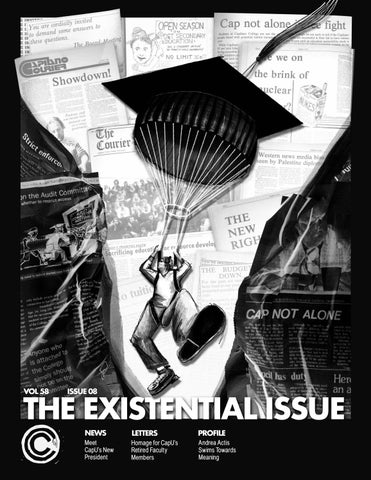
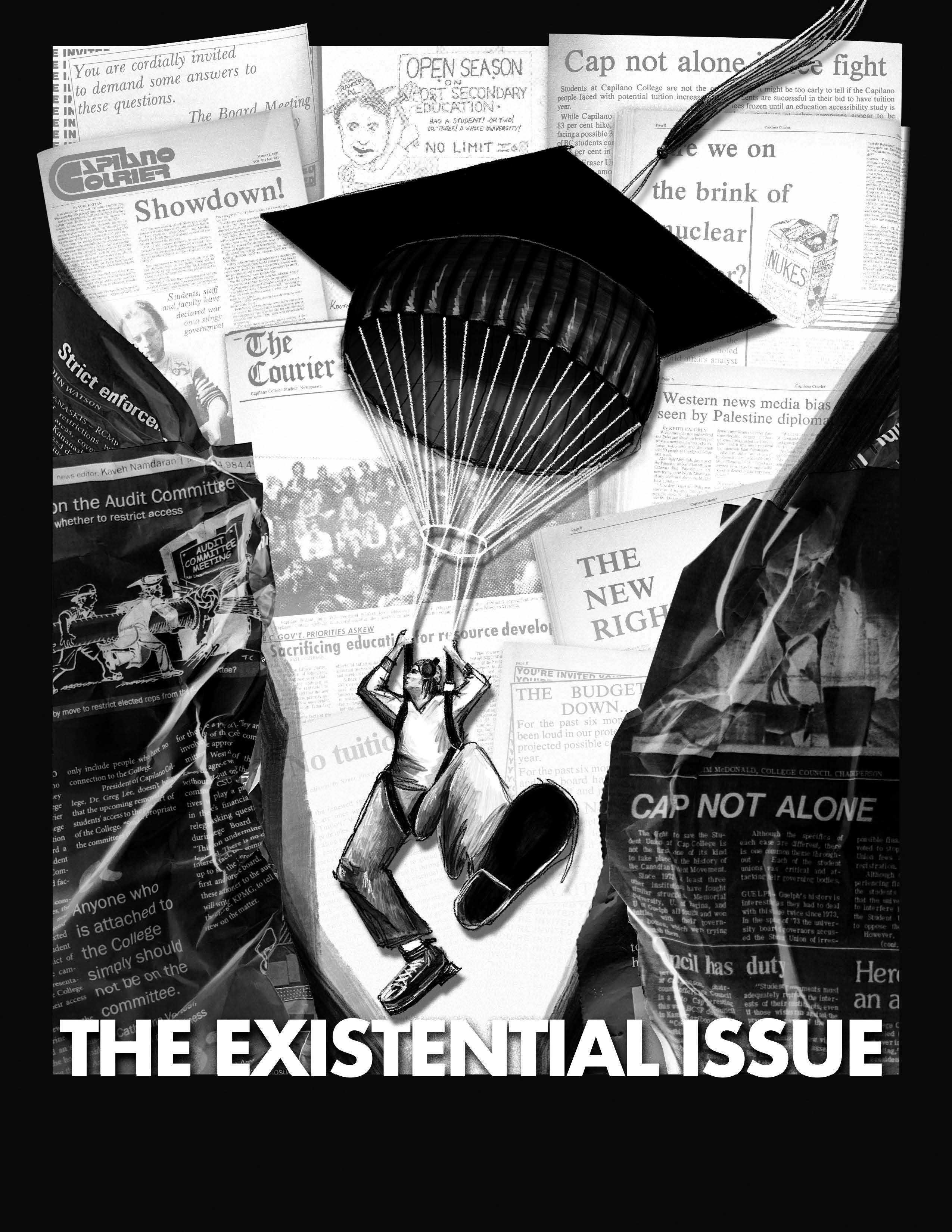
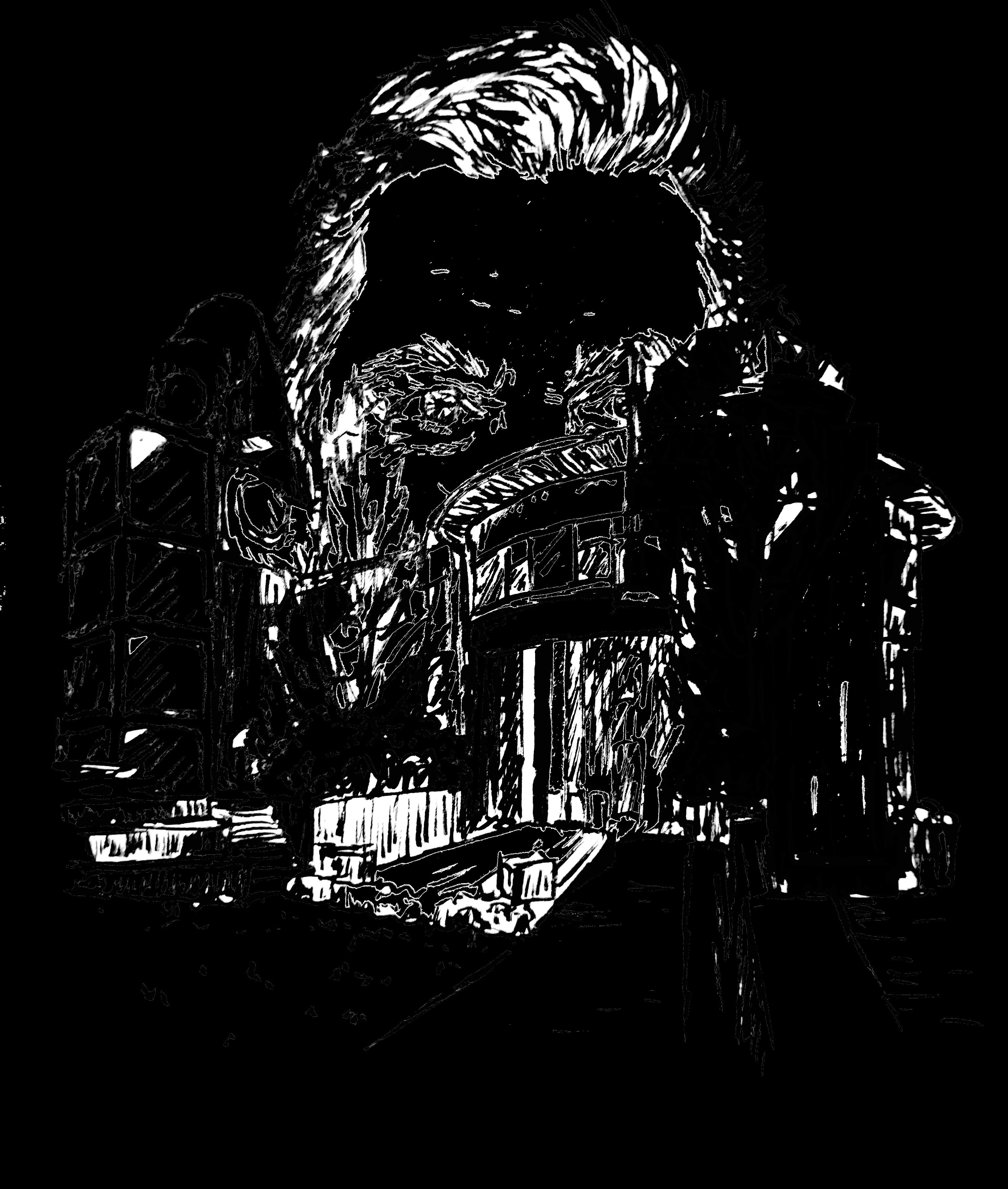
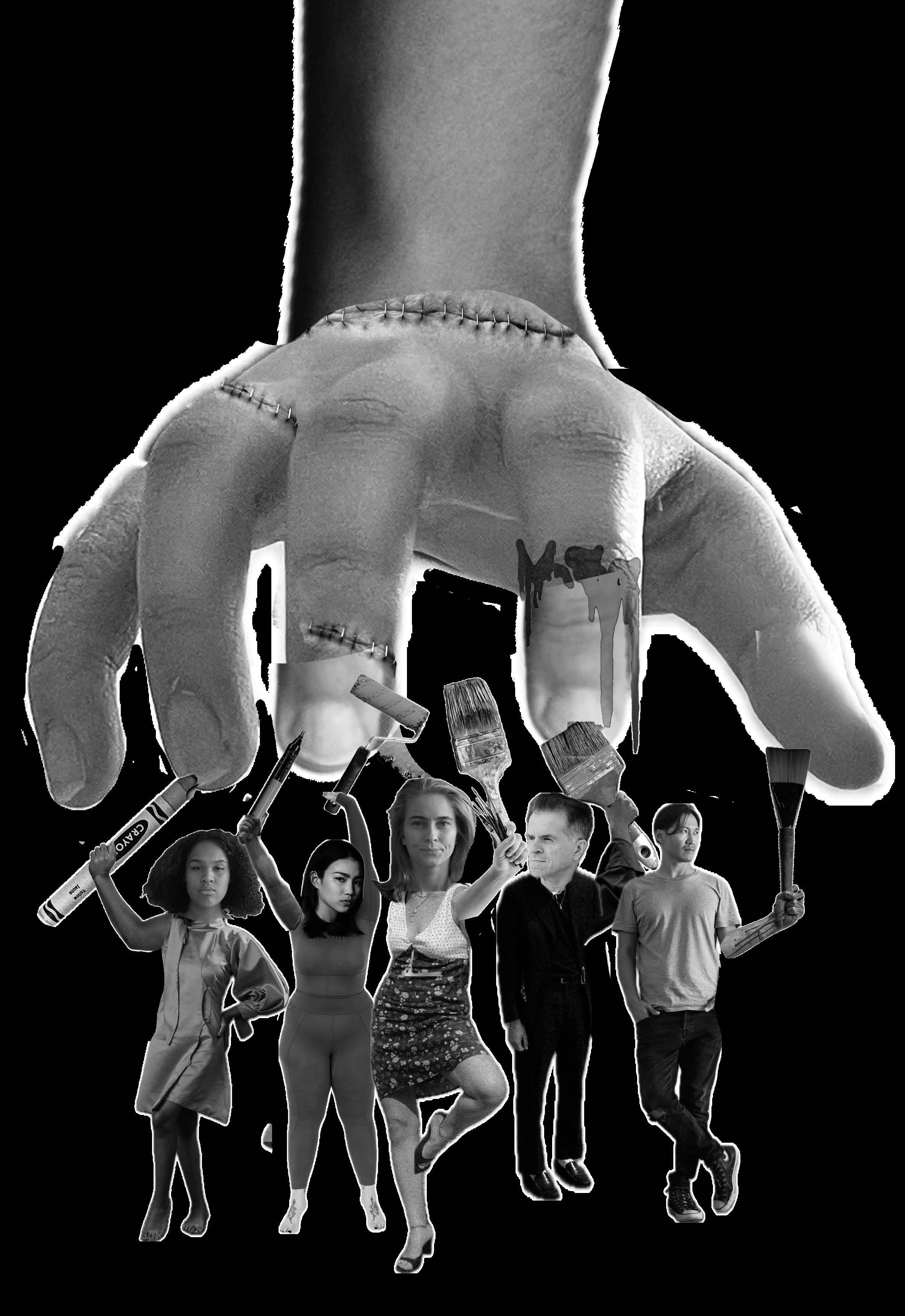
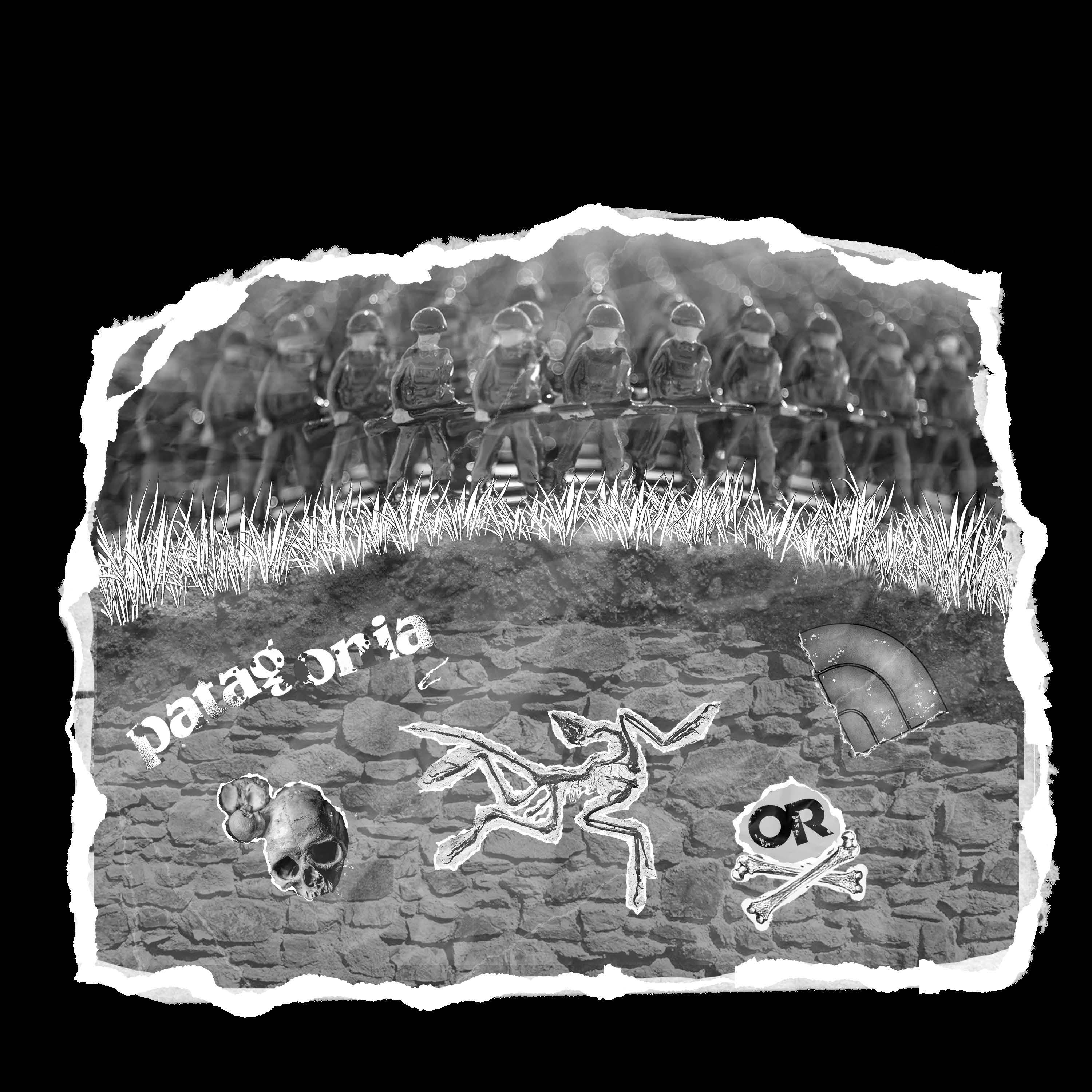
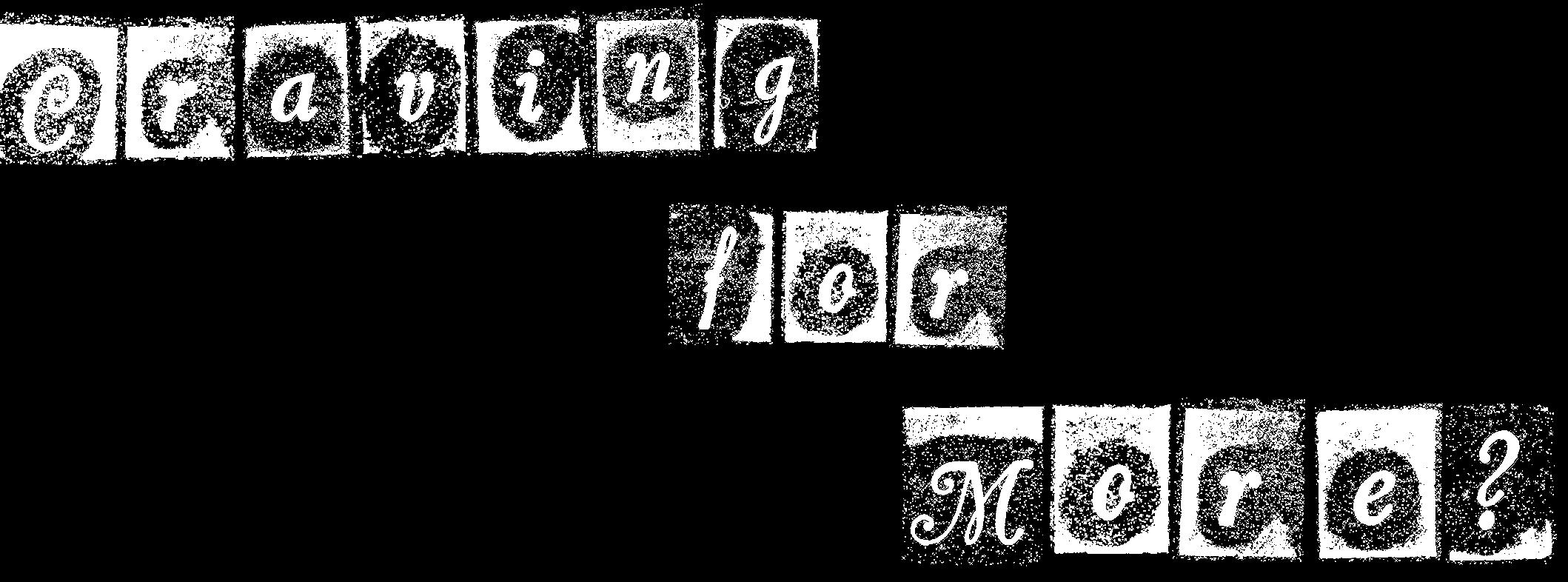
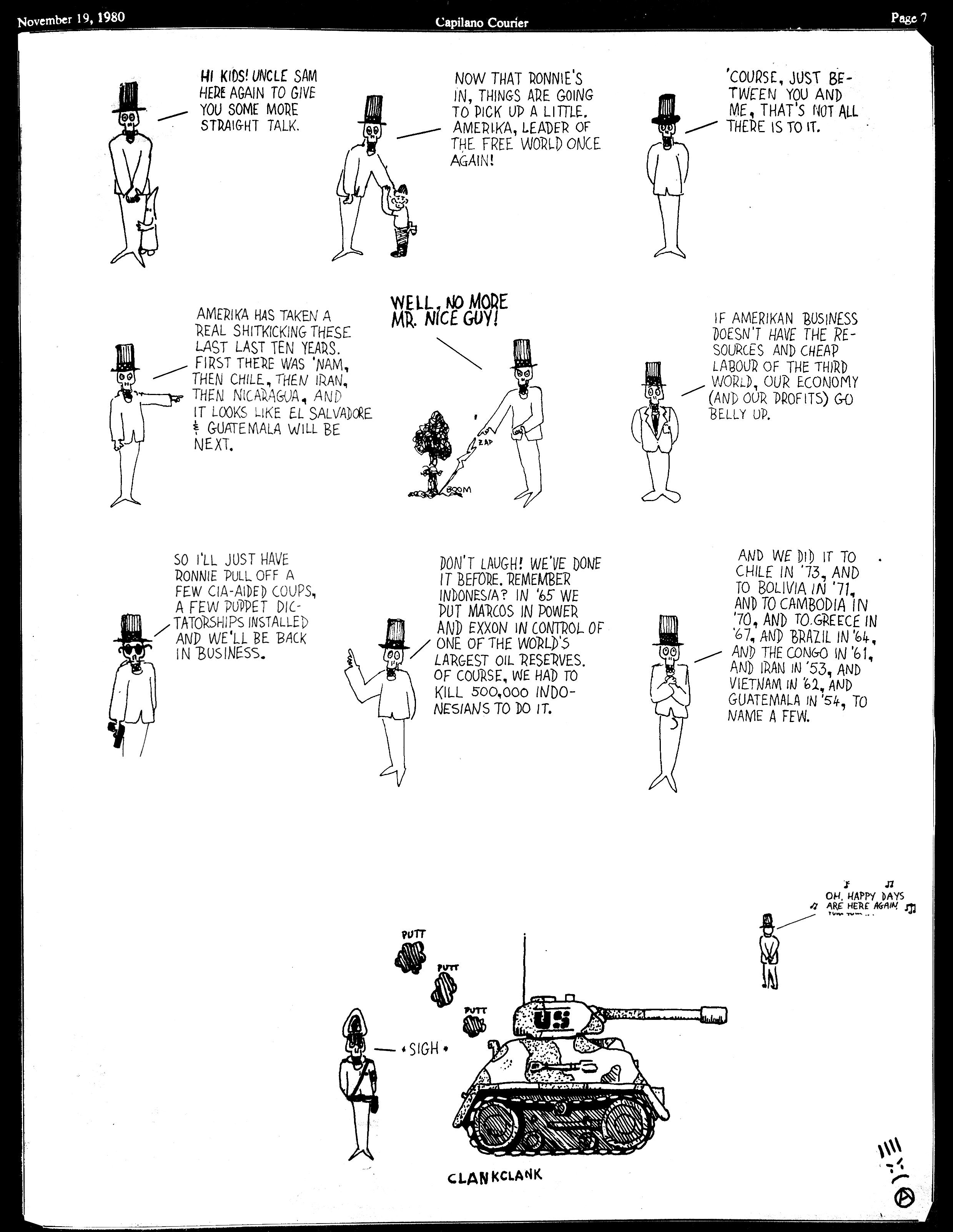
Laura Morales & “the people’s music column,” Capilano Courier issue from November 19, 1980. Additional graphics credited to The Visible Human Project & Ben Abbot
Corrections
The online version of an article in our March issue: “Capilano University Layoffs Remain Invisible, For Now,” has been updated to correct the following information:
¹ An earlier version of this story mixed language from two different sections of the collective agreement. The passage stating the university is incentivized to select positions with “the least seniority or have shorter appointments” applies only to temporary layoffs (Article 12.03(a)(iii)) and does not apply to the permanent layoffs that are the subject of this article.
² In the original version of this article, we stated that Capilano University followed wording guidelines recommended by the B.C. Public School Employers’ Association (BCPSEA) in serving its Section 54 notice. Capilano University has advised us that it is not a member of BCPSEA, did not receive guidance from that organization, and does not take direction from it. Rather, the university is a member of the Post Secondary Employers’ Association (PSEA). Our intent was to note that the wording used by Capilano University is the same as the BCPSEA recommended to other employers, and therefore the rationale behind it is likely the same, not that the university received or followed that guidance directly.
We regret the error and any confusion that it may have caused.
INTERESTED IN CONTRIBUTING?
Email editor@capilanocourier.com for potential writers, and production@capilanocourier.com for interested visual artists and/or photographers. *Illustrators and Photographers are required to send a portfolio or sample(s) of work.
Written by Ben Taylor (he/him) // Crew Writer
Capilano Courier: Questions for President March 11, 2026
An interview with Dr. Jason Dewling
First of all, could you please introduce yourself and share a little bit about your background for those who don’t know much about you?
I’m pleased to join the CapU community. I come to this community as a higher education professional with experience in Alberta and British Columbia. I was an instructor in child and youth care and an associate dean at Lakeland College and later served as vice-president of academic and research at Olds College before joining LaSalle College Vancouver (LCV) as president eight and a half years ago. I love engaging with students and have already had the chance to meet many of you. I’ve attended the volleyball and basketball provincial tournaments and an EarthWorks session in my first couple of weeks. In April, I’ll also be meeting with the Capilano Students’ Union. Additionally, I have a number of student events in my calendar in the coming months, so I’ll have the opportunity to hear directly from many of you. Please stop me and say hello if you see me walking the hallways.
What program did you choose when you started your journey in post-secondary education?
I have a couple of theology degrees (a bachelor’s and a master’s) and a PhD in Education, with my research focused on inclusion for individuals with disabilities.
And, how different did your career path end up being from what you envisioned when you made that decision?
Growing up in a conservative faith community, the predominant perspective was that you pursued theology if you wanted to help or serve others. I soon learned that you could help and serve in a variety of ways. My career path certainly wasn’t a straight line. My story includes many people seeing things in me that I didn’t see in myself. Lots of people gave me a chance when I was still a bit of an unproven entity. Several opportunities also converged at the right time, allowing me to take on exceptional roles. As someone who grew up in a somewhat sheltered environment, I could not have dreamed of the life I’ve lived to this point. That perspective leads me to take on this role with a deep sense of humility and gratitude.
In the official announcement welcoming you to CapU, the board chair mentioned your “work with Indigenous communities.” Could you expand on what that looked like, and how do you plan to take that experience into your role at CapU?
I was in my late twenties and early thirties at Lakeland College when I first began working alongside Indigenous communities. We partnered with a non-profit called Credenda (Cree, Dene and Dakota: CREe-DENe-DAkota) in Saskatchewan, offering early childhood and teaching assistant programming directly within remote communities. Lakeland also had a significant First Nations population on the Lloydminster campus, and we worked alongside those communities to include cultural celebrations on campus, such as an annual teepee raising and round dance. I was the liaison between the college and the local Indigenous communities and organizations. More recently, we had Dr. Kim Baird (Tsawwassen First Nation) serve on our board at LCV and she provided great direction for the organization. We provided an 80 per cent tuition discount to Indigenous students to make our programs more accessible and conducted campus-wide truth and reconciliation training under Dr. Baird’s guidance. At CapU, I’ve already met with the Elders and the Indigenous education & affairs team, and we identified several ways we can move forward with initiatives that support truth and reconciliation. These include developing a process to authenticate Indigenous origins, providing campus training on truth and reconciliation for all employees, and embedding Indigenous knowledge into many of our courses and programs as part of the work connected to the United Nations Sustainable Development Goals.
What is your settling-in timeline looking like? Many decisions were put on hold until the new president arrived—when are you hoping to be ready to start making decisions, and which ones are you being asked to prioritize?
I had some time to onboard before arriving, so I’ve hit the ground running. I’m extremely appreciative of the warm welcome I’ve received from employees, students, alumni and Community. I have a high capacity for listening, reading and learning, so I’m working hard to gather as much information as possible as we respond to the urgency of this moment. I anticipate bringing some key decisions to the board before summer 2026.
Visuals by Ryan Coomber (he/him) // Contributor
On his second day on the job, March 3, Jason Dewling chaired his first senate meeting. Having read University Governance in Canada and the Courier’s December article, Faculty Merger Divides Senate,the new president moderated the discussions during one of the most contentious meetings this governance body had held in years. Over an hour into the meeting and still many timely items left on the agenda, the president offered to order pizzas.
A round of giggles filled the room when one of the senators looked back at that moment—after a lengthy discussion around program suspensions— wishing they had accepted the offer.
“I’m grateful that things worked out the way they did,” Dewling said during his opening remarks, reflecting on the fact that Paul Dangerfield—the former president—had notified the community of his resignation two years ago.
“It’s a long time for an institution to know that a president is leaving and to wait for the next one to come,” he acknowledged. Senators nodded. Many course-remapping, structure-altering decisions had been put into a jar labelled “Do not open unless you are CapU’s new president.”
Understandably, not only senators, but also students, staff and faculty members are paying extremely close attention to the new president’s words. Anyone who has taught or learned in CapU’s small classrooms, or worked behind the scenes to make that possible, knows that we have something special going on, and want to see if the new president can recognize it too and ensure it survives the current financial crisis.
With that in mind, when the president stated, for example, that the university needs to embrace the intent of a teaching university—to be an “applied-learning-focused institution,” according to Dewling—it raises the question of whether fitting this definition leaves room for research initiatives. When he mentioned the importance of programs having “strong labour market connectivity,” it raises two questions: whether that leaves room for programs that offer other types of value and to what extent labour market needs are overlapping with students’ interests. And when he talked about the responsiveness and urgency needed from Senate to address current pressing issues, it raises the question of whether senators are failing to provide required advice to the Board of Governors fast enough, or whether they are delayed because they are having to do the work—gathering evidence, filling consultation gaps—that should have been completed before the Board passed the motion to seek their advice.
To reassure the overthinkers, the new president labelled these as “preliminary comments,” and requested senators to let him adjust them later if he were to come to a different understanding. Although, what seemed like a non-negotiable for the new president is what he called a “core principle” of the university: public trust.
As Dewling mentioned, there is a lot of external pressure: referring to financial pressures, the Avison review, geopolitical dynamics and artificial intelligence. He also said that the situation we are in is not something we can blame on a single person or decision, but rather “external for the most part” and should be seen as an opportunity for everyone to bring their best ideas.
However, there are also internal pressures to address and community trust needs to be rebuilt. After all, it was not that long ago that the Courier asked the former president if CapU was concerned about relying on international enrolment to cover rising operating costs. Halfway through the 2023-24 year—when CapU’s international FTE percentage was 51.63 per cent while the target according to their internationalization plan was between 30 and 40 per cent— Dangerfield’s response was, “At CapU, we are not reliant on international student tuition to deliver quality education.” The broken trust is felt by international students who still don’t know what the full price of their degree will be, as CapU continues to ignore the requirement for transparent tuition fees outlined in the “International Student Enrolment Guidelines” published by the province in 2024. Moreover, this precedent of denying a problem despite the evidence available resonates with the union’s concerns about administrative bloat.
Being elected as president is no small feat. After being short-listed, candidates go through multiple search committees in which faculty, staff and students ask questions and provide feedback on each candidate. If none of the short-listed candidates meet the expected standards, the process has to start all over again, which was the case before a second round short-listed Dewling. Being selected is already a sign of trust from the community, and hopefully, that trust is cultivated under the leadership of the new president.
*The Courier supports critical analysis but does not necessarily endorse the views expressed in this segment.
Written by Laura Morales (she/her) // Co-EIC
Students reactions to the political aspirations of CapU’s chancellor
Written by Ben Taylor (he/him) // Crew Writer
Visuals by Andrei Gueco (he/him) // Contributor
An article published last month by the Capilano Courier about Yuri Fulmer examined how the Chancellor of Capilano University is running to be the leader of the BC Conservative party. With the voting period beginning on May 9, there’s a possibility that within the next two months Fulmer could be a top candidate for Premier of B.C. In an email response shared in the previous article, Fulmer’s team stated that he wanted to have “a clear separation” between the role of Chancellor and his candidacy to lead the BC Conservative party. Given his name will be on students’ degrees at graduation, the Courier turned to students to hear their thoughts on the matter.
One fourth-year MOPA student responded,
“Does he know who goes here? Cap is a progressive school, and this makes our progress seem hollow. It goes against CapU’s values.”
In a media release published by the CapU website upon his reappointment in 2023, then President Paul Dangerfield wrote, “he carries forward the vision, purpose and values of the University into the community.” As mentioned in the previous article, there are clear discrepancies between the proclaimed values of CapU and the BC Conservatives. For instance, the BC Conservatives advocacy for the repeal of the Declaration on the Rights of Indigenous People Act directly contrasts with CapU’s publicized commitment to “Truth and Reconciliation through the principles of Indigenization and decolonization.”
Another 4th year MOPA student asked, “where are his priorities, the school or politics? It seems like a conflict of interest.” A first-year DOCS student also commented, “it’s a bit of a conflict of interest to run to be the leader of any political party while in this role. If I was Chancellor and I wanted to run, I would step down.” As previously mentioned, Fulmer’s campaign team stated that he “wants to have a clear separation
between that role and his candidacy,” however these two students do not see that as a possibility.
In fact, a campaign video published on Fulmer’s LinkedIn and Instagram account features footage of Fulmer on CapU’s campus, further blurring the line of separation between his two roles. It seems that when Fulmer needs a good backdrop for his campaign videos, having clear separation between chancellor and politician is suddenly less important.
One first-year interdisciplinary student asked,
“Should that even be allowed?”
The answer, according to the University Act in B.C., is no: He cannot legally hold both positions. The Chancellor is one of 15 members of the Board of Governors, and the Act specifically states in item 23: “The following persons are not eligible to be or to remain members of the board: (b) members of the Executive Council or of the Legislative Assembly.” This means that if Fulmer had actually won the seat in the legislative assembly that he ran for in 2024, he would have been legally required to be removed from the position of Chancellor immediately. In that election, Fulmer lost to BC Green MLA Jeremy Valeriote in the West Vancouver-Sea to Sky riding; a seat which was previously held by the BC Liberals for thirty years.
The Courier reached out to Board of Governors representatives from 2024, and the current Secretariat, to confirm if Fulmer notified or approached the board about running for public office at that time. The university confirmed that Fulmer had made the Board of Governors aware of his running, and that the university had “a plan in place for the 2024 election if he won.”
On the other hand, the Act also states, “A person may not hold the office of chancellor for more than 6 consecutive years.” Indicating that after the conclusion of the current academic year, Fulmer may not hold his office under any circumstances; meaning that his run for the leadership of the BC Conservatives will not break the laws of the University Act.
However, this whole debacle begs the question; what would that plan have looked like if Fulmer had been elected in 2024? And, should there be a policy in place requiring public facing admin to resign upon taking on high-profile political activity, like Fulmer?
and sustainability Summer Intensives
atCapUSquamish
The university launches new summer programming with a focus on land
Written by Ren Zhang (they/them) // Contributor
Visuals by Anna
Israfilova (she/her) // Contributor
With warm weather and longer days on the horizon, Capilano University’s Squamish campus is hosting seven new program intensives for the Summer 2026 term. Described on the website as a “unique learning experience that combines education with adventure,” these intensives are tailored to the landscape of Átl’ka7tsem, or Howe Sound, and are offered in addition to regular summer classes at the campus.
The program includes classes for tourism, English learning, geography, writing and land studies, and promises learners opportunities to build applicable skills and support global sustainability through involved fieldwork. As the name suggests, the time to complete each intensive ranges from eleven days to around a month, with some offering additional online work in a hybrid style.
The Courier spoke with Brian Storey, Vice President of CapU Squamish, who said the location of Átl’ka7tsem as a United Nations designated UNESCO biosphere inspired the programming to align with the Sustainable Development Goals, addressing targets for quality education, climate action and reduced inequalities, among others, listed on the school’s website.
Notably, all the courses listed do not require prerequisites. Storey explains that the courses are great for a wide audience: high school students looking to get some education in the summer with a head start, international students who want to do a destination-based program, and Squamish residents who might be keen to upgrade their learning. “All the credits are university transferable, which allows students from any university in the Lower Mainland to come and take those courses,” Storey adds.
Domestic students not local to Squamish can pay an extra cost that includes residence and meals on campus. Ranging from 3 to 6 credits, the accelerated pace of an 11-day course might be a plus for those looking for something quick during the summer that would fulfill program requirements.
This announcement comes at a time of changing tides at CapU. With the effective closure of the Lonsdale campus and the ḵálax-ay Sunshine Coast campus, the remaining Squamish campus and Ts̓zil Learning Centre faces some unique prospects to continue the university’s regional mandate.
“There’s quite a large number of remote students who would benefit from, for example, high flex courses, or modes of delivery that include intensive periods,” Storey states, referring to the Sea to Sky corridor. “We have a base set of degrees offered at Squamish now, and there’s future opportunities to serve regional and remote students in new formats.”
Some expansions and new relationships also appear to be in the works. Around the same time as this announcement was made, CapU unveiled a partnership with the Squamish Public Library in a memorandum of agreement (MOU).
“Being one university in one town with one set of services allows for a really intimate connection between the town and the university. These MOU’s represent the strength of that connection.”
In addition to the MOU, the Squamish council recently approved a 424-unit housing and commercial space proposal to be built near CapU Squamish, according to the Squamish Chief
“CapU Squamish is doing well and is very integrated into the community. The community is happy to have CapU back in Squamish and working in partnership with businesses, the government, and public service agencies like the library and the Squamish chamber. As a regional institution with a destination mandate, we are both able to serve both incoming students and the region in a positive way, and [it’s] something CapU should be proud of,” Storey finishes.
After the blow of the ḵálax-ay campus closure to communities in the Sea-to-Sky corridor, the growth and increased programming at the CapU Squamish is an encouraging development.
Detailed information about the intensives and their specific courses can be found on CapU’s website under Summer Intensives.
221A:
Preserving vancouver’s arts and cultural sPaces
How can we preserve arts and culture when they seem to be the least important issue on the agenda?
Written by Cami Davila (she/her) // Crew Writer
Visuals
by Anya Ali-Mulzet (they/them) // Contributor
Cultural Land Trust
According to a report by the Eastside Arts Society, from 2009 to 2019 the city of Vancouver lost 400,000 square feet of art spaces. As stated in the same article, 1,332 artists of the 1,612 with studios in the city faced an “imminent threat” of forced relocation. “We, as Vancouver artists, must always be on the lookout for another place to go to, should our current space become prohibitively expensive, or alternatively, if the landlord wishes to use the space for other purposes,” explained one local artist on the report. In a scenario where arts and culture are no longer a priority, the non-profit organization 221A works to preserve the infrastructure artists need to work.
One of the biggest ongoing 221A’s projects is Cultural Land Trust (CLT), an initiative that seeks to protect arts and cultural spaces in B.C. for the long term through ownership and care of land and buildings. This community model is essentially focused on black, Indigenous and People of colour (BIPOC), LGBTQ2IA+, low-income and disabled artists.
If the project works as the 221A team has planned, the long-term benefits will include stable rents, long-term leases, pathways to ownership and redeveloped properties that maximize their use. Cultural Land Trust’s initial goal is to secure 30 properties in B.C. by 2050, government and owned by the community.
As noted by 221A’s executive director Brian McBay in an interview with The Tyee, the project integrates “certain values around the collective control of land and ensuring equity groups, including Indigenous folks and host nations, can have a mechanism in place to ensure that there’s right relations when it comes to using these lands and developing them.” In March of 2023, they finished their business planning phase, and now are working on getting funds through their website: 221a.ca/donate.
Sector Equity for Anti-Racism in the Arts (SEARA)
In 2020, inspired by social justice movements like Black Lives Matter, Landback and Free Palestine, a handful of organizations came together to form Sector Equity for Anti-Racism in the Arts. Among those, Pacific Association
of Artist Run Centres (PAARC) and 221A emerged as financial sponsors of the movement. SEARA seeks to draw the attention of Canada’s art world to stop perpetuating and creating outside eurocentric, colonial and racist structural ideas. As is stated in the 221A website, the goal is to “create an equitable society where BIPOC artists and cultural workers have equal capacity, governance, social standing, and visibility within arts institutions in BC.” According to the Canadian charitable foundation Vancity Community Foundation, SEARA raised $319,000, which was later distributed in microgrands to Black, Indigenous and People of Colour artists and cultural workers in B.C.
Recently, on February 28, 2026, SEARA presented Link & Build: A Panel on Anti-Racism Advocacy in the Arts, a space to discuss the history and future of anti-racism advocacy in the heritage sector, arts and culture.
Assimiliating Religion Within Indigenous Cultures
From the survivor, to the first and second generation to not attend Indian Residential Schools
Written by Anonda Canadien (Dehcho Dene) (she/her) // Arts and Culture Editor
Visuals by Anya Ali-Mulzet (they/them) // Contributor
For many Indigenous communities and cultures, religious faith has been incorporated within traditions of the various Indigenous nations across the colonial state of Canada. Within this context, we’ll be speaking specifically within the colonial state of Canada and the various cultures and tribes within Canada. The history of Indigenous peoples within Canada is long, harsh and violent. When assimilation began, the government in association with the church (whether that be Roman Catholic, Christianity, Pentecostal, etc.) put into motion Indian Residential Schools and Indian Day School, eventually leading into the Sixties Scoop, the ongoing issue of MMIWGTS+ and the overall effort of genocide of Indigenous peoples.
Here is what it comes down to: You either believe in the church while still being involved with your culture, or you completely reject the notion of religious faith and go back to the ‘roots’ of your culture. I paraphrase this ‘roots’ as it has been muddied over what is the root of a culture by the severe consequences of assimilation. Through the centuries of abuse from when the first colonizer set foot in the Americas of 1492, religious faith has been incorporated into many Indigenous cultures such as traditions and practices, customs and—most notably— creation stories.
Indigenous-based churches across Canada include the Indigenous Alliance Churches of Canada, the Indigenous Ministries of The Anglican Church of Canada and the Indigenous Ministries of The United Church of Canada to name a few. They all have similar quotes surrounding their faith in God while also being ‘spiritually-centered’ within their practice, and they strive for reconciliation of Indigenous peoples within their associations through funding. This isn’t to say religion is a bad thing, but rather in the eyes of the new generation of Indigenous youth who have not been within the Indian Residential School system, this is a new concept of dissecting what it means to be traditional, urban or rezzed out without religion being involved within their culture.
This editor has gathered some peers on their view of religion being incorporated as a means of survival of assimilation within their own respective culture.
“Of course when two worlds collide like when Europe and Turtle Island did, things are going to be exchanged, like religion. [...] We weren’t the ones sailing across the water to go impose the Great Spirit on them,” says Elijah Chenoweth, a fourth-year student in the Motion Picture Arts program and of Indigenous heritage. As a first-generation Indigenous man, he’s the first in his family to not have attended residential school.
An important aspect that he relies on is the notion that the beliefs held by most Indigenous peoples are not just beliefs, they’re realities for them. “For example, many chiefs around my community in the past have really talked a lot of giving Christianity a way better word than they did their own beliefs that we had before, which were that
everything’s alive... when you have people in power just promoting a system that was beaten into us, you’re gonna create a cycle of helplessness.”
When these ideals of religion carry over into the culture from Indian Residential School, it’s inevitable for it to become part of it within traditions and customs. For Chenoweth, he speaks about culture from an urban perspective of not being engaged or grown up within his culture, but still carries the beliefs and values taught to him by his family. And, how a lot of the mainstream media has pushed the narrative of religion being the be all, end all.
“We respect Jesus (figure), just like how Willie Jack (Reservation Dogs) says, like, ‘What’s up, White Jesus?’ But, of course, the Christians aren’t always the same way towards people who believe in more of our ancestral beliefs,” Chenoweth references the character Willie Jack from the beloved show Reservation Dogs that explores Indigenity on screen.
An alumnus of the Indigenous Digital Filmmaking (IDE) program at Capilano University and current employee as the Gear Technician for the aforementioned program, Joshua Settee-Brown is of Indigenous heritage and has mentioned that he is second generation to not attend an Indian Residential School.
“I have witnessed many Indigenous folks practicing Catholicisms and going to church... it makes me feel a bit sad that we had our own religion of sorts and then it was abused out of us,” he mentioned the spirituality that was connected to various Indigenous nations that was ultimately replaced with religion depending on the region of the Indian Residential School.
On how it is to witness the ever ongoing discourse of this, he states that, “to see these communities get forced into this religion from actual centuries of abuse and if they didn’t conform they would be abused worse than they already were.” As a means of survival, religion has been incorporated into various cultures.
As we look at the different sides to this discussion, neither is necessarily a bad thing. We have the survivor of Indian Residential School looking into religious faith as a means to survive, to carry some aspect of their culture whether it be language or practices and customs, and we also have the first generation to not attend Indian Residential School and looking to explore their cultures belief in Creator, a spirituality connected to various Indigenous cultures and nations.
As for the way forward, Chenoweth believes we must return to our roots, “I’d like to see more of a connection. Within me and within more people too, because I don’t think Christianity serves many of us that well. Of course, it can serve us in some ways, but it’s best if it’s made for that space.” He’d like to see more young Indigenous people connect and continue this discourse within their communities.
For Settee-Brown, he shares the same sentiments: “I think today there needs to be more focus on reviving our cultural and spiritual beliefs and let people who come from trauma of being forced into a religion have a choice of their own.”
DON’T BUY ARC’TERYX
Written by Theodore Abbott (he/him) // News Editor
This piece was originally pitched with the simple title of “Don’t Buy Arc’teryx.” As a prominent Vancouver brand, with their head-quarter mere blocks away from Capilano University’s North Vancouver campus, the intent was to expose a side of Arc’teryx that most people are unaware of: Namely, Arc’teryx LEAF. Arc’teryx LEAF is a dedicated branch of the company that manufactures clothing for Law Enforcement and Armed Forces, hence the acronym LEAF.
Over the past several years, LEAF, which was recently rebranded as “Arc’teryx Pro,” has emerged as a leader in the military clothing industry. And, as it turns out, this industry is a relatively crowded field.
When I first stumbled upon the LEAF website a few years ago, I thought I had discovered a unicorn; a branch of the company that was not only unique to Arc’teryx but also somewhat controversial and poorly hidden. I’ll admit, I took pleasure in telling people their latest Arc’teryx kit was made by a company that also puts their logo on tactical clothing manufactured for all sorts of shady outfits, including the Royal Canadian Mounted Police.
However, a little more digging revealed to me how difficult it is to find an outdoor brand that doesn’t make military clothing, than it is to find one that does. Even Patagonia, which has worked hard to cultivate a progressive brand image, is responsible for the ‘Lost Arrow Project:’ a small branch of the larger company that has been making gear for American special forces since the 1990s.
Other big names like Mountain Hardware, The North Face and Outdoor Research have all—at one time or another—manufactured military clothing, thus implicating their brands in war profiteering.
Thankfully, a more ethical alternative exists. Founded by comedian Nathan Fielder, who was born and raised in Vancouver, Summit Ice Apparel is the only outdoor brand working to combat Holocaust denialism. In 2015, Fielder started Summit Ice in order to troll Taiga— another local Vancouver brand—after they commemorated the life of a known holocaust denier in their newsletter. At the brand’s launch event, folks could bring in their old Taiga jackets and trade them for a free Summit Ice jacket. Summit Ice is also a non-profit organization, with 100 per cent of their profits going to the Holocaust Education Centre in Vancouver.
If there’s any takeaway here, it’s that consumption under capitalism is broadly unethical, but that doesn’t mean you shouldn’t search for the more ethical option. When it comes to outdoor brands, there are some with less blood on their hands than others. For example, in addition to making military clothing, Patagonia also has a section of their website dedicated to supporting environmental activism. Arc’teryx, on the other hand, is frequently endorsed by their unofficial brand ambassador Drake. And, then, there’s Summit Ice Apparel, a brand that on their website states “In this new era we stand for everything™. Now that’s something nobody can deny.”
Visuals by Ren Zhang (they/them) // Contributor
An Interview with Anosh Irani
Novelist
and playwright, explores the truths of his land and youth
Anosh Irani is a world-renowned Indo-Canadian novelist and playwright. For over two decades, he has plucked his protagonists from the places we choose to ignore: those who have left their bitter homes—the orphanages and red-light districts—in search for better lives they’ve rarely found. Their trauma follows them like shadows onto newer shores. They are forever marred by the violence of their childhood.
Irani has won a staggering amount of critical acclaim and praise for his zeal and brilliance. While awarding this Capilano University alumnus the Writers’ Trust Engel Findley Award in 2023—one of Canada’s top writing awards—the jury highlighted Irani’s skill at inhabiting “characters for whom hope is an unaffordable luxury,” and for forcing us to keep “our gaze on the depredations of power.” He shows us the naked truths from which we hide.
His stories reveal the truths of the people and lands of his youth in ways that only fiction can do: slantly.
Perhaps his process is most apparent in his 2016 novel, The Parcel, set in Asia’s largest red-light district, where sex work gives way to slavery. The setting and story is personal to Irani.
“I grew up right opposite the red-light district,” he tells the Courier, “It was my backyard.”
He spent long years researching the people that populated the “landscape of [his] childhood” including sex workers, pimps and members of the transgender* community. “The ability to observe,” he says, “requires one to be immersed in an experience and yet have a perspective on it while the experience is unfolding.” It is a quality shared by the best writers. In this way, he “live[s] with the book,” with the people who would dance and cry in his book, long before he writes “a single word.”
Yet, his oeuvre is all fiction. “I am not limited by fact,” he says, “I’m interested in truth: a higher truth, an emotional truth, a spiritual truth. The novel is my vehicle to get there.”
While he has always been a storyteller, his decision to craft these tales in novels and plays was relatively recent, spurred on by his move to Canada.
Written by Rishi Mittal (they/them) // Contributor
“The isolation I felt, the loneliness, made me turn to literature even more,” he recalls, “I immersed myself in it. It was a gift, a painful one.”
He would trawl second-hand bookstores for writing that pulled him in, and he comments, “A book was a refuge.”
CapU—then known as Capilano College—was a series of firsts and holds fond memories. From his first college-level literature class with Tim Acton to studying world literature with Jenny Penberthy, where he read The Palm-Wine Drinkard by Nigerian writer Amos Tutuola. “It resonated with me a lot when I was trying to figure out what to do for my first novel,” Irani says, “To this day it’s one of my favourite books.”
He remembers conversing with Bob Sherrin, his first creative writing instructor, about the interplay between dialogue and scene. “Bob and I are still in touch,” he mentions, “He’s been so wonderful. Lovely, lovely guy.”
Today, he is a professor of writing at the University of British Columbia, where he nurtures the next generation. Every writer’s journey is their own and if he equips his students with only one tool, it is craft. “When opportunity knocks but at a craft level you’re not ready then you won’t get published.”
Improving your craft is simple, if not easy. You don’t need to be enrolled in a creative writing program. “Do what we all do,” he says, “We read, we write and we submit our work to literary magazines, to agents, to publishers.”
Per Irani, read widely and voraciously. Read world literature, in translation if you need to. For him, this has meant reading the works of his Canadian contemporaries like Madeleine Thien and Christina Sharpe, and then stepping beyond these shores to read the beautiful short stories of Naiyer Masud and the harrowing but brilliant Kolyma Tales by Varlam Shalamov.
Above all, he says, writing “takes time and practice.” Failure will be a life-long companion in your life-long journey to tell your truth. “You need stamina and endurance” to be a writer. But, as long as you commit, “you can just get better and better.” There is no secret, no shortcut, no magic wand. “There is nothing else.”
Visuals by Alex Baidanuta (she/her) // Contributor
The Capilano Courier reflects on the process and outcomes of hosting the 88th national student journalism conference
Written by Adam Stothard (he/him) // Co-Editor-In-Chief
A little over a year ago, at NASH87 hosted by Silhouette at McMaster University, Sara Brinkac and Avery Nowicki (the previous year’s Editors-in-Chief of the Capilano Courier) set in motion their plan for the Courier to host NASH88 in North Vancouver. Like many of Brinkac and Nowicki’s ideas, it was audacious, forward-thinking and it would require a lot of work.
NASH—for those unaware—is an annual conference for student journalists from universities and colleges across Canada. It’s facilitated by the Canadian University Press (CUP), a nonprofit cooperative owned by student newspapers at post-secondary institutions throughout the country, and a different publication hosts the event each year. Over the course of three days, students from coast to coast gather and attend workshops and seminars hosted by a diverse array of experienced journalists each speaking to their expertise. But, more than that, it’s an opportunity for students to connect with each other, make friends and discuss the challenges facing each of their publications.
Another big draw for students to attend NASH are the John H. McDonald Awards for Excellence in Student Journalism (the JHMs). Guests get dressed up and attend an evening gala—complete with dinner and drinks—and then sit eagerly to learn if they or their publication has won any awards. There are awards for virtually everything a student publication does, and the room gets rowdy with excitement for every award. This year, the coveted Student Publication of the Year Award was presented by The Globe and Mail and went to Halifax’s own The Dalhousie Gazette.
The theme for NASH88 was “Cultivate.” With that in mind, NASH88 had an expressly do-it-yourself style to it. Handmade decorations were created by volunteers for the dining hall and goodie bags were filled with hand-stamped notepads. When it came to merchandise, designs and branding, the decision was made to hire Freya Emery, the former EIC of the Courier from 2023-24. The overall brand of NASH88 was one that highlighted the nature of Vancouver as a whole, with warm earth tones present and a subtle artfulness.
In the days leading up to NASH88, volunteers gathered in the Courier office doing various arts and crafts for hours on end. For example, our Arts & Culture Editor Anonda Canadien spent hours creating pipe-cleaner flowers, and our Zine Manager Kate Henderson made centerpieces for the JHM Awards gala. There was a constant running to-and-from various stores to purchase whatever the organizers needed. Coffee, snacks, gift cards, crafting supplies, decorations and the list goes on.
The conference began with David Beers, founder of The Tyee, delivering a passionate keynote address about the power of journalism and the state of the world. The grace and experience he displayed during his remarks made us organizers settle for a second, finally catching a glimpse of what the Courier had been working toward when it was agreed we would be hosting.
When asked about attending NASH88, guest Lee Hurley from The Muse—from Memorial University in Newfoundland—said, “[We] had an incredible time exploring the city, getting to hang out with other delegates, chat about issues affecting our respective papers, and offer each other advice,” and that “One minute, we were talking about how to navigate student union elections, nuanced op-eds, and conflicts of interest, and the next, we were making an elaborate drinking game to play at the JHMs. It was pretty chaotic, but I wouldn’t have had it any other way.”
Photos by GracieGRACIEMCLAUGHLIN COM
Our closing keynote was Paper Rag zine founder, Blue Jay Walker, who brought an exemplary amount of DIY grit and youthful exuberance. After the conference was over, Walker posted a reel on Instagram saying he “just gave a speech to a national journalism conference that cost $500 per person,” and that he was going to share the information he gave them for free. Although this came as a surprise, part of what we found so admirable about Walker’s keynote was his open-source values, so we weren’t exactly upset with his decision to share with everyone what he had told us.
Overall, hosting NASH88 was an incredible experience for our publication and if you’re thinking of hosting NASH89, the Courier —and, of course, CUP—are happy to share anything we’ve picked up. However, I want to acknowledge my own biases as a white person when it comes to my overall experience at NASH88, and offer the space to POC voices to share their perspective on the conference.
. . .A Continuation
Student journalists of colour speak on how hopeful the industry feels for the 25 percent
Jasmine Garcha (she/her) // Managing Editor, Capilano Courier With background from Laura Morales (she/her) // Co-Editor-In-Chief, Capilano Courier & prospective from Kavi Achar (they/them) // Editor-In-Chief, The Fulcrum
Note: The NASH88 organizers were contacted for comment on who was consulted leading up to the conference, whether diverse topics were brought up, how guest speakers were chosen and advice for future NASH organizers to prevent important topics from slipping through the cracks. The Courier did not receive a statement by the time of publication.
Background
Who works in Canadian newsrooms? The Canadian Newsroom Diversity Survey (CNDS), presented by the Canadian Association of Journalists (CAJ), answers this question by producing a national breakdown of the race and gender of those who work in media with the data from over 6,000 journalists working in 273 newsrooms nationwide. “As an industry that demands transparency and reports on the diversity of government bodies, public agencies, and private-sector organizations” reads the 2023 CNDS report, “data on diversity for Canadian media is critical to ensure fair and equitable employment opportunities.”
The 2023 CNDS results show that 76 per cent of journalists identify as white, 5.2 per cent identify as Indigenous and 19.3 per cent identify as a visible minority. Considering that 68.8 per cent of the Canadian population is white, Canadian journalists are “slightly more likely to be white than the overall population,” according to the report.
The CAJ also asked newsrooms to indicate “if they had a visible minority or Indigenous journalist in a top-three editorial position.” The results show that 76 per cent have no visible minority or Indigenous people in a top leadership role, with the majority of the racial diversity concentrated in part-time and intern roles
NASH88 in Retrospect From A Student Journalist of Colour
My article-writing journey started on a blog managed by a Punjabi man. Upon coming to CapU, I was taught article-writing by a Japanese man. My aunt was among the first South Asians to report on a Canadian news network in the early 2000s, and a Punjabi man from the CBC was invited to a Courier event two years ago where he encouraged me to apply to the Courier. At NASH87, I attended a roundtable discussion led by a South Asian man who spoke about student advocacy and the extra barriers that come with the POC experience, and a workshop led by a POC who spoke about interacting with marginalized communities. After all of this, I was so excited for NASH88, and I even offered to invite my aunt as a guest speaker the same day that our EICs inquired about hosting.
Stepping into NASH88 came with the sudden awareness that at least 75 per cent of the room was not like me. The part that felt most unsafe was that nobody addressed it; nobody commented on the disparity in these statistics—and particularly the desire to change them—in the first place. As stated by Morales, 68.8 per cent of the Canadian population is white, but, according to the CBC, 54 per cent of Vancouver residents identify as a visible minority. This wasn’t reflected in our lineup of guest speakers, with few being POC, and no spaces had been created to discuss issues that centre marginalized communities or a lack of diversity in the field.
My individual experience falls into a greater, more general one, and we are left with the question: What can we do better? The entire journalism industry’s DEI standards do not fall under the responsibilities of me, CUP or the NASH organizers. However, when facilitating a national conference for any industry in 2026, it should be considered basic standard practice to take into account the minority population. The spaces I landed in which allowed for those aforementioned discussions were not created through protest: the organizers opened that space for us. I know those spaces exist, because I’ve been a part of them before. I know those spaces are possible, because the CBC’s corporate plan summary for 2025–26 states that 84 per cent of their new hires in 2024–25 were POC, and because we could have had one of the first South Asian reporters on TV in Canada speaking at NASH88.
Prospective
Kavi Achar speaks on the lack of diversity in student journalism being traceable to the roots; “The Fulcrum was started by a group of young white men, and we look back in our archives—of which there are many—and there [is] some really awful belittling racist misogynistic language, especially in our opinion sections,” they say, “It also bleeds into the way we cover news.”
“Trying to undo that culture, or create a culture of inclusivity has to be active, and—at least in my perspective—it feels like student journalism today takes a very passive approach to creating that inclusivity,” they continue, “Instead of encouraging editors-in-chief or people with actual power in our newsrooms to create new spaces for marginalized people in any form, there’s instead an emphasis on teaching marginalized people how to fit into the spaces of student journalism already.”
“I’m sure there’s no easy solution in trying to fix all the many issues that come with white heteronormativity in every space, but I think the least that student organizations—and also organizations like CUP or the people who organize NASH—can do is actively create these spaces, not just passively expect people to themselves fit into the space.”
THINGS WE SAY TO OURSELVES—OVER AND OVER AND OVER AND OVER AND OVER AGAIN—THAT HOLD US BACK
Written by Cami Davila (she/her) // Crew Writer
The little guys in my ear are fed up with me. I eat a bowl of chow mein with beef and hear, “There were probably much better and healthier options on the menu.” Their little voices drive me crazy. The tone is high-pitched, almost unintelligible for a human, and they talk very fast, all at the same time, all the time.
“Did you see yourself in the mirror today?” One little guy, out of the hundreds of little voices, asked. I felt so ashamed of myself because I did spend more than 20 minutes in front of the mirror, looking down on everything; my round face, yellow teeth, arms with extra fat, a huge belly and two thick legs. “Every day, we have exactly the same conversation. You need to eat better. However, it’s like you forget about it and end up eating the greasiest things in the cafeteria. You’re a lost cause.”
Everything started when I was eight. We were at dinner with my dad’s family. The food was pasta, and the dessert was ice cream. That was the definition of paradise for me at that age. While eating my second bowl of strawberry ice cream, my aunt came up to me and whispered in my ear, “Honey, it’s time for you to start paying attention to the way you eat. Don’t you think that’s why you don’t fit into any of your clothes anymore?” Now, every time I want to eat something that isn’t ‘allowed,’ all I see is the look of pity on her face.
The little guys in my ear call me fat, ugly, big, uneven and anything opposite of attractive. I don’t do anything to fix it.
Visuals by Leonardo Velazquez (he/him) // Contributor
Every time someone said something about my weight or the way I looked, the voices grew louder. And, this happened with every other insecurity I had. Have you ever seen a movie where the main character isn’t necessarily conventionally pretty, but it’s her intelligence that makes her stand out? Well, the voices say I’m neither, and I believe them. I’ve seen intelligence, and it doesn’t look like me. It looks like my sister, who has always been a top student in class, my cousin, who won a scholarship to pursue her medical specialization, my grandma, who found a job even without having completed her studies just to support her children or the girl in my class who sits two rows in front of me and doesn’t even glance at her phone for the entire class.
I noticed this feeling the day I was learning multiplication with my mom. After a while, I gave up on being able to recite the entire table of eight from memory. “Do you know how long I spent with your sister when she was learning these? Less than three days. The fact that we’ve been going over this for more than a week and you still can’t learn it shows that you don’t care at all about your education.” That night, I fell asleep crying and begging God to be good enough the next day. Spoiler alert: I still haven’t been able to achieve it.
The little guys in my ear call me stupid, mediocre, distracted, uninterested. I don’t do anything to fix it.
There is a pile of papers on my desk. Some are mail I haven’t replied to—something I’ll regret when the bank can’t verify my income and freezes my accounts, or the electric company decides to shut off the power—but most are papers for projects I started and never finished. All the things that I said I would do, but didn’t. All the assignments that I completed with the bare minimum effort. All the favors that I promised, but never delivered. Every time that I had the chance to excel and succeed.
The little guys in my ear call me a failure, a disappointment, a procrastinator, unreliable, someone who wastes their talent, a disorganized person. I don’t do anything to fix it.
But, there are days when my mom calls me and I make her laugh. There are nights with my sister when we attach our bodies to the sofa and binge reality TV shows, laughing at our inside jokes. There’s a video of my one-month-old niece moving her little hands as if recognizing her body. There’s my girlfriend, who always finds a way to hold my hand when we’re close. I live a day with lots of sun but not particularly hot. There’s perfectly steamed milk for preparing a caffé latte.
In those moments, my body feels pure love and gratitude that I cannot hear even one little guy in my ear.
AWARD D SHOWS
Written by Earl Dangwa (he/him) // Contributor
Visuals by Santiago Ospina (he/him) // Contributor
WELCOME TO THE ACADEMY AWARDS!
The Grammys! The BAFTAs! The Golden Globes! Click. Flash. Cameras galore! Red carpets. Stunning gowns. Tailored suits. Diamond earrings. Polished shoes. Timothee Chalamet. The drama. What’s not to love?
Anticipated annually, these award shows are a culmination of the year’s best and brightest talents, whether that be big-budget Hollywood movies or music from new and budding artists waiting for their moment in the spotlight. Families and friends gather in the warmth of their homes to watch their favorite celebrities, hoping they win the most coveted award. For that night, people connect themselves to a community despite their differences of opinions regarding who should win. The awards are a celebration! It doesn’t matter who wins. After all, isn’t celebrating the arts the main purpose of these award shows?
In 2018, The Trump administration ramped up its “build a wall” promise and continued to focus blame on immigrants from Mexico. In the 2018 Oscar Awards, Coco—a movie centering Mexico’s Dia de Muertos (Day of The Dead)—won the awards for Best Animated Feature Film and Best Original Song. It was important that, amidst the government’s devaluation of Mexican lives, a movie portraying and celebrating Mexican culture earned one award, let alone two. These wins are one of many examples that show what award shows like the Oscars are capable of doing: celebrating the art and voices of under-represented and marginalized communities. Coco’s celebration at the Oscars was a reprieve from America’s political landscape because it gave people hope for a more inclusive media landscape. A natural follow-up question would be: Did it have any impact? Did winning the awards do anything to change or improve the lives of the people Coco represents? In the wake of Trump’s second term and ongoing I.C.E atrocities, the answer appears to be: No.
At the end of the day, the main purpose of award shows is not mainly about celebrating the arts, but about entertainment and providing people an escape. To both the celebrities attending and the people watching, these award shows are a welcome distraction from real-world political issues. When politics are brought up in these spaces, it is usually incredibly vague and heavily painted with satirical humour. The entirety of the 2025 Oscar awards was filled with jokes making light of the Trump administration, from Conan O’Brien’s “Americans are excited to see somebody finally stand up to a powerful Russian” to vague support for Ukraine when Adam Sandler shouts “CHALAMET,” wearing a blue hoodie to compliment the other actor’s yellow suit: the colours of the Ukrainian flag. However, throughout the entire night,
they never call out the president’s name directly. People don’t mind the politics in these moments because it contrasts tragedy with a “Hey, look! Funny Allegory™.”
It’s no surprise then that when people do use their voices to directly talk about politics, as in the most recent Grammy awards, there is controversy. Amidst performative “I.C.E. out” pins and vague statements made by celebrities, a lot of award winners used their speeches to stand for the abolition of I.C.E. The seriousness of Bad Bunny’s “I.C.E. out,” echoed by Billie Eilish and Kehlani’s “F*ck I.C.E.,” undercuts the distractions and brings people to reality. However, the controversies that arise due to their speeches themselves are a distraction. At least, I was very distracted by people arguing what place politics has in a space that celebrates art, followed by people explaining art is inherently political.
Am I saying we should give in to nihilism? That anything people do to fight injustice is meaningless? Well, not at all, actually. When a movie like Coco wins an award, or when celebrities use their voices to stand against injustice, it is a good thing. Bringing the public’s attention to injustice is a start, but the distracting nature of award shows and the controversies that arise brings into question how much value we should attribute to these award shows, and the real opinions of the celebrities that attend them.
A reminder to pause,
recognize and appreciate the invaluable contributors
that shaped our university
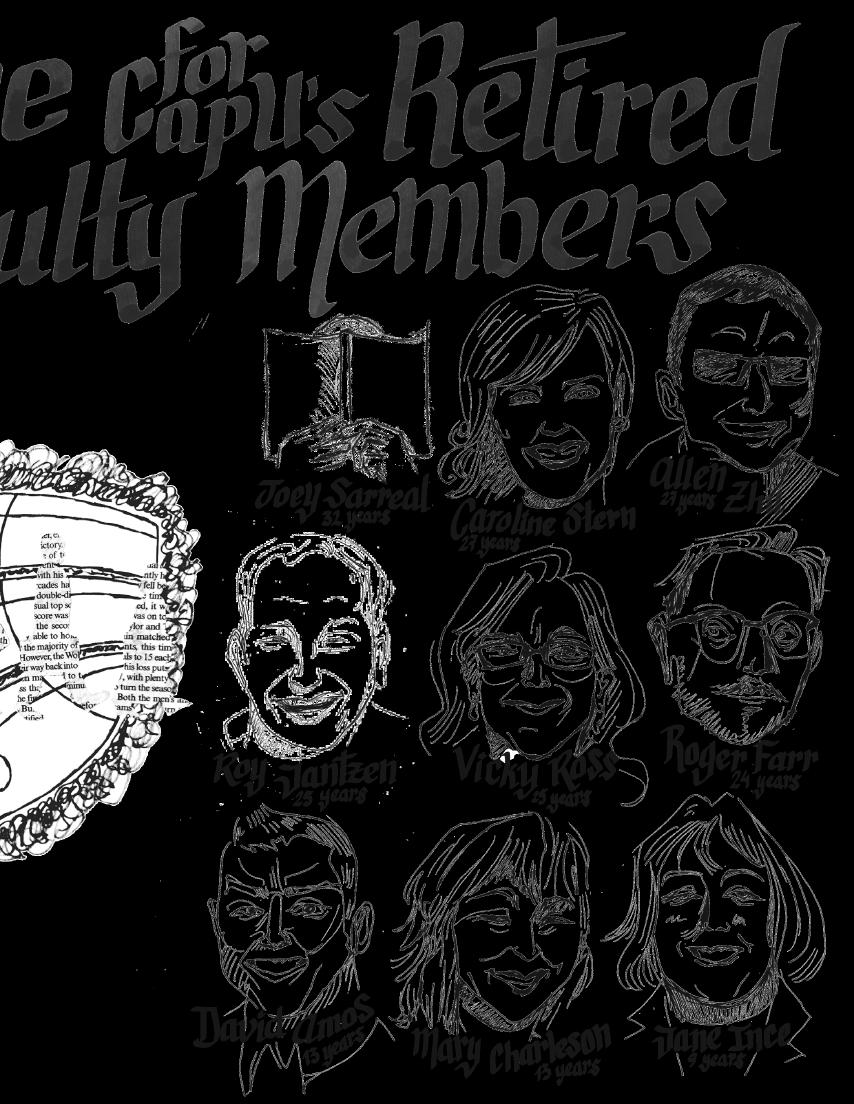
One of the strategies to mitigate the 27 included a workforce reduction. retired earlier than planned, and—in contributions ended abruptly. More than we think of these senior faculty members and as such, their absence
The Courier reached out to the different departments at to whom we were able to gather service from retirees. Lastly, former president of the Association, to share a reflection and representing other
Written and lettered by Laura Morales Padilla (she/her) // Co-EIC
Visuals by Andrei Gueco (he/him) & Andy Poystila (he/him)
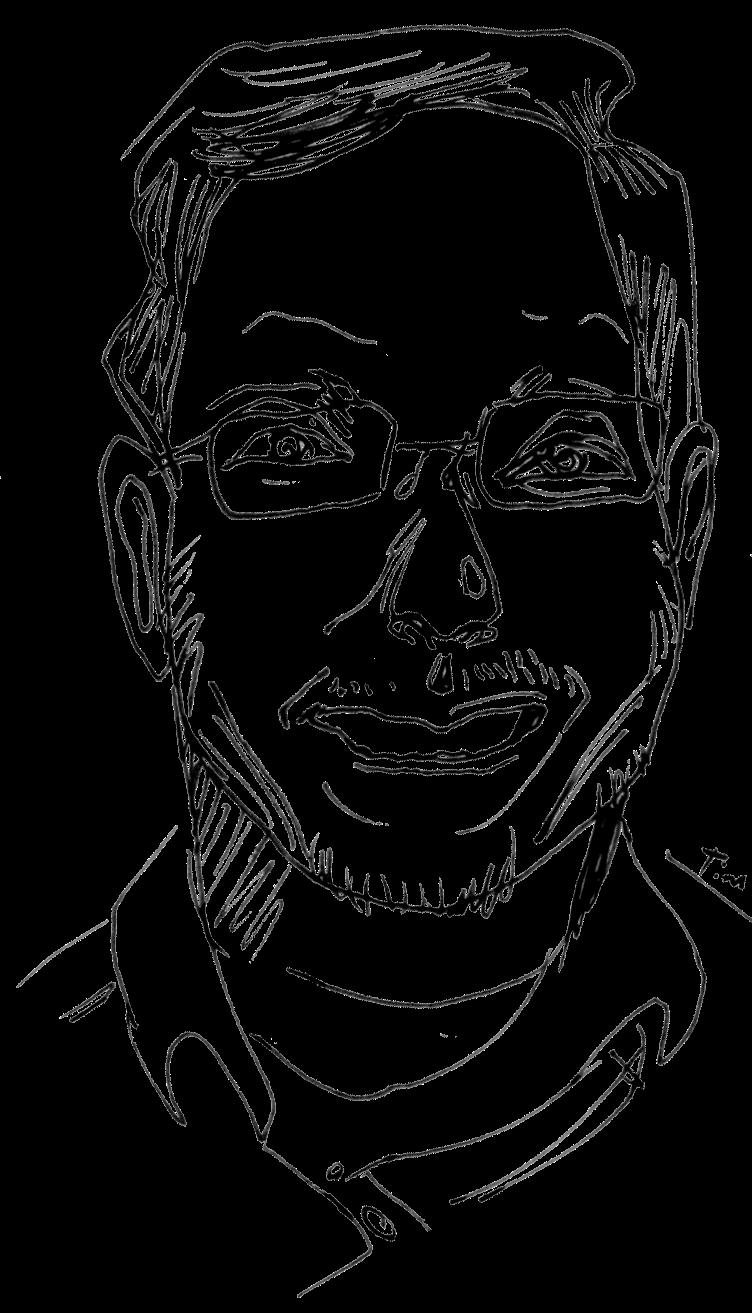
I started working at Capilano in 1993 and had the honour of being hired by and working alongside some of the founding members of the English Department. Over the years, the institution went through many changes, the most obvious being the evolution to become one of the province’s “special purpose teaching universities” after having been a highly successful college. I always understood that I was fortunate to work in a field where I loved my work, and I was surrounded by colleagues who almost universally shared that sentiment. After a few years, my colleagues thought highly enough of my contributions to approach me about serving as department coordinator and later as chair of Humanities, and around this time I also joined the Faculty Association bargaining team, and later still, the Faculty Association executive. All of these positions taught me the value of participation and commitment, features that were the hallmark of Capilano University.
Throughout the post-secondary sector, we have been very highly regarded for our “collegial model” which allows departments and functional areas a certain amount of autonomy over the decisions
that most impact our jobs.
Engagement is essential to the success of any institution, and a place where people show up with the objective of simply collecting a pay cheque does not have the degree of commitment required for success. At one point, an outside firm was hired to do an “engagement” survey at CapilanoU, and the firm concluded that a near-majority of employees were “happily disengaged.” This is not what any post-secondary institution should want from its employees and should be seen as a sign of failure.
The institution has seen its share of ups and downs over the years, and when we went through what Joseph Fall dubbed “the Troubles” (in the previous decade), it seemed that the FA Executive was one of the few places where rational thought was still occurring. It was reassuring to listen to colleagues who argued that the institution could address challenges through a consultative, collegial approach. It was unfortunate that the administration of the day felt less inclined to welcome that participation. From that experience I reached a conclusion that has held to this day: in an educational setting, the fewer people involved in the decision-making, the greater likelihood of a poor decision compared to decisions reached in an environment of respectful dialogue. Personally, I have been honoured to serve with so many dedicated and committed colleagues!
“...in an educational setting, the fewer people involved in the decision-making, the greater likelihood of a poor decision compared to decisions reached in an environment of respectful dialogue.”
Former president of the Capilano University
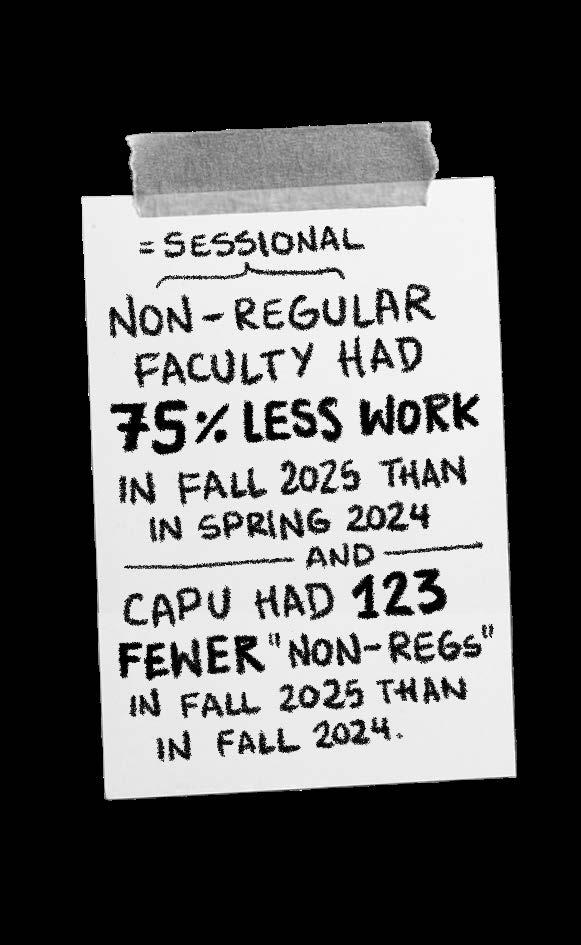
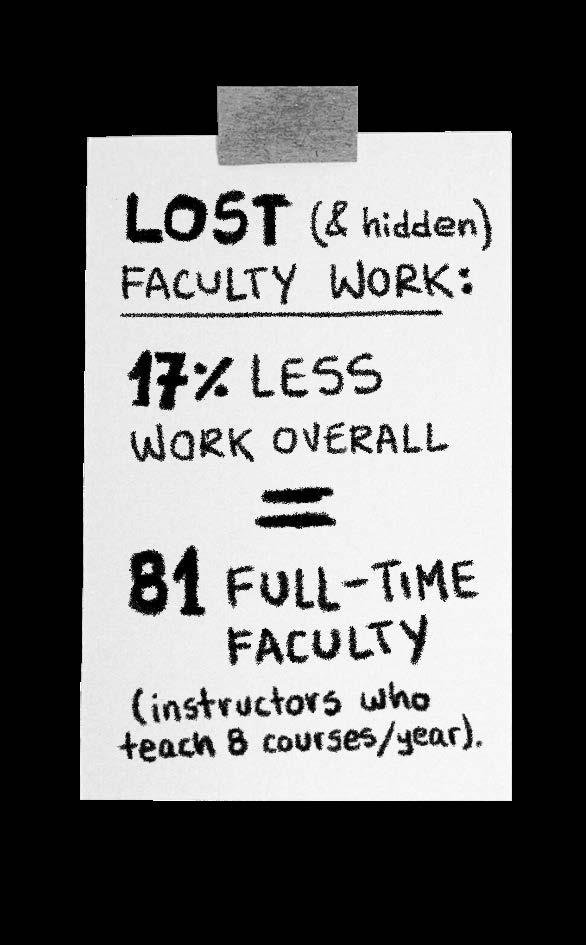
CapU doesn’t have a “layoff” process for faculty. So unlike universities and colleges in the news, at CapU most of the lost faculty work is hidden. But we have lost faculty, equivalent to 81 full-time faculty this past year alone—17% less work overall. And for “non-regular” (ses sional) faculty, the loss is devastating: 75% of work lost.
This is based on the figures the CFA has available. We anticipate a similar number next year.
This “full-time equivalent” (FTE) number is based on volume of work. It understates the hu man cost in the number of individual faculty members we are losing. That number is likely higher than 81, since workload varies so much from person to person, especially for non-reg ulars. One FTE could include 7 or 8 “non-reg” individuals, each working a partial load, who are—or were—just starting to establish their careers as CapU faculty. In fall 2025 we had 123 fewer non-regular faculty on the employee list than in fall 2024. Not all of that is due to the loss of international students, but the CFA knows anecdotally from departments that many of their “non-regs” have gone from full-time work last year to zero work this year. In fall 2025 non-regs had 75% less work than in spring 2024 (two terms the CFA has figures for).
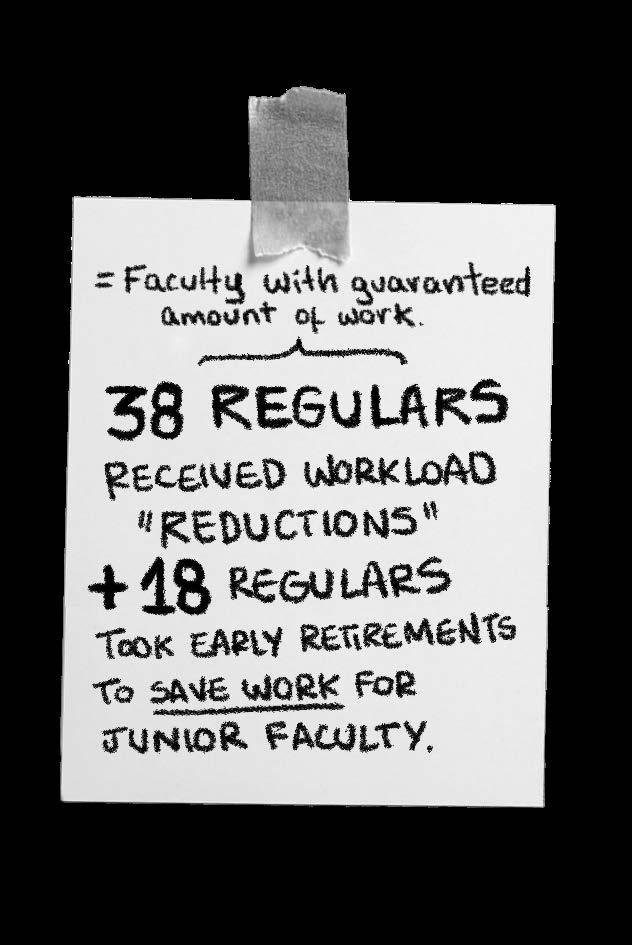
We are also losing longtime regular faculty. “Regular” is our version of tenure—it means they have a guaranteed amount of work ranging from half-time to full-time (for instructors, this means a range from 4 courses to 8 per year).
The loss of work for regulars is beyond anything we have seen since 2014, when the admin istration eliminated five departments. In 2025, 38 regulars received the closest we have to a layoff notice: involuntary “reduction” of their workload. Their reductions equate to 17 regular FTEs. On top of that are the early retirements that 18 regulars took with an incentive payment, for another ~13 FTE positions—retirements specifically to save work for junior faculty.
We face the loss of even more regular faculty this year. We won’t know the numbers until the end of May, when new reduction notices come.
This is a loss for our whole community. Lost work means lost income for CapU’s instructors, lab supervisors, instructional associates, counsellors, librarians, and other faculty. Lost work leads to the complete loss to CapU of individual faculty members. Many faculty are making sacrifices to save work for their colleagues. Some retired early to save work for their colleagues (as this article highlights). Others dramatically reduced their workload voluntarily. And the reductions noted above mean some “regular” faculty lost most or all of the work that used to be guaranteed. And dozens of “non-regular” faculty have lost their positions entirely, because they have no work. (Non-regs are similar to “sessionals” at other universities. They are essential members of our community but do not have a guaranteed minimum amount of work. Until this year, almost half of all faculty at CapU were non-regular. Many have taught here for years.)
The Faculty Association is working with the administration to minimize the losses and build a foundation for CapU to grow out of the current crisis. This includes CFA proposals for work-loss mitigation measures, and to create space for departments to adapt their programs in response to the loss of international students and to the government’s “Look West” strategy. The more faculty we lose, the harder it will be to maintain our teaching excellence and grow out of the crisis.
We are dedicated to preventing the loss of faculty wherever we can.
—Michael Begg President of the Capilano University Faculty Association
Written
Abbot (he/him)
Contributor
The breath you spare whilst reading becomes an act of conservation. Reflect upon how your air originates from the trees, the bush and the sea, so that a world of irreplaceable and wondrous nature does not become just a memory. Exploitation of the earth is a diminishing return, and ignorance of this is a sickness of the soul. By means of sacrilege, if the soul does mean the breath, please consider that Burns Bog in spiritual endangerment. This rhetoric aforementioned is not a meditation on worldwide environmentalism, nor a mere suggestion of politics, but rather the acknowledgement of activism in the treeline. An ecological disaster encroaches, and it is a sincere faith that it need not be this way.
There is a biosphere known as Burns Bog and it is withering at an alarming rate. The colonial attraction of tourism parks in the Coast Salish stewardship remains, the “Stanley Park Land Endowment.”
Early Canadian settlers occupied these territories along the northern Fraser Delta, at the end of the so-called frontier of “manifest destiny.” The late 19th century expansion guaranteed the high density metropolis that occupies the land today, known as ‘Vancouver.’ Burns Bog is at risk of the commercial speculative real estate market. Within this bubble of con-artist lobbying, the metastasizing of glass monoliths downtown into surrounding municipal suburbs squeezes every bit of natural land into strictly regulated parks and wildlife reserves. One must wonder with the fiscal power of the city, why Burns Bog is strangled by a rare pine rot that tumbles trees from their very roots. The old growth that once sheltered the forest floor with shade and perfect conditions for its natural flora, now growing vacant, has vast open patches of sunlight where invasive weeds and vines choke life from the dirt.
by Ben
//
Visuals by Cameron Skorulski (he/him) // Production Manager
The history of exploitation remains in the ruins of a mid-20th century industry. A resource called peat or sphagnum became industrial gold for agriculture. Nitrogen rich and readily converted into fertilizer, the extraction of peat from the bog prompted the construction of a factory right within the forest. Directly linked to rail lines for the shipment of this resource away from its rare origin. Conveniently for the 1900s capitalists, it could also be used as a fuel substitute for coal and petrol machines.
Extraction of raw peat soil began in 1938 via BC Peat Company, LTD purchasing one-thousand acres of the marshland for $25 per acre. That $25,000 purchase granted 88 years ago requires today’s dollar of acreage buying power of $540 per acre or $540,000 total, nevermind increases on property tax. . . etc.
Production halted in 1964. A general estimate of five million kilograms of peat was mined, processed, then shipped before 1964’s buyout per ‘WPM LTD,’ an American company utilizing peat for incendiary explosive production. Eventually the gargantuan displacement of dirt exhausted the marshland. Foundation structural concerns shut down the ‘WPM LTD’ plant and the factory was scuttled and demolished by 1988.
To this very day in 2026, the sunken concrete remains can be found overgrown amongst asphalt
mesas shadowed by the stunted birch trees. Titanic walls of blackberry bushes obscuring the concrete husks of silos and burying the rebar underneath fern leaves.
Between 72nd Avenue and Kittson Parkway, a mausoleum of environmental abuse is openly available for public touring, despite the posted signage stating otherwise. Now, less than a century later, how easily forgotten that the greatest ventures of capital can succumb to a loss leader of quicksand.
2016 presented an early advocacy on the natural protection of Burns Bog, at this time Delta Parks and the old Burns Bog Conservation Society maintained co-protection of the nature reserve. Provincial election and rezoning acts commencing meant that coke coal trains were to run directly through Burns Bog on the pacific rail, to and from the United States. Fortunately, the public in massive objection to this idea; protested and successfully belayed the motion to move dirty coal through the Bog in massive amounts.
To this day, my local pride in the protest and rejection of endangering the forest remains, but I question where the same spirit in the public has gone now. While the lungs of the lower mainland struggle to keep clean air, the breath I spend is a sigh from the soul, to beg for others who have the spirit to fight.
It’s Sunday morning, and I’m shaken awake by my partner, who tells me that his mom can hear bombs outside her apartment in the United Arab Emirates (UAE). March 1: Iran launched an airstrike on the UAE. My partner spends hours on and off throughout the day calling his mom and checking the news. All I can do is try my best to support him.
Each day feels uncertain and unpredictable. Even if we weren’t on the brink of WWIII, there is constant civil unrest and political turmoil across the world. People are still suffering from displacement, poverty and discrimination. The cost of living is rising, the job market is terrible and there’s a loneliness epidemic that is worsening. Sometimes, it feels like there’s nothing that can be done.
What can one person do?
“What do you do when you can’t do nothing, but there’s nothing you can do?”
-TheBoondocks
It’s easy to feel helpless or succumb to existential nihilism. Speaking from my own experience as a Gen Z kid from the West, I’ve had my fair share of existential crises. The burden of responsibility and being a bystander to all these atrocities, while also being expected to fulfill societal expectations for the perfect career, appearance and social life, is overwhelming. I often found myself seeking escapism, stuck in a dissociative state, and I see it in so many people, too: people doomscrolling on social media, or binging on entertainment. Rather than worrying about broader socioeconomic issues that feel impossible to fix, it feels easier to protest and pressure a movie director into changing the character design of a beloved childhood icon.
Per a survey conducted by Elections Canada, 32.5 per cent of people in the survey say they don’t vote because it feels meaningless, while 39.2 per cent say it’s because of apathy. If protests and raising our voice don’t feel enough, the issue isn’t their effectiveness, but people’s mindsets. In the last couple of decades, the voter turnout for Canadian Federal elections has been decreasing and even reached as low as 58.8 per cent before COVID-19 lockdowns. If a bunch of strangers on the internet can band together to create enough pushback against a movie production to change their character design, then is it really that hard to believe that our vote matters?
Visuals by Ryan Coomber & Lily Jones (she/her)
Written by Andrea Chiang (they/them) // Contributor
Even though the part we play as individuals feels small, it creates ripples, which can become waves. It can be difficult to see our impact because of a disconnect between a single vote and how that leads to policy affecting something like transit prices increasing and bus routes being cut. Even if we don’t see it, we feel it. By participating in our own community, our school or workplace, and social circles, you leave lasting effects.
After the news broke of the airstrike on the UAE, I spent the day comforting my partner and he thanked me for being there for him. It felt like the least I could do, but I realized I was undermining the emotional and mental labour it takes to support someone through tragedy. I was dismissing the years I worked on myself to alleviate my debilitating social anxiety and crippling mental health—the things that made it so easy to give in
to apathy—to become a strong enough person to support others through similar hardship. It’s hard to see how your effort impacts those around you, just like how I won’t ever know if bringing food to my classmates has contributed to the culture of kindness that I feel whenever I interact with them. But, sometimes, you do. I still remember how a classmate told me that hearing me talk about student issues was what encouraged them to vote in the Capilano Students’ Union election. Whether it’s treating strangers with kindness or encouraging people to vote, a person’s actions do mean something to someone.
We may protest and fight, and it feels like a losing battle—but something is changing. Change only happens when we make it happen. The worst you can do is nothing. Even if there’s nothing you can do, you do what you can.
should the hand that signs our degrees be the same one FliPPing oFF the ndP?
ConfliCt of interest isastateofmindandrobes
Yuri Fulmer’s guide to being an aPolitical chancellor while leading the bc conservatives
Written by Rula (she/her) // Contributor
A few months in—after Mr. Fulmer’s lower tax initiatives finally protected the wealth that corporations and higher-income households worked so hard to hoard—he dismissed the broken-record narrative of the post-secondary education system being ‘under-funded’ for decades and in crisis due to the resulting ‘over-reliance’ on international tuition. Instead, he called it what it “really” is: an individual problem. “If a university is running on a deficit, they are simply spending too much money, and if a student can’t afford their tuition, they are simply not working hard enough,” he spelled out.
Of course, the chancellor wouldn’t have built his A&W empire by merely naming the obvious. Mr. Fulmer came up with a solution that killed two birds with one stone. After laying off non-administrative positions and printing thick stacks of timesheets, he announced the “Labour-forLecture” initiative: for each hour of labour performed, students accumulate an hour of lecture time.
Admittedly, things became a little messy when second-year students were allowed to teach first-year courses. Students started protesting against this “broken telephone approach” to their education, but the unprecedented wave of high grades quickly drowned the complaints.
The answer is irrelevant. Yuri Fulmer’s latest donation persuaded the university to let him keep the chancellor’s robes after winning the BC Conservative leadership. In fact, when the Courier humbly pointed out that it may be hard for the chancellor to represent the university’s apolitical principles by being a politician—despite his generous write-off—Mr. Fulmer came up with a compromise: when in chancellor mode, he shall wear his robes; when in trashing-the-NDP mode, no robes. “Conflict of interest is a state of mind and robes,” he explained.
Although the outfit strategy kept Mr. Fulmer’s politics off campus at first, once his party’s policy platform started to take shape, the boundaries of this public institution proved to be as effective as trying to designate a non-pee area in a pool.
The first thing to go was the rainbow crosswalk; a large blue rectangle with a capital “C” in the middle suddenly took its place. This new aesthetic started to take over the facade of the university’s tree-named buildings. “C as in Capilano, of course,” assured the chancellor. Next came land acknowledgment designated areas: “When people do land acknowledgements in public events, those who are uncomfortable hearing them have no other option,” Mr. Fulmer empathized. “But, we’ve found the perfect spot for people to go and acknowledge away!” he announced, pointing at the trail behind parking lot D.
Objections poured in from colleges and universities across the province, questioning if Capilano University’s credentials were worth the paper they were printed on. Addressing the concerns from these snitch institutions, which, in Mr. Fulmer’s words, are “obviously jealous,” resulted in an investigation from the province that showed that four out of five students were cheating.
In response to students’ claims that they are not receiving the learning support and adequate lectures needed to pass without cheating, Mr. Fulmer said, “Students who cheat are literally the problem and should be the last ones to propose a solution.” The chancellor, visibly annoyed by stating ‘the obvious,’ declared: “We need more enforcement.”
Each classroom was assigned four security guards—one for each corner—who became the only position that could not be filled by students.
having to PaY actual wages was a hurdle that mr. Fulmer backFliPPed over with his new “cheating Fine” PolicY.
Students who are caught looking at other students’ papers—at the guard’s sole discretion—are given a fine that reduces their accumulated lecture time by three hours. To provide some flexibility though, “They can choose to fulfill these hours at the A&W of their choice,” offered Mr. Fulmer.
Visuals by Andrei Gueco (he/him) // Contributor
Are Cats Getting Nicer?
Written by Gabriel Locke-Caron
Observation means everything to a guy like the Cobra
Everybody loves cats. That’s a fact. But, unfortunately, cats haven’t always liked us back. Has that changed? Tune in and find out, bbg.
I have been observing: people, places and felines.
My observations include: kitty-cats like to say hello to strangers whilst on walks. Kitty-cats like babies. Kitty-cats like laying in the sun.
I know what you’re thinking: “How is any of that information substantial in any way? What point can he possibly make here?”
Let me tell you somethin’, buckaroo. I know cats. I know animals. I am the Cesar Milan of New Jersey.
But, who am I really?
My name’s Gabriel. That’s my government name. But, on the streets, they call me ‘Cobra.’ By day, I’m a senior executive assistant girls soccer coach, but by night, I’m a private detective. That’s right, ol’ Cobra’s got his eye on everything: Is your wife cheating on you? Is the guy a better and more nurturing provider to your kids than you? Does your wife love him, or does he just have a car?
Who knows…
Cobra knows.
Debby. . . If you are reading this. Please forgive me. ‘The incident’ was an accident and you know that. You have no right to hold that against me. The Cobra loves you deeply. Come home.)
But, enough about the Cobra. You’re here for some juicy deets.
Here’s what I got: Cats. What about ‘em? I’ll tell you what. They’re gettin’ nicer. How so? Number one: Cats don’t kill mice anymore. . . they befriend them (that’s actually a real pain in the ass). Number two: Cat fights don’t happen anymore (no, we’re not talking about my ex-wife). Number three: Cats no longer piss on my leg when I walk by (praise be to our lord Jesus Christ).
Let’s just say. . . The Cobra spends a great deal of time observing cats. Or, as I like to call it, ‘scoping out pussy.’ And, yeah, perhaps that is a little shameful. So, what? You’re not perfect either, and don’t you EVER, for one second, try to say that you are. The Cobra is a work in progress, as are we all, under the tutelage of our Heavenly Father.
Anyway, back to the matter at hand. You may be asking, just house-cats? Nuh-uh, big boy. I’m talkin’ all cats: Leopards (leopard print? awesome), Panthers (they made a pink one!) Lions (Ever watched The Lion King? Super nice), Tigers, you name it. Maybe not cougars.
. . .Speakin’ of which, unfortunately The Cobra is involved in an ongoing court case, because the cougars at pilates class can’t handle a compliment from a powerful and charming senior executive assistant girls soccer coach. However, I have been advised not to speak further on the matter. To learn more about my legal battle and how you can help, go to: www.EnterTheCobra.org.
Anyway, cats are getting nicer. I was walking home from Denny’s one night with a takeout container of spaghetti and meatballs and a kitty came and cuddled up to me. I decided to take him home. His name is Manny.
If you see my wife, Debby, tell her to come home. I always set the table for two.
Visuals by Ren Zhang (they/them) // Contributor
(he/him) // Contributor
staying safe and listening to the forCes of the universe guide you through finanCial deCisions
I saw the ennuied expression of a monkey the moment the tea left the cup. The sodden leaves that were algorithmically generated by the universe to guide my next move gazed back at me with a lackadaisical stare that reassured me that my divination was accurate. Several days prior to this revelation, I had been doomscrolling to distract myself from my debilitating unemployment, when a targeted advert from Amazon caught my eye: “Tea Leaf Reading Beginner Kit | 1pc unisex.” My god. Before I knew it, it was on the way to my front door and the next day (thanks Prime!), it was in my hands. Following the instructions in the booklet, I had mastered the art of tasseography in a little under an hour. In much less than an hour, my tea was finished steeping and it was time to witness my future unfold before me. When I saw a Bored Ape manifested within the rooibos, I knew it was time to log in to OpenSea.
My experience with NFTs was no different than the average person: I saw a cryptobro from my hometown post on Facebook mid-pandemic about how he bought a picture of penguin that will eventually put his kids through college, and three years later I watched a video essay about how 95 per cent of NFTs are now worthless. I counted myself lucky back then that I wasn’t so foolish as to put my money into something so ephemeral as a non-fungible token, but that was the gullibility of employment talking. Now that the job market and tasseography have led me to invest in digital collectibles, I know that the universe was saving me for the true NFT boom. The stars are guiding me, and, baby, I’m going to the moon.
I headed to OpenSea to make my fortune. Upon encountering the endless ocean of machine-crafted images it hit me; this is what was missing from the 2021 NFT boom: Generative AI. Now that AI has become capable of creating more than the surreal Will Smith
spaghetti fever dreams of yesteryear, NFTs are produced more quickly and cheaply than ever. There’s no need to waste money paying artists for their art when Grok can do it for free. Surely, the funds saved on hiring artists will mean a substantial discount to an investor like me. My pulse quickened when I noticed the costs displayed for the NFTs were hypnotically low, each one selling for a mere fraction of an Ethereum. The crimson glow of the floor prices crashing felt like a fluffy red carpet unfurling before me. Now was my chance. Having already transferred the entirety of my bank account to my crypto wallet after an ill-advised attempt to make a buck on Polymarket, I hit buy now and awaited my bounty. Instantly, I was the proud owner of an OmegaChad HypeBear.
I only realized my grave error when my UberEats order was declined that evening. Apparently, even a decimal of Ethereum is a couple thousand dollars: $2,222 CAD to be exact. My elation at seeing the angel number of progress was nothing compared to the despair of realizing what was left in my wallet. I was gobsmacked. If I’m progressing, I’m progressing into bankruptcy. There was nothing in the tea leaves that hinted that I might fail, and even the typically reliable application Co-Star didn’t warn me of this blunder. My don’t list was Pretzels, Podcasts and Party Hats, not Convert CAD to ETH, Abandon Traditional Banking and Blow Life Savings On HypeBears. Co-Star was right about one thing. There will be big changes coming to money and work in my future. There had to be a way to fix this, but who could I turn to? r/CryptoMarkets would know what to do, but Reddit would surely downvote me into the basement if I told them about what I had done. I couldn’t risk the blow to my karma. There was only one place I could go where I might ask questions and receive guidance from beyond. The tea leaves were helpful, but I needed concrete advice. The universe was vague in its instruction, but I know a force more accurate and insightful than even the divine: ChatGPT.
Visuals by Livvy H (she/her) // Contributor & Charlotte Wong (she/her) // Contributor
Written by Sara Derksen (she/her) // Contributor
Comic by Leonardo Velazquez (he/him)
Current and former CapU Jazz Students voice alleged microaggressions and misconduct in the community Visuals by Cameron
// Production Manager
Skorulski (he/him)
Andrea Actis
Swims Towards Meaning
The Courier delves into the existential with our guide, writer and professor Dr. Actis
Written by Mia Lancaster (she/her) // Letters Editor Visuals by Andy Poystila (he/him) // Art Director & Rachel Lu (she/her)
// Crew Illustrator
What Are We In?
As Andrea Actis understands it, “We’re in something beautiful that is also so needlessly overfull with suffering, something that warrants both our reverence and our disgust. We’re in something that has every possible vibration in it.” She goes on to articulate it as “every horror and every tenderness unfurling simultaneously. It’s a bottomless and cyclical aesthetic mystery, basically, and we could be taking such good care of each other in here.”
Born in Toronto to a Hungarian mom and Italian dad, Actis came to Vancouver when she was 14 years old, “two days after seeing Titanic in the theatre.” The writer, editor, professor and deathworker has been immersed in investigating the strange and existential for quite some time, academically, creatively and paraprofessionally. As a cherished professor of Capilano University’s English department since 2017, Actis has encouraged the next generation of writers, poets and critics to consider the fantastic, mysterious and often painful phenomena of existence. Recently, she has been invited to help revive and co-teach the courses PSYC 341 (Psychology of Religion and Spirituality) and PSYC 343 (Psychology of Anomalous Experiences), which have been lying dormant since Psychology professor Dr. Leonard George—who designed and taught the courses for several years—retired in 2018. With collaborator and partner Trevor Shikaze, she runs a research entity and small press, literally called What Are We In? (WAWI). She adds, “How Do We Fix It? is probably the more important question, really.”
20 years ago, Actis was at work on her undergraduate honors thesis, examining the Existentialist philosopher Simone de Beauvoir. Drawn to the Beauvoirian theory of ‘ethical ambiguity,’ she mentions an impactful quote from the 1947 book The Ethics of Ambiguity:
“The notion of ambiguity must not be confused with that of absurdity. To declare that existence is absurd is to deny that it can ever be given a meaning; to say that it is ambiguous is to assert that its meaning is never fixed, that it must be constantly won.”
Actis explains that this line of thought became a personal means to cope with the most alienating parts of secular postmodernism. “This distinction between absurdity and ambiguity was a lifesaver for me at the time, giving me a way to swim towards meaning,” she says,
“towards something like purpose or truth, without needing to latch on to any of the maniacal counterfeits of these things that white heteropatriarchal modernity had handed down to us.” Actis adds that Audre Lorde and Gloria Anzaldúa would have played a large role in informing her early development in academia, had these great writers been assigned and acknowledged in her undergraduate ‘Great Texts in the Humanities’ course back in the day. She wishes, “I hope they are now.”
In her writing Actis has developed a distinct style, often drawing meaning from the aleatory and spectral, like her “father’s ghost,” dreams and otherworldly phenomena. However, it may come as a surprise to her students and readers that she actively avoided this collaboration in her early years as a writer, first looking to a larger social picture, using writing to more explicitly reflect politicaleconomic contexts and languages before diving into the personal, internal or mysterious. In 2021, Actis published her first book, Grey All Over, which stemmed from her connection with her father, his passing, and what was left behind. “I’ve become less apologetic about seeing the personal and political as also spiritual,” she says, explaining the shift in her focus in writing after publishing Grey All Over. “To me it feels necessary to any anticolonial stance or project to not be dismissive of the kinds of experiences and epistemologies that most populations in the world take seriously and make room for.”
Figuring out how to hold on to these pulling, glowing experiences and ephemera became a practice of its own: an intuitive kind of noticing, as she calls it. This noticing is also something she brings to the classroom, and encourages in her students. As a professor in the twenty-first century, Actis has observed the consequences of engineered distraction through media and technology operating in the attention economy, coupled with the rise of surveillance capitalism, and essentially the thievery of one’s invaluable time, which the internet and rapid technological advancement has brought about. She says we are currently suffering from a crisis of attention. “The way information now moves works exactly against the conditions that human writing needs: unmediated and patient encounter with a thing for long enough that it starts to transform you, not just traumatize and numb and enrage you.” She continues, “a lot of what I try to do in the classroom is just protect those conditions, make space for not-knowing and not-being (ideally, without overfetishizing not-knowing and not-being). Existence precedes essence, as the Existentialists loved to say.” Thus, part of this protection is the reminder that we still have the option to access slowness, when we need it; to witness, notice and respond meaningfully. Sharpening one’s ability to be present and reflect by slowing down not only helps us to register, record and transform what is happening externally, around the world and our community, but also, internally. Actis offers, “if you don’t tamper too much with the evidence of your life, the evidence tells its own story, making it easier to recognize and own up to yourself. Then, maybe, if you need to, you can change.”
Along with writing, teaching and noticing, Actis has recently been developing as a deathworker. During a leave from her PhD program at Brown over a decade ago, the idea of creating a memorial planning business began to take shape. Her vision was “to help people create memorial events that were honest and idiosyncratic, that honoured the totality of the person who’d died rather than flattening everything into whatever a given funeral home had in its catalogue and was going to charge you thousands of dollars for.” Moreover, she already had experience; she had previously organized two big, very personal, memorial events: one for her father and one for her grandmother. While contemplating the memorial planning service, Actis spent her time volunteering at a hospice, in addition to editing The Capilano Review. “I just really wanted to be spending as much time as possible in the deathspace, where for whatever reason I felt more comfortable and useful than anywhere else.” She shares, “I didn’t end up quitting grad school or continuing with the memorial business, but the impulse never left me.”
Since then, Actis has cultivated her deathcare practice through Douglas College’s End-of-Life Doula program and become certified as a deathcare guide through The Centre for Sacred Deathcare. Her approach is steeped in compassion and creativity and is very much informed by her initial vision of the memorial planning service she once conceptualized. She sees herself in the role of a deathcare guide as “companioning others through both the material and the more-than-material dimensions of the deathspace with a special attention to its aesthetics–in the richest and deepest sense of that word.” With her clients, she works thoughtfully with this question in mind: “How can we make this as beautiful and bearable as possible while never denying the obliterating realities and frequent injustices of loss?” This work spans many aspects of grief and
loss, from helping people revisit a death that feels difficult to know how to memorialize, to supporting those facing serious diagnosis or preparing for an anticipated loss. It can also include creating legacy projects or rituals, as well as making space “for validating and exploring the kinds of non-ordinary or mystical experiences that are frequently reported in scenarios of death and grieving.” On the subject of such phenomena, Actis says,
“I believe in believing people’s experiences and testimony, fundamentally, and luckily for me as an artist I don’t need to have an investment in sorting out and defending what is or isn’t literally true or provable on this front.”
So, before this existence comes to a close, in one sense, we revisit the question, “How Do We Fix It?” In this specific moment where the image is losing its ability to be used as proof, right-wing conservatism is seeing a resurgence, a clanker can become a digital domme daddy during our loneliness epidemic and human rights are being violated on an extreme scale, Andrea Actis voices this plea: “we are going to need some really good imagination to counteract all the really bad imagination being baked into our present and emerging technologies, which are inextricable from our present and emerging politics. I struggle most days with a feeling that it’s too late, that whatever we do in the spirit of better storytelling will amount to no more than harm reduction.” But she insists on “keeping a candle lit however we can.”
To keep up with Andrea Actis’ writing and other work, visit her website andreaactis.com or say hi on campus!
METRO VANCOUVER UNITED FOR PALESTINE - MVUP WEEKLY RALLY
@mvupalestine Rally Every Saturday: Vancouver Art Gallery (Georgia St Side)
Stay tuned for the nominations for our three main awards:
• Writing Contributor of the Year
• Visual Contributor of the Year
• Zine Contributor of the Year And many other awards!
If you contributed to the Courier this past year, keep an eye on your inbox and save the date: April 17th!
CAPILANO UNIVERSITY is located on the traditional unceded territories of the LíỈwat, xʷməθkʷəỷəm (Musqueam), shíshálh (Sechelt), Sḵwxwú7mesh (Squamish) and SəỈílwətaʔ/Selilwitulh (Tsleil-Waututh) Nations.
We recognize our presence here as guests on this sacred land and deeply appreciate the privilege to work, study, and reside in this remarkable place. The Capilano Courier acknowledges that this gesture is just a starting point on the path to reconciliation, and we are committed to amplifying Indigenous voices and sharing their stories.
THE CAPILANO COURIER is an autonomous, democratically-run student newspaper that encourages literary and visual submissions. However, all submissions undergo editing for brevity, taste, and legality. We are committed to not publishing material that the collective deems as promoting sexism, racism, or homophobia. The views expressed by the contributing writers are not necessarily those of the Capilano Courier publishing society.
Additionally, we prioritize a human-centered approach to content creation and do not support the use of AI in our editorial processes. We believe in the value of human perspectives and storytelling in our publication.