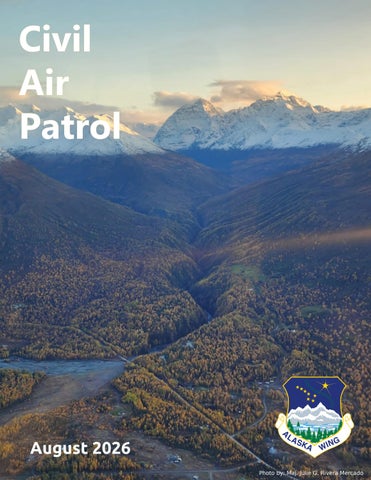
Civil Air Patrol
August 2026 Photo by: Maj. Julie G. Rivera Mercado
Alaska Wing Conference 2026
Save the date Date: November 21, 2026 More details coming soon
Table of Contents
The award process
4-5
Valdez
6-7
Arcturus
8-9
Southeast
10 - 11
Brichwood
12 - 14
Tok
15
Homer
16 - 17
Alaska Wing sUAS Training Opportunities
18 - 19
The Invaluable Worth of Every Member in Civil Air Patrol’s
20 - 21
Professional Volunteering Radio Operating Procedures and Best Practices
22 -23
National Legislative Day
24
Great opportunity
25
Education and Training
26 - 27
CDI September Lesson
28
AKWG QR Codes
29
Pick. Click.Give
20 - 31
Tail Section
32
CAP AKWG 3
The Awards Process By: Lt. Col. Don Duff
CAPR 39-3 is the primary regulation regarding awards categories and criteria for both senior and cadet members. Any CAP member can submit an award but normally the majority of submissions come from unit commanders or unit personnel officers using the proper CAP forms. There is an awards committee for both seniors and cadets that evaluate submissions and make final recommendations for the winners in the respective categories. The recommended applications are then forwarded to the
4
CAP AKWG
wing commander for final approval. Winners are announced at the wing conference and banquet. Afterwards the awards are entered into the members eServices file. Staff Members that participated in mass events such as the Summer Encampment are also recognized. The process leading up to the awards presentations begins about 3 months before the wing conference. A notice (usually 3) is sent out wing wide detailing the submission process with who to submit nominations to
Last day to summit the aw
such as myself and the Director of Cadet Programs with a submission deadline date along with links to view such as CAPR 39-3 and other helpful hints to make the submission process as easy as possible. The two most common awards are the Commander's Commendation and Achievement Award Certificates and a for exemplary service the Exceptional Service Award and the Meritorious Service Awards. The top individual honors are for Senior Member and Cadet of the year along with "Of the Year" specialty awards such as
wards is August 24, 2026
Aerospace Education Officer, Finance Officer, Safety Officer to name a few. For cadets award recognition adds to their chances of higher education scholarships following high school. Recognition doesn't end with the wing conference. The respective winners for the wing are later submitted to Pacific Coast Region for consideration and should any AKWG members are selected they will next be considered for National Awards. The Alaska Wing has been blessed with both Region and National winners.
CAP AKWG 5
VALDEZ
During the month of July, Valdez Composite During Valdez's ann Squadron has been very busy. Festival, Valdez Compo recruitment booth on We have started the rocketry program, senior members spoke and six cadets have built two rockets so program, while severa far and have begun work on our third. The flight simulator for the cadets have been working hard on them. Although we have been unable to launch them due to weather conditions, we hope this month will bring a few sunny days so we can launch them.
On July 29, we conducted a drill test for two cadets to progress in their achievements. That same day, several of our cadets began designing a new squadron patch and selecting a new squadron name. We have narrowed the choices down to a few ideas and hope to finalize them soon.
6
CAP AKWG
Leading the formation is C/SSgt Reiter, followed by C/TSgt Winchester and C/AMM Sanborn. Administering the test is C/SSgt Spadafora.
nual Gold Rush Days osite Squadron hosted a August first. Cadets and e with visitors about the al cadets monitored our local youth and others.
On August 2, C/2Lt Taylor and C/TSgt Winchester showcased our abilities during the Gold Rush Days Parade. Taylor presented the Civil Air Patrol flag and Winchester presented the Alaska state flag .While our valued senior members followed behind, handing out candy and merchandise to parade attendees.
Pictured from left to right are 1 Lt. Taylor then C/TSgt Winchester 1Lt. Bremer and LtCol Freeman
Written and photographed by C/A1C Iris Gheen
CAP AKWG 7
ARCTURUS
The cadets performed new commands they h gained much.
In July, the Arcturus Squadron had many activities. On PT Night, a few cadets completed their PT test, and Cadet Major Buller gave a briefing on Delegation and why it was important for Civil Air Patrol.
8
CAP AKWG
Lt. Col. McCarthy led cadets on why rules an flying. He taught them thought patterns and h thinking.
d drill and marching, learned The squadron used what they learned about had not known before, and rockets into action during a high-flying model rocket launch. Cadets launched their rockets successfully, with many of them achieving altitudes well exceeding 120 feet.
a safety briefing with the nd safety are important for m about the five hazardous how they can affect a pilot’s
On Promotion Night, Lt. Col. McCarthy discussed Character Development with the cadets, including feedback and why it is important in Civil Air Patrol, such as receiving feedback on Search and Rescue activities. For Promotion, Cadet Julieanna Imke was promoted to Airman, marking the start of her Civil Air Patrol journey.
Written by: C/SMSgtEowyn Davidson CAP AKWG 9
SOUTHEAST
This July with the help of Southeast fire extinguishers and SM Scott Novak, Southeast Composite Squadron was able to have a course on fire extinguishers. This course was designed to help build knowledge and confidence around and about fire extinguishers, different types of fires, and when to use an extinguishers. Instructor from Southeast extinguishers lights the fire.
C/2d Lt Fields takes a turn extinguishing.
10
CAP AKWG
A great thing about this course was the opportunity for hands on learning. All the students were able to use an actual fire extinguisher to put out a fire, that was set using a bed of propane lit with a torch.
f
Cadets watching Also this July, Southeast Composite instructor SM Novak Squadron opened a new term for demonstrating how to the cadet executive staff. This term hold a fire extinguisher. we welcome C/1st Lt Lotz as cadet commander and C/CMSgt Rosson as deputy cadet commander. There was also a We would also like to thank C/ classroom portion in Capt. Fields for his time as cadet which cadets learned commander this past term. about the different types of fires, and fire what class of extinguisher to use for each type.
(left to right) C/Capt. Fields, C/CMSgt
Rosson, and C/1st Lt Lotz holding the squadron guideon
Written by C/SMSgt Rosson
CAP AKWG 11
BIRCHWOOD
Birchwood Cadets call out their recent NCSA and RCLS
This is a compilation of experiences from four members of our squadron: Cadets C/ CMSgt Cage Klayum, C/CMSgt Kaden Mattson, C/2nd Lt James Wood, and C/CMSgt Zachary Kenney. Cadets Kenney and Klayum attended the Cybersecurity National Cadet Special Activity (NCSA), Cadet Wood attended the Air Force Specialized Undergraduate Pilot Training (AFSUPT), and Cadet Mattson attended the Rocky Mountain Region Cadet Leadership School (RCLS). The following are the testimonies from each of the Cadets and
highlights of their experiences: Cadet Kenney's and Cadet Klayum's Experiences at Cybersecurity NCSA – South Dakota Cadet Klayum and I attended the Cybersecurity NCSA from July 5–12 at Dakota State University in Madison, South Dakota. The activity focused on cybersecurity fundamentals, cyber careers, and operating systems like Linux and Windows. We learned basic system administration tasks using Control Panel features, such as Task Manager, user account management, software installation/ removal, and system updates. Online
C/2nd Lt Wood in front of a T-6 Texan during AFSUPT at Vance AFB 12
CAP AKWG
S experiences June 12–20. I decided to attend based on recommendations from fellow Cadets and a desire to learn how to better lead and support my squadron. I also wanted to network with Cadets from other wings and regions to learn how they manage their units. Key takeaways included lessons on personal biases and mitigation C/CMSgt Klayum during a lab assignment during strategies, managing Cybersecurity NCSA command climate, and organizational change. The highlight quizzes reinforced our learning was applying these concepts during throughout the week. During offpractical team-building activities duty time, we built teamwork by on the USAFA ropes course. While watching movies, playing pool, and developing a theoretical operations hanging out. plan during the latter half of the course presented some challenges, Cadet Mattson's Experience at RCLS was an effective activity that RCLS - Colorado deepened my understanding of I attended the Rocky Mountain Region leadership within Civil Air Patrol. Cadet Leadership School at the U.S. Air Force Academy Preparatory School in Colorado Springs, Colorado, from
CAP AKWG 13
program demands over 10 hours a day of intensive classroom instruction, fastpaced testing, and rigorous memorization. However, Cadets who keep up with their studies are rewarded with flight time in full 360-degree Air Force simulators. Overall, C/CMSgt Kenney during a lab assignment during it is a challenging Cybersecurity NCSA but highly rewarding activity for aspiring aviators. Cadet Wood's Experience at AFSUPT – Oklahoma Whether gaining hands-on system This summer, I attended my first administration skills at Cybersecurity full National Cadet Special Activity NCSA, refining command strategies (NCSA), the Air Force Specialized at RCLS, or experiencing rigorous Undergraduate Pilot Training pilot training through AFSUPT, (AFSUPT) at Vance Air Force Base these Cadets demonstrated how (AFB) in Enid, Oklahoma, one of the special activities foster personal few locations where Air Force pilots growth and specialized knowledge. begin training for fighter, bomber, These diverse experiences highlight and cargo aircraft. The purpose of invaluable training, leadership this NCSA is to give Civil Air Patrol development, and camaraderie cadets a clear view of the Air Force available across Civil Air Patrol pilot training process while providing programs. Alaska Wing Cadets hands-on experience. and Senior Members are strongly encouraged to take advantage of The activity is tailored for cadets these transformative opportunities interested in becoming Air Force by applying for upcoming NCSAs in pilots, offering a realistic look at Winter 2026 and Summer 2027. what it takes to earn a pilot slot. The 14
CAP AKWG
Written by C/CMSgt Zachary Kenney
TOK
Promotion and Award Ceremony
On 27 July 2026, Tok Composite Squadron held a promotion and award ceremony for C/SSgt Aiden Gross. Cadet Gross was promoted to Cadet Staff Sergeant and presented with Wright Brothers Award #72673. To earn Civil Air Patrol's Wright Brothers Award, Cadet Gross successfully completed all Phase I requirements including leadership, aerospace, and physical fitness tests. This milestone also required him to pass a comprehensive leadership exam, demonstrate drill proficiency in a practical test, and pass a physical fitness test. Additionally, Cadet Gross was presented with a certificate and ribbon for completing the 2026 Alaska Wing Encampment from 7 - 13 June at Joint Base Elmendorf Richardson. This overnight event was a high-intensity, week-long leadership laboratory and immersion experience which Cadet Gross thoroughly enjoyed.
Finally, Tok Composite Squadron also recognized the consistent hard work and support of 2Lt Barb Pine with presentation of a certificate of appreciation. 2Lt Pine is Tok's key player in the Wreaths Across America event, securing support from individual donors and businesses to honor our veterans every year.
Written by LtCol David Briar, Commander
CAP AKWG 15
HOMER
The Homer Squadron was the grateful recipient of funds from the wonderful people of the Homer, AK, Elks Lodge, #2127. Leading the selection committee is Jill Hockema, Past Exalted Ruler and District Deputy to the Grand Exalted Ruler, as well as super contributing member, Linda Young.
The Elks have a long-deserved reputation of generosity in the community and the Homer Squadron was the recent appreciative beneficiaries of these critical funds. Only a few years old, there were foundational essentials that we met, as well as long-term needs like 1 or more year's of regalia for Cadets.
Additionally, t Squadron to sup as the drone p commercial bat each drone to fun length, as well a shown here to and Cadet expe thanks that the the Elks Lodge o
16
CAP AKWG
Project for Twenty Seconds More and Alaska Wing Assistant Director of Communications, 1Lt. Michele Bremer, visited the Homer Squadron in August and had an in-person meeting with 2d Lt Jon Crocker, Comms Officer, while also meeting all the Cadets and Adult Members there.
the gift allowed the pport new initiatives, such program, by supplying a ttery box that would allow nction for 3 times the flight as other wonderful items augment our capability erience. It is with endless e Homer Squadron thank of our community!
Written by: SM Laurie Gentle
CAP AKWG 17
Alaska Wing sUAS Training Opportunities By 2Lt. Alan Sorum
The Alaska Wing of the Civil Air Patrol (CAP) has been working to develop its small Unmanned Aircraft Systems (sUAS) capability across the state. Ultimately, the intent is to see every Squadron, wishing to participate in the program, receive operator training and have a sUAS aircraft available for their use. CAP offers two levels of qualification in this program, they are the sUAS Technician (UAST, 13+ years old) and sUAS Mission Pilot (UASMP). Cadets 16 years of age or older who qualify by completing the required training can fully participate in the sUAS Program. Having sUAS aircraft and trained operators provides the Wing with a number of mission competencies. Among these are disaster relief missions that require the ability to support Incident Awareness and Assessment (IAA) video streaming, high resolution imagery, and assessment of critical infrastructure. sUAS aircraft can greatly aid search and rescue missions through visual searches and use of thermal imaging. In the realm of homeland security, drones can support critical infrastructure modeling, document conditions on the ground prior to an incident, and conduct
18
CAP AKWG
counter sUAS operations. Currently the Alaska Wing UAS program operates the following platforms: • Skydio 2 Pro • DJI Phantom 4 Pro • DJI Enterprise Dual • Skydio X2D Complex • WingtraOne GEN II VTOL Fixed Wing One sUAS that is unique within the Wing is the Wingtra GEN II VTOL Fixed Wing. It is a fixed wing Vertical Takeoff and Landing (VTOL) sUAS. It has a permanent
wing similar to a conventional aircraft. This design allows the aircraft to cover great distances efficiently. It can obtain detailed photography over areas too large to be successfully covered by a multi-rotor drone.
at the Birchwood Airport, home of the Birchwood Composite Squadron, 19814 Birchwood Spur Road, Chugiak, Alaska. There are some one-on-one training opportunities from Wing instructors available as well. More information on registration and training can be had by There are three opportunities for sUAS emailing uas@akwg.cap.gov. training left this year. Some basic prerequisites need to be completed 1. Search and Rescue Exercise prior to the training. Many of these (SAREX) August 21st to August 23rd. requirements are useful for other CAP Those inrested in attending need to qualifications. register at the eServices Registration Zone • Get your FAA TRUST Certificate (The Recreational UAS Safety Test). 2. Four-day ground and flight training • Agree to the Statement of session on September 10th through Understanding. Log into eServices , September 13th from 08:30 to 17:30 go to Ops Quals > Menu > Operations each day. Qualifications > Ops Quals > Pilot > Prerequisites > Check Statement of The use of small Unmanned Aerial Understanding. Systems (sUAS) aircraft enhances our • Take the CAPR 70-4 sUAS Flight ability to conduct search and rescue, Examination. Log into eServices > disaster relief, and other emergency Absorb > Search for “70-4” > Enroll in services missions. This program supports the course and pass the online test. the CAP’s traditional aircraft operations, • Complete Introductory expanding our capabilities to better Communications User Training (ICUT) serve the public. Be sure to contact the and General Emergency Services (GES sUAS team at uas@akwg.cap.gov to 116) available in part on Absorb at learn more about the program. eServices. All available training will be conducted
CAP AKWG 19
The Invaluable Worth of Every Member in Civil Air Patrol’s Profess By: Maj. Julie G. Rivera Mercado
Volunteer service within the Civil Air Patrol represents a noble calling where individual commitment and empathy transform into a collective force capable of impacting entire communities. Within this iconic organization, the concept of a "professional volunteer" takes on a profound meaning that goes far beyond offering free time without financial compensation. Being a professional in the volunteer realm means embracing a standard of excellence, discipline, and ethical responsibility in every task executed. However, the true greatness of this structure lies in understanding that every single person, regardless of rank or role, is an indispensable piece for the mission's success. Every cadet and senior member brings unique talents that enrich the operational and human capacity of the entire unit. In this environment, professionalism measures not only technical skill, but the genuine dedication with which every volunteer chooses to serve others. Professionalism within CAP begins with the explicit recognition of the fundamental value that every individual possesses within the organization. From the pilot in the cockpit to the ground support crew or the cadets in training, every role directly supports the safety and well-being of society. When a member understands that their specific contribution makes a 20
CAP AKWG
real difference, their sense of belonging and commitment grows extraordinarily stronger. This mutual appreciation fosters an environment of respect where everyone's voice is heard and valued equally. No effort is too small when carried out with passion and a clear purpose to protect and guide the community. Therefore, professionalism becomes a direct reflection of the dignity with which each volunteer embraces their daily duty. Upholding high standards of conduct is the hallmark that transforms altruism into an effective response during emergency operations and learning opportunities. Members of the Civil Air Patrol train continuously to operate with the same precision and rigor as full-time professional institutions. This rigorous training is not meant to create distance, but to ensure that the aid provided to those in need is timely, safe, and of high quality. Operational excellence stems precisely from self-discipline and a sincere desire to offer the best version of oneself for the benefit of the group. When every member works with this mindset, mutual trust flourishes and unit cohesion becomes unbreakable. Thus, rigor and professionalism stand as the ultimate display of respect toward the community and fellow teammates.
sional Volunteering At the core of this service philosophy are the core values of Integrity, Volunteer Service, Excellence, and Respect, which guide every action within the group. Sincere respect among members ensures that each volunteer's talent is discovered, cultivated, and used to its fullest potential. By treating every individual with consideration and kindness, an inclusive environment is built where everyone feels motivated to grow as leaders. Teamwork in CAP proves that great achievements are not the result of a single person, but the unified effort of diverse individuals working toward a shared goal. Integrity upholds the trust that the public places in the organization, reminding us that ethics must prevail in every decision. Meanwhile, the constant pursuit of excellence inspires every member to push beyond their own limits every day. The human impact of this professional volunteering is evident in how it transforms the lives of both those who serve and those who receive help. For young cadets, learning to be a "professional volunteer" means gaining leadership principles and empathy that will guide them for the rest of their lives. For adults and veteran leaders, it represents the opportunity to leave a lasting legacy by mentoring future generations through example. Every search and rescue
mission, every aerospace education workshop, and every community project comes to life thanks to the heart of its members. Knowing oneself to be part of a crucial system where every link is valued generates deep pride and unmatched personal fulfillment. This selfless dedication reaffirms that the greatest resource Civil Air Patrol possesses is, without a doubt, its people. In conclusion, true professionalism in the Civil Air Patrol feeds on the certainty that every person matters and every contribution is vital. It is not merely about wearing a uniform or mastering regulations, but about embodying a spirit of service characterized by humility and excellence. By integrating people from diverse backgrounds under a shared framework of professionalism, the organization enhances its ability to serve the nation effectively. Every professional volunteer is a beacon of hope for someone facing adversity and a model of citizenship for their community. Celebrating the importance of each individual ensures that the legacy of volunteer service remains strong, compassionate, and transformative. With every firm step and selfless action, its members prove that authentic leadership is born from the sincere desire to serve from the heart.
CAP AKWG 21
Radio Operating Procedures and Best Practices By: 2Lt. Alan Sorum
As a radio communicator with the Civil Air Patrol (CAP), there are some nearly universal operating procedures and best practices that ensure effective communications. The golden rules of radio operation are stated in just four words; clarity, simplicity, brevity and security.
traffic before transmitting. Break up the message into sensible phrases and maintain a natural rhythm with speech. Key the microphone for a second before speaking and wait a second to release the key after you
Clarity – The goal is to be understood the first time. Simplicity – Use simplified language that can be easily understood. Brevity – Keep messages accurate, short and concise. Security – Assume everyone is listening to your transmission. Preparation – Conduct frequent radio and supporting equipment checks. Practice is the key to better operations. This includes having adequate power, and assuring antenna and other cable connections are tight. Be familiar with the callsigns and locations of other operators within the organization. Check that volume controls are high enough to hear traffic.
have finished talking. Use standard pronunciation, accentuate vowel sounds and use a reasonably strong voice. Avoid jargon, use plain speech. Hold the microphone two to three Transmitting – Decide on inches from your mouth and speak your message’s content before across it. Think, push, speak – not transmitting. Listen for other radio the opposite way around. Radios are 22
CAP AKWG
simplex. Unlike a phone, you cannot used in place of full sentences to speak and listen at the same time. streamline radio exchanges and reduce miscommunications. Some Learn the Phonetic Alphabet examples are: – The phonetic alphabet is used to help listeners identify spoken letters. ROGER – I have received your last transmission satisfactorily. OVER – This is the end of my transmission to you and a response is necessary. OUT – This is the end of my transmission to you and no answer is required. READ BACK – Repeat this entire transmission back to me exactly as received. Avoid the commonly heard “OVER AND OUT” as seen in many old war movies. The two are contradictory and don’t go together! The Wing offers communications training and exercises on a regular basis. Learn to be a communications expert along with your fellow Alaska CAP members. A complete Many words and letters can sound description of CAP radio procedures alike, so phonetic equivalents can can be found in CAP Regulation 100aid with comprehension. 3 Radiotelephone Operations. Use Procedural Words (Prowords) https://www.gocivilairpatrol.com/media/ Correctly – The CAP uses prowords cms/R100_003_4C83447E87350.pdf that are standardized phases with predetermined meaning. They are CAP AKWG 23
Good morning Alaska Wing Cadets, Senior Members and Supporting Families, I am pleased to announce that the application to attend this year's National Legislative Day in Washington DC is now OPEN. Please use the following link (https://forms.gle/o8dTByigwktfG1gE9) to access the cadet application materials with response deadline 16 Oct 2026. Please review all aspects of this application carefully and be aware that there is limited space for this event (2-4 cadets). The focus of this annual event is to bring cadets in their junior year of high school, and who are interested in applying to a military service academy or ROTC program, face-to-face with our state's congressional delegation. You will be representing the Alaska Wing of CAP to our national representatives, discussing what CAP means to you and your local community. All interested and qualified cadets are encouraged to apply. We look forward to receiving and reviewing your applications soon! Lt Col Aaron D. Sperbeck Legal Affairs & Government Relations Advisor Alaska Wing Lake Hood Cadet Squadron Civil Air Patrol, U.S. Air Force Auxiliary (M) 907.223.1693 GoCivilAirPatrol.com
24
CAP AKWG
A great opportunity to take your leadership beyond the squadron. You'll meet people and be able to tell them about the Civil Air Patrol program. 18th Annual Mat-Su Emergency Preparedness Expo. September 26th, 2026 from 10am-3pm
Contact us for more information to participate Lt Col Bryan Emerson, CAP Alaska Wing PAO, Assistant bryan.emerson@akwg.cap.gov (M) 1 (907) 795-5586
Maj. Julie G. Rivera Mercado, CAP Alaska Wing PAO, Director julie.rivera@akwg.cap.gov CAP AKWG 25 (M) 1 (787) 424-0560
Greetings, Alaska Wing! We are pleased to present the upcoming Education & Training and Public Affairs schedule for the months of August and September. Continuous learning and effective communication are vital to our mission success, and the following activities have been designed to support your professional development and enhance our wing's public outreach. Please review the schedule below and mark your calendars accordingly. All virtual sessions and seminars listed below can be accessed using the following connection link: https://meet.google.com/vzw-xnos-gtx
• Sunday, August 30 | 7: Public Affairs Seminar: Interview Note: With our upcomin and visiting dignitaries Conference, this is a pr these interview skills in personnel! September 2026
• Saturday, September 2
Recurring Activity Squadron Command Sess • 1st and 3rd Wednesday of Every Month (5:00 continue until the full PM – 7:00 PM) course curriculum is com
Education and Training Virtual Office Hours: Drop Note: Designed for S in for guidance, questions, and support regarding Deputy Commanders for your training path. any other adult members their squadron comman Wing Commander-Select Virtual Office Hours will include an SCC modu 5-6pm. Sign into the Same current CD topic, a fe Google Meet and you can be moved to a breakout a featured guest speak session for a conversation with Maj. Karen Padgett sessions by attending one 10am-2pm AKDT Sat, 26 August 2026 • Sunday, August 23 | 6:00 PM – 8:00 PM Then in January 2027, Level III Moderated Courses: through all of the topi ▪ Meetings and Meeting Planning unique squadron leader ▪ Motivating and Mentoring and enjoyable. Additional Registration required (Eservices Registration soon. Zone) Open
26
CAP AKWG
:00 PM – 8:00 PM • Sunday, September 27 | 7:00 PM – 8:00 PM : How to Conduct an Public Affairs Seminar: Participation in Air ng Change of Command Shows and Community Fairs Topics Covered: from NHQ for the Wing Coordinating squadron presence at large-scale rime opportunity to put events, preparing promotional/POP materials nto practice with visiting (flyers, banners), and effectively engaging with the general public.
Note: If you have any questions regarding course requirements or schedule details, please don’t hesitate to contact me before the scheduled 26 | 10:00 AM – 2:00 PM events. Remember to join the sessionsusing the sions (SCS): Sessions will Google Meet link provided above: https://meet. google.com/vzw-xnos-gtx.
mpleted.
Squadron Commanders, Seniors and Cadets, and who would like to support nders well. Each session ule, an SUI worksheet,the eatured squadron, and ker. Help shape future e or both 2-hour sessions 6 Sep 2026.
Thank you for your continued dedication to the Alaska Wing! V/R Maj. Julie G. Rivera Mercado AKWG Education and Training Director AKWG Public Affairs Officer Director Civil Air Patrol, U.S. Air Force Auxiliary (M) 787-424-0560
we can start to cycle ics that make Alaska’s rship more time-efficient l dates will be announced
CAP AKWG 27
Character Development September Lesson Volunteer Service
The Awakening of an Everyday Hero By. Maj. Julie G. Rivera Mercado, CDI
Being a volunteer in the Civil Air Patrol is so much more than wearing a uniform or completing a task; it is discovering the transformative power within you to change the world. Every time you decide to give your time, your talents, and your energy to serve others, you become the hero your community needs. It’s not about expecting material rewards, but about experiencing the profound satisfaction of knowing that your effort saved a life, comforted someone vulnerable, or lifted up those around you. By embracing the standard of a "professional volunteer," you prove that excellence and empathy can go hand in hand to accomplish extraordinary missions. Service is not just what you do it’s who you become! As the famous quote attributed to Winston Churchill says: "We make a living by what we get, but we make a life by what we give." Every action plan you execute, every emergency response mission you support, and every small act of kindness within your neighborhood leaves an indelible mark on the future. You hold in your hands the tools, the preparation, and the leadership to be a force for good. Go out there, serve with passion, inspire those around you, and show what youth is truly capable of when deciding to lead with the heart!
28
CAP AKWG
CAP AKWG 29
Support Alaska CAP Cadets through Pick.Click.Give. Through Pick.Click.Give, Alaskans can choose to give a portion (or all) of their Permanent Fund Dividend (PFD) to charity. Thanks to generous donors from all over the state, Alaska Wing Civil Air Patrol Cadet Programs has used donations to support critical mission activities, including aerospace (and other STEM) education, emergency services, and cadet programs. When filling out your PFD application, please consider making a difference by contributing to the Alaska Wing Civil Air Patrol Cadet Programs (just “Search Organizaitons” for the name “Civil”) Please forward this newsletter to your Alaskan neighbors, friends, coworkers, and family who may like to see what Civil Air Patrol does in Alaska and may like show their appreciation for the great work Civil
30
CAP AKWG
Helpful Links: PFD Application Information: https://pfd.alaska.gov/ Pick.Click.Give General Information: https://www.pickclickgive.org/ Pick.Click.Give listing for Alaska Wing (AKWG) Civil Air Patrol (CAP) Cadet Programs: https://www.pickclickgive.org/index.cfm/pfdorgs. info/Civil-Air-Patrol-AKWG-Cadet-Programs Very Respectfully, Maj. Karen L Padgett Pacific Region Assistant Cadet Activities Officer Alaska Wing Assistant Director of Cadet Programs Lake Hood Cadet Squadron, Anchorage, Alaska Civil Air Patrol, U.S. Air Force Auxiliary CAP AKWG 31
We wrap up this edition looking forward service, and we look forward to seeing you
to the exciting opportunities ahead for all step up and lead in these upcoming the Alaska Wing. Mark your calendars, events! as key dates are just around the corner:
our upcoming Q4 SAREX is scheduled This online publication is designed to for August 21–23, followed by our highly attract,
inform
and
motivate
readers
anticipated Wing Conference on November through photographs, text and stories. 21st,
where
welcome
our
we
new
will
Wing
also
officially We see and feel the four core values in
Commander. the faces and body language of the cadets and senior members portrayed herein.
These events reflect the heart of our Submissions are accepted through the
mission, pushing our training forward 10th of each month. Be safe and live our and coming together to celebrate the core values! dedication, leadership, and volunteer spirit
that define our members. Whether on the And
please,
thank,
congratulate,
and
field honing critical skills or gathering as a mentor your fellow CAP members whenever unit to build our future, your commitment possible.
In any volunteer organization,
continues to drive the strength and success the only form of compensation is saying of our wing. Thank you for your unwavering “job well done; thank you.”
Maj. Julie G. Rivera Mercado, CAP Publisher and Editor Alaska Wing PAO, Director julie.rivera@akwg.cap.gov (M) 1 (787) 424-0560 32
CAP AKWG
Lt Col Bryan Emerson, CAP Co - Editor Alaska Wing PAO, Assistant bryan.emerson@akwg.cap.gov (M) 1 (907) 795-5586