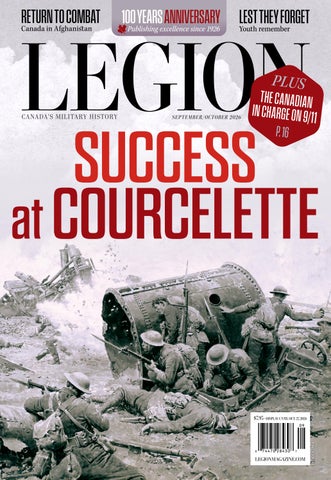
RETURN TO COMBAT Canada in Afghanistan
100 YEARS ANNIVERSARY LEST THEY FORGET Publishing excellence since 1926
Youth remember
PLUS THE CANADIAN IN CHARGE ON 9/ 11 P. 16
SEPTEMBE R /OCTOBER 2026 SEPTEMBE R /OCTOBER 2026
LEGIONMAGAZINE.COM
CoverNS_SO 2026.indd 1
PM40063864
$7.95 >DISPLAY UNTIL OCT. 27, 2026
R09389
SUCCESS at COURCELETTE
2026-07-23 11:05 AM
Advertisement
Honouring the Legion’s Centenary Arbor Memorial is proud to be a Legion Partner. Thank you for 100 years of service, remembrance, and support for veterans and their families.
Arbor Memorial Inc.
Arbor-JA2026.indd 1
CLIENT:
Arbor Memorial
BLEED:
0.125”
DOCKET:
D031062
TYPE SAFETY:
0.5”
2026-07-22 3:49 PM
CONTENTS Artists John Burrows and William Clegg depict the Jones Falls locks of the Rideau Canal sometime in the mid-19th century. John Burrows and William Clegg/ LAC/No. 1990-496-20
46
RIDEAU REDUX The Rideau Canal was initially built as a defence against American invasion, a recurring theme in Canadian history By Don Gillmor
FEATURES
28 NO MERCY
Cover story The Canadian Corps engaged in its second major action at the bloody Battle of Flers-Courcelette By Mark Zuehlke
34 TORCHBEARER
Belgian Walter Cami continues to keep the faith with those Canadians who died in the world wars By Kallan Lyons
40 ON THE BRINK
How a Canadian helped end the Suez Crisis By Alex Bowers
60 “GIVE THEM SHIT”
Sergeant Clarence Kenneth Crockett leads a section of The Calgary Highlanders across Belgium’s Albert Canal in a small but critical moment of the Scheldt Campaign By David J. Bercuson
64 REFLECTIONS ON REMEMBRANCE
Winners of the 2026 Legion National Youth Remembrance Contests By Michela Rosano
70 RETURN TO COMBAT
Canada and Operation Apollo, the early days of the war in Afghanistan By Richard Foot
54 RUNNING THE GAUNTLET ON THE COVER A painting by Fortunino Matania depicts the Canadian capture of the Sugar Refinery during the September 1916 Battle of Flers-Courcelette.
The Canadian Corps gets into action in late 1941 By John Boileau
Fortunino Matania/ CWM/19870268-001
SEPTEMBER / OCTOBER 2026
Pg01-02_Contents.indd 1
1
2026-07-23 11:07 AM
CONTENTS
26 BEHIND THE LINES
96 MILITARY HEALTH MATTERS Under pressure By Alex Bowers
THE FRONT
12THEN & NOW
Images from Canada’s past and present
16THE BRIEFING
A Q&A with retired lieutenant-general Eric Findley By Alex Bowers
18ON THIS DATE
Milestone events from September/October
20 THE VISUAL
100 THE HISTORIAN
The end of NATO? By J.L. Granatstein
102 ON WATCH
Gunboat optics By Serge Durflinger
DEPARTMENTS
5EDITORIAL
2HEROES 2 & VILLAINS
7CONTRIBUTORS
24 ARTIFACT
9FEEDBACK
The Nurses’ Memorial By Alex Bowers
77IN THE NEWS
26 THE DISPATCH
85 SNAPSHOTS
27 HUMOUR HUNT
104 EXIT STRATEGY
Letters of war
2
Hard lessons By Richard Foot
Open-source intel
Richard Turner and Max von Gallwitz By Mark Zuehlke
102
98 OBSERVATION POST
The lighter side of service
$134,789 in Legion donations
By Chris Chuckry
SEPTEMBER / OCTOBER 2026
Pg01-02_Contents.indd 2
2026-07-23 2:57 PM
Advertisement
LEGION 100 WIN BIG GIVEAWAY
THREE WAYS LEGION MEMBERS CAN QUALIFY TO WIN A FORD F-150 STX!
Renew Your Membership for 2026-27
Shop the Poppy Store
Donate to the Poppy Fund
LEARN MORE Legion.ca/winbig
Branch Branch000 l City City
No purchase necessary, terms and conditions apply.
RCL_253114_Centenary_Full_Page.indd 1
2026-07-24 10:01 AM
Advertisement
BUNDLE AND SAVE Vol. 101, No. 5 | SEPTEMBER / OCTOBER 2026
Board of Directors
BOARD CHAIR Sharon McKeown BOARD VICE-CHAIR Berkley Lawrence BOARD SECRETARY Bill Chafe DIRECTORS Steven Clark, Dermod Coombs, Randy Hayley, Trevor Jenvenne, Bruce Julian, Valerie MacGregor, Jack MacIsaac Legion Magazine is published by Canvet Publications Ltd. GENERAL MANAGER Jason Duprau
REMEMBRANCE TRIO VISIT shop.legionmagazine.com or CALL TOLL-FREE 1-844-602-5737
ADMINISTRATION MANAGER Stephanie Gorin (on leave)
EDITOR Aaron Kylie
SALES/ADMINISTRATIVE ASSISTANT Lisa McCoy
SENIOR EDITOR Michela Rosano
ADMINISTRATIVE ASSISTANTS Chantal Horan Veronika Hughes ADMINISTRATIVE AND EDITORIAL CONTENT CO-ORDINATOR Matthew Ryan
SENIOR STAFF WRITER Richard Foot STAFF WRITER Alex Bowers
ART DIRECTOR, CIRCULATION AND PRODUCTION MANAGER Jennifer McGill SENIOR DESIGNER AND PRODUCTION CO-ORDINATOR Derryn Allebone SENIOR DESIGNER Sophie Jalbert
SENIOR DESIGNER AND MARKETING CO-ORDINATOR Diana Coote WEB DESIGNER AND SOCIAL MEDIA CO-ORDINATOR Ankush Katoch
DESIGNER Serena Masonde
Advertising Sales
NOTICE OF
ANNUAL MEETING
OF THE ROYAL CANADIAN LEGION The Dominion Executive Council of The Royal Canadian Legion hereby gives notice of an Annual General Meeting of the organization which will take place at 9:00 am on Saturday, 28 November 2026 at Legion House, 86 Aird Place, Ottawa, Ontario. Agenda for the meeting: 1. Presentation of the audited financial statements 2. Approval of the auditors for 2026-2027
This meeting is being held to fulfill the requirements of the Canada Not-For-Profit Corporations Act. Members wishing to make comment or raise questions on these two items may do so by written submission to Dominion Command, 86 Aird Place, Ottawa, ON K2L 0A1 to be received no later than October 16, 2026. Documentation pertaining to this annual meeting shall be made available on the Legion website at www.legion.ca at least 21 days prior to the annual meeting or upon written request by a member, enclosing a self-addressed stamped envelope (9” x 12” envelope with $5.00 in postage) received at Dominion Command at least 14 days prior to the annual meeting.
4
CANIK MARKETING SERVICES Nik Reitz advertising@legionmagazine.com Marlene Mignardi marlenemignardi@gmail.com Or call 613-591-0116 for more information Published six times per year, January/February, March/April, May/June, July/August, September/October and November/December. Copyright Canvet Publications Ltd. 2026. ISSN 1209-4331
Subscription Rates
Legion Magazine is $13.11 per year ($26.23 for two years and $39.34 for three years); prices include GST. For addresses in NS, NB, NL, PE a subscription is $14.36 for one year ($28.73 for two years and $43.09 for three years). For addresses in ON a subscription is $14.11 for one year ($28.23 for two years and $42.34 for three years). To purchase a magazine subscription visit www.legionmagazine.com or contact Legion Magazine Subscription Dept., 86 Aird Place, Kanata, ON K2L 0A1 Call 613-591-0116 or toll-free 1-844-602-5737. The single copy price is $7.95 plus applicable taxes, shipping and handling.
Change of Address
Send new address and current address label, or, send new address and old address. Send to: Legion Magazine Subscription Department, 86 Aird Place, Kanata, ON K2L 0A1. Or visit www.legionmagazine.com/change-of-address. Allow eight weeks.
Editorial and Advertising Policy
Opinions expressed are those of the writers. Unless otherwise explicitly stated, articles do not imply endorsement of any product or service. The advertisement of any product or service does not indicate approval by the publisher unless so stated. Reproduction or recreation, in whole or in part, in any form or media, is strictly forbidden and is a violation of copyright. Reprint only with written permission. PUBLICATIONS MAIL AGREEMENT NO. 40063864 Return undeliverable Canadian addresses to Legion Magazine Subscription Department 86 Aird Place, Kanata, ON K2L 0A1 | magazine@legion.ca
U.S. Postmasters’ Information
United States: Legion Magazine, USPS 000-117, ISSN 1209-4331, published six times per year (January/February, March/April, May/June, July/August, September/October, November/December). Published by Canvet Publications, 866 Humboldt Pkwy., Buffalo, NY 14211-1218. Periodicals postage paid at Buffalo, NY. The annual subscription rate is $12.49 Cdn. The single copy price is $7.95 Cdn. plus shipping and handling. Circulation records are maintained at Adrienne and Associates, 866 Humboldt Pkwy., Buffalo, NY 14211-1218. U.S. Postmasters send covers only and address changes to Legion Magazine, PO Box 55, Niagara Falls, NY 14304. Member of Alliance for Audited Media and BPA Worldwide. Printed in Canada.
We acknowledge the financial support of the Government of Canada. Version française disponible. From time to time, we share our direct subscriber list with select, reputable companies whose products or services we believe may interest our subscribers. To opt out of receiving these offers, please send your request, including your full name and address, to magazine@legion. ca. Alternatively, you can write to Legion Magazine, 86 Aird Place, Kanata ON K2L 0A1, call 613-591-0116, or call toll-free 1-844-602-5737. We begin by acknowledging that the land on which we gather is the traditional, unceded territory of the Anishinaabe Algonquin Peoples, who have been guardians of, and in relationship with, these lands since time immemorial. We further acknowledge and recognize that our work reaches across all First Nations territories, Métis Homelands and Inuit Nunangat.
SEPTEMBER / OCTOBER 2026
Pg04_Masthead.indd 4
2026-07-23 11:08 AM
EDITORIAL
SEA CHANGE
It’s
quite the statement. This past July, Canada announced the preferred supplier—Germany’s Thyssenkrupp Marine Systems—for its Canadian Patrol Submarine Project. The initiative is set to deliver up to 12 modern subs by the mid-to-late 2030s at an estimated cost of $100 billion—the largest defence procurement in the country’s history. The move is rife with symbolism and has the potential to chart a new course for Canada’s maligned military. For starters, at a time when the government has pledged to more than double its spending on defence and security— to five per cent of annual gross domestic product by 2035—and in the face of evolving global alliances, the investment itself in new underwater boats is substantial. The country is poised to become the largest operator of the Type 212CD sub. And if it receives all 12 vessels, Canada would currently rank 10th among submarine-operating nations. Defending the world’s largest coastline, the subs also significantly strengthen the Royal Canadian Navy’s abilities, not to mention help reinvigorate the force’s storied history as one of the world’s largest navies (it ended the Second World War smaller only than the fleets of the U.S. and U.K.). And might this renewed strength not help burgeoning recruitment? “Canada’s next submarine fleet will secure our coastlines and waters, and their construction will have enormous, lasting benefits for Canadian industries and workers,” Prime Minister Mark Carney said when making the announcement. “We will build this fleet to build Canada strong.” Ultimately, the new submarines may come to best represent the current evolution of the Canadian Armed Forces. As the first major military purchase under Carney’s leadership, replete with his June 2025 pledge to “rapidly procure new equipment and technology, build our defence industrial capacity, and
meet our NATO defence commitment…” and the infusion of $81.1 billion over five years to rearm the CAF in his government’s first budget, the vessels will be a measuring stick for those promises. Will a contract with Thyssenkrupp for the boats be complete by the end of 2027? Will the first of four subs arrive “ahead of schedule” in 2034? And will the unproven 212CD, none yet completed or used anywhere else in the world, work as designed and without any problems common for first-of-class vessels? The country need look no further than its current Victoria-class submarines for evidence of procurement gone wrong. Purchased used from the U.K. in 1998 for about $750 million and delivered between 2000 and 2004, the four boats have been beset by issues ever since—a fire left one inoperable on the water en route to delivery to Canada and today just one is seaworthy.
The move is rife with symbolism and has the potential to chart a new course for Canada’s maligned military. Stephen Fuhr, secretary of state for defence procurement, dismissed such concerns at the time of the July announcement. “This is an evolution; it’s not completely new,” he said of the new variant of the Type 212 sub built for Germany and Italy between 1998 and 2017. “We are dealing with one of the most skilled builders on the planet.” Should it falter, Canadians are likely to continue to be skeptical of major military purchases. Should it all work out, however, it could represent one of the first big wins of Carney’s aim to rebuild, rearm and reinvest in the CAF.
SEPTEMBER / OCTOBER 2026
Pg5_Editorial.indd 5
5
2026-07-23 11:09 AM
Legion Magazine is now wherever you are!
Advertisement
Introducing our NEW digital subscription—the same inspiring stories, expert insights and stunning visuals you expect, now delivered instantly to your favourite device.
Go digital and enjoy: > Immediate access to each new issue > Full access to our issue archives > Exclusive online features
THER SO MUC E’S H EXPLOR TO WHEN Y E GO DIG OU ITAL
and bonus content > A beautifully optimized reading experience on a phone, tablet or laptop > Take-anywhere convenience without sacrificing quality
CALL US NOW to switch your print subscription to digital! TOLL-FREE 1-844-602-5737
Only
12
49 /year + applicable tax
SUBSCRIBE NOW!
shop.legionmagazine.com/subscribe-to-legion-magazine/
Pg39_LM-digital-FP-JA2026.indd 39
2026-07-24 10:21 AM
CONTRIBUTORS
The CO-ORDINATOR
The FREELANCER
The HISTORIAN
Kallan Lyons is a B.C.based journalist who has written for CBC, Yukon News, Canadian Geographic and Legion Magazine. She is the proud granddaughter of three Second World War veterans.
As a professor of history and director of the Centre for Military and Strategic Studies at the University of Calgary, David Bercuson is a respected historian and author. He was appointed to the Order of Canada in 2003.
The AUTHOR
Legion Magazine’s editorial content coordinator Matthew Ryan adeptly handles the Snapshots department, along with writing assignments. With a passion for medieval history, he looks to bring that same enthusiasm to the world of Canadian military history.
Based in Toronto, Don Gillmor is an awardwinning Canadian novelist, journalist and former columnist for Legion Magazine. His most recent book, Cherry Beach, was published in April. Advertisement
SEPTEMBER / OCTOBER 2026
Pg07_Contributors.indd 7
7
2026-07-23 11:09 AM
Advertisement
SISIP-SO2026.indd 1
2026-07-22 3:54 PM
FEEDBACK
Readers’ forum
WE BLUSH
POLISH POSITION
The July/August issue of Legion Magazine included a great article by Edward Poznanski (“The Secret Mission Airmen”) that remembers the Canadian airmen who flew missions to Poland to supply the Polish Home Army. The story underlines the long and connected history of Canadian and Polish men and women fighting for common causes. Hundreds of Polish soldiers fought with the British de Watteville Regiment in the War of 1812. During WW I, some 22,000 Polish men trained in Niagaraon-the-Lake, Ont., then served beside Canadians in the trenches
overseas. In the Second World War, there was another Polish army training camp in Owen Sound, Ont., and again, men schooled here fought on the Western Front. This history may be even more important today given the current geopolitical environment. On a personal note, I’m proud too, that my Polish father served in WW II, as did my father-in-law Frank Curran and his brother Don for Canada. A long and fine tradition. Stan Skrzeszewski London, Ont.
I wanted to send a quick note about the July/August issue of Legion Magazine. It’s genuinely excellent. The articles are clear, engaging and thoughtfully chosen. The balance of history, personal stories and photography is spot on. The issue feels strong, steady and meaningful. Please pass along my appreciation to your whole team. Terri Mason Maple Creek, Sask. Legion Magazine is fantastic and I look forward to receiving every new issue. Great work! William Mulder Nijmegen, Netherlands As a recent new member of the Legion, I’m absolutely impressed with the stories presented in Legion Magazine and will be sure to continue my membership. Barry Heath Saskatoon
Advertisement
SEPTEMBER / OCTOBER 2026
Pg09-11 Feedback.indd 9
9
2026-07-23 8:52 AM
Advertisement
Only in the Shop
NEW!
HAWKS CIRCLING
Following the news these days and reading items such as “Joint ventures” (On Watch, July/August), one must consider that we, as a civilization, are on the brink of annihilation. All it would take is one careless move to light the match. Remember that WW I was started by a gunshot. Melvin Goddard Belnheim, Ont.
NOBODY’S HERO
Two-Toned Toques Soft and warm, these two-toned, double-layered Mad in Canaeda knit toques with a faux-leather maple leaf tag are a Canadian classic. The brim can be worn folded up or down—choose your own style. No matter how you wear it, this toque is sure to keep you cozy when the weather turns cold. Designed in-house. Shop exclusive
Only
*+ tax and shipping
2599* each
SHOP NOW at shop.legionmagazine.com or CALL TOLL-FREE 1-844-602-5737
I’ve been a subscriber for many years and enjoyed the magazine’s great articles. However, I was very unhappy and dismayed by the cartoon (Exit Strategy) in the July/August edition. The depiction of Prime Minister Mark Carney channelling General Brock was really awful. The thought of that pair in the same breath is, to say the least, disturbing. Gary Scarbeau Lindsay, Ont.
Advertisement
Only in the Shop
Coast to Coast Candles Made in Canada Stack-packs of nine tealight candles sourced, made and poured in Canada. Each pack contains three different scents so you can set the scene for any mood.
Only
1399* each
Owl Get Right To It Pocket Pal Weekly Planner Get right to it with this handy pocket-sized planner. Perfect for jotting down plans and ideas, birthdays and special events, this planner includes a convenient pen along with a week-in-view calendar and other helpful guides to keep you sorted and on track.
Only
1599* each
*+ tax and shipping
Visit the Shop for so much more!
10
SHOP NOW at shop.legionmagazine.com or CALL TOLL-FREE 1-844-602-5737
SEPTEMBER / OCTOBER 2026
Pg09-11 Feedback.indd 10
2026-07-23 8:52 AM
ROLLING ON
What a story! (“The wavemaker,” May/June) And what a terrific, wellplaced monument to commemorate not only Fern Blodgett Sunde’s service during the war, but also remind us that our greatest strength can be our imagination. Jeffrey Street Ottawa
CORRECTION In “B.C./Yukon, N.S. and Alberta dominate Dominion darts” (July/August), the date the Men of Vision Branch in Cochrane, Alta., was established was incorrect. It actually received its charter in 1926. In “Altar of remembrance” (July/August), a caption incorrectly identified the designer of the Canadian National Vimy Memorial. Legion Magazine regrets these errors.
Submissions for this department can be sent to magazine@legion.ca. They should be constructive and of general interest. They may be edited for brevity and clarity. The views expressed are those of the correspondents and publication of them does not necessarily constitute an endorsement by Legion Magazine.
Advertisement
Medipac Early Bird Travel Insurance Enrol early and save more! Only available until August 31
NOT FORGOTTEN
I just wanted to say I think the treatment of Japanese-Canadians during the Second World War (“The forgotten exiles,” May/June) was despicable. I’m so sorry this happened to them. Janet Gibson Collingwood, Ont.
HIGH-RANKING PRAISE
As a 101-year-old naval veteran, I was delighted to read J.L. Granatstein’s Historian column (“Step it up”) in the March/ April issue in support of the government’s proposed massive defence spending plans. After decades of minimal military monetary support, cabinet at last has decided that a courageous, well-defended increase—albeit spread over many years, a point not well explained yet—is easier to sell to a still reluctant taxpaying public. The three services themselves must assuredly move quickly, accept what’s available, make prompt decisions and press to rapidly complete contracts. Retired naval reserve commander Fraser M. McKee Mississauga, Ont.
1-800-MEDIPAC 1-800-633-4722 • www.medipac.com Underwritten by Old Republic Insurance Company of Canada
2026MS Medipac ad Legion island 4.275x7.375.indd 1
2026-03-11 1:46:31 PM
SEPTEMBER / OCTOBER 2026
Pg09-11 Feedback.indd 11
11
2026-07-23 8:52 AM
THEN & NOW
12
SEPTEMBER / OCTOBER 2026
Pg12-15_Then_Now.indd 12
Then
Air Mobility Command
2026-07-23 11:11 AM
WARBIRDS READY ← At the outbreak of the Second World War, Allied officials recognized the strategic importance of the airport in Gander, Nfld., as the most easterly land-based airport in North America, and the need to protect it from enemy forces. Canadian, American and British troops, along with 1,500 Newfoundland civilians, served at the airport, pictured here in 1944, for the duration of the war.
SEPTEMBER / OCTOBER 2026
Pg12-15_Then_Now.indd 13
13
2026-07-23 11:11 AM
THEN & NOW
Now
COME FROM AWAY ← Following the deadly terrorist attacks 25 years ago on Sept. 11, 2001, 38 civilian aircraft in U.S. airspace were diverted to the Gander International Airport as part of the Canadian Armed Forces’ Operation Yellow Ribbon. More than 6,500 stranded passengers and crew, equivalent to more than half of the town’s population, were warmly welcomed by the community and affectionately called “come from aways.”
14
SEPTEMBER / OCTOBER 2026
Pg12-15_Then_Now.indd 14
Gander Historical Society
2026-07-23 11:11 AM
SEPTEMBER / OCTOBER 2026
Pg12-15_Then_Now.indd 15
15
2026-07-23 11:11 AM
THE BRIEFING
The Legion Magazine Q&A
RETIRED LIEUTENANT-GENERAL ERIC FINDLEY By Alex Bowers Eric Findley during his tenure as deputy commander of Norad.
“I
have to admit,” said retired Canadian lieutenantgeneral Eric (Rick) Findley, a former director of operations at the North American Aerospace Defense Command, “that when I first got to Norad, it was relatively quiet. 9/11 changed everything.” A major-general in September 2001, the helicopter pilot-turned-overseer of continental air defence found himself at the centre of a terrorist attack that claimed 2,977 lives. Discourse surrounding 9/11 is replete with distinctly Canadian stories within the country’s confines—of Halifax runways and Gander, N.L., hospitality when U.S. commercial aircraft passengers were grounded north of the border. Here, however, the Canadian at the helm of Norad that day explains his role. On the prelude to the 9/11 attacks It was an interesting time because we were into a global strategic exercise that was
16
SEPTEMBER / OCTOBER 2026
Pg16-17_The Briefing.indd 16
usually held in November. The other interesting aspect was Russia indicating that they were going to fly some provocative routes with their bombers. We started an operation called Northern Denial, which was basically just demonstrating that we had the capability of responding to that. By the evening of Sept. 10, I was on shift with all the Norad battle staff in Cheyenne Mountain, Colo., because we were running both the exercise and the operation overnight. Nearly 12 hours later, someone said, “Hey, there’s a possible hijacking taking place.” On Norad’s initial response There hadn’t really been a significant hijacking in Canada or the U.S. since the early 1970s, though there were procedures in place. The idea was to ask Ottawa or Washington whether we could assist, which essentially meant using an unarmed fighter jet to shadow the hijacked aircraft. We were in that process when we saw the first aircraft crash into the World Trade Center. We would soon realize that we didn’t have good situational awareness, as I had asked if that had been the hijacked aircraft, and the initial answer was no; that was apparently just a commuter plane that had gone
off course. I was thinking, it’s a beautiful sunny day—pretty hard for a pilot not to be able to steer around the building. It didn’t make any sense. As we were asking all these questions, the phone rang. I looked down to pick it up, and when I looked up again, I saw bits and pieces coming off the other tower. That said to me that there was some kind of coordinated activity unfolding. “Boss,” somebody close by said, “you had your head down. That was another aircraft.” We went to battle stations, and Otis Air National Guard Base [in Cape Cod, Mass.] launched two F-15s. But at the beginning, we were just trying to understand what was taking place, because there really wasn’t a lot of information. On the unfolding challenges There’s no question that if there’s an attack on North America coming from military aircraft from another country, it’s within Norad’s purview to take counter-air measures. I could even, at that moment in time, in a situation that was extremely urgent, decide to shoot it down. But by virtue of the aircraft originating inside of North America, we didn’t have that luxury. It’s always deemed to be a friendly aircraft if it’s taken off inside the U.S. or Canada. That had changed the way we were looking at things.
Courtesy of Norad
2026-07-23 11:24 AM
READ MORE LEGION MAGAZINE Q&A INTERVIEWS IN ALEX BOWERS’ WEEKLY THE BRIEFING BLOG AT LEGIONMAGAZINE.COM/BRIEFING
As the morning progressed, we decided to put more air patrols out. We started emergency security control of air traffic at the same time the U.S. Federal Aviation Administration was grounding aircraft. At that moment, probably about 3,300 commercial planes were in the air in the northeastern U.S. alone. What do you do? The only reason we would ever get involved would be to shadow an aircraft, but in this case, we were forced to consider whether we would have to shoot an aircraft down.
"At the beginning, we were just trying to understand what was taking place, because there really wasn’t a lot of information." showcased what initiative and discipline are all about. People told me later that I was standing, and that it had a calming influence while answering questions. The only reason I was standing was because my butt was sore from sitting there for 10 hours, but I’m glad it had a calming effect. For me, seeing the towers collapse was the hardest thing to watch. But then, to drive home that evening,
On reconciling emotion with discipline You have to suppress the emotion. You can see or feel the tension within the staff, but I had an amazing group of people who really
listening on the radio to how it had affected the psyche and resolve of Americans was also quite impactful. I got home and had neighbours coming over to thank me for what I did for a living. I said, “I’m a Canadian,” and they said, “It doesn’t matter. Thank you.” I’ll always remember that. Read the full version of this abridged interview at LegionMagazine.com.
Advertisement WINNER
Improve Your Sleep. Elevate Your Life.
Supreme Adjustable Base
BEST SLEEP STORE
THE MOST AWARDED ADJUSTABLE BASES & LIFT CHAIRS IN CANADA
Texas Recliner Lift Chair
HELPING CANADIANS IMPROVE THEIR SLEEP FOR MORE THAN 40 YEARS Partner Benefits
CONTACT US
Find relief from 1-800-455-6421
WWW.ULTRAMATIC.CA
Sciatica & Arthritis
SCAN FOR COUPON
Sleep Apnea Discomfort Acid Reflux & GERD
Swelling & Hypertension
Chronic Pain from Injury
SEPTEMBER / OCTOBER 2026
Pg16-17_The Briefing.indd 17
17
2026-07-23 11:24 AM
ON THIS DATE
Milestone events from September/October 2-3 September 1918 1st and 4th Canadian divisions lead the assault on the Drocourt-Quéant Line at the end of the Second Battle of Arras, taking the territory west of Canal du Nord.
15-16 September 1993 Four soldiers from Princess Patricia’s Canadian Light Infantry are wounded in 15 hours of fierce fighting against Croatian forces in the Battle of Medak Pocket in the Balkans.
September
1 September 1944 Dieppe, France, is liberated by Canadian troops.
3 September 2006 Cpl. Sean Teal, wounded and under heavy Taliban fire in Pashmul, Afghanistan, moves away from cover to call for aid. He returns twice to help and evacuate wounded comrades. He is awarded the Star of Military Valour. 5 September 1697 In what historian Peter C. Newman called “the greatest Arctic sea battle in North American history,” the British surender York Factory to the French in the Battle of Hudson Bay.
9
September 1864 The Charlottetown Conference ends with the British North American colonies of Nova Scotia, New Brunswick, Prince Edward Island and the Province of Canada agreeing in principle to a proposed union. 10 September 1939 Pledging support to Britain and France, Canada declares war on Germany.
18
11
September 2001 Terrorists associated with Islamic extremist group al-Qaida hijack commercial airliners, flying two into the World Trade Center in New York, one into the Pentagon and a fourth crashes after its passengers attack the hijackers. The strikes kill 3,000 people and injure thousands more. Canadians open their airports and homes to stranded U.S. travellers (see Then & Now, page 12). 14 September 1884 Some 400 Canadian voyageurs depart Montreal to participate in the Nile Expedition to rescue a British major-general trapped in Khartoum, Sudan.
16 September 1974 The first group of 32 women take the oath to become RCMP officers. 21 September 1981 The United Nations General Assembly establishes the International Day of Peace. September 1916 The Battle of Flers-Courcelette ends with the Canadians capturing and holding the ruined village of Courcelette, France (see “No Mercy,” pg 28).
22 24 September 1950 Canadian military personnel arrive in Tokyo for training in advance of the newly recruited Canadian Army Special Force bound for the Korean War. 25 September 1942 The Royal Canadian Air Force joins the U.S. in an attack on the Japaneseheld Kiska Island in Alaska. September 2021 Canada observes its first National Day for Truth and Reconciliation to honour the lost children and survivors of residential schools, along with their families and communities.
30
SEPTEMBER / OCTOBER 2026
Pg18-19_On This Date.indd 18
2026-07-23 8:55 AM
VISIT LEGIONMAGAZINE.COM FOR MORE ON THIS DATE EVENTS
1
13 October 1812 British Maj.-Gen. Isaac Brock is killed at the Battle of Queenston Heights. October 1944 The Battle of the Scheldt begins; First Canadian Army has a slog to open the port of Antwerp. 2 October 1952 A North Korean shore battery hits HMCS Iroquois, killing three and wounding 10.
15-17
7 October 1918 The Spanish flu claims its first Canadian victim in Montreal. Overall, the pandemic killed approximately 50,000 Canadians and an estimated 20 million to 100 million people worldwide. October 2001 A naval task group becomes Canada’s initial primary contribution to the war on terror. Within days, Canadian warships are en route to the Arabian Sea as part of Operation Apollo (see “Return to combat,” page 70).
8
12 October 1916 The Newfoundland Regiment captures Hilt Trench in less than 30 minutes. Sgt.-Maj. Gardner, Sgt. Peter Samson and L.Cpl. William Bennett are awarded the Distinguished Conduct Medal for their actions.
October
October 1970 The Canadian Army is deployed in Montreal at the height of the October Crisis. Prime Minister Pierre Trudeau invokes the War Measures Act and hundreds of people are arrested and thousands more are searched before the body of Pierre Laporte, Quebec’s labour and immigration minister, is discovered on Oct. 17. 18 October 1929 Women are declared persons under the law, following a long campaign led by Emily Murphy, Nellie McClung, Louise McKinney, Irene Parlby and Henrietta Muir Edwards.
19 October 1914 The First Battle of Ypres begins. It lasts more than a month. 21 October 1944 I Canadian Corps launches an assault across the Savio River to divert German attention from a larger Allied attack near Bologna, Italy. On the night of Oct. 21-22, Private Ernest (Smokey) Smith earns the Victoria Cross by singlehandedly stopping a German counterattack. 23 October 1951 Five Canadian soldiers are killed and 21 wounded attacking Hills 166 and 156 and patrolling the Nabu-ri valley during the Korean War. 24 October 1962 Prime Minister John Diefenbaker reluctantly authorizes the DEFCON 3 alert to Canadian forces in response to the Cuban Missile Crisis.
26 October 1917 Plowing through mud and facing continuous enemy fire, the Canadian offensive is launched at Passchendaele. Nine Canadians earn the Victoria Cross for their actions during the battle. 29 October 1929 On the worst day of the stock market crash, crowds gather at exchanges in Montreal and Toronto. World trade collapses, and the Great Depression follows.
3 October 1914 The first contingent of more than 30,000 soldiers of the Canadian Expeditionary Force sails from Quebec to join war efforts in Europe. William Rider-Rider/DND/LAC; Wikimedia; Michael Foran/Wikimedia; DND/LAC; William James Topley/LAC; Donald I. Grant/ DND/LAC; John Horton/Government of Canada; The Gazette/LAC; DND/LAC; Norman Wilkinson/CWM/Wikimedia SEPTEMBER / OCTOBER 2026
Pg18-19_On This Date.indd 19
19
2026-07-23 8:55 AM
Open-source intel
THE VISUAL
PEACE OUT
P
eace is hard-won, and it doesn’t always stick. A glance at the news gives innumerable examples: Afghanistan has been in a free-fall back to a violent and repressive Taliban regime since 2021; Gaza is near dust again; Haiti’s political situation churns. International conflicts are on the rise. And Canada used to be there to foster peace. During the 1956 Suez Crisis, Canadian Secretary of State Lester B. Pearson helped initiate the world’s first peacekeeping force, and the country had, for years
since, been at the front lines of international peacekeeping. From Congo to Cyprus, Canadian blue berets earned a reputation as adept and diplomatic peacekeepers, with forces peaking in the early 1990s at roughly 3,300 troops deployed around the world. But the cost was high. In the Balkans in 1993, Canadians literally fought Croatian forces for peace. A total of 23 Canadians were killed while deployed there; many others returned scarred by the horrors of seeing a genocide in real time. In Somalia, while many
served with distinction in a desperate situation, violent abuses put Canada’s conduct under a microscope. In Rwanda the following year, Canadian troops again bore witness to genocide, this time the slaughter of 800,000 civilians. In recent years, Canada has been reluctant to participate in peacekeeping. Just 26* Canadians are currently deployed on UN missions, with a few dozen more on NATO-led operations. Here’s a look at the history of Canada’s major peacekeeping missions. —Michela Rosano
PAST AND PRESENT CANADIAN PEACEKEEPING MISSIONS, UN AND OTHER (TOTAL PERSONNEL) CURRENT PERSONNEL
MALI
CROATIA, BOSNIA AND HERZEGOVINA, SERBIA, MONTENEGRO AND MACEDONIA CYPRUS
~40,000
5
25,000+
1
LEBANON AND GOLAN HEIGHTS (ISRAEL-SYRIA)
12,000+
4
SYRIA
12,000+
HAITI
3,250+
CONGO
2,500+
SOMALIA
~1,400
MALI
1,250+
EGYPT AND GAZA STRIP
~1,170
CAMBODIA, LAOS, VIETNAM
1,000+
EAST TIMOR
650
RWANDA
~600
ETHIOPIA AND ERITREA
540+
NORTH MACEDONIA
~200
SUDAN AND SOUTH SUDAN
~60
~3,300 MOST PEACEKEEPING TROOPS CANADA HAS HAD DEPLOYED AT ONE TIME, IN THE EARLY 1990S
12
~40
~125,000 CANADIANS HAVE SERVED IN INTERNATIONAL PEACE OPERATIONS HAITI
9
*UN data as of April 30, 2026
20 SEPTEMBER / OCTOBER 2026
Pg20-21_The Visual.indd 20
2026-07-24 10:01 AM
LEGEND
CROATIA SERBIA
PAST CANADIAN PEACEKEEPING MISSIONS CURRENT CANADIAN PEACEKEEPING MISSIONS
BOSNIA AND HERZEGOVINA MONTENEGRO
NORTH MACEDONIA
130+
LEBANON & GOLAN HEIGHTS
CYPRUS
SYRIA
CANADIANS HAVE DIED IN PEACE OPERATIONS
VIETNAM GAZA STRIP
NUMBER OF CANADIAN PEACEKEEPING DEATHS
LAOS
50+ EGYPT AND GAZA STRIP
EGYPT
28 CYPRUS CAMBODIA
23 CROATIA, BOSNIA AND HERZEGOVINA, SERBIA, MONTENEGRO AND NORTH MACEDONIA
ERITREA
SUDAN 13 SYRIA SOMALIA ETHIOPIA
2 CAMBODIA, LAOS, VIETNAM SOUTH SUDAN 2 CONGO 2 HAITI CONGO 1 RWANDA
RWANDA EAST TIMOR
SEPTEMBER / OCTOBER 2026
Pg20-21_The Visual.indd 21
21
2026-07-24 10:02 AM
HEROES & VILLAINS
Historic encounters
IN THE SOMME, THE CANADIAN CORPS FOUGHT GERMAN ARMY GROUP GALLWITZ
TURNER By Mark Zuehlke
RICHARD TURNER
T “Hold back the enemy!” —Richard Turner
he hurriedly pulled together continuation of the Canadian Corps’ offensive at Courcelette by Major-General Richard Turner’s 2nd Division in the late afternoon of Sept. 15, 1916, yielded one of the few decisive Allied victories of the entire Somme Campaign. Turner sent his first-wave troops through the depleted 3rd Division and into the village’s ruins in a full-out charge. It was a bold, even reckless, attack. The officers leading it had been given just five hours to prepare before crossing the start line at 6 p.m. Despite heavy casualties, the division took the village, dealing the Germans a decisive defeat.
For Turner, 2nd Division’s exploits at Courcelette helped restore a reputation muddied by a shaky performance at St. Eloi. For Turner, the division’s exploits helped restore a reputation muddied by his shaky performance during the 1916 Battle of St. Eloi Craters—the only battle the Canadian Corps lost during the war. Born in Quebec City on July 25, 1871, Turner joined the Canadian militia when he was 21. Three years later, he attained a captain’s rank and was
22 SEPTEMBER / OCTOBER 2026
Pg22-23_H&V.indd 22
then promoted to major in 1900. That same year, Turner accepted a demotion to lieutenant in order to join the Royal Canadian Dragoons—part of a Canadian volunteer force being sent to South Africa to fight the Boers. The Dragoons came under command of Brigadier-General Edwin Alderson. At Leliefontein on Nov. 7, 1900, Turner was part of a rearguard covering a British column’s retreat. When the rearguard was ambushed by roughly 200 mounted Boers, Turner saved two 12-pound field guns from capture. Shot in the left arm and neck, he ordered a small group of Dragoons to dismount and hold the Boers until the guns could be moved. “Hold back the enemy!” Turner had cried. His gallantry, along with two others, was recognized with a Victoria Cross. Although Turner served under Alderson in South Africa, the British general had tried to sack the Canadian commander for his failure at St. Eloi. Despite Turner’s better performance at Courcelette, on June 23, 1917, he was transferred from divisional command to oversee Canadian troops held in reserve in England. While the new duty brought him a promotion to lieutenant-general, the same day Arthur Currie attained the rank, command of the Canadian Corps went to the latter. Turner’s job became largely administrative and, although technically senior to Currie, he was never considered for corps command.
Sharif Tarabay; Wikimedia
2026-07-23 11:29 AM
GALLWITZ MAX VON GALLWITZ
At
Courcelette, MajorGeneral Richard Turner’s 2nd Division defeated the German 45th Reserve Division, one of many divisions comprising a formation created on July 19, 1916, named after its commander. Before taking command of Army Group Gallwitz, General Max von Gallwitz had established a reputation for competency while serving on virtually every German front. At the war’s outset, Gallwitz commanded the Guard Reserve Corps during the siege of Namur on the Western Front. Thereafter, his corps moved to the Eastern Front, joining 8th Army in driving the Russians out of East Prussia in September 1914. The Germans inflicted more than 125,000 casualties for estimated losses of about 15,000. Having played a pivotal role in this stunning victory, Gallwitz was promoted to command Army Group Gallwitz in February 1915. In July, the general led his army to victory in the battle that took Warsaw on Aug. 5. For his role there, Gallwitz was awarded the much-coveted Pour le Mérite (known as the Blue Max) on July 24, 1915, and on Sept. 28 added the Oak Leaves to the decoration. He then assumed command of 11th Army, leading its invasion of Serbia on Oct. 7— crossing the Danube east of Belgrade. Driving the Serbs back to Salonika (now Thessaloniki), Gallwitz was preparing to complete their destruction when he was summoned to deal with a crisis on the Western Front. Taking
command of Meuse Group West on March 29, 1916, he joined the bloody fighting against the French at Verdun. In July, however, a new crisis sent Gallwitz to the Somme to help stem the British offensive. No sooner did he arrive to lead Second Army than his role was expanded with the creation of a new Army Group Gallwitz, bringing First and Second armies under his command. Responsible for defending the entire Somme, Gallwitz again proved his abilities by limiting the Allied advance to roughly eight kilometres while inflicting horrendous casualties. During the fighting, Gallwitz was much impressed by the courage of the Allied troops. But he disdained their generals.
“Nowhere else have I seen such brave lions being led by such lambs.” —Max von Gallwitz
In July, a new crisis sent Gallwitz to the Somme to help stem the British offensive. “Nowhere else have I seen such brave lions being led by such lambs,” he wrote. From the Somme, Gallwitz raced back to Verdun to command Fifth Army with orders to once again rescue the situation there. Then in 1918, another new Army Group Gallwitz faced the recently arrived American Expeditionary Force until war’s end.
SEPTEMBER / OCTOBER 2026
Pg22-23_H&V.indd 23
23
2026-07-24 10:03 AM
ARTIFACT
Honouring a military treasure
THE NURSES’ MEMORIAL By Alex Bowers
T
he crowd of 800 nursing sisters from across the country stood in silence in the Hall of Honour of Parliament Hill’s Centre Block on Aug. 24, 1926, as a marble memorial was revealed. Speaking at the panel’s unveiling was Margaret MacDonald, matronin-chief during the Great War and the first woman in the British Empire to attain the rank of major. That day was one of commemoration—honouring the 2,845 nurses of the Canadian Army Medical Corps, some 60 of whom had died in that conflict. The roughly five-by-three-metre sculpture—the funds for which had been raised over five years by the caregivers themselves to the tune of $32,000—originated from a single six-tonne piece of Carrara marble. Sculptor George William Hill had sourced the material himself. The result recognized not only those who had served in the war, but spanned the entirety of Canadian nursing history, beginning in 17thcentury New France. On the right side, relying on colonial iconography with racist connotations, Hill depicted a nun caring for an Indigenous baby as a Haudenosaunee warrior watches on. On the left, meanwhile, two nurses tending to a wounded soldier represent sacrifice on the Western Front and beyond. Bridging the eras is a female manifestation of humanity, her arms outstretched as she clasps a caduceus, the traditional emblem of medicine. Looming behind is a male embodiment of history, a personification that clings to the Book of Records from 1639 to 1918.
JANUARY / FEBRUARY / OCTOBER2026 2026 24 SEPTEMBER
Pg24_Artifact.indd 24
The memorial recognized not only those who had served in the Great War but spanned the entirety of Canadian nursing history. “The War Memorial,” wrote feminist historian Kathryn McPherson, “reveals the contradictions faced by a female-dominated occupation trying to locate itself within a patriarchal health care system and body politic.” Despite its complexities, the tribute continues to commemorate, in its own way, Canada’s Great War nurses a century later.
Margaret MacDonald (above), matron-inchief during the Great War, spoke at the 1926 unveiling of the Nurses’ Memorial (top), honouring the 2,845 nurses of the Canadian Army Medical Corps.
Canadian Nurses Association/LAC/e003525007; House of Commons (AI enhanced)
2026-07-23 11:32 AM
Advertisement
CanopyGrowth-SO26.indd 1
2026-07-22 4:02 PM
Letters of war
THE DISPATCH
Oct.3rd.41 My Two Sweethearts; The streets are very narrow and I might mention, hard on the feet. We found that out with full pack on the night we came in. I heard Moaning Minnie [German rocket] for the first time the night before last but it was in the distance and we did not get the alarm. I hear there was only one raider and when they spotted him he didn’t wait for tea. I also watched our planes as they fly so high you seldom see them up there but can follow them by the trail of mist they cause in the high altitude with the heat from their motors, or the exhaust or some such. Also saw a captured German plane being used in a field scheme. It was marked so that none of our boys would start pumping lead at it. This letter may sound as goofy as a nightmare Hon. but lets put it all down to first impressions and call it a mess. Good night my Sweets and happy dreams Until we meet again All my love xo Daddy xo
An excerpt from a letter Corporal Robert J. Duncan (left, centre) sent home to his wife and daughter in Calgary during his training in Aldershot, England. He served with Canadian postal units during the war, first in Britain, then France and Belgium, before returning to Britain as the war started to wind down.
26 SEPTEMBER / OCTOBER 2026
Pg26_The dispatch.indd 26
DND/PL-15558; The Canadian Letters & Images Project/canadianletters.ca (2)
2026-07-23 12:24 PM
HUMOUR HUNT
The lighter side of service
THE LIGHTER SIDE OF SERVICE
W
hile serving on HMCS Regina in preparation for deployment to the Persian Gulf in 2003, the frigate’s executive officer (XO) was a francophone with a very strong accent. As XO, he made situation report announcements on the ship’s PA during exercises. The ship’s waste management room, where plastic
was melted down into large pucks, paper was shredded and other garbage was processed or kept until it could be landed, was commonly referred to as “garbage stores.” During one exercise, the XO confidently announced that the fire in “cabbage stores” was 50 per cent contained. Given the
smell that garbage stores often emitted on hot days in the Persian Gulf, we collectively decided that the XO’s name was a suitable substitute and it stuck not only for the rest of the deployment, but for a couple of years afterward. —Rob (Otis) Bates, retired chief petty officer 2nd class, Medicine Hat, Alta.
HA!
WINGING IT A young pilot officer went in to report to his commanding officer after returning from a raid. “Were you nervous during the attack?” the CO asked. “Who, me?” asked the pilot. “I was cool as a cucumber all the time.” “Swell,” said the CO, “I thought you might have been a bit nervous when you radioed in that 27,000 enemy bombers were coming in at eight feet.”
Bing (Bing!) Coughlin, The Legionary magazine, September 1946 HAVE A FUNNY ANECDOTE FROM CANADA’S MILITARY CULTURE? SEND IT TO MAGAZINE@LEGION.CA
SEPTEMBER / OCTOBER 2026
Pg27_Humour Hunt.indd 27
27
2026-07-23 9:06 AM
FIRST WORLD WAR
NO MERCY
F The Canadian Corps engaged in its second major action at the bloody Battle of Flers-Courcelette By Mark Zuehlke
Following their defeat at St. Eloi Craters and the seesaw battle of Mount Sorrel, many Canadian soldiers readying to go over the top on Sept. 15, 1916, in the attack on Courcelette, anticipated serving the Germans a drubbing. “The time is now very close and I feel we are going to get a little of our own back,” wrote Major Agar Adamson of Princess Patricia’s Canadian Light Infantry.
That such optimism prevailed stood starkly at odds with the battleground reality in which the Canadian Corps was now situated. By the time the Canadians arrived in northern France’s Somme River valley in late August, the British Expeditionary Force (BEF) had been engaged in a campaign of slaughter that started on July 1. In that single day, the British suffered 57,470 casualties, including roughly
28 SEPTEMBER / OCTOBER 2026
Pg28-33_Courcelette.indd 28
2026-07-24 10:03 AM
A painting by Fortunino Matania depicts the Canadian capture of the Sugar Refinery during the September 1916 Battle of Flers-Courcelette.
20,000 killed. This was the bloodiest day in Britain’s long military history. Also counted in the BEF losses that day were those of the Newfoundland Regiment at BeaumontHamel. In about 30 minutes, 324 Newfoundlanders were killed and 386 wounded; just 68 men remained for rollcall. After that, the Somme turned into a grinding attritional campaign that, by late August, had claimed nearly 200,000
Fortunino Matania/CWM/19870268-001
Pg28-33_Courcelette.indd 29
British, more than 70,000 French and an estimated 200,000 German casualties. No great geographical objectives led to the Allies’ Somme Campaign. It was instead meant to relieve pressure on the French army, which was teetering on the edge of defeat southeast at Verdun. The July fighting achieved this purpose—the Germans mostly abandoned their Verdun offensive. This freed the French and
Germans alike to send troops to the Somme. The French Tenth Army extended the Allied front dramatically to the British right while the Germans added their Sixth Army to their heavily fortified front lines. Hereafter, the Allied purpose in the Somme was to break the stalemate on the Western Front by piercing the German defensive lines to unleash a British cavalry-led breakout that would wreak havoc in the enemy rear.
SEPTEMBER / OCTOBER 2026
29
2026-07-23 9:07 AM
An aerial photograph of the Courcelette battlefield on Sept. 15, 1916.
“Not a tree, but occasionally the stump of one to accentuate the bareness, and at night when it is lit up by the flames and the flashes of guns, it leaves the impression of a very modern hell.”
The Canadians were to play an important role in this second major Somme offensive— the first since the July 1 debacle. Two British armies massed along a 16-kilometre front for the Sept. 15 Flers-Courcelette operation. The Canadians were serving as part of General Hubert Gough’s recently constituted Reserve Army on the left of Fourth Army. Marching to the front, the Canadians passed through a hellish landscape. “What villages there were are as flat as ploughed fields, and most certainly the country is one of desolation,” wrote Lieutenant Allan B. Morkill. “Not a tree, but occasionally the stump of one to accentuate the bareness, and at night when it is lit up by the flames and the flashes of guns, it leaves the impression of a very modern hell.”
30 SEPTEMBER / OCTOBER 2026
Pg28-33_Courcelette.indd 30
Added to the horror was the common sight of blackened flesh and broken bones scattered seemingly everywhere. Many Canadians passed “Dead Man’s Trench,” so named because it was clogged with the rotting bodies of Germans killed by an artillery barrage during a relief. The gruesome results were so awful no volunteers could be found to clean it up. In popular culture, BEF Field Marshal Douglas Haig has come to symbolize the class-based disregard Britain’s generals had for the lives of those they commanded. Yet, their preparations for this second Somme offensive demonstrated a desperate desire to develop and utilize new tactics and weapons that could not only carry the day, but reduce casualties.
On the tactical side, the creeping barrage provided a curtain of artillery fire ahead of the advancing infantry that moved in timed lifts aimed to match their pace. The biggest fear with this approach was that the artillery’s accuracy was much compromised by gun barrels badly worn through months of firing. Rounds falling short and killing their own led gunnery officers to recommend the infantry keep a distance back that threatened to undo the barrage’s advantage. By this point, Canadian Corps commander LieutenantGeneral Julian Byng considered 1st Division’s Major-General Arthur Currie his likely successor. When Currie studied the creeping barrage timetable and the proposed safe distances for following it, he disagreed with the gunnery officers’ conclusions and recommended instead that the “infantry should be taught to follow the artillery barrage as closely as a horse will follow a nosebag filled with corn.” Currie recognized that friendly fire casualties were probable, but countered,
LAC/C-43987; DND/LAC/3395787
2026-07-23 9:08 AM
“in the harsh world of the Western Front…it is far better to lose a few of our men from our own artillery fire than to sacrifice hundreds by hostile machine gun fire.” On the new weapons side, Haig decided to unleash a recently invented bulletproof machine that could overrun enemy defences by crushing barbed wire obstacles, then grinding over machine guns or destroying their crews with fire from built-in guns. Described as land cruisers, and forever after code-named tanks, the British had two Mark I variants. Both were roughly four metres wide, two metres tall, and eight metres long with a two-metre-long metal tail for stabilization and steering. The “male” version came with two 6-pounder guns and four Hotchkiss machine guns, while the “female” mounted five Vickers machine guns and one Hotchkiss machine gun. Each could spew 1,000 bullets a minute, but they were unwieldy, mechanically unreliable and had a top
speed slower than a person walking. Forty-nine tanks were available, with seven going to the Canadians, one of which was held in reserve. The Canadians would attack on a two-division front of about 2,000 metres with 3rd Division to the left and 2nd Division on the right. In support was the greatest artillery concentration for a Canadian battle to this point—234 field pieces and 64 heavy guns, many provided by the British. On the night of Sept. 14, the first waves of troops moved into trenches and awaited the 6:20 a.m. attack signal. Behind them, the guns stood wheel to wheel. At 6:20 precisely, the guns erupted with a fire timed to catch the Germans gathering for breakfast. “Terrific bombardment,” Sergeant John Davis wrote in his diary. “One continuous stream and din could be felt.” The infantry moved into no man’s land behind the barrage that rolled ahead
of them by 90 metres every three minutes, with the heavier guns slamming in shells 300 to 500 metres beyond. The 3rd Division’s 1st and 5th Canadian Mounted Rifles (CMR) suffered heavy casualties, more from friendly fire than anticipated but also by German fire from trenches on their northern flank. Orderly lines dissolved. Men moved in clusters by leaps and bounds from one shell crater or ground depression to another. They quickly crashed into the German line and set about bayoneting the enemy. “Fritz is fairly cowed by the bayonet. He simply can’t face it,” wrote 5th CMR’s Sergeant Norman Lowther. The 3rd Division’s attack had been intended to secure the left flank for 2nd Division, with its assigned objectives of secondary importance. But they won both Mouquet Farm and Fabeck Graben trench at a heavy cost— 1st CMR having 70 killed, 179 wounded and 11 missing, while 5th CMR counted 55 dead, 150 wounded and 20 missing.
First aid is administered to wounded troops during the battle.
SEPTEMBER / OCTOBER 2026
Pg28-33_Courcelette.indd 31
31
2026-07-23 9:08 AM
“Bayonet fighting is a bitter struggle to the end, with no mercy shown.” On the right, 2nd Division stormed forward with five battalions. The creeping barrage moved through the German front lines when the Canadians were still 100 metres distant. Caught in the open, the Canadians were driven to ground by vicious machinegun fire and forced to crawl forward, often using the bodies of dead comrades for cover. Private C.V. Bryden’s 31st Battalion company was pinned down by an enemy machine-gunner “clipping bullets over our head and we laid there for a little while until I heard a tank approaching from the rear…the tank passed us and he took care of the German machine gunners… Without the tanks, there’s no question [that] we’d have suffered far greater casualties, and the moral effect of the tanks on the German soldiers
32 SEPTEMBER / OCTOBER 2026
Pg28-33_Courcelette.indd 32
at that time undoubtedly lent itself a great deal to the success of the attack.” Lieutenant Maurice Arthur Pope remembered the tanks “were spitting fire. You’d see them flashing and you just wondered what on earth was going over the ground. It was quite a thrilling sight seeing the tanks going in for the first time.” Inside the tank named Maple Leaf was Canadian Private James Fraser of 4th Battalion and a crew of five others: a New Zealander, three English crewmen and an English lieutenant in command. “We went on through to the Sugar Refinery, knocked the wall in at the Sugar Refinery and then we just came around back and started to go up again when we got ours… hit by a nine-two [artillery piece]. They hit the turret.”
Before the morning ended, the six tanks the Canadians had taken into action were out of it—most having bogged down in the mud. Before Fraser’s tank showed up, the 20th and 21st battalions had been stopped cold by the defences at the Sugar Refinery. Maple Leaf appeared, according to one witness, like “a queer monster of iron, which dipped into trenches and crawled crazily up the other side.” The infantry surged through the smoke and dust cloaking the battlefield and carried the strategically vital ruin. By 8 a.m., all positions south of Courcelette were in Canadian hands. The advance then halted as reserve elements came forward to renew the attack. There was no subtlety to the plan. The first-wave troops in 22nd and 25th battalions were to just charge straight into the guts of the village’s ruins. The original plan had been set for the following morning, but clearly the Germans
CWM/19880309-005; LAC/O-828
2026-07-23 9:08 AM
were teetering, and a hard push was ordered for 6 p.m. that evening. General Richard Turner issued his orders to 2nd Division at 1 p.m. and the officers scrambled to organize and brief their troops in time to go forward behind the barrage. That they were ready in time, the late pre-eminent historian Tim Cook wrote, “was a sign of the growing Canadian professionalism.” The attack was to be made in broad daylight from a position with no trenches in which to form up. “We just moved up in front there. The trenches were blown to pieces,” recalled Captain Charles B. Holmes of the 25th, “and [we] just laid out on the ground in different… companies until the zero hour and then we went through.” Fighting inside the wrecked village was fierce. The 22nd Battalion’s LieutenantColonel Thomas Tremblay led from the front and was buried three times by debris kicked up by exploding shells. Dug out each time by his men, Tremblay guided them on through a bloodbath of hand-to-hand fighting. The “bayonet, rifle butts, shovels, feet, teeth all came into play,” wrote Captain Joseph Chabelle of the action. “ Blood spurted out of punctured breasts; brains spilled from skulls shattered by rifle-butts. Bayonet fighting is a bitter struggle to the end, with no mercy shown.”
Maple Leaf appeared, according to one witness, like “a queer monster of iron, which dipped into trenches and crawled crazily up the other side.” After a 10-minute slaughter, the Germans broke and fled Courcelette. With the village in flames around them, black smoke obscuring the ground ahead, the Canadians braced for the inevitable counterattack. The first came soon after and was followed by 16 more during the next week before the Germans accepted the village’s loss. Canada’s capture of Courcelette marked a stunning success for the corps. But there was no breakthrough. Enough German positions still stood by the end of the 15th that a hard fight to hold the ground and achieve gradual expansions was required. As happened so often on the Western Front, the battle soon sputtered to a halt—both sides exhausted and too battered to continue. By Sept. 22, the Canadians were only about
450 metres east of Courcelette holding a continuous front roughly one kilometre long. Courcelette was the first major operation by the Canadian Corps as a whole, and it cost 7,230 casualties. Private Bryden survived, but his 31st Battalion paid a horrible price. “When we went back to the brick field, they even had to put the reinforcements in the battalion before they dared to call the roll,” Bryden reported. “I think there was only 14 men in the company left.” There would be no respite. On Sept. 26, the Canadians would attack again in the Battle of Thiepval Ridge—just a continuation of the Somme offensive. It was an assault that would include a protracted fight for a long and critical trench—code-named Regina—that would be the last major Canadian battle in the Somme in 1916.
A print (opposite top) shows the charge of the 22nd Battalion toward the ruins of Courcelette. Canadians return victorious from the Battle of FlersCourcelette (right).
SEPTEMBER / OCTOBER 2026
Pg28-33_Courcelette.indd 33
33
2026-07-23 9:08 AM
Torchbearer Belgian Walter Cami continues to keep the faith with those Canadians who died in the world wars
34 SEPTEMBER / OCTOBER 2026
Pg34-39_Walter Cami.indd 34
2026-07-23 9:11 AM
By Kallan Lyons
T
wo years before the COVID-19 pandemic, Walter Cami left his home in Eeklo, Belgium, on a special mission. He parked his car at the end of a country road on the edge of town, got out, pulled a small pair of scissors out of his pocket and started snipping. He was so engrossed that he didn’t notice a large shadow towering over him until a deep voice rang out. “You are stealing my mother’s poppies!” a red-faced farmer announced. Cami followed him across the road, where an elderly woman sat behind the large front window of her farmhouse. As soon as Cami
stepped inside, she demanded to know why he had been stealing her precious flowers. Cami calmly asked her if she had always lived on her farm in Eeklo. She said yes. He inquired if she remembered when they were liberated by the Canadians. She responded without missing a beat, “September 15, 1944.” “I am picking poppies to dry them,” Cami explained. “I am sending them to cadets, young girls and boys in Canada, to be given out on Remembrance Day.” The woman paused for a moment before turning to her son. “Show him the field behind the barn,” she barked. “There are hundreds of poppies back there.”
The portraits (left) of Captain Trumbull Warren and Lieutenant Guy Melfort Drummond during their evocation by The Last Post Association at Tyne Cot Cemetery in Belgium. Walter Cami (right) and a bagpiper during a ceremony at the soldiers’ tombstones.
The Last Post Association; Walter Cami
Pg34-39_Walter Cami.indd 35
SEPTEMBER / OCTOBER 2026
35
2026-07-23 9:11 AM
“I will be with you from the first to last minute and my condition is that the only thing I will accept is a cup of coffee.” A 1918 print of Lieutenant-Colonel John McCrae’s “In Flanders’ Fields.”
Eeklo is roughly the halfway point of the Canadian Liberty Route, which traces the path of the Canadian forces during the liberation of France, Belgium and the Netherlands in the final stages of the Second World War. More than 15,000 Canadians from both world wars are commemorated in Belgium, most of whom died while liberating the region of Flanders, including Eeklo, Furnes, De Panne, Nieuwpoort, Ostend, Knokke-Heist, Bruges and the northern suburbs of Antwerp. In spring, you can find the corn poppy, Papaver rhoeas, blooming throughout the area. The flower was famously documented by Lieutenant-Colonel John McCrae who described a sea of crimson covering the graves of soldiers after the Second Battle of Ypres. His poem honoured his friend, 22-year-old Lieutenant Alexis Helmer, whose life was cut short soon after joining the fight. Hundreds of Canadian cadets have donned a delicate poppy hand-picked by Cami, just one of the ways the Belgian has chosen to honour those who paid the ultimate sacrifice for his country’s freedom.
The lifespan of a wild poppy flower is less than a week, but preserved properly, a dried blossom can last a lifetime. My phone rang in the early evening—2 a.m. for Cami (he says he’s a night owl). A soft-spoken man with a Flemish accent, he immediately apologized for his broken English, despite
speaking it perfectly. Cami, 65, has dedicated 40 years to making sure Belgians never forget what the Canadians did for Europe. Cami and I have a mutual friend through my childhood neighbour, Danny McLeod. He was my surrogate grandfather, and a decorated war hero who drove the first tank into Bergen op Zoom, Netherlands, at the end of the Second World War. To this day, some locals in the town north of the Scheldt still refer to him as their liberator. Retired major McLeod was also one of the first Canadian veterans Cami met, and they developed a close friendship over the years. On the phone, Cami told me McLeod was the first recipient of a poppy he picked in a Flanders field. He wrapped it tightly in tissue and sent it by regular post. “I’ll never forget how grateful and joyful he sounded on the phone that day,” said Cami.
Sheila McLeod presents a framed poppy to cadet Second Lieutenant Kyle Alexander Ryan in memory of her late husband, retired major Danny McLeod (above) in 2016.
36 SEPTEMBER / OCTOBER 2026
Pg34-39_Walter Cami.indd 36
2026-07-23 9:11 AM
At McLeod’s burial in 2014, his wife Sheila placed the poppy in a box beside his urn. Cami then had the idea to send flowers to Canadian cadets, so they could have a piece of Flanders, too. For the centenary of the First World War, a group of young cadets proudly wore their bona fide Flanders poppies on Remembrance Day. Since then, Cami has sent hundreds of dried poppies to Canada. In a tale as old as time, Cami knew little about the war other than what he learned in school. His father, head of criminal investigators for the District of Eeklo with the Gendarmerie, Belgium’s former national police force, wore his uniform only on Remembrance Day. In October 1983, when Cami was 23, he and his family were tasked with removing items from the hospital room where Cami senior spent his final days. They came across a condolence card from the Committee of Patriotic Associations, an organization in Eeklo that honours veterans. The association had trouble finding a place to host their meetings, so Cami’s father arranged to have them gather at the Gendarmerie brigade headquarters. Cami started hearing from people who revered his father—many Belgian veterans and former political prisoners, mainly members of the resistance who survived Nazi concentration camps. Cami obsessed over learning as much as he could about the veterans and both world wars. “My father had the greatest respect for those who liberated us,” he said. “In our case, that was the Canadians.” The first remembrance project Cami undertook with a Canadian veteran was to upgrade the Sherman tank monument at the Balgerhoeke Sasbrug memorial honouring 4th Canadian Armoured Division in Eeklo, with the help of McLeod. Next, he worked on upgrading a monument in Eeklo’s Canada Square called “The Soldier and
Enid Scillitoe (below) finally visits the grave of her brother, Sergeant Leslie Herbert Stride (right), lost in 1940.
the Girl,” commemorating the residents who were killed or went missing in the First and Second world wars. Beside the memorial are the names of 30 Canadian soldiers etched onto three marble plaques—men who died of wounds in Eeklo’s military hospital during Operation Switchback in October-November 1944. In 2017, the original mould of the statue was inaugurated at city hall in Medicine Hat, Alta. Both monuments, one on each side of the ocean, represent the everlasting bond between Canada and Belgium. In addition to mending memorials, Cami also organized tours of Belgian battlefields. Most recently, he has become the unofficial ambassador for people searching for their loved ones lost on Belgian soil. He repeats the first and last names of the fallen to me over the phone. “I always like to mention their names so we remember them at that moment,” he said. Cami tells me that several years ago, he was contacted by an Ontario woman who wanted to visit her uncle’s burial site while on a trip to Europe. Cami offered to take her to the battlefield where he was killed and the Belgian cemetery where he’s buried. Private Kenneth Donald Duncanson of The Algonquin Regiment died during the Battle of the Scheldt. His remains were discovered by a metal detectorist in a field near Molentje, Belgium, on Nov. 11, 2014, and he was buried with full military honours in the Adegem Canadian War Cemetery between Bruges and Ghent. Cami got permission for Duncanson’s
CWM/20060073-001; Courtesy Sheila McLeod; benchedathletes.wordpress.com; Courtesy Walter Cami; Courtesy retired air commodore Terry Davies, U.K.
Pg34-39_Walter Cami.indd 37
niece to visit the field where his remains were found, and they held a moment of silence together. “I stay in the shadows, but I will take you to wherever you want to be and whatever you want to see,” he said about helping Canadians find their lost loved ones. “I will be with you from the first to last minute and my condition is that the only thing I will accept is a cup of coffee.” Enid Scillitoe from Gloucester, U.K., last saw her big brother Sergeant Leslie Herbert Stride in the spring of 1940. They were only a year apart in age. Just a few months later, Stride’s Royal Air Force bomber, whose mission was to bomb an oil depot near Ghent, was shot down by the Germans. The plane crash landed in Lovendegem, Belgium—a 15-minute drive from Eeklo. Stride was just a couple of weeks shy of turning 20.
SEPTEMBER / OCTOBER 2026
37
2026-07-23 9:11 AM
The young man was buried in Eeklo’s Communal Cemetery. Nearly 75 years later, in the fall of 2014, 92-year-old Scillitoe travelled from the U.K. to visit her brother’s grave for the first time. Cami, with the help of Eeklo’s mayor at the time, was able to organize an intimate gravesite ceremony for Scillitoe and her British friends. But when she arrived and read the headstone, Scillitoe noticed something. The names listed included her father, mother, sisters and another brother. Hers was missing. A few days after Scillitoe’s departure, Cami asked another friend, Terry Davis, a retired air commodore with the Royal Air Force, if he could lobby to place a new headstone for Stride. “How he managed to do that will always remain a mystery to me, but sometime later Terry got the green light and I organized the ceremony,” said Cami. On a warm afternoon in July 2015, four airplanes flew high above those who gathered to honour and witness the placing of a new headstone for Stride. One aircraft broke away from the rest, soaring straight up into the sky in what’s known as the missing man formation. Scillitoe passed away a few days after receiving the news that her name had been etched onto the headstone where her big brother was laid to rest.
purchasing supplies for his troop when a piece of shrapnel flew through a plate-glass window, piercing him in the lung. The 28-yearold from Toronto died in a friend’s arms. The city erupted into black and yellow smoke every 20 minutes for the rest of the day. Artillery rained down in advance of a diversionary attack that took place two days later, when the Germans introduced a new weapon: chlorine gas. The Second Battle of Ypres began just five months after the first. Wotherspoon’s grandfather was buried in what became Ypres Reservoir Cemetery in Belgium. Wotherspoon and his wife, Kitty, who have travelled to Europe many times, first met Cami in Eeklo in the early 1990s. “For the last 10 years, on the anniversary of [my grandfather’s] death, Walter has driven three hours to the cemetery to put flowers on his grave,” said Wotherspoon. “That man is absolutely incredible—he goes above and beyond.” Wotherspoon’s family story doesn’t end there. Two nights
after Captain Warren’s funeral, his brother-in-law, Guy Drummond, a member of Montreal’s 13th Battalion (Royal Highlanders of Canada), known as The Black Watch, was killed by a sniper on the Belgian front lines. Their wives, sisters living in London, had no other family nearby. The grieving widows’ father booked passage for their youngest sister from Canada to London to visit, but she never made it. She was aboard RMS Lusitania when it was torpedoed by a German U-boat. When Cami caught wind that these stories were being recognized by the Last Post Association, he immediately felt compelled to contact it.
One of the few details Swatty Wotherspoon of Toronto knew about his grandfather was that he was killed on the market square of Ypres during the First World War. Cami asked for his name and started doing research. On April 20, 1915, a German shell from a giant 42-centimetre siege howitzer fell out of the sky in Ypres, shattering the Hotel de la Châtellenie and the surrounding medieval market, Cloth Hall, in a cloud of smoke. The blast killed 17 men, an unknown number of civilians and one officer standing 180 metres away in a grocery store. Captain Trumbull Warren of the 48th Highlanders of Canada was
38 SEPTEMBER / OCTOBER 2026
Pg34-39_Walter Cami.indd 38
2026-07-23 9:11 AM
“He is one of those people who have really spent their lifetime making sure that the veterans are not forgotten, that their stories continue to be told and honoured.”
On Aug. 18, 2024, Cami was one of more than 800 people who attended the evocation (the storytelling of one or more soldiers accompanied by music and lyrics) at the Tyne Cot Cemetery near Zonnebeke, Belgium. The event was sold out. The performance opened with, “Today we tell you the story of a pair of brothers-in-law.” Actresses played the parts of the wives of Warren and Drummond and retold their husbands’ stories. They included the tragic death of their younger sister, Dorothy Braithwaite, aboard the Lusitania. “It’s all Walter’s doing,” said Wotherspoon. “If he hadn’t met this man who was the head of the Last Post Association and discovered they were going to use Guy Drummond and my grandfather as an example of the Canadian contingent in the First World War, they never would have known the full story.” Cami continues to share their family’s story when he takes young people from Eeklo to that cemetery. He asks them to search for Drummond’s grave—one of nearly 12,000 burials in Tyne Cot. “He is one of those people who have really spent their lifetime making sure that the veterans are not forgotten, that their stories continue to be told and honoured,” added Kitty. “The ceremonies have grown in numbers thanks to people like Walter who keep those things alive.”
“Looking back over the past four decades,” said Cami, “I can only say: more than once it has happened that new friendships saw the light of day for the first time in front of a soldier’s grave.” In July 2023, Cami attended a ceremony at the Canadian Embassy in Brussels—this time, to honour him. He was awarded the Governor General’s Meritorious Service Medal. Cami graciously accepted the recognition, but not for a moment has he thought about accolades or awards. Cami intended to frame a dried poppy for the woman on whose property he had trespassed. When he returned, the farmhouse was empty. Like so many others who experienced the Second World War first-hand, she was gone. Last year’s recipients of Cami’s poppies were a group of young sea cadets in Sooke, B.C., not yet 12 years old. As time passes, memories become lore. The poppies are just a small gesture of Cami’s commemoration to the fallen in the hopes that the next generation, and
Susan Lyons; Courtesy Walter Cami; Courtesy 325 RCSCC Admiral RC Waller
Pg34-39_Walter Cami.indd 39
The writer and her father, John, with a poppy from Cami (opposite top); Students (opposite bottom) from Eeklo, Belgium, hold photos of Warren and Drummond, along with a news clipping about the sinking of the RMS Lusitania. Captain Ken Logan (below, left) poses with sea cadet Philip Almhanna of Sooke, B.C., and a Flanders poppy from Cami on Remembrance Day in 2025.
the one after that, will understand the true meaning of sacrifice. In May 2015, a senior cadet stood in a sea of hundreds awaiting the unveiling of John McCrae’s statue in Ottawa. Soon after, Cami received a copy of a letter written by the cadet to Major R.A. Derkson, commanding officer of 2308 army cadet corps in Port Alberni, B.C. “I remember you gave each of us a dry poppy in a special folder that had been hand-picked for us in Flanders’ Fields by Mr. Cami. This had a particular meaning for me, as my great-grandfather, Private Appleyard, had been killed in World War One and is buried in a war grave cemetery in France. “To me,” the cadet’s letter continued, “the poppy symbolized the sacrifice of my great-grandfather, and it helped steer me to fly to Ottawa to attend the unveiling of the John McCrae statue. Also, I think all the cadets got a better understanding of the meaning of Remembrance Day and what those soldiers went through.” “These words,” said Cami, “that is exactly what it’s all about.”
SEPTEMBER / OCTOBER 2026
39
2026-07-23 9:11 AM
ON THE
Canadian soldiers of the United Nations Emergency Force guard an outpost in the Sinai Desert (below).
BRINK By Alex Bowers
HOW A CANADIAN HELPED END THE SUEZ CRISIS
PORT SAID
Suez Canal
PORT FUAD
ISMAILIA
ON
Suez Canal
SUEZ
Pg40-45_Suez Crisis.indd 40
Nov. 6, 1956, British Prime Minister Anthony Eden received a letter. Within the missive from Moscow, the ailing statesman learned, was a threat of nuclear annihilation. As his cabinet members read the words with dismay, fearing that the Cold War was about to turn very, very hot, Eden himself was outwardly unperturbed. It would take more than Soviet brinkmanship, it seemed, to dissuade him from the course he had set in motion.
Just 24 hours earlier—in what countries around the world perceived as the desperate gasps of dying Empires—Britain and France had joined Israel in invading Egypt. Their objective: to reclaim neo-colonial control over the Suez Canal and oversee the toppling of Eden’s nemesis, Egyptian President Gamal Abdel Nasser—all in the supposed name of peace. Militarily, the prime minister felt that victory was within reach. Politically, the situation was as grievous as the worn faces that surrounded him.
2026-07-23 12:12 PM
And it wasn’t only the U.K.’s ranking enemy snatching at its heels. Its most powerful ally, the U.S., was implementing plans that could ruin the realm economically, and several UN members were likewise moving against its interests. And, with the Commonwealth on the cusp of tearing apart at the seams, Britain stood largely alone, more so than it had ever considered itself during the darkest moments of the Second World War. Not even oh-so-loyal Canada had come out in any forceful defence of the moves. But it would be a Canadian who would help bring this expedition to an end. The Suez Canal, a roughly 193-kilometre waterway running through Egyptian territory to connect the Mediterranean and Red seas, had served as a bastion of Empire since its formal opening in 1869. Once the dream of French diplomat Ferdinand de Lesseps, it was built, at least in part, on the back of forced labour and quickly became a commercially viable shortcut for Europeans venturing east. In 1875, Britain purchased a hefty stake in the French-operated Compagnie universelle du Canal Maritime de Suez that administered the channel. The colonial power then cemented its authority when, in 1882, it invaded and occupied Egypt, thereby seizing de facto control over the country, too. Some 60 years later, despite Britain’s waning influence after the Second World War, the nation’s continuing presence throughout the Suez region was framed as financially and strategically vital. Military bases operated beneath the Union Jack in what became known as the Canal Zone, facilitated by the Anglo-Egyptian Treaty of 1936. Such postings were typically unpopular amid widespread disease and a harsh climate. Worse for the stationed British troops, a significant rise in Egyptian nationalism risked boiling into outright revolt. In October 1951, the Egyptian government declared the 1936
agreement void. Britain ignored subsequent demands to leave, labelling the move invalid. In response, Egyptian officials actively encouraged violence against the occupiers, resulting in heated demonstrations, individual attacks against soldiers and riots. The increased hostilities culminated in a battle between British forces and local police holed up in an Ismailia barracks in January 1952; some 50 Egyptians and several attackers were killed in the skirmish. In its aftermath, further unrest in Cairo claimed the life of Canadian Trade Commissioner J.M. Boyer. Egypt’s relationship with vast swaths of the West appeared to be quickly deteriorating. This fresh anger, however, soon turned on the country’s own monarchical regime, overthrowing
CWM/19910238-130; Wikimedia; General Photographic Agency/Stringer/Getty Images/52473974
Pg40-45_Suez Crisis.indd 41
it in a near-bloodless coup masterminded by then-colonel Nasser on July 23. British authorities, meanwhile, remained on the sidelines, striving to navigate the new political landscape until it became blatant that Egyptian nationalism was stronger than ever. Calls to depart the Suez Canal Zone resumed shortly thereafter. Egyptian police fight off British troops in Ismailia in January 1952 (below). An Egyptian youth addresses a crowd during protests following the signing of the AngloEgyptian Treaty of 1936 (bottom).
SEPTEMBER / OCTOBER 2026
41
2026-07-23 12:12 PM
“We are up against a determined anti-British movement,” wrote one imperial official. “The young [Egyptian] officers think we are on the decline as a Great Power; they have a real hatred politically for us in their hearts. No amount of concession or evacuation on our part will evoke the slightest gratitude in return. Whoever Egypt may want in the future as an ally, it will not be us.” Far more alarming to the West was who that friend might be. In September 1955, it emerged that Egypt had purchased arms from U.S.S.R.-controlled Czechoslovakia. Nasser, now prime minister, intended to play Cold War adversaries against each other, taunting the British that, “if the Soviet Union attacks us, we will ask you to help us. And if you attack us, we will ask the Soviet Union to help us.” No amount of western courtship proved adequate to steer the former military man beyond Moscow’s increasingly influential reach. That the British had agreed to evacuate their troops by June 1956 mattered not. Nor did the promise of Anglo-American funding for Nasser’s dream project, the Aswan High Dam. Egypt’s prime minister even went as far as recognizing Communist leadership in China, infuriating Washington and London. The final, fateful manoeuvre by the British and U.S. governments came when both rescinded their financial backing of Nasser’s dam. As its construction was already in the works, he needed to offset the loss. Nasser had an idea.
Standing before a colossal crowd in Alexandria on July 26, 1956, Nasser railed against a foreign establishment that had loomed over Egypt for decades. The charismatic ruler, wearing a dark suit and a disarming smile, repeatedly invoked the name of Ferdinand de Lesseps, the 19th-century architect behind the Suez Canal. It was all part of the plan.
A short distance from the waterway itself, Egyptian military operatives listened to the speech on radio, waiting for a code word. And there it was, “de Lesseps,” their signal to move against the canal’s Franco-British offices. At gunpoint, startled workers were informed that they now served Egypt. Nasser, still addressing his citizens, announced that the
NASSER, ADDRESSING HIS CITIZENS, ANNOUNCED THAT THE SUEZ CANAL COMPANY HAD JUST BEEN SEIZED AND NATIONALIZED. CHEERS PROMPTLY RANG OUT.
Egyptian President Gamal Abdel Nasser greets the crowd after announcing the nationalization of the Suez Canal on July 26, 1956 (top right). Brits protest tensions over the Suez in London in September 1956 (bottom right).
42 SEPTEMBER / OCTOBER 2026
Pg40-45_Suez Crisis.indd 42
2026-07-23 12:12 PM
British Prime Minister Anthony Eden and French Premier Guy Mollet meet to discuss the Suez Crisis (left). Canada’s Lester B. Pearson at an emergency session of the UN General Assembly in November 1956 (right).
Suez Canal Company had just been seized and nationalized. Cheers promptly rang out. The news was anything but celebrated in London and Paris. More than half of Britain’s oil imports travelled through the Suez; were Nasser to block those shipments, it could pose an existential threat. Prime Minister Eden wasted little time conjuring a plan of his own. The British forces pulled out of Egypt weeks earlier would be remustered for an invasion. And he would solicit accomplices. French leaders had more than one motivation for joining Eden: the company running the Suez Canal had been headquartered in Paris and Nasser was supporting Algerian rebels seeking independence from France. The Egyptian president was likewise assisting guerrillas infiltrating Israel as well as blocking Israeli shipping in areas of the Middle East. While humouring the U.S. with diplomatic overtures, the three co-conspirators met secretly in Sèvres, France. In a stunning display of geopolitical theatre, it was agreed that the Israeli military would commence an assault as Eden and French Premier Guy Mollet expressed shock and, crucially, ignorance on the world
stage. The ostensibly surprise invasion would then afford the two European powers a pretext to intervene under the guise of peacekeepers, whether the Egyptians wanted them or not. So, on the morning of Oct. 29, 1956, 16 Dakota transport aircraft airdropped 395 Israeli paratroopers into Egypt, followed by ground forces and armour that steamed across the Sinai peninsula. The Suez Crisis had begun. Lester B. Pearson, Canada’s secretary of state for external affairs, found himself walking a geopolitical tightrope. With Israeli tanks traversing Egypt and with Britain and France due to land their own forces, the repercussions transcended borders. At the UN, the rifts created by the crisis were already being laid bare. A meeting of the Security Council triggered a vote on a resolution calling for a ceasefire, curiously supported by both U.S. and Soviet officials, only for the British and French to veto it. Proceedings shifted to the General Assembly to circumvent the initial stalemate, yet further hardships awaited—exacerbated when the U.K. and France began bombing Egypt on Oct. 31. Pearson, a middleman from a middle power, sought the middle
Keystone-France/Getty Images/104402388; U.K. National Army Museum; National Archief/Wikimedia; UN
Pg40-45_Suez Crisis.indd 43
ground. He had no desire to outright condemn two of Canada’s most important allies, but he also didn’t want to alienate the U.S., lest the western rift expand. In doing so, however, he surprised Paris and London in not coming out explicitly to their defence, as had Australia and New Zealand. Peace was paramount for Pearson. If he could achieve it while allowing the aggressors to save as much face as possible, all the better. The question was, what de-escalatory measures, brought to a new vote in the UN General Assembly, could secure a broad consensus? A fresh U.S. resolution for a ceasefire would, as relayed by biographer Antony Anderson in The Diplomat: Lester Pearson and the Suez Crisis, achieve little more than “returning to the status quo.” Canada’s representative felt that the UN could—and should—think bigger. In controversially abstaining from the widely supported American resolution vote, Pearson argued that “a ceasefire will be only of temporary value at best. Surely we should have used this opportunity to link a ceasefire to the absolute necessity of a political settlement…for the Suez. We need action, then, not only to end the fighting but to make the peace.” After exhaustive discussions and lobbying behind the scenes, Pearson advanced his own proposal: that the UN create its first large-scale, multinational peacekeeping force of lightly armed military personnel to supervise the cessation of hostilities and oversee the invaders’ withdrawal. It was a
SEPTEMBER / OCTOBER 2026
43
2026-07-24 10:06 AM
British paratroopers arrive at Egypt’s El Gamil airfield on Nov. 5, 1956 (above). Smoke rises from oil tanks along the Suez Canal at Port Said during the Anglo-French assault (right).
bold vision—if not an entirely new concept—and Canada was, Pearson affirmed, prepared to contribute men and materiel to the cause. At emergency meetings of the UN General Assembly on Nov. 4-5, the proposal was put to a vote, winning the approval of 57 countries. Notwithstanding a total of 19 abstentions—the warring factions among them—the Canadian resolution received the two-thirds majority required to pass. With it would come the eventual formation of the United Nations Emergency Force (UNEF), commanded by Canadian Major-General Eedson L.M. (Tommy) Burns. Pearson had helped achieve a historic milestone, a precedentsetting feat still playing out across the world today. Yet, the triumph had been tempered by terrible news. The governments of Britain and France, claiming that their impending intervention remained necessary until UNEF could deploy, intended to persist with their operation. “And so,” wrote Anderson in his 2015 book, “in the midst of the debate to establish a UN command for the proposed force, Pearson learned that London and Paris were proceeding with their military expedition in Egypt, despite all of Ottawa’s clear but
44 SEPTEMBER / OCTOBER 2026
Pg40-45_Suez Crisis.indd 44
measured appeals over the last four months, despite the anger generated in the Commonwealth and throughout the Middle East, despite the strain inflicted on the Western alliance, despite all of his inspired and politically costly diplomacy at the United Nations.” The Suez Crisis wasn’t about to abate. The soldiers came first from the skies, 688 British troops of 3rd Battalion, The Parachute Regiment, descending on Egypt’s El Gamil airfield on Nov. 5, 1956. With much of the opposing air force already neutralized by Canberra and Valiant bombers, it wasn’t long until the men gained a foothold near Port Said at the northern entrance to the canal.
Elsewhere, about 500 French personnel of 2e Régiment de Parachutistes Coloniaux captured key bridges, firing indiscriminately at “every living thing ahead of us,” reported one combatant. It was but the beginning—little more than a taste of what the 80,000-strong invasion force had in store starting at dawn the next day, when a great Anglo-French armada began bombarding the beachhead. Royal Marine commandos, supported by tanks and additional armoured vehicles, soon landed at Port Said. On the other side of the canal, the French stormed Port Fuad, engaged in urban warfare against a determined enemy defending their homes, their families, their communities. Any resistance, uniformed
U.K. National Army Museum; Imperial War Museums/MH 23509/Wikimedia; UN
2026-07-23 12:12 PM
or otherwise, was crushed, freeing the attackers to continue their drive along the canal. The ensuing halt order came not from any martial necessity but parliamentary prudence, hastened by international outrage. The U.S.S.R. was baying for British blood with threats of nuclear devastation. The U.S., under the newly re-elected administration of President Dwight D. Eisenhower, was obstructing London’s loan request from the International Monetary Fund that would have cushioned its faltering economy. Prime Minister Eden had no other choice than to concede political defeat and accept a ceasefire. HMCS Magnificent arrives in Port Said, Egypt, on Jan. 11, 1957, with Canadian soldiers, vehicles and supplies for the UN Emergency Force.
“I’ve just never seen great powers make such a complete mess and botch of things,” remarked Eisenhower of the Suez Crisis. “I think that Britain and France have made a terrible mistake.” It was also a painful lesson for both countries that, without approval from the White House, their global supremacy dwindled. Eden’s days at 10 Downing were numbered; he tendered his resignation on Jan. 9, 1957, as his loathed Egyptian adversary, Nasser, solidified his power. In Paris, arguments have been made that the conflict contributed to the fall of the French Fourth Republic. Such humiliations may have been worse had it not been for the efforts of Pearson. Through his and colleagues’ initiatives, the first soldiers for UNEF arrived in mid-November 1956, eventually mustering units from Colombia, Brazil, India, Sweden, Denmark, Norway, Finland, Indonesia, Yugoslavia and, ultimately, after complications and compromises—namely related to the optics of an Angloinfluenced military—Canada.
The UNEF monitored the French and British departure from Suez, which was completed on Dec. 22. Israel, which refused to host any blue-helmeted personnel in its controlled territory, withdrew in March 1957. That the warring factions had ceased the bloodshed at all was considered worthy of recognition, with Pearson deemed the worthiest of recipients. At a Dec. 10, 1957, ceremony in Oslo, the future prime minister received the Nobel Peace Prize, having embodied the ideals on which the UN was founded. Alas, the UN’s first major peacekeeping presence would come to an end in May and June 1967, when Nasser, as was his prerogative according to the terms of the agreement, revoked the neutral body’s right to reside on Egyptian soil. The Six-Day War with Israel broke out before the last UN troops had vacated. Although lasting regional peace failed to materialize, Pearson’s original proposal had shown potential. It had also shown the world what Canadian middle power could do.
“WE NEED ACTION, THEN, NOT ONLY TO END THE FIGHTING BUT TO MAKE THE PEACE.”
SEPTEMBER / OCTOBER 2026
Pg40-45_Suez Crisis.indd 45
45
2026-07-23 12:12 PM
RIDEAU REDUX The Rideau Canal was initially built as a defence against American invasion, a recurring theme in Canadian history Artist Charles William Jefferys depicts Colonel John By supervising construction of a portion of the Rideau Canal.
46 SEPTEMBER / OCTOBER 2026
Pg46-51_Rideau Canal.indd 46
2026-07-23 12:13 PM
By Don Gillmor
N
ot long after taking office, President Donald Trump floated the idea of Canada becoming the 51st state. He has repeated the idea several times since, saying it “does make a lot of sense.” Understandably, his blithe talk of annexation has made a lot of Canadians nervous. It’s a recurring theme in the country’s history, part of its national DNA. The Americans first invaded in 1775. It was the newly formed Continental Army’s first military excursion and ultimately ended in their defeat at the Battle of Quebec. They invaded again in 1812, with former president Thomas Jefferson writing that “the acquisition of Canada…will be a mere matter of marching.” This turned out not to be true, another military miscalculation in what would become a substantial list (Vietnam, Iraq, Iran et al.). In 1837, there was more talk of annexation and another failed invasion out of the U.S. In the 1860s, Fenian raiders attempted to “liberate” Canada, and while not an official American army, they were at least tolerated by the White House. John A. Macdonald’s rush to bring the West into Confederation was largely to prevent the Americans from annexing the territory. During the presidency of Benjamin Harrison (1889-1893), the McKinley Tariff Act was introduced with tariffs of up to 50 per cent on Canadian goods. The end-game was the annexation of Canada after it was economically decimated. Trump, in many ways a 19th-century figure, has been working from McKinley’s playbook, though he might note that the tariffs backfired spectacularly.
In 1930, the U.S. War Department conceived of War Plan Red, yet another strategy to invade Canada, using chemical weapons this time, and destroying infrastructure. And now Trump has revived the country’s historical uneasiness. Much of Canada has been built on its joint economic and defence alliances with the U.S., and the ongoing, paradoxical threat of American invasion, whether military or economic (or both). The threat of invasion usually does two things: it increases Canadians’ sense of national unity, and it increases the need for autonomous defence. There is evidence of this now with increased demand for Canadian products (and increased shunning of U.S. goods), and the expansion of the defence budget. Canada experienced similar responses after other invasions. So, perhaps it should come as no surprise that the Rideau Canal, today that placid home to skaters in winter and kayakers in summer, was born of the need to defend against American invasion. After the War of 1812, there was a greater sense of national identity as well as a push to make Canada less vulnerable to any further American attacks. One of the country’s vulnerabilities was the St. Lawrence River. There was
a naval base at Kingston, a strategic military asset that was exposed to attack. The only way to get men and supplies there was along a crude, torturous land route, which was slow, or along the St. Lawrence, which had proved treacherous. A canal connecting the site of present-day Ottawa to Kingston would provide a safe alternative. The Rideau Route, as it was called, had been surveyed in 1783 as a possible settlement site for United Empire Loyalists who were leaving the U.S., but in 1816, it was mapped once more by Lieutenant Joshua Jebb of the Royal Engineers, with an eye to military use. In the early 1820s, Upper Canada did what would become a familiar federal pastime—it appointed a commission. The Macaulay Commission was established to look at navigation routes and, in 1824, it began surveying a route for the Rideau Canal. Lieutenant Joshua Jebb of the Royal Engineers mapped the region of the canal route more than once (including in 1816, below) with an eye to its military use.
Charles William Jefferys/LAC; Thomas Dewell Scott/The Illustrated News London/Wikimedia; LAC/NMC 21941 2/3
Pg46-51_Rideau Canal.indd 47
SEPTEMBER / OCTOBER 2026
47
2026-07-23 12:13 PM
The Duke of Wellington (left) was a champion of the canal. The Earl of Dalhousie (right), governor of Canada, turned the first ceremonial shovelful of earth to start its construction.
Building a canal through the wilderness would be a very expensive proposition and Upper Canada made it clear it wasn’t interested in paying for it. Britain was essentially broke after the onerous expense of the Napoleonic Wars, so the project stalled. The canal found an unlikely champion in Arthur Wellesley, the Duke of Wellington. In June 1815, he had defeated Napoleon at Waterloo, an iconic victory that echoes more than 200 years later. Wellington’s victory made him the most renowned military man in Europe, though he was tired of war. “I hope to God that I have fought my last battle,” he said. His wish was granted. In 1818, he was appointed Britain’s master-general of ordnance, in charge of fortifications, transport routes, supplies and engineering. As a military strategist, he understood the importance of the Rideau Canal and successfully lobbied to have it built. It would become one of the greatest engineering feats of the 19th century. It has been said that the Rideau was never used for its intended military purpose, though this isn’t entirely true. Construction began on Sept. 29, 1826, with the Earl of Dalhousie, the governor of Canada, turning the first ceremonial shovelful of earth. That evening, the governor and other dignitaries met at Philemon Wright’s tavern in Hull (now Gatineau) for dinner and toasted the success of their ambitious project. It’s one thing to propose (numerous) toasts to the canal, another to actually build it. That job fell to Lieutenant-Colonel John By of the Royal Engineers, who had served with the Duke of Wellington during the Peninsular War (1808-1814).
As a military strategist, Wellington understood the importance of the Rideau Canal and successfully lobbied to have it built. Colonel By wisely decided on building a slack water canal, which uses dams and locks to manipulate water levels, rather than a conventional canal, which involves far more excavation. The terrain was challenging enough already. Recognizing that steamships were the future, By insisted that the locks be large enough to accommodate military gunboats. This was a source of contention, as it added extra expense, but By got most of what he requested. He divided the route into 23 sections, each separately put to tender. It was ironic that advertisements to submit tenders appeared in U.S. newspapers, soliciting bids to build the canal from the very people it was to defend against. Many Americans tried to find work on the project. John Burrows, overseer of works, wrote, “Through the whole route, the Yankees followed after us like Vultures after an Army, or Sharks after a sick ship, seeking for jobs.” The canal boasted 47 masonry locks, mostly built by Scottish, Cornish and French-Canadian stone masons. They quarried whatever rock was closest to the route so most of the locks are limestone, with sandstone at the southern end. At the base, the walls were 2.4 metres (eight feet) thick, tapering to 1.5 metres (five feet) at the top, and buffered
by 60 centimetres (two feet) of a clay, sand and gravel mixture that ensured they were watertight. Very little machinery was used; most of the heavy stones were set by hand. There weren’t enough labourers in Canada for the job so By brought in 2,000 men from Ireland, many of whom likely wished they hadn’t come. They joined the mostly French-Canadian labourers who had already been hired. The highest paid labourers were given seven shillings a day (roughly equivalent to seven cents), the lowest paid a little more than two shillings. There’s no definitive record of the number of workers on the project, but estimates range up to 4,000, an impressive count, especially given that Kingston had a population of about 3,000 at the time. John MacTaggart was a clerk of works who outlined the construction challenges in his book Three Years in Canada. The chapter titles give some idea of those challenges (Carrion Crows, Disputes and Crimes, Cranberry Marsh and Sickness, Suicidal Manners). MacTaggart described the dangers of using gunpowder to remove the rock. “I once saw a poor man blow a red stick, and hold it deliberately to the priming of a large shot he had just charged. I cried out, but it was no use. He seemed to turn round his face, as if to
48 SEPTEMBER / OCTOBER 2026
Pg46-51_Rideau Canal.indd 48
2026-07-23 12:13 PM
avoid the smoke; off went the blast, and…he was killed in a moment.” The dangers of blasting largely fell to the Corps of Royal Sappers and Miners. Of the 162 who left England in 1827, 35 deserted, five were invalided home, and 22 died (one drowned, five were killed in blasts and 16 succumbed to diseases). The entire canal system is 202-kilometres long, but 90 per cent of that distance is in existing lakes and rivers, with canals joining them. There are 52 dams, many of which posed unique challenges. At Jones Falls, for example, there are three locks, a turning station and a fourth lock, with a total lift of 18 metres (60 feet). The arched dam there was one of the first of its kind, and the largest—107 metres (350 feet) wide and 18 metres (60 feet) high. Hog’s Back dam posed an even graver challenge. It was 14 metres (45 feet) high and during the spring flooding of 1829, a third of it collapsed. Colonel By was at the site at the time, working with the men, trying to fix a leak, when he felt “a motion like an earthquake.” He yelled to the men: “Throw down your tools and run for your lives!” They were able to rebuild, and remarkably, did so without any casualties. The nature of the area’s terrain, meanwhile, made it difficult to use draught horses to haul away earth and stone, so digging the canal was done almost entirely by hand. Earth was dug out with picks and shovels then loaded into wheelbarrows, which were rolled away over the uneven terrain. To remove rock, holes were chiselled by hand then packed with gunpowder and detonated by the British sappers. The work was dirty, dangerous and arduous—but that wasn’t the biggest problem. The swampy topography also produced mosquitoes in millions, some infected with malaria. Often viewed as a tropical disease, it reached epidemic proportions among the workers. Even Colonel By endured it, barely surviving.
The men called it “swamp fever” and in summer 1828, work had to be shut down for weeks because so many of the men were stricken with malaria, many of them dying. The death toll for the entire project has been estimated at an alarming 1,000 workers, the vast majority dying of disease. The malaria outbreak alone is believed to have set the project back six months. Beyond that, the working conditions were brutal. The men toiled 14-hour days, six days a week. They worked in
A photo of the Jones Falls portion of the canal circa 1898.
mud up to their knees and lived in makeshift shanties. “My hands are raw from the pick and shovel,” one labourer said. “We move earth in wheelbarrows along narrow, slippery ‘barrow runs’ from dawn until dark.” And the work was dangerous. “The rock blasting is the worst,” one of the men said. “We use ‘merchant powder’—highly unstable stuff. Many a man I knew was blown to pieces
Thomas Lawrence/Apsley House/Wikimedia; Wikimedia; Bytown Musuem/1990.026.02
Pg46-51_Rideau Canal.indd 49
or crushed by falling rock when the explosives went off too soon.” By spring 1829, the workers had had enough. On March 2, hundreds rioted in the streets of Bytown (now Ottawa), the town named for their employer. This was the fourth time they had protested the difficult working conditions and low pay (the first three all occurring in 1827). Conditions didn’t improve much afterward, however. By the time the canal was completed, there were hundreds of graves marked with wooden crosses.
The wood rotted within a decade or so, leaving unmarked plots. The construction of the Rideau Canal posed extraordinary engineering challenges, and it also saw litigation, drunkenness, brawling, disease (there was also a smallpox outbreak), infighting, desertion and, of course, the weather, which was more severe than the British or Irish workers had ever experienced. The canal’s final section was completed at Kingston Mills,
SEPTEMBER / OCTOBER 2026
49
2026-07-23 12:13 PM
north of the city proper in spring 1832. The hope was that the simple fact of its existence might deter the Americans from any further thoughts of invasion. That it had been such an expensive and ambitious undertaking underscored the British resolve to defend Canada. Henry Grey, the British undersecretary of state for the colonies, described the Rideau as “one of the greatest securities by which we hold the Canadas and the protection of every other great work which either has been, or may be undertaken there.” Colonel By and his family boarded the first steamship (renamed Rideau) to travel the canal in May 1832. In Canada, he was praised for presiding over one of the most remarkable engineering feats of the 19th century. His patron, the Duke of Wellington, emphasized that despite the project’s considerable cost (822,000 pounds—equivalent to about $220 million today), that no one could doubt “the wisdom of the plan, its efficiency and above all its Economy.” He was wrong about that last point. When By returned to England in 1832, members of Parliament did doubt its economy, and he was accused of going over budget and publicly ridiculed. The initial budget had been an unrealistic 169,000 pounds,
an estimate delivered by civil engineer Samuel Clowes. Colonel By had amended it to 474,000 pounds, but the final cost was double even that. The colonel had expected a knighthood at his homecoming but was met instead with a parliamentary inquiry where he was accused of massive overspending and mismanagement. It was also suggested he had spent money without the authorization of his superiors, though he had been instructed to forge ahead without their approval, given that it could take six weeks to get it. Perhaps even worse was the impugning of By’s good character. The inquiry accused him of “conduct unbecoming to an officer.” He had two private residences that were built on government land in Bytown, and the parliamentarians implicated him in land speculation and expropriated the houses. In their view, wrote historian George Raudzens, By was guilty of having “repeatedly and wilfully exceeded his orders for the gratification of his own ambitious designs.” Colonel By was caught in the often-vicious fighting between the Whigs and Tories and used as a political scapegoat. He was already in poor health, partly the result of his work on the canal, and was now a broken man in every sense. He suffered a stroke on Oct. 13, 1834, then another in December. He died in February 1836 at 56.
The Duke of Wellington, meanwhile, emerged unscathed. He had been U.K. prime minister from 1828-1830 and served again briefly in that role in late 1834. He went on to become foreign secretary, then leader of the House of Lords (1841-1846) before his death in 1852. Bytown was renamed Ottawa in 1855, another indignity. But in 1971, a statue of Colonel By was erected on the site of his home in Ottawa’s Major’s Hill Park, in recognition of his remarkable achievement. The military use of the canal didn’t have to wait long. The Upper Canada Rebellion of 1837 gave the U.S. yet another opportunity to attempt to annex the territory. This time, though, it wasn’t the government, but a group called the Patriot Hunters, who wanted to “liberate” Canada from the tyranny of British rule. The rebels weren’t sanctioned by President Martin Van Buren, who was maintaining a neutral stance in his relationship with Britain. The Patriot Hunters had upward of tens of thousands of members, though their numbers dwindled during a short-lived war. Between December 1837 and December 1838, they made 14 recorded invasions into Canada. In one of their last attempts, a group of some 300 men tried to capture the village of Prescott across the St. Lawrence River from Ogdensburg, N.Y.
Artist Thomas Burrowes depicts excavation for the canal nearing completion at Brewer’s Lower Mills.
50 SEPTEMBER / OCTOBER 2026
Pg46-51_Rideau Canal.indd 50
2026-07-23 12:13 PM
A UNESCO world heritage site, the canal was “linked to a significant stage in human history—that of the fight to control the north of the American continent.”
They were repelled by a British gunboat but found refuge in a stone windmill just north of Prescott. Canada sent a company of Royal Marines and supplies to the area using the Rideau Canal. It was the first and only use of the canal for military purposes. The Battle of the Windmill, which ended on Nov. 16, 1838, with the Patriots limping back to the U.S., was one of the last of the Patriots’ War. Still, concerns of a U.S. invasion lingered. A significant proportion of residents of Upper Canada were American-born and there was fear of the enemy within. What were the loyalties of Americans living in Canada? Local newspapers warned of saboteurs disabling the locks along the canal. The threat from the south waned, but never entirely disappeared. In the mid-1840s, a new American threat emerged:
the Oregon Crisis. In 1844, James K. Polk was elected president on an expansionist platform. He was looking to annex both the Republic of Texas to the south and what’s now British Columbia up to Alaska (the latter still Russian territory at that point). His campaign slogan was “54-40 or fight!” referring to the latitude of the southern border of Alaska. The annexation of Texas created the threat of war with Mexico, and Polk couldn’t afford a simultaneous war with Britain, so an agreement was negotiated. The Oregon Treaty established the northern border at the 49th parallel. Through it all, the Rideau Canal stood at the ready. It served as a commercial route in the early years but has since mostly operated as a recreational waterway. It boasts
An artist’s 1841 depiction of the Rideau Canal at Bytown (present-day Ottawa) and a modern-times stamp celebrating the waterway.
one of the world’s longest skating rinks—7.8 kilometres—and is a popular spot for pleasure boaters. It’s the best-preserved example of a slack water canal in North America, and the only one that’s still operational. In 1925, the Rideau Canal was designated a national historic site and, in 2007, it was designated a UNESCO world heritage site. One of the criteria the UN officials cited was that the canal was “linked to a significant stage in human history—that of the fight to control the north of the American continent.” That stage of history still lingers. Once more an expansionist U.S. president is invoking manifest destiny. While it’s now home to pleasure craft rather than gunboats, the Rideau Canal remains a vivid and enduring symbol of Canada’s resolve when under threat.
Thomas Burrowes/Canadian Canal Society/Wikimedia; William Henry Bartlett/Bytown Musuem/P1410; LAC/Canada Post
Pg46-51_Rideau Canal.indd 51
SEPTEMBER / OCTOBER 2026
51
2026-07-23 12:13 PM
Advertisement
DISCOVER
FIND OUT WHAT YOU’RE MISSING
Subscribe and receive our 100% Canadian, award-winning publication
Subscribe and be instantly entered for a chance to WIN an iPAD!*
Subscribe and SAVE 33% off the newsstand price!
Subscribe today!
Thank you for choosing Canadian publishing *Conditions apply. For full contest rules, visit shop.legionmagazine.com/contests
Sneak peek PLUS! Here’s a
of upcoming special editions from FALL 2026 O CANADA: THE VIKINGS
WINTER 2026 CANADIAN PEACEKEEPERS
SPRING 2027 BATTLE OF VIMY RIDGE
Subscribe today and never miss an issue! It’s easy to subscribe! FOR PAYMENT BY CREDIT CARD: Call toll-free 1-844-602-5737 or order online at canadasultimatestory.com YOU GET ONE YEAR (4 issues) for the price of only $39.95 plus applicable tax
Pg52_CUS-sneak_peek-SO26.indd 52
2026-07-24 10:23 AM
Advertisement
History connects us Experience a piece of Canada in every issue
Give the gift they’ll enjoy all year TREAT YOURSELF OR GIVE A GREAT GIFT!
SUBSCRIBE AND NEVER MISS AN ISSUE! Every high-quality, inspiring and informative issue of Canada’s Ultimate Story is filled with intriguing and compelling Canadian stories—all written by prominent Canadian writers and renowned historians.
1-YR. SUBSCRIPTION (4 ISSUES) ONLY $39.95*—THAT’S $19.85 OFF THE COVER PRICE! *plus applicable tax
PLUS! automatically entered for a chance to WIN an Apple iPad!‡ With a 1-year+ renewal, you are
(A value of $649.00)
SUBSCRIBE AND DISCOVER MORE AT
CALL TOLL-FREE
CANADASULTIMATESTORY.COM 1-844-602-5737
SINCE 1926
‡Conditions apply. For full contest rules, go to legionmagazine.com. No purchase necessary to enter. Contest ends December 31, 2026.
Pg53_FullPg_CUSGIFTSUB-SO26.indd 53
2026-07-24 10:13 AM
SECOND WORLD WAR
By John Boileau
RUNNING THE GAUNTLET The Canadian Corps gets into action in late 1941
Sappers of 3rd Field Company, Royal Canadian Engineers, burn piles of coal on Spitsbergen island in Norway in the fall of 1941.
54 SEPTEMBER / OCTOBER 2026
Pg54-59_Gauntlet.indd 54
2026-07-23 12:14 PM
Greenland
SPITSBERGEN Greenland Sea
Barents Sea
Murmansk Archangel
old, barren, glacial, mountainous, isolated and sparsely populated best describe the Norwegian island of Spitsbergen today. This description also applied to the island in 1941 during the Second World War. Spitsbergen, some 1,000 kilometres from the North Pole and the largest island in the Svalbard archipelago, was not initially affected by the war, even after Germany occupied Norway in April 1940. The situation changed in June the next year when Hitler invaded the Soviet Union. The Barents Sea, between Svalbard and the mainland, took on a new strategic significance. Beginning in latesummer 1941, it became the prime route for the shipment of Allied materiel to the Soviets. The so-called Murmansk Run was a dangerous one, but crucial to the Soviet Union remaining in the war against Germany. During the conflict, 41 Allied convoys sailed to the northern Soviet ports of Murmansk and Archangel, bringing millions of tonnes of essential vehicles, weapons, ammunition, fuel, clothing and other commodities. The Germans, well aware of how critical these supplies were to keeping the Soviets in the war, attacked the convoys from air and sea off the coast of occupied Norway. More than 20 per cent of all cargo carried on the Murmansk Run was lost. Canadian merchant seaman sailed in these convoys from the start. And beginning in October 1943, destroyers and frigates of the Royal Canadian Navy provided escorts. They sailed in about 75 per cent of
Norwegian Sea
Longyearbyen Barentsburg
Men of The Edmonton Regiment pose for a photo on Spitsbergen.
all subsequent convoys—without the loss of a single ship. Spitsbergen itself had an important raw material for the war: vast deposits of coal. Canada, as part of the British Empire, and a dozen other countries signed the 1920 Svalbard Treaty, which gave all signatories the right to engage in commercial pursuits on the area’s islands. The Soviet Union was the only country, aside from Norway, to exercise this right and had been mining coal in the region since 1932. By the start of the Second World War, about 2,000 Russians were living on Spitsbergen at Barentsburg, along with nearly 800 Norwegians at Longyearbyen. Almost all of them were coal miners. Once the Soviets were drawn into the war by the German invasion, Soviet leader Joseph Stalin demanded that British Prime Minister Winston Churchill come to his country’s aid. His requests were
Ross Munro/DND/LAC/PA-180524; piemags/ww2archive/Alamy/2X2FATF
Pg54-59_Gauntlet.indd 55
Russia
Iceland
sweeping, including establishing a second front and providing much-needed war supplies. Despite Britain’s stretched resources at the time (the U.S. had not yet joined the conflict), Churchill attempted to meet Stalin’s needs to keep the Soviets in the war. One of their requests was for a permanent Royal Navy presence in the Arctic, which the Admiralty promptly rejected as too dangerous. Churchill wasn’t happy with his navy’s response.
SEPTEMBER / OCTOBER 2026
55
2026-07-23 12:14 PM
THE CANADIAN COMMANDER WAS ANXIOUS TO GET HIS SOLDIERS INTO ACTION, AS THEY HAD BEEN EMPLOYED IN A STATIC DEFENSIVE ROLE SINCE THEIR ARRIVAL.
The Soviet foreign secretary suggested a possible solution: the occupation of Spitsbergen to help secure the sea route from the West to Archangel, as well as possible facilities
for air service between Britain and the Soviet Union. The British chiefs of staff, already under pressure to do something, realized the benefits of occupying the island and
A Canadian machine-gun crew keeps watch aboard Empress of Canada en route to Spitsbergen in August 1941 (left). Locals await departure from the island (below).
recommended the action to the War Cabinet. The British, Soviets and Norwegians negotiated a joint operation. Further discussions between the three countries led to an agreement on mounting one of two possible operations. The first consisted of evacuating the miners from Spitsbergen, while the second entailed occupying the island. British planners initially focused on the latter, which would deny the area to the Germans and provide a defended anchorage and a refuelling base for shipping until the winter freeze-up, which typically began in October. In late July, General John Dill, chief of the imperial general staff, met with Lieutenant-General Andy McNaughton, commander of the Canadian Corps. Dill informally offered the still-developing operation to the Canadians. McNaughton readily accepted. The Canadian commander was anxious to get his soldiers into action, as they had been
56 SEPTEMBER / OCTOBER 2026
Pg54-59_Gauntlet.indd 56
2026-07-24 10:06 AM
Members of Force 111, as the originally planned invasion unit was known, train in Inverary, Scotland, in summer 1941.
employed in a static defensive role since their arrival two years ago. Canadians had been considered for proposed operations on the continent, but all such plans had been cancelled. McNaughton and his men were bitterly disappointed. On July 26, 1941, Canadian and British planners met to discuss Operation Flaxman. The original idea called for Force 111 to consist of an understrength brigade of two infantry battalions, plus Canadian and British support troops, to land on the island, establish a naval anchorage and a refuelling base, then leave at the end of October. First Canadian Division’s 2nd Infantry Brigade was selected, using Princess Patricia’s Canadian Light Infantry and The Edmonton Regiment. While Canadian Military Headquarters (CMHQ) in London enthusiastically pitched into the planning process, the British War Office, calling the shots, soon began to express doubts about Operation Flaxman. It was concerned about a German air threat, a potential problem that did not worry McNaughton or Brigadier Arthur Potts, the commander of 2nd Infantry Brigade. Somewhat mollified by the Canadian commanders, British planners proceeded with preparations but delayed the operation’s launch until more intelligence could be collected. Meanwhile, the Canadian Cabinet War Committee informed McNaughton on July 31 that
it was “quite prepared to have you act on your own judgement as to whether to cooperate and to what extent.” On Aug. 5, the British War Cabinet approved Operation Flaxman. Canadian Military Headquarters issued instructions later that day and, on Aug. 6, Canadian soldiers moved out of their camps at Oxted, Surrey, due south of London, and boarded trains for Glasgow. From the Scottish city, the Canadians would travel by ship to Spitsbergen. Meanwhile, the chiefs of staff had dispatched a naval reconnaissance mission to the island. The resulting opinion was that “an operational base at Spitsbergen for units of [the] Fleet is not necessary and if established will form a commitment which will severely hamper any operations.” Despite the RN’s concerns, the chiefs of staff had to weigh it against the increasing pressure from Churchill to do something in the Arctic to support the Soviets. British Foreign Secretary Anthony Eden had already told his
Soviet counterpart that his country would send an occupation force to Spitsbergen on Aug. 8. To renege would have been politically challenging. When McNaughton and Potts met with the chiefs of staff on Aug. 6 to review the situation, McNaughton made the point that the RN “did not appear to have a clear appreciation of the ‘object’ of the proposed expedition.” He also asked that, until the chiefs of staff made a final decision, Force 111 be sent to the Combined Training Centre at Inverary, Scotland, to ready for a future operation. Meanwhile, 2,000 Canadian soldiers “loaded like a bunch of sardines into the carriages,” wrote one war diarist, were moving north, completely unaware of these developments—or their mission. When they arrived in Glasgow, the troops detrained and boarded Empress of Canada, a Canadian Pacific Steamships passenger liner pressed into wartime service as a troopship. Empress ferried them to Inverary for intensive, and tough, infantry and small boat operations training.
Ross Munro/DND/LAC/PA-180203; National Museum of the U.S. Navy/Wikimedia; Ross Munro/DND/LAC/PA-180196
Pg54-59_Gauntlet.indd 57
SEPTEMBER / OCTOBER 2026
57
2026-07-23 12:14 PM
THE REVISED PLAN REDUCED THE FORCE TO 645 MEN: 527 CANADIANS, 93 BRITISH AND 25 NORWEGIANS. From Spitsbergen to Sicily Bill Bury remained in command of ‘D’ Company following the Norwegian operation and participated in the Sicilian Campaign. On July 27, 1943, he led his men in a bayonet charge that captured a key German post and subsequently repelled three major counterattacks. Bury was killed by a mortar bomb the next day and was subsequently awarded a posthumous Distinguished Service Order.
EXPLOSIVE RISE Geoffrey Walsh began the war as a captain and ended it as a brigadier and chief engineer for First Canadian Army. He remained in the army after the war and went on to be the first commander of Canada’s NATO brigade (1951-52). As a lieutenant-general, Walsh was the last chief of the general staff (1961-64) and the first vice-chief of the defence staff until his retirement in 1965.
Based on new information from the reconnaissance of Spitsbergen, the chiefs of staff directed a revision of Operation Flaxman. The new aims: evacuate the Soviet miners to the U.S.S.R. and the Norwegian ones to Britain; and destroy all coal mining facilities as well as any wireless and meteorological stations that supplied Germany with weather data. The result was a drastic curtailment of the operation and most of the force returned to Surrey, “much disappointed” as Charles P. Stacey put it in Six Years of War: The Army in Canada, Britain and the Pacific. The revised plan reduced the force to 645 men: 527 Canadians, 93 British and 25 Norwegians. The Canadian component consisted of a small 2nd Brigade HQ and attached signals personnel, ‘D’ Company (plus a platoon)
of The Edmonton Regiment commanded by Major Bill Bury, 3rd Field Company, Royal Canadian Engineers under Major Geoffrey Walsh, a machine-gun detachment from The Saskatoon Light Infantry, and medical and pay detachments. The British element included 57 Royal Engineers, while the Norwegians were infantrymen. The newly named Operation Gauntlet began on Aug. 18-19, when Empress of Canada sailed from Scotland carrying Force 111. Later, the troopship rendezvoused with the RN’s Force ‘A ,’ under Rear-Admiral Philip Vian, comprised of cruisers Nigeria and Aurora and three destroyers. The fleet refuelled in Iceland, where Potts and Vian conferred. The vessels departed on the evening of Aug. 21; the next night the soldiers were told their mission for the first time.
58 SEPTEMBER / OCTOBER 2026
Pg54-59_Gauntlet.indd 58
2026-07-23 12:14 PM
A wireless station on Spitsbergen goes up in smoke during the Allied operation in early fall 1941.
North stars After more than six decades of lobbying for recognition, particularly by survivors of the Murmansk Run, a new Second World War campaign medal was approved by Queen Elizabeth II in early 2013. The Arctic Star was authorized for operational service of any length north of the Arctic Circle in the Greenland, Norwegian and Barents seas. While designed primarily for crews of merchant ships and their naval escorts, soldiers who participated in Operation Gauntlet are also eligible. To date, 365 have been issued to Canadians.
The troops landed at Spitsbergen on Aug. 25 to begin their various tasks. The first: evacuate the Russian community. The embarkation of the miners proceeded according to plan, until the resident Russian consul insisted that heavy machinery and mining equipment be loaded as well. Already well-fortified with alcohol, the gift of three more bottles from a Canadian officer resulted in the envoy falling into a drunken stupor. His subordinates carried him aboard Empress and proved more co-operative than their boss in completing the loading. Just after midnight two days later, the liner departed for Archangel, escorted by Nigeria and the three destroyers. Over the next few days, the soldiers completed their tasks on Spitsbergen. Huge piles of coal, estimated at 408,000 tonnes, were set on fire, 249,000 tonnes of fuel
oil was dumped into the ocean or burned, and mining machinery was removed or disabled. In addition, power plants and radio and meteorology equipment were disconnected or destroyed. Empress and its naval escort returned from Archangel late on Sept. 1 and the next day, the entire Norwegian population was taken on board. On Sept. 3, the force departed, leaving Spitsbergen deserted. Three days later, the two cruisers left on another mission, which resulted in the sinking of a German gunnery training cruiser and other vessels. In addition to the 765 Norwegians aboard Empress, there was another group. In Archangel, almost 200 French soldiers, who had escaped from German prisoner-of-war camps to the Soviet Union, had been picked up. On Spitsbergen, the Frenchmen had pitched in to assist the evacuation.
The Canadian Virtual War Memorial; Canadian Military Engineers Museum; National Museum of the U.S. Navy/Wikimedia;U.K. Ministry of Defence/Wikimedia
Pg54-59_Gauntlet.indd 59
Empress reached Glasgow on the night of Sept. 7-8 and, the next day, the Canadians boarded trains for their camps in southern England. Although Gauntlet was a minor non-combat operation, it was a complete success and only one of two missions carried out by the Canadian Army in Europe in 1941 (the other involved the deployment of Royal Canadian Engineers to Gibraltar). It also marked Canada’s first military expedition to the Arctic. General John Dill, chief of the imperial general staff, wrote a short note to LieutenantGeneral McNaughton about the operation. In it, he noted, “The whole operation calls for nothing but praise, and I hear from all sides that your men were just grand.”
SEPTEMBER / OCTOBER 2026
59
2026-07-23 12:14 PM
SECOND WORLD WAR
GIVE THEM SHIT
60 SEPTEMBER / OCTOBER 2026
Pg60-63_Albert Canal.indd 60
2026-07-23 12:15 PM
Sergeant Clarence Kenneth Crockett leads a section of The Calgary Highlanders across Belgium’s Albert Canal in a small but critical moment of the Scheldt Campaign By David J. Bercuson
In
fall 1944, First Canadian Army had been assigned to clear the Scheldt estuary of Germans to allow shipping to proceed to the Port of Antwerp. The Allies—British, Canadian and American— had virtually outrun their supply lines; their ammunition, food and other essentials were still coming all the way from the beaches of Normandy by Red Ball trucks. The British had liberated Antwerp’s port at the start of September, but the waterway from the North Sea to Belgium’s second-largest city was guarded by the Germans and mined. Unless the enemy was cleared out, Antwerp—one of the largest ports in northwest Europe—was essentially useless to the Allies. To advance up the east side of the estuary, 2nd Canadian Infantry Division would have to cross the Albert Canal. That job was given to 5th Canadian Infantry Brigade, which included The Black Watch (Royal Highland Regiment) of Canada and Le Régiment de Maisonneuve from Montreal and The Calgary Highlanders.
The Black Watch were the first to attack the crossing in the early morning hours of Sept. 21. They ran into stiff opposition and were forced back. Next, The Calgary Highlanders took a crack later that night, led by Sergeant Clarence Kenneth Crockett. The 25-year-old from Nanton, Alta., had been described by his company commander as “one of those ideal wartime [non-commissioned officers]—bright, very strong physically and aggressive.” The plan drawn up by ‘C’ Company headquarters was for Crockett to lead a contingent of nine men across the gate of a partially destroyed lock at night,
remove any barriers the Germans had placed on the north side of the gate and establish themselves in a small perimeter on the enemy side of the canal. Then, the rest of ‘C’ Company would follow.
militaryantiquestoronto.com; The Calgary Highlanders (AI enhanced); Ken Bell/DND/LAC/PA-145567; warfarehistorynetwork.com
Pg60-63_Albert Canal.indd 61
Sergeant Clarence Kenneth Crockett of The Calgary Highlanders (opposite top). Canadian soldiers fire on German positions near the Scheldt River in fall 1944. Red Ball trucks move Allied supplies through northwest Europe (below).
SEPTEMBER / OCTOBER 2026
61
2026-07-23 12:15 PM
Crockett’s small party had seven Sten guns (top), two Bren guns (middle), a two-inch mortar (bottom left) and a PIAT launcher (bottom right).
The greatest obstacle Crockett faced: crossing the heavily damaged lock gate in the darkness. The south portion of the gate—a half-metre-wide walkway— was more or less intact. But the other side had been reduced to a single, 15-centimetre-wide pipe and part of a handrail. Crockett had dysentery, but accepted the assignment. Each man in his section doffed their combat boots and put on a pair of sneakers. Crockett and seven of the men took Sten guns (a British manufactured submachine gun of uneven quality), while the other two carried Bren guns (a light machine gun). One man also had a two-inch mortar, another carried a No. 38 radio and a third carried a PIAT (Projector, Infantry, Anti Tank) launcher. Each also had two or three bandoliers of ammunition. Crockett knew that absolute silence would be the key to success as he and his men set off across the half-destroyed lock gate. Before they departed, he told his men: “if the flare goes up, no matter where we are at, you get as low as you can and don’t move…nobody fires until I tell you. There is a possibility that we are going to get caught on the lock gates.” Company commander F.H. (Franko) Baker met the men at the edge of the canal, gave a few last-minute instructions, then at 1:30 a.m. on Sept. 22, Crockett moved out onto the lock gate alone. He crept forward and reached a small island in the middle of the canal. Then he returned to beckon the rest of the patrol to follow him. Corporal Ralph A. Harold followed Crockett closely. Inching ahead, Crockett stopped at the
62 SEPTEMBER / OCTOBER 2026
Pg60-63_Albert Canal.indd 62
damaged portion of the gate and told the others to stay put. He moved cautiously to the north side of the canal. The footing on the pipe was hazardous and, to make matters worse, a light drizzle had started to fall. Crockett slung his Sten gun on his back and used both hands to hold the partly demolished rail. He reached the far side and found a barbed wire barrier. After Harold joined him, they moved it aside. The others began moving across the pipe. At the starting point, Baker and a small group of men waited anxiously. “Not a sound was heard for many long minutes while we strained to follow Crockett’s progress across the lock gates,” Lieutenant Harold Norman Holmgren, the platoon leader, recalled of those tense moments. “Then suddenly a flare lit the canal.” At virtually the same moment, Crockett heard a challenge in German. The men on the pipe froze; German machine guns opened up. One of Cockett’s men was hit. The others quickly scampered to join Crockett and Harold, who directed them into some tall grass near the edge of the canal. Yelling “give them shit,” Crockett returned fire. He killed a German sentry with his Sten gun and charged the nearest German machine gun, silencing it. Then he and Private I.P. MacDonald, who had been carrying the PIAT, crawled to a spot from where they could fire at another German emplacement inside a nearby building. MacDonald launched two projectiles at the position, destroying a machine gun there with his second shot.
CWM/19920007-010; U.K. National Army Museum/NAM.1964-05-60-10; U.K. National Army Museum/NAM.1982-07-84-1; CWM/19900076-675; Wikimedia; Donald I Grant/DND/LAC/PA-136754
2026-07-23 12:15 PM
Crockett and another man then set up the two-inch mortar and fired repeatedly at a third German post until it was destroyed. Meanwhile, Harold crawled to the man who had been wounded. He was sprawled near the canal, bullets cracking past in the air and ricochetting off the ground. Harold bandaged him then attended to three other men. He and Private Ernest Myer led them to the lock gates and helped them cross back over the canal to where stretcher-bearers waited. Back on the north side of the canal, Crockett and the remaining men fired a storm of bullets and their ammunition began to run low. Crockett moved to the radio man and told him to send a message that they badly needed more ammo. The radio man said he had lost the antenna. Crockett shook him and told him that their lives depended on it. As German bullets snapped past, the two crawled around in the grass until they found the missing part, attached it and sent the message. The rest of Crockett’s platoon then scrambled over the lock gates and provided cover for all of ‘C’ Company to join them. Soon, The Calgary Highlanders were over the canal and they wiped out the remaining Germans. The brigade made ready to follow and advance north. The brigade commander recommended Crockett for the Victoria Cross, but it was judged that “the importance of the whole engagement did not warrant such a decoration.” He was awarded the Distinguished Conduct Medal instead. Regardless, the engagement was a critical moment in clearing the Scheldt estuary and opening the Port of Antwerp.
Caption
There is a possibility that we are going to get caught on the lock gates.
Canadian troops cross the Scheldt River in Buffalo amphibious vehicles (above), three weeks after traversing the Albert Canal. Crockett was awarded the Distinguished Conduct Medal (top) for his role in leading the Canadians across the Albert Canal.
SEPTEMBER / OCTOBER 2026
Pg60-63_Albert Canal.indd 63
63
2026-07-23 12:15 PM
Reflections on remembrance WINNERS OF THE 2026 LEGION NATIONAL YOUTH REMEMBRANCE CONTESTS
SENIOR FIRST PLACE COLOUR POSTER Kaitlyn Hewett, Barrie, Ont. | Maple Ridge Secondary School | Dr. W.C. (Bill) Little. MM Br.
64 SEPTEMBER / OCTOBER 2026
Pg64-69_Posters.indd 64
2026-07-23 9:18 AM
By Michela Rosano “They said we fought for peace, but peace feels heavy. It sits in your chest at night, asking if it was worth it.” So reads a stanza from “Where Silence Speaks,” the first placewinning poem written by Chanelle Keating of Northeast Kings Education Centre in Canning, N.S., in the intermediate category of the 2026 National Youth Remembrance Contests. Though she hasn’t fought in any wars, Keating’s poem—and, indeed, the entries from all 48 national finalists this year—reveals an innate wisdom about conflict, sacrifice and remembrance. A “wisdom of the heart” as Charles Dickens put it; a clarity of thought we have in youth that can take a lifetime to come back to. Since 1960, Canadian students from kindergarten to Grade 12 (secondary 5 in Quebec) put their hearts to pen and paper—and in recent years, video—to show what remembrance means to them in the national competition. Run by the Legion National Foundation, the charitable arm of The Royal Canadian Legion, and sponsored by Legion Magazine, the contests have grown to include submissions from nearly 100,000 students each year, with participants entering their work in primary (kindergarten to Grade 3), junior (Grades 4-6), intermediate (Grades 7-9) and senior (Grades 10-12) categories. Entries are then judged at the branch, provincial and national levels. National finalists receive cash prizes, and first-place senior category winners also nab a
SENIOR FIRST PLACE BLACK AND WHITE POSTER Nancy Ge, Waterloo, Ont. | Laurel Heights Secondary School | Waterloo Br.
trip to Ottawa to represent Canadian youth at the national Remembrance Day ceremony. Select winners also earn a spot in an exhibition at the Canadian War Museum in the capital. “I’ve been involved in the contests for about 18-20 years now, since I’ve been in the Legion,” said RCL Dominion Past President Berkley Lawrence. “It always blows me away when you get the national winners and [see the work from] those young age groups. “Meeting the kids the last two years in Ottawa,” he continued, “they had lunch with the governor general, met the prime minister. It’s a life changing event for these students.”
Ultimately, said Lawrence, the contests “give them the idea of remembrance leading up to Nov. 11,” something that’s particularly important in schools where a two-minute moment of silence is often the only remembrance event of the year. For finalists like Keating, that moment of silence has gained a more heartfelt significance in her work. Her last stanza reads: “Now, when people stand in silence, two minutes stretching into eternity, I don’t think of war. I think of the laughter we lost, letters never sent, and how courage sometimes looks a lot like fear that refused to die.”
SEPTEMBER / OCTOBER 2026
Pg64-69_Posters.indd 65
65
2026-07-23 9:18 AM
SENIOR FIRST PLACE ESSAY AINSLEY PEREZ Pickering, Ont. | St. Mary Catholic Secondary School Bay Ridges Br.
LAST TIMES As the sun begins its descent in the sky, I lay on this battlefield of death and valour, remembering those ‘last times.’ I have done so many things in my short life that at some point I did them for the last time! I took advantage of the small things life has to offer because what I didn’t realize was that there would unknowingly always be a last time for everything. I’ve been thinking about the last time I used a pencil. The last time I petted my dog. The last time I played the piano. The Battle of Passchendaele is the last time I will know the hell of this war. For that, maybe I should be thankful. It will be the last time I will witness unimaginable hardship for my fellow Canadian soldiers as we battle through relentless mud, driving rain and heavy enemy fire. The mud is cold through my coat. The air tastes of iron, fear, and loss. Blood cries out from the ground. My blood. The blood of my comrades. The blood of our youth. The blood of a nation standing up for peace and freedom. But my last thoughts go back to what seems like a faraway world—back to my home. Back to a place where, not long ago, I innocently took for granted all of the last times that I would never experience again. Life’s greatest moments are the simplest of moments. Those moments that are untouchable as I lay on death’s bed. How I long for those last times. If only I could have just one more moment at home, doing the most mundane of things. Basking in the simplicity of some of those greatest moments. I never imagined that my life would be taken away so quickly. And now those last times are all I have left to hold onto until the minutes of time run out.
I remember the last time I lay in the wheat fields of Saskatchewan—golden and endless, under the hot summer sun. I remember the wind brushing against my face as I ran barefoot, chasing after my brother, laughing at nothing, laughing at everything. I remember the last time I was in my farmhouse kitchen. My mother humming softly as the smell of warm yeast from the baking bread filled the room. My mother looked up from her work to greet me with a smile, so gentle and joyful. A small expression I will never see again. I remember the last time I took the train, the smell of burning coal and the last goodbye from my father as he shook my hand like a stranger, because it was the only way to keep his voice steady. I remember the last time I had a snowball fight with my best friend Caleb. The ice stinging our faces as we chased each other endlessly around our front yard. I remember the last time I skated on the pond with my little sister, laughing and giggling as she fell for a third time. I remember the last time I received a letter from her— the girl I will never get to marry. Her words giving me great comfort and filling me with love and hope. It’s strange what we remember in our last moments. I don’t remember how much money I have in my pocket. I don’t remember the speeches of political leaders or what my final marks from high school were. I only remember seeing those who made my life what it was. I only remember the feeling I had at home, how those close to me made me feel. I laughed. I loved. I was loved. And now there are no more last times. Perhaps what this war will teach us is that each life, however brief, leaves an imprint and impression. Mine will rest in the fields of Europe but also in the voices of those who remember us—the soldiers who never made it back home to our beloved Canada. The mud is cold through my coat. The air tastes of iron, fear, and loss. I close my eyes for one last time, and home is right there - just past the gunfire, just past the cries of anguish, just past the death and destruction— for the last time.
66 SEPTEMBER / OCTOBER 2026
Pg64-69_Posters.indd 66
2026-07-23 9:18 AM
INTERMEDIATE FIRST PLACE POEM CHANELLE KEATING Kentville, N.S. | Northeast Kings Education Centre Habitant Br.
WHERE SILENCE SPEAKS The battlefield is gone now, but it lives behind my eyes. Grass grows where fire once burned. Beneath the soil, the roots of poppies drink what the Earth still mourns. We called it duty, but sometimes it felt like falling into something bigger than reason, smaller than forgiveness. INTERMEDIATE FIRST PLACE COLOUR POSTER Claire Kim, Calgary | Griffith Woods School | North Calgary Br.
I buried friends with hands that still remember the warmth of theirs. The dirt never leaves your palms. Nor the faces you couldn’t save. They said we fought for peace, but peace feels heavy. It sits in your chest at night, asking if it was worth it. And I wonder, Did the stars see us then? Did they tum away, ashamed that flames can tear apart the fragile parts of a human heart?
INTERMEDIATE FIRST PLACE BLACK AND WHITE POSTER Rachel Stahl, Oak River, Man. | Oak River Colony School | Oak River Br.
Now, when people stand in silence, two minutes stretching into eternity, I don’t think of war. I think of the laughter we lost, letters never sent, and how courage sometimes looks a lot like fear that refused to die.
SEPTEMBER / OCTOBER 2026
Pg64-69_Posters.indd 67
67
2026-07-23 9:19 AM
JUNIOR FIRST PLACE ESSAY AUDREY WILSON Wentzell Lake, N.S. | West Northfield Elementary New Germany Br.
REMEMBRANCE DAY TO ME Remembrance Day to me is remembering all the people who did amazing things for our country. I have multiple relatives that used to be in the war. Remembrance Day is a very special day for me. I’ll be telling you about these relatives.
JUNIOR FIRST PLACE COLOUR POSTER Ziyu Candice Li, West Vancouver | Collingwood Junior School | West Vancouver Br.
The first member was my mother’s grandfather. His name was Neil MacPhee. He served with the Cape Breton Highlanders. I know how much he loved Remembrance Day and how he was proud to be a soldier in all the stories told. This could be why I love Remembrance Day too. The next relative is one of my dad’s grandfathers, Todd Wilson. He drove a tank with the New Brunswick Hussars. He helped with the Liberation of the Netherlands. I had never met him before he died but I know that he was proud to serve which makes me proud of him too. The last soldier is a family member I did meet. He was my Great Papa and my dad’s grandfather. His name was Russel Melvin. He served with the Canadian Army Pacific Force. He was very kind and peaceful. We would go to visit him when I was younger and he was one of the sweetest people ever. As you can now see, Remembrance Day is a very special day for me and my family. Remembrance Day is a day to remember the people who we might not know who served and the family members that served for our country. Every year I have a picture of these family members on our school’s wall of remembrance. I place a poppy every year in remembrance of these relatives at our school’s Remembrance Day ceremony. I lay a wreath in New Germany on Remembrance Day for West Northfield Elementary School. On this day I think to myself “Superman isn’t our hero, these people are.” That is what Remembrance Day is to me. To think about those heroes.
JUNIOR FIRST PLACE BLACK AND WHITE POSTER Evie Li, Toronto | Ivy Yin Yuk Leung Art Studio | Scarborough Centennial Br.
68 SEPTEMBER / OCTOBER 2026
Pg64-69_Posters.indd 68
2026-07-23 9:19 AM
2026 RESULTS SENIOR Black and white poster—Nancy Ge, Waterloo, Ont.; Second: Erin Nicholson, Elmsdale, N.S.; Third: Ashley Nadeau, Neepawa, Man. Colour poster—Kaitlyn Hewett, Barrie, Ont.; Second: Alyssa Byrne, Goulds, N.L.; Third: Chaelyn Han, Vancouver Poetry—Samyukta Warriar, Edmonton; Second: Loujin Farhat, Charlottetown; Third: Dina Al-Hilal Brookfield, N.S. Essay—Ainsley Perez, Pickering, Ont.; Second: Amelia Rideout, Gander, N.L.; Third: Aaliyyah Kazmeen-Abimbola, Winnipeg Video—Madelyn Marcellin, Caledonia, Ont.; Second: Elia Bélanger, Magog, Que.; Third: Carelle Georges Kepwa Tchieyep, Edmundston, N.B.
INTERMEDIATE
PRIMARY FIRST PLACE COLOUR POSTER Monroe Arcand, Municipal District of Greenview No. 16, Alta. | Penson School | Grande Prairie Br.
Black and white poster—Rachel Stahl, Oak River, Man.; Second: Alyssia Mohammed, East York, Ont.; Third: Isabelle Jessome, Elmsdale, N.S. Colour poster—Claire Kim, Calgary; Second: Elyn Han, Vancouver; Third: Catherine Zhao, Charlottetown Poetry—Chanelle Keating, Kentville, N.S.; Second: Meadow Smid, Onanole, Man.; Third: Cassidy Wollman, Tisdale, Sask. Essay—Onajevwe Oduma, Calgary; Second: Anya Waldner, Newton, Man.; Third: Sofia Bazylewicz, Lark Harbour, N.L. Video—Gwen Beaudoin, Amherstburg, Ont.; Second: Milo Katuski, Wynyard, Sask.; Third: Mannix Meagher, Rothesay, N.B.
JUNIOR Black and white poster—Evie Li, Toronto; Second: Stella McDowell, Yorkton, Sask.; Third: Alice Carruthers, Port Williams, N.S. Colour poster—Ziyu Candice Li, West Vancouver; Second: Merrigan Monk, Dartmouth, N.S.; Third: Siha Shin, North York, Ont. Poetry—Mariia Khanina, Charlottetown; Second: Thea Bradshaw, Lashburn, Sask.; Third: Stephanie Sujic, Victoria Essay—Audrey Wilson, Wentzell Lake, N.S.; Second: Jordan Fowler, Corner Brook, N.L.; Third: Madelyn Schneider, Kyle, Sask.
PRIMARY
PRIMARY FIRST PLACE BLACK AND WHITE POSTER Louisa Monk, Dartmouth, N.S. | Michael Wallace School | Somme Br.
Black and white poster—Louisa Monk, Dartmouth, N.S.; Second: Whitney Cooper, Bellevue, Alta.; Third: Bowen Shao, Richmond, B.C. Colour poster—Monroe Arcand, Municipal District of Greenview No. 16, Alta.; Second: Eleanor Robertson, Sechelt, B.C.; Third: Lynxton Gardiner, Big River, Sask.
SEPTEMBER / OCTOBER 2026
Pg64-69_Posters.indd 69
69
2026-07-23 9:19 AM
RETURN TO
COMBAT Canada and Operation Apollo, the early days of the war in Afghanistan
70 SEPTEMBER / OCTOBER 2026
Pg70-76_Apollo 3.indd 70
2026-07-23 10:56 AM
T
Recce troops and a sniper in British kit from 3rd Battalion, Princess Patricia’s Canadian Light Infantry, launch Canada’s first combat assault since the Korean War, on a mountain in eastern Afghanistan called The Whale on March 13, 2002.
By Richard Foot
E
dmonton is a long way from the Shah-i-Kot mountains of eastern Afghanistan: more than 10,000 kilometres as the crow flies, but even farther in psychological terms. For Corporal Rob Furlong—squinting through his rifle scope at a group of enemy fighters one afternoon in March 2002—the forbidding Shah-i-Kot was a world away from home. Only months earlier, in the wake of the 9/11 attacks, Furlong’s unit, 3rd Battalion, Princess Patricia’s Canadian Light Infantry (3 PPCLI), had been ordered to deploy from its base in Edmonton to the heart of al-Qaida’s stronghold in Afghanistan. By March, U.S. and Afghan rebel forces had ousted the Taliban regime from Afghanistan’s capital, Kabul, and scores of displaced Taliban and al-Qaida fighters—possibly including 9/11 Saudi masterminds such as Osama bin Laden— were believed to be gathering for a final stand in the Shah-i-Kot, close to the border with Pakistan. Five Canadian snipers from 3 PPCLI had been seconded to an ambitious American-led air assault aimed at flushing the enemy from the region. The Canadians were divided into a couple of three-man sniper teams: Furlong and Master Corporal Tim McMeekin were placed in one team, along with an American soldier whose job was to guard the Canadian duo as they carried out their tasks. On the first day of the assault, the team was dropped off by helicopter in the mountains. They spent several days combing the snowcovered ridges and rocky spurs, seeking out targets and providing covering fire for U.S. and Afghan army forces in the valley below.
Stephen J. Thorne/The Canadian Press
Pg70-76_Apollo 3.indd 71
The enemy turned out to be more numerous than expected, with several thousand al-Qaida fighters giving stiff resistance. American helicopters were shot down and coalition casualties mounted. Sometimes under direct mortar and rifle fire themselves, the sniper team sighted and killed insurgents moving weapons through the valley or up into the mountain passes. On about their sixth day, McMeekin spotted three enemy fighters through his rangefinder hauling mortars and other weapons in the valley, more than two kilometres away. It was a long distance for an attempted shot, even for elite snipers. Lying prone on the rocky ground alongside his McMillan TAC-50 rifle, Furlong placed the fighter posing the most immediate threat—the one carrying a Russian-made machine gun— in his crosshairs. He checked the precise distance with McMeekin, adjusted his rifle’s elevation, calmed his breathing and settled his finger softly against the trigger. “Stand by,” he said. “Send it,” McMeekin responded. The .50-calibre round spiralled through the air and slammed into the dirt just wide of the enemy machine-gunner. McMeekin called out a correction. Furlong reloaded, adjusted and fired again, this time hitting the target’s backpack. Although the enemy fighters scrambled for cover, they remained exposed, unsure where the shots were coming from. Furlong reloaded and adjusted again, his third shot striking the target directly in the torso. McMeekin, eyeing the action through his rangefinder, confirmed the fatal hit. Furlong had just shot a man from a distance of 2,430 metres, at the time, the longest recorded sniper kill in history. It was a day of heavy meaning for Canada in Afghanistan—a precursor of not only the exceptional fighting ability of Canadian soldiers, but also of their country’s immersion in the long and treacherous war that lay ahead.
SEPTEMBER / OCTOBER 2026
71
2026-07-24 10:07 AM
A Canadian sniper team from 3 PPCLI Battle Group, wearing specialized British fatigues, surveys the terrain near the Afghan-Pakistan border.
Canada’s political leadership was “rocked to its foundations on September 11, 2001,” wrote Janice Gross Stein and Eugene Lang in The Unexpected War: Canada in Kandahar. For one, both Defence Minister Art Eggleton and Defence Chief General Ray Henault were in Europe on that infamous morning (Eggleton in Bulgaria, Henault at a meeting of NATO generals in Hungary). They watched in horror as al-Qaida terrorists flew airliners into the World Trade Center towers and the Pentagon, with a fourth hijacked plane crashing in rural Pennsylvania. Canada was immediately thrust into the front lines. Not only were 24 Canadians among the nearly 3,000 people killed in the attacks, but airports across the country became emergency landing sites for more than 220 U.S.-bound flights. Local communities from Vancouver to Gander, N.L., provided comfort, food and shelter for tens of thousands of stranded passengers. Amid the unfolding maelstrom, Eggleton and Henault hurried back to Ottawa, where the government of Prime Minister Jean Chrétien was coming to terms with a radically altered geopolitical world and scrambling to determine how Canada should respond. “Members of the Chrétien government,” wrote Stein and Lang, “…had no idea what role Canada’s military should, could, or would play in Afghanistan. In fact, Ottawa struggled for months to devise an Afghanistan policy that would satisfy the core political objectives of the government and, at the same time, be acceptable to the Canadian public.” In the weeks prior to 9/11, the government had been preparing a federal budget focused on post-secondary education. That was swept aside, with a hastily revised budget devoted
72 SEPTEMBER / OCTOBER 2026
Pg70-76_Apollo 3.indd 72
The Americans “were curious because they didn’t really know us,” one member recalled. “At the beginning people said, ‘Who the f--- is JTF 2?’”
instead to national security, with an unprecedented $7.7 billion earmarked for intelligence and counterterrorism agencies. With security concerns focused domestically and not abroad, there was little new money for the military. At the same time, the government understood that some kind of military contribution seemed unavoidable. This became especially clear in October when NATO invoked, for the first time in its 52-year history, Article 5 of the alliance’s founding treaty—stating that any attack on a NATO member was an attack on all. Canada was now legally obligated to participate militarily. According to Stein and Lang, the cabinet and senior officials were divided among several approaches. Some wanted Canadian troops dispatched immediately to join U.S. forces launching attacks on the al-Qaida
stronghold in the southern Afghan city of Kandahar. Others preferred a safer role for Canadian troops, possibly assisting European allies in the UN-mandated International Security Assistance Force (ISAF) being put together as a stabilization mission for Kabul. Meanwhile, some senior military officials, worried about the long-neglected and overstretched Canadian Armed Forces, favoured a token contribution to the coalition naval force taking shape in the Arabian Sea. A week after NATO invoked Article 5, Eggleton announced Operation Apollo, Canada’s formal contribution to the U.S. military mission in Afghanistan. Apollo—the name of the American moon landing—was chosen as a deliberate effort to signal Canada’s solidarity with the U.S. Except that Eggleton’s announcement made no mention of any
Stephen J. Thorne/The Canadian Press; John Horton
2026-07-23 10:56 AM
Artist John Horton depicts a Canadian boarding party approaching a merchant tanker in the Arabian Sea during the war in Afghanistan.
Canadian troops putting boots down in Afghanistan. Instead, the navy would bolster the coalition fleet assembling off the coast of Pakistan, with HMCS Halifax ordered to divert from Spain— where the frigate was participating in NATO exercises—to the Arabian Sea. Nine days later, a full naval task force commanded by Commodore Drew Robertson departed from Halifax for South Asia. The warships sailed out of the harbour amid great fanfare, with thousands of wellwishers—and concerned naval families—waving from shore. Among the crowd was Laura Nurse, whose fiancé Able Seaman Scott Shaw was already en route to South Asia on HMCS Halifax. His ship and crew had been due home in a month from its NATO commitment, but were now deployed indefinitely to what
U.S. President George W. Bush was calling the war on terror. “If I had known back then he’d be going to war, I would have married my little sailor man the day he left town,” Nurse told the National Post at the time. “I’m scared I’m not going to see him again.” By January, six Canadian warships were in the Arabian Sea, one third of the navy’s surface fleet. And during the next two years, a total of 16 Royal Canadian Navy destroyers, frigates, supply ships and more than 4,000 sailors joined the effort. They were protecting U.S. ships launching air assaults into Afghanistan, and patrolling the Arabian Sea and Gulf of Oman—boarding hundreds of suspicious vessels in the search for drugs or weapons or al-Qaida operatives seeking to escape from southwest Asia by sea.
What Canadians and many in the most senior levels of the federal government didn’t know is that by December 2001, in addition to the highly touted naval contribution, Canadian troops had been quietly dispatched to Afghanistan. A contingent of Joint Task Force 2 (JTF 2), Canada’s elite special forces, was on the ground supporting American special forces hunting Taliban and al-Qaida leaders. About 40 JTF 2 soldiers joined operatives from Germany, Denmark, Turkey and elsewhere as part of Task Force K-Bar, an assortment of U.S.-led special forces focused on rooting out and arresting or killing enemy forces in southern Afghanistan. Initially operating out of Pakistan and later from a captured runway in Helmand province code-named Camp Rhino, K-Bar later moved to Kandahar Airfield, the former al-Qaida headquarters. News that Canadians were fighting in Afghanistan only reached the Canadian public on Jan. 21, 2002, when newspapers published a wire photograph showing masked Canadians—wearing green camouflage fatigues in contrast with their U.S. counterparts who wore desert brown—escorting three enemy detainees off the ramp of an American helicopter in Kandahar. The image caused an uproar in the House of Commons. Opposition MPs accused the government of misleading Parliament about Canada’s true involvement in Afghanistan and raised questions about the Canadian Forces’ apparent collaboration with controversial U.S. efforts to capture and send “unlawful enemy combatants” to the legally murky American prison in Guantanamo Bay, Cuba. When Canadian special forces first arrived in Afghanistan, JTF 2 was an unknown among the tightknit world of NATO specialized units. The Americans “were curious because they didn’t really know us,” one member recalled for the Toronto Star in 2010. “At the beginning people said, ‘Who the f--- is JTF2?’”
SEPTEMBER / OCTOBER 2026
Pg70-76_Apollo 3.indd 73
73
2026-07-23 10:56 AM
The Canadians quickly proved their ability, carrying out a range of tasks including raiding suspected enemy compounds and hideouts, seizing senior Taliban officials and calling in air strikes from mountain observation posts. As with other K-Bar units, JTF 2 received the U.S. Presidential Unit Citation for “extraordinary heroism and outstanding performance of duty against the enemy in Afghanistan.” While JTF 2’s heroics unfolded in secrecy, the Chrétien government continued dithering over how to support the war in Afghanistan in a more tangible way than the naval deployment. At first, Ottawa sought to join the British-led ISAF stabilization force, however the U.K. gave Ottawa the cold shoulder, saying that aside from an engineering component, a significant Canadian army contingent wasn’t needed in Kabul. Meanwhile, a request arrived from American war planners seeking a battle group in Kandahar. U.S. forces had their hands full hunting the Taliban and al-Qaida remnants in and around the city, and wanted help from Canada to protect Kandahar Airfield, a critically important base for operations across southern Afghanistan. Cabinet agreed and promised to have an infantry battalion in the city—on the ground in a hot war—by February.
The decision “signalled a major shift in political and military thinking in Ottawa,” wrote Stein and Lang. “It would be the first combat mission for the Canadian Forces since the Korean War, fifty years earlier.” After decades of humanitarian or stabilization missions in the Balkans, Africa and the Middle East, this was also a long-awaited opportunity for the military “to show the public that they were a well-trained fighting force, and not just blueberet wearing peacekeepers.” The vanguard of Canada’s infantry commitment—a 3 PPCLI reconnaissance party under the command of Lieutenant-Colonel Pat Stogran—arrived at Kandahar Airfield on Jan. 14, 2002. Like most troops arriving in the city at the time, they were delivered
on an American C-17 Globemaster transport corkscrewing down over the runway to avoid enemy fire, landing on a blacked-out tarmac amid the hulks of abandoned 1980s-era Soviet aircraft. “The trashed international terminal was lit only by the glow of burning 50-gallon drums, where heavily armed, toque-wearing, dirty U.S. Marines were hunched over the flames warming their hands,” wrote historian Sean M. Maloney in The Canadian Army in Afghanistan, a three-volume official history of the conflict, published in 2022. “It was a scene right out of a post-apocalyptic movie.” The rest of the 3 PPCLI battle group touched down two weeks later, taken to an empty patch of ground not far from the runway without any sandbags or other defensive works and told to make camp.
Lieutenant-Colonel Pat Stogran briefs his staff in Kandahar (right).
74
SEPTEMBER / OCTOBER 2026
Pg70-76_Apollo 3.indd 74
Stephen J. Thorne/The Canadian Press; DND/AP2002-5593; DND/ISD02-9506
2026-07-24 10:07 AM
Canadian troops board a U.S. Chinook helicopter in the mountains of eastern Afghanistan on March 17, 2002, at the end of their first combat offensive since the Korean War (opposite top). Canadian troops on The Whale (left).
“What tends to be forgotten is that the loss of the airfield or even its disruption would have been catastrophic and set back the coalition effort months, if not years.” Altogether, Stogran commanded about 1,000 troops drawn mainly from Edmonton but also from units across Canada. In addition to logistics, signals and combat engineering capability, the battle group included three companies of light infantry, a squadron of Lord Strathcona’s Horse (Royal Canadians) equipped with Coyote surveillance vehicles, and a mortar platoon from 1st Regiment, Royal Canadian Horse Artillery. Along with the small JTF 2 team already in place—which operated completely independently of Stogran’s group—the Patricias found themselves amid an international array of forces hailing from Norway to New Zealand, all using Kandahar Airfield as a crucial base. In 2002, the airfield, one of only three major Afghan airstrips in coalition hands, was a somewhat clapped-out facility on the sandy outskirts of Afghanistan’s second largest city. It played a critical role as a secure, forward operating base supporting the war in the south. It fell to Stogran’s battle group, aided by the electronic
surveillance capabilities of its Coyote vehicles, to protect the base, freeing up U.S. infantry battalions for missions farther afield. With little enemy action in the immediate area, guarding the airfield was tedious work. Troops monitored the perimeter of the runway and lived in tents amid the constant din of aircraft coming and going, as well as scorpions, snakes and scorching heat in the spring and summer. “It was an unglamorous task,” wrote Maloney, but a vital one. “What tends to be forgotten is that the loss of the airfield or even its disruption would have been catastrophic and set back the coalition effort months, if not years. “Every conceivable item required by 5,000 troops had to be flown in by air, from vehicles to bullets to water, food and matches. And it all had to be stored and organized somewhere and then protected from the climate, looters and the enemy. Simply put, KAF was the lifeline and the brain for the coalition effort in southern Afghanistan.”
The war heated up for the Canadian battle group in early March. Operation Anaconda— the code name of the coalition air assault on the Shah-i-Kot region— was a welcome respite from guard duty for the battle group’s sniper teams, thrusting them into combat for the first time. The five PPCLI snipers distinguished themselves in the mountains with courage under fire and with historic, record-breaking distance kills. (In the wake of the operation, their achievements were tainted by accusations that some among their group had desecrated the corpse of a dead enemy fighter, including cutting off one of the deceased’s fingers as a souvenir. A lengthy probe by military investigators exonerated the snipers, each of whom—corporals Furlong and Dennis Eason and master corporals McMeekin, Arron Perry and Graham Ragsdale— received the Bronze Star from the U.S. military in recognition of bravery on the battlefield.) Overall, Anaconda didn’t go well, with helicopters shot down, several Americans killed and hundreds of enemy fighters believed to have escaped from the Shahi-Kot valley and into hiding in caves and ravines on The Whale, an escarpment along the west side of the valley. The regular infantry of 3 PPCLI got their own break from the tedium of guarding Kandahar Airfield when they were ordered to sweep the ridgeline for the elusive insurgents. The Canadians were dropped off on the rugged, high-altitude landscape of The Whale by Chinook helicopters on March 13, the soldiers pumped with adrenaline and fully expecting the first major fight for the Canadian Army in decades. For five intense days, laden with heavy packs, they searched area caves and outcrops, finding small enemy ammunition caches, discarded documents and, occasionally, corpses. But the enemy—including possible al-Qaida leaders—had moved on, and the battle group returned to Kandahar.
SEPTEMBER / OCTOBER 2026
Pg70-76_Apollo 3.indd 75
75
2026-07-23 10:56 AM
“Members of the Chrétien government had no idea what role Canada’s military should, could, or would play in Afghanistan.”
A month later on April 17, tragedy enveloped the Patricias, not from enemy action but friendly fire from an American F-16 fighter. The battalion’s ‘A’ Company was conducting a night training exercise at a live-fire range called Tarnak Farm, outside Kandahar Airfield in preparation for an upcoming operation. A U.S. pilot, orbiting the airfield that night, mistook the flashes of Canadian small-arms fire for enemy guns. The pilot dropped a laser-guided bomb on ‘A’ Company, killing Sergeant Marc Léger, Corporal Ainsworth Dyer and privates Richard Green and Nathan Smith, and wounding eight others. The four were the first Canadian soldiers to die in Afghanistan. Their deaths were met with an outpouring of grief in Canada, a country unaccustomed in 2002 to news of its soldiers getting killed overseas. For three months following the incident, Stogran’s troops conducted a variety of other search and inspection missions outside Kandahar as the coalition continued to scour the country for al-Qaida and Taliban forces and hunt down the 9/11 leaders. In May, the Canadians participated in the exhumation of 23 recent graves in the Towr Ghar region of eastern Afghanistan, close to where coalition forces had battled al-Qaida during the Battle of Tora Bora in December. The Patricias had learned from local
76 SEPTEMBER / OCTOBER 2026
Pg70-76_Apollo 3.indd 76
A Canadian soldier stands guard alongside Afghan workers as they wait to unload sacks of grain from a World Food Programme relief flight at Kandahar Airfield on Feb. 28, 2002.
villagers about the presence of the burials, believed to contain the bodies of al-Qaida operatives, including a tall Arab man—possibly Osama bin Laden. A platoon of 3 PPCLI led a team that included U.S. Army Criminal Investigative Division experts to the site. Examination and DNA sampling of the bodies, conducted with the co-operation of local Afghans, didn’t yield the remains of any known al-Qaida leaders. However, investigators determined that the dead had likely been members of bin Laden’s close protection team. The 3 PPCLI battle group ended its mission in Kandahar later that summer, returning home to rest and recover, and to convey to the rest of the Canadian Army lessons learned. The navy, meanwhile, continued its presence in the Arabian Sea until the final vessel, HMCS Calgary, returned home in December 2003. Although neither the government in Ottawa nor most Canadians knew it at the time, the end of Operation Apollo signalled only the beginning of Canada’s involvement in Afghanistan. When 3 PPCLI left Kandahar, the Taliban had been pushed from power, and any surviving al-Qaida forces had been chased across the border to Pakistan. But
as Sean Maloney wrote, “the first wispy visages of the insurgency that would later engulf southern and eastern Afghanistan” had already started to emerge during the Canadians’ time in Kandahar. In the ensuing decade, Canadian forces would be back in Afghanistan, first in Kabul then Kandahar, embroiled in a protracted, high-tempo and far more deadly guerrilla war. Operation Apollo was the quieter, easier overture to all that. Yet, whatever it lacked in drama and spectacle, Canada’s opening foray in Afghanistan proved that Canada was a reliable NATO ally that could contribute effectively to global security. Perhaps most importantly, it shook Canadians out of their complacency toward the military and the true reason for having one. “The conflict in Afghanistan was Canada’s first major shooting war since Korea in the 1950s and was also [Canada’s] first long term counterinsurgency campaign,” wrote Maloney. “The war in Afghanistan reminded Canadians that the peacekeeping paradigm, which for so long dominated the Canadian worldview, reflected an earlier, even mythological golden age. Canada was now up against a new type of enemy.”
Stephen J. Thorne/The Canadian Press
2026-07-23 10:56 AM
The latest on veterans and remembrance
IN THE NEWS
77 THE ROYAL CANADIAN LEGION CELEBRATES ITS 100th BIRTHDAY By Aaron Kylie
79 SERVING YOU 80 THE WEST COAST BATTLES THE PRAIRIES AT THE DOMINION EIGHT-BALL CHAMPIONSHIPS By Matthew Ryan
82 OUR READERS
Gov.-Gen. Louise Arbour speaks at the July 17, 2026, ceremony at the National War Memorial in Ottawa in honour of The Royal Canadian Legion’s 100th birthday.
RESPOND By Aaron Kylie
THE ROYAL CANADIAN LEGION CELEBRATES ITS 100th BIRTHDAY
Advertisement
Hello Fall! NEW!
By Aaron Kylie
O
Northern Harvest Viscose scarf
This bright and elegant scarf is soft and versatile. Designed in-house by Serena Masonde, a Canadian artist. Shop exclusive
Only
2899* each
Scan to visit the Shop
*plus tax and shipping
Aaron Kylie/LM
Pg77-79_RCL100_SY.indd 77
ne hundred years to the day after a special act of Parliament incorporated the Canadian Legion of the British Empire Service League, its current manifestation, The Royal Canadian Legion, was honoured at the National War Memorial in Ottawa in tribute to the milestone. Hundreds, including Legionnaires, veterans and passersby, gathered at the monument in the shadow of the nearby Peace Tower on July 17, 2026, to recognize a century of work in support of Canadian veterans and remembrance. They were joined by lapel-poppy wearing dignitaries including Gov.-Gen. Louise Arbour, Veterans Affairs Minister Jill McKnight, RCL Grand President Larry Murray, RCL President Berkley Lawrence, Vice-Chief
of the Defence Staff Angus Topshee, RCMP Commissioner Mike Duheme, the Canadian Armed Forces chaplain general, Colonel Lisa Pacarynuk, and retired sergeant Wendy Jocko, also the current Chief of the Algonquins of Pikwakanagan First Nation, who officially represented Indigenous veterans. The formal event kicked off with the arrival of the Canadian Remembrance Torch, a symbol of peace and freedom conceived by the miliary pilgrimage group In Our Fathers’ Footsteps. It was designed and built by engineering students from McMaster University in Hamilton, Ont., in 2022. The torch was placed adjacent to the Tomb of the Unknown Soldier, after which the Central Band of the Canadian Armed Forces played O Canada.
SEPTEMBER / OCTOBER 2026
77
2026-07-24 10:08 AM
IN THE NEWS
The latest on veterans and remembrance
RCL Grand President Larry Murray, RCL President Berkley Lawrence and RCL National Executive Director Randy Hayley receive a commemorative nameplate from Canadian Remembrance Torch representatives Felicianna Kapralos, Spencer Dickinson and Karen Hunter. A Hercules conducts a flypast at the event.
she continued. “I’ve attended numerous meetings there, enjoyed events and family gatherings and seen first-hand the Legion’s role in bringing people together. It’s part of the fabric of our community. “Across generations, Legion members have demonstrated that service to country and service to community are inseparable,” McKnight concluded.
Following a land acknowledgement and greeting by Chief Jocko, Gov.-Gen. Arbour addressed the crowd. “For a century, The Royal Canadian Legion has supported our veterans during and beyond their years of service, while keeping their stories alive and paying tribute to those who made the ultimate sacrifice,” noted Arbour. “I thank the Legion for helping generations of veterans build fulfilling lives in their communities,” she continued. “Beyond its commitment to veterans and their families, the Legion is a powerful force in villages, towns and cities across Canada. Through the dedication of its members, it supports seniors, creates educational and
78 SEPTEMBER / OCTOBER 2026
Pg77-79_RCL100_SY.indd 78
sporting opportunities for young people, raises funds and lends a helping hand to those in need.” Veterans Affairs Minister McKnight reiterated Arbour’s message about the Legion’s commitment to community in her address, specifically mentioning memories of her local branch. “For countless Canadians, the Legion has been more than an organization. It has been a place where veterans found comrades who understood their experiences, where friendships were formed and where service continued in volunteering, mentoring and giving back to the community,” said McKnight. “For me, RCL branch 61 in Ladner, B.C., is an integral part of my community and upbringing,”
The RCL’s Murray and Lawrence then took to the podium to spotlight several of the Legion’s milestone initiatives over the years, from hosting Remembrance Day ceremonies at the local and national levels to its work supporting the repatriation of unknown soldiers to Canada and Newfoundland and Labrador. “These illustrations are only some of the Legion-led initiatives that are destined to endure as we head into the country’s next century of remembrance,” said Lawrence. Youth representative Sara Butts of Ottawa read a poem she entered into The Legion National Foundation’s annual National Youth Remembrance Contests (also see “Reflections on remembrance,” page 64) in recognition of the organization’s role in ensuring remembrance passes from one generation to the next. Then, CAF musicians played Last Post, Lament and Rouse. Murray, Lawrence and Jocko recited the Act of Remembrance, in French, English and Algonquin, respectively, which was followed by a flypast of a CC-130J Hercules from 8 Wing Trenton. Two cadets— Warrant Officer Jacob Dubois and Sargeant Isla Raine Dwyer— then recited the Commitment to Remember, in French and English.
Aaron Kylie/LM
2026-07-23 10:59 AM
Chaplain General Pacarynuk followed with a reflection, subtly referencing the Legion’s milestone in concluding: “Let the next century of remembrance be marked not only by ceremonies,” she said, “but by courage in service, compassion in action and fidelity to one another. Lest we forget.” Gov.-Gen. Arbour then placed a wreath at the foot of the National War Memorial, before other dignitaries placed their poppies on the Tomb of the Unknown Soldier. Other veteran organizations on hand followed before God Save the King concluded the ceremony. Afterward, a reception was held at Ottawa City Hall, just steps from the National War Memorial, to celebrate the Legion’s century of work.
SERVING YOU
“Across generations, Legion members have demonstrated that service to country and service to community are inseparable.” Legion Grand President Murray, Dominion President Lawrence, RCL national executive director Randy Hayley and Ottawa Mayor Mark Sutcliffe shared remarks during the fete. Sutcliffe presented a proclamation naming July 17, 2026, as “Royal Canadian Legion Centenary Day” in Ottawa, home of the organization’s headquarters. The event included a ceremonial cake-cutting and the unveiling, by Canada Post president and CEO Doug Ettinger, of a new stamp dedicated to the RCL’s
SERVING YOU is written by Legion command service officers. To reach a service officer, call toll-free 1-877-534-4666, or consult a command website. For years of archives, visit legionmagazine.com
SUPPORTING MILITARY AND VETERAN FAMILIES
M
anniversary. Attendees were also encouraged to participate in the Legion’s Don’t Forget to Remember program, by sharing messages of remembrance on sticky notes. Veterans Affairs Minister McKnight and Legion President Lawrence penned the campaign’s first reminiscences. Theirs and others will be collected from similar events at Legion branches across the country to form murals in Halifax, Toronto and Vancouver later this year in yet another celebration of 100 years of remembrance.
ilitary service impacts the lives of not only members and veterans, but also their families. Making sure families are supported is essential to veterans’ well-being; a strong family network can improve recovery, mental health and overall quality of life. Spouses, children and caregivers of members and veterans often provide significant emotional, physical and financial support, particularly for those living with wounds or mental health conditions. Veterans Affairs Canada offers a range of benefits and programs to eligible family members, such as mental health counselling, family support services, educational assistance, caregiver recognition benefits and survivor benefits. Family members, including spouses, commonlaw partners and dependent children, may be eligible for mental health counselling related to the challenges associated with a loved one’s service-related psychological injury. Currently, this counselling must be linked to the member’s
or veteran’s treatment: if they aren’t participating in treatment, family members may not qualify for support. The Royal Canadian Legion and other veterans’ organizations continue to advocate for mental health services for family members impacted by a loved one’s servicerelated disability based on their own needs. Families also play a vital role in caring for members and veterans with disabilities or chronic health conditions. They often assist with daily living activities, medical treatments and appointments, transitioning to civilian life, and maintaining social connections. As such, VAC offers the Caregiver Recognition Benefit and other support services designed to reduce stress and enhance the quality of care veterans receive. In addition, the veterans ombud has recently published an online Survivors Resource Guide providing practical information and support for caregivers after a member or veteran has died. The Legion has long recognized that the well-being of veterans is closely connected to that of their families and the support they receive. If a caregiver requires financial assistance or help with disability benefit applications or appeals for medical conditions, contact veteransservices @legion.ca or call 1-877-534-4666.
SEPTEMBER / OCTOBER 2026
Pg77-79_RCL100_SY.indd 79
79
2026-07-23 10:59 AM
IN THE NEWS
The latest on veterans and remembrance
THE WEST COAST BATTLES THE PRAIRIES AT THE DOMINION EIGHT-BALL CHAMPIONSHIPS By Matthew Ryan
It
was a passing conversation in a hotel elevator, but it set the stage for the weekend to come. A warm Friday afternoon had made way for a rainy Saturday morning, May 23, on the banks of Winnipeg’s Red River as players made their way to the NorwoodSt. Boniface Branch for The Royal Canadian Legion’s 2026 national eight-ball championships. “I had to rush back upstairs to change,” one player said, “we’d agreed upon uniforms, but of course this morning everyone was wearing different shirts. Not to mention because of the twohour [time] difference, they all came down at the wrong time.” Whether a statement borne of frustration, nerves or simply an observation, it said a lot about the 40 people gathered around the four tables anchoring the branch hall: details matter. If baseball is a game of inches, eight-ball can best be described as a game of millimetres. Beyond the crack of each break, stripes and solids dotted the felt any way chance dictated, and it was up to the men and women gathered that weekend to make the best of it. Nine teams represented the provincial commands, with a tenth host team to round out the competition. Across nine rounds of play, 360 games determined who would progress to the singles and doubles finals. A hush fell over the hall as the first games of the tournament got underway. Within the hour, however, cheers, banter and revelry had taken over—such was the friendly and competitive spirit on display during the weekend.
80 SEPTEMBER / OCTOBER 2026
Pg80-81_8Ball.indd 80
A referee preps a table for a new game as Gurraj Kakkar of Newfoundland and Labrador lines up a shot in another match in the background.
Backed by a team of stellar referees and hard-working L.A. members, the NorwoodSt. Boniface Branch ensured the weekend flew by without so much as a hiccup, and comments on their organization and efficiency could be heard throughout. “We have a nice building and lots of wonderful helpers,” said local arrangements co-chair and branch President Faye Lavack of the occasion. As Saturday gave way to Sunday, the games of the round robin started to paint a clearer picture. Heading into the final stretch, a battle between the West Coast and the Prairies emerged as players from B.C./Yukon and ManitobaNorthwestern Ontario commands duked it out for the title.
“This guy’s good,” remarked Newfoundland and Labrador’s Brian Compton as he watched Mark Hernas of B.C./Yukon take his final singles matchup, hoping to leapfrog Nova Scotia/ Nunavut’s Guy Tremblay into first place. Sure enough, Hernas did just that, advancing to the finals with an unbeaten record of five wins and four ties. There, Hernas was joined by B.C./ Yukon teammate Curtis Beech, Richard Urbanik of ManitobaNorthwestern Ontario, and Othmane Oulaid of the host branch. The games were fast, frantic and filled with talent. Beech, Urbanik and Oulaid gave strong showings across their matches, but in the end, Hernas swept all three to claim the singles title. Up next was the doubles tournament.
Matthew Ryan/LM
2026-07-23 12:17 PM
Singles champ Mark Hernas (above left, left) of B.C./Yukon and Curtis Beech pose with the doubles awards. The duo, along with Andrea Wilson and Craig Walters, receive the team hardware from Dominion sports chair Trevor Jenvenne.
The West Coast battled the Prairies yet again in a best-offive series, and it couldn’t have been closer. Hernas and Beech faced off against Urbanik and Marvin Quiambao of ManitobaNorthwestern Ontario Command. After a back-and-forth during the first two games, Hernas singlehandedly cleared the table in game three, while Quiambao did the same in game four. Both showings earned rapturous applause and set the stage for a tense final matchup. The silence that fell when Quiambao missed the eight-ball by a hair said it all. Cleaning the table, Hernas pocketed the eight-ball to win the series 3-2 for B.C./Yukon. Hernas and Beech’s continued performance, combined with stellar showings from teammates Andrea Wilson and Craig Walters, also nabbed the teams title for B.C./ Yukon Command, completing their sweep of all three events. “I hope there’s a hurricane in B.C.” Urbanik jokingly yelled at the conclusion of the games to the amusement of all. “We’ll be sure to send it your way” Wilson quipped back. After a tense end to the final game, the friendly spirit of
Cleaning the table, Mark Hernas pocketed the eight-ball to win the final doubles series 3-2 for B.C./Yukon.
Local arrangement co-chairs Marvin Quiambao and Faye Lavack (also host branch president) pose with their host recognition plaque.
the championships brought together East and West, new and old—another recurring theme of the weekend. “I love seeing the young guys here,” Urbanik said, thrusting a finger across the room at Hernas. “Just don’t bring him back!” Hernas was among the youngest
competitors present, as was Gurraj Kakkar of Newfoundland and Labrador Command. “We already have photos of her crawling on the table,” said Kakkar of the weekend’s youngest audience member, his seven-week-old daughter. An avid player in his childhood, Kakkar joined the Legion to foster the camaraderie the sport gave him. With him, perhaps, was the next generation of Legion eight-ball players. With the new came the old. The imposing and unmistakable Vimy Memorial stretched across the team jerseys of Nova Scotia/Nunavut were a poignant reminder of loss, in more ways than one. The team had previously been members of the Vimy Branch in Halifax, which recently shuttered in its 99th year. “It was a miserable experience. We were all sad to see it go,” said Lawrence Borden of the branch’s closing. “It felt good to wear our shirts.” Perhaps there was no better representation of the Legion than that. Pride. Solidarity. Camaraderie. A century of history, and still new generations rise to the post.
SEPTEMBER / OCTOBER 2026
Pg80-81_8Ball.indd 81
81
2026-07-24 10:08 AM
IN THE NEWS
The latest on veterans and remembrance
OUR READERS RESPOND You gave us an 83.8 per cent approval rating By Aaron Kylie
“My
dad was a WW II veteran and my brother served with Princess Patricia’s Canadian Light Infantry. Legion Magazine keeps me grounded to my family roots and what’s important,” wrote Suzanne Thompson of Wasa, B.C. “It also keeps me in contact with the realities of today without the bias of social media.” We received similar comments from readers about how the publication continues to keep them connected to family military service, as well as how history shapes current events—among a wide-range of other feedback—in our most recent reader survey. Conducted earlier this year, the review received a super response, with 1,621 readers replying. Thank you. Your observations are critical to helping us continue to improve the magazine. Survey respondents were entered into a draw for a $1,500 travel credit to spend on a vacation package booked through BST Vacations/ Blowes & Stewart Travel Group. The winner was Doug Dersch of Yellowhead County, Alta. We asked readers to rate subjects, features, columns and sections. Once again Remembrance led the way with a 97.5 per cent approval rating. It was followed closely by stories about modern conflict (95.8 per cent), Canadian military history (94.8) and the Second World War (93.8). The Home Front feature saw the largest increase in ranking from our 2002 survey, jumping six spots to rank third among the magazine’s features, columns and departments. Most content remained similarly ranked between surveys, though by and large each item received
a slightly higher approval rating. Notably, new departments, introduced in the publication’s redesigned January/February 2026 issue, ranked near the bottom—we hope a result of their recent debuts rather than general apathy; please do let us know if they’re simply not of interest. Overall, you gave Legion Magazine an 83.8 per cent approval rating. In addition to helping us improve content, the survey’s responses provide our team with more information about a typical reader’s household. For instance, nearly half of you live in communities of 50,000 people or fewer. Nearly 52 per cent are veterans and 80 per cent are male. Legion Magazine readers are also avid travellers, with 74 per cent reporting they are planning a getaway in the next 12 months. Perhaps most interesting to us, however, is the time you spend reading Legion Magazine—85.3 per cent of you report perusing the publication for more than an hour; nearly 40 per cent spend more than three hours with each issue. Such information also helps us attract advertising, which is crucial to our economic success. Ad revenue helps keep the subscription price low, at only $13.11 per year. All in all, the majority of comments we received were positive— words such as good, great, enjoy, educational and love appeared regularly in your feedback. And your criticisms were constructive. Many readers also thanked us for what we do. The gratitude, however, belongs to you—a magazine is nothing without its audience. Legion Magazine subscribers consistently show us one of those most critical of military values: loyalty. For that, we are truly grateful.
READER COMMENTS
YOUR INSIGHTS ON LEGION MAGAZINE Awesome historical and current affairs mix. Instills pride in being Canadian. Alexander Chernichko, Winnipeg Great magazine with up-to-date information on Veterans Affairs Canada items I can apply for and keeps me informed on the military I spent 45 years working for. Anthony Coish, Barrie, Ont. I think Legion Magazine should be required reading in every school. Art Chaplin, Westbank, B.C. I enjoy the connection Legion Magazine gives me to my life in the Canadian Forces and the history of Canada. Art Turnbull, Abbotsford, B.C. Keep the variety going and remain relevant in this day and age. Cynthia Cormier, Nanaimo, B.C. I have just stopped receiving the print copy and shifted to digital. Darryl Damude, Ottawa Well-written and interesting articles. Thought-provoking for sure. Dave Richards, Kingston, N.B. Excellent publication; truly value Canada’s war history. David Fairlie, Saskatoon This magazine just seems to get better and better. David McBride, Madawaska, Ont. I love reading it cover to cover and usually keep it for a reference or pass it on to others. Donald Lumley, Vanscoy, Sask. More relevant than ever in today’s world. Fred May, Bolton, Ont.
82 SEPTEMBER / OCTOBER 2026
Pg82-83_Readers Survey.indd 82
2026-07-24 10:09 AM
This magazine is one of the better ones out there. Elaine McDermid, Whitecourt, Alta. I use this magazine as a resource for teaching about Canadian history in school. Eunice Englot de Groot, Calgary As a veteran, I enjoy Legion Magazine. No need to change anything. James Grant, Orléans, Ont. As a holder of a graduate degree in history, I love features with a historical bent. As a supporter of a strong Canadian military, I also love pieces that analyze Canada’s place in the world. I love that the writers point out problems but also give credit where it is due. The writing overall is top-notch. Jaroslaw Iwanus, Pointe-Sapin, N.B. We have several magazine subscriptions and Legion Magazine is the best. I look forward to each issue. Jason Maloney, Woodridge, Man. A first-class, excellent magazine. I am very impressed by the writers. Would love to see a comprehensive article on military music, which has been an integral part of Canada’s forces since Confederation. Jim Forde, Dartmouth, N.S. I enjoy all the different perspectives. I have even changed my mind after reading Legion Magazine. JoAnn Nodding, Halifax Excellent publication. Nobody else is covering many of the topics you cover in such a balanced and professional manner. Kevin MacLeod, Coldstream, B.C. Thank you for the excellent content. Leo Gravelle, Saint-Bruno-de-Montarville, Que.
Legion Magazine is an excellent publication. I thoroughly read all the articles. They are very interesting, full of information and give me a sense of pride in Canada and the sacrifices of the country’s military over the years. I would like to express my admiration for the late Stephen J. Thorne. He will be missed. Rita M. Rowan, Pickering, Ont. Interesting insights with a variety of opinions. Paul Lith, Sechelt, B.C.
I like the new format. It feels more like a real magazine. I read it from cover to cover and enjoy most of the features, particularly the photo spreads. Liz Dadson, Kincardine, Ont.
Legion Magazine makes me more aware of military history and the footsteps I follow as a current member of the forces. The varied stories of impactful efforts both big and small by individuals, units and Canada as a whole inspire me every time I read them. Matthew Cormier, Victoria
This is such a credible source of Canada’s military history. It should be offered to schools to be included in their history courses. Lorraine Wisser, Tisdale, Sask. I find Legion Magazine interesting and informative and I pass it on to my 16-year-old grandson. Peter Sanguinetti, Emsdale, Ont. Many worthwhile, interesting, informative and timely items. Charles Freeman, Hawkesbury, Ont.
2026 READERSHIP SURVEY
BASED ON RESULTS FROM 1,621 ONLINE AND PRINT SURVEY RESPONSES RANK
SUBJECT
APPROVAL RATING
1 2 3 4 5 6
REMEMBRANCE MODERN CONFLICT SECOND WORLD WAR VETERANS’ HEALTH ISSUES FIRST WORLD WAR PRE-FIRST WORLD WAR
RANK
FEATURES, COLUMNS, DEPARTMENTS
APPROVAL RATING
1 2 3 4 5 6 7 8 9 10 11 12 12 14 15 16 17 18 19 20 21 22 23 24 25 26 27
CANADIAN MILITARY HISTORY PICTORIALS HOME FRONT THE HISTORIAN IN THE NEWS ON THIS DATE ARMY HISTORY FRONT LINES HEROES AND VILLAINS AIR FORCE HISTORY SERVING YOU HUMOUR HUNT NAVY HISTORY MEMOIRS ARTIFACTS POSTERS/MAPS/INSERTS MILITARY HEALTH MATTERS SNAPSHOTS HONOURS AND AWARDS ON WATCH THE VISUAL FEEDBACK ANNIVERSARIES THE DISPATCH EXIT STRATEGY THE BRIEFING LOST TRAILS/UNIT REUNIONS/REQUESTS
94.8 89.5 89 88.9 90.8 90 89.7 88.7 88.3 86.5 84.9 84.1 84.1 83.6 82.8 82.2 81.9 81.4 80.9 79.4 78.7 77.1 77 76.2 74.9 74 72.1
97.5 95.8 93.8 85.2 82.5 66.2
SEPTEMBER / OCTOBER 2026
Pg82-83_Readers Survey.indd 83
83
2026-07-23 11:00 AM
Advertisement
Say hello to exclusiv Soak up the savings on car and exclusive savings. home insurance. Take advantage of your preferred Getcar your preferred home and insurance rate.rate on car and home insurance.
Scan the QR codethe or call Scan QR code or call 1 833 583.3301 to get your price.
1 833 583.3301 to get your pric
Be sure to mention The Royal Canadian Legion!
Belair-SO26.indd 1
2026-07-22 4:03 PM
SNAPSHOTS
85 86 87 88 90 91 91 92 92 93
ALBERTA-N.W.T. BRITISH COLUMBIA/YUKON MANITOBA-NORTHWESTERN ONTARIO
In this issue, Legion branches
donated more than
ONTARIO
PRINCE EDWARD ISLAND
$134,789
NOVA SCOTIA/NUNAVUT
to their communities
NEW BRUNSWICK QUEBEC
SASKATCHEWAN NEWFOUNDLAND AND LABRADOR
Sgt.-at-Arms Len Mainville and vice president Andy Meggitt of Beaverlodge, Alta., Branch present $1,000 to the Beaverlodge Mural Foundation, represented by president Jim Drabbil.
Alberta Lt.-Gov. Salma Lakhani presents Dave McKay of Centennial Branch in Calgary with the AlbertaNorthwest Territories Command Hugh Greene Memorial Award for Branch Service Officer of the Year.
Rick Green and President Linda Reed of High River, Alta., Branch present $5,000 to the Veterans Association Food Bank. LINDA REED
Alberta Lt.-Gov. Salma Lakhani presents executive members of Millennium Branch in Calgary with the Alberta-Northwest Territories Command Branch of the Year award. SEPTEMBER / OCTOBER 2026
Pg85-93_Snaps.indd 85
85
2026-07-23 11:02 AM
SNAPSHOTS
Spotlight on The Royal Canadian Legion
Russell Ford, Past President Hugh Johnson and President Olwen Demidoff of Delta, B.C., Branch present $1,000 to the Delta Inferno youth fastball team.
Jim Cooley (right) of the Merritt Dart Club presents $200 to Merritt, B.C., Branch, represented by President Alphonse L’Abbe.
First Vice Dwight Robinson and President David Joyce of Lynn Valley Branch in North Vancouver, B.C., present $1,500 to the VanCity Basketball Academy, represented by Jamie Oei. ROXANA ALBUSEL
Albert Astles of Comox, B.C., Branch presents $1,000 to the British Columbia-Yukon Last Post Fund, represented by Ted Usher.
James McGhee, Val Davidson, President Mike Young, Mike Keetch and Brenda Thomson of Kamloops, B.C., Branch present students with their local-level first-place National Youth Remembrance Contests certificates.
Padre Brian Kirby of Bowser Branch in Bowser, B.C., presents $1,500 to 296 sea cadets, represented by CPO2 Victor Kamel.
Past President Bill Costain and President Ron Fontaine of Richmond, B.C., Branch present $25,000 to the Salvation Army Rotary Hospice House, represented by Jennifer Dufour and Susie Farrell.
86 SEPTEMBER / OCTOBER 2026
Pg85-93_Snaps.indd 86
2026-07-23 11:02 AM
Theresa McKay, Jim Phillipson, Second Vice Donna Sorenson and President David Joyce of Lynn Valley Branch in North Vancouver, B.C., present $1,780 to the North Vancouver Football Club U16 team.
Rob Gardener, vice president Brian Reid, Bob Taggart, Russell Ford and Past President Hugh Johnson of Delta, B.C., Branch prepare to march in the annual Ladner May Days Parade. CORY RAINBOW
The Merritt Quilt Guild presents a quilt to Merritt, B.C., Branch for a fundraising raffle. Pictured are Pat Carroll, Yvonne Lord, Lila Bodnar, Leslie Flemming and Branch President Alphonse L’Abbe.
Ken Levert of Sooke, B.C., Branch presents $1,000 bursaries to students from Edward Milne Community School.
Members of Ear Falls, Ont., Branch present veteran Robert Borutski with a mobility scooter purchased with donations raised by the branch. SEPTEMBER / OCTOBER 2026
Pg85-93_Snaps.indd 87
87
2026-07-23 11:02 AM
SNAPSHOTS
Spotlight on The Royal Canadian Legion
President Ralph Lambert and Peggy Nancarrow of Trenton, Ont., Branch President Kari Malmström present $1,000 for playground equipment of Coldwater, Ont., Branch at Trent River Public School, presents John O’Hara with the represented by Ashley Prevost. Legionnaire of the Year award.
Second Vice Richard Lynn and President David M. Cole of Barrhaven Branch in Ottawa present $5,000 to Canada Day Barrhaven Inc., represented by Darrell Bartraw.
President Lynn McLellan, L.A. President Sharon Crown, vice-president Dean Weir and District G Commander Tyrone Seeley of Ontario Command present provincial-level first-place Public Speaking Contest certificates to Lennox Cybulski-Hollett, Judy Robitaille and members of Dr. Fred Starr Branch in Jeffery Wong, Tejasveer Persoo and Greater Sudbury, Ont., present $10,000 to the Health Sciences Laynee McIlwain. North Foundation, represented by Abby Cassio.
President Ralph Lambert and Peggy Nancarrow of Trenton, Ont., Branch present $1,500 to the Canadian Cancer Society 2026 Bay of Quinte Relay for Life, represented by Karen White.
Larry Telfer, Angela Pettit, Michael Wellwood and Allan Ferris of Col. Talbot Branch in Aylmer, Ont., receive Quilts of Valour.
District G Commander Tyrone Seeley presents $5,000 toward public speaking to the Ontario Command Youth Education Committee, represented by co-ordinator Hailey Gobin and vice-president Dean Weir.
88 SEPTEMBER / OCTOBER 2026
Pg85-93_Snaps.indd 88
2026-07-23 11:02 AM
President John MacDonell of Kirkland Lake, Ont., Branch presents Bill Hachey with the Legionnaire of the Year award.
President-elect Richard Dobson of Paisley, Ont., Branch presents $750 to Paisley Minor Softball U7 team, represented by Addison Hindman and Kim Craddock.
Members of Shelburne, Ont., Branch present $4,459.57 to the Shelburne and District Fire Department.
Judy Robitaille, Christopher Cawte and President Lionel Frappier of Dr. Fred Starr Branch in Greater Sudbury, Ont., present $3,500 to 134 sea cadets, represented by Lieut. (N) Kristina Simms, Capt. (N) Tammy Valtonen and Lieut. (N) Kathie Renaud.
President Glen Hanley of Paisley, Ont., Branch presents $500 to the Saugeen Shores Cyclones Special Olympics team, represented by athletes Joey Searson, April Virtue, Curtis Button, Ray Tomlinson and Carly Underwood.
Don Seim of Fergus, Ont., Branch presents $2,000 to Belwood Lodge and Camp, represented by Michael Patteson, Claire Beattie and Cathy Bruder.
President John MacDonell of Kirkland Lake, Ont., Branch presents $4,800 to 288 air cadets. SEPTEMBER / OCTOBER 2026
Pg85-93_Snaps.indd 89
89
2026-07-23 11:02 AM
SNAPSHOTS
Spotlight on The Royal Canadian Legion
Members of Hastings, Ont., Branch unveil a new automated external defibrillator for branch and community use.
President Barbara Bickerton of Sussex, N.B., Branch presents $2,199.30 to Kiwanis Nursing Home, represented by Christine Corbett and Mark Cooper. MIKALEEN KILLIAM
On behalf of Ontario Command Branches and L.A. Charitable Foundation, executive members of Zone B2 and Dunsdon Branch in Brantford, Ont., present $7,000 to the Brant Community Healthcare System Foundation toward the purchase of an infant resuscitator.
Local artist Bruno Arseneau presents a new podium and crests to Herman J. Good VC Branch in Bathurst, N.B., represented by President Shirley Scott.
Inez Paul of Alfred Ashburne Memorial Branch in Gagetown, N.B., presents $500 toward a new scoreboard to Gagetown School, represented by students Fred Gosman, Audrey Black and vice-principal Jennifer Tym. LORRAINE HOLDER
FLORA McLEAN
Susan Beers presents Raymond Collette of Kent South Branch in Bouctouche, N.B., with a Quilt of Valour. JACQUES BABINEAU
President Robert Dupuis and Second Vice Dave Bourque of Moncton, N.B., Branch present $1,000 bursaries to 35 local students. ROBERT WILLIAMS
90 SEPTEMBER / OCTOBER 2026
Pg85-93_Snaps.indd 90
2026-07-23 11:02 AM
President Robert Dupuis, Paul Dupuis and Second Vice Dave Bourque of Moncton, N.B., Branch present Moncton Christian Academy students with their local-level National Youth Remembrance Contests certificates. Attending are Amanda Canning and local MLA Claire Johnson.
Valerie Stewart and President Kathy Hennessy of Blackville, N.B., Branch present Blackville High School students with their local-level National Youth Remembrance Contests certificates.
ROBERT WILLIAMS
KATHY HENNESSY
President Terry O’Regan and Mike Jennings of Sutton, Que., Branch present vice president Claude Vadeboncouer (left) with the Legionnaire of the Year award.
Claude Vadeboncouer, Dianne Norwood, Cindy Badger, Alex Gauthier and Mike Jennings of Sutton, Que., Branch celebrate the branch’s 80th anniversary after hiking to the summit of Mount Sutton.
Members of Cowansville, Que., Branch present $3,000 to the Veterans Transition Network, represented by Marion Turmine.
André Gaudreault of Pierre Boucher Branch in Boucherville, Que., presents $2,000 to 711 air cadets, represented by Catherin St-Arnault, Danièle Hammond, Eric Jalbert and Mélanie Therrien.
President Roger Arsenault and Austin Poirier of Wellington, P.E.I., Branch present a $500 bursary to Jacob Gallant. MARIO COUTURE
President Garry Doyle of Morell, P.E.I., Branch presents $500 to the Queen Elizabeth Hospital Foundation, represented by director Gordon MacDougall. GARRY DOYLE SEPTEMBER / OCTOBER 2026
Pg85-93_Snaps.indd 91
91
2026-07-23 11:02 AM
SNAPSHOTS
Spotlight on The Royal Canadian Legion
Members of Whitney Pier Branch in Sydney, N.S., present $700 bursaries to Madelyn MacGillivary, Brooklyn Hogan, Logan Skinner and Joshua Peinsznski.
Frank Beck, President Peter Mattatall and First Vice Edmond Simpson of Tatamagouche, N.S., Branch present Peyton Cole, Ellora Bartlett and Beaudean Bartlett with their provincial-level National Youth Remembrance Contests certificates. MARY PHILLIPS
John (Chesley) Singer of Hants North Branch in Kennetcook, N.S., receives a Quilt of Valour. ASHLEY ZWICKER
Nova Scotia-Nunavut Command President George Della Valle (fifth from left) and members of Ashby Branch in Sydney, N.S., present N.S. Lt.-Gov. Mike Savage with a pin to celebrate the Legion’s centenary. MARY PHILLIPS
Stephen MacLennan of Whitney Pier Branch in Sydney, N.S., presents $1,000 to 587 air cadets, represented by Sgt. Finley MacIntosh.
Sydney, N.S., Branch celebrates the 108th birthday of local veteran Ernie Buist. MARY PHILLIPS
Malcolm Mattatall, Spurgeon Stewart, First Vice Edmond Simpson and Frank Beck of Tatamagouche, N.S., Branch, along with local MP Alana Hirtle (centre) attend a ceremony commemorating the Battle of the Atlantic. MARY PHILLIPS
Harvey Laverdiere and Dawne Morin of Montmartre, Sask., Branch present Steve Lanthier with a Quilt of Valour.
92 SEPTEMBER / OCTOBER 2026
Pg85-93_Snaps.indd 92
2026-07-24 10:10 AM
CORRESPONDENTS’ ADDRESSES Send your photos and news of The Royal Canadian Legion in action in your community to your Command Correspondent. Each branch and ladies auxiliary is entitled to two photos in an issue. Any additional items will be published as news only. Material should be sent as soon as possible after an event. We do not accept material that will be more than a year old when published, or photos that are out of focus or lack contrast. The Command Correspondents are: BRITISH COLUMBIA/YUKON: Lindsay Petrie, 503 - 17665 66A Ave., Surrey, BC V3S 2A7, snapshots@legionbcyukon.ca
Norman Turner and President John Crisby of Eastport, N.L., Branch present Holy Cross School student Grace King with her provincial-level first-place National Youth Remembrance Contests certificate.
ALBERTA–NORTHWEST TERRITORIES: Andrea Legaspi, 2020 – 15 Street NW Calgary, AB T2M 3N8, abnwtsubmissions@abnwtlegion.com SASKATCHEWAN: Tara Brown, 2267 Albert St., Regina, SK S4P 2V5, admin@sasklegion.ca MANITOBA: George Romick, 320 Admiral Court, Thunder Bay, ON P7A 8B5, romickg@tbaytel.net
NEWS BRITISH COLUMBIA-YUKON
Delta, B.C., Branch presented Sgt. Makayla Desaulniers of 1867 army cadets and WO2 Jeevan Sira of 819 air cadets with the Legion Cadet Medal of Excellence. President Patrick O’Sullivan of Summerland, B.C., Branch presented Sgt. Luke Vandewater of 902 air cadets with the Legion Cadet Medal of Excellence. Quilter Joan Irving and President Rod Wilkins of Mount Arrowsmith Branch in Parksville, B.C., presented Charlie Chartrand with a Quilt of Valour. ONTARIO
L.A. President Cindy Peever, Hindi Marges and L.A. Second Vice Jo-Anne Gray of Todmorden Branch in Toronto presented $3,000 to the branch, represented by President Michael Maehle. QUEBEC
Vice President Jay de la Durantaye of Hudson, Que., Branch and Capt. Yohan Boucher-St-Laurent of 3 army cadets presented Eliot Deschamps with the Cadet Medal of Excellence. NEW BRUNSWICK
President Robert Dupuis and Second Vice Dave Bourque of Moncton, N.B., Branch presented Queen Elizabeth School students with their local-level National Youth Remembrance Contests certificates. President Charles Richard and Sgt.-at-Arms Michel Doiron presented Dennielle Allen with her provinciallevel second-place National Youth Remembrance Contests certificate.
NORTHWESTERN ONTARIO: George Romick, 320 Admiral Court, Thunder Bay, ON P7A 8B5, romickg@tbaytel.net ONTARIO: Rae Ann Bauman, 301-35 Flamingo Drive, Elmira, ON N3B 1V3, on.correspondent@on.legion.ca QUEBEC: Ron Kappert, 105-2727 rue St. Patrick, Montreal, QC H3K 0A8, PR_RP@qc.legion.ca lissa Eisan, NEW BRUNSWICK: A Box 183, Moncton STN Main, NB E1C 8K9, nblegionphotos@gmail.com NOVA SCOTIA/NUNAVUT: Mary Phillips, 319 East Broadway, South Bar, NS B1N 3J9, maryp7910@gmail.com PRINCE EDWARD ISLAND: John Yeo, 657 Rte. 19, Meadow Bank, PE C0E 1H1, islander657@yahoo.ca NEWFOUNDLAND AND LABRADOR: Brenda Pender, Box 5745, St. John’s, NL A1C 5X3, bslaney@nfld.net DOMINION COMMAND ZONES: EASTERN U.S. ZONE, Gord Bennett, 803-190 Cedar St., Cambridge, ON N1S 1W5, Captglbcd@aol.com; WESTERN U.S. ZONE, Douglas Lock, 1531 11th St., Manhattan Beach, CA 90266, douglock@fastmail.com Submissions for the Honours and Awards page (Palm Leaf, MSM, MSA and Life Membership) should be sent directly to Legion Magazine, 86 Aird Place, Kanata, ON K2L 0A1 or branchnews@legion.ca.
TECHNICAL SPECS FOR PHOTO SUBMISSIONS DIGITAL PHOTOS—Photos submitted to Command Correspondents electronically must have a minimum width of 1,350 pixels, or 4.5 inches. Final resolution must be 300 dots per inch or greater. As a rough guideline, colour JPEGs would be between 0.5 megabytes (MB) and 1 MB. PHOTO PRINTS—Glossy prints from a photofinishing lab are best because they do not contain the dot pattern that some printers produce. If possible, please submit digital photos electronically. FRENCH INSERT—To receive a French insert of Legion Magazine content, please contact MagazineSubscriptions@legion.ca or call 613-591-3335.
SEPTEMBER / OCTOBER 2026
Pg85-93_Snaps.indd 93
93
2026-07-23 11:02 AM
Spotlight on The Royal Canadian Legion
SNAPSHOTS
LONG SERVICE AWARDS 50 YEARS
BRIAN BULLOCH
CAROLINE KLASSEN
DAVE DURFEY
DAVE PARIS
DAVID FISHER
St. Albert Br., Alta.
St. Albert Br., Alta.
Col. Talbot Br., Aylmer, Ont.
St. Albert Br., Alta.
Sooke Br., B.C.
DAVID FLANNIGAN
FRASER DUNLOP
GLENN KING
JACK KNOWLER
MURRAY SPEARMAN
Lawn Br., N.L.
Dr. Fred Starr Br., Greater Sudbury, Ont.
Coldwater Br., Ont.
Apsley Br., Ont.
Moose Jaw Br., Sask.
PAT HOLLAND
PETER PIOTROSKI
REG SIEBEN
ROBERT VIVIAN
Veterans Memorial Br., Grand Bend, Ont.
St. Albert Br., Alta.
St. Albert Br., Alta.
Coldwater Br., Ont.
55 YEARS
60 YEARS
JOHN BARKEMEYER
JOHN MacDONALD
BOB CHAPDELAINE
FRED BOYD
LEN HANDLEY
St. Albert Br., Alta.
Moncton Br., N.B.
Veterans Memorial Br., Grand Bend, Ont.
Bridgetown Br., N.S.
Mount Benson Br., Nanaimo, B.C.
65 YEARS
70 YEARS
RONALD MAXWELL
CHARLES T. WESTOVER
DOUG KIRKWOOD
Moncton Br., N.B.
Whalley Br., Surrey, B.C.
Erin Br., Ont.
94 SEPTEMBER / OCTOBER 2026
Pg94-95_H&A.indd 94
2026-07-23 12:18 PM
LIFE MEMBERS
MERITORIOUS SERVICE MEDAL
ONTARIO SHIRLEY JOHNSTONE Tobermory Br.
JO ANNE LANE Tobermory Br.
RICK LANE Tobermory Br.
PETER SCHAFFER Capt. A. Roy Brown Br., Carleton Place, Ont.
BRITISH COLUMBIA/YUKON CYRIL GALLANT
CORRECTION Page 82 of the May/June 2026 edition contained an award error. Jim Leadbeater received the Veteran of the Year award, not the Legionnaire of the Year award.
Mount Benson Br., Nanaimo
BOB SEARS Mount Benson Br., Nanaimo
Advertisement
CANVETPUB.COM
ON WAR:
EXPLORING WHY AND HOW WE FIGHT
By
STEPHEN J. THORNE
In On War: Exploring why and how we fight, author Stephen J. Thorne, late senior staff writer at Legion Magazine, drew on historical sources, veterans’ accounts, and his own experiences as a war correspondent and photojournalist to explore conflict and war from multiple perspectives. Illustrated with some of the most profound conflict photography ever shot, On War is a unique and compelling read.
“ “
With exceptional clarity of vision, remarkable detail, compassion, and sensitivity, Thorne carries the reader through the various conflicts that shaped public discourse owing to the brave journalists who reported on them. A towering achievement. Thorne’s Legion fans will not be disappointed.” —Stephen Mize, World War II archivist Thorne’s gift to readers is his ability to digest so much material spread out across a vast spectrum of conflict, then filter it in a memorable series of short, highly readable chapters that will leave much cause for thought after you close the book on his last words.” —Mark Zuehlke, author of the 13-book Canadian battle series and The Canadian Military Atlas
Order today!
ONLY $3995* To order, visit canvetpub.com or call toll-free 1-844-602-5737 today!
*+ tax and shipping
SEPTEMBER / OCTOBER 2026
Pg94-95_H&A.indd 95
95
2026-07-23 12:18 PM
MILITARY HEALTH MATTERS
On veterans’ care
By Alex Bowers
UNDER PRESSURE How a Canadian organization specializing in chronic pain is helping veterans find relief Participants of the centre’s fourth annual Military Veteran Alpine Challenge (left) pose after successfully completing their hike in Whistler, B.C. Members of the centre’s team (opposite), along with veteran advisors Ray McInnis and Hélène Le Scelleur, visit The Pepper Pod in Chelsea, Que.
R
CMP veteran Cameron Kowalski continues to feel the weight on his shoulders. It is, he recognizes, from the physical burden of service, the literal load he carried for much of his 34-year career. The repercussions of donning a “16- or 18-pound duty belt and a vest and all that equipment, 12 hours a day, four days a week,” he said, “that wears on your body.” Kowalski describes a mission-before-self mentality, of pushing through the pain until that pain becomes chronic. “It doesn’t matter how I feel,” he explained of the mindset he once adopted. “I’ve got to support my team. I’ve got to get from here to there, whatever that mission says
96 SEPTEMBER / OCTOBER 2026
Pg96-97_Health.indd 96
I need to do.” Moreover, the now-retired Mountie noted, “you’re doing it for country, and that’s such a profound notion. That’s an extraordinarily huge burden to carry.” For Kowalski and many others—in the RCMP and the Canadian Armed Forces—such responsibilities come at a hefty cost. Statistics from Veterans Affairs Canada underscore the scale of the issue: 41 per cent of former personnel currently live with chronic pain (double the general population). For women veterans, the figure stands at approximately 50 per cent. Those individuals, acknowledged Kowalski, are “looked after by the medical teams that are within the Canadian Armed Forces when they’re in
[the military].” Not so when the uniform comes off, he said, when veterans find themselves entering an overburdened civilian health-care system that requires them to “jump in a queue for [a] family doctor, which is difficult.” Even among those lucky enough to be next in line, hurdles often persist. “Veterans are extremely complicated patients to take on,” said Kowalski, “because of chronic pain, mental health, because of the way that they get broken, so to speak, through training and equipment and wear and tear.” Kowalski himself doesn’t pretend to have all the answers, but he strives to ask the right questions. It is why he found a new outlet for service at the Chronic Pain Centre of Excellence for Canadian Veterans. Officially established in 2020, the homegrown not-for-profit combines scientific research and first-hand experience to improve the well-being of veterans and their families living with chronic pain.
Chronic Pain Centre of Excellence for Canadian Veterans
2026-07-23 12:20 PM
In just over five years, the centre has funded more than 60 research projects on a variety of topics, from demographic differences to post-orthopedic surgery interventions to medical cannabis, yoga and more. The process of choosing these investigatory avenues is “the uniqueness of the organization,” said Kowalski, who has since retired from the centre. “We have an advisory council of veterans, which is 15 former members of the Canadian Armed Forces. They are the ones who guide us. Everything we do is veteraninformed and evidence-based.” It’s these veterans, not lab-coated researchers (or at least not exclusively), who decide what matters most to those living with chronic pain. And the collaboration doesn’t end there. “The researcher has to have a veteran partner so that when they’re doing the research, they’re having that person with lived experience working with them as a co-principal investigator, so to speak,” noted Kowalski. Equally imperative is that the findings must be understood by academics and laypeople alike. This, described Kowalski, “is something that consolidates the research into a tangible, digestible item—whether it be a paper, a trifold document, a video, or something else—that the veteran community can absorb better than having to read [a] 180-page dissertation.” Empowerment by communication extends to the centre’s own initiative, “The Most Painful Podcast,” where veteran-turned-host Tom Hoppe interviews various guests— scientists, clinicians, policymakers and others—who “have a story to tell related to chronic pain.” Exploring a multitude of topics, episodes offer insights into what successful pain management can look like.
“You’re doing it for country, and that’s such a profound notion…. That’s an extraordinarily huge burden to carry.” What the centre, funded entirely by VAC, isn’t in the business of, however, is delivering false hope. The institution promises no fix-all solutions. “Nothing that we research will say, ‘this is the magic bullet—this will take away your chronic pain,’” said Kowalski, “but it will help you live with it and manage it.” As the centre continues to grow, Kowalski hopes that other groups, namely those responsible for service members, grow with it. “My vision,” he said, “is to get organizations such as the CAF and the RCMP to understand the implications of chronic pain within the veteran community and do something to manage that while they’re
still in and while they’re still performing their duties.” For those already navigating life with chronic pain, the centre’s executive has a simple message: You’re not alone. “We need to find those folks who may be hopeless,” confirmed Kowalski, “because that’s a big thing. When you get into that chronic pain hamster wheel, you have hopelessness, and you think that nobody’s looking after you, nobody’s understanding what you’re going through. “The more people we get to, and the more people that understand what we do, and the more research that’s done,” said Kowalski, “I think the better off the whole veteran community is going to be.”
SEPTEMBER / OCTOBER 2026
Pg96-97_Health.indd 97
97
2026-07-24 10:10 AM
OBSERVATION POST
Past meets present Canadian Master Bombardier Clint Godsoe (right) of the Kandahar Provincial Reconstruction Team patrols the province on Aug. 26, 2008, on the way to deliver donated supplies to a local school.
By Richard Foot
HARD LESSONS Top diplomat Ben Rowswell on what Canada can learn from the war in Afghanistan
B
en Rowswell remembers the sinking feeling he had flying out of Kandahar in the summer of 2010. Rowswell had spent the previous two years serving at the highest civilian levels of Canada’s mission in Afghanistan, first as deputy ambassador in Kabul, then as the Representative of Canada in Kandahar (known as the RoCK), overseeing a NATO Provincial Reconstruction Team from 2009 onward. He led a team of about 80 civilians building infrastructure, such as schools and irrigation projects, and providing other support, including training for security and governance, to the people and local authorities of Kandahar province. Their work, alongside the combat and security efforts of the Canadian battle group, was the cornerstone of Canada’s mission to
98 SEPTEMBER / OCTOBER 2026
Pg98-99_Observation.indd 98
“stabilize” the Kandahar region and win the counterinsurgency war there. Yet, despite years of effort, billions of dollars spent and many lives lost, Rowswell says he knew even then that Canada was facing defeat. Sixteen years later, one of Canada’s most senior diplomats in the war in Afghanistan is going public with his thoughts: namely, that Canada suffered a largely unspoken defeat that has for years weakened the country’s resolve to engage in other global conflicts and hot spots. He says it’s important for Canada to learn the lessons from Afghanistan to find the will to re-engage with the world. More than 40,000 Canadian Armed Forces members served in Afghanistan from 2001 to 2014. The war killed 165 Canadians, including 158 soldiers. Many more were wounded in mind and body—injuries
that continue to affect thousands of families today. Rowswell’s comments take nothing away from the courage and professionalism of Canadian soldiers. Rowswell worked closely with thenbrigadier-general Jonathan Vance, the commander of Task Force Kandahar, whose troops, he says, succeeded in the specific, tactical mission assigned to them. “But the overall mission— whether you take that as the broader military mission in Afghanistan, or the Harper government’s attempt at a military-civilian stabilization mission in Kandahar [from 2009 to 2011, when Canadian combat operations ended]— both of those missions failed,” he told Legion Magazine. Today, Rowswell is a Toronto-based consultant with Catalyze4, a strategic advisory firm with expertise in the defence sector. In his previous career, he served in Iraq, where he was the first Canadian diplomat on the ground following the fall of Saddam Hussein. In 2008, he was posted to Afghanistan to support and then lead Canada’s renewed effort to stabilize Kandahar province, following the findings of a high-profile report by former Liberal cabinet minister John Manley. Amid a steady stream of Canadian casualties in Kandahar, Prime Minister Stephen Harper had commissioned Manley to recommend a way forward. Rowswell says Harper was “extremely frustrated with the military mission and felt that the top, political level of government wasn’t sufficiently
ISAF Headquarters Public Affairs Office/Wikipedia
2026-07-23 11:03 AM
informed or on top of what was happening on the ground.” The Harper government accepted the Manley report’s conclusion that the military effort wouldn’t succeed without a renewed, serious attempt at training Afghan security forces, building civilian infrastructure projects, and supporting local governance to improve the lives of ordinary Afghans. That effort unfolded in earnest from 2009-2011, at the end of which Canada handed over its responsibilities in Kandahar to the U.S. Two of Rowswell’s most revealing insights are his claims that the political leaders who sent Canadians to fight in Afghanistan for 14 years did so with only a modicum of confidence that the mission would succeed. And that for successive governments, Canada’s contributions were less about making the world safe from terrorism or rebuilding Afghanistan, than a plain political exercise in meeting international obligations. “The overarching strategic imperative for Canada to get involved in Afghanistan was alliance integrity,” said Rowswell. “Canada’s fundamental security in the world was based on its alliance to the United States and to NATO, and we had to renew our contributions to that alliance not just in spending targets, but in blood and treasure.” He says that prime ministers and their cabinets almost never made decisions about Afghanistan where the centre of gravity was the long-term outcome on the ground. Decision makers were rarely guided by questions such as, how can we help win the war, or even, are Canada’s sacrifices making a lasting difference? Rather, Rowswell says Canadian leaders were motivated by the need to prove to the Americans that Canada was a reliable partner and
Rowswell’s comments take nothing away from the courage and professionalism of Canadian soldiers.
NATO ally that would step up. By the time the Harper Conservatives were in power, that impulse had morphed into how Canada could extricate itself from the minefield of bad options that Afghanistan had become. “What I know from talking with some of the senior politicians at the time is that at no point did Canada ever think more than two or three years ahead,” said Rowswell. He says Bill Graham, Liberal defence minister when the Kandahar mission was initiated, told him that every time a decision about Afghanistan was made in cabinet, the thinking was, “We’ll just do this next thing for 12 months and then we’ll call it quits and we’ll say that we’ve paid our debts, we’ve made our contribution. “When the Kandahar mission came up, the [Paul] Martin government thought, ‘We’ll have to do this for two or three years and then we’ll move on.’ And then the Harper government comes in and says, ‘We’re going to wrap this up in a few years. “That’s why they sometimes say that Afghanistan was 20 one-year wars, as opposed to one 20-year war.” Rowswell says that going to war alongside the U.S. in the aftermath of 9/11, as a means of doing the country’s part for international security and for NATO—even amid doubts that the war could be won—was justifiable. “The NATO alliance is worth dying for, yes. It’s the foundation of our security. That’s definitely worth sacrifice.”
But now that the war is in the past, he says it’s crucial for Canada to understand what it learned from the experience. For example, he says Afghanistan is today a taboo subject to be avoided within the halls of Global Affairs Canada, rather than a topic of valuable learning and debate. Rowswell says sweeping those lessons under the carpet won’t help Canadians or the political, defence or diplomatic establishments to find the will and confidence to engage in other global challenges that demand Canada’s attention—including negotiating with self-assurance and purpose to strike a new trade deal with the U.S. or supporting security in Haiti. “When I look back to where we were as a country with our foreign policy, we are so much less confident and less ambitious than we were in the 2000s,” he said. “That atmosphere of gloom you hear so much about—especially pre-Mark Carney—to me coincides with the end of the Afghanistan mission. “Our confidence in our ability to fight a war or tackle difficult diplomatic issues is so much lower, and I wonder if we would serve ourselves better as a country to say, ‘we lost in Afghanistan, we learned lessons, and now we adjust so that we can take on the next major challenge,’ as opposed to shrinking from it as we seem to have done in the 15 years since.” For greater context of Rowswell’s comments, read a transcript of his interview at legionmagazine. com/Rowswell.
SEPTEMBER / OCTOBER 2026
Pg98-99_Observation.indd 99
99
2026-07-23 11:03 AM
THE HISTORIAN
Canada and conflict in context
By J.L. Granatstein
U.S. President Donald Trump and senior members of his administration meet with NATO Secretary General Mark Rutte at the White House in June 2026.
THE END OF NATO? Can the most successful military alliance in history survive Donald Trump?
C
anada played a substantial part in the creation of the North Atlantic Treaty Organization. Signed on April 4, 1949, the agreement bound together North America and western Europe in an alliance to unite the democracies against threats posed by Soviet aggression. With the end of the Cold War and the fall of the U.S.S.R. in 1991, the alliance expanded to include most of the countries of eastern Europe, and latterly of Nordic and Baltic nations. Now more than 75 years old, NATO has been
100 SEPTEMBER / OCTOBER 2026
Pg100-101_Conflict.indd 100
the most successful military alliance in history. But with Donald Trump president of the United States, NATO faces its worst crisis—and from, of all places, Washington, D.C. Trump has had some genuine grievances with NATO members. After the Soviet Union collapsed, most NATO countries reduced defence spending, and the U.S. assumed the burden—which Trump harped on during his first term (2017-2021). But after Russia annexed Ukraine’s Crimean peninsula and then staged a full-blown invasion
eight years later in 2022, all NATO members—including Canada, belatedly—increased military investment, with some nations exceeding an alliance target of two per cent of gross domestic product (GDP), and all now aiming for a revised goal of five per cent by 2035. Trump’s original NATO criticism is no longer valid, though the U.S. nuclear deterrent and its military power remain central to the defence of the democracies. But Trump’s administration, in his second term, has other concerns. As the 2025 U.S. National Security Strategy (NSS) put it: “it is more than plausible that within a few decades at the latest, certain NATO members will become majority non-European. As such, it is an open question whether they will view their place in the world, or their alliance with the United States, in the same way as those who signed the NATO charter.”
NATO
2026-07-23 12:21 PM
The NSS further highlights European immigration policies that “are transforming the continent and creating strife” and several other issues that are leading to “loss of national identities.” And if, in Trump’s view, Europe is allowing itself to decay, why should the U.S. protect it? The Trump administration believes it’s all the fault of the European Union and its “focus on regulatory suffocation.” The refusal of NATO members to join the U.S. and Israel in their spring 2026 attacks on Iran also demonstrated, in Trump’s opinion, that they were “cowards.” Hard to envision either side seeing much of an alliance with such comments. Trump seems to admire rightwing European politicians, such as former Hungarian prime minister Viktor Orbán (swept from office this past April) who project values and policies like his own. The president also appears to have a particular fascination with Russian President Vladimir Putin and Belarus President Alexander Lukashenko, two dictators. Can a U.S. government that views authoritarians as better models than democratic leaders continue to be comfortable in a military alliance with western Europe and Canada? The U.S. security strategy also made clear that Washington viewed the Western Hemisphere as under its purview. “The United States must be preeminent in the Western Hemisphere as a condition of our security and prosperity,” it states. At the same time, many experts believe the strategy’s positions on other regions of the world effectively concedes influence over them to Russia or China. In effect, Washington is washing its hands of Ukraine, the
Baltic states and eastern Europe, essentially gutting the North Atlantic alliance. An opinion poll conducted in early 2026 in six major western European countries (Denmark, France, Germany, Italy, Spain and the U.K.) indicated a sharp decline in the popularity of the U.S. during the preceding year. Of course, the Western Hemisphere over which the U.S. indicated it must be preeminent includes Greenland and Canada. After Trump began musing about purchasing or seizing the former, an autonomous territory of Denmark, in early 2025, the Danes moved troops to the island, other European Union members did the same and Canada opened a consulate there. Similarly, Trump launched a trade war with Canada by imposing a series of tariffs and repeatedly proclaimed interest in annexing the country and making it the 51st state. For a NATO member to directly threaten the sovereignty of an alliance ally—let alone two—would have seemed inconceivable two years ago. If such a move was to come to pass, it would almost certainly destroy NATO. Could the U.S. simply leave the alliance? In 2023, Congress passed a law outlining rules governing a withdrawal from NATO—requiring either an act of Congress or the approval of two-thirds of the Senate. Neither is likely. Trump, however, still has some cards to play: he can pull U.S. troops out of NATO, abandoning American deployments in Europe; he could fail to honour defence obligations to an alliance member; or he could state that the U.S. nuclear deterrent wouldn’t be available to meet an attack on a NATO country. So, while Trump might not be able to unilaterally exit NATO,
The refusal of NATO members to join the U.S. and Israel in their spring 2026 attacks on Iran also demonstrated, in Trump’s opinion, that they were “cowards.”
he could seriously impact its potential effectiveness. That has led Germany, France, Britain, Poland and other members to work to bolster their defences. Canada, too, where a September 2025 Ipsos poll reported that 60 per cent of people say they no longer trust the U.S., has moved to strengthen its armed forces. Prime Minister Mark Carney, recognizing the threats to his country and NATO, has invested heavily in defence since his April 2025 election. Canada was spending two per cent of GDP on its military by March 2026 and has pledged to reach five per cent within a decade. The Carney government has also worked to strengthen ties with Nordic members of NATO, placing contracts for icebreakers with Finland, firming up submarine purchases from Germany, and intends to build Swedish surveillance planes. Meanwhile, the deployment of some 2,600 Canadian troops to NATO’s Multinational Brigade in Latvia has been confirmed until 2031 and their equipment is rapidly being upgraded. Canada has clearly demonstrated that it has no intention of exiting NATO, no matter what the U.S. might do. Canada’s national interests demand no less.
SEPTEMBER / OCTOBER 2026
Pg100-101_Conflict.indd 101
101
2026-07-23 12:21 PM
ON WATCH
An expert’s view HMCS Ville de Québec is the Royal Canadian Navy's only ship designated as a Frenchlanguage unit, though many of its crew aren't francophone.
By Serge Durflinger
GUNBOAT OPTICS A University of Ottawa history professor on why a permanent Quebec naval base is long overdue
Q
uebec is a maritime province. It has 9,000 kilometres of saltwater coastline (excluding islands) and 400 years—at least—of rich nautical history and traditions. Travelling along the Gulf of St. Lawrence and the river would convince anyone that shipping and seafaring is a part of life for many Quebecers. The gulf is Canada’s gateway to the St. Lawrence Seaway, the Great Lakes and the country’s industrial heartland. Montreal is home to Canada’s secondlargest container port, and immense amounts of resources such as iron ore and forestry products ship from provincial ports including Quebec City, Saguenay, Sept-Îles and BaieComeau. Plus, one of Canada’s largest shipyards is across the St. Lawrence from Quebec City. Critically, given these perilous geostrategic times, Quebec is also a near-Arctic province, with its Ungava peninsula
102 SEPTEMBER / OCTOBER 2026
Pg102-103_On Watch.indd 102
bounded by Hudson Strait and Hudson Bay and located at the eastern entry to the Northwest Passage. But where is the Royal Canadian Navy’s presence in the province? There are no permanent naval bases in Quebec and, surely, it’s time to consider one. In February 2026, Vice-Admiral Angus Topshee, the plain-spoken RCN commander (since promoted to vice chief of the defence staff), told Montreal daily Le Devoir that naval recruiting in Quebec was far weaker proportionately than the other services. Topshee wondered if a permanent naval base in the province might heighten local naval awareness and encourage enlistment. “The reality is that the navy has no operational base in Quebec nor in any Frenchspeaking part of Canada,” he said in an interview conducted in French. Topshee
suggested that Quebec City, Rimouski and Baie-Comeau would be suitable locations for a new naval facility. The federal government has promised hundreds of billions in domestic defence investments, emphasizing the need to more robustly protect Canadian sovereignty. Hopefully this will lead to serious consideration of Topshee’s idea. For decades, parsimonious governments and other operational commitments precluded investing in a more visible military presence in Quebec. But times have changed—for the worse. Canada’s 12 Halifaxclass frigates, four remaining Kingston-class coastal defence vessels and four problemplagued Victoria-class submarines are now some 30-plus years old and the navy’s devoted sailors have been doing more with less for far too long. Canada needs enhanced naval protection in the Gulf of St. Lawrence and in the Arctic. Help is on the way with 15 advanced destroyers to be delivered in the next decade and two modern supply vessels to be completed in the next year or two; plus, Canada is negotiating a contract for 12 new submarines. Six Harry DeWolf-class patrol vessels are now operational and this past April the government indicated interest in acquiring 16-20 new corvettes, smaller warships best suited to littoral warfare, but that pack a big punch. Canada desperately needs heavily armed naval vessels capable of deterring adversaries and defending its coasts.
Government of Canada
2026-07-23 12:21 PM
But who will crew these vessels? Although armed forces recruiting reported its highest enrolment in more than 30 years this past spring, the RCN is still short of personnel (by estimates of up to 25 per cent in some occupations), a situation that decreases operational readiness and adds to crew strain. Topshee’s replacement, Vice-Admiral Dan Charlebois, stated in June that the navy’s growth means that 40 per cent more sailors will be needed in the coming years. A strong naval presence in French Canada could result in an influx of Frenchspeaking Canadians into the navy. Despite a seafaring tradition, French-speaking Canadians haven’t historically enlisted in the RCN in numbers equivalent to their proportion of the population. A likely reason? Until the 1950s, the navy was unilingual. During the Second World War, it largely operated in close co-ordination with the British Admiralty, was particularly British in its orientation and sailors had to speak English, the language of command and almost all administration, education and training. Fewer than 10 per cent of Second World War sailors were French Canadian, with most in trades requiring minimal training and responsibility. There were very few francophone officers. Understandably, there was little interest in the RCN in French-speaking Quebec—even with a very visible naval wartime presence in the province. Following the war and the subsequent Cold War expansion of the fleet that began in the early 1950s, there was some slow movement toward accommodating the French language in the RCN, but English remained overwhelmingly the language of work and shipboard routine.
Despite a seafaring tradition, Frenchspeaking Canadians haven’t historically enlisted in the RCN in numbers equivalent to their proportion of the population. Still, the navy “Canadianized” and, by the mid-1960s, bilingualism expanded, increasingly becoming compulsory for senior officers. In 1968, there were enough francophone officers and ratings for the navy to designate HMCS Ottawa as its first French-language unit. Nevertheless, there were still up to 30 unilingual anglophones aboard working in specialist trades. To keep the ship fully functioning in French, by its own estimate, the navy needed to recruit at least 340 French speakers annually. Francophone enrollment remained stable for decades. But that was then. Today, only nine per cent of the navy’s 8,500 regular personnel identify as francophone compared to 24 per cent in the forces overall. Only one of the navy’s 12 frigates, HMCS Ville de Québec, is designated as a Frenchlanguage unit and still many of its crew aren’t francophone. Meanwhile, six of Canada’s 24 Naval Reserve divisions are in Quebec: HMCS Donnacona in Montreal; HMCS Montcalm in Quebec City; HMCS Radisson in TroisRivières; HMCS Champlain in Saguenay; HMCS d’Iberville in Rimouski; and HMCS Jolliet in Sept-Îles. Five of these are overwhelmingly francophone, ranging from 92 to 100 per cent. Donnacona is the exception—it’s officially bilingual, with just more than half of its ranks French speaking. Additionally, the Naval Reserve Headquarters in Quebec City was relocated there from Halifax in 1985 to increase the naval presence in the province. Roughly half of its
personnel are French speakers. Indeed, 23 per cent of all naval reservists are francophone. This bodes well for Topshee’s hope of finding more recruits in French Canada since there appears to be interest in part-time service in those communities with strong links to the water. Obviously, English remains essential in a navy that operates closely with NATO partners, especially the U.S. navy. Still, unilingual francophones can train and serve in French. Of course, like English speakers, they need to become functionally bilingual to serve as senior officers, and the forces do offer advanced language training. In the end, however, a naval base reasonably close to home, coupled with the likelihood of serving in a Frenchspeaking urban centre, might be the most effective means of recruiting francophones. This is a major consideration since many might feel isolated in Halifax or Esquimalt, B.C, where French-language cultural and educational opportunities are limited. Establishing a naval base in Quebec would help cement the navy into the socio-cultural fabric of the province. Because they are potent symbols of national power, it’s said that warships make the best ambassadors. Highly visible Canadian naval vessels operating from a major—and permanent—Quebec base, plying the province’s coastal waters, protecting Canadian sovereignty, and ensuring the safety of the country’s shores would encourage local recruiting. Build it, and they will come.
SEPTEMBER / OCTOBER 2026
Pg102-103_On Watch.indd 103
103
2026-07-23 12:21 PM
EXIT STRATEGY
Chris Chuckry draws it out
104 SEPTEMBER / OCTOBER 2026
Pg104_Exit.indd 104
2026-07-23 12:22 PM
Advertisement
Supply
Available from your
24k Gold Plated Poppy Pin 300780 $18.95
Indigenous Veterans Pin 600320 $8.95
Brooch 300650 $39.95
Blue Poppy Tote 300791 $8.95
Jacket with Removable Hood S-3XL $129.95
Canada Pin 400817 $5.50
Poppy Coffee Mug (10oz) 300763 $15.95
Collapsible Poppy Umbrella, 24”
Lawn Sign 300788 English 300789 French $19.99
300720 $29.95
Handled Poppy Umbrella, 41” 300721 $39.95
3” x 3” Legion Magnet
Women’s Poppy Raincoat
Legion Centenary Heritage Cap
101109 $8.99
XS-XL $65.00
101110 $34.99
www.POPPYSTORE.ca Sept 2026_fullpage.indd 1 Supply-SO26.indd 1
Please note: Shipping and taxes apply.
1-888-301-2257 Toll-Free 7/20/26 3:02:00 PM 2026-07-24 9:59 AM
Advertisement
BST-SO2026.indd 1
2026-07-22 4:04 PM