


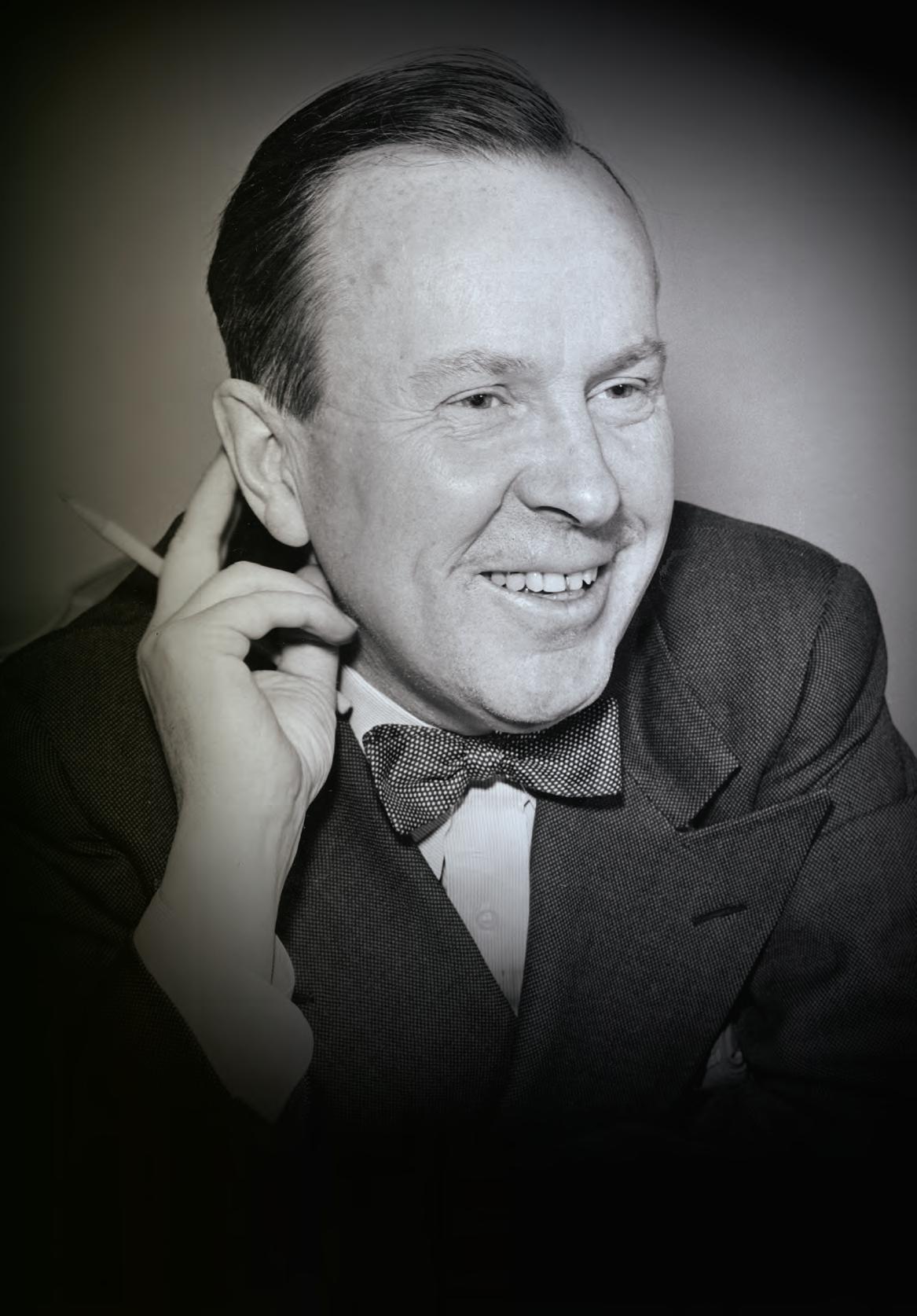
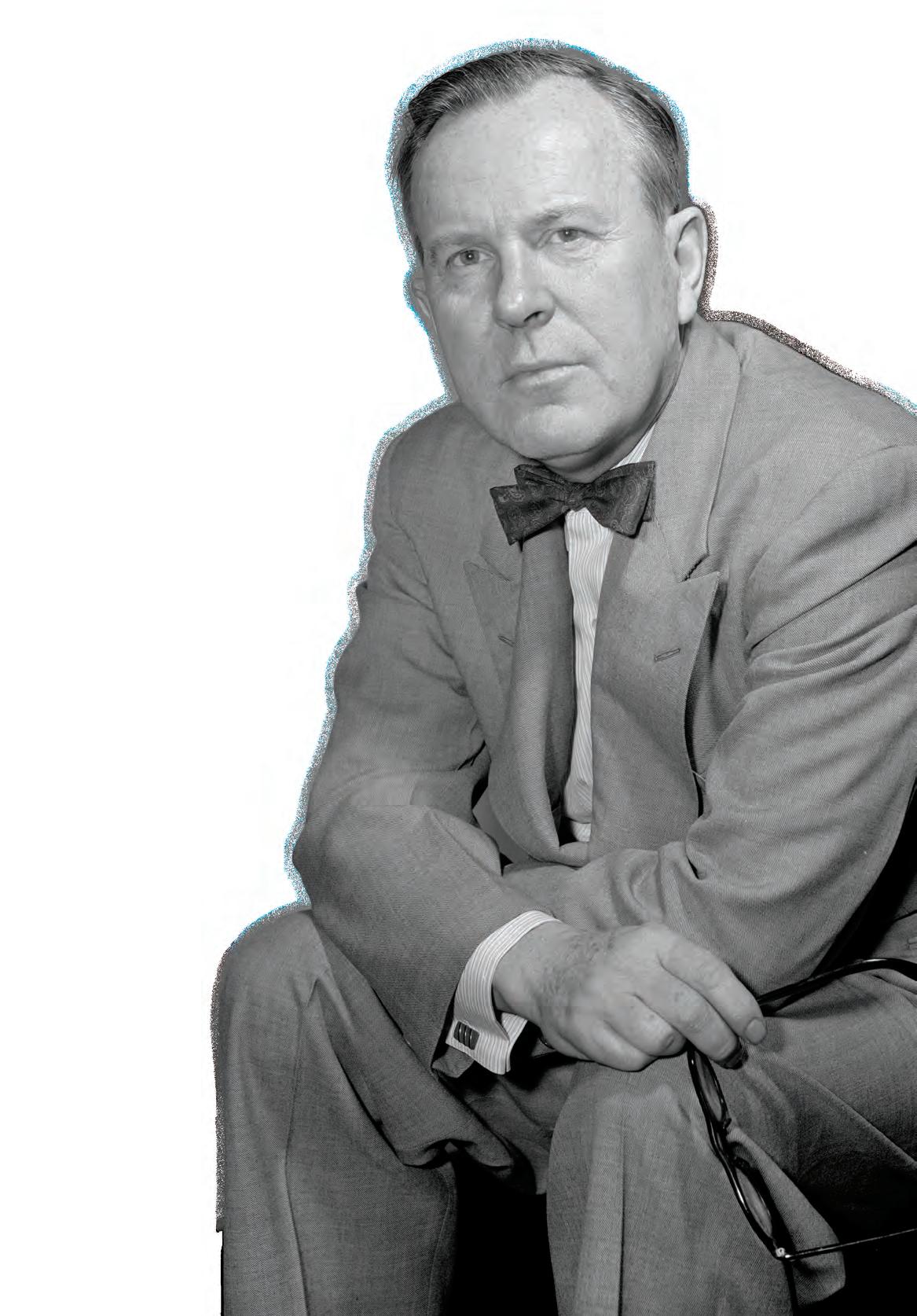
Future prime minister Lester Pearson poses for a portrait in August 1944 during his tenure at the Canadian Embassy in Washington, D.C.
See page 30
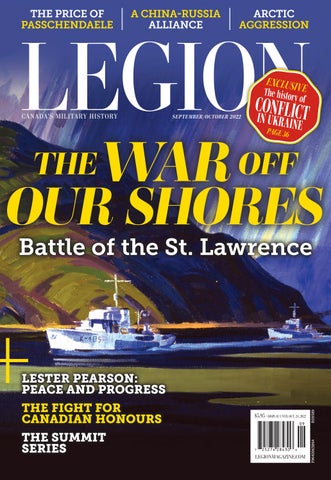
The Battle of the St. Lawrence transformed the lives of Newfoundlanders and Quebecers
By Stephen J. Thorne
Lester Pearson’s diplomatic career grew into a political one that introduced unparalleled social change—and helped walk the world back from the brink of nuclear war
By Sharon Adams
The long and complex history of the independent state provides critical context to Russia’s “special military operation”
By Serhy Yekelchyk
PHOTO
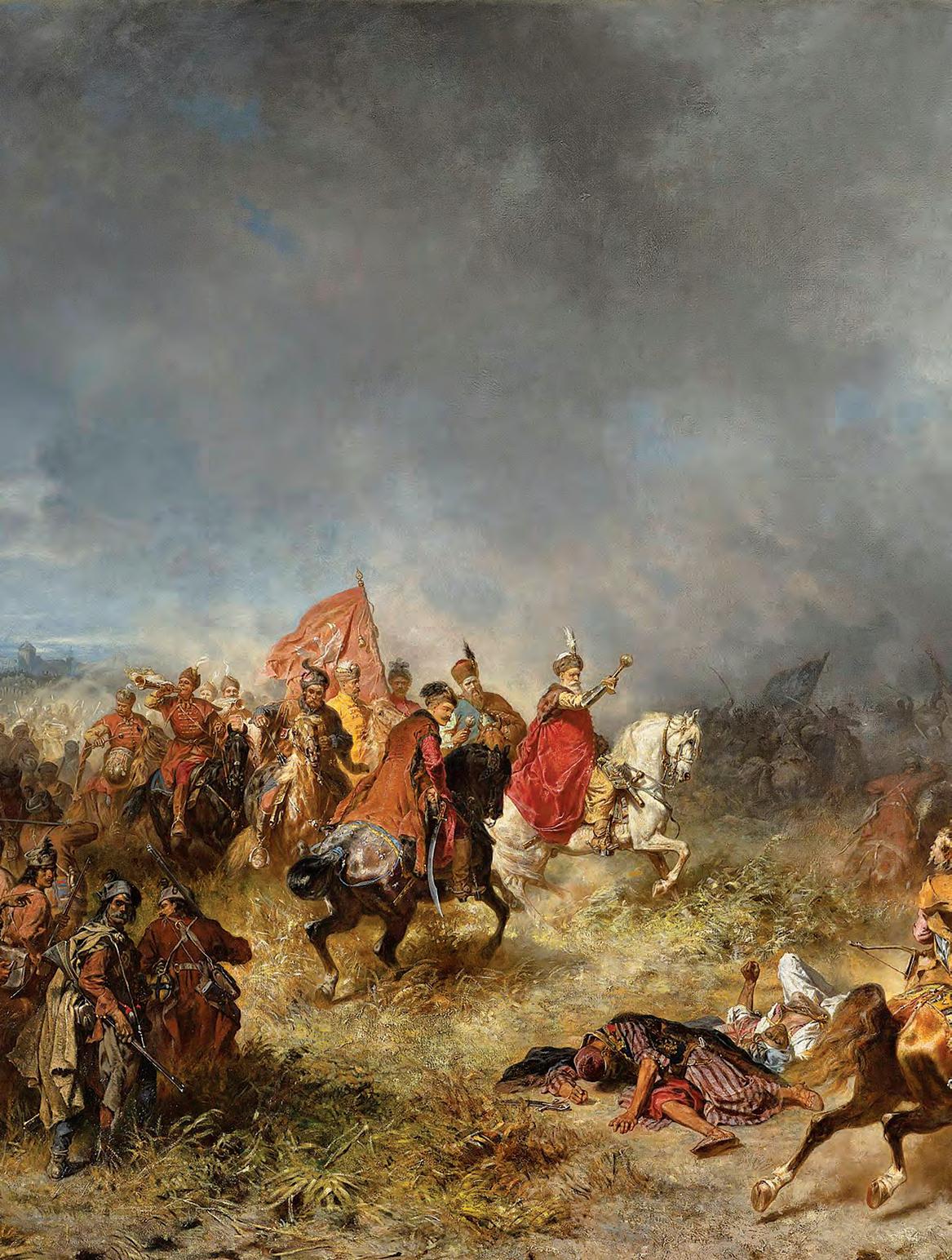
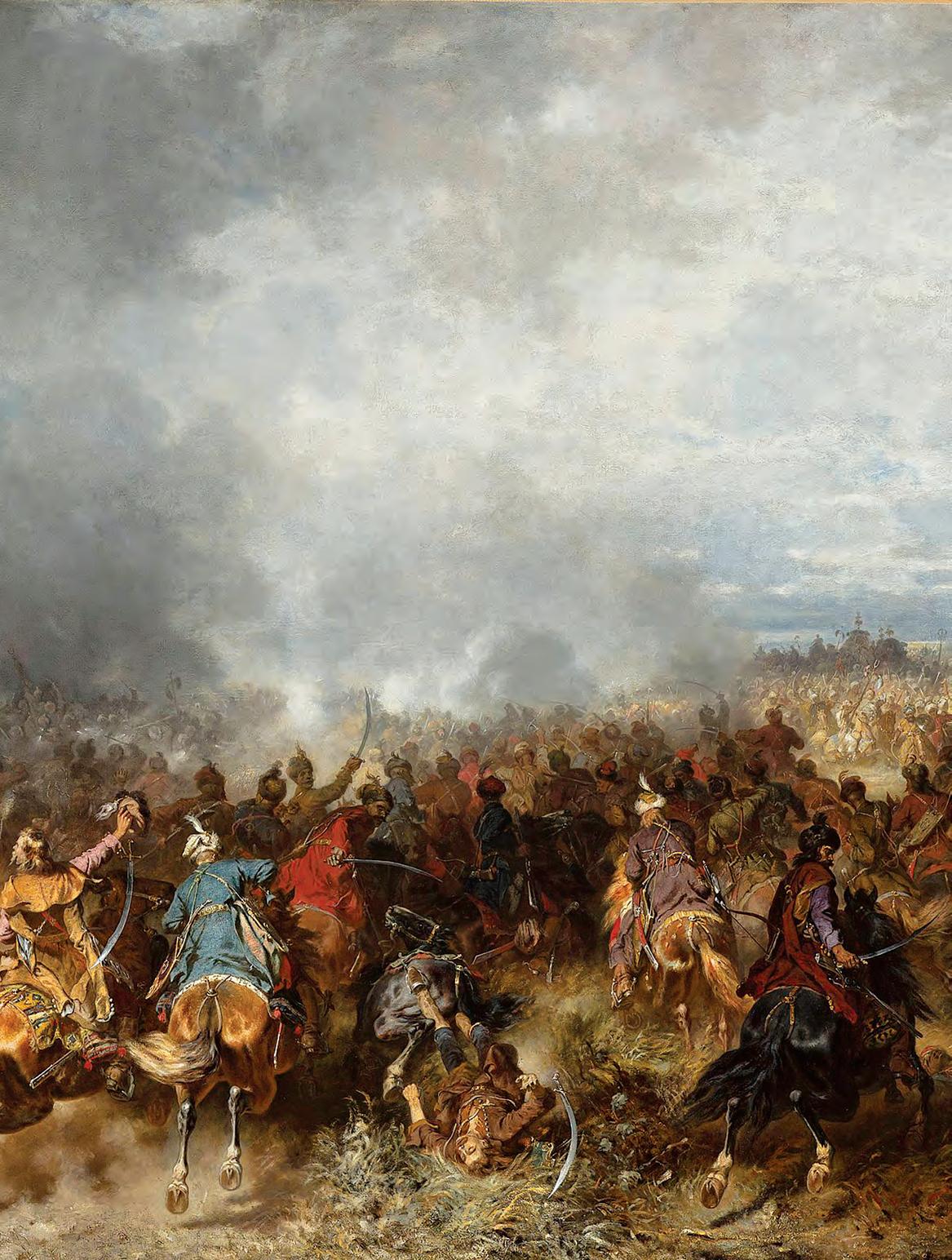
Polish painter Józef Brandt depicts the 1621 Battle of Khotyn. Frontier guards known as Cossacks repelled a massive invading army in the city, now part of Ukraine.
Józef Brandt/National Museum in Warsaw/Wikimedia
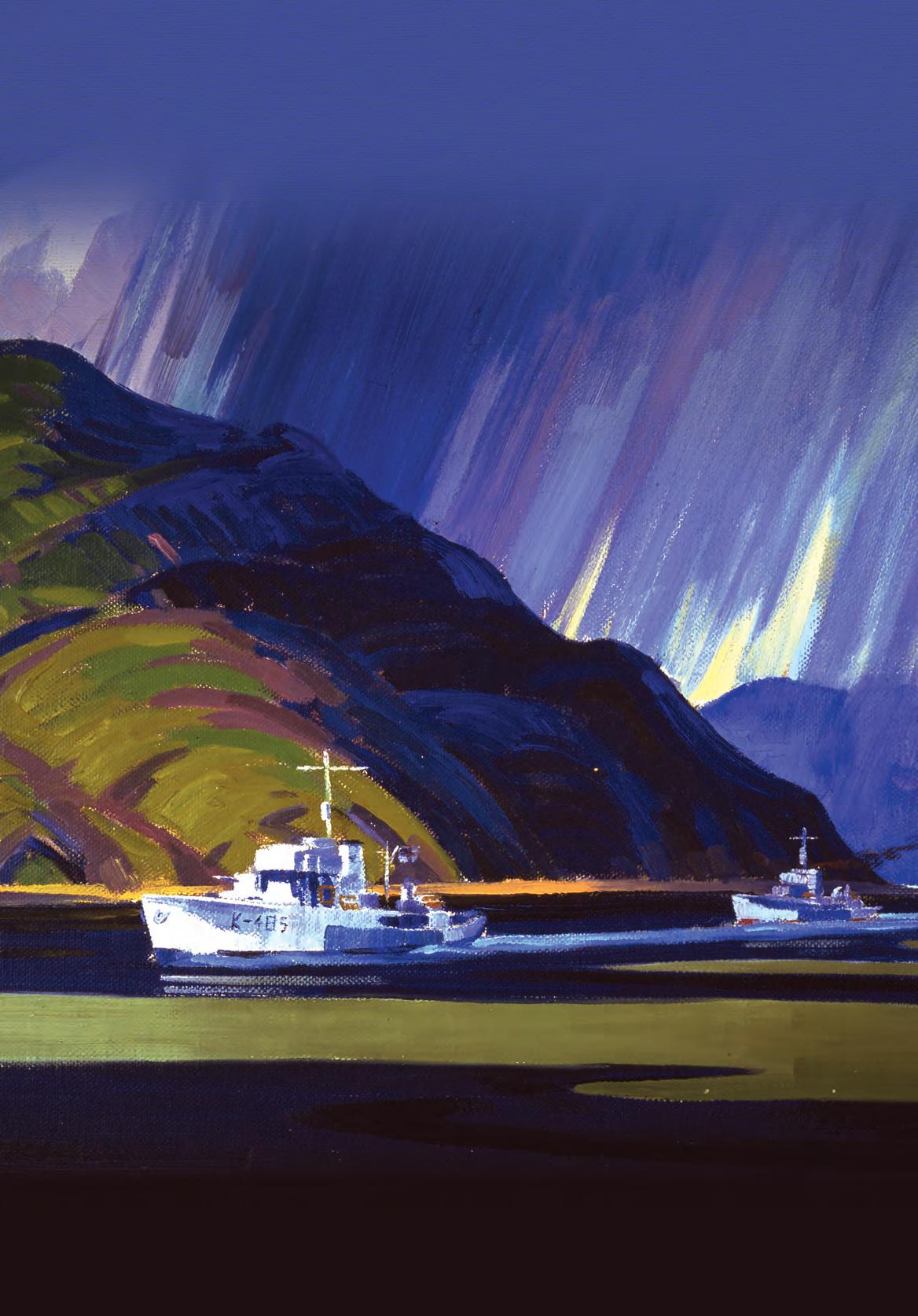
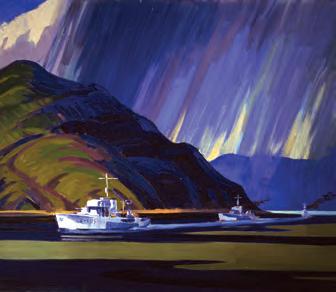
War artist Commander Tony Law depicts corvettes on U-boat patrol sailing up the St. Lawrence River during the Second World War. Commander Charles Anthony Francis (Tony) Law/CWM/19710261-0462
the Allies win the Battle of the St. Lawrence?
BOARD CHAIR Owen Parkhouse BOARD VICE-CHAIR Bruce Julian BOARD SECRETARY Bill Chafe
DIRECTORS Tom Bursey, Steven Clark, Thomas Irvine, Berkley Lawrence, Sharon McKeown, Louise Tardif, Brian Weaver, Irit Weiser
Legion Magazine is published by Canvet Publications Ltd.
GENERAL MANAGER
Jennifer Morse
INTERIM
ADMINISTRATIVE
SUPERVISOR
Mike D’Angelo

INTERIM
ADMINISTRATIVE ASSISTANT
Jonathan Harrison
ADMINISTRATIVE
SUPERVISOR
Stephanie Gorin (on leave)


EDITOR
Aaron Kylie
ASSISTANT EDITOR
Michael A. Smith
STAFF WRITERS
Sharon Adams
Stephen J. Thorne


ART DIRECTOR, CIRCULATION AND PRODUCTION MANAGER
Jason Duprau
SENIOR DESIGNER AND PRODUCTION CO-ORDINATOR
Jennifer McGill
DESIGNERS
Derryn Allebone
Sophie Jalbert


Advertising Sales CANIK MARKETING SERVICES TORONTO advertising@legionmagazine.com
DOVETAIL COMMUNICATIONS INC mmignardi@dvtail.com OR CALL 613-591-0116 FOR MORE INFORMATION
SENIOR DESIGNER
AND MARKETING CO-ORDINATOR
Dyann Bernard
WEB DESIGNER
Ankush Katoch
WEB AND SOCIAL MEDIA CO-ORDINATOR
Mauricio Dimate

Published six times per year, January/February, March/April, May/June, July/August, September/October and November/December. Copyright Canvet Publications Ltd. 2022. ISSN 1209-4331
Subscription Rates
Legion Magazine is $9.96 per year ($19.93 for two years and $29.89 for three years); prices include GST. FOR ADDRESSES IN NS, NB, NL, PE a subscription is $10.91 for one year ($21.83 for two years and $32.74 for three years). FOR ADDRESSES IN ON a subscription is $10.72 for one year ($21.45 for two years and $32.17 for three years).
TO PURCHASE A MAGAZINE SUBSCRIPTION visit www.legionmagazine.com or contact Legion Magazine Subscription Dept., 86 Aird Place, Kanata, ON K2L 0A1 or phone 613-591-0116. The single copy price is $5.95 plus applicable taxes, shipping and handling.
Send new address and current address label. Or, new address and old address, plus all letters and numbers from top line of address label. If label unavailable, enclose member or subscription number. No change can be made without this number. Send to: Legion Magazine Subscription Department, 86 Aird Place, Kanata, ON K2L 0A1. Or visit www.legionmagazine.com. Allow eight weeks.
Editorial and Advertising Policy
Opinions expressed are those of the writers. Unless otherwise explicitly stated, articles do not imply endorsement of any product or service. The advertisement of any product or service does not indicate approval by the publisher unless so stated. Reproduction or recreation, in whole or in part, in any form or media, is strictly forbidden and is a violation of copyright. Reprint only with written permission.
PUBLICATIONS MAIL AGREEMENT NO. 40063864
Return undeliverable Canadian addresses to Legion Magazine Subscription Department 86 Aird Place, Kanata, ON K2L 0A1 | magazine@legion.ca
United States: Legion Magazine, USPS 000-117, ISSN 1209-4331, published six times per year (January/February, March/April, May/June, July/August, September/October, November/December). Published by Canvet Publications, 866 Humboldt Pkwy., Buffalo, NY 14211-1218. Periodicals postage paid at Buffalo, NY. The annual subscription rate is $9.49 Cdn. The single copy price is $5.95 Cdn. plus shipping and handling. Circulation records are maintained at Adrienne and Associates, 866 Humboldt Pkwy., Buffalo, NY 14211-1218. U.S. Postmasters send covers only and address changes to Legion Magazine, PO Box 55, Niagara Falls, NY 14304.
Member of CCAB, a division of BPA International. Printed in Canada.
We acknowledge the financial support of the Government of Canada. Version française disponible.
Made possible with the support of Ontario Creates
The views expressed in this publication are the views of Canvet Publications Ltd. and do not necessarily reflect those of the Province of Ontario.
On occasion, we make our direct subscriber list available to carefully screened companies whose product or services we feel would be of interest to our subscribers. If you would rather not receive such offers, please state this request, along with your full name and address, and e-mail magazine@legion.ca or write to Legion Magazine, 86 Aird Place, Kanata ON K2L 0A1 or phone 613-591-0116.
As a Legion Member, you take pride in the fact that your membership helps support and honour Canada’s Veterans.
Did you know that it comes with benefits you can use, too? Take advantage of all the benefits that come FREE with your membership.

Renew your membership to get all these benefits and more!
MemberPerks® unlocks $1000s in potential savings on offers and deals at stores and restaurants across Canada, including national chains, local businesses and online stores. Use the MemberPerks® app, print out coupons or shop online to save on electronics, travel, fashion, entertainment and so much more!
Your membership also gives you access to additional benefits, including:
• savings and deals from our Membership Partners
• a paid subscription to Legion Magazine
• exclusive members-only items at PoppyStore.ca

all came as a shock to Ardith Bennett, who gave up her own health plan and opted for her husband’s after they married. Dan, a veteran, was over 60, and when he died 15 years later, she discovered she no longer had health benefits.
“I had no idea his coverage ended,” she told the National Association of Federal Retirees in the fall of 2021. “I can’t tell you the number of people I called [at Veterans Affairs Canada] and they couldn’t believe it either.”
An archaic piece of legislation known as the “marriage over 60” or “gold-digger” clause is to blame for Bennett’s predicament. Finding its roots among veterans of the U.S. Civil War of the 1860s, it was intended to prevent women from wedding aged veterans simply to collect their pensions.
Stories of so-called gold-diggers are about as old as the concept of pensions and benefits.
Deathbed marriages were so common following the 1861-65 war they helped inspire the original gold-digger clause in Canada’s 1901 Militia Pensions Act
Times have changed. These days, twilight marriages are common. People live longer, they marry more than once and the pursuit of happiness trumps all.
Yet a version of the gold-digger clause endures in the Canadian Forces Superannuation Act, despite continuing complaints from veterans and a 2015 Liberal election promise to eliminate it.
Under the existing regulation, veterans who marry after 60 must forego up to half their pensions if they want to guarantee payments to their spouses once they’re gone. One retired Royal Canadian Navy commander was asked to relinquish $903 of his $2,250 monthly pension, forever, to provide a
$761 survivor pension to his wife, reported the Surviving Spouses Pension Fairness Coalition. The measure can reduce payments to as little as $1,000 a month. And surviving spouses lose medical and dental benefits when their partner dies, as Bennett did.
The Armed Forces Pensioners’/ Annuitants’ Association of Canada, the National Council of Veterans Associations in Canada and The Royal Canadian Legion have all called for the clause to be scrapped.
The NDP veterans’ critic, MP Rachel Blaney, has introduced a proposal to eliminate the antiquated legislation, saying older veterans deserve to know their autumn loves will be taken care of after they’re gone.
“This ridiculous clause is pushing our veterans into poverty,” said Blaney. “Veterans who find love in their later years should not be punished for it, nor should their partners, the majority of whom are women.
“It’s sexist and archaic and must be eliminated.”
Hear, hear. L
Members of The Royal Canadian Legion can now access exclusive pricing, upgrades and amenities on vacations from the Legion’s latest partner in the Member Benefits Package (MBP), Blowes and Stewart Travel (BST Vacations).
BST is a full-service travel agency registered with the Travel Industry Council of Ontario. Its experienced vacation advisors promise exceptional service before, during and after your trip. Given its combined 120 years in business, BST has built relationships with top hospitality providers. That translates to
unique promotions for Legion members, including privileged perks and extras and access to custom, member-only departures. Plus, Blowes and Stewart will be donating to the programs of The Royal Canadian Legion for all bookings on custom Legion excursions, which in turn supports services and initiatives for veterans.
To explore options for your next vacation, call 1-800-561-4275 or email info@bstvacations.ca and mention you’re a Legion member, or visit www.bstvacations.ca/ royal-canadian-legion.
The MBP also offers discounts for online prescriptions, specially
designed travel insurance packages, as well as retirement living, cellphone plans, eyewear, funerals and much more. Other MBP partners include Pocketpills, IRIS Eyewear, Medipac Travel Insurance, belairdirect car and home insurance, Rogers, HearingLife, Arbor Memorial, Canadian Safe Step Walk-in Tub Company, CHIP Reverse Mortgage, Revera and MBNA Canada Bank.
The continually expanding roster of MBP partners is just another benefit of Legion membership, and the exclusive savings from these companies can easily cover the member fee. L
Blowes & Stewart Travel (BST Vacations) is a family owned and operated, full-service travel agency that has been in business since 1949. Our 80 member team is a power house of knowledge and expertise, and is here to assist you with your travel plans, wherever you may want to go. We pride ourselves on our exceptional service, and creating extraordinary travel experiences for our clients. We are a TICO Registered agency with full trust accounting.
We are proud to be a part of The Royal Canadian Legion Member Benefits Program
As a Royal Canadian Legion member, you will enjoy exclusive pricing, upgrades and special amenities on a wide selection of vacation packages, cruises and tours. You will be able to take advantage of exciting promotions negotiated just for Legion Members, exclusive perks and extras from BST Vacations preferred suppliers, and access to custom group departures specific to Legion Members.*
*A donation will be made to the Legion for any bookings on our custom Legion groups.

BST Vacations is a designated Virtuoso agency - the travel industry’s leading luxury network. Virtuoso advisors specialize in creating unique experiences you can’t find online or plan yourself. Their connections to properties and itineraries around the world are unparalleled. Because of our association with Virtuoso, Legion Members will enjoy VIP recognition at fine hotels with room upgrades and meal inclusions, perks on cruises and tours, as well as privileged access to prestigious events around the world.
BST Vacations Travel Advisors are there for you before, during and after your vacation.
Whether you need assistance with planning that longawaited personal trip by land, air or sea or want to take part in more solemn customized war memorial tours, our team will look after all the details.
We invite you to stop by our offices or contact one of our BST Vacations Dream Makers today!
1-800-561-4275 / info@bstvacations.ca / https://bstvacations.ca/royal-canadian-legion

the Adventure

—Eco-friendly,
3. SIP Happens Wine Mug—Enjoy your favourite hot or cold beverage in the stainless steel mug with drop-in lid. 12 oz., 4.5"h, Matte white

just read the article “Bracing for impact” (Military Health Matters, May/June) and, as a currently suffering veteran with knee and back problems, I enjoyed it. Many of my fellow members who suffered from these issues during service were continually “shoved under the carpet,” so to speak. We were basically told our injuries were our own fault and not because of the continued toll our bodies took from everyday deployment. Some of these members had surgeries, were mustered out to other trades or pushed out completely to live as best they could. At the time, it was just another way of shelving the problems by the powers that be, rather than really looking into the causes of repetitive workloads on our bodies.
DONALD LUMLEY, VANSCOY, SASK.
My late father was one of the Canadians who stayed in Holland after the war (“We are grateful to them, but let them go home,” May/June). He returned home in April of 1946. He exchanged Christmas cards with the people he was billeted with until the day he died. He and my mother were fortunate enough to go over there for a visit in the 1980s. He never mentioned the overstaying their welcome part of his time there. A very interesting article.
BRIAN BROWN, ROSSBURN, MAN.

*
Comments can be sent to: Letters, Legion Magazine , 86 Aird Place, Kanata, ON K2L 0A1 or e-mailed to: magazine@legion.ca
I am an avid reader of Legion Magazine and thus a believer in accuracy of statements made by your readers in “Letters.” In your May/June issue, a contributor wrote that the Turner Valley oil production reached 10 million barrels per day. In fact, it was just under 10 million barrels per year, equivalent to about 27,000 barrels per day.
RICHARD KISER, CALGARY
Too often the public associates serving in the military as a combat fighting role, even though many Canadians have seen forces personnel assisting in natural disasters during the last few years. If the Department of National Defence and the Canadian Armed Forces expanded and enhanced the capabilities and capacity of the Disaster Assistance Response Team (DART) and increased roles in urban search and rescue to include canine units, the recruitment and retention in the CAF would soar (“Crisis management,” May/June). It would also create a diverse capacity in all elements of the forces. Canada needs be one of the first on the ground to a natural disaster or humanitarian crisis. This must include airborne/airmobile immediate response units that are ready to deploy at any moment to any place on the planet, including at home. This would give Canada a reputation as a world leader in disaster and
humanitarian response, as well as in urban search and rescue. When Canadians are seeking a career after high school or university, they would be able to view the CAF as not only a military force, but a force for helping people.
We need to keep this conversation going until we are there.
KELLY CARTER, SOOKE, B.C.
Thank you for another excellent publication (May/June). It was well balanced and informative. The stories highlighting the dependence of Canadians on our military during peace and war was timely. In addition, the “Face to face” article and others provided readers with thoughtful reports and analyses.
FRED SPECKEEN, PRINCE GEORGE, B.C.
Private Jess Larochelle is quoted saying, “I have no regrets” at the end of the March/April article, “Danger Close.” I, and many other Canadians, would say that we have regrets regarding his suffering and the treatment he has received since returning from Afghanistan. This story shows what a first-class hero Larochelle was in the skirmish with the Taliban. It is easy to see how his actions saved himself and his colleagues from further casualties.
To have to take two civilian flights to get home after the wounds he suffered is unconscionable. He deserved much better treatment and support both in Afghanistan and in Canada. This is no way to treat our soldiers who do their jobs superbly.
DAVID ANNIS, DUNCAN, B.C.
If Canada does the buy of the F-35 (“Down to two,” March/April), that decision will be one of the greatest and costliest mistakes of our time. The U.S. air force found the F-25 too expensive to fly and maintain. There continues to be many serious issues with parts availability and quality. The stealth coating bubbles and peels off if the jet stays supersonic for any length of time, which can cause serious non-repairable structural issues. And it’s barely serviceable. Plus, it doesn’t respond well to cold weather. Canada is being sold an unaffordable pig. You can put lipstick on it, but it’s still a pig.
PIERRE LABONTE, OTTAWA L
In the July/August issue “Snapshots,” Saint John, N.B., poster chair Don Marr was misidentified. Our apologies to Mr. Marr for this error.



Legion members and their families can benefit from an exclusive discount on their car, home, condo and tenant’s insurance, on top of any other discounts, savings and benefits customers are already eligible for at belairdirect.





To take advantage of this offer, simply call us and mention you are a Legion member to get your

















Legion Magazine’s award-winning video series Military Moments is back with “The fight to fight: Canada’s No. 2 Construction Battalion,” the inspiring story of Black wartime service with Canadian forces more than 100 years ago.
Black volunteers looking to serve overseas with the Canadian Expeditionary Force during the First World War had every reason not to. Recruiters were turning them away. White battalion commanders, and many of the men in their ranks, refused to serve alongside Black soldiers.
Yet Black men continued to show up at enlistment stations from coast to coast—and not just Canadians. They came north from the United States and all over the British West Indies to sign up.
Ottawa could not stop the blatant racism with which they were often met—and the war effort could not afford to be

turning away soldiers. Its solution was a segregated unit—No. 2 Construction Battalion, commanded by white officers and manned by Black soldiers.
Written and narrated by Legion Magazine staff writer Stephen J. Thorne, “The fight to fight” takes viewers into the room where Lieutentant-Colonel Walter H. Allen, the white commander of the 106th Overseas Battalion (Nova Scotia Rifles), meets the Black community leader, Reverend William White, and makes him a promise the colonel can’t keep. It traces the Black struggle for fair treatment and equal opportunity to fight for king and country in the early 20th century in Canada.
Ultimately, more than 1,300 Black recruits would join the CEF; fewer than 400 were conscripted and up to 500 served in non-segregated infantry units. Several
Black soldiers earned valour decorations and at least 35 were killed in action, proving the doubters wrong in every way.
“The fight to fight” was released this past summer on the eve of the federal government’s apology to members of No. 2 Construction Battalion and their survivors for the indignities they were dealt while volunteering to go to war.
Legion Magazine’s Military Moments is a series of short video histories narrated by the likes of Leonard Cohen, Alan Doyle, Dan Aykroyd, Mike Myers, Roméo Dallaire, Mayann Francis and Barry Pepper. The videos are available at www.legionmagazine.com and www.youtube.com/legionmagazine L
Get notified of all the latest updates on legionmagazine.com by signing up for our weekly e-newsletter at www.legionmagazine.com /en/newsletter-signup








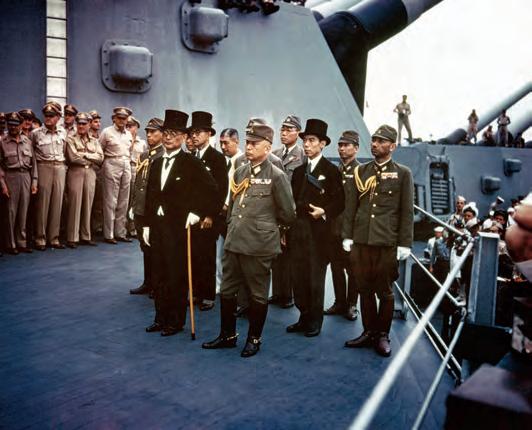
2 September 1945
Japan signs an unconditional surrender, ending six years of war.
3 September 1916
The Canadian Corps take a front along Pozières Ridge near the Somme in northern France.
5 September 1697
In what historian Peter C. Newman called “the greatest Arctic sea battle in North American history,” the British surrendered York Factory to the French in the Battle of Hudson Bay.
8 September 2007
Lieut. Joseph Tremblay leads Afghan soldiers in combat under enemy fire. He is awarded the Medal of Military Valour.
9 September 1944
HMC ships Dunver and Hespeler sink U-484 south of the Hebrides.
23 September 1965
HMCS Ojibwa is commissioned at Chatham, U.K. It is the first submarine to be built to order for the Royal Canadian Navy.
25 September 2007
While under enemy fire in Afghanistan, Capt. Joseph Bordeleau saves a critically injured soldier while directing a quick reaction force. He is awarded the Military Medal of Valour.
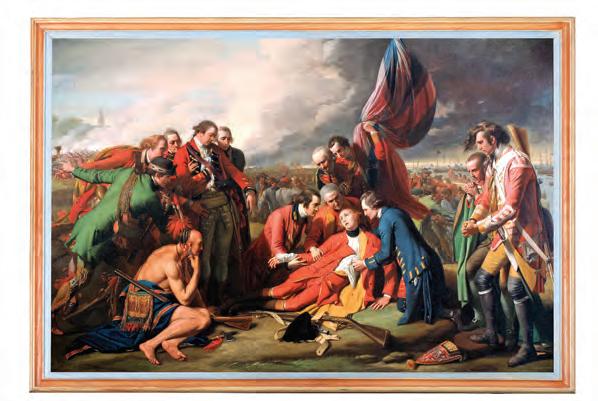
13 September 1759
The British are victorious at the Battle of the Plains of Abraham.
14 September 1990

Canada’s first permanent television station, CBFT Montreal, begins broadcasting.
Canada offers a CF-18 squadron with several hundred military personnel for use in the Persian Gulf during the Gulf War.
16 September 1974
The RCMP swears in its first 32 female officers.
17 September 1949
Future prime minister Lester B. Pearson represents Canada at the first session of the North Atlantic Council, which governs NATO.
18 September 1987
The United States and the Soviet Union agree to reduce the number of nuclear warheads in their arsenals.
26 September 1990
In Quebec, the Oka Crisis ends with the surrender of the Mohawks of Kanesatake.
28 September 1813
HMS Wolfe narrowly escapes destruction during a duel with USS General Pike.

29 September 1962
Alouette I, Canada’s first orbiting satellite, is launched.
30 September 2021
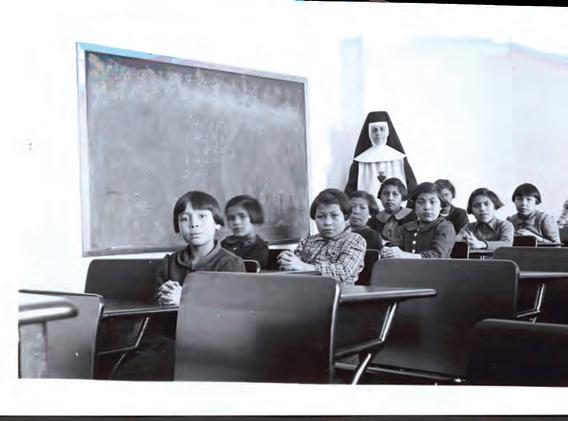
Canada observes its first National Day for Truth and Reconciliation, to honour the lost children and survivors of residential schools, their families, and communities.


8 October 2008
After an ambush in Afghanistan, M.Cpl. David Tedford leaves his vehicle in a hail of bullets to clear a jammed cannon. He is awarded the Medal of Military Valour.
12 October 1917
The First Battle of Passchendaele begins. By the time the village is captured in November, more than 15,000 Canadians are killed and wounded.
22 October 1943
The crew of U-537 set up an automatic weather station at Martin Bay in northern Labrador. It is not discovered by Canadian officials until 1981.

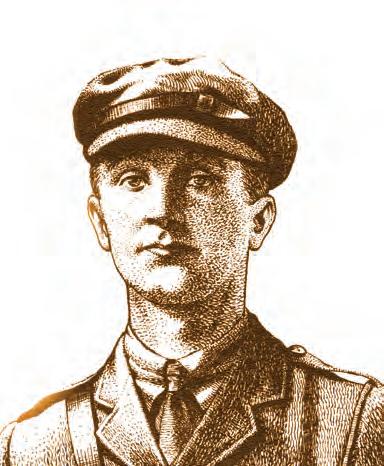
1 October 1917
Lt.-Col. Philip Bent is posthumously awarded the Victoria Cross for leading a successful counterattack to regain lost positions near Polygon Wood, Belgium.
3 October 1987
Canada and the U.S. reach a free-trade agreement, although the deal is not ratified until later.
15 October 1970
At the height of the October Crisis, the Canadian Army is ordered into Montreal.
16 October 1690
Colonists in Quebec City repel an attack by an English fleet of some 30 ships and 2,300 men.
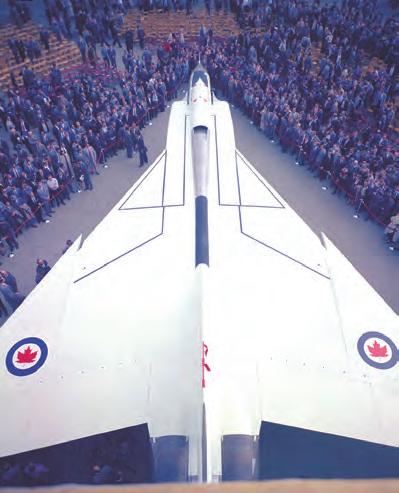
4 October 1957
The Avro Canada CF-105 Arrow is unveiled at Malton, Ont.
6 October 1986
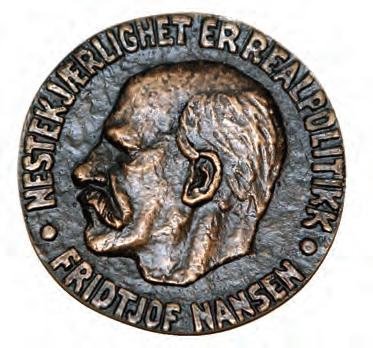
The UN presents the people of Canada with the Nansen Refugee Award for the country’s record of welcoming refugees.
17 October 1944

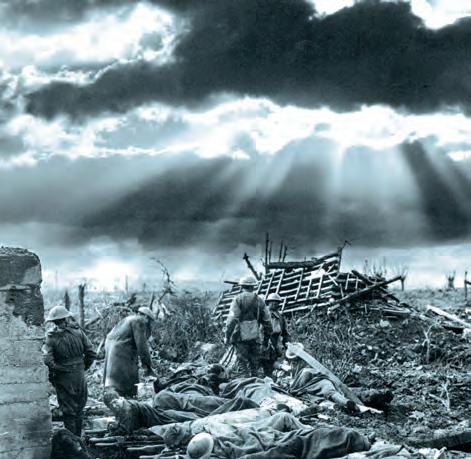
23 October 2007
Under fire during combat in Afghanistan, WO Joseph Léon evacuates two wounded soldiers and helps repel the enemy. He is awarded the Medal of Military Valour.
HMC ships Prince Henry and Prince David land liberation forces in Greece.
18 October 1917
The Canadian Corps relieves Australian and New Zealand forces, which had been decimated at the First Battle of Passchendaele.
19 October 1987
Panicked stockholders sell off millions of shares causing world stock markets to collapse.
20 October 1871
Militia General Order No. 24 authorizes the formation of the first two batteries of Canada’s Permanent Force.
24 October 1971
The UN recommends that member states observe United Nations Day as a public holiday.
25 October 1854
During the Charge of the Light Brigade in the Crimean War, Canadian-born Lieut. Alexander Dunn earns the Victoria Cross.
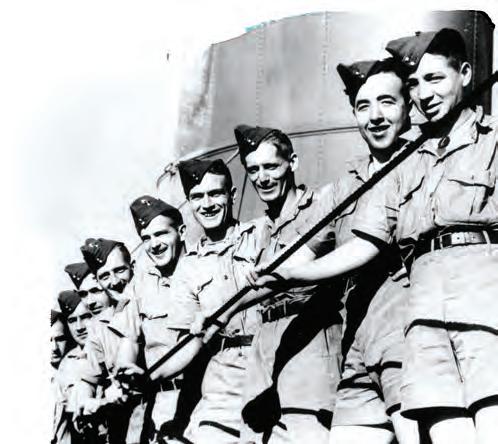
27 October 1941
Nearly 2,000 members of the Canadian Army, known as C-Force, sail for Hong Kong.
By Sharon Adams
There may be no better moment than now to address sexual misconduct in Canada’s military
Ifever there were a time when the Department of National Defence and the Canadian Armed Forces could make real progress against sexual misconduct, it is now.
Canadians have been scandalized by the pervasiveness of sexual misbehaviour within the military, angered by revelations of the toxic culture that has allowed it to go unchecked and exasperated by how long it’s taking to successfully deal with it.
The crisis has done as much to damage military morale and to shock Canadians as a
defeat in combat, said former Supreme Court justice Louise Arbour in her report on the matter released this past May.
The situation can only change if military culture changes, said Arbour. She made 48 recommendations designed to help the process along. Most media reports focused on those suggestions, but as Arbour herself pointed out, if military leaders don’t accept the general direction she proposed, “no amount of detailed recommendations will produce the desired result.”
Lasting change will only happen when the military begins to


question its foundational beliefs and alters the way it operates. For instance, Arbour contended that that the CAF believes it must “be completely self-reliant.” This led, she said, to a response to sexual misconduct in which “the CAF acts as investigator, advisor, prosecutor, defender and even judge.”
True transformation, however, “requires a willingness to examine broader, more progressive options, and not simply a better version of the same old things,” said Arbour.
For instance, why do military leaders move so much during their careers? “Constant mobility as part of career progress [leads] to chaotic management and a lack of accountability,” noted Arbour. Leaders move on before the effect of their changes can be measured, and there’s no guarantee positive changes introduced by one commander will continue with the next.
The leadership system lends itself to focusing on symptoms of the problem, rather than underlying causes. “Every problem must have a solution,” she observed. “The solution must be immediate and actionable.” This leads to plenty of activity, but not much insight.
Using its same old get ’er done approach led the CAF to focus on changing culture rather than structure. So, “it embarked on the conceptualization and operationalization of cultural change, a field in which it had no expertise,” noted Arbour.
Leaders did not examine which aspects of the CAF culture were deficient, nor “whether its insular, hierarchical structures may have facilitated the abuse of power that characterizes most sexual misconduct,” continued Arbour.
Civilian involvement in cultural matters is key, she said.
“While the current leadership of the CAF has expressed a strong commitment to culture change, I believe it is unlikely to be effected
without first a change in its culture of isolation and resistance,” said Arbour. “External input should be a common thread throughout all CAF activities impacted by the issue of sexual misconduct.”
And not just through civilian oversight, which is often after-the-fact and treated as non-binding advice, Arbour stressed, but by civilian advice and assistance throughout the process of developing approaches, rules and regulations.
For instance, the military could benefit from adopting current best practices used by human resources in the civilian workforce. The CAF, of course, is not exposed to civilian organizational culture, so it’s largely unaware of social forces that have caused evolution in the practices put in place by nonmilitary businesses, education and professional organizations.
CAF leaders say they are committed to culture change and there have been signs of increased flexibility. Of particular note is a change in the duty-to-report process for sexual misconduct.
The CAF requires members to report inappropriate or criminal behaviour up the chain of command. It’s the start of a formal process that can lead to disciplinary action. But it creates a problem for survivors of sexual assault who aren’t ready for formal proceedings and are forced into it when someone else reports the misconduct.
This compromises the confidentiality necessary for the process to work and can make the situation worse for survivors unready, or unwilling, to pursue official action. In May, DND announced the duty to report does not apply in the context of its restorative engagement program, part of the 2019 sexual misconduct class-action settlement.
When measured against the enormity of the problem, this response may be a very small step.
But it is a step forward. Yes, sexual misbehaviour remains a problem. As in Canadian civilian society, the military has not eradicated it (and perhaps cannot), but it can make it harder for perpetrators to do their dirty business in the military, while better supporting survivors.
The CAF needs outside help in creating enlightened rules, regulations and traditions that will create a more diverse workforce with values like those of wider Canadian society. It can start by heeding the spirit of Arbour’s suggestions—and following up on her recommendations. L


By Stephen J.Thorne
overnment MPs have voted down the proposed creation of a board to review historical combat actions, including those of Private Jess Larochelle, with an eye to recommending Victoria Crosses where warranted.
Former Conservative leader Erin O’Toole drafted a detailed proposal after New Democrat MP Niki Ashton tabled a 14,129name petition on May 19 urging the federal government to re-evaluate Larochelle’s decorated conduct in Afghanistan (see “Danger close,” March/April).
The consent motion required unanimous support from all members of the House, after which O’Toole’s pitch for a military honours review board would have been debated and likely passed by a simple majority of MPs in the minority parliament.
“All of the parties except the
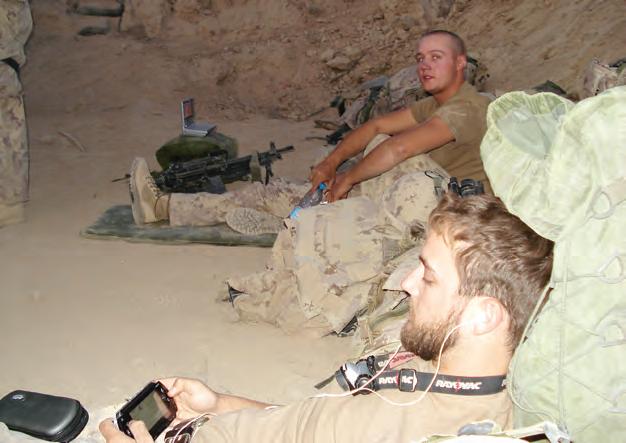
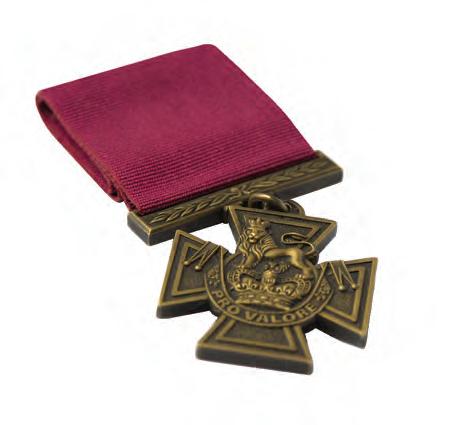
Privates Jess Larochelle (background) and Blake Williamson in Afghanistan. Larochelle received the Star of Military Valour for actions during his tour. Now a grassroots campaign wants to see his award upgraded to a Victory Cross (inset).
“I have always felt that his actions that day in continuing to fight despite being wounded in order to break the enemy attack was worthy and commensurate with the historical awarding of a Victoria Cross,” said Lavoie.
Liberals voted for it,” said a statement from the group Valour in the Presence of the Enemy, which has been championing a review for Larochelle and 26 other veterans dating to the First World War.
With several of his comradesin-arms dead or otherwise out of action, a badly wounded Larochelle was left alone in a perimeter observation post spearheading the defence of a strongpoint near Pashmul in southern Afghanistan.
The Oct. 14, 2006, attack by Taliban fighters was ultimately repelled and Larochelle was awarded the Canadian military’s secondhighest honour, the Star of Military Valour (SMV). “His valiant conduct saved the lives of many members of his company,” said his citation.
His battle group commander, now-retired lieutenant-general Omer Lavoie, was in that engagement and witnessed Larochelle’s performance.
Valour in the Presence of the Enemy is made up largely of Afghanistan vets headed by MP Ashton’s partner Bruce Moncur—himself a wounded member of Larochelle’s Royal Canadian Regiment. The group has garnered broad support. But the awards process is primarily a military one, and it is complex. Any witness can nominate a VC candidate, but it must be endorsed by the nominee’s unit commander and is subject to reviews and revisions before a final decision is made by the Chancellery of Honours, on behalf of the Governor General. Among 1,355 British Empire and Commonwealth soldiers, sailors and aircrew awarded the original Victoria Cross are 98 Canadians, the last of them Lieutenant Robert Hampton Gray, a pilot with Britain’s Fleet Air Arm, in 1945.
In 1993, Canada followed Australia’s precedent and established its own VC. New Zealand did so in 1999. But while Australia has awarded four of the new VCs and New Zealand one, Canada has awarded none.
There were 109 actions honoured with intermediate gallantry awards in Afghanistan, including 20 SMVs, Lieutenant-Colonel Carl Gauthier, the military’s director of honours and recognition, said in 2018.
A committee of general officers reviewed all the citations and nomination processes, concluding they were fair and consistent throughout.
“THERE SHOULD BE NO LIMITATION PERIOD ATTACHED TO RECOGNIZING SUCH HEROIC CONDUCT.”
Valour in the Presence of the Enemy quoted an unnamed participant in the 2012 SMV review who said the committee “struggled with the understanding [of] where the threshold was.”
“He said it was very subjective and it was clear to him at the time part of what was going on was a sense of just waiting for someone else to come along and do something incredible.”
The chief of the defence staff, General Wayne Eyre, was reviewing Larochelle’s file and consulting Commonwealth allies. The Royal Canadian Legion endorsed the effort.
In a June 14 letter to MPs, O’Toole, a veteran himself, said
the board would “serve as an independent review body to advise the [chancellery] with respect to errors or omissions related to military honours within the Canadian Honours System.”
Describing the matter as non-partisan, he noted no such process exists.
“There should be no limitation period attached to recognizing such heroic conduct, nor should we be satisfied that there is no mechanism to review decisions related to recognition.”
Canada’s main allies—including the U.S., the United Kingdom and Australia—“have acknowledged that their systems are imperfect and have acted to address this. Canada must act as well,” he added.
Defence Minister Anita Anand’s office told the National Post the government isn’t against O’Toole’s proposal, but it needs study.
“We are always looking at new ways to honour the sacrifice and bravery of CAF members and veterans, and will be taking the necessary time to examine this particular proposal,” said defence ministry spokesman Daniel Minden.
O’Toole’s proposed board would include representatives from National Defence, academia, the Governor General’s office, the Prime Minister’s Office, the Canadian War Museum and The Royal Canadian Legion, among others.
Advocates for Larochelle say time is of the essence in his case. His war wounds have severely curtailed his mobility and he has been tormented by posttraumatic stress disorder. L



















By David J. Bercuson

The Dominion Executive Council of The Royal Canadian Legion hereby gives notice of an Annual General Meeting of the organization which will take place at 9:00 am on Saturday, 26 November 2022 at Legion House, 86 Aird Place, Ottawa, Ontario.
Agenda for the meeting:
1. Presentation of the audited financial statements
2. Approval of the auditors for 2022-2023
This meeting is being held to fulfill the requirements of the Canada Not-For-Profit Corporations Act. Members wishing to make comment or raise questions on these two items may do so by written submission to Dominion Command, 86 Aird Place, Ottawa, ON K2L 0A1 to be received no later than 27 October 2022.
Documentation pertaining to this annual meeting shall be made available on the Legion website at www.legion.ca at least 21 days prior to the annual meeting or upon written request by a member, enclosing a self-addressed stamped envelope (9” x 12” envelope with $2.00 in postage) received at Dominion Command at least 14 days prior to the annual meeting.
Given Russia’s flagrant violation of Ukraine’s sovereignty and its use of force in a conflict that few countries view as legitimate, how will any negotiations between Canada and Russia, let alone Denmark, lead to a peaceful resolution of the rival interests in the Arctic Ocean seabed?
Although Canadians have largely supported Ukraine in its war against Russian aggression, the fighting is half a world away. Average Canadians, far removed from the ruined streets of Mariupol, are worried about rising gas prices. But a possible conflict between the polar countries has been brewing for years, and Canada remains largely unprepared for what could transpire.
This potential clash is centred on the Lomonosov Ridge, a feature of the Arctic Ocean’s seabed. The ridge extends from the East Siberian continental shelf in Russia’s Far North to the Lincoln Shelf at the northern tip of Nunavut’s Ellesmere Island and Greenland. Canada, Denmark and Russia all claim parts of
the ridge and its ownership will influence the division of minerals and other resources that lie within it, as well as the possible oil and gas deposits that may be found deeper under the sea floor.
The process of determining the boundaries of each country’s Exclusive Economic Zone (EEZ)— conducted under the provisions of the United Nations Convention on the Law of the Sea—has taken years. Studying the seabed in an environment as hostile as the Arctic Ocean has been a significant challenge. Plus, the 21 members of the United Nations’ Commission on the Limits of the Continental Shelf— which is supposed to make the final decision on EEZs—is a part-time body, hence the time required to study and comment on each claim.
When submissions overlap, the final boundaries will be based on hard evidence. In the case of the Lomonosov Ridge, Russia claims the entire feature, though it acknowledges that Denmark has some right to parts of the ridge extending north from Greenland. Russia has rejected any Canadian claim to the ridge.

HOW WILL ANY
In June 2007, Russia reiterated its stance from late 2001 that it effectively owned a major portion of the Arctic Ocean seabed due to its position on Lomonosov. A determination on the competing claims to the ridge has not yet been made.
Canada may have good reasons for its claim to parts of the Far North, but what good is moral right in the face of military might? Russia’s military strength in the Arctic is beyond compare. It has the largest and most powerful fleet of icebreakers in the world—including six that are nuclear powered—that can operate in the dead of winter. It has a fleet

of nuclear submarines with underice capacity. It has a large number of troops and aircraft based in the Arctic that are unmatched in quantity and capability by Canada or even the United States. Given Russia’s aggression against Ukraine, can anyone doubt that Russia will claim what it wants in the Arctic and dismiss negotiations as a Western fantasy? It is wishful thinking that Canada could ever match Russia in Arctic capability, and yet the country has done very little to even prepare itself for a possible confrontation; if Canada faces Russia directly, it will be woefully unprepared. L
Legion members and family can join the hearing health conversation by testing the latest hearing aids at HearingLife for free. For 30 days, take their premium or advanced hearing aids home and see how much better you can hear in everyday situations. At your appointment, you will receive a FREE hearing test* – no referral required – to determine eligibility for the trial. If testing indicates that you could benefit from wearing hearing aids, you will get the chance to try the latest in hearing aid technology for free!


By Stephen J. Thorne
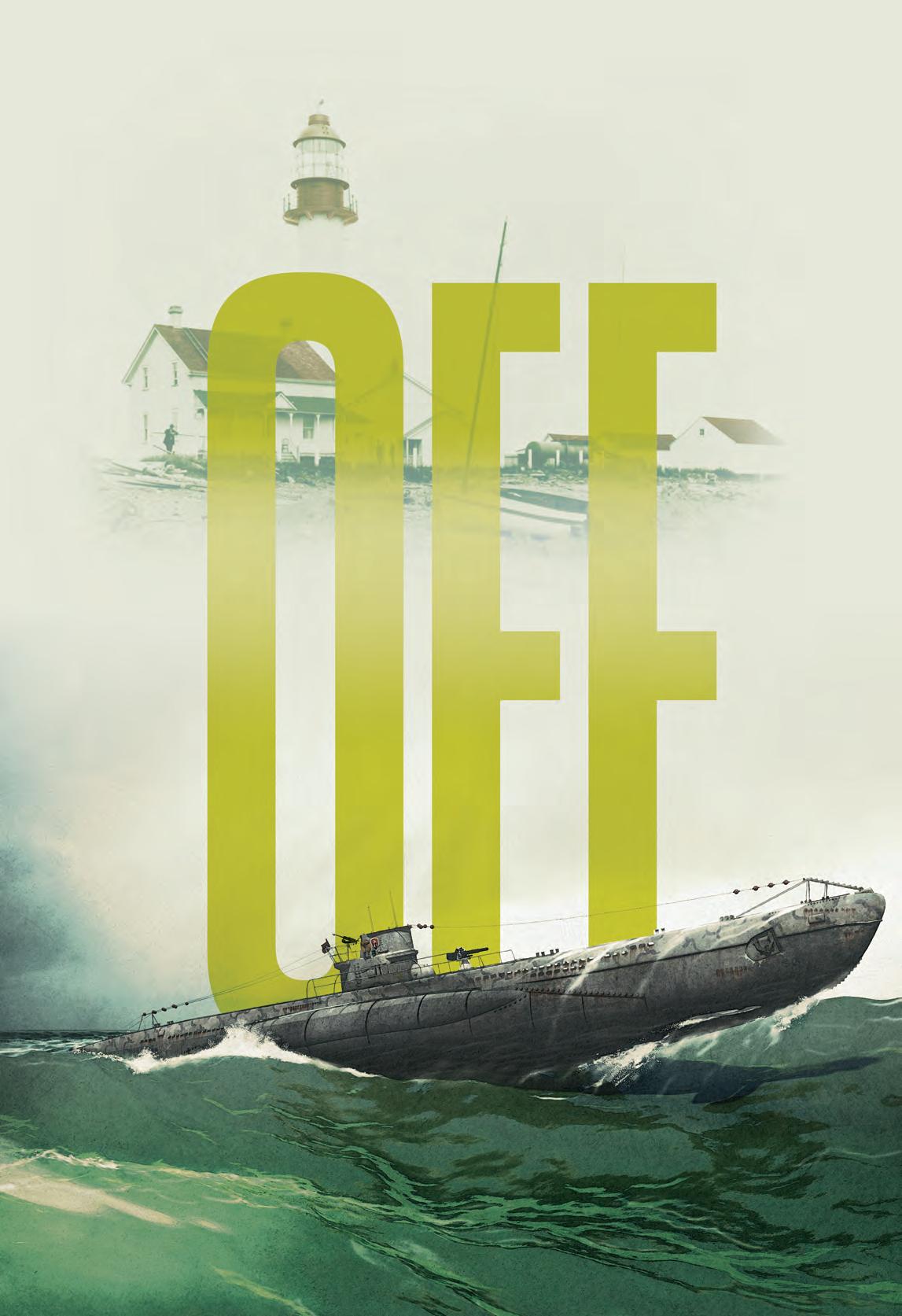
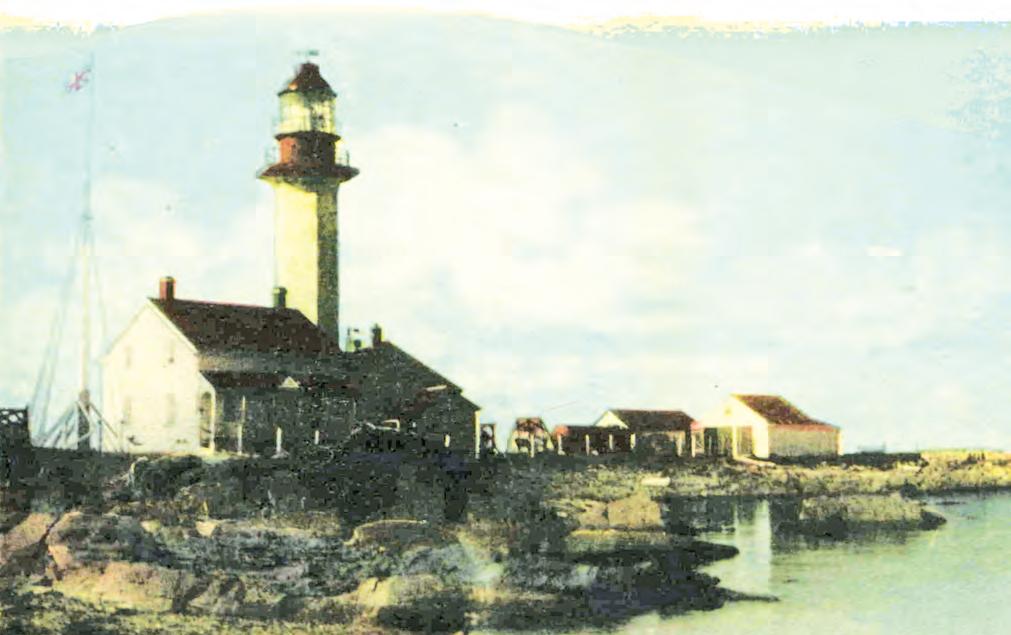
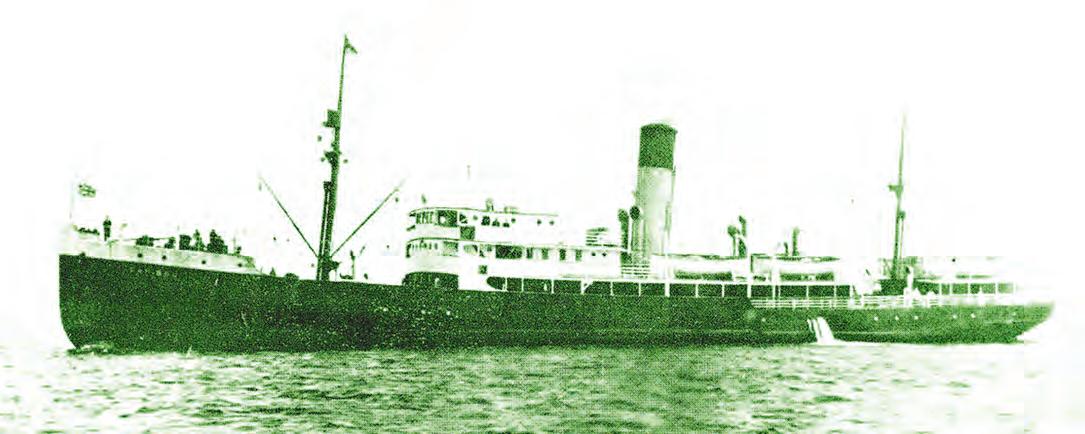
In 1942, U-boats (opposite bottom) started appearing off North America, including U-69, which sank the merchant vessel Carolus near the lighthouse at Pointe Mitis, Que. (opposite top), where David Gendron (below, centre) and his family lived.
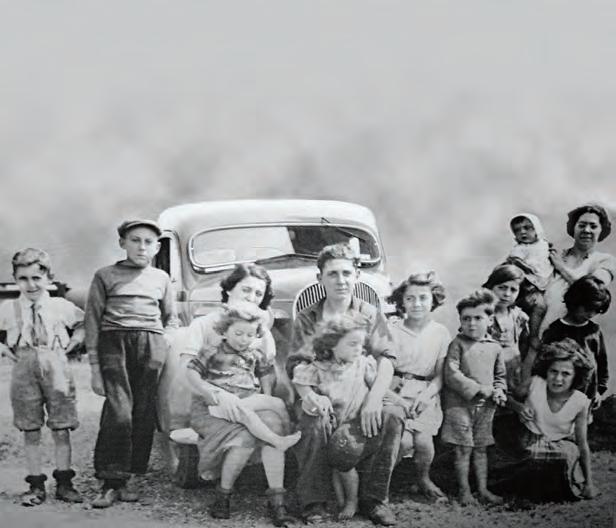
was around midnight on the night of Oct. 8-9, 1942, and in the cozy living room of the lightkeeper’s house on the St. Lawrence River at Pointe Mitis, Que., 21-year-old David Gendron was in the throes of composing a love letter.
The rest of the household was asleep—seven of his siblings; the local schoolteacher who boarded with them; Gendron’s mother, Eugenie, and his father, the lightkeeper, Octave.
On the waters offshore and in the world beyond, a war was going on, far away and ever closer. The Battle of the Atlantic had spilled into the Gulf of St. Lawrence and the river itself.
What would become known as the Battle of the St. Lawrence had already claimed dozens of victims, marking the first time lives were taken by hostile action on Canadian inshore waters since the War of 1812.
More than 400 sailors, civilians and merchantmen died during the three shipping seasons that German Admiral Karl Dönitz’s unterseeboots hunted close to Canadian shores and forced a partial shutdown of gulf shipping spanning parts of three years. Most of the losses would come in the first year, 1942.
In total, U-boats would sink 23 merchant ships along with four Canadian navy vessels in and around the estuary, along with five more cargo carriers at Bell Island, Nfld.
Back in July, Octave had reported sighting a submarine around 9 p.m. on the surface in the bay between his light and the summer resort on the far bank. It stayed for about an hour while tourists danced on the beach nearby.
Shortly afterward, reports surfaced in Germany that a U-boat “commander claimed he and his crew listened to dance music in Canada and watched the lights of cars travelling along a highway,” said a story in the Montreal Gazette dated Oct. 15, 1942.
It noted that the scenic Gaspé route, a tourist favourite, ran along the coast near Métis Beach—a stone’s throw from Pointe Mitis.
On that October evening, however, with autumn colours fading and a damp chill in the air, there were no joyful tourists, only grim-faced mariners cautiously navigating the big river that had been a transitway of Indigenous Peoples since time immemorial; that Jacques Cartier first sailed in 1534; that was now, some four centuries later, a lifeline of international trade and commerce, transport and supply—and a battleground where explosive violence and cruel death had infiltrated civilian psyches in small towns all along the scenic Gaspé Peninsula. Suddenly a dull boom rumbled in from the river, rattling the Gendron family’s living-room windows in their wooden frames. Young David, whiling away his graveyard shift as the assistant lightkeeper, was jarred from his writing and looked up from the rolltop desk. He said later it was 12:10 a.m. U-boat logs recorded the first strike at three minutes before midnight. Then came a series of thunderous cracks, amplified by the moisture-laden air, that shook the white wooden, red-roofed house on its square stone foundation.
It was five days before the ferry Caribou would be sunk in the Cabot Strait and here on the river, the perpetrator of that tragedy, German U-boat skipper Ulrich Gräf commanding U-69, had just fired a volley of torpedoes.
It took only one to dispatch the 2,375-ton Carolus. The vessel broke in two and the little Canadian steamer with its load of empty barrels plunged bow-first to the river bottom. Barrels stored on the afterdeck popped their moorings and others inside the hold came tumbling out as the stern settled and sank. It all took just two minutes.
At the first reverberations, Octave came rushing downstairs and raced out the door. He scurried a few metres over to the redand-white painted concrete lighthouse and huffed and puffed his way almost eight storeys up its winding staircase to the gallery deck adjacent to the lightroom, where he breathlessly peered through the old brass telescope.
Rain squalls had been sweeping across the river all evening but, according to Gräf’s log, the river itself was “mirror-calm” with a “strong phosphorescence.” As Octave

“For the Gendron family, the battle of Oct. 9, 1942, in front of Métis marked their life. They were in the line of fire.”

now discovered, visibility was good enough that it didn’t take a nautical warfare expert to conclude a German submarine was doing its dirty work less than five kilometres from the beach below, where his children had frolicked all summer long.
U-69 had fired from the surface. Two Canadian corvettes, Hepatica and Arrowhead, escorting convoy NL-9 from Labrador to Quebec, were launching illuminating star shells overhead, and may even have been firing their deck guns at the vanishing U-boat.
Just a month earlier, at Saint-Yvon, Que., 300 kilometres along the peninsula near the river’s mouth, a torpedo had slammed into the shoreline, the resulting blast shattering windows in the village. Octave feared for hearth and home, and even thought that the German was firing at the lighthouse itself.
But phones were at a premium along the Gaspé at the time and, despite the pivotal role he fulfilled—being positioned, as he was, at t he water’s edge 24-7—Octave had none.
The Royal Canadian Air Force station at Mont-Joli, Que., was 20 kilometres away and the nearest phone was in the village five kilometres down a bumpy track and out the pitted gravel road. He took the youngest of his children away from the house.
“I didn’t count” the kids, he told Maclean’s magazine seven years later. “I just kept piling them into the car until it wouldn’t hold any more, closed the door, and drove for the phone as fast as I could.”
It was an exasperatingly slow trip. Octave deposited his sleepy-eyed children at the end of the access road, far enough from the beach that his worries could be assuaged. He told the oldest to watch over them, then set out to call his report in.
Six minutes after he hung up, he said, a bomber lumbered out over the point, headed straight for the action.
“After that,” he told Maclean’s writer Jack McNaught, “the government gave me a phone for the house so I could make my reports faster; which I’d been at them all along to do.”
Octave was also granted permission that night to shut off the lighthouse lamp, ceasing its continuous, four-times-a-minute rotation.
The issue of blackouts had been a matter of debate in Ottawa. Towns and villages had taken to dimming lights—brownouts—but Pointe Mitis, for one, averaged 1,000 hours of
fog a year and authorities, in their wisdom, had apparently deemed navigational aids more critical than whatever measures might help mitigate the U-boat threat. They had ordered navigational lights to stay on until told otherwise.
A system was eventually developed using four-times-daily CBC and RadioCanada broadcasts to signal lightkeepers when to shut off their beacons. “A” for “Alphonse” was sent three times to keep the light burning; “B” for “bonbon” meant a U-boat had been sighted and operations were to shut down until further notice.
But, while defensive measures were being stepped up for convoys running men and materiel from Montreal and Quebec City to Labrador and the main East Coast assembly points and back, brazen U-boat skippers were routinely logging the fact that the merchants’ running lights and the navigational buoys that guided them, along with streetlamps, houses and lighthouses ashore, were on.
As it was, 11 Carolus crew died that night; 19 others were rescued.
Gräf submerged and, after some catand-mouse manoeuvring, punctuated by a volley of depth charges, U-69 slunk away and departed the gulf, leaving in its wake an uproar over the sinking a mere 300 kilometres from Quebec City. Gräf was about to cause even greater turmoil off t he southwest coast of Newfoundland.
Back at Pointe Mitis, Octave Gendron would return to some semblance of the normal life he had forged on the little strip of land jutting into the St. Lawrence. He served as Pointe Mitis lightkeeper for 18 years, until 1954.
David Gendron finished the love letter to his sweetheart, Simone Leblanc. The pair eventually married, had seven children, and were together for 45 years.
Their 76-year-old son, Paul, told Legion Magazine his dad went on to work at the Canadian National Railway for 15 years before serving as director of Reford Gardens (Jardins de Métis), a national historic site at Grand-Métis, Que., for 25.
He said the events of that night in 1942 remain a part of family lore.
“For the Gendron family, the battle of Oct. 9, 1942, in front of Métis marked their life,” he said in an e-mail interview. “They were in the line of fire.
“My grandfather Octave Gendron… died in 1975 and he often spoke to us about the Battle of the St. Lawrence.”
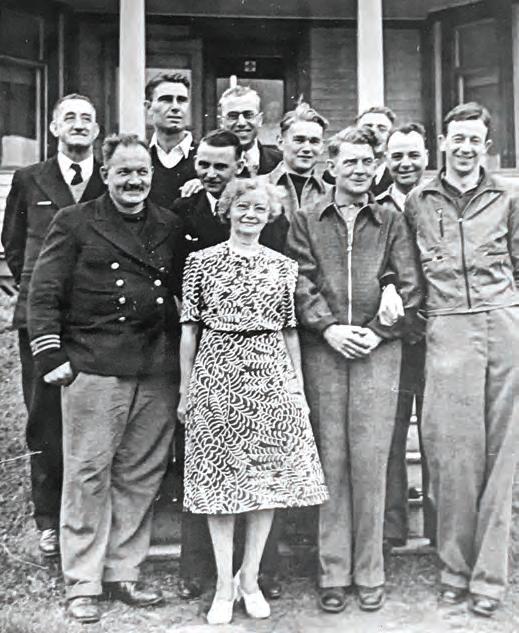
The war’s single greatest loss in near-shore waters was 137 people who died in the sinking of the ferry Caribou (below). Hotelier Rachel Kruse poses with survivors (opposite) after U-517 sank three ships off Cape Gaspé, Que., in September 1942.
As he crossed the Cabot Strait on the night of Oct. 13-14, Gräf sighted smoke belching from the stack of the ferry Caribou. The government vessel was en route from Sydney, N.S., to Port aux Basques, Nfld. It was 60 kilometres from the dock with 73 civilians, 118 military personnel and 46 hands aboard. It was 3:21 a.m.
The German claimed he misidentified the 2,222-ton ferry and its escort, the 672-ton minesweeper Grandmere, as a 6,500-ton troop ship and “two-stack destroyer.” At 3:40 a.m., he unleashed a lone torpedo, striking the Caribou starboard.
The ferry sunk in four minutes, taking 137 lives with it. Gräf dove, then made for the sounds of his sinking prey, knowing that the survivors in the water above would keep Grandmere from depth-charging his boat any more than it already had. He eventually launched a decoy and escaped.
Grandmere’s skipper, Lieutenant (N) James Cuthbert, didn’t give up the chase and go back for survivors until 6:30 a.m.—to some at the time, a controversial set of priorities, but it was procedure and to do otherwise would have put his own vessel at risk.
Fifteen-month-old Leonard Shiers of Halifax was the only one of 11 children aboard Caribou to survive. Of the 46-man crew, mostly Newfoundlanders, only 15 made it home. Five families in particular suffered mightily: the Tappers (five dead), the Toppers (four), the Allens (three), the Skinners (three) and the Tavernors (Captain Benjamin and his two sons).
Area fishing schooners chartered by the Newfoundland Railway Company recovered 34 bodies.
The Royalist newspaper in St. John’s declared the attack “a useless crime.”
“It will have no effect upon the course of the war except to steel our resolve that the Nazi blot on humanity must be eliminated from our world,” it said.
In Port aux Basques, the Oct. 18 funeral procession for six of the victims stretched two kilometres.
Decades later, Norman Crane, a Newfoundland Ranger who helped in the recovery effort, told Nathan M. Greenfield, author of The Battle of the St. Lawrence, that the town at the centre of “maybe 2,000 people” was in shock.
“In 1942, Port-aux-Basques was not like small towns on the mainland,” Crane said. “It was more like a 19th century town. They were a rough-cut bunch like most communities on the sea were. But they were also very respectful.
“The loss of the Caribou affected Port-aux-Basques more than you can imagine today,” he continued. “Ben Tavernor wasn’t just a well-liked captain of the Caribou, he was a respected man, known to have devoted his life to his boat and thus to their link to the outside world. His sons weren’t just fun-loving fellows—although they were—they were Ben Tavernor’s sons, and that counted for a lot.”
Gräf and his entire 45-member crew would be lost in the North Atlantic east of Newfoundland the following February.
By the end of the summer of ’42, residents along the coasts of Quebec and parts of the Dominion of Newfoundland, including Labrador, were attuned to the comings and goings of convoys and virtually any other floating object.
It’s a safe bet that many had seen more of the war than most other civilians in Canada.
U-boat strikes had become almost a familiar, though dreaded, part of life, the sight of oil-soaked survivors silently trudging ashore from rescue craft of all shapes and sizes inspiring the best from what these largely isolated peoples had to give.
On Sept. 7, the eventual ace of the St. Lawrence campaign, Kapitänleutnant Paul Hartwig of U-517, commanding his first and only war patrol, sunk three merchant ships off Cape Gaspé—Mount Pindus, Oakton and Mount Taygetus, killing
seven. He would leave the gulf about two months later with nine ships to his credit.
Many of the 78 survivors who made it ashore ahead of the detritus of their sunken vessels late that Labour Day afternoon were carted off by truck or horse-drawn wagon to the Kruse Hotel in the town of Gaspé, where they came under the care of Rachel Kruse, by all accounts a force of nature whose husband Alfred, a thriving businessman, had died in 1936.
She was known far and wide as “The Fighting Lady” and her hotel had become a centre of the small community, where music and drink flowed freely—at least until the piano player, a sailor, shipped out, never to be heard from again.
At the first sign of her latest round of not-wholly unexpected guests (the hotel had been commandeered by the government on their behalf), Kruse took to the large cardboard box filled with secondhand clothes she kept squirrelled away for just such circumstances.
She matched garments to each person’s needs, give or take a size or two. Hotel guests, primarily long-term residents working at the nearby Fort Ramsay naval station, gave up their beds for the arrivals, many of them blackened by oil and shivering from the frigid waters.
The overflow slept on the floor. In one case, a guest returned after hours and crawled sleepily into bed, only to find it occupied by a Greek merchantman.
The next day, they were gone, the story all but lost to time, the censored newspaper accounts of the day imparting the bare facts and not much else.

U-boat strikes had become almost a familiar, though dreaded, part of life.
After Hartwig sank the Canadian corvette Charlottetown off Cap-Chat, Que., four days later, killing 10 of 64 crew, Dorothy German laid the wounded on her living-room floor in Gaspé—“like cordwood,” as Essex described it.
“No one in Canada would know of the unexpected guests who arrived in the night,” navy veteran James W. Essex wrote in his 1984 book, Victory in the St. Lawrence. “Someone would snap a picture of Mrs. Kruse by the early light of the following morning as she bade farewell to the men she had helped before they were whisked away by special train.
“This picture was proudly displayed by her son Earl on the wall of his home: it showed ‘The Fighting Lady’ surrounded by the men she befriended, their ill-fitting clothes a testimony to her determination and charity, but it was never reproduced in any newspaper, anywhere.”
At one point, a steward appeared in the entranceway and dryly observed that their oil- and blood-soaked bodies would spoil the carpet. German kept on with her task.
“Those who were in the water when the depth charges let go were the worst off,” Essex wrote. “The concussion bursts the blood vessels and you die a slow death.
“Retching and coughing blood are the unmistakeable signs.”
German’s husband, auxiliary Captain Barry German, a First World War veteran who was then serving as naval officer in charge of Fort Ramsay and commanding the auxiliary fleet at Gaspé, soon arrived. He knew the signs, all right.
He took one look at the mass of wounded and ordered them all taken to the local hospital, where some died. Most of
those who recovered would have been reassigned to other merchant ships, some to survive other sinkings—or not.
In Conception Bay on Newfoundland’s east coast, U-boats sunk five cargo ships at Bell Island in September and November 1942, several of them loaded with iron ore from the island’s mines northeast of St. John’s. Sixty-nine merchant seamen died.
letters by Newfoundlanders, many written with such events fresh in their minds.
In a letter to former school chum Kay Normore in England, Doris Higgins of Wabana, Nfld., cryptically describes the aftermath of the second Bell Island attack the previous Monday and how the doctor fetched her father at 4 a.m., telling him to “hurry up for God’s sake and get the van and go and pick up the wounded.
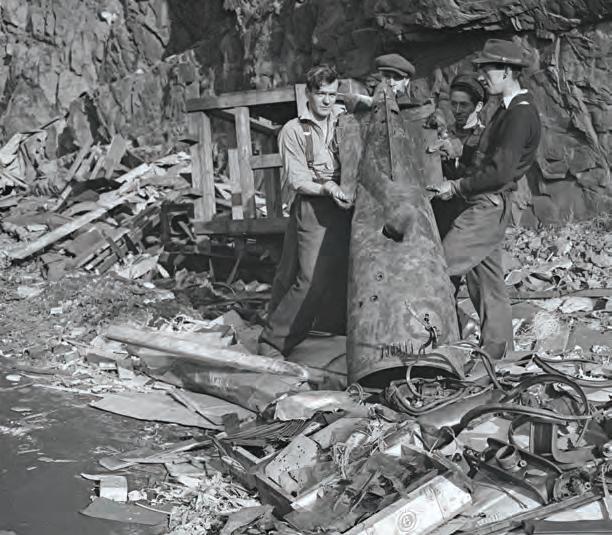
Men hold the remains of the torpedo that destroyed Scotia Pier at Bell Island, Nfld., on Nov. 2, 1942.
Local residents witnessed the strikes at the anchorage just off the island. An errant torpedo blew up one of the main wharves. During the action, residents took to boats, rescuing the survivors and collecting the dead.
The war, therefore, was very much present in the hearts and minds of those who were there, and among

The war, therefore, was very much present in the hearts and minds of those who were there, and among Newfoundlanders generally.
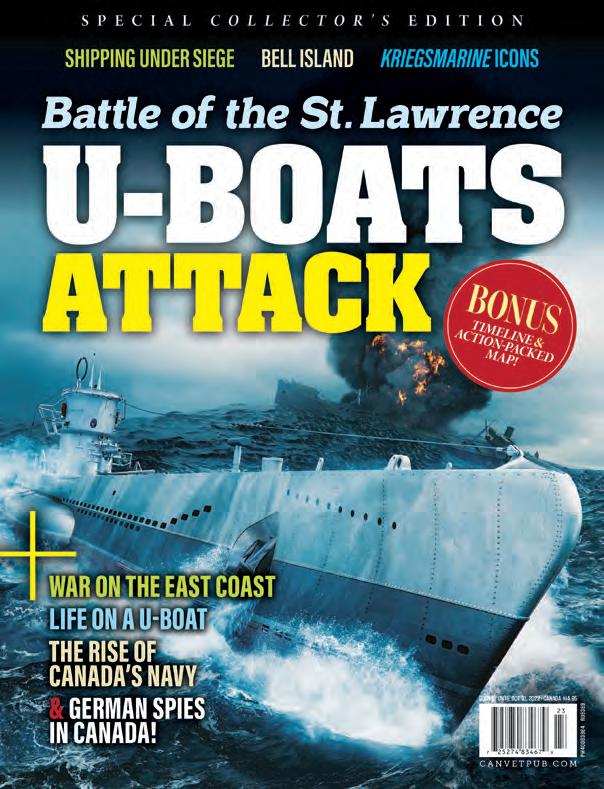
Pick up a copy of U-boats attack: The Battle of the St. Lawrence, the latest special edition in the Canada’s Ultimate Story series, on newsstands now.
Newfoundlanders generally. They were a people, after all, whose primary vocation was spent on the sea, and at least seven Atlantic fishing schooners had been sunk by German U-boats, both near and far from home.
On May 7-8, 1942, U-136 sank the Sydney-based fishing schooner Mildred Pauline, captained by Newfoundlander Abraham Thornhill, off Nova Scotia. Thornhill’s 21-year-old son George was among the seven-man crew. A ll were lost.
U-boats dispatched Newfoundland-owned freighters with Newfoundland crews, including the Humber Arm and the Waterton, both owned by Bowaters Newfoundland Pulp and Paper in Corner Brook, and several vessels belonging to t he St. John’s-based A ngloNewfoundland Development Company.
In the former dominion’s justice department files are censored excerpts from
“He was already out of bed because we were already awakened, and so was everyone else on Bell Island who had ears,” she said, describing the “impressive and sorrowful sight” of 11 funerals making their way through town a few days later.
She discouraged Normore from coming home “by water.”
“It’s too dangerous,” Higgins wrote, “and Kay, my love, we people around here should know that.”
In the end, the Battle of the St. Lawrence was neither won nor lost. By the fall of 1944, German U-boats had simply left the gulf behind for richer Atlantic waters.
Little known in the rest of the country today, the extraordinary events of 1942 still resonate among Atlantic Canadians through stories, memorials and tombstones; memories, myths and legends. L


It is 1942, and the U-boat war that has been raging in the North Atlantic spills into the Gulf of St. Lawrence and onto the river itself. For three years, submarines dispatched by German Admiral Karl Dönitz have been attacking the high-seas convoys that are the lifeline of the war effort overseas.
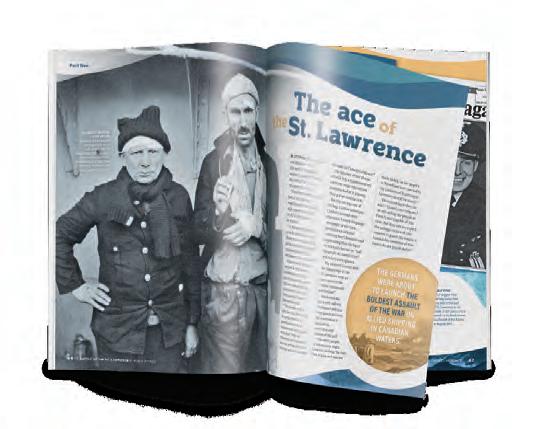
Now the underwater killers seize on new opportunities to attack ill-defended shipping all along the eastern seaboard into the Caribbean. They include transports sailing down the St. Lawrence and out to the coast from Montreal and Quebec City.
For the first time since the War of 1812, lives are lost to hostile action in Canadian waters.
Now available on newsstands across Canada! Pick up your copy today!

The Battle of the St. Lawrence was a limited engagement by opportunistic German U-boat captains to harass shipping in the Gulf of St. Lawrence and, to a smaller degree, the St. Lawrence River itself.
What amounted to a series of attacks spilled into the Cabot Strait and Newfoundland’s Conception Bay, where German unterseeboots sank the ferry Caribou off Port aux Basques and five cargo ships at the anchorage off Bell Island, Nfld., respectively.
The “battle,” such as it was, was adjunct to the epic, high-seas confrontation that took place over the war’s six-year duration as the wolf packs of German Admiral Karl Dönitz hunted down the transatlantic convoys supplying Britain, the Soviet Union and the North African campaign.
U-boats sank 3,500 merchant vessels and 175 warships and killed more than 72,000 merchant and navy seamen. But the cost was great: 783 U-boats were sunk and 28,500 of 40,000 submariners were killed—believed to be the war’s highest casualty rate.
The Battle of the St. Lawrence lasted parts of three shipping seasons, and the bulk of activity took place primarily in one—1942, during which U-boats conducted a campaign, Operation Drumbeat,
along North America’s entire eastern seaboard into the Caribbean.
Capitalizing on Canada’s weak home defences, German subs operating within sight of coastal villages even forced a partial shutdown in gulf shipping activity between late-1942 and late-1944.
Dönitz eventually decided he had bigger fish to fry—namely, the plethora of ships carrying troops and materiel through the gauntlet on the notorious North Atlantic Run.
“The only thing that ever really frightened me was the U-boat peril,”
Britain’s wartime prime minister, Winston Churchill, wrote in his postwar memoir, citing his country’s “potential strangulation” due to the mounting losses in critical men and supplies aboard transports primarily sailing out of Halifax, Sydney, N.S., and St. John’s, Nfld.
The gulf offensive involved 17 U-boats. A handful of them sank 23 merchant vessels and four warships at a loss of about 340 lives, along with six ships and some 200 more lives in Newfoundland waters. Not inconsequential, by any means.
But while several U-boats were damaged and their crews suffered casualties, no German sub was sunk in the gulf.
Twelve of those subs were eventually destroyed in operations far from Canada’s near-shore waters. Of their 631 crew, 526 were killed in action—a staggering 83 per cent.
The Battle of the St. Lawrence served as a wake-up call to Ottawa, as Operation Drumbeat did to Washington. In that sense, it was a win for the Allied cause, motivating both governments to augment coastal defence.
To declare it an Allied victory, however, is a stretch. As near-shore defences and tactics developed, the limited number of U-boats involved moved on to bigger and better things. The Allied triumph would come later. L
> To voice your opinion on this question, go to www.legionmagazine.com/FaceToFace

The loss of hundreds of lives and fewer than three dozen ships in the Battle of the St. Lawrence should not be minimized. Nor should those losses be torpedoed out of proportion in evaluating the fight’s outcome.
The series of attacks reinforced the fact that the realities of the Second World War could come within shooting distance of Canadian homes and led to the growth of Canada’s homeland defence.
“The sinking of the SS Caribou brings the war to Canada with tragic emphasis,” said Minister of Defence for Naval Services Angus Macdonald days after the ferry was sunk by U-69 on Oct. 16, 1942.
The attack hit close to home for Atlantic Canadians, Newfoundlanders and, particularly, for Quebecers, many of whom were originally opposed to Canada’s participation in the war. It hastened support for both the war and the development of the Royal Canadian Navy in domestic waters.
The growth included measures to counter the incursions: the opening of naval base HMCS Fort Ramsay in Gaspé and the mobilization of the Gulf Escort Force, which included two corvettes, five Bangor-class minesweepers,
STEPHEN J. THORNE
is an award-winning journalist, editor, photographer and Legion Magazine staff writer. He has reported on the downfall of South African apartheid and from war fronts in Kosovo and Afghanistan.
three Fairmile motor launches and one armed yacht.
The aggressions inspired other defensive developments, too: the creation of the civilian Aircraft Detection Corps, which emcompassed some 1,320 volunteer observers in Quebec, Atlantic Canada and Newfoundland, as well as the start of routine anti-submarine air patrols, involving 14 area squadrons.
JUST 1.2 PER CENT
These efforts put a quick end to the relatively few attacks in the region’s waters. During the battle,
AARON KYLIE is the editor of Legion Magazine and the former editor-in-chief and associate publisher of Canadian Geographic. He is also the author of the Biggest and Best of Canada: 1000 Facts and Figures
just 33 vessels were sunk—the vaunted unterseeboots, meanwhile, had taken out some 6.3 million tons of Allied shipping in the North Atlantic in 1942 alone.
As Canadian naval historian Marc Milner wrote in 2012, “historians have long known that losses to local convoys in the Canadian coastal zone in 1942 were actually negligible.” The ship loss rate is estimated at just 1.2 per cent.
Interestingly, the largest deployment of U-boats in Canadian waters occurred in the fall of 1942. But, as Milner wrote:
“The Canadian victory in the St. Lawrence in late 1942 was the quiet work of intelligence and operational staffs, routine and targeted patrols, growing skill on the part of the defenders and new technologies. No one noticed at the time but the Germans.”
When Kapitänleutnant Ernst Vogelsang of U-132 returned to Europe in mid-August, he reported the situation in the Strait of Belle Isle as “unfavourable.” By November, the defence was so stout that U-183 refused to enter the Gulf of St. Lawrence.
“It is not a tale of great drama: no unknown U-boat kills have been uncovered, and there was no single decisive battle,” wrote Milner, but “it was a clear Canadian victory.” L
LESTER PEARSON’S diplomatic career grew into a political one that introduced unparalleled social change—and helped walk the world back from the brink of nuclear war

By Sharon Adams
Four days after he turned 18 in 1915, Lester Pearson enlisted in the Canadian Army Medical Corps. He was sent to Greece to serve as a stretcher bearer. In 1917, he was promoted to lieutenant and transferred to the Royal Flying Corps where he got his nickname, Mike, from a flight instructor who thought the name Lester wasn’t macho enough for a pilot.
But Pearson, whether called Lester or Mike, was made of sturdy stuff.
He found a way to pull the world from the brink of nuclear war, earning the Nobel Peace Prize; got impressive legislation passed while heading two minority governments; and weathered many political storms.
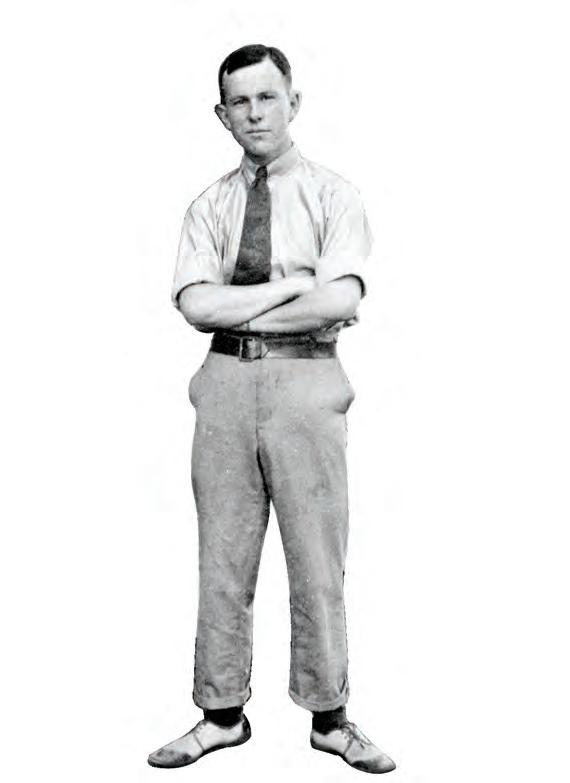
noting it strengthened his democratic and nationalistic instincts. Those instincts served him well when he joined the Department of External Affairs in 1928. At the time, Canada was building a professional foreign service, hiring and promoting candidates on merit, rather than political or family connections. Pearson aced the qualifying exam and was hired at a yearly salary of $3,600.
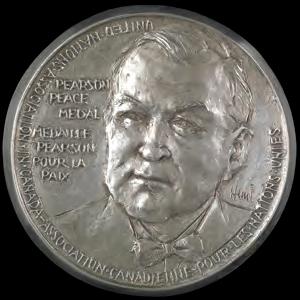
“All of my adult life has been spent...in an atmosphere of international conflict, of fear and insecurity,” he said in his Nobel Lecture in 1957. “I have lived since—as you have—in a period of cold war.”
Lester Bowles Pearson was born in a Methodist parsonage in Newtonbrook, Ont., in 1897, the middle child of three boys.
“God was in His heaven and Queen Victoria on her throne,” he wrote of his idyllic and athletic childhood.
That peace and security ended when his military career began. Ironically, after surviving a plane crash during training, his life as a soldier ended prematurely in 1918 when he was hit by a bus in London during a blackout.
“The war changed Pearson,” wrote biographer John English,
“Pearson had found his vocation,” said an article in Maclean’s in 1951. Pearson immediately began representing Canada at international conferences. And his diplomatic skills served him well domestically, too, as he cleverly identified the source of a leak of secret documents, for which Prime Minister R.B. Bennett nominated him for the Order of the British Empire and secured him a $1,000 bonus.
Pearson was posted to London as first secretary in the Canadian High Commission in 1935. As the world lurched toward war, Pearson developed a reputation as a keen, and often prophetic, political analyst. His work taught him not to see things in black and white.
“He said ‘lots of people see two sides to every issue, but I see four or five,’” his grandson Michael Pearson told an interviewer in 2017.
In 1938, Prime Minister Mackenzie King believed accepting Germany’s annexation of the Sudetenland in Czechoslovakia would stave off war. Pearson disagreed.
“Though I am on the side of the angels,” he said in a letter to his boss in 1939, “in Germany the opposite spirits are hard at work, and I have a feeling they’re going to do a lot of mischief before they are exorcised.”
“ The process...was not one of trade-offs but of finding common ground. ”
On leave in Canada when news broke that Germany might invade Poland, Pearson requested an urgent return to London. And because ships were slow, he wanted to fly—he became the first federal civil servant to officially do so.
On the plane, Pearson noted that most of the other passengers were German and Polish reserve officers who had been called home. He also suffered the first of many bouts of airsickness, but arrived five days before Hitler sent his troops toward Warsaw. The development cemented his belief in alliances and a collective defence.
Such playfulness made Pearson a darling of the U.S. media and he cultivated journalists as friends. Professionally, however, he was conscious of his duty as the Canadian representative to the much larger, louder and wealthier nation. The trick, he told an aide, was to be neither subservient nor oversensitive.
After the war, King enticed Pearson back to Canada and he became under-secretary of state for external affairs in 1946. At the time, it was feared a third world war could rise from the ashes of the second.
trade unions and churches, down to sporting clubs.
NATO is “a declaration to the world that this kind of conquest from within will not in the future take place amongst us,” he said.
“He saw NATO as an opportunity: to advance common interests at the economic and social level [among nations] with similar values, all democracies committed to human rights,” said his grandson, Michael.
Given that ability to unite, it’s hardly surprising that Pearson was persuaded to enter politics in 1948.
The late 1940s were a tense time internationally. The Soviets tested their first atomic bomb in 1949. Mao Zedong’s communists triumphed in the civil war in China. Tensions were growing between North and South Korea.

In 1942, Pearson was sent to Washington, D.C., as a diplomat. There, he helped lay groundwork for the founding of the United Nations in 1945, the same year he was named Canadian ambassador to the U.S.
Pearson’s informal manner was appreciated south of the border; his warmth and good humour charmed people from all walks of life. He came across as a person who took his job seriously, but not himself. And it didn’t hurt that he was a fan of America’s national pastime—baseball—and had played it semi-professionally in Canada before his diplomatic career.
But friendly games between the Canadian Embassy and U.S. State Department raised a worry: Would beating them jeopardize good relations?
“At the same time, national pride would permit no defeat...” noted Pearson of the dilemma. His solution? “We placed a jug of martinis and a glass at each base and agreed that whenever a player reached a base, he had to drink a martini.” Anyone staggering for home could easily be tagged out.
Although Pearson was committed to the United Nations, he recognized its limitations, chiefly the veto power of the five permanent members of the UN Security Council, who had opposing views on democracy and human rights, and the organization’s inability to enforce its decisions.
He believed a bigger stick was needed as a countervailing force to the expansion-minded Soviet Union. NATO was founded in August 1949 by Canada, the United States, Britain and nine western European nations.
Some believe NATO was a Canadian idea, noting Pearson had been thinking about a western alliance since 1946.
Pearson was the force behind what’s known as NATO’s Canadian article, the second clause in the treaty that calls for closer economic collaboration among its members.
“This treaty is not a pact for war,” said Pearson, “but a pledge for peace and progress.”
Communism spreads, Pearson said, because it first suppresses institutions that stand against it, from political parties,
Life was likewise strained in Canada, as the postwar economy slowed, putting a pinch on the unemployed and elderly. Many Canadians couldn’t afford medical treatment. And discontent among the French in Quebec was growing.
“Pearson felt he had no choice. ‘A civil servant can only go so far in determining policy,’” said a 1951 Maclean’s article. “‘When the essential decisions are made, you’re not even in the room.’”
After winning a byelection and taking over as minister of external affairs in 1948, however, he was in the room.
Pearson was an unusual politician, so casual in private, “it falls just short of being undignified,” wrote Robert Fulford in a 1963 Maclean’s article.
Though a charmer in person, Pearson’s charisma did not come across well on television and radio. He spoke with a lisp, looked stiff and uncomfortable and his gestures were wooden.
And Pearson knew it. He said he hoped to be “measured by the record, not by a recording.”
“He does not like or understand big crowds,” wrote Fulford, “and has no feeling for political speeches.”
“I don’t like the circus part of politics,” admitted Pearson. “It makes me blush.”
In person, however, he radiated warmth and good humour. He attracted a range of followers across the political spectrum, from anti-nuclear activists to NATO supporters.
“In Ottawa, a city of obsessive talkers, Pearson is a good listener,” wrote Fulford, noting the trait lulled people into believing he agreed with them.
“Intellectuals tend to believe he’s an intellectual, though his favourite reading is the sports page. Diplomats believe he’s a diplomat, not a politician.... For many people Pearson is a kind of mirror for their own ideals and anxieties,” continued Fulford.
He disappointed people “because he refuses to take firmly one side of an issue which has many sides, and because he will not put policy at the service of politics.”
Pearson maintained an even keel, which his staff credited to his stamina and good temper.
“No matter what the flap may be, we always know the minister...won’t blow up,” said a staffer in a 1951 Maclean’s article. Author Blair Fraser
attributed Pearson’s demeanour to his ability to take 20-minute catnaps, waking up “fresh enough for another long siege of work.”
And there was plenty of work.
In 1955, Pearson became the first foreign minister from a NATOmember nation to visit the Soviet Union after the death of Stalin. He had a “memorable but disturbing experience,” said an article in Policy Options, when then Soviet leader Nikita Khrushchev insisted Pearson match him in drinking 18 shots of vodka. The interaction confirmed for Pearson “that the finger upon the nuclear button was unsteady.”
Then the Suez Crisis put Pearson in the international spotlight.
In 1956, Egypt nationalized the Suez Canal, the major conduit for commerce between the Mediterranean and Red seas. Britain, France and Israel retaliated with an attack on Egypt. Canada did not support the strike.
Global relations rapidly divided into two camps, each led by countries with nuclear arms: the U.S. supporting European interests and the Soviet Union supporting Egypt.
Pearson used the United Nations as an instrument to calm the
situation. He proposed creating a UN emergency force to police a ceasefire and ease the withdrawal of the invading forces. The success of the move popularized peacekeeping.
In 1957, Pearson was awarded the Nobel Peace Prize. The chairman of the Nobel Committee lauded Pearson for “his personal qualities...and wise action... necessary to prevent unrest from spreading and developing into a worldwide conflagration.”
As the Cold War continued to heat up, the Americans became offensively defensive about the spread of communism. Canada’s first whiff of the Cold War came in 1945 when Igor Gouzenko, a cipher clerk in the Soviet Embassy in Ottawa, detailed the operations of Soviet espionage against its wartime allies. Eleven Canadians were eventually convicted of spying in connection with the case.
Subsequently, suspicion grew to paranoia in the U.S. Pearson, naturally, advocated a more moderate reaction: remove traitors from positions of trust, he said, “but in doing so, I hope we may never succumb to the black madness of the witch hunt.”
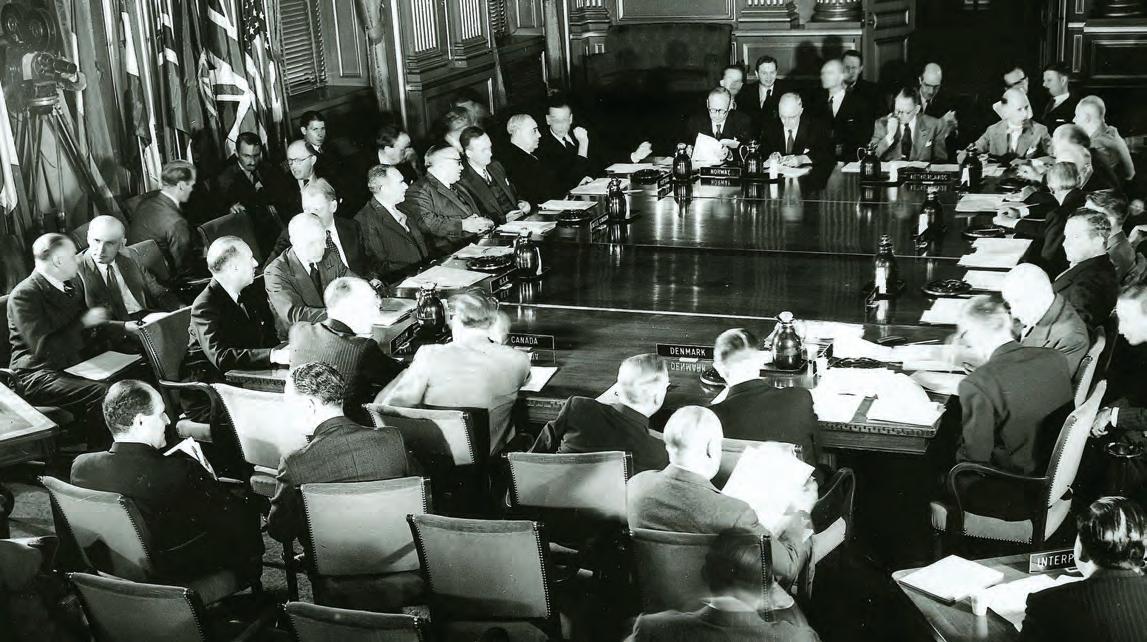
Pearson was a driving force behind the creation of NATO. The organization’s North Atlantic Council held its first session on Sept. 17, 1949.
The federal government began purging the civil service of everyone it believed could be susceptible to being blackmailed into betraying Canada. It created a security panel to root out the untrustworthy.
The RCMP did security checks on civil servants and trade unionists, scientists and university professors, even elected government members, including Pearson himself.
It marked the beginning of the so-called gay purge. LGBTQ civil servants, members of the Canadian military and RCMP were spied on, interrogated and demoted, fired or forced to resign.
E.H. (Egerton Herbert) Norman, a Canadian diplomat who had been interned briefly by the Japanese during the Second World War, was accused by the U.S. of being a communist and possibly a Soviet agent. He had joined a communist society during his university days.
The RCMP investigated and cleared Norman; Pearson stood behind him as U.S. allegations continued. Norman became Canada’s ambassador to Egypt, arriving on the eve of the Suez Crisis.
Some Americans believed he was urging the Egyptian president to become pro-Soviet. A U.S. congressional subcommittee accused Norman of being a communist mole and continually hectored him.
In April 1957, Norman died after he jumped from the roof of an apartment building in Cairo,
his suicide notes asserting his innocence (which was confirmed by a federal investigation in 1990).
This experience may well have contributed to Pearson’s reaction as prime minister when John Watkins, Canada’s ambassador to the Soviet Union in the mid1950s, was accused of espionage.
Watkins was gay and was the victim of a Soviet blackmail scheme.
During the 1960s, the RCMP amassed a file of more than 1,000 pages on him, journalist Dean Beeby reported in The Globe and Mail. Watkins died of a heart attack during an RCMP interrogation in 1964.
It was believed there had been minimal political oversight in the investigation, but that was far from the truth, wrote Beeby.
A top-secret memo outlined risks: Watkins might defect, die by suicide, be kidnapped or assassinated.
Pearson agreed to questioning him and, after Watkins died, directed that the justice minister should not be told about the circumstances of Watkins’ death.
“The prime minister wanted the lid on very tight,” continued Beeby.
“Mr. Pearson has a well-earned legacy.... Less understood are the compromises and dubious decisions he made during the messy business of governing.”
The Liberals lost the 1957 election to John Diefenbaker’s Conservative Party. Louis St. Laurent resigned
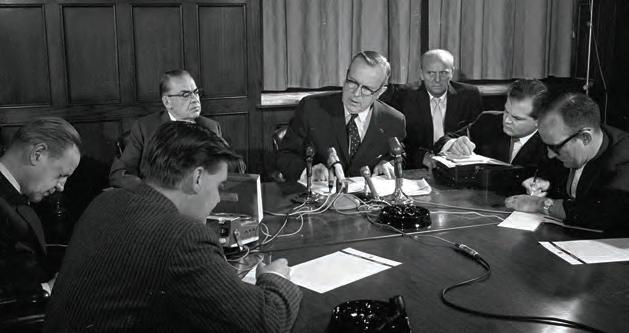
as Liberal leader and Pearson took on the job in January 1958. He called on Diefenbaker to resign.
Instead, Diefenbaker called an election for March and won a decisive victory. Though tempted to throw in the towel, Pearson was encouraged to stay on as Liberal leader, which he did, both then and again after the Conservatives formed a minority government in 1962.
Diefenbaker’s popularity, however, had been slipping since 1958 when he signed an agreement to base 56 American anti-ballistic Bomarc missiles in Canada. In 1959, he cancelled the Avro Arrow project, believing missiles were the future of defence. Plus, the project was too expensive. Then in 1960 it was revealed the Bomarc missiles would be armed with nuclear warheads. It was a political powder keg. One side said nuclear weapons met the country’s defence obligations, the other argued nuclear weapons should never be allowed in Canada.
The issue reignited in October 1962 when Diefenbaker hesitated in immediately backing the U.S. in its standoff with the Soviets over building missile-launch sites in Cuba. The Soviets backed down,
Prime Minister Lester Pearson holds press conferences in 1963 about nuclear arms for Bomarc missiles (left) and in 1964 to introduce the Canadian flag (right).
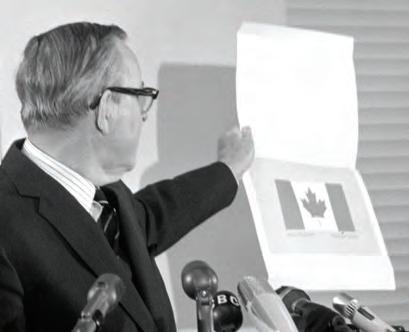

but the Cuban Missile Crisis caused political fallout in Canada.
Diefenbaker’s defence minister resigned over the situation. Nuclear weaponry became a key issue in the 1963 election. Pearson supported nuclear warheads for Bomarc missiles and for providing nuclear weapons to Canadian troops in Europe.
Meanwhile, many voters wanted Canada to be more socially progressive. And many Quebecers wanted the province to separate from Canada, with the bombings of mailboxes in Montreal showing some were willing to support that perspective violently.
In 1960, the Liberal Party had invited 200 economic and social leaders to propose innovative reforms. Many of those ideas were adopted at a policy convention in 1961, easing the way to a Liberal minority government in 1963 and again in 1965.
To achieve his legislative agenda, Prime Minister Pearson relied on the support of the New Democratic Party, led by Tommy Douglas, former premier of Saskatchewan, which had implemented provincial medicare in 1962.
“The process...was not one of trade-offs but of finding common ground,” wrote former Pearson advisor Tom Kent in a 2009 article. That was well within Pearson’s wheelhouse.
Tax-sharing agreements and opting-out provisions with provinces plowed the furrow for rooting expensive social programs such as the Canada Pension Plan and medicare.
Consequently, “the public pensions that had first been greeted with a storm of protest came into being with hardly a dissent,” wrote Kent.
But dissent was threatening the fabric of the country.
“My passionate interest when I was in government...was in the national unity of our country,” Pearson said in his memoirs.
Pearson spoke only English, but he didn’t need a second language to
“ My passionate interest when I was in government...was in the national unity of our country. ”
understand the separatist discourse in Quebec. He recruited prominent Quebecers, including future prime minister Pierre Trudeau, to help shape federal policy.
The Royal Commission on Bilingualism and Biculturalism paved the way for the Official Languages Act in 1969 and, subsequently, multiculturalism policy.
Pearson wanted Canadians to feel like citizens, not British subjects, with their own national symbols, beginning with a national flag to replace the Canadian Red Ensign, the country’s de facto flag, which included a British Union Jack and the shield of Canada on a red background.
The motion for a new flag went before Parliament in June 1964. The Great Flag Debate has been called the ugliest dispute in Canadian Parliamentary history, and it raged on until December, when closure was invoked. But it was approved by a vote of 163 to 78.
The Maple Leaf was first raised on the Peace Tower on Feb. 15, 1965.
“Under this flag may our youth find new inspiration for loyalty to Canada; for a patriotism based not on any mean or narrow nationalism, but on the deep and equal pride that all Canadians will feel,” said Pearson.
“Pearson was making Canada more Canadian,” Andrew Cohen wrote in Extraordinary Canadians: Lester B. Pearson.
But at the time, Pearson was criticized as a leader.
Pearson’s years as prime minister “vibrated with action and creativity...and state activism on a breathless scale; yet scandal, bitter
partisanship and a chaotic air of crisis management undermined accomplishments and threatened to sweep them from memory,” wrote Norman Hillmer in the introduction to Pearson: The Unlikely Gladiator.
“Pearson frequently fails to show the kind of sternness that a leader should have,” wrote journalist Fulford, noting Pearson could never offend anyone. He “will never be either a radical social reformer or an emotional spellbinder.”
Yet in just five years, Pearson’s government transformed Canada, establishing its social security net.
His government ordered a royal commission on the status of women, introduced loans for students and equalized access to welfare. It established the 40-hour work week, two weeks’ vacation time and a new minimum wage.
A points-based, race-free immigration system was instituted; liberalized laws on divorce, abortion and homosexuality were introduced; regulatory agencies were established for communications and transportation; funds were created for rural development; and the stage was set for the unification of the armed forces.
“In no other five years was so much done to improve the circumstances of life for Canadians with average and lower incomes,” said Pearson aide Kent.
Pearson enjoyed the exuberance of Canada’s centennial celebrations, then announced his retirement in December 1967.
“You can call me Mike now,” he said to journalists at a news conference.
Mike Pearson died of cancer in December 1972. L
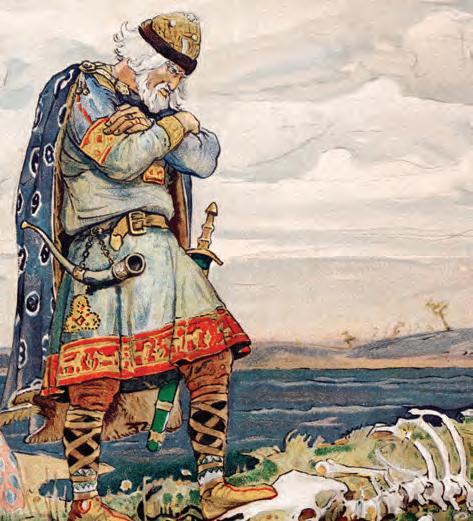
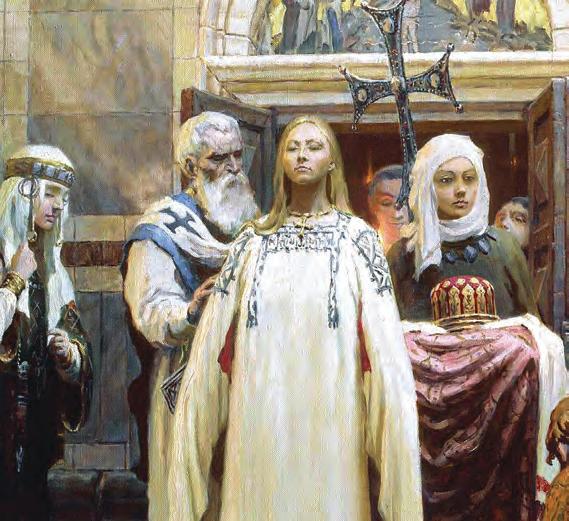

THE LONG AND COMPLEX HISTORY OF THE INDEPENDENT STATE PROVIDES CRITICAL CONTEXT TO RUSSIA’S “SPECIAL MILITARY OPERATION”
By Serhy Yekelchyk

When Russia began a fullscale invasion of Ukraine in the early morning hours of Feb. 24, 2022, Western experts were puzzled about Russia’s strategy. It seemed obvious that the roughly 200,000 Russian troops amassed along the Ukrainian border would not be sufficient to conquer and control all the country, a nation about the size of France and with a population of some 44 million. Russian tactics during the first phase of the war also seemed unequal to the task. The plan


involved landing paratroopers on an airfield near the Ukrainian capital, then attacking strategic targets in Kyiv with small groups of lightly armed, mobile infantry. This gambit seemed to assume that taking control of the Ministry of Defence and the presidential administration buildings would cause Ukrainian defences to disintegrate. The bulk of the Russian forces could then be used to extinguish the remaining “hotbeds of resistance” in central Ukraine and isolate the western provinces.
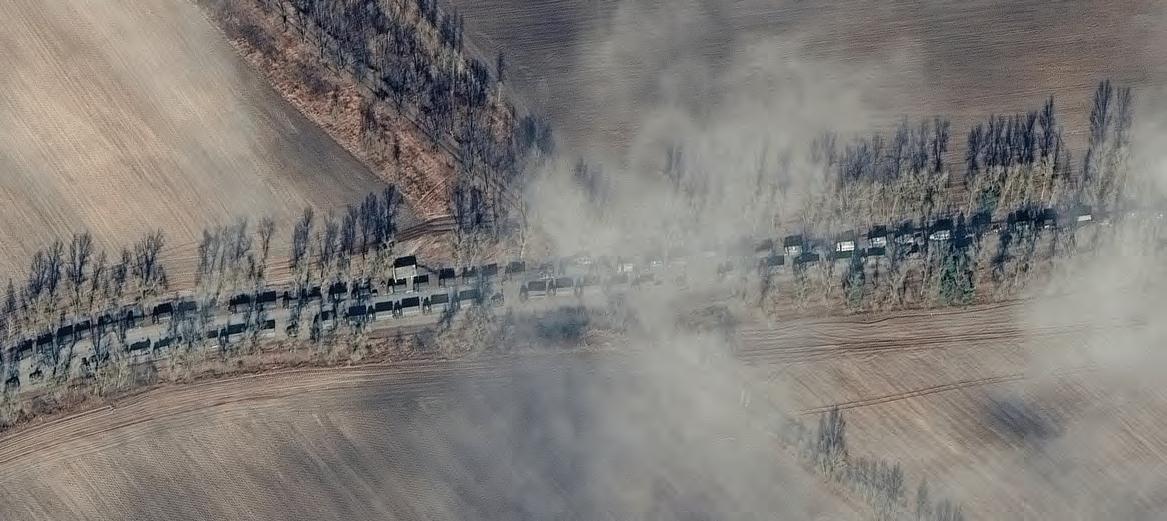

Such a campaign was clearly based on a Russian perception of Ukraine that diverged from that which was understood by Westerners and Ukrainian authorities.
Now that the original Russian war plan has failed, it is valuable to consider what Russian President Vladimir Putin and his advisers misunderstood about Ukraine.
On the morning of the invasion, Putin gave a rambling televised speech that was unlike anything heard in Europe since the Second World War. He said that Ukrainian territory was historically a part of Russia, repeating a stance he had taken in a speech three days earlier. In that address, Putin also said, “Ukraine is not just a neighbouring country. It is an inalienable part of our own history, culture and space.”
Putin’s denial of Ukraine’s legitimacy as a nation or culture is important background information for those who see his army’s alleged war crimes during the conflict as genocide. For centuries, these two arguments have been recurring themes in RussoUkrainian relations. The imperial narrative, which Putin has reinterpreted, obscures and rewrites the complex history of the region.
At the dawn of the Ukrainian and Russian histories, the power relations in the region of Eastern Europe that the two countries now occupy did not benefit the latter. It was Scandinavian warriors and traders known as Rus' (pronounced “roos”) who, in the ninth century, created the first known state in the area centred around Kyiv. Within a century, the distinction between the Norse and the local Slavs disappeared as elites of the two groups intermarried and began adopting Slavic names.
Kyiv, on the western bank of the Dnipro River that connected the Scandinavian and Mediterranean regions, prospered as the trade and administrative capital. Medieval Slavic literati called this country— then Europe’s largest—Rus' land, and later historians referred to it as Kyivan Rus'.
In the late ninth century, Kyiv adopted Christianity from the Byzantine Empire, but the separation between Eastern and Western Christianity was not yet set in stone and the grand princes of Kyiv freely intermarried and built military alliances with other European states.
In the 12th century, the gradual migration of the Rus' to the northeast saw the territory’s border move to where Moscow now stands,
helped lay the foundation for the first known state centred around Kyiv. Princess Olga of Kyiv (opposite right) was an early ruler of Kyivan Rus', as the state became known. A large convoy of ground forces moves toward Kyiv days after Russia’s invasion of Ukraine.
claiming the area from the local Finno-Ugric tribes. The settlement in the area was likely just a small fort with a wooden stockade.
The late, prominent Ukrainian historian Mykhailo Hrushevsky compared the relations between Kyiv and the northeastern frontier to the connections between ancient Rome and its Gaul provinces in present-day France. Modern Russian historians have struggled to reject the political and cultural superiority of medieval Kyiv. Putin, too, won’t acknowledge that the “mother of all Rus' cities,” as the Primary Chronicle, a history of Rus' land from about 850 to 1110, called Kyiv, is now the capital of Ukraine.
As Kyivan Rus' expanded, the grand princes of Kyiv granted their brothers and sons new areas, which eventually grew more autonomous and established their own dynasties.
When the Mongol army arrived at the borders of Rus' in the 13th century, the Rus' princes’ defence was easily overcome. On Dec. 6, 1240, the Mongols broke through the Kyiv walls and laid
waste to the city. Kyivites not killed were enslaved, and a fire destroyed most of city’s wooden buildings.
In Ukrainian history, the fall of Kyiv is seen as a tragedy and its date remains a meaningful reference for Ukrainians today; its anniversary is marked publicly, and commentators often compare subsequent calamities, including very recent ones, to that infamous catastrophe.
The Mongol conquest is interpreted very differently in Russian history. The princes of Moscow grew to prominence under Mongol rule. They were faithful subjects of the Mongol khans and their
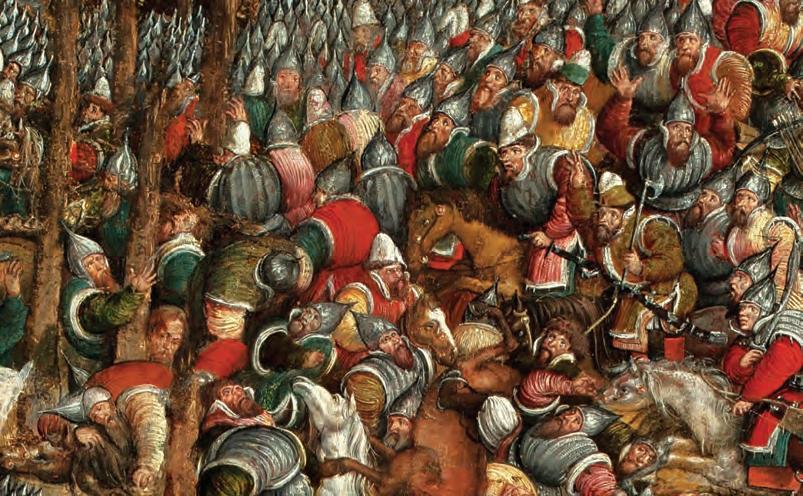

efficient tax collectors. The title czar, or tsar (from Latin Caesar for emperor), was originally applied to the khan before any Muscovite prince dared claim it for himself.
In the 20th century, some Russian political thinkers argued that the Russian tsars and Bolshevik commissars inherited the historical mission of the Mongol Empire, which they interpreted as controlling the vast land spaces of Eurasia stretching from Eastern Europe to the Pacific. Some scholars say Putin and his advisors are directly influenced by such Eurasianist theories.
By the 15th century, the Mongol authority was in decline and the Rus' lands were divided between the Grand Duchy of Lithuania in the west and the Principality of Moscow in the east.
One hundred years later, Lithuania formed a constitutional union with Poland to create the Polish-Lithuanian Commonwealth, with most of the Rus' lands reassigned to its Polish part. Its residents, who called themselves Rusyns, became familiar with European political concepts, including the rights and freedoms of the ruled, which were protected by a social contract with the rulers.
Residents could study Latin at European universities. And Rusyn princes and nobles could reach the highest ranks in the Polish-Lithuanian army, as Prince Kostiantyn Ostrozky did in the 16th century. He served as the supreme military commander of Lithuania and in 1514 defeated Moscow’s 80,000-strong army in the Battle of Orsha (the 30th Mechanized Brigade of the Ukrainian army is now named after him).
The Rusyns, however, remained committed to Eastern (Orthodox) Christianity, which separated them from the Catholic Poles and Lithuanians. Ostrozky’s grandson funded the printing of the first complete Bible in Old Church
Slavonic and founded a college for Orthodox Rusyns. Of course, they had this religion in common with the Muscovites, who otherwise had very different political and cultural views.
The grand princes of Moscow and, later Muscovite tsars, saw themselves as absolute rulers who “owned” their entire domain, including its subjects. Moscow also rejected Latin learning as heretical, segregated upper-class women and isolated foreigners in special residential blocks. It took a major social crisis in the Polish-Lithuanian Commonwealth, where the Rusyn peasants resisted the spread of serfdom to push them toward the Muscovites. By the 17th century, many Rusyn noble families in the Commonwealth—including Ostrozky’s great-grandson— converted to Catholicism and assimilated into Polish culture.
Growing social and religious discontent led peasants to flee the southern steppes, where frontier guards called kozaky (Cossacks) protected Poland from Ottoman and Tatar raids. Cossacks were known throughout Europe as a formidable, if sometimes unruly, cavalry that was credited with saving Poland from the immense invading army of Sultan Osman II during the Battle of Khotyn in 1621.
In 17th-century Ukraine, the Cossacks also came to see themselves as protectors of the Orthodox faith and Rusyn people. Their leaders, called hetmans in the Polish tradition, were statesmen as well as generals.
In 1648, with social and religious tensions rising, a Western-educated Cossack officer named Bohdan Khmelnytsky launched a massive uprising against Polish rule and proclaimed himself a hetman. Peasants joined en masse, claiming the status of the Cossacks and the personal freedoms that came with it.

A skilful military leader and diplomat, Khmelnytsky engaged in a prolonged and violent war with Poland. This eventually resulted in the king granting full autonomy to the three Ukrainian provinces constituted as the Hetmanate—a semi-military civil government divided into regiments and headed by an elected hetman By 1654, Khmelnytsky was forced to seek an ally in Russia. Tsar Alexis agreed to accept
the Ukrainian Cossacks “under his hand,” the exact meaning of which is still disputed by historians. Regardless of the accord’s interpretation, it started the gradual process of the Russian influence in Ukrainian lands.
During the reign of Catherine the Great in the late 18th century, the Russian Empire dismantled the remnants of Cossack autonomy. The country’s last empress regnant gave explicit instructions to erase any administrative and cultural differences between Russia and Cossack Ukraine, which imperial bureaucrats called “Little Russia.” Catherine forced the last hetman to retire in 1764, and the Russian army destroyed the Cossack stronghold of Zaporozhian Sich on the lower Dnipro River in 1775. The families of many Cossack officers assimilated into the Russian nobility. Some, however, eventually began to imagine the Ukrainian nation on a new foundation—that of the peasant language and customs. Like elsewhere in Europe, ethnicity
A painting depicts the Battle of Orsha, where Moscow troops were defeated in Rus' land, part of present-day Belarus, in 1514 (top), while another work shows frontier guards, known as Cossacks, in what is now Ukraine standing their ground to an ultimatum from the Ottoman Empire in the late 17th century (below).
came to define modern nationalism in Ukraine, here in the form of the folk songs and embroidered shirts of peasant serfs and the memories of the Hetmanate. Modern ethnic identity in Ukraine has another dimension, too. The Hetmanate did not include all the former Rus' lands; Poland also retained significant territories, where ethnic Ukrainian peasants constituted a majority. And the Ukrainian Cossacks who distinguished themselves at the Battle of Vienna in 1683—the last Ottoman attempt to conquer central Europe—came from that part of Ukraine, west of the Dnipro.
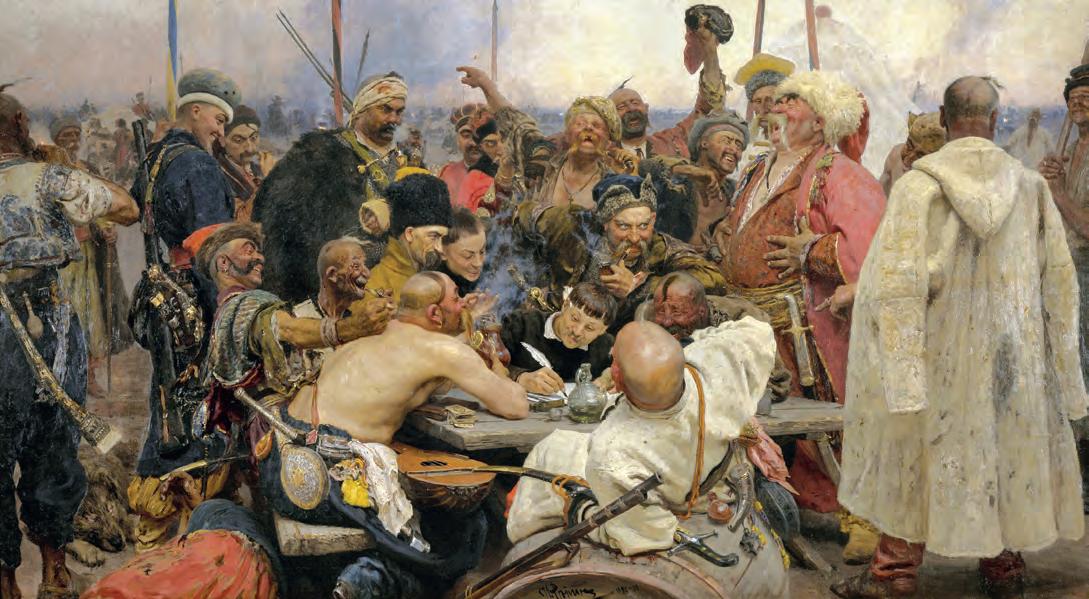
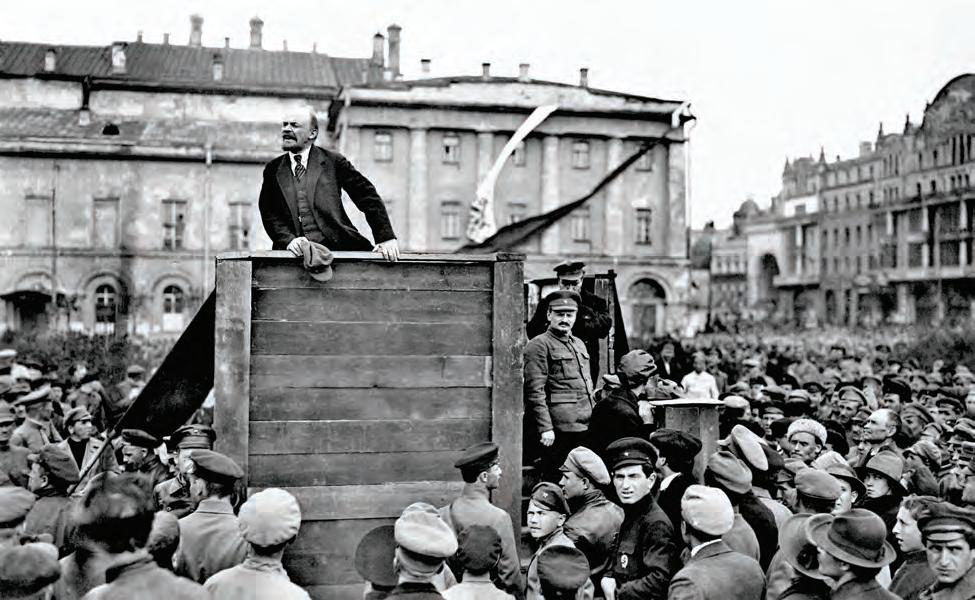
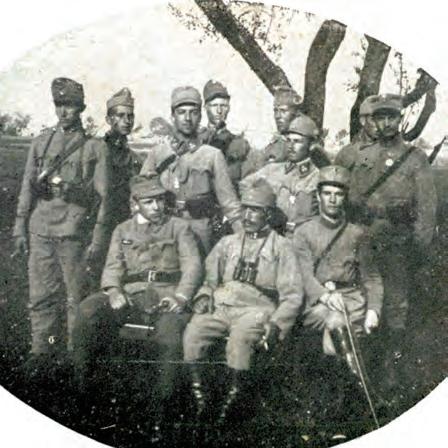
While Catherine II had managed to see Russia take the largest chunk of these lands during the partitions of Poland in the late 18th century, some westernmost Ukrainian lands ended up in the Habsburg Empire. That monarchy referred to Rusyns as Ruthenians, a term derived from Latin, and allowed them much greater cultural and political freedom.
Beginning in the 1860s, Ukrainian intellectuals in the two empires established close contacts, at first based on their mutual admiration for the national bard Taras Shevchenko, a renowned poet active in the first half of the century who had been born a serf.
The notion of ethnic unity between Little Russians and Ruthenians informed the first maps made of Ukrainian ethnolinguistic territories in the 1870s. By the turn of the last century, patriotic activists in both regions began calling themselves “Ukrainians” and some embraced the idea of a united and independent Ukraine.
The First World War would give Ukrainians a chance to build their state. In the decades leading up to
the conflict, the Russian Empire continued to deny that Ukrainians were a separate ethnic group—a stance recently revived by Putin. Russia also banned Ukrainianlanguage publications. Conversely, in the Austro-Hungarian Empire, Ukrainians were recognized as one of 11 main ethnic groups and were politically active. But that was the extent of Ukrainian autonomy.
The war changed all that. The Habsburg commanders allowed the creation of a Ukrainian volunteer unit, the Ukrainian Sich Riflemen. Meanwhile, Ukrainian political activists shared lectures about the right to national selfdetermination with Ukrainian PoWs in German camps. And while Russia didn’t allow ethnic Ukrainian units until 1917, its earlier acceptance of Czechoslovak and Polish legions legitimized the ethnicization of the war. Both Russia and Austria also distinguished the ethnicity of the enemy, which only reinforced the concept.
Soviet leader Vladimir Lenin, who acknowledged Ukrainian nationalism in the early 20th century, gives a speech in Moscow in 1920 (above). During the First World War, the Habsburg Empire allowed the creation of the Ukrainian Sich Riflemen volunteer unit (inset).
The collapse of the Russian monarchy in March 1917 ignited mass enthusiasm for the creation of Ukrainian units. The army command had no choice but to approve them, just as the Russian Provisional Government had to accept the autonomy of the Ukrainian People’s Republic.
In 1918, the republic was briefly replaced with a monarchy under hetman Pavlo Skoropadsky, a Russian general of distant Ukrainian lineage. But the republican forces returned in December.
The Habsburg Empire had also collapsed by then, and another Ukrainian republic sprang up in the western region of the presentday country. The two republics united in a solemn ceremony in January 1919. Independent Ukraine, however, didn’t survive beyond 1920 because the Allies refused to support it, preferring to either restore Russia or enlarge Poland. The Bolsheviks, ultimate winners of the Russian Civil War,


RUSSIA’S DENIAL OF UKRAINE’S RIGHT TO INDEPENDENCE—OR EVEN ANY CULTURAL
starvation”). The Holodomor truly ended the period of Ukrainian revolution that had begun in 1917.
had little choice but to create their own puppet Ukrainian republic, later part of the Soviet Union.
Then Soviet leader Vladimir Lenin acknowledged the strength of Ukrainian national feeling, as well as the new international order in which nation states were becoming the norm. Granting Ukrainians a republic within the Soviet Union was an inventive way of keeping them within the reconstructed Russian Empire. This step was unavoidable after the independent Ukrainian republic emerged in 1917, then claimed its authority over all Ukrainian ethnographic lands.
During the 1920s, in an effort to make the Soviet Union more worldly and to mobilize political support within the country, the Bolsheviks supported Ukrainian cultural development and social advancement. That period ended, however, within a decade as Soviet leader Joseph Stalin engineered a massive famine that killed some four million peasants in the early 1930s. The secret police also arrested and executed leading Ukrainian cultural figures.
Together, these events in 1932-33 are considered by Ukrainians as part of a genocide called the Holodomor (literally translated from Ukrainian as “murder by
By August 1939, when Stalin and Adolf Hitler signed the MolotovRibbentrop Pact to divide Poland, Ukraine (then officially known as the Ukrainian Soviet Socialist Republic) was firmly under the Soviet dictator’s control. When the Red Army stormed Poland from the east following the Nazi invasion from the west in September, Stalin claimed he was liberating large parts of eastern Poland in the name of Soviet Ukraine. While he encountered the radicalized successors of the original Ukrainian nationalists, they were ruthlessly repressed.
The Ukrainian experience of the Second World War was therefore inherently complex. Most Ukrainians were either fighting Nazism with the Red Army or
supporting loved ones doing so. This meant rooting for the victory of one dictatorial regime over another. Hitler planned to make Ukrainians slaves to German masters. They were to be denied medical care and education beyond elementary school. The Nazis starved Ukrainian cities—claiming the provisions were needed for their army and the Reich—and millions of Ukrainians were sent to Germany as slave labourers.
Nevertheless, the Organization of Ukrainian Nationalists (OUN) at first hoped that Hitler’s violation of the Treaty of Versailles would benefit them. Those hopes ended on June 30, 1941, when Germanled forces captured Lviv. When the OUN attempted to declare Ukrainian independence in Lviv, the first major city taken from the Soviets, the Germans arrested the leadership of the group’s largest wing, the Banderites, and began killing its supporters.
Some Banderites had been working as police in occupied Ukrainian territory and participated in the Holocaust and other Nazi war crimes, as Putin has highlighted. Likewise, the smaller wing of the OUN, the Melnykites, helped create the German 14th SS Volunteer Division “Galicia” in 1943, ostensibly for local defence from advancing Soviets. The Nazis, however, did not allow the term “Ukrainian” in the division’s name. They also never made peace with the Banderites, who formed the Ukrainian Insurgent Army (UPA) in 1943 to fight both the Nazis and the Soviets.
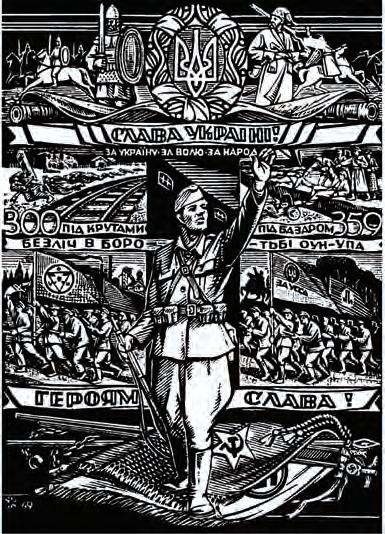
A propaganda poster for the Ukrainian Insurgent Army, which formed in 1943 to fight both the Nazis and the Soviets, includes the phrase “Glory to Ukraine — Glory to (her) Heroes.”
After Ukraine regained its independence in 1991 following the fall of the Soviet Union, the country acknowledged two trends in antiNazi resistance: one pro-Soviet, the other nationalist. Because the Nazis had occupied all of Ukraine, modern Ukrainian school textbooks frame the Second World War as a tragedy, which included limited Ukrainian collaboration. The Holocaust is an important part in the Ukrainian story of the war, as well as in state ceremonies and memorials unveiled or under construction.
This interpretation has produced commemorative practices increasingly at odds with Sovietstyle celebrations of the state’s military might. In 2015, Ukraine established May 8 as the Day of Remembrance and Reconciliation; it also adopted the Western remembrance symbol of the poppy and the motto, “Never again.”
In contrast, Putin’s Russia has continued the Soviet tradition of the “Great Patriotic War” with massive parades on May 9 (Victory Day, Moscow-time). The story of widespread Russian collaboration with the Nazis and the Soviet Union’s alliance with Nazi Germany between 1939 and 1941 is suppressed. Russian historians and diplomats dismiss the Red Army’s war crimes, such as the mass rape of German women, as “fake news.”
The role of the Western Allies during the time is minimized in Russian school books, and Stalin is still given credit for the victory, which explains the consistently high opinion of him in Russian polls. This narrative of the war serves to legitimize Putin as a new dictator who is not only employing Stalinist methods but, ironically, also repeating some of Hitler’s miscalculations.
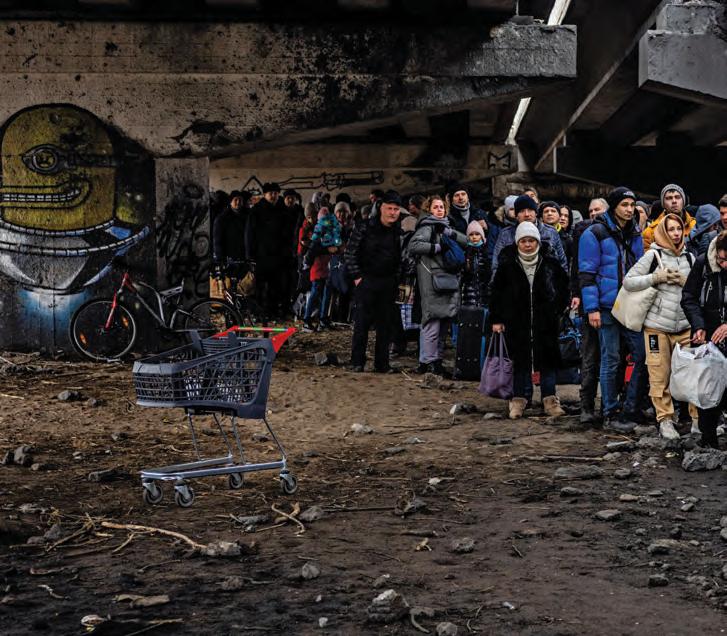

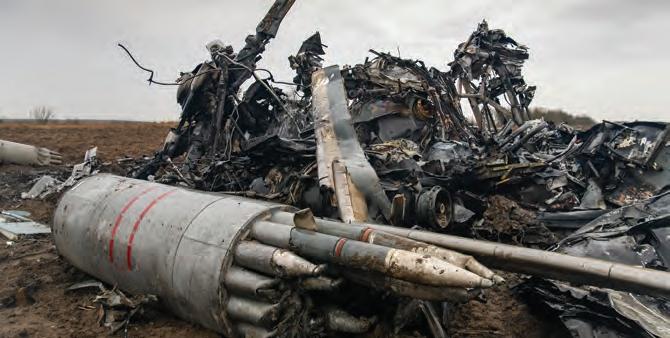
Just as Hitler believed that the Soviet Union was a weak state run by “Judeo-Bolsheviks” that would collapse the moment his armies attacked, Putin, it appears, believed Ukraine was run by Nazi nationalists whose authority would disintegrate the moment Russian helicopters dropped a small landing party of paratroopers in Kyiv. Of course, neither the Jewish identity of Ukraine’s President Volodymyr Zelenskyy, nor the stance of his Servant of the People political party, fit the description. Putin seems to have modelled his “special military operation” in Ukraine on the Anschluss,
the 1938 annexation of Austria by Germany. On March 12, the Germans invaded. The following day, a Nazi government was established, and Hitler proclaimed the union of the two countries.
Today, however, the 1930’s rules of ethnic politics no long apply. Modern nations, rather, are multiethnic, political communities held together by shared ideas rather than blood and race. So, when a quick victory failed to materialize, Putin’s forces applied more firepower and pushed the legal limits of war to their extremes—at least one Russian pleaded guilty to war crimes and numerous other unlawful incidents
Citizens flee the city of Irpin, northwest of Kyiv, in March 2022 following the Russian invasion of Ukraine. The seemingly overmatched Ukrainian army has relentlessly defended the country’s independence, manifest by scenes such as this downed Russian military helicopter (below).
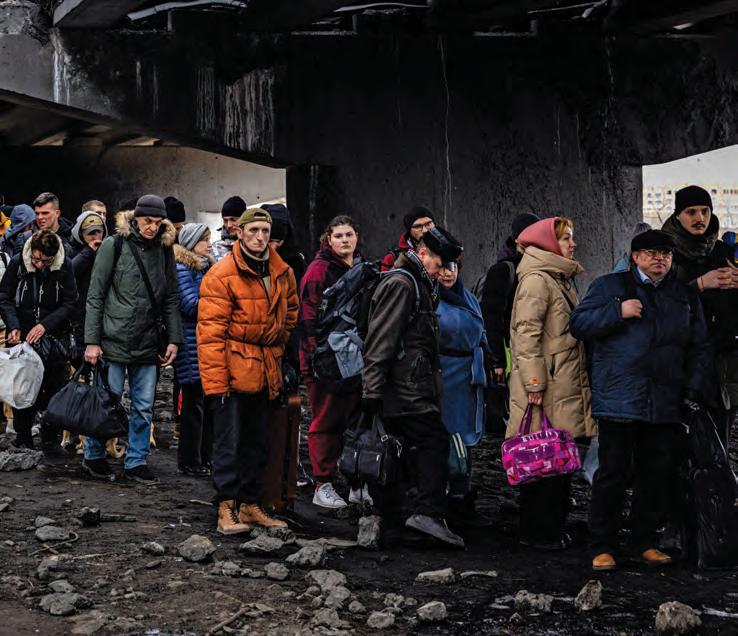
are under investigation. Some Western leaders have labelled some of Russia’s actions genocide.
Russian attitudes toward Ukraine are not only grounded in the distant past and fuelled by imperial nostalgia—they have also been shaped by relatively recent events. After the Second World War, the Soviet Union faced a staunch insurgency from Ukrainian nationalists in western regions that continued until the early 1950s. That era gave rise to Soviet propaganda framed around the idea of Nazi Ukrainians—not just UPA fighters, but any patriotic Ukrainian. Putin has revived this notion.
Ironically, one of the reasons the Soviets transferred the Crimean Peninsula to Ukraine in 1954 was to make the country more Russian. However, historically, the Crimea is neither Ukrainian nor Russian. It was the homeland of the Crimean Tatars, whom Stalin had deported in 1944. It was postwar settlers moving into deserted Tatar homes that made the Crimea “Russian.”
Likewise, the ethnographic model of national identity that developed in Ukraine after the Second World
War reinforced Russian cultural attitudes of superiority. Then, after the collapse of the Soviet Union, the state-abetted cultural assimilation in Ukraine led outsiders to assume that all Ukrainians spoke Russian, with Ukrainian heard only in villages and in “nationalistic” western regions. Ukrainian identity was characterized by dancing and folk songs, rather than by its democratic institutions and multi-party political system.
The difficult post-Cold War economic transition fuelled nationalist resentment in Russia and among Russians in the Crimea. The loss of each Soviet republic was a blow to Russia’s imperial pride, but Ukraine’s departure hit hardest because it challenged both Russia’s historical greatness and its undeveloped sense of ethnic identity which, for many, included Ukrainians. The bitterness was directed at Ukraine.
While Russia’s economy flourished in the new century thanks largely to its mineral wealth, having no similar resources Ukraine’s continued apace. And as Russia crept toward authoritarianism, Ukraine was viewed as politically
chaotic—though it really was democratic. This is, perhaps, the most underappreciated reason behind the Russian invasion.
Russian economic prosperity coincided with the tightening of political controls and the rise of Putin, whereas Ukraine has remained a democratic state where presidents have changed regularly. Ukraine also has a robust civil society, which twice in the 21st century has rebelled against attempts to impose Russian-style authoritarian rule—during the Orange Revolution (2004-05) and the Revolution of Dignity (2014). Between these two events, Russian authorities also focussed on suppressing 2011-12 protests within Russia against Putin’s continued rule. Putin claimed the protests within Russia were Western-sponsored and inspired by the Ukrainian example.
Following the 2014 revolution, which saw the ousting of President Vikor Yanukovych, who had pursued closer ties with Russia, Russia annexed the Crimea and sponsored the war in Ukraine’s Donbas region near the Russian border. The aim was to punish Ukraine and teach Ukrainians a lesson. Russianbacked separatist rebellions in other eastern Ukrainian regions didn’t work, thus depriving Russia of a land bridge to the Crimea. Russian troops performed reasonably well, however, against the underfunded Ukrainian army in the Donbas. To Putin, this confirmed the inferiority of Ukrainian identity.
But the setbacks Russia has encountered during this year’s invasion—tens of thousands of troops lost, more than a dozen generals dead, its flagship Black Sea warship sunk—revelaed Putin’s error. A notion of Ukraine as a democratic, political community is animating this struggle. Putin dismissed the power of democracy at his peril. L
WW I: The war that shaped a nation
It was supposed to be the war to end all wars but the Great War was the most brutal era in Canadian history.
Battle of the Atlantic
The Royal Canadian Navy played a pivotal role in this critical campaign, which raged on open and treacherous seas from September 1939 to May 1945.

O Canada: The history of our home and native land
O Canada tells our story from First Peoples through to our achievements in space. Intro by Canadian comedian and author Rick Mercer.

Twenty-five great Canadian aviators From early birds to astronauts, every one of these nationally celebrated and lesser-known flyers has made important contributions to Canada’s aviation heritage.
Vimy: The birth of a nation
The hard-fought WW I Battle of Vimy Ridge is sometimes called “the birth of the nation.” In April 1917, the Canadian Corps fought together for the first time and achieved success where others had failed.
*Conditions apply. 40% off back issues expires October 31, 2022.
The Somme The Somme examines the role of the Newfoundland Regiment and the Canadian Expeditionary Force in the monumental First World War battle that took place in France from July 1 to Nov. 18, 1916.

The Royals: The fight to rule Canada**
Everything you need to know about Canada’s royal heritage from the earliest kings and queens who dispatched explorers to the New World to the modern British monarchy.
Victoria Cross
The most famous decoration for courage in the Western world, the Victoria Cross has been awarded to dozens of Canadians and the lore behind the VC is sprinkled with strange and heartwrenching stories.
War
showcases the stunning images and rare photos from the men and women who went into battle with only a camera.

World War I: True stories from Vimy to victory
More compelling stories from the First World War are told in memoirs by surviving Canadian soldiers.
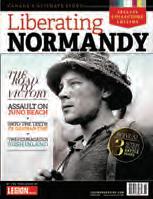
Liberating Normandy: The road to victory
The Battle of Normandy was the beginning of the end of the Second World War in Northwest Europe.
from the
When the First World War started in 1914, Canada’s population was less than 8 million, yet more than 620,000 enlisted. Many of the surviving soldiers share their stories in this special issue.
Passchendaele: Canada’s brutal victory
The Canadian Corps was thrust into a battlefield of mud and craters to help Allied forces in the Battle of Passchendaele— Canada’s third major victory of 1917.
Canada’s Ultimate Story engages readers with captivating stories of Canadian events and fascinating people from our earliest days to present times and editions are filled with little-known facts and trivia relating to our great country.
Canada and the Great War: The battles
From Ypres in April 1915 through to the Hundred Days campaign, Canadian soldiers experienced one fierce ground battle after another.


Crime: Canadian style
Take a trip to Canada’s seedy underbelly and meet the perpetrators of some of the country’s most notorious felonies and misdemeanors.
Experience a
Canada and the Second World War: The battles
Canadians played pivotal roles in many of the most important and costly conflicts of the Second World War. Includes large battle map.
D-Day: The free world fights back
It was the spring of 1944 and the Allies could not wait any longer. British, American and Canadian forces would land on five beaches on France’s Normandy coast in the early hours of June 6, 1944.

Canada and the Victoria Cross
No one ever set out to earn a Victoria Cross, which is awarded for “valour in the face of the enemy.” They were mostly spontaneous acts in the heat of battle. Of 98 Canadian recipients, 36 received their award posthumously.
The march to victory: Canada’s final 100 days of the Great War
The Canadian Corps fought several great battles before Germany surrendered, ending “the war to end all wars.”

O Canada: Discover your land Big land, bigger oceans, huge mountains, wide waterways and wildlife wilderness—Canada offers breathtaking vistas in every direction. Intro by Canadian comedian Cathy Jones.
Canada’s great naval battles
The sea brought explorers, colonizers and navies from Europe to North America— as well as rivalries and wars. Join naval historian Marc Milner as he retraces Canada’s history—all from a nautical perspective.

O Canada: The best of everything
Find out what really makes our country tick. Packed with Canadian people, places, wildlife, cities, culture, feats and innovations. Intro by Canadian comedian Ron James.
John McCrae and the Battles of Flanders John McCrae—doctor, gunner and poet—was shaken by the battlefield death of a friend in May 1915, and wrote the poem “In Flanders Fields” in tribute. The poem remains today a renowned symbol of remembrance.

Canada and the brutal battles of the Somme
The Battle of the Somme lasted 141 days, from July 1 to Nov. 18, 1916. For the Canadian Corps, the Somme was a coming of age, setting the stage for their seminal victories to follow.
Battle of Ortona
Late in 1943, Canadian troops attacked the German-held Italian city of Ortona. In fierce fighting, Canada pushed up Italy’s east coast and prevailed.
1945: Canada and the end of the Second World War
The year 1945 started with a massive German bomber attack on Allied airfields. But the Allies soon pushed back and Canadian troops led the advance across Belgium and into the Netherlands. The end-game was at hand.
Canada and the Great War: Liberation
In the final five weeks of the First World War, Canadian soldiers liberated more than 200 cities, towns and villages in France.
“They were so glad to see us,” said one Canadian soldier, “they wept with joy.”
Early on June 23, 1812, British and American warships exchanged the first shots of the War of 1812. For the next two-and-a-half years, the two sides waged war. Towns and cities—the U.S. capital among them—were burned. Naval battles were fought on the Great Lakes. And heroes were born. The Americans thought taking Canada would be a cakewalk. It wasn’t.
Canada and the liberation of the Netherlands
From late 1944 to May 5, 1945, Canadian troops focused on the Netherlands, occupied by Germany since 1940. Canada liberated the Dutch, town by town, village by village.

O Canada: How Canada was shaped by war and peace
Since the First Peoples arrived on this continent, the place that would be called Canada has been shaped by conflict and co-operation. The impacts of war and the bounties of friendship echo through the story of Canada.

By July 1940, Europe had fallen under Hitler’s advance. Before the Luftwaffe could cross the English Channel, their pilots had to master the skies over Britain. British, Commonwealth and other pilots awaited them. “The Few” included 112 Canadians.
How Canada conquered Vimy Ridge
The Great War had been raging for nearly three years by the time the Canadian Corps captured Vimy Ridge in April 1917. Many historians consider this important battle a defining moment for Canadian troops and our country.
By Stephen J. Thorne
By Stephen J. Thorne
Trevor Oattes
Stephen J. Thorne

is a great paradox of war that a source of immeasurable heartbreak, suffering and loss has, over the centuries, inspired some of history’s greatest art and literature.
Disproportionate volumes of conflict-related works have been devoted to glorifying the sanctioned killing of people. The best, however, expose the rawness and futility of humankind’s greatest failings in ways that touch even those who might rather not confront war’s uniquely commanding ugliness and beauty.
Pablo Picasso’s Guernica, depicting the April 1937 bombing of a bastion of Republican resistance during the Spanish Civil War, is widely regarded by art critics as the most moving and powerful anti-war painting ever made.
Likewise, the John McCrae poem In Flanders Fields, written
on the Ypres battlefield in Belgium in 1915, is in its essence an exquisite anti-war protest, its opening words known the world over: “In Flanders Fields, the poppies blow/ Between the crosses, row on row…”
Each year, Royal Canadian Legion branches across the country sponsor poster and literary contests for students from primary school through high school, the winners of which advance to provincials, where the best are sent on to the national competition, judged and exhibited in Ottawa.
Inevitably, there are surprises, not just in the technical talents of the artists and writers, but in the depth of perspectives that emerge from big cities, small towns and isolated villages in the farthest corners of this vast country—insights that transcend the youth and experience of their creators and move and challenge the public.


Rachel Graham, a 16-year-old high school student from Salmon Cove, a village of nearly 800 on the west shore of Newfoundland’s Conception Bay, put herself in the shoes of a soldier in mourning with My Friend, which won the senior poem category in 2022.
“In the fields where we once fought gallantly, the flowers now reside/but here I am forced to stand alone, without you by my
side,” she began. “Where once the sounds of warfare, unbearable to the ear/is now a deafening silence, of you not being here.”
Her thoughtfully crafted words took the sweeping scale of war to its simplest, most relatable level: the loss of a friend—youthful innocence and naïveté confronted too soon by a profound pain that all of us will eventually know in one way or another. Graham
INTERMEDIATE POSTERS FIRST PLACE
The winning intermediate black and white poster by Si Yan (Sam) Li of Langley, B.C., portrays a soldier afield reflecting on fallen comrades, while the winning intermediate colour poster by Elysa Goyette of Chicoutimi, Que., pays tribute to a diversity of modern-day force members.
SENIOR
Black and white poster—Yuet Leung, Markham, Ont.; Second: Yutai (Terry) Xie, Surrey, B.C.; Third: Heidi Boisvert-Dionne, Drummondville, Que. Colour poster—Eugena Lee, Calgary; Second: Madison Bradbury, Bay Roberts, N.L.; Third: Kangli Zhou, Vancouver Poetry—Rachel Graham, Salmon Cove, N.L.; Second: Sara Pluta, Port Hawkesbury, N.S.; Third: Alexander Friesen, Grande Prairie, Alta. Essay—Aarika Haque, Elrose, Sask.; Second: Lauren Hollett, Dildo, N.L.; Third: Katrina Lickiss, Barnwell, Alta.
Black and white poster—Si Yan (Sam) Li, Langley, B.C.; Second: Akeira Anseth, Cut Knife, Sask.; Third: Nancy Ge, Waterloo, Ont. Colour poster—Elysa Goyette, Chicoutimi, Que.; Second: Eva Rodioukova, Calgary; Third: Jiakang Xu, Maple Ridge, B.C. Poetry—Maya Baerg, Oliver, B.C.; Second: Aaron Christian, Red Deer County, Alta.; Third: Lily Jay, Mount Stewart, P.E.I. Essay—Kate Goodward, La Glace, Alta.; Second: Finn Campbell, Kelowna, B.C.; Third: Daniel Myers, Morell, P.E.I.
Black and white poster—Ella Ng, Calgary; Second: Suki Yang, Surrey, B.C.; Third: Clyte Angcaya, St. Brieux, Sask. Colour poster—April Ferner, Indian Head, Sask.; Second: Chloe Waldner, Newton Siding, Man.; Third: Leslie Yin, Waterloo, Ont. Poetry—Laura Bishop, Charlottetown; Second: Élia Bleu Voua, Mont-Carmel, Que.; Third: Jaxon Clarke, Old Shop, N.L., and Jana Timani, Moncton, N.B. Essay—Kaitlyn Dutrisac, Cavan, Ont.; Second: Olivia Knaus, Humboldt, Sask.; Third: Rowen Dunbar, Enfield, N.S.
Black and white poster—Alexander Gan, Kanata, Ont.; Second: Leah Van Grootheest, Surrey B.C.; Third: Pierze Stewart, Lumsden, Sask.
Colour—Khadijah Varteji, Maple, Ont.; Second: Emma Murray, Carbonear, N.L.; Third: Kathy Wang, Colonsay, Sask.
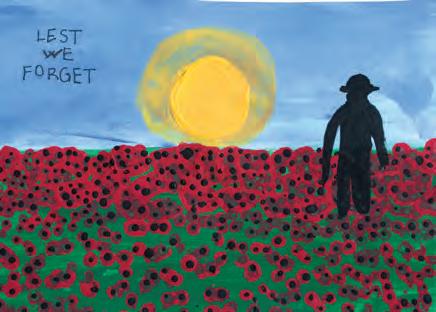
continued: “We did not know the hardships, that were waiting for us there/the war is so unforgiving, taking lives without a care.”
There are winners as diverse in origin as senior essayists Aarika Haque from Elrose, Sask. and runner-up Lauren Hollett from Dildo,
N.L., to the top junior and primary black-and-white artists Ella Ng of Calgary and Alexander Gan of Kanata, Ont., a suburb of Ottawa.
The majority of winners come from small- to mid-sized villages and towns with names such as La Glace, Alta., a village of about
200 residents where Kate Goodward produced the intermediate-winning essay, The Poppy, and Cut Knife, Sask. (population nearly 600), home to intermediate black-andwhite runner-up Akeira Anseth.
There are names from Charlottetown; Cavan, Ont.; Humboldt, Sask.; Mont-Carmel, Que., and Port Hawkesbury, N.S.—places where the Legion remains a central gathering place and a valued community resource devoted to good works.
The Legion National Foundation brings the senior winners to the national Remembrance Day ceremony in Ottawa, where they meet the Governor General and place a wreath on behalf of Canada’s youth.
Winners in the four categories—essay, poem, black-and-white poster and colour poster—from each of four divisions are exhibited at the Canadian War Museum in the nation’s capital for a year. Second-place finishers and honourable mentions are displayed on Parliament Hill in November. L
1-877-534-4666, or consult a command website. For years of archives, visit www.legionmagazine.com
Have you heard about the Additional Pain and Suffering Compensation (APSC) benefit?
Many veterans are aware of the Pain and Suffering Compensation (PSC), granted for service-related illnesses and injuries. It was introduced on April 1, 2019, under the Veterans Well-being Act.
The same legislation includes APSC. To qualify for it, you must have already received a PSC benefit from Veterans Affairs Canada and your illness or injury must have created a barrier to your life after service. It’s a tax-free, monthly benefit, payable for life.
When you apply, VAC will assess your entitled medical conditions, including your level of independent mobility and your need for help with everyday activities such as personal hygiene, to determine the seriousness of your impairment. There are three grade levels for APSC—with corresponding monthly amounts— grade one being for the most severe conditions. An in-person assessment may be required for grade one benefits. RCMP officers are eligible only if they also have served in the military. It’s also not applicable to veterans who served on or before April 1, 1947, or in Korea. In these
instances, veterans have compensation under the Pension Act. Also, Canadian Armed Forces members still in service can’t receive APSC until they’re released.
You can apply for APSC online through your My VAC Account or by calling VAC toll-free at 1-866-522-2122.
If you require assistance in gaining access to VAC disability benefits, or have a friend or family member who needs help, you can find a local command service officer at www.legion.ca/support-for-veterans/ contact-a-service-officer. Or call 1-877-534-4666 toll-free to speak to a service officer. L
By Aaron Kylie
late husband was a veteran and he received Legion Magazine,” wrote Maureen Anderson of Oromocto, N.B. “After he passed away, I just kept renewing it.”
We received many such heartwarming comments from readers of how the publication continues to keep them connected to family military service—among a wide range of other feedback—in our most recent reader survey.
Conducted earlier this year, the review received a great response, with 2,882 readers replying. Thank you. Your observations are critical to helping us continue to improve the magazine.
For example, several respondents were eager to see content that will help engage younger readers and newer veterans. We’ve ‘a lot’ of ideas and plans in place to address this in coming issues.
Survey respondents were entered into a draw for one of 10 prizes. The grand-prize winner was Kelly Mason, of Stittsville, Ont., who received a MacBook Air
> To read more comments from the survey, go to www.legionmagazine.com/ surveyresults22.
laptop computer (13.3-inch display and 256 GB). To see the full list of prize winners, visit www.legionmagazine.com/ readersurvey22.
We asked readers to rate subjects, features, columns and sections. Once again Remembrance led the way with a 95.5 per cent approval rating. It was followed closely by stories about Canadian military history (94.1 per cent) the Second World War and modern conflicts, the later duo both garnering a 93.4 rating.
Our columns “Canada and the new cold war” by J.L. Granatstein and “Eye on defence” by David J. Bercuson, which ranked fifth and seventh overall, saw the largest increase in ranking from our 2018 survey, jumping 17 and 7 spots respectively. Pictorials landed between those columns in sixth, all three in the 88 per cent rating range. The “News” section was rated at that level, too, followed closely by the “On this date” at 87.7 per cent. Overall, you gave Legion Magazine an 83.9 per cent approval rating.
In addition to helping us improve content, the survey’s responses provide our team with more information about a typical reader’s household. For instance, nearly half of you live in communities of 50,000 people or fewer. Nearly 46 per cent are veterans and almost 78 per cent are male. Legion Magazine readers are also avid travellers, with more than 90 per cent reporting they are planning a getaway in the next two years.
Perhaps most interesting to us, however, is the time you spend reading Legion Magazine— 85.6 per cent of you report perusing the publication for more than an hour; 38 per cent spend more than three hours with each issue.
Such information also helps us attract advertising, which is crucial to our economic success. Ad revenue helps keep the subscription price low, at only $9.49 per year.
All in all, the majority of comments we received were positive—words such as good, great, enjoy and love collectively appeared hundreds of times in your feedback. And your criticisms were constructive.
Many readers even thanked us for what we do. The gratitude, however, belongs to you—a magazine is nothing without its audience. Legion Magazine subscribers consistently show us one of those most critical of military values: loyalty. For that, we are truly grateful. L
Legion Magazine fills many gaps in our social and cultural history, besides reminding us of military operations of the past, present and commitments to the preservation of security and peaceful co-existence.
Duncan Matheson, Midland, Ont.
Legion Magazine provides a guiding light and comfort. Informative! Francis Kozina, Lévis, Que.
I love this magazine with all the historical stories. It really helps me, as the Legion
Chaplain, understand what our veterans have gone through in the past and today. Major Rick Robins, Melfort, Sask.
My older sister was in the air force. She bought my first Legion membership for my birthday when I turned 18. I have kept it current for 47 years. It helps remind me to honour my sister, father, uncles, great uncles and all who served in our military. Kim R. Bossenberry, Craik, Sask.
Continued on page 60
By Aaron Kylie
North Bay, home to the Canadian operations centre of Norad and a nearly 75-year air force history, hosted the 52nd Ontario Command Convention. On May 15-17, 387 accredited delegates holding 727 proxy votes gathered to elect new officers, debate resolutions and hear updates on provincial programs. Collaboration was a key theme, manifest in reports on various veterans’ programs and branch donations.
A remembrance ceremony at the Memorial Park cenotaph on First Avenue started the proceedings. Master of ceremonies and Local Arrangements Committee chair Sherry Culling recited the Act of Remembrance. Among those placing wreaths were Memorial (Silver) Cross Mother Jane Byers, Nipissing— Timiskaming MP Anthony Rota, past Ontario command president André Paquette, Colonel Richard Jolette, base commander of 22 Wing North Bay, Veterans Ombudsperson Nishika Jardine, Dominion First Vice-President Owen Parkhouse, Ontario Command President Garry Pond, Ontario Command Ladies’ Auxiliary President Debbie Olmstead and Indigenous veteran and Deputy Chief of the Nipissing First Nation Mike Sawyer. Delegates then moved to Nipissing University’s Robert J. Surtees
Student Athletic Centre, site of the convention, for the opening ceremonies. Peter Beaucage of the Nipissing First Nation conducted a cleansing ceremony and Chairman Ron Goebel welcomed delegates, who then heard from guest speaker Jolette of 22 Wing. The gathering then got down to its business agenda. Pond reported on several highlights from his three-year tenure, which largely coincided with the COVID-19 pandemic. He emphasized the work of Ontario Command’s homeless veterans program, which has helped more than 1,000 individuals to date, as well as Operation Service Dog, which pairs specially trained fourlegged friends with veterans in the province dealing with posttraumatic stress disorder (PTSD). Branches in Ontario donated $400,000 to the program in 2021.
“I feel so proud of the incredible job that our branches, our zones, our districts did, and how every single Legion member helped us get through COVID-19,” said Pond. “We’re not all the way through it yet, but my faith in The Royal Canadian Legion and our survival has been doubled because of your response to this challenge.”
In the Constitution and Laws Committee report, vice-chair Aubrey Callan presented a wide range of
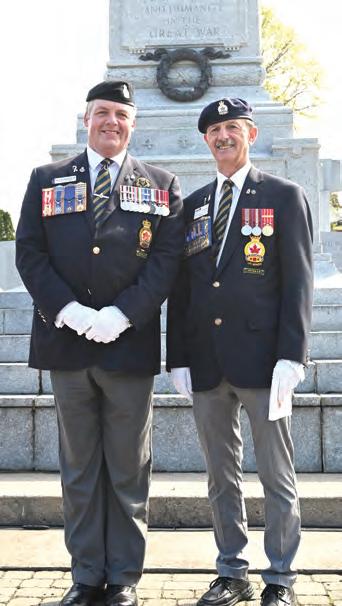
bylaw amendments, the vast majority of which were straightforward. One change, related to provincial command approval of branch clubhouse rules, however, generated much discussion. Many delegates expressed concerns about the rationale behind rejected branch policy documents. Pond ultimately promised the committee would look closely at the situation and fix it.
Terry Jacobs then presented both the Treasurer’s and the Ways and Means Committee reports. A reduction in expenses because of the close of normal operations connected to the pandemic allowed Ontario Command to reimburse two years of per capita branch fees equaling $11 per member per year, a total of more than $2 million. Jacobs noted that while the recent relaxing of pandemic restrictions has resulted in increased command activity, expenses remain below those budgeted. The Ways and Means Committee recommended no per capita increase over the next three years.
Pond presented the Membership Committee report on behalf of its chair Derek Moore, who was absent having had major surgery just days earlier. Membership in Ontario dropped by about 8,000 in 2021 to stand at 85,114. “This long-lasting COVID pandemic certainly didn’t
New Ontario Command President Derek Moore addresses convention delegates in a recorded video (below). Legionnaires gathered at the cenotaph in North Bay beforehand (right), where Dominion Vice-President Owen Parkhouse and outgoing Ontario Command president Garry Pond, among others, placed wreaths (opposite page, left to right).
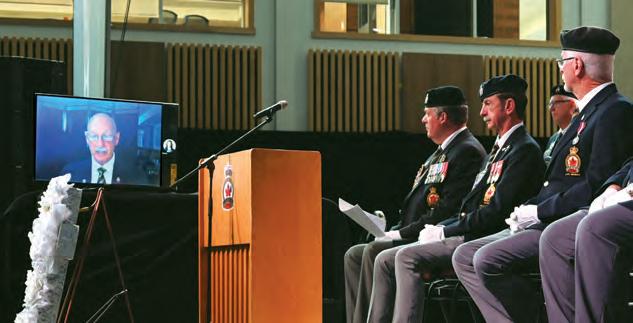
help that situation,” wrote Moore in his report, “but I might add, not as badly as I thought it would.”
Indeed, there was good news presented on national numbers for 2022 at the conference: total membership was up nearly eight per cent, renewal rates had increased by 10 per cent year-over-year, and new or reinstated members had increased by 6,500 over 2021.
“This is the first time in over 30 years that we’re going to see growth in numbers,” said Pond.
Elections took place throughout the convention, beginning with Moore of Capt. Fred Campbell VC Branch in Mount Forest being acclaimed president. Lynn McClellan of Elora Branch was elected first vice over Pam Davidson of Harry Wray Branch in Gravenhurst and Brian Harris of Victory Branch in London.
Harris declined to be added to the seven nominees for three vice-president positions, which included Davidson, Diane Condon of Talbot Trail Branch in Fonthill, Crystal Cook of Milton Wesley Branch in Newmarket, Lynn Deering of Marmora Branch, Gerry Morgan of Baron Byng-Beaches Branch in Toronto, Mark Rogers of Ridgetown Branch and Eric Ross of Brussels Branch. On the fourth ballot, delegates elected Condon, Cook and Rogers.
The election for the honorary
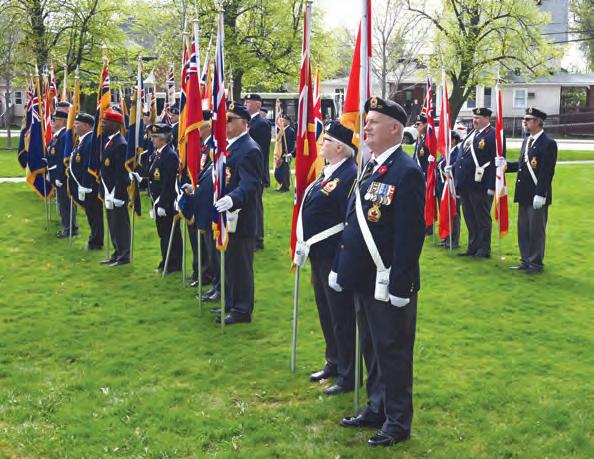
treasurer position pitted incumbent Terry Jacobs of Kanata Branch against his predecessor Ed Pigeau of Thessalon Branch, with the latter reclaiming the role. Ron Goebel of Carleton Place Branch was acclaimed for another term as chairman, while the vice-chair position was hotly contested, taking three ballots to ultimately re-elect Ron Crown of Grand Bend Branch over Eric Ross, Greg Kobold of Brighton Branch and Patricia Thompson-Perry of Pte. Joe Waters Branch in Milton.
Beyond election excitement, other highlights of the convention included: a speech by Phil Ralph, director of health services for Wounded Warriors Canada, which, in partnership with Ontario Command, oversees the Operation Service Dog program—“Let’s get some more dogs out there!” said Pond afterward, and branch representatives responded with nearly $100,000 in donations; an address by Veterans Ombudsperson Nishika Jardine; a primer by Rose McGuire on Ontario’s new Soldiers’ Aid Commission, which provides financial assistance to veterans in need (and their families) in the province; a pair of powerful presentations by Darren Reid, the Ontario representative in the Legion’s Operational Stress Injury Special Section, on veteran suicide, homelessness
and related issues and programs— “I’m not looking for medals, I want hugs because it means they’re still here,” concluded Reid of his work with fellow vets. In total, branch donations to provincial programs totalled nearly $600,000.
Meanwhile, Parkhouse brought updates from Dominion Command, notably declaring that advocating for a national volunteer strategy is a personal priority. He detailed the latest national membership numbers (noted above), and highlighted the forthcoming biodegradable lapel poppies and wreaths, and growth of the poster and literary contests. He noted, too, Dominion advocacy in dealing with sexual misconduct in the military, fighting to end veteran disability claim backlogs and supporting Afghan refugees. He summed up the work succinctly: “We touch so much in this country at the Legion.”
Following the installation of new officers, Goebel introduced a recorded video message from incoming President Moore. “It was a huge disappointment to my wife Patricia and I that we weren’t able to attend this very special Ontario Command provincial convention,” said Moore.
“A return to normal is around the corner. It is my desire to complete what the prior administration was unable to do due to the COVID-19 pandemic,” he continued. “Our theme for this convention is working together. I plan on encouraging that throughout this term, because without it we will not be able to reach our goals.” L
By Trevor Oattes
The pandemic has had a profound impact on the Island, but the members of P.E.I. Command have not let that stop them from pursuing their goals.
The Island’s red sands met the deep blue of the Atlantic Ocean only a few metres from the Souris Branch hall, where Legionnaires from across the province met for the 66th Prince Edward Island Command Convention, May 27-28— the first in-person gathering since the pandemic began.
Joined by guests from New Brunswick and Nova Scotia commands, as well as a representative from Dominion Command, the small seaside branch nearly overflowed with delegates—and enthusiasm.
“We, like everyone in Canada, have come through almost three years of dealing with the COVID-19 pandemic,” said President Duane MacEwen. “It was not an easy decision for us to ask our branches to close their doors for extended periods…but you rose to the challenge and kept your branches viable.
“I am proud of the efforts, determination and stamina you had to keep going.”
After the opening ceremonies, those gathered jumped into the convention’s key agenda
items—social projects, finances, membership and the election of a new slate of executives.
The first matter of business, a motion introduced by Morell Branch member and Dominion First VicePresident Owen Parkhouse, centred on a proposal for affordable housing to aid the Island’s homeless veteran population. P.E.I. Command had, the previous December, qualified for a $50,000 grant from the provincial government, with funding proposed to be used to cover a veteran demographic study, project management and land evaluation.
“Our priority is the social, physical and economic well-being of our veterans,” said MacEwen. “Housing is a need for all, and our veterans need stable housing and rents that they can afford.”
Parkhouse and MacEwen are aiming for a 30-unit complex of affordable housing in Charlottetown, with 10 units dedicated to homeless veterans and 20 for the broader population.
While the motion was widely agreed upon, several delegates noted that not all branch presidents were present at the convention, and even those who were in attendance had not had the chance to discuss the initiative with their branch members. As
such, the motion was withdrawn, to be moved again at a future date once all branches have had the chance to discuss the motion.
Finance chair Lynda Curtis briefed delegates and confirmed a deficit of $1,990. An area of contention was the $7,000 spent on provincial track and field.
“The last time P.E.I. took part in Dominion track and field…to my knowledge there was nothing in the paper, there was nothing on TV, there was nothing on CBC Radio,” said Alan Crane of Kingston Branch in New Haven. “Return on investment, comrades, for $7,000 seems relatively limited in connection to the expenditure.”
Parkhouse, speaking on behalf of Dominion Command, noted that track and field has a long history with the Legion as an event largely for children of Second World War veterans. “I think all good things have to be looked at and reevaluated. Maybe track and field is one of those things,” he said.
The conversation that followed was passionate, with many defending the event as an important part of developing young athletes. Spilling over to the second day, a motion to end P.E.I Command’s participation in the Dominion track and field after this year’s event was carried.
Membership also proved to be a hot-button issue. In 2019, a goal was put forward to have 300,000 Legionnaires nationwide by the organization’s centenary in 2026, with P.E.I. specifically aiming for 3,000. The pandemic, of course, put a dent in these plans and, while all P.E.I. Legion branches survived, membership dropped from 2,000 to 1,500—a 25 per cent loss that was among the most severe in the country.
While these numbers cast a dim light, Parkhouse said he remained confident the Legion could accomplish its goals.
“We’re just coming out of a pandemic where we’ve had to be antisocial for two years,” he said. “What all Canadians are looking for now is to get back to socializing. And what better way to socialize than at your local branch of The Royal Canadian Legion? But you’ve got to get out there and sell it…membership is everyone’s responsibility.
“It’s important that we get
Dominion Vice-President Owen Parkhouse addresses the convention (above left), where Jack MacIsaac (above right) was acclaimed new P.E.I Command president. Outgoing P.E.I. Command president Duane MacEwen (left, on left) welcomed Dominion Treasurer Rick Bennett, who provided updates from Dominion Command to the convention.
give them each year,” said Bennett, referencing the $500 donated by P.E.I. Command to the organization.
“Through your donations to the [RCEL], the Legion provides significant funding for essentials such as daily food and repairs to dwellings. In the past year, we supported close to 120 veterans and widows in this way. I thank you and your branches for what you have contributed in the past and what you will contribute in the future.”
Delegates also voted on several resolutions, including: a motion in which branches would reimburse service officers for gas money when travelling to their locale (defeated); a motion to create a P.E.I. Command sergeant-at-arms (carried); and a motion to implement electronic discussion and voting via video conferencing platforms such as Zoom and Skype (defeated).
our membership up. It’s important that we draw in new people, younger people, families and, most importantly, veterans. We have to remember that all Canadians can join the Legion, and that’s what we really have to be pushing.”
Dominion Treasurer Rick Bennett then spoke, beginning his presentation with a “huge and sincere thank you” to P.E.I.’s efforts during the pandemic. He offered updates from Dominion Command, highlighting digital membership cards, biodegradable poppies and wreaths and, with the aid of the Legion National Foundation, expanded efforts in the poster and literary contests.
He also briefly discussed the Royal Commonwealth Ex-Services League (RCEL) and the Legion’s advocacy and financial efforts to support allied veterans and their families in the Caribbean.
“It’s important for me to share how truly thankful our [international] comrades are for the help you
In the election of officers, Jack MacIsaac of Charlottetown Branch ran unopposed (after MacEwan turned down his nomination, as is custom) and was acclaimed president. Also acclaimed were David Blacquiere of Charlottetown Branch as first vice, John Yeo, also of Charlottetown as chair, and Lynda Curtis of Saint Anthony Branch in Bloomfield, as finance chair. The vice-president position was hotly contested, with seven nominees. Theresa Gallant of Wellington Branch will serve another term in the role, along with newly elected Susan Williams of Ellerslie Branch and David Perry of Souris Branch. David Doucette of Lt.-Col. E.W. Johnstone Branch in Kensington will continue as vice chair after defeating Mario Henry of BordenCarleton Branch in Borden.
The newly elected executive was warmly received by delegates during the swearing-in parade, overseen by Bennett.
“The Royal Canadian Legion is one of the best institutions that has ever come out of this country,” said Parkhouse earlier. “Go out there and do good things.” L
By Stephen J. Thorne
Manitoba-Northwestern Ontario Command is emerging from more than two years of pandemicimposed restrictions in relatively good shape.
Now, newly acclaimed command President Ernie Tester of Gladstone, Man., Branch—a 47-year member—is looking to make friends and recruit members, all while keeping the Legion focused on the people who matter most, veterans.
“We’ve got to support the young veterans; we’ve got to keep them involved,” Tester declared in an interview with Legion Magazine at the command’s 50th convention in Thunder Bay, Ont., in June.
“It means so much,” he said. “We’ve got to look after them. You know, the veterans gave us [young, non-veterans] a chance 45 years ago to get involved in this Legion and we’re very fortunate they [did].
“Membership at that time was starting to decline and they opened it up to associate members and affiliate voting and non-voting members.”
Tester inherits an impressively healthy organization from his predecessor, Jerry Lava of Kenora, Ont., Branch. Last year’s convention was postponed due to COVID-19, and branches had been ordered closed or restricted to limited activities for most of the
preceding two-and-a-half years. Nevertheless, the command emerged from the pandemic with surpluses of $135,994 in 2020 and $124,431 in 2021. All 129 of Man.-N.W.O.’s branches survived the challenge, though two—Roseau Valley in Dominion City, Man., and Wheat City in Brandon, Man.— closed for unrelated reasons.
Ukrainian Canadian Veterans Branch in Winnipeg closed its doors, but did not surrender its charter and was temporarily operating out of other branches.
Tester, now semi-retired from the hotel and grocery businesses, was mentored by Second World War army veteran and former
command president Joe Fraser, who died in 2016 at age 89. “It seems like I went to about 20 conventions with him,” said Tester.
“We have to work together. And respect one another,” he said. “Respect is so important.”
Indeed, respect was the order of the day at the convention, where nary an angry word was uttered during two days of meetings involving 150 proxies and 92 on-site delegates, including some 20 veterans.
The sessions were held in the same Prince Arthur Waterfront Hotel & Suites conference room where the Great War Veterans’ Association, precursor to the
Canadian Legion (later designated “Royal”), ratified adoption of the poppy as the national symbol of remembrance in 1921.
Delegates to the 2022 convention raised more than $15,000 for the Royal Commonwealth Ex-Services League, which administers veterans’ programs in Africa and the Caribbean.
In other elections, Robert Cutbush, former president of Port Arthur, Ont., Branch in Thunder Bay, was voted first vicepresident. Elected vice-presidents were: former District 6 commander Gail Conrad Davey of Lac du Bonnet, Man., Branch; incumbent Wayne Baker of Kenora, Ont., Branch; and former District 2 commander Joan Wright of Brandon, Man., Branch. Former command president Roland Fisette of St. James Branch in Winnipeg was elected honorary treasurer. Bette Vance of Winnipeg’s Norwood-St. Boniface Branch was re-elected chair, and former Kenora Branch vice-president Jason Lava was voted sergeant-atarms. Reverends Kathy Giroux, Chuck Ross and Paul Bringleson continue as honorary chaplains.
Peter Martin of Transcona Branch in Winnipeg delivered a moving report about his 2019 pilgrimage to France and Belgium, incorporating his own family history in a poignant account of his travels to the battlefields and cemeteries of both world wars.
Dominion President Bruce Julien (opposite page, left) with newly acclaimed Manitoba-Northwestern Ontario President Ernie Tester and Past President Jerry Lava. Joan Wright (left) accepts the provincial award for best recruitment by a branch with membership of less than 100 on behalf of Plumas, Man., Branch. First Vice-President Robert Cutbush presents the recruitment award for a branch of more than 100 members to Jean Ste. Marie, accepting on behalf of Swan River, Man., Branch.
And outgoing president Jerry Lava described how “everything changed” as Legions across the country entered the “uncharted waters” of the pandemic. “Zoom” became part of the lexicon as national, regional and local officials began an uncertain journey.
“None of us anticipated what was about to transpire,” said Lava, acknowledging key financial assistance from national headquarters and the federal government.
“Branches did an excellent job trying to think outside the box. There were many creative approaches,” he added, describing how Charleswood Branch sold poppies during peak social distancing in Winnipeg by setting up a drive-thru and pinning the commemorative flowers and collection baskets on the ends of curling brushes.
It was a hit.
Many branches used YouTube or Facebook to stream remembrance ceremonies, demonstrating what Lava described as “the resilience of you, as members, to come up with so many ideas throughout this pandemic to continue on with the
support that we provide to the community and what we represent.”
Dominion President Bruce Julien thanked those who put so much effort into maintaining Legion branches and veterans’ support programs through such challenging times.
He came with good news, too: Legion membership is growing for the first time in more than 30 years—a “phenomenal” eight per cent, year-over-year.
“It looks like we may have turned the corner,” said Julien, “and all the processes we put in are starting to pay off.”
Now, he added, the challenge is to keep the new members.
“Like it or not—agree with it or not—the decision to not remain a member directly relates to the experience and reception that new members receive within their local branches. We’ve got to do better at keeping these members when they sign up. We’ve got to make new members feel welcome, and we’ve got to keep them.
“It is they who are our future.” L
By Sharon Adams
Not one branch had to close because of the pandemic. That good news kicked off the 52nd convention of AlbertaNorthwest Territories Command, held May 6-8 in Red Deer, Alta.
When the pandemic began, “we expected to lose 19 of our 165 branches,” said President John Mahon. “We lost absolutely none to COVID,” though one branch—Rycroft—closed for unrelated reasons.
The event kicked off with many of the 199 delegates parading outside the Cambridge Hotel and Conference Centre. The parade was followed by a short ceremony during which Dominion Past President Tom Irvine and Second World War veteran Arnold Fisher were among those placing wreaths.
Fisher, who served in the Battle of the Netherlands and in Germany, declared the convention officially open.
The business session began with a debate about the need for restructuring the command, starting with cutting one vice-president position.
“We have not made any changes in command structure since 1982,” said Mahon, noting that, at that time, there were 60,000 members, 185 branches and nine districts. There are currently fewer than 35,000 members and 165 branches. “Council is too big,” he said.
“To continue on the road we’re going, we will have to raise the per capita tax,” said Mahon. A motion was made to reduce the number of vice-presidents from three to two, in what Mahon described as the first step in a gradual change to the executive. A small minority opposed the motion, but it was ultimately approved by delegates.
Irvine presented news from Dominion Command, noting the Legion has had to adapt over the past couple of tough years. “Your hard work has ensured that veterans were cared for and that branches survived this historic pandemic,” he said.
“The events you organize keep our branches healthy and alive, the welcoming atmosphere you provide to those who visit ensures they want to come back,” said Irvine.
Work at the national level, meanwhile, has resulted in a new digital membership card, the introduction of biodegradable poppies and wreaths and the growth of the poster and literary contests.
Dominion Command also successfully lobbied the federal government to provide $14 million to support branches across the country during the pandemic, said Irvine. It was later reported that Alberta-N.W.T. Command dispersed more than a million dollars of this funding to provincial branches.
Irvine lauded the work of winners of the Legion’s $30,000 Masters
Scholarship in Veteran Health Research who “are doing amazing work under our name.” The most recent recipient is researching chronic pain among CAF members affected by traumatic brain injury. “Ultimately it’s about providing better health outcomes,” he said. “This is life-changing stuff.”
Also life-changing is the support the Legion provides for the Royal Commonwealth Ex-Services League (RCEL) to veterans and widows in the Caribbean. “In the past year we supported close to 120 veterans and widows,” for basic needs such as food and housing repairs, said Irvine.
During the convention, delegates donated $12,000 to the RCEL; $42,500 to the Command Poppy Fund; $2,000 to the bursary fund; and $1,888.80 to command’s Polio Foundation, which has some 100 clients who are periodically provided with new equipment, such as wheelchairs. Six of those clients receive small stipends to make ends meet.
Delegates did not hear a full financial report at convention.
“A year-end review identified concerning data which triggered an in-depth review of the four-year financials,” reported Treasurer Chris Strong. In turn, that resulted in the auditors being unable to finish their work prior to the convention.
“We have completed the general budgeting for the year and the rest will be completed after the convention and the finalization of the audited statements,” he said in his report, which was passed with no discussion.
With the provincial sports fund boasting a healthy balance and earning interest, delegates voted to take the $1 per year per member that command had been putting into this fund and redirect it to general revenue. “Adding $32,000 per year to the general fund will make sure there are no lapses in any programs,” said Strong.
Poppy Committee chair Dave Velichko and command service officers Mike Burgess and Darryll Newsham took advantage of their reports to walk delegates through the paperwork for applying for poppy funds and Veterans Affairs Canada benefits.
Since the 2019 convention, provincial service officers have processed 1,332 first applications for VAC benefits, resulting in the awarding of more than $64 million in disability payments, $115,000 in increased pensions and $1.8 million in pension back pay.
Director Suzette BrémaultPhillips of the University of Alberta’s Heroes in Mind, Advocacy and Research Consortium
(HiMARC) reported on the program, which has, to date, received donations of more than $646,000 from Alberta-N.W.T. Command and provincial branches. In 2018, the command contributed to the funding of HiMARC’s early research in multi-modal, motion-assisted, memory desensitization and reconsolidation therapy, known simply as 3MDR, which uses virtual reality to treat chronic posttraumatic stress disorder (PTSD).
HiMARC “has grown exponentially,” said Brémault-Phillips. “We started out with $70,000 in funding for two projects—family resilience and 3MDR. As of eight months ago, we’re up to $9 million” in grant funding and dozens of projects.
Most veterans no longer meet the diagnostic criteria for PTSD after receiving 3MDR treatment. The results have been so promising that HiMARC has become internationally renowned for its research in the therapy.
HiMARC is also seeking veterans to participate in two other projects.
Although there are reports that cannabis helps relieve some PTSD symptoms, alleviate pain and promote better sleep, “there is not enough research yet,” noted Brémault-Phillips. “It’s a very complex substance, and we are working to identify what works for whom, when, where, why and how...so veterans can make informed decisions.”
And HiMARC is looking for veterans who received psychotherapy in virtual sessions to participate in a study on the effectiveness of therapy delivered that way.
History was made in the elections when Rosalind LaRose of Stettler Branch became AlbertaN.W.T. Command’s first female president. Unable to attend the convention due to the death of her husband Steve, LaRose sent a message that was read by Executive Director Tammy Wheeler.
“Comrades, we have a journey ahead of us. I have many goals to reach. We have work to do and as a united body we will reach these goals, bringing our command and Legion into the future.”
Velichko of Joe Wynne Branch was elected First Vice, defeating Vice-President Gord Morrison of Stony Plain Branch. Morrison was subsequently elected to one of the two vice-president positions, along with Kelly Lindbeck of Worthington Branch in Wainwright. Mac Torrie of Kingsway Branch in Edmonton was defeated; Kevin Holt of Grimshaw Branch declined nomination.
Strong of Innisfail Branch was re-elected treasurer over Bill Hart of Camrose Branch. Scott Sadler of Onoway Branch was acclaimed chairman, continuing in the role he has held since 2017.
The convention ended with the installation of new officers. L
By Sharon Adams
British Columbia/Yukon Command successfully rolled out electronic voting at its 55th convention held June 2-5 in Nanaimo.
“The system was excellent, and it really was hassle free,” said Dominion Vice-President Berkley Lawrence, who conducted the elections and the installation of officers.
There were six nominees for two vice-president positions. “It took four votes and was completed in approximately 15 minutes, whereas using the scrutineers and paper ballots system, it would have taken well over an hour. My personal opinion was that it was great,” said Lawrence.
The convention went smoothly despite unco-operative weather that forced the parade indoors prior to the opening ceremonies. Wreaths were placed by community dignitaries, Lawrence and Command President Valerie MacGregor.
Lawrence declared the convention open after remarks highlighting several new national initiatives including the introduction of biodegradable poppies and wreaths, the expansion of the one-year free membership for the Legion’s Veterans Family Welcome Program to include parents and guardians of veterans, and advocacy on issues affecting Canadian Armed Forces members and those who helped them during the war in Afghanistan.
Lawrence also spoke about the Royal Commonwealth Ex-Services
League, which supports 57 veterans and 62 widows in the Caribbean “in great financial need,” ensuring they get daily food and have access to funds to repair their homes. More than two dozen branches donated a total of $19,735 to the cause and another $1,700 was raised in cash from delegates.
As business sessions got underway, MacGregor reported that the command had welcomed its first new branch in 25 years— UBC Campus. Other developments since the last convention included: the donation of the building that housed the Fort St. James Branch, which closed prior to the pandemic, to the Ulh’goh Bi’yoh Native Friendship Centre Society; the development of a new five-year strategic plan; the launch of a new newsletter and updated website; and the announcement of plans by the Whitehorse Branch to build a new 75-unit residential complex, which will boast 10 units exclusively for veterans.
The command lost no branches during the pandemic thanks to more than $5 million in aid from Dominion Command and the federal and provincial governments, said treasurer Jim Diack.
He also reported that expenses were down, in part due to travel restrictions and the switch from in-person events to virtual meetings and training during the ongoing
pandemic. Overall, the financial statement showed an excess of $965,335 in revenue over expenses for 2021. The biggest source of revenue is the per capita tax, which has not changed since 2016—making shrinking membership a financial concern, noted Diack.
“Command is always looking for alternative revenue streams to remain sustainable,” he said. One example—the Military Service Recognition Book—brought command $215,430 in income in 2020 and $303,624 in 2021.
Membership chair John Scott reported a decline in membership from 41,343 to 32,450. “However, our branches are just awakening from this long pandemic sleep,” he noted.
The pandemic also impacted the number of entries in the poster and literary contests, which dropped from 6,600 in 2019-20 to 4,295 the following year, reported committee chair Bev Croft. In 2021-22, however, submissions rebounded to 8,599.
Service officer Lori Castle reported that her bureau worked throughout the pandemic. It completed 368 applications to Veterans Affairs Canada during the past three years, processing more than $14 million in claims for pensions and compensation for pain and suffering for veterans.
Three presentations during the convention touched on how
Legion donations are supporting veterans and their families, as well as first responders, in Canada and other countries.
Guest speakers Trevor Greene, formerly of the Seaforth Highlanders of Canada, and neuroscientist Dr. Ryan D’Arcy, described the innovative rehabilitation that has allowed Greene to walk again after an axe attack in Afghanistan damaged his brain.
That level of care will also be available to other veterans when the $312-million Legion Veterans Village Centre of Excellence opens in 2023 in Surrey.
D’Arcy, the centre’s chief scientist, said the project will provide integrated care and support services for veterans and first responders, as well as cutting-edge rehabilitation research. The project also includes housing—nearly 500 condominiums, including 92 affordable units in the first phase. The initial offering sold out quickly, allowing work on the second phase to start sooner than expected.
Meanwhile, Tim Laidler, board president of the Veterans Transition Network (VTN), told delegates about how that organization got involved in aiding refugees who helped the Canadian army during the war in Afghanistan.
As the Taliban took over Kabul, “VTN was fielding hundreds of e-mails” from veterans offering donations to help people they knew in Afghanistan get out of the country. The donations, including from the Legion, “allowed us to quickly take action.”
Laidler and his wife Jamie, who both went overseas to facilitate the work, talked about VTN’s efforts over the past year to provide emergency safe houses, aid with evacuations and help refugees settle in Canada.
Now, “2,000 Afghans are fully transitioned to living in Canada,” Laidler said. The VTN has closed its donation campaign and the new UBC Campus Branch has been recruited to help with refugee resettlement.
In other business, delegates voted to request Dominion Command include acknowledgement of traditional Indigenous land in the procedure at the opening of Legion meetings. Also, two non-concurred motions were brought back to the floor and created much debate.
One, which called for holding provincial Legion Week in June when branches can hold events outdoors, was approved. The second, recommending a modified wreath to honour First Nations veterans, was defeated. Some speakers said there should be no distinction among veterans. Others argued a wreath’s ribbon can be used for such purpose.
The elections, with the new electronic system, went smoothly and quickly. There were 207 accredited delegates carrying 285 proxy votes.
MacGregor received two standing ovations when she declined nomination for another term as president. Craig Thomson of Kamloops Branch was acclaimed president.
Dominion Command Vice-President
Berkley Lawrence (left) oversaw elections at the convention, which featured a new electronic voting system. Outgoing B.C./Yukon Command
President Val MacGregor presents a pin to her successor Craig Thompson.
Bob Underhill of Vancouver TVS Branch was acclaimed first vice. It took four rounds of voting to elect vice-presidents Karen Kusek of Mission Branch and Dale Johnson of Cloverdale Branch in Surrey. Bev Croft of North Vancouver Branch, Terri Orser of Esquimalt Branch, Pete Pearson of Valemount Branch and Danny Reddon of Shalom Branch in Vancouver were unsuccessful in their bids for the position.
Treasurer Jim Diack of Qualicum Beach Branch was returned to office over contender Denise Young of Dawson Creek Branch, while Gary Peters of Seaview Centennial Branch in Lantzville prevailed over Past President Glenn Hodge for the position of Chair.
In a separate proceeding, delegates voted to appoint Dave Sinclair honorary president. A member of Britannia Branch in Victoria, Sinclair is a command past president, past president of Legion Manor and recipient of a Minister of Veterans Affairs Commendation, among other distinctions.
“I am overwhelmed and deeply honoured,” said Sinclair. “For my name to be mentioned in the same breath [as previous recipients, including Victoria Cross recipient Smokey Smith] is a huge honour.” L
Continued from page 49
As the son of a Canadian-born Second World War veteran, I take interest in what veterans went through. Legion Magazine is a great way to keep memories alive and recognize the Legion’s contributions to society.
Phil Nelson, Sarnia, Ont.
Legion Magazine is excellent, but I feel it doesn’t do enough to attract younger readers.
Theodore L. Mageau, Fort Saskatchewan, Alta.
Legion Magazine connects me to my family history and to my heritage. With two children presently serving, Legion Magazine helps Grampa relate to their service!
William Crozier, Westport, Ont.
I’d like to see some initiative to attract newer members, especially young veterans. Rob Harrison, Calgary
I think more should be done on recent deployments. Articles about current members and life in the armed forces would be helpful to those considering joining.
Michael Douel, Simcoe, Ont.
Good content generally, but I would suggest more content for younger vets and non-serving readers.
Josh Muir, Vancouver
It is the one magazine I read cover to cover. I find the investigative articles very well written.
Mark Legge, Canning, N.S.
My late father served in the Royal Canadian Air Force from the Second World War through the late 1960s and never really talked about it much. This magazine allows me a glimpse at some of the things he would have experienced. I also have worked directly with several veterans so more recent military topics interest me. Ron Story, Calgary
Having never served, I enjoy reading about Canada’s military actions and activities. Stephen Stevenson, Surrey, B.C.
I find the magazine in general serves an older population. Younger veterans do not feel much connection.
Karl-Frederic Major, Burk’s Fall, Ont.
Love the magazine. I look forward to each issue.
Carl Myers, Charlottetown
Need more western Canadian articles. Roger Beebe, Medicine Hat, Alta.
More Second World War Black veterans’ history please.
Wilhelmina Nolan-Campbell, Harcourt, N.B.
Great magazine, especially for my needs as a history teacher. For my students, I use a lot of the “Face to face” articles for discussion. These articles have been invaluable to create great discussions with a lot of critical thinking. James Knihniski, Langley, B.C.
Great improvements over the years. Philip Wood, Bay Roberts, N.L.
I would like to see more and better maps. Steven Mintz, Winnipeg
I am the president of Metropolitan Branch in Windsor, Ont., and find the information in the magazine helps broaden my understanding of veterans’ issues so I can serve them better.
Tom Friesen, Tecumseh, Ont.
Volunteering in the community
Accepting the Acadian and Francophone Chamber of Commerce Social Economy Enterprise Award are Wellington, P.E.I., Branch members (from left) Paul Gallant, Theresa Gallant, Branch President David Gallant, branch manager Mike Gallant, Herman Marché, Albert Hashie, Roger Arsenault, Gerald Arsenault and Gilles Painchaud. G. ARSENAULT
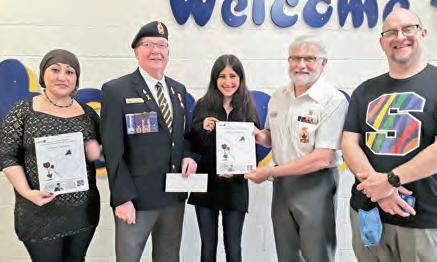
The award-winning poster by Nargiz Amiri (centre), accompanied by her mother Gulzada Tohtieva, was chosen for the cover of the 66th Prince Edward Island Command convention booklet. Congratulating her are (from left) Command President Duane MacEwen, Command chair John Yeo and George Trevor, principal of Stonepark Intermediate School.
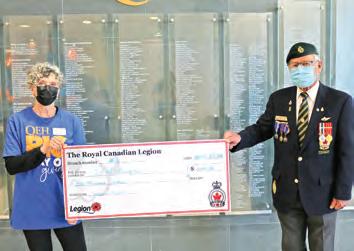
Montague, P.E.I., Branch President Brian Rector presents $1,000 to Queen Elizabeth Hospital development officer Angie McCarthy.
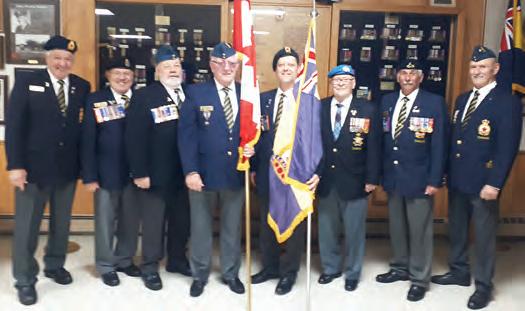
At a ceremony commemorating the Battle of the Atlantic are Wellington, P.E.I., Branch members (from left) Austin Poirier, President David Gallant, Gilles Painchaud, Roger Arsenault, Gerald Arsenault, Earl Arsenault, Dave Redmond and Gilles Labonté. G. ARSENAULT
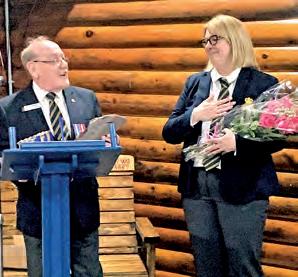
New President Laura Derry of Otterburn Park Branch in Auclair, Que., is presented with the Legionnaire of the Year award by Norman Shelton.
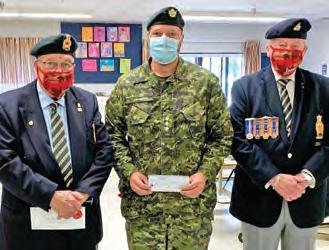
First Vice Bryan Teasdale and President David Innes of Saint-Brunode-Montarville, Que., Branch present $1,000 to the Cadet Corps of Sainte-Julie, represented by its commanding officer, Capt. Christopher Chouinard.
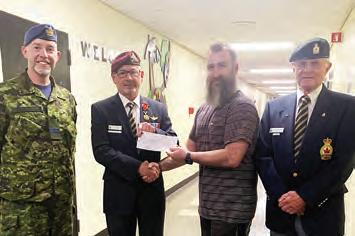
Chuck Richards (right) and service officer Claude Vadeboncoeur of Sutton, Que., Branch present $1,000 to Cowansville 725 Massey Vanier air cadet squadron, represented by its commanding officer, Capt. Tousignant, and civilian committee president, Jean-Sébastien Labonté.
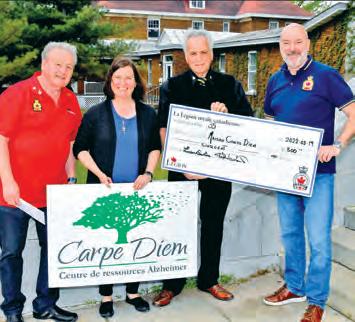
Second Vice Lucien Desbiens (left), Pierre Trottier and President Stéphane Vincent of Trois-Rivières, Que., Branch present $500 to the Carpe Diem Centre, represented by Marianne Daveluy.
ERIC DE WALLENS
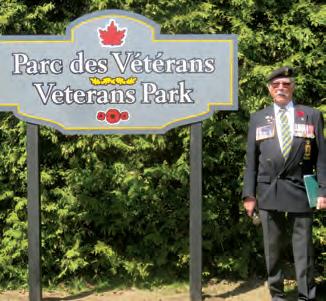
Past President Karl Kramell of Hemmingford, Que., Branch stands alongside the new veterans park sign outside the local Legion.
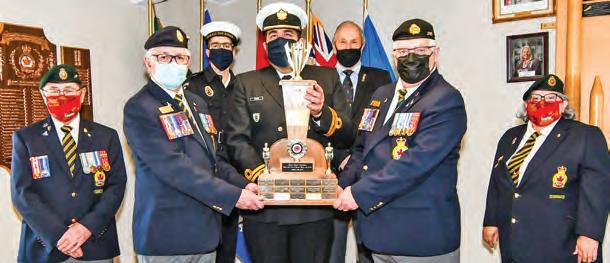
First Vice Bruno Dumas (front left) and Second Vice Yvon Ouellette of Lt.-Col. Charles Forbes Branch in Quebec City present the 287 sea cadets with a trophy, held by Lieutenant (N) Nicolas Cantin, for the group’s noteworthy work. Joining the trio are (from left) Gaétan Guillemette, cadet Commandant Mathieu Durant, Dominic Richard of the Navy League of Canada and branch youth director Carol Mazurat.
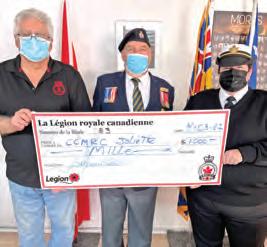
Gilbert Lachance (left) and Reggie Savoie of Lanaudière de Joliette, Que., Branch present $1,000 to the Navy Cadets Corps of Joliette, represented by its commander, Lieutenant (N) Karine Thériault.
Stephen Clempson of Dorval, Que., Branch presents $4,450 to the Red Cross for Ukraine humanitarian relief effort. The Red Cross is represented by Penny Coull (left), Theresa Killen, Fabienne Liasne and Pauline Cornish.
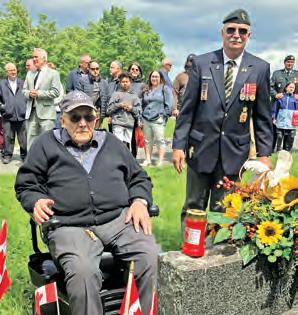
Accompanied by Daniel Montplaisir (right), Noel Pellerin, 93, plants a flag at the tombstone of his father, Pte. Arthur Pellerin, a First World War veteran, during a remembrance ceremony organized by Arthabaska Branch in Victoriaville, Que.
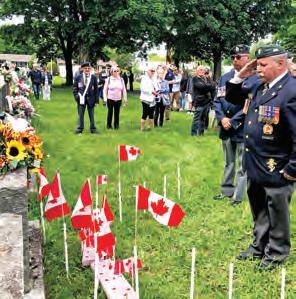
President Michel Trembly of Arthabaska Branch in Victoriaville, Que., salutes the tombstone of First World War veteran Pte. Arthur Pellerin during a remembrance ceremony.

Second Vice Joyce Gravel (left) and Margaret Cross (right front) of Otterburn Park, Que., Branch present $600 to the volunteers from Le Grain d’Sel, a self-help centre that fights poverty and social exclusion.
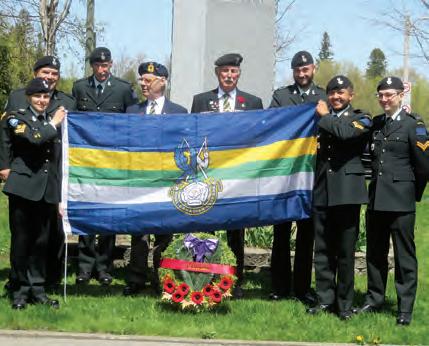
Royal Canadian Hussars from Montreal stand alongside Sgt.-at-Arms David Taylor (left) and Karl Kramell of Hemmingford, Que., Branch after the VE-Day ceremony.
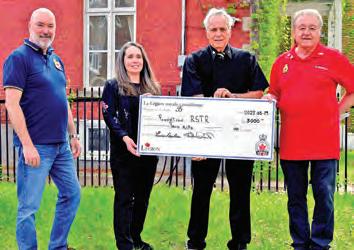
Trois-Rivières, Que., Branch presents $3,000 to the Regional Health Foundation of Trois-Rivières. From left are branch President Stéphane Vincent; Julie Leblanc, health foundation communications co-ordinator; branch member Pierre Trottier and Second Vice Lucien Desbiens. ERIC DE WALLENS
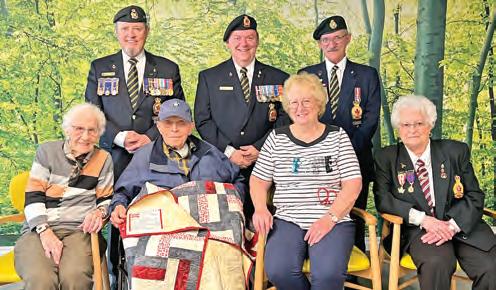
Albert Pellerin of Lt.-Col. Robert Grondin Branch in Shawinigan, Que., is presented a Quilt of Valour by (from left to right) Rita Willet, Robert Trépanier, Branch President Roger Leroux, Bonnie Frappier, Robert Larivée and Pauline St-Arnaud.
Secretary Olwen Demidoff (left) and Past President Gerry Bramhill of Delta, B.C., Branch present $1,000 to Chantelle Bowles of Canuck Place Children’s Hospice, which provides end-of-life supports for children and their families.
Executive member Ron Simpson of Alberni Valley Branch in Port Alberni, B.C., presents the Legionnaire of the Year award to Jean McKamey.
Spencer Gall (centre), campaign director of Richmond Hospital Foundation, receives $15,000 from service officer Bill Costain (left) of Richmond, B.C., Branch and BC/Yukon Command Second Vice Bob Underhill.
Finn Campbell of Kelowna Christian School receives certificates from Audrey Rizzo of Kelowna, B.C., Branch for his intermediate essay which won branch, zone and provincial levels.
The Kaslo, B.C., L.A. raised $2,810 in a perogy-making fundraiser for relief in Ukraine.
At the presentation of $6,000 to W.E. Graham Community Services Society are (from left)
Past President John Gates, secretary Carol Barclay and President Patrick Ashton of Slocan Valley, B.C., Branch and society representatives Susan Kammerzell, executive director Miryam Bishop and Food Bank manager David Burgess. The food bank will receive $2,000 and $4,000 will support seniors’ luncheons.
President Russell Robertson (left) of Diamond Head Branch in Squamish, B.C., accompanied by Past President Ed Robertson, presents $1,953 to Christina Musselwhite, president of Hilltop House Support Society, to help buy a gazebo for residents of the long-term care facility.
President Arlene Johnston (second right) of Merritt, B.C., Branch, presents $5,000 to Carol Holmes and representatives of Nicola Valley First Nations Veterans for a monument to commemorate Indigenous veterans whose service has gone unacknowledged.
Comox, B.C., Branch
President Lynn Edey presents $595.33 to retired major Ted Usher of the Last Post Fund for refurbishment of the gravesite of First World War veteran Edwin Clifford Harbottle, who was wounded at Passchendaele.
Armstrong, B.C., Branch
Past President Linda Higgins presents $5,000 to Chelaine McInroy, attending G.F. Strong Rehabilitation Centre in Vancouver, to help buy a microprocessor knee prosthesis, which costs about $100,000.
Audrey Rizzo of Kelowna, B.C., Branch congratulates Sophia Weibe of Kelowna Christian School, who placed first in the senior colour poster contest at branch and zone levels.
Sooke, B.C., Branch President Ted Davies (from left) and cadets
Master Seaman Kaileigh Carlson and Leading Seaman Daniel Ledger Rodriguez prepare for a ceremony, parade and candlelight tribute commemorating VE-Day and the Battle of the Atlantic.
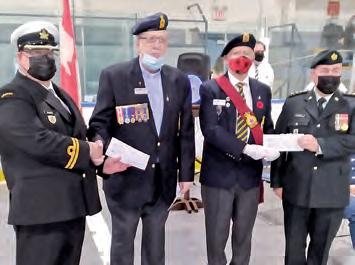
Two donations of $750 from Bowser, B.C., Branch were presented to Lieut. (N) John Tarrington (left) of 189 Port Augusta sea cadets by Padre Brian Kirby and by Sgt.-at-Arms Ken Wood to Capt. Bradley Waterfall (right) of 1725 Canadian Scottish Regiment army cadets.
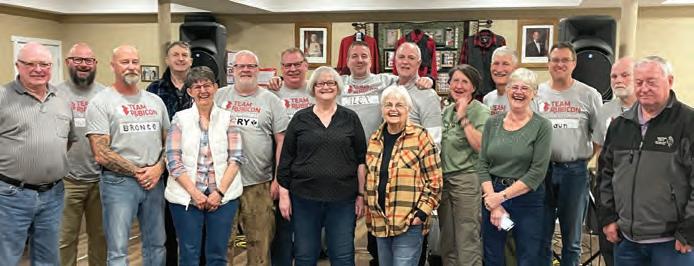
Merritt, B.C., Branch Past President Allen Hamm and service officer Scott Casey (first and second left), vice-president Bud Johnston and President Arlene Johnston (fourth and fifth left) and other branch members pose with members of Team Rubicon Disaster Response Team. The team volunteers came from across Canada and the U.S. to help flood victims and the branch provided food and accommodation to them for the month they were in town.
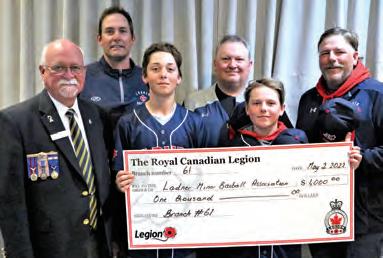
President Al Ridgway (left) of Delta, B.C., Branch presents $1,000 to (rear) Ladner Minor Baseball Association coach Doug Miller, association president Todd Allan and equipment manager Dave Sochting (right) and players (front) Caleb Miller and Drew Sochting.
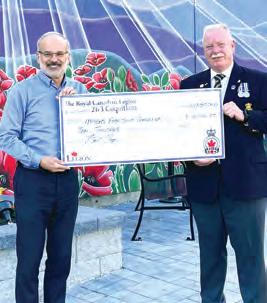
President Bob Chapman (right) of City of Coquitlam Branch in Coquitlam, B.C., presents $10,000 to Richard Stewart for the Mayor’s Food Bank Challenge.
President Al Mooney of Alberni Valley Branch in Port Alberni, B.C., presents $2,000 to Jessica Weeks of West Coast General Hospital Foundation.
President Ted Davies of Sooke, B.C., Branch (right) presents $5,000 to veteran Terry Montgomery (centre) and executive director Kerry Williams of Ayre Manor Seniors Housing. The funds will help buy medical equipment.
Past President Rick Nickerson of Bowser, B.C., Branch presents $750 to 893 air cadets squadron sponsoring committee chair Brie Sorenson, accompanied by cadets Cpl. Mason Holland (left) and Sgt. Mira Shaw.
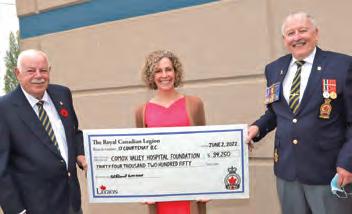
Jessica Aldred, executive director of Comox Valley Healthcare Foundation, receives $34,250 from Courtenay, B.C., Branch poppy chair Bob McDiarmid (left) and Past President Dave Bell. The branch has contributed more than $250,000 during the past 23 years to support health care.
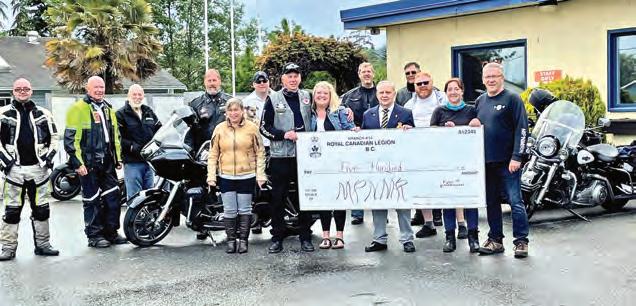
At the presentation of $500 from Sooke, B.C., Branch to Military Police National Motorcycle Relay participants are (holding cheque, from left) Tom and Wendy McIntosh, branch vice-president Al Stuart, Sandra Tucker and Yves Ouellet. The funds are for the Military Police Fund for Blind Children.
New Brunswick Regional Development Minister Gary Crossman presents $5,000 from the Community Investment Fund to President Harold E. Wright of Jervis Bay Memorial Branch in Saint John, N.B., for a new illuminated branch sign. The minister also awarded $10,000 to the branch’s new memorial. MEL VINCENT
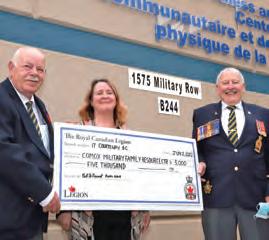
Courtenay, B.C., Branch poppy chair Bob McDiarmid (left) and Past President Dave Bell present $5,000 to Wendy Secord, executive director of Comox Military Family Resource Centre.
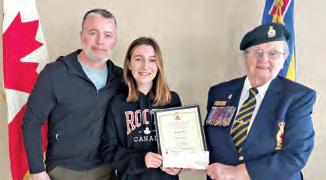
Saint John, N.B., District Commander Jean Stevens presents Jenah Jones, a Grade 7 student at Millidgeville North School in Saint John, N.B., with her second-place N.B. Command award in the intermediate black and white poster competition. She is joined by her father, Tim Jones. H.E. WRIGHT
President Fred Healey of Peninsula Branch in Clifton Royal, N.B., and Jim Landry of Landscape NB accompany Principal Ellen WhittakerBrown and Grade 3 student Rylan (last name withheld) as branch members and students of Macdonald Consolidated School plant a Vimy oak tree to mark Earth Day 2022. KELLY NEWSTEAD
President Eugene Godin of Herman Good VC Branch in Bathurst, N.B., presents a cheque for the 1242 Petit-Rocker army cadets to Capt. Wendy Melanson. GRAHAM WISEMAN
President Harold E. Wright of Jervis Bay Memorial Branch in Saint John, N.B., presents $3,000 to 527 Simonds Squadron air cadets, represented by Heather Tait, secretary of the parents committee. JAMIE TAIT
President Paul Veysey and First Vice Barbara Bickerton of Sussex, N.B., Branch, along with District Commander Wayne Makepeace, congratulate poster contest winners (from left) Alastair Capstick, Summer Tays, Addison Freeze, Clara Carter and Katie Carter.
ROXANNE KYLE
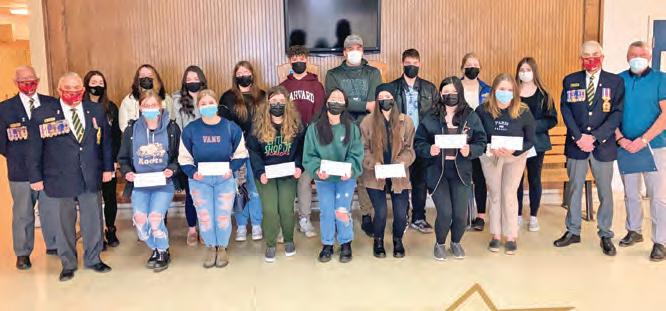
President Philip Wood (right) and members of of Bay Roberts, N.L., Branch congratulate first-, second- and third-place winners of the poster and literary contests from Ascension Collegiate.
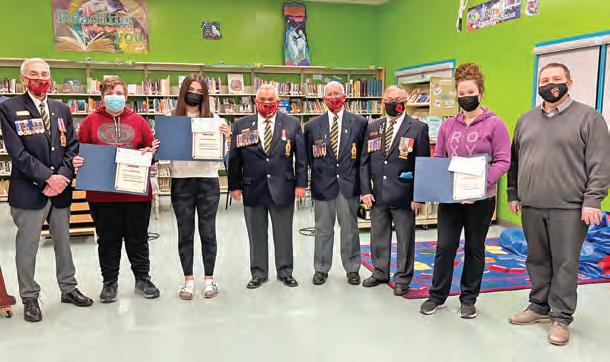
Provincial level winners in the literary and poster contests from Amalgamated Academy are congratulated by President Philip Wood (left) and members of Bay Roberts, N.L., Branch.
President Eugene Godin of Herman Good VC Branch in Bathurst, N.B., and North Shore District Commander Virginie Dubé present a cheque from the New Brunswick Command’s Community Services Fund to the Bathurst Arts Society, represented by Rita May Gates.
Capt. Amanda White of 2355 army cadets receives $1,000 from the Conception Bay Branch in Kelligrews, N.L., represented (from left) by poppy chair Ralph Parmenter, President Dave Strickland and First Vice Gordon Wheadon.
Congratulating Claire Foss of Botwood Collegiate for finishing third at the provincial level in the senior poetry contest are (from left) Botwood, N.L., Branch President Law Power, collegiate vice principal Kenneth Hemeon and poppy chair Randy Hancock.
Dominion Command Vice-President Berkley Lawrence (right) presents the Legionnaire of the Year award to President John MacDonald of Pleasantville Branch in St. John’s, N.L.
Members of Conception Bay Branch in Kelligrews, N.L., and Lieutenant Governor Judy Foote pose during a memorial service commemorating the Battle of the Atlantic, the Battle of Vimy Ridge, the Battle of Normandy, paratroopers who died in 1968 and victims of a helicopter crash in 1998.
Dominion Vice-President Berkley Lawrence and Sarah Lawrence, school committee chair of Carbonear, N.L., Branch, congratulate Emma Murray on placing second in the national primary colour poster contest. Joining them is Carbonear Academy principal Byron King.
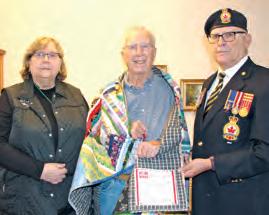
Second World War Lancaster gunner Roy Morrison, 98, is presented with a Quilt of Valour by Rhoda Moore and Legionnaire Ralph Murphy. RALPH MURPHY
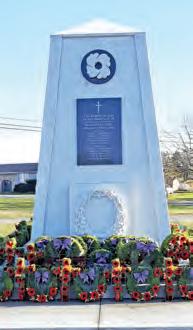
West Pubnico, N.S., Branch replaces its cenotaph after 70 years.
PAUL D’ENTREMONT
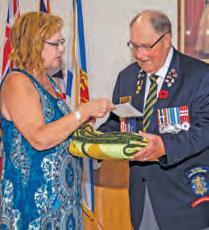
Joseph (Bob) LeFave of Wedgeport, N.S., Branch receives a Quilt of Honour from Debby Gray. PERCY J. COTTREAU
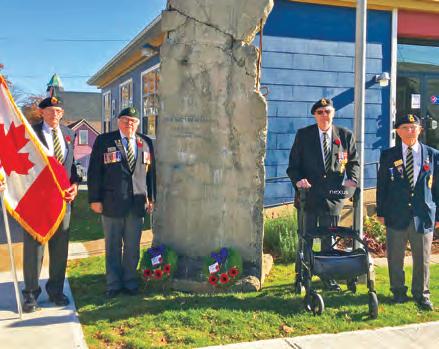
Gary Fox, Arleigh Robar, Tom Wright and Joe Amero of Lunenburg, N.S., Branch honour Cold War vets at a piece of Berlin Wall erected in front of the local Legion. DONNA KELLY
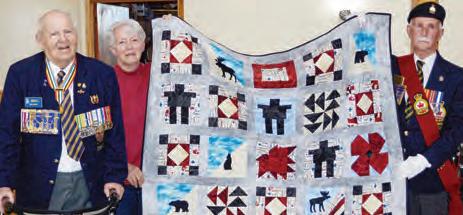
Linda Rolfe, area representative of the Quilts of Valour Canada Society, presents Arnold (Bob) Garron (left) of Wedgeport, N.S., Branch with a Quilt of Valour for his military and Legion contributions. Sgt.-at-Arms Warren Surette was present at the presentation. CYRILLE LEBLANC
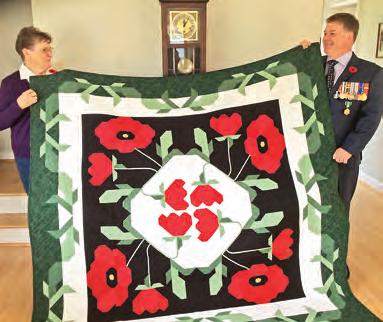
Muriel Elliot presents Afghanistan veteran Steven Hatton of Liscomb, N.S., Branch with a Quilt of Valour. DON HATTON
Veteran James McRae of Yarmouth, N.S., Branch celebrates his 104th birthday with District E Commander Don McCumber. DON McCUMBER
Second Vice Robert MacIntosh and First Vice Brian Bobbitt of Sydney Mines, N.S., Branch donate $918.50 to the local food bank, represented by Audrey MacDougall. CYRIL HATCHER
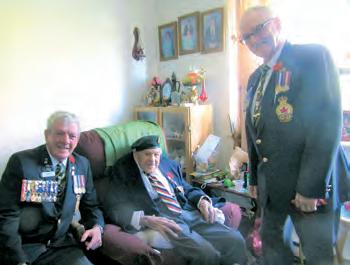
Strickland of Breton Branch in Sydney Mines, N.S., celebrates his 102nd birthday with District A Commander Clarence Dawe (left) and past District Commander Clifford McIntyre. CYRIL HATCHER
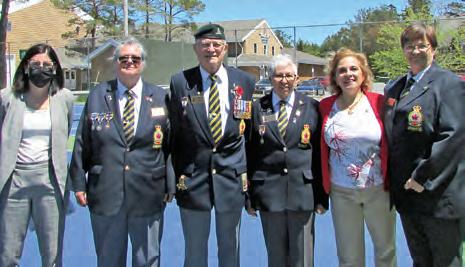
Halifax MP Lena Metledge Diab (left) and Public Services and Procurement Minister Filomena Tassi announce a grant to upgrade F.E. Butler Branch in Chester, N.S. Celebrating the occasion are branch secretary Marilyn Hupman, President Gerry MacNeil, Past President Agnes Conrad and spokesperson Gail Hatt. MARILYN HUPMAN
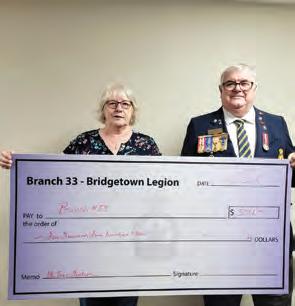
President Fred Boil and Susan Coogan of Bridgetown, N.S., Branch present a cheque for $5,501 from donations raised in an online auction. SUE COOGAN
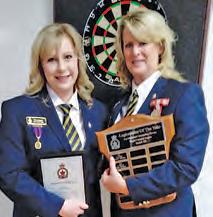
Nova Scotia/Nunavut Command President Donna McRury (left) presents Kim Hooper of Whitney Pier, N.S., Branch with the Legionnaire of the Year award. MARY PHILLIPS
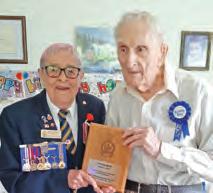
President Mabel McCarthy of Uniacke Branch in Mount Uniacke, N.S., presents Second World War veteran Wyman Hunt with a plaque and a card to celebrate his 100th birthday.
PAULETTE FOLEY
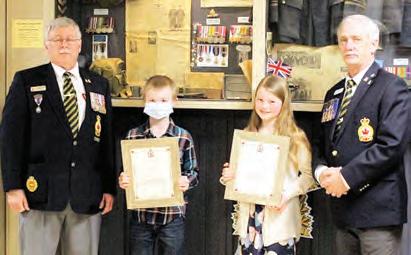
President Darrell Leighton (left) of Hants County Branch in Windsor, N.S., and District D Commander Harry Jackson present awards for the poster and literary contests to Connell Cord, who created the second-place primary black-and-white poster, and Willoughby Lorder, writer of the second-place junior essay. LISA MILLS
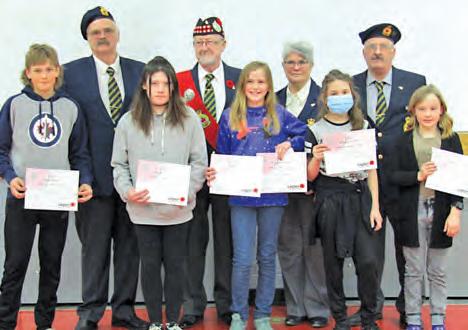
Ken Schwalm (rear, from left), Sgt.-at-Arms John Methven, Loa Titman and Ed Morelli of Viscount, Sask., Branch congratulate zone winners of the poster and literary contests from Viscount School (front, from left)
Porter Lowe, Skye Harriman, Paetyn Leffler, Madden Raymond and Amber Wardell. LOA TITMAN
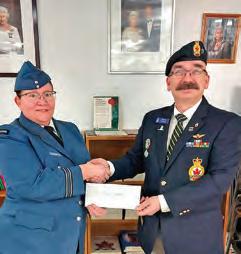
Capt. Joyce Ptolemy of No. 43 squadron air cadets receives $750 from vice-president Popp of Battleford, Sask., Branch. TIM POPP
President Trevor Bancarz (left) and poppy chair
Brian Morris of Robert Combe VC Branch in Melville, Sask., present certificates and prizes to local winners of the poster and literary contests, including (rear, from left)
Addyson Ottenbreit, Elsie Rogalski, Katie Cowan and Jacob Safruik, (front, from left), Arya Englot, Basma Syed, Brooke Loveridge and Lexi Hollinger. DIANNE HACK
Kisbey, Sask., Branch secretary
Nora Weightman and vice-president Richard Krehbiel (right) join Second World War veteran Albert Hale for his 102nd birthday tea. RICHARD KREHBIEL
Vice-president Tim Popp of Battleford, Sask., Branch presents $750 to Capt. Marnell Weikle (rear, second right), accompanied by members of 2537 army cadets. TIM POPP
President Henry Sobchyshyn and Second Vice Olga Dmytrow of Regina, Sask., Branch congratulate Emerald Ridge Elementary School student Hudson Walby on placing first at the provincial level in the intermediate essay contest. GREG ARNOTT
Presenting certificates to students of North West Central School in Plenty, Sask., who participated in the literary and poster contests are (from left) William Turk, James Duncan and Karen Turk of Dodsland, Sask., Branch and Kevin Olson and Cameron Olsen (right) of Plenty Branch. JAMES DUNCAN

Vice-president Rob Nelson of Regina, Sask., Branch presents $3,000 to Allie Kozey of the Riverside Cemetery Field of Honour for the flowerbed program. ROB NELSON
Service officer Noel Brunansky of Wakaw, Sask., Branch presents $1,000 to veteran Loreen Waldbillig to help buy a portable oxygen unit.
JACK JONES
Ken Schwalm (left), vice-president Ed Morelli and Sgt.-at-Arms John Methven of Viscount, Sask., Branch congratulate scholarship winners Dexter Gusikoski (left) and Abigayle Kirzinger, while Kira Wignes (second from right) receives sponsorship for track and field camp. LOA TITMAN
Poppy chair Brian Morris of Robert Combe VC Branch in Melville, Sask., presents $300 scholarships to Melville Comprehensive School students Travis Frick (left) and Samantha Fortune.
DIANNE HACK
President Shauna Grassing (right) and poppy chair Helen Hodgson of Nipawin, Sask., Branch congratulate bursary recipients from L.P. Miller Comprehensive School (from left) Lucas Bryson, Kaylee Ens and Jayda Korecki. NIPAWIN BRANCH
Sgt.-at-Arms John Methven (from left), poppy chair Carol Peterson and vice-president Ed Morelli of Colonsay, Sask., Branch, along with Zone 3 District Commander Marguerite Wolfe and branch member Ken Schwalm, congratulate Grade 12 scholarship winner Halle Mitchener (rear) and Kathy Wang, third-place winner of the national primary colour poster competition. LOA TITMAN
President Jack Jones and Sharon Bews of Wakaw, Sask., Branch present $850 to co-chairs Angela Jackson (centre left) and Sabrina Boutin of the Wakaw Dance Club.
JACK JONES
Nipawin, Sask., Branch poppy chair Helen Hodgson congratulates Amaris Grandfield on placing first in the senior essay contest.
SHAUNA GRASSING
President Tom Shields and poppy chair Joanne Shields (far right) of Lambeth, Ont., Branch present $33,299.04 to St. Joseph’s Health Care Foundation, represented by Zena Currie, co-ordinator of Parkwood Veterans Care program; Tichelle Schram, development director at St. Joseph’s Health Care Foundation and Sue Hardy.
Treasurer Ron Wilson (left) and President Bob Berg of Waterloo, Ont., Branch present $615 from a St. Patrick’s Day fundraiser to Red Cross humanitarian aid for Ukraine.
President Larry McAfee (left) and poppy chair Jim Paterson of Elora, Ont., Branch present $1,500 to each of three local cadet corps, represented by (from left) Capt. Kim Peters, Lt. Sue Patterson and Major Craig Miller.
President Heather Atkins (left) and honours and awards chair Catherine Martin of Lt.-Col. John Foote VC Branch in Grafton, Ont., present the 50 Years Long Service Medal to Sgt.-at-Arms Bill Bachellier.
President Ken Thompson (left) of Capt. Fred Campbell VC Branch in Mount Forest, Ont., and then Ontario Command First Vice Derek Moore present $6,000 to Louise Marshall Hospital Foundation chair Bob Mason on behalf of the Ontario Command Branches and L.A. Charitable Foundation.
President John Cormier of Leslie Sutherland Branch in Corunna, Ont., presents $500 to the Canadian Cancer Society, Sarnia/Lambton, represented by Paula McKinley.
Adrian Williams and President Valerie Clark of Lord Elgin Branch in St. Thomas, Ont., present $2,000 to YWCA representative Sarah Lounsbury for the organization’s Tiny Hope Project, which will build low-income housing.
Honours and awards chair Tom Shotton (left) and President Al Haward (right) of Bowmanville, Ont., Branch congratulate Bob Hackett on his Legionnaire of the Year award.
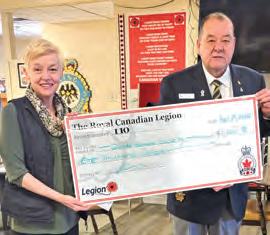
First Vice Yves Bouchard of Trenton, Ont., Branch presents $1,000 to the Quinte Humane Society, represented by executive director Marilyn Lawrie.
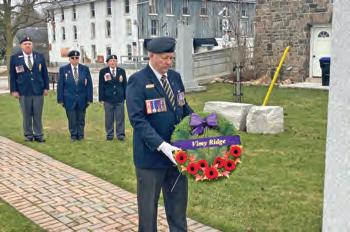
Wayne Tutt, Cheryll Barr and Marg Murphy of Coldwater, Ont., Branch look on as President Norm Marion places a wreath in remembrance of those who fought and died at Vimy Ridge. RICK MORSE

Adrian Williams and President Valerie Clark of Lord Elgin Branch in St. Thomas, Ont., present Travis Topping with $1,000 to assist with expenses for the 2022 Junior Provincial Wheelchair Basketball Team.
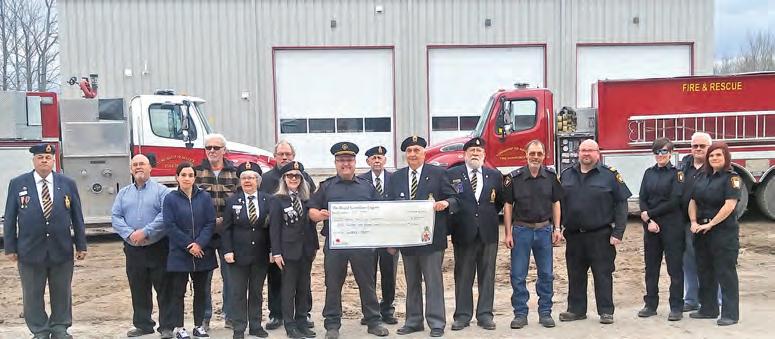
Members of Madoc, Ont., Branch present $8,870 to the Township of Madoc Fire Department Eldorado on behalf of the Ontario Command Branches and L.A. Charitable Foundation. The money will assist veterans and the community.
Catch the Ace lottery chair Steve Glover (right) of Dr. W.C. (Bill) Little M.M. Branch in Barrie, Ont., presents $2,000 to Gilda’s Club Simcoe Muskoka, a cancer support program, represented by its executive director Aaron Lutes.
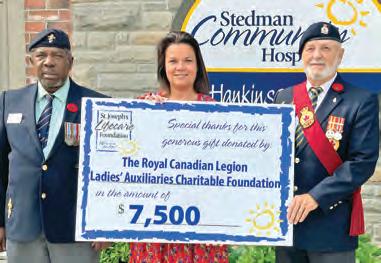
On behalf of the Ontario Command Branches and L.A. Charitable Foundation, poppy chair Wayne Cyrus (left) and service officer Steve Armstrong of Telephone City Branch in Brantford, Ont., present $7,500 to the Stedman Community Hospice, represented by its senior coordinator of events and development, Nicole Clarkson. They also donated $7,200 to St. Joseph’s Lifecare Centre.
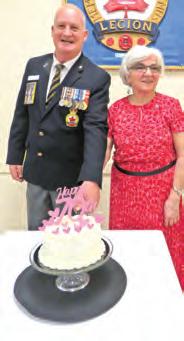
L.A. President Glenda Trottman and President Al Plume of Trenton, Ont., Branch celebrate the branch’s 70th anniversary.
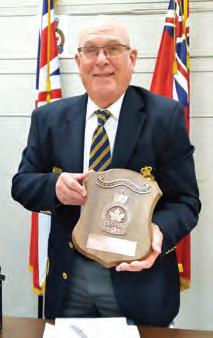
Eric Place is named Prescott, Ont., Branch’s Legionnaire of the Year.
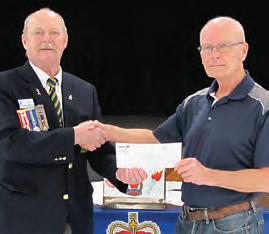
President John Cormier of Leslie Sutherland Branch in Corunna, Ont., presents $250 to the Moore Museum, represented by Dave Taylor, for its model train exhibit.
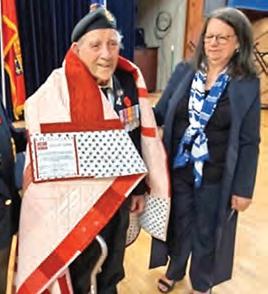
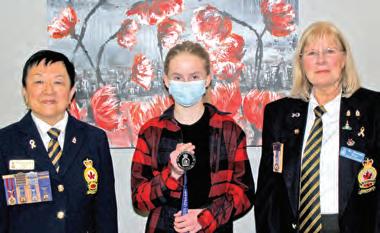
President Kathy Gardner (left) and youth education chair Sue Ainsworth of Lt.-Col. Harry Babcock Branch in Napanee, Ont., congratulate Sophie Donnan for placing second at the provincial level in the literary contest’s intermediate poem category.
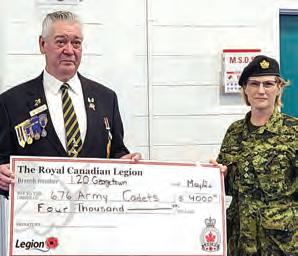
Poppy chair Ray Clarke of Lt.-Col. G.B. Cousens Branch in Georgetown, Ont., presents $4,000 to the 676 Georgetown army cadets, represented by Capt. Cara Lacey.
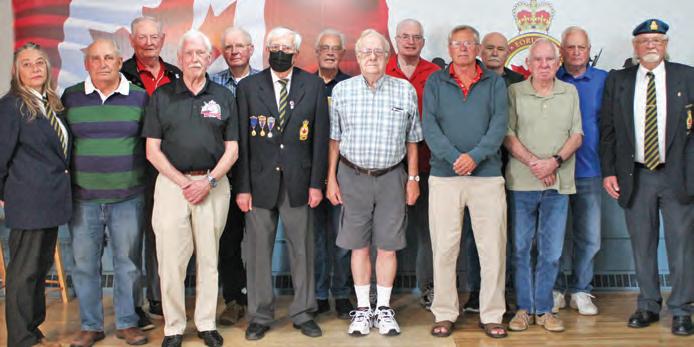
President Ron Adair (centre) and membership chair Deirdre Adair (left) of Midland, Ont., Branch present 12 members with the 50 Years Long Service Medal.
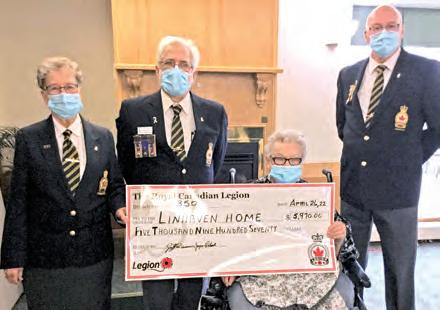
Decoste
of Port
Jeff Burns and John
Branch in St. Catharines, Ont., present $5,970 for therapeutic services at Linhaven long-term care home, represented by Carol MacMaster, one of the facility’s residents.
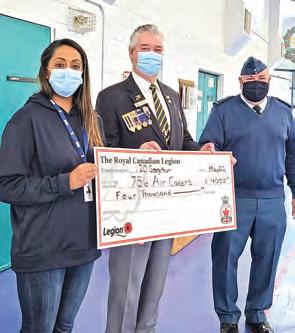
Poppy chair Ray Clarke (centre) of Lt.-Col. G.B. Cousens Branch in Georgetown, Ont., presents $4,000 to the 756 air cadet squadron, represented by its committee member Paula Brar (left) and Capt. Shaun Laverty.
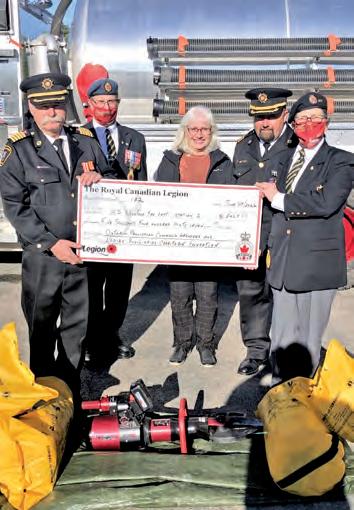
On behalf of Ontario Command Branches and L.A. Charitable Foundation, Thessalon, Ont., Branch charitable foundation chair Francine Grasley (right) and Sgt.-at-Arms Dave Grasley (second from left) present $5,467.77 for the purchase of an ice rescue stretcher and related equipment to Huron Shores Fire Station 2 in Iron Bridge, Ont., represented by Chief Jim Kent (left), clerk administrator Debbie Tonelli and Deputy Chief Scott Richards.
President Myrna Picotte of Bay Ridges Branch in Pickering, Ont., presents the Legionnaire of the Year award to Alexander MacDonald.
Al Wilson receives the Forest, Ont., Branch Legionnaire of the Year award, presented by (from left) Sgt.-at-Arms Ken Parsons, President Shirley Spinks and Immediate Past President Bill Fraser.
President Marilyn Kirk (centre) and First Vice Paul Bolt of Last Post Branch in Port Stanley, Ont., present $5,000 to the St. Thomas Elgin General Hospital Foundation, represented by its marketing communications officer Kenzie Bonnett.
Knesia Sholdra, associate director, philanthropy and events of Georgetown Hospital Foundation, accepts $5,150 for vital signs monitoring equipment from Acton, Ont., Branch, represented by (from left) past president Wes Kutasienski, service officer Laurie McNabb, poppy chair Dave Maloney, Sgt.-at-Arms Percy Harding, treasurer Cathy Munday and President Peggy Graham.
Catch the Ace lottery chair Steve Glover (left) of Dr. W.C. (Bill) Little M.M. Branch in Barrie, Ont., presents $2,000 to the Central Ontario branch of the Canadian Association of Veterans in UN and Peacekeeping, represented by its president Fern Taillefer.
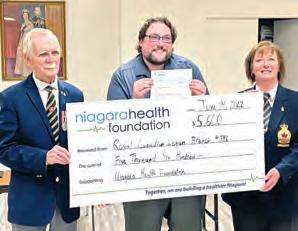
On behalf of Ontario Command Branches and L.A. Charitable Foundation, President Pat Irish (right) and Second Vice Corky Corcoran of Chippawa Branch in Niagara Falls, Ont., present $5,600 to the Niagara Health Foundation, represented by marketing manager Jordan Hallawell.
Heather Boerrichter receives the Legionnaire of the Year award from Brig.-Gen. G.H. Ralston Branch in Port Hope, Ont., represented by (from right) President Andre Labrosse, honours and awards chair Jean Kimball and Mel Hodges.
Youth education chair Fred Hiller (left) and President Randy Graham of Fergus, Ont., Branch present provincial and district level poster and literary awards to Riki Westrik and Joelle Vanleeuwen.
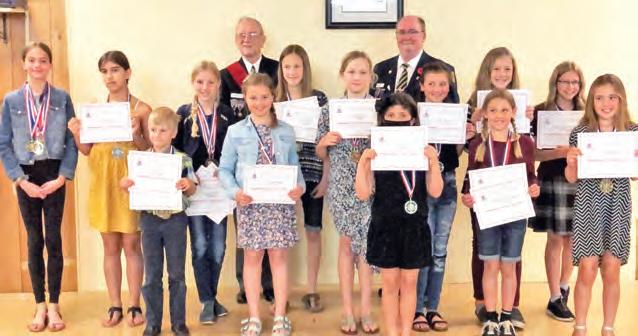
Poppy chair Jim Byron (back row, left) and youth education chair Tony Bratschitsch of Valley City Branch in Dundas, Ont., congratulate branch winners of the poster and literary contests.

Executive members of Strathcona Branch in Ottawa present $20,000 to the Perley Health Foundation, represented by executive director Delphine Haslé (centre) and board member Sandra Perron.
Cadet liaison Beth Chapman of Chippawa Branch in Niagara Falls, Ont., presents $1,000 to the 2835 56th cadets, represented by Steve Torok.
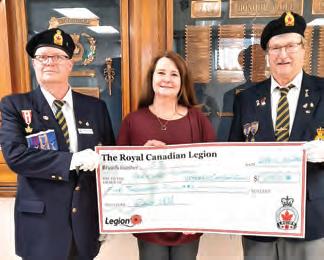
President Ian Adamson (left) and First Vice Rob Gable of Woodstock, Ont., Branch present $5,000 to the St. Joseph's Veterans Care Program at Parkwood Institute, represented by Susan Hardy.
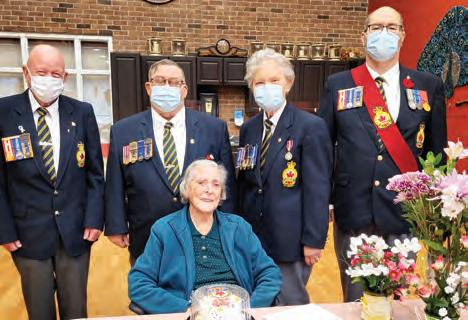
Renfrew, Ont., Branch member Louise Snow (seated) celebrates her 100th birthday with (from left) branch President Bruce Ferguson, First Vice Greg Walbeck, committee chair Ella Box and Sgt.-at-Arms Robert Marsh.
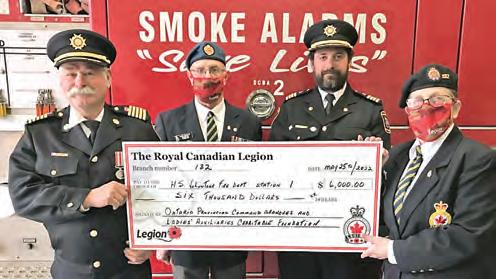
Charitable foundation chair Francine Grasley (right) and Sgt.-at-arms Dave Grasley of Thessalon, Ont., Branch presents $6,000 on behalf of the Ontario Command Branches and L.A. Charitable Foundation to Huron Shores Volunteer Fire Department in Little Rapids, represented by Chief Jim Kent and Deputy Chief Jordan Medve.
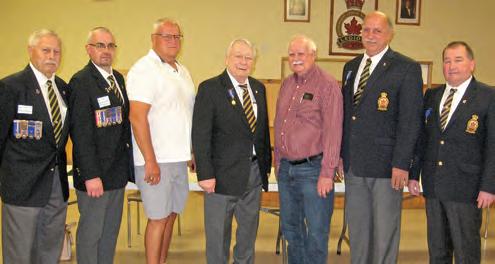
Deputy District C Commander Dennis Schmidt (left) and Zone C-1 Commander Jon Corbett accompany President Ken Vosper (second from right) and Past President Bob Walkom of Mitchell, Ont., Branch in presenting the 50 Years Long Service Medal to Paul Clarke, Clare French and Dick Frier.
BC/Yukon Command has presented Bob Collins with a Certificate of Merit in recognition of his dedication during the overnight vigil at Cobble Hill Cenotaph honouring Canadian soldiers who died in non-combat roles.
Sgt. Samuel Peticlerc of 772 cadet squadron received the Cadet Medal of Excellence from Sgt.-at-Arms Richard Boisclair of Trois-Rivières, Que., Branch.
M.Cpl. Kevin Dubreuil of 2671 Army cadet corps received the Cadet Medal of Excellence from Sgt.-at-Arms Richard Boisclair of Trois-Rivières, Que., Branch.
Send your photos and news of The Royal Canadian Legion in action in your community to your Command Correspondent. Each branch and ladies auxiliary is entitled to two photos in an issue. Any additional items will be published as news only. Material should be sent as soon as possible after an event. We do not accept material that will be more than a year old when published, or photos that are out of focus or lack contrast. The Command Correspondents are:
BRITISH COLUMBIA/YUKON: Graham Fox, 4199 Steede Ave., Port Alberni, BC V9Y 8B6, gra.fox@icloud.com
ALBERTA–NORTHWEST TERRITORIES: Bobbi Foulds, Box 5162, Stn Main, Edson, AB T7E 1T4, foulds.bobbi@gmail.com
SASKATCHEWAN: Tara Brown, 2267 Albert St., Regina, SK S4P 2V5, admin@sasklegion.ca
MANITOBA: George Romick, 320 Admiral Court, Thunder Bay, ON P7A 8B5, romickg@tbaytel.net
NORTHWESTERN ONTARIO: George Romick, 320 Admiral Court, Thunder Bay, ON P7A 8B5, romickg@tbaytel.net
ONTARIO: Mary Ann Goheen, Box 308, Gravenhurst, ON P1P 1T7, magoheen@sympatico.ca
QUEBEC: Pierre (Pete) Garneau, 105-2727 Saint-Patrick St., Montreal, QC H3K 0A8, webmaster@qc.legion.ca
NEW BRUNSWICK: Harold Wright, 2-299 Main St., Saint John, NB E2K 1J1, foulis20@gmail.com
NOVA SCOTIA/NUNAVUT: Marion Fryday-Cook, 2450 Highway 3, RR #1, Chester, NS B0J 1J0, mfrydaycook@hotmail.com
PRINCE EDWARD ISLAND: John Yeo, 657 Rte. 19, Meadow Bank, PE C0E 1H1, islander657@yahoo.ca
NEWFOUNDLAND AND LABRADOR: Brenda Slaney, Box 5745, St. John’s, NL A1C 5X3, bslaney@nfld.net
DOMINION COMMAND ZONES: EASTERN U.S. ZONE, Gord Bennett, 803-190 Cedar St., Cambridge, ON NIS 1W5, Captglbcd@aol.com; WESTERN U.S. ZONE, Douglas Lock, 1531 11th St., Manhattan Beach, CA 90266, doug.lock@verizon.net.
Submissions for the Honours and Awards page (Palm Leaf, MSM, MSA and Life Membership) should be sent directly to Mike D'Angelo, Legion Magazine, 86 Aird Place, Kanata, ON K2L 0A1 or magazine@legion.ca.
TECHNICAL SPECS FOR PHOTO SUBMISSIONS
DIGITAL PHOTOS—Photos submitted to Command Correspondents electronically must have a minimum width of 1,350 pixels, or 4.5 inches. Final resolution must be 300 dots per inch or greater. As a rough guideline, colour JPEGs would be between 0.5 megabytes (MB) and 1 MB.
PHOTO PRINTS—Glossy prints from a photofinishing lab are best because they do not contain the dot pattern that some printers produce. If possible, please submit digital photos electronically.
FRENCH INSERT—To receive a French insert of Legion Magazine content, please contact MagazineSubscriptions@legion.ca or call 613-591-3335.






BC/YUKON
BILL WOOD
Penticton Br.
JIM DEMARCE
Penticton Br.
NIEL WHEELER
Penticton Br.
ALBERT TALSMA
Peterborough Br.
GORD SHARPE
Valley City Br., Dundas
RAY PLOURDE
Orleans Br.
NOVA SCOTIA/ NUNAVUT
AGNES CONRAD
F.E. Butler Br., Chester
BRENDA HOBIN
Calais Br., Lower Sackville
CAROL MacDONALD
Calais Br., Lower Sackville
CLAYTON HERRIDGE
Breton Br., Sydney Mines
GERARD McGEAN
Breton Br., Sydney Mines
LINDA NAUSS-SALTZMAN
F.E. Butler Br., Chester
ROBERT MacINTOSH
Breton Br., Sydney Mines
TOM McCORMACK
Calais Br., Lower Sackville
WENDY FRASER
Breton Br., Sydney Mines


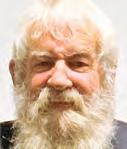
JAMES YOUNG
Pleasantville Br., St. John’s
Yogi Berra, the late, great New York Yankees catcher who had a wonderful gift for malapropisms, had it right:


“It’s tough to make predictions,” he once said, “especially about the future.”
Indeed it is, and not least about the world’s great powers and their intentions. Consider China and Russia, the primary antagonists of the democratic countries in the new cold war era. These superpowers have their own national interests, but also some common aims.
One of their key goals is to weaken the reigning superpower, the United States, and lessen its will and ability to project power.
But will China and Russia become genuine partners, collaborating in their diplomacy and war plans? At the Winter Olympics in Beijing in early February, presidents Xi Jinping and Vladimir Putin agreed to co-operate closely; their partnership had “no limits,” a communiqué stated. The two powers share many attributes that should make them natural comrades: both are run by autocrats who have effectively made themselves rulers for life; both nations have similar systems of government, pervasive
Russian
President Vladimir Putin and Chinese
President Xi Jinping meet in Moscow in June 2019.
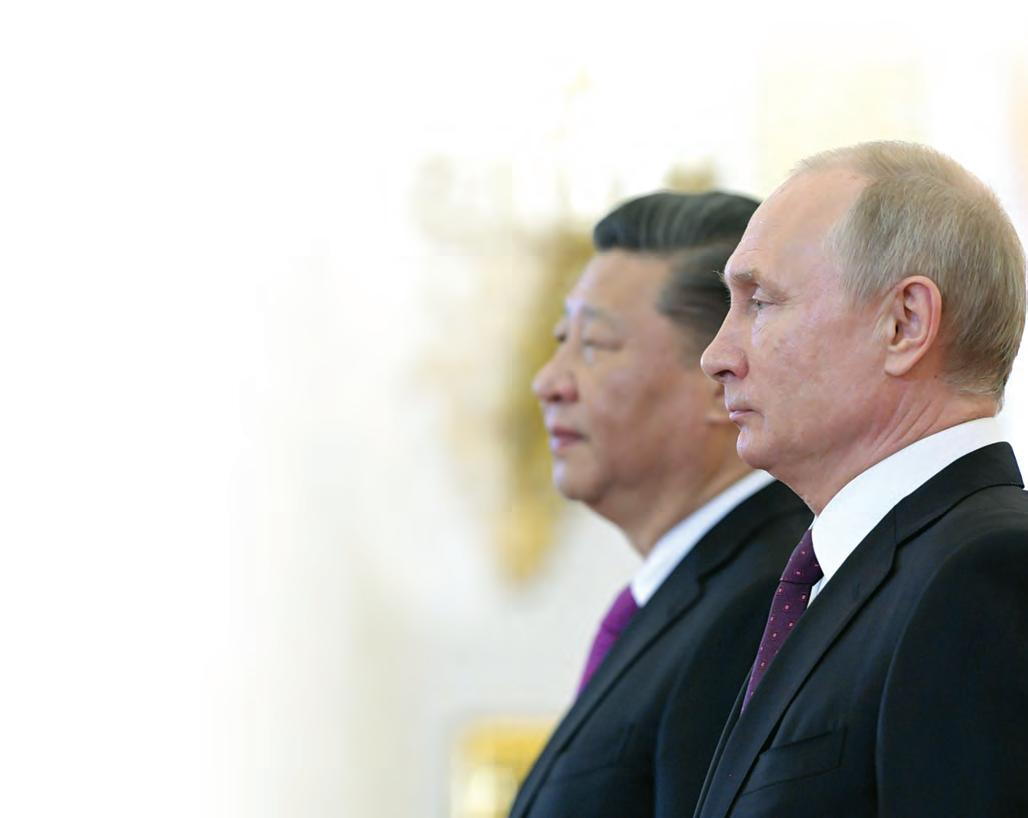
That’s a natural concern for Canada given our long-standing collaboration with the U.S. on defence and in supporting democracy around the world. Canada itself is no stranger to serious difficulties with the two countries, given recent efforts by Russia to conquer Ukraine and militarize the Arctic and major strains in Sino-Canadian diplomacy.
In undermining Western power, China is focused on regional supremacy and the strategic importance of Taiwan, southeast Asia and the Indo-Pacific. Russia, meanwhile, is worried about the strengthening relationships of eastern European nations and the European Union, and the possible (if now very unlikely) expansion of NATO into Ukraine. The Russian invasion of Ukraine on Feb. 24 was allegedly to prevent that—and to stamp out the “Nazification” of the country.


secret police presences, tight controls on freedom of speech and the internet, and a penchant for military and industrial espionage; their militaries have been conducting joint military exercises; they have interfered in the elections of their adversaries (the Chinese in the 2021 Canadian election, as they tried, with some success, to defeat some Conservative candidates of Chinese descent); and both are unduly persecuting minority Muslim populations—Russia having recently introduced laws outlining acceptable forms of Islam and China notably having detained more than one million Uyghurs in recent years.
Both countries have also increased the modernization of their militaries. Russia has been developing new hypersonic missiles and, after swallowing Crimea in 2014 and sponsoring separatist movements in eastern Ukraine’s Donbas region, invaded their neighbour. That invasion prompted Canada and its allies to send significant military aid to Kyiv. And, as noted, Moscow’s buildup of bases, airfields and missile installations in the Arctic are particularly concerning to Canada, not to mention the U.S. and Nordic nations.
China, meanwhile, has invested heavily in building a navy that is beginning to rival the U.S. In the last decade, its People’s Liberation Army Navy (PLAN) has added aircraft carriers, missile cruisers, submarines and fleets of smaller boats. The PLAN had 355 naval vessels—about 50 more than the U.S.—at the end of 2020 according to a recent U.S. Department of Defense report.

The Chinese have also militarized islands and shoals off the coast and those of their neighbours despite a ruling against its territorial claims in the region by the intergovernmental Permanent Court of Arbitration in The Hague. And it has increased military activity around Taiwan (which it claims as part of its territory), including fighter incursions into the country’s air defence zone.
Now China has a naval base in Djibouti in East Africa and is rumoured to be considering another on the Atlantic coast in Equatorial Guinea. It has also declared itself a near-Arctic power.
China and Russia, however, are not natural partners. Their interests don’t always mesh, and conflicts do emerge along their common border. The Soviets clashed with the Chinese in the northwestern region of
Xinjiang, China, in 1934, and there were several months of combat in 1969 on the Ussuri River over territory claimed by both nations. Negotiations culminating in 2008 apparently resolved the territorial issues, but it’s fair to say that Beijing and Moscow both have long memories.
The economies of the two countries are also going in different directions. While China’s has continued to grow since the end of the Cold War, Russia’s has stagnated recently, becoming increasingly dependent on oil and gas exports, medium-term declining assets. The sweeping sanctions imposed by the West after the invasion of Ukraine further weakened the Russian economy and forced Moscow to look to China for help. The extent of that assistance is unclear, but Russia is undoubtedly increasingly dependent on China. Still, it’s unlikely the two superpowers will forge a genuine military and political alliance. When Russia moved troops into Ukraine in February, China’s response was muted, denouncing the U.S. and NATO, but refraining from outward support of Putin. Chinese Foreign Ministry spokesperson Wang Wenbin said in late February that “all countries’ sovereignty and territorial integrity should be respected and upheld”—China insists Taiwan has always been part of its territory so its claims to the state are, it believes, justified. Russia’s attack on Ukraine, however, flies in the face of China’s line. Putin can’t have been pleased with this stance.
Thus, if China invades Taiwan and Beijing asks Moscow for support, Putin’s response might well be tepid. Russia wants Ukraine and China wants Taiwan, and both powers can use their vetoes at the United Nations Security Council to forestall any collective action against any military acts. That could be the extent of their co-operation.
Ultimately, China and Russia want to weaken American’s influence and interrupt the West’s will to defend democracy and oppose aggression. Let’s hope diplomacy is easier to predict than acts of war. L
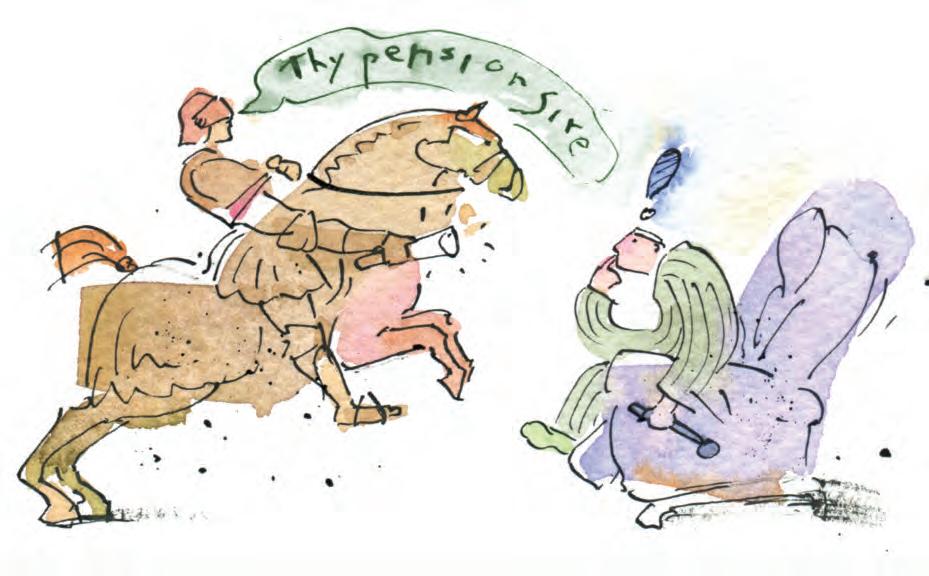
Lieutenant-Colonel Robert
Maclaren of the British army thought he had hit it big.
When he retired in 2001, Maclaren received a letter from the Ministry of Defence detailing his pension benefits and the tax-free lump sum to which he was entitled. The ministry noted that he had been commissioned a second lieutenant on Feb. 1, 1366, and his payout, based on years of service, would total 68,500 pounds.
Maclaren, considering the 635 years of service the ministry had credited to him, did his own calculations and replied to say his benefit should actually be 6,427,586,619.47 pounds and that he was awaiting the cheque.
In due course, the ministry followed up to say its records showed him to be the surviving officer of a number of campaigns, including the Wars of the Roses and the
Napoleonic, Crimean and Boer wars, as well as the battles of Bosworth Field, Waterloo and the Charge of the Light Brigade.
“We would, therefore, wish to know what happened to the following, which do not appear to have been returned to Stores by you on completion of operations.” The letter listed, among other missing items, 9,765 cannons, 127,345 rifles with bayonets, 28,987 horses and three complete marching bands with instruments.
The ministry calculated the value of the missing equipment at 6,427,518,119.47 pounds.
“We have, therefore, subtracted this sum from your lump sum, leaving a residual amount of £68,500, for which you will receive a cheque in due course.”
Clever Brits.
Retired sergeant Billy Neville of the 3rd Battalion, Royal Canadian Regiment passed along a tale from his NATO days in Germany.
> Do you have a funny and true tale from Canada’s military culture? Send your story to magazine@legion.ca
His company was on a week-long patrol exercise that left the troops tired and, after five days without showering, odourous. Early Friday morning, they were waiting for the bus that would return them to Canadian Forces Base Baden-Soellingen.
The warrant officer heard a bus coming up the highway and jumped onto the road waving his rifle. The vehicle stopped and the men piled in. As he boarded, Neville thought the driver looked nervous, but he ignored it, thinking of the weekend ahead.
At the time, German bus drivers typically sold snacks and soft drinks for a little extra cash. This driver didn’t speak English, but the troops used gestures to ask for chips and pop. Oddly, he didn’t charge them.
“Nice guy,” thought Neville.
An hour later, the bus arrived at the base and the troops went off to return weapons and clean their kits.
“All of a sudden,” noted Neville, “the German police and MPs show up.”
It turned out that the bus they had flagged down at gunpoint was not their ride. It had been on its way to pick up children for school.
“When asked by the German police why he didn’t say anything,” reported Neville, “he responded that ‘when I see people waving guns in the middle of the road for me to stop, I stop and take them where they want to go.’”
The incident made the TV news in Germany—and left the participants with a great story.
Richard Jones was with the Royal Canadian Dragoons in Germany in 1977. During one exercise, he and his fellow soldiers went days without really washing, until the regimental sergeant major found a small soccer field that included a clubhouse with change rooms and showers. He arranged for the Canadians to bathe, shave and generally spruce up.
Jones walked out of his shower and asked his buddies if there were more
THE MINISTRY CALCULATED THE VALUE OF THE MISSING EQUIPMENT AT 6,427,518,119.47 POUNDS.
sinks to shave at. One fellow pointed to a door. Jones, naked, grabbed a shaving kit in one hand and towel in the other and went through the door right into the clubhouse…bar. In front of him sat four women, obviously intrigued by this surprising development. An embarrassed Jones managed a quick about-face and marched back into the change room to the laughter of his comrades.
There are oddities in military ranks. Why does a lieutenant-general outrank a major-general? Why are there rearadmirals but no front-admirals? There are actually logical explanations.
At one time, the highest ranking military leaders were known as captain-generals. They were assisted by lieutenant-generals. The next rank down was sergeant-majorgeneral. Over the years, captain was dropped from the top rank and sergeant was dropped from the next. And brigadiers are either the lowest rank of general or a sort of very senior colonel, depending on the army.
As for the navy, the top position was admiral, which was assisted by a vice-admiral (like a vice-president). In the days of sail, warships fought in long lines, with orders being passed on by signal flags. Because the ships at the back of the line might have trouble seeing the communications, they got their own admiral—a rear-admiral. L
By Mark Zuehlke
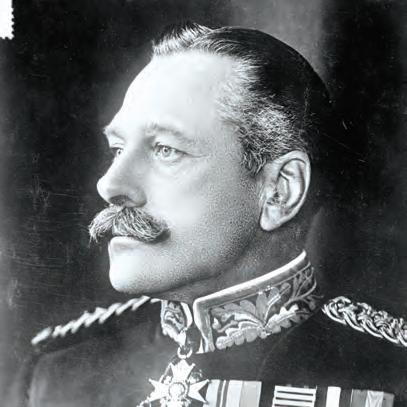
otwithstanding the many difficulties, much has been achieved,” British Expeditionary Force (BEF) commander-in-chief Field Marshal Douglas Haig announced shortly after the Third Battle of Ypres culminated in the Canadian Corps seizing Passchendaele in the fall of 1917.
“It is certain that the enemy’s losses considerably exceeded ours. Most important of all, our new and hastily trained Armies have shown once again that they are capable of meeting and beating the enemy’s best troops, even under conditions which favoured his defence to a degree which it required the greatest endurance, determination and heroism to overcome.”
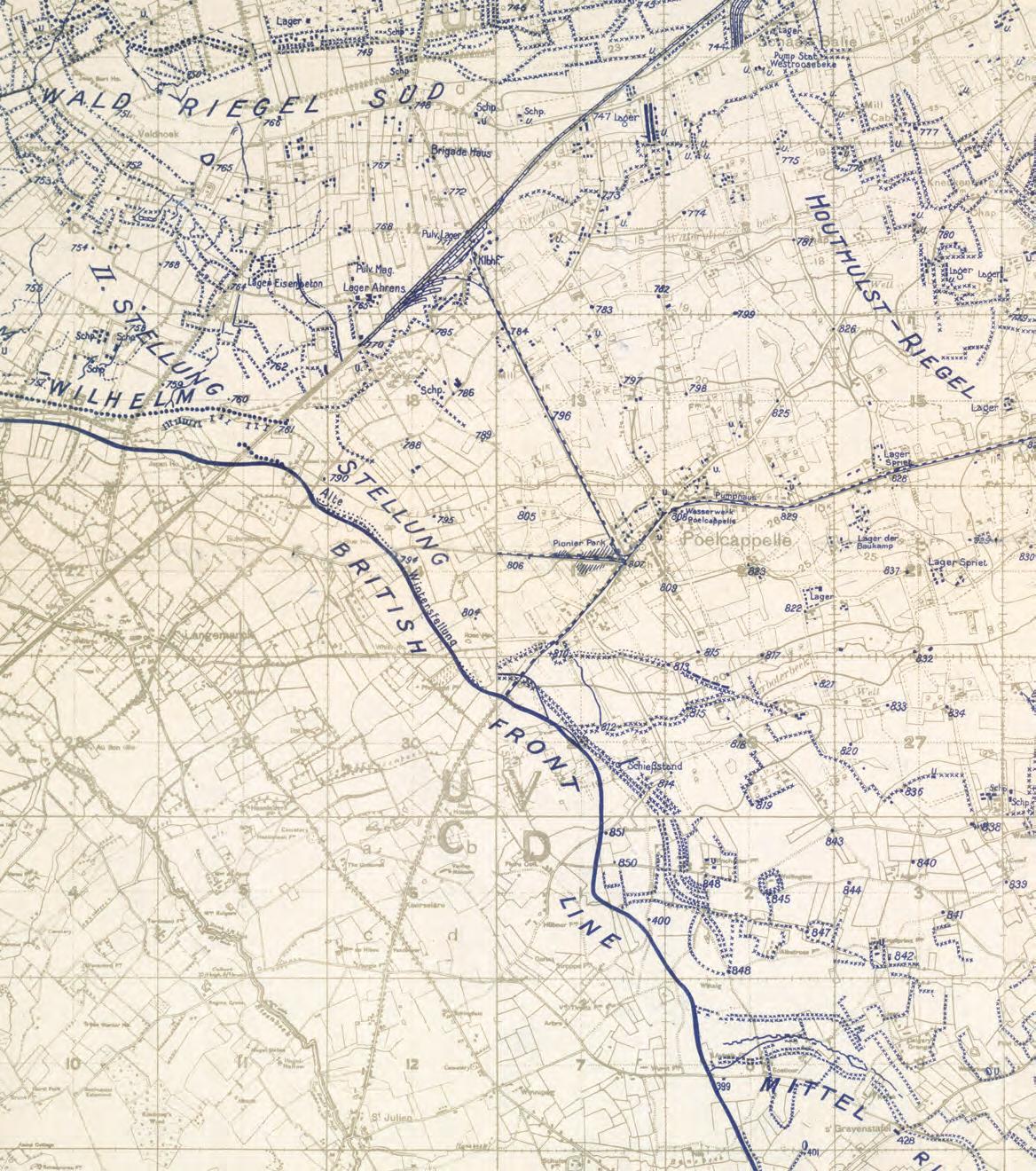
“The idea that a war can be won by waiting for the enemy to attack is a dangerous fallacy.”
—Douglas Haig
achieve a decisive breakout from the trenches and no man’s land that had locked the Allies and the Germans in a costly stalemate.
Haig’s assaults, marked by meticulous and extensive planning, were not aimed solely at scoring victory through attrition— the unrelenting commitment of overwhelming numbers and firepower until the enemy’s losses became unsustainable. What Haig sought, and what repeatedly eluded him, was a breakthrough battle after which cavalry and infantry could roam free to Germany. The resulting casualties on both sides were an inevitable result of this strategy.
In fact, the Germans suffered about 220,000 casualties compared to 275,000—including 15,654 Canadians—from Haig’s command. Such slaughter in a battle that raged from July 31 into early November aligned with Haig’s overall strategy.
“The idea that a war can be won by standing on the defensive and waiting for the enemy to attack is a dangerous fallacy, which owes its inception to the desire to evade the price of victory,” Haig declared.
That price was casualties. Taking command of the BEF in December 1915, Haig immediately initiated massive offensives intended to
Ultimately, Haig blamed the limited gains in 1917 on “the most adverse conditions of weather, [that] entailed almost superhuman exertions on the part of the troops of all arms and services. The enemy had done his utmost to hold his ground…. Despite the magnitude of his efforts, it was the immense natural difficulties, accentuated manifold by the abnormally wet weather, rather than the enemy’s resistance, which limited our progress and prevented the complete capture of [Passchendaele] ridge.”
Had the weather cooperated, his valiant troops would have surely captured the ridge “within the space of a few weeks.”
While Haig considered Passchendaele “amongst the most glorious of British battles,” it came to more symbolize the war’s futile carnage and a failed Allied approach. L
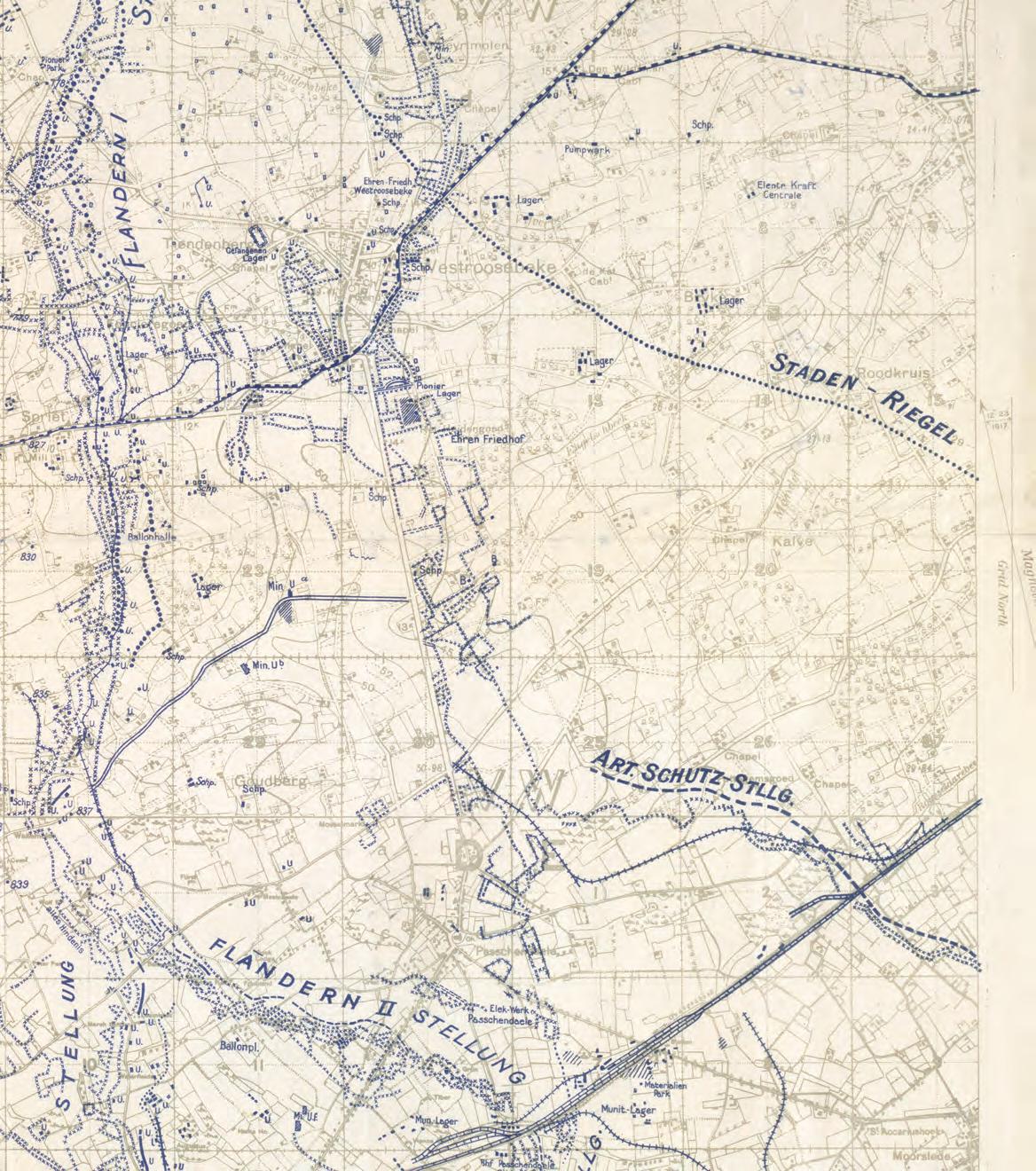
the aftermath of Passchendaele, General der Infanterie Erich Ludendorff reported on the German defence he had overseen during more than three months of relentless fighting. The battles, he wrote, had “imposed a heavy strain on [Germany’s] Western troops. In spite of all the concrete protection [of pillboxes] they seemed more or less powerless under the enormous weight of the enemy’s artillery. At some point they no longer displayed that firmness which I…had hoped for.
“I was myself…put to a terrible strain. The state of affairs in the West appeared to prevent the execution of our plans elsewhere. Our wastage had been so high as to cause grave misgivings and exceeded all expectation.”
The BEF offensive forced Ludendorff to juggle opposing agendas. He had anticipated the continued Western Front stalemate lasting through 1917, which would have left Germany free to complete Russia’s defeat and reinforce the Austrians fighting the Italians in the Alps at Caporetto. But having lost the advantage in the west, Ludendorff was forced to divert divisions there in an attempt to hold ground.
“October came and with it one of the hardest months of the war,” he confessed.
When the Canadian Corps made the advance on Passchendaele village and its ridge, Ludendorff feared defeat.
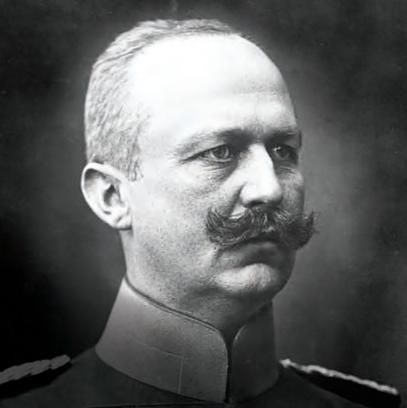
“On October 26 and 30 and November 6 and 10 the fighting was again of the severest description. The enemy charged like a wild bull.” Again, “we only came through…with enormous loss.”
On November 11, the Canadian offensive ceased, and Ludendorff conferred with senior officers at Mons, Belgium. The war had reached its decisive point, he believed. It was apparent, Ludendorff said, that a defensive policy on the Western Front was no longer tenable “in view of the enormous quantity of material of all kinds which the [Allies] had now.” Against this power, his “troops no longer displayed their old stubbornness in defense; they thought with horror of fresh defensive battles; longed for the war of movement. The interests of the army were best served by the offensive; in defense it was bound gradually to succumb to the ever-increasing hostile superiority in men and material. This feeling was shared by everybody.”
WHEN THE CANADIAN CORPS MADE THE ADVANCE ON PASSCHENDAELE VILLAGE AND ITS RIDGE, LUDENDORFF FEARED DEFEAT
The only solution was to roll the dice with a massive spring 1918 offensive aimed at breaking free of the trenches and winning the war. It was a gamble Ludendorff would take and lose. L
“The
—Erich
By Sharon Adams
Painter Marc Magee depicts HMCS Trentonian (below). The corvette was torpedoed by U-1004 and sunk in February 1945. One of two recently recovered mangled portholes (right) show the power of the attack.
A pair of portholes are grim reminders of destruction during the Battle of the Atlantic
The mangled portholes, bronze bent from the force of the explosion, “are the real story of the sinking of the Trentonian,” said Canadian naval historian and author Roger Litwiller in an interview with Legion Magazine. He donated the two artifacts from the ship to a pair of Canadian museums in late 2021.
The Royal Canadian Navy modified Flower-class ship was the last corvette sunk during the Second World War’s Battle of the Atlantic. On Feb. 22, 1945, it was escorting a convoy in the English Channel when it was torpedoed and sunk by German submarine U-1004
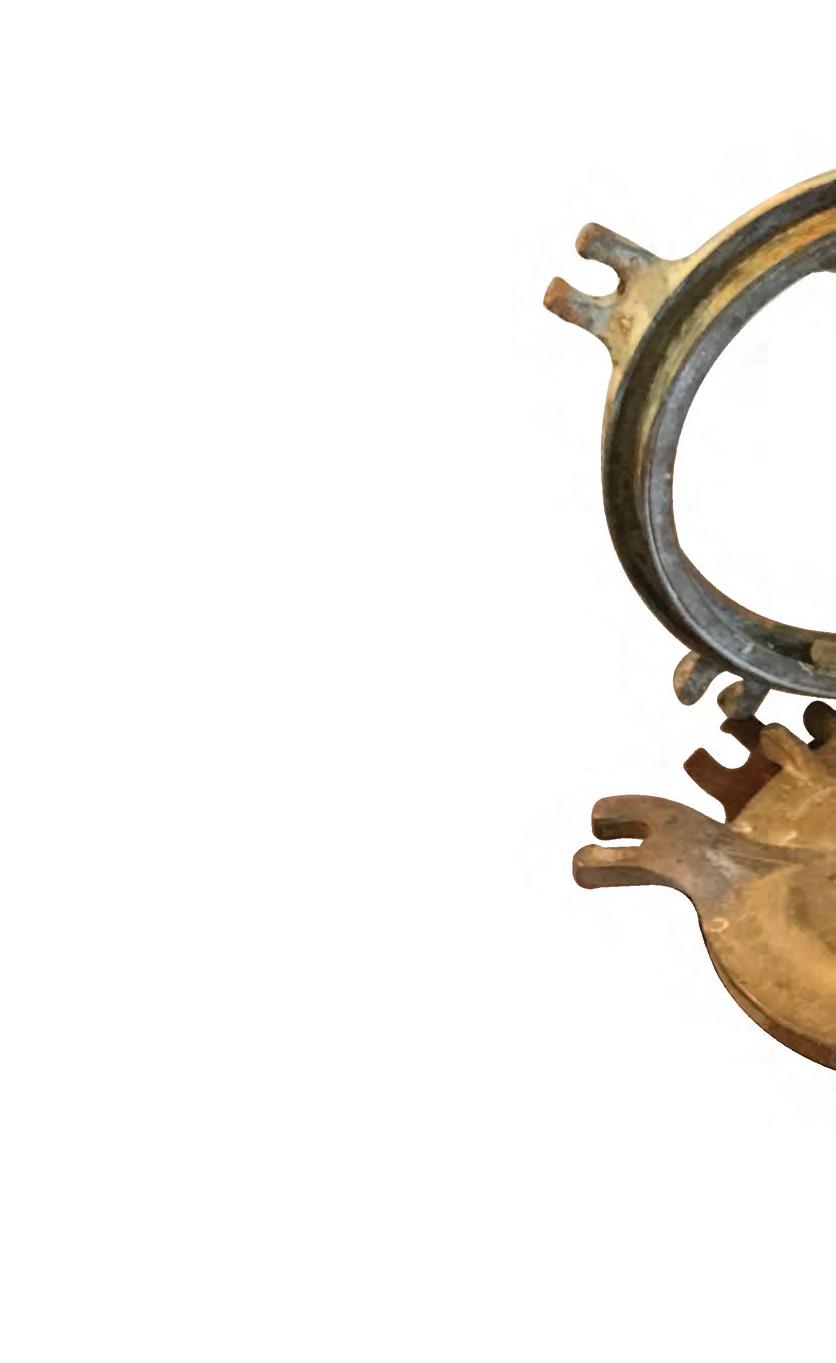
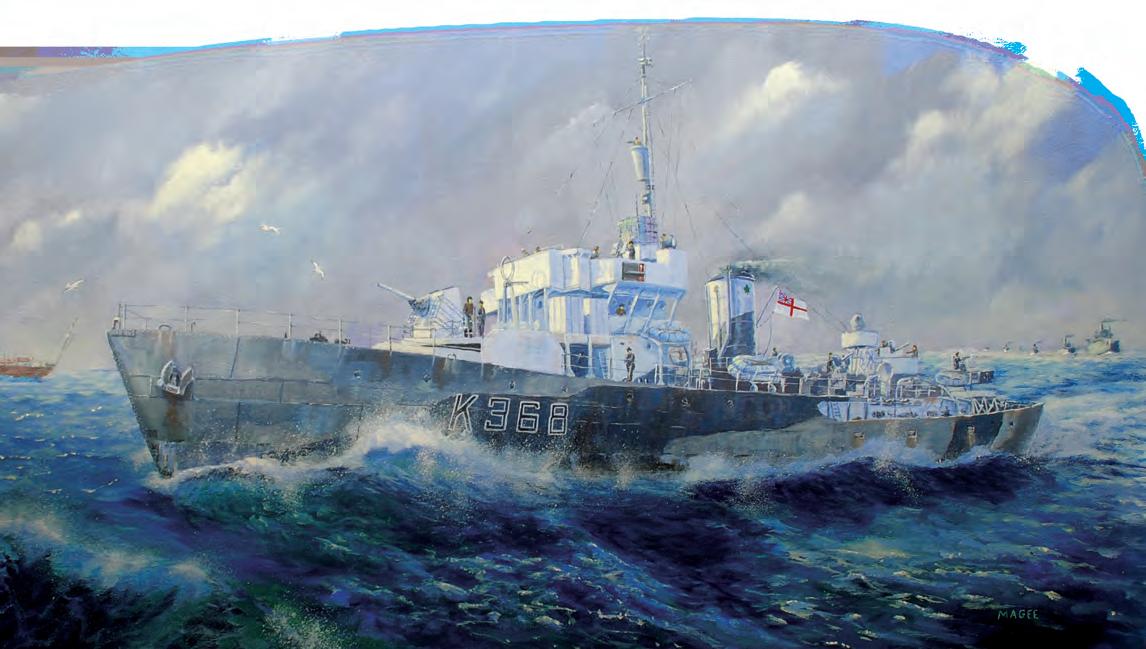

just 20 kilometres from Falmouth on England’s southern coast.
“The torpedo struck us aft with a terrific explosion and the corvette went down in 10 minutes,” said navigating officer Lieutenant Ralph Abbott, in a newspaper account at the time. After destroying the charts, he abandoned ship. “Some of the men sang while awaiting rescue,” but Abbott had to swim for about 45 minutes before rescuers arrived.
The survivors, including a number of wounded, were picked up by motor launches. Six of the 101 crewmen died.
The wreck lay scattered over the sea floor some 50-plus-metres deep, undisturbed for decades,
providing habitat for fish and marine plants. But recently it has attracted recreational divers.
In May 2021, Litwiller, author of White Ensign Flying: Corvette HMCS Trentonian, was contacted by the president of a British diving club. Although the club’s members had been warned of the British law protecting undersea wreckage of Second World War ships and aircraft, many of which are considered gravesites, two of the club’s divers had retrieved portholes from Trentonian.
The club was unable to safely return the artifacts to the wreck site, so the president went searching for a home for the
“My biggest fear is artifacts like this can end up as a lawn ornament in somebody’s garden or sitting in a scrap heap to be melted down.”
—Roger Litwiller
985
Displacement in tons of HMCS Trentonian 280
Approximate weight in kilograms of the explosive in the torpedo that sunk Trentonian 14
Number of Royal Canadian Navy warships lost to U-boat attacks during the Second World War 7
Number of RCN corvettes, including Trentonian, sunk by U-boats in WW II
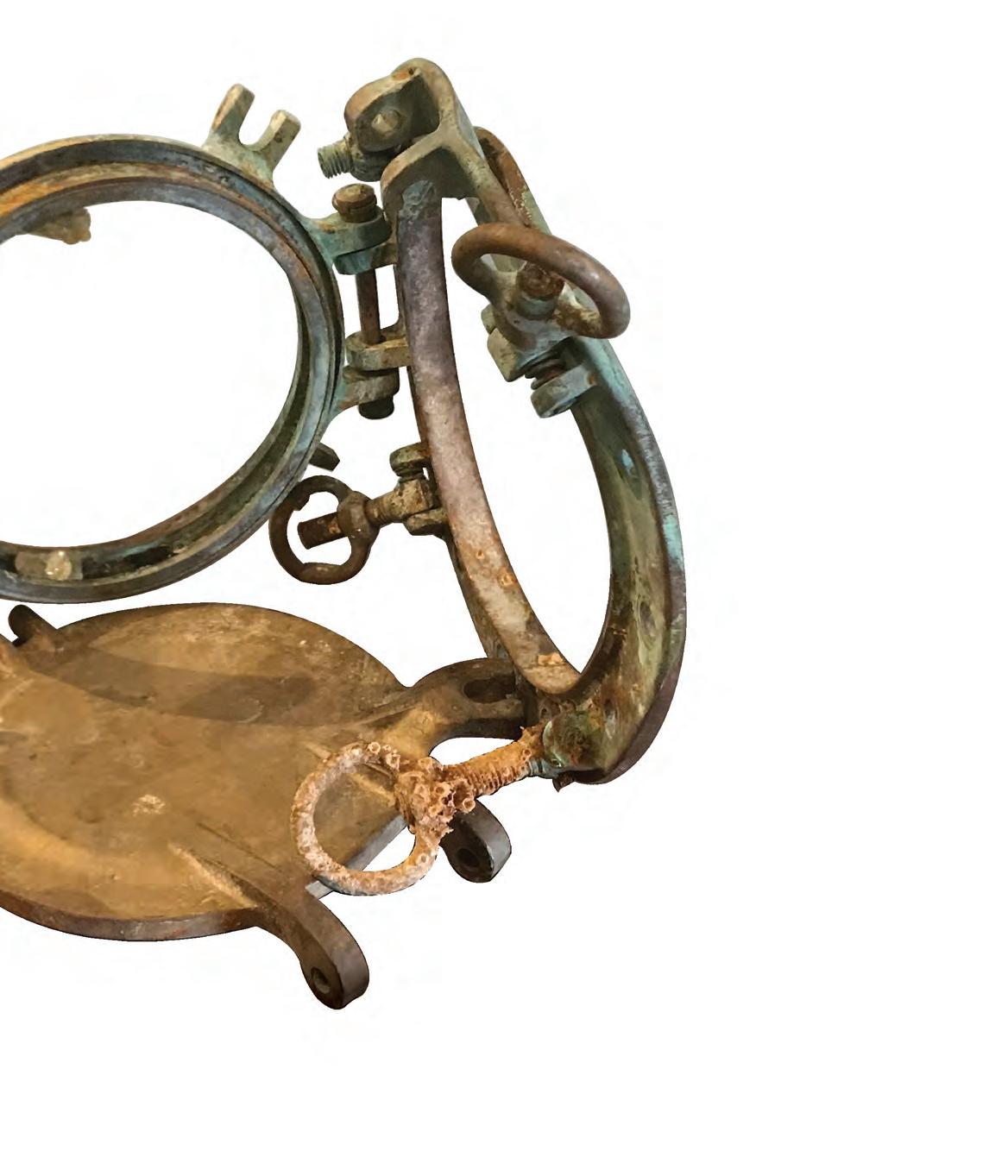

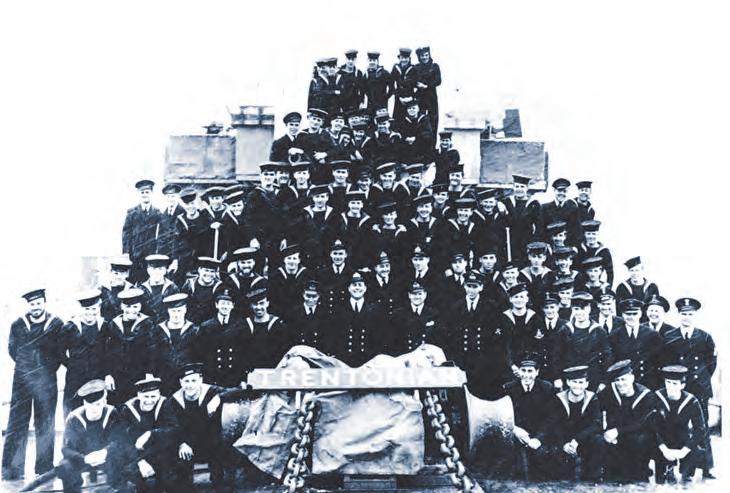
historic items and offered them to Litwiller. He accepted them.
After receiving the portholes in the mail, Litwiller donated them to two museums—one to the Naval Museum of Halifax, as Trentonian had sailed from the city’s port early in its service, and the second to the Marine Museum of the Great Lakes in Kingston, Ont. It was here at this former shipyard on Lake Ontario (now a national historic site) that shipwrights crafted the corvette. Said Litwiller: “Artifacts like these are of such huge historic significance.” L

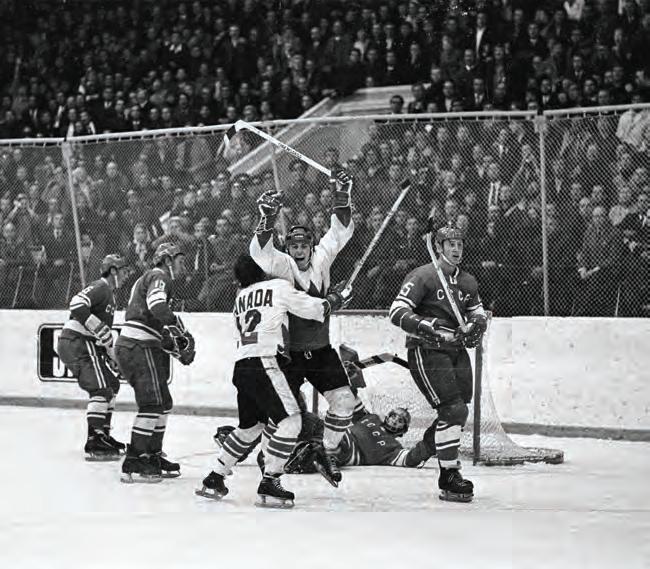
By Don Gillmor
IT WAS NO LONGER JUST A HOCKEY SERIES—IT WAS DEMOCRACY VERSUS COMMUNISM.
The Canadians had better equipment than the Soviets and were playing at home. What would happen when the team headed to the Soviet Union to play four games in Moscow surrounded by frenzied fans?
Sept. 2, 1972 ,
I was a teenager spending the weekend at a friend’s cottage. They had a television there. My pal and I were torn between going to a party—there would be girls there, we were told—and watching Canada play the Soviets. Then Phil Esposito scored 30 seconds after the opening faceoff. My friend and I predicted a final score of 25-0 for the good guys. We left.
There were no girls at the party, and we returned to learn the Soviet Union had won 7-3.
*Find many more stories in our O Canada special issues, NOW available in our SHOP!


We, along with the entire nation, were stunned.
How could a bunch of amateurs beat our best professionals. The Soviets had teamwork, crisp passing and goalie Vladislav Tretiak—Canadian scouts had only seen him play once and their report said he couldn’t stop a balloon. (He’d allegedly been hungover following a bachelor celebration.)
The result of the first game triggered an existential crisis for Canadians. Almost everyone had expected swift, merciless victory and a sweep of the eight-game series. It had never occurred to me and millions of others that Canada could actually lose the matchup.
Canadian coach Harry Sinden juggled the lineup for the second game and got a better result: 4-1 Canada. Game three was a 4-4 tie. Canada looked lost in game four, confused by the tic-tac-toe passing of the Soviets. The Vancouver crowd booed the 5-3 loss, and Esposito gave an impassioned post-game interview promising the Canadians would get better.
Team Canada arrived in the Soviet capital to find the beer and steaks they had sent had vanished. They would have to settle for borscht and vodka. Now it was no longer just a hockey series—it was democracy versus communism. At least that’s what it felt like.
The Soviets won the fifth game. Paul Henderson, who had scored twice in that one, scored the winning goals in games six and seven, setting up the decisive final match.
Team Canada was called for two questionable penalties by German referee Josef Kompalla in the first three minutes and the Soviets scored a power play goal (one of three they tallied in the game). Jean-Paul Parise threatened Kompalla with his stick and was ejected.
Canada was down 5-3 after the second period. Esposito scored early in the third, then Yvan Cournoyer batted in a rebound, though the red goal light didn’t turn on.
Alan Eagleson, head of the NHL Players’ Association, made for the ice to protest. Russian soldiers headed him off, but Canada’s Pete Mahovlich led a group of teammates to rescue him. The goal counted. With a minute left, the game was still tied. In my teenaged mind, I imagined that, if the Russians had won, Soviet tanks would roll onto Parliament Hill, we would be speaking Russian in school and wearing unfashionable clothes.
Then, with 34 seconds left…Henderson, mighty Henderson, scored to save the free world. L





the
Three varieties to choose from: grizzly bear, loon and timber wolf.
Birches and saplings cast long shadows across a snowy stage.
autumn leaves stand out against the bright blue sky. Two varieties to choose from.


The Spitfire was the iconic Allied fighter aircraft in Europe during the Second World War.
Sailing to St. Maarten, St. Lucia, Barbados, Antigua, & St. Kitts & Nevis. Plus 4 glorious days at Sea relaxing on the Edge.
Join BST Vacations and Royal Canadian Legion members from across Canada on an Ultimate Southern Caribbean Cruise on the innovative Celebrity Edge. Your ship, unlike anything else at sea, has such distinctive features as the floating Magic Carpet cantilevered off the ship’s side. Here guests can eat, drink, and soar over the sea.
Itinerary: Fort Lauderdale, Florida * At Sea * At Sea * Philipsburg, St. Maarten * Castries, St. Lucia * Bridgetown, Barbados * St. John’s, Antigua * Basseterre, St. Kitts & Nevis * At Sea * At Sea * Fort Lauderdale, Florida
Includes:
• 1 night pre-cruise in Fort Lauderdale at the Embassy Suites by Hilton
• Transfer from Embassy Suites to the pier at Port Everglades
• Breakfast at the Embassy Suites prior to departure for Port Everglades
• 10 nights onboard Celebrity Edge in your chosen stateroom
• Classic Beverage Package
• Surf Wi-Fi and Gratuities
• All meals, entertainment and services while onboard Celebrity Edge as detailed in the Celebrity brochure and/or on the Celebrity website
• Hosted private cocktail party
• Special group activities
• Exclusive hospitality/information desk for our group
• Optional private group shore excursions for purchase
• All taxes
• Hosted by Representatives from BST Vacations
Pricing:
Category A2 – Aqua Class Stateroom with Veranda - $5,205.00 per person
Category C3 – Concierge Class Stateroom with Veranda - $4,845.00 per person
Category E3 – Edge Stateroom with Veranda - $4,675.00 per person
Category E4 – Edge Stateroom with Veranda - $4,615.00 per person
Category E5 – Edge Stateroom with Veranda - $4,555.00 per person
Category 8 – Ocean View Stateroom - $4,085.00 per person
Category 12 – Inside Stateroom - $3,615.00 per person