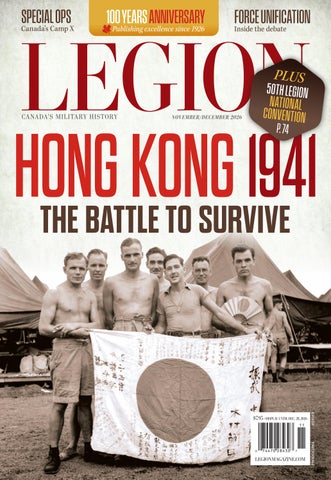
SPECIAL OPS
Canada’s Camp X
100 YEARS ANNIVERSARY Publishing excellence since 1926
FORCE UNIFICATION Inside the debate
PLUS 50TH LEGION NATIONAL CONVENTION P. 74
NOVEMBER /DECEMBER 2026 NOVEMBER /DECEMBER 2026
LEGIONMAGAZINE.COM
CoverNS_ND 2026.indd 1
PM40063864
$7.95 >DISPLAY UNTIL DEC. 28, 2026
R09389
HONG KONG 1941 THE BATTLE TO SURVIVE
2026-09-24 9:17 AM
Advertisement
Continue supporting the Legion’s mission of serving Veterans. It’s because of members like you... that we receive letters like these: “I can’t thank you enough for everything you did to make his last days and my life less stressful by coming to bat to help him receive deserved funding. Every penny went toward caregiving and other medical or travel expenses while he was alive and the last compassionate payment toward funeralhome expenses. I shall be indebted to you for the rest of my life.”
“Your hard work and perseverance on my behalf made it possible for me to receive a medical pension for on-going health issues. It has allowed me some peace of mind regarding my family’s well-being. In addition, the pension allows my wife and I to remain living in our own home and we are very grateful for that.”
Renew online at legion.ca/mission or by calling a Member Services representative at 1-855-330-3344 (Monday–Friday, 8:30–4:30 EST)
Working together to serve Canada’s Veterans
LGE11_OC2.indd 6
2026-09-24 11:17 AM
NOVEMBER/DECEMBER 2026
50 th
DOMINION CONVENTION WINNIPEG
2026
DOMINION PRESIDENT
SHARON McKEOWN Page 74
Darcy Finley
Pg01_DomCover.indd 1
2026-09-24 9:19 AM
Advertisement
SUBSCRIBE TODAY Vol. 101, No. 6 | NOVEMBER / DECEMBER 2026
Board of Directors
BOARD CHAIR Jack MacIsaac BOARD VICE-CHAIR Sharon McKeown BOARD SECRETARY Bill Chafe DIRECTORS Steven Clark, Dermod Coombs, Randy Hayley, Trevor Jenvenne, Berkley Lawrence, Valerie MacGregor, Derek Moore Legion Magazine is published by Canvet Publications Ltd. GENERAL MANAGER Jason Duprau ADMINISTRATION MANAGER Stephanie Gorin (on leave)
EDITOR Aaron Kylie
SALES/ADMINISTRATIVE ASSISTANT Lisa McCoy
SENIOR EDITOR Michela Rosano
ADMINISTRATIVE ASSISTANTS Chantal Horan Veronika Hughes EDITORIAL ASSISTANT Matthew Ryan
SENIOR STAFF WRITER Richard Foot STAFF WRITER Alex Bowers
ART DIRECTOR, CIRCULATION AND PRODUCTION MANAGER Jennifer McGill SENIOR DESIGNER AND PRODUCTION CO-ORDINATOR Derryn Allebone SENIOR DESIGNER Sophie Jalbert
SENIOR DESIGNER AND MARKETING CO-ORDINATOR Diana Coote WEB DESIGNER AND SOCIAL MEDIA CO-ORDINATOR Ankush Katoch
DESIGNER Serena Masonde
SAVE
3OF3F T% HE
Advertising Sales
R COVEE PRIC
EXPERIENCE a piece of Canada in every issue 1-YR. (4 ISSUES) ONLY
3995 + tax
Scan to subscribe
CANIK MARKETING SERVICES Nik Reitz advertising@legionmagazine.com Marlene Mignardi marlenemignardi@gmail.com Or call 613-591-0116 for more information Published six times per year, January/February, March/April, May/June, July/August, September/October and November/December. Copyright Canvet Publications Ltd. 2026. ISSN 1209-4331
Subscription Rates
Legion Magazine is $13.11 per year ($26.23 for two years and $39.34 for three years); prices include GST. For addresses in NS, NB, NL, PE a subscription is $14.36 for one year ($28.73 for two years and $43.09 for three years). For addresses in ON a subscription is $14.11 for one year ($28.23 for two years and $42.34 for three years). To purchase a magazine subscription visit www.legionmagazine.com or contact Legion Magazine Subscription Dept., 86 Aird Place, Kanata, ON K2L 0A1 Call 613-591-0116 or toll-free 1-844-602-5737. The single copy price is $7.95 plus applicable taxes, shipping and handling.
Change of Address
Send new address and current address label, or, send new address and old address. Send to: Legion Magazine Subscription Department, 86 Aird Place, Kanata, ON K2L 0A1. Or visit www.legionmagazine.com/change-of-address. Allow eight weeks.
Editorial and Advertising Policy
Opinions expressed are those of the writers. Unless otherwise explicitly stated, articles do not imply endorsement of any product or service. The advertisement of any product or service does not indicate approval by the publisher unless so stated. Reproduction or recreation, in whole or in part, in any form or media, is strictly forbidden and is a violation of copyright. Reprint only with written permission. PUBLICATIONS MAIL AGREEMENT NO. 40063864 Return undeliverable Canadian addresses to Legion Magazine Subscription Department 86 Aird Place, Kanata, ON K2L 0A1 | magazine@legion.ca
U.S. Postmasters’ Information
United States: Legion Magazine, USPS 000-117, ISSN 1209-4331, published six times per year (January/February, March/April, May/June, July/August, September/October, November/December). Published by Canvet Publications, 866 Humboldt Pkwy., Buffalo, NY 14211-1218. Periodicals postage paid at Buffalo, NY. The annual subscription rate is $12.49 Cdn. The single copy price is $7.95 Cdn. plus shipping and handling. Circulation records are maintained at Adrienne and Associates, 866 Humboldt Pkwy., Buffalo, NY 14211-1218. U.S. Postmasters send covers only and address changes to Legion Magazine, PO Box 55, Niagara Falls, NY 14304. Member of Alliance for Audited Media and BPA Worldwide. Printed in Canada.
DISCOVER MORE AT
CANADASULTIMATESTORY.COM
1-844-602-5737
2
We acknowledge the financial support of the Government of Canada. Version française disponible. From time to time, we share our direct subscriber list with select, reputable companies whose products or services we believe may interest our subscribers. To opt out of receiving these offers, please send your request, including your full name and address, to magazine@legion. ca. Alternatively, you can write to Legion Magazine, 86 Aird Place, Kanata ON K2L 0A1, call 613-591-0116, or call toll-free 1-844-602-5737. We begin by acknowledging that the land on which we gather is the traditional, unceded territory of the Anishinaabe Algonquin Peoples, who have been guardians of, and in relationship with, these lands since time immemorial. We further acknowledge and recognize that our work reaches across all First Nations territories, Métis Homelands and Inuit Nunangat.
NOVEMBER / DECEMBER 2026
Pg02_Masthead.indd 2
2026-09-25 9:33 AM
CONTENTS The colour party is piped into the closing ceremony of The Royal Canadian Legion’s 50th biennial Dominion Convention. Aaron Kylie/LM
74
THE LEGION CELEBRATES ITS CENTENARY Reflecting on 100 years of community service and looking ahead to a new century of remembrance By Aaron Kylie
FEATURES
29 THE EVIL DITCH
Canadians take Regina Trench in the last of the 1916 Somme battles By Mark Zuehlke
34 THE ART OF
UNGENTLEMANLY WARFARE Ontario’s Camp X trained hundreds of Second World War special operatives By Serge Durflinger
40 FIRST OF MANY
Tales from the historic 1950s United Nations Emergency Force By John Boileau
46 ALL FOR ONE ON THE COVER
52 HEATED RIVALRY
The Pemmican War pitted the formidable Crown-backed Hudson’s Bay Company against the upstart Métis-supported North West Company for fur trade supremacy of North America By Richard Foot
60 LEGION OF THE CONDEMNED
Cover story The hubris of Hong Kong 1941— and the Canadians who endured it By Alex Bowers
68 A PATH TO PEACE
Former prisoner of war William Allister channelled forgiveness and healing through his art Art by William Allister with words by Michela Rosano
Paul Hellyer and the 1960s campaign to unify the Canadian Forces By J.L. Granatstein
Canadians taken prisoner during the 1941 Battle of Hong Kong arrive in Manila, Philippines, on Sept. 13, 1945, after being liberated. DND/LAC/PA-137745
NOVEMBER / DECEMBER 2026
Pg03-04_Contents.indd 3
3
2026-09-24 10:34 AM
CONTENTS
110 BEHIND THE LINES
104 MILITARY HEALTH MATTERS Legacy of loss By Alex Bowers
THE FRONT
12THEN & NOW
Images from Canada’s past and present
16THE BRIEFING
A Q&A with Eric Story By Alex Bowers
18ON THIS DATE
Milestone events from November/December
20 THE VISUAL
109 ON WATCH
Call of duty By Matthew Heneghan
110 THE HISTORIAN
Bad neighbour? By J.L. Granatstein
DEPARTMENTS
6EDITORIAL
2HEROES 2 & VILLAINS
8CONTRIBUTORS
24 ARTIFACT
9FEEDBACK
The Valiants Memorial By Alex Bowers
84 IN THE NEWS
26 THE DISPATCH
93 SNAPSHOTS
27 HUMOUR HUNT
112 EXIT STRATEGY
Letters of war
4
Unknown airmen graves By Richard Foot
Open-source intel
William Landymore and Paul Hellyer By Mark Zuehlke
27
106 OBSERVATION POST
The lighter side of service
$253,304 in Legion donations
By Chris Chuckry
NOVEMBER / DECEMBER 2026
Pg03-04_Contents.indd 4
2026-09-24 10:34 AM
Advertisement
For Many Canadians, Their Home Is Their Biggest Asset HomeEquity Bank is a proud partner of The Royal Canadian Legion.
Legion Members Receive a cash rebate of $5001 upon funding their CHIP Reverse Mortgage!
$500 CASH REBATE1
A HomeEquity Bank reverse mortgage solution can help Canadian homeowners 55 and better manage expenses and rising costs in their retirement years by unlocking the equity they have in their homes. Leverage a flexible financial solution Access up to 55%2 of the home’s value, in tax-free cash No Negative Equity Guarantee3 – Maintain title and ownership of your home
What a Reverse Mortgage Can Be Used For: Immediate needs Pay off debt or mortgage
Independence Boost income for daily expenses
Lifestyle Fund travel or home upgrades
Living Legacy Support family with major milestones
Get Your FREE, No Obligation Quote4, 1-888-285-5654, Call Today! 1Terms and conditional apply. Please visit www.chip.ca/legion for more information 2Terms and conditions apply. Please visit www.chip.ca/terms for more information 3Must abide by mortgage obligations, maintain property, pay taxes and homeowners insurance. As long as the clients meet their mortgage obligations, HomeEquity Bank guarantees that the amount they will have to pay on their due date will not exceed the fair market value of their home. If their home depreciates in value and the mortgage amount due is more than the gross proceeds from the sale of the property, HomeEquity Bank covers the difference between the sale price and the loan amount. The guarantee excludes administrative expenses and interest that has accumulated after the due date. Additional terms and conditions may also apply. 4All quotes are estimates based on the information available at the time quote is requested, and do not constitute a firm offer, binding contract, or guarantee of rates or services. Subject to HomeEquity's underwriting guidelines. Additional terms and conditions may also apply
HomeEquity-ND26.indd 4
2026-09-24 10:56 AM
EDITORIAL
ENEMY OF OUR STATE
It’s
not a joke. Nor an idle threat. And not a negotiation tactic. U.S. President Donald Trump’s repeated attacks on Canadian sovereignty and the belittling of our leaders are tantamount to threats of war. Any Canadian who can’t see that isn’t paying close attention. Before Trump was even inaugurated for his second term, he began referring to Canada as the 51st state and calling then prime minister Justin Trudeau “governor.” He has even posted a map of the country covered with the U.S. flag to his Truth Social account several times. Imagine how it would be viewed if China did similarly with Taiwan, or Russia with former Soviet countries? Shortly after announcing his resignation in early 2025, Trudeau got candid about Trump’s stance behind closed doors at a Canada-U.S. economic summit. He told more than 100 business leaders and public policy experts that the president “wants to access the country’s critical minerals” and that “Mr. Trump has it in mind that the easiest way to do it is absorbing our country and it is a real thing.” Widely reported at the time, those sobering remarks seem to have been largely forgotten, despite Trump continuing to regularly refer to Canada as the 51st state and directing the governor jab at Trudeau’s successor Mark Carney. Shortly after Trump’s second inauguration, the president began his deranged tariff policy toward Canada, shifting levy targets at a whim (or as forest fire smoke drifted south). “This is deliberate economic warfare against Canada, not a routine trade dispute,” wrote economists Hadrian Mertins-Kirkwood and Marc Lee in a February 2025 article for the Canadian Centre for Policy Alternatives. Of course, economic warfare has historically been one of the first steps a belligerent takes before launching all-out war. Perhaps there’s no more fitting representation of Trump’s hawkish stance on Canada than the new Gordie Howe
6
International Bridge connecting Windsor, Ont., to Detroit, Mich. Bridges have long been vital military assets and targets, so it’s hardly surprising that Trump went to great lengths to delay its opening—in the end by six months. He demanded that ownership of the Canadian-built crossing be shared with the U.S., even though once Canada had been repaid for the construction cost, its ownership was already split with the state of Michigan. Coincidentally, the owner/operator of the other bridge connecting Windsor and Detroit is a billionaire donor to the Trump-aligned MAGA Inc. political action committee.
The president “wants to access the country’s critical minerals… Mr. Trump has it in mind that the easiest way to do it is absorbing our country and it is a real thing.” “My friends, it’s corruption in plain sight,” Congressman Mike Levin said in a June Instagram post. “A government should work for the people, not for whoever writes the biggest cheque. Open the bridge.” It opened in late July with no official American participation. “Let’s keep working together as two friends, allies and proudly independent countries,” Ontario Premier Doug Ford said at the event. Trump’s response: threatening more tariffs. Weeks later, negotiations on a new Canada-U.S. trade agreement fell apart…again…prompting Carney to say: “America is trying to break us so that they can own us. “We were attacked,” he continued. “You’re at war when you get attacked.”
NOVEMBER / DECEMBER 2026
Pg6_Editorial.indd 6
2026-09-24 10:35 AM
Advertisement
N OR TH A MER I CA’S
SP E
CI A
1 Selling Walk-In Tub
#
LO
FFE
R
Featuring our Free Toilet
Now you can finally have all of the soothing benefits of a relaxing warm bath, or enjoy a convenient refreshing CSLB 1082165 • NSCB 0083445 • 13VH11096000 • CGC1537181 • ROC 312990 • CCB 244331 • SAFESSW784PS PA127501 • MHIC 134233 • TN 5887 • RL.884533 • RBB.49248 • UT 13229623-5501 • 1126
shower while seated or standing with a Safe Step Walk-In Tub. ✓ First walk-in tub available with a customizable shower ✓ Fixed rainfall shower head is adjustable for your height and pivots to offer a seated shower option ✓ High-quality tub complete with a comprehensive lifetime warranty on the entire tub ✓ Top-of-the-line installation and service, all included at one low, affordable price
CALL TODAY AND RECEIVE EXCLUSIVE SAVINGS
Now you can have the best of both worlds–there isn’t a better, more affordable walk-in tub!
FREE COMFORTHEIGHT TOILET PLUS $2500 OFF FOR A LIMITED TIME ONLY
Call Toll-Free 1-800-296-0487
www.SafeStepTub.ca/legion
For your FREE information kit and our Senior Discounts, Call Today Toll-Free
1-800-296-0487
With purchase of a new Safe Step Walk-In Tub. Not applicable with any previous walk-in tub purchase. Offer available while supplies last. No cash value. Must present offer at time of purchase. Cannot be combined with any other offer. Market restrictions may apply. Offer available in select markets only.
SafeStep-ND25.indd 4
2026-09-24 10:57 AM
CONTRIBUTORS
The EDITOR With more than 25 years in the industry, Legion Magazine’s editor Aaron Kylie is a self-professed print nerd with a passion for making magazines. He recently edited Great Canadian Stories: True Tales from the pages of Legion Magazine, the latest book from the magazine’s publisher— in stores now!
The VETERAN
The EXPERT
Former Canadian Armed Forces medic (1 Field Ambulance) and civilian paramedic Matthew Heneghan now devotes time to writing, most recently penning the book Trauma and Tea (2026), and hosting the podcast “Matthew Heneghan: Unfiltered.”
Carolyn Hughes is director of veterans services for The Royal Canadian Legion’s Dominion Command and pens the informative “Serving You” column each issue (page 92). An expert on government benefits for veterans and military members, Hughes is also a regular resource for Legion Magazine.
The LENS MAN Jeremy LeClair is a Saskatchewanbased photographer and videographer. His track-and-field background lent itself well to covering the Legion’s National Youth Track and Field Championships (page 84).
Advertisement WINNER BEST SLEEP STORE
Elevate Your Life.
Supreme Adjustable Base
A Canadian Company
THE MOST AWARDED ADJUSTABLE BASES & LIFT CHAIRS
Venice Recliner Lift Chair
HELPING CANADIANS IMPROVE THEIR SLEEP FOR MORE THAN 40 YEARS Partner Benefits
CONTACT US
8
Find relief from 1-800-455-6421
WWW.ULTRAMATIC.CA
Sciatica & Arthritis
SCAN TO SAVE
Sleep Apnea Discomfort Acid Reflux & GERD
Swelling & Hypertension
Chronic Pain from Injury
NOVEMBER / DECEMBER 2026
Pg08_Contributors.indd 8
2026-09-25 9:51 AM
FEEDBACK
Readers’ forum
pity, as Namibia has proven to be one of the few UN peacekeeping success stories. The country has remained a stable democracy for 36 years since gaining its independence from South Africa. Steve Smedley Regina
of 1600 yards and 400 yards extra for good measure....” His detailed diary of his WW I years is a wonderful family treasure. Chris Kempling Summerland, B.C.
MERCI, OUI
My grandfather, Corporal George Hedley Kempling of St. Catharines, Ont., (26th Battalion, Canadian Expeditionary Force, 2nd Canadian Division), was at Flers-Courcelette (re “No Mercy,” September/ October). This is his diary entry for Sept. 15, 1916: “A wonderful new machine was used for the first time today. It is a sort of armoured car, driven by a 105HP engine. It is armed with two 4-inch Hotchkiss guns and eight machine guns. Then there are several holes for rifles to be fired through. The windows are prism, so that a man doesn’t have to put his head before mere glass to have a look outside. The machine is like a square rather flattened. There are no wheels. The treads, one continuous flexible tread on each side, are constantly pulled round under and over a smooth track on each side of the machine. By the shape of the machine it is seen to be able to rock backward and forward in creeping along and like a caterpillar it climbs down one side of a big hole and up the other, or it flops across it without bothering to reach the bottom of the hole if the trench is narrow enough. When the Germans saw fifteen of these machines on our Canadian front, heading our charge it scared them so stiff that our boys walked right through them. We captured 300 prisoners and reached our objective
TOTAL RECALL
I recently read “Reflections on remembrance” (September/ October) featuring the Legion National Youth Remembrance Contests-winning entries. My father and many of my family members served. Some died overseas. It moved me to tears to see how the youth today are connecting to this part of our shared history. Win McClure Lake Cowichan, B.C.
Editor’s note: We received several messages noting peacekeeping missions that weren’t included in this two-page infographic. It was, however, intended to highlight Canada’s major peacekeeping missions, rather than every one the country has participated in. The aim was largely to highlight the dramatic change in Canada’s involvement in such initiatives. That said, it erroneously did not include the one death of a Canadian peacekeeper in Somalia, Corporal Michael Abel. We regret this error and apologize for the omission.
POLE POSITION
MORE PEACE
Thank you for highlighting Canadian participation in peace operations (“Peace out,” September/October). I served alongside Canadian Forces personnel as an RCMP civilian police monitor with the United Nations Transition Assistance Group in 1989-1990, a mission that wasn’t mentioned in the article. That’s a
My late husband James Fawcett served with the Royal Air Force during WW II. His first tour was with 76 Squadron as a tail gunner. His second tour was with 148 (Special Duties) Squadron based in Brindisi, Italy. In 1944, 148 dropped arms, ammunition and medical supplies to the Polish resistance fighters in Warsaw (re “The secret mission airmen,” July/August). He recalled being so close to the ground during those flights that he could see the German anti-aircraft gunners shooting from the top of the buildings. In 1992, he was awarded the Warsaw Uprising Cross at a ceremony held at the Polish Consulate in Toronto. He also received the Polish Cross of the National Army.
NOVEMBER / DECEMBER 2026
Pg09-10 Feedback.indd 9
9
2026-09-24 11:03 AM
Readers’ forum
FEEDBACK
It was heartwarming to read the accounts of these brave young men in Edward Poznanski’s story. I’m so glad their stories and selfless acts of heroism are being told. Ruth Fawcett Napanee, Ont.
as the addition of a fleur-de-lis and the replacement of “PRO VALORE” with “FOR VALOUR.” Finally, if the five-year rule applies, how did Australia, after reviews, award its VC to a sailor from the Second World War in 2020 and a soldier from the Vietnam War in 2024? I certainly do not propose any lessening of the high standards required for the award of the VC, but I also believe that some common sense must be brought to the process. John Boileau Bedford, N.S.
SOMETHING FISHY
Michela Rosano’s news story, “Feds to review military honours, Victoria Cross” (July/August), notes the so-called five-year rule initiated by King George VI in 1950, which limits nominations for the VC to five years after the act took place. This is the justification that the responsible honours and awards staff steadfastly use to reject the nominations of Jess Larochelle and others. But if there ever were a red herring, this is it. In the first place, the King’s “rule” does not bind Canada. The Canadian VC is not the British VC. The composition of the medal is completely different from the British one, while it incorporates different design elements, such Advertisement FLANDERS - VIMY - SOMME - DIEPPE - NORMANDY - PARIS
110th anniversary tours APRIL 6TH - APRIL 15TH, 2027
LONDON - BLETCHLEY - PORTSMOUTH NORMANDY - DIEPPE - ARRAS - YPRES-BELGIUM
APRIL 2 - APRIL 11 2027 FLANDERS - VIMY - SOMME - DIEPPE
NORMANDY - PARIS
APRIL 6 - APRIL 15 2027
REGISTRATION OPEN WWW.THEBATTLEFIELDTOURS.CA
10
STILL FIGHTING
I would like to compliment Legion Magazine for publishing Janette Higgins’ article “A cause worth fighting for” (July/August) about her father Jim Higgins and the reason he and more than 1,500 Canadian men (and women) went to Spain to fight for the Spanish Republic. The large majority of the 587 who didn’t return lie unremembered in Spain. For the last decade, I have been part of a group seeking to ensure that the men who returned don’t suffer the same fate. On Remembrance Day, volunteers from across Canada have honoured these men by placing flowers on their graves. There are 313 known graves in Canada, but there are 292 other men and women for whom we are still researching their place of burial. Unfortunately, we have found many who lie unmarked on Canadian soil as well. Lest we forget. Raymond Hoff Victoria
SORRY?
The cartoon of Donald Trump sleeping with bags of money around him and the caption “Bored of Peace” (May/June) is in poor taste. Not everyone would share this view of President Trump, especially my American friends. It’s offensive and should be retracted with an apology. Ronald Hart Wasaga Beach, Ont. Submissions for this department can be sent to magazine@legion.ca. They should be constructive and of general interest. They may be edited for brevity and clarity. The views expressed are those of the correspondents and publication of them does not necessarily constitute an endorsement by Legion Magazine.
NOVEMBER / DECEMBER 2026
Pg09-10 Feedback.indd 10
2026-09-25 9:52 AM
Advertisement
CanopyGrowth-SO26.indd 1
2026-09-24 10:57 AM
THEN & NOW
Then
LEST WE FORGET ← The 114th Battalion, known as Brock’s Rangers, is pictured at Camp Borden, Ont., before travelling to Halifax to embark on Nov. 1, 1916. Recruited from Ontario’s Haldimand County and on the Six Nations of the Grand River, more than 600-man-strong battalion included nearly 300 First Nations volunteers. Though Indigenous Peoples were initially discouraged from enlisting in the Canadian Expeditionary Force due to racist beliefs, in all, approximately one third of all First Nations people aged 18-45, as well as an unknown number of Inuit and Métis, served Canada in the Great War.
12
NOVEMBER / DECEMBER 2026
Pg12-15_Then_Now.indd 12
CWM/19860407-020
2026-09-24 11:04 AM
NOVEMBER / DECEMBER 2026
Pg12-15_Then_Now.indd 13
13
2026-09-24 11:04 AM
THEN & NOW
14
NOVEMBER / DECEMBER 2026
Pg12-15_Then_Now.indd 14
Now
Aviator Natalie Chilcott/CFB Wainwright Imaging
2026-09-24 11:04 AM
CONTINUED LEGACY ← Five Canadian Armed Forces training programs—Raven, Bold Eagle (the 2026 graduates pictured here), Black Bear, Grey Wolf and Carcajou (Wolverine)—provide military training and cultural experiences for Indigenous Canadian citizens across the country. Cultural aspects of the camp, which run in the summer for six to eight weeks, are taught by Elders, and include sweat lodges, powwows and sharing circles. During the program, participants are enrolled as CAF members and take basic training.
NOVEMBER / DECEMBER 2026
Pg12-15_Then_Now.indd 15
15
2026-09-24 11:04 AM
THE BRIEFING
The Legion Magazine Q&A
HISTORIAN ERIC STORY
By Alex Bowers assistant professor at Wilfrid Laurier University in Waterloo, Ont., has studied the legacies of the conflict, charting postwar disability and advocacy in Canada. Here, Story discusses the struggles that some veterans continued to face long after the Armistice.
W
hen the guns of the Western Front fell silent on Nov. 11, 1918, the smoke of battle gradually faded. The violence of the previous four years, however, had left countless scars— not only on the landscape, but on those who survived it.
On postwar veterans with disabilities In the official history of the First World War by Gerald Nicholson, it’s written that 172,000 soldiers were wounded on the battlefield. A large majority of those returned home, but that figure doesn’t account for the many hundreds of thousands of soldiers who were diagnosed with illnesses on the battlefield. Even in the official history, shell shock wasn’t included in that number, so the short answer is we don’t really know the real figure. It’s certainly more than 200,000, probably north of 250,000.
“On the one hand, they’re battlefield heroes. On the other, their wounds were considered a hindrance to transitioning to the workforce. They were caught between competing ideals.” In time, sites of such bloodshed could largely heal—mud replaced with fertile fields, ruins rebuilt into thriving communities. The same could not always be said for many Canadian veterans who had lost limbs, developed chronic illnesses or otherwise endured life-altering wounds. Medical and military historian Eric Story, an
16
NOVEMBER / DECEMBER 2026
Pg16-17_The Briefing.indd 16
Veterans were seen as heroes who were to help carry Canada into a more prosperous and better future. When we’re looking specifically at veterans with disabilities, however, two archetypes emerged. On the one hand, they’re battlefield heroes, with the scars of war to prove it. On the other hand, those same wounds were framed as a hindrance
to transitioning into the workforce. They were caught between two competing ideals. On early advocacy efforts A few groups began advocating for these veterans. Two particular groups, the Tuberculous Veterans Association of Canada [since subsumed into The Royal Canadian Legion] and the Amputations Association of the Great War [today known as the War Amps] were very much at the forefront. The Amputations Association became a national group by 1920, representing between 4,000-5,000 veterans who had had various forms of amputations. The lesserknown group, the Tuberculosis Veterans Association, advocated for those diagnosed with the infectious and chronic disease. By 1921, over 10,000 Canadian Great War veterans had received treatment for tuberculosis stemming from their wartime service. On the forgotten story of George Hincks and Marshall McDougall Hincks and McDougall, two wartime leg amputees, embarked on a long-forgotten trek across Canada in 1923. It’s the kind of story that has obvious parallels to Terry Fox’s 1980 Marathon of Hope. These veterans decided that they would walk from Calgary to Ottawa—about 3,000 kilometres—and would do so unassisted on crutches. They trekked across Alberta, Saskatchewan and Manitoba, financing it by McDougall playing piano and Hincks giving speeches to raise awareness of the issues facing veterans with disabilities.
University of Wilfrid Laurier
2026-09-25 10:27 AM
READ MORE LEGION MAGAZINE Q&A INTERVIEWS IN ALEX BOWERS’ WEEKLY THE BRIEFING BLOG AT LEGIONMAGAZINE.COM/BRIEFING
When they reached Winnipeg, Hincks gave his most provocative address. I find that speech such an interesting point of comparison to Terry Fox, who very much championed the idea of overcoming one’s limitations. Hincks, meanwhile, flipped the script entirely. He said that it wasn’t just his issue of needing to overcome the limitations that had been placed on his body, but that the wider public needed to think about the discriminatory attitudes holding him back in the postwar world. Those words were uttered more than 100 years ago, but they’re still so resonant. He shifted the focus onto ableist attitudes that kept him and his fellow amputees from re-entering the workforce. Hincks and McDougall continued on after Winnipeg, crossing into Ontario, but they started to encounter considerable pain. They made it to Kenora, Ont., before McDougall decided to return to Winnipeg. Hincks kept going until Fort William, but there he, too, decided that he couldn’t go any farther. It’s such a wonderful story of fortitude and endurance, but it’s also such a relevant story when we’re talking about today’s disability rights. On drawing parallels with the modern world We often associate the 1970s and the 1980s with the start of the modern disability movement. But the story of McDougall and Hincks, as well as the larger advocacy work of the Amputation Association and the Tuberculosis Veterans Association, started as early as 1918. It’s hard to draw a direct parallel between then and now because the research hasn’t been done, but I would be surprised if there wasn’t some throughline.
On reframing our understanding of wartime disabilities We often think about wars having firm start and end points. But veterans tell us that wars don’t
necessarily end with peace deals and armistices. They can linger long after. Read the full version of this abridged interview at LegionMagazine.com.
Advertisement
Medipac Travel Insurance
®
For Canadians who are heading south this winter
1-800-MEDIPAC 1-800-633-4722 • www.medipac.com Underwritten by Old Republic Insurance Company of Canada
2026MS Medipac ad Legion island 4.275x7.375.indd 1
2026-09-21 5:32:38 PM
NOVEMBER / DECEMBER 2026
Pg16-17_The Briefing.indd 17
17
2026-09-25 10:27 AM
ON THIS DATE
Milestone events from November/December
November 8 November 2008 CBC journalist Mellissa Fung is released 28 days after being kidnapped by insurgents near Kabul, Afghanistan. 9 November 1940 HMCS Collingwood, the first Royal Canadian Navy corvette, is commissioned. 12-13 November 1944 Along with Royal Navy ships, HMCS Algonquin takes part in a surface operation against German vessels along the Norwegian coast. Together, they sink nine enemy vessels.
November 1945 The Nuremberg trials, held by the Allies to prosecute officials of Nazi Germany, begin. In all, 199 defendants are tried, 161 are convicted and 37 are sentenced to death.
20
7 November 1885 Donald Smith (Lord Strathcona) drives the “last spike” in at Craigellachie, B.C., to complete the Canadian Pacific Railway.
November 1944 HMCS Shawinigan is torpedoed and sunk by U-1228 in the Cabot Strait. All 90 crew die.
25
26 November 2008 CPO Thomas Ratzlaff runs through a hail of bullets to neutralize an enemy machine-gun nest in Afghanistan. He is awarded the Star of Military Valour. 29 November 1993 MCpl. Stéphane Langevin and Cpl. David Galvin are killed while escorting a humanitarian aid convoy near Zenica, Bosnia and Herzegovina.
14
30 November 1933 First World War General Arthur Currie dies.
November 1981 Canadarm, the Canadian-made robotic arm, is operated in space for the first time on space shuttle Columbia. 16 November 1941 The Winnipeg Grenadiers and The Royal Rifles of Canada arrive in Hong Kong to join the 14,000-strong Allied defence force (see “Legion of the condemned,” page 60).
18
22 November 1951 The Royal 22e Régiment comes under fire from a Chinese attack on Hill 355 in Korea.
NOVEMBER / DECEMBER 2026
Pg18-19_On This Date.indd 18
2026-09-24 11:13 AM
VISIT LEGIONMAGAZINE.COM FOR MORE ON THIS DATE EVENTS
2 December 1942 The atomic age is ushered in with the first controlled, self-sustaining nuclear chain reaction at the University of Chicago. 3 December 1997 The Anti-Personnel Landmines Convention, also known as the Ottawa Treaty, is signed by 122 countries. It aims to eliminate the weapon worldwide. December 1941 The Japanese attack the U.S. fleet at Pearl Harbor; Canada declares war on Japan.
7
9 December 1755 The first post office opens in what’s now Canada in Halifax in an effort to improve military communications between Britain and North America. 10 December 1914 The Borden Motor Machine Gun Battery, a specialized mobile unit, is formed in Montreal. 13 December 2008 Responding to reports of suspicious activity, three soldiers of The Royal Canadian Regiment— Cpl. Thomas James Hamilton, Pte. John Michael Roy Curwin and Pte. Justin Peter Jones—are killed by an improvised explosive device west of Kandahar, Afghanistan. 16 December 2021 HMCS Winnipeg completes its deployment to the Indo-Pacific region on Operation Projection, an ongoing naval presence mission to promote peace and stability.
22 December 1977 Ottawa approves the construction of six new naval frigates, but it will take years to get the ships into the water. 24 December 1914 An unofficial Christmas truce begins on the Western Front. 25 December 1940 The Canadian Corps is formed in England.
27 December 2001 Deployment is announced of two CP- 140 Aurora long-range surveillance and maritime patrol aircraft and roughly 200 air force personnel to the Persian Gulf. 29 December 1944 Royal Canadian Air Force Flt. Lt. Richard Audet shoots down five German planes.
December 30 December 1941 In Ottawa, British Prime Minister Winston Churchill delivers an inspirational speech that helps galvanize wartime resolve.
LAC; NASA; U.S. National Archives/Wikimedia; Wikimedia; LM Archive (3); U.S. Department of Energy/Wikimedia; Aldo Bidini/Wikimedia
Pg18-19_On This Date.indd 19
NOVEMBER / DECEMBER 2026
19
2026-09-24 11:13 AM
Open-source intel
THE VISUAL
LOWERTOWN LOSSES
F
GREEN ISLAND
A
RIV
SU
ER
SS
EX
bottom left of the map, for instance, was the hardware store of the Cuzner family, whose son Eddie was the 52nd victim of Manfred von Richthofen, the Red Baron. When the Second World War started in 1939, 80 Lowertown families were still dealing with the effects of the war to end all wars—parents shattered by the losses of children, veterans coping with wounds, gas poisoning or shell shock. While the men detailed here all died in service to Canada, it was their mothers, fathers and partners who were conscripted to carry the burden of their sacrifice. This map isn’t about the dead per se. It charts the addresses of their next-of-kin, in a sense a geographic depiction of carnage on the home front and, largely, a visual representation of the emotional damage in Lowertown between 1914 and 1945. —Dave O’Malley O T TA W
Dalhousie and Cumberland once extended north.
TE BO
LE
R
CATHCAR PARK BO
R PA T EN
or the past seven years, I have been mapping the homes of the next-of-kin of Ottawans who fell in the world wars and Korea. Neighbourhood by neighbourhood, I tracked down the residences of nearly 2,000 men and women who died in service. When finished, each map was published locally around Remembrance Day. The final map, covering Lowertown, Ottawa’s oldest neighbourhood— a ramshackle, working-class, largely francophone community in those days—is published here. Neighbourhoods across the country encountered similar fates, felt the endless blows to their hearts, felt their life blood seeping away. Parents stood by while their sons and daughters left home and began arduous journeys that would lead most to war and great risk of death. Every pin on this map tells a unique story of hope and loss. The starred black circle near the
N LTO
TH CA
BINGHAM PARK
CA
RT
BR
UY
È
RE
(Fo
.A ST
rm
ND
erl
RE
GU
W
IG
R PA
WHEN THEY DIED
T EN
AL E
X A N DR
A B R I D GE
EX
ZI E
1916
1917
1918 POSTWAR
FIRST WORLD WAR
1940
1941
1942
1943
1944
1945 POSTWAR
SECOND WORLD WAR
Plus, one death in the Korean War, in 1953.
PARLIAMENT
20 NOVEMBER / DECEMBER 2026
Pg20-21_The Visual NEW.indd 20
2026-09-28 2:19 PM
D
SS EN
1915
AR W BY
SU
MAJOR’S HILL PARK
10
CK MA
NUMBER OF DEATHS
30
20
y
WHERE THEY LIE NOW 26
36
FIRST WORLD WAR
7
3
8
UNITED KINGDOM
BELGIUM
6
5
NKG NO KNOWN GRAVE CANADA
FRANCE 12
7
12
5
NKG
GREEN ISLAND
SECOND WORLD WAR
CANADA
FRANCE
NO KNOWN GRAVE
ITALY
3
3
1
1
UNITED KINGDOM GERMANY 1
1
NETHERLANDS
BELGIUM
ALGERIA
HONG KONG
TUNISIA
AZORES
STANLEY PARK
PORTER’S ISLAND 1
KOREAN WAR RIDE
RO
d once th.
KOREA
AU RIVER
CK W TE UR MB UR G
(Anglesea Square)
CH
BU RG
R TO
Y ME
AR
LO TT
E
LE SO
S
EL
LS FR
ND
ON
LA
AY
U EA
AP
D
ER
HO US
R PA
I EL
RR
NE
AR DW
MB
L DA
MU
RI D
CH
GE
ICK
CU
R AT .P ST
AU BE
K
A ST
R YO
GU
UE
AU
IL
IL
IG
KI N
GU
Y
MACDONALD GARDENS PARK CO
W
NE
LE
N
D
Y RA
SO
.A ST
E DR
HE
t a)
R
T AS EE
us
JULES MORIN PARK
.)
MU
NC
ug
erl
CL
E AR
yA
rm
K RIC
erl
È
(Fo
St
T. DS
T PA
rm Fo
Y RU
RE
r ate yW
S
AU BE
B
RT
IN
E
O(
SE
OL CA
RD
TR PA
RO
N TO
TH CA
JA
TT LO
S DE
CATHCART PARK
OO W
CK
AR
RI PAT ST.
CH
BORDELEAU PARK
IE
T EN
CL
AR
EN
CE
R YO
K
AR W BY
WI
D
GE
OR
LEGEND
GE
LLI AM R
Dave O'Malley
Pg20-21_The Visual NEW.indd 21
Residences of next-of-kin of those who served
FIRST WORLD WAR
SECOND WORLD WAR
ARMY NAVY
ARMY AIR FORCE NAVY
KOREAN WAR
AU I DE
NOVEMBER / DECEMBER 2026
21
2026-09-28 2:19 PM
HEROES & VILLAINS
Historic encounters
IN THE 1960S, OTTAWA IMPOSED UNIFICATION ON CANADA’S THREE ARMED FORCES
LANDYMORE By Mark Zuehlke
WILLIAM LANDYMORE
IN “If I didn’t speak out, who would?” —William Landymore
1966, Rear-Admiral William Landymore became the de facto head of the Royal Canadian Navy just as the federal government was poised to pass legislation that would unify the country’s three armed services into one centralized formation. Effectively, the navy that Landymore had dedicated his life to serving would cease to exist. In 1936, the 20-year-old Landymore had been commissioned into the RCN. Seconded to the Royal Navy, he served on three cruisers by the time war broke out on Sept. 1, 1939. Returning to the RCN, Landymore survived the sinking of two ships on which he served. During the Korean War, he commanded HMCS Iroquois for two tours of duty, received a Mention in Dispatches for a second time and was appointed an officer of the Order of the British Empire.
All-out unification struck Landymore as going too far. In 1958, he assumed command of Canada’s aircraft carrier, HMCS Bonaventure. Promoted to rear-admiral in 1962, Landymore became the first commander of Maritime Command in 1966. This position replaced the chief of the naval staff, which the federal government abolished in 1964 as it began its unification plan.
22 NOVEMBER / DECEMBER 2026
Pg22-23_H&V.indd 22
With unification moving full-speed ahead, Landymore tried to make the government reverse course. “If I didn’t speak out, who would?” he asked. While some integration seemed necessary, all-out unification struck Landymore as going too far. All three services would be abolished, replaced by generic “elements.” Naval and air force ranks would disappear and those of the army would be imposed. Sailors would replace their traditional uniforms with a bottle-green concoction for all military personnel that was modelled on those of the U.S. air force. In November 1964, Landymore told Defence Minister Paul Hellyer that he couldn’t accept unification. Landymore began openly organizing opposition to unification, condemning it as the “most unwieldly, unsatisfactory, idiotic move that was ever made because it didn’t make sense at all.” On July 12, 1966, Landymore refused Hellyer’s demand to resign. Hellyer then decided “there was no alternative but to fire Landymore. He didn’t seem too surprised when he heard the verdict.” Returning to Halifax, Landymore went public about his dismissal, sparking a nationwide controversy over unification. As Landymore departed his command, historian Tony German later noted, “every ship in harbour flew signal flags spelling Landymore’s name; above them flew flags BZ: Bravo Zulu: ‘Well done, Landymore.’”
DND; Arthur Roy/LAC/PA-047164
2026-09-24 11:22 AM
HELLYER PAUL HELLYER
T
he Lester B. Pearson government’s decision to impose a unified command on Canada’s three armed services had no stronger advocate than Paul Hellyer. This was partly fuelled by personal experience. During the Second World War, Hellyer had initially served in the Royal Canadian Air Force before the 1944 personnel crisis prompted his reassignment to the army. Being required to complete a second basic training course may have imbedded a belief that separate services created avoidable inefficiencies and duplications. In 1963, Hellyer was appointed defence minister. The following year, the government tabled a white paper on defence proposing an integrated administrative structure under a single chief of defence staff. Hellyer, an ambitious politician, was determined to go further, believing that reforming the military away from its British roots would appeal to Canadians. Hellyer pushed beyond integration to outright unification of all three services into an indistinguishable amalgam. A standardized uniform, a single-rank system based on army conventions and a single-command structure would not only transform the military but irrevocably break its connections to the past. Hellyer singled out the navy as needing the most reform. “I knew I had my work cut out for me,” Hellyer wrote. “The navy was going to need a lot of modernization....”
While there was resistance to unification in the air force and army, the navy openly rebelled under RearAdmiral William Landymore’s lead. Landymore, and most senior military officers, accepted the merits of greater integration to avoid duplication, reduce costs and enable better co-ordination. In the 1960s, the Defence Department was consuming about 25 per cent of the federal budget and facing major cost overruns for acquisition projects. Some reform was obviously needed. With Hellyer’s senior naval commander openly criticizing his policy, a showdown was inevitable. “To his credit,” Hellyer wrote, “he took me seriously and worked out a strategy not unlike a political campaign.” In response, Hellyer fired Landymore.
“The navy was going to need a lot of modernization to make it contemporary.” —Paul Hellyer
Hellyer believed that reforming the military away from its British roots would appeal to Canadians. Unification proceeded on Feb. 1, 1968. Hellyer predicted other countries would follow Canada’s lead. None did. By 2014, unification had been mostly reversed. Uniforms and ranks were returned. Military heritages were restored and celebrated. The navy and air force became royal again.
NOVEMBER / DECEMBER 2026
Pg22-23_H&V.indd 23
23
2026-09-25 9:53 AM
ARTIFACT
Honouring a military treasure
THE VALIANTS MEMORIAL
The Valiants Memorial (this image) in downtown Ottawa commemorates nation builders, such as (from top) Isaac Brock, Paul Triquet, Laura Secord and Arthur Currie.
By Alex Bowers
W
hen Veterans’ Week entered its second day on Nov. 6, 2006, Ottawa’s residents and visitors woke to find the city’s commemorative landscape enriched. Just 24 hours before, on a Sunday, then-governor general Michaëlle Jean led an unveiling ceremony within sight of the National War Memorial. A new monument comprising 14 life-sized figures from Canadian military history—nine busts and five statues, collectively anchored by a wall of remembrance—was at last revealed. It had been a collaborative project estimated at $1.1 million, a homage realized through the efforts of many, not least sculptors John McEwen and Marlene Hilton Moore. Having immortalized these men and women in bronze, their joint work became the Valiants Memorial. Those commemorated were selected not only for individual acts of courage, tenacity and derring-do, but for what they represented. Spanning some 325 years of conflict, from early colonial confrontations to the world wars, the faces of Indigenous, francophone and anglophone icons—each an icon in their own right—stare out near the top of Sappers Staircase beside Confederation Square. Many are names of unquestionable resonance— Isaac Brock, Thayendanegea, Laura Secord, Arthur Currie, Paul Triquet.
JANUARY / FEBRUARY / DECEMBER 2026 2026 24 NOVEMBER
Pg24_Artifact.indd 24
“Their heroics and their humanity will live forever.” Others embody overlooked, yet no less valiant, deeds. All, however, stand testament to an emergent Canada in times of great upheaval—and to those who, in one way or another, helped forge it. “The legacy of the Valiants Memorial,” artist Hilton Moore told Legion Magazine, “belongs to the Valiants themselves. Their heroics and their humanity will live forever. The beauty and richness of the bronze holds the living presence of these military figures in our hearts and minds through today, tomorrow and always.”
Marlene Hilton Moore
2026-09-24 11:23 AM
2027 WALL CALENDAR Tales of Valour
Separating myth from man is difficult to do. Never is that truer than among those who have earned the Victoria Cross, the Commonwealth’s highest military medal. This calendar highlights the heroic acts of select Canadians who earned that honour.
ONLY
24
95
+ tax and shipping
ORDER NOW!
Visit shop.legionmagazine.com or call toll-free 1-844-602-5737 Advertisement
They shall grow not old, as we that are left grow old: Age shall not weary them, nor the years condemn. At the going down of the sun and in the morning We will remember them. — Laurence Binyon
Artwork by Nolan Underhill
NOVEMBER / DECEMBER 2026
Pg25_Ads.indd 25
25
2026-09-24 11:25 AM
Letters of war
THE DISPATCH
Nov 19 dear dadie I wonder when you will be back mabel stay 4 night at our shack Thank you for that braclet One day will you be home I hope you will be safe You darling is here
A letter written by a primary school-aged Margaret Ormsby to her father George during the First World War. The private fought overseas with the 15th Battalion from May 1915 to September 1916, when he was wounded in a German bombardment following the Battle of Flers-Courcelette. George was invalided home to Lumby, B.C., in June 1917 after months in hospital. He died in 1967, age 88.
26 NOVEMBER / DECEMBER 2026
Pg26_The dispatch.indd 26
CWM/20000013-001; CWM/20000013-014
2026-09-25 9:53 AM
The lighter side of service
HUMOUR HUNT
FORCE LAUGHS
“A
fter a careful “SundayFunDay,” the examination of our CAF (@canadianforces on policies, we learned that there Instagram and facebook. was no actual requirement com/CanadianForces) for us to be boring all the indulges in hits of humour time,” a Canadian Armed using out-of-context Forces spokesperson told captions to accompany the National Post this past images of everyday military April about its sometimeslife. Recent examples: humorous social media • a picture of a paratrooper posts. “This was as much jumping from a plane— a surprise to us as it “What’s the best way was to everyone else.” to exit an aircraft? Often posted on Sunday With altitude and flair.” using the hashtag
• an image of camo-clad
soldiers around a large operational floor map— “When a game of Risk turns into a full-blown briefing.”
• a snap of troops boarding a
helicopter—“‘Om nom nom’ It’s Chinook feeding time.”
So, for all the criticism that may come the CAF’s way, one can hardly say it can’t make us laugh. —Aaron Kylie
HA!
FOOD FIGHT Boy: “What does it mean here by ‘seasoned troops,’ Dad?” Dad: “Mustered by the officers and peppered by the enemy.”
Bing (Bing!) Coughlin, The Legionary magazine, December 1949 HAVE A FUNNY ANECDOTE FROM CANADA’S MILITARY CULTURE? SEND IT TO MAGAZINE@LEGION.CA
NOVEMBER / DECEMBER 2026
Pg27_Humour Hunt.indd 27
27
2026-09-25 9:34 AM
Advertisement
SISIP-SO2026.indd 1
2026-09-24 10:59 AM
FIRST WORLD WAR
By Mark Zuehlke
THE EVIL DITCH CANADIANS TAKE REGINA TRENCH IN THE LAST OF THE 1916 SOMME BATTLES
Mitchell-Turner Air Photos/LAC/C-043992
Pg29-33_Regina Trench.indd 29
NOVEMBER / DECEMBER 2026
29
2026-09-24 11:49 AM
ON
Sept. 15, 1916, Canada won a stunning victory by taking Courcelette and holding it against repeated counterattacks. This marked one of the few achievements for the Allies during the entire 141-day Somme Offensive. Launched on July 1 to take pressure off the embattled French army at Verdun, the Somme became a slaughterhouse for both British and German armies. By the end of September, the Somme had cost the Canadian Corps more than 10,000 casualties. Then, on Oct. 1, the Canadians were tasked with seizing Regina Trench, “that ditch of evil memory,” the main German defensive line roughly 300-500 metres north of Courcelette. This 3,000-metrelong trench spanned the entire length of Thiepval Ridge. A previous Canadian attack on Sept. 26 had been driven back with heavy losses.
Field Marshal Douglas Haig and Major-General Arthur Currie (centre) survey a Great War battlefield.
After that failure, British Expeditionary Force commander, Field Marshal Douglas Haig, allowed no pause. He ordered a renewed attack so the ridge could serve as a jumping-off point for a midOctober offensive, which, all together, became known as the Battle of Ancre Heights. Regina Trench lay just over the spur of Thiepval Ridge, making it an almost impossible target to strike accurately with artillery. Before it stood thick bands of concertina wire. To the rear, a deep ravine and sunken road network made it easy to supply and reinforce. A fresh German Marine Infantry Brigade from the Naval Corps provided its garrison. With strong defences on either side of the ridge, the Canadians’ only option was a frontal assault. Regina also loomed over British lines; any attack in that sector would fail if the trench wasn’t taken beforehand. British Lieutenant-General Julian Byng, who commanded the Canadians, recognized that nothing short of a miracle could bring success. Leading the attack would be 2nd and 3rd divisions. Their respective commanders, Major-General
Richard Turner and MajorGeneral Louis Lipsett, argued that the trench’s defences were too strong for their dwindling and exhausted troops to overcome. Byng’s immediate superior, General Hubert Gough, insisted the attack proceed immediately. Winning Courcelette had left Turner’s 2nd Division fought out. However, Byng ruled there was no time to relieve it with another Canadian division. Turner believed the artillery fire plan would fail to cut the wire and could even miss the trench. Disaster seemed foretold, especially given his division’s 4th and 5th brigades were the main assaulters and needed to advance directly north from Courcelette’s ruins. To the left, 3rd Division’s 8th Brigade would be in support. The 25th Battalion commander was told the attack must succeed at “all costs.” In the days leading up to Oct. 1, artillery hammered Regina Trench’s defences. But patrols detected no signs of the wire being breached. Every potential line of access terminated in a dead-end killing zone. As zero hour at 3:15 p.m. approached, the first wave
30 NOVEMBER / DECEMBER 2026
Pg29-33_Regina Trench.indd 30
2026-09-24 11:49 AM
No man’s land in the vicinity of Regina Trench (above). Lieutenant-General Julian Byng, Major-General Richard Turner and Major-General Louis Lipsett (right, top to bottom) were key leaders in the September 1916 attack on Regina Trench (page 29).
prepared to go over the top. A cold drizzle fell. The artillery fire rose to a crescendo. Yet, nearly the entire storm of shells fell behind the trench, while a few errant guns dropped rounds on the Canadian front position. Private Albert Fowlie remembered his company commander sending a message to the rear to stop the guns from firing on them. The response: “We can’t stop the guns. The wire has to be cut.” Whistles blew and the Canadians advanced. LanceCorporal Ralph Garfield Flemons recalled seeing men immediately fall. “The others would keep on going, going, going, just as though they were on parade, rifles at the trail, and walking, not running…so calm and collected. I thought that was the most glorious thing.” Lieutenant-Colonel Edward Hilliam commanded 5th Brigade’s 25th Battalion. His task was to win Kenora
Trench, then leapfrog through to Regina. “To do this I had 200 all ranks and 12 [machine guns],” he reported after. He should have been leading about 800 men. The first two waves reached Kenora and drove on to Regina only to be halted by the wire. By then, just 30 men remained. Unable to get through, they took cover in shell holes and waited until nightfall to retreat. To the left, 24th Battalion met a similar fate trying to secure Kenora and its junction with Regina. One company made the objective but was then cut off and annihilated by counterattacking marines. Left of 2nd Division, 3rd Division’s 8th Brigade was also slaughtered, with most men falling while trying to get through the wire. One 5th Canadian Mounted Rifles company gained the trench only to be driven back, while the
DND/LAC/PA-004667; LM Archive; British Library/Wikimedia; DND/LAC/PA-006315; LM Archive
Pg29-33_Regina Trench.indd 31
EVERY POTENTIAL LINE OF ACCESS TERMINATED IN A DEAD-END KILLING ZONE. adjacent company was halted inside the wire and torn apart by machinegun fire. All but 15 men in the wire were killed or taken prisoner. By nightfall, Kenora was controlled by the Canadians, but Regina remained unscathed and unreachable. The artillery’s inability to destroy its protecting wire had made succeeding incredibly difficult. Artillery in 1916 couldn’t deliver the precision fire required for a target hidden behind a ridge. Artilleryman D.C. Higgins said later, “We knew, at that time, that you could not control your battery with any accuracy…. The guns were wearing very rapidly and very badly…the ammunition was a bloody mess.” Multiple fuse types, different powder charges and a flawed resupply system that delivered rain-drenched munitions created countless issues.
NOVEMBER / DECEMBER 2026
31
2026-09-29 2:27 PM
before the wire barriers. Only 7th Brigade’s Royal Canadian Regiment gained Regina Trench, but it was driven off after three counterattacks. Just 140 soldiers made it back. All told, the Oct. 8 attack cost 1,364 casualties with another 1,324 killed or wounded in the days leading up to it. The Canadian Corps was done with the Somme; of its 65,000 men, nearly 20,000 had become casualties. Artist James Prinsep Beadle depicts Piper James Richardson rallying his men during the Regina Trench offensive (above). Germans captured during the storming of the trench are escorted to the rear (opposite).
In the aftermath, Haig blamed the Canadians for not capturing Regina Trench, despite the task being clearly unachievable by the forces at hand. “I think the case was that in the hope of saving lives they attacked in too weak numbers,” wrote Haig. “They have been very extravagant in expending ammunition! This points rather to nervousness and low morale.” A pause followed due to dreadful weather and the need for some semblance of reorganization. Byng switched out 2nd Division with 1st Division. Both Canadian and German artillery raked the battlefield. Patrols continued to report that neither the wire nor the strongpoints were suffering much damage. Major-General Arthur Currie of 1st Division implored the corps headquarters’ artillery staff to make the guns work. Taking aside British Major Alan Brooke, who would rise to chief of the Imperial General Staff in the Second World War, Currie said, “I want you to realize how much depends on the guns: my boys haven’t got the kick in them which
32 NOVEMBER / DECEMBER 2026
Pg29-33_Regina Trench.indd 32
they had; I look to the guns to put them in Regina Trench.” The corps responded with thousands of tons of metal. Yet accurately targeting the trench remained next to impossible. At 4:50 a.m. on Oct. 8, eight battalions of 1st and 3rd divisions advanced. Currie’s 3rd and 4th battalions of 1st Brigade were devastated on the far-right flank. Together, each lost more than 60 per cent of their troops, either killed or wounded. To the left, 3rd Brigade’s 13th and 16th (Canadian Scottish) battalions were blocked by the wire and slaughtered by machine-gun fire. The 16th’s 20-year-old Piper James Richardson strode along the line playing his pipes to rally the men. Reinvigorated, about 100 fought through to the trench. Afterward, Richardson set his pipes aside to retrieve the wounded and, upon returning for his instrument, was never seen again. He was awarded a posthumous Victoria Cross for his actions. The attack ultimately failed with only about 75 Can Scot survivors being forced back from Regina Trench. For 3rd Division, the story was the same. Its four battalions were chopped apart
As the corps marched away from the ruins of Courcelette, more Canadians arrived to be thrown against Regina Trench. The 4th Division had been recently deployed to the Western Front and assigned to 2nd British Corps. Its 72nd Battalion paused to cheer the 16th Battalion coming out of the lines. Private Howard Hines was excited because his militia reserve regiment had been divided between the 16th and the 72nd when the war began. Hines was about to offer his praise, when “we saw them coming around the bend of the road. There was no cheering. There wasn’t 100 men in the whole outfit.” It was mid-October. Rain and cold darkened 4th Division’s all-too-clear situation. They moved into the trenches Canadian Corps had left behind and saw the makeshift cemeteries and graves of their countrymen strewn about. Nothing offered much hope. The Canadian artillery had remained behind and aligned its guns alongside those of 2nd Corps. German artillery responded in kind and soldiers died on both sides. An Oct. 21 order to the 11th Brigade gave them their objective: gain a 550-metre toehold of Regina Trench. At 12:05 p.m. the attack went in behind what survivors described as a “perfect barrage.” The 87th Battalion was in the centre and its soldiers—like
James Prinsep Beadle/Bagpipe News; DND/LAC/PA-000825
2026-09-25 9:53 AM
all the others—waded through waist-deep mud toward the trench. Surprisingly, the Germans offered little of their former resistance. When the 87th reached the trench, it was almost flattened by what had been devastating shellfire. Only mangled corpses and dazed Germans remained. The attack was over in about 15 minutes. If there was one certainty in this war, it was that counterattacks would follow, and these were beaten back in turn. The Canadians—supported by 500,000 artillery shells—drove the Germans off. This success prompted a second offensive four days later to take the part of trench that had eluded 1st Division on Oct. 8. It failed. Another reorganization and a weather-dependent attack followed. On Nov. 10, three 4th Division battalions attacked under a full moon at midnight. Thousands of tons of artillery shells had been pounding Regina Trench for months. In some
places the trench had been reduced to mere dips in the ground. During the advance, C. Swanson recalled entering a trench “literally filled with bodies of the 16th Canadian Scottish, and the only way we could get through…was walking on top of them or climb over the top, which wasn’t permissible. It was too hot. The machine-gun fire was terrific. It was rather sickening to begin with, but an old-timer said, ‘You might as well step on them. You can’t hurt them anymore.’ So that was our baptism.” The Canadians kept going. It helped that the battalions were fresh and at full strength. And the Germans, seemingly caught by surprise, folded. They left behind 50 dead and about 90 prisoners. There would be one more Canadian attack in the Somme that year: a Nov. 18 drive out of Regina Trench to take Desire Trench. The result was mixed, with counterattacks driving back some while others held.
THE CANADIAN CORPS WAS DONE WITH THE SOMME; OF ITS 65,000 MEN, NEARLY 20,000 HAD BECOME CASUALTIES.
And then it was over. The Canadians were relieved and left the Somme. Behind them were 20,000 casualties from the Canadian Corps and 4,311 more from 4th Division. There was no victor in the Somme. A measly 9.5-kilometre advance yielded a total of 432,000 British and Commonwealth casualties, 204,000 French and an estimated 500,000 German—more than one million soldiers slaughtered. The Somme Campaign will forever serve as a symbol of the futility of war. Haig would thereafter be condemned for having embraced a strategy based on attrition, literally trying to kill more of them than us to break the stalemate of the Western Front. On the sidelines, the French had pushed the offensive as essential to their survival. The validity of this is debated endlessly. Realistically, however, with October and its dreadful weather reducing the battlefield to an ungodly quagmire, Haig should have ceased the campaign. The year of 1916 was one of blood. Those Canadians who survived left the Somme cut to the bone. But they emerged stronger and with a growing sense of national pride that would fully come to fruition in 1917 at a victory etched in Canada’s history: Vimy Ridge.
NOVEMBER / DECEMBER 2026
Pg29-33_Regina Trench.indd 33
33
2026-09-25 9:54 AM
SECOND WORLD WAR
By Serge Durflinger
THE ART OF UNGENTLEMANLY WARFARE Ontario’s Camp X trained hundreds of Second World War special operatives
An aerial view of Camp X (far left) and artifacts and individuals connected to the Canadian facility.
34 NOVEMBER / DECEMBER 2026
Pg34-39_Camp X.indd 34
2026-09-24 11:50 AM
O
ne of Canada’s least known battle schools of the Second World War was also one of its deadliest. It became known as Camp X and trainees were taught courses in espionage, sabotage, subversion, secret codes, interrogation techniques, knife fighting, silent killing and many other subjects related to covert operations. The top-secret facility was in a rural area on the shores of Lake Ontario near Whitby, Ont., about 55 kilometres east of Toronto. Beyond its role as a training centre for clandestine operations behind enemy lines, it also housed a key radio communications relay station with a sophisticated high-speed transmitter code-named Hydra. Camp X was the first facility of its kind in North America.
In May 1940, with the Germans sweeping toward the English Channel and Britain’s fate seemingly in the balance, British Prime Minister Winston Churchill sought to encourage the Americans to enter the war. He established the British Security Co-ordination (BSC) in New York to gather intelligence and foster proBritish sentiment in the U.S. Churchill appointed Winnipeg-born businessman and First World War veteran William Stephenson to head the BSC and act as the station chief for British intelligence activities in the U.S.
CWM/20100109-013; Wikimedia; CWM/20130345-001; Jacqueline Biéler; Whitby Archives/D2013_008_001; IWM/H 26613/Wikimedia; intrepid-society.org; CWM/19750251-005; Whitby Archives/29-005-001
Pg34-39_Camp X.indd 35
Spymaster man William Stephenson (top) created Camp X (below, in 1941). A WW II propaganda poster discourages Canadians from sharing military info.
NOVEMBER / DECEMBER 2026
35
2026-09-24 11:51 AM
By 1941, London viewed Canada as an ideal and safe location for another training site and created Special Training School 103—Camp X
Office of Strategic Services (OSS). In the meantime, the Americans needed Camp X’s resources and the SOE training methods that would become a model for the OSS. The camp opened on Dec. 6, 1941, and immediately began training about a dozen Americans, mainly Federal Bureau of Investigation agents, in espionage and covert warfare. The next day, Japan attacked Pearl Harbor, propelling the U.S. into the war. As such, Donovan no longer had to depend solely on the SOE facility in Canada as the Americans undertook the training of their own secret agents at home. By March 1942, the first group of 15 Americans graduated Camp X, followed by dozens of others that summer.
A bird’s-eye view of the Camp X facilities in 1943.
France was defeated in June 1940 and the Germans had occupied western Europe. Without the means of striking the enemy in a conventional sense, Britain created the Special Operations Executive (SOE) a month later. Its purpose was to plant agents in Europe and maintain a front there by means of sabotage, information gathering and assisting with the organization of resistance movements. Churchill ordered SOE to “set Europe ablaze.” To do that, SOE maintained numerous secret, highly specialized training facilities in Britain and overseas. By 1941, London viewed Canada as an ideal and safe location for another training site and Stephenson created Special Training School 103—Camp X.
36 NOVEMBER / DECEMBER 2026
Pg34-39_Camp X.indd 36
He arranged the purchase of 105 hectares of isolated farmland by one of his trusted associates, Vancouver entrepreneur Alfred J. Taylor, for $12,000. The property was protected from prying eyes by wooded areas, a swampy creek and rocky cliffs along the Lake Ontario shoreline. Access to the site was restricted to a narrow dirt road. A location close to the U.S. (just 60 kilometres south across the lake) seemed most convenient at first since Camp X was to serve as a surreptitious training centre for Americans in contravention of the U.S. Neutrality Act. In July 1941, President Franklin D. Roosevelt appointed William Donovan to organize an American secret service organization, eventually known as the
Camp X was a British installation, always commanded by a British officer and with most of its training staff British. London also bore most of the costs of running the facility. When it opened, 27 Canadian Army personnel served in various key administrative and support functions and Canada provided communications experts to work with Hydra. The camp was protected by the RCMP. It comprised several wooden buildings, including two barracks accommodating up to 36 trainees, the Hydra building, a residence for camp staff, a gymnasium and a lecture hall, as well as a transmitting tower, a parachute jump tower and a firing range. There were two types of SOE training schools. Type A offered more elementary training and had the important role of rigorously assessing candidates’ physical and temperamental aptitudes and rejecting those below standard. If the students passed muster, they would move on to Type B schools, which emphasized
Wikimedia; learning-history.com; Whitby Archives/29-005-002
2026-09-28 2:21 PM
more detailed clandestine warfare training and preparations for mission-specific operations. Camp X was a hybrid school combining candidate screening with a higher level of training provided by some of the best SOE instructors available. In Britain, Type B training took months, whereas the compressed SOE syllabus at Camp X generally lasted three to four weeks. In August 1942, SOE Lieutenant-Colonel Richard M. Brooker took command at Camp X. He was a dynamic, larger-than-life figure and developed several methods of psychological testing that aimed to assess a candidate’s aptitude for cloak-and-dagger work. He evaluated the men for strain under a variety of scenarios and occasionally used shock training to gauge students’ reactions. For example, he would burst into the lecture hall firing blank rounds to simulate an enemy assault on a safe house. All candidates trained in hand-to-hand combat. The legendary close-combat expert, Lieutenant-Colonel William Ewart Fairbairn, was an instructor at the school.
He imparted his unique fighting system known as Defendu, which blended elements from various martial arts. Fairbairn was most famous for his knife-fighting instruction and the famous double-edged knife that he developed with Eric A. Sykes. The spies-in-training learned the best means of quickly dispatching an enemy by targeting vulnerable areas of the body. Fairbairn described his technique of “ungentlemanly warfare” as “gutter fighting.” Other SOE instructors at Camp X specialized in sabotage, demolition, ambush, disguise and concealment, infiltration and exfiltration, and radio signals intelligence. The spy school even taught safe cracking and the use of invisible ink. In all, there were 52 different courses.
Given their language, French Canadians made ideal agents for setting up resistance cells or sabotage units in enemyoccupied France. Several such volunteers trained directly at SOE schools in Britain and many others were weeded out at Camp X. But 12 French Canadians who trained at Camp X graduated to B schools in Britain. Moreover, Canadians emanating from immigrant backgrounds, including central European, Balkan and Italian, were prized recruits for insertion into occupied Europe. By the end of March 1943, 273 trainees had graduated from Camp X: 83 were Americans representing various intelligence organizations; 58 had been trained for operations in German-occupied
Close-combat expert William Fairbairn (above, in black) demonstrates a fighting technique. The communications centre at Camp X in 1942 (below).
NOVEMBER / DECEMBER 2026
Pg34-39_Camp X.indd 37
37
2026-09-24 11:51 AM
Europe (including 22 Yugoslavs); 53 became security and counter-espionage experts in British diplomatic posts or British-owned industries in Latin America; 34 were British Security Co-ordination staff or members of other British intelligence agencies; 19 worked with Hydra and were trained in top-secret communications; and others were from varied backgrounds who trained there for specific courses. By mid-1943, with several American schools up and running, a substantial number of operatives having been deployed behind enemy lines and Canada having been thoroughly combed for recruits, Camp X’s training programs were no longer needed. In April 1944, they ceased. Estimates vary, but up to 500 operatives and employees of various Allied intelligence groups trained there. Some Camp X graduates went on to notable successes, such as Gustave Biéler, Lionel Guy d’A rtois and Jean-Paul Archambault.
Canadian Yugoslav trainees at Camp X (top left). Hydra equipment at the facility in 1942 (above). The encoding machine was created by Benjamin deForest Bayly (left). Seven Canadians who participated in Special Operations Executive missions in 1944 pose for a photo in Halifax after returning home (opposite top). The teletype room at Camp X (opposite bottom).
All were decorated for their work, Biéler posthumously after he was captured and killed by the Gestapo. One BSC assessment of Camp X stated that it had “fulfilled a usefulness which cannot be underestimated in creating and developing friendly feelings towards Britain by those American organizations which have made use of it.” That had been its original goal. Camp X continued to function for the remainder of the war as the main intelligence radio communications hub
for Stephenson’s BSC. From May 1942, Hydra relayed top-grade encoded messages between Britain, North America and South America. Canadian engineer Benjamin deForest Bayly created Hydra with the help of Canadian amateur radio operators and oversaw topsecret communications at Camp X. According to historian David Stafford, “The Canadian government was more deeply involved in this aspect of Camp X than it ever was in the training school.”
38 NOVEMBER / DECEMBER 2026
Pg34-39_Camp X.indd 38
2026-09-24 11:51 AM
Members of the Canadian Women’s Army Corps (CWAC) were entrusted with the critically important role of encrypting and decrypting the thousands of messages passing through Camp X daily. Winnifred Davidson was one of these women. Posted to Camp X in 1942 at the age of 20, she was told upon arrival: “Don’t tell anyone where you are or what you’re doing here.” Davidson worked with nine other CWACs, as well as some civilian men and women engaged in this top-secret work. “The office ran 24-7,” recalled Davidson. “We worked eight-hour shifts.” In addition to transmitting and receiving Allied messages, Hydra often intercepted coded German communications intended for submarines in the Atlantic or for German secret operatives in South America. All these were instantly transmitted to Bletchley Park, the famous British code-breaking facility. In September 1944, Canada assumed responsibility for the site. Sixty-three Canadian Army personnel were stationed at Camp X alongside
Camp X was a hybrid school combining the candidate screening function with a higher level of training provided by some of the best SOE instructors available.
30 civilians, and the facility became known innocuously as No. 2 Military Research Centre. It was used by the Canadian military until 1969, and the buildings were demolished in the 1970s. The story of Camp X had finally ended. Several notable figures were associated with it, including author Roald Dahl and SOE instructor Paul Dehn, who wrote the screenplay for the 1964 James Bond movie Goldfinger. Many believe that
intrepid-society.com; Whitby Archives/29-000-003; DND/LAC/PA-213624; Whitby Archives
Pg34-39_Camp X.indd 39
Ian Fleming, Bond’s creator, visited Camp X, but this is unproven. Fleming and Stephenson did, however, become good friends after the war and their wartime exploits may have inspired Fleming’s portrayal of the famed secret agent. The site of Camp X is now called Intrepid Park, named for Stephenson’s telegraphic address (not his code name). A memorial to Canada’s wartime spy school was unveiled there in 1984.
NOVEMBER / DECEMBER 2026
39
2026-09-24 11:51 AM
PEACEKEEPING
OF MANY By John Boileau
Tales from the historic 1950s United Nations Emergency Force
A United Nations Emergency Force patrol.
40 NOVEMBER / DECEMBER 2026
Pg40-45_Peacekeeping.indd 40
2026-09-24 11:52 AM
aptain Norman Trower of the Royal Canadian Engineers was sitting in his Ottawa home at 11:30 p.m. on a Saturday in November 1956, when he received a call from the army’s chief engineer, Colonel Ted Webb. It was short and to the point. “Get down to headquarters,” Webb told Trower. He promptly put on his uniform and went, as Trower recalled in a 2001 interview for the Canadian War Museum. On arrival, Webb told him, “The QMG [quarter master general] wants to see you.” Trower and a few officers representing other corps filed into the office of the QMG, MajorGeneral Geoffrey Walsh, a fellow engineer. Walsh looked the group over and said: “You’re a recce party and you’re going to Suez.” He then turned to Trower with added guidance: “You’re a sapper. You know what to do in a recce. Get to it.” With that direction, the small group left Walsh’s office. Canada’s first peacekeeping mission had just begun.
Trower’s move to the Middle East was the result of collusion between Israel, Britain and France to invade the Suez Canal Zone in late 1956, after Egyptian leader Colonel Gamal Abdul Nasser had nationalized the waterway in July. The channel had previously been under Anglo-French control and neither country’s NATO allies had been informed of the planned attack. The allies were furious. At the time, Canada’s secretary of state for external affairs was Lester B. Pearson, who headed the country’s United Nations delegation. Pearson had spent the summer and fall of 1956 trying to find a diplomatic solution to the Suez Crisis. When the Israelis attacked on Oct. 29 and the British and French began bombing two days later, Pearson changed tack and developed an entirely new concept. In the late 1940s, the UN had deployed unarmed military observers in Kashmir and the Middle East to monitor ceasefire agreements. Pearson’s idea, which would earn him the 1957 Nobel Peace Prize, was largley new: the creation of a large-scale peacekeeping force of lightly armed military personnel to interpose itself between the warring parties. The United Nations Emergency Force (UNEF) would supervise the cessation of hostilities, ensure the
withdrawal of French, British and Israeli forces from Egyptian territory and act as a buffer between the Egyptians and Israelis. At emergency meetings of the UN General Assembly on Nov. 4-5, 57 countries voted for the idea, with 19 abstentions. But Britain and France chose to ignore the resolution and, on Nov. 5-6, began landing their forces in the Canal Zone. On Nov. 12, the first soldiers to arrive for UNEF were from the UN Truce Supervision Organization (UNTSO), which had been monitoring armistice agreements between Israel and its immediate neighbours since the 1948 Arab-Israeli War. UNTSO’s chief of staff, Canadian Major-General Eedson L.M. (Tommy) Burns, was appointed commander of UNEF. UNEF did not have complete freedom of movement. Israel refused to allow any UNEF forces on its territory and Egypt only agreed to UNEF’s presence on its soil on the condition that it could revoke its permission at any time. Additionally, UNEF troops had no authority over Egyptian territory or citizens. These conditions restricted UNEF forces to the Gaza Strip and the Sinai Peninsula. Infantry contingents from Colombia, Brazil, India, Sweden, Finland, Indonesia and Yugoslavia, as well as a joint one from Denmark
Anglo-French forces complete their evacuation of Port Said, Egypt, in December 1956.
Courtesy Jack Dangerfield; UN Photo/UN7724726
Pg40-45_Peacekeeping.indd 41
NOVEMBER / DECEMBER 2026
41
2026-09-24 11:52 AM
A Canadian contingent of the UNEF arrives at Abu Suweir transit camp near Ismailia, Egypt, in December 1956 (left). Major-General Eedson L.M. (Tommy) Burns (below, centre), commander of UNEF, consults with military advisors at the UN headquarters in New York on Nov. 16, 1956.
and Norway, soon arrived. As Indonesia, Finland and Colombia had only agreed to short-term commitments, they withdrew their contingents in 1957 and 1958. The Canadian infantry contribution, meanwhile, ran into a snag. 1st Battalion, The Queen’s Own Rifles of Canada was selected, with the soldiers flying on Royal Canadian Air Force transport aircraft and their vehicles and heavy equipment following on the Royal Canadian Navy aircraft carrier Magnificent. But Egyptian authorities objected. Canadian soldiers wore uniforms similiar to those of the British, who had just attacked them, their flag contained the Union Jack and the unit’s name sounded British. Negotiations followed, during which Burns was able to save face for Canada by stating an urgent need for
Canadian administrative, air and—later—reconnaissance units. As a result, 56 Signal Squadron, 56 Transport Company and 56 Infantry Workshop were established, numbered for the year of their creation. Subsequently, the army formed 56 Recce Squadron, initially based on The Royal Canadian Dragoons and Lord Strathcona’s Horse (Royal Canadians), mounted in Ferret scout cars taken from the militia. The RCAF contributed 115 Communications Flight, later renamed 115 Air Transport Unit. During its existence, it flew Dakotas, Otters and Caribous. After Norman Trower—now a major—arrived in Egypt he discovered he would be remaining there even after the recce was completed. The officer designated
to command the engineer detachment had a compassionate problem, so Trower replaced him. Near the end of the year, General Burns appointed Trower force engineer. Trower noted that language differences in the region sometimes caused issues. When the Canadians ordered a large number of rat-tail springs for screen doors to help keep the flies out, they received rat traps instead. Meanwhile, the three occupying forces were moving out. In December 1956, UNEF oversaw the evacuation of British and French troops from the Canal Zone, while Israeli forces withdrew from the Sinai in March 1957. Major Bill Treasure of the Royal Canadian Army Service Corps received his notice of a posting to UNEF differently from Trower. In a 2001 interview with the Canadian War Museum, he remembered working at his desk in Ottawa one day in May 1958. “The orderly room sergeant came in to inform me that I was to report the next morning to the
THAT BURNS Royal Canadian Engineer Eedson Louis Millard Burns picked up the nickname Tommy at the Royal Military College after the famed Canadian world heavyweight boxing champion of the time. Burns was a veteran of both the First and Second world wars and, during the latter, rose to command I (Canadian) Corps in Italy. Despite the successes of his corps, Burns was relieved of command, largely because he could not win the confidence of his subordinates.
He retired from the army postwar and became a senior public servant. On loan to the UN, Burns became chief of staff of UNTSO in 1954 and was nearby when the Suez Crisis broke out, leading to his being named UNEF’s first commander.
42 NOVEMBER / DECEMBER 2026
Pg40-45_Peacekeeping.indd 42
2026-09-24 11:52 AM
Second Lieutenant Jack Dangerfield’s troop (below) was stationed at Fort Worthington (this image) near Rafah in the Gaza Strip.
“The fort was mainly a tented area with some corrugated tin shelters. It was guarded by Brazilian soldiers who often kept us awake at night with their constant shooting.”
medical section for my preliminary medical appointment for service in the Middle East,” said Treasure. “That was my first notification that I was going to UNEF.” Treasure “stormed around for a while,” complaining of an organization “where you learn from the bottom up instead of being told from the top down.” He proceeded to UNEF in October to command 56 Transport Company. As he landed at the El Arish air base, Treasure “could see nothing but sand everywhere,” which he noted was “a rather impressive sight, when you see lots of nothing.” Engineer Lieutenant-Colonel Bill Lye arrived in Egypt in the summer of 1957 as deputy
UN Photo/UN7717732; Courtesy Jack Dangerfield (2)
Pg40-45_Peacekeeping.indd 43
commander of Canadian Base Units Middle East (CBUME). CBUME had been established to co-ordinate the Canadian Army’s communications and logistics units’ support to UNEF. As Lye noted later, he was astonished by Egyptian security arrangements when he arrived. “The Egyptians seemed to believe in disbelieving everybody else by making sure they had frequent checkpoints,” said Lye. “At every checkpoint, there would be a barrier across the road and armed guards to examine your credentials and your identities. As I was travelling in a UNEF car, which was painted UNEF blue, and had UNEF license plates on it, it was pretty obvious and
there was not an awful lot in the way of delay. But it struck me as rather strange. I thought we were travelling in the same country.” After a year, 56 Recce Squadron was replaced by the first of eight reconnaissance squadrons from all four regular armoured regiments. Midway through the next rotation, provided by 8th Canadian Hussars (Princess Louise’s), quarter-ton jeeps replaced the Ferrets as they were more suitable for desert conditions. Second Lieutenant Jack Dangerfield was posted to UNEF in June 1961 to replace a fellow officer in Lord Strathcona’s Horse (Royal Canadians) recce squadron who was medically evacuated home. In a recent email, he recounted with Legion Magazine his experiences after arriving at Fort Worthington near Rafah in the Gaza Strip. “The fort,” noted Dangerfield, “was mainly a tented area with some corrugated tin shelters. It was within a barbed wire enclosure and guarded by observation towers manned, at that time, by Brazilian soldiers—who often kept us awake at night with their constant shooting at whatever.”
NOVEMBER / DECEMBER 2026
43
2026-09-24 11:52 AM
“Living 24 hours a day for weeks on end with the same couple of dozen great soldiers teaches one a lot about human behaviour.”
this page, clockwise from top:
An UNEF outpost, UNEF mine clearing operations and a young Bedouin. opposite page, clockwise from top: 2nd Lieutenant Darrell Dean (centre) with the baby locals asked him to care for; Corporal Carl Svensson of the Canadian contingent of UNEF II prepares for a trip from Ismailia to the Suez Canal in 1975; the UNEF Medal.
The fort was home to squadron headquarters, an administration troop and two recce troops, one on standby while the other provided administrative duties. The third and fourth recce troops were stationed in desert outposts. All four rotated between outposts and main camp about once a month. Each troop had seven jeeps, all of which “had a Bren Gun mounted at the windshield level and a very old short-range radio,” recalled Dangerfield. At the outposts, the recce troops’ main jobs were mobile patrols, which included looking for and disarming any land mines they
found. They also tried to detect and prevent any crossings of the international frontier between Egypt and Israel, usually by numerous nomadic Bedouins in the area. Dangerfield believes one of the peacekeepers’ major contributions was not even in their mandate: “We also helped hundreds of Bedouin stay safe and reasonably healthy.”
Dangerfield has fond memories of his time in UNEF. “Personally, it was one of the best experiences of my life,” he wrote. “Living 24 hours a day for weeks on end with the same couple of dozen great soldiers teaches one a lot about human behaviour. I cherished my time with them. I learned from every one of them.”
44 NOVEMBER / DECEMBER 2026
Pg40-45_Peacekeeping.indd 44
2026-09-25 9:54 AM
Like Jack Dangerfield, 2nd Lieutenant Darrell Dean was a troop leader in a Lord Strathcona’s Horse (Royal Canadians) recce squadron in 1963. As he noted in a recent email, “One morning a man on a white camel appeared at the front gate of my outpost with a small baby in his arms, asking if we could take it to the UN hospital,” as “a clear fluid was seeping from both the baby girl’s ears.” The hospital in Rafah was contacted, gave approval and Dean took the baby to the hospital. “Can you imagine the trust the father displayed in handing over his baby daughter to a complete stranger,” Dean marvelled. “The only real recognition I had of him was that he was riding a white camel. My greatest fear was that the baby would pass away en route or in hospital and then what? Happily, the baby was treated and three weeks later I was called to pick it up and return it to its family.” At that point, Dean commenced a search for a white camel. With help from Bedouins, he eventually found the family and returned their baby, who by now “looked like a Canadian child as it was
UNEF II UNEF kept the peace for 10 years, until it was ordered out of Egypt by President Gamal Abdul Nasser on May 16, 1967, amid growing tensions in the area. Three weeks later, the Six-Day War broke out. In response, the UN established a 7,000-person peacekeeping force known as United Nations Emergency Force Middle East (UNEFME), but popularly called UNEF II. Canada provided the largest contingent, up to 1,100 personnel.
wearing clothing donated by the wives of the regiment. “There was much joy,” he noted of the reunion, “which was followed by coffee, then lunch where I was given one of the sheep’s eyes to eat as the guest of honour. The dad ate the other.” The UN created the UNEF Medal for 90 days consecutive service between Nov. 7, 1956, and June 17, 1967. Canadians received 9,963 of these medals, the only UN one to bear the name of the mission. Thirty-one Canadians died while on UNEF service.
Courtesy Jack Dangerfield (3); Courtesy Darrell Dean; DND; DND/LAC/5039390
Pg40-45_Peacekeeping.indd 45
NOVEMBER / DECEMBER 2026
45
2026-09-24 11:52 AM
ALL FOR ONE PAUL HELLYER AND THE 1960S CAMPAIGN TO UNIFY THE CANADIAN FORCES By J.L. Granatstein
46 NOVEMBER / DECEMBER 2026
Pg46-50_Hellyer.indd 46
2026-09-25 9:55 AM
aul Hellyer joined the Royal Canadian Air Force in 1944 as an aircrew trainee when he was 20. Posted to Camp Borden in Ontario, he spent weeks on “useless duties” waiting for his training to begin, but the RCAF decided there were 4,200 surplus aircrew and he was sent to Toronto to await his discharge. When it finally came after nine weeks, he joined the army and was posted to Camp Petawawa northwest of Ottawa. “The whole indoctrination process was so absurd,” he wrote in his 1990 memoir Damn the Torpedoes: My Fight to Unify Canada’s Armed Forces. Hellyer received new dog tags, relearned the rudiments of drill and had his immunization shots again. When he protested, he was told, “yes, but those were air force shots.” At the time, the army overseas was short of reinforcements, and, Hellyer wrote, “I abhorred the fact that…grown men indulged in silly games that squandered valuable time. There was little effective co-operation between the services.” He was right and, although he denied it was a significant factor in his decision two decades later to unify the forces as defence minister, it seems clear that the runaround he endured had an effect on him.
Liberal leader to support nuclear weapons for the country’s Bomarc missiles, CF-104 fighter-bombers and its NATO brigade. Largely based on that issue—along with divisions in John Diefenbaker’s cabinet and caucus—the Liberals won a minority government in 1963. Prime Minister Pearson duly appointed Hellyer defence minister, and thus began his four-year campaign to unify the country’s forces. “As my first step as minister, I resolved not to sign anything of substance for the first thirty days,” wrote Hellyer in his memoir. “I was well aware that civil servants and the military try to take advantage of the naivety of new ministers by presenting them with a rash of submissions ‘requiring urgent approval.’” After creating departmental study groups, Hellyer determined that a white paper on defence was necessary and he decided to do it himself, the first iteration
Defence Minister Paul Hellyer (opposite and below, with Air Marshal Roy Slemon) led the campaign to unify the Canadian Forces. A medallion (opposite) was created to commemorate the unification.
Hellyer ran a clothing store with his wife after the war. He also became a successful property developer, got into politics and was elected to Parliament as a Liberal in a Toronto riding in 1949—then the youngest MP to win a seat. He won again in 1953 and briefly served as associate defence minister until the Liberals were defeated in 1957. Hellyer lost his seat, too, but was eventually re-elected as an Opposition member in a 1958 byelection. Lester B. Pearson made him defence critic and, after privileged briefings at Norad and NATO persuaded him that Canada was shirking its international commitments, Hellyer persuaded the
Credit LM Archive; numista.com; LAC/3725774
Pg46-50_Hellyer.indd 47
NOVEMBER / DECEMBER 2026
47
2026-09-24 2:39 PM
Prime Minister Lester B. Pearson, Hellyer and Air Marshal Frank Miller attend a June 1965 event.
written in longhand. He sent parts of the draft to the chiefs of staff committee and received generally favourable feedback. Hellyer had not, however, included his thoughts on reorganization. Those he put in a letter to Pearson: his ideas on integration would increase civilian control, reduce waste and make the three services work together more efficiently. Pearson was on board but, when briefed in February 1964, the service heads weren’t. Hellyer’s proposal was to fully integrate Canada’s armed forces and replace the three service leaders with a single chief of defence staff (CDS). “The object is complete unification of the three forces into a single force with resultant improvement in efficiency and tremendous savings.” And after hearing critical responses, Hellyer noted in his diary, “It is the issue of who is going to set military policy—the military or the government.” For the next month, Hellyer fought opposition to his plan with the cabinet committee on external affairs and national defence, and in the full cabinet. He got his way, however, and the white paper published in March 1964 included this key paragraph: “Following the most careful and thoughtful consideration, the government has decided that there is only one adequate solution. It is the integration of the Armed Forces of Canada under a single Chief of Defence Staff and a single Defence Staff. This will be the first step toward a single unified defence force for Canada.”
48 NOVEMBER / DECEMBER 2026
Pg46-50_Hellyer.indd 48
The white paper predicted savings from slashing the number of headquarters and training establishments, which would increase funds for equipment. And for those who worried about the effects of unification on morale, the document reported, “There is no thought of eliminating worthwhile traditions.” The parliamentary and public response to the white paper was generally positive, and Hellyer appointed a CDS, a vice chief, and officers filling functional posts on Aug. 1, 1964. But the minister wasn’t finished. There was to be a single recruiting organization, a single basic training organization and full integration of headquarters and commands. “If in achieving these objectives, a single unified Defence Force for Canada is clearly the logical end result, then such a unified Defence Force will be established,” he continued. “This is where the Canadian Defence Forces are going and all concerned must realize this fact.” The CDS, Air Marshal Frank Miller, told his colleagues that force strength would be reduced by 20 per cent of the estimated 50,000 in support roles, which would amount to 10 per cent of 120,000 regulars. Plus, 20 per cent of personnel at the Ottawa headquarters would be cut. Some “premature releases” were necessary and those who left would receive compensation, soon known as the “golden bowler.” By late 1966, 3,344 servicemen had taken the “bowler” and more than 26,000 had left the military.
Duncan Cameron/LAC/PA-117109
2026-09-25 9:55 AM
The additional funding for equipment Hellyer had promised through integration was also delivered. In December 1964, he announced $1.5 billion for armoured personnel carriers, self-propelled artillery, mortars, four helicopter-equipped destroyers, new supply ships and more transport aircraft. In Ottawa, change continued at Canadian Forces Headquarters (CFHQ), too. Three comptroller-general branches merged, as did personnel branches, public relations directorates, construction engineering staffs, pay systems, intelligence divisions, communications systems, and recruiting organizations. Even the 350 trade classifications in the three services were reduced to 97 in the new system. Without doubt, this was a major achievement for Hellyer. In June 1965, the revamping of the field commands into functional structures took effect. The 11 commands of the three services were reduced to six:
• Air Defence Command; • Air Transport Command; • Material Command; • Mobile Command, with two brigades and tactical aircraft; • Maritime Command, with ships and air units; • and Training Command, with
personnel selection and training from basic to advanced levels.
The forces in NATO reported to Ottawa and the reserves were controlled by regional offices reporting to CFHQ. All this was well received, and Hellyer was pleased. “I think it makes a lot of sense,” he had noted in his diary, “and the reduction from eleven to six will save us a lot of overhead and money.” By the end of 1965, Hellyer was riding high. He had integrated the Canadian Forces and carried the military with him in doing so. He had saved money and used it to get badly needed equipment. And at a time when Prime Minister Pearson’s popularity was slipping—his government managed only another minority in the November election—Hellyer stood out among aspirants for future leader. He was tough, determined, and had proven he could get things done.
On Jan. 27, 1966, Hellyer wrote to Pearson that it was time to move forward with unification. But, he recognized there would be opposition. “Unification… will raise emotions associated with the change of names and traditions,” said Hellyer, “and in these circumstances a decisive approach is essential.”
“It is the issue of who is going to set military policy—the military or the government.” The Prime Minister let Hellyer proceed, but added that the sentiments and traditions of the military should be retained wherever possible. It was good advice, but it went largely unheeded. The House of Commons standing committee on national defence held hearings on Hellyer’s departmental estimates in 1966, and members pressed to have serving officers testify. The minister agreed, and in his own testimony on May 12, he stated flatly that, “We have now reached the stage for final steps toward a unified force.” His senior officers at last began to express doubts publicly—and act. When Hellyer made Lieutenant-General JeanVictor Allard the new CDS, LieutenantGeneral Robert Moncel, who had expected the appointment, left the forces along with two other senior officers. More would follow. While Allard, commander of Mobile Command, was a good fighting soldier, as a francophone, he intended to push bilingualism, adding more uncertainty to the changes already afoot in the largely anglophone forces. In the meantime, Rear-Admiral William M. Landymore, the East Coast naval commander, was telling his officers and ratings that unification would destroy the effectiveness and morale of the Royal Canadian Navy. He told the standing committee the same. On July 12, Hellyer sacked him. Landymore then spoke to the Canadian Press saying that unification had demoralized the officer corps. Hellyer noted in his diary in response that the law of the land, “puts the military under civilian control and this is the way it’s going to be run for a change…. I only hope that [the senior officers] don’t become martyrs.”
NOVEMBER / DECEMBER 2026
Pg46-50_Hellyer.indd 49
49
2026-09-24 11:53 AM
By the end of 1965, Hellyer was riding high. He had integrated the Canadian Forces and carried the military with him in doing so. Hellyer meets Canadian peacekeepers in Nicosia, Cyprus, in June 1964.
Worried that his defence minister was going to cause the government trouble, Pearson again urged caution, noting that, “as many of the service traditions and as much of the old distinctions”—the historic names, uniforms, rank designations— should be preserved. Hellyer courteously reminded Pearson that he had been consulted at every stage of the process. Now dissenters in the reserves and among veterans’ groups were organizing. They created TRIO, short for Tri-Services Identities Organization, which was led by navy and army officers. It soon had 35 branches across Canada. While it received favourable media coverage, it wasn’t enough to swing public opinion against unification. A Gallup poll around the time indicated that 48 per cent of Canadians were in favour of unification and only 33 per cent were against it. Hellyer now had to get amendments to the National Defence Act to authorize unification through Parliament. His advisors in the Defence Council, with new senior officers in place of those who had retired or resigned, were happy.
50 NOVEMBER / DECEMBER 2026
Pg46-50_Hellyer.indd 50
“All of the discussion was ‘pro,’” Hellyer noted in his diary of the council’s position. A cabinet committee approved the amendments, including a common rank structure for the forces; the full cabinet endorsed them, too, on Aug. 11. The next day, Hellyer saw the new dark green uniform to be worn by all services and accepted it. The defence minister introduced the Canadian Forces Reorganization Bill in the Commons on Nov. 4. The Progressive Conservatives filibustered, but the government outlasted the Opposition and unification passed second reading by a vote of 98-62. The fight then went to the standing committee on national defence where the Tories argued against every clause. So, too, did Admiral Landymore. He told the committee of his campaign against unification and his difficult relationship with Hellyer. Landymore erred badly, however, when he charged that Mobile Command was so large that it was “dangerous to our democracy.” “If ever a commander of that Command decided to set himself up to control this country of ours,” Landymore continued, “he has a readymade organization to achieve it.” But in Hellyer’s testimony a week later, he too slipped when he said that “Landymore was fired for 18 months consistent disloyalty to the policy of the people he was paid to serve.” That caused a furor and Hellyer had to retract the allegation. Pearson then waffled, telling Hellyer that the unification bill might not get passed in the present session of Parliament, which would have effectively killed it. But cabinet strongly supported Hellyer and the prime minister acquiesced. Pearson still wavered though, seemingly appreciating better than Hellyer that symbols remained important to veterans and those still serving. The debate went on so long in the House that the government finally shut it down with closure. The bill passed by a vote of 127-73, and the forces were officially unified on Feb. 1, 1968. The victory was pyrrhic for Hellyer, having upended his chances of political advancement. More importantly, it would take Canada’s military years to recalibrate from the tense times and much of what was accomplished would be rolled back during the next decades.
Smith Archive/Alamy/2Y7HFXP
2026-09-24 11:53 AM
CANVETPUB.COM Advertisement
Advertisement
NEW FROM CANVET NEWK ! BOLO E S A E
Great Canadian Stories of the Great War:
RE
True tales from the pages of Legion Magazine Edited by Aaron Kylie with illustrations by Kerry Hodgson From life in the trenches to the realities of being a prisoner-of-war; from a ride-along with a tanker crew to fighting in the “Suicide Squad;” from steadying nerves with a first cigarette, warm-hearted tributes to war horses and much more, Great Canadian Stories of the Great War: True tales from the pages of Legion Magazine is a collection of remembrance that will make you think, laugh and maybe shed a tear.
1 Can0a0d% ian
ONLY
27
95
+ tax and shipping
ORDER NOW! Visit shop.legionmagazine.com or call toll-free 1-844-602-5737 Pg51_FP-STORIES-Ad-ND2026.indd 51
2026-09-24 2:20 PM
Heated rivalry The Pemmican War pitted the formidable Crown-backed Hudson’s Bay Company against the upstart Métis-supported North West Company for fur trade supremacy of North America By Richard Foot
52 NOVEMBER / DECEMBER 2026
Pg52-59_Pemmican War.indd 52
2026-09-24 11:55 AM
Artist Charles William Jefferys depicts Métis horsemen allied with the North West Company fighting Hudson’s Bay Company men on June 19, 1816 (opposite). NWC officer and Métis leader Cutbert Grant (immediate left) eventually shot Robert Semple (far left), the HBC governor of Rupert’s Land, during the melee. It was largely tied to shipments of pemmican, dried buffalo meat that helped fuel fur traders.
T
The gunfire lasted only a few minutes, shattering the stillness of a late-spring prairie evening and any delusions about how ugly the great fur trade feud had become. Robert Semple, the Hudson’s Bay Company (HBC) governor of Rupert’s Land, was the first casualty—shot in the leg, then dispatched by a Métis rifleman who placed the barrel of his gun against the wounded man’s chest and fired. Earlier that day, June 19, 1816, Semple had learned that a party of about 60 Métis and First Nations men, allied with the HBC rival North West Company (NWC), were riding north on horseback, carrying a supply of pemmican. The dried buffalo meat, ground into powder, mixed with buffalo fat and stored in leather bags was the essential lifeblood of both the Nor’Wester canoe brigades and the Métis economy. The shipment skirted an HBC gunboat blockade of the Charles William Jefferys/LAC/2835228; Charles William Jefferys/LAC/2834709; LAC/C-000624; Archives of Manitoba/Wikimedia
Pg52-59_Pemmican War.indd 53
Red River, which—along with its recent burning of the Nor’Wester’s fort just downstream—were part of an HBC campaign to enforce a prohibition on pemmican exports from the area. As the Métis saw it, the blockade and the destruction of their ally’s garrison meant they weren’t just on a mission to evade the export ban, they also wanted to teach the HBC a lesson it wouldn’t forget. The riders, led by NWC officer and Métis leader Cuthbert Grant, were wearing war paint and spoiling for a fight. Semple gathered up a lightly armed group of about 25 HBC men and confronted the Métis horsemen at a cluster of trees called Seven Oaks (in present-day Winnipeg). The two groups met in the long shadows of twilight, with the Métis alert in their saddles, arranged in a tight semicircle around Semple’s men. One of Grant’s lieutenants, a Métis man named François Boucher, barked at the HBC party to lay down its weapons, then demanded: “What do you want?” “What do you want?” Semple hollered back. “We want our fort,” said Boucher. “Well, go to your fort,” Semple answered. “Why have you destroyed our fort, you damned rascal?”
NOVEMBER / DECEMBER 2026
53
2026-09-29 2:25 PM
The 1812-1821 Pemmican War was really a decades-long contest between rival fur trade companies over beaver pelts and the profits that flowed from them.
Affronted, Semple stepped forward to grab Boucher’s rifle and the reins of his horse. There are differing accounts of who fired first, but Semple was soon shot in the leg by Grant. As some of Semple’s men rushed to the side of their ailing governor, the Métis men—all seasoned, disciplined hunters—slid down en masse from their saddles and aimed across their horses’ backs into the confused HBC party, who tried to shoot back, but were cut down by the crossfire. When the Métis then lay down in the grass to reload, Semple’s men interpreted the pause as victory. They sent up a cheer, but their exuberance was greeted by another Métis fusillade, then hand-to-hand combat. When it was over, Semple and 20 of his men lay dead, along with one 16-year-old Métis rider. Grant and his party then mutilated the HBC corpses and sent one survivor—who had feigned death and then begged for mercy—back to the HBC fort with a letter demanding its immediate surrender. The Battle of Seven Oaks, as it came to be known, was the bloodiest episode of the Pemmican War of 1812-1821. The conflict wasn’t really a war. Rather, it was a violent culmination of the epic, decades-long contest between the two commercial titans of the Canadian fur trade. Nor was the fighting really about pemmican— or ideology, or even territory per se. It was instead an internecine feud over beaver pelts, and the corporate profits that flowed to whomever controlled the vast forests that yielded them in abundance. At the centre of this struggle were the First Nations—Blackfoot,
It was an internecine feud over beaver pelts, and the corporate profits that flowed to whomever controlled the vast forests that yielded them in abundance.
Cree, Ojibwe and others—who trapped and supplied the furs in return for valuable trade goods including axes, sewing needles, guns and liquor. These commercial relationships forever disfigured the fortunes of the Indigenous Peoples of the West, most obviously via the unceasing volumes of alcohol shamelessly funneled into the region as a weapon of corporate warfare—each company using booze to entice trade.
Also at the heart of the contest were the Métis, the offspring born across centuries of primarily French, English and Scottish fur traders and their Indigenous country wives. On the Prairies, the Métis had forged their own distinct economy and culture, primarily as buffalo hunters who served as an essential link in supplying the fuel—pemmican—that sustained the canoe brigades on their long, mosquitoplagued journeys transporting trade goods into the West and carrying furs out. Journalist and fur trade chronicler Peter C. Newman has described the Pemmican War as “Canada’s first war of liberation.” The Métis of the West—feeling the first, populist stirrings of nationhood—fought not only to defend the North West Company, whose destiny was tied to theirs, but also to preserve the land and way of life they saw as threatened by encroachments of the Hudson’s Bay Company. The HBC had been a powerful player in the North American fur trade since 1670, when the company was granted exclusive
54 NOVEMBER / DECEMBER 2026
Pg52-59_Pemmican War.indd 54
2026-09-24 11:55 AM
trading rights by the British crown over the enormous territory of Rupert’s Land, which covered all the watersheds draining into Hudson Bay (about one-third of modern-day Canada, plus parts of the American Midwest). From faraway London, HBC governors conducted their business via a series of lonely outposts strung along the frozen shores of the company’s namesake bay. Cree traders brought furs to the posts, from which they were shipped to Britain to be made into felt hats for fashionable Europeans. Meanwhile, a parallel but different system was developed by the French out of Montreal. Here, a multitude of small partnerships hired crews of voyageurs to trade with First Nations around the St. Lawrence valley and the Great Lakes. After the conquest of New France, this system became dominated by merchants from the U.S. colonies, England and Scotland,
who in 1779 combined forces by forming the North West Company. Unlike the stuffy and centralized HBC, whose agents in Canada were salaried servants, the freewheeling NWC directors shared control of their enterprise with the men who led their canoe brigades ever farther west in search of new beaver supplies. These “wintering partners” participated in company decision-making and profit sharing. The Nor’Westers also encouraged inter-marriage between their traders and Indigenous women, a policy that cultivated not only stability among the labour force, but close ties with First Nations and Métis.
By the late 18th century, the NWC had pushed the boundaries of its trading grounds west of the Great Lakes to the rich fur-bearing forests around Lake Athabasca (straddling the northern reaches of today’s border between Alberta and Saskatchewan). It would eventually reach the Pacific, creating North America’s first transcontinental trading system. Each spring, a thousand birchbark canoes laden with goods would set out from Montreal for the long journey to Fort William, the bustling, palisaded Nor’Wester stronghold on the northwest shore of Lake Superior. There they would rendezvous with similar brigades bringing furs from the West. Cargos were exchanged, with trade goods paddled into the interior and furs to Montreal before winter. The most prominent leaders among the NWC directors— “knights of the forest,” Newman has called them— were a handful of transplanted Scots, their growing wealth reflected in the lavish mansions they built for themselves in Montreal. Their increasing dominance over the fur trade eventually woke the London governors of the Hudson’s Bay Company from their competitive slumber. By the turn of the century, the HBC was also sending its own trading parties west from its shipping depots on Hudson Bay, determined to protect its interior fur supplies and meet the commercial threat posed by the Nor’Westers. The result was cutthroat competition in the forests, and soon, an explosion of violence across the northwest.
An artist depicts Indigenous Peoples trading goods at a Hudson’s Bay Company post (left). Beaver pelts were prized by settlers, who shipped them overseas to be made into felt hats (above) for fashionable Europeans.
LAC/C-097661; LAC/3019061; Archives of Manitoba/Wikimedia; Canadian Museum of History/980.10.26 a-b
Pg52-59_Pemmican War.indd 55
NOVEMBER / DECEMBER 2026
55
2026-09-24 11:55 AM
Thomas Douglas, the 5th Earl of Selkirk, considered it his mission in life to alleviate the suffering of the starving Scottish peasants who had been evicted from their tenant farms during the Highland clearances of the 18th century. A wealthy Scottish aristocrat, Selkirk organized a series of privately funded emigration projects to relocate displaced Highlanders across various parts of the British Empire. In 1811, he acquired from the HBC a land grant of 300,000 square kilometres—across parts of present-day Saskatchewan, Manitoba, Ontario, North Dakota and Minnesota. It was five times the size of Scotland. Without asking any of the Indigenous Peoples already living there, Selkirk began recruiting Scottish settlers to develop an agricultural colony he called Assiniboia. The grant was made possible when Selkirk, through a series of Hudson’s Bay Company stock purchases and personal alliances, gained effective control over the company’s governing committee. The other HBC governors, while amused by Selkirk’s do-gooder desires, could see the practical advantages of an inland colony: it would provide needed supplies of labour and food to
support HBC efforts to reinforce its trade networks in the interior. Selkirk would have a home for his dispossessed Highlanders, while the company would plant a flag in the heart of fur country and strike a competitive blow against the pesky Nor’Westers. For the HBC governors, it was all the better that a half-dozen of the North West Company’s most important trading posts were located in the new colony, and that its boundaries included the Red River basin, a critical network used by NWC canoe brigades to bring furs from the interior to Fort William. Although butting heads with the NWC wasn’t Selkirk’s own purpose, conflict seemed an inevitable outcome. The first group of settlers left Scotland in summer 1811. After a harrowing transatlantic passage and a hard winter near the coast of
Hudson Bay, about 20 Highlanders arrived in Assiniboia under the leadership of Miles Macdonell. He had been hired by Selkirk to prepare the colony for settlement. Specifically, they put down roots near the junction of the Red and Assiniboine rivers (present-day downtown Winnipeg), where the rival NWC already had a thriving trading post, Fort Gibraltar. Macdonell stationed his newcomers about a kilometre downstream on the west bank of the Red River and established Fort Douglas as the colony’s headquarters. During the next several years, successive waves totalling close to 300 Highland settlers arrived in Assiniboia, better known as the Red River Colony. The families who braved the journey and struggled to cultivate crops while scratching out a life on the raw prairie—McKays, McLeods, McPhersons, McKinnons and others—were initially tolerated and even assisted by the NWC traders at Fort Gibraltar, as well as by the local Saulteaux, who helped them survive the freezing prairie winters.
Thomas Douglas (top), the 5th Earl of Selkirk, helped establish the Assiniboia colony starting in 1811. It was under the leadership of Miles Macdonell (inset right). An artist depicts Scottish peasants being evicted from their tenant farms during the Highland clearances of the 18th century (right), some of whom immigrated to the new colony.
56 NOVEMBER / DECEMBER 2026
Pg52-59_Pemmican War.indd 56
2026-09-24 11:55 AM
An 1811 map of the Assiniboia area.
It was a different story for many of the Métis, who had much earlier settled the Red River valley and developed a distinct identity and economy supplying pemmican to the Nor’Westers. In particular, the Métis objected to the farm plots the Highlanders laid out for themselves on the banks of the river. As the journalist Newman explained it in Caesars of the Wilderness, his magisterial 1987 history of the North West Company, the Métis hunterwarriors viewed the Scottish farmers as alien trespassers. “Here was a group of cast-offs from another continent insisting they had been granted title to the very land the Métis claimed by right of occupation—not to mention descent from Cree and Saulteaux ancestors who had been its original inhabitants,” wrote Newman. By winter 1814, it was clear the settlement still lacked the means to feed itself, having failed to grow enough crops the previous summer. If not for meat provided by sympathetic Saulteaux and pemmican purchased from the NWC, the colonists would have starved. This prompted Macdonell to issue a series of ill-fated orders—ostensibly to protect food supplies for settlers, but also aimed squarely at disrupting the NWC’s operations. The first was a sweeping ban on exports of all food provisions, including pemmican, from the colony. Huge quantities of locally produced pemmican were distributed by Red River Métis each year to NWC trading posts across the northwest. “From the point of view of the Nor’Westers and the Métis, the ‘pemmican proclamation,’ as it came to be known, was an open declaration of war,” wrote Winnipeg historian Herbert Mays in the Dictionary of Canadian Biography.
“From the point of view of the Nor’Westers and the Métis, the ‘pemmican proclamation,’ as it came to be known, was an open declaration of war.”
Macdonell followed with further provocations: He banned the hunting of buffalo from horseback within the colony and stationed HBC “constables” along the Red River, supported by artillery, to intercept supplies of pemmican coming downriver—and hundreds of bags were confiscated and placed under armed guard at Fort Douglas. Finally, Macdonell sent notices to all NWC forts within the colony’s boundaries, ordering them to evacuate their posts within six months.
Wikimedia; Manitoba Historical Society Archives; David Wilkie/National Galleries of Scotland/Wikimedia; Digital Archive Ontario/912-7126-M127
Pg52-59_Pemmican War.indd 57
The incensed Nor’West directors, gathering for their annual meeting at Fort William, decided the Red River Settlement had to go. They made plans to arrest Macdonell, mount a campaign to entice the colonists to leave and, if all else failed, incite the Métis into armed resistance against the settlement and its sponsor, the HBC. During spring and winter 1815, this campaign was carried out by NWC partner Duncan Cameron, aided by a posse of Métis horsemen led by Cuthbert Grant. The two men visited the Red River settlers and persuaded them to leave the colony with the offer of free transport and land available in Upper and Lower Canada. Those promises were followed by menacing nighttime raids by Métis riders, firing into the air, trampling crops and burning houses. By the end of the summer, all but 13 families had fled the settlement. Hoping to avert an escalation of violence, Macdonell surrendered himself to Cameron at Fort Gibraltar, the NWC base, and was escorted to Montreal to face trial for the alleged
NOVEMBER / DECEMBER 2026
57
2026-09-24 11:55 AM
“The amalgamation brought peace to the Canadian fur trade, and an end to the swashbuckling days of the Nor’Westers.”
“crime” of confiscating pemmican. The remaining settlers soon drifted away, leaving homes and crops in the ground to be further vandalized by the Métis. That autumn, the HBC hit back. It sent additional settlers to the Red River under the command of Robert Semple, the newly appointed governor of not only the colony, but all of Rupert’s Land—proof to the Nor’Westers that Selkirk’s settlement was simply a tool of the HBC. As tensions continued to rise, Semple and other HBC agents attacked and captured Fort Gibraltar and took Cameron prisoner. Semple soon ordered the fort demolished and set ablaze. For the Métis, “the sight of the great fort in flames was too much,” wrote historian Marjorie Wilkins Campbell in The North West Company. “Like a prairie fire, news of the destruction of Fort Gibraltar raced from post to post, and from camp to camp wherever Métis and Indians gathered to hunt buffalo. The ancient war spirit of their Indian mothers, augmented by many a strain of fighting French and Highland Scots paternity, urged them to defend their existence.” In response, Grant and his band of 60-odd Métis riders plundered the HBC trading post at nearby Brandon, then set out to run the blockade on the Red River, intending to transport pemmican
downriver and out of the colony in defiance of the export prohibition. They were intercepted by Semple’s party at Seven Oaks, most of whom soon lay dead on the grass below the trees. The HBC base at Fort Douglas would also fall into Nor’Wester hands, with settlers abandoning the colony once again. Before this, the so-called Pemmican War had been a series of minor skirmishes, arrests and angry words between two rival enterprises. The killings at Seven Oaks transformed the conflict into open warfare. At stake: nothing less than supremacy over the northwest. Earlier that spring, Selkirk had set out from Montreal with a flotilla of canoes that included a regiment of Swiss and German mercenaries, determined to reach, restore and protect the Red River Settlement from the depredations of the NWC. En route, he was shocked to learn about the deaths at Seven Oaks and the capture of Fort Douglas.
A stamp commemorating the founding of Assiniboia, now more commonly known as the Red River Colony. The 1817 Selkirk Treaty (bottom).
Although sick with tuberculosis, Selkirk immediately set a new course for the NWC stronghold of Fort William on Lake Superior. Arriving in August, his armed force captured the fort, impounded its stock of furs and “arrested” about a dozen astonished NWC partners who happened to be in residence. The partners were placed in canoes as prisoners and sent back to Montreal to face trial for the NWC-instigated killings at Seven Oaks (some drowned on Lake Superior during the journey). After wintering at Fort William, Selkirk’s party reached the Red River in spring 1817. His mercenaries recaptured Fort Douglas from the NWC during a surprise night assault, and Selkirk spent the summer trying to restore faith in the colony and convince some of its scattered settlers to return. The turmoil then moved north to the rivers and forests around Lake Athabasca, the wild, fur-rich domain Nor’Westers had once controlled. Newly established HBC posts in the area created heated competition. For several years,
58 NOVEMBER / DECEMBER 2026
Pg52-59_Pemmican War.indd 58
2026-09-24 11:55 AM
agents and allies of both companies attacked each other’s forts, ambushed rival canoe brigades, and seized and imprisoned senior traders and officials at gunpoint. With the northwest deteriorating into chaos, the governor of Lower Canada appointed a commission to investigate the causes of the violence and to “quiet the existing disturbances.” Commission members journeyed west in 1817, armed with a detachment of government troops and an official letter from Lord Bathurst, the British colonial secretary, ordering the end of hostilities,
posed to its fur trade operations. It also, however, condemned the “system of intimidation and violence” the NWC had used to protect its interests. Although the report had little practical effect on the conflict, its conciliatory approach may have encouraged the companies to seek a surprising détente. The commission’s position— combined with cash flow problems plaguing the NWC due to the fierce HBC competition for Athabasca furs, and the realization on all sides that the war was at an impasse— prompted the start of negotiations
An 1817 map of Selkirk’s land holding. That year, Lord Bathurst (above right), the British colonial secretary, ordered the end of hostilities.
the restitution of seized property by all sides and, most notably, the arrest of Selkirk, for his allegedly illegal occupation of Fort William. The commission’s report, tabled the next year in the British Parliament, cast doubt on the legality of the Red River Settlement and sympathized with the Nor’Wester’s claims about the threat the colony
in London about a corporate merger. Discussions also unfolded amid pressure from the British government, which wanted a single, financially sound organization to exert British influence across the North American continent. In 1821, the rivals agreed to end their feud via a “merger,” which was in fact a takeover by the HBC,
LAC/Canada Post/2264703; LAC/3972577; Wikimedia; U.K. National Portrait Gallery/Wikimedia
Pg52-59_Pemmican War.indd 59
advantaged as it was with deeper pockets and greater political influence in London. The amalgamation brought peace to the Canadian fur trade, and an end to the swashbuckling days of the Nor’Westers— “that defiant alliance of voyageurs and Highlanders,” wrote Newman, “whose audacity had established Canada’s first indigenous national enterprise…. They had set down the matrix of a country and had been its uncrowned rulers.” No one at Seven Oaks was convicted for their role in the massacre. Many of the Métis riders present that day were soon killed themselves in various circumstances— one was gored to death in a buffalo hunt; another was skewered by a wooden stake as he jumped from a haystack; yet another was thrown into a fire during a squabble with companions. Cuthbert Grant and his lieutenant François Boucher were both arrested and taken to Montreal to face murder charges. Grant jumped bail and escaped by canoe back to the northwest. After Boucher was acquitted, the charges against Grant were shelved. In the years following the HBC’s takeover of the NWC, Grant transferred his loyalties and served as a paid HBC special constable and, later, as the company’s “warden of the plains of Red River.” Selkirk, meanwhile, had returned to Montreal to fight the criminal charges laid against him in the wake of the commission. He became enmeshed in a years-long legal struggle to clear his name. Weakened by tuberculosis, he eventually left Canada and retired to France in search of a healthier climate. He died there in 1820—a year before the rivals amalgamated— denied the satisfaction of seeing his NWC foes vanquished by the HBC. Selkirk left behind a bankrupt estate, and the unfulfilled dreams of a fledgling colony still struggling for survival on the banks of the Red River.
NOVEMBER / DECEMBER 2026
59
2026-09-24 11:55 AM
SECOND WORLD WAR
LEGION OF THE CONDEMNED THE HUBRIS OF HONG KONG 1941— AND THE CANADIANS WHO ENDURED IT By Alex Bowers
Japanese pictures of several Canadians taken prisoner during the 1941 Battle of Hong Kong.
60 NOVEMBER / DECEMBER 2026
Pg60-66_Hong Kong.indd 60
Courtesy Larry Stebbe/The Memory Project; The Gazette/newspapers.com; CWM/19700036-024; DND/LAC/PA-166999
2026-09-28 2:13 PM
P Private Charles (Bud) Dicks (above). Infantrymen of ‘C’ Company, The Royal Rifles of Canada, sail for Hong Kong in November 1941 (bottom). The disastrous battle was subsequently used as a recruitment tool.
Pg60-66_Hong Kong.indd 61
rivate Charles (Bud) Dicks stared over the cliffside at the jagged rocks below. How much longer, he wondered, until he was hurled into the abyss? His fellow Canadian prisoners lined up beside him undoubtedly shared similar thoughts, a few stealing glances at one another as they counted down the seconds to their fate. Already robbed of their valuables, already herded like cattle and bound by rope, it was now little more than a waiting game, their Japanese captors poised to carry out the execution. “I was trying to figure out which I preferred,” said Dicks, “to be shot or have my head cut off.” Either way, the Montrealer surely concluded, he was soon to see the bottom of that forbidding ledge, his 32-year life ended on some island far from home. Hong Kong had meant nothing to him—but he would die for it. Yet neither Dicks, a member of the Royal Canadian Ordnance Corps (RCOC), nor the rest of the prisoners— including men from The Royal Rifles of Canada, the battalion to which he was attached—were entirely powerless. It was then that a Japanese officer placed his pistol into a captured sergeant’s back and fired. It was then that those left behind realized another option. They jumped.
“This is all wrong,” British Prime Minister Winston Churchill had remarked on Jan. 7, 1941, of the nation’s remote colonial possession straddling the Chinese mainland. “If Japan goes to war there is not the slightest chance of holding Hong Kong or relieving it. It is most unwise to increase the loss we shall suffer there.” Despite previous military assessments labelling Hong Kong as virtually indefensible, Churchill—loath to cede any more of the Empire’s standing on the world’s stage—changed his mind. Bolstering the garrison there, it was subsequently argued, could provide moral support to long-embattled China, having struggled against an expansionist Japan since the 1930s, and the U.S.S.R., which eyed imperial forces of the Rising Sun with suspicion.
2026-09-24 11:57 AM
“I WAS TRYING TO FIGURE OUT WHICH I PREFERRED, TO BE SHOT OR HAVE MY HEAD CUT OFF.”
The dispatch of the Royal Navy’s battleship Prince of Wales and battle cruiser Repulse to comparatively nearby Singapore was merely the beginning. On Sept. 19, 1941, the Canadian government received a formal request for assistance in Hong Kong. It was, at first, met with what would prove to be characteristic reluctance from Prime Minister Mackenzie King. Nevertheless, a combination of political lobbying and, perhaps, influence from anglophone—and anglophile— newspapers swayed him to commit. The result? The creation of ‘C’ Force, primarily comprising two infantry battalions—Quebec’s Royal Rifles of Canada and The Winnipeg Grenadiers—along with various detachments, including the RCOC. Two Canadian nursing sisters, lieutenants Kathleen (Kay) Christie and Anna May, joined 1,973 soldiers at the Vancouver docks on Oct. 27, to depart for the essentially unknown. In mid-November, Hong Kong’s port facilities, communities and mountainous surroundings were revealed to them. Welcome though the warm climate was, the novelty quickly wore off amid mosquitoes and the stench of overcrowded, poverty-stricken streets. The problems didn’t cease there. Looking outward, it was evident that the Crown colony’s defensive layout was astoundingly negligible, consisting mostly of obsolete
guns—pointed toward the sea rather than Japanese-occupied China—and devoid of radar equipment. Peering inward, ‘C’ Force had its own deficiencies. The Canadians selected to safeguard Britain’s interests, a small number of whom had bribed comrades so they could take their place, were widely judged to be unprepared for the task. Some reported having barely fired their rifles; others had minimal understanding of anti-tank weapons and, in certain cases, were unable to arm grenades, purportedly throwing them with the pin unpulled. They were also poorly equipped: A much-anticipated shipment of trucks and Universal Carriers, for instance, failed to arrive after Japanese forces attacked the Philippines. What ‘C’ Force, commanded by Brigadier John K. Lawson—a veteran of the Great War—had in droves, however, was fighting spirit. It would need it. Arguably the greatest flaw in the Hong Kong defensive strategy lay not in the quality or quantity of its garrison strength, but in the hubris of its leaders. For one, long-held and widespread misconceptions about Japanese combat capabilities, wholly grounded in racism, permeated through vast swathes of the Allied military. Its overall commander, British Major-General Christopher Maltby, for instance, believed that Hong Kong’s would-be attackers were poor soldiers. Bigoted theories went further still, some thinking that the Japanese had limited eyesight and intelligence. The overarching view of superiority at least contributed to the Allied downfall. Maltby’s troop disposition plans were also called into question. Across the narrow waters of the Lei Yue Mun Passage—physically bordering mainland China—was the British-administered New Territories, where a series of pillboxes and fortified positions, spanning the hills north of the port city of Kowloon, had
62 NOVEMBER / DECEMBER 2026
Pg60-66_Hong Kong.indd 62
2026-09-25 9:56 AM
Materiel is loaded for Hong Kong in October 1941 (opposite top). Canadian nursing sisters Kathleen (Kay) Christie and Anna May (opposite bottom). William Allister’s diary (below). Brigadier John K. Lawson, commander of ‘C’ Force, speaks with British Major-General Christopher Maltby, the overall Allied commander in Hong Kong (bottom).
been dubbed the Gin Drinkers Line. In the event of a full-scale Japanese offensive, Maltby intended to engage in a two-week delaying action before withdrawing to the island. But the major-general committed only a single company to his brigade reserve—an insufficient counter, according to late military historian Tim Cook. The Canadians, meanwhile, were tasked with preparing for the legitimate threat of Hong Kong being invaded from the sea. Collectively, Maltby had an estimated 14,000 troops at his disposal. The garrison was truly multinational in its two Indian battalions (the 5/7th Rajput and 2/14th Punjab regiments), two British formations (the 2nd Royal Scots and 1st Middlesex Regiment), and the two Canadian units, as well as the 2,000-strong Hong Kong Volunteer Defence Corps, coastal batteries and ancillary forces. As British authorities bargained on perceptions of soldierly dominance, Japan’s battle-hardened 38th Division
mustered masses of additional men for a clear numerical advantage. Figures vary considerably, but the Commonwealth War Graves Commission estimates the adversarial strength at “nearly 30,000 ground troops backed by 47 planes and a much larger naval contingent.” And they were about to strike.
The first wave of enemy bombers droned overhead on Dec. 8, 1941. Among their initial targets were a handful of older planes that constituted Britain’s air power in Hong Kong. With them eliminated, Japanese infantry could commence its push toward the Gin Drinkers Line while, across the Pacific, the U.S. reeled from an aerial attack against Pearl Harbor. Hong Kong’s garrison was alone and, on the ground starting on Dec. 9, enduring its own firestorm. Through much of the New Territories, Japanese forces stormed ahead aggressively, capturing key positions in the Allied line. Defenders did what they could to stem the tide, even securing the odd tactical victory, but their experienced opponents gradually dislodged the Anglo-Indian troops. Without sufficient reinforcements to plug ever-increasing gaps, The Winnipeg Grenadiers’ ‘D’ Company was thrust into the fray, a mostly vain effort culminating in a withdrawal of all beleaguered personnel on Dec. 11. William Allister (also see “A path to peace,” page 68), present as part of the Royal Canadian Corps of Signals, joined the exodus from Kowloon, believing it “sounded fine on paper.” The reality was quite different. “Panic and hysteria swept the waterfront,” he described. “Fifth columnists fired at soldiers and civilians alike. Boats, sampans, junks, ferries, jammed with terrified refugees, were pounded by bombs and sprayed by machine guns. Mobs looted warehouses. Police fired into crowds. Soldiers destroyed vehicles and ammunition. Last-minute demolition squads blew up harbour installations. Our signals section was kept at our posts until the last day, the 12th, and then ordered to get away as best we could.” Allister escaped the carnage, returning to Hong Kong before the Japanese could commit their first of many war crimes. The flag of the Rising Sun was hoisted above Kowloon on Dec. 13. In the meantime, the weary Canadian signalman settled down in an island barracks, only to have sleep elude him and his comrades. “We sat up and smoked and talked in low voices,” the 22-year-old later wrote in his diary. “Finally the question was asked: ‘Do you think we’ll ever get out of here alive?’ “[Corporal Donald] Penny said, ‘I don’t think so.’ And there was silence.”
DND/LAC/PA-116789; Cabbagetown People/honouringbravery.ca; Hong Kong Veterans Commemorative Association/honouringbravery.ca; CWM/20120037-014; Australian War Memorial/Wikimedia
Pg60-66_Hong Kong.indd 63
NOVEMBER / DECEMBER 2026
63
2026-09-24 11:57 AM
Crew abandon HMS Prince of Wales as it sinks in December 1941 after being attacked by Japanese aircraft (below). Sergeant-Major John Osborn (bottom).
The relative quiet was short-lived. With an island invasion all but inevitable, Maltby divided his forces into two composite brigades sited in the eastern and western sectors of Hong Kong. As had been the case during the mainland battle, little consideration was afforded to a reserve, even at the likeliest points of attack.
The two Canadian battalions were split between both brigades, The Winnipeg Grenadiers assigned to the western formation—commanded by their own Brigadier Lawson—and the Royal Rifles belonging to its eastern counterpart under British Brigadier Cedric Wallis. All that was left was to dig in and wait. News spread of mainland atrocities, Pearl Harbor and the sinking of HMS Prince of Wales and Repulse off the coast of Malaya (now Malaysia). Faced with horrendous odds, at least one Canadian chose suicide over the prospect of enduring Japanese barbarism. Feelings of hopelessness were compounded when enemy artillery began shelling the island. Then came the invasion. Crossing the Lei Yue Mun Passage in an assortment of vessels on the night of Dec. 18, the Japanese launched themselves against the 5/7 Rajput Regiment in the northeast. The Indians offered a stout resistance until their positions became untenable, enabling their assailants
to seize several island high points— Mount Parker, Mount Butler and Jardine’s Lookout—by the early hours of the 19th. Occupying the next line of defence were the men of the Royal Rifles, who poured small-arms and Vickers machine-gun fire into the oncoming Japanese. The Winnipeg Grenadiers, too, soon found themselves engaged in a bitter struggle, particularly after unit elements attempted to take control of Jardine’s Lookout; its slopes were instead soon littered with Canadian wounded and dead. Chaos and confusion reigned across the island as soldiers grappled with the fog of war. Amid the heat of battle, often fought at close quarters in desperate pockets, precise accounts faltered, memories fragmenting like shrapnel. Isolated clashes were forgotten when men died lonely deaths, killed atop ridges or perishing in gullies. Other actions would be recalled in unshakeable detail. The fight for Mount Butler was one. There, on Dec. 19, troops from The Winnipeg Grenadiers carried out an uphill bayonet charge, confronting the Japanese in brutal hand-to-hand combat. The hours-long melee succeeded in securing the slopes, yet repeated enemy counterattacks soon overwhelmed the Canadians, claiming many officers and noncommissioned officers in the onslaught. ‘A’ Company Sergeant-Major John Osborn assumed command. Disregarding his wounds, the 42-year-old Great War veteran helped cover an initial retreat with a small group, somehow surviving. Still pinned down and being showered with grenades, Osborn grabbed the live bombs and returned them to sender. When one explosive landed that couldn’t be retrieved in time, the British-born father of five dove onto it. The blast killed Osborn instantly, but his sacrifice saved the lives of his comrades. It would earn him a posthumous Victoria Cross. For every heroic exploit in Hong Kong’s hills and streets, however, there was calamity elsewhere. That same day, Brigadier Lawson’s headquarters, located in Wong Nai Chung Gap, was on the cusp of being overrun when the commander himself took matters into his own hands. In his final communiqué to Maltby, the Canadian officer declared that he and his remaining staff were “going outside to fight it out.” His body was found riddled with bullets.
64 NOVEMBER / DECEMBER 2026
Pg60-66_Hong Kong.indd 64
2026-09-24 11:57 AM
WHAT WAS UNDENIABLE WAS THE TENACITY OF THE CANADIANS. THE DOMINION TROOPS EXACTED A HEAVY TOLL ON THE ENEMY. An annotated photo of the Allies’ West Brigade Headquarters, where The Winnipeg Grenadiers were overrun by Japanese forces.
What was undeniable was the tenacity of the Canadians. Despite training and equipment shortfalls, the Dominion troops exacted a heavy toll on the enemy, noted in post-battle Japanese records. Still, there was only so much they, or any defender, could do. The devastation continued the next day, Dec. 20, when the Japanese southward drive reached the Repulse Bay Hotel. Inside, terrified civilians sought protection from a joint force of British soldiers and ‘A’ and ‘C’ companies of the Royal Rifles. The Anglo-Canadian troops succeeded in holding off the enemy, albeit not well enough to prevent the severing of communications between the eastern and western brigades. The island’s defences had effectively been cut in half. For two days, the men held firm against a relentless barrage that tore much of the lavish hotel asunder. An all-too-brief reprieve came on Dec. 22 with the building’s partial evacuation. By nightfall, most—but not all— of the Canadians managed to escape, although several less fortunate Allied defenders were compelled to surrender. Captives were tortured and executed. Japanese atrocities were taking place throughout Hong Kong and would
Imperial War Museums/HU 2675/Wikimedia; DND/LAC/PA-37483; LAC/3995680
Pg60-66_Hong Kong.indd 65
persist long after the battle. Defeated Canadians, Britons, Indians and Chinese endured vile acts, ranging from beatings to murder. At a makeshift hospital, the attackers bayoneted wounded defenders in their beds—a massacre that would epitomize Japanese cruelty. Lieutenant Kay Christie, one of the two Canadian nursing sisters, later reported that at a different medical facility, the Japanese had rounded up all the women. “As one of the soldiers stood in the doorway with a machine gun,” described the 30-year-old caregiver from Little Current, Ont., “the others took the younger girls, laid them on the floor and raped them while the mothers could do nothing but stand by helplessly and watch.” Any hope the suffering would end was fruitless. At every senior level of British command, from Hong Kong governor Mark Young to Maltby and Wallis, the notion of a garrison-wide surrender was unfathomable. The Royal Rifles’ Lieutenant-Colonel William J. Home, now overseeing ‘C’ Force following Lawson’s death, implored his commander to consider capitulating for the sake of the men. Wallis rebuffed the plea and contemplated having the Canadian shot. By Christmas Day, it was likely obvious to most of the exhausted, hungry, thirsty and dispirited soldiers that Hong Kong was a lost cause. That didn’t prevent Wallis from ordering the Royal Rifles’ ‘D’ Company, holed up well to the south on Stanley peninsula, into a final assault against the region’s namesake village.
NOVEMBER / DECEMBER 2026
65
2026-09-24 11:57 AM
Platoon Sergeant George MacDonell of Stratford, Ont., was among the troops tasked with carrying out an “idiotic” charge without artillery support in broad daylight. The Canadians rushed into a maelstrom of mortar and small-arms fire, ultimately ejecting the Japanese defenders from a graveyard before forcing their withdrawal to nearby bungalows. When MacDonell’s men caught sight of enemy reinforcements making for the cemetery, believing the site was still in their hands, the emotionally detached soldiers were bereft of festive goodwill.
Repatriated PoW Kathleen (Kay) Christie meets her father in Montreal in December 1943.
“We just walked down the road and hosed them with our automatic weapons,” said the 19-year-old infantryman. “We killed every single one of them.” The minor victory proved fleeting in the face of mounting casualties and Japanese flanking efforts. MacDonell and a comrade covered the Royal Rifles’ retreat before escaping themselves, leaving behind 26 killed and 75 wounded. Finally, if belatedly, Maltby acknowledged the futility of the situation. At about 3:15 p.m., the British majorgeneral ordered all surviving defenders to formally capitulate. The surrender announcement took multiple hours to reach east brigade, whereupon Wallis initially refused to accept the missive and instead persevered with previous orders to “hold to the last.” Only in the early hours of Boxing Day did Wallis concede defeat.
66 NOVEMBER / DECEMBER 2026
Pg60-66_Hong Kong.indd 66
Everything had gone black for Private Bud Dicks—then he awoke. Blood coated the rock that had smashed into his face after his fall from the cliffside above, the same ledge from where his Japanese captors had fired upon every Allied prisoner who had chosen to jump over execution. How long he had been unconscious, he wasn’t sure. But one matter was certain: he was alive. The question was whether he could stay that way as he crawled for two painful days toward Stanley peninsula, “where I thought our fellows were.” Rather than the welcome sight of his comrades, however, Dicks discovered that the entire region was swarming with Japanese forces. He needed food. He needed water. He needed medical treatment. Despite such realities, he also refused to turn himself in. “I roamed the hills behind the Jap lines for four or five days,” recalled Dicks. “The last night I fell asleep in a ditch. When I woke a Jap was standing over me. He handed me some flowers and said: ‘Peace. War over.’” Nothing could have been further from the truth. The defence of Hong Kong itself had, according to certain sources, cost an estimated 4,413 Allied casualties, 2,113 of whom were killed. Of those, ‘C’ Force sustained 290 fatalities before surrendering. The survivors then endured a three-and-ahalf-year hellscape in Japanese captivity, where prisoners-of-war were subjected to primitive living conditions—both in Hong Kong and, later, in Japan—as well as widespread disease, brutality, malnutrition and enslavement. Signalman William Allister characterized the ordeal as belonging to a “legion of the condemned.” But Allister would, in a sense, be one of the fortunate, as would Charles Dicks, Kay Christie (released with fellow nursing sister May Waters in 1943), and George MacDonell. While 264 Canadians died in abusive PoW camps, all five returned home. In the ensuing decades, Canada’s Hong Kong veterans fought further battles—against post-traumatic stress; against long-term physical ailments; against Japanese war criminals and apologists; and against a Canadian government that dithered in recognizing their collective sacrifice. All are now gone, a legion of remembered.
NFB/LAC/PA-141659
2026-09-24 11:57 AM
CANVETPUB.COM Advertisement
By
STEPHEN J. THORNE
On War: Exploring why and how we fight In On War: Exploring why and how we fight, late author Stephen J. Thorne, senior staff writer at Legion Magazine, drew on historical sources, veterans’ accounts, and his own experiences as a war correspondent and photojournalist to explore conflict and war from multiple perspectives. Illustrated with some of the most profound conflict photography ever shot, On War is a unique and compelling read.
“
I was ! captivated
“
I was captivated! Thorne takes readers on a journey that touches on everything from conflict language to the plight of noncombatants, the absurdities of military service to the importance of chocolate and coffee to victory. I can highly recommend this wide-ranging and fascinating book that is chock-full of unique and differing perspectives on the general topic of war. Stephen has done a bang-up job!.” Retired major Mark D. Campbell,
ONLY
“
Thorne’s gift to readers is his ability to digest so much material spread out across a vast spectrum of conflict, then filter it in a memorable series of short, highly readable chapters that will leave much cause for thought after you close the book on his last words.” Mark Zuehlke, author of the 13-book Canadian battle series and The Canadian Military Atlas
3rd Battalion, Princess Patricia’s Canadian Light Infantry
“
This book, by one of Canada’s most experienced conflict journalists, reveals deep insight into the country’s military history and contemporary security issues. Thorne offers new and challenging perspectives on how history infuses and informs our modern, dangerous world.”
39
95
+ tax and shipping
ORDER NOW! Scan to visit the Shop
Tim Cook, late author of Vimy: The Battle and the Legend and The Good Allies: How Canada and the United States Fought Together to Defeat Fascism during the Second World War
THERE’S MORE TO DISCOVER
100% Canadian
Visit shop.legionmagazine.com or call toll-free 1-844-602-5737 Pg67_FP-ONWAR-Ad-ND2026.indd 67
2026-09-24 2:23 PM
Pg68-73_Pictorial William Allister.indd 68
2026-09-24 12:08 PM
A PATH TO PEACE
Former prisoner of war William Allister channelled forgiveness and healing through his art By Michela Rosano
W Artist William Allister’s “Zen Spirit” (opposite) and “Believe in Make Believe” (below).
William Allister
Pg68-73_Pictorial William Allister.indd 69
hen William Allister first killed a man, he felt nothing. It didn’t seem real. Just a few weeks earlier, the 22-year-old signalman had arrived in Hong Kong with roughly 2,000 other Canadians expecting routine garrison duty. Instead, they entered a powder keg—with a match. The city erupted on Dec. 8, 1941, when the Japanese attacked, killing 290 Canadians and capturing hundreds more by Christmas, in what would later be known as the Battle of Hong Kong. The shock
of entering a war he “hadn’t planned on, hadn’t been trained for,” wrote Allister in his memoir, was too great. “I was sleepwalking through an ugly fantasy. A phantom in a surrealist dance. There seemed no rhyme or reason to the anarchic battle going on around us,” he wrote. “And here I believed was where I was going to die.” Instead, and possibly worse, Allister became a prisoner of war, sent first to North Point Camp in Hong Kong, then to Camp 3D in Kawasaki, Japan. Through it all, the young man encountered years of hard labour, deplorable conditions and abuse. “We slept on verminridden bunks and subsisted on moldy rice, working long, hard hours in the searing heat,” he wrote. “Arriving [in Japan] in winter from tropical Hong Kong, many Canadians succumbed to pneumonia. In a camp north of [there], 80 men died in the first three months.” But Allister endured. At Camp 3D, with what little supplies he and his fellow PoWs could scrape together, he painted before his shift at the shipyards.
NOVEMBER / DECEMBER 2026
69
2026-09-24 12:08 PM
“I was sleepwalking through an ugly fantasy. There seemed no rhyme or reason to the anarchic battle going on around us. And here I believed was where I was going to die.”
70 NOVEMBER / DECEMBER 2026
Pg68-73_Pictorial William Allister.indd 70
2026-09-24 12:08 PM
“Days of Death and Glory” (opposite top left), “When We Reach the Celestial Window” (opposite top right), “Where the Souls of Dancers Meet” (opposite bottom) and “Past Continuous” (above).
“I used canvas liberated from a tent flap by night, stolen crank case oil for colouring, fingers, and bristles from a shoe brush wired to a stick,” he wrote. Allister painted scenes of his experience: a Japanese sentry, emaciated prisoners, a sunken ship in a Hong Kong harbour. All the while, he was unknowingly laying the foundation for an artistic legacy—and a path to healing. When the war in the Pacific finally ended in August 1945 after the bombings of Hiroshima and Nagasaki, the U.S. military began delivering aid to the recently liberated PoWs. Film footage from that time revealed a disturbing, and by then familiar, wartime scene: skeletal people marching stone-faced in a line, like “walking scarecrows,” wrote Allister. Back home in Montreal, Allister moved on as best he could; he married and had two children, embarked on a brief career as an actor, then a commercial artist and scriptwriter. He wrote several books, including about his time as a PoW—A handful of Rice (1961) and Where Life and Death Hold
William Allister
Pg68-73_Pictorial William Allister.indd 71
Hands (1989). But it was only when the family moved to an art colony in Mexico that Allister began to seriously put brush to canvas again. Art, like writing, calmed the war still raging inside. “Most PoWs can’t really put it out of their minds,” he said in The Art of Compassion, a 1995 documentary about his and architect Raymond Moriyama’s lives. “It comes up in so many different ways.” Through pain and anger, Allister chose understanding. He began learning more about the Japanese military, its spirit and history, and leaned on Buddhist teachings about letting go. In 1983, nearly 40 years after his release from Camp 3D, Allister returned to Japan with his wife, Mona, to put the pieces back together—some of his former fellow PoWs thought he was crazy. What greeted him was an unrecognizable landscape—and a gracious welcome. “To my surprise, the Japanese didn’t try to sweep me under the carpet,” he said, “nothing hidden. We rolled into the shipyards toward a welcoming committee of top brass. A sort of triumphal re-entry.”
NOVEMBER / DECEMBER 2026
71
2026-09-24 12:08 PM
72 NOVEMBER / DECEMBER 2026
Pg68-73_Pictorial William Allister.indd 72
2026-09-24 12:09 PM
“I felt a new broader vision take over. I would paint as I never painted before. Paint a path to peace.”
Allister's East Weds West collection includes paintings: "Things That Pass Swiftly And Pass Forever" (opposite top), "Vanishing Heritage" (opposite bottom); "Hidden Psyche" (top) and "Returning As A Bird" (above).
He later learned that the man who gave the order for his warm reception was a survivor of Hiroshima. The trip was transformative in more ways than one. Visiting a temple one day, Allister watched a demonstration of a woman being dressed in a 12-layered junihitoe, a traditional formal garment. As he watched, “I saw my bitterness, my hostility, my wounds, like her body, being gently covered in layer upon layer of exquisitely coloured and embroidered robes, transforming me into a new being. I felt a new broader vision take over. I would paint as I never painted before. Paint a path to peace.” The late artist’s East Weds West collection became that path. Melding
William Allister
Pg68-73_Pictorial William Allister.indd 73
ancient Japanese mysticism with Canadian landscapes, Allister’s 18 mural-sized works of art are meant to bridge the two cultures, becoming a reconciliation—for the artist and the viewer. The collection premiered at the opening of the Canadian embassy in Tokyo in the early 1990s, and his work has been exhibited at art galleries across Canada, as well as at the University of British Columbia’s Asian Centre and the Canadian War Museum— which owns Allister’s first East Weds West painting, “Returning As A Bird.” “He told me it was the story of a peacock remembering her past life… looking back on her palace in Kyoto,” explained his daughter, Dorianne Allister Winkler, also an artist. William Allister died on Nov. 2, 2008, leaving an unforgettable record of his experience as a PoW, and something, perhaps, far greater. “I cannot repeat enough,” expressed Winkler, “how much he taught me personally about forgiveness in my own life.” That’s a lesson, particularly today, that echos in William Allister’s work.
NOVEMBER / DECEMBER 2026
73
2026-09-24 12:09 PM
The
Legion
celebrates its centenary 50 th
DOMINION CONVENTION WINNIPEG
2026
74
NOVEMBER / DECEMBER 2026
Pg74-79_Convention.indd 74
Aaron Kylie/LM; LM Archive
2026-09-24 1:34 PM
Reflecting on 100 years of community service and looking ahead to a new century of remembrance
T By Aaron Kylie
he original old boys would undoubtedly be proud. A little more than 100 years after the so-called unity conference of Great War veterans was held at Winnipeg’s Marlborough Hotel, nearly 1,000 Legionnaires gathered again in Manitoba’s capital to celebrate the centenary of the organization their forefathers formed and to conduct business at their 50th biennial convention. “Stepping into the role of Dominion president is a privilege beyond measure,” said Sharon McKeown shortly after she was installed in the event’s closing ceremony. “It’s a responsibility I won’t take lightly, particularly as we enter
a new century devoted to caring for our veterans, upholding remembrance and strengthening local communities.” During her inaugural remarks, she reminisced about her own old boys, the Second World War veterans who had welcomed her into the organization in the early 1990s and “educated me on everything Legion and relevant to their day.” “My old boys taught me of sacrifice, not for self, but for others,” McKeown continued. “Of service to country and community, and of the debt we all owe to those who gave, or were prepared to give, their all for others—for our way of life. “I believe the tradition of self-sacrifice for the greater good is equally as strong as in those serving today as in those who served in earlier generations.”
Outgoing executive officers of The Royal Canadian Legion’s Dominion Command, led by incoming Dominion President Sharon McKeown, march in a remembrance parade (opposite) before the convention. Attendees of the Legion’s first convention 100 years ago pose for a photo (below).
NOVEMBER / DECEMBER 2026
Pg74-79_Convention.indd 75
75
2026-09-24 1:34 PM
Attendees of the Legion’s centenary gala, including 100-year-old Second World War veteran and Legionnaire Una Golding (top, bottom right). Legion Grand President Larry Murray (middle) and Legion Dominion President Berkley Lawrence (above) address the event.
Four days earlier, on Aug. 22, some 1,200 Legionnaires and family members gathered for a gala dinner in honour of The Royal Canadian Legion’s century of service at the RBC Convention Centre Winnipeg, which also hosted the convention itself. The Royal Canadian Navy Band of HMCS Chippawa, the local stone frigate, entertained guests as they mingled before a threecourse meal. After dinner, the Winnipeg Police Pipe Band marched to the centre of the room and performed, then Legion Grand President Larry Murray and outgoing national President Berkley Lawrence provided remarks. Lawrence ended the evening’s formalities with a series of traditional salutes, including the loyal toast, the fallen comrades toast and The Royal Canadian Legion toast. The following morning, hundreds of Legionnaires from across the country paraded half a kilometre from the Manitoba Legislative Building north up Memorial Boulevard to the Winnipeg Cenotaph, where a short commemorative ceremony took place. After O Canada, Last Post, a moment of silence, Lament and Rouse, President Lawrence recited the “Act of Remembrance” in English and Grand President Murray did likewise in French. Colonel Lisa Pacarynuk, the Canadian Armed Forces’ chaplain general, delivered the invocation.
Wreaths were then placed by Manitoba Lt.-Gov. Anita Neville, 2020 National Memorial (Silver) Cross Mother Debbie Sullivan, Veterans Affairs Minister Jill McKnight, Brigadier-General Serge Ménard on behalf of the CAF, RCMP Assistant Commissioner Scott McMurchy, Manitoba MLA David Pankratz, Winnipeg’s Deputy Mayor Markus Chambers, Lawrence on behalf of the Legion and ManitobaNorthwestern Ontario Command President Robert Cutbush. Chaplain Chuck Ross delivered the benediction before a rendition of God Save The King concluded the ceremony. The convention had begun informally earlier on Aug. 22 with workshops and presentations at the venue, and Dominion Command hosting discussions on the organization’s essential veterans services, modernizing systems for engaging with and retaining its members, the national poppy campaign, and officially launching an equity, diversity and inclusion (EDI) program. Meanwhile, some 50 exhibitors hosted booths in the convention centre’s Hall B. The convention itself was held in the 4,370-square-metre Hall A. The event’s opening ceremony was held early in the afternoon on Aug. 23. After special guests and the Legion’s senior officers were piped in, all assembled rose to welcome 104-year-old Len Van Roon, a local D-Day veteran, with an extended ovation. Lt.-Gov. Neville then provided welcoming remarks. “The Royal Canadian Legion has become one of the country’s most respected and enduring institutions,” said Neville. “For a century, it has championed veterans and their families, supported military and RCMP members, promoted remembrance, and strengthened communities from coast to coast to coast.” In her keynote address that followed, Veterans Affairs Minister McKnight told Legionnaires she wanted to speak to them “as someone who’s life has been shaped by the Legion.” She spoke of her personal connections to what locals call the Ladner Legion in her hometown of Delta, B.C. “It’s a place where volunteers connect, where neighbours become friends and where service continues long after a uniform comes off,” noted McKnight.
76 NOVEMBER / DECEMBER 2026
Pg74-79_Convention.indd 76
2026-09-24 1:34 PM
“Haig was emphatic that a single, united voice would be more effective in securing proper care and benefits and, quite simply, recognition for veterans.”
D-Day veteran Len Van Roon (top), age 104, attends the convention’s opening ceremony, while Veterans Affairs Minister Jill McKnight (above left) and the Honourable Philip Astor (above right), grandson of Field Marshal Douglas Haig, welcome delegates.
Aaron Kylie/LM
Pg74-79_Convention.indd 77
“My grandmother volunteered with the ladies auxiliary at Branch 57 in Mission, B.C.,” McKnight continued. “As a child, I watched her help organize fundraising events and support the work of the branch. At the time, I didn’t understand the significance of what she was doing. But now I realize she was teaching me that some of the most important acts of service may also be the quietest.” McKnight was followed by a very special guest, the Honourable Philip Astor, grandson of Field Marshal Douglas Haig. Haig commanded the British Expeditionary Force for much of the Great War and was instrumental afterward in the formation of the Canadian Legion. “From the beginning, Haig was emphatic that a single, united voice
would be more effective in securing proper care and benefits and, quite simply, recognition for veterans,” relayed Astor. “In Canada, there were 15 veterans’ organizations. Haig undertook to do whatever he could to help remedy the situation. “In Ottawa,” Astor continued, “the field marshal addressed more than 3,000 former service members, telling them, ‘I’m quite sure that if your different societies come into a single organization, its influence for the good of ex-servicemen and of Canada, will be something far more, far wider and far greater.’ When the time came, the representatives all agreed to form the Canadian Legion of the British Empire Service League.” In concluding his address, Astor declared the convention officially open. Grand President Murray kicked off formal convention business with a summary of recent highlights from his role, including the June 2025 ceremony recognizing the 25th anniversary of the Tomb of the Unknown Soldier, the 35th conference of the Royal Commonwealth Ex-Services League (RCEL) in Ottawa that summer, and the presentation of the 100th veteran service dog through an Ontario Command program at the Canadian War Museum in Ottawa in February 2026. “As we enter our second century of service to Canada and Canadians, I believe it is most important for us to pause, reflect and take pride in all that has been achieved by the Legion since 1926,” said Murray. “I think we also need to commit to maintaining the same dedication and can-do spirit with respect to ensuring the health and well-being of our veterans and their families, to providing a beacon for remembrance across the country and to selflessly serving our communities with a generous spirit.” For his part, outgoing president Lawrence similarly summarized top moments from his two-year tenure, noting the many amazing people he had met in fulfilling his role. He also mentioned a particularly poignant personal moment: when his daughter Teri called him to say she had joined the Legion. “Talk about a proud father,” said Lawrence. “She said, ‘yes, and they gave me a job.’ “I said, ‘Well, that’s not news. What’d they give you?”
NOVEMBER / DECEMBER 2026
77
2026-09-24 1:34 PM
“My old boys taught me of sacrifice, not for self, but for others. Of service to country and community.” “‘I’m the campaign poppy chair.’ I almost dropped the phone,” said the affable Lawrence to a hearty laugh from delegates who know only too well the many challenges of that key fundraising position. Convention delegates got down to serious business themselves the following morning, starting with the election of their new national president. McKeown, a life member of Pte. Joe Waters Branch in Milton, Ont., and the incumbent first vice, was acclaimed to the position, as is tradition. Executive elections continued through days 2 and 3 of the convention. The 878 accredited delegates plus 2,658 proxies totalled a voting strength of 3,536. Sitting vice-presidents Trevor Jenvenne of Lac du Bonnet, Man., Branch, Valerie MacGregor of the Vancouver TVS Branch and Jack MacIsaac of Charlottetown Branch were nominated for first vice. On the second ballot, MacIsaac was elected.
Jenvenne and MacGregor were then included for the three vicepresident positions along with additional nominees Derek Moore of Capt. Fred Campbell VC Branch in Mount Forest and immediate past president of Ontario Command, and Danny Redden of Vancouver TVS Branch and president of the Legion’s Tuberculosis Veterans’ Section. MacGregor and Moore were elected on the first ballot, while Jenvenne prevailed on the second. Sitting treasurer Jill Carleton of PerthUpon-Tay Branch in Perth, Ont., vied for another term against Glenn Hodge, a past president of B.C./Yukon Command, and current president of Trail, B.C., Branch. Carleton was tabbed for another term. Meanwhile, chair Bill Chafe of Sarnia, Ont., Branch, was the only nominee for that position and was acclaimed to serve a fifth consecutive term. Guest speakers, special presentations and committee reports punctuated the voting process throughout the convention. Attendees heard addresses from RCMP Assistant Commissioner McMurchy; Brigadier-General Ménard; Veterans Ombud Nishika Jardine; 2020 National Memorial (Silver) Cross Mother Sullivan; Alan Mulawyshyn, executive director of Veterans’ House Canada; Jennifer Bennett of Canada’s Cadets Leagues; Major David Thompson, secretary general of the RCEL; John Goheen, Legion pilgrimage guide; and Caitlin Bailey, area director for Canada, Americas and Pacific area of the Commonwealth War Graves Commission. Leaders from other Legions around the world also spoke to offer congratulations on the organization’s milestone, including Mark Atkinson, director general of the Royal British Legion; Claire Armstrong, chief executive officer of the Royal British Legion Scotland; and Dan Wiley, national commander of the American Legion. “Service, sacrifice, honour and pride, those are values that run deep with our two Legions,” said Wiley in an address that seemed to be met well by delegates considering U.S.-Canada political tensions. Several special presentations were made during business, too. Dominion past president Bruce Julian was presented the Veterans Ombud Commendation for “his tenacity and enthusiasm for
78 NOVEMBER / DECEMBER 2026
Pg74-79_Convention.indd 78
2026-09-24 1:34 PM
New Dominion President Sharon McKeown addresses delegates (opposite top). Dominion Past President Bruce Julian is presented the Veterans Ombud Commendation by Veterans Ombud Nishika Jardine (opposite bottom). Grand President Murray receives a plaque (above) in recognition of his lifetime membership from former Dominion presidents Lawrence, Dave Flannigan, Tom Eagles and Julian. 2023 National Youth Remembrance Contest winner Vladyslava Pashchenko poses with a display of the circulation toonie commemorating the Legion’s centenary that features her artwork (right).
Aaron Kylie/LM
Pg74-79_Convention.indd 79
helping veterans and their families.” And Grand President Murray received a plaque commemorating his lifetime membership in the Legion. The Legion similarly honoured several partner groups, including Amazon (for its free support of lapel poppy distribution and contribution to protecting the poppy trademark), Ford dealers of Canada (for donating an F-150 pickup as a centenary membership prize) and BMO (for its decades of support to Canada’s defence community). “Legion branches have always been more than meeting halls,” said Mike Bonner, head of Canadian personal and business banking at BMO, in a sincere address. “They are places where people gather, service is honoured, loneliness is broken, and where the idea of Canada is lived in practical ways.” Perhaps the biggest partner presentation, however, was the unveiling of a Legion centenary-themed circulation toonie by the Royal Canadian Mint. The coin boasts artwork by Vladyslava Pashchenko of Calgary, winner of the 2023 senior colour poster category in the Legion National Foundation’s National Youth Remembrance Contests.
Reports and related budgets, meanwhile, were presented by each committee chair, including Veterans, Service and Seniors; Poppy and Remembrance; Membership; Sports; Defence and Security; Rituals, Awards and Protocol; Equity, Diversity and Inclusion; and others. Dominion Treasurer Carleton presented the financial statements, including the statement of revenue and expenses. The 2025 year ended with net revenue of $414,956, down from $897,242 the previous year. Carleton noted the decrease was primarily due to lower poppy and wreath sales and the higher costs of those goods. In projecting future budgets, she indicated rising operating costs, driven by inflation and higher expenses related to freight, technology, utilities, insurance and staffing, will keep budget surpluses relatively modest. “Overall,” wrote Carleton in her report, “the organization remains financially stable and well positioned to continue supporting veterans, members, and communities across Canada.” Jack MacIsaac, chair of the membership committee, reported that the strategic goal of 300,000 members set in 2018 had been reached this past May. He noted that membership was projected to grow further before the end of the year, marking a fifth consecutive year of increases, with the centenary initiative of free new membership a key to the most recent growth. Some 118,000 fresh members had joined in 2026 as of August. (Total paid membership for 2025 was 270,724.) Of particular note of the newbies: 15 per cent are 40 or younger, about 21 per cent are 45 or younger and some 28 per cent are 50 or younger. “The moment has arrived to begin the process of refining our vision, reevaluating our initiatives and objectives,” said new President McKeown in concluding her introductory address, harkening to the evolving membership. “And though we don’t see them,” said McKeown, “my parents, my departed family, friends and my old boys are smiling down on us.”
NOVEMBER / DECEMBER 2026
79
2026-09-25 9:56 AM
50 th At the helm
DOMINION CONVENTION WINNIPEG
2026
DOMINION PRESIDENT Sharon McKeown is a life member of Pte. Joe Waters Branch in Milton, Ont., and has been a member of the Legion for 45 years. She has served in a variety of roles at all levels of the Legion and was the first woman to be elected president of Ontario Command. As a member of the Dominion Executive Council, she has served as chair of the public relations and poppy and remembrance committees; as vice-chair of the veterans, service and seniors committee; and as a member of the finance (budget), membership, Royal Commonwealth Ex-Services League (RCEL), and going forward committees. She is currently chair of the veterans, service and seniors and RCEL committees, and vice-chair of the finance committee, among others. She has also served as chair of Canvet Publications. McKeown retired from a 35-plus-year career as an insurance professional in 2012. Over the years, she has dedicated her time to organizations including Scouts Canada, Girl Guides of Canada and the Lions Club. She is a recipient of the Meritorious Service Medal and Palm Leaf, the Sovereign’s Medal for Volunteers, the Queen Elizabeth II Diamond Jubilee Medal and the King Charles III Coronation Medal. She and her husband Bill have two children, three grandchildren and one great-grandson.
FIRST VICE Jack MacIsaac is currently a member of the Charlottetown Branch and has volunteered with the Legion for 35 years. He retired from the Royal Canadian Air Force in 2010 after 33 years of service. MacIsaac has served with the Legion at all levels, including as president of P.E.I. Command, and has chaired DEC’s membership committee, represented its Western United States Zone and has been a member of the budget, going forward, poppy and remembrance and RCEL committees. He will continue to chair the membership committee and is now vice-chair of the veterans, service and seniors, convention and going forward committees, as well as a member of the RCEL committee. MacIsaac is also now the chair of Canvet Publications. He is a recipient of the King Charles III Coronation Medal and he and his wife Patricia live in Johnstons River, P.E.I. They have one son. VICE-PRESIDENT Valerie MacGregor joined the Legion in 2002. She is a past president of B.C./Yukon Command, where she continues to serve in a variety of capacities at the local, zone and provincial level, including as chair of the Legion Foundation BC/Yukon Command. At the national level, she has served as chair of the membership; equity, diversity and inclusion; and centenary committees and as a member of the RCEL and going forward committees. MacGregor is currently vice-chair of the poppy and remembrance committee and a member of the budget committee. In her professional life, she worked as a certified dental assistant and was a dental management and business consultant. Along with her Legion
work, MacGregor has also served as chair of the North Shore Candlelight committee, as a board director of the New Chelsea Society and as president of the Highlands Not for Profit Daycare. She is the recipient of the Minister of Veterans Affairs Commendation, the Queen Elizabeth II Diamond Jubilee Medal and the King Charles III Coronation Medal. MacGregor enjoys gardening, hiking and exploring the West Coast in her family’s 1978 Volkswagen van. She and her husband Glen have two children, Erin and Gavin, and two grandsons, Franklin and Grant. VICE-PRESIDENT Trevor Jenvenne is a member of Lac du Bonnet, Man., Branch, and has been a Legion member for 16 years. He was an RCMP constable for 20 years before being medically discharged in 2020, and served in the Canadian Armed Forces. Jenvenne has held several positions at all levels of the Legion, notably in tenures as vice-president and president of the Operational Stress Injury (OSI) Special Section. In addition to that role on DEC, he has served as chair of the sports committee, and a member of the RCEL, budget, going forward, and veterans, service and seniors committees as well as serving on the Canvet board. Jenvenne remains sports chair, is now vice-chair of the ritual and awards committee and a member of the budget and RCEL committees. He is also presently chair of Manitoba-Northwestern Ontario Command. Beyond the Legion, Jenvenne has served as a member of the veterans affairs minister’s mental health advisory group. He is the recipient of the RCMP Long Service Medal and the King Charles III Coronation Medal. Jenvenne, a Métis, works as a smallscale farmer, is an avid angler and outdoorsman and describes himself as a “fanatical” Winnipeg Blue Bombers and Winnipeg Jets fan.
80 NOVEMBER / DECEMBER 2026
Pg80-81_AtTheHelm.indd 80
2026-09-24 1:39 PM
VICE-PRESIDENT Derek Moore is a life member of Capt. Fred Campbell VC Branch in Mount Forest, Ont., and has spent 48 years with the Legion, serving in executive positions at each level, including as immediate past president of Ontario Command. He is the son of a Second World War veteran and grandson of two First World War veterans. As a member of DEC, Moore has served as vice-chair of the poppy and remembrance committee and as a member of the membership committee. He is currently chair of the poppy and remembrance committee, vice-chair of the sports committee and a member of the RCEL, budget and going forward committees. He is the recipient of the Queen Elizabeth II Diamond Jubilee Medal and the King Charles III Coronation Medal. Beyond the Legion, Moore is founder of the Mount Forest Heritage Society and enjoys playing darts and the drums. He and his wife Patricia (Trish) have two children, Lisa and Patrick, and five grandchildren. TREASURER Jill Carleton is a member of Perth-Upon-Tay Branch in Perth, Ont. She served more than 20 years in the CAF as a naval logistics officer. After Carleton was medically released in 2005, she worked in the federal public service in various roles, including strategic planning and governance, organizational excellence and workplace wellness. Carleton retired in 2018. At the Legion, she held numerous executive positions at the Osgoode, Ont., Branch and, at the national level, she helped found the OSI Special Section. On the Dominion Executive Council, Carleton has chaired the pension, investment, pay and finance and audit committees, and has served as a member of the veterans, service and seniors, RCEL and going forward committees and president of the OSI Special Section. Beyond her Legion volunteerism, she has served as chair of the audit committee of the Royal Military Colleges of Canada Alumni Association, as a mentor for the Mental Health Commission of Canada SPARK program and as a representative on Veterans Affairs Canada’s mental health treatment review committee, among many other initiatives. Carleton is a certified professional accountant and a certified management accountant. She loves music, animals and gardening. She raised two sons. CHAIR Bill Chafe is a life member with 48 years in the Legion. He served with the First Hussars Reserve Regiment and is currently a member of Sarnia, Ont., Branch. Chafe has risen through the ranks to become Dominion Command chair. He is currently serving his fifth term at the national level. Chafe has served as the vice-chair of the EDI committee; and as a member of the constitution and laws; finance (budget); going forward and veterans, service and seniors committees. He continues to serve on numerous committees and is also the secretary of the Canvet board. He is a retired project manager for CIMS Limited Partnership and in his spare time enjoys all things Legion, travelling and sports. Chafe is a recipient of the Meritorious Service Medal, the Sovereign’s Medal for Volunteers, the Palm Leaf, the Queen Elizabeth II Golden Jubilee Medal, the Queen Elizabeth II Diamond Jubilee Medal and the King Charles III Coronation Medal. He and his wife Laurie have two children, Sharon and Bill, and seven grandchildren.
IMMEDIATE PAST PRESIDENT Berkley Lawrence is a member of Carbonear, N.L., Branch and has spent 23 years with the Legion. He served in the Royal Canadian Corps of Signals for 33 years and has served at every level of the Legion, rising to president of Newfoundland and Labrador Command in 2017. At the national level, he has served as chair of the local arrangements committee for the 2016 dominion convention in St. John’s; the poppy and remembrance; the EDI, the veterans, service and seniors; going forward; and RCEL committees; vice-chair of the Legion’s Veterans Consultation Assembly; as a member of several other committees and is also a former chair of Canvet Publications. He is the recipient of the Special Service Medal with NATO bar, the Canadian Peacekeeping Service Medal, Non-Article 5 Medal for Operations in the Balkans, Queen Elizabeth II Diamond Jubilee Medal, the Canadian Forces’ Decoration with two bars, the King Charles III Coronation Medal and the Newfoundland and Labrador Confederation 75th Anniversary Medal. Lawrence was also named the male volunteer of the year in 2022 for Carbonear. He enjoys travel and outdoor activities, such as fishing, hunting and ATV riding. In addition to his work with the Legion, he is a supporter of Meals on Wheels. Berkley and his wife Sarah have three children, David, Michael and Teri, and six grandchildren. GRAND PRESIDENT Larry Murray retired in 1997 after 33 years with the Royal Canadian Navy and as acting chief of the defence staff with the CAF. He joined Fisheries and Oceans Canada that year and was appointed associate deputy minister. In 1999, he moved to Veterans Affairs Canada, where he served as deputy minister. He subsequently served as deputy minister with Fisheries and Oceans from 2003 to 2007. At the Legion’s national level, he has served as ex-officio of the focus on the future; defence and security; and veterans, service and seniors committees; and as chair of the Veterans Consultation Assembly; and the Op Harmony committee. Currently, he is chair of the veterans consultation committee, ex-officio of the veterans, service and seniors committee, and is a director of the Legion National Foundation. He is the former chair of the Board of Directors of the Public Policy Forum and past president of the Nova Scotia Mainland Division of the Navy League of Canada. He was the first chair of the Veterans Ombudsman Advisory Committee, an external member of the National Defence Audit Committee and honorary Colonel Commandant of the Chaplain Branch of the Canadian Armed Forces. At present, he is chair of the Independent Review Panel on Defence Acquisition. Murray’s awards include Member of the Order of Canada, Commander of the Order of Military Merit, Member of the Order of the Hospital of St. John of Jerusalem, NATO Special Services medal, Vimy Award from the Conference of Defence Associations, Chief of the Defence Staff Commendation, Minister of Veterans Affairs Commendation, 125th Anniversary of the Confederation of Canada Medal, the Queen Elizabeth II Golden Jubilee Medal and the Queen Elizabeth II Diamond Jubilee Medal. He and his wife Claudia Buckley have six children and enjoy spending time with their seven grandchildren. In his spare time, he enjoys volunteering, kayaking, gardening, jogging and reading.
NOVEMBER / DECEMBER 2026
Pg80-81_AtTheHelm.indd 81
81
2026-09-24 1:40 PM
Advertisement
JUST IN TIME FOR GIFT GIVING!
12 Deals of Christmas 2
Scarves for any Season
1
Two-Toned Toques Designed in-house & MADE IN CANADA!
100% Silk or Viscose Super soft, double-layered warmth with a leatherette maple leaf tag. Classically Canadian. Available in four colours. Fits most adults. ONLY
* each 2599
3
Let's Get Toasty Campfire Mug This 16 oz. campfire mug will have you feeling toasty with every sip. The sweet little beaver toasting a marshmallow will have you smiling whether you’re around the fire, at the kitchen table or working away like a busy beaver in the office.
ONLY
18
A collection of five premium teas to tempt your taste buds in this tastefully Canadian tea collection. Each 52 g tin contains 24 tea bags
ONLY
* each 2899
4
Classically Canadian Looking for a sweet treat that’s classically Canadian? You’ll love this gourmet maple fudge! Sweet cream and real maple syrup mingle in each delightful bite. Permission granted to have more than just one.
each
Set of Five Premium Tins of Luxury Tea
STARTING AT ONLY
Maple Fudge
99*
Tastefully Canadian
Add colour and class to any outfit with one of our exclusive scarves. Designed in-house by Canadian artists, each one is a perfect pick-me-up.
5
* set 4499
ONLY
* each 599
6
Bright Day Colour Edge Pocket Notebook
Add some colour to your days with this bright and cheerful rainbow-edged pocket notebook. It features a smooth cover and 128 pages of lined paper with a handy place-holder ribbon. ONLY
* each 1899
*Plus applicable tax and shipping. **Conditions apply. Pre-tax and after discounts. Free shipping within Canada only.
SHOP NOW at shop/legionmagazine.com or TOLL-FREE 1-844-602-5737
12DealsofXmas2026.indd 82
ORDER TODAY!
2026-09-24 10:53 AM
Plus FREE shipping on orders over $99**
7
Canadian All-Stars
Owl get right to it
Clip this handy pouch and key fob to your belt, bag or backpack and you’ve got your valuables on lockdown. Big enough for all your essentials, including your phone, wallet—even your passport—this pouch is perfect for around the block or around the world. Detaches so you can use just the pouch, just the fob or both. So versatile!
Includes a week-in-view calendar, inspirational quotes, time zone map and important dates. Pen included. Super handy! 3.5" x 6" ONLY
* each 1599
Pouch and Wrist Fob Bundle
ONLY
9
Crew Socks Northern Harvest
* bundle 2699
Bloom and Beast
In partnership with Sock Rocket, for each pair produced, three pairs are donated to agencies across Canada providing clothing to Canadian veterans. Adult M/L 7-12 80% cotton, 15% polyester, 5% spandex ONLY
Playing Cards
10
Each of these elegant playing cards represents a province or territory and its provincial animal or bird and plant. Beautiful, fun and a great way to celebrate Canada!
Limited edition
19each
11
8
2027 Pocket Planner
99*
ONLY
Canada is our HOME Solid Walnut Decoration Hang this smooth, sustainably-sourced walnut ornament anywhere you want to feel like home. A perfect "welcome!" on your front door, wonderful in your window or festive on your Christmas tree.
Handmade in Canada ONLY
* each 1199
99* 14each
My Heart Leafs in Canada Wood Inlay Coasters
12
Elevate your table and your spirits with these ethically sourced walnut and maple coasters polished smooth to a glossy shine. Wooden you love a set for your surface?
Handmade in Canada ONLY
* 3899 set
*Plus applicable tax and shipping. **Conditions apply. Pre-tax and after discounts. Free shipping within Canada only.
SHOP NOW at shop.legionmagazine.com or TOLL-FREE 1-844-602-5737
12DealsofXmas2026.indd 83
ORDER TODAY!
2026-09-24 10:53 AM
IN THE NEWS
The latest on veterans and remembrance
84 TRACK STANDOUTS
AT LEGION NATIONAL CHAMPIONSHIPS By Michela Rosano
90 A ONCE-LOST
LEGION BRANCH IS SET TO RETURN By Debbie Jiang
91 OBITUARY 92 SERVING YOU Advertisement
New year, new planner
TRACK STANDOUTS AT LEGION NATIONAL CHAMPIONSHIPS By Michela Rosano with photography by Jeremy LeClair
M 2027 Pocket Planner Includes a week-in-view calendar, inspirational quotes, time zone map and important dates. Pen included. So handy! 3.5" x 6" ONLY * + tax & shipping
1599
These always sell out. Scan to snag yours now!
ore than 800 athletes from across Canada put their best foot forward at Regina’s Canada Games Complex for the Legion National Youth Track and Field Championships from Aug. 7-9 Saskatchewan Lt.-Gov. Bernadette McIntyre’s starting pistol officially opened the event on Friday morning under sunny skies. “What an exciting opportunity for you to meet other young competitors from across Canada!” she shared in a welcome message. “You will find that you have much in common, including the love of your sport, drive to do your best and pride in representing your province.”
Indeed, athletes brought their A-game to 87 events at the 48th annual championship. Legionsponsored standouts Gursher Gabri and Maya Piesik, both from British Columbia/Yukon, set Canadian U-18 records for men’s hammer throw and women’s 3,000-metre race walk, respectively. Other high achievers included championship record-setters Tanaz AulakhKahlon and Lea Vorster, who placed first and second in women’s U-18 400-metre hurdles; Jaylah Dennis in U-18 women’s high jump; Chioma Uzozie in U-16 women’s triple jump and pentathlon; Hannah Gregory in U-18 women’s 800-metres; and Reed Passmore in U-18 men’s decathlon.
84 NOVEMBER / DECEMBER 2026
Pg84-89_Track.indd 84
2026-09-28 2:28 PM
Championship record-breakers include Reed Passmore (opposite), representing Manitoba-Northwestern Ontario Command; Hannah Gregory (left) of the Leduc Track and Field Club, Maya Piesik (below); Chioma Uzozie (bottom left) and Gursher Gabri (bottom right), all representing B.C./Yukon Command. Piesik and Gabri also set Canadian U-18 records in their respective events.
The event is the only one of its kind in Canada for the U-16 and U-18 categories, and many alumni have gone on to compete in the Commonwealth, Pan Am and Olympic games. At the 2024 Summer Olympics in Paris, 28 event alumni represented Canada, including Alysha Newman, bronze medalist in pole vault, and hammer throwers Ethan Katzberg and Camryn Rogers, who both nabbed gold medals. This year, more than 300 of some 800 competing athletes were sponsored by the Legion. “We believe in what we do,” said Dominion Vice President and Sports Committee Chair Trevor Jenvenne at the championship, which had the added significance of being held during the Legion’s centenary. “And you—our youth— are the next generation who will carry parts of our mission, like remembrance, forward.”
Afghanistan veteran and decorated para-athlete Michael Trauner served as Games Ambassador for a fourth time, sharing his story of resilience with athletes and reminding them of the true importance of the championship.
“Medals come and go,” he said, “but don’t ever forget the journey and struggles it took you to achieve those goals. Don’t forget to be proud of yourselves for your achievements.”
NOVEMBER / DECEMBER 2026
Pg84-89_Track.indd 85
85
2026-09-24 1:43 PM
IN THE NEWS
The latest on veterans and remembrance
Lea Vorster (top, left) of B.C./Yukon Command took home silver and beat the previous championship record in women’s U-18 400-metre hurdles. Tanaz Aulakh-Kahlon (centre right, centre) won gold in that event as well as in the women’s U-18 400-metres (pictured). Jaylah Dennis (above) placed first in women’s U-18 high jump, with a final jump of 1.84 metres. Bowen Taylor (right) easily nabbed first place in men’s U-16 four-kilogram shot put with a final throw of 17.53 metres.
86 NOVEMBER / DECEMBER 2026
Pg84-89_Track.indd 86
2026-09-24 1:43 PM
Maxime Cazabon (top) of the Ottawa Lions Track and Field Club competes in the men’s U-18 high jump. Olivia Nsaliwa (centre left) of Alberta-Northwest Territories Command won silver in women’s U-18 long jump, while Delano Smith (centre right) of Ontario Command took home gold in men’s U-16 long jump. Lemuel Sraku-Antwi (bottom, left) edges ahead of his competitors to take home silver in the men’s U-18 100-metres with a time of 10.55.
NOVEMBER / DECEMBER 2026
Pg84-89_Track.indd 87
87
2026-09-24 1:43 PM
IN THE NEWS
The latest on veterans and remembrance
Competitors take off in the women’s U-16 1,200-metres (top). Yonis Khalid, Milo Anderson and Ryker Van Orman (above, left to right) compete in the men’s U-16 2,000-metres. Olivia Froemchen (above right) easily wins first place in women’s U-16 three-kilogram hammer throw with a distance of 54.25 metres. Alex Fortney (right) ekes out a gold-medal win in the men’s U-18 800-metres with a time of 1:52.11.
88 NOVEMBER / DECEMBER 2026
Pg84-89_Track.indd 88
2026-09-24 1:43 PM
Milla Dallaire and Quinn Lavoie (top, right and left) compete in the women’s U-16 1,600-metre sprint medley. Ava Ballek (below) of Alberta-Northwest Territories Command congratulates a competitor. Participants in the men’s U-18 2,000-metre steeplechase (below left). Friendship and camaraderie were paramount throughout the competition (bottom).
FOR MORE PHOTOS FROM THE EVENT, VISIT LEGIONMAGAZINE.COM/TRACKANDFIELD2026
NOVEMBER / DECEMBER 2026
Pg84-89_Track.indd 89
89
2026-09-24 1:43 PM
IN THE NEWS
The latest on veterans and remembrance
A ONCE-LOST LEGION BRANCH IS SET TO RETURN
A
Legion branch that surrendered its charter more than 80 years ago is poised to return after a fashion. No. 9 branch in Vancouver, its members all Japanese-Canadian veterans of the First World War, voluntarily relinquished its status in 1942 as a sign of good faith. “The members of the Japanese branch, Canadian Legion, are resolved to pledge our unflinching loyalty to Canada, as they did in the last Great War, and furthermore resolved to make supreme sacrifice in defence of Canada in this unprecedented crisis which faces her now,” wrote Branch President Masumi Mitsui, a Great War sergeant who had earned the Military Medal, in a telegram to Prime Minister Mackenzie King on Dec. 11, 1941, just four days after the Imperial Japanese Navy attack on Pearl Harbor. King’s private secretary responded on the prime minister’s behalf to, “express the government’s appreciation of the promptness of the action taken by its members in making immediately known their readiness to serve Canada whenever their services may be required.” As a community historian, I have spent nearly 20 years researching Japanese-Canadian veterans of the First World War. While working on a book about the 196 original Japanese-Canadian volunteers rejected by B.C. who then travelled to Alberta to enlist, I learned about the fate of No. 9 branch. It intrigued me greatly and, as The Royal Canadian Legion celebrates its 100th anniversary in 2026, I worked to not only uncover the mystery, but to push to establish a branch in its honour. Branch 9 had been formed as part of the Great War Veterans’ Association in 1924. Fifteen veterans
of Japanese descent who had fought for Canada became charter members of the Canadian Legion after its formation in 1926. While some Japanese-Canadian veterans joined local branches, most living in the Greater Vancouver Area joined No. 9. Particularly notable among the branch’s endeavours was its support in efforts to get JapaneseCanadian Great War veterans the right to vote, which was granted in 1931 after more than a decade of lobbying. That work was led by Saburo Shinobu, an advisor to Japanese-Canadian veterans, who had also worked tirelessly to help them reintegrate into civilian life after the war and as an interpreter. He attended every Legion national and B.C. convention between 1925 and 1942 and was one of the first Canadians to be named an honorary lifetime member of the organization. In 1936, Shinobu led a delegation of seven on the pilgrimage to the unveiling of the Canadian National Vimy Memorial, placing a wreath at the monument on behalf of No. 9. The names of 24 Japanese-Canadian soldiers are included on the memorial. After the outbreak of the Second World War, the branch was as supportive of the country’s efforts as any other. In May 1941, it donated 31,000 Legion cigarettes to Canadian soldiers. And all 45 members at the time, average age 53, reported for Home Guard duty. Still, despite their support and loyalty, No. 9 members were forcibly uprooted from their communities along with some 22,000 other JapaneseCanadians in spring 1942 as part of a federal internment policy. In March, No. 9 surrendered its charter “to prevent any embarrassment to the Legion through its continued membership,” David
By Debbie Jiang
McKee, B.C. secretary of the Legion, told The Vancouver Daily Province in April 1948. “They were assured when they surrendered it that every consideration would be given to [reclaim their charter],” said McKee. One historic document reports the charter was only to be relinquished until “the end of the war with Japan.” But that April, Branch No. 2 in New Westminster, B.C., voted down a resolution to reinstate No. 9. “Considerable controversy arose over the recommendation and it was only with a small margin that the motion was defeated,” wrote the newspaper. “Supporters of the resolution asserted that the Japanese who served Canadian forces in World War I, were still loyal to this country and that they were still Canadian citizens living in a democratic country. “Opposition stated that the Canadian Legion did not want to be responsible for bringing the Japanese element back to the coast,” the story continued, “and suggested that if a charter was granted that it be in an area already designated by law for them.” Regardless, the branch remained in limbo until I contacted the Legion in March 2026. After providing the organization with historical evidence, it agreed that it would consider a charter for a new branch. Twenty-nine descendants of No. 9 members—including David Mitsui, grandson of the president who relinquished the charter, and a granddaughter of Shinobu—formed a group of prospective Legionnaires and made a resolution for a new branch charter. It was approved in the summer. History in action. Learn more about the history of Branch No. 9 at https:// acrobat.adobe.com/link/spaces/ urn:aaid:sc:US:653c32cf-b7ce-408a809e-dedc80c90fe6.
90 NOVEMBER / DECEMBER 2026
Pg90_Legion 9.indd 90
2026-09-25 9:58 AM
IN THE NEWS
The latest on veterans and remembrance
OBITUARY
SHARON ADAMS 1949-2026
L
ong-time Legion Magazine staff writer Sharon Adams, who retired from the publication in December 2022 after a 50-year career in journalism, died this past summer at 76. The B.C. native spent the last 15 years of her awardwinning career penning stories on these pages, writing an estimated million-plus words in that time. Following a long career in daily newspaper reporting and editing— Adams started out at the Edmonton Journal in 1972, hired by legendary Canadian Press war correspondent Ross Munro, and later worked in several roles at the Calgary Herald—she joined Legion Magazine in 2007. Adams played a key role in expanding the publication’s focus and readership with eye-opening stories on a variety of subjects, both historical and current. Adams wrote two regular columns, “Military Health Matters” and “Artifacts,” in additional to the weekly online column “Military Milestones,” as well as feature stories. She painstakingly covered military health, medicine, technology, research and veterans’ care and compensation, delving into issues ranging from post-traumatic stress and suicide to sexual
Long-time Legion Magazine staff writer Sharon Adams poses for a portrait after winning the Ross Munro Award for outstanding reporting on defence matters in 2022, which recognized her stories on a variety of subjects, such as PTSD (above) and sexual trauma (left).
“Her work on post-traumatic stress, moral injury, brain injury, suicide, mefloquine and sexual misconduct brought clarity, empathy and authority to the conversations.” misconduct and wartime advancements in front-line medicine. She earned numerous awards for her Legion Magazine work, most notably a National Magazine Award for a 2013 piece on PTSD and the 2022 Ross Munro Award for outstanding reporting on Canadian defence matters. “Her work on post-traumatic stress, moral injury, brain injury, suicide, mefloquine and sexual misconduct brought clarity, empathy and authority to the conversations
and helped break the silence,” said the citation for the latter honour. Indeed, it’s likely her coverage of military health, research and welfare for which Adams is best remembered. The health and welfare of Canadian veterans and serving personnel emerged as a top issue confronting the country’s military after the war in Afghanistan and few journalists were as devoted to delivering deeply researched, long-form stories on the topic as Sharon Adams.
NOVEMBER / DECEMBER 2026
Pg91_Obit.indd 91
91
2026-09-24 1:51 PM
SERVING YOU
SERVING YOU is written by Legion command service officers. To reach a service officer, call toll-free 1-877-534-4666, or consult a command website. For years of archives, visit legionmagazine.com
BENEFITS REMINDERS
As
we reflect on the service and sacrifice of Canadian forces past and present with remembrance season upon us, it’s a good time for veterans to ensure they are receiving the benefits they deserve for service-related disabilities. Here are a few important items to remember:
VAC won’t necessarily reach out if this policy change can apply to one or more of a veteran or service member’s entitled conditions. If their entitlement is less than 5/5ths, they should have their file reviewed by a Legion command service officer to determine whether the policy change affects their benefits.
Entitlement and disability assessment There are two parts to consider when a claim to Veterans Affairs Canada for service-related injury or illness benefits is successful: • entitlement is granted when a connection to service factors has been established. It is expressed in fifths, ranging from 1/5th to 5/5ths; • once entitlement has been established, VAC determines the level of disability currently experienced, expressed as a percentage.
Reassessments If a veteran is receiving a disability pension, disability award, or pain and suffering compensation for a medical condition(s) linked to their service, they can request a reassessment if they believe the condition has worsened over time. It is important to note that: • medical conditions aren’t normally reassessed within two years of the previous assessment. However, if one or more service-related conditions has worsened, a veteran or service member should discuss their circumstances with a command service officer; • remember that a disability assessment is expressed as a percentage and can be increased over time if a condition worsens.
Partial entitlements A policy change was implemented on Feb. 23, 2018, that provides guidance on awarding partial or full entitlement benefits for disabilities arising from: • both service-related and non-servicerelated injury or disease (causation); • a non-service-related injury or disease that was aggravated by service (aggravation); and • a consequential relationship.
Other benefits and services There are many other benefits and services, including the Veterans Independence Program and Additional Pain and Suffering Compensation, to name a few. For free assistance in determining which benefits and services may apply, call a Legion command service officer toll-free at 1-877-534-4666 or email veteransservices@ legion.ca.
Advertisement
EXPERIENCE
a piece of Canada in every issue DISCOVER MORE AT
CANADASULTIMATESTORY.COM
1-844-602-5737 92 NOVEMBER / DECEMBER 2026
Pg92_SY.indd 92
2026-09-24 1:52 PM
SNAPSHOTS
93 BRITISH COLUMBIA/YUKON 94 ONTARIO 97 MANITOBA-NORTHWESTERN ONTARIO 98 NOVA SCOTIA/NUNAVUT 98 PRINCE EDWARD ISLAND 99 NEW BRUNSWICK 100 ALBERTA-N.W.T. 101 NEWFOUNDLAND AND LABRADOR
In this issue, Legion branches
donated more than
$253,304 to their communities
Members of Campbell River and District Branch in Campbell River, B.C., unveil three new commemorative crosswalks to mark the Legion’s centenary.
President Alphonse L’Abbe and Vice-President Karin Fisher of Merritt, B.C., Branch present $1,000 to the Ride for Vision & Valour, represented by Jennifer and Jean-Guy Meyer.
David and Norma Jean Littleton of Merritt, B.C., Branch (both right) present $100 to the Ride for Vision & Valour, represented by Jean-Guy and Jennifer Meyer.
On behalf of Mission City Branch in Mission, B.C., B.C./Yukon Command Vice-President Karen Kuzek and branch President Kelly Douglas present $5,000 to the Mission Fire Rescue Service, represented by Capt. Dave Taylor, Steve Knox, Mariusz Nowak, Noah Janz and Deputy Chief Nick Rychkun. NOVEMBER / DECEMBER 2026
Pg93-101_Snaps.indd 93
93
2026-09-24 1:56 PM
SNAPSHOTS
Spotlight on The Royal Canadian Legion
Jim Phillipson and First Vice Dwight Robinson of Lynn Valley Branch in North Vancouver, B.C., present $3,000 to the Mom2Mom Child Poverty Initiative, represented by Laura Harding and Theresa Tang. ROXANA ALBUSEL
President Kelly Douglas of Mission City Branch in Mission, B.C., presents $3,400 to the Mission Community Archives, represented by Valerie Billesberger.
Richmond, B.C., Branch’s centenary float wins first place at the annual Steveston Salmon Festival parade. DEBBIE JIANG
President Olwen Demidoff of Delta, B.C., Branch, MLA Ian Paton, Mayor George Harvie, Barbara Dyck, Foster Richardson, Veterans Affairs Minister Jill McKnight and councillors Alicia Guichon and Dylan Kruger attend a ribbon cutting ceremony for a new commemorative crosswalk outside of the branch.
President David Joyce and First Vice Dwight Robinson of Lynn Valley Branch in North Vancouver, B.C., present $3,000 to PLEA Community Services, represented by Maura Fitzpatrick. ROXANA ALBUSEL
Members of Salmo and District Branch in Salmo, B.C., and other volunteers pose for a photo after sorting through recyclables from a local music festival to help raise funds for the branch and the community.
District G Commander Tyrone Seely and Zone G6 public speaking chair Lorraine Lapansee present district-level first-place Public Speaking Contest plaques to Aany Ramos and Tejasveer Persoo. CAROLYN McCAUL
94 NOVEMBER / DECEMBER 2026
Pg93-101_Snaps.indd 94
2026-09-24 1:56 PM
President Bryan Macrostie, First Vice Mike Amirault and Sgt.-at-Arms Dennis Burton of Kemptville, Ont., Branch present $5,934.25 to the Kemptville District Hospital Foundation, represented by Margret Norenberg.
John Greenfield (right) of Bowmanville, Ont., Branch presents $5,000 to the Bowmanville Salvation Army, represented by Robert Ward.
Outgoing President Eobhann Bruce and incoming President Steve Gorton of Beaver Valley-Thornbury Branch in Clarksburg, Ont., are joined by Mayor Andrea Matrosovs in celebrating the Legion’s centenary at an open house.
First Vice Cathy Kovacs and Sue Taylor of Harry B. Miner VC CG Branch in Clinton, Ont., present $1,000 to the Clinton Skating Club, represented by Lillian Bosman (centre).
Along with company staff, Elias Lacerda and Doug Woods, Americas and Canada presidents of Evonik Industries, present $5,000 toward the veterans walkway project of Morrisburg, Ont., Branch, represented by members and President Donna Dillabough (centre).
Mary Ellen Genereux of Elmira, Ont., Branch presents $22,000 to the Waterloo Region Health Network, represented by Meghan LeSouder. RAE ANN BAUMAN
Sgt.-at-Arms Bob Tate, President Al Haward and Jeff Martin of Bowmanville, Ont., Branch present Joe Beshara with the Legionnaire of the Year award. NOVEMBER / DECEMBER 2026
Pg93-101_Snaps.indd 95
95
2026-09-24 1:56 PM
SNAPSHOTS
Spotlight on The Royal Canadian Legion
Stefan Wiecławek, Sabina Glowacki, First Vice Bogdan Wilk and President Yvonne Glowacki of Polish Veterans Branch in St. Catharines, Ont., present $6,000 to Hotel Dieu Shaver, represented by Jody Gowling and Kristina Manzi.
David Thompson of Col. John McCrae Memorial Branch in Guelph, Ont., presents $18,350 to the Waterloo Regional Health Network, represented by Meghan LeSouder.
District G Commander Tyrone Seely and Zone G6 public speaking chair Lorraine Lapansee present district-level first-place Public Speaking Contest plaques to Mitcheal Nelson and Jordon Foster.
President Teri Leslie (centre) and members of Kincardine, Ont., Branch present $30,000 to the Kincardine and Community Health Care Foundation.
Kitley-Toledo Branch in Toledo, Ont., presents $500 to the Kitley Soccer Club.
Harry B. Miner VC CG Branch in Clinton, Ont., present $500 bursaries to Morgan Yantzi and Ashlyn Edwards.
Ontario vice chair Ron Crown, Zone A4 Commander Gerry Bezaire, Branch President Jack MacDonald, L.A. President Carol White, Ontario L.A. Past President Sharon Crown and Mayor Dave Ferguson attend the grand opening of the new Alviston, Ont., Branch hall.
96 NOVEMBER / DECEMBER 2026
Pg93-101_Snaps.indd 96
2026-09-24 1:56 PM
First Vice Bob Vowel, Rhonda Bell and President John O’Handley of Veterans Memorial Branch in Grand Bend, Ont., present $1,000 to Great Cycle Challenge Canada participant and branch member Charles MacDonald.
First Vice Nathan Pellerin and President Darren McConnell of H.T. Church Branch in St. Catharines, Ont., present Judy Ingram with the Legionnaire of the Year award.
President Bruce Tribute and Ron Marshall of Riverside Branch in Windsor, Ont., present $12,000 to 2828 army cadets, represented by Olga Schutz, WO Caladh Clarke, Ireland Clarke and OCdt Kirk St. Pierre.
Mike Michon and Henry Lewis of Port Arthur Branch in Thunder Bay, Ont., march on the colours at a ceremony to mark the Legion’s centenary.
The colour guard of Atikokan, Ont., Branch march at the local Canada Day celebration.
President Robert Cutbush of Manitoba-Northwestern Ontario Command salutes after placing a wreath on behalf of all command branches during a ceremony to mark the Legion’s centenary.
Dan Bird, President Simone Laster, Noris Piccinato and Second Vice Norm Wood of Fort Frances, Ont., Branch present $1,500 to the Salvation Army food bank, represented by Arthur Healcoat. NOVEMBER / DECEMBER 2026
Pg93-101_Snaps.indd 97
97
2026-09-24 1:56 PM
SNAPSHOTS
Spotlight on The Royal Canadian Legion
President Art Hughes of Flin Flon, Man., Branch presents $1,000 to 2328 army cadets, represented by Capt. Justin Cowan.
Ruth Erstelle and President Tom Krezminski of Winnipeg Polish Canadian Branch in Winnipeg present $5,000 to Meliora Service Dogs.
P.E.I. Command, represented by Past President Jack MacIsaac and President David Doucette, celebrate the Legion’s centenary.
Dan Bird, President Simone Laster, Noris Piccinato and Second Vice Norm Wood of Fort Frances, Ont., Branch present $1,500 to the United Native Friendship Centre food bank, represented by Kathy Whalen and Jen Kivimaki.
Makayla and Beryl Boudreau of St. Joseph’s Credit Union present $1,500 to Isle Madame Branch in Arichat, N.S., represented by President Clive Sampson.
Paulette Foly and First Vice Angie Saunders of Uniacke and District Branch in Mount Uniacke, N.S., present $1,000 bursaries to Katelyn Verge and Cali Trahan.
President Susan Quinn of Saint Anthony Branch in Bloomfield, P.E.I., presents a $1,000 bursary to Bella Lewis. Amy Lewis (not pictured) also received a $1,000 bursary.
Kingston Branch in Cornwall, P.E.I., host an open house to celebrate the Legion’s centenary. Pictured are Second Vice Greg Gallant, President Alan Crane and First Vice Terene McGaughey.
98 NOVEMBER / DECEMBER 2026
Pg93-101_Snaps.indd 98
2026-09-24 1:56 PM
President Roger Arsenault of Wellington, P.E.I., Branch presents $1,000 to le Club Social de Baie Egmont, represented by Vincent Gallant.
Morell, P.E.I., Branch participates in the St. Peters’ Bay Wild Blueberry Festival parade in celebration of the Legion’s centenary.
Robert Godin, President Shirley Scott and Michael White of Herman J. Good VC Branch in Bathurst, N.B., present $2,000 bursaries to Noemie Roy, James Jessop and Logan Smith. Not pictured is recipient Kael Bourgoin. FLORA McLEAN
Randy Palmer of Alfred Ashburne Memorial Branch in Gagetown, N.B., presents $500 bursaries to Brannagh Lacey, Candace Walker and Meagan Smith. LORRAINE HOLDER
Russell Gallant of Tignish, P.E.I., Branch presents President Randal Perry with the first copy of his published history of the branch.
Victor Sears and President Doreen Richards of Sackville, N.B., Branch present $500 bursaries to Charlie Hicks and Sophie Wilson. Not pictured are $1,000 recipients Ashley Kay, Laine Acton and $500 recipient Thomas Estabrooks. ALF WALKER
First Vice Art Canavan of Kennebecasis Branch in Rothesay, N.B., presents Mannix Meagher with his national-level third-place National Youth Remembrance Contests certificate.
President Doug Hall of Alfred Ashburne Memorial Branch in Gagetown, N.B., presents Randy Palmer with the Legionnaire of the Year award. NOVEMBER / DECEMBER 2026
Pg93-101_Snaps.indd 99
99
2026-09-24 1:56 PM
SNAPSHOTS
Spotlight on The Royal Canadian Legion
Members of Men of Vision Branch in Cochrane, Alta., celebrate the Legion’s centenary.
On behalf of the Greater Edmonton branches, Jackie Hyshka, President Rick Etmanski and Robert Torrie of Kingsway Branch in Edmonton present $100,000 to the Heroes in Mind, Advocacy and Research Consortium, represented by Suzette Brémault-Phillips.
On behalf of Alberta-Northwest Territories Command, President Dave Velichko accepts the Group Service Award from the Calgary Military Family Resource Centre, represented by executive director Barbara Pohl.
First Vice Alan Rayner and President Dick Cruickshank of Sundre, Alta., Branch present $3,900 to 185 air cadets, represented by Teena Thompson.
Members of Strathmore, Alta., Branch, the Greater Edmonton branches and Alberta-Northwest Territories Command attend the Calgary Stampede in celebration of the Legion’s centenary.
President Dick Cruickshank and First Vice Alan Rayner of Sundre, Alta., Branch present $3,900 to 3025 army cadets, represented by Tracy Friesen.
100 NOVEMBER / DECEMBER 2026
Pg93-101_Snaps.indd 100
2026-09-24 1:56 PM
CORRESPONDENTS’ ADDRESSES Send your photos and news of The Royal Canadian Legion in action in your community to your Command Correspondent. Each branch and ladies auxiliary is entitled to two photos in an issue. Any additional items will be published as news only. Material should be sent as soon as possible after an event. We do not accept material that will be more than a year old when published, or photos that are out of focus or lack contrast. The Command Correspondents are: BRITISH COLUMBIA/YUKON: Lindsay Petrie, 503 - 17665 66A Ave., Surrey, BC V3S 2A7, snapshots@legionbcyukon.ca ALBERTA–NORTHWEST TERRITORIES: Donna Ganzon, 2020 – 15 Street NW Calgary, AB T2M 3N8, abnwtsubmissions@abnwtlegion.com
Mount Pearl, N.L., Branch hosts an open house in celebration of the Legion’s centenary.
NEWS
SASKATCHEWAN: Ashley Ledoux, 2267 Albert St., Regina, SK S4P 2V5, admin@sasklegion.ca MANITOBA: George Romick, 320 Admiral Court, Thunder Bay, ON P7A 8B5, romickg@tbaytel.net NORTHWESTERN ONTARIO: George Romick, 320 Admiral Court, Thunder Bay, ON P7A 8B5, romickg@tbaytel.net
ONTARIO
ONTARIO: Rae Ann Bauman, 301-35 Flamingo Drive, Elmira, ON N3B 1V3, on.correspondent@on.legion.ca
The L.A. of Bowmanville, Ont., Branch presented $10,000 to the branch toward general upkeep.
QUEBEC: Ron Kappert, 105-2727 rue St. Patrick, Montreal, QC H3K 0A8, PR_RP@qc.legion.ca
The L.A. of Elmira, Ont., Branch presented $11,700 to the branch toward refitting the branch kitchen. The L.A. of Todmorden Branch in Toronto presented $3,000 to the branch toward building repairs. L.A President Kris Gordon of Harry Wray Branch in Gravenhurst, Ont., and L.A. President Lorraine Ketch of Central Muskoka Branch in Bracebridge, Ont., presented $110 each to the Gravenhurst and Bracebridge food banks, accompanied by Ontario Command L.A. President Sharon Crown. Ontario Command executives presented Lennox Cybulski-Hollett, Jeffery Wong, Tejasveer Persoo and Laynee McIlwain with their provincial-level first-place National Youth Remembrance Contests certificates. MANITOBA-NORTHWEST ONTARIO
District Commander Robert Penner of Flin Flon, Man., Branch presented the Cadet Medal of Excellence to WO Rory Ford of 2328 army cadets.
CORRECTION Page 77 of the July/August 2026 edition contained a name error. $10,000 was presented to Perley Health by Brian Goss and Pat McGrath, not Brian Goss and Wendy Ryan.
lissa Eisan, NEW BRUNSWICK: A Box 183, Moncton STN Main, NB E1C 8K9, nblegionphotos@gmail.com NOVA SCOTIA/NUNAVUT: Kathy Haslam, 1225 Highway 329, Mill Cove, NS B0J 1T0, 1happykat@gmail.com PRINCE EDWARD ISLAND: John Yeo, 657 Rte. 19, Meadow Bank, PE C0E 1H1, islander657@yahoo.ca NEWFOUNDLAND AND LABRADOR: Brenda Pender, Box 5745, St. John’s, NL A1C 5X3, bslaney@nfld.net DOMINION COMMAND ZONES: EASTERN U.S. ZONE, Gord Bennett, 803-190 Cedar St., Cambridge, ON N1S 1W5, Captglbcd@aol.com; WESTERN U.S. ZONE, Douglas Lock, 1531 11th St., Manhattan Beach, CA 90266, douglock@fastmail.com Submissions for the Honours and Awards page (Palm Leaf, MSM, MSA and Life Membership) should be sent directly to Legion Magazine, 86 Aird Place, Kanata, ON K2L 0A1 or branchnews@legion.ca.
TECHNICAL SPECS FOR PHOTO SUBMISSIONS DIGITAL PHOTOS—Photos submitted to Command Correspondents electronically must have a minimum width of 1,350 pixels, or 4.5 inches. Final resolution must be 300 dots per inch or greater. As a rough guideline, colour JPEGs would be between 0.5 megabytes (MB) and 1 MB. PHOTO PRINTS—Glossy prints from a photofinishing lab are best because they do not contain the dot pattern that some printers produce. If possible, please submit digital photos electronically. FRENCH INSERT—To receive a French insert of Legion Magazine content, please contact MagazineSubscriptions@legion.ca or call 613-591-3335.
NOVEMBER / DECEMBER 2026
Pg93-101_Snaps.indd 101
101
2026-09-24 1:56 PM
Spotlight on The Royal Canadian Legion
SNAPSHOTS
LONG SERVICE AWARDS 50 YEARS
BRUCE EDWARDS
COLIN ROWE
DAVE COLLINS
DON JUNOP
JIM GILCHRIST
KEN MANWELL
Sturgeon Falls Br., Ont.
Bowmanville Br., Ont.
Pembroke Br., Ont.
Pembroke Br., Ont.
Pembroke Br., Ont.
Smiths Falls Br., Ont.
LEONARD TURCOTTE
PAUL WOOD
ROBERT SCHMUCK
SUE DUEMO
TONY FODDIS
St. Albert Br., Alta.
Amherst Br., N.S.
Collingwood Br., Ont.
Merritton Br., St. Catharines, Ont.
St. Albert Br., Alta.
55 YEARS
ELMER LAMONT
GARY GOEGAN
HENRY FALK
BOB GREY
CARL PAGE
DARRELL RABB
Kincardine Br., Ont.
Sturgeon Falls Br., Ont.
Nova Scotia/Nunavut Command, Dartmouth, N.S.
Kincardine Br., Ont.
Sturgeon Falls Br., Ont.
Pembroke Br., Ont.
LOU ARSENAULT
ROBERT BORDEN DOBSON
WALTER PICH
St. Albert Br., Alta.
Guysborough Br., N.S.
St. Albert Br., Alta.
60 YEARS
BOB SIMPSON
DON EBBETT
GARY HEMEON
LEE McDONALD
RICHARD COLOMBE
TERRY SWIM
Pembroke Br., Ont.
High Prairie Br., Alta.
Nova Scotia/Nunavut Command, Dartmouth, N.S.
Merritton Br., St. Catharines, Ont.
Sturgeon Falls Br., Ont.
Nova Scotia/Nunavut Command, Dartmouth, N.S.
102 NOVEMBER / DECEMBER 2026
Pg102-103_H&A.indd 102
2026-09-24 2:03 PM
Advertisement
Shop the good life
LIFE MEMBERS ONTARIO WALTER STEVENS Col. Tom Kennedy Br., Mississauga
ED LECKIE Veterans Memorial Br., Grand Bend
CHARLES MacDONALD Veterans Memorial Br., Grand Bend
ROSE SHADDOCK Veterans Memorial Br., Grand Bend
ROSE LAIDLAW Pembroke Br.
DENIS LEVASSEUR Pembroke Br.
DAVID NORRIS Pembroke Br.
RICK POWER Pembroke Br.
BEN ANGEL Tara Br.
NANCY DEVRIES Tara Br.
BARRY SMITH Tara Br.
RON SMITH Tara Br.
NEW BRUNSWICK BRIAN EISAN Kennebecasis Br., Rothesay
LOST TRAILS SNAG AIR BASE—Seeking group photos of those stationed at the air base in Snag, Yukon, during the Second World War. Please contact Roger Renaud at roger.renaud@sympatico.ca.
Visit the Shop to discover more! SHOP NOW at legionmagazine.com/shop or TOLL-FREE 1-844-602-5737 Advertisement
Give the gift they’ll enjoy all year SAVE
ONLY *
33%
95
39
OFF COVER THE PRICE
R PER YEAS) (4 ISSUE
SUBSCRIBE AND DISCOVER MORE AT
CANADASULTIMATESTORY.COM
*Plus applicable tax
CALL TOLL-FREE
1-844-602-5737 NOVEMBER / DECEMBER 2026
Pg102-103_H&A.indd 103
103
2026-09-29 1:52 PM
MILITARY HEALTH MATTERS
On veterans’ care
By Alex Bowers
LEGACY OF LOSS How an online tool is helping veterans navigate grief
“G
rief is not a straight line,” affirmed Cheryl Cameron, director of operations at the Canadian Virtual Hospice. “It’s actually a big squiggly messy line, and it looks totally different for different people.” Military and RCMP veterans, along with their families, epitomize that reality, their sense of loss taking countless forms. Uniformity might exist in the ranks, but sorrow does not—cannot—conform. “As a society,” Cameron continued, “we are really grief illiterate…. Some of the things that you hear people say, like, ‘Oh, it’s just been so long,’ or ‘I shouldn’t be feeling this way,’ really show a misunderstanding about what grief actually is, and we don’t do a good job…of supporting each other in grief.” The Canadian Virtual Hospice—a free, bilingual online platform providing information and support related to advanced illness, palliative care and grief—has long striven to fill such gaps. Now, the team behind it is focusing on personnel—both former and active—who encounter loss, helping them recognize and better understand the ways it can affect their lives. The resulting resource, Shaped by Service (ShapedbyService.ca—which was expected to be live at press time), was created for, and largely by, Canadian Armed Forces and RCMP
104 NOVEMBER / DECEMBER 2026
Pg104-105_Health.indd 104
community members, drawing on the expertise of grief and trauma specialists to combine first-hand knowledge with the latest research. “The focus on it being digital,” said Cameron, “is really to try to have that accessibility for people when they’re struggling around some topics that sometimes you’re not comfortable either talking to your family
where a huge amount of your identity becomes embedded in your profession.” The death of a colleague or comrade, while unquestionably deserving of in-depth examination, is instead just one manifestation of grief explored through the Veterans Affairs Canada-funded resource, which also tackles injury, disillusionment and sexual trauma, as
“Loss doesn’t have to be a person. It can be financial or housing loss. It can be identity loss, a big thing in a lot of professions, especially military, RCMP, paramedicine and firefighting.” about or reaching out for help.... It’s an online resource people can Google, that they can find at three in the morning.” Considered an accompaniment rather than a substitute to formal counselling or other health services, the website delivers more than 200 pages of content across 13 thematic areas that extend far beyond bereavement. “Loss doesn’t have to be a person,” explained Cameron. “It can be financial loss. It can be housing loss. It can be identity loss, a big thing in a lot of these professions, especially military, RCMP, paramedicine and firefighting,
well as transitioning out of service. The unique challenges that spouses and children might face, too, are addressed in dedicated online sections. Shaped by Service not only explains loss but also outlines practical strategies for navigating it. For example, Cameron detailed, “grief can be present at the same time that you could be dealing with trauma, PTSD or experiencing an occupational stress injury. But grief needs different kinds of attention and strategies.” Nor is the material itself limited to only the written word. In determining the
Canadian Virtual Hospice
2026-09-24 2:07 PM
themes for Shaped by Service, the Canadian Virtual Hospice conducted more than 75 phone and video interviews with individuals dealing with loss. From these, over 850 candid clips—700 in English and 150 in French—are now embedded throughout the modules and consolidated in a gallery searchable by person or topic. Retired RCMP staff sergeant Kathie King (right)—who served upward of 35 years in ‘D’ Division (Manitoba)—was among the veteran contributors, perceiving her participation as a “way to give back” to others who might follow in her bootsteps. “Having had the experience in the mounted police, having been a supervisor, having dealt with so many different things,” she noted, it was important “for people to at least have a resource where you can see yourself in something and then know where you can go for help.”
Notwithstanding the deeply personal nature of grief and the myriad ways it can manifest, commonalities can emerge and shared truths resonate in even the most disparate stories. Less a collection of anecdotes and more a mosaic of raw, authentic voices, each tale offers both insight into loss and, hopefully for some, a reflection of sentiments they may have struggled to articulate. Cameron cited difficulty acknowledging vulnerability as one recurring barrier for interviewees and, significantly, in the broader culture of uniformed service. Numerous videos, she observed, address the “danger of silence, stoicism and of tucking things away and letting them fester.” In professions where physical and mental resilience are viewed as hallmarks of operational readiness, the decision to seek support can carry an added burden. The Canadian
Virtual Hospice hopes that its resource can perhaps lessen the load by “destigmatizing grieving and normalizing grief.” While much work remains to be done on an institutional level, creating a safe space for honest reflection is a meaningful step toward change. “A lot of times,” said Cameron, “people don’t understand that what they’re potentially feeling is 100 per cent normal. It’s super uncomfortable, and we don’t like a lot of these feelings, but it’s part of the normal human experience.”
Advertisement
THE LATEST RELEASE FROM
SP ECI A L COL L ECTOR’S E D I T I O N
L'ANSE AUX MEADOWS LEIF ERIKSON'S VOYAGE RAIDS AND MORE
O Canada
O Canada
Vikings: Search for Vinland Beyond the vivid, and sometimes lurid, modern-day depictions of the Vikings is the history of a formidable medieval Scandinavian people, the Norse. While it’s true that they could be warlike, the story of the Norse is not all broil and battle. As seafarers, they had the means to roam in search of new lands, which they boldly did, transforming the world as they went. The Vikings eventually ventured West, across oceans that washed the coasts of Vinland—what we now call Canada.
Now available on newsstands across Canada!
1495 + applicable tax
V VIKINGS Search for Vinland The sagas Mighty ships Epic discoveries
DISPLAY UNTIL DEC. XX, 2026 • CANADA $14.95
PM40063864 R09389
Order today at canadasultimatestory.com or call toll-free 1-844-602-5737
ONLY
BONUS
MAPS OF VIKING JOURNEYS WEST
CANVETPUB.COM
AVAILABLE AT THESE FINE RETAILERS
AND OTHER FINE MAGAZINE RETAILERS
NOVEMBER / DECEMBER 2026
Pg104-105_Health.indd 105
105
2026-09-24 2:07 PM
OBSERVATION POST
Past meets present
The memorial to those who died while training at Pennfield Ridge Air Station in N.B. during WW II.
By Richard Foot
UNKNOWN AIRMEN GRAVES One family’s search for traces of a beloved pilot lost during the British Commonwealth Air Training Plan
D
onald Cormack joined the Royal Australian Air Force in 1941, one of hundreds of thousands of Australians wanting to serve their country in the Second World War. He left the small, rural community of Esk, Queensland, and came to Canada to learn how to fly bombers with the British Commonwealth Air Training Plan (BCATP). Fifteen months later, in the winter of 1943, Cormack was dead. The
106 NOVEMBER / DECEMBER 2026
Pg106-108_Observation.indd 106
22-year-old was lost along with two other airmen when their Ventura bomber crashed into the Gulf of St. Lawrence during a training exercise. The bodies of Cormack and his crew—navigator Stanley James, 27, a fellow Australian, and wireless air gunner Thomas Hunter, 21, of New Zealand—have never been found. They are among more than 1,500 aircrew who died in BCATP training incidents
during the war. Like Cormack and his crew, many were lost in crashes over water, complicating the recovery of remains and creating a legacy of unknown graves of BCATP flyers across Canada. The deaths of military members in wartime training accidents, especially when they occur far from any operational theatre, are often overlooked compared to those killed on the front lines. Yet the sacrifice remains equal, and the sorrow is no less profound. “Think of the toll this took on the families,” Bil Thuma, a lost aircraft explorer based in Toronto, told Legion Magazine. “How much of an impact does it have when a 20- or 22-year-old kid goes halfway around the world to train for war and never comes back? “When you think particularly of those families that are so distant from where the person died, it’s a huge impact,” said Thuma, “especially if the body isn’t found, because they have no place to grieve.” Don O’Rorke, Cormack’s nephew, said that his family in Australia, particularly his mother (Cormack’s sister), struggled for decades to reckon with his death. Their loss was made harder by not having a grave at which to remember their brother, son and uncle. Today, there is only a plaque in Cormack’s memory at the family’s cemetery plot in Queensland. In 2024, O’Rorke, a businessman in Brisbane, began organizing an expedition team to search for, and hopefully recover, some of the wreckage of Cormack’s
Courtesy Don O’Rorke/Bill Thuma (3)
2026-09-24 2:11 PM
Donald Cormack and his lost crewmates. A Lockheed Ventura bomber, similar to the one the crew trained in.
lost plane, and possibly even repatriate his remains. Finding the wreckage, O’Rorke told Legion Magazine in an email, “would provide closure to an issue that has haunted our family for 80 years.” Cormack had been learning how to fly bombers at RAF Station Pennfield Ridge in southwestern New Brunswick, where planners believed the fog from the nearby Bay of Fundy would replicate the kind of conditions bomber pilots would encounter flying out of England. Pennfield Ridge was one of 151 air training schools hastily built across Canada as part of the BCATP in the 1940s. The overall program was an extraordinary undertaking, one of Canada’s most valuable contributions to the Second World War. Over the course of five years, the BCATP—staffed by tens of thousands of Canadian trainers—graduated more than 131,000 pilots, flight engineers and other aircrew for the air forces of Canada, Britain, Australia and New Zealand. These also included students from Nazi-occupied countries such as France, Poland, Norway and Czechoslovakia. As a result, U.S. President Franklin D. Roosevelt famously called Canada the “aerodrome of democracy.” It’s unclear precisely how many aircrew died while training in Canada with the BCATP, however one estimate published in the Royal Canadian Air Force Journal in 2016 put the number between 1,700 and 2,000 losses.
The deaths of military members in wartime training accidents are often overlooked compared to those killed on the front lines. Yet the sacrifice remains equal. Roughly 70 of those deaths occurred among crews flying out of Pennfield Ridge during the war. Thuma said the airfield was a risky place because its twin-engine Ventura bombers were difficult to fly. He said Cormack’s plane was one of 17 Venturas that crashed out of Pennfield Ridge. Add to that the inexperience of the crews, plus the complexity of flying in both summer fog conditions and a Canadian winter, and Thuma said he’s not surprised at the number of fatalities at that station. On the afternoon of Jan. 26, 1943, Cormack and his crew were flying a cross-country navigation exercise. They
were returning to base from northern New Brunswick, flying at 3,048 metres (10,000 feet) above heavy cloud cover. It’s believed that they attempted to duck below the clouds to get a physical fix on their location, and in the process, their plane became disabled by icing. They crashed onto the icecovered Gulf of St. Lawrence about two kilometres off New Brunswick’s northeastern coast, with an oil fire reportedly seen on the surface. Searches of the crash site at the time failed to turn up any wreckage other than a wheel and a handkerchief monogrammed “S. James.” They found no survivors or remains.
NOVEMBER / DECEMBER 2026
Pg106-108_Observation.indd 107
107
2026-09-24 2:11 PM
OBSERVATION POST
Past meets present
The expedition team that searched for remains of Cormack’s Ventura in 2025 (above). Bill Thuma watches a side-scan sonar during the search (top right). Cormack’s nephew Don O’Rorke sits in the cockpit of a Ventura bomber (bottom right).
“It brought a lump to my throat, thinking that directly below me is where my direct ancestor lost his life representing his country in World War Two.” The expedition team mounted by O’Rorke was the first formal effort to find the wreckage since 1943. The team was led by Thuma, a geophysicist who has found lost aircraft across North America (including an American P-38 fighter that was part of the famous “Lost Squadron” forced to land on the Greenland ice sheet in 1942.) In summer 2025, trailing a sonar device from a fishing boat, the team searched three locations in the Gulf of St. Lawrence: the original co-ordinates of the Ventura crash, as well as the locations of two separate reported sightings of the wreckage by local fisherman, including one where fishermen thought
108 NOVEMBER / DECEMBER 2026
Pg106-108_Observation.indd 108
they pulled up an aircraft wing in their gear, but had to cut it loose due to its weight. The team also dived on some of the locations in about 15 metres (50 feet) of water, but none of their searches turned up anything that resembled pieces of an aircraft. Thuma believes that over the decades, hurricanes and other Atlantic storms have likely dispersed the wreckage over a wide area or buried it beneath the seabed. Despite the disappointment, O’Rorke said it was a worthy and emotional experience to be on the water where his uncle disappeared so long ago. “It brought a lump to my throat, thinking that directly below me is where my direct
ancestor lost his life representing his country in what was a terrible situation, World War Two,” he said. O’Rorke may return sometime in the future to continue the search for his uncle’s Ventura in the hope that even if most of the aircraft has been washed away, its heaviest pieces—the engines—may still be on the seabed in the crash area. For his part, Thuma doesn’t consider the initial search a failure because the real value of such projects comes not from locating or recovering wreckage, but from something more meaningful that transpires during the search itself. “It’s not so much about recovering these aircraft,” he said. “It’s about remembering the sacrifices that were made by the young men who went off earnestly believing they would be helping the war effort— which they would have— but they never made it.”
Courtesy Don O’Rorke/Bill Thuma (3)
2026-09-24 2:11 PM
ON WATCH
An expert’s view
Author Matthew Heneghan (second from left) serves as a pallbearer for Corporal Andrew James Eykelenboom, who was killed by a suicide bomber in Afghanistan.
By Matthew Heneghan
CALL OF DUTY A former Canadian Armed Forces medic reflects on what Remembrance Day means to him
H
eld in the cold breath of November is a whisper of something reverent. Something old and present all within the same gust. It exists as an echo of time since gone, but to those few…a damn few…it’s an ache that lingers in the tired bones of those at attention. Those who remain. On the eleventh day of the eleventh hour on the eleventh month, war was supposed to cease from the human endeavour. What we got were poems written in blood and promises signed, as it turned out, with washable ink. War never stopped. It came again and again. More sons and daughters answered the call. They join with their life in hopes it will be the last time. I was 18 when I offered mine. Old enough to say “yes,” dumb enough to not know what that meant. I was 23 when I learned. I was asked to carry one of my comrades. A fallen brother.
Courtesy Matthew Heneghan
Pg109_On Watch.indd 109
He, too, was only 23. Killed by a suicide bomber after volunteering for a mission to keep others safe, Corporal Andrew James Eykelenboom was the first Canadian medic killed in combat since the Korean War. That day on pallbearer detail, standing on the damp tarmac, punished by howling wind and demand, I grew up. A shade of my innocence fell to the ground and disappeared forever. Two years and many tears later, another sad day would befall the country. May 6, 2008: another brother, another flag to be folded, another mother without a son, another medic taken in haste and wickedness. Corporal Michael Starker was more a brother to me than any who shared my last name. He was a sterling example of what courage looked like. Quiet and brave. Humble and honest. Unwavering.
Canada lost 158 souls to the war in Afghanistan. It was, like many others, a war that was never supposed to happen—for there had already been a war to end all wars. Some 66,000 Canadians died during the First World War, among them 14 nursing sisters. They were killed on June 27, 1918, when the Canadian hospital ship Llandovery Castle was torpedoed and sunk by a German U-boat. Canada forged its identity as a country in the crucible of battle. In the Second World War, Canada lost some 42,000 selfless men and women in the pursuit of stopping evil. Generation after generation, there are those who willingly sacrifice their lives for a greater cause; and with each passing November, more names are etched into the stones of remembrance. It’s important that we remember. Because in doing so, we honour the sacrifices made, and we give just a few more moments of life to those we have lost. The Maple Leaf doesn’t just move in the gentle breeze—it flutters with the last exhaled breaths of all those who died defending it. At the going down of the sun, and in the morning— we will remember them. I will remember them. Always.
NOVEMBER / DECEMBER 2026
109
2026-09-24 2:16 PM
THE HISTORIAN
Canada and conflict in context
Canadians rally on Parliament Hill on March 9, 2025, in response to threats against the country’s sovereignty made by U.S. President Donald Trump.
By J.L. Granatstein
BAD NEIGHBOUR? The rise and fall—and rise again— of anti-Americanism in Canada
T
hirty years ago, my book Yankee Go Home? Canadians and AntiAmericanism was published. It explored the history of Canadian attitudes toward the country’s neighbour, from fleeing United Empire Loyalists after the American Revolution to debates around Confederation and free trade in the 19th and early 20th centuries, and from how Canadians reacted to the delayed participation
110 NOVEMBER / DECEMBER 2026
Pg110-111_Historian.indd 110
of the U.S. in both world wars to the 1988 federal election that heralded the North American Free Trade Agreement. I was transparent about my position on anti-Americanism. In the preface, I wrote: “This book is not the book I expected to write when I began it…. As a devout anti-American for as long as I can remember, I anticipated producing a justification that would be a rationale for what I believed and knew to be true:
the United States was and remained a threat to Canada’s independence, and antiAmericanism was a rational defence against the takeover of Canada by American money, ideas and culture.” But, in researching the project, I changed my mind. As I wrote then, “antiAmericanism was almost always employed as a tool by Canadian political and economic elites bent on preserving or enhancing their power. It was largely the Tory way of keeping proBritish attitudes uppermost in the Canadian psyche. After the Second World War, anti-Americanism gradually became an evermore feeble and defensive response to the increasing American economic, military, and political suzerainty over Canada and the world.” The hint to my new perspective was in the question mark in the title.
Justin Tang/The Canadian Press/CP174281615
2026-09-24 2:18 PM
In 1996, I was no longer anti-American. The subtlety of the punctuation, however, was missed by many readers who simply reacted to the cover. Some booksellers in the Maritimes, for instance, told my publisher that American tourists protested that such an outrageous book was even on sale. The U.S. consul general in Toronto told me personally that he was offended. Neither he nor the tourists had read the book, of course, nor would they. If so, they might have congratulated me. But not now. Today, I have vowed not to travel south of the border again, buy American alcohol or any and all U.S. food products and other goods for that matter. I have friends who have sold their homes in Florida and Arizona, know others who feel guilty if they must go south on a business trip and many more who wish they could stop consuming American media. What happened? President Donald Trump and his “Make America Great Again” (MAGA) movement happened. While Canadians have always had opinions on the leaders of the United States— they tended to dislike Richard Nixon and largely admired Bill Clinton and Barack Obama— the majority seemingly detest Trump. Opinion polls by and large confirm that: a spring 2025 poll of 1,024 Canadians by the Pew Research Center, for instance, reported that 91 per cent described the current U.S. president as arrogant and 76 per cent indicated he was dangerous. Still, such surveys also make clear that Canadians genuinely like everyday Americans. They must—millions of their relatives and compatriots live and work in the U.S., and they used to cross the border to shop, escape winter or visit Disneyland.
A spring 2025 poll by the Pew Research Center reported that 91 per cent described the current U.S. president as arrogant and 76 per cent indicated he was dangerous. And the personalities of leaders matters: Franklin D. Roosevelt and Mackenzie King got along through the Depression and the Second World War; Dwight D. Eisenhower and Louis St-Laurent worked together during the Cold War; Brian Mulroney and Ronald Reagan were so friendly they sang “When Irish Eyes are Smiling” together; and Jean Chrétien golfed affably with Clinton. But none of those presidents acted like Trump, who has referred to prime ministers Justin Trudeau and Mark Carney each as “governor” and stated repeatedly that he wants to make Canada the 51st state, an attack on Canada's sovereignty and survival. Trump’s modern-day predecessors also didn’t slap deranged tariffs on Canadian steel, aluminum and lumber or attempt to cripple the Canadian auto industry, which has been integrated with the U.S. since a 1965 pact. And the 2018 Canada-U.S-. Mexico Agreement that Trump once called “the most important trade deal we’ve ever made by far” is now seen by MAGA acolytes as requiring drastic revisions in favour of American interests or be scrapped. At the same time, Trump is calling NATO allies “cowards” for not supporting his war on Iran and has implied that he might not honour the organization’s Article 5, which promises collective defence against an aggressor. The most likely instigator is Russia and, given Trump’s admiration for and friendship with President Vladimir Putin, that threat is particularly dangerous for western Europe, especially the
Baltic states where Canada has troops stationed. Equally as frightening, under Trump the U.S. has become increasingly authoritarian, deploying heavily armed National Guard troops and Immigration and Customs Enforcement agents in cities across his country and using the Department of Justice to punish political opponents. Even voting, a key to democratic governance, is under threat, with Trump implementing changes to dismantle the existing system. The U.S. seems to be turning both corrupt and fascistic. So, I have changed my mind again. I’m once more an anti-American, at least so long as Trump and his ilk are in power. I have friends and relatives in the U.S., and I can’t blame them for the president’s actions. Most, I’m certain, are equally appalled. But, if I’m an anti-American today, I know that it’s still in Canada’s interests to collaborate with the U.S. The defence of North America, especially the defence of the Arctic, depends on Canada-U.S. co-operation. (The security of Europe likewise relies on U.S.-NATO unity.) Canada’s economy is dependent on the American market, which constitutes 70 per cent of export trade and without which the country would face a crisis. To wit: Canada needs the U.S. for its security and prosperity. I don’t like being antiAmerican, and I truly hope that I can go back to my 1996 state of mind. As I wrote back then: “most Canadians and Americans have got on better than almost any two peoples anywhere.”
NOVEMBER / DECEMBER 2026
Pg110-111_Historian.indd 111
111
2026-09-24 2:18 PM
EXIT STRATEGY
Chris Chuckry draws it out
112 NOVEMBER / DECEMBER 2026
Pg112_Exit V2.indd 112
2026-09-24 2:18 PM
Advertisement
Exclusive Rogers 5G+ plans for Legion members
> Exclusive savings for Legion members on plans and phones. > Canada’s best 5G+ network*
> A dedicated team of experts to guide and support you.
Get Samsung Galaxy A17 5G with unlimited Canada-wide Talk and Text and 50 GB for only $67.00/mo.
$40
/mo.
(after bill credit, plus taxes) for 24 months with financing, after program discount and Automatic Payments Discount. A $40 Device Setup Charge applies. Full device price: $315.84.
Ready to switch to an exclusive 5G+ mobile plan? Talk to a dedicated Red Wireless expert - your exclusive Rogers dealer.
redwireless.ca/legion | 1-888-251-5488
This program is provided by Red Wireless - your exclusive Rogers dealer. Subject to change without notice. Offer available to new or existing Rogers mobile customers. Taxes extra. Rogers Preferred Program. Not available in stores. Membership verification is required; Rogers reserves the right to request proof of membership from each Individual Member at any time. A $40 Device Setup Charge applies. *For plans and offers eligible for existing Rogers customers, a one-time Preferred Program Enrollment Fee may apply. Existing customers with in-market Rogers consumer plans with 6 months or less tenure on their term plan switching to the plan above are not eligible to receive this discount. This offer cannot be combined with any other consumer promotions and/or discounts unless made eligible by Rogers. Plan and device will be displayed separately on your bill. *Based on umlaut’s Best-in-Test results, executed in Q1 2026 and its related publications (Best-in-Test certificate May 2026, Audit Report June 2026). For details visit Best in Test. © 2026 Rogers Communications.
Rogers Red Wireless-ND2026.indd 1
2026-09-24 11:00 AM
Advertisement
Supply
Shop Great Gifts!
Legion Centenary Heritage Cap 101110 $34.99
Blue Poppy Tote 300791 $8.95
White Glass Poppy Ornament 300660 $18.95
Playing Card Case with Two Decks, Pad and Pen 300747 $17.95
Poppy Lawn Ornament
Centenary Hoodie
300783 $16.95
Unisex Small - 3XL $59.95
Cardigan with Legion Badge
Fine Wood Ornament with Memory Capsule
Ceramic Ornament
Unisex Sizes Small - 5XL $64.95
300751 $23.95
300100 $24.95
www.POPPYSTORE.ca Nov 2026_fullpage.indd 1 Supply-ND26.indd 1
Please note: Shipping and taxes apply.
1-888-301-2257 Toll-Free 9/09/26 10:13:59 AM 2026-09-24 11:01 AM