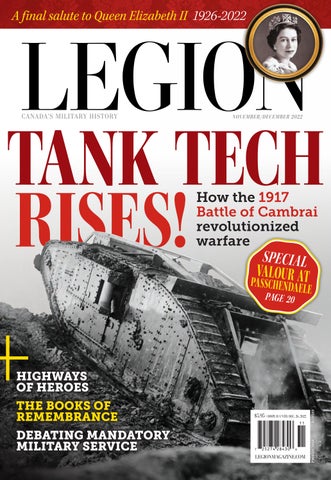
A final salute to Queen Elizabeth II 1926-2022
TANK TECH RISES! NOVEMBER /DECEMBER 2022
How the 1917 Battle of Cambrai revolutionized warfare
SPECIA L VALOUR AT
PASSCHENDAE L PAGE 20
E
+
$5.95 > DISPLAY UNTIL DEC. 26, 2022
MANDATORY DEBATING DEBATINGMANDATORY MILITARY MILITARYSERVICE SERVICE LEGIONMAGAZINE.COM
CoverNS_Nov-Dec 2022 Final.indd 1
PM40063864
THE THEBOOKS BOOKSOF OF REMEMBRANCE REMEMBRANCE
R09389
HIGHWAYS NATO AND OF NEUTRAL HEROESNATIONS
2022-09-22 3:51 PM
Advertisement
Supply
Shop Great Gifts! Locket Bracelet 300767 English 300768 French $34.95
Drop Earrings 300652 $29.95
Locket Brooch 300765 English 300766 French $34.95
Pocket Watch
Brooch
600604 $34.95
300650 $39.95
Fine Wood Ornament with Memory Capsule
Glass Poppy Ornament in Velvet Box
Glass Legion Christmas Ornament
300751 $26.95
300753 $21.95
300483 $16.95
Poppy Ornament 300660 $18.95
Legion Badge Cap 500775 $15.95
Long Sleeve T-Shirt
Charcoal Grey Cardigan
Poppy Vase 10.5” high
Poppy Coffee Cup (10oz)
S-XL: $27.95 2XL: $31.95
$49.95
300764 $44.95
300763 $15.95
www.POPPYSTORE.ca Nov 2022_fullpage.indd 1 SupplyND2022.indd 1
Please note: Shipping and taxes apply.
1-888-301-2268 Toll-Free 9/20/2022 12:00:36 PM 2022-09-23 11:28 AM
Moment of reflection A Canadian Ranger ponders the National Aboriginal Veterans Monument in Ottawa during a ceremony on National Indigenous Peoples Day in June 2022. See page 54
Stephen J. Thorne/LM
Pg01_PhotoSpread.indd 1
2022-09-22 3:56 PM
Features 20 THE VALOUR NINE
Remembering the Canadian soldiers recognized for most conspicuous bravery during the Battle of Passchendaele
By Aaron Kylie
26 THE WAY HOME
What started as a grassroots tribute to Canada’s fallen from Afghanistan 20 years ago evolved into Highways of Heroes across the country
By Sharon Adams
32 A LIFETIME OF SERVICE
A final salute to Queen Elizabeth II, 1926-2022
38 THE GREAT EXPERIMENT
How the first Battle of Cambrai changed warfare forever By Stephen J. Thorne
48 THE NAMESAKE NAVY
How Verdun, Que., formed a special bond with its own warship By Serge Durflinger
54 INDIGENOUS ICONS
Earlier this year, Indigenous spiritual symbols were officially recognized to adorn headstones in the National Military Cemetery of the Canadian Armed Forces By Stephen J. Thorne
By Tom MacGregor
NEW MEMBER BENEFITS PACKAGE PARTNER
See pages 6 and 7 for details!
Pg02-03_Contents.indd 2
2022-09-27 10:40 AM
COLUMNS 12 MILITARY HEALTH MATTERS Bionic bone By Sharon Adams
14
FRONT LINES Lost soldier found By Stephen J. Thorne
THIS PHOTO A lone soldier walks through the pockmarked, muddy landscape and barbed wire during the 1917 Battle of Passchendaele. William Rider-Rider/DND/LAC/PA-002165
ON THE COVER The latest technology of the time, a British Mark IV tank negotiates a slope during special training for the Battle of Cambrai at a driving school in Wailly, France.
16 EYE ON DEFENCE Deterrence theory By David J. Bercuson
46
FACE TO FACE Should Canada institute a period of mandatory military service? By Michael A. Smith and Stephen J. Thorne
88 CANADA AND THE NEW COLD WAR NATO and the neutrals
Alamy/2HTXE09; LMArchives
By J.L. Granatstein
90
HUMOUR HUNT Taking the field By John Ward
92
EROES AND VILLAINS H Nichola Goddard and the Taliban By Mark Zuehlke
94
ARTIFACTS Naming the dead By Sharon Adams
96
O CANADA The Upper Canada Rebellion By Don Gillmor
DEPARTMENTS 6 8 10 60 73 87 87
EDITORIAL LETTERS ON THIS DATE IN THE NEWS SNAPSHOTS LOST TRAIL MARKETPLACE
legionmagazine.com > NOVEMBER/DECEMBER 2022
Pg02-03_Contents.indd 3
3
2022-09-23 2:23 PM
Advertisement
Exclusive to
LEGIONMAGAZINE.COM Vol. 97, No. 6 | November/December 2022
Board of Directors
Our most
POPULAR in the SHOP is back!
BOARD CHAIR Owen Parkhouse BOARD VICE-CHAIR Bruce Julian BOARD SECRETARY Bill Chafe DIRECTORS Tom Bursey, Steven Clark, Thomas Irvine, Berkley Lawrence, Sharon McKeown,
Louise Tardif, Brian Weaver, Irit Weiser Legion Magazine is published by Canvet Publications Ltd. GENERAL MANAGER
Jennifer Morse INTERIM ADMINISTRATIVE SUPERVISOR
Aaron Kylie
ART DIRECTOR, CIRCULATION AND PRODUCTION MANAGER
Mike D’Angelo
ASSISTANT EDITOR
EDITOR
INTERIM ADMINISTRATIVE ASSISTANT
Jonathan Harrison ADMINISTRATIVE SUPERVISOR
Stephanie Gorin (on leave)
Michael A. Smith STAFF WRITERS
Sharon Adams Stephen J. Thorne
SENIOR DESIGNER AND MARKETING CO-ORDINATOR
Jason Duprau
Dyann Bernard
SENIOR DESIGNER AND PRODUCTION CO-ORDINATOR
WEB DESIGNER
Jennifer McGill DESIGNERS
Derryn Allebone Sophie Jalbert
Ankush Katoch WEB AND SOCIAL MEDIA CO-ORDINATOR
Mauricio Dimate
ROSS MUNRO
ROSS MUNRO
WINNER
WINNER
LEGION MAGAZINE’S
LEGION MAGAZINE’S
MEDIA AWARD
ADAM DAY
MEDIA AWARD
ADAM DAY
Advertising Sales CANIK MARKETING SERVICES TORONTO advertising@legionmagazine.com DOVETAIL COMMUNICATIONS INC.
mmignardi@dvtail.com OR CALL 613-591-0116 FOR MORE INFORMATION
Published six times per year, January/February, March/April, May/June, July/August, September/October and November/December. Copyright Canvet Publications Ltd. 2022. ISSN 1209-4331
Subscription Rates Legion Magazine is $9.96 per year ($19.93 for two years and $29.89 for three years); prices include GST. FOR ADDRESSES IN NS, NB, NL, PE a subscription is $10.91 for one year ($21.83 for two years and $32.74 for three years). FOR ADDRESSES IN ON a subscription is $10.72 for one year ($21.45 for two years and $32.17 for three years). TO PURCHASE A MAGAZINE SUBSCRIPTION visit www.legionmagazine.com or contact Legion Magazine Subscription Dept., 86 Aird Place, Kanata, ON K2L 0A1 or phone 613-591-0116. The single copy price is $5.95 plus applicable taxes, shipping and handling.
POCKET PAL NOTEPAD AND 2023 CALENDAR 3.5"w x 6"h
The perfect way to keep track of daily to-dos. Includes week-in-view calendar, quotes, maps and more! Only 18.99* *Plus tax and shipping
Shop today at
legionmagazine.com
Change of Address Send new address and current address label. Or, new address and old address, plus all letters and numbers from top line of address label. If label unavailable, enclose member or subscription number. No change can be made without this number. Send to: Legion Magazine Subscription Department, 86 Aird Place, Kanata, ON K2L 0A1. Or visit www.legionmagazine.com. Allow eight weeks.
Editorial and Advertising Policy Opinions expressed are those of the writers. Unless otherwise explicitly stated, articles do not imply endorsement of any product or service. The advertisement of any product or service does not indicate approval by the publisher unless so stated. Reproduction or recreation, in whole or in part, in any form or media, is strictly forbidden and is a violation of copyright. Reprint only with written permission. PUBLICATIONS MAIL AGREEMENT NO. 40063864
Return undeliverable Canadian addresses to Legion Magazine Subscription Department 86 Aird Place, Kanata, ON K2L 0A1 | magazine@legion.ca
U.S. Postmasters’ Information United States: Legion Magazine, USPS 000-117, ISSN 1209-4331, published six times per year (January/February, March/April, May/June, July/August, September/October, November/December). Published by Canvet Publications, 866 Humboldt Pkwy., Buffalo, NY 14211-1218. Periodicals postage paid at Buffalo, NY. The annual subscription rate is $9.49 Cdn. The single copy price is $5.95 Cdn. plus shipping and handling. Circulation records are maintained at Adrienne and Associates, 866 Humboldt Pkwy., Buffalo, NY 14211-1218. U.S. Postmasters send covers only and address changes to Legion Magazine, PO Box 55, Niagara Falls, NY 14304. Member of CCAB, a division of BPA International. Printed in Canada.
or call toll-free
1-844-602-5737
We acknowledge the financial support of the Government of Canada. Version française disponible. Made possible with the support of Ontario Creates The views expressed in this publication are the views of Canvet Publications Ltd. and do not necessarily reflect those of the Province of Ontario. On occasion, we make our direct subscriber list available to carefully screened companies whose product or services we feel would be of interest to our subscribers. If you would rather not receive such offers, please state this request, along with your full name and address, and e-mail magazine@legion.ca or write to Legion Magazine, 86 Aird Place, Kanata ON K2L 0A1 or phone 613-591-0116.
4
NOVEMBER/DECEMBER 2022 > legionmagazine.com
Pg04_Masthead.indd 4
2022-09-22 3:57 PM
Advertisement
PTSD
Pain
Anxiety
Sleep
Dedicated Veteran Care Team
VAC Coverage & Paperwork Assistance Obtaining Awarded Conditions
No Referral Needed
Free of Charge
Personalized Treatment
Appointments From Home
Home Delivery
French & ASL Available
CanopyGrowth-ND22.indd 1
Support 7 Days A Week
2022-09-22 3:59 PM
EDITORIAL
Homes coming?
“O
ne potential housing option for our folks is Habitat for Humanity,” said a May 5, 2022, e-mail from a senior officer at 19 Wing Comox. It was sent to colleagues at the Royal Canadian Air Force base on northern Vancouver Island, who, as a Department of Defence spokesperson later clarified, were having “significant difficulty” finding housing. It’s a sobering message, reinforcing the impact soaring house and rental prices are having on Canadian Armed Forces members—so high they may have to contact the nonprofit home builder to find a place to live. Those serving in the military are especially impacted by housing challenges, as they’re often subject to sudden, potentially frequent, moves. In April, the chief of the defence staff General Wayne Eyre reported “we’re somewhere in the neighbourhood of 4,000 to 6,000 units short on our bases, which is also accentuating the housing problem.” The last thing CAF members,
particularly non-commissioned officers, should worry about is where they and their families sleep at night. It’s time the government steps up. Canada has been down this road before and found a successful solution. Known as Victory Housing, communities across the country boast neighbourhoods of so-called strawberry box houses (owing to their simple square or rectangular shape), built during and immediately after the Second World War for the influx of returning veterans and others. Between 1941 and 1947, Wartime Housing Limited, a federal Crown corporation, built and managed nearly 26,000 rental housing units in 73 different municipalities. A subsequent federal agency allowed tenants to purchase the homes. The Veterans’ Land Act of 1942, meanwhile, offered loans for land or dwellings. It financed the construction of more than 47,000 additional units between 1943 and 1975.
With the average home price in Canada around $600,000 and the average urban two bedroom renting for some $1,300, and much higher in larger centres, military members are feeling the pinch. “The inflation costs, the housing market skyrocketing and everything—it’s got to have a negative impact, and it has for me specifically,” one CAF member who had served two tours in Afghanistan told CityNews in Vancouver in April. And though a CAF relief program that mitigates the impact of working in a region with a cost of living above the national average is available, it was frozen at 2009 levels 12 years ago while the compensation formula was reviewed. The audit is ongoing. Meanwhile, the cost of base housing, where available, is based on the local market. “It’s a lot of stress and a lot of pressure…on the personnel,” real estate broker Luca Andolfatto told The Canadian Press. Anyone who isn’t ranked as an officer would find it a struggle.” It’s a struggle the government must find a way to alleviate. L
Latest partner provides auto expertise
T
he Royal Canadian Legion’s exclusive Member Benefits Package (MBP) just keeps getting bigger and better: its newest partner, PEARL Fleet Vehicle Management Corp., manages automotive repair and consulting services. PEARL, short for practical everyday automotive repair logistics, has a list of approved repair centres and its advisors are industry experts familiar with everything from tuneups to warrantees, and related costs. It also grants special pricing on tires, auto work, routine maintenance and more, and boasts a concierge service
6
for every garage appointment. Registration is free and members pay only $79.95 (plus taxes) annually once they use the service. Plus, PEARL will be supporting the programs of The Royal Canadian Legion, which in turn supports services and initiatives for veterans. To learn more about how PEARL can take the worry out of managing repairs and extend the life of your vehicle, call 1-800-563-1020 and mention you’re a Legion member, or visit www.pearlcorp.ca. The MBP also offers discounts for travel packages and specially designed travel insurance, as
well as for online prescriptions, retirement living, cellphone plans, eyewear, funerals and much more. Other MBP partners include Blowes and Stewart Travel, Pocketpills, IRIS Eyewear, Medipac Travel Insurance, belairdirect car and home insurance, Rogers, HearingLife, Arbor Memorial, Canadian Safe Step Walk-in Tub Company, CHIP Reverse Mortgage, Revera and MBNA Canada Bank. Exclusive savings from this everexpanding roster of MBP partners is yet another bonus of Legion membership—indeed, the discounts can easily cover the member fee. L
NOVEMBER/DECEMBER 2022 > legionmagazine.com
Pg06_Editorial.indd 6
2022-09-23 2:24 PM
Advertisement
PEARL Vehicle Management Corp. is founded on extensive automotive experience and the highest of customer satisfaction standards. We know everything there is to know about maintaining your vehicle, the actual fair cost of service, maintenance schedules, recalls and warranties.
• National tire buying program offers large savings on tires.
Now, through PEARL, Royal Canadian Legion members can enjoy having an automotive consultant in their back pocket. Simply present your PEARL service card at any approved repair facility and PEARL will handle the details, keeping you informed every step of the way. Never before has it been easier to lower the cost of driving and extend the life of your vehicle.
• Hundreds of approved repair shops across Canada. Have a favorite shop, refer them to us!
Benefits include:
For more information or to register, visit the website at WWW.PEARLCORP.CA or call 1 800 563 1020.
• PEARL Service Card identifies you for all PEARL customer privileges.
• Complete vehicle history stored electronically. • Digital images and copy of every service.
• Flexible payment terms in the event of a surprise big-ticket breakdown. • Professional ongoing automotive service specials and product offerings.
Registration is free. You pay only $79.95 (plus applicable taxes) annually once you decide to use the service.
• Repair consulting for any service…even an oil change. • Standardized repair pricing…pay no more than what the job is worth.
Advertisement
legionmagazine.com > NOVEMBER/DECEMBER 2022
Pearl-AdvertorialND22.indd 7
7
2022-09-22 3:59 PM
LETTERS
Comments can be sent to: Letters, Legion Magazine, 86 Aird Place, Kanata, ON K2L 0A1 or e-mailed to: magazine@legion.ca
Raid
reviews H
aving spent some time in Dieppe in 2018 as part of a Second World War self-guided tour, I found Legion Magazine’s coverage (“To the men of Dieppe,” July/August) of this ill-conceived raid to be very informative. I stopped at the Commonwealth War Graves Commission cemetery coming into town, but failed to notice that the headstones were placed back-to-back, an unusual configuration as pointed out in the sidebar, “Those
I read your July/August 2022 edition with deep gratitude to the veterans who participated in the Dieppe Raid. When I was 14 years old in 1969, I joined a cadet corps affiliated with Les Fusiliers Mont-Royal. The corps’ second-incommand Captain Jean Hogue was a private during the raid and became a trusted role model. I remember many hours speaking and listening to him. The amazing and inspirational Captain Hogue truly changed my life and I joined the Royal Canadian Mounted Police in 1974. From a hero of the Dieppe Raid to the life of an ordinary teen in Montreal, our veterans make a difference.
left behind.” I traversed the chert (fist-sized, rounded stones) on the Dieppe beach where the Essex Scottish Regiment landed and marvelled at the insurmountable odds the soldiers faced. And for what purpose? Stephen J. Thorne had the easier task in “Face to Face” making the argument that the Dieppe Raid was an unmitigated disaster and did not provide valuable lessons in the subsequent D-Day invasion. Canadians at least earned the right to be in the vanguard at Normandy. JIM LITTLE, TURNER VALLEY, ALTA.
Convoy clash
I disagree, to a degree, with the article by Stephen J. Thorne about the freedom convoy (“‘Freedom convoy’ an extremist attempt to overthrow the government, says official,” (July/ August). In my opinion, the radical side is the Liberal party. The thousands of people who went out in extreme cold weather to support the convoy across the country agree with this point of view and that the pandemic was mismanaged in general. Looking back, we can see the unnecessary extremism (lockdowns, mandatory vaccines) forced on the population.
NORMAND THOMAS, MERRICKVILLE, ONT.
JANICE BRULOTTE, EDMONTON Advertisement
In appreciation of your service
save
3
¢
*
per litre
EVERY FRIDAY * Must show valid Canadian Forces ID or CF1 card to qualify.
Offer valid Fridays, with payment in kiosk at all Canadian Tire GAS+ locations. Promotion may be modified or discontinued at any time and cannot be combined with any other offer. Qualifying IDs are: NDI-10, NDI-20, NDI-75, VA Health Benefit Card or the CF1 card with the following designations only: CF, FF, V or D.
8
Bay watch
I read with interest the article “World war off our shores” (September/October). It seems things were different in the Bay of Fundy. My father was acknowledged as an expert in long-range radio transmission. He went around the coast of the bay seeking individuals who could learn to work military radios. They were trained by my father, who also gave each of them a pair of powerful binoculars. At that time in the war, U-boats had limited ability to travel underwater and they typically travelled on the surface. So, my father’s volunteers were to scan the surface of the bay and, if they spotted a U-boat, use the radio to report the sightings. I’m not aware of how many sightings were made and reported, or what actions took place after sightings were made. BOB DAVIS, OTTAWA
Poppy power Once a year on Nov. 11, people think of us (veterans) and those who never came back. Surely, they deserve more than a slight recognition, once a year, with a paper poppy. My suggestion is to create a lasting memory. I propose that poppies be grown around the cenotaph all summer. S. DRYDEN L
NOVEMBER/DECEMBER 2022 > legionmagazine.com
Pg08-09_Letters_Highlights V2.indd 8
2022-09-27 8:49 AM
Exclusive HIGHLIGHT from LegionMagazine.com
We are familiar with stories about people who fought in the Great War, and the advancements of deadly technology. But we don’t hear as much about medical personnel and the evolution of medicine during the war. One of Canada’s premier historians, Tim Cook, has brought those stories to life in his new book Lifesavers and Body Snatchers: Medical Care and the Struggle for Survival in the Great War. Cook shows how life-saving medical innovations were born from the horrors of modern war. It’s been long known that the First World War helped push medicine and treatment options forward, but Cook has uncovered a disturbing reality. Doctors were removing body parts from slain soldiers, without consent, and sending them back to Canada to be studied and put on display. This untold history and the secret
Get notified of all the latest updates on legionmagazine.com by signing up for our weekly e-newsletter at www.legionmagazine.com /en/newsletter-signup
legacy of medicine at war is finally known through the deep archival research and previously unpublished letters presented in Cook’s gripping writing. An excerpt of Cook’s book can be found on Legion Magazine’s website.
who knew their skillset and used that and their determination to smash barriers and open the skies to all. Watch “Airwomen” at www.youtube.com/ legionmagazine starting Nov. 1. L
Legion Magazine’s award-winning video series Military Moments is back with another installment. “Airwomen” introduces viewers to female aviators who fought for women’s right to fight in the skies. Prior to the Second World War, female pilots had broken endurance, altitude and speed records, but their hopes of wartime flying careers were blocked by a thick glass ceiling. Discover the stories of female pilots Advertisement
Legion and Arbor Alliances Remembering our veterans with respect and dignity As a Legion member, you and your immediate family members are entitled to receive special pricing on essential funeral and cemetery arrangements:
10%* savings on arrangements made in advance 5% savings on arrangements made at time of need †
†
PLUS!
FREE professional guidance and planning tools
For an Arbor Memorial location nearest you, please call 1-877-301-8066 or visit arboralliances.ca *10% savings on final arrangements made in advance, excluding crypts which are offered at 5% savings if purchased in advance. † For purchases made in Ontario: 4% savings for cemetery lots, niches and other interment rights and excludes above ground crypts. 10% savings on all other cemetery products and services.
Pg08-09_Letters_Highlights V2.indd 9
CLIENT:
Arbor Memorial
BLEED:
DOCKET:
D015949
TYPE SAFETY:
NAME:
Arbor Alliances Canadian Legion Ad
COLOUR:
AD SIZE:
6.6”w x 4.475”h
Arbor Memorial Inc.
None 0.3125” all around
legionmagazine.com > NOVEMBER/DECEMBER 2022 4 Colour Process
9
2022-09-22 4:08 PM
ON THIS DATE
November 7 November 1956 The first United Nations Emergency Task Force is established to end the Suez Crisis. Canada provides 1,000 personnel.
18 November 1916 The four-month Battle of the Somme ends.
8 November 1940 The American steamship SS City of Rayville hits a German naval mine and sinks in the Bass Strait off Cape Otway, Australia, the first U.S. vessel lost during the Second World War.
1 November 1918 Sgt. Hugh Cairns earns the Victoria Cross for capturing multiple machine-gun crews near Valenciennes, France. He is mortally wounded in the process. 2 November 1951 One Canadian dies and 13 are wounded in a diversionary raid by the Chinese on Hill 187 in Korea.
15 November 1948 Mackenzie King retires after a total of 21 years as prime minister.
9 November 1942 German spy Werner von Janowski is dropped off by U-518 at Chaleur Bay, Que. He is later captured. 11 November 1918 The First World War comes to an end; 619,636 Canadian men and women served, 66,655 died and 172,950 were wounded.
25 November 1944 HMCS Shawinigan is torpedoed and sunk with all hands in the Cabot Strait.
4 November 1942 Germany’s Afrika Korps begins its retreat from El Alamein, Egypt. 5 November 1914 Britain and France declare war on the Ottoman Empire. 6 November 1917 Canadian and British forces launch an assault and capture the ruined village of Passchendaele, Belgium (also see “The valour nine” on page 20).
13 November 1775 Brig.-Gen. Richard Montgomery’s Patriot army captures Montreal, Que.
27 November 2001 Two long-range patrol aircraft are deployed in support of the Naval Task Group in the Persian Gulf.
14 November 1981 Canadarm performs flawlessly in testing on Space Shuttle Columbia.
30 November 1921 The Canadian Air Force ensign is raised for the first time.
10 NOVEMBER/DECEMBER 2022 > legionmagazine.com
Pg10-11_OnThisDate-ND_2022-REV.indd 10
Sharif Tarabay; LAC; CWM; DND; Alamy; iStock; Wikimedia
2022-09-22 4:10 PM
December 13 December 2003 Iraqi dictator Saddam Hussein is captured. He is convicted of crimes against humanity and executed in 2006.
1 December 1943 Joseph Stalin, Franklin D. Roosevelt and Winston Churchill meet in Tehran and express their determination to win the war in Europe. 2 December 1968 The Canadian submarine Rainbow (S75) is commissioned. Purchased from the U.S., it was originally known as USS Argonaut and launched in 1944. 3 December 1970 British Trade Commissioner James Cross, held hostage for 60 days, is freed in exchange for free passage to Cuba for five Front de Libération du Québec captors. 4 December 1866 Constitutional talks begin in London, England—a step toward the British North America Act and Canada’s Confederation.
14 December 1967 Wing Cmdr. R.A. White sets a Canadian altitude record of 100,110 feet, flying a CF-104 Starfighter.
Visit legionmagazine.com for a full list of monthly On This Date events. 20 December 2007 At the age of 81, Elizabeth II surpasses Queen Victoria as the longestlived British monarch. She goes on to have the longest reign, too. 21 December 1943 Canadians engage in vicious houseto-house fighting in Ortona, Italy.
17 December 1944 HMCS Montreal rescues survivors of U-1209 after the sub runs aground on Wolf Rock in the English Channel. 18 December 1916 The costly Battle of Verdun comes to an end after hundreds of thousands of casualties on both sides. 22 December 1969 A post office truck in Montreal is blown up, one of more than 200 bombings set off by the Front de Libération du Québec between 1963 and 1970.
6 December 2008 Joint Task Force Afghanistan Air Wing is established in Kandahar. 7 December 1941 Canada declares war on Finland, Hungary and Romania, the same day Japan attacks Pearl Harbor. 11 December 1936 Edward VIII abdicates the British throne to marry American socialite Wallis Simpson, making his reign one of the shortest in British history. 12 December 1901 The first transatlantic wireless signal is received in St. John’s, Nfld.
29 December 1944 RCAF Flt.-Lt. Dick Audet shoots down five German planes in two minutes. 31 December 1999 Russian President Boris Yeltsin resigns. He is replaced by Vladimir Putin.
legionmagazine.com > NOVEMBER/DECEMBER 2022
Pg10-11_OnThisDate-ND_2022-REV.indd 11
11
2022-09-22 4:10 PM
MILITARY HEALTH MATTERS
By Sharon Adams
Bionic bone The latest protheses are helping veterans like never before
F
or most of human history only crude solutions were available to people who lost limbs to wounds, disease, accidents or congenital defects. French military surgeon Ambroise Paré was among the first to develop functional prostheses—for men maimed on the battlefield in the 16th century. The huge numbers of amputees resulting from wars—some 41,000 in Britain and 3,461 Canadians during the First World War, for example—spawned the growth of an industry that provided prostheses to all disabled veterans. After the Second World War,
prostheses became a specialty, producing major strides in surgical techniques, materials, joint mechanisms and sockets to attach the devices to residual limbs. In the 21st century, many developments moved from the realm of science fiction to reality: prosthetic legs fitted with running blades, motorized robotic hands, microprocessors and sensors communicating between the body and replacement limb, and much more. The science has advanced so far that U.S. troops who had lost significant capacity in their legs in combat but had the limbs
saved, have requested they be amputated and replaced with the latest prostheses “which may offer more than 100 per cent of a natural leg’s functionality,” reported J.R. Wilson in a 2019 DefenseMediaNetwork.com article. Now, a brain-computer interface technology is being developed that will allow an amputee to control some function of their prosthetic limb with their mind. The ultimate goal is for amputees to feel their prostheses are part of their own bodies. Another step along that path is implanting titanium into the bone to which an external prosthetic arm or leg can be attached. The problem with prostheses that attach to the bone with a socket is that the skin contacting the socket can be damaged and become extremely painful. Many amputees abandon their prostheses in frustration. But, with a bone-anchored prosthesis, it is not a problem.
Advertisement
For those we have lost. For those who have given everything to serve. We honour their lives and their sacrifice. atlasveterans.ca
legion-ad.indd 1
2022-09-23 1:11 PM
12 NOVEMBER/DECEMBER 2022 > legionmagazine.com
Pg12-13_Health V2.indd 12
2022-09-23 2:40 PM
This technique is so new that an article appeared in the June issue of the Journal of Military, Veteran and Family Health (JMVFH) to raise awareness of its existence. Studies indicate amputees with bone-anchored prostheses have significant improvements in limb function, pain, body image and quality of life. Users say the prostheses feel more natural and are easier to put on and take off. Mobility also improved; those with leg implants find they can walk longer and faster. And it’s more comfortable to sit. But as with all new technology, there are concerns. Infection where the implant penetrates the skin is common. “The problem there is you have a hole in your skin with metal coming through it that could be an avenue for infection,” said Jason Highsmith, national director of orthotic and prosthetic clinical services for the U.S. Veterans Health Administration, in a 2019 article in Veterans Affairs & Military Medicine Outlook. Science is addressing the problem. Researchers have discovered that infection rates differ between types of implants and different amputation sites and that a change in surgical technique radically reduced infection rates for one type of implant. As well, foreknowledge of the risk makes everyone more vigilant so that infections are caught in the early, more treatable, stages. “Despite the adverse events, patient prosthetic use and (quality of life) improved significantly,” said a five-year study on safety and performance of bone-anchored prostheses after transfemoral amputation, published in 2020 in the Journal of Bone Joint Surgery. “Direct skeletal fixation should be approached with caution,” warned authors of the JMVFH article “Direct skeletal fixation: A new treatment option for Canadian war amputees.”
“Veterans with severely restricted mobility—especially those with multiple or transfemoral amputations,” may be candidates for osseointegration,” said the authors. But, they added, “it is not indicated for all amputees,” including those whose prostheses are attached by socket and have good function.
Advertisement
MEDIPAC TRAVEL INSURANCE
®
For Canadians who are heading south this winter
1-888-MEDIPAC 1-888-633-4722 • www.medipac.com Underwritten by Old Republic Insurance Company of Canada
2022MS Medipac ad Legion island 4.275x7.375.indd 1
Pg12-13_Health V2.indd 13
There is no doubt that as the medical and mechanical problems are solved and best practices identified, and cost comes down, bone anchored prostheses will become more prevalent among amputees. Some researchers believe it will be the preferred method for prosthetic use within the next decade. L
13
2022-09-13 3:39:32 PM legionmagazine.com > NOVEMBER/DECEMBER 2022
2022-09-23 11:33 AM
FRONT LINES
By Stephen J.Thorne
Lost soldier found The life, death and rebirth of Private John Lambert
He
was just 17, a private in the Newfoundland Regiment killed during an all-but-forgotten battle of the First World War. His name was John Lambert, and his remains lay undiscovered for 99 years alongside those of a German and three British soldiers beneath Belgian soil near St. Julien. He was the only one of the group identified. The five were reburied along with two other soldiers of unknown origins during a military ceremony at the New Irish Farm Cemetery in West-Vlaanderen (West Flanders), Belgium, on June 30. “This has been a long and challenging investigation for us,” said Louise Dorr, a British Defence Ministry caseworker. “It’s a matter of great sadness to me personally that we haven’t been able to identify any of the British soldiers or the German casualty. “Whoever they were, they were somebody’s son, brother, husband or father. It’s especially poignant that we are burying old enemies together. They all paid the ultimate price of war, and their sacrifice
14 NOVEMBER/DECEMBER 2022 > legionmagazine.com
Pg14-15_FrontLines.indd 14
must never be forgotten.” Their remains were discovered during an archeological dig near a former field ambulance relay post that had been set up on a local farm during the Third Battle of Ypres, better known to Canadians as Passchendaele. “This relay post was most likely located within 100 meters of the location where Private Lambert was recovered in 2016,” said a Defence Department statement. “It is believed that he and the other soldiers found with him were buried near this relay post and for unknown reasons their remains were not found and recovered following the war.”
Private John Lambert was 16 when he enlisted for service in the First World War. He told recruiters he was 18. A Newfoundland Regiment patch was found with his remains in Belgium where he died in 1917 during the Battle of Langemarck.
A regimental shoulder patch was found with Lambert’s remains, which were then sent to the Canadian military’s Casualty Identification Program in Ottawa. Its experts confirmed his identity through DNA sequencing and other evidence, much of it compiled by Greg Walsh, provincial archivist at The Rooms gallery and museum in St. John’s.
Lambert died a year before the regiment was awarded its “Royal” designation, the only combat unit to receive one during the 1914-18 war. Born in St. John’s, Nfld., the former labourer was 16 years old when he joined up. He told recruiters he was 18. Lambert was killed almost a year later—Aug. 16, 1917—at the Battle of Langemarck, an offensive during the Passchendaele campaign named for the village in West Flanders near where it took place. Lambert served with the regiment’s 1st Battalion, part of the
Coady family; CAF/Directorate of History and Heritage
2022-09-22 4:11 PM
> Check out the Front lines podcast series! Go to legionmagazine.com/frontlines.
FRONT
FRONT
LINES
LINES
PODCAST
PODCAST
A LEGION MAGAZINE
88th Brigade of the 29th Infantry Division of the British Expeditionary Force. Two unidentified soldiers found alongside him came from the Royal Inniskilling Fusiliers and the Royal Hampshire Regiment. So many members of both units were killed on Aug. 16, 1917, that presentday British authorities couldn’t even attempt to identify them. British offensives began northeast of Ypres on July 31, 1917. The 29th Infantry was to capture the Gheluvelt-Langemarck section of the German line. It planned to fight its way through the enemy position for 1,400 metres. Originally designated for Aug. 13, the attack was delayed twice by heavy rain and mud. The Newfoundlanders’ ‘B’ and ‘C’ companies were in the first wave of attack at 4:45 a.m.
on Aug. 16. ‘A’ and ‘D’ companies followed. Slogging through the mud, they overran the German trenches and bunkers and, together with the Hampshires, took all their objectives. Lambert was among 103 casualties from the Dominion of Newfoundland that day, 27 of them killed in action. “Our country mourns the loss of many of our best and bravest lads,” colonial secretary R.S. Squires wrote Lambert’s father, Richard, on Oct. 3, 1917, in a onepage letter rich in post-Victorian rhetoric. “Your noble boy has earned for himself and you an unperishable memory in the annals of this great struggle and has won for himself a Crown of Victory.” The campaign wouldn’t end until November, when the Canadian Corps captured Passchendaele. Total casualties
A LEGION MAGAZIN
are wildly disputed—between 240,000 and almost 450,000 Allied; 217,000-400,000 German. Lambert’s name would be memorialized on one of three bronze tablets at the base of the Beaumont-Hamel Newfoundland Memorial that bear the names of more than 800 Newfoundlanders killed in the war and have no known grave. It will remain there. Relatives and government representatives attended the burial ceremony conducted by Canadian and British military chaplains. Members of the Royal Newfoundland Regiment carried Lambert’s remains to his final resting place among his Empire comrades-in-arms. Said Dorr: “The soldiers taking part in today’s service can see they walk in the footsteps of the giants who went before them.” L
Advertisement
Discover More Living Make the most of every moment with personalized service and meaningful experiences curated to your lifestyle. A place where you get to decide what every day looks like. And now, Legion members can get it all for less with this exclusive offer.
10% OFF MONTHLY suite rate for one year*
BOOK A TOUR TODAY 1-877-929-9222 *Applies to first-time residents. Certain conditions apply. Visit www.reveraliving.com/legion-t-c for full details.
legionmagazine.com > NOVEMBER/DECEMBER 2022
Pg14-15_FrontLines.indd 15
15
2022-09-23 2:23 PM
EYE ON DEFENCE
By David J. Bercuson
Deterrence Canada needs to rebuild its military might
T
oday’s growing danger to global peace has not been as significant since the low points of the Cold War in the early 1960s. And the current instability is far more complex because in the 1960s (and for two decades after that) the greatest threat to world order came from the clash of interests between the Soviet Union and the United States. Now, China, Iran and North Korea, in addition to Russia, make everything more complicated. However, one factor still stands out in defence planning for the U.S. and its allies: deterrence. By building a strong and credible deterrence, democracies can better ensure global stability. Deterrence obviously won’t bring real peace anywhere, but it will dissuade major war as it did for the four and a half decades of the Cold War.
theory
What role should Canada play in establishing deterrence? The answer is simple: add to the deterrent power of the U.S. and other allies. How can Canada do that? By rejuvenating its military. It need not aim at building the Canadian Armed Forces into a major international military machine, but it does need to do more than it is doing and is planning to do during the next five years. To really understand Canada’s current defence policy one needs to examine not what the government claims it’s doing, or is about to do, but what is actually happening. To begin, look at the defence budget announced by the government this past April. Despite hints from the minister of national defence that Canada would take bold steps to expand its military spending after the Russian attack on Ukraine, the actual increase in the budget
was $8 billion over five years. That was certainly a boost, but not a large one. If the government follows the plan laid out back in April, Canadian defence spending will rise to 1.59 per cent of the country’s gross domestic product (GDP) by 2026-27. That’s still below the two per cent of GDP target that Canada—and NATO— committed itself to in 2006, and reaffirmed in 2014 after the first Russian attack on Ukraine. Canada hasn’t lived up to that commitment since then. And it still won’t be close five years from now. Does the two per cent target matter? As an article in the journal Foreign Policy pointed out this past June, that target is a political number that does not directly impact a country’s real defence capability. In other words, it’s not so important how much a nation spends, but what it is actually The Royal Canadian Air Force is working to extend the life of its 25-year-old-plus Griffon helicopters until at least the mid-2030s rather than replace them.
16 NOVEMBER/DECEMBER 2022 > legionmagazine.com
Pg16-17_EyeOnDefence.indd 16
Corporal Angela Gore/Canadian Armed Forces Photo
2022-09-22 4:12 PM
CANADIAN DEFENCE SPENDING WILL RISE TO 1.59 PER CENT OF GDP BY 2026-2027. THAT IS FAR BELOW THE TWO PER CENT OF GDP TARGET.
doing with its expenditure. But here, too, Canada is falling short. For example, Canada’s sovereignty in its Arctic territory depends on a wide variety of Far North capabilities, including search-and-rescue, provisioning Arctic bases and settlements, and under-ice submarines. Canada has almost none of those now, nor will it have them in the next five years. At the end of the Second World War, Canada’s navy was the world’s third largest. Now, the Global Naval Power Ranking has it 22nd, behind Greece, Thailand, Iran, Germany, Spain and even Bangladesh. Canada’s Halifaxclass frigates are obsolete and their replacements are still on the drawing board. The Royal Canadian Navy’s submarines have been in active service since
2003 and have no under-ice capability. Naval supply ships are being built, but face a two-year delay and major cost increases. Canada’s air force, meanwhile, will pull virtually even with those of its principal allies when it acquires the F-35 joint strike fighter (10 years too late and well behind its allies). In the meantime, Canada’s Griffon tactical helicopters are also out-of-date: they are civilian aircraft painted in military colours and need replacing. A 2017 Senate report recommended acquiring attack helicopters and modern tactical lift helicopters to replace the outmoded Griffons. And the Canadian army is well below its ideal troop strength— according to a military report,
the army is short almost 7,600 members. Although there has been a marginal increase in recruitment advertising during the past year, it is nothing like the campaign carried out when Canada had a battle group in Afghanistan. The army also has no modern anti-aircraft defence system. It is commendable that the Canadian Armed Forces are playing a significant part in defending the Baltic countries and will be training Ukrainian soldiers in the United Kingdom—evidence Canada is contributing to common defence. But it’s not enough. Defence is the most important duty of a government. Canada can do more. L
Advertisement
legionmagazine.com > NOVEMBER/DECEMBER 2022
Pg16-17_EyeOnDefence.indd 17
17
2022-09-22 4:12 PM
.
.
Bringing the stories of Canada to life like never before
D AWARERS WINN
SPECIAL OFFER!
SAVE
40
%*
Battle of the Atlantic The Royal Canadian Navy played a pivotal role in this critical campaign, which raged on open and treacherous seas from September 1939 to
Twenty-five great Canadian aviators From early birds to astronauts, every one of these nationally celebrated and lesser-known flyers has made important contributions to Canada’s aviation heritage.
War Photos War Photos showcases the stunning images and rare photos from the men and women who went into battle
War Stories: True stories from the First World War When the First World War started in 1914, Canada’s population was less than 8 million, yet more than 620,000 enlisted. Many of the surviving soldiers share their stories in this special issue.
Battle of the Pacific: Courage in the Far East Canada’s war in the Pacific began on Dec. 7, 1941, when Japanese aircraft attacked the U.S. navy base at Pearl Harbor, Hawaii.
World War I: True stories from Vimy to victory More compelling stories from the First World War are told in memoirs by surviving Canadian soldiers.
Passchendaele: Canada’s brutal victory The Canadian Corps was thrust into a battlefield of mud and craters to help Allied forces in the Battle of Passchendaele—Canada’s third major victory of 1917.
Crime: Canadian style Take a trip to Canada’s seedy underbelly and meet the perpetrators of some of the country’s most notorious felonies and misdemeanors.
Victoria Cross The most famous decoration for courage in the Western world, the Victoria Cross has been awarded to dozens of Canadians and the lore behind the VC is sprinkled with strange and heart-wrenching stories.
Liberating Normandy: The road to victory The Battle of Normandy was the beginning of the end of the Second World War in Northwest Europe.
The Somme The Somme examines the role of the Newfoundland Regiment and the Canadian Expeditionary Force in the monumental First World War battle that took place in France from July 1 to Nov. 18, 1916.
May 1945.
USE COUPON CODE:
NDLM40 at checkout
Makes a great gift!
O Canada: The history of our home and native land O Canada tells our story from First Peoples through to our achievements in space. Intro by Canadian comedian and author Rick Mercer.
Vimy: The birth of a nation The hard-fought WW I Battle of Vimy Ridge is sometimes called “the birth of the nation.” In April 1917, the Canadian Corps fought together for the first time and achieved success where others had failed.
The Royals: The fight to rule Canada** Everything you need to know about Canada’s royal heritage from the earliest kings and queens who dispatched explorers to the New World to the modern British monarchy.
with only a camera.
Choose from 25+ SPECIAL EDITIONS *Conditions apply. 40% off back issues expires December 31, 2022.
Canada’s Ultimate Story engages readers with captivating stories of Canadian events and fascinating people from our earliest days to present times and editions are filled with little-known facts and trivia relating to our great country.
Pg18-19-ND22_CUS_40OFF-BackIssues.indd 18
REG. PRICE
14 -16 95
95
NOW
897
each + tax ** Regular price of The Royals and shipping special issue is $16.95 (plus tax and shipping). Sale price (with coupon code) is $10.17 (plus tax and shipping).
2022-09-23 2:08 PM
g
.
Advertisement Advertisement
Complete your set—order today!
FEATURE EDITION
Just check off the special editions you’d like. USE COUPON CODE:
NDLM40
Canada and the Second World War: The battles Canadians played pivotal roles in many of the most important and costly conflicts of the Second World War. Includes large battle map.
The march to victory: Canada’s final 100 days of the Great War The Canadian Corps fought several great battles before Germany surrendered, ending “the war to end all wars.”
O Canada: The best of everything Find out what really makes our country tick. Packed with Canadian people, places, wildlife, cities, culture, feats and innovations. Intro by Canadian comedian Ron James.
Battle of Ortona Late in 1943, Canadian troops attacked the German-held Italian city of Ortona. In fierce fighting, Canada pushed up Italy’s east coast and prevailed.
D-Day: The free world fights back It was the spring of 1944 and the Allies could not wait any longer. British, American and Canadian forces would land on five beaches on France’s Normandy coast in the early hours of June 6, 1944.
O Canada: Discover your land Big land, bigger oceans, huge mountains, wide waterways and wildlife wilderness— Canada offers breathtaking vistas in every direction. Intro by Canadian comedian Cathy Jones.
John McCrae and the Battles of Flanders John McCrae—doctor, gunner and poet—was shaken by the battlefield death of a friend in May 1915, and wrote the poem “In Flanders Fields” in tribute. The poem remains today a renowned symbol of remembrance.
1945: Canada and the end of the Second World War The year 1945 started with a massive German bomber attack on Allied airfields. But the Allies soon pushed back and Canadian troops led the advance across Belgium and into the Netherlands. The end-game was at hand.
Canada’s great naval battles The sea brought explorers, colonizers and navies from Europe to North America—as well as rivalries and wars. Join naval historian Marc Milner as he retraces Canada’s history—all from a nautical perspective.
Canada and the brutal battles of the Somme The Battle of the Somme lasted 141 days, from July 1 to Nov. 18, 1916. For the Canadian Corps, the Somme was a coming of age, setting the stage for their seminal victories to follow.
Canada and the Great War: Liberation In the final five weeks of the First World War, Canadian soldiers liberated more than 200 cities, towns and villages in France. “They were so glad to see us,” said one Canadian soldier, “they wept with joy.”
O Canada: How Canada was shaped by war and peace Since the First Peoples arrived on this continent, the place that would be called Canada has been shaped by conflict and co-operation. The impacts of war and the bounties of friendship echo through the story of Canada.
Battle of the St. Lawrence: U-boats attack It is 1942, and the U-boat war that has been raging in the North Atlantic spills into the Gulf of St. Lawrence and onto the river itself. For three years, submarines dispatched by German Admiral Karl Dönitz have been attacking the high-seas convoys that are the lifeline of the war effort overseas. Now the underwater killers seize on new opportunities to attack ill-defended shipping all along the eastern seaboard into the Caribbean. They include transports sailing down the St. Lawrence and out to the coast from Montreal and Quebec City. For the first time since the War of 1812, lives are lost to hostile action in Canadian waters.
How Canada conquered Vimy Ridge The Great War had been raging for nearly three years by the time the Canadian Corps captured Vimy Ridge in April 1917. Many historians consider this important battle a defining moment for Canadian troops and our country.
Defining Battles of the War of 1812 Early on June 23, 1812, British and American warships exchanged the first shots of the War of 1812. For the next two-and-a-half years, the two sides waged war. The Americans thought taking Canada would be a cakewalk. It wasn’t.
Experience a piece of Canada in every issue. O RD ER YOUR S PECI A L E D I T IO N S N OW ! V I SI T CA NADA SU LTI MATESTORY.COM TODAY.
SHOP canadasultimatestory.com TOLL-FREE 1-844-602-5737 Pg18-19-ND22_CUS_40OFF-BackIssues.indd 19
2022-09-23 3:18 PM
First World War
The
valour
nine
By Aaron Kylie
Remembering the Canadian soldiers recognized for most conspicuous bravery during the Battle of Passchendaele
DND/LAC/3397043; DND/LAC/PA-040138; CWM/20110065-001
Pg20-25_Passchendaele.indd 20
2022-09-23 10:36 AM
T
here must have been something special in the Belgian air during the waning days of autumn in 1917. While British, Australian and New Zealand troops had struggled for nearly three months to break German lines on a ridge near the village of Passchendaele, the arrival of the Canadian Corps on Oct. 26 turned the tide. Amidst dismal weather and heavy fire, the Canadians captured the hill on Nov. 6. More than 4,000 were killed and some 12,000 more wounded in the effort. But the battle also produced unparalleled moments of courage among the Canadian forces. Nine Canadians were awarded the Victoria Cross for their actions during the offensive—more, by far, than in any other single engagement the country has been involved in.
Wounded Canadian soldiers take cover behind a pillbox during the Battle of Passchendaele in November 1917 (opposite), while a group of their comrades recover the wounded (top). By the end of the clash, nine Canadians had been awarded the Victoria Cross (above).
Legion Magazine remembers the heroic deeds of those nine men here on the 105th anniversary of the Battle of Passchendaele by reprinting the original Victoria Cross citation of each, including the date of their memorable action. Of course, it’s no coincidence that a few dates repeat, specifically, Oct. 26, Oct. 30 and Nov. 6. Those days correspond with the fiercest attacks, each of the first two resulting in just hundreds of metres of ground gained, with heavy losses. Indeed, in only an hour on Oct. 30, the Princess Patricia’s Canadian Light Infantry had lost almost its entire junior officer ranks. The Canadians successfully captured the ridge in the third assault on Nov. 6, though the cost was once again high, including the life of Private James Robertson, one of the two Passchendaele combatants to receive his VC posthumously. Winston Churchill, Britain’s future wartime prime minister, said the battle was “a forlorn expenditure of valour and life without equal in futility.” Still, for Canada, the victory reinforced the growing reputation of the country’s front-line fighting force—aided by the particularly brave acts of these nine men.
legionmagazine.com > NOVEMBER/DECEMBER 2022
Pg20-25_Passchendaele.indd 21
21
2022-09-23 10:36 AM
Private Thomas William Holmes Born: Aug. 17, 1897, Montreal Date of action: Oct. 26, 1917 Unit: 4th Canadian Mounted Rifles Fate: died in Toronto on Jan. 4, 1950, at age 52 For most conspicuous bravery and resource when the right flank of our attack was held up by heavy machine-gun and rifle fire from a “pill-box” strong point. Heavy casualties were producing a critical situation when Pte. Holmes, on his own initiative and single-handed, ran forward and threw two bombs, killing and wounding the crews of two machine guns. He then
returned to his comrades, secured another bomb, and again rushed forward alone under heavy fire and threw the bomb into the entrance of the “pill-box,” causing the nineteen occupants to surrender. By this act of valour at a very critical moment Pte. Holmes undoubtedly cleared the way for the advance of our troops and saved the lives of many of his comrades.
Captain Christopher Patrick John O’Kelly Born: Nov. 18, 1895, Winnipeg Date of action: Oct. 26, 1917 Unit: 52nd Battalion (New Ontario) Fate: presumed drowned in Ontario’s Lac Seul on Nov. 15, 1922, at age 26 For most conspicuous bravery in an action in which he led his company with extraordinary skill and determination. After the original attack had failed and two companies of his unit had launched a new attack, Capt. O’Kelly advanced his command over 1,000 yards under heavy fire without any
artillery barrage, took the enemy positions on the crest of the hill by storm, and then personally organised and led a series of attacks against “Pill-boxes,” his company alone capturing six of them with 100 prisoners and 10 machine guns. Later on in the afternoon, under the leadership of this gallant officer, his
company repelled a strong counter-attack, taking more prisoners, and subsequently during the night captured a hostile raiding party consisting of one officer, 10 men and a machine gun. The whole of these achievements were chiefly due to the magnificent courage, daring and ability of Capt. O’Kelly.
Sergeant George Harry Mullin Born: Aug. 15, 1891, Portland, Ore.; moved to Moosomin, Sask., at age two Date of action: Oct. 30, 1917 Unit: Princess Patricia’s Canadian Light Infantry Fate: died in Regina on April 5, 1963, at age 72 For most conspicuous bravery in attack, when single-handed he captured a commanding “Pill-box” which had withstood the heavy bombardment and was causing heavy casualties to our forces and holding up the attack. He rushed a sniper’s post in front, destroyed the garrison with bombs, and, crawling on top of the “Pill-box,” he shot the two machinegunners with his revolver. Sgt. Mullin then rushed to another entrance and
compelled the garrison of ten to surrender. His gallantry and fearlessness were witnessed by many, and, although rapid fire was directed upon him, and his clothes riddled by bullets, he never faltered in his purpose and he not only helped to save the situation, but also indirectly saved many lives. Mullin had previously been awarded the Military Medal for his conduct during the Canadian Corps attack on Vimy Ridge in April 1917.
22 NOVEMBER/DECEMBER 2022 > legionmagazine.com
Pg20-25_Passchendaele.indd 22
2022-09-23 10:36 AM
Major George Randolph Pearkes Born: Feb. 26, 1888, Watford, England; moved to Red Deer, Alta. Date of action: Oct. 30-31, 1917 Unit: 5th Battalion, Canadian Mounted Rifles Fate: died in Victoria on May 30, 1984, at age 96 For most conspicuous bravery and skilful handling of the troops under his command during the capture and consolidation of considerably more than the objectives allotted to him, in an attack. Just prior to the advance Maj. Pearkes was wounded in the left thigh. Regardless of his wound, he continued to lead his men with the utmost gallantry, despite many obstacles. At a particular stage of the attack his further advance was threatened by a strong point which was an objective of the battalion on his left, but which they had not succeeded in capturing. Quickly appreciating the situation, he captured and held this point, thus enabling his further advance to be successfully pushed forward.
It was entirely due to his determination and fearless personality that he was able to maintain his objective with the small number of men at his command against repeated enemy counter-attacks, both his flanks being unprotected for a considerable depth meanwhile. His appreciation of the situation throughout and the reports rendered by him were invaluable to his Commanding Officer in making dispositions of troops to hold the position captured. He showed throughout a supreme contempt of danger and wonderful powers of control and leading.
Pearkes also held several major command appointments during the Second World War. He later served as Minister of National Defence (1957-1960) and Lieutenant Governor of British Columbia (1961-1968).
Private James Peter Robertson Born: Oct. 26, 1883, Pictou County, N.S. Date of action: Nov. 6, 1917 Unit: 27th Battalion Fate: Killed in action on Nov. 6, 1917, at age 34 For most conspicuous bravery and outstanding devotion to duty in attack. When his platoon was held up by uncut wire and a machine gun causing many casualties, Pte. Robertson dashed to an opening on the flank, rushed the machine gun and, after a desperate struggle with the crew, killed four and then turned the gun on the remainder, who, overcome by the fierceness of his onslaught, were running towards their own lines. His gallant work enabled the platoon to advance. He inflicted many more casualties among the enemy, and then carrying the captured machine gun, he led his platoon
DND/LAC/3216873; CWM/19930013-631; DND/LAC/3219321; DND/LAC/3219828; CWM/19910109-916
Pg20-25_Passchendaele.indd 23
to the final objective. He there selected an excellent position and got the gun into action, firing on the retreating enemy who by this time were quite demoralised by the fire brought to bear on them. During the consolidation Pte. Robertson’s most determined use of the machine gun kept down the fire of the enemy snipers; his courage and his coolness cheered his comrades and inspired them to the finest efforts. Later, when two of our snipers were badly wounded in front of our trench, he went out and carried one of them in under very severe fire. He was killed just as he returned with the second man.
legionmagazine.com > NOVEMBER/DECEMBER 2022
23
2022-09-23 10:36 AM
Corporal Colin Fraser Barron Born: Sept. 20, 1893, Baldavie, Scotland; moved to Toronto at age 16 Date of action: Nov. 6, 1917 Unit: 3rd Battalion Fate: died in Toronto on Aug. 15, 1958, at age 64 For conspicuous bravery when in attack his unit was held up by three machineguns. Cpl. Barron opened on them from a flank at point-blank range, rushed the enemy guns singlehanded, killed four of the crew, and captured the remainder. He then, with remarkable initiative and skill, turned one of the captured guns on the retiring enemy, causing
them severe casualties. The remarkable dash and determination displayed by this N.C.O. in rushing the guns produced far-reaching results, and enabled the advance to be continued. Barron served with the Royal Regiment of Canada during the Second World War. He was also among the Victoria Cross recipients at the coronation of Queen Elizabeth II in 1953.
Private Cecil John Kinross stands between two unidentified civilians and a fellow soldier who are admiring his Victoria Cross. The VC brought Kinross life long fame.
Private Cecil John Kinross Born: Feb. 17, 1895, Uxbridge, England; moved to Alberta at age 16 Date of action: Oct. 30, 1917 Unit: 49th Battalion Fate: died in Lougheed, Alta., on June 21, 1957, at age 62 For most conspicuous bravery in action during prolonged and severe operations. Shortly after the attack was launched, the company to which he belonged came under intense artillery fire, and further advance was held up by a very severe fire from an enemy machine gun. Pte. Kinross, making a careful survey of the
situation, deliberately divested himself of all his equipment save his rifle and bandolier and, regardless of his personal safety, advanced alone over the open ground in broad daylight, charged the enemy machine gun, killing the crew of six, and seized and destroyed the gun. His superb example and courage instilled the greatest confidence in his company,
24 NOVEMBER/DECEMBER 2022 > legionmagazine.com
Pg20-25_Passchendaele.indd 24
and enabled a further advance of 300 yards to be made and a highly important position to be established. Throughout the day he showed marvellous coolness and courage, fighting with the utmost aggressiveness against heavy odds until seriously wounded. Mount Kinross, near Jasper, Alta., is named in his honour.
CWM/19940079-021; CWM/19940079-051; CWM/19940079-070; CWM/19710261-0175
2022-09-23 10:36 AM
Lieutenant Hugh McDonald McKenzie Born: Dec. 5, 1885, Inverness, Scotland; moved to North Bay, Ont., at age 25 Date of action: Oct. 30, 1917 Unit: 7th Canadian Machine Gun Company Fate: Killed in action on Oct. 30, 1917, age 31 For most conspicuous bravery and leading when in charge of a section of four machine guns accompanying the infantry in an attack. Seeing that all the officers and most of the noncommissioned officers of an infantry company had become casualties, and that the men were hesitating before a nest of enemy machine guns, which were on commanding ground and causing them severe casualties, he handed over command of his guns to an N.C.O., rallied the infantry, organised an attack, and captured the strong point.
Finding that the position was swept by machine-gun fire from a “pill-box” which dominated all the ground over
which the troops were advancing, Lt. MacKenzie [sic] made a reconnaissance and detailed flanking and frontal attacking parties which captured the “pill-box,” he himself being killed while leading the frontal attack. By his valour and leadership this gallant officer ensured the capture of these strong points and so saved the lives of many men and enabled the objectives to be attained. McKenize had previously received the Distinguished Conduct Medal and the Croix de Guerre from the French government.
Lieutenant Robert Shankland Born: Oct. 10, 1887, Ayr, Scotland; moved to Winnipeg at age 23 Date of action: Oct. 26, 1917 Unit: 43rd Battalion Fate: died in Vancouver on Jan. 20, 1968, at age 80 For most conspicuous bravery and resource in action under critical and adverse conditions. Having gained a position he rallied the remnant of his own platoon and men of other companies, disposed them to command the ground in front, and inflicted heavy casualties upon the retreating enemy. Later, he dispersed a counter-attack, thus enabling supporting troops to come up unmolested. He then personally communicated to Battalion Headquarters an accurate and valuable report as to the position on the Brigade
frontage, and after doing so rejoined his command and carried on until relieved. His courage and splendid example inspired all ranks and coupled with his great gallantry and skill undoubtedly saved a very critical situation. Shankland had previously been awarded the Distinguished Conduct Medal for his actions at Sanctuary Wood in June 1916. He was one of three Victoria Cross recipients to have lived on Winnipeg’s Pine Street, later named Valour Road in their honour. L
legionmagazine.com > NOVEMBER/DECEMBER 2022
Pg20-25_Passchendaele.indd 25
25
2022-09-27 11:18 AM
What started as a grassroots tribute to Canada’s fallen from Afghanistan 20 years ago evolved into Highways of Heroes across the country
Reuters/Alamy/2CPDP9D; Performance Image/Alamy/E9D1DX
Pg26-31_Highway of Heroes.indd 26
2022-09-23 10:48 AM
By Sharon Adams
In
the three great wars of the 20th century, Canadian soldiers were buried in the countries where they died. Since 1970, Canadian military personnel who died abroad have been brought home for burial—mostly unnoticed by the general public. But the war in Afghanistan produced a steady stream of caskets that didn’t go unheeded or unheralded. The 158 Canadian Armed Forces members who died in Afghanistan were flown to 8 Wing, Canadian Forces Base Trenton in Ontario where a ramp ceremony was performed. Then they were transported some 170 kilometres west on Highway 401 to the morgue in Toronto. The repatriation ceremony for the first four soldiers—Sergeant Marc Léger, Corporal Ainsworth Dyer and privates Richard Green and Nathan Smith—all killed on April 17, 2002—was broadcast live from the base and, like a flash, word of the funeral procession spread. Veterans, military personnel, firefighters and police, and their families living near Highway 401 headed for overpasses near their communities to pay respect to the soldiers and their families.
A hearse leaves Canadian Forces Base Trenton after the ramp ceremony for Sergeant Marc Léger in 2002 (opposite). A flag waves as the procession for Corporal Nathan Cirillo passes on Ontario’s Highway of Heroes in 2014.
Pete Fisher, a journalist in Cobourg, Ont., heard about the motorcade from his father, a retired firefighter. Fisher alerted the local emergency services dispatcher and headed for the highway with his camera to document the impromptu display of support and patriotism. “It’s a feeling hard to describe,” said Fisher. “People wanted to show their support [and] let the families of the fallen know they weren’t alone.” That message was clear to Don and Laurie Greenslade of Saint John, N.B., as they travelled the route in 2007, escorting the body of their
legionmagazine.com > NOVEMBER/DECEMBER 2022
Pg26-31_Highway of Heroes.indd 27
27
2022-09-23 10:48 AM
Corporal Jordan Kowalski salutes as the cortège for Trooper Marc Diab passes along Ontario's Highway of Heroes in 2009.
son, Private David Robert Greenslade, Royal Canadian Regiment, who was among six Canadian soldiers killed Easter Sunday that year in Afghanistan. “It was overwhelming,” said Don. “Seeing the signs, and the people, the flags, the support…it is hard to explain the feeling. “My son will never be forgotten.” As the war dragged on and more motorcades wended their way down the highway, great numbers of people flocked to overpasses to participate in what became an unofficial rite. They were often dressed in red and carried Canadian flags or flags of the soldiers’ home provinces. People had “the desire or need to feel a sense of belonging to the national group in a time of national crisis,” wrote Tracey Raney in, “Patriotisms of the People: Understanding the “Highway of Heroes” as a Canadian National Landmark,” a chapter in Landscapes and Landmarks of Canada: Real, Imagined, (Re)Viewed. The ceremonies gave Canadians a way to express patriotism in a way that transcended their differences, she wrote. One participant even waved the Quebec flag, telling Raney, “because you just don’t see them around here…I’m trying to show the families that we all care.” “The highway bridges became spaces upon which Canadians could collectively grieve the war losses of the ‘Canadian’ national family in a way not seen before in Canadian history,” wrote Raney, a professor at Toronto Metropolitan University. In 2007, journalist Joe Warmington coined the phrase “Highway of Heroes” and that summer naval reservist James
(Jay) Forbes gathered more than 65,000 signatures on a petition in a successful campaign to have Ontario officially rename the 172-kilometres of the 401 between Trenton and Toronto the Highway of Heroes. Ontario’s Highway of Heroes is only the first leg of the journey for military personnel en route to burials in hometowns across the country. In what Raney dubbed “grassroots patriotism,” gradually all provinces and the Northwest Territories named their own Highway of Heroes, though in Alberta it’s known as Veterans Memorial Highway and in Quebec as Autoroute du Souvenir (Remembrance Highway). These thoroughfares serve as permanent memorials to the country’s soldiers, sailors and air crew. But the idea of a national memorial highway in Canada stretches back more than a century. There was a time in Canada when highways did not run…well, together. Civic leaders thought that just as Confederation had been the driving force behind the construction of a railway crossing the continent, so too, could the First World War inspire a national project: a memorial highway uniting the country. In March 1916, the Canadian Municipal Journal floated the idea of a transcontinental artery that “would be a national monument to Canadian faith and virility.” The following year, the journal expanded on the idea: the project could provide employment for returning soldiers and
28 NOVEMBER/DECEMBER 2022 > legionmagazine.com
Pg26-31_Highway of Heroes.indd 28
2022-09-23 10:48 AM
people who lost their jobs as war industries shuttered; it could link cities and provinces and attract tourists; and it would allow access to untapped natural resources. “Such a highway would be the best monument that the people of Canada could build in memory of those splendid sons who have given their lives in her cause on the fields of Flanders. Such a road would be a real peace monument,” a reminder to following generations “that Canada had done her duty at this time of democracy’s trial.” In 1918, the journal exhorted Canadians to think about postwar reconstruction. The “3,500 miles [5,600 kilometres of highway] to link up the Pacific and Atlantic Oceans would cost in round figures $75,000,000.” (The equivalent of more than $125 billion today.) “A huge sum, but none too large for such a purpose.” But a country in mourning, vowing the sacrifice would never be forgotten, and with no gravesites to visit, favoured permanent memorials carved from stone or wrought of metal, incised with names of the dead and, often, the battles in which they fought. In communities across the nation monuments large and small were commissioned by ordinary folk, churches and local organizations, schools and businesses. Canada and the Dominion of Newfoundland erected larger memorials in Europe on the grounds where their soldiers fought, died and were buried. The Canadian National Vimy Memorial was dedicated in France in July 1936 and the National War Memorial was unveiled in Ottawa in 1939. Some communities took a more pragmatic approach, founding memorial universities, high schools and hospitals, gardens and roads. But there was no national commemorative highway. Construction on the Trans-Canada Highway started after the Second World War and was largely completed in the 1960s. It was not named a memorial, but it is a symbol of national unity. Although the original Highway of Heroes is in Ontario, many Canadians consider it a national memorial—the body of every serviceman and servicewoman travels it on the initial part of the journey to his or her hometown. In November 2011, Master Corporal Byron Greff, who had served with the Princess Patricia’s Canadian Light Infantry, travelled the Highway of Heroes, the 158th—and
Carlos Osorio/Getty Images/165282818
Pg26-31_Highway of Heroes.indd 29
“Peoplewantedto show their support [and]letthefamilies ofthefallenknow theyweren’talone.” last—Canadian soldier repatriated from Canada’s war in Afghanistan. But the Trenton to Toronto stretch of the freeway continues as a functional memorial, and people continue to crowd the overpasses as funeral processions go by, doing so even during the pandemic. In 2020, one Ontario veteran drove more than two hours to spend 15 seconds in silent reverence for the passing funeral procession of a CAF member killed in a helicopter crash off the coast of Greece. “I am here in respect of the dead soldiers,” said veteran Maggie Van Tassell in an interview with Fisher. “There is family and friends back in Nova Scotia and all over Canada that can’t be here. So you have to be here for them.” Ontarians continue to be there for the highway, too, cleaning and beautifying it. The Highway of Heroes offers Canadians a physical space to collectively express their ʻCanadianness,’ remarked Raney. “The public’s response to Canadian military war deaths in Afghanistan was deeply connected to a sense of national pride, identity, and belonging to the Canadian nation.” Ontario’s Adopt-a-Highway program was established to encourage local groups to gather to clean up the shoulders of provincial roads. In 2016, Kerri Tadeu, Corporal Nick Kerr and retired Master Corporal Collin Fitzgerald adopted 1.2 kilometres on the Highway of Heroes in honour of Tadeu’s friend Major Michelle Knight-Mendes who died in Afghanistan in 2009. In 2017, they spent 21 days cleaning the section. “We then had the idea to adopt the entire 172 kilometres of the Highway of Heroes,” Tadeu said in an interview with Fisher. Since 2017, twice annual cleanups have been organized along the route. During the last five years, the volunteer pool has grown to include community and youth groups, Royal Canadian Legion branches, police, fire and emergency
legionmagazine.com > NOVEMBER/DECEMBER 2022
29
2022-09-23 10:48 AM
personnel, as well as veterans and serving members of the military. Together they’ve collected thousands of bags of garbage. Although the focus is cleaning up the space, it also provides veterans an opportunity to connect in common purpose, which contributes to their mental health said Tadeu, a psychiatric nurse. Thousands of volunteers, including members of the CAF and Legion branches, have also helped plant trees along the Highway of Heroes during the last seven years, said Mark Cullen, chair of the Highway of Heroes Tree Campaign. In 2014, as Canada’s Afghanistan mission was winding down, it was suggested at a meeting Cullen chaired that trees should form a living tribute along the memorial freeway. It took a year to raise money to start buying trees and organize volunteers to plant them. Donations eventually topped more than $10 million, and future contributions will support their preservation.
The idea to plant trees along a memorial road also dates back a century. Calgary is one of many communities that dedicated a commemorative road after the First World War (see sidebar “Service roads," right). The city renamed a stretch of street running along the north bank of the Bow River as Memorial Drive. Beginning in May 1922, the first of 3,278 trees, mostly poplars, was planted, honouring each of the local war dead. It was meant as a living memorial and solace for families who did not have a grave to visit. Metal discs bearing donors’ names were originally attached to stands by the trees. Over the years the roadway has expanded, necessitating the removal of some trees. The wide swath of wood shrank in places to a narrow ribbon of trees along the bank of the Bow. Now that the poplars planted a century ago are reaching the end of their lives, a city revitalization of the area has cloned the original trees to provide replacements, a rededication to remembrance.
“Ifeel humbled that one of the unnamed trees planted as part of the project will be for me,” ,” saidoneAfghanistanveteran. The tree project grew from an initial campaign to plant 117,000 trees along the highway right-of-way to commemorate every life lost during service in the CAF since Confederation. It has since expanded to planting nearly two million more trees—one for every Canadian who has ever served. A ceremony for planting the last of the trees is planned prior to Remembrance Day 2022. (Up-to-the-minute information about public events can be found on the website www.hohtribute.ca.) “I feel humbled that one of the unnamed trees planted as part of the project will be for me,” said Afghanistan veteran Kerr in a 2019 interview. “I think of the eight friends I lost on the battlefield every time I volunteer,” said Kerr, who helped plant trees for three years. “Every time I put a tree in the ground, I think, ‘That one is for you, buddy.’”
30 NOVEMBER/DECEMBER 2022 > legionmagazine.com
Pg26-31_Highway of Heroes.indd 30
A new generation of Calgarians has been introduced to commemoration by the revitalized space, which includes the Calgary Soldiers Memorial, the public space in Poppy Plaza and, of course, hundreds of preserved and replanted memorial trees. Canada’s network of Highways of Heroes continues to provide solace to families who lost loved ones in service to their country. “Every day we drive down the B.C. Highway of Heroes I blow a kiss to commemorate my Father and Father-in-law, both WWII Veterans, my Son the Afghanistan War Vet & all the boys & girls who have died for our country & who are still protecting our country,” the parent of one veteran posted on the B.C. Ministry of Transportation and Infrastructure webpage devoted to its memorial freeway. Said Fisher succinctly of such paved tributes: “If it gives just .01 per cent of solace to a grieving family, the effort is worth it.” L
Credits
2022-09-23 10:48 AM
SERVICE ROADS
ACROSS THE COUNTRY, communities small and large have memorialized their local servicemen and servicewomen by naming streets in their honour. Here’s a national selection of such tributes. Has your hometown done so, too? Share your street-name story with Legion Magazine on Twitter (@Legion_Magazine) using the hashtag #serviceroads.
British Columbia
In Richmond, 61 streets have been named in commemoration of local soldiers who died in military service.
Ontario
Nova Scotia
Quebec
Prince Edward Island
In Newmarket, Veterans Way intersects with Ernest Cousins Circle, named for an infantryman who died in the First World War. It is one of a dozen local streets named in honour of residents who served and died in the military.
Alberta
Sergeant Shane Stachnik Drive in Waskatenau, population about 250, commemorates the combat engineer killed in Afghanistan in 2006.
Saskatchewan
In 2021, Quebec City renamed a 3.4-kilometre segment of road near 2nd Canadian Division Support Base Valcartier to Route Léo-Major, after the only Canadian to earn Distinguished Conduct Medals in two different wars (Second World and Korea).
Fulton Drive in Regina commemorates Royal Canadian Air Force pilot Captain Gary Fulton, who died May 31, 1976, after a duck was sucked into the engine of his Tutor jet. Fulton guided his plane away from a residential area to crash land in a park.
New Brunswick Bravo Landing in Saint John commemorates a local soldier and five comrades killed in Afghanistan in 2007. Six maple trees planted along the street honour the men: corporals Aaron E. Williams and Brent Poland, Sergeant Donald Lucas, Master Corporal Christopher Paul Stannix and privates Kevin Kennedy and local David Greenslade.
Newmarket Today; Chris Wattie/Reuters/Alamy/2E701NA; Canada Post (2)
Pg26-31_Highway of Heroes.indd 31
Some believe Plug Street in Malpeque was named by Corporal George Ellwin Champion to commemorate islanders who fought and died in the Great War. The name reportedly originates from Ploegsteert in Belgium, near Ypres.
Newfoundland Pynn Place in St. John’s commemorates Henry Pynn who fought in the Irish Rebellion in 1798 and the Napoleonic Wars. In 1815, he became the first native-born Newfoundlander to be knighted.
Manitoba
In 1925, Winnipeg renamed Pine Street to Valour Road to commemorate First World War Victoria Cross recipients Leo Clarke, Frederick Hall and Robert Shankland, all former residents of the street.
Montague Street in Lunenburg commemorates Lieutenant-Colonel Montagu Wilmot, commander of the Fort Cumberland garrison during the Seven Years’ War.
Northwest Territories
Part of Distributor Street in Inuvik was renamed Veteran’s Way in 2007 in honour of Canadians who’ve served.
Yukon
The territory’s portion of the Alaska Highway was officially dedicated to all veterans in 2012.
legionmagazine.com > NOVEMBER/DECEMBER 2022
31
2022-09-23 10:48 AM
Princess Elizabeth was conferred the title of Honorary Colonel of the Grenadier Guards on her 16th birthday in 1942. Later that year, she posed wearing the famous regiment’s insignia (above). As Queen in 2006, Her Majesty greets well-wishers during her 80th birthday celebration in Windsor, U.K. (opposite).
Pg32-37_QEII V2.indd 32
2022-09-23 2:48 PM
f
A final salute to
Queen Elizabeth II 1926-2022
By Tom MacGregor
“For many of us, we have only ever known one Queen,” said Governor General Mary Simon after the death of Queen Elizabeth II at Balmoral Castle in Scotland on Sept. 8. She had been the Queen of Canada for 70 years. “Queen Elizabeth II was a constant presence in our lives,” said Prime Minister Justin Trudeau. “Time and again, Her Majesty marked Canada’s modern history. Over the course of 70 years and 23 royal tours, [she] saw this country from coast to coast to coast and was there for our major, historical milestones.” Indeed, the Queen marked many notable occasions in Canada, including: opening the St. Lawrence Seaway in 1959; commemorating the 100th anniversaries in 1964 of the Charlottetown and Quebec City conferences that paved the way for Confederation; Canada’s centennial and Expo 67 in Montreal in 1967;
the 100th anniversaries of Manitoba and the Northwest Territories in 1970; the centennial of the Royal Canadian Mounted Police in 1973; the opening of the 1976 Olympics in Montreal; the opening of the Commonwealth Games in Edmonton in 1978; the proclamation of the Constitution Act in 1982; Canada’s 125th anniversary and the 40th anniversary of her reign in 1992; and the centennial of the Royal Canadian Navy in 2010. Canada held a special place for the Queen. On her last visit in 2010, she told a crowd waiting for her in Halifax in the pouring rain: “My mother once said that this country felt like a home away from home for the Queen of Canada. It’s very good to be home.” Canadians got to know the young princess early. Elizabeth came to the fore of public attention on Dec. 10, 1936, when her father, the former Duke of York, became king following the abdication of his older brother Edward VIII. She was 10 years old. At the time of her death, Queen Elizabeth II was the only remaining person in British public service who had served in the Second
Smith Archive/Alamy/2GC3XJ1; Kirsty Wigglesworth/Canadian Press/AP
Pg32-37_QEII V2.indd 33
legionmagazine.com > NOVEMBER/DECEMBER 2022
33
2022-09-23 2:48 PM
Princess Elizabeth inspects an honour guard of the Grenadiers on May 17, 1944, in advance of D-Day (right). Recording their first radio broadcast in October 1940 (below), princesses Elizabeth (right) and Margaret address children forced to evacuate Britain during the Blitz.
At the time of her death, she was the only remaining person in British public service who had served in the Second World War. 34 NOVEMBER/DECEMBER 2022 > legionmagazine.com
Pg32-37_QEII V2.indd 34
World War, noted former British prime minister Boris Johnson. During the darkest period of the war for Britain—the Blitz during the Battle of Britain—she and her sister, Princess Margaret, gave a radio broadcast addressing the children who had to be evacuated from the cities. It raised the morale of British subjects. That was Oct. 13, 1940. Elizabeth was 14. As the war progressed, she joined the Auxiliary Territorial Service, training to be a mechanic and driver. Canadians got their first glimpse of the future Queen, then the Duchess of Edinburgh, when she and her husband Prince Philip visited in 1951. She would return 22 times, but her next visit was as Queen Elizabeth II, the Queen of Canada. Both she and Prince Philip took an active interest in Canada’s military. As Canada’s head of state, she was officially the head of the Canadian Armed Forces, and the title Commander-in-Chief was bestowed on her viceregal representative, the governor general. The Queen took honorary titles with many of Canada’s most distinguished army units, serving as Colonel-in-Chief or Captain General of the Argyll and Sutherland Highlanders of Canada; the Calgary Highlanders; the Canadian Military Engineers; the Canadian Grenadier Guards; the Governor General’s Foot Guards; the Governor General’s Horse Guards; the King’s Own Calgary Regiment; Le Régiment de la Chaudière; the Royal New Brunswick Regiment; the Royal Regiment
E.G. Malindine/Shawshots/Alamy/2JTYY6G; Smith Archive/Alamy/2GC4474
2022-09-23 2:48 PM
of Canadian Artillery; the Royal 22e Régiment; the 48th Highlanders of Canada; the Canadian Armed Forces Legal Branch; the Stormont, Dundas and Glengarry Highlanders; and the North Shore (New Brunswick) Regiment. She also served as Air Commodore-in-Chief for the Royal Canadian Air Force. Her relationship with the RCAF goes back to her coronation on June 2, 1953. The RCAF, the Royal Air Force, the CBC and the BBC worked together, filming the occasion and presenting it in both Great Britain and Canada within 11 hours. Cannisters of film were flown by the RCAF across the Atlantic Ocean, allowing the CBC to broadcast the event 27 minutes before anyone in the United States saw it. The Queen had always also taken a great interest in veterans and their needs—they always had their own place in most public gatherings to see her. She would usually make it a point to personally greet some of them. For many years, Prince Philip served as the grand president of the British Commonwealth Ex-Services League, later
the Royal Commonwealth Ex-Services League, which provides financial assistance to Commonwealth veterans from outside Britain who served in the military, then returned to their impoverished homelands. “We will never forget her generous patronage and what her support has brought to our organization,” said Royal Canadian Legion Dominion President Bruce Julian. In 1961, the prefix “royal” was added to the organization’s name with the Queen’s consent. Julian said that with the accession
Smith Archive/Alamy/2GC322J; Content courtesy of the Department of Canadian Heritage/© All rights reserved. Reproduced with the permission of the Minister of Canadian Heritage, 2022; Fred Chartrand/Canadian Press
Pg32-37_QEII V2.indd 35
During the Second World War, the princess trained to be a mechanic and driver with the Auxiliary Territorial Service (top left). The Queen greets Canadian veterans in Ottawa in 1992 (top right) and First Nations children in Brantford, Ont., in 1984 (above).
legionmagazine.com > NOVEMBER/DECEMBER 2022
35
2022-09-27 10:46 AM
Her Majesty rides Burmese, a horse gifted to her by the RCMP, during the Trooping the Colour ceremony in London in 1979 (top) and greets dignitaries in Halifax in 2010 (above) during an International Fleet Review held for the Royal Canadian Navy’s centennial.
of King Charles III, the Legion’s ties to the monarchy and the Commonwealth will remain strong and will be embodied in Governor General Simon, the organization’s current viceregal patron. The Queen also took a great interest in the Royal Canadian Mounted Police, where she served first as Honorary Commissioner and then, in 2012, became Commissioner-in-Chief. The RCMP gave the Queen eight horses over the years. Most were born in the RCMP stables in Saskatchewan and trained in Ottawa. The first, named Burmese, became her favourite and she often rode it during the annual Trooping of the Colour parade in London. During the parade in 1981, a lone shooter fired six shots—proved later
36 NOVEMBER/DECEMBER 2022 > legionmagazine.com
Pg32-37_QEII V2.indd 36
to be blanks—at the Queen. The attack caused the Horse Guards she was riding with to close ranks around her until the culprit was apprehended. Burmese mistook the action and, fearing for the safety of its master, charged at the guards. An excellent equestrian, the Queen soon had Burmese calmed down. Later, the RCMP also presented her with a horse named Centennial. In 1992, the Queen was again in Ottawa to unveil a statue on the lawn of Parliament Hill of herself riding Centennial. The statue was created by West Coast artist Jack Harman. It has since been moved to outside Rideau Hall as a temporary measure while extensive restoration work is done on the Parliament Buildings. During her 2010 visit to Canada, she and Prince Philip inspected Canada’s warships as part of an International Fleet Review to mark the Royal Canadian Navy’s centennial. It is a royal tradition, dating back to the end of the Seven Years’ War. In a constant drizzle, she and Philip boarded HMCS St. John’s, one of Canada’s frigates, to cruise Halifax Harbour visiting many Canadian navy ships, which had been joined by several others from allied countries. Among them were the Royal Navy’s aircraft carrier Arc Royal, the United States navy’s Wasp, an amphibious assault ship, and USS Gettysburg, a
Tim Graham Photo Library/Getty Images; Tom MacGregor/LM
2022-09-23 2:49 PM
guided missile cruiser. Other vessels from Brazil, Denmark, France, Germany and the Netherlands were also on hand. With flags and pennants flying, the crews in each ship lined their decks, shouting three cheers for the Queen. At the end of the inspection, HMCS Athabaskan (3rd) gave a 21-gun salute. Canadians had no way of knowing it would be her last trip to Canada as age and health required her to abandon all overseas travel. Still, she continued a busy schedule of appearances and meetings until the week she died. During pandemic related lockdowns in 2020, she reassured members of the Commonwealth everywhere. Most notable was her television address on April 5, 2020, which was seen by nearly 24 million viewers around the world. At its conclusion, she noted: “We should take comfort that while we may have more still to endure, better days will return; we will be with our friends again; we will be with our families again; we will meet again.” The last phrase is from the chorus of a wartime song popularly sung by Vera Lynn
“Time and again, Her Majesty marked Canada’s modern history.” that became a favourite among those serving in the Second World War and their loved ones. Though she has not been in Canada since 2010, she made sure she was represented in the country during important occasions. This past May, Prince Charles, now king, and his wife, the Duchess of Cornwall, toured Canada to celebrate the Queen’s Platinum Jubilee, her 70th year as monarch. In those seven decades, she brought a monarchy—filled with traditions that are centuries old—into the 21st century. The Queen was quick to adapt to new media, from radio and television to social media, including Twitter, Instagram and Facebook. “She made sacrifices for duty,” said her son, King Charles, during his inaugural address as sovereign. “In her life of service we saw that abiding love of tradition, together with that fearless embrace of progress, which makes us great as nations.” L Advertisement
Who we serve
All veterans, military, RCMP, and their families.
What we do
• Review and address complaints about Veterans Affairs Canada • Provide information and referrals • Advocate for fairness
Where you can go for help Submit a complaint online: ombudsman-veterans.gc.ca Call: 1-877-330-4343
@veteransombudsman @vetsombudsman @veteransombudsmancanada
ombudsman-veterans.gc.ca legionmagazine.com > NOVEMBER/DECEMBER 2022
Pg32-37_QEII V2.indd 37
37
2022-09-23 4:21 PM
First World War
REA G T THE
experiment
How the first Battle of Cambrai changed warfare forever By Stephen J. Thorne
Pg38-45_Cambrai.indd 38
2022-09-22 4:17 PM
T A newly developed Mark IV tank (opposite) ascends a slope during special training for the Battle of Cambrai at the driving school in Wailly, where more than 400 tanks were gathered in northern France in October 1917. A squadron of the Fort Garry Horse passes through a village on the Cambrai front in December 1917 (above).
For three years into late1917, Allied and German forces had been locked in a deadly stalemate, ensconced in trench works meandering more than 750 kilometres from the North Sea through parts of Belgium, France and Germany to the Swiss Alps. Over the course of the Great War, some 60 million troops lived muddy rat-, liceand disease-infested lives of misery, hardship and suffering punctuated by suicidal charges over the parapets under bone-shattering artillery strikes, through mazes of barbed wire and into storms
Alamy/2HTXE09; LAC/3405685
Pg38-45_Cambrai.indd 39
of machine-gun bullets. Bloody 1916 offensives at Verdun, which amassed 700,000 casualties on all sides, and the Somme, with more than a million, along with nearly 500,000 killed, wounded, missing or captured at Passchendaele in 1917, had yielded precious few rewards—or, it seemed, lessons. The Battle of Cambrai in November and December 1917 marked the Allies’ most innovative offensive to date, incorporating methods, technologies and troops on an unprecedented scale to
unprecedented effect—at least initially. It consolidated many of the advancements Allied forces had developed through trial, error and measured success during 39 months of carnage. Though it produced no lasting victory and cost more than 70,000 Allied casualties—almost 40 per cent more than the German defenders— the integrated attack helped set the stage for the conclusive Hundred Days Offensive of 1918. It was dubbed “The Great Experiment,” and it cost Canada 1,052 men, Newfoundland 447.
legionmagazine.com > NOVEMBER/DECEMBER 2022
39
2022-09-22 4:17 PM
Cambrai was chosen as the Allied objective partly due to its role as an important German rail and supply hub and because the landscape was dry and undisturbed by prior battles, thus lending itself to the use of Britain’s latest Mark IV tanks. British forces deployed 476 of the lumbering, eight-man, 28.4-tonne behemoths at Cambrai, 378 of them in combat roles. That was more tanks than in any battle since 32 Mark Is were first used at Flers-Courcelette on the Somme. Most of those had succumbed to breakdowns, debilitating mud or, to a lesser degree, enemy fire. At Cambrai, which posed a layered defence, Brigadier-General Henry Tudor, commander of the 9th (Scottish) Division artillery, advocated new methods of
combined arms, including surprise artillery strikes ranged by pinpointing enemy co-ordinates through surveys of German positions and the sounds of their gunfire. These replaced the traditional ranging of enemy positions by fire alone—bracketing, etc.—which inevitably warned the enemy of impending barrages and subsequent infantry attacks. British General Julian Byng, credited with the novel planning and training methods that led to Canada’s seminal victory at Vimy Ridge, embraced the suggestions at Cambrai, turning what was initially intended as a raid into an all-out offensive 40 kilometres from the Belgian border. For two weeks leading up to the battle, the Royal Flying Corps had trained its
The tanks crushed barbed wire 15 metres deep; the same job would have taken weeks in a traditional attack.
pilots in air-to-ground tactics, which 300 aircraft brought to bear on trenches, supply points and enemy airfields in the days leading up to the ground offensive. At dawn on Nov. 20, 1917, members of the Newfoundland Regiment waited while 110,000 infantry launched the attack. True to the times, it was raining. In what has been described as a forerunner of the blitzkrieg tactics of Hitler’s Second World War offensives, 1,003 artillery pieces opened fire across a 16-kilometre front, laying down a creeping barrage 270 metres in front of six infantry and two cavalry divisions, along with nine tank battalions, as they advanced. The troopers of the Canadian Cavalry Brigade, part of five horsed cavalry divisions, also waited. Finally, at about 10 a.m., the Newfoundlanders—17 officers and 536 enlisted men—began pressing northeast with other units of the 88th Brigade. They moved in diamond formation behind a clattering line of tanks near Villers-Plouich. The Essex Regiment led the way; the Newfoundlanders were on the left, the Worcestershire Regiment on the right, the Hampshires took up the rear.
40 NOVEMBER/DECEMBER 2022 > legionmagazine.com
Pg38-45_Cambrai.indd 40
2022-09-22 4:17 PM
A British tank (opposite) is targeted by German gunners at Cambrai in November 1917. Canadian artillerymen move a howitzer into position amid the ruins of a French village.
Coming off a brutal ordeal at Ypres, the Newfoundlanders met little resistance as they crossed the first trenches of the Hindenburg Line. Enemy machine guns felled some troops and slowed the advance before the nests were destroyed. The tanks crushed barbed wire 15 metres deep; the same job would have taken weeks in a traditional attack. But German artillery would knock out three of the four tanks attached to the brigade. The fourth was sidelined by engine trouble. Elsewhere along the line, LanceCorporal Alfred Brisco’s battle inside a tank named “Hotspur” came to a sudden and violent end. “There was a terrific roar and Hotspur shuddered from stem to stern,” Brisco recalled afterward. “I saw our left caterpillar track fly in the air.
“Our left nose was blown off. If that last shell had landed two feet closer the officer and I would most certainly have both been killed.” A nearby tank to the right received a direct hit and burst into flames. “I only saw one man roll out of a side door,” said Brisco. “The tank on our left also had a direct hit. I did not see anyone get out of that.” Still, the infantry pressed forward. German defenders were overwhelmed. Allied soldiers even described it as a “picnic” and a “cakewalk.” In his memoirs, Major Richard Foot of the Royal Field Artillery described those first successes as “a day to be remembered. We really had the sense of victory for the first time.” Nevertheless, there was savage fighting across the front. British
Sueddeutsche Zeitung Photo/Alamy/E003E9; LAC/CWM/19930013-603
Pg38-45_Cambrai.indd 41
Major William Watson described the scene as he approached a defeated German trench. “The trench-boards were slippery with blood and 15 to 20 corpses, all Germans and all bayoneted, lay strewn about the road like drunken men,” he recalled. “A Highland sergeant … who was in charge of the place, came out to greet us puffing a long cigar.” The Newfoundlanders captured prisoners as they progressed, finally reaching the slope to the St. Quentin Canal, 1,000 metres ahead. Marcoing was to the left, Masnières to the right. The attackers moved into position to launch an assault across a canal lock into the unsecured village of the latter. Here, German defences had been strengthened and the canal approaches were well covered by snipers and machine guns. A tank was called up and, while it pounded the enemy on the north bank, the Newfoundlanders scurried over, led by Captain Grant Patterson, who would be awarded a Military Cross.
legionmagazine.com > NOVEMBER/DECEMBER 2022
41
2022-09-22 4:17 PM
Major Richard Foot described those first successes as “a day
through the gap created by the tanks and infantry, then surround the villages or enemy flanks while tanks performed a frontal assault. But tanks of the day had some serious limitations: they were slow, and their high fuel consumption limited their range; they got easily stuck, were mechanically unreliable and were too big to move along streets or through heavily wooded areas. “Cavalry,” said Potter, “was expected to advance where tanks could not.” Realistic objectives for such operations had been set in March 1917, but in final planning for the expanding offensive at Cambrai, ambitions exceeded reality. All five British cavalry divisions were sent to the front to join the attack, but only three saw action on the first day. Private Chris Knight of the 2nd Dragoon Guards described the scene at the rendezvous point where the cavalry gathered en masse in the hours before the first waves of tanks and infantry launched the attack. “I had never seen so many horses and men together at one
to be remembered. We really had the sense of victory.”
The regiment sheltered in buildings along the canal and prepared to make a 55-metre dash to a parallel railway line. A German machine gun stalled several attempts before Captain Bert Butler and his men reached the tracks and silenced the weapon, earning Butler a Distinguished Service Order. Marcoing was free of Germans, but Masnières wasn’t. The attackers’ armour was stalled at Masnières after the bridge was damaged by retreating Germans. The weight of the lead Allied tank, “Flying Fox II,” finished the job, and it fell with the collapsing span into the canal. The Newfoundlanders took a right turn toward the village, but spent the rest of the day eliminating pesky machine guns and bivouacked near the bridge on the village outskirts, dispatching parties to mop up through the night.
42 NOVEMBER/DECEMBER 2022 > legionmagazine.com
Pg38-45_Cambrai.indd 42
By the time the Newfoundlanders were relieved two days later, they had lost 10 officers and 238 enlisted men. Cambrai was to be the first battle in which tanks and cavalry were used in concert, historian Stephanie E. Potter wrote in 2013. Although Field Marshal Douglas Haig had ordered cavalry corps commander Charles Kavanagh to begin training the mounted troopers in collaborative warfare on Sept. 24, “no combined arms training between cavalry and tanks took place prior to the Cambrai offensive,” noted Potter. “Furthermore, doctrine for the combined use of both cavalry and tanks in battle was still in its infancy.” She said the cavalry was expected to use its superior mobility to pass
LAC/CWM/19930013-572; CWM/19710261-0450; LAC/CWM/19930013-559
2022-09-22 4:17 PM
parade. It was an awe-inspiring sight,” Knight recalled. “Dragoons, Lancers, Hussars—they were all there, as well as Indian mounted troops. The ‘saddle-up’ went for an Indian brigade first. “We sat tense in our saddles, waiting for the order to go forward. Everybody was ‘keyed up.’ Would the order ever come?” He was barely 20 years old, “very young indeed to be a cavalryman.” There were men in his troop who had campaigned in South Africa some 17 years earlier. “There I sat astride a powerful bay, wondering whether he would keep his feet in the plunge that was to come, or whether he would fall in the morass: whether we should both come back triumphant or whether I should come back carrying my saddle. It never occurred to me that I should not come back.” Knight did come back—13 months later. He was captured on the second day of fighting and ended up in Germany until the war ended. The Canadian Cavalry Brigade served as the advance guard for the eastern approach to Masnières. Comms issues plagued cavalry operations and, under the impression the bridge was intact, and tanks had crossed the canal, the Fort Garry Horse went in, only to find the bridge lying in a tangled mass in the canal. Major Philip Hammond of “F” Battalion Tank Corps, evidently not a fan of equestrian warfare, witnessed the ensuing confusion, describing it as “the most ludicrous thing.”
“There was a great deal of clattering, galloping and shouting and a lot of our medieval horse soldiers came charging down the street,” Hammond said later. “I yelled at them that the bridge was gone but they took no notice of me and went right up to it—one [machine gun] would have wiped out the lot, and then they turned about and with a very pious air trotted back the way they had come.” The Winnipeg-based horsemen were now stalled. The Canadian Cavalry Brigade commander was Brigadier-General John Seely, a British MP who quit Parliament to fight and led one of history’s last great cavalry charges at the 1918 Battle of Moreuil Wood. He had an innate understanding of warhorses, their capabilities and their limitations. “Horses can cross almost anything, they can even swim broad rivers, as they have often done in war,” he said. “But the one thing
that they cannot get over, unless they can bridge it, is a canal with perpendicular banks. “They can get in but they can’t get out.” While a patrol was off reconnoitering an alternate canal crossing, the Fort Garrys’ commanding officer, Lieutenant-Colonel Robert Paterson, found a stash of large timbers, each more than 20 centimetres wide by some seven metres long. Local residents helped them build two temporary bridges, 2.5 metres wide apiece—16 timbers across the six-metre-wide canal. The civilians also provided tools, including ropes and axes. The lock keeper donated doors from inside his home for bridge decks. The spans took 75 minutes to build, with enemy fire providing extra incentive to get the job done in a jiffy. It was 3 p.m. Men of the Fort Garry Horse (opposite) who took part in the famous charge at Cambrai, which was described by New York’s The Evening World as equal to “anything in cavalry exploits in the history of the British Empire.” The Canadian Cavalry Brigade commander was BrigadierGeneral John Seely (above), a master horseman and British MP who quit Parliament to fight. The Fort Garrys assemble (below).
legionmagazine.com > NOVEMBER/DECEMBER 2022
Pg38-45_Cambrai.indd 43
43
2022-09-23 10:50 AM
Strachan sent the remaining horses forward as decoys while the men made their escape.
Lieutenant Harcus Strachan (above) was awarded the VC for his “outstanding gallantry and fearless leading” during the battle. A homeward bound survivor packs his kit at Buxton, England (opposite). After a single rider and horse tested the new construction, Captain Duncan Campbell led the Fort Garrys’ “B” Squadron across. It took them seven minutes under constant enemy harassment. Several riders fell into the canal and drowned. The rest of the regiment was to follow but, with only 90 minutes of light left and no opportunity to send reinforcements, a message came forward to Paterson to muster his troops, withdraw and rejoin the rest of the brigade. “Paterson sent the dispatch rider ahead to communicate these orders to ‘B’ Squadron,” Potter wrote. “However, the rider and Paterson himself were unable to catch up with ‘B’ Squadron, which had advanced at a gallop.” The squadron was proceeding on orders to capture the enemy corps headquarters at Escaudœuvres, scout a new crossing farther along the canal and report on the status of bridges.
44 NOVEMBER/DECEMBER 2022 > legionmagazine.com
Pg38-45_Cambrai.indd 44
The advance was going smoothly until they approached Masnières, where machine guns forced them to turn north. They cut a large hole in the wire at Masnières-Beaurevoir before Campbell and two others were killed. Lieutenant Harcus Strachan assumed command and, under ongoing fire, continued leading the troopers through the wire a few at a time. Finally able to advance in column formation, they encountered a German field battery, equipped with four 77mm guns. The cavalry unit charged and killed or captured the entire crew. “The capture of these guns had been a great help to those in the rear as the shellfire round the bridge had been caused by them,” Strachan recounted. But the 120-member squadron was now just 43 troopers. The survivors regrouped and Strachan ordered them to chase down the scattered and retreating enemy infantry, who were making for gun pits less than 750 metres east of Rumilly. The pursuers came under heavy machine-gun fire and were forced to take shelter in a sunken road about a kilometre east of the village. Night was falling, and it was evident that no reinforcements were en route. Strachan sent the remaining horses forward as decoys while the men made their escape. They sent their mounts stampeding from their position while the troopers
ran back toward Masnières. Ten were shot down on the return through enemy-occupied territory. Criticized by some of his own men for reckless actions with a depleted force, Strachan was nevertheless awarded a Victoria Cross for his actions that day. The Allies had broken the German front line, capturing 7,500 prisoners, liberating several villages and advancing eight kilometres across the vaunted Hindenburg Line— farther in a matter of hours than in three months at Passchendaele. Church bells were permitted to ring in London in a rare exception to a wartime ban on the practice. “This is one of the great victories of the campaign, splendidly conceived and splendidly won, a fitting occasion for the ringing of the joy-bells which have for so long been silent,” reported the Army and Navy Gazette of the battle’s first day. But the day was a costly success: 179 tanks had been taken out of action; 65 were destroyed, 71 were disabled by mechanical failure and 43 were stuck. The Allies suffered some 4,000 dead and wounded; 4,200 were taken prisoner. In an essay for the Western Front Association, David Tattersfield attributed the ease of the first day’s success in part to overconfidence on the German side. “The line at Cambrai was undermanned, and was held by tired or second-rate troops,” he wrote, noting the German command assumed that a lengthy preliminary barrage would give them ample time to reinforce their defences.
CWM/19710261-0411; LAC/CWM/19930003-634
2022-09-22 4:17 PM
As it turned out, the offensive simply lost momentum and was perpetuated long after any hope of success had vanished. “In spite of the great success near Cambrai, final victory is not definitely in sight,” the Huddersfield Daily Examiner reported on Nov. 23, 1917, “and it appears to us that the time for the ringing of joy bells has not yet arrived.” By Nov. 28, Allied troops held a salient on the crest of Bourlon Ridge. Two days later, German forces launched a counteroffensive, laying down heavy artillery fire and dispatching infiltrating storm troopers in intense fighting. The Newfoundland Regiment was on the move on Nov. 30, approaching Marcoing Copse when they encountered advancing Germans trying to outflank the 29th Division. The Newfoundlanders attacked with bayonets, stemming the enemy advance. They were relieved on Dec. 3 after enduring several days of virtual roundthe-clock bombardment. Allied forces retreated from the salient, leaving them with meagre gains.
Pg38-45_Cambrai.indd 45
“For the British, however, it felt like a defeat,” wrote Gary Sheffield in The Chief, his 2011 biography of Haig. “The initial euphoria at the achievements of 20 November gave way to bitter disappointment. This did more damage to Haig’s reputation than even the losses and struggles at Ypres.” The Battle of Cambrai ultimately had little strategic impact. Yet the tactics used by both sides pointed the way to more sophisticated warfare. It also marked something of a last great hurrah for horse-borne fighting. Hamstrung by poor communication and an overly complex command chain, the cavalry never lived up to expectations. “After the Battle of Cambrai, cavalry was written off as an antiquated and medieval arm that did nothing but sit behind the front lines, taking up road space that could be better used by supply trains,” wrote Potter. The consensus among historians is that Cambrai was poorly planned. Objectives were unrealistic; the actions were not well co-ordinated; and preparations for an enemy counterattack were inadequate. “The Cambrai offensive seemed unlikely to succeed
before planning had even begun,” said Potter. “Launching a campaign so late in the year was a tactical error on Haig’s behalf, particularly after the long and exhausting Ypres campaign. “The operation proceeded despite a lack of manpower and no reserve, as British reinforcements had been sent to the Italian front.” Yet they were the same tactics that shattered German defences in 1918, Bryn Hammond, head of collections at the Imperial War Museum, told the BBC in 2017. “It was a landmark in warfare,” said Hammond. “It establishes the principle of surprise attack, using each weapon in the role for which it is best suited, still used in the Gulf War. “The era where the deadly combination of machine guns, barbed wire, artillery and trenches defined the character of the battlefield was over.” The second Battle of Cambrai in October 1918 would prove a pivotal success at the outset of the Hundred Days campaign that ultimately ended the war to end all wars. L
2022-09-22 4:17 PM
FACE TO FACE
Should Canada institute a period of mandatory military service? Michael A. Smith says
T
he Canadian military is facing an enlistment and image issue. The rate of new service members is falling; and recruitment efforts are failing. But is the remedy to implement mandatory service for all Canadians in a certain age range? No. Here’s why. What makes a good soldier? Being motivated is a start. Like in any job, when employees aren’t inspired, the quality of work tends to decrease. Is Canada’s military willing to take quantity over quality? That’s what’s at stake. The military is better off training people who want to be there. Soldiers who aren’t completely committed can lead to more mistakes, which in turn could increase the number of casualties. Money is also a factor. It’s a better investment to develop people who are in it for the long haul. How many employers are willing to pay for an employee’s training knowing they’re going to quit soon? Not many. So, why should the Canadian government do it? Look at Israel. In 2015, it started a multi-year plan to reduce the length of compulsory service. Their aim was to create a more efficient military, both financially and logistically. Plus, the concept of mandatory service doesn’t live up to its reality.
NO
It doesn’t apply to everyone. In Israel, ultra-Orthodox Jews and Arab Israelis are exempt. Among those eligible, the enlistment rate in Israel is now about 50 per cent. In total, 65 per cent of Israelis shirk service without repercussions. Why would Canadians be different?
IN TOTAL, 65 PER CENT OF ISRAELIS SHIRK SERVICE WITHOUT REPERCUSSIONS.
If the argument for mandatory service is that we need to be ready for anything, especially those pesky Russians edging to the Arctic, well, I have news: Canada will likely never win an arms race with Russia. So, why pretend that compulsory training will make a difference?
And even if the purpose of such a mandate is to foster national unity, it won’t work. When conscription was introduced in Canada in 1917, protests the following spring in Quebec City by French Canadians left four dead and dozens injured. If the goal is to create a sense of camaraderie and instill disciple and fitness, then there are better ways. Some provinces, such as Ontario, require high school students to complete community service hours to graduate. Which creates a sense of community, grows discipline and teaches new skills—without putting their lives on pause. Compulsory service may also set people behind in their personal and professional development by making them take time off school or work. It would also impact their families. Think of rural communities where it’s all hands on deck. Taking a young person off the farm or out of the family shop could disrupt those small businesses. Yes, the Canadian military is faltering. Yes, there could be a future danger. But mandatory service is not the answer. It will only anger Canadians, put stress on families, cost taxpayers money and risk damaging young peoples’ professional development. If we want to increase enlistment, we need a better sales pitch. L
46 NOVEMBER/DECEMBER 2022 > legionmagazine.com
Pg46-47_FaceToFace.indd 46
2022-09-22 4:18 PM
> To voice your opinion on this question, go to www.legionmagazine.com/FaceToFace
MICHAEL A. SMITH
STEPHEN J. THORNE
is the assistant editor of Legion Magazine. A Newfoundlander, he previously worked as a reporter for CBC Radio’s “The Broadcast” and for the Ottawa Citizen. Smith is also an award-winning poet.
is an award-winning journalist, editor, photographer and Legion Magazine staff writer. He has reported on the downfall of South African apartheid and from war fronts in Kosovo and Afghanistan.
Stephen J. Thorne says
A
few dozen countries have some form of compulsory military service. One would not readily guess why. Each has their own reasons for doing so. Tiny Israel is surrounded by enemies. Men must serve 30 months in the Israeli Defense Force; women, 24. Switzerland, on the other hand, seemingly has no enemies. It has remained neutral since 1815, through two world wars and multiple other conflicts. Yet it requires all males to serve at least 21 weeks and submit to a subsequent training regimen for an indeterminate period. Women may volunteer for any position. South Korean men are eligible for compulsory military service between ages 18 and 30. Women aren’t required to serve, but can volunteer. Males must enlist for about two years. K-pop stars and other select celebrities can delay their service. And a year’s military service is compulsory for Russian males 18-27 years old, minus some exemptions. So why should Canada institute a period of mandatory military service? Because Canada is a big country with a relatively small population— just four people per square
Illustrations by Joel Kimmel
Pg46-47_FaceToFace.indd 47
YES
kilometre, according to the 2022 World Population Review. Statistics Canada says almost three-quarters of Canadians live in cities. Halifax is some 6,000 kilometres from Vancouver.
IT’S THROUGH MILITARY SERVICE THAT CANADIANS HAVE COME TOGETHER.
Toronto, some complain, is a world unto itself. For many of the 90 per cent of Canadians who live within 240 kilometres of the U.S. border, Inuvik, Iqaluit and Tuktoyaktuk might as well be on another planet. Yet the High Arctic, the vast oceans—three of them—and all the people and places in between underscore the strengths, diversity and majesty of this country, in
spite of the ever-evolving pockets of dissatisfaction that divide it. The Canada that we know and love is said to have been founded on the battlefield of Vimy Ridge in 1917, where the four divisions of the Canadian Expeditionary Force fought together for the first time, and won. It is there, and in the battles that followed through Hill 70, Passchendaele, Cambrai and the Hundred Days that Canadians gained their sense of nationhood, independent of the “motherland,” and earned their place in the world. And it’s through military service that Canadians from small towns and villages, big cities and remote outposts, have come together, not only to fight, but to share stories, experiences, perspectives and insights in peacetime as well as war. The opportunities, relationships and diverse experiences a period of military service provides let Canadians see their compatriots in a new light and their land and the world firsthand. They come away with deeper understandings, greater appreciations and, for the most part, broader perspectives. Like it or not, military service— and not necessarily war—forges a stronger sense of country and the planet. L
legionmagazine.com > NOVEMBER/DECEMBER 2022
47
2022-09-23 3:03 PM
HOME FRONT
Pg48-52_Dunver.indd 48
By Serge Durflinger
2022-09-22 4:19 PM
HOW VERDUN, QUE., FORMED A SPECIAL BOND WITH ITS OWN WARSHIP
As
part of Canada Day celebrations marking the country’s 150th anniversary in 2017, several Royal Canadian Navy warships named after Canadian towns and cities visited their namesakes. HMC ships Toronto, Charlottetown and Nanaimo were high-profile participants in their hometown festivities, each offering citizens public tours of their vessels. Local interest in the activities and welfare of a place’s namesake warship is strongly reminiscent of practices in Canada during the Second World War. The majority of the country’s Second World War warships carried the names of Canadian municipalities and most of the locales took an active interest in the vessel bearing their name. The link
Clifford J. Quince/CWM/20030177-063
Pg48-52_Dunver.indd 49
encouraged towns to organize fundraising activities to pay for various crew comforts, while also following the war vicariously through the ship’s engagements. One particularly noteworthy example of the relationship was between the city of Verdun, Que., and its unusually named namesake warship, HMCS Dunver. Nestled along the St. Lawrence River and bounding Montreal to the southwest, Verdun was a working-class municipality about nine square kilometres in size. In 1941, it boasted a population of more than 67,000, about 58 per cent of whom were English speaking. A minority of that group were also British-born immigrants, including the mayor, Edward Wilson. Almost all other Verdunites were
HMCS Dunver appears in a publicity shot on its commissioning during the Second World War (opposite), while 25 of the ship’s sailors pose for an informal picture during the same period.
legionmagazine.com > NOVEMBER/DECEMBER 2022
49
2022-09-22 4:19 PM
The majority of the country’s Second World War warships carried the names of Canadian municipalities.
of French origin. About 7,000 citizens of Verdun saw active service during the war, including more than 1,000 in the navy, a very high proportion of sailors from any city. The naming of a ship in honour of Verdun generated excitement and pride in the community. It was all part of a bigger plan. In 1940, Royal Navy Commander Eric S. Brand suggested to Naval Service Headquarters (NSHQ) in Ottawa that, despite an apparent willingness on the part of the RCN to name its newly built anti-submarine corvettes after flowers as was the practice in the Royal Navy, it might be best to name new Canadian warships for towns and cities. Such naming protocol offered the opportunity to link Canadians directly to the naval war. A carefully managed ship-naming policy was born. NSHQ ranked Canadian cities and towns with populations higher than 2,800 to create a list of potential names, although a provision was made to include smaller communities, too, if they demonstrated particular enthusiasm for the war effort. Sending a town’s name into action could serve as a prize for the patriotic. Some complications occasionally arose, however. Several larger Canadian communities, such as London, Ont., shared names with places in Britain that the Royal Navy had already used. To avoid confusion, no repeat names could be accepted among Commonwealth naval forces. More than 70 Canadian municipalities were obliged to select alternative names—a substitute associated with the place—with the understanding that the navy would exercise final approval. Naval historian David J.
Freeman has noted that this alternative naming policy, which began in the spring of 1942, was “unique among the navies of the world.” In September 1942, NSHQ informed Wilson that “in view of the importance of your City in the Dominion of Canada,” the navy had decided to name one of its new class of frigates, then under construction in Quebec City, after Verdun. But since the Royal Navy already had a ship named Verdun (honouring the First World War battle), naval authorities asked the mayor to send them three alternative names of “local significance.” Wilson initiated a city-wide contest managed by the local Guardian newspaper to select the three options. The citizens picked as their first choice Beurling in honour of Pilot Officer George Beurling, the Verdun ace who had gained international fame that summer for his remarkable combat record over Malta. The second preference was Crawford the surname of one of Verdun’s founders. The third suggestion was Dunver, simply a flipping of the two syllables in Verdun. Given the navy’s policy of not considering names of individuals, Dunver it was. In April 1943, Minister of National Defence for Naval Services Angus Macdonald had invited the city of Verdun, or local volunteer groups on its behalf, to adopt Dunver by sending comforts to its crew. Macdonald noted that community engagement “has been found to be very advantageous in keeping up the morale of ships’ crews.” It also linked home front to battle front and heightened a sense of civic participation in the war. In June, Verdun officials warmly received HMCS Dunver’s first commanding
50 NOVEMBER/DECEMBER 2022 > legionmagazine.com
Pg48-52_Dunver.indd 50
2022-09-22 4:19 PM
officer, Lieutenant-Commander William Woods, coincidentally a British-born Verdunite, and his executive officer, Lieutenant André Marcil. It was the start of a warm relationship between city and ship that would last throughout the war. By chance, there were usually five or six crewmen from Verdun serving aboard. Dunver was officially commissioned in Quebec City on Sept. 11, 1943. At first, the antisubmarine frigate’s crew appeared to pay scant attention to the ship’s unusual name, the only one in the fleet mixing syllables this way. One Dunver rating, Robert Bruce, remembered that while “most of the crew were aware of the origin of the name...at that time everyone was more interested in the ship itself and the job to be done.” On the other hand, A. Keith Givens recalled that “officers and senior ratings made everyone aware of how [the] name came about [as a] morale booster” and the crew seemed “very proud” to represent Verdun. Less than two weeks later, Woods and Marcil were again guests in Verdun at a large public dance and reception. Local politicians from all levels, prominent citizens and the general public all paid 50 cents each to attend, with the proceeds used to purchase items for “Verdun’s own frigate.” Wilson presented Woods with a framed portrait of King George VI for the officers’ wardroom and, more practically, the promise of immediate delivery of 40,000 cigarettes for distribution to the nearly 150 crew members. The city also contributed $100 for the purchase
LAC/PA-204258; Clifford J. Quince/CWM/20030177-021
Pg48-52_Dunver.indd 51
of other amenities, to be selected at the discretion of the ship’s officers. Woods told the gathering: “I feel proud to live in...such a truly loyal and patriotic community. Verdun will always have reason to be proud of her own warcraft and of the gallant crew aboard the ship.” The navy suggested that communities forward playing cards, cribbage boards, magazine subscriptions, radios and batteries, electric toasters and clothes irons to their namesake ships. But Canadians most commonly sent cigarettes, clothing, razor blades, toiletries, sweets, gramophones and sporting equipment. Verdunites, too, sent many of these items, all paid for by local collections and donations. The city mailed a second shipment of 40,000 cigarettes just before Christmas in 1943 and, as a reminder of its sponsorship, presented Dunver with an official crest of the city for mounting aboard. It was duly displayed.
In 1940, Royal Navy Commander Eric S. Brand (opposite) recommended the Royal Canadian Navy name its newly built anti-sub corvettes after Canadian communities. LieutenantCommander William Woods, the commanding officer of Dunver, signs the Golden Book of the City of Verdun in the mayor’s office in June 1943 (left). Capitalizing on civic pride in part fuelled by “their” ship, Verdun citizens are encouraged to buy Victory Bonds (above).
legionmagazine.com > NOVEMBER/DECEMBER 2022
51
2022-09-27 11:24 AM
“Verdun will always have reason to be proud of her own warcraft.”
Verdun, Que., held numerous events to celebrate, connect with and collect comfort donations for Dunver’s crew, such as a dance advertised in a local paper during the war.
The people of Verdun provided some big-ticket items as well. In late 1943 and early 1944, the city was able to procure two scarce washing machines and send them to Dunver, the $300 cost raised locally by the Verdun Women’s Volunteer Reserve Corps (WVRC), a high-profile patriotic group. In April 1944, Verdun’s city clerk, British-born Arthur Burgess, wrote Woods that “nothing would be too much trouble for us.” In September 1944, the WVRC and the Verdun Salvage Committee bought a piano and sent it to Dunver. In early 1945, the WVRC, local businesses, the Lion’s Club and The Royal Canadian Legion’s Verdun Branch combined their efforts to purchase (at the whopping cost of $600) a much-coveted film projector. The sailors appreciated the gifts, and crewman Walter Finlay remembered that “we knew the citizens were thinking of ‘their ship’ and trying to make the crew happy. [The] washing machine was a big thing. Smokes, woollen goods and candy bars were always nice to receive.” In July 1944, a Verdunite stationed in Halifax visited Dunver and experienced first-hand the crew’s gratitude for the city’s thoughtfulness. Wren Jean Nugent, of the
Women’s Royal Canadian Naval Service, wrote her mother that, “I was on the ‘hometown ship’ [and]...treated like a queen.” At her request, Nugent’s letter was published in the Guardian, “so that citizens will know that the officers and ratings of their namesake ship really appreciate what is being done for them.” On Jan. 23, 1946, Dunver was decommissioned and sold for scrap. In 1948, the vessel was sunk as a breakwater in Royston, B.C., and its bones can still be seen today. A street name in Verdun commemorates the ship. L
Dunver's
war
HMCS Dunver was the first River-class frigate launched for the Royal Canadian Navy. It displaced 1,445 tons and was armed with two 4-inch guns, one 12-pounder, and eight 20mm Oerlikon
anti-aircraft guns. It also caried the Hedgehog anti-sub mortar and about 150 depth charges. Following its commissioning on Sept. 11, 1943, it served as part of Escort Group C-5 and helped shepherd transatlantic
52 NOVEMBER/DECEMBER 2022 > legionmagazine.com
Pg48-52_Dunver.indd 52
convoys of vessels laden with precious war supplies for the Allied war effort. In July 1944, Dunver was the senior officer’s ship escorting HXS-300, the largest convoy of the war, numbering 167 merchant
vessels. On Sept. 9, Dunver and HMCS Hespeler were credited with sinking U-484 south of Scotland’s Hebrides Islands. Transferred to the West Coast at war’s end, the ship was decommissioned in 1946.
Courtesy Serge Durflinger; Clifford J. Quince/CWM/20030177-062
2022-09-22 4:19 PM
Advertisement
Remember Canada’s Veterans.
Make November 11 the most unforgettable day. #CanadaRemembers
VETERANS.GC.CA
VetAffairs-ND22.indd 1
2022-09-27 10:36 AM
Indigenous
icons
Pg54-59_Indigenous symbols.indd 54
2022-09-22 4:20 PM
Earlier this year, Indigenous spiritual symbols were officially recognized to adorn headstones in the National Military Cemetery of the Canadian Armed Forces
Photography and story by Stephen J. Thorne
For years after he joined the Royal Canadian Navy in 2004, Chief Petty Officer 2nd Class Patrick Stevens, an Anishinaabe from Nipissing First Nation in northeastern Ontario, hid his Indigenous roots. The military was a lumbering organization, far from progressive and slow to change. Being anything other than white was perceived
as a potential impediment to progress in the Canadian Forces—and worse. Uniformed Indigenous Peoples were subjected to hazing, insults and other harassment from their fellow soldiers. Stevens just wanted a military career. “I was ashamed of my own culture,” he said. That, in spite of a Canadian military history that includes household names such as Shawnee Chief Tecumseh and his First Nations confederacy who fought alongside Canadian and British soldiers
John Jewitt, an Anishinaabe from Nipissing First Nation in northeastern Ontario, smudges Canadian Ranger Sergeant McLeod McKay during a 2022 National Indigenous Peoples Day ceremony at the National Aboriginal Veterans Monument in Ottawa. A First Nations medicine wheel and the Métis infinity sign (right) were officially recognized among the spiritual symbols that can adorn headstones at the National Military Cemetery. An Inuit symbol has yet to be chosen. legionmagazine.com > NOVEMBER/DECEMBER 2022
Pg54-59_Indigenous symbols.indd 55
55
2022-09-22 4:20 PM
during the War of 1812; Francis Pegahmagabow of the Wasauksing First Nation, considered the most deadly sniper of the First World War; and decorated Second World and Korean wars veteran Tommy Prince of Brokenhead Ojibway Nation, who overcame repeated rejections by recruiters before becoming a paratrooper
and decorated war hero. Canadian military badges are rife with Indigenous iconography—arrowheads adorn the uniforms of 2 Canadian Mechanized Brigade Group of Petawawa, Ont.; 31 Canadian Brigade Group garrisoned in London, Ont.; and Canadian special forces. The thunderbird, an Indigenous spirit creature
resembling an eagle, is the emblem of the CAF military police. A common symbol among Pacific northwest First Nations, it’s regarded as an honourable bird and a good spirit dedicated to helping man. Retired sergeant John Jewitt is a 30-year military veteran who served in Somalia and on two lifechanging tours in Cyprus, where he first deployed at 18 years old. He’s also an Anishinaabe from Nipissing and he co-ordinated National Indigenous Peoples Day events in Ottawa.
56 NOVEMBER/DECEMBER 2022 > legionmagazine.com
Pg54-59_Indigenous symbols.indd 56
2022-09-22 4:21 PM
A Mohawk Warrior (opposite top) attends the June 2022 ceremony at the National Aboriginal Veterans Monument in Ottawa. Gary Dore, an Indigenous peacekeeping veteran, and Korean War vets Bill Black, Gordon Gallant and George Guertin, participate in the event (opposite bottom). Canadian Rangers (top) take in the scene, while Chief Petty Officer 2nd Class Patrick Stevens of Nipissing First Nation and RCMP Staff-Sergeant Jeff Paulette of Membertou First Nation in Quebec (above) hold the eagle staffs of their services.
legionmagazine.com > NOVEMBER/DECEMBER 2022
Pg54-59_Indigenous symbols.indd 57
57
2022-09-22 4:21 PM
58 NOVEMBER/DECEMBER 2022 > legionmagazine.com
Pg54-59_Indigenous symbols.indd 58
2022-09-22 4:21 PM
Grandmother Alma Mann Scott of the Ojibwa Sagkeeng First Nation (opposite) sings a bear song over the newly adopted Indigenous spiritual symbols at the National Military Cemetery in June 2022, while jingle dancer Kailee Quesnel hugs her afterward (top right). Métis sisters Kailee and Brianna Quesnel embrace following the event’s healing jingle dance.
In Indigenous culture, he said, the warriors were always the defenders and the protectors. They were the “important people” and, to this day, they are front-and-centre at traditional Indigenous events such as powwows. But in the Canadian military, it used to be that Indigenous personnel would try to hide their heritage for fear they would be overlooked for promotions and other advancements if they didn’t. Jewitt says he overcame his own obstacles with help from a broad diversity of friends. Now, he says, times are changing. “More people are wearing their Indigenous heritage with pride.” That’s the case for Stevens, who’s now Indigenous adviser to the Chaplain General of the Canadian Armed Forces. He wears his braids long—“proudly”— and stands tall as he bears the military’s eagle staff at events like the June 21 ceremony honouring Indigenous veterans at the National Aboriginal Veterans Monument in Ottawa.
Stevens was also at a National Indigenous Peoples Day ceremony at Beechwood, site of the National Military Cemetery of the Canadian Armed Forces, where Indigenous spiritual symbols were officially recognized alongside the Christian cross, the Jewish Star of David, Islam’s Crescent Moon and seven other religious and spiritual symbols to adorn its headstones.
Stevens acknowledged society has come a long way and the general populace is more aware of what Indigenous Canadians have endured over the years, but he said he and other Indigenous Peoples are looking for more concrete action. “It’s not perfect by any means,” he said. “But more conversations are taking place now, and that’s a good thing.” L
legionmagazine.com > NOVEMBER/DECEMBER 2022
Pg54-59_Indigenous symbols.indd 59
59
2022-09-22 4:21 PM
IN THE
NEWS
44th Legion National Youth Track and Field Championships
60 44TH LEGION NATIONAL YOUTH TRACK AND FIELD CHAMPIONSHIPS By Stephen J. Thorne
65 MINT’S 2022 REMEMBRANCE DAY COIN REMINISCENT OF FLANDERS FIELDS By Michael A. Smith
By Stephen J. Thorne
66 NEWFOUNDLAND AND LABRADOR CONVENTION By Jennifer Morse
68 R CAF ESTABLISHES NEW SPACE DIVISION By Stephen J. Thorne
70 POSITIVE OPINION OF CAF DECLINES IN LATEST BIENNIAL SURVEY By Sharon Adams
72 SERVING YOU
T
he Legion National Youth Track and Field Championships took place for the 44th time in August after a two-year, pandemic-imposed hiatus. During three days of events, 690 teenaged athletes participated, including 255 Royal Canadian Legion-sponsored participants who more than held their own against elite club and independent competition from across the country. Among 52 clubs and unattached athletes, RCL teams swept the top three positions in the medal count and placed fifth in the top 10.
With Ontario and Newfoundland and Labrador not participating for another year due to COVID-related issues, British Columbia/Yukon led all comers with 20 gold and 43 medals over all, followed by AlbertaNorthwest Territories (16/36) and Quebec (8/26). Manitoba/ Northwest Ontario placed fifth in the team count with 10 medals; Nova Scotia/Nunavut was eighth with eight, half of them gold. Legion-sponsored teams took 129 of 248 medals awarded at the championships, the only truly national competition for pre-university trackand-field athletes in the country.
Advertisement
12
Deals of
Christmas
*on orders over $70. Conditions apply.
ONLY AT LEGIONMAGAZINE.COM/SHOP OR TOLL-FREE 1-844-602-5737
60 NOVEMBER/DECEMBER 2022 > legionmagazine.com
Pg60-64_Track_ND22.indd 60
FREE SHIPPING More! * See
See page 86 for more details Stephen J. Thorne/LM
2022-09-22 4:22 PM
Officials await the start of the event’s final day (opposite). Dominik Bahadur (far left) won three golds. Samuel Jeffery (left) won the under-18 men’s decathalon. Jennessa Wolfe won the under-18 women’s high jump in a jump-off (below left). Quebec anchor Nikita Gauvin-Jonckeau takes the baton from Sofia Agudelo en route to gold in the under-16 women’s 4x100m relay.
IN THE
NEWS
Eleven event records were set. Aidan Turner of BC/Yukon broke four on the way to winning silver in the under-18 men’s decathlon, running 11.02 seconds in the 100 metres, leaping 7.04 metres in the long jump, clearing 4.2 metres in the pole vault and throwing 41.34 metres in discus. Both he and gold medallist Samuel Jeffrey from Athletics Niagara surpassed the event’s points record, with Jeffrey coming out on top amassing 6519, just seven shy of the national record. Jake McEacheran of AlbertaN.W.T. won gold in both shot put and discus, earning him the Jack Stenhouse Award as the top male Legion athlete of the competition. Sofia Agudelo of Quebec was awarded the Leroy Washburn Award as the top female Legion
athlete at the championships after taking golds in the under16 women’s 80m hurdles, 200m hurdles and the 4x100m relay. And Kelly Smith, a longtime supporter of Legion athletics, was presented with the President’s Award for his decades of service to the cause. The event traces its roots to post-First World War efforts by Legion-affiliated veteran/coaches to mentor the sons and daughters of war dead in athletics. The Legion began a formal Olympic track-and-field training program in 1957, started producing technical manuals in 1963 and organized its first Canada-wide track-and-field meet in 1975. The National Youth Track and Field
ELEVEN EVENT RECORDS WERE SET. AIDAN TURNER OF BC/YUKON BROKE FOUR.
Championships have come to represent the RCL’s single largest monetary investment. Each year, the championships commemorate an event in Canadian military history. This year, it was the disastrous 1942 raid on Dieppe, France. Legionsponsored athletes stay an extra day, during which they attend educational sessions and take tours.
Advertisement
#
1 Deal TOQUE Canada Knit
of Christmas
Soft knit—perfect for Canadian winters!
ONLY
* 2499 each
ONLY AT LEGIONMAGAZINE.COM/SHOP OR TOLL-FREE 1-844-602-5737 legionmagazine.com > NOVEMBER/DECEMBER 2022
Pg60-64_Track_ND22.indd 61
61
2022-09-22 4:22 PM
EACH YEAR, THE CHAMPIONSHIPS COMMEMORATE AN EVENT IN CANADIAN MILITARY HISTORY. THIS YEAR IT WAS THE DIEPPE RAID. The championships and accompanying programs are the RCL’s most diverse effort, attracting a cross-section of young, up-andcoming athletes and exposing them not only to the Legion, its good works and Canada’s military past, but to each other. It also represents an opportunity for young people to commit themselves to goals, to work, to dream, and to test themselves against the best. The benefits are boundless, regardless of their ultimate levels of success. “It’s a good program for the
athletes, but it’s also a good program for the Legion,” said Sandrine Charron, a Sherbrooke-area health co-ordinator who served as chair of the local organizing committee. She mustered some 200 volunteers and helped raise $60,000 in supporting cash, goods and services during the past year. She said many local athletes had no idea what the Legion was or did until they got involved in its athletics development program. “Now they know what the Legion is and they can tell their friends and everyone.” L
Advertisement
#
2 Deal MINI NOTEPAD O Canada
of Christmas
With sticky notes, 3.25"w x 5"h
ONLY AT LEGIONMAGAZINE.COM/SHOP OR TOLL-FREE 1-844-602-5737
ONLY
* 1299 each See page 86 for details *plus taxes and shipping
62 NOVEMBER/DECEMBER 2022 > legionmagazine.com
Pg60-64_Track_ND22.indd 62
2022-09-22 4:22 PM
IN THE
NEWS
Higher, faster, stronger (clockwise from above): Jenna Tunks took gold in shot put; the parental press at work; Divine Aniamaka leaped 14.79 metres to win the triple jump; Sorcha Shui anchored her team to gold in the under-18 women’s 4x400m relay; Sayanthan Arulrajan leaped 6.52 metres to win gold in the under-18 men’s long jump; Shui recieves a congratulatory hug after winning the 400m; triple jumper Gabe Ing was one of six Legion athletes from P.E.I.; Charles Gendron-Jette and winner Yemane Mulugeta run shoulder to shoulder in the 2000m steeplechase.
Advertisement
#
3 Deal CAMPFIRE MUG Celebrating Canada Series
of Christmas
15 oz., ceramic
ONLY AT LEGIONMAGAZINE.COM/SHOP OR TOLL-FREE 1-844-602-5737
ONLY
* 1699 each See page 86 for details *plus taxes and shipping legionmagazine.com > NOVEMBER/DECEMBER 2022
Pg60-64_Track_ND22.indd 63
63
2022-09-22 4:22 PM
Eyes on the prizes (clockwise from left): Ryan Lofstrom and Francis Hinnah round the turn to the homestretch in the under-16 men’s 300m; Jake McEacheran of Alberta-N.W.T. won gold in both the shot put and the discus, earning him the Jack Stenhouse Award as the Legion’s top male athlete of the competition; Monica Galouon-Eta won bronze in the under-16 women’s 200m; Sofia Agudelo was awarded the Leroy Washburn Award as the top female Legion athlete after she took three running golds; Noah Louwerse accepts congratulations from a competitor after anchoring his team’s victory in the 1600m sprint medley.
To see more photos from the 44th Legion National Youth Track and Field Championship, visit www.legionmagazine.com/tandf22. Advertisement
#
4 Deal NOTEBOOK Canadian Wildlife
of Christmas
& Pen Combo,6"w x 7"h
ONLY AT LEGIONMAGAZINE.COM/SHOP OR TOLL-FREE 1-844-602-5737
ONLY
* 1499 each See page 86 for details *plus taxes and shipping
64 NOVEMBER/DECEMBER 2022 > legionmagazine.com
Pg60-64_Track_ND22.indd 64
2022-09-22 4:22 PM
Mint’s 2022 Remembrance Day IN reminiscent THE coin of Flanders Fields NEWS By Michael A. Smith
T
his Remembrance Day, the Royal Canadian Mint commemorates the sacrifices of soldiers and the emotional impact of war with a new $20 silver coin, inspired by John McCrae’s poem “In Flanders Fields” and First World War officers. The coin costs about $100. The one-ounce coin, which became available on Sept. 6, depicts a weary First World War officer, inspecting his trench cap while lying against a tree in a field of blooming poppies. Grave markers, a reminder of his fallen comrades, line the background. Four bright red poppies with black centres overlay him. There have been many Flanders Field-themed coins before. The image, dating back to the First World War, is synonymous with sacrifice and the horrors of war. These non-circulation collector coins play an important role in educating Canadians. “We are here to tell Canadian stories,” said Suzanne Kasnakian, product manager for the Mint. She believes the story of Flanders Fields still resonates with Canadians and can be a “learning experience.” The goal is to “bring you back to the scene of the Second Battle of Ypres in West Flanders, Belgium, where you see a medical officer after the battle, having gone through that experience,” said Kasnakian.
The coin has been in the works for at least a year, and involved numerous drafts and consultations with military experts, veterans and historians. Coin designs are usually not contentious, however, the officer’s insignias, crosses and uniform and other details were painstakingly verified. This commemorative coin began with the idea of “focusing on the origins of the poppy and how it became a symbol for service and sacrifice,” said Kasnakian. To guide the artist, Kasnakian wrote a brief that explained what she wanted the coin to depict. She described how the officer should be dressed, how the poppies should look and even what facial expression should be shown. Pictures were also used for extra clarity. After the details were approved, the briefs were sent to three potential artists who were given two weeks to submit a draft. The chosen artist then worked with the Mint to create the perfect image. “It really starts with product management, and a vision of what they want to see in the coin, and giving the artist enough to bring that to life,” explained Kasnakian. Artist Miko Maciaszek designed this coin. The Mint has produced all of Canada’s circulation coins since its inception in 1908, but commemorative coins are much newer, having been around only
The new 2022 Remembrance Day coin, inspired by officers at Flanders Field, is now available for collectors. since the 1950s. One of the first celebrated the 100th anniversary of the discovery of a process for extracting nickel from ore in 1951. Collector coins help keep the Mint operating. “The commercial success of our current coin program is instrumental because it supports the viability of the Mint as a whole,” said Alex Reeves, the Mint’s senior manager of public affairs. “So, you have to make money, so you can make money.” Since the Mint can put only so many new coins into circulation each year, it is limited in how many commemorative coins it can make. That’s why non-circulation collector coins are important. They can produce as many as they want, usually making over 125 different designs each year. This coin will have a mintage of 8,500, up 1,000 from last year’s version. Remembrance-themed coins are very popular and sell easily—a sign of their value to Canadians. “We have the potential to reach millions of Canadians to raise awareness of something that is important,” said Reeves. “It’s a very special opportunity that we have to tell some interesting and compelling stories that really remind Canadians what we’re all about as a nation.” L
Advertisement
#
5 Deal JOURNAL O Canada
of Christmas
6.25"w x 8.5"h; 80-page lined notepad
ONLY AT LEGIONMAGAZINE.COM/SHOP OR TOLL-FREE 1-844-602-5737
ONLY
* 2299 each See page 86 for details *plus taxes and shipping
Royal Canadian Mint
Pg65_Mint.indd 65
legionmagazine.com > NOVEMBER/DECEMBER 2022
65
2022-09-23 10:52 AM
67th N ewfoundland and
ONTARIO CONVENTION Labrador Convention
Veterans and memorials highlight discussions By Jennifer Morse
D
elegates greeted each other warmly in the Atlantic sunshine at the 67th convention of Newfoundland and Labrador Command, from August 20-24 at the Pleasantville Branch in St. John’s. On Aug. 21, delegates paraded to the Memorial Grounds Cenotaph. There, Command President Nathan Lehr recited the Act of Remembrance after which Lieutenant Governor Judy Foote placed the first wreath, followed by: Memorial (Silver) Cross Mother Patricia Turner-Petten; local, provincial and federal government officials; Lehr; Pleasantville Branch President John MacDonald and Dominion Chair Bill Chafe. The convention was called to order on Aug. 22, with 61 delegates, one past president (another two registered with branches), 11 Provincial Executive Council members, 16 proxies, eight observers and 28 branches present. In his welcome, Lehr said the pandemic created many challenges, from restricting “branch operations, to acquiring emergency funding, to assisting branches.”
Berkley Lawrence, Interim Chair and a former president, updated the progress on the delayed Newfoundland National War Memorial restoration project. Lawrence announced, “after a meeting with the premier, [$500,000] was allotted.” The highlight of the initiative, which will take place on July 1, 2024, is the re-interment of an unknown First World War soldier who died in northern France, to the refurbished memorial. Provincial Treasurer, Ian Walsh, began his review of audited command finances with a poem. He said the command is in good financial health with a 2021 surplus of $53,000. The largest revenues came from “Fenety commemorative booklets, per capita tax, poppy for veteran services and the Dominion Command emergency funding.” A motion was carried for the incoming treasurer to invest the $258,000 in the general account to receive more interest. Delegates also carried the resolution to amend a provincial bylaw so branches can send two
delegates for the first 100 voting members and one delegate for each additional 100 voting members to provincial conventions. Sessions included: a presentation by Michael Pretty of Trail of the Caribou; Harold Jones of Veterans Affairs Canada (VAC) on its services; and Legion National Foundation Chair Dave Flannigan describing the many ways to give to the charity. Members had concerns about the difficulty in getting VAC to respond to calls, vets being turned down for the Veterans Independence Program and more. Meanwhile, Newfoundland Command Executive Director Paul Hillier reported he hopes to receive funding to resume the annual
Advertisement
#
6 Deal TEA MUG Celebrating Canada Series
of Christmas
Glossy white or matte black 16 oz., 6"h
Canada is everyone’s cup of tea
ONLY AT LEGIONMAGAZINE.COM/SHOP OR TOLL-FREE 1-844-602-5737
ONLY
* 1899 each See page 86 for details *plus taxes and shipping
66 NOVEMBER/DECEMBER 2022 > legionmagazine.com
Pg66-67_NL_Convention.indd 66
Jennifer Morse/LM
2022-09-22 4:24 PM
pilgrimage to Beaumont-Hamel in 2023. Also, no provincial track and field meet has been held since 2019—Hillier noted the need for an event coordinator. Still, delegates did donate more than $8,000 to the Sir Leonard Outerbridge fund that finances track and field. Hillier also underlined the importance of the Poppy Manual, and said in 2021 “the total expenditures for benevolent assistance were $42,459.” Provincial branches contribute 20 per cent of their poppy funds to a centralized trust administered by command. The funds support veterans who are either not members of a branch, want autonomy or members of a branch that lacks funds. The next day Chafe spoke about the Royal Commonwealth Ex-Services League, which received more than $27,000 in donations from delegates. He quoted from Dominion President Bruce Julian’s remarks after visiting veterans and widows in the Caribbean. “They were living in corrugated steel shacks that I as a farmer would not keep animals in…these comrades stood by our fathers and grandfathers when fighting.” Membership Chair Shirley Hodder reported that, at the time of the convention, there were 3,571
Outgoing President Nathan Lehr and incoming President Gerald Budden salute during a ceremony (opposite). Delegates marching to the Memorial Grounds Cenotaph (above left). Former president and Interim Chair Berkley Lawrence (above middle) ran proceedings, while Dominion Chair Bill Chafe (above right) shared news from national headquarters. members, 89 per cent of the 2021 total. She briefed delegates on the Veteran Family Welcome Program, which offers one year of free membership to parents, guardians, spouses and adult children of vets. There were many questions on branch share of per capita, renewal stickers and categories of members. There were concerns that associates are undervalued. One commented: “I am very active in my Legion, but I am an associate member and more and more I am feeling like an inferior member.” The district commanders all reported challenges throughout the pandemic, but most branches are open and membership is slowly returning. One branch in District 4 has closed, while three branches in District 3 are in danger of the same. Most districts reported struggling to raise the necessary funds to cover the cost of maintenance and renovations for older buildings. For the first time, there was no need for executive elections. With only one name nominated for each position, the candidates were acclaimed. Gerald Budden of Conception Bay Branch in
Kelligrews is the new president. Philip Wood of Bay Roberts Branch is first vice, Janis Boone of Botwood Branch is second vice, Shirley Hodder of Burin Branch is treasurer and Fred Maclean of Bonne Bay Branch in Woody Point is chair. One promise the new executive made was to push for a change in an inconsistent liquor law that has affected branch bookings. The Newfoundland Labrador Liquor Corporation requires that children leave anniversaries and family reunions by 9:00 p.m., but not for weddings. On the last day, President Budden addressed the delegates. He said, “there is always debate on the classification of membership.” He recalled talking with a veteran who had both sides of his blazer covered with medals. “I got all these medals for serving my country,” the veteran told Budden, “And [pointing to the other side] all these for serving the Legion. I am proud of them all.” “You can be Dominion president as an associate member or veteran,” said Budden. “We are all members of the Legion.” L
Advertisement
#
7 Deal 6-TEA PACK
ONLY
96 luxury tea bags; six premium blends
* 5999 each
ONLY AT LEGIONMAGAZINE.COM/SHOP OR TOLL-FREE 1-844-602-5737
See page 86 for details
Celebrating Canada Series
of Christmas
*plus taxes and shipping legionmagazine.com > NOVEMBER/DECEMBER 2022
Pg66-67_NL_Convention.indd 67
67
2022-09-22 4:24 PM
RCAF establishes new space division By Stephen J. Thorne
T
he Royal Canadian Air Force has established a new space division, but don’t expect combat pilots with the Maple Leaf on their shoulders to be taking Star Wars-style sorties across the Kármán Line any time soon. Commanded by BrigadierGeneral Mike Adamson, 3 Canadian Space Division will focus on “extraterrestrial matters,” and that doesn’t involve aliens— or missions beyond the point 100-kilometres up that is generally agreed to mark the outermost boundary of Earth’s atmosphere. “Astronauts and space exploration, this really continues to be the purview of the Canadian Space Agency,” Adamson told The Canadian Press after announcing existing space-related assets were to be reorganized. “They’re looking at the science of space.” Unlike the American version with its “Guardians,” Canada’s “modest” space division is not a separate military branch and will not have its own unforms. Adamson called it “a recognition of the fact that it’s gone beyond just an office.” According to a Defence Department news release, the new division will “streamline,
focus, and improve how space-based capabilities support critical CAF requirements such as communications, command and control, navigation, weather and situational awareness in support of military operations and activities.” Those operations include search-and-rescue missions, monitoring Canada’s maritime approaches and reinforcing Arctic
“THE SPACE DOMAIN… HAS BECOME CONGESTED, CONTESTED AND COMPETITIVE.” sovereignty, as well as supporting Norad and overseas operations. “We’re more concerned with looking at those components of space on which we have become increasingly reliant as a society in Canada,” Adamson said, including ATMs, internet and cellphone technology, TV and GPS-dependent infrastructure. The division, coming on the
heels of a country-wide Rogers Communications outage that took down cellphone and cable services—including 911—as well as internet and banking for more than a day, will train a cadre of specialists. The defence chief, General Wayne Eyre, said space-based capabilities are “vital to modern military operations.” “As such, space must be integrated across the Canadian Armed Forces and steeped in our operational planning.” The space in the neighbourhood of our planet is becoming an increasingly crowded and contested area.
Advertisement
#
8 Deal SILK SCARF Celebrating Canada Series
of Christmas
Three varieties; 34.5" x 34.5"
ONLY AT LEGIONMAGAZINE.COM/SHOP OR TOLL-FREE 1-844-602-5737
ONLY
* 4599 each See page 86 for details *plus taxes and shipping
68 NOVEMBER/DECEMBER 2022 > legionmagazine.com
Pg68-69_Space-v2.indd 68
iStock
2022-09-22 4:25 PM
“AS THE INTERNATIONAL SECURITY ENVIRONMENT BECOMES INCREASINGLY COMPLEX, SPACE IS A CRITICAL DOMAIN FOR OUR NATIONAL SECURITY.”
The head of the United States space operations told the 2021 Ottawa Conference on Security and Defence that he was seeking new ways to manage the traffic jam of satellites and space junk crowding the skies—and to prevent fender-benders and extraterrestrial road rage in the process. Lieutenant-General Stephen Whiting of U.S. Space Operations Command said humankind is entering “a second golden age of space” but, like all things human, it brings along unwanted baggage. “The space domain…has become congested, contested and competitive,” said Whiting. He said the U.S., Canada and their allies are keeping their
#
9
collective eye on some 30,000 pieces of debris and other objects orbiting the Earth, and he described escalating interactions between rival satellites that demand a more co-ordinated defence among like-minded nations. “The number of active satellites is literally booming,” he said. “From 2019 to 2020, the number of payloads launched increased by almost 300 per cent, from just over 400 payloads in calendar year ’19 to over 1,200 payloads in calendar year ’20.” It’s a new space race, as rival countries clamour to gain dominance over the high ground and all the opportunities—both commercial and military—that come with it. Elon Musk’s SpaceX only started launching satellites in earnest in 2019, and by the time Whiting spoke, the company already owned almost a quarter of all active satellites in orbit.
have remained in orbit since a 2007 high-altitude test by China—that alone was 10 per cent of all space debris at the time of Adamson’s address—and the refuse was posing a risk to the International Space Station, which has orbited 408 kilometres above Earth’s surface for more than two decades. “As the international security environment becomes increasingly complex, space is a critical domain for our national security,” Defence Minister Anita Anand said when the new Canadian division was announced on July 22. The division is projected to employ about 175 military and civilian personnel within a few years—85 positions more than its predecessor, the Director General Space. It will also re-establish 7 Wing, made up of 7 Space Operations Squadron and 7 Operations Support Squadron, providing “space-based data and capabilities in support of CAF operations.” The division will remain committed to the Combined Space Operations Initiative with Australia, Britain, France, Germany, New Zealand and the United States. The initiative’s goal is to improve cooperation and sustain peace within space operations. L
In their strident efforts to get ahead of the game, Whiting explained “the irresponsible acts of other countries” are forcing allies to shift their focus to safety and mobility beyond the gravitational and atmospheric bounds of the planet. Some 3,000 pieces of debris
Advertisement
Celebrating Canada Series
lined Deal NOTEBOOK 80-sheet 5.75”w x 8.25"h of Christmas
Soft touch notebook
ONLY AT LEGIONMAGAZINE.COM/SHOP OR TOLL-FREE 1-844-602-5737
ONLY
* 1899 each See page 86 for details *plus taxes and shipping
legionmagazine.com > NOVEMBER/DECEMBER 2022
Pg68-69_Space-v2.indd 69
69
2022-09-22 4:25 PM
Positive opinion of CAF declines in latest biennial survey By Sharon Adams
A
report commissioned by the Department of National Defence shows an erosion in public confidence in the military over the past five years—a time when the Canadian Armed Forces has been trying to boost the percentage of women, minority and Indigenous members and dealing with a personnel shortage. While 65 per cent of Canadians have a positive opinion of the CAF according to the poll by Earnscliffe
moving forward,” said a statement from DND to Legion Magazine. The reports in 2018, 2020 and 2022 were each based on phone and online surveys of more than 1,500 Canadians, plus numerous focus groups held across the country. For the most recent study, opinions of 1,501 adult Canadians were collected and augmented with data from 10 focus groups held in Toronto, Montreal, Winnipeg, Vancouver and Moncton, N.B.
LACK OF INCLUSION IS A BARRIER TO RECRUITING AND RETRAINING STAFF. Strategy Group, that is down from 82 per cent just two years ago. And a decade out from the war in Afghanistan, Canadians, particularly young adults, are less aware of what the military is doing. DND has tracked public opinion about the CAF since 2017. The biennial tracking study gives the CAF leadership insights “into what has worked and what has not in the past, as well as what considerations should be integrated into their planning
“Canadians’ impressions of the CAF are for the most part either positive or neutral,” stated the report. The CAF can be counted on in emergencies, said respondents, who recognized the contribution of the CAF during the pandemic and in responding to disaster relief. However, respondents were also disappointed in the response to sexual misconduct, systemic racism and mental health support for members and veterans. Two years ago, 70 per cent of
those interviewed believed the military was a good career choice for women and half felt the workplace was respectful of them; those stats are down this year to 56 per cent and to one-third, respectively. The sexual misconduct scandal has impacted citizens’ pride in the military and in confidence that it will be able to resolve the situation, noted the report. Only 21 per cent of participants thought the CAF would deal appropriately with allegations; 38 per cent did not think so. Only a quarter of participants were convinced the military’s culture can change for the positive. “Participants suggested that transparency, promoting more women to leadership roles, making it easier for victims to report misconduct, as well as education and prevention efforts, would give them more faith in the CAF’s ability to change,” concluded the report. Such observations provide “an informative foundation…for the CAF’s continued efforts in recruitment and the development of supporting policies, programs and initiatives,” said the statement. An inclusive workplace is a top priority. “We are taking deliberate and coordinated actions
Advertisement
#
10 Deal TEA MAKER Infuser
of Christmas
Brew the perfect cup of tea
ONLY AT LEGIONMAGAZINE.COM/SHOP OR TOLL-FREE 1-844-602-5737
17 oz., 5.5"h
ONLY
* 3499 each See page 86 for details *plus taxes and shipping
70 NOVEMBER/DECEMBER 2022 > legionmagazine.com
Pg70-71_Survey.indd 70
2022-09-23 10:53 AM
at all levels of the organization to eliminate racism, discrimination, biases, harmful stereotypes, and systemic barriers.” Advances have been made on all those fronts, General Wayne Eyre, Chief of the Defence Staff, told Legion Magazine earlier this year. One big change is that leaders are now being assessed on their ability to promote inclusion. Lack of inclusion is a barrier to recruiting and retraining staff, Lieutenant-General Jennie Carignan said in the same interview. Carignan is the CAF’s chief of professional conduct and
culture, responsible for changing policies and programs to address systemic problems such as discrimination, racism and sexism. Data on Canadians’ attitudes toward the military is important because the CAF has been dealing with personnel shortages for decades. The CAF is about 10,000 people short of its full complement of 100,000, and 2,000 shy of its minimum 68,000 regular force members and 5,000 below the minimum 29,000 part-time reservists. As well, the CAF wants 25 per cent of its personnel to be female
by 2026. Currently only about 16 per cent are, and the CAF is also lagging in recruitment of racialized Canadians and Indigenous Peoples. Canadian Armed Forces Ombudsman Gregory Lick said this past May: “With the CAF currently operating at a deficit of approximately 10,000 to 12,000 regular and reserve force members and thousands of positions unfilled in the civilian ranks, a crisis is slowly emerging.” L
Advertisement
ONLY AT LEGIONMAGAZINE.COM/SHOP OR TOLL-FREE 1-844-602-5737
#
11
Deal
of Christmas
O Canada
INFUSER BOTTLE 16 oz., 8.5"h
ONLY
32 each
+ S U N O B FER! OF
99*
#
12 Deal
of Christmas
Let the adventure begin
WATER BOTTLE 2699 ONLY
12 oz., 6.75"h
*
each
We bring the stories of Canada to life like never before
SUBSCRIBE TO CANADA’S ULTIMATE STORY AND YOU ARE AUTOMATICALLY ENTERED FOR A CHANCE TO
WIN A FITBIT SMARTWATCH! SHOP TODAY! GO TO LEGIONMAGAZINE.COM/SHOP OR CALL TOLL-FREE 1-844-602-5737 ACT FAST! DEADLINE: 31/12/22
*plus taxes and shipping legionmagazine.com > NOVEMBER/DECEMBER 2022
Pg70-71_Survey.indd 71
71
2022-09-22 4:26 PM
SERVING
YOU
A
SERVING YOU is written by Legion command service officers. To reach a service officer, call toll-free 1-877-534-4666, or consult a command website. For years of archives, visit www.legionmagazine.com
Command service officers are committed to privacy
ccessing the programs and services offered by Veterans Affairs Canada can be challenging. But veterans don’t need to figure it out alone. The Royal Canadian Legion’s command service officers (CSOs) are compassionate and well-trained professionals who offer counselling and representation services for Canadian Armed Forces and RCMP members, veterans and their families in dealing with VAC. This includes disability claims or related issues with VAC and the Veterans Review and Appeal Board (VRAB) under the Pension Act and the Veterans Well-being Act. The CSO’s role is mandated through legislation. They can represent veterans and have authorized access to a veteran’s personal information when the individual signs an “Authority in Respect to Representation and Access/Release of Information” form. The services of CSOs are free of charge, whether you’re a Legion member or not.
CSOs must have security clearance from the government and sign a declaration committing themselves to respect the privacy requirements of the Access to Information Act and the Privacy Act. They will use a veteran’s private and protected information solely for the purposes of representing their claims, appeals and other associated benefits with respect to VAC processes or under due process of law. The authorization and access granted to CSOs may be withdrawn at any time by advising a VAC office in writing of a decision to do so. VAC will determine the extent to which the individual wishes to limit access and use information and will ensure all appropriate Legion and VAC authorities are informed of the details of the change. If you or someone you know requires assistance in accessing VAC benefits, please contact a provincial Legion CSO at www.legion.ca/support-for-veterans/ contact-a-service-officer or call the Legion’s national headquarters toll free at 1-877-534-4666. L
Advertisement
NOW AVAILABLE!
Pre-order your 2023 Wall Calendar Only available from our Shop
ONLY
24
TODAY!
U-BOATS ATTACK!
99
THE BATTLE OF THE ST. LAWRENCE
+ tax and shipping
In 1942, the U-boat war that had been raging in the North Atlantic since 1939 spilled into the Gulf of St. Lawrence and onto the river itself. Submarines dispatched by German Admiral Karl Dönitz seized on new opportunities to attack ill-defended shipping all along the eastern seaboard of North America, including transports sailing down the St. Lawrence and out to coastal ports. For the first time since the War of 1812, lives were lost to hostile action on Canadian inshore waters.
While supplies last ACT FAST!
8.5" x 11"
SHOP NOW at legionmagazine.com/shop or CALL TOLL-FREE 1-844-602-5737
72 NOVEMBER/DECEMBER 2022 > legionmagazine.com
Pg72_ServingYou.indd 72
2022-09-22 4:28 PM
SNAPSHOTS Volunteering in the community British Columbia/Yukon
73
New Brunswick
74
Nova Scotia/Nunavut
76
Prince Edward Island
77
Quebec
77
Newfoundland and Labrador
79
Ontario
79
$323,065
Saskatchewan
84
to their communities
Manitoba-Northwestern Ontario
84
Historical Society President Barb Dionne (left) presents a plaque to Vice-President Jean Saul of Peachland, B.C., Branch for display in Cenotaph Park. It includes biographies and photos of First World War soldiers whose names appear on the cenotaph.
IN THIS
ISSUE Legion branches donate more than
At the ribbon-cutting ceremony for a mural on the wall of Courtenay, B.C., Branch are (from left) RCMP Inspector Mike Kurvers, WCWO Donald Farr and Col. J.P. Gagnon of 19 Wing, branch President Barbara Linton, city councillor Doug Hillian and Fire Chief Kurt MacDonald.
President Barbara Linton of Courtenay, B.C., Branch presents $600 to Ted Usher to help refurbish First World War soldier Edwin Clifford Harbottle’s gravesite.
Development officer Holly Routley (dark shirt) of Okanagan College receives $80,000 from Kelowna, B.C., Branch to sponsor a classroom at the college’s new Health Sciences Centre. Representing the branch are (from left) Gerhard Koester, Darlene McCaffery, Jim McCaffery, Linda Mitchell, Audrey Rizzo, Brian Royce and Cory Schieman. legionmagazine.com > NOVEMBER/DECEMBER 2022
Pg73-85_Snapshots.indd 73
73
2022-09-23 10:55 AM
SNAPSHOTS
Volunteering in the community
Barbara Dyck, chair of Delta, B.C., Branch’s poster and literary contest committee, congratulates Claire Barczi for winning the junior essay competition.
Greg Alkerton (left), accompanied by service dog Charlie, and Mike Annan (right) of VICD Service Dogs receive a $4,000 donation from President Al Mooney of Alberni Valley Branch in Port Alberni, B.C.
At the presentation of $4,500 to the Burnaby Hospital Foundation from North Burnaby, B.C., Branch are (from left) Danielle Sleiman, foundation development vice-president; poppy chair Grace Browning; President Wilson Gurney; First Vice Trudy Black; Second Vice Ken Roed; and Sydney Ednie, foundation marketing director.
President Al Mooney (centre) and cadet liaison Max Gagnon of Alberni Valley Branch in Port Alberni, B.C., present $2,000 to Lieut. (N) Todd Flaro (left) of Armour Ford Navy League cadets.
L.A. President Judy Olsen (left), along with bursary committee members Paula Cornish and Gail Savoie of St. Croix Branch in St. Stephen, N.B., present $500 bursaries to St. Stephen High School students. GERALDINE LEAVITT
Veteran Edward Carey of Herman Good VC Branch in Bathurst, N.B., receives a Quilt of Valour from the organization’s Moe Morrison. GRAHAM WISEMAN
Veteran Patsy Hennessy of Herman Good VC Branch in Bathurst, N.B., is presented a Quilt of Valour by the organization’s Moe Morrison. GRAHAM WISEMAN
Saint John, N.B., District Commander Jean Stevens presents a cheque for $500 to Greg Marquis of the Before the Mast sea shanty group. Also attending are Sylvie Savin and her son Alan. HAROLD E. WRIGHT
74 NOVEMBER/DECEMBER 2022 > legionmagazine.com
Pg73-85_Snapshots.indd 74
2022-09-23 10:55 AM
Jervis Bay Memorial Branch of Saint John, N.B., presents $10,000 to the Shining Horizons Therapeutic Riding Association for their new veterans’ program. From left are branch members Mike Agar and Ann Kitchen, Shining Horizons chair Kent Grass, Saint John District Commander Jean Stevens and the branch’s First Vice Rev. Don Shephard. HAROLD E. WRIGHT
Sgt.-at-Arms Robert Christensen of Grand Falls, N.B., Branch presents $1,000 to Captain Patricia Bossé of 314 Cataracts Squadron.
Roger Ruddock (right) and Leon Savoie of St. Croix Branch in St. Stephen, N.B., present $500 bursaries to Cameron Marshall, Hunter Daigle, Haven Richardson, Kyra Adams and Isaac Groom, all St. Stephen High School grads. Missing from the photo is recipient Evan Martin. GERALDINE LEAVITT
Bob Dupuis and Sharlene McCully of Moncton, N.B., Branch present third-place junior poem winner Jan Tinami with her award. She is accompanied by her parents.
President Mike LeBlanc (right) and First Vice Ryan Seguin of Shediac, N.B., Branch present Operation VetBuild co-ordinator Luc Savoie with a donation of $600. TOSH LEBLANC
BONNIE LECLERC
Treasurer Pauline Underhill (left), President Gregory J. Matchett, First Vice Peter McGregor and secretary Valerie Stewart of the Blackville, N.B., Branch present prizes to the winners of the Legion poster contest.
Saint John, N.B., district branches, Jervis Bay Memorial and Lancaster, donate $15,000 to the new Lorneville, N.B., community cenotaph, which honours police and fishing community members as well as war dead. Attending are Saint John Police Constable Bruce Weston (left), Lorneville fisherman Cecil McCavour, retired squadron leader Bruce Carter and private Winnie Rice. legionmagazine.com > NOVEMBER/DECEMBER 2022
Pg73-85_Snapshots.indd 75
75
2022-09-27 8:51 AM
SNAPSHOTS
Volunteering in the community
Annie (Bourque) Muise of Wedgeport, N.S., Branch celebrates her 100th birthday with her husband, Charles Muise, who marked his centenary in August 2021.
Grade 3 student Ava Kerr of Carleton Consolidated Elementary School with her first-place entry in the the Wedgeport, N.S., Branch poster contest. CYRILLE LEBLANC
Frank Beck (back left), John Sellars and Wayne Mingo of Tatamagouche, N.S., Branch present poster and literary contest awards to the winners. HEATHER FORBES
Robert Hoeg, Nova Scotia/Nunavut District C Commander accepts $5,915 from retired RCMP officer Dave Baldwin in memory of RCMP Const. Frank Deschenes. ROBERT HOEG
President Duncan Beaton (left) and Don Kennedy of Normandy Branch in New Glasgow, N.S., present bursaries to Austin White, Madison Cromwell, Kendall Rogers and Madison Beal. TILDA RANEY-FLEMMING
President Gerald Burgess of Dieppe Branch in Waverley, N.S., presents $1,500 bursaries to Lockview High School grads Sarah MacDonaldMiles and Kyle Vaughan. SHEILA PICKREM
Hannah Eisnor is presented with a $1,000 bursary from President Carol MacDonald of Calais Branch in Lower Sackville, N.S. CAROL MacDONALD
Poster and literary contest winners Isaac Leville, Jocelyne Levielle, Tessa Spicer, Ria Suigest and Peyton MacDonald are awarded by Tatamagouche, N.S., Branch. HEATHER FORBES
76 NOVEMBER/DECEMBER 2022 > legionmagazine.com
Pg73-85_Snapshots.indd 76
2022-09-23 10:55 AM
President Duncan Beaton and Don Kennedy of Normandy Branch in New Glasgow, N.S., present a bursary to Tami Lee Ann Borden. TILDA RANEY-FLEMMING
Dominion First Vice Owen Parkhouse presents Paul Arsenault (left) and Wendell Costan of Saint Anthony Branch in Bloomfield, P.E.I., with the 50 Years Long Service medals. L. CURTIS
Tignish, P.E.I., Branch invested $10,000 to restore the Tignish War Memorial, which was built in 1947 from stones cleared from farm fields in adjacent communities. Attending are Sgt.-at-Arms Louis Richard, Bernadette McDermid Pedersen, Stephen Gallant and (rear) Clarence Powers and Roy Pedersen.
P.E.I. Command Sgt.-at-Arms Denny Hoping (left) and Command President Jack MacIsaac present $3,000 to Rick Kennedy, president of the Prince County Hospital Foundation.
First Vice Gayle Mueller (left) and Past President Gordie Perry of George Pearkes VC Branch in Summerside, P.E.I., congratulate Second World War veteran Margaret (Marge) McKenna on her 100th birthday. KAREN GAMBLE
Branch President Brian Rector and poppy chair Maxine Evans of Montague, P.E.I., Branch present $1,000 for the Run for Wishes campaign.
First Vice Gayle Mueller and President James Steele of George Pearkes VC Branch in Summerside, P.E.I., present $3,000 to Heather Matheson of the Prince County Hospital Foundation. KAREN GAMBLE
Richard Boisclair of Trois-Rivières, Que., Branch presents $750 to L’Escadron 226 de Chavigny de Trois-Rivières, represented by parents’ committee president Caroline Doyon and WO1 Alexis Kenney.
legionmagazine.com > NOVEMBER/DECEMBER 2022
Pg73-85_Snapshots.indd 77
77
2022-09-23 2:34 PM
SNAPSHOTS
Volunteering in the community
President Stéphane Vincent, Second Vice Lucien Desbiens and Pierre Trottier of Trois-Rivières, Que., Branch present $2,000 to Albatros House, represented by Marc Beaubien and Diane Kearney. ERIC DE WALLENS
At Greenfield Park, Que., Branch, representative Bonnie Frappier presents Korean War veteran Norm Cleary with a Quilt of Valour. Others attending are (left) Lew Brown, Cliff Walker and Ron Kappert.
Robert Contré (left), Reggie Savoie and Sylvain Tétreault of De Lanaudiere Branch in Joiliette, Que., donate $1,000 to the Joliette Cadet Corps., represented by Lieut. (N) Karine Thériault and CPO1 Mateo Rémy. DENIS DUCHARME
Conrad Boucher, Jean-Pierre Savard, Daniel Paulin and Roger Leroux of Lt.-Col. Robert Grondin Branch in Shawinigan, Que., awarded the winners of the 2021-22 provincial poster and literary contests.
Robin Pelletier (left) and John Dalgarno of Hudson, Que., Branch present $2,000 to the Old Brewery Mission sentinel program, represented by Morgan Huguet, associate director prevention and housing support, and program director Marie Henniger.
The Arvida Branch in Jonquière, Que., held its welcoming ceremony for new Legionnaire and L.A. members.
President Gilles Lavoie of the Dion Branch in Beloeil, Que., received a Quilt of Valour in recognition of his 42 years of service in the Canadian Armed Forces.
Second Vice Pierre Plante and President David Innes of the Montarville Branch in SaintBruno-de-Montarville present a donation to La Maison VictorGadbois, a palliative care centre represented by Mélanie Marsolais.
78 NOVEMBER/DECEMBER 2022 > legionmagazine.com
Pg73-85_Snapshots.indd 78
2022-09-23 10:56 AM
Robin Pelletier from Hudson, Que., Second Vice Pierre Plante and Branch, accompanied by history President David Innes of teacher Peter Miller, presents Montarville Branch in Saint-Brunobursaries to six Westwood de-Montarville, Que., present $3,500 High School grads. to the Centre D’Action Bénévole Les Petits Bonheurs, represented by Louise Fleischmann.
Members of Harbour Grace, N.L., Branch prepare to place flags and 100 wooden crosses on veterans’ graves.
Oshawa, Ont., Branch presents $1,000 bursaries to five students. Receiving the awards for post secondary education are Scott Gordon, Tristan DesLauriers, Michael Quick, Nate Marshall and Ishaan Persaud.
Yvon Boudreau, André Landry, Hubert Landry and Dany Racine of the Quebec North Shore Branch in Baie-Comeau, Que., joined fellow branch members at the 29th annual golf tournament in support of La Vallée des Roseaux end-of-life home.
Students from St. Francis School are awarded for their entries in the poster and literary contests by principal Jeff Neil (rear left) and Jean Burnett, Gerry Burnett and President Paulette Morrissey of Harbour Grace, N.L., Branch.
Wayne Cyrus and Steve Armstrong of Telephone City Branch in Brantford, Ont., present $7,200 to Nicole Clarkson of St. Joseph’s Lifecare Centre on behalf of the Ontario Command Branches and L.A. Charitable Foundation.
First Vice David Thompson of Col. John McCrae Memorial Branch in Guelph, Ont., presents $20,000 to St. Joseph’s Health Centre Foundation, represented by its vice-president of development Jennifer Hall.
legionmagazine.com > NOVEMBER/DECEMBER 2022
Pg73-85_Snapshots.indd 79
79
2022-09-23 2:35 PM
SNAPSHOTS
Volunteering in the community
Cindy Poirier (left) and President Sheila Latner of Waterdown, Ont., Branch present $5,000 to the Military Family Resource Centre in Hamilton, represented by Donna Pickering.
President Graham Noseworthy (left) and poppy chair Ron Chassie (far right) of the H.T. Church Branch in St. Catharines, Ont., present $4,000 from the poppy fund to Leno Di Julio and his Ruck 2 Remember team for the Operation Leave the Streets Behind homeless veterans program.
Deb MacDonald and President Kelvin MacDonald of Earle Brant Memorial Branch in Deseronto, Ont., present students with branch-level awards for the literary and poster contests.
The Kemptville, Ont., Branch hosts the rededication of the cenotaph on its 100th anniversary following improvements to the site. Attending are cenotaph centenary committee chair Roy Brown, Immediate Past President Julie O’Brien, North Grenville Mayor Nancy Peckford, Zone G-3 secretary Sharon Murray and President Jay Tousaw.
Julia Kubica (left) and Third Vice Richard Bucko of Polish Veterans Branch in St. Catharines, Ont., present Yul Vizcarno with a certificate for winning the poster and literary contest.
First Vice Henry Klausnitzer of Byron-Springbank Branch in London, Ont., presents $3,000 to the 27 City of London Air Cadet Squadron’s sponsoring committee chair Keely Ford.
First Vice David Thompson of Col. John McCrae Memorial Branch in Guelph, Ont., presents $7,000 to the Guelph General Hospital Foundation’s project co-ordinator, Jennifer Duggan, on behalf of the Ontario Command Branches and L.A. Charitable Foundation.
Petrolia, Ont., Branch celebrates its 90th anniversary. Ontario Command VicePresident Mark Rogers (right) presents a commemorative certificate to branch President Dennis Laker.
80 NOVEMBER/DECEMBER 2022 > legionmagazine.com
Pg73-85_Snapshots.indd 80
2022-09-23 10:56 AM
Belleville, Ont., Branch poppy chair Shirley Stewart presents $6,555 to Belleville General Hospital foundation executive director Steven Cook on behalf of the Ontario Command Branches and L.A. Charitable Foundation. The money will go toward the purchase of two air transfer systems.
Oakville, Ont., Branch President Steve Thomas presents $5,800 to each of three cadet corps: 540 Golden Hawks air cadets, represented by Capt. Glenn Bowser (left); 1188 Lorne Scots army cadets, represented by Major Trish Ingalls; and the Guelph-based Royal Canadian Sea Cadet Corps Ajax, represented by Lieut. Shane Crawford.
Sgt.-at-Arms Will Alden (left) and First Vice Adrian William of Lord Elgin Branch in St. Thomas, Ont., present $5,000 to the 7 St. Thomas army cadets, represented by MWO Kole Koolen.
Linda Hautala (left) and President Ted McCarron of Milton Wesley Branch in Newmarket, Ont., along with L.A. commander June Sweet, present $19,130 on behalf of the Ontario Command Branches and L.A. Charitable Foundation to Susan Manhan for the DeafBlind Ontario Foundation.
President Gerry Noel (left), L.A. President Jean Humphries and poppy chair Jocelyne Noel-Halle of Rose City Branch in Welland, Ont., present $6,000 to Niagara Health Foundation development officer Serena Stewart.
Lord Elgin Branch in St. Thomas, Ont., conducts Decoration Day services at the South Park Cemetery in St. Thomas.
President WO Wali Mohamed (left) and youth ed chair Nancy Payne of Mackenzie Branch in Woodbridge, Ont., along with Zone E-2 Commander Bruno Scaturchio, present first-place colour poster awards to primary winner Khadijah Varteji.
President Don D’Souza and poppy chair Bob Elliott of Pte. Joe Waters Branch in Milton, Ont., present $2,000 to the Navy League of Canada, represented by Commanding Officer Lieut. (N) Monika Hannon.
legionmagazine.com > NOVEMBER/DECEMBER 2022
Pg73-85_Snapshots.indd 81
81
2022-09-23 10:56 AM
SNAPSHOTS
Volunteering in the community
Sault Ste. Marie, Ont., Branch President Helen Stewart (rear left) and Quilts of Valour Canada representative Shawn DePlonty present Quilts of Valour to veterans Ken Anstice, Calvin Best, Yens Lamour and Bryan Gagne.
Stratford, Ont., Branch President Dale Bast (centre) and First Vice Stephen Zurbrigg present $375 to 19 Squadron WOI Madison Debus.
President Shirley Chalmers of the Harry Miner VC Branch in Clinton, Ont., presents $1,000 to the Clinton Minor Baseball league for its ball camp. In the photo with the team are coach Scott Henderson (left), branch secretary Rick Shropshall and coach Adam Vanderloo.
Merritton Branch in St. Catharines, Ont., presents $3,200 to Hotel Dieu Shaver for the purchase of a vital signs monitor. Attending are RN Jennifer Hansen (left), poppy chair Tom Locke, President Trish Gander, Kristina Manzie, First Vice Alex Verdile and Nadine Champis.
Tobermory, Ont., Branch members Sean Hurst, Rob Davis, Shirley Johnstone and Rick Lane attend the grand opening event for the St. Edmunds Township Museum, which features a veterans exhibit.
Bowmanville, Ont., Branch veterans service officer John Greenfield presents $3,000 for the Salvation Army food bank to pastor Allison Schizkoske.
Hanover, Ont., Branch President Dan Haverson (right) presents $2,000 to Saugeen Hospice, represented by its chair Carl Kuhnke.
At Valley City Branch in Dundas, Ont., cadet liaison Mark Mainprize (left) and poppy chair Jim Byron present $5,000 from the poppy fund to Ruck 2 Remember organizer Lino Di Julio for the Operation Leave the Streets Behind program for homeless veterans.
82 NOVEMBER/DECEMBER 2022 > legionmagazine.com
Pg73-85_Snapshots.indd 82
2022-09-23 10:56 AM
Erin, Ont., Branch members present $8,000 to the Ruck 2 Remember team for the Operation Leave the Streets Behind homeless veterans program.
At Leslie Sutherland Branch in Corunna, Ont., President Eric Hancock presents $1,000 to Captain Kidd Days representatives Ashley Robbins and Geoff Dale.
Stratford, Ont., Branch President Dale Bast, poppy chair Stephen Zurbrigg and members of the poppy committee donate $8,000 to the Stratford General Hospital, represented by Deanna Wright.
Belleville, Ont., Branch poppy chair Shirley Stewart and Don McPherson present $5,990 on behalf of the Ontario Command Branches and L.A. Charitable Foundation to Hasting Manor, represented by its nursing director Taunia Mitobe.
Clinton, Ont., Branch President Shirley Chalmers presents $1,600 to the Clinton Minor Baseball league. At the presentation is Huron-Bruce MP Ben Lobb (left), league president Steve Preszcator and former Kansas City Royals player Willie Wilson.
President Eric Hancock of the Leslie Sutherland Branch in Corunna, Ont., presents $500 to the music department at Colonel Cameron Public School.
Bowmanville, Ont., Branch veterans service officer John Greenfield (centre) presents $5,400 to 172 SSC Clarington Air Cadet Squadron co-chairs Katherine Lokietek and Derek Snider.
President Donna Sampson (left) and Past President Brenda Nash of Flt. Lt. David Hornell Branch in Toronto present $2,500 to 75 Toronto Scottish Army Cadet Corps, represented by its commanding officer Captain Gerard Lizaire.
At Lt.-Col. G.B. Cousens Branch in Georgetown, Ont., poppy chair Ray Clarke (left) and President Dave Frost present $4,615 to Georgetown Hospital Foundation executive director Sandra Taylor.
legionmagazine.com > NOVEMBER/DECEMBER 2022
Pg73-85_Snapshots.indd 83
83
2022-09-23 10:56 AM
SNAPSHOTS
Volunteering in the community
President Trish Gander of the Merritton Branch in St. Catharines, Ont., presents the Ruck 2 Remember team organizer Lino Di Julio with a $2,000 donation for the homeless veterans program.
Chris Valgardson (left) and Elaine Irwin of Lumsden, Sask., Branch present veteran Evelynn Colhoun with a Quilt of Valour at her 100th birthday celebration.
Sgt.-at-Arms Bill Lamb of the Lt.-Col. G.B. Cousens Branch in Georgetown, Ont., presents $6,000 to the Ruck 2 Remember team. The Ladies Auxiliary also presented a $500 cheque and another $170 in cash.
Hawkesbury, Ont., Branch member Claude Lalonde celebrates his 102nd birthday.
President John Corbett (left), veterans service officer Bart DeVries and poppy chair Rick Smith of R.E. Pooley Branch in Exeter, Ont., present $4,750 to Jessica’s House, represented by its community relations and funds development co-ordinator Bre Thompson.
CHRIS VALGARDSON
At the presentation of $5,000 from Moosomin, Sask., Branch to the Eastside Playground Committee to build a playground are (from left) committee representatives Andrea Chamber and Andie Hodgson and branch members Donna Lafleur and Dorothy Windsor. DONNA LAFLEUR
First Vice Don Pawlett (left) of Port Arthur Branch in Thunder Bay, Ont. and L.A. representative Nancy Singleton present $1,500 to the Thunder Bay Therapeutic Riding Association.
Deb Webster presents a Quilt of Valour she won at a raffle at Rivers, Man., Branch to veteran Patrick Wells of the Riverdale Personal Care Home, in thanks for his 37 years of service. WARREN SMALLWOOD
84 NOVEMBER/DECEMBER 2022 > legionmagazine.com
Pg73-85_Snapshots.indd 84
2022-09-23 10:56 AM
CORRESPONDENTS’ ADDRESSES Send your photos and news of The Royal Canadian Legion in action in your community to your Command Correspondent. Each branch and ladies auxiliary is entitled to two photos in an issue. Any additional items will be published as news only. Material should be sent as soon as possible after an event. We do not accept material that will be more than a year old when published, or photos that are out of focus or lack contrast. The Command Correspondents are: BRITISH COLUMBIA/YUKON: Graham Fox, 4199 Steede Ave., Port Alberni, BC V9Y 8B6, gra.fox@icloud.com ALBERTA–NORTHWEST TERRITORIES: Bobbi Foulds, Box 5162, Stn Main, Edson, AB T7E 1T4, foulds.bobbi@gmail.com SASKATCHEWAN: Tara Brown, 2267 Albert St., Regina, SK S4P 2V5, admin@sasklegion.ca
Past President Jim Milne (left) of Fort Garry Branch in Winnipeg thanks student Mitchell Steele, accompanied by his mother Allyson and grandfather Ed Jones, for collecting 50,000 pop can pull tabs to be donated to Trailblazers Life Choices/Tabs for Wheelchairs, which raises money to buy wheelchairs.
MANITOBA: George Romick, 320 Admiral Court, Thunder Bay, ON P7A 8B5, romickg@tbaytel.net NORTHWESTERN ONTARIO: George Romick, 320 Admiral Court, Thunder Bay, ON P7A 8B5, romickg@tbaytel.net ONTARIO: Mary Ann Goheen, Box 308, Gravenhurst, ON P1P 1T7, magoheen@sympatico.ca QUEBEC: Pierre (Pete) Garneau, 105-2727 Saint-Patrick St., Montreal, QC H3K 0A8, webmaster@qc.legion.ca NEW BRUNSWICK: Harold Wright, 2-299 Main St., Saint John, NB E2K 1J1, foulis20@gmail.com NOVA SCOTIA/NUNAVUT: Marion Fryday-Cook, 2450 Highway 3, RR #1, Chester, NS B0J 1J0, mfrydaycook@hotmail.com PRINCE EDWARD ISLAND: John Yeo, 657 Rte. 19, Meadow Bank, PE C0E 1H1, islander657@yahoo.ca NEWFOUNDLAND AND LABRADOR: Brenda Slaney, Box 5745, St. John’s, NL A1C 5X3, bslaney@nfld.net
President Katriina Myllymaa of Port Arthur Branch in Thunder Bay, Ont., presents $500 to Patsy Gustafson and Gord Gustafson of the Military Police National Motorcycle Relay, which is raising funds to help children with sight issues. ROB CUTBUSH
DOMINION COMMAND ZONES: EASTERN U.S. ZONE, Gord Bennett, 803-190 Cedar St., Cambridge, ON NIS 1W5, Captglbcd@aol.com; WESTERN U.S. ZONE, Douglas Lock, 1531 11th St., Manhattan Beach, CA 90266, doug.lock@verizon.net. Submissions for the Honours and Awards page (Palm Leaf, MSM, MSA and Life Membership) should be sent directly to Mike D'Angelo, Legion Magazine, 86 Aird Place, Kanata, ON K2L 0A1 or magazine@legion.ca. TECHNICAL SPECS FOR PHOTO SUBMISSIONS
NEWS BRITISH COLUMBIA/YUKON Port Alberni, B.C., L.A. presented $1,000 to Alberni Valley Branch. Alberni Valley Branch in Port Alberni, B.C., presented the Cadet Medal of Excellence to PO1 Alexander Simpso. Richmond, B.C., Branch donated $15,000 to the Salvation Army Rotary Hospice. President Jean Deschenes and sports chair Charles Baker of Pender Island, B.C., Branch presented $1,000 to the Pender Island Pirates baseball team, represented by team manager Ruthie Fehr and coach Danny Martin.
DIGITAL PHOTOS—Photos submitted to Command Correspondents electronically must have a minimum width of 1,350 pixels, or 4.5 inches. Final resolution must be 300 dots per inch or greater. As a rough guideline, colour JPEGs would be between 0.5 megabytes (MB) and 1 MB. PHOTO PRINTS—Glossy prints from a photofinishing lab are best because they do not contain the dot pattern that some printers produce. If possible, please submit digital photos electronically. FRENCH INSERT—To receive a French insert of Legion Magazine content, please contact MagazineSubscriptions@legion.ca or call 613-591-3335.
legionmagazine.com > NOVEMBER/DECEMBER 2022
Pg73-85_Snapshots.indd 85
85
2022-09-23 10:56 AM
Advertisement
Deals of Christmas 2 JUST IN TIME FOR GIFT GIVING!
1
PLUS FREE SHIPPING over 70.
* Free shipping on orders $
ONLY
Canada Knit
3.25"w x 5"h
I like moose and maybe 3 people; Pre-coffee = grizzly bear
# ONLY
2
15 oz., 3.5"h
ONLY
* 1299 each Canadian Wildlife
NOTEBOOK & Pen Combo, 6"w x 7”h
* 1699 each
4 JOURNAL
Things I moose remember; Grin. Bear it. Take notes.
6.25"w x 8.5"h; 80-page lined notepad
ONLY
* each 2299 *plus taxes and shipping
ONLY
* each 1499
#
5
Celebrating Canada Series
96 luxury tea bags; six premium blends
34.5"x 34.5"
6-TEA PACK * 5999 each
#6 TEA MUG Canada is everyone’s cup of tea Glossy white or matte black 16 oz.,6"
ONLY
* each 1899
Celebrating Canada Series
ONLY
Celebrating Canada Series
O Canada
#
3 CAMPFIRE MUG Sturdy ceramic; two varieties
Celebrating Canada Series
#
1
#
O Canada
24 each MINI TOQUE NOTEPAD Soft knit—perfect for Canadian winters! With sticky notes 99*
#
8
SILK SCARF
Celebrating Canada Series
NOTEBOOK #9 Soft touch notebook; 80-sheet lined 5.75"w x 8.25"h
#
7
ONLY
99* each 18 * each 4599 ONLY
Infuser
TEA MAKER #10 Brew the perfect cup
of tea; perfect with loose leaf tea or tea bags 17 oz., 525ml
ONLY
O Canada
INFUSER BOTTLE 16 oz., 8.5"h ONLY
32 each
34 each
99*
99*
#
11
Let the adventure begin
WATER BOTTLE 12 oz., 6.75"h
12
#
ONLY
* each 2699
*Conditions apply. Taxes extra.Free shipping within Canada only.
+ BONU SUBSCRIBE TO CANADA’S ULTIMATE STORY** OFFERS AND ENTER TO WIN A FITBIT! ! ONLY AT LEGIONMAGAZINE.COM/SHOP OR TOLL-FREE 1-844-602-5737 We bring the stories of Canada to life like never before
ACT ! FEAADSLTINE D 22 31/12/
**1-year subscription $44.95 plus taxes.
Pg86_FullPg_12dealsXmas.indd 86
2022-09-23 11:30 AM
SNAPSHOTS
Volunteering in the community
Advertisement
LONG SERVICE AWARDS 50
Personalized
65
years
years
Mailing Labels
30+ varieties to choose from
Starting at only
2499*
6 pack of
Your Name 180 labels # Street Name City Province Postal Code COUNTRY Your Name # Street Name City Province Postal Code COUNTRY Your Name # Street Name City Province Postal Code COUNTRY
RALPH MILLER
BRUCE McKITTRICK
TERRY SEED
JOHN KAYE WALKER
Kanata Br., Ont.
Kanata Br., Ont.
Auclair Br., Otterburn Park, Que.
Mount Sorrel Br., New Carlisle, Que.
70
LIFE MEMBER AWARDS
75
years
years
*+ tax and shipping
legionmagazine.com or call toll-free
1-844-602-5737
ONTARIO LEN MAYNARD Chatham Br.
MARKETPLACE
ERIC MOULTON Chatham Br.
MARY WALLS
OSBORNE LAKNESS
Jervis Bay Memorial L.A., Saint John, N.B.
Regina Br.
LAURA SOUTH Alliston Br.
NEW BRUNSWICK LEO DOIRON Shediac Br.
DANIEL WOODFIELD Shediac Br.
PALM LEAF
ROBERT DOUGLAS BEYEA Kennebecasis Br., Rothesay
150 years after his birth, we honour Lt. Col. John McCrae and his life of service
McCrae Symposium SAT., NOV. 26 · 10 A.M. TO 4 P.M. GUELPH CIVIC MUSEUM
LOST TRAILS
STAN HALLIDAY
EMMA RANKIN
Pembroke Br., Ont.
Trenton Br., Ont.
KEARNEY, LT.-COL. PAUL EDGAR—Chief of staff at CFB Gagetown in 2007. Seeking to reconnect. Contact Edward Lawrence formerly of Oromocto, N.B., 51-1100 Oxford St. Oshawa ON L1J 6G4, (905) 723-0029, email fast_eddie6@outlook.com.
Advertisement es a Mak
at gre T! GIF
SAV
Step into Canada’s rich history
SUBSCRIBE TO
ALL-CANADIAN, AWARD-WINNING PUBLICATION
QUALITY KEEPSAKE SPECIAL EDITIONS
INTRIGUING AND COMPELLING STORIES
*Plus applicable tax
Ridge TUES., DEC. 6 · 7 P.M. RIVER RUN CENTRE
A musical theatre event by the Fugitives centred around the Battle of Vimy Ridge
RESERVE TICKETS
EXPERIENCE A PIECE OF CANADA IN EVERY ISSUE
25%E Just in time! Purchase a* gift subscription today! 1-YEAR ONLY 44.95
off ne ws pricestand !
A speakers series featuring reflections on the life and service of Lt. Col. John McCrae
a value of 59.80
Visit canadasultimatestory.com or call toll-free 1-844-602-5737
519-836-1221 guelphmuseums.ca
legionmagazine.com > NOVEMBER/DECEMBER 2022
Pg87_H_A_v2.indd 87
87
2022-09-23 11:04 AM
CANADA AND THE NEW COLD WAR
By J.L. Granatstein
NATO and the neutrals
With Finland and Sweden poised to join the international alliance, three other countries are also reconsidering their longstanding neutrality
T NATO Secretary General Jens Stoltenberg and the ministers of foreign affairs of Finland and Sweden meet the media after the two countries signed the group’s Accession Protocols in July.
he Russian invasion of Ukraine brought North Atlantic Treaty Organization nations closer together and almost all of them provided military and humanitarian assistance to the defenders. Nearly all NATO members also subsequently increased their defence spending. Germany, for example, almost doubled its expenditure; Canada, meanwhile, has indicated it will boost the percentage of its gross domestic product devoted to armed forces from 1.36 per cent in 2021 to 1.59 in five years. And historically neutral Finland and Sweden are set to join NATO once the alliance ratifies an early July endorsement of the prospective members—while Turkey originally objected to adding the two countries, it stood down after the trio signed a new extradition memorandum. Largely unnoticed among those headlines,
88 NOVEMBER/DECEMBER 2022 > legionmagazine.com
Pg88-89_NewColdWar.indd 88
three other historically neutral European nations—Switzerland, Austria and Ireland— began public debates on their own relations with NATO. The countries already belong to NATO’s Partnership for Peace programme (PfP), which allows them to co-operate with the alliance and participate in its operations as they choose. None, however, had made moves to consider full membership—until Russia’s aggression against Ukraine. Switzerland has been a neutral state since the end of the Napoleonic Wars in 1815, and it successfully remained so during the two world wars and the Cold War. Nonetheless, the Swiss government joined the European Union (EU) in imposing retaliatory sanctions on Russia and the country’s notoriously secretive banks have frozen about US$2.2 billion in Russian assets.
NATO
2022-09-23 11:05 AM
At the same time, some Swiss military leaders have called for their government to start taking some responsibility for Europe’s security. So, too, have a few politicians. Damien Cottier, a liberal member of the Swiss parliament, said his country has long believed that being amid NATO member nations guaranteed their protection. This, he wrote, is “a dangerous pipe dream. Our country cannot be a free rider when it comes to European security.” Switzerland may be isolated from Russia geographically, but it’s beginning to feel the need to move under NATO’s promise of mutual security. Still, NATO membership remains unpopular among the Swiss with just 33 per cent for it. But public support for closer co-operation with the alliance has grown since Moscow’s attack on Ukraine, and most Swiss—56 per cent according to a poll in April—now want to get as close to NATO as their country’s constitution will allow. The war in Ukraine was a shock wave for Switzerland, and President Ignazio Cassis has stated that neutrality was not “dogma.” Switzerland, however, is unlikely to go as far as Sweden and Finland and join NATO. The Swiss constitution indicates the country’s government must safeguard neutrality, and the principle remains an essential element of its foreign policy. The country’s military is small, with only about 20,000 regulars and a militia 10 times that size. Still, the defence ministry favours increasing co-operation with the alliance. That is a sea change. Something similar is happening in Austria. Occupied by the Allies after the Second World War, its neutrality was adopted by treaty in 1955 to get foreign troops out of the country. Austrian neutrality prohibits three things: military engagement in foreign conflicts, the permanent stationing of foreign troops and membership in a military alliance. Nonetheless, with the strength of its armed forces roughly equal to that of Switzerland, Austria cooperates with NATO through the PfP. It has also imposed sanctions on Russia and is increasing its military spending. Chancellor Karl Nehammer said earlier this year that Austria has no intention of changing its policy. Shortly before travelling to Moscow in April to implore Russian President Vladimir Putin to end the invasion of Ukraine, Nehammer stated that “Austria was neutral, Austria is neutral and Austria will remain neutral.”
SWITZERLAND IS BEGINNING TO FEEL THE NEED TO MOVE UNDER NATO’S MUTUAL SECURITY GUARANTEE. Some three quarters of the country’s population agree with that stance. But there are signs of change. Shortly after the Chancellor’s comments, 50 prominent Austrians raised the issue in an open letter. They called on the Austrian President Alexander Van der Bellen to independently examine whether the country’s policy of neutrality was still appropriate. What’s happening in Vienna is a discussion on how neutrality will be interpreted and implemented. That, too, is a sign of how the war in Ukraine has impacted Austrian opinion. The war has affected Ireland, too. In June, Micheál Martin, the taoiseach (or prime minister), said “we need to reflect on military non-alignment in Ireland and our military neutrality. We are not politically neutral.” Martin went on to say that “I do think we need a reflection on it, but it needs to be informed and without division. For the moment I’m focused on maintaining the unity of purpose that is very evident in Ireland in relation to our overall approach to Ukraine.” As a member of the EU, Dublin imposed sanctions on Russia for its action in Ukraine, but Martin’s remarks, qualified as they were, still amounted to a major change in what had been a longstanding stance on staying out of NATO. That opinion, however, is not yet one reflected by the Irish public at large. One recent poll reported 70 per cent were against membership in the alliance. Few other politicians seemed enthused by the idea. Ireland would have little to contribute to NATO militarily. Its regular and reserve forces total less than 13,000 personnel, its equipment is rudimentary and its defence budget is about 1.1 billion euros. Joining the alliance would certainly lead to demands for a bigger military and increased defence spending—moves that, at the very least, would give Irish politicians and voters pause. None of these three neutral states are likely to join NATO. But that they are even discussing doing so is a major change. And it’s likely their links to the PfP will strengthen. Putin’s war of aggression has changed Europe. The Russian leader clearly failed to consider all the implications of his “special military operation.” L
legionmagazine.com > NOVEMBER/DECEMBER 2022
Pg88-89_NewColdWar.indd 89
89
2022-09-23 11:05 AM
HUMOUR HUNT
By John Ward
Taking the
P
field
eter Cannon of Paisley, Ont., has a story about a 1983 summer exercise with the Grey and Simcoe Foresters, which was staged at a farm owned by one of the regiment’s senior non-commissioned officers (NCOs). The unit was to practise defensive measures and repulsing attacks. On arrival, they dug slit trenches and strung concertina and low wire entanglements before getting their heads down. “I’m in my hooch enjoying the best 15-minute-long sleep of my life until those of us sleeping are woken to ‘Stand to!’ at approximately 0200,” reported Cannon. A firefight develops with blanks, Thunderflashes and artillery sims. The battle dragged on until about 5 a.m. when people
saw a column of lights headed for the property. It turned out that no one had thought to inform the local authorities about the exercise, and the neighbours had been telling the Ontario Provincial Police about a small war on the farm. The police responded in full force. “I remember looking at my trench mate Joe Vella and saying to him, ‘This can’t be good,’ before we both broke out laughing hysterically as our instructors, the enemy force, were yelling, ‘Cease fire.’” The instructors and senior NCOs huddled with the police, who were not amused. “I would have loved to be a fly on the wall when that ball of…rolled uphill from our course commander to the sir that
90 NOVEMBER/DECEMBER 2022 > legionmagazine.com
Pg90-91_HumourHunt.indd 90
2022-09-27 8:52 AM
> Do you have a funny and true tale from Canada’s military culture?
Send your story to magazine@legion.ca
was supposed to do the notifying, to the CO and back down to that specific sir,” said Cannon. Ahh, to be a private who can’t be blamed. Gary Nickel, a Royal Canadian Legion member at Fort Saskatchewan, Alta., was a padre in various western branches for 33 years. He was a civilian officiating clergy (COC) and at one point found himself at Wainwright in southern Alberta. One evening he was having a post-dinner stroll and chat with an NCO. “Suddenly, from the perimeter, the call was yelled, ‘Sergeaaaant!’” said Nickel. He and his companion headed in the direction of the shout. The alarmed soldier then hollered that a pair of eyes was staring at him from the darkness outside the area. A quick glance identified the culprit, a curious coyote whose eyes reflected the camp lights. “As we walked back,” reported Nickel, “someone muttered ‘city boy.’” Valerie Fieber of Charlie Lake, B.C., remembers a tale from her husband’s Uncle John, a Second World War paratrooper. “He made 62 jumps and 61 of them he was pushed out!” recalled Fieber. “Jumping out of the plane was something he did not like. The last time, he said he was waiting by the open door and he accidentally fell out.” John P. Maclean was a Second World War vet and also served as a public affairs officer with the Canadian army in Korea. He had some great tales, including the story of his first night at the Correspondents’ Club in Tokyo in 1951. He was wearing strange gear, including a British khaki shirt with his 1939-45 ribbons, Canada shoulder flashes and the two pips of a first lieutenant. He sported a handlebar mustache and topped the ensemble with his old Irish Regiment of Canada green beret with a light blue hackle. As he nursed a drink, an American colonel loomed out of the semi-darkness and told him a general wanted to buy him a drink. Confused, but curious, Maclean joined the general. It turned out that in
Illustration by Malcolm Jones
Pg90-91_HumourHunt.indd 91
IT TURNED OUT THAT NO ONE HAD THOUGHT TO INFORM THE LOCAL AUTHORITIES ABOUT THE EXERCISE.
his unusual outfit, Maclean had been mistaken for a Turkish two-star general attached to the Commonwealth Brigade. Once it was determined he was neither a Turk nor a general, his American host turned to other matters. He wanted the Canadians to get more coverage. “We Americans are getting all the credit over here,” the general told Maclean. “Which is true, but not good. You and the other Allies are getting nothing. I will show you how to do it.” The next morning, Maclean was ushered into the general’s office. “Your PR delivery is screwed up,” the American said. “Your stuff seems to be going from the front by pack mule, by boat to Japan, by rickshaw to your diplomatic people, by bag to Ottawa, maybe a censor, to Canadian Press somehow in Toronto. “Set it up properly. I’ll OK it. Jeep to Seoul. Jet to Japan. Courier to you. Down the hall to the censors. Radio to San Francisco and wire to CP Toronto.” Maclean said that with this system and the time difference, stories could sometimes make the next day’s newspapers in Canada, much to the delight of the Defence Department and the minister. A friend assured me this occurred one day at a flight training base. A student pilot, flying solo, was apparently having some problems and had the transmit switch open. Suddenly, the airwaves were filled with ripe profanity, ending with “I’m fucked up.” The tower came on quickly. “Aircraft using profanity, identify yourself.” There was a pause before the reply: “I’m not that fucked up.” L
legionmagazine.com > NOVEMBER/DECEMBER 2022
91
2022-09-23 11:07 AM
HEROES AND VILLAINS
By Mark Zuehlke
&
Goddard “I’m
NICHOLA GODDARD
proud of you guys. You got to do it, and you did it very well,” Captain Nichola Goddard told her three-person forward observation officer artillery team over the personnel carrier’s intercom. It was May 17, 2006. Supporting about 200 Task Force Orion Canadian and Afghan National Army (ANA) troops, the quartet had just concluded a fierce engagement with Taliban forces in Afghanistan. Goddard’s praise typified her modest nature, notable that day as she had also marked several personal milestones. She’d become the first GODDARD HAD female Canadian officer to lead BECOME THE troops into combat and the first FIRST FEMALE officer since the Korean War CANADIAN to direct artillery and other OFFICER TO weapons against enemy targets. LEAD TROOPS The action took place in INTO COMBAT. Bayanzi village in Panjawii district and foiled a largescale Taliban buildup leading to an attack on Kandahar City. Throughout the day, Goddard had calmly and accurately directed 1st Regiment, Royal Canadian “We have a burden Horse Artillery 155-millimetre guns and of responsibility to American Apache helicopters against make the world Taliban fighters in and around the town. a better place.” —Captain Nichola Goddard
Goddard entered the military after high school. “Free education and a job for five years after graduation,” her mother said of her daughter’s motivation for
the move. Goddard soon decided that soldiering had a far deeper purpose. Shortly after deploying to Afghanistan in early 2006, she wrote in a letter: “We have a burden of responsibility to make the world a better place for those born into far worse circumstances…my current role in Afghanistan is part of that.” In moments of doubt about the mission arising from the mixed Afghan reaction to the presence of Canadian soldiers, and particularly a female officer, Goddard still insisted, “I just have to believe we are doing a good thing here.” As dusk fell in Bayanzi on May 17, Goddard’s eight-wheel light armoured vehicle (LAV) and other elements of the Canadian-ANA convoy moved along narrow village streets to the western outskirts from which the insurgents had been withdrawing. The Taliban seemed in full retreat. Goddard was in the open turret hatch when rocket-propelled grenades and a spray of AK-47 rounds struck the vehicle. The hull was pierced in several places and a piece of shrapnel struck Goddard in the back of the head. The 26-year-old died instantly, achieving another, albeit unfortunate, mark: Canada’s first female soldier killed in combat. She was also the country’s highest-ranking officer lost in Afghanistan. Goddard is buried in the National Military Cemetery at Beechwood in Ottawa. On Oct. 27, 2006, she was awarded the Meritorious Service Medal. L
92 NOVEMBER/DECEMBER 2022 > legionmagazine.com
Pg92-93_HeroesAndVillains.indd 92
2022-09-23 11:08 AM
&
> To voice your opinion, go to legionmagazine.com/HeroesAndVillains
The first Canadian female officer to lead troops into battle encounters a deadly ambush in Afghanistan
the Taliban W
THE TALIBAN
hen the traditional Afghanistan fighting season began in the spring of 2006, the Taliban brought more numbers to the battlefield and demonstrated greater tactical sophistication than they had previously. While still using improvised explosive devices (IEDs), they also deployed rifles, machine guns, rocket-propelled grenades (RPGs), mortars and rockets. Their command-and-control proved capable of selective targeting and countering coalition force tactics. Having studied Iraq’s insurgency, their new approach included better ambushes and IED placement, and the use of suicide attacks. In 2006, one American intelligence officer stated: “You get a large enough [coalition] force and the enemy…disappear, get a small enough force and [they] come out from behind every rock or hilltop.” It was this reinvigorated Taliban that Task Force Orion faced at Bayanzi on May 17. Instead of breaking away once Canadian and ANA forces deployed, the Taliban stood their ground. As the Canadian-ANA convoy approached the village at about 10 a.m., more than a hundred women, children and elderly men fled. A few minutes later, with Bayanzi largely clear of civilians, the Princess Patricia’s Canadian Light Infantry platoons came under small arms and RPG fire. Back in his tactical headquarters six kilometres away,
DND; iStock/1326357435
Pg92-93_HeroesAndVillains.indd 93
Orion’s commander Lieutenant-Colonel Ian Hope realized, “they’re not running away.” Even as Goddard directed a swarm of Apache helicopters against Taliban targets, the enemy attempted to return fire. During the two-hour fight, Goddard employed artillery, the helicopters, fighter jets and tactical information, all while moving her LAV along a twoTHE TALIBAN kilometre-wide battlefront. AMBUSHED When the fighting subsided, THE ENTIRE the Taliban seemed to be BATTLE GROUP retreating. But they were not. THROUGHOUT The Taliban ambushed the entire battle group throughout THE VILLAGE. the village. Hope estimated that at least 100 enemy combatants were involved. Then suddenly he heard over the radio, “My Sunray’s down! My Sunray’s down!” He realized the officer was Goddard. The Canadians lashed back with M777 155-millimetre artillery and bombs dropped by an American B-1B bomber that repelled the ambush. When the fight for Bayanzi ended, 40 Taliban were confirmed killed, 20 had been taken prisoner and “They’re not one ANA soldier had also been killed. running away.” For the next three weeks, the Canadians —Lieutenant-Colonel were heavily engaged throughout the Ian Hope district. “There are hundreds of Taliban here,” reported Hope. Unable to break the Canadians, however, they then returned to lower-scale insurgency tactics. L
legionmagazine.com > NOVEMBER/DECEMBER 2022
93
2022-09-23 11:08 AM
ARTIFACTS
By Sharon Adams
Naming the
dead
Canada’s eight Books of Remembrance honour those soldiers who gave their lives while serving the country
D
uring restoration of the Centre Block on Parliament Hill, the Books of Remembrance have been moved from the Peace Tower’s Memorial Chamber to a temporary space under the starry ceiling in the Room of Remembrance in Parliament’s Visitor Welcome Centre. The eight tomes are national treasures containing the names of more than 120,000 Canadians who died in service of the country. A page of each book is turned every day in a ceremony at 11 a.m. so that every name sees the light of day at least once a year.
94 NOVEMBER/DECEMBER 2022 > legionmagazine.com
Pg94-95 Artifacts.indd 94
Prime Minister Robert Borden initially wanted names of First World War dead inscribed on the tower’s Memorial Chamber walls. When that proved impractical, Colonel Archer Fortescue Duguid, a veteran of the Great War who penned its official history for Canada, suggested recording the names in a book. Artist James Purves was hired in 1931 to produce it. The work was expected to take five years, but it wasn’t finished when he died in 1940. His assistant Alan Beddoe completed the work in 1942, assisted by six artists and illustrators. That first book is perhaps the jewel of the collection.
The Books of Remembrance (above and right) have historically been housed in the Memorial Chamber (left) of the Peace Tower on Parliament Hill. Numerous artists, including Alan Beddoe (below, right) worked on the tomes.
The dedication pages, in English and French, resemble illuminated manuscripts of medieval times. In total, 66,655 names were inscribed, alphabetically by year of death, by calligrapher William Baldwin. Richly coloured illustrations in heraldic style decorate the page tops, bottoms and margins. A bookmark inlaid with gold and silver sat between the book’s open pages. The volume had more than 600 calf-skin vellum pages, weighed nearly 31 kilos and was almost 25 centimetres thick. It was rebound in two volumes in 1959 when the original binding was replaced. Although the Great War was touted as the war to end all wars, such was not the case. In all, 44,893 Canadians are commemorated in the Second World War Book of Remembrance. It was unveiled on Remembrance Day in 1957. The 516 names in the Korean War Book of Remembrance are recorded on gold-edged vellum pages and are accompanied by a dedication page and another illustrating the shields of the 17 countries of the United Nations forces. The South African War/Nile Expedition Book of Remembrance
VAC (3); DND/LAC/4234243
2022-09-23 11:09 AM
BY THE NUMBERS
$35,000 Estimated cost for the design of the First World War Book of Remembrance in 1931
11
Number of years it took to complete the first book
30 Years that artist Alan Beddoe worked on several Books of Remembrance
“By recalling the dead by name it will enhance the atmosphere of solemnity and induce an attitude of reverence in all beholders.”
—Major Clyde R. Scott
contains 267 names of those who perished in what is known as the 1899-1902 Boer War, as well as a special section dedicated to the
16 killed during the 1884-1885 Nile Expedition, the first overseas conflict Canada participated in. The 211-page Newfoundland Book of Remembrance contains the names of the dominion’s 2,363 war dead from 1914 to 1949, before the province joined Confederation. It was placed in the Memorial Chamber in 1973 and a replica is displayed in the Confederation Building in St. John’s, N.L.
Dedicated in 1993, the Merchant Navy Book of Remembrance memorializes 2,212 mariners lost during the First and Second world wars. A total of 1,653 soldiers, sailors and Indigenous allies killed in Canada when the country was a colony of Great Britain are commemorated in the War of 1812 Book of Remembrance. It was unveiled in 2019 on the 200th anniversary of the treaty that ended the conflict. And the first volume of the In the Service of Canada Book of Remembrance memorializes 1,912 Canadian Armed Forces members who have died since 1947, excluding those recognized in the Korea book. Dedicated in 2005, it contains the names of the dead from the war in Afghanistan, as well as peacekeeping and NATO missions. A second volume now includes the names of 81 killed in action since 2015. L
legionmagazine.com > NOVEMBER/DECEMBER 2022
Pg94-95 Artifacts.indd 95
95
2022-09-23 11:09 AM
O CANADA
By Don Gillmor
THE UPPER CANADA
REBELLION
W
“I HAD LONG SEEN THE COUNTRY IN THE HANDS OF A FEW SHREWD, CRAFTY, COVETOUS MEN.”
* Find many more stories in our O Canada special issues, NOW available in our SHOP!
S P ECI A L CO L L ECTO R’S E D I T I O N
PLUS
ACTION-PACKED
TIMELINE
O Canada
HOW CANADA WAS SHAPED BY
War
With an introduction by DON GILLMOR
Road to Confederation War and money Innovations and inventions
PM40063864 R09389
CANVETPUB.COM
WWW.LEGIONMAGAZINE.COM/SHOP
2021-09-22 2:32 PM
96 NOVEMBER/DECEMBER 2022 > legionmagazine.com
Pg96_OCanada.indd 96
Mackenzie felt they had to seize the moment. He recruited disgruntled farmers and told them to meet at Montgomery’s Tavern just north of Toronto. His plan was to overthrow the legislature and form a provisional government. On Dec. 5, Mackenzie led several hundred farmers down Yonge Street. While the soldiers had left town, some members of the militia were still in the city. A small group of them fired on the crowd. The farmers fled. “The city would have been ours in an hour,” Mackenzie wrote, “probably without firing a shot.” But 800 ran. On Dec. 7, a thousand volunteer militia were given weapons and they marched toward Montgomery’s Tavern with orders to rout the rebels. There were only 400 objectors left—the rest having already returned to their farms—and only half of them had guns. The militia fired cannonballs through the tavern, and the rebels retreated. The battle lasted just minutes. The militia torched the bar. Mackenzie fled to Buffalo, N.Y. Several of the rebels were executed, hundreds of others were imprisoned and charged with treason, and dozens were shipped to Australia, then a penal colony. They argued that they weren’t trying to overthrow the crown, but a corrupt colonial government, a distinction that was lost on the authorities. Mackenzie was pardoned in 1849 and returned to Canada. He was once more elected to office and continued to denounce the corrupt, cozy Family Compact. He died in 1861, but his impassioned advocacy for democracy and for openness in government affairs remains a model today. Simply, Mackenzie spoke truth to power. L
The British army attacks Quebec City in 1759
DISPLAY UNTIL JAN. 31, 2022 • CANADA $14.95
OCan-War&Peace_Coverƒ.indd 1
illiam Lyon Mackenzie was a short, combustible, red-haired Scottish immigrant who coined the term “Family Compact.” He used it to describe the small network of wealthy elite who governed Upper Canada in the first half of the 19th century. “I had long seen the country in the hands of a few shrewd, crafty, covetous men,” he wrote in his newspaper the Colonial Advocate. His opinion made him hugely popular with other reform-minded colonists. It also made him deeply despised by the local oligarchy. The former elected him to the legislature. The latter attacked him in the courts, on the street, and finally, in the offices of the Advocate, where they smashed his printing press and threw the type into Lake Ontario. His popularity continued to grow, however, and in 1834, Mackenzie became Toronto’s first mayor, while keeping his job as Advocate publisher and his seat as a member of the Legislative Assembly of Upper Canada. Mackenzie also kept hounding the establishment, writing a 500-page list of demands titled The Seventh Report on Grievances that he sent to London. His chief complaint? Upper Canada wasn’t really a democracy, but rather the lieutenant governor held the real power. Mackenzie lost his seat in the legislature in 1836, and a year later he was plotting rebellion. In November 1837, virtually all the British troops stationed in Toronto left to deal with rebels in Lower Canada, where Louis-Joseph Papineau was voicing similar complaints. Under Papineau, the Patriotes had advocated for responsible, representative government—and they were prepared to fight for it.
LAC/C-011095
2022-09-23 11:13 AM
Advertisement
Make the most of your Legion Membership As a Legion Member, you take pride in the fact that your membership helps support and honour Canada’s Veterans. Did you know that it comes with benefits you can use, too? Take advantage of all the benefits that come FREE with your membership.
Renew your membership to get all these benefits and more! MemberPerks® unlocks $1000s in potential savings on offers and deals at stores and restaurants across Canada, including national chains, local businesses and online stores. Use the MemberPerks® app, print out coupons or shop online to save on electronics, travel, fashion, entertainment and so much more! Your membership also gives you access to additional benefits, including: • savings and deals from our Membership Partners • a paid subscription to Legion Magazine • exclusive members-only items at PoppyStore.ca
Renew online at legion.ca/perks or by calling Legion Member Services at 855-330-3344 (8:30-4:30 EST) Working together to serve Canada’s Veterans.
MembershipAD-SO22_v1.indd 1
2022-09-23 11:29 AM
Advertisement
Extra savings for Royal Canadian Legion members at belairdirect! Legion members and their families can benefit from an exclusive discount on their car, home, condo and tenant’s insurance, on top of any other discounts, savings and benefits customers are already eligible for at belairdirect. To take advantage of this offer, simply call us and mention you are a Legion member to get your exclusive premium.
Members residing in BC*, AB, ON & QC, please call: 1 833 294.2911 *Note: belairdirect only offers home, condo & tenant’s insurance in BC.
Members residing in NB, NS & PE, please call: 1 866 473.9676 Call for a quote and you'll have the chance to
WIN
1 of 36 prizes of
$1,000*
*Certain conditions, limitations, exclusions and eligibility requirements apply to all offers. Offers may change without notice. Not everyone will qualify for a phone or online quote. belairdirect only offers home insurance in British Columbia. Visit belairdirect.com for more details. ®belairdirect. and ®Little Knight Design are registered trademarks of Belair Insurance Company Inc. ©2021 belairdirect Agency Inc. All rights reserved *No purchase necessary. Contest open to members of the belairdirect group program who are residents of Canada and who have reached the age of majority in their province of residency. Contest starts on April 1st, 2022 at 10:00 a.m. ET and closes on March 31st, 2023 at 11:59 p.m. ET. Total of thirty six (36) cash prizes valued at $1,000 CAN each available to be won. Entrants must also correctly answer a mathematical skill-testing question to be eligible to win. For complete contest rules, visit belairdirect.com/bonus. In British Columbia, Alberta and Ontario, insurance products in The Royal Canadian Legion group discount program (the “Program”) are underwritten by Belair Insurance Company Inc. and serviced by belairdirect Agency Inc. In Quebec, products in the Program are provided and serviced by Belair Insurance Company Inc. In New Brunswick, Nova Scotia, and Prince Edward Island, products in the Program are provided by Trafalgar Insurance Company of Canada and serviced by belairdirect Agency Inc.
BelairND2022.indd 1
2022-09-23 11:30 AM