MONUMENTAL!
The VIMY MEMORIAL at 90 PLUS THEFUTURE OFNORAD
P.92
P.92

Arbor Memorial is proud to be a Legion Partner.
Thank you for 100 years of service, remembrance, and support for veterans and their families.


26
ALTAR OF REMEMBRANCE
Cover story
Vimy Ridge’s journey from mud to chiselled stone—and the veterans who witnessed both By Alex Bowers
32
COMMUNITY CENTRES
As The Royal Canadian Legion celebrates its centenary, branches across the country remain critical local hubs for veteran support and volunteerism
By Niki Wilson
40
A CAUSE WORTH FIGHTING FOR
Before WW II, Jim Higgins and almost 1,700 other Canadians volunteered to fight against fascism in the Spanish Civil War. Those who made it home were labelled communists
By Janette Higgins
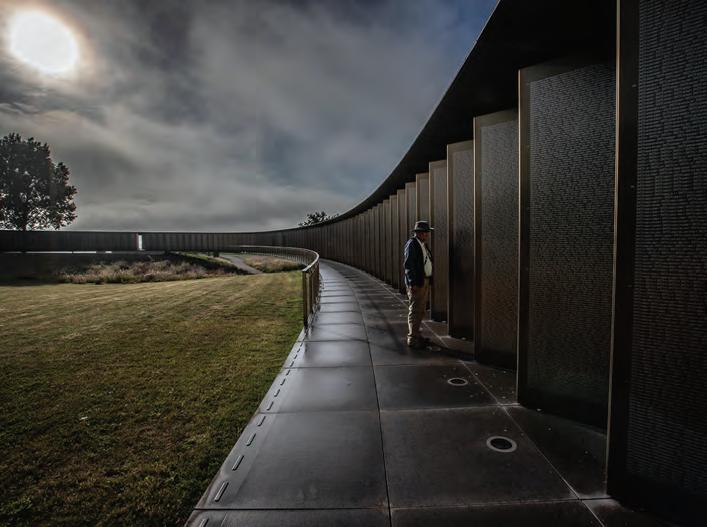
A visitor reads inscriptions on the Ring of Remembrance, an international memorial near Arras, France, that includes the names of 579,606 soldiers killed during the First World War. Stephen J. Thorne/LM
A DREAM COME TRUE
For many Canadians, visiting sites of the world wars is the chance of a lifetime. A visual diary of the Legion’s 2025 Pilgrimage of Remembrance
Photography by Stephen J. Thorne, with words by Aaron Kylie
46
“JUST A SLAUGHTER”
A detailed history of 13 Platoon, ‘C’ Company, 1st Battalion, Royal Hamilton Light Infantry during the August 1942 Dieppe Raid By Philip Mills
52
THE SECRET MISSION AIRMEN
Remembering Canada’s role in efforts to liberate Poland during the Second World War By Edward Poznanski
To mark The Royal Canadian Legion’s centenary, we’re introducing a new digital experience that invites viewers to explore, learn, and connect with 100 years of service brought vividly to life. This dynamic, interactive website showcases the milestones, memories, and moments that shaped our story— and the vision driving the Legion’s next 100 years.

BOARD CHAIR Sharon McKeown BOARD VICE-CHAIR Berkley Lawrence BOARD SECRETARY Bill Chafe DIRECTORS Steven Clark, Dermod Coombs, Randy Hayley, Trevor Jenvenne, Bruce Julian, Valerie MacGregor, Jack MacIsaac Legion Magazine is published by Canvet Publications Ltd.
GENERAL MANAGER Jason Duprau
ADMINISTRATION MANAGER
Stephanie Gorin (on leave)
SALES/ADMINISTRATIVE
ASSISTANT
Lisa McCoy
ADMINISTRATIVE ASSISTANTS
Chantal Horan
Veronika Hughes
ADMINISTRATIVE AND EDITORIAL
CONTENT CO-ORDINATOR
Matthew Ryan
EDITOR
Aaron Kylie
SENIOR EDITOR
Michela Rosano
SENIOR STAFF
WRITER
Richard Foot
STAFF WRITER
Alex Bowers
ART DIRECTOR, CIRCULATION AND PRODUCTION MANAGER
Jennifer McGill
SENIOR DESIGNER AND PRODUCTION CO-ORDINATOR
Derryn Allebone
SENIOR DESIGNER
Sophie Jalbert
DESIGNER
Serena Masonde
Advertising Sales CANIK MARKETING SERVICES Nik Reitz advertising@legionmagazine.com
Marlene Mignardi marlenemignardi@gmail.com Or call 613-591-0116 for more information
SENIOR DESIGNER
AND MARKETING CO-ORDINATOR
Diana Coote
WEB DESIGNER AND SOCIAL MEDIA
CO-ORDINATOR
Ankush Katoch
Published six times per year, January/February, March/April, May/June, July/August, September/October and November/December. Copyright Canvet Publications Ltd. 2026. ISSN 1209-4331
Legion Magazine is $13.11 per year ($26.23 for two years and $39.34 for three years); prices include GST. For addresses in NS, NB, NL, PE a subscription is $14.36 for one year ($28.73 for two years and $43.09 for three years). For addresses in ON a subscription is $14.11 for one year ($28.23 for two years and $42.34 for three years).
To purchase a magazine subscription visit www.legionmagazine.com or contact Legion Magazine Subscription Dept., 86 Aird Place, Kanata, ON K2L 0A1 Call 613-591-0116 or toll-free 1-844-602-5737. The single copy price is $7.95 plus applicable taxes, shipping and handling.
Send new address and current address label, or, send new address and old address. Send to: Legion Magazine Subscription Department, 86 Aird Place, Kanata, ON K2L 0A1. Or visit www.legionmagazine.com/change-of-address. Allow eight weeks.
Opinions expressed are those of the writers. Unless otherwise explicitly stated, articles do not imply endorsement of any product or service. The advertisement of any product or service does not indicate approval by the publisher unless so stated. Reproduction or recreation, in whole or in part, in any form or media, is strictly forbidden and is a violation of copyright. Reprint only with written permission.
PUBLICATIONS MAIL AGREEMENT NO. 40063864
Return undeliverable Canadian addresses to Legion Magazine Subscription Department 86 Aird Place, Kanata, ON K2L 0A1 | magazine@legion.ca
United States: Legion Magazine, USPS 000-117, ISSN 1209-4331, published six times per year (January/February, March/April, May/June, July/August, September/October, November/December). Published by Canvet Publications, 866 Humboldt Pkwy., Buffalo, NY 14211-1218. Periodicals postage paid at Buffalo, NY. The annual subscription rate is $12.49 Cdn. The single copy price is $7.95 Cdn. plus shipping and handling. Circulation records are maintained at Adrienne and Associates, 866 Humboldt Pkwy., Buffalo, NY 14211-1218. U.S. Postmasters send covers only and address changes to Legion Magazine, PO Box 55, Niagara Falls, NY 14304.
Member of Alliance for Audited Media and BPA Worldwide. Printed in Canada.
We acknowledge the financial support of the Government of Canada. Version française disponible. From time to time, we share our direct subscriber list with select, reputable companies whose products or services we believe may interest our subscribers. To opt out of receiving these offers, please send your request, including your full name and address, to magazine@legion. ca. Alternatively, you can write to Legion Magazine, 86 Aird Place, Kanata ON K2L 0A1, call 613-591-0116, or call toll-free 1-844-602-5737.
We begin by acknowledging that the land on which we gather is the traditional, unceded territory of the Anishinaabe Algonquin Peoples, who have been guardians of, and in relationship with, these lands since time immemorial. We further acknowledge and recognize that our work reaches across all First Nations territories, Métis Homelands and Inuit Nunangat.
The wounds are real. There are an estimated 2,000 members of the Canadian Armed Forces who were wounded or injured during the war in Afghanistan. And how many more of the over 40,000 women and men who served in the 2001-2014 conflict—the longest combat mission in the country’s history—deal with memories of the firefights, the improvised explosive device detonations and the suicide attackers?
Still, Canada has designated their work as “special duty service,” despite the veterans of the First and Second world wars and the Korean War being deemed to have “wartime service.”
While the distinction has no bearing on service-related benefits, many Canadians who fought in Afghanistan and other modern conflicts feel slighted that they’re not considered war veterans.
“It gives the perception to those who didn’t serve the idea that what we did in Afghanistan was less than the combat faced by veterans of other eras,”
Michael Blois, who was wounded by a Taliban rocket blast during his second tour in 2007, told The Globe and Mail
It’s time that changed.
To help facilitate revised recognition, Senator Hassan Yussuff introduced a private member’s bill this past April dubbed the Wartime Service Recognition Act. It outlines a framework to review all deployments since Korea on four main criteria:
• the level of risk faced during service, including exposure to hostile or life-threatening conditions;
• the nature, rhythm, duration, scale and intensity of the operations;
• the exposure to conditions capable of causing physical or psychological injury;
• and, the existence of an armed conflict in the geographic location, regardless of the declaration of a state of war.
“We need to…be fair to the members who have contributed so richly to our country’s history,” Yussuff told CTV News in April. “Recognizing them for their wartime
service is fundamental to who we are as a nation, but it’s also about fairness, about the dignity of our Armed Forces members.”
In its 2025 election platform, Prime Minister Mark Carney’s Liberal Party said it would “expand recognition of service by reviewing the designation of certain military missions, including in the Persian Gulf, so that Veterans’ sacrifices in conflict zones are properly recognized.”
“I’m hoping, given the history, given what’s been said by the two parties,” said Yussuff, “they’re actually going to step up now and do what is required of them…. It’s a symbolic recognition, but for the veteran, this is absolutely, fundamentally important to the sacrifice they gave on behalf of their country.”
“It’s a symbolic recognition, but for the veteran, this is absolutely, fundamentally important.”
Indeed, Harold Davis, president of the Persian Gulf Veterans of Canada, told the Globe that the lack of wartime veteran recognition was “an insult.”
In 1991, some 5,100 CAF personnel served during the Persian Gulf War.
“A lot of Canadians don’t know what a veteran does for his country when he leaves. The war’s not over for a lot of veterans,” he said. “We didn’t lose anybody over there, so our casualty number is not sexy enough for the government to…recognize.”
Yussuff’s legislation passed in the Senate without amendment in early June. It will proceed to the House, where should it pass again, it would mandate a review of all Canadian military operations since the Korean War and future missions would have to be similarly assessed within one year.
“We should have a way to assess these missions,” said Yussuff, “and try to give the symbolic recognition to those who serve.”
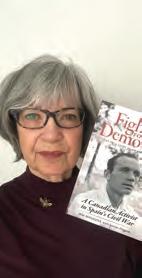
The AUTHOR
While Janette Higgins has penned other books, publishing her father Jim Higgins’ memoir in 2020 was the most rewarding experience of her life. She hopes his story gives context to the role Canadians played in the Spanish Civil War.
Niki Wilson is a proud member of The Royal Canadian Legion’s Jasper, Alta., Branch, known for its service to community and veterans. Her work also appears in other magazines, including Canadian Geographic and Canadian Wildlife

Advertisement

As a senior fellow at the MacdonaldLaurier Institute and a contributing author at thehub.ca, Richard Shimooka’s work focuses on comparative defence policy, strategy and procurement.

The NEW GUY
Legion Magazine’s new senior staff writer Richard Foot is a Halifax-based journalist and author who has written extensively about Canadian and international affairs. He has covered conflicts in Rwanda, Lebanon and Afghanistan.

Across Ontario, adults 55+ are proving that strengh, spirit, and community don’t fade - they evolve. From the ice to the court to the gym, participants show what vibrant, healthy aging truly looks like.
40+ events for all interests and abilities | Opportunities to compete, volunteer or try something new | Pathways to District, Regional, Provincial and National Games.
Whether you are stepping onto the ice, picking up a racket, or cheering from the stands, the OSGA 55+ Games offer a place to stay active, stay social, and stay inspired.






















or

✓ First walk-in tub available with a customizable shower
✓ Fixed rainfall shower head is adjustable for your height and pivots to offer a seated shower option
✓ High-quality tub complete with a comprehensive lifetime warranty on the entire tub
✓ Top-of-the-line installation and service, all included at one low, affordable price


I want to commend you and John Boileau for your article “The wars nobody won” in the May/June Legion Magazine. The missions Canadians participated in 35 years ago in the Balkans were difficult, demanding and complex. Sadly, many died and many came back wounded— physically and mentally. Boileau did a masterful job of collating many aspects of the missions into one article, and the photos were excellent.
the next several months. He was medically discharged in June 1918 and eventually died from his injuries on July 20, 1919, in England. He received a military funeral and is buried in Brookwood Military Cemetery in Surrey, England.
At one point, Canada had more than 4,000 soldiers deployed on the ground in the former Yugoslavia—two complete and well-equipped battle groups, one of the largest contingents—and many Europeans couldn’t understand why the country cared. The missions would continue for many years and many rotations in different areas, and the Balkans would be forever part of many veterans’ dreams and nightmares.
A team led by Paul Hale is doing much to help remember Canadian actions and outstanding service with an initiative called Balkans 35th Commemoration. The group has been interviewing veterans for an audio-visual history project, small and large events are planned for this year and 2027, and a return visit for interested veterans is planned for next year. More information can be found at www.balkans35.ca and on Facebook.
Once again, thank you for an excellent article.
Michel Maisonneuve (retired lieutenant-general) St. Catharines, Ont.
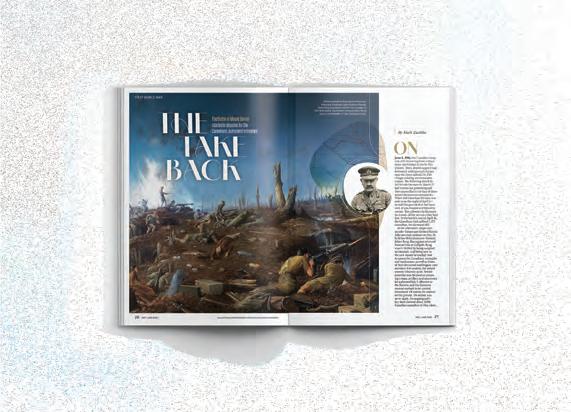
Congratulations to Mark Zuehlke on his well-written article “The take back” (May/June). My grandfather C.E. Little, then a sergeant with the 58th Battalion, 9th Brigade, 3rd Canadian Division, Canadian
Expeditionary Force, was awarded a Military Medal for his actions a month earlier on the night of May 1-2, 1916, at Sanctuary Wood during an “intense bombardment by the enemy.” In 2018, I had the opportunity to walk in his footsteps during a personal war history tour and I visited Maple Copse Cemetery where many of his comrades are buried. A century later, the trees have grown back, and evidence of a trench where they may have sheltered remains. While it pales in comparison to the 89 per cent casualty rate of the 4th Canadian Mounted Rifles, the “Fighting 58th” suffered 80 casualties in May and another 254 casualties in June 1916 during “The take back” at Mount Sorrel. Jim Little Turner Valley, Alta.
“The take back” article on the Battle of Mount Sorrel resonated with me. My great-grandfather, Private C.F. (Ted) Rowbottom of Kenora, Ont., was assigned to the 31st (Alberta) Battalion. He was wounded on June 7, 1916, near the village of Hooge, Belgium. Private Rowbottom would rejoin his unit at month’s end.
The battalion moved to the front lines at The Bluff near St. Eloi. There he suffered a gunshot wound to his shoulder on the morning of July 5 while positioned at the listening post in front of the trenches in no man’s land. Four other men were also wounded, and one officer from his battalion was killed.
My great-grandfather was evacuated to a hospital. It’s believed he suffered a stroke soon after, requiring extensive medical care and therapy over
Thank you for providing the details on the Battle of Mount Sorrel. Thanks also to The Kenora Great War Project team that researched and provided the profiles of all service men from the Kenora area who served in the Great War. I wouldn’t know about my great-grandfather’s journey without their work and your article.
Kelly Ryback
Winnipeg
J.L.Granatstein has written an amazing article on the U.S. National Security Strategy (The Historian, May/June) that summarizes and clarifies it. I have read it several times, and it brings together all the things we have been hearing from the Trump administration for several years. Thank you for this piece, which I have kept and copied to send to several Canadian friends who are interested.
Joan Sutherland
Montreal
Just got my copy of the May/June issue and I found the “cartoon” (Exit strategy) on the last page to be in very poor taste. I tore it out immediately.
Doug Carey
Quesnel, B.C.
I appreciated the article on the Fenian raids (“The last invasion,” March/April), particularly as my great-grandfather Colonel Melville Dawson participated. I didn’t know much of the story until now, but he

was in the militia in London, Ont., at that time and it participated in the incident at Ridgeway. A few years later, he was promoted to lieutenant-colonel and was put in charge of payroll and army stores in London. I have the paperwork from Ottawa appointing him. I really am pleased to know the story of the Fenian raids because I’m currently researching my family’s history.
Leah Steele London, Ont.
I was very impressed by the article “The last invasion” by Serge Durflinger. It was very detailed. This was one of the first actions of The Queen’s Own Rifles of Canada before Confederation. To honour the event, The Queen’s Own Rifles of Canada Association, The Royal Hamilton Light Infantry Association and members of the regiments commemorated the event on May 31 at the Ridgeway Cairn in southwestern Ontario.
Brian Budden Toronto
The very well written “Riot acts” article by Sharon Adams (January/February) also really struck a chord. It ties in with the conditions that my ancestors faced after fleeing hardship from other countries and immigrating to Calgary. Due to WW I-era antiGerman sentiment in Alberta, my ancestors (emigrants of German descent from Russia) were embarrassed about their surname, so they anglicized it to an Irish sounding one. They pretended to be Irish to get work and avoid discrimination.
It’s very sad that throughout history some never seem to learn to stop demonizing people and rationalizing harmful actions toward others that they perceive as different, be it racially, ethnically, nationally, religiously, economically or politically.
Larry McDougall Lethbridge, Alta.
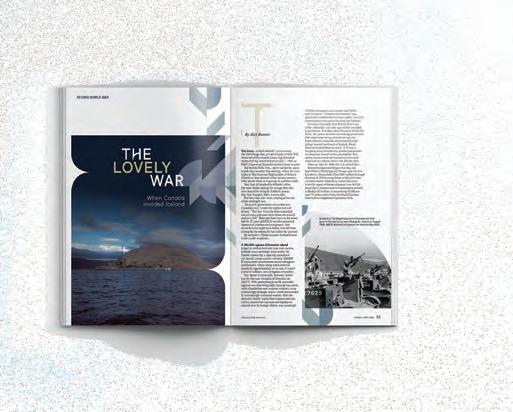
I enjoyed “The lovely war” article by Alex Bowers (March/ April) about Canada’s Second World War invasion of Iceland. My wife’s grandfather served in Iceland, Ireland and Scotland as a staff sergeant with The Cameron Highlanders of Ottawa during WW II. He said that while stationed there he trained new recruits to shoot. They were referred to as “two-week wonders” because that was how long they had to polish their shooting abilities before they were sent into action.
Veteran journalist Richard Foot joined Legion Magazine as senior staff writer this past March (also see Contributors, page 6). His weekly blog, “Observation Post,” debuted shortly thereafter (check it out at LegionMagazine.com) and has received much feedback, such as the following. —Ed.
On “Answering the call: Has the time come for mandatory national service?” (April 15, 2026):
How can you get this article Dominion wide? It’s excellent, but I’m sure there are thousands who will never see it.
Curt Svendsen Edmonton
Thanks! A strong case made for mandatory military service!
Bill Eremko
Drumheller, Alta.
Yes, it’s time to have mandatory national service. It’s way overdue.
D’Arcy Legros
Peterborough, Ont.
I wish I was young enough to defend the country that gives us so much.
Leonard O’Quinn London, Ont.
On “Badge of remembrance: The 1936 pilgrimage to Vimy” (April 1, 2026):
Thank you for the story about the Vimy pilgrimage. My late fatherin-law, Lieutenant-Colonel J.W. Gaius Thompson, was present for the event and was also invited to Buckingham Palace afterward. He had fought at Vimy and had been gassed and wounded in other battles but served again in WW II. He seldom talked about either war, but he occasionally would let his son, my late husband, and his best friend feel where shrapnel was still embedded under his skin. Keep up the stories. Canada needs to remember the sacrifices made by its armed forces members and their families.
Lynda Thompson
Toronto
Submissions for this department can be sent to magazine@legion.ca. They should be constructive and of general interest. They may be edited for brevity and clarity. The views expressed are those of the correspondents and publication of them does not necessarily constitute an endorsement by Legion Magazine


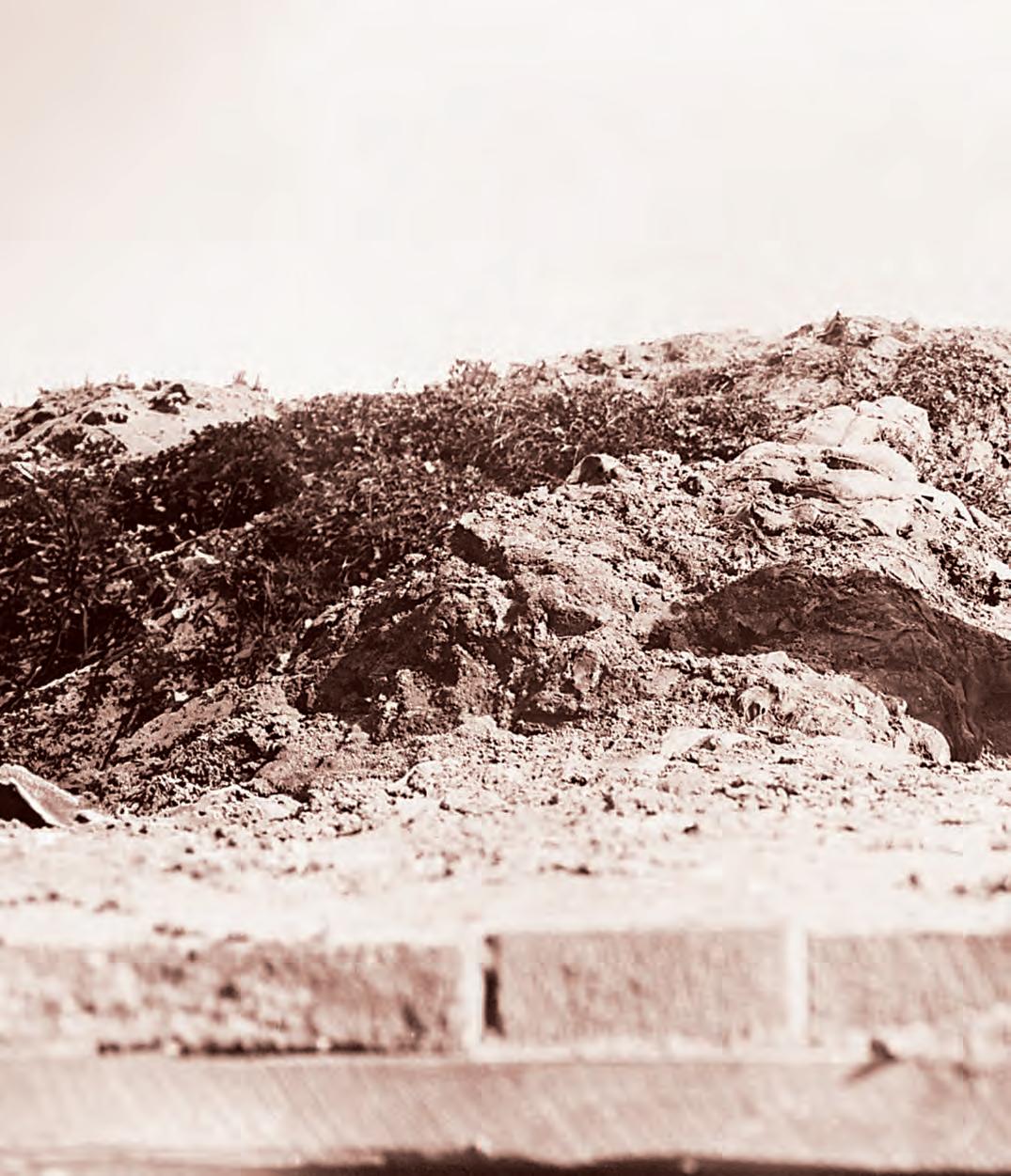
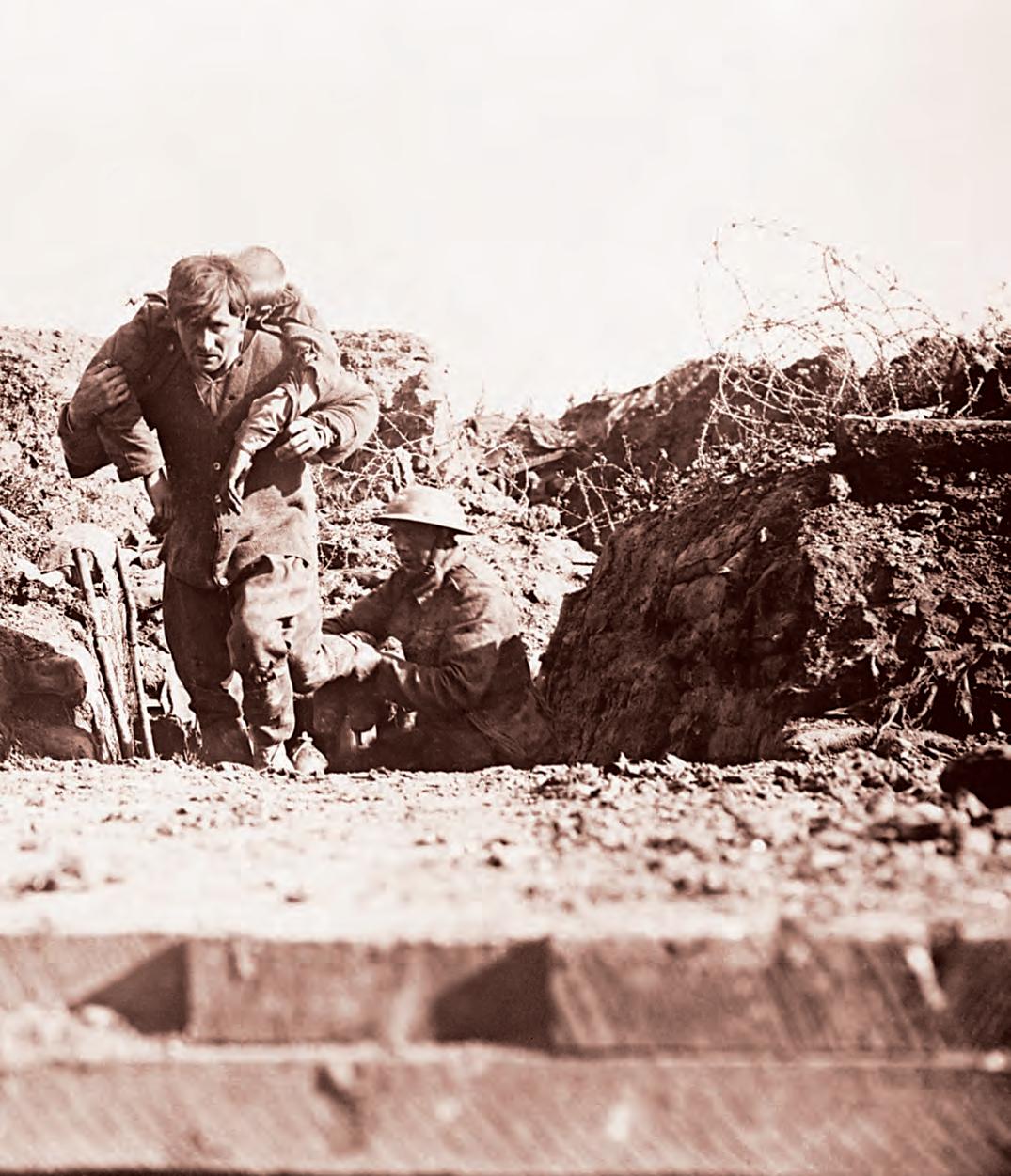
On July 1, 1916, the Newfoundland Regiment joined 29th British Division on the first attack of the Battle of the Somme at Beaumont-Hamel in what became one of the bloodiest days of the First World War. In less than an hour, the regiment was all but decimated: of the 800 Newfoundlanders who went into battle that morning, just 68 answered rollcall the next day.
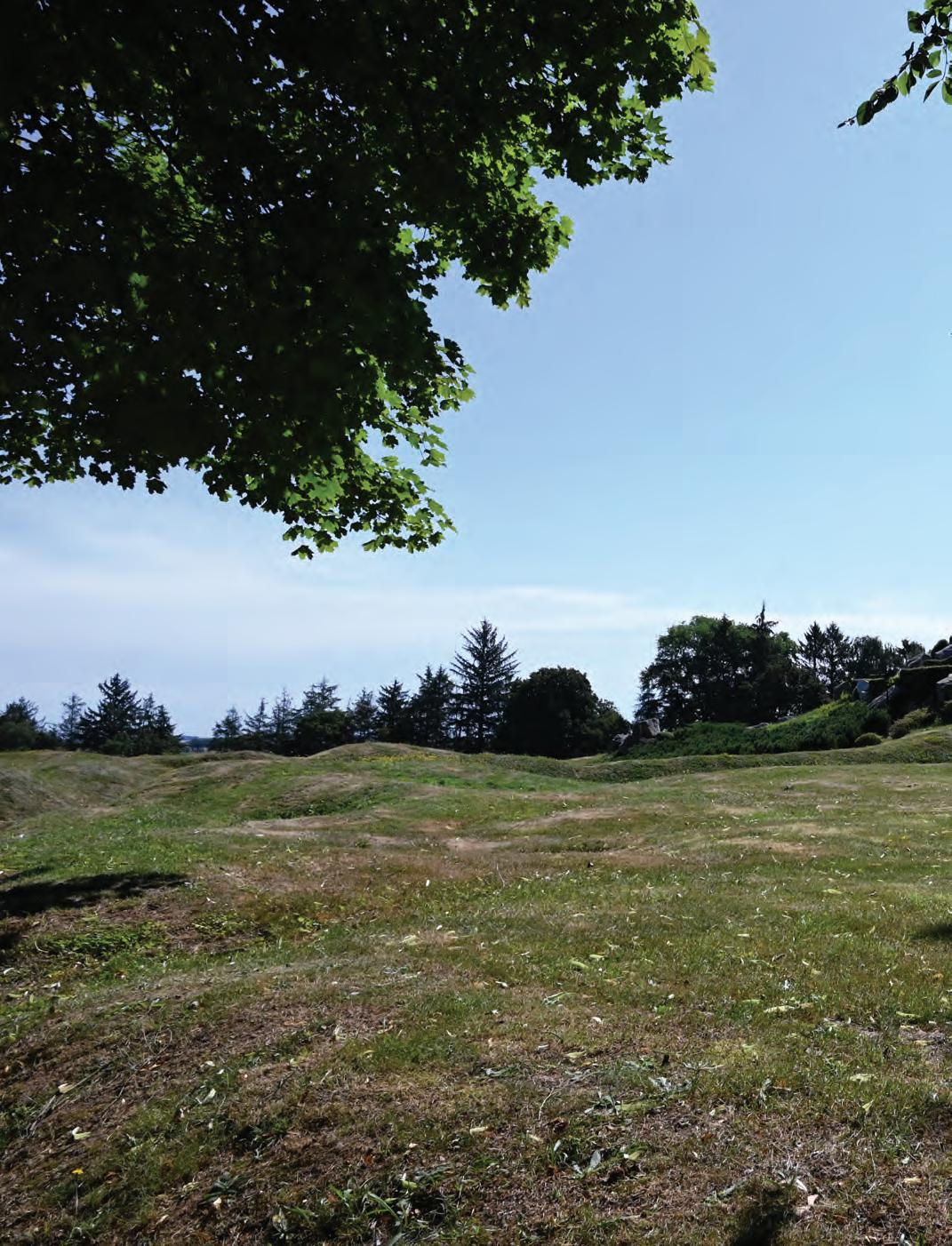
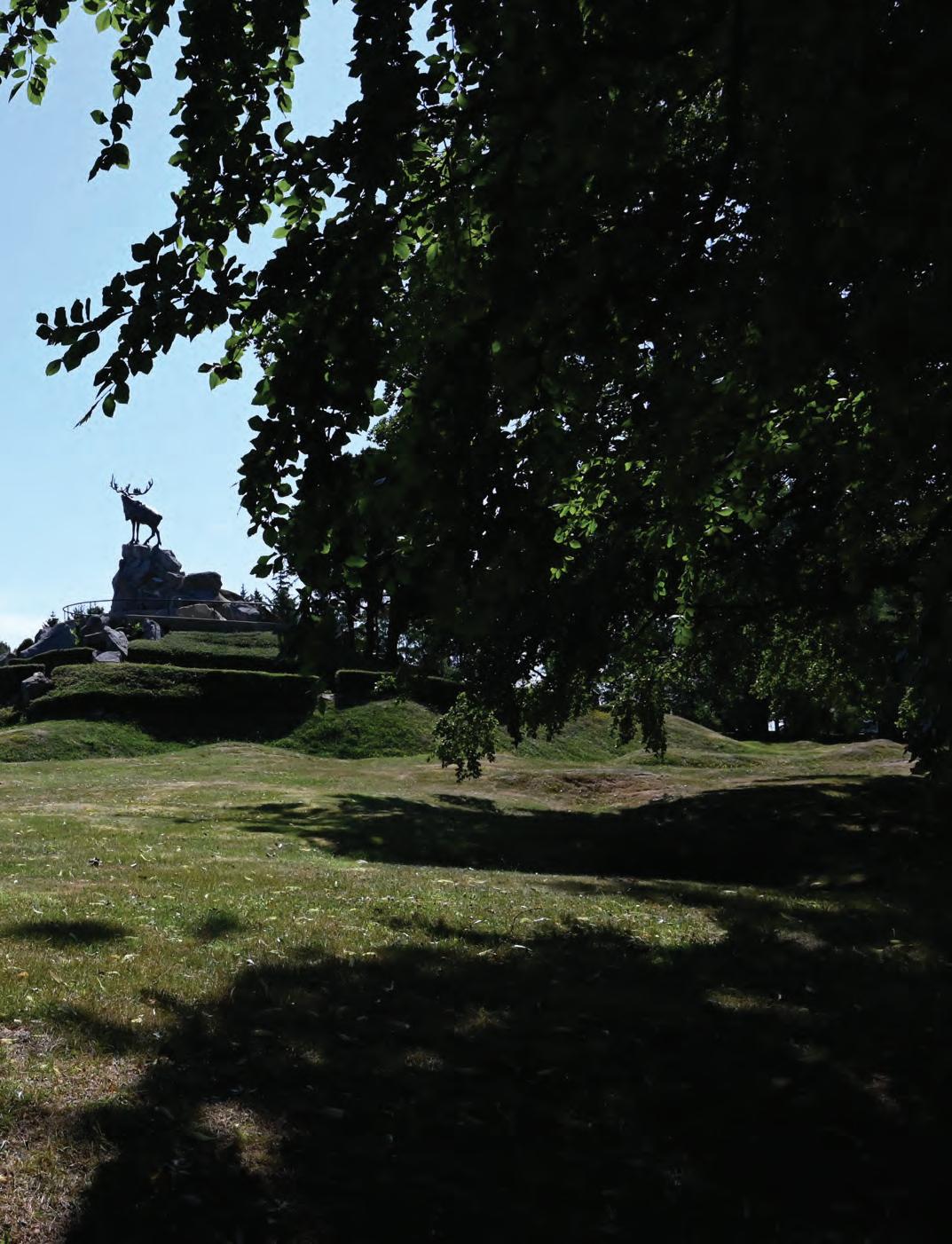
Looking out over the Beaumont-Hamel battlefield in northern France, a bronze caribou honours the sacrifices made by the Newfoundland Regiment that summer morning 110 years ago and throughout the First World War. Inscribed on three bronze tablets at the base of the monument are the names of 821 Newfoundlanders who died during the war with no known grave.
By Alex Bowers
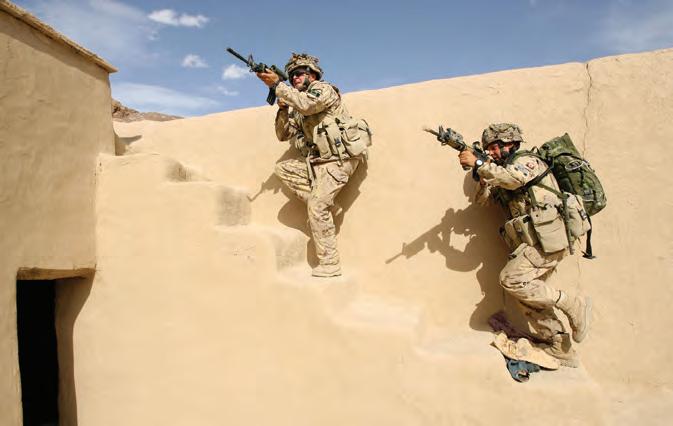
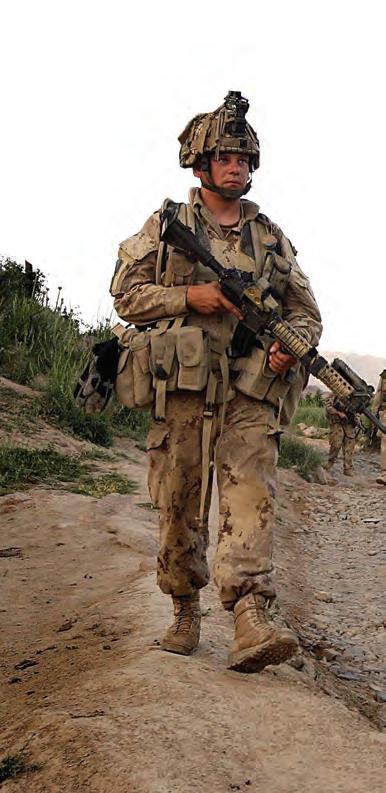
Above all else, retired master warrant officer William MacDonald remembers the maelstrom of Taliban fire amid the Battle of the White School on Aug. 3, 2006. A sergeant at the time, he watched the situation deteriorate as his comrades’ need for further assistance became dire.
The Regina-raised soldier informed his team that he would enter the fray himself, giving them moments to decide if they wanted to join. Corporal Bryce Keller and Private Mark Bedard agreed. The scene they found was nothing short of perilous. Private Kevin Dallaire was badly wounded. Others were overcome with heat exhaustion and grappling with additional complications. Then came a direct hit from a rocket-propelled grenade. MacDonald vaulted into an adjacent building. Outside, Sergeant Vaughan Ingram
was in terrible shape and would soon succumb to his wounds. “I had a different mission now,” MacDonald affirmed, having realized that Ingram, Keller and Dallaire were now all dead. “I had to keep the people who were still alive, alive.”
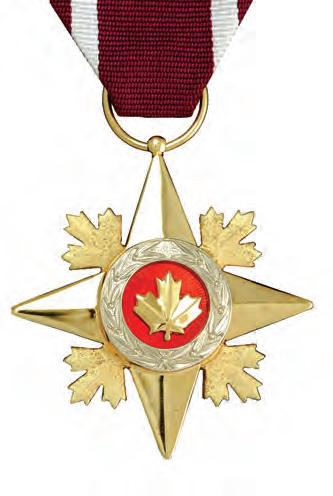
MacDonald's actions that day were recognized two years later with the Star of Military Valour—Canada’s second highest military decoration. The citation describes how MacDonald “selflessly and repeatedly exposed himself to great peril in order to assist his wounded comrades.”
This year, a largely grassroots campaign to upgrade MacDonald’s medal to Canada’s never-before-issued Victoria Cross, which replaced its Commonwealth counterpart more than three decades ago, has gained traction.
Here, MacDonald reflected on his exploits in Afghanistan and beyond.
On the start of his military career In 1989, my best buddy said he was going to join the reserves and wanted me to come along. That’s kind of what pulled me in. At first, being a 16-year-old kid getting screamed at was a culture shock, but you then appreciate the camaraderie and being part of something. It wasn’t until I served overseas [initially in Bosnia] that I got asked if I wanted to join the regular army, so I did. I transferred to PPCLI, where I did further tours in Bosnia, Kosovo and Afghanistan.
On his initial experiences in Afghanistan I was in a reconnaissance platoon when I deployed to Kandahar. When I first got there, our colonel expected us to go and kick a few nests, so we did just that. Otherwise, nothing super significant happened to us until the first week of July, when our platoon got into its first big engagement with the Taliban. From that day forward, we were in a gunfight almost every day.
On earning the Star of Military Valour I was a little bit in shock when I got the letter congratulating me. A lot of people were happy for me; even folks who were there that day in Afghanistan said, “You know you deserve this and more.” Yet there were moments during that battle when I just wanted to roll over and die. You get overwhelmed. You’re faced with the indecision of what
to do and the easy path is to just give up. I was ashamed for years at those thoughts. I didn’t feel like I was being a leader—I was just reacting. Really, ego is what allowed me to function. I’ve had people say that my professionalism, care and concern for those soldiers is what guided me. Maybe, but it doesn’t mean that I haven’t had guilt about my performance and whether I could have prevented anything or helped anybody to continue breathing that day.
On the awarding ceremony
Obviously, there’s a certain amount of pride. But, whether you like it or not, you’re now a spokesperson for that day. Since then, my mission has been to ensure that the names of the fallen aren’t forgotten.
I have to live a good, full life and honour their sacrifice. What meant the most to me was that Bryce Keller’s family was there. I bumped into them in the hotel lobby beforehand and I remember being speechless. I didn’t know what to say. They basically took charge and said, “We don’t blame you for what happened.” That kind of absolved some of the guilt I had over his death.
I would say I was more pleased to have played a role in Keller being awarded the Medal of Military Valour posthumously than receiving my own.
On efforts to award him the Victoria Cross I have mixed emotions. I certainly would never lobby for it. Nor do I believe I’m deserving of it. I’m humbled



that people feel I’m potentially worthy, but I can’t help but envision that moment when they congratulate me for being awarded the Victoria Cross. There’s no playbook for that.
I worry that there would be a perception that it had been awarded just for the sake of it. I don’t want to live with that if that’s why. But several people have said to me, “Did you ever think that maybe it’s not about you?”
I’ve worn a blue beret, so I’ve been a peacekeeper. I’ve worn a green beret on a NATO mission, so I’ve been a peacemaker, and now, since Afghanistan, I’ve been a war fighter, and that’s kind of the dream. But I’d give all of it back for the lives of my friends.
This interview has been edited for brevity and clarity.
“When our brother passed away, we reached out to Ultramatic for advice on reselling his Ultramatic adjustable beds. They were still working after 40 years!
Tina answered our call. She suggested donating the bed to a Veteran. We thought this was a terrific idea, since our family members have a long history of military service.
We are very impressed with the culture of care at Ultramatic and their desire to support their customers and also Veterans in need.”
We recommend Ultramatic to anyone who needs a mattress, adjustable base or recliner.
M., Vancouver BC
1-2 July 1937
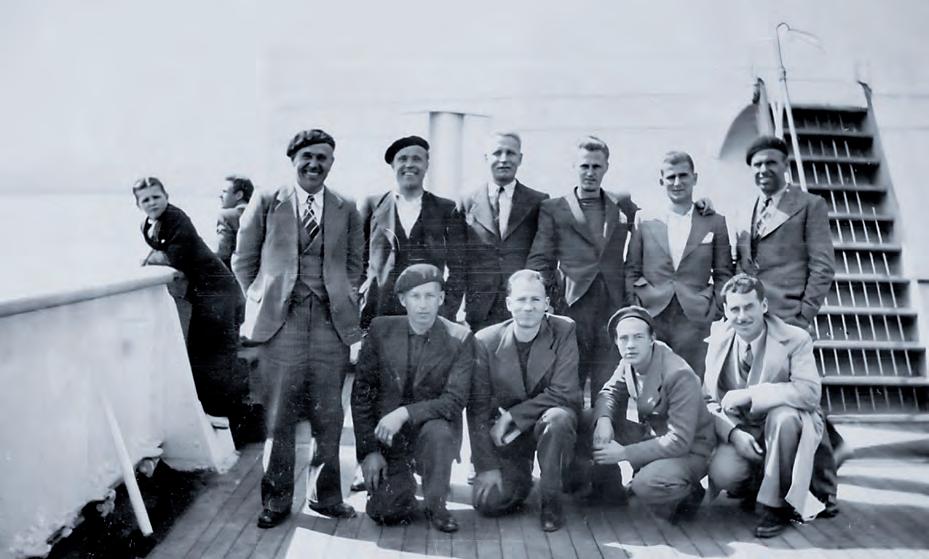
The Mackenzie-Papineau Battalion (also see Heroes and Villains, page 20) of the XVth International Brigade is brought to full strength and deemed operational for combat in the Spanish Civil War.
1 July 1867
The first four provinces—New Brunswick, Nova Scotia, Ontario and Quebec—form the Dominion of Canada under the British North America Act. Despite numerous bilateral agreements with the Crown, Indigenous Peoples aren’t invited to take part in the discussions leading to Confederation.
July 1916
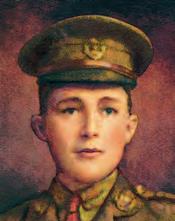
Lieut. Thomas Wilkinson uses an abandoned machine gun during the Battle of the Somme to hold the enemy until relieved. Later that day, he mounts the gun and disperses the enemy to free up an Allied advance. Wilkinson is eventually killed going to aid a wounded man and is posthumously awarded the Victoria Cross.
6 July 1942
Anne Frank’s family goes into hiding in the attic of an Amsterdam warehouse.
7 July 2011
Canada’s combat mission in Afghanistan ends, handing over command of the Task Force Kandahar area to the U.S. army.
July 1758
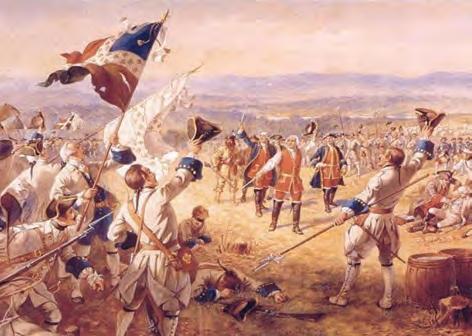
French forces led by General Louis-Joseph de Montcalm defeat a British and American attack at Fort Carillon on the shores of Lake Champlain during the Seven Years’ War.
14 July 1915
The first aircraft built on a Canadian production line, the Curtiss JN-3 trainer, takes its maiden flight in Toronto.

July 1945
The U.S. army detonates the first atomic bomb, code-named Trinity, in New Mexico as part of the Manhattan Project.
18 July 2010
MCpl. Paul Douglas Mitchell puts himself in danger for a second time in Afghanistan to save others and repel enemy attacks, providing machine-gun cover so comrades could reach safety. He is awarded the Medal of Military Valour.
20 July 1974
Turkey invades Cyprus. That summer, three Canadian peacekeepers are killed and 17 more are wounded.
24 July 1917
The Military Service Act is passed in the House of Commons, and conscription becomes law in August.
July 1936
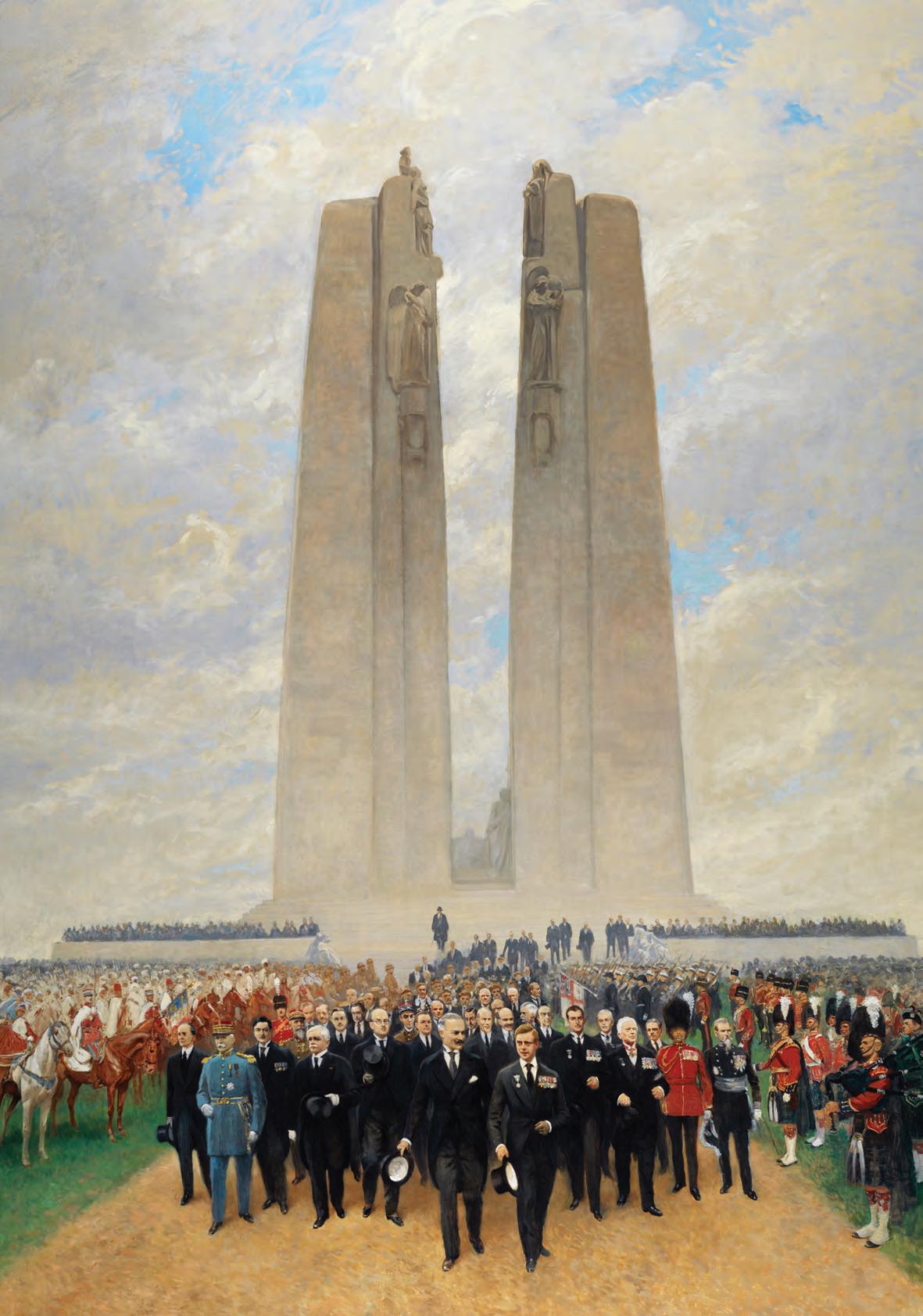
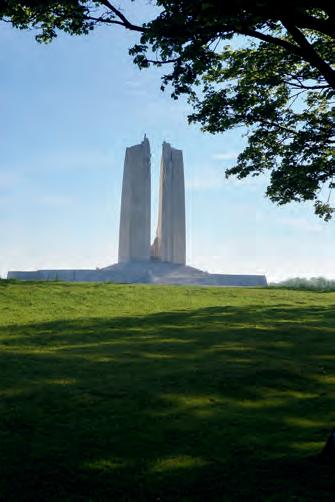
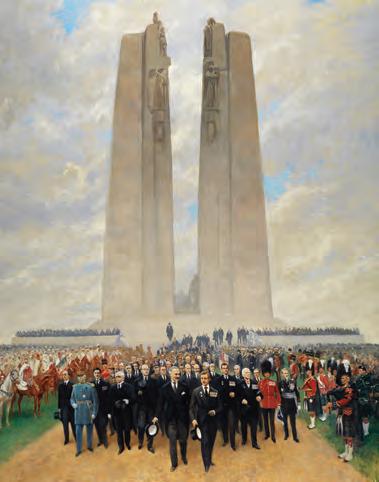
King Edward VIII unveils the Canadian National Vimy Memorial (also see “Altar of remembrance,” page 26) near Arras, France. The memorial stands as a testament to Canada’s sacrifice during the First World War and, particularly, soldiers with no known graves.
27 July 1953
The Korean Armistice Agreement is signed, formally ending three years of fighting. More than 26,000 Canadian Forces personnel served in the conflict; 516 died.
28 July 1914
Following the assassination of Archduke Franz Ferdinand, Austria-Hungary declares war on Serbia, beginning the First World War.
31 July 1942
Depth charges from HMC ships Skeena and Wetaskiwin sink U-588 in the mid-Atlantic.
August 2006
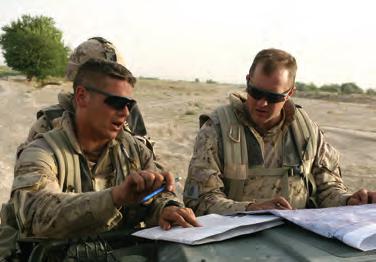
In Afghanistan, Sgt. William Kenneth MacDonald ensures his men hold their ground until reinforcements arrive, repeatedly exposing himself to fire to assist wounded comrades. He is awarded the Star of Military Valour. (Also see “The Briefing,” page 14)
4 August 1914
Britain declares war on Germany. The next day, Germany invades Belgium at the Battle of Liège.
August 1950
The federal government approves the Canadian Army Special Force to raise troops for the Korean War.

August 1917
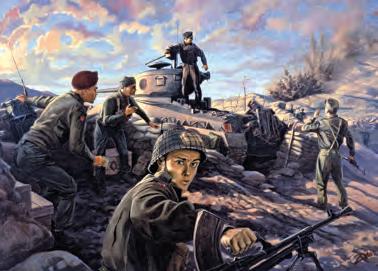
The Victoria Cross is awarded to Capt. William (Billy) Bishop following a June attack on a German aerodrome.
14 August 1945
With Japan’s unconditional surrender to the Allies, the Second World War unofficially ends. Japan signs formal surrender documents on Sept. 2.
15-18 August 1917
Canadians capture Hill 70 at a cost of 9,000 casualties.
18 August 1914
Thousands of recruits begin arriving at Valcartier near Quebec City for training.
August 1942
A force of more than 6,000 Allied troops, including almost 5,000 Canadians, raid the port of Dieppe, France (also see “Just a slaughter,” page 46). The Germans are prepared for the attack, and the raid results in 1,946 Canadians taken prisoner and 916 killed.
21-22 August 1944
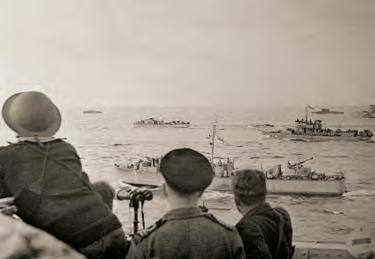
Canadian corvette Alberni is destroyed by a German U-boat in the English Channel, killing 59 crew.
22-23 August 2007
WO Tod Hopkin commands the lead vehicle of a combat team through sustained enemy attacks, exposing himself to great risk to help capture a vital position in Afghanistan. He is awarded the Medal of Military Valour.
24 August 1926
The Nursing Sisters’ Memorial is unveiled in Parliament’s Hall of Honour.
26 August 1918
The Canadian Corps launches a major offensive to break through the Drocourt-Quéant Line in France.
27 August 1953
Nos. 414, 422 and 444 squadrons leave Canada to join the RCAF Air Division at Canadian Forces Base Baden-Soellingen in Germany.
29 August 1911
Canada’s naval service becomes the “Royal” Canadian Navy, by decree of King George V.
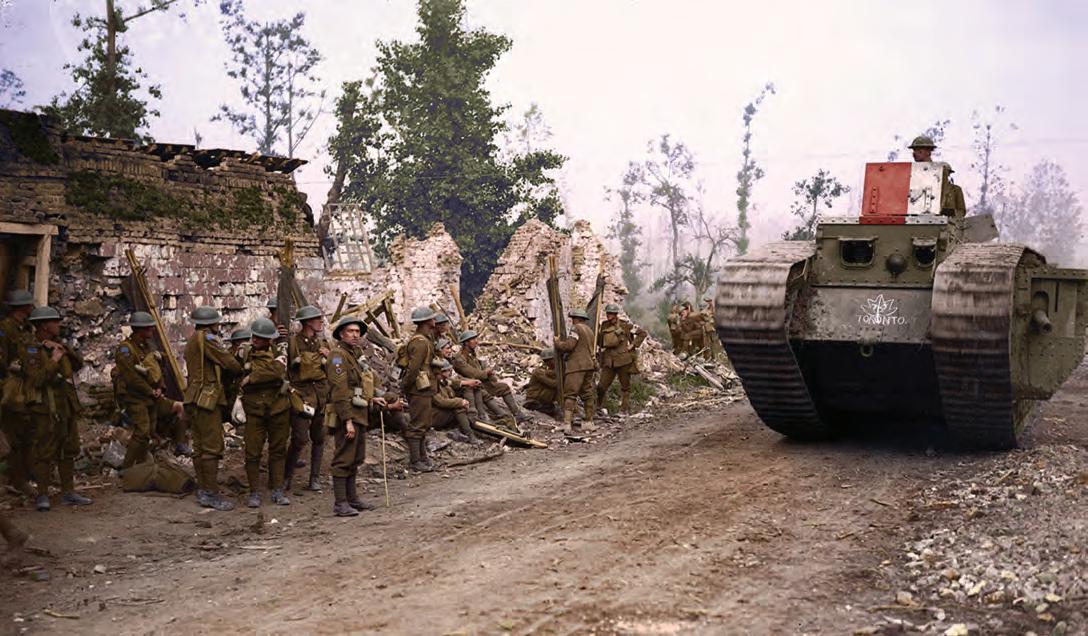
8 August 1918
The Canadian Corps is assigned to spearhead an attack near Amiens, France, to start what will become known as the Hundred Days Offensive.
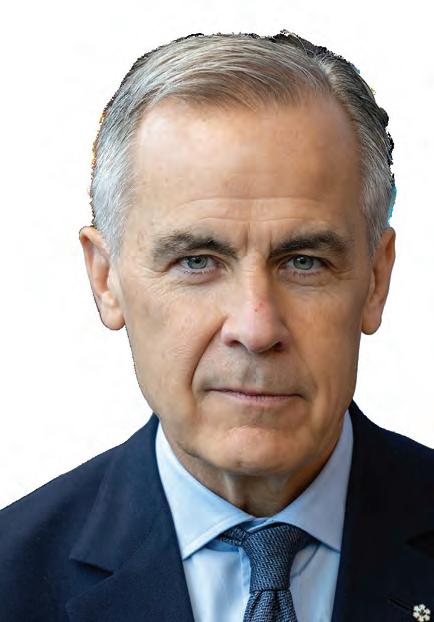
Ina now-famous speech at the 56th World Economic Forum this past January, Prime Minister Mark Carney gave a stark warning to the world’s middle powers: “If we’re not at the table, we’re on the menu.”
The statement wasn’t without cause. With long-standing alliances faltering, economies buckling from geopolitical uncertainty and globalization seemingly at a nadir, the planet is in a precarious position. What then is the planet to do?
The Institute for Economics & Peace identifies the middle powers as 16 countries that, largely unable to independently shape major international outcomes, can still exercise meaningful regional influence through multilateral institutions and niche specializations. The middle powers include Australia, Belgium, Brazil, Canada, Indonesia, Israel, Mexico, Netherlands, Poland, Saudi Arabia, South Korea, Spain,
Sweden, Turkey, Ukraine and the United Arab Emirates.
It was this group to which Carney presented a choice in his address: “negotiate bilaterally” with the superpowers, “compete with each other for favour” or follow Canada in choosing a third path of “genuine co-operation.”
The U.S. and China stand alone today as global hegemons yet, when considered as a collective, the influence of middle powers begins to emerge. The graphics here compare the relative economic and military might of the middle powers to the superpowers and the so-called great powers —Japan, Germany, India, the U.K., France, Italy and Russia.
“We are in the midst of a rupture, not a transition,” said Carney. The following shows the potential of challenging the divisions for those willing to take a seat.
—Matthew Ryan

3,619,840 4,754,925 3,541,700 2,035,000 1,315,600 GROSS DOMESTIC PRODUCT (US$ TRILLIONS) based on 2026 data from the International Monetary Fund
MILITARY PERSONNEL based on 2026 data from World Population Review

By Mark Zuehlke
The pack’s contents, he wrote, “saved my life.”
—Lionel Edwards
Seeing no future in Canada, Edwards considered volunteering to serve in the International Brigades fighting as part of the Republican army.
July 1936, 25-year-old Lionel Edwards first read of the fascist uprising in Spain against the democratically elected Republican government and became obsessed by the war there. The unemployed Calgary accountant was disillusioned with Canada, where roughly 2.2 million of its almost 11 million citizens depended on relief to survive. Seeing no future in Canada, Edwards considered volunteering to serve in the International Brigades fighting as part of the Republican army. By November, he had been inspired by newspaper accounts of an Austrian named Emil Kléber who claimed to be a naturalized Canadian and was being hailed the “defender of Madrid” for leading the International Brigades in driving off Nationalist attacks on the Spanish capital. Despite devastating casualties, the multinational volunteer force won what Edwards considered a glorious victory. All he wanted was to join the growing number of Canadians going to Spain to fight for its freedom. A few weeks later, when a Spanish government delegation came to Calgary, Edwards approached the organizers and was soon on his way overseas.
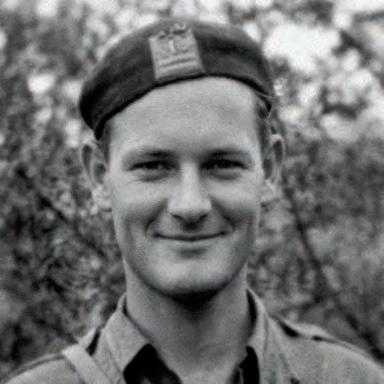
Edwards arrived in Spain in mid-March 1937, having sailed from New York City a month earlier, debarking in France, then joining a group of volunteers hiking through the Pyrenees. After training at the International Brigades’ headquarters in Albacete, Edwards was briefly assigned to administrative duties before being made commander of No. 3 Company platoon in the recently formed Mackenzie-Papineau Battalion (named in honour of the two 1837 rebellion leaders—William Lyon Mackenzie and Louis-Joseph Papineau). Sergeant Edwards’ first action came in October 1937 during the disastrous XVth Brigade (of which the Mac-Paps were part) attack on the hilltop citadel town Fuentes de Ebro. In January 1938, Edwards was promoted to lieutenant and No. 3 Company’s command in time for the grim winter fighting at Tereul. Promoted to captain and No. 1 Company command, Edwards led it into the final major International Brigades’ assault across the Ebro River intended to save the republic from defeat. An exploding shell ripped open his right shoulder and almost tore off his left arm. But most of the shrapnel shredded his heavy backpack. Inside the pack was a treasured copy of the Madrid Defence Council’s order giving Emil Kléber command of all International Brigades defending the city. The pack’s contents, he wrote, “saved my life.” Edwards returned to Canada on Feb. 3, 1939.

early December 1936, Toronto Daily Star correspondent Frederick Griffin interviewed Emil Kléber. All of Griffin’s efforts to confirm Kléber’s background were deftly parried by the “sturdy-set man of 41.” Kléber claimed to be a naturalized Canadian, born in the Austro-Hungarian empire and captured by Russians in 1917 while serving with the Austrian army. After escaping, Kléber told Griffin he had come to Canada and joined the Canadian Expeditionary Force (CEF) in 1919, participating in the intervention in Siberia.
Disillusioned by this expedition in support of the White Russians, Kléber defected to the Soviets. They then sent him to fight alongside Mao Zedong’s Communists against Chiang Kaishek in China—leading 56,000 men in breaking free of an encirclement by more than 1 million enemy troops.
Griffin accepted this backstory. “Such is the background of the strong man of the defence of Madrid,” he wrote. “He is no brass hat leader…but frequently is in the front line and often, earlier in the defence, he took a rifle, or handled a machine-gun while he was instructing and rallying new troops.”
Kléber compared Madrid’s defence to the French Great War stand known as the “Miracle of Verdun.” In Madrid, he said, “a miracle quietly happened.”
The International Brigades showed such bravery they inspired all Madrid to fight and win against overwhelming odds.
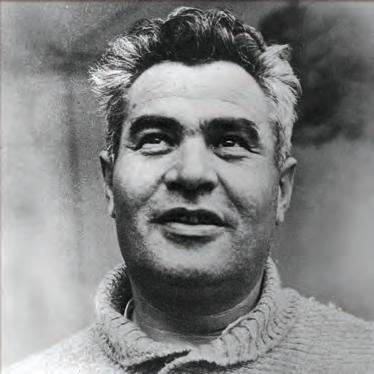
Only years after the 1939 Republican defeat was much of the truth about Kléber revealed. Kléber never concealed that the last name was a nom de guerre borrowed from the famous French Revolution general Jean-Baptiste Kléber. His real name was Manfred Zalmanovich Stern and he was an Austrian captured by the Russians in 1917. His escape to Canada and subsequent CEF service was fanciful, however. Stern was actually an ardent Bolshevik who led Siberian partisans against the White Russians.
In 1922, he entered the Soviet army and, by 1929, was a Main Intelligence Directorate (GRU) agent running a spy cell based in New York City. From there, he did serve in China until 1935, when he returned to Moscow and was sent to Spain the following year.
“He is no brass hat leader…but frequently is in the front line.”
Only years after the 1939
Republican defeat was much of the truth about Kléber revealed.
Stern’s heroic role in Madrid’s defence is beyond question, but it was also exaggerated by Soviet propaganda at the expense of Spanish commanders and the units they led. After Madrid, Stern was recalled to Moscow in December 1937. He disappeared, rumoured to have been shot in Joseph Stalin’s 1938 purge. It was later confirmed that Stern was imprisoned in a Siberian gulag, where he died on Feb. 18, 1954.
By Alex Bowers
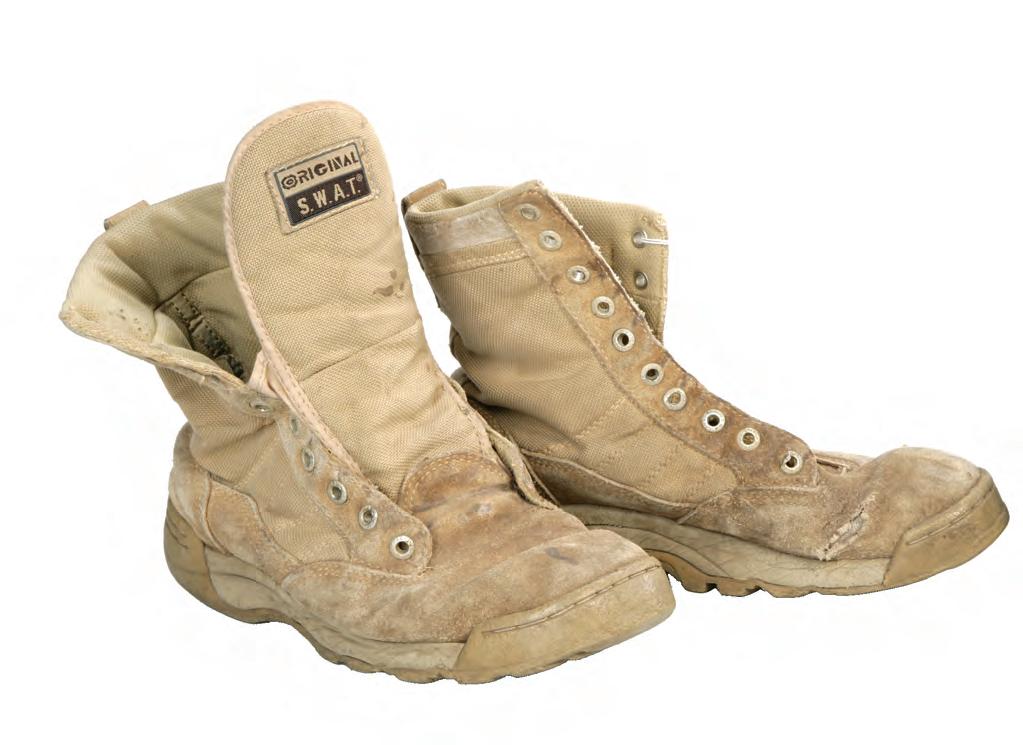
Sergeant William (Willy) MacDonald, they were just boots, a mere pair of Canadian Army-issue hikers to traverse arid Afghanistan. They weren’t exceptional to look at, their leather worn thin after seven arduous months of use. On Aug. 3, 2006, however, amid the Battle of the White School in Panjwaii district west of Kandahar, these boots would take him to hell and back (also see “The Briefing,” page 14).
Already, Corporal Chris Reid had been killed by an improvised explosive device. Already, roughly 200 Taliban fighters, perhaps more, had ambushed the attacking Canadian force, descending on some 14 soldiers, including MacDonald, now decidedly on the defensive under withering heat and fire within the compound’s outbuild
MacDonald’s boots steered him into the fray, the sergeant having resolved himself to act. They would indeed do the walking, but it would be his citation for the Star of Military Valour—Canada’s second-highest decoration—that later did the talking. Awarded on April 4, 2008, it described how MacDonald “selflessly and repeatedly exposed himself to great peril in order to assist his wounded comrades.
On Aug. 3, 2006, however, amid the Battle of the White School in Panjwaii district west of Kandahar, these boots would take him to hell and back.
Despite the risk, he ensured that his men held on until reinforcements arrived and that the platoon’s focus remained on holding the ground that they had fought so hard to secure.”



July 23rd/46
Dear Eira:
Thanks for your nice long letter. Should have written sooner but am really busy so am afraid this letter is going to be brief too.
Before I forget—about the hose situation. I thought if you could get me a few pair so it wouldn’t be such a struggle when I come home. Just when ever [sic] you happened to see some in. Two or three pair would be a great start. There is no need to send them as haven’t had stockings on since arriving….
My reason for being so busy is that I am doing a little Steno work in my time off for one of the guests. He is head of the Westinghouse Electric Corp. of Pittsburgh, Pa. Went over the first nite [sic] and took about 10 letters. Then he informed me that we would start on a lengthy report. The report was: Mr. Robertson was instructed by Gen. Groves to be a civilian observer at the Atomic Bomb Test in Bikini and he was writing a very detailed account of his trip. The work is most interesting and have enjoyed it so much. His description of Hawaii was most interesting, so you can see my hours after “Chambermaiding” have been kept busy—(Hope I’ll get a nice tip!!).
Lots of Love
Peg
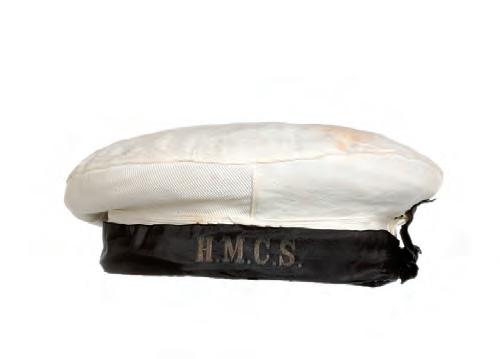
An excerpt of a July 1946 letter Margaret (Peggy) Helen Chesney of Wolseley, Sask., sent to her friend J. Eira Williams. Chesney enlisted with the Women’s Royal Canadian Naval Service in 1943.
Asa direct entry officer at basic training, everything was new to me. I quickly learned that there is a standard for everything. Although a bit excessive, the expectations seemed manageable until Sergeant Cook taught us how to make a bed. Although I failed to see the importance of making an immaculate bed each morning, I schemed for ways to meet the standard.
Before going to bed one night, I prepared my room for inspection. I mopped the floor, dusted the window and made my bed precisely to standard. After lights out, I made a makeshift place to sleep on the floor. In the morning, I arose to an already “met standard” room. My pod mate, Ryan, thought it was preposterous. Sergeant Cook went nuclear on him during the routine inspection: “Week two! You still can’t make your bed! You need to work with Hallett. He has it figured out!”
—an abridged excerpt from John Hallet’s 2025 book Unconventional: A Combat Engineer’s Road to Afghanistan
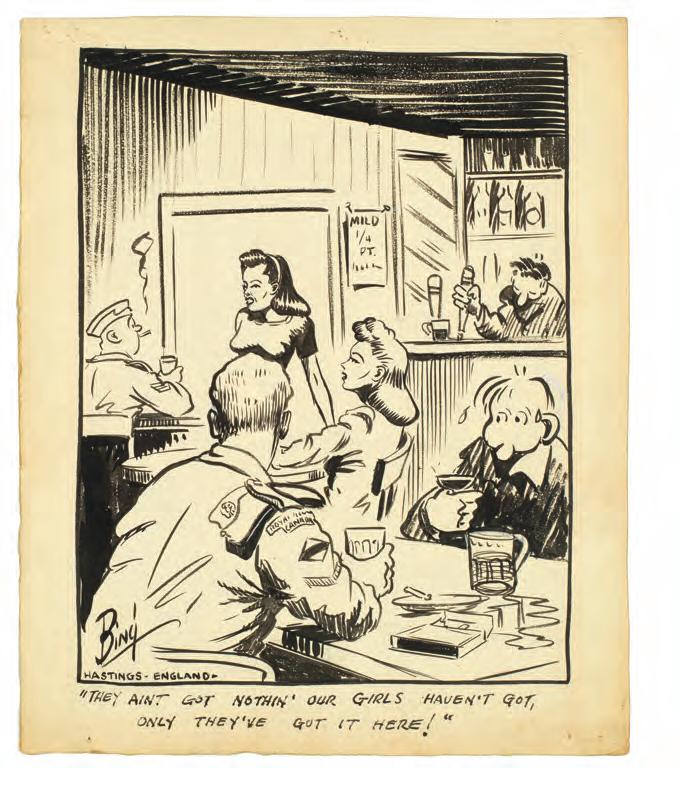

First Canuck: “What’s up, Bill?”
Second Canuck: “I’ve sent my girl a letter every day since we landed in France, and now she’s married the postman.”
Vimy Ridge’s journey from mud to chiselled stone— and the veterans who witnessed both
By Alex Bowers
old soldiers, it may have seemed like history repeating itself. Certainly, as the crowds gathered beside the Montreal docks on July 16, 1936, it at least rhymed.
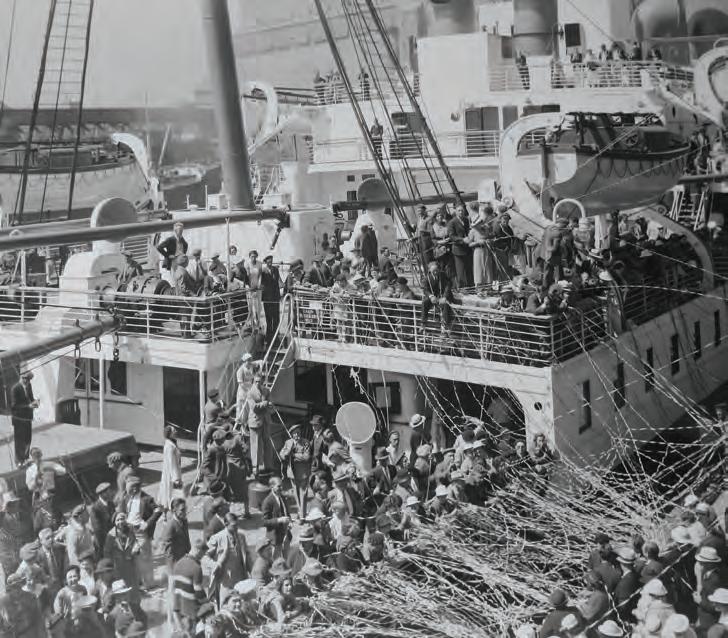
The thousands of well-wishers, cheering above the sound of brass bands and fireworks, bade farewell to five departing ocean liners that collectively carried roughly 6,400 Great War veterans and their families. Had it not been for the presence of mothers, wives and children next to them, the former warriors, many in their 40s and 50s, might have felt like they had travelled back in time.

Then as now, the waving throngs on land were awash with patriotic fervour. Then as now, the laden convoy was bound for faraway Europe. Yet these were not men and women destined for a Western Front of mud, wire and horror, the sights of which lived only in minds. No, these were guests of honour to a long-liberated France, pilgrims embarking on a journey of remembrance—and closure. Vimy beckoned once more, a timeless battleground that loomed as large in Canada’s consciousness as the same seven-kilometre ridge where the country’s sons had spilled so much blood. Gone was the mud, the wire and the horror; in its place now, a memorial stood.
Before the guns had fallen silent and the detritus of war was swept away, the need to mark the April 9-12, 1917, Battle of Vimy Ridge galvanized countless survivors. There, after all, the four divisions of the Canadian Corps, totalling some 100,000 troops, had fought together for the first time, seizing the mighty escarpment—Hill 145. There,
too, an estimated 3,600 Canadians died in securing victory, a sacrifice that warranted special recognition.
So it was that numerous makeshift memorials, often extolling the exploits of individual units, were erected prior to the Nov. 11, 1918, Armistice. Nevertheless, resolve to create a national monument at Vimy, alongside other tributes scattered throughout Belgium and France, endured.
The process began with the identification of eight battle sites deemed most revered by Canadians. Aside from Vimy, those on French soil included Bourlon Wood (Canal du Nord), Le Quesnel (Amiens), Dury (Second Arras) and Courcelette (the Somme). Across the Belgian border, meanwhile, Dominion soldiers had participated in epic clashes near St. Julien (Second Ypres), Hill 62 (Sanctuary Wood and Mount Sorrel) and Passchendaele (Third Ypres).
With the memorial locations selected, the Canadian government eventually negotiated the transfer and purchase of land. But, questions remained concerning the form the monuments would take and who would design them.
In April 1920, a special committee was established in the House of Commons to finalize plans. Renowned architect Percy Nobbs argued that the chosen sites should boast similar memorials, although one could be singled out with a “more imposing design than the other seven.” Vimy quickly became the favourite—but not everybody agreed.
Chief among the dissenters was the Canadian Corps’ own General Arthur Currie, who, despite not yet being in command in April 1917, ascended to the position shortly afterward as its inaugural Canadian-born leader. As far as the former officer and national icon was concerned, “I do not think it was the most outstanding battle, or had the greatest material or moral effect on the winning of the war.” Currie would be overruled in due course, but in the meantime, the notion of having identical monuments persisted.
From September 1920, the newly founded Canadian Battlefields Memorials Commission took charge, launching a competition for designs. Organizers received
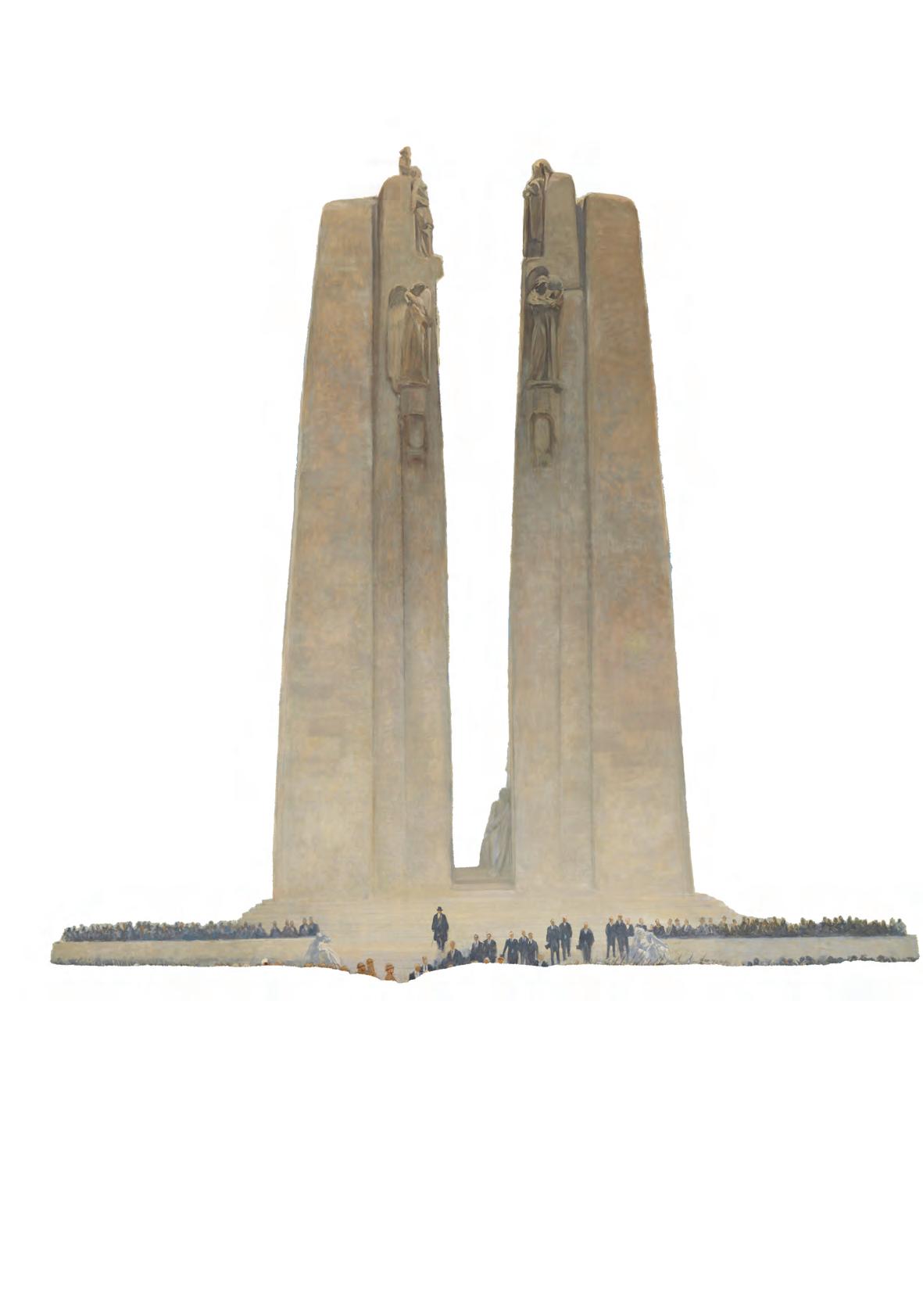
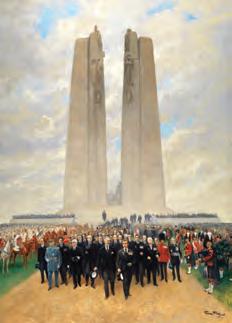
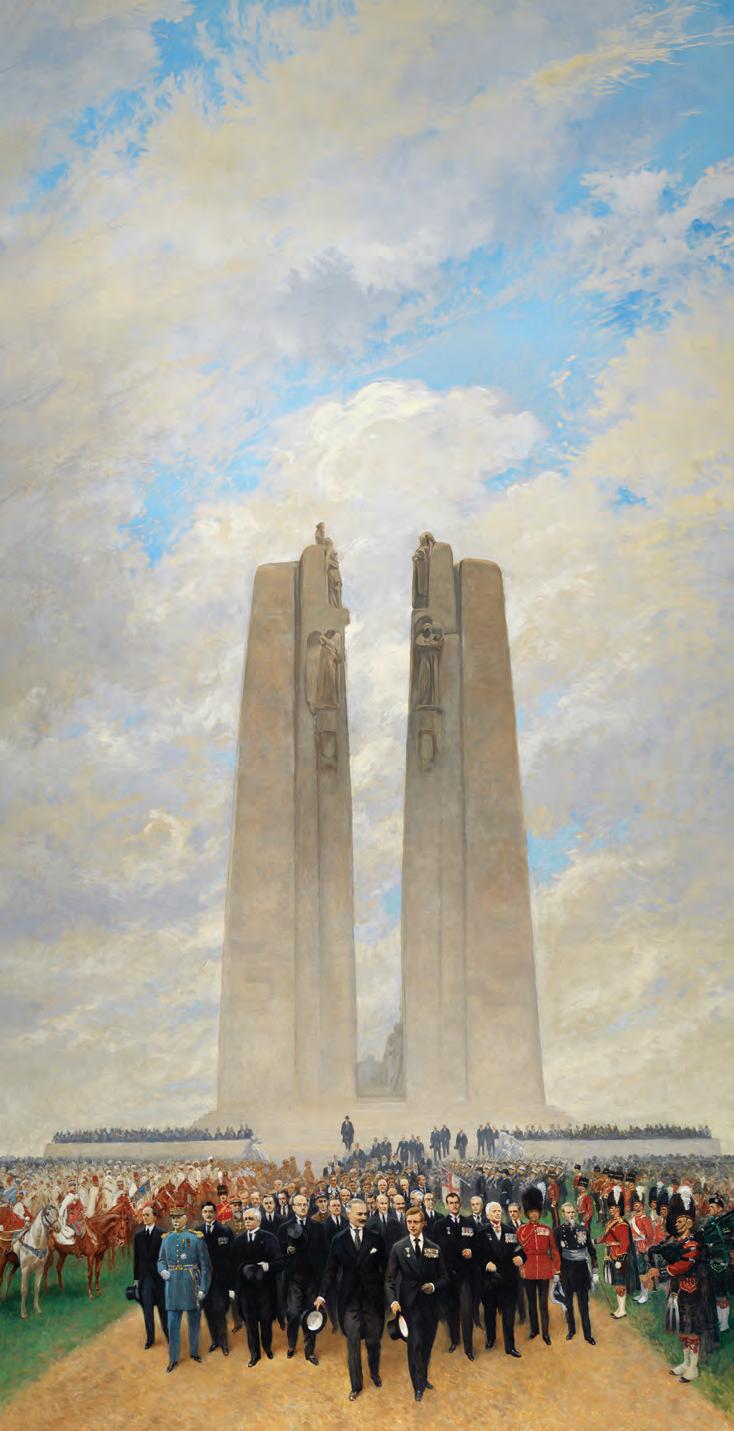
Artist Georges Bertin Scott depicts the unveiling of the Canadian National Vimy Memorial in July 1936 (opposite). Canadian attendees of the event depart the country (left ).
upward of 160 submissions, later shortlisted to 17 entries that were reproduced as models.
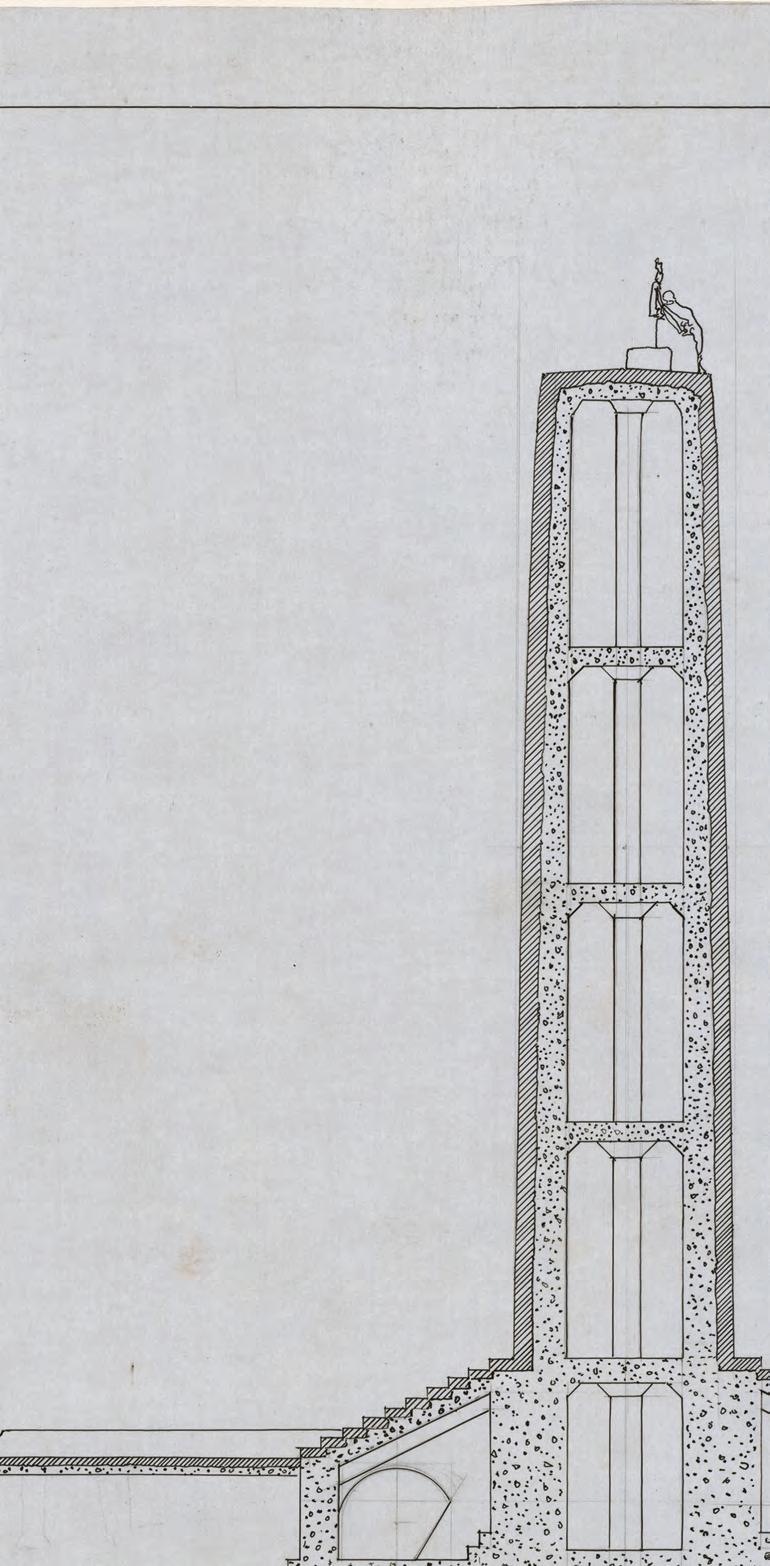
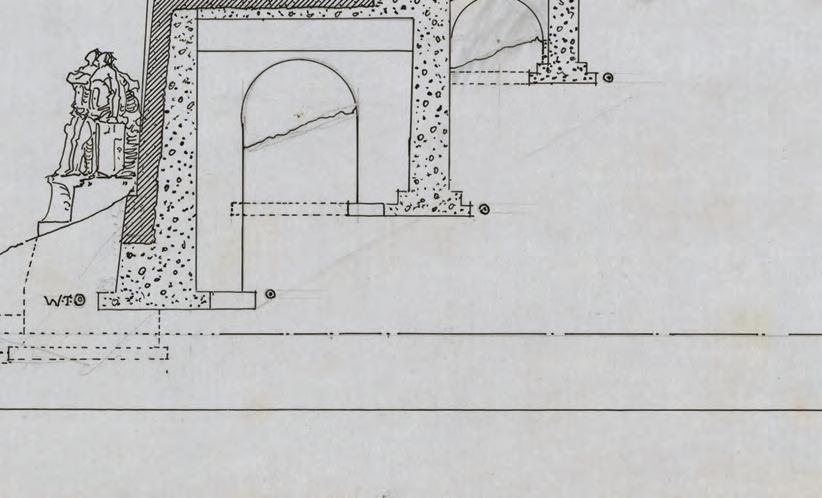
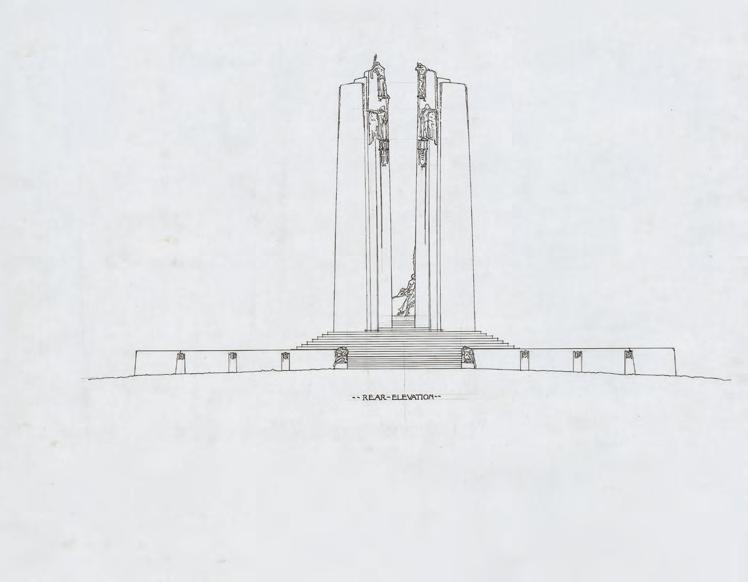
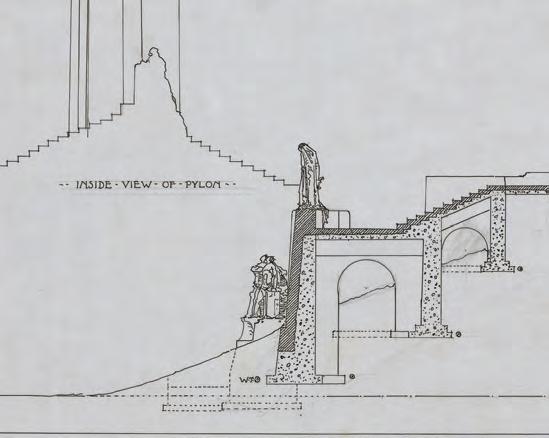
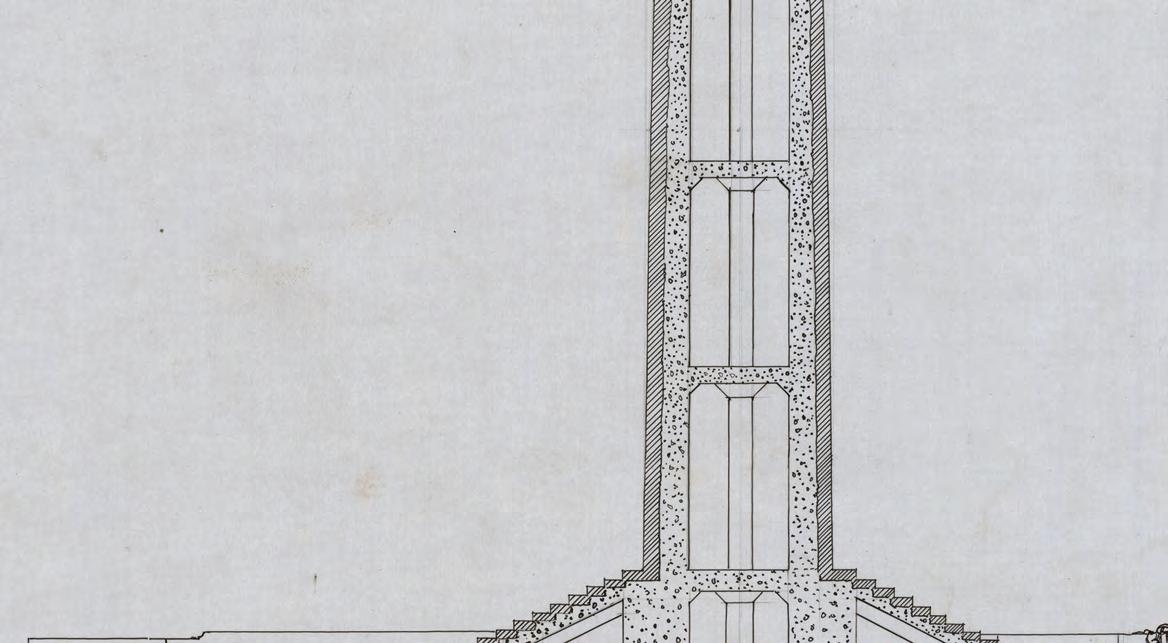
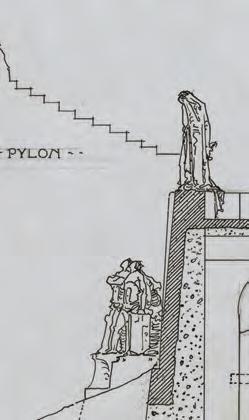
A jury reviewed the maquettes the following year when it became clear that many artists had envisioned monolithic structures imbued with deep national pride. One, however, stood strikingly apart: a large base topped with two soaring pylons representing Canada and France—countries that had paid a towering price in the war. A vacant sarcophagus, emblematic of boundless loss, rested below the memorial while, from high above, the maternal statue of Canada Bereft mourned her dead.
The 19 other allegorical figures— embodying values such as honour, justice and peace—populated the white stone tribute, which seemed almost inexhaustible in its symbolism. This wasn’t a monument to martial prowess, the jury realized, but a testament to sorrow and remembrance.
On Oct. 4, 1921, its esteemed creator, Toronto architect and sculptor Walter Seymour Allward, was announced as the competition’s winner. The commission conceded, however, that Allward’s memorial had a “design of such individuality and complexity that its character precludes it from the possibility of repetition.”
The runner-up, a still-impressive submission by Frederick Chapman Clemesha fated to be known as the Brooding Soldier, was thus picked for the seven other sites—that is, until it was also deemed too unique to replicate after being unveiled at Ypres in 1923. Officials settled on a third cube-like design
for the six remaining locations, all modest yet potent in carrying commemorative weight.
Arguably more pressing were the unresolved matters surrounding Allward’s future masterpiece. For starters, where should it be erected? While the commission initially suggested the monument be placed at Hill 62 in Belgium, the Vimy Ridge site had a somewhat surprising and improbable proponent in Prime Minister Mackenzie King. The Canadian statesman hadn’t served in the war, for which he had been ridiculed during his 1917 election campaign. In advocating for Vimy, King strove for a dutiful tone in the absence of having worn the uniform. His cause proved successful, proclaiming that, “History will look upon the battlegrounds of the Great War as the places of sacrifice. Among the number, no altar will be more conspicuous through the years than that of Vimy Ridge.”
With the decision made, and about 10 square kilometres of local land gifted to Canada by France for memorial use (without transferring territorial sovereignty), Allward could at last see his vision brought to life.
“I had gone into a troubled sleep after thinking of all the muck and horror over there,” recalled Allward of a wartime dream that inspired his memorial. “I found myself overlooking a tremendous battlefield. Division after division of our army was being swallowed up in this smoke, din and destruction. Everything was disappearing, but as I looked down a long avenue of poplars lining one of the main roads, I saw armies of the white dead coming out to relieve the dying armies of the living.
“When I awoke, and for long, long afterwards, the poignant impression remained and finally became a part of this work.”
A nightmare transformed into sublimity, Allward’s dream came
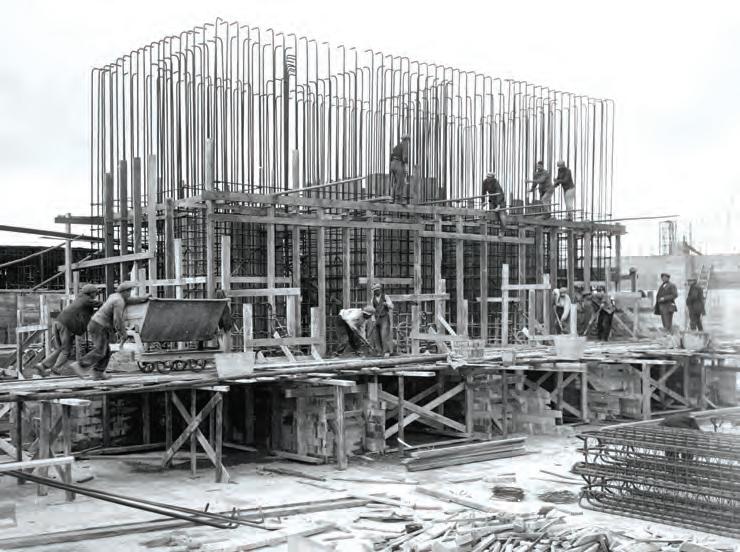

to life as the memorial’s foundation took shape in 1925. But amid the construction of memory, far more tangible reminders of war emerged from the soil during the site’s preparation.
“Vimy Ridge was in appalling shape,” wrote historian Tim Cook in Vimy: The Battle and the Legend of the scene that greeted crews, “with all of the roads leading up the ridge severely damaged, the terrain pocked by millions of shell craters, and a mass of unexploded high-explosive, shrapnel, and chemical shells buried in the earth.”
Added to the devastation was the abundance of bodies, fathers and sons long swallowed by the mud, but since returned to the surface.
Volatile ordnance could be pinpointed with detectors and probes, dugouts could be filled with concrete, and human remains could be recovered, with great dignity, by the Imperial War Graves Commission (later the Commonwealth War Graves Commission). But there were other delays.
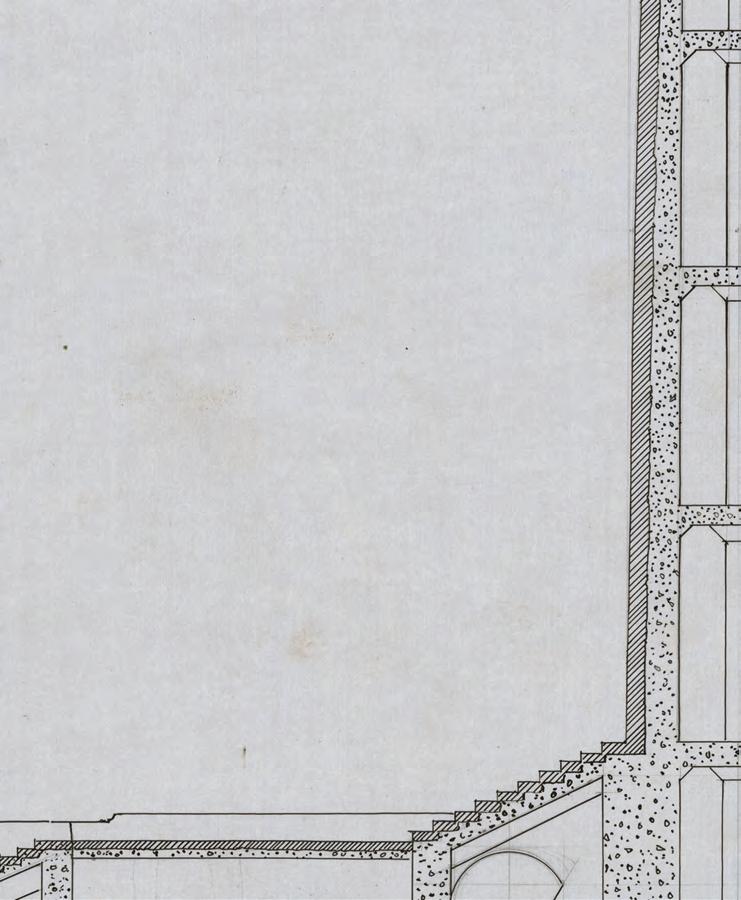
Roughly 65,000 tonnes of soil, chalk and clay were extracted from the site, an arduous process not without critics. The monument foundation itself required 15,000 tonnes of steel-reinforced concrete. Far more distressing for Allward, whose already distinguished sculpting career revealed perfectionist tendencies, was his search for the right stone.
No quarry, scattered across the likes of France, Italy, Spain and England, had rock that suited the architect’s uncompromising demands, which frustrated the commission in Ottawa. Allward, often labelled a mercurial artist

behind closed doors, continued his years-long search while, at Vimy, work came to a grinding halt. Increasingly idle, labourers found ways to stay occupied, resorting to reconstructing the nearby frontline trench system that had fallen into disrepair. Concrete-filled sandbags and mats created a strange sense of permanency, a battleground frozen in time. Much of the same was true of efforts to stabilize parts of the Grange Tunnel some 10 metres beneath the surface. With no end in sight for Allward’s structural woes, the sculptor confronted another complication. When he got his stone, where was he to inscribe the 11,285 names of Canada’s dead who fell in France and had no known grave? Allward agonized over their placement, at first resisting the idea of having them on the memorial walls for fear that they would
“History will look upon the battlegrounds of the Great War as the places of sacrifice. Among the number, no altar will be more conspicuous through the years than that of Vimy Ridge.”
“look like a huge sign board.” He ultimately relented, offering space along the monument’s facades and up the staircase, under the conditions that names run continuously in a single alphabetical sequence (unlike Belgium’s Menin Gate, where they’re arranged in separate panels by regiment and service) and that he would design his own lettering. Of course, before that could transpire, Allward still needed his basic building material. A breakthrough came in 1926, when he zeroed in on an ancient Roman quarry near Split, Yugoslavia (modern-day Croatia). The limestone was known as Seget— durable, versatile and elegant when weathered. It was perfect.
By June 1927, more than 6,000 tonnes of the creamcoloured rock had arrived at Vimy Ridge. Finally, the most fundamental work could begin.
Under Allward’s eye, sculptors studied his maquettes to carve stone figures twice the size, utilizing a pantograph to ensure precision. Engineers and labourers toiled to transform blocks into beauty until two pylons ascended above the Douai Plain. To guarantee the same level of craftsmanship during the miserable winter months, temporary studios shrouded the site to shelter those immersed in artistry and industry, neither one more important than the other. No detail was too small. No finish was too fine. But slowly, surely, a monument was built.
At last, after myriad delays that stretched the project out 11 years— not to mention having surpassed initial cost estimates to reach $1.5 million—Allward announced the memorial’s completion in 1936. All that was left was to unveil it.
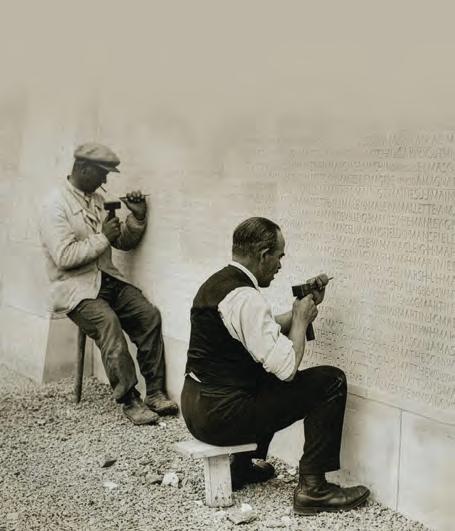
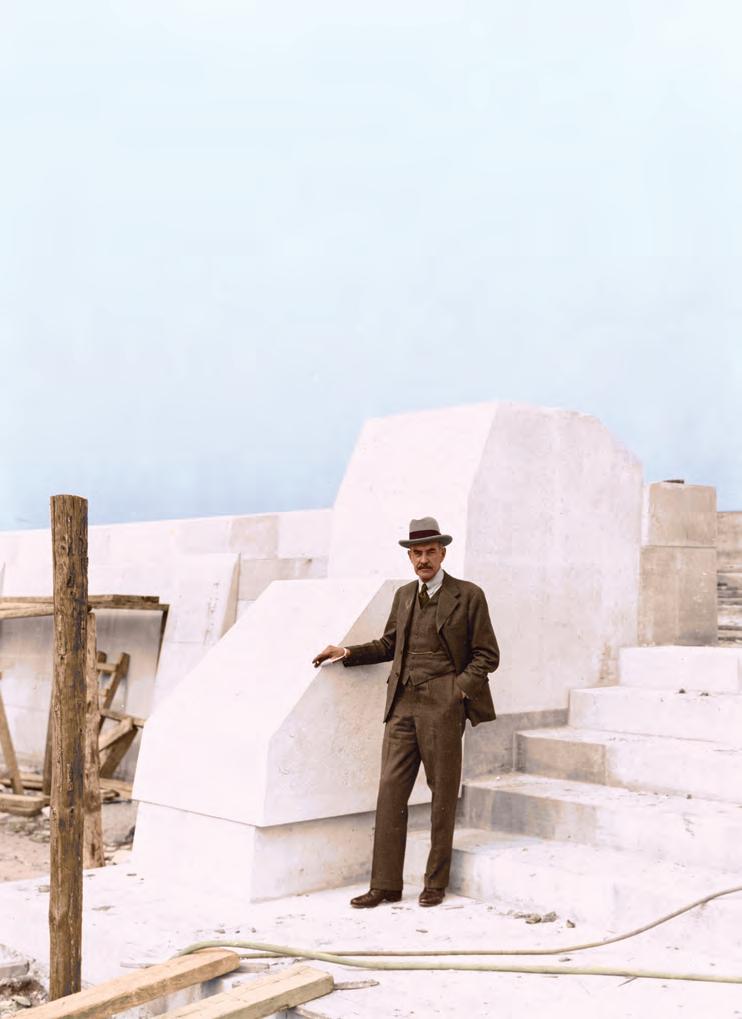
Architect Allward poses at the monument during construction (left ). The names of 11,285 of Canada’s WW I dead with no known grave in France are inscribed (above).
Walking the ground of old battlefields—perhaps laying bare old wounds—wasn’t without precedent when the towers of Vimy took form. Tours of the Western Front commenced shortly after the Armistice, with veterans and civilians from Britain and continental Europe embarking on such journeys for deeply personal reasons. While morbid fascination with the war existed for some, the vast majority came to pay their respects, often to a lost loved one or friend.
Canadians and Newfoundlanders had fewer opportunities, especially after the 1929 stock market crash that plunged the world into the Great Depression. A mere year earlier, however, the Canadian Legion (now The Royal Canadian Legion) had passed a unanimous resolution to organize a pilgrimage, as it would be called, to Belgium and France that might coincide with the monument’s unveiling. The trip was ambitious, particularly with record-high unemployment and abject poverty on a global scale.
The plan proceeded nonetheless, largely percolating behind the scenes until July 1934, when The Legionary magazine (the forerunner of this publication) announced that the pilgrimage would “definitely” happen. Responsibility for the official delegation and program fell to Ottawa. Getting more than 6,000 veterans and family members to the memorial was down to Legionnaire co-ordinators, who calculated the price for a three-and-a-half-week trip at $160 per person— too much for some, even with minor offsets. Still, many would tighten belts to afford the cost.
Those fortunate enough would return to a Europe again in turmoil. Spain appeared on the cusp of civil war (and it was, just one day after the pilgrims departed Canada). Italy’s fascist dictator Benito Mussolini had committed atrocities in Ethiopia. And then there was Hitler’s stranglehold on Germany, its Nazi regime having reoccupied the Rhineland and increasingly hell-bent on another war.
International uncertainty cast a dark shadow, but optimism prevailed when the memorial unveiling date was confirmed for July 26, 1936. King Edward VIII would preside; his presence was regarded as an honour among many attendees. The absence of General Currie, who had passed away in 1933, and Prime Minister King, who never felt comfortable around veterans, was conspicuous, yet the mood remained one of anticipation and, above all else, reflection.
The old soldiers were going back—and ghosts awaited them.
The five ships crossed the Atlantic with considerable ease, their decks overflowing with reunited comrades. HMCS Saguenay, a Royal Canadian Navy destroyer,
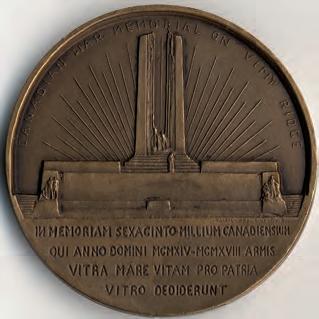
The reverse of the commemorative medallion struck for the 1936 pilgrimage (above).
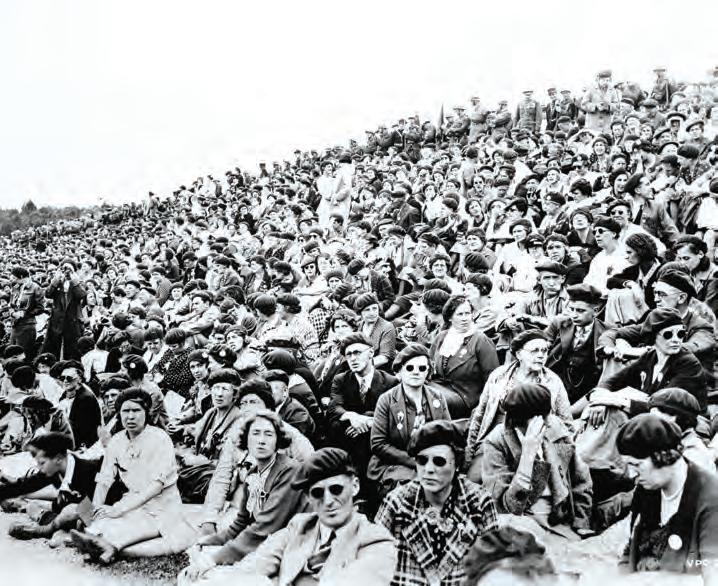
Canadian attendees at the memorial’s unveiling (right ).
escorted the convoy across calm ocean waters. Meanwhile, passengers were issued haversacks, berets—khaki for veterans and blue for other attendees—identification discs, event guidebooks and cherished Vimy Pilgrimage Medals.
Nine days later, on July 25, French and Belgian welcome parties, jostling for space around the ports of Le Havre and Antwerp, offered the delegation as warm a reception as they had received leaving Canada. Guests then boarded trains and, once closer, some 235 buses with an additional 1,365 Canadians who had travelled from the U.K., bringing their total number to about 7,500 pilgrims.
There were other commemorations throughout the trip, other occasions for veterans to pause and remember sacrifices on now-green and fertile fields, but the next day, July 26, would stand as the tour’s defining moment. It was a Sunday, warm and sunny, affording pilgrims the chance to see Allward’s monument at its finest.
“The memorial on Vimy is a beautiful and impressive structure,” expressed pilgrim Mary Botel, noting that “it seemed to dominate the landscape for miles and miles.” Another veteran observed that its towers “soared
Edward VIII recognized that the day belonged to veterans, declaring that the monument “is now and for all time part of Canada.”
up gleaming white into the blue sky, a mighty picture in stone. The effect left one almost breathless.”

The awestruck reactions were many, and they would be shared by the estimated 50,000 French spectators, maybe more, who descended on the site for the afternoon’s grand ceremony, all intent on honouring their liberators.
The pilgrims, divided into groups of beret-wearing veterans and civilians, were escorted to what Allward characterized as the amphitheatre in front of the monument. With military meticulousness, veterans formed up to the sound of the Royal Canadian Horse Artillery Band and composite ensembles from several Canadian Highland regiments. The mixture of excitement and earnestness could be felt through the airwaves as the Canadian Radio Broadcasting Commission (precursor to the CBC) shared the event back home and around the world.
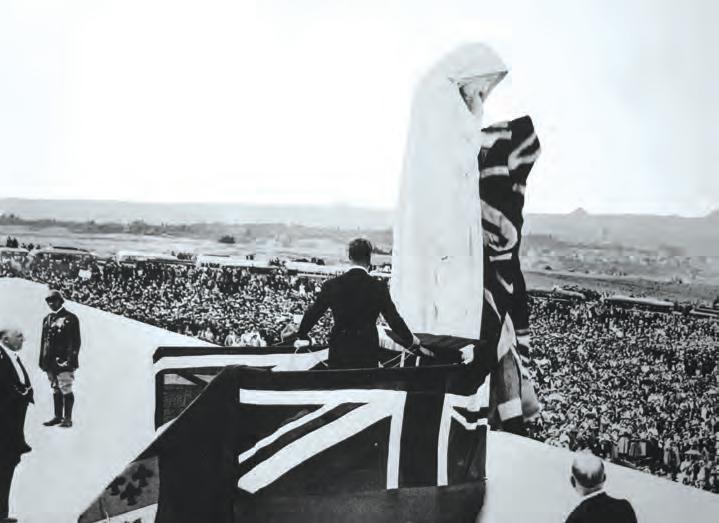
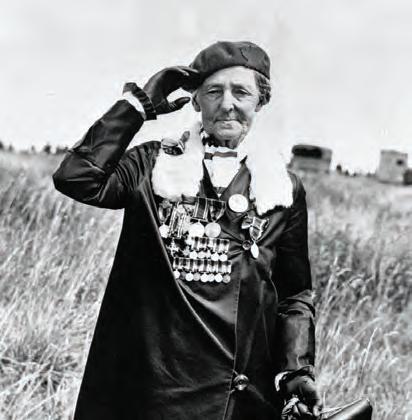
King Edward VIII unveils the monument’s Canada Bereft statue (left ). Memorial (Silver) Cross Mother Charlotte S. Wood (below) poses for a photo at the 1936 event.
monument “crowning the hill of Vimy is now and for all time part of Canada.” None, of course, disputed the sentiment—not when the words rang true for swaths of a healing country that sought meaning in its collective sacrifice. What couldn’t have been fully comprehended was the extent to which Vimy would permeate through a country’s mythos—born and reborn in new lights, interpreted and reinterpreted through the century.
The electric atmosphere only heightened when the King’s entourage arrived at 2:15 p.m., the monarch adorned in a black suit on which a distinctive gold Vimy Pilgrimage Medal was pinned. Once he had taken his place, the formal ceremony began with speeches from religious and government officials. Surprisingly missing from the oratory roster was Allward, who, at 59, had seemingly aged ahead of his time after the 1934 death of his son. Despite such realities, the omission appeared striking. This was Allward’s masterwork that people had ventured across an ocean to see. Here, at the memorial’s unveiling ceremony, the voice of its maker would be silent.
Beyond the still-apt pomp and pageantry, even Edward VIII recognized that the day belonged to veterans, declaring that the
The memorial embodied that greater ideal—but it hadn’t created it alone. Vimy’s legend existed not in a vacuum. Nor did it lie solely at the foot of Canada Bereft when the King pulled the draped Union Jack from her grieving eyes. With the ceremony drawn to a close, pilgrims began to inspect the chiselled limestone. Names of the dead were found and spectres, as Allward had envisioned, joined the living once more.
Whether united in sorrow or a sense of closure—or perhaps both— dozens of Memorial (Silver) Cross Mothers walked among the crowds, sharing a poignant moment when they removed their crosses, each representing a child or children killed in service, and stacked them at the monument. The women then formed a circle and stood in silence.
One, Charlotte S. Wood of Winnipeg—who lost five children to the war—had earlier spoken with King Edward. Holding his hand, she questioned what it had all been for: “Oh, sir, I have been looking at the trenches and I just can’t figure out why our boys had to go through that.” The monarch had only one message: “Please God, Mrs. Wood, it shall never happen again.”

As The Royal Canadian Legion celebrates its centenary, branches across the country remain critical local hubs for veteran support and volunteerism

By Niki Wilson

Aug. 17, 2024, I arrived back in Jasper, Alta., with my family after a month-long evacuation due to the July wildfires that burned a third of the town’s businesses and residences. Amid a drizzle, the smell of wet ash filled our car as we passed the charred husks of local homes. It was a grim scene—collapsed concrete, gnarled rebar and twisted siding snaked away from the debris.
My husband, son and I returned to our small west-end townhouse community to see first-hand that our home had been spared, but friends had lost their homes all around us. Nearby, most of another neighbourhood was gone. From the blackened ground bordering my backyard, I felt my chest constrict around each breath as I stared out at the destruction.
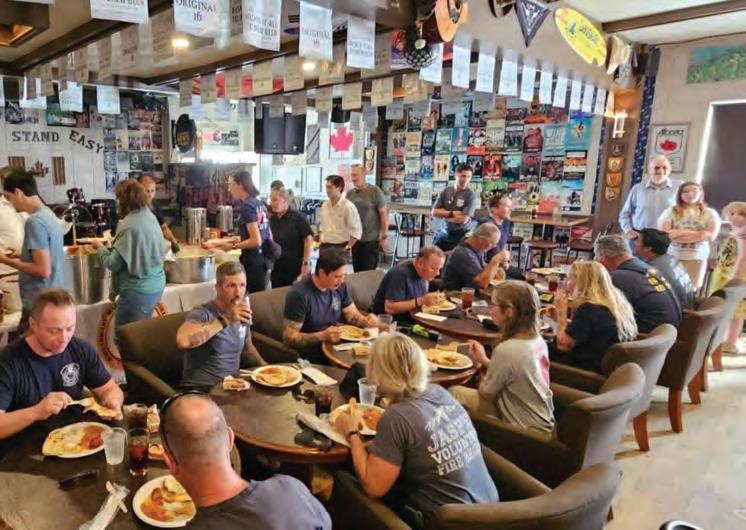
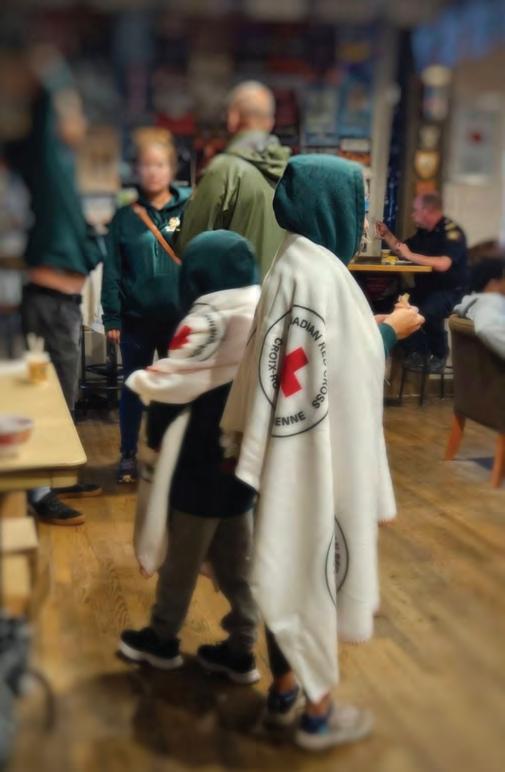
It was late afternoon. My parents, fellow Jasper residents, suggested we go to the local Legion for dinner. There, staff and volunteers were offering a meal to anyone who wanted one. It was critical support while restaurants and grocery stores raced through cleaning and repairs required to reopen.
But the Legion provided more than food. It was a place for Jasperites to gather and get their bearings. We stood in line with other locals and first responders. The place was packed.
“I looked out and saw people who had just lost their home. They had nothing left, and I saw them laughing and smiling because they were with their community,” said Keith Henderson, veteran representative, treasurer and service officer at Jasper Branch.
Legion staff and volunteers bustled around, clearing plates, delivering drinks, resting a hand on a
shoulder. “If someone needs a hug,” branch manager Sue Henderson (Keith’s wife) told the serving team, “just stop. Talk to them.”
The Legion fed hundreds of people a day for nearly six weeks. “It was an honour to serve and take care of our community,” said Sue. To serve. These aren’t just words for the Hendersons.
Sue grew up in a family of soldiers, her father and grandfather both at different times members of the military. She worked and raised the kids with Keith while he trained and served with the Canadian Armed Forces in Afghanistan. Now, they have two sons in active service. And they helped rebuild the Jasper Legion from the brink of financial ruin to a vibrant community hub that’s known regionally—and beyond—for its service and support of veterans.
In doing so, the Jasper Branch, like many others across the country, thrives in a modernday context, while upholding the legacy of The Royal Canadian Legion. For 100 years, more than 1,350 branches across Canada have served veterans and their broader communities. Each a hub of community charitable work, critical to emergency response and, in small towns such as Jasper, archives of local military history.
Maintaining branches in recent decades has been challenging work amid aging members, declining volunteerism, financial instability and addressing issues around inclusivity—for veterans of modern conflicts, Indigenous veterans and an increasingly multicultural country. But local Legions persist, many flourishing.
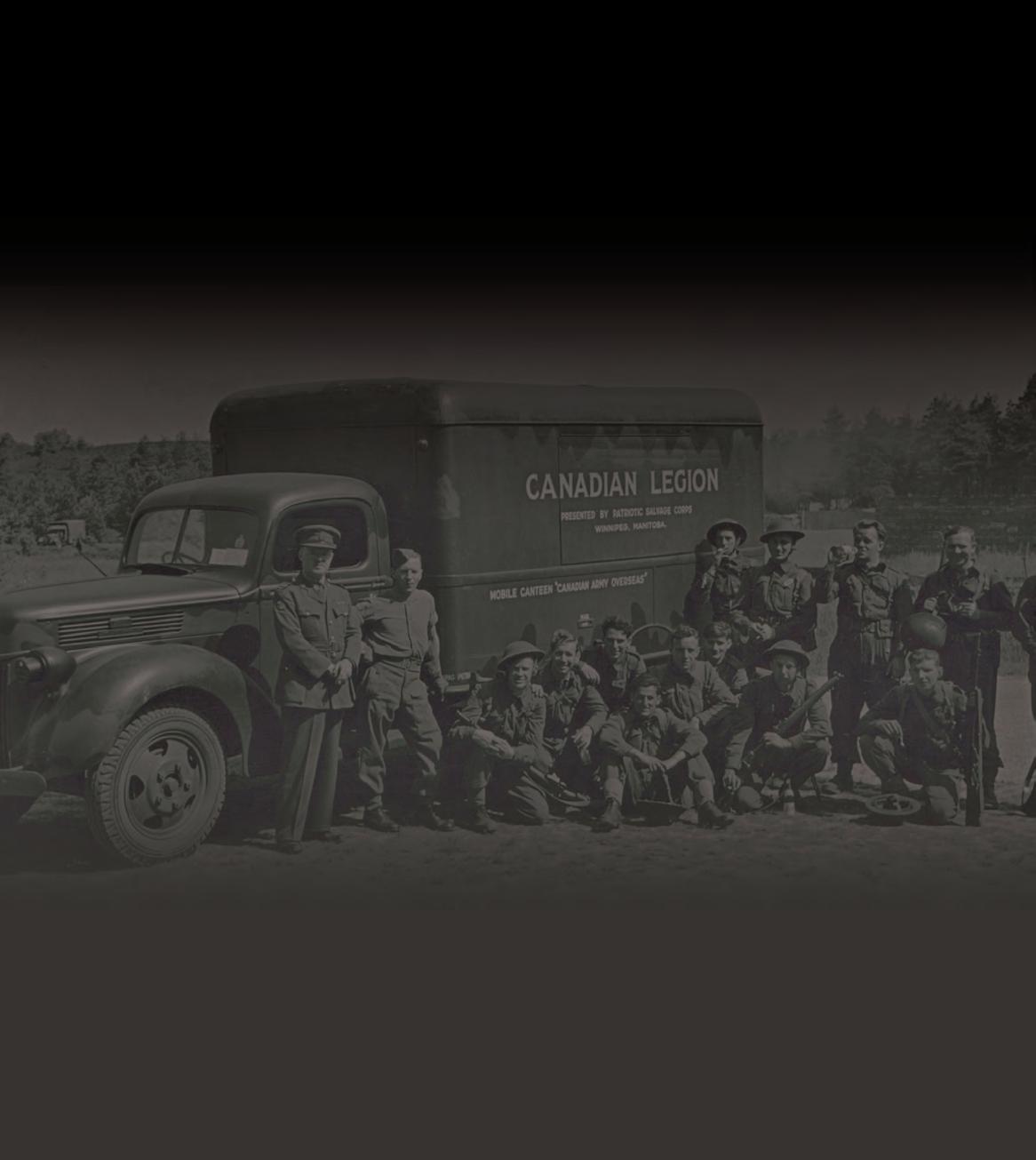
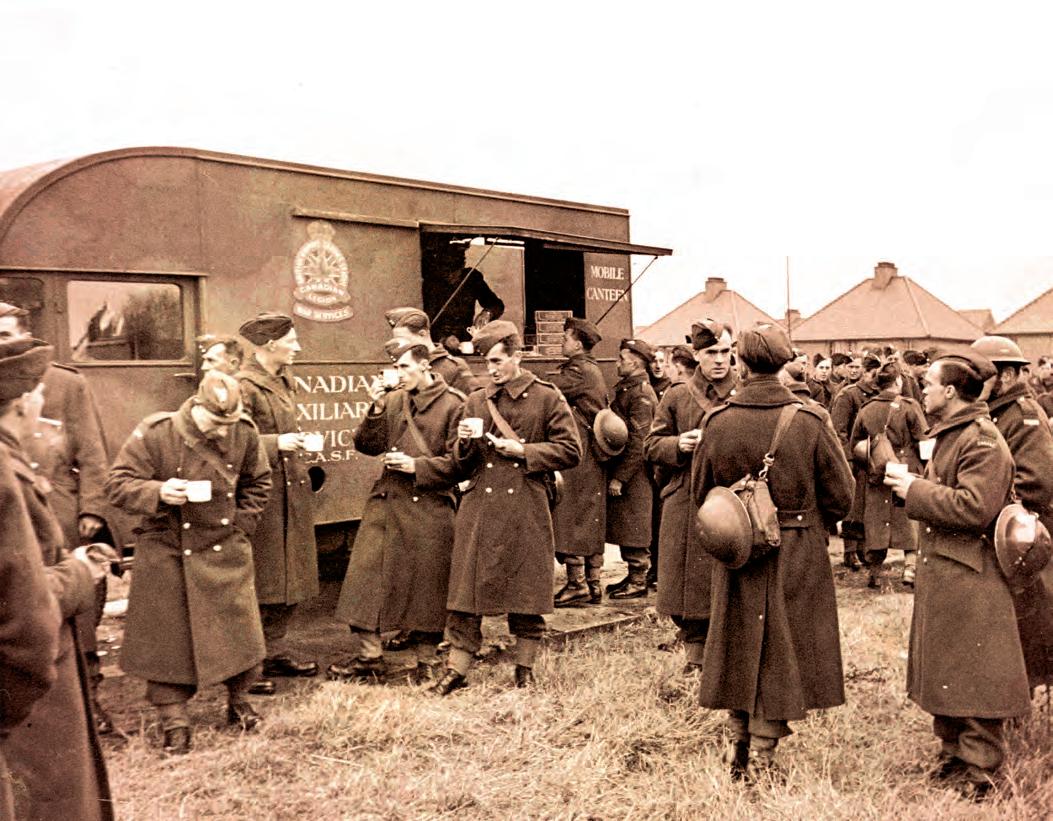
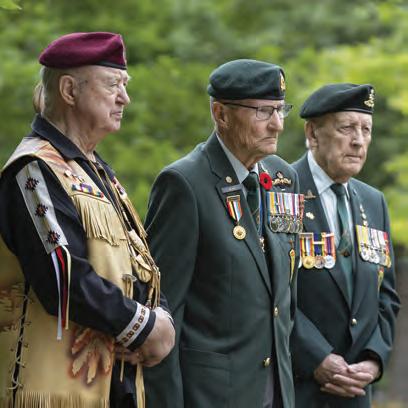
Community members enjoy a meal at The Royal Canadian Legion’s Jasper, Alta., Branch in August 2024 (above). Today, the 100-year-old organization welcomes a wide range of members, from veterans (below) to civilians. During WW II, the Legion operated mobile canteens (opposite bottom). A collector coin released in tribute to the Legion’s centenary (opposite top).
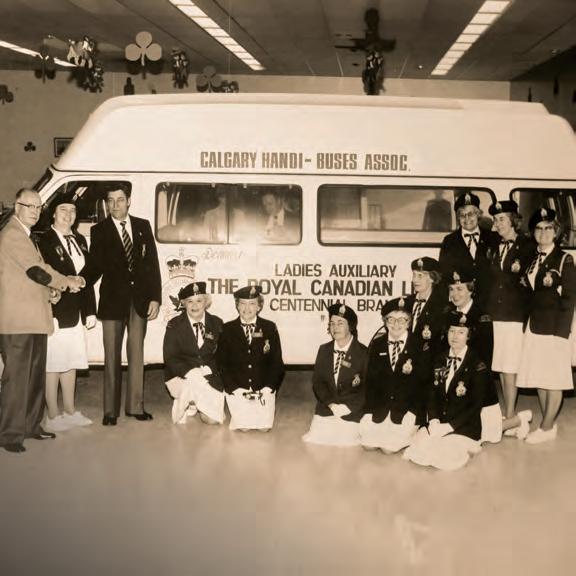
The Canadian Legion was incorporated by a special act of Parliament in July 1926. It was formed by the merger of existing veterans’ organizations, including the prominent Great War Veterans’ Association. It similarly aimed to support veterans, advocate for their rights and promote remembrance.
Those needs were clear following the First World War in which more than 650,000 Canadians and Newfoundlanders served, over 172,000 were wounded and some 66,000 were killed. The horror of the Second World War was still to come: one million-plus Canadians served and more than 44,000 died. As that conflict progressed, Legion branches across Canada mobilized to aid returning service members and provided a place for veterans and their communities to gather.

“The world doesn’t realize that when we retire or leave the service, we have to turn in our sleeping bags.”
Gathering in the aftermath of trauma can be vital in healing. In the decades and conflicts that followed WW II, Legions hummed with volunteer activity. Membership was high.
“In the early ’70s, Jasper had a population of about 3,000 people, and the majority of adults were members of the Legion,” noted Keith Henderson.
As a Jasper kid born that decade, I grew up in the branch, eating Hawkins Cheezies and playing shuffleboard while the adults caroused. I drew poppies for the national youth remembrance contests. I ran my hands over the name of my great-uncle Neil Kennedy, pilot and warrant officer 1st class, on a patinated brass plaque on the Jasper Cenotaph.
Neil’s sister, my grandma, was a Legion member for more than 50 years—she baked thousands of lemon squares for branch fundraisers. I never knew her husband, my grandpa Charlie Wilson, who died at 50. He survived the war, but post-traumatic stress played a role in his early death. I felt the effects of the war all around me. I also understood, though, that one of the antidotes to the corresponding sadness was to gather with people who could relate.

As the years passed, Legion branches became community hubs where locals celebrated wedding anniversaries, birthday milestones and retirements. Branches offered affordable venues, easing financial stress from important moments of remembrance and jubilation in people’s lives.
Beyond community gathering spaces, Legions also became local headquarters for emergencies, fundraisers and rally points for emerging crises. Many branches, for instance, assisted Ukrainians who fled to Canada following Russia’s full-scale invasion of their homeland in 2022.
One of the Legion’s central roles is to support veterans and their families. Trevor Jenvenne is a veteran of both the Canadian Armed Forces and the RCMP. He’s also one of the organization’s three nationallevel vice-presidents and a member of Lac du Bonnet, Man., Branch. Jenvenne took early retirement when PTSD led to his medical discharge from the RCMP at the height of the COVID-19 pandemic in 2020.
“I was losing my job, my livelihood, my career,” said Jenvenne of the turbulent time. It was hard to know where to look for help or how to start he said. He turned to the Legion.
“The Legion did my Veterans Affairs claim for me, and I didn’t have to worry about it,” he related. “I couldn’t have muddled my way through my claim in the state that I was in.”
Not only did his provincial service officer help him with that claim, but also revisited a past claim related to an injury that had been denied. They found an error in the adjudication process and worked to have it overturned. It was a process that helped Jenvenne find solid ground in uncertain times.
Said Jenvenne: “The Legion doesn’t broadcast enough how many veterans it actually helps.”
Helping other veterans can also be part of the healing process, said Jasper’s Keith Henderson. Working to strengthen his branch’s veteran support system helped Henderson “feed the animal inside that was hyper-vigilant and needed to do something that mattered,” when he retired from service.
As a local service officer, Henderson helps both veterans and their families. He recently helped my dad and I with the war medals of great-uncle Neil and grandpa Charlie to ensure we understood what they were, make certain we had all the honours they had earned and that we cared for them properly.
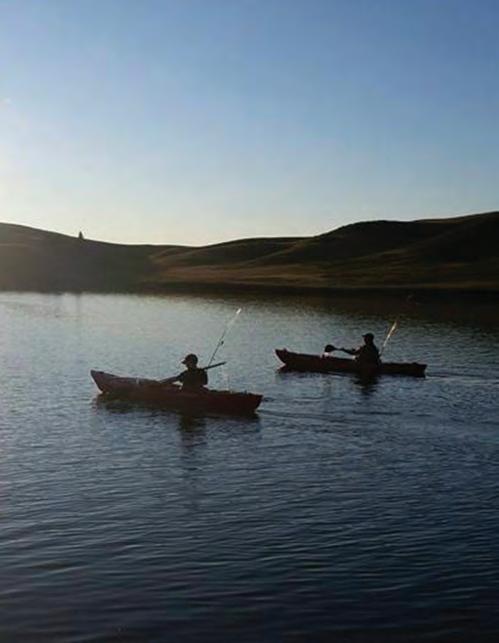
Henderson also founded Veterans Adventures Jasper, a branch program dedicated to improving the physical and mental health of veterans, first responders and their families through outdoor activities in Jasper National Park. He started the initiative after hearing about (and eventually meeting) a young veteran who had been sleeping in his car so he that he could afford to go fishing in the park. “He was trying to find his moment of peace,” Henderson explained. Henderson wanted to help make it easier for veterans to access the local outdoors. “The world doesn’t realize that when we retire or leave the service, we have to turn in our sleeping bags,” he noted. All camping and survival gear is returned. And other gear, such as canoes and kayaks, may be too costly, or veterans may be living in accommodations where there’s nowhere
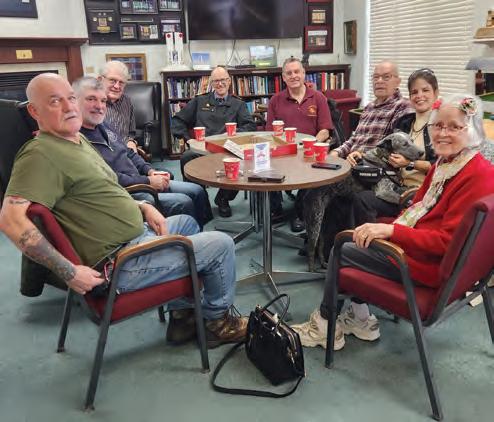
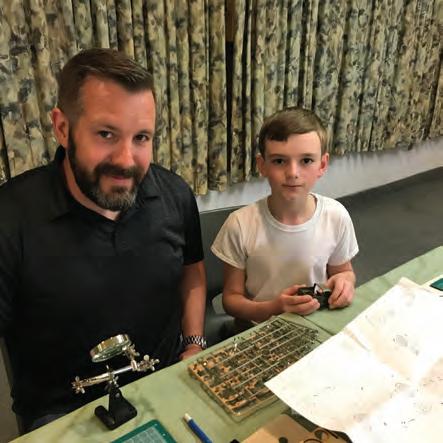
In the aftermath of the 2024 fires in Jasper, Alta., the Legion branch provided meals exclusively to first responders and locals (opposite). Among Jasper Branch’s programs is Veterans Adventures, which helps veterans explore the local national park (far left ). A Buddy Check Coffee event at South Carleton Branch in Manotick, Ont. (above). Jason Salo (immediate left, left) a r etired reservist and military policeman, participates in Operation VetBuild.
to store it. They may be dealing with PTSD or other mental health issues that make it hard to plan a trip, he explained. Or they may be working and just need to get away.
“Well, we can provide that,” he said. “We’re kind of like a regimental quartermaster in the mountains.”
The Legion helps support similar peer-to-peer initiatives across the country, such as Operation VetBuild. It allows veterans to connect with others through hobbies like scale model building kits. And the organization’s national operational stress injury special section offers “outreach, peer support, and referrals for veterans and families affected by operational stress injuries including anxiety, depression, PTSD or other mental health issues.” A popular program is Buddy Check Coffee, a peer-support service typically run by veterans that promotes connection with one another through informal get-togethers.
“The Legion is a very crucial part of veteran wellness,” said Scott Casey, who served as a peacekeeper in Croatia and Bosnia and Herzegovina in the 1990s. Casey is the founder of The Rolling Barrage, which raises awareness about PTSD among active or retired CAF, first responders and medical professionals, primarily through an annual coast-to-coast motorcycle ride. The non-profit has relationships with several Legion branches across the country. I met Casey at the Jasper Legion Mess Gala on Nov. 9, 2025.
I found my name tag at a place setting amid many of the Barrage’s original participants and was instantly welcomed among the active and retired RCMP, exmilitary and families dedicated to the cause—with good-natured conversation and a friendly prank. I quickly learned that, at this gala, no one leaves their name tag unattended unless they want to provide an impromptu performance.
My tag disappeared almost immediately. Moments later, I was asked to come to the head table mic to explain why I was writing this article. But there was a catch: I need to curse while doing it. This was less of a problem than someone who just met me might realize—I was welcomed back to my table with resounding applause and a high-five from Casey.
It’s easy to see how important events like this are for the veterans and first responders who attend. There’s laughter, stories and a shared sense of knowing and experiences. Casey hopes this kind of connection between younger veterans and Legion members continues to grow.
“There’s been a disconnect between the Legion and veterans over the years,” he said. Most Canadians don’t have the same level of personal connection to veterans of modern conflicts as they did with those who served in WW II and some branches are, often by necessity, run with
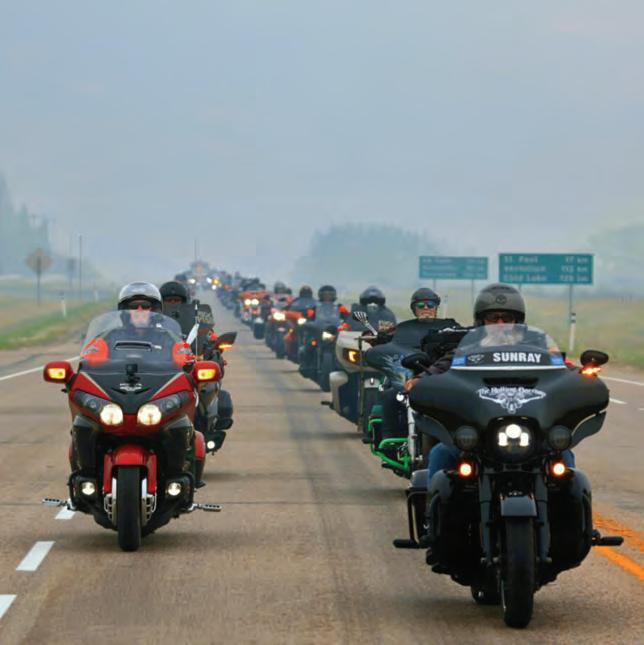

Casey is the founder of The Rolling Barrage, which raises awareness about PTSD among active or retired CAF, first responders and medical professionals.
little input from veterans. Newer veterans aren’t recognized in society in the same way as their predecessors, said Casey, adding that part of the problem is the terminology the federal government uses to classify recent conflicts.
“Afghanistan is not considered a war, but a ‘Special Duty Area,’” noted Casey. “By calling it a Special Duty Area, it diminishes the war veteran’s sacrifice.”
National Legion VP Jenvenne agreed that more work is required to get younger veterans involved in the organization beyond Remembrance Day services. But it’s a tricky balance, he noted. While branches need to get better at welcoming veterans of recent conflicts, they also increasingly
need more of the general public to become members to keep operating. Every year, more branches close, such as Vimy Branch in Halifax, which shuttered this past January after 99 years. To stay open means continuing to stay relevant in the community, said Jenvenne.
“Society itself has evolved,” he noted, “and the Legion has to evolve along with it.”
The only time you can wear a hat in the Legion’s Maple Ridge, B.C., Branch is when you’re line dancing to a country song that requires a tip of a Stetson. Otherwise, hats off.
“We’re more of a traditional branch that way,” said its administrator Kathy Gallagher. Removing your hat is considered a sign of
respect for veterans and those still serving. But the line dancing? Well, that’s one of the many events Gallagher’s Legion offers to more than 2,000 members—one of the largest memberships of a single branch in the country. And one that has been growing in recent years.
Many branches across Canada, like Maple Ridge, are thriving with evolving business models that aim to protect and enhance service to veterans and their local communities, while encouraging new membership and patronage through a wide variety of programs. From the Maple Ridge Branch to representatives of others I spoke to, such as the Edward MacDonald Branch
in Angus, Ont., and the St. James Branch in Winnipeg, there’s an event for seemingly everyone: meat and 50/50 draws; bingo and cribbage nights; live bands, dances, dance lessons and Zumba classes; celebrations of Halloween, St. Patrick’s Day, the Grey Cup, the Super Bowl and Canada Day; Robbie Burns dinners, wing nights and 55+ club socials. And much more.
At St. James Branch, they have hired a special events co-ordinator and are hosting flea markets.
“If you have a good idea, you have to try it,” St. James Branch President Mike Thayer, a veteran, told Legion Magazine Thayer’s Legion has experienced an uptick in membership sales when it tied them to reduced ticket prices for weekly Friday night dances.
For its part, the branch in Angus, Ont.—the only large event space in town—focuses its entertainment bookings on younger people as much as possible. “That draws them in, and our membership has actually grown,” said Branch President Howie Hipwell.
As branches have diversified their offerings, many have strengthened their veteran services. For instance, the Maple Ridge, B.C., Branch partners with the BC/Yukon Legion Foundation to assist veterans with housing.
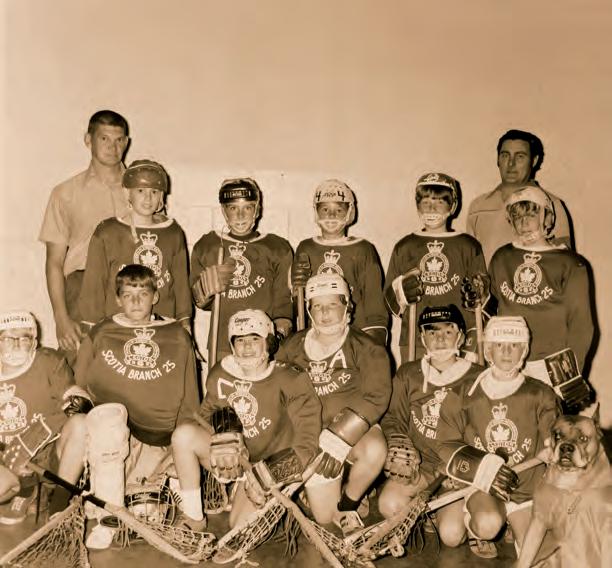
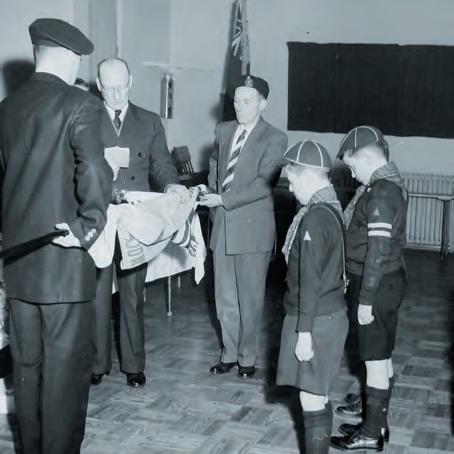
Youth activities ( this page) and The Rolling Barrage motorcycle ride (opposite) are among the many community initiatives supported by Legion branches over the years.
It recently worked with the city to designate a crosswalk—boasting the words “Lest We Forget” in white letters on a red background—as a daily reminder to residents of the sacrifices of veterans and those still serving. In addition to supporting several veterans’ charities and hosting Buddy Checks, it runs a veterans’ dinner open to all. And it co-ordinates historic presentations, such as one in October 2025 focused on the 1,975 Canadian personnel sent to defend Hong Kong in late 1941.
The daughter of a veteran who was taken prisoner during that fight presented a plaque to the branch in commemoration of his service, said administrator Gallagher. “Those are very moving times, when you see and hear those stories.”
Such new initiatives join programs long supported by branches. Legion youth programs promote sport, education and leadership.
“We support minor soccer, minor hockey and minor baseball,” said Hipwell of his branch in Angus, Ont. It provides financial donations to help purchase uniforms and equipment. And monetary support often extends to scholarships and bursaries at Legions across the country.
They also support other youth groups that strengthen leadership and learning opportunities such as cadet programs and the Junior Canadian Rangers. Veteran Sheri Gee has run the Junior Rangers in Valemount, B.C., out of the local Legion since 2012.

“Society itself has evolved, and the Legion has to evolve along with it.”
These programs are foundational to many of the youth who participate, setting them up with skills and support for the next chapter of life, said Gee. “I’ve written letters for them to go to universities,” she noted, adding that kids in such groups are eligible for scholarships and sponsorships through Canada Company, a charity that supports cadets and military families.
“It’s just amazing the amount of change it makes in their lives,” said Gee.
Her comments prompted me to ponder the ways that the Legion shaped my own life. There was my grandmother’s memorial, when many in attendance lined up to place red maple leaves by her photo to honour her service to the branch’s ladies auxiliary. There was the packed hall at my parents’ 25th wedding anniversary celebration. There were so many times I brought my son to the branch for family nights out and Christmas parties. (I still laugh at the time a friendly and mischievous bartender offered my 11-year-old son and two of his buddies a giant chocolate bar
if they were willing to eat a pickled egg. The incentive was too tempting to turn down. And the grimaces on their faces as they earned their prize was quality entertainment.)
But my Legion, like so many branches across Canada, looks different today, too. Now I know living veterans who help deepen my understanding about the cost of war and how the kinds
Members of The Royal Canadian Legion Ladies’ Auxiliary pose with a mobility bus they sponsored in 1979 (left ). Keith and Sue Henderson of Jasper, Alta., Branch (below).
of conflicts that Canada engages in affects the treatment of those who served after they return.
Sometimes on busy nights, those veterans informally keep watch over the crowd, making sure everyone is safe. And when a band plays at the Jasper Branch these days, the crowd looks a little different than it used to: the Legion crowd has grown to include people of all ages, ethnicities and backgrounds.
Jasper Branch manager Sue Henderson told me that in the years to come, she wants to keep growing our Legion as an open community hub and a place that champions volunteerism. As the town continues to rebuild from the 2024 fire, Henderson wants the branch to be a pillar amid whatever the future holds. Most importantly, she wants the Legion to be a safe place for all who serve and have served this country.
“Knowing what my grandfather, my father, my husband, and now my two sons have done,” said Henderson, “I need to keep this place open.”
Niki Wilson is a freelance writer based in Jasper, Alta., and a member of the local Legion branch.
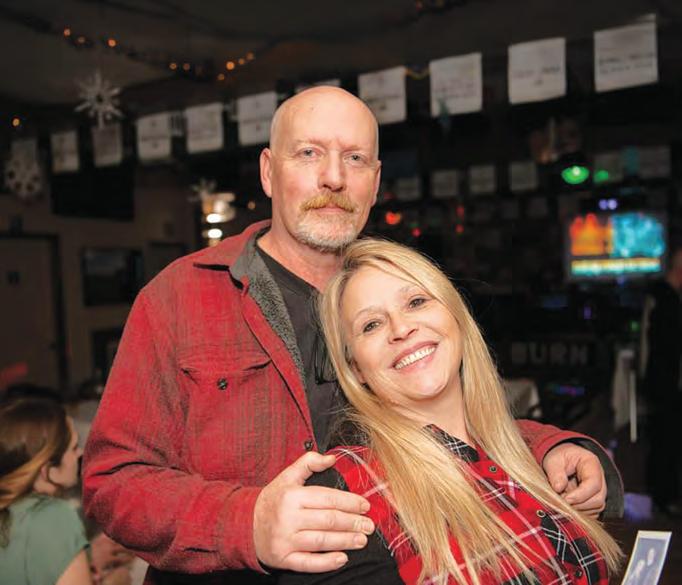
Before WW II, Jim Higgins and almost 1,700 other Canadians volunteered to fight against fascism in the Spanish Civil War. Those who made it home were labelled communists
By Janette Higgins
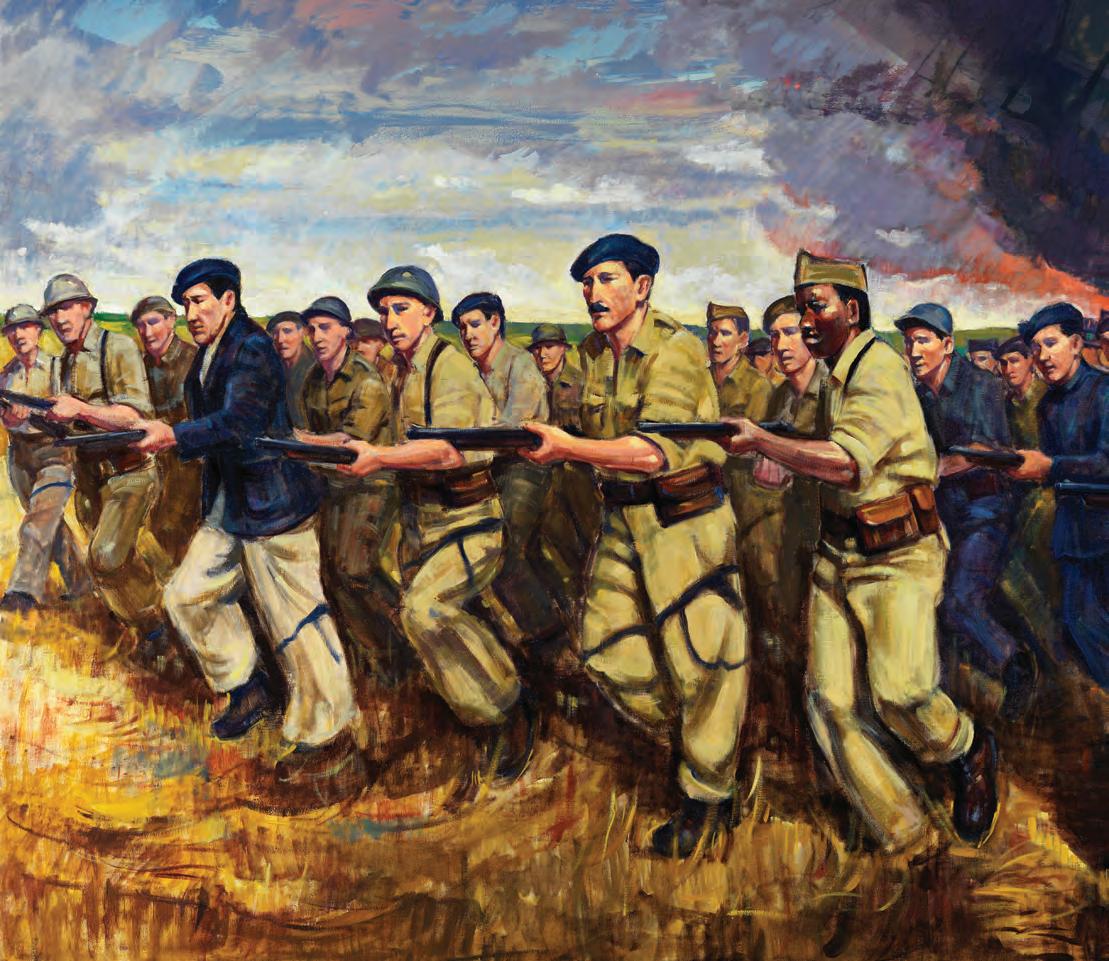


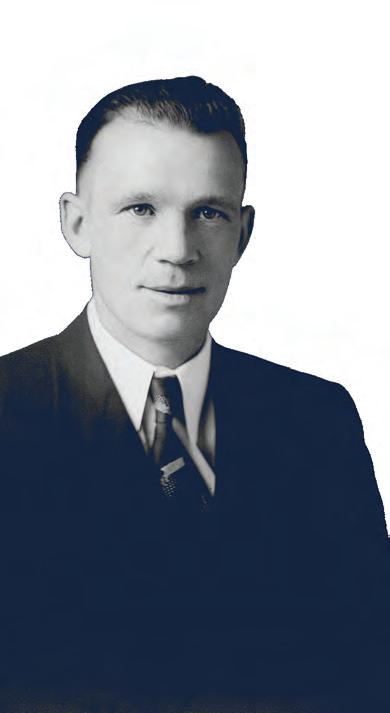
Jim Higgins (left ) served in the Mackenzie-Papineau Battalion (opposite), a Canadian unit that fought as part of the International Brigades during the Spanish Civil War. 1937 propaganda poster for the International Brigades below) translates to “Internationalists, United with the Spanish People and Struggle Against the Invader.”
Growing up in Peterborough, Ont., in the 1950s, I knew little about my father’s past, though I was vaguely aware he had fought in a war. He took me to ceremonies on Remembrance Day, but it never occurred to me to question why he wasn’t marching with the other veterans. It was one of many secrets he kept from his five children.
Jim Higgins and almost 1,700 other Canadians were early to the fight against fascism. Their war was in Spain, which had erupted in 1936 after a few generals attempted a coup against the country’s democratically elected Republican government. Most

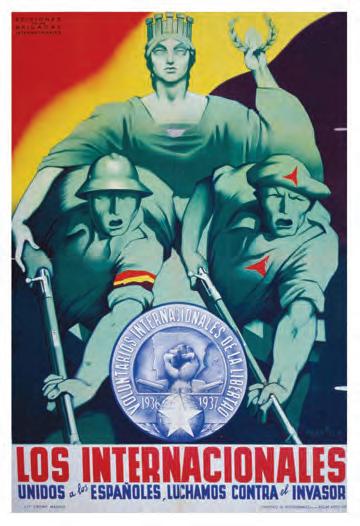
Canadians, along with Higgins, arrived as volunteers in 1937.
General Francisco Franco quickly emerged as the leader of the rebel side, a fascist-supported movement called the Nationalists. In April 1939, after a brutal civil war, Franco’s Nationalists won, five months before the start of the Second World War.
I had barely glanced at the book manuscript and other material he left behind when he died in 1982. In 2017, when I retired, I finally had the time to do what needed to be done.
His story is now thoroughly documented in Fighting for Democracy: The True Story of Jim Higgins, A Canadian Activist in Spain’s Civil War published in 2020, and many mysteries surrounding my father have been solved, including why he wasn’t marching.
In the late 1930s, it was communism, not fascism, that alarmed and preoccupied the leaders of the western democracies, including Canada’s Prime Minister Mackenzie King. They largely turned a blind eye to the aggressions of Germany’s Adolf Hitler and Italy’s Benito Mussolini, and instead admired their perceived accomplishments: the former had revived his country’s economy and the latter had, according to circulated stories, trains running on schedule.
At the same time, Higgins and others identified the dangerous rise of fascism in Europe. It wasn’t hard to recognize, and Canadians were remarkably well informed. Everyone knew when the Nationalist generals revolted against the Spanish government in 1936, and within 10 days had received critical support from Hitler and Mussolini. The Spanish Civil War didn’t leave Canada’s front pages until the conflict ended in April 1939.

Amid a groundswell of international outrage, Higgins and his comrades signed up to fight against fascism in Spain in 1937. Thousands of others from around the world did the same. The Canadians formed the Mackenzie-Papineau Battalion, known as the Mac-Paps, part of the International Brigades that comprised roughly 35,000 volunteers from about 60 countries. The International Brigades were formed in response to German and Italian intervention in July 1936. By October 1936, International Brigade volunteers began arriving in Spain from around the world to fight on the Republican side in the Spanish Civil War. Their motivation was clear. Though some needed a job and others were looking for adventure, none did it for the money. As Higgins wrote: “We were all anti-fascist, including the Germans and Italians who saw what was happening in their own countries.”
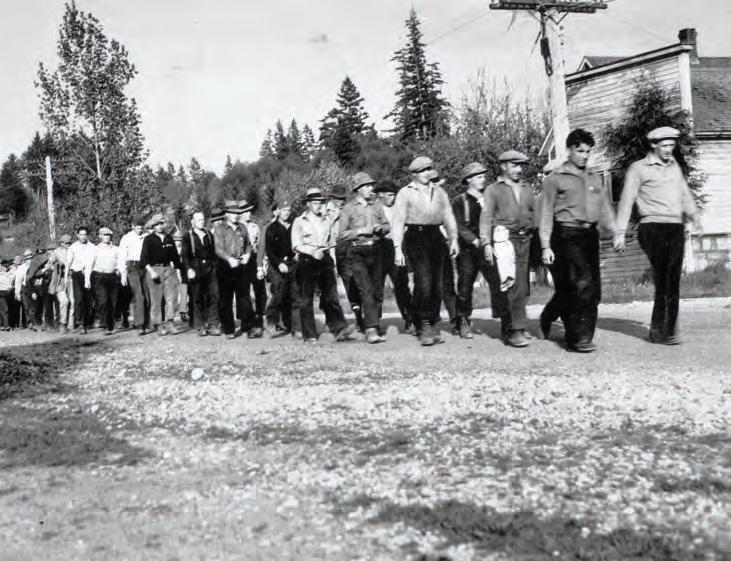
At the war’s outbreak, Spain’s Republican government had been led by a somewhat fractious coalition of socialist and left-wing parties with a wide mix of ideologies. Their reforms—women’s liberation, workers’ rights, establishing secular schools and the end of feudalism—were too much for Spain’s conservatives, the Catholic Church, large landowners and a handful of Spanish generals backed by elites.
Early in the war, western democracies, along with the U.S.S.R., entered into a Non-Intervention Agreement concerning the

war in Spain, but three countries openly defied it: Germany and Italy supported the Spanish Nationalists from the start and, in the absence of support from a left-averse West, the Soviet Union supported the Spanish government’s side.
In return for the majority of Spain’s gold reserves, the Soviets provided mostly antiquated materiel and problematic military expertise. It was a devil’s bargain, but the Spanish government had no choice lest it be overthrown. Volunteer soldiers, medical personnel and others from around the world arrived under the auspices of the Comintern, or Communist International, a Sovietbacked organization that aimed to spread communism worldwide. The genesis of Comintern support
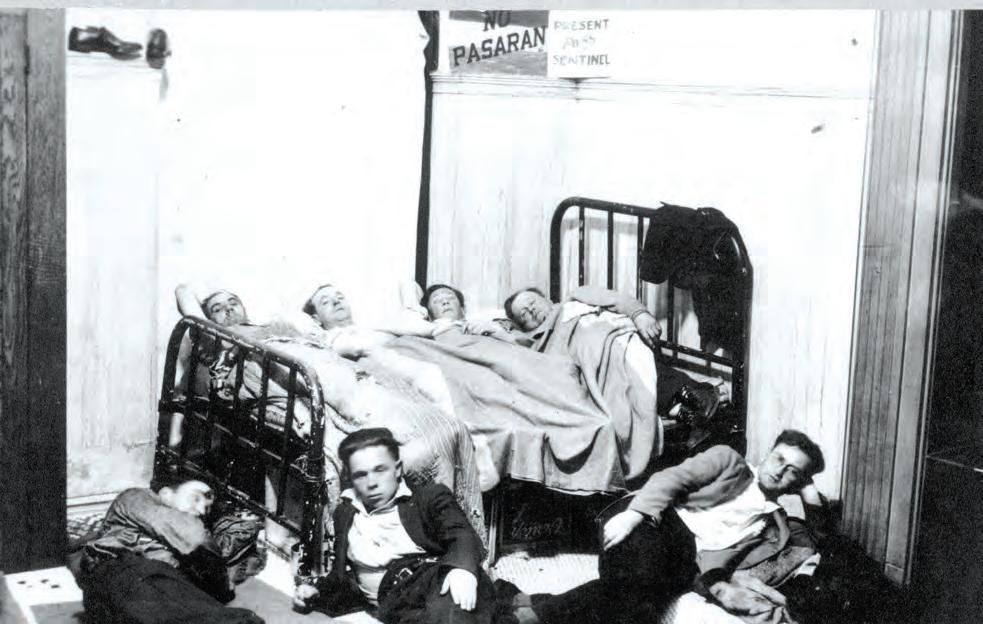
Men leave an unemployment relief camp ( top) on Vancouver Island in protest in 1935. A group of men, possibly members of the Mackenzie-Papineau Battalion, share the same bed during the Depression.

arose from a 1935 “popular front” strategy that involved global Communist parties, including in Canada and the U.S., working with organizations on the left to counter rising fascism and spread communist ideology. This strategy had helped get Spain’s Republican government elected in May 1936. Comintern’s goal was to seek ascendance through evolution, not revolution.
The Great Depression had been devastating to Canadians. It’s hard to comprehend the spirit-crushing despair of those “ten lost years” that started in 1929 with a stock market crash. Farmers lost nearly everything and jobs were scarce— especially for union organizers and single men, such as Higgins.
After being blacklisted in his carpentry trade and effectively prevented from union organizing, Higgins’ talents and resourcefulness led him to work on ranches and in logging camps until he had no choice but to join tens of thousands of other single, unemployed men riding the rails looking for work where none could be found.
By 1932, the Defence Department had established relief camps, where unemployed men were meant to do manual labour in exchange for room and board, medical care and daily wages. In his book, Higgins relates how homeless encampment “eyesores” were removed from urban centres and “swept under the rug” by these camps. The work at the facilities was sometimes meaningless, but at least the men were given sustenance and a bed in a bunkhouse crammed with 50 others.
The Canadians formed the Mackenzie-Papineau Battalion, known as the Mac-Paps, part of the International Brigades.
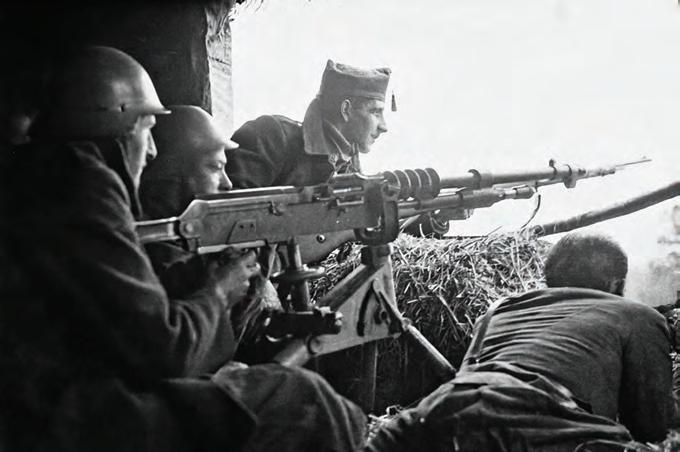
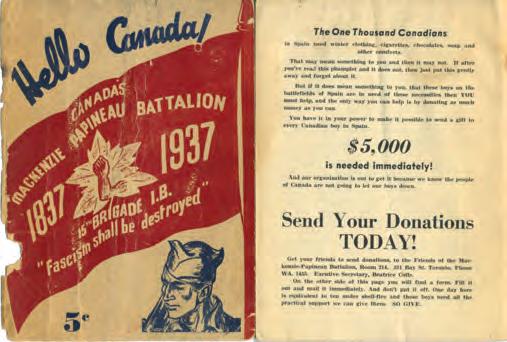
After 1935, left-wing groups backed by the Communist Party of Canada emerged across the country, and they didn’t require members to be card-carrying Communists. That included the Relief Camp Workers’ Union, of which Higgins was a member, though as a social democrat.
to protest. Higgins was already there, having been escorted out of a B.C. camp by the RCMP a few days earlier as an agitator. As I found out later, this incident was responsible for the force labelling him “radical.”
There seemed no end in sight to the Depression. Higgins wrote: “Hundreds of thousands were feeling the effects…but 1935 was the year that brought even the most stubborn to their knees.”
The relief camps had become cauldrons of unrest; the government somehow hadn’t foreseen that putting a bunch of disaffected men together would bring ideas around class struggle into sharp focus.
The situation came to a head in the spring of 1935, when men at various B.C. camps went on strike, travelling to Vancouver
Thus began the On to Ottawa Trek. Roughly 1,500 camp “inmates” tried to bring their protest to Parliament, riding atop railcars and gathering citizen support along the way. They were stopped in Regina when a peaceful crowd of citizens and protestors was suddenly charged by RCMP officers on horseback. The melee that followed is now known as the Regina Riot, but Higgins and his
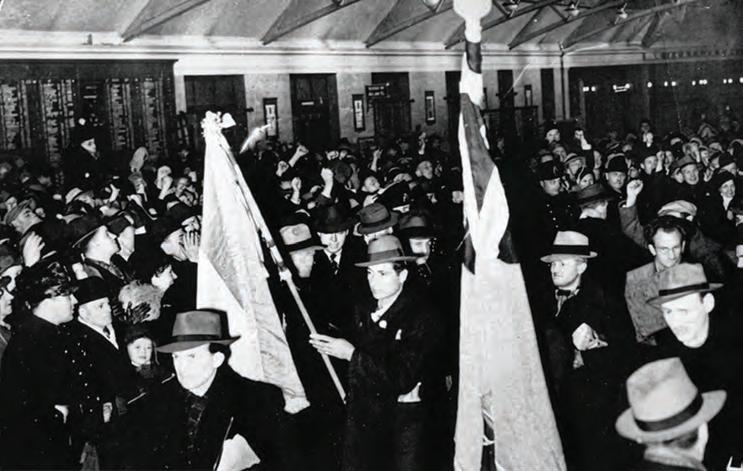

fellow trekkers called it “the use of force to stop the trek.” By the time the Communist Party of Canada began recruiting volunteers for the Spanish Civil War, these men were fired up with nothing to lose— except for their lives, of which the conflict claimed some 400. Most volunteers had no savings and needed support to get to Spain.
In his 2008 book Renegades, Michael Petrou reported that 76 per cent of the Canadian volunteers in the Spanish Civil War were members of the Communist Party of Canada. “Given the spike in enlistment [in the Communist Party] in 1936, it is reasonable to assume they signed up because of [the Spanish Civil War],” he wrote. Higgins was coming out of a Saskatoon Trades and Labour Council meeting in 1937 when he decided to join. “I knew the Communist Party was involved, and had been asked many times to become an official member, but resisted because I did not want to be tied down, to become a robot. I wanted to be independent and decide myself if a cause was worth fighting for,” he wrote. “Defending democracy was a cause worth fighting for— one I could fully commit to.”
In May 1937, Canadian officials were increasingly anxious about communism’s grasp in Canada, and enacted the Foreign Enlistment Act to prevent recruitment by all but acknowledged consular offices. People such as Higgins who were trying to volunteer after that date, had to flout Canadian law and
sneak into Spain. The leftist French government, though sympathetic, gave in to pressure from other western democracies and closed its border with Spain the previous year. So, in late October 1937, Higgins and 20 others found themselves making a dangerous climb over the Pyrenees. Higgins’ army file and writings reveal a courageous soldier. He received a bravery commendation for lugging his machine gun to a strategic spot under a hail of enemy crossfire and singlehandedly
Returning Mac-Pap veterans (left and right ), including Jim Higgins (circled in left image), arrive at Toronto's Union Station to a crowd of 10,000. The Higgins family (bottom), including the writer (far left), in Peterborough, Ont., in December 1948.
halting their advance. Later on, just before the Republicans’ surprise attack in July 1938, known as the Battle of the Ebro, Higgins wrote about exposing enemy spies. He was also entrusted with “special operations,” a few of which he described in his book, and was captured by the enemy, leading to a harrowing escape.
The International Brigades withdrew in September 1938, but Germany and Italy did not; nor did Higgins. He continued fighting with the Spanish Army until late January 1939.

It never occurred to me to question why he wasn’t marching with the other veterans. It was one of many secrets he kept from his five children.
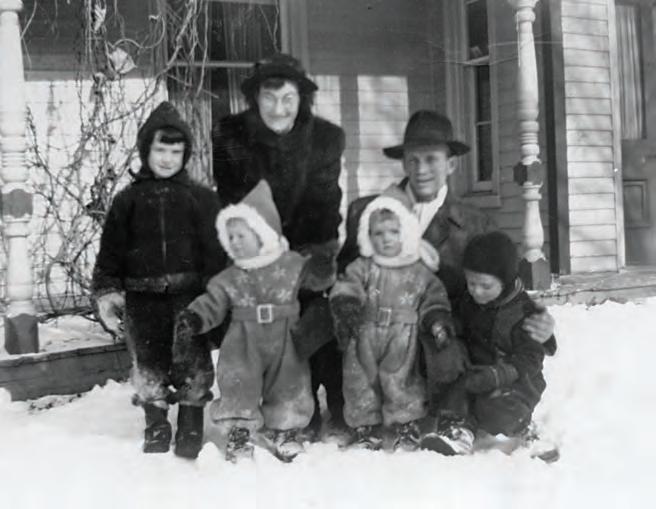

It was a long few years, but Canadians supported their effort. They sent cigarettes and bars of soap to “our boys in Spain,” and when the Mac-Pap veterans returned to Canada in February 1939, the Toronto Star reported that 10,000 civilians turned up at Toronto’s Union Station to hail them as heroes.
The Canadian government saw it differently. The veterans were watched by the RCMP and some, such as Higgins, who volunteered five months later for WW II, were turned down as security risks. The reason? Canadian authorities, no doubt, perceived them as “premature anti-fascists,” a loaded term used for American volunteers. It wasn’t a compliment—it was code for Reds.
For the most part, Higgins and his “radical” comrades weren’t security risks, but they were a threat to capitalist interests. They fought for the rights of workers to organize and for advancements, such as fair wages, unemployment insurance and universal health care.
No Mac-Pap was ever charged under the Foreign Enlistment Act it would have been an unpopular move given their widespread citizen support. Neither were they absolved, however. In 1980, Higgins and other surviving veterans made a plea to Ottawa for recognition. They received nothing. Subsequent appeals on their behalf have also been for naught.
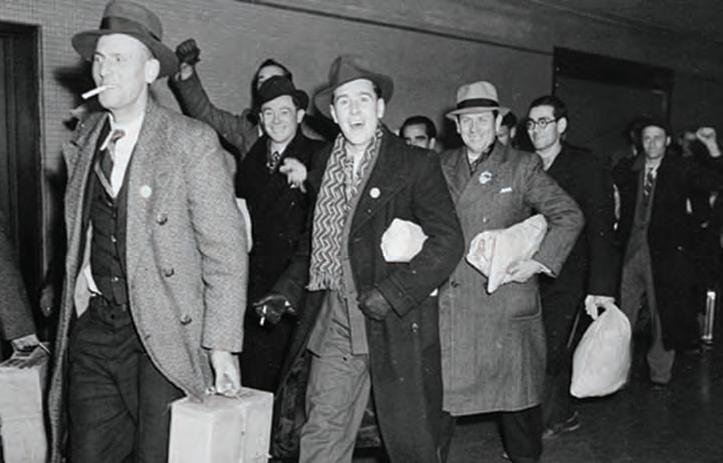
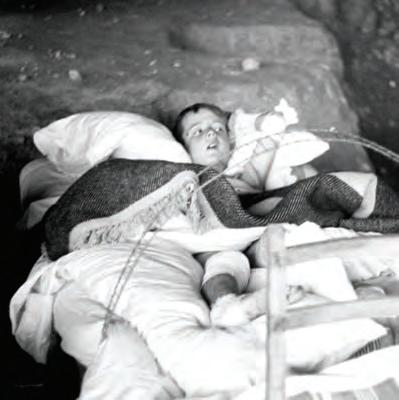
story. I could find nothing in it that seemed threatening to Canada’s security. I did, however, find out that my father attended parties in Toronto in 1940 organized by known Communists and details of his 1942 marriage to Reta Palliser, my mother, along with the names and birthdates of myself and my four siblings. I also found two letters intercepted in 1940 from his girlfriend, Lillyan, in New York; and was further amused by the description of an intercepted Christmas card sent to a friend in Saskatoon. Inside was a raised fist, a potent symbol, even today.
the Ebro, when an enemy bomb hit a water tank, releasing a deluge that swept the child down the mountainside to certain death. Through an incredible fluke and against all odds, Alvarez found his saviour in Peterborough in 1978—Jim Higgins. By 1980, Alvarez had published his acclaimed book, The Tall Soldier: My Forty Year Search For The Man Who Saved My Life. It’s ironic that the last item in my father’s RCMP file tells a hero’s story. Higgins was called a hero more than once. He was also labelled a radical. As for his stand against fascism, my father never wavered. After Franco died and Spain’s transition to democracy began, he told one reporter: “I’m glad I went over there. I’m proud of it.”
In recent decades, a few privately funded memorials have been installed, including one each in B.C. and Ontario under provincial NDP governments, and one in Ottawa, supported by then-governor general Adrienne Clarkson.
In 2018, I received my father’s RCMP file to help document his
I also learned that my father was being watched monthly in the 1950s, around the time when we would attend Remembrance Day ceremonies together. The surveillance continued sporadically after that. The last item in his file is a 1980 news clipping about a boy named Manuel Alvarez who had been rescued by an anonymous Canadian soldier in Spain in July 1937, during the Battle of
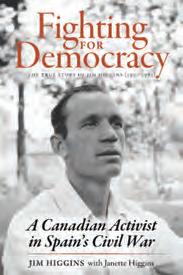
Fighting for Democracy: The True Story of Jim Higgins (1907-1982), A Canadian Activist in Spain’s Civil War by Jim Higgins with Janette Higgins was published in 2020 and is available in eBook formats and print at janettehiggins.com.

By Philip Mills

A detailed history of 13 Platoon, ‘C’ Company, 1st Battalion, Royal Hamilton Light Infantry during the August 1942 Dieppe Raid
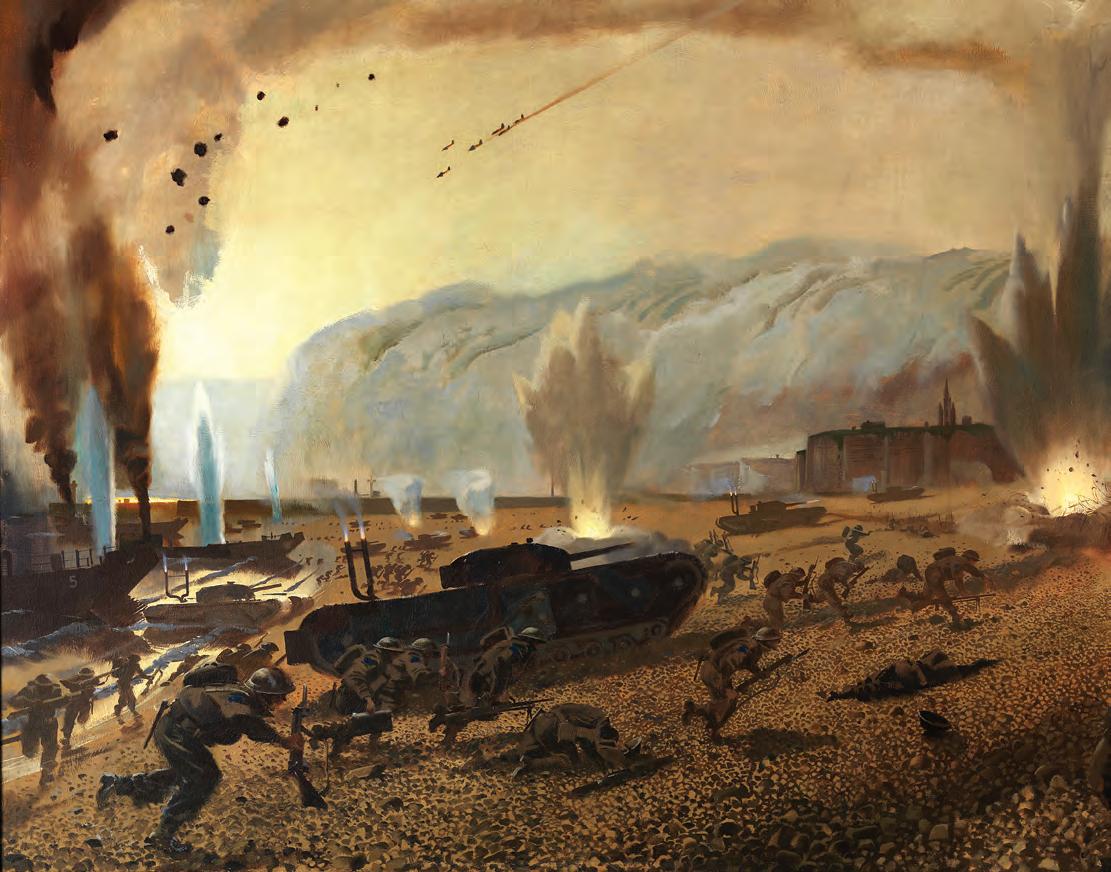


At5:22 a.m. on Aug. 19, 1942, 28-year-old
Lieutenant John (Jack) Gartshore led 13 Platoon, ‘C’ Company, 1st Battalion, Royal Hamilton Light Infantry into combat for the first time. It would also be the last. When the smoke cleared over Dieppe, his regiment known as the Rileys had suffered 82 per cent casualties. 13 Platoon had been in the ill-fated raid’s first wave.
Assigned to land at the sector code-named White Beach, the initial assault by the Rileys, comprising 443 men in three companies, was scheduled for 5:20. ‘D’ Company was to land west of Dieppe’s seaside casino, advance rapidly and knock out positions on the western headland before connecting with The South Saskatchewan Regiment, which would be moving east from a landing at Pourville. In the middle of the three Riley companies, ‘B’ was to overrun the casino, a heavily fortified German defensive position, and push through
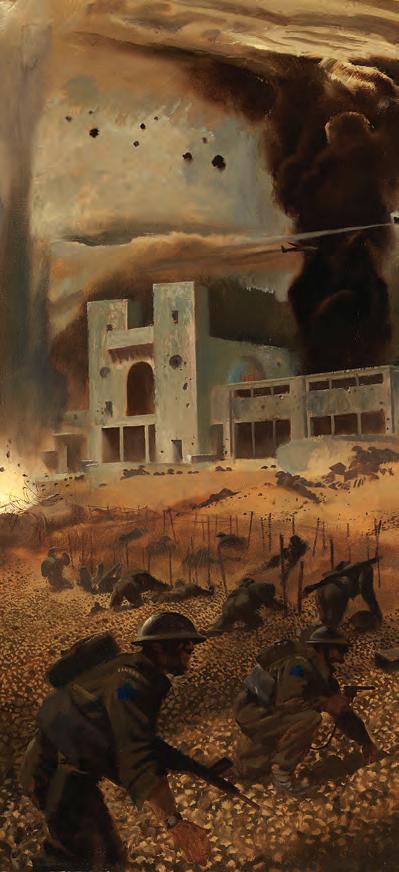
Dieppe to establish its own defensive position on the town’s outskirts. ‘C’ Company, meanwhile, was to land to the east, assist in securing the beachhead, cross the promenade and link with elements of The Essex Scottish regiment to its immediate left.
The three Riley companies sailed aboard Landing Ship, Infantry HMS Glengyle, which carried three Landing Craft, Mechanized (LCM) and 11 Landing Craft, Assault (LCA), along with a single armed Landing Craft, Support. In darkness, the 123 officers and men of ‘C’ Company under Major Norris Waldron mustered on Glengyle’s aft starboard deck beside three LCAs. Shortly after 3 a.m., 13 Platoon boarded one of the LCAs. By 3:10, the landing craft had been lowered and were in formation.
Meanwhile, the battalion’s reserves, around 100 Rileys of ‘A’ Company, along with medical detachments and headquarters staff, were travelling to Dieppe in a separate naval group. They were supposed to land 15 minutes later.
As dawn approached, the weather was clear and the sea calm, promising a bright summer’s day ahead. As Glengyle’s landing craft approached shore, dim twilight revealed the looming headlands flanking Dieppe’s beachfront. Closer in, men could distinguish familiar landmarks, including the prominent shape of the casino. Around 5 a.m., the relative calm was shattered by a 10-minute naval bombardment and aerial strike against German positions on the headlands. As it would turn out, the barrage proved too brief and largely ineffective.
For many Canadians, the first sign of the enemy came in the form of scattered, long-range machine-gun bursts, which intensified as the vessels neared the beach. The sustained artillery and mortar fire that would torment them for the remainder of the raid commenced moments before they touched down.
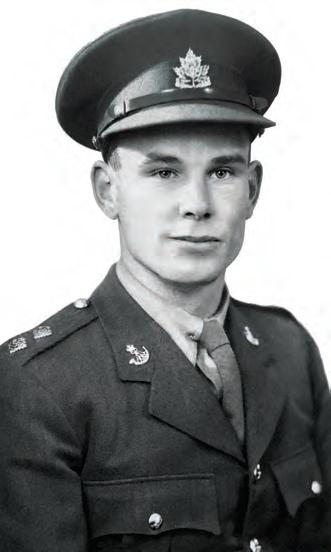

The first wave landed on time and in the designated locations. Alighting directly in front of the heavily fortified casino and below the western headland, ‘B’ and ‘D’ companies bore the brunt of early enemy fire. Farther from the cliff defences, ‘C’ was initially less heavily engaged.
Lieutenant John (Jack) Gartshore led 13 Platoon, ‘C’ Company, 1st Battalion, RHLI that day.

‘C’ Company’s 13 Platoon escaped the worst of the early fusillade, but Lieutenant Gartshore took no chances and ordered his 2-inch mortar to provide smoke.
“While we were about 150 yrds offshore,” Private S.D. Cameron, “fired two smoke bombs from the LCA,” notes an after-action report in the Rileys’ war diary. How effective the smoke was is impossible to assess, but it required considerable co-operation and skill to fire a mortar from a tightly packed moving landing craft.
As the craft came to a halt, the ramp lowered. Gartshore was first out and, trusting his men were close behind, headed up the beach. He need not have worried.
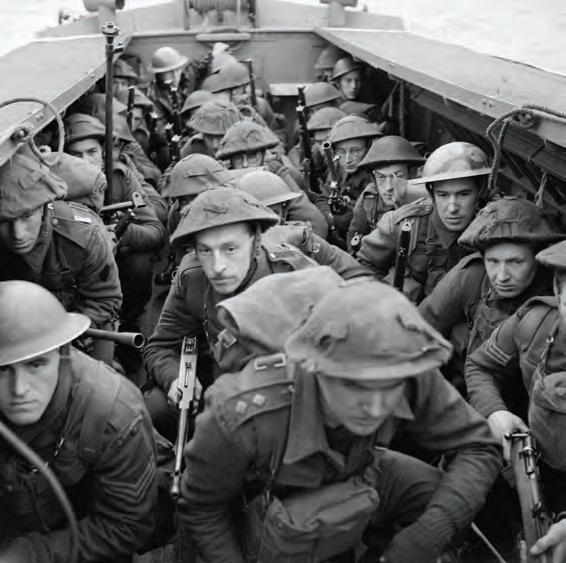
“As the boat grounded,” Private David Neillings was sure that, “we all scrambled out, nobody hesitating,” as he wrote in a postraid statement. Hot on the heels of Gartshore was acting corporal Harry Stewart with No. 3 Section, followed by Corporal Ed Boles leading No. 2 Section. Last off was No. 1 Section, under Lance-Corporal Brian V. Lisson. 13 Platoon cleared the ramp in seconds.
“We disembarked from an LCA after a dry landing and fanning out, rushed up the beach to the first wire,” noted Private Percy Pearson
of No. 2 Section in his post-raid comments. “We had landed just about where we wanted to—about 30 yds to the left of the Casino.” Perhaps thanks to the speed of their exit, the first two sections suffered no casualties reaching the first wire. No. 1 Section wasn’t as fortunate. Rifleman Joseph Johnston recalled that as they leapt from the ramp, they “were met…with a murderous cross fire, which took heavy toll of our ranks.” The first casualty was Private Bob Newton. Falling in front of a stretcher-bearer, Newton was dragged to cover but died during the withdrawal.
Most of 13 Platoon negotiated the first barbed-wire obstacle without much delay. Despite the relatively swift crossing, the wire had caused the unit to become disorganized. Emerging on the far side, some men were separated from their sections. The platoon’s cohesion was largely broken by the time it reached the seawall, which was covered by a substantial entanglement of Dannert wire, about a metre high and two metres deep. No. 3 Section had reached the seawall virtually intact, however, and Gartshore in the lead called for a Bangalore torpedo. Carrying the cumbersome weapon, Private Roy E. Wilkinson had been temporarily trapped in the wire. But hearing the order, he “threw the torpedo as far as possible” before untangling himself.
When Gartshore stood to unleash the explosive pipe into the wire, two machinegun rounds shattered his elbow and sent him spinning. Stewart dashed forward to take over but was also wounded attempting to place the Bangalore. The task was abandoned.
The Rileys had been on the beach less than 30 minutes at this point. The most direct route to the esplanade was blocked by wire, covered by snipers and machine-gun fire, and there were no engineers or tanks nearby to help clear a path. The rest of ‘C’ Company had also stalled at the seawall. And ‘B’ and ‘D’ companies were stretched out and pinned down by the casino.
The Rileys were going nowhere. Gartshore, head spinning from the pain of his crippled arm, assessed the situation. There was only one possible route off the beach. He ordered 13 Platoon to join the assault on the casino.
On hearing the new orders, section leaders gathered as many men as they could and began edging toward the casino. As Private Lewis A. Lardie with No. 2 Section remarked, “it was just a slaughter from then on.” The volume of artillery, mortar, machine-gun and small-arms fire was so intense that according to some eyewitnesses, the rocks on the beach seemed to dance and shudder as if an earthquake was afoot.


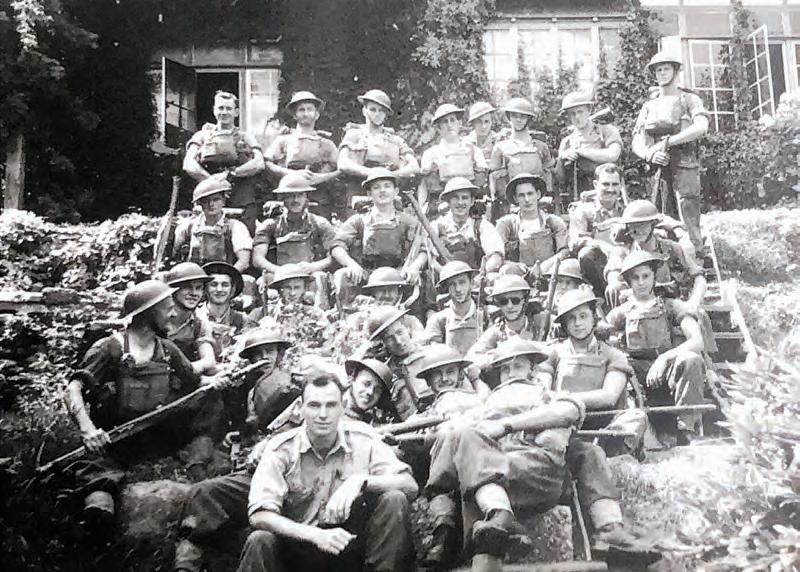
JUST THEN EDDIE BOLES YELLED ‘GRENADE’ AND A POTATO-MASHER CAME TUMBLING OUT FROM BEHIND THE BAGS.”
Private H. West, a rifleman in No. 3 Section, estimated the platoon had been on the beach for about 45 minutes before his section commander ordered the move to the casino “by crawling along the [sea]wall.”
Struggling to keep up with his leader without exposing himself to the enemy, Private Pearson noticed that his 13 Platoon comrade Herbert (Bert) Judd had sustained a serious wound to his face. Judd would later die on the beach and is buried in the Dieppe Canadian War Cemetery in nearby Hautot-sur-Mer.
As No. 3 Section Bren gunner Private William (Wilf) Rolston moved toward the casino, a sniper in the building killed him. Several men, notes the war diary, “took cover under the sea-wall until the Navy barrage of pompoms into the Casino wiped out the sniper.”
Meanwhile, after stopping to provide cover with his Bren gun, ‘C’ Company Private James Ratcliffe lost contact with his section and decided to join 13 Platoon as it crawled past him. Up and down the beach, men became similarly separated from their sections and joined others.
During this scramble—waiting for lulls in artillery and mortar fire, searching for
comrades or avoiding snipers—the platoon’s structure finally disintegrated. Many from 13 reached the casino, but often on their own. Arriving during the second wave, one Landing Craft, Tank landed around 5:50 a.m.—15 minutes late. It was quickly wrecked and stranded near where 13 Platoon had leapt ashore. Its misfortune, however, proved a stroke of luck for the embattled infantry. The four guns aboard—two 2-pounder pom-poms and two 40mm Oerlikons— were welcomed support for the Rileys.
Numerous witnesses credited the naval gunners with knocking out several sniper and machine-gun positions on the upper floors of the casino. The action came at a cost though, all of the gun crew were killed or severely wounded. As the last of the vessel’s weapons fell silent, it was nearly 7 a.m. By then, the Rileys had subdued the pillboxes flanking the casino and were rushing the building.
The casino was two storeys and about 67 square metres in size with a matrix of hallways and gaming rooms. It also featured two threestorey towers facing the sea. The Germans had partially demolished the rear of the building in preparing to remove it entirely, but what remained was essentially a huge pillbox. Rather than being captured by ‘B’ Company early in the assault as planned, taking the casino took the combined efforts of the whole battalion. There was nearly two hours of frantic action before the first men burst through an open door on the casino’s seaward side.

Casualties, and those simply pinned down, were scattered across the length of White Beach. ‘D’ Company, on the extreme right, had been almost completely wiped out in the first rush, with all its officers either dead or badly wounded. Its remaining men clung to whatever cover they could find. 13 Platoon, ‘C’ Company, had taken some casualties, but those still able to fight were now scattered among remnants of ‘B’ Company and the reserves from ‘A’.
When Lance-Corporal Lisson entered the casino with what remained of his No. 1 Section, he immediately joined ad hoc units being formed by other officers. The fight for the building’s tight corridors and dark, unfamiliar rooms proved brutal, with little quarter shown by either side.

THERE WERE
AND THIS TIT-TIT-TIT OF RIFLE AND MACHINE-GUN FIRE ALONG THE WATER. WE REACHED ONE BOAT, BUT IT WAS SO OVERLOADED IT SANK.”
Lisson’s second in command, acting corporal James Henderson, was wounded while crossing a hallway. A comrade propped him up, bandaged the wound and gave him a drink, but he died 15 minutes later. The other soldier rejoined the fight and “proceeded to help clear the building of Germans and did some good work as numerous dead Germans proved,” said a note in the war diary.
“Bullets were ricocheting all over the place, making one hell of a racket,” reported Private Jim Telfer of No. 2 Section of action inside the casino. “There was a pile of sandbags in one corner of the room facing the beach,” he continued. “Just then Eddie Boles yelled ‘Grenade’ and a potato-masher came tumbling out from behind the bags. The ceiling came down, but by the time I got up Eddie and a couple of others had finished the job.”
Despite the intense, close fighting, not all the enemy were dispatched. One German officer was found bleeding profusely from a head wound and one of the Canadians “slapped a field dressing on him [and] propped him up against the wall.” After the casino’s ground floor was cleared, the Rileys had 15 prisoners, two of whom died later of their wounds.
“Under Cpl Lisson’s orders we tied their thumbs behind their backs and sent them back to the beach,” said one private in his after-action report. This order, confirmed to the Germans in Allied operational plans captured after the battle, resulted in Allied prisoners taken at Dieppe being placed in shackles as retaliation.
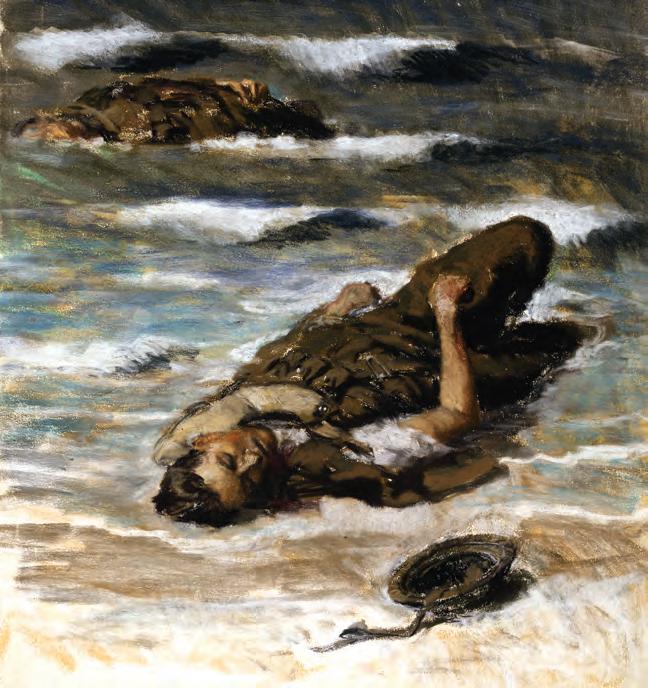
Suffering with his crippled arm, 13 Platoon commander Gartshore somehow managed to drag himself to the casino.
“That casino was as far as we got. I realized as soon as we got there that we weren’t going any farther,” he detailed later. Separated as they were, taking casualties seemingly every step of the way, it’s remarkable that at least 21 of the 34-strong 13 Platoon had made it from the landing, through the first wire to the seawall, then into the casino.
Unbeknown to Gartshore, however, not all his men stayed in the building. Before their leader reached the strongpoint, several made their way to the rear of the building closest to the town. A mixed platoon occupied the demolished section of the casino, engaged enemy positions

and covered men attempting to cross the promenade into the town proper.
One member of 13 Platoon found himself with an assortment of troops behind a hedge between the casino and town. He still had a 2-inch mortar and some ammunition and reported afterward that, “there was a [machine gun] nearby well concealed and HE bombs which I fired had no effect.
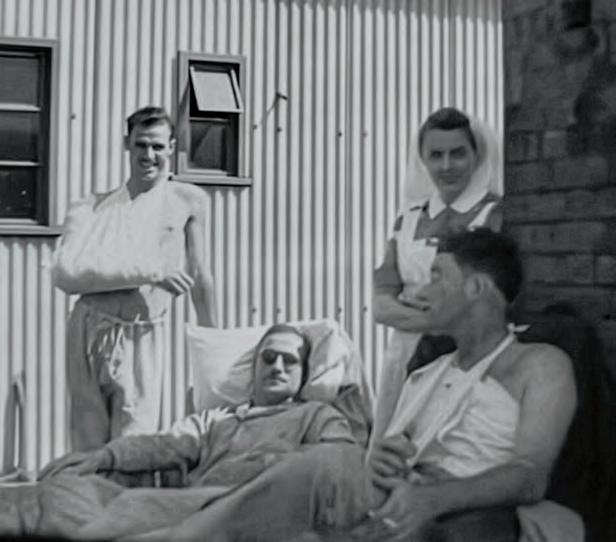
“It was finally wiped out by one of our tanks,” noted the soldier. “Heavy and continuous fire came from the buildings across the esplanade and kept us under cover for a long time, until the order for withdrawal was received.”
Another 13 platoon private reported joining a group in a trench system behind the casino that ultimately covered the return of comrades back toward the building.
Smoke canisters outside the casino covered the retreat. In small groups, those who could helped the wounded through the swirling black cloud. Many made for the leeward side of the beached Landing Craft, Tank that had arrived with the second wave. Numerous casualties had gathered there, too, during the battle. No. 2 Section commander Boles witnessed “Gartshore and…Medical Officer (Capt Clare) both bandaged up and both crawling about and fixing other wounded men.”
As the troops retreated to the water’s edge hoping to be rescued by landing craft, Germans in shorefront buildings and the flanking heights continued to fire on them.
In response, the Canadians organized a rearguard of Bren gunners comprising reinforcements from Les Fusiliers Mont-Royal, a unit of Royal Marine Commandos and several men of 13 Platoon. They worked to hold back the encroaching enemy as long as possible.
Terrible losses in both men and craft during the landings meant too few vessels were available to evacuate survivors. Several that did arrive were destroyed before getting to shore. Others, overloaded with wounded, sank shortly after departing.
The withdrawal proved particularly hazardous for the Rileys, and 13 Platoon suffered further casualties. One 13 man was hit in the head while running for a landing craft but
managed to scramble aboard. Another, by then separated from the platoon, was “knocked under an LCA and dragged into the sea.” He was pulled aboard by a comrade. Wounded earlier, one 13 member was helped onto an overcrowded LCA by Gartshore and Private John Gralick. Gralick later disappeared, his body never recovered. He, like many others missing after the raid, is commemorated in England on the Brookwood 1939-1945 Memorial, located some 50 kilometres west of London.
“We were walking in water up to our waists and necks,” recounted Gartshore later of the retreat. “There were bombs dropping and this tit-tit-tit of rifle and machinegun fire along the water. We reached one boat, but it was so overloaded it sank.
“When that happened, I thought that was it, we weren’t going to get out. But along came another boat, and we all got in. We went first to a destroyer, but it took off and left us there. Then we went to a tank landing craft. Just as they were going to get us up, the boat was hit by a shell and exploded. You could see bodies flying through the air. I remember this huge red ball and then parts of the boat and these bodies flying all over the place.”
Gartshore was eventually transferred to another vessel and returned to England that evening. In total, 15 men of 13 Platoon, many of them wounded, made it back aboard various vessels. They left behind 11 dead and eight who were taken prisoner, four of them wounded. The captured had either covered the withdrawal or were too badly injured to be moved.
For his actions that day, Gartshore was awarded a Military Cross. He spent months in hospital afterward and never returned to active duty. Indeed, on Aug. 20, 1942, only about 100 of some 580 Rileys who were part of the Dieppe Raid reported for duty.

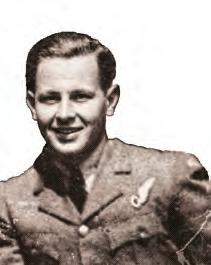

By Edward Poznanski

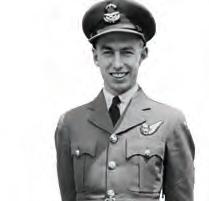

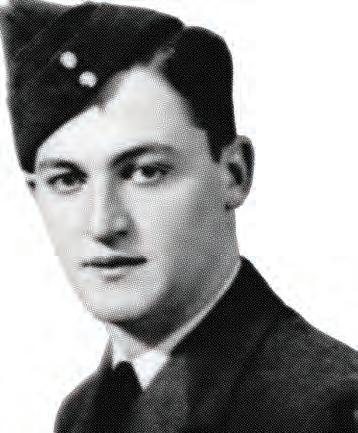

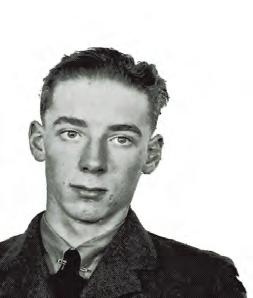



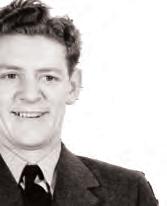
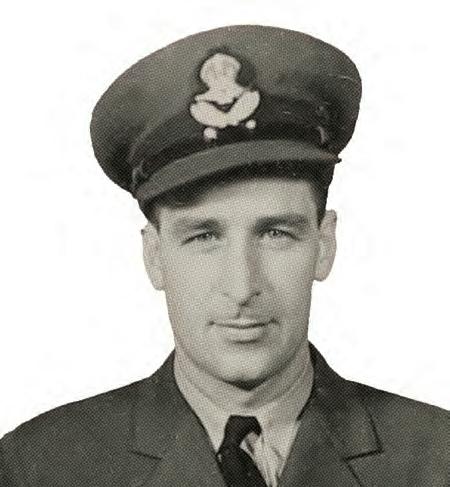
Remembering Canada’s role in efforts to liberate Poland during the Second World War


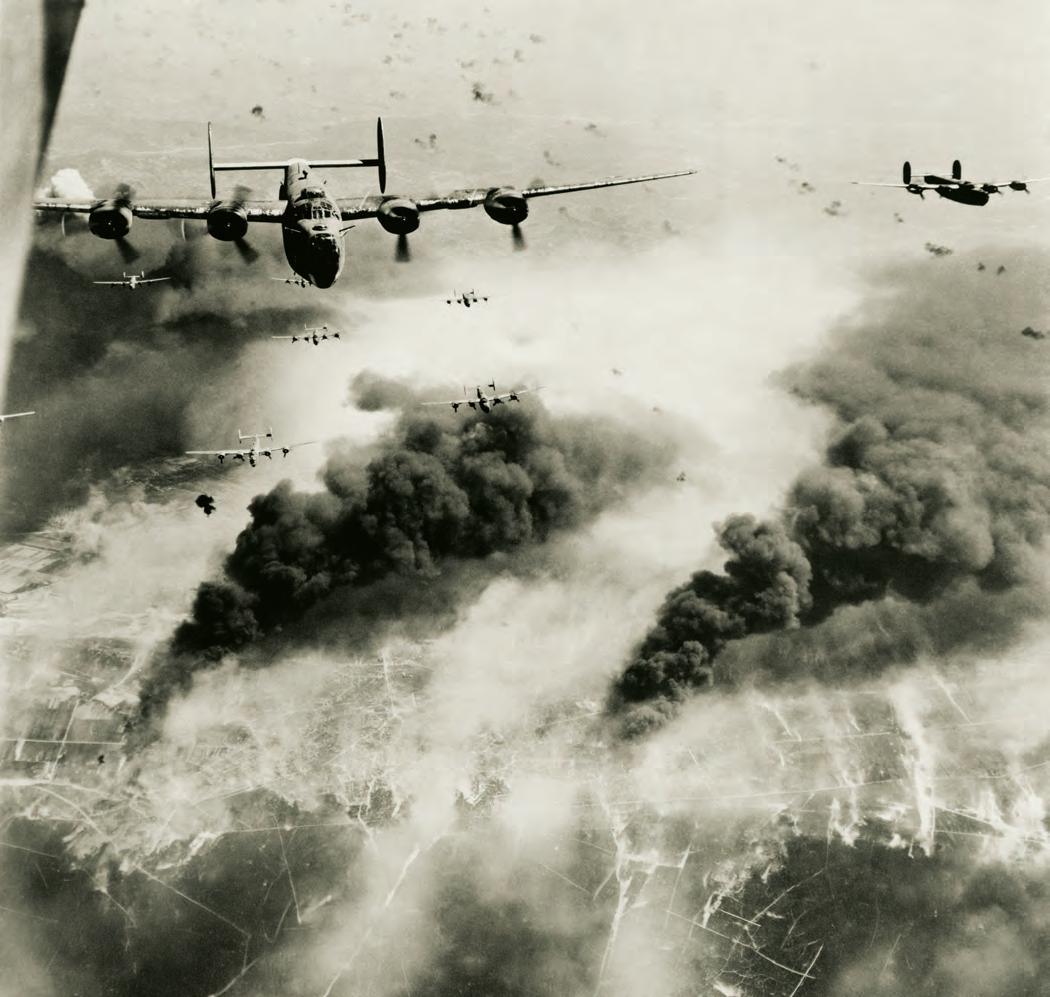


MSome of the sorties to Poland were flown using Consolidated B-24 Liberators, such as these pictured over Romania.
ost are probably familiar with Canada’s roles in liberating France, Italy, Belgium and the Netherlands during the Second World War. But what about the liberation of Poland? Wartime geographic and strategic positions prevented western Allied forces from reaching the country on the ground. This left the air route as the only practical way to help drive the Germans from Poland. It had been attacked by Germany on Sept. 1, 1939, and the Soviet Union joined the invasion on Sept. 17. Poland’s first underground resistance forces emerged by the end of the month as the country was succumbing to the joint onslaught. It was initially composed of many separate organizations but by 1942, the resistance (except for a small communist faction) was unified under the Home Army (HA), the military arm of the Polish
Underground State. Both were loyal to the Polish government-in-exile in London. The HA would eventually reach a strength of 380,000-400,000 soldiers, making it one of the largest resistance forces in Europe. Meanwhile, the Special Operations Executive (SOE) had been created by British Prime Minister Winston Churchill in 1940 to disrupt the German war effort (and later Japan’s) by supporting national resistance movements in enemy-occupied territory. To transport supplies and SOE operatives to resistance forces, the Royal Air Force eventually created four “Special Duties” squadrons (three in Europe and one in Asia). These units were composed of Commonwealth aircrews, principally including Brits, Canadians, Australians, New Zealanders and South Africans. Given its size, the HA desperately needed a wide range of supplies— including small arms, explosives, radios, medical supplies, forging materials, clothing, money, chocolate and cigarettes—to effectively conduct sabotage and other clandestine
Polish pilots return

activities. Agents of an SOE Polish section created in 1942 likewise needed transportation to Poland.
The ability of the SOE and its western allies to support the HA from the air was challenged by both distance and the evolving geopolitical situation. For starters, Poland was some 1,500 kilometres from the U.K. And, following the summer 1941 German invasion of the Soviet Union, all prewar Polish territory—as well as the rest of northwestern Europe— was under control of the Third Reich.
After some trial trips to Poland in 1941, RAF 138 Squadron (which included an all-Polish flight) started flying regularly to the country from Tempsford, England, in 1942. These missions followed a perilous northern route over the North Sea,

occupied Denmark and the Baltic Sea before turning south to Poland. The aircraft, Handley Page Halifaxes, each with a crew of seven or eight, then turned around and took the same path back. They travelled to Poland at night and a sortie usually included several aircraft, each assigned a specific rural drop zone.

The first Royal Canadian Air Force men in 138 Squadron to die on a mission in support of the HA were Flight Sergeant Eugene Shadrack Masson and Sergeant Donald Robin Ross on the night of March 14-15, 1943. (That sortie was particularly deadly with 25 per cent of its aircraft lost). Air gunner Masson, 25, was from Timmins, Ont., while wireless operator/air gunner Ross, 22, was from Sherbrooke, Que. Their Halifax was shot down by a German night fighter en route to Poland and crashed into the Baltic near Store Heddinge, Denmark. The rest of the Allied crew died, too. The Canadians were buried in Bispebjerg Cemetery in Copenhagen. On the night of Sept. 15, 1943, two more Canadians were killed: Flying Officer Joseph Darie Louis Cloutier, the navigator, and Sergeant Kenneth Charles Windsor, flight engineer. Cloutier, 24, was from Trois-Rivières, Que.; Windsor, 23, was from Montreal. Their Halifax was shot down by German anti-aircraft fire while returning to England. It crashed into the Baltic Sea, near Rügenwalde, Germany (now part of Poland). The pilot survived,
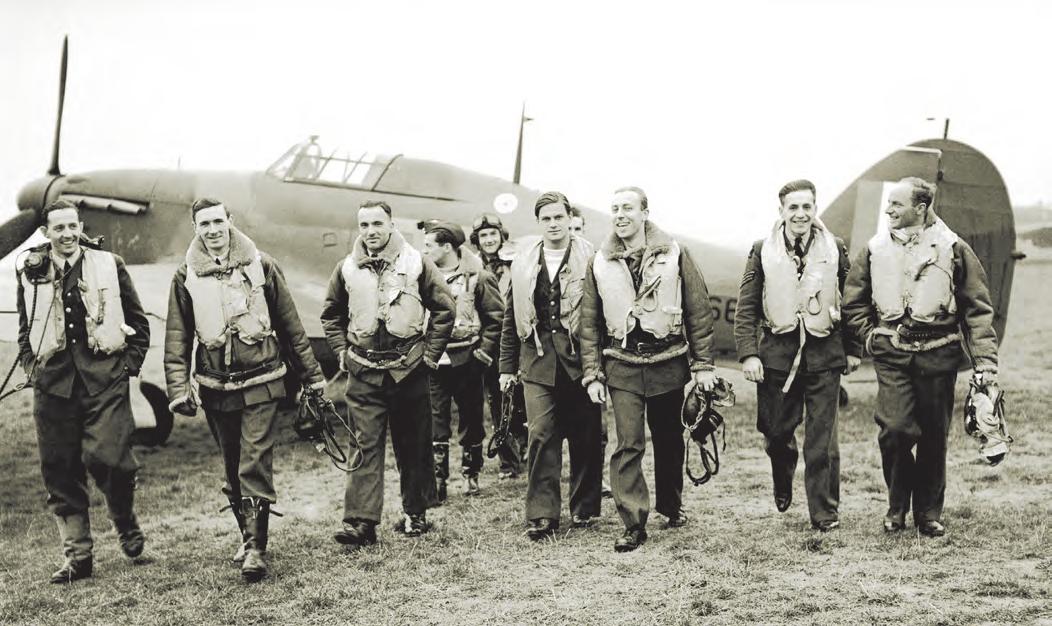

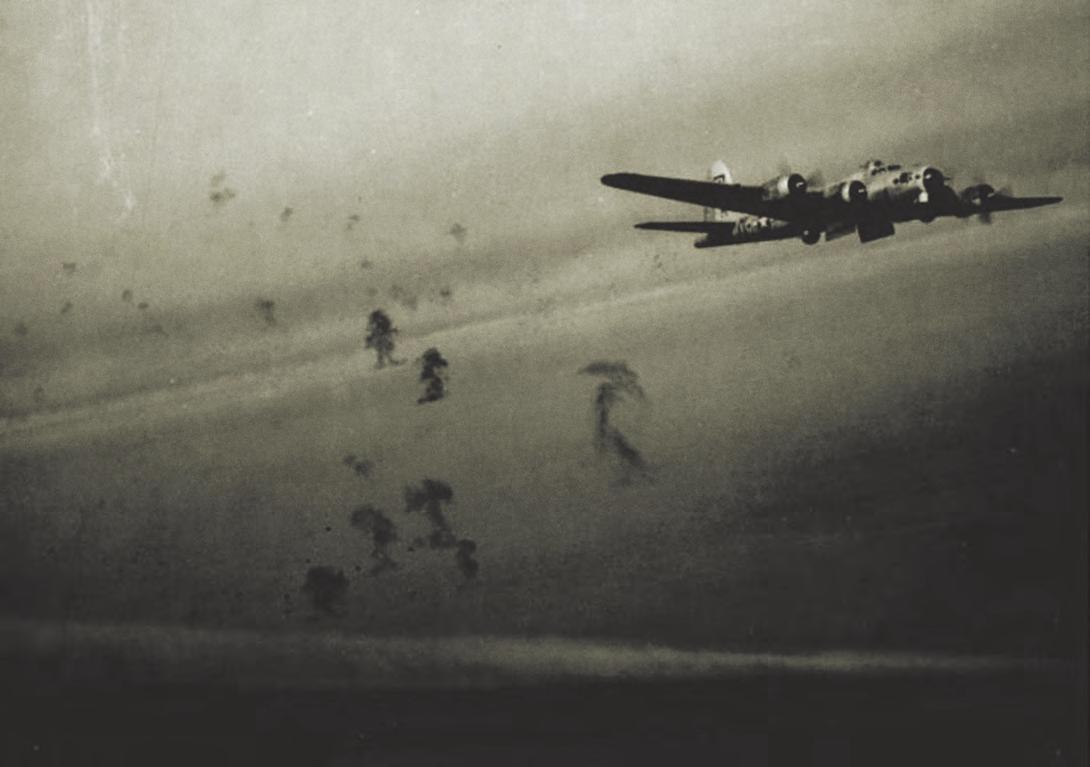
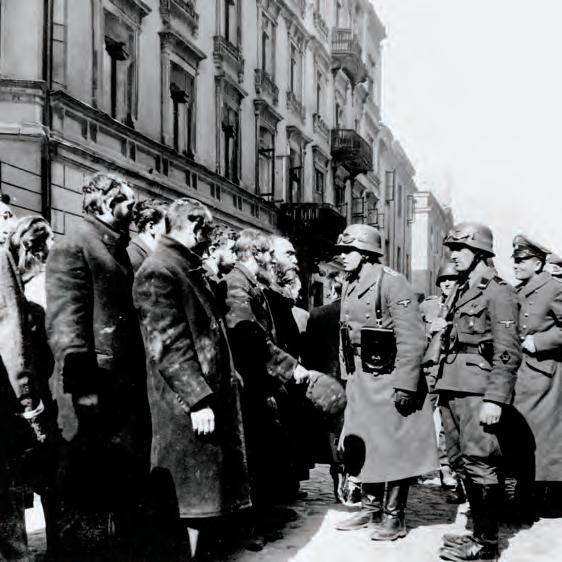

An American B-17 Flying Fortress flies over the Polish capital during the 1944 Warsaw Uprising ( top). Germans interrogate Jews in the city in spring 1943 (above).
while the other seven crewmen died. Their bodies were never recovered, but their names were inscribed on the Runnymede Air Forces Memorial in England.
Canadian Flying Officer James Reid Bradley was killed the next night when his Halifax was shot down by a German night fighter while en route to Poland.
The navigator’s plane crashed into the Kattegat Sea, near Aarhus, Denmark. Two other crew members died and four others were taken prisoner. Bradley, 21, hailed from Toronto. He is buried in the Randers North Cemetery in Denmark.
With southern Italy in Allied hands by early October, RAF support flights to the HA were taken over by 148 Squadron, together with No. 1586 (Polish Special Duties) Flight. The group operated from
Brindisi, Italy, starting in early 1944. The flight path to and from Poland, while slightly shorter, was no less dangerous, now crossing occupied Yugoslavia and Axis-aligned Hungary.
The first Canadians of 148 Squadron killed on an HA mission were Warrant Officer 2nd Class Thomas Johnson Makepeace, the pilot, and Warrant Officer 2nd Class John Stewart McWilliams, navigator, on the night of May 30, 1944. Makepeace, 21, was from Basswood, Man., while McWilliams, 31, was from Peterborough, Ont. Their Halifax was likely shot down by a German night fighter in the vicinity of Secanj, Yugoslavia, while returning to Italy after making a drop in southern Poland. They are buried in a communal grave with the rest of their crew in the Belgrade War Cemetery.
On the night of July 4, 1944, Flying Officer John Stanley Brown was killed when his Halifax was taken out by a German night fighter while outbound to Poland. The 24-year-old bomb aimer was from Wetaskiwin, Alta. His plane crashed in the vicinity of Sombor, Yugoslavia (now Serbia). Brown is also buried along with the rest of his crew in the Belgrade War Cemetery.
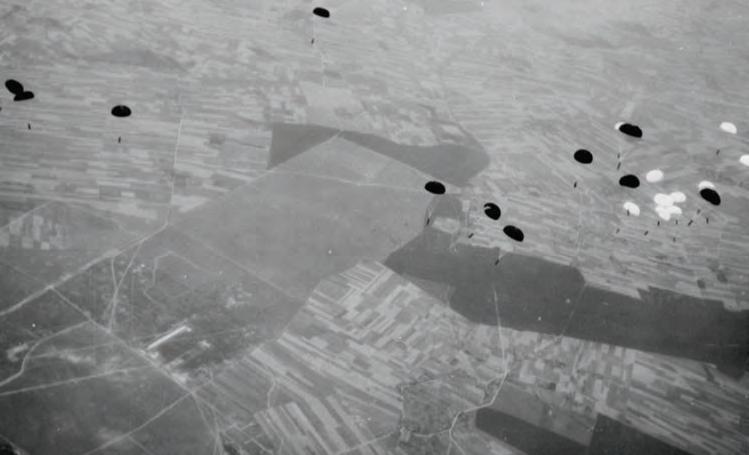
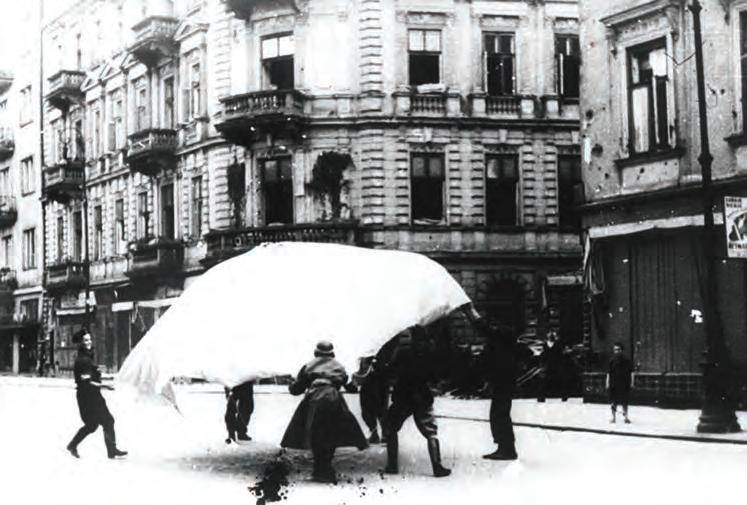

The nature of the RAF’s special duties HA missions changed dramatically after the start of the Warsaw Uprising on Aug. 1, 1944. The Soviet Red Army had reached the eastern outskirts of the Polish capital days earlier. As Warsaw’s German occupiers were preparing to evacuate, the moment seemed opportune for the HA to begin a major push to liberate the city.
The threat of a Soviet-imposed Communist government in Poland added to the resistance’s urgency as the Soviets had already sponsored a rival Polish Communist governmentin-waiting. The HA, expecting a short, easy fight with the retreating Germans, only had enough arms and ammunition for a few days. Its hopes, however, were dashed when the Germans reinforced their Warsaw garrison and fought back furiously. The Red Army, meanwhile, decided not to assist the HA.

In desperation, the Polish government-in-exile lobbied the U.K. and the U.S. to immediately drop supplies to the HA in Warsaw. On Aug. 4, 148 Squadron made its first of several flights to the beleaguered city. These missions proved far more dangerous than those to the southern Polish countryside. Aircraft had to fly farther over enemy territory, straining fuel supplies and increasing the chances of being shot down—the Germans had ringed Warsaw with antiaircraft guns, the planes had to approach at low altitudes over the drop zones, and the Soviets wouldn’t allow crippled or low-on-fuel RAF planes to land in areas they controlled. On Aug. 5, 1944, the first Canadians were killed on an HA mission during the Warsaw Uprising. Two aircraft with Canadians on board were shot down while returning to Italy after their drops on alternate locations in southern Poland. One Halifax crashed near the village of Dabrowa Tarnowska, Poland. Two British crewmen died alongside five Canadians: Flight Lieutenant Arnold Raymond Blynn, 26, its pilot from Middleton, N.S.; Flying Officer Harold Leonard Brown, 20, its wireless operator of Toronto; Pilot Officer George Alfred Chapman, 24, its navigator from Toronto; Flight Sergeant Arthur George William Liddell, 31, the air gunner of Montreal; and Flight Sergeant Charles Burton Wylie, 20, the bomb aimer from Instow, Sask. The other Halifax came down near the village of Debina Zakrzowska, Poland, killing Flight Sergeant Charles Alec Beanland, 20, its air gunner of Hamilton, and the rest of its crew. All the Canadians killed that night were buried in the Krakow Rakowicki Cemetery Poland in 1948.
During the first week of the Warsaw Uprising, 148 Squadron and 1586 Polish Flight sustained particularly significant losses, which caused the RAF to rethink its strategy of dropping supplies in a heavily defended urban area. When

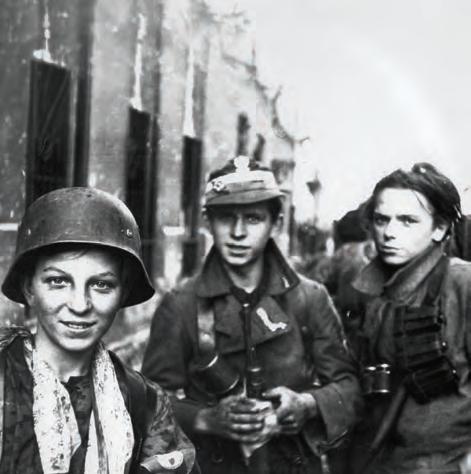
THE RAF UNITS SUPPLYING THE HA DURING THE UPRISING SUFFERED APPALLING LOSSES. OF 196 AIRCRAFT, ONLY 42 MADE IT TO WARSAW—AND 39 OF THOSE WERE LOST.
missions to Warsaw resumed in midAugust, they were reinforced by three bomber squadrons, all equipped with Consolidated B-24 Liberator aircraft.
On the night of Aug. 13-14, 1944, Flying Officer George Dougald MacRae was killed when his Liberator was shot down over Warsaw. The 30-year-old pilot from Ardbeg, Ont., was also buried in Krakow Rakowicki Cemetery. Coincidentally, his brother, Lance Corporal Jamie Duncan MacRae, 32, was killed the next day in France, while serving with The Argyll and Sutherland Highlanders of Canada (Princess Louise’s).
In the whole western Allied operation, more than 250 airmen were killed. “No other major air operation during World War II, and certainly none in which no bombs were dropped, could compare with this incredible effort,” said South African historian Neil D. Orpen.
Between 1943 and 1944, 15 Canadians were killed supplying the HA; another 11 were taken prisoners; and two others survived crashes and evaded capture.
On Dec. 12, 1964, on the 25th anniversary of the creation of the Polish resistance movement and the 20th anniversary of the Warsaw Uprising, the Polish Home Army Ex-Servicemen’s Association in Canada unveiled a monument in Ottawa commemorating the Canadian airmen who died supporting the HA. Canadian parliamentary, government and military officials and representatives of various Polish-Canadian veteran and community organizations attended the ceremony. And Prime Minister Lester B. Pearson paid homage to the bravery of both the RCAF airmen and the HA soldiers. Representatives of the Polish People’s Republic, in the Communist Soviet sphere since 1945, didn’t attend (nor were they invited).
In the 1980s, the political situation in Poland began to change and by 1990, Poland had a freely elected president and parliament. Starting in 1993, officials from the free Republic of Poland attended ceremonies at the monument. In 1995, Polish President Lech Wałesa approved the posthumous awarding of the Cross of the Home Army to all the Canadian airmen named on the memorial.
Polish Home Army soldiers pose for a photo during the 1944 Warsaw Uprising (above).
In the end, the Germans crushed the Warsaw Uprising and the HA surrendered on Oct. 2, 1944. After two months of one of the bloodiest urban battles on the Eastern Front, roughly 18,000 Polish insurgents were killed alongside 150,000200,000 civilians. Further, some 500,000700,000 Warsaw residents were deported to various concentration, labour and prisoner-of-war camps and the Germans undertook a systematic demolition of the city. By January 1945, about 85 per cent of its buildings had been destroyed.
The RAF units supplying the HA during the uprising suffered appalling losses, too. Of 196 aircraft, only 42 made it to Warsaw—and 39 of those were lost.
On Sept. 26, 1995, a rededication ceremony was held for the monument—which had been moved from its original location across from the National War Memorial to Confederation Park in 1967. A sculpted Cross of the Home Army was added to the monument and, like the unveiling in 1964, many dignitaries representing the Canadian government, Canadian and Polish veterans’ organizations, and Polish and Allied embassies attended. Some family members of fallen RCAF aircrew named on the memorial were present, too.
For more than 60 years, the Polish Home Army – Canadian Airmen Memorial has stood in commemoration of the little-known sacrifices made by Canadians to help liberate Poland.
For many Canadians, visiting sites of the world wars is the chance of a lifetime. A visual diary of the Legion’s 2025 Pilgrimage of Remembrance
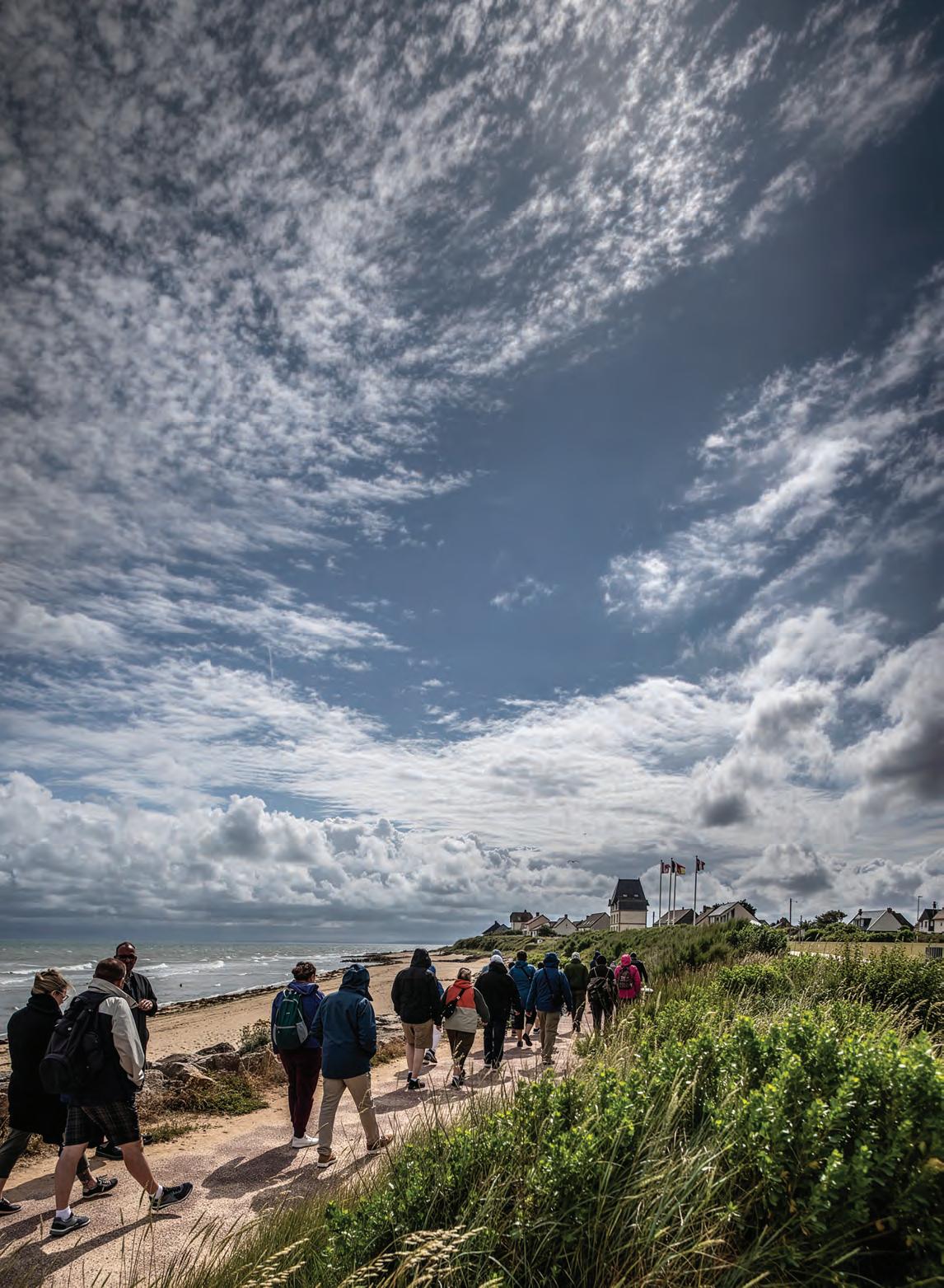


eeing is believing.”
An idiom now, the phrase is credited to 17th-century English clergyman Thomas Fuller. Many, however, may not know the proverb continued with, “but feeling is the truth.”
After the Great War, the loved ones of many Canadian veterans, indeed people the planet over, wanted to experience both the sense and the emotion first-hand by visiting sites of many of the conflict’s battles. They flocked to the old Western Front, often alongside veterans themselves.
In July 1936, The Royal Canadian Legion organized a mass pilgrimage to the ceremony to unveil the Canadian National Vimy Memorial in France (also see “Altar of remembrance,” page 26). Some 6,500 veterans and their family members made the trip on five ships to see the iconic tribute to all Canadians who served in WW I and that bears the names of 11,285 of its sons who died with no known grave.
The Legion conducted several other similar trips during the decades to follow,
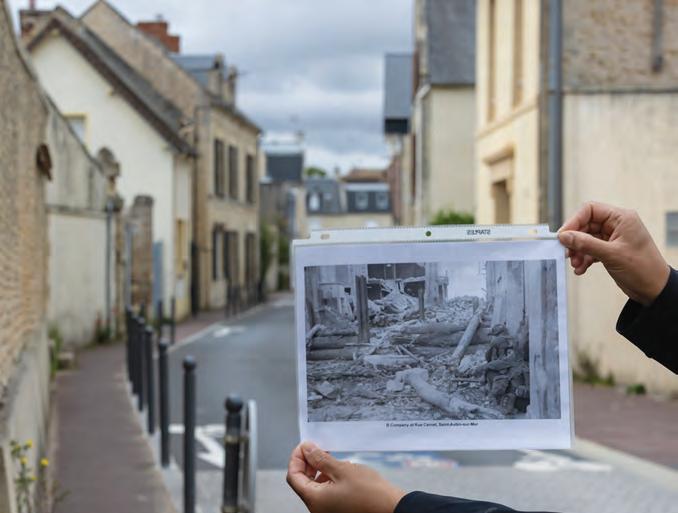
then in 2013, it established a biennial Pilgrimage of Remembrance, in which one member from each of the organization’s 10 territories is selected to participate. The 2025 group experienced a 14-day tour of First and Second world war sites in France and Belgium focused exclusively on Canadian battlefields, cemeteries and memorials, and unmarked rural roadside battle sites—where few, if any, other such excursions stop.
Like those Canadians who trekked overseas in the aftermath of WW I, for modern-day pilgrims, the trip is a dream of a lifetime, a chance to see and connect with the land on which their country’s forbearers fought and fell. Legion Magazine’s late senior staff writer Stephen J. Thorne joined the group to document their tour for this photo essay. For the career military journalist who had spent the last years of his work penning accounts of Canada’s military history, the trek was as meaningful as it was for any of the participants. Seeing really is believing. And feeling really is the truth.
People the planet over wanted to experience both the sense and the emotion first- hand by visiting sites of many of the conflict’s battles.
A child frolics in the shadows of the Mulberry harbours (clockwise from below) deposited along Gold Beach at Arromanches, France, after June 6, 1944; the remnants of a WW II German bunker on the Leopold Canal, where Canadian troops launched the Battle of the Scheldt; pilgrim David Scandrett, a former armoured trooper and commanding officer of 3rd Canadian Ranger Patrol Group, listens to guide John Goheen during the 2025 Legion tour; in the heat of 1944 fighting, a tanker took his turn a little too tight.

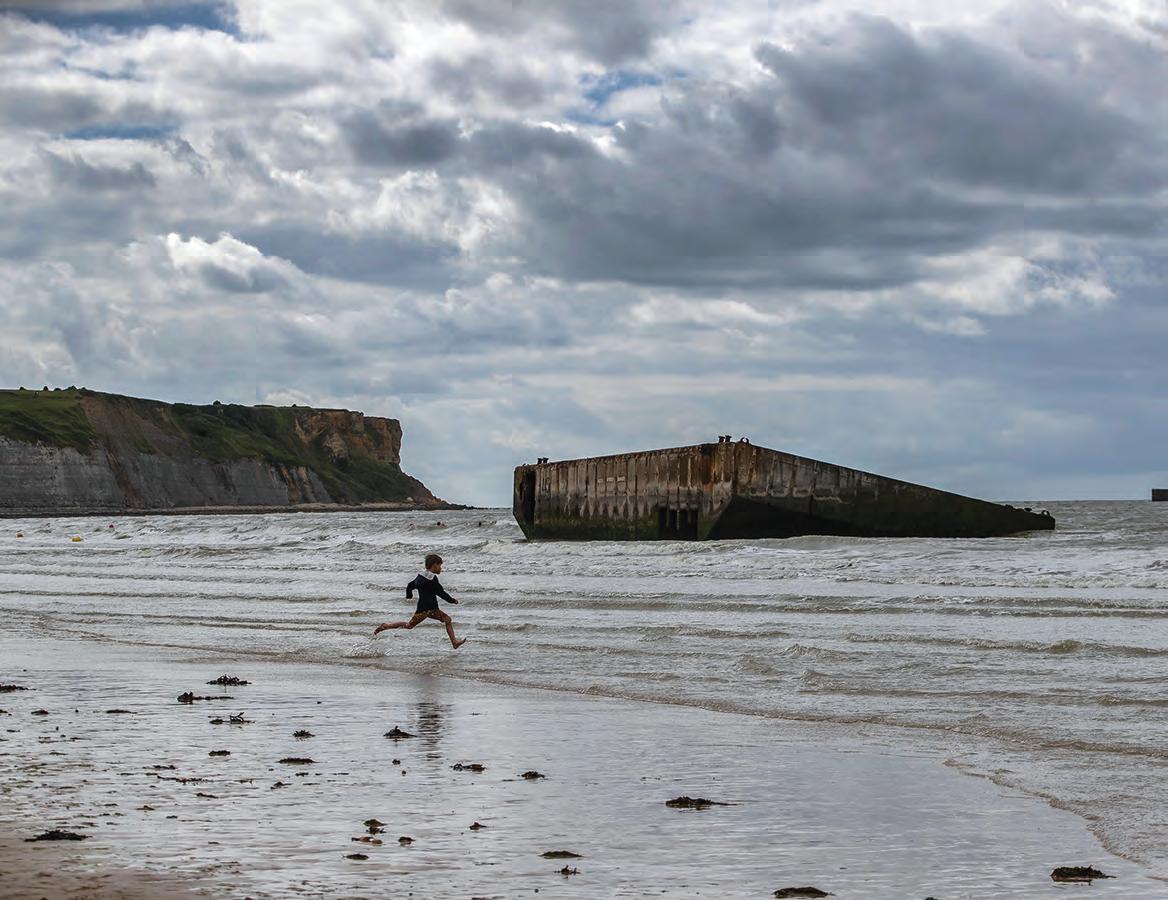


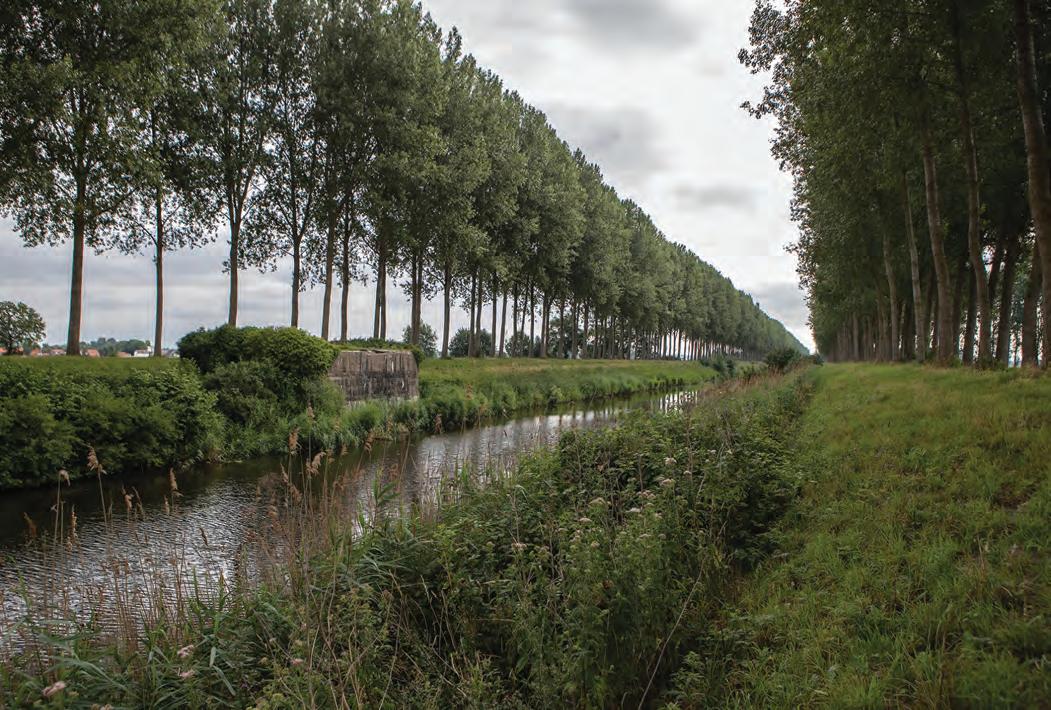

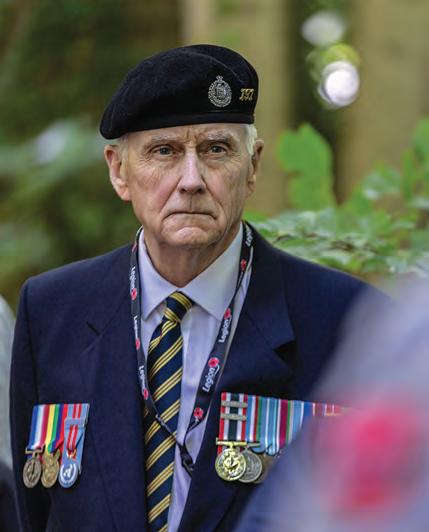


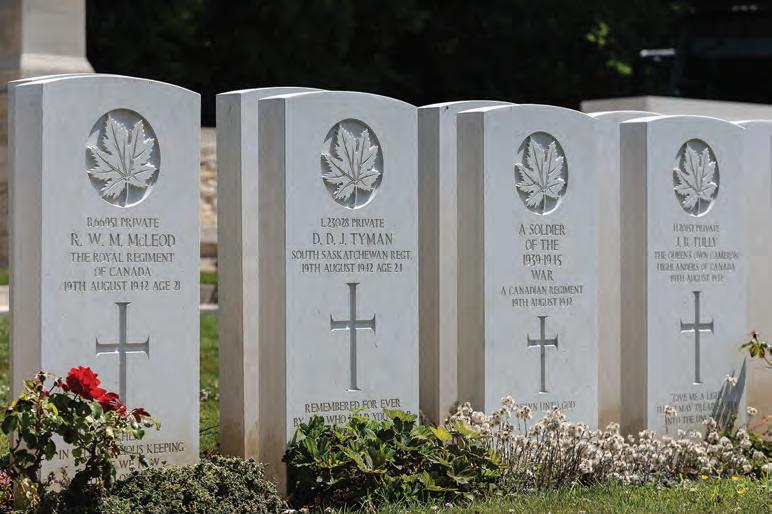
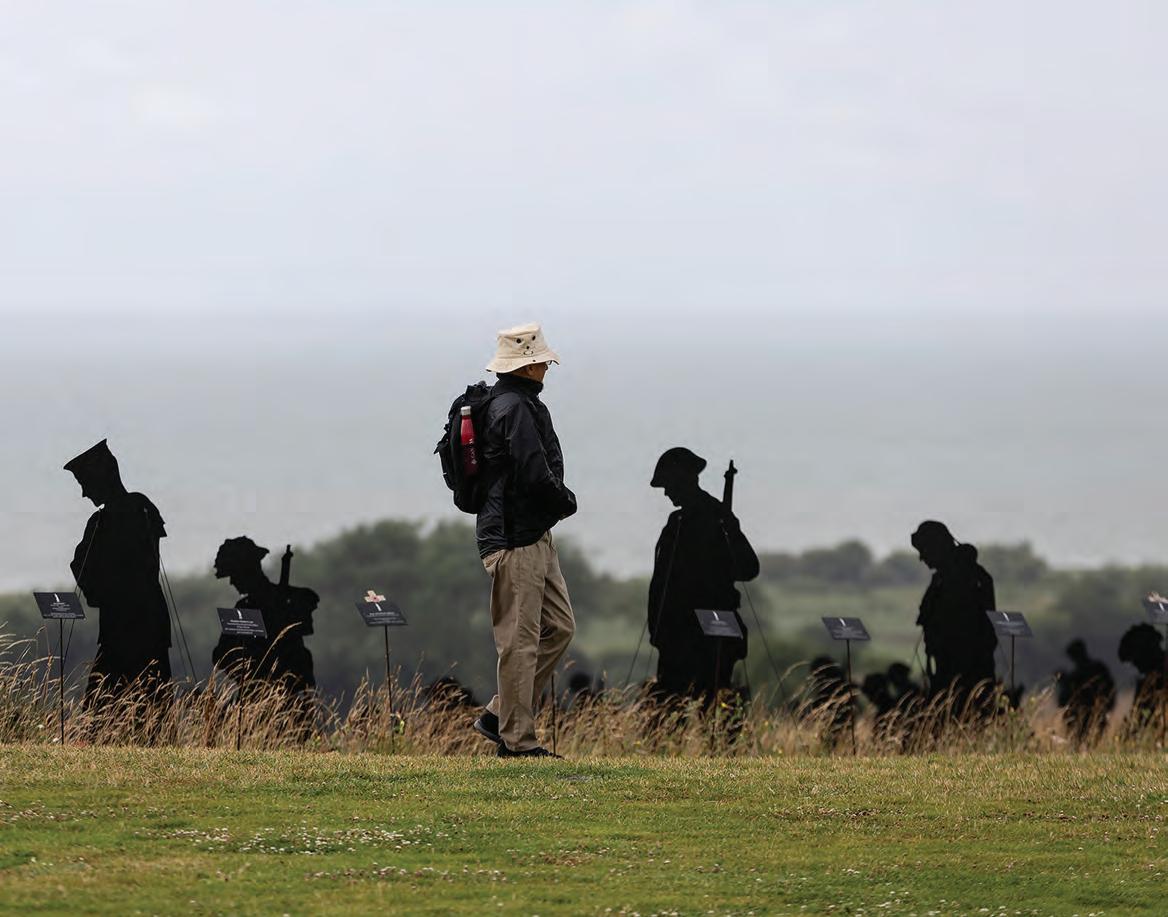
clockwise from this image: A pilgrim strolls through a memorial near Gold Beach in Normandy, France; row upon row of Canadians killed on Aug. 19, 1942, fill the cemetery in Dieppe, France; a German bunker boasts a commanding view of the town and the beach; a woman carts her young charge off White Beach at Dieppe.



The trip is a dream of a lifetime, a chance to see and connect with the land on which their country’s forbearers fought and fell.
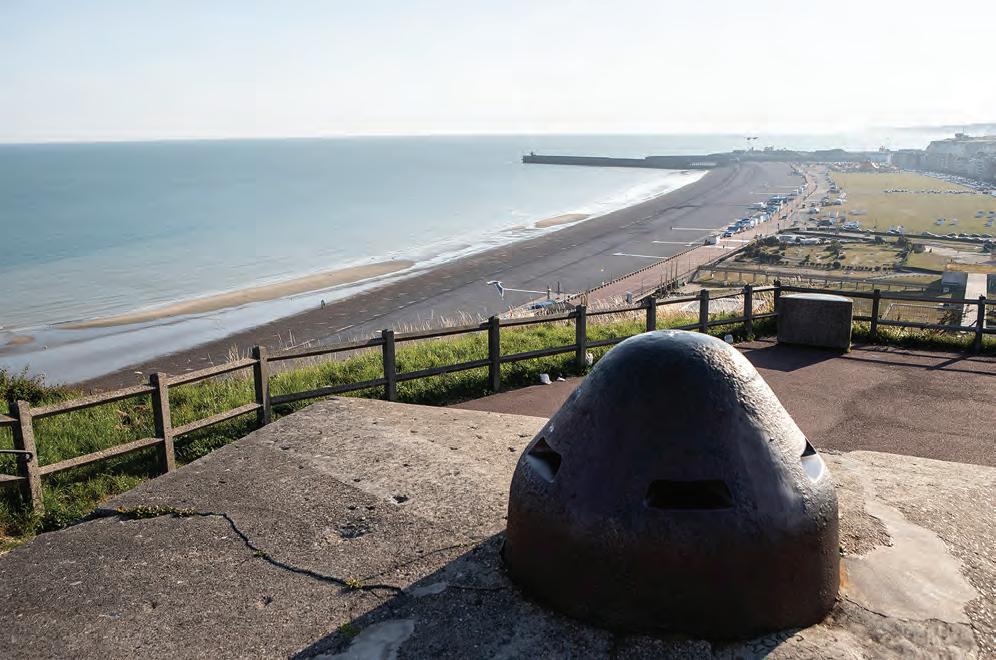
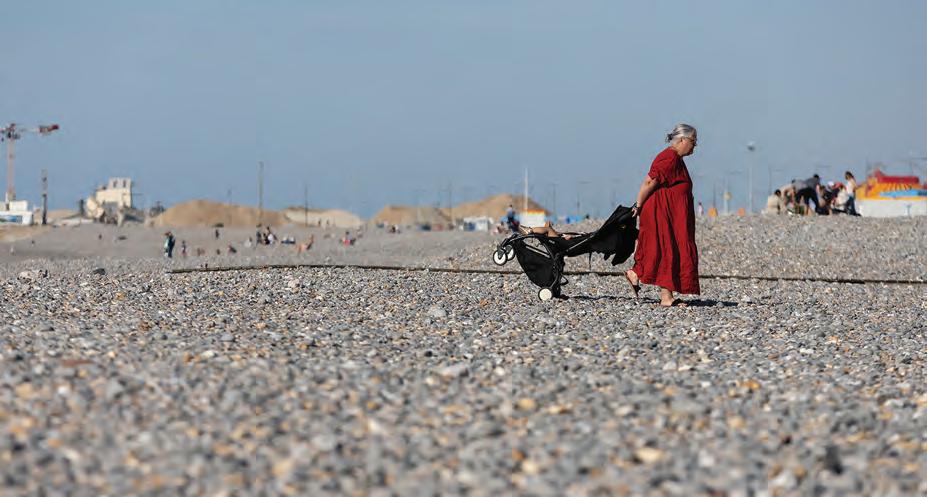
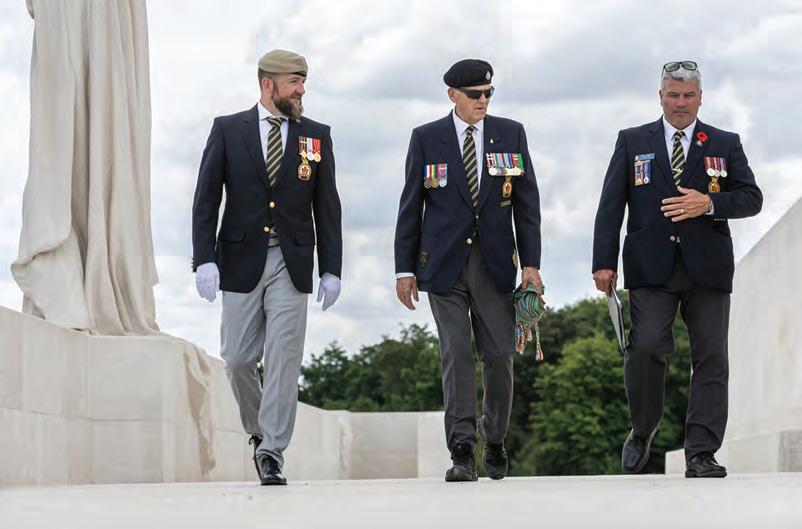
Veterans Caleb MacDonald and David Scandrett walk the Canadian National Vimy Memorial (above and opposite) with pilgrimage guide John Goheen. Grave 7, Row E, Plot 8 in Cabaret-Rouge British Cemetery near Vimy Ridge at Souchez, France (below)—the gravesite of an unidentified Canadian who was exhumed and interred in the Tomb of the Unknown Soldier in Ottawa in 2000.

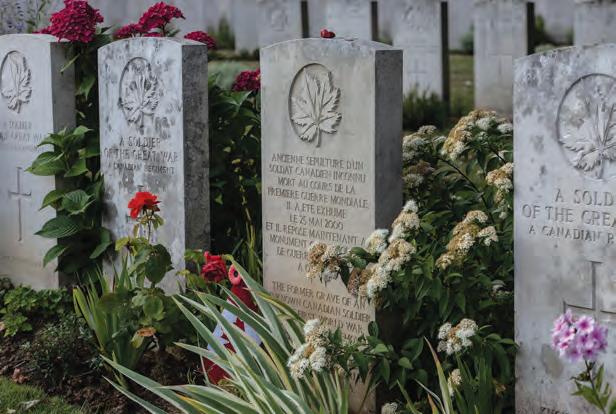

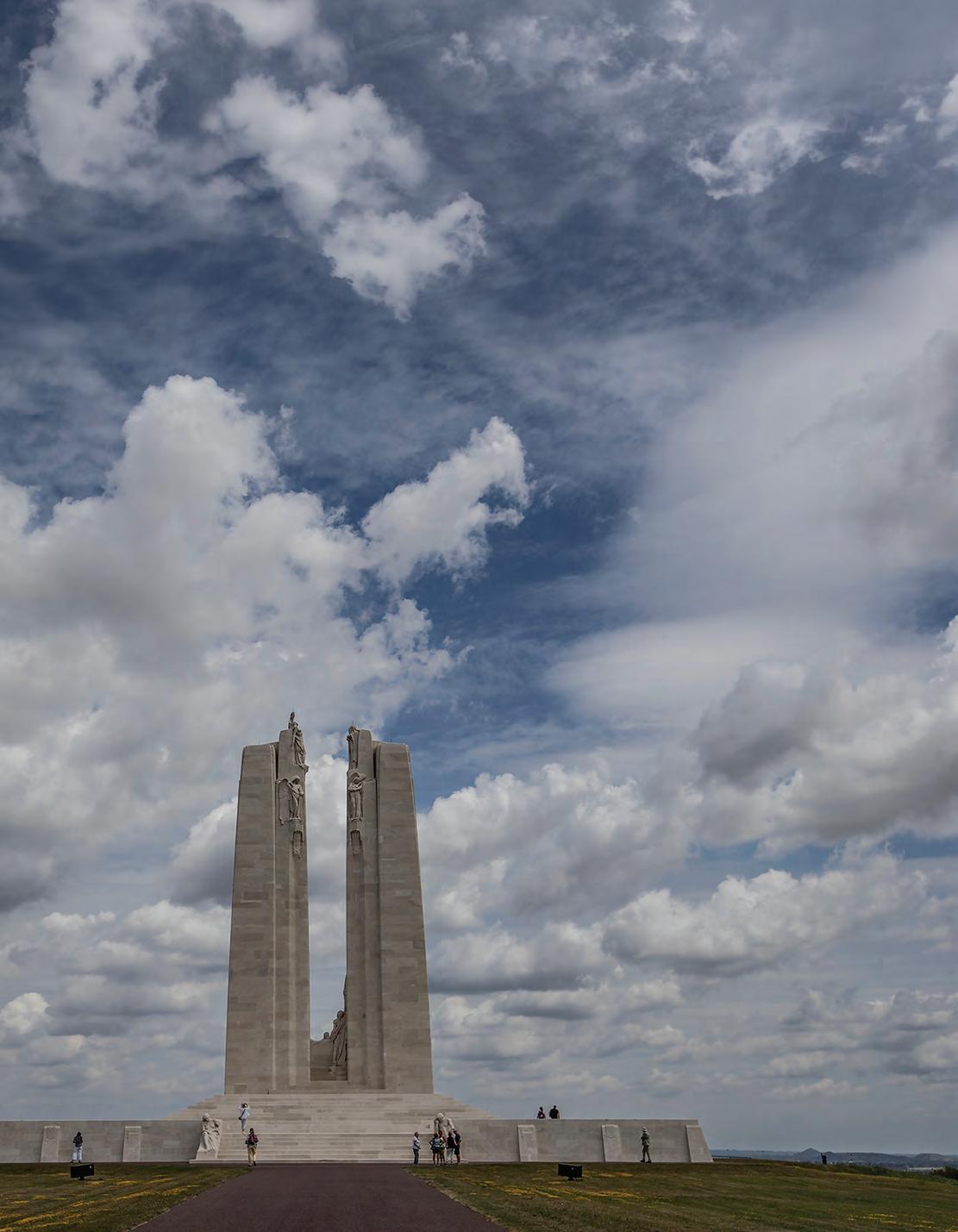
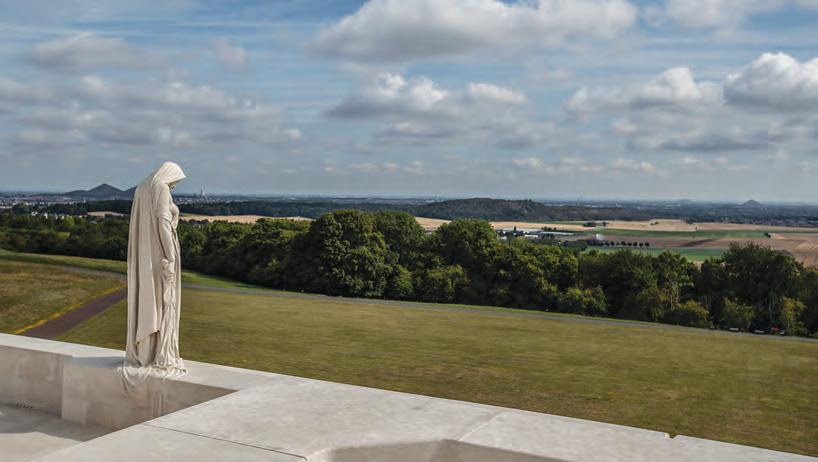
Historian and guide John Goheen briefs pilgrims on the Sept. 27Oct. 1, 1918, battle at Canal du Nord, France (right ). The Beaumont-Hamel Newfoundland Memorial (below).
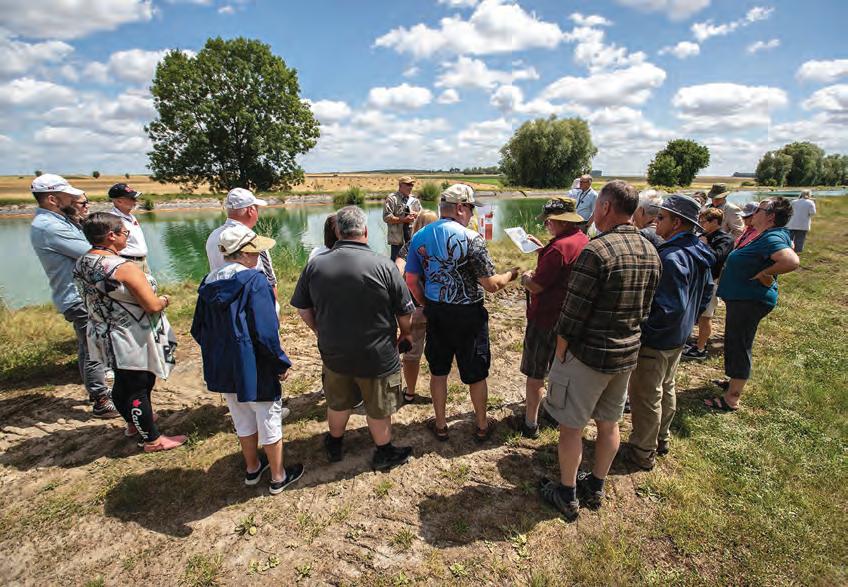
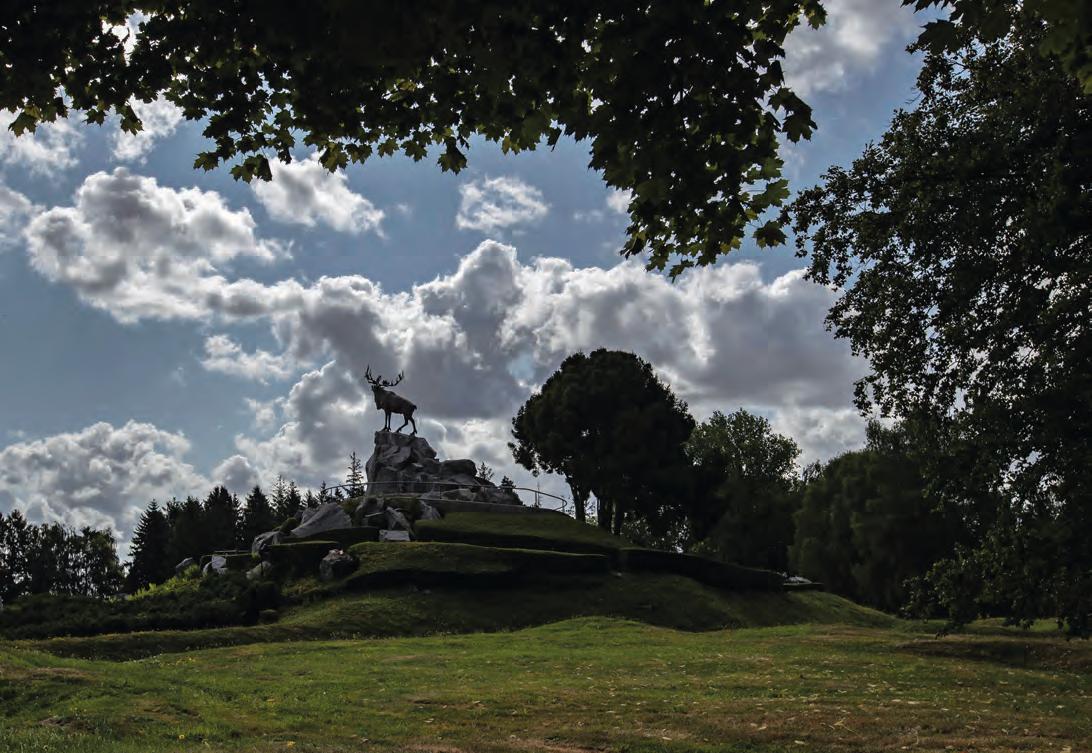
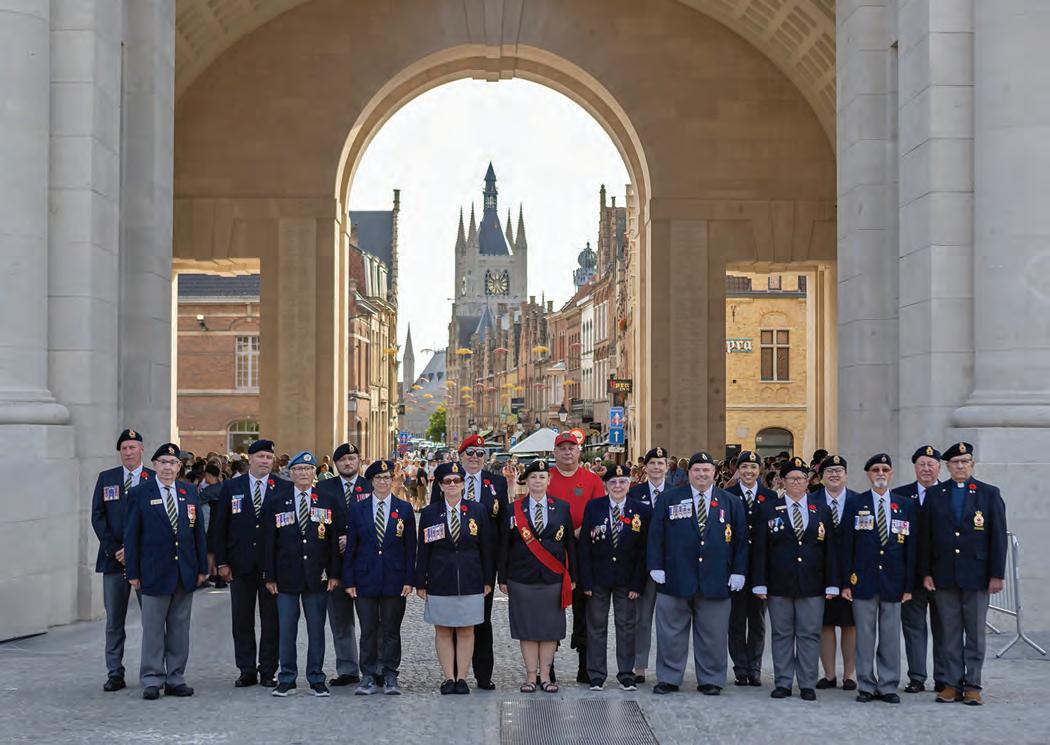
For the journalist who had spent his last years penning accounts of Canada’s military history, the trek was as meaningful as it was for any of the participants.


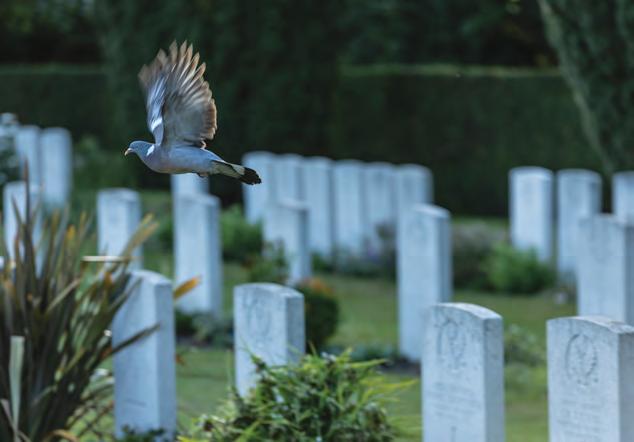

By Richard Foot

By Michela Rosano
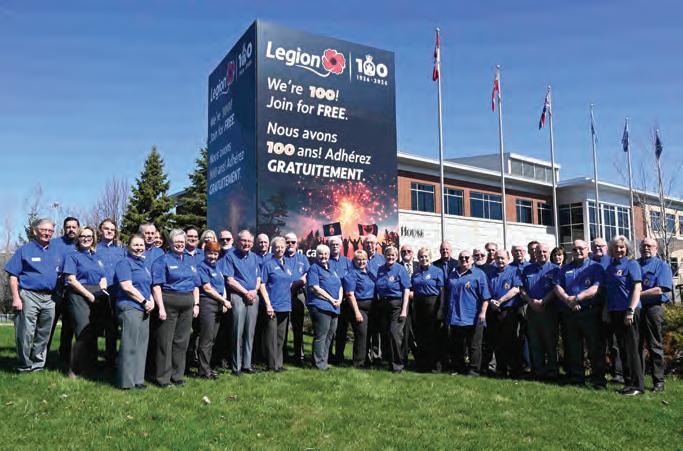
By Alex Bowers
By Michela Rosano
By Richard Foot
or the first time in 13 years, The Royal Canadian Legion has more than 300,000 members, a milestone it reached at the end of April following the addition of a record 81,600 new members in the first four months of its current centenary year.


“Growing membership in any volunteer organization is a major challenge,” said Dominion Command Grand President Larry Murray as he opened the Legion’s Dominion Executive Council (DEC) spring meeting in Ottawa on April 25. “The recent growth of the Legion after 30 years of decline is a truly remarkable achievement.”
The promising membership news and other signs of growth captured much of the DEC’s attention as its members gathered at National
Headquarters in Ottawa for their two-day meeting on April 25-26. Twenty-five council members participated in discussions at Legion House, including Murray, Dominion President Berkley Lawrence, other Dominion executive members and regional Command leaders from across the country. Senior Dominion and Command staff also attended.
They heard a story of remarkable turnaround for the Legion in recent years, including:
• new members added in the first four months of 2026 represented a more than 250 per cent increase from the same time last year (by comparison, between 2000-2020, the Legion averaged no more than 25,000 new members per year);
Members of the Legion’s Dominion Executive Council and headquarter’s staff pose for a group photo during their April meeting.
• about half of new members are 60 or younger;
• more than 40 per cent of new members have joined online thanks to a multi-year Legion initiative to modernize its systems;
• more than 2.5-million emails have been sent to new members, as part of an effort to not only recruit but retain new members;
• and new members are purchasing a record amount of Legion merchandise, with sales of $4.1 million in 2025 and expected to top $5 million this year—double the revenue of years prior to 2023.
“We’re adding numbers like we’ve never seen before,” National Executive Director Randy Hayley told DEC. “By the end of 2026, one in every three Legion members will be new to the organization. Think about that. Aside from 1926 when we launched, this has never happened.
“A 100-year-old organization attracting this many people in a short period of time,” he continued, “that’s unheard of.”
Hayley indicated the growth is a result of efforts to modernize business practices—such as providing online registration and digital membership cards—and the centenary marketing campaign. It’s also, in large measure, due to the free memberships available to new members during the anniversary year.
Hayley noted that initiative should result in higher revenues in years to come, as tens of thousands of new members pay to renew. He said this year’s goal is to recruit 100,000 people—a target he expects to surpass—and to retain at least half of them in future years. If that occurs, an additional 50,000 or more members would renew starting in 2027.
Hayley also said the growth is being recorded across the
“ The recent growth of the Legion after 30 years of decline is a truly remarkable achievement.”
country, with every Legion Command setting new membership records so far in 2026.
However, the free membership policy has also come with some hiccups. DEC heard that some local branches, particularly in Quebec and Ontario, have been charging new members fees to join or requesting donations from them to raise money for branches. The executive pledged to review the matter.
In 2025, the Legion’s paid membership revenue was $6.6 million, an increase of $400,000 over 2024. In the coming years, rising revenues from higher membership and merchandise sales are expected to reduce the organization’s current dependence on its investment funds to pay for operational costs.
“We continue to draw down on our funds,” Dominion Treasurer Jill Carleton reported. “We depend on our investment income to operate. As our revenue grows, that should change.”
The Legion’s net operating surplus—accounting for total income from all sources—was almost $415,000 in 2025, down from $897,000 the previous year.
One notable new revenue source is the Legion’s partnership with Amazon. In 2024, the online retail giant began selling and distributing Legion poppies. The partnership generated $647,000 in revenue in 2025.
“Amazon is taking no cut of the sales,” noted Hayley. “And it’s not just about revenue. It’s about distributing poppies in areas that we’re not. In 2025, over 80 per cent of poppies delivered [by Amazon] were in areas where there are no Legions. So, this is spreading our remembrance message in areas we haven’t been able to reach in the past.”
DEC members also heard and addressed complications arising from a short 2025 poppy campaign
season. Traditionally, poppy distribution runs from the last Friday in October until Nov. 11, resulting in varied campaign durations of 12-18 days depending on the year. Last year’s 12-day campaign “may have impacted fundraising capacity and operational effectiveness,” noted Dominion Command’s Poppy and Remembrance Committee report. DEC passed the committee’s recommendation to institute an annual 19-day campaign, from Oct. 24 to Nov. 11, starting this fall.
DEC also turned its attention to the challenging national and global security environment. In January, Grand President Murray (a former acting defence chief) and President Lawrence signed a letter on behalf of the Legion to Prime Minister Mark Carney, thanking him for the widely acclaimed speech he delivered earlier that month at the World Economic Forum in Davos, Switzerland. In his address, Carney condemned the U.S. trade war and the Trump administration’s verbal attacks on allies, and defended the international rules-based order.
“It is not the norm for us to comment on speeches by national leaders, however the Legion shares the values you have articulated, and we believe it is critical that we show our clear support at this time,” wrote Murray and Lawrence.
In the letter, they also strongly objected to U.S. President Donald Trump’s comments trivializing the contribution of NATO allies, such as Canada, in the war in Afghanistan.
Carney responded to the Legion in writing in March, thanking the organization for its “deep commitment” and “service to our nation.”
Murray highlighted the letter at the DEC meeting and said the Legion has a vital role to play at this moment in history as a vocal advocate on national security and defence issues.
“We’re living in particularly difficult times,” he said.
In that spirit, DEC heard a comprehensive update on the current security environment from Andrea Siew, chair of the Dominion Command Defence and Security Committee.
DEC swiftly passed the committee’s recommendation to call on Ottawa to develop a new, public-facing national security strategy. The move calls for a plan that, among other aims: defines Canada’s national security interests and threat priorities; aligns with future defence investments; and recognizes the well-being of armed forces and RCMP members as core elements of security readiness.
“There has not been a national security strategy since 2004,” said Siew, noting how dramatically international dynamics have changed since then.
“The 2004 strategy does not mention Russia, China or the Arctic. Coming after 9/11, it focuses on the terrorist threat and counterinsurgency operations. In budget 2024, the government committed to publishing a national security strategy every four years,” she continued, “and we have not seen the updated version or any progress toward it.”
Siew said that in the wake of the government’s recent increases in defence spending, “there is no strategic plan on how that money is going to be spent. It is a concern, and I think this is a very important foundation piece— having a security strategy.”
The Legion, meanwhile, has its own grand strategy for the remainder of its centenary year.
This includes a series of commemorations in Ottawa and across the country on July 17, the organization’s 100th birthday—themed as a “national day of reflection, recognition and engagement.”
Branches throughout the country are being encouraged to host open houses that day, where Canadians can gather and create personal, handwritten messages about what remembrance means to them, writing down a few words or sentences on sticky notes. Notes from each branch will be collected and arranged in large artistic mosaics. The resulting images will be showcased at locations around the country.
Other centenary events include the release of a Canada Post “Legion 100” stamp, the launch of a Legionthemed toonie and Remembrance Week in November. The year’s most
highly anticipated event, however, is the national convention from Aug. 22-26 in Winnipeg, where the Legion was founded in 1926.
“That’s going to be a convention people are not going to want to miss,” said Hayley.
Special guests—from the governor-general and the prime minister to the defence chief and RCMP commissioner—have been invited. And delegates will elect a new Dominion executive.
“I was thinking about running for president again and see what the [delegates on] the convention floor would say: ‘That fool, he’s not supposed to do that!’” joked Lawrence, president since 2024.
He closed DEC by thanking all the attending staff and council members for their contributions to the Legion during his past two years in office. He had special praise for Grand President Murray.
“The right-hand man next to me here fills in for me on so many important occasions,” said Lawrence. “I’ve gotten over the habit of calling him ‘sir’ all the time. Now it’s just ‘Larry,’ and we have a great relationship.
“I’ll have more to say at the Dominion convention, but thanks for everything,” he added. “I’ll see you in Winnipeg.”
comes down to something very simple. It’s about keeping our word to those who have served. For too long, the courage and sacrifice of many veterans have not been fully recognized,” said NDP MP Gord Johns in support of a petition presented to a House of Commons committee on April 15, 2026, that aimed to finally award the Canadian Victoria Cross.
By Michela Rosano
The call was answered on May 29, when the parliamentary secretary to the minister of national defence, Sherry Romanado, announced in the House of Commons the creation of an independent military honours review board “to review the Afghanistan veteran cases where new evidence may suggest where the criteria for the Victoria Cross may have been met.”
The announcement is a big win for a multi-year, grassroots effort led by Valour in the Presence of the Enemy, a nonprofit organization headed by Afghanistan veteran Bruce Moncur. He has advocated for fellow Afghan veteran Jess Larochelle’s Star of Military Valour to be upgraded to Canada’s VC since December 2020. The April 15th petition
was introduced to Parliament by Liberal MP Pauline Rochefort of Nipissing-Timiskaming, Larochelle’s hometown riding.
While manning an observation post in Pashmul, west of Kandahar, Afghanistan, on Oct. 14, 2006, Private Larochelle and his company of 1st Battalion, Royal Canadian Regiment were attacked by Taliban insurgents. Hit by a rocket blast and seriously wounded, Larochelle braved continued enemy fire to mount a defence that ultimately saved the rest of his comrades. He was awarded Canada’s second-highest military honour in 2007. Larochelle died
on Aug. 30, 2023, after struggling with chronic pain and posttraumatic stress related to service.
The petition, which had more than 16,000 signatures, aimed to have Larochelle be the first of several veterans of modern conflicts—also including Warrant Officer William MacDonald (See “The Briefing,” page 14), Master Warrant Officer Rick Stacey, Sergeant Pat Tower and Master Corporal Sean Teal, among others— to receive the country’s heretofore unawarded Victoria Cross.
Canada has not awarded a VC since the Second World War, despite creating its own version
For veterans who can no longer live independently due to physical or mental health conditions, one of the most significant supports Veterans Affairs Canada provides is long-term care (LTC). VAC helps cover the cost of LTC in approved facilities, ensuring that financial barriers don’t prevent access to necessary support. Eligibility for VAC-funded LTC depends on several factors, including:
• being an eligible veteran (typically having served in the Canadian Armed Forces, RCMP or in certain civilian positions);
• and medical assessments showing a need for ongoing nursing care or supervision that can’t be adequately provided at home.
VAC also prioritizes access to LTC for lowincome individuals and those with servicerelated disabilities. These “priority access veterans” may receive full coverage for LTC in community facilities, provincially regulated nursing homes or VAC-contracted beds in other facilities. These options can vary by region and placement often depends on an individual’s medical needs and bed availability. A veteran without service-related conditions may still qualify for VAC-supported LTC, but
in the early 1990s. There is currently a time limit of five years after a heroic action has taken place in which to award the honour—a rule created by King George VI in 1950.
“If we don’t actually consider the fact that someone has earned this Victoria Cross,” said retired general Rick Hillier, the former defence chief who earlier led the Canadian Armed Forces in Afghanistan, “then the honours and awards that we [have] across Canada start to be demeaned and diminished. And with that, what we get is less of a willingness, in my view, to serve Canada.”
could receive different levels of financial support and/or experience longer wait times. VAC also evaluates an individual’s income and assets, with lower-income veterans more likely to receive comprehensive coverage.
Applying for LTC through VAC usually involves completing an application, undergoing a medical and functional assessment and co-ordinating with provincial health authorities. Additionally, more attention is being paid to ensure culturally appropriate and trauma-informed care, particularly for those with post-traumatic stress disorder.
While VAC case managers assist veterans and their families to navigate the LTC process, it can be challenging. Demand for LTC continues to grow as the veteran population ages. Wait times, regional disparities in facility availability, and co-ordination between federal and provincial systems can also complicate access.
VAC’s LTC programs are a critical component of Canada’s commitment to caring for those who’ve served. While eligibility requirements and processes can be complex, the overarching goal remains clear: providing veterans with dignified, accessible and high-quality care when they need it most.
For more information, contact VAC directly at 1-866-522-2122 or visit veterans.gc.ca/ en/mental-and-physical-health/physicalhealth-and-wellness/long-term-care for more information.
yez! Oyez! Oyez!” bellowed Windsor, N.S., town crier Lloyd Smith— adorned in a mid-17th centurystyle uniform of the 45th Regiment of Foot—to the enthralled, if somewhat surprised, crowd. Having held the position since 1978, making him the longestserving officially appointed heralder in North America, his booming voice carried through the Hants County Branch hall at the April 25-26, 2026, Dominion Cribbage Championships.
Smith spoke of Windsor’s unique history, dubbed the “little town of big firsts” for (allegedly) being the birthplace of hockey, growing the world’s largest pumpkins and having the oldest agricultural fair on the continent.
The community’s heritage extends further: to being Mi’kmaq traditional territory; to colonial settlement and Acadian expulsion; to wartime training grounds; and, from January 1927, to the Hants County Branch itself.
For local arrangements committee chair Harry Jackson and other organizers, the event was a long time coming. “I applied for a national tournament several times, maybe five or six times,” said the Nova Scotia/Nunavut Command First Vice and former reservist. Planning the event took six months, added Jackson, who enjoys the occasional game of crib when the cards come out most Monday nights.
The cards were cut shortly after the opening ceremony, beginning with the doubles round robin. Watched over by Windsorborn Dominion representative Don McCumber, a competitive
By Alex Bowers
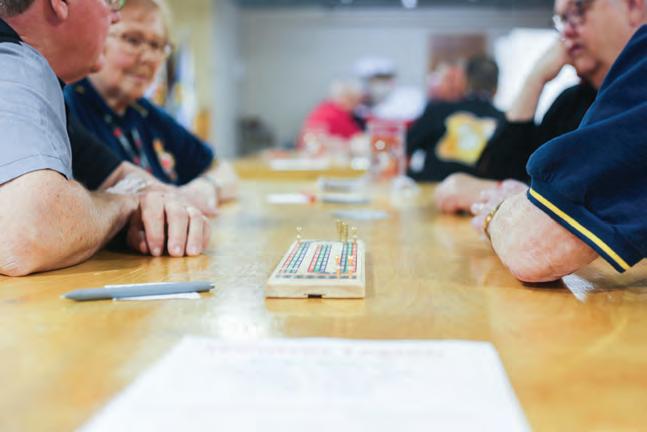
yet convivial spirit prevailed as contestants shook hands, made introductions and uttered “good game” when matches finished.
Amid the laughs, jokes and complimentary refreshments, it soon became evident that British Columbia/Yukon’s perennial Dominion crib champ duo, Barry Dillon and Richard Falle of Prince Edward Branch in Victoria, held a commanding lead. The two Newfoundland transplants ultimately triumphed once more, securing 19 points—six more than their native Atlantic province, which clinched second place— at the end of nine two-set rounds.
“The cards were pretty much with us all day,” remarked Dillon, an 11-time national title holder. “We did lose our very first game, but then we turned it around.”
For Falle, it marks his 10th such victory, the result of the pair’s tableside chemistry. “If I had never had Richard as a partner,” Dillon furthered, “I wouldn’t have been doing this. We’re like brothers.”
The singles competition kick-started shortly after 3 p.m., but with the branch scheduled to host a non-tournament event later that day, participants were afforded just a few rounds before retiring for the evening. From 8:30 a.m. the next morning, however, players were ready to hit the ground running.
Nevertheless, within a couple of hours, a difficult decision was made to limit games to 30 minutes—lest team matches be considerably constrained and the subsequent banquet supper go cold. Dominion representative McCumber—himself an avid crib player—had nothing but praise for the organizers, affirming that “they’ve worked so hard—all the volunteers—to put this together. And I certainly commend them for the job they’re doing.”
The tight yet fair ship accelerated proceedings, notwithstanding ever-welcome intervals for congratulating and even hugging rivals. Such remained the case during
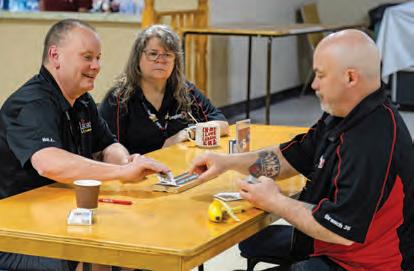
“It’s just a game. If you get too serious, don’t play it because the pressure will get to you. You’re here to have fun.”
the gripping singles playoff between Newfoundland and Labrador’s Terrance Murphy and B.C./Yukon’s Bill Nelligan—both at 18 points when the rounds concluded. The opponents, representing opposite sides of the country, traded banter until a champion emerged.
“This is my third win,” explained Nelligan of snatching the tiebreaker. “I won in 2019, 2023, and now, in 2026.”
The Cranbrook, B.C., Branch Legionnaire has played crib for more than 59 years. “There were eight kids in our family,” he continued, “and all we played were cards when we were young.” Nelligan’s love for the game reached new heights after being hospitalized at 11, where “I played over 47,000 games with the gentleman in the bed beside me,” a perhaps more prudent pastime than racing him in wheelchairs, he said.
Nelligan savoured his most recent victory, intent on celebrating the success with his daughter and grandchildren who live in Nova Scotia. Despite this, the former printer insisted that “it’s just a game. If you get too serious, don’t play it because the pressure will get to you. You’re here to have fun.”
That fun remained on full display when the team tournament commenced at 1 p.m., the atmosphere boisterous until the last round neared and a sense of focus descended over the tables. Just a game though it was, anticipation grew for the announcement of a third and final winner. With separate ‘A’ and ‘B’ team events, scores were combined and tallied after all 18 sets were complete, initially indicating a tight win for Ontario Command’s team, comprising the Ruff family
clockwise from immediate left: Perennial doubles champs Richard Falle and Barry Dillon, representing B.C./Yukon; Team champions Erwin Nernberg, Miriam Reid, Robert Johnson and Heather Taylor, also from B.C./Yukon, receive their trophy from local arrangements chair Harry Jackson and Dominion rep Don McCumber; game action.
(Andrew, John and Mabel) and Terrence James Calbraith of Tara Branch. B.C./Yukon Command’s Heather Taylor, however, questioned the result after noting— and proving—that a double skunk, equating to two extra points, was unaccounted for in the third round. The overturned total, and last-minute upset, awarded Taylor’s team—including Miriam Reid, Erwin Nernberg and Robert Johnson from Ladysmith Branch— the prize at 28 points to Ontario’s 27, seizing a sweep of every title for the West Coast province.
The runners-up, meanwhile, acknowledged their new placement on the leaderboard with grace, a testament to the sportsmanship present throughout the championships.
Following a roast beef supper shared among new friends and old comrades, the closing ceremony highlighted the ethos instilled in players and all those in attendance.
“Events like this,” affirmed McCumber at the podium, “remind us why the Legion remains important. Yes, we honour and remember. Yes, we advocate for veterans and their families, but we also build community.”
Town crier Smith also returned to the stage, inducting each contestant into Nova Scotia’s Order of the Good Time, believed to be the oldest social club in North America after its founding in 1606. Players raised their hands, vowing that they would enjoy their stay in the province, that they would remember its residents pleasantly, that they would speak of the local people kindly, and that they would one day return. A resounding “I will” was bellowed back.
nder big, sunny skies in the Rocky Mountain foothills, dart players from across Canada gathered at the Men of Vision Branch in Cochrane, Alta., on May 2-3, 2026, in the hopes of taking home a national Dominion Darts Championship title. In the end, players from British Columbia/ Yukon, Nova Scotia/Nunavut and Alberta-Northwest Territories provincial commands prevailed.
While spirits were high all weekend, the excitement bubbled over during the team event on Day 2, with the crowd, many standing on chairs to get a clear view of the board, hollering after each throw in the final stretch between teams from Alberta-N.W.T. and Newfoundland and Labrador. Finally, near-hometown heroes Logan Crooks, Keith Sheppard, Shane Rattigan, Moe York and David Beattie (an alternate) from Strathmore, Alta., Branch completed their stellar performance from the round robin, beating the team from Conception Bay Branch in Kelligrews, N.L., and winning the event by a total of three sets across nine games.
The win was particularly emotional for the Alberta team and their enthusiastic supporters.
“This was my dad’s team,” said Crooks, who has competed at the national level since his teens. His father, Jimmy, passed away five years ago. “That’s why we have ‘Jimmy Crooks’ [printed] on our collars. He had never made it to nationals.”
Crediting his parents for introducing him to the sport as a child, Crooks has fond memories of the Legion. “I’d spend a lot of
By Michela Rosano
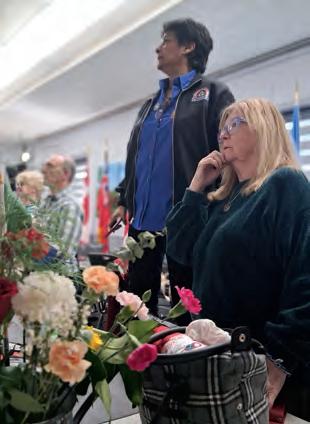
Fridays, Saturdays and Sundays in the Legion playing darts,” he said between congratulatory handshakes from his fellow competitors.
Rounding out the previous day’s events, Coady Burke and Jason Smith of MacDonald Memorial
Team event winners (above) representing Alberta-N.W.T. pose with Dominion rep Bob Underhill (far right), host branch First Vice Ellison Smith (top row, second from right) and Karen Bruens (bottom row, right), Alberta-N.W.T. District 5 Commander and sports rep. The crowd closely watches the final game of the tournament (left ).
Branch in Lakeside, N.S., took home the doubles title, narrowly winning their second set of three by just two points in the final game against Rory Hansen and Chris Lammie from Prince Edward Branch in Victoria, B.C. Burke said he leaned on his teammate for support throughout the event.
“It was a strong field of players, but my partner played very well,” he said. “I wasn’t at my best, but he really picked it up for us. It was friggin’ tough; it came down to the wire at the last round.”
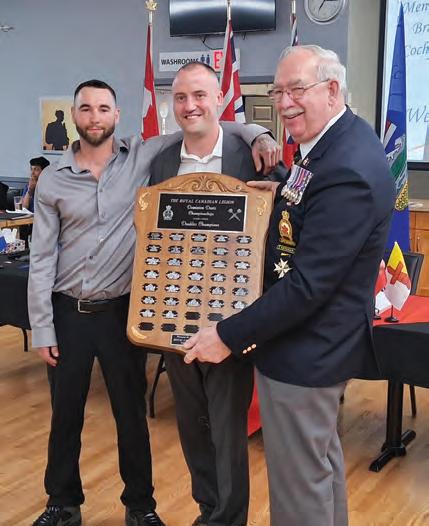
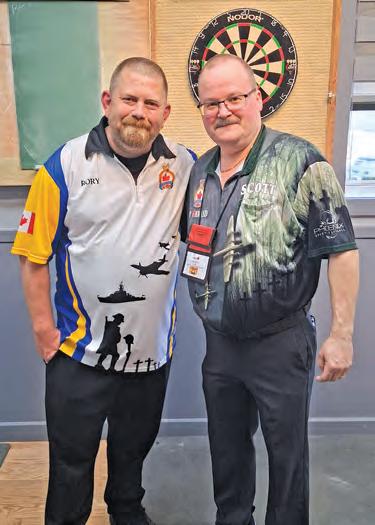
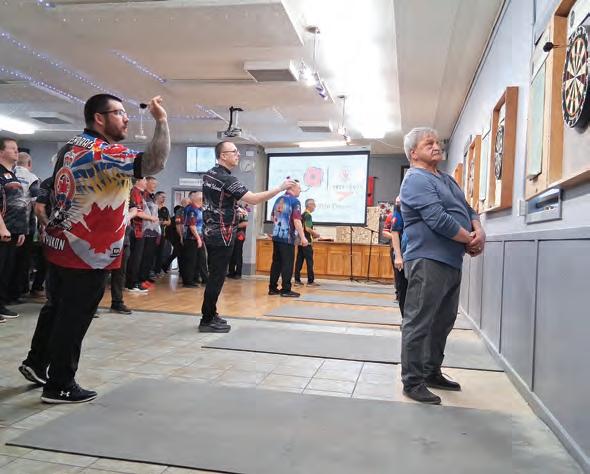
This is the sixth national title (team and doubles) for Burke and Smith, who swept the team event last year with William (Willie) MacIsaac and Sheldon Fudge. But wins aren’t the only reason they keep coming back.
“It’s a big family. [I’ve made] a lot of good friends,” said Burke.
While Hansen narrowly missed the big win in doubles, he snagged gold in the singles event that kicked off the competition that morning. Winning a total of 21 sets in the event and facing stiff competition in second-place winner Scott Tracy from Blacks Harbour, N.B., Branch, Hansen won the last game two sets to one.
Bob Underhill (far left, right) presents a trophy to doubles winners Coady Burke (left) and Jason Smith. First- and second-place singles event winners (left ), Rory Hansen (left) and Scott Tracy. Participants throw in the team event (below).
“I’d spend a lot of Fridays, Saturdays and Sundays in the Legion playing darts.”
Darts Tournament in 2009. Since then, the population of the historic ranching town just west of Calgary has boomed, becoming one of the fastest-growing communities in the province. Membership at the branch, founded in 1974, has gone from roughly 350 members to about 500 in the past five years.
Though the weekend marked his first Dominion competition, Hansen is a seasoned player, boasting National Darts Federation of Canada tournament titles. The Legion, however, is where it all began for him.
“My parents were part of the military, and I joined [the Legion] at 19 as a non-vet. I’m glad they opened it up for more people to join,” he said. Though a lot of the players in the tournament don’t have military backgrounds, gestured Hansen around the room, “this is a game everyone here loves.”
The Men of Vision Branch last hosted the Dominion National
And many of those members are darts players, said Ellison Smith, the branch’s First Vice and its sports co-chair. The Royal Canadian Air Force veteran usually organizes tournaments on Saturdays to coincide with other events at the busy branch, which serves as a hub for local get-togethers in the expanding community.
Smith himself has been playing darts for 26 years and was first introduced to the sport at the Legion, echoing the experience of many players at the tournament. For Smith, it’s the “comradeship, friendship and sportsmanship,” that keep him involved in the sport. “It’s one of the few sports where you shake hands when you start and finish a game.”

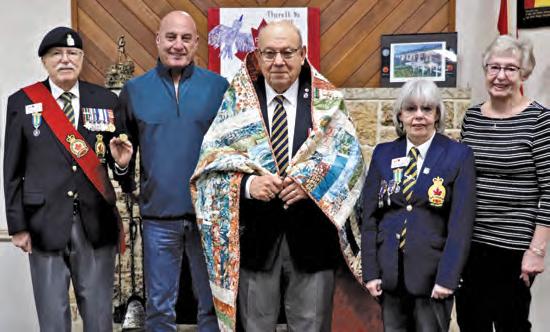
Don Lemon of Carman, Man., Branch is presented with a Quilt of Valour. Attending are Sgt.-at-Arms Jim Scott, Brian Lemon, President Karen Maxwell and Valma Lemon.
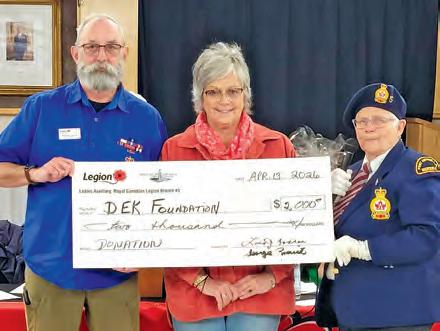
President George Romick and L.A. Sgt.-at-Arms
Nancy Singleton of Port Arthur Branch in Thunder Bay, Ont., present $2,000 to the Dayna Elizabeth Karle Addiction Recovery Foundation, represented by president Carolyn Karle.
In this issue, Legion branches donated more than $147,458 to their communities
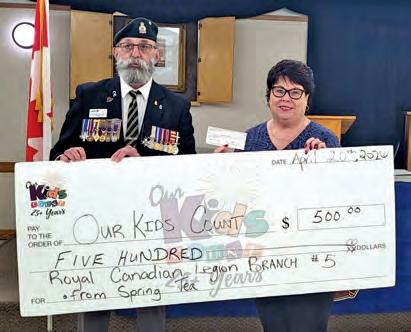
President George Romick of Port Arthur Branch in Thunder Bay, Ont., presents $500 to Our Kids Count, represented by Dorry Burak.
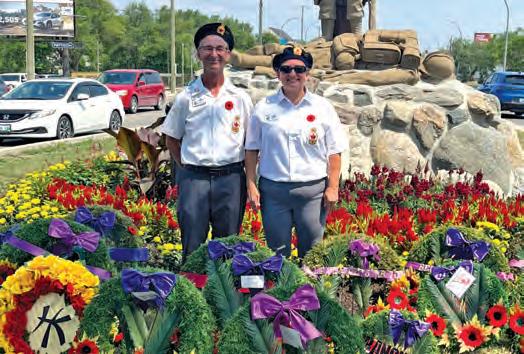
President Ken Fransoo and Sgt.-at-Arms Lisa Boone of Belgian Veterans Branch in St. Boniface, Man., attend a Belgian Independence Day ceremony at the Belgian Veterans War Memorial in Winnipeg.
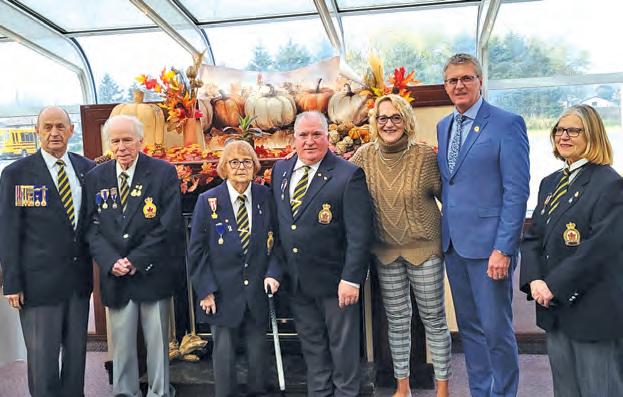
On behalf of the Northern Ontario Heritage Fund Corporation, Marci Watson and local MPP Kevin Holland present $323,900 to Slovak Branch in Thunder Bay, Ont., represented by First Vice David Verescak, Past President Vic Renouf, Levia Collins, President Larry De Coppi and Jeanetty Jumah.
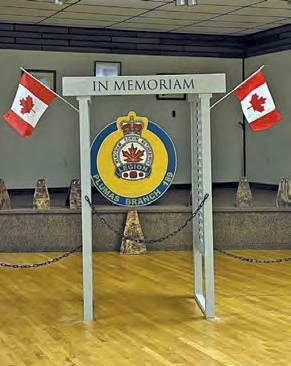
Plumas, Man., Branch unveils its indoor cenotaph for Remembrance Day.
President Doug Braman of Selkirk, Man., Branch presents $3,500 to the Manitoba Darts Association, represented by Steve Renn, to support Team Manitoba’s participation in the 2026 National Youth Darts Championships.
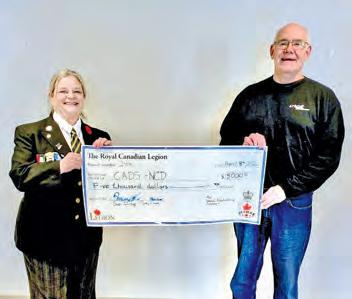
Susan Thomson-Lafosse of Perth-UponTay Branch in Perth, Ont., presents $5,000 to Canadian Adaptive Snowsports-National Capital Division, represented by Malcolm McKinley.
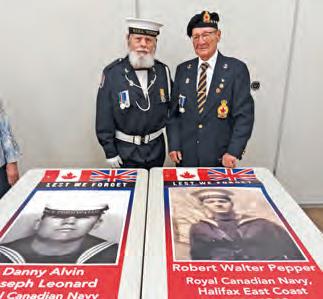
Dan Leonard and Bob Pepper of Metropolitan Branch in Windsor, Ont., stand with their memorial banners, which were displayed during the remembrance period.
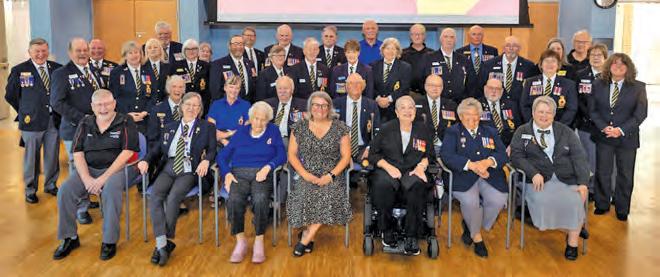
Members from Ontario Command branches attend the annual Perley Health Foundation information session in recognition of their support for veterans.
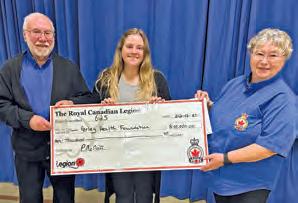
President Brian Goss and Wendy Ryan of Richmond, Ont., Branch present $10,000 to Perley Health Foundation, represented by Marija Shaw.
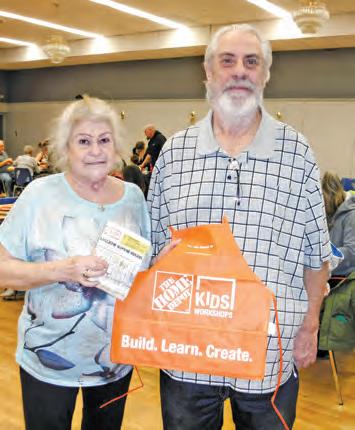
Oshawa, Ont., Branch holds a free children’s workshop on Family Day. Pictured are branch members and organizers Josie Waters and Andy Glover.
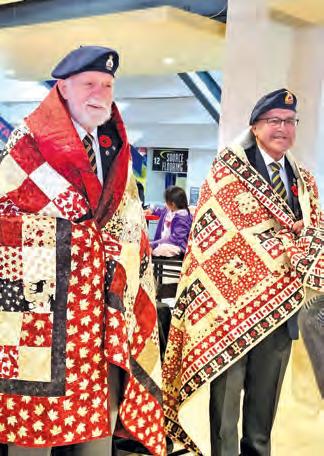
Bob Berg and Ernie Bremner of Fred Gies Branch in Kitchener, Ont., receive Quilts of Valour.
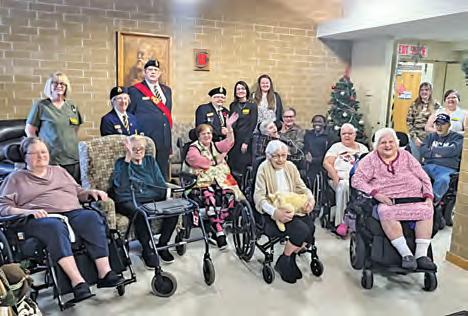
North Centennial Manor receives $11,712 from the Ontario Command Branches and L.A. Charitable Foundation for the purchase of new equipment.
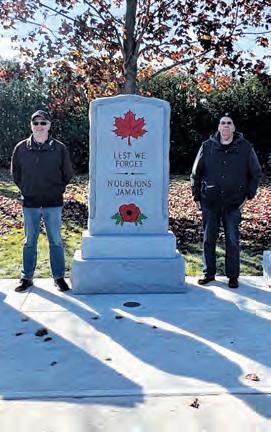
Rod Beswick and Walter Mackey of Sutton West, Ont., Branch unveil the town’s refurbished cenotaph.
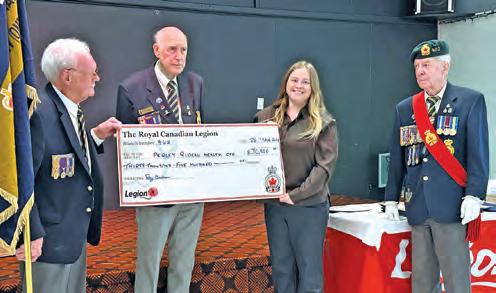
Treasurer Raymond Barker, Richard Campbell and Sgt.-at-Arms Raymond Hotte of Eastview Branch in Vanier, Ont., present $30,500 to Perley Health Foundation, represented by Marija Shaw.
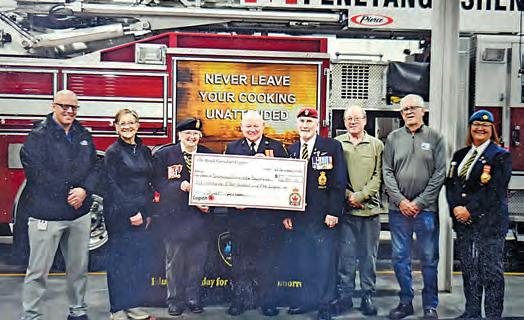
Members of Penetanguishene, Ont., Branch present $6,850 to the Penetanguishene Fire Department.
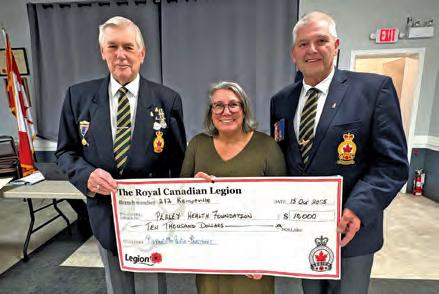
Bruce Harrison and President Bryan MacRostie of Kemptville, Ont., Branch present $10,000 to Perley Health Foundation, represented by Delphine
On behalf of Beaverton, Ont., Branch, Second Vice Colin Theodoru, President Joyce Summers and secretary Heather Hoover accept an Award of Merit from Township of Brock Mayor Mike Jubb and councillor Peter Frank.

Arlene Preston and President Linda Wyman of Greely, Ont., Branch present $5,000 to Perley Health Foundation, represented by Marija Shaw.
Northumberland-Kent District Commander John Evans presents Shayan Hoffarth with her provincial-level first-place National Youth Remembrance Contests certificate. THEA M cEVOY
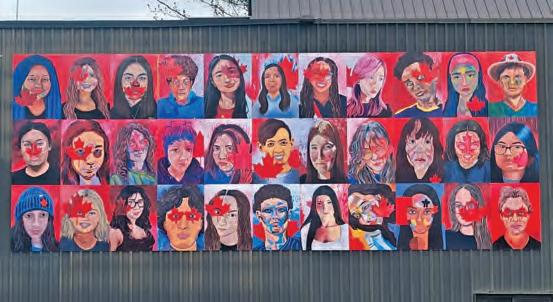
Col. Talbot Branch in Aylmer, Ont., unveils its new mural painted by students from East Elgin Secondary School.
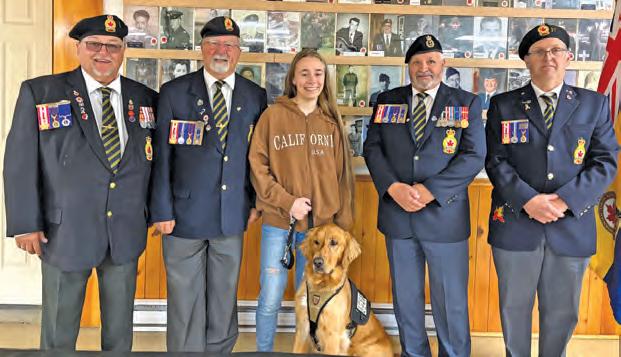
Donations from Dalhousie, N.B., Branch facilitated the training and housing of Rupert the service dog. Pictured with Rupert are Rene Landry Jr., Branch President Leigh Walsh, owner Breea Daigle, Claude Philippe and Second Vice Jean Pierre Diotte. MARY PHILLIPS
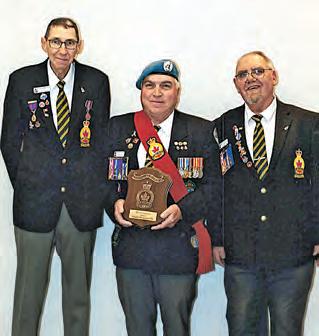
President Charles Richard and Richard Vautour of Cap Pele, N.B., Branch present Sgt.-at-Arms Michel Doiron with the Legionnaire of the Year award. CHARLES RICHARD
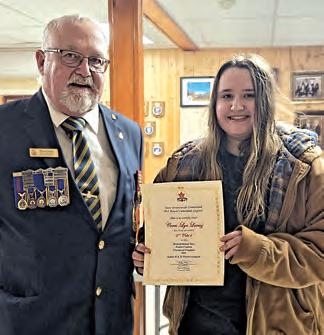
Royal District Commander Brian Eisan presents Corri-Lyn Lovasy with her branch-level second-place National Youth Remembrance Contests certificate. BRIAN EISAN
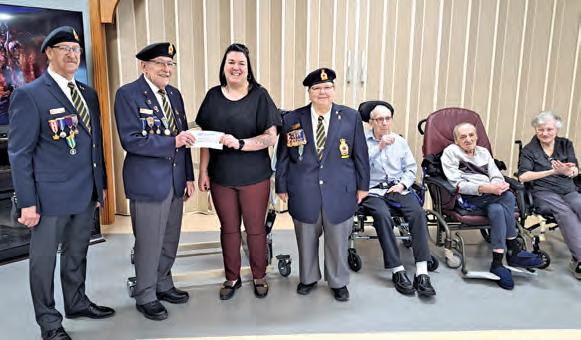
Treasurer Pat Cote, President Joe Leclerc and First Vice Lena Levesque of Grand Falls, N.B., Branch present $7,680 to Falls Villa, represented by general director Amelie Coyouette and residents Real Poitras, Louis Levesque and Nicole Cote. LENA LEVESQUE
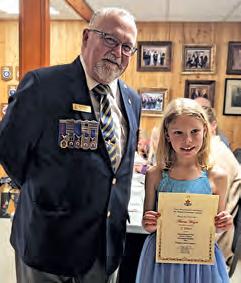
Royal District Commander Brian Eisan presents Aurora Wagner with her branch-level first-place National Youth Remembrance Contests certificate. BRIAN EISAN
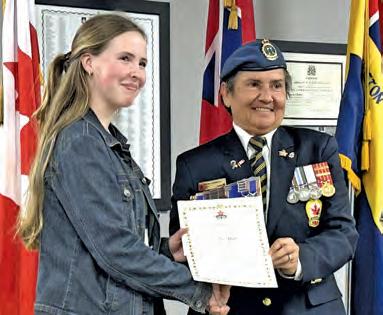
New Brunswick Command Second Vice Geraldine Lefebvre presents Zoe Meek with her provincial-level first-place National Youth Remembrance Contests certificate.
MICHEL LEFEBVRE
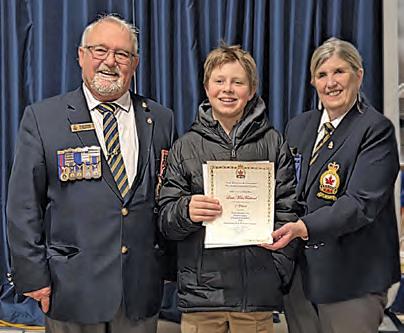
Royal District Commander Brian Eisan and Kathy Campbell of Peninsula Branch in Clifton Royal, N.B., present Lewis MacFarland with his branch-level first-place National Youth Remembrance Contests certificate. BRIAN EISAN
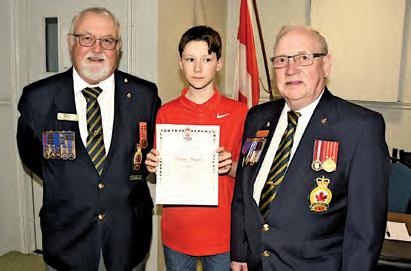
Royal District Commander Brian Eisan and Art Canavan of Kennebecasis Branch in Rothesay, N.B., present Mannix Meagher with his branch-level first-place National Youth Remembrance Contests certificate. BRIAN EISAN
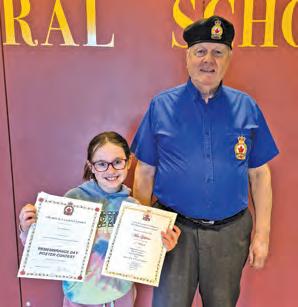
Bob Williams of Miramichi, N.B., Branch presents Mila Gillham with her provincial-level secondplace National Youth Remembrance Contests certificate. THEA M cEVOY
Perrier, Paul Duffy, Trevor Murphy and Marleen Benoit of Stephenville, N.L., Branch celebrate their victory in the provincial cribbage tournament.
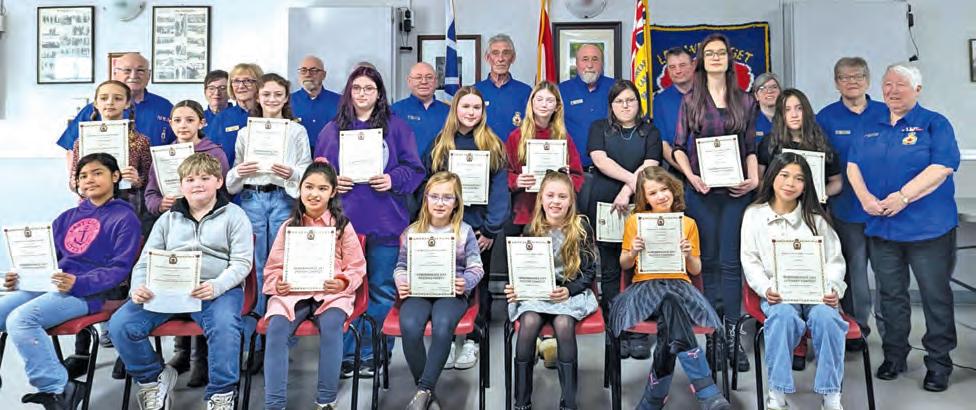
Members of Carbonear, N.L., Branch present certificates to National Youth Remembrance Contests winners from Carbonear Academy, Carbonear Collegiate, Persalvic Elementary, Perlwin Elementary and Tricon Elementary.
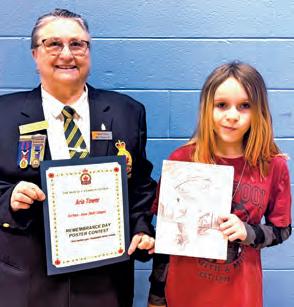
President Pheobe White of Port Blandford, N.L., Branch presents Aria Tower with her provincial-level third-place National Youth Remembrance Contests certificate.
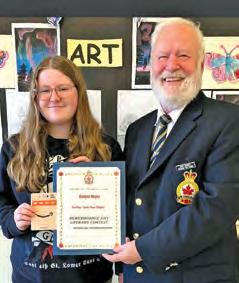
Gay Higgins of Burin, N.L., Branch presents Katelynn Murphy with her provincial-level secondplace National Youth Remembrance Contests certificate.
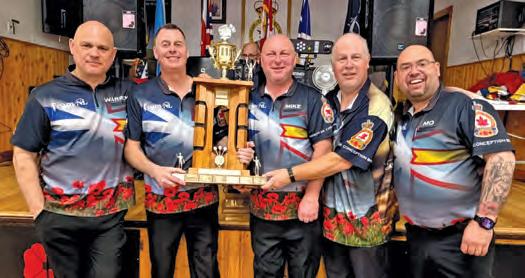
Warren Cheeseman, Rod Tobin, Mike Collins, Kevin Walsh and Mo Keeping of Conception Bay Branch in Kelligrews, N.L., celebrate their victory in the provincial darts tournament.
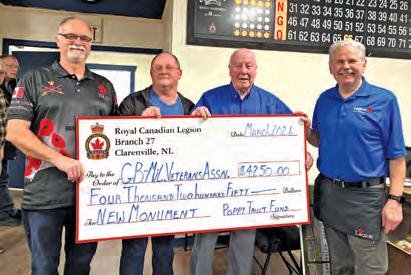
Cy McGettigan and Bill Meadus (both right) of Clarenville, N.L., Branch present $4,250 to the George’s Brook-Milton Veterans Commemoration Association, represented by Curtis Skiffington and Morgan Ellis, to support the construction of a new war memorial.
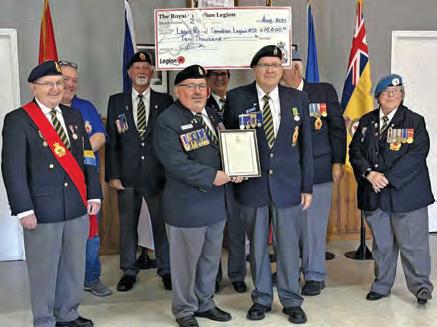
Members of Burin, N.L., Branch present $10,000 to Lawn, N.L., Branch toward building repairs.
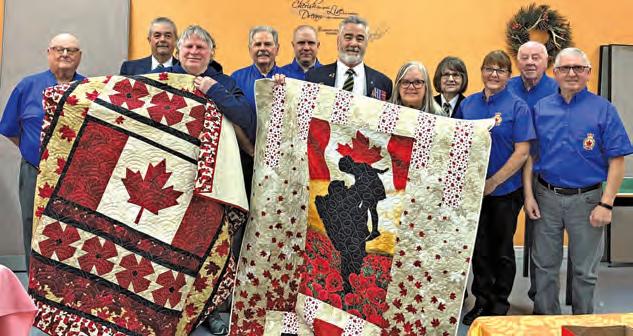
Clifford Peck and Andy Hart of Clarenville, N.L., Branch are presented with Quilts of Valour.
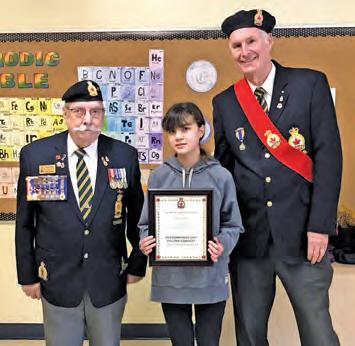
Zone 13 Commander Darryl Cook and Sgt.-at-Arms John Caulfield of Mahone Bay, N.S., Branch present Miya Ritchie of Bayview Community School with her first-place National Youth Remembrance Contests certificate. MICHAEL BROWN
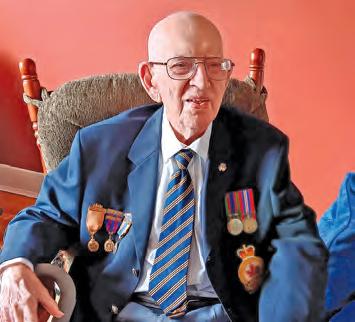
Sydney, N.S., Branch celebrates the 105th birthday of member Bud Maclean.
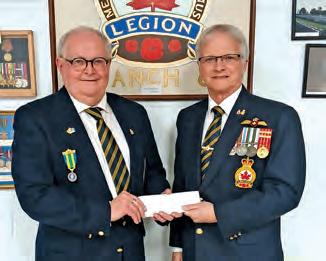
President Peter Mattatall (left) of Tatamagouche, N.S., Branch presents $1,090 to 596 Phoenix Squadron air cadet corps, represented by Spurgeon Stewart. CHRISTENA MATTATALL
Stephen MacLellan of Whitney Pier Branch in Sydney, N.S., presents $1,000 to Quilts of Valour, represented by Debra Lalonde-Gyorfi. MARY PHILLIPS
Gary Conrad of Mersey Branch in Liverpool, N.S., is presented with a Quilt of Valour. JANET WAMBOLDT
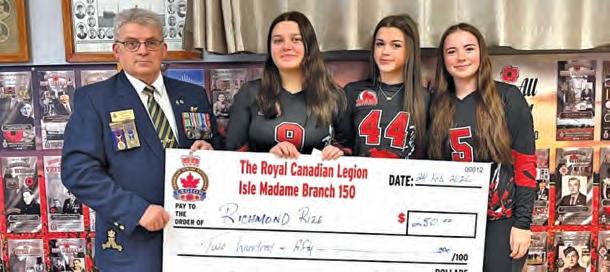
President Clive Samson of Isle Madame Branch in Arichat, N.S., presents $250 to Richmond Rize, represented by Avie Murphy, Maëlle d'Entremont and Bella Joyce, to support its participation in the 2026 Volleyball Canada Youth National Championships. BONNIE SAMSON
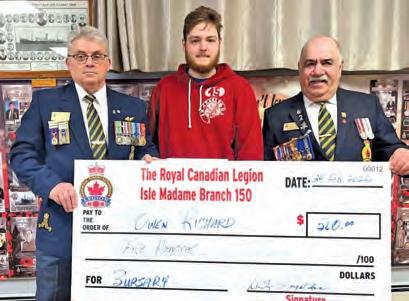
President Clive Samson and bursary chair Donald Goyetche of Isle Madame Branch in Arichat, N.S., present a $500 bursary to Nova Scotia Community College student Owen Richard. BONNIE SAMSON
Murray Crouse of Mersey Branch in Liverpool, N.S., is presented with a Quilt of Valour. JANET WAMBOLDT
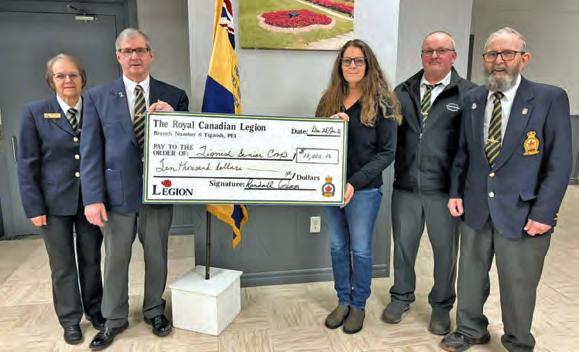
Marie Doyle, Stephen Gallant, President Randall Perry and Louis Richard of Tignish, P.E.I., Branch present $10,000 to the Tignish Seniors Home Care Co-Operative, represented by Penny McLeod.
President Randy Power and First Vice Anna Perry of Tignish, P.E.I., Branch present Anne Marie MacInnis with her provincial-level second-place National Youth Remembrance Contests certificate. Not pictured is first-place winner Holly Wedge.
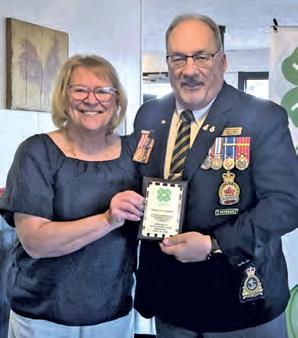
Jeanette Gallant of 4-H Canada presents a Friend of 4-H Award to Wellington, P.E.I., Branch, represented by Past President Mario Couture. MARIO COUTURE
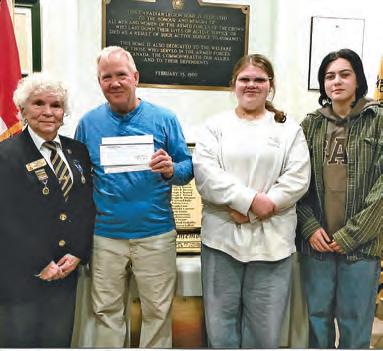
President Gayle Mueller of George Pearkes VC Branch in Summerside, P.E.I., presents $2,000 to Generation XX.
First Vice Irving Arsenault and President Gayle Mueller of George Pearkes VC Branch in Summerside, P.E.I., present $1,000 to the Society of Saint-Vincent de Paul, represented by John Wortman.
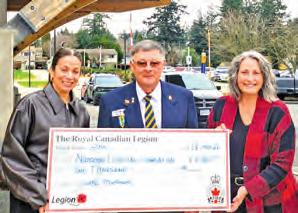
Robin Allen of Mount Benson Branch in Nanaimo, B.C., presents $2,000 to the Nanaimo & District Hospital Foundation, represented by Tina Moreira and Karen McCarthy. KIM ROGERS
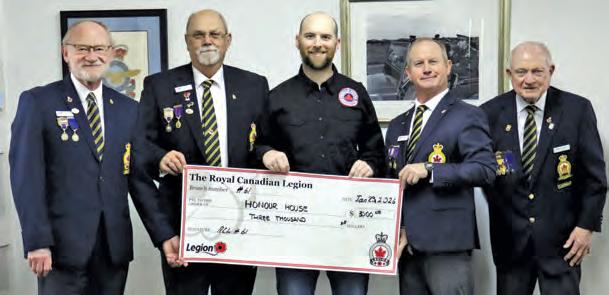
Past President Hugh Johnson, Second Vice Frank Taylor, Russel Ford and Gerry Bramhill of Delta, B.C., Branch present $3,000 to Honour House, represented by acting executive director Curt Appleby.
CORY RAINBOW
Past President Alain Chatigny of Campbell River, B.C., Branch presents $5,000 to 2943 army cadets, represented by Julia Warkentin.
Past President Alain Chatigny of Campbell River, B.C., Branch presents $5,000 to 54 sea cadets, represented by Lieut. (N) Mary Hannay.
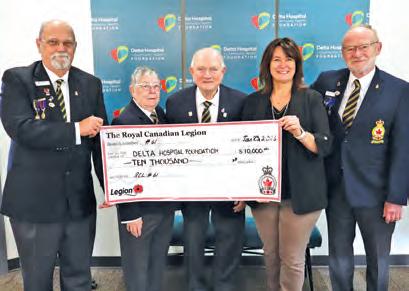
Second Vice Frank Taylor, Barbara Dyck, Gerry Bramhill and Past President Hugh Johnson of Delta, B.C., Branch present $10,000 to the Delta Hospital and Community Health Foundation, represented by Shari Barr. CORY RAINBOW
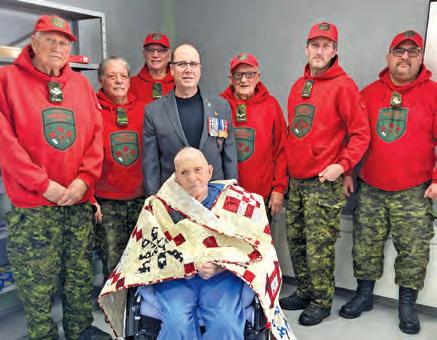
First Vice Daryl Bazin of Stony Plain, Alta., Branch and members of the Valleyview Ranger Patrol present a Quilt of Valour to Donald Gourlay of Valleyview, Alta., Branch. BERNIE OLANSKI
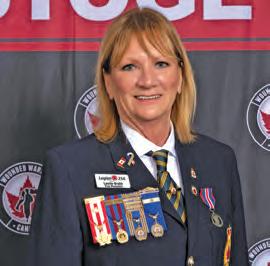
Past President Laurie Grubb of Mount Benson Branch in Nanaimo, B.C., is honoured by Wounded Warriors Canada for her contributions to the charity. KIM ROGERS
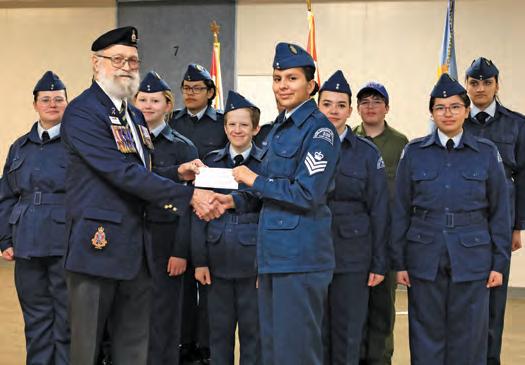
President Don Ebbett of High Prairie, Alta., Branch presents $3,000 to 539 air cadets, represented by Flt. Sgt. Kaliska Chalifoux.
President Tom Marks and Ray Wise of Lord Elgin Branch in St. Thomas, Ont., presented $500 to Second Stage Housing and $1,651.27 to the branch’s track and field program.
President Gayle Mueller of George Pearkes VC Branch in Summerside, P.E.I., presented John Gallant with the Legionnaire of the Year award.
President Gayle Mueller and First Vice Irving Arsenault of George Pearkes VC Branch in Summerside, P.E.I., presented $2,000 to the Salvation Army, represented by Paul Blake.
President Gayle Mueller of George Pearkes VC Branch in Summerside, P.E.I., presented $1,000 to Notre Dame Place, represented by Lila Buchanan.
President Gayle Mueller of George Pearkes VC Branch in Summerside, P.E.I., presented $475 to the IWK Foundation, represented by Barbi Holland.
MANITOBA-NORTHWESTERN ONTARIO
Manitoba-Northwestern Ontario Command L.A.
President Audrey McDonagh presented $2,000 to Manitoba-Northwestern Ontario Command, represented by its President Robert Cutbush.
BRITISH COLUMBIA/YUKON
Barbara Dyck and Gerry Bramhill of Delta, B.C., Branch presented certificates to National Youth Remembrance Contests winners from Hawthorne Elementary School.
Past President Hugh Johnson, Second Vice Frank Taylor, Gerry Bramhill and Russel Ford of Delta, B.C., Branch presented $1,000 to Delta Secondary.
NEWFOUNLAND AND LABRADOR
Members of Clarenville, N.L., Branch presented $10,000 to Lawn, N.L., Branch toward new heat pumps for the building.
Send your photos and news of The Royal Canadian Legion in action in your community to your Command Correspondent. Each branch and ladies auxiliary is entitled to two photos in an issue. Any additional items will be published as news only. Material should be sent as soon as possible after an event. We do not accept material that will be more than a year old when published, or photos that are out of focus or lack contrast. The Command Correspondents are:
BRITISH COLUMBIA/YUKON: Lindsay Petrie, 503 - 17665 66A Ave., Surrey, BC V3S 2A7, snapshots@legionbcyukon.ca
ALBERTA–NORTHWEST TERRITORIES: Andrea Legaspi, 2020 – 15 Street NW Calgary, AB T2M 3N8, abnwtsubmissions@abnwtlegion.com
SASKATCHEWAN: Tara Brown, 2267 Albert St., Regina, SK S4P 2V5, admin@sasklegion.ca
MANITOBA: George Romick, 320 Admiral Court, Thunder Bay, ON P7A 8B5, romickg@tbaytel.net
NORTHWESTERN ONTARIO: George Romick, 320 Admiral Court, Thunder Bay, ON P7A 8B5, romickg@tbaytel.net
ONTARIO: Julie Stephens, 2 Malibu Lane, Fenelon Falls, ON K0M 1N0, juliestephenslegion25@gmail.com
QUEBEC: Ron Kappert, 105-2727 rue St. Patrick, Montreal, QC H3K 0A8, PR_RP@qc.legion.ca
NEW BRUNSWICK: Alissa Eisan, Box 183, Moncton STN Main, NB E1C 8K9, nblegionphotos@gmail.com
NOVA SCOTIA/NUNAVUT: Mary Phillips, 319 East Broadway, South Bar, NS B1N 3J9, maryp7910@gmail.com
PRINCE EDWARD ISLAND: John Yeo, 657 Rte. 19, Meadow Bank, PE C0E 1H1, islander657@yahoo.ca
NEWFOUNDLAND AND LABRADOR: Brenda Slaney, Box 5745, St. John’s, NL A1C 5X3, bslaney@nfld.net
DOMINION COMMAND ZONES: EASTERN U.S. ZONE, Gord Bennett, 803-190 Cedar St., Cambridge, ON N1S 1W5, Captglbcd@aol.com; WESTERN U.S. ZONE, Douglas Lock, 1531 11th St., Manhattan Beach, CA 90266, douglock@fastmail.com
Submissions for the Honours and Awards page (Palm Leaf, MSM, MSA and Life Membership) should be sent directly to Legion Magazine, 86 Aird Place, Kanata, ON K2L 0A1 or branchnews@legion.ca.
DIGITAL PHOTOS—Photos submitted to Command Correspondents electronically must have a minimum width of 1,350 pixels, or 4.5 inches. Final resolution must be 300 dots per inch or greater. As a rough guideline, colour JPEGs would be between 0.5 megabytes (MB) and 1 MB.
PHOTO PRINTS—Glossy prints from a photofinishing lab are best because they do not contain the dot pattern that some printers produce. If possible, please submit digital photos electronically.
FRENCH INSERT—To receive a French insert of Legion Magazine content, please contact MagazineSubscriptions@legion.ca or call 613-591-3335.






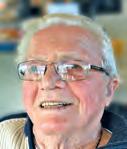

YVON BOUDREAU
Quebec North Shore Br., Baie-Comeau, Que.
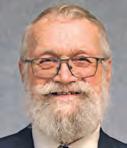
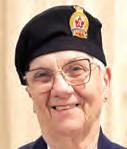


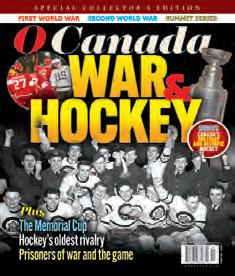
ONTARIO
GERRY HEATON
Oshawa Br.
STEPHEN BELL
Oshawa Br.
STU JARVIS
Oshawa Br.
KEN MANWELL
Smiths Falls Br.
RUTH MACKESY
Petrolia Br.
TOM MACKESY
Petrolia Br.
BRITISH COLUMBIA/YUKON
BRENDA THOMSON
Kamloops Br.
NOVA SCOTIA/NUNAVUT
LORNE MACKINNON
Ashby Br., Sydney
ALBERT (LARRY) WALL
Ashby Br., Sydney
MICO CROWE
Ashby Br., Sydney
BALKANS 35TH COMMEMORATION Seeking Balkans veterans willing to share their stories in a remote interview format for the purpose of educational and historical posterity. Please contact Paul Hale at chair@balkans35.ca.
CORRECTION
Page 77 of the March/April 2026 stated a $1 million donation was presented on behalf of Alberta-Northwest Territories Command. This donation was made on behalf of the Calgary branches.

By Alex Bowers
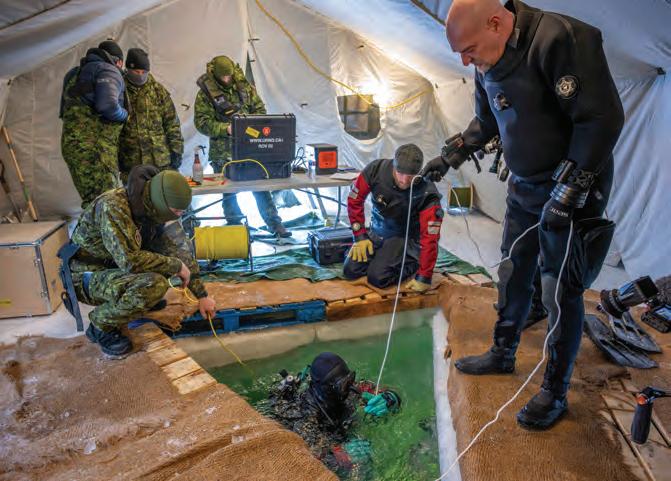
Major Tristan Alie, a medical specialist and cold-weather expert with the Canadian Armed Forces, has long understood the stakes of military inaction in the Arctic.
Like an ever-increasing number of compatriots, the Quebec-raised anesthesiologist recognizes that climate change is warming the Arctic three to four times faster than the global average; that new shipping routes will open as a result; and that foreign powers, friend or foe, loom large in discourse concerning the vast, unforgiving landscape at the country’s remote edge.
Alie also appreciates the CAF’s role in this. “What we need to realize and own is that Canada is NATO’s
Arctic expert,” he explained during a presentation at the Canadian Institute for Military and Veteran Health Research (CIMVHR) forum in October 2025.
“In all of NATO, we are the only ones that have the landmass and the sea-mass with, furthermore, populated communities, including populated military bases…that [are] equitable to one of NATO’s main adversaries: Russia.”
Asserting sovereignty and deterring foreign encroachment through the CAF’s growing northern presence, however, come with seldom-discussed hurdles from a medical standpoint.
“As we’re pushing more people up north,” said Alie, “we need to also make sure
Canadian Armed Forces members work with colleagues of the Belgian Explosive Ordnance Disposal and Destruction Service during a February 2025 exercise near Tuktoyaktuk, N.W.T.
that we’re able to care for them and bring them back home. No soldier wants to be wounded in operations, but unfortunately, working in the Arctic is dangerous.”
The Arctic environment itself poses one of the greatest threats to soldiers, including medics. “Cold weather,” continued Alie, “requires special equipment, techniques [and] training for troops; otherwise, operations and personnel will suffer, goals will become unattainable and efforts will become a matter of simple survival against the elements.”
Knowledge is key, asserted the major, whose experience in the Finnmark region of northern Norway helped inform his presentation. “What we need to do at this present moment is get our medics loaded on courses,” he said. “That will give them that proficiency to survive in those cold-weather environments.”
Factors from nutritional considerations to contingency preparedness—if a soldier falls through ice or needs to build a
shelter in a blizzard, for example—are vital for risk mitigation. “These are the kinds of training [components] that you need to know; to know how to look after yourself even before you can provide medical care.”
Nevertheless, precautionary measures can only stretch so far. Alie used blood as an example of the logistical complexities encountered in the Arctic, noting that it “has to be kept in very tight temperatures between one to six degrees Celsius. And also, once it leaves the blood bank, it lasts for about 21 to 28 days.”
Figures from June 2025 suggested that there were 16 units of blood readily available to CAF personnel operating in the Arctic, 12 units of which were located in Iqaluit, two in Cambridge Bay and two in Rankin Inlet.
“A trauma patient, when they do require blood, requires about anywhere from two to eight units,” said Alie, comparing that to the approximately 150 units of blood held at Ottawa’s Civic Hospital—a trauma centre—and the 50 units at the city’s Hôpital Montfort, which doesn’t handle trauma cases.
Dried plasma and airdrops, albeit not without their own limitations in a capricious Arctic climate, were mooted as potential solutions to partly address transfusion constraints.
“We certainly hear a lot about drones,” added Alie, “but they’re not necessarily the easy fix button.”
Starker still were the realities of evacuating the wounded when point-ofinjury trauma aid proved insufficient. In acknowledging a “big capability gap amongst NATO countries,” Alie insisted that “we can’t use a one-size-fits-all approach in terms of transporting these casualties,” namely
due—once again—to unpredictable climatic conditions. Compounding the issue is the deterioration of the CAF’s northern infrastructure.
According to an evaluation of Arctic operations published by the government in October 2024 prior to recent investment announcements, military structures were “well below the CAF average and, without intervention, will soon move to the ‘rust out’ stage.” For instance, of 102 Arctic airfields—many of which were deemed “outdated”—less than 48 per cent could accommodate the admittedly large, but notably versatile CC-130 Hercules, with only 13 per cent usable for the CC-177 Globemaster.
medical or surgical assets further forward,” even temporarily within smaller health centres. Such practices could play into the role of “medical diplomacy…ensuring that we still maintain that tight relationship with our communities up north because the Rangers are so essential, as we all know and appreciate in terms of our efforts right now.”
Of course, beyond a military context, that same medical diplomacy could help tackle wider challenges related to regional medical services— or lack thereof—that have disproportionately affected local Indigenous populations. The extent to which it could offset systemic failings is another question.
“As we’re pushing more people up north, we need to also make sure that we’re able to care for them and bring them back home.”
Nor did structural assets fare well on a broad scale, 81 per cent of which were more than 30 years old, while 38 per cent of buildings were over 50 years old. The government has since pledged to increase the military’s Arctic footprint through infrastructural upgrades, among other commitments.
Complications persist beyond physically evacuating patients, many of whom could sustain wounds outside of CAF bases and airfields.
“There are only three hospitals with surgical capabilities in the North,” said Alie: “Iqaluit, Whitehorse and Yellowknife. If you look at a map, there’s a big empty space with no surgical care, and we need to be able to fill the void.”
Alie suggested that authorities could “bring some of our
Establishing medical equipment caches throughout the Arctic could be another option, although Alie conceded that concerns remain surrounding the prolonged functionality of certain apparatuses, including ventilators, in the dry climate. “These are all things that we need to trial,” he explained.
With momentum underway, Alie spoke exclusively to Legion Magazine about his future outlook. “My vision is that working in an Arctic environment should be no different than doing any other kinds of exercises. It shouldn’t be seen as this gargantuan task if we provide the progressive, evolving training.”
Calling cold-weather operational readiness “not optional,” Alie equally hopes that “from a medical perspective, we’re there for the soldier.”
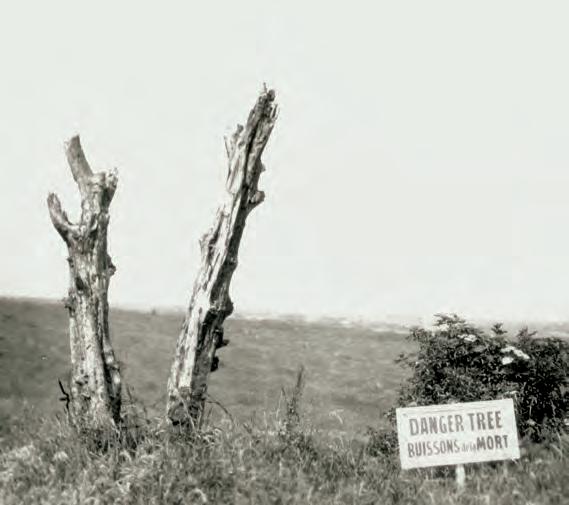
By Richard Foot
A cherished symbol of sacrifice gets a new lease on life
is perhaps Newfoundland and Labrador’s most famous wartime icon. Certainly, it’s a symbol of profound sorrow among a people well-acquainted with loss and hardship.
For more than a century, the Danger Tree, or a version of it, has stood amid the green expanse of the BeaumontHamel battlefield in northern France as a stark reminder of precisely where so many Newfoundlanders died.
On June 30, the eve of the 110th anniversary of the Battle of Beaumont-Hamel, a new version of the Danger Tree was unveiled at the site.
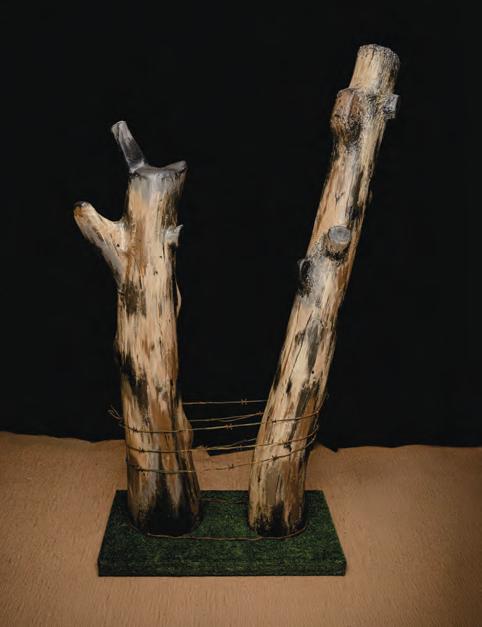
This one, crafted with attention to historical detail at Memorial University in St. John’s, is intended to provide a permanent battlefield replica of the original tree.
When Britain, and automatically Canada, went to war against Germany in August 1914, Newfoundland, then a separate British dominion, had no army or militia. More than 500 volunteers were hastily trained, outfitted and sent overseas as part of the fledgling Newfoundland Regiment. The Newfoundlanders fought first at Gallipoli in 1915, then transferred to France.
On July 1, 1916, British and French forces launched the Somme offensive, aimed at breaking the stalemate in the muddy trenches of the Western Front. The fighting on the Somme would grind on for almost five months. But its deadliest day was July 1—the bloodiest in British military history. That morning, about 800 troops of the Newfoundland Regiment were waiting for their turn to join the assault from a support trench known as St. John’s Road, behind the front line. Already the attack was going badly. The Allies had lost the element of surprise, and hours of British shellfire had neither destroyed the
rows of barbed wire protecting German trenches nor killed the men sheltering in deep dugouts beneath.
When the Newfoundlanders reached the front line, the area was still laden in barbed wire and clogged with dead or wounded soldiers from the initial waves of the attack. As they attempted to cross no man’s land, they too were cut down by German machine-gun fire. And nowhere was the fire as intense as at the prominent remnants of a shattered tree, nicknamed the Danger Tree.
The attack was devastating to the regiment: only 68 of the 800 Newfoundlanders answered rollcall the following morning. The Newfoundland Regiment was effectively wiped out, its 710 dead, missing or wounded soldiers among the more than 57,000 overall British casualties on July 1.
Incredibly, the regiment was reconstituted with additional Newfoundland volunteers and would go on to fight in France and Belgium throughout the war. After the Armistice, it fell to Lieutenant-Colonel Thomas Nangle, the regiment’s chaplain, to identify the graves of Newfoundland soldiers and commemorate their sacrifice.
As the Newfoundland government’s director of war graves, registration, enquiries and exploit memorials, Nangle was determined to honour the memory of those he served with. He was instrumental in acquiring and planning what is now called the Beaumont-Hamel Newfoundland Memorial.
It’s arguably one of the most evocative battle sites in Europe: the original trench lines are well preserved, and the site is dominated by an impressive caribou statue—above plaques listing the names of the dead— symbolizing Newfoundland’s sacrifice. And amid the now
The original battle-worn tree, believed to have been an old apple tree, decayed long ago and was replaced over the decades by various replicas.
verdant killing field stands the Danger Tree.
The original battle-worn tree, believed to have been an old apple tree, decayed long ago and was replaced over the decades by various replicas, none of which stood the test of time. Veterans Affairs Canada hopes this year’s replacement will now be permanent.
In building a new replica, the department found an eager partner in Memorial University, originally founded as a living commemoration to Newfoundland’s wartime sacrifices. There, the task was taken up by the school’s department of technical services.
“When my supervisor first mentioned this project to me, I said, ‘Oh man, I want to be a part of that for sure,’” noted machinist Chris Ryan, who typically spends his days creating parts for oil and gas research or other engineering projects.
Ryan and fellow machinist Simon Ernst relied on an old, black-and-white photograph of the original Danger Tree found in the university’s archives. The picture was taken by Lieutenant-Colonel Nangle in the early 1920s during a memorial-planning visit to Beaumont-Hamel.
Using Nangle’s image, Ryan and Ernst created a 3D computer model of the tree to guide their construction of the replica out of high-density, polyurethane particle board.
St. John’s artist Brittany Mitchell painted the new tree with battle-scarred markings, before it was finished
in fibreglass and sealed with a UV-resistant clear coat to withstand the elements of northern France.
“It’s a pretty robust design,” Ryan told Legion Magazine “They should get a good life out of it.”
Ryan said he was “honoured” to have played a small role in a revered part of his province’s history. His greatgrandfather served in the First World War, signing up with the Newfoundland Regiment after the fighting at Beaumont-Hamel.
Ryan’s grandfather Bernard Long was president of The Royal Canadian Legion’s Pleasantville Branch in St. John’s and his grandmother Nita still volunteers there today.
“They really instilled in me the importance of remembrance,” said Ryan. “They brought me to all the remembrance parades. And I’ve always been a history buff. For my undergraduate degree I did a double major in history and German literature and culture.”
In May, the new Danger Tree was loaded onto a Royal Canadian Air Force transport in St. John’s and flown to France. VAC unveiled it in a ceremony at BeaumontHamel on June 30.
“It’s a pretty amazing thing to have been a part of,” said Ryan. “That tree was as far as the regiment got on that particular day. The loss of life—and the wider significance of that day—resound strongly in the hearts of Newfoundlanders.”
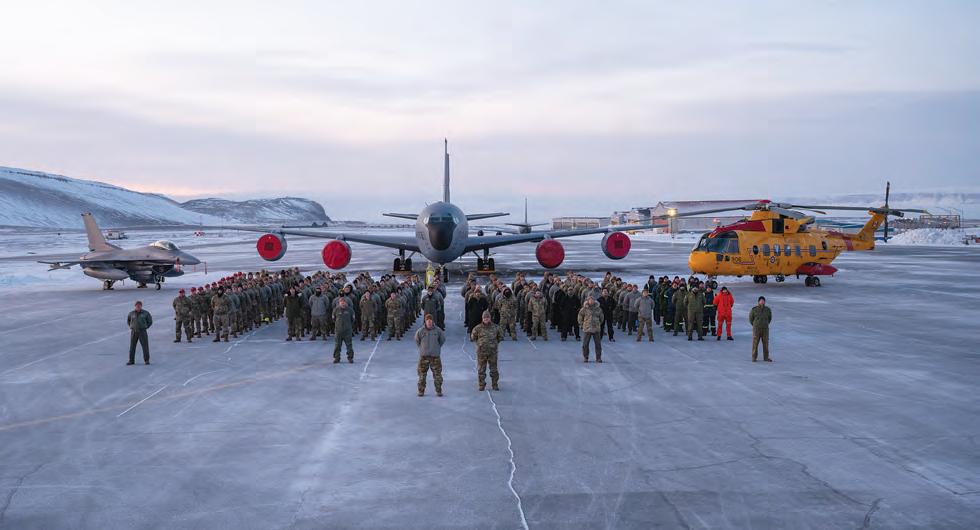
By J.L. Granatstein
Why, despite recent tensions, the Canada-U.S. North American Air Defense Command is still critically important
The recent debate about the merits of the F-35 and the Gripen E fighter jets has highlighted considerations about how Canada plans to reconstitute its air defences. And because that decision impacts the country’s role in the North American Aerospace Defense Command (Norad), it’s critically important. But what exactly is Norad and why does it matter?
Before 1957, Canadian and American air forces had no formal co-operation agreement, despite their shared
Cold War hostility to the Soviet Union. At the time, the U.S.S.R. had hundreds of long-range bombers and some 1,600 nuclear warheads. And if the Soviets were to attack Canada or the U.S., the most likely route would cross the Arctic and proceed south over Canada. The Royal Canadian Air Force and the U.S. Air Force felt that an integrated air defence was essential. Negotiations took place between the government of Prime Minister Louis St-Laurent and the
administration of U.S. President Dwight D. Eisenhower, and the details had been hashed out by the time John Diefenbaker’s Progressive Conservatives were elected in 1957. Urged to do so by General Charles Foulkes, chair of the chiefs of staff committee, the new prime minister signed the agreement on May 12, 1958. Norad was to be headquartered in Colorado with an American commander, while the deputy would always be Canadian; the RCAF’s Norad HQ would be in North Bay, Ont. Surprisingly, the Liberals were highly critical of the alliance, despite the fact that they had, for all practical purposes, sealed the deal. That annoyed Diefenbaker, and his resentment likely contributed to his fury when the Cuban Missile Crisis erupted in October 1962. The Soviet Union had secretly moved nuclear missiles to Cuba, just some 150 kilometres from the southern tip of
Florida. After the Americans discovered the weapons, President John F. Kennedy demanded they be removed and he put his military on high alert—including U.S. aircraft in Norad. The Americans expected Canada would do likewise.
Although he had been briefed on the matter by U.S. officials, Diefenbaker initially refused. Defence Minister Douglas Harkness argued with him but was rebuffed; Harkness nonetheless quietly put RCAF fighters on alert. Diefenbaker later agreed to the move, but the Kennedy administration was furious, as were many members of cabinet. Shortly thereafter, Diefenbaker’s government couldn’t agree on the acquisition of nuclear warheads for recently purchased BOMARC missiles that were intended to destroy attacking bombers. With his cabinet split on the issue, Diefenbaker’s government lost two non-confidence motions in February 1963 and an election was called. Norad’s two first challenges had played roles in the party’s defeat.
The Liberals won the subsequent election and for years there were no ructions. Norad tweaked its name in 1981, to Aerospace from Air, and added missile surveillance and warnings to its tasks. In the ensuing years, the alliance was tight knit. So much so, that when the Canadian deputy commander happened to be in charge at Norad’s Colorado HQ during the 9/11 terrorist attacks on New York and Washington, no one complained.
But difficulties were brewing. In 2005, Prime Minister Paul Martin’s Liberal government had refused to join a U.S. missile defence program. Surprised, the Pentagon gave the responsibility for it to a command other than Norad. There was a growing sense in Washington that Ottawa
wasn’t playing—or paying for—its share in the defence of North America. These concerns increased as Russia and China bolstered their arms production and took greater interest in the Arctic. The U.S. felt it was taking defence seriously; it believed the Canadians seemingly did not.
The Canadian Armed Forces have limited resources in the North—a signals intelligence station at Alert, Nunavut, satellites, a few hundred army regulars, some 4,800 Canadian Rangers, two decades-old icebreakers, 14 surveillance aircraft (for the entire country), and 40-plus-year-old CF-18 fighter jets. The U.S., meanwhile, has an airborne division and modern F-22 and F-35 fighters in Alaska. Canada is, however, beginning to upgrade its crucial Norad radars. In 2022, Ottawa pledged $38.6 billion over 20 years for modernized radar and surveillance systems and, in 2025, it purchased overthe-horizon radar systems from Australia, the first phase of which is slated to be operational by 2029 and complete by 2043. Within a decade, the country promises to have new submarines, too, as well as more troops and new fighter jets. But the current lack of military resources in Canada’s North makes Norad all the more important.
Indeed, the RCAF and USAF continue to work together patrolling the North and the Arctic, monitoring Russian military aircraft flying near North American airspace and, in early 2023, even tracking and shooting down a Chinese spy balloon. The balloon, 60 metres high and carrying equipment weighing some 900 kilograms, crossed over Alaska, the Yukon and B.C., then moved diagonally across most of the U.S. before being destroyed near South Carolina.
When the Canadian deputy commander happened to be in charge at Norad’s Colorado HQ during the 9/11 terrorist attacks, no one complained.
Should the RCAF have destroyed the balloon over Canada? “That’s just silly,” University of Calgary history professor David Bercuson told CBC at the time. “That just completely ignores the fact that Norad exists [and] that we’re part of it….” Norad handled the issue appropriately, monitoring the balloon, assessing its characteristics and downing it where it couldn’t cause damage and could be further analyzed.
In the process, U.S. air force jets entered Canadian airspace acting under the Norad agreement. If RCAF aircraft had been required in American territory, that too would have occurred. If the U.S. aircraft had been grounded for any reason, Canadian planes would have been tasked for the job. In other words, both countries control their own airspace, but both air forces respond to the directions of Norad commanders. No permission is needed. Both Canadian and American interests are served by the alliance.
Air and space warfare have changed dramatically in recent years, and Norad has adapted—and must continue to do so. That requires Canada to do its part in defending the continent it shares with the U.S. That may be expensive, but the country’s national security demands that Norad remains a priority.
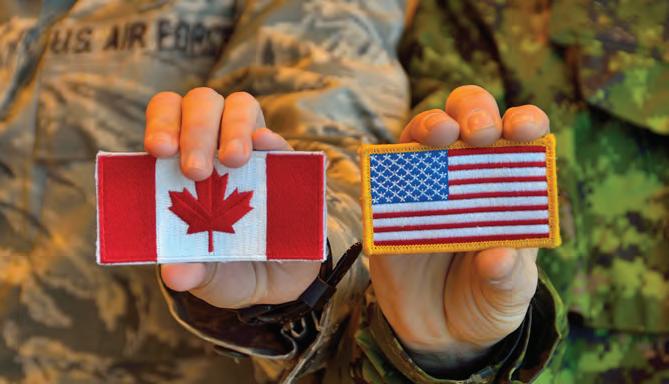
By Richard Shimooka
What the future holds for Norad
Canada-U.S. relations are arguably at their lowest point since the 19th century, spurred on by bluster and tariffs from the Trump administration. The Carney government, riding a wave of resurgent nationalism in the wake of the provocations, has made great fanfare of its efforts to revitalize Canadian security and, in particular, the defence of the Arctic.
Part of this is rooted in the government’s stance that Canada can no longer rely on the U.S. as a strong ally, and that the country needs to reassert its sovereignty to thwart any perceived aggression from Washington. Despite the divergence between the two states’ foreign relations, there’s clear symmetry in their defence priorities. The U.S. national security establishment has become increasingly concerned with the state of continental defence due to obsolete, late-20thcentury sensor architecture
and new threats. This was reflected in recent spending announcements for new detection systems, missile interceptors and advanced networking. Canada’s decadeslong flat or decreasing defence spending and an increasing reliance on U.S. capabilities became significant irritants in bilateral affairs.
Trump’s second administration has placed even greater priority on continental defence, hailing it as a centrepiece of its security policy. Its focus is collectively known as the Golden Dome for America (GD4A), which includes several new systems and strategies. The best indicator of the administration’s prioritization of GD4A is evident in the U.S. government budget request for 2027: U.S. Space Force, the lead in developing and deploying the majority of its capabilities, is in line for a 124 per cent increase in year-over-year spending—nearly double that of any other service.
Canadian and American military members exchange their flags during an exercise in Goose Bay, N.L.
Driving this change is a dramatic rise in potential threats. Arms control initiatives such as the New START and the Anti-Ballistic Missile treaties ended during a period of substantial growth in the quantity and variety of strategic weapon capabilities. It’s estimated that China will complete a five-fold increase in its nuclear weapon stock this decade, from approximately 200 warheads to 1,000 by 2030. Russia, which already possessed a large strategic nuclear force of land- and submarine-launched ballistic missiles, has started diversifying its delivery systems, and now has an impressive cruise-missile capability.
Beyond traditional strategic systems, many adversaries also now have asymmetric capabilities, such as drone swarms. Russia has demonstrated its willingness to use such weapons in the airspace of NATO allies. And there are maritime- and cyber-domain technologies that can also be employed to attack targets in North America. Both Canada and the U.S. are facing more diverse and lethal threats.
The momentum behind a bilateral modernization program isn’t new. It reflects how co-operation is essential to continental security. Canada doesn’t have the economic resources or technological means to defend its vast territory, much less the entire continent. Similarly, the U.S. can’t effectively defend all of North America from its adversaries without working with Canada, which buffers the lower 48 states. Functionally, the bilateral relationship remains extremely strong, as both sides understand the importance of their mission and what each has to contribute.
Belatedly appreciating its importance to bilateral relations, Canada unveiled a $38.6-billion Norad modernization plan in 2022. This has come to include several initiatives: acquiring 88 F-35 fighters; building four overthe-horizon radar sites to cover the North; acquiring eight CC-330 Husky aerial refuellers; and, in the future, adding early warning aircraft. Canada has also stated its willingness to be a part of an integrated air-and-missile defence, essentially abandoning its Paul Martin-era opposition to such a system. As these efforts are implemented, they will enable Canada to shoulder a more equitable share of the continental defence burden.
The Trump administration has similarly outlined an ambitious vision for continental defence within GD4A, including more missile interceptors and sensor systems. However, the signature program is undoubtedly the space-based initiative that envisions a permanent capability to defend North America from intercontinental ballistic missiles. Details about the system’s cost (estimated at more than $500 billion), schedule and feasibility remain in question, but the concept itself reflects the administration’s ambition in this area.
Overall, the guiding approach for these new systems has been affected by an ongoing broader defence strategy referred to as multi-domain battle or joint all-domain command and control. This involves interlocking sensors combined in a unified network that are analyzed by advanced AI algorithms to increase Norad’s ability to detect, track and identify, and potentially respond to, the diverse threats the continent now faces. The key to any part of this system will be the ability to exchange data seamlessly, which will provide each capability with greater battlefield awareness. This is a critical reason why the Royal Canadian Air Force selected the F-35, and it continues to guide the acquisition of new Norad systems. In this vein, perhaps the most critical program for Norad’s future is the airborne moving target indicator (AMTI), a planned constellation of satellites that will initially provide continuous, real-time airborne early warning below Arctic latitudes. While AMTI potentially heralds a revolution for air domain awareness, it hasn’t been without controversy. The Pentagon wants
to divest itself of its existing fleet of early warning aircraft, the nearly half-century-old E-3 Sentry, without a direct replacement since AMTI is intended to provide a similar capability. This is potentially an opportunity for Canada to develop an alternative that would bridge the gap, especially if AMTI is delayed and no U.S. early warning aircraft replacement is forthcoming. Despite the Trump administration’s hostility toward Canada and the plummeting attitude of Canadians toward the U.S., there’s likely to be significant impetus in the future to continue and even enhance Norad’s capabilities. While other aspects of Canada-U.S. relations may be turbulent going forward, the alignment on security and defence that underpins Norad will ensure the 70-year-old defence organization endures. Even if the space-based interceptor or AMTI don’t fully materialize in the coming decades, other programs will eventually encompass a much more capable and robust defence capability that’s able to meet the new and emerging threats of the 21st century.




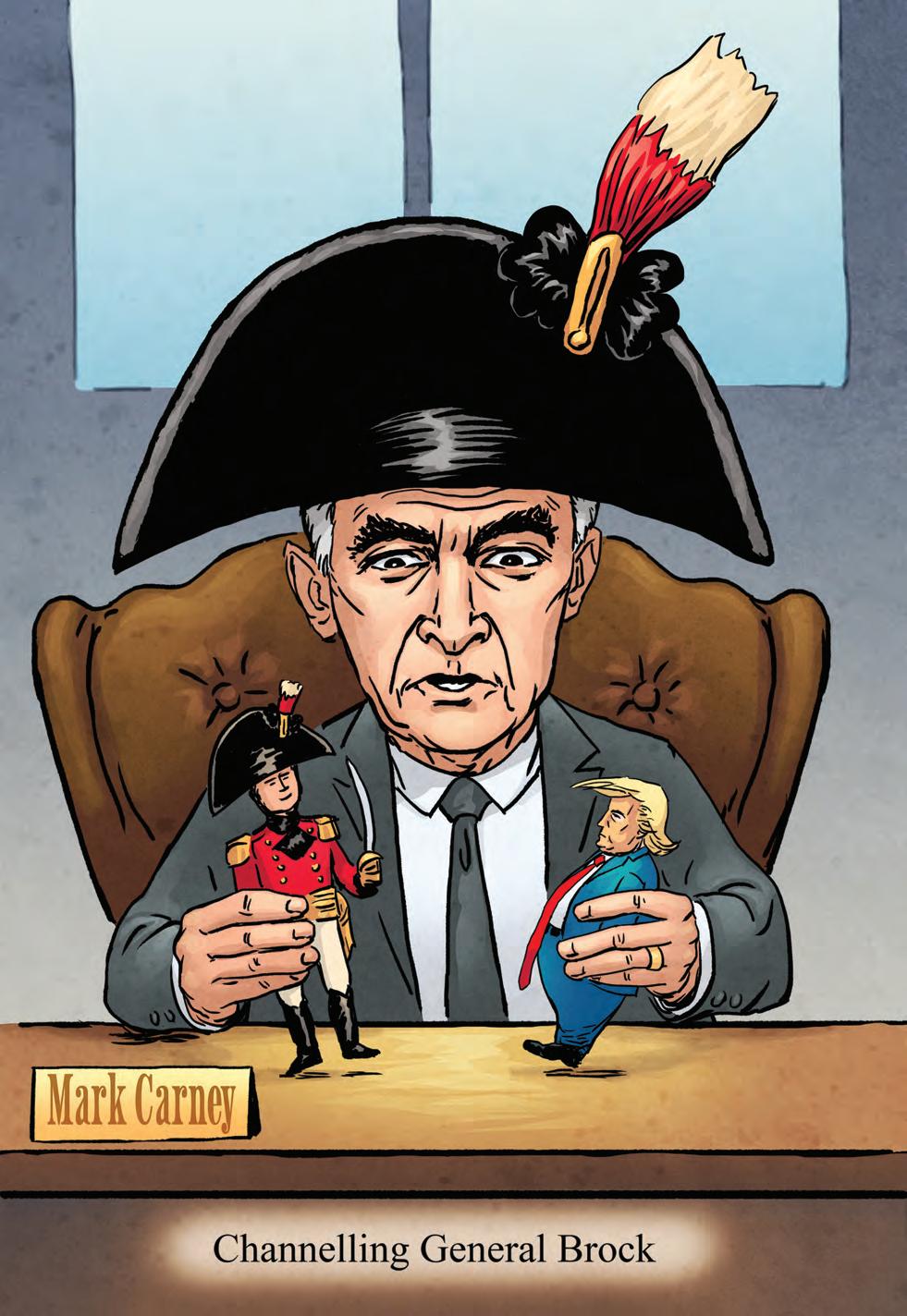

> Exclusive savings for Legion members on plans and phones.
> Canada’s best 5G+ network*
> A dedicated team of experts to guide and support you.