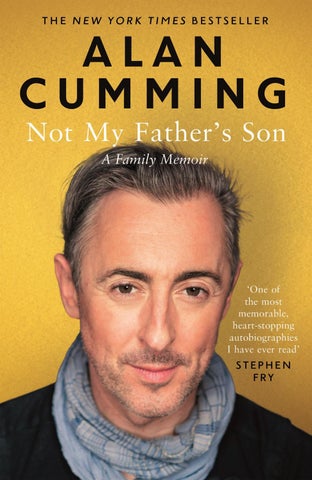
NOT MY FATHER’S Not My Father’s Son SON ‘This year’s best memoir’ The List ‘Cumming is a good writer and keeps us guessing . . . He knits together the various strands of his life with remarkable assurance . . . What might have been a misery memoir is anything but. The bracing honesty and humour plus the fact that there is not a scintilla of selfpity makes this a tremendously encouraging book’ Daily Express ‘A haunting family history woven with empathy’ Independent on Sunday, Best Memoirs of 2014 ‘A clear-eyed, often moving account of both his terrifying childhood and his recent attempts to come to terms with his past . . . Not My Father’s Son moves elegantly and with an occasional dash of humour between Cumming’s childhood and the revelations of the more recent past . . . memorable’ Chicago Tribune ‘Powerful and shocking . . . That he can write isn’t a surprise . . . He delves into his own history and leaves no stone unturned, no dark corner unprodded . . . What Cumming knows better than most is that you can never tell from the surface what’s going on beneath’ Scotland on Sunday ‘Cumming’s eccentric style and assured voice shine brightly on every page, while escorting readers and fans on a memorable journey that 224JJ_offset.indd 1
511KK_tx_B.indd 1
is simultaneously insightful, brave, moving, and witty’ Booklist
14/08/2014 10:14
13/02/2015 09:22
C
511KK_tx_B.indd 2
13/02/2015 09:22
Part One
THEN AND NOW
511KK_tx_B.indd 1
13/02/2015 09:22
Y
bl
st
to
h
th
so
w
ti
w
ga
B
an
To
224JJ_offset.indd 2
511KK_tx_B.indd 2
14/08/2014 10:14 224JJ_offset.indd
13/02/2015 09:22
THEN THEN
YY
ou ou need need a haircut, a haircut, boy!” boy!” MyMy father father hadhad only only glanced glanced at me at me across across thethe kitchen kitchen ta- ta-
bleble as he as he spoke spoke butbut I had I had already already seen seen in his in his eyes eyes thethe coming coming storm. storm. I tried I tried to speak to speak butbut thethe fearfear thatthat now now engulfed engulfed meme made made it hard it hard to swallow, to swallow, andand all all thatthat came came outout waswas a little a little gasping gasping sound sound thatthat hurt hurt mymy throat throat even even more. more. And And I knew I knew speaking speaking would would only only make make things things worse, worse, make make himhim despise despise meme more, more, make make himhim pounce pounce sooner. sooner. That That waswas thethe worst worst bit,bit, thethe waiting. waiting. I never I never knew knew exactly exactly when when it would it would come, come, andand that, that, I know, I know, waswas hishis favourite favourite part. part. As As usual usual we we hadhad eaten eaten ourour evening evening meal meal in near in near silence silence un-until my til my father father hadhad spoken. spoken. Until Until recently recently mymy older older brother, brother, Tom, Tom, would would have have been been seated seated where where I was I was now, now, helping helping to deflect to deflect thethe gaze gaze of impending of impending rage rage thatthat waswas now now focused focused entirely entirely upon upon me.me. ButBut Tom Tom hadhad a job a job now. now. HeHe leftleft every every morning morning in ainshirt a shirt andand tie tie andand ourour father father hated hated himhim forfor it. Tom it. Tom waswas no no longer longer in his in his thrall. thrall. Tom Tom hadhad escaped. escaped. I hadn’t I hadn’t been been so lucky so lucky yet.yet.
14/08/2014 10:14 224JJ_offset.indd 3
511KK_tx_B.indd 3
14/08/2014 10:14
13/02/2015 09:22
NOT MY FATHER’S SON
My mother tried to intervene. “I’ll take him to the barber’s on
un
Saturday morning, Ali,” she said.
m
“He’ll be working on Saturday. He’s not getting away with
be
slouching off his work again. There’s too much of that going on
bu
in this house, do you hear me?”
w
“Yes,” I managed.
so
But now I knew it was a lost cause. It wasn’t just a haircut, it was now my physical shortcomings as a labourer, my inability to
es
perform the tasks he gave me every weekend and many evenings,
w
tasks I was unable to perform because I was twelve, but mostly
er
because he wanted me to fail at them so he could hit me.
kn
You see, I understood my father. I had learned from a very
th
young age to interpret the tone of every word he uttered, his
In
body language, the energy he brought into a room. It has not
la
been pleasant as an adult to realise that dealing with my father’s
si
violence was the beginning of my studies of acting.
w
“I can get one tomorrow at school lunchtime.” My voice trailed
po
off in that way I knew sounded too pleading, too weak, but I
to
couldn’t help it.
co
“Yes, do that, pet,” my mum said, kindly.
m
I could sense the optimism in her tone and I loved her for it. But I knew it was false optimism, denial. This was going to end
h
badly, and there was no way to prevent it.
pa
Every night getting off the school bus, walking through the
er
gates of the estate where we lived, past the sawmill yard where my
on
father reigned, and towards our house was like a lottery. Would
re
he be home yet? What mood would he be in? As soon as I entered
sa
the house and changed out of my school uniform and began my
th
chores—bringing wood and coal in for the fire, starting the fire,
an
setting the table, warming the plates, putting the potatoes on
gr
to boil—I felt a bit safer. You see, by then I was on his territory, 4
224JJ_offset.indd 4
511KK_tx_B.indd 4
14/08/2014 10:14 224JJ_offset.indd
13/02/2015 09:22
THEN AND NOW
n
under his command, I worked for him, and that seemed to calm my father, as though my utter servitude was necessary to his well-
h
being. I still wasn’t completely safe of course—I was never safe—
n
but those chores were so ingrained in me and I felt I did them well enough that even if he did inspect them I would pass muster, so I could breathe a little easier until we sat down to eat.
it
My father was the head forester of Panmure Estate, a country
to
estate near Carnoustie, on the east coast of Scotland. The estate
s,
was vast, with fifty farms and thousands of acres of woodland cov-
ly
ering over twenty-one square miles of land. We lived on what was known as the estate “premises”, the grounds of Panmure House,
ry
though by the time we lived there the big house was long gone.
is
In 1955, as one of many such austerity measures forced upon the
ot
landed aristocracy, its treasures were dismantled and then explo-
’s
sives razed it to the ground. All that remained were the stables, where on chilly Saturday mornings during hunting season I’d re-
ed
port, banging my wellies together to keep the feeling in my toes,
I
to work as a beater, hitting trees with a stick in a line of other country boys, scaring the birds up into the air so that drunk rich men could shoot at them.
t.
Attached still to the stables was the building that had been the
d
house’s chapel. Now it was used for the annual estate Christmas party and occasional dances or card game evenings for the work-
he
ers. We lived in Nursery House, so called because it looked out
my
on a tree nursery where seedlings were hatched and nurtured to
ld
replace the trees that were constantly felled and sent back to the
ed
sawmill that lay up the yard behind us. My father was in charge of
my
the whole process, from the seeds all the way to the cut lumber
e,
and everything in between, as well as the general upkeep of the
n
grounds.
y,
It was all very feudal and a bit Downton Abbey, minus the abbey 55
14/08/2014 10:14 224JJ_offset.indd 5
511KK_tx_B.indd 5
14/08/2014 10:14
13/02/2015 09:22
NOT MY FATHER’S SON
and fifty years later. I answered the door to men who referred
th
to my father as “The Maister”. There were gamekeepers and big
w
gates and sweeping drives and follies but no lord of the manor, as during the time we lived there the place was owned by, respec-
fi
tively, a family shipping company, a racehorse owner’s charitable
fe
trust, and then a huge insurance company.
ou
I didn’t know it at the time, but I was living through the end of
pr
an era of grand Scottish estates, as now, like Panmure, they have
bo
been mostly all dismantled and sold off. Looking back on it, it
h
was a beautiful place to grow up, but at the time all I wanted was to get as far away as possible.
m
I had seen my father’s van parked by the tractor shed as I
it
walked by. So he was home. But maybe he wasn’t actually in the
th
house, maybe he was talking to one of his men in the sawmill or
he
in one of the storehouses or sheds. It was the time of day when
be
they were coming back from the woods and cleaning their tools
st
before going home. I couldn’t see my dad, although I didn’t want to be seen to be looking for him in case he spotted me and
h
he’d know that my fear was guiding my search. That would be
th
his opening. Maybe there would be someone in the yard who’d
to
come to see him, a farmer or even his boss, the estate factor (or
ye
manager), who would allow me to get by him without inspection.
dr
I turned round the corner into the driveway of our house at the
m
bottom of the sawmill yard, and I could see there was a light on in
ch
his office. My heart sank. He was sitting at his desk in the window
th
and he looked up when he saw me. Immediately I straightened,
fi
tried to remember all the things he’d told me were wrong about me recently. I prayed my hair was combed the way he liked it, my
sh
school bag was hanging on my shoulder at the right angle, and
sa
my shoes were shiny enough. It probably took only ten seconds before I reached the front door and was out of his sight, but in 6
224JJ_offset.indd 6
511KK_tx_B.indd 6
14/08/2014 10:14 224JJ_offset.indd
13/02/2015 09:22
THEN AND NOW
d
that flash a myriad of anxieties about my flaws and failures had
ig
whirred across my mind.
or,
He was on the phone, thankfully. He didn’t come out of his of-
c-
fice even until after my mum came home from work, and I always
le
felt a little lighter having her in the house. She finished making our tea while we chatted. Then we heard the noise of him ap-
of
proaching through the house towards us and we were quiet. We
ve
both knew it was not a good idea to speak until we had appraised
it
him, and tonight apparently it was not a good idea to speak at all.
as
My father sat into his chair at the kitchen table and immediately my mother set down his plate of food in front of him. This is how
I
it always happened. Any deviation, let alone any complaint about
he
the food, could start him off. Without acknowledging her or me
or
he lifted his cutlery and began to eat. He ate like an animal, not
n
because he was messy or noisy, but because he tore at his food, with
ls
strength and stealth and efficiency. It was terrifying to watch.
n’t
My father was silent for a while after my mum spoke, and I
d
hoped that my going to the barber’s during school lunch break
be
the next day would appease him. All I could think of was getting
’d
to the end of this meal and upstairs to my homework, or better
or
yet far into the woods with my dog to hide. But my mouth was so
n.
dry, and there was a lump of fear stuck at the top of my chest that
he
made it hard to swallow. I had to get some water or I was going to
n
choke, or worse, cry. I got up from the table and moved towards
w
the sink. I picked up a glass off the draining board and began to
d,
fill it.
ut
“What the hell do you think you’re doing?” he said, not quite
my
shouting yet, but still too loud, as though he had been waiting to
d
say it, eager to make the next move, and now here it was.
ds
“Eh? Did you hear me?”
n
“I need to drink some water,” I gasped. 77
14/08/2014 10:14 224JJ_offset.indd 7
511KK_tx_B.indd 7
14/08/2014 10:14
13/02/2015 09:22
NOT MY FATHER’S SON
“Put that glass down!” Now he was shouting. My mother said very quietly, “Ali, leave him.”
sh
My father rose from his chair and everything went red. At the
I
same time as he began shouting at me he grabbed me by the
cl
scruff of the neck and I was being dragged across the kitchen,
to
through the living room, through the hallway, out through the
m
porch and the front door and across the yard to the shed where
th
we kept our bikes. He threw me up on top of a workbench. He
so
was baying now, not just shouting. You couldn’t understand what
fo
he was saying but I know it had to do with my hair and my water drinking and how fucking useless and insolent and pathetic I
fe
was, but it wasn’t coherent. It was just pure violent rage, and it
m
was directed at me. There was a lone bare lightbulb hanging from the shed ceiling.
di
I remember looking up at it as he scrambled in a drawer behind
up
me. Soon my head was propelled forward by his hand, the other
w
one wielding a rusty pair of clippers that he used on the sheep we
di
had in the field in front of our house. They were blunt and dirty
al
and they cut my skin, but my father shaved my head with them,
an
holding me down like an animal.
de
I was hysterical now, as hysterical as he was, but I knew he en-
a
joyed hearing me scream and it would be over quicker if I was
go
quiet and limp. But that was so hard. I was in pain and shock and
cu
I still hadn’t had a drink of water and I felt I was going to pass out with trying to catch my breath. All I could do was wait for the end. Eventually it was over. He pushed my head one way, then the other in order to inspect his work, then threw the clippers back in the drawer. “You get your hair cut properly! Do you hear me?” he said, rage abating, coming down, spent. “Yes,” I tried not to whimper. 8
224JJ_offset.indd 8
511KK_tx_B.indd 8
14/08/2014 10:14 224JJ_offset.indd
13/02/2015 09:22
THEN AND NOW
He whacked me across the back of my head and was gone. The shed door banged, and I was left to climb down from the bench.
he
I made sure to clean up the mess. I gathered in my hands the
he
clumps of my hair that had fallen to the floor and took them
n,
to the rubbish bin outside. I returned to the shed once more to
he
make sure everything was back to normal, and then switched off
re
that lone lightbulb and headed back into the house. I heard the
He
sound of my dad’s van heading up the sawmill yard and I stopped
at
for a moment, filled with shock and relief that he was gone.
er
In the bathroom I drank some water from the tap. Bits of hair
I
fell into the sink as I drank and I could feel droplets of blood on
it
my neck. Finally I stood up and stared at my reflection.
g.
die. Really, in that moment I wanted to die. My mum tried to tidy
d
up the mess with scissors, to make it look less uneven, but there
I looked like a concentration camp inmate, and I wanted to
er
were patches that actually had no hair left at all, that couldn’t be
we
disguised. I would have to go to school looking like this. I cried
ty
all through the night. The next morning my eyes were so red
m,
and puffy they were almost closed, but I was glad because they detracted from my head. I told my teachers I had reached up to
n-
a high shelf and knocked over a jar of creosote and some had
as
gone in my eyes. When asked about my hair, I said I had tried to
d
cut it myself.
ss
he
n
rs
ge
99
14/08/2014 10:14 224JJ_offset.indd 9
511KK_tx_B.indd 9
14/08/2014 10:14
13/02/2015 09:22
I
h
cl
m a
an
tw
h
th
su
is
bo
em
pa
224JJ_offset.indd
511KK_tx_B.indd 10
13/02/2015 09:22
NOW
I
have had more hairstyles than most men of my age have had hot dinners.
It doesn’t take a genius to work out that part of the reason I
have so enjoyed changing the colour, length and look of my follicles over the years is something to do with reclaiming the power my father took from me in this regard (as well as many others) as a child. My hair has been blond several times, it has been short and spiky, long and floppy, sleek, shaggy, and everything in between. I’ve even faced the clipper demons and shaved my own head more than once. It took a while to get to this place, though. In my late teens, there were several occasions when I was in a hair salon and would suddenly feel nauseated, and twice I actually vomited, not realising till many years (and quite a lot of therapy) later that my body was manifesting physically what I could not yet cope with emotionally. I clearly had some deeply suppressed and deeply painful coiffure memory. But after I had left home, and was free
224JJ_offset.indd 11
511KK_tx_B.indd 11
14/08/2014 10:14
13/02/2015 09:22
NOT MY FATHER’S SON
from my father’s grip, I began to make my hair a symbol of my own freedom. One time at drama school, in a particularly semiotic act of self-assertion, I actually agreed to my youthful locks being dyed purple by an overzealous hairdressing student and went back to the parental home for the weekend with my head held high and nothing, not a word, was said about it. (I did wear a purple sweater as well, in an attempt to divert all the attention, but still, it was ballsy, don’t you think?!) I suppose what I am saying is . . . I am okay. I survived my father. We all did—my mother, my brother and me—literally as well as figuratively. But as with all difficult things, it was a process. But more of that later.
I
du
ta
ip
sm
fl
us
L
at
ou
th
J.
h
12
224JJ_offset.indd 12
511KK_tx_B.indd 12
14/08/2014 10:14 224JJ_offset.indd
13/02/2015 09:22
my
mi-
ks
nd
ad
ar
THURSDAY 20TH MAY 2010
n,
er.
as
ut
I
am standing on the stage of a huge marquee that houses the Cinema Against AIDS Gala in the gardens of the Hôtel
du Cap, just outside Cannes. I am looking out at a sea of rich, tanned, chatty French people, all sipping champagne and gossiping to each other and ignoring me and smoking, smoking, smoking. I should point out that I am not alone on this stage. I am flanked by Patti Smith and Marion Cotillard, and the three of us are just standing there, and absolutely nothing is happening. Luckily, nobody in the audience is paying any of us any attention at all, and it feels like we are trapped in celebrity aspic. Suddenly the reverie is broken by a sheepish voice that turns out to be my own, saying into the microphone, “Um, sorry about this delay, ladies and gentlemen, we’re, eh, just waiting for Mary J. Blige to return to the stage so we can auction off a duet with her and Patti.” Patti Smith’s head whipped round towards me so fast I actually
14/08/2014 10:14 224JJ_offset.indd 13
511KK_tx_B.indd 13
14/08/2014 10:14
13/02/2015 09:22
NOT MY FATHER’S SON
felt a draft. Panic made her eyes seem even more otherworldly than I’d remembered when she’d passed me on her way to the
in
stage earlier in the evening. Right now she was the spitting image of one of those girls in The Crucible, fresh from a hellish vision.
sa
in
th
C
M
m
bl
sa a
It “What?” she spat. “What would we even sing together? No one
th
told me about this!” You may not know it but Patti Smith is prone to spitting. I first
w
met her at a party in a New York City clothing store a couple
so
of years earlier. She sang a few songs as cute young people in black milled around serving canapés and champagne to less cute
w
older people in black. It wasn’t very rock and roll, but then Patti
or
changed all that. In between two of her songs, she spat. Not an
w
“Oops I’ve got a little something stuck on my tongue” kind of
ar
spit, but a great big throat-curdling gob of a spit. A loogie as they say in the Americas. And she spat on the carpet. Several times.
su
No mention was made of Patti’s spitting by anyone in the store,
m
least of all me, when I was taken to meet her after the performance. As we were introduced I could see Patti sizing me up
th
rather suspiciously with her Dickensian eyes.
se
14
224JJ_offset.indd 14
511KK_tx_B.indd 14
14/08/2014 10:14 224JJ_offset.indd
13/02/2015 09:22
THEN AND NOW
ly
“You’re the mystery guy, aren’t you?” she said, pupils widening
he
in recognition.
ge
“What?” I said, a little overwhelmed. “You’re the guy who hosts Masterpiece on PBS, aren’t you?” she said, as though she herself were one of the TV detectives I did indeed introduce as Masterpiece Mystery host. I was just processing the fact that Patti Smith was an avid viewer of Miss Marple and Co. when she dealt me another body blow: “I’ve always wanted that job,” she muttered wistfully. I made a pact with myself right there and then never to tell the Masterpiece people this information, as they would surely bump me and make Patti’s wish come true. Can you imagine Patti Smith coming out of the shadows in a black suit, spouting forth about Inspector Linley or some malfeasance on the Orient Express and ending each introduction with a resounding gob into a specially designed PBS spittoon? I can. It would be a lot more entertaining than that bloke in a suit with
ne
the funny accent they have on now. Meanwhile, Marion had walked to the side of the stage and
st
was shouting to anyone who would listen, “Do something! Do
le
something!!”
n
I admired her Gallic sense of injustice, but I knew her cries
te
would be in vain. These kinds of events, though seemingly glam-
ti
orous and sophisticated from the outside, are often organised
n
with the finesse of a nursery nativity play, and one whose teachers
of
are all lapsed members of Narcotics Anonymous.
ey
Patti and I were left centre stage, both numb. She was presumably running through the list of songs she and Mary J. Blige
e,
might both know, which can’t have taken long.
r-
I was thinking back to earlier in the evening. I had started
up
the show with a song (“That’s Life”—how sadly apposite it now seemed) and a monologue in which I was purporting to channel 15 15
14/08/2014 10:14 224JJ_offset.indd 15
511KK_tx_B.indd 15
14/08/2014 10:14
13/02/2015 09:22
NOT MY FATHER’S SON
the spirit of Sharon Stone, the event’s usual host and whose shoes
Pr
I was filling, as it were. Alas, the crowd was underwhelmed. The
T
only time the drone of chat slightly faltered was when I briefly
h
made them think Sharon was watching the proceedings via a
dr
webcam from the film set that forbade her presence. “So make
m
sure you bid high,” I had warned. “Cos that bitch will cut you.”
ex
A small crowd had gathered at the side of the stage, some offer-
se
ing advice, others offering their services to fill the embarrassing
n
gap. Suddenly Harvey Weinstein, the movie mogul and the man
m
whose genius idea it had been to auction off the duet between
fo
Patti and Mary J. in the first place, came rushing in from a side door and blurted out that he had just been ripped a new one by
R
Ms Blige. A visible and voluble tremor rippled throughout the
th
gaggle of glitterati. Harvey does not get dressed down by anyone,
w
ever, let alone a ferocious R & B legend who was on her way
B
home when she heard her name being announced for a duet she also knew nothing about. Harvey had that detached air of
co
someone who had just been mugged. I had a sudden thought
h
that witnessing his encounter with Mary J. would have made a
ev
much better auction item than a duet between the two ladies, but
be
I used my inside voice and kept that to myself. Harvey mopped
to
the sweat from his brow and said that Mary had finally acqui-
ph
esced and would be out in a moment, presumably when she had
n
finished wiping his blood off her Louboutins.
ab
As Mary, Harvey and Patti returned to the stage, smiling as
fo
though they had planned all this years before, I fled the tent and sneaked off to the hotel bar to drown my sorrows. I realised I had
lo
never actually liked Cannes. Well, I like Cannes, the actual town.
tw
What I’m not so keen on are those few weeks every May when the
bo
town is marauded by movie folk.
on
My first ever Cannes was in 1992, when my debut feature film,
st
16
224JJ_offset.indd 16
511KK_tx_B.indd 16
14/08/2014 10:14 224JJ_offset.indd
13/02/2015 09:22
THEN AND NOW
es
Prague, premiered there. Looking back, it was all a giddy blur.
he
The only film festival I had ever been to before then was back
fly
home in Scotland, when a film I had made in my last term of
a
drama school, Gillies McKinnon’s Passing Glory, had its pre-
ke
miere at the Edinburgh Film Festival in 1986. I remember that experience very vividly because it was the first time I had ever
r-
seen myself on the big screen and I was horrified by how my
ng
nose seemed to appear at least fifteen seconds before the rest of
n
my face. A less confident man might have avoided the camera
n
for life.
de
But I soldiered on, and here I was, not strolling up Lothian
by
Road and popping into the Edinburgh Filmhouse, but cruising
he
the Croisette and monter l’escalier of the Palais des Congrès! That
e,
week I realised for the first time that glamour actually had a smell.
ay
But also I was reminded that the industry I was in was show business.
et
Film festivals are really just business conventions, you see. It
of
could be photocopiers, it could be shower curtains, Cannes just
ht
happens to be movies. And I think any business convention,
a
even such a glamorous one as the Cannes Film Festival, can only
ut
be interesting for so long because too many people are talking
ed
too much about the same thing: their jobs or product—as not just
ui-
photocopiers and shower curtains but also films are referred to
ad
nowadays. Now don’t get me wrong, I love my job, I love talking about films, but if that’s the only topic of conversation available
as
for days at a time, I get a serious bout of ennui.
nd
That night, in my beautiful room in the Hôtel du Cap that
d
looked out onto the stunning terrace that sloped down to the
n.
twinkling Mediterranean where the little dinghies of paparazzi
he
bobbed in the wake, I had funny dreams. I dreamed I was back onstage in the tent and Harvey was auctioning off a kiss with me
m,
starting at thirty thousand dollars, and nobody was bidding! The 17 17
14/08/2014 10:14 224JJ_offset.indd 17
511KK_tx_B.indd 17
14/08/2014 10:14
13/02/2015 09:22
NOT MY FATHER’S SON
fact that this had actually happened to Ryan Gosling earlier that
kn
evening only further fuelled the nightmare.
go
“No, Harvey,” I kept saying. “Be more realistic. Start at a hundred pounds!”
in
I also dreamed of my mum, feverishly knitting lots and lots of
C
pairs of socks to give as Christmas presents to all the new Asian
ar
relations she was about to acquire.
fo
Yes, I’ll run that by you again. You see, the very next day, I was
h
to fly to London to prepare for the filming of an episode of the
th
BBC’s Who Do You Think You Are?, a very popular programme in
th
which celebrities have their genealogy investigated, and studi-
(T
ous, balding men in tweed jackets with leather patches on the
fo
elbows help the celebs pore over ancient parchments wherein
w
family secrets are hidden. But not for long of course, as a hitherto unpredictable secret is revealed, and then the celeb cries.
fa
I had been asked at the end of the previous year if I would
pr
be interested in taking part in the show, and had immediately
pi
said yes. Then came the rather unnerving few months when the
in
production company people went off and did some initial re-
to
search to see whether or not my past was worthy of a full hourlong probe. In other words, they needed to determine whether my ancestors were interesting enough. Being an actor, I am very used to the notion of waiting for people to pass judgement on me—audiences, critics, awards juries, fashion police—all do it with such alarming regularity that it has almost ceased to be alarming. But this was different. This time the judgement was not about me, and yet it reflected on me. And I wanted very dearly to do this show because it would give me the opportunity to get to the bottom of a mystery in my mum’s side of the family, a mystery whose received explanation I had never fully bought and knew would be resolved by the programme once and for all. And hence the dream about my mum 18
224JJ_offset.indd 18
511KK_tx_B.indd 18
14/08/2014 10:14 224JJ_offset.indd
13/02/2015 09:22
THEN AND NOW
at
knitting socks for all those new family members I imagined I was going to unearth.
n-
Well, actually, there were two family mysteries. The other one involved my dad’s side, the Cumming clan of Cawdor. Yes, that
of
Cawdor, “Glamis thou art, and Cawdor; and shalt be what thou
n
art promised” and so on. Cawdor is a little village surrounded by forest and farmland in the north of Scotland, and Shakespeare
as
had set Macbeth there without bothering to research the fact that
he
the real Macbeths never set foot in the place because they died
n
three hundred years or so before Cawdor Castle was even built.
di-
(This lack of attention to historical detail is more grist to the mill
he
for my theory that Shakespeare, if he were alive today, would be
n
h-
writing for TV. But somewhere classy, though.) My dad’s family had been Cawdor Estate farmworkers for as far back as anyone could remember. Cut to the 1980s. Like many
d
privately owned Scottish castles, Cawdor’s lairds were feeling the
ly
pinch and so opened their home to the public, thus commenc-
he
ing a stream of postcards, sent to me by various friends who had
e-
toured the castle, of this portrait . . .
r-
er
ry
n
do
be
as
ld
my
n
o-
m 19 19
14/08/2014 10:14 224JJ_offset.indd 19
511KK_tx_B.indd 19
14/08/2014 10:14
13/02/2015 09:22
NOT MY FATHER’S SON
Do you think there might have been a dalliance belowstairs at some point? Perhaps the help gave a little extra? Hello?!
C
I am startled by the resemblance of this man, John Campbell,
th
the First Lord of Cawdor (painted by Sir Joshua Reynolds in 1778
di
and hanging in the castle’s drawing room to this day) to myself.
al
I have a postcard of it in my study, and several friends have mis-
in
taken it for a still from some period movie I’ve done. My imagination is pretty vivid and knows no bounds at the best
E
of times, but now it went into overdrive, and I dreamt of future
la
episodes of Who Do You Think You Are? revealing that I was in fact
an
the rightful Earl of Cawdor, and then a special follow-up show de-
br
tailing the difficulties of trading in my jet-setting Hollywood life
a
for one of a Scottish laird dealing with grumpy American tourists
en
and damp banquet halls.
M
Of course I knew that aside from going to Cawdor and wrench-
w
ing a chunk of hair off the present earl’s head for a DNA test— something which was not in the remit of the rather scholarly
w
methods of Who Do You Think You Are?—there would be no way of proving the veracity of my potential claim to minor aristocracy. If
ab
some randy laird long ago got a chambermaid up the duff, thereby
ab
infusing the Cumming lineage with bluish blood, he would hardly
on
be rushing to the village clerk to have it written in the annals for
ab
TV researchers to chance upon centuries later, would he?
by
No, the real mystery, and the one I was happy to learn that the
gr
show was going to focus on, concerned my maternal grandfather,
D
Thomas Darling.
bu
Although my mum, Mary, kept the surname Cumming after
re
her divorce from my father, she is known to me, my brother Tom,
th
and all our friends by her maiden name, Mary Darling. She isn’t
fa
Mary, she is Mary Darling. This is mostly because her name so suits her. She is a darling.
se
20
224JJ_offset.indd 20
511KK_tx_B.indd 20
14/08/2014 10:14 224JJ_offset.indd
13/02/2015 09:22
THEN AND NOW
at
I had spoken to her several times that week before I arrived in Cannes, as she had been getting more and more excited about
ll,
the start of filming. It was her father that the show was going to
78
discuss, after all, a man she last saw when she was eight years old,
lf.
although he hadn’t died until she was thirteen, five years later,
s-
in 1951. This is what I knew: Tommy Darling was from the north of
st
England, an area known as the Borders for its proximity to Scot-
re
land, and was orphaned at age two. He had married my granny
ct
and had four children—Mary Darling and her three younger
e-
brothers: Tommy, Don, and the now deceased Raymond. He was
fe
a decorated soldier in the Second World War. But after the war
ts
ended Tommy Darling never came home, ever. He joined the Malayan police force and died there in a shooting accident, and
h-
was buried in neighbouring Singapore.
—
But why had he never returned to his family? And what exactly
ly
were the circumstances of this “shooting accident”?
of
In the run-up to the beginning of filming, my mind raced
If
about the possible outcomes of Tommy Darling’s story, but also
by
about the way a family can have so little knowledge of a relation
ly
only one generation away. When little is known and less is spoken
or
about, it’s so easy for glaring inaccuracies to be smoothed over by surmise and assumption. I realised that I had no idea who my
he
granddad was, and neither did my mum or my brother. Mary
er,
Darling’s mum, my beloved Granny, had died a few years before, but I never remembered her speaking of him. She had actually
er
remarried after his death, and when her second husband died
m,
there was yet more baggage heaped on top of Tommy Darling’s
’t
so
faint shadow. If Mary Darling was excited, I was agog. I love a surprise, you see. I loved the fact that I would not be told by the production 21 21
14/08/2014 10:14 224JJ_offset.indd 21
511KK_tx_B.indd 21
14/08/2014 10:14
13/02/2015 09:22
NOT MY FATHER’S SON
staff where I would be going on this odyssey until the day it actually began, and each day could mean a different country, a different continent even! I had been told only that the first week of the shoot would take place in Europe (pretty vague!) and that I would start in London but would need my passport at some point. I felt like a little boy again, that feeling that I would burst with the waiting and the suspense. And worse, although the show was normally shot in two consecutive weeks, because of my filming schedule the second week and conclusion of the story would not happen for another month. I didn’t know how I was going to manage to contain myself for a whole four weeks! I did know, however, that in two days’ time, on Saturday morning in London, I had an appointment with a doctor to get some required jabs for
M
the second part of the shoot, and after a quick search on the Internet I’d discovered that the countries these inoculations were required for included Singapore, so hey ho, call me Sherlock, I
w
was pretty sure I knew where I was going to end up.
aw
ra
so
w
w
te
B
ou
A
ju
fe 22
224JJ_offset.indd 22
511KK_tx_B.indd 22
14/08/2014 10:14 224JJ_offset.indd
13/02/2015 09:22
D This paperback edition published by Canongate Books in 2015 First published in Great Britain in 2014 by Canongate Books Ltd, 14 High Street, Edinburgh EH1 1TE www.canongate.tv 1 Copyright © Alan Cumming, 2014 The moral right of the author has been asserted First published in the United States in 2014 by HarperCollins Publishers, 1985 Broadway, New York, NY 10007 Every effort has been made to trace copyright holders and obtain their permission for the use of copyright material. The publisher apologies for any errors or omissions and would be grateful if notified of any corrections that should be incorporated in future reprints or editions of this book. Photograph on p. 14 courtesy of Getty Images, photographer: Francois Durand; photograph of map on p. 169 courtesy of iStock, ©studiocasper; photo still from The Good Wife on p. 178 courtesy of CBS Television Studios/photo by Justin Stephens. All other images courtesy of the author. British Library Cataloguing-in-Publication Data A catalogue record for this book is available on request from the British Library ISBN 978 1 78211 546 5 Printed and bound in Great Britain by Clays Ltd, St Ives plc
224JJ_offset.indd
511KK_tx_B.indd 4
13/02/2015 09:22