CANNON WINTER 2018
Living Our Mission
>>>>>>>>>>>>>>>>>>>>>>>>>>>>>>>>>>>>>>>>>>>>>>>>>>>>>>>>>>>>
MAGAZINE
> Living Our Mission Living Our Mission ..................................................................................................................... 4
> Nurturing Relationships CANNON MAGAZINE WINTER 2018
Cannon Magazine is published semiannually by the Office of Advancement. Send address changes to rriemersma@cannonschool.org.
EDITORIAL STAFF Beth Levanti Director of Marketing and Communications EDITOR Amy Reiss Marketing and Communications Manager CONTRIBUTORS Sarah Allgood, Matt Gossage, Todd Hartung, Fabio Hurtado, David Ibsen, Beth Levanti, and Amy Reiss
ADMINISTRATION HEAD OF SCHOOL Matthew E. Gossage HEAD OF LOWER SCHOOL Michelle Alexander HEAD OF MIDDLE SCHOOL Carla M. Moyer HEAD OF UPPER SCHOOL Debra Otey DIRECTOR OF STUDIES Fabio A. Hurtado DIRECTOR OF ADMISSION William Diskin DIRECTOR OF ADVANCEMENT Todd W. Hartung Jr. DIRECTOR OF ATHLETICS Dr. Patrick J. Moyer DIRECTOR OF BUSINESS AND FINANCE Whit G. Brown DIRECTOR OF COLLEGE COUNSELING Dr. Beth Wilner
A Friend for the Ages .................................................................................................................. 8 Do You Believe in Magic? ........................................................................................................10
>The Heart of Learning Mission Talk: Exploring the Heart of Learning ..................................................................11
> Engaging the Learner The Write Stuff ...........................................................................................................................13 Hitting All the Right Notes: How the Arts Engage Learners ..........................................16 The Big Picture ...........................................................................................................................18
> A Journey of Growth Struggles, Setbacks, and Our Journey of Growth ...............................................................20 Leading by Example ..................................................................................................................24 A Will to Succeed ......................................................................................................................26 The Cannon Fund: Rooted in Learning.................................................................................27 Imagine Tomorrow ....................................................................................................................28
> Alumni Alumni Spotlight: Austin Cindric ’17 ..................................................................................29 Class Notes ..................................................................................................................................30 Alumni Corner ...........................................................................................................................31 Alumni Events .............................................................................................................................34
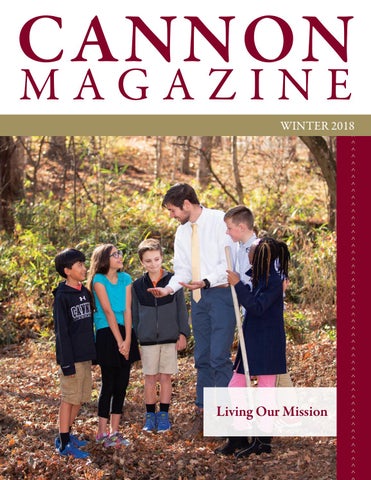
COVER: Mr. Paul Borowicz and his fifth-grade history students compare different soil types to better understand how physical geography and environmental features led to the development of agriculture along river valleys in the ancient world. Photo courtesy of Emby Taylor Photography. Cannon Magazine thanks Emby Taylor Photography for capturing images of the Cannon School community in action throughout the school year.
DIRECTOR OF INSTITUTIONAL TECHNOLOGY Bill Donovan
> > > > > > > > > > > > > > > > > > > > > > > > > > > > > 2 | WINTER 2018 | CANNON MAGAZINE
In This Issue
Letter from the Head of School < < < < < < < < < < < < “We want you to know all about our four-month-old mission statement. We hope that you will see in these articles and in these images that our new mission statement truly captures what we strive to be each day: a community committed to nurturing, engaging, learning, and growing.� Dear Cannon Community,
Can you recall that time in life when someone gave you something so new and so different and so exciting that you literally could not wait to use it and show it? You were certain that this new thing would introduce new possibilities and new aspects of life heretofore unrealized and unexplored. And you felt that those people closest to you would simply want to see how happy you were to have this new thing. For me, it was a red Schwinn bike that I received when I was 10. To this day, I cannot remember any bike I rode before this red Schwinn; and any bike since the red Schwinn would always be described in comparison to the red Schwinn. I saw in this bike the certainty of being able to go faster and farther. For a 10-year-old boy, there was really nothing better than the prospects of greater velocity and brand-new vistas.
Matthew E. Gossage, Head of School
Cannon School has something new and different and exciting, and we are convinced this new thing will introduce new possibilities heretofore unrealized and unexplored. And in this edition of Cannon Magazine, we want you to see how happy we are with this thing that is new and different. We are like a kid with a new bike. We want you to learn all about our four-month-old mission statement. We hope that you will see in these articles and in these images that our new mission statement truly captures what we strive to be each day: a community committed to nurturing, engaging, learning, and growing. We love the clarity that our new mission statement provides. We recognize and respect the inherent challenge in the statement that calls us individually and collectively to work together to be better and to do better with each new day. We look forward to living this new mission with you as we strive to engage each and every learner at Cannon.
Sincerely,
CANNON MAGAZINE | WINTER 2018 | 3
Living Our Mission > > > > > > > > > > > > > > > > > > > > > >
Cannon School nurtures relationships at the heart of learning and engages the learner in a journey of growth. > > > > > > > > > > > >
4 | WINTER 2018 | CANNON MAGAZINE
> > > > > > > > > > > > > > > > > > > > > > > > > > > > Purpose, Motivation, and Legacy
“This community lives its mission to the fullest. It’s really easy to know everyone and build relationships. I value every relationship I have here, and I know I’ll stay in touch with teachers and friends and hold them as great memories.”
Last winter, these three words facilitated a process for our school—the crafting of a new mission statement. We asked ourselves three questions: What is Cannon School’s purpose? Why do we do what we do at Cannon? What, in the end, do we want Cannon to be remembered for?
- Rohan Handa ’18
We then turned to our community to assist us with answers. The results shaped what would become our mission statement: Cannon School nurtures relationships at the heart of learning and engages the learner in a journey of growth. Nurturing. Engaging. Learning. Growing. “At Cannon, even though there’s 1,000 of us, we’re essentially one community.”
Each one of these words is powerful enough to stand on its own. When used together, however, they become much more. They become an anchoring ideology for the Cannon School community. We believe that this new mission statement is a clarification of who we already are as a school community. Walk our halls and observe how a teacher stops to inquire about how a student’s game panned out the night before. (Also overheard: students asking teachers about their children or their weekend plans.) We are a community built on relationships, and this allows our students to learn deeply, question freely, and grow exponentially. We believe we live our mission statement every day, and that we have been for years. So we turned to students and faculty to help show how these are more than just words.
“I feel that my friends are my greatest support system because no matter what I am going through, they always have a shoulder for me to lean on. Being able to walk in the hall and see so many warm faces makes my day at Cannon ten times brighter.”
-Kate Bynum ’24
“At Cannon, I feel like I’m the best teacher I’ve ever been. Because of the support, encouragement, and positive environment, I am free to be creative, and I have the time to make learning come to life. I feel nurtured as a teacher, and that allows me to nurture these first-graders on their journey of growth.” -Jill Moore, First-Grade Teacher
Nurturing
-McKenna Koch ’20 CANNON MAGAZINE | WINTER 2018 | 5
Engaging “I look at engaging the learner as inspiring somebody. If I get to know you and understand how you learn, how you think, how you process—it makes the nurturing and engaging part easy.” -Keith West, Upper School History Teacher
“I like that our teachers let us have choices. It makes learning fun, and I feel like I learn more that way.” -Hartley Smith ’26
6 | WINTER 2018 | CANNON MAGAZINE
“When I was new in Middle School, I didn’t even need to seek out the teachers—they found me. They helped me with ways to study and cared about me.”
Learning
-Amaya King ’22
“I feel like I am growing as a student because each year I learn more.” -Karina Thakkar ’28
Growing
“My role as a captain is to make sure everyone knows they are an important part of the team. Even if you aren’t the go-to scorer, you’re a star in your own role. And I think verbalizing that has helped bring my team together. Speaking has power, and it can make great things happen.”
“Through the opportunities given to me at Cannon, I’ve grown as a leader, as a person, as a learner, and as someone who cares about others. I’m still growing, but Cannon has set me up to grow well.” -Andrea Moore ’18
-Harrison Alexander ’22
CANNON MAGAZINE | WINTER 2018 | 7
A Friend for the Ages When it comes to friendship, age truly has no limit! Here at Cannon School, we celebrate relationships across various age groups. We understand how much a Junior Kindergarten student can benefit from a Senior Buddy (and vice versa!), or how an advisee/advisor relationship takes on new meaning after Commencement.
1
2
8 | WINTER 2018 | CANNON MAGAZINE
3
6
7
Page 8 1. Every Upper School boy in our wrestling program is paired with Middle School wrestlers. The Upper Schoolers provide encouragement and support throughout the season. 2. Our Senior/Junior Kindergarten Buddy program pairs our youngest students with our oldest. Throughout the year, buddies bond by having lunch, playing, and reading together. 3. Rose Edmondson ’17 was back on campus over winter break to visit her former advisor, Ms. Rebecca Eury. Advisors often keep in touch with their former advisees into their adult years. Page 9 4. Jackson Cooksey ’18 shows Rhys Moreno LaVoie ’30 how to play violin when Kindergarteners visited the Upper School strings students. 5. Middle School students practice instruments with their Upper School counterparts during band. 6. Our annual Project Wrap-In pairs members of an older advisory with one that is younger. Students get to know each other while they wrap gifts for children in need. 7. Upper School members of the Peer Support Team get ready to deliver doughnuts to eighth-grade advisories. CANNON MAGAZINE | WINTER 2018 | 9
Nurturing Relationships
5
> > > > > > > > > > > > > > > > > > > > > > > > > > > > > > > > >
4
Do You Believe in Magic?
Making Maggie Scurlock’s Dream Come True When 8-year-old Maggie Scurlock burst into the Amway Center and spotted the Orlando Magic Dancers on the court below, she had three words for the smiling, sparkling women waiting to greet her. “That’s my team!” This past November, Maggie, who is living with Down syndrome, proved that not only can she be a part of any team—she can elevate it with her spirit and energy. Maggie is the daughter of Mr. Danny Scurlock, Upper School Math Department Chair, and Mrs. Lisa Scurlock, Assistant to the Head of School. She is also sister to Jackson ’23 and Sydney ’25. Her “Magic-al” experience was cheering with the Orlando Magic Dancers during an NBA game last November. It came to fruition through Dream On 3, a non-profit organization that brings sports-related dreams to life for those living with a chronic illness, intellectual or developmental disability, or other life-altering condition, and the Cannon School Junior Dream Team, who selected her as a recipient. On Friday, November 17, Maggie received a schoolwide send-off from the Cannon community, after which she was whisked away to Florida. There, she performed with the cheerleaders during an Orlando Magic game and spent time at Disney World with her favorite character, Princess Sofia the First. Maggie had cheerleaders of her own here at Cannon — the Junior Dream Team, under the leadership of Mrs. Sue Ramsey, 2020 Dean of Students and Community Outreach Co-Leader. Comprised of freshmen Ella Ruddy and Alex Erdin, sophomores Emily Cleveland and Carter Otey, juniors Sané Davis and Thomas Fromke, and seniors Maddie Woods and Jackson Cooksey, the Junior Dream Team was tasked with hundreds of details, from designing t-shirts to planning logistics. Along the way, all the students became close with Maggie— to the point that she always greeted the group with the words, “My friends!”
Maggie Scurlock celebrates with the Orlando Magic Dancers. As part of her Dream, Maggie performed with the women throughout the game and at halftime.
“It was obvious that the Junior Dream Team planned Maggie’s dream experience with true purpose and intentionality,” said Mr. Scurlock. “Their hard work made the experience very meaningful and unforgettable. As Maggie gets older, she will be able to draw from this experience as a source of confidence.” Advisor Mrs. Sue Ramsey feels that the Junior Dream Team got as much out of the experience as Maggie. “Team members trusted each other and blended their gifts to achieve a common goal, and each member grew as an individual as they honed skills and broadened their scope of leadership,” said Mrs. Ramsey. The Cannon community’s embracing of Maggie truly reflects how we nurture relationships here at Cannon. She will always be part of our Cannon family!
10 | WINTER 2018 | CANNON MAGAZINE
Members of our Junior Dream Team pose with Mrs. Sue Ramsey and Mrs. Connie Stavrakas at the Cannon community send-off.
The Heart of Learning Exploring the Heart of Learning By Fabio Hurtado, JrK – Grade 12 Director of Studies Mr. Fabio Hurtado stepped into the newly created role of JrK – Grade 12 Director of Studies at the beginning of the 2016-2017 school year. He serves as a bridge between the Lower, Middle, and Upper Schools to connect both teachers and concepts, ensuring students receive the most meaningful education from year to year. Prior to taking on this position, Mr. Hurtado served as the Upper School Dean of Academics. We asked Mr. Hurtado about what he believes “the heart of learning” to be. Below is his response. Nurturing relationships at the heart of learning. Of all the promises our mission statement makes, for me, this one asks to be unraveled and explored. A story from my childhood helps me understand what we mean by the heart of learning. It’s an invitation into a complexity.
When I was a kid in Elizabeth, New Jersey, our group of friends had two go-to games: two-hand touch street football and Dungeons and Dragons (D&D). Elizabeth was the prototype of an overcrowded central Jersey town twenty-five miles outside Manhattan. Our two-hand touch games were played amid parked and double-parked cars and stopped by the traffic cutting through to Elizabeth Avenue on our one-way neighborhood Jacques Street. Still, two-hand touch was for us a simple game: pass, catch, score. In contrast, there was D&D, which asked for character development and a running plot with subplots and open-ended choices that we, as our characters, had to make and often endure and barely survive. But through the complexity of those relationships, the game delivered a true payoff. The heart of learning holds a similar complexity. During our last Family Day, our Head of School masterfully weaved for faculty the relationship between our mission, Core Values, our Adaptive Expertise model, and our Go Beyond motto. The heart of learning could be similarly approached. What is at the 11 | WINTER 2018 | CANNON MAGAZINE
> > > > > > > > > > > > > > > > > > > > > > > > > > > > > > > > > > >
Mission Talk:
heart of learning? David Streight, in Breaking into the Heart of Character, reminds us that true learning includes three key elements: relatedness, competence, and autonomy. I am a learner at the heart of learning when I experience: • an affective sense of being known and accepted by other master and beginner learners. Relatedness. • an intellectual sense that the academic “work,” the content, is challenging but doable, and that the “hard” material can be learned. Competence. • an empowering sense of having choice and freedom in the learning process. Autonomy. When I am learning a new technique used in watercolors, or the causes leading to the Spanish-American War, or how to value teamwork and curiosity, I must experience a certain freedom in how to learn. I am also called to choose to engage with the material, the content, the learning. Both support an agency. This is autonomy.
Mr. Fabio Hurtado I must also experience a feeling that those around me want me to learn, that those who have learned the content or the lesson believe I can—and will—learn it. This is relatedness. And finally, when I am assessed by a master learner (a teacher, a peer), I receive the glorious assurance that I have indeed learned. The process is not complete until my learning is measured against an agreed level of mastery so that I can declare myself (be declared) competent. The relationship of these three elements: relatedness, competence, and autonomy and how they are connected is what we promise in our mission to nurture at the heart of learning. Nurturing relationships at the heart of learning. In your child. In our classrooms, in our faculty who embody it and teach it. It’s not an easy promise in our mission. And it’s one we must deliver.
12 | WINTER 2018 | CANNON MAGAZINE
A typical afternoon for our Upper School students includes homework, sports or activities, maybe snagging a few minutes on social media. Nicki Cusumano ’18 and Amelia Wyatt ’20 have schedules that look a little different. They have logged countless hours writing books, both of which were published this past fall. We posed some questions to both these writers and learned a little more about the story behind these stories.
Nicki Cusumano with a copy of her first book, "Painting Sanctuary." Nicki writes under the pen name Nicki Lynn.
Nicki Cusumano ’18, Author of Painting Sanctuary Nicki’s novel, Painting Sanctuary, examines how two teens deal with the fallout of a tragic accident. What inspired you to write this book? Can you remember the moment the idea came to you? I don’t think there is a specific source of inspiration I can reference. Instead, there were a lot of pieces that came together. I was already writing, and I rediscovered an old short story draft that I decided to adapt into something longer. I added another old idea too, rounding out the two sides of the story. Tell us a little bit of what your writing process entails. I save the majority of my writing for the summer when I don’t have to be as concerned with the demands of school and extracurricular activities and allow myself plenty of time to
indulge in my creative interests. Since it is meant to be for fun and relaxation, I don’t instill a rigid schedule and instead allow my mood to drive my motivation and effort. Once I become absorbed in the story, I find it all comes to fruition very quickly. I am also notorious for being very spontaneous, and I am not known to plan extensively, so everything that occurs is usually dependent on my direction for that day. What was the most challenging aspect of writing Painting Sanctuary? The most challenging part was deciding where and when to end the story. I knew I wanted to extend it into a series, but it was difficult to figure out what made an ideal stopping point. I wanted it to be able to stand alone in case I decided to not progress with it any further but still leave a lot of opportunity for future stories.
13 | WINTER 2018 | CANNON MAGAZINE
Engaging the Learner
Two Cannon Students Publish Books
> > > > > > > > > > > > > > > > > > > > > > > > > > > > > > > > > > >
The Write Stuff
How would you say your Cannon education has influenced or helped your writing? I have found that the welcoming and academic environment at Cannon, particularly in my English classes, has created an atmosphere that is very receptive to my writing endeavors. Can you describe the feeling you had when you finished the book? There is a strong sense of satisfaction and pride quickly followed by an eagerness to do more. I am filled with a sense of completion and accomplishment whenever I type the final words to any story, but I am always looking to jump into my next adventure too. You’re contracted for two more books in this series, making it a trilogy. Can you update us on the progress of those books? As far as the trilogy goes, Painting Sanctuary, Painting Dreams, and Painting Words comprise the series. The first is already available, and the second is in press. I wrote Painting Sanctuary two years ago and finished Painting Dreams this summer and submitted it for editing. Hopefully, Painting Dreams will be available in the upcoming months! Painting Words, the final book, however, is still in the works. I am a few chapters in, but my attention has been divided between school and the impending publication of another story of mine, so I don’t have a clear timeline yet for that. All of those are coming out of World Castle Publishing, but another story of mine, Death’s Smile, a short psychological thriller, is scheduled for release this spring from Ink Smith Publishing.
Nicki sat down with Upper School English Teacher Mr. Mark Dunn, also a published author, to answer questions during a Student Life assembly this fall.
Painting Sanctuary was written under Nicki’s pen name, Nicki Lynn. It is available for purchase on Amazon.com and on www.worldcastlepublishing.com.
Amelia Wyatt ’20, Author of Ozzie and the Island Amelia drew on personal experiences to write and illustrate Ozzie and the Island, a children’s story of a bird who finds himself in a strange place. All proceeds from the sale of the book will benefit La Escuelita, a bilingual preschool program that serves Hispanic children in the Lake Norman area. Amelia has volunteered her time at the school for several years. What inspired you to write Ozzie and the Island? The idea for Ozzie and the Island came from a number of places. It predominately stemmed from the immigrant experience, a story I’ve heard from many of the children of La Escuelita and my mother herself. Looking at the confusion, loneliness, and difficulties that an immigrant life entails really informed the book’s plot. My hope is in understanding Ozzie’s story, readers can empathize with those who experienced these issues firsthand, something I think is very important and topical at the moment.
Amelia surrounded by friends from La Escuelita preschool. All proceeds from "Ozzie and the Island" benefit La Escuelita. Through sales of her book as well as donor support, Amelia was able to recently reach her $100,000 fundraising goal. 14 | WINTER 2018 | CANNON MAGAZINE
On another scale, the root theme of being an outsider remains universal, and I hope this book can provide a feeling of understanding for anyone that feels like outsiders themselves. Truthfully, I have to thank my publisher and editor Leslie Rindoks for what the story has become. Without her, I wouldn’t have been able to construct and refine the story into what it is today.
You have worked with La Escuelita for many years. Can you give us some background about the program? There are a number of La Escuelita schools in the North Carolina region, but the one I’m involved with (La Escuelita Alban) has been in operation since about 2013. It started with a single classroom and a single donor, and has grown since to several classrooms, lots of students, and hundreds of donors. These schools were formed to fill the need to put Hispanic children on a level playing field when they enter kindergarten, and to help them overcome language and cultural barriers that can prevent them from success in school. Your book is about a funny-looking bird, but it also helps readers empathize with the immigrant experience. Your mother emigrated from Colombia to this country. Did stories of her experience help shape this book? Absolutely. Like you said, my mother is an immigrant to this country. She came from Colombia, South America, in 1986. Her challenges, as someone who came into the US without speaking any English, deeply influenced what story I wanted to tell and how I wanted to tell it. Aside from strict story line, it also served as the motivator for why I got involved with La Escuelita in the first place. All my life my mother has told me her stories; the trials of entering an all-American high school, the way people treated her as a foreigner, among
countless other things—and I think that’s given me deep empathy for those who experience similar lives. So when La Escuelita first popped up, and I saw how it was going to help the lives of children who are often in the same position as my mother was, I immediately attached myself to the program. Everything subsequent to that choice of getting involved—the book, the sales going toward the program, my volunteering efforts—have been about serving that immigrant community; not only because my mother has given me a deeper understanding of their issues, but because I’ve also learned through my mother’s successes that there’s so much potential for good, successful lives for these folks. You illustrated this book as well. Which was more challenging— the art or writing the story? I think both were challenging in different ways. As far as illustrations go, the hardest parts were developing a personal sense of style and logistically getting all the paintings to meet my standards. While writing a children’s book may seem easy, it’s deceptively complex; you have to be so economic with your word choice. The refining and cutting down of the story to a clear, succinct story was a difficulty, but it was a process I loved to do as well. Ozzie and the Island is available for purchase at ameliakwyatt.com, Amazon.com, or at Main Street Books in Davidson.
Amelia Wyatt reads a copy of her book, "Ozzie and the Island," to Cannon Lower School students. 15 | WINTER 2018 | CANNON MAGAZINE
Hitting All the Right Notes: How the Arts Engage Learners
The use of Orff instruments in Lower School music classes makes learning meaningful—and fun!
A first-grade student sits at a table in Mrs. Krista John’s class, experimenting with watercolors and brushstrokes to see what suits his vision. A sixth-grader steps to a microphone in CPAC to sing a concert solo and bravely tamps down butterflies to find that first note. A ninth-grader uses a circular saw to design a set piece for the upcoming theater production. Not only do the arts allow us to experience the joy of creation—recent research shows that arts education is closely linked to academic achievement and social and emotional development (Kloberdanz). The arts engage learners in physical, cognitive, emotional, and social ways, resulting in engaged and motivated learners (Upitis). Visual Arts Observation, problem-solving, and confidence are all skills gleaned in visual arts classes, according to Mrs. Emily Thompson, Middle School Visual Arts Teacher. “Students coming up with their own ideas and then troubleshooting them is a skill that carries over to every subject area,” she said. “Learning through trial and error will help them navigate other areas with more confidence and creativity.” Teaching for Artistic Behavior (TAB) is a nationally recognized approach to art education that gives students the opportunity to make choices about their work with teachers who are responsive to their ideas. Cannon’s visual arts program adopted this model back in 2014 with amazing results. “The shift in our visual arts curriculum to a TAB-model has been a huge success,” said Mr. Nate Rogers, Director of Visual Art. “We have seen student engagement skyrocket as the students are being asked to develop projects and create works of their own devising.” Mrs. Krista Johns, Lower School Art Teacher, loves the implementation of TAB. “Students are given the opportunity to express themselves in a way that really speaks to who they are as individuals, and as a result, they are highly engaged in the classroom,” she said. “This definitely carries over into other subjects as we are seeing teachers give more choice in how students prove they have learned the material, instead of always relying 16 | WINTER 2018 | CANNON MAGAZINE
on a paper and pencil test. I think when students are allowed to show what they know in a meaningful, creative way, the knowledge they have gained is more likely to stay with them.” Music Whether it be learning to play the violin or trumpet or mastering a tune, music class is the perfect place to develop discipline, courage, and individuality, explained Mr. Rob Burlington, Director of Music Arts. “You can’t hide in a music ensemble, and just like a sports team, each person’s contribution is valuable and important. You learn to practice being courageous and a risk-taker,” he said. Practice is an essential aspect of Cannon’s music program. Middle and Upper School Strings Teacher Anne Marie Samuel enjoys watching her students embrace the habits of practice as well as reap the rewards of performance. “Practice builds self-discipline and reflection, and performance provides students opportunities to build grit, confidence, focus, and poise,” she said. Music classes at Cannon also help develop coordination and motor skills, whether it be using percussion instruments in the Lower School or playing drums in the Upper School band. “The Lower School music curriculum engages the learner in playful, joyful, and artistic experiences," said Mrs. Aimee Pfitzner, Lower School Music Teacher. “Students sing, move, play, and create using a wide variety of music, and each experience adds a layer of complexity and richness to the developing musicality of the young learner. Playing of instruments develops fine motor control and reading skills. Music is rarely ever just music alone, but our aim is to create a musical culture in which every child participates joyfully, creatively, and confidently.” Theater There’s no question—standing on stage in a theater production, no matter how big or small your part, can be intimidating. A theater education encourages confidence, concentration, and trust. “When I think about Cannon, I think about Cannon theater first,” said alumna Jessica Abel ’15. “Before theater, I was so shy. But in theater, you can’t blend in.”
Middle School art students experiment with calligraphy.
While at Cannon, Jessica started with small, non-speaking parts and backstage work before graduating to lead roles. “I think theater taught me to take ownership of a project and really enjoy it from start to finish and make it your own, but also realize that it’s bigger than you. No matter what your role, it’s encouraged that you have creative ownership of it.” Now a junior at The University of North Carolina at Chapel Hill, Jessica just finished a semester-long internship at Ambassador Theatre Group on the West End in London. There, she did copywriting and copyediting for their customer relations marketing team. She believes her theater background was what landed her the job. “This internship helped me realize the career track I want to be on. My theater experience is what gave me the confidence to pursue it.”
Members of the Cannon Theater Company take a bow after a production of Too Much Light Makes the Baby Go Blind. 17 | WINTER 2018 | CANNON MAGAZINE
A Mission Close to Our Hearts After introducing our new mission statement this fall, Lower School students learned how to act out its different elements. Adapting these kinesthetic aspects helped our younger students better commit the mission statement to memory. Here, we display “The Heart of Learning.�
18 | WINTER 2018 | CANNON MAGAZINE
> > > > > > > > > > > > > > > > > > > > > > > > > > > > > > > > > > > > > > > >
CANNON MAGAZINE | WINTER 2018 | 19
The Big Picture
Struggles, Setbacks, and What They Have Taught Us on Our Journeys of Growth There’s an ancient fable, passed down countless times, about a young boy who watches a butterfly struggle to break free from its cocoon. The boy takes pity on the insect and sets it free—only to have the butterfly plummet to the ground and die. A wise man tells the boy that the butterfly needed to labor so its wings would become strong enough to lift itself away. Without the struggle, the butterfly was not able to fully transform itself into what it was meant to be. Adversity is inevitable, but it’s also often the catalyst for success. It’s not about what happens to us but about how we respond to what happens that makes all the difference, and that helps us on our journeys of growth. Here are five stories about members of our Cannon community who have transformed obstacles into stepping stones to help pave their paths to growth.
Image above: Mr. Paul Borowicz with his fifth-grade students. 20 | WINTER 2018 | CANNON MAGAZINE
Mr. Paul Borowicz, Fifth-Grade Teacher — Learning the Hard Way, So It’s Easier for Others No one in the world is more surprised about where Mr. Paul Borowicz ended up than…Mr. Paul Borowicz. “If you had told ninth-grade me, or even me at the beginning of twelfth grade, that I would wind up being a teacher, I would have laughed and not believed you,” he said. “And I think a lot of my old teachers would have laughed and not believed you either.” Mr. Borowicz describes his former (and present) self as a non-typical learner. “It was hard for me to sit and listen for information and learn based on other people’s learning styles,” he said. “I struggled a lot with, ‘This is the way I’m supposed to do it, so why is it not working for me?’ I felt like I had the intelligence to understand the material, but something wasn’t connecting—that I knew the stuff, but I just couldn’t make that A.” He was diagnosed with Attention Deficit/Hyperactivity Disorder (ADHD) in eighth grade but didn’t like the side effects of the prescribed medication. He made a deal with his parents—he could go off the medication if he was able to create his own plan to stay organized and if his grades stayed on track. Although it was a difficult process, he was successful by holding himself accountable. When the end of high school neared, however, he found himself at a crossroads. He spoke with a favorite history teacher of his about the fact
“I try to apply that to how my kids are learning in my classroom. Am I presenting this in a verbal way, a visual way, am I giving hands-on opportunities for the kinesthetic learners? Having been through that hardship, I don’t want my students to leave my classroom feeling they can’t do things.” Jackson Welsh ’18 — From the Course to the Stage Jackson Welsh ’18 can tell you the exact moment he had an epiphany that completely changed the course
Up until that night, Jackson had spent most of his time honing his golf game. “I had gotten a dream into my head that I was going to play college golf,” he said. “I was going to the golf course every day after school, every weekend, and playing in tournaments all over the place.” There was just one little problem. “I just didn’t have the ability,” he said. He sat in CPAC that February evening, coming off a couple of bad tournaments and nervous about the upcoming tryout for the Cannon School varsity team. “I looked at the stage, and it hit me—being up there, that was really what I wanted to do. I had pushed theater to the side because I had been so focused on golf, but that’s not really who I am. What I’d been so committed to was not really what I was supposed to be doing.” Jackson views his failure to make the varsity golf team in the following weeks as a blessing in disguise. Instead, he threw himself into his acting class. “I was born with confidence, I’m comfortable in front of people, and I’m outgoing. What plays so well to those strengths is theater and acting.” He was thrilled to
"I looked at the stage and it hit me — being up there, that was really what I wanted to do." –Jackson Welsh ’18 get a sizable part in the following year’s production of A School for Scandal. “I felt like golf had been telling me no for a long time and rejecting me, and that led to a lot of negativity. But then flipping that and getting a decent part in the winter show—that acceptance was really big for me.” The following summer, Jackson was working out in Andrews Strength and Conditioning Center when Coach Brad Hoover approached him and suggested he try out for the football team. “I had never played peewee league or anything, but I went out and loved it and wound up playing both my junior and senior year. And I don’t know if I would have accepted Coach Hoover’s offer otherwise, because freshman-year me would have been way too worried about messing up to even try.”
21 | WINTER 2018 | CANNON MAGAZINE
A Journey of Growth
Now in his fourth year at Cannon, Mr. Borowicz uses his past academic struggles to better serve his students. “I think back to my struggles as a student— having to do things this way or that way, and not my way—and I think back to how information was presented to me, from behind a podium. And I also look back on me sitting there thinking, this doesn’t work for me, so it must not be working for someone else too.”
of his Upper School career. It was a February evening in 2014, and he was sitting in the Cindric Performing Arts Center watching the Cannon Theater Company’s production of Carousel.
> > > > > > > > > > > > > > > > > > > > > > > > > > > > > > > > > > >
that it seemed like everyone was ready to move on, but he still felt like there was so much more to learn. The teacher suggested he study education in college because he had the kind of personality that could connect and communicate. “I thought to myself, ‘I love learning so much—how cool would it be if I could spread that love?’”
“Of course, sometimes I messed up, and that was a lot of pressure to put on myself. But I learned that it’s okay to go outside and stretch your comfort zone.” – Emma Little ’22
Emma Little ’22 (kicker)
Emma Little ’22 — A Girl in the Game You could say Emma Little ’22 sent an e-mail back in 2016 “for kicks.” Then a sixth-grader, the longtime soccer player decided she wanted to try something new—football. Considering there had never been a girl on the football team, she had to create her own game plan, so she fired off an e-mail to Mr. Donnie Hayes, “because I picked up a yearbook and saw he was listed as the coach.” Mr. Hayes directed Emma to Assistant Athletic Director Rod Rachal, who took the information to a conference meeting, and it was agreed that Emma could play on the Middle School football team. She quickly settled into her position as kicker. “It felt a little weird at first, because I wasn’t quite sure how the guys would react. I hadn’t talked to them about me being on the football team, so I think they were a little shocked. But as the season went on, they kind of came out of their shell.”
Others might turn their back on tennis, which aggravates the pain, but quitting was not an option for Jordan. “I thought about quitting. But, tennis is a great place for me to relieve stress and get a break from school. I couldn’t imagine my life without it,” she said. Jordan feels that dealing with this obstacle has helped her become a better player—and person. “I think I’m more determined and more driven. I believe that I can set a goal, have obstacles pop up and have people tell me I won’t be able to do it, but I have the inner strength to power through those obstacles.” “Things will come up, and you’ll have to rethink your original plan and learn new ways to do something,” Jordan continued. “But ultimately, it’s your choice how you choose to handle situations.”
“When we were playing against other teams, I was the only girl out there. I was afraid if I messed up, those guys would make fun of me, so I was like, ‘I can’t mess up. I can’t mess up!’ Of course, sometimes I messed up, and that was a lot of pressure to put on myself. But I learned that it’s okay to go outside and stretch your comfort zone.” Emma enjoyed two years on the field, and she feels that the confidence she gained in the process led to personal growth. “I thought, if I can do football, I can obviously do something that would normally be hard, like a presentation or public speaking. My advice is—girls should stand up and go after what they want.” Jordan Besh ’18 — Persevering Through Pain Every athlete dreads an injury. So, when tennis player Jordan Besh ’18 started experiencing chronic pain at age 12, she assumed that overuse was the culprit—often the case in her sport. Unfortunately, the underlying issue was far more serious. Jordan has spent years at doctors, trying to get a correct diagnosis. They can pinpoint that some of the cause is autoimmune and some is neuromuscular, but she remains, to an extent, somewhat of a “medical mystery.” 22 | WINTER 2018 | CANNON MAGAZINE
Jordan Besh ’18
Jordan was recently named to the CISAA All-Conference 1st Team and an NCISAA All-State player. She will play tennis at Sewanee: The University of the South this fall. Grace Ankrom ’21, Avery Watkins ’21, and Chloe Winchester ’21 — Growing Together Through Learning When Grace Ankrom ’21, Avery Watkins ’21, and Chloe Winchester ’21 began eighth grade last year, they faced a common enemy—time, and the lack thereof. Between athletics and after-school activities, there just never seemed to be enough time to squeeze in all the studying that needed to get done. So when Grace suggested a peer-led study group, Avery and Chloe were eager to try the concept. The three worked with Mrs. Carla Moyer, Head of Middle School, and several teachers to design a system that the girls could lead and accommodate students’ needs. The result was not only beneficial for the students who attended, but allowed the three girls to hone their leadership skills and better prepare for Upper School. From the start, it was understood that the girls would run the study group, rather than adults. They settled on meeting twice a week during lunch, and then went about lining up classrooms and figuring out guidelines. “We did it like a tutoring system,” said Grace. “We sat down with everyone and as a group decided on a topic of the day.” If there was an upcoming history test, for example, the group would focus on that, and the three girls took turns as leaders, depending on subject matter. Immediately, they found themselves handling conflict. “There were problems with some people not working, just socializing,” said Avery. “Or, we might not all want to study the same thing. Sometimes there were too many people—one time, thirty people showed up. So, we figured out it was better to have one of us always there to act as a peer supervisor.” The girls strived to address different learning styles so that all attendees would benefit. They incorporated strategies for visual, oral, and kinesthetic learners to make the sessions both fun and useful. Along the way, they bonded and learned much about themselves. “Planning for the meetings and making sure we were organized meant we had to be good at time management and responsibility, which has helped a lot now that we are in Upper School,” said Chloe. “We really learned how to lead, cooperate, and work with others.” Grace, Chloe, and Avery all agreed that their endeavor made the transition to Upper School this year far easier. “Coming into the high school, we were like, ‘We’re on our own now,’” said Grace. “The study group taught us how to be independent and helped build skills we’ve needed this year.”
“ We really learned how to lead, cooperate, and work with others.” – Chloe Winchester ’21
Grace Ankrom ’21, Chloe Winchester ’21, and Avery Watkins ’21 23 | WINTER 2018 | CANNON MAGAZINE
Leading by Example How the Cannon Athletic Leadership Council is Making the Cut
Members of CALC pose with University of North Carolina—Charlotte Athletic Director Judy Rose.
Let’s face it: in athletics, championship titles and winning seasons don’t happen because of just one person. Teamwork and the ability to work together toward a common goal are what ultimately bring home the awards and the accolades. Student-athlete leadership is key to developing teams who can successfully work as one. However, today’s highly structured sports culture offers few opportunities for kids to organically learn to lead. What to do? Director of Athletics Pat Moyer and the Cannon Athletic Department recognized that leadership is not necessarily something people are born with—it can be developed through the right approach. Three years ago, they started a series of leadership lunches to help our students understand the importance of leading by example. That led to this year and the formation of the Cannon Athletic Leadership Council—a formalized structure in which a selected group of Upper School athletes are trained to proactively lead their peers, both on and off the field.
24 | WINTER 2018 | CANNON MAGAZINE
The Process Leaders aren’t made overnight—it takes time and can be difficult as comfort zones are pushed. When Cannon Athletics began the process back in 2015, they first established a Leadership Academy that all Upper School athletes are required to attend. They also started a series of leadership lunches, which served as a type of “learning laboratory” in which young athletes could share insights and experiences while listening to speakers who helped cultivate “The Great Eight Standards of Cannon Athletics.” These expectations, which speak to trust, commitment, and sacrifice, have become the culture for our student-athletes. “Initially, the focus was on hard work and what hard work meant,” said Dr. Moyer. “We had some success, so after the second year we turned to the coaches and asked, ‘Where do
we go next?’” The Cannon Athletic Leadership Council (CALC) is the next step in turning the athletic program over to the students.” Four male and four female athletes from each grade, representing a variety of sports, were selected. They combined with other student leaders from the Upper School to learn about a different topic each month—examples include communication, passion and energy, commitment, vision and mission, accountability, and responsibility. After hearing from a speaker, the CALC team would come together to discuss how they could enact these values within their own teams. “We are trying to build some infrastructure and build a culture of people who are going to own the expectations. [Up until now] students have thought it’s only the coach’s job to hold student-athletes accountable to our standards . But the student leaders know the ins and outs of the team at a level that the coaches do not. And now they’re the ones who are talking about the need to own the accountability aspect,” said Dr. Moyer The Leaders
CALC
Claire Christman ’18 serves on CALC and was one of three cheerleaders who approached Dr. Moyer this summer. They were down a coach (Coach Erin Banks, a new hire, started at the beginning of the school year), but they didn’t want that to stop them from their summer preparations. They wanted to take charge, run summer practices, and ensure that everyone would know that they were available to work with any new cheerleader. This feeling of empowerment led to confidence. “The leadership council has been instrumental in my development as a leader. From the time I entered Cannon as a freshman to now, I am a different person because of the resources provided,” said Claire, a fouryear cheerleader who is also swimming this winter.
Claire Christman ’18
“Leading as a student isn’t always easy, but I’d like to think I lead through friendship,” Claire continued. “Being able to connect and form strong relationships with every single girl is different as a peer because I’m in the midst with them. I’m running through all the routines as well as studying next to them in the library. I’m on a personal level where I can connect. It’s rewarding to be someone they can rely on.” Chris Nelson ’18 admits he probably didn’t fit the picture of an ideal student-athlete leader when he was back in Middle School. When he arrived in the Upper School, Chris found himself struggling with the increased workload and greater demand for practice time outside of school. “This changed when coaches like Coach Powell and Coach Helfant instilled in me a mentality of hard work that has carried over from athletics into other aspects of my life. This mentality has taught me the importance of time management, integrity, and passion,” he said. Lessons like these made Chris an ideal choice to serve on CALC. “CALC has taught me the importance of discussing leadership. A discussion of leadership is more beneficial than a seminar with one speaker because multiple thoughts, ideas, and experiences are shared, resulting in a more holistic learning experience,” he said.
Chris Nelson ’18 25 | WINTER 2018 | CANNON MAGAZINE
A Will to Succeed:
Cannon’s ‘Renaissance Man’ Exson Pursues Greatness Athletically, Academically By C. Jemal Horton, The Independent Tribune CONCORD, N.C. – He would spend hours sometimes, crouched over with intense focus, devising just the right play for Batman to make a strategic move and score a touchdown on Superman. This was 8-year-old Will Exson’s introduction to the game of football. After scribbling plays in his notebook, Exson would take out his collection of DC Comics superhero action figures, line them up like gridiron greats, and simulate football games to the fullest extent of his imagination. Even at such a young age, Exson took a thinking man’s approach to the game, eschewing the traditional smashing of imaginary players that many youngsters often take and instead planning and then executing his drawn-up plays with precision. Now a do-it-all senior for the Cannon School Cougars, all indications are that Exson will get to pursue his passion for at least four more years. He stands nearly 6 foot 3, and he’s as athletic as they come – quick, fast and loves contact. You want defense?
playing on Saturdays and/or attending any college he desires look pretty good. “As a student and an athlete, he’s just very smart, and he brings that to the way he plays the game of football,” Hoover said of Exson. “I honestly think he could play any position for us on either side of the ball, because he understands the game that well. “What I appreciate about him is not only that he’s smart like that, but it’s how physical he plays, how much effort he puts in – in practice and in games. The intellectual side of things helps put him in the right place at the right time, and then he’s able to make plays for us.” Exson takes pride in making plays for Cannon. He loves the school. Although he came to the school in ninth grade for academic reasons – “I look for academics first in a school, and that’s what I’ve found here,” he said – he was excited to suit up for the varsity football team when he arrived on campus as a freshman. That year, he started on defense at linebacker and showed promise.
As a safety, he ranks among the county leaders with 73 tackles, and he’s snatched two interceptions.
Hoover arrived during his sophomore year and, noticing Exson’s athleticism, moved him to cornerback. He flourished, earning allstate honors after intercepting seven passes.
Offensively, he plays receiver for the Cougars and, again, is among the county leaders with his 350 yards to go with 17 catches and five touchdowns.
“I guess quarterbacks tried to throw jump balls against a 6-2 corner, and it didn’t work out too well for them,” he said, shrugging his shoulders.
Exson even has a decent 31.6-yard average as a punter.
Since last season, he’s primarily been a safety on defense, and opposing quarterbacks don’t challenge him nearly as often, so he’s provided great run support for the Cougars and racked up big tackle totals.
And speaking of averages, perhaps most impressive is the 4.26 GPA Exson carries while attending football practices and games, and playing the cello – yes, the cello — in the school orchestra and a quartet on the side with some close friends. As a coach’s dream on the football field and a parent’s dream off it, Exson’s chances of 26 | WINTER 2018 | CANNON MAGAZINE
Exson believes he has what it takes to play at a bigger college program, but he’s also determined to make his college choice with his academic interests in mind and not with his football heart.
Will Exson ’18. Photo courtesy of James Nix. “It’s very important to me to go to a school with a strong academic tradition,” he said. “Football is going to last four (more) years, but I’m really concerned with that 40 afterward. I want to establish myself, get a good career and really use the sport I love as a tool to get me to a better academic institution than I probably could on my own.” Thus far, Exson has offers to play at Davidson, Division II Florida Tech and Division III schools M.I.T., Middlebury and Carnegie Mellon. All are universities that would get Exson on a great path toward his desired career. “Chemical engineering has piqued my interest most,” Exson said. “I’m an analytical thinker, I love to problem-solve. Naturally, I’m best with math and science, and engineering allows you to solve greater problems, whether it be within the local community or the world. That’s what I want to do. I want to be a role model.” And as someone who’s spent hours drawing up plays for superheroes, Exson can appreciate the power of a role model. This piece was excerpted from the original, which appeared in the Independent Tribune.
The Cannon Fund – Rooted in Learning Each fall, the school asks that you contribute to the Cannon Fund, our most critical fundraising initiative. But how, exactly, are those dollars used?
The Cannon Fund bridges the gap between tuition and the actual cost of a Cannon education. This means that learning initiatives are enhanced when our families contribute. Examples of how these dollars are spent include (corresponding photos labeled below): 1
Allocating resources so teachers can take advantage of professional development opportunities.
2
Helping outfit the Middle School ThinkTank with cutting-edge equipment.
3
Providing furniture and materials such as theater scripts for our arts students.
4
Funding materials to help Lower School students discover passions on Adaptive Expertise Days.
5
Ensuring our Lower School students have access to innovative technology.
The Cannon Fund ensures our students will learn in an extraordinary environment with caring, committed faculty and exciting opportunities. If you have not already made your Cannon Fund gift, you can do so by visiting www.cannonschool.org/thecannonfund.
1
5 2
4
3
CANNON MAGAZINE | WINTER 2018 | 27
IMAGINE TOMORROW THANKS TO THE 194 FAMILIES AND FRIENDS WHO GAVE $3.8 MILLION TO THE IMAGINE TOMORROW CAMPAIGN. TOMORROW IS HERE! CONSTRUCTION IS UNDERWAY, AND THESE ARE THE MILESTONES ON THE HORIZON.
New emergency access road measures 1,200 linear feet.
14 2 1
LIBRARY/ MEDIA CENTER
in the new Seventh and Eighth
Grade Building
FALL 2018 28 | WINTER 2018 | CANNON MAGAZINE
Next year, I will move up to the NASCAR Xfinity Series. As that is a step up from the truck series, it will bring new challenges. What has been your favorite part of the process? The most difficult? I have met some amazing people with some amazing stories and created lifelong friends. Success is thrilling, but has been difficult to reach. In many of the racing series that I’ve moved up through, I’ve been the youngest and the least experienced. It’s always an uphill battle, which has provided the best experiences to learn from. Did you have experiences or teachers here at Cannon that prepared you for this journey?
Austin may be a recent graduate from Cannon, but he’s been driving race cars since the fourth grade. He is currently looking forward to moving up to the NASCAR Xfinity Series and continuing to differentiate himself from the field. Can you share the path you took when you first started racing? In fourth grade, I started racing locally at Charlotte Motor Speedway in INEX Bandoleros and US Legend Cars, and I expanded to racing across the east coast until I was 13 years old. When I turned 14, racing became more serious as I started touring in an open-wheel, open-cockpit road racing series called USF2000. This series is a “ladder series” to IndyCar. I would later test myself in as many disciplines and opportunities as possible, ranging from driving sportscars, to stockcars, to rally cars, all while continuing my USF2000, open-wheel racing. These various pathways and experiences make me unique for my age, opening up more opportunities at higher levels of motorsports. What made racing attractive to you? Besides living in the Charlotte area, specifically in Mooresville where the water tower says, “Race City USA,” both sides of my family have been involved in racing to some extent for decades. I’ve grown up around it and built a passion out of it. My dad is the President of Penske Racing, and his father built engines for IndyCars and Indy 500 race cars. My mom’s father was a successful sports car/endurance driver, and her brother raced in Indy Lights, an open-wheel ladder series.
Up until May of 2017 when I graduated, I had been in school my entire racing career. In some ways, you could say it was like having two jobs. Having full-time commitments in both, it put a strain on my time commitments as well as my relationships with my teachers. I don’t mean this as a bad thing—I stayed late after school, kept my teachers updated with my schedule, and received an unwavering amount of support towards that schedule. My teachers made it possible for me to excel in my education as well as in a racing career. I know I was lucky, as many drivers my age don’t have that opportunity. It made it easier for me to pursue all racing opportunities while I was still receiving a full education at a high level. What is your advice for current Cannon students who want a career in professional sports? Be different. This applies to much more than just sports, but has helped me immensely in my career. Find what makes you different than those around you, because that is what is going to make you an attractive choice for that one person who has the power to give you that opportunity. I make myself different from most drivers my age by not only being involved in multiple disciplines, but also by becoming successful in each of those different disciplines. This has opened so many doors for me because it makes me stand out against other drivers. If anything, find your tiebreaker. What is the best piece of career advice you’ve received? Don’t wait for the phone to ring.
29 | WINTER 2018 | CANNON MAGAZINE
Alumni
Austin Cindric ’17
Last season, I competed in the NASCAR Camping World Truck Series for Brad Keselowski Racing, where we finished third in the championship in my rookie season, as well as my only full year in stock car racing. Even with my full-time commitment to stock car racing, I am constantly pursuing opportunities in all corners of motorsports to continue to differentiate myself from my competition.
> > > > > > > > > > > > > > > > > > > > > > > > > > > > > > > > > > > > > > > > > > > > > >
Alumni Spotlight
What are some of your recent milestones?
2003 Jamey Falkenbury got married on August 12 in Charleston.
Katie Regnery married Patrick “PJ” Joseph ’07 on March 4, 2017 in Mooresville, NC. The reception was held at the Trump National Golf Club, where coincidentally, the bride and groom attended Cannon prom together years ago! The wedding party included Cougars Kelci Deddens, Virginia Goode, and Kelsey Willoughby and the bride’s siblings Shelby Regnery ’05, Tom Regnery ’07, and Mark Regnery ’15. After a honeymoon to Hawaii, the couple resides in Atlanta, GA with their pupper, Hal. Colin York and Katie Fink welcomed Diana Eleanor to the world on September 11. Big sister Mary began the Spanish Immersion Kindergarten at Lake Norman Elementary. Katie and Colin currently reside in Mooresville, NC.
Jamey Falkenbury’s wedding. From l-r: Ryan Lubert ’05, John Falkenbury, Jamey Falkenbury ’03, Amanda Falkenbury, Barb Falkenbury, Catherine Falkenbury ’06, Will Bertram ’05, and Eddie Alcorn ’04.
2004 Eddie Alcorn started classes in the UNC-Chapel Hill Master of Social Work program. After graduation in 2020, he plans to work as a counselor and care coordinator with palliative care and hospice services.
2006 Monica Dyck LeBlanc opened a private psychotherapy practice in Asheville, NC, treating trauma, anxiety, and addiction. Megan Rindoks recently became the Community Outreach and Guest Experience Manager at Durham Performing Arts Center (DPAC) in Durham, NC. She is also a principal dancer for ShaLeigh Dance Works, a modern dance theater company based in Durham. The company will be touring this season in NYC with appearances at both Lincoln Center and Dixon Place. It is equally important to share that she has an adorable cat named Messalina (shout out to the whole Latin class gang).
Katie Regnery ’08 married PJ Joseph ’07 in March 2017.
2008 Denny Alcorn continued his work with Mercy Ships by starting a full-time research analyst position at the headquarters in Lindale, TX. Even though his house isn’t perfect, he has a little more room than when he was living on the hospital ship over the past two years! Matt Keeler was recently appointed to the board of Davidson Youth Baseball and is focusing on community marketing and outreach initiatives in the Lake Norman area. He is also heading coaches’ clinics for ages 6-12, which emphasize both character and skill development for young children.
Mary and Diana, daughters of Colin York ’08 and Katie Fink ’08.
>Class Notes 30 | WINTER 2018 | CANNON MAGAZINE
Alumni Corner
The Alumni Jazz Jam:
Defining What it Means to "Come Home" Thoughts from Mrs. Sarah Allgood, Alumni Relations Coordinator
Mrs. Sarah Allgood
It’s a chilly evening at local hot spot Cabarrus Brewing Company, and microphones, amplifiers, chairs, and various unaccompanied instruments are set up and ready for an intimate, yet lively performance. It can only mean one thing—it’s time for the annual Alumni Jazz Jam! Slowly, people trickle in—some wearing Cannon spirit wear—looking around for familiar faces. Their eyes light up when they spot an old friend, former teacher, or favorite coach.
Mr. Brad Davis signals to “the guys” that it is time to start jamming, and jam they do. The Cannon Jazz alumni members are energetic but controlled, excited but calm. Mr. Davis introduces the group during a break, and mentions how fortunate he is to have the opportunity to work with the bright young people at Cannon School in the music program. He shares with the listeners how special it is that even after the students graduate, they still enjoy “coming home,” getting together with their instruments, and playing for hours like they’d been regularly practicing together for years. Alumni parents also enjoy this event. They spent years getting to know the parents of their son or daughter’s friends while serving on CAFTA, watching games from the sidelines, and setting up for the annual Cougarpalooza. Tonight, they also have the chance to reconnect. Alumni enjoy grilled cheese sandwiches, tacos and empanadas from the food trucks while they laugh and share details about their winter breaks so far. This evening reminds me that growing a strong alumni program may be valuable to the school, but it is invaluable to our alumni community. The relationships formed at Cannon are remembered for years to come, long after the caps and gowns are put away.
Members of the Alumni Jazz Band play at the Alumni Jazz Jam this past December.
31 | WINTER 2018 | CANNON MAGAZINE
2009 Jess Ekstrom says that in the past year, her company, Headbands for Hope, has launched impact initiatives such as hosting proms at children’s hospitals and starting their #BandTogether program where they partner with a childhood cancer Jess Ekstrom ‘09 charity and donate proceeds from sales to their mission. They’ve also joined hands with art therapy by having the patients create their own headbands with the flower crown kits they provide. Molly Frowine married Mike Pedemont in uptown Charlotte on August 26, 2017. Cannon alumni Maggie Peterson, Shelby Mason, Katherine Vendley, and Jordan Rubens attended the wedding at The Charlotte City Club. Mike and Molly met at work, when Mike sent in a resume and application to be Molly’s date to the company Christmas party. The happy and hilarious couple resides in Charlotte.
her life has recently come full circle. She traveled to Morocco with The Experiment at age 16 for five intense, life-changing weeks. She trekked the Sahara on camelback, lived with a local family and practiced Spanish with her host grandfather, and learned to cook traditional Moroccan tagine. It sparked a passion for language, culture, and travel that continued into college as she studied abroad and majored in Hispanic Linguistics at UNC. Now, nearly a decade later, she lives in Washington, D.C., and is the Marketing Coordinator for The Experiment. She gets to combine all of her passions on a daily basis while encouraging high school students to travel abroad and have the same remarkable experience she did. It’s never too early to open your eyes to global Hunter Horton ’10 (right) in education and understanding. Morocco. Katherine Sherrill started graduate studies this fall at GarrettEvangelical Theological Seminary in Evanston, IL. She plans to complete course work both at the Seminary and at The Center for Religion and Psychotherapy of Chicago. Katherine also recently became a candidate for ordination within the United Methodist Church.
2011 First Lieutenant Sam Camut married Claire Schneider on May 28, 2017 in Milwaukee, WI. Cannon alumni in attendance were best man, Devin Smith, and Dylan Mason, Thomas Campbell, Jackson Sipperly, Conor Larkin, Winston Felker, and Andrew Mikita. Sam will be receiving his Marine Corps pilot wings in January 2018 and will be flying the V-22 Osprey. Molly Frowine ’09 married Mike Pedemont in August 2017.
Elizabeth Hyde graduated as a doctor of veterinary medicine from North Carolina State University in May. After graduation, she moved to Manhattan, KS (the Little Apple), where she now works as a small animal medicine and surgery intern for Kansas State University’s College of Veterinary Medicine. Currently, she is applying to zoo medicine internships and residencies with hopes to specialize in Dr. Elizabeth Hyde works at Kansas State zoological medicine.
2010
University’s College of Veterinary Medicine.
Heidi Gruber just took a job teaching eighth-grade English at Crystal Springs Uplands School in Belmont, California. She will be living in the Sunset District of San Francisco, just a block off the beach! Hunter Horton reports that after going on The Experiment in International Living in 2009, the summer before her senior year, 32 | WINTER 2018 | CANNON MAGAZINE
First Lieutenant Sam Camut married Claire Schneider in May 2017.
2012 Emily Anderson graduated from UNC-Chapel Hill in 2016 with a B.S. in Biology and minors in chemistry and medical anthropology. She was actively involved on campus in her time at UNC as a member of Honors Carolina, Kappa Kappa Gamma, and Carolina For The Kids Foundation. She also worked as a research assistant on the NC NEXUS Project, a study investigating the utility of applying whole exome sequencing technology to newborn screening. Emily is continuing her education by pursuing a Master’s of Science in Genetic Counseling from the University of North Carolina at Greensboro. She expects to graduate in May 2018.
Tim Gruber (third person narrative, Mark Dunn would be smiling) resides in Richmond, VA teaching and coaching at St. Christopher’s School for boys. He ran the Richmond Marathon in November (finishing in 2:28 and fifth overall), a few weeks after taking part in the Cannon Tuna Run with fellow alums. Kenzie Moyer reports that after graduating from the University of Arizona with a degree in physiology and minors in biochemistry and Tim Gruber ’12 ran the Richmond mathematics in May of 2016, Marathon in November. she moved to Phoenix. She is a graduate student at Arizona State University, where she is pursuing a Master’s in Exercise and Wellness. She teaches chemistry and exercise physiology at ASU Preparatory Academy, where she also coaches cross country, basketball, track, and golf. She helped coach the cross country team to their first state title in the fall. She enjoys mentoring young men and women to achieve their potential in the classroom and on the athletic field.
and her 54-hole scoring record in October, now a 207 (-9). She is looking forward to what is to come this spring individually and with her teammates as they pursue their goal to be NCAA Champions!
Anna Redding ’15 had a great year on and off the course at UVA.
Brandon Wade graduated from the Charlotte Fire Academy in September and is working for the Charlotte Fire Department and Robinson Volunteer Fire Department as well as completing his degree.
Hailey Wade Odum is a K-5 lab science/STEM teacher at Cabarrus Charter Academy.
2015 Jessica Abel has spent the last semester in London working as a marketing representative with Ambassador Theatre Group (ATG). ATG produces, operates ticketing, and manages venues for dozens of West End shows including Harry Potter and the Cursed Child, Wicked, The Lion King, and Matilda. Her favorite projects included marketing the West End premiere of The Exorcist and writing copy for the Harry Potter and the Cursed Child customer relations campaigns. Anna Redding successfully completed her fifth semester at UVA Jessica Abel ’15 has spent the last semester in and has grown as London working with Ambassador Theater Group. a person, student, and an athlete. As a member of UVA SAAC, she is working with the NCAA SAAC on a proposed legislation on early recruitment and NLIs. Also, this has been a personal record-breaking semester for her on the golf course. She broke her 18-hole scoring record in September, now a 67 (-5),
Brandon Wade ’15 graduated from the Charlotte Fire Academy in September 2017.
Darby West, currently a student at Notre Dame, met up with USC student and Cannon alumnus, Timmy Hennigan ’13 at the Notre Dame vs. USC game this fall. A triumphant weekend for Darby and the Fighting Irish!
Darby West ’15 and Timmy Hennigan ’13 met up at the Notre Dame vs. USC game this fall.
33 | WINTER 2018 | CANNON MAGAZINE
Alumni Events
1
2
3
4
5
Making your alumni gift to the Cannon Fund just got a lot easier! Find us on Venmo: Cannon Alumni 34 | WINTER 2018 | CANNON MAGAZINE
Upcoming Events
6
April 5 – Alumni Flashbacks in Chapel Hill, Charlotte, Atlanta, Raleigh May 20 – Alumni vs. Varsity lacrosse game October 19 – Homecoming 1. Alumni soccer game in August 2. Alumni basketball game this January 3. Homecoming 2017 saw plenty of alumni on campus. 4. Mary Edwards ’17 was the winner of an alumni gift basket at the Homecoming festivities. 5. Members of the Alumni Board at their summer meeting 6. The Cougar Holiday Party 2017 7. Alumni participate in the Tuna Run, a race that stretches from Raleigh to Atlantic Beach. 8. All smiles at the Cougar Holiday party at Fox & Hound in Birkdale 9. Members of the Alumni Jazz Band entertain the crowd at Homecoming.
7
8
9
35 | WINTER 2018 | CANNON MAGAZINE
>>>>>>>>>>>>>>>>>>>>>>>>>>>>>>>>>>>>>>>
5801 Poplar Tent Road Concord, NC 28027 www.cannonschool.org
PRESENTS
THE 2018 CANNON SCHOOL GOLF TOURNAMENT
MONDAY, APRIL 30, 2018 RIVER RUN COUNTRY CLUB IN DAVIDSON, NC