CANNON WINTER 2017
IMAGINE
TOMORROW
>>>>>>>>>>>>>>>>>>>>>>>>>>>>>>>>>>>>>>>>>>>>>>>>>>>>>>>>>>>>
MAGAZINE
> Imagine Tomorrow Imagine Tomorrow........................................................................................................................ 4 Imagine Tomorrow: In Their Own Words .............................................................................. 6 Imagine Tomorrow: Join These Families ................................................................................ 8
CANNON MAGAZINE WINTER 2017
Cannon Magazine is published semiannually by the Office of Advancement. Send address changes to rriemersma@cannonschool.org.
EDITORIAL STAFF EDITOR Beth Levanti Director of Marketing and Communications ASSOCIATE EDITOR Amy Reiss Marketing and Communications Manager CONTRIBUTORS Michelle Alexander, Sarah Allgood, Jane Anthony ’20, Miles Batley ’20, Taylor Bennett ’20, John Cooke, Matt Gossage, Meredith Haddock ’18, Todd Hartung, Beth Levanti, Caroline Livingston ’19, Amelia Mann, Olivia Reiff ’17, Amy Reiss, Megan Thompson
ADMINISTRATION HEAD OF SCHOOL Matthew E. Gossage
> Engaged Learning Reaching for the Stars and Learning Something New ........................................................10 Discover. Empathize. Build. .....................................................................................................12 Can We Talk? ...............................................................................................................................14 Welcome to the Club! ................................................................................................................16
> The Big Picture Our Name in Lights....................................................................................................................18
> Athletics Cannon Athletics by the Numbers .........................................................................................20 Cannon School Golfers Make the Cut by Serving Others ................................................21
> Arts Cinderella: A Sneak Preview ...................................................................................................22 Music to Our Ears (and Eyes!) .................................................................................................23
> Community
HEAD OF LOWER SCHOOL Michelle Alexander
Helping or Hurting? Author Julie Lythcott-Haims Addresses the Overparenting Problem ...................................................................................................24
HEAD OF MIDDLE SCHOOL Carla M. Moyer
Cannon School’s Maria DeHaas Speaker Series Presents Julie Lythcott-Haims ..................................................................................................................27
HEAD OF UPPER SCHOOL Debra Otey DIRECTOR OF STUDIES Fabio A. Hurtado DIRECTOR OF ADMISSION William Diskin DIRECTOR OF ADVANCEMENT Todd W. Hartung Jr. DIRECTOR OF ATHLETICS Dr. Patrick J. Moyer DIRECTOR OF BUSINESS AND FINANCE Whit G. Brown
> Alumni Alumni Spotlight: Kristen Lovin ’04 .....................................................................................28 Class Notes ...................................................................................................................................29 Taking the Wheel: Matthew Godley ’12 ..............................................................................31 Alumni Events .............................................................................................................................32
> Parting Thought Inclusivity, Intentionality, Innovation – Through the Eyes of Our Students ...........................................................................................................................34
DIRECTOR OF COLLEGE COUNSELING Anne Shandley
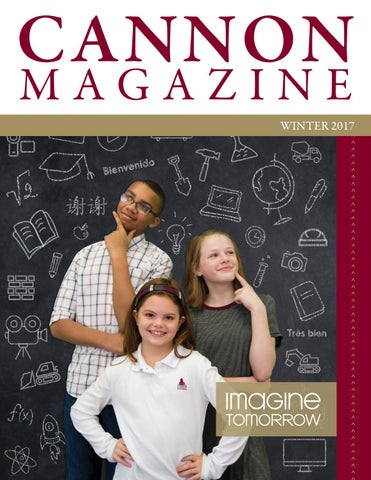
COVER: Jack Selden ’20, Cate Wickerham ’27, and Leighton Evans ’23 struck this pose when we asked them to imagine tomorrow. The future is in good hands. Photo courtesy of Emby Taylor Photography.
DIRECTOR OF INSTITUTIONAL TECHNOLOGY Bill Donovan
Cannon Magazine also thanks Emby Taylor Photography for capturing images of the Cannon School community in action throughout the school year.
> > > > > > > > > > > > > > > > > > > > > > > > > > > > > 2 | WINTER 2017 | CANNON MAGAZINE
In This Issue
Letter from the Head of School < < < < < < < < < < < < “If the truth be told, our school has benefitted greatly from our abiding respect for history and a close relationship with imagination.” Dear Cannon Community,
In one sense, the State of the School message delivered on January 19 represented our version of a morality play. The wandering protagonist, played by a challenged Head of School, was met on that evening by the personifications of two powerful abstractions—History and Imagination. During the course of their visit, History and Imagination discuss their lengthy affiliation with our school, share with the audience their excitement over participation in a new set of plans, and depart with the promise to pay close attention to what will unfold at 5801 Poplar Tent Road. If the truth be told, the Head of School benefitted greatly from the descension of History and Imagination onto our campus. If the truth be told, our school has benefitted greatly from our abiding respect for history and a close relationship with imagination. In my mind, history and imagination merge together in their mutual interest in the question: “How can we do better?” Epochs in history often begin with someone believing things can be better and making an unwavering commitment to realizing that difference. History is literally made when individuals imagine in their hearts and minds a new possibility and outcome. The history of our school has been marked by volunteers, faculty, and staff who have had the vision to see things in the moment unseen and who have had the conviction to do the hard work to create a new reality. This spirit is alive and well on our campus in 2017. I encourage you to carve out some time to sit with this edition of Cannon Magazine and read about how this community is imagining tomorrow.
Matthew E. Gossage, Head of School
Sincerely,
Visit www.cannonschool.org/webcast to watch the State of the School message Matt references in his letter. Learn how History, Imagination, and a group of current Cannon parents have come together to answer the question, “How can we do better?”
3 | WINTER 2017 | CANNON MAGAZINE
IMAGINE TOMORROW
LEARN ABOUT THE $3.7 MILLION CAMPAIGN THAT WILL HELP TODAY’S CANNON STUDENTS BECOME TOMORROW’S THOUGHT LEADERS.
THREE FORMIDABLE FORCES History, imagination, and families. These three formidable forces have fueled our hearts and minds here at Cannon School for more than four decades now. In 1969, the Cannon family opened the J.W. Cannon house on Union Street in downtown Concord to students, creating Cabarrus Academy. In 1994, the school moved from that 9,000 square-foot home to our sixty-five acre residence here on Poplar Tent Road. We changed our name to Cannon School in 1998 and expanded the Upper School in 2008. And most recently, our footprint has grown to include tremendous new spaces that unite our campus like the Cannon Performing Arts Center, Randy Marion Family Field House and Field, Andrews Strength and Conditioning Center, and Bryant Central Green. At some point, each of these accomplishments was just an idea— just something we had the courage to imagine together. Scholars of Cannon’s history would point out that our compelling desire to keep asking the question, “How can we do better?” seems to be part of our very DNA as a school community. We believe history is made when we try to answer that question—and we’re asking it again.
“the Outback”—a humble building that houses the eighth grade and was built more than a decade ago as a temporary solution to Cannon’s growing enrollment. As it turns out, the Campus Master Planning Committee wasn’t the only group imagining what that space around the Outback could become. In the spring of 2016, a group of parents approached Head of School Matt Gossage to ask a few questions of their own. “Is the Outback permanent?” “How did it come to be in the first place?” And most importantly, “Can we not do better?” Based on the Campus Master Planning Committee’s recent work, the answer was a resounding, “Yes.” In fact, the Committee’s research enabled the Administration and this curious group of parents to have an ongoing dialogue about how we might do better for Middle School students. Then in August 2016, a group of nine families took bold action and pledged $1.95 million to build a new Seventh and Eighth Grade Building.
THE BEST LAID PLANS During the 2015-2016 school year, Cannon’s Campus Master Planning Committee was busy assessing the school’s facilities needs to create a long-range plan that aspired to look ten, even twenty years into the future. Faculty, staff, and Administration had the opportunity to share their insights as part of the self-study Cannon completed for its reaccreditation in 2015. Armed with those insights, the Committee produced a set of long-term goals. As is always the case, a set of short-term questions also arose. And all of those questions had to do with the space we lovingly call 4 | WINTER 2017 | CANNON MAGAZINE
Internal Layout of Technology Studio. Final design to be determined.
OUR NEEDS The generosity and imagination of those nine families set off a chain reaction. If Cannon were to utilize the prime real estate behind the current Middle School to build a new Seventh and Eighth Grade Building, that would free up the Outback and our current seventh grade classrooms for new and innovative uses. From there, the Imagine Tomorrow Campaign took shape. Imagine Tomorrow is a $3.7 million capital campaign that will help today’s Cannon students become tomorrow’s thought leaders. Thus far, more than fifty families have already pledged their support, raising $3.1 million. As you read on, it is our hope you will gain a deeper understanding of what we are trying to accomplish for our students by closing the $650,000 gap that remains to reach our goal. The first project we want you to picture in your mind’s eye is a new, two-story, Seventh and Eighth Grade Building that will connect to the current Middle School. This new building will house fourteen new classrooms, a flexible library and media center, and plenty of space for collaboration, meetings, and outdoor activity. The Middle School World Language Program will be on the first floor. The second floor will include seventh and eighth grade classrooms and science labs devoted to focus areas such as engineering and life sciences, enabling collaboration among grade-level and subject-level teams. The second project that will surely spark your imagination is an overhaul of the Outback that will transform it into a state-of-the-art technology studio for the Upper School. The interior of the Outback will be reconfigured to include
spaces like a maker studio, fabrication studio, computer lab, and video conferencing room. This technology center is the place where Upper School students will work on solving real-world problems through hands-on, team-based learning. A typical day in the technology studio might include Upper School students doing everything from building models with 3-D printers and laser cutters, to writing code for a robotics challenge, to creating an app, to video conferencing with NASA. In fact, the mere concept for the renovation of the Outback is already inviting new, real-world partnerships. As members of Cannon’s Administration embarked on researching what the Outback could become, they met with the founders of Skookum—a company right here in Charlotte that works with organizations nationwide to solve their most pressing and complex technology challenges. Skookum’s founders are also Cannon parents, and they have been dynamic resources as we re-imagine the Outback and how we can teach our students to use technology to improve themselves and the world around them. The third project we want you to visualize will be in our current Middle School. When the seventh grade moves to their new building, we can utilize those rooms to provide a dedicated classroom for Lower School World Language and a dedicated classroom for the After-School Program. And if we can reach our $3.7 million goal this spring, the entire Cannon community can look forward to breaking ground on the new Seventh and Eighth Grade Building this summer and celebrating the grand openings of all these projects in fall 2018.
As Mr. Gossage reflected at his State of the School message, “My position is that any independent school in this country that is serious about educating students—basically, we’re restless— because we’re yearning for something better. We’re yearning for an era that’s going to bring in a vibrancy that doesn’t exist right now. Within these schools, teachers and administrators are talking about this on a daily basis. Schools are talking to schools. Schools are talking to colleges. And for the first time, schools are talking to industries and companies about this yearning for something better.” He continued. “And here’s what I think is at the heart of it. I think schools are confronting that the world is full of challenge, and it’s full of unpredictability. But what I sense that’s different, even since I’ve been at Cannon, is that this is not a lament. It’s not a hopelessness. It’s an excitement over what education can be in the face of all of that. I think what’s at the heart of it is educators across the country saying, we need to reconnect what we know with how we live.” Help Cannon Imagine Tomorrow. For us, it can’t arrive soon enough.
Internal Layout of Seventh and Eighth Grade Building, First Floor. Final design to be determined. 5 | WINTER 2017 | CANNON MAGAZINE
IMAGINE TOMORROW
Seventh and Eighth Grade Building. Final design to be determined.
While it is certainly exciting to envision these new and innovative spaces, the truth at the heart of this campaign that we find most inspiring is this: Our school community is a place where our parents’ ideas mesh with Cannon’s mission and advance us faster and further down the path to our future. And while traveling that path is sometimes strenuous, it is always more meaningful when we walk it together.
> > > > > > > > > > > > > > > > > > > > > > > > > > > > > > > >
AT THE HEART OF THE MATTER
IMAGINE TOMORROW: IN THEIR OWN WORDS
“We hope for our children to have an educational experience that cultivates a lifelong attitude of enthusiasm and curiosity about the world around them—a community that fosters their sense of capability and confidence. In our opinion, the Cannon faculty and staff have invested themselves wholeheartedly in our children to just this effect. That we in turn invest in projects such as this one speaks to our gratitude for their time and talents.” – Joan and Mick Ankrom
“Every day our children come home with stories of how they have learned, laughed, and been challenged in Cannon’s thoughtful spaces. None of these facilities would exist without the vision of parents who came before us. We’ve observed that eighth graders in particular seem to be ready for more freedom. The new building will meet the unique needs of seventh and eighth graders by offering them fun, open, updated spaces where they can work and play together.” – Alice and Benton Bragg 6 | WINTER 2017 | CANNON MAGAZINE
“We are excited to support the Imagine Tomorrow Campaign because we believe in Cannon School’s philosophy of adaptive learning, where students are taught to think and use hands-on techniques instead of memorization. A new space for Middle School as well as the Upper School technology space will offer wonderful places for such learning.” –Pam and Graham Bullard
“Imagine that a classroom of teenagers has created a new app that reduces waste. Imagine that new start-up companies are created by our very own children. Imagine a variety of foreign languages spoken amongst our Lower School children. We believe cutting-edge technology should be at the center of education, and the boundaries should be limitless. We believe we have the resources to see this project to completion not only for our current students, but for generations of students to reap the benefits.” – Sheetal Patel-Thakkar and Nehal Thakkar
“Cannon School has provided a stable core value system that our children have enjoyed living by every day. The simple fact that they are excited to go to school is evidence that Cannon’s approach is making an impact. The new changes for Middle School and the addition of a new Upper School ‘think tank’ will further enhance this impact by providing more productive and creative work spaces. Making an investment into our family’s future was the right decision.”
“When we imagine tomorrow, we see our youngest as part of the first class to enter the new Middle School building and our oldest inventing in the new Upper School ‘think tank.’ At Cannon, the faculty and administration are constantly learning and adapting curriculum to embrace the latest research on education. With these new spaces, our boys will have top-notch facilities to match their topnotch education.”
– Shannon and Jon Ward
– Kimberly and Ray Haigney
“These much-needed updates focusing on the Middle School will enable this division to have the same resources as the other divisions, while also providing facilities for our growing Lower School needs. We are thrilled that our youngest son will have the chance to use these spaces in his last years of Middle School. And the rebirth of ‘the Outback’ as an Upper School technology center is another benefit that all students will be able to utilize in their upcoming years at Cannon.”
– Teri and Tom Jones
7 | WINTER 2017 | CANNON MAGAZINE
IMAGINE TOMORROW JOIN THESE FAMILIES WHO HAVE PLEDGED $3.1 MILLION OF OUR $3.7 MILLION GOAL (As of February 6, 2017)
Dr. Mark Fromke and Mrs. Heidi Fromke
Anonymous
Mr. Lonnie Galloway and Mrs. Winslow Galloway
Dr. Michael Bitzer and Ms. Andrea Anders
Mr. Travis Geisler and Mrs. Carrie Geisler
Mr. Mick Ankrom and Mrs. Joan Ankrom
Mr. Matthew Gossage and Mrs. Linda Gossage
Dr. Scott Baker and Dr. Kristin Baker
Dr. Raymond Haigney and Mrs. Kimberly Haigney
Mr. Matt Barr and Mrs. Gwin Barr
Mr. James Hartsell and Mrs. Leah Hartsell
Mr. Benton Bragg and Mrs. Alice Bragg
Mr. Todd Hartung and Mrs. Regina Hartung
Mrs. Katherine Bray-Merrell
Mr. Bill Heisel and Mrs. Domineec Heisel
Mr. Horace Bryan and Mrs. Reisa Bryan
Mr. Michael Hoffman
Mr. David Bryant and Mrs. Nicki Bryant
Mr. Andrew Hudson
The Budd Group
Mr. David Ibsen
Dr. Graham Bullard and Mrs. Pam Bullard
Dr. Tom Jones and Mrs. Teri Jones
Dr. Bret Busby and Mrs. Sarah Busby
Mr. Tom Kabasakalian and Mrs. Lisa Kabasakalian
Dr. Brian Cain and Mrs. Karin Cain
Dr. Kurt Lark and Dr. Rebecca Lark
Dr. Alan Chiemprabha and Mrs. Catherine Chiemprabha
Mr. Britt Leatherman and Mrs. Kimberly Leatherman
Mr. James Combs and Mrs. Lisa Combs
Mr. Jeffrey Leck and Dr. Genevieve Leck
Mr. Bryan Delaney and Mrs. Holli Delaney
Mr. David Lewis and Mrs. Susan Lewis
Mr. Linn Evans and Mrs. Blake Evans
Dr. Andy Little and Dr. Jen Little
8 | WINTER 2017 | CANNON MAGAZINE
Mr. James Michaels and Ms. Carolyn Lyons
Mr. Jochen Wittgraefe and Mrs. Bianca Wittgraefe
Mr. Cary Majors and Mrs. Jen Majors
Mr. Victor Yang and Mrs. Pamela Yang
Mr. Robert McCreary and Mrs. Michelle McCreary
Ms. Pamela Zamora
Mr. Harry McKay and Mrs. Andrea McKay
Mr. Hans Zandhuis and Mrs. Terri Zandhuis
Mr. Steve McLeod and Mrs. Portia McLeod Mr. Josh Meeks and Mrs. Barbara Meeks Ms. Sarah Miller Hon. Grey Mills and Mrs. Jennifer Marion Mills
“At Cannon School, we believe the best way to predict the future is to invent it. We are deeply grateful to all of the
Mr. Todd Morton and Mrs. Michelle Morton
families, friends, faculty, staff, and
Mr. Michael Nelson Jr. and Mrs. Kimberly Nelson
alumni who make our forward-looking
Dr. Adam Ortiz and Mrs. Connie Ortiz
approach possible. On behalf of our
Mr. Todd Pelow and Mrs. Jodie Pelow Mr. Ben Peterson and Dr. Porter Peterson Mr. Hans Peterson and Mrs. Siobhán Peterson
entire school community, I extend special thanks to these families who have laid the foundation for the Imagine Tomorrow Campaign. This campaign will infuse our
Mr. Ernest Remmey and Mrs. Virginia Remmey
learning environment with even more
Mr. Peter Riemersma and Mrs. Robin Riemersma
creativity, collaboration, and real-world
Mr. John Schneider and Mrs. Susan Schneider
problem solving—and these are gifts that
Dr. John Selden and Dr. Kym Selden
will benefit Cannon students for years
Mr. Alan Shaw and Mrs. Anne Shaw Mr. Alan Springate and Mrs. Tori Springate Dr. Jon Ter Poorten and Dr. Maryanna Ter Poorten
to come. It is our hope that all Cannon families will join this effort and help us reach our goal.” –Todd Hartung, Director of Advancement
Dr. Nehal Thakkar and Dr. Sheetal Patel-Thakkar Mr. Matthew Timmes and Mrs. Lisa Timmes Mr. Tim Tysinger and Mrs. Torey Tysinger Mr. Abe VanWingerden and Mrs. Cindi VanWingerden Mr. Jonathan Ward and Mrs. Shannon Ward Mr. Ferris Way and Mrs. Elizabeth Way Mr. Bart Wellborn and Mrs. Gayle Wellborn Mr. Scott Wickerham and Mrs. Rebeccah Wickerham
Add your name to the list. Reaching our $3.7 million goal will take everyone’s participation. If you are interested in supporting the Imagine Tomorrow Campaign, please contact Todd Hartung, Director of Advancement thartung@cannonschool.org 704-721-7178
Mr. Thomas Wickwire and Mrs. Jeanne Wickwire
CANNON MAGAZINE | WINTER 2017 | 9
Reaching for the Stars and Learning Something New
Lower School students explore extraordinary experiences on Adaptive Expertise Days. Fiona Gibbons ’26 leans over her yoga mat—focused, balanced, and carefully maintaining her downward-facing dog pose. Comfortably clad in her orange third-grade t-shirt and leggings, she’s out of her normal Lower School uniform—and with good reason. Today is one of the three AE (Adaptive Expertise) Days that Lower School will celebrate this year. There’s been a twist added into the 2016-2017 structure—call it AE 2.0. This year, students are embracing their Lower School theme, “Reach for the Stars,” and exploring their passions by navigating new experiences. For Fiona, this includes yoga in the morning and movie making in the afternoon. “The main reason we revamped our AE Days was to allow students to explore their passions or take a risk by learning something new,” said Mrs. Melissa Fox, Third Grade Teacher and Lower School Dean of Studies. “In the past, these days centered on our yearly theme as well as our AE habits. This year’s theme is ‘Reaching for the Stars,’ meaning ‘Students Taking A Risk,’ and striving to be the best they can be in all areas. Through much reflection, we came to the decision that in order to accomplish this, kids should be able to choose areas in which they want to dig deeper,” she said. The first AE Day of the year, in November, included students choosing morning and afternoon sessions from a list which included coding, painting, newspaper writing, running, and the popular “Backyard Chickens,” (learning how to raise and care for your own chickens). Staff and faculty specifically chose the themes they wanted to teach based on their own passions and interests. Students worked with teachers and students from various grade levels with whom they may not normally have interaction. There are two more days with a similar structure scheduled for this year. Adaptive Expertise traits such as flexibility, risk-taking, curiosity, creativity, and purpose were all explored. “To become an adaptive expert, you really need to invest yourself in learning a subject or craft in a more thorough way,” said Mr. Brandon Powers, Lower School Science Teacher and Dean of Innovation, who was instrumental in planning the day.
“The main reason we revamped our AE Days was to allow students to explore their passions or take a risk by learning something new.” 10 | WINTER 2017 | CANNON MAGAZINE
“You become elite at something when you can improvise, adapt, and bring it to life. In terms of education, we want students to become adaptive in everything, but the ‘expert’ part of the equation requires a passion for the subject matter.” So, what was the feedback from the first AE Day? “In all my years at Cannon, I really cannot think of single day where so many teachers came together with such a contagious amount of energy and enthusiasm for a day to be successful. It just felt good to be here that day and be a part of it,” said Mr. Powers.
> > > > > > > > > > > > > > > > > > > > > > > > > > > > > > > > > > > > >
11 | WINTER 2017 | CANNON MAGAZINE
Engaged Learning
Discover. Empathize. Build. Teachers and students utilize design thinking to imagine their ideal school. What If? If you could design the school of your dreams, what would it be like? It’s a big question, and it’s one that Cannon School’s teachers and students are coming together to answer. As it turns out, it’s not as hard as you might think to start picturing your ideal school. You just need to look through the right lens. Intrigued? We are too. So we sought out Mr. Fabio Hurtado, Cannon’s Director of Studies, to tell us about the work he’s doing with IMPACT—a group of eighteen teachers from all three divisions focused on gaining insights into what teachers and students need and want from their experiences at Cannon. “The focus of IMPACT this year is to bring teachers and students together to learn about each other and solve problems,” said Mr. Hurtado. “We have done, as a school, high-level discussions and strategic planning to dig deeper into Adaptive Expertise as the language of teaching and learning at Cannon. Bringing together teachers and students allows us to receive authentic feedback as to how we’re doing infusing the habits of Adaptive Expertise and developing a relational approach that goes beyond the traditional educational model of knowledge transfer.”
12 | WINTER 2017 | CANNON MAGAZINE
And moving beyond traditional educational models requires a nontraditional approach, which is why IMPACT decided to utilize design thinking to get teachers and students talking. Design Thinking “Design thinking is people-centered and focused on solving problems—and these are two things that define Cannon’s culture,” explained Mr. Hurtado. “Design thinking has its roots in the Stanford D. School, but at Cannon, we are using it as a methodology to discover problems of practice and to allow students and teachers to understand, empathize, and connect with one another to discover needs and wants and design human-centered solutions. It’s also active, fast-paced, and a lot of fun.” That all sounds great, but curious minds want to know, what does a design thinking lab look like? And what does it look like at Cannon? We got our answer in October when IMPACT hosted its first meeting with students in the Middle School ThinkTank. When we looked through the windows, we saw eighteen teachers and eighteen Upper School students dressed casually, surrounded by design carts, talking in small groups and pairs, and working at tables littered with water bottles, coffee cups, snacks, and post-it notes. And while everyone appeared a little unsure about what they were doing, everyone was clearly engaged in doing it.
“So the real-world problem we presented to students and teachers that day was to design an ideal school,” shared Mr. Hurtado. “But before that, we spent time nailing down what our current experience is at Cannon and what a student or teacher needs and wants from the school experience. We engaged in discovery phases where we worked to define the problem better and discover the ‘thorns’ and ‘roses’ of our experience. Then we also did some empathy interviews with one another. And throughout, we would do activities called SPARKs, which help folks commit to the norms of our design thinking model— like sharing ideas, rapid ideation, failing and learning, and having fun.” The lab also included a build, which was a chance for everyone to capture with a model what the discovery phase and empathy conversations revealed. Each teacher-student pair culled through the design carts to build a low-resolution model that embodied their partner’s needs, wants, and ideal school experience. “But the point of the build is that you are also asked to present the product to your partner. So in that experience, you get to share with them what you heard in their story that moved them,” said Mr. Hurtado. Since October, IMPACT has hosted a design thinking lab that involved Lower School students, and they are planning another to engage Middle School students. Looking Through a New Lens By all accounts, placing teachers, administrators, and students on a level playing field as designers has been a great fit for Cannon, yielding meaningful personal connections and memorable learning adventures. “It felt like I could be open and be myself,” said Peyton Kelly ’18 about the lab in October. “I knew I wasn’t being judged for a grade and wouldn’t get in trouble for speaking my mind.” Mr. Jeremy Mattsson, Fifth-Grade Science Teacher, also commented on a feeling of openness. “The empathy piece made us engage in putting ourselves in the shoes of our partner. It actually feels good for students to recognize the challenges teachers deal with on a day-to-day basis. On the flipside of that, it reaffirmed and reminded us as teachers that students are stressed and live hectic lives as students.” Zachary Olguin ’17 was so engaged by the lab in October, he has continued to keep up with IMPACT since then. “Since the activity, I have been a part of another design thinking lab for the Lower School and have gone to a faculty professional development session. It is very neat to see the teachers outside of their classrooms talking about curriculum and school as a whole from the side that wants what is best for the students. It has made me more aware of the commitments that teachers have to their students and their school.” Mrs. Melissa Fox, Third Grade Teacher and Lower School Dean of Studies, has also continued to process what the experience has meant for her and what it means for Cannon. “I have a new lens to look through since the design thinking activity. I have come to realize that human-centered problem solving is for all ages from little kids to adults. This experience shows that in many ways, we are doing what we say we are doing as a school—relational teaching, deep learning, studentdriven choice, and challenge. It also showed areas in which we can grow together as a school.”
13 | WINTER 2017 | CANNON MAGAZINE
Can We Talk? Upper School students and faculty embrace difficult conversations to build community.
From l-r: Osahon Tokunboh ’18, Maddie Woods ’18, Hope Springate ’18, and Mr. Tom Booker
Dread, confusion, insecurity, or anger. None of us are strangers to these feelings when faced with a delicate conversation we don’t want to have or when we’re trapped in an important conversation that has gone unexpectedly and uncontrollably off the rails. But why are difficult conversations so—difficult? Are we all just doing it wrong? More than likely, yes. Luckily, Cannon’s Upper School deans and students are here to offer us hope as well as insights into what we have to gain by opening ourselves up to conversations that make us squirm. A Collective Experience In the name of self-awareness and building community as part of the Student Life Program, all Upper School students and faculty read and are discussing throughout this school year Difficult Conversations: How To Discuss What Matters Most, by Douglas Stone, Bruce Patton, and Sheila Heen. “Our summer self-improvement book and our community meetings throughout the year are part of the connective and collective Upper School experience in which we all participate,” explained Mr. Tom Booker, Cannon’s Upper School Dean of Students. With the goal of bringing everyone in the Upper School even closer together, the Upper School Dean Team has traditionally picked a feel-good summer read that you’d find nestled within the Self-Improvement or Inspiration categories on Amazon. This year, they took a bit of a risk by choosing Difficult Conversations, but it was one they knew would be worthwhile. “What I’ve seen both at Cannon and the world in general is that while we are trending towards a more united community, the ease of accessing information can also cause us to polarize,” shared Mr. Booker. “If we believe certain ideas, we can generally find a lot of information that supports those ideas. This can paralyze communication because it is easier to retain those ideas than try to expand our minds and invite disagreement as a means of learning. Having meaningful conversations about topics on which we disagree as a means of reaching truth—instead of e-mailing, texting, or posting about them—is essential.” 14 | WINTER 2017 | CANNON MAGAZINE
The Book We suspect the authors of Difficult Conversations would agree with Mr. Booker. As the book explains, “Discomfort and awkwardness are not limited to topics on the editorial page. Anytime we feel vulnerable or our self-esteem is implicated, when the issues at stake are important and the outcome uncertain, when we care deeply about what is being discussed or about the people with whom we are discussing it, there is potential for us to experience the conversation as difficult.” From there, Stone, Patton, and Heen provide a structure for approaching difficult conversations that ultimately challenges the reader to move away from a “message delivery stance” in favor of a “learning stance.” In brief, when you want to broach a sensitive subject, the authors encourage you to sort out what has happened to bring you to this point of discomfort, understand the emotions you’re bringing to the table, and accept that you may need to work on grounding yourself and your own identity. But most importantly, they advise, “Shift your stance to support learning, sharing, and problem-solving.” Simple, But Not Easy “It’s simple, but not easy,” said Mr. Booker of the architecture the book provides. Mr. Booker is also a biology teacher, so it’s not surprising that he tested Difficult Conversations before cementing it as the choice for the summer read. “I worked with a few students who are known for their passion around being socially conscious,” he explained. “We tried to role-play with some tough situations like bullying, offensive humor, ending a relationship, or talking with a teacher about a grade. We discovered that they were ill-equipped to adhere to the main precepts of the book: Don’t blame. Don’t assume you know what someone else is thinking. Don’t try to be ‘right.’ The students got caught in these conversational traps and weren’t able to get into the substance of the issues we tried.” From there, the Dean Team planned a series of assignments and activities that would guide the Upper School’s Student Life discussions for this school year. Students were asked to reflect on questions like, “What are impediments to having difficult conversations?” and “If the results of the conversation were guaranteed to be positive, which difficult conversations would you most like to have?” Then, within the smaller, tight-knit settings of their Advisories, students were asked to engage in difficult conversations, real or invented, to practice the techniques from the book. “Getting the students to think this methodology was worthwhile and getting them to buy in was a challenge,” said Mr. Nate Rogers, who guided his Advisory of sophomore boys through practice conversations. “Getting them out of their typical frames of mind and into listening to what other people are saying and actually taking that on is tricky. My students did great with one of the activities that was just constructing the bones of an argument and presenting both sides of the argument to each other. But then when it was more organic, when we had to have the conversation for real—that was much harder. It requires a great deal of maturity.” But the Upper School students, as a whole, persevered. The impediments they shared about approaching difficult conversations
ranged from not wanting to hurt anyone’s feelings, to not knowing enough about the subject, to not wanting to be judged. Difficult conversations they were interested in having ran the gamut from feminism, to race relations, to coping with illness and death, to telling parents something they don’t want to hear. Worth It When we asked students what they thought about the experience, they explained how their practice is taking root as a real-life skill. “People can learn so much by facing difficult conversations with an open mind and looking at it as a chance to learn from someone with a different perspective, explained Hope Springate ’18. “Since I’ve encountered the book and activities, I’ve approached every conversation as an opportunity to learn and become more educated from the person or group I’m speaking with.” Maddie Woods ’18 agreed and shared how she put her own communication style under the microscope. “The activities that we’ve been doing are really helping me acknowledge and understand my inherent biases that I used to not believe affected my conversations. While reading the book, I began to understand that I had these biases, but it was not until I actually started practicing having difficult conversations and analyzing them that I realized I was taking these biases with me into my discussions and letting them affect how positively the conversations ended up, and how I understood the other person’s point of view. This has helped me remain conscious of my biases and predispositions and acknowledge them in a positive way that lets me stay true to my own thoughts while understanding others’ ideas.” Osahon Tokunboh ’18 reflected on how the experience achieved its aim of enhancing a sense of community. “When you look at having difficult conversations as an opportunity to gain something as opposed to a battle, you will be surprised by how understanding other people are. Everyone wants to have their voices heard, and we as a Cannon community have a duty to listen. Within my own Advisory, these activities helped us take a step from friends towards brothers.” 15 | WINTER 2017 | CANNON MAGAZINE
Welcome to the Club! These Cannon teams compete—but not on the field. Do you think healthy competition is limited to athletics? Think again! Cannon School offers many academic clubs that compete at the regional, state, and even national level. These teams span Lower, Middle, and Upper School, offering students of all ages a chance to get involved. Science Olympiad Science Olympiad, comprised of a Middle School and an Upper School team, is an opportunity to explore subjects related to STEAM (Science, Technology, Engineering, Arts, and Math), such as anatomy, geology, wind power generation, and “build-it” events. The Science Olympiad competition each spring consists of twentythree team events, with an emphasis on hands-on participation. Students or pairs of students compete in multiple events, and tasks range from answering questions about meteorology to creating and flying a model airplane that runs on a rubber band. Students may have to construct a tower that weighs as little as possible but can hold the greatest load or build a wheeled vehicle that needs to stop at a certain distance. “The kids have so many gifts and get to show them off in the spirit of good, healthy competition,” said Mr. John Riley, Science Olympiad Coach. Cannon placed fourth last year in the Science Olympiad regional tournament and had numerous state-level recognitions at the North Carolina Science Olympiad tournament held at NC State University. “It is very rewarding to see bright, smiling faces when they get recognized in front of large audiences for an exceptional performance at an event,” said Mr. Riley.
Elementary Battle of the Books and Battle of the Books In what book does a character fake an entire dream journal? Or impersonate a radio host? These are questions that could be asked at an Elementary Battle of the Books (EBOB) or Battle of the Books (BOB) competition. EBOB is open to students in grades 4 and 5, and BOB is open to grades 6, 7, and 8. The programs are designed to encourage reading by all students. Each participant is given a list of books to read—eighteen books for EBOB and twenty-seven books for BOB—exposing them to a variety of literary styles and points of view. “I like all the books that we read because they are very interesting. EBOB takes me out of my reading comfort zone because there are a lot of different kinds of books that I wouldn’t normally read,” said Alyssa Fox ’24, who has participated in the club the last two years. Last year’s EBOB team won the regional competition and advanced to the states at the independent school level. Both the BOB and EBOB team look forward to this spring’s competition.
16 | WINTER 2017 | CANNON MAGAZINE
Model United Nations Model United Nations, or MUN, is an educational simulation and academic competition in which students learn about diplomacy, international relations, and the United Nations. Cannon School is a charter member of Charlotte Model UN, a local consortium that provides beginner and advanced platforms for both Middle and Upper School students. “Model UN provides an education about the structure and purpose of the United Nations and how it works. As students take on the role of diplomats from a member country, they learn more about how that country might respond to world events in addition to facts about that country that help them understand its role within the UN,” said Mr. Mike Hoffman, Model UN Advisor. “They then connect this information with issues going on in today’s world. They also learn diplomacy as they work with students representing other nations and other schools to find solutions that could work in the real world.” Middle School students participate annually in the Parliamentary Procedure Pizza event, where they learn these rules of order while representing various parts of a pizza order (e.g. The Meatlover’s Coalition, the Kingdom of Pepperoni, or Vegetarian Island). Our Upper School students compete in conferences on college campuses on the East Coast, representing their country on one of several committees such as the Economic and Social Council, Security Council, or General Assembly. Several of our students have won awards, including Clay Maguire ’17, Elizabeth Hurley ’18, and Abhi Gadudasu ’19. Envirothon Turn on any news program, and undoubtedly you will hear about the increasing demands on our natural environment—and the crisis that has created. Since our younger generations will inherit these issues, it makes sense that they understand the problems at hand and try and create solutions. Envirothon is a competitive program in which students work together in teams to study environmental issues. The program’s mission is to foster environmental awareness and activism, culminating in the completion of an annual service project and participation in regional and state-level competitions. Cannon hosts three teams at the Upper School level and two teams in Middle School. “The most important thing that Envirothon participants learn is to appreciate, respect, and protect the environment. Several of the club’s members have participated for seven or eight years—and cite Envirothon as being a fundamental part of their career plans and personal values. As our society moves toward a place where environmental crises are intensifying, it is so important that we have students who will be dedicated to serving the earth in their futures,” said Mrs. Kenan Mattsson, Envirothon Advisor. The Cannon Envirothon team is competitive each year at both the state and regional level. Our students consistently place in the top three at the regional competition and have twice placed first with several perfect scores. Last year, they made Cabarrus County history by placing fourth in the state, higher than any Cabarrus team in the program’s history. This year, the team’s goal is to place first in the state and make it to the national competition.
17 | WINTER 2017 | CANNON MAGAZINE
Our Name in Lights Do you know how to paint with light? Eighth graders in Mr. Leigh Northrup’s “Tech Art Fusion” class certainly do. One of the first artists to explore light painting was Man Ray. He once said, “Of course, there will always be those who look only at technique, who ask ‘how,’ while others of a more curious nature will ask ‘why.’ Personally, I have always preferred inspiration to information.” Whether you’re the type to ask “how” or “why,” everyone likes seeing their name in lights.
18 | WINTER 2017 | CANNON MAGAZINE
> > > > > > > > > > > > > > > > > > > > > > > > > > > > > > > > > > > > > > > >
CANNON MAGAZINE | WINTER 2017 | 19
The Big Picture
ATHLETICS BY THE NUMBERS
14
21
26
SPORTS OFFERED AT CANNON
MIDDLE SCHOOL TEAMS
UPPER SCHOOL TEAMS
INJURY TREATMENTS DOWN MORE THAN
600
26
60% IN THE
PAST 2 YEARS SINCE STRENGTH AND CONDITIONING PROGRAM BEGAN
TIMES PER WEEK STUDENTS USE ANDREWS STRENGTH AND CONDITIONING CENTER
20 ||SUMMER WINTER 2017 2016 || CANNON CANNONMAGAZINE MAGAZINE
STUDENT ATHLETES WHO HAVE GONE ON TO PLAY AT THE COLLEGIATE LEVEL IN THE LAST 4 YEARS
37
ALL-CONFERENCE ATHLETES IN 2015-2016
19
ALL-STATE ATHLETES IN 2015-2016
5
CONFERENCE CHAMPIONSHIPS IN FALL 2016
Members of our Cougar golf teams are definitely above par, as demonstrated by their dedication to serving others. Here are just two stories about how members of the boys’ and girls’ golf teams are excelling off the course.
extraordinary sportsmanship and integrity on and off the golf course, giving back to others through the game of golf, and having a positive impact on others.
This fall, Tim Bunten ’17, Michael Childress ’18, Lansdon Robbins ’18, Braxton Tracy ’18, and Michael Sanders ’18 played in the Carolina Cup, a junior charity golf tournament. The event, organized by Michael Sanders and his parents in association with the American Junior Golf Association (AJGA), brought together some of the top junior golfers from across the state to raise money for several golf-related charities. As a result of their efforts, $62,000 was raised to benefit the Nicklaus Children’s Health Care Foundation, the Achieving Competitive Excellence (ACE) Grant of the AJGA, and the First Tee of the Sandhills program. Michael Childress and Braxton Tracy raised more than $5,000 individually and were selected to go to West Palm Beach, Florida, to meet Jack Nicklaus and Rickie Fowler.
Muskan Uppal ’19 has also combined her love of golf with serving others by raising more than $3,000 through the Birdies for Charity program, supporting First Tee of Charlotte. First Tee is a youth development organization that provides young people with educational programs that build character and promote values and healthful living through golf.
In addition, Michael Sanders won the Jerry Cole Sportsmanship Award given by the American Junior Golf Association at their year-end banquet at the PGA National on November 20. This national award is given to one junior golfer a year who displays
Michael Sanders ’18
“I am fortunate enough to play golf and pursue the amazing opportunities the game provides me,” said Muskan. “Through golf, I give back to others who do not have the resources to pursue whatever their dream might be. By giving back, I believe it strengthens the community and brings people together. Also by giving back, I have been lucky enough to meet some amazing people who come from different backgrounds.”
Cannon School is proud of the hard work and dedication of these studentathletes. In our book, they always make the cut!
Muskan Uppal ’19
From l-r: Tim Bunten ’17, Lansdon Robbins ’18, Michael Childress ’18, and Braxton Tracy ’18 21 | WINTER 2017 | CANNON MAGAZINE
Athletics
Cut by Serving Others
> > > > > > > > > > > > > > > > > > > > > > > > > > > > > > > > > > > > > > > > > > > > >
Cannon School Golfers Make the
Cinderella: A Sneak Preview Cannon Theater Company explores what is possible with a new take on an old fairy tale.
Cinderella: “If you’re my Fairy Godmother, then anything is possible, right?” Fairy Godmother: “I suppose so.” Cinderella: “You could change it all. You could make it all happen.” Fairy Godmother: “No, but you could change it. You could make it all happen.” “A lot of this play is about what’s possible,” explained Mr. Andy Macdonald, Cannon’s Director of Theater Arts. “And for me, that applies directly to doing musicals—because I get that feeling, that strong temptation every time to say, ‘It’s just not possible.’ But I have to fight that voice and have a kind of crazy courage and optimism and vision to make things possible.” And true to form, Cannon Theater Company’s production of Cinderella is ambitious. Their performance, slated for February 23-25, is based on Rodgers & Hammerstein’s 1957 musical that received a Tony Award-winning update in 2013. The updated version maintains the magic of the original, but with characters who show more ownership and agency in determining their own outcomes. “So that’s what I talk with the kids about,” shared Mr. Mac. “If this is just an activity, that’s what the audience is going to see. But if you have a vision for yourself and your performance to reach a new level you’ve never reached before—that’s when it becomes fun for you, and you grow. And that’s when it becomes fun for the audience, and they grow.” “I like to ask the cast what they imagine is possible for the show,” Mr. Mac continued. “I ask about the minimum and maximum they might envision for the show. I really try to flesh that out, and even have them define it. Then the vision for the production comes from the students themselves.”
22 | WINTER 2017 | CANNON MAGAZINE
Since Mr. Mac already had the cast in this reflective headspace, we decided to visit a rehearsal in January and get their take. “Well, this show is a challenge—let’s just get that out of the way,” said Kevin King ’17 to laughs from his cast mates. Kevin, who plays Prince Topher, elaborated, “We have to do literal magic in the show. That’s pretty challenging. And for me personally, this is a hard role because my character is the polar opposite of me. So there’s the technical aspect, the character aspect, and just the grand scale of the production. There are a lot of large choreographed scenes.” Amy Clark ’17, who plays Ella (Cinderella) agreed. “Whenever you think about putting on a large-scale musical with high school students, it always seems kind of impossible at the beginning. But it’s always been my dream to do something that has a lot of singing because I’ve always loved to sing and watch Broadway shows. For this role, I envision moving around stage and getting the audience excited about the singing.” “And this is a very different take on the show,” said Izzie Ortiz ’19, who plays Charlotte. “I’m excited to combine the traditional style with a more modern style.” “This entire show is about what’s possible and what we can we do with these characters who are so well known and worn out,” said Sara
Serulneck ’17, who plays Madame. “So, what’s an extra side of the story we don’t know, or an extra dimension we can add to the characters that makes them more interesting? Like what if Cinderella saves the prince? Or what if the evil stepsisters have some redeeming qualities?” “For me, one of my favorite things is to see little children enjoying themselves,” said Zoe Smith ’19, who plays Marie (Fairy Godmother). “So that’s one of the places I want to go with the performance—giving little kids a story they can feel excited about.” “I just want someone to laugh,” quipped Cole Ventura ’19, who plays Sebastian. (And laugh, his cast mates did.) “We’re just a diverse group of people who came together to tell a really awesome story,” summed up Eli Ben ’19, who plays Pinkleton. “I can’t wait to see how it turns out, because I don’t think it will turn out like I imagined— and that’s exciting.”
Arts Mrs. Aimee Pfitzner publishes second book. For Mrs. Aimee Curtis Pfitzner, it all started with a memory. Cannon’s Lower School Music Teacher looked back fondly on her childhood days headed to school on a big yellow bus, playing clapping games like “Miss Mary Mack” and “Lemonade, Crunchy Ice.” “I would travel that same road every day, singing with my cousins and the farmers’ kids who lived in the town,” she recalled. Mrs. Pfitzner’s love of music grew from there, and she has spent the last seventeen years teaching at Cannon. At a faculty meeting in 2014, she began discussing with other teachers how our students, now “digital natives,” spent much of their bus time glued to phones and electronics. “I thought about how important it was for them to have face-to-face interaction, and about the importance of touch,” she said. She remembered the games of her youth, but when she tried to locate a book about hand-clapping, she came up empty. Instead, she got to work creating her own book of hand-clapping games from around the world.
book, students from Manhattan putting their own spin on some of the songs—and has heard from others located at all points in between. Mrs. Pfitzner believes that the message of the book—marrying music with movement—is a large part of its success. “You can’t have one without the other. It’s primal,” she said. “When you free up the body, you free up the spirit.” There was only one problem with the first Hands to Hands book. “There were too many songs to fit in one book!” Mrs. Pfitzner said. So she’s now published a follow-up, Hands to Hands Too! Hand Clapping Songs and Games from the USA and Canada. She looks forward to hearing more stories about how our own Cannon students now spend their bus rides playing and laughing—and eschewing their electronics.
Mrs. Pfitzner published Hands to Hands – Hand Clapping Songs and Games from Around the World last year, and it was an immediate success. It’s a bestseller in music education catalogs. Mrs. Pfitzner has received video of children in Kenya playing the games from the For more information about Aimee Curtis Pfitzner’s books, visit www.beatinpathpublications.com/ACP
23 | WINTER 2017 | CANNON MAGAZINE
> > > > > > > > > > > > > > > > > > > > > > > > > > > > > > > > > > > > > > > > > > > > > >
Music to Our Ears (and Eyes!)
Helping or Hurting? Author Julie Lythcott–Haims addresses the overparenting problem. Julie Lythcott-Haims, author of How to Raise an Adult: Break Free of the Overparenting Trap and Prepare Your Kid for Success, spent a decade as a dean of freshmen and undergraduate advising at Stanford University. While there, she noticed a troubling trend—more and more parents overly involved in the lives of their children. As a result of this hyperactive parenting, she felt that many students were ill-prepared to deal with the demands which face young adults in the “real world.” Ms. Lythcott-Haims will join us at Cannon School on Tuesday, February 28, as part of the Maria DeHaas Speaker Series. In anticipation of her visit, we asked several faculty members who read her book to weigh in on some of the same topics that Ms. Lythcott-Haims addresses. Ms. Amelia Mann, Associate Director of College Counseling In the book, Ms. Lythcott-Haims says the college admission process can resemble “an arms race.” In your opinion, what should parents be doing to help prepare their child for college admission—and what should they not be doing? Frank Sachs, a director of college counseling, coined the mantra, “College is a match to be made, not a prize to be won.” The college admissions landscape is very different and far more stressful for students than it was a mere ten years ago. Well-intentioned parents can make the process worse by inserting themselves into their child’s decisions. The college process is one brief period in your child’s life. Don’t let it define him or your relationship with him. Allow your child to be who he is, providing him with opportunities to expand his horizons and demonstrate his passions. By focusing on pairing a student with schools that best fulfill a student’s academic, social, and aspirational desires (regardless of where that school stands on a flawed ranking system), a student is more likely to attend a college where he or she thrives and is happy.
Mr. John Cooke, Middle School History Teacher In the book, Ms. Lythcott-Haims discusses the importance of letting our children—especially our tweens and teens—develop as “wildflowers, not bonsai trees.” As a Middle School teacher with twenty years’ experience here at Cannon, how do you support your students “forging their own paths?” Students have to be allowed to figure things out. Sometimes this means risk and mistakes made. You cannot sculpt a perfect work of art, neatly trimmed and trained, and call it a wildflower. A teacher must create an environment where unique flowers can grow and thrive through the discovery of who they are.
24 | WINTER 2017 | CANNON MAGAZINE
Community
Ms. Lythcott-Haims talks about our kids lacking “basic life skills,” and makes a case for 18-year-olds doing things such as being able to speak with adults they don’t know and contribute with chores. What are some Lower School ageappropriate “life skills” that you feel are important for our students to master? Building life skills begins early in life. As parents, we must find ways, even in the Lower School years, to build skills that will lead to responsibility, accountability, and independence. For Lower School children, here are just a few that will be important for them to master: • Cleaning up after themselves. This can be done through chores at home—cleaning their room, clearing their places at the dinner table, sweeping the floor, emptying the dishwasher. • They should be able to independently handle their belongings—hanging up coats, packing and unpacking their backpacks, putting things away in the appropriate places. • Basic interpersonal skills should be mastered. They should be able to know how to shake hands, introduce themselves, and even initiate a conversation.
Mrs. Megan Thompson, Middle School Counselor Ms. Lythcott-Haims points out that recent studies have shown a correlation between overparenting and mental health problems such as depression and anxiety. Do you agree? If so, what are some things parents can be doing to prevent this from happening? I would agree with both Ms. Lythcott-Haims and research I have read that suggests that there is a positive correlation between “overparenting” and increased rates of anxiety and depression among young people. Although there are various factors that are contributing to the rise in anxiety and depression that mental health practitioners are seeing in young patients, overparenting unfortunately seems to be one factor that is playing a role. As discussed in the book, when parents are constantly doing things for their children, from completing their homework for them, to intervening in friendship or social dilemmas, to making all of the decisions for them, children are sent a message that their parents do not believe in them—that they do not feel they have the skills and ability to do things on their own. One major way parents can combat this is to foster and encourage healthy independence. Allow children from a young age to complete developmentally appropriate tasks on their own. When there are moments that are unsuccessful, talk about them, discuss what went wrong, ask what can you do differently, and praise your child for trying. Helping children learn to do things independently and to take risks followed by open, honest conversations about what worked well and what didn’t will help children develop self-efficacy and confidence in their ability to make future decisions, even if they make a mistake. This leads to them believing in themselves so that they become confident, self-sufficient, successful adults. 25 | WINTER 2017 | CANNON MAGAZINE
> > > > > > > > > > > > > > > > > > > >> > > > > > > > > > > > > > > > > > > > > >
Mrs. Michelle Alexander, Head of Lower School
Students have to be allowed to figure things out. Sometimes this means risk and mistakes made. You cannot sculpt a perfect work of art, neatly trimmed and trained, and call it a wildflower. A teacher must create an environment where unique flowers can grow and thrive through the discovery of who they are. –Mr. John Cooke, Middle School History Teacher
26 | WINTER 2017 | CANNON MAGAZINE
Cannon School’s Maria DeHaas Speaker Series Presents: Julie Lythcott-Haims
Author of the New York Times best-selling book, How to Raise an Adult: Break Free of the Overparenting Trap and Prepare Your Kid for Success Tuesday, February 28 7:00 p.m. Cannon Performing Arts Center
For more information or to RSVP, visit www.cannonschool.org/speakerseries
CANNON MAGAZINE | WINTER 2017 | 27
Alumni Spotlight Kristen Lovin ’04
Kristen graduated from Harvard University with a bachelor’s degree in Electrical Engineering and a master’s degree in Computer Science. She later obtained her law degree at Columbia Law School and is currently the Patent Law Clerk at the U.S. District Court for the Northern District of California—combining her passions for tech and law. Can you share the path you’ve taken from Cannon to your current position in San Jose? My path has been a bit of a constructive meander. When I applied to colleges in 2003, I planned to study government and go straight to law school. This changed once I got to Harvard College. I took Computer Sciences 50, Harvard’s introductory computer science course, and discovered I really liked programming. I ended up graduating in 2008 with a bachelor’s degree in Electrical Engineering and a master’s degree in Computer Science. After graduation, I moved to Seattle and worked as a Program Manager at Microsoft.
What made these clerkships attractive to you? Clerking is one of the best forms of education you can get as a litigator. You work directly with a judge on real, live cases. You learn first-hand what is effective and what isn’t, and you get to dig into substantive law in ways that practitioners rarely can. You also develop incredible friendships with your judge and fellow clerks, which are relationships you’ll take with you for the rest of your career. On top of this, both of my clerkships have focused on my specialty: patent law. The Federal Circuit handles the appeals for all of the patent cases in the country, and as Patent Law Clerk for the Northern District of California, I get to work primarily on patent cases for several different judges. Both have given me the opportunity to work on the cutting edge of issues that face this field. What is the best advice you’ve received in your career journey? Take chances. Always push yourself one step beyond what feels comfortable, one step beyond what you think you can do. And nerves are ok—it just means you care. Never stop learning. There is always room for improvement, and you can learn something from every experience. Be observant and watch other people—adopt what makes others successful and abstain from the things that give them trouble. Be a student of the world. What has been your favorite part about the process? The non-linearity of my journey. I have moved across the country five times and have been everything from nerdy computer girl to hardcharging lawyer. I’ve worked with wonderfully different people in amazing places and have had offices that have overlooked the Olympic Mountains, the San Francisco Bay, and the White House. (I’ve also had plenty of windowless offices and cramped cubicles!) I’ve loved the adventure. What is your advice for Cannon students who want to study and practice law?
Despite my love for tech, my interest in law had never really subsided. Plus, working in the industry, I saw that there was a need for technical lawyers—people who could write and speak well, but also really understand technology. In 2010, I quit my job at Microsoft and moved across the country to become a law student at Columbia Law School.
Do everything you can to become the best writer you can be. It will make you invaluable.
In 2013, I graduated from law school and moved to San Francisco to work as a patent litigator at Quinn Emanuel Urquhart & Sullivan. While working, I was lucky enough to be offered the opportunity to clerk at the U.S. Court of Appeals for the Federal Circuit in Washington, D.C. I began a one-year clerkship in October 2015. When my term finished, I moved back to California to pursue a second clerkship, which is my current job. I am now the Patent Law Clerk at the U.S. District Court for the Northern District of California.
Develop your public speaking skills. Get involved in debate, mock trial, and/or theater. It’s surprising how many lawyers get visibly nervous when they step up to the podium to speak to the judge. (And trust me, I don’t blame them. It’s intimidating.) The earlier you can get comfortable speaking, the better.
28 | WINTER 2017 | CANNON MAGAZINE
Train yourself to think precisely, and pay extraordinary attention to detail. Small distinctions can make big differences in the law, and your clients will trust you to do this carefully and intelligently.
Get out there and experience it. I spent time in high school shadowing lawyers in a variety of settings. These opportunities often aren’t ready-made, but if you’re persistent, you can find that person who is willing to give you some time.
2006 Brian Hughes is currently working with The Home Depot Corporate.
2007 Anthony Oddo recently became engaged to his medical school classmate, Betsy Ruedrich, a native of Columbus, OH. Anthony and Betsy attend Wright State University’s Boonshoft School of Medicine in Dayton, OH. They are currently applying to Couples Match together for residency and are interviewing throughout the country as they both pursue careers in pediatrics. The two will graduate, and get Anthony Oddo ’07 and his fiancé, Betsy Ruedrich married, in May 2017.
2008
Justin Weaks has been working out of Washington, D.C., since the start of 2016 and splitting time between D.C. and NYC. He was recently awarded an artist grant for his performance in Word Becomes Flesh with Theater Alliance in D.C. He has developed a relationship with the John F. Kennedy Center and has been a part of developing a lot of new work that’s performed in theaters across the country. He is also currently involved in the development of a production that will have its world premiere in D.C. in June 2017. Check out www.jweaks.com. Kelsey Willoughby is working at the Atlanta Children’s Hospital and is enrolled in the Family Nurse Practitioner Master’s Program at Georgia State.
2009 Sam Jaszewski graduated from The University of Miami and is now focusing on his M.B.A. at Georgetown University. Matthew Poppe graduated in May with a dual degree from the University of South Carolina School of Law and the Vermont Law School, earning a Juris Doctor and a master’s in Environmental Law and Policy. In his three years at the University of South Carolina, he was Vice Justice of the Pinckney Chapter of the Phi Alpha Delta Law Fraternity, a member of the John Belton O’Neall Inn of Court, named to the Dean’s List, and worked as a law clerk in the Office of the Governor of South Carolina.
Denny Alcorn is working in health information technology and process improvement for Mercy Ships in Cotonou, Benin. He’s figuring out how they can improve the patient flow process and is building a predictive model for providing surgical services in other African countries. Kelci Deddens and Blake Pozzi are engaged and planning for their wedding in April 2017. The couple resides in Hermosa Beach, CA. Dallas Disbro continues to show strong improvements after breaking his C5 vertebrae and damaging his spinal cord in a diving accident last May. He underwent spinal surgery in Baltimore’s Shock Trauma Center before going to The Shepherd Center in Atlanta for rehab and intensive therapy that lasted about five months. He has seen incredible improvement in his mobility and is currently working on standing and walking with a walker. Now nine months later, he’s back living independently in Washington, D.C., where he continues therapy and is looking to get back to work with Merrill Lynch in the near future.
Matthew Poppe ’09 worked as a law clerk in the Office of South Carolina Governor Nikki Haley.
Fil Sexton graduated from UNC Law School and is working as an associate for King & Spalding in Atlanta. He is studying to take the bar in early 2017. Savannah Sipperly is working as a physician assistant in general surgery and trauma surgery at Wake Medical Center in Raleigh. In her spare time, she has been traveling, recently visiting Ireland.
>Class Notes
29 | WINTER 2017 | CANNON MAGAZINE
Alumni
Eddie Alcorn and his wife, Sarah, have been working with underserved communities around Chapel Hill, establishing an exercise program and children’s toy drive. They enjoyed celebrating the holidays!
Katie Regnery and PJ Joseph ’07 are engaged and planning for their wedding in March 2017. The couple resides in Atlanta, GA, with their golden retriever puppy, Hal.
> > > > > > > > > > > > > > > > > > > > > > > > > > > > > > > > > > > > > > > > > > > > > >
2004
2010
Ashley Rivenbark ’10 was recently published in Yale University’s China Hands Magazine. This example of poster art appeared in her article.
Ashley Rivenbark has written an article which was recently published in Yale University’s China Hands Magazine and is an exploration of the Cultural Revolution’s legacy and her interview with the director of the Shanghai Propaganda Poster Art Centre. She traveled to and fell in love with China in 2007 through Cannon School’s Tianli Exchange, and over the next ten years traveled back to China on five separate trips, ranging from three weeks to six months, to teach, study, intern, and conduct research for academic articles.
2011 Crystal Bennett started as a nurse on the Burn Unit at Vanderbilt University Hospital last summer. Since then, Crystal has gotten involved in research and co-presented a poster titled “Airway Management of Patients Burned while Smoking on Oxygen.” She presented at the Southern Regional Burn Conference, where she and her research team won first place. She also received the Cheryl Jordan Grant from the American Burn Association, allowing her to visit one of the top Burn Centers at New York Presbyterian. Crystal is looking forward to expanding her role in nursing research. Sam Camut is currently a Second Lieutenant in the U.S. Marine Corps and living in Pensacola, FL. He recently completed Primary Flight Training, where he learned how to fly on the T-6 Texan II. In the near future, he will be selecting what he will be flying in the Marine Corps, and he is hoping for helicopters. From there, he will move on to Advanced Flight Training to earn his wings as a Marine Aviator. Ultimately, he is looking forward to going to a squadron and being given the opportunity to serve with fellow Marines. Joan Palumbo has finished a season-long PR internship with the Charlotte Checkers and is now the Communications Coordinator for the team.
Tim Gruber currently works at St. Christopher’s School for boys as a kindergarten and fourth grade teacher. He is also enrolled in University of Richmond’s Teacher Licensure Program, working on his license to teach elementary school in Virginia.
2015 Patrick Hunter was selected to be part of Washington and Lee’s regional team that participated in the NCAA DIII Southeast Regional Championship for Cross Country. The event was held at Berry College on November 12. The Washington and Lee team placed second overall and automatically qualified for the National NCAA DIII Championship. This is only the third time in Washington and Lee’s history that the cross country team has qualified for nationals—1975, 1995, and now 2016. In that race, Patrick ran the 8K in 27:22. Nationals was in Louisville, KY, where he finished with a time of 26:55.
2016 Michael Dacus plays in the Clemson University Tiger Band. It was an exciting first year with the band as the Clemson football team celebrated their win as NCAA National Champions! As a mechanical engineering major, a member of Tiger Band, and more importantly a proud Clemson Tiger, he can tell you that there is, as Clemson alumnus Joe Sherman once said, “something in these hills.”
Michael Dacus ’16 plays in the band for the Clemson Tigers, NCAA National Champions.
Stay Connected
2012
New address? New e-mail? News to share?
Jane Campbell moved back to Charlotte after graduating from Florida Southern College in May. Since then, she has been working as an account manager for Collabera, an IT staffing firm in Uptown Charlotte. Katie Shaw, Jackie Ramdin, and Jane live together in the Plaza Midwood area and enjoy spending most of their time exploring Charlotte and trying new restaurants.
Update your contact information at cannonschool.org/ alumni so we can keep you posted on upcoming alumni events. And don’t forget to submit your class notes and photos for an upcoming Cannon Magazine.
30 | WINTER 2017 | CANNON MAGAZINE
Taking the Wheel Matthew Godley ’12 is developing a safe driving technology to prevent accidents and save lives. Few moments strike fear into the hearts of parents everywhere like handing over the car keys to their teenagers who can’t wait to hit the open road— alone and unsupervised. Even though he’s not a parent, it’s a concern Matthew Godley ’12 understands. Matthew is no stranger to driving fast. He started racing Bandoleros when he was 9 years old and enjoyed competing on tracks like Bristol Motor Speedway and Rockingham Speedway into his teens. He also remembers a troubling news story that taught him that youth doesn’t equal invincibility. “In 2008, two boys died in a car accident in the Peninsula neighborhood,” Matthew shared. “The accident had a big impact on my life because I was more than saddened that two kids around my age lost their lives.” By the time he was a freshman at Denison University, Matthew drew on these experiences and began to imagine a technology to help people, and maybe even save lives. Matthew’s technology, now in product development, is the Safe Driving System or SDS. The Safe Driving System is a patented technology designed to mitigate unsafe driving in three key ways—by preventing cellular distracted driving, programming performance safety vehicle functions, and communicating events and activity to users. It all starts with a small device that plugs into any car manufactured since 1996 and establishes communication links among the car’s engine control unit to slow and stop the vehicle, Bluetooth, and a smartphone. Just one of the real-world applications for SDS is for a parent to choose which mobile apps on their child’s phone can be accessed while they are driving. Matthew explained, “The SDS technology will allow parents to either program or receive notifications on their smartphones when their child is speeding, driving recklessly, and using certain apps while driving. Or, they might prevent their child from taking such actions in the first place by selecting speed prevention to disallow a driver from driving any threshold set by a parent over the speed limit or choose certain apps their child can access while driving. In the event of an accident, it will also send a notification to emergency contacts that an accident has occurred and include the GPS location of the accident for medical assistance to provide necessary care. A notification can even be sent to confirm the driver and passengers are wearing their seatbelts.”
In addition to helping families, Matthew believes the versatility of the system will be utilized by commercial fleets, government municipalities, school buses, insurance companies, Uber, Lyft, and other ride-sharing programs. And he should know. He’s certainly done his research. When Matthew first had his idea in 2013, he reached out to Louis Foreman—a Cannon parent, inventor, and entrepreneur. “Mr. Foreman advised me to perform a patent search to see if any patents existed that would prevent me from patenting my idea. My favorite part of the process so far was receiving the U.S. patent. I felt happy and empowered knowing I invented something truly unique.” And it’s been a wild ride ever since. Matthew has performed market research with more than 200 families, insurance agents, commercial fleets, and industry experts, validating the features of the SDS technology. He’s developed a business model, revenue model, and go-to-market plan with his advisors. “Now, I’m leading the product development team in Silicon Valley while launching our marketing campaigns,” Matthew explained. “I’m always networking and searching for partners—passionate individuals who want to be part of our company and vision and to help complete our product development and launch as a company.” Perhaps the only thing that excites Matthew as much as combining his passions for technology and helping others is what he’s learning from the process itself. When asked for the best business advice he’s received so far he shared, “Be teachable, and be changeable. Always be teachable, but also be willing to change the way you do things once you have learned from others who have accomplished what you desire to do.”
You can learn more about Matthew and his company at www.startengine.com/startup/itft
31 | WINTER 2017 | CANNON MAGAZINE
1
2
3
Upcoming Events April 7 – Alumni Flashbacks May 19 – Cannon School Commencement December – Class of 2007 and 2012 Reunions. Visit www. cannonschool.org/alumni for updates. 32 | WINTER 2017 | CANNON MAGAZINE
1. Steven Metz ’10 and his band playing at Homecoming 2. Class of 2006 Reunion at Heist Brewery in December 3. The Alumni Tent at Homecoming 4. Members of the Alumni Board at their summer meeting 5. The Cougar Holiday Party at Fox & Hound in December 6. Alumni Jazz Jam at Cabarrus Brewing Company in December 7. Alumni Soccer Game in August 8. Class of 2011 Reunion at Heist Brewery in December
5
4
6
7
8
33 | WINTER 2017 | CANNON MAGAZINE
Inclusivity, Intentionality, Innovation—Through the Eyes of Our Students This January, Upper School students enrolled in Winterm—a week of courses and experiences designed for students to explore interests and passions in a non-traditional learning environment. Upper School Biology Teacher Mr. Brandon Herder taught a beginner photography class in which students were tasked with capturing images that displayed three attributes of our Cannon culture—inclusivity, intentionality, and innovation. These six photos were selected as examples of what is special about our Cannon community!
Inclusivity, by Caroline Livingston ’19
Inclusivity, by Olivia Reiff ’17
34 | WINTER 2017 | CANNON MAGAZINE
Innovation, by Jane Anthony ’20
Innovation, by Miles Batley ’20
Parting Thought Intentionality, by Taylor Bennett ’20
35 | WINTER 2017 | CANNON MAGAZINE
> > > > > > > > > > > > > > > > > > > > > > > > > > > > > > > > > > > > > > >
Intentionality, by Meredith Haddock ’18
>>>>>>>>>>>>>>>>>>>>>>>>>>>>>>>>>
5801 Poplar Tent Road Concord, NC 28027 www.cannonschool.org
presents
THE 2017 CANNON SCHOOL GOLF TOURNAMENT Benefitting the New Cannon School Technology Space
MONDAY, APRIL 24, 2017
The Peninsula Club
Cornelius, NC