ISSUE 23
|
JANUARY 2026
The Marine Insurer N AV I G AT I N G N E W S & A N A LYS I S IN THE MARINE MARKETS
l a i t n : d e in pot we g g n u i t eh a o Fl g th in p p a T
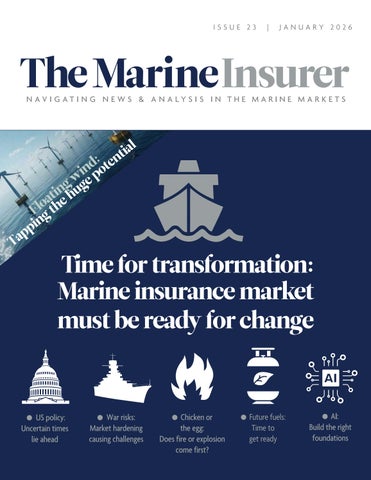
Time for transformation: Marine insurance market must be ready for change
l US policy:
Uncertain times lie ahead
l War risks:
Market hardening causing challenges
l Chicken or
the egg: Does fire or explosion come first?
l Future fuels:
Time to get ready
l AI:
Build the right foundations
QBE Marine – Leading specialists on → Cargo and STP → Ports, Terminals and Logistics → Inland Marine → Hull and Machinery → Marine War → Marine Liability → Specie and Fine Art
1051704/2511
For more information visit QBEeurope.com
QBE European Operations is a trading name of QBE UK Limited, QBE Underwriting Limited and QBE Europe SA/NV. QBE UK Limited and QBE Underwriting Limited are both authorised by the Prudential Regulation Authority and regulated by the Financial Conduct Authority and Prudential Regulation Authority. QBE Europe SA/NV is authorised by the National Bank of Belgium under licence number 3093.
CONTENTS | EDITORIAL
Comment Back to where we started?
Highlights a
FEATURES
30 04 2025 in review and the year ahead
Reviewing a busy year for the maritime sector and the outlook for 2026
06 US maritime policy
The US maritime regulatory policy in 2025 under the spotlight
10 Navigating risk
Analysing the key risks facing the maritime sector and its insurers into 2026
12 War risk liabilities
The potential hidden liabilities for P&I insurers in a challenging war risk market
16 War risk exclusions
UK Court of Appeal’s decision leading to positive news for insureds
20 The Nordic Plan
Looking at how the Heroic Idun arbitration award reinforces the position under the Nordic Marine Insurance Plan of 2013
40 Future fuel risks
Alternative fuels can lead to a wider range of applications for greener ship operations
43 Downstream energy
Rising losses are likely to lead to more challenging renewals in the downstream energy insurance market market
46 Biodiversity
Saving the seas: How marine insurance can help restore nature
50 AI foundations
On how the insurance industry should be approaching the rush to embrace artificial intelligence
52 Safety at sea
The iniatives the maritime industry has initiated in an effort to continue to make seafarers safer at sea
56 Fire and explosions
The complex matter of determining a CTL caused by physical damage to a vessel
Using a real-life case study to highlight the complexities of identifying what comes first in marine cargo fires – the fire or the explosion
25 Global marine: Türkiye
60 Profile: London Club
22 CTL law
Examining Türkiye’s central role in global maritime trade
03
40
30 P&I renewals
Why P&I Clubs may find it difficult to impose further increases at renewal
As 2025 ended and 2026 began, it seemed little had changed in a year and the marine insurance market continued to grapple with much the same issues. At the time of writing, the war in Ukraine was rumbling on, the Houthis had declared peace but no-one was sure whether that could be trusted and, more recently, the US had declared war on dark fleet vessels carrying Venezuelan oil as well as taken its president to the US to face drug related charges. Added to that geopolitical uncertainty, the IMO was unable to carry through on its promised Net Zero Framework, pushing the vote back by a year and leaving the industry uncertain as to whether to invest in expensive and often little tested new fuels or continue with older technology that might need replacing in a near future. The market itself also ended the year in some confusion, with war rates appearing to harden, along with P&I renewals, despite many believing those changes were unnecessary. Meanwhile the debate on artificial intelligence has been hotting up with some beginning to question whether it will be the panacea that everyone is hoping for. Whatever decision is made on that, the clear advice emerging is to look before you leap and make sure technological foundations are solid before any changes are made. And then, there remains the continuing risk of fire and explosions on board vessels. At the end of the year, three more crew lost their lives in a fire and all in the insurance sector continue to caution about misdeclared cargoes and the risks of carrying hazardous cargoes, alongside the well-publicised risks of carrying lithium batteries. It will be interesting to see what changes 2026 will bring but it is certainly a time for the sector to think nimbly and be ready for whatever comes next. So, all that is left for me to do is to wish all our readers a happy and prosperous new year.
Liz Booth, Editor, The Marine Insurer
36 Floating wind
Achieving the huge potential of floating wind through investment and collaboartion
Editor Liz Booth liz@lizbooth.co.uk Assistant Editor Adrian Ladbury ladburya@gmail.com Art Editor Rob Crotty rob@greenlightpartners.co.uk
Commercial Director Daniel Creasey daniel@cannonevents.com tel: +44 07702 835831 Publishing Director Grant Attwell grant@cannonevents.com tel: +44 07905 933252
Published by Cannon Events and Publications © Cannon Events Limited 2026 Pictures: Adobe Stock
All rights reserved. No part of this publication maybe reproduced, stored in a retrieval system, or transmitted in any form or by any means, electrical, mechanical, photocopying, recording or otherwise without the prior written permission of the publishers. The views expressed in The Marine Insurer Magazine are not necessarily shared by the publisher, Cannon Events limited. The views expressed are those of the individual contributors. No liability is accepted by Cannon Events Limited for any loss to any person, legal or physical as a result of any statement figure or fact contained in this title. The publication of advertisements does not reflect any endorsement by the publisher.
The Marine Insurer | January 2026
04 MARINE | Review and outlook In association with AXA XL
As we reflect on the past year and look to the horizon, the maritime industry stands at a pivotal juncture. The sector is experiencing rapid transformation driven by multiple factors from technological innovation to environmental imperatives to geopolitical shifts and demographic changes. These factors collectively shape an evolving landscape that demands new skills, innovative risk management and a committed partnership between all stakeholders.
GEOPOLITICAL CHANGES
The international maritime industry is inherently sensitive to geopolitical shifts. Developments, such as attacks by Houthi rebels in the Red Sea, prompted companies to reassess routes, often rerouting through the Cape of Good Hope, which adds time, costs and new navigational skills. Similarly, disputes over the Panama Canal and rising tariffs in the US have led to route diversification and supply chain re-evaluation. The tensions between the US and China also impact global supply chains, requiring clients to be agile and adaptive. These geopolitical dynamics increase risks. Insurance plays a key role in understanding and managing these risks, sometimes in real time, helping clients navigate piracy, conflict, and political instability. As the maritime environment becomes more complex, open communication between stakeholders is vital and insurers must remain agile and proactive in risk mitigation.
TECH PROGRESS AND DEMOGRAPHIC CHALLENGES
Technological advances are transforming risk management. Sensors provide real-time cargo condition data, while artificial intelligence (AI) optimises inventory and reduces warehouse risks. These innovations are shifting the maritime workforce from predominantly physical roles to tech-driven positions, demanding new skills. However, attracting talent also remains a challenge. Extended voyages rerouted to avoid hotspots, coupled with declining birthrates and migration driven by climate and social unrest, threaten recruitment. The industry must adapt its talent strategies to ensure a sustainable future workforce. To help shipowners navigate the changes, we are continually enhancing our own knowledge, expertise and data to ensure that they can meet the future demands of a changing labour force and subsequent risk environment.
ROUTE TO REDUCED EMISSIONS
The marine industry has set ambitious greenhouse gas (GHG) emission reduction targets. At the International Maritime Organization (IMO) meeting in April, an agreement was reached that made shipping the first industry in the world subject to internationally mandated emissions reduction targets. From 2028, the IMO requires ships to begin to use alternative fuels and its global fuel standard will require ships The Marine Insurer | January 2026
Supporting marine for the next generation Louise Nevill, CUO Specialty, UK & Lloyd’s at AXA XL, reviews a busy year for the maritime sector and the outlook for 2026 as the sector embraces a more sustainable future
to reduce their annual GHG fuel intensity. This means they will need to restrict how much is emitted for each unit used on a so-called well-to-wake basis – all the way along the chain. Those ships that emit above the thresholds set will need to acquire remedial units to redress the balance. As part of their efforts to meet these goals, shipowners around the world are exploring new technology and fuel types, from hydrogen to nuclear. This brings with it evolving risks and opportunities that require continually updated knowledge and expertise. And the mariners of tomorrow will need to understand how to work alongside new fuel sources on new designs of vessels and new technology.
SUSTAINABLE SEAS
2025 marked another important milestone for the move towards more sustainable oceans and seas. In June, the 3rd United Nations Ocean Conference was aimed at finding ways to support the conservation and sustainable use of oceans, seas and marine resources. And when the marine insurance industry gathered in Singapore for the International Union of Marine Insurance conference, sustainable development was top of the agenda. Innovation in the way ships are fuelled, loaded and unloaded, docked and maintained, as well as how goods are transported, stored and monitored while at sea is pushing the marine industry forward towards its decarbonisation goals. Insurers are working in partnership with marine clients as they create new technology, from the nascent stages of invention to operation and beyond, to play its part in this journey to a blue economy – a model of ocean-based activity that is sustainable and regenerative.
MARINE | Review and outlook In association with AXA XL
05
“The energy transition is no longer an abstract future concept; it is happening all around us, at sea, in the holds of ships and at docks and ports.”
ENERGY TRANSITION IN ACTION
The energy transition is no longer an abstract future concept; it is happening all around us, at sea, in the holds of ships and at docks and ports. Just as our clients are innovating to find ways to move to a lower carbon economy, so we are looking to find innovative ways to partner with them and provide risk and insurance solutions to make the transition a reality. Take Canopée, the world’s first sail-assisted cargo ship which launched in late 2023 and for which AXA XL was an insurance and reinsurance partner. Or TransOceanic Wind Transport, a Francebased shipping company that in 2025 began the construction of six cargo-carrying sailing sisterships. AXA XL is also one of the partners behind a credit insurance arrangement that is helping to fund this innovative project. Most recently we signed the Declaration of Cooperation for Accelerating Nuclear for Maritime Applications to Support Climate Ambitions, an initiative that looks to drive progress and advance sustainable and secure nuclear integration in the maritime sector. The marine insurance industry is also supporting numerous other projects including the development of hybrid ferries and electric sailing fleets.
TOWARDS A BLUE ECONOMY
In this volatile environment, maritime companies face complex
challenges, from climate change and digitalisation to technological innovation. Success depends on mariners’ ability to manage risks and seize opportunities sustainably. Insurers aim to be strategic partners, supporting bold initiatives that address these challenges. Insurance solutions such as covering investments in hybrid ships, electric ports or smart logistics are vital for fostering confidence and enabling transformative projects. By de-risking investments, insurance helps to accelerate the transition toward a sustainable blue economy.
LOOKING AHEAD
The maritime industry stands at a crossroads, with profound opportunities and challenges ahead. Climate commitments, technological progress, geopolitical tensions and demographic shifts will continue to shape the future. Success will depend on collaboration between ship owners, ports, regulators and their insurance partners. In 2026 and beyond, our industry’s role is to continue supporting innovation, facilitating sustainable investments and sharing expertise. By working together, we can help ensure the maritime sector remains resilient, sustainable and ready for the next era of global trade. The Marine Insurer | Janauary 2026
06 MARINE | US maritime policy in 2025 In association with Chalos & Co
Storm-tossed shipping policy
The Marine Insurer | January 2026
US maritime policy in 2025 In association with Chalos & Co
07
Benjamin Robinson, attorney at Chalos & Co, explains the big changes in US maritime regulatory policy in 2025 and advises the community to remain on its toes, ready for more change as we enter 2026
“Section 5 of the Executive Order, directed the US Trade Representative (USTR) to coordinate with other relevant federal agencies and initiate an investigation of China’s practices in the maritime, logistics, and shipbuilding under Section 301 of the Trade Act of 1974. This set off a regulatory maelstrom that presents considerable uncertainty for the year ahead.”
The year 2025 was marked by historic volatility in US maritime policy. President Trump’s 9 April, 2025, Executive Order “Restoring America’s Maritime Dominance,” set the stage for these policy developments. It was aimed at reversing the trend of weakening of US commercial shipbuilding capacity and diminishing maritime workforce and the correlative strengthening position of maritime rivals. The Executive Order noted that the US constructs less than one percent of commercial ships globally, while China produces approximately half. In response, it established the framework within which both USTR and FMC subsequently launched their regulatory initiatives. One notable provision was Section 5 of the Executive Order. This directed the US Trade Representative (USTR) to coordinate with other relevant federal agencies and initiate an investigation of China’s practices in the maritime, logistics, and shipbuilding under Section 301 of the Trade Act of 1974. This set off a regulatory maelstrom that presents considerable uncertainty for the year ahead.
SECTION 301 MARITIME ACTIONS
On 23 April, 2025, roughly two weeks after issuance of the Executive Order, USTR published a Federal Register notice formally proposing port fees and duties. The fees we imposed based on its findings in the hastily conducted Section 301 investigation that determined China’s targeting of the maritime, logistics and shipbuilding sectors for dominance was unreasonable and burdened US commerce. USTR’s authority under the Trade Act of 1974 grants it broad authority to investigate foreign government practices that burden or restrict US commerce and take retaliatory action. See 90 F.R. 17114 (Apr. 23, 2025); 19 U.S.C. § 2411. According to the investigation’s findings China engaged in extensive state subsidies to its shipbuilding industry that enabled Chinese yards to capture approximately 50% of global shipbuilding capacity. The subsidies, estimated in the tens of billions of dollars annually, were found to have systematically disadvantaged US and allied shipbuilders. USTR determined that these practices warranted remedial measures under Section 301 authority. The Marine Insurer | January 2026
08
MARINE | US maritime policy in 2025 In association with Chalos & Co
The goals of the Section 301 actions were threefold. First, the measures aimed to counter China’s state subsidies and non-market practices in shipbuilding that had effectively eliminated Western competition in many market segments. Second, the actions sought to reduce US dependence on Chinese-built vessels and Chinese-operated shipping services, that policymakers identified as both an economic vulnerability and a national security concern. Third, the initiative was designed to create economic incentives for revival of the US merchant marine and shipbuilding industries, that had declined to less than one percent of global commercial shipbuilding orders. The Administration announced concurrent investments of $500bn from Japan and $150bn from South Korea for US shipyard modernisation to support this objective. The April 23 notice organised the proposed fees and duties into six annexes. The annexes are not cumulative. Only one applies to any single vessel. Annex I imposed fees on Chinese-operated or Chinese-owned vessels, escalating to $140 per net ton by 2028. Annex II covered Chinesebuilt vessels, with fees reaching $33 per net ton or $250 per container by 2028. Annex III addressed foreign-built car carriers at $150 per car equivalent unit beginning October 14, 2025. These fees were assessed per US port rotation up to five times annually. Additional measures under Annex V included duties up to 100% on Chinese-origin ship-to-shore cranes and cargo handling equipment. The notice also mandates that beginning 17 April, 2028, licenses for the export of LNG from the US must require that exporters use US vessels for the maritime transport of a certain percentage of LNG exports, starting at 1% and gradually increasing to 15% by 2047.
BIMCO CONTRACTUAL FRAMEWORK
In response to the pending implementation of USTR fees, the Baltic and International Maritime Council (BIMCO) published the USTR Clause for Time Charter Parties 2025 in July 2025. BIMCO developed this standardised contractual clause through a working group of ship owners, charterers and P&I Clubs to address allocation of fee obligations in charter party arrangements. The BIMCO clause establishes procedures requiring vessel owners to declare whether vessels fall under USTR fee jurisdiction and allocates responsibility for fee payment between owners and charterers based on the nature of the vessel’s nexus to Chinese ownership, operation, or construction. The clause requires fees to be paid directly to US agencies rather than through intermediaries, given the substantial sums involved, and provides indemnification mechanisms for parties harmed by non-payment. Given the unprecedented nature of the fee structure and the complexities of multiparty charter arrangements in international shipping, BIMCO left the door open to subsequent refinement of the The Marine Insurer | January 2026
“Just two weeks after the USTR fees took effect, the White House announced a comprehensive US-China trade andeconomic agreement that included China’s commitment to negotiate on the Section 301 issues raised in the maritime investigation.”
clause as implementation experience accumulates.
FLAG STATE PRACTICES
In May 2025, the Federal Maritime Commission opened an investigation to examine whether foreign shipping laws and regulations, particularly those related to “flag of convenience” practices, have produced conditions unfavorable to the foreign trade of the US. While FMC has launched investigations on its own initiative previously and has investigated unfavourable conditions under the 1920 Merchant Marine Act, this investigation is unprecedented in its scope and potential impact. FMC’s investigation was initiated pursuant to Section 19 of the Merchant Marine Act of 1920, which authorises
US maritime policy in 2025 In association with Chalos & Co
the Commission to investigate whether laws, regulations, or practices of foreign governments create conditions unfavourable to shipping in US foreign trade. The Commission’s opening notice identified multiple concerns, including the emergence of “shadow fleets,” safety trends, supply chain vulnerabilities and the role of foreign flagging practices as potential causes of these issues. The notice alleged that competitive pressure among flag states to attract vessel registrations has led to a regulatory “race to the bottom” with lower safety, environmental and labour standards. FMC cited several vessel casualties, including the March 2024 allision of MV Dali with the Francis Scott Key Bridge in Baltimore, as examples of risks posed by flag of convenience practices. The investigation sought public comment to identify and distinguish “responsible” flagging laws, regulations and practices from those that are unfavourable.” It also sought input on the impacts on efficiency and reliability of the ocean shipping supply chain posed by flagging regimes and problematic owners’ and operators’ practices such as underinsured vessels, poor safety practices and threats to freedom-of-navigation principles. On August 20, 2025, the comment period closed. A total of 38 comments were received from various stakeholders including seafarer unions, flag state registries and industry associations. FMC has considerable authority to act on findings from this investigation. Under 46 U.S.C. § 42106, the Commission may limit voyages to US ports, suspend tariffs and service contracts, suspend an ocean common carrier’s right to operate under filed agreements, impose fees up to $1,000,000 per voyage, or take other actions found necessary to adjust or meet unfavourable conditions to shipping in US foreign trade. In enforcing these provisions, FMC has authority to call on US Customs and Border Protection and the US Coast Guard. 46 U.S.C. § 42107. As of writing, FMC issued no findings or proposed regulations based on the investigation and remains open and pending.
SUSPENSION OF SECTION 301 MARITIME ACTIONS Days before the first increase in USTR fees took effect, China’s Ministry of Transport announced that special port fees would apply to US-nexus vessels at Chinese ports beginning 14 October, 2025. The structure of China’s reciprocal fees closely mirrored the US fee schedule in both phased implementation and magnitude of charges, creating the potential for escalating tit-for-tat trade restrictions in the maritime sector. Just two weeks after the USTR fees took effect, the White House announced a comprehensive US-China trade and economic agreement that included China’s commitment to negotiate on the Section 301 issues raised in the maritime investigation. On 9 November, 2025, following an unusual one-and-a-half-day comment period, USTR issued a Federal Register notice suspending all Section 301 actions related
09
to China’s targeting of the maritime, logistics and shipbuilding sectors for one year, ending 9 November, 2026. The suspension covers fees on maritime transport services under Annexes I, II, and III of the 23 April, 2025 notice (as modified by the 16 October, 2025 notice), as well as duties on ship-to-shore cranes and cargo handling equipment under Annex V.A. During the suspension period, no liabilities will accrue for these fees or duties. The suspension was directed by the President and deemed no longer appropriate under Section 307(a)(1) of the Trade Act. Significantly, the suspension notice does not specify if scheduled fee increases will be reset. If the fees resume after 9 November, 2026, the scheduled increases under the original action may take effect at the higher rates rather than restarting from zero. The suspension allows time for bilateral negotiations while enabling the US to advance domestic shipbuilding investments through the announced Japanese and Korean commitments. The suspension puts off increased shipping costs, commercial disruptions and potential realignment of trans-Pacific trade routes as negotiations on the subject proceed.
CONCLUSION: AN UNCERTAIN HORIZON
The pitch and roll of US maritime policy in 2025 revealed the administration’s willingness to deploy aggressive trade measures in support of domestic maritime interests and the practical limitations such unilateral actions face in an interconnected global economy. The year’s policy turbulence - from ambitious tariff structures to industry scrambling for contractual solutions to sudden diplomatic suspension - left the maritime sector facing profound uncertainty. At the close of the year, the FMC’s flag-of-convenience investigation remains open and unresolved, potentially representing a longer-term challenge to established international maritime practices. The USTR fees also remain in regulatory limbo, suspended but not eliminated, with the prospect of resumption, possibly at escalated levels, hanging over the industry as bilateral negotiations proceed. Whether these initiatives represent a temporary disruption or the beginning of a fundamental restructuring of international maritime trade rules remains to be seen. What is certain is that 2025 demonstrated that US maritime policy can change course with remarkable speed, leaving an industry built on long-term capital investments and multi-year contracts struggling to navigate increasingly rough regulatory waters. What is certain, however, is that ship owners, operators and charterers worldwide should maintain a careful watch over US maritime policy in the year to come and stand poised to adjust course as these uncertainties evolve. The Marine Insurer | January 2026
10 MARINE | Risk management In association with Liberty Specialty Markets
Navigating risk in a complex marine market Chris Hicks, head of marine, Liberty Specialty Markets analyses the key risks facing the maritime sector and its insurers into 2026. Stable underwriting relationships and deeper data sharing are key to rising to developing accumulation risks Last year reaffirmed that many challenges familiar to the marine market will persist well beyond 2026. Global trade volumes continue to fluctuate amid ongoing geopolitical tensions, supply chain disruptions and shifts in trade policy. At the same time, rising asset values, softening rates, concentrated risks in ports, warehouses and high-value cargo, along with evolving climate-related exposures are also reshaping the market. These challenges do not occur in isolation and often intersect, creating potential for amplified and systemic exposures. Traditionally, each peril is assessed individually yet the current environment demands greater portfolio-level understanding of potential interactions and how they could accumulate.
RENEWAL SEASON PRESSURES
For both insurers and clients, the renewal season brings these issues into sharp focus and with that the opportunity to review risk mitigation strategies. In time, this process has improved, with many clients moving renewals away from peak periods. Yet, with the bulk of renewals still occurring on 1/1, careful and strategic resource allocation is still very much needed to ensure stringent evaluation standards are maintained during the fourth quarter.
ACCUMULATION RISK
Often occurring due to shared logistics and storage facilities, accumulation risk is arguably the most difficult and pressing challenge facing the marine market. Facilities in clusters exacerbate this, for example Taiwan’s semiconductor manufacturing hub, with one warehouse or The Marine Insurer | January 2026
compound housing multiple assureds in close proximity. Stockpile values have hugely increased, with a single warehouse potentially housing multiple billions of dollars worth of stock – values unimaginable just a few years ago. Accumulation risks often only become apparent after a major incident occurs, as seen with the Tianjin port explosion in 2015. The chemical blast hit multiple marine property and cargo assets, with the high concentration of adjacent goods compounding the overall loss value. To better understand and quantify accumulation exposures before they materialise, deeper knowledge is required of clients’ businesses, how those businesses intersect with others and how values accumulate across the supply chain.
DIGITALISATION AND SUPPLY CHAIN VISIBILITY
Digital tools are further helping to address accumulation risk and improve visibility across complex supply chains. Telematics, GPS tracking and digital supply chain platforms are all developing tools offering real-time monitoring, yet adoption remains limited due to cost, fragmented standards and scale. Tracking tends to be confined to the most valuable or sensitive shipments such as pharmaceuticals or
MARINE | Risk management In association with Liberty Specialty Markets
11
Black Sea, geopolitical instability continues to challenge the market. War-related risks in Ukraine remain similarly complex, yet there is also opportunity for potential involvement in reconstruction. Climate hazards, from floods to tornadoes, are increasingly important considerations, particularly when high-value assets are concentrated. Trends such as digitalisation and energy transition also continue to influence exposures and demand. For instance, renewable energy projects drive marine insurance demand, while energy transition and highvalue cargo introduce additional operational variables.
POOLING INTERNAL RESOURCES
Only a fraction of containers globally are actively tracked, meaning the real-time progress of most cargoes is largely invisible. semiconductors. For instance, only a fraction of containers globally are actively tracked, meaning the real-time progress of most cargoes is largely invisible. Despite these limitations, digital tools are improving and greater adoption will allow insurers to build a better understanding of how client operations intersect across warehouses and logistics providers in different territories.
Long-term, stable underwriting relationships allow deeper insight into client operations, providing more accurate data essential to understanding accumulation risk at a portfolio level. Greater knowledge sharing is pivotal, both with clients and between the various areas of expertise within insurance organisations. Earlier this year we launched an integrated business unit model – bringing underwriting, actuarial, claims, risk engineers and all aspects of delivery together, which produced superior insights with numerous other benefits. Clients greatly appreciate it when claims colleagues attend meetings and the effort to place considerable additional expertise and experience at their disposal. Closer organisational integration has naturally led to greater knowledge sharing, fortified essential relationships, sharpened risk selection, produced more insightful terms and conditions and enhanced our overall view and management of risk. Moving away from traditional silos is therefore a further way insurers can address knowledge gaps and help mitigate accumulation risks. The confluence of these issues highlight the importance of a portfolio-level, data-driven approach. Through greater collaboration and by combining historical insight with a sharper understanding of client exposures, insurers can transform their portfolio-level understanding and enhance their resilience against future accumulation risks.
KNOWLEDGE GAPS
Even with technology, significant knowledge gaps persist. Many insurers struggle to fully understand the scale and concentration of exposures across regions or third-party logistics providers. Bridging these gaps requires integrating insights across portfolios, sharing intelligence internally – to identify and manage systemic risks before they escalate – and drawing on claims experience from past events. Understanding clients’ operations, mapping supply chain linkages and applying historical insights reduces knowledge gaps, boosting insurers’ ability to anticipate potential accumulations.
GEOPOLITICAL AND CLIMATE
“Understanding clients’ operations, mapping supply chain linkages and applying historical insights reduces knowledge gaps, boosting insurers’ ability to anticipate potential accumulations.”
With ongoing threats in regions such as the Red Sea and The Marine Insurer | Janauary 2026
12
MARINE | War risk In association with Hill Dickinsonal
War risks without war cover
BLUE CARDS IN BRIEF
Alexander Freeman (left), partner, and Richard Cooper, marine manager, of Hill Dickinson, explain the potential hidden liabilities for P&I insurers in a challenging and hard marine war risk market
WAR RISK EXCEPTIONS: BUNKERS AND WRECK REMOVAL CONVENTION
When, from October 2023, Houthi attacks started intensifying in the Red Sea, war risk premiums covering Red Sea transit surged to unprecedented levels. For many owners, the cost of insurance cover became prohibitive, sometimes 10 times higher than pre-crisis rates. Faced with spiralling costs, some owners chose to take the risk and trade in the region without adequate war risk coverage. Throughout 2025, that gamble has produced predictable consequences. Multiple ships have been damaged or sunk in the region as a result of the conflict. The risks are broad – vessels have been lost as a result of a number of different causes, from direct targeted attacks by the Houthis to indirect casualties following Israeli strikes on Houthi territory. Some of these casualties did not have adequate war risk insurance. However, most if not all had full hull & machinery and P&I cover. Although they are not directly exposed to war risks, questions have arisen as to the extent to which P&I insurers remain unexposed to liability under the blue card regimes, even when the casualty was caused by a war risk. This article explores the extent of the P&I insurers’ liability under the blue cards generally issued under the Bunkers Convention, the Nairobi Wreck Removal Convention and the Maritime Labour Convention (MLC). The Marine Insurer | January 2026
A blue card is a confirmation from the insurer (usually the P&I insurer) that financial security exists to meet compulsory cover under certain conventions. In practice, the conventions allow direct action against the insurer. This mechanism means that, in some cases, a convention state or claimant can bypass the shipowner and hold the insurer directly liable. The following three blue cards are generally issued: • Bunkers Convention 2001 – covers pollution from bunker oil. Compulsory insurance for ships of more than 1,000 GT. • Nairobi Wreck Removal Convention 2007 – covers locating, marking and removing wrecks. Compulsory insurance from 300 GT. • MLC 2006 – covers abandonment and crew claims. These certificates are generally compulsory in normal trading. The question arises to what extent a P&I insurer will be liable when a vessel without war risk insurance is sunk by a war risk.
Both the Bunkers and Wreck Removal Conventions contain similar carve-outs. If the casualty resulted from war, hostilities, civil war or insurrection, then there is no liability under the conventions. Because direct claims can be brought against the insurer, the P&I insurer can raise the same defence. So, if a missile strike or drone attack causes an oil spill or wreck, the P&I insurer should be able to resist liability under these conventions. However, the issue of what caused the casualty remains important. If a vessel grounds and becomes a wreck while diverting to avoid a perceived war threat, then the cause of the casualty will unlikely fall within the war risk carve-out under the conventions, exposing the P&I insurer to liability under the relevant blue cards. In that case, the insurer could face enormous bunker pollution or wreck removal claims. This distinction is critical. A war risk defence is not a blanket exemption for any casualty in a conflict zone. It applies only when the damage is directly caused by warlike operations. Poor navigation, machinery failure or human error might not apply – although a careful consideration of the direct cause will be critical.
MLC: NO WAR DEFENCE
The blue card under the MLC is different. It is a financial security regime regarding owners’ liabilities to seafarers, for example for abandonment, repatriation, medical care and the like. There is no war-risk exception. A seafarer is deemed abandoned if wages go unpaid for two months, repatriation is not arranged, or basic support is lacking. Blue card liability covers up to four months’ wages, essential needs and repatriation. In practice, if there is a loss of life or if an owner cannot
13
MARINE | War risk In association with Hill Dickinsonal al
“If a vessel grounds and becomes a wreck while diverting to avoid a perceived war threat, then the cause of the casualty will unlikely fall within the war risk carveout under the conventions, exposing the P&I insurer to liability under the relevant blue cards. In that case, the insurer could face enormous bunker pollution or wreck removal claims.”
maintain wages or repatriate after a war casualty, the P&I insurer might be exposed to liability. The best mitigation following any casualty is to ensure that the owner repatriates the crew as soon as possible. Delay risks port state action, reputational damage and even criminal exposure in some jurisdictions.
JURISDICTIONAL MATTERS
Generally, a state can only claim under a blue card if the casualty occurs within its territorial sea. However, not every Red Sea state has ratified the blue card conventions. For example, Yemen and Sudan are not parties to the Wreck
Removal Convention, so P&I insurers are generally not exposed to wrecks within their territorial sea because neither state can claim wreck removal costs under the blue cards. Additionally, local laws in non-convention states must be reviewed to determine whether any rights exist to pursue claims against owners or directly against their insurers for pollution or wreck removal costs, even when such costs arise from a war risk.
BOTTOM LINE
In the light of ongoing geopolitical tensions around the globe, a P&I insurer’s exposure is far more nuanced than many assume. Some P&I insurers might (rather understandably) be operating under the belief that there is no or little liability where they have not underwritten war risks. That is not the case because exposure can still arise, whether because a casualty is caused indirectly by a war risk, or there are unavoidable obligations such as those under the MLC and/ or exposure under local laws in non-convention states. Although the Red Sea situation appears to be easing at the time of writing this article, P&I insurers should nevertheless remain vigilant. War zones create unpredictable liabilities and P&I insurers may want to reconsider covering owners that take unreasonable risks or raising premiums accordingly to reflect these risks. The Marine Insurer | January 2026
20 March 2026
Marine Insurance London is the UK's leading marine insurance conference that brings the London Market together with a truly global audience. The conference attracted over 400 delegates in 2025 and is set to grow even bigger this year. With the next event taking place on 20th March 2026 at the Leonardo Royal Hotel London Tower Bridge, this will be the conference all brokers, insurers and third parties should attend to help shape the future of the industry.
PROUD HEADLINE SPONSOR
PROUD SPONSORS
GLOBAL PARTNERS
Holdings Limited Insurance Group
marineinsurancelondon.com
10.45 & 15.10 COFFEE BREAK ȶȉ March ȶȉȶ6
08.50-09.20: Opening Address
MODERATOR
13.10 LUNCH What’s Going on in the World from a Military Perspective?
TBC, ROYAL NAVY
09.20-10.00: Panel Discussion
Is it the End of Globalisation as We Know it?
FRÉDÉRIC DENÈFLE, PRESIDENT, INTERNATIONAL UNION OF MARINE INSURANCE JAREK KLIMCZAK, MASTER MARINER, CHIEF RISK CONSULTING OFFICER, AXA XL ALEXANDRA COUVADELLI, VICE PRESIDENT UK CLAIMS, GARD
10.00-10.20: Presentation
Regulations – Shape-Shifting Rules; The Changing Nature of Regulation
10.20-10.40: Presentation
LNG Shipping and The Energy Transition
JEFF WILSON, DIVISIONAL DIRECTOR MARINE AND OFFSHORE ADVISORY, HOWDEN
10.40-10.45: Post-Coffee Break Briefing
An Introduction to Stream Two
RONNY REPPE, CHIEF EXECUTIVE OFFICER, NORIA
STREAM TWO
STREAM ONE 11.15-11.35 Presentation:
Marine Insurers Shaping Up in New World Order
Changing Trade Routes: The Red Sea Threat – Not Over Yet
TBC,GARD DR. DOMINICK DONALD, SENIOR ADVISER,HERMINUS
11.35-12.15 Panel Discussion: Geopolitics – How Can Insurers Support Clients in Navigating the Uncertain World?
The Perfect Match – A Single Source of Truth RONNY REPPE, CHIEF EXECUTIVE OFFICER, NORIA ED DAVIES, CHIEF INFORMATION OFFICER, WEST OF ENGLAND P&I CLUB BEN HARRISON, CHIEF TECHNOLOGY OFFICER, CETO RALPH HALE, SMART FOLLOW ENGAGEMENT ANALYST, APOLLO UNDERWRITING
LUKE OGILVIE, SENIOR UNDERWRITER – HULL AND WAR, LIBERTY SPECIALTY MARKETS BENJAMIN LOCKWOOD, HEAD OF SPECIALTY, AEGIS KATIE COSTELLO, HEAD OF HULL AND WAR, MARKEL INTERNATIONAL ANDERS HOVELSRUD, CHIEF UNDERWRITING OFFICER – WAR, DNK DEN NORSKE KRIGSFORSIKRING FOR SKIB
12.15-12.55 Panel Discussion: War Insurance – Can War Insurance Still Prop Up Other Parts of the Portfolio?
Compliance – The Licence to Operate SW BURGER, MARITIME SANCTIONS AND DEFENCE LAWYER, GARD JACOB DAMGAARD, DIVISIONAL DIRECTOR – HEAD OF LOSS PREVENTION, BRITANNIA P&I CLUB KAROL URBAŃCZYK, INSURANCE CONSULTANT, FUTURE PROCESSING MICAH COX, SENIOR SANCTIONS AND ANTI-MONEY LAUNDERING MANAGER, MARSH
THOMAS CAPPELEN, DIRECTOR, HULL DIVISION, CAMBIASO RISSO BEN MCKEITH, SENIOR UNDERWRITER, LONDON P&I CLUB MATTHEW GYSBERS, UNDERWRITING MANAGER, HULL AND WAR, AXA XL IAIN HENSTRIDGE, CLASS LEADER, HULL, APOLLO UNDERWRITING
Fireside Chat
Presentation
13.45-14.10:
Plastic Pellets
Placing Customers at the Heart of the Digital Journey
INTERNATIONAL GROUP TBC & LONDON CLUB
Presentation
DAVID MIDDLETON, HEAD OF LONDON MARKET, AMAZON WEB SERVICES
14.10-14.30:
Salvage Case Study
Case Study
The Numbers Have It
MAURICE SCHREURS, COMMERCIAL DIRECTOR, SMIT SALVAGE
14.30-15.10: Panel Discussion
The Leader’s Playbook – Reshaping Insurance Through Innovation and Talent
MARK BENNETT, CHIEF GROWTH OFFICER, ACORD SOLUTIONS GROUP DAN MCCARTHY, DIRECTOR OF MARINE, MARKEL INTERNATIONAL SIMON SQUIRES, HEAD OF MARKET TRANSFORMATION, UK AND LLOYDS, AXA XL CHRISTOPHER JONES, CHIEF EXECUTIVE, INTERNATIONAL UNDERWRITING ASSOCIATION
15.40-16.00: Presentation
Criminalisation of Seafarers – Going to Work Shouldn’t Mean Going to Jail
LEYLA PEARSON, SENIOR MANAGER, LEGAL, INTERNATIONAL CHAMBER OF SHIPPING
16.00-16.40: Panel Discussion
Alternative Fuels – Will They Scale and Deliver on Time?
JAMES MUNN, PORTFOLIO MANAGER – PORTS, TERMINALS, TRANSPORTATION AND LOGISTICS, QBE SIMON SCHNORR, HEAD OF MARINE AND ENERGY, CHAUCER GROUP NICK MADDALENA, MANAGING DIRECTOR – INSURANCE, AMBREY GLOBAL SPECIALTY RICHARD YOUNG, CHIEF UNDERWRITING OFFICER, CLEARWATER UNDERWRITING
16.40-17.10: Fireside Chat
The Role of Charterers in the Spotlight
STEPHEN KENNY KC, BARRISTER, 7 KINGS’S BENCH WALK KUNBI SOWUNMI, SENIOR CLAIMS ADVISOR/LAWYER, GARD (NORTH AMERICA) INC.
PANELLIST
16
MARINE | War risk exclusion In association with HFW
Win Win – Court of Appeal victory for marine insurance buyers
Jenny Salmon legal director, London, Alex Walley, senior associate, London, right, and Bea Bray, associate, London, bottom left, HFW, explain the UK Court of Appeal’s decision in the Win Win arrest case that they say led to positive news for insureds in the maritime sector
The Marine Insurer | January 2026
MARINE | War risk exclusion In association with HFW
17
The UK Court of Appeal’s decision in The Win Win clarifies two important aspects of marine insurance law: 1. The interpretation of exclusion 1(e) of the American Institute Hull War risks and Strikes Clauses, dated 1 December 1977 and their addendum dated 1 April 1984 (the American Clauses), concerning arrests and detentions under customs and quarantine regulations; and, 2. The meaning of “senior management” when determining whose knowledge matters for the purposes of a policyholder’s duty of fair presentation.
BACKGROUND FACTS
On 13 February 2019, the Win Win anchored in an area commonly understood to be Eastern OPL (Outside Port Limits) Singapore, which straddled Indonesian territorial waters. Historically, vessels had anchored in this area without interference from Indonesian authorities. However, in February 2019, the Indonesian Navy unexpectedly began arresting numerous vessels for anchoring within territorial waters without prior authorisation, citing breaches of the Shipping Law of Indonesia. The Win Win was detained on 17 February 2019 and remained under arrest until 9 January 2020 — ie for almost 11 months. The vessel was insured under a war risks policy which incorporated the American Clauses, including (in the addendum) a 12 month detention clause amended to six months in the policy. The insureds claimed for a constructive total loss on the basis that the detention exceeded six months.
THE WAR RISKS EXCLUSION
“The key question for the court was whether the sole director, who was the only person with knowledge of the criminal charges, formed part of the insureds’ senior management.”
Insurers denied liability on several grounds, including reliance on exclusion 1(e) of the American Clauses, which states: “This insurance does not cover any loss, damage or expense caused by, resulting from or incurred as a consequence of: (e) Arrest, restraint or detainment under customs or quarantine regulations and similar arrests, restraints or detainments not arising from actual or impending hostilities.” Insurers argued that the detention fell within “similar arrests, restraints or detainments not arising from actual or impending hostilities”, contending that the exclusion should apply broadly to any detention under peacetime laws. First instance At first instance, the judge held that an arrest or detention would only be “similar” where the underlying purpose of the detention is materially the same as that of customs or quarantine regulations. The exclusion did not apply, as a detention for anchoring in territorial waters was not The Marine Insurer | January 2026
18
MARINE | War risk exclusion In association with HFW
sufficiently similar to an arrest under customs or quarantine regulations. Court of Appeal Insurers appealed and advanced a wider construction of exclusion 1(e), namely that it excluded losses arising from any arrest or detention under ordinary peacetime laws, regardless of similarity to customs or quarantine regulations. Insurers’ alternative argument was that customs and quarantine regulations are a form of state control so the term “similar” should be interpreted as covering any exercise by a state of control over its territorial waters. The Court of Appeal rejected both arguments. Males LJ held that exclusion 1(e) refers to two different kinds of regulations and extends to detentions under other regulations which have a similar purpose to either of them. Therefore, the wording “and similar” refers to arrests or detentions under regulations which have a similar purpose to custom and quarantine regulations ie regulations concerning the import of goods or the protection of health. A detention under a regulation concerned with permission to anchor in territorial waters could not be regarded as sufficiently “similar”.
DUTY OF FAIR PRESENTATION
A separate issue concerned the insureds’ disclosure obligations. The duty of fair presentation requires an insured to disclose to its insurer all material facts which it knows or ought to know. The registered owner of the vessel, a named insured, had a sole director facing criminal charges (later discontinued). Insurers argued that failure to disclose details of the criminal charges amounted to a breach of the duty of fair presentation. A corporate insured’s knowledge is assessed by reference
“In February 2019, the Indonesian Navy unexpectedly began arresting numerous vessels for anchoring within territorial waters without prior authorisation, citing breaches of the Shipping Law of Indonesia. The Win Win was detained on 17 February 2019 and remained under arrest until 9 January 2020.”
The Marine Insurer | January 2026
to its “senior management” or those responsible for its insurance. The Insurance Act 2015 defines senior management as individuals who play significant roles in the making of decisions about how the insured’s activities are managed or organised. The key question for the court was whether the sole director, who was the only person with knowledge of the criminal charges, formed part of the insureds’ senior management. First instance Dias J held that the sole director did not form part of senior management. He acted only on instructions from the parent company and exercised no independent judgement. Consequently, Dias J found that the insureds did not have actual knowledge of the charges. As to whether the other named insureds under the policy should have knowledge of the charges, the judge found that a reasonable search would not have involved enquiring with the sole director about pending criminal charges given the longstanding relationship of trust and confidence between the sole director and the other insureds. Court of Appeal On appeal, insurers argued that a sole director of a corporate insured with no other employees must always form part of senior management. The Court disagreed as the sole director had no role in the decision making about the registered owner’s commercial activities. Further, where the sole director had no operational role and knew nothing about the risk to be insured, it was held that the insureds’ reasonable search would not have entailed asking him about circumstances that might affect the insured risk. The Court’s judgment reaffirms that determining senior management requires an evaluative assessment of who makes significant decisions about the insured’s activities. Formal titles are not determinative, substance matters. A person may influence decisions without holding office, but conversely, a director with no decision-making authority may fall outside senior management.
PRACTICAL IMPLICATIONS
Policyholders will benefit from the Court’s narrow interpretation of exclusion 1(e). Detentions under peacetime laws, including those relating to navigation, will not automatically fall within the exclusion unless they share the purpose and objective of customs or quarantine regulations. The Court’s judgment also underscores the fact-sensitive analysis which should be applied when determining the make-up of an insured’s senior management and the scope of its disclosure obligations. Policyholders should look beyond job titles as what matters is identifying key individuals responsible for decision making.
20 MARINE | The Nordic plan In association with Thommessen
The detention of vessels by foreign states for relatively long periods of time, continues to cause trouble for owners. If the detention lasts for an extended period, the question may arise whether owners can bring a claim for total loss compensation under their war risk policy. The war risk cover (in contrast to marine cover) allows for a total loss claim to be brought after 12 months’ detention of the vessel, conditioned on whether the other prerequisite conditions for cover has been met. Whether owners are entitled to total loss compensation is therefore a question of great financial importance to both owners and war risk insurers. While the recent English Court of Appeal Win Win judgment has developed the position in respect of war total loss detention claims under English law, the recent Heroic Idun arbitration award reinforces the position under the Nordic Marine Insurance Plan of 2013, Version 2019 (the Nordic Plan), particularly in respect of law enforcement not constituting a war peril. Below, we will look at the award and comment briefly on war total loss detention claims under the Nordic Plan.
FACTS
The Heroic Idun was detained in west Africa from August 2022 to May 2023, first in Equatorial Guinea and subsequently, following an extradition, in Nigeria. The detention was the result of events on 8 August 2022, when Heroic Idun disobeyed orders from the Nigerian Navy and escaped out of Nigerian waters. Towards the end of the encounter with the Nigerian Navy, Heroic Idun broadcasted to nearby vessels that she suspected to be under attack by pirates. Heroic Idun’s owners filed a claim for total loss compensation with their war risk insurer in February 2023, ie six months after she was first detained by the Equatoguinean Navy. The war risk insurer disputed that the owners were entitled to total loss compensation under the war policy.
Heroic Idun case clarifies detentions under Nordic Plan Andreas Meidell, (left) partner, Emilie Falch, (middle) specialist counsel and Vetle Nordstoga, (bottom left) managing associate, at Norwegian commercial law firm Thommessen explain that the recent Heroic Idun arbitration award reinforces the position under the Nordic Marine Insurance Plan of 2013, Version 2019 on law enforcement not constituting a war peril and discuss the wider war total loss detention claims under the plan
TOTAL LOSS CLAIM
The total loss claim was based on a provision similar to Clause 15-11 of the Nordic Plan, which at the time provided that if “the assured has been deprived of the vessel by an intervention by a foreign state power, for which the insurer is liable under Cl. 2-9, the assured may claim for a total loss if the vessel has not been released within six months from the day the intervention took place”. Under the Nordic Plan, the assured is entitled to maintain the total loss claim even though the vessel is subsequently released.
ARBITRATION AWARD
The claim turned on whether the detention constituted a war peril pursuant to Clause 2-9(1)(b) of the Nordic Plan, that is whether the detention constituted “capture at sea […] and other similar interventions by a foreign state power, The Marine Insurer | January 2026
provided any such intervention is made for the furtherance of an overriding national or supranational political objective”. The claim was rejected by the tribunal, which found that the detention of the Heroic Idun constituted law enforcement, which is not “an overriding … political objective.” The latter would, according to the commentaries, be political objectives that are “typical of war or times of crisis”. The tribunal held that Heroic Idun had initially been approached by the Nigerian Navy on routine patrol due to a lack of necessary clearances, which is typical for law enforcement. The subsequent detention of Heroic Idun, including the cooperation and extradition between Nigeria and Equatorial Guinea, was law enforcement prompted by Heroic
MARINE | The Nordic plan In association with Thommessen
21
The Heroic Idun was detained in West Africa from August 2022 to May 2023.
“Adjudication of detention cases as war perils will always depend heavily Idun’s own actions on 8 August 2022, in particular her decision to disobey the Nigerian Navy and to escape from Nigerian waters.
COMMENTS
It follows from the Heroic Idun award that an assured will not be entitled to total loss compensation under its war risk policy if the vessel detention is a result of law enforcement and nothing else. Such detentions are not a war peril according to Clause 2-9 (1)(b). This reinforces what follows from the Commentary to the Nordic Plan as well as what is the position from earlier arbitration awards such as the Chemical Ruby award from 1988 and the MT Sira award from 2016. If faced with a detention as a result of law enforcement, owners must therefore turn to their hull insurers. However, although the marine risk cover under the Nordic Plan is an all-risk cover, it does set a very high threshold for total loss detention claims, namely that the vessel must be “lost without there being any prospects of it being recovered” (Clause 11-1). Under English law, the Court of Appeal dismissed the insurers’ appeal in the Win Win. The vessel was detained by Indonesian authorities from February 2019 until January 2020, triggering a constructive total loss under the war‑risks policy. Under the war risk policy cover was excluded for “arrest, restraint or detainment under customs or quarantine regulations and similar arrests, restraints or detainments not arising from actual or impending hostilities”, that is detentions under customs/quarantine laws or regulations of a
on the particular facts of the specific matter. Although the regulations of war perils take different approaches, the results may be the same.”
similar purpose. The Court of Appeal held that the exclusion only covered detentions under regulations which have a similar purpose as customs and quarantine regulations (concerning, respectively, import of goods and the protection of health). […]” Applying that test, the Win Win was detained as an assertion of Indonesian sovereignty over territorial waters and not for import or health reasons, so the detention was not sufficiently similar to customs or quarantine detentions and the exclusion did not apply. The court therefore rejected the insurers’ appeal. Adjudication of detention cases as war perils will always depend heavily on the particular facts of the specific matter. Although the regulations of war perils take different approaches, the results may be the same. For example, assertion of national sovereignty over territorial waters, may be regarded as “overriding political objectives” and enforcement of oil export clearances may be regarded as “customs (…) and similar arrests (…) not arising from (…) hostilities”. However, this will ultimately depend on the detailed facts of each matter. The Marine Insurer | January 2026
22 MARINE | CTL law In association with 7 King’s Bench Walk
Totally lost? Richard Sarll, barrister and arbitrator at 7 King’s Bench Walk, analyses the complex matter of determining a CTL caused by physical damage to a vessel in maritime law and implications of recent cases
The test for whether a car is a “write off” – or, as Americans would say, whether it has been “totaled” – is familiar to every motorist. It is where the repair costs exceed the car’s value, making it uneconomical to repair. Instead of fixing it, the motor insurer will typically pay its cash value, prior to the accident. In the law of marine insurance, the basic principle is the same. According to The Marine Insurer | January 2026
Section 60(2)(ii), Marine Insurance Act 1906, there is a constructive total loss (CTL) in the case of damage to a ship, “where she is so damaged by a peril insured against that the cost of repairing the damage would exceed the value of the ship when repaired”. The similarities with motor insurance soon end, however, not least because marine insurance policies usually vary the statutory test. How does one assess whether a ship is a CTL “on figures”? Instead of comparing the repair costs with the value of the ship when repaired, modern forms of marine insurance policies typically require a comparison between the repair costs on the one hand and the insured or agreed value, rather than the market value, on the other. If the assured can show that the repair costs will surpass the insured value, then the ship will be a CTL and the underwriters will pay the amount of that insured value, rather than the market value. There are conveniences for both sides in this arrangement. The assured can agree a value that is reflective of the original purchase price,
MARINE | CTL law In association with 7 King’s Bench Walk
23
“If a ship is so badly damaged as to warrant serving notice of abandonment (a pre-requisite for CTL claims) there may be very little prospect of the assured ever actually repairing it. This is especially true in situations where a (lower) market value has undoubtedly been exceeded by the repair costs, even if one still needs to establish that a (higher) insured value would be surpassed.’’
DEMONSTRATION OF CTL
enabling it to pay off its bank loans in case of a total loss, even if the market value of the ship has fallen. As for the underwriters, a higher insured value means more premium.
WHAT PERCENTAGE MUST BE EXCEEDED?
Under Institute Time Clauses (Hulls) 1.10.83 (the most frequently used policy wording) it is necessary to show that the cost of repair “would exceed the insured value”. Under the little used International Hull Clauses 2003, the assured faces a lesser test, as it need only show that the repair costs would exceed 80% of the insured value. However, even if the ’83 Clauses might suggest that 100% of the insured value must be exceeded before the test for CTL is met, recent Court decisions have adopted a more lenient approach. In both The Brillante Virtuoso and The Renos, judges were prepared to apply a “contingency” of 10% to the repair costings, given the limitations in the ship inspections which meant that the full extent of damage might only be revealed in the course of repair.
If a ship is so badly damaged as to warrant serving notice of abandonment (a pre-requisite for CTL claims) there may be very little prospect of the assured ever actually repairing it. This is especially true in situations where a (lower) market value has undoubtedly been exceeded by the repair costs, even if one still needs to establish that a (higher) insured value would be surpassed. An assured would not normally go to the expense of repairing a ship, if it could purchase another at lesser cost. Hence, the question whether a stricken vessel qualifies as a CTL is very often resolved by a hypothetical “desk-top exercise”, without the repairs actually being performed. In such instances, best practice initially involves a joint survey of the damage. Afterwards, an independent surveyor appointed by the assured should draw up a repair specification. The specification should be agreed with the underwriters’ surveyor. It should then be sent out to pre-agreed shipyards, inviting quotations. Once received, the quotes should be scrutinised for any omitted items. Ideally, the yards would be asked to treat separately any repair items, the need for which the respective surveyors have disagreed on. If the repair costings for the agreed items exceed the insured value, then that should suffice to trigger payment. Complications may nevertheless arise if repair yards prove unwilling to issue quotations, suspecting perhaps that the vessel will never actually be repaired. In such cases, it may be necessary to resort to, for example, the published tariffs for steel renewal, or pricelists for spare parts available on the websites of equipment manufacturers. There may also be disputes around the choice of yard, especially if a ship could be repaired less expensively - but The Marine Insurer | January 2026
24
MARINE | CTL law In association with 7 King’s Bench Walk
less quickly or with lesser quality - in another part of the world. A “prudent uninsured test” is likely to be applied.
Sumption in The Renos. It may be that the whole amount should be included without deduction.
RANKING TOWARDS THE TARGET FIGURE
SUE AND LABOUR
The types of repair costs capable of ranking towards the target figure are long and varied. They may include temporary repairs and insurance for the voyage to the repair yard; spare parts used in repairs; class surveyors’ fees; fuels and stores; wharfage; drydock dues; and port agency. The cost of engaging salvors to safeguard a ship and tow it to a place of safety can often be included amongst the repair costings. In The Renos, it was decided there was no temporal restriction in the ranking of these costs. The reference in Section 60(2)(ii) of the 1906 Act to “the expense of future salvage operations” did not exclude the cost of salvage operations incurred before the tendering of notice of abandonment. The cost of “future general average contributions” due from the shipowner (as referenced in the same section) is likely to be treated in the same way, despite previous indications to the contrary in The Medina Princess. Where there has been sacrificial damage to the ship (eg hull damage incurred during refloating), there is no doubt that general average contributions to this fall to be ignored when assessing the amount of the repair costs that rank towards the target. Even if a repair cost would be excluded if it were the subject of a claim for a partial loss (eg painting of the vessel’s bottom as per Clause 15 of the ’83 Clauses), this has been held to be irrelevant in the context of a CTL calculation which simply assesses whether the overall cost of repair would exceed the insured value.
EXCLUDED COSTS
By contrast, costs incurred by the assured in merely investigating the claim, in advertising the stricken vessel for sale and in handling the sale are typically excluded from the costs that rank towards the target figure. Whereas salvage rewards due from ship interests as assessed under Article 13, Salvage Convention 1989 are capable of inclusion, it was held in The Renos that expenses payable under the SCOPIC clause should be excluded. This is on the basis that they are designed at rewarding salvors for the prevention of environmental damage, rather than damage to insured property. It remains to be seen whether this is a “hard and fast” rule. In respect of general average expenditure incurred by the shipowner (as opposed to general average sacrifice, which has already been addressed above) it is the practice of average adjusters to deduct contributions due from other parties to the common maritime adventure when assessing the repair costs that rank towards the target figure. However, contrary observations were made by Lord The Marine Insurer | January 2026
Where repair costs serve to avoid or minimise loss which would be recoverable under the policy, the assured may, in addition to its indemnity for a CTL, be able to claim such expenses under the sue and labour clause, as it constitutes a supplemental agreement. This is so, even if it has already employed such expenses towards exceeding the insured value as part of its CTL calculation. Where such expenses are allowable in general average, with the result that they may not constitute sue and labour, they cannot be recovered under any supplemental agreement. However, the practice of average adjusters is typically to deduct ship’s proportion of general average from the proceeds of sale falling to be tendered to the underwriters upon payment of the indemnity for the CTL. If there are no, or else insufficient, proceeds from which a deduction might be made, Clause 13.5 of the ’83 Clauses requires the underwriters to bear such proportion of the expense of attempting to save the ship and other property as may reasonably be regarded as having been incurred in respect of the ship.
DOUBTS ABOUT CTL
In practice, there may be some doubt about whether a ship is or is not a CTL. For instance, it may not be known whether a crankshaft needs to be replaced or else can be repaired. In such cases, the underwriters may agree to a “compromised total loss”, with a suitable reduction to the pay-out.
“The types of repair costs capable of ranking towards the target figure are long and varied. They may include temporary repairs and insurance for the voyage to the repair yard; spare parts used in repairs; class surveyors’ fees; fuels and stores; wharfage; drydock dues; and port agency.”
MARINE | Global shipping: Türkiye In association with Esenyel & Partners
25
Türkiye’s strategic position at sea Capt. Deha Aydin, marine consultant, Esenyel & Partners, reviews Türkiye’s central role in global maritime trade despite serious recent challenges The year 2025 will be remembered as one of the most complex and defining periods in modern maritime history. Global shipping continued to carry nearly 90% of world trade by volume, reaffirming its irreplaceable role in the global economy. Yet this essential industry operated under unprecedented pressure, shaped by geopolitical conflicts, regional security risks, environmental regulations, digital vulnerabilities and shifting trade routes. In this challenging landscape, Türkiye emerged not merely as a coastal state affected by developments, but as a strategic maritime actor positioned at the crossroads of global shipping lanes, regional conflicts and international logistics networks. Worldwide, seaborne trade in 2025 showed modest growth rather than rapid expansion. Demand for containerised cargo recovered unevenly, bulk trades fluctuated with energy and food markets, and tanker shipping remained heavily influenced by sanctions, embargoes and conflict-related rerouting. Longer voyage distances - particularly due to the avoidance of high-risk regions - increased operating costs, fuel consumption and freight rates. Insurance premiums, especially war-risk cover, rose sharply for vessels trading in sensitive areas, fundamentally altering voyage economics. At the same time, maritime safety indicators revealed worrying trends. Distress alerts, onboard fires, machinery failures and navigational incidents increased compared to previous years. Aging fleets, crew shortages, fatigue and increasingly complex operational requirements contributed to these figures.
vessels and ports to cyber threats such as GPS spoofing, signal interference and ransomware attacks. Shipping in 2025 was no longer challenged only by weather and mechanical risks, but by invisible digital and geopolitical hazards as well. Two regions stood out as the most critical risk zones of the year: the Red Sea and the Black Sea. Both areas directly affected global trade flows and placed Türkiye at the center of regional maritime dynamics. The Red Sea remained one of the most dangerous waterways for commercial shipping in 2025. As the main maritime corridor connecting Europe to Asia via the Suez Canal, its instability had global consequences. Continued attacks on merchant vessels using missiles, drones and unmanned surface vehicles forced many ship owners to reconsider Red Sea transits altogether. Several vessels were damaged or sunk, crew members were injured or lost and the psychological burden on seafarers intensified. As a result, a significant portion of global shipping
“War-risk insurance premiums for Black Sea voyages surged, yet Türkiye’s ports continued to function as essential gateways between Europe and Asia.”
EXPOSED VESSELS
Digitalisation, while improving efficiency, also exposed The Marine Insurer | January 2026
26
MARINE | Global shipping: Türkiye In association with Esenyel & Partners
diverted around the Cape of Good Hope, adding weeks to voyage times and increasing freight costs worldwide. For Türkiye, disruptions in the Red Sea had both direct and indirect consequences. Turkish ports, particularly in the Mediterranean, experienced shifts in traffic patterns, while Turkish shipowners trading internationally faced higher insurance costs and operational uncertainty. At the same time, Türkiye’s geographic position strengthened its importance as a logistics and transshipment hub for alternative routes linking Europe, the Middle East and Central Asia.
SENSITIVE CHALLENGE
The Black Sea, however, represented an even more immediate and sensitive challenge for Türkiye in 2025. As a Black Sea coastal state with major ports such as Istanbul, Samsun, Trabzon and Zonguldak, Türkiye was directly exposed to the risks created by ongoing regional conflict. Sea mines, unexploded ordnance, drone activity and accidental strikes posed continuous threats to commercial navigation. Incidents involving merchant vessels highlighted that even neutral shipping was vulnerable in contested waters.
STABILISING ROLE
Despite these risks, the Black Sea remained vital for grain exports, energy transport, and regional trade. Türkiye played a crucial stabilising role by supporting freedom of navigation while maintaining strict controls over naval movements in accordance with international conventions. Turkish maritime authorities increased monitoring, safety advisories and coordination with international partners to mitigate risks to commercial vessels transiting the Turkish Straits and operating in nearby waters. War-risk insurance premiums for Black Sea voyages surged, yet Türkiye’s ports continued to function as essential gateways between Europe and Asia. Beyond security concerns, Türkiye’s maritime sector in 2025 demonstrated significant resilience and growth. The Turkishowned merchant fleet continued its upward trajectory, placing Türkiye among the world’s top maritime nations by deadweight tonnage. Turkish ship owners expanded into diversified segments, including bulk carriers, tankers, offshore support vessels and specialised ships, while increasingly focusing on fleet modernisation and regulatory compliance. Turkish ports also strengthened their global position. With multiple ports ranking among the world’s busiest container hubs, Türkiye reinforced its role as a regional logistics powerhouse. Investments in port infrastructure, digital port management systems and hinterland connectivity improved efficiency and competitiveness. In an era when global supply chains sought flexibility and alternative routes, Türkiye’s integrated port and logistics network became a strategic advantage. Shipbuilding and yacht construction further elevated Türkiye’s maritime profile in 2025. Turkish shipyards The Marine Insurer | January 2026
“Maritime safety indicators revealed worrying trends. Distress alerts, onboard fires, machinery failures and navigational incidents increased compared to previous years. Aging fleets, crew shortages, fatigue and increasingly complex operational requirements contributed to these figures.”
maintained strong order books, particularly in the high-value yacht and specialised vessel segments. Türkiye ranked among the world’s leading countries in superyacht production by total project length, second only to Italy. At the same time, Turkish yards invested heavily in green technologies, producing hybrid and electric yachts and advancing energy-efficient vessel designs. Maintenance, repair, refit and retrofit services also attracted international demand, positioning Türkiye as a key regional hub for maritime services.
MARINE | Global shipping: Türkiye In association with Esenyel & Partners
27
Two regions stood out as the most critical risk zones of the year: the Red Sea and the Black Sea. Both areas directly affected global trade flows and placed Türkiye at the center of regional maritime dynamics.
ENERGY EFFICIENCY
Environmental regulation remained another defining theme of the year. As global shipping accelerated its transition toward decarbonisation, Türkiye aligned its policies with international standards while supporting the sector through incentives and regulatory frameworks. Efforts to promote energy efficiency, alternative fuels and fleet renewal gained momentum, even as ship owners faced uncertainty around fuel availability and long-term regulatory clarity. From a human perspective, 2025 underscored the importance of seafarers in sustaining maritime trade under increasingly difficult conditions. Turkish seafarers benefited from international recognition agreements that expanded their employment opportunities globally. At the same time, matters such as crew welfare, training, fatigue and safety gained prominence, particularly for crews operating in high-risk regions such as the Red Sea and Black Sea.
DEFINED BY CONTRADICTION
In conclusion, global maritime shipping in 2025 was defined by contradiction: continued growth amid rising uncertainty, innovation alongside insecurity and strategic opportunity shadowed by geopolitical risk. For Türkiye, the year highlighted both vulnerability and strength. Located at the heart of some of the world’s most critical maritime corridors, Türkiye faced direct exposure to regional conflicts while simultaneously leveraging its geographic, industrial and logistical advantages. The experiences of 2025 made one reality clear: maritime power in the modern world is not measured solely by fleet size or port throughput, but by resilience, adaptability, safety and strategic vision. As global shipping moves forward, Türkiye stands positioned not only as a bridge between seas and continents, but as a key stakeholder in shaping a safer, more sustainable and more resilient maritime future. The Marine Insurer | January 2026
Our next event will take place in Singapore on the 23rd of April 2026 at the Suntec Singapore Convention & Exhibition Centre during Singapore Maritime Week, where we are proudly co-located. Record numbers of 450 delegates attended the conference in 2025 and this year's event is set to be even bigger! It’s a crucial gathering for marine insurance professionals in the region, bringing brokers, insurers and third parties together with the shipowner community to discuss all aspects of marine insurance. Don’t miss out! PROUD SPONSORS
GLOBAL PARTNERS
Holdings Limited Insurance Group
marineinsuranceasia.com
23 April 2026
10.40 & 15.20 COFFEE BREAK SPONSORED BY SUN MARINE & TRADING
MODERATOR
13.10 LUNCH 09.00-09.20: Keynote Address
TBC
ROLF THORE ROPPESTAD, CHIEF EXECUTIVE OFFICER, GARD
09.20-10.00: Panel Discussion
TBC
MICHAEL WALLS, MARINE, CARGO & LOGISTICS LEADER – ASIA MANAGING DIRECTOR, MARSH ROLF THORE ROPPESTAD, CHIEF EXECUTIVE OFFICER, GARD NICK SHAW, CHIEF EXECUTIVE OFFICER, INTERNATIONAL GROUP OF P&I CLUBS LARS LANGE, SECRETARY GENERAL, INTERNATIONAL UNION OF MARINE INSURANCE
10.00-10.40: Panel Discussion
State of Market – Time for a Bargain?
VLADIMIR LJUBISAVLJEVIC, DIVISIONAL DIRECTOR- MARINE, CARGO & LOGISTICS, HOWDEN OLIVER MILOSCHEWSKY, REGIONAL DIRECTOR, HEAD OF SHIPPING, ASIA COMMERCIAL RISK SOLUTIONS, AON ALEXANDROS AMPATZIS, HEAD OF MARINE, ASIA PACIFIC, TOKIO MARINE KILN
11.10-11.50: Panel Discussion
War Risks: Firing in Anger – The Risk of War
AMANDA BJORK, HEAD OF CLAIMS, CAMBIASO RISSO ASIA ALEX GRAY, DIRECTOR, HEAD OF MARINE, PRICE FORBES BROKING (ASIA) KIRILL PATYRYKIN, MANAGING DIRECTOR, SUN MARINE
11.50-12.10: Presentation
AI and People – Ensuring Talent Matches Demand
12.10-12.40: Role Play Part 1
The Casualty
AMANDA HASTINGS, HEAD OF CLAIMS, APA, CLAIMS AND INCIDENT MANAGEMENT, MAERSK LEGAL TBC, AON JULIEN RABEUX, HEAD OF CLAIMS SINGAPORE, WEST OF ENGLAND P&I CLUB
12.40-13.00: Role Play Part 2
Legal Advice
13.00-13.30: Role Play Part 3
Settling the Claim
AMANDA HASTINGS, HEAD OF CLAIMS, APA, CLAIMS AND INCIDENT MANAGEMENT, MAERSK LEGAL TBC, AON JULIEN RABEUX, HEAD OF CLAIMS SINGAPORE, WEST OF ENGLAND P&I CLUB
STREAM TWO
STREAM ONE 14.20-15.00 Panel Discussion: Data Centres – Are Data Centres a Risk too Far for Marine Insurers?
Pollution – Alternative Fuels JACOB DAMGAARD, DIVISIONAL DIRECTOR- HEAD OF LOSS PREVENTION, BRITANNIA P&I CLUB TONY PAULSON, HEAD OF ASIA & CORPORATE DIRECTOR, WEST OF ENGLAND INSURANCE SERVICES TBC, LONDON CLUB
JEREMY MAYNARD, SENIOR VICE PRESIDENT ASIA CLAIMS ADVOCACY LEADER, MARINE, CARGO & LOGISTICS CLAIMS LEADER, ASIA, MARSH
15.00-15.20 Case Study: Cargo Accumulation – The Real Cost of a Cargo Claim
Spoofing, Jamming, Hacking and Cyber – The Real Implications of GPS Spoofing
CRAIG JOHNSTON, VICE PRESIDENT GLOBAL CLAIMS LEAD CARGO, GARD
Case Study
TBC, KPLER
15.50-16.10:
Container Losses – Nurdles, Nurdles Everywhere ROSHAN KUMAR, HEAD-MARINE CLAIMS DEPARTMENT, INDIA INTERNATIONAL INSURANCE, SINGAPORE
Presentation
JOHN GOW, PRINCIPAL ASSOCIATE, HAWKINS
16.10-16.30:
Cargo Claims and Loss Prevention – Who is Really to Blame? RAVI MUTHUSAMY, GROUP COUNSEL, X-PRESS FEEDERS
16.30-17.00: Fireside Chat
Presentation
Fires Involving Batteries
Fireside Chat
Maritime Cyber Security and Investigations within International Shipping FRANK SIOLI, MANAGING PARTNER, SIOLI ALEXANDER PINO RICK ROHN, PRESIDENT & CHIEF EXECUTIVE OFFICER, INSPECTRE SOLUTIONS INTERNATIONAL
Training – Investing in People
FIONA POUNDS, ASSOCIATE DIRECTOR AND DEPUTY GENERAL MANAGER, THE LONDON P&I CLUB
marineinsuranceasia.com
PANELLIST
30 MARINE | P&I renewals In association with Howden
Bozidar Ljubisavljevic, executive director, marine at Howden, says that the P&I Clubs will find it difficult to impose further increases at the coming renewals having already done so in 2024 and 2025
The P&I Club that cried wolf The Marine Insurer | January 2026
MARINE | P&I renewals In association with Howden
31
Protection and Indemnity (P&I) insurance is a specialised form of marine liability insurance coverage designed to protect shipowners against a broad range of third party liability risks. Largely provided through mutual associations known as P&I clubs, this insurance plays a central role in the shipping industry by covering liabilities related to crew, passengers, cargo, collisions, pollution and wreck removal. Its origins trace back to the mid 19th century, when shipowners formed “protection clubs” to manage liabilities imposed by legislation, eventually evolving into today’s international network of P&I clubs. This system ensures that even catastrophic claims - sometimes exceeding the total assets of a shipowner - can be met. The 20th of February remains the traditional renewal date for P&I insurance each year. This market update outlines considerations in assessing the financial resilience of individual P&I clubs and the International Group as that date approaches. General increases in P&I insurance refer to adjustments in rating that clubs seek to apply at annual renewal. These increases are intended to ensure that income remains sufficient to meet anticipated claims, certain reinsurance costs and operating expenses. Rather than being tailored to individual shipowners, general increases are applied across the membership base, providing a collective mechanism to balance overall financial exposure. Although imperfect, this practice has become a consistent feature of the renewal process and seeks to align future premium with expected liabilities for the year ahead. A further aim of this article is to assess whether the general increases sought at the 2026–27 policy year renewal are equitable relative to the financial strength of the clubs.
FINANCIAL YEAR RESULTS
For the most recent full financial year of published accounts,
“It remains difficult to justify shipowners continually paying unilaterally determined increases without clear explanation of how figures are calculated or why they are necessary.”
The Marine Insurer | January 2026
32
MARINE | P&I renewals In association with Howden
2025 FINANCIAL YEAR P&I CLUB RESULTS IN US$M
“Claims cover, our metric of a club’s ability to withstand claims volatility, paints a different picture, with fewer clubs passing our 150% benchmark than a year 5-YEAR FINANCIAL YEAR P&I CLUB CUMULATIVE RESULTS IN US$M
10 out of 12 P&I clubs reported underwriting losses. These ranged from a loss of US$96m to a gain of US$39m, with an average loss of US$29m and a total loss of US$353m across the 12 clubs. The weakest performers were Britannia, NorthStandard, Skuld, UK Club and Steamship. Policy year combined ratios averaged 118%, a sharp swing from last year’s average of 97%. However, 11 of 12 clubs reported an overall financial year surplus, supported by strong investment returns. Results ranged from a loss of US$7m to a gain of US$118m, with an average gain of US$32m and a total gain of US$387m. Five year cumulative results showed an average annual gain of US$12m (excluding Gard) or US$43m (including Gard).
ANALYSIS
Combined ratios increased for almost all clubs except for SOP, and for many clubs the jump takes them significantly beyond our benchmark of 105%. The worst performers were Britannia, Skuld, Gard, NorthStandard and UK Club. The metric of free reserves to premium income was held steady for most clubs, with some clubs still holding unnecessary levels (Gard at 308%) comparing to the market benchmark of 100%. Claims cover, our metric of a club’s ability to withstand The Marine Insurer | January 2026
ago and most clubs showing negative trends.”
claims volatility, paints a different picture, with fewer clubs passing our 150% benchmark than a year ago and most clubs showing negative trends. Gard at 339% continues to outperform, however we again ask the question whether this level of reserves is needed. A notable mention to Swedish Club, one of the few clubs that continues to build on this metric, alongside the American Club, West, SOP and Japan – although American Club and West both fall significantly below our benchmark of 150%. The ratios of free reserves to mutual P&I tonnage, a historic ‘general assessment’ metric continues to be useful, not as an absolute comparison between clubs, but as an assessment of trends. Many clubs against this metric are not showing erosion as underwriting results have been subsidized by investment returns. Finally, our measure of the movement in ratio of free reserves to mutual P&I tonnage remains indicative of growth of free reserves relative to growth of club and, when viewed across one, three and five year movement bands,
MOVEMENT IN RATIO FREE RESERVES TO ENTERED MUTUAL GT
MARINE | P&I renewals In association with Howden
% OF INTERNATIONAL GROUP MUTUAL GT vs POOL CONTRIBUTION LAST YEAR, WITH y-o-y change IN POOL CONTRIBUTION
33
extent of premium and deductible increases each year. Transparency remains limited and members usually receive insufficient explanation. of why a percentage increase is imposed, how it will be enforced or its impact on future results. For the 2026/27 policy year, all clubs are seeking general increases ranging from 5% to 8%, with several also raising deductibles.
ARE GENERAL INCREASES JUSTIFIED?
this measure offers another view of potential for volatility in results. This graph is reproduced here, with the trend direction of five years to three years to one year needing to be considered as an indication of financial performance.
POOL CLAIMS
Pool claims in 2024 were substantial. At one year of development in 2025, incurred figures reached US$467m, with an additional deterioration of US$185m from previous years (compared to US$136m and US$149m respectively as at last year). While pool claims are inherently unpredictable, they will affect some clubs more than others. Graphs reproduced here show each club’s share of mutual tonnage, their relative contribution to the pool and year on year changes. Clubs with rising contributions relative to tonnage will be disproportionately impacted in the coming years as a result of these results, with additional pressure on future financial results and arguably a squeezed ability to aggressively compete for new business.
GENERAL INCREASES
Boards and managers of P&I clubs unilaterally decide the
“Pool claims in 2024 were substantial. At one year of
As noted earlier, a general increase is intended to bring financial results into balance. However, in practice, outcomes vary across what is often described as a three tier system: • Clubs that can afford not to impose increases often still do; • Clubs that cannot afford to avoid increases set them at levels arguably below what is required; and, • Other clubs that sit in the middle, occasionally shifting between tiers. The problem arises when results have been strong yet increases are still imposed. This occurred in 2024 and again in 2025, when results suggested that no general increase would have been reasonable. Shipowners’ P&I Club was the only club not to impose an increase in 2025. By 2026, many clubs may regret not easing their stance earlier. Had they given shipowners relief in prior years, they could now present genuine increases that would be taken seriously. Instead, repeated calls for increases in 2024 and 2025 risked credibility. Many clubs may now be seen as having “cried wolf,” leaving fewer persuasive arguments available. It remains difficult to justify shipowners continually paying unilaterally determined increases without clear explanation of how figures are calculated or why they are necessary. Ultimately, beyond engaging a broker with the tools and skillset to negotiate assertively on their behalf and assist in developing multi‑year P&I purchasing strategies, members are left with limited choices. Can clubs aim to do better?
P&I AVERAGE GENERAL INCREASES MARKET CYCLE
development in 2025, incurred figures reached US$467m, with an additional deterioration of US$185m from previous years.”
The Marine Insurer | January 2026
Cargo Insurance London 5 March 2026
Now firmly established as the leading cargo insurance conference for the London market, Cargo Insurance London is an accessible and dedicated one day conference in the heart of the city. Mainly attended by insurers and brokers. Cargo Insurance London is a must attend for anyone working in this sector.
PROUD HEADLINE SPONSOR
PROUD SPONSORS
GLOBAL PARTNERS
Holdings Limited Insurance Group
cargoinsurancelondon.com
Cargo Insurance London ȍ March ȶȉȶ6 10.40 & 14.50 COFFEE BREAK
MODERATOR
PANELLIST
12.40 LUNCH
09.00-09.40: Panel Discussion
State of the Market – A Bumpy Road Ahead?
HOWARD POTTER, HEAD OF MARINE, AVIVA TONY ACHINELLI, PARTNER, MCGILL AND PARTNERS RICHARD COSTAIN, HEAD OF CARGO AND SPECIE, LANCASHIRE GEOFF WILKINSON, SENIOR CARGO AND SPECIE UNDERWRITER, CHAUCER ALASTAIR SCOTT, SENIOR VICE PRESIDENT, GUY CARPENTER
09.40-10.00: Fireside Chat
New Markets on the Horizon?
JUAN CARLOS MARTINEZ, CHAIRMAN AND CHIE EXECUTIVE OFFICER, CARGO CORP UNDERWRITERS EDWARD PAGE-TURNER, SENIOR VICE PRESIDENT, MARSH
10.00-10.40: Panel Discussion
The Changing Nature of Ports and Terminals’ Risks
JULIEN HORN, PARTNER – PORTS AND TRANSPORTATION LIABILITIES, MCGILL AND PARTNERS JAMES MUNN, PORTFOLIO MANAGER – PORTS, TERMINALS, TRANSPORTATION AND LOGISTICS, QBE INSURANCE CHRIS CHATFIELD, PARTNER, KENNEDYS
11.10-11.30: Presentation
Technology Driving Shippers’ Interest Innovation
TBC, HOWDEN
11.30-11.50: Fireside Chat
Accumulation
TOM KILMISTER, VICE PRESIDENT GLOBAL MARINE, CARGO & LOGISTICS PRACTICE, MARSH
11.50-12.10: Presentation
Global Cargo Theft Risks and Best Practices for Mitigation
RONALD GREENE, EXECUTIVE VICE PRESIDENT, OVER-HAUL
12.10-12.30: Panel Discussion
Cyber – High-Profile Attack Warning for Cargo Players
JACK CHAMBERLAIN, DEPUTY CLASS UNDERWRITER, CHAUCER EMMY FALVEY, SENIOR VICE PRESIDENT, HEAD OF CAPACITY, FALVEY INSURANCE GROUP
13.30-13.50: Keynote address
Maritime Security – Keeping Trade Moving
TBC, ROYAL NAVY
13.50-14.30: Panel Discussion
How Can London Remain Relevant in the Stock Throughput Space?
KATIE FROST, CARGO UNDERWRITER, CHAUCER CHRIS HICKS, HEAD OF MARINE LONDON, LIBERTY SPECIALTY MARKETS MAXIM DE PRINS, SENIOR VICE PRESIDENT- MARINE CARGO, LOCKTON
14.30-14.50: Presentation
Sanctions and Trade Compliance – Keeping the Lawyers Busy
15.10-15.40: Fireside Chat
Data Centres – All That Glitters is Not Gold
15.40-16.00: Presentation
Scrap Metal Fires
SIMON HODGKINSON, GLOBAL HEAD OF LOSS PREVENTION, WEST OF ENGLAND P&I CLUB
16.00-16.20: Presentation
The Cost of Lost Cargo
ALEXANDRA COUVADELLI, VICE PRESIDENT UK CLAIMS, GARD
16.20-16.40: Case Study
Hazardous Cargo – It’s Not all About Fires
16.40-17.00: Presentation
Container Disposal – Cleaning Up at the End of the Day
TBC, LONDON CLUB
cargoinsurancelondon.com
36 MARINE | Floating Wind In association with Tokio Marine GX (TMGX)
Andries Veldstra, senior underwriter, Tokio Marine GX (TMGX), says that tapping the huge potential of floating wind is not easy but can be achieved through collaboration, investment and a willingness to make hard choices around standardisation and infrastructure
The Marine Insurer | January 2026
Pipeline or pipedream?
MARINE | Floating Wind In association with Tokio Marine GX (TMGX)
At TMGX, the unit created specifically to provide insurance and risk management advice for the energy transition, we have regular check-ins with our dedicated offshore wind underwriters to discuss upcoming projects, industry development, claims trends and provide an outlook on expected premium versus exposure for our company. The potential of floating offshore wind has been widely discussed in the past few years. It is clear that we need to explore deeper seabeds, with only 20% of global coastlines suitable for fixed bottom – both monopiles and jacket foundations. Offshore wind is a cornerstone of the global energy
37
transition. For the past two decades, capacity has soared, with more than 85GW installed. The sector was projected to deliver 264GW annually by 2050, with a total market value nearing £1trn. According to these predictions, floating wind could contribute 15% of offshore wind generation globally. Unfortunately, however, the sector’s ambitions and reality aren’t currently aligned. While there is positive momentum, the sector remains locked in a perpetual experimental state. The largest
The Marine Insurer | January 2026
38
MARINE | Floating Wind In association with Tokio Marine GX (TMGX)
operational project, Equinor’s Hywind Tampen in Norway, has 11 turbines and a total capacity of just 94.6MW. Although a remarkable feat, the generated electricity of that particular windfarm does not feed into the grid, instead it’s used to meet part of the electricity demand for the oil and gas industry off the Norwegian coast. Considerable investments have been made, creating a significant pipeline of floating wind projects to be developed and deployed in the next few years. However, the sector is still far from being scalable and profitable.
CLAIMS DATA – OR LACK THEREOF
TMGX reports are always based off of our existing and verifiable claims data. For floating wind, the dataset remains much smaller than for fixed-bottom projects. Since our perception of risk, and the resulting cover and premium levels, depend on available data, insurers are left with no choice but to limit cover and maintain higher premiums until more experience is gained. Therefore, there is more work to be done by underwriters to gain and understand the data, and share it more widely with the market, allowing us to make more informed decisions on risk.
TARGETS VERSUS REALITY
The successful outcome of the ScotWind offshore wind leasing round in 2022 secured 32.3GW of new offshore wind capacity, of which 21.5GW were for floating wind. Putting this into perspective, these 21.5GW would require 2150 10MW turbines. In today’s floating wind context of an industry that struggles to deliver even 30MW semicommercial projects on time and within budget, this seems difficult to achieve. At TMGX, we support innovation but also advocate for realism. We are aware that we are not alone in our concerns about the viability of floating wind. Many have tried to address the key issues and we have tried to tackle the challenge from an insurer’s perspective. Below are some of the main concerns we still have about floating wind and would like to see addressed to help us support the industry more through our underwriting. 1 High costs Floating platforms are extremely expensive to manufacture, transport, and install, compared to fixed-bottom. The specialised infrastructure and logistics required for deepwater floating wind deployment have a big impact on cost. In offshore wind, the specifics of working at sea are the main drivers for the extreme costs for installation, maintenance and insurance claims, and we would like to see these come down through standardisation and further R&D. 2 Supply chain In recent years, geopolitical tensions, inflation and the Covid-19 pandemic have put severe strains on supply chains The Marine Insurer | January 2026
Typical floating wind port layout. ~ Source: ABP, Crowle and Thies (2021). globally and offshore wind has felt these delays too. Despite these challenges, the production of fixed-bottom turbines, components, cables and steel foundations has proven remarkably resilient. This has created a shift in industry focus that has left floating wind behind, with its supply chain still largely undeveloped, as attention remains on improving fixedbottom turbines. 3. Port infrastructure Floating wind demands large, purpose-built port infrastructure. Ports must accommodate deep water and large laydown areas for turbine assembly and supersized floating platforms. At present, most ports capable of supporting offshore wind are used for fixed-bottom projects. Floating wind needs a new generation of port capacity - or repurposing of existing infrastructure - to keep pace with planned developments.
“Considerable investments have been made, creating a significant pipeline of floating wind projects to be developed and deployed in the next few years. However, the sector is still far from being scalable and profitable.”
MARINE | Floating Wind In association with Tokio Marine GX (TMGX)
39
crane, highlights the tangible results that R&D programmes can achieve. 5. Lack of design standardisation The floating wind industry currently supports a variety of foundation designs - spar buoys, barges, semi-submersibles, tension-leg platforms and steel versus concrete. This diversity reflects a nascent sector – adding complexity, cost and risk. Without standardisation, everything from tooling and vessel availability to repair protocols becomes more difficult.
SO WHAT NEEDS TO HAPPEN NEXT? Floating offshore wind dynamic cable system. Source: A Guide To Offshore Wind Limited access to suitable ports massively increases the time needed to repair a turbine, proportionally impacting elements like business interruption or insurance claims. 4. The challenge of dynamic cables Dynamic cables are essential for floating wind and remain a weak point. Unlike the buried cables used in fixed-bottom systems, dynamic cables are suspended in the water and more exposed to the constant stress from waves, currents and external factors like anchor drag by vessels – making them more of a risk when it comes to damage and insurance. Investment in R&D is needed to create more robust, secure and long-lasting cable systems. It will be extremely important to focus on detachable connections, both for cable systems and moorings, to meet the initial goals of being able to maintain and repair in available ports. The success of the recent on-site gearbox exchange — a world first — at the Kincardine floating wind farm, enabled by an up-tower
Five types of floating wind turbine foundations. Source: Wind Europe
To move from demonstration to widespread adoption, the sector needs a clear roadmap. At TMGX, we believe five things need to be addressed in this roadmap: 1. Standardise designs and limit turbine size Unifying turbine sizes, foundation types and cable specifications will simplify manufacturing, reduce costs and make repairs more predictable. Floating foundations aren’t as adaptable as fixed-bottom ones; increased turbine size often requires a complete redesign of the substructure. Agreeing on a maximum size will provide more certainty for developers and insurers alike. 2. Advance dynamic cable technology Continued R&D investment is essential to improve the strength and durability of dynamic cabling, supported by clear safety standards that ensure cables are secure, resilient and adaptable. 3. Expand port access and capacity Governments and developers should collaborate to repurpose existing facilities and build new ones suited to floating wind’s unique assembly, deployment and maintenance demands. The road ahead is difficult but achievable. Being behind on targets doesn’t mean the opportunity is lost. But optimism alone won’t make it happen. We need collaboration, investment and a willingness to make hard choices around standardisation and infrastructure. At TMGX, we remain cautiously optimistic and are looking to support the industry. Floating wind is no illusion, but it must be approached with a level head, a steady hand and a clear understanding of the risks and rewards ahead.
The Marine Insurer | January 2026
40 MARINE | Future fuel risks In association with NorthStandard
Decarbonisation demands mitigation Advances in alternative fuel production mean a wider range of applications for greener ship operations. But developments also call for mature mitigation strategies, writes Mark Smith, loss prevention director for decarbonisation at global mutual NorthStandard Switching from HFO and MDO to green alternatives – including ammonia, methanol, hydrogen, biofuels, battery power and even nuclear reactors– introduces brand-new risks to the maritime and offshore sectors: instability, toxicity and engine damage, for example. These are major challenges that will stretch operators, crews and P&I clubs alike, raising the prospect of complex claims and uncertain liabilities. As a Club, we are proactively helping our members to prepare now. By staying up to date on every emerging green marine fuel and technology, rather than limiting our scope to one or two options, our purpose is to stay ahead of multiple deadlines and support the industry’s long-term shift to net zero without compromising safety or financial strategies. Currently, our members account for about 20% of International Group tonnage, or 150 million gt. The International Group has identified major gaps in liability regimes for alternative fuels carried as bunkers and we have supported a submission to the International Maritime Organisation (IMO) legal committee on this topic. That item is now formally on its agenda. The Marine Insurer | January 2026
BIOFUELS BOOM
Already, we are seeing a strong uptake of biofuels. These are genuine drop-in fuels, removing the need for engine and tank conversions and/or dual-fuel system installations. That makes biofuels viable for older ships coming to the end of their operational lives. Also driving biofuel adoption is the January 2025 introduction of FuelEU Maritime, which offers fleet operators the commercial incentive of a surplus/deficit trade-off scheme. So, ships with better access to biofuels – those working in the Netherlands, for instance – can build up compliance ‘surpluses’, while ships burning fossil fuels, including those operating in areas where biofuel availability is patchy, such as in the Mediterranean, rack up ‘deficits’. Through the FuelEU Maritime pooling mechanism, a biofuel-powered ship could effectively cancel out the deficit of a diesel-powered sister ship, cutting fleet costs relating to FuelEU. This mechanism is for vessels trading to/from EU-only for now, with the IMO’s comparable global regime version delayed, after the October 2025 MEPC extraordinary session
MARINE | Future fuel risks In association with NorthStandard
41
“As a club, we are already seeing biofuel-related claims, mostly related to problems with blocked filters and/ or purifiers – and P&I clubs can expect adjournment. To help our members capture the savings already available, we negotiated discounted transaction fees to the BetterSea surplus/deficit trading platform between February and mid-August 2025. The discount equated to a saving of around €42,000 per containership (or more for a cruise ship), on top of the free expert consultation provided. We are now planning the next stage of partnership benefit with BetterSea. As a club, we are already seeing biofuel-related claims, mostly related to problems with blocked filters and/or purifiers – and P&I clubs can expect more of the same as the uptake continues. In some cases, opportunist vendors may use lower quality cutter stock to raise their profits by mixing it with fuel blends, thereby compromising personnel safety and vessel and component integrity. This is a trend we noted post IMO 2020 sulphur cap with very low sulphur fuel oils. That is why we give every member free access to our Fuel Insights platform, powered by data from every major bunkering port, provided by its partner VPS. This service provides real-time quality statistics, plus cat-fine alerts, for numerous regions—everything an owner needs to know
more of the same as the uptake continues. In some cases, opportunist vendors may use lower quality cutter stock to raise their profits by mixing it with fuel blends, thereby compromising personnel safety and vessel and component integrity. This is a trend we noted post IMO 2020 sulphur cap with very low sulphur fuel oils.”
The Marine Insurer | January 2026
42
MARINE | Future fuel risks In association with NorthStandard
when deciding where to bunker. In fact, one member recently used the platform to trace contaminated fuel straight back to a supply barge that had already contaminated other ships; this information helped the member to debunker in time, saving a substantial amount in potential repairs and legal costs. On the technical side, we have also run webinars highlighting matters such as microbial growth from fatty acid methyl ester (FAME) when it sits in tanks for months on end —an issue that short-run trials have only partly explored. Longer voyages will tell the full story, and we are keeping up to date on these developments, so that our members stay informed. We are also about to publish a biofuel guidance paper which will look at quality controls and proof of sustainability concerns because our members have raised these as potential problems.
mechanical WAPS failure impacts on vessel manoeuvrability? Unknowns keep emerging. For example, hydrogen comes with well-known flammability risks and a wide explosive range. So, we must work in collaboration with class, fuel experts and manufacturers to stay knowledgeable and relevant. Furthermore, given that the real danger may come years from now if crews grow complacent, establishing a culture of vigilance now is a critical basis for future safe fuel use. That is why we run regular live webinars on evolving regulations and risks, with crew competence always the top priority. We also run seminars to help embed and improve safety culture as well as helping our members establish procedures and safety management systems as useful as possible.
NUCLEAR, WAPS AND BEYOND
NorthStandard is also preparing for claims related to nuclearfuelled ships. Here, insurability will hinge on reactor design, the emergency planning zone (EPZ – the immediate vicinity around the reactor for implementing rapid response to radiological incidents, and usually just the vessel itself when using modern small modular reactors (SMRs)) and the ship’s trading patterns. Today’s compact SMRs have small EPZs, which suggests that they can be insurable and port-friendly. Older, larger designs with extensive EPZs may face restricted port access, soaring nuclear liability premiums and potential entry refusals until the exposure is fully quantified. Prototype floating nuclear power plants are advancing toward deployment and will come into being before nuclear merchant vessels. We are heavily involved in this research, investigating everything from propulsion integration to offshore mooring. It is simply not enough to speculate. This is why risk assessments must evolve with the technology and the regulations. To achieve this, we have teamed up with the Nuclear Energy Maritime Organisation (NEMO). Launched in 2024, NEMO was created to unite stakeholders across the nuclear and maritime segments, with founding members including Lloyd’s Register, Bureau Veritas, DNV, VARD Group, BWXT Advanced Technologies, CORE POWER and HD Hyundai (KSOE), to name just a few. I am currently spearheading NEMO’s STCW task force on training and certification for nuclear-powered merchant vessels because crew competencies will be essential for nuclear-powered commercial ships to take off. We cannot rely on yesterday’s P&I claim assumptions for nuclear ships: the old playbook, based on legacy land-based incidents or Cold War-era naval submarine management, underestimates how differently today’s SMRs function in a commercial setting. Wind-assisted propulsion systems (WAPS) and hydrogen also demand fresh thinking when it comes to risk assessments. What if wing sails won’t fold in port, or a The Marine Insurer | January 2026
“Wind-assisted propulsion systems (WAPS) and hydrogen also demand fresh thinking when it comes to risk assessments. What if wing sails won’t fold in port, or a mechanical WAPS failure impacts on vessel manoeuvrability?”
MARINE | Downstream energy market outlook In association with Tokio Marine HCC International
Downstream energy insurance buyers face potential market correction Rising losses are likely to lead to more challenging renewals in the downstream energy insurance market. José Leary, head of downstream energy, Tokio Marine HCC International, explains the market dynamics The downstream energy insurance market entered 2025 in a buyer’s mood. Losses in 2024 were relatively light - around $2bn against a premium pool of roughly $3.5bn - leaving ample capacity to fuel accelerating competition, with well-run accounts benefiting from rate reductions, deductible flexibility and a rollback of stricter terms as a result. However, as the first half of 2025 drew to a close, that picture had shifted. Expectations have been reset in the face of a cluster of large losses. These included: > PBF – Martinez Refinery - fire > Varo – Neustadt Refinery – explosion > Chevron – El Segundo - fire > Marathon – Galveston Bay > MOL – Danube Refinery - fire Each of these claims were triggered by different events, but collectively, they reinforce two key truths: 1. Downstream business interruption (BI) is driven by margins, not throughput; and, 2. Policy language around volatility and variable costs can materially shape claim outcomes.
43
More carriers are taking working lines, captives are deploying more capital and full-follow facilities are trimming commercial market orders. Accounts with credible engineering narratives and recent valuations continue to attract competitive pricing and deductibles. However, recent losses may cool the sharpest rate reductions, especially at lower layers and for risks with weaker governance. Regional and domestic carriers are also expanding their presence in the US, Asia-Pacific and the Middle East but without early alignment on wordings. That diversification risks fragmenting forms and diluting London’s influence.
LOSS ENVIRONMENT
Adjusters reviewing 2025’s losses consistently highlight four themes: 1. Valuation adequacy; 2. Critical spares and lead times; 3. Realistic decontamination allowances; and, 4.The mechanics of gross earnings (GE), particularly in the US. Recent refinery outages have sharply altered yields and economics. When key conversion units are offline, the crude slate tends to produce a higher proportion of lower-value intermediates, which do not meet final product requirements without additional processing, often requiring purchased blending components or make-up materials. Because makeup purchases and yield changes increase variable costs, even a modest throughput loss can translate into a significantly larger margin impact. This sensitivity is most evident on the US West Coast, where refining capacity is constrained and specifications are complex. Crack spreads can move quickly. Los Angeles gasoline margins doubled from about $12/bbl to $24/bbl within a few months in 2024. The Valero Benicia shutdown, Phillips 66 Rodeo maintenance outage, and fire at Chevron’s El Segundo refinery all underscored how narrow the margin buffer becomes when major plants go offline.
“Ample market capacity has driven rates lower and, at times, eroded technical underwriting discipline. Yet downstream BI exposures remain inherently complex, particularly in relation to margin volatility and yield behaviour.”
The Marine Insurer | January 2026
44
MARINE | Downstream energy market outlook In association with Tokio Marine HCC International
In those conditions, a $10/bbl spread swing can shift quarterly margins by $40–$50m for a large site. Traditional GE and BI models based on revenue rather than margin behaviour often miss these dynamics, leading to misstated exposures just when volatility peaks.
UNDERSTANDING VARIABLE COSTS UNDER GROSS EARNINGS FORMS Underwriters can improve BI accuracy by gaining a clearer picture of how variable costs behave. This involves understanding which inputs fluctuate directly with throughput such as feedstock, purchased intermediates, hydrogen, power or steam (including cogeneration) and freight and how these are captured in the client’s accounts. Discussions around how costs change during partial outages, how internal utilities are priced and what mitigation actions (such as make-up product purchases) are possible, provide a more realistic picture of exposure. A practical improvement is to agree upfront on what constitutes variable cost within the gross earnings definition. This can be documented through a short policy schedule listing key categories, reviewed annually to reflect operational changes. Such clarity helps prevent post-loss disputes and ensures that both the insurer and the insured share the same understanding of how volatility and configuration influence recoverable earnings, without making the form overly complex.
WORDINGS: MANAGING VOLATILITY
In a market that remains competitive but increasingly selective, wording discipline is essential. • BI volatility clause (LMA5515/LMA5515A): These clauses have become central as refining margins and global crack spreads fluctuate. Ensuring caps are calibrated within realistic ranges is key to managing exposure through the whole cycle. The updated LMA5515A extends volatility adjustment logic to partial losses, addressing a gap in the original wording. In one modelled refinery case, the difference between LMA5515 and LMA5515A produced a $100m variance in loss quantum. • Gross earnings addendum: Clarify which costs are variable to reduce adjustment ambiguity. • Waiting periods: Define how these interact with volatility caps and extra expense clauses to avoid overlap or unintended coverage gaps.
RISK ENGINEERING AND CONTRACTOR CONTROLS
Three areas continue to draw attention across recent losses and risk reviews: • Owner-verified isolation: Energy isolation and de-pressurisation confirmed by the asset owner, with signed off spade/blank lists and valve line ups. • Flange management: Clear flow direction marking, upstream/downstream identification, and firm stop work authority at the field level. The Marine Insurer | January 2026
“Recent losses may cool the sharpest rate reductions, especially at lower layers and for risks with weaker governance. Regional and domestic carriers are also expanding their presence in the US, Asia-Pacific and the Middle East but without early alignment on wordings.”
• Contractor alignment and competency: Bridging documents and training that align owner and contractor procedures before high-risk work. Tracking permit-to-work (PTW) metrics for example - how many issues are found in each audit and how often the same ones recur - has become standard practice. These metrics show how well work control systems function and where procedures may need to be improved. Insurers and risk engineers are paying closer attention to this data. Strong PTW performance, with few repeat findings and clear improvement trends, reflects operational discipline, while persistent weaknesses suggest areas for further review. PTW trends are increasingly discussed as part of broader benchmarking of reliability and, in some cases, insurance engagement.
AGEING INFRASTRUCTURE UNDERWRITING PRESSURE POINTS Much of the US refining base dates from the 1960s–80s and sustained high utilisation is testing aging metallurgy and legacy control systems. Three underwriting differentiators stand out:
MARINE | Downstream energy market outlook In association with Tokio Marine HCC International
1. Corrosion under insulation (CUI) and thinning control: Evidence of backlog reduction and API 571 documentation. 2. Inspection rigor: Compliance with API 570/653 intervals, coverage, and closure of findings. 3. Isolation integrity: Verified isolation procedures and PTW audits on legacy valve systems. Commercially, this translates into a sharper focus on turnaround execution, higher attachment points for older asset clusters, and closer scrutiny of OPEX vs CAPEX balance.
MARKET MECHANICS AND VALUATION
Ample market capacity has driven rates lower and, at times, eroded technical underwriting discipline. Yet downstream BI exposures remain inherently complex, particularly in relation to margin volatility and yield behaviour. Meanwhile, the growing presence of domestic carriers is intensifying competition on both price and coverage, underscoring the need for strong discipline to avoid coverage creep. Inflation has eased but it remains a concern, while long lead times for critical spares continue to challenge valuations. Updated construction values, refreshed spares lists and clarity around BI values are increasingly vital.
WHAT STRONG SUBMISSIONS LOOK LIKE • Operational reliability: Evidence of turnaround discipline, hotwork control, and PTW performance;
45
• Transparent valuations and BI logic: Clear treatment of variable costs and appropriate volatility caps; and, • Engineering: Track and close recommendations, demonstrate continuous improvement through clear audit trails and performance metrics.
OUTLOOK
The outlook for the next 12 months remains broadly buyerfriendly, though selectivity is returning. If natural catastrophe activity remains within the normal range and large losses ease, capacity should remain ample and disciplined accounts will continue to benefit. However, downstream losses are tracking $4bn–$5bn against an estimated $3bn in premium an imbalance that is likely to firm up lower layers first. The 2025 experience underscores the current market narrative: • An operational disruption triggers a major process outage; • Margin dynamics, not throughput, drive the BI; • Spreads spike; and, • A volatility clause shapes the tail. The takeaway for both buyers and underwriters is clear. Treat downstream BI as a precision product built on data and discipline. Define variable costs clearly, model volatility accurately, ensure PTW performance remains a measurable control and strengthen the linkage between exposure and pricing. The Marine Insurer | January 2026
46 MARINE | Biodiversity In association with Gard
In just four years, governments must not only halt biodiversity loss but reverse it. Björn Alfthan, senior sustainable business executive, and Elizabeth Joseph, senior executive industry liaison, of P&I Club Gard explore how marine insurance can protect biodiversity, improve ocean health and support these global goals The 2030 global sustainable development goals are ambitious and demand urgent action. While biodiversity is often viewed through a terrestrial lens, the ocean’s role is equally vital. Oceans underpin economies and climate stability. It is time to make ocean health a strategic priority, not a side issue. At the centre of global efforts to halt biodiversity loss is the headline target of the Kunming-Montreal Global Biodiversity Framework, often described as the biodiversity equivalent of the Paris Agreement. The aim is to conserve 30% of the planet’s land, inland waters and marine areas by 2030 - the “30x30 Target”. Progress is underway, yet the gap for the oceans remains large. To date, only 9.6% of the ocean is designated as marine protected areas and just 0.9% of that lies in the high seas despite the high seas covering 61% of the ocean, according to the World Economic Forum 30x30 Ocean Action Plan. Even more surprising is that more than 90% of marine species are yet to be discovered. This shortfall underscores the urgency of action. Even so, 2025 brought significant breakthroughs. The Biodiversity Beyond National Jurisdiction (BBNJ) Agreement reached 60 ratifications, triggering its formal entry into force on 17 January 2026 - a milestone for high-seas governance.
“WIN-WINS” IN SHIPPING
In parallel, the shipping industry’s decarbonisation drive is uncovering approaches that can deliver gains for both climate and nature. In 2025, the IMO’s Marine Environment Protection Committee took a major step forward by advancing work on a legally binding biofouling instrument - aimed at improving hull efficiency to reduce emissions and curb the spread of invasive species. Shipping is responsible for 60%–90% of exotic species introductions, making this a critical intervention. Beyond biofouling, a suite of measures is now within reach to address both decarbonisation and biodiversity. This includes “just-in-time” operations, propeller retrofits and optimised routing that encompasses biodiversity considerations, such as migratory corridors for marine mammals. Coastal states have also been implementing their own measures. For example, the state of California promotes voluntary 10-knot speed reductions during whale migration season (May The Marine Insurer | January 2026
Saving the seas How marine insurance can help restore nature
– December), while Canada enforces seasonal speed limits in designated zones and Brazil issues guidance for ships in humpback whale areas. Meanwhile, the increasing use of contractual changes that seek to hold shipowners or charterers to certain environmental performance standards, such as decarbonisation clauses in charterparties, can also play their role for biodiversity. Together, these efforts can deliver measurable benefits for human health, for nature and for the climate, through lower emissions, reduced underwater radiated noise (URN) and fewer ship strikes. Market signals are also accelerating the shift towards biodiversity-conscious practices. Investor expectations and supply chain pressures are driving greater transparency on ocean nature and biodiversity, using globally recognised frameworks such as the Taskforce on Nature-related Financial Disclosures (TNFD).
IMPLICATIONS AND OPPORTUNITIES Many in the industry may be wondering how marine insurance can truly make a difference. The good news is that there are practical steps we can take right now. Here are some of the most immediate and actionable areas for insurers to act on:
MARINE | Biodiversity In association with Gard
> Prepare for new regulations and reporting requirements: As governments expand marine protected areas and operational requirements (eg speed, discharge and noise controls), insurers should strengthen due diligence to assess clients’ readiness and environmental exposure. On the high seas, the BBNJ agreement’s emphasis on environmental impact assessments (EIAs) will raise transparency expectations. Binding coverage may, in some cases, require evidence of approved EIAs before projects commence. > Introduce nature-based risk modelling where it makes sense: As evidence mounts that climate change drives insured losses, financial regulators are pressing insurers to identify, assess and manage climate-related risks through processes such as the Own Risk and Solvency Assessment (ORSA). Physical climate risks are supported by extensive historical data and predictive models. The missing piece is how ecosystems amplify or buffer those risks and the introduction of nature-based risk modelling. > Share solutions and expertise: Entry conditions, technical guidance and transparency can shift operator behaviour. Building on frameworks such as the Poseidon Principles, similar approaches could address biodiversity factors such as ship strikes, underwater radiated noise and habitat degradation. This would link loss prevention expertise with digital tools and nature data to support credible and practical
47
improvements. > Support clients’ compliance: Marine insurers already hold extensive claims data and operational insights, while they already use real‑time fleet tools for sanctions and operational oversight. These platforms can increasingly deliver nature‑related insights. Support may include helping clients report under TNFD and the International Sustainability Standards Board (ISSB), or mandatory ones such as the EU’s Corporate Sustainability Reporting Directive (CSRD), plus segment benchmarking to encourage biodiversity‑friendly practices across routes and operations. > Unite around a limited number of sensible biodiversity metrics: As attention to nature and biodiversity grows, a surge in the number of metrics to track progress is inevitable. While this innovation is welcome, it carries risks. Poorly designed indicators could expose insurers to greenwashing claims, while a lack of comparability and standardisation across the maritime industry may erode credibility. Worse, it could even incentivise behaviours that harm biodiversity. > Engage in proactive dialogue with members and clients around biodiversity issues: Insurers benefit from proactive engagement with shipowners and operators. For owners and operators, identifying and investigating environmental near misses, such as close whale encounters, ballast water management challenges, biofouling control issues and near releases of pollutants can provide early signals of risk. These insights not only support compliance and reduce liability but also facilitate valuable dialogue with marine insurers. > Using best available science for claims handling: On the claims handling side, adapting to address ecological impacts alongside the traditional liabilities is increasingly important. Faster, biodiversity‑sensitive casualty responses, supported by updated protocols and tools such as environmental DNA for damage assessment and restoration monitoring will be increasingly important. Collaboration with authorities, NGOs and scientists enhances credibility and outcomes, positioning insurers not just as indemnifiers but as leaders in ocean stewardship. The next four years will be decisive. Insurers that act now - by innovating, collaborating and influencing industry standards - will not only manage risk, but shape the future of sustainable maritime commerce.
“Progress is underway, yet the gap for the oceans remains large. To date, only 9.6% of the ocean is designated as marine protected areas and just 0.9% of that lies in the high seas despite the high seas covering 61% of the ocean.”
The Marine Insurer | Janauary 2026
Forward Thinking™ Foreign Exchange Ballinger & Co. is a leading specialist in Foreign Exchange. We deliver FX risk management strategies and trading services to corporates and institutions. Through superior pricing and execution, improved transactional efficiency and deep market knowledge we provide each of our clients with an essential competitive advantage.
Ballinger & Co. is authorised and regulated by the Financial Conduct Authority under the Payment Services Directive as an Authorised Payment Institution with registration number FRN 825771.
E: info@ballinger.co
T: +44 (0) 20 3869 1800
W: ballinger.co
179 Great Portland Street, Marylebone, London, W1W 5PL
50 MARINE | AI foundations In association with Noria
The house on mud Ronny Reppe, CEO at Noria, looks at how the insurance industry should be approaching the rush to embrace artificial intelligence Imagine building an expensive home on soft, shifting mud. It seems solid at first, but when the first storm hits, it sinks, cracks and eventually collapses. This is akin to marine and energy insurers, rushing into the newest technologies – namely artificial intelligence (AI) – without first securing their foundational elements. With the hype surrounding AI, it’s easy to get caught up in its potential. AI has the ability to transform risk assessment and claims processing, drastically changing how marine insurers and brokers operate. However, if you’re considering AI integration, having your fundamental processes in place is essential. Without solid foundations, AI initiatives will likely crumble under pressure, be it regulatory scrutiny, data issues, or integration challenges.
THREE FOUNDATIONS
There are three foundations to establish before even discussing AI: governance, risk, and compliance (GRC); a single source of truth (SSoT); and robust application programming interfaces (APIs).
GRC: YOUR LICENSE TO OPERATE
Governance, risk and compliance (GRC) encompasses the frameworks, processes, and controls that ensure your organisation complies with laws, manages risks effectivel, and maintains good governance. In the context of marine and energy insurance, this means adhering to a raft of regulations that safeguard everything from financial stability to data privacy. As such, GRC is one of the bedrocks that keep your operations stable and trustworthy. Regulations include Solvency II that ensures that insurers have enough capital to cover potential losses, while the GDPR protects sensitive client data. More recently, the Digital Operational Resilience Act (DORA) focuses on bolstering cybersecurity and operational resilience in financial services. Add in Climate-Related Financial Disclosures (TCFD), anti-money laundering rules, sanctions compliance, and industry-specific standards like those from the International Maritime Organisation (IMO) and you can The Marine Insurer | January 2026
see why obtaining and maintaining this licence to operate has become increasingly challenging in the last decade. A firm foundation of GRC ensures you are prepared with policies for risk assessment, internal audits and compliance training. But if your data isn’t GDPR-compliant, feeding it into an AI model will expose and amplify problems. One of the most common misconceptions around GRC is that insurers believe a strong focus on compliance will stifle innovation. Not so. Getting it right will create a stable platform where AI can thrive, safely. As AWS executive Thomas Godden notes in his Guardian Labs piece on data foundations: “Security and governance are often positioned as barriers to innovation, but they’re actually enablers when designed thoughtfully.” Godden argues that we can build governance that enables, rather than restricts, by making it dynamic through real-time monitoring, automated compliance checking and the ability to quicky audit decision paths when questions arise.
ESTABLISHING A SSOT
The second foundation is having a SSoT. This ensures all your data comes from a central, accurate and up-to-date source, eliminating data silos across departments. In practice, this means no more silos where the underwriting team has one version of a policy, claims have another and finance yet a third. We know that fragmented data is a recipe for disaster in a data-intensive field like marine insurance. Errors such as duplicate entries and outdated information will inevitably creep in if data is scattered across spreadsheets, legacy systems and disparate databases. This leads to poor decision-making, such as underpricing a
MARINE | AI foundations In association with Noria
51
“Without solid foundations, AI initiatives will likely crumble under pressure, be it regulatory scrutiny, data issues, or integration challenges.”
policy on a high-risk tanker route or delaying a claim payout due to mismatched records. A unified SSoT allows freal-time insights, crucial for AI applications. Modern data management practices, supported by tools such as data lakes or ERP systems, help achieve this. A solid SSoT foundation also enables context-rich data that will allow AI to capture not just what happened, but why it happened. Godden warns that “by 2027 companies will spend more on data context engineering than traditional data engineering … AI systems need connections between information, not isolated facts.” These connections simply cannot be found in a siloed, disparate data environment. Establishing an SSoT may also require some effort: data audits, migration projects and ongoing governance. It will require buy-in from across the organisation to standardise data entry, embrace automation and use new tools. This may sound daunting, but the rewards are clear: an SSoT with context-rich data will enable AI agents to provide faster, more accurate insights and to make nuanced decisions, like adjusting premiums dynamically. Consider a real-world example: a marine broker handling a fleet of container ships. With an SSoT enriched with context, they can instantly access unified records of past incidents, policy terms and client histories. Add AI on top, and it could flag emerging risks, like a spike in claims from a particular trade lane. But if data is siloed, that AI might miss patterns or, worse, base decisions on faulty info, leading to financial losses or regulatory non-compliance. An SSoT ensures your operations run smoothly, setting the stage for AI to add real value rather than chaos.
APIS ENABLING DATA FLOW
I have always thought of API. as the sector’s unsung heroes. They are essentially the bridges that allow different software systems
to talk to each other seamlessly, enabling integration between your internal systems and external ones. Why are APIs a foundational must-have? Marine and energy insurers and brokers do not operate in isolation. Policies might need to pull data from port authorities, claims from satellite imagery providers, or compliance checks from global databases. Without robust APIs, these connections are clunky, manual and error-prone. APIs standardise. They enable secure, real-time data exchange. Getting the API foundation right is also vital because AI thrives on data flow. ML models need constant feeds from diverse sources to learn and predict. If your systems are API-enabled, integrating AI tools becomes straightforward, like plugging in an AI chatbot for client queries or a predictive model for premium calculations. Without them, you will be stuck with outdated, isolated technology that makes AI adoption near impossible. Building or adopting APIs involves choosing standards like RESTful APIs, ensuring security (eg OAuth for authentication), and testing for scalability. The payoff? Efficiency gains, reduced errors and a rock-solid platform ready for innovation.
CHECK YOUR FOUNDATIONS
Before pursuing AI any further in marine or energy insurance, check your three foundations. That is, a solid GRC as your licence to operate, a reliable SSoT for data integrity and APIs for seamless connectivity. They may not be glamorous, but they are essential for weathering any storm. As Godden puts it: “The organisations seeing results with agentic AI today share one thing: they started building their foundations before the models were ready. They recognised that data infrastructure determines what’s possible and they acted.” Here is a simple call to action. Have a conversation with your IT team today and ask them to assess your readiness in these areas. Are your GRC processes compliant? Is there a true SSoT? Are APIs implemented for smooth integration? An honest evaluation now can prevent significant setbacks later. After all, investing in strong foundations is always wiser than having to rebuild after a collapse.
The Marine Insurer | Janauary 2026
52 MARINE | Safety at sea In association with UK P&I Club
Focus on quality not quantity By Kostas Karavasilis regional loss ` prevention director, Greece, UK P&I Club
The Marine Insurer | January 2026
MARINE | Safety at sea In association with UK P&I Club
For the past 30 years, the maritime industry has invested significant time, money and effort into safety for good reason. Initiatives such as the ISM Code, ISPS, MLC, port state control campaigns, vetting regimes, TMSA and numerous companyspecific programmes have all aimed to improve standards and reduce risk. Each new layer, however well intentioned, has brought with it procedures, checklists, reports and KPIs. Many seafarers now say they feel overwhelmed by safety paperwork. Senior officers often remark that they spend more time looking at screens and forms than out of the bridge window. This raises an important question: At what point does “safety work” begin to interfere with actual safe practices?
BALANCING SAFETY REQUIREMENTS
The ISM Code was designed to embed structured safety management within shipping companies and to clarify company responsibility for safe operations. In many fleets it has succeeded. Responsibilities are clearer, procedures more consistent and learning from incidents better organised. However, ISM has not existed in isolation. It has been joined by increasing requirements from flag states and class, port state control inspection campaigns, vetting systems such as SIRE and TMSA, internal audits, KPIs, management initiatives and growing digital reporting demands. Individually, many of these requirements are reasonable. Taken together, however, they can result in excessive “safety layering”: SMS manuals running to hundreds or thousands of pages, multiple checklists for the same task and reports that must be sent to different stakeholders in different formats. What starts as a well-intentioned safety system can gradually turn into a complex administrative web that is difficult for busy shipboard teams to navigate.
CLUTTER TO CLAIMS
Seafarers may describe it as paperwork, bureaucracy, or admin, but certain patterns are now common. On modern bridges, it is normal to find separate checklists for arrival, departure, pilot boarding, anchoring, heavy weather, restricted visibility and more. Officers are also required to complete handover forms and enter data during navigation in confined waters or heavy traffic. From a claims perspective, this is a clear risk. Investigations into collisions and groundings have shown cases where the Officer of the Watch was occupied with paperwork or data entry at a critical moment. The bridge team’s attention is split between the external situation and what the checklist or reporting system demands. Handover processes, intended to transfer situational awareness, can become exercises in obtaining signatures. In some cases, checklist completion becomes an end in itself. A thick file of completed forms does not compensate for a poor lookout.
53
Engine room and deck operations In the engine room and on deck, “clutter” often appears as: > Permits to work and risk assessments for routine jobs, repeated with little variation; > Inspection rounds with extensive forms but few recorded defects; and > The same information entered into logbooks, planned maintenance systems and separate digital tools. In machinery damage and personal injury claims, it is common to see: > Permits and risk assessments that are clearly copied from other tasks and do not reflect the conditions on the day; > Toolbox talks that are recorded but poorly understood or remembered by the crew; and > Checklists marked as completed despite later evidence showing steps could not have been properly carried out within the available time. Such paperwork can create the appearance of control without the reality. In the worst cases, it weakens a company’s legal defence by showing a gap between documented systems and actual practice.
TICK-BOX CULTURE
A strong tick-box culture has developed on board ships. Surveyors, auditors and inspectors are also under pressure to complete lengthy checklists in limited time. As a result, crew members may come to believe that safety documentation must look “perfect” for inspections, even if that means: > Not reporting minor issues for fear of negative findings; > Completing forms to match what they think inspectors expect; and, > Treating checklists as a performance rather than a risk-control tool. When the priority becomes a clean audit rather than genuine safety, the credibility of documentation declines, along with opportunities for real learning and improvement.
THE HUMAN SIDE
Safety clutter affects human factors in three critical ways. Limited attention Attention is finite. Officers and crew must monitor traffic, communicate with pilots, tugs, VTS and engine rooms, manage alarms, and operate equipment. Adding multiple forms and digital checklists means something must give. If administrative tasks are not carefully controlled, they will interfere with core safety activities. Increased fatigue Paperwork becomes a problem when it cuts into rest time or forces reporting to be completed at unsafe moments. A fatigued watchkeeper who has spent hours catching up on forms is more likely to make mistakes, particularly during night watches. This The Marine Insurer | January 2026
54
MARINE | Safety at sea In association with UK P&I Club
is not a question of motivation, but of human limits. Loss of safety ownership The most serious impact may be cultural. When the safety management system feels like something to “get through” rather than something that helps, genuine engagement is lost. Crew may stop reporting near misses, sanitise reports, or see procedures as obstacles rather than support. From a loss-prevention perspective, this is a warning sign. A system that looks robust on paper but lacks crew trust is unlikely to prevent incidents.
“SAFETY WORK” VERSUS “SAFETY OF WORK”
Safety work refers to procedures, audits, KPIs, reports and documentation. The safety of work refers to real conditions on board and the actions that actually keep people safe. Both are necessary. Regulators, charterers and insurers require evidence of safety management. However, safety work should exist to improve the safety of work - not to grow for its own sake. Often, when a problem occurs, a checklist becomes longer, but nothing is removed. Audit findings frequently result in new templates rather than changes to how work is done. A useful test for any safety activity is simple: If we stopped doing this tomorrow, would the ship actually be less safe? If the honest answer is “probably not,” the activity may need to be simplified, combined, or removed.
PRACTICAL STEPS TO REDUCE CLUTTER
Reducing clutter does not mean weakening the SMS. It means focusing effort where it has the greatest safety and claims-prevention impact. Organise documentation around tasks Choose a high-risk operation - such as port arrival, enclosed space entry, mooring or tank cleaning - and list all related forms, permits, checklists and procedures. Identify overlaps and duplication. Ask the crew which documents genuinely help and which do not.
“What starts as a well-intentioned safety system can gradually turn into a complex administrative web that is difficult for busy shipboard teams to navigate.”
The Marine Insurer | January 2026
This often leads to quick improvements by combining similar forms, removing repeated sections, or adjusting timing so documentation is completed outside peak workload periods. Protect high-risk operational windows Navigation procedures can clearly state that routine paperwork should be deferred during pilotage, confined waters, and other critical phases unless directly related to navigational safety. During watch handovers, situational awareness should come first. Documentation can follow once the relieving officer is settled. Clear company policy supports crews in prioritising safe operations. Involve seafarers in design and review Masters, officers, and engineers are best placed to judge what works. Involve them in developing and reviewing procedures, and seek practical input on layout, wording and sequence. Pilot changes on a small number of vessels before fleet-wide implementation. This builds ownership and ensures the SMS reflects real life on board, not just shore-side expectations. Use digital tools carefully Digital systems can reduce duplication, but they can also encourage excessive data collection. Treat each new required field as a cost in crew time. Highlight only critical information, limit mandatory entries and avoid parallel paper and electronic systems. Focus on quality, not quantity From a claims perspective, fewer accurate and meaningful records are far more valuable than large volumes of generic paperwork. High-value evidence includes clear log entries, honest incident and near-miss reports and visual material that explains what actually happened. Accuracy must always be encouraged over completeness.
A CALL TO ACTION: “LESS, BUT BETTER”
Safety clutter and tick-box culture are rarely intentional. They arise from attempts to manage complex risks in a demanding environment. But as ships, regulations and technology evolve, simply adding more rules is no longer sustainable. Unchecked clutter increases accident risk at critical moments, worsens fatigue and undermines the credibility of safety documentation in investigations and legal proceedings. The challenge—and opportunity—for the industry is to move toward “less, but better”: fewer, clearer and bettertargeted procedures; administrative demands that respect life at sea; and safety systems that crews trust, use and believe in.
Market leaders in specialist marine insurance Comprehensive cover for: → Protection & Indemnity (P&I) → Hull and Machinery → Yacht P&I
1051704/2511-BM
For more information visit BritishMarine.com
British Marine is a trading name of QBE Europe SA/NV (‘QBE Europe’), QBE UK Limited (‘QBE UK’), and QBE Underwriting Limited (‘QUL’). QBE Europe SA/NV is authorised by the National Bank of Belgium under licence number 3093. QBE UK and QUL are both authorised by the Prudential Regulation Authority and regulated by the Financial Conduct Authority and the Prudential Regulation Authority. QUL is a Lloyd’s managing agent. British Marine is a branding of QBE Insurance (Singapore) Pte Ltd, QBE Hongkong & Shanghai Insurance Limited, QBE Insurance (Malaysia) Berhad, and QBE Insurance (Vietnam) Company Limited.
56 MARINE | Fires and explosions at sea In association with Hawkins & Associates
Which came first, the fire or the explosion? Paul Willis, from Hawkins’ marine incidents team, uses a real-life case study to highlight the complexities of identifying what comes first in marine cargo fires – the fire or the explosion
Hawkins investigated the cause of a fire and explosion on board a container ship on behalf of an insurer of various cargo interests. One of the key questions, as always, was which occurred first, the fire or the explosion?
FIRE DETECTION AND FIREFIGHTING
Cargo holds are often fitted with an active smoke detection system, whereby air is drawn from the cargo holds through metal tubes. That air is then passed through smoke detectors which, in the event of activation, alert the crew to a possible fire. There are two main firefighting methods on a container ship. The first is to fill the cargo hold or engine room where the fire has been detected with carbon dioxide (CO2) gas. The gas is delivered from banks of gas bottles stored in a designated compartment to the affected area either through the smoke detector sampling tubes or a dedicated distribution pipework. The second is to use traditional fire hoses or misting/sprinkler systems to apply water to the affected area. In extreme cases, where a fire in a cargo hold cannot be controlled, it is often possible to partially flood the relevant cargo hold with sea water. This is often a last resort measure as it will probably result in at least the partial loss of the cargo in that hold and might cause the vessel to become unstable.
HEATED FUEL TANKS
The majority of larger container ships are driven by reciprocating engines fuelled with heavy fuel oil (HFO), which is a high viscosity diesel fuel. HFO is stored in bunker fuel tanks. On some vessels such as the larger container ships those tanks can occupy the void between the sides of the vessel and the cargo holds, those tanks are The Marine Insurer | January 2026
referred to as “wing tanks”. The HFO is kept liquid and at a viscosity suitable for pumping to the engine room by heating it to between 50 and 70 ˚C with steam heating pipes routed through the bunker tanks.
INVESTIGATING THE CAUSE
Since this investigation was carried out on behalf of cargo interests, rather than the owners of the vessel, only limited information concerning the circumstances of the incident was provided. From media sources we became aware that the crew reported an explosion and subsequently smoke was seen coming from a cargo hold. Later, a fire in that cargo hold was apparently extinguished by the application
MARINE | Fires and explosions at sea In association with Hawkins & Associates
of the vessel’s on-board CO2 fire extinguishing system, but a few days after deployment of the CO2 the temperature within the hold had increased again and further CO2 was discharged into the hold. A specialist marine salvage team was appointed and they ultimately decided to flood the affected hold partially with sea water. The patterns of fire damage to the cargo hold, the containers within that hold and the bulkhead between the affected hold and one adjacent to it, indicated that the incident was centred on, or close to, a container that stood on and next to a heated wing tank extension. There was no physical evidence to indicate that the incident was caused by an electrical fault within the cargo hold. The only lights within the hold were remote from the most severe area of fire damage. Even if the lighting had been switched on and developed a fault, it would seem unlikely that the fire would spread, or be sufficiently intense to cause damage to the containers without the fire detection system operating and alerting the crew to the fire before the explosion occurred. There were no reefer (refrigerated container) power supplies or refrigerated containers in the cargo hold and so it was clear that the fire was not caused by faulty refrigeration equipment, or the electricity supplies to them. Since the fire originated within a cargo hold and no loose readily ignitable cargo was held there, ie all of the cargo was held within containers, nor was there and signs of accumulations of combustible detritus (rubbish/waste) there was no realistic prospect for the fire to be associated with carelessly discarded smoker’s materials. There was no suggestion that hot work (welding or grinding) was being undertaken on the ship before the incident and the vessel appeared to be generally in good condition.
Left: The interior of the container ship cargo hold (once emptied) where the fire and explosion occurred. The highlighted “V” pattern shows the seat of the fire (i.e. at the base of the “V”). The stepped structures are extensions of the HFO wing tanks.
57
There was scorching damage to the vessel outside the cargo hold, namely to the deck bollards, the ladders, hand rails and the lashing bridge crossways. That damage indicated that hot gases were ejected from the hold and impinged on the painted metal surfaces. The most prominent feature was the scorching damage to the paint on the bollards at a level below the coaming (the upstand which forms the sides of the cargo hold that extend about two meters above the deck). This scorching indicated that hot gases were ejected under pressure from the cargo hold through ventilation louvres and at a time before the ventilation covers of the hold were closed for the CO2 fire suppression system to be released. The inference being that the fire was not the first event, but rather an explosion occurred, which then initiated the fire. The damage to the container at the seat of the incident indicated that the container walls and doors had been “blown” outwards before the container had collapsed. The roof of the container had also been displaced upwards during the explosion which, considering the damage to the container as a whole (it was crushed by the containers above during the fire), must have occurred before the container collapsed. This again suggests that the explosion occurred either before the fire or at least during its very early stages. The remains of what appeared to be the lids of plastic drums, which had sustained varying degrees of fire damage, were found on top of surfaces and below other debris throughout the hold. The position of these lids the associated and smoke protection marks indicated that they
“Even a cargo which might be quite innocuous in small quantities can display dangerous properties when transported in large quantities, especially if those large quantities of material are exposed to environmental conditions such as moisture or heat, during or prior to loading, or during a voyage.”
The Marine Insurer | January 2026
58
MARINE | Fires and explosions at sea In association with Hawkins & Associates
of the container. There was a grey sludge-like material and debris found throughout the hold, which the author considered had the appearance of residue left after an explosion involving calcium hypochlorite (this had been documented by Hawkins in previous cases). The similarities of the appearance of the debris, the container lids and the fact that the crew had difficulty fighting the fire using CO2 all suggest that an explosion involving calcium hypochlorite was a plausible cause of this explosion and fire. Samples of the sludge and debris were taken from inside the cargo hold and from the scorched areas surrounding it. These samples were subject to chemical characterisation analysis by gas chromatography mass spectrometry and by x-ray diffraction. Most significantly, those analyses revealed that elevated levels of calcium were present in all of the samples and, significantly, in a sample recovered from the coaming outside the hold and below a vent. This deposit cannot be attributed to substances mixed in the hold with the firefighting water. In that respect, the source of the calcium must be attributed to material that was volatilised during the incident and deposited below on the coaming, probably during the explosion and when gasses vented under pressure from the ventilation louvres. Left: The crushed remains of the container clearly showing the effects of an explosion highlighted with an arrow.
had been “blown” across the hold at a very early stage of this incident. It seems most likely that the plastic drums were those for the contents of the cargo stowed within the only container that had exploded. The fact that some of the drum lids were unburned indicates that the explosion preceded a major and sustained fire within that container.
CARRYING DANGEROUS GOODS
Insurers of cargo vessels generally require the owners and operators to adhere to internationally recognised guidance concerned with maximising the overall safety of the vessel, the crew and the cargo. One part of that guidance is known as the International Maritime Organisations Dangerous Goods Code (IMDG code) which is the internationally accepted guideline for the transportation or shipment of dangerous goods or materials by a vessel on water. Even a cargo which might be quite innocuous in small quantities can display dangerous properties when transported in large quantities, especially if those large quantities of material are exposed to environmental conditions such as moisture or heat, during or prior to loading, or during a voyage. The cargo manifest provided to date shows that no dangerous cargo had been declared and subsequently stowed in the cargo hold. The container at the seat of the explosion was, according to the manifest information, carrying a non-hazardous material, of the type that is known not to self-heat or explode. It seems most likely therefore that the explosion was caused by the mis-declared contents The Marine Insurer | January 2026
MIS-DECLARED CARGO
Calcium hypochlorite, chemical formula Ca(OCl)2, is an IMDG listed cargo, which is well known to have caused explosions and fires on ships. It should be segregated from other cargo and shaded from sunlight, away from heat
“Insurers of cargo vessels generally require the owners and operators to adhere to internationally recognised guidance concerned with maximising the overall safety of the vessel, the crew and the cargo.”
MARINE | Fires and explosions at sea In association with Hawkins & Associates
59
Left: The remains of a melted plastic drum lid recovered from the cargo hold.
sources (such as HFO wing tanks) and in a space with free air circulation. The IMDG documents suggest that no more than 14 tonnes are carried per load. A 20 ft shipping container will potentially contain significantly more than this figure. In bulk quantities, and when exposed to temperatures in excess of around 50 Celsius, calcium hypochlorite can begin to decompose chemically. The precise mechanism of the decomposition process is complex, but in simple terms it involves the evolution of several relatively stable calcium containing species as well as chlorine gas, most importantly oxygen and heat are liberated. The decomposition of the hypochlorite ion is shown below, where ClO- is the hypochlorite ion as dissociated from the calcium ion Ca 2+: 2 ClO- → 2 Cl- + O2 The combination of an oxygen rich environment and elevated temperatures creates conditions favourable for rapid decomposition and combustion, if well constrained, for instance in a shipping container, those conditions may lead to an explosion. It is significant that in this and other calcium hypochlorite fire/explosion cases on ships, the application of the vessel’s on-board CO2 firefighting system has been relatively ineffective. This is due to the increased oxygen concentration in the locality and a reaction between calcium hypochlorite and carbon dioxide, which has the effect of rendering the application of CO2 ineffective, or at the very least reduces its efficacy. This explains why the fire resulting from the explosion in this case was difficult to contain. The reaction between calcium hypochlorite and carbon dioxide is shown below and shows how carbon dioxide gas is
effectively sequestered by calcium hypochlorite: Ca(ClO)2 + CO2 → CaCO3 + Cl2 Guidance concerning the shipping of calcium hypochlorite is provided by IMDG code and requires containers transporting the material to be treated more carefully than other nondangerous cargo. Consequently, it is more expensive to ship calcium hypochlorite than a similar quantity of a less dangerous cargo. It is for that reason that it is not uncommon to find shipments of calcium hypochlorite have been mis-declared as another cargo. The result is that there will always be the potential for this cargo to be stowed in inappropriate locations on vessels (next to heat sources or other cargo that might burn readily) and therefore, until this problem is eradicated, the risk of explosion and fire will remain.
“Calcium hypochlorite, chemical formula Ca(OCl)2, is an IMDG listed cargo, which is well known to have caused explosions and fires on ships. It should be segregated from other cargo and shaded from sunlight, away from heat sources.”
The Marine Insurer | January 2026
60 MARINE | Profile: London Club
Building strong foundations Reflecting on his first 12 months as head of the London P&I Club, chief executive James Bean looks back on the steps the Club has taken in recent years to strengthen its position and looks forward to 2026
Before joining the London Club in November 2024, I already knew about the strong reputation the Club had for service among its peers in the International Group. One broker described the Club to me as the last of the “true mutuals”. This was recognition of us having a deep understanding of our member’s operations and the close relationships we have with them, built on the honesty and support that ship owners are always looking for from their P&I club. Having been in the post for more than a year, I have witnessed this first hand when visiting members with our teams in the UK, Greece, Hong Kong, Cyprus and Korea, all of whom build and maintain those strong relationships that the London Club is renowned for. In February 2025, during the last round of renewals, the London Club increased its tonnage levels by more than 12% and its premium growth by more than 15%. During the year, we have been able to see a further growth of 9%, much of which coming from members entering additional tonnage. Our technical performance in the past three years has been strong, meaning our average combined ratio for this period The Marine Insurer | January 2026
will drop below 100% if this pattern continues. All of this is a clear sign that the London Club has well and truly turned the corner.
DIFFICULT DECISIONS
It is no secret that the London Club had to make difficult decisions earlier this decade, including making supplementary calls in order to strengthen its capital position. We remain grateful for the support we received from members and their brokers during this period. A few years on, the London Club is back on firm footing and, I am pleased to say, our foundations have never been stronger as a result. We learnt a lot from this period and are committed to not going backwards. Part of that has meant, in the past few years, identifying those ship owners who take more out of the Club than they put into it. It has meant making difficult decisions as we looked to remove those vessels that were proving too costly for us to have on our books and ensure that the London Club is back operating on more sustainable levels. These decisions have borne fruit as we head into 2026. S&P Global Ratings upgraded our outlook last year to ‘stable’ on the back of our improved operating performance and strengthened capital position. We are poised for further sustainable growth next year and remain focused on positioning ourselves as a leading independent mutual marine P&I insurer with a continued reputation for best-inclass personal service. This means ensuring we are well placed to serve our members, while remaining true to our mutual ethos and enhancing our financial resiliency.
“Looking forward to next year, we have been able to see a further growth of 9%, much of which coming from members entering additional tonnage. Our technical performance in the past three years has been strong, meaning our average combined ratio for this period will drop below 100% if this pattern continues.”
MARINE | Profile: London Club
61
In October 2025, the London Club opened a representative office in Shanghai’s Pudong Free Trade Zone.
A clear example of this in action is steps to add to our claims and underwriting teams in Greece, Hong Kong and Korea, as well as our recent expansion in China to serve our growing membership across Asia.
ASIAN EXPANSION
In October 2025, the London Club opened a representative office in Shanghai’s Pudong Free Trade Zone. This was a significant step for the Club as our members’ business interests have grown steadily in the region and we recognised the need to be much closer to them. Working alongside the teams in Hong Kong and London, this new office will provide day-to-day claims support to our members in China. This move has been very warmly received. Next year also marks the 50th anniversary of the London Club being a part of Hong Kong’s maritime community so the expansion of our presence in Asia could not have come at a better time. Notwithstanding these encouraging developments for the London Club, we are always aware of the challenges facing our industry. From geopolitics and sanctions to the evolving
trade landscape, our members need certainty and support more than ever from their P&I club. The volatility and speed of change is massive in today’s environment. We at the London Club know that we have to provide the right counsel and support to our members, when they need it most. I see this continuing into next year and beyond as we look to enhance our capabilities and invest for the future. The cornerstone to our service is the people at the London Club. Their passion for P&I, depth of knowledge and close relationships with members, brokers and correspondents is second to none. We hold ourselves up as the gold standard for personal service within the P&I industry, giving our members that extra support in the most challenging of times, which is why they will always be a priority for me. Through the year we have invested in both: people and technology. When you combine that with a team who have already gone above and beyond what is expected of a P&I club, this gives me the confidence to know that the London Club is well positioned for long-term stability and the firstclass service we are known for as we continue to grow and evolve. The Marine Insurer | January 2026
Greece
The next Marine Insurance Greece will take place during on 6th & 7th May, 2026 in Athens. The last event brought together more than 400 shipowners, brokers, insurers and third parties over two days. The conference is a ‘must-attend’ and will be the biggest gathering of marine insurance professionals in Greece. Punctuated with numerous networking opportunities, including the opening night party, the conference hopes to further deliver on the success of 2025 PROUD SPONSORS
GLOBAL PARTNERS
Holdings Limited Insurance Group
marineinsurancegreece.com
CANNON E V E N T S
L T D
Upcoming Events 2026 MARCH
MAY
APRIL
05
23
Cargo Insurance London
Asia
6-7
marineinsuranceasia.com
cargoinsurancelondon.com
Greece
SINGAPORE
marineinsurancegreece.com
20
20-21 Turkey
marineinsurancelondon.com
marineinsuranceturkey.com
JULY
SEPTEMBER
OCTOBER
02
23-25
08 Nordics
energyinsurancelondon.com
marineclaimsinternational.com
marineinsurancenordics.com
NOVEMBER
NOVEMBER
12
TBC Americas
energyinsuranceamericas.com
OSLO
Middle East marineinsurancemiddleeast.com
?
www.marineinsurer.co.uk