- A solid year and large stride in the right direction
2025 was a year of considerable progress for HAV Group. We delivered revenue growth and positive EBITDA-results every quarter of the year. A solid order backlog gives a healthy platform for 2026, when we aim to capitalise on further unrealised potential.
In the 2024 annual report, I described how the year was a balancing act, where we had available capacity in some of our business units while also experiencing that schedules on already won projects were pushed to right. Balancing such short-term challenges while also positioning HAV group for future growth was key to entering 2025 in ship shape.
With 2025 now in the rearview mirror, I am pleased to say that we delivered on our ambitions. We increased revenue by six percent to NOK 803 million, but more importantly we significantly improved our EBITDA-result – from NOK -35.1 million in 2024 to NOK 21. million in 2025. The fourth quarter was the strongest.
Growing electrification trend
Our energy design and smart control business was the main driver of HAV Group’s enhanced financial performance, enabled by 65 percent revenue growth and strong project execution. Additionally, the business area upheld an order backlog of close to NOK 1 billion throughout the year.
Maritime electrification is a trend that supports this business. Electrification is a key driver for making vessels more energy efficient and for reducing emissions. Independent analyses indicate that this maritime electrification trend is expected to grow significantly in the years ahead, across vessel segments. This will create substantial market opportunities for HAV Group.
We have seen plenty of examples of the latter for our energy design and smart control business during 2025. The business has been chosen to provide several onshore charging stations and act as system integrator to deliver power systems, including batteries, and automation systems for several newbuild vessels.
Room for improvement
An old aphorism says that the largest room in the world is the room for improvement. This has also been my attitude towards our respective business areas for ship design and water treatment systems. Throughout 2025 and into 2026, we have taken a number of measures to enhance performance in these businesses. They include management changes, intensified marketing efforts, and strategies to boost aftermarket sales, to name a few.
We have therefore also seen several positives in 2025. Our water treatment business secured a market breakthrough in land-based aquaculture and won projects within conventional fish farming. It also delivered its best year ever in terms of aftermarket revenue generation as its installed base continues to grow. Our ship design business is also pursuing opportunities in the aquaculture industry and also won a contract to design a new live fish carrier in 2025. Winning more projects is the top priority for both businesses, and I remain optimistic about improving these business areas’ financial performance.
Outlook
The green transition, stricter regulations, and increasing competition continue to shape the maritime industry. In Europe, EU-regulations reward shipowners who invest in emission-reducing technologies and penalise those who don’t. Examples of this are the EU Emissions Trading System (EU ETS) and the FuelEU Maritime Regulation. HAV Group is well positioned to capitalise on this trend with technologies
that enable shipowners to enhance vessel operations, profitability, and environmental performance.
The global shipbuilding market is predicted to remain at a stable level in the coming years. The aforementioned maritime electrification trend is a key driver for making vessels more energy efficient and for reducing emissions while the industry awaits large-scale adoption of alternative fuels. Speaking of alternative fuels, during 2025 we experienced that the maritime hydrogen market developed much more slowly than expected, making near-term commercialisation uneconomic. We therefore reallocated capital and management focus were reallocated to business areas with clearer demand and profitability. However, we have already developed leading technology for hydrogenbased energy systems and will be ready to capitalize on this when the market picks up.
In total, we expect that the positive development seen in 2025 will continue in 2026, and we anticipate both revenue growth and improved EBITDA margin versus last year.
This is HAV Group’s second integrated annual report, documenting how environmental, societal and governance topics go hand-in-hand with our corporate development. We believe that this approach will contribute towards creating value for all our stakeholders. I encourage you to spend some time learning about this.
Finally, a big thank you to our colleagues, customers, suppliers and shareholders for your support. Let’s together make 2026 even better than 2025.
Gunnar Larsen CEO | HAV Group ASA
ABOUT HAV GROUP:
Strategy, business model and value chain (SBM-1)
HAV is the Norwegian word for ocean. Our vision is “A sustainable future at sea”.
HAV Group is an international provider of technology and services for maritime and marine industries. Although formally established as late as 2021, HAV Group currently comprises four subsidiaries – HAV Design, Norwegian Electric Systems, HAV Hydrogen and Norwegian Greentech – that have several decades of combined industry experience.
We are an enabler of optimised vessel performance and operating costs and achieve this by providing advice and optimised solutions throughout a ship’s lifecycle, thereby enhancing vessel and cargo owners’ competitiveness. Our experience and expertise, as well as the focus on efficiency, safety, and sustainability, is the foundation for developing and delivering high-quality innovative solutions to our customers in the seafood, energy, and transport sectors. The Group possesses special expertise in guiding the marine and maritime industries towards zero-emissions.
• SHIP DESIGN: We are a supplier of innovative ship design, pioneering the design and construction of zero and low-emission vessels.
• ENERGY DESIGN AND SMART CONTROL SYSTEMS: We are supplier of sustainable energy systems, electric propulsion, automation and NavCom systems for a wide range of vessels.
• HYDROGEN-BASED ENERGY SYSTEMS: We are a supplier of zero-emission hydrogen-based energy systems for vessels.
• WATER TREATMENT SYSTEMS: We are a supplier of ballast water treatment systems and other water treatment systems for aquaculture and maritime use.
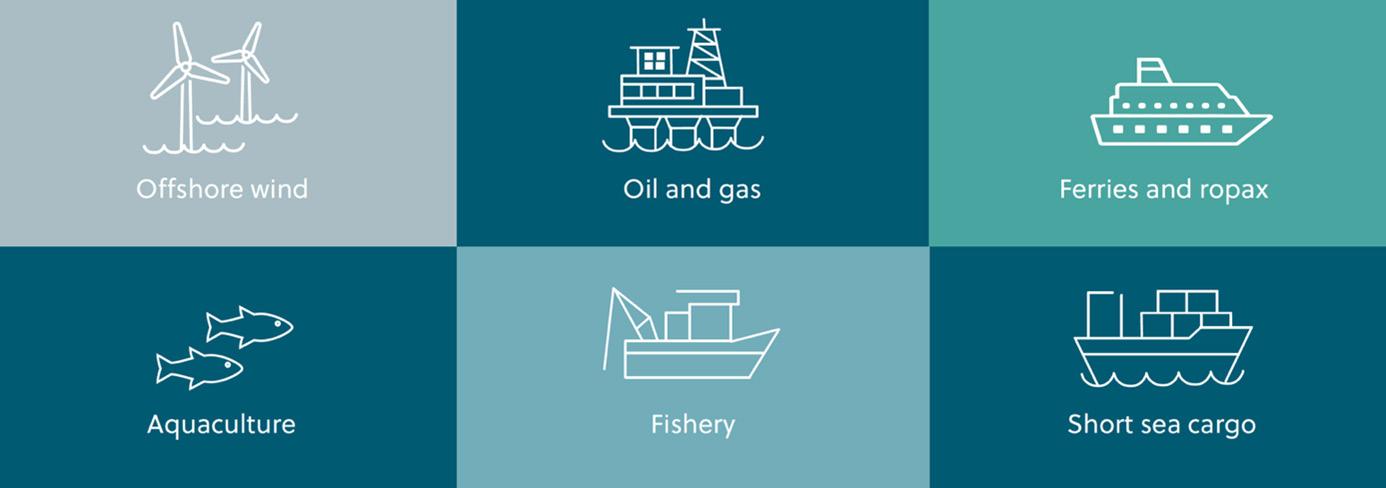
Our main industry segments
Sustainability strategy
Sustainability is core to our success and an integral part of our overall strategy and way of work. We have developed a sustainability strategy, focusing on all topics considered material to our company, and developed a 2024-2026 plan to meet our objectives. Our sustainability strategy supports and aligns with our business strategy, following our overarching vision and values:
ENVIRONMENT:
• Enabling the green shift at sea
• Technologies and services for the maritime green transition
• Becoming a net-zero company
• Limiting environmental impacts across product life cycle
SOCIAL:
• Making people and our local communities thrive
• Safe and healthy work environments
• Diverse and inclusive workplace
• High job satisfaction and continuous development
• Supporting our local communities
GOVERNANCE:
• Trusted and responsible partner
• Ethical business conduct
• Sustainability throughout our value chain
• Transparent reporting and open stakeholder dialogue
We are headquartered in Fosnavåg, Norway, with offices in Bergen, Ålesund and Egersund (Norway), Sopot (Poland), and Istanbul (Turkey).
We are a public limited liability company listed on Euronext Growth Oslo.
Ålesund
Fosnavåg
Bergen Egersund
Sopot
Istanbul
•
Membership organisations
Both the Group and our subsidiaries are members and play an active part in the following organisations:
• ÅLESUND KUNNSKAPSPARK (ÅKP): ÅKP is located on campus in Ålesund and the hub’s core goal is to contribute to creating tomorrow’s jobs and building a more attractive region to live and work in. ÅKP is a regional center for innovation and economic development, including one of the Norway’s most complete incubator systems, the cluster programs BLUE Maritime – Global Centre of Expertise, Legasea and Norwegian Rooms and several other national and international projects.
• MARITIMT FORUM (NORDVEST): Maritimt Forum is an interest organisation that brings together the entire Norwegian maritime industry. Its 700 members contribute to developing a world-leading and holistic maritime cluster. Maritimt Forum brings together both the employee and employer side of the industry, and represents common interests of the cluster.
• NÆRINGSLIVETS HOVEDORGANISASJON (NHO): The Confederation of Norwegian Enterprise (NHO) is Norway’s largest organisation for employers. Its current membership of 32.000+ companies ranges from small family-owned businesses to multinational companies in most sectors. NHO is the leading spokesperson on behalf of business and industry in Norway. Having expert knowledge and an extensive business network, NHO plays an important and constructive role in the Norwegian society.
• GCE BLUE MARITIME CLUSTER: The Norwegian maritime cluster is a world leader in design, construction, equipment and operation of advanced vessels for the global ocean industries.
• OCEAN HYWAY CLUSTER: Ocean Hyway Cluster is Norway’s leading network for hydrogen-based solutions for the maritime sector. The cluster work closely with the industry to exploit the commercial opportunities of new hydrogen technology solutions to make Norway a global leading hydrogen player.
• HR NORGE / HR NORWAY: HR Norway is the country’s largest HR and management professional network and consists of members from both the private and public sectors.
HAV Group’s business
Ship design
We advise customers regarding selection of vessel parameters and technologies that allow shipowners to increase their competitiveness and enable the green transition at sea.
We provide pioneering innovations in the design and construction of low and zero-emission vessels and energy-optimised ship designs. This entails developing the most efficient vessels possible, covering every aspect of the vessel’s functionality and performance, including environmental performance, through concept development, detail design, equipment selection, procurement, system engineering and integration.
Further, innovative simulation-based ship design enables analysis and documentation of real-life performance of a vessel – before it has been built.
In total, the Group possesses the competence and tools available to help shipowners design, develop and construct low and zero-emission vessels, thereby supporting the global maritime industry in reaching its GHG emission targets.
Our subsidiary HAV Design has a track record of more than 100 ship designs.
No of confirmed incidents of corruption - -Communication with suppliers about business ethics and anti-corruption (%)1
1 KPI adjusted after the 2024 double materiality assessment (DMA). 2 No employees in the company per year end.
Energy design and smart control systems
We supply low- and zero-emission energy, propulsion and control systems for the global marine market.
Detailed knowledge about vessel operations – from bridge to propeller – and specialist competence in integrating energy sources, including electric propulsion and charging systems, allow design of optimal power and propulsion systems that keep GHG emissions to a minimum.
Smart control systems and software platforms for navigation, automation and control ensure even more fuel-efficient operations.
These products and systems are key enablers to achieve low- and zero-emissions, and can be applied to newbuilds or retrofitted on board existing vessels, making it easier for shipowners to reduce GHG emissions from their fleets.
Our subsidiary Norwegian Electric Systems is a leading supplier of advanced diesel electric, hybrid electric, and 100 percent electric propulsion systems, for the global marine market.
No of confirmed incidents of corruption - -Communication with suppliers about business ethics and anti-corruption (%) 1
1 KPI adjusted after the 2024 double materiality assessment (DMA). 2 No employees in the company per year end.
Hydrogen-based energy systems
We are a supplier of complete and scalable zero-emission hydrogen-based energy systems for vessels. The systems are suitable for both vessel newbuilds and retrofits.
The Group has developed maritime-based energy systems with liquid hydrogen tank below deck and a container-based hydrogen system to be installed on deck – the Zero Emission Pod.
Adoption of hydrogen as ship fuel is considered a vital part of the transition to more sustainable shipping. We are one of the global frontrunners in offering approved hydrogen-based energy systems for ships.
Installed effect can be used for the main propulsion systems, or for additional power supply on board the vessel to comply with green operation standards. Quayside, hydrogen systems can ensure sufficient green power supply to the vessel, which does not need to rely on onshore charging infrastructure to achieve zero-emission status.
Our subsidiary, HAV Hydrogen, was previously responsible for developing hydrogen-based energy systems. In 2025, responsibility for maintenance of the technology and expertise was transferred to HAV Group’s ship design business. Intellectual property rights (IPR) are being safeguarded to be positioned to capitalize on future market opportunities for the technology.
Water treatment systems
We are a supplier of energy efficient ballast water treatment systems for both small- and mediumsized ships, and of other water treatment systems for the aquaculture industry.
The spread of invasive species is recognised as one of the greatest threats to the ecological and the economic wellbeing of the planet.
Efficient treatment of ballast water prevents the unwanted spread of invasive species. The ballast water treatment system is available for both retrofit and vessel newbuilds.
Process water treatment for aquaculture production is key to maintain fish health and avoid detrimental effect on local environment.
Through our subsidiary Norwegian Greentech, we provide water treatment technologies for both land-based aquaculture and live fish carriers. Moreover, our water treatment products are based has a chemical-free system that does not pollute the marine environment. The company has sold more than 800 water treatment systems so far.
No of confirmed incidents of corruption
Communication with suppliers about business ethics and anti-corruption
1 KPI adjusted after the 2024 double materiality assessment (DMA). 2 No employees in the company per year end.
Board of Directors report
HAV Group ASA (“HAV”) was established in February 2021, and is an international provider of technology and services for the maritime and marine industry. The company is listed on Euronext Growth Oslo.
OPERATIONS AND LOCATION
HAV is the parent company and single owner of the shares in various subsidiaries operating within engineering, ship design and equipment. The Group has several decades of combined experience in the industry, in addition to special expertise in leading the marine and maritime industry through the green shift and towards the goal of zero emissions. The purpose of HAV is to assist its subsidiaries with strategic management, finance, logistics, marketing, legal and other support functions.
HAV and the management group are based in the main office at HAV House in Fosnavåg, Herøy municipality. Below follows a description of development in the various business areas.
SHIP DESIGN
HAV Group’s ship design business, HAV Design, carries out development, sale and deliveries of ship design, project engineering and system packages to shipyards and shipping companies worldwide. The scope of delivery can consist of packages with basic design, detailed design and engineering support, equipment packages, and system integration based on the customer’s requirements and needs.
The business area is headquartered in Fosnavåg, Norway, and has also established an international subsidiary in Poland. The ship design business is continuously engaged in the development of advanced vessel concept and technical solutions, contributing to a broad range of maritime projects.
This segment also participates in research and development towards using hydrogen as an energy source for larger vessels. This project is going to contribute towards strengthening the Group’s leading position within the green transition in the maritime industry.
HAV Design has delivered or has design under development for customers within the regions of Europe, America, Asia and Africa.
In 2025, it was announced that HAV Design had been awarded the contract for the newly developed HAV 595 design, a forward-looking wellboat intended to meet high standards for biosecurity and fish welfare.
In 2025, Richard Schofield was appointed as the new Managing Director of HAV Design. Richard brings extensive experience from the maritime industry, including ship design, engineering work, project management,
operations, and technology development. He has assisted clients across several vessel segments in which the company already holds a strong market position.
HAV Design is 100% owned by HAV as of 31 December 2025.
Segment turnover was NOK 122.6 million (334.9) and a pre-tax result of NOK -24.1 million (9.8). EBITDA amounted to NOK -21,1 million (7.9). The segment has an equity of NOK 11.5 million (14.2) which equals 6% (10%) of total assets.
HYDROGEN-BASED ENERGY SYSTEMS
HAV Hydrogen is a start-up company with the aim of being a total supplier of hydrogen-based energy systems for vessels. Through the FreeCO2ast project, HAV Hydrogen has developed a high-capacity hydrogen energy system, to be approved for zero-emission sailing with high speed over long sailing distances.
The scope of delivery can consist of complete and scalable hydrogen systems for use on both big and small vessels, newbuildings and retrofits, that are designed for operation in heavy seas. HAV Hydrogen is a total supplier with expertise in pre-studies, hydrogen systems, ship integration and cooperation with the policy instrument system and private investors.
HAV Hydrogen has been exposed to the fact that the maritime industry’s transition to hydrogen-powered ships is taking longer than expected. This resulted in increased uncertainty related to realization of previously expected projects and the timing of these. Considering this and the negative market development in general, a decision was made in 2025 to reduce both cost and activity level in HAV Hydrogen, and to put construction of the ZEPOD prototype on hold until a strategy for the company’s future operations has been established. The intellectual property rights are being safeguarded to be positioned to capitalize on future market opportunities for technology.
HAV Hydrogen is 100% owned by HAV Group as per 31 December 2025.
The business area is headquartered in Fosnavåg. Segment turnover was NOK 0 million (0.9) and a pre-tax result of NOK -8.3 million (-10.8). EBITDA amounted to NOK -7.1 million (-10.1). The segment has an equity of NOK 10 million (5.3) which equals 53% (62%) of total assets
ENERGY DESIGN AND SMART CONTROL SYSTEMS
Norwegian Electric Systems manufactures and supplies electric, hybrid-electric propulsion systems, integrated automation systems, bridge systems, as well as navigation- and communication packages for vessels. This includes switchboards, electromechanical products, automation and safety systems. NES has a unique composition of products that complement each other in a good way, and the company can deliver complete equipment supplies from bridge to thruster.
In addition to the locations in Bergen and Ålesund, the business area has also established a branch in Egersund, which is primarily responsible for product development. The Egersund area has long traditions in the development of advanced technology within marine systems. An office is also established in Istanbul, Turkey, to provide services to Turkish and other shipyards in southern Europe.
The business area won multiple new contracts in 2025, including awards with Udupi Cochin Shipyard in India to equip eight new bulk carriers, Tersan Shipyard in Turkey to act as system integrator and deliver power and automation systems three ferries, and to perform a similar role for a live fish carrier being built at Fitjar Mekaniske Verksted.
Norwegian Electric Systems is 100% owned by HAV Group ASA per 31 December 2025.
Segment turnover was NOK 592.2 million (364.5) and a negative pre-tax result of NOK 63.5 million (-6.9). EBITDA amounted to NOK 68.7 million (-13.1). The segment has an equity of NOK 34.3 million (24.2) which equals 7% (6%) of total assets.
WATER TREATMENT SYSTEMS
Norwegian Greentech is specialised in design, engineering and delivery of systems for cleansing of ballast water. The International Maritime Organization (IMO) now demands cleansing of ballast water for ships within certain categories or areas, and this also results in vessels in operation having to install such systems, as well as newbuilds.
In 2025, Norwegian Greentech was subcontracted by Eyvi to deliver its UV- and filter-based water treatment system to Artic Seafarm’s land-based salmon farming facility in Northern Norway. This contract is the subsidiary’s breakthrough award within land-based aquaculture. The company believes that the aquaculture industry in
general, and the land-based sector specifically, will represent substantial growth opportunities going forward. It also won a contract to deliver its water treatment solutions to two live fish carriers.
Norwegian Greentech is 100% owned by HAV Group ASA per 31 December 2025.
Segment turnover was NOK 102.7 million (97.7) and pre-tax profits was at NOK -13.1. million (-7.7). EBITDA was at NOK -3.4 million (0.3). The segment has an equity of NOK 10.0 million (10.0), which amounts to 10% (12%) of total assets.
GOING CONCERN
The financial statements have been prepared under the going concern assumption, cf. the Accounting Act § 2-2 (8). It is confirmed that the going concern assumption is present.
FUTURE DEVELOPMENT
The green transition, stricter regulations, and increasing competition continue to shape the maritime industry. HAV Group is well positioned to address these challenges with technology that enhances vessel operations, profitability, and environmental performance.
While geopolitical uncertainty and tariff issues create headwinds, the global shipbuilding market is predicted to remain at a stable level in the coming years. HAV Group’s main market presence in the European and Norwegian markets reduces exposure to transcontinental trade conflicts.
The positive development seen in 2025 is expected to continue in 2026, driven by contract wins with corresponding margin improvements.
RISK ASSESSMENT
Risk in business areas is generally handled as an integral part of the work processes. All managers are responsible for risk management and internal control within their area of responsibility.
The Board receives, generally, quarterly reports where the companies’ finances, information about projects, and market conditions are described.
In sales contracts, the respective Group company carries the legal and commercial risk towards customers. However, in some cases, there have also been issued parent company guarantees from HAV.
Internally in the Group, each business area carries the risk of its own performance. Beyond the commercial risk factors described in the paragraphs above, the Group is also exposed to the following risk factors:
FINANCIAL RISK:
The Group’s primary sources of liquidity in addition to the operational cash flows have been equity capital and debt financing raised through several minor loans related to projects. The Group is exposed to various risks such as market risk (including currency risk, fair value interest rate risk and price risk), credit risk, liquidity risk and cash flow interest rate risk, and no assurances can be given that the Group’s monitoring of such risks will be adequate or sufficient.
The Group’s credit and borrowing facilities are structured in short term debt instruments. Although such debt instruments contain few or no covenants and are customarily secured in accordance with the market practice for these types of financing, there can be no assurance that the Group will be able to meet such covenants relating to current or future indebtedness contained in its funding agreements or that its lenders will extend waivers or amend terms to avoid any actual or anticipated breaches of such covenants. Failure to comply with its financial and other covenants may have an adverse effect on the Group’s financial condition, and also potential increased financial costs, requirements for additional security or cancellation of loans.
The main requirements in HAV Group’s covenant-structure are; year-end 2025 Equity > MNOK 75 and Borrowing rate less than 70% based on sum of used credit facility and guarantees.
The Group is dependent upon having access to short term funding. There can be no assurance that the Group may not experience net cash flow shortfalls exceeding the Group’s available funding sources nor can there be any assurance that the Group will be able to raise new equity, or arrange new borrowing facilities, on favourable terms and in amounts necessary to conduct its ongoing and future operations, should this be required.
NOK is the functional currency of HAV and all its subsidiaries. The Group is exposed to foreign currency risks related to its operations. The Group’s expenses are primarily in NOK and EUR. As such, the Group’s earnings are exposed to fluctuations in the foreign currency market for NOK in relation to EUR. To mitigate this risk,
the company has implemented hedging arrangements and uses the foreign currency spot and forward market to buy foreign currencies. Contracts are entered into when treasury finds it in line with the overall currency risk strategy.
MARKET AND BUSINESS RISK
The demand for maritime technologies depends on underlying industries that are vulnerable to external factors outside of the Group’s control. In particular, the demand for newbuilding of vessels and associated maritime technologies is dependent on the activity within the different industries and segments, which are in turn dependent on factors including, but not limited to, worldwide economic and political conditions, levels of supply and demand, the policies of the Organization of Petroleum Exporting Countries (“OPEC”), advances in exploration and development technology, and the availability and exploitation of alternate fuel sources.
The demand for vessels within fisheries and aquaculture is dependent on regulatory frameworks and other factors. A decline in the demand for maritime technologies will have a negative impact on the demand for the Group’s products, technologies and services.
The Group is dependent on successfully competing for, and winning, contracts offering a satisfactory profit margin in order to maintain revenues and profitability. The contracts are entered into in a competitive market where the Group competes on product quality, overall service offering, financing, and price. A deterioration of the Group’s ability to deliver competitive products, technologies and services could have a significant adverse effect on the Group’s business and results of operations in the future.
The products and services offered by the Group are characterised by complex projects with a high technological content and highly customised orders. When entering into contracts, the Group has risks on its margin between the agreed fixed price of the finished product or service, and the costs involved in completing such product or service. In particular, when constructing new or customised products, there is an element of uncertainty involved in the cost or time involved in such construction which may have a significant adverse effect on the Group’s results of operations.
When supplying maritime technologies, the Group provides a functionality guarantee for the product for a specified period of time after delivery. The Group makes allocation for such guarantees in its accounts. There can be no assurance that the allocations made will be sufficient to meet any potential warranty claims, and a rightful claim could have a material adverse effect on the Group’s financial position.
The Group has procured adequate insurance coverage for its operation risks in line with market practice, including but not limited to insurance for personnel, property and liability. The Group’s insurance policies and contractual rights to indemnity may not adequately cover the Group’s losses, or may have exclusions of coverage for some losses. In line with industry practice, the Group does not have insurance coverage or rights to indemnity for all kinds of risks. If a significant accident or other event occurs which are not fully covered by insurance or contractual indemnity, it could adversely affect the financial position, results of operations and cash flows of the Group. Further information can be found in the Corporate Governance Statement of this Annual integrated report.
DIRECTORS’ AND OFFICERS INSURANCE
HAV Group ASA has established a liability insurance for the Board of Directors (the Board), which includes the parent company and its subsidiaries. The insurance policy covers the Board members, CEO and members of the management group, and comprises personal liability, including defence and legal costs.
SHAREHOLDER INFORMATION
HAV Group ASA was listed on Euronext Growth Oslo in March 2021 and has 2937 shareholders as of 31.12.2025. The company only has one share class, and all shares are freely tradable.
ACCOUNTING PRINCIPLES
The consolidated financial statements of HAV Group ASA and its subsidiaries (the “Group”) are prepared in accordance with the Accounting Act and generally accepted accounting principles. See note 2 -Significant Accounting Policies.
FINANCIAL REVIEW
The Group’s revenue was NOK 803.0 million in 2025 compared to NOK 759.0 million in 2024.
The operating profit (EBIT) for the Group was NOK 2 million in 2025 compared to NOK -51.5 million in 2024.
The Group’s net profit in 2025 amounted to NOK 1.5 million, compared to NOK -31.6 million in 2024. Equity amounted to NOK 88.1 million in 2025, compared to NOK 86.5 million in 2024. This represents an equity ratio of 13.1% respectively in 2025 and 14.4% in 2024.
Net cash flow for the Group in 2025 NOK -51.3 million compared to NOK 98.5 million in 2024.
Cash flow from operating activities is NOK -30.0 million compared to NOK 100 million in 2024. The deviation between EBITDA and cash flow from operations mainly reflects a temporary binding of working capital in accounts receivable, driven by the invoicing structure and timing of the project portfolio.
Net cash flow from investing activities NOK -11.3 million in 2025 compared to NOK -12.7 million in 2024. The negative cash flow is mainly due to investment in research and development.
Net cash flow from financing activities NOK -10.0 million in 2025 compared to NOK 11.1 million in 2024.
Main reason is sale of own shares and repayment of non-current debt. The cash flow statement shows the cash flow changes throughout the year. Total assets and capital employed is variable based on the payment terms and delivery times of contracts.
As of 31 December 2025, the Group’s cash and cash equivalents were NOK 199.1 million compared to NOK 250.4 million at the end of 2024.
The Group’s current liabilities amounted to NOK 573.9 million 2025 compared to NOK 499.1 million 2024, and the increase is mainly due to higher level of advance payment from customer.
The balance sheet shows total assets for the Group of NOK 669.9 million in 2025, compared to NOK 601.3 million in 2024. The Board believes that the annual report provides an accurate view of the Group’s assets and liabilities, financial position, and results.
WORK ENVIRONMENT
The total sick leave for the Group in 2025 was 3.8%, versus 2.7% in 2024. The Group works actively to reduce the extent of injuries, secure workplaces, and improve protective equipment. It also works actively to return employees from long-term sick leave.
No serious workplace accidents which resulted in major property damage or personal injury have occurred or been reported during the year. The Board receives quarterly statistics for the development within the areas of health, environment, safety, and quality.
The Norwegian Transparency Act (“Åpenhetsloven”) promotes businesses’ respect for basic human rights
and decent working conditions and ensure the public’s access to information. The Act imposes, among other things, a duty to provide information and carry out due diligence is assessments in the supply chain, which shall be explained in an annual report. (See appendix 1 - Transparency Act statement 2025).
Further information on working environmental impacts can also be found in the ESG section of this Annual integrated report.
EQUALITY AND DISCRIMINATION
The Group shall comply with the purpose of the Equality and Discrimination Act, including by promoting equality and preventing discrimination on the grounds of sex, pregnancy, maternity leave or adoption, care tasks, ethnicity, religion, outlook on life, disability, sexual orientation, gender identity, gender expression, age and other significant factors of a person. The Group shall be a workplace where there is full equality between women and men. When hiring, professional competence is emphasised. Candidates with different ethnicity, national origin, descent, skin colour, language, religion or outlook on life shall all have the same opportunities and rights. Working time arrangements in the Group follow from the various positions and are independent of gender. Further information on equality and non-discrimination can be found in the attached statement to this Annual integrated report.
Further reporting in accordance with the Equality and Discrimination Act can be found on the websites for the Group companies that are covered by the extended reporting obligations within this area, where the report for 2025 will be published within 30 June 2026.
ENVIRONMENTAL AND CLIMATE RISK
In 2025, the management assessed how climate change affect or is likely to affect HAV Group and the group’s operations, looking both at physical and transitional risks. While HAV Group is to some extent exposed to physical climate risks, the risks are mostly indirect, mainly affecting the group’s upstream and downstream value chain.
Acute risks such as floods and storms can impact sub-suppliers that source materials that are used in HAV Group’s products (e.g. steel and copper for water treatment systems). A disruption in our upstream supply
chain can impact HAV Group’s suppliers / sub-suppliers downstream and hence the group’s ability to deliver products to customers within the expected time frame.
Chronic risks such as a change in temperature (both colder / warmer weather) can lead to increased energy costs for heating / cooling of office buildings and facilities for manufacturing / assembly. HAV Group is currently leasing the buildings from our landlords, meaning that we are not directly impacted by this. Similarly, potential rising sea levels can mean that the landlord will have increased expenses (for example linked to insurance / upgrading of buildings). Our offices are not located by the ocean, (i.e. not at immediate risk) and the group has already invested in technological equipment that allows white collar employees to work from home if needed.
Both acute and chronic climate risks can lead to an increased demand for HAV Group’s products and services, i.e. an opportunity for the company. The risk of heavy rain / snow, erosion, landslides etc. can make maritime shipping a preferred transportation method compared to land- or air-based transportation.
Most of the climate risks identified are therefore transitional. Stricter governmental regulations or regulations imposed by IMO or similar organisations (e.g. relating to use / sourcing of critical raw materials, transportation and travel activities) can lead to increased reporting and documentation requirements, i.e. a cost for the company. On the other hand, HAV Group has had a focus on sustainability since the company’s inception, and our sustainability reporting exceeds current legal expectations. It is therefore the group’s impression that we are well positioned to meet such risks.
Finally, the green transition, stricter regulations, and increasing competition continue to shape the maritime industry. While this to some extent will increase R&D costs, it first and foremost represents an excellent business opportunity for HAV Group as we are well positioned to address these challenges with technology that enhances vessel operations, profitability, and environmental performance. Still, it is important that the development of new solutions is balanced against market desires and requirements.
RESEARCH AND DEVELOPMENT
The Group conducts extensive development activities, including the development of ship designs and zeroemission propulsion systems. As of 31 December 2025, the Group owns more than 40 ship designs that are sold
worldwide. From 2013, great emphasis has been placed on development, and several new designs have been developed. There are significant excess values here beyond those stated in the financial statements. Support from several different programmes have been received and the development of a system for rebuilding to hydrogen is a large project that extends over several years. A major part of our intangible assets in the balance sheet is linked to the extensive development of our USCG/IMO certified ballast water cleaning systems finalized in 2022. Within the Energy design and smart control systems segment, several minor projects have been developed in recent years, focusing on new products and upgrades of existing products to meet new market and regulatory requirements.
ANNUAL PROFIT AND ALLOCATION
The Board proposes the following allocation of the parent company’s profit for 2025: Transferred to other equity in total MNOK 40.2. The Board proposes a dividend of NOK 0.
SOCIAL RESPONSIBILITY
HAV Group ASA shall maintain a solid reputation for its credibility around the world, by consistently conducting its operations with integrity and in compliance with the applicable laws and regulations. Board members and employees shall act fairly and honestly, and display integrity in all dealings with other employees, business partners, clients, the public, the industry, shareholders, suppliers, competitors, and government authorities. The Group’s values and commitment to sustainable development should be reflected, promoted and implemented through policies, decisions, and actions.
The Group has established a code of ethics and social responsibility: “code of conduct”, as well as a “supplier code of conduct”. Among other things, these guidelines include rules for relations with business partners, hereunder policy regarding gifts and confidential information. The code of ethics and social responsibility also give guidelines on how to deal with a potential conflict of interest. Furthermore, the supplier code of conduct shall promote the Group’s supply chain to respect basic human rights and decent working conditions.
An anti-corruption programme has been developed, and this programme deals with among other things how to define risk areas for corruption and how to take preventive measures.
Both the anti-corruption programme, the code of conduct and the supplier code of conduct are available at the Groups’ web page www.havgroup.no
The Group is strongly involved in ensuring the development of expertise and education in the maritime industry. Our apprentice programme and HAV Academy are examples of the social responsibility that the Group has taken to ensure future competence in our industry.
RESPONSIBILITY STATEMENT
We hereby in accordance with the Norwegian Securities Trading Act §5-5 confirm, to the best of our knowledge, that the financial statements for the period 1 January to 31 December 2025 have been prepared in accordance with applicable accounting standards, and that the information in the accounts gives a true and fair view of the company’s and Group’s assets, liabilities, financial position and profit or loss as a whole. We also confirm that the annual report gives a fair view of the company’s and Group’s development, financial position and profit or loss as a whole, as well as a description of the principal risks and uncertainties the company’s and the Group face.
Chairman of the Board
Helge Simonnes Board member
Thor-Lennart Solevåg Board member
Board member
Vibeke Fængsrud Board member
Linda
Rudolfsen Myklebust
Board member
Board member
Gunnar Larsen CEO
Corporate Governance Statement
HAV Group ASA (“HAV Group” or the ”Company”) wishes to maintain a high level of trust among its investors, employees, customers, suppliers and society at large, and therefore endeavours to practise good corporate governance.
STATEMENT CONCERNING CORPORATE GOVERNANCE
Implementation and reporting on corporate governance
The Company’s shares are listed on Euronext Growth Oslo, and are thus not subject to mandatory reporting requirements for corporate governance according to the Norwegian Accounting Act § 3-3b and ”The Norwegian Code of Practice for Corporate Governance” (”NUES”).
The Board has a responsibility to ensure that the Company has good corporate governance, and finds it therefore appropriate to follow the recommendation in NUES, last revised 28 August 2025, which is available at www.nues.no.
This reporting on corporate governance follows the same system as NUES where natural. If the Company deviates from the NUES recommendation, HAV Group will adhere to the “comply or explain” principle for each and every clause in the recommendation.
According to HAV Group’s own evaluation, the Company deviates from the Corporate Governance Code on the following points:
• HAV Group does not require all Board members to be present at the general meeting as the Company has deemed it satisfactory to require the presence of the Chairperson of the Board and the CEO.
• HAV Group does not require the chairman of the nomination committee to be present at the general meeting, but the Chairman of the nomination committee may attend the general meeting if the matters to be dealt with are of such a nature that this is considered necessary.
• As HAV Group is not listed on a regulated market, the Company is not required to prepare an annual remuneration report. The Company has therefore not deemed it necessary to develop specific guidelines for remuneration of executive personnel. Instead it follows established company practice when deciding executive management remuneration.
Core values
The Company shall have a good reputation for credibility around the world, achieved by consistently conducting its business with integrity and in accordance with the acts and regulations that apply to the Company’s activities. Members of the Board and employees shall act in a fair and honest manner and demonstrate integrity in all their dealings with other employees, business associates and clients, the general public, the business community, shareholders, suppliers, competitors and public authorities. The Company’s core values and commitment to sustainable development shall be reflected, promoted and implemented through guidelines, decisions and actions.
The Company’s guidelines are set out in the “code of conduct”, the “supplier code of conduct” and the Company’s anti-corruption policy, all available on the Company’s website www.havgroup.no.
The business
HAV Group is a public limited liability company organised under the laws of Norway and subject to the provisions of the Norwegian Public Limited Liability Companies Act.
The scope of the Company’s business is laid down in Article 3 of the Articles of Association. The purpose of the Company is to invest, directly or indirectly, in maritime activities, including what is naturally connected to this.
The Company is an international provider of green technologies and services for maritime industries.
HAV Group each year publishes a sustainability report where it presents the main social, societal, and environmental challenges the Company faces, and how it approaches them. The identified focus areas are integrated with the Company’s business strategy, and concrete goals are each year defined to improve HAV Group’s performance within these areas.
To discuss and evaluate goals, strategy and risk profile, the Board conducts an annual strategy meeting, where the main purpose is to set the long-term direction for the Company. This takes into account financial, social and environmental considerations plus the Company’s impact on people.
A further description of the Company’s operations, goals, strategy, and risk profile is provided in the Group’s annual report, which shows how the Company’s operations and strategies are aligned with objectives defined in the Articles of Association.
Equity and dividends
The Company shall at all times have sufficient equity to achieve its goals and strategy, and that matches its risk profile and commitments.
The following dividend policy is adopted by the Board:
”At present date, the Company is in a growth phase and will most likely not pay any dividend in the short to medium term as the Company intends to use its profit for both organic and inorganic growth initiatives as well as product and technology innovation. However, the Company will strive to follow a dividend policy favourable to the shareholders and the amount of any profits to be retained will be dependent on, inter alia, the Company’s investment requirements and rate of growth and inorganic investment opportunities.
There can be no assurance that in any given year a dividend will be proposed or declared. When the Board considers whether to propose a dividend and determines the amount, the Board will take into account the limitations that follow from the applicable legal restrictions, the Company’s capital requirements, including capital costs, the Company’s financial position, market prospects and other general business terms and conditions.”
The annual general meeting 2025 authorised the Board to acquire the Company’s own shares in connection with share purchase programme and acquisitions. The current mandate is valid until the next annual general meeting, however no longer than 30 June 2026.
The Board will also propose that the 2026 annual general meeting authorises the Board to acquire the Company’s own shares in connection with share purchase program and otherwise where this is considered to in the interest of the Company (including but not limited to acquisitions). The Board will propose that the authorisations are made applicable until the Company’s next annual general meeting, however no later than 30 June 2027.
The annual general meeting 2025 granted the Board a general authorisation to carry out capital increases in order to ensure that the Board has the necessary flexibility to be able to take advantage of strategic business opportunities. The authorisation entitles the Board to issue shares in return for cash contributions and non-cash contributions, and in connection with mergers or acquisitions that are strategic and important to the further development of the Company. The current mandate is valid until the next annual general meeting, however no longer than 30 June 2026.
In order to ensure that the Board has the flexibility necessary for it to be able to take advantage of strategic business opportunities, the Board will propose that the 2026 annual general meeting grants the Board a renewed authorisation to carry out capital increases, cf. Section 10-14 of the Public Limited Liability Companies Act. The authorisation will entitle the board to issue shares in return for cash contributions and non-cash contributions, and in connection with mergers and acquisitions that are strategically important for the further development of the Company, and that shareholders’ preferential right to subscribe for shares is waived. The Board will propose that the authorisations are made applicable until the Company’s next annual general meeting.
Equal treatment of shareholders and transactions with close associates
Equal treatment of all shareholders is a core governance principle. The Company has one class of shares. Each share carries one vote at the general meeting.
The Company’s trading in own shares shall preferably take place through Euronext Growth Oslo, alternatively in other ways at the listed price. On 31 December 2025, the Company held zero own shares.
If the Board, on the basis of an authorisation from the general meeting, decides to carry out a capital increase in which existing shareholders’ preferential rights are waived, the reason for this will be given in the stock exchange statement issued in connection with the capital increase. The justification shall specifically state how the principle of equal treatment of shareholders is safeguarded.
Freely negotiable shares
All shares in the Company are freely negotiable, and are listed on Euronext Growth Oslo. The Company’s articles of association do not contain any form of restriction on negotiability of the shares.
The general meeting
The general meeting is the Company’s supreme body. The Board decides the form of the meeting, can be conducted as a physical or electronic meeting in accordance with applicable legislation. The Board strives to enable as many shareholders as possible to exercise their rights by participating and voting at the Company’s general meetings, and make the general meeting an effective meeting place for shareholders and the Board, among other things by ensuring that:
• The notice of the general meeting is sent to shareholders at least 14 days before the general meeting is held, and made available via Oslo Børs’ notification system www.newsweb.no and on the Company’s website www.havgroup.no at the same time.
• Case documents shall provide sufficient information to enable shareholders to form an opinion in advance on matters to be considered.
• The person who is a shareholder five business days before the general meeting (the record date) has the right to attend and vote at the general meeting, The registration deadline is set as close to the meeting date as possible, but no later than two days before the general meeting is held. Shareholders who have not registered can be denied admission to the meeting.
The chair of the Board and the CEO are present at the general meeting, while the other Board members and the chairman of the Nomination Committee may also be present.
The auditor shall attend the general meeting when the matters to be dealt with are of such a nature that this is considered necessary.
All shareholders registered in the Norwegian Central Securities Depository (VPS) receive notice of the general meeting, and are entitled to submit proposals and vote directly or by proxy. A proxy form is prepared and sent out together with the notice of the general meeting. The Company will appoint a person who can act as a proxy for shareholder if advance voting is not available.
The Company’s Articles of Association allow for documents to be considered at the general meeting to be made available on the Company’s website instead of being distributed with the notice of meeting. This also applies to documents that by law shall be included in or enclosed with the notice of the general meeting. Shareholders can nonetheless ask to have them sent.
The general meeting shall approve the annual accounts, allocate profit/adopt coverage of loss, and consider other matters that are, by law or the Company’s Articles of Association, the business of the general meeting. .
The Company’s Articles of Association do not contain any special provisions concerning who should chair the Company’s general meeting. In line with the provisions of the Public Limited Liability Companies Act, the general meeting is opened by the chair of the Board, and the chair of the meeting is then elected by the general meeting.
The minutes of the general meeting are published in a stock exchange statement and made available on the Company’s website www.havgroup.no
Nomination Committee
In accordance with the Articles of Association, the Company has established a Nomination Committee.
The Nomination Committee shall consist of two members who are independent of the Company’s Board and executive personnel. Current members of the nomination committee are Helge Aarseth (Chairman) and Arve Moltubakk.
The Nomination Committee shall propose Board members for election at the general meeting, and ensure that the candidates possesses the right qualifications and integrity to fulfil their obligations. In concrete terms, the committee shall identify and evaluate potential Board members, send its recommendation to the general meeting when Board members are up for election, and propose directors’ fees. In addition, the committee shall have an advisory function in relation to the Board with respect to the board’s composition, instructions and evaluation. A justification for a candidate will include information on each candidate’s competence, capacity and independence.
As part of its nomination process, the Nomination Committee will have contact with major shareholders, the Board and the company’s executive management to ensure that the process takes both the Board’s and the Company’s needs into consideration.
The Nomination Committee shall also propose candidates for the Nomination Committee, and remuneration for the members of this body. The general meeting shall stipulate guidelines for the duties of the Nomination Committee, elect the chairperson and members of the Nomination Committee, and determine the committee’s remuneration.
Information regarding the Nomination Committee members, the procedures, as well as how input and proposals may be submitted to the committee is published on the Company’s website. The website also includes information about when such proposals must be submitted in order to be considered by the Nomination Committee.
The Board’s composition and independence
The Company’s Article of Association stipulates that the Board shall consist of between three and seven members, elected for two years at a time. The Chair of the Board is elected by the general meeting. The Company’s Board has seven members. Five of the members are independent of the Company’s executive personnel, important business associates and the Company’s principal owner. The Board currently consists of three women and four men, none of whom are executive personnel in the Company.y.
TThe Company has not established a corporate assembly, but two employee representatives (men) are members of the Board.
The Board members are encouraged to own shares in the Company, and an overview of the Board members’ holdings are presented in a note to the annual accounts. As of 31 December 2025, four out of seven Board members owned shares in the Company.
The composition and overall qualifications of the Board is assumed to make a positive contribution to the development of the Company and the satisfactory safeguarding of the shareholders’ interests. A more detailed presentation of the members of the Board is included in the annual report.
The work of the Board
The Board has overall responsibility to secure the Company’s value creation in a sustainable manner and determines the Company’s goals, risk profile and strategies, as well as follow-up on this. The Board’s duties also include monitoring and control of the Company’s activities, including responsibility for ensuring that
activities are organised and run within the framework of applicable law.
The Board has adopted instructions for its work and the chief executive’s work, with particular emphasis on a clear internal division of responsibility and duties. The Board has also adopted instructions for Board committees.
The rules and procedures describe how the Board is responsible for reviewing and approving the organisation’s purpose, values or mission statements, strategies, policies and goals related to sustainable development, and delegate implementation of such matters to the Company’s management. The procedures also include stipulations to ensure that the Company has the necessary due diligence and other processes in place to identify and manage its impacts on the economy, environment and people, and ensure that the management of the Company engages with relevant stakeholders to support these processes. At least annually, the Board reviews the company’s sustainability performance, including key performance indicators and priorities going forward.
The Company has guidelines that impose a notification obligation on Board members and executive personnel who have a direct or indirect material interest in agreements entered into by the Company.
Any transaction between the Company and a close associate shall be based on ordinary market terms at arm’s length. Any transaction which is not immaterial shall be carried out on the basis of a valuation by an independent third party. The Company will ensure that significant transactions with close associates are processed in accordance with the requirements laid out in the Public Limited Liability Companies Act.
Transactions between close associates are discussed in a note to the 2025 annual accounts.
Further, if the Chairperson of the Board is personally involved in matters of a material character, the Board’s consideration of such matters will be chaired by another member of the Board.
The Board employs and exercises rights of instruction in relation to the chief executive officer, who is responsible for the day-to-day running of the Company. The Board oversees the enterprise and its management.
The Board adopts an annual plan for its work and holds meetings as necessary, at least five ordinary meetings per year. The Board evaluates its own performance and expertise on an annual basis. The evaluation is submitted to the Nomination Committee.
The Company has an Audit Committee consisting of two of the Board members, one of whom is independent of the Company’s principal owner. One of the members have accounting expertise. The Company does not currently have a Remuneration Committee. In the event that the Board is required to engage in matters related to compensation paid to executive personnel, this is handled by the Chairperson on behalf of the Board. The Chairperson is independent of the Company’s executive personnel.
The Company’s financial calendar is published at www.newsweb.no, and on the Company’s website www. havgroup.no. The Company’s results are published each quarter unless otherwise decided by the Board.
The Chief Executive Officer has a right and an obligation to participate in the consideration of matters by the Board and to state his/her opinion, unless the Board decides otherwise in a particular case.
The Board discusses, as necessary, its own form of work and the processes relating to the preparation and execution of Board meetings, and its overall qualifications and capacity in relation to the Company’s activities.
Risk management and internal control
The Board has responsibility for ensuring that the Company has sufficient internal control and appropriate risk management systems adapted to the Company’s scope and activities. This responsibility also includes the Company’s core values and code of conduct.
The most important risk for the Company is the market risk associated with shipbuilding activities, technology development, financial risk and operational risk. In practice, risk is handled as an integral part of the work processes. All managers are responsible for risk management and internal control within their area of responsibility.
The Board receives, as a minimum, quarterly reports describing the Company’s financial situation, information about projects and market conditions. The Board also receives quarterly statistics on developments in quality, health, safety and the environment. External parties conduct control and followup of the Company and the Company’s activities relating to ISO certification.
The Board continuously evaluates the information submitted to the Board by the administration and adopts amendments to the reporting procedures if required. The Board conducts an annual review to discuss and identify external and internal risk factors for the Company.
The Company’s financial reports are drawn up pursuant to the accounting principles specified in the annual report. The Company’s quarterly reports to the Board and the reports published each quarter are prepared on the same principles.
The Audit Committee shall help the Board to fulfil its supervisory responsibility for the accounts, the financial reporting process and the internal control. The Audit Committee shall also evaluate the external auditor’s work, and, if relevant, recommend a change of auditor. The committee shall also assess the auditor’s fee. The Audit Committee is entitled to full access to all relevant documentation, and can use external advisors if necessary. The Audit Committee shall have at least one meeting per quarter.
The Audit Committee reviews the financial annual and interim reports, with a particular focus on accounting principles, material discretionary items, and compliance with laws, regulations and accounting standards.
Remuneration of the Board
Remuneration of the Board and the Audit Committee are decided annually by the general meeting. The remuneration is not based on the Company’s performance, and no share options are issued to members of the Board.
The remuneration is stipulated on the basis of time expenditure and the Company’s activities and size.
Members of the Board, including companies with whom they are associated, are usually not given separate assignments by HAV Group in addition to their function as directors. Such assignments will be based on approval from the Board. There were no such assignments in 2025.
Remuneration of executive personnel
Efforts are made to recruit and retain executive personnel who possess the qualities required to run the Company, and, not least, to promote value creation. Each employee’s remuneration shall be competitive on market terms, shall reflect his/her area of responsibility and work performance, and align the interest of shareholders and executive personnel.
The Board is directly responsible for determining the CEO’s salary and other benefits. The CEO is, in consultation with the CHRO of HAV Group, responsible for determining the salary and other benefits for the Group’s other senior executives.
As HAV Group is not listed on a regulated market, the Company is not required to prepare an annual remuneration report. As of now, the Company has therefore not deemed it necessary to develop specific guidelines for remuneration of executive personnel. However, according to established company practice, executive management remuneration consists of three main elements: salary, bonus and equity-based instruments. Bonus payments are subject to an absolute limit.
Information and communication
The Board shall disclose financial and other information with due regard to the requirements of equal treatment of participants in the securities market. To facilitate this, the Company has established guidelines for reporting of financial and other information. The purpose of these guidelines is to provide expedient and accurate information about the Company to its shareholders and other stakeholders. Transparency, equal treatment and correct reporting shall give the different groups of stakeholders the best possible basis for assessing the Company’s current and future situation.
The Company shall communicate all information relevant for assessing the operation and value of the Company to its shareholders and to the market in a timely and effective manner, with regard to equal treatment of shareholders, in accordance with the applicable laws and rules for companies listed on Euronext Growth Oslo.
The Company will publish significant information via Oslo Børs’ notification system www.newsweb.no, and on the Company’s website www.havgroup.no.
The Company shall have a dialogue with its shareholders via adequate forums based on the principle of equal treatment and equal access to information.
The Company publishes an annual financial calendar with an overview of the dates of planned important events such as quarterly reports and the general meeting. The Company’s investor relations policy is also available on its website.
Takeovers
The Board has drawn up some main principles for how any takeover bids should be dealt with. In the event of a takeover bid for the shares in the Company, the Board shall ensure that the Company’s shareholders receive equal treatment and that the Company’s activities are not unduly disrupted.
The board shall also ensure that shareholders have sufficient information and enough time to consider the offer. The Board shall not seek to prevent or impede takeover bids for the Company’s activities or shares unless special grounds exist for doing so. The Company’s Articles of Association do not include defense mechanisms aimed towards take-over bids, nor are any other obstacles implemented with the objective of reducing the trade and/or transferability of the Company’s shares. If a takeover bid is launched for the shares in the Company, the Board shall release a statement with a recommendation on whether shareholders should or should not accept the offer.
Auditor
The general meeting appoints the auditor and approves the auditor’s fee. The auditor’s responsibility is to audit the annual accounts and the annual report, including the sustainability report, submitted by the Board and the Chief Executive Officer pursuant to the Auditors Act and generally accepted accounting practices.
The auditor presents the main features of the plan for the auditing work to the Audit Committee and the Board each year. Meetings are held between the auditor and the Board, either the full Board or the Chair, as necessary.
The auditor will have annual meetings with the Board or the Audit Committee to review the Company’s internal control and risk management related to financial reporting and sustainability reporting. The auditor will not take on assignments for the Company that can lead to conflicts of interest, and will issue an annual confirmation of his/her independence to the Audit Committee. It is the Board’s responsibility to maintain the independent role of the auditor.
Fosnavåg, 30 April 2026
The Board of Directors of HAV Group ASA
Sustainability statement
Our sustainability statement is structured in four main parts: General information, Environment, Social and Governance.
General information
Basis for preparation (BP-1)
This is our fourth sustainability report and applies to the reporting period 1 January to 31 December 2025. The report has been prepared on a consolidated basis and the scope is the same as for our financial statements. The sustainability report covers our upstream and downstream value chain (see illustration on page 8-9).
Disclosures in relation to specific circumstances (BP-2)
We use the same time horizons as defined by ESRS 1 section 6.4:
• Short-term is defined as within the next reporting year
• Mid-term is defined as from the end of the next reporting year up until five years
• Long-term is defined as more than five years from the publishing date of this report
We have not used any indirect sources to estimate data, except from our carbon accounting where we rely on GHG emission factors from DEFRA, IEA and AIB.
We have previously prepared our sustainability report in accordance with the 2021 General Reporting Initiative’s (GRI) reporting standard. From 2024, we are reporting with reference to the new European Sustainability Reporting Standard (ESRS). We have also included information stemming from other legislation, such as the Norwegian Transparency Act and Norwegian legislation on equality and non-discrimination (see appendix 1 and 2).
We have not identified any reporting errors from previous reporting periods.
The role of the management group and the Board (GOV-1)
Our Board consists of seven members. Five of the members (71%) are independent of the company’s executive personnel, important business associates and the company’s principal owner. The Board currently consists of three women (43%) and four men (57%), none of whom are executive personnel in HAV Group. Information about each Board member is available on our website. Detailed information on composition, independence and the work of the Board can be found in the Corporate Governance Statement, sections 8 and 9. Additionally, information about each Board member is available on our website.
Our sustainability performance is governed by the Board, who also review our sustainability strategy. The Board is responsible for ensuring that the interests of stakeholders are safeguarded in a satisfactory manner. The Board has
prepared and adopted rules and procedures for the Board and has an annual plan for its work to ensure that all important issues and business areas are covered, emphasising objectives, strategy, and implementation of our business plan.
At least annually, the Board reviews our sustainability performance, including material topics, key performance indicators and priorities. The Board is also provided quarterly statistics on developments in quality, health, safety and the environment.
Our management group is composed of seven members and an overview can be found on our website. The Chief Human Resource Officer (CHRO) is responsible for the follow-up of sustainability activities across the Group and reports back to the management group and the Board who evaluate the results. Additional responsibilities involve helping the organisation integrate all relevant sustainability elements into our overall strategy, prioritising key sustainability issues, providing guidance on sustainability matters, and communicating with both internal and external stakeholders about sustainability topics.
Information provided to, and sustainability matters addressed by the management group and the Board (GOV-2)
The CHRO oversees our Group’s overall sustainability progress and provides updates to the management group and Board on a need-to know basis. Progress is assessed based on existing policies, goals, targets, and actions. Critical issues related to our Group’s sustainability related impacts may also be raised and communicated to the management group and the Board on a need-to-know basis.
Sustainability risks are assessed through a structured annual evaluation process or through specific risk evaluations as needed. For details on the annual process, we refer to the Corporate Governance Statement section 10 and this sustainability report. We report and follow up on risk and compliance exposures in all business areas in a controlled and consistent manner, managed by the CHRO.
Integration of sustainability-related performance incentive schemes (GOV-3)
There are currently no incentives schemes related to sustainability matters offered to the Board or the management group.
Statement on due diligence (GOV-4)
We regularly carry out various due diligence processes to identify impacts, risks, and opportunities across our value chain and subsidiaries. The Board has adopted instructions for its work and the chief executive’s work, with particular emphasis on a clear internal division of responsibility and duties. The rules and procedures describe how the Board is responsible for reviewing and approving our organisation’s purpose, values or mission statements, strategies, policies and goals related to sustainable development, and delegate implementation of such matters to the management group. The procedures also include stipulations to ensure that our Group has the necessary due diligence and other processes in place to identify and manage our impacts on the economy, environment and people, and ensure that the management group engages with relevant stakeholders to support these processes.
We rely on third-party suppliers for production and distribution, which means that we are directly and indirectly exposed to supply chain risks, including human rights breaches. In line with the OECD guidelines for multinational enterprises, we conduct due diligence of new suppliers and business partners following our own procedures.
During 2024, we conducted a double materiality assessment to map sustainability-related impacts, risks, and opportunities. This process involved key internal stakeholders from all business areas, allowing for a comprehensive evaluation and prioritisation of sustainability issues.
Furthermore, we conduct an annual human rights risk assessment in compliance with the Norwegian Transparency Act. This assessment takes into account factors such as industry and location to identify potential human rights risks within our supply chain.
Core elements of due diligence
a) Embedding due diligence in governance, strategy and business model
Reference
Appendix 1
b) Engaging with affected stakeholders in all key steps of the due diligence Appendix 1
c ) Identifying and assessing adverse impacts
d) Taking actions to address those adverse impacts
Appendix 1
Appendix 1
e) Tracking the effectiveness of these efforts and communicating Appendix 1
Risk management and internal controls over sustainability reporting (GOV-5)
The Board is responsible for ensuring that the Group has good internal control and appropriate risk management systems adapted to our scope and activities. This responsibility also includes our core values and code of conduct.
In practice, risk is handled as an integral part of the work processes. All managers are responsible for risk management and internal control within their area of responsibility.
The Board continuously evaluates the information submitted to the Board by the administration and adopts amendments to the reporting procedures if required. The Board conducts an annual review to discuss and identify external and internal risk factors.
Interest and views of stakeholders (SBM-2)
In 2022, we conducted a stakeholder mapping, which identified the following key stakeholder groups:
Stakeholder group
Investors
Board of Directors
Employees, including the management group
Suppliers and business partners
Customers
Industry associations
Government & regulatory authorities
Local communities
Definition
Any person or other entity who have invested in HAV Group with the expectation of receiving financial returns.
The governing body of HAV Group, elected by shareholders to set strategy and oversee management.
A person with employment at HAV Group.
Vendors and businesses whom HAV Group procures goods or services from.
A person or company buying goods or services from HAV Group.
Organisations that support the industries in which HAV Group operates within.
Regulatory authorities that monitor and enforce regulations on HAV Group.
People or communities who are living within the area of HAV Group’s operations.
We keep an ongoing dialogue with all stakeholder groups through various channels, and our most common engagement activities are listed in the table below. Additionally, we conducted systematic stakeholder dialogue with several of these stakeholder groups in 2022. In the systematic stakeholder dialogue, selected stakeholders were e-mailed an ESG survey that comprised of 18 sustainability related questions.
Stakeholder group Engagement activities
Investors
Board of Directors
Employees, including the management group
• Quarterly and annual reports
• Quarterly webcast presentations
• Company presentations
• ESG survey
• Board meetings
• HAV Academy activities
• Monthly dialogue meetings with employee representatives
• Annual employee interview and Questionnaire
• ESG survey
• Social events
Suppliers and business partners
Customers
Industry associations
Government & regulatory authorities
Local communities
• ESG survey
• Common R&D projects
Sales and design processes
• Customer services
• ESG survey
• Regular meetings
• Seminars and conferences
• ESG survey
• NHO membership
• Third party validation
• Local political dialogue
• Audits
• Sponsoring activities
Part of the stakeholder dialogue 2022
Material impacts, risks and opportunities (SBM-3)
HAV Group’s material impacts and risks have been assessed to be from the topical standards E1 Climate change, S1 Own workforce and G1 Business conduct. While we identified opportunities in the double materiality assessment, none of the opportunities were deemed material based on the thresholds set.
The table below briefly describes our material impacts and risks, including where in our value chain these impacts and risks are concentrated as well as their expected time horizon. More information on how we respond or plan to respond to the effects of the impacts and risks are included in the topical sections of this sustainability statement. The material topics will be reviewed regularly based on changes to HAV Group’s strategy, business model and other external factors.
Positive environmental impact from HAV’s supply of innova-tive ship design, pioneering the design and construction of zero and low-emission vessels. However, our systems also involve industrial manufacturing, which have a negative environmental impact, mainly through Scope 3 emissions.
Positive environmental impact from HAV’s supply of zero-emission, hydrogen-based energy systems, electric propulsion, automation and NavCom systems for a wide range of vessels. Norwegian Electric Systems (NES) is a world leading supplier within energy efficiency and zero-emission operations.
Positive impact on own workforce from HAV’s efforts to enhance employee well-being, such as social events designed to foster a positive work environment and increase job satisfaction. Furthermore, employee benefits, such as enhanced insurance coverage, preventive health checks, and individual follow-ups can potentially promote employee well-being, reduce stress, and boost productivity.
Positive impact on our workforce by offering career development opportunities, including clear pathways for growth and advancement. Positive impacts from a safe and healthy working environment for own workforce, such as increased productivity, enhanced employee well-being, higher employee retention and improved company reputation.
negative
Description of the process to identify and assess material impacts, risks and opportunities (IRO-1)
Although not subject to the Corporate Sustainability Reporting Directive (CSRD), HAV Group undertook a double materiality assessment (DMA) in 2024 in line with the European Sustainability Reporting Standard (ESRS) and specifically the steps outlined in ESRS 1 General Requirements, Chapter 3. The main objective was to identify significant sustainability related IROs across all locations, and upstream and downstream in our value chain (see value chain model under disclosure SBM-1).
Impact materiality assessment
HAV Group undertook its first impact assessment in 2022, following the guidelines of the Global Reporting Initiative (GRI) Standard and the Euronext Sustainability Guidelines. In this process, the company did a stakeholder mapping and conducted several stakeholder interviews (see disclosure SBM-2) to collect information and then met in a series of workshops to discuss findings.
In 2023 the company established an ESG strategy setting ambitions, targets and actions linked to material sustainability topics. In addition to members of HAV Group’s management team, Managing Directors in each HAV subsidiary was involved in the 2023 ESG strategy project and shared valuable insights from their companies and based on their areas of responsibilities.
In the 2024 DMA, we revisited the list of material topics already identified and organised them in line with ESRS topics, sub-topics and sub-sub-topics. In this process, the impact of each topic was carefully re-evaluated considering its scale (how great the impact is on environment and people), scope (how widespread the impact is), and for negative impacts: its irremediability (how difficult it is to reverse the damage in terms of cost and time horizon). Both scale, scope and irremediability were evaluated using a 1-3 scale, and then added together, giving an “impact materiality score” between 2-6. Impacts scoring more than 4 points were considered material to the company.
Financial materiality assessment
After finishing the impact materiality assessment, the company conducted a financial materiality assessment, evaluating risks and opportunities from an ‘outside-in’ perspective. As dependencies on natural, human and social resources can be sources of financial risks or opportunities, this was the starting point of the assessment.
The financial materiality workshop resulted in a list of risks and opportunities that were scored based on their likelihood / probability of occurrence and the potential severity / consequence, using the same scales as for HAV Group’s annual risk assessment. Financial materiality was then calculated as probability x consequence, giving a score between 0 and 25. Risks and opportunities scoring more than 12 points were considered material to the company. No opportunities and only one risk received this score in the 2024 materiality assessment.
Decision-making and internal control processes
Both HAV Group’s CEO, CFO and CHRO has been involved in the DMA process, and have, together with the Board of Directors, approved the list of material topics. The findings from the DMA will be integrated in the Group’s annual reporting, ESG strategy and risk management procedures.
Environment
Enabling the green shift at sea
E1 CLIMATE CHANGE
Climate change mitigation and energy
Impacts, risks and opportunities (ESRS 2 SBM-3)
Climate change mitigation:
Shipping is considered a hard-to-abate sector, meaning that it is more difficult to decarbonise this industry compared to many others. The need for new and greener solutions is more important than ever, and HAV Group can have a positive impact on climate change mitigation through our supply of innovative ship design and construction of zero and low-emission vessels.
However, our systems also involve industrial manufacturing, which have a negative environmental impact, mainly through Scope 3 emissions. Despite our positive contribution to GHG emission abatement, all our systems involve industrial manufacturing, which can also have an actual or potential negative environmental impact, from the sourcing of materials to the transportation and disposal of products. Having a conscious mindset when choosing suppliers is therefore important.
As other companies, HAV Group is also exposed to climate change risks. For more information about this, please refer to the risk section of the Board of Director’s report.
Energy:
As a technology and service supplier for maritime and marine industries, we have the opportunity and responsibility to positively contribute to the global green energy transition. HAV Group can have a positive impact on energy use through our hydrogen-based energy systems, electric propulsion, automation and NavCom systems for a wide range of vessels. Our vessel design, electrification, and hydrogen systems is part of the solution for the shipping sector, for example, Norwegian Electric Systems (NES) is a worldleading supplier for energy efficiency.
For more information about risks and opportunities linked to climate change, please refer to the risk section in the Board of Director’s report.
Policies related to climate change (E1-2)
Our company operates in accordance with relevant national and international environmental legislation and we expect our suppliers to do the same. For HAV Group’s employees, our HSE policy outlines our approach to environmental topics, including climate change mitigation and energy, while guidelines for suppliers are stated in our supplier code of conduct. When asked, the supplier should report on its environmental performance. It is the HSEQ manager in each subsidiary and the CHRO director at group level who are responsible for following up our environmental policies.
Actions and resources in relation to climate change (E1-3)
HAV Group offers numerous products and services that support the marine and maritime industries towards the goal of climate change mitigation and efficient energy use, including:
• Ship design: We advise customers regarding selection of vessel parameters and technologies that allow them to increase their competitiveness and enable the green transition at sea. We provide pioneering innovations in the design and construction of low and zero-emission vessels and energyoptimised ship designs. This entails developing the most efficient vessels possible, covering every aspect of the vessel’s functionality and performance, including environmental performance, through concept development, detail design, equipment selection, procurement, system engineering and integration. Further, innovative simulation-based ship design enables analysis and documentation of real-life performance of a vessel – before it has been built. In total, we possess the competence and tools available to help shipowners design, develop and construct low and zero-emission vessels, thereby supporting the global maritime industry in reaching its GHG emission targets.
• Energy design and smart control systems: We supply low- and zero-emission energy, propulsion, and control systems for the global marine market. Detailed knowledge about vessel operations –from bridge to propeller – and specialist competence in integrating energy sources, including electric propulsion, and charging systems, allow design of optimal power and propulsion systems that keep GHG emissions to a minimum. Smart control systems and software platforms for navigation, automation and control ensure even more fuel-efficient operations. These products and systems are key enablers to achieve low and zero emissions, and can be applied to newbuilds or retrofitted on board existing vessels, making it easier for shipowners to reduce GHG emissions from their fleets.
• Hydrogen-based energy systems: We supply complete and scalable zero-emission hydrogen-based energy systems for vessels. The systems are suitable for both vessel newbuilds and retrofits. We have developed maritime-based energy systems with liquid hydrogen tank below deck and a containerbased hydrogen system to be installed on deck. Adoption of hydrogen as ship fuel is considered a vital part of the transition to more sustainable shipping. We are one of the global frontrunners in offering approved hydrogen-based energy systems for ships. Installed effect can be used for the main propulsion systems, or for additional power supply on board the vessel to comply with green operation standards. Quayside, hydrogen systems can ensure sufficient green power supply to the vessel, which does not need to rely on onshore charging infrastructure to achieve zero-emission status.
• Water treatment systems: We are a supplier of ballast water treatment systems for ships and other water treatment systems for the aquaculture industry. The spread of invasive species is recognised as one of the greatest threats to the ecological and the economic wellbeing of the planet. Efficient treatment of ballast water prevents the unwanted spread of invasive species. The ballast water treatment system is available for retrofit. Process water treatment for aquaculture production is key to maintain fish health and avoid detrimental effect on local environment. Further, our water treatment products have a chemical-free system that does not pollute the marine environment.
To track our current footprint and progress, we have established carbon accounting through CEMAsys’ online platform. We are collecting relevant GHG emissions data from all subsidiaries and disclose GHG emissions annually, both on a consolidated level and per subsidiary, through our sustainability statements.
Targets related to climate change (E1-4)
HAV Group is in the process of establishing short- and medium-term targets related to climate change and energy. Our long-term ambitions are to:
• Enable our customers to succeed in the maritime green transition, andwater treatment systems for
• Become a net-zero company.
HAV Group supports all 17 Sustainable Developments Goals, and in particular:
• SDG 7: Target 7.3: By 2030, double the global rate of improvement in energy efficiency.
• SDG 14: Target 14.1: By 2025, prevent and significantly reduce marine pollution of all kinds, in particular from land-based activities, including marine debris and nutrient pollution.
Gross Scopes 1, 2 and 3 and Total GHG emissions (E1-6)
Scope 1 covers GHG emissions from sources that an organisation owns or controls directly. As the nature of our business does not require us to burn fuels, this means that our Scope 1 emissions are low. Our Scope 1 emissions are mainly linked to our four company-owned cars.
Scope 2 covers indirect GHG emissions from the generation of purchased electricity, steam, heating and cooling. Our Scope 2 emissions are linked to electricity consumption at our offices in Norway, Poland, and Turkey.
We do not manufacture the systems we sell, so most of the GHG emissions linked to our operations fall under Scope 3 (other indirect GHG emissions). The following Scope 3 categories have been identified as most significant:
• Category 1 (spend-based): Purchased goods and services
• Category 3: Fuel- and energy related activities
• Category 4: Upstream transportation and distribution
• Category 6: Business travel
• Category 7: Employee commuting
Gases include CO2, while CH4 is considered in the electricity emission factors. We have not measured refrigerant injections in the offices we operate. We do not have any biogenic CO2 emissions. 2021 is the base year for our Scope 1 and 2 emissions (the year our company was established) and 2023 is the base year for our Scope 3 emissions. We have used an operational approach for GHG emissions consolidation. Emission factors used are based on numbers from DEFRA, IEA, AIB and EPA (2024).
Social
Making people and our local community thrive
S1 OWN WORKFORCE
Working conditions and equal treatment and opportunities for all
Impacts, risks and opportunities (SBM-3)
Working conditions
HAV Group can have a positive impact on our own workforce through our efforts to enhance employee well-being, such as social events designed to foster a positive work environment and increase job satisfaction. Furthermore, employee benefits, such as enhanced insurance coverage, preventive health checks, and individual follow-ups can potentially promote employee well-being, reduce stress, and boost productivity.
Equal treatment and opportunities for all
The company can also have a positive impact on our own workforce by offering career development opportunities, including clear pathways for growth and advancement regardless of the employee’s background. In addition to enhanced employee well-being, a safe and healthy working environment can lead to increased productivity, higher employee retention and improved company reputation.
Policies (S1-1)
We shall ensure good working conditions and equal treatment and opportunities for all. The Group has established several policy documents linked to this area, including:
• A recruitment policy that shall ensure that we employ qualified personnel who are dedicated and skilled and that can contribute to the company’s goals
• An employee handbook (“personalhåndbok”)
• An HSE policy
• A stop-work-policy (describing the process for workers to remove themselves from work situations that can cause injuries or ill- health)
• A supplier code of conduct
While every employee is expected to contribute to good working conditions and equal treatment, this topic is governed by our Chief Human Resource Officer (CHRO) together with the HR manager in both the parent company and most subsidiaries.
Process for engaging with own workforce and worker’s representatives (S1-2)
In line with Norwegian legislation, we have established a Working Environment Committee (“AMU”). HAV Group (the parent company) and all subsidiaries have appointed their own safety representatives (“verneombud”) and employees have elected union representatives, who regularly communicate with the management group.
Actions related to own workforce (S1-4)
Because we work in a highly competitive environment, it is important that we position ourselves as an attractive employer, in particular among young people. As our workforce consists of people with a background mainly within engineering, logistics and project management, we regularly take part in annual career fairs at relevant universities and colleges.
We have also established internship and apprentice programmes aimed at recruiting candidates for future positions that runs throughout the year, including the summer. Additionally, we are in the process of establishing a programme that will offer students the possibility to write their master’s thesis with us.
Our company is part of the JA-Bedrift initiative (“YES-initiative”), a project initiated by the Fosnavåg municipality with the objective of making school more varied for students and introduce them to future employment opportunities. We have also established a collaboration with the Norwegian Labour and Welfare Administration (NAV) to look at how we can offer jobs to people that for various reasons have ended up outside the workforce. We are an active participant in the “Bli med hit!” (“Join-us!”) project, which is a collaboration between Molde Næringsforum, Kristiansund and Nordmøre Næringsforum and Næringsforeningen in the Ålesund region, that aims to recruit and retain workers in the region.
Targets related to own workforce (S1-5)
HAV Group is in the process of establishing short- and medium-term targets relating to its own workforce.
Our long-term ambitions are to:
• Be considered as a preferred employer in our industry (for example measured through the number of applicants for new/open positions, new hires and retention rate)
• Promote learning and development among employees (for example measured through participation in learning programmes such as HAV Academy)
• Be a safe workplace (target: zero incidents / injuries)
• Ensure employee wellbeing including work-life balance (for example measured through low absence rate, low turnover, employee engagement score and parental leave).
• Attract young people and motivate workers to stay in the workforce beyond 62 years of age (age diversity).
HAV Group supports all 17 Sustainable Developments Goals, and in particular:
• SDG 8: Target 8.5: By 2030, achieve full and productive employment and decent work for all women and men, including for young people and persons with disabilities, and equal pay for work of equal value.
Characteristics of employees and diversity metrics (S1-6 and S1-9)
While HAV Group has employees in several countries, only our offices in Norway employ more than 50 persons in total.
Gender distribution for different employee categories
year-end figures
New hires by gender and age
% of total numbers of permanent employees per year end
Employee turnover
% of year end permanent total numbers of employees per year end
Social protection (S1-11)
We offer comprehensive benefits to all employees, including an insurance package with personal insurance that goes beyond the statutory occupational injury insurance, in addition to recreational accident, group life, illness/disability and travel insurance. We also offer treatment insurance to employees, preventive health checks and individual follow-up. Temporary and part-time employees have access to the same health/insurance benefits as full time employees.
Training and skills development (S1-13)
To facilitate professional and personal development, we regularly sponsor learning courses for employees.
HAV Academy is our most important learning area and consists of two different training programmes –one for all employees and one for leaders:
• Through our basic training programme, we offer employees an arena for learning, inspiration, and motivation. In the basic training programme, employees share their experiences across business areas and roles and gain extended knowledge about the different companies in the Group, their system and procedures.
• Through our leadership training programme, we seek to strengthen relational competence and become more confident in leadership roles. The participants’ work with concepts such as vision, values, culture, and business models, getting basic understanding of topics such as accounting and finance.
Training and skills development
Occupational health and safety (S1-14)
We work every day to maintain and develop a strong HSE culture. We encourage staff to actively contribute with suggestions that can improve HSE, and to stop work which may cause accidents, damage, or unsafe situations. Managers are responsible for establishing HSE procedures and routines, while employees are expected to comply with these guidelines.
Some of our subsidiaries are certified according to ISO 9001 (Quality Management Systems). This entails for instance that we are required to implement a HSE management system, referred to as TQM. All workers (100%) except non-employees are covered by this system. Employees can report work-related hazards or dangerous situations through the TQM and in 2025, all employees received training on how to do so.
We continuously work to identify work-related hazards and risks, for example through the Safe Job Analysis. The TQM is based on findings from these assessments, which are conducted on a routine and non-routine basis. Regular communication and employee involvement are essential elements of the TQM.
We have consulted an external occupational health service (Medi 3 Bedriftshelsetjeneste) that assists us with for example risk assessments, safety rounds and health examinations. We hold regular meetings with union representatives and safety representatives where HSE is on the agenda.
All employees receive information about HSE as part of the onboarding process, this also include an introduction to proper use of equipment and safety gear if relevant. Safety representatives undergo a basic course related to the working environment. A first aid course is held annually, and all employees are required to participate. All companies in the Group have installed defibrillators in every office. Every other year, a defibrillator course is organised, and fire exercises are also held annually. A crisis plan has recently been developed, and a crisis exercise is in planning.
Few high-consequence risks have been identified but work that our service engineers carry out on board vessels at foreign shipyards can potentially pose a risk of high-consequence injury (0 in 2025). Therefore, we have strengthened our HSE guidelines for this group specifically in 2024, by developing safety folders that service engineers can bring to work.
As most of the work conducted in HAV Group takes place in an office environment, the main type of work-related injury is musculoskeletal. To improve this, all offices have installed desks, chairs and screens that can be raised / lowered, depending on each employee’s individual needs.
If work-related incidents were to occur, we will use case handling in TQM to describe the incident, what measures we took to prevent the incident from developing further and investigative measures. In 2025, two HSE injuries were registered in the TQM, down from four in 2024. Two of the injuries related to use of electricity (NES), while two injuries related to slip/step incidents (NGT). Based on both incidents, we have reviewed our HSE routines for improvement.
We expect our suppliers to ensure a safe and healthy working environment for their employees, and to minimise workers’ exposure to potential safety hazards through design, preventative maintenance, safe work procedures, safety training and the use of protective gear. Suppliers shall also have procedures and systems in place to prevent, manage, track, and report occupational injuries and illness, as outlined in our supplier code of conduct.
Incidents and injuries that happen during instalment of products shall be reported, and we will investigate and follow-up with appropriate measures. Injuries or incidents that are related to our products but that happens after the product have been installed are reported back to the company on a voluntary basis (so far, the company has not received any such reports).
Health and safety
All numbers are reported in head count and at the end of the reporting period
Work-life balance (S1-15)
Our goal is to keep valuable competence and experience within the firm, and to reach this goal, ensuring a good work-life balance is essential. Employees can use flexible or reduced working hours to meet other important obligations in their daily lives.
Work-life balance
Trusted and responsible partner Governance
G1 BUSINESS CONDUCT
Management of relationships with suppliers, incl. payment practices
Impacts, risks and opportunities (SBM-3)
Management of relationships with suppliers, incl. payment practices: HAV Group delivers products and services worldwide. This means that we are occasionally dependent on the use of intermediaries or agents to open doors to new markets and establish relations with new customers, in particular overseas. Such intermediaries are normally only paid if their endeavours are successful (signature of a contract), and they therefore have a strong closing incentive. We usually have limited knowledge of and control over the intermediary’s operations, and it is therefore a risk that unethical business conduct can occur in connection with such contracts. Intermediaries who operate on their own are deemed to entail a greater risk than intermediaries or agents that are employed by recognised brokerages.
It is vital that we as a company maintain an invaluable reputation for corporate trustworthiness, consistently conducting business with integrity and in compliance with the laws and regulations governing our activities.
Business conduct policies and corporate culture (G1-1)
We shall adhere responsible business practices in all our operations and are committed to conduct our business with integrity, in accordance with internationally proclaimed human rights and with the aim of furthering sustainable development. In this respect, we recognise the importance of our suppliers, contractors, subcontractors, distributers, agents, consultants, and other partners in achieving this pursuit.
We expect employees, the management group and the Board to act in a fair and honest manner and demonstrate integrity in all their dealings with other employees, business associates and clients, the public, shareholders, suppliers, competitors, and government authorities.
As a company residing in Norway, we operate in accordance with Norwegian anti-corruption laws. In addition to our code of conduct and supplier code of conduct, we have established an anti-corruption policy both for HAV Group and subsidiaries. These policies are available on our website and are integrated
in all employment contracts. To improve transparency, we have established a Corporate Governance Statement in line with The Norwegian Code of Practice for Corporate Governance’s recommendations (NUES) that can be found on page 32-45 and on our website.
All suppliers are requested to comply with the supplier code of conduct and warrant that it conducts and will continue to conduct its business in a responsible and ethical manner and in accordance with the provisions of the supplier code of conduct. Agreements with intermediaries or agents and suppliers must include adequate anti-corruption provisions. These provisions must ensure that the contract can be terminated should corruption be found to exist with the counterpart and must include an obligation to cover any financial loss suffered by the relevant company in connection with termination of the contract.
The relevant company Board shall be informed about the use of agents or intermediaries in connection with the approval of contracts.
Our Head of Legal Affairs has the overall responsibility to develop and maintain appropriate guidelines in this area. All employees, partners and other stakeholders shall be informed about the Group’s policies regarding business ethics and anti-corruption. Updates to the policies are communicated in internal messages.
Actions (MDR-A)
Risk of unethical business conduct shall always be examined and assessed in relation to new markets, customers, and partners. Risk assessments are conducted using online indicators or indexes. For sanctions matters, external advisors perform integrity due diligence when found necessary. As part of our obligations under the Norwegian Transparency Act, the Group reports on its due diligence assessments and outcomes in annual Transparency Act statement (see appendix 1 and our website).
Management of relationships with suppliers (G1-2) and prevention and detection of corruption and bribery (G1-3)
We have previously organised an anti-corruption training for relevant functions with the assistance of an external course provider and will offer refreshment training for both employees and Board members when deemed appropriate.
We acknowledge the risk of violations of the code of conduct and depend on the willingness of employees
and external parties to raise concerns to uphold high ethical standards. Examples of violations include, but are not limited to, fraud and corruption, harassment and discrimination, and violations of environmental and human rights. Should circumstances be found to exist that are subject to penal sanctions (including corruption), or that are in violation of statutory obligations or prohibitions, or in breach of our code of conduct or generally accepted ethical standards, we will facilitate internal notifications.
Employees are encouraged to use their right and responsibility to report concerns (“whistleblowing”). This also applies to external parties, including employees of associated companies. The whistleblower decides what information is to be provided and there is no requirement that the whistleblower can prove the event, act, or omission. However, to allow us to perform adequate follow-up actions, the report should include as much detail as possible and, if available, supporting evidence.
Reports of concerns can be made to our Integrity Channel, jointly managed by the Head of Legal Affairs and the CHRO. The Integrity Channel offers the whistleblower the possibility to report anonymously. Our core principles for handling reports of concerns are:
• Fair and objective process
• Protection of the whistleblower against retaliation
• Protection of the legal rights of the individual who is the subject of the report
• Confidentiality
• Protection of sources
• Protection of personal data
Targets
Prevention and detection of corruption and bribery
The scope of anti-corruption and anti-bribery training programmes offered or required
% of at-risk functions covered by training programmes
% of the administrative, management and supervisory bodies that has undergone anti-corruption and anti-bribery training
The adopted anti-corruption policies are included as an integrated part of all employee contracts. A formal training program is not yet in place, but at-risk functions have been identified and previously covered through external expert-led sessions. A more structured program may be developed as the organization scales. In addition, Several board members and management have previously been introduced to anticorruption and anti-bribery principles through external expertise. Formal recurring training may be formalized as part of HAV Group’s governance development roadmap.
Targets (MDR-T) and incidents of corruption and bribery (G1-4)
Total no. of confirmed incidents in which employees were dismissed or disciplined for corruption or bribery-related incidents
Total no. of confirmed incidents when contracts with business partners were terminated or not renewed due to violations related to corruption
FINANCIAL STATEMENTS
(NOK 1,000)
Fosnavåg, 30 April 2026
The Board of Directors and CEO HAV Group ASA
Chairman of the Board
Helge Simonnes Board member
Thor-Lennart Solevåg Board member
Board member
Vibeke Fængsrud Board member
Linda Rudolfsen Myklebust Board member
Board member
Gunnar Larsen CEO
CONSOLIDATED STATEMENT OF CHANGES IN EQUITY
STATEMENT OF CASHFLOW
NOTE 1. GENERAL INFORMATION
HAV Group ASA is a limited company based in Norway, and its head office is in Fosnavåg, Herøy.
HAV is the parent company and majority owner of the shares in various subsidiaries operating within engineering, ship design and equipment. The group has several decades of combined experience in the industry, in addition to special expertise in leading the marine and maritime industry through the green shift and towards the goal of zero emissions. The purpose of HAV is to assist its subsidiaries with strategic management, finance, logistics, marketing, and other support functions. See note 3 segment information.
NOTE 2. SIGNIFICANT ACCOUNTING POLICIES
2.1 Basis of preparation
The consolidated financial statements of HAV Group ASA and its subsidiaries (the “Group”) are prepared in accordance with the Accounting Act and generally accepted accounting principles in Norway.
Preparation of accounts in accordance with the Accounting Act requires the use of estimates. Furthermore, the application of the company’s accounting principles requires management to exercise discretion. Areas that to a large extent contain such discretionary assessments, a high degree of complexity, or areas where assumptions and estimates are significant for the annual accounts, are described in the notes.
The consolidated financial statements have been prepared according to the assessment rules in the Accounting Act, chapter 5.
The consolidated financial statements are presented in NOK 1,000. Figures in all notes to the financial statements are also presented in NOK 1,000 unless otherwise specified.
The consolidated accounts were approved by the Board of Directors on 30 April 2026.
2.2 Basis of consolidation
The consolidated financial statements include Hav Group ASA and companies in which Hav Group ASA has a controlling influence. Controlling influence is normally achieved when the parent company has ownership interests that directly, or indirectly, provide more than half of the voting rights in a company, unless it and only in exceptional cases, it can be clearly demonstrated that ownership does not provide control. Note 10 shows an overview of subsidiaries.
Internal transactions and intercompany balances, including internal profits and unrealized gains and losses, are eliminated. Similarly, unrealized losses are eliminated, but only to the extent that there are no indications of impairment of the asset sold internally.
A change in ownership interest in a subsidiary, without loss of control, is accounted for as an equity transaction. If the group loses control of a subsidiary, the following is executed:
• Derecognizes the assets and liabilities of the subsidiary.
• Derecognizes the carrying amount of any non-controlling Interests.
• Derecognizes the cumulative translation differences recorded in equity.
• Recognizes the fair value of the consideration received.
• Recognizes the fair value of any investment retained.
• Recognizes any surplus or deficit in profit or loss.
2.3
Classification of balance sheet items
Assets intended for permanent ownership or use are classified as fixed assets. Assets that are associated with the product cycle are classified as current assets. Receivables are otherwise classified as current assets if they are to be repaid within one year. For debt, analogous criteria are used as a basis. First-year installments on long-term receivables and long-term debt are nevertheless not classified as current assets and short-term debt.
2.4
Acquisition cost
Acquisition cost for assets includes the purchase price, less bonuses, discounts and the like, and with the addition of purchase expenses (shipping, customs duties, nonrefundable government fees and other direct purchase expenses). When purchasing in foreign currency, the asset is capitalized at the exchange rate at the time of the transaction.
For property, plant and equipment and intangible assets, the acquisition cost also includes direct expenses to prepare the asset for use, such as expenses for testing the asset.
2.5 Foreign currency
Receivables and liabilities in foreign currency, which are not hedged using forward contracts, are capitalized at the exchange rate at the end of the financial year. Exchange rate gains and losses related to sales of goods and purchases of goods in foreign currency are recognized as operating income and cost of goods.
2.6 Related parties
Parties are related if one party has the ability, directly or indirectly, to control the other party or exercise significant influence over the party in making financial and operating decisions. Parties are also related if they are subject to common control or common significant influence.
Transactions with related parties are disclosed in note 22.
2.7 Revenue recognition
The Group’s operating revenues are related to the following income streams:
• Sale of ship electrical systems and accompanying aftermarket activity (Norwegian Electric Systems)
• Sale of ship design that is also combined with equipment deliveries (HAV Design)
• Delivery of systems for cleaning of ballast water (Norwegian Greentech)
Sale of ship electrical systems
Income from contracts must be recognized in the income statement in line with progress (degree of completion).
Earned contract income on the balance sheet date is the total estimated contract income multiplied by the degree of completion. Earned contract income in the period is earned contract income on the balance sheet date less earned contract income recognized in the income statement in previous periods.
The degree of completion is calculated on the basis of production performed for completion, contract costs are incurred on the balance sheet date, and the degree of completion is calculated as the ratio between these and estimated total contract costs.
Sale of ship design, possibly combined with equipment packages.
Earned contract income on the balance sheet date is the total estimated contract income multiplied by the degree of completion. Earned contract income in the period is earned contract income on the balance sheet date less earned contract income recognized in the income statement in previous periods.
The degree of completion is calculated on the basis of production performed for completion, contract costs are incurred on the balance sheet date, and the degree of completion is calculated as the ratio between these and estimated total contract costs.
Delivery of systems for cleaning of ballast water Revenues from the sale of goods are recognized in the income statement once delivery has taken place and the risk and return has been transferred.
2.8 Borrowing costs
Borrowing costs directly attributable to the acquisition, construction or production of an asset that necessarily takes a substantial period of time to get ready for its intended use or sale are capitalized as part of the cost of the respective assets. All other borrowing costs are expensed in the period in which they occur. Borrowing costs consist of interest and other costs that an entity incurs in connection with the borrowing of funds.
2.9 Property, plant and equipment
Property, plant and equipment is stated in the balance sheet at cost, net of accumulated depreciation and accumulated impairment losses, if any. Cost includes expenditures that are directly attributable to the acquisition of the item of property, plant and equipment.
Depreciation is calculated on a straight-line basis over the estimated useful lives of the assets as follows:
• Land and buildings 10-40 years
• Machinery 3-10 years
• Operating equipment 3-10 years
When significant parts of property and equipment are required to be replaced at intervals, the Group recognizes such parts as individual assets with specific useful lives and depreciates them accordingly. All other repair and maintenance costs are recognized in profit and loss as incurred.
Leased (leased) fixed assets are capitalized as fixed assets if the lease is considered financial.
An item of property and equipment and any significant part initially recognized is derecognized upon disposal or when no future economic benefits are expected from its use or disposal. Any gain or loss arising on derecognition of the asset (calculated as the difference between the net disposal proceeds and the carrying amount of the asset) is included in the income statement when the asset is derecognized. The residual values, useful lives and methods of depreciation of property and equipment are reviewed at each financial year end and adjusted prospectively, if appropriate.
2.10 Intangible assets
Development expenses are capitalized to the extent that a future economic benefit related to the development of an identifiable intangible asset can be identified and the expenses can be measured reliably. Otherwise, such expenses are expensed on an ongoing basis. Capitalized development is depreciated on a straight-line basis over its economic life.
2.11
Impairment of fixed assets
If there is an indication that the book value of a fixed asset is higher than the fair value, a test for impairment is performed. The test is performed for the lowest level of fixed assets that have independent cash flows. If the book value is higher than both sales value and value in use (present value for continued use / ownership), a write-down is made to the higher of sales value and value in use.
Previous write-downs, with the exception of write-downs of goodwill, are reversed if the conditions for the write-down are no longer present.
2.12 Inventories
Goods are valued at the lower of acquisition cost (according to the FIFO principle) and fair value. For raw materials, replacement cost is used as an approximation of fair value. For finished goods and goods under construction, the acquisition cost consists of expenses for product design, material consumption, direct wages, and other direct and indirect production costs (based on normal capacity). Fair value is the estimated selling price less expenses for completion and sale. Only variable expenses are considered necessary to sell finished goods, while fixed manufacturing costs are also included as necessary for goods that have not been finished.
2.13 Construction contracts
Work in progress related to fixed-price contracts with a long production time is assessed according to the current settlement method. The degree of completion is calculated as accrued costs as a percentage of the expected total cost. The total cost is reassessed on an ongoing basis. For projects that are assumed to incur losses, the entire estimated loss is expensed immediately.
2.14 Receivables
Accounts receivable are entered in the balance sheet after deductions for provisions for expected losses. Provisions for losses are made on the basis of an individual assessment of the receivables and an additional provision to cover other
foreseeable losses. Significant financial problems with the customer, the probability that the customer will go bankrupt or undergo financial restructuring and deferrals and deficiencies in payments are considered as indicators that trade receivables must be written down.
Other receivables, both current receivables and capital receivables, are entered at the lower of nominal and fair value. Fair value is the present value of expected future payments. However, no discounting is made when the effect of discounting is insignificant for the accounts. Provisions for losses are assessed in the same way as for trade receivables.
2.15 Treasury Shares
Own equity instruments that are reacquired (treasury shares) are recognized at cost and deducted from equity. No gain or loss is recognized in profit or loss on the purchase, sale, issue or cancellation of the Group’s own equity instruments. Any difference between the carrying amount and the consideration, if reissued, is recognized in retained earnings. Voting rights related to treasury shares are nullified for the Group and no dividends are allocated to them.
2.16 Debt
Debt, with the exception of certain provisions for liabilities, is recognized in the balance sheet at the nominal debt amount.
2.17 Accounts payable
Trade payables are recognized at fair value on initial recognition. Accounts payable are classified as short-term if they fall due within one year or less. If this is not the case, it is classified as long-term. Due to the short maturity, the face value of the debt is considered to reflect fair value. Normally, fair value will equal transaction price.
In agreements that reduce the value of outstanding debt, the value of the debt is reduced and recorded as income. Upon subsequent calculation of the value of the agreement, changes are entered as an adjustment of the debt with a counter-item in the income statement.
2.18 Pension
The company has various pension schemes. The pension schemes are financed through payments to insurance companies, with the exception of the AFP scheme. The company has both defined contribution plans and defined benefit plans.
Deposit plans
In the case of deposit plans, the company pays deposits to an insurance company. The company has no further payment obligation after the deposits have been paid. The deposits are accounted for as wage costs. Any prepaid deposits are capitalized as an asset (pension funds) to the extent that the deposit can be refunded or reduce future payments.
AFP
The AFP scheme is an unsecured performance-based multicompany scheme. Such a scheme is in fact a defined benefit plan, but is treated in the accounts as a defined contribution plan as a result of the scheme’s administrator not providing sufficient information to calculate the obligation in a reliable manner.
2.19 Warranties
Warranties related to completed sales are assessed at the estimated cost of such work. The estimate is calculated on the basis of historical figures for warranty work, but corrected for expected deviations due to, for example, changes in quality assurance routines and changes in product range. The provision is entered under “Other current liabilities”, and the change in the provision is expensed.
2.20 Government grants
Government grants are recognized when it is reasonably certain that the company will meet the conditions stipulated for the grants and that the grants will be received. Operating grants are recognized systematically during the grant period. Grants are deducted from the cost which the grant is meant to cover. Investment grants are capitalized and recognized systematically over the asset’s useful life. Investment grants are recognized as a deduction of the asset’s carrying amount.
2.21 Taxes
The tax expense in the income statement includes both the tax payable for the period and the change in deferred tax. Deferred tax is calculated at the current tax rate on the basis of the temporary differences that exist between accounting and tax values, as well as any tax losses carried forward at the end of the financial year. Tax-increasing and tax-reducing temporary differences that reverse or can reverse in the same period have been offset. The entry of deferred tax assets on net tax-reducing differences that have not been settled and losses carried forward are justified by assumed future earnings. Deferred tax and tax assets that can be recognized in the balance sheet are entered net in the balance sheet.
Deferred tax is recognized at the nominal amount.
2.22 Cash flow statement
The cash flow statement is prepared according to the indirect method. Cash and cash equivalents include cash, bank deposits and other short-term, liquid investments that can be immediately and with insignificant exchange rate risk converted into known cash amounts and with a remaining term of less than three months from the date of acquisition.
NOTE 3. SEGMENT INFORMATION
The Group's main activities are:
1. HAV Design, i.e. provide ship design and system packages for offshore, transport and fishing vessels;
2. Norwegian Electric Systems , i.e. specializing in design, engineering and installation of electric systems and delivery of control and automation systems for ships;
3. Norwegian Greentech, i.e. specializes in delivery of ballast water treatment systems.
4. HAV Hydrogen, i.e. delivers complete and scalable hydrogensystems, that are designed for operation in heavy seas.
5. Other/Elimination includes intercompany and mother company.
See note 10 for information about which segment each subsidiary are located in.
The group divides the customers into geographical areas on the basis of the customers' nationalities. The areas are Norway, Europe without Norway and Other.
The Group's customer base consists of a wide range of companies.
Transfer prices between operating segments are basis in a manner similar to transactions with third parties.
The accounting principles for segment reporting correspond to those used by the group, with the exception of discontinued operations which are treated in the same way as continuing operations in segment reporting.
"Other" contains parent company items and elimination of intra-group transactions.
"Other" contains parent company items and elimination of intra-group transactions.
NOTE 4. SALARY, FEES, NUMBER OF EMPLOYEES ETC. I
(NOK 1,000)
The Group has a defined contribution plan covering all employees. The Group's pension scheme satisfies the requirements of the Act on Compulsory Occupational Pensions. Pension costs for the Group's defined contribution plans are expensed on a continuous basis with earnings for the employees. The Group's duty is limited to the payment of agreed contribution and where the actuarial risk and investment risk fall on the individual employee.
CEO resignation for a total of twelve (12) months - including salary during the notice period.
In the Group, the Chief Executive Officer is not entitled to severance of pay. The Group has not granted loans to, nor provided guarantees or other security for, the Chief Executive Officer, the Chair of the Board, or other related parties. Executive management is not party to any bonus or share-based compensation arrangements.
Board
Gunnar Larsen, CEO Pål Aurvåg, CFO Frank-Levi Kvalsund, CHRO
NOTE
5. OTHER OPERATING EXPENSES
NOTE 6. INTANGIBLE ASSETS
NOTE 7. PROPERTY, PLANT AND EQUIPMENT
Operating equipment relates mainly to IT infrastructure and software.
Depreciation
Operating equipment and are depreciated by the linear method over expected useful life.
NOTE 8. FINANCIAL INCOME AND FINANCIAL EXPENSES
NOTE 9. INCOME TAX
The parent company HAV Group ASA is resident in Norway, where the corporate tax rate is 22 %, while some parts of the group are taxed in other jurisdictions and other tax regimes.
The major componenents of income tax expense/ (income) for the year are:
Reconciliation of actual tax cost against expected tax cost in accordance with the ordinary Norwegian income tax rate of 22%. (NOK 1,000)
1,000)
Deferred tax relates to the following temporary differences: Deferred income tax and liabilities are offset when there is a legally enforceable right to offset current tax assets against current
liabilities and when the deferred income taxes relate to the same fiscal authority.
The minority shareholders in HAV Design & Engineering Rijeka d.o.o. and HAV Design & Engineering Rijeka d.o.o. have been bought out in 2024.
Financial information for subsidiaries with non-controllling interest (NOK 1,000)
The financial information is for the full year and on 100% basis.
NOTE 11. INVENTORY (NOK 1,000)
Inventory is recognised at the lower of average cost and net realisable value.
NOTE 12. FINANCIAL RISK MANAGEMENT
Financial Risk
The Group’s activities expose it to financial risks such as, market risks, credit/counterpart risk and liquidity risk.
The Board of Directors is responsible for setting the objectives and underlying principles of financial risk management for the Group. The Board of Directors also establishes detailed policies such as authority levels, oversight responsibilities, risk identification and measurement, exposure limits and hedging strategies.
Market Risk
Market risk is the risk that fluctuations in market prices, e.g. exchange rates, the price of such raw materials as steel, and interest rates, will affect future cash flows or the value of financial instruments. Market risk management aims to ensure that risk exposure stays within the defined limits, while optimising the risk-adjusted return. Attempts should be made to secure major purchases in connection with projects as soon as possible after the final clarification of the project.
Capital Management
The Group’s objectives when managing capital are to safeguard the Group’s ability to continue as a going concern and to maintain an optimal capital structure so as to maximise shareholder value. In order to maintain or achieve an optimal capital structure, the Group may return capital to shareholders or obtain borrowings.
The Group monitors capital based on the equity to total asset ratio. In additon, the Group monitors the working capital closely.
Interest Rate Risk
The Group are exposed to changes in interest rates, as the liabilities have floating rates. The Group have not entered into interest rate hedging instrument. Reference is made to Note 16 for more information regarding interest bearing debt.
Currency Risk
The Group’s revenue and costs are denominated primarily in Norwegian Krone (“NOK”) which is the functional currency of most entities within the Group. Currency risk arises through ordinary business, future commercial transactions, recognised assets and liabilities and when such have been made against payment in a currency other than the functional currency of the Group. The Group is mainly exposed to Euro (EUR). The Group has a currency hedging strategy where forward contracts are used to keep the currency risk at a low level.
The Group's currency exposure is based on cash and bank balances, trade and other receivables, and trade and other payables. Financial assets and financial liabilities denominated in the functional currency are not included.
If the EUR or USD rates against the NOK had been stronger or weaker by 5 % at the balance sheet date with all other variables, the effects on profit and loss before tax arising from the net financial assets position would have been as follows:
If the EUR or USD rates against the NOK had been stronger or weaker by 5 % (2024: 5 %) at the balance sheet date with all other variables, the effects on profit and loss before tax arising from the net financial assets position would have been as follows:
Credit/Counterparty Risk
Credit risk refers to the ability and willingness of counterparts to pay for services rendered and to stand by their future contractual commitments with the Group. The Group has implemented thorough procedures to limit the exposure to unreliable counterparts and the Group avoids undue concentration of credit and counterpart exposure. Prior to fixing any business with new customers or medium to longer term business with existing customers, commercial departments have to get approval from the Group’s credit risk team. Significant exposures must be approved by the Groups Credit Committee.
The age analysis of trade receivables is as follows:
The credit assessments are based on information from external credit rating agencies, public information, the Group's previous experience with the counterpart and internal analysis. Country and political risk also forms a part of the assessment. The Group actively seeks to diversify its exposure to particular industries and/or jurisdictions.
Liquidity Risk
Liquidity risk is the risk that the group will be unable to fulfil its financial obligations as they fall due. The Group monitors its liquidity risk by maintaining a level of cash and bank balances deemed adequate by management to finance the Group’s operations and mitigate the effects of fluctuations in cash flows.
Management monitors rolling forecasts of the Group’s liquidity reserve and cash and bank balances on the basis of expected cash flow. Close follow of the cash flow development
is also the basis for the continued operation considerations. Reference can be made to note 14 for details on cash, note 16 for interest bearing debt.
Liquidity risk can also be caused by customers not able to establish long-term financing for projects or that the Group is unable to secure construction financing.
Liabilities in balance sheet
NOTE 14. CASH AND CASH EQUIVALENTS
Cash and cash equivalents consist of:
Restricted cash consists of:
NOTE 15 SHARE CAPITAL
Ordinary shares issued and fully paid
All shares have equal rights.
2025
The share capital was NOK 35 000 000 divided by 35 000 000 shares, at NOK 1.
Treasuryshares
HAV Group ASA owns no treasury shares
Dividendsandgroupcontributions
The Group has not paid dividend in 2025.
The board proposes NOK 0 in dividend for the general meeting
Emini Invest AS, HSR Invest AS, Innidimann AS and Pision AS jointly own 100% of Havila Holding AS. The largest shareholder of the Group is Havila Holding AS. Chairman of the Board Vegard Sævik and boardmember Hege Sævik Rabben have indirect ownership in the group through their ownership in Havila Holding AS.
Havila Holding AS is a limited company based in Norway, and its head office is located in Fosnavåg, Herøy.
2024
The share capital was NOK 35 000 000 divided by 35 000 000 shares, at NOK 1.
Treasuryshares
HHAV Group ASA owns no treasury shares
Dividendsandgroupcontributions
The Group has not paid dividend in 2024.
The board proposes NOK 0 in dividend for the general meeting
EEmini Invest AS, HSR Invest AS, Innidimann AS and Pision AS jointly own 100% of Havila Holding AS. The largest shareholder of the Group is Havila Holding AS. Chairman of the Board Vegard Sævik and boardmember Hege Sævik Rabben have indirect ownership in the group through their ownership in Havila Holding AS.
Havila Holding AS is a limited company based in Norway, and its head office is located in Fosnavåg, Herøy.
Shareholders as of 31/12/2024
NOTE 16. INTEREST BEARING DEBT
Bank and leasing
(NOK 1,000)
2025
As of 31 December 2025 we have NOK 0,052 millions in long term debt, related to a company van.
The long term loan to DNB of MNOK 0 was fully repaid in 2025.
A new guarantee facility was agreed in Q1 2025 and new covenants per 31/12/2025 are year end Equity > MNOK 75 and Borrowing rate less than 70% based on use of guarantee facility and overdrafts.
The limited of the guarantee facility MNOK 150. Used guarantee MNOK 92 per. 31/12/2025.
2024
The Liabilities to financial institutions of MNOK 9.9 is related to DNB loan (Hav Group)
All loans were refinanced 1.February 2024 with total amount of MNOK 36 in DNB. In accordance with agreement with DNB of selling our own shares, MNOK 17,1 was used as an extra ordinary downpayment.
As of 31 December 2024, the Group had agreed a waiwer until Q1 2025.
A new guarantee facility was agreed in Q1 2025. New covenants are year end Equity > MNOK 80 and full year 2025 EBITDA > MNOK 25. The maturity of loan is 2025 with nominal interest rates of NIBOR 3 months + margin 2.25 %.
NOTE 17. OTHER CURRENT LIABILITIES
(NOK 1,000)
*See note 20 Contingencies and provisions
NOTE 18. PROVISIONS FOR LOSS CONTRACTS
(NOK 1,000)
The provison at year end is related to loss contracts. The amount is related to projects at Norwegian Electric Systems related to delivery of engineering and installation of electric systems and delivery of control and automation systems for ships. The reduction in provision is due to finalizing of projects in NES.
The provision is presented as part of other current liabilities in the balance sheet. In the profit and loss statement the expense is allocated between the line items materials and consumables, payroll expenses and other operating expenses.
NOTE 19. GOVERNMENT GRANTS
2025 (2024)
Government grants have been received for several development projects. The grants are entered as a cost reduction of other operating expenses in profit og loss. There are no unsatisfied conditions or conditions attached to these grants.
NOTE 20. CONTINGENCIES AND PROVISIONS
Guarantees/warranties
The Group occasionally faces warranty claims as part of its ordinary business. No material warranty claim has as of the date of these financial statements been directed at any of the companies in the Group, nor have any of the companies in the Group been notified of any such claims.
(NOK 1,000)
NOTE 21. RELATED PARTY TRANSACTIONS
The Group has various transactions with related parties. All the transactions have been carried out as part of the ordinary operations.
The most significant transactions are as follows: (NOK 1,000)
Eiendom AS Sales to related parties / Purchases from related parties / Amounts owed to related parties /
Related to lease of office space. Havblikk Eiendom AS is a subsidiary of Havila Holding AS, which owns directly 34,9% of the shares in HAV Group ASA.
Kystruten AS Sales to related parties / Purchases from related parties / Amounts owed (claimss\s -) to related
Havila Holding AS owns 34.9 % of the shares in HAV Group ASA - the largest owner i HAV Group ASA. Havila Holding ASA owns 59,7% in Havila Kystruten AS.
The balance sheet includes the following receivables and payables resulting from transactions with associated companies:
Havblikk
Havila
PARENT COMPANY
BALANCE SHEET PARENT COMPANY
Fosnavåg, 30 April 2026
The Board of Directors and CEO HAV Group ASA
Vegard Sævik Chairman of the Board Linda Rudolfsen Myklebust Board member
Helge Simonnes Board member
Thor-Lennart Solevåg Board member
Vibeke Fængsrud Board member
Gunnar Larsen CEO
STATEMENT OF CASHFLOW PARENT COMPANY
NOTES TO THE FINANCIAL STATEMENTS 2025 PARENT COMPANY
NOTE 1 ACCOUNTING PRINCIPLES
Accounting Principles
The financial statements are set up in accordance with the Norwegian Accounting Act. They are prepared using Norwegian accounting standards and generally accepted accounting principles.
The company’s revenue consists of management fees to subsidiaries. Revenue from services is recognized as they are delivered.
Management has used estimates and assumptions that affect the income statement and the valuation of assets and liabilities, as well as contingent assets and liabilities, at the balance sheet date during the preparation of financial statements in accordance with generally accepted accounting principles.
Fixed assets are comprised of assets intended for long-term hold and use. Fixed assets are stated at cost. Fixed assets are capitalized and depreciated over the asset's useful life.
Expenditure on research and development is capitalized to the extent that a future economic benefit related to the development of an identifiable intangible asset can be identified and where the acquisition cost can be measured reliably. Otherwise, such expenses are expensed on an ongoing basis. Capitalized research and development is depreciated on a straight-line basis over its economic life.
Tangible fixed assets are written down to the recoverable amount when impairment is not expected to be temporary. The recoverable amount is the higher of an asset’s net selling price and its value in use. An asset’s value in use is the present value of the estimated future cash flows from the asset. If the reasons for impairment no longer exist, the impairment loss is reversed.
Current assets and liabilities consist of items that fall due for payment within one year of acquisition, as well as items related to the business cycle. Current assets are valued at the lower of cost and net realizable value. Current liabilities are stated at nominal value at the time of acquisition.
Monetary items in foreign currency are translated using the exchange rates at the balance sheet date. Transactions in foreign currency are translated at the rate applicable on the transaction date.
Trade receivables and other receivables are recorded at nominal value less a provision for doubtful accounts. The provision is made based on an individual assessment of each receivable.
Subsidiaries and associated companies are assessed according to the cost method in the company accounts. The investment is valued at the acquisition cost of the shares unless impairment has been necessary. Write-downs have been made at fair value when a fall in value is due to reasons that cannot be assumed temporary and it must be considered necessary according to good accounting practice. Impairment losses are reversed when the basis for impairment is no longer present.
Dividends, group contributions and other distributions from subsidiaries are recognized in the same year as they are recognized in the financial statement of the provider. If dividends/group contribution exceed withheld profits after the acquisition date, the excess amount represents repayment of invested capital, and the distribution will be deducted from the recorded value of the acquisition in the balance sheet for the parent company.
The tax expense in the income statement is comprised of both the period’s payable tax and changes in deferred tax. Deferred tax is calculated at a rate of 22 % based on the temporary differences that exist between accounting and tax values, and tax losses carried forward at the year-end. Tax increasing and tax-reducing temporary differences that are reversed or can be reversed in the same period are offset. Net deferred tax assets are recognized to the extent that it is probable that the amount can be utilized against future taxable income.
Accounting principles are further discussed in the accompanying notes to individual financial statement items.
NOTE 2 PAYROLL EXPENSES, NUMBER OF EMPLOYEES, REMUNERATIONS, ETC.
(NOK 1,000)
Frank-Levi Kvalsund, CHRO Board
No loans or guarantees have been issued to the CEO, the Chairman of the Board or other related parties. As of 31/12/2025 there has not been established bonus programs or share based incenive programs for management. CEO resignation for a total of twelve (12) months - including salary during the notice period.
Pension scheme
The company has a defined contribution plan in accordance with the Norwegian Law on Required Occupational Pension. The pension depends on paid-in contributions and the return on these contributions. For the company, the year’s pension cost is equal to the year’s premium.
The company’s pension scheme meets the requirements of the Norwegian Law on Required Occupational Pension.
Gunnar Larsen, CEO Pål Aurvåg, CFO
Taxes are expensed as they incur, i.e. the tax charge is related to the pre-tax accounting profit. Taxes are comprised of payable tax (tax on the year’s taxable income) and changes in deferred tax. The tax expense is allocated between the ordinary profit and items in accordance with the tax base.
Below is a breakdown of the difference between profit before taxes in the P&L statement and the year’s tax
The income tax expense in the profit and loss statement consists of the following:
NOTE 7 INTANGIBLE
ASSETS
(NOK 1,000)
The company’s capitalized research and development concerns the development of a hydrogen system solution. The project name is FreeCO2ast and was trasferred to HAV Group ASA as part of the drop-down in Q1 2021.
NOTE 8 SUBSIDIARIES
Subsidiaries are accounted for using the cost method. (NOK 1.000)
NOTE 9 INTERCOMPANY BALANCES AND TRANSACTIONS
NOTE 10 OTHER SHORT TERM RECEIVABLES AND LIABILITIES
(NOK 1,000)
NOTE 11 RESTRICTED CASH
MNOK 1 291 (MNOK 13 659 in 2024) of cash and cash equivalents relates to MNOK 1 291 tax withholdings.
12 EQUITY
(NOK 1,000)
The board proposes NOK 0 in dividend for the general meeting
The board proposes NOK 0 in dividend for the general meeting
NOTE 13 SHARE CAPITAL AND SHAREHOLDER INFORMATION
2025
The company got one stock group and all shares have same rights.
The share capital was NOK 35 000 000 divided by 35 000 000 shares, at NOK 1.
HAV Group ASA has no treasury shares
The board proposes NOK 0 in dividend for the general meeting.
Emini Invest AS, HSR Invest AS, Innidimann AS and Pision AS jointly own 100% of Havila Holding AS. The largest shareholder of the Group is Havila Holding AS. Chairman of the Board Vegard Sævik and boardmember Hege Sævik Rabben have indirect ownership in the group through their ownership in Havila Holding AS.
Havila Holding AS is a limited company based in Norway, and its head office is located in Fosnavåg, Herøy.
2024
The company got one stock group and all shares have same rights.
The share capital was NOK 35 000 000 divided by 35 000 000 shares, at NOK 1.
HAV Group ASA has no treasury shares
The board proposes NOK 0 in dividend for the general meeting.
Shareholders as of 31/12/2024
Emini Invest AS, HSR Invest AS, Innidimann AS and Pision AS jointly own 100% of Havila Holding AS. The largest shareholder of the Group is Havila Holding AS. Chairman of the Board Vegard Sævik and boardmember Hege Sævik Rabben have indirect ownership in the group through their ownership in Havila Holding AS.
Havila Holding AS is a limited company based in Norway, and its head office is located in Fosnavåg, Herøy.
NOTE 14 NON-CURRENT LIABILITIES (NOK 1,000)
The Liabilities to financial institutions of MNOK 0.0 the DNB loan of MNOK 9.9 (Hav Group ASA) was fully repaid in 2025.
All loans were refinanced 1.February 2024 with total amount of MNOK 36 in DNB. In accordance with agreement with DNB of selling our own shares, MNOK 17.1 was used as an extra
NOTE 15 MORTGAGES (NOK 1,000)
Security was provided for the DnB Loan in 2024.
NOTE 16 FINANCIAL MARKET RISK
Interest rate Risk
Interest rate risk arises in the short and medium run as the Company’s liabilities are subject to floating interest rates.
Foreign currency Risk
Fluctuations in exchange rates entail both direct and indirect financial risks for the company. The Group uses currency hedging instruments to keep the currency risk at a low level.
Liquidity Risk
Liquidity risk is the risk that the group is unable to fulfill its financial obligations as they fall due. The Group has routines for continued monitoring of the cash flow.
ordinary down payment. The liabilities to financial institutions will be repaid within 2 years.
The HAV Group ASA has unused overdraft facility MNOK 30. The liabilities to other are earn out of acquisitions(uncertain obligation).
Independent auditor’s report
To the General Meeting of HAV Group ASA
Independent Auditor’s Report
Opinion
We have audited the financial statements of HAV Group ASA, which comprise:
• the financial statements of the parent company HAV Group ASA (the Company), which comprise the balance sheet parent company as at 31 December 2025, profit or loss statement parent company and statement of cashflow parent company for the year then ended, and notes to the financial statements, including a summary of significant accounting policies, and
• the consolidated financial statements of HAV Group ASA and its subsidiaries (the Group), which comprise the consolidated statement of financial position as at 31 December 2025, the consolidated statement of profit or loss, consolidated statement of changes in equity and consolidated statement of cashflow for the year then ended, and notes to the financial statements, including a summary of significant accounting policies.
In our opinion
• the financial statements comply with applicable statutory requirements,
• the financial statements give a true and fair view of the financial position of the Company as at 31 December 2025, and its financial performance and its cash flows for the year then ended in accordance with the Norwegian Accounting Act and accounting standards and practices generally accepted in Norway, and
• the consolidated financial statements give a true and fair view of the financial position of the Group as at 31 December 2025, and its financial performance and its cash flows for the year then ended in accordance with the Norwegian Accounting Act and accounting standards and practices generally accepted in Norway.
Basis for Opinion
We conducted our audit in accordance with International Standards on Auditing (ISAs). Our responsibilities under those standards are further described in the Auditor’s Responsibilities for the Audit of the Financial Statements section of our report. We are independent of the Company and the Group as required by relevant laws and regulations in Norway and the International Ethics Standards Board for Accountants’ International Code of Ethics for Professional Accountants (including International Independence Standards) (IESBA Code), and we have fulfilled our other ethical responsibilities in accordance with these requirements. We believe that the audit evidence we have obtained is sufficient and appropriate to provide a basis for our opinion.
Other Information
The Board of Directors and the Managing Director (management) are responsible for the information in the Board of Directors’ report and the other information accompanying the financial statements. The other information comprises information in the annual report, but does not include the financial statements and our auditor’s report thereon. Our opinion on the financial statements does not cover the information in the Board of Directors’ report nor the other information accompanying the financial statements.
In connection with our audit of the financial statements, our responsibility is to read the Board of Directors’ report and the other information accompanying the financial statements. The purpose is to consider if there is material inconsistency between the Board of Directors’ report and the other information accompanying the financial statements and the financial statements or our knowledge obtained in the audit, or whether the Board of Directors’ report and the other information accompanying the financial statements otherwise appear to be materially misstated. We are required to report if there is a material misstatement in the Board of Directors’ report or the other information accompanying the financial statements. We have nothing to report in this regard.
Based on our knowledge obtained in the audit, it is our opinion that the Board of Directors’ report
PricewaterhouseCoopers AS, org.no.: 987 009 713 MVA, Statsautoriserte revisorer og medlemmer av Den norske Revisorforening Advokatfirmaet PricewaterhouseCoopers AS, Org.no.: 988 371 084 MVA, Medlemmer av Advokatforeningen. advokatfirmaet@pwc.com PwC Tax Services AS, Org.no.: 962 066 321 MVA, Autorisert regnskapsførerselskap, Medlem av Regnskap Norge Torgallmenningen 14, 5014 Bergen, P.O, Box 3984 - Sandviken, NO-5835 Bergen, T: 02316 (+47 952 60 000) www.pwc.no
• is consistent with the financial statements and
• contains the information required by applicable statutory requirements.
Responsibilities of Management for the Financial Statements
Management is responsible for the preparation of financial statements that give a true and fair view in accordance with the Norwegian Accounting Act and accounting standards and practices generally accepted in Norway, and for such internal control as management determines is necessary to enable the preparation of financial statements that are free from material misstatement, whether due to fraud or error.
In preparing the financial statements, management is responsible for assessing the Company’s and the Group’s ability to continue as a going concern, disclosing, as applicable, matters related to going concern. The financial statements use the going concern basis of accounting insofar as it is not likely that the enterprise will cease operations.
Auditor’s Responsibilities for the Audit of the Financial Statements
Our objectives are to obtain reasonable assurance about whether the financial statements as a whole are free from material misstatement, whether due to fraud or error, and to issue an auditor’s report that includes our opinion.
Reasonable assurance is a high level of assurance, but is not a guarantee that an audit conducted in accordance with ISAs will always detect a material misstatement when it exists. Misstatements can arise from fraud or error and are considered material if, individually or in aggregate, they could reasonably be expected to influence the economic decisions of users taken on the basis of these financial statements. For further description of Auditor’s Responsibilities for the Audit of the Financial Statements reference is made to: https://revisorforeningen.no/revisjonsberetninger
Bergen, 30 April 2026 PricewaterhouseCoopers AS
Stian Thomassen
State Authorised Public Accountant
(This document is signed electronically)
Appendices
1:
Transparency Act statement 2025
1. Introduction
1.1 The Norwegian Transparency Act
On 1 July 2022, the Act relating to enterprises’ transparency and work on fundamental human rights and decent working conditions (the Transparency Act) entered into force in Norway. The Act is based on the UN’s Guiding Principles on Business and Human Rights (UNGP) and the OECD’s guidelines for multinational enterprises, and shall promote enterprises’ respect for fundamental human rights and decent working conditions in connection with the production of goods and the provision of services, and ensure the general public access to information regarding how adverse impacts on fundamental human rights and decent working conditions is addressed.
By fundamental human rights we mean the internationally recognised human rights that are enshrined, among other places, in the International Covenant on Economic, Social and Cultural Rights of 1966, the International Covenant on Civil and Political Rights of 1966 and the ILO’s core conventions on fundamental principles and rights at work. By decent working conditions we mean work that safeguards fundamental human rights and health, safety and environment in the workplace, and that provides a living wage.
According to the Transparency Act, HAV Group is required to undertake human rights due diligence assessments and report annually on the work, risks, and potential and actual impacts on human rights. The following subsidiaries of HAV Group ASA are subject to the Act and required to publish statements; HAV Design AS (“HDE”), Norwegian Greentech AS (“NGT”) and Norwegian Electric Systems AS (“NES”).
1.2 Our policy for handling requests of information
For information about how HAV Group or its subsidiaries handles actual and potential adverse impacts to fundamental human rights and decent working conditions in its supply chains, please contact office@havgroup.no. Enquires will be answered as swiftly as possible and within reasonably time.
1.3 The Group
HAV Group ASA, together with its main subsidiaries (hereafter referred to as “the Group”) is an international provider of technology and services for maritime and marine industries. Although formally established in 2021, the Group has several decades of industry experience and possesses special expertise in guiding the marine and maritime industries towards zero emissions. The Group’s services and solutions includes:
• SHIP DESIGN: Supplier of innovative ship design, pioneering the design and construction of zero and low-emission vessels
• ENERGY DESIGN AND SMART CONTROL SYSTEMS: Supplier of sustainable energy systems, electric propulsion, automation and NavCom systems for a wide range of vessels
• HYDROGEN-BASED ENERGY SYSTEMS: Supplier of zero-emission hydrogen-based energy systems for vessels
• WATER TREATMENT SYSTEMS: Supplier of ballast water treatment system and other process water treatment systems for aquaculture and maritime use
Our experience and expertise, as well as the focus on efficiency, safety, and sustainability, lays the foundation for developing and delivering high-quality innovative solutions to our customers in the seafood, energy, and transport sectors.
The Group is headquartered in Fosnavåg, Norway, with offices in Bergen, Ålesund and Egersund (Norway), Sopot (Poland) and Istanbul (Turkey).
2. Embedding due diligence in governance, strategy and business model
Sound corporate governance forms the basis for the Group’s value creation. Our corporate culture is founded on good business practice, openness, honesty, and respect for other people. The Group shall adhere to integrity, governance, and responsible business practices in all our operations.
We strive to ensure that our internal control mechanisms, organisation, and management structures comply with sound corporate governance principles. The Group has implemented guidelines (policy documents) related to fundamental human rights and decent working conditions within the enterprise and throughout the supply chain. The guidelines are part of our efforts to embed responsible business conduct into policies and management systems.
The Group operate under the same overarching Code of Conduct, Supplier Code of Conduct and reporting systems and procedures to facilitate internal and external notifications.
2.1 Code of Conduct
Our main governing documents for dealing with ethical business conduct and human rights specifically are the Group’s Code of Conduct for Business, Ethics and Corporate Social Responsibility (the “Code of Conduct”) and the Supplier Code of Conduct. Both documents are available on https://www.havgroup. no/about/corporate-responsibility/
The Code of Conduct has been adopted to underscore the principles by which we conduct our relations with employees, business partners and other stakeholders. The Code of Conduct applies to all Board members and employees.
2.2 Supplier Code of Conduct
We are committed to conducting our businesses with integrity, in accordance with internationally proclaimed human rights and with the aim of furthering sustainable development and we recognise the importance of our suppliers, contractors, subcontractors, distributers, agents, consultants, and joint venture partners in achieving this pursuit.
The Supplier Code of Conduct communicates the Group’s expectations for suppliers and business partners, and any supplier of the Group is required to comply with it. The Supplier Code of Conduct includes information about compliance with legislation, respect for human and labour rights, decent working condition, child labour, working hours, wages, non-discrimination, freedom of association, health and safety, etc.
2.3 Whistleblowing – the Integrity Channel
The Group has established reporting systems and procedures to facilitate internal and external notifications if circumstances can be found to exist that are subject to penal sanctions, or that are in violation of statutory obligations or prohibitions, or in breach of the Code of Conduct or generally accepted ethical standards. Examples of violations include, but are not limited to, fraud and corruption, harassment and discrimination, and violations of environmental and human rights laws. There is no requirement that the whistleblower can prove the event, act, or omission.
Reports of concerns can be made through the Group’s Integrity Channel available at https://www. havgroup.no/about/corporate-responsibility, which offers the whistleblower the possibility to report anonymously, and where the whistleblower’s identity will be kept confidential to the extent permitted by the applicable personal data regulations. Employees and external parties are encouraged to use their right and responsibility to report concerns.
3. Engaging with affected stakeholders in all key steps of the due diligence
We encourage suppliers, consultants and other business partners within our sphere of influence to adopt the principles of the Code of Conduct, and in the assessment of potential and current suppliers, the principles described in the Supplier Code of Conduct shall be applied. The supplier is required to report on potential and actual adverse impacts, and if any potential or actual adverse
impacts are detected, the Group has the right to demand efforts from the supplier to rectify the situation. The Group takes a partnership approach in relation to suppliers by proactively seeking continuous improvement also on the part of suppliers, but in severe cases the Group has the right to terminate the contract.
4. Identifying and assessing adverse impacts
4.1 Prioritisation in the Group
The Global Economy’s Human Rights and Rule of Law Index considers the relationship between the state and its population insofar as fundamental human rights are protected and freedoms are observed and respected. The higher the indicator’s value, the less protected are the human rights and the rule of law in the country.
Although the Group has offices in Poland, Croatia and Turkey, our main operations take place in Norway, where the risk of human rights violations is perceived to be low (0.2 as per the Human rights and Rule of Law Index 2024). However, the Group is also dependent on suppliers that operate globally, which makes human rights violation and decent working conditions important topics for us.
In 2025, the Group updated its due diligence policy and assessments of existing suppliers. In these assessments, we have listed suppliers across the Group (more than 100) based on for example size, industry, and country of operations. We have also looked into whether the supplier itself is subject to the Transparency Act as well as the Norwegian law on collective bargaining agreements, which many of our suppliers are.
4.2 Due diligence process
The Group has implemented guidelines to identify and assess adverse impacts, prevent and mitigate such impacts, track improvements and communicate any findings and results. Such due diligence processes are carried out regularly, proportionally to the size of each enterprise, the nature of the businesses, the context of the operations, and the severity and probability of adverse impacts on fundamental human rights and decent working conditions.
As part of our due diligence processes, we have created an initial overview of our areas of operations and type of relationship with suppliers and business partners. Based on the initial scoping process, we perform a risk and impact assessment of prioritised operations, suppliers and business relationship to identify and assess specific actual and potential adverse impacts. Where significant risks or impacts are detected, the Group will consider how to cease, prevent or mitigate the adverse impacts and/or risks in accordance with its guidelines. Results are tracked and reported on, in accordance with the Transparency Act.
Assessments of the potential adverse impact on human rights and decent working conditions are always made when entering into contracts with new suppliers, and entails for instance that the supplier receives information and accepts compliance with our ethical guidelines, request for more information from the supplier itself and some suppliers also have to fill out our ESG questionnaire where we request information on topics such as:
• Due diligence and supply chain management
• Human rights and decent working conditions
• Use of short-term employment
• Forced labour
• Child labour
• Working hours, wages, and benefits
• Non-discrimination
• Freedom of association
• Health and safety
4.3 Results
The 2025 due diligence assessment confirms that the risk of human rights breaches in the Group is generally low. Risks identified relates to NES’ and NGT’s supply chain, see chapter 4.3.2 and 4.3.3.
4.3.1 HAV Design AS (“HDE”)
Based on previous assessments, we have found terms of employment, wages and workhours, discrimination, health and safety, data privacy and sexual harassment to be the main risk areas for HDE. These are considered when choosing suppliers and business partners. In the 2025 due diligence assessments, no negative impact on human rights and decent working conditions has been identified in HDE.
4.3.2 Norwegian Greentech AS (“NGT”)
No negative impact on human rights or decent working conditions has been identified for NES in 2025. The company has identified risks related to some of its suppliers which are operating in countries where the risk of human rights breaches is higher, where the supplier has a lot of sub-suppliers, is dependent on a high degree of foreign workers, and/or are operating in risk-related industries such as textile, cleaning, and transport (where wages and occupational health and safety can be a risk). However, NES have a longterm cooperation with several of our suppliers, which is likely to reduce such risks.
4.3.3 Norwegian Electric Systems AS (“NES”)
No negative impact on human rights or decent working conditions have been identified for NES in 2025. The company has identified risks related to some of its suppliers which are operating in countries where the risk of human rights breaches is higher, where the supplier has a lot of sub-suppliers, is dependent on a high degree of foreign workers, and/or are operating in risk-related industries such as textile, cleaning, and transport (where wages and occupational health and safety can be a risk). However, NES have a longterm cooperation with several of our suppliers, which is likely to reduce such risks.
5. Taking actions to address adverse impacts and risks
In addition to implementing relevant policy documents, a channel for reporting irregularities and distributing a supplier questionnaire, the Group has taken a number of measures in order to mitigate risks in our supply chain, for example, we have collected additional information about selected suppliers, such as certifications obtained, their sustainability/CSR report or other relevant documentation, which is saved and evaluated/discussed. We have also checked whether our suppliers have implemented their own ethical guidelines, are members of the UN Global Compact (UNGC) and/or are certified according to the ISO 9001 certification (Quality Management System).
6. Tracking the effectiveness of efforts and communicating
Going forward, we will continue our due diligence assessments of suppliers, in particular those that are using a significant number of subcontractors or a high degree of foreign workers, to make sure that payments and decent working conditions are considered. We will also make sure that all suppliers have received and accepted to comply with the Supplier Code of Conduct. These measures are likely to further reduce the risk of negative consequences and halt present activities that might have negative impact.
Statement on equality and non-discrimination
1. Introduction
According to the Norwegian Equality and Anti-Discrimination Act §26, Norwegian employers shall make active, targeted, and systematic efforts to promote equality and prevent discrimination in the workplace. Under the Act, all public and private companies that employ more than 50 persons are required to investigate and analyse risks of discrimination or other barriers to equality and implement and evaluate measures suited to counteract discrimination and promote greater equality and diversity in the workplace.
As of 31 December 2025, HAV Group (the parent company) had a total of 16 employees which means that we are not legally required to issue a public statement regarding our work on equality and nondiscrimination. However, this is an important focus area for us, and we are therefore reporting with reference to the recommendations from The Norwegian Directorate for Children, Youth and Family Affairs (Bufdir). As NES had more than 50 employees in Norway at the end of 2025, the company publishes its own statement, in accordance with the Act.
In the rest of this document, HAV Group refers to both the parent company and its subsidiaries.
2. State of gender equality and pay gaps
By year end 2025, HAV Group had 164 permanent employees, where 29 (18%) are women and 135 (82%) are men. The reason why HAV Group employs more male than female workers is largely due to the fact that there are more men that choose to pursue a career within our industry. In terms of part-time, temporary, and non-guaranteed hour employees, there are no significant differences between men and women.
Both women and men are entitled to parental leave. In 2025, 1 woman and 6 men took parental leave across the Group
Equal pay for equal work is an important principle in HAV Group in 2025, women earned 95.8% of men’s salary
3. Work for gender equality and non-discrimination
3.1 Principles, procedures and standards for equality and anti-discrimination
HAV Group aims to be a workplace where there is full equality between women and men. The working environment shall be fair and inclusive, with equal opportunities for all. Our policy commitment relating to this topic is referenced in the code of conduct, which can be accessed on our website.
We do not tolerate any form of discrimination, harassment, or degrading treatment of employees. We respect and support basic human rights and labour rights, including the UN’s Declaration of Human Rights, the OECD’s guidelines for multinational enterprises and the ILO’s declaration on fundamental principles and rights in the workplace. When recruiting new employees, every candidate will be evaluated based on their qualifications and skills only.
We expect employees and others to report unwanted and undesirable behaviour. Reports can be made to HAV Group’s Integrity Channel, managed by the Head of Legal Affairs and the Senior Vice President Human Resources, and relevant personnel are required to determine corrective actions or improvements needed in the HSE management system. All reports will be handled with discretion and without reprisals for the person reporting.
3.2 This is how we work to ensure equality and non-discrimination in practice
We have established several initiatives across the Group to prevent obstacles to equality. HAV Group (the parent company) is for example a member of the Women’s International Shipping Trading Association (WISTA International) which objective is to attract and support women at the management group level, in the maritime, trading and logistics sectors. As a member, HAV Group (the parent company) have committed to the ‘40 by 30 Initiative’, meaning that we will promote diversity and strive towards increasing the share of women in leading positions to 40% by 2030. In 2024, we established an action plan on how to reach this target.
To monitor progress and to make sure that we have an equal and inspiring working environment free
of any discrimination, we keep a close dialogue with employees through personnel and all-hands meetings. We also conduct an employment survey every year where we specifically ask about equality and non-discrimination. In 2025, the response rate was 74% and actions have been implemented based on the results. We also conduct development talks with employees annually, where questions or concerns regarding diversity and inclusion can be raised.
Our efforts are made to accommodate working conditions to the extent possible, particularly concerning parental leave arrangements, where we emphasise that leave periods do not hinder career development. We also offer flexibility when it comes to part time work or reduced working hours. This makes it easier for employees to combine their work at HAV Group with other obligations in their life, such as caring for parents or small children.
We are committed to ensuring that our employees receive compensation and conditions following laws, agreements, and guidelines. Our compensation framework is reviewed annually during salary negotiations. This ensures that all employees receive a market-competitive pay following their competence, experience, and professional level, and this goes for both our male and female employees.
When recruiting new employees, we make sure that the job advertisement is aimed at attracting both men and women. All employees – including those who work part time, temporary or contracted –are informed about job vacancies through the Intranet. We also participate at career fairs and similar events where we highlight the industry opportunities for both male and female talents. Diversity and equality are also topics of discussion in our collaboration with TEKNA (the Norwegian trade union for scientist, technologist and students), STYRKE (a trade union for engineers, production managers, middle managers, team leaders and technical staff in the private sector) and NITO (Norway’s largest trade union for engineers and technologists).
3.3 General risks for discrimination and obstacles to gender equality
Union representatives and the management group have identified the following potential risks and barriers regarding gender equality:
• Hard to combine work and sound family life
• Male-dominated industry
3.4 Objectives for 2026
To minimise risks for discrimination and obstacles to gender equality, we aim to:
• Conduct employee interviews and satisfaction surveys annually.
• Attend career fairs, etc. to change a traditional mindset indicating that certain professions are only for men or women. Our goal is to attend at least 2-4 career fairs each year.
• Be proactive in conveying the exciting industry we have and the job opportunities we can offer to students before they make choices about their educational path after lower secondary school. It is therefore a goal to participate in “career days” held during the last year of lower secondary school.
• Continuously working on the content in our job advertisements. We aim to have a conscious approach to our use of images, for instance by using more pictures of women in our digital campaigns.
• Continue the HAV Group Basic Training programme for all employees and both men and women.
• Be visible and talk about our commitment to diversity and inclusion, and show it by participating in conferences, seminars and on other relevant arenas.
• Have a system for securing equal pay and have objectives to increase the proportion of women at the management group level. Publish the figures to show progress.
• Ensure that the Group has flexible work time arrangements and that employees are offered the possibility to work from home.
• Make sure employees are aware of the zero tolerance for gender based discrimination and harassment in our worplace policy and know how to report any incidents.
3.5 Results of the work and expectations for the work going forward
We have not received any reports of misconduct or discrimination in the reporting period.
3.6 Action overview and action plan
The status of our work our work on equality and non-discrimination is reviewed at quarterly collaboration meetings between the management group, union and safety representatives. In 2025, we have:
• Conducted our employee engagement survey with an 74% response rate.
• Attended 5 career fairs.
• HAV Group was partner and part of the jury in a local Innovation Camp (Innovasjonscamp) where students from 2nd year in lower secondary school participated in 2025
• Continued our flexible work time arrangements and employees are offered the possibility to work from home when needed.
• Developed a zero-tolerance policy for gender-based discrimination and harassment in our workplace.
• Informed employees about the policy and how to report any incidents through our Integrity channel.
In 2026, we will continue to monitor risk areas to make sure that these are mitigated and improved.