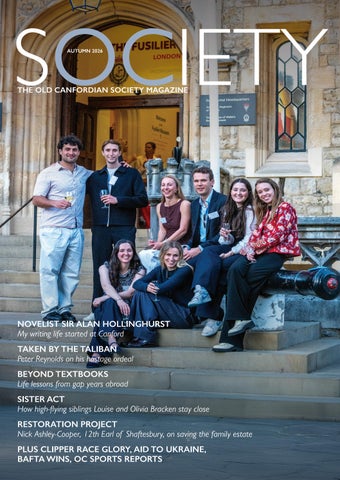
SOCIETY AUTUMN 2026
THE OLD CANFORDIAN SOCIETY MAGAZINE
NOVELIST SIR ALAN HOLLINGHURST My writing life started at Canford TAKEN BY THE TALIBAN Peter Reynolds on his hostage ordeal BEYOND TEXTBOOKS Life lessons from gap years abroad SISTER ACT How high-flying siblings Louise and Olivia Bracken stay close RESTORATION PROJECT Nick Ashley-Cooper, 12th Earl of Shaftesbury, on saving the family estate PLUS CLIPPER RACE GLORY, AID TO UKRAINE, BAFTA WINS, OC SPORTS REPORTS
2
SOCIETY ISSUE 05 2026
OC Society 100 years old A message from new OCS president Cleeves Palmer On 26 June 2026 the OCS was one hundred years old. During our centenary year we will be organising an event or two in celebration of this remarkable milestone. We will also be reviving the UK regional get-togethers OCs have enjoyed in the past. It is just over six months since you elected me and your newly invigorated committee, but I can promise you that we have been busy. Firstly, let me tell you how we are sharing the workload. We have set up the following subcommittees and each of these is being led by the enthusiastic chairs listed below: • Treasury - Simon Young • Strategy - Luke Dugdale • Communications - John Walker • Sport - Cleeves Palmer DL • Mentoring & Compassion beyond Canford - Barry Coupe • Legal & Governance - Arthur Wood • UK Regions - Paul Nurser • Overseas - Richard Booth • Centenary & Events - Paul Nurser Simon Young has done a great job for some years now in ensuring that our finances are in good order and that our reserves are earning both good yields and capital appreciation.
As I write this, Luke Dugdale, together with his Strategy team members Richard Booth and Arthur Wood, are working on a strategy paper to share with all Old Canfordians so that you can help form the future of the OCS. On the sporting front, my team has awarded grants to support the investment that the Development Office has given through the years. We have provided grants to OC Rugby 7s, OC Football, OC Golf, OC Rowing, OC Cricket (Cygnets) and to OC Squash, which is enjoying a renaissance under the leadership of committee member Albert Blackburn. Barry Coupe has kindly taken up the mantle of supporting OCs who need support beyond Canford. We have been pleased to be able to support one family facing the sudden and early loss of their OC father, and to support one student through a Gap Year project. Arthur Wood, who has a very good eye for detail, is keeping watch to ensure that we conduct ourselves in an orderly manner, and within our constitution, and John Walker is looking at ways to improve communications for all OCs. Richard Booth has reached out to all OC Overseas Reps, and so far has met up online with ten reps who between them cover North America, Europe, Asia,
and Australasia. They continue to engage our OCs, both for networking events and by providing a point of contact and support for those new in-country. Our aim is to augment their ‘Beyond Canford’ engagement efforts, aligned with the new OCS strategy, and in some cases provide financial support for set-piece events each year. In closing, I want to pay tribute to Rowena Gaston, who has led the Development Office for ten years. Rowena moved on to pastures new in July. The OCS owes Rowena a great debt of gratitude for her hard work, dedication, good cheer and expertise. To mark our appreciation, fellow OCS Committee member Simon Young and I presented Rowena with a present from us all. We will always be very grateful for all that she has done to promote fellowship amongst us. Thank you Rowena. Cleeves Palmer DL (C80)
To contact Cleeves, please email president@ocsociety.uk
CONTENTS
3
4 Letter from headmaster Chris Wheeler 6 OC News –
triumphs and tribulations shared
14 Canford Community – latest updates 20 A Knight’s Tale –
novelist Sir Alan Hollinghurst’s writing life
24 New eyes – the gift of gap year travel 27 Best friends, different lives –
meet the Bracken sisters
30 Captive in Afghanistan – Peter Reynolds tells all
33 Leavers’ Ball 2026 – in pictures 34 House of healing – Nick Ashley-Cooper
on restoring St. Giles House
38 Staff Farewells 39 From the Archive – pupils get building,
plus, a school history lesson through fragments
43 OC Sports Reports 48 Fondly remembered – former
headmaster Martin Marriott and OC Obituaries
55 OCS Committee and Overseas Reps
OC Editor Genevieve Fox (C82) would love to share more OC adventures, achievements, updates and photographs. Please contact her at OCEditor@Canford.com
4
SOCIETY ISSUE 05 2026
HEADMASTER’S LETTER
Chris Wheeler
O
ne of the privileges of becoming Head of Canford is discovering just how far the Canford story reaches. As a newcomer to the school this year, I expected to inherit a wonderful community of current pupils, parents and staff. What I perhaps did not fully appreciate until I arrived was the strength, loyalty and affection of the Old Canfordian network. Throughout the year I have met OCs from across generations, professions and continents. Some left Canford only months ago; others attended the school many decades ago. Yet what has been striking is the consistency of their connection to the school. The details of their individual experiences may differ, but the affection with which they speak about Canford remains remarkably similar. The buildings have evolved. New opportunities have emerged. Expectations and challenges have changed. Yet something fundamental endures. Canford continues to be a place where young people are encouraged to throw themselves fully into life. As I have watched pupils this year, I have often reflected on the qualities that future Old Canfordians will carry with them long after they leave. They are learning to think critically, communicate effectively, collaborate with others
and show resilience when faced with setbacks. They are discovering passions on sports pitches, stages, rivers, in workshops, laboratories, classrooms and chapels. They are learning how to lead, how to serve and how to contribute positively to a community greater than themselves. These are the things that ultimately endure. Of course, 2025-26 has also been an important year institutionally. The creation of the Canford Schools Group through our partnership with Dumpton School marks a significant moment in the school’s history. Rooted in shared values and educational ambition, the partnership strengthens both schools while preserving the distinctive character that makes each special. We are building the Canford Schools Group not simply for the present, but for future generations of Canfordians. The completion of the new Sixth Form College represents another important investment in that future. Designed to nurture independence, intellectual
curiosity and personal responsibility, it reflects our determination to ensure that pupils leave Canford genuinely prepared for life beyond school. The year’s ISI inspection also confirmed much that our community already knows: that Canford remains a school of exceptional quality. Particularly pleasing was the recognition of pupil leadership, which was highlighted as a significant strength, an accolade reserved for only the best 10% of schools. Throughout the year I have seen countless examples of that leadership in practice. I have watched senior pupils mentor younger ones, organise events, lead charitable initiatives, captain sports teams, direct productions, perform music at the highest level and represent the school with distinction. These experiences matter because they prepare young people not simply for examinations or university places, but for life. That broader vision of education feels particularly relevant when considering the contribution made by generations of Old Canfordians.
HEADMASTER CHRIS WHEELER
That is why the continued engagement of Old Canfordians is so important.
As I have met alumni, I have been struck not only by the diversity of their achievements but also by the common qualities they display. Whether working in business, medicine, law, education, the arts, the military or public service, many speak about the formative opportunities they encountered while at school: opportunities to lead, to participate, to fail safely, to discover strengths they did not know they possessed.
Your support enriches the experience of today’s pupils. Through careers guidance, mentoring, networking, philanthropy, attendance at events and simply maintaining your connection with the school, you help bridge the gap between education and the wider world. You provide pupils with examples of the many different paths a Canford education can support. This year has also highlighted the extraordinary work done by our Development and Alumni Relations team in sustaining those connections. Through reunions, regional gatherings, international events and ongoing engagement, the sense of belonging that characterises the Canford community remains vibrant long after pupils have left the school gates. I am grateful to Rowena Gaston for all she has given to support our alumni during her time here and I know many OCs will join me in wishing her well for her future. Indeed, one of the most encouraging aspects of the OC network is that
5
it is not merely nostalgic. It remains forward-looking. The strongest school communities are not museums preserving a fixed moment in time. They are living organisations that honour their traditions while continuing to evolve. Canford’s history matters deeply, but so too does its future. As Head, I feel fortunate to inherit a school in such strong health. Outstanding pupils, dedicated staff, committed governors, supportive parents and an engaged alumni community provide firm foundations for the years ahead. As I complete my first year at Canford, I would like to thank all those Old Canfordians who have welcomed me so warmly. I have greatly enjoyed hearing your stories, learning about your experiences and seeing the affection in which you continue to hold the school. The task of every generation is to leave an institution stronger than it found it. Looking at the commitment and generosity of the OC community, I am confident that Canford’s future is bright. Chris Wheeler
6
SOCIETY ISSUE 05 2026
OC NEWS Star of the screen TV PRODUCER LAURENCE BOWEN ON A BAFTA TRIUMPH FOR HIS LATEST DRAMA
Alice with mum Helen and family
Celebrating the 2026 BAFTA win for Prisoner 951: (from left) Laurence Bowen, director Philippa Lowthorpe, Nazanin Zaghari-Ratcliffe, actor Narges Rashidi and Dancing Ledge’s MD Chris Carey
Alice’s Charity Hair Donation – Made with Love In the new year, OC Alice Herbert (D22) donated over 14 inches of hair to the Little Princess Trust in memory of her mum, Helen, who passed away from breast cancer in December 2024. Alice’s amazing donation was part of a fundraising campaign to support the charity’s work providing wigs for young people.
T
he 2026 British Academy Television Awards, held in May, was a typically glittering affair and the star-studded ceremony proved to be a successful evening for Laurence Bowen (SH82), who runs TV production company Dancing Ledge.
Losing hair can be one of the most challenging parts of cancer treatment. The Little Princess Trust provides real hair wigs to children and young people up to the age of 24, helping to restore confidence and identity at a difficult time. The charity covers all associated costs, including making, fitting, and styling the wigs, and it also supports research into kinder and more effective treatments for childhood cancers through its Hair and Hope mission.
Laurence’s most recent BBC1 drama, Prisoner 951, was among the BAFTA nominations, and he was seated alongside Narges Rashidi as she was announced the winner of the Leading Actress Award for her searing portrayal of Nazanin Zaghari-Ratcliffe, the Iranian British woman imprisoned in Tehran for six years on trumped-up spying charges.
Alice grew her hair for over two years in preparation for this donation and has been raising funds to support the charity’s continued work. What a wonderful thing to do in honour of her beloved mum Helen. Well done Alice.
Laurence bought the TV rights to Nazanin’s book A Yard of Sky, written with her husband, Richard Ratcliffe (played by Joseph Fiennes), who campaigned tirelessly for her release.
For further information about the charity, see www.littleprincesses.org.uk
“It was incredibly inspiring reading Nazanin and Richard’s memoir. I was in awe of their ability to survive and retain their humanity in the most
utterly challenging circumstances,” says Laurence. “Both our actors brought such truth and layering to their performances, working with our wonderful director Philippa Lowthorpe and screenwriter Stephen Butchard.” Laurence credits his time at Canford for igniting his passion for drama, in particular directing Zigger Zagger by Peter Terson in a House Drama competition. “It was my first ever experience of directing, and it was terrifying – where should everyone stand, who could act, would they remember their lines, would they take my notes?” he recalls. “But it set me down a path of directing and acting at university, and then ultimately working in TV.” After reading History at Oxford, Laurence started out as a script reader, later founding Feelgood Fiction. In 2005 he won a BAFTA for My Life As a Popat, a BBC comedy about a British-Indian family, and later produced BBC one-off drama The Eichmann Show, starring Martin
7
Nichola Coughlan in Big Mood Martin Freeman in The Responder
Mudlarks and modern treasures When she isn’t beachcombing on the foreshore of the river Thames or teaching up-and-coming potters, ceramic artist Fliff Carr (née Lidsey, M82) is working on her own projects and commissions in her North London studio
Anne-Marie Duff in The Salisbury Poisonings
Freeman and Anthony LaPaglia, about the 1961 trial of Nazi war criminal Adolf Eichmann. Dancing Ledge Productions is named after the picturesque rock ridge on the Jurassic Coast, near his late grandparents’ home in Swanage, Dorset. Laurence’s critically acclaimed programmes range from Channel 4 comedy Big Mood, featuring Nicola Coughlan, to BBC1 dramas The Salisbury Poisonings and The Responder, for which he reunited with Martin Freeman, who won an International Emmy for his role as a troubled Liverpool cop. “I’ve always loved being able to make comedy alongside drama. But the thing I love most as a producer is being able to tell stories on a platform where tens of millions of people get to watch what you’ve made,” he says. “It’s great when the response is positive, not so good when it isn’t – there’s nowhere to hide!”
A maker of modern treasures, refined tableware and art works, Fliff ’s finely thrown and hand-rolled pieces include jugs with sweeping but delicate gold-lustred handles. Espresso cups and plates are decorated with images sourced from old books, which are then collaged as transfers onto each piece. Butter dishes are topped with found objects washed up on the banks of the Thames, such as chess pieces, nails and 17th-century ceramic sherds. Previous retail clients include Fortnum & Mason and Anthropologie and her work is available in The Merchants Table gallery in Woodbridge, Suffolk, and The Shop Floor Project in Ulverston, Cumbria. Fliff has just completed a private commission of twelve black canary cups for an A-list actor whom, sadly for us, she is far too discreet to namecheck. When she was at Canford, Fliff took Art A Level, where she was taught by the painter and former Director of Art Rob Woolner. “Rob was a big influence on me,” says Fliff. “He taught me that art could be playful and experimental and not just about completing an exam – that was exciting.”They still keep in touch. One of Fliff ’s recent projects, ‘Weight of Uncertainty’, was a response to the Covid pandemic and how the restrictions imposed on individuals and communities stacked up. Fliff represented this ‘weight of uncertainty’ with single earthenware, unglazed clay
vessels, each weighing 1oz and measuring 3-5cm in height. On every day of lockdown, she threw one vessel on her pottery wheel. The accumulated uncertainty over the ensuing 103 days of the first lockdown is visually represented in this collection of vessels. When a third national lockdown was announced in January 2021 Fliff created a further 63 black clay vessels to reflect the darker mood of the nation. Today, the world faces different uncertainties but for Fliff, working with clay is about a different, dynamic kind of uncertainty – how the material will react, what she will bring to the creative process, where the initial inspiration leads. “I have been working with clay now for 30 years in four different studios and with ever evolving ideas and skill sets,” she says. “I’ve shared spaces and worked on my own. It is a fantastic feeling to walk into the studio early in the morning with a project on the go, to put on a good audio book and get working. I love visitors and would of course welcome any Canford alumni to come and have a ‘go’ on the wheel or just a chat!” Fliff is open to commissions and loves talking through ideas with clients. You can see her work on her website www.fliff.co.uk, or follow her on Instagram: @fliffcarrceramics
8
SOCIETY ISSUE 05 2026
NEWS IN BRIEF Bespoke boutique banking Congratulations to Celeste Leverton (Ma15) on launching Leverton Wealth Partners, a boutique wealth advisory practice. The firm, which is an associate partner practice of St James’s Place, targets an “under-served” segment of young entrepreneurs. Offering bespoke, relationship-led advice, it also supports individuals and families in taking a thoughtful, long-term approach to managing their wealth. Celeste brings close to a decade of experience from Coutts, where she advised high-networth clients on complex wealth planning and investment strategy, with expertise in multi-generational financial planning and responsible investment. Through her practice she works closely with entrepreneurs, business owners and senior leaders, with a particular interest in supporting the next generation of wealth creators. She is also passionate about encouraging more women to engage confidently with wealth planning and investment decisions as the generational transfer of wealth unfolds. Last year, the Centre for Economic and Business Research predicted women would be expected to hold 60% of UK wealth by the end of 2025. ‘Historically, leadership within private wealth has tended to skew older and male, while wealth ownership itself is becoming increasingly diverse,’ Celeste has previously commented, arguing that advisory models needed to evolve alongside that. Celeste has argued that her own age was itself representative of the shift that is coming “I think, unfortunately, we haven’t seen the financial services space move proportionally with that.” Good luck, Celeste, on your new venture.
Three OCs take on the Great South Run Three OCs conquered the 10-mile AJ Bell Great South Run in Portsmouth last October. The trio – Jonathan Peddie (SH86), Dickon Le Marchant (M86), and Anthony Field (M86 – braved the elements and completed the iconic road race, which saw approximately 25,000 runners fill the streets of Portsmouth. Congratulations to all three for their effort and perseverance.
Making Waves Clipper Race sailor Lauren Corn celebrated her 21st birthday on the Southern Ocean. She spoke to Society shortly after arriving in Oban (Leg 7) to a hero’s welcome On 18th October 2025, Dorset sailor Lauren Corn (L23) joined as First Mate aboard the Washington, DC yacht, sailing 40,000 nautical miles as part of the Clipper 2025-26 Round the World Yacht Race. Lauren had been training crews for the Clipper Race when she was asked to step in at short notice to replace the previous First Mate. She joined the prestigious – and gruelling – race in Punta del Este, Uruguay, the start of Leg 2, and was one of only two paid professionals on the team. Alongside her 21-year-old skipper, she formed the youngest skipper/mate pairing in this year’s race. The Washington, DC yacht set sail from Uruguay to Cape Town on 20th October 2025. “Sadly, we hit a whale in the South Atlantic with over 1,000 miles to Cape Town left, which resulted in us only having one rudder and limited steerage,” says Lauren, who grew up sailing in Poole, Dorset. After a break from university, Lauren earned her Yachtmaster qualification in Australia, gaining experience in racing and instruction. Leg 3 was also memorable, for very different reasons. “I celebrated my 21st birthday smack bang in the middle of Leg 3 in the Southern Ocean,” she says. “My birthday started at 1am to the sound of the team putting in a reef, but luckily Skipper Ella [Hebron] was handling that so I didn’t have to – birthday good news! “I arranged for the crew to have a fancy dress party and a got my favourite carrot cake, along with some lovely presents and non-alcoholic champagne. The best gift was that the sun was out, which was a fairly rare occurrence for Leg 3.” She endured freezing, 40-60-knot winds of the Roaring Forties, adding: “I remember seeing the massive waves (easily over 20ft) with the sun shining through the top of them and realising how privileged I was to experience a part of the earth that so few people get to travel to. “I’ve had a lot of lows, too, though the worst are really just going through rough weather, being cold with a lot of crew seasick, and feeling like it’s not going to end. One low, which eventually turned into a high, was medevacking a crew member on Christmas Eve. At that point, we were on Leg 4, the Australian Coast-to-Coast leg, and three days out from Freemantle, 500 miles behind the rest of the fleet.
OC NEWS
Arriving in Seattle on Power of Seattle Sports with skipper Angela Brandsma
“There was a question of whether we could keep the casualty on board until Hobart, Tasmania, but it was correctly deemed too dangerous so we turned back to Bussleton, a town an hour south of Freemantle, having been promised a helicopter rescue – which sadly then wasn’t available! “However, by sailing the boat as best we could we managed to catch two boats on the east coast of Australia, making it the biggest comeback of the race – I was prouder of that than of any race result.” Lauren changed teams at the start of Leg 6, leaving Washington, DC and joining Power of Seattle Sports. “Another big high was winning our home race for Seattle on our joker (double points), which was Leg 6, the Mighty Pacific, which is known to be the toughest.” For Lauren, racing across the globe also offers time to reflect and compare notes. “There are long periods where there isn’t a lot going on apart from just sailing the boat fast. I loved having open conversations with the crew on how we could improve as a team. What’s very interesting about Clipper is the crew all come from different backgrounds and have very varied life experiences. I’m always looking to tap into that and learn from them as they learn sailing from me.” Lauren and her crew completed seven out of eight legs of the global route, crossing the finish line in Oban, Scotland on 11th July 2026 to a hero’s welcome. “Arriving in Oban was very
9
Motoring to a Le Mans start south of Korea with a fishing boat in the background
cool as it was the first time being back in the UK. I had my whole family there for the first time, as well as some of my friends from the race waiting on the dock. It was a great feeling to know that was our last ocean crossing.” Lauren’s immediate sailing plans will be a breeze after the Clipper challenges. “I’m definitely looking forward to getting back into some of my own sailing where I’m not in such a position of responsibility,” says Lauren, “and can enjoy being one of the crew instead of First Mate.” As for next landlubber steps, Lauren won’t be standing still. University, to study Maths or Naval Architecture, is on the horizon and, says Lauren, “I would really like to climb a mountain! There’s also a lot of other beautiful places I would like to sail to. During the Race I made a list of things I wanted to do after it, and that includes a lot of sports, like road cycling and kick boxing.”
“Since starting yacht sailing, I’ve always found being at sea very clarifying in terms of what I want my life to look like and what matters most to me – and that has only grown. “For anyone who knew me before the race compared to after, I would say my emotional intelligence has improved massively, along with my communication skills. “On a more introspective level, I would say I’ve relaxed into my personality a lot more and have confidence in knowing who and what type of person I am. I no longer feel I need to try to fit a certain stereotype or act a certain way.”
The 2025-26 Clipper Round the World Yacht Race fleet arrived back in Portsmouth on 25th July, before Society magazine went to press. Team GOSH, sponsored by Great Ormond Street Charity, took first place. Back in Oban, Lauren had said that, whatever the outcome, taking part “has absolutely changed me – and anyone who says it hasn’t done the same for them won’t have realised how yet, or is lying! A sail change by Lauren in the North Pacific during a squall
10
SOCIETY ISSUE 05 2026
NEWS IN BRIEF
Robin Wright (SH69), left, with his late brother Nigel Wright (SH65)
Catie conquers the South Downs for the Armed Forces
A full life in Salisbury – from street life to stage
On 13th June 2025, Catie Pettit (L95) took on the South Downs Way 50k as part of her ongoing fundraising efforts for SSAFA, the Armed Forces charity.
“In Salisbury, I have a very full life,” writes Robin Wright (SH69), “yes, even at my age! I do a lot of volunteering, which keeps me off the streets. Actually, one of my activities puts me on the streets – Community Speedwatch. It’s amazing how fast we go in built-up areas without noticing the speed, although some do it as a pastime. But 65mph in a 30mph zone cannot be considered careless.
This was Catie’s third endurance challenge in support of SSAFA, an organisation that does invaluable work supporting serving personnel, veterans, and their families. The cause is particularly close to her heart, as her son is currently serving in the Armed Forces, and a close friend has benefited enormously from the charity’s support. Catie’s previous challenges include the Steaming to the Coast trail marathon over the Quantock Hills in Somerset, and the Isle of Wight Ultra Challenge (53k), where she achieved an impressive 4th place finish. Catie continued her fundraising journey in September, taking on the Chiltern Wonderland 50-mile race. Go Catie! Well done, and best of luck with future challenges and fundraising. For further information about the charity, see SSAFA.org.uk
In Salisbury Cathedral, I have been guiding and stewarding for nearly 20 years. In the recent heatwave it was definitely the coolest place in town! Ushering at the Salisbury Playhouse is another favourite occupation, which again I have been doing for over 15 years. It enables me to see all the shows that appeal. The price to pay is the selling of ice creams. My most favourite place to eat in Salisbury is ‘Charlie’s Kitchen and Cocktail Bar’, which sells Turkish and Mediterranean food. Wonderful ambience and so friendly and such professional staff. (I think the owners are retiring if there are any OC restaurateurs out there wishing to run a restaurant in our Cathedral City!). If any OCs are visiting Salisbury, get in touch. I can show you around.”
Tying the knot, Canford style It was wedding bells for OCs Tom Doyle (M18) and Liv Barker (Ma18), who celebrated their big day on 30th May 2026, surrounded by Canford friends. The day was made even more special, given the strong OC presence, which included Tom’s best man, James Elwood (M18). Warm congratulations to Tom and Liv as they begin this exciting new chapter together.
OC NEWS
OCs on the road to Ukraine: delivering aid under fire
11
Prior to departure for Ukraine: (from L to R) Sir Julian Brazier (former MP & UFC Patron), Rob Lasseter (C76), Andrew Canning (C76), Rob Shepherd (C81), Digby Shepherd (C21), Ants Walker (UFC Admin), Tim Anstee (UFC Founder/Director & father of two OCs: Harry (M11) & Charlie (M21); A cemetery with graves of Ukrainians killed in action
BY ANDREW CANNING Six months after Putin invaded Ukraine for the second time, in 2022, Andrew Canning (C76), a former Royal Marine, accepted an invitation from former Canford parent Tim Anstee to volunteer, along with some other OCs, for the newly formed Ukraine Freedom Company (UFC). Andrew has been organising the collection and delivery of medical and other humanitarian aid for the UFC ever since. Last year, four OCs travelled together on two vehicles as part of the UFC’s 26th aid convoy. Tim Anstee, father of OCs Harry (M11) and Charlie (M22), co-founded the notfor-profit, volunteer-manned Ukraine Freedom Company (UFC) soon after Putin invaded Ukraine (again) in 2022. The aim of UFC was to deliver much needed aid to the civilian and military people of Ukraine. The initial plea for aid was for warm winter warfare clothing for Ukrainian troops fighting on the front line during that first winter of the conflict. Not least, I and other former Royal Marines cleared our attics of still excellent old Arctic Warfare clothing and equipment and donated them to UFC. When the founders’ garden sheds became overloaded with generous donations later in 2022, Rob Shepherd (C81), who runs a farm in Hampshire, provided a barn to serve as the UFC depot for all aid collected prior to delivery to Ukraine. Rob spent ten years in the British Army and the airborne reserves, serving in Northern Ireland, Germany, Kenya, Belize and the Falkland Islands as ADC to General Sir Peter de la Billière,
another OC parent. By July 2026 UFC had made over 35 aid delivery trips all over Ukraine, under constant threat of Russian missile or drone attacks. UFC convoys are typically on the road for eight to fourteen days; all volunteer drivers pay their own way on convoys, including accommodation, bar costs and breakfasts. One notable aid convoy included four OCs in September 2025 – me, Rob Shepherd, fellow farmer Rob Lasseter (C76), a good friend of mine, and Rob Shepherd’s son, Digby (C21), a qualified agricultural drone pilot. Dibgy manages diversification projects for the family farm, which range from music festivals to holiday lets. The four of us manned two of the vehicles on the convoy. Air raid sirens are heard on every trip. Those present generally have the choice of taking cover wherever they can, including designated air raid shelters. Or they can ignore the endless sirens. I and other UFC drivers have done both. Spending hours in underground shelters is a sobering and uncomfortable experience, not seen in the UK since WWII. But for Ukrainians, doing so has been routine practice since February 2022. On one occasion, in Sumy in 2026, without any siren sounding, three Russian drones passed overhead as we were handing over the aid. One drone was shot down by Ukrainian forces 200m from us, debris falling close by. The second drone hit its target about 500m away from us and the third Russian
drone hit a target, intended or not, which was a residential area, occupied by families and others. Many deaths and casualties were reported, children included. What has made a marked impression, on me and all the UFC drivers visiting this proud nation, is the obvious absence of men aged between 25 and 60. Cafes, bars, shops and streets are dominated by women, many of whom will have lost family members and friends killed in action. Cemeteries, packed with new graves of the fallen, are everywhere, even in remote rural areas. These, along with other public memorials, are very poignant. I will never forget Digby standing beside the memorial banner of a young man born the day before him in 2002. Strangely, since my involvement with UFC driving to Ukraine, food shops have been well stocked and fuel has not been in short supply. I have witnessed so many very moving moments in Ukraine, but what never fails to touch me deeply, on each and every trip, is the absolute gratitude expressed by Ukrainians for what we deliver to them. They stress that the aid we, and other aid agencies, deliver constantly fuels their resilience and determination to resist Putin’s unprovoked aggression, and that it has helped them to do so. It is humbling indeed to be emotionally thanked, in Ukrainian or in English, by people that have been at war since 2022.
Should you wish to donate to UFC, please do so to the Ukraine Freedom Company Ltd. UFC Co-Op bank details are 08-92-50, 68823151
12
SOCIETY ISSUE 05 2026
NEWS IN BRIEF
Book News ARTISTIC FREEDOMS AND STRANGE AMBITIONS Paul Munden (F76), biographer of rebel violinist, Nigel Kennedy, traces his career back to Canford’s culture of creativity – and the cutting-edge Film Soc
OC Connections at 35,000 feet From Canford to the cockpit… Two OCs, one A380, 5,000 miles to Johannesburg. A chance meeting, or proof that OC connections are everywhere? On a recent work trip to South Africa, Captain Scott Forbes (F94) found himself in familiar company, though perhaps not in the usual setting. “I was lucky to find myself sat next to another OC, Will Gabb (C11), and we had a great time chatting about our time at Canford,” Scott shares. “This may sound like a lucky coincidence, but it was a little different. We were the pilots on that trip, flying the Airbus A380 over 5,000 miles down to Johannesburg for British Airways.” What followed was a journey not just across continents, but across Canford generations. Comparing experiences from the mid 90s to 2011, Scott and Will reflected on how much had changed, and how much had stayed the same. “We spent some time on the flight comparing the differences from when I left Canford to Will’s time there. A lot had changed in that time, but we both had great stories of school events and even some of the teaching staff who overlapped during our time there.” With nearly 500 passengers on board and 5,000 miles ahead, the flight was a busy one, taking them due south to one of the world’s most remarkable destinations. “Some golf and dinner later, it was time to head back to a rather wetter UK,” Scott adds. “But Will and I are scheduled to fly again soon, so if you are ever on a British Airways flight, listen out for the names of the pilots. It might be an OC name you recognise.”
I spent hours at Canford on the athletics track, but also in the music school, on stage, writing poems, and co-editing the literary magazine, Wade’s Boat, with Mark Dugdale (S76) and Tim Shortis (B76), amongst others. Canford enabled me to pursue these various interests with considerable freedom, and that became the model for my whole career. It never occurred to me, however, playing violin in the school orchestra, that I might one day write a book on the bestselling violinist of all time, and undoubtedly the most controversial. Another OC, the late Sir John Drummond (B52), Controller of BBC Radio 3 from 1987 to 1992, famously fell out with Nigel Kennedy, but from the moment I first saw Kennedy play live I was hooked, stunned by his extraordinary, boundary-breaking talent. I was forced to consider why it matters that everyone should, as the 18th-century maverick writer Laurence Sterne puts it, ‘tell their stories their own way’: tell stories, or write poems, play music, and indeed live life with truly individual purpose. If the inclusion of poems in a critical biography was unusual, my next project had even stranger ambition: to revisit the films of Sam Peckinpah – entirely in verse. It was at Canford that I first encountered the director’s films, including Straw Dogs (1971). Steve Room, and later David Dunford, running the Film Society, screened the notorious thriller in 1976. Peckinpah Suite, like Unclassified, is not only a form of biography; it is also a highly personal account of experiencing art. I firmly believe that making art of our own is critical to our understanding of other artworks – and the world. That is why, as Director of The National Association of Writers in Education, I fought to introduce the Creative Writing A Level, which so many teachers and students welcomed (and which may yet be reinstated after its shameful removal on political grounds). Meanwhile, I’m excited to have a full-length screenplay, The Darkroom, due for production later this year. Right now, though, I’m off to Shakespeare’s Globe for the judging of Poetry by Heart, the national competition for schools coorganised by Tim Shortis. Our free-ranging education served us well, I think. Unclassified: Nigel Kennedy in Chapters & Verse and Peckinpah Suite are published by Recent Work Press; paulmunden.com
Paul Munden, left, with Nigel Kennedy
Canford athletics 1976
Taming of the Shrew
13
IS IT TIME TO SHARE YOUR LIFE STORY?
HOW CANFORD LED ME TO A BIZARRE MUSIC GENRE
CREATIVE COLLABORATION
Author Dominic Bliss (SH87) has written Novak Djokovic’s autobiography. Is yours next?
By Christian Kriticos (SH10)
Toby Brooks (L18) has released his first book, Two Windows and a Door, blending poetry and visual art to reflect on creativity, change, and navigating new beginnings
Studying languages and literature at Canford, and later at University College London, encouraged me to pursue a career in journalism and books. I’ve written for The Telegraph, Financial Times and National Geographic, amongst others, and written 20 books, including five biographies. I’ve been lucky enough to interview figures such as explorer Sir Ranulph Fiennes, David Cameron, astronaut Tim Peake, Serena Williams, Jamie Oliver, physicist Brian Cox and David Bailey. I now write biographies and ghost-write autobiographies, including those of Rafa Nadal, Novak Djokovic, and former world squash champion Nick Matthew. Ghost-writing the life stories of lesserknown people is equally rewarding, however. It’s a skill that requires a huge amount of sensitivity and discretion. I now want to offer my services to other OCs who wish to leave a written legacy behind, mainly for their families and friends. Please get in touch if you’d like to know more: email me at dominic. bliss@btopenworld.com or call 07900 915918.
NOVAK DJOKOVIC
C
OC NEWS
DOMINIC BLISS
It’s always been my ambition to write a book. But I never imagined my first would be about musique concrète – a bizarre form of avant-garde music originating in the 1940s. I first heard about this obscure genre during my time at Canford. Swapping CDs and iTunes libraries with my fellow pupils, I gained a music education that eventually led to a career in music journalism. Like any good education, it included the classics – particularly, The Beatles. But among the Fab Four’s oeuvre, there was one track I couldn’t abide. At the end of their longest album was ‘Revolution 9’ – an eight-minute collage of weird noises and sound effects. I eventually learned it was mimicking a genre known as musique concrète. That didn’t make me appreciate it any more. But something about that mysterious genre stuck with me. Years later, I was invited to pitch a book proposal to Bloomsbury and remembered musique concrète. Writing the book was my attempt to come to grips with this strange genre. And hopefully that mirrors the reader’s experience too, as I reveal unexpected connections between musique concrète and popular music. For instance, I show how it directly influenced major artists of the 1960s, like Frank Zappa and The Who. I also explore how its innovative techniques anticipated later genres like hip-hop and ambient music. I’m now working on my second book (which also has a Canford connection). And I hope to write many more – on even more unexpected subjects! Christiankriticos.com
T H E G R E AT E ST O F A L L T I M E DOMINIC BLISS
NOVAK DJOKOVIC The greatest of all time
The book features Toby’s poetry in conversation with the art work of his artist friend, Marina de Laitre. Taking in Toby’s life in the Bristol poetry scene and Marina’s in Hong Kong, the book centres around finding space for creativity whilst taking on life’s perpetual changes. Toby has been working on his career as a writer and comedian since leaving university in 2021. The book chronicles this journey and moving to a new city, relationships and careers. First edition copies are beautifully designed and bound on premium paper by Calvert’s in London and are signed and numbered. For more information, see twowindowsandadoor.com or follow the project’s developments on Instagram @twowindowsandadoor
14
SOCIETY ISSUE 05 2026
Rugby Reunion Lunch
Canford Community The past year has been another busy one for the Old Canfordian community, with a full calendar of familiar favourites alongside some new additions. We welcomed alumni back to Canford for reunions celebrating the Classes of 1976, 1986, 1996 and 2006. Looking ahead, we are delighted to introduce a new 10-year reunion, with the inaugural event bringing together the Classes of 2015, 2016 and 2017. Our popular Clink & Connect evening in London for younger OCs was once again a great success and is now firmly established as a regular fixture in the OC calendar. Our sporting programme has continued to thrive. In December 2025, we launched a new Rugby Reunion Lunch, where OCs enjoyed a hearty meal before cheering Canford to an exciting victory over Sherborne. After a year’s break, the OC Hockey Day returned in the spring and proved such a success that it will now become an annual event. Meanwhile, the OC Football Club played twice at Canford during the year, with a record number of OCs taking part and they have performed well in the Arthurian League – a wonderful reflection of the enduring camaraderie and enthusiasm within the Canford community. In February, it was our privilege to host a Celebration of Life for the late Martin Marriott. OCs travelled from across the UK and around the world to honour the extraordinary contribution that both Martin and Judith made to Canford and to generations of Canfordians. It was a fitting tribute to two people who have had such a lasting impact on the school For me, the time has now come to bid farewell to Canford. It has been a genuine privilege to meet so many remarkable OCs over the past ten years, and I am deeply grateful for the support you have shown in everything we have sought to achieve together. OC Hockey
Nineveh Lunch
OC London Drinks
CANFORD COMMUNITY
15
1976 The Centenary celebrations will always remain a personal highlight, and it is my sincere hope that the Martin Marriott Foundation, founded in my first year at Canford, continues to flourish in the years ahead. Thank you for your unwavering support – whether by attending events, volunteering your time, mentoring fellow OCs or giving so generously to the bursary programme. Your commitment has helped strengthen the Canford community and ensure that future generations can benefit from the opportunities that make the school so special.
1996
Thank you, and farewell. Rowena Gaston Development Director
2006
Clink & Connect
1986
16
SOCIETY ISSUE 05 2026
C ANFORD SCHOOLS GROUP Chris Wheeler with Christian Saenger, Headmaster of Dumpton School
This is an exciting first step in establishing a new group of leading independent boarding and day schools that share common values. The Canford Schools Group has an ambitious vision for the future and will continue to build ever more dynamic partnerships, enhancing teaching, providing new opportunities for pupils and staff, and ensuring a collaborative and exciting future for independent education across the South of England.
IN
September 2025, The Canford Schools Group of charitable independent schools was formed, which included the merger with Dumpton School. Canford and Dumpton share educational values, placing kindness and aspiration for every individual pupil at the heart of their vision. This like-minded educational approach has been the foundation for this merger. Both schools are keeping their individual identity, name, headmaster, teachers, uniform and site. The Governing Body of The Canford Schools Group consists of governors from both schools and Dumpton will have an Education Committee overseeing its offering.
We believe in high autonomy partnerships, which celebrate the existing traditions, ethos and identities that our school communities love whilst challenging one another to be ever better. Both Canford and Dumpton hugely appreciate their longstanding and close relationships with other schools, and as a Group will seek to develop even closer ties with a range of partners who share the Group’s educational values.
Chris Wheeler Headmaster, Canford
CANFORD COMMUNITY
17
FESTIVAL OF IDEAS
CANFORD NAMED TOP INDEPENDENT SCHOOL IN THE SOUTH OF ENGLAND
In the final two days before the October half term Canford held their annual Festival of Ideas. This exciting festival is an opportunity for pupils to listen, interact and be inspired by thought-provoking speakers in a range of talks and interactive sessions. The event aims not just to inform, but to stimulate reflection and discussion around how we respond to rapid transformation. The lineup for the Festival of Ideas 2025, themed around ‘change,’ explored how shifts in technology, environment, culture, and society are reshaping our world.
Canford School was delighted to be named the top independent school in the South of England in the 2025 Independent School Parent Awards. Presented at a ceremony in London, the award recognised not only Canford’s beautiful Dorset setting and outstanding educational opportunities, but also its strong commitment to community partnership and outreach.
Jamie Ings (S05), Head of Enrichment and the Festival Organiser, said: “Change is both inevitable and exhilarating, it shapes our world and challenges us to reimagine what’s possible. The aim of this year’s Festival of Ideas was to explore the forces transforming how we live and think, from technological innovation and environmental shifts to cultural and artistic evolution. Through a diverse programme of talks and performances, we aimed not only to inform but to spark reflection and conversation about how we navigate change and how we can use it to build a more thoughtful, inclusive future.”
The 39 Steps delighted audiences over three nights in the Layard Theatre during the Easter term, showcasing the talent, energy and creativity of Canford pupils both on stage and behind the scenes. With quick-fire character changes, inventive staging and sharp physical comedy, the production was a technically demanding challenge,
THE 39 STEPS
Judges were particularly impressed by the school’s close links with the local community, from shared use of facilities, including the sports centre, theatre and church, to partnerships with more than 70 organisations across the region. This year also marked the 15th anniversary of Canford’s partnership with The Bourne Academy in Bournemouth, which continues to provide enriching academic and cocurricular opportunities for pupils from both schools, alongside bursary support for Sixth Form students. The award reflects Canford’s vision of enabling pupils to “make a difference to their own lives, and to the lives of others”, and is a tribute to everyone who contributes to the vibrant Canford community.
tackled with impressive professionalism by cast and crew alike. Built entirely in-house, the set, lighting and sound design transformed the stage seamlessly from London to the Scottish Highlands, helping to create a lively and engaging production enjoyed by packed audiences throughout the run.
18
SOCIETY ISSUE 05 2026
TOPPING-OUT CEREMONY MARKS MAJOR MILESTONE IN CANFORD’S SIXTH FORM DEVELOPMENT Canford School marked an important milestone in its new Upper Sixth Form development in January 2026 with the toppingout of the new College residences, ahead of completion in autumn 2026. The project builds on the successful opening of the College Hub in Spring 2025, which has quickly become the centre of Sixth Form life, offering study, wellbeing, careers and social spaces for pupils. Situated close to the Manor House and central school facilities, the new development will provide high-quality ensuite accommodation for Upper Sixth boarders, placing Sixth Form pupils at the heart of the Canford community. The scheme has been delivered in partnership with Feltham Construction Ltd, with the new facilities set to further enhance the Sixth Form experience at Canford.
NEW ATHLETE DEVELOPMENT CENTRE (ADC) PARTNERSHIP WITH TEAM BATH NETBALL Canford School was delighted to announce a new partnership with Team Bath Netball, becoming the Dorset host location within the Team Bath Netball Athlete Development Centre (ADC) network. The partnership reflects a shared commitment to developing and sustaining the netball pathway across the South West, ensuring talented young players have access to expert coaching, clear progression routes and excellent facilities. Sport remains central to a Canford education, and the school’s outstanding sporting facilities will now support Team Bath Netball’s delivery of high-quality coaching and development opportunities for netballers aged 14–17 across Dorset and the surrounding area. Canford joins a network of ten Team Bath Netball ADC locations, helping young athletes build strong foundations through weekly coaching alongside lifestyle and sports science support as part of the Team Bath pathway.
CANFORD SCHOOL PRAISED FOR EXCEPTIONAL PUPIL LEADERSHIP IN ISI INSPECTION Canford School was recognised as one of the leading schools in the country following the publication of its latest Independent Schools Inspectorate (ISI) report, which highlights a “significant strength” in the development of pupil leadership. The inspection, which took place in the Christmas term, resulted in an exceptionally positive report across all areas of school life. Of particular note was the inspection team’s award of a “significant strength” for pupil leadership, an accolade reserved for very few schools with areas of excellence that really stand out. Inspectors praised the way Canford empowers its pupils, recognising leadership at all levels as a defining feature of the school’s culture and ethos. This recognition is seen as a testament not only to the pupils themselves, but also to the dedication and commitment of staff who support and nurture leadership at every level. To mark the achievement, the school held a celebratory lunch for pupils and staff, reflecting Canford’s strong sense of community and shared success. From national awards and outstanding examination results to inspection outcomes, the school continues to celebrate incredible collective achievements. The report places Canford firmly among the very best schools in the country, reinforcing its reputation for excellence and its commitment to developing confident, capable, and values-driven young leaders.
CANFORD COMMUNITY
19
Dates for your Diary
Dates are correct at going to press. Further events may be added. Please check our Events Page on Canford Global Connect (globalconnect.canford.com/events) and regular Canford emails. OCTOBER 2026 Saturday 10th 2015, 2016 & 2017 Reunion Lunch, 12.00 midday, Canford NOVEMBER 2026 Wednesday 11th Nineveh Legacy Society Lunch, 12.00 midday, Canford Friday 13th Canford Online Auction starts (finishes Sunday 29th) DECEMBER 2026 Saturday 5th OC Rugby Reunion, 12.00 midday, Canford JANUARY 2027 Thursday 28th Clink & Connect (2016 - 2026), London
MARCH 2027 Friday 12th Careers Convention, Canford Saturday 13th 2007 Reunion Lunch, 12.00 midday, Canford Sunday 14th OC Hockey, 10.30, Canford MAY 2027 Saturday 8th 1987 Reunion Lunch, 12.00 midday, Canford OC London Drinks, date and venue TBC JUNE 2027 Friday 18th
Canford Arboreturm Tour with Andrew Powell, 6.00pm, Canford
JULY 2027 Henley Royal Regatta Lunch Reception, date TBC
The Martin Marriott Foundation was established in 2016 to support Canford’s bursary programme. The late Martin Marriott, Headmaster of Canford from 1976 to 1993, was a passionate advocate for widening access through bursaries. He was honoured to lend his name to the Foundation, which reflects his lifelong commitment to opening up opportunities for young people. “The breadth of opportunities at Canford has allowed me to meaningfully explore my ambitions, for which I am extremely grateful.” Reflecting on his time at Canford, one OC who left in 2026 believes his life would have been very different had he not come here. Once naturally shy, he has grown into a far more confident young man, developing strong interpersonal, planning and organisational skills. His parents have noticed the transformation too, commenting on how much more outgoing and mature he has become. “I have made friends for life - people I can socialise with but also have meaningful intellectual conversations with. I’ve built connections that I know will continue through the Old Canfordian network. Academically, I have achieved far more than I expected, and I know my predicted grades would have been lower had I not come to Canford. My confidence has grown enormously, I feel much more able to express myself, and moving to a completely new environment has accelerated my personal growth. It has been an inspiring experience.”
Today, it is with pride and genuine pleasure that we celebrate a bursary programme that continues to grow - supporting children who are thriving, embracing every opportunity, and making the most of all that a Canford education offers. This is made possible through the school’s own financial investment, alongside the generosity of donors who choose to support the Martin Marriott Foundation. A bursary transforms the life of an individual pupil, but its impact extends far beyond that. These young people enrich the Canford community and, in turn, their own home communities. The true power of the Martin Marriott Foundation lies in its ripple effect: by supporting one pupil, we help shape a future in which they will go on to support others. Together, we can continue to make that vision a reality. For further information on supporting the Martin Marriott Foundation, please visit globalconnect. canford.com/supportus
T EVENTS
FEBRUARY 2027 Saturday 6th 1997 Reunion Lunch, 12.00 midday, Canford Wednesday 10th 50+ Reunion, 11.00am, Canford Saturday 27th 1977 Reunion Lunch, 12.00 midday, Canford
“The lessons are taught at a much higher level than I was used to and are far more discussionbased rather than us simply being talked at. Teachers’ passion for their subjects is infectious at Canford and makes you want to learn. It also helps enormously to be surrounded by other students who are genuinely keen to learn.”
“I have completely changed the way I view myself. I am confident in my own abilities. I have never been as happy at school as I am at Canford and I have looked forward to every day. My teachers have been incredibly supportive, and this experience has truly changed my life in every way. I am more confident than ever about what I can achieve.” “Coming to Canford has completely changed me. I’ve become much more confident, I’ve experienced things I never thought I’d have the chance to do, and I’m really comfortable with who I am. The opportunities I’ve been given have shaped the person I’ve become.”
20
SOCIETY ISSUE 05 2026
A KNIGHT’S TALE Sir Alan Hollinghurst tells Society about creative inspiration at Canford, his award-winning novels and being honoured by the King Was home a place full of books, a place that shaped you? From aged eight, we lived in and around Cirencester in Gloucestershire. My father was a bank manager, so we moved each time he was promoted. He was a keen reader of English history and classic literature, and he had a great interest in old buildings; I still treasure books on church architecture that he had as a teenager in the 1920s, and childhood habits of going to look at churches, castles and country houses have remained a central part of my life ever since. My mother had always been a reader of poetry, knew many poems by heart, and my own life-long interest in poetry I feel stems from its being part of the atmosphere at home. Being knighted by King Charles 2024
FEATURE
Treasured: George Barrow, drawing of soldier, 1917 As a child, was there a book that ignited your own love of words? At the age of eleven or twelve I fell under the spell of both P. G. Wodehouse and J. R. R. Tolkien, two very different writers, but each of them giving me an early experience of the absolute compulsion of reading, the bliss of comedy or the grip of myth. At Canford poetry came more into focus – I’m forever grateful to the extremely dulllooking anthology, Fifteen Poets: Chaucer to Arnold, that we were all issued with. It was the book that really introduced me to the classic canon of English poetry, and attuned my system to the workings and possibilities of metaphor, rhythm and sound, grammar itself. I feel I’ve always been a fairly literary writer, tipping my hat to the writers from the past who mean most to me, and who are often poets – Tennyson, Hopkins, Hardy. Did you have a writing life at Canford? Or friends or teachers that inspired you? Yes, very much so – we all had separate exercise books for creative writing, and I wrote my first poems under the guidance of Robin Whicker, then head of English, whose classroom was up 97 steps at the top of the tower – a wonderful place apart. My début at the age of 13 was a Wordsworthian sonnet sequence called “The Pleasures of Life”, which appeared in a school poetry
Gong boy: winning the Booker in 2024
mag called cross-section. Later, under the influence of Paul Merchant, who was only at Canford for two or three years, I got into Modernism, and started writing very different poems, and lots of them. Peter Parker (now a famous biographer and historian of British gay life) was in School House, and published quarto envelopes of poems on roneoed sheets, and one of these was of poems by me. In the late 1960s, counter-cultural ideas infiltrated Canford through rock music and avant-garde art and writing, and the production of (preferably obscure and expressionistic) poetry had a certain cachet. On the strength of one of my poems I was called in for a chat by the Headmaster, Ian Wallace, who was anxious I should use my influence wisely. It was news to me that I had an influence, but it suggests the subversive role poetry was thought to have. What were the challenges, cultural and otherwise, for you as a teenager at Canford? I was generally very happy at Canford, which was passing through a time of great change in the years I was there (1967-71). There was a general relaxation of old-school practices, the cadet corps and daily chapel became voluntary, and the art shack under the great Robin Noscoe was a haven and a source of alternative ideas. In fact, Robin was as important to me as anyone, I did an additional History of Art A level with him, and he shaped my understanding of
21
Inspiration: Gerald Kelly, Study of a Dancer c1909
painting and sculpture and architecture in ways I’m still conscious of today. Hockey and cricket always made me miserable, but I found to my surprise I was a good cross-country runner and escaped by myself for long exploratory runs through outer parts of the park and over Canford Heath. My head was full of Wordsworth and Tennyson, Holst and Vaughan Williams, nature worship mixed up with fervid feelings about certain other boys. I was probably a rather odd child. I was also very interested in Canford Manor itself, and made measured plans of the whole house, though as a Beaufort boy I never fully mastered the Gormenghast-like upper stairs and passageways of the main building. What are your most vivid memories of Canford? Quite a lot tied up with music. I didn’t sing or play, but going to hear the BSO at the Winter Gardens in Bournemouth opened up new dimensions – I still have programmes signed by the conductor Jascha Horenstein and the great Sovietera pianist Emil Gilels. Generous music masters like Beverley Manning and Chris Brown held record evenings and lent LPs. This was how I discovered Mahler, Messiaen, Stravinsky. When I hear the start of part two of The Rite of Spring, what I see even now is the view from my Beaufort study-bedroom of the main building at dusk, with birds circling its turrets.
22
SOCIETY ISSUE 05 2026
What was your path from Canford to where you sit now, writing at your desk? I’m an only child, and from an early age I tended to live in a world of my own – writing poems and stories was a part of that. I thought at first I would probably be a teacher – which I was, very briefly, before jumping ship to journalism. In my twenties it seemed that if I was going to be a “creative” writer I would be a poet, not in itself a way to make a living. At Oxford I’d started and abandoned several novels, and it was only when I got going on The Swimming-Pool Library in 1984 that I knew I had a really good idea, and that it was something I was going to stick with. It was a risk writing such a frank book about gay life, but happily when it came out in 1988 it was an immediate bestseller, and I started to think of “novelist” as my job description (I was Deputy Editor of the TLS at the time). I went fully free-lance in 1995 – also a risk, but I’ve survived, despite some fairly lean patches. What do you have on your writing desk? Nothing – except an Anglepoise, a pen and pencil, and whatever I’m working on. The visual interest is the view of Hampstead Heath from the window, which I must have gazed out at a million times between sentences. I was sad when a great grey poplar came down in a storm last winter, but it has opened up a lovely new vista across the fields. Is there a possession that you treasure? A little sketch of a First World War soldier reading has hung over my desk for years and brings back the world of my novel The Stranger’s Child, about a young poet killed on the Somme. The artist, George Barrow, was killed in action in August 1917, not long after this drawing was done.
What painting or other work of art has inspired you? An unfinished painting of a Burmese dancer by Gerald Kelly came up for sale just as I was finishing Our Evenings, which features another Kelly picture of the same subject: an extraordinary coincidence, and I knew I had to buy it. It became a kind of emblem of the book for me. You write fiction. Where does real life slip between the pages? Your latest novel, Our Evenings, is set in a boys’ public school, for instance. is Bampton and its mores modelled on Canford? Memory is really any novelist’s greatest resource, and everything I write is a mixture of remembered and imagined experience, in ever-changing proportions that I’m barely aware of at the time. Our Evenings is the fictional memoirs of a man in his late sixties, written by me at the same age, and I suspect I put more of myself into the book than I ever had before; but Dave Win, though he’s partly me, is also partly someone quite different – most notably in that his father is Burmese. Canford itself wasn’t really in my mind for Dave’s Bampton School, apart from the surreal Field Day exercises we used to go on – do these still happen? I remember one year hitchhiking to Southampton with two other
boys, with instructions to bring back a letter signed by the captain of an ocean liner. We failed, of course, and ended up waiting in the rain by the Ringwood roundabout for a master to rescue us in his car. Other boys had been told to present a real live baby to a master in disguise on Hengistbury Head. What I wanted to recapture in the book was the unnerving but exciting feeling of being outside school and left to your own devices. It was somehow a glimpse of the holidays and also of the future. Our Evenings has been praised for its social comedy. Who are your comic heroes? I gave Dave in that book my own love of Wodehouse – a writer I still find wonderfully funny after 60 years of reading him. I’m not as a rule keen on books whose main purpose is to make you laugh, but I love wit, the sensation of wit as part of a writer’s intelligence – Jane Austen, Henry James, Evelyn Waugh: I suppose I vaguely think of myself as writing in that tradition of English social comedy, which of course embraces many things that aren’t funny at all. Are you yourself a cheery soul, or a grumpy so-and-so? I may not be the best person to ask – but I think I have, in spite of everything, a cheerful and optimistic temperament.
Classy: From left, Oliver Coleman as Toby Fedden, Dan Stevens as Nick Guest and Alex Wyndham as Antoine ‘Wani’ Ouradi in the BBC adaptation of The Line of Beauty
FEATURE
complex, however instinctual the urge to write may be, and you are always learning. Writing my seventh novel I found myself still grappling with the fundamentals of creative writing classes: point-of-view, structure, narrative voice; and I rely heavily on an old friend who has read all my books in their first completed versions and who gives me very detailed and sometimes very severe feedback on them.
At Oxford, 1974
We live in difficult times, geo-politically. Where do you find joy? I find joy in much the same things now as I did as a teenager: in art and nature. And, more now than then, in friendships, which hold life together, and give it purpose as well as pleasure. Is writing a craft, one that can be taught? Where do you stand on Creative Writing MAs, say, versus writing groups and a daily writing habit? I think almost anyone who has a gift can benefit from being read and criticised and encouraged by an informed and intelligent teacher; but the gift has to be there. The craft of writing is highly
Now for the dinner party question. You get to invite four guests, living or dead. Who gets the invite? I’ve organised this without any confidence that the guests would get on with each other. Henry James (of the early 1880s, when he’d just published The Portrait of a Lady; the later James fascinates me too, but he would talk too much). My maternal grandmother Edith Hollinghurst: I never knew any of my grandparents, and I feel the lack. Edith was a workingclass woman from Derby who had aspirations, a fine singing voice and a strong character: I have newspaper reviews of concert she gave to raise money for the troops in the First World War, and she might give us a song after dinner. The great American poet Elizabeth Bishop, who would probably be too shy to say much at first, but after a few drinks would become revelatory. The late Barry Humphries, who would turn the disaster of this dinner-party into a wildly funny story the following day. I’ve been vegetarian for 45 years, so the menu will be meat-free, and regarded with suspicion, if not outright dismay, by everyone but me. Finally, Ernest Hemingway wrote a short story that was only six words long. Can you write one for us please? I wrote one for a charity auction three years ago, and I’m happy to share it again. It is surely, if nothing else,
23
Alan at Canford with his new literary heroes, 1970
the longest six-word story yet composed: “My husband lives in Ateritsiputeritsipuolilautatsijänkä – alas!” (Ateritsi . . . &c is a remote Finnish settlement, and the longest placename in mainland Europe.)
Alan Hollinghurst (B74) his life at a glance Born in Stroud in 1954, Alan Hollinghurst read English at Magdalen College, Oxford. He is the author of seven novels, including The Swimming-Pool Library and 2024 Booker Prize winner The Line of Beauty, which was adapted for BBC2 in 2006, and for the Almeida Theatre, London, in 2025. His latest novel is Our Evenings (2024). Drawing on a love of French Classical drama instilled by John Ainsworth’s A Level classes at Canford, Alan has translated two plays of Racine, Bajazet and Bérénice. In 2025 he was knighted for services to Literature, and later that year was the recipient of the David Cohen Prize for life-time achievement.
24
SOCIETY ISSUE 05 2026
The Gift that keeps giving THREE OCs ON GAP YEARS THAT CHANGED THEIR LIVES WHEELS – AND NERVES – OF STEEL Frederick Bowater (SH24) on cycling from home to Singapore
“Sorry, did you just say you cycled to Singapore?!” That is the usual response when I’m asked what I did in my gap year.
T
he second is, “Why?” I could say it was just the first thing that came into my head, but the idea was undoubtedly rooted in hearing talks at Canford by others who had travelled by bicycle. Either way, once said, I had to go through with it… I self-funded from summer work, invested in a custom bike, kitted up and got going in October 2025. My father joined me for the first two weeks and we followed a WWI trench route from Dunkirk to Porrentruy on the Swiss border. Sadly, parting company also meant no more hotels, but the Alps in autumn more than made up for it. That said, until Vienna I had friends of friends to stay with about once every five days – a great way to let myself in gently to the epic trip ahead. To save money, I knocked on people’s doors asking if I could pitch my tent in their garden for a degree of safety. I explained my journey and the generosity of people was incredible, noticeably more so from those with less material wealth. As I approached Istanbul I faced a critical decision about my route, weighing up the onset of winter, geopolitics, and the endless doors that were closed by the Foreign
Commonwealth Office if I continued east. So I ended up flat packing the bike to fly to Amman in Jordan to overcome the serious risks posed by trouble spots. From here I cycled south down the west coast of Saudi Arabia to Ab’ha near Yemen, before travelling up to Ryiadh and then Abu Dhabi.
The next stop was Vietnam. Once again geo-politics at the Bangladesh/ Burmese border was prohibitive and Ed and I flew to Hanoi together before parting company, as planned, so I could complete my trip. So it was back on the bike to cycle south, down Vietnam, Cambodia, Thailand and Malaysia to Singapore.
I was fortunate to meet a couple of Dutch contemporaries on the road, and it was a welcome period of company as we remained together all the way to Muscat in Oman. From here I was stymied by visa rules for entering Pakistan and had to adapt and re-route to India, where I had an epic bout of food poisoning.
There were inevitable highs and mental lows, but the secret was breaking everything down to achievable goals, even if that was just reaching the next village when you are freezing and hungry. Tomorrow is always another day and a chance to reset. A necessary mental approach when travelling 15,515kms through 20 countries.
From Jaipur I cycled up to the Southwest of Nepal and cycled the ‘hilly’ route west to east through the Himalayan foothills, experiencing unbelievable scenery and all extremes of weather from the valley floor to the pass tops and back down again (over and over!).
There were a few near misses, not least the irony of being knocked off my bike (and into hospital) when within sight of the skyscrapers of Singapore! Going across the bridge in a taxi wasn’t the ending I wanted but it certainly didn’t take away from what I’d achieved.
Arriving in Kathmandu I met up with Canfordian Ed Timberlake and, along with a third friend, set off to hike the Annapurna Circuit. This took us up to 4500 metres, offering an unforgettable perspective on the world.
The hardest country psychologically was Cambodia. The heat was intense, the rain turned roads to peanut butter ,and my body hadn’t fully recovered from the severe food poisoning. I felt nothing but relief when I got to the Thai border.
GAP YEAR
My favourite countries were Saudi Arabia and Nepal. The Saudis were so hospitable. Some days we could barely cycle for a couple of hours before being invited in to someone’s home for a vast meal. My time in Saudi also showed me how much our perceptions in the UK are shaped by newspapers and assumptions that a whole country is like the one area or incident we might read about. That is a narrow perspective that doesn’t serve cultural understanding. Follow Frederick’s adventures on Instagram @Frederick_cycles
25
WE SAW INDIA WITH NEW EYES Fun, festivals and making friends – Will Vessey (L25) on interning at Sagar School, Rajasthan with Hester Child (B25)
T
he Sagar School is a co-ed boarding school in Rajasthan, the “land of kings”, in north-western India – and Hester and I had little idea of the kind of fun, enchanting and simply awesome experience we were going to have during our three-month internship.
Founded in 2000 by the late Dr Vidya Sagar, the Sagar School has had a loose connection to Canford since Dr Sagar’s daughter, OC Rosemary Sagar (C77), a family investor, helped to set up teacher exchanges and subject collaborations in 2014. The Sagar School, which has roughly 130 pupils aged from 10 to 18, nurtures academic success and character growth. Over the years, several OCs have travelled to the school in Tijara – a small village in Rajasthan, to work as interns. Hester and I had very little knowledge about what the school looked like before arriving in September 2025, let alone what we were going to be doing. We weren’t even sure about the weather, and inevitably didn’t pack enough warm clothes for the cold nights in winter! Tijara has quite a unique climate as it is situated in the lush Aravalli Hills but near the Rajasthani desert. We were amazed at the beauty of the school site. The stereotype of India, and Rajasthan, as arid, was gone as we took in the thriving greens of the trees all over the campus, and the red and pink hues of the Rajasthani stone in the buildings. There is an impressive archway as you drive into the school that encapsulates the magical feel of the site. The walled campus, centred around a cricket pitch, is huge. Wildlife is everywhere - physically and audibly - as there is always birdsong to be heard, a peacock to be seen wandering, or a squirrel skittering around. As well as this, because of an incredible team of gardeners, the school grounds are always immaculate. It was a very aesthetically pleasing place to be for us!
26
SOCIETY ISSUE 05 2026
It would be easy to say that for three months we simply taught some classes, helped in the art department, took part in school events and played sports with the students. But we made new friends with students and teachers alike and engaged with Indian culture in any way we could – sometimes to our detriment where spicy food was concerned! This was not a culture we had been taught about in school, and this sometimes worked to our advantage, because we saw everything with a fresh perspective – uncorrupted by textbooks and exams. Unsurprisingly, having been modelled on British boarding schools, a typical day is not dissimilar to one at Canford. However, with a pupil body of roughly 130, each interaction felt refreshingly personal. With students in a seating plan for meals in the dining hall, we sat at each table for a week. Meals were arguably the most entertaining times – we had so many hilarious conversations as Hester and I got to know the students. It would often be awkward at first, but by the end of the week, we would never want to move tables! Particular highlights were accidentally eating a whole chilli, everyone finding Hester practising her Hindi hilarious, and getting called a tomato for my pinker skin complexion than theirs! Popular sports like cricket, football, tennis, badminton and basketball are available, but we could also ride horses, swim, play squash, volleyball and much more. In turn, these sports also helped to forge relationships and we have many happy memories of playing them with a backdrop of warm sunsets over the beautiful Aravalli Hills. We were also lucky enough to travel to a teacher’s home in Tamil Nadu (one of the states in the south of India) during the school’s half term and took part in Diwali there, which is the festival of light with truly unique celebrations. Fireworks of all shapes and sizes are
everywhere, there is next to no health and safety, but a lot of fun is had nonetheless! An unfortunate side effect of this is the smog - which is so bad in New Delhi that it isn’t healthy to be outside. We were especially struck during half term by how different Tamil Nadu was in comparison to Rajasthan. Not only is the environment much greener, but they have their own language and their own customs, which can be said about the whole of India. The fact that there are over 19,500 languages and dialects spoken in the country shows this. It can be easy to see one portrayal of India online and assume everything is the same wherever you are, but the sheer size of the country means that the reality is very different. It is hard to reflect on such a long period of time, as we naturally learnt many lessons from the varied things that we did, such as the concept of communicating without words because, even though English is commonly spoken in India, there are often different words for the things which are easier to explain through actions. Equally, the fact that everyone we met was kind and welcoming to us, whether they were rich or poor. We gradually learnt that we had to throw ourselves into every opportunity the Sagar School offered us, whether it was unusual for us or not (like dressing up in traditional clothing for a fashion show!) because we learnt far more - about India and ourselves from going out of our comfort zones and giving things a go. This reminds me of a conversation we had with a housemaster very early on, where he said that if we did just this, “not only will you learn, but we will learn from you”, and I hope that we created a positive impact at The Sagar School equally as significant to the one we gained. Will Vessey
GAP FEATURE YEAR
27
Sister Act One is a post-doc scientist in old age immunotherapy, the other is a producer of live TV events, from the Proms to the late Queen’s funeral. Chalk and cheese on paper, best friends in real life, Olivia (B12) and Louise (L13) Bracken tell Society about their bonds of love, loss and mutual admiration
Bonded: Olivia, left, and Louise
28
SOCIETY ISSUE 05 2026
L
ouise, you followed your big sister Olivia to Canford. What’s the secret to your sisterly bond? LOUISE: We have always been incredibly close – two peas in a pod. We share a love of music, performing and laughing and have always had a strong work ethic and desire to make the most out of any situation, good or bad. We have always supported one another and, even though I’m younger, I have always been fiercely protective of Olivia. OLIVIA: My parents told us that from the moment Louise came into my life I was utterly enamoured with her. Apparently, I wanted to hold her all the time, take her for little walks, calm her down when she was upset. Life presented me with the best possible gift that you could ask for and that was a ready made best friend. You’ve chosen different careers. Were they shaped in childhood? LOUISE: We both loved performing and making up songs for our parents. We were adventurous, too, and there was a lot of laughter growing up. Our dad was a physicist so Olivia gets that from him. For a long time, I’d make up what she actually did – and got it totally wrong! I have now finally mastered what she is researching and can tell others. OLIVIA: We were raised in a house that encouraged curiosity and independent thinking and that nurtured each of our interests. Our father loved music and we were encouraged to learn musical instruments from a very young age. Olivia, you are a post-doctoral research fellow in immunology at UCL. What are you working on? I am looking at the ageing immune system and specifically, why our immune
systems get worse as we age. We are trying to understand how a specific type of white blood cell, called a T cell, changes as we age. Ultimately, we are trying to find drug targets so that the function of these cells could be improved in older people, but the funding landscape is becoming more challenging. My dream is to set up my own research group investigating autoimmune disease and why people with autoimmune disease are unable to ‘switch off ’ their inflammatory response, but I’m not there yet. Maybe someday! What were your paths from Canford to jobs in TV and immunology research? LOUISE: For me it was music. The music department at school showed us that music was about far more than just performing. In terms of going from music to TV, it was absolutely because live television replicates the feeling of performing. You work for weeks on the build up and when you’re on air you have to rely on the fact you’ve prepared enough, and then just enjoy it – it’s the performers high! It may not be rockstar level, but it’s addictive. I don’t think Canford forced you to decide what you wanted to be when you grew up (in a good way). I didn’t go to Manchester University wondering where a degree in music would take me, I went in knowing that this is what I loved doing the most and that was enough. Our parents had a lot to do with that too, of course – just do what you love. OLIVIA: I’ve wanted to be a scientist since I was 7 years old, when my parents gave me a book called My Big I Wonder Why Book. I’ve always loved asking questions and solving problems. Of course there were a few deviations (actress, lawyer), but during my GCSE summer I was lucky enough to be able to do some work experience in
a haematology-oncology lab and that was it. I purchased a book called How the Immune System Works, I studied it and knew from then on I wanted to do biochemistry and eventually work in the field of immunology, which is where I am today. Louise, what led you to a career in television? I definitely didn’t know I wanted to be a TV producer, but in my second year at Manchester University I applied for the summer work experience programme at the BBC, where I was placed on the BBC Proms. I worked as a runner and caught the live television bug. After university I started back at the BBC in the Events Department. I worked my way up to producer and by 2022 I was lead producer on the Queen’s funeral. I’ve been very lucky to work on lots of different productions, from The Queen’s Jubilee to a Nike Global Livestream. I love writing scripts, communicating with stakeholders and managing teams. But I do think our careers are longer than ever – I have 40 years left of mine! I’m excited with where my skills could take me, and what new chapters I have ahead. Louise, what was the biggest challenge producing the late Queen’s state funeral in 2022? Having 10 days to produce it and basically having no sleep for that entire time. Before we went on air, I said out loud to myself, ‘it’s just another broadcast’ - knowing this could well end my career before it’s even begun. We were on air for nine hours and thankfully it all went well. I should also mention that the woman who was the executive producer of the State Funeral is called Catherine Stirk. Very early on in my career she became a champion of mine, a mentor and now a dear, dear friend. A few years into this very special working relationship she showed me a photo of a recent trip
FEATURE
to visit her uncle in Dorset. Many of you reading this will recognise this next name…It was the legendary Keith Hay. He was one of my tutors in Lancaster House. So the most important moments of my career, many of the incredible opportunities I have been given, were unknowingly given to me by Mr Hay’s niece. So really you could say that Canford has been with me all along!
29
Louise in the gallery for the Queen’s funeral, 2022; and Red carpet: Louise, far right, and the Last Night of the Proms team, nominated for a BAFTA in 2025
Louise, you’ve worked with public figures and celebrities. Who stands out the most for you? Joanna Lumley - I was her producer for VJ Day. We got on like a house on fire! You’ve both got intense, focused jobs. Olivia, what do you do to relax and kick back? Well, once an all-rounder, always an allrounder. I still sing in two choirs: The City of London Choir and the choir of Christ Church Southgate. Music gives me so much peace and joy and I feel very lucky to have two passions in music and science. Most recently I was in a musical in London called Lifeline, a professional production about Alexander Flemming and his discovery of penicillin. The production involved real-life scientists and medics to be part of the chorus, which is where I took part! It was a truly special experience. On a less cultured note… I also love reality TV, and I mean absolute trash. I still watch Made in Chelsea. Also, drinking wine and hanging out with friends can’t be beaten. Some siblings have tricky relationships. Are there any experiences that have brought you closer together? LOUISE: Our incredibly and hugely inspirational dad died when I was 24 and Olivia was 25. We weathered so much of his illness and this indescribable loss while we were furthering our careers.
Olivia, on winning early career researcher of the year for the Division of Medicine at UCL; and in her lab
It definitely brought us closer because at that age it was difficult for anyone else to understand what we were going through. It was a really tough time in our lives. We have always been incredibly blessed in life, and have known it. But now we just feel that so much of people’s lives are hard, and that you really must appreciate the good when you can – the small wins, but also the mundane. During that time, we would’ve done anything for a boring day with nothing to report, and so now when there’s nothing to report over coffee, we laugh and think how blessed we are that life is mundane. Mundane is so, so beautiful. Treasure it. OLIVIA: I think our secret is a deep and profound sense of respect for each other. We adore each other. Obviously, we have had many arguments over the years, but what set of siblings hasn’t? Certainly, the death of our lovely Dad brought us closer in ways I couldn’t imagine. I don’t know what we would have done without each other. I still don’t. Louise is my right hand and even though we see each other all the time, I still miss her when she isn’t around!
Leaving school and finding your path in life can be hard. Any tips for younger OCs? OLIVIA: Find a job that fulfils you. Science is not the most financially rewarding job, but I get to wake up every day knowing I might discover something new that no one else has seen before. It’s exciting and that in itself provides riches. Happiness: what does the word mean to each of you? LOUISE: Gosh! What a question. Happiness is family to me. It’s about love in all its forms - personal, romantic, friendships, familial – and your passions. When you’ve lost someone significant like we have, you realise that everything else is just noise. OLIVIA: Happiness is contentment from within. Louise and I have faced hard times in our lives, but we both find huge joy in living. We know that’s what our Dad would have wanted for us; his love didn’t die – it will carry us forever.
30
SOCIETY ISSUE 05 2026
Taken by the Taliban In 2025 Peter Reynolds (C63) and his wife Barbie were held captive in Afghanistan for over seven months – without charge. So why were they arrested in the country they call home? By Genevieve Fox Lunch with Peter Reynolds and his wife Barbie is going swimmingly. We’ve polished off our mains in a lively Bath bistro, dessert is on its way, and Peter has suggested a second glass of wine. Fortification is needed. Peter, a consummate storyteller, is detailing how he prevented cockroaches from crawling up the couple’s mattress on a filthy cell floor and over their faces, while they slept. But, at the critical moment, a waiter, in the manner of an adjutant interrupting a battle staff briefing, speaks into PJ’s ear. “What!” gasps PJ. “Out of apple crumble? This is really serious.” Barbie shakes her head in mock incredulity. If you’ve been detained by the Taliban for over seven months and holed up in a maximum-security prison with execution on the horizon, you don’t sweat the small stuff. If you are Peter and Barbie Reynolds, you laugh at it. But no one was laughing when news of the couple’s detainment by the Taliban made headlines around the world in February 2025. Peter, then 79, and Barbie, 75, both Afghan citizens as well as British ones, had been running Rebuild, which offers adult education training programmes, for two decades. They’d built their forever home and training centre in Nayak, a remote village in Yakawlang District, Bamyan province, 150 miles northwest of Kabul. They’d sold up in the UK in 2007. They’d left their four adult children and grandchildren behind.
“We wanted to make a difference” – Paul and Barbie Reynolds in Afghanistan
They’d adopted three street dogs. The Taliban regime seized power on 15 August 2021, following the disastrous US withdrawal after a 19-year war. Peter and Barbie stayed. “We weren’t going to leave Afghanistan in its hour of need,” says Peter. Within a year, the new regime had invited them to take their youth education programmes to all 34 of Afghanistan’s provinces. They were arrested on 1st February 2025. “Why were we arrested? No idea,” says Peter, 81. Various trumpedup charges were thrown at them. But, to date, the Criminal Investigation Department has been unable to prove any criminal activity on their part. Peter, unable to speak little Dari and no Pashto, the two official languages, called his translator, who was duly arrested with them, along with their Chinese/ American friend, travelling with them to their home in Bamyan province. Held in a police station overnight, Peter was chained to the translator by the ankles
and by his wrists to another prisoner. Two days later they were moved to an underground cell in Kabul’s interior ministry. There were rats, mice and a small, barred window. Over the ensuing nearly eight months, Peter and Barbie were detained in ten different facilities, including Pul-e-Charkhi, the notorious, grim Soviet monolith of a maximum-security prison outside Kabul. On arrival, Peter and Barbie were again separated. Peter and his translator had their own cubicle within a cell of 25 other men, some of whom were rapists and murderers. “I didn’t know if Barbie was being mistreated, or if she was alive,” recalls Peter. “They wouldn’t let me see her.” The not-knowing was insupportable. Peter had had a heart attack back in 2006. He had a TIA, or mini stroke, in Pul-e-Charkhi, and Barbie became anaemic and malnourished.
FEATURE
31
“Execution seemed the only way out of prison” Barbie at home in Nayak with her dogs
P
eter had met Barbie at the newly opened University of Bath in the Swinging Sixties. He’d ditched a career in accountancy following Canford and was retraining as a probation officer. Both were studying the hot new academic subject of the day – sociology. The daughter of a British civil servant, Barbie, 76, grew up in India. Peter was born in Sri Lanka. His father worked for Shell Oil and the family moved to Jamaica when Peter was four, then to Chile. He and his older sister were sent to board in the UK. “It probably cost my parents a huge amount to be parted from us. We didn’t see them for about five years. But I don’t remember ever feeling sad. I didn’t have anything to compare it with. I always felt happy. And I was very happy at Canford.” PJ, as he was known at school, reels off a list of everything he enjoyed, including ringing the church bells in the chapel, squash, having a go at Real Tennis and Fives – and boxing. “My housemaster wanted to make me a house prefect and said, but you’ve got to do something first. Take up boxing, get in a school play. Just do something!” So, he did both, with gusto. “I broke my best friend Richard Forrest’s (C63) nose.” They still cycled to Denmark together when they were 16, along with Dan Fearon (C63) and Nick Kelsey, so evidently all was forgiven. He played the blind Earl of Gloucester in King Lear, too. “I had to throw myself off the cliff so I hurled myself off the stage and onto the platform below and killed myself. Aaagh!” he cries in a fake scream.
The children on the table next to us peer over their shoulders, wide-eyed. Barbie chuckles. Along with a mischievous sense of humour, the couple share a zest for life and the conviction that their lives are in the hands of a loving God. Following their arrest, one accusation thrown at them during their sevenmonth detainment was that they were proselytising missionaries and were trying to convert Afghans from Islam to Christianity. “We said, we don’t even call ourselves Christians, we love God – with all our heart,” says Peter. “We don’t follow any particular religion. So, we were an anomaly. How can you possibly love God and pray if you aren’t a Muslim or a Christian?” Peter traces his own quest for faith to Canford. “I was radically considering
what my life was all about. I knew I didn’t want a desk job, like my father now had in London. But what did I want? I used to go out to the playing fields by Court House and stand under the stars and say, God, if you’re there, I really want to know you.” Barbie had attended Woodstock, the elite international boarding school in the foothills of the Himalayas, and summered in Afghanistan, by then a magnet for free-spirited Westerners on the Hippie Trail. Like them, she stocked up on sequinned sheepskin coats (“they were very smelly!”), but in her gap year in 1967 she volunteered in a pioneering school for blind men – and fell in love with the people and the country. She vowed to return, but first she needed a university degree if she was to teach. Peter was 23 when he met “gorgeous” Barbie at a university
Peter in the Court House rugby team
32
SOCIETY ISSUE 05 2026
Qatar Foreign Ministry, Qatari
Peter on a Canford School Lake District Adventure Christian Union party in Bath. She was 19. “The rest is history,” he smiles. “We went back to Afghanistan two years later, in 1970, and got married in Kabul.” Barbie’s mother had recently died and her father was heading up medical teams in the capital. “I sold my car and flew my mother and sister out for the wedding.” The plan, Barbie jumps in, “was to have lots of children here in the UK very quickly so they’d be British, put them all in the back of a converted VW minibus to Kabul, and van-school them in that.” Having children went to plan - they had five, though, tragically, their eldest son, Simon, was killed in a road accident in South Africa, aged 21. Afghanistan’s tumultuous history put paid to their plans. “We waited 33 years before going back,” says Barbie. A window appeared in 2003, the year USbacked forces toppled the Taliban regime and a new president installed. Barbie and Peter, who had set up Rebuild, at that time a training organisation for relationship skills, moved fast. They got themselves teaching assignments in Kabul and worked there on and off for the next two years. In 2007 they sold their house in Loughborough and relocated. Their future lay in Afghanistan. Rebuild would now focus on training Afghans to train other Afghans in communication and life skills. When the Taliban took power again in 2021, Rebuild staff continued to train women and girls, within the confines of
Homeward bound - in style
the new laws. The team of 40 men and women were careful – and determined. From mid-June until their release on 19th September 2025, the couple lived in an ordinary house with ten armed guards. Here, they were given furniture, including a bed, and offered pizza and kebabs. “The guards who looked after us became our friends,” says Barbie. “They were very sweet.” Peter has frequent flashbacks, of school but also of darker days. “The worst thing for me was the extreme powerlessness I felt in Pul-e-Charkhi,” he says. “It’s something all Afghans fear. But they accept it. I struggled against it. “My translator would say to me, Peter, I know I’m supposed to be here with you and that you’re part of my destiny. “I knew that Mohammed says, if the person doesn’t convert, kill them. So, the only outcome my employee could see was… Well, he didn’t want to say it. “I said, you are telling me you think the only way out of this will be that we will be executed. And he said yes.” How did that make him feel? “We were ready for it,” he says. The readiness, he explains, lay in hope, hope that “whether or not I survived, it might – please – make a difference. Afghanistan is probably one of the most dysfunctional countries in the world with one of the most corrupt governments in the world. I thought, whether we live or whether we die, let it change something.”
I ask Peter and Barbie if they regret staying in August 2021 when others fled, or tried to, and their children, and the British government, pleaded with them to leave. “As a mother, the hardest part for me was the cost to our kids,” says Barbie. “I think they really did suffer.” “I have huge regret for what they went through,” adds Peter, “and huge admiration. They handled everything with great wisdom.” Their Chinese/American friend was released from Pul-e-Charki prison on 29th March 2025, Peter and Barbie on 18th May, only to be held in another grim basement for over a month. Their translator was released on bail shortly afterwards. Gifted a therapist by Hostage International, along with Peter and Barbie and some Rebuild staff, he is now a teacher. Then, on 23rd June 2025, Peter and Barbie were moved to the house with the ten armed guards in Kabul. The UK government, like most countries, does not recognise the Taliban. It was the Qatari government who brokered their final release on 19th September 2025. “They got us out in style,” smiles Peter. “We flew in a private jet. They said, here’s the bedroom - it had amazing bed linen and an ensuite – if you want to sleep. I said, I’m not going to sleep. I’m not gonna miss this.” He had filet mignon steak from the trolley for lunch. Of course he did.
“The worst thing was the powerlessness”
Leavers’ Ball 2025
Leavers’ Ball 2026
34
SOCIETY ISSUE 05 2026
House of Healing
Nick Ashley-Cooper, 12th Earl of Shaftesbury, saved his family’s ailing estate through music and community. By Genevieve Fox
U
nder a blazing three o’clock sun, Nick Ashley-Cooper, 12th Earl of Shaftesbury, pauses by the ha-ha and cocks his ear. It is a genteel gesture and one deliciously at odds with the raucous voices belting out ‘Hey Jude’ on the parterre behind us. “Karaoke!” beams Nick, the former New York DJ, turning towards his ancestral home. “We’ve got a wedding party today. It’s a joy to hear this, and the laughter, the speeches, the cheers, the claps. It’s like medicine for the house to have people celebrating.” Nick (F97) and his wife Dinah, a Bavarian veterinary surgeon and horse breeder, have been nursing St. Giles House back to rude health for nearly two decades – so the healing metaphor is apt. When the couple married in 2010, the Grade I-listed 17th-century red-brick mansion in Dorset was on its proverbial knees and named and shamed on Historic England’s
Nick Ashley-Cooper in the library
Heritage At Risk register. Nick’s parents had jumped ship in the Seventies, moving into the dower house on the 5,700-acre estate to escape further restoration attempts and stress. For Nick and his big brother Anthony there was a fairy-tale melancholy to the big house at the other end of the park. “My brother and I used to come down here on our BMXs. I’d ride around thinking, wow, what is this place?” recalls Nick. “The scale of it was pretty overwhelming. The house was completely abandoned – shuttered up, no electricity, everything overgrown. It was in a state of real dereliction. But it didn’t feel spooky. It felt sad.” Today, the restored house is a dazzling hostess, with weddings, events and music its lifeblood. “It’s very much a kind of living being – and a very warm and inviting place. You can feel that
generations of family have loved it,” says Nick as we stroll through the park. “Bringing it back to life with my wife and our family has been the most incredible journey.” Nick and Dinah and their son, 15, and two daughters, aged 14 and 11, repurposed an apartment in the east wing, once Nick’s great-grandmother’s private quarters, as their family home. Other buildings, including the stables, have been turned into smart accommodation (witty flourishes include hayricks for headboards). A dancing space with DJ decks in the cellar has a speakeasy bar and nightclub vibe, and St. Giles is host to the annual music and DJing festival, We Out Here, curated by DJ Giles Peterson. “I get to see DJs I’ve always admired playing here,” says Nick. “It brings full circle my earlier life as a DJ and my love of music.”
FEATURE
35
Warm and inviting: St. Giles House
“The house is where the magic happens”
It is also a triumphant example of past and present partying together, and at no cost to architectural integrity. Indeed, the restoration of St. Giles House has earned plaudits from Historic England and the Georgian Group, amongst others. Nick is proud of these gongs, and that St. Giles House (stgilesdorset.com) has reclaimed its place in history, along with his own ancestors, including the 3rd Earl (1671-1713), a politician and Enlightenment philosopher, and the 7th Earl (1801-1885), a social reformer and philosopher. As for Nick himself, he is proud that St. Giles House is “here for everyone”. “I love that St. Giles is accessible and part of the community. People can really get out of their day-to-day life and get into this amazing space. We call it the magic of St. Giles,” he says, pointing across a bridge to the wilderness part of the 400-acre estate park. “It makes you feel alive. “We try to create experiences where you get to switch off, be away from technology – hopefully! – and bed into this environment and the nature.” The 3rd Earl, who propounded the revolutionary belief that wilderness was profoundly beautiful rather than ugly or chaotic, would approve. How fitting that his back-to-nature philosophy, which became a driving force for the Romantic movement, lives on under Nick’s stewardship. More circularity, then, something Nick again feels when he reflects on how his father did his best to save the house. In this way, the
It’s been an incredible journey: Nick and wife Dinah
house takes its turn on this generational journey of healing and restoration. Nick, who has a sauna and lakeswimming habit and is an ultramarathon runner and mountaineer in his spare time, is “slightly obsessed” with the estate’s trees. “There’s something incredible about living amongst something whose lifespan stretches way beyond your own life. My own is full of lots of different timelines – the day-to-day work and two or three-year projects, the children growing up, and then you go into the land with the dogs and watch the trees we planted at the start of the restoration project in 2010 grow. It feels really grounding to have those different kind of time stamps.” But above all it is the house “that holds the key to all the magic,” says Nick as we cross the terrace. “It plays such a central role in bringing people together.” The bridal party is in full swing, champagne flutes in hand. Inside, tables are laid for the wedding breakfast
in the bright, 20m-long library. Nick remembers the snow coming through one wall, his father having hacked away at a bay window in a bid to be rid of unwanted architectural additions. The rare book collection survived though, and this glorious but unpompous state room, one of six used for events in the house, is lined with leather-bound books belonging to the philosopher 3rd Earl, along with a clutch of contemporary paperbacks of Nick’s. We leave the revellers to it and chat in the Estate Office, the catering team spiriting up hundreds of canapés in the industrial kitchen down the hall. Before he became the custodian of St. Giles, Nick was ensconced in his life as a techno DJ and events and music promoter in New York. Knowing the responsibility for the estate would one day fall to his brother – “always the responsible one” to his kid brother’s high-octane, free-spirited ways – Nick was carving out a future for himself
36
SOCIETY ISSUE 05 2026
Nick and friends on the cloisters
Nick with the 1st XV, back row, third from left
After a “mutual parting of ways” back in Eton, Nick was all set for Sixth Form college in London – until his parents, in a rare intervention, vetoed that option. He pitched up at Franklin House with the turntables he’d asked for his sixteenth birthday in tow. “It was a bit sly, but I told my mother I wouldn’t get into any more trouble if I had them – they’d keep me occupied.
and loving it. But then double tragedy struck, and his plans were upended. In late 2004 his father, 66 and living on the Côte d’Azur, was murdered. Aware that their pending divorce would cut her out of the 10th Earl’s estate, his estranged third wife, Jamila M’Barek, had hired her brother as a contract killer. The Earl, a troubled soul, an alcoholic and absent father, had “lost his way,” says Nick respectfully, and was “easy prey”. Six months later, his brother Anthony, by now the 11th Earl of Shaftesbury and already planning the regeneration of the family estate, came to visit Nick in New York. One evening, the brothers, along with two half-siblings, enjoyed a much-needed night out together. The following morning Anthony, who had had a full medical only months earlier, died from Sudden Adult Death Syndrome. He was 27 years old. “His death was completely unforeseeable, and it transformed my
life,” Nick tells me. With his brother’s life cut short, 25-year-old Nick felt as though his own had been “derailed”. Miraculously, what he especially loved about DJing would be the secret ingredient that enabled him to step into his brother’s shoes and pull off the revival of St. Giles House. Back when he was a rebellious teenager at Eton, before moving on to Canford for the Sixth Form in 1995, Nick wished he was somewhere else – not home, which was unsettled, but a London nightclub, preferably. “I’d go up to the clubs in the mid 90s, and every genre of music was being played in a single night – House, Techno, Tribal, Drum & Bass. It was just such an exciting world, a world where everyone from multiple backgrounds was accepted and people from all different walks of life were welcomed. And I could see it was the DJs who were controlling the space. I was captivated by that.”
“Well, that bit was true,” Nick laughs, though he fears he “gave the school, the system, a pretty hard time. I was never a super compliant child, growing up, and I really credit Canford for getting me through. I got good A levels. “Later, when all the wheels fell off in my life and my brother died, I decided to go to business school. For the first time in my life, I was really focused on something academic and could see how it was going to benefit me. Getting into London Business School was only possible because I managed to get through my A levels, which got me to Manchester University.” Nick credits his Franklin housemaster, Dr. Michael Harms, for taking him on, in the best possible way: meeting him where he was, perhaps seeing the need behind the rebellious behaviour. “He sent me off running every week and said, I’ll race you in a month.” The punishment was a gift: Nick realised he could run and run. He learned perseverance, which has got him through his ultra-marathons, including one across the Atacama desert, and the uphill challenge of turning St. Giles into a thriving enterprise.
FEATURE
“A special shout-out goes to Bruce and Penny Macfarlane,” adds Nick. The Macfarlanes ran the Lorifer, a small boarding house for boys in the Upper Sixth. “I moved there in my final year and it was my saviour and they were absolutely wonderful. I would also love to mention former history teacher Keith Hay, with whom I am still in touch, and who even does the occasional tour at St Giles!” And let’s not forget the fact that Canford was co-ed which, after attending an all-boys prep and secondary school, was another gift for Nick. “I was really dying to be around girls and just have something a little bit more normal,” he says. “It felt like a breath of fresh air.” So did the unaffected nature of his fellow Canfordians. “There was no pretence. People liked you for who you were, there were no cliques, it was more, straight up, if you’re a good guy, they liked you. Simple as that. I built up some really lovely friends – there’s still a tight
37
Sharing the passion: We Out here festival
group of us that sees each other all the time.” Rugby was another hit. “I gave everything to it. There were some fantastic players and I absolutely loved the camaraderie. That’s a part of school life I miss hugely now.” Nick, who has something of the 7th Earl’s philosophical instincts, urges fellow OCs to take the long view. “My life sometimes felt, when tragedy hit, that I’d been derailed and had to break off what I was doing and start something completely different. But
now, looking back, I realise it’s all been one continuum. Music, my great passion, has found a way to come back in.”
“To other OCs coming up, I’d say, you don’t know what’s going to happen in your life, and sometimes you’ve just got to accept the things that happen and keep true to yourself. Keep doing what you feel is the right thing to do, knowing that your passions will stay with you.”
Personal. Professional. You don’t have to choose.
We provide expert legal advice, guiding you through intricate & complex legal matters. moorebarlow.com | 023 8071 8000 Guildford | London | Lymington | Richmond | Southampton | Woking Rural | Private Wealth | Family | Employment | Property | Corporate | Commercial | Schools | Charities | Disputes | Serious Injury
Your trusted legal partner
38
SOCIETY ISSUE 05 2026
STAFF FAREWELLS
Nick Baugniet After 29 years at Canford, Nick is retiring. Nick has been an unbelievable ambassador for our school and has served our community in so many ways. He has been a Housemaster, a Head of Department (HOD) and an outstanding teacher of Academic PE. He has also taught Maths, Classics and Computing. In addition, Nick has been a leading sports coach – he quickly builds up a strong rapport with his teams (and colleagues) and he quietly, efficiently and brilliantly goes about his business. A genuine believer in the value of educating the whole person, Nick has served our pupils so well and countless numbers of OCs will have benefitted from his caring, calm and dedicated nature. Utterly reliable and trustworthy. A Canford legend.
Mike Doherty Mike has supported Canfordians as they look to take their next steps into Higher Education and Careers for the past 15 years. Bringing experience from the business world, he founded programmes designed to support employability, preparing pupils for job applications and supporting those embarking on specialist pathways such as medicine or applications to US universities. His knowledge and skills supporting our pupils in the UCAS process have been hugely appreciated over many years – as has his wicked sense of humour. He has also frequently supported our Rugby club. We’re grateful to Mike for laying the foundations of a Futures department that continues to grow and adapt to the needs of our pupils.
Rowena Gaston Director of Development Rowena has led our alumni and fundraising work for ten and a half years with commitment, passion and dedication. She has organised and hosted hundreds of Old Canfordian events, working with thousands of OCs to ensure they feel engaged with Canford today. In her fundraising work she has helped secure funding for a significant number of amazing pupils to come to Canford, for whom it would otherwise have been beyond their means. She will be greatly missed by our OCs especially, for whom she has been hugely dependable.
Kerry Mapp Kerry leaves us after 18 years of service, heading up our grounds team. Canford is surely one of the most beautiful environments our pupils could hope to learn in and the work Kerry and his team do to create such inspiring spaces is simply wonderful. We wish Kerry the best for his retirement.
David Neill David leaves Canford after 26 years of dedicated service. During his time at Canford he has been a teacher of Chemistry, an HOD of Chemistry, Oxbridge co-ordinator, and Deputy Head Co-Curricular. His influence can be seen in a huge plethora of activities, from Community Service to sports teams to our extraordinary partnership trips. In addition to his work here at Canford, he has been a Governor for The Bourne Academy for many years. We are enormously grateful to David for all that he has done in so many guises for Canford.
ARCHIVE
39
No builders required When the art school ran out of space in the 1950s, legendary Art Master Robin Noscoe designed an annexe – and got the boys to build it. When a pavilion-theatre was needed, they built that too. By archivist Jess Bichard
S
ince opening its doors to its first pupils in 1923, Canford has grown considerably, not only in pupil numbers, but also in its buildings and the range of facilities it offers. These developments have helped establish the school as the prestigious institution it is today. Looking back to the 1840s, the Canford estate, together with surrounding land, was purchased by the Guest family. At its height, the estate extended to more than 17,000 acres, making it one of the largest in Dorset. A map created for Lord Wimborne around 1900, now held in the archive, shows that even in the later years of the Guest family’s residence at Canford Manor, the estate stretched from several miles north of the River Stour all the way to the Sandbanks peninsula.
Lord Wimborne prior to the sale of the remaining estate. In the final months before the school opened, considerable effort went into preparing the 180-acre grounds to welcome its first pupils. The site included the manor house, the real tennis courts, the watermill, access to Canford Magna Parish Church, and a number of houses suitable for staff accommodation. At the time, these facilities were considered more than sufficient and represented a substantial improvement in space, making the relocation of Clarence School to Canford Manor both practical and worthwhile. However, with capacity for only 200 boarders and no provision for day pupils, it was not long before additional classroom space and accommodation were required.
By the time the Reverend Warrington purchased the estate in 1923 for its transformation into Canford School, its size had been significantly reduced. Much of the land and many of the properties had already been sold or gifted to Poole Council by
The first purpose-built boarding house opened as an extension of the existing Court House in 1928, followed shortly by Beaufort House (now the Sixth Form Hub) in 1930, which provided boarding accommodation as well as ten much-needed classrooms. As pupil
1
numbers continued to grow, further permanent teaching spaces became necessary. For some time, many lessons were still held in temporary buildings; the chemistry and physics laboratories, for example, were housed in the former stables, far from ideal as a long-term solution. However, staff and pupils didn’t allow their ambition to be restricted by the limitations of existing buildings and teaching spaces. Robin Noscoe, Art Master from 1949 to 1978, is responsible for several pupil-built buildings around the school during his time at Canford. In the 1950s, the art school was still housed behind the assembly hall, near
2
40
SOCIETY ISSUE 05 2026
6
3
4 the fives courts. Known playfully as the “art shack,” it was too small to accommodate the growing interest in the subject. As a result, at the end of the summer term in 1953, Noscoe enlisted several pupils to help build a small extension. Today, it would be almost unimaginable for anyone other than professional contractors to be involved in the construction of new school buildings. However, it was a different time, without the constraints of modern health and safety regulations. Even so, the idea of pupils undertaking such work went against convention, and the project was met with some scepticism. (Pic 1) CORONATION FOUNDATION STONE With their art projects complete and plans already approved by the local council, the boys began work on a lean-to annexe at the rear of the art school. Despite the limitations of term time and a busy school schedule, by the end of 1953 they had completed the brickwork and a foundation stone was laid to commemorate the Coronation year. By the end of the spring term in 1954, nearly a year after construction began, the annexe was almost complete. In the final weeks of term, Noscoe organised an intensive push to finish the project, ultimately impressing its critics. Their success, however, quickly highlighted the need for even more space. As additional equipment was introduced into the art school, such as a pottery kiln, internal rearrangements proved insufficient, and it soon became clear that further expansion was necessary. Preparations therefore began for yet another extension. As soon as A Levels concluded in 1955, work commenced on a new addition, planned to be twice the size of the original annexe. With a few finishing touches made in the Autumn of 1955, the pupil-built extension to the Art School remained in use until a purpose-built Art
5 school (also designed by Noscoe) was built in 1974. (Pic 2) Over the following decade, several further developments were made to the school, including the construction of a sports pavilion that remains in use today. Prior to this pavilion, a small pavilion was built on the Lower Tadmoors in 1963 using the labour of the so-called school pioneers, in which pupils carried out the construction under teacher supervision, mainly that of Robin Noscoe. This project was a somewhat smaller undertaking than the proposed new cricket pavilion that would replace the old thatched-roof pavilion on Mountjoy. (Pic 3) In the summer term of 1964, the existing wooden thatched-roof pavilion was destroyed by fire after a burning cigarette was thrown into some netting that had been taken down for Open Day and placed next to the pavilion. (Pic 4) By the winter of that year, plans had already been drawn up for a replacement pavilion and an open-air theatre on Mountjoy. Interestingly, there had already been proposals for a new pavilion before the fire, with some wanting to rebuild the pavilion as it had been, and others wanting an entirely new building elsewhere in the Park. Aspects from some of these artists impressions published in the 1963 Summer Canfordian of a pavilion can be seen in Noscoe’s final drawings for the new pavilion, and it was eventually decided that the new pavilion would be built on the site of the old pavilion. Plans for the new pavilion were revealed in the 1964 Winter Canfordian. (Pic 5 & 6) Boys helped clear the burnt remains, preparing the site for construction to begin on Noscoe’s most ambitious, and certainly most impressive, project yet. Within proposals for the project, the use of school pioneers was once again suggested, both to keep the costs
ARCHIVE
41
8
9 10
11
7
Princess Margaret’s visit was three weeks’ away – the rush was on down and to allow the project to commence much sooner than if external builders were hired. In an interview in the 1965 summer Canfordian, Robin Noscoe was cautiously optimistic about progress. In the project’s early months, more than 200 boys contributed around 1,500 hours of labour. (Pic 7) Initial enthusiasm for the project appeared to wane as the months went on, by the end of 1965, a prefect stated his disappointment in a ‘lack of sufficient support from the boys’, who were evidently reluctant to sacrifice their weekends in order to work on the pavilion. In the autumn term of 1966, it was announced that Princess Margaret would have a flying visit within three weeks, prompting a rush to complete as much of the main construction as possible. In those three weeks between the announcement of the visit and the day of the visit, as described in the Autumn 1966 Canfordian, window panels were put in and painted, paving stones laid, weeds were removed and anti-mud devices were laid down. (Pic 8) During her brief visit (just 16 minutes in total to be precise) she unveiled a sculpture by Geoffrey Clarke created for the open-air theatre. Updates continued in the Canfordian over the next two years, and by the summer of 1967, thanks to a huge final push to ensure the pavilion was ready for the upcoming cricket season, the project was complete. The total cost of the project was estimated at £7,000 (approximately £160,000 today), which Noscoe suggested was a third of what it would have cost if it had been built professionally. The whole construction process was well documented with photos held in the archive showing the involvement
of the boys from start to finish, from tearing down the remains of the old pavilion, to digging the foundations for the new pavilion and bricklaying. (Pic 9 & 10) Although there is no list of names of those involved, some of the photos show boys as young as Shells appear to be getting involved! What is also evident in the photos, is a total lack of health and safety equipment being used by today’s standards, as well as some interesting methods being used for construction. EXECUTED WITH EXUBERANCE The building was awarded a Civic Trust award in 1968, which celebrated architectural achievements, making Canford the first public school to win the award. The Civic Trust cited that “Workmanship is often crude, but everywhere it seems to exude the exuberance of those who executed it”. In his history of the school, Michael Rathbone commented on the project: ‘The building of the Pavilion-Theatre was justified not because those who worked on it were providing for future cricket XIs and future dramatic productions but because they were learning manual skills at a time when the school made little other provision for learning manual skills’. Whilst the openair theatre is no longer used, nearly 60 years since being erected, the pavilion continues to be used all year round for a variety of events, and most will be unaware that Canford boys provided a significant amount of labour in its construction. In his years at the school, Noscoe made his mark in many ways, but I think it is safe to say that building the pavilion was an unforgettable experience for those involved and one that few Canfordian’s have had since. (Pic 11)
42
SOCIETY ISSUE 05 2026
A History of Canford in a handful of objects By Canford archivist Jess Bichard I recently shared 13th-century fragments of medieval glassware and tiles believed to originate from the original manor house with some Lower Sixth historians. They were captivated not only by these historic remains, but also by the more ordinary, everyday objects from the school’s past. Here are some of my favourites.
1 DIGGING THE PAST The small collection of mediaeval fragments, including tiles from the roof, (Pic 1) were uncovered when the foundations for the Beaufort building (now the Sixth Form College building) were dug in 1928. Canford Manor as it stands now is the third known house to stand on these grounds, and all that remains of the original mediaeval manor house now is John O’Gaunts Kitchen and the Salisbury Chamber, built around 1450 as an extension to the main house. READ UP Over the years, the school has seen a wide range of internally produced magazines and journals, many written and published by pupils. Some were short-lived. The Stour Review, for example, produced by the Sixth Form in 1925 to document Canford life, produced only five issues. (Pic 2) Comparing its style with today’s publication, The Blue Bubble, they noted clear differences in tone and approach.
2 From 1928, Franklin House, then based in the Tower, produced a termly magazine titled The Tower. In its first issue, the editors stated that their aim was not to “produce something that will give pleasure to the world,” but rather to serve the House by providing “a detailed record of House events.” Over time, the magazine became less serious and began to include an expanding literary section. Its final issue dates from October 1939, along with many other school and house magazines that also ceased at the outbreak of the Second World War. SCHOOL BAGGAGE The archive holds a small collection of luggage labels dating from the 1930s to the 1950s (Pic 3). Today, most Canford boarders arrive by car, as there is no railway station nearby. However, until the closure of the Southampton to Dorchester railway line in 1964, many pupils began and ended each term by travelling on the “Canford train” to and from Wimborne station. (Pic 4)
3
4 In November 1930, the Southern Railway had introduced a special train service at the start and end of each term for the school’s use. This continued for just over 30 years. The railway’s closure was marked by pupils in a two-page spread in The Canfordian in summer 1964. Sixty years on, members of the Canford community still pass beneath the former railway bridge, now part of the Castleman Trailway, on their way to and from the school. These luggage labels offer a small but vivid snapshot of a once-familiar routine that shaped nearly a third of Canford’s history. If you’d like to explore the Canford Archive, visit the Canford Archive website. There are also many gaps in the collection, and I would welcome the help of OCs in filling them. If you have any items, photographs, or even anecdotes from your school days, please do get in touch.
Discover more on Canford’s online archive: canfordarchive.com
OC SPORTS REPORTS
43
Sports Reports F OOTBALL
OCFC side shortly before their opportunity to seal promotion
Canford’s third season, 2025/26 in the Arthurian League saw the Old Canfordians Football Club finish top of Division 4 to seal its first silverware and earn back-to-back promotions. Plenty of new faces were mixed in amongst the familiar, bringing in fresh young legs and welcome quality as the Club crossed 50 appearance-makers. It was a season defined by classic comebacks. Two late goals to draw 3-3 with Old Epsomians despite being down to 10 men. A last-minute Isaac Ameyaw (C25) header (generously described) before beating Old Kingstonians on penalties in the cup. A Chris Rutland (L18) weak foot howitzer to beat Old Oundelians 2-1 in the dying moments. But none was more historic than the 5-4 win away at Old Wykehamist IIs. Goals from Louis James (C17) saw us come from behind to level the scores three times, yet we trailed 4-3 in the 89th minute before being awarded arguably the softest penalty in Arthurian history. As time ticked on at 4-4, the game was calling out for a hero. Up stepped substitute Kerry Gunu (C24). A week after an overly zealous Friday night led to a no-show against Old Kingstonians,
public enemy number one was already on a yellow card, having been booked for simulation just moments after coming on. In the 94th minute, a bouncing ball fell to Kerry on the edge of the box, who curled in a worldie on his right foot to make it 5-4, before wheeling away in celebration and removing his shirt to reveal a white vest emblazoned with the immortal words of Mario Ballotelli... “Why always me?”. Amongst the pandemonium he miraculously escaped a second yellow, and secured the season’s (and probably all-time) OCFC champagne moment. There were plenty of goals – but some of our best performances showed the grittier side of this champion outfit. The OCs ground out a crucial 2-1 win against old enemies Sherborne, who were reduced to 10 men after two particularly ugly challenges. Will Hutchings (F17) bagged the winner from a Josh Bingham (F21) cross, en route to an impressive eight goals and seven assists for the season. At the other end of the spectrum, the crowning moment for the season was a superb 4-1 away win at Old Kingstonians. Our ever-industrious number 9, Toby
Hett (F17) bagged the brace that turned all eyes to top spot. In true OCFC fashion, after remaining undefeated all year, the title was sealed with by far our worst performance in a 0-6 loss to Old Epsomians. There were great performances all season long from club veterans, including goalkeeper Fruin Mackillop-Hall (SH19) and the increasingly disciplined Freddie Johnson (C19) and Nick Broad (W19) at the heart of defence. Poacher-turnedprovider Toby Hett (F17) had the most assists with seven, while Louis James (C17) took home the Golden Boot with 12 goals in his 14 games. Off the field, Max Johnson (C17) and Patrick Regan (SH17) rounded off the committee with fantastic efforts to keep the club running smoothly – from kit-washing to first-aid training. Old heads aside, an influx of young talent took the team to the next level, and we look forward to welcoming many more OC debutants next season. On that note, for anyone keen to get involved in the club, please email oldcanfordiansfc@gmail.com. Division 3 awaits. Up the Oaks! LOUIS JAMES
Kerry Gunu reveals a why always me vest after scoring the winner vs Old Wykehamist IIs
Hutch celebrating: ‘25/26 Player of the Season Toby Hett wheels away in celebration after making it 2-0 vs Old Johnians IIs Will Hutchings collecting the 2024/25 player of the season award
44
SOCIETY ISSUE 05 2026
5 T H EDITIO N OF TH E JOH N B OY S C HALLE NGE C U P: O L D C A N FORDIANS v THE HY D E TE NNI S C LUB Real tennis supremo John Boys, left, with Cleeves Palmer
RE AL TE NNIS I am delighted to report on the 5th edition of the John Boys Challenge Cup: Old Canfordians v The Hyde Tennis Club. It was a very close match between the two teams at the Hyde Tennis Club on 18th October 2025. In the first match Corin Fisher-Jenkins (C90) survived an onslaught of hard hitting from his opponent and came out as the winner 6/4 6/2. Corin, who is our number one OC at present, has such a great variety of shots at his disposal that it makes it difficult for any opponent to deal with, and this match was no exception. In the second match, Corin was joined by Simon de Halpert (F64), and they comfortably beat the opposition 6/3 6/3. Corin continued to play at a similarly high standard. Simon, who is a great all-around court player, famous for short chases, was a great compliment to Corin’s game. It was the first time they had played together. In the third match, Simon de Halpert lost a hard-fought singles. By his own high standards he made a few more mistakes than normal against an opponent on great form, losing at 6/3 6/2. Another debut pairing was
the captain joined by newcomer to the team Albert Blackburn (C24) in the fourth match. Albert played stunning tennis throughout, his partner was rather rusty though, and they succumbed to a close 6/3 6/5 defeat. In match number 5, Albert Blackburn continued his great form and comfortably beat his opponent 6/1 6/4, playing with a smile throughout. Albert has been a great find for the future of this fixture. Match number 6 was pivotal, as after a slow start, Rob Awford (M75) and Barry Coupe (F70) enjoyed a renaissance after a 2/6 first set loss. They found their form and came charging back to win the final two sets 6/3 6/5 and that gave us an unassailable lead of 4-2. In the final match Rob
Awford started extremely brightly, winning the first set 6/2 but his canny opponent turned the tables, taking the final two sets 3/6 3/6. As ever, it was a great delight to us all that we were joined for the day by John Boys, Canford‘s real tennis supremo from the last century and Maths master between 1958 and 1991. John was on tremendous form and he was thrilled to meet up with an old friend, Sheila Mackintosh, who was one of the early leading lights of the Ladies Real Tennis Association (LRTA). Old Canfordians are now 3-1 up in the series, with one match having been tied. If you would like to play in next year’s fixture, which is on Sunday 11th October, please email me at cleeves.palmerocs@gmail.com CLEEVES PALMER
G OLF HALFORD HEWITT 2026 An international team of 10 OC golfers from Dubai, Perth, LA, France and the UK represented Canford and had a lot of fun during the Halford Hewitt this year. We were drawn against Cranley at Royal St George’s and after a titanic battle, we lost 3.5/1.5. We then progressed to the plate and got down to the last 8, before becoming unstuck.
TOOSEY TROPHY Congratulations to Ollie Stockes for winning our knockout!
NEW RECRUITS We welcomed Leo Vorobyev, who left the school last year, to the fold.
Pictured from left to right: Andy Eales, James Hollis, Philip Steen, David Restall, Neil Gordon, Greg Taylor, Phil Effick, Matt Suggett, Tim Adams, Morgan Taylor, Richard Black, Ollie Stocks, Stephen Moore, Ben Richards, Alan Maher, Nick Simmonds, Nick Pomeroy
BEN RICHARDS
OC SPORTS REPORTS
45
HOC K E Y On Sunday 22nd March 2026, Old Canfordians and members of the wider Canford community came back for this year’s OC Hockey Day. Bathed in glorious sunshine, it was a fantastic afternoon, even if the conditions were a little on the warm side for hockey. A broad range of OCs took part, from recent leavers in the Class of 2025 through to those who left in 1966. Some attendees are still regularly playing hockey, while for others it was their first time picking up a stick in many years, making the occasion all the more special. After an enjoyable and competitive hour of play, the match concluded in a thrilling 4–4 draw. Players and supporters then came together to enjoy a Canford lunch in the sunshine, providing the perfect opportunity to catch up and reconnect. The day was a great success and, due to popular demand, we hope to establish OC Hockey Day as a regular fixture in the Old Canfordian calendar. A huge thank you to OCs Rob Daubeney (M84) and Simon Young (M93) for their invaluable support in organising the event and encouraging others to take part, and to Greg Davis, Head of Hockey, for his help with umpiring on the day.
RUGBY
In May this year, we took an OCs side to Bournemouth Sevens and put in a performance that exceeded all of our expectations. We won four of our five games, though our run came to an end in the semi-finals with a narrow defeat to Nottingham University Rugby League – a result that stung, but one I think we can all look back on with real pride, given the level of opposition and the quality of rugby we showed across the tournament. A big part of what made the weekend so special was getting the Class of 2024 back together. There is something about a Sevens tournament that strips things back: fast rugby, the sun out, and people you haven’t seen since school. It felt like a proper reunion, which is exactly the spirit we want to build the OCs side around. The plan is to make this an annual fixture that includes OCs of all ages. Bournemouth Sevens offered a proper music festival, too great acts, great energy, and a brilliant atmosphere. It was exactly the kind of bonding time that money can’t really plan for. Thank you to the OC community for your funding and support and for giving this group of young players an unforgettable experience. JOHNNY WALSTER
GOING FOR GLORY FOR LUKE MEHSON’S 2025/26 SEASON OC Luke Mehson (M18) has been recognised for his performances with Rosslyn Park during the 2025/26 National One season, earning selection on the left wing (11) in the National League Rugby Team of the Season. He finished as the second top try scorer in the League with 25 tries and played a key role in Rosslyn Park securing 4th place in the final league table. Mehson scored seven tries in a single match against Leicester Lions, setting a new club record. Following his league campaign and Team of the Season inclusion, he also featured at this year’s Floodlit 7s.
46
SOCIETY ISSUE 05 2026
ROWIN G
Henry Barham (3 seat) on his way to victory in the final of the Prince Albert Challenge Cup at Henley Royal Regatta
OLD BLADES On Saturday 13th September 2025, George Streeton (L12), Rupert Talfourd-Cook (S17), James Martin (B79) and George Farthing (C20) made an excellent start to the year by returning to Dorney Lake for the 2025 Old Blades Regatta. George Streeton and Rupert Talfourd-Cook joined forces with Shiplake Vikings in a composite crew featuring six Henley Royal Regatta winners from the 2024 and 2025 Princess Elizabeth Challenge Cup-winning crews. Meanwhile, James Martin raced in an experienced Eton Vikings composite, coxed by George Farthing. With an average age more than ten years higher than any other crew in the field, they could certainly claim underdog status. Competition was fierce, with the field including two Princess Elizabeth-winning Eton crews (1995 and 2005) alongside two Hampton Lions crews, ensuring a very high standard of racing throughout. The regatta began with two 500-metre semi-
finals, with handicaps based on average crew age. Taking full advantage of their sevensecond head start, the Old Canfordian/Eton composite produced an impressive performance to secure a place in the A Final. The Old Canfordian/Shiplake crew also rowed strongly but narrowly missed out on joining them. The final provided a fitting climax to the day as the 1995 Eton Vikings sought revenge after defeat in the semi-final. In a thrilling race, the crews traded blows throughout the course, crossing the finish line at rate 40 in an almost inseparable photo finish. James Martin and George Farthing, racing alongside their Eton teammates, emerged victorious to claim the 2025 Old Blades Regatta title. To the best of our knowledge, this marks the first time an Old Canfordian has helped lift the Old Blades trophy - a milestone we hope will be the first of many. This year’s regatta will take place on Saturday 12 September, where we hope to defend the title and, perhaps, field a full Old Canfordian crew.
OC SHOWDOWN TIME
The Old Canfordian Boat Club would also like to recognise the outstanding achievements of two recent Old Canfordians, Henry Barham (L22) and Imy Woodcock (D23), both of whom enjoyed exceptional university seasons. Imy, coxing Newcastle University’s leading men’s four, and Henry, rowing in the three seat of Imperial College London’s top men’s four, had been rivals throughout the season. It was therefore a special moment when the two crews were drawn on opposite sides of the Prince Albert Challenge Cup at Henley Royal Regatta, guaranteeing the possibility of an Old Canfordian showdown. On the way to the final, Imy steered Newcastle to impressive victories over Durham University, Oxford Brookes University and Oxford University. Henry and Imperial defeated crews from the University of Birmingham, the University of Cambridge and the Netherlands to book their place in the final. Having raced together in Canford’s Princess Elizabeth Challenge Cup crew in 2022, it was guaranteed that an Old Canfordian would be lifting the trophy Following a fast start from Newcastle, Imperial steadily rowed through the field to secure victory by one length. We warmly congratulate Henry Barham on becoming a Henley Royal Regatta winner.
Imy Woodcock (centre) and her crew from Newcastle University winning the Stratton Cup at Metropolitan Amateur Regatta
Henry (second from left) stood on the podium at Henley Royal Regatta with his Red Box
We also congratulate Imy Woodcock on an outstanding season. She has since gone on to represent Great Britain at the FISU World University Championships in Canada, coxing the GB men’s eight – an achievement of which the Old Canfordian community can be immensely proud. OC’s victorious at Old Blades Regatta, (left to right) George Streeton L12, George Farthing C20, Rupert Talfourd Cook S17, James Martin B79
GEORGE FARTHING (C20)
OC SPORTS REPORTS
47
C RIC K E T MATCH REPORT While rain is cricket’s traditional enemy, the Cygnets suffered an unprecedented setback when our match against the School was cancelled because of the heatwave, and temperatures were still high for the Twenty20 Stour Cup at Bryanston. The Cygnets restricted Clayesmore to 163-4 in the semi-final, Tom Kiff (L24) taking 2-23 before hitting 51 and adding 93 with Harry Mitchell (SH19) as we racked up our first win in the Cup since 2022. Sherborne proved sterner opposition in the final, making 186-8 although we held some good catches, including Nick Newton (C19) taking an absolute steepler, and Adam Driver (W25) recovered from a first-over mauling to take 3-29. George Guirdham (M25) led our reply with an unbeaten 75, sharing a century partnership with Gus Mitchell (C15), but we fell short on 174-4. Back on Mountjoy on Monday, Oscar Berridge (W23) (35) and Jamie Hadley (W09) (31) gave us a good start against Clayesmore in benign batting conditions, but that was as good as it got as we were skittled for 130. Fergus Watson took the last five wickets for five runs in 16 balls, completing a hat-trick by bowling our last three men. Although Jamie Mitchell took 3-24 with the new ball, the Cormorants never looked in trouble against our other bowlers and sealed a comfortable six-wicket win. We had new opposition on Tuesday with an away game at Brockenhurst CC who batted first and though briefly interrupted when some New Forest ponies stopped play, made 198-8 from their 30 overs as seamer Will Hutchings’ (F17) persistence brought him 5-36. The Cygnets batted steadily but lost regular wickets, and all seemed lost when the last pair came together. But Jordan Le Boutillier (C19) (120 not out) and Mark Mitchener (0 not out) evoked memories of Ben Stokes and Jack Leach from the 2019 Ashes with an unbroken last-wicket stand of 36. The pair’s embrace, as the unlikely heist was completed, was chosen as the “Champagne Moment of the Week”. With no game on Wednesday, and Bryanston pulling out of Thursday’s fixture, Sherborne were our final opponents on Friday, and soon regretted fielding first after winning the toss as the Cygnets plundered 357-8 from 40 overs, our highest total since records began. George “Bones” Baugniet (L19) hit 134 from 79 balls to earn his first Cygnet of the Week trophy, and was well supported by Berridge (63) before debutant Ben Jack (L26) flogged the tiring Pilgrims attack for 74. Sherborne were never at the races after their captain was bowled by the first ball of their innings, before Jack (3-27) ripped through their middle order with a hostile spell, and Rob Graham (F10) chipped in with 2-21 as the innings folded for 235 and a thumping 122-run victory was completed. Our thanks to the OC Society, the Development Office and the ground staff for their support, and to Jordan and “Bones” for taking over running the team after Rob Graham’s many years in the role. We’re always keen to welcome new players – email cygnetscricket@yahoo.co.uk if you want to play in 2027. MARK MITCHENER (B93)
MARK MITCHENER (B93) – CENTURION CYGNET Also known to many as Mitch, Mark Mitchener joined Beaufort House in 1988. His passion for scoring was soon employed by Simon Turrill, MIC cricket, and Mitch scored for the 1st XI for two years. In the Upper Sixth he turned out for the 3rd XI, with his proudest playing moment hitting the winning runs off the bowling of ‘Doc’ Harms in a leavers v staff match. It is with the Old Canfordians cricket team, the Cygnets, that Mitch has really found his tribe. His devotion is legion, even having turned down watching an Ashes Test at Lord’s, where he is an MCC member, to play during Cygnets week. During the 2026 Cygnets week, Mitch played his landmark 100th Cygnets game, a feat only bettered by Nick “Chappers” Chapman (B76). Mitch is a slow bowler by trade, with some of his deliveries taking longer to arrive than second class post. Sherborne Pilgrims suffered at Mitch’s hands, as he took the final two wickets of an innings to record an impressive career best of two wickets for seven runs. An inveterate cricket buff, Mitch has amassed a database of Cygnets games over the last 30 or so years. Bowling, batting, number of games played. All the data is there, like a mini Wisden. It is in the post-match beers that Mitch comes alive with all forms of cricketing and Bournemouth AFC trivia, as well as debating his All-Star Cygnets XI (after much cajoling recent Cygnets organiser Rob Graham narrowly sneaked in, admittedly at third change bowler). I have been fortunate to play a number of Cygnets games over the last 30 years and a few things stand out. The camaraderie amongst OCs of different years and eras continues to be first class. Also, the cricket is for everyone. No matter your standard, you will be welcomed with open arms. People like Chappers, Rob Graham and Mitch are the glue that keep OC sports alive, so please support the Cygnets or other OC sports wherever you can. For those keen to play in Summer 2027 please contact Jordan Le Boutillier at cygnetscricket@yahoo.co.uk SIMON YOUNG (M93)
48
SOCIETY ISSUE 05 2026
Obituaries skilful way he presented both himself and the school to the world beyond. In 1990 he was interviewed by Frank Bough on an ITV money programme. Intercut with the interview were scenes of Canford’s photogenic beauty at its springtime best, with everything suggesting impressive affluence. When challenged by Bough that fees for boarders were absurdly expensive, Martin cleverly came back with a list of what every child received – the teaching, the sport, the extracurricular, board and lodging – concluding that ‘It actually works out as £30 a day. And I can’t find a good hotel or bed and breakfast for that!’
Martin Marriott REMEMBERED BY FRANK AHERN Martin had a large collection of elephants of various sizes and materials, a favourite three of which adorned the desk in his Canford study. The elephant was an entirely appropriate emblem of the stature of the man. At 6’61/2”, he was a towering presence, visible to all when addressing staff in the Common Room and a commanding figure on the side-lines of any games pitch. And his great height was also a measure of his remarkable qualities of leadership. It was during his 16 years as Headmaster of Canford that these qualities most fully blossomed and they would culminate in Martin’s election as Chairman of the Headmaster’s Conference in 1988. In that year, a feature appeared in the Daily Telegraph, which described him as ‘the very model of a modern headmaster’. Certainly, the reputation of the school grew steadily under his leadership, becoming increasingly well-known and regarded. There were various reasons for this, one of which undoubtedly was the
Born in 1932, Martin Marriott was the son of the Bishop of Newfoundland. It was a gangly 16-year-old who left behind an ‘uneventful life’ in postdepression Canada to join the Sixth Form of Lancing College. Here a charismatic housemaster would become a role model for Martin’s own future housemastering. He went on to read History at New College, Oxford, followed by National Service in the RAF. During this time he married Judith Lubbock, whom he had met in his Oxford days. He began his teaching career with seven happy years at Heversham Grammar School in the Lake District. In 1966 he moved to Haileybury School, quickly rising to housemaster and later Second Master. It was when he was housemaster that a particularly potent double act came into being, as Judith began to play an increasingly important role alongside Martin. Business would be done as much over the kitchen table as across the Housemaster’s desk, a pastoral modus vivendi that would be carried over to Canford.
In 1975, following the sudden death of Haileybury’s headmaster, Marriott stepped in as acting head, shortly afterwards becoming Headmaster of Canford. On his appointment, his former housemaster at Lancing wrote to the governors to say, ‘You are very, very lucky to get him.’ And so it turned out. At his first Speech Day, Martin reciprocated the compliment, saying ‘We have come to a very good school, a very happy and vigorous community, and we are extremely lucky to be here.’ Elsewhere he would state that he found a school ‘in good order in most ways’, but with one obvious weakness. Unhappy with the ‘semi-autonomous’ nature of the house system, Martin, like Henry VII bringing the ‘robber barons’ to heel, transformed a decentralised structure into a more integrated system. There were two particular values that he wanted to strengthen at Canford. He was keen that the school should be a truly Christian school, in line with its foundation; and he wanted to develop a strong sense of community. So, rather
FONDLY REMEMBERED – OC OBITUARIES
than being tied to his study, he would be out and about the school, talking to pupils and staff and visiting departments. With the energetic support of Judith, his house became a place which brought people together and gave an inclusive sense of community. His inspiring qualities of optimism, enthusiasm and empathy, complemented by his open-mindedness, judgment and vision, and underpinned by a steely toughness, enabled him to take Canford forward in times that were not always easy. His 1980 Appeal resulted in a significant building programme, including a new Art block, the Lovell block, a purpose-built Franklin House and, finally, Marriotts, Canford’s first girls’ house. It was a particular pleasure to him that, unlike Franklin, the house was named in the plural, a fitting and appropriate tribute, he felt, to Judith. Slipping into relaxed retirement was never really an option for a man of Martin’s great energy, wisdom and sense of purpose. The single portfolio of being a headmaster very quickly burgeoned into a number of varied portfolios. He served on the governing boards of four schools and became a key member of the newly formed Independent Schools Inspectorate, inspecting 19 schools and appraising 42 headmasters. He had always believed it important to broaden the range of pupils attending Canford by offering more bursaries for poorer parents. It was entirely appropriate, therefore, that, when the Canford Campaign for raising bursary funds was launched in 2016, it was called the Martin Marriott Foundation. The first years of his retirement were spent at Morris Farm House, in Baverstock, which became a magnet to the very many friends and former colleagues who wanted to visit him and Judith. Here he took up painting and gardening. There were also many forays onto the golf course, a sport ideal for Martin: it wasn’t the golf that mattered, it was the opportunity for chatting, for satisfying that curious mind of his. Martin’s life was always rooted in his deep Christian faith, so when he and Judith moved into a smaller house in Salisbury, the church at which they worshipped, St Thomas’s, benefited from his still prodigious energy. It was here that Martin’s funeral was held on August 18th 2025. The huge congregation – augmented by over 800 people following the service on YouTube – was attended by many of his former pupils, teaching colleagues and a host of new friends acquired in his retirement. It was a fitting celebration of a long and very full life, led in a truly exemplary fashion.
Brian Rea (S54) Brian went to Canford School as a day boy in Salisbury House from 1950 to 1954. After school he did his National Service as a Commissioned Officer in the Royal Navy, which he loved. He started his career as a Management Trainee with Unilever and pursued a career in Management and Commerce that took him to all corners of the globe, spending some years in Nigeria. He married his wife Barbara just after his 22nd birthday and went on to have three sons, all of which he sent to Canford: Jason Rea (W81), George Rea (W83) and Jonny Rea (W86). One of his seven grandchildren also attended Canford School: James Rea, (SH15). He retired to Highcliffe and later to Christchurch where he was active with Rotary and Probus and various community initiatives. After stoically and courageously battling with illness, he finally passed, aged 88, leaving his beloved wife Barbara, to whom he had been a devoted husband for 66 years. An exceptional and exemplary man, he was a true gentleman. He is sadly missed by all his family and all who knew him.
49
50
SOCIETY ISSUE 05 2026
Stephen Jacob (S78)
Dr. James William Dickenson (SH58)
REMEMBERED BY HIS FRIEND PETER ARNETT (S77)
REMEMBERED BY HIS WIFE, GJERTRUD F. DICKENSON. THANK YOU FOR THE MUSIC, JAMES!
Steve was already well travelled when he arrived at Canford in 1973. Born in Cornwall, he had lived in Malta and Aden before his family settled in Corfe Mullen. Although his uncle was Robin Noscoe (then Canford’s Head of Art), Steve’s strengths were in the sciences, and he went on to Exeter University to read Chemistry. He became a schoolteacher, briefly, before finding his niche in IT with IBM in Winchester and Accenture in London. Later he set up his own IT consulting practice, which was successful in Europe. He particularly enjoyed his projects in Vienna.
Everybody just called him James. He was a friendly and kind man, and a brilliant musician who inspired both young and old, amateurs and professionals. In Gudbrandsdalen, Norway, he was an institution: working as a church organist, jazz musician, and leader of choirs and big bands. He was equally at home in classical music, folk music, and swing jazz.
When Brexit curtailed these activities, Steve turned to writing, at which he proved very talented, authoring books on his twin passions of photography and city walks. Cruelly, a misdiagnosed cancer robbed him of the chance to see these published in his lifetime. Steve died in London in November 2025. Steve was always a team player. At Canford he was a stalwart in the 2nd rowing VIII, where his size and fitness ensured him the number 7 seat in the “engine room”. He made friends wherever he went and many of these came together at his funeral. Steve was a constant and real friend, keeping in touch with some of them from his school and university days, and was generous in his time and hospitality towards them. He never married, but enjoyed several long-term relationships with women who shared his outlook on life. He is survived by his elder brother and sister, a nephew and a niece, to whom he was very close and to whom we extend our condolences for their loss.
James William Dickenson was born on 20th October 1940 in Warrington, where his family ran a furniture store. At age eight, he went to Hampton House boarding school in Tarporley, Cheshire, and from 1954 to 1958, he attended Canford School, where his music teachers, Anthony and Fiona Brown, inspired him. After four years of studying law at Bristol University, he graduated in 1962. Following his graduation, he engaged in a mix of teaching, legal practice, and music-making. In 1970, he decided to dedicate himself fully to music studies at Manchester University and The Royal Manchester College of Music. This was followed by several years of freelance work in grammar schools, lecturing at the University of Salford, and playing the harpsichord in the Manchester Camerata and with the BBC Northern Symphony Orchestra. He served as an organist in the Church of England from the age of 22, and as an examiner for the Associated Board of the Royal Schools of Music from 1978 to 1992. James W. Dickenson ran his own music school in Chester and took a leading role in several performances of musical masterworks. He performed many concerts in the north of England and made recordings for the BBC. In 1987, James took a position in Norway, first in the small community of Stor-Elvdal, and later in Sør-Fron (north of Lillehammer). It was at this time that he married and had a daughter. During these years, he recorded a CD of Duke Ellington’s music, Jazz from the Gallery (1996). He also made several other recordings, including Cakewalk (2000), Images in Time (2005), and Jazz Nocturne (2006). James was particularly interested in the impact of Norwegian folk music on Norwegian jazz. This interest led to his PhD studies under the guidance of Dr. Sheila Whiteley at the University of Salford (2003), followed by his book, From Grieg to Garbarek, in 2011. James, who died on 9th October 2025, reminded us to always look on the bright side of life and to do a kind deed each day. He inspired many musicians throughout his life and will be sorely missed by his family.
FONDLY REMEMBERED – OC OBITUARIES
51
Stephen Weld (B58) REMEMBERED BY HIS FAMILY Lieutenant Colonel Stephen Weld, aged 85, passed away peacefully on 22nd March 2026 in Harrogate, North Yorkshire, surrounded by friends and family. Born on 19th May 1940 in Colombo, Sri Lanka, Stephen’s life was shaped by service, intellect, humour, creativity and faith. Stephen’s childhood was spent primarily in the south of England, attending Edinburgh House prep and then Canford. On leaving school in 1958 he went to the Royal Military Academy, Sandhurst and spent the next 30 years in the Army. The son of a British army colonel, he followed in his father’s footsteps and joined the Royal Engineers, where he served with passion and distinction, rising to the rank of lieutenant colonel. His military career took him all over the world, serving in diverse and often demanding environments, including Malaysia, Indonesia, the Falkland Islands, Germany and Cyprus. He embraced the cultures in which he lived, learning Malay, Indonesian and German, and enjoying local (the spicier the better) food, and was widely respected for his adaptability, sound judgement, and thoughtful leadership. Known for his sharp wit and dry humour, he had a gift for lightening serious moments. Having served in Ripon, North Yorkshire, as squadron commander,
he grew to love the area and bought a home in Kirkby Malzeard, which he used as a base. After retiring from the Army in 1988, Stephen took up the teaching of art for 22 years, becoming a dedicated and much‑loved teacher in Hampshire and later in North Yorkshire (Cundall Manor School). He believed deeply in the importance of learning and took pleasure in encouraging curiosity and adventure. His wide and worldly experience, intelligence, and understated humour enriched his teaching and left a lasting impression on many students and colleagues. Beyond his professional life, Stephen was a keen and talented painter. During his school days he painted mainly in oils, but in 1970, on being posted to Pennypot, North Yorkshire, the compelling beauty of the Dales made him take up watercolour, which remained his favourite medium. He continued to explore with his sketchbook long after he retired, both close to home on his daily walks and on trips further afield. He was a full member of the Armed Forces Art Society until its demise in 2017. Stephen was passionate about historic cars. He owned and cared for his two Crossleys and took great pleasure in their history and character. He used his 2 litre sports tourer, affectionately known as GO, as his daily transport for over 60 years. He was an active member of the VSCC, Crossley Car
Club and MG Owners Club. His annual pilgrimage to the Prescott Hill Climb, home of the Bugatti Owners Club, was a highlight in his calendar. He organised a hugely popular annual vintage car rally and treasure hunt in the Yorkshire Dales, the first prize being one of his paintings. Stephen was an active member of his local community, the Royal British Legion and a committed member of his church. His artwork enriched the community and could be found everywhere, from school theatres and village pantomime productions to Remembrance Sunday monuments. He also gave local art classes for both adults and children at the local primary school where he was a school governor for many years. His commitment to communities in which he was part was demonstrated by the extraordinary support his friends showed in ensuring that Stephen was not alone for the last weeks of his life, a testament to his life indeed. Lieutenant Colonel Stephen Weld will be remembered by his family and friends, and all those that he met, as a gentleman of integrity, warmth, faith, humour, modesty and creativity, whose life touched many across generations and continents. In the words of his dear friend Dave Robinson, “But him - gentle man - we won’t forget”.
52
SOCIETY ISSUE 05 2026
Nigel J.G. Wright (SH65) REMEMBERED BY HIS BROTHER ROBIN WRIGHT (SH69) My brother Nigel left Canford in 1965 after ‘O’ Levels to pursue a career in the timber industry in London. At Canford he was very keen on backstage work in the theatre, was a mainstay in the ‘O’ Room, played the drums in the CCF Band and played the drums in the school band. He was also very keen on sport, especially cricket and hockey, where he played goalkeeper for the 1st XI and represented Wales U19 in the sport.
Sir Ronald Hampel (C50)
Nigel started out as a management trainee in London, living in the YMCA, some bedsits and then a flat. He was a trainee in the paper/timber industries at the wharfs in London and, starting at the very bottom, worked his way up, eventually becoming a managing director. He worked extremely hard and diligently, enough to be able to retire early and enjoy twenty years of travelling the world and enjoying retirement.
Ronnie, along with his two brothers, was sent to board at Canford school in 1945. He went on to study modern languages and law at Corpus Christi College, Cambridge, and won a half-blue in tennis. In 1957 he married Jane Hewson, and they had four children, Katie, Andrew, Rupert and Peter, and have 14 grandchildren, as well as great grandchildren.
In 1967 he met Christine, a Westminster nurse, and three years later they were married at Greetwell Church near Christine’s home in Lincoln. They moved to their first house in Bingham, near Nottingham, and in 1972 their first son, David, was born. 1974 saw the arrival of their second son, Richard. Soon afterwards Nigel moved to another firm and in 1975 the family moved to Tickhill in South Yorkshire, where they became integral members of the local church and community.
British industrialist Sir Ronnie Claus Hampel OBE, born in Shrewsbury on 31st May 1932, was the son of Rutgard (née Hauck) and her husband, Karl Hampel, an Austrian engineer who built sugar mills in Britain in the 1920s following service in the First World War.
An exceptionally well-connected businessmen, he became chairman of ICI from 1995 and was knighted the same year for services to the Chemical Industry. A major force in the birth of the pharmaceutical company Zeneca (now part of AstraZeneca) and a powerful influence on other company boards, he left ICI in 1999, when he became chair of United News and Media. Always a keen sportsman, he was Chairman of the All England Lawn Tennis Club and was Chairman of the Eden Project Trust. He died on 26th February 2026.
Nigel was a founder member of the playgroup float-building committee for the annual local carnival. Serious planning took place all year round, every Thursday evening at the local pub, and from that lifelong friendships were built. Eventually Nigel became a director of Manson Timber and work often took him abroad and particularly to Finland’s mills and forests, where his stories of deep snow, remote wildernesses and bears became ever exaggerated with the telling! Theatre remained a great passion from his teenage years when he would assist at the local amateur dramatic productions in his hometown, Paignton in Devon. Eventually, he and Christine became season ticket holders at the Crucible Theatre, Sheffield. When the opportunity arose to help transform a former tile warehouse into the Doncaster Little Theatre, Nigel jumped in with his usual work ethic – from theatre construction to stage managing, to building sets, to making things work. He never needed the spotlight. He was happiest behind the scenes. Nigel loved the various cars he had and kept them immaculately. As time went on, they of course became more and more technical – he loved technology, though his family are never sure that technology loved him. His greatest joy was his and Christine’s family. He doted on his five grandchildren and they on him. David and Richard said that he showed them how to take things seriously but still see the funny side. They will all miss him terribly. Late in 2025, Nigel began to struggle with exercise and eventually he was diagnosed with a faulty heart valve. On 3rd February 2026 he went into hospital to have this replaced but sadly that evening he died before they could do anything for him. Chris, David, Richard, his grandchildren, our sister Sue, all his friends and I are missing him very much. R.I.P.
FONDLY REMEMBERED – OC OBITUARIES
53
David Hilliard Lovatt (F61) REMEMBERED BY HIS DAUGHTER, SUKI LOVATT Born on 7th August 1943 in Stamford, Lincolnshire, during the final years of the Second World War, David was the fourth of five children. Soon after the war, the family moved to Biddulph Moor in Staffordshire. At Canford, David was an accomplished sportsman. He played cricket, rugby, hockey, squash and, notably, real tennis, competing at both Lord’s and Hampton Court. He also developed a strong love of sailing. David’s passion for cars saw him buy his first – a 1934 Riley Falcon – while still at school. Cars were strictly forbidden, yet his housemaster, Mr Nash, later confessed he had known all along, to David’s astonishment. A year later, he became the youngest person to pass the test for the Institute of Advanced Motorists. After leaving school, David undertook an apprenticeship at William Boulton Ltd., a local ceramic engineering firm in the Potteries. He later joined the family business, Acme Marls, in Burslem, becoming Managing Director. Alongside his professional life, he devoted considerable time and energy to public service, chairing more than 28 organisations, including the North Staffordshire Chamber of Commerce, Potteries Housing Association and Staffordshire Wildlife Trust. In 1966, David married Mary, with whom he shared nearly six decades of marriage. Together they raised three children and later enjoyed five grandchildren. To family and friends, David was a man of integrity, warmth and good humour – a true gentleman. Following his death in 2025, he is remembered with great affection and respect, and leaves behind a family who are immensely proud of his life and legacy.
Just before going to press, Society learned that the following Old Canfordians have passed away. Bill Ahl (SH61), Kenneth Barnes (W51), Robin Benians (C47) Thomas Blaxland (M46), William Findlay (B51) Robin Kennard (SH43), Ian Peterkin (W61), Anthony Smith (SH63), Peter Stebbing (W46) Jonathan Trouton (B50), Ken Dix (S47) If you would like to provide an obituary for any of the above, please email community@canford.com
Robert Shaw (M58) REMEMBERED BY HIS WIFE KATE Robert Grenville Shaw was born in Andover on 13th December 1939, and he and his mother and sister sailed to Canada soon after. Robert was eleven months old when his father, an officer in the RAF, was killed while training pilots for the Battle of Britain; he is buried in the military cemetery in Ottowa. Returning to England while still at war, Robert was evacuated with his sister. Eventually he came to Canford in 1953. Robert’s never-ending and great love was chemistry, and he graduated from Birmingham University with a BSc(Hons)CE. He worked with Air Products for a number of years, both in the UK and also in Holland, Germany and USA. He came to Australia in 1971 at the suggestion of an Aussie rugby mate. He settled in Sydney and worked for CIG for a number of years in senior positions. Robert married Jenny, who tragically died after the birth of their daughter. Robert raised Phillippa, who is a delightful credit to him. Robert had started his own waste water treatment consultancy business, registered a number of patents and built over 400 sites in Australia and Asia. He eventually sold his business and took early retirement. This allowed him to enjoy time on the water sailing and, eventually, in his steamboat called Brillig. But his greatest love was for his old English Panther motorbikes. At one stage we had at least 13 WIPs (Work in Progress restoration projects). Robert and I met in later life, married and eventually settled in Morpeth in the Hunter Valley. We had a number of very happy years together and travelled frequently. Unfortunately, Parkinson’s Disease gradually overtook his abilities, but he still had his scientific calculator handy to the end. He died on 18th November 2025. He was a lovely man.
54
SOCIETY ISSUE 05 2026
Donald Dean Medical Electives RACHAEL KO (S20), PERU As part of my final year at the University of Bristol, I was fortunate to spend a month in Lobitos, a small fishing village in the north of Peru. I worked within the healthcare team at the local Posta de Salud, or Health Post, as part of the EcoSwell medical internship. After a sunrise surf at Playa Lobitos and a delicious breakfast cooked by Meche, we would walk through the village to the Health Post clinic. There we worked alongside the amazing staff – Luisa (the highly skilled & compassionate head nurse who runs the post) and Genesis (a paediatric nurse trainee) – to support consultations for the residents. We assisted in taking patient histories and carrying out basic diagnostic tests, encountering a wide range of conditions, from viral infections, asthma and diabetes to appendicitis, pyelonephritis and menorrhagia. We were supported by our translator (and budding artist!) Junior, who not only helped to break down our Spanish language barrier, but who also cultivated a meaningful cultural exchange. He shared insights into local life, traditions, and perspectives that enriched our experience far beyond what we could have learned on our own. After lunch and a refreshing dip in the sea, we worked alongside the Public Health team to support their research in their campaign on iron deficiency anaemia (IDA). IDA is a significant public health challenge in Peru that unequally affects rural communities. As part of the initiative, EcoSwell distributed ‘Lucky Iron Fish’ to families in the village to incorporate into their cooking and help increase iron intake. To support this research, we spent afternoons visiting households, collecting finger-prick blood samples and analysing results, alongside existing data, to assess trends in IDA prevalence. We also contributed to local public health outreach initiatives, visiting primary schools to assist with TB screening and vision testing. It was a privilege to be fully integrated into these teams and so warmly welcomed by the community – their appreciation was a powerful reminder of how small acts of care and connection can have a meaningful impact. Time spent in Lobitos provided an eye-opening experience in rural medicine. We faced challenges such as limited resources and the absence of electricity or running water in the health post. Each obstacle reinforced the importance of strong fundamental clinical skills and the ability to adapt without reliance on technology. What I had expected to be a straightforward medical elective became something far more impactful. I developed a deeper appreciation for what genuine collaboration with a community entails, and for how sustainable, integrated healthcare is delivered in practice. It also made me reflect on how fortunate we are in the UK. I am extremely grateful to the Donald Dean Award for making this experience possible and for enabling me to contribute, in a small way, to such a remarkable community. For further information see: globalconnect.canford.com/pages/donald-dean-medics-award
CONNOR ELLIOT-MURRAY (L19), CHILE I am extremely grateful to Canford for the Donald Dean award, which made it possible for me to undertake a six-week medical elective in clinical oncology in Chile following my final year of medical school at Imperial College London. This opportunity gave me not only valuable clinical experience but also a broader perspective on healthcare delivery and a chance to explore a part of the world I would otherwise never have visited. I spent my elective with UC Christos university, Santiago, and was based within the oncology department, where I was attached to a team led by Dr. Jose Pena. Over the six weeks I attended outpatient clinics, ward rounds, multidisciplinary team meetings, and chemotherapy administration sessions, and observed a range of procedures, including biopsies and central line insertions. This gave me insight into the full patient journey, from initial diagnosis through to treatment planning and palliative care.
One of the most striking aspects of the placement was seeing how oncology care is delivered within a healthcare system quite different from the NHS. Chile operates a mixed public-private model (FONASA and ISAPRE), and I quickly saw how this affects patient access to newer chemotherapy agents, diagnostic imaging turnaround times, and continuity of care. Patients in the public system often faced longer waits for advanced treatments, which prompted me to think critically about resource allocation and equity in healthcare more broadly — themes that are just as relevant back home, even if they manifest differently. President Sheila Way (née Morrison) (B86) Honorary Secretary Richard Dyball (S82) Clinically, I was able to compare presentations and Simon Youngseen (M93) managementHonorary of cancersTreasurer that are less commonly in the UK due to differing Barry risk factor prevalence, a Committee Coupe (F70), including Matt Keats (S89) higher incidence of gastric cancer. This gave me exposure to diagnostic and surgical approaches I would otherwise Society Editor Genevieve Foxnot (C82) have encountered at this stage of training. Language was an initial barrier, but improving my medical Spanish over the placement not only helped me communicate with patients To comply with GDPR of regulation and to protect OC’s but also deepened my appreciation the importance of clear communication oncology, where conversations are on Canford personal indetails, contact details can be found often sensitive and emotionally Global Connect orsignificant. by contacting community@canford.com is printed oninpaper sustainable forests; t Beyond the hospital,Society living and working Chilefrom allowed me to experience theplates culture, pace chemicals; of life printing aregeography, processedand without printing ink in South/Central America — which included having the are vegetable-based. unique opportunity of visiting Brazil, Chile, Peru (including Society is now published annually for Old Canfordian Macchu Picchu) and Mexico — in a way that would in possible the autumn. If you would like receive more copies, not have been without dedicated timetothere. This broadened my perspective, personally register a change ofboth address or electand to receive your professionally, and reinforced my interest in how global health disparities shape clinical practice.
OCS Committee
This elective has directly influenced how I think about patient-centred care, healthcare systems, and equity of access, and has redoubled my passion as I representative, p To make contact for withmedicine an overseas move forward into postgraduate training. I am sincerely or email community@canford.com thankful to the school for the generous support that made this experience possible, and for the opportunity to grow Australia both as a doctor and as an individual. John Marshall (SH67) Victoria
OCS COMMITTEE
tee
(née Morrison) (B86) hard Dyball (S82) mon Young (M93) pe (F70), Matt Keats (S89) President Sheila Way (née Morrison) (B86)
tee
OCS Committee OCS Committee President
Cleeves Palmer (C80)
55
Notice is hereby given that the
Annual General Meeting
Honorary Secretary Dyball (S82) electronically, please contact the Development magazine HonoraryCommittee Secretary Richard Paul Nurser (W89) OCS ve Fox (C82) Honorary Treasurer Simon Simon Young (M93) Honorary Treasurer Young (M93) Office on 01202 847506, email community@canford.com or (née (B86) (née Morrison) Morrison) (B86) Committee Albert(F70), Blackburn (C24), Richard(S89) Booth (L06) tee Committee Barry Coupe Matt Keats President Sheila Way (née Morrison) hard (S82) writeAntonia to(B86) thevan Development Barry Coupe (F70), Deventer (S96) Office Canford,Wimborne, Dorset hard Dyball Dyball (S82)
of the
Honorary Secretary Richard Dyball (S82) mon Young (M93) (SH79), Lara Edsall (M24) magazine electronically, please contact the Development BH21 3AD. regulation and to protect OC’s Luke Dugdale mon Young (M93) (née Morrison) (B86) Society Editor Genevieve Fox (C82) Jo Lyons (W77), John Walker (C63) Honorary Treasurer Simon Young (M93) pe (F70), Matt Keats (S89) on 01202 more than one OC Office is registered at a 847506, given email community@canford.com or pe (F70), Matt Keats t details can be(S82) found on(S89) CanfordRobert Way (S19), JamesWhere hard Dyball Wigmore (S77) Committee Barry Coupe (F70), Matt Keats (S89) w r ite to the Development address, we now send one family copy. If you would like to Office Canford,Wimborne, Dorset Arthur Wood (M79) magazine mon Young (M93) contacting community@canford.com magazine electronically, electronically, please please contact contact the the Development Development ve Fox Fox (C82) (C82)Society Editor Genevieve Fox (C82) ve magazine electronically, please contact the Development BH21 3AD. receive more copies don’t hesitate to contact community@ pe Matt Keatswith (S89) Office 01202 847506, To comply GDPR regulation and to on protect OC’s on(F70), paper from sustainable forests; theFox (C82) Office on 01202 847506, email email community@canford.com community@canford.com or or Society Editor Genevieve
OLD CANFORDIAN SOCIETY
To comply with GDPR regulation and to protect OC’s personal details, Office Where on 01202 847506, email community@canford.com will be held at at a given or more than one OC is registered canford.com rrbe ite to the Development Office Can rne, personal details, canw on essed without chemicals; printing inksdetails magazine electronically, please contact the Development w itefound to the Development Office Canford,Wimbo ford,Wimbo rne, Dorset Dorset contact details cancontact be found on Canford Global Connect orCanford by contacting w rite should to the Office Can ford,Wimbo rne, Dorset address, we Development now send copy. If you would like to Contributions to theemail 2026community@canford.com issue be sent to one the BH21 Global protect Connect or by contacting community@canford.com regulation Office 3AD. on 01202 847506, or family BH21 3AD. Canford School, Wimborne, Dorset regulation and and to to protect OC’s OC’s st BH21 3AD. receive more copies don’t hesitate to contact community@ editor by 1 July 2026 at: oceditor@canford.com blished annually for Canfordians isOld printed on paper from sustainable forests; the Development printing plates are ToSociety comply with GDPR regulation and to protect OC’s more than one OC is registered aa given Society is printed on paper from sustainable forests; tt details found on write toWhere the Office Dorset Where more thanthe one OCCan is ford,Wimbo registered at atrne, given details can can be be found without on Canford Canford processed chemicals; printing inks are vegetable-based. Where more than one OC is registered at a given canford.com Front and back cover image: TBC personal details, contact details can be found on Canford address, we now send one family copy. If you would would like to receive more copies, printing plates are processed without chemicals; printing inks contacting BH21 3AD. we now send one family copy. If you would like like to to regulation community@canford.com andSociety to protect OC’s annually for Oldaddress, contacting community@canford.com is now published Canfordians in the autumn. If you address, we now send copy. should If you would Contributions toone the family 2026 issue be sentlike to to the Global Connect or by contacting community@canford.com receive more copies don’t hesitate to contact community@ dress or elect to receive your are vegetable-based. on paper from sustainable forests; the Where more than one OC is registered at a given would like to more the copies, register a change of address or elect receive more copies don’tto hesitate to contact community@ ton details can be found onreceive Canford paper from sustainable forests; st receive more copies don’toceditor@canford.com hesitate to contact community@ editorIfby 1 would July 2026 receive your magazine electronically, please contact the Development Office Society isisprinting now published annually for we Old Canfordians Society printed on paper from sustainable forests; the family copy. canford.com essed chemicals; inks address, now send one you like at: to canford.com contacting community@canford.com essed without without printing inks onchemicals; 01202 847506, community@canford.com canford.com Front and back cover image: TBC printing plates are processed without chemicals; printing inks Contributions to the 2026 should be sent the in or thewrite autumn. Ifforests; you would like toreceive receive more copies, to the Development Office Canford,Wimborne, Dorset BH21 3AD. The full more copies don’t hesitate to contact community@ Contributions to the 2026 issue issue should be agenda sent to to will the be published on the OCS page of on paper from sustainable the st Contributions to the 2026 issue should be sent to the are vegetable-based. editor by 11st July at: register change of address or elect receive your blished annually for Old Canfordians Canford Global Connect (globalconnect.canford.com/pages/ Where than one OC is registered at a to given we2026 now send canford.com editor byaddress, July 2026 at: oceditor@canford.com oceditor@canford.com blished annually for amore Old Canfordians essed without chemicals; printing inks st one family copy. If youpublished would like toannually receive more copies don’t hesitate to July 2026 at: oceditor@canford.com editor by 1 Society is now for Old Canfordians Front and back cover TBC ocs) at least 10 days before the meeting. Any Other Business would receive more Contributions toimage: the 2026 should be sent to the Front cover image: TBC issue would like to receive more copies, copies, please do ct withlike an to overseas so via and Canford Global Connect contact representative, community@canford.com Contributions toback the 2027 issue should Front and back cover image: TBC in the autumn. If you would like to receive more copies, st should be submitted to president@ocsociety.uk to the Canfordians editor by 1st July 2027 at:editor oceditor@canford.com dress or elect to receive your by 1 July 2026 at: oceditor@canford.com blished for Old dress orannually elect be tosent receive your unity@canford.com at least 7 days before the meeting. register a change of address or elect toatreceive your Front cover image: OCS from the class of Front 2020 OC London Drinks,image: FusilierTBC and back cover would like to receive more copies, Museum, Tower of London. Photo by Paul West dress or elect to receive yourcontact with an overseas Luxembourg on the Agenda will be an election of any officers and To make representative, please do so Included via Canford Global Connect (SH67) Victoria Jason Rea (W81) To make an overseas representative, please do so via Canford committee members where positions have become vacant. orcontact email with community@canford.com
ve Fox (C82)community@canford.com
ON SATURDAY 13 FEBRUARY 2027 AT 10 AM
Global Connect or email community@canford.com
ct representative, please Global Connect ct with with an an overseas overseas Australia representative, please do do so so via via Canford Canford Global Members wishing to stand for election should send an e-mail to Middle East UAE Australia Luxembourg Middle East&Connect & UAE ro (B78) New South Wales To make contact with an overseas representative, please do so via Canford Global Connect unity@canford.com John Marshall (SH67) Nick Pomeroy (S94) president@ocsociety.uk including the role they are standing for, their unity@canford.com John Marshall (SH67) Victoria Jason Rea (W81) Nick Pomeroy (S94) or email community@canford.com Victoria reason for standing and a brief resumé, which will be published on ct with an overseas representative, please do so via Canford Global Connect Luxembourg Luxembourg (B81) New South Wales the OCS members only section of Canford Global Connect in unity@canford.com Silvio de Denaro (B78) Richard Booth (L06) Australia Luxembourg Middle East & UAE Portugal (SH67) Rea SilvioSouth de Denaro (B78) New SouthJason Wales (SH67) Victoria Victoria Jason Rea (W81) (W81) January 2027. For more information, please contact the President at New Wales John Marshall (SH67) Victoria Jason Rea (W81) Nick Pomeroy (S94) John Rowe (W57) Luxembourg presidentoc@live.co.uk
Andrew Short (B81) Middle & (SH67) Victoria Jason Zealand ReaEast (W81) Middle East & UAE UAE New ro (B78) New South Wales Andrew ro (B78) New South Wales New SouthShort Wales (B81) New South Wales SH84) Middle East & UAEwill be: The timetable for this election Portugal South Africa Charlie Nairne (SH82) Nick Pomeroy Silvio de Denaro (B78) New SouthNick Wales Pomeroy (S94) (S94) • Volunteers for election Nick Pomeroy (S94)to notify the President by Monday 11 John Rowe (W57) David Ralph (SH67) Middle East & UAE ro (B78) New South Wales Canada (B81) New South Wales January 2027 magazine electronically, please contact the Development Germany (B81) New South Wales Portugal Portugal Nick Pomeroy (S94) Gerald Cooper-Key (F67) New South Wales Portugal Andrew Short (B81) 01202 Konïg 847506, email community@canford.com or (SH84) e (S67) Office onTatjana Portugal John Rowe (W57) South Africa Switzerland John • Notification of the election to be sent by e-mail and posted on John Rowe Rowe (W57) (W57) wrSouth ite to the Development Office Canford,Wimbo rne, Dorset (B81) New Wales John Rowe (W57) David Ralph (SH67) Jonny Rea (W86) the OCS page of Canford Global Connect, with a link to details Portugal Germany BH21 3AD. Germany Ireland of those standing for election, by Friday 15 January 2027 South Africa SH84) South Africa SH84) John Rowe (W57) Tatjana Konïg (SH84) South Africa David Ralph (SH67) Where more than one OC is registered at a given Tatjana Konïg (SH84) John McFarlane (S67) (M88) South Africa Switzerland USA David David Ralph Ralph (SH67) (SH67) • Voting opens Friday 11 January 2027 address, we now send one family copy. If you would like to (F64) Pennsylvania David Ralph (SH67) Jonny Rea (W86) Jeremy Fergusson mSH84) South Africa Ireland • V oting closes Friday5 February 2027 at midnight By order of the Spain receive more copies don’t hesitate to contact community@ Ireland Israel eethe (S67) Switzerland (S67) David Ralph (SH67) Switzerland John McFarlane (S67) Catherine Brookes (S93) Committee of the Old Canfordian Society. John McFarlane(M88) (S67) Dan Diamant lake (S91) canford.com Switzerland USA ks Jonny Rea (W86) Richard Gowar (C73) Florida Jonny Rea (W86) Contributions to the 2026 issue should be sent to the Jonny (W86) (F64) JeremyRea Fergusson Pennsylvania NOTES e (S67) Switzerland Switzerland editor byIsrael 1st July 2026 at: oceditor@canford.com Israel ns Italy (M88) Members wishing to attend the AGM in person or online must USA (M88) JonnyCoombes Rea (W86) Simon Robinson (F01) USA Dan Diamant (M88) Tom (B88) Los Angeles Front and backDiamant cover image: TBC Dan (M88)(S91) Jessima Timberlake ngio (née Tundo Ma97) USA at: https://forms.cloud.microsoft/e/wr6zic8it5 register Jeremy Fergusson (F64) Pennsylvania Richard Gowar (C73) Florida Jeremy Fergusson (F64) Pennsylvania Jeremy Fergusson Pennsylvania or through (F64) the Development Office. (M88) USA USA Italy Italy Kenya Jeremy (F64)(F64) Pennsylvania lake lake (S91) (S91) JeremyFergusson Fergusson Richard Gowar wish Coombes to receive details how to attend either in person or Jessima Timberlake (S91) (B88)ofLos Angeles Richard Gowar (C73) (C73) Florida FloridaIf youTom Pennsylvania Jessima NatashaTimberlake Di Cangio (S91) (née Tundo Ma97) Richard Gowar (C73) Florida online, or to vote by post, but do not currently have internet access, Richard Gowar (C73) lake (S91) please contact the Development Office by post Richard Gowar (B88) (C73) Los Florida Tom Coombes Angeles Kenya Kenya Florida Tom Coombes (B88) Los Angeles ngio (née Tundo Ma97) on 01202 841254. ngio (née Tundo Ma97) please do so via Canford Connect NatashaGlobal Di Cangio Tom Coombes or (B88) Los Angeles Natasha Di Cangio (née Tundo Ma97) (née Tundo Ma97) Tom Coombes (B88) Tom Coombes (B88) Los Angeles Los Angeles ngio (née Tundo Ma97) Luxembourg Luxembourg Jason Rea (W81)
Jason Rea (W81)
Bringing OCs together: Canford reunions 2025-26