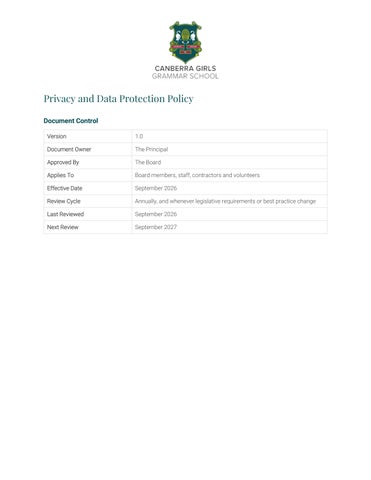
Privacy and Data Protection Policy Document Control Version
1.0
Document Owner
The Principal
Approved By
The Board
Applies To
Board members, staff, contractors and volunteers
Effective Date
September 2026
Review Cycle
Annually, and whenever legislative requirements or best practice change
Last Reviewed
September 2026
Next Review
September 2027
Contents 1. Scope ......................................................................................................................................................................................... 3 2. Purpose ..................................................................................................................................................................................... 3 3. Terms and definitions ............................................................................................................................................................. 3 4. Kinds of personal information we collect ........................................................................................................................... 4 5. How we collect personal information .................................................................................................................................. 5 6. Purposes for which we collect, use and disclose personal information ....................................................................... 6 7. Student Images and Recordings .......................................................................................................................................... 6 8. Automated decision making.................................................................................................................................................. 7 9. Who we disclose personal information to .......................................................................................................................... 8 10. Counselling, Psychological and Medical Records ........................................................................................................... 9 11. How we store personal information .................................................................................................................................. 9 12. Sending and storing information overseas ...................................................................................................................... 9 13. Fundraising and marketing................................................................................................................................................10 14. Data Security of personal information ............................................................................................................................10 15. Access and correction of personal information ............................................................................................................11 16. Parent, Carer and Guardian Access to Student Information .......................................................................................11 17. Consent and right of access to the personal information of students .....................................................................11 18. Child safety, information sharing and record keeping..................................................................................................12 19. Handling and protecting personal and confidential information................................................................................12 20. Retention and secure disposal (confidential waste) ....................................................................................................12 21. Data breach response ........................................................................................................................................................13 22. Surveillance and monitoring of School systems ...........................................................................................................13 23. Use of media management and facial recognition technology..................................................................................14 24. Enquiries and complaints ..................................................................................................................................................14 25. Related policies and other references .............................................................................................................................15 Version History ............................................................................................................................................................................15
Privacy and Data Protection Policy | Page 2 of 15
1. Scope 1.1
This Policy applies to all personal information handled by the School in connection with its educational, boarding, operational and community activities.
1.2
It applies to personal information relating to: •
students (including boarding and international/CRICOS students)
•
parents and carers
•
staff, contractors, volunteers and job applicants
•
alumni, donors and members of the School community
•
any other individuals whose personal information is collected or held by the School.
1.3
This Policy applies to personal information in all forms, including paper records, electronic records, images, video, audio recordings, surveillance records and information stored or processed through digital systems and platforms.
1.4
Employee records: The Privacy Act contains an exemption for employee records where the handling is directly related to a current or former employment relationship. To the extent that exemption applies, this Policy does not regulate those records—however, it does apply to staff health information and to all other personal information handled by the School outside that exemption.
2. Purpose 2.1
The purpose of this Policy is to explain how Canberra Girls Grammar School (the School) collects, uses, stores, discloses and protects personal information in compliance with the Privacy Act 1988 (Cth), the Australian Privacy Principles (APPs) and, where applicable, the Health Records (Privacy and Access) Act 1997 (ACT).
2.2
This Policy aims to:
2.3
•
promote transparent, responsible and lawful handling of personal information
•
protect the privacy, safety and wellbeing of students, families, staff and the School community
•
support compliance with child safety, education, boarding and CRICOS/ESOS obligations
•
set clear expectations for staff, contractors and volunteers in managing personal and sensitive information.
The current version of this policy is published on our website.
3. Terms and definitions TERM
DEFINITION
Automated decision making
Processing of personal information by computer systems or AI tools to make or assist in making decisions. At CGGS, such processes are used to support professional judgement and are not relied on as the sole basis for decisions that significantly affect individuals.
Biometric information
Information derived from physical characteristics (such as facial features) that can be used for automated recognition or matching. At CGGS, this may include encrypted and irreversible facial templates used solely for media consent management.
Privacy and Data Protection Policy | Page 3 of 15
TERM
DEFINITION
Confidential information
Any information relating to the School, staff, students, parents/carers or operations that is not publicly available, including personal information, counselling records, psychological or medical records, internal records, reports, notes, correspondence and any copies in physical or electronic form.
Confidential waste
Any record containing personal or confidential information that is no longer required and must be securely destroyed or permanently de-identified in accordance with the Records Management Policy and Records Retention and Disposal Procedures.
Electronic surveillance
Monitoring of email, internet usage, digital systems, online communications or other electronic activity on School-owned or School paid resources, including web filtering, traffic monitoring and content blocking.
Health information
Information about health, medication, disability, health services provided or wishes about future health services.
Legal hold
A formal direction issued by the School to preserve records and suspend their alteration, deletion, de-identification or destruction where litigation, an investigation, complaint, audit, child safety matter or regulatory enquiry is current or reasonably anticipated. While a legal hold applies, relevant records must be retained regardless of normal disposal timeframes.
Personal information
Information or opinion about an identified individual or a reasonably identifiable individual.
Record/ surveillance record
Information created, received or maintained as evidence of School activities or decisions. This includes personal information captured through CCTV, electronic monitoring, ICT systems, and other approved technologies. Surveillance records form part of personal information and must be handled in accordance with this Policy and the Records Management Policy.
Sensitive information
Personal information of a sensitive nature, including health information, racial or ethnic origin, religious beliefs, biometric information and other categories defined under privacy legislation.
Unsolicited information
Personal information received that the School did not request. If it is not reasonably necessary, it is destroyed or de-identified.
Video and camera surveillance
Use of CCTV or other video recording systems deployed for safety, security, property protection and the discharge of the School’s duty of care. Excludes prohibited areas such as toilets, changing rooms, showers and first aid rooms.
4. Kinds of personal information we collect The types of information the School collects include (but is not limited to) personal information, including health and other sensitive information, about: 4.1
Students and parents/carers before, during and after the course of a student’s enrolment at the School, including: •
name, contact details (including next of kin), date of birth, gender, language background, previous school and religion;
•
parents’ education, occupation, language spoken at home, nationality and country of birth
Privacy and Data Protection Policy | Page 4 of 15
4.2
•
health information (e.g., details of disability and/or allergies, dietary requirements, absence notes, immunisation details, medical reports and names of doctors)
•
NAPLAN results
•
recent school reports
•
information about referrals to government welfare agencies
•
counselling reports
•
any Family Court orders
•
criminal records
Job applicants, staff, volunteers and contractors, including: •
name, contact details (including next of kin), and date of birth
•
information on job applications
•
professional development history
•
salary and payment information, including superannuation details
•
health information where relevant to duties or provided by a staff member (e.g., details of disability and/or allergies), and medical certificates
•
complaint records and investigation reports
•
leave details
•
workplace surveillance information
•
work emails and private emails (when using work email address) and Internet browsing history
4.3
Other people who come into contact with the School, including name and contact details and any other information necessary for the contact with the School.
4.4
In limited circumstances, the School may use systems that generate biometric information, such as encrypted facial recognition templates, derived from photographs or videos. This information is considered sensitive information and is collected and used only for specific, limited purposes, such as supporting the administration and enforcement of media consent preferences.
4.5
The School may collect, receive and hold counselling records and psychological or medical reports relating to students, including information provided by external practitioners. Such information forms part of the School's records and is managed in accordance with this Policy, the School's Counselling Records Policy and the Records Management Policy.
5. How we collect personal information 5.1
The School generally collects personal information about an individual directly from the individual (or their Parent or guardian in the case of students). This includes forms, face-to-face meetings and interviews, emails and telephone calls.
5.2
In some circumstances the School may be provided with personal information about an individual from a third party, for example a report provided by a medical professional, a reference from another school or a referee for a job applicant. If a student transfers to a new school, the new school may collect personal information about the student from the student’s previous school to facilitate the transfer of the student.
5.3
We might also collect personal information by using AI systems to generate it. The kinds of personal information that may be generated by AI systems include those set out above under the heading ‘Kinds of personal information we collect’.
Privacy and Data Protection Policy | Page 5 of 15
5.4
We may also collect personal information through surveillance activities (such as CCTV security cameras) and email monitoring.
5.5
We use fair and lawful means and only collect what is reasonably necessary for the School’s functions and activities. Where we collect from others, or where individuals may be unaware of the collection, we take reasonable steps to notify them (Collection Notices).
6. Purposes for which we collect, use and disclose personal information 6.1
We only use or disclose information for the primary purpose of collection, for a related secondary purpose within reasonable expectations (or directly related to sensitive information), with consent or as required or authorised by law. The purposes for which the School collects, uses and discloses personal information depend on our relationship with you and include the following:
6.2
Students and parents or carers:
6.3
6.4
6.5
•
providing schooling and school activities
•
satisfying the reasonable requests of Parents, students and the School throughout the period of a student’s enrolment at the School
•
making required reports to government authorities
•
keeping Parents informed about matters related to their child’s schooling, through correspondence, apps, newsletters and magazines
•
day-to-day administration of the School
•
looking after students’ educational, social and health wellbeing
•
seeking donations for the School (see the ‘Fundraising’ section of this Privacy Policy)
•
to satisfy the School’s legal obligations and allow the School to discharge its duty of care.
Volunteers: •
to contact you about, and administer, the volunteer position
•
for insurance purposes
•
satisfying the School’s legal obligations, for example, in relation to child protection legislation.
Job applicants and contractors: •
assessing and (if successful) engaging the applicant or contractor
•
administering the individual’s employment or contract
•
seeking donations for the School (see the ‘Fundraising’ section of this Privacy Policy)
•
for insurance purposes
•
satisfying the School’s legal obligations, for example, in relation to child protection legislation.
We take particular care with health information. We generally collect with consent from the individual (or parent/carer where appropriate), or where needed to discharge our duty of care, required or authorised by law, to prevent or lessen a serious threat to life, health or safety.
7. Student Images and Recordings 7.1
The School recognises that student images and recordings constitute personal information and, in some circumstances, may be sensitive in nature.
Privacy and Data Protection Policy | Page 6 of 15
7.2
Staff must only collect, use or disclose student images and recordings for authorised educational, operational or communication purposes and in accordance with the School’s consent and privacy requirements.
7.3
Staff must not take, store, retain or otherwise hold student images or recordings on personal devices or unauthorised systems, except where expressly authorised by the School, and must ensure that any authorised images are transferred to approved School systems as soon as practicable and are not retained on the device.
7.4
Staff must not store, synchronise or back up student images or recordings to personal or unauthorised cloud storage services and must ensure that device settings or applications do not automatically upload such content outside approved School systems.
7.5
Student images and recordings must only be accessed, used and shared through authorised School systems and for approved purposes, and must not be transmitted via personal email accounts, messaging applications or unauthorised platforms.
7.6
The storage, security and retention of student images and recordings is governed by clauses 11, 14 and 20 of this Policy.
8. Automated decision making 8.1
The School may use personal information in the operation of computer programs, digital systems or automated tools to make, or assist staff to make, certain decisions. These processes are referred to as automated decision‑making.
8.2
The School uses AI and automated tools to help staff surface relevant information, identify patterns, or receive alerts. In all cases, these tools assist human judgement; staff remain responsible for any decisions made on the basis of that information. The School does not use automated systems to make decisions autonomously about students, staff or other individuals.
8.3
Depending on the context, personal information used in automated or semi‑automated processes may include:
8.4
•
identifying and contact information
•
enrolment, attendance and timetable information
•
academic progress and assessment data
•
wellbeing, safeguarding, or behavioural indicators generated through School systems
•
ICT system usage data and security alerts
•
other information reasonably necessary for the School’s educational, administrative, safeguarding or legal functions.
Automated systems may be used to: •
support enrolment, timetabling or administrative workflows
•
flag attendance patterns or academic progress for staff review
•
assist in identifying potential wellbeing, safeguarding or ICT security risks for further human assessment
•
support eligibility checks for activities, programs or events
•
assist staff by presenting information, alerts or recommendations for consideration.
Privacy and Data Protection Policy | Page 7 of 15
8.5
Where automated tools are used, decisions that could reasonably be expected to significantly affect an individual’s rights or interests are reviewed and confirmed by appropriate School staff before any action is taken.
8.6
The School maintains oversight of automated decision‑making processes and takes reasonable steps to ensure that: •
automated systems are used lawfully, fairly and proportionately
•
decisions are not made solely by automated means where human review is appropriate
•
personal information used in automated processes is relevant, accurate and secure
•
individuals are treated fairly and consistently.
8.7
Where automated processes involve third-party platforms, the School only engages providers that meet its privacy and security requirements and ensures that appropriate contractual and data protection arrangements are in place.
8.8
The School’s privacy and security requirements are defined in this Policy, including the Data Security provisions at Section 14, and in related ICT and records management frameworks.
8.9
The School will take reasonable steps to notify individuals about the use of automated decision‑making where it is relevant to them, including through this Policy, Privacy Collection Notices, and other School communications. Further information about specific automated systems may be provided on request.
9. Who we disclose personal information to 9.1
The School may disclose personal information, including sensitive information, for educational, care and administrative purposes, and to seek support and advice. This may include: •
other schools and teachers at those schools, including a new school to which a student transfers to facilitate the transfer of the student
•
government departments (including for policy and funding purposes)
•
medical practitioners
•
providers of educational, support and health services to the School, including specialist visiting teachers, [sports] coaches, volunteers, and counsellors
•
organisations that assist us with fundraising (see the ‘Fundraising’ section of this Privacy Policy)
•
providers of specialist advisory services and assistance to the School, including in Human Resources, child protection and support for students with additional needs, and providers of education and ICT systems used by the School for the purposes of administering and supporting those systems (see further the section below ‘Sending and storing information overseas’);
•
regulatory authorities, child protection agencies and other bodies to whom the School is required or authorised to disclose personal information under applicable law, including for mandatory reporting and statutory information sharing purposes;
•
providers of learning and assessment platforms and tools
•
assessment and educational authorities, including the Australian Curriculum, Assessment and Reporting Authority (ACARA) and NAPLAN Test Administration Authorities (who will disclose it to the entity that manages the online platform for NAPLAN)
•
agencies and organisations to whom we are required to disclose personal information for education, funding and research purposes including camp, excursion and tour providers
•
people providing administrative and financial services to the School
Privacy and Data Protection Policy | Page 8 of 15
•
the Schools Information System, the Schools Learning Management System and other information technology services
•
recipients of School publications, such as newsletters and magazines
•
students’ parents or guardians
•
anyone you authorise the School to disclose information to
•
anyone to whom we are required or authorised to disclose the information to by law, including child protection laws
•
Pixevety, as the School’s contracted media management service provider, which supports the secure storage, organisation and management of digital media and assists in applying and enforcing student and staff media consent preferences in accordance with the School’s instructions.
10. Counselling, Psychological and Medical Records 10.1
The School may use and disclose counselling records and psychological or medical reports relating to students to support student wellbeing, safety, educational planning and the discharge of its duty of care obligations where such use or disclosure is authorised by law or would reasonably be expected.
10.2
Access to counselling records and psychological or medical reports is restricted to staff with a legitimate need to know and is managed having regard to the sensitivity of the information and the wellbeing and safety of the student.
10.3
Where appropriate, the School may provide summaries of counselling information or redact particularly sensitive information before sharing information more broadly within the School.
10.4
The creation, management, access, retention and disclosure of counselling records are also governed by the School's Counselling Records Policy and associated procedures.
11. How we store personal information 11.1
We store your personal information in hard copy and electronically.
11.2
We use information management and storage systems provided by third party service providers. Personal information is stored with and accessible by the third-party service providers for the purpose of providing services to the School in connection with the systems.
11.3
The School may use online or ‘cloud’ service providers to store personal information and to provide services to the School that involve the use of personal information. See further the section below ‘Sending and storing information overseas’.
11.4
The School uses media management platforms such as Pixevety to store and manage digital media. These providers may process personal information, including images and associated metadata, under the School’s direction and in accordance with contractual, privacy and security requirements.
12. Sending and storing information overseas 12.1
The School may disclose personal information about an individual to overseas recipients in certain circumstances, for instance, to facilitate a school exchange.
12.2
The School may use online or ‘cloud’ service providers to store personal information and to provide services to the School that involve the use of personal information, such as services relating to email, instant messaging and education and assessment applications.
Privacy and Data Protection Policy | Page 9 of 15
12.3
Some limited personal information may also be provided to these service providers to enable them to authenticate users that access their services and provide technical support. This personal information may be stored in the ‘cloud’ which means that it may reside on a cloud service provider’s servers which may be situated outside Australia. Where a cloud service provider's data is stored outside of Australia, the School provides only limited or de-identified personal information to that third party provider.
12.4
School personnel and its service providers may have the ability to access, monitor, use or disclose emails, communications (e.g., instant messaging), documents and associated administrative data for the purpose of administering these services and ensuring their proper use.
12.5
The School uses AI systems that are provided by third parties. These third parties may store or have access to personal information input into, and/or generated by, these AI systems. These third parties may be located outside Australia.
13. Fundraising and marketing 13.1
The School treats seeking donations for the future growth and development of the School as an important part of ensuring that the School continues to provide a quality learning environment in which both students and staff thrive. Your personal information may be used to make an appeal to you. It may also be disclosed to organisations that assist in the School’s fundraising activities, for example, the Gabriel Foundation and on occasions, external fundraising organisations.
13.2
If you do not want to receive fundraising communications from us, please contact our Advancement Team.
14. Data Security of personal information 14.1
The School has in place steps to protect the personal information the School holds from misuse, interference and loss, unauthorised access, modification or disclosure by use of various methods including locked storage of paper records and password access rights to computerised records.
14.2
These steps include: •
Restricting access to information on the School databases on a need-to-know basis with different levels of security being allocated to staff based on their roles and responsibilities and security profile.
•
Ensuring all staff are aware that they are not to reveal or share personal passwords.
•
Ensuring if personal and health information is stored in hard copy files, these files are stored in lockable filing cabinets in lockable rooms. Access to these records is restricted to staff on a need-to-know basis.
•
Implementing physical security measures around the School buildings and grounds to prevent breakins.
•
Implementing ICT security systems, policies and procedures, designed to protect personal information storage on our computer networks.
•
Implementing human resources policies and procedures, such as email and internet usage, confidentiality and document security policies, designed to ensure that staff follow correct protocols when handling personal information.
•
Undertaking due diligence with respect to third party service providers who may have access to personal information, including cloud service providers, to ensure as far as practicable that they are compliant with the Australian Privacy Principles or a similar privacy regime.
•
Staff must not read or view student files or other confidential information in public locations (including public transport, airports, cafés or any place where others may see the material), as this poses a risk of unauthorised disclosure.
Privacy and Data Protection Policy | Page 10 of 15
15. Access and correction of personal information 15.1
Under the Commonwealth Privacy Act and the Health Records Act, an individual has the right to seek access to, and/or correction of, any personal information which the School holds about them. Students will generally be able to access and update their personal information through their parents or carers, but older students may seek access and correction themselves.
15.2
There are some exceptions to these rights set out in the applicable legislation.
15.3
To make a request to access, update or correct any personal information the School holds about you or your child, please do so via the Parent Portal. For additional assistance, please contact the Student Records Officer at StudentRecordsOfficer@cggs.act.edu.au. The School will require you to verify your identity and specify what information you require.
15.4
If we decide to refuse your request, we will provide you with written notice explaining the reasons for refusal (unless, considering the grounds for refusal, it would be unreasonable to provide reasons) and how to appeal this decision.
16. Parent, Carer and Guardian Access to Student Information 16.1
The School recognises that parents, carers and guardians may have rights to access personal information relating to their child, subject to applicable privacy laws and other legal requirements.
16.2
Requests for access to student information will be managed having regard to the best interests of the student and any relevant court orders, parenting orders, guardianship arrangements or other legal restrictions known to the School.
16.3
Where the School is aware of court orders, parenting arrangements, guardianship arrangements or other lawful restrictions affecting access to student information, personal information will only be accessed, used or disclosed in accordance with those arrangements and the School's legal obligations.
16.4
The School may require documentation or other evidence to establish parental responsibility, guardianship arrangements or authority to access information where necessary.
16.5
The School may refuse, restrict or defer access to personal information where permitted by law, including where disclosure: a. would be inconsistent with a court order or other legal restriction; b. would unreasonably impact the privacy of another individual; or c. may present a risk to the safety, wellbeing or welfare of a student or another person.
17. Consent and right of access to the personal information of students 17.1
The School respects every parent’s or carer’s right to make decisions concerning their child’s education.
17.2
Generally, the School will refer any requests for consent and notices in relation to the personal information of a student to the student’s parents or carers. Generally, the School will treat consent given by parents or carers as consent given on behalf of the student and notice to parents or carers will act as notice given to the student.
17.3
Parents may seek access to personal information held by the School about them or their child by contacting the Principal in writing by email at principal@cggs.act.edu.au. However, there may be occasions when access is denied. Such occasions may include (but are not limited to) where the School believes the student has capacity to consent and the School is not permitted to disclose the information to the parent or carer without the student’s consent, where release of the information would have an unreasonable impact on the privacy of others, or where the release may result in a breach of the School’s duty of care to the student.
Privacy and Data Protection Policy | Page 11 of 15
17.4
The School may, at its discretion, at the request of a student, grant that student access to information held by the School about them or allow a student to give or withhold consent to the use of their personal information, independently of their parents or carers. This would normally be done only when the maturity of the student and/or the student’s personal circumstances warrant it.
18. Child safety, information sharing and record keeping 18.1
As part of its obligations under the ACT Child Safe Standards and the Education Regulation 2005 (ACT), the School must ensure that all personal information relating to students’ safety and wellbeing is managed in accordance with the School’s Child Safety and Wellbeing Policy which requires the School to maintain documented policies and procedures for information sharing and record keeping as part of its child safety framework.
18.2
The School must treat all child safety information as confidential and must ensure that any sharing of information is: •
restricted to nominated personnel; and
•
conducted in accordance with relevant legislative requirements, including the ACT statutory information sharing regime relating to child protection and the wellbeing of children and young people
18.3
These obligations may permit or require the School, its staff, volunteers and contractors to share information with external agencies for the purpose of protecting a child or young person, even where that information would ordinarily be protected by privacy laws.
18.4
The following documents form part of the School’s Child Safety policy and may apply to all personal information collected and handled for child safety purposes:
18.5
•
Child Safety and Wellbeing Policy
•
Child Safety Code of Conduct.
Staff, volunteers and contractors must comply with these policies when creating, storing, accessing, using or disclosing any personal information relating to child safety matters. All records of child safety concerns must be maintained securely and in accordance with these policies and the School’s retention schedules.
19. Handling and protecting personal and confidential information 19.1
The School must protect all confidential and personal information it handles, including information relating to students, staff, parents/carers and the School’s operations. Confidential information includes any notes, electronic records, reports, documents or copies that are not publicly available.
19.2
Staff, contractors and volunteers must:
19.3
•
only access information they are authorised to see
•
always maintain confidentiality
•
ensure confidential information is not disclosed to unauthorised people
•
store information securely, whether in physical or digital form
•
follow all School directions about secure handling of personal information.
Staff, contractors and volunteers must immediately report any actual or suspected accidental access, disclosure, loss or mishandling of personal or confidential information in accordance with the School’s ICT Incident Response Plan and incident reporting procedures.
20. Retention and secure disposal (confidential waste) Privacy and Data Protection Policy | Page 12 of 15
20.1
The School retains personal information only for as long as it is required for lawful and legitimate purposes, including education delivery, duty of care, child safety, regulatory obligations, and the management of complaints, audits, investigations and legal proceedings.
20.2
When personal information is no longer required, and there is no legal reason to keep it, the School securely destroys it or permanently deidentifies it in accordance with the Records Management Policy and the Records Retention and Disposal Procedures and Schedule, using secure shredding for paper records and secure deletion processes for electronic records.
20.3
This includes media records and any associated biometric templates, which are retained only for as long as necessary to manage media consent and are securely deleted in accordance with the School’s Records Management Policy and retention schedule.
20.4
A legal hold applies where a complaint, investigation, child safety matter, audit, or legal proceeding is current or reasonably anticipated. While a legal hold applies, the School will suspend destruction or de‑identification of relevant records until the matter is resolved and the hold is lifted.
20.5
The School keeps required records for each accepted overseas student, including contact details and assessment outcomes, and retains those records for at least two years after the person ceases to be an accepted student. The School also confirms and updates key contact details with accepted students at least every six months while they remain accepted students.
20.6
Boarding records created in connection with boarding accommodation, supervision and pastoral care are retained in accordance with the Records Retention and Disposal Procedures and Schedule, with longer retention applying where records relate to child safety, serious incidents, complaints or significant health and wellbeing matters.
21. Data breach response 21.1
A data breach involves unauthorised access, unauthorised disclosure, or loss of personal information (where loss is likely to result in unauthorised access or disclosure). We act immediately to contain, assess within 30 days and remediate.
21.2
If the breach is likely to result in serious harm, we will notify the affected individuals and the Office of the Australian Information Commissioner as soon as practicable, and review to prevent recurrence.
21.3
Our ICT Incident Response Plan sets out the roles, containment steps, notification options and follow-up actions.
22. Surveillance and monitoring of School systems 22.1
The School conducts monitoring and surveillance activities to maintain the safety and security of students, staff and visitors, and to ensure the appropriate and lawful use of School facilities and ICT systems. Information collected through monitoring and surveillance forms part of personal information and is handled in accordance with this Policy and applicable law, including the Workplace Privacy Act 2011 (ACT).
22.2
The School may undertake video and camera surveillance for safety and security purposes, and computer and electronic surveillance of School ICT systems. Electronic surveillance may include: •
monitoring emails sent using School systems
•
monitoring and blocking access to websites
•
filtering harmful or inappropriate content, and
•
monitoring internet and network activity for cyber-security, wellbeing and compliance purposes.
Privacy and Data Protection Policy | Page 13 of 15
22.3
Surveillance and monitoring are undertaken only for legitimate School purposes, including: •
safety, protection of School property, preventing inappropriate or unlawful online behaviour
•
supporting wellbeing
•
safeguarding, and discharging the School’s duty of care obligations and
•
investigating breaches of School policies, including general conduct and behavioural expectations
22.4
Surveillance is not conducted in prohibited areas such as toilets, showers, changing rooms, sick bays or first-aid rooms.
22.5
The School takes reasonable steps to ensure transparency. Staff are notified of applicable surveillance arrangements in accordance with legal requirements, and students and parents/carers are informed about student ICT monitoring through this Policy, collection notices and the Student ICT Acceptable Use Procedures.
22.6
Access to monitoring and surveillance records is restricted to authorised personnel who require access to perform their duties. Such records may be used only for legitimate School purposes and disclosed only where required or authorised by law, including to law enforcement or relevant safeguarding agencies.
22.7
The School monitors internet and ICT use through system-based controls that identify patterns of use and flag certain activity, including where specified keywords are entered. Where alerts are generated, including those relating to student wellbeing or potential risk, these may be reviewed and acted on by appropriate staff. Monitoring is not continuous and is not actively undertaken outside School operating periods.
22.8
Surveillance records are retained and securely disposed of in accordance with clause 20 of this Policy and the School’s Records Management Policy and Records Retention and Disposal Procedures and Schedule.
23. Use of media management and facial recognition technology 23.1
The School uses Pixevety as its media management platform to securely store and manage photographs and video of School activities.
23.2
Pixevety may use automated face‑matching technology to assist in applying and enforcing media consent preferences for students. This technology creates encrypted and irreversible biometric templates derived from facial features.
23.3
These templates: •
are used solely to manage and enforce media consent;
•
are not used for identification, surveillance or any other purpose; and
•
cannot be reversed to recreate an image.
23.4
The School relies on parent or carer consent for this processing. Consent may be withdrawn at any time.
23.5
Pixevety acts as a contracted service provider and processes personal information only in accordance with the School’s instructions.
24. Enquiries and complaints 24.1
If you would like further information about the way the School manages the personal information it holds or wish to complain that you believe that the School has breached the Australian Privacy Principles or the Health Privacy Principles please contact the Principal by email at principal@cggs.act.edu.au. The School will investigate any complaint and will notify you of the making of a decision in relation to your complaint as soon as is practicable after it has been made.
Privacy and Data Protection Policy | Page 14 of 15
24.2
If you are not satisfied with our response, you may complain to the Office of the Australian Information Commissioner (OAIC) via the OAIC website, www.oaic.gov.au.
25. Related policies and other references •
ICT Incident Response Plan
•
Child Safety and Wellbeing Policy
•
ICT Policy
•
ICT Acceptable Use Procedures (Staff)
•
ICT Acceptable Use Procedures (Students)
•
Records Management Policy (includes Records Retention and Disposal Schedule)
•
Records Management Procedures (Archiving, Access and Disposal)
Use of Data in Educational Practice CGGS recognises that personal and student data is used not only for administrative and compliance purposes, but also to support teaching, learning, wellbeing and school improvement. The principles governing the educational use, analysis and visibility of student data are articulated in the CGGS Data Governance and Use Policy. The Data Governance and Use Policy does not replace or override this Privacy and Data Protection Policy. All collection, storage, access, use, disclosure and retention of personal information, including student data used for educational purposes, must comply with this policy, relevant legislation and regulatory requirements. Where there is any inconsistency between policies, this Privacy and Data Protection Policy take precedence.
Version History VERSION
APPROVED BY
REVISION DATE
DESCRIPTION OF CHANGE
AUTHOR
1.0
The Principal
13 March 2026
Consolidation of policies: Privacy Policy, Privacy Information Protection Policy, Surveillance Policy, Confidentiality and Confidential Waste Policy, Document Security External Policy, Photography and Video Policy and Procedures
Executive Director Strategic Projects and Policy
Reference to new procedures around Student ICT monitoring and after-hours escalation framework Reference to new Records Management Policy, with Records Retention Disposal Schedule (Appendix A) and Records Registers Templates (Appendix B) and Records Management Procedures (Archiving, Access and Disposal)
Privacy and Data Protection Policy | Page 15 of 15