THE CVAA
Newsletter of the Canadian Vascular Access Association
Fall 2020
CVAA Webinar Series The new fall CVAA Webinar Series has launched and is underway. Have you attended any sessions yet? We are thrilled to be able to provide great webinars based on some of the intended content from the 2020 conference. All sessions are archived and available here for CVAA Members. All webinars are free for CVAA members – see you there!
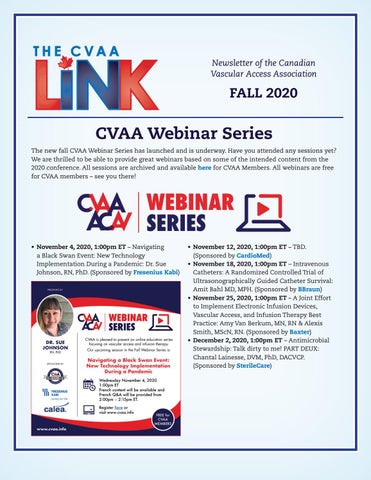
• November 4, 2020, 1:00pm ET – Navigating a Black Swan Event: New Technology Implementation During a Pandemic: Dr. Sue Johnson, RN, PhD. (Sponsored by Fresenius Kabi)
• November 12, 2020, 1:00pm ET – TBD. (Sponsored by CardioMed) • November 18, 2020, 1:00pm ET – Intravenous Catheters: A Randomized Controlled Trial of Ultrasonographically Guided Catheter Survival: Amit Bahl MD, MPH. (Sponsored by BBraun) • November 25, 2020, 1:00pm ET – A Joint Effort to Implement Electronic Infusion Devices, Vascular Access, and Infusion Therapy Best Practice: Amy Van Berkum, MN, RN & Alexis Smith, MScN, RN. (Sponsored by Baxter) • December 2, 2020, 1:00pm ET – Antimicrobial Stewardship: Talk dirty to me! PART DEUX: Chantal Lainesse, DVM, PhD, DACVCP. (Sponsored by SterileCare)
Introcan Safety® IV Catheter
Introcan Safety® 3 IV Catheter
Introcan Safety® Deep Access IV Catheter
INTROCAN SAFETY® FAMILY OF PERIPHERAL IV CATHETERS YOUR SAFETY IS OUR #1 PRIORITY B. Braun Medical offers a portfolio of peripheral IV catheters to help ensure clinician safety and improve outcomes. • Can help reduce needlestick injuries1,3 • Reduces blood exposure2 • Introcan Deep Access has shown a significant increase in catheter survival of 44 hours (1.8 days)4
1. Tosini, et al “Needlestick Injury Rates According to Different Types of Safety-Engineered Devices: Results of a French Multicenter Study“, Infection Control and Hospital Epidemiology, Vol 31, No. 4, April 2010 (p. 402-407). 2. Richardson D, “Reducing blood exposure risks and costs associated with SPIVC insertion”, Nursing Management, vol. 42, no. 12, Dec 2011 (reprint p. 1-4). 3. Infusion Nurses Society (2016) Infusion Therapy Standards of Practice, Journal of Infusion Nursing Supplement, Vol. 39, no. 1S, Std 18, Practice Criteria B. 4. Amit Bahl, MD, MPH; Mahmoud Hijazi, BA; Nai-Wei Chen, PhD; Ludovic Lachapelle-Clavette, BA; Jacob Price, MD. (2020). Ultralong Versus Standard Long Peripheral Intravenous Catheters: A Randomized Controlled Trial of Ultrasonographically Guided Catheter Survival. Ann Emerg Med. pii S0196-0644(19)31383-6. doi: 10.1016/j.annemergemed.2019.11.013
B. Braun Canada Ltd. | Mississauga, ON | 1-855-882-7286 | BBraun.ca Rx only. ©2020 B. Braun Medical Inc.,Bethlehem PA. All rights reserved. 20-0363 10/20
President’s Message What we have heard over and over again in the last six months of an ever-changing world is words such as: thank you; we appreciate you; we are grateful for all you do. In the healthcare environment over these past few months, we have been challenged by fatigue, increased patient loads, and fear for our own health. Yet, we have risen to the challenge. We have put ourselves in vulnerable positions, trying to be as protected as possible, but doing what we need to do for our patients. And this has been met with clapping, the banging of pots and pans, discounts at restaurants, dedicated grocery store hours, food deliveries, and many other ways that people have shown their gratitude to us. The dedication to the amount of resources, webinars, and literature that has been created and delivered around vascular access for COVID-19 patients has been impressive. Experts in vascular access and infusion therapy having been sharing their challenges, trials and successes to better our IV community. These experts have taken to papers and to computers to ensure that all healthcare workers have as much knowledge and skill as possible to better the safety of our patients in this demanding environment. I know that we all thought, and hoped, that social distancing and germ bubbles would never have to be common words in our society. But as we move forward into whatever the future holds, we move as a community that is supported by one another. So, go online and see all the resources that are available to aid healthcare workers in this time. At CVAA, we have also been challenged by this new world, but we have been encouraged by the hope that still shines through and the ways that people have reached out to continue to
support one another. We have also been inspired to change the way we do some things—such as hosting our Fall Webinar series and looking at various options for our 2021 National Conference. I am excited for what the future holds in vascular access and infusion therapy because, as we go on in this pandemic, this area of specialty has been highlighted and recognized for the ever-important piece of healthcare that it is.
Kristie Naayer, RN, BScN, CVAA(c), VA-BC™ President
Fall 2020 | Page 3
Remove the guesswork from your PICC Placement. Find your rhythm.
PICC Navigation Without Calibration The Arrow® VPS Rhythm™ Device with TipTracker™ Technology. Let the VPS Rhythm™ Device be your guide during PICC placement. With the widest sphere of real-time visual navigation on the market, the VPS Rhythm with TipTracker™ Technology allows you to clearly see where your PICC is going by tracing the catheter pathway on the monitor screen. No calibration. No confirmatory chest X-ray.* Compatible with a broad range of PICC brands and sizes, it pairs familiar ECG modality with TipTracker Technology for simple PICC navigation and tip confirmation. Eliminate chest X-ray the easy way. Navigate. Confirm. Eliminate. Find your rhythm.
Click here to Find your Rhythm.
Rx only. * See VPS Rhythm Device Operator’s Manual or TipTracker™ Stylet Instructions for Use for Full Indications for Use. Chest X-ray can be eliminated with appropriate hospital policy and procedures in place. Teleflex, the Teleflex logo, Arrow, TipTracker, and VPS Rhythm are trademarks or registered trademarks of Teleflex Incorporated or its affiliates, in the U.S. and/or other countries. All other trademarks are trademarks of their respective owners. © 2020 Teleflex Incorporated. All rights reserved. MC-002247 Rev 0.1
VASC Workshop Report On January 24, 2020, the first CVAA Student Chapter, the Vascular Access Student Club (VASC) through the McGill Ingram School of Nursing (ISON), had the opportunity to lead four successful workshop sessions at the 2020 Canadian Nursing Students’ Association (CNSA) annual conference held in Montreal. The workshops, which were presented to 100 nursing students from across Canada, were entitled “Making Vascular Access a Success: PIV Innovations” and “Harm Reduction and Naloxone Training,” and were led by the VASC-McGill Executive Team
(Madolyn Connolly, VP Internal, Catherine Farmer, VP External, and Miranda Harrington, President and CVAA Student Ambassador) in collaboration with the McGill Harm Reduction Initiative organizer, Leigh Hoffman. The “Making Vascular Access a Success” workshop aimed to expose nursing students to innovations in PIV technology and provide an opportunity for hands-on PIV insertion practise. This workshop consisted of an introduction to intraosseous vascular access infusion and insertion techniques, and vein light operation and
Fall 2020 | Page 5
application, followed by PIV insertion practise courtesy of the Ingram School of Nursing Satoko Shibata Clinical Nursing Laboratories and supported by BBraun of Canada. At the Harm Reduction and Naloxone Training workshops attendees were provided with basic knowledge of harm reduction strategies in the current context of the opioid crisis. The participants were also trained in the administration of naloxone as an opioid overdose intervention and given the opportunity to practise intramuscular injection techniques. continued…
The CNSA workshop experience empowered the VASC-McGill Executive Team with the opportunity to share knowledge, facilitate discussion, and promote continuing education on vascular access amongst fellow nursing students. The opportunity to apply previously acquired knowledge also helped to consolidate vascular access and infusion nursing skills, as well as the StrengthsBased Nursing approach, learned through the ISON’s Vascular Access and Infusion Nursing (VAIN) framework. Furthermore, the workshops
enabled like-minded peers from across Canada to network, learn from each other, and further explore the specialty of vascular access, an opportunity which is currently unavailable in many undergraduate nursing settings. After the workshops, participants provided positive verbal feedback to the VASCMcGill Executive Team regarding the peer-led workshop format, expressing that the experience was less intimidating than the traditional faculty-presenter. Participants also reported being less fearful of asking ‘silly questions’ during discussion
The World Congress of Vascular Access (WoCoVA) is a multi-disciplinary and multiprofessional foundation which promotes the science of vascular access. It is a bi-annual congress (conference) where professionals from all over the world can share the latest research and innovations. Further information regarding WoCoVA can be found at www.wocova.com. WoCoVA has grown in the last 10 years to much more than a congress. In order to better organize the worldwide efforts and actions in the field of vascular access an overarching organization to cover all activities has been created. The Global Vascular Access Network
periods. Many participants were inspired to learn more about the process of becoming a CNSA speaker and about the resources offered by VASC-McGill. We feel that this experience sparked a greater interest in peer leadership surrounding nursing skill acquisition and practice throughout both CNSA attendees and McGill ISON students. The 2019–2020 VASC Executive Team Madolyn Connolly Catherine Farmer Miranda Harrington
(GloVANet) is the umbrella vascular access organization recently created out of Amsterdam, with WoCoVA being the largest and most important activity. In addition to WoCoVA, areas within GloVANet are Education & Training, Data & Research and Other Projects. GloVANet aims to be the worldwide network to enhance global awareness on vascular access and improve patient care. CVAA is excited to be partnering with WoCoVA and GloVaNet and working toward achieving our Mission Statement of ensuring optimal patient outcomes through this partnership with education, knowledge, and research in vascular access and infusion therapy. More information to come!
Fall 2020 | Page 6
Members’ Q&A Forum – Sosido The Members’ Q&A Forum through Sosido is one of the most used benefits of your CVAA membership—are you taking advantage of the knowledge from your colleagues across the country? If you don’t know how to log in, email Melissa at cvaa@cvaa.info and join everyone! This year alone, there has been more than 50 questions that have been answered by other CVAA members. The Forum is a great way to learn how others are practising and share tips and tricks. Here is a small sampling of the types of questions that have been asked recently. Log in today to see all the responses. Q1: If a patient has a blocked PICC line (assuming it is a double lumen and only one is blocked, sluggish, etc.) do we administer Alteplase to ALL the lumens or just the blocked ones? Q2: Looking for information related to the frequency of flushing for pediatric implanted ports. We currently state every 4 weeks if not in use, but we have heard that there is a move towards every 8 weeks. I am also interested in flushing volumes.
Q3: What facilities are using the chlorhexidine dressings for short-term, non-tunneled CVCs? Is the standard of practice for all facilities to use the chlorhexidine dressing for all CVCs or is it just when there is an infection suspected? Q4: With the mask shortage due to the COVID-19 pandemic, how are your homecare nurses providing care for patients who require CVAD procedures that require a mask?
Fall 2020 | Page 7
Q5: Many of our patients are now having their blood work drawn in the community rather than the cancer centres with the pandemic. Phlebotomists/lab technicians cannot access central lines. What is recommended for patients who had mastectomy on one side and have an implanted CVAD on the other arm? Phlebotomy distal to the IVAD with or without a tourniquet, or not at all?
ACCESS MANAGEMENT A FULLY INTEGRATED PROGRAM THAT DELIVERS END-TO-END CARE. At BD, we believe that truly effective vascular access therapy starts long before the first IV is ever inserted. That’s why we designed the BD® Vascular Access Management program: an integrated solution that spans the continuum of vascular access care. The program aims to help clinicians reduce complications and improve quality of care by standardizing on industry best practices throughout the entire process. With the combined expertise of BD and BARD—now as one BD—our program offers in-depth assessments, evidence-based recommendations, training and education, and world-class tools and technologies. Discover total vascular access management designed to deliver better clinical and economic outcomes. Discover the new BD.
Learn more at bd.com/TotalManagement BD and the BD Logo are trademarks of Becton, Dickinson and Company or its affiliates. © 2019 BD. All rights reserved. BD-9535 (0419)
Become a Vascular Access Author
The Canadian Vascular Access Association (CVAA) is dedicated to publishing articles that promote safe, high-quality care in vascular access, infusion therapy, and healthcare in general. A blind peer-reviewed academic journal, we bring leading-edge discoveries, knowledge and best practice experience forward, so valuable innovations and ideas can drive standards toward continued excellence. Why should you want to become one of our authors? Don’t underestimate or discount your experience, your wisdom or impact. • Spotlighting your research, ideas and expertise raises your profile as a leader in
this complex field, while contributing to practice improvement. • Increase your knowledge’s value by sharing it with other health professionals. • By exploring and educating, your article models and drives excellence in quality care and may inspire a breakthrough idea. What we are looking for Manuscripts submitted must be evidence-based and unbiased contributions to the improvement of vascular access and infusion therapy practice, presented in any of the following categories: • quantitative research – e.g., prospective, randomized control trial, retrospective, literature review, systematic review, etc.; and
Fall 2020 | Page 9
• qualitative research – e.g., data analysis, survey results and analysis, patient voice, etc. randomized control trial protocol. In addition to clinical research, CVAA is looking for manuscripts regarding best practice implementation or knowledge translation for the “Collaborating for Best Practice” column. • Share best practice guideline implementation within local context. Keep your article to 600–800 words (excluding title, references and any tables or charts) and include the description of the clinical situation or concern, its relevance to infusion therapy, solution, and results.
From you we need the following: • A statement of all possible conflicts of interest—sources of funding, any related relationships that potentially cause bias or conflict of interest • A cover letter indicating work is original, author affiliations with universities or medical establishments, contact information of senior author, brief biography(ies) (15-20 words) of author(s), assurance submission for publication is unique to CVAA • Double-spaced, approximately 2,500 words including figure legends or tables and excluding references—longer articles by editor’s approval only • Structured abstract for scientific articles, up to 200 words including headings of: Purpose, Methods, Results and Conclusions. Non-scientific abstracts are unstructured • Succinct, meaningful headings and subheadings, clearly dividing content • Manuscript sent by email attachment (Word), graphics sent in separate file • Permission to reprint previously published material must be acquired by author • APA formatting for references
– in-text citations in authordate method • Tables and images or graphics on separate document using high-resolution images • Illustrations sent separately as a TIFF or JPEG file not embedded in text—for detailed instruction, please see link to complete author’s guidelines available at https:// cvaa.info/en/publications/ vascular-access-journal or contact editor@cvaa.info • All measurements in metric, physical quantities and time units expressed in numerals. • Use only standard abbreviations/acronyms, defined at first mention and not in title. • Copy of all permissions and release forms accompany submitted manuscript and remain property of CVAA • No reference made to patient’s identity, no use of names, initials, hospital numbers, dates or personal histories From us you can expect the following: • All manuscripts submitted to CVAA are reviewed by the editor and publications committee chair for suitability and clinical relevance, then sent for blind reviews by a panel of experts.
Fall 2020 | Page 10
• The panel looks for timeliness, importance, accuracy, clarity and applicability. • We comply with “Uniform requirements for manuscripts submitted to biomedical journals” (http://www.icmje. org). • Our editorial policies align with those of the Council of Science Editors (http://www. councilscienceeditors.org/ services/draft_approved.cfm). • The author(s) of the article retain(s) copyright, and upon acceptance of the manuscript, they agree to name CVAA’s journal, Vascular Access, as first publisher in all citations, republications, or listings in any database or retrieval system. • We hold the right to edit manuscripts, without affecting scientific content, to ensure conformity with the journal’s style. • We do not tolerate plagiarism. Please submit manuscripts to: Manuscripts should be submitted via e-mail to publications@cvaa.info. Note: Detailed author guidelines are available from editor@cvaa. info.
Cathflo (alteplase, recombinant) has been available in Canada for 18 years
Pr
®
CATHFLO is indicated for the restoration of function to central venous access devices. Consult the product monograph at http://www.rochecanada. com/PMs/Cathflo/Cathflo_PM_E.pdf for contraindications, warnings, precautions, adverse reactions, interactions, dosing, and conditions of clinical use. The product monograph is also available ourmarket drug Re-designthrough of U.S. logo for Canadian as per G. Downie (text converted to outline and saved as Illustrator eps) - Judy Updated on May 5, 2003 to reflect the registration. Colour: PMS 2627- Mirja information department. Call us at 1-888-762-4388.
© Copyright 2020, Hoffmann-La Roche Limited CATHFLO® Registered trade-mark of Genentech, Inc., used under license
(alteplase) 2 mg
Hoffmann-La Roche Limited Mississauga, ON L5N 5M8 10140E20v
Defined "O"
(alteplase) 2 mg
Join the 2021–2022 Board of Directors This is an extraordinary opportunity for individuals who are passionate about CVAA’s mission and are interested in leadership, affecting change and furthering the association. There several positions available at this time and all CVAA members are invited to apply. Board of Directors positions each carry a two (2)-year term, unless otherwise listed. The available positions for 2021-2022 are: • 3 Directors-At-Large • 1 Treasurer Elect (Treasurer in 2022) • 1 Student Ambassador. Expectations for ALL Directors are in the Governance Manual here. Ideal candidates will have the following qualifications: • understand and demonstrate a commitment to CVAA, our mission and our programs • keep up to date with issues and trends that affect the organization • prepare for meetings by reading agendas, minutes, reports and other documentation required to actively participate in them • contribute skills and knowledge by participating actively in meetings and committee work • work collaboratively as a team • personal qualities of integrity, credibility, and a passion for improving the practice of vascular access/infusion therapy. Directors-At-Large (See the full role description here) Some key points and expectations for DirectorsAt-Large for the 2021-2022 term: • are CVAA(c) certified or obtain the certification within first year of their term • participate in monthly Board meetings by videoconference
• participate in other meetings and activities called by the President for various issues, as required • attend the CVAA national conference, April 27 30, 2021 in Winnipeg, MB or virtually - TBD • attend a meeting in early January TBD, 2021 (location TBD or virtually) Service on the CVAA Board of Directors is without remuneration, except for administrative support, travel, and accommodation costs in relation to duties. Applications are due by November 6, 2020 at 4:00pm ET and must be submitted through the CVAA website here. Voting by electronic vote will be open to all members during the month of November 2020. Please contact cvaa@cvaa.info with any questions. We hope you will consider submitting your application to be a part of the CVAA National Board of Directors!
Fall 2020 | Page 12
Submit your name here
Student Ambassador The Student Ambassador is a non-voting advisory position appointed by the CVAA Board of Directors. The position is designated for a student in full-time post-secondary education in the nursing field. The Student Ambassador will advocate for CVAA to students and new graduates and will provide the Board of Directors with a student perspective and education connections. The role will also include the promotion and continued development of the Vascular Access Student Club CVAA chapters, as well as acting as a liaison between the executive members of the Vascular Access Student Club CVAA chapters and CVAA National. A Student Ambassador shall serve a two (2)-year term of office and may not serve more than one (1) term. Attendance at monthly Board meetings via video conference and participation on committees are required. Why Become a CVAA Student Ambassador? • valuable learning opportunity • development of communication, organizational, and management skills • gain experience and insight into vascular access and infusion therapy issues • expand vascular access opportunities within your school and community • show demonstrated contribution and ability to future employers • receive reference letter post-term
• free full student rate conference registration for the national conference each year • free student membership during term. Service on the CVAA Board of Directors is without remuneration, except for administrative support, travel, and accommodation costs in relation to duties. Applications are due by November 6, 2020 at 4:00pm ET and must be emailed to Melissa Stark at cvaa@cvaa.info. Please send a current CV and letter of interest. Telephone interviews will be held with short-listed candidates. The Student Ambassador position will be appointed by the Board of Directors in December 2020. Please contact cvaa@cvaa.info with any questions. We hope you will consider submitting your nomination to be a part of the CVAA National Board of Directors!
Thank You Kathleen! The CVAA Board of Directors wishes to thank Kathleen Toth for her time and participation on the CVAA Board beginning in January 2019. Kathleen is a vascular access clinician with Vernon Jubilee Hospital in the interior of B.C. Her expertise and years of experience have provided great value at the Board table. She ended her Board term this past September and we wish her all the best.
Fall 2020 | Page 13
Now accepting Abstracts for the 2021 CVAA Conference! We are now accepting abstract submissions for Plenary, Concurrent, Skills Labs and Poster Presentations for the April 28–30, 2021 CVAA National Conference in Winnipeg, MB, and virtually online! Get all the information and submit online here. Submissions are accepted until OCTOBER 30, 2020. Please forward to your colleagues. Save the date and see you next year!
Fall 2020 | Page 14
TECHNOLOGY YOU CAN TRUST
87
% LESS
THROMBUS
ACCUMULATION COMPARED TO COMMONLY USED PICCS (BASED ON PLATELET COUNT)†
BioFlo Midline with Endexo technology
Go wireless C3 Wave tip location system
Implantable Port with a Smart Port body and BioFlo Catheter
† The reduction in thrombus accumulation (based on platelet count) is supported by acute in-vitro testing. Pre-clinical in-vitro evaluations performed up to two hours using bovine blood do not necessarily predict clinical performance with respect to thrombus formation. Refer to instructions for use provided with BioFlo PICC, BioFlo Midline, C3 Wave System, Smart Port and SmartPort+ Implantable Port. Please refer to the complete instructions, warnings, precautions, potential complications and contraindications prior to use of these products. Complete risk information for these products can be found at: https://www.angiodynamics.com/about-us/risk-information/ AngioDynamics, the AngioDynamics logo, Smart Port, Smart Port+, BioFlo and the BioFlo logo are trademarks and/or registered trademarks of AngioDynamics, Inc., an affiliate or subsidiary. C3 Wave and the C3 Wave logo are trademarks and/or registered trademarks of AngioDynamics VA LLC. All other trademarks are property of their respective owners. ©2020 AngioDynamics, Inc. GL/VA/AD/455 Rev 01 10/2020